IChO 1974 · Theory problem 3
Acid-base reactions of 0.2 M solutions A-H
The following 0.2 molar solutions are available:
| A: \(\ce{HCl}\) | B: \(\ce{HSO4-}\) | C: \(\ce{CH3COOH}\) | D: \(\ce{NaOH}\) |
| E: \(\ce{CO3^2-}\) | F: \(\ce{CH3COONa}\) | G: \(\ce{HPO4^2-}\) | H: \(\ce{H2SO4}\) |
Problems:
- Determine the concentration of \(\ce{H3O+}\) ions in solution C.
- Determine pH value in solution A.
- Write an equation for the chemical reaction that takes place when substances B and E are allowed to react and mark conjugate acid-base pairs.
- Compare acid-base properties of substances A, B, and C and determine which one will show the most basic properties. Explain your decision.
- Write a chemical equation for the reaction between substances B and G, and explain the shift of equilibrium.
- Write a chemical equation for the reaction between substances C and E, and explain the shift of equilibrium.
- Calculate the volume of D solution which is required to neutralise 20.0 \(\mathrm{cm^3}\) of H solution.
- What would be the volume of hydrogen chloride being present in one litre of A solution if it were in gaseous state at a pressure of 202.65 kPa and a temperature of 37 °C?
Ionisation constants:
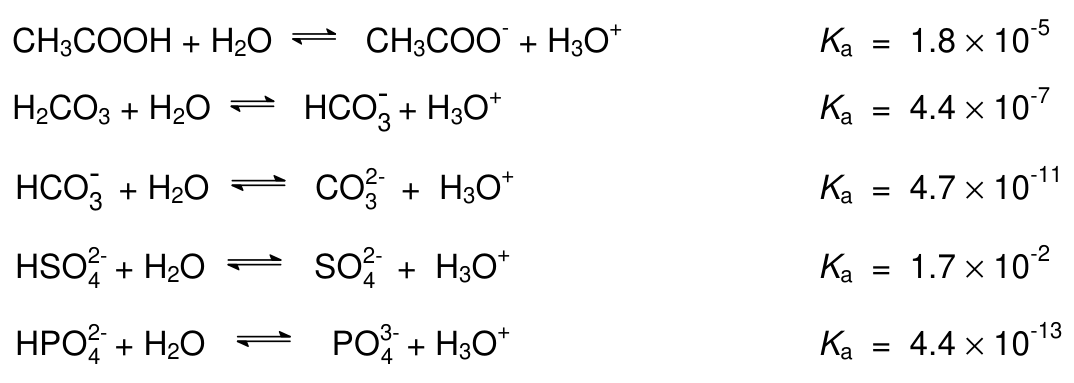
Relative atomic masses:
\(A_{\mathrm r}(\ce{Na})=23;\quad A_{\mathrm r}(\ce{S})=32;\quad A_{\mathrm r}(\ce{O})=16.\)
Official English text of the problem.
Answers
- \(\boxed{[\ce{H3O+}]=1.9\times10^{-3}\ \mathrm{mol\,dm^{-3}}}\).
- \(\boxed{\mathrm{pH}=0.70}\).
- \(\ce{HSO4- + CO3^2- <=> SO4^2- + HCO3-}\). Conjugate pairs: \(\ce{HSO4-}/\ce{SO4^2-}\) and \(\ce{HCO3-}/\ce{CO3^2-}\).
- Acid strength: \(\boxed{A>B>C}\). C has the highest pH and is least acidic; B is amphiprotic. These distinguish two possible readings of “most basic properties.”
- \(\ce{HSO4- + HPO4^2- <=> SO4^2- + H2PO4-}\), favouring the products. The constant needed to calculate its equilibrium constant is not supplied.
- \(\ce{CH3COOH + CO3^2- <=> CH3COO- + HCO3-}\), with \(\boxed{K=3.8\times10^5}\), strongly favouring the products. With sufficient acid, further reaction releases \(\ce{CO2}\).
- \(\boxed{V_D=40.0\ \mathrm{cm^3}}\).
- \(\boxed{V\approx2.54\ \mathrm{dm^3}}\), treating the gas as ideal.
Solution
The species names and SMILES used in the answers and calculations are collected below. SMILES represent connectivity and formal charges; they do not show aqueous solvation, resonance delocalisation, or the direction of proton transfer. Dots separate ionic components of salts.
| Species | Name | SMILES |
|---|---|---|
| \(\ce{HCl}\) | Hydrogen chloride | Cl |
| \(\ce{HSO4-}\) | Hydrogen sulfate ion | O=S(=O)(O)[O-] |
| \(\ce{CH3COOH}\) | Acetic acid | CC(=O)O |
| \(\ce{NaOH}\) | Sodium hydroxide | [Na+].[OH-] |
| \(\ce{CO3^2-}\) | Carbonate ion | O=C([O-])[O-] |
| \(\ce{CH3COONa}\) | Sodium acetate | CC(=O)[O-].[Na+] |
| \(\ce{HPO4^2-}\) | Hydrogen phosphate ion | O=P(O)([O-])[O-] |
| \(\ce{H2SO4}\) | Sulfuric acid | O=S(=O)(O)O |
| \(\ce{H2O}\) | Water | O |
| \(\ce{H3O+}\) | Hydronium ion | [OH3+] |
| \(\ce{Cl-}\) | Chloride ion | [Cl-] |
| \(\ce{CH3COO-}\) | Acetate ion | CC(=O)[O-] |
| \(\ce{SO4^2-}\) | Sulfate ion | O=S(=O)([O-])[O-] |
| \(\ce{HCO3-}\) | Hydrogen carbonate ion | O=C(O)[O-] |
| \(\ce{H2CO3}\) | Carbonic acid | O=C(O)O |
| \(\ce{CO2}\) | Carbon dioxide | O=C=O |
| \(\ce{H2PO4-}\) | Dihydrogen phosphate ion | O=P(O)(O)[O-] |
| \(\ce{PO4^3-}\) | Phosphate ion | O=P([O-])([O-])[O-] |
| \(\ce{Na2SO4}\) | Sodium sulfate | [Na+].[Na+].[O-]S(=O)(=O)[O-] |
The calculations use the usual concentration approximation for aqueous equilibria.
1. Hydronium concentration in C
Acetic acid dissociates according to
\[ \ce{CH3COOH + H2O <=> CH3COO- + H3O+}. \]
Let \(c_0=0.2\ \mathrm{mol\,dm^{-3}}\) and let \(x=[\ce{H3O+}]\). Neglecting the very small contribution from water,
\[ [\ce{CH3COO-}]=x,\qquad [\ce{CH3COOH}]=c_0-x. \]
Thus
\[ K_a=\frac{x^2}{c_0-x}=1.8\times10^{-5}. \]
Solving the quadratic gives
\[ x=\frac{-K_a+\sqrt{K_a^2+4K_ac_0}}{2} =1.8884\times10^{-3}\ \mathrm{mol\,dm^{-3}}. \]
Therefore,
\[ \boxed{[\ce{H3O+}]\approx1.9\times10^{-3}\ \mathrm{mol\,dm^{-3}}}. \]
The approximation \(x\approx\sqrt{K_ac_0}\) gives the same rounded result. Only \(0.94\%\) of the acid dissociates, so that approximation is justified.
2. pH of A
Hydrogen chloride is a strong acid and is essentially completely ionised:
\[ \ce{HCl + H2O -> H3O+ + Cl-}. \]
Consequently,
\[ [\ce{H3O+}]=0.2\ \mathrm{mol\,dm^{-3}}, \]
and
\[ \boxed{\mathrm{pH}=-\log_{10}(0.2)=0.699\approx0.70}. \]
3. Reaction between B and E; conjugate pairs
Hydrogen sulfate donates a proton to carbonate:
\[ \boxed{\ce{HSO4- + CO3^2- <=> SO4^2- + HCO3-}}. \]
The conjugate acid–base pairs, written acid first, are
\[ \underbrace{\ce{HSO4-}/\ce{SO4^2-}}_{\text{proton donor and its conjugate base}}, \qquad \underbrace{\ce{HCO3-}/\ce{CO3^2-}}_{\text{conjugate acid and proton acceptor}}. \]
The equilibrium constant for this proton transfer is
\[ K=\frac{K_a(\ce{HSO4-})}{K_a(\ce{HCO3-})} =\frac{1.7\times10^{-2}}{4.7\times10^{-11}} =3.6\times10^8. \]
Hence the reaction strongly favours the products.
If at least two equivalents of hydrogen sulfate are supplied per carbonate ion, a second proton transfer is possible:
\[ \ce{HSO4- + HCO3- <=> SO4^2- + H2CO3}, \]
followed by
\[ \ce{H2CO3 <=> CO2 + H2O}. \]
The additional conjugate pair is \(\ce{H2CO3}/\ce{HCO3-}\). With carbon dioxide escaping, the overall reaction is
\[ \ce{2HSO4- + CO3^2- -> 2SO4^2- + CO2 ^ + H2O}. \]
4. Acid–base properties of A, B, and C
Their acid strengths decrease in the order
\[ \boxed{\ce{HCl}>\ce{HSO4-}>\ce{CH3COOH}}. \]
Hydrogen chloride is a strong acid. Hydrogen sulfate has \(K_a=1.7\times10^{-2}\), whereas acetic acid has the much smaller \(K_a=1.8\times10^{-5}\).
For equal analytical concentrations, their approximate hydronium concentrations and pH values are:
| Solution | \([\ce{H3O+}]\), \(\mathrm{mol\,dm^{-3}}\) | pH |
|---|---|---|
| A | \(0.200\) | \(0.70\) |
| B | \(0.0504\) | \(1.30\) |
| C | \(0.00189\) | \(2.72\) |
For B, the value follows from \(x^2/(0.2-x)=1.7\times10^{-2}\).
Thus, if “most basic” means the highest pH among the three solutions, the answer is C. All three solutions are nevertheless acidic.
There is a separate distinction: B is amphiprotic in the usual aqueous acid–base classification. It can donate a proton,
\[ \ce{HSO4- + H2O <=> SO4^2- + H3O+}, \]
or accept a proton in a sufficiently acidic medium,
\[ \ce{HSO4- + H3O+ <=> H2SO4 + H2O}. \]
Consequently, B is the answer if the intended identification is the species displaying both acid and base behaviour. Amphiprotic character alone does not establish a ranking of intrinsic proton-acceptor basicity.
5. Reaction between B and G
Hydrogen sulfate acts as the proton donor and hydrogen phosphate as the proton acceptor:
\[ \boxed{\ce{HSO4- + HPO4^2- <=> SO4^2- + H2PO4-}}. \]
The equilibrium favours the products because dihydrogen phosphate is a weaker acid than hydrogen sulfate: proton transfer produces the weaker acid–base pair.
The equilibrium constant would be
\[ K= \frac{[\ce{SO4^2-}][\ce{H2PO4-}]} {[\ce{HSO4-}][\ce{HPO4^2-}]} = \frac{K_a(\ce{HSO4-})}{K_a(\ce{H2PO4-})}. \]
However, \(K_a(\ce{H2PO4-})\) is not supplied. The listed value \(4.4\times10^{-13}\) describes
\[ \ce{HPO4^2- + H2O <=> PO4^3- + H3O+}, \]
and cannot be used as the denominator for the requested reaction. Thus the direction stated above uses the qualitative acid-strength relationship; a numerical equilibrium constant cannot be calculated from the supplied table alone.
6. Reaction between C and E
Acetic acid transfers a proton to carbonate:
\[ \boxed{\ce{CH3COOH + CO3^2- <=> CH3COO- + HCO3-}}. \]
Its equilibrium constant is
\[ K=\frac{K_a(\ce{CH3COOH})}{K_a(\ce{HCO3-})} =\frac{1.8\times10^{-5}}{4.7\times10^{-11}} =\boxed{3.8\times10^5}. \]
Therefore, the equilibrium lies strongly to the right. Acetic acid is much stronger than hydrogen carbonate as a proton donor.
With additional acetic acid, hydrogen carbonate also accepts a proton:
\[ \ce{CH3COOH + HCO3- <=> CH3COO- + H2CO3}. \]
For this step,
\[ K=\frac{1.8\times10^{-5}}{4.4\times10^{-7}} \approx41, \]
so it also favours the products. Carbon dioxide formation and escape drive the reaction further:
\[ \ce{H2CO3 <=> CO2 + H2O}. \]
With two acid equivalents per carbonate ion, the overall reaction is
\[ \boxed{\ce{2CH3COOH + CO3^2- -> 2CH3COO- + CO2 ^ + H2O}}. \]
7. Volume of D needed to neutralise H
Complete neutralisation requires two moles of sodium hydroxide per mole of sulfuric acid:
\[ \ce{H2SO4 + 2NaOH -> Na2SO4 + 2H2O}. \]
The amount of sulfuric acid is
\[ n(\ce{H2SO4}) =0.2\ \mathrm{mol\,dm^{-3}}\times20.0\times10^{-3}\ \mathrm{dm^3} =4.00\times10^{-3}\ \mathrm{mol}. \]
Therefore,
\[ n(\ce{NaOH})=8.00\times10^{-3}\ \mathrm{mol}, \]
and
\[ V_D= \frac{8.00\times10^{-3}\ \mathrm{mol}} {0.2\ \mathrm{mol\,dm^{-3}}} =0.0400\ \mathrm{dm^3}. \]
Thus,
\[ \boxed{V_D=40.0\ \mathrm{cm^3}}. \]
The common molarity cancels, so the required base volume is exactly twice the acid volume under the stated conditions.
8. Volume of gaseous hydrogen chloride
One litre of solution A contains the equivalent of
\[ n(\ce{HCl}) =0.2\ \mathrm{mol\,dm^{-3}}\times1\ \mathrm{dm^3} =0.2\ \mathrm{mol}. \]
Using the ideal-gas equation,
\[ V=\frac{nRT}{p}, \]
with
\[ T=37+273.15=310.15\ \mathrm K,\qquad R=8.314\ \mathrm{kPa\,dm^3\,mol^{-1}\,K^{-1}}, \]
gives
\[ V= \frac{(0.2)(8.314)(310.15)}{202.65}\ \mathrm{dm^3} =2.5449\ \mathrm{dm^3}. \]
Hence,
\[ \boxed{V\approx2.54\ \mathrm{dm^3}}, \]
or about \(2.5\ \mathrm L\).
The solution was checked against the official solution.
IChO 1974 · Theorieaufgabe 3
Säure-Base-Reaktionen von 0.2 M Lösungen A-H
Die folgenden 0.2-molaren Lösungen stehen zur Verfügung:
| A: \(\ce{HCl}\) | B: \(\ce{HSO4-}\) | C: \(\ce{CH3COOH}\) | D: \(\ce{NaOH}\) |
| E: \(\ce{CO3^2-}\) | F: \(\ce{CH3COONa}\) | G: \(\ce{HPO4^2-}\) | H: \(\ce{H2SO4}\) |
Aufgaben:
- Bestimmen Sie die Konzentration der \(\ce{H3O+}\)-Ionen in Lösung C.
- Bestimmen Sie den pH-Wert in Lösung A.
- Stellen Sie eine Gleichung für die chemische Reaktion auf, die stattfindet, wenn die Stoffe B und E miteinander reagieren, und kennzeichnen Sie die konjugierten Säure-Base-Paare.
- Vergleichen Sie die Säure-Base-Eigenschaften der Stoffe A, B und C und bestimmen Sie, welcher davon die stärksten basischen Eigenschaften aufweist. Begründen Sie Ihre Entscheidung.
- Stellen Sie eine chemische Gleichung für die Reaktion zwischen den Stoffen B und G auf und erläutern Sie die Verschiebung des Gleichgewichts.
- Stellen Sie eine chemische Gleichung für die Reaktion zwischen den Stoffen C und E auf und erläutern Sie die Verschiebung des Gleichgewichts.
- Berechnen Sie das Volumen der Lösung D, das zur Neutralisation von 20.0 \(\mathrm{cm^3}\) der Lösung H benötigt wird.
- Welches Volumen hätte der in einem Liter der Lösung A enthaltene Chlorwasserstoff, wenn er bei einem Druck von 202.65 kPa und einer Temperatur von 37 °C gasförmig vorläge?
Ionisationskonstanten:
Relative Atommassen:
\(A_{\mathrm r}(\ce{Na})=23;\quad A_{\mathrm r}(\ce{S})=32;\quad A_{\mathrm r}(\ce{O})=16.\)
Aufgabentext aus dem offiziellen englischen Text übersetzt.
Antworten
- \(\boxed{[\ce{H3O+}]=1.9\times10^{-3}\ \mathrm{mol\,dm^{-3}}}\).
- \(\boxed{\mathrm{pH}=0.70}\).
- \(\ce{HSO4- + CO3^2- <=> SO4^2- + HCO3-}\). Konjugierte Paare: \(\ce{HSO4-}/\ce{SO4^2-}\) und \(\ce{HCO3-}/\ce{CO3^2-}\).
- Säurestärke: \(\boxed{A>B>C}\). C hat den höchsten pH-Wert und ist am wenigsten sauer; B ist amphiprotisch. Diese Aussagen unterscheiden zwei mögliche Deutungen von „stärkste basische Eigenschaften“.
- \(\ce{HSO4- + HPO4^2- <=> SO4^2- + H2PO4-}\), wobei das Gleichgewicht auf der Produktseite liegt. Die zur Berechnung der Gleichgewichtskonstante benötigte Konstante ist nicht angegeben.
- \(\ce{CH3COOH + CO3^2- <=> CH3COO- + HCO3-}\), mit \(\boxed{K=3.8\times10^5}\), wobei das Gleichgewicht stark auf der Produktseite liegt. Bei ausreichender Säuremenge wird durch eine weitere Reaktion \(\ce{CO2}\) freigesetzt.
- \(\boxed{V_D=40.0\ \mathrm{cm^3}}\).
- \(\boxed{V\approx2.54\ \mathrm{dm^3}}\), wenn das Gas als ideal betrachtet wird.
Lösung
Die Namen und SMILES der in den Antworten und Berechnungen verwendeten Spezies sind im Folgenden zusammengestellt. SMILES geben die Verknüpfung der Atome und die Formalladungen wieder; sie zeigen weder die Solvatation in wässriger Lösung noch die mesomere Delokalisierung oder die Richtung der Protonenübertragung. Punkte trennen die ionischen Bestandteile von Salzen.
| Spezies | Name | SMILES |
|---|---|---|
| \(\ce{HCl}\) | Chlorwasserstoff | Cl |
| \(\ce{HSO4-}\) | Hydrogensulfat-Ion | O=S(=O)(O)[O-] |
| \(\ce{CH3COOH}\) | Essigsäure | CC(=O)O |
| \(\ce{NaOH}\) | Natriumhydroxid | [Na+].[OH-] |
| \(\ce{CO3^2-}\) | Carbonat-Ion | O=C([O-])[O-] |
| \(\ce{CH3COONa}\) | Natriumacetat | CC(=O)[O-].[Na+] |
| \(\ce{HPO4^2-}\) | Hydrogenphosphat-Ion | O=P(O)([O-])[O-] |
| \(\ce{H2SO4}\) | Schwefelsäure | O=S(=O)(O)O |
| \(\ce{H2O}\) | Wasser | O |
| \(\ce{H3O+}\) | Oxonium-Ion | [OH3+] |
| \(\ce{Cl-}\) | Chlorid-Ion | [Cl-] |
| \(\ce{CH3COO-}\) | Acetat-Ion | CC(=O)[O-] |
| \(\ce{SO4^2-}\) | Sulfat-Ion | O=S(=O)([O-])[O-] |
| \(\ce{HCO3-}\) | Hydrogencarbonat-Ion | O=C(O)[O-] |
| \(\ce{H2CO3}\) | Kohlensäure | O=C(O)O |
| \(\ce{CO2}\) | Kohlenstoffdioxid | O=C=O |
| \(\ce{H2PO4-}\) | Dihydrogenphosphat-Ion | O=P(O)(O)[O-] |
| \(\ce{PO4^3-}\) | Phosphat-Ion | O=P([O-])([O-])[O-] |
| \(\ce{Na2SO4}\) | Natriumsulfat | [Na+].[Na+].[O-]S(=O)(=O)[O-] |
In den Berechnungen wird die übliche Konzentrationsnäherung für Gleichgewichte in wässriger Lösung verwendet.
1. Oxoniumionenkonzentration in C
Essigsäure dissoziiert gemäß
\[ \ce{CH3COOH + H2O <=> CH3COO- + H3O+}. \]
Es seien \(c_0=0.2\ \mathrm{mol\,dm^{-3}}\) und \(x=[\ce{H3O+}]\). Unter Vernachlässigung des sehr kleinen Beitrags des Wassers gilt
\[ [\ce{CH3COO-}]=x,\qquad [\ce{CH3COOH}]=c_0-x. \]
Somit gilt
\[ K_a=\frac{x^2}{c_0-x}=1.8\times10^{-5}. \]
Die Lösung der quadratischen Gleichung ergibt
\[ x=\frac{-K_a+\sqrt{K_a^2+4K_ac_0}}{2} =1.8884\times10^{-3}\ \mathrm{mol\,dm^{-3}}. \]
Daher ist
\[ \boxed{[\ce{H3O+}]\approx1.9\times10^{-3}\ \mathrm{mol\,dm^{-3}}}. \]
Die Näherung \(x\approx\sqrt{K_ac_0}\) liefert dasselbe gerundete Ergebnis. Nur \(0.94\%\) der Säure dissoziieren, sodass diese Näherung gerechtfertigt ist.
2. pH-Wert von A
Chlorwasserstoff ist eine starke Säure und liegt praktisch vollständig ionisiert vor:
\[ \ce{HCl + H2O -> H3O+ + Cl-}. \]
Folglich gilt
\[ [\ce{H3O+}]=0.2\ \mathrm{mol\,dm^{-3}}, \]
und
\[ \boxed{\mathrm{pH}=-\log_{10}(0.2)=0.699\approx0.70}. \]
3. Reaktion zwischen B und E; konjugierte Paare
Hydrogensulfat gibt ein Proton an Carbonat ab:
\[ \boxed{\ce{HSO4- + CO3^2- <=> SO4^2- + HCO3-}}. \]
Die konjugierten Säure-Base-Paare, jeweils mit der Säure an erster Stelle, sind
\[ \underbrace{\ce{HSO4-}/\ce{SO4^2-}}_{\text{Protonendonator und seine konjugierte Base}}, \qquad \underbrace{\ce{HCO3-}/\ce{CO3^2-}}_{\text{konjugierte Säure und Protonenakzeptor}}. \]
Die Gleichgewichtskonstante dieser Protonenübertragung beträgt
\[ K=\frac{K_a(\ce{HSO4-})}{K_a(\ce{HCO3-})} =\frac{1.7\times10^{-2}}{4.7\times10^{-11}} =3.6\times10^8. \]
Daher liegt das Gleichgewicht der Reaktion stark auf der Produktseite.
Werden pro Carbonat-Ion mindestens zwei Äquivalente Hydrogensulfat zugegeben, ist eine zweite Protonenübertragung möglich:
\[ \ce{HSO4- + HCO3- <=> SO4^2- + H2CO3}, \]
gefolgt von
\[ \ce{H2CO3 <=> CO2 + H2O}. \]
Das zusätzliche konjugierte Paar ist \(\ce{H2CO3}/\ce{HCO3-}\). Wenn Kohlenstoffdioxid entweicht, lautet die Gesamtreaktion
\[ \ce{2HSO4- + CO3^2- -> 2SO4^2- + CO2 ^ + H2O}. \]
4. Säure-Base-Eigenschaften von A, B und C
Ihre Säurestärken nehmen in folgender Reihenfolge ab:
\[ \boxed{\ce{HCl}>\ce{HSO4-}>\ce{CH3COOH}}. \]
Chlorwasserstoff ist eine starke Säure. Für Hydrogensulfat gilt \(K_a=1.7\times10^{-2}\), während Essigsäure mit \(K_a=1.8\times10^{-5}\) einen deutlich kleineren Wert aufweist.
Bei gleichen analytischen Konzentrationen ergeben sich näherungsweise folgende Oxoniumionenkonzentrationen und pH-Werte:
| Lösung | \([\ce{H3O+}]\), \(\mathrm{mol\,dm^{-3}}\) | pH |
|---|---|---|
| A | \(0.200\) | \(0.70\) |
| B | \(0.0504\) | \(1.30\) |
| C | \(0.00189\) | \(2.72\) |
Für B folgt der Wert aus \(x^2/(0.2-x)=1.7\times10^{-2}\).
Somit gilt: Wenn „am stärksten basisch“ den höchsten pH-Wert unter den drei Lösungen bezeichnet, lautet die Antwort C. Alle drei Lösungen sind dennoch sauer.
Davon zu unterscheiden ist eine weitere Eigenschaft: B ist amphiprotisch nach der üblichen Säure-Base-Klassifikation für wässrige Lösungen. Es kann ein Proton abgeben,
\[ \ce{HSO4- + H2O <=> SO4^2- + H3O+}, \]
oder in einem hinreichend sauren Medium ein Proton aufnehmen,
\[ \ce{HSO4- + H3O+ <=> H2SO4 + H2O}. \]
Folglich lautet die Antwort B, wenn diejenige Spezies gesucht ist, die sowohl Säure- als auch Baseverhalten zeigt. Der amphiprotische Charakter allein begründet keine Rangfolge der intrinsischen Basizität als Protonenakzeptor.
5. Reaktion zwischen B und G
Hydrogensulfat wirkt als Protonendonator und Hydrogenphosphat als Protonenakzeptor:
\[ \boxed{\ce{HSO4- + HPO4^2- <=> SO4^2- + H2PO4-}}. \]
Das Gleichgewicht liegt auf der Produktseite, weil Dihydrogenphosphat eine schwächere Säure als Hydrogensulfat ist: Durch die Protonenübertragung entsteht das schwächere Säure-Base-Paar.
Die Gleichgewichtskonstante wäre
\[ K= \frac{[\ce{SO4^2-}][\ce{H2PO4-}]} {[\ce{HSO4-}][\ce{HPO4^2-}]} = \frac{K_a(\ce{HSO4-})}{K_a(\ce{H2PO4-})}. \]
Allerdings ist \(K_a(\ce{H2PO4-})\) nicht angegeben. Der aufgeführte Wert \(4.4\times10^{-13}\) beschreibt
\[ \ce{HPO4^2- + H2O <=> PO4^3- + H3O+}, \]
und kann für die gefragte Reaktion nicht als Nenner verwendet werden. Die oben angegebene Richtung beruht daher auf dem qualitativen Verhältnis der Säurestärken; ein Zahlenwert für die Gleichgewichtskonstante lässt sich allein aus der vorgegebenen Tabelle nicht berechnen.
6. Reaktion zwischen C und E
Essigsäure überträgt ein Proton auf Carbonat:
\[ \boxed{\ce{CH3COOH + CO3^2- <=> CH3COO- + HCO3-}}. \]
Die Gleichgewichtskonstante dieser Reaktion beträgt
\[ K=\frac{K_a(\ce{CH3COOH})}{K_a(\ce{HCO3-})} =\frac{1.8\times10^{-5}}{4.7\times10^{-11}} =\boxed{3.8\times10^5}. \]
Das Gleichgewicht liegt daher stark auf der rechten Seite. Essigsäure ist als Protonendonator wesentlich stärker als Hydrogencarbonat.
Bei Zugabe weiterer Essigsäure nimmt auch Hydrogencarbonat ein Proton auf:
\[ \ce{CH3COOH + HCO3- <=> CH3COO- + H2CO3}. \]
Für diesen Schritt gilt
\[ K=\frac{1.8\times10^{-5}}{4.4\times10^{-7}} \approx41, \]
sodass auch hier das Gleichgewicht auf der Produktseite liegt. Die Bildung und das Entweichen von Kohlenstoffdioxid treiben die Reaktion weiter voran:
\[ \ce{H2CO3 <=> CO2 + H2O}. \]
Mit zwei Säureäquivalenten pro Carbonat-Ion lautet die Gesamtreaktion
\[ \boxed{\ce{2CH3COOH + CO3^2- -> 2CH3COO- + CO2 ^ + H2O}}. \]
7. Zur Neutralisation von H benötigtes Volumen von D
Für die vollständige Neutralisation werden zwei Mol Natriumhydroxid pro Mol Schwefelsäure benötigt:
\[ \ce{H2SO4 + 2NaOH -> Na2SO4 + 2H2O}. \]
Die Stoffmenge der Schwefelsäure beträgt
\[ n(\ce{H2SO4}) =0.2\ \mathrm{mol\,dm^{-3}}\times20.0\times10^{-3}\ \mathrm{dm^3} =4.00\times10^{-3}\ \mathrm{mol}. \]
Daher gilt
\[ n(\ce{NaOH})=8.00\times10^{-3}\ \mathrm{mol}, \]
und
\[ V_D= \frac{8.00\times10^{-3}\ \mathrm{mol}} {0.2\ \mathrm{mol\,dm^{-3}}} =0.0400\ \mathrm{dm^3}. \]
Somit ist
\[ \boxed{V_D=40.0\ \mathrm{cm^3}}. \]
Die gemeinsame molare Konzentration kürzt sich heraus, sodass das benötigte Volumen der Base unter den angegebenen Bedingungen genau doppelt so groß wie das Säurevolumen ist.
8. Volumen von gasförmigem Chlorwasserstoff
Ein Liter der Lösung A enthält das Äquivalent von
\[ n(\ce{HCl}) =0.2\ \mathrm{mol\,dm^{-3}}\times1\ \mathrm{dm^3} =0.2\ \mathrm{mol}. \]
Mit der idealen Gasgleichung
\[ V=\frac{nRT}{p}, \]
und
\[ T=37+273.15=310.15\ \mathrm K,\qquad R=8.314\ \mathrm{kPa\,dm^3\,mol^{-1}\,K^{-1}}, \]
ergibt sich
\[ V= \frac{(0.2)(8.314)(310.15)}{202.65}\ \mathrm{dm^3} =2.5449\ \mathrm{dm^3}. \]
Daher ist
\[ \boxed{V\approx2.54\ \mathrm{dm^3}}, \]
also etwa \(2.5\ \mathrm L\).
Die Lösung wurde mit der offiziellen Lösung abgeglichen.
IChO 1974 · Teori sorusu 3
0.2 M A-H çözeltilerinin asit-baz tepkimeleri
Aşağıdaki 0.2 molar çözeltiler mevcuttur:
| A: \(\ce{HCl}\) | B: \(\ce{HSO4-}\) | C: \(\ce{CH3COOH}\) | D: \(\ce{NaOH}\) |
| E: \(\ce{CO3^2-}\) | F: \(\ce{CH3COONa}\) | G: \(\ce{HPO4^2-}\) | H: \(\ce{H2SO4}\) |
Sorular:
- C çözeltisindeki \(\ce{H3O+}\) iyonlarının derişimini belirleyiniz.
- A çözeltisinin pH değerini belirleyiniz.
- B ve E maddeleri tepkimeye sokulduğunda gerçekleşen kimyasal tepkimenin denklemini yazınız ve eşlenik asit-baz çiftlerini belirtiniz.
- A, B ve C maddelerinin asit-baz özelliklerini karşılaştırınız ve hangisinin en belirgin bazik özellikleri göstereceğini belirleyiniz. Kararınızı açıklayınız.
- B ve G maddeleri arasındaki tepkimenin kimyasal denklemini yazınız ve dengenin kayma yönünü açıklayınız.
- C ve E maddeleri arasındaki tepkimenin kimyasal denklemini yazınız ve dengenin kayma yönünü açıklayınız.
- 20.0 \(\mathrm{cm^3}\) H çözeltisini nötrleştirmek için gereken D çözeltisinin hacmini hesaplayınız.
- Bir litre A çözeltisinde bulunan hidrojen klorür, 202.65 kPa basınçta ve 37 °C sıcaklıkta gaz hâlinde olsaydı hacmi ne olurdu?
İyonlaşma sabitleri:
Bağıl atom kütleleri:
\(A_{\mathrm r}(\ce{Na})=23;\quad A_{\mathrm r}(\ce{S})=32;\quad A_{\mathrm r}(\ce{O})=16.\)
Soru metni resmi İngilizce metinden çevrilmiştir.
Cevaplar
- \(\boxed{[\ce{H3O+}]=1.9\times10^{-3}\ \mathrm{mol\,dm^{-3}}}\).
- \(\boxed{\mathrm{pH}=0.70}\).
- \(\ce{HSO4- + CO3^2- <=> SO4^2- + HCO3-}\). Eşlenik çiftler: \(\ce{HSO4-}/\ce{SO4^2-}\) ve \(\ce{HCO3-}/\ce{CO3^2-}\).
- Asit kuvveti: \(\boxed{A>B>C}\). C en yüksek pH değerine sahiptir ve en az asidiktir; B amfiprotiktir. Bunlar, “en belirgin bazik özellikler” ifadesinin iki olası yorumunu birbirinden ayırır.
- \(\ce{HSO4- + HPO4^2- <=> SO4^2- + H2PO4-}\); denge ürünler yönündedir. Bu tepkimenin denge sabitini hesaplamak için gereken sabit verilmemiştir.
- \(\ce{CH3COOH + CO3^2- <=> CH3COO- + HCO3-}\); \(\boxed{K=3.8\times10^5}\) olup denge büyük ölçüde ürünler yönündedir. Yeterli miktarda asit bulunduğunda, tepkimenin devamında \(\ce{CO2}\) açığa çıkar.
- \(\boxed{V_D=40.0\ \mathrm{cm^3}}\).
- Gazın ideal olduğu kabul edilirse \(\boxed{V\approx2.54\ \mathrm{dm^3}}\).
Çözüm
Cevaplarda ve hesaplamalarda kullanılan türlerin adları ve SMILES gösterimleri aşağıda bir araya getirilmiştir. SMILES, atomların bağlanma düzenini ve formal yükleri gösterir; sulu ortamda solvatasyonu, rezonans delokalizasyonunu veya proton aktarımının yönünü göstermez. Noktalar, tuzların iyonik bileşenlerini birbirinden ayırır.
| Tür | Adı | SMILES |
|---|---|---|
| \(\ce{HCl}\) | Hidrojen klorür | Cl |
| \(\ce{HSO4-}\) | Hidrojen sülfat iyonu | O=S(=O)(O)[O-] |
| \(\ce{CH3COOH}\) | Asetik asit | CC(=O)O |
| \(\ce{NaOH}\) | Sodyum hidroksit | [Na+].[OH-] |
| \(\ce{CO3^2-}\) | Karbonat iyonu | O=C([O-])[O-] |
| \(\ce{CH3COONa}\) | Sodyum asetat | CC(=O)[O-].[Na+] |
| \(\ce{HPO4^2-}\) | Hidrojen fosfat iyonu | O=P(O)([O-])[O-] |
| \(\ce{H2SO4}\) | Sülfürik asit | O=S(=O)(O)O |
| \(\ce{H2O}\) | Su | O |
| \(\ce{H3O+}\) | Hidronyum iyonu | [OH3+] |
| \(\ce{Cl-}\) | Klorür iyonu | [Cl-] |
| \(\ce{CH3COO-}\) | Asetat iyonu | CC(=O)[O-] |
| \(\ce{SO4^2-}\) | Sülfat iyonu | O=S(=O)([O-])[O-] |
| \(\ce{HCO3-}\) | Hidrojen karbonat iyonu | O=C(O)[O-] |
| \(\ce{H2CO3}\) | Karbonik asit | O=C(O)O |
| \(\ce{CO2}\) | Karbon dioksit | O=C=O |
| \(\ce{H2PO4-}\) | Dihidrojen fosfat iyonu | O=P(O)(O)[O-] |
| \(\ce{PO4^3-}\) | Fosfat iyonu | O=P([O-])([O-])[O-] |
| \(\ce{Na2SO4}\) | Sodyum sülfat | [Na+].[Na+].[O-]S(=O)(=O)[O-] |
Hesaplamalarda sulu çözelti dengeleri için kullanılan standart derişim yaklaşımı uygulanmıştır.
1. C çözeltisindeki hidronyum derişimi
Asetik asit aşağıdaki denkleme göre ayrışır:
\[ \ce{CH3COOH + H2O <=> CH3COO- + H3O+}. \]
\(c_0=0.2\ \mathrm{mol\,dm^{-3}}\) ve \(x=[\ce{H3O+}]\) olsun. Suyun çok küçük katkısı ihmal edildiğinde,
\[ [\ce{CH3COO-}]=x,\qquad [\ce{CH3COOH}]=c_0-x. \]
Böylece
\[ K_a=\frac{x^2}{c_0-x}=1.8\times10^{-5}. \]
İkinci dereceden denklem çözüldüğünde
\[ x=\frac{-K_a+\sqrt{K_a^2+4K_ac_0}}{2} =1.8884\times10^{-3}\ \mathrm{mol\,dm^{-3}}. \]
Dolayısıyla,
\[ \boxed{[\ce{H3O+}]\approx1.9\times10^{-3}\ \mathrm{mol\,dm^{-3}}}. \]
\(x\approx\sqrt{K_ac_0}\) yaklaşımı, yuvarlama yapıldığında aynı sonucu verir. Asidin yalnızca \(0.94\%\) kadarı ayrıştığından bu yaklaşım geçerlidir.
2. A çözeltisinin pH değeri
Hidrojen klorür kuvvetli bir asittir ve hemen hemen tamamen iyonlaşır:
\[ \ce{HCl + H2O -> H3O+ + Cl-}. \]
Buna göre,
\[ [\ce{H3O+}]=0.2\ \mathrm{mol\,dm^{-3}}, \]
ve
\[ \boxed{\mathrm{pH}=-\log_{10}(0.2)=0.699\approx0.70}. \]
3. B ile E arasındaki tepkime; eşlenik çiftler
Hidrojen sülfat, karbonata bir proton verir:
\[ \boxed{\ce{HSO4- + CO3^2- <=> SO4^2- + HCO3-}}. \]
Asit önce yazılmak üzere eşlenik asit–baz çiftleri şunlardır:
\[ \underbrace{\ce{HSO4-}/\ce{SO4^2-}}_{\text{proton vericisi ve onun eşlenik bazı}}, \qquad \underbrace{\ce{HCO3-}/\ce{CO3^2-}}_{\text{eşlenik asit ve proton alıcısı}}. \]
Bu proton aktarımının denge sabiti
\[ K=\frac{K_a(\ce{HSO4-})}{K_a(\ce{HCO3-})} =\frac{1.7\times10^{-2}}{4.7\times10^{-11}} =3.6\times10^8. \]
Bu nedenle tepkimede denge büyük ölçüde ürünler yönündedir.
Karbonat iyonu başına en az iki eşdeğer hidrojen sülfat sağlanırsa ikinci bir proton aktarımı mümkündür:
\[ \ce{HSO4- + HCO3- <=> SO4^2- + H2CO3}, \]
ardından
\[ \ce{H2CO3 <=> CO2 + H2O}. \]
Ek eşlenik çift \(\ce{H2CO3}/\ce{HCO3-}\) çiftidir. Karbon dioksitin ortamdan uzaklaşmasıyla toplam tepkime şöyledir:
\[ \ce{2HSO4- + CO3^2- -> 2SO4^2- + CO2 ^ + H2O}. \]
4. A, B ve C'nin asit–baz özellikleri
Asit kuvvetleri aşağıdaki sırayla azalır:
\[ \boxed{\ce{HCl}>\ce{HSO4-}>\ce{CH3COOH}}. \]
Hidrojen klorür kuvvetli bir asittir. Hidrojen sülfatın asitlik sabiti \(K_a=1.7\times10^{-2}\) iken asetik asidinki çok daha küçük olup \(K_a=1.8\times10^{-5}\) değerindedir.
Eşit analitik derişimlerde, yaklaşık hidronyum derişimleri ve pH değerleri şöyledir:
| Çözelti | \([\ce{H3O+}]\), \(\mathrm{mol\,dm^{-3}}\) | pH |
|---|---|---|
| A | \(0.200\) | \(0.70\) |
| B | \(0.0504\) | \(1.30\) |
| C | \(0.00189\) | \(2.72\) |
B için bu değer \(x^2/(0.2-x)=1.7\times10^{-2}\) denkleminden elde edilir.
Dolayısıyla, “en bazik” ifadesi üç çözelti arasında en yüksek pH değerine sahip olmayı ifade ediyorsa cevap C'dir. Bununla birlikte üç çözelti de asidiktir.
Ayrı bir ayrım daha vardır: Sulu ortamlar için kullanılan olağan asit–baz sınıflandırmasında B amfiprotiktir. Bir proton verebilir,
\[ \ce{HSO4- + H2O <=> SO4^2- + H3O+}, \]
veya yeterince asidik bir ortamda bir proton alabilir,
\[ \ce{HSO4- + H3O+ <=> H2SO4 + H2O}. \]
Bu nedenle, belirlenmesi istenen tür hem asit hem de baz davranışı gösteren tür ise cevap B'dir. Amfiprotik özellik tek başına türlerin kendilerine özgü proton alma bazlıklarını sıralamaya yetmez.
5. B ile G arasındaki tepkime
Hidrojen sülfat proton vericisi, hidrojen fosfat ise proton alıcısı olarak davranır:
\[ \boxed{\ce{HSO4- + HPO4^2- <=> SO4^2- + H2PO4-}}. \]
Dihidrojen fosfat, hidrojen sülfattan daha zayıf bir asit olduğundan denge ürünler yönündedir: Proton aktarımı sonucunda daha zayıf asit–baz çifti oluşur.
Denge sabiti şu şekilde ifade edilir:
\[ K= \frac{[\ce{SO4^2-}][\ce{H2PO4-}]} {[\ce{HSO4-}][\ce{HPO4^2-}]} = \frac{K_a(\ce{HSO4-})}{K_a(\ce{H2PO4-})}. \]
Ancak \(K_a(\ce{H2PO4-})\) verilmemiştir. Listelenen \(4.4\times10^{-13}\) değeri
\[ \ce{HPO4^2- + H2O <=> PO4^3- + H3O+}, \]
tepkimesine aittir ve istenen tepkime için paydada kullanılamaz. Dolayısıyla yukarıda belirtilen yön, asit kuvvetleri arasındaki nitel ilişkiye dayanır; yalnızca verilen tablo kullanılarak sayısal bir denge sabiti hesaplanamaz.
6. C ile E arasındaki tepkime
Asetik asit, karbonata bir proton aktarır:
\[ \boxed{\ce{CH3COOH + CO3^2- <=> CH3COO- + HCO3-}}. \]
Bu tepkimenin denge sabiti
\[ K=\frac{K_a(\ce{CH3COOH})}{K_a(\ce{HCO3-})} =\frac{1.8\times10^{-5}}{4.7\times10^{-11}} =\boxed{3.8\times10^5}. \]
Dolayısıyla denge büyük ölçüde sağ taraftadır. Asetik asit, proton vericisi olarak hidrojen karbonattan çok daha kuvvetlidir.
Ek asetik asit bulunduğunda hidrojen karbonat da bir proton alır:
\[ \ce{CH3COOH + HCO3- <=> CH3COO- + H2CO3}. \]
Bu basamak için,
\[ K=\frac{1.8\times10^{-5}}{4.4\times10^{-7}} \approx41, \]
olduğundan bu tepkimede de denge ürünler yönündedir. Karbon dioksitin oluşması ve ortamdan uzaklaşması tepkimeyi daha da ileri götürür:
\[ \ce{H2CO3 <=> CO2 + H2O}. \]
Karbonat iyonu başına iki eşdeğer asit bulunduğunda toplam tepkime şöyledir:
\[ \boxed{\ce{2CH3COOH + CO3^2- -> 2CH3COO- + CO2 ^ + H2O}}. \]
7. H'yi nötrleştirmek için gereken D hacmi
Tam nötrleşme için her bir mol sülfürik asit başına iki mol sodyum hidroksit gerekir:
\[ \ce{H2SO4 + 2NaOH -> Na2SO4 + 2H2O}. \]
Sülfürik asidin madde miktarı
\[ n(\ce{H2SO4}) =0.2\ \mathrm{mol\,dm^{-3}}\times20.0\times10^{-3}\ \mathrm{dm^3} =4.00\times10^{-3}\ \mathrm{mol}. \]
Dolayısıyla,
\[ n(\ce{NaOH})=8.00\times10^{-3}\ \mathrm{mol}, \]
ve
\[ V_D= \frac{8.00\times10^{-3}\ \mathrm{mol}} {0.2\ \mathrm{mol\,dm^{-3}}} =0.0400\ \mathrm{dm^3}. \]
Böylece,
\[ \boxed{V_D=40.0\ \mathrm{cm^3}}. \]
Ortak molarite sadeleştiğinden, belirtilen koşullarda gereken baz hacmi asit hacminin tam olarak iki katıdır.
8. Gaz hâlindeki hidrojen klorürün hacmi
Bir litre A çözeltisi, aşağıdaki miktara eşdeğer hidrojen klorür içerir:
\[ n(\ce{HCl}) =0.2\ \mathrm{mol\,dm^{-3}}\times1\ \mathrm{dm^3} =0.2\ \mathrm{mol}. \]
İdeal gaz denklemi
\[ V=\frac{nRT}{p}, \]
şu değerlerle kullanıldığında,
\[ T=37+273.15=310.15\ \mathrm K,\qquad R=8.314\ \mathrm{kPa\,dm^3\,mol^{-1}\,K^{-1}}, \]
şu sonuç elde edilir:
\[ V= \frac{(0.2)(8.314)(310.15)}{202.65}\ \mathrm{dm^3} =2.5449\ \mathrm{dm^3}. \]
Böylece,
\[ \boxed{V\approx2.54\ \mathrm{dm^3}}, \]
yani yaklaşık \(2.5\ \mathrm L\) bulunur.
Çözüm, resmi çözümle karşılaştırılarak kontrol edildi.
IChO 1974 · Problema teórico 3
Reacciones ácido-base de disoluciones 0.2 M A-H
Se dispone de las siguientes disoluciones 0.2 molares:
| A: \(\ce{HCl}\) | B: \(\ce{HSO4-}\) | C: \(\ce{CH3COOH}\) | D: \(\ce{NaOH}\) |
| E: \(\ce{CO3^2-}\) | F: \(\ce{CH3COONa}\) | G: \(\ce{HPO4^2-}\) | H: \(\ce{H2SO4}\) |
Cuestiones:
- Determine la concentración de iones \(\ce{H3O+}\) en la disolución C.
- Determine el valor del pH de la disolución A.
- Escriba una ecuación para la reacción química que tiene lugar cuando se hacen reaccionar las sustancias B y E, e indique los pares ácido-base conjugados.
- Compare las propiedades ácido-base de las sustancias A, B y C, y determine cuál de ellas mostrará las propiedades más básicas. Justifique su decisión.
- Escriba una ecuación química para la reacción entre las sustancias B y G, y explique el desplazamiento del equilibrio.
- Escriba una ecuación química para la reacción entre las sustancias C y E, y explique el desplazamiento del equilibrio.
- Calcule el volumen de disolución D necesario para neutralizar 20.0 \(\mathrm{cm^3}\) de disolución H.
- ¿Qué volumen ocuparía el cloruro de hidrógeno presente en un litro de disolución A si se encontrara en estado gaseoso a una presión de 202.65 kPa y una temperatura de 37 °C?
Constantes de ionización:
Masas atómicas relativas:
\(A_{\mathrm r}(\ce{Na})=23;\quad A_{\mathrm r}(\ce{S})=32;\quad A_{\mathrm r}(\ce{O})=16.\)
Enunciado traducido del texto oficial en inglés.
Respuestas
- \(\boxed{[\ce{H3O+}]=1.9\times10^{-3}\ \mathrm{mol\,dm^{-3}}}\).
- \(\boxed{\mathrm{pH}=0.70}\).
- \(\ce{HSO4- + CO3^2- <=> SO4^2- + HCO3-}\). Pares conjugados: \(\ce{HSO4-}/\ce{SO4^2-}\) y \(\ce{HCO3-}/\ce{CO3^2-}\).
- Fuerza ácida: \(\boxed{A>B>C}\). C tiene el pH más alto y es la menos ácida; B es anfiprótica. Estas distinciones corresponden a dos posibles interpretaciones de «propiedades más básicas».
- \(\ce{HSO4- + HPO4^2- <=> SO4^2- + H2PO4-}\), con el equilibrio desplazado hacia los productos. No se proporciona la constante necesaria para calcular su constante de equilibrio.
- \(\ce{CH3COOH + CO3^2- <=> CH3COO- + HCO3-}\), con \(\boxed{K=3.8\times10^5}\), con el equilibrio muy desplazado hacia los productos. Con suficiente ácido, una reacción posterior libera \(\ce{CO2}\).
- \(\boxed{V_D=40.0\ \mathrm{cm^3}}\).
- \(\boxed{V\approx2.54\ \mathrm{dm^3}}\), considerando el gas como ideal.
Solución
Los nombres de las especies y los SMILES utilizados en las respuestas y los cálculos se recogen a continuación. Los SMILES representan la conectividad y las cargas formales; no muestran la solvatación acuosa, la deslocalización por resonancia ni el sentido de la transferencia de protones. Los puntos separan los componentes iónicos de las sales.
| Especie | Nombre | SMILES |
|---|---|---|
| \(\ce{HCl}\) | Cloruro de hidrógeno | Cl |
| \(\ce{HSO4-}\) | Ion hidrogenosulfato | O=S(=O)(O)[O-] |
| \(\ce{CH3COOH}\) | Ácido acético | CC(=O)O |
| \(\ce{NaOH}\) | Hidróxido de sodio | [Na+].[OH-] |
| \(\ce{CO3^2-}\) | Ion carbonato | O=C([O-])[O-] |
| \(\ce{CH3COONa}\) | Acetato de sodio | CC(=O)[O-].[Na+] |
| \(\ce{HPO4^2-}\) | Ion hidrogenofosfato | O=P(O)([O-])[O-] |
| \(\ce{H2SO4}\) | Ácido sulfúrico | O=S(=O)(O)O |
| \(\ce{H2O}\) | Agua | O |
| \(\ce{H3O+}\) | Ion hidronio | [OH3+] |
| \(\ce{Cl-}\) | Ion cloruro | [Cl-] |
| \(\ce{CH3COO-}\) | Ion acetato | CC(=O)[O-] |
| \(\ce{SO4^2-}\) | Ion sulfato | O=S(=O)([O-])[O-] |
| \(\ce{HCO3-}\) | Ion hidrogenocarbonato | O=C(O)[O-] |
| \(\ce{H2CO3}\) | Ácido carbónico | O=C(O)O |
| \(\ce{CO2}\) | Dióxido de carbono | O=C=O |
| \(\ce{H2PO4-}\) | Ion dihidrogenofosfato | O=P(O)(O)[O-] |
| \(\ce{PO4^3-}\) | Ion fosfato | O=P([O-])([O-])[O-] |
| \(\ce{Na2SO4}\) | Sulfato de sodio | [Na+].[Na+].[O-]S(=O)(=O)[O-] |
En los cálculos se utiliza la aproximación habitual basada en concentraciones para los equilibrios acuosos.
1. Concentración de hidronio en C
El ácido acético se disocia según
\[ \ce{CH3COOH + H2O <=> CH3COO- + H3O+}. \]
Sean \(c_0=0.2\ \mathrm{mol\,dm^{-3}}\) y \(x=[\ce{H3O+}]\). Despreciando la contribución muy pequeña del agua,
\[ [\ce{CH3COO-}]=x,\qquad [\ce{CH3COOH}]=c_0-x. \]
Por tanto,
\[ K_a=\frac{x^2}{c_0-x}=1.8\times10^{-5}. \]
Al resolver la ecuación de segundo grado se obtiene
\[ x=\frac{-K_a+\sqrt{K_a^2+4K_ac_0}}{2} =1.8884\times10^{-3}\ \mathrm{mol\,dm^{-3}}. \]
Por consiguiente,
\[ \boxed{[\ce{H3O+}]\approx1.9\times10^{-3}\ \mathrm{mol\,dm^{-3}}}. \]
La aproximación \(x\approx\sqrt{K_ac_0}\) da el mismo resultado redondeado. Solo se disocia el \(0.94\%\) del ácido, por lo que dicha aproximación está justificada.
2. pH de A
El cloruro de hidrógeno es un ácido fuerte y está prácticamente ionizado por completo:
\[ \ce{HCl + H2O -> H3O+ + Cl-}. \]
En consecuencia,
\[ [\ce{H3O+}]=0.2\ \mathrm{mol\,dm^{-3}}, \]
y
\[ \boxed{\mathrm{pH}=-\log_{10}(0.2)=0.699\approx0.70}. \]
3. Reacción entre B y E; pares conjugados
El hidrogenosulfato cede un protón al carbonato:
\[ \boxed{\ce{HSO4- + CO3^2- <=> SO4^2- + HCO3-}}. \]
Los pares ácido-base conjugados, escritos con el ácido en primer lugar, son
\[ \underbrace{\ce{HSO4-}/\ce{SO4^2-}}_{\text{donador de protones y su base conjugada}}, \qquad \underbrace{\ce{HCO3-}/\ce{CO3^2-}}_{\text{ácido conjugado y aceptor de protones}}. \]
La constante de equilibrio de esta transferencia de protones es
\[ K=\frac{K_a(\ce{HSO4-})}{K_a(\ce{HCO3-})} =\frac{1.7\times10^{-2}}{4.7\times10^{-11}} =3.6\times10^8. \]
Por ello, la reacción está muy desplazada hacia los productos.
Si se aportan al menos dos equivalentes de hidrogenosulfato por ion carbonato, es posible una segunda transferencia de protones:
\[ \ce{HSO4- + HCO3- <=> SO4^2- + H2CO3}, \]
seguida de
\[ \ce{H2CO3 <=> CO2 + H2O}. \]
El par conjugado adicional es \(\ce{H2CO3}/\ce{HCO3-}\). Si el dióxido de carbono se desprende, la reacción global es
\[ \ce{2HSO4- + CO3^2- -> 2SO4^2- + CO2 ^ + H2O}. \]
4. Propiedades ácido-base de A, B y C
Sus fuerzas ácidas disminuyen en el orden
\[ \boxed{\ce{HCl}>\ce{HSO4-}>\ce{CH3COOH}}. \]
El cloruro de hidrógeno es un ácido fuerte. El hidrogenosulfato tiene \(K_a=1.7\times10^{-2}\), mientras que el ácido acético tiene un valor mucho menor, \(K_a=1.8\times10^{-5}\).
Para concentraciones analíticas iguales, sus concentraciones aproximadas de hidronio y sus valores de pH son:
| Disolución | \([\ce{H3O+}]\), \(\mathrm{mol\,dm^{-3}}\) | pH |
|---|---|---|
| A | \(0.200\) | \(0.70\) |
| B | \(0.0504\) | \(1.30\) |
| C | \(0.00189\) | \(2.72\) |
Para B, el valor se obtiene de \(x^2/(0.2-x)=1.7\times10^{-2}\).
Por tanto, si «más básica» significa el pH más alto entre las tres disoluciones, la respuesta es C. No obstante, las tres disoluciones son ácidas.
Existe otra distinción: B es anfiprótica según la clasificación ácido-base habitual en medio acuoso. Puede ceder un protón,
\[ \ce{HSO4- + H2O <=> SO4^2- + H3O+}, \]
o aceptar un protón en un medio suficientemente ácido,
\[ \ce{HSO4- + H3O+ <=> H2SO4 + H2O}. \]
En consecuencia, B es la respuesta si se pretende identificar la especie que presenta tanto comportamiento ácido como básico. El carácter anfiprótico por sí solo no permite establecer un orden de basicidad intrínseca como aceptor de protones.
5. Reacción entre B y G
El hidrogenosulfato actúa como donador de protones y el hidrogenofosfato como aceptor de protones:
\[ \boxed{\ce{HSO4- + HPO4^2- <=> SO4^2- + H2PO4-}}. \]
El equilibrio está desplazado hacia los productos porque el dihidrogenofosfato es un ácido más débil que el hidrogenosulfato: la transferencia de protones produce el par ácido-base más débil.
La constante de equilibrio sería
\[ K= \frac{[\ce{SO4^2-}][\ce{H2PO4-}]} {[\ce{HSO4-}][\ce{HPO4^2-}]} = \frac{K_a(\ce{HSO4-})}{K_a(\ce{H2PO4-})}. \]
Sin embargo, no se proporciona \(K_a(\ce{H2PO4-})\). El valor tabulado \(4.4\times10^{-13}\) describe
\[ \ce{HPO4^2- + H2O <=> PO4^3- + H3O+}, \]
y no puede utilizarse como denominador para la reacción solicitada. Por tanto, el sentido indicado anteriormente se basa en la relación cualitativa entre las fuerzas ácidas; no es posible calcular un valor numérico de la constante de equilibrio únicamente a partir de la tabla proporcionada.
6. Reacción entre C y E
El ácido acético transfiere un protón al carbonato:
\[ \boxed{\ce{CH3COOH + CO3^2- <=> CH3COO- + HCO3-}}. \]
Su constante de equilibrio es
\[ K=\frac{K_a(\ce{CH3COOH})}{K_a(\ce{HCO3-})} =\frac{1.8\times10^{-5}}{4.7\times10^{-11}} =\boxed{3.8\times10^5}. \]
Por consiguiente, el equilibrio está muy desplazado hacia la derecha. El ácido acético es mucho más fuerte que el hidrogenocarbonato como donador de protones.
Con ácido acético adicional, el hidrogenocarbonato también acepta un protón:
\[ \ce{CH3COOH + HCO3- <=> CH3COO- + H2CO3}. \]
Para esta etapa,
\[ K=\frac{1.8\times10^{-5}}{4.4\times10^{-7}} \approx41, \]
por lo que también está desplazada hacia los productos. La formación y el desprendimiento de dióxido de carbono desplazan aún más la reacción:
\[ \ce{H2CO3 <=> CO2 + H2O}. \]
Con dos equivalentes de ácido por ion carbonato, la reacción global es
\[ \boxed{\ce{2CH3COOH + CO3^2- -> 2CH3COO- + CO2 ^ + H2O}}. \]
7. Volumen de D necesario para neutralizar H
La neutralización completa requiere dos moles de hidróxido de sodio por mol de ácido sulfúrico:
\[ \ce{H2SO4 + 2NaOH -> Na2SO4 + 2H2O}. \]
La cantidad de ácido sulfúrico es
\[ n(\ce{H2SO4}) =0.2\ \mathrm{mol\,dm^{-3}}\times20.0\times10^{-3}\ \mathrm{dm^3} =4.00\times10^{-3}\ \mathrm{mol}. \]
Por consiguiente,
\[ n(\ce{NaOH})=8.00\times10^{-3}\ \mathrm{mol}, \]
y
\[ V_D= \frac{8.00\times10^{-3}\ \mathrm{mol}} {0.2\ \mathrm{mol\,dm^{-3}}} =0.0400\ \mathrm{dm^3}. \]
Por tanto,
\[ \boxed{V_D=40.0\ \mathrm{cm^3}}. \]
La molaridad común se cancela, por lo que el volumen de base necesario es exactamente el doble del volumen de ácido en las condiciones indicadas.
8. Volumen de cloruro de hidrógeno gaseoso
Un litro de disolución A contiene el equivalente de
\[ n(\ce{HCl}) =0.2\ \mathrm{mol\,dm^{-3}}\times1\ \mathrm{dm^3} =0.2\ \mathrm{mol}. \]
Utilizando la ecuación de los gases ideales,
\[ V=\frac{nRT}{p}, \]
con
\[ T=37+273.15=310.15\ \mathrm K,\qquad R=8.314\ \mathrm{kPa\,dm^3\,mol^{-1}\,K^{-1}}, \]
se obtiene
\[ V= \frac{(0.2)(8.314)(310.15)}{202.65}\ \mathrm{dm^3} =2.5449\ \mathrm{dm^3}. \]
Por ello,
\[ \boxed{V\approx2.54\ \mathrm{dm^3}}, \]
o aproximadamente \(2.5\ \mathrm L\).
La solución se comprobó con la solución oficial.
IChO 1974 · 理论题 3
0.2 M 溶液 A-H 的酸碱反应
现有下列浓度均为 0.2 mol/L 的溶液:
| A: \(\ce{HCl}\) | B: \(\ce{HSO4-}\) | C: \(\ce{CH3COOH}\) | D: \(\ce{NaOH}\) |
| E: \(\ce{CO3^2-}\) | F: \(\ce{CH3COONa}\) | G: \(\ce{HPO4^2-}\) | H: \(\ce{H2SO4}\) |
问题:
- 求溶液 C 中 \(\ce{H3O+}\) 离子的浓度。
- 求溶液 A 的 pH 值。
- 写出物质 B 和 E 反应时发生的化学反应方程式,并标出共轭酸碱对。
- 比较物质 A、B 和 C 的酸碱性质,判断哪一种表现出最强的碱性。说明判断的理由。
- 写出物质 B 和 G 之间反应的化学方程式,并解释平衡的移动方向。
- 写出物质 C 和 E 之间反应的化学方程式,并解释平衡的移动方向。
- 计算中和 20.0 \(\mathrm{cm^3}\) 的 H 溶液所需的 D 溶液的体积。
- 一升 A 溶液中所含的氯化氢,若在压强为 202.65 kPa、温度为 37 °C 的条件下以气态存在,其体积是多少?
电离常数:
相对原子质量:
\(A_{\mathrm r}(\ce{Na})=23;\quad A_{\mathrm r}(\ce{S})=32;\quad A_{\mathrm r}(\ce{O})=16.\)
题目译自官方英文原文。
答案
- \(\boxed{[\ce{H3O+}]=1.9\times10^{-3}\ \mathrm{mol\,dm^{-3}}}\)。
- \(\boxed{\mathrm{pH}=0.70}\)。
- \(\ce{HSO4- + CO3^2- <=> SO4^2- + HCO3-}\)。共轭酸碱对为:\(\ce{HSO4-}/\ce{SO4^2-}\) 和 \(\ce{HCO3-}/\ce{CO3^2-}\)。
- 酸性强弱:\(\boxed{A>B>C}\)。C 的 pH 最高,酸性最弱;B 具有质子两性。这区分了对“最强的碱性”的两种可能理解。
- \(\ce{HSO4- + HPO4^2- <=> SO4^2- + H2PO4-}\),平衡偏向生成物一侧。题目未提供计算该反应平衡常数所需的常数。
- \(\ce{CH3COOH + CO3^2- <=> CH3COO- + HCO3-}\),其中 \(\boxed{K=3.8\times10^5}\),平衡强烈偏向生成物一侧。酸足量时,进一步反应释放 \(\ce{CO2}\)。
- \(\boxed{V_D=40.0\ \mathrm{cm^3}}\)。
- \(\boxed{V\approx2.54\ \mathrm{dm^3}}\),将气体视为理想气体。
解答
以下汇总了答案和计算中所用物种的名称及 SMILES。SMILES 表示原子的连接关系和形式电荷;它们不表示水溶液中的溶剂化、共振离域或质子转移的方向。点号用于分隔盐中的离子组分。
| 物种 | 名称 | SMILES |
|---|---|---|
| \(\ce{HCl}\) | 氯化氢 | Cl |
| \(\ce{HSO4-}\) | 硫酸氢根离子 | O=S(=O)(O)[O-] |
| \(\ce{CH3COOH}\) | 乙酸 | CC(=O)O |
| \(\ce{NaOH}\) | 氢氧化钠 | [Na+].[OH-] |
| \(\ce{CO3^2-}\) | 碳酸根离子 | O=C([O-])[O-] |
| \(\ce{CH3COONa}\) | 乙酸钠 | CC(=O)[O-].[Na+] |
| \(\ce{HPO4^2-}\) | 磷酸氢根离子 | O=P(O)([O-])[O-] |
| \(\ce{H2SO4}\) | 硫酸 | O=S(=O)(O)O |
| \(\ce{H2O}\) | 水 | O |
| \(\ce{H3O+}\) | 水合氢离子 | [OH3+] |
| \(\ce{Cl-}\) | 氯离子 | [Cl-] |
| \(\ce{CH3COO-}\) | 乙酸根离子 | CC(=O)[O-] |
| \(\ce{SO4^2-}\) | 硫酸根离子 | O=S(=O)([O-])[O-] |
| \(\ce{HCO3-}\) | 碳酸氢根离子 | O=C(O)[O-] |
| \(\ce{H2CO3}\) | 碳酸 | O=C(O)O |
| \(\ce{CO2}\) | 二氧化碳 | O=C=O |
| \(\ce{H2PO4-}\) | 磷酸二氢根离子 | O=P(O)(O)[O-] |
| \(\ce{PO4^3-}\) | 磷酸根离子 | O=P([O-])([O-])[O-] |
| \(\ce{Na2SO4}\) | 硫酸钠 | [Na+].[Na+].[O-]S(=O)(=O)[O-] |
计算采用水溶液平衡中通常使用的浓度近似。
1. C 中的水合氢离子浓度
乙酸按下式电离:
\[ \ce{CH3COOH + H2O <=> CH3COO- + H3O+}. \]
令 \(c_0=0.2\ \mathrm{mol\,dm^{-3}}\),并令 \(x=[\ce{H3O+}]\)。忽略水的电离所产生的极小贡献,得
\[ [\ce{CH3COO-}]=x,\qquad [\ce{CH3COOH}]=c_0-x. \]
因此
\[ K_a=\frac{x^2}{c_0-x}=1.8\times10^{-5}. \]
解此二次方程,得
\[ x=\frac{-K_a+\sqrt{K_a^2+4K_ac_0}}{2} =1.8884\times10^{-3}\ \mathrm{mol\,dm^{-3}}. \]
所以,
\[ \boxed{[\ce{H3O+}]\approx1.9\times10^{-3}\ \mathrm{mol\,dm^{-3}}}. \]
采用近似式 \(x\approx\sqrt{K_ac_0}\) 可得到相同的舍入结果。只有 \(0.94\%\) 的乙酸发生电离,因此这一近似是合理的。
2. A 的 pH
氯化氢是强酸,基本上完全电离:
\[ \ce{HCl + H2O -> H3O+ + Cl-}. \]
因此,
\[ [\ce{H3O+}]=0.2\ \mathrm{mol\,dm^{-3}}, \]
并且
\[ \boxed{\mathrm{pH}=-\log_{10}(0.2)=0.699\approx0.70}. \]
3. B 与 E 的反应;共轭酸碱对
硫酸氢根离子向碳酸根离子提供一个质子:
\[ \boxed{\ce{HSO4- + CO3^2- <=> SO4^2- + HCO3-}}. \]
按酸在前的顺序书写,共轭酸碱对为
\[ \underbrace{\ce{HSO4-}/\ce{SO4^2-}}_{\text{质子给体及其共轭碱}}, \qquad \underbrace{\ce{HCO3-}/\ce{CO3^2-}}_{\text{共轭酸和质子受体}}. \]
这一质子转移反应的平衡常数为
\[ K=\frac{K_a(\ce{HSO4-})}{K_a(\ce{HCO3-})} =\frac{1.7\times10^{-2}}{4.7\times10^{-11}} =3.6\times10^8. \]
因此,该反应强烈倾向于生成产物。
如果每个碳酸根离子对应加入至少两个当量的硫酸氢根离子,则可能发生第二次质子转移:
\[ \ce{HSO4- + HCO3- <=> SO4^2- + H2CO3}, \]
随后发生
\[ \ce{H2CO3 <=> CO2 + H2O}. \]
新增的共轭酸碱对为 \(\ce{H2CO3}/\ce{HCO3-}\)。当二氧化碳逸出时,总反应为
\[ \ce{2HSO4- + CO3^2- -> 2SO4^2- + CO2 ^ + H2O}. \]
4. A、B 和 C 的酸碱性质
它们的酸性由强到弱依次为
\[ \boxed{\ce{HCl}>\ce{HSO4-}>\ce{CH3COOH}}. \]
氯化氢是强酸。硫酸氢根离子的 \(K_a=1.7\times10^{-2}\),而乙酸的 \(K_a=1.8\times10^{-5}\),小得多。
在分析浓度相同的情况下,它们的水合氢离子浓度和 pH 的近似值为:
| 溶液 | \([\ce{H3O+}]\),\(\mathrm{mol\,dm^{-3}}\) | pH |
|---|---|---|
| A | \(0.200\) | \(0.70\) |
| B | \(0.0504\) | \(1.30\) |
| C | \(0.00189\) | \(2.72\) |
对于 B,该数值由 \(x^2/(0.2-x)=1.7\times10^{-2}\) 求得。
因此,如果“碱性最强”是指三种溶液中 pH 最高,则答案为 C。不过,这三种溶液均呈酸性。
还有另一项区别:在通常的水溶液酸碱分类中,B 具有质子两性。它既能给出一个质子,
\[ \ce{HSO4- + H2O <=> SO4^2- + H3O+}, \]
也能在酸性足够强的介质中接受一个质子,
\[ \ce{HSO4- + H3O+ <=> H2SO4 + H2O}. \]
因此,如果题目意在找出既表现出酸性又表现出碱性的物种,则答案为 B。仅凭质子两性,无法确定各物种作为质子受体的内禀碱性强弱顺序。
5. B 与 G 的反应
硫酸氢根离子充当质子给体,磷酸氢根离子充当质子受体:
\[ \boxed{\ce{HSO4- + HPO4^2- <=> SO4^2- + H2PO4-}}. \]
平衡偏向生成物一侧,因为磷酸二氢根离子的酸性比硫酸氢根离子弱:质子转移生成了较弱的酸和较弱的碱。
该反应的平衡常数应为
\[ K= \frac{[\ce{SO4^2-}][\ce{H2PO4-}]} {[\ce{HSO4-}][\ce{HPO4^2-}]} = \frac{K_a(\ce{HSO4-})}{K_a(\ce{H2PO4-})}. \]
然而,题目未提供 \(K_a(\ce{H2PO4-})\)。所列数值 \(4.4\times10^{-13}\) 对应的是
\[ \ce{HPO4^2- + H2O <=> PO4^3- + H3O+}, \]
不能用作所求反应平衡常数表达式中的分母。因此,上述方向的判断依据的是酸性强弱的定性关系;仅凭所给表格,无法计算平衡常数的数值。
6. C 与 E 的反应
乙酸向碳酸根离子转移一个质子:
\[ \boxed{\ce{CH3COOH + CO3^2- <=> CH3COO- + HCO3-}}. \]
其平衡常数为
\[ K=\frac{K_a(\ce{CH3COOH})}{K_a(\ce{HCO3-})} =\frac{1.8\times10^{-5}}{4.7\times10^{-11}} =\boxed{3.8\times10^5}. \]
因此,平衡强烈偏向右侧。作为质子给体,乙酸比碳酸氢根离子强得多。
加入更多乙酸时,碳酸氢根离子也会接受一个质子:
\[ \ce{CH3COOH + HCO3- <=> CH3COO- + H2CO3}. \]
对于这一步反应,
\[ K=\frac{1.8\times10^{-5}}{4.4\times10^{-7}} \approx41, \]
所以平衡也偏向生成物一侧。二氧化碳的生成和逸出进一步推动反应:
\[ \ce{H2CO3 <=> CO2 + H2O}. \]
每个碳酸根离子对应两个当量的酸时,总反应为
\[ \boxed{\ce{2CH3COOH + CO3^2- -> 2CH3COO- + CO2 ^ + H2O}}. \]
7. 中和 H 所需的 D 的体积
每摩尔硫酸完全中和需要两摩尔氢氧化钠:
\[ \ce{H2SO4 + 2NaOH -> Na2SO4 + 2H2O}. \]
硫酸的物质的量为
\[ n(\ce{H2SO4}) =0.2\ \mathrm{mol\,dm^{-3}}\times20.0\times10^{-3}\ \mathrm{dm^3} =4.00\times10^{-3}\ \mathrm{mol}. \]
因此,
\[ n(\ce{NaOH})=8.00\times10^{-3}\ \mathrm{mol}, \]
并且
\[ V_D= \frac{8.00\times10^{-3}\ \mathrm{mol}} {0.2\ \mathrm{mol\,dm^{-3}}} =0.0400\ \mathrm{dm^3}. \]
所以,
\[ \boxed{V_D=40.0\ \mathrm{cm^3}}. \]
两种溶液相同的物质的量浓度可相互约去,因此在题设条件下,所需碱溶液的体积恰好为酸溶液体积的两倍。
8. 气态氯化氢的体积
一升溶液 A 所含氯化氢的等效物质的量为
\[ n(\ce{HCl}) =0.2\ \mathrm{mol\,dm^{-3}}\times1\ \mathrm{dm^3} =0.2\ \mathrm{mol}. \]
利用理想气体状态方程,
\[ V=\frac{nRT}{p}, \]
其中
\[ T=37+273.15=310.15\ \mathrm K,\qquad R=8.314\ \mathrm{kPa\,dm^3\,mol^{-1}\,K^{-1}}, \]
得
\[ V= \frac{(0.2)(8.314)(310.15)}{202.65}\ \mathrm{dm^3} =2.5449\ \mathrm{dm^3}. \]
因此,
\[ \boxed{V\approx2.54\ \mathrm{dm^3}}, \]
即约为 \(2.5\ \mathrm L\)。
解答已与官方解答核对。
IChO 1974 · Теоретическая задача 3
Кислотно-основные реакции 0.2 M растворов A-H
Имеются следующие растворы с молярной концентрацией 0.2 моль/л:
| A: \(\ce{HCl}\) | B: \(\ce{HSO4-}\) | C: \(\ce{CH3COOH}\) | D: \(\ce{NaOH}\) |
| E: \(\ce{CO3^2-}\) | F: \(\ce{CH3COONa}\) | G: \(\ce{HPO4^2-}\) | H: \(\ce{H2SO4}\) |
Задания:
- Определите концентрацию ионов \(\ce{H3O+}\) в растворе C.
- Определите значение pH раствора A.
- Напишите уравнение химической реакции, протекающей при взаимодействии веществ B и E, и укажите сопряжённые кислотно-основные пары.
- Сравните кислотно-основные свойства веществ A, B и C и определите, какое из них проявляет наиболее выраженные основные свойства. Объясните свой выбор.
- Напишите уравнение химической реакции между веществами B и G и объясните смещение равновесия.
- Напишите уравнение химической реакции между веществами C и E и объясните смещение равновесия.
- Рассчитайте объём раствора D, необходимый для нейтрализации 20.0 \(\mathrm{cm^3}\) раствора H.
- Какой объём занимал бы хлороводород, содержащийся в одном литре раствора A, если бы он находился в газообразном состоянии при давлении 202.65 кПа и температуре 37 °C?
Константы ионизации:
Относительные атомные массы:
\(A_{\mathrm r}(\ce{Na})=23;\quad A_{\mathrm r}(\ce{S})=32;\quad A_{\mathrm r}(\ce{O})=16.\)
Условие переведено с официального английского текста.
Ответы
- \(\boxed{[\ce{H3O+}]=1.9\times10^{-3}\ \mathrm{mol\,dm^{-3}}}\).
- \(\boxed{\mathrm{pH}=0.70}\).
- \(\ce{HSO4- + CO3^2- <=> SO4^2- + HCO3-}\). Сопряжённые пары: \(\ce{HSO4-}/\ce{SO4^2-}\) и \(\ce{HCO3-}/\ce{CO3^2-}\).
- Сила кислот: \(\boxed{A>B>C}\). C имеет наибольшее значение pH и является наименее кислым раствором; B — амфипротное вещество. Эти утверждения разграничивают два возможных толкования выражения «наиболее выраженные основные свойства».
- \(\ce{HSO4- + HPO4^2- <=> SO4^2- + H2PO4-}\), равновесие смещено в сторону продуктов. Константа, необходимая для расчёта константы равновесия этой реакции, не дана.
- \(\ce{CH3COOH + CO3^2- <=> CH3COO- + HCO3-}\), причём \(\boxed{K=3.8\times10^5}\), поэтому равновесие сильно смещено в сторону продуктов. При достаточном количестве кислоты дальнейшая реакция сопровождается выделением \(\ce{CO2}\).
- \(\boxed{V_D=40.0\ \mathrm{cm^3}}\).
- \(\boxed{V\approx2.54\ \mathrm{dm^3}}\), если считать газ идеальным.
Решение
Названия химических частиц и их SMILES, используемые в ответах и расчётах, собраны ниже. SMILES отражают порядок соединения атомов и формальные заряды; они не показывают сольватацию в водном растворе, резонансную делокализацию или направление переноса протона. Точки разделяют ионные компоненты солей.
| Химическая частица | Название | SMILES |
|---|---|---|
| \(\ce{HCl}\) | Хлороводород | Cl |
| \(\ce{HSO4-}\) | Гидросульфат-ион | O=S(=O)(O)[O-] |
| \(\ce{CH3COOH}\) | Уксусная кислота | CC(=O)O |
| \(\ce{NaOH}\) | Гидроксид натрия | [Na+].[OH-] |
| \(\ce{CO3^2-}\) | Карбонат-ион | O=C([O-])[O-] |
| \(\ce{CH3COONa}\) | Ацетат натрия | CC(=O)[O-].[Na+] |
| \(\ce{HPO4^2-}\) | Гидрофосфат-ион | O=P(O)([O-])[O-] |
| \(\ce{H2SO4}\) | Серная кислота | O=S(=O)(O)O |
| \(\ce{H2O}\) | Вода | O |
| \(\ce{H3O+}\) | Ион гидроксония | [OH3+] |
| \(\ce{Cl-}\) | Хлорид-ион | [Cl-] |
| \(\ce{CH3COO-}\) | Ацетат-ион | CC(=O)[O-] |
| \(\ce{SO4^2-}\) | Сульфат-ион | O=S(=O)([O-])[O-] |
| \(\ce{HCO3-}\) | Гидрокарбонат-ион | O=C(O)[O-] |
| \(\ce{H2CO3}\) | Угольная кислота | O=C(O)O |
| \(\ce{CO2}\) | Диоксид углерода | O=C=O |
| \(\ce{H2PO4-}\) | Дигидрофосфат-ион | O=P(O)(O)[O-] |
| \(\ce{PO4^3-}\) | Фосфат-ион | O=P([O-])([O-])[O-] |
| \(\ce{Na2SO4}\) | Сульфат натрия | [Na+].[Na+].[O-]S(=O)(=O)[O-] |
В расчётах используется обычное концентрационное приближение для равновесий в водных растворах.
1. Концентрация ионов гидроксония в C
Уксусная кислота диссоциирует согласно уравнению
\[ \ce{CH3COOH + H2O <=> CH3COO- + H3O+}. \]
Пусть \(c_0=0.2\ \mathrm{mol\,dm^{-3}}\) и \(x=[\ce{H3O+}]\). Пренебрегая очень малым вкладом воды, получаем
\[ [\ce{CH3COO-}]=x,\qquad [\ce{CH3COOH}]=c_0-x. \]
Таким образом,
\[ K_a=\frac{x^2}{c_0-x}=1.8\times10^{-5}. \]
Решение квадратного уравнения даёт
\[ x=\frac{-K_a+\sqrt{K_a^2+4K_ac_0}}{2} =1.8884\times10^{-3}\ \mathrm{mol\,dm^{-3}}. \]
Следовательно,
\[ \boxed{[\ce{H3O+}]\approx1.9\times10^{-3}\ \mathrm{mol\,dm^{-3}}}. \]
Приближение \(x\approx\sqrt{K_ac_0}\) даёт тот же результат после округления. Диссоциирует лишь \(0.94\%\) кислоты, поэтому это приближение оправданно.
2. pH раствора A
Хлороводород — сильная кислота, практически полностью ионизирующаяся в воде:
\[ \ce{HCl + H2O -> H3O+ + Cl-}. \]
Следовательно,
\[ [\ce{H3O+}]=0.2\ \mathrm{mol\,dm^{-3}}, \]
и
\[ \boxed{\mathrm{pH}=-\log_{10}(0.2)=0.699\approx0.70}. \]
3. Реакция между B и E; сопряжённые пары
Гидросульфат-ион отдаёт протон карбонат-иону:
\[ \boxed{\ce{HSO4- + CO3^2- <=> SO4^2- + HCO3-}}. \]
Сопряжённые кислотно-основные пары, в каждой из которых кислота записана первой:
\[ \underbrace{\ce{HSO4-}/\ce{SO4^2-}}_{\text{донор протона и сопряжённое ему основание}}, \qquad \underbrace{\ce{HCO3-}/\ce{CO3^2-}}_{\text{сопряжённая кислота и акцептор протона}}. \]
Константа равновесия этого переноса протона равна
\[ K=\frac{K_a(\ce{HSO4-})}{K_a(\ce{HCO3-})} =\frac{1.7\times10^{-2}}{4.7\times10^{-11}} =3.6\times10^8. \]
Следовательно, равновесие реакции сильно смещено в сторону продуктов.
Если на один карбонат-ион приходится не менее двух эквивалентов гидросульфат-ионов, возможен второй перенос протона:
\[ \ce{HSO4- + HCO3- <=> SO4^2- + H2CO3}, \]
за которым следует
\[ \ce{H2CO3 <=> CO2 + H2O}. \]
Дополнительная сопряжённая пара — \(\ce{H2CO3}/\ce{HCO3-}\). При удалении диоксида углерода суммарная реакция имеет вид
\[ \ce{2HSO4- + CO3^2- -> 2SO4^2- + CO2 ^ + H2O}. \]
4. Кислотно-основные свойства A, B и C
Их сила как кислот убывает в ряду
\[ \boxed{\ce{HCl}>\ce{HSO4-}>\ce{CH3COOH}}. \]
Хлороводород — сильная кислота. Для гидросульфат-иона \(K_a=1.7\times10^{-2}\), тогда как для уксусной кислоты значение значительно меньше: \(K_a=1.8\times10^{-5}\).
При одинаковых аналитических концентрациях приближённые значения концентрации ионов гидроксония и pH составляют:
| Раствор | \([\ce{H3O+}]\), \(\mathrm{mol\,dm^{-3}}\) | pH |
|---|---|---|
| A | \(0.200\) | \(0.70\) |
| B | \(0.0504\) | \(1.30\) |
| C | \(0.00189\) | \(2.72\) |
Для B это значение следует из уравнения \(x^2/(0.2-x)=1.7\times10^{-2}\).
Таким образом, если под «наиболее выраженными основными свойствами» понимается наибольшее значение pH среди трёх растворов, ответ — C. Тем не менее все три раствора являются кислыми.
Есть и другое различие: B — амфипротное вещество согласно обычной классификации кислот и оснований в водных растворах. Оно может отдавать протон,
\[ \ce{HSO4- + H2O <=> SO4^2- + H3O+}, \]
или принимать протон в достаточно кислой среде,
\[ \ce{HSO4- + H3O+ <=> H2SO4 + H2O}. \]
Следовательно, ответом будет B, если требуется определить частицу, проявляющую как кислотные, так и основные свойства. Сама по себе амфипротность не позволяет установить ряд собственной основности частиц как акцепторов протона.
5. Реакция между B и G
Гидросульфат-ион выступает донором протона, а гидрофосфат-ион — его акцептором:
\[ \boxed{\ce{HSO4- + HPO4^2- <=> SO4^2- + H2PO4-}}. \]
Равновесие смещено в сторону продуктов, поскольку дигидрофосфат-ион является более слабой кислотой, чем гидросульфат-ион: перенос протона приводит к образованию более слабой кислотно-основной пары.
Константа равновесия выражалась бы следующим образом:
\[ K= \frac{[\ce{SO4^2-}][\ce{H2PO4-}]} {[\ce{HSO4-}][\ce{HPO4^2-}]} = \frac{K_a(\ce{HSO4-})}{K_a(\ce{H2PO4-})}. \]
Однако \(K_a(\ce{H2PO4-})\) не дана. Приведённое значение \(4.4\times10^{-13}\) относится к равновесию
\[ \ce{HPO4^2- + H2O <=> PO4^3- + H3O+}, \]
и его нельзя использовать в знаменателе для рассматриваемой реакции. Таким образом, указанное выше направление смещения равновесия определяется качественным соотношением силы кислот; численное значение константы равновесия нельзя рассчитать только по приведённой таблице.
6. Реакция между C и E
Уксусная кислота передаёт протон карбонат-иону:
\[ \boxed{\ce{CH3COOH + CO3^2- <=> CH3COO- + HCO3-}}. \]
Константа равновесия этой реакции равна
\[ K=\frac{K_a(\ce{CH3COOH})}{K_a(\ce{HCO3-})} =\frac{1.8\times10^{-5}}{4.7\times10^{-11}} =\boxed{3.8\times10^5}. \]
Следовательно, равновесие сильно смещено вправо. Уксусная кислота является значительно более сильным донором протона, чем гидрокарбонат-ион.
При добавлении дополнительного количества уксусной кислоты гидрокарбонат-ион также принимает протон:
\[ \ce{CH3COOH + HCO3- <=> CH3COO- + H2CO3}. \]
Для этой стадии
\[ K=\frac{1.8\times10^{-5}}{4.4\times10^{-7}} \approx41, \]
поэтому её равновесие также смещено в сторону продуктов. Образование и удаление диоксида углерода способствуют дальнейшему протеканию реакции:
\[ \ce{H2CO3 <=> CO2 + H2O}. \]
При двух эквивалентах кислоты на один карбонат-ион суммарная реакция имеет вид
\[ \boxed{\ce{2CH3COOH + CO3^2- -> 2CH3COO- + CO2 ^ + H2O}}. \]
7. Объём D, необходимый для нейтрализации H
Для полной нейтрализации требуется два моля гидроксида натрия на один моль серной кислоты:
\[ \ce{H2SO4 + 2NaOH -> Na2SO4 + 2H2O}. \]
Количество вещества серной кислоты равно
\[ n(\ce{H2SO4}) =0.2\ \mathrm{mol\,dm^{-3}}\times20.0\times10^{-3}\ \mathrm{dm^3} =4.00\times10^{-3}\ \mathrm{mol}. \]
Следовательно,
\[ n(\ce{NaOH})=8.00\times10^{-3}\ \mathrm{mol}, \]
и
\[ V_D= \frac{8.00\times10^{-3}\ \mathrm{mol}} {0.2\ \mathrm{mol\,dm^{-3}}} =0.0400\ \mathrm{dm^3}. \]
Таким образом,
\[ \boxed{V_D=40.0\ \mathrm{cm^3}}. \]
Одинаковая молярная концентрация сокращается, поэтому при указанных условиях требуемый объём раствора основания ровно вдвое больше объёма раствора кислоты.
8. Объём газообразного хлороводорода
В одном литре раствора A содержится количество хлороводорода, эквивалентное
\[ n(\ce{HCl}) =0.2\ \mathrm{mol\,dm^{-3}}\times1\ \mathrm{dm^3} =0.2\ \mathrm{mol}. \]
Используя уравнение состояния идеального газа,
\[ V=\frac{nRT}{p}, \]
при
\[ T=37+273.15=310.15\ \mathrm K,\qquad R=8.314\ \mathrm{kPa\,dm^3\,mol^{-1}\,K^{-1}}, \]
получаем
\[ V= \frac{(0.2)(8.314)(310.15)}{202.65}\ \mathrm{dm^3} =2.5449\ \mathrm{dm^3}. \]
Следовательно,
\[ \boxed{V\approx2.54\ \mathrm{dm^3}}, \]
или около \(2.5\ \mathrm L\).
Решение проверено по официальному решению.
IChO 1974 · مسألة نظرية 3
تفاعلات الأحماض والقواعد للمحاليل A-H ذات التركيز 0.2 M
تتوفر المحاليل الآتية بتركيز 0.2 مولاري:
| A: \(\ce{HCl}\) | B: \(\ce{HSO4-}\) | C: \(\ce{CH3COOH}\) | D: \(\ce{NaOH}\) |
| E: \(\ce{CO3^2-}\) | F: \(\ce{CH3COONa}\) | G: \(\ce{HPO4^2-}\) | H: \(\ce{H2SO4}\) |
المطلوب:
- حدد تركيز أيونات \(\ce{H3O+}\) في المحلول C.
- حدد قيمة pH في المحلول A.
- اكتب معادلة التفاعل الكيميائي الذي يحدث عند السماح للمادتين B وE بالتفاعل، وحدد أزواج الحمض والقاعدة المترافقة.
- قارن الخواص الحمضية والقاعدية للمواد A وB وC، وحدد أيها يُظهر أكبر قدر من الخواص القاعدية. علل اختيارك.
- اكتب معادلة كيميائية للتفاعل بين المادتين B وG، وفسر انزياح الاتزان.
- اكتب معادلة كيميائية للتفاعل بين المادتين C وE، وفسر انزياح الاتزان.
- احسب حجم المحلول D اللازم لمعادلة 20.0 \(\mathrm{cm^3}\) من المحلول H.
- ما حجم كلوريد الهيدروجين الموجود في لتر واحد من المحلول A لو كان في الحالة الغازية عند ضغط 202.65 kPa ودرجة حرارة 37 °C؟
ثوابت التأين:
الكتل الذرية النسبية:
\(A_{\mathrm r}(\ce{Na})=23;\quad A_{\mathrm r}(\ce{S})=32;\quad A_{\mathrm r}(\ce{O})=16.\)
نص المسألة مترجم عن النص الإنجليزي الرسمي.
الإجابات
- \(\boxed{[\ce{H3O+}]=1.9\times10^{-3}\ \mathrm{mol\,dm^{-3}}}\).
- \(\boxed{\mathrm{pH}=0.70}\).
- \(\ce{HSO4- + CO3^2- <=> SO4^2- + HCO3-}\). الأزواج المترافقة: \(\ce{HSO4-}/\ce{SO4^2-}\) و\(\ce{HCO3-}/\ce{CO3^2-}\).
- قوة الحمض: \(\boxed{A>B>C}\). للمحلول C أعلى قيمة pH، وهو الأقل حمضية؛ أما B فهو أمفيبروتي. يميز هذان الوصفان بين تفسيرين محتملين لعبارة «أكبر قدر من الخواص القاعدية».
- \(\ce{HSO4- + HPO4^2- <=> SO4^2- + H2PO4-}\)، مع رجحان تكوّن النواتج. الثابت اللازم لحساب ثابت اتزان هذا التفاعل غير معطى.
- \(\ce{CH3COOH + CO3^2- <=> CH3COO- + HCO3-}\)، حيث \(\boxed{K=3.8\times10^5}\)، مع رجحان كبير لتكوّن النواتج. وعند توفر كمية كافية من الحمض، يؤدي استمرار التفاعل إلى انطلاق \(\ce{CO2}\).
- \(\boxed{V_D=40.0\ \mathrm{cm^3}}\).
- \(\boxed{V\approx2.54\ \mathrm{dm^3}}\)، بافتراض أن الغاز مثالي.
الحل
تُجمع أدناه أسماء الأنواع الكيميائية وصيغ SMILES المستخدمة في الإجابات والحسابات. تمثل صيغ SMILES ترابط الذرات والشحنات الشكلية؛ ولا تُظهر الإماهة في المحلول المائي، أو عدم تمركز الإلكترونات بفعل الرنين، أو اتجاه انتقال البروتون. وتفصل النقاط بين المكونات الأيونية للأملاح.
| النوع الكيميائي | الاسم | SMILES |
|---|---|---|
| \(\ce{HCl}\) | كلوريد الهيدروجين | Cl |
| \(\ce{HSO4-}\) | أيون هيدروجين الكبريتات | O=S(=O)(O)[O-] |
| \(\ce{CH3COOH}\) | حمض الأسيتيك | CC(=O)O |
| \(\ce{NaOH}\) | هيدروكسيد الصوديوم | [Na+].[OH-] |
| \(\ce{CO3^2-}\) | أيون الكربونات | O=C([O-])[O-] |
| \(\ce{CH3COONa}\) | أسيتات الصوديوم | CC(=O)[O-].[Na+] |
| \(\ce{HPO4^2-}\) | أيون هيدروجين الفوسفات | O=P(O)([O-])[O-] |
| \(\ce{H2SO4}\) | حمض الكبريتيك | O=S(=O)(O)O |
| \(\ce{H2O}\) | الماء | O |
| \(\ce{H3O+}\) | أيون الهيدرونيوم | [OH3+] |
| \(\ce{Cl-}\) | أيون الكلوريد | [Cl-] |
| \(\ce{CH3COO-}\) | أيون الأسيتات | CC(=O)[O-] |
| \(\ce{SO4^2-}\) | أيون الكبريتات | O=S(=O)([O-])[O-] |
| \(\ce{HCO3-}\) | أيون هيدروجين الكربونات | O=C(O)[O-] |
| \(\ce{H2CO3}\) | حمض الكربونيك | O=C(O)O |
| \(\ce{CO2}\) | ثاني أكسيد الكربون | O=C=O |
| \(\ce{H2PO4-}\) | أيون ثنائي هيدروجين الفوسفات | O=P(O)(O)[O-] |
| \(\ce{PO4^3-}\) | أيون الفوسفات | O=P([O-])([O-])[O-] |
| \(\ce{Na2SO4}\) | كبريتات الصوديوم | [Na+].[Na+].[O-]S(=O)(=O)[O-] |
تستخدم الحسابات التقريب المعتاد القائم على التراكيز في الاتزانات المائية.
1. تركيز الهيدرونيوم في C
يتفكك حمض الأسيتيك وفق المعادلة
\[ \ce{CH3COOH + H2O <=> CH3COO- + H3O+}. \]
لنفرض أن \(c_0=0.2\ \mathrm{mol\,dm^{-3}}\) وأن \(x=[\ce{H3O+}]\). بإهمال المساهمة الضئيلة جدًا للماء،
\[ [\ce{CH3COO-}]=x,\qquad [\ce{CH3COOH}]=c_0-x. \]
إذن
\[ K_a=\frac{x^2}{c_0-x}=1.8\times10^{-5}. \]
يعطي حل المعادلة التربيعية
\[ x=\frac{-K_a+\sqrt{K_a^2+4K_ac_0}}{2} =1.8884\times10^{-3}\ \mathrm{mol\,dm^{-3}}. \]
وعليه،
\[ \boxed{[\ce{H3O+}]\approx1.9\times10^{-3}\ \mathrm{mol\,dm^{-3}}}. \]
يعطي التقريب \(x\approx\sqrt{K_ac_0}\) النتيجة نفسها بعد التقريب العددي. ولا يتفكك سوى \(0.94\%\) من الحمض، لذا فإن هذا التقريب مبرر.
2. قيمة pH للمحلول A
كلوريد الهيدروجين حمض قوي، ويتأين بصورة كاملة عمليًا:
\[ \ce{HCl + H2O -> H3O+ + Cl-}. \]
وبناءً على ذلك،
\[ [\ce{H3O+}]=0.2\ \mathrm{mol\,dm^{-3}}, \]
و
\[ \boxed{\mathrm{pH}=-\log_{10}(0.2)=0.699\approx0.70}. \]
3. التفاعل بين B وE؛ الأزواج المترافقة
يمنح أيون هيدروجين الكبريتات بروتونًا لأيون الكربونات:
\[ \boxed{\ce{HSO4- + CO3^2- <=> SO4^2- + HCO3-}}. \]
أزواج الحمض والقاعدة المترافقة، مع كتابة الحمض أولًا، هي
\[ \underbrace{\ce{HSO4-}/\ce{SO4^2-}}_{\text{مانح البروتون وقاعدته المترافقة}}, \qquad \underbrace{\ce{HCO3-}/\ce{CO3^2-}}_{\text{الحمض المترافق ومستقبل البروتون}}. \]
ثابت الاتزان لانتقال البروتون هذا هو
\[ K=\frac{K_a(\ce{HSO4-})}{K_a(\ce{HCO3-})} =\frac{1.7\times10^{-2}}{4.7\times10^{-11}} =3.6\times10^8. \]
ومن ثم يرجح التفاعل تكوّن النواتج بدرجة كبيرة.
إذا توفر مكافئان على الأقل من هيدروجين الكبريتات لكل أيون كربونات، أمكن انتقال بروتون ثانٍ:
\[ \ce{HSO4- + HCO3- <=> SO4^2- + H2CO3}, \]
ويلي ذلك
\[ \ce{H2CO3 <=> CO2 + H2O}. \]
الزوج المترافق الإضافي هو \(\ce{H2CO3}/\ce{HCO3-}\). ومع تصاعد ثاني أكسيد الكربون، يكون التفاعل الكلي
\[ \ce{2HSO4- + CO3^2- -> 2SO4^2- + CO2 ^ + H2O}. \]
4. الخواص الحمضية والقاعدية للمواد A وB وC
تتناقص قوتها الحمضية وفق الترتيب
\[ \boxed{\ce{HCl}>\ce{HSO4-}>\ce{CH3COOH}}. \]
كلوريد الهيدروجين حمض قوي. ولهيدروجين الكبريتات ثابت \(K_a=1.7\times10^{-2}\)، بينما لحمض الأسيتيك ثابت أصغر بكثير، وهو \(K_a=1.8\times10^{-5}\).
عند تساوي التراكيز التحليلية، تكون التراكيز التقريبية للهيدرونيوم وقيم pH كما يأتي:
| المحلول | \([\ce{H3O+}]\)، \(\mathrm{mol\,dm^{-3}}\) | pH |
|---|---|---|
| A | \(0.200\) | \(0.70\) |
| B | \(0.0504\) | \(1.30\) |
| C | \(0.00189\) | \(2.72\) |
بالنسبة إلى B، تُستنتج القيمة من \(x^2/(0.2-x)=1.7\times10^{-2}\).
إذن، إذا كان المقصود بعبارة «الأكثر قاعدية» هو أعلى قيمة pH بين المحاليل الثلاثة، فالإجابة هي C. ومع ذلك، فإن المحاليل الثلاثة جميعها حمضية.
وهناك تمييز آخر مستقل: B أمفيبروتي وفق التصنيف المعتاد للأحماض والقواعد في الأوساط المائية. إذ يمكنه منح بروتون،
\[ \ce{HSO4- + H2O <=> SO4^2- + H3O+}, \]
أو استقبال بروتون في وسط حمضي بما يكفي،
\[ \ce{HSO4- + H3O+ <=> H2SO4 + H2O}. \]
وعليه، تكون الإجابة B إذا كان المطلوب تحديد النوع الكيميائي الذي يُظهر سلوكًا حمضيًا وقاعديًا معًا. ولا تكفي الصفة الأمفيبروتية وحدها لترتيب القاعدية الذاتية من حيث القدرة على استقبال البروتون.
5. التفاعل بين B وG
يعمل هيدروجين الكبريتات بوصفه مانحًا للبروتون، وهيدروجين الفوسفات بوصفه مستقبلًا للبروتون:
\[ \boxed{\ce{HSO4- + HPO4^2- <=> SO4^2- + H2PO4-}}. \]
يرجح الاتزان تكوّن النواتج لأن ثنائي هيدروجين الفوسفات حمض أضعف من هيدروجين الكبريتات: إذ ينتج عن انتقال البروتون زوج الحمض والقاعدة الأضعف.
يكون ثابت الاتزان
\[ K= \frac{[\ce{SO4^2-}][\ce{H2PO4-}]} {[\ce{HSO4-}][\ce{HPO4^2-}]} = \frac{K_a(\ce{HSO4-})}{K_a(\ce{H2PO4-})}. \]
غير أن \(K_a(\ce{H2PO4-})\) غير معطى. فالقيمة المدرجة \(4.4\times10^{-13}\) تصف التفاعل
\[ \ce{HPO4^2- + H2O <=> PO4^3- + H3O+}, \]
ولا يمكن استخدامها في المقام للتفاعل المطلوب. لذا يستند الاتجاه المذكور أعلاه إلى العلاقة النوعية بين قوتي الحمضين؛ ولا يمكن حساب قيمة عددية لثابت الاتزان من الجدول المعطى وحده.
6. التفاعل بين C وE
ينقل حمض الأسيتيك بروتونًا إلى أيون الكربونات:
\[ \boxed{\ce{CH3COOH + CO3^2- <=> CH3COO- + HCO3-}}. \]
ثابت اتزانه هو
\[ K=\frac{K_a(\ce{CH3COOH})}{K_a(\ce{HCO3-})} =\frac{1.8\times10^{-5}}{4.7\times10^{-11}} =\boxed{3.8\times10^5}. \]
وعليه، ينزاح الاتزان بدرجة كبيرة نحو اليمين. فحمض الأسيتيك أقوى بكثير من هيدروجين الكربونات بوصفه مانحًا للبروتون.
مع إضافة المزيد من حمض الأسيتيك، يستقبل هيدروجين الكربونات أيضًا بروتونًا:
\[ \ce{CH3COOH + HCO3- <=> CH3COO- + H2CO3}. \]
لهذه الخطوة،
\[ K=\frac{1.8\times10^{-5}}{4.4\times10^{-7}} \approx41, \]
لذا فهي أيضًا ترجح تكوّن النواتج. ويدفع تكوّن ثاني أكسيد الكربون وتصاعده التفاعل إلى مزيد من التقدم:
\[ \ce{H2CO3 <=> CO2 + H2O}. \]
عند توفر مكافئين من الحمض لكل أيون كربونات، يكون التفاعل الكلي
\[ \boxed{\ce{2CH3COOH + CO3^2- -> 2CH3COO- + CO2 ^ + H2O}}. \]
7. حجم D اللازم لمعادلة H
تتطلب المعادلة التامة مولين من هيدروكسيد الصوديوم لكل مول من حمض الكبريتيك:
\[ \ce{H2SO4 + 2NaOH -> Na2SO4 + 2H2O}. \]
كمية مادة حمض الكبريتيك هي
\[ n(\ce{H2SO4}) =0.2\ \mathrm{mol\,dm^{-3}}\times20.0\times10^{-3}\ \mathrm{dm^3} =4.00\times10^{-3}\ \mathrm{mol}. \]
وعليه،
\[ n(\ce{NaOH})=8.00\times10^{-3}\ \mathrm{mol}, \]
و
\[ V_D= \frac{8.00\times10^{-3}\ \mathrm{mol}} {0.2\ \mathrm{mol\,dm^{-3}}} =0.0400\ \mathrm{dm^3}. \]
إذن،
\[ \boxed{V_D=40.0\ \mathrm{cm^3}}. \]
يُختزل التركيز المولاري المشترك، لذا فإن حجم القاعدة المطلوب يساوي ضعف حجم الحمض تمامًا في الظروف المذكورة.
8. حجم كلوريد الهيدروجين الغازي
يحتوي لتر واحد من المحلول A على ما يعادل
\[ n(\ce{HCl}) =0.2\ \mathrm{mol\,dm^{-3}}\times1\ \mathrm{dm^3} =0.2\ \mathrm{mol}. \]
باستخدام معادلة الغاز المثالي،
\[ V=\frac{nRT}{p}, \]
حيث
\[ T=37+273.15=310.15\ \mathrm K,\qquad R=8.314\ \mathrm{kPa\,dm^3\,mol^{-1}\,K^{-1}}, \]
نحصل على
\[ V= \frac{(0.2)(8.314)(310.15)}{202.65}\ \mathrm{dm^3} =2.5449\ \mathrm{dm^3}. \]
ومن ثم،
\[ \boxed{V\approx2.54\ \mathrm{dm^3}}, \]
أي نحو \(2.5\ \mathrm L\).
تمت مراجعة الحل بمقارنته بالحل الرسمي.