IChO 1974 · Theory problem 2
Reaction scheme leading to substance G
Substance G can be prepared by several methods according to the following scheme:
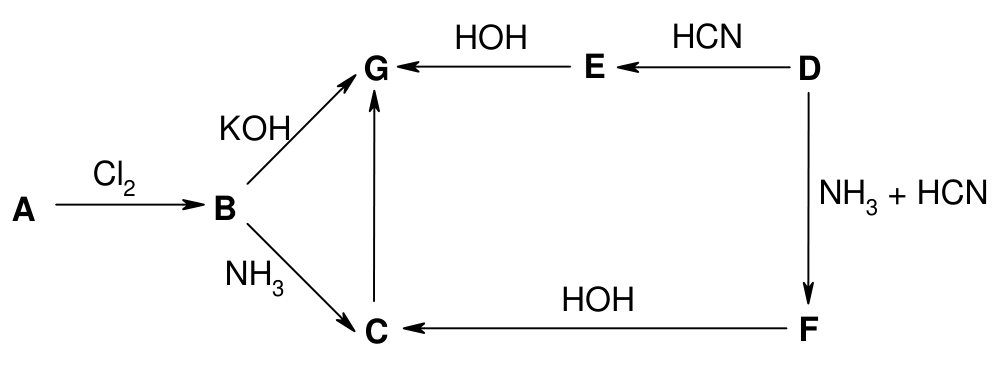
Compound A is 48.60 mass % carbon, 8.10 % hydrogen, and 43.30 % oxygen. It reacts with a freshly prepared silver(I) oxide to form an undissolved salt. An amount of 1.81 g of silver(I) salt is formed from 0.74 g of compound A.
Compound D contains 54.54 mass % of carbon, 9.09 % of hydrogen, and 36.37 % of oxygen. It combines with \(\ce{NaHSO3}\) to produce a compound containing 21.6 % of sulphur.
Problems:
- Write summary as well as structural formulas of substances A and D.
- Write structural formulas of substances B, C, E, F, and G.
- Classify the reactions in the scheme marked by arrows and discuss more in detail reactions B → G and D → E.
- Write structural formulas of possible isomers of substance G and give the type of isomerism.
Relative atomic masses:
\[ A_r(\ce{C})=12;\quad A_r(\ce{H})=1;\quad A_r(\ce{O})=16;\quad A_r(\ce{Ag})=108;\quad A_r(\ce{Na})=23;\quad A_r(\ce{S})=32. \]
Official English text of the problem.
Answers
- A and D:
| Substance | Name | Molecular formula | Condensed structural formula | SMILES |
|---|---|---|---|---|
| A | Propanoic acid (propionic acid) | \(\ce{C3H6O2}\) | \(\ce{CH3CH2COOH}\) | CCC(=O)O |
| D | Ethanal (acetaldehyde) | \(\ce{C2H4O}\) | \(\ce{CH3CHO}\) | CC=O |
- The remaining compounds:
| Substance | Name | Condensed structural formula | SMILES |
|---|---|---|---|
| B | 2-Chloropropanoic acid | \(\ce{CH3CHClCOOH}\) | CC(Cl)C(=O)O |
| C | 2-Aminopropanoic acid (alanine) | \(\ce{CH3CH(NH2)COOH}\) | CC(N)C(=O)O |
| E | 2-Hydroxypropanenitrile (acetaldehyde cyanohydrin) | \(\ce{CH3CH(OH)CN}\) | CC(O)C#N |
| F | 2-Aminopropanenitrile | \(\ce{CH3CH(NH2)CN}\) | CC(N)C#N |
| G | 2-Hydroxypropanoic acid (lactic acid) | \(\ce{CH3CH(OH)COOH}\) | CC(O)C(=O)O |
These SMILES leave stereochemistry unspecified. Under achiral reaction conditions, the chiral products are obtained as racemates.
- Reaction classifications:
| Arrow | Classification |
|---|---|
| A → B | Substitution: chlorination at the carbon adjacent to the carboxyl group |
| B → G | Nucleophilic substitution: replacement of chlorine by hydroxyl |
| B → C | Nucleophilic substitution by ammonia; ammonolysis |
| C → G | Nitrosative deamination, replacing the amino group by hydroxyl |
| D → E | Nucleophilic addition to a carbonyl group; cyanohydrin formation |
| E → G | Hydrolysis of a nitrile to a carboxylic acid |
| D → F | Condensation followed by cyanide addition; the aminonitrile-forming stage of the Strecker synthesis |
| F → C | Hydrolysis of a nitrile to a carboxylic acid |
The missing reagent for C → G is nitrous acid, \(\ce{HNO2}\), ON=O. Aqueous potassium hydroxide initially gives a lactate salt in B → G; acidification gives free G.
- G has two optical isomers, which are enantiomers:
| Isomer | Stereochemical SMILES |
|---|---|
| \((S)\)-2-Hydroxypropanoic acid | C[C@H](O)C(=O)O |
| \((R)\)-2-Hydroxypropanoic acid | C[C@@H](O)C(=O)O |
Within the hydroxycarboxylic-acid family, 3-hydroxypropanoic acid, \(\ce{HOCH2CH2COOH}\), OCCC(=O)O, is also a positional constitutional isomer of G.
Solution
1. Identification of A and D
For A, a \(100\ \mathrm{g}\) sample contains
\[ n(\ce{C})=\frac{48.60}{12}=4.050\ \mathrm{mol}, \] \[ n(\ce{H})=\frac{8.10}{1}=8.10\ \mathrm{mol}, \qquad n(\ce{O})=\frac{43.30}{16}=2.70625\ \mathrm{mol}. \]
Thus,
\[ n(\ce{C}):n(\ce{H}):n(\ce{O}) =1.4965:2.9931:1 \approx 3:6:2. \]
The empirical formula is therefore \(\ce{C3H6O2}\), with empirical-formula mass
\[ 3(12)+6(1)+2(16)=74\ \mathrm{g\,mol^{-1}}. \]
Formation of a silver salt with silver(I) oxide identifies a carboxylic acid. An integer multiple of this empirical formula, \(\ce{C_{3k}H_{6k}O_{2k}}\), has only one degree of unsaturation:
\[ \mathrm{DBE}=1+3k-\frac{6k}{2}=1. \]
Consequently, it can contain only one carboxyl group. Formation of its silver salt replaces one acidic hydrogen per molecule by silver, increasing the molar mass by
\[ 108-1=107\ \mathrm{g\,mol^{-1}}. \]
Hence,
\[ n(\mathbf A) =\frac{(1.81-0.74)\ \mathrm{g}}{107\ \mathrm{g\,mol^{-1}}} =0.0100\ \mathrm{mol}, \]
and
\[ M(\mathbf A) =\frac{0.74\ \mathrm{g}}{0.0100\ \mathrm{mol}} =74\ \mathrm{g\,mol^{-1}}. \]
The molecular formula equals the empirical formula. The three-carbon carboxylic acid is propanoic acid, CCC(=O)O.
The salt-forming reaction is
\[ \ce{2CH3CH2COOH + Ag2O -> 2CH3CH2COOAg(s) + H2O}. \]
Here silver(I) oxide is represented ionically by [Ag+].[Ag+].[O-2], silver propanoate by CCC(=O)[O-].[Ag+], and water by O. These ionic SMILES specify composition rather than solid-state coordination.
The silver salt has molar mass
\[ M(\ce{C3H5O2Ag})=36+5+32+108=181\ \mathrm{g\,mol^{-1}}, \]
so the predicted salt mass is
\[ 0.0100\ \mathrm{mol}\times181\ \mathrm{g\,mol^{-1}} =1.81\ \mathrm{g}, \]
exactly reproducing the stated yield.
For D, the corresponding amounts in \(100\ \mathrm{g}\) are
\[ \frac{54.54}{12}:\frac{9.09}{1}:\frac{36.37}{16} =4.545:9.09:2.273125 \approx2:4:1. \]
Its empirical formula is therefore \(\ce{C2H4O}\), with empirical-formula mass \(44\ \mathrm{g\,mol^{-1}}\).
Addition of sodium hydrogensulfite, \(\ce{NaHSO3}\), [Na+].[O-]S(=O)O, indicates a carbonyl compound. Any integer multiple of \(\ce{C2H4O}\) also has only one degree of unsaturation, so there is one carbonyl group and one hydrogensulfite unit is added per molecule.
Since
\[ M(\ce{NaHSO3})=23+1+32+3(16)=104\ \mathrm{g\,mol^{-1}}, \]
the sulfur mass fraction in the adduct gives
\[ \frac{32}{M(\mathbf D)+104}=0.216. \]
Therefore,
\[ M(\mathbf D)=\frac{32}{0.216}-104 =44.1\ \mathrm{g\,mol^{-1}} \approx44\ \mathrm{g\,mol^{-1}}. \]
Thus D has molecular formula \(\ce{C2H4O}\). A two-carbon carbonyl compound must be the aldehyde ethanal, CC=O.
Its addition reaction is
\[ \ce{CH3CHO + NaHSO3 <=> CH3CH(OH)SO3Na}. \]
The product is sodium 1-hydroxyethane-1-sulfonate, CC(O)S(=O)(=O)[O-].[Na+]. Its molar mass is \(148\ \mathrm{g\,mol^{-1}}\), giving
\[ w(\ce{S})=\frac{32}{148}\times100\%=21.6\%. \]
2. Identification of B, C, E, F, and G
Starting from D provides the most direct identification of G.
Addition of hydrogen cyanide, C#N, to ethanal places hydroxyl and cyano groups on the former carbonyl carbon. The product E is therefore 2-hydroxypropanenitrile:
\[ \mathbf E:\quad \ce{CH3CH(OH)CN}. \]
Hydrolysis converts the nitrile carbon into the carboxyl carbon without changing the carbon skeleton. Thus G is 2-hydroxypropanoic acid:
\[ \mathbf G:\quad \ce{CH3CH(OH)COOH}. \]
To produce this G by replacing chlorine with hydroxyl, B must have chlorine on carbon 2:
\[ \mathbf B:\quad \ce{CH3CHClCOOH}. \]
Replacing that chlorine by an amino group using ammonia, N, gives C, alanine:
\[ \mathbf C:\quad \ce{CH3CH(NH2)COOH}. \]
Finally, ethanal reacts with ammonia and hydrogen cyanide to form the corresponding aminonitrile F:
\[ \mathbf F:\quad \ce{CH3CH(NH2)CN}. \]
Hydrolysis of its nitrile group gives alanine, independently confirming both F and C.
3. Balanced equations and reaction mechanisms
The equations below use neutral organic molecular forms unless a salt is explicitly shown. Nitrile hydrolysis requires suitable aqueous acidic or alkaline conditions, usually with heating; protonation states during the reaction depend on pH.
A → B: α-chlorination
\[ \ce{CH3CH2COOH + Cl2 -> CH3CHClCOOH + HCl}. \]
This is substitution of an α hydrogen by chlorine, under the usual conditions for α-halogenation of a carboxylic acid. Chlorine has SMILES ClCl; hydrogen chloride has SMILES Cl.
B → G: hydrolytic nucleophilic substitution
With aqueous potassium hydroxide, [K+].[OH-], neutralization and chlorine displacement give
\[ \ce{CH3CHClCOOH + 2KOH -> CH3CH(OH)COOK + KCl + H2O}. \]
The organic product in the alkaline solution is potassium lactate, CC(O)C(=O)[O-].[K+]. Potassium chloride is [K+].[Cl-].
Acidification then gives free lactic acid:
\[ \ce{CH3CH(OH)COOK + HCl -> CH3CH(OH)COOH + KCl}. \]
One equivalent of hydroxide neutralizes the carboxyl group; another effects substitution. The substitution can be represented ionically as
\[ \ce{CH3CHClCOO^- + OH^- -> CH3CH(OH)COO^- + Cl^-}. \]
The participating ions are:
- 2-Chloropropanoate:
CC(Cl)C(=O)[O-] - Hydroxide:
[OH-] - Lactate:
CC(O)C(=O)[O-] - Chloride:
[Cl-]
In a direct \(S_\mathrm{N}2\) description, an oxygen lone pair of hydroxide attacks the α carbon from the side opposite chlorine. The carbon–chlorine bonding pair moves onto chlorine as the carbon–oxygen bond forms. Such a direct displacement inverts an individual stereocentre. Because B is formed racemically under achiral conditions, this route gives racemic G.
B → C: ammonolysis
\[ \ce{CH3CHClCOOH + 2NH3 -> CH3CH(NH2)COOH + NH4Cl}. \]
This is nucleophilic substitution. One ammonia molecule supplies the amino group, while another accepts the released proton. Ammonium chloride has SMILES [NH4+].[Cl-].
C → G: nitrosative deamination
\[ \ce{CH3CH(NH2)COOH + HNO2 -> CH3CH(OH)COOH + N2 + H2O}. \]
Nitrous acid, ON=O, replaces the amino group by hydroxyl with evolution of nitrogen, N#N. This supplies the reagent omitted from the vertical arrow in the scheme.
D → E: cyanohydrin formation
\[ \ce{CH3CHO + HCN <=> CH3CH(OH)CN}. \]
This is nucleophilic addition to the carbonyl group. The mechanism proceeds in two steps.
First, cyanide ion, [C-]#N, attacks the electrophilic carbonyl carbon through its carbon atom. The carbonyl π-electron pair moves onto oxygen:
\[ \ce{CH3CHO + CN^- <=> CH3CH(O^-)CN}. \]
The intermediate is the cyanohydrin alkoxide, CC([O-])C#N.
Second, the alkoxide takes a proton from hydrogen cyanide:
\[ \ce{CH3CH(O^-)CN + HCN <=> CH3CH(OH)CN + CN^-}. \]
Cyanide is regenerated. The net changes are formation of a carbon–carbon bond and conversion of the carbonyl group into an alcohol group.
The carbonyl carbon is initially trigonal planar. Attack on its two faces is equally probable in an achiral environment, producing the two enantiomers of E in equal amounts. Subsequent nitrile hydrolysis therefore gives racemic G.
E → G: nitrile hydrolysis
\[ \ce{CH3CH(OH)CN + 2H2O -> CH3CH(OH)COOH + NH3}. \]
The nitrile group is hydrolysed, through an amide intermediate, to a carboxyl group.
D → F: aminonitrile formation
\[ \ce{CH3CHO + NH3 + HCN -> CH3CH(NH2)CN + H2O}. \]
This is the aminonitrile-forming stage of the Strecker synthesis. It comprises condensation of ethanal with ammonia, followed by cyanide addition. The condensation intermediate is ethanimine, CC=N:
\[ \ce{CH3CHO + NH3 <=> CH3CH=NH + H2O}, \]
followed overall by
\[ \ce{CH3CH=NH + HCN -> CH3CH(NH2)CN}. \]
F → C: nitrile hydrolysis
\[ \ce{CH3CH(NH2)CN + 2H2O -> CH3CH(NH2)COOH + NH3}. \]
The nitrile group becomes a carboxyl group while the amino group is retained, yielding alanine.
4. Isomerism of G
The central carbon of lactic acid is attached to four different groups:
\[ \ce{-OH},\qquad \ce{-COOH},\qquad \ce{-CH3},\qquad \ce{-H}. \]
It is therefore a stereogenic centre. There are exactly two stereoisomers of this connectivity: \((S)\)-lactic acid, C[C@H](O)C(=O)O, and \((R)\)-lactic acid, C[C@@H](O)C(=O)O. They are nonsuperimposable mirror images: optical isomers, or enantiomers.
Their Fischer projections can be specified precisely as follows. Put the carboxyl group at the top and the methyl group at the bottom:
| Isomer | Left horizontal group | Right horizontal group |
|---|---|---|
| \((S)\)-Lactic acid | \(\ce{OH}\) | \(\ce{H}\) |
| \((R)\)-Lactic acid | \(\ce{H}\) | \(\ce{OH}\) |
In these projections, horizontal bonds point toward the observer and vertical bonds point away. The priority order is hydroxyl \(>\) carboxyl \(>\) methyl \(>\) hydrogen.
The enantiomers have equal and opposite optical rotations under identical measurement conditions. Their equimolar mixture is optically inactive.
If constitutional isomers are also intended, the other saturated hydroxycarboxylic acid with formula \(\ce{C3H6O3}\) is:
| Name | Structure | SMILES | Relationship to G |
|---|---|---|---|
| 3-Hydroxypropanoic acid | \(\ce{HOCH2CH2COOH}\) | OCCC(=O)O |
Positional isomer; achiral |
Allowing different functional-group arrangements gives further constitutional isomers. Examples include methoxyethanoic acid, \(\ce{CH3OCH2COOH}\), COCC(=O)O, and methyl 2-hydroxyethanoate (methyl glycolate), \(\ce{HOCH2COOCH3}\), COC(=O)CO. These illustrate functional-group isomerism.
The solution was checked against the official solution.
IChO 1974 · Theorieaufgabe 2
Reaktionsschema zur Herstellung von Stoff G
Stoff G kann nach dem folgenden Schema auf mehreren Wegen hergestellt werden:
Verbindung A enthält 48.60 Massen-% Kohlenstoff, 8.10 % Wasserstoff und 43.30 % Sauerstoff. Sie reagiert mit frisch hergestelltem Silber(I)-oxid unter Bildung eines ungelösten Salzes. Aus 0.74 g der Verbindung A entstehen 1.81 g des Silber(I)-salzes.
Verbindung D enthält 54.54 Massen-% Kohlenstoff, 9.09 % Wasserstoff und 36.37 % Sauerstoff. Sie reagiert mit \(\ce{NaHSO3}\) zu einer Verbindung, die 21.6 % Schwefel enthält.
Aufgaben:
- Geben Sie die Summenformeln sowie die Strukturformeln der Stoffe A und D an.
- Geben Sie die Strukturformeln der Stoffe B, C, E, F und G an.
- Ordnen Sie die im Schema durch Pfeile gekennzeichneten Reaktionen den Reaktionstypen zu und erörtern Sie die Reaktionen B → G und D → E ausführlicher.
- Geben Sie die Strukturformeln möglicher Isomere von Stoff G und die Art der Isomerie an.
Relative Atommassen:
\[ A_r(\ce{C})=12;\quad A_r(\ce{H})=1;\quad A_r(\ce{O})=16;\quad A_r(\ce{Ag})=108;\quad A_r(\ce{Na})=23;\quad A_r(\ce{S})=32. \]
Aufgabentext aus dem offiziellen englischen Text übersetzt.
Antworten
- A und D:
| Stoff | Name | Summenformel | Halbstrukturformel | SMILES |
|---|---|---|---|---|
| A | Propansäure (Propionsäure) | \(\ce{C3H6O2}\) | \(\ce{CH3CH2COOH}\) | CCC(=O)O |
| D | Ethanal (Acetaldehyd) | \(\ce{C2H4O}\) | \(\ce{CH3CHO}\) | CC=O |
- Die übrigen Verbindungen:
| Stoff | Name | Halbstrukturformel | SMILES |
|---|---|---|---|
| B | 2-Chlorpropansäure | \(\ce{CH3CHClCOOH}\) | CC(Cl)C(=O)O |
| C | 2-Aminopropansäure (Alanin) | \(\ce{CH3CH(NH2)COOH}\) | CC(N)C(=O)O |
| E | 2-Hydroxypropannitril (Acetaldehydcyanhydrin) | \(\ce{CH3CH(OH)CN}\) | CC(O)C#N |
| F | 2-Aminopropannitril | \(\ce{CH3CH(NH2)CN}\) | CC(N)C#N |
| G | 2-Hydroxypropansäure (Milchsäure) | \(\ce{CH3CH(OH)COOH}\) | CC(O)C(=O)O |
Diese SMILES legen die Stereochemie nicht fest. Unter achiralen Reaktionsbedingungen werden die chiralen Produkte als Racemate erhalten.
- Einordnung der Reaktionen:
| Pfeil | Einordnung |
|---|---|
| A → B | Substitution: Chlorierung am Kohlenstoffatom neben der Carboxylgruppe |
| B → G | Nucleophile Substitution: Ersatz von Chlor durch eine Hydroxygruppe |
| B → C | Nucleophile Substitution durch Ammoniak; Ammonolyse |
| C → G | Nitrosative Desaminierung unter Ersatz der Aminogruppe durch eine Hydroxygruppe |
| D → E | Nucleophile Addition an eine Carbonylgruppe; Cyanhydrinbildung |
| E → G | Hydrolyse eines Nitrils zu einer Carbonsäure |
| D → F | Kondensation mit anschließender Cyanidaddition; die Aminonitril-bildende Stufe der Strecker-Synthese |
| F → C | Hydrolyse eines Nitrils zu einer Carbonsäure |
Das fehlende Reagenz für C → G ist salpetrige Säure, \(\ce{HNO2}\), ON=O. Wässrige Kaliumhydroxidlösung liefert bei B → G zunächst ein Lactatsalz; durch Ansäuern entsteht freies G.
- G besitzt zwei optische Isomere, die Enantiomere sind:
| Isomer | Stereochemische SMILES |
|---|---|
| \((S)\)-2-Hydroxypropansäure | C[C@H](O)C(=O)O |
| \((R)\)-2-Hydroxypropansäure | C[C@@H](O)C(=O)O |
Innerhalb der Stoffklasse der Hydroxycarbonsäuren ist 3-Hydroxypropansäure, \(\ce{HOCH2CH2COOH}\), OCCC(=O)O, außerdem ein Stellungsisomer und damit ein Konstitutionsisomer von G.
Lösung
1. Identifizierung von A und D
Eine \(100\ \mathrm{g}\)-Probe von A enthält
\[ n(\ce{C})=\frac{48.60}{12}=4.050\ \mathrm{mol}, \] \[ n(\ce{H})=\frac{8.10}{1}=8.10\ \mathrm{mol}, \qquad n(\ce{O})=\frac{43.30}{16}=2.70625\ \mathrm{mol}. \]
Somit gilt
\[ n(\ce{C}):n(\ce{H}):n(\ce{O}) =1.4965:2.9931:1 \approx 3:6:2. \]
Die Verhältnisformel lautet daher \(\ce{C3H6O2}\); die zugehörige molare Masse beträgt
\[ 3(12)+6(1)+2(16)=74\ \mathrm{g\,mol^{-1}}. \]
Die Bildung eines Silbersalzes mit Silber(I)-oxid weist auf eine Carbonsäure hin. Ein ganzzahliges Vielfaches dieser Verhältnisformel, \(\ce{C_{3k}H_{6k}O_{2k}}\), besitzt nur einen Ungesättigtheitsgrad:
\[ \mathrm{DBE}=1+3k-\frac{6k}{2}=1. \]
Folglich kann es nur eine Carboxylgruppe enthalten. Bei der Bildung seines Silbersalzes wird pro Molekül ein saures Wasserstoffatom durch Silber ersetzt, wodurch sich die molare Masse um
\[ 108-1=107\ \mathrm{g\,mol^{-1}} \]
erhöht. Daher gilt
\[ n(\mathbf A) =\frac{(1.81-0.74)\ \mathrm{g}}{107\ \mathrm{g\,mol^{-1}}} =0.0100\ \mathrm{mol}, \]
und
\[ M(\mathbf A) =\frac{0.74\ \mathrm{g}}{0.0100\ \mathrm{mol}} =74\ \mathrm{g\,mol^{-1}}. \]
Die Summenformel stimmt mit der Verhältnisformel überein. Die Carbonsäure mit drei Kohlenstoffatomen ist Propansäure, CCC(=O)O.
Die Salzbildungsreaktion lautet
\[ \ce{2CH3CH2COOH + Ag2O -> 2CH3CH2COOAg(s) + H2O}. \]
Hier wird Silber(I)-oxid ionisch durch [Ag+].[Ag+].[O-2], Silberpropanoat durch CCC(=O)[O-].[Ag+] und Wasser durch O dargestellt. Diese ionischen SMILES geben die Zusammensetzung und nicht die Koordination im Festkörper an.
Das Silbersalz hat die molare Masse
\[ M(\ce{C3H5O2Ag})=36+5+32+108=181\ \mathrm{g\,mol^{-1}}, \]
sodass sich für die erwartete Salzmasse
\[ 0.0100\ \mathrm{mol}\times181\ \mathrm{g\,mol^{-1}} =1.81\ \mathrm{g}, \]
ergibt, was die angegebene Ausbeute genau reproduziert.
Für D ergeben sich in \(100\ \mathrm{g}\) die entsprechenden Stoffmengenverhältnisse
\[ \frac{54.54}{12}:\frac{9.09}{1}:\frac{36.37}{16} =4.545:9.09:2.273125 \approx2:4:1. \]
Die Verhältnisformel lautet daher \(\ce{C2H4O}\), mit einer zugehörigen molaren Masse von \(44\ \mathrm{g\,mol^{-1}}\).
Die Addition von Natriumhydrogensulfit, \(\ce{NaHSO3}\), [Na+].[O-]S(=O)O, weist auf eine Carbonylverbindung hin. Jedes ganzzahlige Vielfache von \(\ce{C2H4O}\) besitzt ebenfalls nur einen Ungesättigtheitsgrad, sodass eine Carbonylgruppe vorliegt und pro Molekül eine Hydrogensulfiteinheit addiert wird.
Da
\[ M(\ce{NaHSO3})=23+1+32+3(16)=104\ \mathrm{g\,mol^{-1}}, \]
gilt, ergibt sich aus dem Massenanteil des Schwefels im Addukt
\[ \frac{32}{M(\mathbf D)+104}=0.216. \]
Daraus folgt
\[ M(\mathbf D)=\frac{32}{0.216}-104 =44.1\ \mathrm{g\,mol^{-1}} \approx44\ \mathrm{g\,mol^{-1}}. \]
Somit hat D die Summenformel \(\ce{C2H4O}\). Eine Carbonylverbindung mit zwei Kohlenstoffatomen muss der Aldehyd Ethanal, CC=O, sein.
Seine Additionsreaktion lautet
\[ \ce{CH3CHO + NaHSO3 <=> CH3CH(OH)SO3Na}. \]
Das Produkt ist Natrium-1-hydroxyethan-1-sulfonat, CC(O)S(=O)(=O)[O-].[Na+]. Seine molare Masse beträgt \(148\ \mathrm{g\,mol^{-1}}\), woraus sich
\[ w(\ce{S})=\frac{32}{148}\times100\%=21.6\%. \]
ergibt.
2. Identifizierung von B, C, E, F und G
Ausgehend von D lässt sich G am unmittelbarsten identifizieren.
Bei der Addition von Cyanwasserstoff, C#N, an Ethanal werden eine Hydroxygruppe und eine Cyanogruppe am ursprünglichen Carbonylkohlenstoffatom gebunden. Das Produkt E ist daher 2-Hydroxypropannitril:
\[ \mathbf E:\quad \ce{CH3CH(OH)CN}. \]
Die Hydrolyse wandelt das Nitrilkohlenstoffatom in das Carboxylkohlenstoffatom um, ohne das Kohlenstoffgerüst zu verändern. Somit ist G 2-Hydroxypropansäure:
\[ \mathbf G:\quad \ce{CH3CH(OH)COOH}. \]
Damit dieses G durch Ersatz von Chlor durch eine Hydroxygruppe entsteht, muss B Chlor am Kohlenstoffatom 2 tragen:
\[ \mathbf B:\quad \ce{CH3CHClCOOH}. \]
Der Ersatz dieses Chlors durch eine Aminogruppe mithilfe von Ammoniak, N, liefert C, Alanin:
\[ \mathbf C:\quad \ce{CH3CH(NH2)COOH}. \]
Schließlich reagiert Ethanal mit Ammoniak und Cyanwasserstoff zum entsprechenden Aminonitril F:
\[ \mathbf F:\quad \ce{CH3CH(NH2)CN}. \]
Die Hydrolyse seiner Nitrilgruppe liefert Alanin und bestätigt damit unabhängig sowohl F als auch C.
3. Ausgeglichene Reaktionsgleichungen und Reaktionsmechanismen
In den folgenden Gleichungen werden neutrale organische Molekülformen verwendet, sofern nicht ausdrücklich ein Salz dargestellt ist. Die Nitrilhydrolyse erfordert geeignete wässrige saure oder alkalische Bedingungen, gewöhnlich unter Erwärmen; die Protonierungszustände während der Reaktion hängen vom pH-Wert ab.
A → B: α-Chlorierung
\[ \ce{CH3CH2COOH + Cl2 -> CH3CHClCOOH + HCl}. \]
Hierbei wird unter den üblichen Bedingungen für die α-Halogenierung einer Carbonsäure ein α-Wasserstoffatom durch Chlor substituiert. Chlor hat die SMILES ClCl; Chlorwasserstoff hat die SMILES Cl.
B → G: hydrolytische nucleophile Substitution
Mit wässriger Kaliumhydroxidlösung, [K+].[OH-], führen Neutralisation und Ersatz des Chlors zu
\[ \ce{CH3CHClCOOH + 2KOH -> CH3CH(OH)COOK + KCl + H2O}. \]
Das organische Produkt in der alkalischen Lösung ist Kaliumlactat, CC(O)C(=O)[O-].[K+]. Kaliumchlorid ist [K+].[Cl-].
Durch anschließendes Ansäuern entsteht freie Milchsäure:
\[ \ce{CH3CH(OH)COOK + HCl -> CH3CH(OH)COOH + KCl}. \]
Ein Äquivalent Hydroxid neutralisiert die Carboxylgruppe; ein weiteres bewirkt die Substitution. Die Substitution lässt sich ionisch darstellen als
\[ \ce{CH3CHClCOO^- + OH^- -> CH3CH(OH)COO^- + Cl^-}. \]
Die beteiligten Ionen sind:
- 2-Chlorpropanoat:
CC(Cl)C(=O)[O-] - Hydroxid:
[OH-] - Lactat:
CC(O)C(=O)[O-] - Chlorid:
[Cl-]
Bei einer Beschreibung als direkte \(S_\mathrm{N}2\)-Reaktion greift ein freies Elektronenpaar am Sauerstoffatom des Hydroxids das α-Kohlenstoffatom von der dem Chlor gegenüberliegenden Seite an. Das bindende Elektronenpaar der Kohlenstoff–Chlor-Bindung geht auf das Chlor über, während sich die Kohlenstoff–Sauerstoff-Bindung bildet. Eine solche direkte Substitution führt zur Inversion am einzelnen Stereozentrum. Da B unter achiralen Bedingungen als Racemat gebildet wird, liefert dieser Reaktionsweg racemisches G.
B → C: Ammonolyse
\[ \ce{CH3CHClCOOH + 2NH3 -> CH3CH(NH2)COOH + NH4Cl}. \]
Dies ist eine nucleophile Substitution. Ein Ammoniakmolekül liefert die Aminogruppe, während ein weiteres das freigesetzte Proton aufnimmt. Ammoniumchlorid hat die SMILES [NH4+].[Cl-].
C → G: nitrosative Desaminierung
\[ \ce{CH3CH(NH2)COOH + HNO2 -> CH3CH(OH)COOH + N2 + H2O}. \]
Salpetrige Säure, ON=O, ersetzt die Aminogruppe unter Entwicklung von Stickstoff, N#N, durch eine Hydroxygruppe. Damit ist das am senkrechten Pfeil im Schema fehlende Reagenz bestimmt.
D → E: Cyanhydrinbildung
\[ \ce{CH3CHO + HCN <=> CH3CH(OH)CN}. \]
Dies ist eine nucleophile Addition an die Carbonylgruppe. Der Mechanismus verläuft in zwei Schritten.
Zunächst greift das Cyanidion, [C-]#N, über sein Kohlenstoffatom das elektrophile Carbonylkohlenstoffatom an. Das π-Elektronenpaar der Carbonylgruppe geht auf den Sauerstoff über:
\[ \ce{CH3CHO + CN^- <=> CH3CH(O^-)CN}. \]
Das Zwischenprodukt ist das Cyanhydrin-Alkoxid, CC([O-])C#N.
Im zweiten Schritt nimmt das Alkoxid ein Proton von Cyanwasserstoff auf:
\[ \ce{CH3CH(O^-)CN + HCN <=> CH3CH(OH)CN + CN^-}. \]
Das Cyanid wird regeneriert. Insgesamt wird eine Kohlenstoff–Kohlenstoff-Bindung gebildet und die Carbonylgruppe in eine Alkoholgruppe umgewandelt.
Das Carbonylkohlenstoffatom ist zunächst trigonal-planar. In einer achiralen Umgebung ist der Angriff von beiden Seiten gleich wahrscheinlich, sodass die beiden Enantiomere von E in gleichen Mengen entstehen. Die anschließende Nitrilhydrolyse liefert daher racemisches G.
E → G: Nitrilhydrolyse
\[ \ce{CH3CH(OH)CN + 2H2O -> CH3CH(OH)COOH + NH3}. \]
Die Nitrilgruppe wird über ein Amid als Zwischenprodukt zu einer Carboxylgruppe hydrolysiert.
D → F: Aminonitrilbildung
\[ \ce{CH3CHO + NH3 + HCN -> CH3CH(NH2)CN + H2O}. \]
Dies ist die Aminonitril-bildende Stufe der Strecker-Synthese. Sie umfasst die Kondensation von Ethanal mit Ammoniak und die anschließende Cyanidaddition. Das Kondensationszwischenprodukt ist Ethanimin, CC=N:
\[ \ce{CH3CHO + NH3 <=> CH3CH=NH + H2O}, \]
gefolgt von der Gesamtreaktion
\[ \ce{CH3CH=NH + HCN -> CH3CH(NH2)CN}. \]
F → C: Nitrilhydrolyse
\[ \ce{CH3CH(NH2)CN + 2H2O -> CH3CH(NH2)COOH + NH3}. \]
Die Nitrilgruppe wird zu einer Carboxylgruppe, während die Aminogruppe erhalten bleibt; dabei entsteht Alanin.
4. Isomerie von G
Das zentrale Kohlenstoffatom der Milchsäure ist mit vier verschiedenen Gruppen verbunden:
\[ \ce{-OH},\qquad \ce{-COOH},\qquad \ce{-CH3},\qquad \ce{-H}. \]
Es ist daher ein stereogenes Zentrum. Bei dieser Konnektivität gibt es genau zwei Stereoisomere: \((S)\)-Milchsäure, C[C@H](O)C(=O)O, und \((R)\)-Milchsäure, C[C@@H](O)C(=O)O. Sie sind nicht zur Deckung bringbare Spiegelbilder: optische Isomere oder Enantiomere.
Ihre Fischer-Projektionen lassen sich wie folgt eindeutig angeben. Die Carboxylgruppe wird oben und die Methylgruppe unten angeordnet:
| Isomer | Linke horizontale Gruppe | Rechte horizontale Gruppe |
|---|---|---|
| \((S)\)-Milchsäure | \(\ce{OH}\) | \(\ce{H}\) |
| \((R)\)-Milchsäure | \(\ce{H}\) | \(\ce{OH}\) |
In diesen Projektionen zeigen die horizontalen Bindungen zum Betrachter hin und die vertikalen Bindungen von ihm weg. Die Prioritätsreihenfolge lautet Hydroxygruppe \(>\) Carboxylgruppe \(>\) Methylgruppe \(>\) Wasserstoff.
Die Enantiomere weisen unter identischen Messbedingungen betragsgleiche, aber entgegengesetzte optische Drehungen auf. Ihr äquimolares Gemisch ist optisch inaktiv.
Falls auch Konstitutionsisomere gemeint sind, ist die andere gesättigte Hydroxycarbonsäure mit der Formel \(\ce{C3H6O3}\):
| Name | Struktur | SMILES | Beziehung zu G |
|---|---|---|---|
| 3-Hydroxypropansäure | \(\ce{HOCH2CH2COOH}\) | OCCC(=O)O |
Stellungsisomer; achiral |
Lässt man unterschiedliche Anordnungen funktioneller Gruppen zu, ergeben sich weitere Konstitutionsisomere. Beispiele sind Methoxyethansäure, \(\ce{CH3OCH2COOH}\), COCC(=O)O, und Methyl-2-hydroxyethanoat (Glycolsäuremethylester), \(\ce{HOCH2COOCH3}\), COC(=O)CO. Diese veranschaulichen die Funktionsisomerie.
Die Lösung wurde mit der offiziellen Lösung abgeglichen.
IChO 1974 · Teori sorusu 2
G maddesinin elde edilmesini sağlayan tepkime şeması
G maddesi, aşağıdaki şemaya göre çeşitli yöntemlerle hazırlanabilir:
A bileşiği kütlece %48.60 karbon, %8.10 hidrojen ve %43.30 oksijen içerir. Taze hazırlanmış gümüş(I) oksit ile tepkimeye girerek çözünmeyen bir tuz oluşturur. 0.74 g A bileşiğinden 1.81 g gümüş(I) tuzu oluşur.
D bileşiği kütlece %54.54 karbon, %9.09 hidrojen ve %36.37 oksijen içerir. \(\ce{NaHSO3}\) ile birleşerek %21.6 kükürt içeren bir bileşik oluşturur.
Sorular:
- A ve D maddelerinin molekül formüllerini ve yapı formüllerini yazınız.
- B, C, E, F ve G maddelerinin yapı formüllerini yazınız.
- Şemada oklarla gösterilen tepkimeleri sınıflandırınız ve B → G ile D → E tepkimelerini daha ayrıntılı olarak tartışınız.
- G maddesinin olası izomerlerinin yapı formüllerini yazınız ve izomerlik türünü belirtiniz.
Bağıl atom kütleleri:
\[ A_r(\ce{C})=12;\quad A_r(\ce{H})=1;\quad A_r(\ce{O})=16;\quad A_r(\ce{Ag})=108;\quad A_r(\ce{Na})=23;\quad A_r(\ce{S})=32. \]
Soru metni resmi İngilizce metinden çevrilmiştir.
Cevaplar
- A ve D:
| Madde | Adı | Molekül formülü | Yoğunlaştırılmış yapı formülü | SMILES |
|---|---|---|---|---|
| A | Propanoik asit (propiyonik asit) | \(\ce{C3H6O2}\) | \(\ce{CH3CH2COOH}\) | CCC(=O)O |
| D | Etanal (asetaldehit) | \(\ce{C2H4O}\) | \(\ce{CH3CHO}\) | CC=O |
- Diğer bileşikler:
| Madde | Adı | Yoğunlaştırılmış yapı formülü | SMILES |
|---|---|---|---|
| B | 2-Kloropropanoik asit | \(\ce{CH3CHClCOOH}\) | CC(Cl)C(=O)O |
| C | 2-Aminopropanoik asit (alanin) | \(\ce{CH3CH(NH2)COOH}\) | CC(N)C(=O)O |
| E | 2-Hidroksipropannitril (asetaldehit siyanohidrini) | \(\ce{CH3CH(OH)CN}\) | CC(O)C#N |
| F | 2-Aminopropannitril | \(\ce{CH3CH(NH2)CN}\) | CC(N)C#N |
| G | 2-Hidroksipropanoik asit (laktik asit) | \(\ce{CH3CH(OH)COOH}\) | CC(O)C(=O)O |
Bu SMILES gösterimlerinde stereokimya belirtilmemiştir. Akiral tepkime koşullarında kiral ürünler rasematlar olarak elde edilir.
- Tepkimelerin sınıflandırılması:
| Ok | Sınıflandırma |
|---|---|
| A → B | Yer değiştirme: karboksil grubuna komşu karbonda klorlama |
| B → G | Nükleofilik yer değiştirme: klorun hidroksil ile yer değiştirmesi |
| B → C | Amonyak ile nükleofilik yer değiştirme; amonoliz |
| C → G | Nitrozatif deaminasyon; amino grubunun hidroksil ile yer değiştirmesi |
| D → E | Karbonil grubuna nükleofilik katılma; siyanohidrin oluşumu |
| E → G | Bir nitrilin karboksilik aside hidrolizi |
| D → F | Kondenzasyon ve ardından siyanür katılması; Strecker sentezinin aminonitril oluşum aşaması |
| F → C | Bir nitrilin karboksilik aside hidrolizi |
C → G için eksik bırakılan reaktif nitröz asittir, \(\ce{HNO2}\), ON=O. Sulu potasyum hidroksit, B → G tepkimesinde başlangıçta bir laktat tuzu verir; asitlendirme sonucunda serbest G elde edilir.
- G'nin, birbirinin enantiyomeri olan iki optik izomeri vardır:
| İzomer | Stereokimyasal SMILES |
|---|---|
| \((S)\)-2-Hidroksipropanoik asit | C[C@H](O)C(=O)O |
| \((R)\)-2-Hidroksipropanoik asit | C[C@@H](O)C(=O)O |
Hidroksikarboksilik asitler ailesindeki 3-hidroksipropanoik asit, \(\ce{HOCH2CH2COOH}\), OCCC(=O)O, aynı zamanda G'nin konum izomerliği gösteren bir yapı izomeridir.
Çözüm
1. A ve D'nin belirlenmesi
A için, \(100\ \mathrm{g}\) numunedeki madde miktarları şöyledir:
\[ n(\ce{C})=\frac{48.60}{12}=4.050\ \mathrm{mol}, \] \[ n(\ce{H})=\frac{8.10}{1}=8.10\ \mathrm{mol}, \qquad n(\ce{O})=\frac{43.30}{16}=2.70625\ \mathrm{mol}. \]
Böylece,
\[ n(\ce{C}):n(\ce{H}):n(\ce{O}) =1.4965:2.9931:1 \approx 3:6:2. \]
Dolayısıyla basit formül \(\ce{C3H6O2}\) olup basit formüle karşılık gelen molar kütle
\[ 3(12)+6(1)+2(16)=74\ \mathrm{g\,mol^{-1}}. \]
Gümüş(I) oksit ile gümüş tuzu oluşması, bileşiğin bir karboksilik asit olduğunu gösterir. Bu basit formülün tam sayı katı olan \(\ce{C_{3k}H_{6k}O_{2k}}\) formülünün doymamışlık derecesi yalnızca birdir:
\[ \mathrm{DBE}=1+3k-\frac{6k}{2}=1. \]
Bu nedenle yalnızca bir karboksil grubu içerebilir. Gümüş tuzu oluşurken molekül başına bir asidik hidrojenin yerini gümüş alır ve molar kütle şu kadar artar:
\[ 108-1=107\ \mathrm{g\,mol^{-1}}. \]
Buna göre,
\[ n(\mathbf A) =\frac{(1.81-0.74)\ \mathrm{g}}{107\ \mathrm{g\,mol^{-1}}} =0.0100\ \mathrm{mol}, \]
ve
\[ M(\mathbf A) =\frac{0.74\ \mathrm{g}}{0.0100\ \mathrm{mol}} =74\ \mathrm{g\,mol^{-1}}. \]
Molekül formülü basit formüle eşittir. Üç karbonlu karboksilik asit propanoik asittir, CCC(=O)O.
Tuz oluşum tepkimesi şöyledir:
\[ \ce{2CH3CH2COOH + Ag2O -> 2CH3CH2COOAg(s) + H2O}. \]
Burada gümüş(I) oksit iyonik olarak [Ag+].[Ag+].[O-2], gümüş propanoat CCC(=O)[O-].[Ag+] ve su O ile gösterilir. Bu iyonik SMILES gösterimleri, katı hâldeki koordinasyonu değil bileşimi belirtir.
Gümüş tuzunun molar kütlesi
\[ M(\ce{C3H5O2Ag})=36+5+32+108=181\ \mathrm{g\,mol^{-1}}, \]
olduğundan beklenen tuz kütlesi
\[ 0.0100\ \mathrm{mol}\times181\ \mathrm{g\,mol^{-1}} =1.81\ \mathrm{g}, \]
olup verilen ürün miktarıyla tam olarak örtüşür.
D için, \(100\ \mathrm{g}\) numunedeki karşılık gelen madde miktarları şöyledir:
\[ \frac{54.54}{12}:\frac{9.09}{1}:\frac{36.37}{16} =4.545:9.09:2.273125 \approx2:4:1. \]
Dolayısıyla basit formülü \(\ce{C2H4O}\) olup basit formüle karşılık gelen molar kütle \(44\ \mathrm{g\,mol^{-1}}\) değerindedir.
Sodyum hidrojen sülfit, \(\ce{NaHSO3}\), [Na+].[O-]S(=O)O, katılması bir karbonil bileşiğine işaret eder. \(\ce{C2H4O}\) formülünün herhangi bir tam sayı katının da doymamışlık derecesi yalnızca birdir; dolayısıyla bir karbonil grubu vardır ve molekül başına bir hidrojen sülfit birimi katılır.
\[ M(\ce{NaHSO3})=23+1+32+3(16)=104\ \mathrm{g\,mol^{-1}}, \]
olduğundan, katılma ürünündeki kükürdün kütle kesri şu bağıntıyı verir:
\[ \frac{32}{M(\mathbf D)+104}=0.216. \]
Dolayısıyla,
\[ M(\mathbf D)=\frac{32}{0.216}-104 =44.1\ \mathrm{g\,mol^{-1}} \approx44\ \mathrm{g\,mol^{-1}}. \]
Böylece D'nin molekül formülü \(\ce{C2H4O}\) olur. İki karbonlu bir karbonil bileşiği, etanal aldehidi, CC=O, olmalıdır.
Katılma tepkimesi şöyledir:
\[ \ce{CH3CHO + NaHSO3 <=> CH3CH(OH)SO3Na}. \]
Ürün sodyum 1-hidroksietan-1-sülfonattır, CC(O)S(=O)(=O)[O-].[Na+]. Molar kütlesi \(148\ \mathrm{g\,mol^{-1}}\) olduğundan
\[ w(\ce{S})=\frac{32}{148}\times100\%=21.6\%. \]
2. B, C, E, F ve G'nin belirlenmesi
D'den yola çıkmak, G'yi belirlemenin en doğrudan yoludur.
Etanale hidrojen siyanür, C#N, katılmasıyla hidroksil ve siyano grupları, başlangıçtaki karbonil karbonuna bağlanır. Dolayısıyla E ürünü 2-hidroksipropannitrildir:
\[ \mathbf E:\quad \ce{CH3CH(OH)CN}. \]
Hidroliz, karbon iskeletini değiştirmeden nitril karbonunu karboksil karbonuna dönüştürür. Böylece G, 2-hidroksipropanoik asittir:
\[ \mathbf G:\quad \ce{CH3CH(OH)COOH}. \]
Klorun hidroksil ile yer değiştirmesiyle bu G'nin elde edilebilmesi için B'deki klorun 2 numaralı karbona bağlı olması gerekir:
\[ \mathbf B:\quad \ce{CH3CHClCOOH}. \]
Amonyak, N, kullanılarak bu klorun bir amino grubu ile yer değiştirmesi C'yi, yani alanini, verir:
\[ \mathbf C:\quad \ce{CH3CH(NH2)COOH}. \]
Son olarak etanal, amonyak ve hidrojen siyanür ile tepkimeye girerek karşılık gelen aminonitril F'yi oluşturur:
\[ \mathbf F:\quad \ce{CH3CH(NH2)CN}. \]
Nitril grubunun hidrolizi alanin verir; bu da hem F'yi hem de C'yi bağımsız olarak doğrular.
3. Denkleştirilmiş denklemler ve tepkime mekanizmaları
Aşağıdaki denklemlerde, açıkça bir tuz gösterilmediği sürece organik bileşiklerin yüksüz moleküler biçimleri kullanılmıştır. Nitril hidrolizi, genellikle ısıtma eşliğinde, uygun sulu asidik veya bazik koşullar gerektirir; tepkime sırasındaki protonlanma durumları pH'ye bağlıdır.
A → B: α-klorlama
\[ \ce{CH3CH2COOH + Cl2 -> CH3CHClCOOH + HCl}. \]
Bu, bir karboksilik asidin α-halojenlenmesi için olağan koşullarda, bir α hidrojeninin klor ile yer değiştirmesidir. Klorun SMILES gösterimi ClCl; hidrojen klorürün SMILES gösterimi Cl şeklindedir.
B → G: hidrolitik nükleofilik yer değiştirme
Sulu potasyum hidroksit, [K+].[OH-], ile nötralleşme ve klorun yer değiştirmesi sonucunda
\[ \ce{CH3CHClCOOH + 2KOH -> CH3CH(OH)COOK + KCl + H2O}. \]
Bazik çözeltideki organik ürün potasyum laktattır, CC(O)C(=O)[O-].[K+]. Potasyum klorürün gösterimi [K+].[Cl-] şeklindedir.
Ardından asitlendirme, serbest laktik asit verir:
\[ \ce{CH3CH(OH)COOK + HCl -> CH3CH(OH)COOH + KCl}. \]
Bir eşdeğer hidroksit karboksil grubunu nötralleştirir; bir diğeri yer değiştirmeyi gerçekleştirir. Yer değiştirme iyonik olarak şöyle gösterilebilir:
\[ \ce{CH3CHClCOO^- + OH^- -> CH3CH(OH)COO^- + Cl^-}. \]
Tepkimeye katılan iyonlar şunlardır:
- 2-Kloropropanoat:
CC(Cl)C(=O)[O-] - Hidroksit:
[OH-] - Laktat:
CC(O)C(=O)[O-] - Klorür:
[Cl-]
Doğrudan bir \(S_\mathrm{N}2\) mekanizmasıyla açıklamada, hidroksitin oksijenindeki bir ortaklanmamış elektron çifti, α karbonuna klorun karşı tarafından saldırır. Karbon–oksijen bağı oluşurken karbon–klor bağının elektron çifti klora geçer. Böyle bir doğrudan yer değiştirme, tek bir stereomerkezin konfigürasyonunu tersine çevirir. B, akiral koşullarda rasemik olarak oluştuğundan bu yol rasemik G verir.
B → C: amonoliz
\[ \ce{CH3CHClCOOH + 2NH3 -> CH3CH(NH2)COOH + NH4Cl}. \]
Bu bir nükleofilik yer değiştirmedir. Bir amonyak molekülü amino grubunu sağlarken diğeri açığa çıkan protonu alır. Amonyum klorürün SMILES gösterimi [NH4+].[Cl-] şeklindedir.
C → G: nitrozatif deaminasyon
\[ \ce{CH3CH(NH2)COOH + HNO2 -> CH3CH(OH)COOH + N2 + H2O}. \]
Nitröz asit, ON=O, azot, N#N, çıkışıyla amino grubunun hidroksil ile yer değiştirmesini sağlar. Bu, şemadaki dikey ok üzerinde eksik bırakılan reaktifi belirler.
D → E: siyanohidrin oluşumu
\[ \ce{CH3CHO + HCN <=> CH3CH(OH)CN}. \]
Bu, karbonil grubuna nükleofilik katılmadır. Mekanizma iki basamakta ilerler.
İlk olarak siyanür iyonu, [C-]#N, karbon atomu üzerinden elektrofilik karbonil karbonuna saldırır. Karbonilin π elektron çifti oksijene geçer:
\[ \ce{CH3CHO + CN^- <=> CH3CH(O^-)CN}. \]
Ara ürün siyanohidrin alkoksittir, CC([O-])C#N.
İkinci olarak alkoksit, hidrojen siyanürden bir proton alır:
\[ \ce{CH3CH(O^-)CN + HCN <=> CH3CH(OH)CN + CN^-}. \]
Siyanür yeniden oluşur. Net değişimler, bir karbon–karbon bağının oluşması ve karbonil grubunun bir alkol grubuna dönüşmesidir.
Karbonil karbonu başlangıçta üçgen düzlemsel geometriye sahiptir. Akiral bir ortamda iki yüzüne saldırı olasılığı eşittir ve E'nin iki enantiyomeri eşit miktarlarda oluşur. Bu nedenle ardından gerçekleşen nitril hidrolizi rasemik G verir.
E → G: nitril hidrolizi
\[ \ce{CH3CH(OH)CN + 2H2O -> CH3CH(OH)COOH + NH3}. \]
Nitril grubu, bir amit ara ürünü üzerinden hidroliz edilerek karboksil grubuna dönüşür.
D → F: aminonitril oluşumu
\[ \ce{CH3CHO + NH3 + HCN -> CH3CH(NH2)CN + H2O}. \]
Bu, Strecker sentezinin aminonitril oluşum aşamasıdır. Etanalin amonyak ile kondenzasyonunu ve ardından siyanür katılmasını içerir. Kondenzasyon ara ürünü etanimindir, CC=N:
\[ \ce{CH3CHO + NH3 <=> CH3CH=NH + H2O}, \]
ardından toplamda şu tepkime gerçekleşir:
\[ \ce{CH3CH=NH + HCN -> CH3CH(NH2)CN}. \]
F → C: nitril hidrolizi
\[ \ce{CH3CH(NH2)CN + 2H2O -> CH3CH(NH2)COOH + NH3}. \]
Amino grubu korunurken nitril grubu karboksil grubuna dönüşür ve alanin elde edilir.
4. G'nin izomerliği
Laktik asidin merkezdeki karbonu dört farklı gruba bağlıdır:
\[ \ce{-OH},\qquad \ce{-COOH},\qquad \ce{-CH3},\qquad \ce{-H}. \]
Dolayısıyla bu karbon bir stereojenik merkezdir. Bu bağlanma düzenine sahip tam olarak iki stereoizomer vardır: \((S)\)-laktik asit, C[C@H](O)C(=O)O ve \((R)\)-laktik asit, C[C@@H](O)C(=O)O. Bunlar üst üste çakıştırılamayan ayna görüntüleridir: optik izomerler, yani enantiyomerlerdir.
Fischer izdüşümleri tam olarak şöyle belirtilebilir. Karboksil grubunu üste, metil grubunu alta yerleştirin:
| İzomer | Soldaki yatay grup | Sağdaki yatay grup |
|---|---|---|
| \((S)\)-Laktik asit | \(\ce{OH}\) | \(\ce{H}\) |
| \((R)\)-Laktik asit | \(\ce{H}\) | \(\ce{OH}\) |
Bu izdüşümlerde yatay bağlar gözlemciye doğru, dikey bağlar ise gözlemciden uzağa yönelir. Öncelik sırası hidroksil \(>\) karboksil \(>\) metil \(>\) hidrojen şeklindedir.
Enantiyomerlerin aynı ölçüm koşullarındaki optik döndürmeleri eşit büyüklükte ve zıt yönlüdür. Eşmolar karışımları optikçe etkin değildir.
Yapı izomerleri de kastediliyorsa, \(\ce{C3H6O3}\) formülüne sahip diğer doymuş hidroksikarboksilik asit şudur:
| Adı | Yapısı | SMILES | G ile ilişkisi |
|---|---|---|---|
| 3-Hidroksipropanoik asit | \(\ce{HOCH2CH2COOH}\) | OCCC(=O)O |
Konum izomeri; akiral |
Farklı fonksiyonel grup düzenlemeleri de dikkate alındığında başka yapı izomerleri elde edilir. Örnekler arasında metoksietanoik asit, \(\ce{CH3OCH2COOH}\), COCC(=O)O ve metil 2-hidroksietanoat (metil glikolat), \(\ce{HOCH2COOCH3}\), COC(=O)CO yer alır. Bunlar fonksiyonel grup izomerliğine örnektir.
Çözüm, resmi çözümle karşılaştırılarak kontrol edildi.
IChO 1974 · Problema teórico 2
Esquema de reacciones que conducen a la sustancia G
La sustancia G puede prepararse mediante varios métodos de acuerdo con el siguiente esquema:
El compuesto A contiene un 48.60 % en masa de carbono, un 8.10 % de hidrógeno y un 43.30 % de oxígeno. Reacciona con óxido de plata(I) recién preparado para formar una sal que no se disuelve. A partir de 0.74 g del compuesto A se forman 1.81 g de la sal de plata(I).
El compuesto D contiene un 54.54 % en masa de carbono, un 9.09 % de hidrógeno y un 36.37 % de oxígeno. Se combina con \(\ce{NaHSO3}\) para producir un compuesto que contiene un 21.6 % de azufre.
Cuestiones:
- Escriba las fórmulas moleculares y estructurales de las sustancias A y D.
- Escriba las fórmulas estructurales de las sustancias B, C, E, F y G.
- Clasifique las reacciones indicadas mediante flechas en el esquema y analice con más detalle las reacciones B → G y D → E.
- Escriba las fórmulas estructurales de los posibles isómeros de la sustancia G e indique el tipo de isomería.
Masas atómicas relativas:
\[ A_r(\ce{C})=12;\quad A_r(\ce{H})=1;\quad A_r(\ce{O})=16;\quad A_r(\ce{Ag})=108;\quad A_r(\ce{Na})=23;\quad A_r(\ce{S})=32. \]
Enunciado traducido del texto oficial en inglés.
Respuestas
- A y D:
| Sustancia | Nombre | Fórmula molecular | Fórmula estructural condensada | SMILES |
|---|---|---|---|---|
| A | Ácido propanoico (ácido propiónico) | \(\ce{C3H6O2}\) | \(\ce{CH3CH2COOH}\) | CCC(=O)O |
| D | Etanal (acetaldehído) | \(\ce{C2H4O}\) | \(\ce{CH3CHO}\) | CC=O |
- Los compuestos restantes:
| Sustancia | Nombre | Fórmula estructural condensada | SMILES |
|---|---|---|---|
| B | Ácido 2-cloropropanoico | \(\ce{CH3CHClCOOH}\) | CC(Cl)C(=O)O |
| C | Ácido 2-aminopropanoico (alanina) | \(\ce{CH3CH(NH2)COOH}\) | CC(N)C(=O)O |
| E | 2-Hidroxipropanonitrilo (cianohidrina del acetaldehído) | \(\ce{CH3CH(OH)CN}\) | CC(O)C#N |
| F | 2-Aminopropanonitrilo | \(\ce{CH3CH(NH2)CN}\) | CC(N)C#N |
| G | Ácido 2-hidroxipropanoico (ácido láctico) | \(\ce{CH3CH(OH)COOH}\) | CC(O)C(=O)O |
Estos SMILES no especifican la estereoquímica. En condiciones de reacción aquirales, los productos quirales se obtienen como racematos.
- Clasificación de las reacciones:
| Flecha | Clasificación |
|---|---|
| A → B | Sustitución: cloración en el carbono adyacente al grupo carboxilo |
| B → G | Sustitución nucleófila: reemplazo del cloro por un grupo hidroxilo |
| B → C | Sustitución nucleófila por amoníaco; amonólisis |
| C → G | Desaminación nitrosativa, con reemplazo del grupo amino por un grupo hidroxilo |
| D → E | Adición nucleófila a un grupo carbonilo; formación de una cianohidrina |
| E → G | Hidrólisis de un nitrilo para dar un ácido carboxílico |
| D → F | Condensación seguida de adición de cianuro; etapa de formación del aminonitrilo en la síntesis de Strecker |
| F → C | Hidrólisis de un nitrilo para dar un ácido carboxílico |
El reactivo que falta para C → G es el ácido nitroso, \(\ce{HNO2}\), ON=O. El hidróxido de potasio acuoso produce inicialmente una sal de lactato en B → G; la acidificación da G libre.
- G tiene dos isómeros ópticos, que son enantiómeros:
| Isómero | SMILES estereoquímico |
|---|---|
| Ácido \((S)\)-2-hidroxipropanoico | C[C@H](O)C(=O)O |
| Ácido \((R)\)-2-hidroxipropanoico | C[C@@H](O)C(=O)O |
Dentro de la familia de los ácidos hidroxicarboxílicos, el ácido 3-hidroxipropanoico, \(\ce{HOCH2CH2COOH}\), OCCC(=O)O, también es un isómero constitucional de posición de G.
Solución
1. Identificación de A y D
Para A, una muestra de \(100\ \mathrm{g}\) contiene
\[ n(\ce{C})=\frac{48.60}{12}=4.050\ \mathrm{mol}, \] \[ n(\ce{H})=\frac{8.10}{1}=8.10\ \mathrm{mol}, \qquad n(\ce{O})=\frac{43.30}{16}=2.70625\ \mathrm{mol}. \]
Por tanto,
\[ n(\ce{C}):n(\ce{H}):n(\ce{O}) =1.4965:2.9931:1 \approx 3:6:2. \]
La fórmula empírica es, por tanto, \(\ce{C3H6O2}\), con una masa molar correspondiente a la fórmula empírica de
\[ 3(12)+6(1)+2(16)=74\ \mathrm{g\,mol^{-1}}. \]
La formación de una sal de plata con óxido de plata(I) permite identificar un ácido carboxílico. Un múltiplo entero de esta fórmula empírica, \(\ce{C_{3k}H_{6k}O_{2k}}\), tiene un solo grado de insaturación:
\[ \mathrm{DBE}=1+3k-\frac{6k}{2}=1. \]
En consecuencia, solo puede contener un grupo carboxilo. La formación de su sal de plata reemplaza un hidrógeno ácido por molécula por plata, lo que aumenta la masa molar en
\[ 108-1=107\ \mathrm{g\,mol^{-1}}. \]
Así pues,
\[ n(\mathbf A) =\frac{(1.81-0.74)\ \mathrm{g}}{107\ \mathrm{g\,mol^{-1}}} =0.0100\ \mathrm{mol}, \]
y
\[ M(\mathbf A) =\frac{0.74\ \mathrm{g}}{0.0100\ \mathrm{mol}} =74\ \mathrm{g\,mol^{-1}}. \]
La fórmula molecular coincide con la fórmula empírica. El ácido carboxílico de tres carbonos es el ácido propanoico, CCC(=O)O.
La reacción de formación de la sal es
\[ \ce{2CH3CH2COOH + Ag2O -> 2CH3CH2COOAg(s) + H2O}. \]
Aquí, el óxido de plata(I) se representa en forma iónica mediante [Ag+].[Ag+].[O-2], el propanoato de plata mediante CCC(=O)[O-].[Ag+] y el agua mediante O. Estos SMILES iónicos especifican la composición, no la coordinación en estado sólido.
La sal de plata tiene una masa molar de
\[ M(\ce{C3H5O2Ag})=36+5+32+108=181\ \mathrm{g\,mol^{-1}}, \]
por lo que la masa de sal prevista es
\[ 0.0100\ \mathrm{mol}\times181\ \mathrm{g\,mol^{-1}} =1.81\ \mathrm{g}, \]
lo que reproduce exactamente la cantidad obtenida indicada en el enunciado.
Para D, las cantidades correspondientes en \(100\ \mathrm{g}\) son
\[ \frac{54.54}{12}:\frac{9.09}{1}:\frac{36.37}{16} =4.545:9.09:2.273125 \approx2:4:1. \]
Su fórmula empírica es, por tanto, \(\ce{C2H4O}\), con una masa molar correspondiente a la fórmula empírica de \(44\ \mathrm{g\,mol^{-1}}\).
La adición de hidrogenosulfito de sodio, \(\ce{NaHSO3}\), [Na+].[O-]S(=O)O, indica que se trata de un compuesto carbonílico. Cualquier múltiplo entero de \(\ce{C2H4O}\) también tiene un solo grado de insaturación, de modo que hay un grupo carbonilo y se añade una unidad de hidrogenosulfito por molécula.
Puesto que
\[ M(\ce{NaHSO3})=23+1+32+3(16)=104\ \mathrm{g\,mol^{-1}}, \]
la fracción másica de azufre en el aducto da
\[ \frac{32}{M(\mathbf D)+104}=0.216. \]
Por tanto,
\[ M(\mathbf D)=\frac{32}{0.216}-104 =44.1\ \mathrm{g\,mol^{-1}} \approx44\ \mathrm{g\,mol^{-1}}. \]
Así, D tiene la fórmula molecular \(\ce{C2H4O}\). Un compuesto carbonílico de dos carbonos debe ser el aldehído etanal, CC=O.
Su reacción de adición es
\[ \ce{CH3CHO + NaHSO3 <=> CH3CH(OH)SO3Na}. \]
El producto es el 1-hidroxietano-1-sulfonato de sodio, CC(O)S(=O)(=O)[O-].[Na+]. Su masa molar es \(148\ \mathrm{g\,mol^{-1}}\), lo que da
\[ w(\ce{S})=\frac{32}{148}\times100\%=21.6\%. \]
2. Identificación de B, C, E, F y G
Partir de D permite identificar G de la manera más directa.
La adición de cianuro de hidrógeno, C#N, al etanal sitúa los grupos hidroxilo y ciano en el carbono que pertenecía al grupo carbonilo. El producto E es, por tanto, el 2-hidroxipropanonitrilo:
\[ \mathbf E:\quad \ce{CH3CH(OH)CN}. \]
La hidrólisis convierte el carbono del nitrilo en el carbono del carboxilo sin modificar el esqueleto carbonado. Por tanto, G es el ácido 2-hidroxipropanoico:
\[ \mathbf G:\quad \ce{CH3CH(OH)COOH}. \]
Para producir este G reemplazando el cloro por un grupo hidroxilo, B debe tener el cloro en el carbono 2:
\[ \mathbf B:\quad \ce{CH3CHClCOOH}. \]
El reemplazo de ese cloro por un grupo amino utilizando amoníaco, N, da C, la alanina:
\[ \mathbf C:\quad \ce{CH3CH(NH2)COOH}. \]
Finalmente, el etanal reacciona con amoníaco y cianuro de hidrógeno para formar el aminonitrilo correspondiente F:
\[ \mathbf F:\quad \ce{CH3CH(NH2)CN}. \]
La hidrólisis de su grupo nitrilo da alanina, lo que confirma de manera independiente tanto F como C.
3. Ecuaciones ajustadas y mecanismos de reacción
Las ecuaciones siguientes utilizan las formas moleculares orgánicas neutras, salvo cuando se muestra explícitamente una sal. La hidrólisis de nitrilos requiere condiciones acuosas ácidas o alcalinas adecuadas, generalmente con calentamiento; los estados de protonación durante la reacción dependen del pH.
A → B: α-cloración
\[ \ce{CH3CH2COOH + Cl2 -> CH3CHClCOOH + HCl}. \]
Se trata de la sustitución de un hidrógeno α por cloro, en las condiciones habituales para la α-halogenación de un ácido carboxílico. El cloro tiene el SMILES ClCl; el cloruro de hidrógeno tiene el SMILES Cl.
B → G: sustitución nucleófila hidrolítica
Con hidróxido de potasio acuoso, [K+].[OH-], la neutralización y el desplazamiento del cloro dan
\[ \ce{CH3CHClCOOH + 2KOH -> CH3CH(OH)COOK + KCl + H2O}. \]
El producto orgánico en la disolución alcalina es el lactato de potasio, CC(O)C(=O)[O-].[K+]. El cloruro de potasio es [K+].[Cl-].
La acidificación posterior da ácido láctico libre:
\[ \ce{CH3CH(OH)COOK + HCl -> CH3CH(OH)COOH + KCl}. \]
Un equivalente de hidróxido neutraliza el grupo carboxilo; otro lleva a cabo la sustitución. La sustitución puede representarse en forma iónica como
\[ \ce{CH3CHClCOO^- + OH^- -> CH3CH(OH)COO^- + Cl^-}. \]
Los iones que participan son:
- 2-Cloropropanoato:
CC(Cl)C(=O)[O-] - Hidróxido:
[OH-] - Lactato:
CC(O)C(=O)[O-] - Cloruro:
[Cl-]
En una descripción mediante un mecanismo \(S_\mathrm{N}2\) directo, un par de electrones no enlazantes del oxígeno del hidróxido ataca al carbono α por el lado opuesto al cloro. El par de electrones del enlace carbono–cloro se desplaza hacia el cloro a medida que se forma el enlace carbono–oxígeno. Este desplazamiento directo invierte la configuración de un estereocentro individual. Como B se forma como racemato en condiciones aquirales, esta vía da G racémico.
B → C: amonólisis
\[ \ce{CH3CHClCOOH + 2NH3 -> CH3CH(NH2)COOH + NH4Cl}. \]
Se trata de una sustitución nucleófila. Una molécula de amoníaco aporta el grupo amino, mientras que otra acepta el protón liberado. El cloruro de amonio tiene el SMILES [NH4+].[Cl-].
C → G: desaminación nitrosativa
\[ \ce{CH3CH(NH2)COOH + HNO2 -> CH3CH(OH)COOH + N2 + H2O}. \]
El ácido nitroso, ON=O, reemplaza el grupo amino por un grupo hidroxilo con desprendimiento de nitrógeno, N#N. Este es el reactivo omitido en la flecha vertical del esquema.
D → E: formación de una cianohidrina
\[ \ce{CH3CHO + HCN <=> CH3CH(OH)CN}. \]
Se trata de una adición nucleófila al grupo carbonilo. El mecanismo transcurre en dos etapas.
En primer lugar, el ion cianuro, [C-]#N, ataca al carbono electrófilo del carbonilo a través de su átomo de carbono. El par de electrones π del carbonilo se desplaza hacia el oxígeno:
\[ \ce{CH3CHO + CN^- <=> CH3CH(O^-)CN}. \]
El intermedio es el alcóxido de la cianohidrina, CC([O-])C#N.
En segundo lugar, el alcóxido capta un protón del cianuro de hidrógeno:
\[ \ce{CH3CH(O^-)CN + HCN <=> CH3CH(OH)CN + CN^-}. \]
El cianuro se regenera. Los cambios netos son la formación de un enlace carbono–carbono y la conversión del grupo carbonilo en un grupo alcohol.
El carbono del carbonilo tiene inicialmente una geometría trigonal plana. El ataque por sus dos caras es igualmente probable en un entorno aquiral, lo que produce los dos enantiómeros de E en cantidades iguales. Por tanto, la hidrólisis posterior del nitrilo da G racémico.
E → G: hidrólisis del nitrilo
\[ \ce{CH3CH(OH)CN + 2H2O -> CH3CH(OH)COOH + NH3}. \]
El grupo nitrilo se hidroliza, a través de un intermedio amida, para dar un grupo carboxilo.
D → F: formación del aminonitrilo
\[ \ce{CH3CHO + NH3 + HCN -> CH3CH(NH2)CN + H2O}. \]
Esta es la etapa de formación del aminonitrilo en la síntesis de Strecker. Comprende la condensación del etanal con amoníaco, seguida de la adición de cianuro. El intermedio de condensación es la etanimina, CC=N:
\[ \ce{CH3CHO + NH3 <=> CH3CH=NH + H2O}, \]
seguida, en términos globales, de
\[ \ce{CH3CH=NH + HCN -> CH3CH(NH2)CN}. \]
F → C: hidrólisis del nitrilo
\[ \ce{CH3CH(NH2)CN + 2H2O -> CH3CH(NH2)COOH + NH3}. \]
El grupo nitrilo se convierte en un grupo carboxilo mientras se conserva el grupo amino, lo que da alanina.
4. Isomería de G
El carbono central del ácido láctico está unido a cuatro grupos diferentes:
\[ \ce{-OH},\qquad \ce{-COOH},\qquad \ce{-CH3},\qquad \ce{-H}. \]
Por tanto, es un centro estereogénico. Existen exactamente dos estereoisómeros con esta conectividad: el ácido \((S)\)-láctico, C[C@H](O)C(=O)O, y el ácido \((R)\)-láctico, C[C@@H](O)C(=O)O. Son imágenes especulares no superponibles: isómeros ópticos, o enantiómeros.
Sus proyecciones de Fischer pueden especificarse con precisión del siguiente modo. Sitúe el grupo carboxilo en la parte superior y el grupo metilo en la parte inferior:
| Isómero | Grupo horizontal izquierdo | Grupo horizontal derecho |
|---|---|---|
| Ácido \((S)\)-láctico | \(\ce{OH}\) | \(\ce{H}\) |
| Ácido \((R)\)-láctico | \(\ce{H}\) | \(\ce{OH}\) |
En estas proyecciones, los enlaces horizontales apuntan hacia el observador y los enlaces verticales se alejan de él. El orden de prioridad es hidroxilo \(>\) carboxilo \(>\) metilo \(>\) hidrógeno.
Los enantiómeros presentan rotaciones ópticas de igual magnitud y signo opuesto en condiciones de medida idénticas. Su mezcla equimolar es ópticamente inactiva.
Si también se contemplan los isómeros constitucionales, el otro ácido hidroxicarboxílico saturado de fórmula \(\ce{C3H6O3}\) es:
| Nombre | Estructura | SMILES | Relación con G |
|---|---|---|---|
| Ácido 3-hidroxipropanoico | \(\ce{HOCH2CH2COOH}\) | OCCC(=O)O |
Isómero de posición; aquiral |
Si se admiten distintas disposiciones de los grupos funcionales, aparecen otros isómeros constitucionales. Algunos ejemplos son el ácido metoxietanoico, \(\ce{CH3OCH2COOH}\), COCC(=O)O, y el 2-hidroxietanoato de metilo (glicolato de metilo), \(\ce{HOCH2COOCH3}\), COC(=O)CO. Estos ilustran la isomería de función.
La solución se comprobó con la solución oficial.
IChO 1974 · 理论题 2
制备物质 G 的反应路线
物质 G 可按照下列反应路线,通过几种方法制备:
化合物 A 中碳的质量分数为 48.60 %,氢为 8.10 %,氧为 43.30 %。它与新制备的氧化银(I)反应,生成不溶性盐。0.74 g 化合物 A 可生成 1.81 g 银(I)盐。
化合物 D 中碳的质量分数为 54.54 %,氢为 9.09 %,氧为 36.37 %。它与 \(\ce{NaHSO3}\) 结合,生成硫含量为 21.6 % 的化合物。
问题:
- 写出物质 A 和 D 的分子式及结构式。
- 写出物质 B、C、E、F 和 G 的结构式。
- 对反应路线中箭头所示的反应进行分类,并较详细地讨论反应 B → G 和 D → E。
- 写出物质 G 可能的异构体的结构式,并指出异构类型。
相对原子质量:
\[ A_r(\ce{C})=12;\quad A_r(\ce{H})=1;\quad A_r(\ce{O})=16;\quad A_r(\ce{Ag})=108;\quad A_r(\ce{Na})=23;\quad A_r(\ce{S})=32. \]
题目译自官方英文原文。
答案
- A 和 D:
| 物质 | 名称 | 分子式 | 结构简式 | SMILES |
|---|---|---|---|---|
| A | 丙酸(丙酸) | \(\ce{C3H6O2}\) | \(\ce{CH3CH2COOH}\) | CCC(=O)O |
| D | 乙醛(乙醛) | \(\ce{C2H4O}\) | \(\ce{CH3CHO}\) | CC=O |
- 其余化合物:
| 物质 | 名称 | 结构简式 | SMILES |
|---|---|---|---|
| B | 2-氯丙酸 | \(\ce{CH3CHClCOOH}\) | CC(Cl)C(=O)O |
| C | 2-氨基丙酸(丙氨酸) | \(\ce{CH3CH(NH2)COOH}\) | CC(N)C(=O)O |
| E | 2-羟基丙腈(乙醛氰醇) | \(\ce{CH3CH(OH)CN}\) | CC(O)C#N |
| F | 2-氨基丙腈 | \(\ce{CH3CH(NH2)CN}\) | CC(N)C#N |
| G | 2-羟基丙酸(乳酸) | \(\ce{CH3CH(OH)COOH}\) | CC(O)C(=O)O |
这些 SMILES 未指定立体化学构型。在非手性反应条件下,所得手性产物为外消旋体。
- 反应分类:
| 箭头 | 分类 |
|---|---|
| A → B | 取代反应:与羧基相邻的碳原子上的氯化反应 |
| B → G | 亲核取代反应:羟基取代氯 |
| B → C | 氨参与的亲核取代反应;氨解反应 |
| C → G | 亚硝化脱氨反应,以羟基取代氨基 |
| D → E | 对羰基的亲核加成反应;氰醇的生成 |
| E → G | 腈水解生成羧酸 |
| D → F | 缩合后发生氰根加成;Strecker 合成中生成氨基腈的阶段 |
| F → C | 腈水解生成羧酸 |
C → G 中缺少的试剂是亚硝酸,\(\ce{HNO2}\),ON=O。在 B → G 中,使用氢氧化钾水溶液最初得到乳酸盐;酸化后得到游离的 G。
- G 有两个光学异构体,二者互为对映异构体:
| 异构体 | 立体化学 SMILES |
|---|---|
| \((S)\)-2-羟基丙酸 | C[C@H](O)C(=O)O |
| \((R)\)-2-羟基丙酸 | C[C@@H](O)C(=O)O |
在羟基羧酸这一类化合物中,3-羟基丙酸,\(\ce{HOCH2CH2COOH}\),OCCC(=O)O,也是 G 的一种位置构造异构体。
解答
1. A 和 D 的确定
对于 A,\(100\ \mathrm{g}\) 样品中含有
\[ n(\ce{C})=\frac{48.60}{12}=4.050\ \mathrm{mol}, \] \[ n(\ce{H})=\frac{8.10}{1}=8.10\ \mathrm{mol}, \qquad n(\ce{O})=\frac{43.30}{16}=2.70625\ \mathrm{mol}. \]
因此,
\[ n(\ce{C}):n(\ce{H}):n(\ce{O}) =1.4965:2.9931:1 \approx 3:6:2. \]
故实验式为 \(\ce{C3H6O2}\),实验式的摩尔质量为
\[ 3(12)+6(1)+2(16)=74\ \mathrm{g\,mol^{-1}}. \]
与氧化银(I)反应生成银盐,表明它是一种羧酸。该实验式的整数倍 \(\ce{C_{3k}H_{6k}O_{2k}}\) 的不饱和度仅为 1:
\[ \mathrm{DBE}=1+3k-\frac{6k}{2}=1. \]
因此,它只能含有一个羧基。生成银盐时,每个分子中的一个酸性氢被银取代,使摩尔质量增加
\[ 108-1=107\ \mathrm{g\,mol^{-1}}. \]
所以,
\[ n(\mathbf A) =\frac{(1.81-0.74)\ \mathrm{g}}{107\ \mathrm{g\,mol^{-1}}} =0.0100\ \mathrm{mol}, \]
并且
\[ M(\mathbf A) =\frac{0.74\ \mathrm{g}}{0.0100\ \mathrm{mol}} =74\ \mathrm{g\,mol^{-1}}. \]
分子式与实验式相同。含三个碳原子的羧酸是丙酸,CCC(=O)O。
成盐反应为
\[ \ce{2CH3CH2COOH + Ag2O -> 2CH3CH2COOAg(s) + H2O}. \]
这里,氧化银(I)用离子形式 [Ag+].[Ag+].[O-2] 表示,丙酸银用 CCC(=O)[O-].[Ag+] 表示,水用 O 表示。这些离子形式的 SMILES 表示的是组成,而非固态配位结构。
该银盐的摩尔质量为
\[ M(\ce{C3H5O2Ag})=36+5+32+108=181\ \mathrm{g\,mol^{-1}}, \]
因此,预计生成的盐的质量为
\[ 0.0100\ \mathrm{mol}\times181\ \mathrm{g\,mol^{-1}} =1.81\ \mathrm{g}, \]
与题给产量完全一致。
对于 D,\(100\ \mathrm{g}\) 样品中相应元素的物质的量之比为
\[ \frac{54.54}{12}:\frac{9.09}{1}:\frac{36.37}{16} =4.545:9.09:2.273125 \approx2:4:1. \]
故其实验式为 \(\ce{C2H4O}\),实验式的摩尔质量为 \(44\ \mathrm{g\,mol^{-1}}\)。
能与亚硫酸氢钠 \(\ce{NaHSO3}\),[Na+].[O-]S(=O)O,发生加成反应,表明它是一种羰基化合物。\(\ce{C2H4O}\) 的任意整数倍的不饱和度也仅为 1,因此分子中有一个羰基,每个分子加成一个亚硫酸氢根单元。
由于
\[ M(\ce{NaHSO3})=23+1+32+3(16)=104\ \mathrm{g\,mol^{-1}}, \]
由加成产物中硫的质量分数可得
\[ \frac{32}{M(\mathbf D)+104}=0.216. \]
因此,
\[ M(\mathbf D)=\frac{32}{0.216}-104 =44.1\ \mathrm{g\,mol^{-1}} \approx44\ \mathrm{g\,mol^{-1}}. \]
所以 D 的分子式为 \(\ce{C2H4O}\)。含两个碳原子的羰基化合物必定是醛,即乙醛,CC=O。
其加成反应为
\[ \ce{CH3CHO + NaHSO3 <=> CH3CH(OH)SO3Na}. \]
产物为 1-羟基乙烷-1-磺酸钠,CC(O)S(=O)(=O)[O-].[Na+]。其摩尔质量为 \(148\ \mathrm{g\,mol^{-1}}\),由此得到
\[ w(\ce{S})=\frac{32}{148}\times100\%=21.6\%. \]
2. B、C、E、F 和 G 的确定
从 D 出发,可以最直接地确定 G。
氰化氢,C#N,与乙醛加成后,羟基和氰基连接到原来的羰基碳原子上。因此,产物 E 是 2-羟基丙腈:
\[ \mathbf E:\quad \ce{CH3CH(OH)CN}. \]
水解将腈基碳原子转变为羧基碳原子,而不改变碳骨架。因此,G 是 2-羟基丙酸:
\[ \mathbf G:\quad \ce{CH3CH(OH)COOH}. \]
要通过用羟基取代氯来生成这一 G,B 中的氯必须位于 2 号碳原子上:
\[ \mathbf B:\quad \ce{CH3CHClCOOH}. \]
用氨,N,使氨基取代该氯,得到 C,即丙氨酸:
\[ \mathbf C:\quad \ce{CH3CH(NH2)COOH}. \]
最后,乙醛与氨和氰化氢反应,生成相应的氨基腈 F:
\[ \mathbf F:\quad \ce{CH3CH(NH2)CN}. \]
其腈基水解后得到丙氨酸,从另一条途径确认了 F 和 C 的结构。
3. 配平的反应方程式与反应机理
以下方程式中,除非明确写出盐,否则有机物均以中性分子形式表示。腈的水解需要适当的酸性或碱性水溶液条件,通常还需加热;反应过程中的质子化状态取决于 pH。
A → B:α-氯化
\[ \ce{CH3CH2COOH + Cl2 -> CH3CHClCOOH + HCl}. \]
这是在羧酸 α-卤化的常规条件下,氯取代 α 位氢的反应。氯气的 SMILES 为 ClCl;氯化氢的 SMILES 为 Cl。
B → G:水解型亲核取代
使用氢氧化钾水溶液,[K+].[OH-],经中和及氯的取代,得到
\[ \ce{CH3CHClCOOH + 2KOH -> CH3CH(OH)COOK + KCl + H2O}. \]
碱性溶液中的有机产物是乳酸钾,CC(O)C(=O)[O-].[K+]。氯化钾为 [K+].[Cl-]。
随后酸化,得到游离乳酸:
\[ \ce{CH3CH(OH)COOK + HCl -> CH3CH(OH)COOH + KCl}. \]
一当量氢氧根离子用于中和羧基,另一当量用于取代反应。该取代反应可用离子方程式表示为
\[ \ce{CH3CHClCOO^- + OH^- -> CH3CH(OH)COO^- + Cl^-}. \]
参与反应的离子为:
- 2-氯丙酸根离子:
CC(Cl)C(=O)[O-] - 氢氧根离子:
[OH-] - 乳酸根离子:
CC(O)C(=O)[O-] - 氯离子:
[Cl-]
按直接 \(S_\mathrm{N}2\) 机理描述,氢氧根离子中氧原子的一对孤电子从氯的相反一侧进攻 α 碳原子。在碳—氧键形成的同时,碳—氯键的成键电子对转移到氯原子上。这种直接取代会使单个立体中心的构型发生反转。由于 B 在非手性条件下以外消旋体形式生成,因此这条路线得到的是外消旋的 G。
B → C:氨解
\[ \ce{CH3CHClCOOH + 2NH3 -> CH3CH(NH2)COOH + NH4Cl}. \]
这是亲核取代反应。一个氨分子提供氨基,另一个氨分子接受释放出的质子。氯化铵的 SMILES 为 [NH4+].[Cl-]。
C → G:亚硝化脱氨
\[ \ce{CH3CH(NH2)COOH + HNO2 -> CH3CH(OH)COOH + N2 + H2O}. \]
亚硝酸,ON=O,使羟基取代氨基,同时放出氮气,N#N。这就是反应路线中竖直箭头处省略的试剂。
D → E:氰醇的生成
\[ \ce{CH3CHO + HCN <=> CH3CH(OH)CN}. \]
这是对羰基的亲核加成反应。反应机理分为两步。
第一步,氰根离子,[C-]#N,通过其碳原子进攻具有亲电性的羰基碳原子。羰基的 π 电子对转移到氧原子上:
\[ \ce{CH3CHO + CN^- <=> CH3CH(O^-)CN}. \]
中间体为氰醇的醇盐阴离子,CC([O-])C#N。
第二步,醇盐阴离子从氰化氢中夺取一个质子:
\[ \ce{CH3CH(O^-)CN + HCN <=> CH3CH(OH)CN + CN^-}. \]
氰根离子得以再生。总的变化是形成一个碳—碳键,并将羰基转变为醇羟基。
羰基碳原子最初呈平面三角形构型。在非手性环境中,从平面两侧进攻的概率相同,因此等量生成 E 的两个对映异构体。随后的腈水解因而得到外消旋的 G。
E → G:腈的水解
\[ \ce{CH3CH(OH)CN + 2H2O -> CH3CH(OH)COOH + NH3}. \]
腈基经酰胺中间体水解为羧基。
D → F:氨基腈的生成
\[ \ce{CH3CHO + NH3 + HCN -> CH3CH(NH2)CN + H2O}. \]
这是 Strecker 合成中生成氨基腈的阶段。它包括乙醛与氨的缩合,随后发生氰根加成。缩合中间体是乙亚胺,CC=N:
\[ \ce{CH3CHO + NH3 <=> CH3CH=NH + H2O}, \]
随后发生的总反应为
\[ \ce{CH3CH=NH + HCN -> CH3CH(NH2)CN}. \]
F → C:腈的水解
\[ \ce{CH3CH(NH2)CN + 2H2O -> CH3CH(NH2)COOH + NH3}. \]
腈基转变为羧基,而氨基保留,生成丙氨酸。
4. G 的异构现象
乳酸的中心碳原子连接着四个不同的基团:
\[ \ce{-OH},\qquad \ce{-COOH},\qquad \ce{-CH3},\qquad \ce{-H}. \]
因此,它是一个立体生成中心。具有这种连接方式的立体异构体恰有两个:\((S)\)-乳酸,C[C@H](O)C(=O)O,以及 \((R)\)-乳酸,C[C@@H](O)C(=O)O。它们互为不能重合的镜像,即光学异构体,或称对映异构体。
它们的 Fischer 投影式可准确规定如下。将羧基置于上方,甲基置于下方:
| 异构体 | 左侧水平基团 | 右侧水平基团 |
|---|---|---|
| \((S)\)-乳酸 | \(\ce{OH}\) | \(\ce{H}\) |
| \((R)\)-乳酸 | \(\ce{H}\) | \(\ce{OH}\) |
在这些投影式中,水平键指向观察者,竖直键背向观察者。优先顺序为羟基 \(>\) 羧基 \(>\) 甲基 \(>\) 氢。
在相同的测量条件下,这两个对映异构体的旋光度大小相等、方向相反。它们的等摩尔混合物不具有旋光性。
如果题意也包括构造异构体,则分子式为 \(\ce{C3H6O3}\) 的另一种饱和羟基羧酸为:
| 名称 | 结构 | SMILES | 与 G 的关系 |
|---|---|---|---|
| 3-羟基丙酸 | \(\ce{HOCH2CH2COOH}\) | OCCC(=O)O |
位置异构体;非手性 |
若允许官能团采用不同的组合方式,还会有更多构造异构体。例如,甲氧基乙酸,\(\ce{CH3OCH2COOH}\),COCC(=O)O,以及 2-羟基乙酸甲酯(羟基乙酸甲酯),\(\ce{HOCH2COOCH3}\),COC(=O)CO。这些体现了官能团异构现象。
解答已与官方解答核对。
IChO 1974 · Теоретическая задача 2
Схема реакций получения вещества G
Вещество G можно получить несколькими способами согласно следующей схеме:
Соединение A содержит 48.60 масс. % углерода, 8.10 % водорода и 43.30 % кислорода. Оно реагирует со свежеприготовленным оксидом серебра(I) с образованием нерастворимой соли. Из 0.74 г соединения A образуется 1.81 г соли серебра(I).
Соединение D содержит 54.54 масс. % углерода, 9.09 % водорода и 36.37 % кислорода. Оно присоединяет \(\ce{NaHSO3}\) с образованием соединения, содержащего 21.6 % серы.
Задания:
- Напишите молекулярные и структурные формулы веществ A и D.
- Напишите структурные формулы веществ B, C, E, F и G.
- Классифицируйте реакции, обозначенные стрелками на схеме, и подробнее рассмотрите реакции B → G и D → E.
- Напишите структурные формулы возможных изомеров вещества G и укажите тип изомерии.
Относительные атомные массы:
\[ A_r(\ce{C})=12;\quad A_r(\ce{H})=1;\quad A_r(\ce{O})=16;\quad A_r(\ce{Ag})=108;\quad A_r(\ce{Na})=23;\quad A_r(\ce{S})=32. \]
Условие переведено с официального английского текста.
Ответы
- A и D:
| Вещество | Название | Молекулярная формула | Сокращённая структурная формула | SMILES |
|---|---|---|---|---|
| A | Пропановая кислота (пропионовая кислота) | \(\ce{C3H6O2}\) | \(\ce{CH3CH2COOH}\) | CCC(=O)O |
| D | Этаналь (ацетальдегид) | \(\ce{C2H4O}\) | \(\ce{CH3CHO}\) | CC=O |
- Остальные соединения:
| Вещество | Название | Сокращённая структурная формула | SMILES |
|---|---|---|---|
| B | 2-Хлорпропановая кислота | \(\ce{CH3CHClCOOH}\) | CC(Cl)C(=O)O |
| C | 2-Аминопропановая кислота (аланин) | \(\ce{CH3CH(NH2)COOH}\) | CC(N)C(=O)O |
| E | 2-Гидроксипропаннитрил (циангидрин ацетальдегида) | \(\ce{CH3CH(OH)CN}\) | CC(O)C#N |
| F | 2-Аминопропаннитрил | \(\ce{CH3CH(NH2)CN}\) | CC(N)C#N |
| G | 2-Гидроксипропановая кислота (молочная кислота) | \(\ce{CH3CH(OH)COOH}\) | CC(O)C(=O)O |
В этих записях SMILES стереохимия не указана. В ахиральных условиях реакции хиральные продукты получаются в виде рацематов.
- Классификация реакций:
| Стрелка | Классификация |
|---|---|
| A → B | Замещение: хлорирование по атому углерода, соседнему с карбоксильной группой |
| B → G | Нуклеофильное замещение: замена хлора гидроксильной группой |
| B → C | Нуклеофильное замещение под действием аммиака; аммонолиз |
| C → G | Дезаминирование под действием азотистой кислоты с заменой аминогруппы гидроксильной группой |
| D → E | Нуклеофильное присоединение к карбонильной группе; образование циангидрина |
| E → G | Гидролиз нитрила до карбоновой кислоты |
| D → F | Конденсация с последующим присоединением цианид-иона; стадия образования аминонитрила в синтезе Штреккера |
| F → C | Гидролиз нитрила до карбоновой кислоты |
Недостающий реагент для C → G — азотистая кислота, \(\ce{HNO2}\), ON=O. В реакции B → G под действием водного раствора гидроксида калия сначала образуется соль молочной кислоты; подкисление даёт свободное вещество G.
- У G есть два оптических изомера, являющихся энантиомерами:
| Изомер | Стереохимическая запись SMILES |
|---|---|
| \((S)\)-2-Гидроксипропановая кислота | C[C@H](O)C(=O)O |
| \((R)\)-2-Гидроксипропановая кислота | C[C@@H](O)C(=O)O |
Среди гидроксикарбоновых кислот 3-гидроксипропановая кислота, \(\ce{HOCH2CH2COOH}\), OCCC(=O)O, также является структурным изомером положения вещества G.
Решение
1. Определение A и D
Для A образец массой \(100\ \mathrm{g}\) содержит
\[ n(\ce{C})=\frac{48.60}{12}=4.050\ \mathrm{mol}, \] \[ n(\ce{H})=\frac{8.10}{1}=8.10\ \mathrm{mol}, \qquad n(\ce{O})=\frac{43.30}{16}=2.70625\ \mathrm{mol}. \]
Следовательно,
\[ n(\ce{C}):n(\ce{H}):n(\ce{O}) =1.4965:2.9931:1 \approx 3:6:2. \]
Таким образом, простейшая формула — \(\ce{C3H6O2}\), а соответствующая ей молярная масса равна
\[ 3(12)+6(1)+2(16)=74\ \mathrm{g\,mol^{-1}}. \]
Образование серебряной соли при взаимодействии с оксидом серебра(I) указывает на карбоновую кислоту. Формула, кратная этой простейшей формуле, \(\ce{C_{3k}H_{6k}O_{2k}}\), имеет всего одну степень ненасыщенности:
\[ \mathrm{DBE}=1+3k-\frac{6k}{2}=1. \]
Следовательно, соединение может содержать только одну карбоксильную группу. При образовании его серебряной соли один кислотный атом водорода в каждой молекуле замещается серебром, что увеличивает молярную массу на
\[ 108-1=107\ \mathrm{g\,mol^{-1}}. \]
Отсюда
\[ n(\mathbf A) =\frac{(1.81-0.74)\ \mathrm{g}}{107\ \mathrm{g\,mol^{-1}}} =0.0100\ \mathrm{mol}, \]
и
\[ M(\mathbf A) =\frac{0.74\ \mathrm{g}}{0.0100\ \mathrm{mol}} =74\ \mathrm{g\,mol^{-1}}. \]
Молекулярная формула совпадает с простейшей. Карбоновая кислота с тремя атомами углерода — пропановая кислота, CCC(=O)O.
Реакция образования соли:
\[ \ce{2CH3CH2COOH + Ag2O -> 2CH3CH2COOAg(s) + H2O}. \]
Здесь оксид серебра(I) представлен в ионном виде записью [Ag+].[Ag+].[O-2], пропаноат серебра — CCC(=O)[O-].[Ag+], а вода — O. Эти ионные записи SMILES задают состав, а не координацию в твёрдом состоянии.
Молярная масса серебряной соли равна
\[ M(\ce{C3H5O2Ag})=36+5+32+108=181\ \mathrm{g\,mol^{-1}}, \]
поэтому расчётная масса соли составляет
\[ 0.0100\ \mathrm{mol}\times181\ \mathrm{g\,mol^{-1}} =1.81\ \mathrm{g}, \]
что в точности воспроизводит указанный выход.
Для D соответствующие количества вещества в \(100\ \mathrm{g}\) составляют
\[ \frac{54.54}{12}:\frac{9.09}{1}:\frac{36.37}{16} =4.545:9.09:2.273125 \approx2:4:1. \]
Таким образом, его простейшая формула — \(\ce{C2H4O}\), а соответствующая ей молярная масса равна \(44\ \mathrm{g\,mol^{-1}}\).
Присоединение гидрогенсульфита натрия, \(\ce{NaHSO3}\), [Na+].[O-]S(=O)O, указывает на карбонильное соединение. Любая формула, кратная \(\ce{C2H4O}\), также имеет всего одну степень ненасыщенности, поэтому в молекуле имеется одна карбонильная группа и к каждой молекуле присоединяется одна формульная единица гидрогенсульфита.
Поскольку
\[ M(\ce{NaHSO3})=23+1+32+3(16)=104\ \mathrm{g\,mol^{-1}}, \]
из массовой доли серы в продукте присоединения получаем
\[ \frac{32}{M(\mathbf D)+104}=0.216. \]
Следовательно,
\[ M(\mathbf D)=\frac{32}{0.216}-104 =44.1\ \mathrm{g\,mol^{-1}} \approx44\ \mathrm{g\,mol^{-1}}. \]
Таким образом, молекулярная формула D — \(\ce{C2H4O}\). Карбонильное соединение с двумя атомами углерода должно быть альдегидом — этаналем, CC=O.
Его реакция присоединения:
\[ \ce{CH3CHO + NaHSO3 <=> CH3CH(OH)SO3Na}. \]
Продукт — 1-гидроксиэтан-1-сульфонат натрия, CC(O)S(=O)(=O)[O-].[Na+]. Его молярная масса равна \(148\ \mathrm{g\,mol^{-1}}\), откуда
\[ w(\ce{S})=\frac{32}{148}\times100\%=21.6\%. \]
2. Определение B, C, E, F и G
Проще всего определить G, исходя из D.
При присоединении циановодорода, C#N, к этаналю гидроксильная группа и цианогруппа оказываются у бывшего карбонильного атома углерода. Следовательно, продукт E — 2-гидроксипропаннитрил:
\[ \mathbf E:\quad \ce{CH3CH(OH)CN}. \]
Гидролиз превращает углерод нитрильной группы в карбоксильный углерод без изменения углеродного скелета. Таким образом, G — 2-гидроксипропановая кислота:
\[ \mathbf G:\quad \ce{CH3CH(OH)COOH}. \]
Чтобы получить это вещество G заменой хлора на гидроксильную группу, B должно содержать хлор при атоме углерода 2:
\[ \mathbf B:\quad \ce{CH3CHClCOOH}. \]
Замена этого хлора на аминогруппу с помощью аммиака, N, даёт C, аланин:
\[ \mathbf C:\quad \ce{CH3CH(NH2)COOH}. \]
Наконец, этаналь реагирует с аммиаком и циановодородом с образованием соответствующего аминонитрила F:
\[ \mathbf F:\quad \ce{CH3CH(NH2)CN}. \]
Гидролиз его нитрильной группы даёт аланин, независимо подтверждая строение как F, так и C.
3. Уравнения реакций с расставленными коэффициентами и механизмы реакций
В приведённых ниже уравнениях органические соединения записаны в нейтральной молекулярной форме, если соль не указана явно. Для гидролиза нитрилов необходимы подходящие условия в водной кислой или щелочной среде, обычно при нагревании; состояние протонирования в ходе реакции зависит от pH.
A → B: α-хлорирование
\[ \ce{CH3CH2COOH + Cl2 -> CH3CHClCOOH + HCl}. \]
Это замещение α-атома водорода хлором в обычных условиях α-галогенирования карбоновой кислоты. Запись SMILES для хлора — ClCl; для хлороводорода — Cl.
B → G: гидролитическое нуклеофильное замещение
Под действием водного раствора гидроксида калия, [K+].[OH-], нейтрализация и замещение хлора приводят к следующему результату:
\[ \ce{CH3CHClCOOH + 2KOH -> CH3CH(OH)COOK + KCl + H2O}. \]
Органический продукт в щелочном растворе — лактат калия, CC(O)C(=O)[O-].[K+]. Хлорид калия — [K+].[Cl-].
Последующее подкисление даёт свободную молочную кислоту:
\[ \ce{CH3CH(OH)COOK + HCl -> CH3CH(OH)COOH + KCl}. \]
Один эквивалент гидроксида нейтрализует карбоксильную группу; другой участвует в замещении. Замещение можно представить в ионном виде:
\[ \ce{CH3CHClCOO^- + OH^- -> CH3CH(OH)COO^- + Cl^-}. \]
В реакции участвуют следующие ионы:
- 2-Хлорпропаноат:
CC(Cl)C(=O)[O-] - Гидроксид:
[OH-] - Лактат:
CC(O)C(=O)[O-] - Хлорид:
[Cl-]
При описании реакции как прямого замещения по механизму \(S_\mathrm{N}2\) неподелённая электронная пара кислорода гидроксид-иона атакует α-атом углерода со стороны, противоположной хлору. Электронная пара связи углерод–хлор переходит к хлору одновременно с образованием связи углерод–кислород. Такое прямое замещение приводит к обращению конфигурации отдельного стереоцентра. Поскольку B образуется в виде рацемата в ахиральных условиях, этот путь даёт рацемическое G.
B → C: аммонолиз
\[ \ce{CH3CHClCOOH + 2NH3 -> CH3CH(NH2)COOH + NH4Cl}. \]
Это нуклеофильное замещение. Одна молекула аммиака служит источником аминогруппы, а другая принимает высвобождающийся протон. Запись SMILES для хлорида аммония — [NH4+].[Cl-].
C → G: дезаминирование под действием азотистой кислоты
\[ \ce{CH3CH(NH2)COOH + HNO2 -> CH3CH(OH)COOH + N2 + H2O}. \]
Под действием азотистой кислоты, ON=O, аминогруппа заменяется гидроксильной группой с выделением азота, N#N. Это и есть реагент, пропущенный у вертикальной стрелки на схеме.
D → E: образование циангидрина
\[ \ce{CH3CHO + HCN <=> CH3CH(OH)CN}. \]
Это нуклеофильное присоединение к карбонильной группе. Механизм включает две стадии.
Сначала цианид-ион, [C-]#N, своим атомом углерода атакует электрофильный карбонильный атом углерода. Электронная пара π-связи карбонильной группы переходит к кислороду:
\[ \ce{CH3CHO + CN^- <=> CH3CH(O^-)CN}. \]
Промежуточный продукт — алкоксид-ион циангидрина, CC([O-])C#N.
На второй стадии алкоксид-ион отщепляет протон от циановодорода:
\[ \ce{CH3CH(O^-)CN + HCN <=> CH3CH(OH)CN + CN^-}. \]
Цианид-ион регенерируется. Суммарные изменения состоят в образовании связи углерод–углерод и превращении карбонильной группы в спиртовую группу.
Карбонильный атом углерода первоначально имеет тригонально-плоское окружение. Атака с обеих сторон его плоскости равновероятна в ахиральной среде, поэтому два энантиомера E образуются в равных количествах. Следовательно, последующий гидролиз нитрила даёт рацемическое G.
E → G: гидролиз нитрила
\[ \ce{CH3CH(OH)CN + 2H2O -> CH3CH(OH)COOH + NH3}. \]
Нитрильная группа гидролизуется через промежуточный амид до карбоксильной группы.
D → F: образование аминонитрила
\[ \ce{CH3CHO + NH3 + HCN -> CH3CH(NH2)CN + H2O}. \]
Это стадия образования аминонитрила в синтезе Штреккера. Она включает конденсацию этаналя с аммиаком с последующим присоединением цианид-иона. Промежуточный продукт конденсации — этанимин, CC=N:
\[ \ce{CH3CHO + NH3 <=> CH3CH=NH + H2O}, \]
после чего суммарно происходит
\[ \ce{CH3CH=NH + HCN -> CH3CH(NH2)CN}. \]
F → C: гидролиз нитрила
\[ \ce{CH3CH(NH2)CN + 2H2O -> CH3CH(NH2)COOH + NH3}. \]
Нитрильная группа превращается в карбоксильную, а аминогруппа сохраняется, в результате чего образуется аланин.
4. Изомерия G
Центральный атом углерода молочной кислоты связан с четырьмя различными группами:
\[ \ce{-OH},\qquad \ce{-COOH},\qquad \ce{-CH3},\qquad \ce{-H}. \]
Следовательно, он является стереогенным центром. Для такого порядка соединения атомов существуют ровно два стереоизомера: \((S)\)-молочная кислота, C[C@H](O)C(=O)O, и \((R)\)-молочная кислота, C[C@@H](O)C(=O)O. Они представляют собой несовмещаемые зеркальные отражения: оптические изомеры, или энантиомеры.
Их проекции Фишера можно однозначно задать следующим образом. Расположим карбоксильную группу сверху, а метильную группу снизу:
| Изомер | Группа слева на горизонтали | Группа справа на горизонтали |
|---|---|---|
| \((S)\)-Молочная кислота | \(\ce{OH}\) | \(\ce{H}\) |
| \((R)\)-Молочная кислота | \(\ce{H}\) | \(\ce{OH}\) |
В этих проекциях горизонтальные связи направлены к наблюдателю, а вертикальные — от него. Порядок старшинства групп: гидроксильная \(>\) карбоксильная \(>\) метильная \(>\) водород.
В одинаковых условиях измерения энантиомеры имеют равные по величине и противоположные по знаку углы оптического вращения. Их эквимолярная смесь оптически неактивна.
Если подразумеваются также структурные изомеры, то другая насыщенная гидроксикарбоновая кислота с формулой \(\ce{C3H6O3}\) имеет следующее строение:
| Название | Структура | SMILES | Отношение к G |
|---|---|---|---|
| 3-Гидроксипропановая кислота | \(\ce{HOCH2CH2COOH}\) | OCCC(=O)O |
Изомер положения; ахирален |
Если допустить иные сочетания функциональных групп, появляются дополнительные структурные изомеры. Примерами служат метоксиэтановая кислота, \(\ce{CH3OCH2COOH}\), COCC(=O)O, и метил-2-гидроксиэтаноат (метилгликолят), \(\ce{HOCH2COOCH3}\), COC(=O)CO. Они иллюстрируют межклассовую изомерию.
Решение проверено по официальному решению.
IChO 1974 · مسألة نظرية 2
مخطط تفاعلات يؤدي إلى المادة G
يمكن تحضير المادة G بعدة طرائق وفقًا للمخطط الآتي:
يحتوي المركب A على 48.60 % كتليًا من الكربون، و8.10 % من الهيدروجين، و43.30 % من الأكسجين. ويتفاعل مع أكسيد الفضة(I) المحضّر حديثًا ليكوّن ملحًا غير ذائب. وتتكوّن كمية مقدارها 1.81 g من ملح الفضة(I) من 0.74 g من المركب A.
يحتوي المركب D على 54.54 % كتليًا من الكربون، و9.09 % من الهيدروجين، و36.37 % من الأكسجين. ويتحد مع \(\ce{NaHSO3}\) لينتج مركبًا يحتوي على 21.6 % من الكبريت.
المطلوب:
- اكتب الصيغ الجزيئية وكذلك الصيغ البنائية للمادتين A وD.
- اكتب الصيغ البنائية للمواد B وC وE وF وG.
- صنّف التفاعلات المشار إليها بالأسهم في المخطط، وناقش بمزيد من التفصيل التفاعلين B → G وD → E.
- اكتب الصيغ البنائية للمتماكبات الممكنة للمادة G، وحدّد نوع التماكب.
الكتل الذرية النسبية:
\[ A_r(\ce{C})=12;\quad A_r(\ce{H})=1;\quad A_r(\ce{O})=16;\quad A_r(\ce{Ag})=108;\quad A_r(\ce{Na})=23;\quad A_r(\ce{S})=32. \]
نص المسألة مترجم عن النص الإنجليزي الرسمي.
الإجابات
- A وD:
| المادة | الاسم | الصيغة الجزيئية | الصيغة البنائية المكثفة | SMILES |
|---|---|---|---|---|
| A | حمض البروبانويك (حمض البروبيونيك) | \(\ce{C3H6O2}\) | \(\ce{CH3CH2COOH}\) | CCC(=O)O |
| D | الإيثانال (الأسيتالدهيد) | \(\ce{C2H4O}\) | \(\ce{CH3CHO}\) | CC=O |
- المركبات المتبقية:
| المادة | الاسم | الصيغة البنائية المكثفة | SMILES |
|---|---|---|---|
| B | حمض 2-كلوروبروبانويك | \(\ce{CH3CHClCOOH}\) | CC(Cl)C(=O)O |
| C | حمض 2-أمينوبروبانويك (الألانين) | \(\ce{CH3CH(NH2)COOH}\) | CC(N)C(=O)O |
| E | 2-هيدروكسي بروبان نيتريل (سيانوهيدرين الأسيتالدهيد) | \(\ce{CH3CH(OH)CN}\) | CC(O)C#N |
| F | 2-أمينو بروبان نيتريل | \(\ce{CH3CH(NH2)CN}\) | CC(N)C#N |
| G | حمض 2-هيدروكسي بروبانويك (حمض اللاكتيك) | \(\ce{CH3CH(OH)COOH}\) | CC(O)C(=O)O |
لا تحدّد صيغ SMILES هذه الكيمياء الفراغية. وفي ظروف تفاعل غير كيرالية، تُحصل النواتج الكيرالية على هيئة مخاليط راسيمية.
- تصنيف التفاعلات:
| السهم | التصنيف |
|---|---|
| A → B | استبدال: كلورة عند ذرة الكربون المجاورة لمجموعة الكربوكسيل |
| B → G | استبدال نيوكليوفيلي: إحلال الهيدروكسيل محل الكلور |
| B → C | استبدال نيوكليوفيلي بالأمونيا؛ تحلّل بالأمونيا |
| C → G | نزع الأمين بالنتروزَة، مع إحلال الهيدروكسيل محل مجموعة الأمينو |
| D → E | إضافة نيوكليوفيلية إلى مجموعة كربونيل؛ تكوين سيانوهيدرين |
| E → G | تحلّل مائي لنتريل إلى حمض كربوكسيلي |
| D → F | تكاثف تتبعه إضافة السيانيد؛ مرحلة تكوين الأمينونتريل في اصطناع شتريكر |
| F → C | تحلّل مائي لنتريل إلى حمض كربوكسيلي |
الكاشف الناقص في C → G هو حمض النيتروز، \(\ce{HNO2}\)، ON=O. ويعطي هيدروكسيد البوتاسيوم المائي في البداية ملح اللاكتات في B → G؛ ويعطي التحميض G الحر.
- للمادة G متماكبان ضوئيان، وهما متماكبان مرآتيان:
| المتماكب | صيغة SMILES المحدّدة للكيمياء الفراغية |
|---|---|
| حمض \((S)\)-2-هيدروكسي بروبانويك | C[C@H](O)C(=O)O |
| حمض \((R)\)-2-هيدروكسي بروبانويك | C[C@@H](O)C(=O)O |
ضمن عائلة الأحماض الهيدروكسية الكربوكسيلية، يُعدّ حمض 3-هيدروكسي بروبانويك، \(\ce{HOCH2CH2COOH}\)، OCCC(=O)O، أيضًا متماكبًا بنائيًا موضعيًا للمادة G.
الحل
1. تحديد هوية A وD
بالنسبة إلى A، تحتوي عينة مقدارها \(100\ \mathrm{g}\) على
\[ n(\ce{C})=\frac{48.60}{12}=4.050\ \mathrm{mol}, \] \[ n(\ce{H})=\frac{8.10}{1}=8.10\ \mathrm{mol}, \qquad n(\ce{O})=\frac{43.30}{16}=2.70625\ \mathrm{mol}. \]
وعليه،
\[ n(\ce{C}):n(\ce{H}):n(\ce{O}) =1.4965:2.9931:1 \approx 3:6:2. \]
إذن الصيغة الأولية هي \(\ce{C3H6O2}\)، وكتلة الصيغة الأولية هي
\[ 3(12)+6(1)+2(16)=74\ \mathrm{g\,mol^{-1}}. \]
يدل تكوّن ملح فضة باستخدام أكسيد الفضة(I) على أن المركب حمض كربوكسيلي. وأي مضاعف صحيح لهذه الصيغة الأولية، \(\ce{C_{3k}H_{6k}O_{2k}}\)، له درجة عدم إشباع واحدة فقط:
\[ \mathrm{DBE}=1+3k-\frac{6k}{2}=1. \]
وبالتالي، لا يمكن أن يحتوي إلا على مجموعة كربوكسيل واحدة. وعند تكوّن ملحه الفضي، تحل الفضة محل ذرة هيدروجين حمضية واحدة في كل جزيء، فتزداد الكتلة المولية بمقدار
\[ 108-1=107\ \mathrm{g\,mol^{-1}}. \]
ومن ثم،
\[ n(\mathbf A) =\frac{(1.81-0.74)\ \mathrm{g}}{107\ \mathrm{g\,mol^{-1}}} =0.0100\ \mathrm{mol}, \]
و
\[ M(\mathbf A) =\frac{0.74\ \mathrm{g}}{0.0100\ \mathrm{mol}} =74\ \mathrm{g\,mol^{-1}}. \]
تساوي الصيغة الجزيئية الصيغة الأولية. والحمض الكربوكسيلي الذي يحتوي على ثلاث ذرات كربون هو حمض البروبانويك، CCC(=O)O.
تفاعل تكوين الملح هو
\[ \ce{2CH3CH2COOH + Ag2O -> 2CH3CH2COOAg(s) + H2O}. \]
يُمثّل أكسيد الفضة(I) هنا أيونيًا بالصيغة [Ag+].[Ag+].[O-2]، وبروبانوات الفضة بالصيغة CCC(=O)[O-].[Ag+]، والماء بالصيغة O. وتحدّد صيغ SMILES الأيونية هذه التركيب، لا التناسق في الحالة الصلبة.
الكتلة المولية لملح الفضة هي
\[ M(\ce{C3H5O2Ag})=36+5+32+108=181\ \mathrm{g\,mol^{-1}}, \]
ومن ثم تكون كتلة الملح المتوقعة
\[ 0.0100\ \mathrm{mol}\times181\ \mathrm{g\,mol^{-1}} =1.81\ \mathrm{g}, \]
وهي تطابق تمامًا المردود المذكور.
بالنسبة إلى D، تكون كميات المادة المقابلة في \(100\ \mathrm{g}\) هي
\[ \frac{54.54}{12}:\frac{9.09}{1}:\frac{36.37}{16} =4.545:9.09:2.273125 \approx2:4:1. \]
إذن صيغته الأولية هي \(\ce{C2H4O}\)، وكتلة صيغته الأولية \(44\ \mathrm{g\,mol^{-1}}\).
تدل إضافة هيدروجين كبريتيت الصوديوم، \(\ce{NaHSO3}\)، [Na+].[O-]S(=O)O، على وجود مركب كربونيلي. وأي مضاعف صحيح للصيغة \(\ce{C2H4O}\) له أيضًا درجة عدم إشباع واحدة فقط، لذا توجد مجموعة كربونيل واحدة وتُضاف وحدة واحدة من الهيدروجين كبريتيت إلى كل جزيء.
بما أن
\[ M(\ce{NaHSO3})=23+1+32+3(16)=104\ \mathrm{g\,mol^{-1}}, \]
فإن الكسر الكتلي للكبريت في ناتج الإضافة يعطي
\[ \frac{32}{M(\mathbf D)+104}=0.216. \]
ولذلك،
\[ M(\mathbf D)=\frac{32}{0.216}-104 =44.1\ \mathrm{g\,mol^{-1}} \approx44\ \mathrm{g\,mol^{-1}}. \]
إذن الصيغة الجزيئية للمادة D هي \(\ce{C2H4O}\). ولا بد أن يكون المركب الكربونيلي المحتوي على ذرتي كربون هو الألدهيد الإيثانال، CC=O.
تفاعل الإضافة الخاص به هو
\[ \ce{CH3CHO + NaHSO3 <=> CH3CH(OH)SO3Na}. \]
الناتج هو 1-هيدروكسي إيثان-1-سلفونات الصوديوم، CC(O)S(=O)(=O)[O-].[Na+]. وتبلغ كتلته المولية \(148\ \mathrm{g\,mol^{-1}}\)، مما يعطي
\[ w(\ce{S})=\frac{32}{148}\times100\%=21.6\%. \]
2. تحديد هوية B وC وE وF وG
يوفّر الانطلاق من D أكثر السبل مباشرة لتحديد هوية G.
تؤدي إضافة سيانيد الهيدروجين، C#N، إلى الإيثانال إلى وضع مجموعتي الهيدروكسيل والسيانو على ذرة الكربون التي كانت كربون مجموعة الكربونيل. ولذلك يكون الناتج E هو 2-هيدروكسي بروبان نيتريل:
\[ \mathbf E:\quad \ce{CH3CH(OH)CN}. \]
يحوّل التحلّل المائي كربون النتريل إلى كربون الكربوكسيل دون تغيير الهيكل الكربوني. وعليه، تكون G هي حمض 2-هيدروكسي بروبانويك:
\[ \mathbf G:\quad \ce{CH3CH(OH)COOH}. \]
لإنتاج هذه المادة G بإحلال الهيدروكسيل محل الكلور، يجب أن تحمل B الكلور على ذرة الكربون 2:
\[ \mathbf B:\quad \ce{CH3CHClCOOH}. \]
يؤدي إحلال مجموعة أمينو محل ذلك الكلور باستخدام الأمونيا، N، إلى إعطاء C، وهو الألانين:
\[ \mathbf C:\quad \ce{CH3CH(NH2)COOH}. \]
وأخيرًا، يتفاعل الإيثانال مع الأمونيا وسيانيد الهيدروجين ليكوّن الأمينونتريل المقابل F:
\[ \mathbf F:\quad \ce{CH3CH(NH2)CN}. \]
يعطي التحلّل المائي لمجموعة النتريل فيه الألانين، مما يؤكد بصورة مستقلة هوية كل من F وC.
3. المعادلات الموزونة وآليات التفاعل
تستخدم المعادلات أدناه الأشكال الجزيئية العضوية المتعادلة، ما لم يُذكر ملح صراحةً. ويتطلّب التحلّل المائي للنتريل ظروفًا مائية حمضية أو قلوية مناسبة، مع التسخين عادةً؛ وتعتمد حالات البروتنة أثناء التفاعل على الأس الهيدروجيني pH.
A → B: الكلورة في الموضع α
\[ \ce{CH3CH2COOH + Cl2 -> CH3CHClCOOH + HCl}. \]
هذا استبدال لذرة هيدروجين في الموضع α بالكلور، في الظروف المعتادة لهلجنة حمض كربوكسيلي في الموضع α. وصيغة SMILES للكلور هي ClCl؛ وصيغة SMILES لكلوريد الهيدروجين هي Cl.
B → G: استبدال نيوكليوفيلي بالتحلّل المائي
باستخدام هيدروكسيد البوتاسيوم المائي، [K+].[OH-]، يعطي التعادل وإزاحة الكلور
\[ \ce{CH3CHClCOOH + 2KOH -> CH3CH(OH)COOK + KCl + H2O}. \]
الناتج العضوي في المحلول القلوي هو لاكتات البوتاسيوم، CC(O)C(=O)[O-].[K+]. وصيغة كلوريد البوتاسيوم هي [K+].[Cl-].
ثم يعطي التحميض حمض اللاكتيك الحر:
\[ \ce{CH3CH(OH)COOK + HCl -> CH3CH(OH)COOH + KCl}. \]
يعادل مكافئ واحد من الهيدروكسيد مجموعة الكربوكسيل؛ ويُحدث مكافئ آخر الاستبدال. ويمكن تمثيل الاستبدال أيونيًا كما يأتي
\[ \ce{CH3CHClCOO^- + OH^- -> CH3CH(OH)COO^- + Cl^-}. \]
الأيونات المشاركة هي:
- 2-كلوروبروبانوات:
CC(Cl)C(=O)[O-] - الهيدروكسيد:
[OH-] - اللاكتات:
CC(O)C(=O)[O-] - الكلوريد:
[Cl-]
وفق وصف مباشر بآلية \(S_\mathrm{N}2\)، يهاجم زوج إلكتروني حر على أكسجين الهيدروكسيد ذرة الكربون α من الجهة المقابلة للكلور. وينتقل الزوج الإلكتروني الرابط بين الكربون والكلور إلى الكلور بالتزامن مع تكوّن رابطة الكربون–الأكسجين. وتؤدي هذه الإزاحة المباشرة إلى انقلاب التشكيل الفراغي عند المركز الفراغي المنفرد. ولأن B تتكوّن على هيئة خليط راسيمي في ظروف غير كيرالية، فإن هذا المسار يعطي G راسيمية.
B → C: التحلّل بالأمونيا
\[ \ce{CH3CHClCOOH + 2NH3 -> CH3CH(NH2)COOH + NH4Cl}. \]
هذا استبدال نيوكليوفيلي. يوفّر جزيء أمونيا واحد مجموعة الأمينو، بينما يستقبل جزيء آخر البروتون المتحرّر. وصيغة SMILES لـكلوريد الأمونيوم هي [NH4+].[Cl-].
C → G: نزع الأمين بالنتروزَة
\[ \ce{CH3CH(NH2)COOH + HNO2 -> CH3CH(OH)COOH + N2 + H2O}. \]
يُحِلّ حمض النيتروز، ON=O، الهيدروكسيل محل مجموعة الأمينو مع تصاعد النيتروجين، N#N. وهذا يحدّد الكاشف المحذوف من السهم الرأسي في المخطط.
D → E: تكوين السيانوهيدرين
\[ \ce{CH3CHO + HCN <=> CH3CH(OH)CN}. \]
هذه إضافة نيوكليوفيلية إلى مجموعة الكربونيل. وتسير الآلية في خطوتين.
أولًا، يهاجم أيون السيانيد، [C-]#N، كربون الكربونيل الإلكتروفيلي عبر ذرة الكربون فيه. وينتقل زوج إلكترونات π في مجموعة الكربونيل إلى الأكسجين:
\[ \ce{CH3CHO + CN^- <=> CH3CH(O^-)CN}. \]
الوسيط هو ألكوكسيد السيانوهيدرين، CC([O-])C#N.
ثانيًا، يأخذ الألكوكسيد بروتونًا من سيانيد الهيدروجين:
\[ \ce{CH3CH(O^-)CN + HCN <=> CH3CH(OH)CN + CN^-}. \]
يتجدّد السيانيد. والتغيّران الصافيان هما تكوّن رابطة كربون–كربون وتحوّل مجموعة الكربونيل إلى مجموعة كحولية.
يكون كربون الكربونيل في البداية ذا هندسة مثلثية مستوية. ويتساوى احتمال الهجوم على وجهيه في وسط غير كيرالي، فتنتج كميات متساوية من المتماكبين المرآتيين للمادة E. ولذلك يعطي التحلّل المائي اللاحق للنتريل G راسيمية.
E → G: التحلّل المائي للنتريل
\[ \ce{CH3CH(OH)CN + 2H2O -> CH3CH(OH)COOH + NH3}. \]
تتحلّل مجموعة النتريل مائيًا، مرورًا بوسيط أميدي، إلى مجموعة كربوكسيل.
D → F: تكوين الأمينونتريل
\[ \ce{CH3CHO + NH3 + HCN -> CH3CH(NH2)CN + H2O}. \]
هذه هي مرحلة تكوين الأمينونتريل في اصطناع شتريكر. وتشمل تكاثف الإيثانال مع الأمونيا، تليه إضافة السيانيد. ووسيط التكاثف هو الإيثانيمين، CC=N:
\[ \ce{CH3CHO + NH3 <=> CH3CH=NH + H2O}, \]
ويليه، في المحصلة،
\[ \ce{CH3CH=NH + HCN -> CH3CH(NH2)CN}. \]
F → C: التحلّل المائي للنتريل
\[ \ce{CH3CH(NH2)CN + 2H2O -> CH3CH(NH2)COOH + NH3}. \]
تتحوّل مجموعة النتريل إلى مجموعة كربوكسيل مع بقاء مجموعة الأمينو، فينتج الألانين.
4. تماكب G
ترتبط ذرة الكربون المركزية في حمض اللاكتيك بأربع مجموعات مختلفة:
\[ \ce{-OH},\qquad \ce{-COOH},\qquad \ce{-CH3},\qquad \ce{-H}. \]
لذلك فهي مركز مولّد للتماكب الفراغي. ويوجد متماكبان فراغيان بالضبط لهذا الترابط بين الذرات: حمض اللاكتيك-\((S)\)، C[C@H](O)C(=O)O، وحمض اللاكتيك-\((R)\)، C[C@@H](O)C(=O)O. وهما صورتان مرآتيتان غير قابلتين للتطابق: متماكبان ضوئيان، أو متماكبان مرآتيان.
يمكن تحديد مسقطي فيشر لهما بدقة كما يأتي. ضع مجموعة الكربوكسيل في الأعلى ومجموعة الميثيل في الأسفل:
| المتماكب | المجموعة الأفقية اليسرى | المجموعة الأفقية اليمنى |
|---|---|---|
| حمض اللاكتيك-\((S)\) | \(\ce{OH}\) | \(\ce{H}\) |
| حمض اللاكتيك-\((R)\) | \(\ce{H}\) | \(\ce{OH}\) |
في هذين المسقطين، تتجه الروابط الأفقية نحو الناظر، بينما تتجه الروابط الرأسية بعيدًا عنه. وترتيب الأولوية هو الهيدروكسيل \(>\) الكربوكسيل \(>\) الميثيل \(>\) الهيدروجين.
للمتماكبين المرآتيين دورانان ضوئيان متساويان في المقدار ومتعاكسان في الاتجاه في ظروف قياس متماثلة. وخليطهما المتساوي المولات غير نشط ضوئيًا.
إذا كانت المتماكبات البنائية مقصودة أيضًا، فإن الحمض الهيدروكسي الكربوكسيلي المشبع الآخر ذي الصيغة \(\ce{C3H6O3}\) هو:
| الاسم | البنية | SMILES | العلاقة بالمادة G |
|---|---|---|---|
| حمض 3-هيدروكسي بروبانويك | \(\ce{HOCH2CH2COOH}\) | OCCC(=O)O |
متماكب موضعي؛ غير كيرالي |
إن السماح بترتيبات مختلفة للمجموعات الوظيفية يعطي متماكبات بنائية إضافية. ومن أمثلتها حمض ميثوكسي إيثانويك، \(\ce{CH3OCH2COOH}\)، COCC(=O)O، و2-هيدروكسي إيثانوات الميثيل (غليكولات الميثيل)، \(\ce{HOCH2COOCH3}\)، COC(=O)CO. وهذه أمثلة توضح تماكب المجموعات الوظيفية.
تمت مراجعة الحل بمقارنته بالحل الرسمي.