International Chemistry Olympiad
IChO 1977
Bratislava, Czechoslovakia · 8 theory problems with complete solutions
Problem 1: Salts M2S2Ox of sulphur oxoacids
Compare three salts of a composition \(\ce{M2S2O_x}\) where x are three different small integers and M is an alkali metal. To each of the three salts apply some of the following assertions:
a) The \(\ce{O-O}\) bond is characteristic for the anion.
b) The \(\ce{S-S}\) bond is characteristic for the anion.
c) The \(\ce{S-O-S}\) bond is characteristic for the anion.
d) It is formed by thermal decomposition of hydrogen sulphate.
e) It is formed by anodic oxidation of hydrogen sulphate.
f) It is formed by the reaction of an aqueous solution of sulphite with sulphur.
g) Its aqueous solution dissolves silver bromide.
h) Neutralisation of its aqueous solution with hydroxide \(\ce{MOH}\) yields sulphate \(\ce{M2SO4}\).
i) In aqueous solution, it is able to oxidise Mn(II) salt to permanganate.Problems:
1.1 Fill in the correct x values in the formulas given in the Table and indicate in the corresponding square by appropriate letters those assertions that may be applied to each of the given salts:
\(\ce{M2S2O_{\square}}\) \(\ce{M2S2O_{\square}}\) \(\ce{M2S2O_{\square}}\) 1.2 Write structural formulas of the anions of the above three salts and assign \(\sigma\)-bonds and \(\pi\)-bonds in them.
1.3 Write the chemical equations expressing the processes involved in the assertions under the letters d, e, f, g, h, i.
Official English text of the problem.
Problem 2: Permanganate and hydrogen peroxide
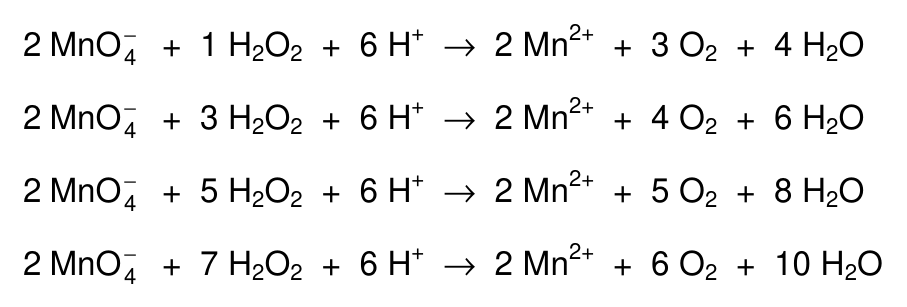
The reaction of permanganate ions with hydrogen peroxide in an acidic solution gives Mn(II) salt and at the same time oxygen is released:
Problems:
- The possible ratios of the reactants in the above equations express:
a) all equations ☐
b) only some of the equations ☐
c) only one equation ☐
d) none ☐Indicate the correct assertion by a cross in the corresponding square and explain your decision.
-
Which of the reactants is an oxidising agent and which is a reducing one?
-
How much potassium permanganate is needed to release 112 \(\mathrm{cm^3}\) of oxygen at STP conditions from an excess of hydrogen peroxide in acidic solution?
Official English text of the problem.
Problem 3: Isomeric cyclobutanedicarboxylic acids
The letters A, B, C, D, and E represent isomeric cyclobutane dicarboxylic acid, one of them being a racemic form.
It was shown that:
a) only compound C forms a cyclic anhydride easily,
b) B yields a cyclic anhydride only at higher temperatures,
c) of all the acids under investigation, only A releases carbon dioxide when heated,
d) D and E do not change at higher temperatures,
e) 2 moles of diethyl ester of malonic acid when reacted with sodium ethoxide (\(\ce{EtONa}\)), are transformed to sodium salt which by reaction with methylene iodide (\(\ce{CH2I2}\)) yields a tetraester \(\ce{C15H24O8}\). This new ester gives a tetraester \(\ce{C16H24O8}\) in the reaction with 2 moles of sodium ethoxide and 1 mole of methylene iodide. The last mentioned tetraester is transformed by alkaline hydrolysis and subsequent acidification to a tetracarboxylic acid which when heated, gives a mixture of B and E.
Problems:
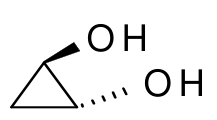
3.1 Give formulas corresponding to the letters A, B, C, D, and E. Mark the group which is above the plane of the cycle

, that under the plane with

For example:
3.2 Express processes a), b), and c) by chemical equations.
Official English text of the problem.
Problem 4: Hydrolysis of an optically active ester C6H12O2
An optically active ester (11.6 g) having the summary formula \(\ce{C6H12O2}\), was hydrolysed by heating with an excess of aqueous sodium hydroxide solution. After terminating the hydrolysis the alkaline reaction mixture was several times extracted with ether. The aqueous solution was not optically active. The united ether extracts were dried with anhydrous magnesium sulphate. The ether solution was filtrated, ether was distilled off from it and the residue was redistilled. 7.4 g (100 %) of a liquid boiling at 100 °C was obtained.
Problems:
- Write the structural formula of the ester.
- What would be the structure of an ester with identical summary formula, i. e. \(\ce{C6H12O2}\), if the aqueous solution after the alkaline hydrolysis obtained in the above mentioned way, were optically active?
- Write down equations for the alkaline hydrolysis of both esters with sodium hydroxide solution.
Official English text of the problem.
Problem 5: Solubility of two copper(I) salts in a buffer
Two copper(I) salts of the organic acids \(\ce{HA}\) and \(\ce{HB}\), slightly soluble in water, form a saturated solution in buffer of a given pH.
Problems:
5.1 What will be the concentration of \(\ce{Cu+}\) cations in the solution if the solubility products of the two salts are \(K_{\mathrm{s}}(\ce{CuA})\) and \(K_{\mathrm{s}}(\ce{CuB})\) and the ionisation constants of the acids are \(K_{\mathrm{a}}(\ce{HA})\) and \(K_{\mathrm{a}}(\ce{HB})\)?
Official English text of the problem.
Problem 6: Determination of glycine
Amino acids can be determined by measuring the volume of nitrogen released in their reaction with nitrous acid (Van Slyke's method), for example:

Another method consists of the reaction of amino acids with a volumetric solution of perchloric acid, for example:

The excess of the perchloric acid is determined then by titration with a volumetric solution of sodium acetate (carried out in a non-aqueous solution).
50.0 cm³ of a 0.100-normal solution of perchloric acid were added to a sample of glycine in glacial acetic acid. The excess of the perchloric acid was determined after the reaction by titration with 0.150-normal volumetric solution of sodium acetate. The consumption was 16.0 cm³.
Problem:
6.1 What would be the volume of the nitrogen released at a pressure of 102 658 Pa and a temperature of 20 °C when assumed that the same quantity of sample were analysed by the Van Slyke's method?
Official English text of the problem.
Problem 7: Photosynthesis reversed in a galvanic cell
Photosynthesis by be summarised by the overall equation:

for which values of \(\Delta H\) and \(\Delta S\) at \(25\,^\circ\mathrm{C}\) are as follows:
\[ \Delta H=2.816\times10^6\ \mathrm{J},\qquad \Delta S=-182\ \mathrm{J\,K^{-1}}\quad\text{or} \]
\(\Delta H=2.816\times10^6\ \mathrm{J\,mol^{-1}},\quad \Delta S=-182\ \mathrm{J\,K^{-1}\,mol^{-1}}\) if \(\Delta H\) and \(\Delta S\) values are related to one mole of reaction changes.
Imagine that there have been devised electrodes that would allow selective reduction of oxygen to water and oxidation of glucose to carbon dioxide in a galvanic cell, i. e a reverse process when compared with that of the photosynthetic reaction.
Problems:
7.1 What will be the electromotive force of the cell in which light energy would be transformed to electric energy by means of the photosynthetic reaction?
Note: In the envelope you can find the relation between the electromotive force and the change of free enthalpy of the reaction. (Attention: If you open the envelope you lose some points.)
7.2 In case we would want to quantify the symbol "light" in the equation of photosynthesis, we would ask: how many moles of photons with wavelength for example \(500\ \mathrm{nm}\) take part in the above reaction? Calculate.
7.3 Calculate, what would be the electric power of a square swimming pool with a side of \(10\ \mathrm{m}\) containing green algae capable of the photosynthetic reaction if under average illumination a current of \(1\ \mathrm{mA}\) can be expected from the area of \(1\ \mathrm{cm^2}\).
Official English text of the problem.
Problem 8: Carbon monoxide and haemoglobin
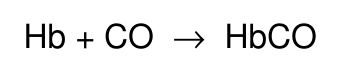
Among other factors, deterioration of the environment is manifested also by air pollution with carbon monoxide. Its most powerful source are combustion engines. The toxicity of carbon monoxide is caused by the fact that it forms with the blood dye - haemoglobin (\(\ce{Hb}\)), the compound carbonyl haemoglobin (\(\ce{HbCO}\)):
The chemical bond in carbonyl haemoglobin is about 200 times stronger than that in oxyhaemoglobin (\(\ce{HbO2}\)) originating under common conditions. Consequently, haemoglobin cannot be used in oxygen transfer. The lack of oxygen starts to be felt from 50 ppm carbon monoxide in the air, i. e. 10 % carbonyl haemoglobin in blood.
Air oxygen dissolves in blood in the lungs and its concentration under common conditions is kept at \(1.6\times10^{-6}\ \mathrm{mol\,dm^{-3}}\) by breathing. The concentration of haemoglobin in the blood of lung capillaries is also constant and is equal to \(8\times10^{-6}\ \mathrm{mol\,dm^{-3}}\)
Problems:
8.1 Calculate the rate of oxyhaemoglobin formation if the rate constant is \(k=2.1\times10^{6}\ \mathrm{dm^{3}\,mol^{-1}\,s^{-1}}\) (at \(37\,^\circ\mathrm{C}\) – normal body temperature).
8.2 In some cases (carbon monoxide poisoning) an increase of the rate of oxyhaemoglobin formation up to \(1.1\times10^{-4}\ \mathrm{mol\,dm^{-3}\,s^{-1}}\) is needed.
a) Calculate the required concentration of oxygen assuming that the concentration of haemoglobin in blood is constant.
b) Suggest of practical solution on the assumption that the concentration of oxygen in blood is proportional to the pressure of oxygen entering the lungs.
Official English text of the problem.
Internationale Chemie-Olympiade
IChO 1977
Bratislava, Tschechoslowakei · 8 Theorieaufgaben mit vollständigen Lösungen
Aufgabe 1: Salze M2S2Ox der Sauerstoffsäuren des Schwefels
Vergleichen Sie drei Salze der Zusammensetzung \(\ce{M2S2O_x}\), wobei x drei verschiedene kleine ganze Zahlen bezeichnet und M ein Alkalimetall ist. Auf jedes der drei Salze treffen einige der folgenden Aussagen zu:
a) Die \(\ce{O-O}\)-Bindung ist für das Anion charakteristisch.
b) Die \(\ce{S-S}\)-Bindung ist für das Anion charakteristisch.
c) Die \(\ce{S-O-S}\)-Bindung ist für das Anion charakteristisch.
d) Es entsteht durch thermische Zersetzung von Hydrogensulfat.
e) Es entsteht durch anodische Oxidation von Hydrogensulfat.
f) Es entsteht durch die Reaktion einer wässrigen Sulfitlösung mit Schwefel.
g) Seine wässrige Lösung löst Silberbromid.
h) Die Neutralisation seiner wässrigen Lösung mit dem Hydroxid \(\ce{MOH}\) ergibt das Sulfat \(\ce{M2SO4}\).
i) In wässriger Lösung kann es ein Mn(II)-Salz zu Permanganat oxidieren.Aufgaben:
1.1 Tragen Sie die richtigen x-Werte in die in der Tabelle angegebenen Formeln ein und kennzeichnen Sie in den entsprechenden Feldern mit den passenden Buchstaben diejenigen Aussagen, die auf das jeweilige Salz zutreffen:
\(\ce{M2S2O_{\square}}\) \(\ce{M2S2O_{\square}}\) \(\ce{M2S2O_{\square}}\) 1.2 Geben Sie die Strukturformeln der Anionen der drei oben genannten Salze an und ordnen Sie darin die \(\sigma\)-Bindungen und \(\pi\)-Bindungen zu.
1.3 Geben Sie die chemischen Gleichungen für die Vorgänge an, die in den Aussagen unter den Buchstaben d, e, f, g, h, i beschrieben werden.
Aufgabentext aus dem offiziellen englischen Text übersetzt.
Aufgabe 2: Permanganat und Wasserstoffperoxid
Bei der Reaktion von Permanganat-Ionen mit Wasserstoffperoxid in saurer Lösung entsteht ein Mn(II)-Salz, und gleichzeitig wird Sauerstoff freigesetzt:
Aufgaben:
- Die möglichen Mengenverhältnisse der Reaktanden werden in den obigen Gleichungen dargestellt durch:
a) alle Gleichungen ☐
b) nur einige der Gleichungen ☐
c) nur eine Gleichung ☐
d) keine ☐Kennzeichnen Sie die richtige Aussage durch ein Kreuz im entsprechenden Kästchen und begründen Sie Ihre Entscheidung.
-
Welcher der Reaktanden ist ein Oxidationsmittel und welcher ein Reduktionsmittel?
-
Wie viel Kaliumpermanganat wird benötigt, um aus einem Überschuss an Wasserstoffperoxid in saurer Lösung 112 \(\mathrm{cm^3}\) Sauerstoff unter Standardbedingungen (STP) freizusetzen?
Aufgabentext aus dem offiziellen englischen Text übersetzt.
Aufgabe 3: Isomere Cyclobutandicarbonsäuren
Die Buchstaben A, B, C, D, und E bezeichnen isomere Cyclobutandicarbonsäuren, von denen eine als Racemat vorliegt.
Es wurde festgestellt, dass:
a) nur Verbindung C leicht ein cyclisches Anhydrid bildet,
b) B erst bei höheren Temperaturen ein cyclisches Anhydrid ergibt,
c) von allen untersuchten Säuren nur A beim Erhitzen Kohlenstoffdioxid abspaltet,
d) D und E sich bei höheren Temperaturen nicht verändern,
e) 2 Mol Malonsäurediethylester bei der Umsetzung mit Natriumethanolat (\(\ce{EtONa}\)) in das Natriumsalz überführt werden, das bei der Reaktion mit Methyleniodid (\(\ce{CH2I2}\)) einen Tetraester \(\ce{C15H24O8}\) ergibt. Dieser neue Ester ergibt bei der Reaktion mit 2 Mol Natriumethanolat und 1 Mol Methyleniodid einen Tetraester \(\ce{C16H24O8}\). Der zuletzt genannte Tetraester wird durch alkalische Hydrolyse und anschließendes Ansäuern in eine Tetracarbonsäure überführt, die beim Erhitzen ein Gemisch aus B und E ergibt.
Aufgaben:
3.1 Geben Sie die den Buchstaben A, B, C, D, und E entsprechenden Formeln an. Kennzeichnen Sie die Gruppe oberhalb der Ringebene mit
, diejenige unterhalb der Ebene mit
Zum Beispiel:
3.2 Stellen Sie die Vorgänge a), b) und c) durch chemische Gleichungen dar.
Aufgabentext aus dem offiziellen englischen Text übersetzt.
Aufgabe 4: Hydrolyse eines optisch aktiven Esters C6H12O2
Ein optisch aktiver Ester (11.6 g) mit der Summenformel \(\ce{C6H12O2}\) wurde durch Erhitzen mit einem Überschuss an wässriger Natriumhydroxidlösung hydrolysiert. Nach Beendigung der Hydrolyse wurde das alkalische Reaktionsgemisch mehrmals mit Ether extrahiert. Die wässrige Lösung war nicht optisch aktiv. Die vereinigten Etherextrakte wurden mit wasserfreiem Magnesiumsulfat getrocknet. Die Etherlösung wurde filtriert, der Ether daraus abdestilliert und der Rückstand erneut destilliert. Es wurden 7.4 g (100 %) einer bei 100 °C siedenden Flüssigkeit erhalten.
Aufgaben:
- Geben Sie die Strukturformel des Esters an.
- Welche Struktur hätte ein Ester mit derselben Summenformel, d. h. \(\ce{C6H12O2}\), wenn die nach der alkalischen Hydrolyse auf die oben beschriebene Weise erhaltene wässrige Lösung optisch aktiv wäre?
- Geben Sie die Gleichungen für die alkalische Hydrolyse beider Ester mit Natriumhydroxidlösung an.
Aufgabentext aus dem offiziellen englischen Text übersetzt.
Aufgabe 5: Löslichkeit zweier Kupfer(I)-Salze in einer Pufferlösung
Zwei in Wasser schwer lösliche Kupfer(I)-Salze der organischen Säuren \(\ce{HA}\) und \(\ce{HB}\) bilden in einer Pufferlösung mit einem vorgegebenen pH-Wert eine gesättigte Lösung.
Aufgaben:
5.1 Wie hoch ist die Konzentration der \(\ce{Cu+}\)-Kationen in der Lösung, wenn die Löslichkeitsprodukte der beiden Salze \(K_{\mathrm{s}}(\ce{CuA})\) und \(K_{\mathrm{s}}(\ce{CuB})\) und die Säurekonstanten der Säuren \(K_{\mathrm{a}}(\ce{HA})\) und \(K_{\mathrm{a}}(\ce{HB})\) sind?
Aufgabentext aus dem offiziellen englischen Text übersetzt.
Aufgabe 6: Bestimmung von Glycin
Aminosäuren können durch Messung des Volumens des bei ihrer Reaktion mit salpetriger Säure freigesetzten Stickstoffs bestimmt werden (Methode nach Van Slyke), zum Beispiel:
Eine andere Methode beruht auf der Reaktion von Aminosäuren mit einer Perchlorsäure-Maßlösung, zum Beispiel:
Der Überschuss an Perchlorsäure wird anschließend durch Titration mit einer Natriumacetat-Maßlösung bestimmt (durchgeführt in nichtwässriger Lösung).
Zu einer Probe von Glycin in Eisessig wurden 50.0 cm³ einer 0.100-normalen Perchlorsäurelösung gegeben. Der Überschuss an Perchlorsäure wurde nach der Reaktion durch Titration mit einer 0.150-normalen Natriumacetat-Maßlösung bestimmt. Der Verbrauch betrug 16.0 cm³.
Aufgabe:
6.1 Welches Volumen hätte der bei einem Druck von 102 658 Pa und einer Temperatur von 20 °C freigesetzte Stickstoff, wenn dieselbe Probenmenge nach der Methode von Van Slyke analysiert würde?
Aufgabentext aus dem offiziellen englischen Text übersetzt.
Aufgabe 7: Umkehrung der Photosynthese in einer galvanischen Zelle
Die Photosynthese lässt sich durch die folgende Gesamtgleichung zusammenfassen:
Für diese Reaktion haben \(\Delta H\) und \(\Delta S\) bei \(25\,^\circ\mathrm{C}\) die folgenden Werte:
\[ \Delta H=2.816\times10^6\ \mathrm{J},\qquad \Delta S=-182\ \mathrm{J\,K^{-1}}\quad\text{oder} \]
\(\Delta H=2.816\times10^6\ \mathrm{J\,mol^{-1}},\quad \Delta S=-182\ \mathrm{J\,K^{-1}\,mol^{-1}}\), wenn die Werte von \(\Delta H\) und \(\Delta S\) auf einen Reaktionsumsatz von einem Mol bezogen werden.
Stellen Sie sich vor, es seien Elektroden entwickelt worden, die in einer galvanischen Zelle die selektive Reduktion von Sauerstoff zu Wasser und die Oxidation von Glucose zu Kohlenstoffdioxid ermöglichen, also einen Prozess, der die Umkehrung der Photosynthesereaktion darstellt.
Aufgaben:
7.1 Wie groß ist die elektromotorische Kraft der Zelle, in der Lichtenergie mithilfe der Photosynthesereaktion in elektrische Energie umgewandelt würde?
Hinweis: Im Umschlag finden Sie den Zusammenhang zwischen der elektromotorischen Kraft und der Änderung der freien Enthalpie der Reaktion. (Achtung: Wenn Sie den Umschlag öffnen, verlieren Sie einige Punkte.)
7.2 Wenn wir das Symbol „Licht“ in der Photosynthesegleichung quantifizieren möchten, stellt sich die Frage: Wie viele Mol Photonen mit einer Wellenlänge von beispielsweise \(500\ \mathrm{nm}\) sind an der obigen Reaktion beteiligt? Berechnen Sie diese Stoffmenge.
7.3 Berechnen Sie die elektrische Leistung eines quadratischen Schwimmbeckens mit einer Seitenlänge von \(10\ \mathrm{m}\), das Grünalgen enthält, die zur Photosynthesereaktion fähig sind, wenn bei durchschnittlicher Beleuchtung von einer Fläche von \(1\ \mathrm{cm^2}\) ein Strom von \(1\ \mathrm{mA}\) zu erwarten ist.
Aufgabentext aus dem offiziellen englischen Text übersetzt.
Aufgabe 8: Kohlenstoffmonoxid und Hämoglobin
Die Verschlechterung der Umwelt zeigt sich unter anderem auch in der Luftverschmutzung durch Kohlenstoffmonoxid. Seine bedeutendste Quelle sind Verbrennungsmotoren. Die Giftigkeit von Kohlenstoffmonoxid beruht darauf, dass es mit dem Blutfarbstoff Hämoglobin (\(\ce{Hb}\)) die Verbindung Carbonylhämoglobin (\(\ce{HbCO}\)) bildet:
Die chemische Bindung im Carbonylhämoglobin ist etwa 200-mal stärker als die im Oxyhämoglobin (\(\ce{HbO2}\)), das unter normalen Bedingungen entsteht. Folglich steht das Hämoglobin nicht mehr für den Sauerstofftransport zur Verfügung. Der Sauerstoffmangel macht sich ab 50 ppm Kohlenstoffmonoxid in der Luft bemerkbar, d. h. bei 10 % Carbonylhämoglobin im Blut.
In der Lunge löst sich Luftsauerstoff im Blut, und seine Konzentration wird unter normalen Bedingungen durch die Atmung bei \(1.6\times10^{-6}\ \mathrm{mol\,dm^{-3}}\) gehalten. Die Konzentration von Hämoglobin im Blut der Lungenkapillaren ist ebenfalls konstant und beträgt \(8\times10^{-6}\ \mathrm{mol\,dm^{-3}}\)
Aufgaben:
8.1 Berechnen Sie die Bildungsgeschwindigkeit von Oxyhämoglobin, wenn die Geschwindigkeitskonstante \(k=2.1\times10^{6}\ \mathrm{dm^{3}\,mol^{-1}\,s^{-1}}\) beträgt (bei \(37\,^\circ\mathrm{C}\) – normaler Körpertemperatur).
8.2 In einigen Fällen (Kohlenstoffmonoxidvergiftung) ist eine Erhöhung der Bildungsgeschwindigkeit von Oxyhämoglobin auf \(1.1\times10^{-4}\ \mathrm{mol\,dm^{-3}\,s^{-1}}\) erforderlich.
a) Berechnen Sie die erforderliche Sauerstoffkonzentration unter der Annahme, dass die Hämoglobinkonzentration im Blut konstant ist.
b) Schlagen Sie eine praktische Lösung unter der Annahme vor, dass die Sauerstoffkonzentration im Blut proportional zum Druck des in die Lunge gelangenden Sauerstoffs ist.
Aufgabentext aus dem offiziellen englischen Text übersetzt.
Uluslararası Kimya Olimpiyatı
IChO 1977
Bratislava, Çekoslovakya · 8 teori sorusu, tam çözümleriyle
Soru 1: Kükürt oksoasitlerinin M2S2Ox tuzları
x'in üç farklı küçük tam sayı ve M'nin bir alkali metal olduğu, \(\ce{M2S2O_x}\) bileşimindeki üç tuzu karşılaştırın. Aşağıdaki ifadelerden bazıları bu üç tuzun her biri için geçerlidir:
a) Anyonun karakteristik bağı \(\ce{O-O}\) bağıdır.
b) Anyonun karakteristik bağı \(\ce{S-S}\) bağıdır.
c) Anyonun karakteristik bağı \(\ce{S-O-S}\) bağıdır.
d) Hidrojen sülfatın ısıl bozunmasıyla oluşur.
e) Hidrojen sülfatın anodik yükseltgenmesiyle oluşur.
f) Sülfitin sulu çözeltisinin kükürt ile tepkimesinden oluşur.
g) Sulu çözeltisi gümüş bromürü çözer.
h) Sulu çözeltisinin \(\ce{MOH}\) hidroksiti ile nötrleştirilmesi sonucunda \(\ce{M2SO4}\) sülfatı elde edilir.
i) Sulu çözeltide Mn(II) tuzunu permanganata yükseltgeyebilir.Sorular:
1.1 Tabloda verilen formüllerdeki x değerlerini doğru şekilde doldurun ve verilen tuzların her biri için geçerli olan ifadeleri uygun harflerle ilgili kutucuklarda belirtin:
\(\ce{M2S2O_{\square}}\) \(\ce{M2S2O_{\square}}\) \(\ce{M2S2O_{\square}}\) 1.2 Yukarıdaki üç tuzun anyonlarının yapı formüllerini yazın ve bu yapılardaki \(\sigma\) bağlarını ve \(\pi\) bağlarını belirtin.
1.3 d, e, f, g, h, i harfleriyle verilen ifadelerdeki süreçleri gösteren kimyasal denklemleri yazın.
Soru metni resmi İngilizce metinden çevrilmiştir.
Soru 2: Permanganat ve hidrojen peroksit
Permanganat iyonlarının asidik bir çözeltide hidrojen peroksitle tepkimesi sonucunda Mn(II) tuzu oluşur ve aynı zamanda oksijen açığa çıkar:
Sorular:
- Yukarıdaki denklemlerden hangileri tepkimeye giren maddelerin olası oranlarını ifade eder?
a) tüm denklemler ☐
b) denklemlerin yalnızca bazıları ☐
c) yalnızca bir denklem ☐
d) hiçbiri ☐Doğru ifadeyi ilgili kareye çarpı koyarak belirtin ve kararınızı açıklayın.
-
Tepkimeye giren maddelerden hangisi yükseltgen, hangisi indirgendir?
-
Asidik çözeltide fazla miktarda bulunan hidrojen peroksitten standart sıcaklık ve basınç (STP) koşullarında 112 \(\mathrm{cm^3}\) oksijen açığa çıkarmak için ne kadar potasyum permanganat gerekir?
Soru metni resmi İngilizce metinden çevrilmiştir.
Soru 3: İzomerik siklobütandikarboksilik asitler
A, B, C, D ve E harfleri, biri rasemik formda olan izomerik siklobütandikarboksilik asitleri temsil etmektedir.
Şunlar gösterilmiştir:
a) yalnızca C bileşiği kolayca halkalı bir anhidrit oluşturur,
b) B, yalnızca daha yüksek sıcaklıklarda halkalı bir anhidrit verir,
c) incelenen asitlerin tümü arasında yalnızca A, ısıtıldığında karbon dioksit açığa çıkarır,
d) D ve E, daha yüksek sıcaklıklarda değişime uğramaz,
e) malonik asidin dietil esterinin 2 molü, sodyum etoksit (\(\ce{EtONa}\)) ile tepkimeye sokulduğunda sodyum tuzuna dönüşür; bu tuz, metilen iyodür (\(\ce{CH2I2}\)) ile tepkimeye girerek \(\ce{C15H24O8}\) tetraesterini verir. Bu yeni ester, 2 mol sodyum etoksit ve 1 mol metilen iyodür ile tepkimesinde \(\ce{C16H24O8}\) tetraesterini verir. Son sözü edilen tetraester, bazik hidroliz ve ardından asitleştirme yoluyla bir tetrakarboksilik aside dönüştürülür; bu asit ısıtıldığında B ve E karışımını verir.
Sorular:
3.1 A, B, C, D ve E harflerine karşılık gelen formülleri veriniz. Halka düzleminin üzerindeki grubu
ile, düzlemin altındaki grubu ise
ile gösteriniz. Örneğin:
3.2 a), b) ve c) süreçlerini kimyasal denklemlerle ifade ediniz.
Soru metni resmi İngilizce metinden çevrilmiştir.
Soru 4: Optikçe aktif bir C6H12O2 esterinin hidrolizi
Molekül formülü \(\ce{C6H12O2}\) olan optikçe aktif bir ester (11.6 g), aşırı miktarda sulu sodyum hidroksit çözeltisiyle ısıtılarak hidroliz edildi. Hidroliz tamamlandıktan sonra bazik tepkime karışımı eterle birkaç kez ekstrakte edildi. Sulu çözelti optikçe aktif değildi. Birleştirilen eter ekstraktları susuz magnezyum sülfatla kurutuldu. Eter çözeltisi süzüldü, eter damıtılarak uzaklaştırıldı ve kalan madde yeniden damıtıldı. 100 °C'de kaynayan bir sıvıdan 7.4 g (%100) elde edildi.
Sorular:
- Esterin yapı formülünü yazınız.
- Yukarıda belirtilen şekilde gerçekleştirilen bazik hidrolizden sonra elde edilen sulu çözelti optikçe aktif olsaydı, aynı molekül formülüne, yani \(\ce{C6H12O2}\) formülüne sahip bir esterin yapısı nasıl olurdu?
- Her iki esterin sodyum hidroksit çözeltisiyle bazik hidroliz denklemlerini yazınız.
Soru metni resmi İngilizce metinden çevrilmiştir.
Soru 5: İki bakır(I) tuzunun tampon çözeltideki çözünürlüğü
Organik asitler \(\ce{HA}\) ve \(\ce{HB}\)'nin suda az çözünen iki bakır(I) tuzu, belirli bir pH değerine sahip tampon çözeltide doygun bir çözelti oluşturur.
Sorular:
5.1 İki tuzun çözünürlük çarpımları \(K_{\mathrm{s}}(\ce{CuA})\) ve \(K_{\mathrm{s}}(\ce{CuB})\), asitlerin iyonlaşma sabitleri ise \(K_{\mathrm{a}}(\ce{HA})\) ve \(K_{\mathrm{a}}(\ce{HB})\) olduğuna göre, çözeltideki \(\ce{Cu+}\) katyonlarının derişimi ne olur?
Soru metni resmi İngilizce metinden çevrilmiştir.
Soru 6: Glisin tayini
Amino asitler, nitröz asitle tepkimelerinde açığa çıkan azotun hacmi ölçülerek tayin edilebilir (Van Slyke yöntemi), örneğin:
Bir başka yöntem, amino asitlerin ayarlı bir perklorik asit çözeltisiyle tepkimesine dayanır, örneğin:
Ardından perklorik asidin fazlası, ayarlı bir sodyum asetat çözeltisiyle titrasyon yoluyla belirlenir (titrasyon susuz bir çözeltide gerçekleştirilir).
Buzlu asetik asit içindeki bir glisin numunesine 50.0 cm³ 0.100 normal perklorik asit çözeltisi eklenmiştir. Tepkimeden sonra perklorik asidin fazlası, 0.150 normal ayarlı sodyum asetat çözeltisiyle titrasyon yoluyla belirlenmiştir. Harcanan hacim 16.0 cm³ olmuştur.
Soru:
6.1 Aynı miktardaki numunenin Van Slyke yöntemiyle analiz edildiği varsayılırsa, 102 658 Pa basınçta ve 20 °C sıcaklıkta açığa çıkan azotun hacmi ne olurdu?
Soru metni resmi İngilizce metinden çevrilmiştir.
Soru 7: Galvanik hücrede tersine çevrilen fotosentez
Fotosentez, aşağıdaki toplam tepkime denklemiyle özetlenebilir:
Bu tepkime için \(25\,^\circ\mathrm{C}\) sıcaklığındaki \(\Delta H\) ve \(\Delta S\) değerleri şöyledir:
\[ \Delta H=2.816\times10^6\ \mathrm{J},\qquad \Delta S=-182\ \mathrm{J\,K^{-1}}\quad\text{veya} \]
\(\Delta H\) ve \(\Delta S\) değerleri tepkimenin bir mol ilerlemesine karşılık gelen değişimlerle ilişkilendirilirse \(\Delta H=2.816\times10^6\ \mathrm{J\,mol^{-1}},\quad \Delta S=-182\ \mathrm{J\,K^{-1}\,mol^{-1}}\) olur.
Bir galvanik hücrede oksijenin seçici olarak suya indirgenmesini ve glikozun karbondioksite yükseltgenmesini, yani fotosentez tepkimesinin tersinin gerçekleşmesini sağlayacak elektrotların geliştirildiğini düşününüz.
Sorular:
7.1 Fotosentez tepkimesi aracılığıyla ışık enerjisinin elektrik enerjisine dönüştürüleceği hücrenin elektromotor kuvveti ne olacaktır?
Not: Zarfta, elektromotor kuvvet ile tepkimenin serbest entalpi değişimi arasındaki bağıntıyı bulabilirsiniz. (Dikkat: Zarfı açarsanız bir miktar puan kaybedersiniz.)
7.2 Fotosentez denklemindeki "ışık" simgesini nicel olarak ifade etmek isteseydik şu soruyu sorardık: Örneğin dalga boyu \(500\ \mathrm{nm}\) olan fotonlardan kaç molü yukarıdaki tepkimeye katılır? Hesaplayınız.
7.3 Bir kenarı \(10\ \mathrm{m}\) olan, fotosentez tepkimesini gerçekleştirebilen yeşil algler içeren kare biçimindeki bir yüzme havuzunun elektrik gücünü, ortalama aydınlatma koşullarında \(1\ \mathrm{cm^2}\) alandan \(1\ \mathrm{mA}\) akım elde edilmesi bekleniyorsa hesaplayınız.
Soru metni resmi İngilizce metinden çevrilmiştir.
Soru 8: Karbon monoksit ve hemoglobin
Çevrenin bozulması, diğer etkenlerin yanı sıra, havanın karbon monoksitle kirlenmesiyle de kendini gösterir. Karbon monoksitin en büyük kaynağı içten yanmalı motorlardır. Karbon monoksitin zehirliliği, kan pigmenti olan hemoglobin (\(\ce{Hb}\)) ile karbonilhemoglobin (\(\ce{HbCO}\)) bileşiğini oluşturmasından kaynaklanır:
Karbonilhemoglobindeki kimyasal bağ, olağan koşullarda oluşan oksihemoglobindeki (\(\ce{HbO2}\)) bağdan yaklaşık 200 kat daha kuvvetlidir. Bunun sonucunda hemoglobin, oksijen taşınmasında kullanılamaz. Havadaki karbon monoksit düzeyi 50 ppm'e ulaştığında, yani kandaki karbonilhemoglobin oranı % 10 olduğunda, oksijen eksikliği hissedilmeye başlar.
Havadaki oksijen akciğerlerde kanda çözünür ve olağan koşullarda derişimi, solunum yoluyla \(1.6\times10^{-6}\ \mathrm{mol\,dm^{-3}}\) düzeyinde tutulur. Akciğer kılcal damarlarındaki kanda hemoglobin derişimi de sabittir ve \(8\times10^{-6}\ \mathrm{mol\,dm^{-3}}\) değerine eşittir.
Sorular:
8.1 Hız sabiti \(k=2.1\times10^{6}\ \mathrm{dm^{3}\,mol^{-1}\,s^{-1}}\) olduğuna göre (\(37\,^\circ\mathrm{C}\)'de – normal vücut sıcaklığı), oksihemoglobin oluşum hızını hesaplayınız.
8.2 Bazı durumlarda (karbon monoksit zehirlenmesinde), oksihemoglobin oluşum hızının \(1.1\times10^{-4}\ \mathrm{mol\,dm^{-3}\,s^{-1}}\) değerine kadar artırılması gerekir.
a) Kandaki hemoglobin derişiminin sabit olduğunu varsayarak gerekli oksijen derişimini hesaplayınız.
b) Kandaki oksijen derişiminin akciğerlere giren oksijenin basıncıyla orantılı olduğunu varsayarak uygulanabilir bir çözüm öneriniz.
Soru metni resmi İngilizce metinden çevrilmiştir.
Olimpiada Internacional de Química
IChO 1977
Bratislava, Checoslovaquia · 8 problemas teóricos con soluciones completas
Problema 1: Sales M2S2Ox de oxoácidos del azufre
Compare tres sales de composición \(\ce{M2S2O_x}\), donde x toma tres valores enteros pequeños diferentes y M es un metal alcalino. A cada una de las tres sales le corresponden algunas de las siguientes afirmaciones:
a) El enlace \(\ce{O-O}\) es característico del anión.
b) El enlace \(\ce{S-S}\) es característico del anión.
c) El enlace \(\ce{S-O-S}\) es característico del anión.
d) Se forma por descomposición térmica del hidrogenosulfato.
e) Se forma por oxidación anódica del hidrogenosulfato.
f) Se forma por la reacción de una disolución acuosa de sulfito con azufre.
g) Su disolución acuosa disuelve el bromuro de plata.
h) La neutralización de su disolución acuosa con el hidróxido \(\ce{MOH}\) produce el sulfato \(\ce{M2SO4}\).
i) En disolución acuosa, es capaz de oxidar una sal de Mn(II) a permanganato.Cuestiones:
1.1 Complete los valores correctos de x en las fórmulas de la tabla e indique en la casilla correspondiente, mediante las letras apropiadas, las afirmaciones que pueden aplicarse a cada una de las sales dadas:
\(\ce{M2S2O_{\square}}\) \(\ce{M2S2O_{\square}}\) \(\ce{M2S2O_{\square}}\) 1.2 Escriba las fórmulas estructurales de los aniones de las tres sales anteriores e identifique en ellas los enlaces \(\sigma\) y los enlaces \(\pi\).
1.3 Escriba las ecuaciones químicas que expresan los procesos descritos en las afirmaciones correspondientes a las letras d, e, f, g, h, i.
Enunciado traducido del texto oficial en inglés.
Problema 2: Permanganato y peróxido de hidrógeno
La reacción de los iones permanganato con el peróxido de hidrógeno en disolución ácida produce una sal de Mn(II) y, al mismo tiempo, se desprende oxígeno:
Cuestiones:
- Las posibles proporciones de los reactivos en las ecuaciones anteriores están expresadas por:
a) todas las ecuaciones ☐
b) solo algunas de las ecuaciones ☐
c) solo una ecuación ☐
d) ninguna ☐Indique la afirmación correcta con una cruz en la casilla correspondiente y explique su decisión.
-
¿Cuál de los reactivos es un agente oxidante y cuál es un agente reductor?
-
¿Cuánto permanganato de potasio se necesita para desprender 112 \(\mathrm{cm^3}\) de oxígeno en condiciones normales de presión y temperatura (STP) a partir de un exceso de peróxido de hidrógeno en disolución ácida?
Enunciado traducido del texto oficial en inglés.
Problema 3: Ácidos ciclobutanodicarboxílicos isómeros
Las letras A, B, C, D, y E representan ácidos ciclobutanodicarboxílicos isómeros, uno de los cuales es una forma racémica.
Se demostró que:
a) solo el compuesto C forma fácilmente un anhídrido cíclico,
b) B produce un anhídrido cíclico únicamente a temperaturas más altas,
c) de todos los ácidos investigados, solo A libera dióxido de carbono al calentarse,
d) D y E no experimentan cambios a temperaturas más altas,
e) 2 moles del éster dietílico del ácido malónico, al reaccionar con etóxido de sodio (\(\ce{EtONa}\)), se transforman en una sal sódica que, al reaccionar con yoduro de metileno (\(\ce{CH2I2}\)), produce un tetraéster \(\ce{C15H24O8}\). Este nuevo éster da un tetraéster \(\ce{C16H24O8}\) al reaccionar con 2 moles de etóxido de sodio y 1 mol de yoduro de metileno. Este último tetraéster se transforma mediante hidrólisis alcalina y posterior acidificación en un ácido tetracarboxílico que, al calentarse, da una mezcla de B y E.
Cuestiones:
3.1 Indique las fórmulas correspondientes a las letras A, B, C, D, y E. Marque el grupo que se encuentra por encima del plano del anillo con
, y el que se encuentra por debajo del plano con
Por ejemplo:
3.2 Exprese los procesos a), b) y c) mediante ecuaciones químicas.
Enunciado traducido del texto oficial en inglés.
Problema 4: Hidrólisis de un éster ópticamente activo C6H12O2
Un éster ópticamente activo (11.6 g) de fórmula molecular \(\ce{C6H12O2}\) se hidrolizó por calentamiento con un exceso de disolución acuosa de hidróxido de sodio. Una vez terminada la hidrólisis, la mezcla de reacción alcalina se extrajo varias veces con éter. La disolución acuosa no presentaba actividad óptica. Los extractos etéreos reunidos se secaron con sulfato de magnesio anhidro. La disolución etérea se filtró, se eliminó el éter por destilación y el residuo se volvió a destilar. Se obtuvieron 7.4 g (100 %) de un líquido que hervía a 100 °C.
Cuestiones:
- Escriba la fórmula estructural del éster.
- ¿Cuál sería la estructura de un éster con la misma fórmula molecular, es decir, \(\ce{C6H12O2}\), si la disolución acuosa obtenida tras la hidrólisis alcalina realizada de la manera descrita anteriormente fuera ópticamente activa?
- Escriba las ecuaciones de la hidrólisis alcalina de ambos ésteres con disolución de hidróxido de sodio.
Enunciado traducido del texto oficial en inglés.
Problema 5: Solubilidad de dos sales de cobre(I) en una disolución tampón
Dos sales de cobre(I) de los ácidos orgánicos \(\ce{HA}\) y \(\ce{HB}\), poco solubles en agua, forman una disolución saturada en una disolución tampón de pH dado.
Problemas:
5.1 ¿Cuál será la concentración de cationes \(\ce{Cu+}\) en la disolución si los productos de solubilidad de las dos sales son \(K_{\mathrm{s}}(\ce{CuA})\) y \(K_{\mathrm{s}}(\ce{CuB})\) y las constantes de ionización de los ácidos son \(K_{\mathrm{a}}(\ce{HA})\) y \(K_{\mathrm{a}}(\ce{HB})\)?
Enunciado traducido del texto oficial en inglés.
Problema 6: Determinación de glicina
Los aminoácidos pueden determinarse midiendo el volumen de nitrógeno liberado en su reacción con ácido nitroso (método de Van Slyke), por ejemplo:
Otro método consiste en la reacción de los aminoácidos con una disolución valorada de ácido perclórico, por ejemplo:
El exceso de ácido perclórico se determina a continuación mediante una valoración con una disolución valorada de acetato de sodio (realizada en una disolución no acuosa).
Se añadieron 50.0 cm³ de una disolución 0.100 normal de ácido perclórico a una muestra de glicina en ácido acético glacial. Tras la reacción, el exceso de ácido perclórico se determinó mediante una valoración con una disolución valorada 0.150 normal de acetato de sodio. El volumen consumido fue de 16.0 cm³.
Problema:
6.1 ¿Cuál sería el volumen de nitrógeno liberado a una presión de 102 658 Pa y una temperatura de 20 °C, suponiendo que se analizara la misma cantidad de muestra mediante el método de Van Slyke?
Enunciado traducido del texto oficial en inglés.
Problema 7: Fotosíntesis invertida en una pila galvánica
La fotosíntesis puede resumirse mediante la ecuación global:
para la cual los valores de \(\Delta H\) y \(\Delta S\) a \(25\,^\circ\mathrm{C}\) son los siguientes:
\[ \Delta H=2.816\times10^6\ \mathrm{J},\qquad \Delta S=-182\ \mathrm{J\,K^{-1}}\quad\text{o} \]
\(\Delta H=2.816\times10^6\ \mathrm{J\,mol^{-1}},\quad \Delta S=-182\ \mathrm{J\,K^{-1}\,mol^{-1}}\) si los valores de \(\Delta H\) y \(\Delta S\) se refieren a un mol de avance de la reacción.
Imagine que se han diseñado electrodos que permitirían la reducción selectiva del oxígeno a agua y la oxidación de la glucosa a dióxido de carbono en una pila galvánica, es decir, un proceso inverso al de la reacción fotosintética.
Cuestiones:
7.1 ¿Cuál será la fuerza electromotriz de la pila en la que la energía luminosa se transformaría en energía eléctrica mediante la reacción fotosintética?
Nota: En el sobre encontrará la relación entre la fuerza electromotriz y la variación de entalpía libre de la reacción. (Atención: Si abre el sobre, perderá algunos puntos.)
7.2 Si quisiéramos cuantificar el símbolo «luz» en la ecuación de la fotosíntesis, nos preguntaríamos: ¿cuántos moles de fotones con una longitud de onda de, por ejemplo, \(500\ \mathrm{nm}\) intervienen en la reacción anterior? Calcúlelo.
7.3 Calcule cuál sería la potencia eléctrica de una piscina cuadrada de \(10\ \mathrm{m}\) de lado que contiene algas verdes capaces de realizar la reacción fotosintética si, con una iluminación media, cabe esperar una corriente de \(1\ \mathrm{mA}\) por cada superficie de \(1\ \mathrm{cm^2}\).
Enunciado traducido del texto oficial en inglés.
Problema 8: Monóxido de carbono y hemoglobina
Entre otros factores, el deterioro del medio ambiente se manifiesta también por la contaminación del aire con monóxido de carbono. Su principal fuente son los motores de combustión. La toxicidad del monóxido de carbono se debe a que forma con el pigmento sanguíneo, la hemoglobina (\(\ce{Hb}\)), el compuesto carboxihemoglobina (\(\ce{HbCO}\)):
El enlace químico en la carboxihemoglobina es unas 200 veces más fuerte que el de la oxihemoglobina (\(\ce{HbO2}\)), que se forma en condiciones normales. En consecuencia, la hemoglobina no puede participar en el transporte de oxígeno. La falta de oxígeno empieza a manifestarse a partir de 50 ppm de monóxido de carbono en el aire, es decir, un 10 % de carboxihemoglobina en la sangre.
El oxígeno del aire se disuelve en la sangre en los pulmones y, en condiciones normales, la respiración mantiene su concentración en \(1.6\times10^{-6}\ \mathrm{mol\,dm^{-3}}\). La concentración de hemoglobina en la sangre de los capilares pulmonares también es constante e igual a \(8\times10^{-6}\ \mathrm{mol\,dm^{-3}}\)
Cuestiones:
8.1 Calcule la velocidad de formación de oxihemoglobina si la constante de velocidad es \(k=2.1\times10^{6}\ \mathrm{dm^{3}\,mol^{-1}\,s^{-1}}\) (a \(37\,^\circ\mathrm{C}\), la temperatura corporal normal).
8.2 En algunos casos (intoxicación por monóxido de carbono) es necesario aumentar la velocidad de formación de oxihemoglobina hasta \(1.1\times10^{-4}\ \mathrm{mol\,dm^{-3}\,s^{-1}}\).
a) Calcule la concentración de oxígeno necesaria suponiendo que la concentración de hemoglobina en la sangre es constante.
b) Proponga una solución práctica suponiendo que la concentración de oxígeno en la sangre es proporcional a la presión del oxígeno que entra en los pulmones.
Enunciado traducido del texto oficial en inglés.
国际化学奥林匹克
IChO 1977
捷克斯洛伐克布拉迪斯拉发 · 8 道理论题及完整解答
题目 1:硫的含氧酸盐 M2S2Ox
比较三种组成通式为 \(\ce{M2S2O_x}\) 的盐,其中 x 为三个不同的小整数,M 为碱金属。以下各项描述中的若干项适用于这三种盐中的每一种:
a) 该阴离子的特征是具有 \(\ce{O-O}\) 键。
b) 该阴离子的特征是具有 \(\ce{S-S}\) 键。
c) 该阴离子的特征是具有 \(\ce{S-O-S}\) 键。
d) 该盐由硫酸氢盐热分解生成。
e) 该盐由硫酸氢盐在阳极氧化生成。
f) 该盐由亚硫酸盐的水溶液与硫反应生成。
g) 其水溶液能溶解溴化银。
h) 用氢氧化物 \(\ce{MOH}\) 中和其水溶液,得到硫酸盐 \(\ce{M2SO4}\)。
i) 在水溶液中,该盐能将 Mn(II) 盐氧化为高锰酸盐。问题:
1.1 在表中所给的化学式内填入正确的 x 值,并在相应的方格中填入适当的字母,标明适用于各盐的描述:
\(\ce{M2S2O_{\square}}\) \(\ce{M2S2O_{\square}}\) \(\ce{M2S2O_{\square}}\) 1.2 写出上述三种盐的阴离子的结构式,并标明其中的 \(\sigma\) 键和 \(\pi\) 键。
1.3 写出表示 d、e、f、g、h、i 各项描述所涉及过程的化学方程式。
题目译自官方英文原文。
题目 2:高锰酸根与过氧化氢
高锰酸根离子与过氧化氢在酸性溶液中反应,生成锰(II)盐,同时放出氧气:
问题:
- 上述方程式中,能表示反应物可能的比例的是:
a) 所有方程式 ☐
b) 仅部分方程式 ☐
c) 仅一个方程式 ☐
d) 均不能 ☐在相应方框内打叉,指出正确的说法,并解释你的判断。
-
哪种反应物是氧化剂,哪种是还原剂?
-
在酸性溶液中,使过量的过氧化氢在标准温度和压力(STP)条件下放出 112 \(\mathrm{cm^3}\) 氧气,需要多少高锰酸钾?
题目译自官方英文原文。
题目 3:环丁烷二甲酸的异构体
字母 A、B、C、D 和 E 代表互为异构体的环丁烷二甲酸,其中一种为外消旋体。
已知:
a) 只有化合物 C 容易形成环状酸酐,
b) B 仅在较高温度下生成环状酸酐,
c) 在所研究的全部酸中,只有 A 在加热时释放二氧化碳,
d) D 和 E 在较高温度下不发生变化,
e) 2 摩尔丙二酸二乙酯与乙醇钠(\(\ce{EtONa}\))反应,转化为钠盐,该钠盐与二碘甲烷(\(\ce{CH2I2}\))反应,生成四酯 \(\ce{C15H24O8}\)。这一新生成的酯与 2 摩尔乙醇钠和 1 摩尔二碘甲烷反应,生成四酯 \(\ce{C16H24O8}\)。后一种四酯经碱性水解并随后酸化,转化为一种四羧酸,该酸加热后得到 B 和 E 的混合物。
问题:
3.1 写出与字母 A、B、C、D 和 E 对应的结构式。用下列符号标出位于环平面上方的基团
,用下列符号标出位于环平面下方的基团
例如:
3.2 用化学方程式表示过程 a)、b) 和 c)。
题目译自官方英文原文。
题目 4:具有旋光性的酯 C6H12O2 的水解
将 11.6 g 分子式为 \(\ce{C6H12O2}\) 的具有旋光性的酯与过量氢氧化钠水溶液一起加热,使其水解。水解结束后,用乙醚多次萃取碱性反应混合物。水溶液不具有旋光性。合并乙醚萃取液,用无水硫酸镁干燥。过滤乙醚溶液,蒸去乙醚,再将残留物重新蒸馏,得到 7.4 g(100 %)沸点为 100 °C 的液体。
问题:
- 写出该酯的结构式。
- 如果按上述方法进行碱性水解后得到的水溶液具有旋光性,那么具有相同分子式,即 \(\ce{C6H12O2}\) 的酯应具有怎样的结构?
- 写出这两种酯与氢氧化钠溶液发生碱性水解的反应方程式。
题目译自官方英文原文。
题目 5:两种铜(I)盐在缓冲溶液中的溶解度
有机酸 \(\ce{HA}\) 和 \(\ce{HB}\) 的两种铜(I)盐均微溶于水,在给定 pH 的缓冲溶液中形成饱和溶液。
问题:
5.1 若这两种盐的溶度积分别为 \(K_{\mathrm{s}}(\ce{CuA})\) 和 \(K_{\mathrm{s}}(\ce{CuB})\),两种酸的电离常数分别为 \(K_{\mathrm{a}}(\ce{HA})\) 和 \(K_{\mathrm{a}}(\ce{HB})\),则溶液中 \(\ce{Cu+}\) 阳离子的浓度是多少?
题目译自官方英文原文。
题目 6:甘氨酸的测定
氨基酸可通过测量其与亚硝酸反应时释放的氮气体积来测定(范斯莱克法),例如:
另一种方法是使氨基酸与高氯酸标准溶液反应,例如:
然后用乙酸钠标准溶液滴定过量的高氯酸(在非水溶液中进行)。
向甘氨酸的冰乙酸溶液试样中加入 50.0 cm³ 当量浓度为 0.100 的高氯酸溶液。反应后,用当量浓度为 0.150 的乙酸钠标准溶液滴定过量的高氯酸,消耗的体积为 16.0 cm³。
问题:
6.1 假设用范斯莱克法分析相同量的试样,在压力为 102 658 Pa、温度为 20 °C 时,释放的氮气体积是多少?
题目译自官方英文原文。
题目 7:原电池中的光合作用逆反应
光合作用可用下列总反应式概括:
该反应在 \(25\,^\circ\mathrm{C}\) 时的 \(\Delta H\) 和 \(\Delta S\) 值如下:
\[ \Delta H=2.816\times10^6\ \mathrm{J},\qquad \Delta S=-182\ \mathrm{J\,K^{-1}}\quad\text{或} \]
\(\Delta H=2.816\times10^6\ \mathrm{J\,mol^{-1}},\quad \Delta S=-182\ \mathrm{J\,K^{-1}\,mol^{-1}}\),如果 \(\Delta H\) 和 \(\Delta S\) 的数值是按一摩尔反应进度计的。
设想已经研制出这样的电极,能够在原电池中使氧气选择性地还原为水,并使葡萄糖氧化为二氧化碳,即实现与光合作用反应相反的过程。
问题:
7.1 借助光合作用反应将光能转化为电能的电池,其电动势是多少?
注:信封中给出了电动势与反应自由焓变之间的关系。(注意:打开信封将被扣去一些分数。)
7.2 如果要将光合作用反应式中的“光”这一符号定量化,就需要问:上述反应有多少摩尔的光子参与,例如波长为 \(500\ \mathrm{nm}\) 的光子?请计算。
7.3 一个边长为 \(10\ \mathrm{m}\) 的正方形游泳池内含有能进行光合作用的绿藻,如果在平均光照条件下,每 \(1\ \mathrm{cm^2}\) 面积预计可产生 \(1\ \mathrm{mA}\) 的电流,计算该游泳池能提供的电功率。
题目译自官方英文原文。
题目 8:一氧化碳与血红蛋白
环境恶化的表现之一是空气受到一氧化碳污染。内燃机是一氧化碳最主要的来源。一氧化碳的毒性源于它能与血液中的色素——血红蛋白(\(\ce{Hb}\))形成碳氧血红蛋白(\(\ce{HbCO}\))这一化合物:
碳氧血红蛋白中的化学键强度约为通常条件下形成的氧合血红蛋白(\(\ce{HbO2}\))中相应化学键强度的 200 倍。因此,血红蛋白无法参与氧的运输。当空气中一氧化碳的含量达到 50 ppm,即血液中碳氧血红蛋白的比例达到 10 % 时,就开始出现缺氧感。
空气中的氧在肺部溶入血液,在通常条件下,通过呼吸,其浓度维持在 \(1.6\times10^{-6}\ \mathrm{mol\,dm^{-3}}\)。肺毛细血管血液中的血红蛋白浓度也保持恒定,等于 \(8\times10^{-6}\ \mathrm{mol\,dm^{-3}}\)
问题:
8.1 若速率常数为 \(k=2.1\times10^{6}\ \mathrm{dm^{3}\,mol^{-1}\,s^{-1}}\)(在 \(37\,^\circ\mathrm{C}\),即正常体温下),计算氧合血红蛋白的生成速率。
8.2 在某些情况下(一氧化碳中毒),需要将氧合血红蛋白的生成速率提高至 \(1.1\times10^{-4}\ \mathrm{mol\,dm^{-3}\,s^{-1}}\)。
a) 假设血液中血红蛋白的浓度保持恒定,计算所需的氧浓度。
b) 假设血液中氧的浓度与进入肺部的氧的分压成正比,提出一种切实可行的方法。
题目译自官方英文原文。
Международная химическая олимпиада
IChO 1977
Братислава, Чехословакия · 8 теоретических задач с полными решениями
Задача 1: Соли M2S2Ox кислородсодержащих кислот серы
Сравните три соли состава \(\ce{M2S2O_x}\), где x принимает три различных небольших целочисленных значения, а M — щелочной металл. К каждой из трёх солей относятся некоторые из следующих утверждений:
a) Для аниона характерна связь \(\ce{O-O}\).
b) Для аниона характерна связь \(\ce{S-S}\).
c) Для аниона характерна связь \(\ce{S-O-S}\).
d) Она образуется при термическом разложении гидросульфата.
e) Она образуется при анодном окислении гидросульфата.
f) Она образуется при реакции водного раствора сульфита с серой.
g) Её водный раствор растворяет бромид серебра.
h) При нейтрализации её водного раствора гидроксидом \(\ce{MOH}\) образуется сульфат \(\ce{M2SO4}\).
i) В водном растворе она способна окислять соль Mn(II) до перманганата.Задания:
1.1 Впишите правильные значения x в формулы, приведённые в таблице, и обозначьте в соответствующих клетках подходящими буквами те утверждения, которые применимы к каждой из данных солей:
\(\ce{M2S2O_{\square}}\) \(\ce{M2S2O_{\square}}\) \(\ce{M2S2O_{\square}}\) 1.2 Напишите структурные формулы анионов трёх указанных солей и укажите в них \(\sigma\)-связи и \(\pi\)-связи.
1.3 Напишите химические уравнения процессов, описанных в утверждениях под буквами d, e, f, g, h, i.
Условие переведено с официального английского текста.
Задача 2: Перманганат и пероксид водорода
При реакции перманганат-ионов с пероксидом водорода в кислом растворе образуется соль Mn(II) и одновременно выделяется кислород:
Вопросы:
- Возможные соотношения реагентов в приведённых выше уравнениях выражают:
a) все уравнения ☐
b) только некоторые из уравнений ☐
c) только одно уравнение ☐
d) ни одно ☐Отметьте правильное утверждение крестиком в соответствующем квадрате и объясните свой выбор.
-
Какой из реагентов является окислителем, а какой — восстановителем?
-
Сколько перманганата калия необходимо для выделения 112 \(\mathrm{cm^3}\) кислорода при нормальных условиях из избытка пероксида водорода в кислом растворе?
Условие переведено с официального английского текста.
Задача 3: Изомерные циклобутандикарбоновые кислоты
Буквами A, B, C, D, и E обозначены изомерные циклобутандикарбоновые кислоты, одна из которых представляет собой рацемическую форму.
Было установлено, что:
a) только соединение C легко образует циклический ангидрид,
b) B образует циклический ангидрид только при более высоких температурах,
c) из всех исследуемых кислот только A выделяет диоксид углерода при нагревании,
d) D и E не изменяются при более высоких температурах,
e) 2 моль диэтилового эфира малоновой кислоты при взаимодействии с этилатом натрия (\(\ce{EtONa}\)) превращаются в натриевую соль, которая при взаимодействии с дийодметаном (\(\ce{CH2I2}\)) даёт тетраэфир \(\ce{C15H24O8}\). Этот новый эфир при взаимодействии с 2 моль этилата натрия и 1 моль дийодметана даёт тетраэфир \(\ce{C16H24O8}\). Последний из упомянутых тетраэфиров путём щелочного гидролиза и последующего подкисления превращают в тетракарбоновую кислоту, которая при нагревании даёт смесь B и E.
Задания:
3.1 Приведите формулы, соответствующие буквам A, B, C, D, и E. Обозначьте группу, находящуюся над плоскостью цикла, с помощью
, а группу, находящуюся под плоскостью, — с помощью
Например:
3.2 Выразите процессы a), b) и c) химическими уравнениями.
Условие переведено с официального английского текста.
Задача 4: Гидролиз оптически активного сложного эфира C6H12O2
Оптически активный сложный эфир (11.6 г) с молекулярной формулой \(\ce{C6H12O2}\) подвергли гидролизу при нагревании с избытком водного раствора гидроксида натрия. После завершения гидролиза щелочную реакционную смесь несколько раз экстрагировали диэтиловым эфиром. Водный раствор не проявлял оптической активности. Объединённые эфирные экстракты высушили безводным сульфатом магния. Эфирный раствор отфильтровали, отогнали из него эфир, а остаток перегнали. Было получено 7.4 г (100 %) жидкости, кипящей при 100 °C.
Вопросы:
- Напишите структурную формулу сложного эфира.
- Какова была бы структура сложного эфира с той же молекулярной формулой, т. е. \(\ce{C6H12O2}\), если бы водный раствор, полученный после щелочного гидролиза описанным выше способом, проявлял оптическую активность?
- Напишите уравнения щелочного гидролиза обоих сложных эфиров раствором гидроксида натрия.
Условие переведено с официального английского текста.
Задача 5: Растворимость двух солей меди(I) в буферном растворе
Две малорастворимые в воде соли меди(I) органических кислот \(\ce{HA}\) и \(\ce{HB}\) образуют насыщенный раствор в буферном растворе с заданным pH.
Вопросы:
5.1 Какова будет концентрация катионов \(\ce{Cu+}\) в растворе, если произведения растворимости этих двух солей равны \(K_{\mathrm{s}}(\ce{CuA})\) и \(K_{\mathrm{s}}(\ce{CuB})\), а константы ионизации кислот — \(K_{\mathrm{a}}(\ce{HA})\) и \(K_{\mathrm{a}}(\ce{HB})\)?
Условие переведено с официального английского текста.
Задача 6: Определение глицина
Аминокислоты можно определять, измеряя объём азота, выделяющегося при их реакции с азотистой кислотой (метод Ван-Слайка), например:
Другой метод основан на реакции аминокислот с титрованным раствором хлорной кислоты, например:
Затем избыток хлорной кислоты определяют титрованием титрованным раствором ацетата натрия (титрование проводят в неводном растворе).
К пробе глицина в ледяной уксусной кислоте добавили 50.0 см³ 0.100-нормального раствора хлорной кислоты. После реакции избыток хлорной кислоты определили титрованием 0.150-нормальным титрованным раствором ацетата натрия. Расход раствора составил 16.0 см³.
Задание:
6.1 Каков был бы объём азота, выделившегося при давлении 102 658 Па и температуре 20 °C, если бы такое же количество пробы анализировали методом Ван-Слайка?
Условие переведено с официального английского текста.
Задача 7: Фотосинтез, обращённый в гальваническом элементе
Фотосинтез можно описать суммарным уравнением:
для которого значения \(\Delta H\) и \(\Delta S\) при \(25\,^\circ\mathrm{C}\) равны:
\[ \Delta H=2.816\times10^6\ \mathrm{J},\qquad \Delta S=-182\ \mathrm{J\,K^{-1}}\quad\text{или} \]
\(\Delta H=2.816\times10^6\ \mathrm{J\,mol^{-1}},\quad \Delta S=-182\ \mathrm{J\,K^{-1}\,mol^{-1}}\), если значения \(\Delta H\) и \(\Delta S\) отнесены к одному молю протекшей реакции.
Представьте, что разработаны электроды, позволяющие избирательно восстанавливать кислород до воды и окислять глюкозу до диоксида углерода в гальваническом элементе, то есть осуществлять процесс, обратный реакции фотосинтеза.
Вопросы:
7.1 Какова будет электродвижущая сила элемента, в котором энергия света преобразуется в электрическую энергию посредством реакции фотосинтеза?
Примечание: В конверте вы найдёте соотношение между электродвижущей силой и изменением свободной энтальпии реакции. (Внимание: Если вы откроете конверт, то потеряете часть баллов.)
7.2 Если бы мы захотели количественно выразить обозначение «свет» в уравнении фотосинтеза, то задали бы вопрос: сколько молей фотонов с длиной волны, например, \(500\ \mathrm{nm}\) участвует в приведённой выше реакции? Выполните расчёт.
7.3 Рассчитайте электрическую мощность квадратного плавательного бассейна со стороной \(10\ \mathrm{m}\), содержащего зелёные водоросли, способные осуществлять реакцию фотосинтеза, если при средней освещённости с площади \(1\ \mathrm{cm^2}\) можно ожидать ток \(1\ \mathrm{mA}\).
Условие переведено с официального английского текста.
Задача 8: Монооксид углерода и гемоглобин
Ухудшение состояния окружающей среды проявляется, среди прочего, и в загрязнении воздуха монооксидом углерода. Его наиболее мощным источником являются двигатели внутреннего сгорания. Токсичность монооксида углерода обусловлена тем, что он образует с пигментом крови — гемоглобином (\(\ce{Hb}\)) — соединение карбоксигемоглобин (\(\ce{HbCO}\)):
Химическая связь в карбоксигемоглобине примерно в 200 раз прочнее, чем в оксигемоглобине (\(\ce{HbO2}\)), образующемся в обычных условиях. В результате гемоглобин не может участвовать в переносе кислорода. Недостаток кислорода начинает ощущаться при содержании монооксида углерода в воздухе от 50 ppm, что соответствует содержанию карбоксигемоглобина в крови 10 %.
Кислород воздуха растворяется в крови в лёгких, и в обычных условиях благодаря дыханию его концентрация поддерживается на уровне \(1.6\times10^{-6}\ \mathrm{mol\,dm^{-3}}\). Концентрация гемоглобина в крови лёгочных капилляров также постоянна и равна \(8\times10^{-6}\ \mathrm{mol\,dm^{-3}}\)
Задания:
8.1 Рассчитайте скорость образования оксигемоглобина, если константа скорости равна \(k=2.1\times10^{6}\ \mathrm{dm^{3}\,mol^{-1}\,s^{-1}}\) (при \(37\,^\circ\mathrm{C}\) — нормальной температуре тела).
8.2 В некоторых случаях (при отравлении монооксидом углерода) необходимо увеличить скорость образования оксигемоглобина до \(1.1\times10^{-4}\ \mathrm{mol\,dm^{-3}\,s^{-1}}\).
a) Рассчитайте необходимую концентрацию кислорода, считая концентрацию гемоглобина в крови постоянной.
b) Предложите практическое решение, исходя из предположения, что концентрация кислорода в крови пропорциональна давлению кислорода, поступающего в лёгкие.
Условие переведено с официального английского текста.
الأولمبياد الدولي للكيمياء
IChO 1977
براتيسلافا، تشيكوسلوفاكيا · 8 مسائل نظرية مع حلول كاملة
المسألة 1: أملاح M2S2Ox للأحماض الأكسجينية للكبريت
قارن بين ثلاثة أملاح تركيبها \(\ce{M2S2O_x}\)، حيث تأخذ x ثلاث قيم صحيحة صغيرة مختلفة، وM فلز قلوي. تنطبق على كل واحد من الأملاح الثلاثة بعض العبارات الآتية:
a) يتميز الأنيون بوجود الرابطة \(\ce{O-O}\).
b) يتميز الأنيون بوجود الرابطة \(\ce{S-S}\).
c) يتميز الأنيون بوجود الرابطة \(\ce{S-O-S}\).
d) يتكوّن بالتحلل الحراري للكبريتات الهيدروجينية.
e) يتكوّن بالأكسدة الأنودية للكبريتات الهيدروجينية.
f) يتكوّن بتفاعل محلول مائي للكبريتيت مع الكبريت.
g) يُذيب محلوله المائي بروميد الفضة.
h) تؤدي معادلة محلوله المائي بالهيدروكسيد \(\ce{MOH}\) إلى تكوّن الكبريتات \(\ce{M2SO4}\).
i) يستطيع في المحلول المائي أكسدة ملح Mn(II) إلى البرمنغنات.المطلوب:
1.1 ضع القيم الصحيحة لـ x في الصيغ المعطاة في الجدول، وبيّن في المربع المقابل، باستخدام الحروف المناسبة، العبارات التي تنطبق على كل ملح من الأملاح المعطاة:
\(\ce{M2S2O_{\square}}\) \(\ce{M2S2O_{\square}}\) \(\ce{M2S2O_{\square}}\) 1.2 اكتب الصيغ البنائية لأنيونات الأملاح الثلاثة المذكورة أعلاه، وحدّد فيها روابط \(\sigma\) وروابط \(\pi\).
1.3 اكتب المعادلات الكيميائية التي تعبّر عن العمليات الواردة في العبارات ذات الحروف d، e، f، g، h، i.
نص المسألة مترجم عن النص الإنجليزي الرسمي.
المسألة 2: البرمنغنات وفوق أكسيد الهيدروجين
ينتج عن تفاعل أيونات البرمنغنات مع فوق أكسيد الهيدروجين في محلول حمضي ملح المنغنيز الثنائي، وينطلق الأكسجين في الوقت نفسه:
المطلوب:
- تعبّر عن النسب الممكنة للمواد المتفاعلة في المعادلات أعلاه:
a) جميع المعادلات ☐
b) بعض المعادلات فقط ☐
c) معادلة واحدة فقط ☐
d) لا واحدة منها ☐حدّد العبارة الصحيحة بوضع علامة × في المربع المقابل، وعلّل اختيارك.
-
أيّ المواد المتفاعلة عامل مؤكسد وأيّها عامل مختزل؟
-
ما كتلة برمنغنات البوتاسيوم اللازمة لتحرير 112 \(\mathrm{cm^3}\) من الأكسجين عند الظروف القياسية لدرجة الحرارة والضغط (STP) من كمية فائضة من فوق أكسيد الهيدروجين في محلول حمضي؟
نص المسألة مترجم عن النص الإنجليزي الرسمي.
المسألة 3: أحماض السيكلوبوتان ثنائية الكربوكسيل المتماكبة
تمثل الحروف A, B, C, D, وE أحماض السيكلوبوتان ثنائية الكربوكسيل المتماكبة، أحدها شكل راسيمي.
تبيّن ما يأتي:
a) المركب C وحده يُكوِّن أنهيدريدًا حلقيًا بسهولة،
b) يُنتج B أنهيدريدًا حلقيًا عند درجات حرارة أعلى فقط،
c) من بين جميع الأحماض قيد الدراسة، يطلق A وحده ثاني أكسيد الكربون عند تسخينه،
d) لا يتغير D وE عند درجات الحرارة الأعلى،
e) يتحول مولان من إستر ثنائي الإيثيل لحمض المالونيك، عند تفاعلهما مع إيثوكسيد الصوديوم (\(\ce{EtONa}\))، إلى ملح الصوديوم الذي يُنتج بتفاعله مع يوديد الميثيلين (\(\ce{CH2I2}\)) إسترًا رباعيًا \(\ce{C15H24O8}\). ويعطي هذا الإستر الجديد إسترًا رباعيًا \(\ce{C16H24O8}\) عند تفاعله مع مولين من إيثوكسيد الصوديوم ومول واحد من يوديد الميثيلين. ويتحول الإستر الرباعي الأخير، بالتحلل المائي القلوي ثم التحميض، إلى حمض رباعي الكربوكسيل يعطي عند تسخينه مزيجًا من B وE.
المطلوب:
3.1 أعطِ الصيغ الموافقة للحروف A, B, C, D, وE. مثِّل المجموعة الواقعة فوق مستوى الحلقة بالرمز
، والمجموعة الواقعة تحت المستوى بالرمز
على سبيل المثال:
3.2 عبِّر عن العمليات a) وb) وc) بمعادلات كيميائية.
نص المسألة مترجم عن النص الإنجليزي الرسمي.
المسألة 4: التحلل المائي لإستر نشط ضوئيًا C6H12O2
أُجري التحلل المائي لإستر نشط ضوئيًا (11.6 g)، صيغته المجملة \(\ce{C6H12O2}\)، بتسخينه مع فائض من محلول هيدروكسيد الصوديوم المائي. وبعد انتهاء التحلل المائي، استُخلص مزيج التفاعل القلوي عدة مرات بالإيثر. لم يكن المحلول المائي نشطًا ضوئيًا. جُمعت المستخلصات الإيثرية وجُففت بكبريتات المغنيسيوم اللامائية. رُشِّح المحلول الإيثري، وقُطِّر الإيثر منه، ثم أُعيد تقطير المتبقي. فحُصل على 7.4 g (100 %) من سائل يغلي عند 100 °C.
المطلوب:
- اكتب الصيغة البنائية للإستر.
- ما بنية إستر له الصيغة المجملة نفسها، أي \(\ce{C6H12O2}\)، إذا كان المحلول المائي الناتج بعد التحلل المائي القلوي بالطريقة المذكورة أعلاه نشطًا ضوئيًا؟
- اكتب معادلات التحلل المائي القلوي لكلا الإسترين بمحلول هيدروكسيد الصوديوم.
نص المسألة مترجم عن النص الإنجليزي الرسمي.
المسألة 5: ذوبانية ملحين للنحاس(I) في محلول منظم
يشكّل ملحان للنحاس(I) من الحمضين العضويين \(\ce{HA}\) و\(\ce{HB}\)، قليلا الذوبان في الماء، محلولًا مشبعًا في محلول منظم ذي أس هيدروجيني محدد.
المطلوب:
5.1 ما تركيز كاتيونات \(\ce{Cu+}\) في المحلول إذا كان حاصلا الإذابة للملحين هما \(K_{\mathrm{s}}(\ce{CuA})\) و\(K_{\mathrm{s}}(\ce{CuB})\)، وكان ثابتا تأين الحمضين هما \(K_{\mathrm{a}}(\ce{HA})\) و\(K_{\mathrm{a}}(\ce{HB})\)؟
نص المسألة مترجم عن النص الإنجليزي الرسمي.
المسألة 6: التقدير الكمي للغليسين
يمكن تقدير الأحماض الأمينية كمّيًا بقياس حجم النيتروجين المنطلق من تفاعلها مع حمض النيتروز (طريقة فان سلايك)، على سبيل المثال:
تعتمد طريقة أخرى على تفاعل الأحماض الأمينية مع محلول قياسي من حمض البيركلوريك، على سبيل المثال:
ثم تُحدَّد كمية حمض البيركلوريك الفائضة بالمعايرة بمحلول قياسي من أسيتات الصوديوم (تُجرى المعايرة في محلول غير مائي).
أُضيف 50.0 cm³ من محلول حمض البيركلوريك ذي العيارية 0.100 إلى عينة من الغليسين في حمض الأسيتيك الجليدي. وحُدِّدت كمية حمض البيركلوريك الفائضة بعد التفاعل بالمعايرة بمحلول قياسي من أسيتات الصوديوم ذي العيارية 0.150. وكان الحجم المستهلَك 16.0 cm³.
المطلوب:
6.1 ما حجم النيتروجين المنطلق عند ضغط 102 658 Pa ودرجة حرارة 20 °C، بافتراض تحليل الكمية نفسها من العينة بطريقة فان سلايك؟
نص المسألة مترجم عن النص الإنجليزي الرسمي.
المسألة 7: عكس البناء الضوئي في خلية جلفانية
يمكن تلخيص البناء الضوئي بالمعادلة الإجمالية الآتية:
وتكون قيمتا \(\Delta H\) و\(\Delta S\) لها عند \(25\,^\circ\mathrm{C}\) كما يأتي:
\[ \Delta H=2.816\times10^6\ \mathrm{J},\qquad \Delta S=-182\ \mathrm{J\,K^{-1}}\quad\text{أو} \]
\(\Delta H=2.816\times10^6\ \mathrm{J\,mol^{-1}},\quad \Delta S=-182\ \mathrm{J\,K^{-1}\,mol^{-1}}\) إذا كانت قيمتا \(\Delta H\) و\(\Delta S\) منسوبتين إلى مول واحد من التفاعل.
تخيّل أنه جرى ابتكار أقطاب تسمح بالاختزال الانتقائي للأكسجين إلى ماء وبأكسدة الغلوكوز إلى ثاني أكسيد الكربون في خلية جلفانية، أي بعملية عكسية مقارنةً بتفاعل البناء الضوئي.
المطلوب:
7.1 ما القوة الدافعة الكهربائية للخلية التي تتحول فيها الطاقة الضوئية إلى طاقة كهربائية بوساطة تفاعل البناء الضوئي؟
ملاحظة: تجد في الظرف العلاقة بين القوة الدافعة الكهربائية والتغير في الإنثالبي الحر للتفاعل. (تنبيه: إذا فتحت الظرف، فستفقد بعض النقاط.)
7.2 إذا أردنا التعبير كمّيًا عن الرمز «ضوء» في معادلة البناء الضوئي، لطرحنا السؤال الآتي: كم مولًا من الفوتونات ذات الطول الموجي \(500\ \mathrm{nm}\)، مثلًا، يشارك في التفاعل أعلاه؟ احسب ذلك.
7.3 احسب القدرة الكهربائية التي يمكن الحصول عليها من حوض سباحة مربع طول ضلعه \(10\ \mathrm{m}\)، يحتوي على طحالب خضراء قادرة على إجراء تفاعل البناء الضوئي، إذا كان من المتوقع، تحت إضاءة متوسطة، الحصول على تيار مقداره \(1\ \mathrm{mA}\) من مساحة قدرها \(1\ \mathrm{cm^2}\).
نص المسألة مترجم عن النص الإنجليزي الرسمي.
المسألة 8: أحادي أكسيد الكربون والهيموغلوبين
من بين عوامل أخرى، يتجلى تدهور البيئة أيضًا في تلوث الهواء بأحادي أكسيد الكربون. وتُعدّ محركات الاحتراق أكبر مصادره. وتعود سمية أحادي أكسيد الكربون إلى أنه يُكوِّن مع صباغ الدم، الهيموغلوبين (\(\ce{Hb}\))، مركّب كربونيل الهيموغلوبين (\(\ce{HbCO}\)):
الرابطة الكيميائية في كربونيل الهيموغلوبين أقوى بنحو 200 مرة من الرابطة في الأوكسيهيموغلوبين (\(\ce{HbO2}\)) المتكوّن في الظروف المعتادة. ونتيجة لذلك، لا يعود الهيموغلوبين قادرًا على نقل الأكسجين. ويبدأ الشعور بنقص الأكسجين عندما يبلغ تركيز أحادي أكسيد الكربون في الهواء 50 جزءًا في المليون، أي عندما تبلغ نسبة كربونيل الهيموغلوبين في الدم 10 %.
يذوب أكسجين الهواء في الدم داخل الرئتين، ويحافظ التنفس على تركيزه في الظروف المعتادة عند \(1.6\times10^{-6}\ \mathrm{mol\,dm^{-3}}\). كما أن تركيز الهيموغلوبين في دم الشعيرات الدموية الرئوية ثابت ويساوي \(8\times10^{-6}\ \mathrm{mol\,dm^{-3}}\)
المطلوب:
8.1 احسب سرعة تكوّن الأوكسيهيموغلوبين إذا كان ثابت السرعة \(k=2.1\times10^{6}\ \mathrm{dm^{3}\,mol^{-1}\,s^{-1}}\) (عند \(37\,^\circ\mathrm{C}\) – درجة حرارة الجسم الطبيعية).
8.2 في بعض الحالات (التسمم بأحادي أكسيد الكربون)، يلزم رفع سرعة تكوّن الأوكسيهيموغلوبين إلى \(1.1\times10^{-4}\ \mathrm{mol\,dm^{-3}\,s^{-1}}\).
a) احسب تركيز الأكسجين المطلوب بافتراض أن تركيز الهيموغلوبين في الدم ثابت.
b) اقترح حلًا عمليًا بافتراض أن تركيز الأكسجين في الدم يتناسب طرديًا مع ضغط الأكسجين الداخل إلى الرئتين.
نص المسألة مترجم عن النص الإنجليزي الرسمي.