IChO 1977 · Theory problem 2
Permanganate and hydrogen peroxide
The reaction of permanganate ions with hydrogen peroxide in an acidic solution gives Mn(II) salt and at the same time oxygen is released:
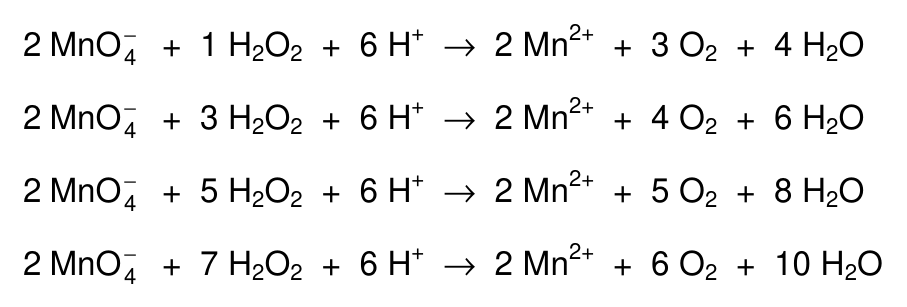
Problems:
- The possible ratios of the reactants in the above equations express:
a) all equations ☐
b) only some of the equations ☐
c) only one equation ☐
d) none ☐
Indicate the correct assertion by a cross in the corresponding square and explain your decision.
-
Which of the reactants is an oxidising agent and which is a reducing one?
-
How much potassium permanganate is needed to release 112 \(\mathrm{cm^3}\) of oxygen at STP conditions from an excess of hydrogen peroxide in acidic solution?
Official English text of the problem.
Answers
-
c) only one equation: the third equation. Place a cross in the square beside c). The reacting mole ratio is \[ n(\ce{MnO4^-}):n(\ce{H2O2})=2:5. \]
-
Oxidising agent: permanganate ion, \(\ce{MnO4^-}\),
[O-][Mn](=O)(=O)=O.
Reducing agent: hydrogen peroxide, \(\ce{H2O2}\),OO. -
\(0.316\ \mathrm{g}\) of potassium permanganate, \(\ce{KMnO4}\),
[K+].[O-][Mn](=O)(=O)=O.
Solution
The other species used below are hydrogen ion, \(\ce{H+}\), [H+]; manganese(II) ion, \(\ce{Mn^2+}\), [Mn+2]; dioxygen, \(\ce{O2}\), O=O; and water, \(\ce{H2O}\), O. Potassium permanganate contains potassium ions, \(\ce{K+}\), [K+], and permanganate ions. Permanganate is tetrahedral; its SMILES gives a formal bond representation rather than the geometry or resonance delocalisation.
1. Selecting the reaction equation
All four proposed equations balance atoms and total charge. To identify the equation describing the stated redox reaction, we must consider the oxidation and reduction processes.
Manganese changes from oxidation state \(+7\) in permanganate to \(+2\), accepting five electrons per manganese atom. Its reduction half-reaction in acidic solution is
\[ \ce{MnO4^- + 8H+ + 5e^- -> Mn^2+ + 4H2O}. \]
Hydrogen peroxide is oxidised to dioxygen. Each oxygen atom changes from oxidation state \(-1\) to \(0\), so each peroxide molecule supplies two electrons:
\[ \ce{H2O2 -> O2 + 2H+ + 2e^-}. \]
Multiplying the reduction half-reaction by two and the oxidation half-reaction by five transfers ten electrons in each direction. Adding and cancelling electrons and excess hydrogen ions gives
\[ \boxed{\ce{2MnO4^- + 5H2O2 + 6H+ -> 2Mn^2+ + 5O2 + 8H2O}}. \]
Thus the third equation expresses the stoichiometry of this redox reaction, and the correct choice is c).
2. Identifying the oxidising and reducing agents
- Permanganate is the oxidising agent: it accepts electrons and is itself reduced, with manganese changing from \(+7\) to \(+2\).
- Hydrogen peroxide is the reducing agent: it supplies electrons and is itself oxidised, with oxygen changing from \(-1\) to \(0\).
Hydrogen ions provide the acidic medium; their oxidation state does not change.
3. Calculating the required potassium permanganate
Using the conventional STP molar gas volume,
\[ V_m=22.4\ \mathrm{dm^3\,mol^{-1}}, \]
the amount of oxygen is
\[ n(\ce{O2}) =\frac{112\times10^{-3}\ \mathrm{dm^3}} {22.4\ \mathrm{dm^3\,mol^{-1}}} =5.00\times10^{-3}\ \mathrm{mol}. \]
The balanced equation produces five moles of oxygen for every two moles of permanganate. Each mole of potassium permanganate supplies one mole of permanganate ions, so
\[ n(\ce{KMnO4}) =\frac{2}{5}n(\ce{O2}) =2.00\times10^{-3}\ \mathrm{mol}. \]
Using rounded standard atomic masses,
\[ M(\ce{KMnO4}) =39.1+54.9+4(16.0) =158.0\ \mathrm{g\,mol^{-1}}. \]
Therefore,
\[ m(\ce{KMnO4}) =(2.00\times10^{-3}\ \mathrm{mol}) (158.0\ \mathrm{g\,mol^{-1}}) =\boxed{0.316\ \mathrm{g}}. \]
The solution was checked against the official solution.
IChO 1977 · Theorieaufgabe 2
Permanganat und Wasserstoffperoxid
Bei der Reaktion von Permanganat-Ionen mit Wasserstoffperoxid in saurer Lösung entsteht ein Mn(II)-Salz, und gleichzeitig wird Sauerstoff freigesetzt:
Aufgaben:
- Die möglichen Mengenverhältnisse der Reaktanden werden in den obigen Gleichungen dargestellt durch:
a) alle Gleichungen ☐
b) nur einige der Gleichungen ☐
c) nur eine Gleichung ☐
d) keine ☐
Kennzeichnen Sie die richtige Aussage durch ein Kreuz im entsprechenden Kästchen und begründen Sie Ihre Entscheidung.
-
Welcher der Reaktanden ist ein Oxidationsmittel und welcher ein Reduktionsmittel?
-
Wie viel Kaliumpermanganat wird benötigt, um aus einem Überschuss an Wasserstoffperoxid in saurer Lösung 112 \(\mathrm{cm^3}\) Sauerstoff unter Standardbedingungen (STP) freizusetzen?
Aufgabentext aus dem offiziellen englischen Text übersetzt.
Antworten
-
c) nur eine Gleichung: die dritte Gleichung. Setzen Sie ein Kreuz in das Kästchen neben c). Das Stoffmengenverhältnis der reagierenden Stoffe beträgt \[ n(\ce{MnO4^-}):n(\ce{H2O2})=2:5. \]
-
Oxidationsmittel: Permanganat-Ion, \(\ce{MnO4^-}\),
[O-][Mn](=O)(=O)=O.
Reduktionsmittel: Wasserstoffperoxid, \(\ce{H2O2}\),OO. -
\(0.316\ \mathrm{g}\) Kaliumpermanganat, \(\ce{KMnO4}\),
[K+].[O-][Mn](=O)(=O)=O.
Lösung
Die weiteren im Folgenden verwendeten Spezies sind das Wasserstoff-Ion, \(\ce{H+}\), [H+]; das Mangan(II)-Ion, \(\ce{Mn^2+}\), [Mn+2]; Disauerstoff, \(\ce{O2}\), O=O; und Wasser, \(\ce{H2O}\), O. Kaliumpermanganat enthält Kalium-Ionen, \(\ce{K+}\), [K+], und Permanganat-Ionen. Permanganat ist tetraedrisch; seine SMILES-Notation stellt die Bindungen formal dar, nicht jedoch die Geometrie oder die mesomere Delokalisierung.
1. Auswahl der Reaktionsgleichung
In allen vier vorgeschlagenen Gleichungen sind die Atombilanz und die Gesamtladungsbilanz ausgeglichen. Um die Gleichung zu bestimmen, die die angegebene Redoxreaktion beschreibt, müssen wir die Oxidations- und Reduktionsvorgänge betrachten.
Mangan geht von der Oxidationszahl \(+7\) im Permanganat zu \(+2\) über und nimmt dabei fünf Elektronen pro Manganatom auf. Die Teilgleichung seiner Reduktion in saurer Lösung lautet
\[ \ce{MnO4^- + 8H+ + 5e^- -> Mn^2+ + 4H2O}. \]
Wasserstoffperoxid wird zu Disauerstoff oxidiert. Jedes Sauerstoffatom geht von der Oxidationszahl \(-1\) zu \(0\) über, sodass jedes Peroxidmolekül zwei Elektronen abgibt:
\[ \ce{H2O2 -> O2 + 2H+ + 2e^-}. \]
Durch Multiplikation der Reduktionsteilgleichung mit zwei und der Oxidationsteilgleichung mit fünf werden bei beiden Vorgängen jeweils zehn Elektronen übertragen. Durch Addition und Kürzen der Elektronen und der auf beiden Seiten vorkommenden Wasserstoff-Ionen erhält man
\[ \boxed{\ce{2MnO4^- + 5H2O2 + 6H+ -> 2Mn^2+ + 5O2 + 8H2O}}. \]
Somit gibt die dritte Gleichung die Stöchiometrie dieser Redoxreaktion wieder, und die richtige Antwort ist c).
2. Bestimmung des Oxidations- und des Reduktionsmittels
- Permanganat ist das Oxidationsmittel: Es nimmt Elektronen auf und wird selbst reduziert, wobei Mangan von \(+7\) zu \(+2\) übergeht.
- Wasserstoffperoxid ist das Reduktionsmittel: Es gibt Elektronen ab und wird selbst oxidiert, wobei Sauerstoff von \(-1\) zu \(0\) übergeht.
Wasserstoff-Ionen sorgen für das saure Medium; ihre Oxidationszahl ändert sich nicht.
3. Berechnung der benötigten Menge an Kaliumpermanganat
Unter Verwendung des üblichen molaren Gasvolumens unter Standardbedingungen (STP),
\[ V_m=22.4\ \mathrm{dm^3\,mol^{-1}}, \]
ergibt sich für die Stoffmenge an Sauerstoff
\[ n(\ce{O2}) =\frac{112\times10^{-3}\ \mathrm{dm^3}} {22.4\ \mathrm{dm^3\,mol^{-1}}} =5.00\times10^{-3}\ \mathrm{mol}. \]
Nach der ausgeglichenen Gleichung entstehen aus jeweils zwei Mol Permanganat fünf Mol Sauerstoff. Jedes Mol Kaliumpermanganat liefert ein Mol Permanganat-Ionen, sodass
\[ n(\ce{KMnO4}) =\frac{2}{5}n(\ce{O2}) =2.00\times10^{-3}\ \mathrm{mol}. \]
Unter Verwendung gerundeter Standardatommassen ergibt sich
\[ M(\ce{KMnO4}) =39.1+54.9+4(16.0) =158.0\ \mathrm{g\,mol^{-1}}. \]
Daraus folgt
\[ m(\ce{KMnO4}) =(2.00\times10^{-3}\ \mathrm{mol}) (158.0\ \mathrm{g\,mol^{-1}}) =\boxed{0.316\ \mathrm{g}}. \]
Die Lösung wurde mit der offiziellen Lösung abgeglichen.
IChO 1977 · Teori sorusu 2
Permanganat ve hidrojen peroksit
Permanganat iyonlarının asidik bir çözeltide hidrojen peroksitle tepkimesi sonucunda Mn(II) tuzu oluşur ve aynı zamanda oksijen açığa çıkar:
Sorular:
- Yukarıdaki denklemlerden hangileri tepkimeye giren maddelerin olası oranlarını ifade eder?
a) tüm denklemler ☐
b) denklemlerin yalnızca bazıları ☐
c) yalnızca bir denklem ☐
d) hiçbiri ☐
Doğru ifadeyi ilgili kareye çarpı koyarak belirtin ve kararınızı açıklayın.
-
Tepkimeye giren maddelerden hangisi yükseltgen, hangisi indirgendir?
-
Asidik çözeltide fazla miktarda bulunan hidrojen peroksitten standart sıcaklık ve basınç (STP) koşullarında 112 \(\mathrm{cm^3}\) oksijen açığa çıkarmak için ne kadar potasyum permanganat gerekir?
Soru metni resmi İngilizce metinden çevrilmiştir.
Cevaplar
-
c) yalnızca bir denklem: üçüncü denklem. c) seçeneğinin yanındaki kareye çarpı koyun. Tepkimeye giren maddelerin mol oranı şöyledir: \[ n(\ce{MnO4^-}):n(\ce{H2O2})=2:5. \]
-
Yükseltgen: permanganat iyonu, \(\ce{MnO4^-}\),
[O-][Mn](=O)(=O)=O.
İndirgen: hidrojen peroksit, \(\ce{H2O2}\),OO. -
\(0.316\ \mathrm{g}\) potasyum permanganat, \(\ce{KMnO4}\),
[K+].[O-][Mn](=O)(=O)=O.
Çözüm
Aşağıda kullanılan diğer türler hidrojen iyonu, \(\ce{H+}\), [H+]; mangan(II) iyonu, \(\ce{Mn^2+}\), [Mn+2]; dioksijen, \(\ce{O2}\), O=O; ve su, \(\ce{H2O}\), O şeklindedir. Potasyum permanganat, potasyum iyonları, \(\ce{K+}\), [K+], ve permanganat iyonları içerir. Permanganat tetrahedral yapıdadır; SMILES gösterimi, geometriyi veya rezonans delokalizasyonunu değil, biçimsel bir bağ gösterimini verir.
1. Tepkime denkleminin seçilmesi
Önerilen dört denklemin tümünde atom sayıları ve toplam yük denktir. Belirtilen redoks tepkimesini tanımlayan denklemi belirlemek için yükseltgenme ve indirgenme süreçlerini ele almalıyız.
Manganın yükseltgenme basamağı, mangan atomu başına beş elektron almasıyla permanganattaki \(+7\) değerinden \(+2\) değerine değişir. Asidik çözeltideki indirgenme yarı tepkimesi şöyledir:
\[ \ce{MnO4^- + 8H+ + 5e^- -> Mn^2+ + 4H2O}. \]
Hidrojen peroksit dioksijene yükseltgenir. Her bir oksijen atomunun yükseltgenme basamağı \(-1\) değerinden \(0\) değerine değişir; dolayısıyla her bir peroksit molekülü iki elektron verir:
\[ \ce{H2O2 -> O2 + 2H+ + 2e^-}. \]
İndirgenme yarı tepkimesi ikiyle, yükseltgenme yarı tepkimesi beşle çarpıldığında her iki yönde de on elektron aktarılır. Yarı tepkimeler toplanıp elektronlar ve her iki tarafta bulunan hidrojen iyonları sadeleştirildiğinde şu denklem elde edilir:
\[ \boxed{\ce{2MnO4^- + 5H2O2 + 6H+ -> 2Mn^2+ + 5O2 + 8H2O}}. \]
Dolayısıyla üçüncü denklem bu redoks tepkimesinin stokiyometrisini ifade eder ve doğru seçenek c) olur.
2. Yükseltgen ve indirgen maddelerin belirlenmesi
- Permanganat yükseltgendir: elektron alır ve kendisi indirgenir; manganın yükseltgenme basamağı \(+7\) değerinden \(+2\) değerine değişir.
- Hidrojen peroksit indirgendir: elektron verir ve kendisi yükseltgenir; oksijenin yükseltgenme basamağı \(-1\) değerinden \(0\) değerine değişir.
Hidrojen iyonları asidik ortamı sağlar; yükseltgenme basamakları değişmez.
3. Gerekli potasyum permanganat miktarının hesaplanması
STP koşullarında geleneksel olarak kullanılan molar gaz hacmi
\[ V_m=22.4\ \mathrm{dm^3\,mol^{-1}}, \]
alındığında oksijenin madde miktarı şöyledir:
\[ n(\ce{O2}) =\frac{112\times10^{-3}\ \mathrm{dm^3}} {22.4\ \mathrm{dm^3\,mol^{-1}}} =5.00\times10^{-3}\ \mathrm{mol}. \]
Denkleştirilmiş denkleme göre her iki mol permanganat için beş mol oksijen oluşur. Her bir mol potasyum permanganat bir mol permanganat iyonu sağladığından
\[ n(\ce{KMnO4}) =\frac{2}{5}n(\ce{O2}) =2.00\times10^{-3}\ \mathrm{mol}. \]
Yuvarlatılmış standart atom kütleleri kullanıldığında
\[ M(\ce{KMnO4}) =39.1+54.9+4(16.0) =158.0\ \mathrm{g\,mol^{-1}}. \]
Böylece,
\[ m(\ce{KMnO4}) =(2.00\times10^{-3}\ \mathrm{mol}) (158.0\ \mathrm{g\,mol^{-1}}) =\boxed{0.316\ \mathrm{g}}. \]
Çözüm, resmi çözümle karşılaştırılarak kontrol edildi.
IChO 1977 · Problema teórico 2
Permanganato y peróxido de hidrógeno
La reacción de los iones permanganato con el peróxido de hidrógeno en disolución ácida produce una sal de Mn(II) y, al mismo tiempo, se desprende oxígeno:
Cuestiones:
- Las posibles proporciones de los reactivos en las ecuaciones anteriores están expresadas por:
a) todas las ecuaciones ☐
b) solo algunas de las ecuaciones ☐
c) solo una ecuación ☐
d) ninguna ☐
Indique la afirmación correcta con una cruz en la casilla correspondiente y explique su decisión.
-
¿Cuál de los reactivos es un agente oxidante y cuál es un agente reductor?
-
¿Cuánto permanganato de potasio se necesita para desprender 112 \(\mathrm{cm^3}\) de oxígeno en condiciones normales de presión y temperatura (STP) a partir de un exceso de peróxido de hidrógeno en disolución ácida?
Enunciado traducido del texto oficial en inglés.
Respuestas
-
c) solo una ecuación: la tercera ecuación. Marque con una cruz la casilla junto a c). La proporción molar de los reactivos es \[ n(\ce{MnO4^-}):n(\ce{H2O2})=2:5. \]
-
Agente oxidante: ion permanganato, \(\ce{MnO4^-}\),
[O-][Mn](=O)(=O)=O.
Agente reductor: peróxido de hidrógeno, \(\ce{H2O2}\),OO. -
\(0.316\ \mathrm{g}\) de permanganato de potasio, \(\ce{KMnO4}\),
[K+].[O-][Mn](=O)(=O)=O.
Solución
Las otras especies utilizadas a continuación son el ion hidrógeno, \(\ce{H+}\), [H+]; el ion manganeso(II), \(\ce{Mn^2+}\), [Mn+2]; el dioxígeno, \(\ce{O2}\), O=O; y el agua, \(\ce{H2O}\), O. El permanganato de potasio contiene iones potasio, \(\ce{K+}\), [K+], e iones permanganato. El permanganato es tetraédrico; su SMILES proporciona una representación formal de los enlaces, en lugar de la geometría o la deslocalización por resonancia.
1. Selección de la ecuación de reacción
Las cuatro ecuaciones propuestas están ajustadas tanto en átomos como en carga total. Para identificar la ecuación que describe la reacción de oxidación-reducción indicada, debemos considerar los procesos de oxidación y reducción.
El manganeso pasa del estado de oxidación \(+7\) en el permanganato a \(+2\), aceptando cinco electrones por átomo de manganeso. Su semirreacción de reducción en disolución ácida es
\[ \ce{MnO4^- + 8H+ + 5e^- -> Mn^2+ + 4H2O}. \]
El peróxido de hidrógeno se oxida a dioxígeno. Cada átomo de oxígeno pasa del estado de oxidación \(-1\) a \(0\), por lo que cada molécula de peróxido cede dos electrones:
\[ \ce{H2O2 -> O2 + 2H+ + 2e^-}. \]
Al multiplicar la semirreacción de reducción por dos y la semirreacción de oxidación por cinco, se transfieren diez electrones en cada sentido. Al sumar y cancelar los electrones y los iones hidrógeno sobrantes, se obtiene
\[ \boxed{\ce{2MnO4^- + 5H2O2 + 6H+ -> 2Mn^2+ + 5O2 + 8H2O}}. \]
Por tanto, la tercera ecuación expresa la estequiometría de esta reacción de oxidación-reducción, y la opción correcta es c).
2. Identificación de los agentes oxidante y reductor
- El permanganato es el agente oxidante: acepta electrones y se reduce, mientras el manganeso pasa de \(+7\) a \(+2\).
- El peróxido de hidrógeno es el agente reductor: cede electrones y se oxida, mientras el oxígeno pasa de \(-1\) a \(0\).
Los iones hidrógeno proporcionan el medio ácido; su estado de oxidación no cambia.
3. Cálculo del permanganato de potasio necesario
Utilizando el volumen molar convencional de un gas en condiciones normales de presión y temperatura (STP),
\[ V_m=22.4\ \mathrm{dm^3\,mol^{-1}}, \]
la cantidad de sustancia de oxígeno es
\[ n(\ce{O2}) =\frac{112\times10^{-3}\ \mathrm{dm^3}} {22.4\ \mathrm{dm^3\,mol^{-1}}} =5.00\times10^{-3}\ \mathrm{mol}. \]
La ecuación ajustada produce cinco moles de oxígeno por cada dos moles de permanganato. Cada mol de permanganato de potasio aporta un mol de iones permanganato, por lo que
\[ n(\ce{KMnO4}) =\frac{2}{5}n(\ce{O2}) =2.00\times10^{-3}\ \mathrm{mol}. \]
Utilizando masas atómicas estándar redondeadas,
\[ M(\ce{KMnO4}) =39.1+54.9+4(16.0) =158.0\ \mathrm{g\,mol^{-1}}. \]
Por tanto,
\[ m(\ce{KMnO4}) =(2.00\times10^{-3}\ \mathrm{mol}) (158.0\ \mathrm{g\,mol^{-1}}) =\boxed{0.316\ \mathrm{g}}. \]
La solución se comprobó con la solución oficial.
IChO 1977 · 理论题 2
高锰酸根与过氧化氢
高锰酸根离子与过氧化氢在酸性溶液中反应,生成锰(II)盐,同时放出氧气:
问题:
- 上述方程式中,能表示反应物可能的比例的是:
a) 所有方程式 ☐
b) 仅部分方程式 ☐
c) 仅一个方程式 ☐
d) 均不能 ☐
在相应方框内打叉,指出正确的说法,并解释你的判断。
-
哪种反应物是氧化剂,哪种是还原剂?
-
在酸性溶液中,使过量的过氧化氢在标准温度和压力(STP)条件下放出 112 \(\mathrm{cm^3}\) 氧气,需要多少高锰酸钾?
题目译自官方英文原文。
答案
-
c) 仅一个方程式:第三个方程式。在 c) 旁的方框内打叉。反应物的物质的量之比为 \[ n(\ce{MnO4^-}):n(\ce{H2O2})=2:5. \]
-
氧化剂:高锰酸根离子,\(\ce{MnO4^-}\),
[O-][Mn](=O)(=O)=O。
还原剂:过氧化氢,\(\ce{H2O2}\),OO。 -
\(0.316\ \mathrm{g}\) 高锰酸钾,\(\ce{KMnO4}\),
[K+].[O-][Mn](=O)(=O)=O。
解答
下文使用的其他化学物种为氢离子,\(\ce{H+}\),[H+];锰(II)离子,\(\ce{Mn^2+}\),[Mn+2];氧气,\(\ce{O2}\),O=O;以及水,\(\ce{H2O}\),O。高锰酸钾含有钾离子,\(\ce{K+}\),[K+],以及高锰酸根离子。高锰酸根离子呈四面体构型;其 SMILES 给出的是形式上的成键表示,而非其几何构型或共振离域情况。
1. 选择反应方程式
所给的四个方程式都满足原子数和总电荷守恒。要确定哪个方程式描述了题述的氧化还原反应,必须考虑氧化过程和还原过程。
锰的氧化态从高锰酸根中的 \(+7\) 变为 \(+2\),每个锰原子接受五个电子。它在酸性溶液中的还原半反应为
\[ \ce{MnO4^- + 8H+ + 5e^- -> Mn^2+ + 4H2O}. \]
过氧化氢被氧化为氧气。每个氧原子的氧化态从 \(-1\) 变为 \(0\),因此每个过氧化氢分子提供两个电子:
\[ \ce{H2O2 -> O2 + 2H+ + 2e^-}. \]
将还原半反应乘以二,将氧化半反应乘以五,使得失电子数均为十。将两式相加,约去电子以及两边共有的氢离子,得到
\[ \boxed{\ce{2MnO4^- + 5H2O2 + 6H+ -> 2Mn^2+ + 5O2 + 8H2O}}. \]
因此,第三个方程式表示了该氧化还原反应的化学计量关系,正确选项为 c)。
2. 确定氧化剂和还原剂
- 高锰酸根是氧化剂:它接受电子,自身被还原,其中锰的氧化态从 \(+7\) 变为 \(+2\)。
- 过氧化氢是还原剂:它提供电子,自身被氧化,其中氧的氧化态从 \(-1\) 变为 \(0\)。
氢离子提供酸性介质;其氧化态不变。
3. 计算所需高锰酸钾的量
采用常规标准状况(STP)下的气体摩尔体积,
\[ V_m=22.4\ \mathrm{dm^3\,mol^{-1}}, \]
氧气的物质的量为
\[ n(\ce{O2}) =\frac{112\times10^{-3}\ \mathrm{dm^3}} {22.4\ \mathrm{dm^3\,mol^{-1}}} =5.00\times10^{-3}\ \mathrm{mol}. \]
根据配平的方程式,每两摩尔高锰酸根生成五摩尔氧气。每摩尔高锰酸钾提供一摩尔高锰酸根离子,因此
\[ n(\ce{KMnO4}) =\frac{2}{5}n(\ce{O2}) =2.00\times10^{-3}\ \mathrm{mol}. \]
采用经四舍五入的标准原子量,
\[ M(\ce{KMnO4}) =39.1+54.9+4(16.0) =158.0\ \mathrm{g\,mol^{-1}}. \]
因此,
\[ m(\ce{KMnO4}) =(2.00\times10^{-3}\ \mathrm{mol}) (158.0\ \mathrm{g\,mol^{-1}}) =\boxed{0.316\ \mathrm{g}}. \]
解答已与官方解答核对。
IChO 1977 · Теоретическая задача 2
Перманганат и пероксид водорода
При реакции перманганат-ионов с пероксидом водорода в кислом растворе образуется соль Mn(II) и одновременно выделяется кислород:
Вопросы:
- Возможные соотношения реагентов в приведённых выше уравнениях выражают:
a) все уравнения ☐
b) только некоторые из уравнений ☐
c) только одно уравнение ☐
d) ни одно ☐
Отметьте правильное утверждение крестиком в соответствующем квадрате и объясните свой выбор.
-
Какой из реагентов является окислителем, а какой — восстановителем?
-
Сколько перманганата калия необходимо для выделения 112 \(\mathrm{cm^3}\) кислорода при нормальных условиях из избытка пероксида водорода в кислом растворе?
Условие переведено с официального английского текста.
Ответы
-
c) только одно уравнение: третье уравнение. Поставьте крестик в квадрате рядом с c). Мольное соотношение реагирующих веществ составляет \[ n(\ce{MnO4^-}):n(\ce{H2O2})=2:5. \]
-
Окислитель: перманганат-ион, \(\ce{MnO4^-}\),
[O-][Mn](=O)(=O)=O.
Восстановитель: пероксид водорода, \(\ce{H2O2}\),OO. -
\(0.316\ \mathrm{g}\) перманганата калия, \(\ce{KMnO4}\),
[K+].[O-][Mn](=O)(=O)=O.
Решение
Другие химические частицы, используемые ниже: ион водорода, \(\ce{H+}\), [H+]; ион марганца(II), \(\ce{Mn^2+}\), [Mn+2]; молекулярный кислород, \(\ce{O2}\), O=O; и вода, \(\ce{H2O}\), O. Перманганат калия содержит ионы калия, \(\ce{K+}\), [K+], и перманганат-ионы. Перманганат-ион имеет тетраэдрическое строение; его запись SMILES представляет формальную схему связей, а не геометрию или резонансную делокализацию.
1. Выбор уравнения реакции
Во всех четырёх предложенных уравнениях соблюдаются баланс атомов и суммарного заряда. Чтобы определить уравнение, описывающее указанную окислительно-восстановительную реакцию, необходимо рассмотреть процессы окисления и восстановления.
Степень окисления марганца изменяется от \(+7\) в перманганат-ионе до \(+2\), при этом каждый атом марганца принимает пять электронов. Полуреакция его восстановления в кислом растворе имеет вид
\[ \ce{MnO4^- + 8H+ + 5e^- -> Mn^2+ + 4H2O}. \]
Пероксид водорода окисляется до молекулярного кислорода. Степень окисления каждого атома кислорода изменяется от \(-1\) до \(0\), поэтому каждая молекула пероксида отдаёт два электрона:
\[ \ce{H2O2 -> O2 + 2H+ + 2e^-}. \]
После умножения полуреакции восстановления на два, а полуреакции окисления на пять число принимаемых и отдаваемых электронов составляет десять. Складывая полуреакции и сокращая электроны и избыточные ионы водорода, получаем
\[ \boxed{\ce{2MnO4^- + 5H2O2 + 6H+ -> 2Mn^2+ + 5O2 + 8H2O}}. \]
Таким образом, третье уравнение выражает стехиометрию этой окислительно-восстановительной реакции, и правильный ответ — c).
2. Определение окислителя и восстановителя
- Перманганат-ион является окислителем: он принимает электроны и сам восстанавливается, при этом степень окисления марганца изменяется от \(+7\) до \(+2\).
- Пероксид водорода является восстановителем: он отдаёт электроны и сам окисляется, при этом степень окисления кислорода изменяется от \(-1\) до \(0\).
Ионы водорода создают кислую среду; их степень окисления не изменяется.
3. Расчёт необходимой массы перманганата калия
Используя общепринятое значение молярного объёма газа при нормальных условиях,
\[ V_m=22.4\ \mathrm{dm^3\,mol^{-1}}, \]
получаем количество вещества кислорода
\[ n(\ce{O2}) =\frac{112\times10^{-3}\ \mathrm{dm^3}} {22.4\ \mathrm{dm^3\,mol^{-1}}} =5.00\times10^{-3}\ \mathrm{mol}. \]
Согласно уравнению реакции, на каждые два моля перманганат-ионов образуется пять молей кислорода. Каждый моль перманганата калия даёт один моль перманганат-ионов, поэтому
\[ n(\ce{KMnO4}) =\frac{2}{5}n(\ce{O2}) =2.00\times10^{-3}\ \mathrm{mol}. \]
Используя округлённые стандартные атомные массы, получаем
\[ M(\ce{KMnO4}) =39.1+54.9+4(16.0) =158.0\ \mathrm{g\,mol^{-1}}. \]
Следовательно,
\[ m(\ce{KMnO4}) =(2.00\times10^{-3}\ \mathrm{mol}) (158.0\ \mathrm{g\,mol^{-1}}) =\boxed{0.316\ \mathrm{g}}. \]
Решение проверено по официальному решению.
IChO 1977 · مسألة نظرية 2
البرمنغنات وفوق أكسيد الهيدروجين
ينتج عن تفاعل أيونات البرمنغنات مع فوق أكسيد الهيدروجين في محلول حمضي ملح المنغنيز الثنائي، وينطلق الأكسجين في الوقت نفسه:
المطلوب:
- تعبّر عن النسب الممكنة للمواد المتفاعلة في المعادلات أعلاه:
a) جميع المعادلات ☐
b) بعض المعادلات فقط ☐
c) معادلة واحدة فقط ☐
d) لا واحدة منها ☐
حدّد العبارة الصحيحة بوضع علامة × في المربع المقابل، وعلّل اختيارك.
-
أيّ المواد المتفاعلة عامل مؤكسد وأيّها عامل مختزل؟
-
ما كتلة برمنغنات البوتاسيوم اللازمة لتحرير 112 \(\mathrm{cm^3}\) من الأكسجين عند الظروف القياسية لدرجة الحرارة والضغط (STP) من كمية فائضة من فوق أكسيد الهيدروجين في محلول حمضي؟
نص المسألة مترجم عن النص الإنجليزي الرسمي.
الإجابات
-
c) معادلة واحدة فقط: المعادلة الثالثة. ضع علامة × في المربع بجانب c). النسبة المولية للمواد المتفاعلة هي \[ n(\ce{MnO4^-}):n(\ce{H2O2})=2:5. \]
-
العامل المؤكسد: أيون البرمنغنات، \(\ce{MnO4^-}\)،
[O-][Mn](=O)(=O)=O.
العامل المختزل: فوق أكسيد الهيدروجين، \(\ce{H2O2}\)،OO. -
\(0.316\ \mathrm{g}\) من برمنغنات البوتاسيوم، \(\ce{KMnO4}\)،
[K+].[O-][Mn](=O)(=O)=O.
الحل
الأنواع الكيميائية الأخرى المستخدمة أدناه هي أيون الهيدروجين، \(\ce{H+}\)، [H+]؛ وأيون المنغنيز الثنائي، \(\ce{Mn^2+}\)، [Mn+2]؛ وثنائي الأكسجين، \(\ce{O2}\)، O=O؛ والماء، \(\ce{H2O}\)، O. تحتوي برمنغنات البوتاسيوم على أيونات البوتاسيوم، \(\ce{K+}\)، [K+]، وأيونات البرمنغنات. لأيون البرمنغنات بنية رباعية السطوح؛ وتعطي صيغة SMILES الخاصة به تمثيلًا صوريًا للروابط، لا للشكل الهندسي أو لعدم تمركز الإلكترونات الناجم عن الرنين.
1. اختيار معادلة التفاعل
جميع المعادلات الأربع المقترحة موزونة من حيث الذرات والشحنة الكلية. ولتحديد المعادلة التي تصف تفاعل الأكسدة والاختزال المذكور، يجب أن ننظر في عمليتي الأكسدة والاختزال.
تتغير حالة أكسدة المنغنيز من \(+7\) في البرمنغنات إلى \(+2\)، باكتساب خمسة إلكترونات لكل ذرة منغنيز. ونصف تفاعل اختزاله في المحلول الحمضي هو
\[ \ce{MnO4^- + 8H+ + 5e^- -> Mn^2+ + 4H2O}. \]
يتأكسد فوق أكسيد الهيدروجين إلى ثنائي الأكسجين. وتتغير حالة أكسدة كل ذرة أكسجين من \(-1\) إلى \(0\)، ولذلك يمنح كل جزيء من فوق أكسيد الهيدروجين إلكترونين:
\[ \ce{H2O2 -> O2 + 2H+ + 2e^-}. \]
يؤدي ضرب نصف تفاعل الاختزال في اثنين ونصف تفاعل الأكسدة في خمسة إلى انتقال عشرة إلكترونات في كل اتجاه. وبجمع نصفي التفاعل واختزال الإلكترونات وأيونات الهيدروجين الزائدة نحصل على
\[ \boxed{\ce{2MnO4^- + 5H2O2 + 6H+ -> 2Mn^2+ + 5O2 + 8H2O}}. \]
إذن تعبّر المعادلة الثالثة عن النسب الستوكيومترية لتفاعل الأكسدة والاختزال هذا، والاختيار الصحيح هو c).
2. تحديد العامل المؤكسد والعامل المختزل
- البرمنغنات هي العامل المؤكسد: فهي تكتسب الإلكترونات وتُختزل، وتتغير حالة أكسدة المنغنيز من \(+7\) إلى \(+2\).
- فوق أكسيد الهيدروجين هو العامل المختزل: فهو يمنح الإلكترونات ويتأكسد، وتتغير حالة أكسدة الأكسجين من \(-1\) إلى \(0\).
توفّر أيونات الهيدروجين الوسط الحمضي؛ ولا تتغير حالة أكسدتها.
3. حساب كمية برمنغنات البوتاسيوم المطلوبة
باستخدام الحجم المولي المعتاد للغاز عند الظروف القياسية لدرجة الحرارة والضغط (STP)،
\[ V_m=22.4\ \mathrm{dm^3\,mol^{-1}}, \]
تكون كمية مادة الأكسجين
\[ n(\ce{O2}) =\frac{112\times10^{-3}\ \mathrm{dm^3}} {22.4\ \mathrm{dm^3\,mol^{-1}}} =5.00\times10^{-3}\ \mathrm{mol}. \]
تنتج المعادلة الموزونة خمسة مولات من الأكسجين مقابل كل مولين من البرمنغنات. ويعطي كل مول من برمنغنات البوتاسيوم مولًا واحدًا من أيونات البرمنغنات، ومن ثم
\[ n(\ce{KMnO4}) =\frac{2}{5}n(\ce{O2}) =2.00\times10^{-3}\ \mathrm{mol}. \]
باستخدام الكتل الذرية القياسية المقرّبة،
\[ M(\ce{KMnO4}) =39.1+54.9+4(16.0) =158.0\ \mathrm{g\,mol^{-1}}. \]
وعليه،
\[ m(\ce{KMnO4}) =(2.00\times10^{-3}\ \mathrm{mol}) (158.0\ \mathrm{g\,mol^{-1}}) =\boxed{0.316\ \mathrm{g}}. \]
تمت مراجعة الحل بمقارنته بالحل الرسمي.