IChO 1977 · Theory problem 3
Isomeric cyclobutanedicarboxylic acids
The letters A, B, C, D, and E represent isomeric cyclobutane dicarboxylic acid, one of them being a racemic form.
It was shown that:
a) only compound C forms a cyclic anhydride easily,
b) B yields a cyclic anhydride only at higher temperatures,
c) of all the acids under investigation, only A releases carbon dioxide when heated,
d) D and E do not change at higher temperatures,
e) 2 moles of diethyl ester of malonic acid when reacted with sodium ethoxide (\(\ce{EtONa}\)), are transformed to sodium salt which by reaction with methylene iodide (\(\ce{CH2I2}\)) yields a tetraester \(\ce{C15H24O8}\). This new ester gives a tetraester \(\ce{C16H24O8}\) in the reaction with 2 moles of sodium ethoxide and 1 mole of methylene iodide. The last mentioned tetraester is transformed by alkaline hydrolysis and subsequent acidification to a tetracarboxylic acid which when heated, gives a mixture of B and E.
Problems:
3.1 Give formulas corresponding to the letters A, B, C, D, and E. Mark the group which is above the plane of the cycle

, that under the plane with

For example:
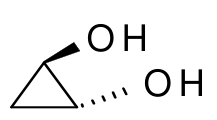
3.2 Express processes a), b), and c) by chemical equations.
Official English text of the problem.
Answers
- 3.1 The assignments are:
| Letter | Identity | SMILES |
|---|---|---|
| A | Cyclobutane-1,1-dicarboxylic acid | O=C(O)C1(C(=O)O)CCC1 |
| B | cis-Cyclobutane-1,3-dicarboxylic acid | O=C(O)[C@H]1C[C@@H](C(=O)O)C1 |
| C | cis-Cyclobutane-1,2-dicarboxylic acid, the meso form | O=C(O)[C@H]1[C@@H](C(=O)O)CC1 |
| D | trans-Cyclobutane-1,2-dicarboxylic acid, a 1:1 racemate of the \((1R,2R)\) and \((1S,2S)\) enantiomers | O=C(O)[C@H]1[C@H](C(=O)O)CC1 and O=C(O)[C@@H]1[C@@H](C(=O)O)CC1 |
| E | trans-Cyclobutane-1,3-dicarboxylic acid | O=C(O)[C@H]1C[C@H](C(=O)O)C1 |
For the requested drawings, number an idealized square cyclobutane ring clockwise:
| Letter | Positions of the two carboxyl groups | Wedge/dash representation |
|---|---|---|
| A | Both at carbon 1 | One solid wedge and one hashed wedge |
| B | Carbons 1 and 3 | Both solid wedges |
| C | Carbons 1 and 2 | Both solid wedges |
| D | Carbons 1 and 2 | One solid wedge and one hashed wedge; show its mirror image alongside it, in equal proportion |
| E | Carbons 1 and 3 | One solid wedge and one hashed wedge |
- 3.2 The balanced reactions are:
\[ \begin{aligned} \text{a) C:}\quad& \ce{C6H8O4 ->[\text{mild heating}] C6H6O3 + H2O}\\ \text{b) B:}\quad& \ce{C6H8O4 ->[\text{higher temperature}] C6H6O3 + H2O}\\ \text{c) A:}\quad& \ce{C6H8O4 ->[\Delta] C5H8O2 + CO2} \end{aligned} \]
The organic products, respectively, are:
| Process | Product | SMILES |
|---|---|---|
| a) | Cyclic anhydride of cis-cyclobutane-1,2-dicarboxylic acid | O=C1OC(=O)[C@H]2CC[C@@H]12 |
| b) | Cyclic anhydride of cis-cyclobutane-1,3-dicarboxylic acid | O=C1OC(=O)[C@H]2C[C@@H]1C2 |
| c) | Cyclobutanecarboxylic acid | O=C(O)C1CCC1 |
The small-molecule products are water, O, and carbon dioxide, O=C=O.
Solution
3.1 — Identification of the five acids
There are three possible arrangements of two carboxyl groups on a cyclobutane ring: 1,1, 1,2, and 1,3. The 1,2- and 1,3-arrangements each have cis and trans forms. Counting an enantiomeric pair as one racemic form gives the five substances in the question.
Identification of A.
The 1,1-isomer contains two carboxyl groups attached to the same carbon, the characteristic arrangement of a substituted malonic acid. It can lose one carboxyl group as carbon dioxide on heating, replacing that group by hydrogen. Consequently,
\[ \boxed{\text{A is cyclobutane-1,1-dicarboxylic acid.}} \]
The synthesis in observation e) determines which positional isomers B and E are.
The starting reagents are diethyl malonate, CCOC(=O)CC(=O)OCC; sodium ethoxide, [Na+].CC[O-]; and diiodomethane (methylene iodide), C(I)I. Ethanol, CCO, and sodium iodide, [Na+].[I-], are the coproducts of the alkylation steps.
Ethoxide removes an acidic methylene proton from each of two diethyl malonate molecules. Their carbon atoms then replace the two iodides of one diiodomethane molecule, giving the linkage
\[ \ce{(EtO2C)2CH-CH2-CH(CO2Et)2}. \]
Here \(\ce{Et}\) denotes an ethyl group. The product is tetraethyl propane-1,1,3,3-tetracarboxylate, CCOC(=O)C(CC(C(=O)OCC)C(=O)OCC)C(=O)OCC. The balanced net reaction is
\[ \ce{2 C7H12O4 + 2 NaOC2H5 + CH2I2 -> C15H24O8 + 2 C2H5OH + 2 NaI}. \]
Its molecular formula agrees with the stated \(\ce{C15H24O8}\).
Each terminal malonate carbon still bears one hydrogen. Removing these two hydrogens with two equivalents of ethoxide allows a second diiodomethane molecule to link the same two carbons through another methylene group. This closes a four-membered ring:
- Ring carbons 1 and 3 are the original malonate carbons, each bearing two ester groups.
- Ring carbons 2 and 4 are the two methylene groups introduced from diiodomethane.
The product is therefore tetraethyl cyclobutane-1,1,3,3-tetracarboxylate, CCOC(=O)C1(C(=O)OCC)CC(C(=O)OCC)(C(=O)OCC)C1:
\[ \ce{C15H24O8 + 2 NaOC2H5 + CH2I2 -> C16H24O8 + 2 C2H5OH + 2 NaI}. \]
Hydrolysis and acidification replace the four ethoxy groups by hydroxyl groups, producing cyclobutane-1,1,3,3-tetracarboxylic acid, O=C(O)C1(C(=O)O)CC(C(=O)O)(C(=O)O)C1.
The overall ester-to-acid conversion is
\[ \ce{C16H24O8 + 4 H2O ->[\text{alkaline hydrolysis}][\text{then acidification}] C8H8O8 + 4 C2H5OH}. \]
Heating removes one carboxyl group from each geminal pair:
\[ \ce{C8H8O8 ->[\Delta] C6H8O4 + 2 CO2}. \]
The remaining carboxyl groups are necessarily at positions 1 and 3. Their relative orientations can be cis or trans; the stated product mixture therefore establishes that B and E are the two cyclobutane-1,3-dicarboxylic acids. No mixture ratio is specified.
Distinguishing B and E.
In the cis-1,3-isomer, both carboxyl groups lie on the same face of the ring and can form an oxygen bridge by dehydration. The constrained bridged anhydride requires higher temperature. The trans-1,3-isomer has the groups on opposite faces and remains unchanged under the stated conditions. Thus,
\[ \boxed{\text{B is cis-1,3; E is trans-1,3.}} \]
Distinguishing C and D.
The remaining substances are the cis- and trans-1,2-isomers. Adjacent carboxyl groups on the same face can readily form a five-membered anhydride ring, so
\[ \boxed{\text{C is cis-1,2; D is trans-1,2.}} \]
The cis-1,2-isomer has opposite configurations at its two stereogenic carbons and is meso. The trans-1,2-isomer has the enantiomeric configurations \((1R,2R)\) and \((1S,2S)\), making D the racemic form.
The square drawings in the Answers section specify relative configurations. Actual cyclobutane rings are puckered; the wedges and hashes indicate the two ring faces, rather than asserting a perfectly planar conformation.
3.2 — Equations and explanation of the thermal reactions
a) Easy anhydride formation by C
\[ \ce{C6H8O4 ->[\text{mild heating}] C6H6O3 + H2O}. \]
The reactant is cis-cyclobutane-1,2-dicarboxylic acid; the product is its cyclic anhydride, whose structure is given above. The two adjacent carboxyl groups lie on the same face. Dehydration joins their carbonyl carbons through an oxygen atom, forming a five-membered anhydride ring fused to the cyclobutane ring.
b) Anhydride formation by B at higher temperature
\[ \ce{C6H8O4 ->[\text{higher temperature}] C6H6O3 + H2O}. \]
The reactant is cis-cyclobutane-1,3-dicarboxylic acid; the product is its cyclic anhydride. Here the bridge spans opposite ring carbons. An anhydride-containing circuit is six-membered, but it is constrained within a bridged bicyclic framework. This less favorable geometry accounts for the higher temperature required.
Although the two anhydrides have the same molecular formula, their connectivities differ, as their SMILES show.
c) Decarboxylation of A
\[ \ce{C6H8O4 ->[\Delta] C5H8O2 + CO2}. \]
Cyclobutane-1,1-dicarboxylic acid undergoes malonic-acid-type decarboxylation to give cyclobutanecarboxylic acid. One carboxyl group is replaced by hydrogen, while the cyclobutane ring remains intact. One mole of A therefore releases one mole of carbon dioxide.
The solution was checked against the official solution.
IChO 1977 · Theorieaufgabe 3
Isomere Cyclobutandicarbonsäuren
Die Buchstaben A, B, C, D, und E bezeichnen isomere Cyclobutandicarbonsäuren, von denen eine als Racemat vorliegt.
Es wurde festgestellt, dass:
a) nur Verbindung C leicht ein cyclisches Anhydrid bildet,
b) B erst bei höheren Temperaturen ein cyclisches Anhydrid ergibt,
c) von allen untersuchten Säuren nur A beim Erhitzen Kohlenstoffdioxid abspaltet,
d) D und E sich bei höheren Temperaturen nicht verändern,
e) 2 Mol Malonsäurediethylester bei der Umsetzung mit Natriumethanolat (\(\ce{EtONa}\)) in das Natriumsalz überführt werden, das bei der Reaktion mit Methyleniodid (\(\ce{CH2I2}\)) einen Tetraester \(\ce{C15H24O8}\) ergibt. Dieser neue Ester ergibt bei der Reaktion mit 2 Mol Natriumethanolat und 1 Mol Methyleniodid einen Tetraester \(\ce{C16H24O8}\). Der zuletzt genannte Tetraester wird durch alkalische Hydrolyse und anschließendes Ansäuern in eine Tetracarbonsäure überführt, die beim Erhitzen ein Gemisch aus B und E ergibt.
Aufgaben:
3.1 Geben Sie die den Buchstaben A, B, C, D, und E entsprechenden Formeln an. Kennzeichnen Sie die Gruppe oberhalb der Ringebene mit
, diejenige unterhalb der Ebene mit
Zum Beispiel:
3.2 Stellen Sie die Vorgänge a), b) und c) durch chemische Gleichungen dar.
Aufgabentext aus dem offiziellen englischen Text übersetzt.
Antworten
- 3.1 Die Zuordnungen lauten:
| Buchstabe | Verbindung | SMILES |
|---|---|---|
| A | Cyclobutan-1,1-dicarbonsäure | O=C(O)C1(C(=O)O)CCC1 |
| B | cis-Cyclobutan-1,3-dicarbonsäure | O=C(O)[C@H]1C[C@@H](C(=O)O)C1 |
| C | cis-Cyclobutan-1,2-dicarbonsäure, die meso-Form | O=C(O)[C@H]1[C@@H](C(=O)O)CC1 |
| D | trans-Cyclobutan-1,2-dicarbonsäure, ein 1:1-Racemat der Enantiomere \((1R,2R)\) und \((1S,2S)\) | O=C(O)[C@H]1[C@H](C(=O)O)CC1 und O=C(O)[C@@H]1[C@@H](C(=O)O)CC1 |
| E | trans-Cyclobutan-1,3-dicarbonsäure | O=C(O)[C@H]1C[C@H](C(=O)O)C1 |
Nummerieren Sie für die geforderten Zeichnungen einen idealisierten quadratischen Cyclobutanring im Uhrzeigersinn:
| Buchstabe | Positionen der beiden Carboxylgruppen | Keilstrichdarstellung |
|---|---|---|
| A | Beide am Kohlenstoffatom 1 | Ein ausgefüllter und ein gestrichelter Keil |
| B | Kohlenstoffatome 1 und 3 | Beide als ausgefüllte Keile |
| C | Kohlenstoffatome 1 und 2 | Beide als ausgefüllte Keile |
| D | Kohlenstoffatome 1 und 2 | Ein ausgefüllter und ein gestrichelter Keil; daneben das Spiegelbild in gleichem Anteil darstellen |
| E | Kohlenstoffatome 1 und 3 | Ein ausgefüllter und ein gestrichelter Keil |
- 3.2 Die ausgeglichenen Reaktionsgleichungen lauten:
\[ \begin{aligned} \text{a) C:}\quad& \ce{C6H8O4 ->[\text{schwaches Erhitzen}] C6H6O3 + H2O}\\ \text{b) B:}\quad& \ce{C6H8O4 ->[\text{höhere Temperatur}] C6H6O3 + H2O}\\ \text{c) A:}\quad& \ce{C6H8O4 ->[\Delta] C5H8O2 + CO2} \end{aligned} \]
Die jeweiligen organischen Produkte sind:
| Vorgang | Produkt | SMILES |
|---|---|---|
| a) | Cyclisches Anhydrid der cis-Cyclobutan-1,2-dicarbonsäure | O=C1OC(=O)[C@H]2CC[C@@H]12 |
| b) | Cyclisches Anhydrid der cis-Cyclobutan-1,3-dicarbonsäure | O=C1OC(=O)[C@H]2C[C@@H]1C2 |
| c) | Cyclobutancarbonsäure | O=C(O)C1CCC1 |
Die niedermolekularen Produkte sind Wasser, O, und Kohlenstoffdioxid, O=C=O.
Lösung
3.1 — Identifizierung der fünf Säuren
Für zwei Carboxylgruppen an einem Cyclobutanring gibt es drei mögliche Anordnungen: 1,1, 1,2 und 1,3. Bei der 1,2- und der 1,3-Anordnung gibt es jeweils eine cis- und eine trans-Form. Zählt man ein Enantiomerenpaar als eine racemische Form, erhält man die fünf in der Aufgabe genannten Substanzen.
Identifizierung von A.
Das 1,1-Isomer enthält zwei Carboxylgruppen, die an dasselbe Kohlenstoffatom gebunden sind; dies ist die charakteristische Anordnung einer substituierten Malonsäure. Beim Erhitzen kann es eine Carboxylgruppe als Kohlenstoffdioxid abspalten, wobei diese Gruppe durch Wasserstoff ersetzt wird. Folglich gilt:
\[ \boxed{\text{A ist Cyclobutan-1,1-dicarbonsäure.}} \]
Die Synthese in Beobachtung e) legt fest, welche Stellungsisomere B und E sind.
Die Ausgangsreagenzien sind Malonsäurediethylester, CCOC(=O)CC(=O)OCC; Natriumethanolat, [Na+].CC[O-]; und Diiodmethan (Methyleniodid), C(I)I. Ethanol, CCO, und Natriumiodid, [Na+].[I-], sind die Nebenprodukte der Alkylierungsschritte.
Ethanolat entfernt jeweils ein saures Methylenproton aus zwei Molekülen Malonsäurediethylester. Deren Kohlenstoffatome ersetzen anschließend die beiden Iodidgruppen eines Diiodmethanmoleküls, wodurch die folgende Verknüpfung entsteht:
\[ \ce{(EtO2C)2CH-CH2-CH(CO2Et)2}. \]
Dabei bezeichnet \(\ce{Et}\) eine Ethylgruppe. Das Produkt ist Propan-1,1,3,3-tetracarbonsäuretetraethylester, CCOC(=O)C(CC(C(=O)OCC)C(=O)OCC)C(=O)OCC. Die ausgeglichene Gesamtreaktion lautet:
\[ \ce{2 C7H12O4 + 2 NaOC2H5 + CH2I2 -> C15H24O8 + 2 C2H5OH + 2 NaI}. \]
Seine Summenformel stimmt mit der angegebenen Formel \(\ce{C15H24O8}\) überein.
Jedes endständige Malonat-Kohlenstoffatom trägt noch ein Wasserstoffatom. Durch die Abspaltung dieser beiden Wasserstoffatome mit zwei Äquivalenten Ethanolat kann ein zweites Diiodmethanmolekül dieselben beiden Kohlenstoffatome über eine weitere Methylengruppe verknüpfen. Dadurch wird ein viergliedriger Ring geschlossen:
- Die Ringkohlenstoffatome 1 und 3 sind die ursprünglichen Malonat-Kohlenstoffatome und tragen jeweils zwei Estergruppen.
- Die Ringkohlenstoffatome 2 und 4 sind die beiden aus Diiodmethan eingeführten Methylengruppen.
Das Produkt ist daher Cyclobutan-1,1,3,3-tetracarbonsäuretetraethylester, CCOC(=O)C1(C(=O)OCC)CC(C(=O)OCC)(C(=O)OCC)C1:
\[ \ce{C15H24O8 + 2 NaOC2H5 + CH2I2 -> C16H24O8 + 2 C2H5OH + 2 NaI}. \]
Durch Hydrolyse und Ansäuern werden die vier Ethoxygruppen durch Hydroxygruppen ersetzt, wobei Cyclobutan-1,1,3,3-tetracarbonsäure, O=C(O)C1(C(=O)O)CC(C(=O)O)(C(=O)O)C1, entsteht.
Die Gesamtreaktion der Umwandlung des Esters in die Säure lautet:
\[ \ce{C16H24O8 + 4 H2O ->[\text{alkalische Hydrolyse}][\text{anschließend Ansäuern}] C8H8O8 + 4 C2H5OH}. \]
Beim Erhitzen wird aus jedem geminalen Paar eine Carboxylgruppe abgespalten:
\[ \ce{C8H8O8 ->[\Delta] C6H8O4 + 2 CO2}. \]
Die verbleibenden Carboxylgruppen befinden sich zwangsläufig an den Positionen 1 und 3. Ihre relative Orientierung kann cis oder trans sein; das angegebene Produktgemisch belegt daher, dass B und E die beiden Cyclobutan-1,3-dicarbonsäuren sind. Ein Mischungsverhältnis ist nicht angegeben.
Unterscheidung von B und E.
Im cis-1,3-Isomer liegen beide Carboxylgruppen auf derselben Seite des Rings und können durch Wasserabspaltung eine Sauerstoffbrücke bilden. Die Bildung des geometrisch eingeschränkten verbrückten Anhydrids erfordert eine höhere Temperatur. Beim trans-1,3-Isomer liegen die Gruppen auf entgegengesetzten Seiten, und es bleibt unter den angegebenen Bedingungen unverändert. Somit gilt:
\[ \boxed{\text{B ist cis-1,3; E ist trans-1,3.}} \]
Unterscheidung von C und D.
Die verbleibenden Substanzen sind die cis- und trans-1,2-Isomere. Benachbarte Carboxylgruppen auf derselben Seite können leicht einen fünfgliedrigen Anhydridring bilden, daher gilt:
\[ \boxed{\text{C ist cis-1,2; D ist trans-1,2.}} \]
Das cis-1,2-Isomer besitzt an seinen beiden stereogenen Kohlenstoffatomen entgegengesetzte Konfigurationen und ist eine meso-Verbindung. Das trans-1,2-Isomer besitzt die enantiomeren Konfigurationen \((1R,2R)\) und \((1S,2S)\), sodass D die racemische Form ist.
Die quadratischen Zeichnungen im Abschnitt Antworten geben die relativen Konfigurationen an. Tatsächliche Cyclobutanringe sind gefaltet; die ausgefüllten und gestrichelten Keile kennzeichnen die beiden Seiten des Rings, ohne eine vollkommen ebene Konformation zu behaupten.
3.2 — Gleichungen und Erklärung der thermischen Reaktionen
a) Leichte Anhydridbildung durch C
\[ \ce{C6H8O4 ->[\text{schwaches Erhitzen}] C6H6O3 + H2O}. \]
Der Ausgangsstoff ist cis-Cyclobutan-1,2-dicarbonsäure; das Produkt ist ihr cyclisches Anhydrid, dessen Struktur oben angegeben ist. Die beiden benachbarten Carboxylgruppen liegen auf derselben Seite. Durch Wasserabspaltung werden ihre Carbonylkohlenstoffatome über ein Sauerstoffatom verbunden, wodurch ein fünfgliedriger, mit dem Cyclobutanring anellierter Anhydridring entsteht.
b) Anhydridbildung durch B bei höherer Temperatur
\[ \ce{C6H8O4 ->[\text{höhere Temperatur}] C6H6O3 + H2O}. \]
Der Ausgangsstoff ist cis-Cyclobutan-1,3-dicarbonsäure; das Produkt ist ihr cyclisches Anhydrid. Hier überspannt die Brücke gegenüberliegende Ringkohlenstoffatome. Ein die Anhydridgruppe enthaltender Ring ist sechsgliedrig, jedoch innerhalb eines verbrückten bicyclischen Gerüsts geometrisch eingeschränkt. Diese ungünstigere Geometrie erklärt die erforderliche höhere Temperatur.
Obwohl die beiden Anhydride dieselbe Summenformel haben, unterscheiden sie sich in der Verknüpfung ihrer Atome, wie ihre SMILES zeigen.
c) Decarboxylierung von A
\[ \ce{C6H8O4 ->[\Delta] C5H8O2 + CO2}. \]
Cyclobutan-1,1-dicarbonsäure wird nach Art einer Malonsäure decarboxyliert, wobei Cyclobutancarbonsäure entsteht. Eine Carboxylgruppe wird durch Wasserstoff ersetzt, während der Cyclobutanring intakt bleibt. Ein Mol A setzt daher ein Mol Kohlenstoffdioxid frei.
Die Lösung wurde mit der offiziellen Lösung abgeglichen.
IChO 1977 · Teori sorusu 3
İzomerik siklobütandikarboksilik asitler
A, B, C, D ve E harfleri, biri rasemik formda olan izomerik siklobütandikarboksilik asitleri temsil etmektedir.
Şunlar gösterilmiştir:
a) yalnızca C bileşiği kolayca halkalı bir anhidrit oluşturur,
b) B, yalnızca daha yüksek sıcaklıklarda halkalı bir anhidrit verir,
c) incelenen asitlerin tümü arasında yalnızca A, ısıtıldığında karbon dioksit açığa çıkarır,
d) D ve E, daha yüksek sıcaklıklarda değişime uğramaz,
e) malonik asidin dietil esterinin 2 molü, sodyum etoksit (\(\ce{EtONa}\)) ile tepkimeye sokulduğunda sodyum tuzuna dönüşür; bu tuz, metilen iyodür (\(\ce{CH2I2}\)) ile tepkimeye girerek \(\ce{C15H24O8}\) tetraesterini verir. Bu yeni ester, 2 mol sodyum etoksit ve 1 mol metilen iyodür ile tepkimesinde \(\ce{C16H24O8}\) tetraesterini verir. Son sözü edilen tetraester, bazik hidroliz ve ardından asitleştirme yoluyla bir tetrakarboksilik aside dönüştürülür; bu asit ısıtıldığında B ve E karışımını verir.
Sorular:
3.1 A, B, C, D ve E harflerine karşılık gelen formülleri veriniz. Halka düzleminin üzerindeki grubu
ile, düzlemin altındaki grubu ise
ile gösteriniz. Örneğin:
3.2 a), b) ve c) süreçlerini kimyasal denklemlerle ifade ediniz.
Soru metni resmi İngilizce metinden çevrilmiştir.
Cevaplar
- 3.1 Harflerin karşılıkları şöyledir:
| Harf | Kimliği | SMILES |
|---|---|---|
| A | Siklobütan-1,1-dikarboksilik asit | O=C(O)C1(C(=O)O)CCC1 |
| B | cis-Siklobütan-1,3-dikarboksilik asit | O=C(O)[C@H]1C[C@@H](C(=O)O)C1 |
| C | cis-Siklobütan-1,2-dikarboksilik asit, mezo form | O=C(O)[C@H]1[C@@H](C(=O)O)CC1 |
| D | trans-Siklobütan-1,2-dikarboksilik asit, \((1R,2R)\) ve \((1S,2S)\) enantiyomerlerinin 1:1 rasemik karışımı | O=C(O)[C@H]1[C@H](C(=O)O)CC1 ve O=C(O)[C@@H]1[C@@H](C(=O)O)CC1 |
| E | trans-Siklobütan-1,3-dikarboksilik asit | O=C(O)[C@H]1C[C@H](C(=O)O)C1 |
İstenen çizimler için, idealize edilmiş kare biçimindeki bir siklobütan halkasını saat yönünde numaralandırınız:
| Harf | İki karboksil grubunun konumları | Kama/kesikli kama gösterimi |
|---|---|---|
| A | Her ikisi de 1 numaralı karbonda | Bir dolu kama ve bir kesikli kama |
| B | 1 ve 3 numaralı karbonlarda | Her ikisi de dolu kama |
| C | 1 ve 2 numaralı karbonlarda | Her ikisi de dolu kama |
| D | 1 ve 2 numaralı karbonlarda | Bir dolu kama ve bir kesikli kama; ayna görüntüsünü yanında, eşit oranda gösteriniz |
| E | 1 ve 3 numaralı karbonlarda | Bir dolu kama ve bir kesikli kama |
- 3.2 Denkleştirilmiş tepkimeler şöyledir:
\[ \begin{aligned} \text{a) C:}\quad& \ce{C6H8O4 ->[\text{hafif ısıtma}] C6H6O3 + H2O}\\ \text{b) B:}\quad& \ce{C6H8O4 ->[\text{daha yüksek sıcaklık}] C6H6O3 + H2O}\\ \text{c) A:}\quad& \ce{C6H8O4 ->[\Delta] C5H8O2 + CO2} \end{aligned} \]
Organik ürünler sırasıyla şöyledir:
| Süreç | Ürün | SMILES |
|---|---|---|
| a) | cis-Siklobütan-1,2-dikarboksilik asidin halkalı anhidriti | O=C1OC(=O)[C@H]2CC[C@@H]12 |
| b) | cis-Siklobütan-1,3-dikarboksilik asidin halkalı anhidriti | O=C1OC(=O)[C@H]2C[C@@H]1C2 |
| c) | Siklobütankarboksilik asit | O=C(O)C1CCC1 |
Küçük moleküllü ürünler su, O, ve karbon dioksittir, O=C=O.
Çözüm
3.1 — Beş asidin belirlenmesi
Bir siklobütan halkası üzerindeki iki karboksil grubu için üç olası yerleşim vardır: 1,1, 1,2 ve 1,3. 1,2- ve 1,3-yerleşimlerinin her birinin cis ve trans formları vardır. Bir enantiyomer çifti tek bir rasemik form olarak sayıldığında, sorudaki beş madde elde edilir.
A'nın belirlenmesi.
1,1-izomeri, aynı karbona bağlı iki karboksil grubu içerir; bu, sübstitüe bir malonik asidin karakteristik yerleşimidir. Isıtıldığında bir karboksil grubunu karbon dioksit olarak kaybedebilir ve bu grubun yerini hidrojen alır. Dolayısıyla,
\[ \boxed{\text{A, siklobütan-1,1-dikarboksilik asittir.}} \]
e) gözlemindeki sentez, B ve E'nin hangi konum izomerleri olduğunu belirler.
Başlangıç reaktifleri dietil malonat, CCOC(=O)CC(=O)OCC; sodyum etoksit, [Na+].CC[O-]; ve diiyodometandır (metilen iyodür), C(I)I. Etanol, CCO, ve sodyum iyodür, [Na+].[I-], alkilleme basamaklarında birlikte oluşan diğer ürünlerdir.
Etoksit, iki dietil malonat molekülünün her birinden asidik bir metilen protonunu uzaklaştırır. Ardından bunların karbon atomları, bir diiyodometan molekülünün iki iyodürünün yerini alarak şu bağlantıyı oluşturur:
\[ \ce{(EtO2C)2CH-CH2-CH(CO2Et)2}. \]
Burada \(\ce{Et}\), bir etil grubunu belirtir. Ürün tetraetil propan-1,1,3,3-tetrakarboksilattır, CCOC(=O)C(CC(C(=O)OCC)C(=O)OCC)C(=O)OCC. Denkleştirilmiş net tepkime şöyledir:
\[ \ce{2 C7H12O4 + 2 NaOC2H5 + CH2I2 -> C15H24O8 + 2 C2H5OH + 2 NaI}. \]
Molekül formülü, verilen \(\ce{C15H24O8}\) ile uyumludur.
Uçlardaki malonat karbonlarının her biri hâlâ bir hidrojen taşır. Bu iki hidrojenin iki eşdeğer etoksit ile uzaklaştırılması, ikinci bir diiyodometan molekülünün aynı iki karbonu başka bir metilen grubu üzerinden birbirine bağlamasını sağlar. Böylece dört üyeli bir halka kapanır:
- 1 ve 3 numaralı halka karbonları, her biri iki ester grubu taşıyan başlangıçtaki malonat karbonlarıdır.
- 2 ve 4 numaralı halka karbonları, diiyodometandan gelen iki metilen grubudur.
Dolayısıyla ürün tetraetil siklobütan-1,1,3,3-tetrakarboksilattır, CCOC(=O)C1(C(=O)OCC)CC(C(=O)OCC)(C(=O)OCC)C1:
\[ \ce{C15H24O8 + 2 NaOC2H5 + CH2I2 -> C16H24O8 + 2 C2H5OH + 2 NaI}. \]
Hidroliz ve asitleştirme, dört etoksi grubunun yerine hidroksil gruplarını geçirerek siklobütan-1,1,3,3-tetrakarboksilik asit oluşturur, O=C(O)C1(C(=O)O)CC(C(=O)O)(C(=O)O)C1.
Esterden aside toplam dönüşüm şöyledir:
\[ \ce{C16H24O8 + 4 H2O ->[\text{bazik hidroliz}][\text{ardından asitleştirme}] C8H8O8 + 4 C2H5OH}. \]
Isıtma, her geminal çiftten bir karboksil grubunu uzaklaştırır:
\[ \ce{C8H8O8 ->[\Delta] C6H8O4 + 2 CO2}. \]
Kalan karboksil grupları zorunlu olarak 1 ve 3 konumlarındadır. Birbirlerine göre yönelimleri cis veya trans olabilir; dolayısıyla belirtilen ürün karışımı, B ve E'nin iki siklobütan-1,3-dikarboksilik asit olduğunu ortaya koyar. Karışım oranı belirtilmemiştir.
B ve E'nin ayırt edilmesi.
cis-1,3-izomerinde, her iki karboksil grubu halkanın aynı yüzünde bulunur ve su kaybıyla bir oksijen köprüsü oluşturabilir. Geometrik olarak kısıtlanmış bu köprülü anhidritin oluşumu daha yüksek sıcaklık gerektirir. trans-1,3-izomerinde gruplar karşıt yüzlerde bulunur ve bu izomer belirtilen koşullarda değişmeden kalır. Dolayısıyla,
\[ \boxed{\text{B, cis-1,3; E, trans-1,3 izomeridir.}} \]
C ve D'nin ayırt edilmesi.
Geriye kalan maddeler cis- ve trans-1,2-izomerleridir. Aynı yüzde bulunan komşu karboksil grupları kolayca beş üyeli bir anhidrit halkası oluşturabilir; dolayısıyla
\[ \boxed{\text{C, cis-1,2; D, trans-1,2 izomeridir.}} \]
cis-1,2-izomerinin iki stereojenik karbonu zıt konfigürasyonlara sahiptir ve bu izomer mezodur. trans-1,2-izomeri, \((1R,2R)\) ve \((1S,2S)\) enantiyomerik konfigürasyonlarına sahiptir; bu nedenle D rasemik formdur.
Cevaplar bölümündeki kare çizimler, bağıl konfigürasyonları belirtir. Gerçek siklobütan halkaları bükülmüş yapıdadır; dolu ve kesikli kamalar, tam düzlemsel bir konformasyon öne sürmek yerine halkanın iki yüzünü gösterir.
3.2 — Isıl tepkimelerin denklemleri ve açıklaması
a) C'nin kolayca anhidrit oluşturması
\[ \ce{C6H8O4 ->[\text{hafif ısıtma}] C6H6O3 + H2O}. \]
Tepkimeye giren madde cis-siklobütan-1,2-dikarboksilik asittir; ürün ise yapısı yukarıda verilen halkalı anhidritidir. İki komşu karboksil grubu aynı yüzde bulunur. Su kaybı, bu grupların karbonil karbonlarını bir oksijen atomu üzerinden birleştirerek siklobütan halkasıyla kaynaşmış beş üyeli bir anhidrit halkası oluşturur.
b) B'nin daha yüksek sıcaklıkta anhidrit oluşturması
\[ \ce{C6H8O4 ->[\text{daha yüksek sıcaklık}] C6H6O3 + H2O}. \]
Tepkimeye giren madde cis-siklobütan-1,3-dikarboksilik asittir; ürün ise onun halkalı anhidritidir. Burada köprü, karşılıklı halka karbonlarını birbirine bağlar. Anhidrit grubunu içeren bir halka yolu altı üyelidir, ancak köprülü bisiklik bir iskelet içinde geometrik olarak kısıtlanmıştır. Daha az elverişli olan bu geometri, neden daha yüksek sıcaklık gerektiğini açıklar.
İki anhidrit aynı molekül formülüne sahip olsa da SMILES gösterimlerinden görüldüğü gibi atomlarının bağlanma düzenleri farklıdır.
c) A'nın dekarboksilasyonu
\[ \ce{C6H8O4 ->[\Delta] C5H8O2 + CO2}. \]
Siklobütan-1,1-dikarboksilik asit, malonik asit tipi dekarboksilasyona uğrayarak siklobütankarboksilik asit verir. Bir karboksil grubunun yerini hidrojen alırken siklobütan halkası bozulmadan kalır. Dolayısıyla bir mol A, bir mol karbon dioksit açığa çıkarır.
Çözüm, resmi çözümle karşılaştırılarak kontrol edildi.
IChO 1977 · Problema teórico 3
Ácidos ciclobutanodicarboxílicos isómeros
Las letras A, B, C, D, y E representan ácidos ciclobutanodicarboxílicos isómeros, uno de los cuales es una forma racémica.
Se demostró que:
a) solo el compuesto C forma fácilmente un anhídrido cíclico,
b) B produce un anhídrido cíclico únicamente a temperaturas más altas,
c) de todos los ácidos investigados, solo A libera dióxido de carbono al calentarse,
d) D y E no experimentan cambios a temperaturas más altas,
e) 2 moles del éster dietílico del ácido malónico, al reaccionar con etóxido de sodio (\(\ce{EtONa}\)), se transforman en una sal sódica que, al reaccionar con yoduro de metileno (\(\ce{CH2I2}\)), produce un tetraéster \(\ce{C15H24O8}\). Este nuevo éster da un tetraéster \(\ce{C16H24O8}\) al reaccionar con 2 moles de etóxido de sodio y 1 mol de yoduro de metileno. Este último tetraéster se transforma mediante hidrólisis alcalina y posterior acidificación en un ácido tetracarboxílico que, al calentarse, da una mezcla de B y E.
Cuestiones:
3.1 Indique las fórmulas correspondientes a las letras A, B, C, D, y E. Marque el grupo que se encuentra por encima del plano del anillo con
, y el que se encuentra por debajo del plano con
Por ejemplo:
3.2 Exprese los procesos a), b) y c) mediante ecuaciones químicas.
Enunciado traducido del texto oficial en inglés.
Respuestas
- 3.1 Las asignaciones son:
| Letra | Identidad | SMILES |
|---|---|---|
| A | Ácido ciclobutano-1,1-dicarboxílico | O=C(O)C1(C(=O)O)CCC1 |
| B | Ácido cis-ciclobutano-1,3-dicarboxílico | O=C(O)[C@H]1C[C@@H](C(=O)O)C1 |
| C | Ácido cis-ciclobutano-1,2-dicarboxílico, la forma meso | O=C(O)[C@H]1[C@@H](C(=O)O)CC1 |
| D | Ácido trans-ciclobutano-1,2-dicarboxílico, un racemato 1:1 de los enantiómeros \((1R,2R)\) y \((1S,2S)\) | O=C(O)[C@H]1[C@H](C(=O)O)CC1 y O=C(O)[C@@H]1[C@@H](C(=O)O)CC1 |
| E | Ácido trans-ciclobutano-1,3-dicarboxílico | O=C(O)[C@H]1C[C@H](C(=O)O)C1 |
Para los dibujos solicitados, numere un anillo de ciclobutano cuadrado idealizado en sentido horario:
| Letra | Posiciones de los dos grupos carboxilo | Representación mediante cuñas sólidas y discontinuas |
|---|---|---|
| A | Ambos en el carbono 1 | Una cuña sólida y una cuña discontinua |
| B | Carbonos 1 y 3 | Ambas cuñas sólidas |
| C | Carbonos 1 y 2 | Ambas cuñas sólidas |
| D | Carbonos 1 y 2 | Una cuña sólida y una cuña discontinua; muestre a su lado su imagen especular, en igual proporción |
| E | Carbonos 1 y 3 | Una cuña sólida y una cuña discontinua |
- 3.2 Las reacciones ajustadas son:
\[ \begin{aligned} \text{a) C:}\quad& \ce{C6H8O4 ->[\text{calentamiento suave}] C6H6O3 + H2O}\\ \text{b) B:}\quad& \ce{C6H8O4 ->[\text{temperatura más alta}] C6H6O3 + H2O}\\ \text{c) A:}\quad& \ce{C6H8O4 ->[\Delta] C5H8O2 + CO2} \end{aligned} \]
Los productos orgánicos son, respectivamente:
| Proceso | Producto | SMILES |
|---|---|---|
| a) | Anhídrido cíclico del ácido cis-ciclobutano-1,2-dicarboxílico | O=C1OC(=O)[C@H]2CC[C@@H]12 |
| b) | Anhídrido cíclico del ácido cis-ciclobutano-1,3-dicarboxílico | O=C1OC(=O)[C@H]2C[C@@H]1C2 |
| c) | Ácido ciclobutanocarboxílico | O=C(O)C1CCC1 |
Los productos de molécula pequeña son agua, O, y dióxido de carbono, O=C=O.
Solución
3.1 — Identificación de los cinco ácidos
Hay tres disposiciones posibles de dos grupos carboxilo en un anillo de ciclobutano: 1,1, 1,2 y 1,3. Las disposiciones 1,2 y 1,3 presentan, cada una, formas cis y trans. Si se cuenta un par de enantiómeros como una forma racémica, se obtienen las cinco sustancias del enunciado.
Identificación de A.
El isómero 1,1 contiene dos grupos carboxilo unidos al mismo carbono, la disposición característica de un ácido malónico sustituido. Al calentarse, puede perder un grupo carboxilo en forma de dióxido de carbono, sustituyéndose dicho grupo por hidrógeno. Por consiguiente,
\[ \boxed{\text{A es el ácido ciclobutano-1,1-dicarboxílico.}} \]
La síntesis de la observación e) determina qué isómeros de posición son B y E.
Los reactivos de partida son malonato de dietilo, CCOC(=O)CC(=O)OCC; etóxido de sodio, [Na+].CC[O-]; y diyodometano (yoduro de metileno), C(I)I. El etanol, CCO, y el yoduro de sodio, [Na+].[I-], son los coproductos de las etapas de alquilación.
El etóxido extrae un protón ácido del grupo metileno de cada una de dos moléculas de malonato de dietilo. A continuación, sus átomos de carbono sustituyen a los dos yoduros de una molécula de diyodometano, dando lugar a la unión
\[ \ce{(EtO2C)2CH-CH2-CH(CO2Et)2}. \]
Aquí, \(\ce{Et}\) representa un grupo etilo. El producto es el propano-1,1,3,3-tetracarboxilato de tetraetilo, CCOC(=O)C(CC(C(=O)OCC)C(=O)OCC)C(=O)OCC. La reacción neta ajustada es
\[ \ce{2 C7H12O4 + 2 NaOC2H5 + CH2I2 -> C15H24O8 + 2 C2H5OH + 2 NaI}. \]
Su fórmula molecular concuerda con la indicada, \(\ce{C15H24O8}\).
Cada carbono terminal de malonato conserva un hidrógeno. La extracción de estos dos hidrógenos con dos equivalentes de etóxido permite que una segunda molécula de diyodometano una los mismos dos carbonos mediante otro grupo metileno. Así se cierra un anillo de cuatro miembros:
- Los carbonos 1 y 3 del anillo son los carbonos originales del malonato, cada uno de los cuales lleva dos grupos éster.
- Los carbonos 2 y 4 del anillo son los dos grupos metileno introducidos a partir del diyodometano.
Por tanto, el producto es el ciclobutano-1,1,3,3-tetracarboxilato de tetraetilo, CCOC(=O)C1(C(=O)OCC)CC(C(=O)OCC)(C(=O)OCC)C1:
\[ \ce{C15H24O8 + 2 NaOC2H5 + CH2I2 -> C16H24O8 + 2 C2H5OH + 2 NaI}. \]
La hidrólisis y la acidificación sustituyen los cuatro grupos etoxi por grupos hidroxilo, produciendo ácido ciclobutano-1,1,3,3-tetracarboxílico, O=C(O)C1(C(=O)O)CC(C(=O)O)(C(=O)O)C1.
La conversión global del éster en ácido es
\[ \ce{C16H24O8 + 4 H2O ->[\text{hidrólisis alcalina}][\text{posterior acidificación}] C8H8O8 + 4 C2H5OH}. \]
El calentamiento elimina un grupo carboxilo de cada par geminal:
\[ \ce{C8H8O8 ->[\Delta] C6H8O4 + 2 CO2}. \]
Los grupos carboxilo restantes están necesariamente en las posiciones 1 y 3. Sus orientaciones relativas pueden ser cis o trans; por tanto, la mezcla de productos indicada establece que B y E son los dos ácidos ciclobutano-1,3-dicarboxílicos. No se especifica la proporción de la mezcla.
Distinción entre B y E.
En el isómero cis-1,3, ambos grupos carboxilo se encuentran en la misma cara del anillo y pueden formar un puente de oxígeno por deshidratación. El anhídrido puenteado, cuya geometría está restringida, requiere una temperatura más alta. El isómero trans-1,3 tiene los grupos en caras opuestas y permanece inalterado en las condiciones indicadas. Por tanto,
\[ \boxed{\text{B es cis-1,3; E es trans-1,3.}} \]
Distinción entre C y D.
Las sustancias restantes son los isómeros cis- y trans-1,2. Los grupos carboxilo adyacentes situados en la misma cara pueden formar fácilmente un anillo de anhídrido de cinco miembros, por lo que
\[ \boxed{\text{C es cis-1,2; D es trans-1,2.}} \]
El isómero cis-1,2 tiene configuraciones opuestas en sus dos carbonos estereogénicos y es meso. El isómero trans-1,2 presenta las configuraciones enantioméricas \((1R,2R)\) y \((1S,2S)\), por lo que D es la forma racémica.
Los dibujos cuadrados de la sección Respuestas especifican las configuraciones relativas. Los anillos reales de ciclobutano están plegados; las cuñas sólidas y discontinuas indican las dos caras del anillo, sin implicar una conformación perfectamente plana.
3.2 — Ecuaciones y explicación de las reacciones térmicas
a) Formación fácil de un anhídrido a partir de C
\[ \ce{C6H8O4 ->[\text{calentamiento suave}] C6H6O3 + H2O}. \]
El reactivo es el ácido cis-ciclobutano-1,2-dicarboxílico; el producto es su anhídrido cíclico, cuya estructura se ha indicado anteriormente. Los dos grupos carboxilo adyacentes se encuentran en la misma cara. La deshidratación une sus carbonos carbonílicos mediante un átomo de oxígeno, formando un anillo de anhídrido de cinco miembros fusionado con el anillo de ciclobutano.
b) Formación de un anhídrido a partir de B a una temperatura más alta
\[ \ce{C6H8O4 ->[\text{temperatura más alta}] C6H6O3 + H2O}. \]
El reactivo es el ácido cis-ciclobutano-1,3-dicarboxílico; el producto es su anhídrido cíclico. En este caso, el puente une carbonos opuestos del anillo. Un ciclo que contiene el grupo anhídrido tiene seis miembros, pero está restringido dentro de una estructura bicíclica puenteada. Esta geometría menos favorable explica la mayor temperatura necesaria.
Aunque los dos anhídridos tienen la misma fórmula molecular, sus conectividades difieren, como muestran sus SMILES.
c) Descarboxilación de A
\[ \ce{C6H8O4 ->[\Delta] C5H8O2 + CO2}. \]
El ácido ciclobutano-1,1-dicarboxílico experimenta una descarboxilación de tipo malónico para dar ácido ciclobutanocarboxílico. Un grupo carboxilo se sustituye por hidrógeno, mientras que el anillo de ciclobutano permanece intacto. Por tanto, un mol de A libera un mol de dióxido de carbono.
La solución se comprobó con la solución oficial.
IChO 1977 · 理论题 3
环丁烷二甲酸的异构体
字母 A、B、C、D 和 E 代表互为异构体的环丁烷二甲酸,其中一种为外消旋体。
已知:
a) 只有化合物 C 容易形成环状酸酐,
b) B 仅在较高温度下生成环状酸酐,
c) 在所研究的全部酸中,只有 A 在加热时释放二氧化碳,
d) D 和 E 在较高温度下不发生变化,
e) 2 摩尔丙二酸二乙酯与乙醇钠(\(\ce{EtONa}\))反应,转化为钠盐,该钠盐与二碘甲烷(\(\ce{CH2I2}\))反应,生成四酯 \(\ce{C15H24O8}\)。这一新生成的酯与 2 摩尔乙醇钠和 1 摩尔二碘甲烷反应,生成四酯 \(\ce{C16H24O8}\)。后一种四酯经碱性水解并随后酸化,转化为一种四羧酸,该酸加热后得到 B 和 E 的混合物。
问题:
3.1 写出与字母 A、B、C、D 和 E 对应的结构式。用下列符号标出位于环平面上方的基团
,用下列符号标出位于环平面下方的基团
例如:
3.2 用化学方程式表示过程 a)、b) 和 c)。
题目译自官方英文原文。
答案
- 3.1 各字母对应的化合物如下:
| 字母 | 化合物名称 | SMILES |
|---|---|---|
| A | 环丁烷-1,1-二甲酸 | O=C(O)C1(C(=O)O)CCC1 |
| B | 顺式-环丁烷-1,3-二甲酸 | O=C(O)[C@H]1C[C@@H](C(=O)O)C1 |
| C | 顺式-环丁烷-1,2-二甲酸,即内消旋体 | O=C(O)[C@H]1[C@@H](C(=O)O)CC1 |
| D | 反式-环丁烷-1,2-二甲酸,由 \((1R,2R)\) 和 \((1S,2S)\) 对映体组成的 1:1 外消旋混合物 | O=C(O)[C@H]1[C@H](C(=O)O)CC1 和 O=C(O)[C@@H]1[C@@H](C(=O)O)CC1 |
| E | 反式-环丁烷-1,3-二甲酸 | O=C(O)[C@H]1C[C@H](C(=O)O)C1 |
绘制题目要求的结构图时,将理想化的正方形环丁烷环按顺时针方向编号:
| 字母 | 两个羧基的位置 | 楔线/虚楔线表示法 |
|---|---|---|
| A | 均位于 1 号碳原子上 | 一个用实楔线,另一个用虚楔线 |
| B | 位于 1 号和 3 号碳原子上 | 均用实楔线 |
| C | 位于 1 号和 2 号碳原子上 | 均用实楔线 |
| D | 位于 1 号和 2 号碳原子上 | 一个用实楔线,另一个用虚楔线;在旁边画出其镜像,并标明二者比例相等 |
| E | 位于 1 号和 3 号碳原子上 | 一个用实楔线,另一个用虚楔线 |
- 3.2 配平后的反应方程式为:
\[ \begin{aligned} \text{a) C:}\quad& \ce{C6H8O4 ->[\text{温和加热}] C6H6O3 + H2O}\\ \text{b) B:}\quad& \ce{C6H8O4 ->[\text{较高温度}] C6H6O3 + H2O}\\ \text{c) A:}\quad& \ce{C6H8O4 ->[\Delta] C5H8O2 + CO2} \end{aligned} \]
相应的有机产物分别为:
| 过程 | 产物 | SMILES |
|---|---|---|
| a) | 顺式-环丁烷-1,2-二甲酸的环状酸酐 | O=C1OC(=O)[C@H]2CC[C@@H]12 |
| b) | 顺式-环丁烷-1,3-二甲酸的环状酸酐 | O=C1OC(=O)[C@H]2C[C@@H]1C2 |
| c) | 环丁烷甲酸 | O=C(O)C1CCC1 |
小分子产物为水(O)和二氧化碳(O=C=O)。
解答
3.1 — 五种酸的鉴定
两个羧基在环丁烷环上有三种可能的排列方式:1,1、1,2 和 1,3。1,2- 和 1,3-排列各有顺式和反式两种形式。将一对对映体作为一种外消旋体计数,即得到题目中的五种物质。
A 的鉴定。
1,1-异构体的两个羧基连接在同一个碳原子上,这是取代丙二酸的特征排列。加热时,它可以使一个羧基以二氧化碳的形式脱去,该羧基被氢取代。因此,
\[ \boxed{\text{A 是环丁烷-1,1-二甲酸。}} \]
实验事实 e) 中的合成过程确定了 B 和 E 属于哪一类位置异构体。
起始试剂为丙二酸二乙酯 CCOC(=O)CC(=O)OCC、乙醇钠 [Na+].CC[O-] 和二碘甲烷(碘化亚甲基)C(I)I。乙醇 CCO 和碘化钠 [Na+].[I-] 是烷基化步骤中的副产物。
乙醇根离子从两个丙二酸二乙酯分子的亚甲基上各夺取一个具有酸性的质子。随后,这两个碳原子取代一个二碘甲烷分子中的两个碘,形成如下连接结构
\[ \ce{(EtO2C)2CH-CH2-CH(CO2Et)2}. \]
此处 \(\ce{Et}\) 表示乙基。产物为丙烷-1,1,3,3-四甲酸四乙酯,CCOC(=O)C(CC(C(=O)OCC)C(=O)OCC)C(=O)OCC。配平后的总反应方程式为
\[ \ce{2 C7H12O4 + 2 NaOC2H5 + CH2I2 -> C15H24O8 + 2 C2H5OH + 2 NaI}. \]
其分子式与题目给出的 \(\ce{C15H24O8}\) 一致。
两端来自丙二酸酯的碳原子上仍各有一个氢。用两当量乙醇根离子夺取这两个氢后,第二个二碘甲烷分子就能通过另一个亚甲基将这两个碳原子连接起来,从而闭合形成一个四元环:
- 环上的 1 号和 3 号碳原子是原来丙二酸酯中的碳原子,各带有两个酯基。
- 环上的 2 号和 4 号碳原子来自二碘甲烷引入的两个亚甲基。
因此,产物为环丁烷-1,1,3,3-四甲酸四乙酯,CCOC(=O)C1(C(=O)OCC)CC(C(=O)OCC)(C(=O)OCC)C1:
\[ \ce{C15H24O8 + 2 NaOC2H5 + CH2I2 -> C16H24O8 + 2 C2H5OH + 2 NaI}. \]
水解并酸化后,四个乙氧基被羟基取代,生成环丁烷-1,1,3,3-四甲酸,O=C(O)C1(C(=O)O)CC(C(=O)O)(C(=O)O)C1。
酯转化为酸的总反应为
\[ \ce{C16H24O8 + 4 H2O ->[\text{碱性水解}][\text{随后酸化}] C8H8O8 + 4 C2H5OH}. \]
加热使每对同碳羧基各脱去一个羧基:
\[ \ce{C8H8O8 ->[\Delta] C6H8O4 + 2 CO2}. \]
剩余的羧基必定位于 1 位和 3 位。它们的相对取向可以是顺式或反式;因此,题目所述的产物混合物表明,B 和 E 是两种环丁烷-1,3-二甲酸。题目未给出混合物中两者的比例。
B 和 E 的区分。
在顺式-1,3-异构体中,两个羧基位于环的同侧,可以通过脱水形成氧桥。这种受几何构型限制的桥环酸酐需要在较高温度下才能形成。反式-1,3-异构体的两个羧基位于环的两侧,在所述条件下不发生变化。因此,
\[ \boxed{\text{B 是顺式-1,3;E 是反式-1,3。}} \]
C 和 D 的区分。
剩下的物质为顺式和反式的 1,2-异构体。同侧相邻的羧基容易形成五元酸酐环,因此
\[ \boxed{\text{C 是顺式-1,2;D 是反式-1,2。}} \]
顺式-1,2-异构体的两个手性碳原子的构型相反,为内消旋体。反式-1,2-异构体具有互为对映体的 \((1R,2R)\) 和 \((1S,2S)\) 构型,因此 D 为外消旋体。
答案部分的正方形结构图表示相对构型。实际的环丁烷环呈折叠状;实楔线和虚楔线表示环的两个侧面,并不意味着其构象完全平面化。
3.2 — 热反应的方程式及解释
a) C 容易形成酸酐
\[ \ce{C6H8O4 ->[\text{温和加热}] C6H6O3 + H2O}. \]
反应物为顺式-环丁烷-1,2-二甲酸;产物为其环状酸酐,结构已在上文给出。两个相邻的羧基位于同侧。脱水使它们的羰基碳原子通过一个氧原子相连,形成一个与环丁烷环稠合的五元酸酐环。
b) B 在较高温度下形成酸酐
\[ \ce{C6H8O4 ->[\text{较高温度}] C6H6O3 + H2O}. \]
反应物为顺式-环丁烷-1,3-二甲酸;产物为其环状酸酐。这里的桥跨接在环上相对的两个碳原子之间。含有酸酐基团的闭合环路为六元环,但它受到桥环双环骨架的约束。这种较不利的几何构型解释了为何需要较高温度。
虽然两种酸酐具有相同的分子式,但原子连接方式不同,这一点可从它们的 SMILES 看出。
c) A 的脱羧
\[ \ce{C6H8O4 ->[\Delta] C5H8O2 + CO2}. \]
环丁烷-1,1-二甲酸发生丙二酸型脱羧反应,生成环丁烷甲酸。一个羧基被氢取代,而环丁烷环保持完整。因此,一摩尔 A 释放一摩尔二氧化碳。
解答已与官方解答核对。
IChO 1977 · Теоретическая задача 3
Изомерные циклобутандикарбоновые кислоты
Буквами A, B, C, D, и E обозначены изомерные циклобутандикарбоновые кислоты, одна из которых представляет собой рацемическую форму.
Было установлено, что:
a) только соединение C легко образует циклический ангидрид,
b) B образует циклический ангидрид только при более высоких температурах,
c) из всех исследуемых кислот только A выделяет диоксид углерода при нагревании,
d) D и E не изменяются при более высоких температурах,
e) 2 моль диэтилового эфира малоновой кислоты при взаимодействии с этилатом натрия (\(\ce{EtONa}\)) превращаются в натриевую соль, которая при взаимодействии с дийодметаном (\(\ce{CH2I2}\)) даёт тетраэфир \(\ce{C15H24O8}\). Этот новый эфир при взаимодействии с 2 моль этилата натрия и 1 моль дийодметана даёт тетраэфир \(\ce{C16H24O8}\). Последний из упомянутых тетраэфиров путём щелочного гидролиза и последующего подкисления превращают в тетракарбоновую кислоту, которая при нагревании даёт смесь B и E.
Задания:
3.1 Приведите формулы, соответствующие буквам A, B, C, D, и E. Обозначьте группу, находящуюся над плоскостью цикла, с помощью
, а группу, находящуюся под плоскостью, — с помощью
Например:
3.2 Выразите процессы a), b) и c) химическими уравнениями.
Условие переведено с официального английского текста.
Ответы
- 3.1 Соответствия следующие:
| Буква | Соединение | SMILES |
|---|---|---|
| A | Циклобутан-1,1-дикарбоновая кислота | O=C(O)C1(C(=O)O)CCC1 |
| B | цис-Циклобутан-1,3-дикарбоновая кислота | O=C(O)[C@H]1C[C@@H](C(=O)O)C1 |
| C | цис-Циклобутан-1,2-дикарбоновая кислота, мезо-форма | O=C(O)[C@H]1[C@@H](C(=O)O)CC1 |
| D | транс-Циклобутан-1,2-дикарбоновая кислота, рацемат 1:1 энантиомеров \((1R,2R)\) и \((1S,2S)\) | O=C(O)[C@H]1[C@H](C(=O)O)CC1 и O=C(O)[C@@H]1[C@@H](C(=O)O)CC1 |
| E | транс-Циклобутан-1,3-дикарбоновая кислота | O=C(O)[C@H]1C[C@H](C(=O)O)C1 |
Для требуемых рисунков пронумеруйте идеализированное квадратное циклобутановое кольцо по часовой стрелке:
| Буква | Положения двух карбоксильных групп | Изображение сплошными и штриховыми клиньями |
|---|---|---|
| A | Обе при атоме углерода 1 | Один сплошной клин и один штриховой клин |
| B | При атомах углерода 1 и 3 | Два сплошных клина |
| C | При атомах углерода 1 и 2 | Два сплошных клина |
| D | При атомах углерода 1 и 2 | Один сплошной клин и один штриховой клин; рядом покажите зеркальное изображение в равной пропорции |
| E | При атомах углерода 1 и 3 | Один сплошной клин и один штриховой клин |
- 3.2 Уравнения реакций с расставленными коэффициентами:
\[ \begin{aligned} \text{a) C:}\quad& \ce{C6H8O4 ->[\text{слабое нагревание}] C6H6O3 + H2O}\\ \text{b) B:}\quad& \ce{C6H8O4 ->[\text{более высокая температура}] C6H6O3 + H2O}\\ \text{c) A:}\quad& \ce{C6H8O4 ->[\Delta] C5H8O2 + CO2} \end{aligned} \]
Органическими продуктами соответственно являются:
| Процесс | Продукт | SMILES |
|---|---|---|
| a) | Циклический ангидрид цис-циклобутан-1,2-дикарбоновой кислоты | O=C1OC(=O)[C@H]2CC[C@@H]12 |
| b) | Циклический ангидрид цис-циклобутан-1,3-дикарбоновой кислоты | O=C1OC(=O)[C@H]2C[C@@H]1C2 |
| c) | Циклобутанкарбоновая кислота | O=C(O)C1CCC1 |
Низкомолекулярные продукты — вода, O, и диоксид углерода, O=C=O.
Решение
3.1 — Идентификация пяти кислот
Существуют три возможных варианта расположения двух карбоксильных групп в циклобутановом кольце: 1,1, 1,2 и 1,3. Для расположений 1,2 и 1,3 в каждом случае существуют цис- и транс-формы. Если считать пару энантиомеров одной рацемической формой, получаются пять веществ, указанных в условии.
Идентификация A.
1,1-Изомер содержит две карбоксильные группы, присоединённые к одному и тому же атому углерода, — характерное расположение для замещённой малоновой кислоты. При нагревании он может терять одну карбоксильную группу в виде диоксида углерода с замещением этой группы водородом. Следовательно,
\[ \boxed{\text{A — циклобутан-1,1-дикарбоновая кислота.}} \]
Синтез, описанный в наблюдении e), позволяет определить, какими позиционными изомерами являются B и E.
Исходные реагенты — диэтилмалонат, CCOC(=O)CC(=O)OCC; этилат натрия, [Na+].CC[O-]; и дийодметан (йодистый метилен), C(I)I. Этанол, CCO, и йодид натрия, [Na+].[I-], являются сопутствующими продуктами стадий алкилирования.
Этилат-ион отщепляет кислотный протон метиленовой группы от каждой из двух молекул диэтилмалоната. Затем их атомы углерода замещают два йодид-иона одной молекулы дийодметана, образуя фрагмент
\[ \ce{(EtO2C)2CH-CH2-CH(CO2Et)2}. \]
Здесь \(\ce{Et}\) обозначает этильную группу. Продукт — тетраэтилпропан-1,1,3,3-тетракарбоксилат, CCOC(=O)C(CC(C(=O)OCC)C(=O)OCC)C(=O)OCC. Суммарное уравнение реакции с расставленными коэффициентами имеет вид
\[ \ce{2 C7H12O4 + 2 NaOC2H5 + CH2I2 -> C15H24O8 + 2 C2H5OH + 2 NaI}. \]
Его молекулярная формула согласуется с указанной формулой \(\ce{C15H24O8}\).
Каждый концевой атом углерода малонатного фрагмента по-прежнему несёт один атом водорода. Отщепление этих двух атомов водорода двумя эквивалентами этилат-иона позволяет второй молекуле дийодметана соединить те же два атома углерода через ещё одну метиленовую группу. При этом замыкается четырёхчленное кольцо:
- Атомы углерода кольца 1 и 3 — исходные атомы углерода малонатных фрагментов, каждый из которых несёт две сложноэфирные группы.
- Атомы углерода кольца 2 и 4 — две метиленовые группы, введённые из дийодметана.
Следовательно, продукт — тетраэтилциклобутан-1,1,3,3-тетракарбоксилат, CCOC(=O)C1(C(=O)OCC)CC(C(=O)OCC)(C(=O)OCC)C1:
\[ \ce{C15H24O8 + 2 NaOC2H5 + CH2I2 -> C16H24O8 + 2 C2H5OH + 2 NaI}. \]
Гидролиз и подкисление заменяют четыре этоксигруппы гидроксильными группами, в результате чего образуется циклобутан-1,1,3,3-тетракарбоновая кислота, O=C(O)C1(C(=O)O)CC(C(=O)O)(C(=O)O)C1.
Суммарное превращение сложного эфира в кислоту описывается уравнением
\[ \ce{C16H24O8 + 4 H2O ->[\text{щелочной гидролиз}][\text{затем подкисление}] C8H8O8 + 4 C2H5OH}. \]
При нагревании из каждой геминальной пары удаляется одна карбоксильная группа:
\[ \ce{C8H8O8 ->[\Delta] C6H8O4 + 2 CO2}. \]
Оставшиеся карбоксильные группы обязательно находятся в положениях 1 и 3. Их взаимная ориентация может быть цис или транс; таким образом, указанная смесь продуктов устанавливает, что B и E — две циклобутан-1,3-дикарбоновые кислоты. Соотношение компонентов смеси не указано.
Различение B и E.
В цис-1,3-изомере обе карбоксильные группы расположены по одну сторону кольца и могут образовать кислородный мостик путём дегидратации. Для образования мостикового ангидрида с геометрическими ограничениями требуется более высокая температура. В транс-1,3-изомере группы расположены по разные стороны кольца, и он остаётся неизменным в указанных условиях. Таким образом,
\[ \boxed{\text{B — цис-1,3; E — транс-1,3.}} \]
Различение C и D.
Оставшиеся вещества — цис- и транс-1,2-изомеры. Соседние карбоксильные группы, расположенные по одну сторону кольца, могут легко образовать пятичленный ангидридный цикл, поэтому
\[ \boxed{\text{C — цис-1,2; D — транс-1,2.}} \]
Цис-1,2-изомер имеет противоположные конфигурации двух стереогенных атомов углерода и является мезо-формой. Транс-1,2-изомер имеет энантиомерные конфигурации \((1R,2R)\) и \((1S,2S)\), поэтому D — рацемическая форма.
Квадратные изображения в разделе «Ответы» задают относительные конфигурации. Реальные циклобутановые кольца неплоские; сплошные и штриховые клинья указывают две стороны кольца, а не подразумевают строго плоскую конформацию.
3.2 — Уравнения и объяснение термических реакций
a) Лёгкое образование ангидрида из C
\[ \ce{C6H8O4 ->[\text{слабое нагревание}] C6H6O3 + H2O}. \]
Реагент — цис-циклобутан-1,2-дикарбоновая кислота; продукт — её циклический ангидрид, структура которого приведена выше. Две соседние карбоксильные группы расположены по одну сторону кольца. При дегидратации их карбонильные атомы углерода соединяются через атом кислорода, образуя пятичленный ангидридный цикл, конденсированный с циклобутановым кольцом.
b) Образование ангидрида из B при более высокой температуре
\[ \ce{C6H8O4 ->[\text{более высокая температура}] C6H6O3 + H2O}. \]
Реагент — цис-циклобутан-1,3-дикарбоновая кислота; продукт — её циклический ангидрид. Здесь мостик соединяет противоположные атомы углерода кольца. Цикл, содержащий ангидридную группу, является шестичленным, но его геометрия ограничена мостиковым бициклическим каркасом. Эта менее благоприятная геометрия объясняет необходимость более высокой температуры.
Хотя оба ангидрида имеют одинаковую молекулярную формулу, порядок соединения атомов в них различается, как показывают их SMILES.
c) Декарбоксилирование A
\[ \ce{C6H8O4 ->[\Delta] C5H8O2 + CO2}. \]
Циклобутан-1,1-дикарбоновая кислота подвергается декарбоксилированию по типу малоновой кислоты с образованием циклобутанкарбоновой кислоты. Одна карбоксильная группа замещается водородом, а циклобутановое кольцо сохраняется неизменным. Поэтому один моль A выделяет один моль диоксида углерода.
Решение проверено по официальному решению.
IChO 1977 · مسألة نظرية 3
أحماض السيكلوبوتان ثنائية الكربوكسيل المتماكبة
تمثل الحروف A, B, C, D, وE أحماض السيكلوبوتان ثنائية الكربوكسيل المتماكبة، أحدها شكل راسيمي.
تبيّن ما يأتي:
a) المركب C وحده يُكوِّن أنهيدريدًا حلقيًا بسهولة،
b) يُنتج B أنهيدريدًا حلقيًا عند درجات حرارة أعلى فقط،
c) من بين جميع الأحماض قيد الدراسة، يطلق A وحده ثاني أكسيد الكربون عند تسخينه،
d) لا يتغير D وE عند درجات الحرارة الأعلى،
e) يتحول مولان من إستر ثنائي الإيثيل لحمض المالونيك، عند تفاعلهما مع إيثوكسيد الصوديوم (\(\ce{EtONa}\))، إلى ملح الصوديوم الذي يُنتج بتفاعله مع يوديد الميثيلين (\(\ce{CH2I2}\)) إسترًا رباعيًا \(\ce{C15H24O8}\). ويعطي هذا الإستر الجديد إسترًا رباعيًا \(\ce{C16H24O8}\) عند تفاعله مع مولين من إيثوكسيد الصوديوم ومول واحد من يوديد الميثيلين. ويتحول الإستر الرباعي الأخير، بالتحلل المائي القلوي ثم التحميض، إلى حمض رباعي الكربوكسيل يعطي عند تسخينه مزيجًا من B وE.
المطلوب:
3.1 أعطِ الصيغ الموافقة للحروف A, B, C, D, وE. مثِّل المجموعة الواقعة فوق مستوى الحلقة بالرمز
، والمجموعة الواقعة تحت المستوى بالرمز
على سبيل المثال:
3.2 عبِّر عن العمليات a) وb) وc) بمعادلات كيميائية.
نص المسألة مترجم عن النص الإنجليزي الرسمي.
الإجابات
- 3.1 تعيين المركبات هو:
| الحرف | هوية المركب | SMILES |
|---|---|---|
| A | حمض السيكلوبوتان-1,1-ثنائي الكربوكسيل | O=C(O)C1(C(=O)O)CCC1 |
| B | حمض سيس-السيكلوبوتان-1,3-ثنائي الكربوكسيل | O=C(O)[C@H]1C[C@@H](C(=O)O)C1 |
| C | حمض سيس-السيكلوبوتان-1,2-ثنائي الكربوكسيل، الشكل ميزو | O=C(O)[C@H]1[C@@H](C(=O)O)CC1 |
| D | حمض ترانس-السيكلوبوتان-1,2-ثنائي الكربوكسيل، مزيج راسيمي بنسبة 1:1 من المتماكبين المرآتيين \((1R,2R)\) و\((1S,2S)\) | O=C(O)[C@H]1[C@H](C(=O)O)CC1 وO=C(O)[C@@H]1[C@@H](C(=O)O)CC1 |
| E | حمض ترانس-السيكلوبوتان-1,3-ثنائي الكربوكسيل | O=C(O)[C@H]1C[C@H](C(=O)O)C1 |
لإعداد الرسوم المطلوبة، رقِّم حلقة سيكلوبوتان مربعة مثالية في اتجاه عقارب الساعة:
| الحرف | موضعا مجموعتي الكربوكسيل | التمثيل بالأوتاد الممتلئة والمخططة |
|---|---|---|
| A | كلتاهما عند ذرة الكربون 1 | وتد ممتلئ ووتد مخطط |
| B | ذرتا الكربون 1 و3 | وتدان ممتلئان |
| C | ذرتا الكربون 1 و2 | وتدان ممتلئان |
| D | ذرتا الكربون 1 و2 | وتد ممتلئ ووتد مخطط؛ أظهِر صورته المرآتية إلى جانبه بنسبة متساوية |
| E | ذرتا الكربون 1 و3 | وتد ممتلئ ووتد مخطط |
- 3.2 التفاعلات الموزونة هي:
\[ \begin{aligned} \text{a) C:}\quad& \ce{C6H8O4 ->[\text{تسخين لطيف}] C6H6O3 + H2O}\\ \text{b) B:}\quad& \ce{C6H8O4 ->[\text{درجة حرارة أعلى}] C6H6O3 + H2O}\\ \text{c) A:}\quad& \ce{C6H8O4 ->[\Delta] C5H8O2 + CO2} \end{aligned} \]
النواتج العضوية، على الترتيب، هي:
| العملية | الناتج | SMILES |
|---|---|---|
| a) | الأنهيدريد الحلقي لحمض سيس-السيكلوبوتان-1,2-ثنائي الكربوكسيل | O=C1OC(=O)[C@H]2CC[C@@H]12 |
| b) | الأنهيدريد الحلقي لحمض سيس-السيكلوبوتان-1,3-ثنائي الكربوكسيل | O=C1OC(=O)[C@H]2C[C@@H]1C2 |
| c) | حمض السيكلوبوتان كربوكسيليك | O=C(O)C1CCC1 |
النواتج ذات الجزيئات الصغيرة هي الماء، O، وثاني أكسيد الكربون، O=C=O.
الحل
3.1 — تحديد هوية الأحماض الخمسة
توجد ثلاثة ترتيبات ممكنة لمجموعتي كربوكسيل على حلقة سيكلوبوتان: 1,1 و1,2 و1,3. ولكلٍّ من الترتيبين 1,2 و1,3 شكل سيس وشكل ترانس. وباحتساب زوج المتماكبات المرآتية شكلًا راسيميًا واحدًا، نحصل على المواد الخمس الواردة في السؤال.
تحديد هوية A.
يحتوي المتماكب 1,1 على مجموعتي كربوكسيل مرتبطتين بذرة الكربون نفسها، وهو الترتيب المميز لحمض المالونيك المستبدَل. ويمكنه أن يفقد إحدى مجموعتي الكربوكسيل في صورة ثاني أكسيد الكربون عند التسخين، مع إحلال الهيدروجين محل تلك المجموعة. ومن ثم،
\[ \boxed{\text{A هو حمض السيكلوبوتان-1,1-ثنائي الكربوكسيل.}} \]
يحدد التحضير الوارد في الملاحظة e) أيَّ المتماكبات الموضعية يمثل كلٌّ من B وE.
الكواشف الابتدائية هي مالونات ثنائي الإيثيل، CCOC(=O)CC(=O)OCC؛ وإيثوكسيد الصوديوم، [Na+].CC[O-]؛ وثنائي يودو الميثان (يوديد الميثيلين)، C(I)I. أما الإيثانول، CCO، ويوديد الصوديوم، [Na+].[I-]، فهما الناتجان المصاحبان لخطوات الألكلة.
ينتزع الإيثوكسيد بروتونًا حمضيًا من مجموعة الميثيلين في كلٍّ من جزيئين من مالونات ثنائي الإيثيل. ثم تحل ذرتا الكربون فيهما محل ذرتي اليود في جزيء واحد من ثنائي يودو الميثان، فينشأ الترابط
\[ \ce{(EtO2C)2CH-CH2-CH(CO2Et)2}. \]
يرمز \(\ce{Et}\) هنا إلى مجموعة إيثيل. والناتج هو البروبان-1,1,3,3-رباعي الكربوكسيلات رباعي الإيثيل، CCOC(=O)C(CC(C(=O)OCC)C(=O)OCC)C(=O)OCC. والتفاعل الصافي الموزون هو
\[ \ce{2 C7H12O4 + 2 NaOC2H5 + CH2I2 -> C15H24O8 + 2 C2H5OH + 2 NaI}. \]
تتفق صيغته الجزيئية مع الصيغة المذكورة \(\ce{C15H24O8}\).
لا تزال كل ذرة كربون طرفية من وحدتي المالونات تحمل ذرة هيدروجين واحدة. ويسمح نزع ذرتي الهيدروجين هاتين باستخدام مكافئين من الإيثوكسيد لجزيء ثانٍ من ثنائي يودو الميثان بربط ذرتي الكربون نفسيهما عبر مجموعة ميثيلين أخرى. وبذلك تُغلَق حلقة رباعية الأعضاء:
- ذرتا الكربون 1 و3 في الحلقة هما ذرتا الكربون الأصليتان في المالونات، وتحمل كلٌّ منهما مجموعتي إستر.
- ذرتا الكربون 2 و4 في الحلقة هما مجموعتا الميثيلين اللتان أُدخلتا من ثنائي يودو الميثان.
إذن، الناتج هو السيكلوبوتان-1,1,3,3-رباعي الكربوكسيلات رباعي الإيثيل، CCOC(=O)C1(C(=O)OCC)CC(C(=O)OCC)(C(=O)OCC)C1:
\[ \ce{C15H24O8 + 2 NaOC2H5 + CH2I2 -> C16H24O8 + 2 C2H5OH + 2 NaI}. \]
يؤدي التحلل المائي والتحميض إلى إحلال مجموعات هيدروكسيل محل مجموعات الإيثوكسي الأربع، فينتج حمض السيكلوبوتان-1,1,3,3-رباعي الكربوكسيل، O=C(O)C1(C(=O)O)CC(C(=O)O)(C(=O)O)C1.
التحول الكلي من الإستر إلى الحمض هو
\[ \ce{C16H24O8 + 4 H2O ->[\text{التحلل المائي القلوي}][\text{ثم التحميض}] C8H8O8 + 4 C2H5OH}. \]
يزيل التسخين مجموعة كربوكسيل واحدة من كل زوج من المجموعات المرتبطة بذرة الكربون نفسها:
\[ \ce{C8H8O8 ->[\Delta] C6H8O4 + 2 CO2}. \]
تكون مجموعتا الكربوكسيل المتبقيتان بالضرورة في الموضعين 1 و3. وقد يكون اتجاههما النسبي سيس أو ترانس؛ ولذلك يثبت مزيج النواتج المذكور أن B وE هما حمضا السيكلوبوتان-1,3-ثنائيا الكربوكسيل. ولم تُحدَّد نسبة المزيج.
التمييز بين B وE.
في المتماكب سيس-1,3، تقع مجموعتا الكربوكسيل على الوجه نفسه من الحلقة، ويمكنهما تكوين جسر أكسجيني بنزع الماء. ويتطلب تكوين الأنهيدريد الجسري المقيَّد درجة حرارة أعلى. أما المتماكب ترانس-1,3 فتقع مجموعتاه على وجهين متقابلين، ويظل دون تغير في الظروف المذكورة. ومن ثم،
\[ \boxed{\text{B هو سيس-1,3؛ E هو ترانس-1,3.}} \]
التمييز بين C وD.
المادتان المتبقيتان هما المتماكبان سيس-1,2 وترانس-1,2. ويمكن لمجموعتي الكربوكسيل المتجاورتين الواقعتين على الوجه نفسه أن تُكوِّنا بسهولة حلقة أنهيدريد خماسية الأعضاء، لذا
\[ \boxed{\text{C هو سيس-1,2؛ D هو ترانس-1,2.}} \]
للمتماكب سيس-1,2 تكوينان فراغيان متعاكسان عند ذرتي الكربون المولِّدتين للتصاوغ الفراغي، وهو من نوع ميزو. أما المتماكب ترانس-1,2 فله التكوينان الفراغيان المتقابلان مرآتيًا \((1R,2R)\) و\((1S,2S)\)، مما يجعل D الشكل الراسيمي.
تحدد الرسوم المربعة في قسم الإجابات التكوينات الفراغية النسبية. أما حلقات السيكلوبوتان الفعلية فهي متغضنة؛ وتشير الأوتاد الممتلئة والمخططة إلى وجهي الحلقة، ولا تعني أن التشكل مستوٍ تمامًا.
3.2 — معادلات التفاعلات الحرارية وتفسيرها
a) تكوُّن الأنهيدريد بسهولة من C
\[ \ce{C6H8O4 ->[\text{تسخين لطيف}] C6H6O3 + H2O}. \]
المتفاعل هو حمض سيس-السيكلوبوتان-1,2-ثنائي الكربوكسيل؛ والناتج هو أنهيدريده الحلقي، الذي أُعطي تركيبه أعلاه. وتقع مجموعتا الكربوكسيل المتجاورتان على الوجه نفسه. ويربط نزع الماء ذرتي كربون الكربونيل فيهما عبر ذرة أكسجين، فتتكون حلقة أنهيدريد خماسية الأعضاء مندمجة مع حلقة السيكلوبوتان.
b) تكوُّن الأنهيدريد من B عند درجة حرارة أعلى
\[ \ce{C6H8O4 ->[\text{درجة حرارة أعلى}] C6H6O3 + H2O}. \]
المتفاعل هو حمض سيس-السيكلوبوتان-1,3-ثنائي الكربوكسيل؛ والناتج هو أنهيدريده الحلقي. ويربط الجسر هنا بين ذرتي كربون متقابلتين في الحلقة. ويكون المسار الحلقي المحتوي على الأنهيدريد سداسي الأعضاء، لكنه مقيَّد ضمن هيكل جسري ثنائي الحلقة. وتفسر هذه البنية الهندسية الأقل ملاءمةً الحاجة إلى درجة حرارة أعلى.
على الرغم من أن للأنهيدريدين الصيغة الجزيئية نفسها، فإن كيفية اتصال الذرات فيهما تختلف، كما تُبيِّن صيغتاهما بترميز SMILES.
c) نزع الكربوكسيل من A
\[ \ce{C6H8O4 ->[\Delta] C5H8O2 + CO2}. \]
يخضع حمض السيكلوبوتان-1,1-ثنائي الكربوكسيل لنزع الكربوكسيل من النوع المميز لحمض المالونيك، فيعطي حمض السيكلوبوتان كربوكسيليك. وتحل ذرة هيدروجين محل إحدى مجموعتي الكربوكسيل، بينما تبقى حلقة السيكلوبوتان سليمة. ولذلك يطلق مول واحد من A مولًا واحدًا من ثاني أكسيد الكربون.
تمت مراجعة الحل بمقارنته بالحل الرسمي.