IChO 1977 · Theory problem 8
Carbon monoxide and haemoglobin
Among other factors, deterioration of the environment is manifested also by air pollution with carbon monoxide. Its most powerful source are combustion engines. The toxicity of carbon monoxide is caused by the fact that it forms with the blood dye - haemoglobin (\(\ce{Hb}\)), the compound carbonyl haemoglobin (\(\ce{HbCO}\)):
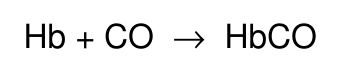
The chemical bond in carbonyl haemoglobin is about 200 times stronger than that in oxyhaemoglobin (\(\ce{HbO2}\)) originating under common conditions. Consequently, haemoglobin cannot be used in oxygen transfer. The lack of oxygen starts to be felt from 50 ppm carbon monoxide in the air, i. e. 10 % carbonyl haemoglobin in blood.
Air oxygen dissolves in blood in the lungs and its concentration under common conditions is kept at \(1.6\times10^{-6}\ \mathrm{mol\,dm^{-3}}\) by breathing. The concentration of haemoglobin in the blood of lung capillaries is also constant and is equal to \(8\times10^{-6}\ \mathrm{mol\,dm^{-3}}\)
Problems:
8.1 Calculate the rate of oxyhaemoglobin formation if the rate constant is \(k=2.1\times10^{6}\ \mathrm{dm^{3}\,mol^{-1}\,s^{-1}}\) (at \(37\,^\circ\mathrm{C}\) – normal body temperature).
8.2 In some cases (carbon monoxide poisoning) an increase of the rate of oxyhaemoglobin formation up to \(1.1\times10^{-4}\ \mathrm{mol\,dm^{-3}\,s^{-1}}\) is needed.
a) Calculate the required concentration of oxygen assuming that the concentration of haemoglobin in blood is constant.
b) Suggest of practical solution on the assumption that the concentration of oxygen in blood is proportional to the pressure of oxygen entering the lungs.
Official English text of the problem.
Answers
- 8.1: \(v=2.7\times10^{-5}\ \mathrm{mol\,dm^{-3}\,s^{-1}}\).
- 8.2(a): \([\ce{O2}]=6.5\times10^{-6}\ \mathrm{mol\,dm^{-3}}\).
- 8.2(b): Increase the inhaled oxygen partial pressure to approximately \(4.1\) times its normal value, using oxygen-enriched gas or a pressure chamber. With unchanged air composition, the required absolute total pressure is \(4.1\) times normal.
Solution
The small molecules involved are oxygen (dioxygen), \(\ce{O2}\), SMILES O=O, and carbon monoxide, \(\ce{CO}\), SMILES [C-]#[O+]. Haemoglobin (\(\ce{Hb}\)), oxyhaemoglobin (\(\ce{HbO2}\)), and carbonyl haemoglobin (\(\ce{HbCO}\)) are represented by the problem’s simplified protein-binding notation. Their full molecular structures are not specified, so unique complete SMILES cannot be supplied for these protein species.
8.1
In the simplified model used by the problem, oxygen associates with haemoglobin:
\[ \ce{Hb + O2 -> HbO2}. \]
The bimolecular formation rate is
\[ v=k[\ce{Hb}][\ce{O2}]. \]
Substituting the given values,
\[ \begin{aligned} v &= \left(2.1\times10^{6}\ \mathrm{dm^{3}\,mol^{-1}\,s^{-1}}\right) \left(8\times10^{-6}\ \mathrm{mol\,dm^{-3}}\right) \left(1.6\times10^{-6}\ \mathrm{mol\,dm^{-3}}\right)\\ &=2.688\times10^{-5}\ \mathrm{mol\,dm^{-3}\,s^{-1}}. \end{aligned} \]
Thus,
\[ \boxed{v\approx2.7\times10^{-5}\ \mathrm{mol\,dm^{-3}\,s^{-1}}}. \]
8.2(a)
At the same temperature, \(k\) is unchanged. With haemoglobin concentration held constant, rearranging the rate law gives
\[ [\ce{O2}]_{\mathrm{required}} =\frac{v_{\mathrm{required}}}{k[\ce{Hb}]}. \]
Therefore,
\[ \begin{aligned} [\ce{O2}]_{\mathrm{required}} &= \frac{1.1\times10^{-4}\ \mathrm{mol\,dm^{-3}\,s^{-1}}} {\left(2.1\times10^{6}\ \mathrm{dm^{3}\,mol^{-1}\,s^{-1}}\right) \left(8\times10^{-6}\ \mathrm{mol\,dm^{-3}}\right)}\\ &=6.5476\times10^{-6}\ \mathrm{mol\,dm^{-3}}. \end{aligned} \]
Hence,
\[ \boxed{[\ce{O2}]_{\mathrm{required}} \approx6.5\times10^{-6}\ \mathrm{mol\,dm^{-3}}}. \]
8.2(b)
By the stipulated proportionality between dissolved oxygen concentration and inhaled oxygen partial pressure,
\[ \frac{p_{\ce{O2},\mathrm{required}}} {p_{\ce{O2},\mathrm{normal}}} = \frac{[\ce{O2}]_{\mathrm{required}}} {[\ce{O2}]_{\mathrm{normal}}} = \frac{6.5476\times10^{-6}}{1.6\times10^{-6}} \approx4.1. \]
Thus,
\[ \boxed{p_{\ce{O2},\mathrm{required}} \approx4.1\,p_{\ce{O2},\mathrm{normal}}}. \]
A practical solution is to administer oxygen-enriched inhaled gas, increasing its oxygen partial pressure. Alternatively, a pressure chamber can increase the pressure of inhaled air. Since
\[ p_{\ce{O2}}=x_{\ce{O2}}P, \]
where \(x_{\ce{O2}}\) is the oxygen mole fraction and \(P\) is the absolute total pressure, using air of unchanged composition requires \(P_{\mathrm{required}}\approx4.1P_{\mathrm{normal}}\).
The solution was checked against the official solution.
IChO 1977 · Theorieaufgabe 8
Kohlenstoffmonoxid und Hämoglobin
Die Verschlechterung der Umwelt zeigt sich unter anderem auch in der Luftverschmutzung durch Kohlenstoffmonoxid. Seine bedeutendste Quelle sind Verbrennungsmotoren. Die Giftigkeit von Kohlenstoffmonoxid beruht darauf, dass es mit dem Blutfarbstoff Hämoglobin (\(\ce{Hb}\)) die Verbindung Carbonylhämoglobin (\(\ce{HbCO}\)) bildet:
Die chemische Bindung im Carbonylhämoglobin ist etwa 200-mal stärker als die im Oxyhämoglobin (\(\ce{HbO2}\)), das unter normalen Bedingungen entsteht. Folglich steht das Hämoglobin nicht mehr für den Sauerstofftransport zur Verfügung. Der Sauerstoffmangel macht sich ab 50 ppm Kohlenstoffmonoxid in der Luft bemerkbar, d. h. bei 10 % Carbonylhämoglobin im Blut.
In der Lunge löst sich Luftsauerstoff im Blut, und seine Konzentration wird unter normalen Bedingungen durch die Atmung bei \(1.6\times10^{-6}\ \mathrm{mol\,dm^{-3}}\) gehalten. Die Konzentration von Hämoglobin im Blut der Lungenkapillaren ist ebenfalls konstant und beträgt \(8\times10^{-6}\ \mathrm{mol\,dm^{-3}}\)
Aufgaben:
8.1 Berechnen Sie die Bildungsgeschwindigkeit von Oxyhämoglobin, wenn die Geschwindigkeitskonstante \(k=2.1\times10^{6}\ \mathrm{dm^{3}\,mol^{-1}\,s^{-1}}\) beträgt (bei \(37\,^\circ\mathrm{C}\) – normaler Körpertemperatur).
8.2 In einigen Fällen (Kohlenstoffmonoxidvergiftung) ist eine Erhöhung der Bildungsgeschwindigkeit von Oxyhämoglobin auf \(1.1\times10^{-4}\ \mathrm{mol\,dm^{-3}\,s^{-1}}\) erforderlich.
a) Berechnen Sie die erforderliche Sauerstoffkonzentration unter der Annahme, dass die Hämoglobinkonzentration im Blut konstant ist.
b) Schlagen Sie eine praktische Lösung unter der Annahme vor, dass die Sauerstoffkonzentration im Blut proportional zum Druck des in die Lunge gelangenden Sauerstoffs ist.
Aufgabentext aus dem offiziellen englischen Text übersetzt.
Antworten
- 8.1: \(v=2.7\times10^{-5}\ \mathrm{mol\,dm^{-3}\,s^{-1}}\).
- 8.2(a): \([\ce{O2}]=6.5\times10^{-6}\ \mathrm{mol\,dm^{-3}}\).
- 8.2(b): Der Partialdruck des eingeatmeten Sauerstoffs ist mithilfe eines sauerstoffangereicherten Gases oder einer Druckkammer auf etwa das \(4.1\)-Fache seines Normalwerts zu erhöhen. Bei unveränderter Luftzusammensetzung beträgt der erforderliche absolute Gesamtdruck das \(4.1\)-Fache des Normalwerts.
Lösung
Die beteiligten kleinen Moleküle sind Sauerstoff (Disauerstoff), \(\ce{O2}\), SMILES O=O, und Kohlenstoffmonoxid, \(\ce{CO}\), SMILES [C-]#[O+]. Hämoglobin (\(\ce{Hb}\)), Oxyhämoglobin (\(\ce{HbO2}\)) und Carbonylhämoglobin (\(\ce{HbCO}\)) werden durch die vereinfachte Schreibweise der Aufgabe für die Bindung an das Protein dargestellt. Ihre vollständigen Molekülstrukturen sind nicht angegeben, sodass für diese Proteinspezies keine eindeutigen vollständigen SMILES angegeben werden können.
8.1
In dem in der Aufgabe verwendeten vereinfachten Modell bindet Sauerstoff an Hämoglobin:
\[ \ce{Hb + O2 -> HbO2}. \]
Die bimolekulare Bildungsgeschwindigkeit beträgt
\[ v=k[\ce{Hb}][\ce{O2}]. \]
Einsetzen der gegebenen Werte ergibt
\[ \begin{aligned} v &= \left(2.1\times10^{6}\ \mathrm{dm^{3}\,mol^{-1}\,s^{-1}}\right) \left(8\times10^{-6}\ \mathrm{mol\,dm^{-3}}\right) \left(1.6\times10^{-6}\ \mathrm{mol\,dm^{-3}}\right)\\ &=2.688\times10^{-5}\ \mathrm{mol\,dm^{-3}\,s^{-1}}. \end{aligned} \]
Somit gilt
\[ \boxed{v\approx2.7\times10^{-5}\ \mathrm{mol\,dm^{-3}\,s^{-1}}}. \]
8.2(a)
Bei gleicher Temperatur bleibt \(k\) unverändert. Bei konstant gehaltener Hämoglobinkonzentration ergibt das Umstellen des Geschwindigkeitsgesetzes
\[ [\ce{O2}]_{\mathrm{required}} =\frac{v_{\mathrm{required}}}{k[\ce{Hb}]}. \]
Daher gilt
\[ \begin{aligned} [\ce{O2}]_{\mathrm{required}} &= \frac{1.1\times10^{-4}\ \mathrm{mol\,dm^{-3}\,s^{-1}}} {\left(2.1\times10^{6}\ \mathrm{dm^{3}\,mol^{-1}\,s^{-1}}\right) \left(8\times10^{-6}\ \mathrm{mol\,dm^{-3}}\right)}\\ &=6.5476\times10^{-6}\ \mathrm{mol\,dm^{-3}}. \end{aligned} \]
Damit ergibt sich
\[ \boxed{[\ce{O2}]_{\mathrm{required}} \approx6.5\times10^{-6}\ \mathrm{mol\,dm^{-3}}}. \]
8.2(b)
Aus der vorgegebenen Proportionalität zwischen der Konzentration des gelösten Sauerstoffs und dem Partialdruck des eingeatmeten Sauerstoffs folgt
\[ \frac{p_{\ce{O2},\mathrm{required}}} {p_{\ce{O2},\mathrm{normal}}} = \frac{[\ce{O2}]_{\mathrm{required}}} {[\ce{O2}]_{\mathrm{normal}}} = \frac{6.5476\times10^{-6}}{1.6\times10^{-6}} \approx4.1. \]
Somit gilt
\[ \boxed{p_{\ce{O2},\mathrm{required}} \approx4.1\,p_{\ce{O2},\mathrm{normal}}}. \]
Eine praktische Lösung besteht darin, sauerstoffangereichertes Atemgas zu verabreichen und dadurch dessen Sauerstoffpartialdruck zu erhöhen. Alternativ kann der Druck der eingeatmeten Luft mithilfe einer Druckkammer erhöht werden. Da
\[ p_{\ce{O2}}=x_{\ce{O2}}P, \]
gilt, wobei \(x_{\ce{O2}}\) der Stoffmengenanteil des Sauerstoffs und \(P\) der absolute Gesamtdruck ist, erfordert die Verwendung von Luft unveränderter Zusammensetzung \(P_{\mathrm{required}}\approx4.1P_{\mathrm{normal}}\).
Die Lösung wurde mit der offiziellen Lösung abgeglichen.
IChO 1977 · Teori sorusu 8
Karbon monoksit ve hemoglobin
Çevrenin bozulması, diğer etkenlerin yanı sıra, havanın karbon monoksitle kirlenmesiyle de kendini gösterir. Karbon monoksitin en büyük kaynağı içten yanmalı motorlardır. Karbon monoksitin zehirliliği, kan pigmenti olan hemoglobin (\(\ce{Hb}\)) ile karbonilhemoglobin (\(\ce{HbCO}\)) bileşiğini oluşturmasından kaynaklanır:
Karbonilhemoglobindeki kimyasal bağ, olağan koşullarda oluşan oksihemoglobindeki (\(\ce{HbO2}\)) bağdan yaklaşık 200 kat daha kuvvetlidir. Bunun sonucunda hemoglobin, oksijen taşınmasında kullanılamaz. Havadaki karbon monoksit düzeyi 50 ppm'e ulaştığında, yani kandaki karbonilhemoglobin oranı % 10 olduğunda, oksijen eksikliği hissedilmeye başlar.
Havadaki oksijen akciğerlerde kanda çözünür ve olağan koşullarda derişimi, solunum yoluyla \(1.6\times10^{-6}\ \mathrm{mol\,dm^{-3}}\) düzeyinde tutulur. Akciğer kılcal damarlarındaki kanda hemoglobin derişimi de sabittir ve \(8\times10^{-6}\ \mathrm{mol\,dm^{-3}}\) değerine eşittir.
Sorular:
8.1 Hız sabiti \(k=2.1\times10^{6}\ \mathrm{dm^{3}\,mol^{-1}\,s^{-1}}\) olduğuna göre (\(37\,^\circ\mathrm{C}\)'de – normal vücut sıcaklığı), oksihemoglobin oluşum hızını hesaplayınız.
8.2 Bazı durumlarda (karbon monoksit zehirlenmesinde), oksihemoglobin oluşum hızının \(1.1\times10^{-4}\ \mathrm{mol\,dm^{-3}\,s^{-1}}\) değerine kadar artırılması gerekir.
a) Kandaki hemoglobin derişiminin sabit olduğunu varsayarak gerekli oksijen derişimini hesaplayınız.
b) Kandaki oksijen derişiminin akciğerlere giren oksijenin basıncıyla orantılı olduğunu varsayarak uygulanabilir bir çözüm öneriniz.
Soru metni resmi İngilizce metinden çevrilmiştir.
Cevaplar
- 8.1: \(v=2.7\times10^{-5}\ \mathrm{mol\,dm^{-3}\,s^{-1}}\).
- 8.2(a): \([\ce{O2}]=6.5\times10^{-6}\ \mathrm{mol\,dm^{-3}}\).
- 8.2(b): Oksijence zenginleştirilmiş gaz veya bir basınç odası kullanarak solunan oksijenin kısmi basıncını normal değerinin yaklaşık \(4.1\) katına çıkarınız. Havanın bileşimi değiştirilmezse gerekli mutlak toplam basınç, normal değerin \(4.1\) katıdır.
Çözüm
Burada yer alan küçük moleküller oksijen (dioksijen), \(\ce{O2}\), SMILES O=O ve karbon monoksit, \(\ce{CO}\), SMILES [C-]#[O+] şeklindedir. Hemoglobin (\(\ce{Hb}\)), oksihemoglobin (\(\ce{HbO2}\)) ve karbonilhemoglobin (\(\ce{HbCO}\)), soruda kullanılan basitleştirilmiş proteine bağlanma gösterimiyle temsil edilmiştir. Tam molekül yapıları belirtilmediği için bu protein türleri için tek ve eksiksiz birer SMILES gösterimi verilemez.
8.1
Soruda kullanılan basitleştirilmiş modelde oksijen, hemoglobine bağlanır:
\[ \ce{Hb + O2 -> HbO2}. \]
İki moleküllü oluşum tepkimesinin hızı şöyledir:
\[ v=k[\ce{Hb}][\ce{O2}]. \]
Verilen değerler yerine konulduğunda,
\[ \begin{aligned} v &= \left(2.1\times10^{6}\ \mathrm{dm^{3}\,mol^{-1}\,s^{-1}}\right) \left(8\times10^{-6}\ \mathrm{mol\,dm^{-3}}\right) \left(1.6\times10^{-6}\ \mathrm{mol\,dm^{-3}}\right)\\ &=2.688\times10^{-5}\ \mathrm{mol\,dm^{-3}\,s^{-1}}. \end{aligned} \]
Böylece,
\[ \boxed{v\approx2.7\times10^{-5}\ \mathrm{mol\,dm^{-3}\,s^{-1}}}. \]
8.2(a)
Aynı sıcaklıkta \(k\) değişmez. Hemoglobin derişimi sabit tutulduğunda, hız yasasının yeniden düzenlenmesiyle şu ifade elde edilir:
\[ [\ce{O2}]_{\mathrm{required}} =\frac{v_{\mathrm{required}}}{k[\ce{Hb}]}. \]
Dolayısıyla,
\[ \begin{aligned} [\ce{O2}]_{\mathrm{required}} &= \frac{1.1\times10^{-4}\ \mathrm{mol\,dm^{-3}\,s^{-1}}} {\left(2.1\times10^{6}\ \mathrm{dm^{3}\,mol^{-1}\,s^{-1}}\right) \left(8\times10^{-6}\ \mathrm{mol\,dm^{-3}}\right)}\\ &=6.5476\times10^{-6}\ \mathrm{mol\,dm^{-3}}. \end{aligned} \]
Buna göre,
\[ \boxed{[\ce{O2}]_{\mathrm{required}} \approx6.5\times10^{-6}\ \mathrm{mol\,dm^{-3}}}. \]
8.2(b)
Çözünmüş oksijen derişimi ile solunan oksijenin kısmi basıncı arasında verilen orantılılık ilişkisine göre,
\[ \frac{p_{\ce{O2},\mathrm{required}}} {p_{\ce{O2},\mathrm{normal}}} = \frac{[\ce{O2}]_{\mathrm{required}}} {[\ce{O2}]_{\mathrm{normal}}} = \frac{6.5476\times10^{-6}}{1.6\times10^{-6}} \approx4.1. \]
Böylece,
\[ \boxed{p_{\ce{O2},\mathrm{required}} \approx4.1\,p_{\ce{O2},\mathrm{normal}}}. \]
Uygulanabilir bir çözüm, oksijence zenginleştirilmiş gaz solutarak solunan gazın oksijen kısmi basıncını artırmaktır. Alternatif olarak, bir basınç odasıyla solunan havanın basıncı artırılabilir. Şu bağıntı geçerlidir:
\[ p_{\ce{O2}}=x_{\ce{O2}}P, \]
burada \(x_{\ce{O2}}\) oksijenin mol kesri, \(P\) ise mutlak toplam basınçtır; dolayısıyla bileşimi değiştirilmemiş hava kullanılması, \(P_{\mathrm{required}}\approx4.1P_{\mathrm{normal}}\) olmasını gerektirir.
Çözüm, resmi çözümle karşılaştırılarak kontrol edildi.
IChO 1977 · Problema teórico 8
Monóxido de carbono y hemoglobina
Entre otros factores, el deterioro del medio ambiente se manifiesta también por la contaminación del aire con monóxido de carbono. Su principal fuente son los motores de combustión. La toxicidad del monóxido de carbono se debe a que forma con el pigmento sanguíneo, la hemoglobina (\(\ce{Hb}\)), el compuesto carboxihemoglobina (\(\ce{HbCO}\)):
El enlace químico en la carboxihemoglobina es unas 200 veces más fuerte que el de la oxihemoglobina (\(\ce{HbO2}\)), que se forma en condiciones normales. En consecuencia, la hemoglobina no puede participar en el transporte de oxígeno. La falta de oxígeno empieza a manifestarse a partir de 50 ppm de monóxido de carbono en el aire, es decir, un 10 % de carboxihemoglobina en la sangre.
El oxígeno del aire se disuelve en la sangre en los pulmones y, en condiciones normales, la respiración mantiene su concentración en \(1.6\times10^{-6}\ \mathrm{mol\,dm^{-3}}\). La concentración de hemoglobina en la sangre de los capilares pulmonares también es constante e igual a \(8\times10^{-6}\ \mathrm{mol\,dm^{-3}}\)
Cuestiones:
8.1 Calcule la velocidad de formación de oxihemoglobina si la constante de velocidad es \(k=2.1\times10^{6}\ \mathrm{dm^{3}\,mol^{-1}\,s^{-1}}\) (a \(37\,^\circ\mathrm{C}\), la temperatura corporal normal).
8.2 En algunos casos (intoxicación por monóxido de carbono) es necesario aumentar la velocidad de formación de oxihemoglobina hasta \(1.1\times10^{-4}\ \mathrm{mol\,dm^{-3}\,s^{-1}}\).
a) Calcule la concentración de oxígeno necesaria suponiendo que la concentración de hemoglobina en la sangre es constante.
b) Proponga una solución práctica suponiendo que la concentración de oxígeno en la sangre es proporcional a la presión del oxígeno que entra en los pulmones.
Enunciado traducido del texto oficial en inglés.
Respuestas
- 8.1: \(v=2.7\times10^{-5}\ \mathrm{mol\,dm^{-3}\,s^{-1}}\).
- 8.2(a): \([\ce{O2}]=6.5\times10^{-6}\ \mathrm{mol\,dm^{-3}}\).
- 8.2(b): Aumentar la presión parcial del oxígeno inhalado hasta aproximadamente \(4.1\) veces su valor normal, utilizando un gas enriquecido con oxígeno o una cámara hiperbárica. Si la composición del aire no cambia, la presión total absoluta necesaria es \(4.1\) veces la normal.
Solución
Las moléculas pequeñas implicadas son el oxígeno (dioxígeno), \(\ce{O2}\), SMILES O=O, y el monóxido de carbono, \(\ce{CO}\), SMILES [C-]#[O+]. La hemoglobina (\(\ce{Hb}\)), la oxihemoglobina (\(\ce{HbO2}\)) y la carboxihemoglobina (\(\ce{HbCO}\)) se representan mediante la notación simplificada de unión a proteínas empleada en el problema. No se especifican sus estructuras moleculares completas, por lo que no se pueden proporcionar SMILES completos e inequívocos para estas especies proteicas.
8.1
En el modelo simplificado utilizado en el problema, el oxígeno se une a la hemoglobina:
\[ \ce{Hb + O2 -> HbO2}. \]
La velocidad de formación bimolecular es
\[ v=k[\ce{Hb}][\ce{O2}]. \]
Sustituyendo los valores dados,
\[ \begin{aligned} v &= \left(2.1\times10^{6}\ \mathrm{dm^{3}\,mol^{-1}\,s^{-1}}\right) \left(8\times10^{-6}\ \mathrm{mol\,dm^{-3}}\right) \left(1.6\times10^{-6}\ \mathrm{mol\,dm^{-3}}\right)\\ &=2.688\times10^{-5}\ \mathrm{mol\,dm^{-3}\,s^{-1}}. \end{aligned} \]
Por tanto,
\[ \boxed{v\approx2.7\times10^{-5}\ \mathrm{mol\,dm^{-3}\,s^{-1}}}. \]
8.2(a)
A la misma temperatura, \(k\) no cambia. Manteniendo constante la concentración de hemoglobina y despejando en la ley de velocidad, se obtiene
\[ [\ce{O2}]_{\mathrm{required}} =\frac{v_{\mathrm{required}}}{k[\ce{Hb}]}. \]
Por lo tanto,
\[ \begin{aligned} [\ce{O2}]_{\mathrm{required}} &= \frac{1.1\times10^{-4}\ \mathrm{mol\,dm^{-3}\,s^{-1}}} {\left(2.1\times10^{6}\ \mathrm{dm^{3}\,mol^{-1}\,s^{-1}}\right) \left(8\times10^{-6}\ \mathrm{mol\,dm^{-3}}\right)}\\ &=6.5476\times10^{-6}\ \mathrm{mol\,dm^{-3}}. \end{aligned} \]
Así pues,
\[ \boxed{[\ce{O2}]_{\mathrm{required}} \approx6.5\times10^{-6}\ \mathrm{mol\,dm^{-3}}}. \]
8.2(b)
De acuerdo con la proporcionalidad estipulada entre la concentración de oxígeno disuelto y la presión parcial del oxígeno inhalado,
\[ \frac{p_{\ce{O2},\mathrm{required}}} {p_{\ce{O2},\mathrm{normal}}} = \frac{[\ce{O2}]_{\mathrm{required}}} {[\ce{O2}]_{\mathrm{normal}}} = \frac{6.5476\times10^{-6}}{1.6\times10^{-6}} \approx4.1. \]
Por tanto,
\[ \boxed{p_{\ce{O2},\mathrm{required}} \approx4.1\,p_{\ce{O2},\mathrm{normal}}}. \]
Una solución práctica consiste en administrar un gas inhalado enriquecido con oxígeno, aumentando su presión parcial de oxígeno. Como alternativa, una cámara hiperbárica permite aumentar la presión del aire inhalado. Puesto que
\[ p_{\ce{O2}}=x_{\ce{O2}}P, \]
donde \(x_{\ce{O2}}\) es la fracción molar de oxígeno y \(P\) es la presión total absoluta, utilizar aire de composición inalterada requiere \(P_{\mathrm{required}}\approx4.1P_{\mathrm{normal}}\).
La solución se comprobó con la solución oficial.
IChO 1977 · 理论题 8
一氧化碳与血红蛋白
环境恶化的表现之一是空气受到一氧化碳污染。内燃机是一氧化碳最主要的来源。一氧化碳的毒性源于它能与血液中的色素——血红蛋白(\(\ce{Hb}\))形成碳氧血红蛋白(\(\ce{HbCO}\))这一化合物:
碳氧血红蛋白中的化学键强度约为通常条件下形成的氧合血红蛋白(\(\ce{HbO2}\))中相应化学键强度的 200 倍。因此,血红蛋白无法参与氧的运输。当空气中一氧化碳的含量达到 50 ppm,即血液中碳氧血红蛋白的比例达到 10 % 时,就开始出现缺氧感。
空气中的氧在肺部溶入血液,在通常条件下,通过呼吸,其浓度维持在 \(1.6\times10^{-6}\ \mathrm{mol\,dm^{-3}}\)。肺毛细血管血液中的血红蛋白浓度也保持恒定,等于 \(8\times10^{-6}\ \mathrm{mol\,dm^{-3}}\)
问题:
8.1 若速率常数为 \(k=2.1\times10^{6}\ \mathrm{dm^{3}\,mol^{-1}\,s^{-1}}\)(在 \(37\,^\circ\mathrm{C}\),即正常体温下),计算氧合血红蛋白的生成速率。
8.2 在某些情况下(一氧化碳中毒),需要将氧合血红蛋白的生成速率提高至 \(1.1\times10^{-4}\ \mathrm{mol\,dm^{-3}\,s^{-1}}\)。
a) 假设血液中血红蛋白的浓度保持恒定,计算所需的氧浓度。
b) 假设血液中氧的浓度与进入肺部的氧的分压成正比,提出一种切实可行的方法。
题目译自官方英文原文。
答案
- 8.1: \(v=2.7\times10^{-5}\ \mathrm{mol\,dm^{-3}\,s^{-1}}\)。
- 8.2(a): \([\ce{O2}]=6.5\times10^{-6}\ \mathrm{mol\,dm^{-3}}\)。
- 8.2(b): 使用富氧气体或加压舱,将吸入气体中氧的分压提高到正常值的约 \(4.1\) 倍。在空气组成不变的情况下,所需的绝对总压为正常值的 \(4.1\) 倍。
解答
所涉及的小分子为氧气(双原子氧),\(\ce{O2}\),SMILES 为 O=O,以及一氧化碳,\(\ce{CO}\),SMILES 为 [C-]#[O+]。血红蛋白(\(\ce{Hb}\))、氧合血红蛋白(\(\ce{HbO2}\))和碳氧血红蛋白(\(\ce{HbCO}\))均采用题目中简化的蛋白质结合表示法。题目未给出它们的完整分子结构,因此无法为这些蛋白质物种提供唯一且完整的 SMILES。
8.1
在题目采用的简化模型中,氧与血红蛋白结合:
\[ \ce{Hb + O2 -> HbO2}. \]
这一双分子反应的生成速率为
\[ v=k[\ce{Hb}][\ce{O2}]. \]
代入给定数值,
\[ \begin{aligned} v &= \left(2.1\times10^{6}\ \mathrm{dm^{3}\,mol^{-1}\,s^{-1}}\right) \left(8\times10^{-6}\ \mathrm{mol\,dm^{-3}}\right) \left(1.6\times10^{-6}\ \mathrm{mol\,dm^{-3}}\right)\\ &=2.688\times10^{-5}\ \mathrm{mol\,dm^{-3}\,s^{-1}}. \end{aligned} \]
因此,
\[ \boxed{v\approx2.7\times10^{-5}\ \mathrm{mol\,dm^{-3}\,s^{-1}}}. \]
8.2(a)
在相同温度下,\(k\) 保持不变。在血红蛋白浓度保持恒定的情况下,将速率方程变形可得
\[ [\ce{O2}]_{\mathrm{required}} =\frac{v_{\mathrm{required}}}{k[\ce{Hb}]}. \]
因此,
\[ \begin{aligned} [\ce{O2}]_{\mathrm{required}} &= \frac{1.1\times10^{-4}\ \mathrm{mol\,dm^{-3}\,s^{-1}}} {\left(2.1\times10^{6}\ \mathrm{dm^{3}\,mol^{-1}\,s^{-1}}\right) \left(8\times10^{-6}\ \mathrm{mol\,dm^{-3}}\right)}\\ &=6.5476\times10^{-6}\ \mathrm{mol\,dm^{-3}}. \end{aligned} \]
所以,
\[ \boxed{[\ce{O2}]_{\mathrm{required}} \approx6.5\times10^{-6}\ \mathrm{mol\,dm^{-3}}}. \]
8.2(b)
根据题目规定的溶解氧浓度与吸入气体中氧分压之间的正比关系,
\[ \frac{p_{\ce{O2},\mathrm{required}}} {p_{\ce{O2},\mathrm{normal}}} = \frac{[\ce{O2}]_{\mathrm{required}}} {[\ce{O2}]_{\mathrm{normal}}} = \frac{6.5476\times10^{-6}}{1.6\times10^{-6}} \approx4.1. \]
因此,
\[ \boxed{p_{\ce{O2},\mathrm{required}} \approx4.1\,p_{\ce{O2},\mathrm{normal}}}. \]
一种切实可行的方法是让患者吸入富氧气体,以提高其中氧的分压。另一种方法是使用加压舱,提高吸入空气的压力。由于
\[ p_{\ce{O2}}=x_{\ce{O2}}P, \]
其中 \(x_{\ce{O2}}\) 为氧的摩尔分数,\(P\) 为绝对总压,因此,若使用组成不变的空气,则需要 \(P_{\mathrm{required}}\approx4.1P_{\mathrm{normal}}\)。
解答已与官方解答核对。
IChO 1977 · Теоретическая задача 8
Монооксид углерода и гемоглобин
Ухудшение состояния окружающей среды проявляется, среди прочего, и в загрязнении воздуха монооксидом углерода. Его наиболее мощным источником являются двигатели внутреннего сгорания. Токсичность монооксида углерода обусловлена тем, что он образует с пигментом крови — гемоглобином (\(\ce{Hb}\)) — соединение карбоксигемоглобин (\(\ce{HbCO}\)):
Химическая связь в карбоксигемоглобине примерно в 200 раз прочнее, чем в оксигемоглобине (\(\ce{HbO2}\)), образующемся в обычных условиях. В результате гемоглобин не может участвовать в переносе кислорода. Недостаток кислорода начинает ощущаться при содержании монооксида углерода в воздухе от 50 ppm, что соответствует содержанию карбоксигемоглобина в крови 10 %.
Кислород воздуха растворяется в крови в лёгких, и в обычных условиях благодаря дыханию его концентрация поддерживается на уровне \(1.6\times10^{-6}\ \mathrm{mol\,dm^{-3}}\). Концентрация гемоглобина в крови лёгочных капилляров также постоянна и равна \(8\times10^{-6}\ \mathrm{mol\,dm^{-3}}\)
Задания:
8.1 Рассчитайте скорость образования оксигемоглобина, если константа скорости равна \(k=2.1\times10^{6}\ \mathrm{dm^{3}\,mol^{-1}\,s^{-1}}\) (при \(37\,^\circ\mathrm{C}\) — нормальной температуре тела).
8.2 В некоторых случаях (при отравлении монооксидом углерода) необходимо увеличить скорость образования оксигемоглобина до \(1.1\times10^{-4}\ \mathrm{mol\,dm^{-3}\,s^{-1}}\).
a) Рассчитайте необходимую концентрацию кислорода, считая концентрацию гемоглобина в крови постоянной.
b) Предложите практическое решение, исходя из предположения, что концентрация кислорода в крови пропорциональна давлению кислорода, поступающего в лёгкие.
Условие переведено с официального английского текста.
Ответы
- 8.1: \(v=2.7\times10^{-5}\ \mathrm{mol\,dm^{-3}\,s^{-1}}\).
- 8.2(a): \([\ce{O2}]=6.5\times10^{-6}\ \mathrm{mol\,dm^{-3}}\).
- 8.2(b): Увеличить парциальное давление вдыхаемого кислорода примерно в \(4.1\) раза по сравнению с нормальным значением, используя обогащённую кислородом газовую смесь или барокамеру. При неизменном составе воздуха необходимое абсолютное общее давление в \(4.1\) раза выше нормального.
Решение
Участвующие в процессе малые молекулы — это кислород (дикислород), \(\ce{O2}\), SMILES O=O, и монооксид углерода, \(\ce{CO}\), SMILES [C-]#[O+]. Гемоглобин (\(\ce{Hb}\)), оксигемоглобин (\(\ce{HbO2}\)) и карбоксигемоглобин (\(\ce{HbCO}\)) представлены принятыми в задаче упрощёнными обозначениями белка и его комплексов. Их полные молекулярные структуры не указаны, поэтому для этих белковых частиц невозможно привести однозначные полные записи SMILES.
8.1
В упрощённой модели, используемой в задаче, кислород связывается с гемоглобином:
\[ \ce{Hb + O2 -> HbO2}. \]
Скорость бимолекулярной реакции образования оксигемоглобина равна
\[ v=k[\ce{Hb}][\ce{O2}]. \]
Подставляя заданные значения, получаем
\[ \begin{aligned} v &= \left(2.1\times10^{6}\ \mathrm{dm^{3}\,mol^{-1}\,s^{-1}}\right) \left(8\times10^{-6}\ \mathrm{mol\,dm^{-3}}\right) \left(1.6\times10^{-6}\ \mathrm{mol\,dm^{-3}}\right)\\ &=2.688\times10^{-5}\ \mathrm{mol\,dm^{-3}\,s^{-1}}. \end{aligned} \]
Таким образом,
\[ \boxed{v\approx2.7\times10^{-5}\ \mathrm{mol\,dm^{-3}\,s^{-1}}}. \]
8.2(a)
При той же температуре \(k\) не изменяется. При постоянной концентрации гемоглобина преобразование кинетического уравнения даёт
\[ [\ce{O2}]_{\mathrm{required}} =\frac{v_{\mathrm{required}}}{k[\ce{Hb}]}. \]
Следовательно,
\[ \begin{aligned} [\ce{O2}]_{\mathrm{required}} &= \frac{1.1\times10^{-4}\ \mathrm{mol\,dm^{-3}\,s^{-1}}} {\left(2.1\times10^{6}\ \mathrm{dm^{3}\,mol^{-1}\,s^{-1}}\right) \left(8\times10^{-6}\ \mathrm{mol\,dm^{-3}}\right)}\\ &=6.5476\times10^{-6}\ \mathrm{mol\,dm^{-3}}. \end{aligned} \]
Отсюда
\[ \boxed{[\ce{O2}]_{\mathrm{required}} \approx6.5\times10^{-6}\ \mathrm{mol\,dm^{-3}}}. \]
8.2(b)
Согласно заданной пропорциональности между концентрацией растворённого кислорода и парциальным давлением вдыхаемого кислорода,
\[ \frac{p_{\ce{O2},\mathrm{required}}} {p_{\ce{O2},\mathrm{normal}}} = \frac{[\ce{O2}]_{\mathrm{required}}} {[\ce{O2}]_{\mathrm{normal}}} = \frac{6.5476\times10^{-6}}{1.6\times10^{-6}} \approx4.1. \]
Таким образом,
\[ \boxed{p_{\ce{O2},\mathrm{required}} \approx4.1\,p_{\ce{O2},\mathrm{normal}}}. \]
Практическое решение заключается в подаче для вдыхания газовой смеси, обогащённой кислородом, что повышает его парциальное давление. Другой вариант — повышение давления вдыхаемого воздуха с помощью барокамеры. Поскольку
\[ p_{\ce{O2}}=x_{\ce{O2}}P, \]
где \(x_{\ce{O2}}\) — мольная доля кислорода, а \(P\) — абсолютное общее давление, при использовании воздуха неизменного состава требуется \(P_{\mathrm{required}}\approx4.1P_{\mathrm{normal}}\).
Решение проверено по официальному решению.
IChO 1977 · مسألة نظرية 8
أحادي أكسيد الكربون والهيموغلوبين
من بين عوامل أخرى، يتجلى تدهور البيئة أيضًا في تلوث الهواء بأحادي أكسيد الكربون. وتُعدّ محركات الاحتراق أكبر مصادره. وتعود سمية أحادي أكسيد الكربون إلى أنه يُكوِّن مع صباغ الدم، الهيموغلوبين (\(\ce{Hb}\))، مركّب كربونيل الهيموغلوبين (\(\ce{HbCO}\)):
الرابطة الكيميائية في كربونيل الهيموغلوبين أقوى بنحو 200 مرة من الرابطة في الأوكسيهيموغلوبين (\(\ce{HbO2}\)) المتكوّن في الظروف المعتادة. ونتيجة لذلك، لا يعود الهيموغلوبين قادرًا على نقل الأكسجين. ويبدأ الشعور بنقص الأكسجين عندما يبلغ تركيز أحادي أكسيد الكربون في الهواء 50 جزءًا في المليون، أي عندما تبلغ نسبة كربونيل الهيموغلوبين في الدم 10 %.
يذوب أكسجين الهواء في الدم داخل الرئتين، ويحافظ التنفس على تركيزه في الظروف المعتادة عند \(1.6\times10^{-6}\ \mathrm{mol\,dm^{-3}}\). كما أن تركيز الهيموغلوبين في دم الشعيرات الدموية الرئوية ثابت ويساوي \(8\times10^{-6}\ \mathrm{mol\,dm^{-3}}\)
المطلوب:
8.1 احسب سرعة تكوّن الأوكسيهيموغلوبين إذا كان ثابت السرعة \(k=2.1\times10^{6}\ \mathrm{dm^{3}\,mol^{-1}\,s^{-1}}\) (عند \(37\,^\circ\mathrm{C}\) – درجة حرارة الجسم الطبيعية).
8.2 في بعض الحالات (التسمم بأحادي أكسيد الكربون)، يلزم رفع سرعة تكوّن الأوكسيهيموغلوبين إلى \(1.1\times10^{-4}\ \mathrm{mol\,dm^{-3}\,s^{-1}}\).
a) احسب تركيز الأكسجين المطلوب بافتراض أن تركيز الهيموغلوبين في الدم ثابت.
b) اقترح حلًا عمليًا بافتراض أن تركيز الأكسجين في الدم يتناسب طرديًا مع ضغط الأكسجين الداخل إلى الرئتين.
نص المسألة مترجم عن النص الإنجليزي الرسمي.
الإجابات
- 8.1: \(v=2.7\times10^{-5}\ \mathrm{mol\,dm^{-3}\,s^{-1}}\).
- 8.2(a): \([\ce{O2}]=6.5\times10^{-6}\ \mathrm{mol\,dm^{-3}}\).
- 8.2(b): ارفع الضغط الجزئي للأكسجين المستنشق إلى نحو \(4.1\) أمثال قيمته المعتادة، باستخدام غاز مُغنى بالأكسجين أو حجرة ضغط. وعند إبقاء تركيب الهواء دون تغيير، يكون الضغط الكلي المطلق المطلوب \(4.1\) أمثال قيمته المعتادة.
الحل
الجزيئات الصغيرة المعنية هي الأكسجين (ثنائي الأكسجين)، \(\ce{O2}\)، وتمثيله بصيغة SMILES هو O=O، وأحادي أكسيد الكربون، \(\ce{CO}\)، وتمثيله بصيغة SMILES هو [C-]#[O+]. ويُمثَّل الهيموغلوبين (\(\ce{Hb}\))، والأوكسيهيموغلوبين (\(\ce{HbO2}\))، وكربونيل الهيموغلوبين (\(\ce{HbCO}\)) بالترميز المبسط للارتباط بالبروتين المستخدم في المسألة. ولم تُحدَّد بُناها الجزيئية الكاملة، ولذلك لا يمكن تقديم تمثيلات SMILES كاملة ومحددة على نحو فريد لهذه الأنواع البروتينية.
8.1
في النموذج المبسط المستخدم في المسألة، يرتبط الأكسجين بالهيموغلوبين:
\[ \ce{Hb + O2 -> HbO2}. \]
تُعطى سرعة التكوّن ثنائي الجزيء بالعلاقة
\[ v=k[\ce{Hb}][\ce{O2}]. \]
بالتعويض بالقيم المعطاة،
\[ \begin{aligned} v &= \left(2.1\times10^{6}\ \mathrm{dm^{3}\,mol^{-1}\,s^{-1}}\right) \left(8\times10^{-6}\ \mathrm{mol\,dm^{-3}}\right) \left(1.6\times10^{-6}\ \mathrm{mol\,dm^{-3}}\right)\\ &=2.688\times10^{-5}\ \mathrm{mol\,dm^{-3}\,s^{-1}}. \end{aligned} \]
إذن،
\[ \boxed{v\approx2.7\times10^{-5}\ \mathrm{mol\,dm^{-3}\,s^{-1}}}. \]
8.2(a)
عند درجة الحرارة نفسها، يبقى \(k\) دون تغيير. ومع إبقاء تركيز الهيموغلوبين ثابتًا، تعطي إعادة ترتيب قانون السرعة
\[ [\ce{O2}]_{\mathrm{required}} =\frac{v_{\mathrm{required}}}{k[\ce{Hb}]}. \]
وعليه،
\[ \begin{aligned} [\ce{O2}]_{\mathrm{required}} &= \frac{1.1\times10^{-4}\ \mathrm{mol\,dm^{-3}\,s^{-1}}} {\left(2.1\times10^{6}\ \mathrm{dm^{3}\,mol^{-1}\,s^{-1}}\right) \left(8\times10^{-6}\ \mathrm{mol\,dm^{-3}}\right)}\\ &=6.5476\times10^{-6}\ \mathrm{mol\,dm^{-3}}. \end{aligned} \]
ومن ثم،
\[ \boxed{[\ce{O2}]_{\mathrm{required}} \approx6.5\times10^{-6}\ \mathrm{mol\,dm^{-3}}}. \]
8.2(b)
وفقًا للتناسب المفترض بين تركيز الأكسجين المذاب والضغط الجزئي للأكسجين المستنشق،
\[ \frac{p_{\ce{O2},\mathrm{required}}} {p_{\ce{O2},\mathrm{normal}}} = \frac{[\ce{O2}]_{\mathrm{required}}} {[\ce{O2}]_{\mathrm{normal}}} = \frac{6.5476\times10^{-6}}{1.6\times10^{-6}} \approx4.1. \]
إذن،
\[ \boxed{p_{\ce{O2},\mathrm{required}} \approx4.1\,p_{\ce{O2},\mathrm{normal}}}. \]
يتمثل أحد الحلول العملية في إعطاء غاز مُغنى بالأكسجين للاستنشاق، مما يزيد الضغط الجزئي للأكسجين فيه. وبدلًا من ذلك، يمكن استخدام حجرة ضغط لزيادة ضغط الهواء المستنشق. وبما أن
\[ p_{\ce{O2}}=x_{\ce{O2}}P, \]
حيث \(x_{\ce{O2}}\) هو الكسر المولي للأكسجين و\(P\) هو الضغط الكلي المطلق، فإن استخدام هواء ذي تركيب لم يتغير يتطلب \(P_{\mathrm{required}}\approx4.1P_{\mathrm{normal}}\).
تمت مراجعة الحل بمقارنته بالحل الرسمي.