IChO 2023 · Theory problem 8
Nazarov Reaction
The Nazarov reaction is a frequently used reaction of divinyl ketones to give cyclopentenones. It proceeds either photochemically or via acid catalysis and is an electrocyclization, followed by a proton transfer.

8.1 Draw the π molecular orbitals to describe the Nazarov reaction. Fill in the electrons into the respective energy levels. Mark with an x the (i) HOMO (highest occupied molecular orbital) and (ii) LUMO (lowest unoccupied molecular orbital). For this exercise, you can consider the divinyl ketone as a pentadienyl cation with five p-orbitals.
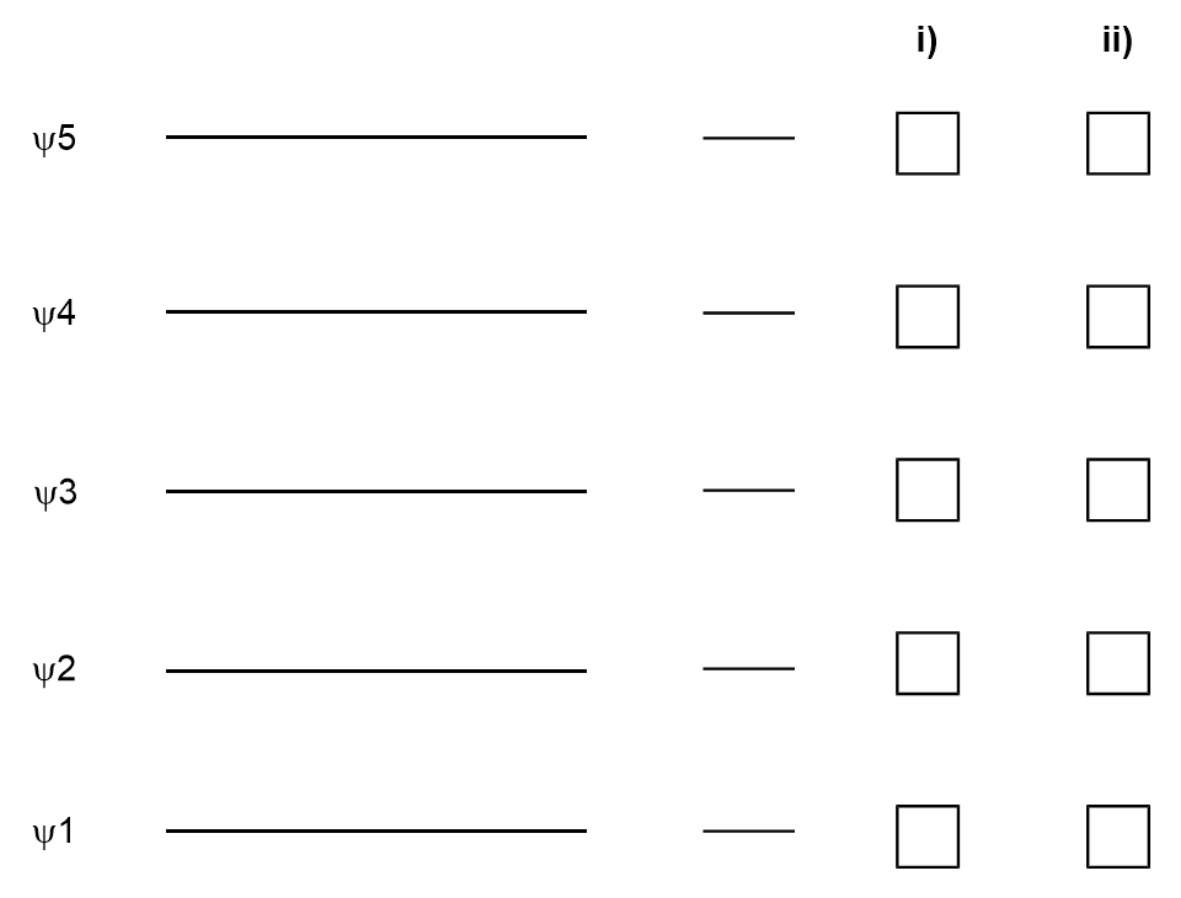
8.2 From the π molecular orbitals you derived in Task 8.1, predict under which conditions the Nazarov reaction of the divinyl ketone will proceed in a disrotatory or conrotatory fashion. In the table mark with an x the conditions under which the reaction is allowed.
| Disrotatory | Conrotatory | |
|---|---|---|
| Thermal | ||
| Photochemical |
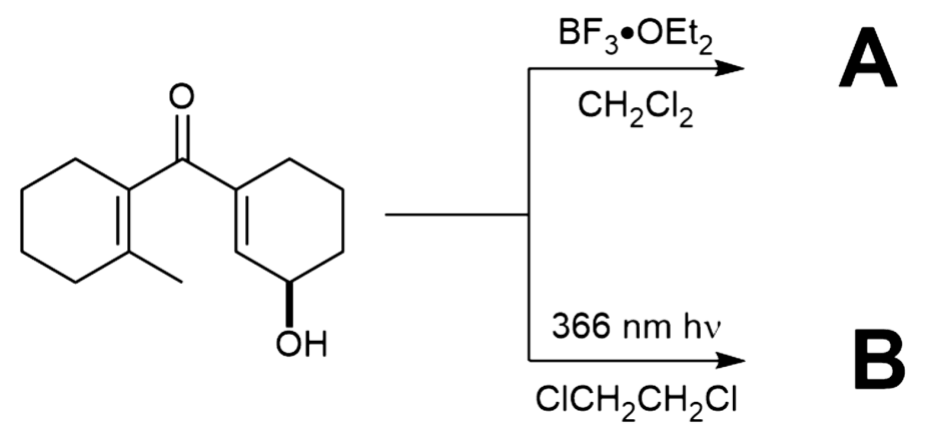
8.3 The Nazarov reaction was used as key reaction in a synthesis of Farnesin. For both conditions below, draw one possible structure for each of A and B, including stereochemistry. Note that the products of both reactions show \(\ce{^1H}\) NMR a signal at 6.70–6.73 ppm.
The synthesis of Capnellene commences with unsaturated aldehyde C shown below. Treatment with D, followed by reaction with \(\ce{MnO2}\) supported on carbon gave divinyl ketone E shown below. Exposure to a mixture of \(\ce{P2O5}\) and MsOH yielded F, which was elaborated via a sequence of reactions to the unsaturated ketone I.
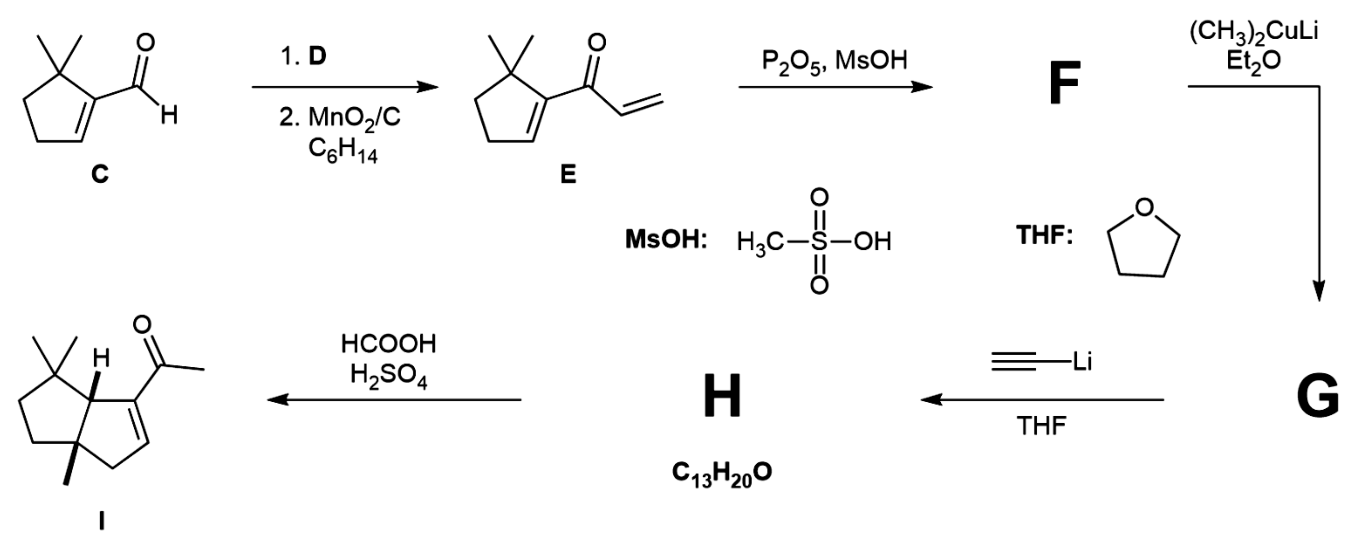
8.4 Choose the reagent(s) from the list that would be suitable as D.
(a) \(\ce{H2C=CHMgBr}\) (c) \(\ce{H2C=CHBr}\), \(\ce{Pd(PPh3)4}\)
(b) 1. \(\ce{NaBH4}\) 2. \(\ce{H2C=CHLi}\) (d) \(\ce{H2C=CHMgBr}\), \(\ce{CuI}\)
8.5 Give the structures of intermediates F, G, and H, including their stereochemistry.
Enone I was then subjected to \(\ce{H2C=CHMgBr}\) and \(\ce{CuI}\) in THF to give intermediate J, followed by ozonolysis to yield intermediate K, which shows a signal at 9.61 ppm in the \(\ce{^1H}\) NMR. Treatment with 5-% \(\ce{KOH}\) in a mixture of THF and ether yielded intermediate L. Hydrogenation with a Pt catalyst and under an atmosphere of \(\ce{H2}\) yielded M, which finally gave rise to Capnellene.
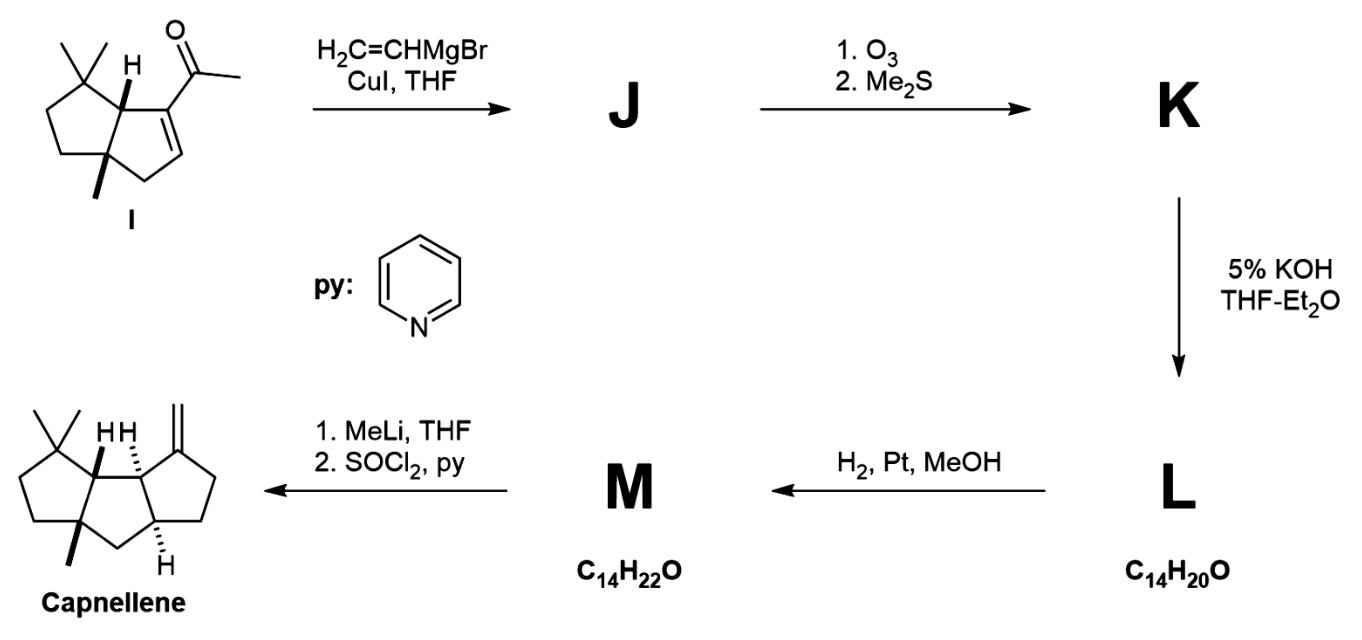
8.6 Give the structures J, K, L, and M, including their stereochemistry.
Official English text of the problem.
Answers
-
8.1. The pentadienyl cation has four π electrons, giving \[ (\psi_1)^2(\psi_2)^2. \] Thus HOMO \(=\psi_2\) and LUMO \(=\psi_3\). The upper-lobe phase patterns, in increasing energy, are \[ +++++,\qquad ++0--,\qquad +0-0+,\qquad +-0+-,\qquad +-+-+. \] The coefficients and drawing instructions are given in the solution.
-
8.2.
| Disrotatory | Conrotatory | |
|---|---|---|
| Thermal | x | |
| Photochemical | x |
- 8.3. One possible pair consists of the following stereoisomers of 13-hydroxy-2-methyltricyclo[7.4.0.0²,⁷]tridec-6-en-8-one:
| Product | Configuration | Isomeric SMILES |
|---|---|---|
| A | \((1R,2S,9S,13R)\) | C[C@@]12CCCC=C1C(=O)[C@H]1CCC[C@@H](O)[C@H]12 |
| B | \((1S,2S,9R,13R)\) | C[C@@]12CCCC=C1C(=O)[C@@H]1CCC[C@@H](O)[C@@H]12 |
These representatives have an enone double bond in the original left six-membered ring. The original terminal methyl and terminal hydrogen are trans in A, but cis in B.
-
8.4. (a) only: vinylmagnesium bromide,
C=C[Mg]Br. -
8.5. The structures below use the enantiomer corresponding to the supplied drawing of I.
| Intermediate | Name | Isomeric SMILES |
|---|---|---|
| F | 8,8-Dimethylbicyclo[3.3.0]oct-1(5)-en-2-one | O=C1CCC2=C1C(C)(C)CC2 |
| G | (1S,5S)-5,8,8-Trimethylbicyclo[3.3.0]octan-2-one | CC1(C)CC[C@@]2(C)CCC(=O)[C@@H]12 |
| H | (1S,2R,5S)-2-Ethynyl-5,8,8-trimethylbicyclo[3.3.0]octan-2-ol | C#C[C@@]1(O)CC[C@]2(C)CCC(C)(C)[C@@H]21 |
H is shown with ethynyl on the same face as the bridgehead methyl. Its alcohol-center epimer is also compatible with the subsequent rearrangement; see the solution.
- 8.6.
| Intermediate | Name | Isomeric SMILES |
|---|---|---|
| J | 1-[(1S,2S,3R,5S)-3-Ethenyl-5,8,8-trimethylbicyclo[3.3.0]octan-2-yl]ethan-1-one | C=C[C@H]1C[C@]2(C)CCC(C)(C)[C@@H]2[C@H]1C(C)=O |
| K | (1S,3S,4R,5S)-4-Acetyl-1,6,6-trimethylbicyclo[3.3.0]octane-3-carbaldehyde | CC(=O)[C@H]1[C@@H](C=O)C[C@]2(C)CCC(C)(C)[C@H]12 |
| L | (1S,2S,6R,8S)-8,11,11-Trimethyltricyclo[6.3.0.0²,⁶]undec-4-en-3-one | CC1(C)CC[C@@]2(C)C[C@@H]3C=CC(=O)[C@@H]3[C@@H]12 |
| M | (1S,2S,6S,8S)-8,11,11-Trimethyltricyclo[6.3.0.0²,⁶]undecan-3-one | CC1(C)CC[C@@]2(C)C[C@@H]3CCC(=O)[C@@H]3[C@@H]12 |
J and K are represented in the productive cis configuration leading to the drawn capnellene stereochemistry. In L and M, both five-membered-ring junctions are cis, with the junction hydrogens on opposite faces at the two junctions. The achiral synthesis also gives the corresponding mirror-image series.
Solution
8.1 — Molecular orbitals and electron occupation
The model species is the pentadienyl cation, C=C[CH+]C=C. Its five contiguous p orbitals contain four electrons: the two double bonds supply two electrons each, while the cationic center contributes an empty p orbital.
Number the atomic p orbitals consecutively along the chain, \(p_1,\ldots,p_5\). In the simple Hückel model,
\[ \psi_k=\sum_{j=1}^{5}c_{jk}p_j,\qquad c_{jk}=\sqrt{\frac13}\sin\left(\frac{jk\pi}{6}\right), \]
with energies
\[ E_k=\alpha+2\beta\cos\left(\frac{k\pi}{6}\right), \qquad \beta<0. \]
The following table specifies the orbital drawings completely. Coefficients in the third column are proportional to the orbital amplitudes.
| Orbital, highest first | Energy | Coefficients on \(p_1,p_2,p_3,p_4,p_5\) | Nodes along the chain | Electrons | Mark |
|---|---|---|---|---|---|
| \(\psi_5\) | \(\alpha-\sqrt3\beta\) | \(1,-\sqrt3,2,-\sqrt3,1\) | 4 | Empty | |
| \(\psi_4\) | \(\alpha-\beta\) | \(1,-1,0,1,-1\) | 3 | Empty | |
| \(\psi_3\) | \(\alpha\) | \(1,0,-1,0,1\) | 2 | Empty | x under LUMO |
| \(\psi_2\) | \(\alpha+\beta\) | \(1,1,0,-1,-1\) | 1 | \(\uparrow\downarrow\) | x under HOMO |
| \(\psi_1\) | \(\alpha+\sqrt3\beta\) | \(1,\sqrt3,2,\sqrt3,1\) | 0 | \(\uparrow\downarrow\) |
To draw these orbitals:
- Draw a p-orbital pair at each carbon with nonzero coefficient.
- Give the upper lobe the phase indicated by the coefficient and the lower lobe the opposite phase.
- Make lobe sizes proportional to the coefficient magnitudes.
- At a zero coefficient, indicate a node through that atom. The atomic p orbital still exists, but its contribution to that particular MO is zero.
Changing every sign in a row gives the same physical orbital.
8.2 — Electrocyclic selection rules
This is a four-electron, or \(4n\), electrocyclization.
In the ground-state HOMO, \(\psi_2\), the terminal coefficients have opposite signs. Conrotation brings matching phases together to form the new terminal carbon–carbon σ bond.
Photoexcitation promotes an electron from \(\psi_2\) into \(\psi_3\). The terminal coefficients of \(\psi_3\) have the same sign, and the photochemically allowed mode is consequently disrotation.
Thus:
\[ \boxed{\text{Thermal: conrotatory}} \qquad \boxed{\text{Photochemical: disrotatory}}. \]
8.3 — Structures and stereochemistry of A and B
The starting material is (3R)-3-hydroxycyclohex-1-en-1-ylmethanone,
O=C(C1=C(C)CCCC1)C1=C[C@H](O)CCC1.
The new σ bond joins the two lower alkene carbons in the supplied drawing. One bears the methyl substituent; the other originally bears a hydrogen.
For the products selected in the Answers, the atom numbering is:
- C2: original methyl-bearing terminal carbon;
- C1: original hydrogen-bearing terminal carbon;
- C7 and C9: original left and right carbonyl-adjacent alkene carbons;
- C8: carbonyl carbon;
- C13: original alcohol-bearing carbon.
The product double bond is C6=C7, in the original left six-membered ring. C6 bears a vinylic hydrogen, providing the proton consistent with the signal at 6.70–6.73 ppm.
This NMR clue matters because an alternative product with the double bond between the original right-hand alkene carbons would have a fully substituted enone double bond and no corresponding vinylic proton.
The stereochemical drawing instructions for the selected pair are:
| Bond or hydrogen, with the ring skeleton oriented as in the question | A | B |
|---|---|---|
| C2–methyl | Solid wedge | Solid wedge |
| C1–H | Dashed wedge | Solid wedge |
| C9–H | Dashed wedge | Solid wedge |
| C13–OH | Solid wedge | Solid wedge |
The C13 alcohol configuration is retained. The right-hand ring junction is chosen cis in both representatives.
Under Lewis-acid activation, conrotation places the original terminal methyl and terminal hydrogen on opposite faces: A. Under irradiation, disrotation places them on the same face: B.
Both transformations are atom-conserving isomerizations:
\[ \ce{C14H20O2 ->[BF3.OEt2] C14H20O2} \qquad(\mathbf A) \]
\[ \ce{C14H20O2 ->[h\nu,\ 366\ nm] C14H20O2} \qquad(\mathbf B). \]
The different possible proton-transfer pathways and facial choices explain why the question asks for one possible structure under each condition.
8.4 — Identification of D
The starting aldehyde C is 5,5-dimethylcyclopent-1-ene-1-carbaldehyde,
O=CC1=CCCC1(C)C.
The required product E is 1-(5,5-dimethylcyclopent-1-en-1-yl)prop-2-en-1-one,
C=CC(=O)C1=CCCC1(C)C.
To obtain E, a vinyl group must first add to the aldehyde carbonyl carbon, giving a secondary allylic alcohol. Oxidation then converts that alcohol into the divinyl ketone.
Therefore D is vinylmagnesium bromide, C=C[Mg]Br, option (a).
The alcohol intermediate is 1-(5,5-dimethylcyclopent-1-en-1-yl)prop-2-en-1-ol,
C=CC(O)C1=CCCC1(C)C. It is formed as a racemate; its alcohol-center configuration is erased during oxidation.
Including aqueous work-up, the addition is balanced by
\[ \ce{C8H12O + C2H3MgBr + H2O -> C10H16O + MgBrOH}. \]
Using \(\ce{MnO}\) as the formal reduced manganese product, the oxidation balance is
\[ \ce{C10H16O + MnO2 -> C10H14O + MnO + H2O}. \]
The other choices do not give the required transformation:
- (b): \(\ce{NaBH4}\) first reduces the aldehyde; the subsequent organolithium encounters an alcohol rather than the required carbonyl electrophile.
- (c): vinyl bromide and the palladium catalyst do not provide the required nucleophilic vinyl addition.
- (d): copper promotes conjugate addition to the unsaturated aldehyde, giving the wrong carbon connectivity.
8.5 — F, G and H
For discussing this sequence, retain the bicyclo[3.3.0]octane numbering used in the name of F: the bridgeheads are C1 and C5, the ketone is at C2, and the geminal methyl groups are at C8.
Formation of F. Acid activation of E produces the pentadienyl-cation system. Thermal conrotatory closure joins the cyclopentene’s β carbon to the terminal vinyl carbon, creating the second five-membered ring.
Proton transfer gives F with its C1=C5 double bond at the shared ring junction. This placement is independently required by the next step: conjugate methyl addition must install the angular methyl observed in I.
The cyclization conserves the molecular formula:
\[ \ce{C10H14O ->[P2O5,\ MsOH] C10H14O}. \]
Formation of G. Lithium dimethylcuprate performs 1,4-addition to F. Methyl attaches at the β carbon, C5, and protonation gives the C1 hydrogen.
The configuration carried forward to the supplied I is cis: C1–H and C5–methyl are on the same face. G is therefore the cis-fused trimethyl bicyclic ketone listed above.
A formal balance including aqueous work-up is
\[ \ce{C10H14O + (CH3)2CuLi + H2O -> C11H18O + CH3Cu + LiOH}. \]
Formation of H. Lithium acetylide adds 1,2 to G’s ketone. Protonation of the alkoxide gives the tertiary propargylic alcohol H:
\[ \ce{C11H18O + LiC#CH + H2O -> C13H20O + LiOH}. \]
The molecular formula agrees with the supplied \(\ce{C13H20O}\). Its degree of unsaturation is
\[ \mathrm{DBE}=\frac{2(13)+2-20}{2}=4, \]
accounted for by two rings and one triple bond.
The representative H in the Answers has ethynyl on the same face as the bridgehead methyl and OH on the opposite face. Its C2 epimer is (1S,2S,5S)-2-ethynyl-5,8,8-trimethylbicyclo[3.3.0]octan-2-ol,
C#C[C@]1(O)CC[C@]2(C)CCC(C)(C)[C@@H]21.
Consistency with I. Under the acidic conditions, the tertiary ethynyl alcohol undergoes a Rupe rearrangement: dehydration and hydration produce an α,β-unsaturated methyl ketone. The ring double bond becomes C2=C3, and the ethynyl group becomes the acetyl substituent.
The product is 1-[(1S,5S)-5,8,8-trimethylbicyclo[3.3.0]oct-2-en-2-yl]ethan-1-one, I,
CC(=O)C1=CC[C@]2(C)CCC(C)(C)[C@H]12.
Overall,
\[ \ce{C13H20O ->[HCOOH,\ H2SO4] C13H20O}. \]
The alcohol-bearing carbon becomes trigonal in I, so this rearrangement removes the stereochemical distinction between the two C2 epimers of H.
8.6 — J, K, L and M
I → J: conjugate vinyl addition. The copper-containing vinyl reagent adds to the β carbon of I’s enone. The acetyl carbonyl remains intact, while a vinyl group attaches at the adjacent ring carbon.
In the productive stereoisomer shown, the acetyl and vinyl substituents are cis, on the face bearing the angular methyl. Their corresponding ring hydrogens are on the opposite face.
Including aqueous work-up,
\[ \ce{C13H20O + C2H3MgBr + H2O -> [CuI] C15H24O + MgBrOH}. \]
J → K: reductive ozonolysis. Ozonolysis cleaves the terminal vinyl group. Its ring-attached carbon becomes an aldehyde carbon, while its terminal carbon gives methanal (formaldehyde), C=O.
The aldehyde explains the 9.61 ppm signal. The pre-existing methyl ketone is retained, giving K with formula \(\ce{C14H22O2}\).
The atom-balanced ozonolysis and reductive work-up are
\[ \ce{C15H24O + O3 + (CH3)2S -> C14H22O2 + CH2O + (CH3)2SO}. \]
K → L: intramolecular aldol condensation. Base removes a proton from the acetyl methyl group. Its enolate attacks the aldehyde intramolecularly, closing a five-membered ring.
The new ring contains, consecutively:
- the ketone-bearing original ring carbon;
- the ketone carbonyl carbon;
- the former acetyl methyl carbon;
- the former aldehyde carbon;
- the adjacent original ring carbon.
Dehydration gives the conjugated cyclopentenone L:
\[ \ce{C14H22O2 ->[KOH] C14H20O + H2O}. \]
Thus L has three rings, one carbonyl and one alkene:
\[ \mathrm{DBE}(L)=\frac{2(14)+2-20}{2}=5. \]
For its drawing, retain the original bridgehead H and angular methyl as solid wedges. At the newly formed right-hand ring junction, draw both junction hydrogens dashed, matching the final capnellene drawing.
L → M: hydrogenation. Hydrogenation saturates the enone carbon–carbon double bond while retaining the ketone:
\[ \ce{C14H20O + H2 ->[Pt] C14H22O}. \]
Both alkene carbons become methylene groups, so no additional stereocenters are created. The existing junction geometry is retained.
The formula gives
\[ \mathrm{DBE}(M)=\frac{2(14)+2-22}{2}=4, \]
corresponding to three rings and one carbonyl. The change from \(6R\) in L’s name to \(6S\) in M’s name reflects a change in CIP priorities, not inversion of that center.
Consistency with capnellene. Methyl lithium adds to M’s ketone. Subsequent dehydration gives the exocyclic methylene group of capnellene,
CC1(C)CC[C@@]2(C)C[C@@H]3CCC(=C)[C@@H]3[C@@H]12.
A formal overall balance, omitting pyridine’s trapping of the acid, is
\[ \ce{C14H22O + CH3Li + SOCl2 -> C15H24 + LiCl + SO2 + HCl}. \]
This preserves all four ring-junction configurations shown in the final target.
The answers were checked against the official answers published by the organisers.
IChO 2023 · Theorieaufgabe 8
Nazarov-Reaktion
Die Nazarov-Reaktion ist eine häufig verwendete Reaktion von Divinylketonen zu Cyclopentenonen. Sie verläuft entweder photochemisch oder säurekatalysiert und ist eine Elektrocyclisierung, auf die eine Protonenübertragung folgt.
8.1 Zeichnen Sie die π-Molekülorbitale zur Beschreibung der Nazarov-Reaktion. Besetzen Sie die jeweiligen Energieniveaus mit Elektronen. Markieren Sie mit einem x (i) das HOMO (höchstes besetztes Molekülorbital) und (ii) das LUMO (niedrigstes unbesetztes Molekülorbital). Für diese Aufgabe können Sie das Divinylketon als Pentadienyl-Kation mit fünf p-Orbitalen betrachten.
8.2 Sagen Sie anhand der π-Molekülorbitale, die Sie in Aufgabe 8.1 hergeleitet haben, voraus, unter welchen Bedingungen die Nazarov-Reaktion des Divinylketons disrotatorisch bzw. konrotatorisch verläuft. Markieren Sie in der Tabelle mit einem x die Bedingungen, unter denen die Reaktion erlaubt ist.
| Disrotatorisch | Konrotatorisch | |
|---|---|---|
| Thermisch | ||
| Photochemisch |
8.3 Die Nazarov-Reaktion wurde als Schlüsselreaktion in einer Synthese von Farnesin eingesetzt. Zeichnen Sie für beide unten angegebenen Bedingungen jeweils eine mögliche Struktur von A und B, einschließlich der Stereochemie. Beachten Sie, dass die Produkte beider Reaktionen im \(\ce{^1H}\)-NMR-Spektrum ein Signal bei 6.70–6.73 ppm zeigen.
Die Synthese von Capnellen beginnt mit dem unten gezeigten ungesättigten Aldehyd C. Die Behandlung mit D und anschließende Umsetzung mit auf Kohlenstoff geträgertem \(\ce{MnO2}\) ergaben das unten gezeigte Divinylketon E. Die Behandlung mit einem Gemisch aus \(\ce{P2O5}\) und MsOH lieferte F, das über eine Reaktionsfolge in das ungesättigte Keton I überführt wurde.
8.4 Wählen Sie aus der Liste das bzw. die Reagenzien aus, die als D geeignet wären.
(a) \(\ce{H2C=CHMgBr}\) (c) \(\ce{H2C=CHBr}\), \(\ce{Pd(PPh3)4}\)
(b) 1. \(\ce{NaBH4}\) 2. \(\ce{H2C=CHLi}\) (d) \(\ce{H2C=CHMgBr}\), \(\ce{CuI}\)
8.5 Geben Sie die Strukturen der Zwischenprodukte F, G und H einschließlich ihrer Stereochemie an.
Das Enon I wurde anschließend mit \(\ce{H2C=CHMgBr}\) und \(\ce{CuI}\) in THF zum Zwischenprodukt J umgesetzt. Durch anschließende Ozonolyse entstand das Zwischenprodukt K, das im \(\ce{^1H}\)-NMR-Spektrum ein Signal bei 9.61 ppm zeigt. Die Behandlung mit 5-%iger \(\ce{KOH}\) in einem Gemisch aus THF und Ether lieferte das Zwischenprodukt L. Hydrierung mit einem Pt-Katalysator unter einer \(\ce{H2}\)-Atmosphäre ergab M, aus dem schließlich Capnellen erhalten wurde.
8.6 Geben Sie die Strukturen von J, K, L und M einschließlich ihrer Stereochemie an.
Aufgabentext aus dem offiziellen englischen Text übersetzt.
Antworten
-
8.1. Das Pentadienyl-Kation besitzt vier π-Elektronen, woraus sich \[ (\psi_1)^2(\psi_2)^2. \] ergibt. Somit gilt HOMO \(=\psi_2\) und LUMO \(=\psi_3\). Die Phasenmuster der oberen Orbitallappen lauten in der Reihenfolge zunehmender Energie \[ +++++,\qquad ++0--,\qquad +0-0+,\qquad +-0+-,\qquad +-+-+. \] Die Koeffizienten und die Zeichenanleitung sind in der Lösung angegeben.
-
8.2.
| Disrotatorisch | Konrotatorisch | |
|---|---|---|
| Thermisch | x | |
| Photochemisch | x |
- 8.3. Ein mögliches Paar besteht aus den folgenden Stereoisomeren von 13-Hydroxy-2-methyltricyclo[7.4.0.0²,⁷]tridec-6-en-8-on:
| Produkt | Konfiguration | Isomere SMILES |
|---|---|---|
| A | \((1R,2S,9S,13R)\) | C[C@@]12CCCC=C1C(=O)[C@H]1CCC[C@@H](O)[C@H]12 |
| B | \((1S,2S,9R,13R)\) | C[C@@]12CCCC=C1C(=O)[C@@H]1CCC[C@@H](O)[C@@H]12 |
Diese Vertreter besitzen eine Enon-Doppelbindung im ursprünglichen linken Sechsring. Die ursprüngliche endständige Methylgruppe und das ursprüngliche endständige Wasserstoffatom stehen in A trans, jedoch in B cis zueinander.
-
8.4. Nur (a): Vinylmagnesiumbromid,
C=C[Mg]Br. -
8.5. Die folgenden Strukturen verwenden das Enantiomer, das der vorgegebenen Zeichnung von I entspricht.
| Zwischenprodukt | Name | Isomere SMILES |
|---|---|---|
| F | 8,8-Dimethylbicyclo[3.3.0]oct-1(5)-en-2-on | O=C1CCC2=C1C(C)(C)CC2 |
| G | (1S,5S)-5,8,8-Trimethylbicyclo[3.3.0]octan-2-on | CC1(C)CC[C@@]2(C)CCC(=O)[C@@H]12 |
| H | (1S,2R,5S)-2-Ethinyl-5,8,8-trimethylbicyclo[3.3.0]octan-2-ol | C#C[C@@]1(O)CC[C@]2(C)CCC(C)(C)[C@@H]21 |
H ist mit der Ethinylgruppe auf derselben Seite wie die Brückenkopf-Methylgruppe dargestellt. Sein Epimer am alkoholtragenden Zentrum ist ebenfalls mit der nachfolgenden Umlagerung vereinbar; siehe die Lösung.
- 8.6.
| Zwischenprodukt | Name | Isomere SMILES |
|---|---|---|
| J | 1-[(1S,2S,3R,5S)-3-Ethenyl-5,8,8-trimethylbicyclo[3.3.0]octan-2-yl]ethan-1-on | C=C[C@H]1C[C@]2(C)CCC(C)(C)[C@@H]2[C@H]1C(C)=O |
| K | (1S,3S,4R,5S)-4-Acetyl-1,6,6-trimethylbicyclo[3.3.0]octan-3-carbaldehyd | CC(=O)[C@H]1[C@@H](C=O)C[C@]2(C)CCC(C)(C)[C@H]12 |
| L | (1S,2S,6R,8S)-8,11,11-Trimethyltricyclo[6.3.0.0²,⁶]undec-4-en-3-on | CC1(C)CC[C@@]2(C)C[C@@H]3C=CC(=O)[C@@H]3[C@@H]12 |
| M | (1S,2S,6S,8S)-8,11,11-Trimethyltricyclo[6.3.0.0²,⁶]undecan-3-on | CC1(C)CC[C@@]2(C)C[C@@H]3CCC(=O)[C@@H]3[C@@H]12 |
J und K sind in der produktiven cis-Konfiguration dargestellt, die zur gezeichneten Stereochemie von Capnellen führt. In L und M sind beide Fünfringverknüpfungen cis, wobei die Wasserstoffatome an den Verknüpfungsstellen an den beiden Ringverknüpfungen auf entgegengesetzten Seiten liegen. Die achirale Synthese liefert auch die entsprechende spiegelbildliche Reihe.
Lösung
8.1 — Molekülorbitale und Elektronenbesetzung
Die Modellspezies ist das Pentadienyl-Kation, C=C[CH+]C=C. Seine fünf aufeinanderfolgenden p-Orbitale enthalten vier Elektronen: Die beiden Doppelbindungen liefern jeweils zwei Elektronen, während das kationische Zentrum ein leeres p-Orbital beisteuert.
Nummerieren Sie die atomaren p-Orbitale entlang der Kette fortlaufend mit \(p_1,\ldots,p_5\). Im einfachen Hückel-Modell gilt
\[ \psi_k=\sum_{j=1}^{5}c_{jk}p_j,\qquad c_{jk}=\sqrt{\frac13}\sin\left(\frac{jk\pi}{6}\right), \]
mit den Energien
\[ E_k=\alpha+2\beta\cos\left(\frac{k\pi}{6}\right), \qquad \beta<0. \]
Die folgende Tabelle legt die Orbitalzeichnungen vollständig fest. Die Koeffizienten in der dritten Spalte sind proportional zu den Orbitalamplituden.
| Orbital, höchstes zuerst | Energie | Koeffizienten an \(p_1,p_2,p_3,p_4,p_5\) | Knoten entlang der Kette | Elektronen | Markierung |
|---|---|---|---|---|---|
| \(\psi_5\) | \(\alpha-\sqrt3\beta\) | \(1,-\sqrt3,2,-\sqrt3,1\) | 4 | Leer | |
| \(\psi_4\) | \(\alpha-\beta\) | \(1,-1,0,1,-1\) | 3 | Leer | |
| \(\psi_3\) | \(\alpha\) | \(1,0,-1,0,1\) | 2 | Leer | x bei LUMO |
| \(\psi_2\) | \(\alpha+\beta\) | \(1,1,0,-1,-1\) | 1 | \(\uparrow\downarrow\) | x bei HOMO |
| \(\psi_1\) | \(\alpha+\sqrt3\beta\) | \(1,\sqrt3,2,\sqrt3,1\) | 0 | \(\uparrow\downarrow\) |
So zeichnen Sie diese Orbitale:
- Zeichnen Sie an jedem Kohlenstoffatom mit einem von null verschiedenen Koeffizienten das Lappenpaar eines p-Orbitals.
- Geben Sie dem oberen Lappen die durch den Koeffizienten angegebene Phase und dem unteren Lappen die entgegengesetzte Phase.
- Zeichnen Sie die Lappengrößen proportional zu den Beträgen der Koeffizienten.
- Kennzeichnen Sie bei einem Koeffizienten von null einen Knoten durch das betreffende Atom. Das atomare p-Orbital existiert weiterhin, sein Beitrag zu diesem bestimmten MO ist jedoch null.
Werden alle Vorzeichen in einer Zeile umgekehrt, ergibt sich dasselbe physikalische Orbital.
8.2 — Elektrocyclische Auswahlregeln
Es handelt sich um eine Vier-Elektronen- oder \(4n\)-Elektrocyclisierung.
Im HOMO des Grundzustands, \(\psi_2\), haben die endständigen Koeffizienten entgegengesetzte Vorzeichen. Durch Konrotation werden übereinstimmende Phasen zusammengeführt, sodass die neue Kohlenstoff–Kohlenstoff-σ-Bindung zwischen den Kettenenden entsteht.
Bei der Photoanregung wird ein Elektron aus \(\psi_2\) in \(\psi_3\) angehoben. Die endständigen Koeffizienten von \(\psi_3\) haben dasselbe Vorzeichen, und die photochemisch erlaubte Reaktionsweise ist folglich die Disrotation.
Somit gilt:
\[ \boxed{\text{Thermisch: konrotatorisch}} \qquad \boxed{\text{Photochemisch: disrotatorisch}}. \]
8.3 — Strukturen und Stereochemie von A und B
Der Ausgangsstoff ist (3R)-3-Hydroxycyclohex-1-en-1-ylmethanon,
O=C(C1=C(C)CCCC1)C1=C[C@H](O)CCC1.
Die neue σ-Bindung verbindet die beiden unteren Alken-Kohlenstoffatome in der vorgegebenen Zeichnung. Eines trägt den Methylsubstituenten; das andere trägt ursprünglich ein Wasserstoffatom.
Für die unter Antworten ausgewählten Produkte lautet die Atomnummerierung:
- C2: ursprüngliches methyltragendes endständiges Kohlenstoffatom;
- C1: ursprüngliches wasserstofftragendes endständiges Kohlenstoffatom;
- C7 und C9: ursprüngliche linke und rechte, der Carbonylgruppe benachbarte Alken-Kohlenstoffatome;
- C8: Carbonyl-Kohlenstoffatom;
- C13: ursprüngliches alkoholtragendes Kohlenstoffatom.
Die Doppelbindung im Produkt ist C6=C7 im ursprünglichen linken Sechsring. C6 trägt ein vinylisches Wasserstoffatom, dessen Proton mit dem Signal bei 6.70–6.73 ppm vereinbar ist.
Dieser NMR-Hinweis ist wichtig, weil ein alternatives Produkt mit einer Doppelbindung zwischen den ursprünglichen rechten Alken-Kohlenstoffatomen eine vollständig substituierte Enon-Doppelbindung und kein entsprechendes vinylisches Proton aufweisen würde.
Die Anweisungen zum Zeichnen der Stereochemie des ausgewählten Paars lauten:
| Bindung oder Wasserstoffatom, bei einer Orientierung des Ringgerüsts wie in der Aufgabenstellung | A | B |
|---|---|---|
| C2–Methyl | Ausgefüllter Keil | Ausgefüllter Keil |
| C1–H | Gestrichelter Keil | Ausgefüllter Keil |
| C9–H | Gestrichelter Keil | Ausgefüllter Keil |
| C13–OH | Ausgefüllter Keil | Ausgefüllter Keil |
Die Konfiguration am alkoholtragenden C13 bleibt erhalten. Die rechte Ringverknüpfung wird für beide Vertreter als cis gewählt.
Bei Aktivierung durch eine Lewis-Säure bringt die Konrotation die ursprüngliche endständige Methylgruppe und das ursprüngliche endständige Wasserstoffatom auf entgegengesetzte Seiten: A. Unter Bestrahlung bringt die Disrotation sie auf dieselbe Seite: B.
Beide Umwandlungen sind Isomerisierungen, bei denen alle Atome erhalten bleiben:
\[ \ce{C14H20O2 ->[BF3.OEt2] C14H20O2} \qquad(\mathbf A) \]
\[ \ce{C14H20O2 ->[h\nu,\ 366\ nm] C14H20O2} \qquad(\mathbf B). \]
Die verschiedenen möglichen Wege der Protonenübertragung und die möglichen Seitenwahlen erklären, weshalb in der Aufgabe für jede Bedingung eine mögliche Struktur verlangt wird.
8.4 — Identifizierung von D
Der als Ausgangsstoff verwendete Aldehyd C ist 5,5-Dimethylcyclopent-1-en-1-carbaldehyd,
O=CC1=CCCC1(C)C.
Das benötigte Produkt E ist 1-(5,5-Dimethylcyclopent-1-en-1-yl)prop-2-en-1-on,
C=CC(=O)C1=CCCC1(C)C.
Um E zu erhalten, muss zunächst eine Vinylgruppe an das Carbonyl-Kohlenstoffatom des Aldehyds addiert werden, wobei ein sekundärer Allylalkohol entsteht. Durch Oxidation wird dieser Alkohol anschließend in das Divinylketon überführt.
D ist daher Vinylmagnesiumbromid, C=C[Mg]Br, Option (a).
Das alkoholische Zwischenprodukt ist 1-(5,5-Dimethylcyclopent-1-en-1-yl)prop-2-en-1-ol,
C=CC(O)C1=CCCC1(C)C. Es entsteht als Racemat; seine Konfiguration am alkoholtragenden Zentrum geht bei der Oxidation verloren.
Unter Einbeziehung der wässrigen Aufarbeitung lautet die ausgeglichene Additionsgleichung
\[ \ce{C8H12O + C2H3MgBr + H2O -> C10H16O + MgBrOH}. \]
Mit \(\ce{MnO}\) als formalem Reduktionsprodukt des Mangans lautet die Oxidationsbilanz
\[ \ce{C10H16O + MnO2 -> C10H14O + MnO + H2O}. \]
Die anderen Optionen ergeben nicht die erforderliche Umwandlung:
- (b): \(\ce{NaBH4}\) reduziert zunächst den Aldehyd; die anschließend eingesetzte Organolithiumverbindung trifft auf einen Alkohol statt auf das benötigte Carbonyl-Elektrophil.
- (c): Vinylbromid und der Palladiumkatalysator ermöglichen nicht die erforderliche nucleophile Vinyladdition.
- (d): Kupfer begünstigt die konjugierte Addition an den ungesättigten Aldehyd, wodurch die falsche Kohlenstoffverknüpfung entsteht.
8.5 — F, G und H
Für die Erörterung dieser Reaktionsfolge wird die im Namen von F verwendete Nummerierung des Bicyclo[3.3.0]octans beibehalten: Die Brückenköpfe sind C1 und C5, die Ketogruppe befindet sich an C2 und die geminalen Methylgruppen an C8.
Bildung von F. Die Säureaktivierung von E erzeugt das Pentadienyl-Kation-System. Der thermische konrotatorische Ringschluss verbindet das β-Kohlenstoffatom des Cyclopentens mit dem endständigen Vinyl-Kohlenstoffatom und bildet den zweiten Fünfring.
Durch Protonenübertragung entsteht F mit seiner C1=C5-Doppelbindung an der gemeinsamen Ringverknüpfung. Diese Position wird unabhängig davon durch den nächsten Schritt vorgegeben: Die konjugierte Methyladdition muss die in I vorhandene angulare Methylgruppe einführen.
Bei der Cyclisierung bleibt die Summenformel erhalten:
\[ \ce{C10H14O ->[P2O5,\ MsOH] C10H14O}. \]
Bildung von G. Lithiumdimethylcuprat geht mit F eine 1,4-Addition ein. Die Methylgruppe bindet an das β-Kohlenstoffatom C5, und durch Protonierung wird das Wasserstoffatom an C1 eingeführt.
Die bis zum vorgegebenen I beibehaltene Konfiguration ist cis: C1–H und C5–Methyl liegen auf derselben Seite. G ist daher das oben aufgeführte cis-verknüpfte bicyclische Trimethylketon.
Eine formale Bilanz unter Einbeziehung der wässrigen Aufarbeitung lautet
\[ \ce{C10H14O + (CH3)2CuLi + H2O -> C11H18O + CH3Cu + LiOH}. \]
Bildung von H. Lithiumacetylid addiert 1,2 an die Ketogruppe von G. Durch Protonierung des Alkoholats entsteht der tertiäre Propargylalkohol H:
\[ \ce{C11H18O + LiC#CH + H2O -> C13H20O + LiOH}. \]
Die Summenformel stimmt mit der vorgegebenen Formel \(\ce{C13H20O}\) überein. Sein Ungesättigtheitsgrad beträgt
\[ \mathrm{DBE}=\frac{2(13)+2-20}{2}=4, \]
was zwei Ringen und einer Dreifachbindung entspricht.
Beim unter Antworten angegebenen Vertreter von H liegt die Ethinylgruppe auf derselben Seite wie die Brückenkopf-Methylgruppe und die OH-Gruppe auf der gegenüberliegenden Seite. Sein C2-Epimer ist (1S,2S,5S)-2-Ethinyl-5,8,8-trimethylbicyclo[3.3.0]octan-2-ol,
C#C[C@]1(O)CC[C@]2(C)CCC(C)(C)[C@@H]21.
Übereinstimmung mit I. Unter den sauren Bedingungen durchläuft der tertiäre Ethinylalkohol eine Rupe-Umlagerung: Dehydratisierung und Hydratisierung erzeugen ein α,β-ungesättigtes Methylketon. Die Ringdoppelbindung liegt dann zwischen C2 und C3, und aus der Ethinylgruppe wird der Acetylsubstituent.
Das Produkt ist 1-[(1S,5S)-5,8,8-Trimethylbicyclo[3.3.0]oct-2-en-2-yl]ethan-1-on, I,
CC(=O)C1=CC[C@]2(C)CCC(C)(C)[C@H]12.
Insgesamt gilt:
\[ \ce{C13H20O ->[HCOOH,\ H2SO4] C13H20O}. \]
Das alkoholtragende Kohlenstoffatom wird in I trigonal, sodass diese Umlagerung den stereochemischen Unterschied zwischen den beiden C2-Epimeren von H aufhebt.
8.6 — J, K, L und M
I → J: konjugierte Vinyladdition. Das kupferhaltige Vinylreagenz addiert an das β-Kohlenstoffatom des Enons von I. Die Acetyl-Carbonylgruppe bleibt erhalten, während eine Vinylgruppe an das benachbarte Ring-Kohlenstoffatom bindet.
Im gezeigten produktiven Stereoisomer stehen die Acetyl- und Vinylsubstituenten cis zueinander, auf der Seite, die die angulare Methylgruppe trägt. Die zugehörigen Wasserstoffatome am Ring liegen auf der gegenüberliegenden Seite.
Unter Einbeziehung der wässrigen Aufarbeitung gilt:
\[ \ce{C13H20O + C2H3MgBr + H2O -> [CuI] C15H24O + MgBrOH}. \]
J → K: reduktive Ozonolyse. Die Ozonolyse spaltet die endständige Vinylgruppe. Ihr an den Ring gebundenes Kohlenstoffatom wird zum Aldehyd-Kohlenstoffatom, während ihr endständiges Kohlenstoffatom Methanal (Formaldehyd), C=O, liefert.
Die Aldehydgruppe erklärt das Signal bei 9.61 ppm. Das bereits vorhandene Methylketon bleibt erhalten, sodass K mit der Formel \(\ce{C14H22O2}\) entsteht.
Die nach Atomen ausgeglichene Gleichung für die Ozonolyse mit reduktiver Aufarbeitung lautet
\[ \ce{C15H24O + O3 + (CH3)2S -> C14H22O2 + CH2O + (CH3)2SO}. \]
K → L: intramolekulare Aldolkondensation. Die Base entfernt ein Proton von der Methylgruppe der Acetylgruppe. Das daraus entstandene Enolat greift den Aldehyd intramolekular an und schließt einen Fünfring.
Der neue Ring enthält der Reihe nach:
- das ketontragende ursprüngliche Ring-Kohlenstoffatom;
- das Carbonyl-Kohlenstoffatom der Ketogruppe;
- das ehemalige Methyl-Kohlenstoffatom der Acetylgruppe;
- das ehemalige Aldehyd-Kohlenstoffatom;
- das benachbarte ursprüngliche Ring-Kohlenstoffatom.
Durch Dehydratisierung entsteht das konjugierte Cyclopentenon L:
\[ \ce{C14H22O2 ->[KOH] C14H20O + H2O}. \]
Somit besitzt L drei Ringe, eine Carbonylgruppe und eine Alken-Doppelbindung:
\[ \mathrm{DBE}(L)=\frac{2(14)+2-20}{2}=5. \]
Behalten Sie in der Zeichnung die Bindungen zum ursprünglichen Brückenkopf-H und zur angularen Methylgruppe als ausgefüllte Keile bei. Zeichnen Sie an der neu gebildeten rechten Ringverknüpfung die Bindungen zu beiden Wasserstoffatomen an der Verknüpfungsstelle gestrichelt, entsprechend der abschließenden Zeichnung von Capnellen.
L → M: Hydrierung. Die Hydrierung sättigt die Kohlenstoff–Kohlenstoff-Doppelbindung des Enons unter Erhalt der Ketogruppe:
\[ \ce{C14H20O + H2 ->[Pt] C14H22O}. \]
Beide Alken-Kohlenstoffatome werden zu Methylengruppen, sodass keine zusätzlichen Stereozentren entstehen. Die vorhandene Geometrie der Ringverknüpfungen bleibt erhalten.
Aus der Formel ergibt sich
\[ \mathrm{DBE}(M)=\frac{2(14)+2-22}{2}=4, \]
entsprechend drei Ringen und einer Carbonylgruppe. Der Wechsel von \(6R\) im Namen von L zu \(6S\) im Namen von M beruht auf einer Änderung der CIP-Prioritäten, nicht auf einer Inversion dieses Zentrums.
Übereinstimmung mit Capnellen. Methyllithium addiert an die Ketogruppe von M. Die anschließende Dehydratisierung liefert die exocyclische Methylengruppe von Capnellen,
CC1(C)CC[C@@]2(C)C[C@@H]3CCC(=C)[C@@H]3[C@@H]12.
Eine formale Gesamtbilanz, bei der das Abfangen der Säure durch Pyridin nicht berücksichtigt wird, lautet
\[ \ce{C14H22O + CH3Li + SOCl2 -> C15H24 + LiCl + SO2 + HCl}. \]
Dabei bleiben alle vier Konfigurationen der Ringverknüpfungen erhalten, die im endgültigen Zielmolekül dargestellt sind.
Die Ergebnisse wurden mit den von den Veranstaltern veröffentlichten offiziellen Ergebnissen abgeglichen.
IChO 2023 · Teori sorusu 8
Nazarov Tepkimesi
Nazarov tepkimesi, divinil ketonlardan siklopentenonların elde edilmesinde sıkça kullanılan bir tepkimedir. Fotokimyasal olarak veya asit kataliziyle gerçekleşir ve ardından proton aktarımının geldiği bir elektrohalkalaşmadır.
8.1 Nazarov tepkimesini açıklamak için π molekül orbitallerini çiziniz. Elektronları ilgili enerji düzeylerine yerleştiriniz. (i) HOMO'yu (en yüksek enerjili dolu molekül orbitali) ve (ii) LUMO'yu (en düşük enerjili boş molekül orbitali) x ile işaretleyiniz. Bu alıştırmada divinil ketonu, beş p orbitali içeren bir pentadienil katyonu olarak ele alabilirsiniz.
8.2 8.1 görevinde elde ettiğiniz π molekül orbitallerinden hareketle, divinil ketonun Nazarov tepkimesinin hangi koşullarda disrotator veya konrotator biçimde gerçekleşeceğini öngörünüz. Tepkimenin izinli olduğu koşulları tabloda x ile işaretleyiniz.
| Disrotator | Konrotator | |
|---|---|---|
| Termal | ||
| Fotokimyasal |
8.3 Nazarov tepkimesi, farnesin sentezinde kilit tepkime olarak kullanılmıştır. Aşağıdaki her iki koşul için, A ve B'nin her birinin stereokimyasını da göstererek olası birer yapısını çiziniz. Her iki tepkimenin ürünlerinin de \(\ce{^1H}\) NMR spektrumunda 6.70–6.73 ppm'de bir sinyal verdiğine dikkat ediniz.
Kapnellen sentezi, aşağıda gösterilen doymamış aldehit C ile başlar. D ile muamelenin ardından karbon üzerine desteklenmiş \(\ce{MnO2}\) ile tepkimeye sokulması, aşağıda gösterilen divinil keton E'yi vermiştir. \(\ce{P2O5}\) ve MsOH karışımıyla muamele, bir dizi tepkimeyle doymamış keton I'ya dönüştürülen F'yi vermiştir.
8.4 Listeden D olarak kullanılmaya uygun reaktif(ler)i seçiniz.
(a) \(\ce{H2C=CHMgBr}\) (c) \(\ce{H2C=CHBr}\), \(\ce{Pd(PPh3)4}\)
(b) 1. \(\ce{NaBH4}\) 2. \(\ce{H2C=CHLi}\) (d) \(\ce{H2C=CHMgBr}\), \(\ce{CuI}\)
8.5 F, G ve H ara ürünlerinin yapılarını stereokimyalarıyla birlikte veriniz.
Ardından enon I, THF içinde \(\ce{H2C=CHMgBr}\) ve \(\ce{CuI}\) ile tepkimeye sokularak J ara ürünü elde edilmiş; bunu izleyen ozonoliz ile \(\ce{^1H}\) NMR spektrumunda 9.61 ppm'de sinyal veren K ara ürünü oluşmuştur. THF ve eter karışımı içinde %5'lik \(\ce{KOH}\) ile muamele, L ara ürününü vermiştir. Pt katalizörüyle ve \(\ce{H2}\) atmosferi altında hidrojenleme sonucunda, sonunda kapnellenin elde edildiği M oluşmuştur.
8.6 J, K, L ve M yapılarını stereokimyalarıyla birlikte veriniz.
Soru metni resmi İngilizce metinden çevrilmiştir.
Cevaplar
-
8.1. Pentadienil katyonunun dört π elektronu vardır; bunların yerleşimi \[ (\psi_1)^2(\psi_2)^2. \] şeklindedir. Dolayısıyla HOMO \(=\psi_2\) ve LUMO \(=\psi_3\) olur. Artan enerji sırasıyla üst lobların faz düzenleri \[ +++++,\qquad ++0--,\qquad +0-0+,\qquad +-0+-,\qquad +-+-+. \] şeklindedir. Katsayılar ve çizim yönergeleri çözümde verilmiştir.
-
8.2.
| Disrotator | Konrotator | |
|---|---|---|
| Termal | x | |
| Fotokimyasal | x |
- 8.3. Olası bir çift, 13-hidroksi-2-metiltrisiklo[7.4.0.0²,⁷]tridek-6-en-8-on bileşiğinin aşağıdaki stereoizomerlerinden oluşur:
| Ürün | Konfigürasyon | İzomerik SMILES |
|---|---|---|
| A | \((1R,2S,9S,13R)\) | C[C@@]12CCCC=C1C(=O)[C@H]1CCC[C@@H](O)[C@H]12 |
| B | \((1S,2S,9R,13R)\) | C[C@@]12CCCC=C1C(=O)[C@@H]1CCC[C@@H](O)[C@@H]12 |
Bu örnek yapılarda enon çift bağı, başlangıçtaki soldaki altı üyeli halkada bulunur. Başlangıçtaki uç metil grubu ile uç hidrojen A'da trans, B'de ise cis konumundadır.
-
8.4. Yalnızca (a): vinilmagnezyum bromür,
C=C[Mg]Br. -
8.5. Aşağıdaki yapılarda, verilen I çizimine karşılık gelen enantiyomer kullanılmıştır.
| Ara ürün | Adı | İzomerik SMILES |
|---|---|---|
| F | 8,8-Dimetilbisiklo[3.3.0]okt-1(5)-en-2-on | O=C1CCC2=C1C(C)(C)CC2 |
| G | (1S,5S)-5,8,8-Trimetilbisiklo[3.3.0]oktan-2-on | CC1(C)CC[C@@]2(C)CCC(=O)[C@@H]12 |
| H | (1S,2R,5S)-2-Etinil-5,8,8-trimetilbisiklo[3.3.0]oktan-2-ol | C#C[C@@]1(O)CC[C@]2(C)CCC(C)(C)[C@@H]21 |
H, etinil grubu köprübaşı metil grubuyla aynı yüzde olacak biçimde gösterilmiştir. Alkol merkezindeki epimeri de sonraki yeniden düzenlenmeyle uyumludur; çözüme bakınız.
- 8.6.
| Ara ürün | Adı | İzomerik SMILES |
|---|---|---|
| J | 1-[(1S,2S,3R,5S)-3-Etenil-5,8,8-trimetilbisiklo[3.3.0]oktan-2-il]etan-1-on | C=C[C@H]1C[C@]2(C)CCC(C)(C)[C@@H]2[C@H]1C(C)=O |
| K | (1S,3S,4R,5S)-4-Asetil-1,6,6-trimetilbisiklo[3.3.0]oktan-3-karbaldehit | CC(=O)[C@H]1[C@@H](C=O)C[C@]2(C)CCC(C)(C)[C@H]12 |
| L | (1S,2S,6R,8S)-8,11,11-Trimetiltrisiklo[6.3.0.0²,⁶]undek-4-en-3-on | CC1(C)CC[C@@]2(C)C[C@@H]3C=CC(=O)[C@@H]3[C@@H]12 |
| M | (1S,2S,6S,8S)-8,11,11-Trimetiltrisiklo[6.3.0.0²,⁶]undekan-3-on | CC1(C)CC[C@@]2(C)C[C@@H]3CCC(=O)[C@@H]3[C@@H]12 |
J ve K, çizilen kapnellen stereokimyasını veren cis konfigürasyonda gösterilmiştir. L ve M'de, beş üyeli halkaların her iki birleşimi de cis olup iki birleşimdeki birleşim hidrojenleri zıt yüzlerdedir. Akiral sentez, bunlara karşılık gelen ayna görüntüsü serisini de verir.
Çözüm
8.1 — Molekül orbitalleri ve elektron yerleşimi
Model tür, pentadienil katyonudur, C=C[CH+]C=C. Ardışık beş p orbitali dört elektron içerir: iki çift bağın her biri ikişer elektron sağlarken katyonik merkez boş bir p orbitaliyle katkıda bulunur.
Atomik p orbitallerini zincir boyunca sırayla \(p_1,\ldots,p_5\) olarak numaralandıralım. Basit Hückel modelinde,
\[ \psi_k=\sum_{j=1}^{5}c_{jk}p_j,\qquad c_{jk}=\sqrt{\frac13}\sin\left(\frac{jk\pi}{6}\right), \]
olup enerjiler
\[ E_k=\alpha+2\beta\cos\left(\frac{k\pi}{6}\right), \qquad \beta<0. \]
şeklindedir. Aşağıdaki tablo, orbital çizimlerini tamamen tanımlar. Üçüncü sütundaki katsayılar orbital genlikleriyle orantılıdır.
| Orbital, en yüksek enerjiliden başlayarak | Enerji | \(p_1,p_2,p_3,p_4,p_5\) üzerindeki katsayılar | Zincir boyunca düğümler | Elektronlar | İşaret |
|---|---|---|---|---|---|
| \(\psi_5\) | \(\alpha-\sqrt3\beta\) | \(1,-\sqrt3,2,-\sqrt3,1\) | 4 | Boş | |
| \(\psi_4\) | \(\alpha-\beta\) | \(1,-1,0,1,-1\) | 3 | Boş | |
| \(\psi_3\) | \(\alpha\) | \(1,0,-1,0,1\) | 2 | Boş | LUMO altında x |
| \(\psi_2\) | \(\alpha+\beta\) | \(1,1,0,-1,-1\) | 1 | \(\uparrow\downarrow\) | HOMO altında x |
| \(\psi_1\) | \(\alpha+\sqrt3\beta\) | \(1,\sqrt3,2,\sqrt3,1\) | 0 | \(\uparrow\downarrow\) |
Bu orbitalleri çizmek için:
- Katsayısı sıfır olmayan her karbonda bir p orbitalinin iki lobunu çiziniz.
- Üst loba katsayının belirttiği fazı, alt loba ise zıt fazı veriniz.
- Lob boyutlarını katsayıların mutlak değerleriyle orantılı yapınız.
- Katsayının sıfır olduğu yerde, o atomdan geçen bir düğüm gösteriniz. Atomik p orbitali yine vardır, ancak söz konusu molekül orbitaline katkısı sıfırdır.
Bir satırdaki tüm işaretlerin değiştirilmesi, fiziksel olarak aynı orbitali verir.
8.2 — Elektrosiklik seçim kuralları
Bu, dört elektronlu, yani \(4n\) elektronlu bir elektrohalkalaşmadır.
Temel hâl HOMO'su \(\psi_2\)'de, uç katsayılar zıt işaretlidir. Konrotasyon, uyumlu fazları bir araya getirerek uç karbonlar arasında yeni karbon–karbon σ bağını oluşturur.
Fotouyarılma, bir elektronu \(\psi_2\)'den \(\psi_3\)'e yükseltir. \(\psi_3\)'ün uç katsayıları aynı işaretlidir ve dolayısıyla fotokimyasal olarak izinli hareket biçimi disrotasyondur.
Dolayısıyla:
\[ \boxed{\text{Termal: konrotator}} \qquad \boxed{\text{Fotokimyasal: disrotator}}. \]
8.3 — A ve B'nin yapıları ve stereokimyaları
Başlangıç maddesi (3R)-3-hidroksisikloheks-1-en-1-ilmetanon bileşiğidir,
O=C(C1=C(C)CCCC1)C1=C[C@H](O)CCC1.
Yeni σ bağı, verilen çizimde altta bulunan iki alken karbonunu birleştirir. Bunlardan biri metil sübstitüentini taşır; diğeri başlangıçta bir hidrojen taşır.
Cevaplar bölümünde seçilen ürünler için atom numaralandırması şöyledir:
- C2: başlangıçtaki metil taşıyan uç karbon;
- C1: başlangıçtaki hidrojen taşıyan uç karbon;
- C7 ve C9: başlangıçtaki, karbonile komşu sol ve sağ alken karbonları;
- C8: karbonil karbonu;
- C13: başlangıçtaki alkol grubu taşıyan karbon.
Ürünün çift bağı, başlangıçtaki soldaki altı üyeli halkada bulunan C6=C7 bağıdır. C6, 6.70–6.73 ppm'deki sinyalle uyumlu protonu sağlayan bir vinilik hidrojen taşır.
Bu NMR ipucu önemlidir; çünkü çift bağın başlangıçtaki sağ alken karbonları arasında bulunduğu alternatif bir üründe, enon çift bağı tamamen sübstitüe olur ve buna karşılık gelen bir vinilik proton bulunmaz.
Seçilen çift için stereokimyasal çizim yönergeleri şöyledir:
| Halka iskeleti sorudaki gibi yönlendirilmişken bağ veya hidrojen | A | B |
|---|---|---|
| C2–metil | Dolu kama | Dolu kama |
| C1–H | Kesikli kama | Dolu kama |
| C9–H | Kesikli kama | Dolu kama |
| C13–OH | Dolu kama | Dolu kama |
C13'teki alkol konfigürasyonu korunur. Her iki örnek yapıda da sağdaki halka birleşimi cis olarak seçilmiştir.
Lewis asidiyle etkinleştirme altında konrotasyon, başlangıçtaki uç metil grubunu ve uç hidrojeni zıt yüzlere yerleştirir: A. Işınlama altında disrotasyon, bunları aynı yüze yerleştirir: B.
Her iki dönüşüm de atomların korunduğu izomerleşmelerdir:
\[ \ce{C14H20O2 ->[BF3.OEt2] C14H20O2} \qquad(\mathbf A) \]
\[ \ce{C14H20O2 ->[h\nu,\ 366\ nm] C14H20O2} \qquad(\mathbf B). \]
Olası farklı proton aktarım yolları ve yüz seçimleri, soruda neden her koşul için olası bir yapı istendiğini açıklar.
8.4 — D'nin belirlenmesi
Başlangıç aldehiti C, 5,5-dimetilsiklopent-1-en-1-karbaldehit bileşiğidir,
O=CC1=CCCC1(C)C.
İstenen ürün E, 1-(5,5-dimetilsiklopent-1-en-1-il)prop-2-en-1-on bileşiğidir,
C=CC(=O)C1=CCCC1(C)C.
E'yi elde etmek için önce bir vinil grubunun aldehit karbonil karbonuna katılması ve ikincil bir allilik alkol oluşturması gerekir. Ardından yükseltgenme, bu alkolü divinil ketona dönüştürür.
Dolayısıyla D, (a) seçeneğindeki vinilmagnezyum bromürdür, C=C[Mg]Br.
Alkol ara ürünü 1-(5,5-dimetilsiklopent-1-en-1-il)prop-2-en-1-ol bileşiğidir,
C=CC(O)C1=CCCC1(C)C. Rasemat olarak oluşur; alkol merkezinin konfigürasyonu yükseltgenme sırasında ortadan kalkar.
Sulu ortamda son işlem de dâhil edildiğinde, katılma tepkimesinin denkliği
\[ \ce{C8H12O + C2H3MgBr + H2O -> C10H16O + MgBrOH}. \]
ile verilir. Biçimsel indirgenmiş mangan ürünü olarak \(\ce{MnO}\) kullanıldığında, yükseltgenme denkliği
\[ \ce{C10H16O + MnO2 -> C10H14O + MnO + H2O}. \]
şeklindedir. Diğer seçenekler istenen dönüşümü sağlamaz:
- (b): \(\ce{NaBH4}\) önce aldehiti indirger; ardından kullanılan organolityum bileşiği, gerekli karbonil elektrofili yerine bir alkolle karşılaşır.
- (c): vinil bromür ve paladyum katalizörü, gerekli nükleofilik vinil katılmasını sağlamaz.
- (d): bakır, doymamış aldehite konjuge katılmayı destekleyerek yanlış karbon bağlanma düzenini verir.
8.5 — F, G ve H
Bu tepkime dizisini ele alırken, F'nin adında kullanılan bisiklo[3.3.0]oktan numaralandırmasını koruyalım: köprübaşları C1 ve C5, keton C2'de ve geminal metil grupları C8'dedir.
F'nin oluşumu. E'nin asitle etkinleştirilmesi, pentadienil katyonu sistemini oluşturur. Termal konrotator halkalaşma, siklopentenin β karbonunu uç vinil karbonuna bağlayarak ikinci beş üyeli halkayı oluşturur.
Proton aktarımı, C1=C5 çift bağı ortak halka birleşiminde bulunan F'yi verir. Bir sonraki basamak da bağımsız olarak bu yerleşimi gerektirir: konjuge metil katılması, I'da görülen açısal metil grubunu yerleştirmelidir.
Halkalaşmada molekül formülü korunur:
\[ \ce{C10H14O ->[P2O5,\ MsOH] C10H14O}. \]
G'nin oluşumu. Lityum dimetilkuprat, F'ye 1,4-katılması yapar. Metil grubu β karbonu olan C5'e bağlanır ve protonlanma C1 hidrojenini verir.
Verilen I yapısına taşınan konfigürasyon cis konfigürasyondur: C1–H ve C5–metil aynı yüzdedir. Dolayısıyla G, yukarıda listelenen cis kaynaşmış trimetil bisiklik ketondur.
Sulu ortamda son işlemi de içeren biçimsel bir denklik şöyledir:
\[ \ce{C10H14O + (CH3)2CuLi + H2O -> C11H18O + CH3Cu + LiOH}. \]
H'nin oluşumu. Lityum asetilür, G'nin ketonuna 1,2 katılması yapar. Alkoksitin protonlanması, üçüncül propargilik alkol H'yi verir:
\[ \ce{C11H18O + LiC#CH + H2O -> C13H20O + LiOH}. \]
Molekül formülü, verilen \(\ce{C13H20O}\) ile uyumludur. Doymamışlık derecesi
\[ \mathrm{DBE}=\frac{2(13)+2-20}{2}=4, \]
olup iki halka ve bir üçlü bağdan kaynaklanır.
Cevaplar bölümündeki örnek H yapısında etinil grubu köprübaşı metil grubuyla aynı yüzde, OH ise zıt yüzdedir. C2 epimeri (1S,2S,5S)-2-etinil-5,8,8-trimetilbisiklo[3.3.0]oktan-2-ol bileşiğidir,
C#C[C@]1(O)CC[C@]2(C)CCC(C)(C)[C@@H]21.
I ile uyumluluk. Asidik koşullarda üçüncül etinil alkol, Rupe yeniden düzenlenmesine uğrar: su ayrılması ve su katılması sonucunda α,β-doymamış bir metil keton oluşur. Halka çift bağı C2=C3 olur ve etinil grubu asetil sübstitüentine dönüşür.
Ürün, 1-[(1S,5S)-5,8,8-trimetilbisiklo[3.3.0]okt-2-en-2-il]etan-1-on, I bileşiğidir,
CC(=O)C1=CC[C@]2(C)CCC(C)(C)[C@H]12.
Toplamda,
\[ \ce{C13H20O ->[HCOOH,\ H2SO4] C13H20O}. \]
Alkol taşıyan karbon, I'da üçgen düzlemsel hâle gelir; bu nedenle bu yeniden düzenlenme, H'nin iki C2 epimeri arasındaki stereokimyasal farkı ortadan kaldırır.
8.6 — J, K, L ve M
I → J: konjuge vinil katılması. Bakır içeren vinil reaktifi, I'nın enonunun β karbonuna katılır. Asetil karbonili korunurken komşu halka karbonuna bir vinil grubu bağlanır.
Gösterilen ve istenen ürüne götüren stereoizomerde, asetil ve vinil sübstitüentleri cis konumundadır ve açısal metil grubunu taşıyan yüzde bulunur. Bunlara karşılık gelen halka hidrojenleri zıt yüzdedir.
Sulu ortamda son işlem de dâhil edildiğinde,
\[ \ce{C13H20O + C2H3MgBr + H2O -> [CuI] C15H24O + MgBrOH}. \]
J → K: indirgen ozonoliz. Ozonoliz, uç vinil grubunu parçalar. Halkaya bağlı karbonu bir aldehit karbonuna dönüşürken uç karbonu metanal (formaldehit), C=O, verir.
Aldehit, 9.61 ppm'deki sinyali açıklar. Önceden var olan metil keton korunarak \(\ce{C14H22O2}\) formüllü K elde edilir.
Atomlar bakımından denkleştirilmiş ozonoliz ve indirgen son işlem şöyledir:
\[ \ce{C15H24O + O3 + (CH3)2S -> C14H22O2 + CH2O + (CH3)2SO}. \]
K → L: molekül içi aldol kondenzasyonu. Baz, asetil metil grubundan bir proton koparır. Oluşan enolat, aldehite molekül içi saldırı yaparak beş üyeli bir halka kapatır.
Yeni halka sırasıyla şunları içerir:
- keton taşıyan başlangıçtaki halka karbonu;
- keton karbonil karbonu;
- eski asetil metil karbonu;
- eski aldehit karbonu;
- başlangıçtaki komşu halka karbonu.
Su ayrılması, konjuge siklopentenon L'yi verir:
\[ \ce{C14H22O2 ->[KOH] C14H20O + H2O}. \]
Dolayısıyla L, üç halka, bir karbonil ve bir alken içerir:
\[ \mathrm{DBE}(L)=\frac{2(14)+2-20}{2}=5. \]
Çiziminde, başlangıçtaki köprübaşı H atomunu ve açısal metil grubunu dolu kama olarak koruyunuz. Yeni oluşan sağ halka birleşiminde, son kapnellen çizimiyle uyumlu olacak şekilde her iki birleşim hidrojenini de kesikli kama ile çiziniz.
L → M: hidrojenleme. Hidrojenleme, ketonu korurken enonun karbon–karbon çift bağını doyurur:
\[ \ce{C14H20O + H2 ->[Pt] C14H22O}. \]
Her iki alken karbonu da metilen grubuna dönüşür; dolayısıyla yeni stereomerkezler oluşmaz. Mevcut birleşim geometrisi korunur.
Formülden
\[ \mathrm{DBE}(M)=\frac{2(14)+2-22}{2}=4, \]
elde edilir; bu değer üç halka ve bir karbonile karşılık gelir. L'nin adındaki \(6R\)'nin M'nin adında \(6S\)'ye dönüşmesi, o merkezin ters dönmesini değil, CIP önceliklerindeki bir değişimi yansıtır.
Kapnellen ile uyumluluk. Metillityum, M'nin ketonuna katılır. Ardından su ayrılması, kapnellenin halka dışı metilen grubunu verir,
CC1(C)CC[C@@]2(C)C[C@@H]3CCC(=C)[C@@H]3[C@@H]12.
Piridinin asidi tutması hesaba katılmadığında, biçimsel toplam denklik
\[ \ce{C14H22O + CH3Li + SOCl2 -> C15H24 + LiCl + SO2 + HCl}. \]
şeklindedir. Bu dönüşüm, son hedef yapıda gösterilen dört halka birleşimi konfigürasyonunun tümünü korur.
Sonuçlar, düzenleyicilerin yayımladığı resmi sonuçlarla karşılaştırılarak kontrol edildi.
IChO 2023 · Problema teórico 8
Reacción de Nazarov
La reacción de Nazarov es una reacción de las divinil cetonas utilizada frecuentemente para obtener ciclopentenonas. Transcurre por vía fotoquímica o mediante catálisis ácida y consiste en una electrociclación seguida de una transferencia de protón.
8.1 Dibuje los orbitales moleculares π para describir la reacción de Nazarov. Coloque los electrones en los niveles de energía correspondientes. Marque con una x el (i) HOMO (orbital molecular ocupado de mayor energía) y el (ii) LUMO (orbital molecular desocupado de menor energía). Para este ejercicio, puede considerar la divinil cetona como un catión pentadienilo con cinco orbitales p.
8.2 A partir de los orbitales moleculares π que ha obtenido en el apartado 8.1, prediga en qué condiciones la reacción de Nazarov de la divinil cetona transcurrirá de forma disrotatoria o conrotatoria. Marque con una x en la tabla las condiciones en las que la reacción está permitida.
| Disrotatoria | Conrotatoria | |
|---|---|---|
| Térmica | ||
| Fotoquímica |
8.3 La reacción de Nazarov se utilizó como reacción clave en una síntesis de farnesina. Para las dos condiciones indicadas a continuación, dibuje una estructura posible de cada uno de los compuestos A y B, incluida su estereoquímica. Tenga en cuenta que los productos de ambas reacciones presentan una señal a 6.70–6.73 ppm en la RMN de \(\ce{^1H}\).
La síntesis de capneleno comienza con el aldehído insaturado C que se muestra a continuación. El tratamiento con D, seguido de la reacción con \(\ce{MnO2}\) soportado sobre carbono, dio la divinil cetona E que se muestra a continuación. El tratamiento con una mezcla de \(\ce{P2O5}\) y MsOH produjo F, que se transformó mediante una secuencia de reacciones en la cetona insaturada I.
8.4 Elija de la lista el reactivo o los reactivos que serían adecuados como D.
(a) \(\ce{H2C=CHMgBr}\) (c) \(\ce{H2C=CHBr}\), \(\ce{Pd(PPh3)4}\)
(b) 1. \(\ce{NaBH4}\) 2. \(\ce{H2C=CHLi}\) (d) \(\ce{H2C=CHMgBr}\), \(\ce{CuI}\)
8.5 Indique las estructuras de los intermedios F, G y H, incluida su estereoquímica.
A continuación, la enona I se trató con \(\ce{H2C=CHMgBr}\) y \(\ce{CuI}\) en THF para dar el intermedio J, seguido de ozonólisis para obtener el intermedio K, que presenta una señal a 9.61 ppm en la RMN de \(\ce{^1H}\). El tratamiento con \(\ce{KOH}\) al 5 % en una mezcla de THF y éter produjo el intermedio L. La hidrogenación con un catalizador de Pt y bajo una atmósfera de \(\ce{H2}\) produjo M, que finalmente dio lugar al capneleno.
8.6 Indique las estructuras de J, K, L y M, incluida su estereoquímica.
Enunciado traducido del texto oficial en inglés.
Respuestas
-
8.1. El catión pentadienilo tiene cuatro electrones π, lo que da \[ (\psi_1)^2(\psi_2)^2. \] Por tanto, HOMO \(=\psi_2\) y LUMO \(=\psi_3\). Los patrones de fase de los lóbulos superiores, en orden creciente de energía, son \[ +++++,\qquad ++0--,\qquad +0-0+,\qquad +-0+-,\qquad +-+-+. \] Los coeficientes y las instrucciones para dibujarlos se indican en la solución.
-
8.2.
| Disrotatoria | Conrotatoria | |
|---|---|---|
| Térmica | x | |
| Fotoquímica | x |
- 8.3. Una pareja posible está formada por los siguientes estereoisómeros de la 13-hidroxi-2-metiltriciclo[7.4.0.0²,⁷]tridec-6-en-8-ona:
| Producto | Configuración | SMILES isomérico |
|---|---|---|
| A | \((1R,2S,9S,13R)\) | C[C@@]12CCCC=C1C(=O)[C@H]1CCC[C@@H](O)[C@H]12 |
| B | \((1S,2S,9R,13R)\) | C[C@@]12CCCC=C1C(=O)[C@@H]1CCC[C@@H](O)[C@@H]12 |
Estos representantes tienen el doble enlace de la enona en el anillo de seis miembros de la izquierda original. El metilo terminal y el hidrógeno terminal originales están en disposición trans en A, pero cis en B.
-
8.4. Solo (a): bromuro de vinilmagnesio,
C=C[Mg]Br. -
8.5. Las estructuras siguientes utilizan el enantiómero correspondiente al dibujo proporcionado de I.
| Intermedio | Nombre | SMILES isomérico |
|---|---|---|
| F | 8,8-Dimetilbiciclo[3.3.0]oct-1(5)-en-2-ona | O=C1CCC2=C1C(C)(C)CC2 |
| G | (1S,5S)-5,8,8-Trimetilbiciclo[3.3.0]octan-2-ona | CC1(C)CC[C@@]2(C)CCC(=O)[C@@H]12 |
| H | (1S,2R,5S)-2-Etinil-5,8,8-trimetilbiciclo[3.3.0]octan-2-ol | C#C[C@@]1(O)CC[C@]2(C)CCC(C)(C)[C@@H]21 |
H se muestra con el etinilo en la misma cara que el metilo de la cabeza de puente. Su epímero en el centro que porta el alcohol también es compatible con la transposición posterior; véase la solución.
- 8.6.
| Intermedio | Nombre | SMILES isomérico |
|---|---|---|
| J | 1-[(1S,2S,3R,5S)-3-Etenil-5,8,8-trimetilbiciclo[3.3.0]octan-2-il]etan-1-ona | C=C[C@H]1C[C@]2(C)CCC(C)(C)[C@@H]2[C@H]1C(C)=O |
| K | (1S,3S,4R,5S)-4-Acetil-1,6,6-trimetilbiciclo[3.3.0]octano-3-carbaldehído | CC(=O)[C@H]1[C@@H](C=O)C[C@]2(C)CCC(C)(C)[C@H]12 |
| L | (1S,2S,6R,8S)-8,11,11-Trimetiltriciclo[6.3.0.0²,⁶]undec-4-en-3-ona | CC1(C)CC[C@@]2(C)C[C@@H]3C=CC(=O)[C@@H]3[C@@H]12 |
| M | (1S,2S,6S,8S)-8,11,11-Trimetiltriciclo[6.3.0.0²,⁶]undecan-3-ona | CC1(C)CC[C@@]2(C)C[C@@H]3CCC(=O)[C@@H]3[C@@H]12 |
J y K se representan en la configuración cis productiva que conduce a la estereoquímica del capneleno dibujada. En L y M, ambas uniones entre anillos de cinco miembros son cis, con los hidrógenos de las uniones en caras opuestas en las dos uniones. La síntesis aquiral también da la serie especular correspondiente.
Solución
8.1 — Orbitales moleculares y ocupación electrónica
La especie modelo es el catión pentadienilo, C=C[CH+]C=C. Sus cinco orbitales p contiguos contienen cuatro electrones: los dos dobles enlaces aportan dos electrones cada uno, mientras que el centro catiónico aporta un orbital p vacío.
Numere los orbitales atómicos p consecutivamente a lo largo de la cadena, \(p_1,\ldots,p_5\). En el modelo simple de Hückel,
\[ \psi_k=\sum_{j=1}^{5}c_{jk}p_j,\qquad c_{jk}=\sqrt{\frac13}\sin\left(\frac{jk\pi}{6}\right), \]
con energías
\[ E_k=\alpha+2\beta\cos\left(\frac{k\pi}{6}\right), \qquad \beta<0. \]
La siguiente tabla especifica por completo los dibujos de los orbitales. Los coeficientes de la tercera columna son proporcionales a las amplitudes de los orbitales.
| Orbital, primero el de mayor energía | Energía | Coeficientes en \(p_1,p_2,p_3,p_4,p_5\) | Nodos a lo largo de la cadena | Electrones | Marca |
|---|---|---|---|---|---|
| \(\psi_5\) | \(\alpha-\sqrt3\beta\) | \(1,-\sqrt3,2,-\sqrt3,1\) | 4 | Vacío | |
| \(\psi_4\) | \(\alpha-\beta\) | \(1,-1,0,1,-1\) | 3 | Vacío | |
| \(\psi_3\) | \(\alpha\) | \(1,0,-1,0,1\) | 2 | Vacío | x bajo LUMO |
| \(\psi_2\) | \(\alpha+\beta\) | \(1,1,0,-1,-1\) | 1 | \(\uparrow\downarrow\) | x bajo HOMO |
| \(\psi_1\) | \(\alpha+\sqrt3\beta\) | \(1,\sqrt3,2,\sqrt3,1\) | 0 | \(\uparrow\downarrow\) |
Para dibujar estos orbitales:
- Dibuje un par de lóbulos de un orbital p en cada carbono cuyo coeficiente no sea cero.
- Asigne al lóbulo superior la fase indicada por el coeficiente y al lóbulo inferior la fase opuesta.
- Haga que los tamaños de los lóbulos sean proporcionales a los valores absolutos de los coeficientes.
- Cuando un coeficiente sea cero, indique un nodo que pase por ese átomo. El orbital atómico p sigue existiendo, pero su contribución a ese orbital molecular concreto es cero.
Cambiar todos los signos de una fila da el mismo orbital físico.
8.2 — Reglas de selección electrocíclicas
Se trata de una electrociclación de cuatro electrones, o de \(4n\) electrones.
En el HOMO del estado fundamental, \(\psi_2\), los coeficientes terminales tienen signos opuestos. La conrotación aproxima fases coincidentes para formar el nuevo enlace σ carbono–carbono entre los extremos.
La fotoexcitación promueve un electrón de \(\psi_2\) a \(\psi_3\). Los coeficientes terminales de \(\psi_3\) tienen el mismo signo y, por tanto, el modo permitido fotoquímicamente es la disrotación.
Así:
\[ \boxed{\text{Térmica: conrotatoria}} \qquad \boxed{\text{Fotoquímica: disrotatoria}}. \]
8.3 — Estructuras y estereoquímica de A y B
El material de partida es la (3R)-3-hidroxiciclohex-1-en-1-ilmetanona,
O=C(C1=C(C)CCCC1)C1=C[C@H](O)CCC1.
El nuevo enlace σ une los dos carbonos de alqueno situados en la parte inferior del dibujo proporcionado. Uno porta el sustituyente metilo; el otro porta originalmente un hidrógeno.
Para los productos seleccionados en las Respuestas, la numeración de los átomos es:
- C2: carbono terminal original que porta el metilo;
- C1: carbono terminal original que porta el hidrógeno;
- C7 y C9: carbonos de alqueno originales de la izquierda y de la derecha adyacentes al carbonilo;
- C8: carbono del carbonilo;
- C13: carbono original que porta el alcohol.
El doble enlace del producto es C6=C7, en el anillo de seis miembros de la izquierda original. C6 porta un hidrógeno vinílico, que aporta el protón compatible con la señal a 6.70–6.73 ppm.
Esta pista de RMN es importante porque un producto alternativo con el doble enlace entre los carbonos del alqueno original de la derecha tendría un doble enlace de enona totalmente sustituido y carecería del protón vinílico correspondiente.
Las instrucciones para el dibujo estereoquímico de la pareja seleccionada son:
| Enlace o hidrógeno, con el esqueleto de los anillos orientado como en la pregunta | A | B |
|---|---|---|
| C2–metilo | Cuña sólida | Cuña sólida |
| C1–H | Cuña discontinua | Cuña sólida |
| C9–H | Cuña discontinua | Cuña sólida |
| C13–OH | Cuña sólida | Cuña sólida |
Se conserva la configuración del alcohol en C13. La unión de los anillos de la derecha se elige cis en ambos representantes.
Con la activación por un ácido de Lewis, la conrotación sitúa el metilo terminal y el hidrógeno terminal originales en caras opuestas: A. Bajo irradiación, la disrotación los sitúa en la misma cara: B.
Ambas transformaciones son isomerizaciones que conservan los átomos:
\[ \ce{C14H20O2 ->[BF3.OEt2] C14H20O2} \qquad(\mathbf A) \]
\[ \ce{C14H20O2 ->[h\nu,\ 366\ nm] C14H20O2} \qquad(\mathbf B). \]
Las distintas vías posibles de transferencia de protón y las distintas elecciones de cara explican por qué la pregunta pide una estructura posible en cada condición.
8.4 — Identificación de D
El aldehído de partida C es el 5,5-dimetilciclopent-1-eno-1-carbaldehído,
O=CC1=CCCC1(C)C.
El producto requerido E es la 1-(5,5-dimetilciclopent-1-en-1-il)prop-2-en-1-ona,
C=CC(=O)C1=CCCC1(C)C.
Para obtener E, primero debe adicionarse un grupo vinilo al carbono del carbonilo del aldehído, dando un alcohol alílico secundario. A continuación, la oxidación convierte ese alcohol en la divinil cetona.
Por tanto, D es bromuro de vinilmagnesio, C=C[Mg]Br, opción (a).
El alcohol intermedio es el 1-(5,5-dimetilciclopent-1-en-1-il)prop-2-en-1-ol,
C=CC(O)C1=CCCC1(C)C. Se forma como racemato; la configuración de su centro que porta el alcohol se pierde durante la oxidación.
Incluyendo el tratamiento acuoso final, la adición se ajusta mediante
\[ \ce{C8H12O + C2H3MgBr + H2O -> C10H16O + MgBrOH}. \]
Utilizando \(\ce{MnO}\) como producto formal de la reducción del manganeso, el balance de oxidación es
\[ \ce{C10H16O + MnO2 -> C10H14O + MnO + H2O}. \]
Las demás opciones no dan la transformación requerida:
- (b): el \(\ce{NaBH4}\) reduce primero el aldehído; el organolitio añadido posteriormente encuentra un alcohol en lugar del electrófilo carbonílico requerido.
- (c): el bromuro de vinilo y el catalizador de paladio no proporcionan la adición nucleófila de vinilo requerida.
- (d): el cobre favorece la adición conjugada al aldehído insaturado, dando una conectividad incorrecta entre los carbonos.
8.5 — F, G y H
Para analizar esta secuencia, conserve la numeración del biciclo[3.3.0]octano utilizada en el nombre de F: las cabezas de puente son C1 y C5, la cetona está en C2 y los grupos metilo geminales están en C8.
Formación de F. La activación ácida de E produce el sistema del catión pentadienilo. El cierre conrotatorio térmico une el carbono β del ciclopenteno al carbono terminal del vinilo, creando el segundo anillo de cinco miembros.
La transferencia de protón da F con su doble enlace C1=C5 en la unión compartida de los anillos. Esta posición también viene exigida, de forma independiente, por el paso siguiente: la adición conjugada de metilo debe introducir el metilo angular observado en I.
La ciclación conserva la fórmula molecular:
\[ \ce{C10H14O ->[P2O5,\ MsOH] C10H14O}. \]
Formación de G. El dimetilcuprato de litio realiza una adición 1,4 a F. El metilo se une al carbono β, C5, y la protonación aporta el hidrógeno de C1.
La configuración que se conserva hasta el I proporcionado es cis: C1–H y C5–metilo están en la misma cara. Por tanto, G es la cetona bicíclica trimetilada con fusión cis indicada anteriormente.
Un balance formal que incluye el tratamiento acuoso final es
\[ \ce{C10H14O + (CH3)2CuLi + H2O -> C11H18O + CH3Cu + LiOH}. \]
Formación de H. El acetiluro de litio se adiciona en 1,2 a la cetona de G. La protonación del alcóxido da el alcohol propargílico terciario H:
\[ \ce{C11H18O + LiC#CH + H2O -> C13H20O + LiOH}. \]
La fórmula molecular concuerda con la fórmula proporcionada, \(\ce{C13H20O}\). Su grado de insaturación es
\[ \mathrm{DBE}=\frac{2(13)+2-20}{2}=4, \]
que corresponde a dos anillos y un triple enlace.
El representante de H en las Respuestas tiene el etinilo en la misma cara que el metilo de la cabeza de puente y el OH en la cara opuesta. Su epímero en C2 es el (1S,2S,5S)-2-etinil-5,8,8-trimetilbiciclo[3.3.0]octan-2-ol,
C#C[C@]1(O)CC[C@]2(C)CCC(C)(C)[C@@H]21.
Concordancia con I. En las condiciones ácidas, el alcohol etinílico terciario experimenta una transposición de Rupe: la deshidratación y la hidratación producen una metil cetona α,β-insaturada. El doble enlace del anillo pasa a ser C2=C3 y el grupo etinilo se convierte en el sustituyente acetilo.
El producto es la 1-[(1S,5S)-5,8,8-trimetilbiciclo[3.3.0]oct-2-en-2-il]etan-1-ona, I,
CC(=O)C1=CC[C@]2(C)CCC(C)(C)[C@H]12.
Globalmente,
\[ \ce{C13H20O ->[HCOOH,\ H2SO4] C13H20O}. \]
El carbono que porta el alcohol se vuelve trigonal en I, por lo que esta transposición elimina la distinción estereoquímica entre los dos epímeros de H en C2.
8.6 — J, K, L y M
I → J: adición conjugada de vinilo. El reactivo vinílico que contiene cobre se adiciona al carbono β de la enona de I. El carbonilo del acetilo permanece intacto, mientras que un grupo vinilo se une al carbono adyacente del anillo.
En el estereoisómero productivo mostrado, los sustituyentes acetilo y vinilo están en disposición cis, en la cara que porta el metilo angular. Sus correspondientes hidrógenos del anillo están en la cara opuesta.
Incluyendo el tratamiento acuoso final,
\[ \ce{C13H20O + C2H3MgBr + H2O -> [CuI] C15H24O + MgBrOH}. \]
J → K: ozonólisis reductora. La ozonólisis escinde el grupo vinilo terminal. Su carbono unido al anillo se convierte en un carbono de aldehído, mientras que su carbono terminal da metanal (formaldehído), C=O.
El aldehído explica la señal a 9.61 ppm. Se conserva la metil cetona preexistente, dando K con fórmula \(\ce{C14H22O2}\).
La ozonólisis y el tratamiento reductor final, con balance de átomos, son
\[ \ce{C15H24O + O3 + (CH3)2S -> C14H22O2 + CH2O + (CH3)2SO}. \]
K → L: condensación aldólica intramolecular. La base extrae un protón del grupo metilo del acetilo. Su enolato ataca al aldehído de forma intramolecular, cerrando un anillo de cinco miembros.
El nuevo anillo contiene, consecutivamente:
- el carbono del anillo original que porta la cetona;
- el carbono del carbonilo de la cetona;
- el antiguo carbono del metilo del acetilo;
- el antiguo carbono del aldehído;
- el carbono adyacente del anillo original.
La deshidratación da la ciclopentenona conjugada L:
\[ \ce{C14H22O2 ->[KOH] C14H20O + H2O}. \]
Así, L tiene tres anillos, un carbonilo y un alqueno:
\[ \mathrm{DBE}(L)=\frac{2(14)+2-20}{2}=5. \]
Para dibujarlo, conserve el H de la cabeza de puente original y el metilo angular como cuñas sólidas. En la unión de anillos de la derecha recién formada, dibuje ambos hidrógenos de la unión con cuñas discontinuas, de acuerdo con el dibujo final del capneleno.
L → M: hidrogenación. La hidrogenación satura el doble enlace carbono–carbono de la enona y conserva la cetona:
\[ \ce{C14H20O + H2 ->[Pt] C14H22O}. \]
Ambos carbonos del alqueno se convierten en grupos metileno, por lo que no se crean estereocentros adicionales. Se conserva la geometría existente de las uniones.
La fórmula da
\[ \mathrm{DBE}(M)=\frac{2(14)+2-22}{2}=4, \]
lo que corresponde a tres anillos y un carbonilo. El cambio de \(6R\) en el nombre de L a \(6S\) en el nombre de M refleja un cambio en las prioridades CIP, no una inversión de ese centro.
Concordancia con el capneleno. El metil-litio se adiciona a la cetona de M. La deshidratación posterior da el grupo metileno exocíclico del capneleno,
CC1(C)CC[C@@]2(C)C[C@@H]3CCC(=C)[C@@H]3[C@@H]12.
Un balance global formal, omitiendo la captura del ácido por la piridina, es
\[ \ce{C14H22O + CH3Li + SOCl2 -> C15H24 + LiCl + SO2 + HCl}. \]
Esto conserva las cuatro configuraciones de las uniones de anillos mostradas en el producto objetivo final.
Los resultados se comprobaron con los resultados oficiales publicados por los organizadores.
IChO 2023 · 理论题 8
纳扎罗夫反应
纳扎罗夫反应是一种常用的由二乙烯基酮生成环戊烯酮的反应。该反应可在光照或酸催化条件下进行,其过程为电环化,随后发生质子转移。
8.1 画出描述纳扎罗夫反应的 π 分子轨道。将电子填入相应的能级。在 (i) HOMO(最高占据分子轨道)和 (ii) LUMO(最低未占据分子轨道)处标上 x。本题中,可以将二乙烯基酮视为具有五个 p 轨道的戊二烯基正离子。
8.2 根据你在任务 8.1 中得到的 π 分子轨道,预测二乙烯基酮的纳扎罗夫反应在什么条件下以对旋或顺旋方式进行。在表中用 x 标出允许反应发生的条件。
| 对旋 | 顺旋 | |
|---|---|---|
| 热反应 | ||
| 光化学反应 |
8.3 在法呢素的一条合成路线中,纳扎罗夫反应被用作关键反应。对于下列两种条件,分别画出 A 和 B 的一种可能结构,包括其立体化学。注意,两种反应的产物均在 \(\ce{^1H}\) NMR 谱的 6.70–6.73 ppm 处出现信号。
卡普烯的合成从下图所示的不饱和醛 C 开始。先用 D 处理,再与负载于碳上的 \(\ce{MnO2}\) 反应,得到下图所示的二乙烯基酮 E。用 \(\ce{P2O5}\) 和 MsOH 的混合物处理后得到 F,再经一系列反应将其转化为不饱和酮 I。
8.4 从下列选项中选出适合作为 D 的试剂。
(a) \(\ce{H2C=CHMgBr}\) (c) \(\ce{H2C=CHBr}\),\(\ce{Pd(PPh3)4}\)
(b) 1. \(\ce{NaBH4}\) 2. \(\ce{H2C=CHLi}\) (d) \(\ce{H2C=CHMgBr}\),\(\ce{CuI}\)
8.5 给出中间体 F、G 和 H 的结构,包括其立体化学。
随后,将烯酮 I 与 \(\ce{H2C=CHMgBr}\) 和 \(\ce{CuI}\) 在 THF 中反应,得到中间体 J,再经臭氧化分解得到中间体 K,其 \(\ce{^1H}\) NMR 谱在 9.61 ppm 处出现信号。在 THF 和乙醚的混合溶剂中用 5-% \(\ce{KOH}\) 处理,得到中间体 L。在 \(\ce{H2}\) 气氛中用 Pt 催化剂进行氢化,得到 M,最终由其制得卡普烯。
8.6 给出 J、K、L 和 M 的结构,包括其立体化学。
题目译自官方英文原文。
答案
-
8.1. 戊二烯基正离子具有四个 π 电子,其电子排布为 \[ (\psi_1)^2(\psi_2)^2. \] 因此,HOMO \(=\psi_2\),LUMO \(=\psi_3\)。按能量由低到高排列,上方轨道瓣的相位模式为 \[ +++++,\qquad ++0--,\qquad +0-0+,\qquad +-0+-,\qquad +-+-+. \] 轨道系数及绘图说明见解答。
-
8.2.
| 对旋 | 顺旋 | |
|---|---|---|
| 热反应 | x | |
| 光化学反应 | x |
- 8.3. 一组可能的产物为 13-羟基-2-甲基三环[7.4.0.0²,⁷]十三碳-6-烯-8-酮的下列立体异构体:
| 产物 | 构型 | 异构 SMILES |
|---|---|---|
| A | \((1R,2S,9S,13R)\) | C[C@@]12CCCC=C1C(=O)[C@H]1CCC[C@@H](O)[C@H]12 |
| B | \((1S,2S,9R,13R)\) | C[C@@]12CCCC=C1C(=O)[C@@H]1CCC[C@@H](O)[C@@H]12 |
这两个代表性结构的烯酮双键位于原来的左侧六元环中。原来的末端甲基与末端氢在 A 中为反式,而在 B 中为顺式。
-
8.4. 仅 (a):乙烯基溴化镁,
C=C[Mg]Br。 -
8.5. 以下结构采用与题目所给 I 的结构图相对应的对映异构体。
| 中间体 | 名称 | 异构 SMILES |
|---|---|---|
| F | 8,8-二甲基双环[3.3.0]辛-1(5)-烯-2-酮 | O=C1CCC2=C1C(C)(C)CC2 |
| G | (1S,5S)-5,8,8-三甲基双环[3.3.0]辛烷-2-酮 | CC1(C)CC[C@@]2(C)CCC(=O)[C@@H]12 |
| H | (1S,2R,5S)-2-乙炔基-5,8,8-三甲基双环[3.3.0]辛烷-2-醇 | C#C[C@@]1(O)CC[C@]2(C)CCC(C)(C)[C@@H]21 |
所示 H 中的乙炔基与桥头甲基位于同一面。其羟基所在立体中心的差向异构体也能发生后续重排;见解答。
- 8.6.
| 中间体 | 名称 | 异构 SMILES |
|---|---|---|
| J | 1-[(1S,2S,3R,5S)-3-乙烯基-5,8,8-三甲基双环[3.3.0]辛烷-2-基]乙烷-1-酮 | C=C[C@H]1C[C@]2(C)CCC(C)(C)[C@@H]2[C@H]1C(C)=O |
| K | (1S,3S,4R,5S)-4-乙酰基-1,6,6-三甲基双环[3.3.0]辛烷-3-甲醛 | CC(=O)[C@H]1[C@@H](C=O)C[C@]2(C)CCC(C)(C)[C@H]12 |
| L | (1S,2S,6R,8S)-8,11,11-三甲基三环[6.3.0.0²,⁶]十一碳-4-烯-3-酮 | CC1(C)CC[C@@]2(C)C[C@@H]3C=CC(=O)[C@@H]3[C@@H]12 |
| M | (1S,2S,6S,8S)-8,11,11-三甲基三环[6.3.0.0²,⁶]十一烷-3-酮 | CC1(C)CC[C@@]2(C)C[C@@H]3CCC(=O)[C@@H]3[C@@H]12 |
J 和 K 均以能生成所示卡普烯立体构型的顺式构型表示。在 L 和 M 中,两处五元环稠合均为顺式,但这两处稠合位置上的氢分别位于相反的两面。该非手性合成也会生成相应的一系列镜像异构体。
解答
8.1 — 分子轨道与电子占据情况
模型物种为戊二烯基正离子,C=C[CH+]C=C。其五个连续的 p 轨道中含有四个电子:两个双键各提供两个电子,而正离子中心提供一个空 p 轨道。
将原子 p 轨道沿链依次编号为 \(p_1,\ldots,p_5\)。在简单休克尔模型中,
\[ \psi_k=\sum_{j=1}^{5}c_{jk}p_j,\qquad c_{jk}=\sqrt{\frac13}\sin\left(\frac{jk\pi}{6}\right), \]
其能量为
\[ E_k=\alpha+2\beta\cos\left(\frac{k\pi}{6}\right), \qquad \beta<0. \]
下表完整给出了绘制轨道图所需的信息。第三列的系数与轨道振幅成正比。
| 轨道,能量最高者列于首行 | 能量 | \(p_1,p_2,p_3,p_4,p_5\) 上的系数 | 沿链的节点数 | 电子 | 标记 |
|---|---|---|---|---|---|
| \(\psi_5\) | \(\alpha-\sqrt3\beta\) | \(1,-\sqrt3,2,-\sqrt3,1\) | 4 | 空 | |
| \(\psi_4\) | \(\alpha-\beta\) | \(1,-1,0,1,-1\) | 3 | 空 | |
| \(\psi_3\) | \(\alpha\) | \(1,0,-1,0,1\) | 2 | 空 | 在 LUMO 下标 x |
| \(\psi_2\) | \(\alpha+\beta\) | \(1,1,0,-1,-1\) | 1 | \(\uparrow\downarrow\) | 在 HOMO 下标 x |
| \(\psi_1\) | \(\alpha+\sqrt3\beta\) | \(1,\sqrt3,2,\sqrt3,1\) | 0 | \(\uparrow\downarrow\) |
绘制这些轨道时:
- 在每个系数非零的碳原子处画出 p 轨道的一对轨道瓣。
- 上方轨道瓣的相位由系数的正负确定,下方轨道瓣的相位与其相反。
- 轨道瓣的大小与系数的绝对值成正比。
- 在系数为零的位置标出通过该原子的节点。该原子的 p 轨道仍然存在,但它对这一特定分子轨道的贡献为零。
将一行中所有系数的符号同时反转,所得轨道在物理上仍是同一个轨道。
8.2 — 电环化反应的选择定则
这是一个四电子,即 \(4n\) 电子电环化反应。
在基态 HOMO(\(\psi_2\))中,两个末端的系数符号相反。顺旋使同相位的轨道瓣相互接近,从而在两个末端碳原子之间形成新的 σ 键。
光激发使一个电子从 \(\psi_2\) 跃迁至 \(\psi_3\)。\(\psi_3\) 的两个末端系数同号,因此光化学允许的反应方式为对旋。
因此:
\[ \boxed{\text{热反应:顺旋}} \qquad \boxed{\text{光化学反应:对旋}}. \]
8.3 — A 和 B 的结构与立体化学
起始原料为 (3R)-3-羟基环己-1-烯-1-基甲酮,
O=C(C1=C(C)CCCC1)C1=C[C@H](O)CCC1。
新形成的 σ 键连接题图中位置较低的两个烯碳原子。其中一个带有甲基取代基,另一个原本带有一个氢。
对于答案中所选的产物,原子编号如下:
- C2:原来带有甲基的末端碳;
- C1:原来带有氢的末端碳;
- C7 和 C9:原来左侧和右侧与羰基相邻的烯碳;
- C8:羰基碳;
- C13:原来带有羟基的碳。
产物的双键为 C6=C7,位于原来的左侧六元环中。C6 上带有一个烯氢,该质子与 6.70–6.73 ppm 处的信号相符。
这一 NMR 线索很重要,因为另一种产物若在原来右侧的两个烯碳之间形成双键,其烯酮双键将为全取代双键,不含相应的烯氢。
所选一对产物的立体化学绘图说明如下:
| 键或氢,环骨架的朝向与题图相同 | A | B |
|---|---|---|
| C2–甲基 | 实楔线 | 实楔线 |
| C1–H | 虚楔线 | 实楔线 |
| C9–H | 虚楔线 | 实楔线 |
| C13–OH | 实楔线 | 实楔线 |
C13 上羟基所在中心的构型保持不变。在这两个代表性结构中,右侧环的稠合均选择为顺式。
在路易斯酸活化条件下,顺旋使原来的末端甲基与末端氢位于相反的两面,得到 A。在光照条件下,对旋使它们位于同一面,得到 B。
这两种转化都是原子守恒的异构化反应:
\[ \ce{C14H20O2 ->[BF3.OEt2] C14H20O2} \qquad(\mathbf A) \]
\[ \ce{C14H20O2 ->[h\nu,\ 366\ nm] C14H20O2} \qquad(\mathbf B). \]
由于可能存在不同的质子转移路径和面选择,题目才要求在每种条件下给出一种可能的结构。
8.4 — 确定 D
起始醛 C 为 5,5-二甲基环戊-1-烯-1-甲醛,
O=CC1=CCCC1(C)C。
所需产物 E 为 1-(5,5-二甲基环戊-1-烯-1-基)丙-2-烯-1-酮,
C=CC(=O)C1=CCCC1(C)C。
要得到 E,必须先将乙烯基加成到醛的羰基碳上,生成烯丙位仲醇。随后通过氧化将该醇转化为二乙烯基酮。
因此,D 为乙烯基溴化镁,C=C[Mg]Br,即选项 (a)。
醇中间体为 1-(5,5-二甲基环戊-1-烯-1-基)丙-2-烯-1-醇,
C=CC(O)C1=CCCC1(C)C。该醇以外消旋体形式生成;其羟基所在立体中心的构型在氧化过程中消失。
包括水相后处理在内,该加成反应的配平方程式为
\[ \ce{C8H12O + C2H3MgBr + H2O -> C10H16O + MgBrOH}. \]
以 \(\ce{MnO}\) 作为形式上的锰还原产物,氧化反应的配平方程式为
\[ \ce{C10H16O + MnO2 -> C10H14O + MnO + H2O}. \]
其他选项不能实现所需的转化:
- (b):\(\ce{NaBH4}\) 首先将醛还原;随后加入的有机锂试剂遇到的是醇,而非所需的羰基亲电试剂。
- (c):溴乙烯与钯催化剂不能实现所需的乙烯基亲核加成。
- (d):铜促进对不饱和醛的共轭加成,得到错误的碳原子连接关系。
8.5 — F、G 和 H
讨论这一反应序列时,沿用 F 名称中的双环[3.3.0]辛烷编号:桥头为 C1 和 C5,酮羰基位于 C2,偕二甲基位于 C8。
F 的形成。 E 经酸活化生成戊二烯基正离子体系。热条件下的顺旋关环将环戊烯的 β 碳与末端乙烯基碳连接起来,形成第二个五元环。
质子转移生成 F,其 C1=C5 双键位于两环共有的稠合处。下一步反应也独立要求双键位于此处:甲基的共轭加成必须引入 I 中所示的角甲基。
该环化反应保持分子式不变:
\[ \ce{C10H14O ->[P2O5,\ MsOH] C10H14O}. \]
G 的形成。 二甲基铜锂对 F 进行 1,4-加成。甲基连接到 β 碳 C5 上,质子化则在 C1 上引入氢。
后续保留至题给 I 的构型为顺式:C1–H 与 C5–甲基位于同一面。因此,G 为上面列出的顺式稠合三甲基双环酮。
包括水相后处理在内的形式配平方程式为
\[ \ce{C10H14O + (CH3)2CuLi + H2O -> C11H18O + CH3Cu + LiOH}. \]
H 的形成。 乙炔锂对 G 的酮羰基发生 1,2 加成。醇盐经质子化生成炔丙位叔醇 H:
\[ \ce{C11H18O + LiC#CH + H2O -> C13H20O + LiOH}. \]
其分子式与题给的 \(\ce{C13H20O}\) 一致。不饱和度为
\[ \mathrm{DBE}=\frac{2(13)+2-20}{2}=4, \]
对应于两个环和一个三键。
答案中代表性的 H 结构,其乙炔基与桥头甲基位于同一面,OH 则位于另一面。它的 C2 差向异构体为 (1S,2S,5S)-2-乙炔基-5,8,8-三甲基双环[3.3.0]辛烷-2-醇,
C#C[C@]1(O)CC[C@]2(C)CCC(C)(C)[C@@H]21。
与 I 的一致性。 在酸性条件下,该含乙炔基的叔醇发生 Rupe 重排:经脱水和水合生成 α,β-不饱和甲基酮。环上的双键变为 C2=C3,乙炔基则转化为乙酰基取代基。
产物为 1-[(1S,5S)-5,8,8-三甲基双环[3.3.0]辛-2-烯-2-基]乙烷-1-酮,即 I,
CC(=O)C1=CC[C@]2(C)CCC(C)(C)[C@H]12。
总反应为
\[ \ce{C13H20O ->[HCOOH,\ H2SO4] C13H20O}. \]
原来带羟基的碳在 I 中变为平面三角形构型,因此该重排消除了 H 的两个 C2 差向异构体之间的立体化学差别。
8.6 — J、K、L 和 M
I → J:乙烯基的共轭加成。 含铜的乙烯基试剂加成到 I 的烯酮 β 碳上。乙酰基的羰基保持不变,而乙烯基连接到相邻的环碳上。
在所示能够通向目标产物的立体异构体中,乙酰基与乙烯基取代基呈顺式,均位于带有角甲基的一面。它们所对应的环上氢则位于另一面。
包括水相后处理在内,
\[ \ce{C13H20O + C2H3MgBr + H2O -> [CuI] C15H24O + MgBrOH}. \]
J → K:还原性臭氧化分解。 臭氧化分解使末端乙烯基断裂。与环相连的碳转化为醛基碳,而末端碳生成甲醛(蚁醛),C=O。
醛基解释了 9.61 ppm 处的信号。原有的甲基酮保留下来,所得 K 的分子式为 \(\ce{C14H22O2}\)。
臭氧化分解及还原性后处理的原子配平方程式为
\[ \ce{C15H24O + O3 + (CH3)2S -> C14H22O2 + CH2O + (CH3)2SO}. \]
K → L:分子内羟醛缩合。 碱从乙酰基的甲基上夺取一个质子。所生成的烯醇负离子在分子内进攻醛基,闭合形成五元环。
新环依次包含:
- 原来环上连接酮基的碳;
- 酮羰基碳;
- 原乙酰基的甲基碳;
- 原醛基碳;
- 原来环上相邻的碳。
脱水生成共轭环戊烯酮 L:
\[ \ce{C14H22O2 ->[KOH] C14H20O + H2O}. \]
因此,L 含有三个环、一个羰基和一个烯键:
\[ \mathrm{DBE}(L)=\frac{2(14)+2-20}{2}=5. \]
绘制其结构时,将原有桥头 H 与角甲基保留为实楔线。在新形成的右侧环稠合处,将两个稠合位置上的氢都画成虚楔线,与最终卡普烯的结构图一致。
L → M:氢化。 氢化使烯酮的碳碳双键饱和,同时保留酮羰基:
\[ \ce{C14H20O + H2 ->[Pt] C14H22O}. \]
两个烯碳均变为亚甲基,因此没有生成新的立体中心。原有的环稠合几何构型保持不变。
由分子式可得
\[ \mathrm{DBE}(M)=\frac{2(14)+2-22}{2}=4, \]
对应于三个环和一个羰基。L 名称中的 \(6R\) 变为 M 名称中的 \(6S\),反映的是 CIP 优先顺序的变化,而非该中心的构型翻转。
与卡普烯的一致性。 甲基锂加成到 M 的酮羰基上。随后脱水,生成卡普烯的环外亚甲基,
CC1(C)CC[C@@]2(C)C[C@@H]3CCC(=C)[C@@H]3[C@@H]12。
忽略吡啶对酸的捕获作用,形式上的总配平方程式为
\[ \ce{C14H22O + CH3Li + SOCl2 -> C15H24 + LiCl + SO2 + HCl}. \]
该过程保留了最终目标分子中所示的全部四个环稠合位置的构型。
结果已与主办方公布的官方答案核对。
IChO 2023 · Теоретическая задача 8
Реакция Назарова
Реакция Назарова — часто используемая реакция дивинилкетонов с образованием циклопентенонов. Она протекает либо фотохимически, либо при кислотном катализе и представляет собой электроциклизацию с последующим переносом протона.
8.1 Изобразите π-молекулярные орбитали для описания реакции Назарова. Распределите электроны по соответствующим энергетическим уровням. Отметьте знаком x (i) HOMO (высшую занятую молекулярную орбиталь) и (ii) LUMO (низшую свободную молекулярную орбиталь). В этом задании дивинилкетон можно рассматривать как пентадиенильный катион с пятью p-орбиталями.
8.2 На основании π-молекулярных орбиталей, полученных в задании 8.1, предскажите, при каких условиях реакция Назарова для дивинилкетона будет протекать дисротаторно или конротаторно. Отметьте в таблице знаком x условия, при которых реакция разрешена.
| Дисротаторно | Конротаторно | |
|---|---|---|
| Термически | ||
| Фотохимически |
8.3 Реакция Назарова использовалась в качестве ключевой реакции в синтезе фарнезина. Для обоих приведённых ниже условий изобразите по одной возможной структуре A и B, указав стереохимию. Обратите внимание, что в спектрах ЯМР \(\ce{^1H}\) продуктов обеих реакций наблюдается сигнал при 6.70–6.73 м. д.
Синтез капнеллена начинается с ненасыщенного альдегида C, показанного ниже. Обработка реагентом D с последующей реакцией с \(\ce{MnO2}\), нанесённым на углеродный носитель, дала дивинилкетон E, показанный ниже. Воздействие смеси \(\ce{P2O5}\) и MsOH привело к образованию F, который посредством последовательности реакций был превращён в ненасыщенный кетон I.
8.4 Выберите из списка реагент(ы), подходящий(ие) в качестве D.
(a) \(\ce{H2C=CHMgBr}\) (c) \(\ce{H2C=CHBr}\), \(\ce{Pd(PPh3)4}\)
(b) 1. \(\ce{NaBH4}\) 2. \(\ce{H2C=CHLi}\) (d) \(\ce{H2C=CHMgBr}\), \(\ce{CuI}\)
8.5 Приведите структуры промежуточных соединений F, G и H, указав их стереохимию.
Затем енон I обработали \(\ce{H2C=CHMgBr}\) и \(\ce{CuI}\) в ТГФ с получением промежуточного соединения J, последующий озонолиз которого дал промежуточное соединение K, в спектре ЯМР \(\ce{^1H}\) которого наблюдается сигнал при 9.61 м. д. Обработка 5%-ным \(\ce{KOH}\) в смеси ТГФ и эфира дала промежуточное соединение L. Гидрирование на Pt-катализаторе в атмосфере \(\ce{H2}\) привело к получению M, из которого в конечном итоге был получен капнеллен.
8.6 Приведите структуры J, K, L и M, указав их стереохимию.
Условие переведено с официального английского текста.
Ответы
-
8.1. Пентадиенильный катион имеет четыре π-электрона, что даёт \[ (\psi_1)^2(\psi_2)^2. \] Таким образом, HOMO \(=\psi_2\) и LUMO \(=\psi_3\). Последовательности фаз верхних долей в порядке возрастания энергии имеют вид \[ +++++,\qquad ++0--,\qquad +0-0+,\qquad +-0+-,\qquad +-+-+. \] Коэффициенты и указания по изображению орбиталей приведены в решении.
-
8.2.
| Дисротаторно | Конротаторно | |
|---|---|---|
| Термически | x | |
| Фотохимически | x |
- 8.3. Одна из возможных пар состоит из следующих стереоизомеров 13-гидрокси-2-метилтрицикло[7.4.0.0²,⁷]тридец-6-ен-8-она:
| Продукт | Конфигурация | Изомерический SMILES |
|---|---|---|
| A | \((1R,2S,9S,13R)\) | C[C@@]12CCCC=C1C(=O)[C@H]1CCC[C@@H](O)[C@H]12 |
| B | \((1S,2S,9R,13R)\) | C[C@@]12CCCC=C1C(=O)[C@@H]1CCC[C@@H](O)[C@@H]12 |
У этих представителей двойная связь енона находится в исходном левом шестичленном кольце. Исходные метильная группа и атом водорода при концевых атомах находятся в транс-положении в A, но в цис-положении в B.
-
8.4. Только (a): винилмагнийбромид,
C=C[Mg]Br. -
8.5. Для приведённых ниже структур выбран энантиомер, соответствующий данному в условии изображению I.
| Промежуточное соединение | Название | Изомерический SMILES |
|---|---|---|
| F | 8,8-Диметилбицикло[3.3.0]окт-1(5)-ен-2-он | O=C1CCC2=C1C(C)(C)CC2 |
| G | (1S,5S)-5,8,8-Триметилбицикло[3.3.0]октан-2-он | CC1(C)CC[C@@]2(C)CCC(=O)[C@@H]12 |
| H | (1S,2R,5S)-2-Этинил-5,8,8-триметилбицикло[3.3.0]октан-2-ол | C#C[C@@]1(O)CC[C@]2(C)CCC(C)(C)[C@@H]21 |
H изображён с этинильной группой по ту же сторону, что и метильная группа при узловом атоме. Его эпимер по спиртовому центру также совместим с последующей перегруппировкой; см. решение.
- 8.6.
| Промежуточное соединение | Название | Изомерический SMILES |
|---|---|---|
| J | 1-[(1S,2S,3R,5S)-3-Этенил-5,8,8-триметилбицикло[3.3.0]октан-2-ил]этан-1-он | C=C[C@H]1C[C@]2(C)CCC(C)(C)[C@@H]2[C@H]1C(C)=O |
| K | (1S,3S,4R,5S)-4-Ацетил-1,6,6-триметилбицикло[3.3.0]октан-3-карбальдегид | CC(=O)[C@H]1[C@@H](C=O)C[C@]2(C)CCC(C)(C)[C@H]12 |
| L | (1S,2S,6R,8S)-8,11,11-Триметилтрицикло[6.3.0.0²,⁶]ундец-4-ен-3-он | CC1(C)CC[C@@]2(C)C[C@@H]3C=CC(=O)[C@@H]3[C@@H]12 |
| M | (1S,2S,6S,8S)-8,11,11-Триметилтрицикло[6.3.0.0²,⁶]ундекан-3-он | CC1(C)CC[C@@]2(C)C[C@@H]3CCC(=O)[C@@H]3[C@@H]12 |
J и K представлены в продуктивной цис-конфигурации, приводящей к изображённой стереохимии капнеллена. В L и M оба сочленения пятичленных колец являются цис-сочленениями, причём атомы водорода при двух сочленениях находятся по противоположным сторонам. Ахиральный синтез также даёт соответствующий ряд зеркальных изомеров.
Решение
8.1 — Молекулярные орбитали и их заполнение электронами
Модельной частицей является пентадиенильный катион, C=C[CH+]C=C. Его пять последовательно расположенных p-орбиталей содержат четыре электрона: две двойные связи дают по два электрона каждая, а катионный центр предоставляет пустую p-орбиталь.
Пронумеруем атомные p-орбитали последовательно вдоль цепи: \(p_1,\ldots,p_5\). В простой модели Хюккеля
\[ \psi_k=\sum_{j=1}^{5}c_{jk}p_j,\qquad c_{jk}=\sqrt{\frac13}\sin\left(\frac{jk\pi}{6}\right), \]
с энергиями
\[ E_k=\alpha+2\beta\cos\left(\frac{k\pi}{6}\right), \qquad \beta<0. \]
Следующая таблица полностью определяет изображения орбиталей. Коэффициенты в третьем столбце пропорциональны амплитудам орбиталей.
| Орбиталь, начиная с самой высокой по энергии | Энергия | Коэффициенты при \(p_1,p_2,p_3,p_4,p_5\) | Узлы вдоль цепи | Электроны | Отметка |
|---|---|---|---|---|---|
| \(\psi_5\) | \(\alpha-\sqrt3\beta\) | \(1,-\sqrt3,2,-\sqrt3,1\) | 4 | Пустая | |
| \(\psi_4\) | \(\alpha-\beta\) | \(1,-1,0,1,-1\) | 3 | Пустая | |
| \(\psi_3\) | \(\alpha\) | \(1,0,-1,0,1\) | 2 | Пустая | x в графе LUMO |
| \(\psi_2\) | \(\alpha+\beta\) | \(1,1,0,-1,-1\) | 1 | \(\uparrow\downarrow\) | x в графе HOMO |
| \(\psi_1\) | \(\alpha+\sqrt3\beta\) | \(1,\sqrt3,2,\sqrt3,1\) | 0 | \(\uparrow\downarrow\) |
Чтобы изобразить эти орбитали:
- Изобразите пару долей p-орбитали у каждого атома углерода с ненулевым коэффициентом.
- Придайте верхней доле фазу, указанную коэффициентом, а нижней доле — противоположную фазу.
- Сделайте размеры долей пропорциональными абсолютным значениям коэффициентов.
- При нулевом коэффициенте обозначьте узел, проходящий через этот атом. Атомная p-орбиталь по-прежнему существует, но её вклад в данную МО равен нулю.
Изменение всех знаков в строке даёт ту же физическую орбиталь.
8.2 — Правила отбора для электроциклических реакций
Это четырёхэлектронная, или \(4n\), электроциклизация.
В HOMO основного состояния, \(\psi_2\), коэффициенты при концевых атомах имеют противоположные знаки. Конротаторное вращение сближает доли с совпадающими фазами для образования новой σ-связи углерод–углерод между концевыми атомами.
При фотовозбуждении электрон переходит с \(\psi_2\) на \(\psi_3\). Коэффициенты при концевых атомах в \(\psi_3\) имеют одинаковый знак, поэтому фотохимически разрешённым является дисротаторное вращение.
Таким образом:
\[ \boxed{\text{Термически: конротаторно}} \qquad \boxed{\text{Фотохимически: дисротаторно}}. \]
8.3 — Структуры и стереохимия A и B
Исходное вещество — (3R)-3-гидроксициклогекс-1-ен-1-илметанон,
O=C(C1=C(C)CCCC1)C1=C[C@H](O)CCC1.
Новая σ-связь соединяет два нижних алкеновых атома углерода на рисунке в условии. Один из них несёт метильный заместитель; другой изначально несёт атом водорода.
Для продуктов, выбранных в разделе «Ответы», нумерация атомов следующая:
- C2: исходный концевой атом углерода, несущий метильную группу;
- C1: исходный концевой атом углерода, несущий атом водорода;
- C7 и C9: исходные левый и правый алкеновые атомы углерода, соседние с карбонильной группой;
- C8: карбонильный атом углерода;
- C13: исходный атом углерода, несущий спиртовую группу.
Двойная связь продукта — C6=C7, в исходном левом шестичленном кольце. C6 несёт винильный атом водорода, протон которого соответствует сигналу при 6.70–6.73 м. д.
Это указание из спектра ЯМР существенно, поскольку альтернативный продукт с двойной связью между исходными правыми алкеновыми атомами углерода имел бы полностью замещённую двойную связь енона и не имел бы соответствующего винильного протона.
Указания по изображению стереохимии выбранной пары:
| Связь или атом водорода при ориентации скелета колец, как в условии | A | B |
|---|---|---|
| C2–метил | Сплошной клин | Сплошной клин |
| C1–H | Штриховой клин | Сплошной клин |
| C9–H | Штриховой клин | Сплошной клин |
| C13–OH | Сплошной клин | Сплошной клин |
Конфигурация спиртового центра C13 сохраняется. В обоих представителях правое сочленение колец выбрано цис.
При активации кислотой Льюиса конротаторное вращение располагает исходные метильную группу и атом водорода при концевых атомах по противоположным сторонам: A. При облучении дисротаторное вращение располагает их по одну сторону: B.
Оба превращения представляют собой изомеризации с сохранением всех атомов:
\[ \ce{C14H20O2 ->[BF3.OEt2] C14H20O2} \qquad(\mathbf A) \]
\[ \ce{C14H20O2 ->[h\nu,\ 366\ nm] C14H20O2} \qquad(\mathbf B). \]
Различные возможные пути переноса протона и выбор стороны объясняют, почему в задании требуется привести одну возможную структуру для каждых условий.
8.4 — Определение D
Исходный альдегид C — 5,5-диметилциклопент-1-ен-1-карбальдегид,
O=CC1=CCCC1(C)C.
Требуемый продукт E — 1-(5,5-диметилциклопент-1-ен-1-ил)проп-2-ен-1-он,
C=CC(=O)C1=CCCC1(C)C.
Для получения E винильная группа должна сначала присоединиться к карбонильному атому углерода альдегида с образованием вторичного аллилового спирта. Затем окисление превращает этот спирт в дивинилкетон.
Следовательно, D — винилмагнийбромид, C=C[Mg]Br, вариант (a).
Промежуточный спирт — 1-(5,5-диметилциклопент-1-ен-1-ил)проп-2-ен-1-ол,
C=CC(O)C1=CCCC1(C)C. Он образуется в виде рацемата; конфигурация его спиртового центра утрачивается при окислении.
С учётом водной обработки уравнение присоединения имеет вид
\[ \ce{C8H12O + C2H3MgBr + H2O -> C10H16O + MgBrOH}. \]
Если принять \(\ce{MnO}\) за формальный продукт восстановления марганца, уравнение окисления имеет вид
\[ \ce{C10H16O + MnO2 -> C10H14O + MnO + H2O}. \]
Другие варианты не обеспечивают требуемого превращения:
- (b): \(\ce{NaBH4}\) сначала восстанавливает альдегид; затем литийорганический реагент взаимодействует со спиртом, а не с требуемым карбонильным электрофилом.
- (c): винилбромид и палладиевый катализатор не обеспечивают требуемого нуклеофильного присоединения винильной группы.
- (d): медь способствует сопряжённому присоединению к ненасыщенному альдегиду, что приводит к неправильному соединению атомов углерода.
8.5 — F, G и H
При обсуждении этой последовательности сохраним нумерацию бицикло[3.3.0]октана, использованную в названии F: узловые атомы — C1 и C5, кетонная группа находится при C2, а геминальные метильные группы — при C8.
Образование F. Кислотная активация E создаёт систему пентадиенильного катиона. Термическое конротаторное замыкание соединяет β-атом углерода циклопентена с концевым атомом углерода винильной группы, создавая второе пятичленное кольцо.
Перенос протона даёт F с двойной связью C1=C5 в общем сочленении колец. Такое положение независимо требуется следующей стадией: сопряжённое присоединение метильной группы должно ввести ангулярную метильную группу, наблюдаемую в I.
При циклизации молекулярная формула сохраняется:
\[ \ce{C10H14O ->[P2O5,\ MsOH] C10H14O}. \]
Образование G. Диметилкупрат лития осуществляет 1,4-присоединение к F. Метильная группа присоединяется к β-атому углерода C5, а протонирование даёт атом водорода при C1.
Конфигурация, сохраняющаяся в приведённом в условии I, — цис: C1–H и C5–метил находятся по одну сторону. Следовательно, G — указанный выше триметилзамещённый бициклический кетон с цис-сочленением колец.
Формальное уравнение с учётом водной обработки имеет вид
\[ \ce{C10H14O + (CH3)2CuLi + H2O -> C11H18O + CH3Cu + LiOH}. \]
Образование H. Ацетиленид лития вступает в 1,2-присоединение к кетонной группе G. Протонирование алкоголята даёт третичный пропаргиловый спирт H:
\[ \ce{C11H18O + LiC#CH + H2O -> C13H20O + LiOH}. \]
Молекулярная формула согласуется с приведённой в условии \(\ce{C13H20O}\). Его степень ненасыщенности равна
\[ \mathrm{DBE}=\frac{2(13)+2-20}{2}=4, \]
что соответствует двум кольцам и одной тройной связи.
У представителя H из раздела «Ответы» этинильная группа находится по ту же сторону, что и метильная группа при узловом атоме, а OH — по противоположную сторону. Его эпимер по C2 — (1S,2S,5S)-2-этинил-5,8,8-триметилбицикло[3.3.0]октан-2-ол,
C#C[C@]1(O)CC[C@]2(C)CCC(C)(C)[C@@H]21.
Согласованность с I. В кислых условиях третичный этинильный спирт претерпевает перегруппировку Рупе: дегидратация и гидратация приводят к образованию α,β-ненасыщенного метилкетона. Двойная связь в кольце занимает положение C2=C3, а этинильная группа превращается в ацетильный заместитель.
Продукт — 1-[(1S,5S)-5,8,8-триметилбицикло[3.3.0]окт-2-ен-2-ил]этан-1-он, I,
CC(=O)C1=CC[C@]2(C)CCC(C)(C)[C@H]12.
В целом,
\[ \ce{C13H20O ->[HCOOH,\ H2SO4] C13H20O}. \]
Атом углерода, несущий спиртовую группу, в I становится тригональным, поэтому эта перегруппировка устраняет стереохимическое различие между двумя эпимерами H по C2.
8.6 — J, K, L и M
I → J: сопряжённое присоединение винильной группы. Медьсодержащий винильный реагент присоединяется к β-атому углерода енона I. Карбонильная группа ацетильного заместителя остаётся неизменной, а винильная группа присоединяется к соседнему атому углерода кольца.
В изображённом продуктивном стереоизомере ацетильный и винильный заместители находятся в цис-положении, по ту же сторону, что и ангулярная метильная группа. Соответствующие атомы водорода кольца находятся по противоположную сторону.
С учётом водной обработки,
\[ \ce{C13H20O + C2H3MgBr + H2O -> [CuI] C15H24O + MgBrOH}. \]
J → K: восстановительный озонолиз. Озонолиз расщепляет концевую винильную группу. Её связанный с кольцом атом углерода становится альдегидным атомом углерода, а концевой атом углерода даёт метаналь (формальдегид), C=O.
Альдегидная группа объясняет сигнал при 9.61 м. д. Уже имеющаяся метилкетонная группа сохраняется, в результате чего образуется K с формулой \(\ce{C14H22O2}\).
Уравнение озонолиза и восстановительной обработки с соблюдением баланса атомов имеет вид
\[ \ce{C15H24O + O3 + (CH3)2S -> C14H22O2 + CH2O + (CH3)2SO}. \]
K → L: внутримолекулярная альдольная конденсация. Основание отщепляет протон от метильной группы ацетильного заместителя. Образовавшийся енолят внутримолекулярно атакует альдегидную группу, замыкая пятичленное кольцо.
Новое кольцо последовательно содержит:
- исходный атом углерода кольца, несущий кетонную группу;
- карбонильный атом углерода кетонной группы;
- бывший атом углерода метильной группы ацетильного заместителя;
- бывший альдегидный атом углерода;
- соседний исходный атом углерода кольца.
Дегидратация даёт сопряжённый циклопентенон L:
\[ \ce{C14H22O2 ->[KOH] C14H20O + H2O}. \]
Таким образом, L имеет три кольца, одну карбонильную группу и одну алкеновую связь:
\[ \mathrm{DBE}(L)=\frac{2(14)+2-20}{2}=5. \]
При его изображении сохраните связи с исходным узловым атомом H и ангулярной метильной группой в виде сплошных клиньев. В новом правом сочленении колец изобразите связи с обоими узловыми атомами водорода штриховыми клиньями, в соответствии с итоговым изображением капнеллена.
L → M: гидрирование. Гидрирование насыщает двойную связь углерод–углерод енона, сохраняя кетонную группу:
\[ \ce{C14H20O + H2 ->[Pt] C14H22O}. \]
Оба алкеновых атома углерода превращаются в метиленовые группы, поэтому дополнительных стереоцентров не возникает. Существующая геометрия сочленений сохраняется.
Из формулы следует
\[ \mathrm{DBE}(M)=\frac{2(14)+2-22}{2}=4, \]
что соответствует трём кольцам и одной карбонильной группе. Изменение \(6R\) в названии L на \(6S\) в названии M отражает изменение приоритетов по правилам CIP, а не обращение конфигурации этого центра.
Согласованность с капнелленом. Метиллитий присоединяется к кетонной группе M. Последующая дегидратация даёт экзоциклическую метиленовую группу капнеллена,
CC1(C)CC[C@@]2(C)C[C@@H]3CCC(=C)[C@@H]3[C@@H]12.
Формальное суммарное уравнение, не учитывающее связывание кислоты пиридином, имеет вид
\[ \ce{C14H22O + CH3Li + SOCl2 -> C15H24 + LiCl + SO2 + HCl}. \]
При этом сохраняются конфигурации всех четырёх атомов сочленения колец, показанные в конечном целевом соединении.
Ответы проверены по официальным ответам, опубликованным организаторами.
IChO 2023 · مسألة نظرية 8
تفاعل نازاروف
تفاعل نازاروف هو تفاعل يُستخدم كثيرًا لتحويل كيتونات ثنائي الفينيل إلى سيكلوبنتينونات. ويجري إما ضوئيًا أو بالتحفيز الحمضي، وهو تحلّق كهروحَلَقي يعقبه انتقال بروتون.
8.1 ارسم المدارات الجزيئية π لوصف تفاعل نازاروف. وزّع الإلكترونات على مستويات الطاقة المناسبة. ضع علامة x على (i) المدار HOMO (أعلى مدار جزيئي مشغول) و(ii) المدار LUMO (أدنى مدار جزيئي غير مشغول). في هذا التمرين، يمكنك اعتبار كيتون ثنائي الفينيل كاتيون بنتاداينيل ذي خمسة مدارات p.
8.2 انطلاقًا من المدارات الجزيئية π التي اشتققتها في المهمة 8.1، توقّع الظروف التي يجري فيها تفاعل نازاروف لكيتون ثنائي الفينيل بدوران متعاكس الاتجاه أو بدوران متوافق الاتجاه. ضع علامة x في الجدول عند الظروف التي يكون فيها التفاعل مسموحًا.
| دوران متعاكس الاتجاه | دوران متوافق الاتجاه | |
|---|---|---|
| حراري | ||
| ضوئي كيميائي |
8.3 استُخدم تفاعل نازاروف بوصفه التفاعل الرئيسي في اصطناع الفارنيسين. لكلٍّ من الظرفين أدناه، ارسم بنية ممكنة لكلٍّ من A وB، مع توضيح الكيمياء الفراغية. لاحظ أن نواتج كلا التفاعلين تُظهر إشارة عند 6.70–6.73 ppm في طيف الرنين المغناطيسي النووي لـ \(\ce{^1H}\).
يبدأ اصطناع الكابنيلين بالألدهيد غير المشبع C الموضح أدناه. أدّت معالجته بـ D، ثم تفاعله مع \(\ce{MnO2}\) المحمول على الكربون، إلى كيتون ثنائي الفينيل E الموضح أدناه. وأدّت معالجته بمزيج من \(\ce{P2O5}\) وMsOH إلى F، الذي حُوِّل عبر سلسلة من التفاعلات إلى الكيتون غير المشبع I.
8.4 اختر من القائمة الكاشف أو الكواشف المناسبة لتكون D.
(a) \(\ce{H2C=CHMgBr}\) (c) \(\ce{H2C=CHBr}\)، \(\ce{Pd(PPh3)4}\)
(b) 1. \(\ce{NaBH4}\) 2. \(\ce{H2C=CHLi}\) (d) \(\ce{H2C=CHMgBr}\)، \(\ce{CuI}\)
8.5 أعطِ بُنى المركبات الوسيطة F وG وH، مع توضيح كيميائها الفراغية.
عولج الإينون I بعد ذلك بـ \(\ce{H2C=CHMgBr}\) و\(\ce{CuI}\) في THF لإعطاء المركب الوسيط J، ثم أُجري له تحلّل بالأوزون لإعطاء المركب الوسيط K، الذي يُظهر إشارة عند 9.61 ppm في طيف الرنين المغناطيسي النووي لـ \(\ce{^1H}\). وأدّت المعالجة بـ \(\ce{KOH}\) بتركيز 5-% في مزيج من THF والإيثر إلى المركب الوسيط L. وأعطت الهدرجة باستخدام حفّاز Pt وتحت جوّ من \(\ce{H2}\) المركب M، الذي أُنتج منه الكابنيلين في النهاية.
8.6 أعطِ بُنى J وK وL وM، مع توضيح كيميائها الفراغية.
نص المسألة مترجم عن النص الإنجليزي الرسمي.
الإجابات
-
8.1. يحتوي كاتيون البنتاداينيل على أربعة إلكترونات π، مما يعطي \[ (\psi_1)^2(\psi_2)^2. \] ومن ثم فإن HOMO \(=\psi_2\) وLUMO \(=\psi_3\). وأنماط أطوار الفصوص العلوية، بترتيب تزايد الطاقة، هي \[ +++++,\qquad ++0--,\qquad +0-0+,\qquad +-0+-,\qquad +-+-+. \] ترد المعاملات وتعليمات الرسم في الحل.
-
8.2.
| دوران متعاكس الاتجاه | دوران متوافق الاتجاه | |
|---|---|---|
| حراري | x | |
| ضوئي كيميائي | x |
- 8.3. يتكوّن أحد الأزواج الممكنة من المتماكبين الفراغيين التاليين لـ 13-هيدروكسي-2-ميثيل ثلاثي سيكلو[7.4.0.0²,⁷]تريديس-6-ين-8-ون:
| الناتج | التشكيل الفراغي | SMILES المتماكبي |
|---|---|---|
| A | \((1R,2S,9S,13R)\) | C[C@@]12CCCC=C1C(=O)[C@H]1CCC[C@@H](O)[C@H]12 |
| B | \((1S,2S,9R,13R)\) | C[C@@]12CCCC=C1C(=O)[C@@H]1CCC[C@@H](O)[C@@H]12 |
تحتوي هاتان البنيتان المختارتان على رابطة الإينون المزدوجة في الحلقة السداسية اليسرى الأصلية. وتكون مجموعة الميثيل الطرفية الأصلية وذرة الهيدروجين الطرفية الأصلية في الوضع trans في A، ولكنهما في الوضع cis في B.
-
8.4. (a) فقط: بروميد فينيل المغنيسيوم،
C=C[Mg]Br. -
8.5. تستخدم البُنى أدناه المتماكب المرآتي الموافق للرسم المعطى لـ I.
| المركب الوسيط | الاسم | SMILES المتماكبي |
|---|---|---|
| F | 8,8-ثنائي ميثيل ثنائي سيكلو[3.3.0]أوكت-1(5)-ين-2-ون | O=C1CCC2=C1C(C)(C)CC2 |
| G | (1S,5S)-5,8,8-ثلاثي ميثيل ثنائي سيكلو[3.3.0]أوكتان-2-ون | CC1(C)CC[C@@]2(C)CCC(=O)[C@@H]12 |
| H | (1S,2R,5S)-2-إيثاينيل-5,8,8-ثلاثي ميثيل ثنائي سيكلو[3.3.0]أوكتان-2-ول | C#C[C@@]1(O)CC[C@]2(C)CCC(C)(C)[C@@H]21 |
يُعرض H بحيث تكون مجموعة الإيثاينيل على الوجه نفسه الذي تقع عليه مجموعة الميثيل عند رأس الجسر. كما أن إبيمره عند المركز الكحولي يتوافق مع إعادة الترتيب اللاحقة؛ انظر الحل.
- 8.6.
| المركب الوسيط | الاسم | SMILES المتماكبي |
|---|---|---|
| J | 1-[(1S,2S,3R,5S)-3-إيثينيل-5,8,8-ثلاثي ميثيل ثنائي سيكلو[3.3.0]أوكتان-2-يل]إيثان-1-ون | C=C[C@H]1C[C@]2(C)CCC(C)(C)[C@@H]2[C@H]1C(C)=O |
| K | (1S,3S,4R,5S)-4-أسيتيل-1,6,6-ثلاثي ميثيل ثنائي سيكلو[3.3.0]أوكتان-3-كربالدهيد | CC(=O)[C@H]1[C@@H](C=O)C[C@]2(C)CCC(C)(C)[C@H]12 |
| L | (1S,2S,6R,8S)-8,11,11-ثلاثي ميثيل ثلاثي سيكلو[6.3.0.0²,⁶]أونديس-4-ين-3-ون | CC1(C)CC[C@@]2(C)C[C@@H]3C=CC(=O)[C@@H]3[C@@H]12 |
| M | (1S,2S,6S,8S)-8,11,11-ثلاثي ميثيل ثلاثي سيكلو[6.3.0.0²,⁶]أونديكان-3-ون | CC1(C)CC[C@@]2(C)C[C@@H]3CCC(=O)[C@@H]3[C@@H]12 |
يُمثَّل J وK بالتشكيل cis المؤدي إلى الكيمياء الفراغية المرسومة للكابنيلين. في L وM، يكون كلا موضعي التحام الحلقات الخماسية من النمط cis، وتكون ذرات هيدروجين الالتحام على وجهين متقابلين عند موضعي الالتحام. ويعطي الاصطناع غير الكيرالي أيضًا سلسلة الصور المرآتية المقابلة.
الحل
8.1 — المدارات الجزيئية وإشغالها بالإلكترونات
النوع الكيميائي المستخدم في النموذج هو كاتيون البنتاداينيل، C=C[CH+]C=C. تحتوي مداراته p الخمسة المتجاورة على أربعة إلكترونات: إذ تُسهم كلٌّ من الرابطتين المزدوجتين بإلكترونين، بينما يُسهم المركز الكاتيوني بمدار p فارغ.
رقّم المدارات الذرية p بالتتابع على طول السلسلة، \(p_1,\ldots,p_5\). في نموذج هوكل البسيط،
\[ \psi_k=\sum_{j=1}^{5}c_{jk}p_j,\qquad c_{jk}=\sqrt{\frac13}\sin\left(\frac{jk\pi}{6}\right), \]
وتكون الطاقات
\[ E_k=\alpha+2\beta\cos\left(\frac{k\pi}{6}\right), \qquad \beta<0. \]
يحدّد الجدول التالي رسوم المدارات تحديدًا كاملًا. وتتناسب المعاملات في العمود الثالث مع سعات المدارات.
| المدار، الأعلى أولًا | الطاقة | المعاملات على \(p_1,p_2,p_3,p_4,p_5\) | العقد على طول السلسلة | الإلكترونات | العلامة |
|---|---|---|---|---|---|
| \(\psi_5\) | \(\alpha-\sqrt3\beta\) | \(1,-\sqrt3,2,-\sqrt3,1\) | 4 | فارغ | |
| \(\psi_4\) | \(\alpha-\beta\) | \(1,-1,0,1,-1\) | 3 | فارغ | |
| \(\psi_3\) | \(\alpha\) | \(1,0,-1,0,1\) | 2 | فارغ | x تحت LUMO |
| \(\psi_2\) | \(\alpha+\beta\) | \(1,1,0,-1,-1\) | 1 | \(\uparrow\downarrow\) | x تحت HOMO |
| \(\psi_1\) | \(\alpha+\sqrt3\beta\) | \(1,\sqrt3,2,\sqrt3,1\) | 0 | \(\uparrow\downarrow\) |
لرسم هذه المدارات:
- ارسم زوج فصوص مدار p عند كل ذرة كربون ذات معامل غير صفري.
- أعطِ الفص العلوي الطور الذي تشير إليه إشارة المعامل، والفص السفلي الطور المعاكس.
- اجعل أحجام الفصوص متناسبة مع القيم المطلقة للمعاملات.
- عند المعامل الصفري، بيّن عقدة تمر بتلك الذرة. يظل المدار الذري p موجودًا، لكن مساهمته في ذلك المدار الجزيئي بعينه تساوي صفرًا.
يؤدي عكس جميع الإشارات في صفٍّ ما إلى المدار الفيزيائي نفسه.
8.2 — قواعد الاختيار للتفاعلات الكهروحلقية
هذا تحلّق كهروحَلَقي بأربعة إلكترونات، أي من نمط \(4n\).
في المدار HOMO للحالة الأرضية، \(\psi_2\)، تكون إشارتا المعاملين الطرفيين متعاكستين. ويجمع الدوران المتوافق الاتجاه الأطوار المتطابقة لتكوين رابطة σ الجديدة بين ذرتي الكربون الطرفيتين.
ترقّي الإثارة الضوئية إلكترونًا من \(\psi_2\) إلى \(\psi_3\). وللمعاملين الطرفيين في \(\psi_3\) الإشارة نفسها، ومن ثم يكون النمط المسموح به ضوئيًا هو الدوران المتعاكس الاتجاه.
إذن:
\[ \boxed{\text{حراري: دوران متوافق الاتجاه}} \qquad \boxed{\text{ضوئي كيميائي: دوران متعاكس الاتجاه}}. \]
8.3 — بُنى A وB وكيمياؤهما الفراغية
المادة الابتدائية هي (3R)-3-هيدروكسي سيكلوهكس-1-ين-1-يلميثانون،
O=C(C1=C(C)CCCC1)C1=C[C@H](O)CCC1.
تصل رابطة σ الجديدة بين ذرتي كربون الألكين السفليتين في الرسم المعطى. تحمل إحداهما مستبدل الميثيل؛ وتحمل الأخرى في الأصل ذرة هيدروجين.
بالنسبة إلى النواتج المختارة في الإجابات، يكون ترقيم الذرات كما يلي:
- C2: ذرة الكربون الطرفية الأصلية الحاملة للميثيل؛
- C1: ذرة الكربون الطرفية الأصلية الحاملة للهيدروجين؛
- C7 وC9: ذرتا كربون الألكين الأصليتان اليسرى واليمنى المجاورتان للكربونيل؛
- C8: ذرة كربون الكربونيل؛
- C13: ذرة الكربون الأصلية الحاملة للمجموعة الكحولية.
الرابطة المزدوجة في الناتج هي C6=C7، وتقع في الحلقة السداسية اليسرى الأصلية. وتحمل C6 ذرة هيدروجين فينيلية، وهي البروتون الذي يتوافق مع الإشارة عند 6.70–6.73 ppm.
تكتسب هذه القرينة من طيف الرنين المغناطيسي النووي أهميتها لأن ناتجًا بديلًا تكون فيه الرابطة المزدوجة بين ذرتي كربون الألكين الأصليتين على اليمين سيحتوي على رابطة إينون مزدوجة مستبدلة بالكامل، ولن يحتوي على بروتون فينيلي مقابل.
تعليمات رسم الكيمياء الفراغية للزوج المختار هي:
| الرابطة أو ذرة الهيدروجين، مع توجيه الهيكل الحلقي كما في السؤال | A | B |
|---|---|---|
| C2–ميثيل | إسفين ممتلئ | إسفين ممتلئ |
| C1–H | إسفين متقطع | إسفين ممتلئ |
| C9–H | إسفين متقطع | إسفين ممتلئ |
| C13–OH | إسفين ممتلئ | إسفين ممتلئ |
يُحتفَظ بالتشكيل الفراغي للمركز الكحولي C13. ويُختار موضع التحام الحلقتين الأيمن من النمط cis في كلتا البنيتين.
عند التنشيط بحمض لويس، يضع الدوران المتوافق الاتجاه مجموعة الميثيل الطرفية الأصلية وذرة الهيدروجين الطرفية الأصلية على وجهين متقابلين: A. وعند التشعيع، يضعهما الدوران المتعاكس الاتجاه على الوجه نفسه: B.
كلا التحولين تماكب يحافظ على الذرات:
\[ \ce{C14H20O2 ->[BF3.OEt2] C14H20O2} \qquad(\mathbf A) \]
\[ \ce{C14H20O2 ->[h\nu,\ 366\ nm] C14H20O2} \qquad(\mathbf B). \]
تفسّر المسارات المختلفة الممكنة لانتقال البروتون واختيارات الوجه سبب طلب السؤال بنية ممكنة واحدة تحت كل ظرف.
8.4 — تحديد D
الألدهيد الابتدائي C هو 5,5-ثنائي ميثيل سيكلوبنت-1-ين-1-كربالدهيد،
O=CC1=CCCC1(C)C.
الناتج المطلوب E هو 1-(5,5-ثنائي ميثيل سيكلوبنت-1-ين-1-يل)بروب-2-ين-1-ون،
C=CC(=O)C1=CCCC1(C)C.
للحصول على E، يجب أولًا أن تُضاف مجموعة فينيل إلى ذرة كربون كربونيل الألدهيد، فتُعطي كحولًا أليليًا ثانويًا. ثم تحوّل الأكسدة ذلك الكحول إلى كيتون ثنائي الفينيل.
إذن D هو بروميد فينيل المغنيسيوم، C=C[Mg]Br، الخيار (a).
المركب الكحولي الوسيط هو 1-(5,5-ثنائي ميثيل سيكلوبنت-1-ين-1-يل)بروب-2-ين-1-ول،
C=CC(O)C1=CCCC1(C)C. ويتكوّن على هيئة مزيج راسيمي؛ ويزول التشكيل الفراغي لمركزه الكحولي أثناء الأكسدة.
بإدراج المعالجة النهائية المائية، تُوازَن الإضافة بالمعادلة
\[ \ce{C8H12O + C2H3MgBr + H2O -> C10H16O + MgBrOH}. \]
باستخدام \(\ce{MnO}\) بوصفه ناتج اختزال المنغنيز الصوري، تكون معادلة الأكسدة الموزونة
\[ \ce{C10H16O + MnO2 -> C10H14O + MnO + H2O}. \]
لا تعطي الخيارات الأخرى التحول المطلوب:
- (b): يختزل \(\ce{NaBH4}\) الألدهيد أولًا؛ ثم يواجه مركب الليثيوم العضوي كحولًا بدلًا من الكربونيل الإلكتروفيلي المطلوب.
- (c): لا يوفّر بروميد الفينيل وحفّاز البلاديوم الإضافة النوكليوفيلية المطلوبة لمجموعة الفينيل.
- (d): يعزّز النحاس الإضافة المترافقة إلى الألدهيد غير المشبع، مما يعطي ترابطًا خاطئًا لذرات الكربون.
8.5 — F وG وH
لمناقشة هذا التسلسل، احتفظ بترقيم ثنائي سيكلو[3.3.0]أوكتان المستخدم في اسم F: رأسا الجسر هما C1 وC5، وتقع مجموعة الكيتون عند C2، ومجموعتا الميثيل التوأميتان عند C8.
تكوّن F. يُنتج التنشيط الحمضي لـ E منظومة كاتيون البنتاداينيل. ويصل الانغلاق الحراري بدوران متوافق الاتجاه بين ذرة الكربون β في السيكلوبنتين وذرة كربون الفينيل الطرفية، منشئًا الحلقة الخماسية الثانية.
يعطي انتقال البروتون F، الذي تقع رابطته المزدوجة C1=C5 عند موضع التحام الحلقتين المشترك. والخطوة التالية تقتضي هذا الموضع أيضًا بصورة مستقلة: إذ يجب أن تُدخل الإضافة المترافقة للميثيل مجموعة الميثيل الزاوية الموجودة في I.
يحافظ التحلّق على الصيغة الجزيئية:
\[ \ce{C10H14O ->[P2O5,\ MsOH] C10H14O}. \]
تكوّن G. يُجري ثنائي ميثيل كوبرات الليثيوم إضافة 1,4 إلى F. وترتبط مجموعة الميثيل بذرة الكربون β، أي C5، وتُعطي البروتنة ذرة الهيدروجين عند C1.
التشكيل الفراغي الذي يُحتفَظ به وصولًا إلى I المعطى هو cis: تقع C1–H وC5–ميثيل على الوجه نفسه. ومن ثم فإن G هو الكيتون ثنائي الحلقة ثلاثي الميثيل ذو الالتحام cis المدرج أعلاه.
المعادلة الصورية الموزونة، مع إدراج المعالجة النهائية المائية، هي
\[ \ce{C10H14O + (CH3)2CuLi + H2O -> C11H18O + CH3Cu + LiOH}. \]
تكوّن H. يُضاف أسيتيليد الليثيوم بإضافة 1,2 إلى مجموعة الكيتون في G. وتُعطي بروتنة الألكوكسيد الكحول البروبارجيلي الثالثي H:
\[ \ce{C11H18O + LiC#CH + H2O -> C13H20O + LiOH}. \]
تتفق الصيغة الجزيئية مع الصيغة المعطاة \(\ce{C13H20O}\). ودرجة عدم الإشباع فيه هي
\[ \mathrm{DBE}=\frac{2(13)+2-20}{2}=4, \]
وتُعزى إلى حلقتين ورابطة ثلاثية واحدة.
تحتوي البنية المختارة لـ H في الإجابات على مجموعة الإيثاينيل على الوجه نفسه الذي تقع عليه مجموعة الميثيل عند رأس الجسر، وعلى OH على الوجه المقابل. وإبيمره عند C2 هو (1S,2S,5S)-2-إيثاينيل-5,8,8-ثلاثي ميثيل ثنائي سيكلو[3.3.0]أوكتان-2-ول،
C#C[C@]1(O)CC[C@]2(C)CCC(C)(C)[C@@H]21.
الاتساق مع I. في الظروف الحمضية، يخضع الكحول الإيثاينيلي الثالثي إلى إعادة ترتيب روبي: إذ يُنتج نزع الماء والإماهة كيتونًا ميثيليًا غير مشبع عند α,β. وتصبح الرابطة المزدوجة في الحلقة C2=C3، وتتحول مجموعة الإيثاينيل إلى مستبدل الأسيتيل.
الناتج هو 1-[(1S,5S)-5,8,8-ثلاثي ميثيل ثنائي سيكلو[3.3.0]أوكت-2-ين-2-يل]إيثان-1-ون، I،
CC(=O)C1=CC[C@]2(C)CCC(C)(C)[C@H]12.
إجمالًا،
\[ \ce{C13H20O ->[HCOOH,\ H2SO4] C13H20O}. \]
تصبح ذرة الكربون الحاملة للمجموعة الكحولية مثلثية في I، لذا تزيل إعادة الترتيب هذه الاختلاف الفراغي بين إبيمري H عند C2.
8.6 — J وK وL وM
I → J: إضافة مترافقة للفينيل. يُضاف كاشف الفينيل المحتوي على النحاس إلى ذرة الكربون β في إينون I. وتبقى مجموعة كربونيل الأسيتيل دون تغيير، بينما ترتبط مجموعة فينيل بذرة الكربون المجاورة في الحلقة.
في المتماكب الفراغي المرسوم المؤدي إلى الناتج المطلوب، يكون مستبدلا الأسيتيل والفينيل في الوضع cis، على الوجه الحامل لمجموعة الميثيل الزاوية. وتقع ذرتا هيدروجين الحلقة المقابلتان لهما على الوجه الآخر.
بإدراج المعالجة النهائية المائية،
\[ \ce{C13H20O + C2H3MgBr + H2O -> [CuI] C15H24O + MgBrOH}. \]
J → K: التحلّل الاختزالي بالأوزون. يشطر التحلّل بالأوزون مجموعة الفينيل الطرفية. وتتحول ذرة كربونها المرتبطة بالحلقة إلى ذرة كربون ألدهيد، بينما تُعطي ذرة كربونها الطرفية الميثانال (الفورمالدهيد)، C=O.
يفسّر الألدهيد الإشارة عند 9.61 ppm. ويُحتفَظ بالكيتون الميثيلي الموجود مسبقًا، مما يعطي K ذا الصيغة \(\ce{C14H22O2}\).
معادلة التحلّل بالأوزون والمعالجة النهائية الاختزالية الموزونة من حيث الذرات هي
\[ \ce{C15H24O + O3 + (CH3)2S -> C14H22O2 + CH2O + (CH3)2SO}. \]
K → L: تكاثف ألدولي داخل الجزيء. تنتزع القاعدة بروتونًا من مجموعة ميثيل الأسيتيل. ويهاجم الإينولات الناتج الألدهيد داخل الجزيء، فيغلق حلقة خماسية.
تحتوي الحلقة الجديدة، بالتتابع، على:
- ذرة كربون الحلقة الأصلية الحاملة للكيتون؛
- ذرة كربون كربونيل الكيتون؛
- ذرة الكربون التي كانت ميثيل الأسيتيل؛
- ذرة الكربون التي كانت كربون الألدهيد؛
- ذرة كربون الحلقة الأصلية المجاورة.
يعطي نزع الماء السيكلوبنتينون المترافق L:
\[ \ce{C14H22O2 ->[KOH] C14H20O + H2O}. \]
إذن يحتوي L على ثلاث حلقات ومجموعة كربونيل واحدة ورابطة ألكين واحدة:
\[ \mathrm{DBE}(L)=\frac{2(14)+2-20}{2}=5. \]
لرسمه، احتفظ بذرة H الأصلية عند رأس الجسر ومجموعة الميثيل الزاوية بإسفينين ممتلئين. وعند موضع التحام الحلقتين الأيمن المتكوّن حديثًا، ارسم كلتا ذرتي هيدروجين الالتحام بإسفينين متقطعين، بما يطابق الرسم النهائي للكابنيلين.
L → M: الهدرجة. تُشبع الهدرجة رابطة الكربون–الكربون المزدوجة في الإينون مع الإبقاء على الكيتون:
\[ \ce{C14H20O + H2 ->[Pt] C14H22O}. \]
تتحول كلتا ذرتي كربون الألكين إلى مجموعتي ميثيلين، لذا لا تنشأ مراكز فراغية إضافية. ويُحتفَظ بالهندسة الفراغية الموجودة لمواضع الالتحام.
تعطي الصيغة
\[ \mathrm{DBE}(M)=\frac{2(14)+2-22}{2}=4, \]
وهو ما يقابل ثلاث حلقات ومجموعة كربونيل واحدة. ويعكس التغير من \(6R\) في اسم L إلى \(6S\) في اسم M تغيرًا في أولويات CIP، وليس انقلابًا في ذلك المركز.
الاتساق مع الكابنيلين. يُضاف ميثيل الليثيوم إلى مجموعة الكيتون في M. ويعطي نزع الماء اللاحق مجموعة الميثيلين خارج الحلقية في الكابنيلين،
CC1(C)CC[C@@]2(C)C[C@@H]3CCC(=C)[C@@H]3[C@@H]12.
المعادلة الإجمالية الصورية الموزونة، مع إغفال احتجاز البيريدين للحمض، هي
\[ \ce{C14H22O + CH3Li + SOCl2 -> C15H24 + LiCl + SO2 + HCl}. \]
يحافظ هذا على التشكيلات الفراغية الأربعة جميعها عند مواضع التحام الحلقات الموضحة في المركب المستهدف النهائي.
تمت مراجعة النتائج بمقارنتها بالنتائج الرسمية التي نشرها المنظمون.