IChO 2023 · Theory problem 7
Enzyme Kinetics
The Michaelis–Menten (MM) mechanism, introduced in 1913, describes the kinetics of enzyme catalysis. In this mechanism, enzyme \(\ce{E}\) catalyzes the conversion of substrate \(\ce{S}\) to the product \(\ce{P}\):
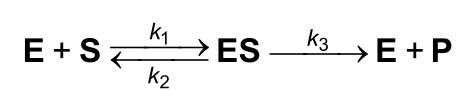
The initial rate for an enzymatic reaction following the MM mechanism is given as
\[ v_0=v_{\max}\frac{[\ce{S}]_0}{K_{\mathrm M}+[\ce{S}]_0} \tag{1} \]
when the initial concentration of \(\ce{E}\) is much lower than the initial concentration of \(\ce{S}\), \([\ce{E}]_0\ll[\ce{S}]_0\). The Michaelis constant is defined as \(K_{\mathrm M}=(k_2+k_3)/k_1\). The initial rate can also be expressed as the product of the relative flow \(j\) and \([\ce{E}]_0\):
\[ v_0=j[\ce{E}]_0 \tag{2} \]
Note: Questions 7.1 and 7.2 can have one, multiple, or no correct answer(s).
7.1 Choose the correct alternative form(s) of the initial rate (\(v_0\)) expressions (1) and (2).
\([\ce{ES}]_{\max}\) is the maximum concentration of the \(\ce{ES}\) complex.
- (a) \(\displaystyle v_0=\frac{k_3[\ce{E}]_0[\ce{S}]_0}{K_{\mathrm M}+[\ce{S}]_0}\)
- (b) \(\displaystyle v_0=\frac{k_3[\ce{E}]}{K_{\mathrm M}/[\ce{S}]_0+1}\)
- (c) \(\displaystyle v_0=j[\ce{ES}]_{\max}\)
- (d) \(\displaystyle v_0=\frac{k_3[\ce{E}]_0[\ce{ES}]_{\max}}{K_{\mathrm M}+[\ce{S}]_0}\)
- (e) \(\displaystyle v_0=\frac{k_3[\ce{E}]_0}{K_{\mathrm M}/[\ce{S}]_0+1}\)
- (f) \(\displaystyle v_0=\frac{j[\ce{E}]_0}{K_{\mathrm M}+[\ce{S}]_0}\)
7.2 Choose the pair(s) of axes (\(y\) vs. \(x\)) that are expected to give a linear plot.
- (a) \(v_0\) vs. \(1/[\ce{S}]_0\)
- (b) \(v_0\) vs. \(v_0/K_{\mathrm M}\)
- (c) \(v_0\) vs. \(K_{\mathrm M}/v_0\)
- (d) \(1/v_0\) vs. \(v_0/[\ce{S}]_0\)
- (e) \(1/v_0\) vs. \(v_0/K_{\mathrm M}\)
- (f) \([\ce{S}]_0/v_0\) vs. \([\ce{S}]_0\)
Many enzymes catalyze multi- rather than single-substrate transformations. However, if the concentration of one of the substrates is much higher than that of the other substrate or it is kept constant, the MM kinetics is also valid. Here we will look at two independent enzymatic systems that follow the MM kinetics.
Enzymatic System I
Enzyme \(\ce{E}\) converts substrates \(\ce{A}\) and \(\ce{B}\) to products \(\ce{P_A}\) and \(\ce{P_B}\). At rapid pre-equilibrium between the free enzyme and all enzyme–substrate complexes, the following equation applies:
\[ v_0= \frac{k[\ce{E}]_0[\ce{A}]_0[\ce{B}]_0} {(K+[\ce{A}]_0)(K+[\ce{B}]_0)} \tag{3} \]
where \(k\) is the rate constant of one of the reactions. The same equilibrium constant \(K\) characterizes the dissociation of either substrate from the corresponding active site of \(\ce{E}\).
7.3 Show that equation (3) takes the MM form (1) if the concentration of substrate \(\ce{B}\) is maintained at a constant value \(c_0\). Give the expression for \(v_{\max}\) in this case.
7.4 Propose a kinetic scheme for the Enzymatic System I consistent with eq. (3), showing all the intermediates and products. Indicate the reaction with a rate constant \(k\).
Enzymatic System II
Enzyme \(\ce{E}\) has five active sites, each of which is specific to one of the substrates \(\ce{S_A}\), \(\ce{S_B}\), or \(\ce{S_C}\) that are selectively transformed to products \(\ce{P_A}\), \(\ce{P_B}\), or \(\ce{P_C}\), respectively. There is at least one active site for each substrate. Each active site is independent of the others.
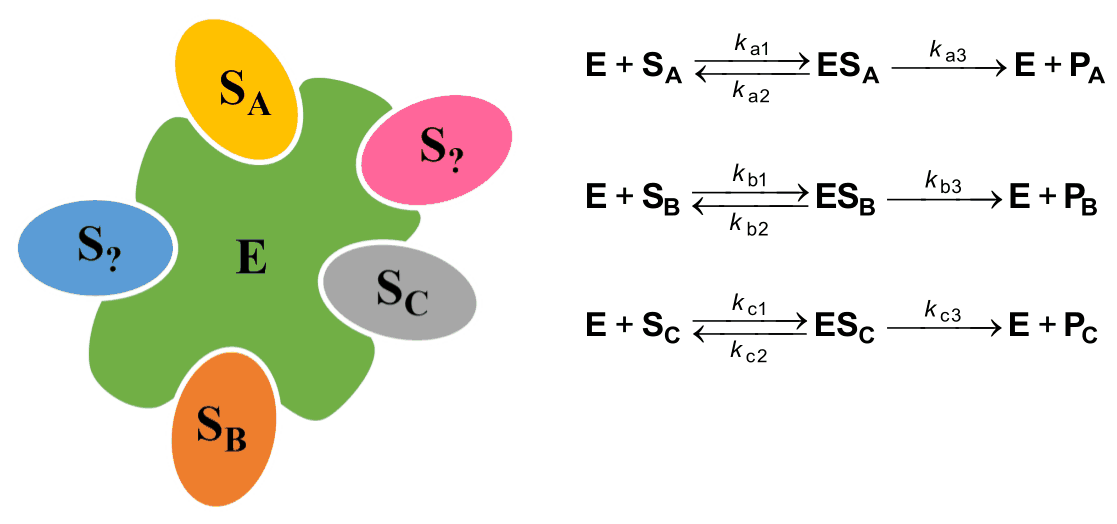
For \(\ce{E}\), it is known that:
-
The affinity for \(\ce{S_C}\) is higher than for \(\ce{S_B}\).
-
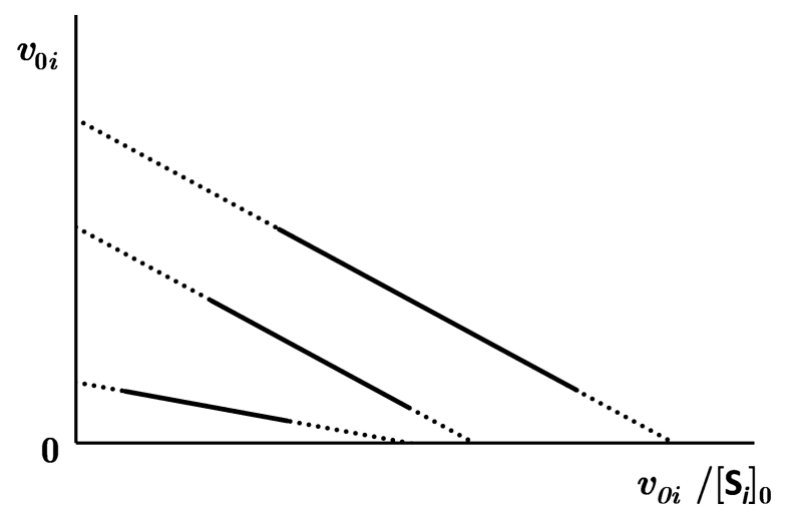
The plot of \(v_{0i}\) vs. \(v_{0i}/[\ce{S_i}]_0\), known as Eadie–Hofstee plot, for \(\ce{S_A}\), \(\ce{S_B}\), \(\ce{S_C}\), with rate given per active site (\(v_{0i}\)), is shown below, but the scale and the legend are omitted.
-
When \(\ce{E}\) is saturated with \(\ce{S_A}\), \(\ce{S_B}\), \(\ce{S_C}\), the catalytic turnover number (TON) for \(\ce{S_C}\) per site is \(10200\ \mathrm{min^{-1}}\), and 2023 product \(\ce{P_A}\), \(\ce{P_B}\), \(\ce{P_C}\) molecules in total are synthesized per second. At the same time, no more than \(5.94\times10^6\) molecules of \(\ce{P_A}\) and \(\ce{P_B}\) are detected to form per hour.
-
At equimolar concentrations of \(\ce{S_A}\), \(\ce{S_B}\), \(\ce{S_C}\), which are at least 1000-times lower than corresponding \(K_{\mathrm M,i}\) values, the \(\ce{P_A}\), \(\ce{P_B}\), \(\ce{P_C}\) concentrations become proportional to the catalytic efficiency \((\varepsilon_i=k_{i3}/K_{\mathrm M,i})\), and their ratio is \(3:2:5\), respectively.
-
Two \(\ce{ES_i}\) complexes have equal rate constants for dissociation to \(\ce{E}\) and \(\ce{S_i}\). The activation barrier for the reaction of \(\ce{ES_C}\) into the initial compounds is \(1266\ \mathrm{J\,mol^{-1}}\) higher than for the reaction into the final products. Assume that the pre-exponential factors are equal for both reactions and \(T=25\,^\circ\mathrm C\).
-
For \(\ce{E + S_i}\) reaction: \(k_{\mathrm{c1}}=1.57\times10^7\ \mathrm{M^{-1}\,s^{-1}}\) and \(k_{\mathrm{a1}}=k_{\mathrm{b1}}\).
7.5 Fill in the table below and provide your calculations. Hints:
- Use information from points 1 and 2 to find the relation (\(<\), \(>\), \(=\)) between constants \(K_{\mathrm M,A}\), \(K_{\mathrm M,B}\) and \(K_{\mathrm M,C}\).
- Information from points 3 and 5 allows you to complete the first column (number of active sites for each substrate) and the last row (all the constants for substrate \(\ce{S_C}\)) of the table. Check that the sum of active sites is equal to 5.
| # of active sites | \(k_1\) | \(k_2\) | \(k_3\) | \(K_{\mathrm M}\) | |
|---|---|---|---|---|---|
| \(\ce{S_A}\) | |||||
| \(\ce{S_B}\) | |||||
| \(\ce{S_C}\) | \(1.57\times10^7\ \mathrm{M^{-1}\,s^{-1}}\) |
Official English text of the problem.
Answers
- 7.1: (a), (c), (e).
- 7.2: (b), (f).
- 7.3: \(\displaystyle v_{\max}=\frac{k[\ce{E}]_0c_0}{K+c_0}\), with \(K_{\mathrm M,A}=K\).
- 7.4: Rapid binding equilibria \(\ce{E + A <=> EA}\), \(\ce{E + B <=> EB}\), \(\ce{EA + B <=> EAB}\), and \(\ce{EB + A <=> EAB}\), each with dissociation constant \(K\), followed by \(\ce{EAB ->[k] E + P_A + P_B}\).
- 7.5: \(K_{\mathrm M,A}=K_{\mathrm M,B}>K_{\mathrm M,C}\). The upper, middle, and shallow lines represent \(\ce{S_A}\), \(\ce{S_B}\), and \(\ce{S_C}\), respectively. The completed table is:
| Substrate | # of active sites | \(k_1\;(\mathrm{M^{-1}\,s^{-1}})\) | \(k_2\;(\mathrm{s^{-1}})\) | \(k_3\;(\mathrm{s^{-1}})\) | \(K_{\mathrm M}\;(\mathrm M)\) |
|---|---|---|---|---|---|
| \(\ce{S_A}\) | 1 | \(1.96\times10^7\) | \(1.02\times10^2\) | \(9.08\times10^2\) | \(5.14\times10^{-5}\) |
| \(\ce{S_B}\) | 1 | \(1.96\times10^7\) | \(4.05\times10^2\) | \(6.05\times10^2\) | \(5.14\times10^{-5}\) |
| \(\ce{S_C}\) | 3 | \(1.57\times10^7\) | \(1.02\times10^2\) | \(1.70\times10^2\) | \(1.73\times10^{-5}\) |
Solution
7.1
For the MM mechanism, enzyme conservation gives
\[ [\ce{E}]_0=[\ce{E}]+[\ce{ES}]. \]
At substrate saturation, essentially all enzyme is present as the complex, so
\[ [\ce{ES}]_{\max}=[\ce{E}]_0, \qquad v_{\max}=k_3[\ce{E}]_0. \]
Substitution into equation (1) gives
\[ v_0= \frac{k_3[\ce{E}]_0[\ce{S}]_0}{K_{\mathrm M}+[\ce{S}]_0} = \frac{k_3[\ce{E}]_0}{K_{\mathrm M}/[\ce{S}]_0+1}. \]
Thus (a) and (e) are correct. Also, equation (2) becomes
\[ v_0=j[\ce{E}]_0=j[\ce{ES}]_{\max}, \]
so (c) is correct.
In (b), \([\ce{E}]\) is the free-enzyme concentration, which generally differs from the total concentration \([\ce{E}]_0\). In (d), replacing the numerator’s substrate concentration with \([\ce{ES}]_{\max}\) does not preserve the MM expression. In (f), the additional concentration denominator is incorrect; it also gives units of \(\mathrm{s^{-1}}\), whereas \(v_0\) has units of concentration per time.
Therefore,
\[ \boxed{\text{7.1: (a), (c), (e).}} \]
7.2
Write \(s=[\ce{S}]_0\), \(V=v_{\max}\), and \(K=K_{\mathrm M}\), with \(V\) and \(K\) constant:
\[ v_0=\frac{Vs}{K+s}. \]
Each proposed choice gives the following relation between its stated \(y\) and \(x\):
| Option | Relation | Linear? |
|---|---|---|
| (a) | \(\displaystyle y=\frac{V}{1+Kx}\) | No |
| (b) | \(y=Kx\) | Yes |
| (c) | \(\displaystyle y=\frac{K}{x}\) | No |
| (d) | \(\displaystyle y=\frac{1}{V-Kx}\) | No |
| (e) | \(\displaystyle y=\frac{1}{Kx}\) | No |
| (f) | \(\displaystyle y=\frac{K}{V}+\frac{x}{V}\) | Yes |
For (b), the linearity follows directly from \(x=v_0/K_{\mathrm M}\): the line passes through the origin with slope \(K_{\mathrm M}\).
For (f), rearranging the MM equation gives the Hanes–Woolf form:
\[ \frac{[\ce{S}]_0}{v_0} = \frac{K_{\mathrm M}}{v_{\max}} +\frac{[\ce{S}]_0}{v_{\max}}. \]
Its slope is \(1/v_{\max}\), and its vertical intercept is \(K_{\mathrm M}/v_{\max}\).
Therefore,
\[ \boxed{\text{7.2: (b), (f).}} \]
7.3
Set \([\ce{B}]_0=c_0\) in equation (3):
\[ v_0= \frac{k[\ce{E}]_0[\ce{A}]_0c_0} {(K+[\ce{A}]_0)(K+c_0)}. \]
Collecting the factors independent of \([\ce{A}]_0\),
\[ v_0= \underbrace{\frac{k[\ce{E}]_0c_0}{K+c_0}}_{v_{\max}} \frac{[\ce{A}]_0}{K+[\ce{A}]_0}. \]
This is the MM form, with
\[ \boxed{ v_{\max}=\frac{k[\ce{E}]_0c_0}{K+c_0}, \qquad K_{\mathrm M,A}=K. } \]
7.4
A suitable scheme allows the two substrates to bind independently in either order. The singly bound complexes are \(\ce{EA}\) and \(\ce{EB}\); both routes lead to the doubly bound complex \(\ce{EAB}\):
\[ \begin{aligned} &\ce{E + A <=> EA},\\ &\ce{E + B <=> EB},\\ &\ce{EA + B <=> EAB},\\ &\ce{EB + A <=> EAB}. \end{aligned} \]
Each binding equilibrium has dissociation constant \(K\). Only the doubly bound complex undergoes the product-forming step:
\[ \boxed{\ce{EAB ->[k] E + P_A + P_B}.} \]
The overall substrate conversion is
\[ \ce{A + B -> P_A + P_B}. \]
Thus, a drawing would show a binding square with \(\ce{E}\), \(\ce{EA}\), \(\ce{EB}\), and \(\ce{EAB}\) at its corners, and an irreversible arrow labelled \(k\) from \(\ce{EAB}\) to \(\ce{E + P_A + P_B}\).
To verify the rate law, let \(a=[\ce{A}]_0\) and \(b=[\ce{B}]_0\). Rapid pre-equilibrium gives
\[ [\ce{EA}]=\frac{[\ce{E}]a}{K}, \qquad [\ce{EB}]=\frac{[\ce{E}]b}{K}, \qquad [\ce{EAB}]=\frac{[\ce{E}]ab}{K^2}. \]
The enzyme balance is therefore
\[ \begin{aligned} [\ce{E}]_0 &=[\ce{E}]+[\ce{EA}]+[\ce{EB}]+[\ce{EAB}]\\ &=[\ce{E}] \left(1+\frac{a}{K}\right) \left(1+\frac{b}{K}\right). \end{aligned} \]
Consequently,
\[ [\ce{EAB}] = \frac{[\ce{E}]_0ab}{(K+a)(K+b)}, \]
and the reaction rate is
\[ v_0=k[\ce{EAB}] = \frac{k[\ce{E}]_0[\ce{A}]_0[\ce{B}]_0} {(K+[\ce{A}]_0)(K+[\ce{B}]_0)}, \]
as required. Each of the two products forms at this rate.
7.5
Let \(n_A,n_B,n_C\) be the numbers of sites specific to the three substrates. They are positive integers satisfying
\[ n_A+n_B+n_C=5. \]
First, rearrange the MM equation into the Eadie–Hofstee form:
\[ v_{0i} = v_{\max,i} - K_{\mathrm M,i}\frac{v_{0i}}{[\ce{S_i}]_0}. \]
The slope is \(-K_{\mathrm M,i}\), and the vertical intercept is the maximum rate per site, proportional to \(k_{i3}\).
The graph contains two parallel, steeper lines and one shallower line. Using the stated affinity comparison, \(K_{\mathrm M,C}<K_{\mathrm M,B}\). Therefore, the shallow line must correspond to \(\ce{S_C}\), and the two parallel lines correspond to \(\ce{S_A}\) and \(\ce{S_B}\):
\[ \boxed{K_{\mathrm M,A}=K_{\mathrm M,B}>K_{\mathrm M,C}.} \]
The turnover constant for a C site is
\[ k_{\mathrm{c3}} = 10200\ \mathrm{min^{-1}} \left(\frac{1\ \mathrm{min}}{60\ \mathrm s}\right) = 170\ \mathrm{s^{-1}}. \]
The maximum allowed combined A-and-B production rate is
\[ \frac{5.94\times10^6}{3600} = 1650\ \text{molecules per second}. \]
Thus, C sites must produce at least
\[ 2023-1650=373\ \text{molecules per second}. \]
For one enzyme molecule,
\[ 170n_C\ge373, \qquad n_C\ge2.194. \]
Since \(n_C\) is an integer, \(n_C\ge3\). At least one site is required for each of A and B, so \(n_C\le3\). Hence
\[ \boxed{n_A=1,\qquad n_B=1,\qquad n_C=3.} \]
The site count is indeed \(1+1+3=5\).
Next, the two reactions of the C complex are
\[ \ce{ES_C ->[k_{c2}] E + S_C}, \qquad \ce{ES_C ->[k_{c3}] E + P_C}. \]
Their equal Arrhenius pre-exponential factors give
\[ \frac{k_{\mathrm{c2}}}{k_{\mathrm{c3}}} = \exp\left[ -\frac{E_{\mathrm a,c2}-E_{\mathrm a,c3}}{RT} \right]. \]
Using \(T=298.15\ \mathrm K\) and \(R=8.314\ \mathrm{J\,mol^{-1}\,K^{-1}}\),
\[ \frac{k_{\mathrm{c2}}}{k_{\mathrm{c3}}} = \exp\left[ -\frac{1266}{8.314(298.15)} \right] \approx0.6001. \]
Therefore,
\[ \boxed{k_{\mathrm{c2}}\approx102.0\ \mathrm{s^{-1}}.} \]
It follows that
\[ K_{\mathrm M,C} = \frac{k_{\mathrm{c2}}+k_{\mathrm{c3}}}{k_{\mathrm{c1}}} = \frac{102.0+170}{1.57\times10^7} \approx1.7326\times10^{-5}\ \mathrm M, \]
so
\[ \boxed{K_{\mathrm M,C}=1.73\times10^{-5}\ \mathrm M.} \]
To use the low-concentration product ratio, the number of sites must be included. At a common substrate concentration \(s\ll K_{\mathrm M,i}\),
\[ v_i = n_i[\ce{E}]_0 \frac{k_{i3}s}{K_{\mathrm M,i}+s} \approx n_i[\ce{E}]_0\frac{k_{i3}}{K_{\mathrm M,i}}s = n_i[\ce{E}]_0\varepsilon_i s. \]
The specified \(s/K_{\mathrm M,i}\le10^{-3}\) justifies this approximation. Consequently,
\[ n_A\varepsilon_A:n_B\varepsilon_B:n_C\varepsilon_C = 3:2:5. \]
With the site counts already found,
\[ \varepsilon_A:\varepsilon_B:3\varepsilon_C = 3:2:5, \]
or equivalently,
\[ \boxed{\varepsilon_A:\varepsilon_B:\varepsilon_C=9:6:5.} \]
Because \(K_{\mathrm M,A}=K_{\mathrm M,B}\),
\[ \frac{k_{\mathrm{a3}}}{k_{\mathrm{b3}}} = \frac{\varepsilon_A}{\varepsilon_B} = \frac32. \]
At saturation, the total production rate gives
\[ k_{\mathrm{a3}}+k_{\mathrm{b3}}+3k_{\mathrm{c3}}=2023\ \mathrm{s^{-1}}, \]
hence
\[ k_{\mathrm{a3}}+k_{\mathrm{b3}} = 2023-3(170) = 1513\ \mathrm{s^{-1}}. \]
Combining the sum and ratio,
\[ \boxed{ k_{\mathrm{a3}}=\frac35(1513)=907.8\ \mathrm{s^{-1}}, } \]
\[ \boxed{ k_{\mathrm{b3}}=\frac25(1513)=605.2\ \mathrm{s^{-1}}. } \]
Thus the higher of the two parallel lines is A, and the lower is B.
The ratio \(\varepsilon_A/\varepsilon_C=9/5\) now determines the common A-and-B Michaelis constant:
\[ \frac{k_{\mathrm{a3}}/K_{\mathrm M,A}} {k_{\mathrm{c3}}/K_{\mathrm M,C}} = \frac95, \]
so
\[ \begin{aligned} K_{\mathrm M,A} &=\frac{5k_{\mathrm{a3}}}{9k_{\mathrm{c3}}}K_{\mathrm M,C}\\ &=\frac{5(907.8)}{9(170)} \left(1.7326\times10^{-5}\right)\ \mathrm M\\ &\approx5.1399\times10^{-5}\ \mathrm M. \end{aligned} \]
Therefore,
\[ \boxed{ K_{\mathrm M,A}=K_{\mathrm M,B}=5.14\times10^{-5}\ \mathrm M. } \]
Finally, \(k_{\mathrm{a1}}=k_{\mathrm{b1}}\) and \(K_{\mathrm M,A}=K_{\mathrm M,B}\) imply
\[ k_{\mathrm{a2}}+k_{\mathrm{a3}} = k_{\mathrm{b2}}+k_{\mathrm{b3}}. \]
Thus,
\[ k_{\mathrm{b2}}-k_{\mathrm{a2}} = k_{\mathrm{a3}}-k_{\mathrm{b3}} = 302.6\ \mathrm{s^{-1}}. \]
The A and B dissociation rate constants cannot be the equal pair. If instead \(k_{\mathrm{b2}}=k_{\mathrm{c2}}\approx102.0\ \mathrm{s^{-1}}\), then
\[ k_{\mathrm{a2}}\approx102.0-302.6=-200.6\ \mathrm{s^{-1}}, \]
which is impossible. The equal pair must therefore be A and C:
\[ \boxed{k_{\mathrm{a2}}=k_{\mathrm{c2}}\approx102.0\ \mathrm{s^{-1}},} \]
\[ \boxed{ k_{\mathrm{b2}}\approx102.0+302.6 =404.6\ \mathrm{s^{-1}}. } \]
The common association rate constant is
\[ \begin{aligned} k_{\mathrm{a1}}=k_{\mathrm{b1}} &=\frac{k_{\mathrm{a2}}+k_{\mathrm{a3}}}{K_{\mathrm M,A}}\\ &\approx \frac{102.0+907.8}{5.1399\times10^{-5}}\\ &=1.9646\times10^7\ \mathrm{M^{-1}\,s^{-1}}. \end{aligned} \]
To three significant figures,
\[ \boxed{ k_{\mathrm{a1}}=k_{\mathrm{b1}} =1.96\times10^7\ \mathrm{M^{-1}\,s^{-1}}. } \]
The unrounded values satisfy the two saturation constraints:
\[ 907.8+605.2+3(170)=2023\ \text{products per second}, \]
\[ (907.8+605.2)(3600) = 5.4468\times10^6 < 5.94\times10^6 \quad\text{A-and-B products per hour}. \]
They also give the required low-concentration total-product ratio:
\[ n_A\varepsilon_A:n_B\varepsilon_B:n_C\varepsilon_C = 9:6:15 = 3:2:5. \]
The solution was checked against the official solution.
IChO 2023 · Theorieaufgabe 7
Enzymkinetik
Der 1913 eingeführte Michaelis–Menten-Mechanismus (MM-Mechanismus) beschreibt die Kinetik der Enzymkatalyse. Bei diesem Mechanismus katalysiert das Enzym \(\ce{E}\) die Umwandlung des Substrats \(\ce{S}\) in das Produkt \(\ce{P}\):
Die Anfangsgeschwindigkeit einer enzymatischen Reaktion, die dem MM-Mechanismus folgt, ist gegeben durch
\[ v_0=v_{\max}\frac{[\ce{S}]_0}{K_{\mathrm M}+[\ce{S}]_0} \tag{1} \]
wenn die Anfangskonzentration von \(\ce{E}\) wesentlich kleiner ist als die Anfangskonzentration von \(\ce{S}\), \([\ce{E}]_0\ll[\ce{S}]_0\). Die Michaelis-Konstante ist definiert als \(K_{\mathrm M}=(k_2+k_3)/k_1\). Die Anfangsgeschwindigkeit lässt sich auch als Produkt des relativen Flusses \(j\) und \([\ce{E}]_0\) ausdrücken:
\[ v_0=j[\ce{E}]_0 \tag{2} \]
Hinweis: Bei den Fragen 7.1 und 7.2 kann eine, können mehrere oder keine der Antworten richtig sein.
7.1 Wählen Sie die korrekte(n) alternative(n) Form(en) der Ausdrücke (1) und (2) für die Anfangsgeschwindigkeit (\(v_0\)).
\([\ce{ES}]_{\max}\) ist die maximale Konzentration des \(\ce{ES}\)-Komplexes.
- (a) \(\displaystyle v_0=\frac{k_3[\ce{E}]_0[\ce{S}]_0}{K_{\mathrm M}+[\ce{S}]_0}\)
- (b) \(\displaystyle v_0=\frac{k_3[\ce{E}]}{K_{\mathrm M}/[\ce{S}]_0+1}\)
- (c) \(\displaystyle v_0=j[\ce{ES}]_{\max}\)
- (d) \(\displaystyle v_0=\frac{k_3[\ce{E}]_0[\ce{ES}]_{\max}}{K_{\mathrm M}+[\ce{S}]_0}\)
- (e) \(\displaystyle v_0=\frac{k_3[\ce{E}]_0}{K_{\mathrm M}/[\ce{S}]_0+1}\)
- (f) \(\displaystyle v_0=\frac{j[\ce{E}]_0}{K_{\mathrm M}+[\ce{S}]_0}\)
7.2 Wählen Sie die Achsenpaare (\(y\) gegen \(x\)), bei denen eine lineare Auftragung zu erwarten ist.
- (a) \(v_0\) gegen \(1/[\ce{S}]_0\)
- (b) \(v_0\) gegen \(v_0/K_{\mathrm M}\)
- (c) \(v_0\) gegen \(K_{\mathrm M}/v_0\)
- (d) \(1/v_0\) gegen \(v_0/[\ce{S}]_0\)
- (e) \(1/v_0\) gegen \(v_0/K_{\mathrm M}\)
- (f) \([\ce{S}]_0/v_0\) gegen \([\ce{S}]_0\)
Viele Enzyme katalysieren Umsetzungen mit mehreren Substraten statt mit nur einem Substrat. Wenn jedoch die Konzentration eines der Substrate wesentlich höher ist als die des anderen Substrats oder konstant gehalten wird, gilt ebenfalls die MM-Kinetik. Hier betrachten wir zwei voneinander unabhängige enzymatische Systeme, die der MM-Kinetik folgen.
Enzymatisches System I
Das Enzym \(\ce{E}\) wandelt die Substrate \(\ce{A}\) und \(\ce{B}\) in die Produkte \(\ce{P_A}\) und \(\ce{P_B}\) um. Bei einem sich schnell einstellenden vorgelagerten Gleichgewicht zwischen dem freien Enzym und allen Enzym-Substrat-Komplexen gilt die folgende Gleichung:
\[ v_0= \frac{k[\ce{E}]_0[\ce{A}]_0[\ce{B}]_0} {(K+[\ce{A}]_0)(K+[\ce{B}]_0)} \tag{3} \]
Dabei ist \(k\) die Geschwindigkeitskonstante einer der Reaktionen. Dieselbe Gleichgewichtskonstante \(K\) beschreibt die Dissoziation beider Substrate vom jeweiligen aktiven Zentrum von \(\ce{E}\).
7.3 Zeigen Sie, dass Gleichung (3) die MM-Form (1) annimmt, wenn die Konzentration des Substrats \(\ce{B}\) auf einem konstanten Wert \(c_0\) gehalten wird. Geben Sie den Ausdruck für \(v_{\max}\) in diesem Fall an.
7.4 Schlagen Sie für das Enzymatische System I ein kinetisches Schema vor, das mit Gl. (3) übereinstimmt und alle Zwischenstufen und Produkte zeigt. Kennzeichnen Sie die Reaktion mit der Geschwindigkeitskonstante \(k\).
Enzymatisches System II
Das Enzym \(\ce{E}\) besitzt fünf aktive Zentren, von denen jedes spezifisch für eines der Substrate \(\ce{S_A}\), \(\ce{S_B}\) oder \(\ce{S_C}\) ist, die selektiv in die jeweiligen Produkte \(\ce{P_A}\), \(\ce{P_B}\) oder \(\ce{P_C}\) umgewandelt werden. Für jedes Substrat gibt es mindestens ein aktives Zentrum. Jedes aktive Zentrum ist von den anderen unabhängig.
Über \(\ce{E}\) ist Folgendes bekannt:
-
Die Affinität zu \(\ce{S_C}\) ist höher als zu \(\ce{S_B}\).
-
Die Auftragung von \(v_{0i}\) gegen \(v_{0i}/[\ce{S_i}]_0\), die als Eadie–Hofstee-Diagramm bezeichnet wird, ist für \(\ce{S_A}\), \(\ce{S_B}\), \(\ce{S_C}\) unten dargestellt. Die Geschwindigkeit ist dabei pro aktivem Zentrum angegeben (\(v_{0i}\)); die Skalierung und die Legende wurden jedoch weggelassen.
-
Wenn \(\ce{E}\) mit \(\ce{S_A}\), \(\ce{S_B}\), \(\ce{S_C}\) gesättigt ist, beträgt die katalytische Wechselzahl (TON) für \(\ce{S_C}\) pro Zentrum \(10200\ \mathrm{min^{-1}}\), und insgesamt werden pro Sekunde 2023 Moleküle der Produkte \(\ce{P_A}\), \(\ce{P_B}\), \(\ce{P_C}\) synthetisiert. Gleichzeitig wird die Bildung von höchstens \(5.94\times10^6\) Molekülen von \(\ce{P_A}\) und \(\ce{P_B}\) pro Stunde nachgewiesen.
-
Bei äquimolaren Konzentrationen von \(\ce{S_A}\), \(\ce{S_B}\), \(\ce{S_C}\), die mindestens um den Faktor 1000 kleiner sind als die entsprechenden \(K_{\mathrm M,i}\)-Werte, werden die Konzentrationen von \(\ce{P_A}\), \(\ce{P_B}\), \(\ce{P_C}\) proportional zur katalytischen Effizienz \((\varepsilon_i=k_{i3}/K_{\mathrm M,i})\), und ihr Verhältnis beträgt in dieser Reihenfolge \(3:2:5\).
-
Zwei \(\ce{ES_i}\)-Komplexe haben gleiche Geschwindigkeitskonstanten für die Dissoziation zu \(\ce{E}\) und \(\ce{S_i}\). Die Aktivierungsbarriere für die Reaktion von \(\ce{ES_C}\) zu den Ausgangsverbindungen ist um \(1266\ \mathrm{J\,mol^{-1}}\) höher als für die Reaktion zu den Endprodukten. Nehmen Sie an, dass die präexponentiellen Faktoren für beide Reaktionen gleich sind und \(T=25\,^\circ\mathrm C\) gilt.
-
Für die Reaktion \(\ce{E + S_i}\) gilt: \(k_{\mathrm{c1}}=1.57\times10^7\ \mathrm{M^{-1}\,s^{-1}}\) und \(k_{\mathrm{a1}}=k_{\mathrm{b1}}\).
7.5 Füllen Sie die folgende Tabelle aus und geben Sie Ihre Berechnungen an. Hinweise:
- Bestimmen Sie anhand der Informationen aus den Punkten 1 und 2 die Beziehung (\(<\), \(>\), \(=\)) zwischen den Konstanten \(K_{\mathrm M,A}\), \(K_{\mathrm M,B}\) und \(K_{\mathrm M,C}\).
- Mithilfe der Informationen aus den Punkten 3 und 5 können Sie die erste Spalte (Anzahl der aktiven Zentren für jedes Substrat) und die letzte Zeile (alle Konstanten für das Substrat \(\ce{S_C}\)) der Tabelle ausfüllen. Überprüfen Sie, dass die Summe der aktiven Zentren gleich 5 ist.
| Anzahl aktiver Zentren | \(k_1\) | \(k_2\) | \(k_3\) | \(K_{\mathrm M}\) | |
|---|---|---|---|---|---|
| \(\ce{S_A}\) | |||||
| \(\ce{S_B}\) | |||||
| \(\ce{S_C}\) | \(1.57\times10^7\ \mathrm{M^{-1}\,s^{-1}}\) |
Aufgabentext aus dem offiziellen englischen Text übersetzt.
Antworten
- 7.1: (a), (c), (e).
- 7.2: (b), (f).
- 7.3: \(\displaystyle v_{\max}=\frac{k[\ce{E}]_0c_0}{K+c_0}\), mit \(K_{\mathrm M,A}=K\).
- 7.4: Sich schnell einstellende Bindungsgleichgewichte \(\ce{E + A <=> EA}\), \(\ce{E + B <=> EB}\), \(\ce{EA + B <=> EAB}\) und \(\ce{EB + A <=> EAB}\), jeweils mit der Dissoziationskonstante \(K\), gefolgt von \(\ce{EAB ->[k] E + P_A + P_B}\).
- 7.5: \(K_{\mathrm M,A}=K_{\mathrm M,B}>K_{\mathrm M,C}\). Die obere, die mittlere und die flachere Gerade entsprechen \(\ce{S_A}\), \(\ce{S_B}\) bzw. \(\ce{S_C}\). Die ausgefüllte Tabelle lautet:
| Substrat | Anzahl aktiver Zentren | \(k_1\;(\mathrm{M^{-1}\,s^{-1}})\) | \(k_2\;(\mathrm{s^{-1}})\) | \(k_3\;(\mathrm{s^{-1}})\) | \(K_{\mathrm M}\;(\mathrm M)\) |
|---|---|---|---|---|---|
| \(\ce{S_A}\) | 1 | \(1.96\times10^7\) | \(1.02\times10^2\) | \(9.08\times10^2\) | \(5.14\times10^{-5}\) |
| \(\ce{S_B}\) | 1 | \(1.96\times10^7\) | \(4.05\times10^2\) | \(6.05\times10^2\) | \(5.14\times10^{-5}\) |
| \(\ce{S_C}\) | 3 | \(1.57\times10^7\) | \(1.02\times10^2\) | \(1.70\times10^2\) | \(1.73\times10^{-5}\) |
Lösung
7.1
Für den MM-Mechanismus ergibt die Enzymbilanz
\[ [\ce{E}]_0=[\ce{E}]+[\ce{ES}]. \]
Bei Substratsättigung liegt praktisch das gesamte Enzym als Komplex vor, sodass
\[ [\ce{ES}]_{\max}=[\ce{E}]_0, \qquad v_{\max}=k_3[\ce{E}]_0. \]
Einsetzen in Gleichung (1) ergibt
\[ v_0= \frac{k_3[\ce{E}]_0[\ce{S}]_0}{K_{\mathrm M}+[\ce{S}]_0} = \frac{k_3[\ce{E}]_0}{K_{\mathrm M}/[\ce{S}]_0+1}. \]
Somit sind (a) und (e) richtig. Außerdem wird Gleichung (2) zu
\[ v_0=j[\ce{E}]_0=j[\ce{ES}]_{\max}, \]
also ist (c) richtig.
In (b) ist \([\ce{E}]\) die Konzentration des freien Enzyms, die sich im Allgemeinen von der Gesamtkonzentration \([\ce{E}]_0\) unterscheidet. In (d) bleibt der MM-Ausdruck nicht erhalten, wenn die Substratkonzentration im Zähler durch \([\ce{ES}]_{\max}\) ersetzt wird. In (f) ist der zusätzliche Konzentrationsterm im Nenner falsch; außerdem ergibt sich dadurch die Einheit \(\mathrm{s^{-1}}\), während \(v_0\) die Einheit Konzentration pro Zeit hat.
Daher gilt
\[ \boxed{\text{7.1: (a), (c), (e).}} \]
7.2
Wir setzen \(s=[\ce{S}]_0\), \(V=v_{\max}\) und \(K=K_{\mathrm M}\), wobei \(V\) und \(K\) konstant sind:
\[ v_0=\frac{Vs}{K+s}. \]
Für jede vorgeschlagene Antwortmöglichkeit ergibt sich die folgende Beziehung zwischen den jeweils angegebenen Größen \(y\) und \(x\):
| Antwortmöglichkeit | Beziehung | Linear? |
|---|---|---|
| (a) | \(\displaystyle y=\frac{V}{1+Kx}\) | Nein |
| (b) | \(y=Kx\) | Ja |
| (c) | \(\displaystyle y=\frac{K}{x}\) | Nein |
| (d) | \(\displaystyle y=\frac{1}{V-Kx}\) | Nein |
| (e) | \(\displaystyle y=\frac{1}{Kx}\) | Nein |
| (f) | \(\displaystyle y=\frac{K}{V}+\frac{x}{V}\) | Ja |
Bei (b) folgt die Linearität unmittelbar aus \(x=v_0/K_{\mathrm M}\): Die Gerade verläuft durch den Ursprung und hat die Steigung \(K_{\mathrm M}\).
Bei (f) ergibt die Umformung der MM-Gleichung die Hanes–Woolf-Form:
\[ \frac{[\ce{S}]_0}{v_0} = \frac{K_{\mathrm M}}{v_{\max}} +\frac{[\ce{S}]_0}{v_{\max}}. \]
Ihre Steigung beträgt \(1/v_{\max}\), und ihr Ordinatenabschnitt ist \(K_{\mathrm M}/v_{\max}\).
Daher gilt
\[ \boxed{\text{7.2: (b), (f).}} \]
7.3
Wir setzen \([\ce{B}]_0=c_0\) in Gleichung (3) ein:
\[ v_0= \frac{k[\ce{E}]_0[\ce{A}]_0c_0} {(K+[\ce{A}]_0)(K+c_0)}. \]
Fassen wir die von \([\ce{A}]_0\) unabhängigen Faktoren zusammen, erhalten wir
\[ v_0= \underbrace{\frac{k[\ce{E}]_0c_0}{K+c_0}}_{v_{\max}} \frac{[\ce{A}]_0}{K+[\ce{A}]_0}. \]
Dies ist die MM-Form mit
\[ \boxed{ v_{\max}=\frac{k[\ce{E}]_0c_0}{K+c_0}, \qquad K_{\mathrm M,A}=K. } \]
7.4
In einem geeigneten Schema können die beiden Substrate unabhängig voneinander in beliebiger Reihenfolge binden. Die einfach belegten Komplexe sind \(\ce{EA}\) und \(\ce{EB}\); beide Wege führen zum doppelt belegten Komplex \(\ce{EAB}\):
\[ \begin{aligned} &\ce{E + A <=> EA},\\ &\ce{E + B <=> EB},\\ &\ce{EA + B <=> EAB},\\ &\ce{EB + A <=> EAB}. \end{aligned} \]
Jedes Bindungsgleichgewicht hat die Dissoziationskonstante \(K\). Nur der doppelt belegte Komplex durchläuft den produktbildenden Schritt:
\[ \boxed{\ce{EAB ->[k] E + P_A + P_B}.} \]
Die gesamte Substratumsetzung lautet
\[ \ce{A + B -> P_A + P_B}. \]
Eine Zeichnung würde somit ein Quadrat der Bindungsgleichgewichte mit \(\ce{E}\), \(\ce{EA}\), \(\ce{EB}\) und \(\ce{EAB}\) an seinen Ecken sowie einen mit \(k\) beschrifteten irreversiblen Pfeil von \(\ce{EAB}\) zu \(\ce{E + P_A + P_B}\) zeigen.
Zur Überprüfung des Geschwindigkeitsgesetzes setzen wir \(a=[\ce{A}]_0\) und \(b=[\ce{B}]_0\). Das sich schnell einstellende vorgelagerte Gleichgewicht ergibt
\[ [\ce{EA}]=\frac{[\ce{E}]a}{K}, \qquad [\ce{EB}]=\frac{[\ce{E}]b}{K}, \qquad [\ce{EAB}]=\frac{[\ce{E}]ab}{K^2}. \]
Die Enzymbilanz lautet daher
\[ \begin{aligned} [\ce{E}]_0 &=[\ce{E}]+[\ce{EA}]+[\ce{EB}]+[\ce{EAB}]\\ &=[\ce{E}] \left(1+\frac{a}{K}\right) \left(1+\frac{b}{K}\right). \end{aligned} \]
Folglich gilt
\[ [\ce{EAB}] = \frac{[\ce{E}]_0ab}{(K+a)(K+b)}, \]
und die Reaktionsgeschwindigkeit ist
\[ v_0=k[\ce{EAB}] = \frac{k[\ce{E}]_0[\ce{A}]_0[\ce{B}]_0} {(K+[\ce{A}]_0)(K+[\ce{B}]_0)}, \]
wie gefordert. Jedes der beiden Produkte wird mit dieser Geschwindigkeit gebildet.
7.5
Seien \(n_A,n_B,n_C\) die Anzahlen der für die drei Substrate spezifischen Zentren. Sie sind positive ganze Zahlen, für die gilt:
\[ n_A+n_B+n_C=5. \]
Zunächst formen wir die MM-Gleichung in die Eadie–Hofstee-Form um:
\[ v_{0i} = v_{\max,i} - K_{\mathrm M,i}\frac{v_{0i}}{[\ce{S_i}]_0}. \]
Die Steigung ist \(-K_{\mathrm M,i}\), und der Ordinatenabschnitt ist die maximale Geschwindigkeit pro Zentrum, die proportional zu \(k_{i3}\) ist.
Das Diagramm enthält zwei parallele, steilere Geraden und eine flachere Gerade. Aus dem angegebenen Affinitätsvergleich folgt \(K_{\mathrm M,C}<K_{\mathrm M,B}\). Daher muss die flachere Gerade \(\ce{S_C}\) entsprechen, und die beiden parallelen Geraden entsprechen \(\ce{S_A}\) und \(\ce{S_B}\):
\[ \boxed{K_{\mathrm M,A}=K_{\mathrm M,B}>K_{\mathrm M,C}.} \]
Die Wechselzahl für ein C-Zentrum beträgt
\[ k_{\mathrm{c3}} = 10200\ \mathrm{min^{-1}} \left(\frac{1\ \mathrm{min}}{60\ \mathrm s}\right) = 170\ \mathrm{s^{-1}}. \]
Die maximal zulässige gemeinsame Bildungsrate von A- und B-Produkten beträgt
\[ \frac{5.94\times10^6}{3600} = 1650\ \text{Moleküle pro Sekunde}. \]
Somit müssen die C-Zentren mindestens
\[ 2023-1650=373\ \text{Moleküle pro Sekunde} \]
produzieren. Für ein Enzymmolekül gilt
\[ 170n_C\ge373, \qquad n_C\ge2.194. \]
Da \(n_C\) eine ganze Zahl ist, gilt \(n_C\ge3\). Für A und B ist jeweils mindestens ein Zentrum erforderlich, sodass \(n_C\le3\) gilt. Folglich ist
\[ \boxed{n_A=1,\qquad n_B=1,\qquad n_C=3.} \]
Die Anzahl der Zentren beträgt tatsächlich \(1+1+3=5\).
Als Nächstes betrachten wir die beiden Reaktionen des C-Komplexes:
\[ \ce{ES_C ->[k_{c2}] E + S_C}, \qquad \ce{ES_C ->[k_{c3}] E + P_C}. \]
Aus ihren gleichen präexponentiellen Arrhenius-Faktoren folgt
\[ \frac{k_{\mathrm{c2}}}{k_{\mathrm{c3}}} = \exp\left[ -\frac{E_{\mathrm a,c2}-E_{\mathrm a,c3}}{RT} \right]. \]
Mit \(T=298.15\ \mathrm K\) und \(R=8.314\ \mathrm{J\,mol^{-1}\,K^{-1}}\) erhalten wir
\[ \frac{k_{\mathrm{c2}}}{k_{\mathrm{c3}}} = \exp\left[ -\frac{1266}{8.314(298.15)} \right] \approx0.6001. \]
Daher gilt
\[ \boxed{k_{\mathrm{c2}}\approx102.0\ \mathrm{s^{-1}}.} \]
Daraus folgt
\[ K_{\mathrm M,C} = \frac{k_{\mathrm{c2}}+k_{\mathrm{c3}}}{k_{\mathrm{c1}}} = \frac{102.0+170}{1.57\times10^7} \approx1.7326\times10^{-5}\ \mathrm M, \]
also
\[ \boxed{K_{\mathrm M,C}=1.73\times10^{-5}\ \mathrm M.} \]
Um das Produktverhältnis bei niedrigen Konzentrationen zu verwenden, muss die Anzahl der Zentren berücksichtigt werden. Bei einer gemeinsamen Substratkonzentration \(s\ll K_{\mathrm M,i}\) gilt
\[ v_i = n_i[\ce{E}]_0 \frac{k_{i3}s}{K_{\mathrm M,i}+s} \approx n_i[\ce{E}]_0\frac{k_{i3}}{K_{\mathrm M,i}}s = n_i[\ce{E}]_0\varepsilon_i s. \]
Die angegebene Bedingung \(s/K_{\mathrm M,i}\le10^{-3}\) rechtfertigt diese Näherung. Folglich gilt
\[ n_A\varepsilon_A:n_B\varepsilon_B:n_C\varepsilon_C = 3:2:5. \]
Mit den bereits bestimmten Anzahlen der Zentren ergibt sich
\[ \varepsilon_A:\varepsilon_B:3\varepsilon_C = 3:2:5, \]
oder gleichwertig
\[ \boxed{\varepsilon_A:\varepsilon_B:\varepsilon_C=9:6:5.} \]
Da \(K_{\mathrm M,A}=K_{\mathrm M,B}\), gilt
\[ \frac{k_{\mathrm{a3}}}{k_{\mathrm{b3}}} = \frac{\varepsilon_A}{\varepsilon_B} = \frac32. \]
Bei Sättigung ergibt die gesamte Bildungsrate
\[ k_{\mathrm{a3}}+k_{\mathrm{b3}}+3k_{\mathrm{c3}}=2023\ \mathrm{s^{-1}}, \]
also
\[ k_{\mathrm{a3}}+k_{\mathrm{b3}} = 2023-3(170) = 1513\ \mathrm{s^{-1}}. \]
Aus der Kombination von Summe und Verhältnis folgt
\[ \boxed{ k_{\mathrm{a3}}=\frac35(1513)=907.8\ \mathrm{s^{-1}}, } \]
\[ \boxed{ k_{\mathrm{b3}}=\frac25(1513)=605.2\ \mathrm{s^{-1}}. } \]
Somit entspricht die höhere der beiden parallelen Geraden A und die niedrigere B.
Das Verhältnis \(\varepsilon_A/\varepsilon_C=9/5\) bestimmt nun die gemeinsame Michaelis-Konstante für A und B:
\[ \frac{k_{\mathrm{a3}}/K_{\mathrm M,A}} {k_{\mathrm{c3}}/K_{\mathrm M,C}} = \frac95, \]
also
\[ \begin{aligned} K_{\mathrm M,A} &=\frac{5k_{\mathrm{a3}}}{9k_{\mathrm{c3}}}K_{\mathrm M,C}\\ &=\frac{5(907.8)}{9(170)} \left(1.7326\times10^{-5}\right)\ \mathrm M\\ &\approx5.1399\times10^{-5}\ \mathrm M. \end{aligned} \]
Daher gilt
\[ \boxed{ K_{\mathrm M,A}=K_{\mathrm M,B}=5.14\times10^{-5}\ \mathrm M. } \]
Schließlich folgt aus \(k_{\mathrm{a1}}=k_{\mathrm{b1}}\) und \(K_{\mathrm M,A}=K_{\mathrm M,B}\)
\[ k_{\mathrm{a2}}+k_{\mathrm{a3}} = k_{\mathrm{b2}}+k_{\mathrm{b3}}. \]
Somit gilt
\[ k_{\mathrm{b2}}-k_{\mathrm{a2}} = k_{\mathrm{a3}}-k_{\mathrm{b3}} = 302.6\ \mathrm{s^{-1}}. \]
Die Dissoziationsgeschwindigkeitskonstanten von A und B können nicht das gleiche Paar bilden. Wäre stattdessen \(k_{\mathrm{b2}}=k_{\mathrm{c2}}\approx102.0\ \mathrm{s^{-1}}\), so ergäbe sich
\[ k_{\mathrm{a2}}\approx102.0-302.6=-200.6\ \mathrm{s^{-1}}, \]
was unmöglich ist. Das Paar gleicher Konstanten muss daher zu A und C gehören:
\[ \boxed{k_{\mathrm{a2}}=k_{\mathrm{c2}}\approx102.0\ \mathrm{s^{-1}},} \]
\[ \boxed{ k_{\mathrm{b2}}\approx102.0+302.6 =404.6\ \mathrm{s^{-1}}. } \]
Die gemeinsame Assoziationsgeschwindigkeitskonstante beträgt
\[ \begin{aligned} k_{\mathrm{a1}}=k_{\mathrm{b1}} &=\frac{k_{\mathrm{a2}}+k_{\mathrm{a3}}}{K_{\mathrm M,A}}\\ &\approx \frac{102.0+907.8}{5.1399\times10^{-5}}\\ &=1.9646\times10^7\ \mathrm{M^{-1}\,s^{-1}}. \end{aligned} \]
Auf drei signifikante Stellen gerundet ergibt sich
\[ \boxed{ k_{\mathrm{a1}}=k_{\mathrm{b1}} =1.96\times10^7\ \mathrm{M^{-1}\,s^{-1}}. } \]
Die ungerundeten Werte erfüllen die beiden Bedingungen bei Sättigung:
\[ 907.8+605.2+3(170)=2023\ \text{Produkte pro Sekunde}, \]
\[ (907.8+605.2)(3600) = 5.4468\times10^6 < 5.94\times10^6 \quad\text{A- und B-Produkte pro Stunde}. \]
Sie ergeben auch das geforderte Verhältnis der insgesamt gebildeten Produkte bei niedrigen Konzentrationen:
\[ n_A\varepsilon_A:n_B\varepsilon_B:n_C\varepsilon_C = 9:6:15 = 3:2:5. \]
Die Lösung wurde mit der offiziellen Lösung abgeglichen.
IChO 2023 · Teori sorusu 7
Enzim Kinetiği
1913 yılında ortaya konan Michaelis–Menten (MM) mekanizması, enzim katalizinin kinetiğini açıklar. Bu mekanizmada \(\ce{E}\) enzimi, \(\ce{S}\) substratının \(\ce{P}\) ürününe dönüşümünü katalizler:
MM mekanizmasına uyan bir enzimatik tepkimenin başlangıç hızı şu şekilde verilir:
\[ v_0=v_{\max}\frac{[\ce{S}]_0}{K_{\mathrm M}+[\ce{S}]_0} \tag{1} \]
Bu ifade, \(\ce{E}\)'nin başlangıç derişimi \(\ce{S}\)'nin başlangıç derişiminden çok düşük olduğunda, \([\ce{E}]_0\ll[\ce{S}]_0\), geçerlidir. Michaelis sabiti \(K_{\mathrm M}=(k_2+k_3)/k_1\) olarak tanımlanır. Başlangıç hızı, bağıl akış \(j\) ile \([\ce{E}]_0\)'ın çarpımı olarak da ifade edilebilir:
\[ v_0=j[\ce{E}]_0 \tag{2} \]
Not: 7.1 ve 7.2 sorularında bir veya birden fazla doğru seçenek olabilir ya da hiçbir seçenek doğru olmayabilir.
7.1 Başlangıç hızını (\(v_0\)) veren (1) ve (2) ifadelerinin doğru alternatif biçimlerini seçiniz.
\([\ce{ES}]_{\max}\), \(\ce{ES}\) kompleksinin maksimum derişimidir.
- (a) \(\displaystyle v_0=\frac{k_3[\ce{E}]_0[\ce{S}]_0}{K_{\mathrm M}+[\ce{S}]_0}\)
- (b) \(\displaystyle v_0=\frac{k_3[\ce{E}]}{K_{\mathrm M}/[\ce{S}]_0+1}\)
- (c) \(\displaystyle v_0=j[\ce{ES}]_{\max}\)
- (d) \(\displaystyle v_0=\frac{k_3[\ce{E}]_0[\ce{ES}]_{\max}}{K_{\mathrm M}+[\ce{S}]_0}\)
- (e) \(\displaystyle v_0=\frac{k_3[\ce{E}]_0}{K_{\mathrm M}/[\ce{S}]_0+1}\)
- (f) \(\displaystyle v_0=\frac{j[\ce{E}]_0}{K_{\mathrm M}+[\ce{S}]_0}\)
7.2 Doğrusal bir grafik vermesi beklenen eksen çiftlerini (\(y\)'nin \(x\)'e karşı grafiği) seçiniz.
- (a) \(v_0\)'ın \(1/[\ce{S}]_0\)'a karşı grafiği
- (b) \(v_0\)'ın \(v_0/K_{\mathrm M}\)'ye karşı grafiği
- (c) \(v_0\)'ın \(K_{\mathrm M}/v_0\)'a karşı grafiği
- (d) \(1/v_0\)'ın \(v_0/[\ce{S}]_0\)'a karşı grafiği
- (e) \(1/v_0\)'ın \(v_0/K_{\mathrm M}\)'ye karşı grafiği
- (f) \([\ce{S}]_0/v_0\)'ın \([\ce{S}]_0\)'a karşı grafiği
Birçok enzim, tek substratlı dönüşümler yerine çok substratlı dönüşümleri katalizler. Ancak substratlardan birinin derişimi diğer substratın derişiminden çok yüksekse veya sabit tutuluyorsa MM kinetiği yine geçerlidir. Burada MM kinetiğine uyan iki bağımsız enzimatik sistemi inceleyeceğiz.
Enzimatik Sistem I
\(\ce{E}\) enzimi, \(\ce{A}\) ve \(\ce{B}\) substratlarını \(\ce{P_A}\) ve \(\ce{P_B}\) ürünlerine dönüştürür. Serbest enzim ile tüm enzim–substrat kompleksleri arasında hızlı bir ön denge kurulduğunda aşağıdaki denklem geçerlidir:
\[ v_0= \frac{k[\ce{E}]_0[\ce{A}]_0[\ce{B}]_0} {(K+[\ce{A}]_0)(K+[\ce{B}]_0)} \tag{3} \]
Burada \(k\), tepkimelerden birinin hız sabitidir. Her iki substratın da \(\ce{E}\)'nin kendisine karşılık gelen aktif bölgesinden ayrışması aynı \(K\) denge sabitiyle tanımlanır.
7.3 \(\ce{B}\) substratının derişimi sabit bir \(c_0\) değerinde tutulduğunda (3) denkleminin (1) numaralı MM biçimini aldığını gösteriniz. Bu durum için \(v_{\max}\) ifadesini veriniz.
7.4 Enzimatik Sistem I için (3) denklemiyle uyumlu, tüm ara türleri ve ürünleri gösteren bir kinetik şema öneriniz. Hız sabiti \(k\) olan tepkimeyi belirtiniz.
Enzimatik Sistem II
\(\ce{E}\) enziminin, her biri sırasıyla seçici olarak \(\ce{P_A}\), \(\ce{P_B}\) veya \(\ce{P_C}\) ürünlerine dönüştürülen \(\ce{S_A}\), \(\ce{S_B}\) veya \(\ce{S_C}\) substratlarından birine özgü beş aktif bölgesi vardır. Her substrat için en az bir aktif bölge bulunur. Her aktif bölge diğerlerinden bağımsızdır.
\(\ce{E}\) için şunlar bilinmektedir:
-
\(\ce{S_C}\)'ye olan afinite, \(\ce{S_B}\)'ye olan afiniteden yüksektir.
-
\(\ce{S_A}\), \(\ce{S_B}\), \(\ce{S_C}\) için, hızın aktif bölge başına (\(v_{0i}\)) verildiği ve Eadie–Hofstee grafiği olarak bilinen, \(v_{0i}\)'nin \(v_{0i}/[\ce{S_i}]_0\)'a karşı grafiği aşağıda gösterilmiştir; ancak ölçek ve açıklama anahtarı çıkarılmıştır.
-
\(\ce{E}\), \(\ce{S_A}\), \(\ce{S_B}\), \(\ce{S_C}\) ile doyurulduğunda, \(\ce{S_C}\) için bölge başına katalitik çevrim sayısı (TON) \(10200\ \mathrm{min^{-1}}\) olur ve saniyede toplam 2023 adet \(\ce{P_A}\), \(\ce{P_B}\), \(\ce{P_C}\) ürün molekülü sentezlenir. Aynı zamanda, saatte en fazla \(5.94\times10^6\) adet \(\ce{P_A}\) ve \(\ce{P_B}\) molekülünün oluştuğu saptanır.
-
\(\ce{S_A}\), \(\ce{S_B}\), \(\ce{S_C}\)'nin eşit molar derişimlerde olduğu ve bu derişimlerin ilgili \(K_{\mathrm M,i}\) değerlerinden en az 1000 kat düşük olduğu durumda, \(\ce{P_A}\), \(\ce{P_B}\), \(\ce{P_C}\) derişimleri katalitik verimlilikle \((\varepsilon_i=k_{i3}/K_{\mathrm M,i})\) orantılı hâle gelir ve bunların oranı sırasıyla \(3:2:5\) olur.
-
İki \(\ce{ES_i}\) kompleksinin \(\ce{E}\) ve \(\ce{S_i}\)'ye ayrışma hız sabitleri eşittir. \(\ce{ES_C}\)'nin başlangıç bileşiklerine dönüştüğü tepkimenin aktivasyon engeli, son ürünlere dönüştüğü tepkimeninkinden \(1266\ \mathrm{J\,mol^{-1}}\) daha yüksektir. Her iki tepkimenin üstel öncesi çarpanlarının eşit olduğunu ve \(T=25\,^\circ\mathrm C\) olduğunu varsayınız.
-
\(\ce{E + S_i}\) tepkimesi için: \(k_{\mathrm{c1}}=1.57\times10^7\ \mathrm{M^{-1}\,s^{-1}}\) ve \(k_{\mathrm{a1}}=k_{\mathrm{b1}}\).
7.5 Aşağıdaki tabloyu doldurunuz ve hesaplamalarınızı gösteriniz. İpuçları:
- \(K_{\mathrm M,A}\), \(K_{\mathrm M,B}\) ve \(K_{\mathrm M,C}\) sabitleri arasındaki ilişkiyi (\(<\), \(>\), \(=\)) bulmak için 1. ve 2. maddelerdeki bilgileri kullanınız.
-
- ve 5. maddelerdeki bilgiler, tablonun ilk sütununu (her substrat için aktif bölge sayısı) ve son satırını (\(\ce{S_C}\) substratına ait tüm sabitler) tamamlamanızı sağlar. Aktif bölgelerin toplam sayısının 5 olduğunu kontrol ediniz.
| Aktif bölge sayısı | \(k_1\) | \(k_2\) | \(k_3\) | \(K_{\mathrm M}\) | |
|---|---|---|---|---|---|
| \(\ce{S_A}\) | |||||
| \(\ce{S_B}\) | |||||
| \(\ce{S_C}\) | \(1.57\times10^7\ \mathrm{M^{-1}\,s^{-1}}\) |
Soru metni resmi İngilizce metinden çevrilmiştir.
Cevaplar
- 7.1: (a), (c), (e).
- 7.2: (b), (f).
- 7.3: \(\displaystyle v_{\max}=\frac{k[\ce{E}]_0c_0}{K+c_0}\), burada \(K_{\mathrm M,A}=K\).
- 7.4: Her birinin ayrışma sabiti \(K\) olan hızlı bağlanma dengeleri \(\ce{E + A <=> EA}\), \(\ce{E + B <=> EB}\), \(\ce{EA + B <=> EAB}\) ve \(\ce{EB + A <=> EAB}\); ardından \(\ce{EAB ->[k] E + P_A + P_B}\).
- 7.5: \(K_{\mathrm M,A}=K_{\mathrm M,B}>K_{\mathrm M,C}\). Üstteki, ortadaki ve daha yatık doğrular sırasıyla \(\ce{S_A}\), \(\ce{S_B}\) ve \(\ce{S_C}\)'yi temsil eder. Tamamlanmış tablo şöyledir:
| Substrat | Aktif bölge sayısı | \(k_1\;(\mathrm{M^{-1}\,s^{-1}})\) | \(k_2\;(\mathrm{s^{-1}})\) | \(k_3\;(\mathrm{s^{-1}})\) | \(K_{\mathrm M}\;(\mathrm M)\) |
|---|---|---|---|---|---|
| \(\ce{S_A}\) | 1 | \(1.96\times10^7\) | \(1.02\times10^2\) | \(9.08\times10^2\) | \(5.14\times10^{-5}\) |
| \(\ce{S_B}\) | 1 | \(1.96\times10^7\) | \(4.05\times10^2\) | \(6.05\times10^2\) | \(5.14\times10^{-5}\) |
| \(\ce{S_C}\) | 3 | \(1.57\times10^7\) | \(1.02\times10^2\) | \(1.70\times10^2\) | \(1.73\times10^{-5}\) |
Çözüm
7.1
MM mekanizmasında enzimin korunumu şu eşitliği verir:
\[ [\ce{E}]_0=[\ce{E}]+[\ce{ES}]. \]
Substrat doygunluğunda enzimin hemen hemen tamamı kompleks hâlinde bulunur; dolayısıyla
\[ [\ce{ES}]_{\max}=[\ce{E}]_0, \qquad v_{\max}=k_3[\ce{E}]_0. \]
(1) denkleminde yerine koyunca
\[ v_0= \frac{k_3[\ce{E}]_0[\ce{S}]_0}{K_{\mathrm M}+[\ce{S}]_0} = \frac{k_3[\ce{E}]_0}{K_{\mathrm M}/[\ce{S}]_0+1}. \]
Böylece (a) ve (e) doğrudur. Ayrıca (2) denklemi şu hâli alır:
\[ v_0=j[\ce{E}]_0=j[\ce{ES}]_{\max}, \]
dolayısıyla (c) doğrudur.
(b) seçeneğindeki \([\ce{E}]\), genellikle toplam derişim \([\ce{E}]_0\)'dan farklı olan serbest enzim derişimidir. (d) seçeneğinde paydaki substrat derişiminin \([\ce{ES}]_{\max}\) ile değiştirilmesi MM ifadesini korumaz. (f) seçeneğinde paydaya eklenen derişim terimi yanlıştır; ayrıca bu ifade \(\mathrm{s^{-1}}\) birimini verirken \(v_0\)'ın birimi birim zaman başına derişimdir.
Dolayısıyla,
\[ \boxed{\text{7.1: (a), (c), (e).}} \]
7.2
\(V\) ve \(K\) sabit olmak üzere \(s=[\ce{S}]_0\), \(V=v_{\max}\) ve \(K=K_{\mathrm M}\) yazalım:
\[ v_0=\frac{Vs}{K+s}. \]
Önerilen her seçenek, belirtilen \(y\) ve \(x\) arasında aşağıdaki ilişkiyi verir:
| Seçenek | İlişki | Doğrusal mı? |
|---|---|---|
| (a) | \(\displaystyle y=\frac{V}{1+Kx}\) | Hayır |
| (b) | \(y=Kx\) | Evet |
| (c) | \(\displaystyle y=\frac{K}{x}\) | Hayır |
| (d) | \(\displaystyle y=\frac{1}{V-Kx}\) | Hayır |
| (e) | \(\displaystyle y=\frac{1}{Kx}\) | Hayır |
| (f) | \(\displaystyle y=\frac{K}{V}+\frac{x}{V}\) | Evet |
(b) için doğrusallık doğrudan \(x=v_0/K_{\mathrm M}\) eşitliğinden gelir: doğru, \(K_{\mathrm M}\) eğimiyle orijinden geçer.
(f) için MM denkleminin yeniden düzenlenmesi Hanes–Woolf biçimini verir:
\[ \frac{[\ce{S}]_0}{v_0} = \frac{K_{\mathrm M}}{v_{\max}} +\frac{[\ce{S}]_0}{v_{\max}}. \]
Eğimi \(1/v_{\max}\), düşey ekseni kestiği değer ise \(K_{\mathrm M}/v_{\max}\)'tır.
Dolayısıyla,
\[ \boxed{\text{7.2: (b), (f).}} \]
7.3
(3) denkleminde \([\ce{B}]_0=c_0\) alalım:
\[ v_0= \frac{k[\ce{E}]_0[\ce{A}]_0c_0} {(K+[\ce{A}]_0)(K+c_0)}. \]
\([\ce{A}]_0\)'dan bağımsız çarpanları bir araya getirince,
\[ v_0= \underbrace{\frac{k[\ce{E}]_0c_0}{K+c_0}}_{v_{\max}} \frac{[\ce{A}]_0}{K+[\ce{A}]_0}. \]
Bu, aşağıdaki değerlerle MM biçimidir:
\[ \boxed{ v_{\max}=\frac{k[\ce{E}]_0c_0}{K+c_0}, \qquad K_{\mathrm M,A}=K. } \]
7.4
Uygun bir şema, iki substratın birbirinden bağımsız olarak her iki sırayla da bağlanmasına izin verir. Tek substrat bağlı kompleksler \(\ce{EA}\) ve \(\ce{EB}\)'dir; her iki yol da iki substrat bağlı \(\ce{EAB}\) kompleksine götürür:
\[ \begin{aligned} &\ce{E + A <=> EA},\\ &\ce{E + B <=> EB},\\ &\ce{EA + B <=> EAB},\\ &\ce{EB + A <=> EAB}. \end{aligned} \]
Her bağlanma dengesinin ayrışma sabiti \(K\)'dır. Yalnızca iki substrat bağlı kompleks, ürün oluşturan basamağa girer:
\[ \boxed{\ce{EAB ->[k] E + P_A + P_B}.} \]
Toplam substrat dönüşümü şöyledir:
\[ \ce{A + B -> P_A + P_B}. \]
Dolayısıyla çizimde, köşelerinde \(\ce{E}\), \(\ce{EA}\), \(\ce{EB}\) ve \(\ce{EAB}\) bulunan bir bağlanma karesi ve \(\ce{EAB}\)'den \(\ce{E + P_A + P_B}\)'ye uzanan, \(k\) ile etiketlenmiş tersinmez bir ok gösterilir.
Hız yasasını doğrulamak için \(a=[\ce{A}]_0\) ve \(b=[\ce{B}]_0\) olsun. Hızlı ön denge şu eşitlikleri verir:
\[ [\ce{EA}]=\frac{[\ce{E}]a}{K}, \qquad [\ce{EB}]=\frac{[\ce{E}]b}{K}, \qquad [\ce{EAB}]=\frac{[\ce{E}]ab}{K^2}. \]
Buna göre enzim bilançosu şöyledir:
\[ \begin{aligned} [\ce{E}]_0 &=[\ce{E}]+[\ce{EA}]+[\ce{EB}]+[\ce{EAB}]\\ &=[\ce{E}] \left(1+\frac{a}{K}\right) \left(1+\frac{b}{K}\right). \end{aligned} \]
Sonuç olarak,
\[ [\ce{EAB}] = \frac{[\ce{E}]_0ab}{(K+a)(K+b)}, \]
ve tepkime hızı
\[ v_0=k[\ce{EAB}] = \frac{k[\ce{E}]_0[\ce{A}]_0[\ce{B}]_0} {(K+[\ce{A}]_0)(K+[\ce{B}]_0)}, \]
olur; bu, istenen ifadedir. İki ürünün her biri bu hızda oluşur.
7.5
Üç substrata özgü bölge sayıları \(n_A,n_B,n_C\) olsun. Bunlar aşağıdaki eşitliği sağlayan pozitif tam sayılardır:
\[ n_A+n_B+n_C=5. \]
Önce MM denklemini Eadie–Hofstee biçiminde yeniden düzenleyelim:
\[ v_{0i} = v_{\max,i} - K_{\mathrm M,i}\frac{v_{0i}}{[\ce{S_i}]_0}. \]
Eğim \(-K_{\mathrm M,i}\), düşey ekseni kestiği değer ise \(k_{i3}\) ile orantılı olan bölge başına maksimum hızdır.
Grafikte birbirine paralel, daha dik iki doğru ve daha yatık bir doğru bulunur. Verilen afinite karşılaştırmasından \(K_{\mathrm M,C}<K_{\mathrm M,B}\) elde edilir. Bu nedenle daha yatık doğru \(\ce{S_C}\)'ye, paralel iki doğru ise \(\ce{S_A}\) ve \(\ce{S_B}\)'ye karşılık gelmelidir:
\[ \boxed{K_{\mathrm M,A}=K_{\mathrm M,B}>K_{\mathrm M,C}.} \]
Bir C bölgesinin çevrim sabiti şöyledir:
\[ k_{\mathrm{c3}} = 10200\ \mathrm{min^{-1}} \left(\frac{1\ \mathrm{min}}{60\ \mathrm s}\right) = 170\ \mathrm{s^{-1}}. \]
A ve B için izin verilen maksimum toplam üretim hızı şöyledir:
\[ \frac{5.94\times10^6}{3600} = 1650\ \text{saniye başına molekül}. \]
Dolayısıyla C bölgeleri en az
\[ 2023-1650=373\ \text{saniye başına molekül} \]
üretmelidir.
Bir enzim molekülü için,
\[ 170n_C\ge373, \qquad n_C\ge2.194. \]
\(n_C\) bir tam sayı olduğundan \(n_C\ge3\) olur. A ve B'nin her biri için en az bir bölge gerektiğinden \(n_C\le3\) olur. O hâlde
\[ \boxed{n_A=1,\qquad n_B=1,\qquad n_C=3.} \]
Bölge sayısı gerçekten de \(1+1+3=5\)'tir.
Şimdi C kompleksinin iki tepkimesi şöyledir:
\[ \ce{ES_C ->[k_{c2}] E + S_C}, \qquad \ce{ES_C ->[k_{c3}] E + P_C}. \]
Arrhenius üstel öncesi çarpanlarının eşit olması şu sonucu verir:
\[ \frac{k_{\mathrm{c2}}}{k_{\mathrm{c3}}} = \exp\left[ -\frac{E_{\mathrm a,c2}-E_{\mathrm a,c3}}{RT} \right]. \]
\(T=298.15\ \mathrm K\) ve \(R=8.314\ \mathrm{J\,mol^{-1}\,K^{-1}}\) kullanılarak,
\[ \frac{k_{\mathrm{c2}}}{k_{\mathrm{c3}}} = \exp\left[ -\frac{1266}{8.314(298.15)} \right] \approx0.6001. \]
Dolayısıyla,
\[ \boxed{k_{\mathrm{c2}}\approx102.0\ \mathrm{s^{-1}}.} \]
Buradan
\[ K_{\mathrm M,C} = \frac{k_{\mathrm{c2}}+k_{\mathrm{c3}}}{k_{\mathrm{c1}}} = \frac{102.0+170}{1.57\times10^7} \approx1.7326\times10^{-5}\ \mathrm M, \]
dolayısıyla
\[ \boxed{K_{\mathrm M,C}=1.73\times10^{-5}\ \mathrm M.} \]
Düşük derişimdeki ürün oranını kullanmak için bölge sayısı hesaba katılmalıdır. Ortak bir \(s\ll K_{\mathrm M,i}\) substrat derişiminde,
\[ v_i = n_i[\ce{E}]_0 \frac{k_{i3}s}{K_{\mathrm M,i}+s} \approx n_i[\ce{E}]_0\frac{k_{i3}}{K_{\mathrm M,i}}s = n_i[\ce{E}]_0\varepsilon_i s. \]
Verilen \(s/K_{\mathrm M,i}\le10^{-3}\) koşulu bu yaklaşımı geçerli kılar. Sonuç olarak,
\[ n_A\varepsilon_A:n_B\varepsilon_B:n_C\varepsilon_C = 3:2:5. \]
Daha önce bulunan bölge sayıları kullanıldığında,
\[ \varepsilon_A:\varepsilon_B:3\varepsilon_C = 3:2:5, \]
veya eşdeğer olarak,
\[ \boxed{\varepsilon_A:\varepsilon_B:\varepsilon_C=9:6:5.} \]
\(K_{\mathrm M,A}=K_{\mathrm M,B}\) olduğundan,
\[ \frac{k_{\mathrm{a3}}}{k_{\mathrm{b3}}} = \frac{\varepsilon_A}{\varepsilon_B} = \frac32. \]
Doygunlukta toplam üretim hızı şu eşitliği verir:
\[ k_{\mathrm{a3}}+k_{\mathrm{b3}}+3k_{\mathrm{c3}}=2023\ \mathrm{s^{-1}}, \]
dolayısıyla
\[ k_{\mathrm{a3}}+k_{\mathrm{b3}} = 2023-3(170) = 1513\ \mathrm{s^{-1}}. \]
Toplam ve oran birlikte kullanıldığında,
\[ \boxed{ k_{\mathrm{a3}}=\frac35(1513)=907.8\ \mathrm{s^{-1}}, } \]
\[ \boxed{ k_{\mathrm{b3}}=\frac25(1513)=605.2\ \mathrm{s^{-1}}. } \]
Böylece paralel iki doğrudan üstteki A, alttaki B'dir.
\(\varepsilon_A/\varepsilon_C=9/5\) oranı artık A ve B'nin ortak Michaelis sabitini belirler:
\[ \frac{k_{\mathrm{a3}}/K_{\mathrm M,A}} {k_{\mathrm{c3}}/K_{\mathrm M,C}} = \frac95, \]
dolayısıyla
\[ \begin{aligned} K_{\mathrm M,A} &=\frac{5k_{\mathrm{a3}}}{9k_{\mathrm{c3}}}K_{\mathrm M,C}\\ &=\frac{5(907.8)}{9(170)} \left(1.7326\times10^{-5}\right)\ \mathrm M\\ &\approx5.1399\times10^{-5}\ \mathrm M. \end{aligned} \]
Dolayısıyla,
\[ \boxed{ K_{\mathrm M,A}=K_{\mathrm M,B}=5.14\times10^{-5}\ \mathrm M. } \]
Son olarak, \(k_{\mathrm{a1}}=k_{\mathrm{b1}}\) ve \(K_{\mathrm M,A}=K_{\mathrm M,B}\) eşitlikleri şu sonucu verir:
\[ k_{\mathrm{a2}}+k_{\mathrm{a3}} = k_{\mathrm{b2}}+k_{\mathrm{b3}}. \]
Böylece,
\[ k_{\mathrm{b2}}-k_{\mathrm{a2}} = k_{\mathrm{a3}}-k_{\mathrm{b3}} = 302.6\ \mathrm{s^{-1}}. \]
A ve B'nin ayrışma hız sabitleri eşit olan çift olamaz. Bunun yerine \(k_{\mathrm{b2}}=k_{\mathrm{c2}}\approx102.0\ \mathrm{s^{-1}}\) olsaydı,
\[ k_{\mathrm{a2}}\approx102.0-302.6=-200.6\ \mathrm{s^{-1}}, \]
olurdu; bu ise olanaksızdır. Bu nedenle eşit olan çift A ve C olmalıdır:
\[ \boxed{k_{\mathrm{a2}}=k_{\mathrm{c2}}\approx102.0\ \mathrm{s^{-1}},} \]
\[ \boxed{ k_{\mathrm{b2}}\approx102.0+302.6 =404.6\ \mathrm{s^{-1}}. } \]
Ortak birleşme hız sabiti şöyledir:
\[ \begin{aligned} k_{\mathrm{a1}}=k_{\mathrm{b1}} &=\frac{k_{\mathrm{a2}}+k_{\mathrm{a3}}}{K_{\mathrm M,A}}\\ &\approx \frac{102.0+907.8}{5.1399\times10^{-5}}\\ &=1.9646\times10^7\ \mathrm{M^{-1}\,s^{-1}}. \end{aligned} \]
Üç anlamlı basamakla,
\[ \boxed{ k_{\mathrm{a1}}=k_{\mathrm{b1}} =1.96\times10^7\ \mathrm{M^{-1}\,s^{-1}}. } \]
Yuvarlanmamış değerler, doygunluktaki iki kısıtı sağlar:
\[ 907.8+605.2+3(170)=2023\ \text{saniye başına ürün}, \]
\[ (907.8+605.2)(3600) = 5.4468\times10^6 < 5.94\times10^6 \quad\text{saat başına A ve B ürünleri}. \]
Ayrıca düşük derişimde istenen toplam ürün oranını da verirler:
\[ n_A\varepsilon_A:n_B\varepsilon_B:n_C\varepsilon_C = 9:6:15 = 3:2:5. \]
Çözüm, resmi çözümle karşılaştırılarak kontrol edildi.
IChO 2023 · Problema teórico 7
Cinética enzimática
El mecanismo de Michaelis–Menten (MM), introducido en 1913, describe la cinética de la catálisis enzimática. En este mecanismo, la enzima \(\ce{E}\) cataliza la conversión del sustrato \(\ce{S}\) en el producto \(\ce{P}\):
La velocidad inicial de una reacción enzimática que sigue el mecanismo MM viene dada por
\[ v_0=v_{\max}\frac{[\ce{S}]_0}{K_{\mathrm M}+[\ce{S}]_0} \tag{1} \]
cuando la concentración inicial de \(\ce{E}\) es mucho menor que la concentración inicial de \(\ce{S}\), \([\ce{E}]_0\ll[\ce{S}]_0\). La constante de Michaelis se define como \(K_{\mathrm M}=(k_2+k_3)/k_1\). La velocidad inicial también puede expresarse como el producto del flujo relativo \(j\) y \([\ce{E}]_0\):
\[ v_0=j[\ce{E}]_0 \tag{2} \]
Nota: Las preguntas 7.1 y 7.2 pueden tener una, varias o ninguna respuesta correcta.
7.1 Elija las formas alternativas correctas de las expresiones (1) y (2) de la velocidad inicial (\(v_0\)).
\([\ce{ES}]_{\max}\) es la concentración máxima del complejo \(\ce{ES}\).
- (a) \(\displaystyle v_0=\frac{k_3[\ce{E}]_0[\ce{S}]_0}{K_{\mathrm M}+[\ce{S}]_0}\)
- (b) \(\displaystyle v_0=\frac{k_3[\ce{E}]}{K_{\mathrm M}/[\ce{S}]_0+1}\)
- (c) \(\displaystyle v_0=j[\ce{ES}]_{\max}\)
- (d) \(\displaystyle v_0=\frac{k_3[\ce{E}]_0[\ce{ES}]_{\max}}{K_{\mathrm M}+[\ce{S}]_0}\)
- (e) \(\displaystyle v_0=\frac{k_3[\ce{E}]_0}{K_{\mathrm M}/[\ce{S}]_0+1}\)
- (f) \(\displaystyle v_0=\frac{j[\ce{E}]_0}{K_{\mathrm M}+[\ce{S}]_0}\)
7.2 Elija los pares de ejes (\(y\) frente a \(x\)) que se espera que den una gráfica lineal.
- (a) \(v_0\) frente a \(1/[\ce{S}]_0\)
- (b) \(v_0\) frente a \(v_0/K_{\mathrm M}\)
- (c) \(v_0\) frente a \(K_{\mathrm M}/v_0\)
- (d) \(1/v_0\) frente a \(v_0/[\ce{S}]_0\)
- (e) \(1/v_0\) frente a \(v_0/K_{\mathrm M}\)
- (f) \([\ce{S}]_0/v_0\) frente a \([\ce{S}]_0\)
Muchas enzimas catalizan transformaciones de varios sustratos en lugar de uno solo. Sin embargo, si la concentración de uno de los sustratos es mucho mayor que la del otro sustrato o se mantiene constante, la cinética MM también es válida. Aquí examinaremos dos sistemas enzimáticos independientes que siguen la cinética MM.
Sistema enzimático I
La enzima \(\ce{E}\) convierte los sustratos \(\ce{A}\) y \(\ce{B}\) en los productos \(\ce{P_A}\) y \(\ce{P_B}\). En condiciones de preequilibrio rápido entre la enzima libre y todos los complejos enzima–sustrato, se cumple la siguiente ecuación:
\[ v_0= \frac{k[\ce{E}]_0[\ce{A}]_0[\ce{B}]_0} {(K+[\ce{A}]_0)(K+[\ce{B}]_0)} \tag{3} \]
donde \(k\) es la constante de velocidad de una de las reacciones. La misma constante de equilibrio \(K\) caracteriza la disociación de cualquiera de los dos sustratos del centro activo correspondiente de \(\ce{E}\).
7.3 Demuestre que la ecuación (3) adopta la forma MM (1) si la concentración del sustrato \(\ce{B}\) se mantiene en un valor constante \(c_0\). Dé la expresión de \(v_{\max}\) en este caso.
7.4 Proponga un esquema cinético para el Sistema enzimático I compatible con la ec. (3), mostrando todos los intermedios y productos. Indique la reacción cuya constante de velocidad es \(k\).
Sistema enzimático II
La enzima \(\ce{E}\) tiene cinco centros activos, cada uno de los cuales es específico para uno de los sustratos \(\ce{S_A}\), \(\ce{S_B}\) o \(\ce{S_C}\), que se transforman selectivamente en los productos \(\ce{P_A}\), \(\ce{P_B}\) o \(\ce{P_C}\), respectivamente. Hay al menos un centro activo para cada sustrato. Cada centro activo es independiente de los demás.
Para \(\ce{E}\), se sabe que:
-
La afinidad por \(\ce{S_C}\) es mayor que por \(\ce{S_B}\).
-
La gráfica de \(v_{0i}\) frente a \(v_{0i}/[\ce{S_i}]_0\), conocida como gráfica de Eadie–Hofstee, para \(\ce{S_A}\), \(\ce{S_B}\) y \(\ce{S_C}\), con la velocidad expresada por centro activo (\(v_{0i}\)), se muestra a continuación, pero se han omitido la escala y la leyenda.
-
Cuando \(\ce{E}\) está saturada con \(\ce{S_A}\), \(\ce{S_B}\) y \(\ce{S_C}\), el número de recambio catalítico (TON) para \(\ce{S_C}\) por centro es \(10200\ \mathrm{min^{-1}}\), y se sintetizan en total 2023 moléculas de los productos \(\ce{P_A}\), \(\ce{P_B}\) y \(\ce{P_C}\) por segundo. Al mismo tiempo, se detecta la formación de no más de \(5.94\times10^6\) moléculas de \(\ce{P_A}\) y \(\ce{P_B}\) por hora.
-
A concentraciones equimolares de \(\ce{S_A}\), \(\ce{S_B}\) y \(\ce{S_C}\), que son al menos 1000 veces menores que los valores correspondientes de \(K_{\mathrm M,i}\), las concentraciones de \(\ce{P_A}\), \(\ce{P_B}\) y \(\ce{P_C}\) pasan a ser proporcionales a la eficiencia catalítica \((\varepsilon_i=k_{i3}/K_{\mathrm M,i})\), y su proporción es \(3:2:5\), respectivamente.
-
Dos complejos \(\ce{ES_i}\) tienen constantes de velocidad iguales para su disociación en \(\ce{E}\) y \(\ce{S_i}\). La barrera de activación para la reacción de \(\ce{ES_C}\) que da lugar a los compuestos iniciales es \(1266\ \mathrm{J\,mol^{-1}}\) mayor que la de la reacción que da lugar a los productos finales. Suponga que los factores preexponenciales son iguales para ambas reacciones y que \(T=25\,^\circ\mathrm C\).
-
Para la reacción \(\ce{E + S_i}\): \(k_{\mathrm{c1}}=1.57\times10^7\ \mathrm{M^{-1}\,s^{-1}}\) y \(k_{\mathrm{a1}}=k_{\mathrm{b1}}\).
7.5 Complete la tabla siguiente y presente sus cálculos. Pistas:
- Utilice la información de los puntos 1 y 2 para encontrar la relación (\(<\), \(>\), \(=\)) entre las constantes \(K_{\mathrm M,A}\), \(K_{\mathrm M,B}\) y \(K_{\mathrm M,C}\).
- La información de los puntos 3 y 5 permite completar la primera columna (número de centros activos para cada sustrato) y la última fila (todas las constantes del sustrato \(\ce{S_C}\)) de la tabla. Compruebe que la suma de centros activos sea igual a 5.
| N.º de centros activos | \(k_1\) | \(k_2\) | \(k_3\) | \(K_{\mathrm M}\) | |
|---|---|---|---|---|---|
| \(\ce{S_A}\) | |||||
| \(\ce{S_B}\) | |||||
| \(\ce{S_C}\) | \(1.57\times10^7\ \mathrm{M^{-1}\,s^{-1}}\) |
Enunciado traducido del texto oficial en inglés.
Respuestas
- 7.1: (a), (c), (e).
- 7.2: (b), (f).
- 7.3: \(\displaystyle v_{\max}=\frac{k[\ce{E}]_0c_0}{K+c_0}\), con \(K_{\mathrm M,A}=K\).
- 7.4: Equilibrios rápidos de unión \(\ce{E + A <=> EA}\), \(\ce{E + B <=> EB}\), \(\ce{EA + B <=> EAB}\) y \(\ce{EB + A <=> EAB}\), cada uno con constante de disociación \(K\), seguidos de \(\ce{EAB ->[k] E + P_A + P_B}\).
- 7.5: \(K_{\mathrm M,A}=K_{\mathrm M,B}>K_{\mathrm M,C}\). Las rectas superior, intermedia y de menor pendiente en valor absoluto representan \(\ce{S_A}\), \(\ce{S_B}\) y \(\ce{S_C}\), respectivamente. La tabla completa es:
| Sustrato | N.º de centros activos | \(k_1\;(\mathrm{M^{-1}\,s^{-1}})\) | \(k_2\;(\mathrm{s^{-1}})\) | \(k_3\;(\mathrm{s^{-1}})\) | \(K_{\mathrm M}\;(\mathrm M)\) |
|---|---|---|---|---|---|
| \(\ce{S_A}\) | 1 | \(1.96\times10^7\) | \(1.02\times10^2\) | \(9.08\times10^2\) | \(5.14\times10^{-5}\) |
| \(\ce{S_B}\) | 1 | \(1.96\times10^7\) | \(4.05\times10^2\) | \(6.05\times10^2\) | \(5.14\times10^{-5}\) |
| \(\ce{S_C}\) | 3 | \(1.57\times10^7\) | \(1.02\times10^2\) | \(1.70\times10^2\) | \(1.73\times10^{-5}\) |
Solución
7.1
Para el mecanismo MM, la conservación de la enzima da
\[ [\ce{E}]_0=[\ce{E}]+[\ce{ES}]. \]
En condiciones de saturación por sustrato, prácticamente toda la enzima está presente como complejo, por lo que
\[ [\ce{ES}]_{\max}=[\ce{E}]_0, \qquad v_{\max}=k_3[\ce{E}]_0. \]
Al sustituir en la ecuación (1), se obtiene
\[ v_0= \frac{k_3[\ce{E}]_0[\ce{S}]_0}{K_{\mathrm M}+[\ce{S}]_0} = \frac{k_3[\ce{E}]_0}{K_{\mathrm M}/[\ce{S}]_0+1}. \]
Por tanto, (a) y (e) son correctas. Además, la ecuación (2) se convierte en
\[ v_0=j[\ce{E}]_0=j[\ce{ES}]_{\max}, \]
por lo que (c) es correcta.
En (b), \([\ce{E}]\) es la concentración de enzima libre, que generalmente difiere de la concentración total \([\ce{E}]_0\). En (d), sustituir la concentración de sustrato del numerador por \([\ce{ES}]_{\max}\) no conserva la expresión MM. En (f), el denominador adicional de concentración es incorrecto; además, da unidades de \(\mathrm{s^{-1}}\), mientras que \(v_0\) tiene unidades de concentración por unidad de tiempo.
Por tanto,
\[ \boxed{\text{7.1: (a), (c), (e).}} \]
7.2
Escribamos \(s=[\ce{S}]_0\), \(V=v_{\max}\) y \(K=K_{\mathrm M}\), con \(V\) y \(K\) constantes:
\[ v_0=\frac{Vs}{K+s}. \]
Cada opción propuesta da la siguiente relación entre sus variables \(y\) y \(x\) indicadas:
| Opción | Relación | ¿Lineal? |
|---|---|---|
| (a) | \(\displaystyle y=\frac{V}{1+Kx}\) | No |
| (b) | \(y=Kx\) | Sí |
| (c) | \(\displaystyle y=\frac{K}{x}\) | No |
| (d) | \(\displaystyle y=\frac{1}{V-Kx}\) | No |
| (e) | \(\displaystyle y=\frac{1}{Kx}\) | No |
| (f) | \(\displaystyle y=\frac{K}{V}+\frac{x}{V}\) | Sí |
Para (b), la linealidad se deduce directamente de \(x=v_0/K_{\mathrm M}\): la recta pasa por el origen con pendiente \(K_{\mathrm M}\).
Para (f), al reordenar la ecuación MM se obtiene la forma de Hanes–Woolf:
\[ \frac{[\ce{S}]_0}{v_0} = \frac{K_{\mathrm M}}{v_{\max}} +\frac{[\ce{S}]_0}{v_{\max}}. \]
Su pendiente es \(1/v_{\max}\), y su ordenada en el origen es \(K_{\mathrm M}/v_{\max}\).
Por tanto,
\[ \boxed{\text{7.2: (b), (f).}} \]
7.3
Hacemos \([\ce{B}]_0=c_0\) en la ecuación (3):
\[ v_0= \frac{k[\ce{E}]_0[\ce{A}]_0c_0} {(K+[\ce{A}]_0)(K+c_0)}. \]
Agrupando los factores independientes de \([\ce{A}]_0\),
\[ v_0= \underbrace{\frac{k[\ce{E}]_0c_0}{K+c_0}}_{v_{\max}} \frac{[\ce{A}]_0}{K+[\ce{A}]_0}. \]
Esta es la forma MM, con
\[ \boxed{ v_{\max}=\frac{k[\ce{E}]_0c_0}{K+c_0}, \qquad K_{\mathrm M,A}=K. } \]
7.4
Un esquema adecuado permite que los dos sustratos se unan de forma independiente en cualquier orden. Los complejos con un solo sustrato unido son \(\ce{EA}\) y \(\ce{EB}\); ambas rutas conducen al complejo con los dos sustratos unidos \(\ce{EAB}\):
\[ \begin{aligned} &\ce{E + A <=> EA},\\ &\ce{E + B <=> EB},\\ &\ce{EA + B <=> EAB},\\ &\ce{EB + A <=> EAB}. \end{aligned} \]
Cada equilibrio de unión tiene una constante de disociación \(K\). Solo el complejo con los dos sustratos unidos experimenta la etapa de formación de productos:
\[ \boxed{\ce{EAB ->[k] E + P_A + P_B}.} \]
La conversión global de los sustratos es
\[ \ce{A + B -> P_A + P_B}. \]
Así, un dibujo mostraría un cuadrado de unión con \(\ce{E}\), \(\ce{EA}\), \(\ce{EB}\) y \(\ce{EAB}\) en sus vértices, y una flecha irreversible rotulada \(k\) desde \(\ce{EAB}\) hasta \(\ce{E + P_A + P_B}\).
Para verificar la ley de velocidad, sean \(a=[\ce{A}]_0\) y \(b=[\ce{B}]_0\). El preequilibrio rápido da
\[ [\ce{EA}]=\frac{[\ce{E}]a}{K}, \qquad [\ce{EB}]=\frac{[\ce{E}]b}{K}, \qquad [\ce{EAB}]=\frac{[\ce{E}]ab}{K^2}. \]
Por tanto, el balance de enzima es
\[ \begin{aligned} [\ce{E}]_0 &=[\ce{E}]+[\ce{EA}]+[\ce{EB}]+[\ce{EAB}]\\ &=[\ce{E}] \left(1+\frac{a}{K}\right) \left(1+\frac{b}{K}\right). \end{aligned} \]
En consecuencia,
\[ [\ce{EAB}] = \frac{[\ce{E}]_0ab}{(K+a)(K+b)}, \]
y la velocidad de reacción es
\[ v_0=k[\ce{EAB}] = \frac{k[\ce{E}]_0[\ce{A}]_0[\ce{B}]_0} {(K+[\ce{A}]_0)(K+[\ce{B}]_0)}, \]
como se requería. Cada uno de los dos productos se forma a esta velocidad.
7.5
Sean \(n_A,n_B,n_C\) los números de centros específicos para los tres sustratos. Son enteros positivos que satisfacen
\[ n_A+n_B+n_C=5. \]
Primero, reordenamos la ecuación MM para obtener la forma de Eadie–Hofstee:
\[ v_{0i} = v_{\max,i} - K_{\mathrm M,i}\frac{v_{0i}}{[\ce{S_i}]_0}. \]
La pendiente es \(-K_{\mathrm M,i}\), y la ordenada en el origen es la velocidad máxima por centro, proporcional a \(k_{i3}\).
La gráfica contiene dos rectas paralelas de mayor pendiente en valor absoluto y una recta de menor pendiente en valor absoluto. Utilizando la comparación de afinidades indicada, \(K_{\mathrm M,C}<K_{\mathrm M,B}\). Por tanto, la recta de menor pendiente en valor absoluto debe corresponder a \(\ce{S_C}\), y las dos rectas paralelas corresponden a \(\ce{S_A}\) y \(\ce{S_B}\):
\[ \boxed{K_{\mathrm M,A}=K_{\mathrm M,B}>K_{\mathrm M,C}.} \]
La constante de recambio de un centro C es
\[ k_{\mathrm{c3}} = 10200\ \mathrm{min^{-1}} \left(\frac{1\ \mathrm{min}}{60\ \mathrm s}\right) = 170\ \mathrm{s^{-1}}. \]
La velocidad máxima permitida de producción conjunta de A y B es
\[ \frac{5.94\times10^6}{3600} = 1650\ \text{moléculas por segundo}. \]
Por tanto, los centros C deben producir al menos
\[ 2023-1650=373\ \text{moléculas por segundo}. \]
Para una molécula de enzima,
\[ 170n_C\ge373, \qquad n_C\ge2.194. \]
Como \(n_C\) es un entero, \(n_C\ge3\). Se requiere al menos un centro para cada uno de los sustratos A y B, por lo que \(n_C\le3\). Así pues,
\[ \boxed{n_A=1,\qquad n_B=1,\qquad n_C=3.} \]
El número de centros es, efectivamente, \(1+1+3=5\).
A continuación, las dos reacciones del complejo C son
\[ \ce{ES_C ->[k_{c2}] E + S_C}, \qquad \ce{ES_C ->[k_{c3}] E + P_C}. \]
Sus factores preexponenciales de Arrhenius iguales dan
\[ \frac{k_{\mathrm{c2}}}{k_{\mathrm{c3}}} = \exp\left[ -\frac{E_{\mathrm a,c2}-E_{\mathrm a,c3}}{RT} \right]. \]
Utilizando \(T=298.15\ \mathrm K\) y \(R=8.314\ \mathrm{J\,mol^{-1}\,K^{-1}}\),
\[ \frac{k_{\mathrm{c2}}}{k_{\mathrm{c3}}} = \exp\left[ -\frac{1266}{8.314(298.15)} \right] \approx0.6001. \]
Por tanto,
\[ \boxed{k_{\mathrm{c2}}\approx102.0\ \mathrm{s^{-1}}.} \]
Se deduce que
\[ K_{\mathrm M,C} = \frac{k_{\mathrm{c2}}+k_{\mathrm{c3}}}{k_{\mathrm{c1}}} = \frac{102.0+170}{1.57\times10^7} \approx1.7326\times10^{-5}\ \mathrm M, \]
por lo que
\[ \boxed{K_{\mathrm M,C}=1.73\times10^{-5}\ \mathrm M.} \]
Para utilizar la proporción de productos a baja concentración, debe incluirse el número de centros. A una concentración común de sustrato \(s\ll K_{\mathrm M,i}\),
\[ v_i = n_i[\ce{E}]_0 \frac{k_{i3}s}{K_{\mathrm M,i}+s} \approx n_i[\ce{E}]_0\frac{k_{i3}}{K_{\mathrm M,i}}s = n_i[\ce{E}]_0\varepsilon_i s. \]
La condición especificada \(s/K_{\mathrm M,i}\le10^{-3}\) justifica esta aproximación. En consecuencia,
\[ n_A\varepsilon_A:n_B\varepsilon_B:n_C\varepsilon_C = 3:2:5. \]
Con los números de centros ya obtenidos,
\[ \varepsilon_A:\varepsilon_B:3\varepsilon_C = 3:2:5, \]
o, de forma equivalente,
\[ \boxed{\varepsilon_A:\varepsilon_B:\varepsilon_C=9:6:5.} \]
Como \(K_{\mathrm M,A}=K_{\mathrm M,B}\),
\[ \frac{k_{\mathrm{a3}}}{k_{\mathrm{b3}}} = \frac{\varepsilon_A}{\varepsilon_B} = \frac32. \]
En condiciones de saturación, la velocidad total de producción da
\[ k_{\mathrm{a3}}+k_{\mathrm{b3}}+3k_{\mathrm{c3}}=2023\ \mathrm{s^{-1}}, \]
de donde
\[ k_{\mathrm{a3}}+k_{\mathrm{b3}} = 2023-3(170) = 1513\ \mathrm{s^{-1}}. \]
Combinando la suma y la proporción,
\[ \boxed{ k_{\mathrm{a3}}=\frac35(1513)=907.8\ \mathrm{s^{-1}}, } \]
\[ \boxed{ k_{\mathrm{b3}}=\frac25(1513)=605.2\ \mathrm{s^{-1}}. } \]
Por tanto, la más alta de las dos rectas paralelas es A, y la más baja es B.
La relación \(\varepsilon_A/\varepsilon_C=9/5\) determina ahora la constante de Michaelis común a A y B:
\[ \frac{k_{\mathrm{a3}}/K_{\mathrm M,A}} {k_{\mathrm{c3}}/K_{\mathrm M,C}} = \frac95, \]
por lo que
\[ \begin{aligned} K_{\mathrm M,A} &=\frac{5k_{\mathrm{a3}}}{9k_{\mathrm{c3}}}K_{\mathrm M,C}\\ &=\frac{5(907.8)}{9(170)} \left(1.7326\times10^{-5}\right)\ \mathrm M\\ &\approx5.1399\times10^{-5}\ \mathrm M. \end{aligned} \]
Por tanto,
\[ \boxed{ K_{\mathrm M,A}=K_{\mathrm M,B}=5.14\times10^{-5}\ \mathrm M. } \]
Finalmente, \(k_{\mathrm{a1}}=k_{\mathrm{b1}}\) y \(K_{\mathrm M,A}=K_{\mathrm M,B}\) implican
\[ k_{\mathrm{a2}}+k_{\mathrm{a3}} = k_{\mathrm{b2}}+k_{\mathrm{b3}}. \]
Así,
\[ k_{\mathrm{b2}}-k_{\mathrm{a2}} = k_{\mathrm{a3}}-k_{\mathrm{b3}} = 302.6\ \mathrm{s^{-1}}. \]
Las constantes de velocidad de disociación de A y B no pueden ser el par de constantes iguales. Si, en cambio, \(k_{\mathrm{b2}}=k_{\mathrm{c2}}\approx102.0\ \mathrm{s^{-1}}\), entonces
\[ k_{\mathrm{a2}}\approx102.0-302.6=-200.6\ \mathrm{s^{-1}}, \]
lo cual es imposible. Por tanto, el par de constantes iguales debe ser el de A y C:
\[ \boxed{k_{\mathrm{a2}}=k_{\mathrm{c2}}\approx102.0\ \mathrm{s^{-1}},} \]
\[ \boxed{ k_{\mathrm{b2}}\approx102.0+302.6 =404.6\ \mathrm{s^{-1}}. } \]
La constante de velocidad de asociación común es
\[ \begin{aligned} k_{\mathrm{a1}}=k_{\mathrm{b1}} &=\frac{k_{\mathrm{a2}}+k_{\mathrm{a3}}}{K_{\mathrm M,A}}\\ &\approx \frac{102.0+907.8}{5.1399\times10^{-5}}\\ &=1.9646\times10^7\ \mathrm{M^{-1}\,s^{-1}}. \end{aligned} \]
Con tres cifras significativas,
\[ \boxed{ k_{\mathrm{a1}}=k_{\mathrm{b1}} =1.96\times10^7\ \mathrm{M^{-1}\,s^{-1}}. } \]
Los valores sin redondear satisfacen las dos restricciones de saturación:
\[ 907.8+605.2+3(170)=2023\ \text{productos por segundo}, \]
\[ (907.8+605.2)(3600) = 5.4468\times10^6 < 5.94\times10^6 \quad\text{productos de A y B por hora}. \]
También dan la proporción requerida de productos totales a baja concentración:
\[ n_A\varepsilon_A:n_B\varepsilon_B:n_C\varepsilon_C = 9:6:15 = 3:2:5. \]
La solución se comprobó con la solución oficial.
IChO 2023 · 理论题 7
酶动力学
1913 年提出的米氏(Michaelis–Menten,MM)机制描述了酶催化反应的动力学。在该机制中,酶 \(\ce{E}\) 催化底物 \(\ce{S}\) 转化为产物 \(\ce{P}\):
遵循 MM 机制的酶促反应的初始速率由下式给出
\[ v_0=v_{\max}\frac{[\ce{S}]_0}{K_{\mathrm M}+[\ce{S}]_0} \tag{1} \]
其适用条件是 \(\ce{E}\) 的初始浓度远低于 \(\ce{S}\) 的初始浓度,即 \([\ce{E}]_0\ll[\ce{S}]_0\)。米氏常数定义为 \(K_{\mathrm M}=(k_2+k_3)/k_1\)。初始速率也可以表示为相对通量 \(j\) 与 \([\ce{E}]_0\) 的乘积:
\[ v_0=j[\ce{E}]_0 \tag{2} \]
注意:第 7.1 和 7.2 题可能有一个、多个或没有正确选项。
7.1 选出初始速率(\(v_0\))表达式 (1) 和 (2) 的正确等价形式。
\([\ce{ES}]_{\max}\) 为 \(\ce{ES}\) 复合物的最大浓度。
- (a) \(\displaystyle v_0=\frac{k_3[\ce{E}]_0[\ce{S}]_0}{K_{\mathrm M}+[\ce{S}]_0}\)
- (b) \(\displaystyle v_0=\frac{k_3[\ce{E}]}{K_{\mathrm M}/[\ce{S}]_0+1}\)
- (c) \(\displaystyle v_0=j[\ce{ES}]_{\max}\)
- (d) \(\displaystyle v_0=\frac{k_3[\ce{E}]_0[\ce{ES}]_{\max}}{K_{\mathrm M}+[\ce{S}]_0}\)
- (e) \(\displaystyle v_0=\frac{k_3[\ce{E}]_0}{K_{\mathrm M}/[\ce{S}]_0+1}\)
- (f) \(\displaystyle v_0=\frac{j[\ce{E}]_0}{K_{\mathrm M}+[\ce{S}]_0}\)
7.2 选出预期能得到直线图的坐标轴组合(\(y\) 对 \(x\))。
- (a) \(v_0\) 对 \(1/[\ce{S}]_0\)
- (b) \(v_0\) 对 \(v_0/K_{\mathrm M}\)
- (c) \(v_0\) 对 \(K_{\mathrm M}/v_0\)
- (d) \(1/v_0\) 对 \(v_0/[\ce{S}]_0\)
- (e) \(1/v_0\) 对 \(v_0/K_{\mathrm M}\)
- (f) \([\ce{S}]_0/v_0\) 对 \([\ce{S}]_0\)
许多酶催化的是多底物转化,而非单底物转化。然而,如果一种底物的浓度远高于另一种底物的浓度,或其浓度保持恒定,米氏动力学也适用。下面将考察两个彼此独立且遵循米氏动力学的酶促反应体系。
酶促反应体系 I
酶 \(\ce{E}\) 将底物 \(\ce{A}\) 和 \(\ce{B}\) 转化为产物 \(\ce{P_A}\) 和 \(\ce{P_B}\)。当游离酶与所有酶–底物复合物之间达到快速预平衡时,下式成立:
\[ v_0= \frac{k[\ce{E}]_0[\ce{A}]_0[\ce{B}]_0} {(K+[\ce{A}]_0)(K+[\ce{B}]_0)} \tag{3} \]
其中,\(k\) 为其中一个反应的速率常数。两种底物从 \(\ce{E}\) 各自相应的活性位点解离时,具有相同的平衡常数 \(K\)。
7.3 证明:若底物 \(\ce{B}\) 的浓度保持为恒定值 \(c_0\),则式 (3) 具有米氏方程 (1) 的形式。给出此时 \(v_{\max}\) 的表达式。
7.4 为酶促反应体系 I 提出一个与式 (3) 一致的动力学反应示意图,标出所有中间体和产物。指出速率常数为 \(k\) 的反应。
酶促反应体系 II
酶 \(\ce{E}\) 具有五个活性位点,每个位点均对底物 \(\ce{S_A}\)、\(\ce{S_B}\) 或 \(\ce{S_C}\) 中的一种具有专一性,并分别将其选择性地转化为产物 \(\ce{P_A}\)、\(\ce{P_B}\) 或 \(\ce{P_C}\)。每种底物至少对应一个活性位点。各活性位点彼此独立。
关于 \(\ce{E}\),已知:
-
其对 \(\ce{S_C}\) 的亲和力高于对 \(\ce{S_B}\) 的亲和力。
-
对于 \(\ce{S_A}\)、\(\ce{S_B}\)、\(\ce{S_C}\),以每个活性位点的速率(\(v_{0i}\))作 \(v_{0i}\) 对 \(v_{0i}/[\ce{S_i}]_0\) 的图,称为 Eadie–Hofstee 图,如下所示,但省略了刻度和图例。
-
当 \(\ce{E}\) 被 \(\ce{S_A}\)、\(\ce{S_B}\)、\(\ce{S_C}\) 饱和时,每个位点对 \(\ce{S_C}\) 的催化转换数(TON)为 \(10200\ \mathrm{min^{-1}}\),且每秒共合成 2023 个产物 \(\ce{P_A}\)、\(\ce{P_B}\)、\(\ce{P_C}\) 分子。同时,检测到每小时生成的 \(\ce{P_A}\) 和 \(\ce{P_B}\) 分子总数不超过 \(5.94\times10^6\)。
-
当 \(\ce{S_A}\)、\(\ce{S_B}\)、\(\ce{S_C}\) 的摩尔浓度相等,且均不高于各自对应的 \(K_{\mathrm M,i}\) 值的千分之一时,\(\ce{P_A}\)、\(\ce{P_B}\)、\(\ce{P_C}\) 的浓度与催化效率 \((\varepsilon_i=k_{i3}/K_{\mathrm M,i})\) 成正比,三者的浓度比依次为 \(3:2:5\)。
-
有两种 \(\ce{ES_i}\) 复合物解离为 \(\ce{E}\) 和 \(\ce{S_i}\) 的速率常数相等。\(\ce{ES_C}\) 转化为初始反应物的反应活化能垒比转化为最终产物的高 \(1266\ \mathrm{J\,mol^{-1}}\)。假设这两个反应的指前因子相等,且 \(T=25\,^\circ\mathrm C\)。
-
对于 \(\ce{E + S_i}\) 反应:\(k_{\mathrm{c1}}=1.57\times10^7\ \mathrm{M^{-1}\,s^{-1}}\),且 \(k_{\mathrm{a1}}=k_{\mathrm{b1}}\)。
7.5 填写下表,并给出计算过程。提示:
- 利用第 1 和第 2 点的信息,确定常数 \(K_{\mathrm M,A}\)、\(K_{\mathrm M,B}\) 和 \(K_{\mathrm M,C}\) 之间的关系(\(<\)、\(>\)、\(=\))。
- 第 3 和第 5 点的信息可用于填完表中的第一列(每种底物对应的活性位点数)和最后一行(底物 \(\ce{S_C}\) 的所有常数)。检查活性位点总数是否等于 5。
| 活性位点数 | \(k_1\) | \(k_2\) | \(k_3\) | \(K_{\mathrm M}\) | |
|---|---|---|---|---|---|
| \(\ce{S_A}\) | |||||
| \(\ce{S_B}\) | |||||
| \(\ce{S_C}\) | \(1.57\times10^7\ \mathrm{M^{-1}\,s^{-1}}\) |
题目译自官方英文原文。
答案
- 7.1: (a), (c), (e)。
- 7.2: (b), (f)。
- 7.3: \(\displaystyle v_{\max}=\frac{k[\ce{E}]_0c_0}{K+c_0}\),其中 \(K_{\mathrm M,A}=K\)。
- 7.4: 快速结合平衡 \(\ce{E + A <=> EA}\)、\(\ce{E + B <=> EB}\)、\(\ce{EA + B <=> EAB}\) 和 \(\ce{EB + A <=> EAB}\),各自的解离常数均为 \(K\),随后发生 \(\ce{EAB ->[k] E + P_A + P_B}\)。
- 7.5: \(K_{\mathrm M,A}=K_{\mathrm M,B}>K_{\mathrm M,C}\)。上方、中间以及斜率绝对值较小的直线分别代表 \(\ce{S_A}\)、\(\ce{S_B}\) 和 \(\ce{S_C}\)。填好的表格如下:
| 底物 | 活性位点数 | \(k_1\;(\mathrm{M^{-1}\,s^{-1}})\) | \(k_2\;(\mathrm{s^{-1}})\) | \(k_3\;(\mathrm{s^{-1}})\) | \(K_{\mathrm M}\;(\mathrm M)\) |
|---|---|---|---|---|---|
| \(\ce{S_A}\) | 1 | \(1.96\times10^7\) | \(1.02\times10^2\) | \(9.08\times10^2\) | \(5.14\times10^{-5}\) |
| \(\ce{S_B}\) | 1 | \(1.96\times10^7\) | \(4.05\times10^2\) | \(6.05\times10^2\) | \(5.14\times10^{-5}\) |
| \(\ce{S_C}\) | 3 | \(1.57\times10^7\) | \(1.02\times10^2\) | \(1.70\times10^2\) | \(1.73\times10^{-5}\) |
解答
7.1
对于 MM 机制,由酶的物料守恒可得
\[ [\ce{E}]_0=[\ce{E}]+[\ce{ES}]. \]
当底物达到饱和时,几乎所有酶都以复合物形式存在,因此
\[ [\ce{ES}]_{\max}=[\ce{E}]_0, \qquad v_{\max}=k_3[\ce{E}]_0. \]
代入式 (1),得到
\[ v_0= \frac{k_3[\ce{E}]_0[\ce{S}]_0}{K_{\mathrm M}+[\ce{S}]_0} = \frac{k_3[\ce{E}]_0}{K_{\mathrm M}/[\ce{S}]_0+1}. \]
因此 (a) 和 (e) 正确。此外,式 (2) 变为
\[ v_0=j[\ce{E}]_0=j[\ce{ES}]_{\max}, \]
所以 (c) 正确。
在 (b) 中,\([\ce{E}]\) 是游离酶的浓度,通常不同于总浓度 \([\ce{E}]_0\)。在 (d) 中,将分子中的底物浓度替换为 \([\ce{ES}]_{\max}\) 后,所得表达式不再与米氏表达式等价。在 (f) 中,额外引入的浓度分母是错误的;它还会使单位变为 \(\mathrm{s^{-1}}\),而 \(v_0\) 的单位应为浓度除以时间。
因此,
\[ \boxed{\text{7.1: (a), (c), (e).}} \]
7.2
记 \(s=[\ce{S}]_0\)、\(V=v_{\max}\)、\(K=K_{\mathrm M}\),其中 \(V\) 和 \(K\) 为常数:
\[ v_0=\frac{Vs}{K+s}. \]
各选项所给出的 \(y\) 与 \(x\) 之间的关系如下:
| 选项 | 关系 | 是否为线性关系? |
|---|---|---|
| (a) | \(\displaystyle y=\frac{V}{1+Kx}\) | 否 |
| (b) | \(y=Kx\) | 是 |
| (c) | \(\displaystyle y=\frac{K}{x}\) | 否 |
| (d) | \(\displaystyle y=\frac{1}{V-Kx}\) | 否 |
| (e) | \(\displaystyle y=\frac{1}{Kx}\) | 否 |
| (f) | \(\displaystyle y=\frac{K}{V}+\frac{x}{V}\) | 是 |
对于 (b),由 \(x=v_0/K_{\mathrm M}\) 可直接得出线性关系:该直线经过原点,斜率为 \(K_{\mathrm M}\)。
对于 (f),将米氏方程重排,得到 Hanes–Woolf 形式:
\[ \frac{[\ce{S}]_0}{v_0} = \frac{K_{\mathrm M}}{v_{\max}} +\frac{[\ce{S}]_0}{v_{\max}}. \]
其斜率为 \(1/v_{\max}\),纵轴截距为 \(K_{\mathrm M}/v_{\max}\)。
因此,
\[ \boxed{\text{7.2: (b), (f).}} \]
7.3
在式 (3) 中令 \([\ce{B}]_0=c_0\):
\[ v_0= \frac{k[\ce{E}]_0[\ce{A}]_0c_0} {(K+[\ce{A}]_0)(K+c_0)}. \]
将与 \([\ce{A}]_0\) 无关的因子合并,得到
\[ v_0= \underbrace{\frac{k[\ce{E}]_0c_0}{K+c_0}}_{v_{\max}} \frac{[\ce{A}]_0}{K+[\ce{A}]_0}. \]
这就是米氏形式,其中
\[ \boxed{ v_{\max}=\frac{k[\ce{E}]_0c_0}{K+c_0}, \qquad K_{\mathrm M,A}=K. } \]
7.4
一个合适的反应方案应允许两种底物以任意顺序独立结合。仅结合一种底物的复合物为 \(\ce{EA}\) 和 \(\ce{EB}\);两条途径均通向同时结合两种底物的复合物 \(\ce{EAB}\):
\[ \begin{aligned} &\ce{E + A <=> EA},\\ &\ce{E + B <=> EB},\\ &\ce{EA + B <=> EAB},\\ &\ce{EB + A <=> EAB}. \end{aligned} \]
每个结合平衡的解离常数均为 \(K\)。只有同时结合两种底物的复合物才发生生成产物的步骤:
\[ \boxed{\ce{EAB ->[k] E + P_A + P_B}.} \]
底物转化的总反应为
\[ \ce{A + B -> P_A + P_B}. \]
因此,示意图应以 \(\ce{E}\)、\(\ce{EA}\)、\(\ce{EB}\) 和 \(\ce{EAB}\) 为四个顶点,构成表示结合过程的正方形,并从 \(\ce{EAB}\) 向 \(\ce{E + P_A + P_B}\) 画一条标有 \(k\) 的不可逆箭头。
为验证速率方程,令 \(a=[\ce{A}]_0\)、\(b=[\ce{B}]_0\)。由快速预平衡可得
\[ [\ce{EA}]=\frac{[\ce{E}]a}{K}, \qquad [\ce{EB}]=\frac{[\ce{E}]b}{K}, \qquad [\ce{EAB}]=\frac{[\ce{E}]ab}{K^2}. \]
因此,酶的物料衡算为
\[ \begin{aligned} [\ce{E}]_0 &=[\ce{E}]+[\ce{EA}]+[\ce{EB}]+[\ce{EAB}]\\ &=[\ce{E}] \left(1+\frac{a}{K}\right) \left(1+\frac{b}{K}\right). \end{aligned} \]
由此可得
\[ [\ce{EAB}] = \frac{[\ce{E}]_0ab}{(K+a)(K+b)}, \]
反应速率为
\[ v_0=k[\ce{EAB}] = \frac{k[\ce{E}]_0[\ce{A}]_0[\ce{B}]_0} {(K+[\ce{A}]_0)(K+[\ce{B}]_0)}, \]
与所要求的表达式一致。两种产物各自均以此速率生成。
7.5
设 \(n_A,n_B,n_C\) 分别为对三种底物具有专一性的位点数。它们均为正整数,且满足
\[ n_A+n_B+n_C=5. \]
首先,将米氏方程重排为 Eadie–Hofstee 形式:
\[ v_{0i} = v_{\max,i} - K_{\mathrm M,i}\frac{v_{0i}}{[\ce{S_i}]_0}. \]
斜率为 \(-K_{\mathrm M,i}\),纵轴截距为每个位点的最大速率,与 \(k_{i3}\) 成正比。
图中有两条平行且较陡的直线,以及一条较平缓的直线。由题中给出的亲和力比较可知,\(K_{\mathrm M,C}<K_{\mathrm M,B}\)。因此,较平缓的直线必定对应 \(\ce{S_C}\),而两条平行直线对应 \(\ce{S_A}\) 和 \(\ce{S_B}\):
\[ \boxed{K_{\mathrm M,A}=K_{\mathrm M,B}>K_{\mathrm M,C}.} \]
C 位点的转换常数为
\[ k_{\mathrm{c3}} = 10200\ \mathrm{min^{-1}} \left(\frac{1\ \mathrm{min}}{60\ \mathrm s}\right) = 170\ \mathrm{s^{-1}}. \]
A 和 B 产物的合计生成速率上限为
\[ \frac{5.94\times10^6}{3600} = 1650\ \text{个分子每秒}. \]
因此,C 位点每秒至少必须生成
\[ 2023-1650=373\ \text{个分子每秒}. \]
对于一个酶分子,
\[ 170n_C\ge373, \qquad n_C\ge2.194. \]
由于 \(n_C\) 为整数,故 \(n_C\ge3\)。A 和 B 各自至少需要一个位点,因此 \(n_C\le3\)。所以
\[ \boxed{n_A=1,\qquad n_B=1,\qquad n_C=3.} \]
位点总数确实为 \(1+1+3=5\)。
接下来,C 复合物的两个反应为
\[ \ce{ES_C ->[k_{c2}] E + S_C}, \qquad \ce{ES_C ->[k_{c3}] E + P_C}. \]
由于它们的阿伦尼乌斯指前因子相等,可得
\[ \frac{k_{\mathrm{c2}}}{k_{\mathrm{c3}}} = \exp\left[ -\frac{E_{\mathrm a,c2}-E_{\mathrm a,c3}}{RT} \right]. \]
取 \(T=298.15\ \mathrm K\)、\(R=8.314\ \mathrm{J\,mol^{-1}\,K^{-1}}\),
\[ \frac{k_{\mathrm{c2}}}{k_{\mathrm{c3}}} = \exp\left[ -\frac{1266}{8.314(298.15)} \right] \approx0.6001. \]
因此,
\[ \boxed{k_{\mathrm{c2}}\approx102.0\ \mathrm{s^{-1}}.} \]
由此得到
\[ K_{\mathrm M,C} = \frac{k_{\mathrm{c2}}+k_{\mathrm{c3}}}{k_{\mathrm{c1}}} = \frac{102.0+170}{1.57\times10^7} \approx1.7326\times10^{-5}\ \mathrm M, \]
所以
\[ \boxed{K_{\mathrm M,C}=1.73\times10^{-5}\ \mathrm M.} \]
利用低浓度下的产物比例时,必须计入位点数。当各底物具有相同的浓度 \(s\ll K_{\mathrm M,i}\) 时,
\[ v_i = n_i[\ce{E}]_0 \frac{k_{i3}s}{K_{\mathrm M,i}+s} \approx n_i[\ce{E}]_0\frac{k_{i3}}{K_{\mathrm M,i}}s = n_i[\ce{E}]_0\varepsilon_i s. \]
题设的 \(s/K_{\mathrm M,i}\le10^{-3}\) 使这一近似合理。因此,
\[ n_A\varepsilon_A:n_B\varepsilon_B:n_C\varepsilon_C = 3:2:5. \]
代入已求得的位点数,
\[ \varepsilon_A:\varepsilon_B:3\varepsilon_C = 3:2:5, \]
或等价地,
\[ \boxed{\varepsilon_A:\varepsilon_B:\varepsilon_C=9:6:5.} \]
由于 \(K_{\mathrm M,A}=K_{\mathrm M,B}\),
\[ \frac{k_{\mathrm{a3}}}{k_{\mathrm{b3}}} = \frac{\varepsilon_A}{\varepsilon_B} = \frac32. \]
在饱和条件下,由总产物生成速率可得
\[ k_{\mathrm{a3}}+k_{\mathrm{b3}}+3k_{\mathrm{c3}}=2023\ \mathrm{s^{-1}}, \]
因此
\[ k_{\mathrm{a3}}+k_{\mathrm{b3}} = 2023-3(170) = 1513\ \mathrm{s^{-1}}. \]
联立两者的和与比值,得到
\[ \boxed{ k_{\mathrm{a3}}=\frac35(1513)=907.8\ \mathrm{s^{-1}}, } \]
\[ \boxed{ k_{\mathrm{b3}}=\frac25(1513)=605.2\ \mathrm{s^{-1}}. } \]
因此,两条平行直线中,较高的一条对应 A,较低的一条对应 B。
现在,由比值 \(\varepsilon_A/\varepsilon_C=9/5\) 可确定 A 和 B 共有的米氏常数:
\[ \frac{k_{\mathrm{a3}}/K_{\mathrm M,A}} {k_{\mathrm{c3}}/K_{\mathrm M,C}} = \frac95, \]
所以
\[ \begin{aligned} K_{\mathrm M,A} &=\frac{5k_{\mathrm{a3}}}{9k_{\mathrm{c3}}}K_{\mathrm M,C}\\ &=\frac{5(907.8)}{9(170)} \left(1.7326\times10^{-5}\right)\ \mathrm M\\ &\approx5.1399\times10^{-5}\ \mathrm M. \end{aligned} \]
因此,
\[ \boxed{ K_{\mathrm M,A}=K_{\mathrm M,B}=5.14\times10^{-5}\ \mathrm M. } \]
最后,由 \(k_{\mathrm{a1}}=k_{\mathrm{b1}}\) 和 \(K_{\mathrm M,A}=K_{\mathrm M,B}\) 可知
\[ k_{\mathrm{a2}}+k_{\mathrm{a3}} = k_{\mathrm{b2}}+k_{\mathrm{b3}}. \]
因此,
\[ k_{\mathrm{b2}}-k_{\mathrm{a2}} = k_{\mathrm{a3}}-k_{\mathrm{b3}} = 302.6\ \mathrm{s^{-1}}. \]
A 和 B 的解离速率常数不可能是相等的那一对。如果假设 \(k_{\mathrm{b2}}=k_{\mathrm{c2}}\approx102.0\ \mathrm{s^{-1}}\),则
\[ k_{\mathrm{a2}}\approx102.0-302.6=-200.6\ \mathrm{s^{-1}}, \]
这是不可能的。因此,相等的那一对必定是 A 和 C:
\[ \boxed{k_{\mathrm{a2}}=k_{\mathrm{c2}}\approx102.0\ \mathrm{s^{-1}},} \]
\[ \boxed{ k_{\mathrm{b2}}\approx102.0+302.6 =404.6\ \mathrm{s^{-1}}. } \]
共同的结合速率常数为
\[ \begin{aligned} k_{\mathrm{a1}}=k_{\mathrm{b1}} &=\frac{k_{\mathrm{a2}}+k_{\mathrm{a3}}}{K_{\mathrm M,A}}\\ &\approx \frac{102.0+907.8}{5.1399\times10^{-5}}\\ &=1.9646\times10^7\ \mathrm{M^{-1}\,s^{-1}}. \end{aligned} \]
保留三位有效数字,
\[ \boxed{ k_{\mathrm{a1}}=k_{\mathrm{b1}} =1.96\times10^7\ \mathrm{M^{-1}\,s^{-1}}. } \]
未舍入的数值满足饱和条件下的两项约束:
\[ 907.8+605.2+3(170)=2023\ \text{个产物分子每秒}, \]
\[ (907.8+605.2)(3600) = 5.4468\times10^6 < 5.94\times10^6 \quad\text{个 A 和 B 产物分子每小时}. \]
它们也给出了所要求的低浓度下的总产物比例:
\[ n_A\varepsilon_A:n_B\varepsilon_B:n_C\varepsilon_C = 9:6:15 = 3:2:5. \]
解答已与官方解答核对。
IChO 2023 · Теоретическая задача 7
Ферментативная кинетика
Механизм Михаэлиса–Ментен (ММ), предложенный в 1913 году, описывает кинетику ферментативного катализа. В этом механизме фермент \(\ce{E}\) катализирует превращение субстрата \(\ce{S}\) в продукт \(\ce{P}\):
Начальная скорость ферментативной реакции, протекающей по механизму ММ, задаётся выражением
\[ v_0=v_{\max}\frac{[\ce{S}]_0}{K_{\mathrm M}+[\ce{S}]_0} \tag{1} \]
при условии, что начальная концентрация \(\ce{E}\) намного ниже начальной концентрации \(\ce{S}\), \([\ce{E}]_0\ll[\ce{S}]_0\). Константа Михаэлиса определяется как \(K_{\mathrm M}=(k_2+k_3)/k_1\). Начальную скорость можно также выразить как произведение относительного потока \(j\) и \([\ce{E}]_0\):
\[ v_0=j[\ce{E}]_0 \tag{2} \]
Примечание: в вопросах 7.1 и 7.2 может быть один или несколько правильных ответов либо ни одного.
7.1 Выберите правильные альтернативные формы выражений (1) и (2) для начальной скорости (\(v_0\)).
\([\ce{ES}]_{\max}\) — максимальная концентрация комплекса \(\ce{ES}\).
- (a) \(\displaystyle v_0=\frac{k_3[\ce{E}]_0[\ce{S}]_0}{K_{\mathrm M}+[\ce{S}]_0}\)
- (b) \(\displaystyle v_0=\frac{k_3[\ce{E}]}{K_{\mathrm M}/[\ce{S}]_0+1}\)
- (c) \(\displaystyle v_0=j[\ce{ES}]_{\max}\)
- (d) \(\displaystyle v_0=\frac{k_3[\ce{E}]_0[\ce{ES}]_{\max}}{K_{\mathrm M}+[\ce{S}]_0}\)
- (e) \(\displaystyle v_0=\frac{k_3[\ce{E}]_0}{K_{\mathrm M}/[\ce{S}]_0+1}\)
- (f) \(\displaystyle v_0=\frac{j[\ce{E}]_0}{K_{\mathrm M}+[\ce{S}]_0}\)
7.2 Выберите пары величин, откладываемых по осям (\(y\) в зависимости от \(x\)), для которых ожидается линейный график.
- (a) \(v_0\) в зависимости от \(1/[\ce{S}]_0\)
- (b) \(v_0\) в зависимости от \(v_0/K_{\mathrm M}\)
- (c) \(v_0\) в зависимости от \(K_{\mathrm M}/v_0\)
- (d) \(1/v_0\) в зависимости от \(v_0/[\ce{S}]_0\)
- (e) \(1/v_0\) в зависимости от \(v_0/K_{\mathrm M}\)
- (f) \([\ce{S}]_0/v_0\) в зависимости от \([\ce{S}]_0\)
Многие ферменты катализируют превращения с участием нескольких субстратов, а не одного. Однако если концентрация одного из субстратов намного выше концентрации другого или поддерживается постоянной, кинетика ММ также применима. Здесь мы рассмотрим две независимые ферментативные системы, подчиняющиеся кинетике ММ.
Ферментативная система I
Фермент \(\ce{E}\) превращает субстраты \(\ce{A}\) и \(\ce{B}\) в продукты \(\ce{P_A}\) и \(\ce{P_B}\). При быстро устанавливающемся предварительном равновесии между свободным ферментом и всеми фермент-субстратными комплексами справедливо следующее уравнение:
\[ v_0= \frac{k[\ce{E}]_0[\ce{A}]_0[\ce{B}]_0} {(K+[\ce{A}]_0)(K+[\ce{B}]_0)} \tag{3} \]
где \(k\) — константа скорости одной из реакций. Одна и та же константа равновесия \(K\) характеризует диссоциацию каждого из субстратов из соответствующего активного центра \(\ce{E}\).
7.3 Покажите, что уравнение (3) принимает форму уравнения ММ (1), если концентрация субстрата \(\ce{B}\) поддерживается на постоянном уровне \(c_0\). Приведите выражение для \(v_{\max}\) в этом случае.
7.4 Предложите кинетическую схему для ферментативной системы I, согласующуюся с уравнением (3), указав все промежуточные соединения и продукты. Укажите реакцию с константой скорости \(k\).
Ферментативная система II
Фермент \(\ce{E}\) имеет пять активных центров, каждый из которых специфичен к одному из субстратов \(\ce{S_A}\), \(\ce{S_B}\) или \(\ce{S_C}\), селективно превращающихся в продукты \(\ce{P_A}\), \(\ce{P_B}\) или \(\ce{P_C}\) соответственно. Для каждого субстрата имеется по крайней мере один активный центр. Каждый активный центр независим от остальных.
Для \(\ce{E}\) известно следующее:
-
Сродство к \(\ce{S_C}\) выше, чем к \(\ce{S_B}\).
-
График зависимости \(v_{0i}\) от \(v_{0i}/[\ce{S_i}]_0\), известный как график Иди–Хофсти, для \(\ce{S_A}\), \(\ce{S_B}\), \(\ce{S_C}\), со скоростью, приведённой в расчёте на один активный центр (\(v_{0i}\)), показан ниже, однако масштаб и легенда не указаны.
-
При насыщении \(\ce{E}\) субстратами \(\ce{S_A}\), \(\ce{S_B}\), \(\ce{S_C}\) число оборотов катализатора (TON) для \(\ce{S_C}\) в расчёте на один центр составляет \(10200\ \mathrm{min^{-1}}\), а за секунду синтезируется в общей сложности 2023 молекулы продуктов \(\ce{P_A}\), \(\ce{P_B}\), \(\ce{P_C}\). При этом за час регистрируется образование не более \(5.94\times10^6\) молекул \(\ce{P_A}\) и \(\ce{P_B}\).
-
При равных молярных концентрациях \(\ce{S_A}\), \(\ce{S_B}\), \(\ce{S_C}\), которые по крайней мере в 1000 раз ниже соответствующих значений \(K_{\mathrm M,i}\), концентрации \(\ce{P_A}\), \(\ce{P_B}\), \(\ce{P_C}\) становятся пропорциональными каталитической эффективности \((\varepsilon_i=k_{i3}/K_{\mathrm M,i})\), а их соотношение составляет \(3:2:5\) соответственно.
-
Два комплекса \(\ce{ES_i}\) имеют одинаковые константы скорости диссоциации на \(\ce{E}\) и \(\ce{S_i}\). Активационный барьер реакции превращения \(\ce{ES_C}\) в исходные соединения на \(1266\ \mathrm{J\,mol^{-1}}\) выше, чем для реакции превращения в конечные продукты. Считайте, что предэкспоненциальные множители для обеих реакций одинаковы и \(T=25\,^\circ\mathrm C\).
-
Для реакции \(\ce{E + S_i}\): \(k_{\mathrm{c1}}=1.57\times10^7\ \mathrm{M^{-1}\,s^{-1}}\) и \(k_{\mathrm{a1}}=k_{\mathrm{b1}}\).
7.5 Заполните приведённую ниже таблицу и представьте свои расчёты. Подсказки:
- Используйте информацию из пунктов 1 и 2, чтобы определить соотношение (\(<\), \(>\), \(=\)) между константами \(K_{\mathrm M,A}\), \(K_{\mathrm M,B}\) и \(K_{\mathrm M,C}\).
- Информация из пунктов 3 и 5 позволяет заполнить первый столбец (число активных центров для каждого субстрата) и последнюю строку (все константы для субстрата \(\ce{S_C}\)) таблицы. Проверьте, что суммарное число активных центров равно 5.
| Число активных центров | \(k_1\) | \(k_2\) | \(k_3\) | \(K_{\mathrm M}\) | |
|---|---|---|---|---|---|
| \(\ce{S_A}\) | |||||
| \(\ce{S_B}\) | |||||
| \(\ce{S_C}\) | \(1.57\times10^7\ \mathrm{M^{-1}\,s^{-1}}\) |
Условие переведено с официального английского текста.
Ответы
- 7.1: (a), (c), (e).
- 7.2: (b), (f).
- 7.3: \(\displaystyle v_{\max}=\frac{k[\ce{E}]_0c_0}{K+c_0}\), при этом \(K_{\mathrm M,A}=K\).
- 7.4: Быстро устанавливающиеся равновесия связывания \(\ce{E + A <=> EA}\), \(\ce{E + B <=> EB}\), \(\ce{EA + B <=> EAB}\) и \(\ce{EB + A <=> EAB}\), каждое с константой диссоциации \(K\), за которыми следует \(\ce{EAB ->[k] E + P_A + P_B}\).
- 7.5: \(K_{\mathrm M,A}=K_{\mathrm M,B}>K_{\mathrm M,C}\). Верхняя, средняя и пологая прямые соответствуют \(\ce{S_A}\), \(\ce{S_B}\) и \(\ce{S_C}\) соответственно. Заполненная таблица:
| Субстрат | Число активных центров | \(k_1\;(\mathrm{M^{-1}\,s^{-1}})\) | \(k_2\;(\mathrm{s^{-1}})\) | \(k_3\;(\mathrm{s^{-1}})\) | \(K_{\mathrm M}\;(\mathrm M)\) |
|---|---|---|---|---|---|
| \(\ce{S_A}\) | 1 | \(1.96\times10^7\) | \(1.02\times10^2\) | \(9.08\times10^2\) | \(5.14\times10^{-5}\) |
| \(\ce{S_B}\) | 1 | \(1.96\times10^7\) | \(4.05\times10^2\) | \(6.05\times10^2\) | \(5.14\times10^{-5}\) |
| \(\ce{S_C}\) | 3 | \(1.57\times10^7\) | \(1.02\times10^2\) | \(1.70\times10^2\) | \(1.73\times10^{-5}\) |
Решение
7.1
Для механизма ММ из баланса фермента следует
\[ [\ce{E}]_0=[\ce{E}]+[\ce{ES}]. \]
При насыщении субстратом практически весь фермент находится в форме комплекса, поэтому
\[ [\ce{ES}]_{\max}=[\ce{E}]_0, \qquad v_{\max}=k_3[\ce{E}]_0. \]
Подстановка в уравнение (1) даёт
\[ v_0= \frac{k_3[\ce{E}]_0[\ce{S}]_0}{K_{\mathrm M}+[\ce{S}]_0} = \frac{k_3[\ce{E}]_0}{K_{\mathrm M}/[\ce{S}]_0+1}. \]
Таким образом, (a) и (e) верны. Кроме того, уравнение (2) принимает вид
\[ v_0=j[\ce{E}]_0=j[\ce{ES}]_{\max}, \]
поэтому (c) также верно.
В (b) \([\ce{E}]\) — концентрация свободного фермента, которая в общем случае отличается от общей концентрации \([\ce{E}]_0\). В (d) замена концентрации субстрата в числителе на \([\ce{ES}]_{\max}\) не сохраняет выражение ММ. В (f) дополнительный знаменатель, имеющий размерность концентрации, неверен; он также приводит к единицам \(\mathrm{s^{-1}}\), тогда как \(v_0\) имеет размерность концентрации, делённой на время.
Следовательно,
\[ \boxed{\text{7.1: (a), (c), (e).}} \]
7.2
Обозначим \(s=[\ce{S}]_0\), \(V=v_{\max}\) и \(K=K_{\mathrm M}\), причём \(V\) и \(K\) постоянны:
\[ v_0=\frac{Vs}{K+s}. \]
Для каждого предложенного варианта получаем следующую зависимость между указанными в нём \(y\) и \(x\):
| Вариант | Зависимость | Линейная? |
|---|---|---|
| (a) | \(\displaystyle y=\frac{V}{1+Kx}\) | Нет |
| (b) | \(y=Kx\) | Да |
| (c) | \(\displaystyle y=\frac{K}{x}\) | Нет |
| (d) | \(\displaystyle y=\frac{1}{V-Kx}\) | Нет |
| (e) | \(\displaystyle y=\frac{1}{Kx}\) | Нет |
| (f) | \(\displaystyle y=\frac{K}{V}+\frac{x}{V}\) | Да |
Для (b) линейность непосредственно следует из \(x=v_0/K_{\mathrm M}\): прямая проходит через начало координат и имеет угловой коэффициент \(K_{\mathrm M}\).
Для (f) преобразование уравнения ММ даёт форму Хейнса–Вулфа:
\[ \frac{[\ce{S}]_0}{v_0} = \frac{K_{\mathrm M}}{v_{\max}} +\frac{[\ce{S}]_0}{v_{\max}}. \]
Её угловой коэффициент равен \(1/v_{\max}\), а отрезок, отсекаемый на оси ординат, равен \(K_{\mathrm M}/v_{\max}\).
Следовательно,
\[ \boxed{\text{7.2: (b), (f).}} \]
7.3
Положим \([\ce{B}]_0=c_0\) в уравнении (3):
\[ v_0= \frac{k[\ce{E}]_0[\ce{A}]_0c_0} {(K+[\ce{A}]_0)(K+c_0)}. \]
Объединив множители, не зависящие от \([\ce{A}]_0\), получим
\[ v_0= \underbrace{\frac{k[\ce{E}]_0c_0}{K+c_0}}_{v_{\max}} \frac{[\ce{A}]_0}{K+[\ce{A}]_0}. \]
Это форма уравнения ММ, в которой
\[ \boxed{ v_{\max}=\frac{k[\ce{E}]_0c_0}{K+c_0}, \qquad K_{\mathrm M,A}=K. } \]
7.4
Подходящая схема допускает независимое связывание двух субстратов в любом порядке. Комплексы с одним связанным субстратом — \(\ce{EA}\) и \(\ce{EB}\); оба пути ведут к комплексу с двумя связанными субстратами \(\ce{EAB}\):
\[ \begin{aligned} &\ce{E + A <=> EA},\\ &\ce{E + B <=> EB},\\ &\ce{EA + B <=> EAB},\\ &\ce{EB + A <=> EAB}. \end{aligned} \]
Каждое равновесие связывания характеризуется константой диссоциации \(K\). Только комплекс с двумя связанными субстратами вступает в стадию образования продуктов:
\[ \boxed{\ce{EAB ->[k] E + P_A + P_B}.} \]
Суммарное превращение субстратов имеет вид
\[ \ce{A + B -> P_A + P_B}. \]
Таким образом, на рисунке следовало бы изобразить квадрат связывания с \(\ce{E}\), \(\ce{EA}\), \(\ce{EB}\) и \(\ce{EAB}\) в вершинах и необратимую стрелку с обозначением \(k\) от \(\ce{EAB}\) к \(\ce{E + P_A + P_B}\).
Чтобы проверить кинетическое уравнение, обозначим \(a=[\ce{A}]_0\) и \(b=[\ce{B}]_0\). Быстро устанавливающееся предварительное равновесие даёт
\[ [\ce{EA}]=\frac{[\ce{E}]a}{K}, \qquad [\ce{EB}]=\frac{[\ce{E}]b}{K}, \qquad [\ce{EAB}]=\frac{[\ce{E}]ab}{K^2}. \]
Следовательно, баланс фермента имеет вид
\[ \begin{aligned} [\ce{E}]_0 &=[\ce{E}]+[\ce{EA}]+[\ce{EB}]+[\ce{EAB}]\\ &=[\ce{E}] \left(1+\frac{a}{K}\right) \left(1+\frac{b}{K}\right). \end{aligned} \]
Отсюда
\[ [\ce{EAB}] = \frac{[\ce{E}]_0ab}{(K+a)(K+b)}, \]
а скорость реакции равна
\[ v_0=k[\ce{EAB}] = \frac{k[\ce{E}]_0[\ce{A}]_0[\ce{B}]_0} {(K+[\ce{A}]_0)(K+[\ce{B}]_0)}, \]
что и требовалось получить. Каждый из двух продуктов образуется с этой скоростью.
7.5
Пусть \(n_A,n_B,n_C\) — числа центров, специфичных к трём субстратам. Это положительные целые числа, удовлетворяющие условию
\[ n_A+n_B+n_C=5. \]
Сначала преобразуем уравнение ММ к форме Иди–Хофсти:
\[ v_{0i} = v_{\max,i} - K_{\mathrm M,i}\frac{v_{0i}}{[\ce{S_i}]_0}. \]
Угловой коэффициент равен \(-K_{\mathrm M,i}\), а отрезок, отсекаемый на оси ординат, — максимальной скорости в расчёте на один центр, пропорциональной \(k_{i3}\).
На графике представлены две параллельные, более крутые прямые и одна более пологая. Из указанного сравнения сродства следует \(K_{\mathrm M,C}<K_{\mathrm M,B}\). Поэтому пологая прямая должна соответствовать \(\ce{S_C}\), а две параллельные прямые — \(\ce{S_A}\) и \(\ce{S_B}\):
\[ \boxed{K_{\mathrm M,A}=K_{\mathrm M,B}>K_{\mathrm M,C}.} \]
Каталитическая константа для центра C равна
\[ k_{\mathrm{c3}} = 10200\ \mathrm{min^{-1}} \left(\frac{1\ \mathrm{min}}{60\ \mathrm s}\right) = 170\ \mathrm{s^{-1}}. \]
Максимально допустимая суммарная скорость образования продуктов A и B составляет
\[ \frac{5.94\times10^6}{3600} = 1650\ \text{молекул в секунду}. \]
Следовательно, центры C должны производить по крайней мере
\[ 2023-1650=373\ \text{молекулы в секунду}. \]
Для одной молекулы фермента
\[ 170n_C\ge373, \qquad n_C\ge2.194. \]
Поскольку \(n_C\) — целое число, \(n_C\ge3\). Для каждого из A и B требуется по крайней мере один центр, поэтому \(n_C\le3\). Отсюда
\[ \boxed{n_A=1,\qquad n_B=1,\qquad n_C=3.} \]
Число центров действительно равно \(1+1+3=5\).
Далее, две реакции комплекса C имеют вид
\[ \ce{ES_C ->[k_{c2}] E + S_C}, \qquad \ce{ES_C ->[k_{c3}] E + P_C}. \]
Из равенства их предэкспоненциальных множителей в уравнении Аррениуса следует
\[ \frac{k_{\mathrm{c2}}}{k_{\mathrm{c3}}} = \exp\left[ -\frac{E_{\mathrm a,c2}-E_{\mathrm a,c3}}{RT} \right]. \]
Используя \(T=298.15\ \mathrm K\) и \(R=8.314\ \mathrm{J\,mol^{-1}\,K^{-1}}\), получаем
\[ \frac{k_{\mathrm{c2}}}{k_{\mathrm{c3}}} = \exp\left[ -\frac{1266}{8.314(298.15)} \right] \approx0.6001. \]
Следовательно,
\[ \boxed{k_{\mathrm{c2}}\approx102.0\ \mathrm{s^{-1}}.} \]
Отсюда следует
\[ K_{\mathrm M,C} = \frac{k_{\mathrm{c2}}+k_{\mathrm{c3}}}{k_{\mathrm{c1}}} = \frac{102.0+170}{1.57\times10^7} \approx1.7326\times10^{-5}\ \mathrm M, \]
так что
\[ \boxed{K_{\mathrm M,C}=1.73\times10^{-5}\ \mathrm M.} \]
Чтобы использовать соотношение продуктов при низких концентрациях, необходимо учесть число центров. При одинаковой концентрации субстратов \(s\ll K_{\mathrm M,i}\)
\[ v_i = n_i[\ce{E}]_0 \frac{k_{i3}s}{K_{\mathrm M,i}+s} \approx n_i[\ce{E}]_0\frac{k_{i3}}{K_{\mathrm M,i}}s = n_i[\ce{E}]_0\varepsilon_i s. \]
Указанное условие \(s/K_{\mathrm M,i}\le10^{-3}\) обосновывает это приближение. Следовательно,
\[ n_A\varepsilon_A:n_B\varepsilon_B:n_C\varepsilon_C = 3:2:5. \]
С учётом уже найденных чисел центров
\[ \varepsilon_A:\varepsilon_B:3\varepsilon_C = 3:2:5, \]
или, что эквивалентно,
\[ \boxed{\varepsilon_A:\varepsilon_B:\varepsilon_C=9:6:5.} \]
Поскольку \(K_{\mathrm M,A}=K_{\mathrm M,B}\),
\[ \frac{k_{\mathrm{a3}}}{k_{\mathrm{b3}}} = \frac{\varepsilon_A}{\varepsilon_B} = \frac32. \]
При насыщении суммарная скорость образования продуктов даёт
\[ k_{\mathrm{a3}}+k_{\mathrm{b3}}+3k_{\mathrm{c3}}=2023\ \mathrm{s^{-1}}, \]
откуда
\[ k_{\mathrm{a3}}+k_{\mathrm{b3}} = 2023-3(170) = 1513\ \mathrm{s^{-1}}. \]
Используя совместно сумму и отношение, получаем
\[ \boxed{ k_{\mathrm{a3}}=\frac35(1513)=907.8\ \mathrm{s^{-1}}, } \]
\[ \boxed{ k_{\mathrm{b3}}=\frac25(1513)=605.2\ \mathrm{s^{-1}}. } \]
Таким образом, верхняя из двух параллельных прямых соответствует A, а нижняя — B.
Теперь отношение \(\varepsilon_A/\varepsilon_C=9/5\) определяет общую для A и B константу Михаэлиса:
\[ \frac{k_{\mathrm{a3}}/K_{\mathrm M,A}} {k_{\mathrm{c3}}/K_{\mathrm M,C}} = \frac95, \]
так что
\[ \begin{aligned} K_{\mathrm M,A} &=\frac{5k_{\mathrm{a3}}}{9k_{\mathrm{c3}}}K_{\mathrm M,C}\\ &=\frac{5(907.8)}{9(170)} \left(1.7326\times10^{-5}\right)\ \mathrm M\\ &\approx5.1399\times10^{-5}\ \mathrm M. \end{aligned} \]
Следовательно,
\[ \boxed{ K_{\mathrm M,A}=K_{\mathrm M,B}=5.14\times10^{-5}\ \mathrm M. } \]
Наконец, из \(k_{\mathrm{a1}}=k_{\mathrm{b1}}\) и \(K_{\mathrm M,A}=K_{\mathrm M,B}\) следует
\[ k_{\mathrm{a2}}+k_{\mathrm{a3}} = k_{\mathrm{b2}}+k_{\mathrm{b3}}. \]
Таким образом,
\[ k_{\mathrm{b2}}-k_{\mathrm{a2}} = k_{\mathrm{a3}}-k_{\mathrm{b3}} = 302.6\ \mathrm{s^{-1}}. \]
Константы скорости диссоциации A и B не могут составлять пару равных констант. Если же \(k_{\mathrm{b2}}=k_{\mathrm{c2}}\approx102.0\ \mathrm{s^{-1}}\), то
\[ k_{\mathrm{a2}}\approx102.0-302.6=-200.6\ \mathrm{s^{-1}}, \]
что невозможно. Следовательно, пару равных констант должны составлять A и C:
\[ \boxed{k_{\mathrm{a2}}=k_{\mathrm{c2}}\approx102.0\ \mathrm{s^{-1}},} \]
\[ \boxed{ k_{\mathrm{b2}}\approx102.0+302.6 =404.6\ \mathrm{s^{-1}}. } \]
Общая константа скорости ассоциации равна
\[ \begin{aligned} k_{\mathrm{a1}}=k_{\mathrm{b1}} &=\frac{k_{\mathrm{a2}}+k_{\mathrm{a3}}}{K_{\mathrm M,A}}\\ &\approx \frac{102.0+907.8}{5.1399\times10^{-5}}\\ &=1.9646\times10^7\ \mathrm{M^{-1}\,s^{-1}}. \end{aligned} \]
С точностью до трёх значащих цифр
\[ \boxed{ k_{\mathrm{a1}}=k_{\mathrm{b1}} =1.96\times10^7\ \mathrm{M^{-1}\,s^{-1}}. } \]
Неокруглённые значения удовлетворяют двум ограничениям при насыщении:
\[ 907.8+605.2+3(170)=2023\ \text{молекулы продуктов в секунду}, \]
\[ (907.8+605.2)(3600) = 5.4468\times10^6 < 5.94\times10^6 \quad\text{молекул продуктов A и B в час}. \]
Они также дают требуемое соотношение суммарных количеств продуктов при низких концентрациях:
\[ n_A\varepsilon_A:n_B\varepsilon_B:n_C\varepsilon_C = 9:6:15 = 3:2:5. \]
Решение проверено по официальному решению.
IChO 2023 · مسألة نظرية 7
حركية الإنزيمات
تصف آلية ميكايليس–منتن (MM)، التي طُرحت عام 1913، حركية التحفيز الإنزيمي. في هذه الآلية، يحفّز الإنزيم \(\ce{E}\) تحوّل الركيزة \(\ce{S}\) إلى الناتج \(\ce{P}\):
تُعطى السرعة الابتدائية لتفاعل إنزيمي يتبع آلية MM بالعلاقة
\[ v_0=v_{\max}\frac{[\ce{S}]_0}{K_{\mathrm M}+[\ce{S}]_0} \tag{1} \]
عندما يكون التركيز الابتدائي لـ \(\ce{E}\) أقل بكثير من التركيز الابتدائي لـ \(\ce{S}\)، أي \([\ce{E}]_0\ll[\ce{S}]_0\). ويُعرَّف ثابت ميكايليس بأنه \(K_{\mathrm M}=(k_2+k_3)/k_1\). ويمكن أيضًا التعبير عن السرعة الابتدائية بحاصل ضرب التدفق النسبي \(j\) في \([\ce{E}]_0\):
\[ v_0=j[\ce{E}]_0 \tag{2} \]
ملاحظة: قد يكون لكل من السؤالين 7.1 و7.2 إجابة صحيحة واحدة أو عدة إجابات صحيحة، أو قد لا تكون له أي إجابة صحيحة.
7.1 اختر الصيغة أو الصيغ البديلة الصحيحة لتعبيري السرعة الابتدائية (\(v_0\))، (1) و(2).
يمثّل \([\ce{ES}]_{\max}\) التركيز الأقصى للمعقّد \(\ce{ES}\).
- (a) \(\displaystyle v_0=\frac{k_3[\ce{E}]_0[\ce{S}]_0}{K_{\mathrm M}+[\ce{S}]_0}\)
- (b) \(\displaystyle v_0=\frac{k_3[\ce{E}]}{K_{\mathrm M}/[\ce{S}]_0+1}\)
- (c) \(\displaystyle v_0=j[\ce{ES}]_{\max}\)
- (d) \(\displaystyle v_0=\frac{k_3[\ce{E}]_0[\ce{ES}]_{\max}}{K_{\mathrm M}+[\ce{S}]_0}\)
- (e) \(\displaystyle v_0=\frac{k_3[\ce{E}]_0}{K_{\mathrm M}/[\ce{S}]_0+1}\)
- (f) \(\displaystyle v_0=\frac{j[\ce{E}]_0}{K_{\mathrm M}+[\ce{S}]_0}\)
7.2 اختر زوج المحورين أو أزواج المحاور (\(y\) مقابل \(x\)) التي يُتوقَّع أن تعطي رسمًا بيانيًا خطيًا.
- (a) \(v_0\) مقابل \(1/[\ce{S}]_0\)
- (b) \(v_0\) مقابل \(v_0/K_{\mathrm M}\)
- (c) \(v_0\) مقابل \(K_{\mathrm M}/v_0\)
- (d) \(1/v_0\) مقابل \(v_0/[\ce{S}]_0\)
- (e) \(1/v_0\) مقابل \(v_0/K_{\mathrm M}\)
- (f) \([\ce{S}]_0/v_0\) مقابل \([\ce{S}]_0\)
تحفّز إنزيمات كثيرة تحوّلات متعددة الركائز بدلًا من تحوّلات أحادية الركيزة. ومع ذلك، إذا كان تركيز إحدى الركيزتين أعلى بكثير من تركيز الركيزة الأخرى، أو إذا أُبقي ثابتًا، فإن حركية MM تظل صالحة أيضًا. سنتناول هنا نظامين إنزيميين مستقلين يتبعان حركية MM.
النظام الإنزيمي I
يحوّل الإنزيم \(\ce{E}\) الركيزتين \(\ce{A}\) و\(\ce{B}\) إلى الناتجين \(\ce{P_A}\) و\(\ce{P_B}\). عند تحقق اتزان مسبق سريع بين الإنزيم الحر وجميع معقّدات الإنزيم–الركيزة، تنطبق المعادلة الآتية:
\[ v_0= \frac{k[\ce{E}]_0[\ce{A}]_0[\ce{B}]_0} {(K+[\ce{A}]_0)(K+[\ce{B}]_0)} \tag{3} \]
حيث \(k\) هو ثابت سرعة أحد التفاعلات. ويصف ثابت الاتزان نفسه \(K\) تفكك أي من الركيزتين عن الموقع النشط الموافق لها في \(\ce{E}\).
7.3 بيّن أن المعادلة (3) تأخذ صيغة MM الواردة في (1) إذا أُبقي تركيز الركيزة \(\ce{B}\) عند قيمة ثابتة \(c_0\). أعطِ تعبير \(v_{\max}\) في هذه الحالة.
7.4 اقترح مخططًا حركيًا لـ النظام الإنزيمي I يتوافق مع المعادلة (3)، مع إظهار جميع المركّبات الوسيطة والنواتج. حدّد التفاعل الذي ثابت سرعته \(k\).
النظام الإنزيمي II
للإنزيم \(\ce{E}\) خمسة مواقع نشطة، يختص كل منها بإحدى الركائز \(\ce{S_A}\) أو \(\ce{S_B}\) أو \(\ce{S_C}\)، التي تتحوّل انتقائيًا إلى النواتج \(\ce{P_A}\) أو \(\ce{P_B}\) أو \(\ce{P_C}\)، على الترتيب. ويوجد موقع نشط واحد على الأقل لكل ركيزة. وكل موقع نشط مستقل عن المواقع الأخرى.
بالنسبة إلى \(\ce{E}\)، تُعرف المعلومات الآتية:
-
الألفة تجاه \(\ce{S_C}\) أعلى من الألفة تجاه \(\ce{S_B}\).
-
يرد أدناه الرسم البياني لـ \(v_{0i}\) مقابل \(v_{0i}/[\ce{S_i}]_0\)، المعروف باسم مخطط إيدي–هوفستي، للركائز \(\ce{S_A}\) و\(\ce{S_B}\) و\(\ce{S_C}\)، حيث تُعطى السرعة لكل موقع نشط (\(v_{0i}\))، ولكن حُذف مقياس الرسم ومفتاحه.
-
عندما يكون \(\ce{E}\) مشبعًا بالركائز \(\ce{S_A}\) و\(\ce{S_B}\) و\(\ce{S_C}\)، يكون عدد الدورات التحفيزية (TON) للركيزة \(\ce{S_C}\) لكل موقع هو \(10200\ \mathrm{min^{-1}}\)، ويُصنَّع ما مجموعه 2023 جزيئًا من النواتج \(\ce{P_A}\) و\(\ce{P_B}\) و\(\ce{P_C}\) في الثانية. وفي الوقت نفسه، يُرصد تكوّن ما لا يزيد على \(5.94\times10^6\) جزيئًا من \(\ce{P_A}\) و\(\ce{P_B}\) في الساعة.
-
عند تراكيز متساوية مولاريًا للركائز \(\ce{S_A}\) و\(\ce{S_B}\) و\(\ce{S_C}\)، تقل عن قيم \(K_{\mathrm M,i}\) الموافقة بمعامل لا يقل عن 1000، تصبح تراكيز \(\ce{P_A}\) و\(\ce{P_B}\) و\(\ce{P_C}\) متناسبة مع الكفاءة التحفيزية \((\varepsilon_i=k_{i3}/K_{\mathrm M,i})\)، وتكون نسبتها \(3:2:5\)، على الترتيب.
-
لمعقّدين من معقّدات \(\ce{ES_i}\) ثابتا سرعة متساويان لتفككهما إلى \(\ce{E}\) و\(\ce{S_i}\). ويزيد حاجز التنشيط لتفاعل \(\ce{ES_C}\) الذي يعيد تكوين المركّبات الابتدائية بمقدار \(1266\ \mathrm{J\,mol^{-1}}\) على حاجز التنشيط لتفاعله الذي يُكوّن النواتج النهائية. افترض أن العاملين السابقين للأسّ متساويان في كلا التفاعلين، وأن \(T=25\,^\circ\mathrm C\).
-
لتفاعل \(\ce{E + S_i}\): \(k_{\mathrm{c1}}=1.57\times10^7\ \mathrm{M^{-1}\,s^{-1}}\) و\(k_{\mathrm{a1}}=k_{\mathrm{b1}}\).
7.5 أكمل الجدول أدناه وقدّم حساباتك. تلميحات:
- استخدم المعلومات الواردة في النقطتين 1 و2 لإيجاد العلاقة (\(<\)، \(>\)، \(=\)) بين الثوابت \(K_{\mathrm M,A}\) و\(K_{\mathrm M,B}\) و\(K_{\mathrm M,C}\).
- تتيح لك المعلومات الواردة في النقطتين 3 و5 إكمال العمود الأول (عدد المواقع النشطة لكل ركيزة) والصف الأخير (جميع الثوابت للركيزة \(\ce{S_C}\)) من الجدول. تحقّق من أن مجموع المواقع النشطة يساوي 5.
| عدد المواقع النشطة | \(k_1\) | \(k_2\) | \(k_3\) | \(K_{\mathrm M}\) | |
|---|---|---|---|---|---|
| \(\ce{S_A}\) | |||||
| \(\ce{S_B}\) | |||||
| \(\ce{S_C}\) | \(1.57\times10^7\ \mathrm{M^{-1}\,s^{-1}}\) |
نص المسألة مترجم عن النص الإنجليزي الرسمي.
الإجابات
- 7.1: (a), (c), (e).
- 7.2: (b), (f).
- 7.3: \(\displaystyle v_{\max}=\frac{k[\ce{E}]_0c_0}{K+c_0}\)، حيث \(K_{\mathrm M,A}=K\).
- 7.4: اتزانات ارتباط سريعة \(\ce{E + A <=> EA}\) و\(\ce{E + B <=> EB}\) و\(\ce{EA + B <=> EAB}\) و\(\ce{EB + A <=> EAB}\)، لكل منها ثابت تفكك \(K\)، يليها \(\ce{EAB ->[k] E + P_A + P_B}\).
- 7.5: \(K_{\mathrm M,A}=K_{\mathrm M,B}>K_{\mathrm M,C}\). تمثّل الخطوط العلوي والأوسط والأقل انحدارًا الركائز \(\ce{S_A}\) و\(\ce{S_B}\) و\(\ce{S_C}\)، على الترتيب. والجدول المكتمل هو:
| الركيزة | عدد المواقع النشطة | \(k_1\;(\mathrm{M^{-1}\,s^{-1}})\) | \(k_2\;(\mathrm{s^{-1}})\) | \(k_3\;(\mathrm{s^{-1}})\) | \(K_{\mathrm M}\;(\mathrm M)\) |
|---|---|---|---|---|---|
| \(\ce{S_A}\) | 1 | \(1.96\times10^7\) | \(1.02\times10^2\) | \(9.08\times10^2\) | \(5.14\times10^{-5}\) |
| \(\ce{S_B}\) | 1 | \(1.96\times10^7\) | \(4.05\times10^2\) | \(6.05\times10^2\) | \(5.14\times10^{-5}\) |
| \(\ce{S_C}\) | 3 | \(1.57\times10^7\) | \(1.02\times10^2\) | \(1.70\times10^2\) | \(1.73\times10^{-5}\) |
الحل
7.1
في آلية MM، يعطي انحفاظ كمية الإنزيم
\[ [\ce{E}]_0=[\ce{E}]+[\ce{ES}]. \]
عند الإشباع بالركيزة، يكون كل الإنزيم تقريبًا موجودًا على هيئة المعقّد، لذا
\[ [\ce{ES}]_{\max}=[\ce{E}]_0, \qquad v_{\max}=k_3[\ce{E}]_0. \]
بالتعويض في المعادلة (1) نحصل على
\[ v_0= \frac{k_3[\ce{E}]_0[\ce{S}]_0}{K_{\mathrm M}+[\ce{S}]_0} = \frac{k_3[\ce{E}]_0}{K_{\mathrm M}/[\ce{S}]_0+1}. \]
إذن (a) و(e) صحيحتان. كذلك، تصبح المعادلة (2)
\[ v_0=j[\ce{E}]_0=j[\ce{ES}]_{\max}, \]
ومن ثم فإن (c) صحيحة.
في (b)، يمثّل \([\ce{E}]\) تركيز الإنزيم الحر، الذي يختلف عمومًا عن التركيز الكلي \([\ce{E}]_0\). وفي (d)، لا يحافظ استبدال تركيز الركيزة في البسط بـ \([\ce{ES}]_{\max}\) على تعبير MM. وفي (f)، فإن عامل التركيز الإضافي في المقام غير صحيح؛ كما أنه يعطي وحدات \(\mathrm{s^{-1}}\)، في حين أن وحدات \(v_0\) هي تركيز لكل وحدة زمن.
وعليه،
\[ \boxed{\text{7.1: (a), (c), (e).}} \]
7.2
لنكتب \(s=[\ce{S}]_0\) و\(V=v_{\max}\) و\(K=K_{\mathrm M}\)، مع ثبات \(V\) و\(K\):
\[ v_0=\frac{Vs}{K+s}. \]
يعطي كل خيار مقترح العلاقة الآتية بين \(y\) و\(x\) المحدّدين فيه:
| الخيار | العلاقة | هل هي خطية؟ |
|---|---|---|
| (a) | \(\displaystyle y=\frac{V}{1+Kx}\) | لا |
| (b) | \(y=Kx\) | نعم |
| (c) | \(\displaystyle y=\frac{K}{x}\) | لا |
| (d) | \(\displaystyle y=\frac{1}{V-Kx}\) | لا |
| (e) | \(\displaystyle y=\frac{1}{Kx}\) | لا |
| (f) | \(\displaystyle y=\frac{K}{V}+\frac{x}{V}\) | نعم |
بالنسبة إلى (b)، تنتج الخطية مباشرةً من \(x=v_0/K_{\mathrm M}\): يمر الخط بنقطة الأصل وميله \(K_{\mathrm M}\).
بالنسبة إلى (f)، تعطي إعادة ترتيب معادلة MM صيغة هينز–وولف:
\[ \frac{[\ce{S}]_0}{v_0} = \frac{K_{\mathrm M}}{v_{\max}} +\frac{[\ce{S}]_0}{v_{\max}}. \]
ميلها هو \(1/v_{\max}\)، ومقطعها على المحور الرأسي هو \(K_{\mathrm M}/v_{\max}\).
وعليه،
\[ \boxed{\text{7.2: (b), (f).}} \]
7.3
نضع \([\ce{B}]_0=c_0\) في المعادلة (3):
\[ v_0= \frac{k[\ce{E}]_0[\ce{A}]_0c_0} {(K+[\ce{A}]_0)(K+c_0)}. \]
بتجميع العوامل المستقلة عن \([\ce{A}]_0\)،
\[ v_0= \underbrace{\frac{k[\ce{E}]_0c_0}{K+c_0}}_{v_{\max}} \frac{[\ce{A}]_0}{K+[\ce{A}]_0}. \]
هذه هي صيغة MM، حيث
\[ \boxed{ v_{\max}=\frac{k[\ce{E}]_0c_0}{K+c_0}, \qquad K_{\mathrm M,A}=K. } \]
7.4
يسمح المخطط المناسب بارتباط الركيزتين بصورة مستقلة، بأي من الترتيبين. والمعقّدان المرتبطان بركيزة واحدة هما \(\ce{EA}\) و\(\ce{EB}\)؛ ويؤدي كلا المسارين إلى المعقّد المرتبط بالركيزتين \(\ce{EAB}\):
\[ \begin{aligned} &\ce{E + A <=> EA},\\ &\ce{E + B <=> EB},\\ &\ce{EA + B <=> EAB},\\ &\ce{EB + A <=> EAB}. \end{aligned} \]
لكل اتزان ارتباط ثابت تفكك \(K\). ولا يخضع لخطوة تكوين النواتج إلا المعقّد المرتبط بالركيزتين:
\[ \boxed{\ce{EAB ->[k] E + P_A + P_B}.} \]
التحوّل الكلي للركيزتين هو
\[ \ce{A + B -> P_A + P_B}. \]
وعليه، سيُظهر الرسم مربعًا للارتباط تقع \(\ce{E}\) و\(\ce{EA}\) و\(\ce{EB}\) و\(\ce{EAB}\) عند رؤوسه، وسهمًا غير عكوس موسومًا بـ \(k\) من \(\ce{EAB}\) إلى \(\ce{E + P_A + P_B}\).
للتحقّق من قانون السرعة، نضع \(a=[\ce{A}]_0\) و\(b=[\ce{B}]_0\). يعطي الاتزان المسبق السريع
\[ [\ce{EA}]=\frac{[\ce{E}]a}{K}, \qquad [\ce{EB}]=\frac{[\ce{E}]b}{K}, \qquad [\ce{EAB}]=\frac{[\ce{E}]ab}{K^2}. \]
ومن ثم فإن موازنة الإنزيم هي
\[ \begin{aligned} [\ce{E}]_0 &=[\ce{E}]+[\ce{EA}]+[\ce{EB}]+[\ce{EAB}]\\ &=[\ce{E}] \left(1+\frac{a}{K}\right) \left(1+\frac{b}{K}\right). \end{aligned} \]
وبالتالي،
\[ [\ce{EAB}] = \frac{[\ce{E}]_0ab}{(K+a)(K+b)}, \]
وتكون سرعة التفاعل
\[ v_0=k[\ce{EAB}] = \frac{k[\ce{E}]_0[\ce{A}]_0[\ce{B}]_0} {(K+[\ce{A}]_0)(K+[\ce{B}]_0)}, \]
كما هو مطلوب. ويتكوّن كل من الناتجين بهذه السرعة.
7.5
لتكن \(n_A,n_B,n_C\) أعداد المواقع المختصة بالركائز الثلاث. وهي أعداد صحيحة موجبة تحقق
\[ n_A+n_B+n_C=5. \]
أولًا، نعيد ترتيب معادلة MM للحصول على صيغة إيدي–هوفستي:
\[ v_{0i} = v_{\max,i} - K_{\mathrm M,i}\frac{v_{0i}}{[\ce{S_i}]_0}. \]
الميل هو \(-K_{\mathrm M,i}\)، والمقطع على المحور الرأسي هو السرعة القصوى لكل موقع، وهي متناسبة مع \(k_{i3}\).
يحتوي الرسم البياني على خطين متوازيين أشد انحدارًا وخط واحد أقل انحدارًا. باستخدام المقارنة المذكورة للألفة، يكون \(K_{\mathrm M,C}<K_{\mathrm M,B}\). لذلك، لا بد أن يقابل الخط الأقل انحدارًا \(\ce{S_C}\)، وأن يقابل الخطان المتوازيان \(\ce{S_A}\) و\(\ce{S_B}\):
\[ \boxed{K_{\mathrm M,A}=K_{\mathrm M,B}>K_{\mathrm M,C}.} \]
ثابت الدوران التحفيزي لموقع C هو
\[ k_{\mathrm{c3}} = 10200\ \mathrm{min^{-1}} \left(\frac{1\ \mathrm{min}}{60\ \mathrm s}\right) = 170\ \mathrm{s^{-1}}. \]
أقصى معدل مسموح به لإنتاج A وB مجتمعين هو
\[ \frac{5.94\times10^6}{3600} = 1650\ \text{جزيئًا في الثانية}. \]
لذلك، يجب أن تنتج مواقع C ما لا يقل عن
\[ 2023-1650=373\ \text{جزيئًا في الثانية}. \]
لجزيء إنزيم واحد،
\[ 170n_C\ge373, \qquad n_C\ge2.194. \]
بما أن \(n_C\) عدد صحيح، فإن \(n_C\ge3\). ويلزم موقع واحد على الأقل لكل من A وB، لذا \(n_C\le3\). ومن ثم
\[ \boxed{n_A=1,\qquad n_B=1,\qquad n_C=3.} \]
وبالفعل، فإن عدد المواقع هو \(1+1+3=5\).
بعد ذلك، يكون تفاعلا معقّد C هما
\[ \ce{ES_C ->[k_{c2}] E + S_C}, \qquad \ce{ES_C ->[k_{c3}] E + P_C}. \]
يعطي تساوي العاملين السابقين للأسّ في معادلة أرهينيوس لهذين التفاعلين
\[ \frac{k_{\mathrm{c2}}}{k_{\mathrm{c3}}} = \exp\left[ -\frac{E_{\mathrm a,c2}-E_{\mathrm a,c3}}{RT} \right]. \]
باستخدام \(T=298.15\ \mathrm K\) و\(R=8.314\ \mathrm{J\,mol^{-1}\,K^{-1}}\)،
\[ \frac{k_{\mathrm{c2}}}{k_{\mathrm{c3}}} = \exp\left[ -\frac{1266}{8.314(298.15)} \right] \approx0.6001. \]
وعليه،
\[ \boxed{k_{\mathrm{c2}}\approx102.0\ \mathrm{s^{-1}}.} \]
ينتج عن ذلك أن
\[ K_{\mathrm M,C} = \frac{k_{\mathrm{c2}}+k_{\mathrm{c3}}}{k_{\mathrm{c1}}} = \frac{102.0+170}{1.57\times10^7} \approx1.7326\times10^{-5}\ \mathrm M, \]
ومن ثم
\[ \boxed{K_{\mathrm M,C}=1.73\times10^{-5}\ \mathrm M.} \]
لاستخدام نسبة النواتج عند التراكيز المنخفضة، يجب أخذ عدد المواقع في الحسبان. عند تركيز مشترك للركائز \(s\ll K_{\mathrm M,i}\)،
\[ v_i = n_i[\ce{E}]_0 \frac{k_{i3}s}{K_{\mathrm M,i}+s} \approx n_i[\ce{E}]_0\frac{k_{i3}}{K_{\mathrm M,i}}s = n_i[\ce{E}]_0\varepsilon_i s. \]
يبرّر الشرط المعطى \(s/K_{\mathrm M,i}\le10^{-3}\) هذا التقريب. وبالتالي،
\[ n_A\varepsilon_A:n_B\varepsilon_B:n_C\varepsilon_C = 3:2:5. \]
باستخدام أعداد المواقع التي وجدناها،
\[ \varepsilon_A:\varepsilon_B:3\varepsilon_C = 3:2:5, \]
أو، بصورة مكافئة،
\[ \boxed{\varepsilon_A:\varepsilon_B:\varepsilon_C=9:6:5.} \]
بما أن \(K_{\mathrm M,A}=K_{\mathrm M,B}\)،
\[ \frac{k_{\mathrm{a3}}}{k_{\mathrm{b3}}} = \frac{\varepsilon_A}{\varepsilon_B} = \frac32. \]
عند الإشباع، يعطي معدل الإنتاج الكلي
\[ k_{\mathrm{a3}}+k_{\mathrm{b3}}+3k_{\mathrm{c3}}=2023\ \mathrm{s^{-1}}, \]
ومن ثم
\[ k_{\mathrm{a3}}+k_{\mathrm{b3}} = 2023-3(170) = 1513\ \mathrm{s^{-1}}. \]
بالجمع بين المجموع والنسبة،
\[ \boxed{ k_{\mathrm{a3}}=\frac35(1513)=907.8\ \mathrm{s^{-1}}, } \]
\[ \boxed{ k_{\mathrm{b3}}=\frac25(1513)=605.2\ \mathrm{s^{-1}}. } \]
إذن الخط الأعلى من الخطين المتوازيين هو A، والأدنى هو B.
تحدّد النسبة \(\varepsilon_A/\varepsilon_C=9/5\) الآن ثابت ميكايليس المشترك لـ A وB:
\[ \frac{k_{\mathrm{a3}}/K_{\mathrm M,A}} {k_{\mathrm{c3}}/K_{\mathrm M,C}} = \frac95, \]
ومن ثم
\[ \begin{aligned} K_{\mathrm M,A} &=\frac{5k_{\mathrm{a3}}}{9k_{\mathrm{c3}}}K_{\mathrm M,C}\\ &=\frac{5(907.8)}{9(170)} \left(1.7326\times10^{-5}\right)\ \mathrm M\\ &\approx5.1399\times10^{-5}\ \mathrm M. \end{aligned} \]
وعليه،
\[ \boxed{ K_{\mathrm M,A}=K_{\mathrm M,B}=5.14\times10^{-5}\ \mathrm M. } \]
أخيرًا، يقتضي \(k_{\mathrm{a1}}=k_{\mathrm{b1}}\) و\(K_{\mathrm M,A}=K_{\mathrm M,B}\) أن
\[ k_{\mathrm{a2}}+k_{\mathrm{a3}} = k_{\mathrm{b2}}+k_{\mathrm{b3}}. \]
إذن،
\[ k_{\mathrm{b2}}-k_{\mathrm{a2}} = k_{\mathrm{a3}}-k_{\mathrm{b3}} = 302.6\ \mathrm{s^{-1}}. \]
لا يمكن أن يكون ثابتا سرعة التفكك لـ A وB هما الزوج المتساوي. وإذا كان بدلًا من ذلك \(k_{\mathrm{b2}}=k_{\mathrm{c2}}\approx102.0\ \mathrm{s^{-1}}\)، فإن
\[ k_{\mathrm{a2}}\approx102.0-302.6=-200.6\ \mathrm{s^{-1}}, \]
وهذا مستحيل. لذلك لا بد أن يكون الزوج المتساوي هو A وC:
\[ \boxed{k_{\mathrm{a2}}=k_{\mathrm{c2}}\approx102.0\ \mathrm{s^{-1}},} \]
\[ \boxed{ k_{\mathrm{b2}}\approx102.0+302.6 =404.6\ \mathrm{s^{-1}}. } \]
ثابت سرعة الارتباط المشترك هو
\[ \begin{aligned} k_{\mathrm{a1}}=k_{\mathrm{b1}} &=\frac{k_{\mathrm{a2}}+k_{\mathrm{a3}}}{K_{\mathrm M,A}}\\ &\approx \frac{102.0+907.8}{5.1399\times10^{-5}}\\ &=1.9646\times10^7\ \mathrm{M^{-1}\,s^{-1}}. \end{aligned} \]
بالتقريب إلى ثلاثة أرقام معنوية،
\[ \boxed{ k_{\mathrm{a1}}=k_{\mathrm{b1}} =1.96\times10^7\ \mathrm{M^{-1}\,s^{-1}}. } \]
تحقق القيم غير المقرّبة القيدين عند الإشباع:
\[ 907.8+605.2+3(170)=2023\ \text{ناتجًا في الثانية}, \]
\[ (907.8+605.2)(3600) = 5.4468\times10^6 < 5.94\times10^6 \quad\text{من نواتج A وB في الساعة}. \]
كما أنها تعطي النسبة المطلوبة لإجمالي النواتج عند التراكيز المنخفضة:
\[ n_A\varepsilon_A:n_B\varepsilon_B:n_C\varepsilon_C = 9:6:15 = 3:2:5. \]
تمت مراجعة الحل بمقارنته بالحل الرسمي.