IChO 2023 · Theory problem 6
Direct Conversion of Methane to Methanol
Methane is widely available as natural gas making it an attractive feedstock for the chemical industry, such as for the production of methanol. However, control of this process is challenging as methanol is more easily oxidized than methane. Overoxidation is avoided in a chemical looping process, where active sites of copper-exchanged zeolite catalysts provide only the single oxygen atom required for oxidation to methanol and are consumed. In a second step, the catalyst is regenerated with oxygen in the absence of methane. The scheme below shows two potential catalytic copper sites. During the reaction, Cu(II) is reduced to Cu(I).
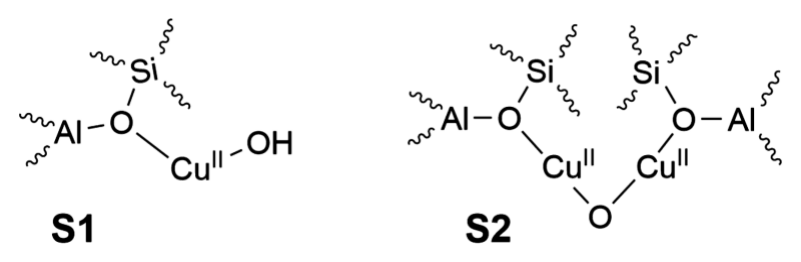
6.1 Give the number of S1 sites and the number of S2 sites required to oxidize one methane molecule to methanol.
In the absence of oxygen, the methanol formed does not desorb from zeolite. If the reaction is performed in a container with constant volume and temperature (an autoclave), a pressure-drop results only from the consumption of methane, which can be considered as an ideal gas. In a 1 L autoclave containing 200 mg of zeolite loaded with 4.3 % wt. copper, the initial methane pressure \(p_0 = 933\ \mathrm{Pa}\) dropped to \(p_\infty = 925\ \mathrm{Pa}\) after completion of the reaction at 528 K.
6.2 Calculate the percentage of copper that reacted.
6.3 Experimental data are plotted in Figure 1. Based on this, decide on the (pseudo) order of the oxidation of \(\ce{CH4}\).
(a) The reaction is of (pseudo) zeroth order.
(b) The reaction is of (pseudo) first order.
(c) The reaction is of (pseudo) second order.
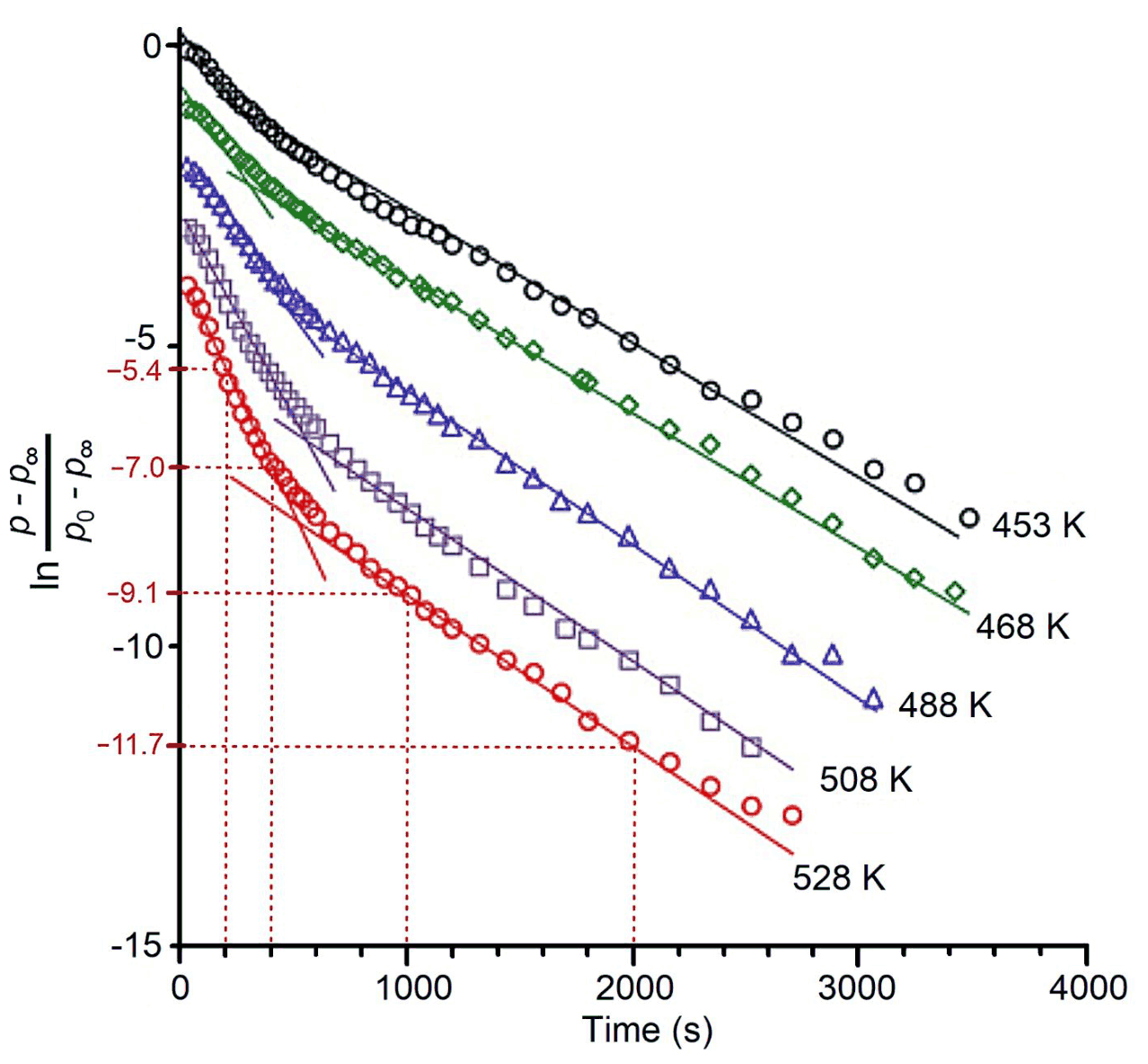
Figure 1. Semi-logarithmic graph of normalized methane pressure versus time for the reaction with copper-loaded zeolite containing sites S1 and S2 in an autoclave at various temperatures. The symbols denote experimental data points. The solid lines are linear fits to appropriate time ranges. The dotted lines are guides for the eyes
6.4 Write down the (pseudo) rate law for the oxidation of \(\ce{CH4}\) that is consistent with the experimental data under the given conditions. Note that it may depend on the concentrations of \(\ce{CH4}\) as well as of sites S1 and S2 and on the rate constants.
6.5 Choose the correct statement(s).
(a) At least two types of copper sites react, each with a different rate constant.
(b) The overall methane oxidation by zeolite is faster at higher temperature.
(c) At higher temperature, a larger fraction of the copper sites will have reacted with methane after completion of the reaction.
(d) One of the reactions becomes slower at higher temperature.
Paramagnetic sites S1 can be observed by electron paramagnetic resonance (EPR) spectroscopy, whereas diamagnetic sites S2 do not give an EPR signal. EPR spectroscopy measures the number of electron spins. Thus, the number of S1 sites is proportional to the double integral \(I_2\) of the EPR spectrum, i.e. \([\mathbf{S1}] \propto I_2\). Spectra were measured at different temperatures \(T\) and at each temperature at different times, \(t\), after initiating the reaction.
6.6 Derive the equation, which is linear in time, that relates \(I_2(t)\) to the rate constant for the loss of S1 sites.
6.7 Tick the boxes on the answer sheet for each measurement that needs to be calibrated with a known Cu(II) standard.
(a) Total number of paramagnetic Cu(II) sites in the sample.
(b) Concentration of paramagnetic Cu(II) sites in the sample.
(c) Rate constant.
(d) Types of different paramagnetic Cu(II) species in the sample.
From EPR measurements, it is known that the rate constant for the reaction with S1 sites at 528 K is \(2.604 \times 10^{-3}\ \mathrm{s^{-1}}\).
6.8 Considering Figure 1 and based on a calculation, decide if methane reacts faster or slower with S2 sites than with S1 sites.
(a) Methane reacts faster with S1.
(b) Both reaction rates are the same.
(c) Methane reacts faster with S2.
Methanol can be further converted into valuable olefins with different zeolite catalysts. In this process, one observes an intermediate product with molar mass \(86.09\ \mathrm{g\,mol^{-1}}\), elemental analysis (55.8 % wt. \(\ce{C}\), 7.0 % wt. \(\ce{H}\)) and an \({}^{1}\mathrm{H}\) NMR spectrum consisting of signals at four different chemical shifts:
a: 12.2 ppm (1H, s), broad, disappears when \(\ce{D2O}\) is added
b: 6.3 ppm (1H, d)
c: 5.7 ppm (1H, d)
d: 2.0 ppm (3H, s)
6.9 Draw the structure of the intermediate product and assign protons a and d.
The United States Department of Energy assigned twelve chemical compounds only containing \(\ce{C}\), \(\ce{H}\) and \(\ce{O}\) as platform chemicals. These are the most promising candidates, easy to prepare from renewable resources and with multiple target derivatives to be prepared from them. One of them is compound A, that can either be further derivatized or used for example in medicinal applications or in detergents.
- \({}^{1}\mathrm{H}\) NMR in DMSO: 7.81 ppm (a, s), 13.0 ppm (b, s, broad, disappears when \(\ce{D2O}\) is added), both signals have the same integral.
- \({}^{13}\mathrm{C}\) NMR: 165.1 ppm (1), 150.6 ppm (2) and 120.6 ppm (3).
- \(M = 156.03\ \mathrm{g\,mol^{-1}}\). Elemental analysis: 46.15 % wt. \(\ce{C}\), 2.56 % wt. \(\ce{H}\).
6.10 Give a possible structure of A and assign all protons and carbon 1.
Official English text of the problem.
Answers
- 6.1: 2 S1 sites or 1 S2 site per methane molecule.
- 6.2: \(2.7\%\) of the copper reacted.
- 6.3: (b) — (pseudo) first order.
- 6.4: With \(k_i\) defined as the first-order disappearance constant of site population \(i\), \[ -\frac{d[\ce{CH4}]}{dt} =\frac{k_1}{2}[\mathbf{S1}]+k_2[\mathbf{S2}]. \]
- 6.5: (a) and (b).
- 6.6: \[ \boxed{\ln\!\left(\frac{I_2(t)}{I_2(0)}\right)=-k_1t}. \]
- 6.7: (a) and (b).
- 6.8: (c) — methane reacts faster with S2. The slow and fast graphical decay constants are approximately \(2.6\times10^{-3}\) and \(8.0\times10^{-3}\ \mathrm{s^{-1}}\), respectively.
- 6.9: Methacrylic acid (2-methylprop-2-enoic acid),
C=C(C)C(=O)O. Proton a is the carboxylic acid proton; d denotes the three methyl protons. - 6.10: Furan-2,5-dicarboxylic acid,
O=C(O)c1ccc(C(=O)O)o1. Protons a are the two ring hydrogens at positions 3 and 4; b are the two carboxylic acid protons. Carbon signal 1 represents both carboxyl carbonyl carbons.
Solution
6.1
Methane, C, is oxidized to methanol, CO. The carbon oxidation number changes from \(-4\) in \(\ce{CH4}\) to \(-2\) in \(\ce{CH3OH}\), corresponding to the loss of two electrons per methane molecule.
Each copper atom accepts one electron when Cu(II) is reduced to Cu(I). Therefore, two copper atoms must be reduced per methane molecule:
- S1 contains one copper atom, so two S1 sites are required.
- S2 contains two copper atoms, so one S2 site is required.
After including catalyst regeneration, the balanced overall conversion is
\[ \ce{2CH4 + O2 -> 2CH3OH}, \]
where molecular oxygen has SMILES O=O.
6.2
Because methanol remains adsorbed, the decrease in gas amount equals the amount of methane consumed. Using \(R=8.314\ \mathrm{Pa\,m^3\,mol^{-1}\,K^{-1}}\),
\[ \begin{aligned} n_{\ce{CH4},\mathrm{reacted}} &=\frac{(p_0-p_\infty)V}{RT}\\ &=\frac{(933-925)\ \mathrm{Pa}\times1.00\times10^{-3}\ \mathrm{m^3}} {8.314\ \mathrm{Pa\,m^3\,mol^{-1}\,K^{-1}}\times528\ \mathrm{K}}\\ &=1.82\times10^{-6}\ \mathrm{mol}. \end{aligned} \]
The initial copper mass is
\[ m_{\ce{Cu}}=200\ \mathrm{mg}\times0.043 =8.6\ \mathrm{mg}. \]
Using \(M(\ce{Cu})=63.55\ \mathrm{g\,mol^{-1}}\),
\[ n_{\ce{Cu},0} =\frac{8.6\times10^{-3}\ \mathrm{g}} {63.55\ \mathrm{g\,mol^{-1}}} =1.35\times10^{-4}\ \mathrm{mol}. \]
Two copper atoms react per methane molecule, regardless of which site type is involved:
\[ n_{\ce{Cu},\mathrm{reacted}} =2n_{\ce{CH4},\mathrm{reacted}} =3.64\times10^{-6}\ \mathrm{mol}. \]
Thus,
\[ \boxed{ \text{Copper reacted} =\frac{3.64\times10^{-6}}{1.35\times10^{-4}}\times100\% \approx2.7\%. } \]
6.3
Define the normalized remaining pressure change as
\[ q(t)=\frac{p(t)-p_\infty}{p_0-p_\infty}. \]
For a single first-order contribution,
\[ q(t)=e^{-kt}, \qquad \ln q(t)=-kt. \]
Thus, first-order behavior produces a straight line on the given semilogarithmic plot. The two slope regimes indicate two kinetic contributions, each consistent with pseudo-first-order decay.
The correct choice is (b).
6.4
The methane concentration changes by only
\[ \frac{933-925}{933}\times100\%=0.86\%. \]
It can therefore be treated as approximately constant while the reactive copper sites are consumed.
Define \(k_1\) and \(k_2\) by the disappearance of the respective site populations:
\[ -\frac{d[\mathbf{S1}]}{dt}=k_1[\mathbf{S1}], \qquad -\frac{d[\mathbf{S2}]}{dt}=k_2[\mathbf{S2}]. \]
Expressing the amounts per common fixed volume, the stoichiometry from 6.1 gives
\[ -\frac{d[\ce{CH4}]}{dt} =-\frac12\frac{d[\mathbf{S1}]}{dt} -\frac{d[\mathbf{S2}]}{dt}. \]
Hence,
\[ \boxed{ -\frac{d[\ce{CH4}]}{dt} =\frac12 k_1[\mathbf{S1}]+k_2[\mathbf{S2}]. } \]
The factor \(1/2\) accounts for the consumption of two S1 sites per methane molecule. Equivalently, if the constants are defined directly for methane consumption,
\[ v=k'_1[\mathbf{S1}]+k'_2[\mathbf{S2}], \qquad k'_1=\frac{k_1}{2},\quad k'_2=k_2. \]
Any dependence on the approximately constant methane concentration is incorporated into these pseudo-first-order constants. For example, an underlying site-disappearance law \(K_i[\ce{CH4}][\mathbf{S}i]\) would give \(k_i=K_i[\ce{CH4}]_0\). The present experiment does not independently establish the intrinsic order in methane.
To connect this law to Figure 1, let \(S_{1,0}\) and \(S_{2,0}\) denote the initial concentrations of reactive sites. The remaining methane uptake capacity is
\[ [\ce{CH4}](t)-[\ce{CH4}]_\infty =\frac12S_{1,0}e^{-k_1t}+S_{2,0}e^{-k_2t}. \]
Consequently,
\[ \boxed{ q(t)= \frac{\frac12S_{1,0}e^{-k_1t}+S_{2,0}e^{-k_2t}} {\frac12S_{1,0}+S_{2,0}}. } \]
This sum of two exponentials explains the changing slope and the eventual dominance of the slower population.
6.5
- (a) Correct. The two slope regimes are consistent with two site populations having different rate constants.
- (b) Correct. The fitted slopes become more negative at higher temperature, indicating faster consumption of the reactive sites and methane.
- (c) Not supported. The pressure change is normalized by its final magnitude. This removes the information needed to compare the absolute fractions of copper that eventually react at different temperatures.
- (d) Incorrect. Both fitted kinetic regimes become faster as temperature increases.
Therefore, select (a) and (b).
6.6
At a fixed temperature and under fixed measurement conditions,
\[ I_2(t)=\alpha[\mathbf{S1}](t), \]
where \(\alpha\) is a constant instrumental proportionality factor.
Integrating the first-order site-loss equation gives
\[ \int_{[\mathbf{S1}]_0}^{[\mathbf{S1}](t)} \frac{d[\mathbf{S1}]}{[\mathbf{S1}]} =-k_1\int_0^t dt, \]
so
\[ \ln\!\left( \frac{[\mathbf{S1}](t)}{[\mathbf{S1}]_0} \right)=-k_1t. \]
Substituting the EPR intensities cancels \(\alpha\):
\[ \boxed{ \ln\!\left(\frac{I_2(t)}{I_2(0)}\right)=-k_1t. } \]
Plotting this logarithmic ratio against time gives a straight line with slope \(-k_1\).
6.7
A known Cu(II) standard determines the conversion between integrated EPR signal intensity and the absolute number of spins.
Therefore, calibration is needed for:
- (a) the total number of paramagnetic Cu(II) sites;
- (b) their concentration.
For (c), the unknown intensity calibration factor cancels in \(I_2(t)/I_2(0)\), so the rate constant can be obtained without absolute calibration.
For (d), different paramagnetic species are distinguished through spectral features such as resonance positions and hyperfine patterns; absolute spin-count calibration is unnecessary.
Select (a) and (b).
6.8
At 528 K, the late-time fitted segment passes approximately through
\[ (t,y)=(1000\ \mathrm{s},-9.1) \quad\text{and}\quad (2000\ \mathrm{s},-11.7), \]
where \(y=\ln q\). Its decay constant is
\[ \begin{aligned} k_{\mathrm{slow}} &\simeq-\frac{(-11.7)-(-9.1)} {(2000-1000)\ \mathrm{s}}\\ &=2.6\times10^{-3}\ \mathrm{s^{-1}}. \end{aligned} \]
This agrees with the EPR value
\[ k_1=2.604\times10^{-3}\ \mathrm{s^{-1}}, \]
so the slow population is S1.
For the early, steeper segment, the dotted guides give approximately
\[ (t,y)=(200\ \mathrm{s},-5.4) \quad\text{and}\quad (400\ \mathrm{s},-7.0). \]
Thus,
\[ \begin{aligned} k_{\mathrm{fast,app}} &\simeq-\frac{(-7.0)-(-5.4)} {(400-200)\ \mathrm{s}}\\ &=8.0\times10^{-3}\ \mathrm{s^{-1}}. \end{aligned} \]
The second population must therefore be faster than S1:
\[ \boxed{\text{Methane reacts faster with S2: choice (c).}} \]
If S2 dominates the early fitted segment, this gives \(k_2\approx8.0\times10^{-3}\ \mathrm{s^{-1}}\), approximately \(3.1k_1\). The exact separation of the two contributions is unnecessary for deciding which is faster.
6.9
The oxygen mass fraction is
\[ 100.0-55.8-7.0=37.2\%. \]
Combining the elemental analysis with the molar mass gives the approximate numbers of atoms per molecule:
\[ N_{\ce{C}} =\frac{0.558(86.09)}{12.01}\approx4, \]
\[ N_{\ce{H}} =\frac{0.070(86.09)}{1.008}\approx6, \]
\[ N_{\ce{O}} =\frac{0.372(86.09)}{16.00}\approx2. \]
The molecular formula is therefore
\[ \boxed{\ce{C4H6O2}}. \]
Its degree of unsaturation is
\[ \mathrm{DBE}=\frac{2(4)+2-6}{2}=2. \]
The broad, exchangeable signal at 12.2 ppm identifies a carboxylic acid proton. The carboxyl carbonyl accounts for one degree of unsaturation.
The two signals at 6.3 and 5.7 ppm, each integrating to one proton, indicate two nonequivalent terminal alkene hydrogens. The 2.0 ppm singlet integrating to three protons is a methyl group attached to the substituted alkene carbon.
These features give methacrylic acid (2-methylprop-2-enoic acid):
\[ \boxed{\ce{CH2=C(CH3)-C(=O)-OH}} \]
SMILES: C=C(C)C(=O)O.
To draw it, place a terminal methylene group double-bonded to a carbon bearing both a methyl group and a carboxylic acid group.
The assignments are:
- a, 12.2 ppm: the carboxylic acid \(\ce{O-H}\) proton.
- d, 2.0 ppm: the three protons of the methyl group attached to the alkene carbon.
The two terminal methylene hydrogens are chemically nonequivalent and can split each other through geminal coupling, accounting for signals b and c. The terminal alkene has no \(E/Z\) configuration.
6.10
The oxygen mass fraction is
\[ 100.00-46.15-2.56=51.29\%. \]
The approximate atom counts are
\[ N_{\ce{C}} =\frac{0.4615(156.03)}{12.01}\approx6, \]
\[ N_{\ce{H}} =\frac{0.0256(156.03)}{1.008}\approx4, \]
\[ N_{\ce{O}} =\frac{0.5129(156.03)}{16.00}\approx5. \]
Thus,
\[ \boxed{\ce{C6H4O5}}, \qquad \mathrm{DBE}=\frac{2(6)+2-4}{2}=5. \]
The two proton signals have equal integrals. With four hydrogens in total, each signal represents two hydrogens.
The broad signal at 13.0 ppm indicates two equivalent carboxylic acid protons. Two carboxyl groups account for four oxygen atoms, two carbon atoms, and two degrees of unsaturation. The remaining fragment contains four carbons and one oxygen, with three degrees of unsaturation: a ring and two double bonds.
A symmetric furan ring bearing two equivalent carboxyl groups satisfies these requirements. A suitable structure is furan-2,5-dicarboxylic acid:
SMILES: O=C(O)c1ccc(C(=O)O)o1.
Draw a five-membered aromatic furan ring, numbering its oxygen as position 1. Attach a carboxylic acid group to each adjacent carbon, positions 2 and 5. The remaining ring carbons, positions 3 and 4, each bear one hydrogen.
The requested assignments are:
- a, 7.81 ppm: the two equivalent ring hydrogens at positions 3 and 4. Equivalent hydrogens do not split each other, consistent with the singlet.
- b, 13.0 ppm: the two equivalent carboxylic acid \(\ce{O-H}\) protons.
- Carbon signal 1, 165.1 ppm: the two equivalent carboxyl carbonyl carbons.
The remaining carbon signals are also consistent:
- 150.6 ppm, signal 2: ring carbons 2 and 5, directly bonded to the ring oxygen and bearing the carboxyl substituents.
- 120.6 ppm, signal 3: proton-bearing ring carbons 3 and 4.
The solution was checked against the official solution.
IChO 2023 · Theorieaufgabe 6
Direkte Umwandlung von Methan zu Methanol
Methan ist als Erdgas in großem Umfang verfügbar und daher ein attraktiver Rohstoff für die chemische Industrie, beispielsweise zur Herstellung von Methanol. Die Kontrolle dieses Prozesses ist jedoch schwierig, da Methanol leichter oxidiert wird als Methan. Eine Überoxidation wird durch ein chemisches Kreislaufverfahren vermieden, bei dem aktive Zentren kupferausgetauschter Zeolithkatalysatoren nur das einzelne Sauerstoffatom bereitstellen, das für die Oxidation zu Methanol benötigt wird, und dabei verbraucht werden. In einem zweiten Schritt wird der Katalysator in Abwesenheit von Methan mit Sauerstoff regeneriert. Das folgende Schema zeigt zwei mögliche katalytische Kupferzentren. Während der Reaktion wird Cu(II) zu Cu(I) reduziert.
6.1 Geben Sie die Anzahl der S1-Zentren und die Anzahl der S2-Zentren an, die benötigt werden, um ein Methanmolekül zu Methanol zu oxidieren.
In Abwesenheit von Sauerstoff desorbiert das gebildete Methanol nicht vom Zeolith. Wird die Reaktion in einem Behälter bei konstantem Volumen und konstanter Temperatur (einem Autoklaven) durchgeführt, ergibt sich ein Druckabfall ausschließlich aus dem Verbrauch von Methan, das als ideales Gas betrachtet werden kann. In einem 1-L-Autoklaven mit 200 mg Zeolith, der mit 4.3 Massen-% Kupfer beladen war, sank der anfängliche Methandruck \(p_0 = 933\ \mathrm{Pa}\) nach Abschluss der Reaktion bei 528 K auf \(p_\infty = 925\ \mathrm{Pa}\).
6.2 Berechnen Sie den prozentualen Anteil des Kupfers, der reagiert hat.
6.3 In Abbildung 1 sind experimentelle Daten dargestellt. Entscheiden Sie anhand dieser Daten über die (Pseudo-)Reaktionsordnung der Oxidation von \(\ce{CH4}\).
(a) Die Reaktion ist von (pseudo-)nullter Ordnung.
(b) Die Reaktion ist von (pseudo-)erster Ordnung.
(c) Die Reaktion ist von (pseudo-)zweiter Ordnung.
Abbildung 1. Halblogarithmische Darstellung des normierten Methandrucks gegen die Zeit für die Reaktion mit kupferbeladenem Zeolith, der die Zentren S1 und S2 enthält, in einem Autoklaven bei verschiedenen Temperaturen. Die Symbole kennzeichnen experimentelle Datenpunkte. Die durchgezogenen Linien sind lineare Anpassungen an geeignete Zeitbereiche. Die gepunkteten Linien dienen der visuellen Orientierung
6.4 Geben Sie das (Pseudo-)Geschwindigkeitsgesetz für die Oxidation von \(\ce{CH4}\) an, das unter den gegebenen Bedingungen mit den experimentellen Daten übereinstimmt. Beachten Sie, dass es sowohl von den Konzentrationen von \(\ce{CH4}\) und der Zentren S1 und S2 als auch von den Geschwindigkeitskonstanten abhängen kann.
6.5 Wählen Sie die richtige(n) Aussage(n) aus.
(a) Mindestens zwei Arten von Kupferzentren reagieren, jeweils mit einer unterschiedlichen Geschwindigkeitskonstante.
(b) Die gesamte Methanoxidation durch den Zeolith verläuft bei höherer Temperatur schneller.
(c) Bei höherer Temperatur hat nach Abschluss der Reaktion ein größerer Anteil der Kupferzentren mit Methan reagiert.
(d) Eine der Reaktionen wird bei höherer Temperatur langsamer.
Paramagnetische S1-Zentren können mittels Elektronenparamagnetischer Resonanzspektroskopie (EPR-Spektroskopie) beobachtet werden, während diamagnetische S2-Zentren kein EPR-Signal liefern. Die EPR-Spektroskopie misst die Anzahl der Elektronenspins. Daher ist die Anzahl der S1-Zentren proportional zum Doppelintegral \(I_2\) des EPR-Spektrums, d. h. \([\mathbf{S1}] \propto I_2\). Die Spektren wurden bei verschiedenen Temperaturen \(T\) und bei jeder Temperatur zu verschiedenen Zeiten \(t\) nach Beginn der Reaktion gemessen.
6.6 Leiten Sie die in der Zeit lineare Gleichung her, die \(I_2(t)\) mit der Geschwindigkeitskonstante für die Abnahme der S1-Zentren verknüpft.
6.7 Kreuzen Sie auf dem Antwortbogen die Kästchen für jede Messung an, die mit einem bekannten Cu(II)-Standard kalibriert werden muss.
(a) Gesamtzahl der paramagnetischen Cu(II)-Zentren in der Probe.
(b) Konzentration der paramagnetischen Cu(II)-Zentren in der Probe.
(c) Geschwindigkeitskonstante.
(d) Arten der verschiedenen paramagnetischen Cu(II)-Spezies in der Probe.
Aus EPR-Messungen ist bekannt, dass die Geschwindigkeitskonstante für die Reaktion mit S1-Zentren bei 528 K \(2.604 \times 10^{-3}\ \mathrm{s^{-1}}\) beträgt.
6.8 Entscheiden Sie unter Berücksichtigung von Abbildung 1 und anhand einer Berechnung, ob Methan mit S2-Zentren schneller oder langsamer reagiert als mit S1-Zentren.
(a) Methan reagiert schneller mit S1.
(b) Beide Reaktionsgeschwindigkeiten sind gleich.
(c) Methan reagiert schneller mit S2.
Methanol kann mit verschiedenen Zeolithkatalysatoren zu wertvollen Olefinen weiterverarbeitet werden. Bei diesem Prozess beobachtet man ein Zwischenprodukt mit einer molaren Masse von \(86.09\ \mathrm{g\,mol^{-1}}\), einer Elementaranalyse (55.8 Massen-% \(\ce{C}\), 7.0 Massen-% \(\ce{H}\)) und einem \({}^{1}\mathrm{H}\)-NMR-Spektrum mit Signalen bei vier verschiedenen chemischen Verschiebungen:
a: 12.2 ppm (1H, s), breit, verschwindet bei Zugabe von \(\ce{D2O}\)
b: 6.3 ppm (1H, d)
c: 5.7 ppm (1H, d)
d: 2.0 ppm (3H, s)
6.9 Zeichnen Sie die Struktur des Zwischenprodukts und ordnen Sie die Protonen a und d zu.
Das Energieministerium der Vereinigten Staaten hat zwölf chemische Verbindungen, die ausschließlich \(\ce{C}\), \(\ce{H}\) und \(\ce{O}\) enthalten, als Plattformchemikalien eingestuft. Diese sind die vielversprechendsten Kandidaten, die sich leicht aus nachwachsenden Rohstoffen herstellen lassen und aus denen zahlreiche Zielderivate hergestellt werden können. Eine davon ist die Verbindung A, die entweder weiter derivatisiert oder beispielsweise für medizinische Anwendungen oder in Waschmitteln verwendet werden kann.
- \({}^{1}\mathrm{H}\)-NMR in DMSO: 7.81 ppm (a, s), 13.0 ppm (b, s, breit, verschwindet bei Zugabe von \(\ce{D2O}\)), beide Signale haben das gleiche Integral.
- \({}^{13}\mathrm{C}\)-NMR: 165.1 ppm (1), 150.6 ppm (2) und 120.6 ppm (3).
- \(M = 156.03\ \mathrm{g\,mol^{-1}}\). Elementaranalyse: 46.15 Massen-% \(\ce{C}\), 2.56 Massen-% \(\ce{H}\).
6.10 Geben Sie eine mögliche Struktur von A an und ordnen Sie alle Protonen sowie das Kohlenstoffatom 1 zu.
Aufgabentext aus dem offiziellen englischen Text übersetzt.
Antworten
- 6.1: 2 S1-Zentren oder 1 S2-Zentrum pro Methanmolekül.
- 6.2: \(2.7\%\) des Kupfers haben reagiert.
- 6.3: (b) — (pseudo-)erste Ordnung.
- 6.4: Wenn \(k_i\) als Geschwindigkeitskonstante erster Ordnung für die Abnahme der Zentrenpopulation \(i\) definiert ist, \[ -\frac{d[\ce{CH4}]}{dt} =\frac{k_1}{2}[\mathbf{S1}]+k_2[\mathbf{S2}]. \]
- 6.5: (a) und (b).
- 6.6: \[ \boxed{\ln\!\left(\frac{I_2(t)}{I_2(0)}\right)=-k_1t}. \]
- 6.7: (a) und (b).
- 6.8: (c) — Methan reagiert schneller mit S2. Die grafisch ermittelten langsamen und schnellen Abklingkonstanten betragen etwa \(2.6\times10^{-3}\) bzw. \(8.0\times10^{-3}\ \mathrm{s^{-1}}\).
- 6.9: Methacrylsäure (2-Methylprop-2-ensäure),
C=C(C)C(=O)O. Proton a ist das Carbonsäureproton; d bezeichnet die drei Methylprotonen. - 6.10: Furan-2,5-dicarbonsäure,
O=C(O)c1ccc(C(=O)O)o1. Die Protonen a sind die beiden Ringwasserstoffatome an den Positionen 3 und 4; b sind die beiden Carbonsäureprotonen. Das Kohlenstoffsignal 1 entspricht beiden Carbonylkohlenstoffatomen der Carboxylgruppen.
Lösung
6.1
Methan, C, wird zu Methanol, CO, oxidiert. Die Oxidationszahl des Kohlenstoffs ändert sich von \(-4\) in \(\ce{CH4}\) zu \(-2\) in \(\ce{CH3OH}\), was der Abgabe von zwei Elektronen pro Methanmolekül entspricht.
Jedes Kupferatom nimmt ein Elektron auf, wenn Cu(II) zu Cu(I) reduziert wird. Daher müssen pro Methanmolekül zwei Kupferatome reduziert werden:
- S1 enthält ein Kupferatom, daher werden zwei S1-Zentren benötigt.
- S2 enthält zwei Kupferatome, daher wird ein S2-Zentrum benötigt.
Unter Einbeziehung der Katalysatorregeneration lautet die ausgeglichene Gesamtreaktion
\[ \ce{2CH4 + O2 -> 2CH3OH}, \]
wobei molekularer Sauerstoff die SMILES-Darstellung O=O hat.
6.2
Da Methanol adsorbiert bleibt, entspricht die Abnahme der Gasstoffmenge der Stoffmenge des verbrauchten Methans. Mit \(R=8.314\ \mathrm{Pa\,m^3\,mol^{-1}\,K^{-1}}\) ergibt sich
\[ \begin{aligned} n_{\ce{CH4},\mathrm{reacted}} &=\frac{(p_0-p_\infty)V}{RT}\\ &=\frac{(933-925)\ \mathrm{Pa}\times1.00\times10^{-3}\ \mathrm{m^3}} {8.314\ \mathrm{Pa\,m^3\,mol^{-1}\,K^{-1}}\times528\ \mathrm{K}}\\ &=1.82\times10^{-6}\ \mathrm{mol}. \end{aligned} \]
Die anfängliche Kupfermasse beträgt
\[ m_{\ce{Cu}}=200\ \mathrm{mg}\times0.043 =8.6\ \mathrm{mg}. \]
Mit \(M(\ce{Cu})=63.55\ \mathrm{g\,mol^{-1}}\) ergibt sich
\[ n_{\ce{Cu},0} =\frac{8.6\times10^{-3}\ \mathrm{g}} {63.55\ \mathrm{g\,mol^{-1}}} =1.35\times10^{-4}\ \mathrm{mol}. \]
Pro Methanmolekül reagieren zwei Kupferatome, unabhängig davon, welche Art von Zentrum beteiligt ist:
\[ n_{\ce{Cu},\mathrm{reacted}} =2n_{\ce{CH4},\mathrm{reacted}} =3.64\times10^{-6}\ \mathrm{mol}. \]
Somit gilt
\[ \boxed{ \text{Umgesetztes Kupfer} =\frac{3.64\times10^{-6}}{1.35\times10^{-4}}\times100\% \approx2.7\%. } \]
6.3
Die normierte verbleibende Druckänderung wird definiert als
\[ q(t)=\frac{p(t)-p_\infty}{p_0-p_\infty}. \]
Für einen einzelnen Beitrag erster Ordnung gilt
\[ q(t)=e^{-kt}, \qquad \ln q(t)=-kt. \]
Ein Verhalten erster Ordnung ergibt somit in der gegebenen halblogarithmischen Darstellung eine Gerade. Die beiden Bereiche unterschiedlicher Steigung weisen auf zwei kinetische Beiträge hin, die jeweils mit einer Abnahme nach pseudo-erster Ordnung vereinbar sind.
Die richtige Antwort ist (b).
6.4
Die Methankonzentration ändert sich nur um
\[ \frac{933-925}{933}\times100\%=0.86\%. \]
Sie kann daher als näherungsweise konstant betrachtet werden, während die reaktiven Kupferzentren verbraucht werden.
Wir definieren \(k_1\) und \(k_2\) über die Abnahme der jeweiligen Zentrenpopulationen:
\[ -\frac{d[\mathbf{S1}]}{dt}=k_1[\mathbf{S1}], \qquad -\frac{d[\mathbf{S2}]}{dt}=k_2[\mathbf{S2}]. \]
Werden die Stoffmengen auf ein gemeinsames konstantes Volumen bezogen, ergibt sich aus der Stöchiometrie aus 6.1
\[ -\frac{d[\ce{CH4}]}{dt} =-\frac12\frac{d[\mathbf{S1}]}{dt} -\frac{d[\mathbf{S2}]}{dt}. \]
Daraus folgt
\[ \boxed{ -\frac{d[\ce{CH4}]}{dt} =\frac12 k_1[\mathbf{S1}]+k_2[\mathbf{S2}]. } \]
Der Faktor \(1/2\) berücksichtigt den Verbrauch von zwei S1-Zentren pro Methanmolekül. Gleichwertig gilt bei einer direkten Definition der Konstanten für den Methanverbrauch
\[ v=k'_1[\mathbf{S1}]+k'_2[\mathbf{S2}], \qquad k'_1=\frac{k_1}{2},\quad k'_2=k_2. \]
Jede Abhängigkeit von der näherungsweise konstanten Methankonzentration ist in diesen Geschwindigkeitskonstanten pseudo-erster Ordnung enthalten. Beispielsweise würde ein zugrunde liegendes Geschwindigkeitsgesetz \(K_i[\ce{CH4}][\mathbf{S}i]\) für die Abnahme der Zentren zu \(k_i=K_i[\ce{CH4}]_0\) führen. Das vorliegende Experiment bestimmt die intrinsische Reaktionsordnung bezüglich Methan nicht unabhängig.
Um dieses Gesetz mit Abbildung 1 zu verknüpfen, seien \(S_{1,0}\) und \(S_{2,0}\) die Anfangskonzentrationen der reaktiven Zentren. Die verbleibende Methanaufnahmekapazität beträgt
\[ [\ce{CH4}](t)-[\ce{CH4}]_\infty =\frac12S_{1,0}e^{-k_1t}+S_{2,0}e^{-k_2t}. \]
Folglich gilt
\[ \boxed{ q(t)= \frac{\frac12S_{1,0}e^{-k_1t}+S_{2,0}e^{-k_2t}} {\frac12S_{1,0}+S_{2,0}}. } \]
Diese Summe zweier Exponentialfunktionen erklärt die sich ändernde Steigung und die schließlich eintretende Dominanz der langsamer reagierenden Population.
6.5
- (a) Richtig. Die beiden Bereiche unterschiedlicher Steigung sind mit zwei Zentrenpopulationen mit unterschiedlichen Geschwindigkeitskonstanten vereinbar.
- (b) Richtig. Die angepassten Steigungen werden bei höherer Temperatur negativer, was auf einen schnelleren Verbrauch der reaktiven Zentren und des Methans hinweist.
- (c) Nicht belegt. Die Druckänderung wird auf ihren endgültigen Betrag normiert. Dadurch geht die Information verloren, die benötigt wird, um die absoluten Anteile des Kupfers zu vergleichen, die bei verschiedenen Temperaturen letztlich reagieren.
- (d) Falsch. Beide angepassten kinetischen Bereiche werden mit steigender Temperatur schneller.
Daher sind (a) und (b) auszuwählen.
6.6
Bei einer festen Temperatur und unter festen Messbedingungen gilt
\[ I_2(t)=\alpha[\mathbf{S1}](t), \]
wobei \(\alpha\) ein konstanter instrumenteller Proportionalitätsfaktor ist.
Die Integration der Gleichung erster Ordnung für die Abnahme der Zentren ergibt
\[ \int_{[\mathbf{S1}]_0}^{[\mathbf{S1}](t)} \frac{d[\mathbf{S1}]}{[\mathbf{S1}]} =-k_1\int_0^t dt, \]
also
\[ \ln\!\left( \frac{[\mathbf{S1}](t)}{[\mathbf{S1}]_0} \right)=-k_1t. \]
Beim Einsetzen der EPR-Intensitäten kürzt sich \(\alpha\) heraus:
\[ \boxed{ \ln\!\left(\frac{I_2(t)}{I_2(0)}\right)=-k_1t. } \]
Die Auftragung dieses logarithmierten Verhältnisses gegen die Zeit ergibt eine Gerade mit der Steigung \(-k_1\).
6.7
Ein bekannter Cu(II)-Standard bestimmt den Umrechnungsfaktor zwischen der integrierten EPR-Signalintensität und der absoluten Anzahl der Spins.
Daher ist eine Kalibrierung erforderlich für:
- (a) die Gesamtzahl der paramagnetischen Cu(II)-Zentren;
- (b) deren Konzentration.
Bei (c) kürzt sich der unbekannte Intensitätskalibrierfaktor in \(I_2(t)/I_2(0)\) heraus, sodass die Geschwindigkeitskonstante ohne absolute Kalibrierung bestimmt werden kann.
Bei (d) werden verschiedene paramagnetische Spezies anhand spektraler Merkmale wie Resonanzlagen und Hyperfeinstrukturen unterschieden; eine Kalibrierung der absoluten Spinzahl ist nicht erforderlich.
Es sind (a) und (b) auszuwählen.
6.8
Bei 528 K verläuft der für späte Zeiten angepasste Abschnitt näherungsweise durch
\[ (t,y)=(1000\ \mathrm{s},-9.1) \quad\text{und}\quad (2000\ \mathrm{s},-11.7), \]
wobei \(y=\ln q\) ist. Seine Abklingkonstante beträgt
\[ \begin{aligned} k_{\mathrm{slow}} &\simeq-\frac{(-11.7)-(-9.1)} {(2000-1000)\ \mathrm{s}}\\ &=2.6\times10^{-3}\ \mathrm{s^{-1}}. \end{aligned} \]
Dies stimmt mit dem EPR-Wert
\[ k_1=2.604\times10^{-3}\ \mathrm{s^{-1}}, \]
überein, sodass die langsam reagierende Population S1 ist.
Für den frühen, steileren Abschnitt liefern die gepunkteten Hilfslinien näherungsweise
\[ (t,y)=(200\ \mathrm{s},-5.4) \quad\text{und}\quad (400\ \mathrm{s},-7.0). \]
Somit gilt
\[ \begin{aligned} k_{\mathrm{fast,app}} &\simeq-\frac{(-7.0)-(-5.4)} {(400-200)\ \mathrm{s}}\\ &=8.0\times10^{-3}\ \mathrm{s^{-1}}. \end{aligned} \]
Die zweite Population muss daher schneller reagieren als S1:
\[ \boxed{\text{Methan reagiert schneller mit S2: Antwort (c).}} \]
Wenn S2 den frühen angepassten Abschnitt dominiert, ergibt sich daraus \(k_2\approx8.0\times10^{-3}\ \mathrm{s^{-1}}\), also etwa \(3.1k_1\). Eine exakte Trennung der beiden Beiträge ist für die Entscheidung, welcher schneller ist, nicht erforderlich.
6.9
Der Massenanteil des Sauerstoffs beträgt
\[ 100.0-55.8-7.0=37.2\%. \]
Die Kombination der Elementaranalyse mit der molaren Masse liefert die näherungsweisen Anzahlen der Atome pro Molekül:
\[ N_{\ce{C}} =\frac{0.558(86.09)}{12.01}\approx4, \]
\[ N_{\ce{H}} =\frac{0.070(86.09)}{1.008}\approx6, \]
\[ N_{\ce{O}} =\frac{0.372(86.09)}{16.00}\approx2. \]
Die Summenformel lautet daher
\[ \boxed{\ce{C4H6O2}}. \]
Der Ungesättigtheitsgrad beträgt
\[ \mathrm{DBE}=\frac{2(4)+2-6}{2}=2. \]
Das breite, austauschbare Signal bei 12.2 ppm kennzeichnet ein Carbonsäureproton. Die Carbonylgruppe der Carboxylgruppe entspricht einem Ungesättigtheitsgrad.
Die beiden Signale bei 6.3 und 5.7 ppm, deren Integrale jeweils einem Proton entsprechen, weisen auf zwei nicht äquivalente terminale Alkenwasserstoffatome hin. Das Singulett bei 2.0 ppm mit einem Integral entsprechend drei Protonen stammt von einer Methylgruppe, die an das substituierte Alkenkohlenstoffatom gebunden ist.
Diese Merkmale ergeben Methacrylsäure (2-Methylprop-2-ensäure):
\[ \boxed{\ce{CH2=C(CH3)-C(=O)-OH}} \]
SMILES: C=C(C)C(=O)O.
Zum Zeichnen der Struktur wird eine terminale Methylengruppe über eine Doppelbindung mit einem Kohlenstoffatom verbunden, das sowohl eine Methylgruppe als auch eine Carboxylgruppe trägt.
Die Zuordnungen lauten:
- a, 12.2 ppm: das \(\ce{O-H}\)-Proton der Carbonsäure.
- d, 2.0 ppm: die drei Protonen der an das Alkenkohlenstoffatom gebundenen Methylgruppe.
Die beiden terminalen Methylenwasserstoffatome sind chemisch nicht äquivalent und können durch geminale Kopplung ihre Signale gegenseitig aufspalten, was die Signale b und c erklärt. Das terminale Alken besitzt keine \(E/Z\)-Konfiguration.
6.10
Der Massenanteil des Sauerstoffs beträgt
\[ 100.00-46.15-2.56=51.29\%. \]
Die näherungsweisen Atomanzahlen sind
\[ N_{\ce{C}} =\frac{0.4615(156.03)}{12.01}\approx6, \]
\[ N_{\ce{H}} =\frac{0.0256(156.03)}{1.008}\approx4, \]
\[ N_{\ce{O}} =\frac{0.5129(156.03)}{16.00}\approx5. \]
Somit gilt
\[ \boxed{\ce{C6H4O5}}, \qquad \mathrm{DBE}=\frac{2(6)+2-4}{2}=5. \]
Die beiden Protonensignale haben gleiche Integrale. Bei insgesamt vier Wasserstoffatomen entspricht jedes Signal zwei Wasserstoffatomen.
Das breite Signal bei 13.0 ppm weist auf zwei äquivalente Carbonsäureprotonen hin. Zwei Carboxylgruppen entsprechen vier Sauerstoffatomen, zwei Kohlenstoffatomen und zwei Ungesättigtheitsgraden. Das verbleibende Fragment enthält vier Kohlenstoffatome und ein Sauerstoffatom mit drei Ungesättigtheitsgraden: einem Ring und zwei Doppelbindungen.
Ein symmetrischer Furanring mit zwei äquivalenten Carboxylgruppen erfüllt diese Anforderungen. Eine geeignete Struktur ist Furan-2,5-dicarbonsäure:
SMILES: O=C(O)c1ccc(C(=O)O)o1.
Zeichnen Sie einen fünfgliedrigen aromatischen Furanring und nummerieren Sie sein Sauerstoffatom als Position 1. Fügen Sie an jedem benachbarten Kohlenstoffatom, also an den Positionen 2 und 5, eine Carboxylgruppe an. Die verbleibenden Ringkohlenstoffatome an den Positionen 3 und 4 tragen jeweils ein Wasserstoffatom.
Die geforderten Zuordnungen lauten:
- a, 7.81 ppm: die beiden äquivalenten Ringwasserstoffatome an den Positionen 3 und 4. Äquivalente Wasserstoffatome spalten ihre Signale nicht gegenseitig auf, was mit dem Singulett übereinstimmt.
- b, 13.0 ppm: die beiden äquivalenten \(\ce{O-H}\)-Protonen der Carbonsäuregruppen.
- Kohlenstoffsignal 1, 165.1 ppm: die beiden äquivalenten Carbonylkohlenstoffatome der Carboxylgruppen.
Die übrigen Kohlenstoffsignale sind ebenfalls damit vereinbar:
- 150.6 ppm, Signal 2: die Ringkohlenstoffatome 2 und 5, die direkt an den Ringsauerstoff gebunden sind und die Carboxylsubstituenten tragen.
- 120.6 ppm, Signal 3: die protonentragenden Ringkohlenstoffatome 3 und 4.
Die Lösung wurde mit der offiziellen Lösung abgeglichen.
IChO 2023 · Teori sorusu 6
Metanın Doğrudan Metanole Dönüştürülmesi
Metan, doğal gaz olarak yaygın biçimde bulunur; bu da onu kimya endüstrisi için, örneğin metanol üretiminde, cazip bir ham madde hâline getirir. Ancak metanol metandan daha kolay yükseltgendiği için bu sürecin kontrolü zordur. Aşırı yükseltgenme, bakır iyonlarıyla değiştirilmiş zeolit katalizörlerin aktif merkezlerinin metanole yükseltgenme için gereken tek oksijen atomunu sağladığı ve tüketildiği bir kimyasal döngü süreciyle önlenir. İkinci bir adımda katalizör, metan bulunmayan ortamda oksijenle yenilenir. Aşağıdaki şema, olası iki katalitik bakır merkezini göstermektedir. Tepkime sırasında Cu(II), Cu(I)'e indirgenir.
6.1 Bir metan molekülünü metanole yükseltgemek için gereken S1 merkezlerinin sayısını ve S2 merkezlerinin sayısını veriniz.
Oksijen yokluğunda oluşan metanol zeolitten desorbe olmaz. Tepkime, hacmi ve sıcaklığı sabit bir kapta (otoklavda) gerçekleştirilirse basınç düşüşü yalnızca ideal gaz olarak kabul edilebilen metanın tüketiminden kaynaklanır. Kütlece % 4.3 bakır yüklenmiş 200 mg zeolit içeren 1 L'lik bir otoklavda, başlangıçtaki metan basıncı \(p_0 = 933\ \mathrm{Pa}\), 528 K'de tepkimenin tamamlanmasının ardından \(p_\infty = 925\ \mathrm{Pa}\) değerine düşmüştür.
6.2 Bakırın yüzde kaçının tepkimeye girdiğini hesaplayınız.
6.3 Deneysel veriler Şekil 1'de grafik olarak verilmiştir. Buna dayanarak \(\ce{CH4}\)'ün yükseltgenmesinin (yalancı) derecesini belirleyiniz.
(a) Tepkime (yalancı) sıfırıncı derecedendir.
(b) Tepkime (yalancı) birinci derecedendir.
(c) Tepkime (yalancı) ikinci derecedendir.
Şekil 1. Bir otoklavda çeşitli sıcaklıklarda, S1 ve S2 merkezlerini içeren bakır yüklenmiş zeolitle gerçekleşen tepkime için normalize edilmiş metan basıncının zamana karşı yarı logaritmik grafiği. Semboller deneysel veri noktalarını göstermektedir. Düz çizgiler, uygun zaman aralıklarına yapılan doğrusal uyumları göstermektedir. Noktalı çizgiler görsel kılavuz niteliğindedir
6.4 Verilen koşullarda deneysel verilerle uyumlu olan, \(\ce{CH4}\)'ün yükseltgenmesine ilişkin (yalancı) hız yasasını yazınız. Bu yasanın \(\ce{CH4}\) derişiminin yanı sıra S1 ve S2 merkezlerinin derişimlerine ve hız sabitlerine de bağlı olabileceğini dikkate alınız.
6.5 Doğru ifade veya ifadeleri seçiniz.
(a) Her biri farklı bir hız sabitine sahip en az iki tür bakır merkezi tepkimeye girer.
(b) Zeolit tarafından gerçekleştirilen toplam metan yükseltgenmesi daha yüksek sıcaklıkta daha hızlıdır.
(c) Daha yüksek sıcaklıkta, tepkime tamamlandığında bakır merkezlerinin daha büyük bir kısmı metanla tepkimeye girmiş olur.
(d) Tepkimelerden biri daha yüksek sıcaklıkta yavaşlar.
Paramanyetik S1 merkezleri elektron paramanyetik rezonans (EPR) spektroskopisiyle gözlenebilirken, diyamanyetik S2 merkezleri EPR sinyali vermez. EPR spektroskopisi elektron spinlerinin sayısını ölçer. Dolayısıyla S1 merkezlerinin sayısı, EPR spektrumunun çift integrali \(I_2\) ile orantılıdır; yani \([\mathbf{S1}] \propto I_2\). Spektrumlar farklı \(T\) sıcaklıklarında ve her sıcaklıkta tepkimenin başlatılmasından sonraki farklı \(t\) zamanlarında ölçülmüştür.
6.6 \(I_2(t)\) ile S1 merkezlerinin kaybolmasına ilişkin hız sabiti arasında ilişki kuran, zamana göre doğrusal denklemi türetiniz.
6.7 Bilinen bir Cu(II) standardıyla kalibre edilmesi gereken her ölçüm için cevap kâğıdındaki kutuları işaretleyiniz.
(a) Numunedeki paramanyetik Cu(II) merkezlerinin toplam sayısı.
(b) Numunedeki paramanyetik Cu(II) merkezlerinin derişimi.
(c) Hız sabiti.
(d) Numunedeki farklı paramanyetik Cu(II) türlerinin çeşitleri.
EPR ölçümlerinden, 528 K'de S1 merkezleriyle gerçekleşen tepkimenin hız sabitinin \(2.604 \times 10^{-3}\ \mathrm{s^{-1}}\) olduğu bilinmektedir.
6.8 Şekil 1'i dikkate alarak ve bir hesaplamaya dayanarak, metanın S2 merkezleriyle S1 merkezlerine kıyasla daha hızlı mı yoksa daha yavaş mı tepkimeye girdiğini belirleyiniz.
(a) Metan S1 ile daha hızlı tepkimeye girer.
(b) Her iki tepkime hızı da aynıdır.
(c) Metan S2 ile daha hızlı tepkimeye girer.
Metanol, farklı zeolit katalizörlerle daha sonra değerli olefinlere dönüştürülebilir. Bu süreçte molar kütlesi \(86.09\ \mathrm{g\,mol^{-1}}\) olan, element analizi sonuçları kütlece % 55.8 \(\ce{C}\) ve % 7.0 \(\ce{H}\) olan ve \({}^{1}\mathrm{H}\) NMR spektrumu dört farklı kimyasal kaymada sinyallerden oluşan bir ara ürün gözlenir:
a: 12.2 ppm (1H, s), geniş, \(\ce{D2O}\) eklendiğinde kaybolur
b: 6.3 ppm (1H, d)
c: 5.7 ppm (1H, d)
d: 2.0 ppm (3H, s)
6.9 Ara ürünün yapısını çiziniz ve a ile d protonlarının atamalarını yapınız.
Amerika Birleşik Devletleri Enerji Bakanlığı, yalnızca \(\ce{C}\), \(\ce{H}\) ve \(\ce{O}\) içeren on iki kimyasal bileşiği platform kimyasalları olarak belirlemiştir. Bunlar, yenilenebilir kaynaklardan kolayca hazırlanabilen ve kendilerinden çok sayıda hedef türev hazırlanabilen, en umut verici adaylardır. Bunlardan biri, daha ileri türevlendirme işlemlerine tabi tutulabilen veya örneğin tıbbi uygulamalarda ya da deterjanlarda kullanılabilen A bileşiğidir.
- DMSO içinde \({}^{1}\mathrm{H}\) NMR: 7.81 ppm (a, s), 13.0 ppm (b, s, geniş, \(\ce{D2O}\) eklendiğinde kaybolur); her iki sinyalin integrali aynıdır.
- \({}^{13}\mathrm{C}\) NMR: 165.1 ppm (1), 150.6 ppm (2) ve 120.6 ppm (3).
- \(M = 156.03\ \mathrm{g\,mol^{-1}}\). Element analizi: kütlece % 46.15 \(\ce{C}\), % 2.56 \(\ce{H}\).
6.10 A için olası bir yapı veriniz ve tüm protonların ve 1 karbonunun atamalarını yapınız.
Soru metni resmi İngilizce metinden çevrilmiştir.
Cevaplar
- 6.1: Metan molekülü başına 2 S1 merkezi veya 1 S2 merkezi.
- 6.2: Bakırın \(2.7\%\)'si tepkimeye girmiştir.
- 6.3: (b) — (yalancı) birinci derece.
- 6.4: \(k_i\), \(i\) merkez popülasyonunun birinci dereceden kaybolma sabiti olarak tanımlandığında, \[ -\frac{d[\ce{CH4}]}{dt} =\frac{k_1}{2}[\mathbf{S1}]+k_2[\mathbf{S2}]. \]
- 6.5: (a) ve (b).
- 6.6: \[ \boxed{\ln\!\left(\frac{I_2(t)}{I_2(0)}\right)=-k_1t}. \]
- 6.7: (a) ve (b).
- 6.8: (c) — metan S2 ile daha hızlı tepkimeye girer. Grafikten elde edilen yavaş ve hızlı azalma sabitleri sırasıyla yaklaşık \(2.6\times10^{-3}\) ve \(8.0\times10^{-3}\ \mathrm{s^{-1}}\)'dir.
- 6.9: Metakrilik asit (2-metilprop-2-enoik asit),
C=C(C)C(=O)O. a protonu karboksilik asit protonudur; d, üç metil protonunu gösterir. - 6.10: Furan-2,5-dikarboksilik asit,
O=C(O)c1ccc(C(=O)O)o1. a protonları, 3 ve 4 konumlarındaki iki halka hidrojenidir; b, iki karboksilik asit protonudur. 1 karbon sinyali, her iki karboksil karbonil karbonunu temsil eder.
Çözüm
6.1
Metan, C, metanole, CO, yükseltgenir. Karbonun yükseltgenme basamağı, \(\ce{CH4}\)'te \(-4\) iken \(\ce{CH3OH}\)'te \(-2\) olur; bu, metan molekülü başına iki elektron kaybına karşılık gelir.
Cu(II), Cu(I)'e indirgendiğinde her bakır atomu bir elektron alır. Dolayısıyla metan molekülü başına iki bakır atomunun indirgenmesi gerekir:
- S1 bir bakır atomu içerir; bu nedenle iki S1 merkezi gerekir.
- S2 iki bakır atomu içerir; bu nedenle bir S2 merkezi gerekir.
Katalizörün yenilenmesi de dâhil edildiğinde, denkleştirilmiş toplam dönüşüm
\[ \ce{2CH4 + O2 -> 2CH3OH}, \]
şeklindedir; burada moleküler oksijenin SMILES gösterimi O=O'dur.
6.2
Metanol adsorplanmış hâlde kaldığından, gaz miktarındaki azalma tüketilen metan miktarına eşittir. \(R=8.314\ \mathrm{Pa\,m^3\,mol^{-1}\,K^{-1}}\) kullanılarak,
\[ \begin{aligned} n_{\ce{CH4},\mathrm{reacted}} &=\frac{(p_0-p_\infty)V}{RT}\\ &=\frac{(933-925)\ \mathrm{Pa}\times1.00\times10^{-3}\ \mathrm{m^3}} {8.314\ \mathrm{Pa\,m^3\,mol^{-1}\,K^{-1}}\times528\ \mathrm{K}}\\ &=1.82\times10^{-6}\ \mathrm{mol}. \end{aligned} \]
Başlangıçtaki bakır kütlesi
\[ m_{\ce{Cu}}=200\ \mathrm{mg}\times0.043 =8.6\ \mathrm{mg}. \]
\(M(\ce{Cu})=63.55\ \mathrm{g\,mol^{-1}}\) kullanılarak,
\[ n_{\ce{Cu},0} =\frac{8.6\times10^{-3}\ \mathrm{g}} {63.55\ \mathrm{g\,mol^{-1}}} =1.35\times10^{-4}\ \mathrm{mol}. \]
Hangi merkez türünün söz konusu olduğundan bağımsız olarak, metan molekülü başına iki bakır atomu tepkimeye girer:
\[ n_{\ce{Cu},\mathrm{reacted}} =2n_{\ce{CH4},\mathrm{reacted}} =3.64\times10^{-6}\ \mathrm{mol}. \]
Dolayısıyla,
\[ \boxed{ \text{Tepkimeye giren bakır} =\frac{3.64\times10^{-6}}{1.35\times10^{-4}}\times100\% \approx2.7\%. } \]
6.3
Normalize edilmiş kalan basınç değişimini şu şekilde tanımlayalım:
\[ q(t)=\frac{p(t)-p_\infty}{p_0-p_\infty}. \]
Birinci dereceden tek bir katkı için,
\[ q(t)=e^{-kt}, \qquad \ln q(t)=-kt. \]
Dolayısıyla birinci dereceden davranış, verilen yarı logaritmik grafikte bir doğru oluşturur. İki farklı eğim bölgesi, her biri yalancı birinci dereceden azalmayla uyumlu iki kinetik katkıya işaret eder.
Doğru seçenek (b)'dir.
6.4
Metan derişimi yalnızca
\[ \frac{933-925}{933}\times100\%=0.86\%. \]
oranında değişir. Bu nedenle, tepkimeye girebilen bakır merkezleri tüketilirken metan derişimi yaklaşık olarak sabit kabul edilebilir.
\(k_1\) ve \(k_2\)'yi, ilgili merkez popülasyonlarının kaybolması üzerinden tanımlayalım:
\[ -\frac{d[\mathbf{S1}]}{dt}=k_1[\mathbf{S1}], \qquad -\frac{d[\mathbf{S2}]}{dt}=k_2[\mathbf{S2}]. \]
Miktarlar aynı sabit hacim başına ifade edildiğinde, 6.1'deki stokiyometri şu bağıntıyı verir:
\[ -\frac{d[\ce{CH4}]}{dt} =-\frac12\frac{d[\mathbf{S1}]}{dt} -\frac{d[\mathbf{S2}]}{dt}. \]
Böylece,
\[ \boxed{ -\frac{d[\ce{CH4}]}{dt} =\frac12 k_1[\mathbf{S1}]+k_2[\mathbf{S2}]. } \]
\(1/2\) çarpanı, metan molekülü başına iki S1 merkezinin tüketilmesini hesaba katar. Eşdeğer olarak, sabitler doğrudan metan tüketimi için tanımlanırsa,
\[ v=k'_1[\mathbf{S1}]+k'_2[\mathbf{S2}], \qquad k'_1=\frac{k_1}{2},\quad k'_2=k_2. \]
Yaklaşık olarak sabit olan metan derişimine her türlü bağımlılık, bu yalancı birinci dereceden sabitlerin içine dâhil edilmiştir. Örneğin, temeldeki merkez kaybolma yasası \(K_i[\ce{CH4}][\mathbf{S}i]\) olsaydı, \(k_i=K_i[\ce{CH4}]_0\) elde edilirdi. Bu deney, metana göre gerçek tepkime derecesini bağımsız olarak ortaya koymaz.
Bu yasayı Şekil 1 ile ilişkilendirmek için, \(S_{1,0}\) ve \(S_{2,0}\) tepkimeye girebilen merkezlerin başlangıç derişimlerini göstersin. Kalan metan alım kapasitesi
\[ [\ce{CH4}](t)-[\ce{CH4}]_\infty =\frac12S_{1,0}e^{-k_1t}+S_{2,0}e^{-k_2t}. \]
Sonuç olarak,
\[ \boxed{ q(t)= \frac{\frac12S_{1,0}e^{-k_1t}+S_{2,0}e^{-k_2t}} {\frac12S_{1,0}+S_{2,0}}. } \]
İki üstel terimin bu toplamı, değişen eğimi ve zamanla daha yavaş popülasyonun baskın hâle gelmesini açıklar.
6.5
- (a) Doğru. İki farklı eğim bölgesi, farklı hız sabitlerine sahip iki merkez popülasyonuyla uyumludur.
- (b) Doğru. Uyum doğrularının eğimleri daha yüksek sıcaklıkta daha negatif olur; bu, tepkimeye girebilen merkezlerin ve metanın daha hızlı tüketildiğini gösterir.
- (c) Desteklenmiyor. Basınç değişimi, son değerinin büyüklüğüne göre normalize edilmiştir. Bu işlem, farklı sıcaklıklarda sonuçta tepkimeye giren bakırın mutlak oranlarını karşılaştırmak için gereken bilgiyi ortadan kaldırır.
- (d) Yanlış. Uyum yapılan her iki kinetik bölge de sıcaklık arttıkça hızlanır.
Bu nedenle (a) ve (b)'yi seçiniz.
6.6
Sabit bir sıcaklıkta ve sabit ölçüm koşullarında,
\[ I_2(t)=\alpha[\mathbf{S1}](t), \]
burada \(\alpha\), cihaza bağlı sabit bir orantı katsayısıdır.
Birinci dereceden merkez kaybolma denkleminin integrali alındığında
\[ \int_{[\mathbf{S1}]_0}^{[\mathbf{S1}](t)} \frac{d[\mathbf{S1}]}{[\mathbf{S1}]} =-k_1\int_0^t dt, \]
dolayısıyla
\[ \ln\!\left( \frac{[\mathbf{S1}](t)}{[\mathbf{S1}]_0} \right)=-k_1t. \]
EPR şiddetleri yerine konulduğunda \(\alpha\) sadeleşir:
\[ \boxed{ \ln\!\left(\frac{I_2(t)}{I_2(0)}\right)=-k_1t. } \]
Bu logaritmik oranın zamana karşı grafiği, eğimi \(-k_1\) olan bir doğru verir.
6.7
Bilinen bir Cu(II) standardı, integrali alınmış EPR sinyal şiddeti ile mutlak spin sayısı arasındaki dönüşümü belirler.
Bu nedenle aşağıdakiler için kalibrasyon gerekir:
- (a) paramanyetik Cu(II) merkezlerinin toplam sayısı;
- (b) bunların derişimi.
(c) için, bilinmeyen şiddet kalibrasyon katsayısı \(I_2(t)/I_2(0)\) oranında sadeleşir; dolayısıyla hız sabiti mutlak kalibrasyon yapılmadan elde edilebilir.
(d) için, farklı paramanyetik türler rezonans konumları ve aşırı ince yapı desenleri gibi spektral özellikler aracılığıyla ayırt edilir; mutlak spin sayısı kalibrasyonu gerekli değildir.
(a) ve (b)'yi seçiniz.
6.8
528 K'de, geç zamanlardaki uyum doğrusu yaklaşık olarak şu noktalardan geçer:
\[ (t,y)=(1000\ \mathrm{s},-9.1) \quad\text{ve}\quad (2000\ \mathrm{s},-11.7), \]
burada \(y=\ln q\)'dur. Bu doğrunun azalma sabiti
\[ \begin{aligned} k_{\mathrm{slow}} &\simeq-\frac{(-11.7)-(-9.1)} {(2000-1000)\ \mathrm{s}}\\ &=2.6\times10^{-3}\ \mathrm{s^{-1}}. \end{aligned} \]
Bu değer, EPR'den elde edilen
\[ k_1=2.604\times10^{-3}\ \mathrm{s^{-1}}, \]
değeriyle uyumludur; dolayısıyla yavaş popülasyon S1'dir.
Erken zamanlardaki daha dik bölüm için, noktalı kılavuz çizgiler yaklaşık olarak şu noktaları verir:
\[ (t,y)=(200\ \mathrm{s},-5.4) \quad\text{ve}\quad (400\ \mathrm{s},-7.0). \]
Dolayısıyla,
\[ \begin{aligned} k_{\mathrm{fast,app}} &\simeq-\frac{(-7.0)-(-5.4)} {(400-200)\ \mathrm{s}}\\ &=8.0\times10^{-3}\ \mathrm{s^{-1}}. \end{aligned} \]
Bu nedenle ikinci popülasyon S1'den daha hızlı olmalıdır:
\[ \boxed{\text{Metan S2 ile daha hızlı tepkimeye girer: seçenek (c).}} \]
Erken zamanlardaki uyum yapılan bölümde S2 baskınsa, buradan \(k_2\approx8.0\times10^{-3}\ \mathrm{s^{-1}}\), yani yaklaşık \(3.1k_1\) elde edilir. Hangisinin daha hızlı olduğuna karar vermek için iki katkının tam olarak ayrıştırılması gerekli değildir.
6.9
Oksijenin kütle kesri
\[ 100.0-55.8-7.0=37.2\%. \]
Element analizi ile molar kütle bir arada kullanıldığında, molekül başına yaklaşık atom sayıları elde edilir:
\[ N_{\ce{C}} =\frac{0.558(86.09)}{12.01}\approx4, \]
\[ N_{\ce{H}} =\frac{0.070(86.09)}{1.008}\approx6, \]
\[ N_{\ce{O}} =\frac{0.372(86.09)}{16.00}\approx2. \]
Dolayısıyla molekül formülü
\[ \boxed{\ce{C4H6O2}}. \]
Doymamışlık derecesi
\[ \mathrm{DBE}=\frac{2(4)+2-6}{2}=2. \]
12.2 ppm'deki geniş ve değişime uğrayabilen sinyal, bir karboksilik asit protonunu tanımlar. Karboksil karbonili, bir doymamışlık derecesine karşılık gelir.
6.3 ve 5.7 ppm'deki, her birinin integrali bir protona karşılık gelen iki sinyal, eşdeğer olmayan iki uç alken hidrojenine işaret eder. 2.0 ppm'deki, integrali üç protona karşılık gelen singlet, sübstitüe alken karbonuna bağlı bir metil grubudur.
Bu özellikler metakrilik asit (2-metilprop-2-enoik asit) yapısını verir:
\[ \boxed{\ce{CH2=C(CH3)-C(=O)-OH}} \]
SMILES: C=C(C)C(=O)O.
Yapıyı çizmek için, hem bir metil grubu hem de bir karboksilik asit grubu taşıyan bir karbona çift bağla bağlı bir uç metilen grubu yerleştiriniz.
Atamalar şöyledir:
- a, 12.2 ppm: karboksilik asidin \(\ce{O-H}\) protonu.
- d, 2.0 ppm: alken karbonuna bağlı metil grubunun üç protonu.
İki uç metilen hidrojeni kimyasal olarak eşdeğer değildir ve geminal eşleşme yoluyla birbirlerinin sinyallerini yarabilir; bu, b ve c sinyallerini açıklar. Uç alkenin \(E/Z\) konfigürasyonu yoktur.
6.10
Oksijenin kütle kesri
\[ 100.00-46.15-2.56=51.29\%. \]
Yaklaşık atom sayıları
\[ N_{\ce{C}} =\frac{0.4615(156.03)}{12.01}\approx6, \]
\[ N_{\ce{H}} =\frac{0.0256(156.03)}{1.008}\approx4, \]
\[ N_{\ce{O}} =\frac{0.5129(156.03)}{16.00}\approx5. \]
Dolayısıyla,
\[ \boxed{\ce{C6H4O5}}, \qquad \mathrm{DBE}=\frac{2(6)+2-4}{2}=5. \]
İki proton sinyalinin integralleri eşittir. Toplam dört hidrojen bulunduğundan, her sinyal iki hidrojeni temsil eder.
13.0 ppm'deki geniş sinyal, iki eşdeğer karboksilik asit protonuna işaret eder. İki karboksil grubu; dört oksijen atomunu, iki karbon atomunu ve iki doymamışlık derecesini karşılar. Geriye kalan parça, dört karbon ve bir oksijen içerir ve üç doymamışlık derecesine sahiptir: bir halka ve iki çift bağ.
İki eşdeğer karboksil grubu taşıyan simetrik bir furan halkası bu koşulları sağlar. Uygun bir yapı furan-2,5-dikarboksilik asittir:
SMILES: O=C(O)c1ccc(C(=O)O)o1.
Oksijenini 1 konumu olarak numaralandırarak beş üyeli aromatik bir furan halkası çiziniz. Oksijene komşu karbonların her birine, yani 2 ve 5 konumlarına, bir karboksilik asit grubu bağlayınız. Geriye kalan halka karbonlarının, yani 3 ve 4 konumlarının, her biri bir hidrojen taşır.
İstenen atamalar şöyledir:
- a, 7.81 ppm: 3 ve 4 konumlarındaki iki eşdeğer halka hidrojeni. Eşdeğer hidrojenler birbirlerinin sinyallerini yarmaz; bu, singlet ile uyumludur.
- b, 13.0 ppm: iki eşdeğer karboksilik asit \(\ce{O-H}\) protonu.
- Karbon sinyali 1, 165.1 ppm: iki eşdeğer karboksil karbonil karbonu.
Diğer karbon sinyalleri de yapıyla uyumludur:
- 150.6 ppm, sinyal 2: halka oksijenine doğrudan bağlı olan ve karboksil sübstitüentlerini taşıyan 2 ve 5 numaralı halka karbonları.
- 120.6 ppm, sinyal 3: proton taşıyan 3 ve 4 numaralı halka karbonları.
Çözüm, resmi çözümle karşılaştırılarak kontrol edildi.
IChO 2023 · Problema teórico 6
Conversión directa de metano en metanol
El metano está ampliamente disponible en forma de gas natural, lo que lo convierte en una materia prima atractiva para la industria química, por ejemplo, para la producción de metanol. Sin embargo, controlar este proceso es difícil, ya que el metanol se oxida con mayor facilidad que el metano. La oxidación excesiva se evita mediante un proceso de ciclo químico, en el que los centros activos de los catalizadores de zeolita intercambiada con cobre proporcionan únicamente el átomo de oxígeno necesario para la oxidación a metanol y se consumen. En una segunda etapa, el catalizador se regenera con oxígeno en ausencia de metano. El esquema siguiente muestra dos posibles centros catalíticos de cobre. Durante la reacción, el Cu(II) se reduce a Cu(I).
6.1 Indique el número de centros S1 y el número de centros S2 necesarios para oxidar una molécula de metano a metanol.
En ausencia de oxígeno, el metanol formado no se desorbe de la zeolita. Si la reacción se lleva a cabo en un recipiente a volumen y temperatura constantes (un autoclave), la caída de presión se debe únicamente al consumo de metano, que puede considerarse un gas ideal. En un autoclave de 1 L que contiene 200 mg de zeolita con una carga de cobre del 4.3 % en masa, la presión inicial de metano \(p_0 = 933\ \mathrm{Pa}\) descendió a \(p_\infty = 925\ \mathrm{Pa}\) tras completarse la reacción a 528 K.
6.2 Calcule el porcentaje de cobre que reaccionó.
6.3 Los datos experimentales se representan en la Figura 1. A partir de ellos, determine el (pseudo)orden de la oxidación de \(\ce{CH4}\).
(a) La reacción es de (pseudo)orden cero.
(b) La reacción es de (pseudo)primer orden.
(c) La reacción es de (pseudo)segundo orden.
Figura 1. Gráfica semilogarítmica de la presión normalizada de metano frente al tiempo para la reacción con zeolita cargada con cobre que contiene centros S1 y S2, en un autoclave a diversas temperaturas. Los símbolos representan los puntos experimentales. Las líneas continuas son ajustes lineales en intervalos de tiempo apropiados. Las líneas de puntos sirven como guías visuales
6.4 Escriba la ley de (pseudo)velocidad para la oxidación de \(\ce{CH4}\) que sea coherente con los datos experimentales en las condiciones indicadas. Tenga en cuenta que puede depender tanto de las concentraciones de \(\ce{CH4}\) y de los centros S1 y S2 como de las constantes de velocidad.
6.5 Elija la(s) afirmación(es) correcta(s).
(a) Reaccionan al menos dos tipos de centros de cobre, cada uno con una constante de velocidad distinta.
(b) La oxidación global del metano por la zeolita es más rápida a mayor temperatura.
(c) A mayor temperatura, una fracción mayor de los centros de cobre habrá reaccionado con el metano una vez completada la reacción.
(d) Una de las reacciones se vuelve más lenta a mayor temperatura.
Los centros paramagnéticos S1 pueden observarse mediante espectroscopia de resonancia paramagnética electrónica (EPR), mientras que los centros diamagnéticos S2 no dan señal de EPR. La espectroscopia EPR mide el número de espines electrónicos. Por tanto, el número de centros S1 es proporcional a la integral doble \(I_2\) del espectro de EPR, es decir, \([\mathbf{S1}] \propto I_2\). Se midieron espectros a diferentes temperaturas \(T\) y, a cada temperatura, a diferentes tiempos, \(t\), tras iniciar la reacción.
6.6 Deduzca la ecuación, lineal en el tiempo, que relaciona \(I_2(t)\) con la constante de velocidad de la desaparición de los centros S1.
6.7 Marque las casillas de la hoja de respuestas correspondientes a cada medida que deba calibrarse con un patrón conocido de Cu(II).
(a) Número total de centros paramagnéticos de Cu(II) en la muestra.
(b) Concentración de centros paramagnéticos de Cu(II) en la muestra.
(c) Constante de velocidad.
(d) Tipos de las distintas especies paramagnéticas de Cu(II) en la muestra.
A partir de las medidas de EPR, se sabe que la constante de velocidad de la reacción con los centros S1 a 528 K es \(2.604 \times 10^{-3}\ \mathrm{s^{-1}}\).
6.8 Considerando la Figura 1 y basándose en un cálculo, determine si el metano reacciona más rápida o más lentamente con los centros S2 que con los centros S1.
(a) El metano reacciona más rápidamente con S1.
(b) Ambas velocidades de reacción son iguales.
(c) El metano reacciona más rápidamente con S2.
El metanol puede transformarse posteriormente en olefinas de valor mediante distintos catalizadores de zeolita. En este proceso se observa un producto intermedio con una masa molar de \(86.09\ \mathrm{g\,mol^{-1}}\), un análisis elemental (55.8 % en masa de \(\ce{C}\), 7.0 % en masa de \(\ce{H}\)) y un espectro de RMN de \({}^{1}\mathrm{H}\) que consta de señales a cuatro desplazamientos químicos distintos:
a: 12.2 ppm (1H, s), ancha, desaparece al añadir \(\ce{D2O}\)
b: 6.3 ppm (1H, d)
c: 5.7 ppm (1H, d)
d: 2.0 ppm (3H, s)
6.9 Dibuje la estructura del producto intermedio y asigne los protones a y d.
El Departamento de Energía de los Estados Unidos designó doce compuestos químicos que contienen únicamente \(\ce{C}\), \(\ce{H}\) y \(\ce{O}\) como compuestos químicos plataforma. Estos son los candidatos más prometedores, fáciles de preparar a partir de recursos renovables y a partir de los cuales pueden prepararse múltiples derivados de interés. Uno de ellos es el compuesto A, que puede transformarse en otros derivados o utilizarse, por ejemplo, en aplicaciones medicinales o en detergentes.
- RMN de \({}^{1}\mathrm{H}\) en DMSO: 7.81 ppm (a, s), 13.0 ppm (b, s, ancha, desaparece al añadir \(\ce{D2O}\)); ambas señales tienen la misma integral.
- RMN de \({}^{13}\mathrm{C}\): 165.1 ppm (1), 150.6 ppm (2) y 120.6 ppm (3).
- \(M = 156.03\ \mathrm{g\,mol^{-1}}\). Análisis elemental: 46.15 % en masa de \(\ce{C}\), 2.56 % en masa de \(\ce{H}\).
6.10 Proponga una posible estructura de A y asigne todos los protones y el carbono 1.
Enunciado traducido del texto oficial en inglés.
Respuestas
- 6.1: 2 centros S1 o 1 centro S2 por molécula de metano.
- 6.2: Reaccionó el \(2.7\%\) del cobre.
- 6.3: (b) — (pseudo)primer orden.
- 6.4: Definiendo \(k_i\) como la constante de desaparición de primer orden de la población de centros \(i\), \[ -\frac{d[\ce{CH4}]}{dt} =\frac{k_1}{2}[\mathbf{S1}]+k_2[\mathbf{S2}]. \]
- 6.5: (a) y (b).
- 6.6: \[ \boxed{\ln\!\left(\frac{I_2(t)}{I_2(0)}\right)=-k_1t}. \]
- 6.7: (a) y (b).
- 6.8: (c) — el metano reacciona más rápidamente con S2. Las constantes de decaimiento lenta y rápida obtenidas gráficamente son aproximadamente \(2.6\times10^{-3}\) y \(8.0\times10^{-3}\ \mathrm{s^{-1}}\), respectivamente.
- 6.9: Ácido metacrílico (ácido 2-metilprop-2-enoico),
C=C(C)C(=O)O. El protón a es el protón del grupo ácido carboxílico; d representa los tres protones del metilo. - 6.10: Ácido furano-2,5-dicarboxílico,
O=C(O)c1ccc(C(=O)O)o1. Los protones a son los dos hidrógenos del anillo en las posiciones 3 y 4; b son los dos protones de los grupos ácido carboxílico. La señal de carbono 1 representa ambos carbonos carbonílicos de los grupos carboxilo.
Solución
6.1
El metano, C, se oxida a metanol, CO. El número de oxidación del carbono cambia de \(-4\) en \(\ce{CH4}\) a \(-2\) en \(\ce{CH3OH}\), lo que corresponde a la pérdida de dos electrones por molécula de metano.
Cada átomo de cobre acepta un electrón cuando el Cu(II) se reduce a Cu(I). Por tanto, deben reducirse dos átomos de cobre por molécula de metano:
- S1 contiene un átomo de cobre, por lo que se necesitan dos centros S1.
- S2 contiene dos átomos de cobre, por lo que se necesita un centro S2.
Al incluir la regeneración del catalizador, la conversión global ajustada es
\[ \ce{2CH4 + O2 -> 2CH3OH}, \]
donde el oxígeno molecular tiene el SMILES O=O.
6.2
Como el metanol permanece adsorbido, la disminución de la cantidad de gas equivale a la cantidad de metano consumido. Utilizando \(R=8.314\ \mathrm{Pa\,m^3\,mol^{-1}\,K^{-1}}\),
\[ \begin{aligned} n_{\ce{CH4},\mathrm{reacted}} &=\frac{(p_0-p_\infty)V}{RT}\\ &=\frac{(933-925)\ \mathrm{Pa}\times1.00\times10^{-3}\ \mathrm{m^3}} {8.314\ \mathrm{Pa\,m^3\,mol^{-1}\,K^{-1}}\times528\ \mathrm{K}}\\ &=1.82\times10^{-6}\ \mathrm{mol}. \end{aligned} \]
La masa inicial de cobre es
\[ m_{\ce{Cu}}=200\ \mathrm{mg}\times0.043 =8.6\ \mathrm{mg}. \]
Utilizando \(M(\ce{Cu})=63.55\ \mathrm{g\,mol^{-1}}\),
\[ n_{\ce{Cu},0} =\frac{8.6\times10^{-3}\ \mathrm{g}} {63.55\ \mathrm{g\,mol^{-1}}} =1.35\times10^{-4}\ \mathrm{mol}. \]
Reaccionan dos átomos de cobre por molécula de metano, independientemente del tipo de centro que intervenga:
\[ n_{\ce{Cu},\mathrm{reacted}} =2n_{\ce{CH4},\mathrm{reacted}} =3.64\times10^{-6}\ \mathrm{mol}. \]
Por tanto,
\[ \boxed{ \text{Cobre que reaccionó} =\frac{3.64\times10^{-6}}{1.35\times10^{-4}}\times100\% \approx2.7\%. } \]
6.3
Definimos la variación de presión restante normalizada como
\[ q(t)=\frac{p(t)-p_\infty}{p_0-p_\infty}. \]
Para una única contribución de primer orden,
\[ q(t)=e^{-kt}, \qquad \ln q(t)=-kt. \]
Así, un comportamiento de primer orden produce una línea recta en la gráfica semilogarítmica dada. Los dos regímenes de pendiente indican dos contribuciones cinéticas, cada una de ellas compatible con un decaimiento de pseudoprimer orden.
La opción correcta es (b).
6.4
La concentración de metano varía solamente un
\[ \frac{933-925}{933}\times100\%=0.86\%. \]
Por tanto, puede considerarse aproximadamente constante mientras se consumen los centros reactivos de cobre.
Definimos \(k_1\) y \(k_2\) mediante la desaparición de las respectivas poblaciones de centros:
\[ -\frac{d[\mathbf{S1}]}{dt}=k_1[\mathbf{S1}], \qquad -\frac{d[\mathbf{S2}]}{dt}=k_2[\mathbf{S2}]. \]
Expresando las cantidades por unidad de un mismo volumen fijo, la estequiometría de 6.1 da
\[ -\frac{d[\ce{CH4}]}{dt} =-\frac12\frac{d[\mathbf{S1}]}{dt} -\frac{d[\mathbf{S2}]}{dt}. \]
Por consiguiente,
\[ \boxed{ -\frac{d[\ce{CH4}]}{dt} =\frac12 k_1[\mathbf{S1}]+k_2[\mathbf{S2}]. } \]
El factor \(1/2\) tiene en cuenta el consumo de dos centros S1 por molécula de metano. De forma equivalente, si las constantes se definen directamente para el consumo de metano,
\[ v=k'_1[\mathbf{S1}]+k'_2[\mathbf{S2}], \qquad k'_1=\frac{k_1}{2},\quad k'_2=k_2. \]
Cualquier dependencia de la concentración aproximadamente constante de metano queda incorporada en estas constantes de pseudoprimer orden. Por ejemplo, una ley subyacente de desaparición de centros \(K_i[\ce{CH4}][\mathbf{S}i]\) daría \(k_i=K_i[\ce{CH4}]_0\). Este experimento no permite establecer de forma independiente el orden intrínseco respecto al metano.
Para relacionar esta ley con la Figura 1, sean \(S_{1,0}\) y \(S_{2,0}\) las concentraciones iniciales de centros reactivos. La capacidad restante de consumo de metano es
\[ [\ce{CH4}](t)-[\ce{CH4}]_\infty =\frac12S_{1,0}e^{-k_1t}+S_{2,0}e^{-k_2t}. \]
En consecuencia,
\[ \boxed{ q(t)= \frac{\frac12S_{1,0}e^{-k_1t}+S_{2,0}e^{-k_2t}} {\frac12S_{1,0}+S_{2,0}}. } \]
Esta suma de dos exponenciales explica la pendiente variable y el predominio final de la población más lenta.
6.5
- (a) Correcta. Los dos regímenes de pendiente son compatibles con dos poblaciones de centros que tienen constantes de velocidad diferentes.
- (b) Correcta. Las pendientes ajustadas se vuelven más negativas a mayor temperatura, lo que indica un consumo más rápido de los centros reactivos y del metano.
- (c) No respaldada. La variación de presión se normaliza por su magnitud final. Esto elimina la información necesaria para comparar las fracciones absolutas de cobre que terminan reaccionando a distintas temperaturas.
- (d) Incorrecta. Ambos regímenes cinéticos ajustados se vuelven más rápidos al aumentar la temperatura.
Por tanto, se seleccionan (a) y (b).
6.6
A una temperatura fija y en condiciones de medida constantes,
\[ I_2(t)=\alpha[\mathbf{S1}](t), \]
donde \(\alpha\) es un factor constante de proporcionalidad instrumental.
La integración de la ecuación de desaparición de centros de primer orden da
\[ \int_{[\mathbf{S1}]_0}^{[\mathbf{S1}](t)} \frac{d[\mathbf{S1}]}{[\mathbf{S1}]} =-k_1\int_0^t dt, \]
por lo que
\[ \ln\!\left( \frac{[\mathbf{S1}](t)}{[\mathbf{S1}]_0} \right)=-k_1t. \]
Al sustituir las intensidades de EPR, se cancela \(\alpha\):
\[ \boxed{ \ln\!\left(\frac{I_2(t)}{I_2(0)}\right)=-k_1t. } \]
La representación de este cociente logarítmico frente al tiempo da una línea recta de pendiente \(-k_1\).
6.7
Un patrón conocido de Cu(II) determina la conversión entre la intensidad integrada de la señal de EPR y el número absoluto de espines.
Por tanto, se necesita calibración para:
- (a) el número total de centros paramagnéticos de Cu(II);
- (b) su concentración.
En (c), el factor desconocido de calibración de la intensidad se cancela en \(I_2(t)/I_2(0)\), por lo que la constante de velocidad puede obtenerse sin calibración absoluta.
En (d), las distintas especies paramagnéticas se distinguen mediante características espectrales, como las posiciones de resonancia y los patrones hiperfinos; no es necesaria una calibración del número absoluto de espines.
Se seleccionan (a) y (b).
6.8
A 528 K, el tramo ajustado a tiempos largos pasa aproximadamente por
\[ (t,y)=(1000\ \mathrm{s},-9.1) \quad\text{y}\quad (2000\ \mathrm{s},-11.7), \]
donde \(y=\ln q\). Su constante de decaimiento es
\[ \begin{aligned} k_{\mathrm{slow}} &\simeq-\frac{(-11.7)-(-9.1)} {(2000-1000)\ \mathrm{s}}\\ &=2.6\times10^{-3}\ \mathrm{s^{-1}}. \end{aligned} \]
Este resultado concuerda con el valor obtenido por EPR
\[ k_1=2.604\times10^{-3}\ \mathrm{s^{-1}}, \]
por lo que la población lenta es S1.
Para el tramo inicial, de mayor pendiente en valor absoluto, las guías de puntos dan aproximadamente
\[ (t,y)=(200\ \mathrm{s},-5.4) \quad\text{y}\quad (400\ \mathrm{s},-7.0). \]
Así,
\[ \begin{aligned} k_{\mathrm{fast,app}} &\simeq-\frac{(-7.0)-(-5.4)} {(400-200)\ \mathrm{s}}\\ &=8.0\times10^{-3}\ \mathrm{s^{-1}}. \end{aligned} \]
La segunda población debe, por tanto, ser más rápida que S1:
\[ \boxed{\text{El metano reacciona más rápidamente con S2: opción (c).}} \]
Si S2 domina el tramo inicial ajustado, se obtiene \(k_2\approx8.0\times10^{-3}\ \mathrm{s^{-1}}\), aproximadamente \(3.1k_1\). No es necesario separar exactamente las dos contribuciones para decidir cuál es más rápida.
6.9
La fracción másica de oxígeno es
\[ 100.0-55.8-7.0=37.2\%. \]
Combinando el análisis elemental con la masa molar se obtienen los números aproximados de átomos por molécula:
\[ N_{\ce{C}} =\frac{0.558(86.09)}{12.01}\approx4, \]
\[ N_{\ce{H}} =\frac{0.070(86.09)}{1.008}\approx6, \]
\[ N_{\ce{O}} =\frac{0.372(86.09)}{16.00}\approx2. \]
Por tanto, la fórmula molecular es
\[ \boxed{\ce{C4H6O2}}. \]
Su grado de insaturación es
\[ \mathrm{DBE}=\frac{2(4)+2-6}{2}=2. \]
La señal ancha e intercambiable a 12.2 ppm identifica un protón de ácido carboxílico. El carbonilo del grupo carboxilo aporta un grado de insaturación.
Las dos señales a 6.3 y 5.7 ppm, cada una con una integral correspondiente a un protón, indican dos hidrógenos no equivalentes de un alqueno terminal. El singlete a 2.0 ppm con una integral correspondiente a tres protones es un grupo metilo unido al carbono sustituido del alqueno.
Estas características corresponden al ácido metacrílico (ácido 2-metilprop-2-enoico):
\[ \boxed{\ce{CH2=C(CH3)-C(=O)-OH}} \]
SMILES: C=C(C)C(=O)O.
Para dibujarlo, coloque un grupo metileno terminal unido mediante un doble enlace a un carbono que lleva tanto un grupo metilo como un grupo ácido carboxílico.
Las asignaciones son:
- a, 12.2 ppm: el protón \(\ce{O-H}\) del grupo ácido carboxílico.
- d, 2.0 ppm: los tres protones del grupo metilo unido al carbono del alqueno.
Los dos hidrógenos del metileno terminal son químicamente no equivalentes y pueden desdoblar mutuamente sus señales mediante acoplamiento geminal, lo que explica las señales b y c. El alqueno terminal no tiene configuración \(E/Z\).
6.10
La fracción másica de oxígeno es
\[ 100.00-46.15-2.56=51.29\%. \]
Los números aproximados de átomos son
\[ N_{\ce{C}} =\frac{0.4615(156.03)}{12.01}\approx6, \]
\[ N_{\ce{H}} =\frac{0.0256(156.03)}{1.008}\approx4, \]
\[ N_{\ce{O}} =\frac{0.5129(156.03)}{16.00}\approx5. \]
Por tanto,
\[ \boxed{\ce{C6H4O5}}, \qquad \mathrm{DBE}=\frac{2(6)+2-4}{2}=5. \]
Las dos señales de protones tienen integrales iguales. Con cuatro hidrógenos en total, cada señal representa dos hidrógenos.
La señal ancha a 13.0 ppm indica dos protones equivalentes de ácido carboxílico. Dos grupos carboxilo aportan cuatro átomos de oxígeno, dos átomos de carbono y dos grados de insaturación. El fragmento restante contiene cuatro carbonos y un oxígeno, con tres grados de insaturación: un anillo y dos dobles enlaces.
Un anillo de furano simétrico con dos grupos carboxilo equivalentes satisface estos requisitos. Una estructura adecuada es el ácido furano-2,5-dicarboxílico:
SMILES: O=C(O)c1ccc(C(=O)O)o1.
Dibuje un anillo aromático de furano de cinco miembros, numerando su oxígeno como posición 1. Una un grupo ácido carboxílico a cada carbono adyacente, en las posiciones 2 y 5. Los carbonos restantes del anillo, en las posiciones 3 y 4, llevan un hidrógeno cada uno.
Las asignaciones solicitadas son:
- a, 7.81 ppm: los dos hidrógenos equivalentes del anillo en las posiciones 3 y 4. Los hidrógenos equivalentes no desdoblan mutuamente sus señales, lo que concuerda con el singlete.
- b, 13.0 ppm: los dos protones equivalentes \(\ce{O-H}\) de los grupos ácido carboxílico.
- Señal de carbono 1, 165.1 ppm: los dos carbonos carbonílicos equivalentes de los grupos carboxilo.
Las señales de carbono restantes también son coherentes:
- 150.6 ppm, señal 2: carbonos 2 y 5 del anillo, unidos directamente al oxígeno del anillo y que llevan los sustituyentes carboxilo.
- 120.6 ppm, señal 3: carbonos 3 y 4 del anillo, que llevan hidrógenos.
La solución se comprobó con la solución oficial.
IChO 2023 · 理论题 6
甲烷直接转化为甲醇
甲烷广泛存在于天然气中,因此是化学工业中一种很有吸引力的原料,例如可用于生产甲醇。然而,由于甲醇比甲烷更容易被氧化,这一过程的控制颇具挑战性。化学循环过程可以避免过度氧化:铜离子交换沸石催化剂的活性位点仅提供氧化生成甲醇所需的单个氧原子,并在此过程中被消耗。在第二步中,催化剂在不存在甲烷的条件下用氧气再生。下图展示了两种可能的催化铜位点。反应过程中,Cu(II) 被还原为 Cu(I)。
6.1 给出将一个甲烷分子氧化为甲醇所需的 S1 位点数和 S2 位点数。
在不存在氧气的条件下,生成的甲醇不会从沸石上脱附。如果反应在体积和温度恒定的容器(高压釜)中进行,则压力下降仅由甲烷的消耗引起,且可将甲烷视为理想气体。在一个 1 L 的高压釜中,装有 200 mg 铜负载量为 4.3 %(质量分数)的沸石;在 528 K 下反应完成后,甲烷压力由初始的 \(p_0 = 933\ \mathrm{Pa}\) 降至 \(p_\infty = 925\ \mathrm{Pa}\)。
6.2 计算发生反应的铜的百分比。
6.3 实验数据绘于图 1。据此判断 \(\ce{CH4}\) 氧化反应的(准)级数。
(a) 该反应为(准)零级反应。
(b) 该反应为(准)一级反应。
(c) 该反应为(准)二级反应。
图 1. 在不同温度下,甲烷在高压釜中与含有 S1 和 S2 位点的载铜沸石反应时,归一化甲烷压力随时间变化的半对数图。符号表示实验数据点。实线是对适当时间范围内的数据进行的线性拟合。点线用于辅助读图
6.4 写出在给定条件下与实验数据一致的 \(\ce{CH4}\) 氧化反应的(准)速率方程。注意,它可能取决于 \(\ce{CH4}\) 以及 S1 和 S2 位点的浓度,还取决于速率常数。
6.5 选出正确的陈述。
(a) 至少有两种类型的铜位点参与反应,各自具有不同的速率常数。
(b) 温度越高,沸石氧化甲烷的总反应越快。
(c) 温度越高,反应完成后与甲烷发生反应的铜位点所占比例越大。
(d) 其中一个反应在较高温度下变慢。
顺磁性的 S1 位点可通过电子顺磁共振(EPR)波谱观测,而抗磁性的 S2 位点不产生 EPR 信号。EPR 波谱测量的是电子自旋数。因此,S1 位点数与 EPR 谱的二次积分 \(I_2\) 成正比,即 \([\mathbf{S1}] \propto I_2\)。在不同温度 \(T\) 下测量了波谱,并且在每个温度下,均在反应开始后的不同时间 \(t\) 进行了测量。
6.6 推导将 \(I_2(t)\) 与 S1 位点消耗的速率常数联系起来、且对时间呈线性关系的方程。
6.7 对于以下各项测量,在答题纸上勾选需要用已知 Cu(II) 标准样品进行校准的项目。
(a) 样品中顺磁性 Cu(II) 位点的总数。
(b) 样品中顺磁性 Cu(II) 位点的浓度。
(c) 速率常数。
(d) 样品中不同顺磁性 Cu(II) 物种的类型。
由 EPR 测量可知,528 K 下与 S1 位点反应的速率常数为 \(2.604 \times 10^{-3}\ \mathrm{s^{-1}}\)。
6.8 结合图 1,通过计算判断甲烷与 S2 位点的反应比与 S1 位点的反应更快还是更慢。
(a) 甲烷与 S1 的反应更快。
(b) 两者的反应速率相同。
(c) 甲烷与 S2 的反应更快。
使用不同的沸石催化剂,可将甲醇进一步转化为高价值的烯烃。在这一过程中,观测到一种中间产物,其摩尔质量为 \(86.09\ \mathrm{g\,mol^{-1}}\),元素分析结果为(\(\ce{C}\) 的质量分数为 55.8 %,\(\ce{H}\) 的质量分数为 7.0 %),其 \({}^{1}\mathrm{H}\) NMR 谱在四个不同化学位移处出现信号:
a: 12.2 ppm(1H,s),宽峰,加入 \(\ce{D2O}\) 后消失
b: 6.3 ppm(1H,d)
c: 5.7 ppm(1H,d)
d: 2.0 ppm(3H,s)
6.9 画出该中间产物的结构,并对质子 a 和 d 进行归属。
美国能源部将十二种仅含 \(\ce{C}\)、\(\ce{H}\) 和 \(\ce{O}\) 的化合物列为平台化学品。它们是最有前景的候选物,易于由可再生资源制备,并可用于制备多种目标衍生物。其中之一是化合物 A,它既可进一步衍生化,也可用于例如医药或洗涤剂等用途。
- 在 DMSO 中测得的 \({}^{1}\mathrm{H}\) NMR:7.81 ppm(a,s),13.0 ppm(b,s,宽峰,加入 \(\ce{D2O}\) 后消失),两个信号的积分相同。
- \({}^{13}\mathrm{C}\) NMR:165.1 ppm(1)、150.6 ppm(2)和 120.6 ppm(3)。
- \(M = 156.03\ \mathrm{g\,mol^{-1}}\)。元素分析:\(\ce{C}\) 的质量分数为 46.15 %,\(\ce{H}\) 的质量分数为 2.56 %。
6.10 给出 A 的一种可能结构,并对所有质子及碳 1 进行归属。
题目译自官方英文原文。
答案
- 6.1: 每个甲烷分子需要 2 个 S1 位点或 1 个 S2 位点。
- 6.2: \(2.7\%\) 的铜发生了反应。
- 6.3: (b) —(准)一级反应。
- 6.4: 将 \(k_i\) 定义为第 \(i\) 类位点的一级消耗速率常数,则 \[ -\frac{d[\ce{CH4}]}{dt} =\frac{k_1}{2}[\mathbf{S1}]+k_2[\mathbf{S2}]. \]
- 6.5: (a) 和 (b)。
- 6.6: \[ \boxed{\ln\!\left(\frac{I_2(t)}{I_2(0)}\right)=-k_1t}. \]
- 6.7: (a) 和 (b)。
- 6.8: (c) — 甲烷与 S2 的反应更快。从图中得到的慢过程和快过程的衰减常数分别约为 \(2.6\times10^{-3}\) 和 \(8.0\times10^{-3}\ \mathrm{s^{-1}}\)。
- 6.9: 甲基丙烯酸(2-甲基丙-2-烯酸),
C=C(C)C(=O)O。质子 a 是羧酸质子;d 表示三个甲基质子。 - 6.10: 呋喃-2,5-二甲酸,
O=C(O)c1ccc(C(=O)O)o1。质子 a 是 3 位和 4 位上的两个环氢;b 是两个羧酸质子。碳信号 1 对应两个羧基的羰基碳。
解答
6.1
甲烷 C 被氧化为甲醇 CO。碳的氧化数从 \(\ce{CH4}\) 中的 \(-4\) 变为 \(\ce{CH3OH}\) 中的 \(-2\),对应于每个甲烷分子失去两个电子。
Cu(II) 被还原为 Cu(I) 时,每个铜原子接受一个电子。因此,每个甲烷分子对应两个铜原子被还原:
- S1 含有一个铜原子,因此需要两个 S1 位点。
- S2 含有两个铜原子,因此需要一个 S2 位点。
将催化剂再生过程计入后,配平的总转化反应为
\[ \ce{2CH4 + O2 -> 2CH3OH}, \]
其中,氧分子的 SMILES 为 O=O。
6.2
由于甲醇仍吸附在沸石上,气体物质的量的减少量等于消耗的甲烷的物质的量。取 \(R=8.314\ \mathrm{Pa\,m^3\,mol^{-1}\,K^{-1}}\),
\[ \begin{aligned} n_{\ce{CH4},\mathrm{reacted}} &=\frac{(p_0-p_\infty)V}{RT}\\ &=\frac{(933-925)\ \mathrm{Pa}\times1.00\times10^{-3}\ \mathrm{m^3}} {8.314\ \mathrm{Pa\,m^3\,mol^{-1}\,K^{-1}}\times528\ \mathrm{K}}\\ &=1.82\times10^{-6}\ \mathrm{mol}. \end{aligned} \]
铜的初始质量为
\[ m_{\ce{Cu}}=200\ \mathrm{mg}\times0.043 =8.6\ \mathrm{mg}. \]
取 \(M(\ce{Cu})=63.55\ \mathrm{g\,mol^{-1}}\),
\[ n_{\ce{Cu},0} =\frac{8.6\times10^{-3}\ \mathrm{g}} {63.55\ \mathrm{g\,mol^{-1}}} =1.35\times10^{-4}\ \mathrm{mol}. \]
无论涉及哪一种类型的位点,每个甲烷分子均对应两个铜原子发生反应:
\[ n_{\ce{Cu},\mathrm{reacted}} =2n_{\ce{CH4},\mathrm{reacted}} =3.64\times10^{-6}\ \mathrm{mol}. \]
因此,
\[ \boxed{ \text{发生反应的铜的百分比} =\frac{3.64\times10^{-6}}{1.35\times10^{-4}}\times100\% \approx2.7\%. } \]
6.3
将归一化的剩余压力变化量定义为
\[ q(t)=\frac{p(t)-p_\infty}{p_0-p_\infty}. \]
对于单一的一级反应贡献,
\[ q(t)=e^{-kt}, \qquad \ln q(t)=-kt. \]
因此,一级反应行为在给定的半对数图中呈现为直线。两个不同斜率的区段表明存在两种动力学贡献,每一种均与准一级衰减相符。
正确选项为 (b)。
6.4
甲烷浓度的变化仅为
\[ \frac{933-925}{933}\times100\%=0.86\%. \]
因此,在活性铜位点被消耗的过程中,可以将甲烷浓度视为近似恒定。
根据相应类型位点的消耗定义 \(k_1\) 和 \(k_2\):
\[ -\frac{d[\mathbf{S1}]}{dt}=k_1[\mathbf{S1}], \qquad -\frac{d[\mathbf{S2}]}{dt}=k_2[\mathbf{S2}]. \]
以同一固定体积内的物质的量表示浓度,由 6.1 中的化学计量关系可得
\[ -\frac{d[\ce{CH4}]}{dt} =-\frac12\frac{d[\mathbf{S1}]}{dt} -\frac{d[\mathbf{S2}]}{dt}. \]
所以,
\[ \boxed{ -\frac{d[\ce{CH4}]}{dt} =\frac12 k_1[\mathbf{S1}]+k_2[\mathbf{S2}]. } \]
因子 \(1/2\) 体现了每个甲烷分子消耗两个 S1 位点这一关系。等价地,若直接针对甲烷的消耗定义速率常数,则
\[ v=k'_1[\mathbf{S1}]+k'_2[\mathbf{S2}], \qquad k'_1=\frac{k_1}{2},\quad k'_2=k_2. \]
速率对近似恒定的甲烷浓度的任何依赖关系均被并入这些准一级速率常数中。例如,若实际的位点消耗速率方程为 \(K_i[\ce{CH4}][\mathbf{S}i]\),则有 \(k_i=K_i[\ce{CH4}]_0\)。本实验不能独立确定反应对甲烷的本征级数。
为将这一速率方程与图 1 联系起来,令 \(S_{1,0}\) 和 \(S_{2,0}\) 表示活性位点的初始浓度。剩余的甲烷反应容量为
\[ [\ce{CH4}](t)-[\ce{CH4}]_\infty =\frac12S_{1,0}e^{-k_1t}+S_{2,0}e^{-k_2t}. \]
因此,
\[ \boxed{ q(t)= \frac{\frac12S_{1,0}e^{-k_1t}+S_{2,0}e^{-k_2t}} {\frac12S_{1,0}+S_{2,0}}. } \]
这两个指数项之和解释了斜率的变化,以及较慢的那类位点最终占主导地位的现象。
6.5
- (a) 正确。 两个不同斜率的区段与两类具有不同速率常数的位点相符。
- (b) 正确。 温度升高时,拟合斜率变得更负,表明活性位点和甲烷的消耗更快。
- (c) 缺乏依据。 压力变化量以其最终变化幅度进行了归一化。这使得比较不同温度下最终发生反应的铜的绝对比例所需的信息被消除了。
- (d) 错误。 两个拟合动力学区段所对应的过程都随温度升高而加快。
因此,选择 (a) 和 (b)。
6.6
在固定温度和固定测量条件下,
\[ I_2(t)=\alpha[\mathbf{S1}](t), \]
其中,\(\alpha\) 是一个恒定的仪器比例因子。
对位点消耗的一级速率方程积分,得到
\[ \int_{[\mathbf{S1}]_0}^{[\mathbf{S1}](t)} \frac{d[\mathbf{S1}]}{[\mathbf{S1}]} =-k_1\int_0^t dt, \]
所以
\[ \ln\!\left( \frac{[\mathbf{S1}](t)}{[\mathbf{S1}]_0} \right)=-k_1t. \]
代入 EPR 信号强度后,\(\alpha\) 被约去:
\[ \boxed{ \ln\!\left(\frac{I_2(t)}{I_2(0)}\right)=-k_1t. } \]
将这一比值的对数对时间作图,可得斜率为 \(-k_1\) 的直线。
6.7
已知 Cu(II) 标准样品可确定积分 EPR 信号强度与自旋绝对数目之间的换算关系。
因此,下列测量需要校准:
- (a) 顺磁性 Cu(II) 位点的总数;
- (b) 这些位点的浓度。
对于 (c),未知的强度校准因子在 \(I_2(t)/I_2(0)\) 中被约去,因此无需绝对校准即可得到速率常数。
对于 (d),不同的顺磁性物种可通过共振位置、超精细结构等波谱特征加以区分;无需进行绝对自旋计数校准。
选择 (a) 和 (b)。
6.8
在 528 K 下,后期的拟合线段近似经过以下两点:
\[ (t,y)=(1000\ \mathrm{s},-9.1) \quad\text{和}\quad (2000\ \mathrm{s},-11.7), \]
其中 \(y=\ln q\)。其衰减常数为
\[ \begin{aligned} k_{\mathrm{slow}} &\simeq-\frac{(-11.7)-(-9.1)} {(2000-1000)\ \mathrm{s}}\\ &=2.6\times10^{-3}\ \mathrm{s^{-1}}. \end{aligned} \]
这一结果与 EPR 测得的值
\[ k_1=2.604\times10^{-3}\ \mathrm{s^{-1}}, \]
一致,因此较慢的那类位点是 S1。
对于早期较陡的线段,由辅助点线可近似读得
\[ (t,y)=(200\ \mathrm{s},-5.4) \quad\text{和}\quad (400\ \mathrm{s},-7.0). \]
因此,
\[ \begin{aligned} k_{\mathrm{fast,app}} &\simeq-\frac{(-7.0)-(-5.4)} {(400-200)\ \mathrm{s}}\\ &=8.0\times10^{-3}\ \mathrm{s^{-1}}. \end{aligned} \]
因此,第二类位点的反应必然比 S1 更快:
\[ \boxed{\text{甲烷与 S2 的反应更快:选项 (c)。}} \]
如果 S2 在早期拟合线段中占主导地位,则有 \(k_2\approx8.0\times10^{-3}\ \mathrm{s^{-1}}\),约为 \(3.1k_1\)。判断哪一种反应更快,无需精确分离这两种贡献。
6.9
氧的质量分数为
\[ 100.0-55.8-7.0=37.2\%. \]
将元素分析结果与摩尔质量结合,可得每个分子中各元素原子数的近似值:
\[ N_{\ce{C}} =\frac{0.558(86.09)}{12.01}\approx4, \]
\[ N_{\ce{H}} =\frac{0.070(86.09)}{1.008}\approx6, \]
\[ N_{\ce{O}} =\frac{0.372(86.09)}{16.00}\approx2. \]
因此,分子式为
\[ \boxed{\ce{C4H6O2}}. \]
其不饱和度为
\[ \mathrm{DBE}=\frac{2(4)+2-6}{2}=2. \]
12.2 ppm 处的宽峰具有可交换性,表明存在羧酸质子。羧基中的羰基贡献一个不饱和度。
6.3 和 5.7 ppm 处的两个信号各对应一个质子的积分,表明存在两个不等价的末端烯烃氢。2.0 ppm 处积分对应三个质子的单峰来自与取代的烯烃碳相连的甲基。
这些特征对应于甲基丙烯酸(2-甲基丙-2-烯酸):
\[ \boxed{\ce{CH2=C(CH3)-C(=O)-OH}} \]
SMILES:C=C(C)C(=O)O。
绘制结构时,将末端亚甲基通过双键与一个同时连接甲基和羧基的碳原子相连。
归属如下:
- a,12.2 ppm: 羧酸的 \(\ce{O-H}\) 质子。
- d,2.0 ppm: 与烯烃碳相连的甲基上的三个质子。
末端亚甲基上的两个氢化学不等价,可通过偕偶合相互裂分,从而产生信号 b 和 c。该末端烯烃不存在 \(E/Z\) 构型。
6.10
氧的质量分数为
\[ 100.00-46.15-2.56=51.29\%. \]
原子数的近似值为
\[ N_{\ce{C}} =\frac{0.4615(156.03)}{12.01}\approx6, \]
\[ N_{\ce{H}} =\frac{0.0256(156.03)}{1.008}\approx4, \]
\[ N_{\ce{O}} =\frac{0.5129(156.03)}{16.00}\approx5. \]
因此,
\[ \boxed{\ce{C6H4O5}}, \qquad \mathrm{DBE}=\frac{2(6)+2-4}{2}=5. \]
两个质子信号的积分相等。由于总共有四个氢,因此每个信号代表两个氢。
13.0 ppm 处的宽峰表明存在两个等价的羧酸质子。两个羧基包含四个氧原子、两个碳原子,并贡献两个不饱和度。剩余片段含有四个碳和一个氧,具有三个不饱和度:一个环和两个双键。
带有两个等价羧基的对称呋喃环满足这些要求。一种符合要求的结构是呋喃-2,5-二甲酸:
SMILES:O=C(O)c1ccc(C(=O)O)o1。
画出一个五元芳香性呋喃环,将其中的氧原子编号为 1 位。在与氧相邻的两个碳原子,即 2 位和 5 位,各连接一个羧基。其余的环碳原子,即 3 位和 4 位,各连接一个氢。
所要求的归属如下:
- a,7.81 ppm: 3 位和 4 位上的两个等价环氢。等价氢彼此不发生裂分,与单峰相符。
- b,13.0 ppm: 两个等价的羧酸 \(\ce{O-H}\) 质子。
- 碳信号 1,165.1 ppm: 两个等价的羧基羰基碳。
其余碳信号也与该结构相符:
- 150.6 ppm,信号 2: 环上 2 位和 5 位的碳,它们直接与环氧原子相连,并带有羧基取代基。
- 120.6 ppm,信号 3: 环上连接氢的 3 位和 4 位碳。
解答已与官方解答核对。
IChO 2023 · Теоретическая задача 6
Прямое превращение метана в метанол
Метан широко доступен в виде природного газа, что делает его привлекательным сырьём для химической промышленности, например для производства метанола. Однако управлять этим процессом непросто, поскольку метанол окисляется легче, чем метан. Избыточного окисления удаётся избежать в процессе химического циклирования, в котором активные центры цеолитных катализаторов, содержащих ионообменно введённую медь, предоставляют только один атом кислорода, необходимый для окисления до метанола, и при этом расходуются. На второй стадии катализатор регенерируют кислородом в отсутствие метана. На приведённой ниже схеме показаны два возможных каталитических центра меди. В ходе реакции Cu(II) восстанавливается до Cu(I).
6.1 Укажите число центров S1 и число центров S2, необходимых для окисления одной молекулы метана до метанола.
В отсутствие кислорода образующийся метанол не десорбируется с цеолита. Если реакцию проводят в сосуде при постоянных объёме и температуре (автоклаве), снижение давления обусловлено только расходованием метана, который можно считать идеальным газом. В автоклаве объёмом 1 л, содержащем 200 мг цеолита с массовой долей меди 4.3 %, начальное давление метана \(p_0 = 933\ \mathrm{Pa}\) после завершения реакции при 528 К снизилось до \(p_\infty = 925\ \mathrm{Pa}\).
6.2 Рассчитайте, какой процент меди прореагировал.
6.3 Экспериментальные данные представлены на рисунке 1. На их основе определите (псевдо)порядок реакции окисления \(\ce{CH4}\).
(a) Реакция имеет (псевдо)нулевой порядок.
(b) Реакция имеет (псевдо)первый порядок.
(c) Реакция имеет (псевдо)второй порядок.
Рисунок 1. Полулогарифмический график зависимости нормированного давления метана от времени для реакции с содержащим медь цеолитом с центрами S1 и S2 в автоклаве при различных температурах. Символами обозначены экспериментальные точки. Сплошные линии представляют собой линейные аппроксимации на соответствующих интервалах времени. Пунктирные линии служат визуальными ориентирами
6.4 Запишите (псевдо)кинетическое уравнение окисления \(\ce{CH4}\), согласующееся с экспериментальными данными в указанных условиях. Учтите, что оно может зависеть от концентраций как \(\ce{CH4}\), так и центров S1 и S2, а также от констант скорости.
6.5 Выберите верное утверждение (верные утверждения).
(a) В реакцию вступают по меньшей мере два типа центров меди, каждому из которых соответствует своя константа скорости.
(b) Суммарное окисление метана цеолитом протекает быстрее при более высокой температуре.
(c) При более высокой температуре к моменту завершения реакции с метаном прореагирует бо́льшая доля центров меди.
(d) Одна из реакций замедляется при повышении температуры.
Парамагнитные центры S1 можно наблюдать методом спектроскопии электронного парамагнитного резонанса (ЭПР), тогда как диамагнитные центры S2 не дают сигнала ЭПР. Спектроскопия ЭПР позволяет измерять число электронных спинов. Поэтому число центров S1 пропорционально двойному интегралу \(I_2\) спектра ЭПР, т. е. \([\mathbf{S1}] \propto I_2\). Спектры измеряли при различных температурах \(T\), а при каждой температуре — в различные моменты времени \(t\) после начала реакции.
6.6 Выведите линейное по времени уравнение, связывающее \(I_2(t)\) с константой скорости исчезновения центров S1.
6.7 Отметьте в листе ответов клетки для каждого измерения, требующего калибровки по известному стандартному образцу Cu(II).
(a) Общее число парамагнитных центров Cu(II) в образце.
(b) Концентрация парамагнитных центров Cu(II) в образце.
(c) Константа скорости.
(d) Типы различных парамагнитных форм Cu(II) в образце.
Из измерений ЭПР известно, что константа скорости реакции с центрами S1 при 528 К равна \(2.604 \times 10^{-3}\ \mathrm{s^{-1}}\).
6.8 Рассмотрев рисунок 1 и выполнив расчёт, определите, реагирует ли метан с центрами S2 быстрее или медленнее, чем с центрами S1.
(a) Метан быстрее реагирует с S1.
(b) Скорости обеих реакций одинаковы.
(c) Метан быстрее реагирует с S2.
Метанол можно далее превращать в ценные олефины с помощью других цеолитных катализаторов. В этом процессе наблюдается промежуточный продукт с молярной массой \(86.09\ \mathrm{g\,mol^{-1}}\), результатами элементного анализа (массовые доли: 55.8 % \(\ce{C}\), 7.0 % \(\ce{H}\)) и спектром ЯМР \({}^{1}\mathrm{H}\), состоящим из сигналов при четырёх различных химических сдвигах:
a: 12.2 м. д. (1H, с), широкий, исчезает при добавлении \(\ce{D2O}\)
b: 6.3 м. д. (1H, д)
c: 5.7 м. д. (1H, д)
d: 2.0 м. д. (3H, с)
6.9 Изобразите структуру промежуточного продукта и укажите отнесение протонов a и d.
Министерство энергетики США выделило двенадцать химических соединений, содержащих только \(\ce{C}\), \(\ce{H}\) и \(\ce{O}\), в качестве платформенных химических соединений. Это наиболее перспективные кандидаты, которые легко получать из возобновляемых ресурсов и из которых можно синтезировать множество целевых производных. Одно из них — соединение A, которое можно либо превращать в другие производные, либо использовать, например, в медицине или в моющих средствах.
- ЯМР \({}^{1}\mathrm{H}\) в ДМСО: 7.81 м. д. (a, с), 13.0 м. д. (b, с, широкий, исчезает при добавлении \(\ce{D2O}\)); оба сигнала имеют одинаковую интегральную интенсивность.
- ЯМР \({}^{13}\mathrm{C}\): 165.1 м. д. (1), 150.6 м. д. (2) и 120.6 м. д. (3).
- \(M = 156.03\ \mathrm{g\,mol^{-1}}\). Элементный анализ: массовые доли 46.15 % \(\ce{C}\), 2.56 % \(\ce{H}\).
6.10 Приведите возможную структуру A и укажите отнесение всех протонов и атома углерода 1.
Условие переведено с официального английского текста.
Ответы
- 6.1: 2 центра S1 или 1 центр S2 на одну молекулу метана.
- 6.2: Прореагировало \(2.7\%\) меди.
- 6.3: (b) — (псевдо)первый порядок.
- 6.4: Если \(k_i\) определена как константа скорости исчезновения совокупности центров \(i\) по первому порядку, \[ -\frac{d[\ce{CH4}]}{dt} =\frac{k_1}{2}[\mathbf{S1}]+k_2[\mathbf{S2}]. \]
- 6.5: (a) и (b).
- 6.6: \[ \boxed{\ln\!\left(\frac{I_2(t)}{I_2(0)}\right)=-k_1t}. \]
- 6.7: (a) и (b).
- 6.8: (c) — метан быстрее реагирует с S2. Определённые по графику константы медленного и быстрого экспоненциального убывания составляют приблизительно \(2.6\times10^{-3}\) и \(8.0\times10^{-3}\ \mathrm{s^{-1}}\) соответственно.
- 6.9: Метакриловая кислота (2-метилпроп-2-еновая кислота),
C=C(C)C(=O)O. Протон a — протон карбоксильной группы; d обозначает три протона метильной группы. - 6.10: Фуран-2,5-дикарбоновая кислота,
O=C(O)c1ccc(C(=O)O)o1. Протоны a — два атома водорода кольца в положениях 3 и 4; b — два протона карбоксильных групп. Углеродный сигнал 1 соответствует обоим карбонильным атомам углерода карбоксильных групп.
Решение
6.1
Метан, C, окисляется до метанола, CO. Степень окисления углерода изменяется от \(-4\) в \(\ce{CH4}\) до \(-2\) в \(\ce{CH3OH}\), что соответствует потере двух электронов на одну молекулу метана.
Каждый атом меди принимает один электрон при восстановлении Cu(II) до Cu(I). Следовательно, на одну молекулу метана должны восстановиться два атома меди:
- S1 содержит один атом меди, поэтому требуются два центра S1.
- S2 содержит два атома меди, поэтому требуется один центр S2.
С учётом регенерации катализатора уравнение суммарного превращения с расставленными коэффициентами имеет вид
\[ \ce{2CH4 + O2 -> 2CH3OH}, \]
где молекулярный кислород имеет запись SMILES O=O.
6.2
Поскольку метанол остаётся адсорбированным, уменьшение количества газа равно количеству израсходованного метана. Используя \(R=8.314\ \mathrm{Pa\,m^3\,mol^{-1}\,K^{-1}}\), получаем
\[ \begin{aligned} n_{\ce{CH4},\mathrm{reacted}} &=\frac{(p_0-p_\infty)V}{RT}\\ &=\frac{(933-925)\ \mathrm{Pa}\times1.00\times10^{-3}\ \mathrm{m^3}} {8.314\ \mathrm{Pa\,m^3\,mol^{-1}\,K^{-1}}\times528\ \mathrm{K}}\\ &=1.82\times10^{-6}\ \mathrm{mol}. \end{aligned} \]
Начальная масса меди равна
\[ m_{\ce{Cu}}=200\ \mathrm{mg}\times0.043 =8.6\ \mathrm{mg}. \]
Используя \(M(\ce{Cu})=63.55\ \mathrm{g\,mol^{-1}}\), получаем
\[ n_{\ce{Cu},0} =\frac{8.6\times10^{-3}\ \mathrm{g}} {63.55\ \mathrm{g\,mol^{-1}}} =1.35\times10^{-4}\ \mathrm{mol}. \]
На одну молекулу метана реагируют два атома меди независимо от типа участвующего центра:
\[ n_{\ce{Cu},\mathrm{reacted}} =2n_{\ce{CH4},\mathrm{reacted}} =3.64\times10^{-6}\ \mathrm{mol}. \]
Таким образом,
\[ \boxed{ \text{Доля прореагировавшей меди} =\frac{3.64\times10^{-6}}{1.35\times10^{-4}}\times100\% \approx2.7\%. } \]
6.3
Определим нормированное оставшееся изменение давления как
\[ q(t)=\frac{p(t)-p_\infty}{p_0-p_\infty}. \]
Для единственного вклада, подчиняющегося кинетике первого порядка,
\[ q(t)=e^{-kt}, \qquad \ln q(t)=-kt. \]
Таким образом, кинетике первого порядка соответствует прямая линия на данном полулогарифмическом графике. Два участка с различными наклонами указывают на два кинетических вклада, каждый из которых согласуется с убыванием по закону псевдопервого порядка.
Правильный вариант — (b).
6.4
Концентрация метана изменяется всего на
\[ \frac{933-925}{933}\times100\%=0.86\%. \]
Поэтому её можно считать приблизительно постоянной в ходе расходования реакционноспособных центров меди.
Определим \(k_1\) и \(k_2\) через исчезновение соответствующих совокупностей центров:
\[ -\frac{d[\mathbf{S1}]}{dt}=k_1[\mathbf{S1}], \qquad -\frac{d[\mathbf{S2}]}{dt}=k_2[\mathbf{S2}]. \]
Если отнести количества веществ к одному и тому же постоянному объёму, стехиометрия из пункта 6.1 даёт
\[ -\frac{d[\ce{CH4}]}{dt} =-\frac12\frac{d[\mathbf{S1}]}{dt} -\frac{d[\mathbf{S2}]}{dt}. \]
Следовательно,
\[ \boxed{ -\frac{d[\ce{CH4}]}{dt} =\frac12 k_1[\mathbf{S1}]+k_2[\mathbf{S2}]. } \]
Множитель \(1/2\) учитывает расходование двух центров S1 на одну молекулу метана. Эквивалентная запись, если константы определены непосредственно для расходования метана, имеет вид
\[ v=k'_1[\mathbf{S1}]+k'_2[\mathbf{S2}], \qquad k'_1=\frac{k_1}{2},\quad k'_2=k_2. \]
Любая зависимость от приблизительно постоянной концентрации метана включена в эти константы псевдопервого порядка. Например, исходное кинетическое уравнение исчезновения центров \(K_i[\ce{CH4}][\mathbf{S}i]\) давало бы \(k_i=K_i[\ce{CH4}]_0\). Данный эксперимент не позволяет независимо установить истинный порядок реакции по метану.
Чтобы связать это уравнение с рисунком 1, обозначим начальные концентрации реакционноспособных центров через \(S_{1,0}\) и \(S_{2,0}\). Оставшаяся ёмкость по поглощению метана равна
\[ [\ce{CH4}](t)-[\ce{CH4}]_\infty =\frac12S_{1,0}e^{-k_1t}+S_{2,0}e^{-k_2t}. \]
Следовательно,
\[ \boxed{ q(t)= \frac{\frac12S_{1,0}e^{-k_1t}+S_{2,0}e^{-k_2t}} {\frac12S_{1,0}+S_{2,0}}. } \]
Эта сумма двух экспонент объясняет изменение наклона и преобладание вклада более медленно реагирующей совокупности центров на поздних стадиях.
6.5
- (a) Верно. Два участка с различными наклонами согласуются с наличием двух совокупностей центров, имеющих разные константы скорости.
- (b) Верно. При повышении температуры наклоны аппроксимирующих прямых становятся более отрицательными, что указывает на более быстрое расходование реакционноспособных центров и метана.
- (c) Не подтверждается. Изменение давления нормировано на его конечную величину. При этом теряется информация, необходимая для сравнения абсолютных долей меди, которые в итоге реагируют при разных температурах.
- (d) Неверно. Оба аппроксимируемых кинетических режима ускоряются с повышением температуры.
Следовательно, следует выбрать (a) и (b).
6.6
При постоянной температуре и неизменных условиях измерения
\[ I_2(t)=\alpha[\mathbf{S1}](t), \]
где \(\alpha\) — постоянный приборный коэффициент пропорциональности.
Интегрирование уравнения исчезновения центров по первому порядку даёт
\[ \int_{[\mathbf{S1}]_0}^{[\mathbf{S1}](t)} \frac{d[\mathbf{S1}]}{[\mathbf{S1}]} =-k_1\int_0^t dt, \]
откуда
\[ \ln\!\left( \frac{[\mathbf{S1}](t)}{[\mathbf{S1}]_0} \right)=-k_1t. \]
При подстановке интенсивностей ЭПР коэффициент \(\alpha\) сокращается:
\[ \boxed{ \ln\!\left(\frac{I_2(t)}{I_2(0)}\right)=-k_1t. } \]
График зависимости этого логарифма отношения от времени представляет собой прямую с наклоном \(-k_1\).
6.7
Известный стандартный образец Cu(II) позволяет установить коэффициент пересчёта интегральной интенсивности сигнала ЭПР в абсолютное число спинов.
Поэтому калибровка необходима для определения:
- (a) общего числа парамагнитных центров Cu(II);
- (b) их концентрации.
В случае (c) неизвестный калибровочный коэффициент интенсивности сокращается в отношении \(I_2(t)/I_2(0)\), поэтому константу скорости можно получить без абсолютной калибровки.
В случае (d) различные парамагнитные формы различают по спектральным признакам, таким как положения резонансных линий и характер сверхтонкой структуры; абсолютная калибровка числа спинов не требуется.
Следует выбрать (a) и (b).
6.8
При 528 К аппроксимирующий отрезок на поздних временах проходит приблизительно через точки
\[ (t,y)=(1000\ \mathrm{s},-9.1) \quad\text{и}\quad (2000\ \mathrm{s},-11.7), \]
где \(y=\ln q\). Соответствующая константа убывания равна
\[ \begin{aligned} k_{\mathrm{slow}} &\simeq-\frac{(-11.7)-(-9.1)} {(2000-1000)\ \mathrm{s}}\\ &=2.6\times10^{-3}\ \mathrm{s^{-1}}. \end{aligned} \]
Это согласуется со значением, полученным методом ЭПР,
\[ k_1=2.604\times10^{-3}\ \mathrm{s^{-1}}, \]
поэтому медленно реагирующая совокупность — S1.
Для начального, более крутого отрезка пунктирные вспомогательные линии дают приблизительно
\[ (t,y)=(200\ \mathrm{s},-5.4) \quad\text{и}\quad (400\ \mathrm{s},-7.0). \]
Таким образом,
\[ \begin{aligned} k_{\mathrm{fast,app}} &\simeq-\frac{(-7.0)-(-5.4)} {(400-200)\ \mathrm{s}}\\ &=8.0\times10^{-3}\ \mathrm{s^{-1}}. \end{aligned} \]
Следовательно, вторая совокупность должна реагировать быстрее, чем S1:
\[ \boxed{\text{Метан быстрее реагирует с S2: вариант (c).}} \]
Если на начальном аппроксимируемом отрезке преобладает вклад S2, это даёт \(k_2\approx8.0\times10^{-3}\ \mathrm{s^{-1}}\), то есть приблизительно \(3.1k_1\). Для определения того, какая реакция протекает быстрее, точное разделение двух вкладов не требуется.
6.9
Массовая доля кислорода равна
\[ 100.0-55.8-7.0=37.2\%. \]
Совместное использование результатов элементного анализа и молярной массы даёт приблизительное число атомов каждого элемента в молекуле:
\[ N_{\ce{C}} =\frac{0.558(86.09)}{12.01}\approx4, \]
\[ N_{\ce{H}} =\frac{0.070(86.09)}{1.008}\approx6, \]
\[ N_{\ce{O}} =\frac{0.372(86.09)}{16.00}\approx2. \]
Следовательно, молекулярная формула имеет вид
\[ \boxed{\ce{C4H6O2}}. \]
Степень ненасыщенности равна
\[ \mathrm{DBE}=\frac{2(4)+2-6}{2}=2. \]
Широкий сигнал обменивающегося протона при 12.2 м. д. указывает на протон карбоксильной группы. Карбонильная связь карбоксильной группы соответствует одной степени ненасыщенности.
Два сигнала при 6.3 и 5.7 м. д., каждый с интегральной интенсивностью, соответствующей одному протону, указывают на два неэквивалентных атома водорода при концевой двойной связи. Синглет при 2.0 м. д. с интегральной интенсивностью, соответствующей трём протонам, относится к метильной группе, связанной с замещённым атомом углерода двойной связи.
Этим признакам соответствует метакриловая кислота (2-метилпроп-2-еновая кислота):
\[ \boxed{\ce{CH2=C(CH3)-C(=O)-OH}} \]
SMILES: C=C(C)C(=O)O.
Чтобы изобразить её структуру, соедините концевую метиленовую группу двойной связью с атомом углерода, несущим метильную и карбоксильную группы.
Отнесения сигналов:
- a, 12.2 м. д.: протон \(\ce{O-H}\) карбоксильной группы.
- d, 2.0 м. д.: три протона метильной группы, связанной с атомом углерода двойной связи.
Два атома водорода концевой метиленовой группы химически неэквивалентны и могут расщеплять сигналы друг друга за счёт геминального спин-спинового взаимодействия, что объясняет сигналы b и c. Для концевой двойной связи \(E/Z\)-конфигурация не определяется.
6.10
Массовая доля кислорода равна
\[ 100.00-46.15-2.56=51.29\%. \]
Приблизительное число атомов каждого элемента составляет
\[ N_{\ce{C}} =\frac{0.4615(156.03)}{12.01}\approx6, \]
\[ N_{\ce{H}} =\frac{0.0256(156.03)}{1.008}\approx4, \]
\[ N_{\ce{O}} =\frac{0.5129(156.03)}{16.00}\approx5. \]
Таким образом,
\[ \boxed{\ce{C6H4O5}}, \qquad \mathrm{DBE}=\frac{2(6)+2-4}{2}=5. \]
Два протонных сигнала имеют одинаковую интегральную интенсивность. Поскольку всего имеется четыре атома водорода, каждый сигнал соответствует двум атомам водорода.
Широкий сигнал при 13.0 м. д. указывает на два эквивалентных протона карбоксильных групп. Две карбоксильные группы содержат четыре атома кислорода и два атома углерода и соответствуют двум степеням ненасыщенности. Оставшийся фрагмент содержит четыре атома углерода и один атом кислорода и имеет три степени ненасыщенности: одно кольцо и две двойные связи.
Симметричное фурановое кольцо с двумя эквивалентными карбоксильными группами удовлетворяет этим требованиям. Подходящая структура — фуран-2,5-дикарбоновая кислота:
SMILES: O=C(O)c1ccc(C(=O)O)o1.
Изобразите пятичленное ароматическое фурановое кольцо, присвоив атому кислорода номер 1. Присоедините карбоксильную группу к каждому из соседних с кислородом атомов углерода, находящихся в положениях 2 и 5. Каждый из оставшихся атомов углерода кольца в положениях 3 и 4 несёт один атом водорода.
Требуемые отнесения сигналов:
- a, 7.81 м. д.: два эквивалентных атома водорода кольца в положениях 3 и 4. Эквивалентные атомы водорода не расщепляют сигналы друг друга, что согласуется с синглетом.
- b, 13.0 м. д.: два эквивалентных протона \(\ce{O-H}\) карбоксильных групп.
- Углеродный сигнал 1, 165.1 м. д.: два эквивалентных карбонильных атома углерода карбоксильных групп.
Остальные углеродные сигналы также согласуются со структурой:
- 150.6 м. д., сигнал 2: атомы углерода кольца 2 и 5, непосредственно связанные с атомом кислорода кольца и несущие карбоксильные заместители.
- 120.6 м. д., сигнал 3: атомы углерода кольца 3 и 4, несущие атомы водорода.
Решение проверено по официальному решению.
IChO 2023 · مسألة نظرية 6
التحويل المباشر للميثان إلى ميثانول
يتوافر الميثان على نطاق واسع في صورة غاز طبيعي، مما يجعله مادة أولية جذابة للصناعة الكيميائية، مثل إنتاج الميثانول. غير أن التحكم في هذه العملية يمثل تحديًا، إذ يتأكسد الميثانول بسهولة أكبر من الميثان. ويُتجنَّب الإفراط في الأكسدة باستخدام عملية التدوير الكيميائي، حيث توفر المواقع النشطة في حفازات الزيوليت المتبادلة أيونيًا بالنحاس ذرة الأكسجين الوحيدة اللازمة للأكسدة إلى الميثانول، وتُستهلك هذه المواقع. وفي خطوة ثانية، يُجدَّد الحفاز بالأكسجين في غياب الميثان. يوضح المخطط أدناه موقعين محتملين للنحاس ذوي نشاط حفزي. وخلال التفاعل، يُختزل Cu(II) إلى Cu(I).
6.1 أعطِ عدد مواقع S1 وعدد مواقع S2 اللازمين لأكسدة جزيء ميثان واحد إلى ميثانول.
في غياب الأكسجين، لا يتحرر الميثانول المتكوّن من الزيوليت بإزالة الامتزاز. وإذا أُجري التفاعل في وعاء ثابت الحجم ودرجة الحرارة (أوتوكلاف)، فإن انخفاض الضغط ينتج فقط عن استهلاك الميثان، الذي يمكن اعتباره غازًا مثاليًا. في أوتوكلاف حجمه 1 L يحتوي على 200 mg من الزيوليت المحمَّل بالنحاس بنسبة كتلية 4.3 %، انخفض ضغط الميثان الابتدائي \(p_0 = 933\ \mathrm{Pa}\) إلى \(p_\infty = 925\ \mathrm{Pa}\) بعد اكتمال التفاعل عند 528 K.
6.2 احسب النسبة المئوية للنحاس الذي تفاعل.
6.3 رُسمت البيانات التجريبية في الشكل 1. استنادًا إليها، حدِّد الرتبة (الظاهرية) لأكسدة \(\ce{CH4}\).
(a) التفاعل من الرتبة الصفرية (الظاهرية).
(b) التفاعل من الرتبة الأولى (الظاهرية).
(c) التفاعل من الرتبة الثانية (الظاهرية).
الشكل 1. رسم بياني شبه لوغاريتمي لضغط الميثان المُطبَّع بدلالة الزمن للتفاعل مع الزيوليت المحمَّل بالنحاس والمحتوي على مواقع S1 وS2 في أوتوكلاف عند درجات حرارة مختلفة. تشير الرموز إلى نقاط البيانات التجريبية. والخطوط المتصلة هي ملاءمات خطية لنطاقات زمنية مناسبة. أما الخطوط المنقطة فهي أدلة بصرية
6.4 اكتب قانون السرعة (الظاهري) لأكسدة \(\ce{CH4}\) المتوافق مع البيانات التجريبية في الظروف المعطاة. لاحظ أنه قد يعتمد على تراكيز \(\ce{CH4}\) وكذلك مواقع S1 وS2 وعلى ثوابت السرعة.
6.5 اختر العبارة أو العبارات الصحيحة.
(a) يتفاعل نوعان على الأقل من مواقع النحاس، ولكل منهما ثابت سرعة مختلف.
(b) تكون الأكسدة الكلية للميثان بواسطة الزيوليت أسرع عند درجة حرارة أعلى.
(c) عند درجة حرارة أعلى، يكون جزء أكبر من مواقع النحاس قد تفاعل مع الميثان بعد اكتمال التفاعل.
(d) يصبح أحد التفاعلات أبطأ عند درجة حرارة أعلى.
يمكن رصد مواقع S1 البارامغناطيسية باستخدام مطيافية الرنين البارامغناطيسي الإلكتروني (EPR)، في حين أن مواقع S2 الديامغناطيسية لا تعطي إشارة EPR. تقيس مطيافية EPR عدد اللفّات المغزلية الإلكترونية. ومن ثم، فإن عدد مواقع S1 يتناسب طرديًا مع التكامل المزدوج \(I_2\) لطيف EPR، أي \([\mathbf{S1}] \propto I_2\). قِيست الأطياف عند درجات حرارة مختلفة \(T\)، وعند كل درجة حرارة في أزمنة مختلفة، \(t\)، بعد بدء التفاعل.
6.6 اشتق المعادلة الخطية بدلالة الزمن التي تربط \(I_2(t)\) بثابت سرعة اختفاء مواقع S1.
6.7 ضع علامة في المربعات على ورقة الإجابة لكل قياس يحتاج إلى معايرة باستخدام معيار معلوم من Cu(II).
(a) العدد الكلي لمواقع Cu(II) البارامغناطيسية في العينة.
(b) تركيز مواقع Cu(II) البارامغناطيسية في العينة.
(c) ثابت السرعة.
(d) أنواع أصناف Cu(II) البارامغناطيسية المختلفة في العينة.
من قياسات EPR، يُعلَم أن ثابت سرعة التفاعل مع مواقع S1 عند 528 K هو \(2.604 \times 10^{-3}\ \mathrm{s^{-1}}\).
6.8 بالنظر إلى الشكل 1 وبالاستناد إلى حساب، حدِّد ما إذا كان الميثان يتفاعل مع مواقع S2 أسرع أم أبطأ من تفاعله مع مواقع S1.
(a) يتفاعل الميثان أسرع مع S1.
(b) سرعتا التفاعلين متساويتان.
(c) يتفاعل الميثان أسرع مع S2.
يمكن تحويل الميثانول لاحقًا إلى أوليفينات قيّمة باستخدام حفازات زيوليت مختلفة. وفي هذه العملية، يُلاحَظ ناتج وسيط كتلته المولية \(86.09\ \mathrm{g\,mol^{-1}}\)، وتحليله العنصري (55.8 % كتليًا من \(\ce{C}\)، و7.0 % كتليًا من \(\ce{H}\))، وله طيف رنين مغناطيسي نووي (NMR) لـ \({}^{1}\mathrm{H}\) يتألف من إشارات عند أربع إزاحات كيميائية مختلفة:
a: 12.2 ppm (1H, s)، عريضة، تختفي عند إضافة \(\ce{D2O}\)
b: 6.3 ppm (1H, d)
c: 5.7 ppm (1H, d)
d: 2.0 ppm (3H, s)
6.9 ارسم بنية الناتج الوسيط وعيِّن البروتونات a وd.
صنّفت وزارة الطاقة الأمريكية اثني عشر مركبًا كيميائيًا لا تحتوي إلا على \(\ce{C}\) و\(\ce{H}\) و\(\ce{O}\) بوصفها مواد كيميائية منصة. وهذه أكثر المواد المرشحة الواعدة، إذ يسهل تحضيرها من موارد متجددة، ويمكن تحضير مشتقات مستهدفة متعددة منها. أحدها هو المركب A، الذي يمكن إما تحضير مشتقات أخرى منه أو استخدامه، على سبيل المثال، في التطبيقات الطبية أو في المنظفات.
- طيف NMR لـ \({}^{1}\mathrm{H}\) في DMSO: 7.81 ppm (a، أحادية)، و13.0 ppm (b، أحادية، عريضة، تختفي عند إضافة \(\ce{D2O}\))، وللإشارتين التكامل نفسه.
- طيف NMR لـ \({}^{13}\mathrm{C}\): 165.1 ppm (1)، و150.6 ppm (2) و120.6 ppm (3).
- \(M = 156.03\ \mathrm{g\,mol^{-1}}\). التحليل العنصري: 46.15 % كتليًا من \(\ce{C}\)، و2.56 % كتليًا من \(\ce{H}\).
6.10 أعطِ بنية ممكنة للمركب A وعيِّن جميع البروتونات والكربون 1.
نص المسألة مترجم عن النص الإنجليزي الرسمي.
الإجابات
- 6.1: موقعان من S1 أو موقع واحد من S2 لكل جزيء ميثان.
- 6.2: تفاعل \(2.7\%\) من النحاس.
- 6.3: (b) — الرتبة الأولى (الظاهرية).
- 6.4: بتعريف \(k_i\) على أنه ثابت اختفاء مجموعة المواقع \(i\) من الرتبة الأولى، \[ -\frac{d[\ce{CH4}]}{dt} =\frac{k_1}{2}[\mathbf{S1}]+k_2[\mathbf{S2}]. \]
- 6.5: (a) و(b).
- 6.6: \[ \boxed{\ln\!\left(\frac{I_2(t)}{I_2(0)}\right)=-k_1t}. \]
- 6.7: (a) و(b).
- 6.8: (c) — يتفاعل الميثان أسرع مع S2. ثابتا الاضمحلال البطيء والسريع المستخرجان بيانيًا يساويان تقريبًا \(2.6\times10^{-3}\) و\(8.0\times10^{-3}\ \mathrm{s^{-1}}\)، على الترتيب.
- 6.9: حمض الميثاكريليك (حمض 2-ميثيل بروب-2-ينويك)،
C=C(C)C(=O)O. البروتون a هو بروتون الحمض الكربوكسيلي؛ وتشير d إلى بروتونات الميثيل الثلاثة. - 6.10: حمض الفوران-2,5-ثنائي الكربوكسيليك،
O=C(O)c1ccc(C(=O)O)o1. البروتونات a هي ذرتا هيدروجين الحلقة في الموضعين 3 و4؛ وb هما بروتونا الحمض الكربوكسيلي. تمثل إشارة الكربون 1 كلتا ذرتي كربون الكربونيل في مجموعتي الكربوكسيل.
الحل
6.1
يتأكسد الميثان، C، إلى الميثانول، CO. يتغير عدد تأكسد الكربون من \(-4\) في \(\ce{CH4}\) إلى \(-2\) في \(\ce{CH3OH}\)، وهو ما يقابل فقد إلكترونين لكل جزيء ميثان.
تستقبل كل ذرة نحاس إلكترونًا واحدًا عندما يُختزل Cu(II) إلى Cu(I). لذلك، يجب اختزال ذرتي نحاس لكل جزيء ميثان:
- يحتوي S1 على ذرة نحاس واحدة، لذا يلزم موقعان من S1.
- يحتوي S2 على ذرتي نحاس، لذا يلزم موقع واحد من S2.
بعد تضمين تجديد الحفاز، تكون معادلة التحويل الكلية الموزونة
\[ \ce{2CH4 + O2 -> 2CH3OH}, \]
حيث يكون تمثيل SMILES للأكسجين الجزيئي هو O=O.
6.2
لأن الميثانول يبقى ممتزًّا، فإن النقص في كمية الغاز يساوي كمية الميثان المستهلكة. باستخدام \(R=8.314\ \mathrm{Pa\,m^3\,mol^{-1}\,K^{-1}}\)،
\[ \begin{aligned} n_{\ce{CH4},\mathrm{reacted}} &=\frac{(p_0-p_\infty)V}{RT}\\ &=\frac{(933-925)\ \mathrm{Pa}\times1.00\times10^{-3}\ \mathrm{m^3}} {8.314\ \mathrm{Pa\,m^3\,mol^{-1}\,K^{-1}}\times528\ \mathrm{K}}\\ &=1.82\times10^{-6}\ \mathrm{mol}. \end{aligned} \]
كتلة النحاس الابتدائية هي
\[ m_{\ce{Cu}}=200\ \mathrm{mg}\times0.043 =8.6\ \mathrm{mg}. \]
باستخدام \(M(\ce{Cu})=63.55\ \mathrm{g\,mol^{-1}}\)،
\[ n_{\ce{Cu},0} =\frac{8.6\times10^{-3}\ \mathrm{g}} {63.55\ \mathrm{g\,mol^{-1}}} =1.35\times10^{-4}\ \mathrm{mol}. \]
تتفاعل ذرتا نحاس لكل جزيء ميثان، بصرف النظر عن نوع الموقع المشارك:
\[ n_{\ce{Cu},\mathrm{reacted}} =2n_{\ce{CH4},\mathrm{reacted}} =3.64\times10^{-6}\ \mathrm{mol}. \]
إذًا،
\[ \boxed{ \text{النحاس المتفاعل} =\frac{3.64\times10^{-6}}{1.35\times10^{-4}}\times100\% \approx2.7\%. } \]
6.3
نعرِّف التغير المتبقي المُطبَّع في الضغط كما يأتي
\[ q(t)=\frac{p(t)-p_\infty}{p_0-p_\infty}. \]
لمساهمة واحدة من الرتبة الأولى،
\[ q(t)=e^{-kt}, \qquad \ln q(t)=-kt. \]
إذن، ينتج عن السلوك من الرتبة الأولى خط مستقيم على الرسم شبه اللوغاريتمي المعطى. ويشير نطاقا الميل إلى مساهمتين حركيتين، تتوافق كل منهما مع اضمحلال من الرتبة الأولى الظاهرية.
الخيار الصحيح هو (b).
6.4
لا يتغير تركيز الميثان إلا بمقدار
\[ \frac{933-925}{933}\times100\%=0.86\%. \]
ولذلك يمكن اعتباره ثابتًا تقريبًا في أثناء استهلاك مواقع النحاس المتفاعلة.
نعرِّف \(k_1\) و\(k_2\) من خلال اختفاء مجموعتي المواقع المعنيتين:
\[ -\frac{d[\mathbf{S1}]}{dt}=k_1[\mathbf{S1}], \qquad -\frac{d[\mathbf{S2}]}{dt}=k_2[\mathbf{S2}]. \]
بالتعبير عن الكميات بالنسبة إلى حجم ثابت مشترك، تعطي العلاقات الستوكيومترية من 6.1
\[ -\frac{d[\ce{CH4}]}{dt} =-\frac12\frac{d[\mathbf{S1}]}{dt} -\frac{d[\mathbf{S2}]}{dt}. \]
ومن ثم،
\[ \boxed{ -\frac{d[\ce{CH4}]}{dt} =\frac12 k_1[\mathbf{S1}]+k_2[\mathbf{S2}]. } \]
يأخذ العامل \(1/2\) في الحسبان استهلاك موقعين من S1 لكل جزيء ميثان. وبصورة مكافئة، إذا عُرِّفت الثوابت مباشرة لاستهلاك الميثان،
\[ v=k'_1[\mathbf{S1}]+k'_2[\mathbf{S2}], \qquad k'_1=\frac{k_1}{2},\quad k'_2=k_2. \]
يُضمَّن أي اعتماد على تركيز الميثان الثابت تقريبًا في ثوابت الرتبة الأولى الظاهرية هذه. فعلى سبيل المثال، يعطي قانون أساسي لاختفاء المواقع من الصورة \(K_i[\ce{CH4}][\mathbf{S}i]\) العلاقة \(k_i=K_i[\ce{CH4}]_0\). ولا تثبت التجربة الحالية بصورة مستقلة الرتبة الحقيقية بالنسبة إلى الميثان.
لربط هذا القانون بالشكل 1، لنجعل \(S_{1,0}\) و\(S_{2,0}\) يرمزان إلى التراكيز الابتدائية للمواقع المتفاعلة. تكون السعة المتبقية لاستهلاك الميثان
\[ [\ce{CH4}](t)-[\ce{CH4}]_\infty =\frac12S_{1,0}e^{-k_1t}+S_{2,0}e^{-k_2t}. \]
وبالتالي،
\[ \boxed{ q(t)= \frac{\frac12S_{1,0}e^{-k_1t}+S_{2,0}e^{-k_2t}} {\frac12S_{1,0}+S_{2,0}}. } \]
يفسر مجموع الدالتين الأسّيتين هذا تغير الميل وهيمنة مجموعة المواقع الأبطأ في النهاية.
6.5
- (a) صحيحة. يتوافق نطاقا الميل مع مجموعتين من المواقع لهما ثابتا سرعة مختلفان.
- (b) صحيحة. تصبح ميول الملاءمة أكثر سلبية عند درجة حرارة أعلى، مما يدل على استهلاك أسرع للمواقع المتفاعلة والميثان.
- (c) غير مدعومة. يُطبَّع تغير الضغط بقسمته على مقداره النهائي. وهذا يزيل المعلومات اللازمة لمقارنة الكسور المطلقة من النحاس التي تتفاعل في النهاية عند درجات حرارة مختلفة.
- (d) غير صحيحة. يصبح كلا النطاقين الحركيين اللذين أُجريت لهما الملاءمة أسرع مع ارتفاع درجة الحرارة.
لذلك، اختر (a) و(b).
6.6
عند درجة حرارة ثابتة وفي ظروف قياس ثابتة،
\[ I_2(t)=\alpha[\mathbf{S1}](t), \]
حيث \(\alpha\) عامل تناسب ثابت خاص بالجهاز.
يعطي تكامل معادلة اختفاء المواقع من الرتبة الأولى
\[ \int_{[\mathbf{S1}]_0}^{[\mathbf{S1}](t)} \frac{d[\mathbf{S1}]}{[\mathbf{S1}]} =-k_1\int_0^t dt, \]
ومن ثم
\[ \ln\!\left( \frac{[\mathbf{S1}](t)}{[\mathbf{S1}]_0} \right)=-k_1t. \]
بالتعويض بشدات EPR يُختزل \(\alpha\):
\[ \boxed{ \ln\!\left(\frac{I_2(t)}{I_2(0)}\right)=-k_1t. } \]
يعطي رسم هذه النسبة اللوغاريتمية بدلالة الزمن خطًا مستقيمًا ميله \(-k_1\).
6.7
يحدِّد معيار معلوم من Cu(II) التحويل بين شدة إشارة EPR المتكاملة والعدد المطلق للّفّات المغزلية.
لذلك، تلزم المعايرة من أجل:
- (a) العدد الكلي لمواقع Cu(II) البارامغناطيسية؛
- (b) تركيزها.
بالنسبة إلى (c)، يُختزل عامل معايرة الشدة المجهول في \(I_2(t)/I_2(0)\)، لذا يمكن الحصول على ثابت السرعة دون معايرة مطلقة.
بالنسبة إلى (d)، تُميَّز الأصناف البارامغناطيسية المختلفة من خلال الخصائص الطيفية، مثل مواضع الرنين وأنماط البنية فائقة الدقة؛ ولا تلزم معايرة العدد المطلق للّفّات المغزلية.
اختر (a) و(b).
6.8
عند 528 K، يمر مقطع الملاءمة عند الأزمنة المتأخرة تقريبًا بالنقطتين
\[ (t,y)=(1000\ \mathrm{s},-9.1) \quad\text{و}\quad (2000\ \mathrm{s},-11.7), \]
حيث \(y=\ln q\). ويكون ثابت اضمحلاله
\[ \begin{aligned} k_{\mathrm{slow}} &\simeq-\frac{(-11.7)-(-9.1)} {(2000-1000)\ \mathrm{s}}\\ &=2.6\times10^{-3}\ \mathrm{s^{-1}}. \end{aligned} \]
وهذا يتفق مع قيمة EPR
\[ k_1=2.604\times10^{-3}\ \mathrm{s^{-1}}, \]
لذا فإن مجموعة المواقع البطيئة هي S1.
بالنسبة إلى المقطع المبكر الأشد انحدارًا، تعطي الخطوط المنقطة الإرشادية تقريبًا
\[ (t,y)=(200\ \mathrm{s},-5.4) \quad\text{و}\quad (400\ \mathrm{s},-7.0). \]
إذًا،
\[ \begin{aligned} k_{\mathrm{fast,app}} &\simeq-\frac{(-7.0)-(-5.4)} {(400-200)\ \mathrm{s}}\\ &=8.0\times10^{-3}\ \mathrm{s^{-1}}. \end{aligned} \]
ولذلك لا بد أن تكون مجموعة المواقع الثانية أسرع من S1:
\[ \boxed{\text{يتفاعل الميثان أسرع مع S2: الخيار (c).}} \]
إذا كانت S2 تهيمن على مقطع الملاءمة المبكر، فإن ذلك يعطي \(k_2\approx8.0\times10^{-3}\ \mathrm{s^{-1}}\)، أي نحو \(3.1k_1\). ولا يلزم الفصل الدقيق بين المساهمتين لتحديد أيهما أسرع.
6.9
الكسر الكتلي للأكسجين هو
\[ 100.0-55.8-7.0=37.2\%. \]
يعطي الجمع بين التحليل العنصري والكتلة المولية الأعداد التقريبية للذرات في كل جزيء:
\[ N_{\ce{C}} =\frac{0.558(86.09)}{12.01}\approx4, \]
\[ N_{\ce{H}} =\frac{0.070(86.09)}{1.008}\approx6, \]
\[ N_{\ce{O}} =\frac{0.372(86.09)}{16.00}\approx2. \]
إذن، الصيغة الجزيئية هي
\[ \boxed{\ce{C4H6O2}}. \]
درجة عدم الإشباع هي
\[ \mathrm{DBE}=\frac{2(4)+2-6}{2}=2. \]
تدل الإشارة العريضة القابلة للتبادل عند 12.2 ppm على بروتون حمض كربوكسيلي. وتمثل مجموعة الكربونيل في الكربوكسيل درجة واحدة من عدم الإشباع.
تشير الإشارتان عند 6.3 و5.7 ppm، اللتان يقابل تكامل كل منهما بروتونًا واحدًا، إلى ذرتي هيدروجين غير متكافئتين في ألكين طرفي. أما الإشارة الأحادية عند 2.0 ppm التي يقابل تكاملها ثلاثة بروتونات فهي لمجموعة ميثيل مرتبطة بذرة كربون الألكين المستبدلة.
تعطي هذه السمات حمض الميثاكريليك (حمض 2-ميثيل بروب-2-ينويك):
\[ \boxed{\ce{CH2=C(CH3)-C(=O)-OH}} \]
تمثيل SMILES: C=C(C)C(=O)O.
لرسمه، ضع مجموعة ميثيلين طرفية مرتبطة برابطة مزدوجة بذرة كربون تحمل مجموعة ميثيل ومجموعة حمض كربوكسيلي معًا.
التعيينات هي:
- a، 12.2 ppm: بروتون \(\ce{O-H}\) في الحمض الكربوكسيلي.
- d، 2.0 ppm: البروتونات الثلاثة لمجموعة الميثيل المرتبطة بذرة كربون الألكين.
ذرتا هيدروجين الميثيلين الطرفية غير متكافئتين كيميائيًا، ويمكن أن تشطر كل منهما إشارة الأخرى من خلال الاقتران التوأمي، وهو ما يفسر الإشارتين b وc. ولا يوجد للألكين الطرفي تشكيل \(E/Z\).
6.10
الكسر الكتلي للأكسجين هو
\[ 100.00-46.15-2.56=51.29\%. \]
الأعداد التقريبية للذرات هي
\[ N_{\ce{C}} =\frac{0.4615(156.03)}{12.01}\approx6, \]
\[ N_{\ce{H}} =\frac{0.0256(156.03)}{1.008}\approx4, \]
\[ N_{\ce{O}} =\frac{0.5129(156.03)}{16.00}\approx5. \]
إذًا،
\[ \boxed{\ce{C6H4O5}}, \qquad \mathrm{DBE}=\frac{2(6)+2-4}{2}=5. \]
للإشارتين البروتونيتين تكاملان متساويان. ومع وجود أربع ذرات هيدروجين إجمالًا، تمثل كل إشارة ذرتي هيدروجين.
تشير الإشارة العريضة عند 13.0 ppm إلى بروتونين متكافئين لحمض كربوكسيلي. وتمثل مجموعتا الكربوكسيل أربع ذرات أكسجين، وذرتي كربون، ودرجتين من عدم الإشباع. ويحتوي الجزء المتبقي على أربع ذرات كربون وذرة أكسجين واحدة، وله ثلاث درجات من عدم الإشباع: حلقة ورابطتان مزدوجتان.
تستوفي هذه المتطلبات حلقة فوران متناظرة تحمل مجموعتي كربوكسيل متكافئتين. والبنية المناسبة هي حمض الفوران-2,5-ثنائي الكربوكسيليك:
تمثيل SMILES: O=C(O)c1ccc(C(=O)O)o1.
ارسم حلقة فوران عطرية خماسية الأعضاء، ورقِّم ذرة الأكسجين فيها بالموضع 1. أضف مجموعة حمض كربوكسيلي إلى كل ذرة كربون مجاورة لها، أي في الموضعين 2 و5. وتحمل كل من ذرتي كربون الحلقة المتبقيتين، في الموضعين 3 و4، ذرة هيدروجين واحدة.
التعيينات المطلوبة هي:
- a، 7.81 ppm: ذرتا هيدروجين الحلقة المتكافئتان في الموضعين 3 و4. لا تشطر ذرات الهيدروجين المتكافئة إشارات بعضها بعضًا، وهو ما يتوافق مع الإشارة الأحادية.
- b، 13.0 ppm: بروتونا \(\ce{O-H}\) المتكافئان في الحمض الكربوكسيلي.
- إشارة الكربون 1، 165.1 ppm: ذرتا كربون الكربونيل المتكافئتان في مجموعتي الكربوكسيل.
إشارات الكربون المتبقية متوافقة أيضًا:
- 150.6 ppm، الإشارة 2: ذرتا كربون الحلقة 2 و5، المرتبطتان مباشرة بأكسجين الحلقة واللتان تحملان مستبدلَي الكربوكسيل.
- 120.6 ppm، الإشارة 3: ذرتا كربون الحلقة 3 و4 اللتان تحملان بروتونين.
تمت مراجعة الحل بمقارنته بالحل الرسمي.