IChO 2023 · Theory problem 5
Hydrodesulfurization
The production of sulfur-free fuels is the general trend towards lowering the emission of sulfur-containing compounds that are toxic to the environment. To remove sulfur, the hydrogen-assisted hydrodesulfurization process is used at the refineries.
5.1 Draw the structure of products A to E of thiophene hydrodesulfurization, knowing that A and B are cyclic regioisomers and C is cyclic.
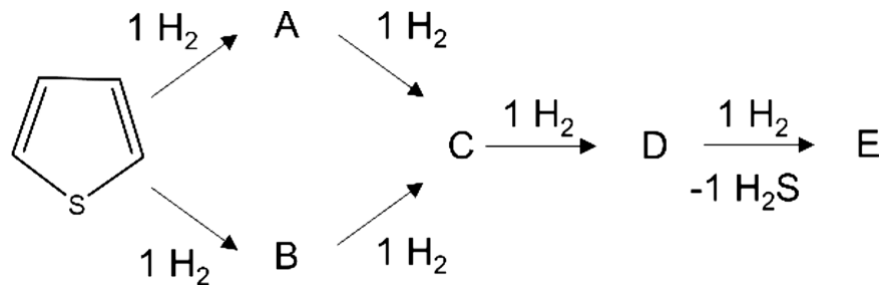
Figure 1. Thiophene hydrodesulfurization process
Sulfur has two most common natural stable isotopes, \(\ce{^{32}S}\) and \(\ce{^{34}S}\), with a relative molar abundance of \(x(\ce{^{32}S})=94.8\,\%\) and \(x(\ce{^{34}S})=4.37\,\%\), respectively. For hydrogen, the stable natural isotopes are \(\ce{^{1}H}\) and \(\ce{^{2}H}\) (\(\ce{D}\)), with a relative molar abundance of \(x(\ce{^{1}H})=99.986\,\%\) and \(x(\ce{^{2}H})=0.014\,\%\), respectively.
5.2 Considering only the isotopes listed above, list all isotopologues of \(\ce{H2S}\).
5.3 Considering only the isotopes listed above, list all isotopologues of \(\ce{H2S}\) containing simultaneously \(\ce{D}\) and \(\ce{^{34}S}\) nuclei and for each calculate the respective relative molar abundance in %.
The desulfurization is a catalytic process typically carried out over \(\ce{MoS2}\) supported on \(\ce{SiO2}\) (\(\ce{MoS2}/\ce{SiO2}\)) catalyst. To study the surface of the catalyst, isotope exchange methods can be employed. The isotope exchange reaction takes place at the gas-solid interface, resulting in the exchange of the surface atoms exclusively. In the first approximation, the bulk atoms do not participate in the exchange (Figure 2).
In the experiment, the isotope exchange between the \(\ce{MoS2}/\ce{SiO2}\) catalyst (Mo mass fraction \(w_{\mathrm{Mo}}=4.280\,\%\), initially containing only \(\ce{^{32}S}\)) and gaseous isotopically-labeled \(\ce{H2^{34}S}\) was studied in a flow reactor (Figure 2). The \(\ce{MoS2}/\ce{SiO2}\) catalyst (\(m_{\mathrm{cat}}=1.2350\,\mathrm{g}\)) was kept in a flow (\(p=1.00\,\mathrm{bar}\), \(v=20.0\,\mathrm{mL\,min^{-1}}\), \(T=23.0\,^\circ\mathrm{C}\)) of gas mixture containing \(\ce{H2^{34}S}\) balanced with \(\ce{Ar}\) (volume fraction \(\varphi(\ce{H2^{34}S})=1.00\,\%\), \(\ce{^{34}S}\) isotopic purity \(\alpha=99.95\ \text{mol.}\,\%\)). The experiment duration was \(t=10.0\,\mathrm{min}\) and gas from the outlet was collected during the entire experiment. The measured fraction of \(\ce{^{34}S}\) isotope among the sulfur atoms (\(\gamma\)) in the collected gas phase was \(\gamma=87.3\ \text{mol.}\,\%\). Assume ideal gas behavior, and that the elemental (not isotopic!) composition of \(\ce{MoS2}\) on the surface and in the bulk are identical, and by the end of the experiment all sulfur atoms from the surface are exchanged with the gas phase.
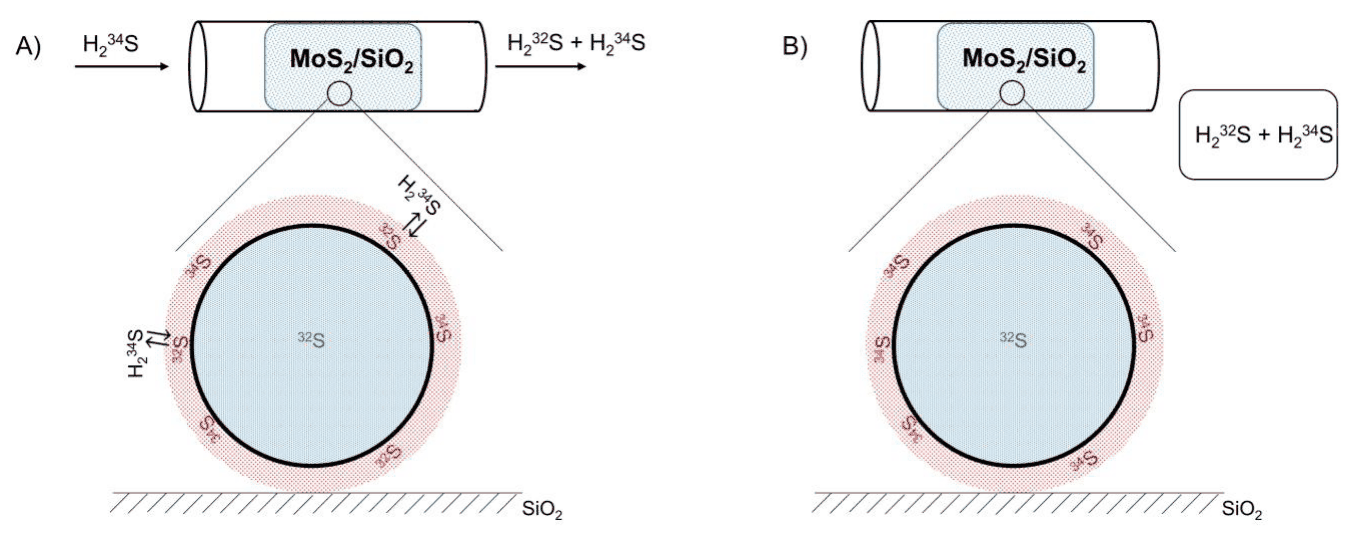
Figure 2. Schematic representation of the experiment in the course (A) and at the final stage (B). Sulfur atoms on the surface are shown in red, sulfur atoms in the bulk are shown in blue. Molybdenum atoms are not shown.
5.4 Calculate the amount of exchanged sulfur atoms \(n(\ce{S})_{\mathrm{surface}}\) in mol.
If you have been unable to calculate the amount of exchanged sulfur atoms, use the value \(1.53\times10^{-5}\,\mathrm{mol}\) in all the following calculations.
Assume that the \(\ce{MoS2}\) phase consists of uniform spherical particles, and at the end of the experiment all sulfur atoms located on the surface are exchanged, while the bulk atoms did not participate in the exchange reaction. The density of \(\ce{MoS2}\) is \(\rho=5.06\,\mathrm{g\,cm^{-3}}\), the average area occupied by \(\ce{S}\) and \(\ce{Mo}\) atoms on the surface is equal to \(A_{\mathrm{S}}=3.00\times10^{-19}\,\mathrm{m^2}\) and \(A_{\mathrm{Mo}}=5.00\times10^{-19}\,\mathrm{m^2}\), respectively. The area of a sphere with radius \(R\) can be calculated as \(S=4\pi R^2\), and its volume as \(V=(4/3)\pi R^3\). Assume that isotopic composition does not affect the density of \(\ce{MoS2}\).
5.5 Calculate the particle radius \(R\) of the \(\ce{MoS2}\) particles. Give your answer in nm.
In reality, the isotopically-labeled atoms from the surface diffuse into the bulk and the non-labeled atoms from the bulk travel to the surface, undergoing a gradual exchange (Figure 3A). Therefore, for a given moment, the fraction of the labeled atoms inside the particle decreases from the surface of the particle to its center. Simultaneously, with an increase in time of exchange, the involvement of bulk atoms to the exchange reaction increases, as sketched in Figure 3B.
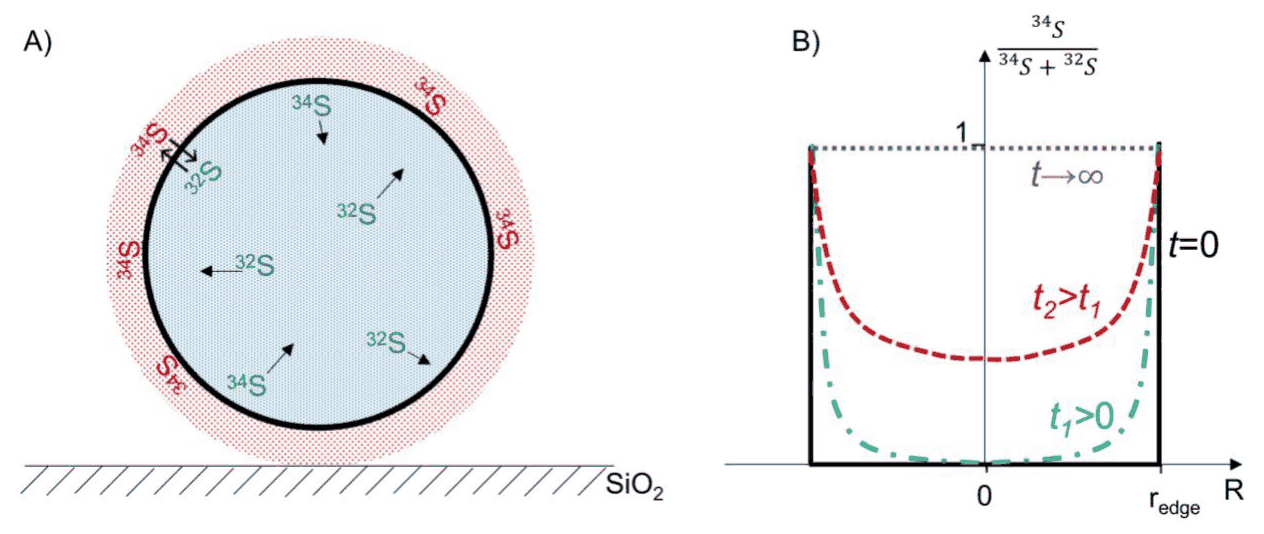
Figure 3. A) Schematic representation of the diffusion of sulfur isotopes from the surface to the bulk in a \(\ce{MoS2}\) particle. Sulfur atoms on the surface are shown in red, sulfur atoms in the bulk are shown in blue. Molybdenum atoms are not shown. B) The fraction of \(\ce{^{34}S}\) atoms in the bulk as function of time and distance from center of the particle; \(r_{\mathrm{edge}}\) corresponds to the radius of \(\ce{MoS2}\) particle.
At the end of the experiment, the surface atoms are completely exchanged, and additionally a fraction of the bulk is exchanged via diffusion. The fraction of the exchanged bulk atoms, \(n(\ce{S})_{\mathrm{bulk}}^{\mathrm{ex}}\), of the total bulk atoms of sulfur, \(n(\ce{S})_{\mathrm{bulk}}^{\mathrm{total}}\), can be calculated as:
\[ F=n(\ce{S})_{\mathrm{bulk}}^{\mathrm{ex}}/ n(\ce{S})_{\mathrm{bulk}}^{\mathrm{total}} =1-\exp(-Dt/R^2) \]
Where \(t\) is the time of exchange experiment (described above), \(R\) is the particle radius, and \(D\) is the diffusion coefficient. The catalyst described above was independently studied by means of electron microscopy, which showed that the \(\ce{MoS2}\) particles are uniformly distributed spheres with a radius of \(35.0\,\mathrm{nm}\).
5.6 Using \(R=35.0\,\mathrm{nm}\) and the data of the exchange experiment described above, calculate the diffusion coefficient \(D\) (in \(\mathrm{m^2\,s^{-1}}\)) for the diffusion of sulfur atoms in \(\ce{MoS2}\). In your calculations, use the approximation \(e^x\approx1+x\) for \(x\ll1\).
Official English text of the problem.
Answers
- 5.1: A: 2,3-dihydrothiophene
S1CCC=C1; B: 2,5-dihydrothiopheneS1CC=CC1; C: thiolane (tetrahydrothiophene)S1CCCC1; D: butane-1-thiolCCCCS; E: butaneCCCC. A and B may be interchanged. - 5.2: Six isotopologues: sulfur-32 hydrogen sulfide
[1H][32S][1H], its monodeuterated form[1H][32S][2H]and dideuterated form[2H][32S][2H]; sulfur-34 hydrogen sulfide[1H][34S][1H], its monodeuterated form[1H][34S][2H]and dideuterated form[2H][34S][2H]. - 5.3: Monodeuterated sulfur-34 hydrogen sulfide, \(\ce{HD^{34}S}\),
[1H][34S][2H]: \(1.2\times10^{-3}\,\%\). Dideuterated sulfur-34 hydrogen sulfide, \(\ce{D2^{34}S}\),[2H][34S][2H]: \(8.6\times10^{-8}\,\%\). - 5.4: \(n(\ce{S})_{\mathrm{surface}}=1.03\times10^{-5}\,\mathrm{mol}\).
- 5.5: \(R\approx15.4\,\mathrm{nm}\).
- 5.6: \(D\approx1.07\times10^{-20}\,\mathrm{m^2\,s^{-1}}\).
Solution
5.1 — Products and balanced reactions
The starting material is thiophene, c1ccsc1. The other small molecules in the reaction scheme are hydrogen, [H][H], and hydrogen sulfide, [SH2].
Addition of one molecule of hydrogen leaves one double bond in the five-membered sulfur-containing ring. There are two distinct positions for this double bond:
| Product | Name and SMILES | Precise description of the requested drawing |
|---|---|---|
| A | 2,3-Dihydrothiophene S1CCC=C1 |
A five-membered ring with sequence \(\ce{S-CH2-CH2-CH=CH}\), closed back to sulfur. The double bond includes a carbon adjacent to sulfur. |
| B | 2,5-Dihydrothiophene S1CC=CC1 |
A five-membered ring with sequence \(\ce{S-CH2-CH=CH-CH2}\), closed back to sulfur. The double bond joins the two carbons not directly bonded to sulfur. |
| C | Thiolane (tetrahydrothiophene) S1CCCC1 |
A saturated five-membered ring containing one sulfur atom and four \(\ce{CH2}\) groups. |
| D | Butane-1-thiol CCCCS |
An open, unbranched chain, \(\ce{CH3CH2CH2CH2SH}\). |
| E | Butane CCCC |
An open, unbranched chain, \(\ce{CH3CH2CH2CH3}\). |
The diagram does not distinguish the two branches, so assigning A and B the other way round is equally valid.
Hydrogenation of either remaining double bond gives the same saturated ring C. Hydrogenolysis of one ring carbon–sulfur bond then opens the ring to give D. Hydrogenolysis of the remaining carbon–sulfur bond produces E and hydrogen sulfide.
The balanced reactions for both branches are:
\[ \ce{C4H4S + H2 -> C4H6S} \qquad\text{(thiophene to A or B)} \]
\[ \ce{C4H6S + H2 -> C4H8S} \qquad\text{(A or B to C)} \]
\[ \ce{C4H8S + H2 -> CH3CH2CH2CH2SH} \qquad\text{(C to D)} \]
\[ \ce{CH3CH2CH2CH2SH + H2 -> CH3CH2CH2CH3 + H2S} \qquad\text{(D to E)} \]
Thus the overall hydrodesulfurization is:
\[ \boxed{\ce{C4H4S + 4H2 -> C4H10 + H2S}} \]
5.2 — All isotopologues
The two hydrogen positions are equivalent. Consequently, the hydrogen isotope combinations are two protium atoms, one protium and one deuterium atom, or two deuterium atoms. Combining these three possibilities with either sulfur isotope gives \(3\times2=6\) isotopologues.
Here and below, \(\ce{H}\) in an isotope-specific formula denotes \(\ce{^{1}H}\).
| Formula | Name | Isotope-explicit SMILES |
|---|---|---|
| \(\ce{H2^{32}S}\) | Sulfur-32 hydrogen sulfide | [1H][32S][1H] |
| \(\ce{HD^{32}S}\) | Monodeuterated sulfur-32 hydrogen sulfide | [1H][32S][2H] |
| \(\ce{D2^{32}S}\) | Dideuterated sulfur-32 hydrogen sulfide | [2H][32S][2H] |
| \(\ce{H2^{34}S}\) | Sulfur-34 hydrogen sulfide | [1H][34S][1H] |
| \(\ce{HD^{34}S}\) | Monodeuterated sulfur-34 hydrogen sulfide | [1H][34S][2H] |
| \(\ce{D2^{34}S}\) | Dideuterated sulfur-34 hydrogen sulfide | [2H][34S][2H] |
Interchanging the two hydrogen positions does not create another isotopologue.
5.3 — Abundances of isotopologues containing both deuterium and sulfur-34
Use the stated natural isotope fractions:
\[ p_{\mathrm H}=0.99986,\qquad p_{\mathrm D}=0.00014,\qquad p_{34}=0.0437. \]
The instruction to consider only the listed isotopes restricts the species being enumerated; the supplied natural sulfur abundances are used without renormalization.
For monodeuterated sulfur-34 hydrogen sulfide, \(\ce{HD^{34}S}\), [1H][34S][2H], either hydrogen position can contain deuterium. Hence the factor of two:
\[ \begin{aligned} x(\ce{HD^{34}S}) &=2p_{\mathrm H}p_{\mathrm D}p_{34}\\ &=2(0.99986)(0.00014)(0.0437)\\ &=1.223428696\times10^{-5}. \end{aligned} \]
Converting the mole fraction to percent,
\[ x(\ce{HD^{34}S}) =0.001223428696\,\% \approx\boxed{1.2\times10^{-3}\,\%}. \]
For dideuterated sulfur-34 hydrogen sulfide, \(\ce{D2^{34}S}\), [2H][34S][2H],
\[ \begin{aligned} x(\ce{D2^{34}S}) &=p_{\mathrm D}^{\,2}p_{34}\\ &=(0.00014)^2(0.0437)\\ &=8.5652\times10^{-10}, \end{aligned} \]
so
\[ x(\ce{D2^{34}S}) =8.5652\times10^{-8}\,\% \approx\boxed{8.6\times10^{-8}\,\%}. \]
The final percentages are rounded to two significant figures, consistent with the supplied deuterium abundance.
5.4 — Amount of exchanged sulfur
For the numerical calculations, use the standard constants
\[ R_{\mathrm g}=8.31446\,\mathrm{J\,mol^{-1}\,K^{-1}}, \qquad N_{\mathrm A}=6.02214\times10^{23}\,\mathrm{mol^{-1}}. \]
The total gas volume passed through the reactor is
\[ V_{\mathrm{gas}}=vt =(20.0\,\mathrm{mL\,min^{-1}})(10.0\,\mathrm{min}) =200\,\mathrm{mL} =2.00\times10^{-4}\,\mathrm{m^3}. \]
Each hydrogen sulfide molecule contains one sulfur atom. Its volume fraction equals its mole fraction for an ideal gas, so the amount of sulfur passed through the reactor is
\[ \begin{aligned} n_{\mathrm{gas}}(\ce{S}) &=\frac{pV_{\mathrm{gas}}\varphi}{R_{\mathrm g}T}\\ &=\frac{(1.00\times10^5\,\mathrm{Pa}) (2.00\times10^{-4}\,\mathrm{m^3})(0.0100)} {(8.31446\,\mathrm{J\,mol^{-1}\,K^{-1}})(296.15\,\mathrm K)}\\ &=8.1224\times10^{-5}\,\mathrm{mol}. \end{aligned} \]
Exchange replaces one sulfur atom in the solid with one from the gas, leaving the total amount of gas-phase sulfur unchanged. Since the catalyst initially contains no sulfur-34, the net amount of sulfur-34 retained is
\[ \begin{aligned} n_{\mathrm{retained}}(\ce{^{34}S}) &=(\alpha-\gamma)n_{\mathrm{gas}}(\ce{S})\\ &=(0.9995-0.873)(8.1224\times10^{-5})\\ &=1.02748\times10^{-5}\,\mathrm{mol}. \end{aligned} \]
Under the completely labelled surface approximation shown in Figure 2, this is the amount of surface sulfur:
\[ \boxed{n(\ce{S})_{\mathrm{surface}} \approx1.03\times10^{-5}\,\mathrm{mol}}. \]
If the final surface isotope fraction is taken as \(0.9995\) rather than unity, this amount is divided by \(0.9995\), a correction of only \(0.050\,\%\). The calculations below use the completely labelled surface approximation.
5.5 — Radius inferred when exchange occurs only at the surface
Use \(M(\ce{Mo})=95.95\,\mathrm{g\,mol^{-1}}\) and \(M(\ce{^{32}S})\approx32.00\,\mathrm{g\,mol^{-1}}\). The mass and amount of molybdenum are
\[ m(\ce{Mo})=m_{\mathrm{cat}}w_{\mathrm{Mo}} =(1.2350)(0.04280)=0.052858\,\mathrm g, \]
\[ n(\ce{Mo})=\frac{0.052858}{95.95} =5.50891\times10^{-4}\,\mathrm{mol}. \]
Thus the mass of the supported molybdenum disulfide phase is approximately
\[ \begin{aligned} m(\ce{MoS2}) &=n(\ce{Mo})\left[M(\ce{Mo})+2M(\ce{^{32}S})\right]\\ &=(5.50891\times10^{-4})(159.95)\\ &=0.0881150\,\mathrm g. \end{aligned} \]
Its total volume is therefore
\[ V_{\mathrm{solid}} =\frac{0.0881150\,\mathrm g}{5.06\,\mathrm{g\,cm^{-3}}} =0.0174140\,\mathrm{cm^3} =1.74140\times10^{-8}\,\mathrm{m^3}. \]
The small mass increase from isotope substitution is negligible at the experimental precision.
The surface has the same elemental composition as the bulk, so
\[ n(\ce{Mo})_{\mathrm{surface}} =\frac12n(\ce{S})_{\mathrm{surface}}. \]
Both sulfur and molybdenum occupy surface area. Consequently,
\[ \begin{aligned} S_{\mathrm{total}} &=N_{\mathrm A}\left[ n(\ce{S})_{\mathrm{surface}}A_{\mathrm S} +n(\ce{Mo})_{\mathrm{surface}}A_{\mathrm{Mo}} \right]\\ &=N_{\mathrm A}n(\ce{S})_{\mathrm{surface}} \left(A_{\mathrm S}+\frac12A_{\mathrm{Mo}}\right). \end{aligned} \]
The area per surface sulfur atom, including its corresponding half molybdenum atom, is
\[ A_{\mathrm S}+\frac12A_{\mathrm{Mo}} =3.00\times10^{-19}+\frac12(5.00\times10^{-19}) =5.50\times10^{-19}\,\mathrm{m^2}. \]
Hence
\[ S_{\mathrm{total}} =(6.02214\times10^{23})(1.02748\times10^{-5}) (5.50\times10^{-19}) =3.4032\,\mathrm{m^2}. \]
For any number of identical spheres,
\[ \frac{S_{\mathrm{total}}}{V_{\mathrm{solid}}} =\frac{4\pi R^2}{(4/3)\pi R^3} =\frac3R. \]
Therefore,
\[ R=\frac{3V_{\mathrm{solid}}}{S_{\mathrm{total}}} =\frac{3(1.74140\times10^{-8})}{3.4032} =1.5351\times10^{-8}\,\mathrm m, \]
\[ \boxed{R\approx15.4\,\mathrm{nm}}. \]
5.6 — Diffusion coefficient using the measured radius
Now use the independently measured radius
\[ R=35.0\,\mathrm{nm}=3.50\times10^{-8}\,\mathrm m. \]
The observed exchange from part 5.4 must now be divided into surface exchange and bulk exchange.
The actual total surface area is
\[ S_{\mathrm{actual}} =\frac{3V_{\mathrm{solid}}}{R} =\frac{3(1.74140\times10^{-8})}{3.50\times10^{-8}} =1.49263\,\mathrm{m^2}. \]
Thus the actual amount of surface sulfur is
\[ \begin{aligned} n(\ce{S})_{\mathrm{surface,actual}} &=\frac{S_{\mathrm{actual}}} {N_{\mathrm A}(A_{\mathrm S}+A_{\mathrm{Mo}}/2)}\\ &=\frac{1.49263} {(6.02214\times10^{23})(5.50\times10^{-19})}\\ &=4.50650\times10^{-6}\,\mathrm{mol}. \end{aligned} \]
The amount of exchanged bulk sulfur is the observed exchange minus this surface contribution:
\[ \begin{aligned} n(\ce{S})_{\mathrm{bulk}}^{\mathrm{ex}} &=1.02748\times10^{-5}-4.50650\times10^{-6}\\ &=5.76833\times10^{-6}\,\mathrm{mol}. \end{aligned} \]
The total amount of sulfur in the particles is
\[ n(\ce{S})_{\mathrm{total}} =2n(\ce{Mo}) =1.10178\times10^{-3}\,\mathrm{mol}. \]
The denominator in the definition of \(F\) is bulk sulfur, so surface sulfur must also be subtracted here:
\[ \begin{aligned} n(\ce{S})_{\mathrm{bulk}}^{\mathrm{total}} &=1.10178\times10^{-3}-4.50650\times10^{-6}\\ &=1.09728\times10^{-3}\,\mathrm{mol}. \end{aligned} \]
Therefore,
\[ F=\frac{5.76833\times10^{-6}}{1.09728\times10^{-3}} =5.25696\times10^{-3}. \]
Using the requested approximation,
\[ \exp\left(-\frac{Dt}{R^2}\right) \approx1-\frac{Dt}{R^2}, \]
so
\[ F=1-\exp\left(-\frac{Dt}{R^2}\right) \approx\frac{Dt}{R^2}. \]
With \(t=10.0\,\mathrm{min}=600\,\mathrm s\),
\[ \begin{aligned} D&\approx\frac{FR^2}{t}\\ &=\frac{(5.25696\times10^{-3})(3.50\times10^{-8}\,\mathrm m)^2} {600\,\mathrm s}\\ &=1.0733\times10^{-20}\,\mathrm{m^2\,s^{-1}}. \end{aligned} \]
\[ \boxed{D\approx1.07\times10^{-20}\,\mathrm{m^2\,s^{-1}}}. \]
The inferred exponent \(Dt/R^2\approx0.00526\) is much smaller than unity, consistent with the approximation. Bulk exchange also explains why the surface-only calculation in part 5.5 gives a smaller radius: it attributes too much of the observed exchange to surface area.
The solution was checked against the official solution. Where this solution differs from the official solution, the official solution contains an error or a misprint.
IChO 2023 · Theorieaufgabe 5
Hydrodesulfurierung
Die Herstellung schwefelfreier Kraftstoffe entspricht dem allgemeinen Bestreben, die Emission umweltschädlicher schwefelhaltiger Verbindungen zu verringern. Zur Entfernung von Schwefel wird in Raffinerien die Hydrodesulfurierung unter Einsatz von Wasserstoff angewendet.
5.1 Zeichnen Sie die Strukturen der Produkte A bis E der Hydrodesulfurierung von Thiophen. Dabei ist bekannt, dass A und B cyclische Regioisomere sind und C cyclisch ist.
Abbildung 1. Hydrodesulfurierung von Thiophen
Die beiden häufigsten natürlichen stabilen Isotope des Schwefels sind \(\ce{^{32}S}\) und \(\ce{^{34}S}\) mit relativen Stoffmengenanteilen von \(x(\ce{^{32}S})=94.8\,\%\) bzw. \(x(\ce{^{34}S})=4.37\,\%\). Die natürlichen stabilen Isotope des Wasserstoffs sind \(\ce{^{1}H}\) und \(\ce{^{2}H}\) (\(\ce{D}\)) mit relativen Stoffmengenanteilen von \(x(\ce{^{1}H})=99.986\,\%\) bzw. \(x(\ce{^{2}H})=0.014\,\%\).
5.2 Listen Sie unter ausschließlicher Berücksichtigung der oben genannten Isotope alle Isotopologe von \(\ce{H2S}\) auf.
5.3 Listen Sie unter ausschließlicher Berücksichtigung der oben genannten Isotope alle Isotopologe von \(\ce{H2S}\) auf, die gleichzeitig \(\ce{D}\)- und \(\ce{^{34}S}\)-Kerne enthalten, und berechnen Sie für jedes den jeweiligen relativen Stoffmengenanteil in %.
Die Entschwefelung ist ein katalytischer Prozess, der typischerweise an einem Katalysator aus \(\ce{MoS2}\) auf einem \(\ce{SiO2}\)-Träger (\(\ce{MoS2}/\ce{SiO2}\)) durchgeführt wird. Zur Untersuchung der Katalysatoroberfläche können Isotopenaustauschmethoden eingesetzt werden. Die Isotopenaustauschreaktion findet an der Grenzfläche zwischen Gas und Feststoff statt, wobei ausschließlich die Oberflächenatome ausgetauscht werden. In erster Näherung nehmen die Atome im Inneren des Feststoffs nicht am Austausch teil (Abbildung 2).
Im Experiment wurde der Isotopenaustausch zwischen dem \(\ce{MoS2}/\ce{SiO2}\)-Katalysator (Mo-Massenanteil \(w_{\mathrm{Mo}}=4.280\,\%\), anfangs ausschließlich \(\ce{^{32}S}\) enthaltend) und gasförmigem, isotopenmarkiertem \(\ce{H2^{34}S}\) in einem Durchflussreaktor untersucht (Abbildung 2). Der \(\ce{MoS2}/\ce{SiO2}\)-Katalysator (\(m_{\mathrm{cat}}=1.2350\,\mathrm{g}\)) wurde einem Gasstrom (\(p=1.00\,\mathrm{bar}\), \(v=20.0\,\mathrm{mL\,min^{-1}}\), \(T=23.0\,^\circ\mathrm{C}\)) aus einem Gemisch von \(\ce{H2^{34}S}\) und \(\ce{Ar}\) als Restgas ausgesetzt (Volumenanteil \(\varphi(\ce{H2^{34}S})=1.00\,\%\), Isotopenreinheit von \(\ce{^{34}S}\): \(\alpha=99.95\ \text{mol.}\,\%\)). Die Versuchsdauer betrug \(t=10.0\,\mathrm{min}\), und das austretende Gas wurde während des gesamten Experiments gesammelt. Der gemessene Anteil des Isotops \(\ce{^{34}S}\) an den Schwefelatomen (\(\gamma\)) in der gesammelten Gasphase betrug \(\gamma=87.3\ \text{mol.}\,\%\). Nehmen Sie ideales Gasverhalten an sowie, dass die elementare (nicht die isotopische!) Zusammensetzung von \(\ce{MoS2}\) an der Oberfläche und im Inneren identisch ist und bis zum Ende des Experiments alle Schwefelatome der Oberfläche mit der Gasphase ausgetauscht werden.
Abbildung 2. Schematische Darstellung des Experiments während seines Verlaufs (A) und im Endzustand (B). Schwefelatome an der Oberfläche sind rot dargestellt, Schwefelatome im Inneren blau. Molybdänatome sind nicht dargestellt.
5.4 Berechnen Sie die Stoffmenge der ausgetauschten Schwefelatome \(n(\ce{S})_{\mathrm{surface}}\) in mol.
Falls Sie die Stoffmenge der ausgetauschten Schwefelatome nicht berechnen konnten, verwenden Sie in allen folgenden Berechnungen den Wert \(1.53\times10^{-5}\,\mathrm{mol}\).
Nehmen Sie an, dass die \(\ce{MoS2}\)-Phase aus gleich großen kugelförmigen Partikeln besteht und am Ende des Experiments alle Schwefelatome an der Oberfläche ausgetauscht sind, während die Atome im Inneren nicht an der Austauschreaktion teilgenommen haben. Die Dichte von \(\ce{MoS2}\) beträgt \(\rho=5.06\,\mathrm{g\,cm^{-3}}\); die mittlere Fläche, die \(\ce{S}\)- bzw. \(\ce{Mo}\)-Atome an der Oberfläche einnehmen, beträgt \(A_{\mathrm{S}}=3.00\times10^{-19}\,\mathrm{m^2}\) bzw. \(A_{\mathrm{Mo}}=5.00\times10^{-19}\,\mathrm{m^2}\). Die Oberfläche einer Kugel mit dem Radius \(R\) kann als \(S=4\pi R^2\) und ihr Volumen als \(V=(4/3)\pi R^3\) berechnet werden. Nehmen Sie an, dass die Isotopenzusammensetzung die Dichte von \(\ce{MoS2}\) nicht beeinflusst.
5.5 Berechnen Sie den Partikelradius \(R\) der \(\ce{MoS2}\)-Partikel. Geben Sie Ihre Antwort in nm an.
Tatsächlich diffundieren die isotopenmarkierten Atome von der Oberfläche ins Innere, während die nicht markierten Atome aus dem Inneren an die Oberfläche wandern und dabei allmählich ausgetauscht werden (Abbildung 3A). Daher nimmt zu einem gegebenen Zeitpunkt der Anteil der markierten Atome innerhalb des Partikels von der Partikeloberfläche zum Zentrum hin ab. Gleichzeitig nimmt mit zunehmender Austauschdauer die Beteiligung der Atome im Inneren an der Austauschreaktion zu, wie in Abbildung 3B skizziert.
Abbildung 3. A) Schematische Darstellung der Diffusion von Schwefelisotopen von der Oberfläche ins Innere eines \(\ce{MoS2}\)-Partikels. Schwefelatome an der Oberfläche sind rot dargestellt, Schwefelatome im Inneren blau. Molybdänatome sind nicht dargestellt. B) Anteil der \(\ce{^{34}S}\)-Atome im Inneren als Funktion der Zeit und des Abstands vom Partikelzentrum; \(r_{\mathrm{edge}}\) entspricht dem Radius des \(\ce{MoS2}\)-Partikels.
Am Ende des Experiments sind die Oberflächenatome vollständig ausgetauscht, und zusätzlich ist ein Teil der Atome im Inneren durch Diffusion ausgetauscht. Der Anteil der ausgetauschten Atome im Inneren, \(n(\ce{S})_{\mathrm{bulk}}^{\mathrm{ex}}\), an der Gesamtzahl der Schwefelatome im Inneren, \(n(\ce{S})_{\mathrm{bulk}}^{\mathrm{total}}\), lässt sich wie folgt berechnen:
\[ F=n(\ce{S})_{\mathrm{bulk}}^{\mathrm{ex}}/ n(\ce{S})_{\mathrm{bulk}}^{\mathrm{total}} =1-\exp(-Dt/R^2) \]
Dabei ist \(t\) die Dauer des oben beschriebenen Austauschexperiments, \(R\) der Partikelradius und \(D\) der Diffusionskoeffizient. Der oben beschriebene Katalysator wurde unabhängig davon mittels Elektronenmikroskopie untersucht. Diese zeigte, dass die \(\ce{MoS2}\)-Partikel gleichmäßig verteilte Kugeln mit einem Radius von \(35.0\,\mathrm{nm}\) sind.
5.6 Berechnen Sie mit \(R=35.0\,\mathrm{nm}\) und den Daten des oben beschriebenen Austauschexperiments den Diffusionskoeffizienten \(D\) (in \(\mathrm{m^2\,s^{-1}}\)) für die Diffusion von Schwefelatomen in \(\ce{MoS2}\). Verwenden Sie bei Ihren Berechnungen die Näherung \(e^x\approx1+x\) für \(x\ll1\).
Aufgabentext aus dem offiziellen englischen Text übersetzt.
Antworten
- 5.1: A: 2,3-Dihydrothiophen
S1CCC=C1; B: 2,5-DihydrothiophenS1CC=CC1; C: Thiolan (Tetrahydrothiophen)S1CCCC1; D: Butan-1-thiolCCCCS; E: ButanCCCC. A und B können vertauscht werden. - 5.2: Sechs Isotopologe: Schwefel-32-Schwefelwasserstoff
[1H][32S][1H], seine monodeuterierte Form[1H][32S][2H]und seine dideuterierte Form[2H][32S][2H]; Schwefel-34-Schwefelwasserstoff[1H][34S][1H], seine monodeuterierte Form[1H][34S][2H]und seine dideuterierte Form[2H][34S][2H]. - 5.3: Monodeuterierter Schwefel-34-Schwefelwasserstoff, \(\ce{HD^{34}S}\),
[1H][34S][2H]: \(1.2\times10^{-3}\,\%\). Dideuterierter Schwefel-34-Schwefelwasserstoff, \(\ce{D2^{34}S}\),[2H][34S][2H]: \(8.6\times10^{-8}\,\%\). - 5.4: \(n(\ce{S})_{\mathrm{surface}}=1.03\times10^{-5}\,\mathrm{mol}\).
- 5.5: \(R\approx15.4\,\mathrm{nm}\).
- 5.6: \(D\approx1.07\times10^{-20}\,\mathrm{m^2\,s^{-1}}\).
Lösung
5.1 — Produkte und ausgeglichene Reaktionsgleichungen
Der Ausgangsstoff ist Thiophen, c1ccsc1. Die anderen kleinen Moleküle im Reaktionsschema sind Wasserstoff, [H][H], und Schwefelwasserstoff, [SH2].
Nach der Addition eines Wasserstoffmoleküls verbleibt eine Doppelbindung im fünfgliedrigen schwefelhaltigen Ring. Für diese Doppelbindung gibt es zwei unterschiedliche Positionen:
| Produkt | Name und SMILES | Genaue Beschreibung der geforderten Zeichnung |
|---|---|---|
| A | 2,3-Dihydrothiophen S1CCC=C1 |
Ein fünfgliedriger Ring mit der Abfolge \(\ce{S-CH2-CH2-CH=CH}\), der zurück zum Schwefel geschlossen wird. An der Doppelbindung ist ein dem Schwefel benachbartes Kohlenstoffatom beteiligt. |
| B | 2,5-Dihydrothiophen S1CC=CC1 |
Ein fünfgliedriger Ring mit der Abfolge \(\ce{S-CH2-CH=CH-CH2}\), der zurück zum Schwefel geschlossen wird. Die Doppelbindung verbindet die beiden Kohlenstoffatome, die nicht direkt an Schwefel gebunden sind. |
| C | Thiolan (Tetrahydrothiophen) S1CCCC1 |
Ein gesättigter fünfgliedriger Ring mit einem Schwefelatom und vier \(\ce{CH2}\)-Gruppen. |
| D | Butan-1-thiol CCCCS |
Eine offene, unverzweigte Kette, \(\ce{CH3CH2CH2CH2SH}\). |
| E | Butan CCCC |
Eine offene, unverzweigte Kette, \(\ce{CH3CH2CH2CH3}\). |
Das Schema unterscheidet die beiden Reaktionswege nicht, daher ist eine vertauschte Zuordnung von A und B ebenso richtig.
Die Hydrierung der jeweils verbleibenden Doppelbindung ergibt denselben gesättigten Ring C. Die Hydrogenolyse einer Kohlenstoff–Schwefel-Bindung im Ring öffnet anschließend den Ring und liefert D. Die Hydrogenolyse der verbleibenden Kohlenstoff–Schwefel-Bindung erzeugt E und Schwefelwasserstoff.
Die ausgeglichenen Reaktionsgleichungen für beide Reaktionswege lauten:
\[ \ce{C4H4S + H2 -> C4H6S} \qquad\text{(Thiophen zu A oder B)} \]
\[ \ce{C4H6S + H2 -> C4H8S} \qquad\text{(A oder B zu C)} \]
\[ \ce{C4H8S + H2 -> CH3CH2CH2CH2SH} \qquad\text{(C zu D)} \]
\[ \ce{CH3CH2CH2CH2SH + H2 -> CH3CH2CH2CH3 + H2S} \qquad\text{(D zu E)} \]
Damit lautet die Gesamtreaktion der Hydrodesulfurierung:
\[ \boxed{\ce{C4H4S + 4H2 -> C4H10 + H2S}} \]
5.2 — Alle Isotopologe
Die beiden Wasserstoffpositionen sind gleichwertig. Folglich bestehen die möglichen Kombinationen der Wasserstoffisotope aus zwei Protiumatomen, einem Protium- und einem Deuteriumatom oder zwei Deuteriumatomen. Die Kombination dieser drei Möglichkeiten mit jeweils einem der beiden Schwefelisotope ergibt \(3\times2=6\) Isotopologe.
Hier und im Folgenden bezeichnet \(\ce{H}\) in einer isotopenspezifischen Formel \(\ce{^{1}H}\).
| Formel | Name | SMILES mit expliziter Isotopenangabe |
|---|---|---|
| \(\ce{H2^{32}S}\) | Schwefel-32-Schwefelwasserstoff | [1H][32S][1H] |
| \(\ce{HD^{32}S}\) | Monodeuterierter Schwefel-32-Schwefelwasserstoff | [1H][32S][2H] |
| \(\ce{D2^{32}S}\) | Dideuterierter Schwefel-32-Schwefelwasserstoff | [2H][32S][2H] |
| \(\ce{H2^{34}S}\) | Schwefel-34-Schwefelwasserstoff | [1H][34S][1H] |
| \(\ce{HD^{34}S}\) | Monodeuterierter Schwefel-34-Schwefelwasserstoff | [1H][34S][2H] |
| \(\ce{D2^{34}S}\) | Dideuterierter Schwefel-34-Schwefelwasserstoff | [2H][34S][2H] |
Das Vertauschen der beiden Wasserstoffpositionen erzeugt kein weiteres Isotopolog.
5.3 — Häufigkeiten der Isotopologe, die sowohl Deuterium als auch Schwefel-34 enthalten
Wir verwenden die angegebenen natürlichen Isotopenanteile:
\[ p_{\mathrm H}=0.99986,\qquad p_{\mathrm D}=0.00014,\qquad p_{34}=0.0437. \]
Die Anweisung, nur die aufgeführten Isotope zu berücksichtigen, beschränkt die aufzuzählenden Spezies; die angegebenen natürlichen Schwefelhäufigkeiten werden ohne Renormierung verwendet.
Bei monodeuteriertem Schwefel-34-Schwefelwasserstoff, \(\ce{HD^{34}S}\), [1H][34S][2H], kann sich Deuterium an jeder der beiden Wasserstoffpositionen befinden. Daher ergibt sich der Faktor zwei:
\[ \begin{aligned} x(\ce{HD^{34}S}) &=2p_{\mathrm H}p_{\mathrm D}p_{34}\\ &=2(0.99986)(0.00014)(0.0437)\\ &=1.223428696\times10^{-5}. \end{aligned} \]
Die Umrechnung des Stoffmengenanteils in Prozent ergibt
\[ x(\ce{HD^{34}S}) =0.001223428696\,\% \approx\boxed{1.2\times10^{-3}\,\%}. \]
Für dideuterierten Schwefel-34-Schwefelwasserstoff, \(\ce{D2^{34}S}\), [2H][34S][2H], gilt
\[ \begin{aligned} x(\ce{D2^{34}S}) &=p_{\mathrm D}^{\,2}p_{34}\\ &=(0.00014)^2(0.0437)\\ &=8.5652\times10^{-10}, \end{aligned} \]
also
\[ x(\ce{D2^{34}S}) =8.5652\times10^{-8}\,\% \approx\boxed{8.6\times10^{-8}\,\%}. \]
Die endgültigen Prozentwerte sind entsprechend der angegebenen Deuteriumhäufigkeit auf zwei signifikante Stellen gerundet.
5.4 — Stoffmenge des ausgetauschten Schwefels
Für die numerischen Berechnungen verwenden wir die Standardkonstanten
\[ R_{\mathrm g}=8.31446\,\mathrm{J\,mol^{-1}\,K^{-1}}, \qquad N_{\mathrm A}=6.02214\times10^{23}\,\mathrm{mol^{-1}}. \]
Das gesamte durch den Reaktor geleitete Gasvolumen beträgt
\[ V_{\mathrm{gas}}=vt =(20.0\,\mathrm{mL\,min^{-1}})(10.0\,\mathrm{min}) =200\,\mathrm{mL} =2.00\times10^{-4}\,\mathrm{m^3}. \]
Jedes Schwefelwasserstoffmolekül enthält ein Schwefelatom. Bei einem idealen Gas entspricht sein Volumenanteil seinem Stoffmengenanteil, sodass die durch den Reaktor geleitete Stoffmenge an Schwefel beträgt:
\[ \begin{aligned} n_{\mathrm{gas}}(\ce{S}) &=\frac{pV_{\mathrm{gas}}\varphi}{R_{\mathrm g}T}\\ &=\frac{(1.00\times10^5\,\mathrm{Pa}) (2.00\times10^{-4}\,\mathrm{m^3})(0.0100)} {(8.31446\,\mathrm{J\,mol^{-1}\,K^{-1}})(296.15\,\mathrm K)}\\ &=8.1224\times10^{-5}\,\mathrm{mol}. \end{aligned} \]
Beim Austausch wird ein Schwefelatom im Feststoff durch eines aus dem Gas ersetzt, sodass die gesamte Stoffmenge an Schwefel in der Gasphase unverändert bleibt. Da der Katalysator anfangs keinen Schwefel-34 enthält, beträgt die netto zurückgehaltene Stoffmenge an Schwefel-34
\[ \begin{aligned} n_{\mathrm{retained}}(\ce{^{34}S}) &=(\alpha-\gamma)n_{\mathrm{gas}}(\ce{S})\\ &=(0.9995-0.873)(8.1224\times10^{-5})\\ &=1.02748\times10^{-5}\,\mathrm{mol}. \end{aligned} \]
Unter der in Abbildung 2 dargestellten Näherung einer vollständig markierten Oberfläche entspricht dies der Stoffmenge an Oberflächenschwefel:
\[ \boxed{n(\ce{S})_{\mathrm{surface}} \approx1.03\times10^{-5}\,\mathrm{mol}}. \]
Wird der endgültige Isotopenanteil an der Oberfläche als \(0.9995\) statt als eins angenommen, wird diese Stoffmenge durch \(0.9995\) dividiert; dies entspricht einer Korrektur von nur \(0.050\,\%\). Die folgenden Berechnungen verwenden die Näherung einer vollständig markierten Oberfläche.
5.5 — Abgeleiteter Radius bei ausschließlich an der Oberfläche stattfindendem Austausch
Wir verwenden \(M(\ce{Mo})=95.95\,\mathrm{g\,mol^{-1}}\) und \(M(\ce{^{32}S})\approx32.00\,\mathrm{g\,mol^{-1}}\). Die Masse und die Stoffmenge an Molybdän betragen
\[ m(\ce{Mo})=m_{\mathrm{cat}}w_{\mathrm{Mo}} =(1.2350)(0.04280)=0.052858\,\mathrm g, \]
\[ n(\ce{Mo})=\frac{0.052858}{95.95} =5.50891\times10^{-4}\,\mathrm{mol}. \]
Damit beträgt die Masse der auf dem Träger befindlichen Molybdändisulfidphase näherungsweise
\[ \begin{aligned} m(\ce{MoS2}) &=n(\ce{Mo})\left[M(\ce{Mo})+2M(\ce{^{32}S})\right]\\ &=(5.50891\times10^{-4})(159.95)\\ &=0.0881150\,\mathrm g. \end{aligned} \]
Ihr Gesamtvolumen beträgt daher
\[ V_{\mathrm{solid}} =\frac{0.0881150\,\mathrm g}{5.06\,\mathrm{g\,cm^{-3}}} =0.0174140\,\mathrm{cm^3} =1.74140\times10^{-8}\,\mathrm{m^3}. \]
Die geringe Massenzunahme durch die Isotopensubstitution ist bei der experimentellen Genauigkeit vernachlässigbar.
Die Oberfläche hat dieselbe elementare Zusammensetzung wie das Innere, daher gilt
\[ n(\ce{Mo})_{\mathrm{surface}} =\frac12n(\ce{S})_{\mathrm{surface}}. \]
Sowohl Schwefel als auch Molybdän beanspruchen Fläche an der Oberfläche. Folglich gilt
\[ \begin{aligned} S_{\mathrm{total}} &=N_{\mathrm A}\left[ n(\ce{S})_{\mathrm{surface}}A_{\mathrm S} +n(\ce{Mo})_{\mathrm{surface}}A_{\mathrm{Mo}} \right]\\ &=N_{\mathrm A}n(\ce{S})_{\mathrm{surface}} \left(A_{\mathrm S}+\frac12A_{\mathrm{Mo}}\right). \end{aligned} \]
Die Fläche pro Schwefelatom an der Oberfläche einschließlich des ihm zugeordneten halben Molybdänatoms beträgt
\[ A_{\mathrm S}+\frac12A_{\mathrm{Mo}} =3.00\times10^{-19}+\frac12(5.00\times10^{-19}) =5.50\times10^{-19}\,\mathrm{m^2}. \]
Somit ergibt sich
\[ S_{\mathrm{total}} =(6.02214\times10^{23})(1.02748\times10^{-5}) (5.50\times10^{-19}) =3.4032\,\mathrm{m^2}. \]
Für eine beliebige Anzahl identischer Kugeln gilt
\[ \frac{S_{\mathrm{total}}}{V_{\mathrm{solid}}} =\frac{4\pi R^2}{(4/3)\pi R^3} =\frac3R. \]
Daher folgt
\[ R=\frac{3V_{\mathrm{solid}}}{S_{\mathrm{total}}} =\frac{3(1.74140\times10^{-8})}{3.4032} =1.5351\times10^{-8}\,\mathrm m, \]
\[ \boxed{R\approx15.4\,\mathrm{nm}}. \]
5.6 — Diffusionskoeffizient unter Verwendung des gemessenen Radius
Nun verwenden wir den unabhängig gemessenen Radius
\[ R=35.0\,\mathrm{nm}=3.50\times10^{-8}\,\mathrm m. \]
Der in Teil 5.4 beobachtete Austausch muss nun in Oberflächenaustausch und Austausch im Inneren aufgeteilt werden.
Die tatsächliche Gesamtoberfläche beträgt
\[ S_{\mathrm{actual}} =\frac{3V_{\mathrm{solid}}}{R} =\frac{3(1.74140\times10^{-8})}{3.50\times10^{-8}} =1.49263\,\mathrm{m^2}. \]
Damit beträgt die tatsächliche Stoffmenge an Oberflächenschwefel
\[ \begin{aligned} n(\ce{S})_{\mathrm{surface,actual}} &=\frac{S_{\mathrm{actual}}} {N_{\mathrm A}(A_{\mathrm S}+A_{\mathrm{Mo}}/2)}\\ &=\frac{1.49263} {(6.02214\times10^{23})(5.50\times10^{-19})}\\ &=4.50650\times10^{-6}\,\mathrm{mol}. \end{aligned} \]
Die Stoffmenge des ausgetauschten Schwefels im Inneren ergibt sich aus dem beobachteten Austausch abzüglich dieses Oberflächenbeitrags:
\[ \begin{aligned} n(\ce{S})_{\mathrm{bulk}}^{\mathrm{ex}} &=1.02748\times10^{-5}-4.50650\times10^{-6}\\ &=5.76833\times10^{-6}\,\mathrm{mol}. \end{aligned} \]
Die gesamte Stoffmenge an Schwefel in den Partikeln beträgt
\[ n(\ce{S})_{\mathrm{total}} =2n(\ce{Mo}) =1.10178\times10^{-3}\,\mathrm{mol}. \]
Der Nenner in der Definition von \(F\) bezieht sich auf den Schwefel im Inneren, daher muss der Oberflächenschwefel auch hier abgezogen werden:
\[ \begin{aligned} n(\ce{S})_{\mathrm{bulk}}^{\mathrm{total}} &=1.10178\times10^{-3}-4.50650\times10^{-6}\\ &=1.09728\times10^{-3}\,\mathrm{mol}. \end{aligned} \]
Daraus folgt
\[ F=\frac{5.76833\times10^{-6}}{1.09728\times10^{-3}} =5.25696\times10^{-3}. \]
Mit der geforderten Näherung gilt
\[ \exp\left(-\frac{Dt}{R^2}\right) \approx1-\frac{Dt}{R^2}, \]
also
\[ F=1-\exp\left(-\frac{Dt}{R^2}\right) \approx\frac{Dt}{R^2}. \]
Mit \(t=10.0\,\mathrm{min}=600\,\mathrm s\) ergibt sich
\[ \begin{aligned} D&\approx\frac{FR^2}{t}\\ &=\frac{(5.25696\times10^{-3})(3.50\times10^{-8}\,\mathrm m)^2} {600\,\mathrm s}\\ &=1.0733\times10^{-20}\,\mathrm{m^2\,s^{-1}}. \end{aligned} \]
\[ \boxed{D\approx1.07\times10^{-20}\,\mathrm{m^2\,s^{-1}}}. \]
Der abgeleitete Exponent \(Dt/R^2\approx0.00526\) ist wesentlich kleiner als eins, was mit der Näherung vereinbar ist. Der Austausch im Inneren erklärt auch, warum die Berechnung in Teil 5.5, die ausschließlich den Oberflächenaustausch berücksichtigt, einen kleineren Radius ergibt: Sie schreibt einen zu großen Teil des beobachteten Austauschs der Oberfläche zu.
Die Lösung wurde mit der offiziellen Lösung abgeglichen. Wo diese Lösung von der offiziellen Lösung abweicht, enthält die offizielle Lösung einen Fehler oder Druckfehler.
IChO 2023 · Teori sorusu 5
Hidrodesülfürizasyon
Çevre için toksik olan kükürt içeren bileşiklerin emisyonunu azaltmaya yönelik genel eğilim, kükürtsüz yakıtların üretilmesidir. Kükürdü uzaklaştırmak için rafinerilerde hidrojen destekli hidrodesülfürizasyon işlemi kullanılır.
5.1 A ve B'nin halkalı bölge izomerleri ve C'nin halkalı olduğunu bilerek, tiyofenin hidrodesülfürizasyon ürünleri A–E'nin yapılarını çiziniz.
Şekil 1. Tiyofenin hidrodesülfürizasyon işlemi
Kükürdün doğada en yaygın bulunan iki kararlı izotopu \(\ce{^{32}S}\) ve \(\ce{^{34}S}\) olup bağıl molar bollukları sırasıyla \(x(\ce{^{32}S})=94.8\,\%\) ve \(x(\ce{^{34}S})=4.37\,\%\)'tir. Hidrojenin doğada bulunan kararlı izotopları \(\ce{^{1}H}\) ve \(\ce{^{2}H}\) (\(\ce{D}\)) olup bağıl molar bollukları sırasıyla \(x(\ce{^{1}H})=99.986\,\%\) ve \(x(\ce{^{2}H})=0.014\,\%\)'tür.
5.2 Yalnızca yukarıda listelenen izotopları dikkate alarak, \(\ce{H2S}\)'nin tüm izotopologlarını listeleyiniz.
5.3 Yalnızca yukarıda listelenen izotopları dikkate alarak, aynı anda hem \(\ce{D}\) hem de \(\ce{^{34}S}\) çekirdekleri içeren tüm \(\ce{H2S}\) izotopologlarını listeleyiniz ve her birinin bağıl molar bolluğunu % cinsinden hesaplayınız.
Desülfürizasyon, genellikle \(\ce{SiO2}\) üzerinde desteklenmiş \(\ce{MoS2}\) (\(\ce{MoS2}/\ce{SiO2}\)) katalizörü üzerinde gerçekleştirilen katalitik bir işlemdir. Katalizörün yüzeyini incelemek için izotop değişimi yöntemleri kullanılabilir. İzotop değişim tepkimesi gaz-katı ara yüzeyinde gerçekleşir ve yalnızca yüzey atomlarının değişimiyle sonuçlanır. İlk yaklaşımda, iç kısımdaki atomlar değişime katılmaz (Şekil 2).
Deneyde, \(\ce{MoS2}/\ce{SiO2}\) katalizörü (Mo kütle kesri \(w_{\mathrm{Mo}}=4.280\,\%\), başlangıçta yalnızca \(\ce{^{32}S}\) içeren) ile gaz hâlindeki izotopla işaretlenmiş \(\ce{H2^{34}S}\) arasındaki izotop değişimi bir akış reaktöründe incelenmiştir (Şekil 2). \(\ce{MoS2}/\ce{SiO2}\) katalizörü (\(m_{\mathrm{cat}}=1.2350\,\mathrm{g}\)), \(\ce{H2^{34}S}\) içeren ve geri kalanı \(\ce{Ar}\) olan bir gaz karışımı (hacim kesri \(\varphi(\ce{H2^{34}S})=1.00\,\%\), \(\ce{^{34}S}\) izotop saflığı \(\alpha=99.95\ \text{mol.}\,\%\)) akışı altında (\(p=1.00\,\mathrm{bar}\), \(v=20.0\,\mathrm{mL\,min^{-1}}\), \(T=23.0\,^\circ\mathrm{C}\)) tutulmuştur. Deney süresi \(t=10.0\,\mathrm{min}\) olup çıkış gazı deneyin tamamı boyunca toplanmıştır. Toplanan gaz fazındaki kükürt atomları arasında \(\ce{^{34}S}\) izotopunun ölçülen kesri (\(\gamma\)), \(\gamma=87.3\ \text{mol.}\,\%\) olarak bulunmuştur. Gazın ideal davrandığını, yüzeydeki ve iç kısımdaki \(\ce{MoS2}\)'nin elementel (izotopik değil!) bileşimlerinin aynı olduğunu ve deneyin sonunda yüzeydeki tüm kükürt atomlarının gaz fazıyla değişime uğradığını varsayınız.
Şekil 2. Deneyin devam ederken (A) ve son aşamadaki (B) şematik gösterimi. Yüzeydeki kükürt atomları kırmızı, iç kısımdaki kükürt atomları mavi renkle gösterilmiştir. Molibden atomları gösterilmemiştir.
5.4 Değişime uğrayan kükürt atomlarının miktarını \(n(\ce{S})_{\mathrm{surface}}\) mol cinsinden hesaplayınız.
Değişime uğrayan kükürt atomlarının miktarını hesaplayamadıysanız, bundan sonraki tüm hesaplamalarda \(1.53\times10^{-5}\,\mathrm{mol}\) değerini kullanınız.
\(\ce{MoS2}\) fazının eş boyutlu küresel taneciklerden oluştuğunu ve deney sonunda yüzeyde bulunan tüm kükürt atomlarının değişime uğradığını, iç kısımdaki atomların ise değişim tepkimesine katılmadığını varsayınız. \(\ce{MoS2}\)'nin yoğunluğu \(\rho=5.06\,\mathrm{g\,cm^{-3}}\), yüzeydeki \(\ce{S}\) ve \(\ce{Mo}\) atomlarının kapladığı ortalama alanlar sırasıyla \(A_{\mathrm{S}}=3.00\times10^{-19}\,\mathrm{m^2}\) ve \(A_{\mathrm{Mo}}=5.00\times10^{-19}\,\mathrm{m^2}\)'dir. Yarıçapı \(R\) olan bir kürenin yüzey alanı \(S=4\pi R^2\), hacmi ise \(V=(4/3)\pi R^3\) ile hesaplanabilir. İzotopik bileşimin \(\ce{MoS2}\)'nin yoğunluğunu etkilemediğini varsayınız.
5.5 \(\ce{MoS2}\) taneciklerinin yarıçapını \(R\) hesaplayınız. Yanıtınızı nm cinsinden veriniz.
Gerçekte, yüzeydeki izotopla işaretlenmiş atomlar iç kısma difüzlenirken, iç kısımdaki işaretlenmemiş atomlar yüzeye ilerleyerek kademeli bir değişime uğrar (Şekil 3A). Dolayısıyla, belirli bir anda tanecik içindeki işaretlenmiş atomların kesri, taneciğin yüzeyinden merkezine doğru azalır. Aynı zamanda, değişim süresi uzadıkça iç kısımdaki atomların değişim tepkimesine katılımı Şekil 3B'de şematik olarak gösterildiği gibi artar.
Şekil 3. A) Bir \(\ce{MoS2}\) taneciğinde kükürt izotoplarının yüzeyden iç kısma difüzyonunun şematik gösterimi. Yüzeydeki kükürt atomları kırmızı, iç kısımdaki kükürt atomları mavi renkle gösterilmiştir. Molibden atomları gösterilmemiştir. B) Zamanın ve tanecik merkezinden uzaklığın fonksiyonu olarak iç kısımdaki \(\ce{^{34}S}\) atomlarının kesri; \(r_{\mathrm{edge}}\), \(\ce{MoS2}\) taneciğinin yarıçapına karşılık gelir.
Deney sonunda yüzey atomlarının tamamı değişime uğrar ve buna ek olarak iç kısmın bir bölümü de difüzyon yoluyla değişime uğrar. İç kısımda değişime uğrayan kükürt atomlarının miktarının, \(n(\ce{S})_{\mathrm{bulk}}^{\mathrm{ex}}\), iç kısımdaki toplam kükürt atomlarının miktarına, \(n(\ce{S})_{\mathrm{bulk}}^{\mathrm{total}}\), oranı şu şekilde hesaplanabilir:
\[ F=n(\ce{S})_{\mathrm{bulk}}^{\mathrm{ex}}/ n(\ce{S})_{\mathrm{bulk}}^{\mathrm{total}} =1-\exp(-Dt/R^2) \]
Burada \(t\), yukarıda açıklanan değişim deneyinin süresi, \(R\) tanecik yarıçapı ve \(D\) difüzyon katsayısıdır. Yukarıda açıklanan katalizör, elektron mikroskopisiyle bağımsız olarak incelenmiş ve \(\ce{MoS2}\) taneciklerinin yarıçapı \(35.0\,\mathrm{nm}\) olan, düzgün dağılım gösteren küreler olduğu belirlenmiştir.
5.6 \(R=35.0\,\mathrm{nm}\) değerini ve yukarıda açıklanan değişim deneyinin verilerini kullanarak, kükürt atomlarının \(\ce{MoS2}\) içindeki difüzyonu için difüzyon katsayısını \(D\) (\(\mathrm{m^2\,s^{-1}}\) cinsinden) hesaplayınız. Hesaplamalarınızda \(e^x\approx1+x\) yaklaşımını \(x\ll1\) için kullanınız.
Soru metni resmi İngilizce metinden çevrilmiştir.
Cevaplar
- 5.1: A: 2,3-dihidrotiyofen
S1CCC=C1; B: 2,5-dihidrotiyofenS1CC=CC1; C: tiyolan (tetrahidrotiyofen)S1CCCC1; D: bütan-1-tiyolCCCCS; E: bütanCCCC. A ve B yer değiştirebilir. - 5.2: Altı izotopolog: kükürt-32 içeren hidrojen sülfür
[1H][32S][1H], bunun tek döteryumlu biçimi[1H][32S][2H]ve iki döteryumlu biçimi[2H][32S][2H]; kükürt-34 içeren hidrojen sülfür[1H][34S][1H], bunun tek döteryumlu biçimi[1H][34S][2H]ve iki döteryumlu biçimi[2H][34S][2H]. - 5.3: Tek döteryumlu, kükürt-34 içeren hidrojen sülfür, \(\ce{HD^{34}S}\),
[1H][34S][2H]: \(1.2\times10^{-3}\,\%\). İki döteryumlu, kükürt-34 içeren hidrojen sülfür, \(\ce{D2^{34}S}\),[2H][34S][2H]: \(8.6\times10^{-8}\,\%\). - 5.4: \(n(\ce{S})_{\mathrm{surface}}=1.03\times10^{-5}\,\mathrm{mol}\).
- 5.5: \(R\approx15.4\,\mathrm{nm}\).
- 5.6: \(D\approx1.07\times10^{-20}\,\mathrm{m^2\,s^{-1}}\).
Çözüm
5.1 — Ürünler ve denkleştirilmiş tepkimeler
Başlangıç maddesi tiyofendir, c1ccsc1. Tepkime şemasındaki diğer küçük moleküller hidrojen, [H][H], ve hidrojen sülfürdür, [SH2].
Bir hidrojen molekülünün katılması sonucunda, kükürt içeren beş üyeli halkada bir çift bağ kalır. Bu çift bağ için iki farklı konum vardır:
| Ürün | Adı ve SMILES gösterimi | İstenen çizimin ayrıntılı tanımı |
|---|---|---|
| A | 2,3-Dihidrotiyofen S1CCC=C1 |
\(\ce{S-CH2-CH2-CH=CH}\) dizilimine sahip, yeniden kükürde bağlanarak kapanan beş üyeli bir halka. Çift bağın karbonlarından biri kükürde komşudur. |
| B | 2,5-Dihidrotiyofen S1CC=CC1 |
\(\ce{S-CH2-CH=CH-CH2}\) dizilimine sahip, yeniden kükürde bağlanarak kapanan beş üyeli bir halka. Çift bağ, kükürde doğrudan bağlı olmayan iki karbonu birbirine bağlar. |
| C | Tiyolan (tetrahidrotiyofen) S1CCCC1 |
Bir kükürt atomu ve dört \(\ce{CH2}\) grubu içeren doymuş beş üyeli bir halka. |
| D | Bütan-1-tiyol CCCCS |
Açık, dallanmamış bir zincir, \(\ce{CH3CH2CH2CH2SH}\). |
| E | Bütan CCCC |
Açık, dallanmamış bir zincir, \(\ce{CH3CH2CH2CH3}\). |
Şema iki dalı birbirinden ayırt etmediğinden, A ve B'nin ters şekilde atanması da aynı ölçüde geçerlidir.
Kalan çift bağların her birinin hidrojenasyonu aynı doymuş halka C'yi verir. Ardından halkadaki bir karbon–kükürt bağının hidrojenolizi halkayı açarak D'yi oluşturur. Kalan karbon–kükürt bağının hidrojenolizi ise E ve hidrojen sülfür üretir.
Her iki dal için denkleştirilmiş tepkimeler şöyledir:
\[ \ce{C4H4S + H2 -> C4H6S} \qquad\text{(tiyofenden A veya B'ye)} \]
\[ \ce{C4H6S + H2 -> C4H8S} \qquad\text{(A veya B'den C'ye)} \]
\[ \ce{C4H8S + H2 -> CH3CH2CH2CH2SH} \qquad\text{(C'den D'ye)} \]
\[ \ce{CH3CH2CH2CH2SH + H2 -> CH3CH2CH2CH3 + H2S} \qquad\text{(D'den E'ye)} \]
Böylece toplam hidrodesülfürizasyon tepkimesi şöyledir:
\[ \boxed{\ce{C4H4S + 4H2 -> C4H10 + H2S}} \]
5.2 — Tüm izotopologlar
İki hidrojen konumu eşdeğerdir. Dolayısıyla hidrojen izotopu birleşimleri iki protiyum atomu, bir protiyum ve bir döteryum atomu ya da iki döteryum atomudur. Bu üç olasılığın her birini iki kükürt izotopundan biriyle birleştirmek \(3\times2=6\) izotopolog verir.
Burada ve aşağıda, izotopu açıkça belirtilen bir formüldeki \(\ce{H}\), \(\ce{^{1}H}\)'yi ifade eder.
| Formül | Adı | İzotopları açıkça belirtilmiş SMILES gösterimi |
|---|---|---|
| \(\ce{H2^{32}S}\) | Kükürt-32 içeren hidrojen sülfür | [1H][32S][1H] |
| \(\ce{HD^{32}S}\) | Tek döteryumlu, kükürt-32 içeren hidrojen sülfür | [1H][32S][2H] |
| \(\ce{D2^{32}S}\) | İki döteryumlu, kükürt-32 içeren hidrojen sülfür | [2H][32S][2H] |
| \(\ce{H2^{34}S}\) | Kükürt-34 içeren hidrojen sülfür | [1H][34S][1H] |
| \(\ce{HD^{34}S}\) | Tek döteryumlu, kükürt-34 içeren hidrojen sülfür | [1H][34S][2H] |
| \(\ce{D2^{34}S}\) | İki döteryumlu, kükürt-34 içeren hidrojen sülfür | [2H][34S][2H] |
İki hidrojen konumunun yer değiştirmesi başka bir izotopolog oluşturmaz.
5.3 — Hem döteryum hem de kükürt-34 içeren izotopologların bollukları
Verilen doğal izotop kesirlerini kullanalım:
\[ p_{\mathrm H}=0.99986,\qquad p_{\mathrm D}=0.00014,\qquad p_{34}=0.0437. \]
Yalnızca listelenen izotopların dikkate alınması talimatı, listelenecek türleri sınırlar; verilen doğal kükürt bollukları yeniden normalize edilmeden kullanılır.
Tek döteryumlu, kükürt-34 içeren hidrojen sülfürde, \(\ce{HD^{34}S}\), [1H][34S][2H], hidrojen konumlarından herhangi biri döteryum içerebilir. İki çarpanı buradan gelir:
\[ \begin{aligned} x(\ce{HD^{34}S}) &=2p_{\mathrm H}p_{\mathrm D}p_{34}\\ &=2(0.99986)(0.00014)(0.0437)\\ &=1.223428696\times10^{-5}. \end{aligned} \]
Mol kesrini yüzdeye dönüştürürsek,
\[ x(\ce{HD^{34}S}) =0.001223428696\,\% \approx\boxed{1.2\times10^{-3}\,\%}. \]
İki döteryumlu, kükürt-34 içeren hidrojen sülfür, \(\ce{D2^{34}S}\), [2H][34S][2H], için
\[ \begin{aligned} x(\ce{D2^{34}S}) &=p_{\mathrm D}^{\,2}p_{34}\\ &=(0.00014)^2(0.0437)\\ &=8.5652\times10^{-10}, \end{aligned} \]
dolayısıyla
\[ x(\ce{D2^{34}S}) =8.5652\times10^{-8}\,\% \approx\boxed{8.6\times10^{-8}\,\%}. \]
Son yüzdeler, verilen döteryum bolluğuyla tutarlı olacak şekilde iki anlamlı basamağa yuvarlanmıştır.
5.4 — Değişime uğrayan kükürt miktarı
Sayısal hesaplamalarda şu standart sabitleri kullanalım:
\[ R_{\mathrm g}=8.31446\,\mathrm{J\,mol^{-1}\,K^{-1}}, \qquad N_{\mathrm A}=6.02214\times10^{23}\,\mathrm{mol^{-1}}. \]
Reaktörden geçirilen toplam gaz hacmi şöyledir:
\[ V_{\mathrm{gas}}=vt =(20.0\,\mathrm{mL\,min^{-1}})(10.0\,\mathrm{min}) =200\,\mathrm{mL} =2.00\times10^{-4}\,\mathrm{m^3}. \]
Her hidrojen sülfür molekülü bir kükürt atomu içerir. İdeal bir gazda hacim kesri mol kesrine eşit olduğundan, reaktörden geçirilen kükürt miktarı şöyledir:
\[ \begin{aligned} n_{\mathrm{gas}}(\ce{S}) &=\frac{pV_{\mathrm{gas}}\varphi}{R_{\mathrm g}T}\\ &=\frac{(1.00\times10^5\,\mathrm{Pa}) (2.00\times10^{-4}\,\mathrm{m^3})(0.0100)} {(8.31446\,\mathrm{J\,mol^{-1}\,K^{-1}})(296.15\,\mathrm K)}\\ &=8.1224\times10^{-5}\,\mathrm{mol}. \end{aligned} \]
Değişim sırasında katıdaki bir kükürt atomunun yerini gazdan gelen bir kükürt atomu alır; böylece gaz fazındaki toplam kükürt miktarı değişmez. Katalizör başlangıçta hiç kükürt-34 içermediğinden, tutulan net kükürt-34 miktarı şöyledir:
\[ \begin{aligned} n_{\mathrm{retained}}(\ce{^{34}S}) &=(\alpha-\gamma)n_{\mathrm{gas}}(\ce{S})\\ &=(0.9995-0.873)(8.1224\times10^{-5})\\ &=1.02748\times10^{-5}\,\mathrm{mol}. \end{aligned} \]
Şekil 2'de gösterilen, yüzeyin tamamen işaretlendiği yaklaşımında bu, yüzeydeki kükürt miktarıdır:
\[ \boxed{n(\ce{S})_{\mathrm{surface}} \approx1.03\times10^{-5}\,\mathrm{mol}}. \]
Yüzeydeki son izotop kesri bir yerine \(0.9995\) alınırsa, bu miktar \(0.9995\)'e bölünür; bu, yalnızca \(0.050\,\%\)'lik bir düzeltmedir. Aşağıdaki hesaplamalarda yüzeyin tamamen işaretlendiği yaklaşımı kullanılmıştır.
5.5 — Değişim yalnızca yüzeyde gerçekleştiğinde hesaplanan yarıçap
\(M(\ce{Mo})=95.95\,\mathrm{g\,mol^{-1}}\) ve \(M(\ce{^{32}S})\approx32.00\,\mathrm{g\,mol^{-1}}\) değerlerini kullanalım. Molibdenin kütlesi ve madde miktarı şöyledir:
\[ m(\ce{Mo})=m_{\mathrm{cat}}w_{\mathrm{Mo}} =(1.2350)(0.04280)=0.052858\,\mathrm g, \]
\[ n(\ce{Mo})=\frac{0.052858}{95.95} =5.50891\times10^{-4}\,\mathrm{mol}. \]
Böylece desteklenmiş molibden disülfür fazının kütlesi yaklaşık olarak şöyledir:
\[ \begin{aligned} m(\ce{MoS2}) &=n(\ce{Mo})\left[M(\ce{Mo})+2M(\ce{^{32}S})\right]\\ &=(5.50891\times10^{-4})(159.95)\\ &=0.0881150\,\mathrm g. \end{aligned} \]
Dolayısıyla toplam hacmi şöyledir:
\[ V_{\mathrm{solid}} =\frac{0.0881150\,\mathrm g}{5.06\,\mathrm{g\,cm^{-3}}} =0.0174140\,\mathrm{cm^3} =1.74140\times10^{-8}\,\mathrm{m^3}. \]
İzotop yer değiştirmesinden kaynaklanan küçük kütle artışı, deneyin hassasiyetinde ihmal edilebilir.
Yüzey, iç kısımla aynı elementel bileşime sahiptir; dolayısıyla
\[ n(\ce{Mo})_{\mathrm{surface}} =\frac12n(\ce{S})_{\mathrm{surface}}. \]
Hem kükürt hem de molibden yüzeyde alan kaplar. Bu nedenle,
\[ \begin{aligned} S_{\mathrm{total}} &=N_{\mathrm A}\left[ n(\ce{S})_{\mathrm{surface}}A_{\mathrm S} +n(\ce{Mo})_{\mathrm{surface}}A_{\mathrm{Mo}} \right]\\ &=N_{\mathrm A}n(\ce{S})_{\mathrm{surface}} \left(A_{\mathrm S}+\frac12A_{\mathrm{Mo}}\right). \end{aligned} \]
Yüzeydeki her bir kükürt atomu başına düşen alan, ona karşılık gelen yarım molibden atomu da dâhil edildiğinde şöyledir:
\[ A_{\mathrm S}+\frac12A_{\mathrm{Mo}} =3.00\times10^{-19}+\frac12(5.00\times10^{-19}) =5.50\times10^{-19}\,\mathrm{m^2}. \]
Böylece
\[ S_{\mathrm{total}} =(6.02214\times10^{23})(1.02748\times10^{-5}) (5.50\times10^{-19}) =3.4032\,\mathrm{m^2}. \]
Özdeş kürelerin sayısı ne olursa olsun,
\[ \frac{S_{\mathrm{total}}}{V_{\mathrm{solid}}} =\frac{4\pi R^2}{(4/3)\pi R^3} =\frac3R. \]
Dolayısıyla,
\[ R=\frac{3V_{\mathrm{solid}}}{S_{\mathrm{total}}} =\frac{3(1.74140\times10^{-8})}{3.4032} =1.5351\times10^{-8}\,\mathrm m, \]
\[ \boxed{R\approx15.4\,\mathrm{nm}}. \]
5.6 — Ölçülen yarıçap kullanılarak difüzyon katsayısının hesaplanması
Şimdi bağımsız olarak ölçülen yarıçapı kullanalım:
\[ R=35.0\,\mathrm{nm}=3.50\times10^{-8}\,\mathrm m. \]
5.4 kısmında gözlenen değişim artık yüzeydeki değişim ve iç kısımdaki değişim olarak ikiye ayrılmalıdır.
Gerçek toplam yüzey alanı şöyledir:
\[ S_{\mathrm{actual}} =\frac{3V_{\mathrm{solid}}}{R} =\frac{3(1.74140\times10^{-8})}{3.50\times10^{-8}} =1.49263\,\mathrm{m^2}. \]
Böylece yüzeydeki gerçek kükürt miktarı şöyledir:
\[ \begin{aligned} n(\ce{S})_{\mathrm{surface,actual}} &=\frac{S_{\mathrm{actual}}} {N_{\mathrm A}(A_{\mathrm S}+A_{\mathrm{Mo}}/2)}\\ &=\frac{1.49263} {(6.02214\times10^{23})(5.50\times10^{-19})}\\ &=4.50650\times10^{-6}\,\mathrm{mol}. \end{aligned} \]
İç kısımda değişime uğrayan kükürt miktarı, gözlenen değişimden yüzeyin bu katkısının çıkarılmasıyla bulunur:
\[ \begin{aligned} n(\ce{S})_{\mathrm{bulk}}^{\mathrm{ex}} &=1.02748\times10^{-5}-4.50650\times10^{-6}\\ &=5.76833\times10^{-6}\,\mathrm{mol}. \end{aligned} \]
Taneciklerdeki toplam kükürt miktarı şöyledir:
\[ n(\ce{S})_{\mathrm{total}} =2n(\ce{Mo}) =1.10178\times10^{-3}\,\mathrm{mol}. \]
\(F\)'nin tanımındaki payda iç kısımdaki kükürt olduğundan, burada da yüzeydeki kükürt çıkarılmalıdır:
\[ \begin{aligned} n(\ce{S})_{\mathrm{bulk}}^{\mathrm{total}} &=1.10178\times10^{-3}-4.50650\times10^{-6}\\ &=1.09728\times10^{-3}\,\mathrm{mol}. \end{aligned} \]
Dolayısıyla,
\[ F=\frac{5.76833\times10^{-6}}{1.09728\times10^{-3}} =5.25696\times10^{-3}. \]
İstenen yaklaşımı kullanırsak,
\[ \exp\left(-\frac{Dt}{R^2}\right) \approx1-\frac{Dt}{R^2}, \]
dolayısıyla
\[ F=1-\exp\left(-\frac{Dt}{R^2}\right) \approx\frac{Dt}{R^2}. \]
\(t=10.0\,\mathrm{min}=600\,\mathrm s\) için,
\[ \begin{aligned} D&\approx\frac{FR^2}{t}\\ &=\frac{(5.25696\times10^{-3})(3.50\times10^{-8}\,\mathrm m)^2} {600\,\mathrm s}\\ &=1.0733\times10^{-20}\,\mathrm{m^2\,s^{-1}}. \end{aligned} \]
\[ \boxed{D\approx1.07\times10^{-20}\,\mathrm{m^2\,s^{-1}}}. \]
Hesaplanan üs \(Dt/R^2\approx0.00526\), birden çok küçüktür ve bu, kullanılan yaklaşımla tutarlıdır. İç kısımdaki değişim, 5.5 kısmında yalnızca yüzeydeki değişime dayanan hesaplamanın neden daha küçük bir yarıçap verdiğini de açıklar: bu hesaplama, gözlenen değişimin gereğinden büyük bir bölümünü yüzey alanına atfeder.
Çözüm, resmi çözümle karşılaştırılarak kontrol edildi. Bu çözümün resmi çözümden ayrıldığı yerlerde resmi çözümde bir hata ya da baskı hatası vardır.
IChO 2023 · Problema teórico 5
Hidrodesulfuración
La producción de combustibles libres de azufre es la tendencia general para reducir las emisiones de compuestos que contienen azufre y son tóxicos para el medio ambiente. Para eliminar el azufre, en las refinerías se utiliza el proceso de hidrodesulfuración con hidrógeno.
5.1 Dibuje la estructura de los productos A a E de la hidrodesulfuración del tiofeno, sabiendo que A y B son regioisómeros cíclicos y que C es cíclico.
Figura 1. Proceso de hidrodesulfuración del tiofeno
Los dos isótopos estables naturales más comunes del azufre son \(\ce{^{32}S}\) y \(\ce{^{34}S}\), con abundancias molares relativas de \(x(\ce{^{32}S})=94.8\,\%\) y \(x(\ce{^{34}S})=4.37\,\%\), respectivamente. En el caso del hidrógeno, los isótopos estables naturales son \(\ce{^{1}H}\) y \(\ce{^{2}H}\) (\(\ce{D}\)), con abundancias molares relativas de \(x(\ce{^{1}H})=99.986\,\%\) y \(x(\ce{^{2}H})=0.014\,\%\), respectivamente.
5.2 Considerando únicamente los isótopos indicados anteriormente, enumere todos los isotopólogos del \(\ce{H2S}\).
5.3 Considerando únicamente los isótopos indicados anteriormente, enumere todos los isotopólogos del \(\ce{H2S}\) que contengan simultáneamente núcleos de \(\ce{D}\) y \(\ce{^{34}S}\) y calcule para cada uno su abundancia molar relativa en %.
La desulfuración es un proceso catalítico que normalmente se lleva a cabo sobre un catalizador de \(\ce{MoS2}\) soportado sobre \(\ce{SiO2}\) (\(\ce{MoS2}/\ce{SiO2}\)). Para estudiar la superficie del catalizador pueden emplearse métodos de intercambio isotópico. La reacción de intercambio isotópico tiene lugar en la interfase gas-sólido, y da lugar al intercambio exclusivo de los átomos de la superficie. En una primera aproximación, los átomos del interior no participan en el intercambio (Figura 2).
En el experimento se estudió el intercambio isotópico entre el catalizador de \(\ce{MoS2}/\ce{SiO2}\) (fracción másica de Mo \(w_{\mathrm{Mo}}=4.280\,\%\), que inicialmente contenía únicamente \(\ce{^{32}S}\)) y \(\ce{H2^{34}S}\) gaseoso marcado isotópicamente, en un reactor de flujo (Figura 2). El catalizador de \(\ce{MoS2}/\ce{SiO2}\) (\(m_{\mathrm{cat}}=1.2350\,\mathrm{g}\)) se mantuvo en una corriente (\(p=1.00\,\mathrm{bar}\), \(v=20.0\,\mathrm{mL\,min^{-1}}\), \(T=23.0\,^\circ\mathrm{C}\)) de una mezcla gaseosa que contenía \(\ce{H2^{34}S}\), con \(\ce{Ar}\) como gas de balance (fracción volumétrica \(\varphi(\ce{H2^{34}S})=1.00\,\%\), pureza isotópica del \(\ce{^{34}S}\) \(\alpha=99.95\ \text{mol.}\,\%\)). La duración del experimento fue de \(t=10.0\,\mathrm{min}\) y se recogió el gas de salida durante todo el experimento. La fracción medida del isótopo \(\ce{^{34}S}\) entre los átomos de azufre (\(\gamma\)) en la fase gaseosa recogida fue \(\gamma=87.3\ \text{mol.}\,\%\). Suponga un comportamiento de gas ideal, que la composición elemental (¡no isotópica!) del \(\ce{MoS2}\) en la superficie y en el interior es idéntica, y que al final del experimento todos los átomos de azufre de la superficie se han intercambiado con la fase gaseosa.
Figura 2. Representación esquemática del experimento durante su transcurso (A) y en la etapa final (B). Los átomos de azufre de la superficie se muestran en rojo y los átomos de azufre del interior, en azul. No se muestran los átomos de molibdeno.
5.4 Calcule la cantidad de átomos de azufre intercambiados \(n(\ce{S})_{\mathrm{surface}}\) en mol.
Si no ha podido calcular la cantidad de átomos de azufre intercambiados, utilice el valor \(1.53\times10^{-5}\,\mathrm{mol}\) en todos los cálculos siguientes.
Suponga que la fase de \(\ce{MoS2}\) está formada por partículas esféricas uniformes, y que al final del experimento todos los átomos de azufre situados en la superficie se han intercambiado, mientras que los átomos del interior no han participado en la reacción de intercambio. La densidad del \(\ce{MoS2}\) es \(\rho=5.06\,\mathrm{g\,cm^{-3}}\), y el área media ocupada por los átomos de \(\ce{S}\) y \(\ce{Mo}\) en la superficie es igual a \(A_{\mathrm{S}}=3.00\times10^{-19}\,\mathrm{m^2}\) y \(A_{\mathrm{Mo}}=5.00\times10^{-19}\,\mathrm{m^2}\), respectivamente. El área de una esfera de radio \(R\) puede calcularse como \(S=4\pi R^2\), y su volumen como \(V=(4/3)\pi R^3\). Suponga que la composición isotópica no afecta a la densidad del \(\ce{MoS2}\).
5.5 Calcule el radio \(R\) de las partículas de \(\ce{MoS2}\). Exprese su respuesta en nm.
En realidad, los átomos marcados isotópicamente de la superficie se difunden hacia el interior y los átomos no marcados del interior se desplazan hacia la superficie, de modo que experimentan un intercambio gradual (Figura 3A). Por tanto, en un instante dado, la fracción de átomos marcados dentro de la partícula disminuye desde la superficie de la partícula hasta su centro. Simultáneamente, a medida que aumenta el tiempo de intercambio, aumenta la participación de los átomos del interior en la reacción de intercambio, como se ilustra en la Figura 3B.
Figura 3. A) Representación esquemática de la difusión de los isótopos del azufre desde la superficie hacia el interior de una partícula de \(\ce{MoS2}\). Los átomos de azufre de la superficie se muestran en rojo y los átomos de azufre del interior, en azul. No se muestran los átomos de molibdeno. B) Fracción de átomos de \(\ce{^{34}S}\) en el interior en función del tiempo y de la distancia al centro de la partícula; \(r_{\mathrm{edge}}\) corresponde al radio de la partícula de \(\ce{MoS2}\).
Al final del experimento, los átomos de la superficie se han intercambiado por completo y, además, una fracción de los átomos del interior se ha intercambiado por difusión. La fracción de átomos del interior intercambiados, \(n(\ce{S})_{\mathrm{bulk}}^{\mathrm{ex}}\), respecto al total de átomos de azufre del interior, \(n(\ce{S})_{\mathrm{bulk}}^{\mathrm{total}}\), puede calcularse como:
\[ F=n(\ce{S})_{\mathrm{bulk}}^{\mathrm{ex}}/ n(\ce{S})_{\mathrm{bulk}}^{\mathrm{total}} =1-\exp(-Dt/R^2) \]
Donde \(t\) es el tiempo del experimento de intercambio (descrito anteriormente), \(R\) es el radio de la partícula y \(D\) es el coeficiente de difusión. El catalizador descrito anteriormente se estudió de forma independiente mediante microscopía electrónica, que mostró que las partículas de \(\ce{MoS2}\) son esferas distribuidas uniformemente con un radio de \(35.0\,\mathrm{nm}\).
5.6 Utilizando \(R=35.0\,\mathrm{nm}\) y los datos del experimento de intercambio descrito anteriormente, calcule el coeficiente de difusión \(D\) (en \(\mathrm{m^2\,s^{-1}}\)) para la difusión de átomos de azufre en \(\ce{MoS2}\). En sus cálculos, utilice la aproximación \(e^x\approx1+x\) para \(x\ll1\).
Enunciado traducido del texto oficial en inglés.
Respuestas
- 5.1: A: 2,3-dihidrotiofeno
S1CCC=C1; B: 2,5-dihidrotiofenoS1CC=CC1; C: tiolano (tetrahidrotiofeno)S1CCCC1; D: butano-1-tiolCCCCS; E: butanoCCCC. A y B pueden intercambiarse. - 5.2: Seis isotopólogos: sulfuro de hidrógeno con azufre-32
[1H][32S][1H], su forma monodeuterada[1H][32S][2H]y su forma dideuterada[2H][32S][2H]; sulfuro de hidrógeno con azufre-34[1H][34S][1H], su forma monodeuterada[1H][34S][2H]y su forma dideuterada[2H][34S][2H]. - 5.3: Sulfuro de hidrógeno monodeuterado con azufre-34, \(\ce{HD^{34}S}\),
[1H][34S][2H]: \(1.2\times10^{-3}\,\%\). Sulfuro de hidrógeno dideuterado con azufre-34, \(\ce{D2^{34}S}\),[2H][34S][2H]: \(8.6\times10^{-8}\,\%\). - 5.4: \(n(\ce{S})_{\mathrm{surface}}=1.03\times10^{-5}\,\mathrm{mol}\).
- 5.5: \(R\approx15.4\,\mathrm{nm}\).
- 5.6: \(D\approx1.07\times10^{-20}\,\mathrm{m^2\,s^{-1}}\).
Solución
5.1 — Productos y reacciones ajustadas
El compuesto de partida es el tiofeno, c1ccsc1. Las otras moléculas pequeñas del esquema de reacción son el hidrógeno, [H][H], y el sulfuro de hidrógeno, [SH2].
La adición de una molécula de hidrógeno deja un doble enlace en el anillo de cinco miembros que contiene azufre. Hay dos posiciones distintas para este doble enlace:
| Producto | Nombre y SMILES | Descripción precisa del dibujo solicitado |
|---|---|---|
| A | 2,3-Dihidrotiofeno S1CCC=C1 |
Un anillo de cinco miembros con la secuencia \(\ce{S-CH2-CH2-CH=CH}\), que se cierra sobre el azufre. El doble enlace incluye un carbono adyacente al azufre. |
| B | 2,5-Dihidrotiofeno S1CC=CC1 |
Un anillo de cinco miembros con la secuencia \(\ce{S-CH2-CH=CH-CH2}\), que se cierra sobre el azufre. El doble enlace une los dos carbonos que no están enlazados directamente al azufre. |
| C | Tiolano (tetrahidrotiofeno) S1CCCC1 |
Un anillo saturado de cinco miembros que contiene un átomo de azufre y cuatro grupos \(\ce{CH2}\). |
| D | Butano-1-tiol CCCCS |
Una cadena abierta no ramificada, \(\ce{CH3CH2CH2CH2SH}\). |
| E | Butano CCCC |
Una cadena abierta no ramificada, \(\ce{CH3CH2CH2CH3}\). |
El diagrama no distingue las dos rutas, por lo que asignar A y B a la inversa es igualmente válido.
La hidrogenación de cualquiera de los dobles enlaces restantes da el mismo anillo saturado C. La hidrogenólisis de uno de los enlaces carbono–azufre del anillo lo abre y da D. La hidrogenólisis del enlace carbono–azufre restante produce E y sulfuro de hidrógeno.
Las reacciones ajustadas de ambas rutas son:
\[ \ce{C4H4S + H2 -> C4H6S} \qquad\text{(de tiofeno a A o B)} \]
\[ \ce{C4H6S + H2 -> C4H8S} \qquad\text{(de A o B a C)} \]
\[ \ce{C4H8S + H2 -> CH3CH2CH2CH2SH} \qquad\text{(de C a D)} \]
\[ \ce{CH3CH2CH2CH2SH + H2 -> CH3CH2CH2CH3 + H2S} \qquad\text{(de D a E)} \]
Por tanto, la hidrodesulfuración global es:
\[ \boxed{\ce{C4H4S + 4H2 -> C4H10 + H2S}} \]
5.2 — Todos los isotopólogos
Las dos posiciones del hidrógeno son equivalentes. En consecuencia, las combinaciones de isótopos del hidrógeno son dos átomos de protio, un átomo de protio y uno de deuterio, o dos átomos de deuterio. Al combinar estas tres posibilidades con cualquiera de los dos isótopos del azufre se obtienen \(3\times2=6\) isotopólogos.
Aquí y en lo que sigue, \(\ce{H}\) en una fórmula que especifica los isótopos representa \(\ce{^{1}H}\).
| Fórmula | Nombre | SMILES con isótopos explícitos |
|---|---|---|
| \(\ce{H2^{32}S}\) | Sulfuro de hidrógeno con azufre-32 | [1H][32S][1H] |
| \(\ce{HD^{32}S}\) | Sulfuro de hidrógeno monodeuterado con azufre-32 | [1H][32S][2H] |
| \(\ce{D2^{32}S}\) | Sulfuro de hidrógeno dideuterado con azufre-32 | [2H][32S][2H] |
| \(\ce{H2^{34}S}\) | Sulfuro de hidrógeno con azufre-34 | [1H][34S][1H] |
| \(\ce{HD^{34}S}\) | Sulfuro de hidrógeno monodeuterado con azufre-34 | [1H][34S][2H] |
| \(\ce{D2^{34}S}\) | Sulfuro de hidrógeno dideuterado con azufre-34 | [2H][34S][2H] |
Intercambiar las dos posiciones del hidrógeno no crea otro isotopólogo.
5.3 — Abundancias de los isotopólogos que contienen tanto deuterio como azufre-34
Se utilizan las fracciones isotópicas naturales indicadas:
\[ p_{\mathrm H}=0.99986,\qquad p_{\mathrm D}=0.00014,\qquad p_{34}=0.0437. \]
La instrucción de considerar únicamente los isótopos indicados restringe las especies que se enumeran; las abundancias naturales del azufre proporcionadas se utilizan sin renormalizarlas.
En el sulfuro de hidrógeno monodeuterado con azufre-34, \(\ce{HD^{34}S}\), [1H][34S][2H], cualquiera de las posiciones del hidrógeno puede contener deuterio. De ahí el factor de dos:
\[ \begin{aligned} x(\ce{HD^{34}S}) &=2p_{\mathrm H}p_{\mathrm D}p_{34}\\ &=2(0.99986)(0.00014)(0.0437)\\ &=1.223428696\times10^{-5}. \end{aligned} \]
Al convertir la fracción molar en porcentaje,
\[ x(\ce{HD^{34}S}) =0.001223428696\,\% \approx\boxed{1.2\times10^{-3}\,\%}. \]
Para el sulfuro de hidrógeno dideuterado con azufre-34, \(\ce{D2^{34}S}\), [2H][34S][2H],
\[ \begin{aligned} x(\ce{D2^{34}S}) &=p_{\mathrm D}^{\,2}p_{34}\\ &=(0.00014)^2(0.0437)\\ &=8.5652\times10^{-10}, \end{aligned} \]
por lo que
\[ x(\ce{D2^{34}S}) =8.5652\times10^{-8}\,\% \approx\boxed{8.6\times10^{-8}\,\%}. \]
Los porcentajes finales se redondean a dos cifras significativas, de acuerdo con la abundancia de deuterio proporcionada.
5.4 — Cantidad de azufre intercambiado
Para los cálculos numéricos, se utilizan las constantes estándar
\[ R_{\mathrm g}=8.31446\,\mathrm{J\,mol^{-1}\,K^{-1}}, \qquad N_{\mathrm A}=6.02214\times10^{23}\,\mathrm{mol^{-1}}. \]
El volumen total de gas que ha pasado por el reactor es
\[ V_{\mathrm{gas}}=vt =(20.0\,\mathrm{mL\,min^{-1}})(10.0\,\mathrm{min}) =200\,\mathrm{mL} =2.00\times10^{-4}\,\mathrm{m^3}. \]
Cada molécula de sulfuro de hidrógeno contiene un átomo de azufre. En un gas ideal, su fracción volumétrica es igual a su fracción molar, por lo que la cantidad de azufre que ha pasado por el reactor es
\[ \begin{aligned} n_{\mathrm{gas}}(\ce{S}) &=\frac{pV_{\mathrm{gas}}\varphi}{R_{\mathrm g}T}\\ &=\frac{(1.00\times10^5\,\mathrm{Pa}) (2.00\times10^{-4}\,\mathrm{m^3})(0.0100)} {(8.31446\,\mathrm{J\,mol^{-1}\,K^{-1}})(296.15\,\mathrm K)}\\ &=8.1224\times10^{-5}\,\mathrm{mol}. \end{aligned} \]
El intercambio sustituye un átomo de azufre del sólido por uno del gas, de modo que la cantidad total de azufre en la fase gaseosa permanece inalterada. Como el catalizador no contiene inicialmente azufre-34, la cantidad neta de azufre-34 retenida es
\[ \begin{aligned} n_{\mathrm{retained}}(\ce{^{34}S}) &=(\alpha-\gamma)n_{\mathrm{gas}}(\ce{S})\\ &=(0.9995-0.873)(8.1224\times10^{-5})\\ &=1.02748\times10^{-5}\,\mathrm{mol}. \end{aligned} \]
Con la aproximación de una superficie completamente marcada que se muestra en la Figura 2, esta es la cantidad de azufre superficial:
\[ \boxed{n(\ce{S})_{\mathrm{surface}} \approx1.03\times10^{-5}\,\mathrm{mol}}. \]
Si se toma como fracción isotópica final de la superficie \(0.9995\) en lugar de la unidad, esta cantidad se divide por \(0.9995\), una corrección de tan solo \(0.050\,\%\). Los cálculos siguientes utilizan la aproximación de una superficie completamente marcada.
5.5 — Radio deducido cuando el intercambio ocurre únicamente en la superficie
Se utilizan \(M(\ce{Mo})=95.95\,\mathrm{g\,mol^{-1}}\) y \(M(\ce{^{32}S})\approx32.00\,\mathrm{g\,mol^{-1}}\). La masa y la cantidad de molibdeno son
\[ m(\ce{Mo})=m_{\mathrm{cat}}w_{\mathrm{Mo}} =(1.2350)(0.04280)=0.052858\,\mathrm g, \]
\[ n(\ce{Mo})=\frac{0.052858}{95.95} =5.50891\times10^{-4}\,\mathrm{mol}. \]
Por tanto, la masa de la fase de disulfuro de molibdeno soportada es aproximadamente
\[ \begin{aligned} m(\ce{MoS2}) &=n(\ce{Mo})\left[M(\ce{Mo})+2M(\ce{^{32}S})\right]\\ &=(5.50891\times10^{-4})(159.95)\\ &=0.0881150\,\mathrm g. \end{aligned} \]
Su volumen total es, por tanto,
\[ V_{\mathrm{solid}} =\frac{0.0881150\,\mathrm g}{5.06\,\mathrm{g\,cm^{-3}}} =0.0174140\,\mathrm{cm^3} =1.74140\times10^{-8}\,\mathrm{m^3}. \]
El pequeño aumento de masa debido a la sustitución isotópica es despreciable a la precisión del experimento.
La superficie tiene la misma composición elemental que el interior, por lo que
\[ n(\ce{Mo})_{\mathrm{surface}} =\frac12n(\ce{S})_{\mathrm{surface}}. \]
Tanto el azufre como el molibdeno ocupan área superficial. En consecuencia,
\[ \begin{aligned} S_{\mathrm{total}} &=N_{\mathrm A}\left[ n(\ce{S})_{\mathrm{surface}}A_{\mathrm S} +n(\ce{Mo})_{\mathrm{surface}}A_{\mathrm{Mo}} \right]\\ &=N_{\mathrm A}n(\ce{S})_{\mathrm{surface}} \left(A_{\mathrm S}+\frac12A_{\mathrm{Mo}}\right). \end{aligned} \]
El área por átomo de azufre superficial, incluido el medio átomo de molibdeno que le corresponde, es
\[ A_{\mathrm S}+\frac12A_{\mathrm{Mo}} =3.00\times10^{-19}+\frac12(5.00\times10^{-19}) =5.50\times10^{-19}\,\mathrm{m^2}. \]
De ahí que
\[ S_{\mathrm{total}} =(6.02214\times10^{23})(1.02748\times10^{-5}) (5.50\times10^{-19}) =3.4032\,\mathrm{m^2}. \]
Para cualquier número de esferas idénticas,
\[ \frac{S_{\mathrm{total}}}{V_{\mathrm{solid}}} =\frac{4\pi R^2}{(4/3)\pi R^3} =\frac3R. \]
Por tanto,
\[ R=\frac{3V_{\mathrm{solid}}}{S_{\mathrm{total}}} =\frac{3(1.74140\times10^{-8})}{3.4032} =1.5351\times10^{-8}\,\mathrm m, \]
\[ \boxed{R\approx15.4\,\mathrm{nm}}. \]
5.6 — Coeficiente de difusión utilizando el radio medido
Ahora se utiliza el radio medido de forma independiente
\[ R=35.0\,\mathrm{nm}=3.50\times10^{-8}\,\mathrm m. \]
El intercambio observado en el apartado 5.4 debe dividirse ahora entre el intercambio superficial y el intercambio en el interior.
El área superficial total real es
\[ S_{\mathrm{actual}} =\frac{3V_{\mathrm{solid}}}{R} =\frac{3(1.74140\times10^{-8})}{3.50\times10^{-8}} =1.49263\,\mathrm{m^2}. \]
Por tanto, la cantidad real de azufre superficial es
\[ \begin{aligned} n(\ce{S})_{\mathrm{surface,actual}} &=\frac{S_{\mathrm{actual}}} {N_{\mathrm A}(A_{\mathrm S}+A_{\mathrm{Mo}}/2)}\\ &=\frac{1.49263} {(6.02214\times10^{23})(5.50\times10^{-19})}\\ &=4.50650\times10^{-6}\,\mathrm{mol}. \end{aligned} \]
La cantidad de azufre del interior intercambiado es el intercambio observado menos esta contribución superficial:
\[ \begin{aligned} n(\ce{S})_{\mathrm{bulk}}^{\mathrm{ex}} &=1.02748\times10^{-5}-4.50650\times10^{-6}\\ &=5.76833\times10^{-6}\,\mathrm{mol}. \end{aligned} \]
La cantidad total de azufre en las partículas es
\[ n(\ce{S})_{\mathrm{total}} =2n(\ce{Mo}) =1.10178\times10^{-3}\,\mathrm{mol}. \]
El denominador en la definición de \(F\) es el azufre del interior, por lo que también aquí debe restarse el azufre superficial:
\[ \begin{aligned} n(\ce{S})_{\mathrm{bulk}}^{\mathrm{total}} &=1.10178\times10^{-3}-4.50650\times10^{-6}\\ &=1.09728\times10^{-3}\,\mathrm{mol}. \end{aligned} \]
Por tanto,
\[ F=\frac{5.76833\times10^{-6}}{1.09728\times10^{-3}} =5.25696\times10^{-3}. \]
Utilizando la aproximación solicitada,
\[ \exp\left(-\frac{Dt}{R^2}\right) \approx1-\frac{Dt}{R^2}, \]
por lo que
\[ F=1-\exp\left(-\frac{Dt}{R^2}\right) \approx\frac{Dt}{R^2}. \]
Con \(t=10.0\,\mathrm{min}=600\,\mathrm s\),
\[ \begin{aligned} D&\approx\frac{FR^2}{t}\\ &=\frac{(5.25696\times10^{-3})(3.50\times10^{-8}\,\mathrm m)^2} {600\,\mathrm s}\\ &=1.0733\times10^{-20}\,\mathrm{m^2\,s^{-1}}. \end{aligned} \]
\[ \boxed{D\approx1.07\times10^{-20}\,\mathrm{m^2\,s^{-1}}}. \]
El exponente deducido \(Dt/R^2\approx0.00526\) es mucho menor que la unidad, en consonancia con la aproximación. El intercambio en el interior también explica por qué el cálculo que considera únicamente la superficie en el apartado 5.5 da un radio menor: atribuye al área superficial una proporción excesiva del intercambio observado.
La solución se comprobó con la solución oficial. Donde esta solución difiere de la solución oficial, la solución oficial contiene un error o una errata.
IChO 2023 · 理论题 5
加氢脱硫
生产无硫燃料是减少对环境有毒害作用的含硫化合物排放的总体趋势。炼油厂采用氢气参与的加氢脱硫工艺来除去硫。
5.1 已知 A 和 B 是环状区域异构体,C 也是环状化合物,画出噻吩加氢脱硫产物 A 至 E 的结构。
图 1. 噻吩加氢脱硫过程
硫最常见的两种天然稳定同位素为 \(\ce{^{32}S}\) 和 \(\ce{^{34}S}\),其相对摩尔丰度分别为 \(x(\ce{^{32}S})=94.8\,\%\) 和 \(x(\ce{^{34}S})=4.37\,\%\)。氢的天然稳定同位素为 \(\ce{^{1}H}\) 和 \(\ce{^{2}H}\)(\(\ce{D}\)),其相对摩尔丰度分别为 \(x(\ce{^{1}H})=99.986\,\%\) 和 \(x(\ce{^{2}H})=0.014\,\%\)。
5.2 仅考虑上述同位素,列出 \(\ce{H2S}\) 的所有同位素体。
5.3 仅考虑上述同位素,列出同时含有 \(\ce{D}\) 和 \(\ce{^{34}S}\) 原子核的所有 \(\ce{H2S}\) 同位素体,并分别计算其相对摩尔丰度,以 % 表示。
脱硫是一种催化过程,通常使用负载于 \(\ce{SiO2}\) 上的 \(\ce{MoS2}\)(\(\ce{MoS2}/\ce{SiO2}\))催化剂。可采用同位素交换法研究催化剂表面。同位素交换反应发生在气固界面,仅使表面原子发生交换。在一级近似下,体相原子不参与交换(图 2)。
实验中,在流动反应器内研究了 \(\ce{MoS2}/\ce{SiO2}\) 催化剂(Mo 的质量分数为 \(w_{\mathrm{Mo}}=4.280\,\%\),最初仅含 \(\ce{^{32}S}\))与气态同位素标记的 \(\ce{H2^{34}S}\) 之间的同位素交换(图 2)。将 \(\ce{MoS2}/\ce{SiO2}\) 催化剂(\(m_{\mathrm{cat}}=1.2350\,\mathrm{g}\))置于含有 \(\ce{H2^{34}S}\)、以 \(\ce{Ar}\) 为平衡气的混合气流中(\(p=1.00\,\mathrm{bar}\)、\(v=20.0\,\mathrm{mL\,min^{-1}}\)、\(T=23.0\,^\circ\mathrm{C}\);体积分数 \(\varphi(\ce{H2^{34}S})=1.00\,\%\),\(\ce{^{34}S}\) 的同位素纯度 \(\alpha=99.95\ \text{mol.}\,\%\))。实验持续时间为 \(t=10.0\,\mathrm{min}\),并在整个实验过程中收集出口气体。测得所收集气相中硫原子所含 \(\ce{^{34}S}\) 同位素的分数(\(\gamma\))为 \(\gamma=87.3\ \text{mol.}\,\%\)。假设气体遵循理想气体行为,表面与体相中 \(\ce{MoS2}\) 的元素组成(不是同位素组成!)相同,且在实验结束时,表面的所有硫原子均已与气相发生交换。
图 2. 实验进行中(A)和最终阶段(B)的示意图。表面硫原子以红色表示,体相硫原子以蓝色表示。图中未画出钼原子。
5.4 计算发生交换的硫原子的物质的量 \(n(\ce{S})_{\mathrm{surface}}\),以 mol 表示。
如果你未能算出发生交换的硫原子的物质的量,请在以下所有计算中使用数值 \(1.53\times10^{-5}\,\mathrm{mol}\)。
假设 \(\ce{MoS2}\) 相由大小均一的球形颗粒组成,在实验结束时,位于表面的所有硫原子均已发生交换,而体相原子未参与交换反应。\(\ce{MoS2}\) 的密度为 \(\rho=5.06\,\mathrm{g\,cm^{-3}}\),表面上 \(\ce{S}\) 和 \(\ce{Mo}\) 原子平均占据的面积分别为 \(A_{\mathrm{S}}=3.00\times10^{-19}\,\mathrm{m^2}\) 和 \(A_{\mathrm{Mo}}=5.00\times10^{-19}\,\mathrm{m^2}\)。半径为 \(R\) 的球的表面积可由 \(S=4\pi R^2\) 计算,体积可由 \(V=(4/3)\pi R^3\) 计算。假设同位素组成不影响 \(\ce{MoS2}\) 的密度。
5.5 计算 \(\ce{MoS2}\) 颗粒的半径 \(R\)。答案以 nm 表示。
实际上,表面经同位素标记的原子会向体相扩散,而体相中未标记的原子会迁移至表面,逐渐发生交换(图 3A)。因此,在某一给定时刻,颗粒内标记原子的分数从颗粒表面向中心逐渐减小。同时,随着交换时间延长,参与交换反应的体相原子增多,如图 3B 所示。
图 3. A) \(\ce{MoS2}\) 颗粒中硫同位素从表面向体相扩散的示意图。表面硫原子以红色表示,体相硫原子以蓝色表示。图中未画出钼原子。B) 体相中 \(\ce{^{34}S}\) 原子的分数随时间和距颗粒中心距离的变化;\(r_{\mathrm{edge}}\) 对应于 \(\ce{MoS2}\) 颗粒的半径。
实验结束时,表面原子已完全发生交换,此外还有一部分体相原子通过扩散发生交换。发生交换的体相硫原子的物质的量 \(n(\ce{S})_{\mathrm{bulk}}^{\mathrm{ex}}\) 占体相硫原子总物质的量 \(n(\ce{S})_{\mathrm{bulk}}^{\mathrm{total}}\) 的分数可按下式计算:
\[ F=n(\ce{S})_{\mathrm{bulk}}^{\mathrm{ex}}/ n(\ce{S})_{\mathrm{bulk}}^{\mathrm{total}} =1-\exp(-Dt/R^2) \]
其中,\(t\) 为交换实验的时间(如上所述),\(R\) 为颗粒半径,\(D\) 为扩散系数。采用电子显微镜对上述催化剂进行了独立研究,结果表明,\(\ce{MoS2}\) 颗粒为均匀分布的球体,半径为 \(35.0\,\mathrm{nm}\)。
5.6 使用 \(R=35.0\,\mathrm{nm}\) 和上述交换实验的数据,计算扩散系数 \(D\)(单位为 \(\mathrm{m^2\,s^{-1}}\)),它描述硫原子在 \(\ce{MoS2}\) 中的扩散。计算时,使用近似式 \(e^x\approx1+x\),该式在 \(x\ll1\) 时成立。
题目译自官方英文原文。
答案
- 5.1: A: 2,3-二氢噻吩
S1CCC=C1;B: 2,5-二氢噻吩S1CC=CC1;C: 硫杂环戊烷(四氢噻吩)S1CCCC1;D: 1-丁硫醇CCCCS;E: 丁烷CCCC。A 和 B 可以互换。 - 5.2: 六种同位素体:硫-32 硫化氢
[1H][32S][1H],其单氘代形式[1H][32S][2H]和二氘代形式[2H][32S][2H];硫-34 硫化氢[1H][34S][1H],其单氘代形式[1H][34S][2H]和二氘代形式[2H][34S][2H]。 - 5.3: 单氘代硫-34 硫化氢,\(\ce{HD^{34}S}\),
[1H][34S][2H]:\(1.2\times10^{-3}\,\%\)。二氘代硫-34 硫化氢,\(\ce{D2^{34}S}\),[2H][34S][2H]:\(8.6\times10^{-8}\,\%\)。 - 5.4: \(n(\ce{S})_{\mathrm{surface}}=1.03\times10^{-5}\,\mathrm{mol}\)。
- 5.5: \(R\approx15.4\,\mathrm{nm}\)。
- 5.6: \(D\approx1.07\times10^{-20}\,\mathrm{m^2\,s^{-1}}\)。
解答
5.1 — 产物与配平的反应方程式
起始原料为噻吩,c1ccsc1。反应示意图中的其他小分子为氢气,[H][H],以及硫化氢,[SH2]。
加成一分子氢气后,含硫五元环中还剩一个双键。该双键有两个不同的位置:
| 产物 | 名称和 SMILES | 所要求绘制结构的精确描述 |
|---|---|---|
| A | 2,3-二氢噻吩 S1CCC=C1 |
按 \(\ce{S-CH2-CH2-CH=CH}\) 顺序连接、末端再与硫相连而闭合的五元环。双键的一端为与硫相邻的碳原子。 |
| B | 2,5-二氢噻吩 S1CC=CC1 |
按 \(\ce{S-CH2-CH=CH-CH2}\) 顺序连接、末端再与硫相连而闭合的五元环。双键连接两个不与硫直接成键的碳原子。 |
| C | 硫杂环戊烷(四氢噻吩)S1CCCC1 |
含有一个硫原子和四个 \(\ce{CH2}\) 基团的饱和五元环。 |
| D | 1-丁硫醇 CCCCS |
无支链的开链结构,\(\ce{CH3CH2CH2CH2SH}\)。 |
| E | 丁烷 CCCC |
无支链的开链结构,\(\ce{CH3CH2CH2CH3}\)。 |
示意图未对两条支路作出区分,因此将 A 和 B 的归属互换也同样正确。
无论哪一种产物,其剩余双键加氢后均得到相同的饱和环 C。随后,环上的一根碳—硫键发生氢解,使环打开,生成 D。剩余碳—硫键的氢解生成 E 和硫化氢。
两条支路中配平的反应方程式为:
\[ \ce{C4H4S + H2 -> C4H6S} \qquad\text{(噻吩转化为 A 或 B)} \]
\[ \ce{C4H6S + H2 -> C4H8S} \qquad\text{(A 或 B 转化为 C)} \]
\[ \ce{C4H8S + H2 -> CH3CH2CH2CH2SH} \qquad\text{(C 转化为 D)} \]
\[ \ce{CH3CH2CH2CH2SH + H2 -> CH3CH2CH2CH3 + H2S} \qquad\text{(D 转化为 E)} \]
因此,加氢脱硫的总反应为:
\[ \boxed{\ce{C4H4S + 4H2 -> C4H10 + H2S}} \]
5.2 — 所有同位素体
两个氢原子的位置等价。因此,氢同位素的组合为两个氕原子、一个氕原子和一个氘原子,或两个氘原子。将这三种可能分别与任一种硫同位素组合,可得到 \(3\times2=6\) 种同位素体。
此处及下文中,标明同位素的化学式中的 \(\ce{H}\) 表示 \(\ce{^{1}H}\)。
| 化学式 | 名称 | 明确标示同位素的 SMILES |
|---|---|---|
| \(\ce{H2^{32}S}\) | 硫-32 硫化氢 | [1H][32S][1H] |
| \(\ce{HD^{32}S}\) | 单氘代硫-32 硫化氢 | [1H][32S][2H] |
| \(\ce{D2^{32}S}\) | 二氘代硫-32 硫化氢 | [2H][32S][2H] |
| \(\ce{H2^{34}S}\) | 硫-34 硫化氢 | [1H][34S][1H] |
| \(\ce{HD^{34}S}\) | 单氘代硫-34 硫化氢 | [1H][34S][2H] |
| \(\ce{D2^{34}S}\) | 二氘代硫-34 硫化氢 | [2H][34S][2H] |
交换两个氢原子的位置不会产生另一种同位素体。
5.3 — 同时含氘和硫-34 的同位素体的丰度
使用题给的天然同位素分数:
\[ p_{\mathrm H}=0.99986,\qquad p_{\mathrm D}=0.00014,\qquad p_{34}=0.0437. \]
仅考虑所列同位素的要求限制的是所枚举的物种;计算时直接使用题给的硫天然丰度,不进行重新归一化。
对于单氘代硫-34 硫化氢,\(\ce{HD^{34}S}\),[1H][34S][2H],任一氢原子位置均可被氘占据。因此有因子 2:
\[ \begin{aligned} x(\ce{HD^{34}S}) &=2p_{\mathrm H}p_{\mathrm D}p_{34}\\ &=2(0.99986)(0.00014)(0.0437)\\ &=1.223428696\times10^{-5}. \end{aligned} \]
将摩尔分数换算为百分数,
\[ x(\ce{HD^{34}S}) =0.001223428696\,\% \approx\boxed{1.2\times10^{-3}\,\%}. \]
对于二氘代硫-34 硫化氢,\(\ce{D2^{34}S}\),[2H][34S][2H],
\[ \begin{aligned} x(\ce{D2^{34}S}) &=p_{\mathrm D}^{\,2}p_{34}\\ &=(0.00014)^2(0.0437)\\ &=8.5652\times10^{-10}, \end{aligned} \]
所以
\[ x(\ce{D2^{34}S}) =8.5652\times10^{-8}\,\% \approx\boxed{8.6\times10^{-8}\,\%}. \]
最终的百分数保留两位有效数字,与题给氘丰度的精度一致。
5.4 — 发生交换的硫的物质的量
数值计算采用以下标准常数
\[ R_{\mathrm g}=8.31446\,\mathrm{J\,mol^{-1}\,K^{-1}}, \qquad N_{\mathrm A}=6.02214\times10^{23}\,\mathrm{mol^{-1}}. \]
通过反应器的气体总体积为
\[ V_{\mathrm{gas}}=vt =(20.0\,\mathrm{mL\,min^{-1}})(10.0\,\mathrm{min}) =200\,\mathrm{mL} =2.00\times10^{-4}\,\mathrm{m^3}. \]
每个硫化氢分子含有一个硫原子。对于理想气体,其体积分数等于摩尔分数,因此通过反应器的硫的物质的量为
\[ \begin{aligned} n_{\mathrm{gas}}(\ce{S}) &=\frac{pV_{\mathrm{gas}}\varphi}{R_{\mathrm g}T}\\ &=\frac{(1.00\times10^5\,\mathrm{Pa}) (2.00\times10^{-4}\,\mathrm{m^3})(0.0100)} {(8.31446\,\mathrm{J\,mol^{-1}\,K^{-1}})(296.15\,\mathrm K)}\\ &=8.1224\times10^{-5}\,\mathrm{mol}. \end{aligned} \]
交换过程中,固体中的一个硫原子被气体中的一个硫原子替换,气相中硫的总物质的量保持不变。由于催化剂最初不含硫-34,所保留的硫-34 的净物质的量为
\[ \begin{aligned} n_{\mathrm{retained}}(\ce{^{34}S}) &=(\alpha-\gamma)n_{\mathrm{gas}}(\ce{S})\\ &=(0.9995-0.873)(8.1224\times10^{-5})\\ &=1.02748\times10^{-5}\,\mathrm{mol}. \end{aligned} \]
在图 2 所示的表面完全被标记的近似下,这就是表面硫的物质的量:
\[ \boxed{n(\ce{S})_{\mathrm{surface}} \approx1.03\times10^{-5}\,\mathrm{mol}}. \]
如果将最终表面同位素分数取为 \(0.9995\) 而不是 1,则需将该物质的量除以 \(0.9995\),修正幅度仅为 \(0.050\,\%\)。以下计算采用表面完全被标记的近似。
5.5 — 仅在表面发生交换时推算的半径
使用 \(M(\ce{Mo})=95.95\,\mathrm{g\,mol^{-1}}\) 和 \(M(\ce{^{32}S})\approx32.00\,\mathrm{g\,mol^{-1}}\)。钼的质量和物质的量为
\[ m(\ce{Mo})=m_{\mathrm{cat}}w_{\mathrm{Mo}} =(1.2350)(0.04280)=0.052858\,\mathrm g, \]
\[ n(\ce{Mo})=\frac{0.052858}{95.95} =5.50891\times10^{-4}\,\mathrm{mol}. \]
因此,所负载的二硫化钼相的质量约为
\[ \begin{aligned} m(\ce{MoS2}) &=n(\ce{Mo})\left[M(\ce{Mo})+2M(\ce{^{32}S})\right]\\ &=(5.50891\times10^{-4})(159.95)\\ &=0.0881150\,\mathrm g. \end{aligned} \]
故其总体积为
\[ V_{\mathrm{solid}} =\frac{0.0881150\,\mathrm g}{5.06\,\mathrm{g\,cm^{-3}}} =0.0174140\,\mathrm{cm^3} =1.74140\times10^{-8}\,\mathrm{m^3}. \]
在本实验精度下,同位素替换引起的微小质量增加可以忽略。
表面与体相的元素组成相同,因此
\[ n(\ce{Mo})_{\mathrm{surface}} =\frac12n(\ce{S})_{\mathrm{surface}}. \]
硫和钼均占据表面积。因此,
\[ \begin{aligned} S_{\mathrm{total}} &=N_{\mathrm A}\left[ n(\ce{S})_{\mathrm{surface}}A_{\mathrm S} +n(\ce{Mo})_{\mathrm{surface}}A_{\mathrm{Mo}} \right]\\ &=N_{\mathrm A}n(\ce{S})_{\mathrm{surface}} \left(A_{\mathrm S}+\frac12A_{\mathrm{Mo}}\right). \end{aligned} \]
计入每个表面硫原子所对应的半个钼原子后,每个表面硫原子对应的面积为
\[ A_{\mathrm S}+\frac12A_{\mathrm{Mo}} =3.00\times10^{-19}+\frac12(5.00\times10^{-19}) =5.50\times10^{-19}\,\mathrm{m^2}. \]
于是
\[ S_{\mathrm{total}} =(6.02214\times10^{23})(1.02748\times10^{-5}) (5.50\times10^{-19}) =3.4032\,\mathrm{m^2}. \]
对于任意数量的相同球体,
\[ \frac{S_{\mathrm{total}}}{V_{\mathrm{solid}}} =\frac{4\pi R^2}{(4/3)\pi R^3} =\frac3R. \]
因此,
\[ R=\frac{3V_{\mathrm{solid}}}{S_{\mathrm{total}}} =\frac{3(1.74140\times10^{-8})}{3.4032} =1.5351\times10^{-8}\,\mathrm m, \]
\[ \boxed{R\approx15.4\,\mathrm{nm}}. \]
5.6 — 利用实测半径计算扩散系数
现在使用独立测得的半径
\[ R=35.0\,\mathrm{nm}=3.50\times10^{-8}\,\mathrm m. \]
现在必须将第 5.4 小题中观测到的交换量分为表面交换量和体相交换量。
实际总表面积为
\[ S_{\mathrm{actual}} =\frac{3V_{\mathrm{solid}}}{R} =\frac{3(1.74140\times10^{-8})}{3.50\times10^{-8}} =1.49263\,\mathrm{m^2}. \]
因此,实际表面硫的物质的量为
\[ \begin{aligned} n(\ce{S})_{\mathrm{surface,actual}} &=\frac{S_{\mathrm{actual}}} {N_{\mathrm A}(A_{\mathrm S}+A_{\mathrm{Mo}}/2)}\\ &=\frac{1.49263} {(6.02214\times10^{23})(5.50\times10^{-19})}\\ &=4.50650\times10^{-6}\,\mathrm{mol}. \end{aligned} \]
发生交换的体相硫的物质的量等于观测到的交换量减去上述表面贡献:
\[ \begin{aligned} n(\ce{S})_{\mathrm{bulk}}^{\mathrm{ex}} &=1.02748\times10^{-5}-4.50650\times10^{-6}\\ &=5.76833\times10^{-6}\,\mathrm{mol}. \end{aligned} \]
颗粒中硫的总物质的量为
\[ n(\ce{S})_{\mathrm{total}} =2n(\ce{Mo}) =1.10178\times10^{-3}\,\mathrm{mol}. \]
\(F\) 定义中的分母为体相硫,因此这里也必须减去表面硫:
\[ \begin{aligned} n(\ce{S})_{\mathrm{bulk}}^{\mathrm{total}} &=1.10178\times10^{-3}-4.50650\times10^{-6}\\ &=1.09728\times10^{-3}\,\mathrm{mol}. \end{aligned} \]
因此,
\[ F=\frac{5.76833\times10^{-6}}{1.09728\times10^{-3}} =5.25696\times10^{-3}. \]
使用题目要求的近似,
\[ \exp\left(-\frac{Dt}{R^2}\right) \approx1-\frac{Dt}{R^2}, \]
所以
\[ F=1-\exp\left(-\frac{Dt}{R^2}\right) \approx\frac{Dt}{R^2}. \]
代入 \(t=10.0\,\mathrm{min}=600\,\mathrm s\),
\[ \begin{aligned} D&\approx\frac{FR^2}{t}\\ &=\frac{(5.25696\times10^{-3})(3.50\times10^{-8}\,\mathrm m)^2} {600\,\mathrm s}\\ &=1.0733\times10^{-20}\,\mathrm{m^2\,s^{-1}}. \end{aligned} \]
\[ \boxed{D\approx1.07\times10^{-20}\,\mathrm{m^2\,s^{-1}}}. \]
推算出的指数 \(Dt/R^2\approx0.00526\) 远小于 1,与所用近似一致。体相交换也解释了为何第 5.5 小题中仅考虑表面的计算会得到较小的半径:该计算将观测到的交换量中过多的部分归因于表面积。
解答已与官方解答核对。本解答与官方解答不同之处,均为官方解答中的错误或印刷错误。
IChO 2023 · Теоретическая задача 5
Гидрообессеривание
Производство топлив, не содержащих серы, — общая тенденция, направленная на снижение выбросов серосодержащих соединений, токсичных для окружающей среды. Для удаления серы на нефтеперерабатывающих заводах используют процесс гидрообессеривания с участием водорода.
5.1 Изобразите структуры продуктов A–E гидрообессеривания тиофена, зная, что A и B — циклические региоизомеры, а C — циклическое соединение.
Рисунок 1. Процесс гидрообессеривания тиофена
У серы есть два наиболее распространённых природных стабильных изотопа, \(\ce{^{32}S}\) и \(\ce{^{34}S}\), с относительными мольными долями \(x(\ce{^{32}S})=94.8\,\%\) и \(x(\ce{^{34}S})=4.37\,\%\) соответственно. У водорода природными стабильными изотопами являются \(\ce{^{1}H}\) и \(\ce{^{2}H}\) (\(\ce{D}\)) с относительными мольными долями \(x(\ce{^{1}H})=99.986\,\%\) и \(x(\ce{^{2}H})=0.014\,\%\) соответственно.
5.2 Учитывая только перечисленные выше изотопы, перечислите все изотопологи \(\ce{H2S}\).
5.3 Учитывая только перечисленные выше изотопы, перечислите все изотопологи \(\ce{H2S}\), содержащие одновременно ядра \(\ce{D}\) и \(\ce{^{34}S}\), и для каждого рассчитайте соответствующую относительную мольную долю в %.
Обессеривание — каталитический процесс, который обычно проводят на катализаторе \(\ce{MoS2}\), нанесённом на \(\ce{SiO2}\) (\(\ce{MoS2}/\ce{SiO2}\)). Для исследования поверхности катализатора можно использовать методы изотопного обмена. Реакция изотопного обмена протекает на границе раздела газ–твёрдое тело, в результате чего обмениваются исключительно поверхностные атомы. В первом приближении атомы в объёме не участвуют в обмене (рисунок 2).
В эксперименте в проточном реакторе исследовали изотопный обмен между катализатором \(\ce{MoS2}/\ce{SiO2}\) (массовая доля Mo \(w_{\mathrm{Mo}}=4.280\,\%\), первоначально содержащим только \(\ce{^{32}S}\)) и газообразным изотопно-меченым \(\ce{H2^{34}S}\) (рисунок 2). Катализатор \(\ce{MoS2}/\ce{SiO2}\) (\(m_{\mathrm{cat}}=1.2350\,\mathrm{g}\)) выдерживали в потоке (\(p=1.00\,\mathrm{bar}\), \(v=20.0\,\mathrm{mL\,min^{-1}}\), \(T=23.0\,^\circ\mathrm{C}\)) газовой смеси, содержащей \(\ce{H2^{34}S}\), остальную часть которой составлял \(\ce{Ar}\) (объёмная доля \(\varphi(\ce{H2^{34}S})=1.00\,\%\), изотопная чистота по \(\ce{^{34}S}\) \(\alpha=99.95\ \text{мол.}\,\%\)). Продолжительность эксперимента составляла \(t=10.0\,\mathrm{min}\); выходящий газ собирали в течение всего эксперимента. Измеренная доля изотопа \(\ce{^{34}S}\) среди атомов серы (\(\gamma\)) в собранной газовой фазе составила \(\gamma=87.3\ \text{мол.}\,\%\). Считайте газ идеальным и примите, что элементный (не изотопный!) состав \(\ce{MoS2}\) на поверхности и в объёме одинаков и к концу эксперимента все атомы серы на поверхности обменялись с газовой фазой.
Рисунок 2. Схематическое изображение эксперимента в ходе его проведения (A) и на заключительной стадии (B). Атомы серы на поверхности показаны красным цветом, атомы серы в объёме — синим. Атомы молибдена не показаны.
5.4 Рассчитайте количество обменявшихся атомов серы \(n(\ce{S})_{\mathrm{surface}}\) в молях.
Если вам не удалось рассчитать количество обменявшихся атомов серы, используйте во всех последующих расчётах значение \(1.53\times10^{-5}\,\mathrm{mol}\).
Предположите, что фаза \(\ce{MoS2}\) состоит из одинаковых сферических частиц и к концу эксперимента все атомы серы, расположенные на поверхности, обменялись, а атомы в объёме не участвовали в реакции обмена. Плотность \(\ce{MoS2}\) равна \(\rho=5.06\,\mathrm{g\,cm^{-3}}\), средняя площадь, занимаемая атомами \(\ce{S}\) и \(\ce{Mo}\) на поверхности, равна \(A_{\mathrm{S}}=3.00\times10^{-19}\,\mathrm{m^2}\) и \(A_{\mathrm{Mo}}=5.00\times10^{-19}\,\mathrm{m^2}\) соответственно. Площадь поверхности шара радиусом \(R\) можно рассчитать как \(S=4\pi R^2\), а его объём — как \(V=(4/3)\pi R^3\). Считайте, что изотопный состав не влияет на плотность \(\ce{MoS2}\).
5.5 Рассчитайте радиус \(R\) частиц \(\ce{MoS2}\). Приведите ответ в нм.
В действительности изотопно-меченые атомы с поверхности диффундируют в объём, а немеченые атомы из объёма перемещаются к поверхности, постепенно вступая в обмен (рисунок 3A). Поэтому в данный момент времени доля меченых атомов внутри частицы уменьшается от поверхности частицы к её центру. Одновременно с увеличением времени обмена всё больше атомов из объёма вовлекается в реакцию обмена, как схематически показано на рисунке 3B.
Рисунок 3. A) Схематическое изображение диффузии изотопов серы с поверхности в объём частицы \(\ce{MoS2}\). Атомы серы на поверхности показаны красным цветом, атомы серы в объёме — синим. Атомы молибдена не показаны. B) Доля атомов \(\ce{^{34}S}\) в объёме в зависимости от времени и расстояния от центра частицы; \(r_{\mathrm{edge}}\) соответствует радиусу частицы \(\ce{MoS2}\).
К концу эксперимента поверхностные атомы полностью обменялись, и дополнительно за счёт диффузии обменялась часть атомов в объёме. Долю обменявшихся атомов в объёме, \(n(\ce{S})_{\mathrm{bulk}}^{\mathrm{ex}}\), от общего количества атомов серы в объёме, \(n(\ce{S})_{\mathrm{bulk}}^{\mathrm{total}}\), можно рассчитать следующим образом:
\[ F=n(\ce{S})_{\mathrm{bulk}}^{\mathrm{ex}}/ n(\ce{S})_{\mathrm{bulk}}^{\mathrm{total}} =1-\exp(-Dt/R^2) \]
Здесь \(t\) — время эксперимента по обмену (описанного выше), \(R\) — радиус частицы, а \(D\) — коэффициент диффузии. Описанный выше катализатор независимо исследовали методом электронной микроскопии, который показал, что частицы \(\ce{MoS2}\) представляют собой равномерно распределённые сферы радиусом \(35.0\,\mathrm{nm}\).
5.6 Используя \(R=35.0\,\mathrm{nm}\) и данные описанного выше эксперимента по обмену, рассчитайте коэффициент диффузии \(D\) (в \(\mathrm{m^2\,s^{-1}}\)) атомов серы в \(\ce{MoS2}\). В расчётах используйте приближение \(e^x\approx1+x\) при \(x\ll1\).
Условие переведено с официального английского текста.
Ответы
- 5.1: A: 2,3-дигидротиофен
S1CCC=C1; B: 2,5-дигидротиофенS1CC=CC1; C: тиолан (тетрагидротиофен)S1CCCC1; D: бутан-1-тиолCCCCS; E: бутанCCCC. A и B можно поменять местами. - 5.2: Шесть изотопологов: сероводород с серой-32
[1H][32S][1H], его монодейтерированная форма[1H][32S][2H]и дидейтерированная форма[2H][32S][2H]; сероводород с серой-34[1H][34S][1H], его монодейтерированная форма[1H][34S][2H]и дидейтерированная форма[2H][34S][2H]. - 5.3: Монодейтерированный сероводород с серой-34, \(\ce{HD^{34}S}\),
[1H][34S][2H]: \(1.2\times10^{-3}\,\%\). Дидейтерированный сероводород с серой-34, \(\ce{D2^{34}S}\),[2H][34S][2H]: \(8.6\times10^{-8}\,\%\). - 5.4: \(n(\ce{S})_{\mathrm{surface}}=1.03\times10^{-5}\,\mathrm{mol}\).
- 5.5: \(R\approx15.4\,\mathrm{nm}\).
- 5.6: \(D\approx1.07\times10^{-20}\,\mathrm{m^2\,s^{-1}}\).
Решение
5.1 — Продукты и уравнения реакций с расставленными коэффициентами
Исходное вещество — тиофен, c1ccsc1. Другие малые молекулы на схеме реакций — водород, [H][H], и сероводород, [SH2].
При присоединении одной молекулы водорода в пятичленном серосодержащем цикле остаётся одна двойная связь. Для этой двойной связи возможны два различных положения:
| Продукт | Название и SMILES | Точное описание требуемой структуры |
|---|---|---|
| A | 2,3-Дигидротиофен S1CCC=C1 |
Пятичленный цикл с последовательностью \(\ce{S-CH2-CH2-CH=CH}\), замыкающейся на атоме серы. Двойная связь включает атом углерода, соседний с серой. |
| B | 2,5-Дигидротиофен S1CC=CC1 |
Пятичленный цикл с последовательностью \(\ce{S-CH2-CH=CH-CH2}\), замыкающейся на атоме серы. Двойная связь соединяет два атома углерода, непосредственно не связанных с серой. |
| C | Тиолан (тетрагидротиофен) S1CCCC1 |
Насыщенный пятичленный цикл, содержащий один атом серы и четыре группы \(\ce{CH2}\). |
| D | Бутан-1-тиол CCCCS |
Открытая неразветвлённая цепь, \(\ce{CH3CH2CH2CH2SH}\). |
| E | Бутан CCCC |
Открытая неразветвлённая цепь, \(\ce{CH3CH2CH2CH3}\). |
На схеме две ветви не различаются, поэтому обратное присвоение обозначений A и B столь же допустимо.
Гидрирование оставшейся двойной связи в любом из двух изомеров даёт один и тот же насыщенный цикл C. Последующий гидрогенолиз одной из связей углерод–сера в цикле приводит к раскрытию цикла с образованием D. Гидрогенолиз оставшейся связи углерод–сера даёт E и сероводород.
Уравнения реакций с расставленными коэффициентами для обеих ветвей:
\[ \ce{C4H4S + H2 -> C4H6S} \qquad\text{(тиофен в A или B)} \]
\[ \ce{C4H6S + H2 -> C4H8S} \qquad\text{(A или B в C)} \]
\[ \ce{C4H8S + H2 -> CH3CH2CH2CH2SH} \qquad\text{(C в D)} \]
\[ \ce{CH3CH2CH2CH2SH + H2 -> CH3CH2CH2CH3 + H2S} \qquad\text{(D в E)} \]
Таким образом, суммарное уравнение гидрообессеривания:
\[ \boxed{\ce{C4H4S + 4H2 -> C4H10 + H2S}} \]
5.2 — Все изотопологи
Два положения атомов водорода эквивалентны. Следовательно, возможны следующие сочетания изотопов водорода: два атома протия, один атом протия и один атом дейтерия или два атома дейтерия. Сочетание этих трёх вариантов с каждым из двух изотопов серы даёт \(3\times2=6\) изотопологов.
Здесь и далее \(\ce{H}\) в формуле с указанием изотопного состава обозначает \(\ce{^{1}H}\).
| Формула | Название | SMILES с явным указанием изотопов |
|---|---|---|
| \(\ce{H2^{32}S}\) | Сероводород с серой-32 | [1H][32S][1H] |
| \(\ce{HD^{32}S}\) | Монодейтерированный сероводород с серой-32 | [1H][32S][2H] |
| \(\ce{D2^{32}S}\) | Дидейтерированный сероводород с серой-32 | [2H][32S][2H] |
| \(\ce{H2^{34}S}\) | Сероводород с серой-34 | [1H][34S][1H] |
| \(\ce{HD^{34}S}\) | Монодейтерированный сероводород с серой-34 | [1H][34S][2H] |
| \(\ce{D2^{34}S}\) | Дидейтерированный сероводород с серой-34 | [2H][34S][2H] |
Перестановка атомов водорода между двумя положениями не создаёт нового изотополога.
5.3 — Содержание изотопологов, содержащих одновременно дейтерий и серу-34
Используем указанные природные доли изотопов:
\[ p_{\mathrm H}=0.99986,\qquad p_{\mathrm D}=0.00014,\qquad p_{34}=0.0437. \]
Указание учитывать только перечисленные изотопы ограничивает набор перечисляемых частиц; приведённые природные доли изотопов серы используются без перенормировки.
Для монодейтерированного сероводорода с серой-34, \(\ce{HD^{34}S}\), [1H][34S][2H], дейтерий может занимать любое из двух положений водорода. Отсюда множитель два:
\[ \begin{aligned} x(\ce{HD^{34}S}) &=2p_{\mathrm H}p_{\mathrm D}p_{34}\\ &=2(0.99986)(0.00014)(0.0437)\\ &=1.223428696\times10^{-5}. \end{aligned} \]
Переводя мольную долю в проценты, получаем
\[ x(\ce{HD^{34}S}) =0.001223428696\,\% \approx\boxed{1.2\times10^{-3}\,\%}. \]
Для дидейтерированного сероводорода с серой-34, \(\ce{D2^{34}S}\), [2H][34S][2H],
\[ \begin{aligned} x(\ce{D2^{34}S}) &=p_{\mathrm D}^{\,2}p_{34}\\ &=(0.00014)^2(0.0437)\\ &=8.5652\times10^{-10}, \end{aligned} \]
поэтому
\[ x(\ce{D2^{34}S}) =8.5652\times10^{-8}\,\% \approx\boxed{8.6\times10^{-8}\,\%}. \]
Итоговые процентные значения округлены до двух значащих цифр в соответствии с точностью заданной доли дейтерия.
5.4 — Количество обменявшейся серы
Для численных расчётов используем стандартные константы
\[ R_{\mathrm g}=8.31446\,\mathrm{J\,mol^{-1}\,K^{-1}}, \qquad N_{\mathrm A}=6.02214\times10^{23}\,\mathrm{mol^{-1}}. \]
Общий объём газа, пропущенного через реактор, равен
\[ V_{\mathrm{gas}}=vt =(20.0\,\mathrm{mL\,min^{-1}})(10.0\,\mathrm{min}) =200\,\mathrm{mL} =2.00\times10^{-4}\,\mathrm{m^3}. \]
Каждая молекула сероводорода содержит один атом серы. Для идеального газа его объёмная доля равна мольной доле, поэтому количество серы, пропущенной через реактор, равно
\[ \begin{aligned} n_{\mathrm{gas}}(\ce{S}) &=\frac{pV_{\mathrm{gas}}\varphi}{R_{\mathrm g}T}\\ &=\frac{(1.00\times10^5\,\mathrm{Pa}) (2.00\times10^{-4}\,\mathrm{m^3})(0.0100)} {(8.31446\,\mathrm{J\,mol^{-1}\,K^{-1}})(296.15\,\mathrm K)}\\ &=8.1224\times10^{-5}\,\mathrm{mol}. \end{aligned} \]
При обмене один атом серы в твёрдой фазе замещается одним атомом из газа, так что общее количество серы в газовой фазе остаётся неизменным. Поскольку катализатор первоначально не содержит серы-34, суммарное количество удержанной серы-34 равно
\[ \begin{aligned} n_{\mathrm{retained}}(\ce{^{34}S}) &=(\alpha-\gamma)n_{\mathrm{gas}}(\ce{S})\\ &=(0.9995-0.873)(8.1224\times10^{-5})\\ &=1.02748\times10^{-5}\,\mathrm{mol}. \end{aligned} \]
В приближении полностью меченой поверхности, показанной на рисунке 2, это и есть количество поверхностной серы:
\[ \boxed{n(\ce{S})_{\mathrm{surface}} \approx1.03\times10^{-5}\,\mathrm{mol}}. \]
Если принять конечную долю изотопа на поверхности равной \(0.9995\), а не единице, это количество следует разделить на \(0.9995\), что даёт поправку всего \(0.050\,\%\). В дальнейших расчётах используется приближение полностью меченой поверхности.
5.5 — Радиус, определяемый в предположении обмена только на поверхности
Используем \(M(\ce{Mo})=95.95\,\mathrm{g\,mol^{-1}}\) и \(M(\ce{^{32}S})\approx32.00\,\mathrm{g\,mol^{-1}}\). Масса и количество вещества молибдена равны
\[ m(\ce{Mo})=m_{\mathrm{cat}}w_{\mathrm{Mo}} =(1.2350)(0.04280)=0.052858\,\mathrm g, \]
\[ n(\ce{Mo})=\frac{0.052858}{95.95} =5.50891\times10^{-4}\,\mathrm{mol}. \]
Следовательно, масса нанесённой фазы дисульфида молибдена приблизительно равна
\[ \begin{aligned} m(\ce{MoS2}) &=n(\ce{Mo})\left[M(\ce{Mo})+2M(\ce{^{32}S})\right]\\ &=(5.50891\times10^{-4})(159.95)\\ &=0.0881150\,\mathrm g. \end{aligned} \]
Таким образом, её общий объём равен
\[ V_{\mathrm{solid}} =\frac{0.0881150\,\mathrm g}{5.06\,\mathrm{g\,cm^{-3}}} =0.0174140\,\mathrm{cm^3} =1.74140\times10^{-8}\,\mathrm{m^3}. \]
Небольшим увеличением массы вследствие изотопного замещения можно пренебречь при данной точности эксперимента.
Элементный состав поверхности такой же, как в объёме, поэтому
\[ n(\ce{Mo})_{\mathrm{surface}} =\frac12n(\ce{S})_{\mathrm{surface}}. \]
Площадь на поверхности занимают как сера, так и молибден. Следовательно,
\[ \begin{aligned} S_{\mathrm{total}} &=N_{\mathrm A}\left[ n(\ce{S})_{\mathrm{surface}}A_{\mathrm S} +n(\ce{Mo})_{\mathrm{surface}}A_{\mathrm{Mo}} \right]\\ &=N_{\mathrm A}n(\ce{S})_{\mathrm{surface}} \left(A_{\mathrm S}+\frac12A_{\mathrm{Mo}}\right). \end{aligned} \]
Площадь, приходящаяся на один поверхностный атом серы с учётом соответствующей ему половины атома молибдена, равна
\[ A_{\mathrm S}+\frac12A_{\mathrm{Mo}} =3.00\times10^{-19}+\frac12(5.00\times10^{-19}) =5.50\times10^{-19}\,\mathrm{m^2}. \]
Отсюда
\[ S_{\mathrm{total}} =(6.02214\times10^{23})(1.02748\times10^{-5}) (5.50\times10^{-19}) =3.4032\,\mathrm{m^2}. \]
Для любого числа одинаковых шаров
\[ \frac{S_{\mathrm{total}}}{V_{\mathrm{solid}}} =\frac{4\pi R^2}{(4/3)\pi R^3} =\frac3R. \]
Следовательно,
\[ R=\frac{3V_{\mathrm{solid}}}{S_{\mathrm{total}}} =\frac{3(1.74140\times10^{-8})}{3.4032} =1.5351\times10^{-8}\,\mathrm m, \]
\[ \boxed{R\approx15.4\,\mathrm{nm}}. \]
5.6 — Коэффициент диффузии, рассчитанный с использованием измеренного радиуса
Теперь используем независимо измеренный радиус
\[ R=35.0\,\mathrm{nm}=3.50\times10^{-8}\,\mathrm m. \]
Наблюдаемый обмен из пункта 5.4 теперь необходимо разделить на обмен на поверхности и обмен в объёме.
Фактическая общая площадь поверхности равна
\[ S_{\mathrm{actual}} =\frac{3V_{\mathrm{solid}}}{R} =\frac{3(1.74140\times10^{-8})}{3.50\times10^{-8}} =1.49263\,\mathrm{m^2}. \]
Таким образом, фактическое количество поверхностной серы равно
\[ \begin{aligned} n(\ce{S})_{\mathrm{surface,actual}} &=\frac{S_{\mathrm{actual}}} {N_{\mathrm A}(A_{\mathrm S}+A_{\mathrm{Mo}}/2)}\\ &=\frac{1.49263} {(6.02214\times10^{23})(5.50\times10^{-19})}\\ &=4.50650\times10^{-6}\,\mathrm{mol}. \end{aligned} \]
Количество серы, обменявшейся в объёме, равно наблюдаемому количеству обменявшейся серы за вычетом этого поверхностного вклада:
\[ \begin{aligned} n(\ce{S})_{\mathrm{bulk}}^{\mathrm{ex}} &=1.02748\times10^{-5}-4.50650\times10^{-6}\\ &=5.76833\times10^{-6}\,\mathrm{mol}. \end{aligned} \]
Общее количество серы в частицах равно
\[ n(\ce{S})_{\mathrm{total}} =2n(\ce{Mo}) =1.10178\times10^{-3}\,\mathrm{mol}. \]
В знаменателе определения \(F\) стоит количество серы в объёме, поэтому здесь также необходимо вычесть поверхностную серу:
\[ \begin{aligned} n(\ce{S})_{\mathrm{bulk}}^{\mathrm{total}} &=1.10178\times10^{-3}-4.50650\times10^{-6}\\ &=1.09728\times10^{-3}\,\mathrm{mol}. \end{aligned} \]
Следовательно,
\[ F=\frac{5.76833\times10^{-6}}{1.09728\times10^{-3}} =5.25696\times10^{-3}. \]
Используя требуемое приближение,
\[ \exp\left(-\frac{Dt}{R^2}\right) \approx1-\frac{Dt}{R^2}, \]
получаем
\[ F=1-\exp\left(-\frac{Dt}{R^2}\right) \approx\frac{Dt}{R^2}. \]
При \(t=10.0\,\mathrm{min}=600\,\mathrm s\),
\[ \begin{aligned} D&\approx\frac{FR^2}{t}\\ &=\frac{(5.25696\times10^{-3})(3.50\times10^{-8}\,\mathrm m)^2} {600\,\mathrm s}\\ &=1.0733\times10^{-20}\,\mathrm{m^2\,s^{-1}}. \end{aligned} \]
\[ \boxed{D\approx1.07\times10^{-20}\,\mathrm{m^2\,s^{-1}}}. \]
Полученный показатель экспоненты \(Dt/R^2\approx0.00526\) намного меньше единицы, что согласуется с использованным приближением. Обмен в объёме также объясняет, почему расчёт с учётом только поверхностного обмена в пункте 5.5 даёт меньший радиус: в нём слишком большая часть наблюдаемого обмена приписывается площади поверхности.
Решение проверено по официальному решению. Там, где это решение расходится с официальным, в официальном решении есть ошибка или опечатка.
IChO 2023 · مسألة نظرية 5
نزع الكبريت بالهدرجة
يُعدّ إنتاج وقود خالٍ من الكبريت التوجّه العام نحو خفض انبعاثات المركّبات المحتوية على الكبريت والسامّة للبيئة. ولإزالة الكبريت، تُستخدم في المصافي عملية نزع الكبريت بالهدرجة بمساعدة الهيدروجين.
5.1 ارسم بُنى نواتج نزع الكبريت من الثيوفين بالهدرجة من A إلى E، علمًا بأن A وB متماكبان موضعيان حلقيان وأن C حلقي.
الشكل 1. عملية نزع الكبريت من الثيوفين بالهدرجة
للكبريت نظيران طبيعيان مستقرّان هما الأكثر شيوعًا، وهما \(\ce{^{32}S}\) و\(\ce{^{34}S}\)، بوفرة مولية نسبية تبلغ \(x(\ce{^{32}S})=94.8\,\%\) و\(x(\ce{^{34}S})=4.37\,\%\)، على الترتيب. أمّا الهيدروجين، فنظيراه الطبيعيان المستقرّان هما \(\ce{^{1}H}\) و\(\ce{^{2}H}\) (\(\ce{D}\))، بوفرة مولية نسبية تبلغ \(x(\ce{^{1}H})=99.986\,\%\) و\(x(\ce{^{2}H})=0.014\,\%\)، على الترتيب.
5.2 مع الاقتصار على النظائر المذكورة أعلاه، اذكر جميع الأنواع الجزيئية النظيرية لـ\(\ce{H2S}\).
5.3 مع الاقتصار على النظائر المذكورة أعلاه، اذكر جميع الأنواع الجزيئية النظيرية لـ\(\ce{H2S}\) التي تحتوي في الوقت نفسه على نوى \(\ce{D}\) و\(\ce{^{34}S}\)، واحسب الوفرة المولية النسبية لكلٍّ منها بوحدة %.
نزع الكبريت عملية حفزية تُجرى عادةً باستخدام حفّاز \(\ce{MoS2}\) المحمول على \(\ce{SiO2}\) (\(\ce{MoS2}/\ce{SiO2}\)). ولدراسة سطح الحفّاز، يمكن استخدام طرائق التبادل النظائري. يحدث تفاعل التبادل النظائري عند السطح البيني بين الغاز والصلب، مما يؤدي إلى تبادل ذرات السطح وحدها. وفي التقريب الأول، لا تشارك الذرات في داخل المادة في التبادل (الشكل 2).
في التجربة، دُرس التبادل النظائري بين حفّاز \(\ce{MoS2}/\ce{SiO2}\) (الكسر الكتلي لـMo هو \(w_{\mathrm{Mo}}=4.280\,\%\)، ويحتوي في البداية على \(\ce{^{32}S}\) فقط) وغاز \(\ce{H2^{34}S}\) الموسوم نظائريًا، في مفاعل جريان (الشكل 2). أُبقي حفّاز \(\ce{MoS2}/\ce{SiO2}\) (\(m_{\mathrm{cat}}=1.2350\,\mathrm{g}\)) في تيار (\(p=1.00\,\mathrm{bar}\)، \(v=20.0\,\mathrm{mL\,min^{-1}}\)، \(T=23.0\,^\circ\mathrm{C}\)) من مزيج غازي يحتوي على \(\ce{H2^{34}S}\) ويُستكمل باقيه بغاز \(\ce{Ar}\) (الكسر الحجمي \(\varphi(\ce{H2^{34}S})=1.00\,\%\)، والنقاوة النظيرية لـ\(\ce{^{34}S}\) هي \(\alpha=99.95\ \text{mol.}\,\%\)). كانت مدة التجربة \(t=10.0\,\mathrm{min}\)، وجُمع الغاز الخارج طوال مدة التجربة. وكان الكسر المقاس لنظير \(\ce{^{34}S}\) بين ذرات الكبريت (\(\gamma\)) في الطور الغازي المجمّع هو \(\gamma=87.3\ \text{mol.}\,\%\). افترض سلوك الغاز المثالي، وأن التركيب العنصري (وليس النظائري!) لـ\(\ce{MoS2}\) على السطح وفي الداخل متماثل، وأن جميع ذرات الكبريت على السطح قد تبادلت مع الطور الغازي بحلول نهاية التجربة.
الشكل 2. تمثيل تخطيطي للتجربة في أثنائها (A) وفي مرحلتها النهائية (B). تظهر ذرات الكبريت على السطح باللون الأحمر، وتظهر ذرات الكبريت في الداخل باللون الأزرق. لم تُرسم ذرات الموليبدينوم.
5.4 احسب كمية ذرات الكبريت المتبادلة \(n(\ce{S})_{\mathrm{surface}}\) بوحدة mol.
إذا لم تتمكّن من حساب كمية ذرات الكبريت المتبادلة، فاستخدم القيمة \(1.53\times10^{-5}\,\mathrm{mol}\) في جميع الحسابات التالية.
افترض أن طور \(\ce{MoS2}\) يتكوّن من جسيمات كروية متماثلة، وأن جميع ذرات الكبريت الموجودة على السطح قد تبادلت في نهاية التجربة، بينما لم تشارك الذرات الداخلية في تفاعل التبادل. كثافة \(\ce{MoS2}\) هي \(\rho=5.06\,\mathrm{g\,cm^{-3}}\)، ومتوسط المساحة التي تشغلها ذرات \(\ce{S}\) و\(\ce{Mo}\) على السطح يساوي \(A_{\mathrm{S}}=3.00\times10^{-19}\,\mathrm{m^2}\) و\(A_{\mathrm{Mo}}=5.00\times10^{-19}\,\mathrm{m^2}\)، على الترتيب. يمكن حساب مساحة سطح كرة نصف قطرها \(R\) بالعلاقة \(S=4\pi R^2\)، وحجمها بالعلاقة \(V=(4/3)\pi R^3\). افترض أن التركيب النظائري لا يؤثر في كثافة \(\ce{MoS2}\).
5.5 احسب نصف قطر جسيمات \(\ce{MoS2}\)، أي \(R\). أعطِ إجابتك بوحدة nm.
في الواقع، تنتشر الذرات الموسومة نظائريًا من السطح إلى الداخل، وتنتقل الذرات غير الموسومة من الداخل إلى السطح، فتخضع لتبادل تدريجي (الشكل 3A). لذلك، في لحظة معيّنة، يتناقص كسر الذرات الموسومة داخل الجسيم من سطحه إلى مركزه. وفي الوقت نفسه، تزداد مشاركة الذرات الداخلية في تفاعل التبادل مع زيادة زمن التبادل، كما هو موضّح تخطيطيًا في الشكل 3B.
الشكل 3. A) تمثيل تخطيطي لانتشار نظائر الكبريت من السطح إلى الداخل في جسيم من \(\ce{MoS2}\). تظهر ذرات الكبريت على السطح باللون الأحمر، وتظهر ذرات الكبريت في الداخل باللون الأزرق. لم تُرسم ذرات الموليبدينوم. B) كسر ذرات \(\ce{^{34}S}\) في الداخل بدلالة الزمن والمسافة من مركز الجسيم؛ يمثّل \(r_{\mathrm{edge}}\) نصف قطر جسيم \(\ce{MoS2}\).
في نهاية التجربة، تكون ذرات السطح قد تبادلت بالكامل، ويكون جزء من الذرات الداخلية قد تبادل أيضًا بفعل الانتشار. يمكن حساب نسبة الذرات الداخلية المتبادلة، \(n(\ce{S})_{\mathrm{bulk}}^{\mathrm{ex}}\)، إلى مجموع ذرات الكبريت الداخلية، \(n(\ce{S})_{\mathrm{bulk}}^{\mathrm{total}}\)، كما يأتي:
\[ F=n(\ce{S})_{\mathrm{bulk}}^{\mathrm{ex}}/ n(\ce{S})_{\mathrm{bulk}}^{\mathrm{total}} =1-\exp(-Dt/R^2) \]
حيث \(t\) هو زمن تجربة التبادل (الموصوفة أعلاه)، و\(R\) نصف قطر الجسيم، و\(D\) معامل الانتشار. دُرس الحفّاز الموصوف أعلاه بصورة مستقلة باستخدام المجهر الإلكتروني، الذي أظهر أن جسيمات \(\ce{MoS2}\) كرات موزّعة بانتظام يبلغ نصف قطرها \(35.0\,\mathrm{nm}\).
5.6 باستخدام \(R=35.0\,\mathrm{nm}\) وبيانات تجربة التبادل الموصوفة أعلاه، احسب معامل الانتشار \(D\) (بوحدة \(\mathrm{m^2\,s^{-1}}\)) لانتشار ذرات الكبريت في \(\ce{MoS2}\). استخدم في حساباتك التقريب \(e^x\approx1+x\) عندما يكون \(x\ll1\).
نص المسألة مترجم عن النص الإنجليزي الرسمي.
الإجابات
- 5.1: A: 2,3-ثنائي هيدروثيوفين
S1CCC=C1؛ B: 2,5-ثنائي هيدروثيوفينS1CC=CC1؛ C: ثيولان (رباعي هيدروثيوفين)S1CCCC1؛ D: بوتان-1-ثيولCCCCS؛ E: بوتانCCCC. يجوز تبديل A وB. - 5.2: ستة أنواع جزيئية نظيرية: كبريتيد الهيدروجين المحتوي على الكبريت-32
[1H][32S][1H]، وصورته المستبدلة بذرة ديوتيريوم واحدة[1H][32S][2H]، وصورته المستبدلة بذرتَي ديوتيريوم[2H][32S][2H]؛ وكبريتيد الهيدروجين المحتوي على الكبريت-34[1H][34S][1H]، وصورته المستبدلة بذرة ديوتيريوم واحدة[1H][34S][2H]، وصورته المستبدلة بذرتَي ديوتيريوم[2H][34S][2H]. - 5.3: كبريتيد الهيدروجين المحتوي على الكبريت-34 والمستبدل بذرة ديوتيريوم واحدة، \(\ce{HD^{34}S}\)،
[1H][34S][2H]: \(1.2\times10^{-3}\,\%\). كبريتيد الهيدروجين المحتوي على الكبريت-34 والمستبدل بذرتَي ديوتيريوم، \(\ce{D2^{34}S}\)،[2H][34S][2H]: \(8.6\times10^{-8}\,\%\). - 5.4: \(n(\ce{S})_{\mathrm{surface}}=1.03\times10^{-5}\,\mathrm{mol}\).
- 5.5: \(R\approx15.4\,\mathrm{nm}\).
- 5.6: \(D\approx1.07\times10^{-20}\,\mathrm{m^2\,s^{-1}}\).
الحل
5.1 — النواتج والتفاعلات الموزونة
المادة الابتدائية هي الثيوفين، c1ccsc1. والجزيئات الصغيرة الأخرى في مخطّط التفاعل هي الهيدروجين، [H][H]، وكبريتيد الهيدروجين، [SH2].
تُبقي إضافة جزيء واحد من الهيدروجين رابطة مزدوجة واحدة في الحلقة الخماسية المحتوية على الكبريت. ولهذه الرابطة المزدوجة موضعان مختلفان:
| الناتج | الاسم وSMILES | الوصف الدقيق للرسم المطلوب |
|---|---|---|
| A | 2,3-ثنائي هيدروثيوفين S1CCC=C1 |
حلقة خماسية ذات التسلسل \(\ce{S-CH2-CH2-CH=CH}\)، تنغلق بالاتصال مجددًا بالكبريت. تشمل الرابطة المزدوجة ذرة كربون مجاورة للكبريت. |
| B | 2,5-ثنائي هيدروثيوفين S1CC=CC1 |
حلقة خماسية ذات التسلسل \(\ce{S-CH2-CH=CH-CH2}\)، تنغلق بالاتصال مجددًا بالكبريت. تصل الرابطة المزدوجة بين ذرتَي الكربون غير المرتبطتين مباشرةً بالكبريت. |
| C | ثيولان (رباعي هيدروثيوفين) S1CCCC1 |
حلقة خماسية مشبعة تحتوي على ذرة كبريت واحدة وأربع مجموعات \(\ce{CH2}\). |
| D | بوتان-1-ثيول CCCCS |
سلسلة مفتوحة غير متفرّعة، \(\ce{CH3CH2CH2CH2SH}\). |
| E | بوتان CCCC |
سلسلة مفتوحة غير متفرّعة، \(\ce{CH3CH2CH2CH3}\). |
لا يميّز المخطّط بين المسارين، لذا فإن إسناد A وB بالعكس صحيح بالقدر نفسه.
تؤدي هدرجة الرابطة المزدوجة المتبقية في أيٍّ منهما إلى الحلقة المشبعة نفسها C. ثم يؤدي التحلّل الهيدروجيني لإحدى روابط الكربون–الكبريت في الحلقة إلى فتحها وإعطاء D. ويؤدي التحلّل الهيدروجيني لرابطة الكربون–الكبريت المتبقية إلى إنتاج E وكبريتيد الهيدروجين.
التفاعلات الموزونة لكلا المسارين هي:
\[ \ce{C4H4S + H2 -> C4H6S} \qquad\text{(من الثيوفين إلى A أو B)} \]
\[ \ce{C4H6S + H2 -> C4H8S} \qquad\text{(من A أو B إلى C)} \]
\[ \ce{C4H8S + H2 -> CH3CH2CH2CH2SH} \qquad\text{(من C إلى D)} \]
\[ \ce{CH3CH2CH2CH2SH + H2 -> CH3CH2CH2CH3 + H2S} \qquad\text{(من D إلى E)} \]
ومن ثمّ يكون التفاعل الإجمالي لنزع الكبريت بالهدرجة:
\[ \boxed{\ce{C4H4S + 4H2 -> C4H10 + H2S}} \]
5.2 — جميع الأنواع الجزيئية النظيرية
موضعا الهيدروجين متكافئان. لذلك، تكون تراكيب نظائر الهيدروجين الممكنة ذرتَي بروتيوم، أو ذرة بروتيوم وذرة ديوتيريوم، أو ذرتَي ديوتيريوم. ويؤدي الجمع بين هذه الاحتمالات الثلاثة وكلٍّ من نظيرَي الكبريت إلى \(3\times2=6\) أنواع جزيئية نظيرية.
هنا وفيما يلي، يرمز \(\ce{H}\) في الصيغة المحدِّدة للنظائر إلى \(\ce{^{1}H}\).
| الصيغة | الاسم | SMILES مع تحديد النظائر صراحةً |
|---|---|---|
| \(\ce{H2^{32}S}\) | كبريتيد الهيدروجين المحتوي على الكبريت-32 | [1H][32S][1H] |
| \(\ce{HD^{32}S}\) | كبريتيد الهيدروجين المحتوي على الكبريت-32 والمستبدل بذرة ديوتيريوم واحدة | [1H][32S][2H] |
| \(\ce{D2^{32}S}\) | كبريتيد الهيدروجين المحتوي على الكبريت-32 والمستبدل بذرتَي ديوتيريوم | [2H][32S][2H] |
| \(\ce{H2^{34}S}\) | كبريتيد الهيدروجين المحتوي على الكبريت-34 | [1H][34S][1H] |
| \(\ce{HD^{34}S}\) | كبريتيد الهيدروجين المحتوي على الكبريت-34 والمستبدل بذرة ديوتيريوم واحدة | [1H][34S][2H] |
| \(\ce{D2^{34}S}\) | كبريتيد الهيدروجين المحتوي على الكبريت-34 والمستبدل بذرتَي ديوتيريوم | [2H][34S][2H] |
لا يؤدي تبديل موضعَي الهيدروجين إلى نوع جزيئي نظيري آخر.
5.3 — وفرة الأنواع الجزيئية النظيرية المحتوية على كلٍّ من الديوتيريوم والكبريت-34
نستخدم الكسور الطبيعية للنظائر المعطاة:
\[ p_{\mathrm H}=0.99986,\qquad p_{\mathrm D}=0.00014,\qquad p_{34}=0.0437. \]
إن توجيه الاقتصار على النظائر المذكورة يحدّد الأنواع المطلوب تعدادها؛ أمّا قيم الوفرة الطبيعية للكبريت المعطاة فتُستخدم دون إعادة تطبيع.
في كبريتيد الهيدروجين المحتوي على الكبريت-34 والمستبدل بذرة ديوتيريوم واحدة، \(\ce{HD^{34}S}\)، [1H][34S][2H]، يمكن لأيٍّ من موضعَي الهيدروجين أن يحتوي على الديوتيريوم. ومن هنا يأتي العامل اثنان:
\[ \begin{aligned} x(\ce{HD^{34}S}) &=2p_{\mathrm H}p_{\mathrm D}p_{34}\\ &=2(0.99986)(0.00014)(0.0437)\\ &=1.223428696\times10^{-5}. \end{aligned} \]
بتحويل الكسر المولي إلى نسبة مئوية،
\[ x(\ce{HD^{34}S}) =0.001223428696\,\% \approx\boxed{1.2\times10^{-3}\,\%}. \]
أمّا لكبريتيد الهيدروجين المحتوي على الكبريت-34 والمستبدل بذرتَي ديوتيريوم، \(\ce{D2^{34}S}\)، [2H][34S][2H]،
\[ \begin{aligned} x(\ce{D2^{34}S}) &=p_{\mathrm D}^{\,2}p_{34}\\ &=(0.00014)^2(0.0437)\\ &=8.5652\times10^{-10}, \end{aligned} \]
ومن ثمّ
\[ x(\ce{D2^{34}S}) =8.5652\times10^{-8}\,\% \approx\boxed{8.6\times10^{-8}\,\%}. \]
تُقرَّب النسب المئوية النهائية إلى رقمين معنويين، بما يتوافق مع وفرة الديوتيريوم المعطاة.
5.4 — كمية الكبريت المتبادل
نستخدم في الحسابات العددية الثابتين القياسيين
\[ R_{\mathrm g}=8.31446\,\mathrm{J\,mol^{-1}\,K^{-1}}, \qquad N_{\mathrm A}=6.02214\times10^{23}\,\mathrm{mol^{-1}}. \]
الحجم الكلي للغاز المارّ عبر المفاعل هو
\[ V_{\mathrm{gas}}=vt =(20.0\,\mathrm{mL\,min^{-1}})(10.0\,\mathrm{min}) =200\,\mathrm{mL} =2.00\times10^{-4}\,\mathrm{m^3}. \]
يحتوي كل جزيء من كبريتيد الهيدروجين على ذرة كبريت واحدة. ويساوي كسره الحجمي كسره المولي في حالة الغاز المثالي، لذا فإن كمية الكبريت المارّة عبر المفاعل هي
\[ \begin{aligned} n_{\mathrm{gas}}(\ce{S}) &=\frac{pV_{\mathrm{gas}}\varphi}{R_{\mathrm g}T}\\ &=\frac{(1.00\times10^5\,\mathrm{Pa}) (2.00\times10^{-4}\,\mathrm{m^3})(0.0100)} {(8.31446\,\mathrm{J\,mol^{-1}\,K^{-1}})(296.15\,\mathrm K)}\\ &=8.1224\times10^{-5}\,\mathrm{mol}. \end{aligned} \]
يستبدل التبادل ذرة كبريت واحدة في الصلب بذرة واحدة من الغاز، فتبقى الكمية الكلية للكبريت في الطور الغازي دون تغيير. وبما أن الحفّاز لا يحتوي في البداية على الكبريت-34، فإن صافي كمية الكبريت-34 المحتجزة هو
\[ \begin{aligned} n_{\mathrm{retained}}(\ce{^{34}S}) &=(\alpha-\gamma)n_{\mathrm{gas}}(\ce{S})\\ &=(0.9995-0.873)(8.1224\times10^{-5})\\ &=1.02748\times10^{-5}\,\mathrm{mol}. \end{aligned} \]
وفق تقريب السطح الموسوم بالكامل الموضّح في الشكل 2، تمثّل هذه كمية كبريت السطح:
\[ \boxed{n(\ce{S})_{\mathrm{surface}} \approx1.03\times10^{-5}\,\mathrm{mol}}. \]
إذا اعتُمد الكسر النظائري النهائي على السطح مساويًا لـ\(0.9995\) بدلًا من الواحد، تُقسم هذه الكمية على \(0.9995\)، وهو تصحيح لا يتجاوز \(0.050\,\%\). تستخدم الحسابات التالية تقريب السطح الموسوم بالكامل.
5.5 — نصف القطر المستنتج عندما يحدث التبادل على السطح فقط
نستخدم \(M(\ce{Mo})=95.95\,\mathrm{g\,mol^{-1}}\) و\(M(\ce{^{32}S})\approx32.00\,\mathrm{g\,mol^{-1}}\). كتلة الموليبدينوم وكميته هما
\[ m(\ce{Mo})=m_{\mathrm{cat}}w_{\mathrm{Mo}} =(1.2350)(0.04280)=0.052858\,\mathrm g, \]
\[ n(\ce{Mo})=\frac{0.052858}{95.95} =5.50891\times10^{-4}\,\mathrm{mol}. \]
ومن ثمّ فإن كتلة طور ثنائي كبريتيد الموليبدينوم المحمول تساوي تقريبًا
\[ \begin{aligned} m(\ce{MoS2}) &=n(\ce{Mo})\left[M(\ce{Mo})+2M(\ce{^{32}S})\right]\\ &=(5.50891\times10^{-4})(159.95)\\ &=0.0881150\,\mathrm g. \end{aligned} \]
لذلك يكون حجمه الكلي
\[ V_{\mathrm{solid}} =\frac{0.0881150\,\mathrm g}{5.06\,\mathrm{g\,cm^{-3}}} =0.0174140\,\mathrm{cm^3} =1.74140\times10^{-8}\,\mathrm{m^3}. \]
يمكن إهمال الزيادة الصغيرة في الكتلة الناتجة عن الاستبدال النظائري ضمن دقة التجربة.
للسطح التركيب العنصري نفسه الذي للداخل، لذا
\[ n(\ce{Mo})_{\mathrm{surface}} =\frac12n(\ce{S})_{\mathrm{surface}}. \]
يشغل كلٌّ من الكبريت والموليبدينوم مساحةً على السطح. وبناءً على ذلك،
\[ \begin{aligned} S_{\mathrm{total}} &=N_{\mathrm A}\left[ n(\ce{S})_{\mathrm{surface}}A_{\mathrm S} +n(\ce{Mo})_{\mathrm{surface}}A_{\mathrm{Mo}} \right]\\ &=N_{\mathrm A}n(\ce{S})_{\mathrm{surface}} \left(A_{\mathrm S}+\frac12A_{\mathrm{Mo}}\right). \end{aligned} \]
المساحة لكل ذرة كبريت سطحية، بما فيها نصف ذرة الموليبدينوم المقابل لها، هي
\[ A_{\mathrm S}+\frac12A_{\mathrm{Mo}} =3.00\times10^{-19}+\frac12(5.00\times10^{-19}) =5.50\times10^{-19}\,\mathrm{m^2}. \]
وعليه
\[ S_{\mathrm{total}} =(6.02214\times10^{23})(1.02748\times10^{-5}) (5.50\times10^{-19}) =3.4032\,\mathrm{m^2}. \]
لأي عدد من الكرات المتماثلة،
\[ \frac{S_{\mathrm{total}}}{V_{\mathrm{solid}}} =\frac{4\pi R^2}{(4/3)\pi R^3} =\frac3R. \]
لذلك،
\[ R=\frac{3V_{\mathrm{solid}}}{S_{\mathrm{total}}} =\frac{3(1.74140\times10^{-8})}{3.4032} =1.5351\times10^{-8}\,\mathrm m, \]
\[ \boxed{R\approx15.4\,\mathrm{nm}}. \]
5.6 — معامل الانتشار باستخدام نصف القطر المقاس
نستخدم الآن نصف القطر المقاس بصورة مستقلة
\[ R=35.0\,\mathrm{nm}=3.50\times10^{-8}\,\mathrm m. \]
يجب الآن تقسيم التبادل المرصود في الجزء 5.4 إلى تبادل سطحي وتبادل داخلي.
مساحة السطح الكلية الفعلية هي
\[ S_{\mathrm{actual}} =\frac{3V_{\mathrm{solid}}}{R} =\frac{3(1.74140\times10^{-8})}{3.50\times10^{-8}} =1.49263\,\mathrm{m^2}. \]
ومن ثمّ فإن الكمية الفعلية لكبريت السطح هي
\[ \begin{aligned} n(\ce{S})_{\mathrm{surface,actual}} &=\frac{S_{\mathrm{actual}}} {N_{\mathrm A}(A_{\mathrm S}+A_{\mathrm{Mo}}/2)}\\ &=\frac{1.49263} {(6.02214\times10^{23})(5.50\times10^{-19})}\\ &=4.50650\times10^{-6}\,\mathrm{mol}. \end{aligned} \]
كمية الكبريت الداخلي المتبادل هي التبادل المرصود مطروحًا منه هذه المساهمة السطحية:
\[ \begin{aligned} n(\ce{S})_{\mathrm{bulk}}^{\mathrm{ex}} &=1.02748\times10^{-5}-4.50650\times10^{-6}\\ &=5.76833\times10^{-6}\,\mathrm{mol}. \end{aligned} \]
الكمية الكلية للكبريت في الجسيمات هي
\[ n(\ce{S})_{\mathrm{total}} =2n(\ce{Mo}) =1.10178\times10^{-3}\,\mathrm{mol}. \]
المقام في تعريف \(F\) هو الكبريت الداخلي، لذا يجب طرح كبريت السطح هنا أيضًا:
\[ \begin{aligned} n(\ce{S})_{\mathrm{bulk}}^{\mathrm{total}} &=1.10178\times10^{-3}-4.50650\times10^{-6}\\ &=1.09728\times10^{-3}\,\mathrm{mol}. \end{aligned} \]
لذلك،
\[ F=\frac{5.76833\times10^{-6}}{1.09728\times10^{-3}} =5.25696\times10^{-3}. \]
باستخدام التقريب المطلوب،
\[ \exp\left(-\frac{Dt}{R^2}\right) \approx1-\frac{Dt}{R^2}, \]
ومن ثمّ
\[ F=1-\exp\left(-\frac{Dt}{R^2}\right) \approx\frac{Dt}{R^2}. \]
عند \(t=10.0\,\mathrm{min}=600\,\mathrm s\)،
\[ \begin{aligned} D&\approx\frac{FR^2}{t}\\ &=\frac{(5.25696\times10^{-3})(3.50\times10^{-8}\,\mathrm m)^2} {600\,\mathrm s}\\ &=1.0733\times10^{-20}\,\mathrm{m^2\,s^{-1}}. \end{aligned} \]
\[ \boxed{D\approx1.07\times10^{-20}\,\mathrm{m^2\,s^{-1}}}. \]
الأسّ المستنتج \(Dt/R^2\approx0.00526\) أصغر بكثير من الواحد، بما يتوافق مع التقريب. كما يفسّر التبادل الداخلي سبب إعطاء الحساب الذي يقتصر على السطح في الجزء 5.5 نصفَ قطر أصغر: فهو ينسب قدرًا أكبر مما ينبغي من التبادل المرصود إلى مساحة السطح.
تمت مراجعة الحل بمقارنته بالحل الرسمي. حيثما يختلف هذا الحل عن الحل الرسمي، يحتوي الحل الرسمي على خطأ أو خطأ مطبعي.