IChO 2023 · Theory problem 4
Fluorinated and Hypervalent Compounds
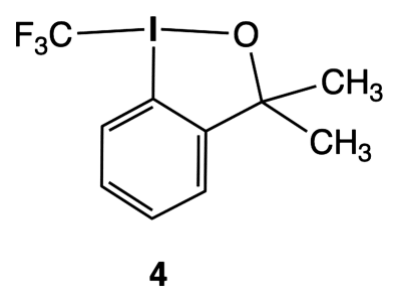
Fluorine forms stable and isolable compounds with essentially all elements, including the noble gases \(\ce{Kr}\) and \(\ce{Xe}\). Fluorine-containing molecules often feature uncommon structures. Thus, fluorine is frequently involved in the formation of compounds with elements of groups 14–18, which are defined as hypervalent. The synthesis of fluorinated organic compounds is nowadays heavily based on the availability of specifically designed reagents, compound 4 below being an example.
Hint: Any element \(E\) in the series \(\mathbf{E^1}\)–\(\mathbf{E^8}\) may be represented more than once.
Part I. Molecular geometry
4.1 Identify elements \(\mathbf{E^1}\), \(\mathbf{E^2}\), \(\mathbf{E^3}\), and \(\mathbf{E^4}\) in the three species 1, \(\mathbf{[2]^-}\), and \(\mathbf{[3]^-}\).
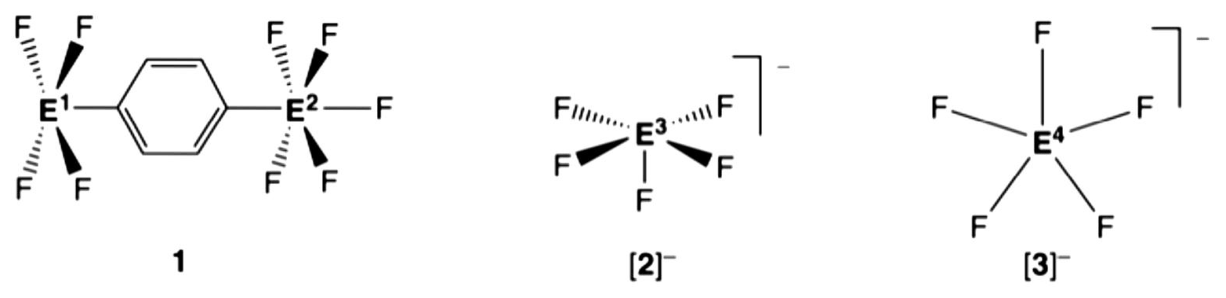
1: neutral, non-zwitterionic molecule, \(\mathbf{E^1}\) square pyramidal, \(\mathbf{E^2}\) octahedral, average \(d(E^1\!-\!\ce{F})=1.91\ \text{Å}\); average \(d(E^2\!-\!\ce{F})=1.58\ \text{Å}\)
\(\mathbf{[2]^-}\): anion, square pyramidal, average \(d(E^3\!-\!\ce{F})=1.96\ \text{Å}\)
\(\mathbf{[3]^-}\): anion, pentagonal planar, \(d(E^4\!-\!\ce{F})=1.98\ \text{Å}\)
Hints:
- The molecular geometries refer to the arrangement of atoms bonding to \(E^1\)–\(E^4\)
- The elemental analysis of 1 gives a carbon content of 17.75 % wt.
| Group 15 | Group 16 | Group 17 | Group 18 |
|---|---|---|---|
| \(d(\ce{P-F})=1.50\text{–}1.68\ \text{Å}\) | \(d(\ce{S-F})=1.52\text{–}1.60\ \text{Å}\) | \(d(\ce{Cl-F})=1.63\text{–}1.85\ \text{Å}\) | |
| \(d(\ce{As-F})=1.68\text{–}1.72\ \text{Å}\) | \(d(\ce{Se-F})=1.75\text{–}1.80\ \text{Å}\) | \(d(\ce{Br-F})=1.77\text{–}1.97\ \text{Å}\) | \(d(\ce{Kr-F})=1.77\text{–}1.89\ \text{Å}\) |
| \(d(\ce{Sb-F})=1.85\text{–}2.05\ \text{Å}\) | \(d(\ce{Te-F})=1.80\text{–}2.00\ \text{Å}\) | \(d(\ce{I-F})=1.90\text{–}2.00\ \text{Å}\) | \(d(\ce{Xe-F})=1.77\text{–}2.00\ \text{Å}\) |
Table 1. Typical \(\ce{E-F}\) bond distance ranges for a selection of elements in groups 15–18
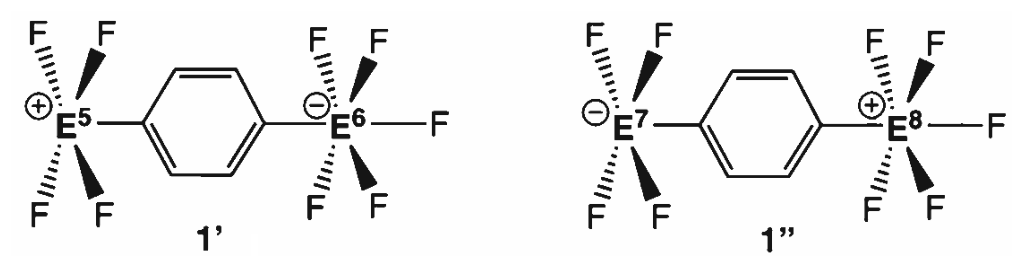
4.2 Choose which elements \(\mathbf{E^5}/\mathbf{E^6}\) and \(\mathbf{E^7}/\mathbf{E^8}\), respectively, would display the given geometry, including \(\ce{E-F}\) bond distances close to those in 1 (see Table 1).
Part II. Reactivity and structure
Consider the reaction shown below:
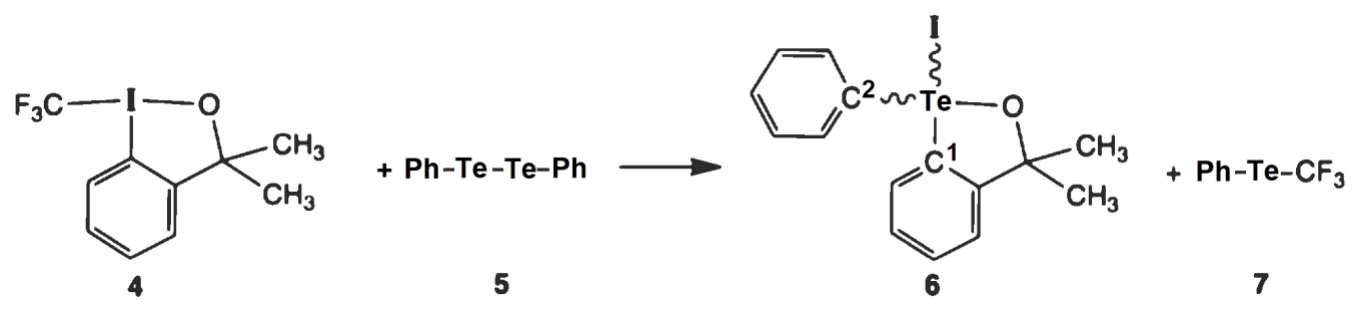
4.3 Choose the ideal geometry of compound 6 in terms of the arrangement of the valence-shell electron-pair domains around the \(\ce{Te}\) atom:
- square planar
- square pyramidal
- trigonal bipyramidal
- tetrahedral
- octahedral
Provide the expected ideal bond angles \(C^1\!-\!\ce{Te}\!-\!\ce{I}\), \(C^2\!-\!\ce{Te}\!-\!\ce{I}\), \(\ce{I-Te-O}\), and \(C^1\!-\!\ce{Te}\!-\!C^2\).
4.4 Write the number \({}^{1}\mathrm{H}\)-NMR signals you expect for the two methyl groups in compounds 4 and 6, respectively.
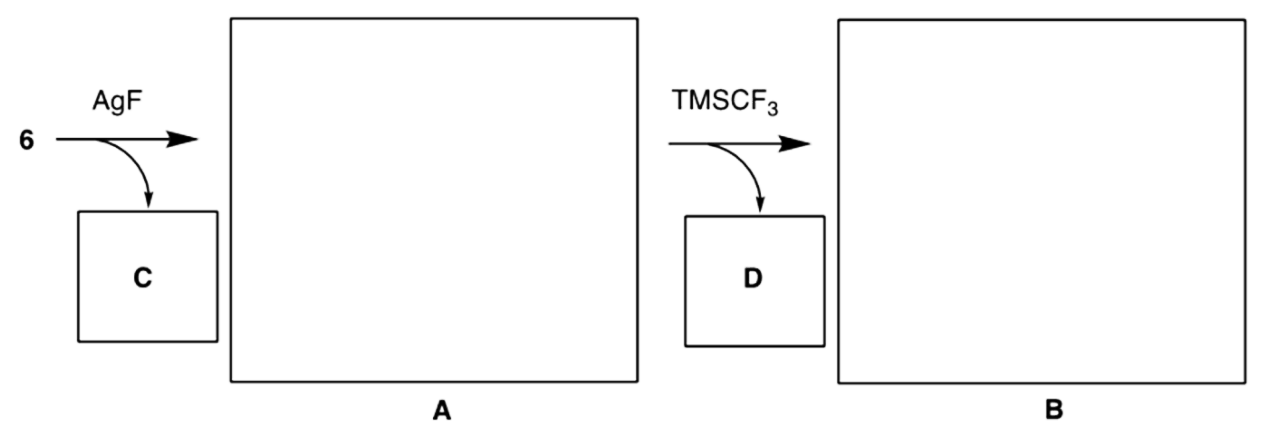
4.5 Compound 6 reacts consecutively with \(\ce{AgF}\) and \(\ce{(H3C)3SiCF3}\) (\(\ce{TMSCF3}\)). Formulate the \(\ce{Te}\)-containing intermediate A and final product B, including their correct geometry, as well as the byproducts C and D. Draw A and B and write the by-products C and D. Hint: molecular weight of D is \(92.08\ \mathrm{g\,mol^{-1}}\).
Assume that compound 6 reacts with a sterically bulky, chiral, enantiomerically pure Lewis acid, such as the known boron derivative 8, as shown below. This reaction should lead to the formation of a new product 9, the composition of which corresponds to the sum of 6 and 8. Further assume that 9 is a salt, in which the cation derives from 6 and the anion from 8.
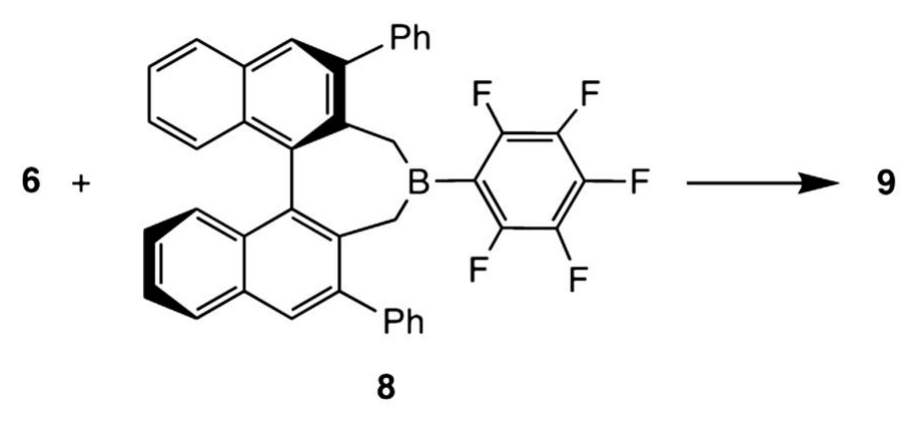
4.6 Draw the structure of both the \(\ce{Te}\)-containing cation and the boron-containing anion and choose the ideal geometry of the cation in terms of the arrangement of the valence-shell electron-pair domains around the \(\ce{Te}\) atom.
Hint: For 8 (chiral, enantiomerically pure) use the following schematic representation:
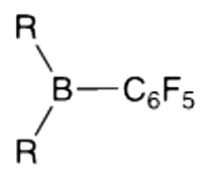
Choose the ideal molecular geometry of the cation:
- square-planar
- trigonal-planar
- trigonal-pyramidal
- trigonal-bipyramidal
- tetrahedral
4.7 State the number of possible stereochemically different salts 9.
Part III. Synthesis of a \(\lambda^3\)-difluoroiodane and rotation around a single bond
Compound 10 is prepared from starting material 8 by oxidation with trichloroisocyanuric acid (TCICA, 9) in the presence of excess \(\ce{KF}\) in dry acetonitrile as shown below.
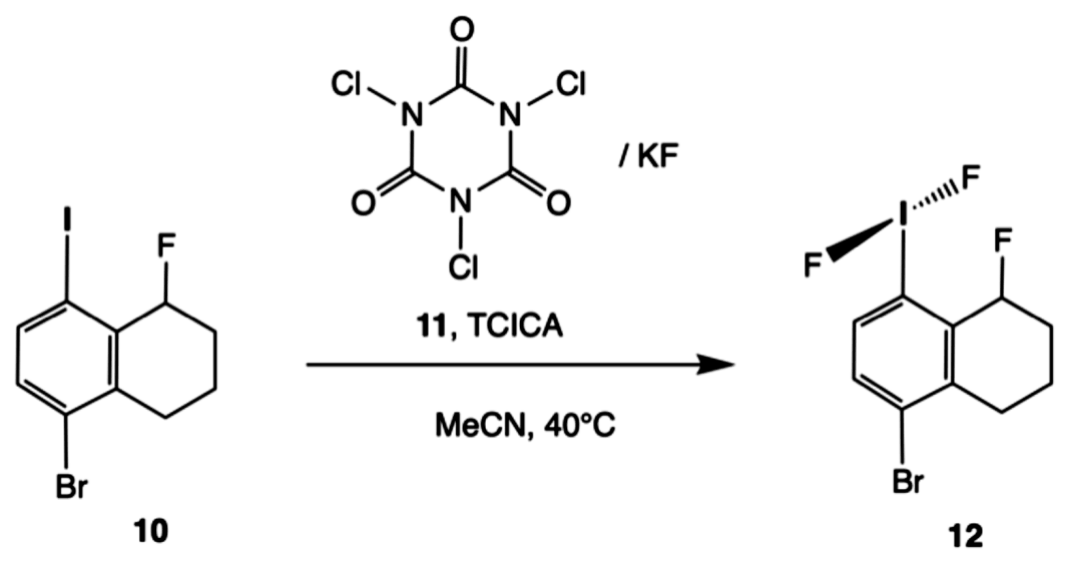
4.8 Write balanced half-cell reactions and a balanced overall reaction for this process.
Hint: Abbreviate 10 as \(\ce{R-I}\), 11 as \(\ce{R-IF2}\), and TCICA as \(\ce{C3Cl3N3O3}\). The six-membered ring of TCICA stays intact upon reduction.
The \(\ce{IF2}\) group in 12 can rotate around the \(\ce{I-C}\) bond (imagine a molecular propeller). The corresponding rotation barrier has been measured experimentally, \(E_\mathrm{a}=30\ \mathrm{kJ\,mol^{-1}}\). Furthermore, the rate constant for the rotation is \(k=2500\ \mathrm{s^{-1}}\) at \(228\ \mathrm{K}\).
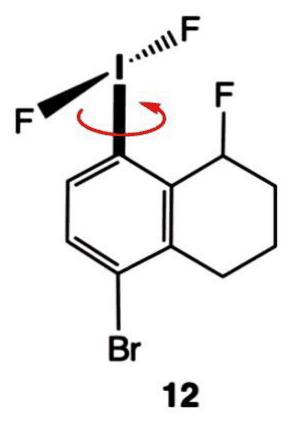
4.9 Determine how fast the \(\ce{IF2}\) group can in principle rotate at room temperature (\(298\ \mathrm{K}\)). Consider this process as if it were a chemical reaction for which you are determining the rate constant. Write your answer on the answer sheet. The unit of the constant should be given in \(\mathrm{s^{-1}}\).
Official English text of the problem.
Answers
Names, SMILES, and precise spatial descriptions of the structures are provided in the corresponding solution entries.
- 4.1: \(E^1=\ce{I}\), \(E^2=\ce{S}\), \(E^3=\ce{Te}\), \(E^4=\ce{Xe}\).
- 4.2: \(E^5=\ce{Xe}\), \(E^6=\ce{P}\), \(E^7=\ce{Te}\), \(E^8=\ce{Cl}\).
- 4.3: Trigonal-bipyramidal electron-domain geometry, with a seesaw molecular shape. The requested angles, in order, are \(90^\circ,\ 90^\circ,\ 180^\circ,\ 120^\circ\).
- 4.4: 4: one signal for six methyl protons; 6: two signals, each representing three methyl protons.
- 4.5: A is 6 with iodine replaced by fluorine; B is 6 with iodine replaced by \(\ce{CF3}\). Both have seesaw geometry, with oxygen and the replacing ligand axial. C is silver iodide, \(\ce{AgI}\); D is trimethylsilyl fluoride, \(\ce{(CH3)3SiF}\).
- 4.6: Iodide transfers from 6 to borane 8, giving the cyclic telluronium cation and \(\ce{[R2B(I)(C6F5)]^-}\). The cation has tetrahedral electron-domain geometry and trigonal-pyramidal molecular geometry.
- 4.7: Two diastereomeric salts.
- 4.8: The balanced half-reactions are \[ \ce{R-I + 2F- -> R-IF2 + 2e-} \] \[ \ce{C3Cl3N3O3 + 6e- -> C3N3O3^{3-} + 3Cl-}. \] The overall reaction with potassium fluoride is \[ \boxed{\ce{3 R-I + C3Cl3N3O3 + 6 KF -> 3 R-IF2 + K3C3N3O3 + 3 KCl}}. \]
- 4.9: \[ \boxed{k(298\ \mathrm{K})\approx1.03\times10^5\ \mathrm{s^{-1}}} \] or \(1.0\times10^5\ \mathrm{s^{-1}}\) to two significant figures.
Solution
4.1 — Identification of \(E^1\)–\(E^4\)
For a central atom with \(v\) valence electrons, \(b\) single bonds, and \(l\) lone pairs, its formal charge is \[ q=v-b-2l. \]
A square-pyramidal centre is \(AX_5E\): five bonds and one lone pair. An octahedral centre is \(AX_6\). A pentagonal-planar centre is \(AX_5E_2\), with two axial lone pairs in a pentagonal-bipyramidal electron-domain arrangement.
| Centre | Bonds | Lone pairs | Formal charge | Required valence electrons | Group |
|---|---|---|---|---|---|
| \(E^1\) | 5 | 1 | 0 | 7 | 17 |
| \(E^2\) | 6 | 0 | 0 | 6 | 16 |
| \(E^3\) | 5 | 1 | \(-1\) | 6 | 16 |
| \(E^4\) | 5 | 2 | \(-1\) | 8 | 18 |
For \(E^2\), the group-16 element with an average bond distance of \(1.58\ \text{Å}\) is sulfur.
The molecular formula of 1 is therefore \(\ce{C6H4F9E^1S}\). Its carbon mass fraction gives \[ M(1)=\frac{6M(\ce{C})}{0.1775} =\frac{6(12.011)}{0.1775} \approx406.01\ \mathrm{g\,mol^{-1}}. \] Consequently, \[ \begin{aligned} M(E^1) &=M(1)-6M(\ce{C})-4M(\ce{H})-9M(\ce{F})-M(\ce{S})\\ &\approx126.86\ \mathrm{g\,mol^{-1}}, \end{aligned} \] identifying iodine. This also fits the \(1.91\ \text{Å}\) bond distance. The complete formula \(\ce{C6H4F9IS}\) gives \[ w_\ce{C} =\frac{72.066}{406.048}\times100\% =17.748\%\approx17.75\%. \]
For \(E^3\), the group-16 bond-distance range containing \(1.96\ \text{Å}\) is that of tellurium. For \(E^4\), the group-18 range containing \(1.98\ \text{Å}\) is that of xenon.
The identified structures are:
| Species | Name | SMILES |
|---|---|---|
| 1 | Tetrafluoro[4-(pentafluorosulfanyl)phenyl]iodane | [I](F)(F)(F)(F)c1ccc(S(F)(F)(F)(F)F)cc1 |
| \(\mathbf{[2]^-}\) | Pentafluorotellurate(IV) ion | [Te-](F)(F)(F)(F)F |
| \(\mathbf{[3]^-}\) | Pentafluoroxenate(IV) ion | [Xe-](F)(F)(F)(F)F |
The SMILES specify connectivity and charge. The spatial arrangements are square pyramidal at iodine in 1, octahedral at sulfur in 1, square pyramidal for \(\ce{[TeF5]^-}\), and pentagonal planar for \(\ce{[XeF5]^-}\).
4.2 — Charged analogues
The geometries remain unchanged, so the formal-charge equation determines the required groups.
| Centre | Required calculation | Group | Element selected from bond distances |
|---|---|---|---|
| \(E^5\) | \(v=5+2+1=8\) | 18 | \(\ce{Xe}\) |
| \(E^6\) | \(v=6-1=5\) | 15 | \(\ce{P}\) |
| \(E^7\) | \(v=5+2-1=6\) | 16 | \(\ce{Te}\) |
| \(E^8\) | \(v=6+1=7\) | 17 | \(\ce{Cl}\) |
Thus the replacements are isoelectronic with the corresponding centres in 1. Xenon and tellurium have bond-distance ranges containing \(1.91\ \text{Å}\). Phosphorus has a range containing \(1.58\ \text{Å}\); chlorine provides the shortest listed halogen–fluorine distances and the closest halogen match to that value.
| Species | Descriptive name | SMILES |
|---|---|---|
| 1′ | Para-phenylene-linked xenon/phosphorus zwitterion | [Xe+](F)(F)(F)(F)c1ccc([P-](F)(F)(F)(F)F)cc1 |
| 1″ | Para-phenylene-linked tellurium/chlorine zwitterion | [Te-](F)(F)(F)(F)c1ccc([Cl+](F)(F)(F)(F)F)cc1 |
In each structure, the left-hand centre is square pyramidal and the right-hand centre is octahedral.
4.3 — Geometry and angles of compound 6
Compound 6, the cyclic iodo(phenyl)tellurane, has SMILES
CC1(C)O[Te](I)(c2ccccc2)c2ccccc21.
Tellurium has four single bonds and one lone pair: \[ 6-4=2 \] nonbonding electrons. It is therefore \(AX_4E\), with five electron domains.
The ideal electron-domain arrangement is trigonal bipyramidal. Place:
- iodine and oxygen in the two axial positions;
- \(C^1\), \(C^2\), and the lone pair in the three equatorial positions.
The lone pair occupies an equatorial site, where it has fewer \(90^\circ\) interactions. The electronegative ligands occupy the axial sites. Removing the lone-pair position from the drawing gives the seesaw molecular shape.
Hence \[ \boxed{ \begin{aligned} \angle(C^1\!-\!\ce{Te}\!-\!\ce{I})&=90^\circ,\\ \angle(C^2\!-\!\ce{Te}\!-\!\ce{I})&=90^\circ,\\ \angle(\ce{I-Te-O})&=180^\circ,\\ \angle(C^1\!-\!\ce{Te}\!-\!C^2)&=120^\circ. \end{aligned}} \]
The connectivity SMILES leaves the Te configuration unspecified, as does the problem’s drawing.
4.4 — Methyl-group NMR signals
Compound 4 is Togni reagent I, SMILES
CC1(C)O[I](C(F)(F)F)c2ccccc21.
Its iodine centre has three bonds and two lone pairs, giving a T-shaped molecular arrangement. The two methyl groups are related by the molecular reflection symmetry and are enantiotopic. In an achiral NMR medium, they have the same chemical shift: \[ \boxed{\text{Compound 4: one methyl resonance, integrating to }6\mathrm{H}.} \]
In 6, the two axial ligands differ and the two equatorial carbon ligands differ. The resulting seesaw arrangement is chiral at tellurium. The two methyl groups are therefore diastereotopic: \[ \boxed{\text{Compound 6: two methyl resonances, each integrating to }3\mathrm{H}.} \]
A racemic sample of 6 still gives these two resonances in an achiral medium, because its two enantiomers have identical NMR spectra.
4.5 — Structures of A and B; byproducts C and D
Silver(I) fluoride, SMILES [Ag+].[F-], replaces the iodine ligand with fluorine. Precipitation of silver iodide accompanies the exchange.
Trimethyl(trifluoromethyl)silane—the Ruppert–Prakash reagent—has SMILES C[Si](C)(C)C(F)(F)F. It subsequently replaces the Te-bound fluorine with a trifluoromethyl group, forming a strong silicon–fluorine bond.
Let \(L\) denote the unchanged chelating carbon–oxygen framework of 6. The balanced substitutions are \[ \ce{LTe(Ph)I + AgF -> LTe(Ph)F + AgI} \] and \[ \ce{LTe(Ph)F + (CH3)3SiCF3 -> LTe(Ph)(CF3) + (CH3)3SiF}. \]
| Label | Name | SMILES |
|---|---|---|
| A | Cyclic fluoro(phenyl)tellurane | CC1(C)O[Te](F)(c2ccccc2)c2ccccc21 |
| B | Cyclic phenyl(trifluoromethyl)tellurane | CC1(C)O[Te](C(F)(F)F)(c2ccccc2)c2ccccc21 |
| C | Silver(I) iodide | [Ag+].[I-] |
| D | Trimethylsilyl fluoride, or fluorotrimethylsilane | C[Si](C)(C)F |
To draw A, retain the ring framework and phenyl group of 6, place oxygen and fluorine opposite one another axially, and place the two aryl carbon bonds and the lone pair equatorially.
To draw B, replace that axial fluorine with the carbon of \(\ce{CF3}\). Oxygen and \(\ce{CF3}\) are axial; \(C^1\), \(C^2\), and the lone pair are equatorial. Both products consequently have trigonal-bipyramidal electron-domain geometry and seesaw molecular geometry. Their SMILES leave Te handedness unspecified.
For D, \[ \begin{aligned} M(\ce{C3H9FSi}) &=3(12.011)+9(1.008)+18.998+28.085\\ &=92.19\ \mathrm{g\,mol^{-1}}. \end{aligned} \] This exposes a discrepancy with the printed \(92.08\ \mathrm{g\,mol^{-1}}\) hint.
4.6 — The ions in salt 9
The borane accepts iodide, [I-], from 6:
\[
\ce{LTe(Ph)I + R2B(C6F5) ->
[LTe(Ph)]^+ + [R2B(I)(C6F5)]^-}.
\]
The \(\ce{Te-I}\) bonding electron pair leaves with iodine, and iodide donates a lone pair to boron. The Te–O and both Te–C bonds remain intact.
The cyclic phenyl telluronium cation has the two possible stereochemical SMILES
CC1(C)O[Te@+](c2ccccc2)c2ccccc21
and
CC1(C)O[Te@@+](c2ccccc2)c2ccccc21.
These represent opposite configurations at tellurium. Its three bonds and one lone pair give \(AX_3E\): \[ \boxed{\text{Electron-domain geometry: tetrahedral.}} \] \[ \boxed{\text{Molecular geometry: trigonal pyramidal.}} \]
For a drawing, retain the five-membered ring, remove iodine, mark the cationic charge, and show the three Te bonds forming a pyramid with a lone pair occupying the fourth approximately tetrahedral direction.
The iodoborate anion derived from 8 is \[ \ce{[R2B(I)(C6F5)]^-}, \] with tetrahedral boron bonded to iodine, pentafluorophenyl, and the two original scaffold arms.
Its full connectivity SMILES is
[B-]1(I)(c2c(F)c(F)c(F)c(F)c2F)Cc2c(-c3ccccc3)cc3ccccc3c2-c2c(C1)c(-c3ccccc3)cc3ccccc23.
For reference, 8, the binaphthyl-bridged pentafluorophenylborane, has connectivity SMILES
B1(c2c(F)c(F)c(F)c(F)c2F)Cc2c(-c3ccccc3)cc3ccccc3c2-c2c(C1)c(-c3ccccc3)cc3ccccc23.
Ordinary SMILES does not specify the binaphthyl atropisomeric configuration here: in both structures it is the fixed axial configuration drawn for enantiopure 8. Iodide coordination preserves that configuration.
4.7 — Number of stereochemically different salts
The pyramidal cation has two enantiomeric configurations at Te. The borate has the single inherited axial configuration supplied by enantiopure 8.
The two equivalent scaffold arms of 8 do not introduce an additional independent stereochemical choice at boron. Consequently, the possibilities are \[ (R_\mathrm{Te},\chi_\mathrm{borate}) \quad\text{and}\quad (S_\mathrm{Te},\chi_\mathrm{borate}), \] where \(\chi_\mathrm{borate}\) is fixed.
These salts are diastereomers, giving \[ \boxed{2}. \]
4.8 — Balanced redox reactions
Following the reaction drawing, 10 is the starting aryl iodide, 11 is TCICA, and 12 is the difluoroiodane.
The organic structures are:
| Compound | Name | SMILES |
|---|---|---|
| 10 | 5-Bromo-1-fluoro-8-iodo-1,2,3,4-tetrahydronaphthalene | FC1CCCc2c(Br)ccc(I)c21 |
| 12 | 5-Bromo-8-(difluoro-\(\lambda^3\)-iodanyl)-1-fluoro-1,2,3,4-tetrahydronaphthalene | FC1CCCc2c(Br)ccc(I(F)F)c21 |
The configuration of the fluorinated saturated carbon is unspecified in the supplied drawing and in these SMILES. At iodine in 12, the two fluorines occupy opposite axial sites of a T-shaped molecular arrangement.
Formation of two iodine–fluorine bonds is a two-electron oxidation: \[ \boxed{\ce{R-I + 2F- -> R-IF2 + 2e-}}. \] Both sides have net charge \(-2\).
Each N–Cl unit of TCICA accepts two electrons on cleavage to a negatively charged ring nitrogen and chloride. Reduction of all three units therefore consumes six electrons. Under the stated dry conditions, the intact reduced ring is written as cyanurate(3−): \[ \boxed{\ce{C3Cl3N3O3 + 6e- -> C3N3O3^{3-} + 3Cl-}}. \] Both sides have net charge \(-6\).
Multiplying the oxidation half-reaction by three and adding gives \[ \ce{3 R-I + 6F- + C3Cl3N3O3 -> 3 R-IF2 + C3N3O3^{3-} + 3Cl-}. \]
Including the potassium counterions: \[ \boxed{\ce{3 R-I + C3Cl3N3O3 + 6 KF -> 3 R-IF2 + K3C3N3O3 + 3 KCl}}. \]
The remaining molecular and ionic identities are:
| Species | Name | SMILES |
|---|---|---|
| \(\ce{C3Cl3N3O3}\) | Trichloroisocyanuric acid, TCICA | O=C1N(Cl)C(=O)N(Cl)C(=O)N1Cl |
| \(\ce{C3N3O3^{3-}}\) | Cyanurate(3−) ion | O=C1[N-]C(=O)[N-]C(=O)[N-]1 |
| \(\ce{K3C3N3O3}\) | Tripotassium cyanurate | [K+].[K+].[K+].O=C1[N-]C(=O)[N-]C(=O)[N-]1 |
| \(\ce{KF}\) | Potassium fluoride | [K+].[F-] |
| \(\ce{KCl}\) | Potassium chloride | [K+].[Cl-] |
| \(\ce{F-}\) | Fluoride ion | [F-] |
| \(\ce{Cl-}\) | Chloride ion | [Cl-] |
The cyanurate SMILES shows one resonance representation; its charge is delocalized.
4.9 — Rotation rate constant at 298 K
Use the Arrhenius equation with a temperature-independent prefactor over the stated interval: \[ k=A\exp\left(-\frac{E_\mathrm a}{RT}\right). \] Taking the ratio at two temperatures eliminates \(A\): \[ \ln\left(\frac{k_{298}}{k_{228}}\right) =\frac{E_\mathrm a}{R} \left(\frac1{228\ \mathrm K}-\frac1{298\ \mathrm K}\right). \]
Using \(E_\mathrm a=3.0\times10^4\ \mathrm{J\,mol^{-1}}\) and \(R=8.314\ \mathrm{J\,mol^{-1}\,K^{-1}}\), \[ \ln\left(\frac{k_{298}}{2500\ \mathrm{s^{-1}}}\right) = \frac{30000}{8.314} \left(\frac1{228}-\frac1{298}\right) =3.71756. \] Therefore, \[ \begin{aligned} k_{298} &=2500\,e^{3.71756}\ \mathrm{s^{-1}}\\ &=1.0291\times10^5\ \mathrm{s^{-1}}. \end{aligned} \]
Thus \[ \boxed{k(298\ \mathrm K)\approx1.03\times10^5\ \mathrm{s^{-1}}}. \]
The solution was checked against the official solution.
IChO 2023 · Theorieaufgabe 4
Fluorierte und hypervalente Verbindungen
Fluor bildet mit praktisch allen Elementen stabile und isolierbare Verbindungen, einschließlich der Edelgase \(\ce{Kr}\) und \(\ce{Xe}\). Fluorhaltige Moleküle weisen häufig ungewöhnliche Strukturen auf. So ist Fluor häufig an der Bildung von Verbindungen mit Elementen der Gruppen 14–18 beteiligt, die als hypervalent bezeichnet werden. Die Synthese fluorierter organischer Verbindungen beruht heutzutage in hohem Maße auf der Verfügbarkeit gezielt entwickelter Reagenzien; die unten gezeigte Verbindung 4 ist ein Beispiel dafür.
Hinweis: Jedes Element \(E\) in der Reihe \(\mathbf{E^1}\)–\(\mathbf{E^8}\) kann mehr als einmal vorkommen.
Teil I. Molekülgeometrie
4.1 Bestimmen Sie die Elemente \(\mathbf{E^1}\), \(\mathbf{E^2}\), \(\mathbf{E^3}\) und \(\mathbf{E^4}\) in den drei Spezies 1, \(\mathbf{[2]^-}\) und \(\mathbf{[3]^-}\).
1: neutrales, nicht zwitterionisches Molekül, \(\mathbf{E^1}\) quadratisch-pyramidal, \(\mathbf{E^2}\) oktaedrisch, mittlerer Abstand \(d(E^1\!-\!\ce{F})=1.91\ \text{Å}\); mittlerer Abstand \(d(E^2\!-\!\ce{F})=1.58\ \text{Å}\)
\(\mathbf{[2]^-}\): Anion, quadratisch-pyramidal, mittlerer Abstand \(d(E^3\!-\!\ce{F})=1.96\ \text{Å}\)
\(\mathbf{[3]^-}\): Anion, pentagonal-planar, \(d(E^4\!-\!\ce{F})=1.98\ \text{Å}\)
Hinweise:
- Die Molekülgeometrien beziehen sich auf die Anordnung der an \(E^1\)–\(E^4\) gebundenen Atome.
- Die Elementaranalyse von 1 ergibt einen Kohlenstoffgehalt von 17.75 Massen-%.
| Gruppe 15 | Gruppe 16 | Gruppe 17 | Gruppe 18 |
|---|---|---|---|
| \(d(\ce{P-F})=1.50\text{–}1.68\ \text{Å}\) | \(d(\ce{S-F})=1.52\text{–}1.60\ \text{Å}\) | \(d(\ce{Cl-F})=1.63\text{–}1.85\ \text{Å}\) | |
| \(d(\ce{As-F})=1.68\text{–}1.72\ \text{Å}\) | \(d(\ce{Se-F})=1.75\text{–}1.80\ \text{Å}\) | \(d(\ce{Br-F})=1.77\text{–}1.97\ \text{Å}\) | \(d(\ce{Kr-F})=1.77\text{–}1.89\ \text{Å}\) |
| \(d(\ce{Sb-F})=1.85\text{–}2.05\ \text{Å}\) | \(d(\ce{Te-F})=1.80\text{–}2.00\ \text{Å}\) | \(d(\ce{I-F})=1.90\text{–}2.00\ \text{Å}\) | \(d(\ce{Xe-F})=1.77\text{–}2.00\ \text{Å}\) |
Tabelle 1. Typische Bereiche der \(\ce{E-F}\)-Bindungslängen für ausgewählte Elemente der Gruppen 15–18
4.2 Wählen Sie die Elemente \(\mathbf{E^5}/\mathbf{E^6}\) bzw. \(\mathbf{E^7}/\mathbf{E^8}\), die die angegebene Geometrie mit \(\ce{E-F}\)-Bindungslängen nahe denen in 1 aufweisen würden (siehe Tabelle 1).
Teil II. Reaktivität und Struktur
Betrachten Sie die unten dargestellte Reaktion:
4.3 Wählen Sie die ideale Geometrie der Verbindung 6 hinsichtlich der Anordnung der Elektronenpaardomänen der Valenzschale um das \(\ce{Te}\)-Atom:
- quadratisch-planar
- quadratisch-pyramidal
- trigonal-bipyramidal
- tetraedrisch
- oktaedrisch
Geben Sie die erwarteten idealen Bindungswinkel \(C^1\!-\!\ce{Te}\!-\!\ce{I}\), \(C^2\!-\!\ce{Te}\!-\!\ce{I}\), \(\ce{I-Te-O}\) und \(C^1\!-\!\ce{Te}\!-\!C^2\) an.
4.4 Geben Sie die Anzahl der \({}^{1}\mathrm{H}\)-NMR-Signale an, die Sie jeweils für die beiden Methylgruppen in den Verbindungen 4 und 6 erwarten.
4.5 Verbindung 6 reagiert nacheinander mit \(\ce{AgF}\) und \(\ce{(H3C)3SiCF3}\) (\(\ce{TMSCF3}\)). Formulieren Sie das \(\ce{Te}\)-haltige Zwischenprodukt A und das Endprodukt B einschließlich ihrer korrekten Geometrie sowie die Nebenprodukte C und D. Zeichnen Sie A und B und geben Sie die Nebenprodukte C und D an. Hinweis: Die molare Masse von D beträgt \(92.08\ \mathrm{g\,mol^{-1}}\).
Nehmen Sie an, dass Verbindung 6 mit einer sterisch anspruchsvollen, chiralen, enantiomerenreinen Lewis-Säure reagiert, beispielsweise mit dem bekannten Borderivat 8, wie unten gezeigt. Diese Reaktion sollte zur Bildung eines neuen Produkts 9 führen, dessen Zusammensetzung der Summe von 6 und 8 entspricht. Nehmen Sie ferner an, dass 9 ein Salz ist, in dem das Kation von 6 und das Anion von 8 abstammt.
4.6 Zeichnen Sie die Struktur sowohl des \(\ce{Te}\)-haltigen Kations als auch des borhaltigen Anions und wählen Sie die ideale Geometrie des Kations hinsichtlich der Anordnung der Elektronenpaardomänen der Valenzschale um das \(\ce{Te}\)-Atom.
Hinweis: Verwenden Sie für 8 (chiral, enantiomerenrein) die folgende schematische Darstellung:
Wählen Sie die ideale Molekülgeometrie des Kations:
- quadratisch-planar
- trigonal-planar
- trigonal-pyramidal
- trigonal-bipyramidal
- tetraedrisch
4.7 Geben Sie die Anzahl der möglichen stereochemisch unterschiedlichen Salze 9 an.
Teil III. Synthese eines \(\lambda^3\)-Difluoriodans und Rotation um eine Einfachbindung
Verbindung 10 wird aus dem Ausgangsstoff 8 durch Oxidation mit Trichlorisocyanursäure (TCICA, 9) in Gegenwart von überschüssigem \(\ce{KF}\) in trockenem Acetonitril hergestellt, wie unten gezeigt.
4.8 Formulieren Sie ausgeglichene Halbreaktionen und eine ausgeglichene Gesamtreaktion für diesen Prozess.
Hinweis: Kürzen Sie 10 als \(\ce{R-I}\), 11 als \(\ce{R-IF2}\) und TCICA als \(\ce{C3Cl3N3O3}\) ab. Der sechsgliedrige Ring von TCICA bleibt bei der Reduktion intakt.
Die \(\ce{IF2}\)-Gruppe in 12 kann um die \(\ce{I-C}\)-Bindung rotieren (stellen Sie sich einen molekularen Propeller vor). Die entsprechende Rotationsbarriere wurde experimentell gemessen: \(E_\mathrm{a}=30\ \mathrm{kJ\,mol^{-1}}\). Außerdem beträgt die Geschwindigkeitskonstante der Rotation \(k=2500\ \mathrm{s^{-1}}\) bei \(228\ \mathrm{K}\).
4.9 Bestimmen Sie, wie schnell die \(\ce{IF2}\)-Gruppe bei Raumtemperatur (\(298\ \mathrm{K}\)) prinzipiell rotieren kann. Betrachten Sie diesen Prozess wie eine chemische Reaktion, für die Sie die Geschwindigkeitskonstante bestimmen. Schreiben Sie Ihre Antwort auf das Antwortblatt. Die Einheit der Konstante soll in \(\mathrm{s^{-1}}\) angegeben werden.
Aufgabentext aus dem offiziellen englischen Text übersetzt.
Antworten
Namen, SMILES und genaue räumliche Beschreibungen der Strukturen sind in den entsprechenden Lösungsabschnitten angegeben.
- 4.1: \(E^1=\ce{I}\), \(E^2=\ce{S}\), \(E^3=\ce{Te}\), \(E^4=\ce{Xe}\).
- 4.2: \(E^5=\ce{Xe}\), \(E^6=\ce{P}\), \(E^7=\ce{Te}\), \(E^8=\ce{Cl}\).
- 4.3: Trigonal-bipyramidale Elektronendomänengeometrie mit einer wippenförmigen Molekülgestalt. Die gefragten Winkel betragen in der angegebenen Reihenfolge \(90^\circ,\ 90^\circ,\ 180^\circ,\ 120^\circ\).
- 4.4: 4: ein Signal für sechs Methylprotonen; 6: zwei Signale, die jeweils drei Methylprotonen entsprechen.
- 4.5: A entspricht 6, wobei Iod durch Fluor ersetzt ist; B entspricht 6, wobei Iod durch \(\ce{CF3}\) ersetzt ist. Beide weisen eine Wippengeometrie auf, wobei Sauerstoff und der jeweils neu eintretende Ligand axiale Positionen einnehmen. C ist Silberiodid, \(\ce{AgI}\); D ist Trimethylsilylfluorid, \(\ce{(CH3)3SiF}\).
- 4.6: Iodid wird von 6 auf das Boran 8 übertragen, wobei das cyclische Telluroniumkation und \(\ce{[R2B(I)(C6F5)]^-}\) entstehen. Das Kation hat eine tetraedrische Elektronendomänengeometrie und eine trigonal-pyramidale Molekülgeometrie.
- 4.7: Zwei diastereomere Salze.
- 4.8: Die ausgeglichenen Halbreaktionen lauten \[ \ce{R-I + 2F- -> R-IF2 + 2e-} \] \[ \ce{C3Cl3N3O3 + 6e- -> C3N3O3^{3-} + 3Cl-}. \] Die Gesamtreaktion mit Kaliumfluorid lautet \[ \boxed{\ce{3 R-I + C3Cl3N3O3 + 6 KF -> 3 R-IF2 + K3C3N3O3 + 3 KCl}}. \]
- 4.9: \[ \boxed{k(298\ \mathrm{K})\approx1.03\times10^5\ \mathrm{s^{-1}}} \] oder \(1.0\times10^5\ \mathrm{s^{-1}}\) auf zwei signifikante Stellen gerundet.
Lösung
4.1 — Identifizierung von \(E^1\)–\(E^4\)
Für ein Zentralatom mit \(v\) Valenzelektronen, \(b\) Einfachbindungen und \(l\) freien Elektronenpaaren beträgt die Formalladung \[ q=v-b-2l. \]
Ein quadratisch-pyramidales Zentrum entspricht \(AX_5E\): fünf Bindungen und ein freies Elektronenpaar. Ein oktaedrisches Zentrum entspricht \(AX_6\). Ein pentagonal-planares Zentrum entspricht \(AX_5E_2\) mit zwei axialen freien Elektronenpaaren in einer pentagonal-bipyramidalen Elektronendomänenanordnung.
| Zentrum | Bindungen | Freie Elektronenpaare | Formalladung | Erforderliche Valenzelektronen | Gruppe |
|---|---|---|---|---|---|
| \(E^1\) | 5 | 1 | 0 | 7 | 17 |
| \(E^2\) | 6 | 0 | 0 | 6 | 16 |
| \(E^3\) | 5 | 1 | \(-1\) | 6 | 16 |
| \(E^4\) | 5 | 2 | \(-1\) | 8 | 18 |
Für \(E^2\) ist das Element der Gruppe 16 mit einer mittleren Bindungslänge von \(1.58\ \text{Å}\) Schwefel.
Die Summenformel von 1 lautet daher \(\ce{C6H4F9E^1S}\). Aus seinem Kohlenstoffmassenanteil ergibt sich \[ M(1)=\frac{6M(\ce{C})}{0.1775} =\frac{6(12.011)}{0.1775} \approx406.01\ \mathrm{g\,mol^{-1}}. \] Folglich gilt \[ \begin{aligned} M(E^1) &=M(1)-6M(\ce{C})-4M(\ce{H})-9M(\ce{F})-M(\ce{S})\\ &\approx126.86\ \mathrm{g\,mol^{-1}}, \end{aligned} \] womit Iod identifiziert ist. Dies stimmt auch mit der Bindungslänge von \(1.91\ \text{Å}\) überein. Die vollständige Summenformel \(\ce{C6H4F9IS}\) ergibt \[ w_\ce{C} =\frac{72.066}{406.048}\times100\% =17.748\%\approx17.75\%. \]
Für \(E^3\) ist der Bindungslängenbereich der Gruppe 16, der \(1.96\ \text{Å}\) einschließt, derjenige von Tellur. Für \(E^4\) ist der Bereich der Gruppe 18, der \(1.98\ \text{Å}\) einschließt, derjenige von Xenon.
Die identifizierten Strukturen sind:
| Spezies | Name | SMILES |
|---|---|---|
| 1 | Tetrafluor[4-(pentafluorsulfanyl)phenyl]iodan | [I](F)(F)(F)(F)c1ccc(S(F)(F)(F)(F)F)cc1 |
| \(\mathbf{[2]^-}\) | Pentafluorotellurat(IV)-Ion | [Te-](F)(F)(F)(F)F |
| \(\mathbf{[3]^-}\) | Pentafluoroxenat(IV)-Ion | [Xe-](F)(F)(F)(F)F |
Die SMILES geben Konnektivität und Ladung an. Die räumlichen Anordnungen sind quadratisch-pyramidal am Iod in 1, oktaedrisch am Schwefel in 1, quadratisch-pyramidal für \(\ce{[TeF5]^-}\) und pentagonal-planar für \(\ce{[XeF5]^-}\).
4.2 — Geladene Analoga
Die Geometrien bleiben unverändert, sodass die Gleichung für die Formalladung die erforderlichen Gruppen bestimmt.
| Zentrum | Erforderliche Berechnung | Gruppe | Anhand der Bindungslängen ausgewähltes Element |
|---|---|---|---|
| \(E^5\) | \(v=5+2+1=8\) | 18 | \(\ce{Xe}\) |
| \(E^6\) | \(v=6-1=5\) | 15 | \(\ce{P}\) |
| \(E^7\) | \(v=5+2-1=6\) | 16 | \(\ce{Te}\) |
| \(E^8\) | \(v=6+1=7\) | 17 | \(\ce{Cl}\) |
Die ersetzenden Atome sind somit isoelektronisch mit den entsprechenden Zentren in 1. Xenon und Tellur haben Bindungslängenbereiche, die \(1.91\ \text{Å}\) einschließen. Phosphor hat einen Bereich, der \(1.58\ \text{Å}\) einschließt; Chlor weist die kürzesten aufgeführten Halogen–Fluor-Bindungslängen auf und kommt diesem Wert unter den Halogenen am nächsten.
| Spezies | Beschreibender Name | SMILES |
|---|---|---|
| 1′ | Über para-Phenylen verbrücktes Xenon/Phosphor-Zwitterion | [Xe+](F)(F)(F)(F)c1ccc([P-](F)(F)(F)(F)F)cc1 |
| 1″ | Über para-Phenylen verbrücktes Tellur/Chlor-Zwitterion | [Te-](F)(F)(F)(F)c1ccc([Cl+](F)(F)(F)(F)F)cc1 |
In jeder Struktur ist das linke Zentrum quadratisch-pyramidal und das rechte Zentrum oktaedrisch.
4.3 — Geometrie und Winkel der Verbindung 6
Verbindung 6, das cyclische Iod(phenyl)telluran, hat den SMILES
CC1(C)O[Te](I)(c2ccccc2)c2ccccc21.
Tellur hat vier Einfachbindungen und ein freies Elektronenpaar: \[ 6-4=2 \] nichtbindende Elektronen. Es entspricht daher \(AX_4E\) mit fünf Elektronendomänen.
Die ideale Elektronendomänenanordnung ist trigonal-bipyramidal. Ordnen Sie an:
- Iod und Sauerstoff in den beiden axialen Positionen;
- \(C^1\), \(C^2\) und das freie Elektronenpaar in den drei äquatorialen Positionen.
Das freie Elektronenpaar besetzt eine äquatoriale Position, in der es weniger \(90^\circ\)-Wechselwirkungen aufweist. Die elektronegativen Liganden besetzen die axialen Positionen. Lässt man die Position des freien Elektronenpaars in der Zeichnung weg, ergibt sich die wippenförmige Molekülgestalt.
Damit gilt \[ \boxed{ \begin{aligned} \angle(C^1\!-\!\ce{Te}\!-\!\ce{I})&=90^\circ,\\ \angle(C^2\!-\!\ce{Te}\!-\!\ce{I})&=90^\circ,\\ \angle(\ce{I-Te-O})&=180^\circ,\\ \angle(C^1\!-\!\ce{Te}\!-\!C^2)&=120^\circ. \end{aligned}} \]
Der Konnektivitäts-SMILES lässt die Te-Konfiguration unbestimmt, ebenso wie die Zeichnung in der Aufgabenstellung.
4.4 — NMR-Signale der Methylgruppen
Verbindung 4 ist das Togni-Reagenz I, SMILES
CC1(C)O[I](C(F)(F)F)c2ccccc21.
Ihr Iodzentrum hat drei Bindungen und zwei freie Elektronenpaare, was zu einer T-förmigen Molekülanordnung führt. Die beiden Methylgruppen gehen durch die Spiegelsymmetrie des Moleküls ineinander über und sind enantiotop. In einem achiralen NMR-Medium haben sie dieselbe chemische Verschiebung: \[ \boxed{\text{Verbindung 4: eine Methylresonanz mit einem Integral von }6\mathrm{H}.} \]
In 6 unterscheiden sich die beiden axialen Liganden voneinander, ebenso wie die beiden äquatorialen Kohlenstoffliganden. Die resultierende Wippenanordnung ist am Tellur chiral. Die beiden Methylgruppen sind daher diastereotop: \[ \boxed{\text{Verbindung 6: zwei Methylresonanzen mit einem Integral von jeweils }3\mathrm{H}.} \]
Auch eine racemische Probe von 6 ergibt diese beiden Resonanzen in einem achiralen Medium, da ihre beiden Enantiomere identische NMR-Spektren aufweisen.
4.5 — Strukturen von A und B; Nebenprodukte C und D
Silber(I)-fluorid, SMILES [Ag+].[F-], ersetzt den Iodliganden durch Fluor. Der Austausch wird von der Fällung von Silberiodid begleitet.
Trimethyl(trifluormethyl)silan – das Ruppert–Prakash-Reagenz – hat den SMILES C[Si](C)(C)C(F)(F)F. Es ersetzt anschließend das an Te gebundene Fluor durch eine Trifluormethylgruppe, wobei eine starke Silicium–Fluor-Bindung gebildet wird.
Mit \(L\) sei das unveränderte chelatisierende Kohlenstoff–Sauerstoff-Gerüst von 6 bezeichnet. Die ausgeglichenen Substitutionsreaktionen lauten \[ \ce{LTe(Ph)I + AgF -> LTe(Ph)F + AgI} \] und \[ \ce{LTe(Ph)F + (CH3)3SiCF3 -> LTe(Ph)(CF3) + (CH3)3SiF}. \]
| Kennzeichnung | Name | SMILES |
|---|---|---|
| A | Cyclisches Fluor(phenyl)telluran | CC1(C)O[Te](F)(c2ccccc2)c2ccccc21 |
| B | Cyclisches Phenyl(trifluormethyl)telluran | CC1(C)O[Te](C(F)(F)F)(c2ccccc2)c2ccccc21 |
| C | Silber(I)-iodid | [Ag+].[I-] |
| D | Trimethylsilylfluorid oder Fluortrimethylsilan | C[Si](C)(C)F |
Um A zu zeichnen, behalten Sie das Ringgerüst und die Phenylgruppe von 6 bei, ordnen Sauerstoff und Fluor einander gegenüber in axialen Positionen an und platzieren die beiden Bindungen zu den Arylkohlenstoffatomen sowie das freie Elektronenpaar äquatorial.
Um B zu zeichnen, ersetzen Sie dieses axiale Fluor durch den Kohlenstoff von \(\ce{CF3}\). Sauerstoff und \(\ce{CF3}\) stehen axial; \(C^1\), \(C^2\) und das freie Elektronenpaar stehen äquatorial. Beide Produkte haben folglich eine trigonal-bipyramidale Elektronendomänengeometrie und eine wippenförmige Molekülgeometrie. Ihre SMILES lassen die Händigkeit am Te unbestimmt.
Für D gilt \[ \begin{aligned} M(\ce{C3H9FSi}) &=3(12.011)+9(1.008)+18.998+28.085\\ &=92.19\ \mathrm{g\,mol^{-1}}. \end{aligned} \] Dies zeigt eine Abweichung von dem im Hinweis abgedruckten Wert \(92.08\ \mathrm{g\,mol^{-1}}\).
4.6 — Die Ionen im Salz 9
Das Boran nimmt Iodid, [I-], von 6 auf:
\[
\ce{LTe(Ph)I + R2B(C6F5) ->
[LTe(Ph)]^+ + [R2B(I)(C6F5)]^-}.
\]
Das bindende Elektronenpaar der \(\ce{Te-I}\)-Bindung verbleibt beim abgehenden Iod, und Iodid stellt dem Bor ein freies Elektronenpaar zur Verfügung. Die Te–O-Bindung und beide Te–C-Bindungen bleiben intakt.
Das cyclische Phenyltelluroniumkation hat die beiden möglichen stereochemischen SMILES
CC1(C)O[Te@+](c2ccccc2)c2ccccc21
und
CC1(C)O[Te@@+](c2ccccc2)c2ccccc21.
Diese stellen entgegengesetzte Konfigurationen am Tellur dar. Seine drei Bindungen und ein freies Elektronenpaar ergeben \(AX_3E\): \[ \boxed{\text{Elektronendomänengeometrie: tetraedrisch.}} \] \[ \boxed{\text{Molekülgeometrie: trigonal-pyramidal.}} \]
Behalten Sie für eine Zeichnung den fünfgliedrigen Ring bei, entfernen Sie Iod, kennzeichnen Sie die positive Ladung und stellen Sie die drei Te-Bindungen als Pyramide dar, wobei das freie Elektronenpaar die vierte, annähernd tetraedrische Richtung einnimmt.
Das von 8 abgeleitete Iodoborat-Anion ist \[ \ce{[R2B(I)(C6F5)]^-}, \] mit einem tetraedrischen Boratom, das an Iod, Pentafluorphenyl und die beiden ursprünglichen Gerüstarme gebunden ist.
Sein vollständiger Konnektivitäts-SMILES lautet
[B-]1(I)(c2c(F)c(F)c(F)c(F)c2F)Cc2c(-c3ccccc3)cc3ccccc3c2-c2c(C1)c(-c3ccccc3)cc3ccccc23.
Zum Vergleich hat 8, das binaphthylverbrückte Pentafluorphenylboran, den Konnektivitäts-SMILES
B1(c2c(F)c(F)c(F)c(F)c2F)Cc2c(-c3ccccc3)cc3ccccc3c2-c2c(C1)c(-c3ccccc3)cc3ccccc23.
Gewöhnliche SMILES legen hier die atropisomere Konfiguration des Binaphthyls nicht fest: In beiden Strukturen ist es die für enantiomerenreines 8 gezeichnete, festgelegte axiale Konfiguration. Bei der Koordination von Iodid bleibt diese Konfiguration erhalten.
4.7 — Anzahl der stereochemisch unterschiedlichen Salze
Das pyramidale Kation besitzt zwei enantiomere Konfigurationen am Te. Das Borat besitzt die einzige, vom enantiomerenreinen 8 übernommene axiale Konfiguration.
Die beiden äquivalenten Gerüstarme von 8 führen keine zusätzliche unabhängige stereochemische Wahlmöglichkeit am Bor ein. Folglich sind die Möglichkeiten \[ (R_\mathrm{Te},\chi_\mathrm{borate}) \quad\text{und}\quad (S_\mathrm{Te},\chi_\mathrm{borate}), \] wobei \(\chi_\mathrm{borate}\) festgelegt ist.
Diese Salze sind Diastereomere, womit sich folgende Anzahl ergibt: \[ \boxed{2}. \]
4.8 — Ausgeglichene Redoxreaktionen
Gemäß dem Reaktionsschema ist 10 das als Ausgangsstoff verwendete Aryliodid, 11 ist TCICA und 12 ist das Difluoriodan.
Die organischen Strukturen sind:
| Verbindung | Name | SMILES |
|---|---|---|
| 10 | 5-Brom-1-fluor-8-iod-1,2,3,4-tetrahydronaphthalin | FC1CCCc2c(Br)ccc(I)c21 |
| 12 | 5-Brom-8-(difluor-\(\lambda^3\)-iodanyl)-1-fluor-1,2,3,4-tetrahydronaphthalin | FC1CCCc2c(Br)ccc(I(F)F)c21 |
Die Konfiguration des fluorierten gesättigten Kohlenstoffatoms ist in der vorgegebenen Zeichnung und in diesen SMILES nicht festgelegt. Am Iod in 12 besetzen die beiden Fluoratome gegenüberliegende axiale Positionen einer T-förmigen Molekülanordnung.
Die Bildung zweier Iod–Fluor-Bindungen ist eine Zweielektronenoxidation: \[ \boxed{\ce{R-I + 2F- -> R-IF2 + 2e-}}. \] Beide Seiten haben die Nettoladung \(-2\).
Jede N–Cl-Einheit von TCICA nimmt bei der Spaltung zu einem negativ geladenen Ringstickstoffatom und Chlorid zwei Elektronen auf. Die Reduktion aller drei Einheiten verbraucht daher sechs Elektronen. Unter den angegebenen trockenen Bedingungen wird der intakte reduzierte Ring als Cyanurat(3−) formuliert: \[ \boxed{\ce{C3Cl3N3O3 + 6e- -> C3N3O3^{3-} + 3Cl-}}. \] Beide Seiten haben die Nettoladung \(-6\).
Multipliziert man die Oxidationshalbreaktion mit drei und addiert die Halbreaktionen, erhält man \[ \ce{3 R-I + 6F- + C3Cl3N3O3 -> 3 R-IF2 + C3N3O3^{3-} + 3Cl-}. \]
Unter Einbeziehung der Kaliumgegenionen: \[ \boxed{\ce{3 R-I + C3Cl3N3O3 + 6 KF -> 3 R-IF2 + K3C3N3O3 + 3 KCl}}. \]
Die übrigen Moleküle und Ionen sind:
| Spezies | Name | SMILES |
|---|---|---|
| \(\ce{C3Cl3N3O3}\) | Trichlorisocyanursäure, TCICA | O=C1N(Cl)C(=O)N(Cl)C(=O)N1Cl |
| \(\ce{C3N3O3^{3-}}\) | Cyanurat(3−)-Ion | O=C1[N-]C(=O)[N-]C(=O)[N-]1 |
| \(\ce{K3C3N3O3}\) | Trikaliumcyanurat | [K+].[K+].[K+].O=C1[N-]C(=O)[N-]C(=O)[N-]1 |
| \(\ce{KF}\) | Kaliumfluorid | [K+].[F-] |
| \(\ce{KCl}\) | Kaliumchlorid | [K+].[Cl-] |
| \(\ce{F-}\) | Fluorid-Ion | [F-] |
| \(\ce{Cl-}\) | Chlorid-Ion | [Cl-] |
Der Cyanurat-SMILES zeigt eine mesomere Grenzstruktur; die Ladung ist delokalisiert.
4.9 — Geschwindigkeitskonstante der Rotation bei 298 K
Verwenden Sie die Arrhenius-Gleichung mit einem im angegebenen Intervall temperaturunabhängigen präexponentiellen Faktor: \[ k=A\exp\left(-\frac{E_\mathrm a}{RT}\right). \] Durch Bildung des Verhältnisses bei zwei Temperaturen wird \(A\) eliminiert: \[ \ln\left(\frac{k_{298}}{k_{228}}\right) =\frac{E_\mathrm a}{R} \left(\frac1{228\ \mathrm K}-\frac1{298\ \mathrm K}\right). \]
Mit \(E_\mathrm a=3.0\times10^4\ \mathrm{J\,mol^{-1}}\) und \(R=8.314\ \mathrm{J\,mol^{-1}\,K^{-1}}\) ergibt sich \[ \ln\left(\frac{k_{298}}{2500\ \mathrm{s^{-1}}}\right) = \frac{30000}{8.314} \left(\frac1{228}-\frac1{298}\right) =3.71756. \] Daher gilt \[ \begin{aligned} k_{298} &=2500\,e^{3.71756}\ \mathrm{s^{-1}}\\ &=1.0291\times10^5\ \mathrm{s^{-1}}. \end{aligned} \]
Somit gilt \[ \boxed{k(298\ \mathrm K)\approx1.03\times10^5\ \mathrm{s^{-1}}}. \]
Die Lösung wurde mit der offiziellen Lösung abgeglichen.
IChO 2023 · Teori sorusu 4
Florlu ve Hipervalent Bileşikler
Flor, soy gazlar \(\ce{Kr}\) ve \(\ce{Xe}\) dâhil olmak üzere hemen hemen tüm elementlerle kararlı ve izole edilebilir bileşikler oluşturur. Flor içeren moleküller sıklıkla alışılmadık yapılara sahiptir. Bu nedenle flor, 14–18. grup elementleriyle hipervalent olarak tanımlanan bileşiklerin oluşumunda sıklıkla yer alır. Günümüzde florlu organik bileşiklerin sentezi büyük ölçüde özel olarak tasarlanmış reaktiflerin bulunabilirliğine dayanır; aşağıdaki 4 bileşiği bunlara bir örnektir.
İpucu: \(\mathbf{E^1}\)–\(\mathbf{E^8}\) dizisindeki herhangi bir \(E\) elementi birden fazla kez yer alabilir.
Bölüm I. Molekül geometrisi
4.1 1, \(\mathbf{[2]^-}\) ve \(\mathbf{[3]^-}\) türlerindeki \(\mathbf{E^1}\), \(\mathbf{E^2}\), \(\mathbf{E^3}\) ve \(\mathbf{E^4}\) elementlerini belirleyin.
1: nötr, zwitteriyonik olmayan molekül, \(\mathbf{E^1}\) kare piramidal, \(\mathbf{E^2}\) oktahedral, ortalama \(d(E^1\!-\!\ce{F})=1.91\ \text{Å}\); ortalama \(d(E^2\!-\!\ce{F})=1.58\ \text{Å}\)
\(\mathbf{[2]^-}\): anyon, kare piramidal, ortalama \(d(E^3\!-\!\ce{F})=1.96\ \text{Å}\)
\(\mathbf{[3]^-}\): anyon, beşgen düzlemsel, \(d(E^4\!-\!\ce{F})=1.98\ \text{Å}\)
İpuçları:
- Molekül geometrileri, \(E^1\)–\(E^4\) atomlarına bağlanan atomların düzenlenişini ifade eder.
- 1 bileşiğinin element analizi, kütlece %17.75 karbon içeriği verir.
| Grup 15 | Grup 16 | Grup 17 | Grup 18 |
|---|---|---|---|
| \(d(\ce{P-F})=1.50\text{–}1.68\ \text{Å}\) | \(d(\ce{S-F})=1.52\text{–}1.60\ \text{Å}\) | \(d(\ce{Cl-F})=1.63\text{–}1.85\ \text{Å}\) | |
| \(d(\ce{As-F})=1.68\text{–}1.72\ \text{Å}\) | \(d(\ce{Se-F})=1.75\text{–}1.80\ \text{Å}\) | \(d(\ce{Br-F})=1.77\text{–}1.97\ \text{Å}\) | \(d(\ce{Kr-F})=1.77\text{–}1.89\ \text{Å}\) |
| \(d(\ce{Sb-F})=1.85\text{–}2.05\ \text{Å}\) | \(d(\ce{Te-F})=1.80\text{–}2.00\ \text{Å}\) | \(d(\ce{I-F})=1.90\text{–}2.00\ \text{Å}\) | \(d(\ce{Xe-F})=1.77\text{–}2.00\ \text{Å}\) |
Tablo 1. 15–18. gruplardan seçilmiş elementler için tipik \(\ce{E-F}\) bağ uzunluğu aralıkları
4.2 Sırasıyla hangi \(\mathbf{E^5}/\mathbf{E^6}\) ve \(\mathbf{E^7}/\mathbf{E^8}\) elementlerinin, 1 bileşiğindekilere yakın \(\ce{E-F}\) bağ uzunluklarıyla birlikte verilen geometriyi sergileyeceğini seçin (bkz. Tablo 1).
Bölüm II. Tepkimeye girme eğilimi ve yapı
Aşağıda gösterilen tepkimeyi ele alın:
4.3 \(\ce{Te}\) atomunun çevresindeki değerlik kabuğu elektron çifti bölgelerinin düzenlenişi açısından 6 bileşiğinin ideal geometrisini seçin:
- kare düzlemsel
- kare piramidal
- üçgen çift piramidal
- tetrahedral
- oktahedral
Beklenen ideal \(C^1\!-\!\ce{Te}\!-\!\ce{I}\), \(C^2\!-\!\ce{Te}\!-\!\ce{I}\), \(\ce{I-Te-O}\) ve \(C^1\!-\!\ce{Te}\!-\!C^2\) bağ açılarını verin.
4.4 Sırasıyla 4 ve 6 bileşiklerindeki iki metil grubu için beklediğiniz \({}^{1}\mathrm{H}\)-NMR sinyallerinin sayısını yazın.
4.5 6 bileşiği sırasıyla \(\ce{AgF}\) ve \(\ce{(H3C)3SiCF3}\) (\(\ce{TMSCF3}\)) ile tepkimeye girer. \(\ce{Te}\) içeren A ara ürününü ve B son ürününü doğru geometrileriyle birlikte, ayrıca C ve D yan ürünlerini formülle gösterin. A ve B'yi çizin ve C ve D yan ürünlerini yazın. İpucu: D'nin molekül kütlesi \(92.08\ \mathrm{g\,mol^{-1}}\)'dir.
6 bileşiğinin, aşağıda gösterildiği gibi, bilinen bor türevi 8 gibi sterik olarak hacimli, kiral ve enantiyomerik olarak saf bir Lewis asidiyle tepkimeye girdiğini varsayın. Bu tepkime, bileşimi 6 ve 8'in toplamına karşılık gelen yeni bir 9 ürününün oluşumuna yol açmalıdır. Ayrıca 9'un, katyonu 6'dan ve anyonu 8'den türeyen bir tuz olduğunu varsayın.
4.6 Hem \(\ce{Te}\) içeren katyonun hem de bor içeren anyonun yapısını çizin ve \(\ce{Te}\) atomunun çevresindeki değerlik kabuğu elektron çifti bölgelerinin düzenlenişi açısından katyonun ideal geometrisini seçin.
İpucu: 8 (kiral, enantiyomerik olarak saf) için aşağıdaki şematik gösterimi kullanın:
Katyonun ideal molekül geometrisini seçin:
- kare düzlemsel
- üçgen düzlemsel
- üçgen piramidal
- üçgen çift piramidal
- tetrahedral
4.7 Stereokimyasal olarak farklı olası 9 tuzlarının sayısını belirtin.
Bölüm III. Bir \(\lambda^3\)-difloroiyodanın sentezi ve bir tekli bağ etrafında dönme
10 bileşiği, aşağıda gösterildiği gibi, kuru asetonitril içinde fazla miktarda \(\ce{KF}\) varlığında başlangıç maddesi 8'in trikloroizosiyanürik asit (TCICA, 9) ile yükseltgenmesiyle hazırlanır.
4.8 Bu süreç için denkleştirilmiş yarı hücre tepkimelerini ve denkleştirilmiş toplam tepkimeyi yazın.
İpucu: 10'u \(\ce{R-I}\), 11'i \(\ce{R-IF2}\) ve TCICA'yı \(\ce{C3Cl3N3O3}\) olarak kısaltın. TCICA'nın altı üyeli halkası indirgenme sırasında bozulmadan kalır.
12'deki \(\ce{IF2}\) grubu, \(\ce{I-C}\) bağı etrafında dönebilir (moleküler bir pervane hayal edin). Bu dönmeye karşılık gelen enerji engeli deneysel olarak ölçülmüştür: \(E_\mathrm{a}=30\ \mathrm{kJ\,mol^{-1}}\). Ayrıca dönmenin hız sabiti \(228\ \mathrm{K}\)'de \(k=2500\ \mathrm{s^{-1}}\)'dir.
4.9 \(\ce{IF2}\) grubunun oda sıcaklığında (\(298\ \mathrm{K}\)) ilke olarak ne kadar hızlı dönebileceğini belirleyin. Bu süreci, hız sabitini belirlediğiniz bir kimyasal tepkimeymiş gibi ele alın. Cevabınızı cevap kâğıdına yazın. Sabitin birimi \(\mathrm{s^{-1}}\) olarak verilmelidir.
Soru metni resmi İngilizce metinden çevrilmiştir.
Cevaplar
Yapıların adları, SMILES gösterimleri ve kesin uzamsal betimlemeleri ilgili çözüm maddelerinde verilmiştir.
- 4.1: \(E^1=\ce{I}\), \(E^2=\ce{S}\), \(E^3=\ce{Te}\), \(E^4=\ce{Xe}\).
- 4.2: \(E^5=\ce{Xe}\), \(E^6=\ce{P}\), \(E^7=\ce{Te}\), \(E^8=\ce{Cl}\).
- 4.3: Üçgen çift piramidal elektron bölgesi geometrisi, tahterevalli biçiminde molekül geometrisi. İstenen açılar sırasıyla \(90^\circ,\ 90^\circ,\ 180^\circ,\ 120^\circ\)'dir.
- 4.4: 4: altı metil protonu için bir sinyal; 6: her biri üç metil protonunu temsil eden iki sinyal.
- 4.5: A, 6'daki iyodun florla değiştirilmiş hâlidir; B, 6'daki iyodun \(\ce{CF3}\) ile değiştirilmiş hâlidir. Her ikisi de tahterevalli geometrisine sahiptir; oksijen ve iyodun yerini alan ligand aksiyal konumdadır. C, gümüş iyodür, \(\ce{AgI}\); D, trimetilsilil florür, \(\ce{(CH3)3SiF}\)'dir.
- 4.6: İyodür, 6'dan boran 8'e aktarılır ve halkalı tellüronyum katyonu ile \(\ce{[R2B(I)(C6F5)]^-}\) oluşur. Katyon, tetrahedral elektron bölgesi geometrisine ve üçgen piramidal molekül geometrisine sahiptir.
- 4.7: İki diastereomerik tuz.
- 4.8: Denkleştirilmiş yarı tepkimeler şöyledir: \[ \ce{R-I + 2F- -> R-IF2 + 2e-} \] \[ \ce{C3Cl3N3O3 + 6e- -> C3N3O3^{3-} + 3Cl-}. \] Potasyum florür ile toplam tepkime şöyledir: \[ \boxed{\ce{3 R-I + C3Cl3N3O3 + 6 KF -> 3 R-IF2 + K3C3N3O3 + 3 KCl}}. \]
- 4.9: \[ \boxed{k(298\ \mathrm{K})\approx1.03\times10^5\ \mathrm{s^{-1}}} \] veya iki anlamlı basamakla \(1.0\times10^5\ \mathrm{s^{-1}}\).
Çözüm
4.1 — \(E^1\)–\(E^4\)'ün belirlenmesi
\(v\) değerlik elektronu, \(b\) tekli bağı ve \(l\) ortaklanmamış elektron çifti olan bir merkez atomun formal yükü şöyledir: \[ q=v-b-2l. \]
Kare piramidal bir merkez \(AX_5E\)'dir: beş bağ ve bir ortaklanmamış elektron çifti. Oktahedral bir merkez \(AX_6\)'dır. Beşgen düzlemsel bir merkez ise \(AX_5E_2\)'dir; beşgen çift piramidal elektron bölgesi düzenlenişinde iki aksiyal ortaklanmamış elektron çifti bulunur.
| Merkez | Bağlar | Ortaklanmamış elektron çiftleri | Formal yük | Gereken değerlik elektronları | Grup |
|---|---|---|---|---|---|
| \(E^1\) | 5 | 1 | 0 | 7 | 17 |
| \(E^2\) | 6 | 0 | 0 | 6 | 16 |
| \(E^3\) | 5 | 1 | \(-1\) | 6 | 16 |
| \(E^4\) | 5 | 2 | \(-1\) | 8 | 18 |
\(E^2\) için ortalama bağ uzunluğu \(1.58\ \text{Å}\) olan 16. grup elementi kükürttür.
Dolayısıyla 1'in molekül formülü \(\ce{C6H4F9E^1S}\)'dir. Karbonun kütle kesrinden \[ M(1)=\frac{6M(\ce{C})}{0.1775} =\frac{6(12.011)}{0.1775} \approx406.01\ \mathrm{g\,mol^{-1}}. \] elde edilir. Buna göre, \[ \begin{aligned} M(E^1) &=M(1)-6M(\ce{C})-4M(\ce{H})-9M(\ce{F})-M(\ce{S})\\ &\approx126.86\ \mathrm{g\,mol^{-1}}, \end{aligned} \] olduğundan elementin iyot olduğu belirlenir. Bu sonuç, \(1.91\ \text{Å}\) bağ uzunluğuyla da uyumludur. Tam formül \(\ce{C6H4F9IS}\) için \[ w_\ce{C} =\frac{72.066}{406.048}\times100\% =17.748\%\approx17.75\%. \] elde edilir.
\(E^3\) için \(1.96\ \text{Å}\)'ü içeren 16. grup bağ uzunluğu aralığı tellüre aittir. \(E^4\) için \(1.98\ \text{Å}\)'ü içeren 18. grup aralığı ksenona aittir.
Belirlenen yapılar şöyledir:
| Tür | Ad | SMILES |
|---|---|---|
| 1 | Tetrafloro[4-(pentaflorosülfanil)fenil]iyodan | [I](F)(F)(F)(F)c1ccc(S(F)(F)(F)(F)F)cc1 |
| \(\mathbf{[2]^-}\) | Pentaflorotellürat(IV) iyonu | [Te-](F)(F)(F)(F)F |
| \(\mathbf{[3]^-}\) | Pentafloroksenat(IV) iyonu | [Xe-](F)(F)(F)(F)F |
SMILES gösterimleri bağlanma düzenini ve yükü belirtir. Uzamsal düzenlenişler, 1'de iyot merkezinde kare piramidal, 1'de kükürt merkezinde oktahedral, \(\ce{[TeF5]^-}\) için kare piramidal ve \(\ce{[XeF5]^-}\) için beşgen düzlemseldir.
4.2 — Yüklü analoglar
Geometriler değişmediğinden, gereken grupları formal yük denklemi belirler.
| Merkez | Gereken hesaplama | Grup | Bağ uzunluklarından seçilen element |
|---|---|---|---|
| \(E^5\) | \(v=5+2+1=8\) | 18 | \(\ce{Xe}\) |
| \(E^6\) | \(v=6-1=5\) | 15 | \(\ce{P}\) |
| \(E^7\) | \(v=5+2-1=6\) | 16 | \(\ce{Te}\) |
| \(E^8\) | \(v=6+1=7\) | 17 | \(\ce{Cl}\) |
Böylece yerlerine geçen elementler, 1'deki karşılık gelen merkezlerle izoelektroniktir. Ksenon ve tellürün bağ uzunluğu aralıkları \(1.91\ \text{Å}\)'ü içerir. Fosforun aralığı \(1.58\ \text{Å}\)'ü içerir; klor, listelenen en kısa halojen–flor bağ uzunluklarını sağlar ve halojenler arasında bu değere en yakın eşleşmeyi verir.
| Tür | Betimleyici ad | SMILES |
|---|---|---|
| 1′ | Para-fenilen ile bağlanmış ksenon/fosfor zwitteriyonu | [Xe+](F)(F)(F)(F)c1ccc([P-](F)(F)(F)(F)F)cc1 |
| 1″ | Para-fenilen ile bağlanmış tellür/klor zwitteriyonu | [Te-](F)(F)(F)(F)c1ccc([Cl+](F)(F)(F)(F)F)cc1 |
Her yapıda soldaki merkez kare piramidal, sağdaki merkez ise oktahedraldir.
4.3 — 6 bileşiğinin geometrisi ve açıları
Halkalı iyodo(fenil)tellüran olan 6 bileşiğinin SMILES gösterimi şöyledir:
CC1(C)O[Te](I)(c2ccccc2)c2ccccc21.
Tellürün dört tekli bağı ve bir ortaklanmamış elektron çifti vardır: \[ 6-4=2 \] bağ yapmayan elektron. Dolayısıyla beş elektron bölgesine sahip bir \(AX_4E\) türüdür.
İdeal elektron bölgesi düzenlenişi üçgen çift piramidaldir. Yerleşim şu şekildedir:
- iyot ve oksijen iki aksiyal konuma;
- \(C^1\), \(C^2\) ve ortaklanmamış elektron çifti üç ekvatoryal konuma yerleştirilir.
Ortaklanmamış elektron çifti, daha az sayıda \(90^\circ\)'lik etkileşime sahip olduğu ekvatoryal bir konumu işgal eder. Elektronegatif ligandlar aksiyal konumları işgal eder. Çizimden ortaklanmamış elektron çiftinin konumu çıkarıldığında tahterevalli biçiminde molekül geometrisi elde edilir.
Buna göre \[ \boxed{ \begin{aligned} \angle(C^1\!-\!\ce{Te}\!-\!\ce{I})&=90^\circ,\\ \angle(C^2\!-\!\ce{Te}\!-\!\ce{I})&=90^\circ,\\ \angle(\ce{I-Te-O})&=180^\circ,\\ \angle(C^1\!-\!\ce{Te}\!-\!C^2)&=120^\circ. \end{aligned}} \]
Bağlanma düzenini veren SMILES gösterimi, sorudaki çizim gibi, Te konfigürasyonunu belirtmez.
4.4 — Metil gruplarının NMR sinyalleri
4 bileşiği Togni reaktifi I'dir; SMILES gösterimi şöyledir:
CC1(C)O[I](C(F)(F)F)c2ccccc21.
İyot merkezinin üç bağı ve iki ortaklanmamış elektron çifti vardır; bu da T biçiminde bir moleküler düzenleniş verir. İki metil grubu molekülün yansıma simetrisiyle birbirine dönüşür ve enantiyotopiktir. Akiral bir NMR ortamında aynı kimyasal kaymaya sahiptirler: \[ \boxed{\text{4 bileşiği: integrali şu değere karşılık gelen tek metil rezonansı: }6\mathrm{H}.} \]
6'da iki aksiyal ligand birbirinden farklıdır ve iki ekvatoryal karbon ligandı da birbirinden farklıdır. Ortaya çıkan tahterevalli düzenlenişi tellür merkezinde kiraldir. Bu nedenle iki metil grubu diastereotopiktir: \[ \boxed{\text{6 bileşiği: her birinin integrali şu değere karşılık gelen iki metil rezonansı: }3\mathrm{H}.} \]
6'nın rasemik bir örneği de akiral bir ortamda bu iki rezonansı verir; çünkü iki enantiyomerinin NMR spektrumları aynıdır.
4.5 — A ve B'nin yapıları; C ve D yan ürünleri
SMILES gösterimi [Ag+].[F-] olan gümüş(I) florür, iyot ligandını florla değiştirir. Bu değişime gümüş iyodürün çökmesi eşlik eder.
Trimetil(triflorometil)silanın —Ruppert–Prakash reaktifi— SMILES gösterimi C[Si](C)(C)C(F)(F)F'dir. Ardından Te'ye bağlı floru bir triflorometil grubuyla değiştirerek güçlü bir silisyum–flor bağı oluşturur.
\(L\), 6'nın değişmeden kalan, şelat oluşturan karbon–oksijen iskeletini göstersin. Denkleştirilmiş yer değiştirme tepkimeleri şöyledir: \[ \ce{LTe(Ph)I + AgF -> LTe(Ph)F + AgI} \] ve \[ \ce{LTe(Ph)F + (CH3)3SiCF3 -> LTe(Ph)(CF3) + (CH3)3SiF}. \]
| Etiket | Ad | SMILES |
|---|---|---|
| A | Halkalı floro(fenil)tellüran | CC1(C)O[Te](F)(c2ccccc2)c2ccccc21 |
| B | Halkalı fenil(triflorometil)tellüran | CC1(C)O[Te](C(F)(F)F)(c2ccccc2)c2ccccc21 |
| C | Gümüş(I) iyodür | [Ag+].[I-] |
| D | Trimetilsilil florür veya florotrimetilsilan | C[Si](C)(C)F |
A'yı çizmek için 6'nın halka iskeletini ve fenil grubunu koruyun, oksijen ve floru birbirinin karşısındaki aksiyal konumlara, iki aril karbon bağını ve ortaklanmamış elektron çiftini ise ekvatoryal konumlara yerleştirin.
B'yi çizmek için bu aksiyal florun yerine \(\ce{CF3}\)'ün karbonunu yerleştirin. Oksijen ve \(\ce{CF3}\) aksiyal; \(C^1\), \(C^2\) ve ortaklanmamış elektron çifti ekvatoryal konumdadır. Sonuç olarak her iki ürün de üçgen çift piramidal elektron bölgesi geometrisine ve tahterevalli molekül geometrisine sahiptir. SMILES gösterimleri Te'nin kiral yönelimini belirtmez.
D için, \[ \begin{aligned} M(\ce{C3H9FSi}) &=3(12.011)+9(1.008)+18.998+28.085\\ &=92.19\ \mathrm{g\,mol^{-1}}. \end{aligned} \] Bu sonuç, basılı metindeki \(92.08\ \mathrm{g\,mol^{-1}}\) ipucuyla bir uyuşmazlık olduğunu ortaya koyar.
4.6 — 9 tuzundaki iyonlar
Boran, 6'dan iyodürü, [I-], alır:
\[
\ce{LTe(Ph)I + R2B(C6F5) ->
[LTe(Ph)]^+ + [R2B(I)(C6F5)]^-}.
\]
\(\ce{Te-I}\) bağ elektron çifti iyotla birlikte ayrılır ve iyodür, bora bir ortaklanmamış elektron çifti verir. Te–O bağı ve her iki Te–C bağı bozulmadan kalır.
Halkalı fenil tellüronyum katyonunun iki olası stereokimyasal SMILES gösterimi
CC1(C)O[Te@+](c2ccccc2)c2ccccc21
ve
CC1(C)O[Te@@+](c2ccccc2)c2ccccc21
şeklindedir.
Bunlar tellür merkezindeki karşıt konfigürasyonları temsil eder. Üç bağ ve bir ortaklanmamış elektron çifti \(AX_3E\) düzenini verir: \[ \boxed{\text{Elektron bölgesi geometrisi: tetrahedral.}} \] \[ \boxed{\text{Molekül geometrisi: üçgen piramidal.}} \]
Çizim için beş üyeli halkayı koruyun, iyodu çıkarın, katyonik yükü işaretleyin ve üç Te bağını bir piramit oluşturacak şekilde gösterin; ortaklanmamış elektron çifti yaklaşık tetrahedral düzenin dördüncü yönünü işgal etsin.
8'den türeyen iyodoborat anyonu \[ \ce{[R2B(I)(C6F5)]^-}, \] şeklindedir; tetrahedral bor, iyoda, pentaflorofenile ve başlangıçtaki iskeletin iki koluna bağlıdır.
Tam bağlanma düzenini veren SMILES gösterimi şöyledir:
[B-]1(I)(c2c(F)c(F)c(F)c(F)c2F)Cc2c(-c3ccccc3)cc3ccccc3c2-c2c(C1)c(-c3ccccc3)cc3ccccc23.
Karşılaştırma için, binaftil köprülü pentaflorofenilboran olan 8'in bağlanma düzenini veren SMILES gösterimi şöyledir:
B1(c2c(F)c(F)c(F)c(F)c2F)Cc2c(-c3ccccc3)cc3ccccc3c2-c2c(C1)c(-c3ccccc3)cc3ccccc23.
Standart SMILES gösterimi burada binaftilin atropizomerik konfigürasyonunu belirtmez: her iki yapıda da bu konfigürasyon, enantiyomerik olarak saf 8 için çizilmiş sabit eksenel konfigürasyondur. İyodürün koordinasyonu bu konfigürasyonu korur.
4.7 — Stereokimyasal olarak farklı tuzların sayısı
Piramidal katyonun Te merkezinde iki enantiyomerik konfigürasyonu vardır. Borat, enantiyomerik olarak saf 8'den aktarılan tek bir eksenel konfigürasyona sahiptir.
8'in eşdeğer iki iskelet kolu, bor merkezinde ek bir bağımsız stereokimyasal seçenek oluşturmaz. Dolayısıyla olasılıklar \[ (R_\mathrm{Te},\chi_\mathrm{borate}) \quad\text{ve}\quad (S_\mathrm{Te},\chi_\mathrm{borate}), \] şeklindedir; burada \(\chi_\mathrm{borate}\) sabittir.
Bu tuzlar diastereomerdir ve sayıları \[ \boxed{2}. \] olarak bulunur.
4.8 — Denkleştirilmiş redoks tepkimeleri
Tepkime çizimine göre 10, başlangıçtaki aril iyodür; 11, TCICA; 12 ise difloroiyodandır.
Organik yapılar şöyledir:
| Bileşik | Ad | SMILES |
|---|---|---|
| 10 | 5-Bromo-1-floro-8-iyodo-1,2,3,4-tetrahidronaftalen | FC1CCCc2c(Br)ccc(I)c21 |
| 12 | 5-Bromo-8-(difloro-\(\lambda^3\)-iyodanil)-1-floro-1,2,3,4-tetrahidronaftalen | FC1CCCc2c(Br)ccc(I(F)F)c21 |
Florlanmış doymuş karbonun konfigürasyonu, verilen çizimde ve bu SMILES gösterimlerinde belirtilmemiştir. 12'deki iyot merkezinde iki flor, T biçimindeki moleküler düzenlenişin birbirine karşıt aksiyal konumlarını işgal eder.
İki iyot–flor bağının oluşması, iki elektronlu bir yükseltgenmedir: \[ \boxed{\ce{R-I + 2F- -> R-IF2 + 2e-}}. \] Her iki tarafın net yükü \(-2\)'dir.
TCICA'nın her N–Cl birimi, negatif yüklü bir halka azotu ve klorür oluşturmak üzere parçalanırken iki elektron alır. Bu nedenle üç birimin tamamının indirgenmesi altı elektron tüketir. Belirtilen kuru koşullarda, bozulmadan kalan indirgenmiş halka siyanürat(3−) olarak yazılır: \[ \boxed{\ce{C3Cl3N3O3 + 6e- -> C3N3O3^{3-} + 3Cl-}}. \] Her iki tarafın net yükü \(-6\)'dır.
Yükseltgenme yarı tepkimesi üçle çarpılıp tepkimeler toplandığında \[ \ce{3 R-I + 6F- + C3Cl3N3O3 -> 3 R-IF2 + C3N3O3^{3-} + 3Cl-}. \] elde edilir.
Potasyum karşı iyonları da dâhil edildiğinde: \[ \boxed{\ce{3 R-I + C3Cl3N3O3 + 6 KF -> 3 R-IF2 + K3C3N3O3 + 3 KCl}}. \]
Geriye kalan moleküler ve iyonik türlerin kimlikleri şöyledir:
| Tür | Ad | SMILES |
|---|---|---|
| \(\ce{C3Cl3N3O3}\) | Trikloroizosiyanürik asit, TCICA | O=C1N(Cl)C(=O)N(Cl)C(=O)N1Cl |
| \(\ce{C3N3O3^{3-}}\) | Siyanürat(3−) iyonu | O=C1[N-]C(=O)[N-]C(=O)[N-]1 |
| \(\ce{K3C3N3O3}\) | Tripotasyum siyanürat | [K+].[K+].[K+].O=C1[N-]C(=O)[N-]C(=O)[N-]1 |
| \(\ce{KF}\) | Potasyum florür | [K+].[F-] |
| \(\ce{KCl}\) | Potasyum klorür | [K+].[Cl-] |
| \(\ce{F-}\) | Florür iyonu | [F-] |
| \(\ce{Cl-}\) | Klorür iyonu | [Cl-] |
Siyanüratın SMILES gösterimi, rezonans gösterimlerinden birini verir; yükü delokalizedir.
4.9 — 298 K'deki dönme hız sabiti
Belirtilen aralıkta ön çarpanın sıcaklıktan bağımsız olduğunu kabul ederek Arrhenius denklemini kullanın: \[ k=A\exp\left(-\frac{E_\mathrm a}{RT}\right). \] İki sıcaklıktaki değerlerin oranı alındığında \(A\) elenir: \[ \ln\left(\frac{k_{298}}{k_{228}}\right) =\frac{E_\mathrm a}{R} \left(\frac1{228\ \mathrm K}-\frac1{298\ \mathrm K}\right). \]
\(E_\mathrm a=3.0\times10^4\ \mathrm{J\,mol^{-1}}\) ve \(R=8.314\ \mathrm{J\,mol^{-1}\,K^{-1}}\) kullanılarak, \[ \ln\left(\frac{k_{298}}{2500\ \mathrm{s^{-1}}}\right) = \frac{30000}{8.314} \left(\frac1{228}-\frac1{298}\right) =3.71756. \] Dolayısıyla, \[ \begin{aligned} k_{298} &=2500\,e^{3.71756}\ \mathrm{s^{-1}}\\ &=1.0291\times10^5\ \mathrm{s^{-1}}. \end{aligned} \]
Böylece \[ \boxed{k(298\ \mathrm K)\approx1.03\times10^5\ \mathrm{s^{-1}}}. \]
Çözüm, resmi çözümle karşılaştırılarak kontrol edildi.
IChO 2023 · Problema teórico 4
Compuestos fluorados e hipervalentes
El flúor forma compuestos estables y aislables con prácticamente todos los elementos, incluidos los gases nobles \(\ce{Kr}\) y \(\ce{Xe}\). Las moléculas que contienen flúor suelen presentar estructuras poco comunes. Así, el flúor interviene con frecuencia en la formación de compuestos con elementos de los grupos 14–18 que se definen como hipervalentes. En la actualidad, la síntesis de compuestos orgánicos fluorados se basa en gran medida en la disponibilidad de reactivos diseñados específicamente; el compuesto 4 que aparece a continuación es un ejemplo.
Pista: Cualquier elemento \(E\) de la serie \(\mathbf{E^1}\)–\(\mathbf{E^8}\) puede aparecer más de una vez.
Parte I. Geometría molecular
4.1 Identifique los elementos \(\mathbf{E^1}\), \(\mathbf{E^2}\), \(\mathbf{E^3}\) y \(\mathbf{E^4}\) de las tres especies 1, \(\mathbf{[2]^-}\) y \(\mathbf{[3]^-}\).
1: molécula neutra, no zwitteriónica, \(\mathbf{E^1}\) piramidal cuadrada, \(\mathbf{E^2}\) octaédrica, valor medio de \(d(E^1\!-\!\ce{F})=1.91\ \text{Å}\); valor medio de \(d(E^2\!-\!\ce{F})=1.58\ \text{Å}\)
\(\mathbf{[2]^-}\): anión, piramidal cuadrada, valor medio de \(d(E^3\!-\!\ce{F})=1.96\ \text{Å}\)
\(\mathbf{[3]^-}\): anión, pentagonal plana, \(d(E^4\!-\!\ce{F})=1.98\ \text{Å}\)
Pistas:
- Las geometrías moleculares se refieren a la disposición de los átomos enlazados a \(E^1\)–\(E^4\)
- El análisis elemental de 1 da un contenido de carbono del 17.75 % en masa.
| Grupo 15 | Grupo 16 | Grupo 17 | Grupo 18 |
|---|---|---|---|
| \(d(\ce{P-F})=1.50\text{–}1.68\ \text{Å}\) | \(d(\ce{S-F})=1.52\text{–}1.60\ \text{Å}\) | \(d(\ce{Cl-F})=1.63\text{–}1.85\ \text{Å}\) | |
| \(d(\ce{As-F})=1.68\text{–}1.72\ \text{Å}\) | \(d(\ce{Se-F})=1.75\text{–}1.80\ \text{Å}\) | \(d(\ce{Br-F})=1.77\text{–}1.97\ \text{Å}\) | \(d(\ce{Kr-F})=1.77\text{–}1.89\ \text{Å}\) |
| \(d(\ce{Sb-F})=1.85\text{–}2.05\ \text{Å}\) | \(d(\ce{Te-F})=1.80\text{–}2.00\ \text{Å}\) | \(d(\ce{I-F})=1.90\text{–}2.00\ \text{Å}\) | \(d(\ce{Xe-F})=1.77\text{–}2.00\ \text{Å}\) |
Tabla 1. Intervalos típicos de distancias de enlace \(\ce{E-F}\) para una selección de elementos de los grupos 15–18
4.2 Elija qué elementos \(\mathbf{E^5}/\mathbf{E^6}\) y \(\mathbf{E^7}/\mathbf{E^8}\), respectivamente, presentarían la geometría indicada, con distancias de enlace \(\ce{E-F}\) próximas a las de 1 (véase la Tabla 1).
Parte II. Reactividad y estructura
Considere la reacción que se muestra a continuación:
4.3 Elija la geometría ideal del compuesto 6 en términos de la disposición de los dominios de pares de electrones de la capa de valencia alrededor del átomo de \(\ce{Te}\):
- cuadrada plana
- piramidal cuadrada
- bipiramidal trigonal
- tetraédrica
- octaédrica
Indique los ángulos de enlace ideales esperados \(C^1\!-\!\ce{Te}\!-\!\ce{I}\), \(C^2\!-\!\ce{Te}\!-\!\ce{I}\), \(\ce{I-Te-O}\) y \(C^1\!-\!\ce{Te}\!-\!C^2\).
4.4 Escriba el número de señales de RMN de \({}^{1}\mathrm{H}\) que espera para los dos grupos metilo en los compuestos 4 y 6, respectivamente.
4.5 El compuesto 6 reacciona consecutivamente con \(\ce{AgF}\) y \(\ce{(H3C)3SiCF3}\) (\(\ce{TMSCF3}\)). Formule el intermedio A y el producto final B que contienen \(\ce{Te}\), incluida su geometría correcta, así como los subproductos C y D. Dibuje A y B y escriba los subproductos C y D. Pista: La masa molar de D es \(92.08\ \mathrm{g\,mol^{-1}}\).
Suponga que el compuesto 6 reacciona con un ácido de Lewis estéricamente voluminoso, quiral y enantioméricamente puro, como el derivado de boro conocido 8, tal como se muestra a continuación. Esta reacción debería dar lugar a la formación de un nuevo producto 9, cuya composición corresponde a la suma de 6 y 8. Suponga además que 9 es una sal en la que el catión deriva de 6 y el anión de 8.
4.6 Dibuje la estructura tanto del catión que contiene \(\ce{Te}\) como del anión que contiene boro y elija la geometría ideal del catión en términos de la disposición de los dominios de pares de electrones de la capa de valencia alrededor del átomo de \(\ce{Te}\).
Pista: Para 8 (quiral, enantioméricamente puro), utilice la siguiente representación esquemática:
Elija la geometría molecular ideal del catión:
- cuadrada plana
- trigonal plana
- piramidal trigonal
- bipiramidal trigonal
- tetraédrica
4.7 Indique el número de sales 9 estereoquímicamente diferentes posibles.
Parte III. Síntesis de un \(\lambda^3\)-difluoroyodano y rotación alrededor de un enlace sencillo
El compuesto 10 se prepara a partir del material de partida 8 mediante oxidación con ácido tricloroisocianúrico (TCICA, 9) en presencia de un exceso de \(\ce{KF}\) en acetonitrilo anhidro, tal como se muestra a continuación.
4.8 Escriba las semirreacciones ajustadas y una reacción global ajustada para este proceso.
Pista: Abrevie 10 como \(\ce{R-I}\), 11 como \(\ce{R-IF2}\) y TCICA como \(\ce{C3Cl3N3O3}\). El anillo de seis miembros del TCICA permanece intacto tras la reducción.
El grupo \(\ce{IF2}\) de 12 puede rotar alrededor del enlace \(\ce{I-C}\) (imagine una hélice molecular). La barrera de rotación correspondiente se ha medido experimentalmente, \(E_\mathrm{a}=30\ \mathrm{kJ\,mol^{-1}}\). Además, la constante de velocidad de la rotación es \(k=2500\ \mathrm{s^{-1}}\) a \(228\ \mathrm{K}\).
4.9 Determine a qué velocidad puede rotar, en principio, el grupo \(\ce{IF2}\) a temperatura ambiente (\(298\ \mathrm{K}\)). Considere este proceso como si fuera una reacción química cuya constante de velocidad está determinando. Escriba su respuesta en la hoja de respuestas. La unidad de la constante debe expresarse en \(\mathrm{s^{-1}}\).
Enunciado traducido del texto oficial en inglés.
Respuestas
Los nombres, los SMILES y las descripciones espaciales precisas de las estructuras se proporcionan en los apartados correspondientes de la solución.
- 4.1: \(E^1=\ce{I}\), \(E^2=\ce{S}\), \(E^3=\ce{Te}\), \(E^4=\ce{Xe}\).
- 4.2: \(E^5=\ce{Xe}\), \(E^6=\ce{P}\), \(E^7=\ce{Te}\), \(E^8=\ce{Cl}\).
- 4.3: Geometría de dominios electrónicos bipiramidal trigonal, con una geometría molecular de balancín. Los ángulos solicitados, en orden, son \(90^\circ,\ 90^\circ,\ 180^\circ,\ 120^\circ\).
- 4.4: 4: una señal para seis protones metílicos; 6: dos señales, cada una correspondiente a tres protones metílicos.
- 4.5: A es 6 con el yodo sustituido por flúor; B es 6 con el yodo sustituido por \(\ce{CF3}\). Ambos tienen geometría de balancín, con el oxígeno y el ligando sustituyente en posiciones axiales. C es yoduro de plata, \(\ce{AgI}\); D es fluoruro de trimetilsililo, \(\ce{(CH3)3SiF}\).
- 4.6: El yoduro se transfiere de 6 al borano 8, dando el catión teluronio cíclico y \(\ce{[R2B(I)(C6F5)]^-}\). El catión tiene geometría de dominios electrónicos tetraédrica y geometría molecular piramidal trigonal.
- 4.7: Dos sales diastereoméricas.
- 4.8: Las semirreacciones ajustadas son \[ \ce{R-I + 2F- -> R-IF2 + 2e-} \] \[ \ce{C3Cl3N3O3 + 6e- -> C3N3O3^{3-} + 3Cl-}. \] La reacción global con fluoruro de potasio es \[ \boxed{\ce{3 R-I + C3Cl3N3O3 + 6 KF -> 3 R-IF2 + K3C3N3O3 + 3 KCl}}. \]
- 4.9: \[ \boxed{k(298\ \mathrm{K})\approx1.03\times10^5\ \mathrm{s^{-1}}} \] o \(1.0\times10^5\ \mathrm{s^{-1}}\) con dos cifras significativas.
Solución
4.1 — Identificación de \(E^1\)–\(E^4\)
Para un átomo central con \(v\) electrones de valencia, \(b\) enlaces sencillos y \(l\) pares solitarios, su carga formal es \[ q=v-b-2l. \]
Un centro piramidal cuadrado es \(AX_5E\): cinco enlaces y un par solitario. Un centro octaédrico es \(AX_6\). Un centro pentagonal plano es \(AX_5E_2\), con dos pares solitarios axiales en una disposición de dominios electrónicos bipiramidal pentagonal.
| Centro | Enlaces | Pares solitarios | Carga formal | Electrones de valencia requeridos | Grupo |
|---|---|---|---|---|---|
| \(E^1\) | 5 | 1 | 0 | 7 | 17 |
| \(E^2\) | 6 | 0 | 0 | 6 | 16 |
| \(E^3\) | 5 | 1 | \(-1\) | 6 | 16 |
| \(E^4\) | 5 | 2 | \(-1\) | 8 | 18 |
Para \(E^2\), el elemento del grupo 16 con una distancia de enlace media de \(1.58\ \text{Å}\) es el azufre.
Por tanto, la fórmula molecular de 1 es \(\ce{C6H4F9E^1S}\). Su fracción másica de carbono da \[ M(1)=\frac{6M(\ce{C})}{0.1775} =\frac{6(12.011)}{0.1775} \approx406.01\ \mathrm{g\,mol^{-1}}. \] En consecuencia, \[ \begin{aligned} M(E^1) &=M(1)-6M(\ce{C})-4M(\ce{H})-9M(\ce{F})-M(\ce{S})\\ &\approx126.86\ \mathrm{g\,mol^{-1}}, \end{aligned} \] lo que identifica al yodo. Esto también concuerda con la distancia de enlace de \(1.91\ \text{Å}\). La fórmula completa \(\ce{C6H4F9IS}\) da \[ w_\ce{C} =\frac{72.066}{406.048}\times100\% =17.748\%\approx17.75\%. \]
Para \(E^3\), el intervalo de distancias de enlace del grupo 16 que contiene \(1.96\ \text{Å}\) es el del telurio. Para \(E^4\), el intervalo del grupo 18 que contiene \(1.98\ \text{Å}\) es el del xenón.
Las estructuras identificadas son:
| Especie | Nombre | SMILES |
|---|---|---|
| 1 | Tetrafluoro[4-(pentafluorosulfanil)fenil]yodano | [I](F)(F)(F)(F)c1ccc(S(F)(F)(F)(F)F)cc1 |
| \(\mathbf{[2]^-}\) | Ion pentafluorotelurato(IV) | [Te-](F)(F)(F)(F)F |
| \(\mathbf{[3]^-}\) | Ion pentafluoroxenato(IV) | [Xe-](F)(F)(F)(F)F |
Los SMILES especifican la conectividad y la carga. Las disposiciones espaciales son piramidal cuadrada en el yodo de 1, octaédrica en el azufre de 1, piramidal cuadrada para \(\ce{[TeF5]^-}\) y pentagonal plana para \(\ce{[XeF5]^-}\).
4.2 — Análogos con carga
Las geometrías permanecen inalteradas, por lo que la ecuación de la carga formal determina los grupos requeridos.
| Centro | Cálculo requerido | Grupo | Elemento seleccionado a partir de las distancias de enlace |
|---|---|---|---|
| \(E^5\) | \(v=5+2+1=8\) | 18 | \(\ce{Xe}\) |
| \(E^6\) | \(v=6-1=5\) | 15 | \(\ce{P}\) |
| \(E^7\) | \(v=5+2-1=6\) | 16 | \(\ce{Te}\) |
| \(E^8\) | \(v=6+1=7\) | 17 | \(\ce{Cl}\) |
Así, los sustitutos son isoelectrónicos con los centros correspondientes de 1. El xenón y el telurio tienen intervalos de distancias de enlace que contienen \(1.91\ \text{Å}\). El fósforo tiene un intervalo que contiene \(1.58\ \text{Å}\); el cloro presenta las distancias halógeno–flúor más cortas de las indicadas y es el halógeno que más se aproxima a ese valor.
| Especie | Nombre descriptivo | SMILES |
|---|---|---|
| 1′ | Zwitterión de xenón/fósforo unidos por un grupo para-fenileno | [Xe+](F)(F)(F)(F)c1ccc([P-](F)(F)(F)(F)F)cc1 |
| 1″ | Zwitterión de telurio/cloro unidos por un grupo para-fenileno | [Te-](F)(F)(F)(F)c1ccc([Cl+](F)(F)(F)(F)F)cc1 |
En cada estructura, el centro de la izquierda es piramidal cuadrado y el centro de la derecha es octaédrico.
4.3 — Geometría y ángulos del compuesto 6
El compuesto 6, el yodo(fenil)telurano cíclico, tiene el SMILES
CC1(C)O[Te](I)(c2ccccc2)c2ccccc21.
El telurio tiene cuatro enlaces sencillos y un par solitario: \[ 6-4=2 \] electrones no enlazantes. Por tanto, es \(AX_4E\), con cinco dominios electrónicos.
La disposición ideal de los dominios electrónicos es bipiramidal trigonal. Se sitúan:
- el yodo y el oxígeno en las dos posiciones axiales;
- \(C^1\), \(C^2\) y el par solitario en las tres posiciones ecuatoriales.
El par solitario ocupa una posición ecuatorial, donde tiene menos interacciones de \(90^\circ\). Los ligandos electronegativos ocupan las posiciones axiales. Al eliminar del dibujo la posición del par solitario, se obtiene la geometría molecular de balancín.
Por tanto, \[ \boxed{ \begin{aligned} \angle(C^1\!-\!\ce{Te}\!-\!\ce{I})&=90^\circ,\\ \angle(C^2\!-\!\ce{Te}\!-\!\ce{I})&=90^\circ,\\ \angle(\ce{I-Te-O})&=180^\circ,\\ \angle(C^1\!-\!\ce{Te}\!-\!C^2)&=120^\circ. \end{aligned}} \]
El SMILES de conectividad deja sin especificar la configuración del Te, al igual que el dibujo del problema.
4.4 — Señales de RMN de los grupos metilo
El compuesto 4 es el reactivo de Togni I, SMILES
CC1(C)O[I](C(F)(F)F)c2ccccc21.
Su centro de yodo tiene tres enlaces y dos pares solitarios, lo que da una disposición molecular en forma de T. Los dos grupos metilo están relacionados por la simetría de reflexión de la molécula y son enantiotópicos. En un medio aquiral de RMN, tienen el mismo desplazamiento químico: \[ \boxed{\text{Compuesto 4: una resonancia de metilo, con una integral de }6\mathrm{H}.} \]
En 6, los dos ligandos axiales son diferentes y los dos ligandos carbonados ecuatoriales también son diferentes. La disposición de balancín resultante es quiral en el telurio. Por tanto, los dos grupos metilo son diastereotópicos: \[ \boxed{\text{Compuesto 6: dos resonancias de metilo, cada una con una integral de }3\mathrm{H}.} \]
Una muestra racémica de 6 sigue dando estas dos resonancias en un medio aquiral, porque sus dos enantiómeros tienen espectros de RMN idénticos.
4.5 — Estructuras de A y B; subproductos C y D
El fluoruro de plata(I), SMILES [Ag+].[F-], sustituye el ligando yodo por flúor. El intercambio va acompañado de la precipitación de yoduro de plata.
El trimetil(trifluorometil)silano —el reactivo de Ruppert–Prakash— tiene el SMILES C[Si](C)(C)C(F)(F)F. Posteriormente, sustituye el flúor enlazado al Te por un grupo trifluorometilo, formando un enlace silicio–flúor fuerte.
Sea \(L\) el armazón quelante de carbono–oxígeno de 6, que permanece inalterado. Las sustituciones ajustadas son \[ \ce{LTe(Ph)I + AgF -> LTe(Ph)F + AgI} \] y \[ \ce{LTe(Ph)F + (CH3)3SiCF3 -> LTe(Ph)(CF3) + (CH3)3SiF}. \]
| Etiqueta | Nombre | SMILES |
|---|---|---|
| A | Fluoro(fenil)telurano cíclico | CC1(C)O[Te](F)(c2ccccc2)c2ccccc21 |
| B | Fenil(trifluorometil)telurano cíclico | CC1(C)O[Te](C(F)(F)F)(c2ccccc2)c2ccccc21 |
| C | Yoduro de plata(I) | [Ag+].[I-] |
| D | Fluoruro de trimetilsililo, o fluorotrimetilsilano | C[Si](C)(C)F |
Para dibujar A, conserve el armazón del anillo y el grupo fenilo de 6, sitúe el oxígeno y el flúor en posiciones axiales opuestas y coloque los dos enlaces a los carbonos arílicos y el par solitario en posiciones ecuatoriales.
Para dibujar B, sustituya ese flúor axial por el carbono de \(\ce{CF3}\). El oxígeno y \(\ce{CF3}\) son axiales; \(C^1\), \(C^2\) y el par solitario son ecuatoriales. En consecuencia, ambos productos tienen geometría de dominios electrónicos bipiramidal trigonal y geometría molecular de balancín. Sus SMILES dejan sin especificar la configuración quiral del Te.
Para D, \[ \begin{aligned} M(\ce{C3H9FSi}) &=3(12.011)+9(1.008)+18.998+28.085\\ &=92.19\ \mathrm{g\,mol^{-1}}. \end{aligned} \] Esto pone de manifiesto una discrepancia con el valor de \(92.08\ \mathrm{g\,mol^{-1}}\) de la pista impresa.
4.6 — Los iones de la sal 9
El borano acepta yoduro, [I-], de 6:
\[
\ce{LTe(Ph)I + R2B(C6F5) ->
[LTe(Ph)]^+ + [R2B(I)(C6F5)]^-}.
\]
El par de electrones del enlace \(\ce{Te-I}\) se separa junto con el yodo, y el yoduro dona un par solitario al boro. El enlace Te–O y ambos enlaces Te–C permanecen intactos.
El catión fenilteluronio cíclico tiene los dos SMILES estereoquímicos posibles
CC1(C)O[Te@+](c2ccccc2)c2ccccc21
y
CC1(C)O[Te@@+](c2ccccc2)c2ccccc21.
Estos representan configuraciones opuestas en el telurio. Sus tres enlaces y un par solitario dan \(AX_3E\): \[ \boxed{\text{Geometría de dominios electrónicos: tetraédrica.}} \] \[ \boxed{\text{Geometría molecular: piramidal trigonal.}} \]
Para dibujarlo, conserve el anillo de cinco miembros, elimine el yodo, indique la carga catiónica y muestre los tres enlaces del Te formando una pirámide, con un par solitario que ocupa la cuarta dirección de una disposición aproximadamente tetraédrica.
El anión yodoborato derivado de 8 es \[ \ce{[R2B(I)(C6F5)]^-}, \] con un boro tetraédrico enlazado al yodo, al pentafluorofenilo y a los dos brazos originales del armazón.
Su SMILES de conectividad completo es
[B-]1(I)(c2c(F)c(F)c(F)c(F)c2F)Cc2c(-c3ccccc3)cc3ccccc3c2-c2c(C1)c(-c3ccccc3)cc3ccccc23.
Como referencia, 8, el pentafluorofenilborano con puente de binaftilo, tiene el SMILES de conectividad
B1(c2c(F)c(F)c(F)c(F)c2F)Cc2c(-c3ccccc3)cc3ccccc3c2-c2c(C1)c(-c3ccccc3)cc3ccccc23.
El SMILES ordinario no especifica aquí la configuración atropisomérica del binaftilo: en ambas estructuras es la configuración axial fija dibujada para el compuesto 8 enantioméricamente puro. La coordinación del yoduro conserva esa configuración.
4.7 — Número de sales estereoquímicamente diferentes
El catión piramidal tiene dos configuraciones enantioméricas en el Te. El borato tiene la única configuración axial heredada del compuesto 8 enantioméricamente puro.
Los dos brazos equivalentes del armazón de 8 no introducen una posibilidad estereoquímica independiente adicional en el boro. En consecuencia, las posibilidades son \[ (R_\mathrm{Te},\chi_\mathrm{borate}) \quad\text{y}\quad (S_\mathrm{Te},\chi_\mathrm{borate}), \] donde \(\chi_\mathrm{borate}\) es fija.
Estas sales son diastereómeros, lo que da \[ \boxed{2}. \]
4.8 — Reacciones redox ajustadas
Según el esquema de reacción, 10 es el yoduro de arilo de partida, 11 es el TCICA y 12 es el difluoroyodano.
Las estructuras orgánicas son:
| Compuesto | Nombre | SMILES |
|---|---|---|
| 10 | 5-Bromo-1-fluoro-8-yodo-1,2,3,4-tetrahidronaftaleno | FC1CCCc2c(Br)ccc(I)c21 |
| 12 | 5-Bromo-8-(difluoro-\(\lambda^3\)-yodanil)-1-fluoro-1,2,3,4-tetrahidronaftaleno | FC1CCCc2c(Br)ccc(I(F)F)c21 |
La configuración del carbono saturado fluorado no se especifica en el dibujo proporcionado ni en estos SMILES. En el yodo de 12, los dos átomos de flúor ocupan posiciones axiales opuestas de una disposición molecular en forma de T.
La formación de dos enlaces yodo–flúor es una oxidación de dos electrones: \[ \boxed{\ce{R-I + 2F- -> R-IF2 + 2e-}}. \] Ambos lados tienen una carga neta de \(-2\).
Cada unidad N–Cl del TCICA acepta dos electrones al escindirse para dar un nitrógeno del anillo con carga negativa y cloruro. Por tanto, la reducción de las tres unidades consume seis electrones. En las condiciones anhidras indicadas, el anillo reducido intacto se escribe como cianurato(3−): \[ \boxed{\ce{C3Cl3N3O3 + 6e- -> C3N3O3^{3-} + 3Cl-}}. \] Ambos lados tienen una carga neta de \(-6\).
Al multiplicar por tres la semirreacción de oxidación y sumar, se obtiene \[ \ce{3 R-I + 6F- + C3Cl3N3O3 -> 3 R-IF2 + C3N3O3^{3-} + 3Cl-}. \]
Incluyendo los contraiones de potasio: \[ \boxed{\ce{3 R-I + C3Cl3N3O3 + 6 KF -> 3 R-IF2 + K3C3N3O3 + 3 KCl}}. \]
Las identidades de las moléculas y los iones restantes son:
| Especie | Nombre | SMILES |
|---|---|---|
| \(\ce{C3Cl3N3O3}\) | Ácido tricloroisocianúrico, TCICA | O=C1N(Cl)C(=O)N(Cl)C(=O)N1Cl |
| \(\ce{C3N3O3^{3-}}\) | Ion cianurato(3−) | O=C1[N-]C(=O)[N-]C(=O)[N-]1 |
| \(\ce{K3C3N3O3}\) | Cianurato tripotásico | [K+].[K+].[K+].O=C1[N-]C(=O)[N-]C(=O)[N-]1 |
| \(\ce{KF}\) | Fluoruro de potasio | [K+].[F-] |
| \(\ce{KCl}\) | Cloruro de potasio | [K+].[Cl-] |
| \(\ce{F-}\) | Ion fluoruro | [F-] |
| \(\ce{Cl-}\) | Ion cloruro | [Cl-] |
El SMILES del cianurato muestra una de las representaciones de resonancia; su carga está deslocalizada.
4.9 — Constante de velocidad de rotación a 298 K
Se utiliza la ecuación de Arrhenius con un factor preexponencial independiente de la temperatura en el intervalo indicado: \[ k=A\exp\left(-\frac{E_\mathrm a}{RT}\right). \] Tomar el cociente a dos temperaturas elimina \(A\): \[ \ln\left(\frac{k_{298}}{k_{228}}\right) =\frac{E_\mathrm a}{R} \left(\frac1{228\ \mathrm K}-\frac1{298\ \mathrm K}\right). \]
Utilizando \(E_\mathrm a=3.0\times10^4\ \mathrm{J\,mol^{-1}}\) y \(R=8.314\ \mathrm{J\,mol^{-1}\,K^{-1}}\), \[ \ln\left(\frac{k_{298}}{2500\ \mathrm{s^{-1}}}\right) = \frac{30000}{8.314} \left(\frac1{228}-\frac1{298}\right) =3.71756. \] Por tanto, \[ \begin{aligned} k_{298} &=2500\,e^{3.71756}\ \mathrm{s^{-1}}\\ &=1.0291\times10^5\ \mathrm{s^{-1}}. \end{aligned} \]
Así, \[ \boxed{k(298\ \mathrm K)\approx1.03\times10^5\ \mathrm{s^{-1}}}. \]
La solución se comprobó con la solución oficial.
IChO 2023 · 理论题 4
含氟化合物与超价化合物
氟几乎能与所有元素形成稳定且可分离的化合物,包括稀有气体 \(\ce{Kr}\) 和 \(\ce{Xe}\)。含氟分子常具有不常见的结构。因此,氟经常参与形成含有第 14–18 族元素的化合物,这些化合物被定义为超价化合物。如今,含氟有机化合物的合成在很大程度上依赖于专门设计的试剂的可获得性,下面的化合物 4 就是一个例子。
提示:\(\mathbf{E^1}\)–\(\mathbf{E^8}\) 系列中的任一元素 \(E\) 都可以出现多次。
部分 I. 分子几何构型
4.1 确定三种物种 1、\(\mathbf{[2]^-}\) 和 \(\mathbf{[3]^-}\) 中的元素 \(\mathbf{E^1}\)、\(\mathbf{E^2}\)、\(\mathbf{E^3}\) 和 \(\mathbf{E^4}\)。
1:中性、非两性离子分子,\(\mathbf{E^1}\) 为四方锥形,\(\mathbf{E^2}\) 为八面体形,平均 \(d(E^1\!-\!\ce{F})=1.91\ \text{Å}\);平均 \(d(E^2\!-\!\ce{F})=1.58\ \text{Å}\)
\(\mathbf{[2]^-}\):阴离子,四方锥形,平均 \(d(E^3\!-\!\ce{F})=1.96\ \text{Å}\)
\(\mathbf{[3]^-}\):阴离子,平面五边形,\(d(E^4\!-\!\ce{F})=1.98\ \text{Å}\)
提示:
- 分子几何构型指与 \(E^1\)–\(E^4\) 成键的原子的空间排列
- 1 的元素分析结果表明,其碳的质量分数为 17.75 %。
| 第 15 族 | 第 16 族 | 第 17 族 | 第 18 族 |
|---|---|---|---|
| \(d(\ce{P-F})=1.50\text{–}1.68\ \text{Å}\) | \(d(\ce{S-F})=1.52\text{–}1.60\ \text{Å}\) | \(d(\ce{Cl-F})=1.63\text{–}1.85\ \text{Å}\) | |
| \(d(\ce{As-F})=1.68\text{–}1.72\ \text{Å}\) | \(d(\ce{Se-F})=1.75\text{–}1.80\ \text{Å}\) | \(d(\ce{Br-F})=1.77\text{–}1.97\ \text{Å}\) | \(d(\ce{Kr-F})=1.77\text{–}1.89\ \text{Å}\) |
| \(d(\ce{Sb-F})=1.85\text{–}2.05\ \text{Å}\) | \(d(\ce{Te-F})=1.80\text{–}2.00\ \text{Å}\) | \(d(\ce{I-F})=1.90\text{–}2.00\ \text{Å}\) | \(d(\ce{Xe-F})=1.77\text{–}2.00\ \text{Å}\) |
表 1. 第 15–18 族部分元素的典型 \(\ce{E-F}\) 键长范围
4.2 分别选择哪些元素 \(\mathbf{E^5}/\mathbf{E^6}\) 和 \(\mathbf{E^7}/\mathbf{E^8}\) 能呈现给定的几何构型,且其 \(\ce{E-F}\) 键长接近 1 中的键长(见表 1)。
部分 II. 反应性与结构
考虑下图所示的反应:
4.3 根据 \(\ce{Te}\) 原子周围价层电子对域的排列,选择化合物 6 的理想几何构型:
- 平面正方形
- 四方锥形
- 三角双锥形
- 四面体形
- 八面体形
给出预期的理想键角 \(C^1\!-\!\ce{Te}\!-\!\ce{I}\)、\(C^2\!-\!\ce{Te}\!-\!\ce{I}\)、\(\ce{I-Te-O}\) 和 \(C^1\!-\!\ce{Te}\!-\!C^2\)。
4.4 分别写出化合物 4 和 6 中两个甲基预期产生的 \({}^{1}\mathrm{H}\)-NMR 信号数。
4.5 化合物 6 依次与 \(\ce{AgF}\) 和 \(\ce{(H3C)3SiCF3}\)(\(\ce{TMSCF3}\))反应。写出含 \(\ce{Te}\) 的中间体 A 和最终产物 B,包括其正确的几何构型,以及副产物 C 和 D。画出 A 和 B,并写出副产物 C 和 D。提示:D 的分子量为 \(92.08\ \mathrm{g\,mol^{-1}}\)。
假设化合物 6 与一种空间位阻大、具有手性且为对映体纯的路易斯酸反应,例如已知的硼衍生物 8,如下图所示。该反应应生成新产物 9,其组成对应于 6 与 8 的组成之和。进一步假设 9 是一种盐,其中阳离子源自 6,阴离子源自 8。
4.6 画出含 \(\ce{Te}\) 阳离子和含硼阴离子的结构,并根据 \(\ce{Te}\) 原子周围价层电子对域的排列,选择阳离子的理想几何构型。
提示:对于 8(具有手性且为对映体纯),使用以下示意表示:
选择阳离子的理想分子几何构型:
- 平面正方形
- 平面三角形
- 三角锥形
- 三角双锥形
- 四面体形
4.7 指出可能存在的立体化学不同的盐 9 的数目。
部分 III. \(\lambda^3\)-二氟碘烷的合成与单键旋转
如下图所示,在干燥乙腈中、过量 \(\ce{KF}\) 存在下,用三氯异氰尿酸(TCICA,9)氧化起始原料 8,制得化合物 10。
4.8 写出该过程配平的半反应方程式和配平的总反应方程式。
提示:将 10 简写为 \(\ce{R-I}\),11 简写为 \(\ce{R-IF2}\),TCICA 简写为 \(\ce{C3Cl3N3O3}\)。TCICA 的六元环在还原时保持完整。
12 中的 \(\ce{IF2}\) 基团可以绕 \(\ce{I-C}\) 键旋转(想象一个分子螺旋桨)。相应的旋转势垒已通过实验测得,为 \(E_\mathrm{a}=30\ \mathrm{kJ\,mol^{-1}}\)。此外,在 \(228\ \mathrm{K}\) 时,旋转的速率常数为 \(k=2500\ \mathrm{s^{-1}}\)。
4.9 确定原则上 \(\ce{IF2}\) 基团在室温(\(298\ \mathrm{K}\))下能够以多快的速率旋转。将这一过程视为一个化学反应,求其速率常数。将答案写在答题纸上。该常数的单位应为 \(\mathrm{s^{-1}}\)。
题目译自官方英文原文。
答案
结构的名称、SMILES 和精确的空间描述见相应的解答条目。
- 4.1: \(E^1=\ce{I}\),\(E^2=\ce{S}\),\(E^3=\ce{Te}\),\(E^4=\ce{Xe}\)。
- 4.2: \(E^5=\ce{Xe}\),\(E^6=\ce{P}\),\(E^7=\ce{Te}\),\(E^8=\ce{Cl}\)。
- 4.3: 三角双锥形电子域几何构型,分子形状为跷跷板形。所求键角依次为 \(90^\circ,\ 90^\circ,\ 180^\circ,\ 120^\circ\)。
- 4.4: 4:一个信号,对应六个甲基质子;6:两个信号,每个信号对应三个甲基质子。
- 4.5: A 为 6 中的碘被氟取代后的产物;B 为 6 中的碘被 \(\ce{CF3}\) 取代后的产物。两者均具有跷跷板形几何构型,氧和取代后的配体位于轴向。C 为碘化银,\(\ce{AgI}\);D 为三甲基氟硅烷,\(\ce{(CH3)3SiF}\)。
- 4.6: 碘离子从 6 转移至硼烷 8,生成环状碲鎓阳离子和 \(\ce{[R2B(I)(C6F5)]^-}\)。该阳离子具有四面体形电子域几何构型和三角锥形分子几何构型。
- 4.7: 两种互为非对映异构体的盐。
- 4.8: 配平的半反应为 \[ \ce{R-I + 2F- -> R-IF2 + 2e-} \] \[ \ce{C3Cl3N3O3 + 6e- -> C3N3O3^{3-} + 3Cl-}. \] 使用氟化钾时的总反应为 \[ \boxed{\ce{3 R-I + C3Cl3N3O3 + 6 KF -> 3 R-IF2 + K3C3N3O3 + 3 KCl}}. \]
- 4.9: \[ \boxed{k(298\ \mathrm{K})\approx1.03\times10^5\ \mathrm{s^{-1}}} \] 或取两位有效数字,得到 \(1.0\times10^5\ \mathrm{s^{-1}}\)。
解答
4.1 — 确定 \(E^1\)–\(E^4\)
对于具有 \(v\) 个价电子、\(b\) 个单键和 \(l\) 对孤电子对的中心原子,其形式电荷为 \[ q=v-b-2l. \]
四方锥形中心为 \(AX_5E\):具有五个键和一对孤电子对。八面体形中心为 \(AX_6\)。平面五边形中心为 \(AX_5E_2\),其电子域呈五角双锥形排列,两对孤电子对位于轴向。
| 中心 | 键数 | 孤电子对数 | 形式电荷 | 所需价电子数 | 族 |
|---|---|---|---|---|---|
| \(E^1\) | 5 | 1 | 0 | 7 | 17 |
| \(E^2\) | 6 | 0 | 0 | 6 | 16 |
| \(E^3\) | 5 | 1 | \(-1\) | 6 | 16 |
| \(E^4\) | 5 | 2 | \(-1\) | 8 | 18 |
对于 \(E^2\),平均键长为 \(1.58\ \text{Å}\) 的第 16 族元素是硫。
因此,1 的分子式为 \(\ce{C6H4F9E^1S}\)。由其碳的质量分数可得 \[ M(1)=\frac{6M(\ce{C})}{0.1775} =\frac{6(12.011)}{0.1775} \approx406.01\ \mathrm{g\,mol^{-1}}. \] 因此, \[ \begin{aligned} M(E^1) &=M(1)-6M(\ce{C})-4M(\ce{H})-9M(\ce{F})-M(\ce{S})\\ &\approx126.86\ \mathrm{g\,mol^{-1}}, \end{aligned} \] 由此确定该元素为碘。这也与 \(1.91\ \text{Å}\) 的键长相符。由完整分子式 \(\ce{C6H4F9IS}\) 可得 \[ w_\ce{C} =\frac{72.066}{406.048}\times100\% =17.748\%\approx17.75\%. \]
对于 \(E^3\),第 16 族元素中,键长范围包含 \(1.96\ \text{Å}\) 的是碲。对于 \(E^4\),第 18 族元素中,键长范围包含 \(1.98\ \text{Å}\) 的是氙。
确定的结构如下:
| 物种 | 名称 | SMILES |
|---|---|---|
| 1 | 四氟[4-(五氟硫基)苯基]碘烷 | [I](F)(F)(F)(F)c1ccc(S(F)(F)(F)(F)F)cc1 |
| \(\mathbf{[2]^-}\) | 五氟合碲(IV)酸根离子 | [Te-](F)(F)(F)(F)F |
| \(\mathbf{[3]^-}\) | 五氟合氙(IV)酸根离子 | [Xe-](F)(F)(F)(F)F |
SMILES 指明了连接关系和电荷。空间排列为:1 中碘周围呈四方锥形,1 中硫周围呈八面体形,\(\ce{[TeF5]^-}\) 呈四方锥形,\(\ce{[XeF5]^-}\) 呈平面五边形。
4.2 — 带电类似物
几何构型保持不变,因此可用形式电荷方程确定所需的族。
| 中心 | 所需计算 | 族 | 根据键长选择的元素 |
|---|---|---|---|
| \(E^5\) | \(v=5+2+1=8\) | 18 | \(\ce{Xe}\) |
| \(E^6\) | \(v=6-1=5\) | 15 | \(\ce{P}\) |
| \(E^7\) | \(v=5+2-1=6\) | 16 | \(\ce{Te}\) |
| \(E^8\) | \(v=6+1=7\) | 17 | \(\ce{Cl}\) |
因此,替换后的中心与 1 中相应的中心互为等电子体。氙和碲的键长范围均包含 \(1.91\ \text{Å}\)。磷的键长范围包含 \(1.58\ \text{Å}\);在所列卤素中,氯的卤素–氟键长最短,也最接近该数值。
| 物种 | 描述性名称 | SMILES |
|---|---|---|
| 1′ | 对亚苯基连接的氙/磷两性离子 | [Xe+](F)(F)(F)(F)c1ccc([P-](F)(F)(F)(F)F)cc1 |
| 1″ | 对亚苯基连接的碲/氯两性离子 | [Te-](F)(F)(F)(F)c1ccc([Cl+](F)(F)(F)(F)F)cc1 |
在每种结构中,左侧中心为四方锥形,右侧中心为八面体形。
4.3 — 化合物 6 的几何构型和键角
化合物 6 是环状碘代(苯基)碲烷,其 SMILES 为
CC1(C)O[Te](I)(c2ccccc2)c2ccccc21。
碲具有四个单键和一对孤电子对,其非键合电子数为: \[ 6-4=2 \] 因此,它属于 \(AX_4E\),具有五个电子域。
理想的电子域排列为三角双锥形。各位置安排如下:
- 碘和氧占据两个轴向位置;
- \(C^1\)、\(C^2\) 和孤电子对占据三个赤道位置。
孤电子对占据赤道位置,在该位置的 \(90^\circ\) 相互作用较少。电负性较强的配体占据轴向位置。在图中去掉孤电子对所占的位置后,得到跷跷板形分子形状。
因此 \[ \boxed{ \begin{aligned} \angle(C^1\!-\!\ce{Te}\!-\!\ce{I})&=90^\circ,\\ \angle(C^2\!-\!\ce{Te}\!-\!\ce{I})&=90^\circ,\\ \angle(\ce{I-Te-O})&=180^\circ,\\ \angle(C^1\!-\!\ce{Te}\!-\!C^2)&=120^\circ. \end{aligned}} \]
这一表示连接关系的 SMILES 未指定 Te 的构型,题目中的图示也未指定。
4.4 — 甲基的 NMR 信号
化合物 4 是 Togni 试剂 I,其 SMILES 为
CC1(C)O[I](C(F)(F)F)c2ccccc21。
其碘中心具有三个键和两对孤电子对,形成 T 形分子排列。两个甲基通过分子的镜面对称操作相互关联,互为对映异位基团。在非手性 NMR 介质中,它们具有相同的化学位移: \[ \boxed{\text{化合物 4:一个甲基共振信号,积分对应 }6\mathrm{H}.} \]
在 6 中,两个轴向配体彼此不同,两个赤道碳配体也彼此不同。由此形成的跷跷板形排列使碲中心具有手性。因此,两个甲基互为非对映异位基团: \[ \boxed{\text{化合物 6:两个甲基共振信号,每个信号的积分对应 }3\mathrm{H}.} \]
6 的外消旋样品在非手性介质中仍给出这两个共振信号,因为其两个对映异构体具有相同的 NMR 谱。
4.5 — A 和 B 的结构;副产物 C 和 D
氟化银(I)(SMILES 为 [Ag+].[F-])将碘配体置换为氟。该交换过程伴随碘化银沉淀的生成。
三甲基(三氟甲基)硅烷,即 Ruppert–Prakash 试剂,其 SMILES 为 C[Si](C)(C)C(F)(F)F。随后,它将与 Te 键合的氟置换为三氟甲基,同时形成较强的硅–氟键。
用 \(L\) 表示 6 中保持不变的碳–氧螯合骨架。配平的取代反应为 \[ \ce{LTe(Ph)I + AgF -> LTe(Ph)F + AgI} \] 和 \[ \ce{LTe(Ph)F + (CH3)3SiCF3 -> LTe(Ph)(CF3) + (CH3)3SiF}. \]
| 标号 | 名称 | SMILES |
|---|---|---|
| A | 环状氟代(苯基)碲烷 | CC1(C)O[Te](F)(c2ccccc2)c2ccccc21 |
| B | 环状苯基(三氟甲基)碲烷 | CC1(C)O[Te](C(F)(F)F)(c2ccccc2)c2ccccc21 |
| C | 碘化银(I) | [Ag+].[I-] |
| D | 三甲基氟硅烷,或氟代三甲基硅烷 | C[Si](C)(C)F |
画 A 时,保留 6 的环骨架和苯基,将氧和氟置于相对的两个轴向位置,将两个与芳基碳相连的键和孤电子对置于赤道位置。
画 B 时,将该轴向氟替换为 \(\ce{CF3}\) 的碳原子。氧和 \(\ce{CF3}\) 位于轴向;\(C^1\)、\(C^2\) 和孤电子对位于赤道位置。因此,两种产物均具有三角双锥形电子域几何构型和跷跷板形分子几何构型。它们的 SMILES 未指定 Te 的手性构型。
对于 D, \[ \begin{aligned} M(\ce{C3H9FSi}) &=3(12.011)+9(1.008)+18.998+28.085\\ &=92.19\ \mathrm{g\,mol^{-1}}. \end{aligned} \] 这表明它与题面所给提示中的 \(92.08\ \mathrm{g\,mol^{-1}}\) 存在差异。
4.6 — 盐 9 中的离子
硼烷从 6 接受碘离子 [I-]:
\[
\ce{LTe(Ph)I + R2B(C6F5) ->
[LTe(Ph)]^+ + [R2B(I)(C6F5)]^-}.
\]
\(\ce{Te-I}\) 成键电子对随碘一起离去,碘离子向硼提供一对孤电子对。Te–O 键和两个 Te–C 键均保持完整。
环状苯基碲鎓阳离子具有以下两种可能的立体化学 SMILES
CC1(C)O[Te@+](c2ccccc2)c2ccccc21
和
CC1(C)O[Te@@+](c2ccccc2)c2ccccc21。
它们表示碲中心的两种相反构型。其三个键和一对孤电子对构成 \(AX_3E\): \[ \boxed{\text{电子域几何构型:四面体形。}} \] \[ \boxed{\text{分子几何构型:三角锥形。}} \]
作图时,保留五元环,去掉碘,标明阳离子电荷,并将三个 Te 键画成锥形,孤电子对占据近似四面体的第四个方向。
由 8 衍生的含碘硼酸根阴离子为 \[ \ce{[R2B(I)(C6F5)]^-}, \] 其中硼呈四面体构型,与碘、五氟苯基以及原有骨架的两个臂成键。
其完整的连接关系 SMILES 为
[B-]1(I)(c2c(F)c(F)c(F)c(F)c2F)Cc2c(-c3ccccc3)cc3ccccc3c2-c2c(C1)c(-c3ccccc3)cc3ccccc23。
作为参考,8 为联萘桥连的五氟苯基硼烷,其连接关系 SMILES 为
B1(c2c(F)c(F)c(F)c(F)c2F)Cc2c(-c3ccccc3)cc3ccccc3c2-c2c(C1)c(-c3ccccc3)cc3ccccc23。
这里的普通 SMILES 未指定联萘的阻转异构构型:在这两种结构中,该构型均为对映体纯的 8 的图示中所给的固定轴手性构型。碘离子的配位保留了该构型。
4.7 — 立体化学不同的盐的数目
锥形阳离子在 Te 处具有两种互为对映异构的构型。硼酸根具有由对映体纯的 8 继承而来的唯一轴手性构型。
8 的两个等价骨架臂不会在硼处引入额外的独立立体化学选择。因此,可能的组合为 \[ (R_\mathrm{Te},\chi_\mathrm{borate}) \quad\text{和}\quad (S_\mathrm{Te},\chi_\mathrm{borate}), \] 其中 \(\chi_\mathrm{borate}\) 是固定的。
这些盐互为非对映异构体,因此数目为 \[ \boxed{2}. \]
4.8 — 配平的氧化还原反应
按照反应图,10 是起始芳基碘化物,11 是 TCICA,12 是二氟碘烷。
有机物的结构如下:
| 化合物 | 名称 | SMILES |
|---|---|---|
| 10 | 5-溴-1-氟-8-碘-1,2,3,4-四氢萘 | FC1CCCc2c(Br)ccc(I)c21 |
| 12 | 5-溴-8-(二氟-\(\lambda^3\)-碘烷基)-1-氟-1,2,3,4-四氢萘 | FC1CCCc2c(Br)ccc(I(F)F)c21 |
所给图示和这些 SMILES 均未指定连有氟的饱和碳原子的构型。在 12 的碘中心,两个氟占据 T 形分子排列中相对的轴向位置。
形成两个碘–氟键是一个双电子氧化过程: \[ \boxed{\ce{R-I + 2F- -> R-IF2 + 2e-}}. \] 两侧的净电荷均为 \(-2\)。
TCICA 的每个 N–Cl 单元断裂为带负电的环上氮原子和氯离子时,接受两个电子。因此,全部三个单元的还原共消耗六个电子。在所述干燥条件下,完整的还原后环写作氰尿酸根(3−): \[ \boxed{\ce{C3Cl3N3O3 + 6e- -> C3N3O3^{3-} + 3Cl-}}. \] 两侧的净电荷均为 \(-6\)。
将氧化半反应乘以三,再相加,得到 \[ \ce{3 R-I + 6F- + C3Cl3N3O3 -> 3 R-IF2 + C3N3O3^{3-} + 3Cl-}. \]
计入作为抗衡离子的钾离子: \[ \boxed{\ce{3 R-I + C3Cl3N3O3 + 6 KF -> 3 R-IF2 + K3C3N3O3 + 3 KCl}}. \]
其余分子和离子的名称如下:
| 物种 | 名称 | SMILES |
|---|---|---|
| \(\ce{C3Cl3N3O3}\) | 三氯异氰尿酸,TCICA | O=C1N(Cl)C(=O)N(Cl)C(=O)N1Cl |
| \(\ce{C3N3O3^{3-}}\) | 氰尿酸根(3−)离子 | O=C1[N-]C(=O)[N-]C(=O)[N-]1 |
| \(\ce{K3C3N3O3}\) | 氰尿酸三钾 | [K+].[K+].[K+].O=C1[N-]C(=O)[N-]C(=O)[N-]1 |
| \(\ce{KF}\) | 氟化钾 | [K+].[F-] |
| \(\ce{KCl}\) | 氯化钾 | [K+].[Cl-] |
| \(\ce{F-}\) | 氟离子 | [F-] |
| \(\ce{Cl-}\) | 氯离子 | [Cl-] |
氰尿酸根的 SMILES 表示一种共振结构;其电荷是离域的。
4.9 — 298 K 时的旋转速率常数
使用阿伦尼乌斯方程,并假定在所给温度范围内指前因子不随温度变化: \[ k=A\exp\left(-\frac{E_\mathrm a}{RT}\right). \] 取两个温度下速率常数的比值,消去 \(A\): \[ \ln\left(\frac{k_{298}}{k_{228}}\right) =\frac{E_\mathrm a}{R} \left(\frac1{228\ \mathrm K}-\frac1{298\ \mathrm K}\right). \]
代入 \(E_\mathrm a=3.0\times10^4\ \mathrm{J\,mol^{-1}}\) 和 \(R=8.314\ \mathrm{J\,mol^{-1}\,K^{-1}}\), \[ \ln\left(\frac{k_{298}}{2500\ \mathrm{s^{-1}}}\right) = \frac{30000}{8.314} \left(\frac1{228}-\frac1{298}\right) =3.71756. \] 因此, \[ \begin{aligned} k_{298} &=2500\,e^{3.71756}\ \mathrm{s^{-1}}\\ &=1.0291\times10^5\ \mathrm{s^{-1}}. \end{aligned} \]
于是 \[ \boxed{k(298\ \mathrm K)\approx1.03\times10^5\ \mathrm{s^{-1}}}. \]
解答已与官方解答核对。
IChO 2023 · Теоретическая задача 4
Фторированные и гипервалентные соединения
Фтор образует устойчивые соединения, которые можно выделить в индивидуальном виде, практически со всеми элементами, включая благородные газы \(\ce{Kr}\) и \(\ce{Xe}\). Фторсодержащие молекулы часто имеют необычное строение. Так, фтор нередко участвует в образовании соединений с элементами групп 14–18, которые называют гипервалентными. В настоящее время синтез фторированных органических соединений в значительной степени основан на доступности специально разработанных реагентов, примером которых служит приведённое ниже соединение 4.
Подсказка: любой элемент \(E\) в ряду \(\mathbf{E^1}\)–\(\mathbf{E^8}\) может встречаться более одного раза.
Часть I. Геометрия молекул
4.1 Определите элементы \(\mathbf{E^1}\), \(\mathbf{E^2}\), \(\mathbf{E^3}\) и \(\mathbf{E^4}\) в трёх частицах 1, \(\mathbf{[2]^-}\) и \(\mathbf{[3]^-}\).
1: нейтральная молекула, не являющаяся цвиттер-ионом; окружение \(\mathbf{E^1}\) — квадратная пирамида, окружение \(\mathbf{E^2}\) — октаэдр; среднее \(d(E^1\!-\!\ce{F})=1.91\ \text{Å}\); среднее \(d(E^2\!-\!\ce{F})=1.58\ \text{Å}\)
\(\mathbf{[2]^-}\): анион, квадратная пирамида, среднее \(d(E^3\!-\!\ce{F})=1.96\ \text{Å}\)
\(\mathbf{[3]^-}\): анион, плоский пятиугольник, \(d(E^4\!-\!\ce{F})=1.98\ \text{Å}\)
Подсказки:
- Геометрия молекул относится к расположению атомов, связанных с \(E^1\)–\(E^4\)
- Согласно данным элементного анализа, массовое содержание углерода в 1 составляет 17.75 %.
| Группа 15 | Группа 16 | Группа 17 | Группа 18 |
|---|---|---|---|
| \(d(\ce{P-F})=1.50\text{–}1.68\ \text{Å}\) | \(d(\ce{S-F})=1.52\text{–}1.60\ \text{Å}\) | \(d(\ce{Cl-F})=1.63\text{–}1.85\ \text{Å}\) | |
| \(d(\ce{As-F})=1.68\text{–}1.72\ \text{Å}\) | \(d(\ce{Se-F})=1.75\text{–}1.80\ \text{Å}\) | \(d(\ce{Br-F})=1.77\text{–}1.97\ \text{Å}\) | \(d(\ce{Kr-F})=1.77\text{–}1.89\ \text{Å}\) |
| \(d(\ce{Sb-F})=1.85\text{–}2.05\ \text{Å}\) | \(d(\ce{Te-F})=1.80\text{–}2.00\ \text{Å}\) | \(d(\ce{I-F})=1.90\text{–}2.00\ \text{Å}\) | \(d(\ce{Xe-F})=1.77\text{–}2.00\ \text{Å}\) |
Таблица 1. Типичные диапазоны длин связей \(\ce{E-F}\) для некоторых элементов групп 15–18
4.2 Выберите элементы \(\mathbf{E^5}/\mathbf{E^6}\) и \(\mathbf{E^7}/\mathbf{E^8}\), соответственно, для которых характерна указанная геометрия, а длины связей \(\ce{E-F}\) близки к таковым в 1 (см. таблицу 1).
Часть II. Реакционная способность и строение
Рассмотрите приведённую ниже реакцию:
4.3 Выберите идеальную геометрию соединения 6 с точки зрения расположения областей электронных пар валентной оболочки вокруг атома \(\ce{Te}\):
- плоский квадрат
- квадратная пирамида
- тригональная бипирамида
- тетраэдр
- октаэдр
Укажите ожидаемые идеальные валентные углы \(C^1\!-\!\ce{Te}\!-\!\ce{I}\), \(C^2\!-\!\ce{Te}\!-\!\ce{I}\), \(\ce{I-Te-O}\) и \(C^1\!-\!\ce{Te}\!-\!C^2\).
4.4 Укажите число сигналов в спектре ЯМР \({}^{1}\mathrm{H}\), ожидаемых для двух метильных групп в соединениях 4 и 6, соответственно.
4.5 Соединение 6 последовательно реагирует с \(\ce{AgF}\) и \(\ce{(H3C)3SiCF3}\) (\(\ce{TMSCF3}\)). Установите строение \(\ce{Te}\)-содержащего промежуточного соединения A и конечного продукта B, включая их правильную геометрию, а также побочных продуктов C и D. Изобразите A и B и запишите формулы побочных продуктов C и D. Подсказка: молярная масса D равна \(92.08\ \mathrm{g\,mol^{-1}}\).
Предположим, что соединение 6 реагирует со стерически объёмной хиральной энантиомерно чистой кислотой Льюиса, например с известным производным бора 8, как показано ниже. Эта реакция должна приводить к образованию нового продукта 9, состав которого соответствует сумме составов 6 и 8. Далее предположим, что 9 представляет собой соль, в которой катион образуется из 6, а анион — из 8.
4.6 Изобразите структуры как \(\ce{Te}\)-содержащего катиона, так и борсодержащего аниона и выберите идеальную геометрию катиона с точки зрения расположения областей электронных пар валентной оболочки вокруг атома \(\ce{Te}\).
Подсказка: для 8 (хирального, энантиомерно чистого соединения) используйте следующее схематическое изображение:
Выберите идеальную молекулярную геометрию катиона:
- плоский квадрат
- плоский треугольник
- тригональная пирамида
- тригональная бипирамида
- тетраэдр
4.7 Укажите число возможных стереохимически различных солей 9.
Часть III. Синтез \(\lambda^3\)-дифторйодана и вращение вокруг одинарной связи
Соединение 10 получают из исходного вещества 8 окислением трихлоризоциануровой кислотой (TCICA, 9) в присутствии избытка \(\ce{KF}\) в сухом ацетонитриле, как показано ниже.
4.8 Запишите уравнения полуреакций и суммарное уравнение этого процесса с расставленными коэффициентами.
Подсказка: обозначьте 10 как \(\ce{R-I}\), 11 как \(\ce{R-IF2}\), а TCICA как \(\ce{C3Cl3N3O3}\). Шестичленный цикл TCICA при восстановлении сохраняется.
Группа \(\ce{IF2}\) в 12 может вращаться вокруг связи \(\ce{I-C}\) (представьте себе молекулярный пропеллер). Соответствующий барьер вращения был измерен экспериментально: \(E_\mathrm{a}=30\ \mathrm{kJ\,mol^{-1}}\). Кроме того, константа скорости вращения составляет \(k=2500\ \mathrm{s^{-1}}\) при \(228\ \mathrm{K}\).
4.9 Определите, насколько быстро в принципе может вращаться группа \(\ce{IF2}\) при комнатной температуре (\(298\ \mathrm{K}\)). Рассматривайте этот процесс как химическую реакцию, для которой требуется определить константу скорости. Запишите ответ в лист ответов. Единица измерения константы должна быть указана в \(\mathrm{s^{-1}}\).
Условие переведено с официального английского текста.
Ответы
Названия, SMILES и точные описания пространственного строения структур приведены в соответствующих пунктах решения.
- 4.1: \(E^1=\ce{I}\), \(E^2=\ce{S}\), \(E^3=\ce{Te}\), \(E^4=\ce{Xe}\).
- 4.2: \(E^5=\ce{Xe}\), \(E^6=\ce{P}\), \(E^7=\ce{Te}\), \(E^8=\ce{Cl}\).
- 4.3: Тригонально-бипирамидальное расположение электронных областей, молекула имеет форму качелей. Запрошенные углы в указанном порядке: \(90^\circ,\ 90^\circ,\ 180^\circ,\ 120^\circ\).
- 4.4: 4: один сигнал шести протонов метильных групп; 6: два сигнала, каждый из которых соответствует трём протонам метильной группы.
- 4.5: A представляет собой 6, в котором йод заменён фтором; B представляет собой 6, в котором йод заменён на \(\ce{CF3}\). Оба соединения имеют геометрию качелей, причём кислород и замещающий лиганд занимают аксиальные положения. C — йодид серебра, \(\ce{AgI}\); D — фторид триметилсилила, \(\ce{(CH3)3SiF}\).
- 4.6: Йодид переходит от 6 к борану 8, образуя циклический катион теллурония и \(\ce{[R2B(I)(C6F5)]^-}\). Катион имеет тетраэдрическое расположение электронных областей и тригонально-пирамидальную молекулярную геометрию.
- 4.7: Две диастереомерные соли.
- 4.8: Уравнения полуреакций с расставленными коэффициентами: \[ \ce{R-I + 2F- -> R-IF2 + 2e-} \] \[ \ce{C3Cl3N3O3 + 6e- -> C3N3O3^{3-} + 3Cl-}. \] Суммарное уравнение реакции с фторидом калия: \[ \boxed{\ce{3 R-I + C3Cl3N3O3 + 6 KF -> 3 R-IF2 + K3C3N3O3 + 3 KCl}}. \]
- 4.9: \[ \boxed{k(298\ \mathrm{K})\approx1.03\times10^5\ \mathrm{s^{-1}}} \] или \(1.0\times10^5\ \mathrm{s^{-1}}\) с двумя значащими цифрами.
Решение
4.1 — Определение \(E^1\)–\(E^4\)
Для центрального атома с \(v\) валентными электронами, \(b\) одинарными связями и \(l\) неподелёнными парами формальный заряд равен \[ q=v-b-2l. \]
Центр с геометрией квадратной пирамиды относится к типу \(AX_5E\): пять связей и одна неподелённая пара. Октаэдрический центр относится к типу \(AX_6\). Центр с геометрией плоского пятиугольника относится к типу \(AX_5E_2\), с двумя аксиальными неподелёнными парами при пентагонально-бипирамидальном расположении электронных областей.
| Центр | Связи | Неподелённые пары | Формальный заряд | Требуемое число валентных электронов | Группа |
|---|---|---|---|---|---|
| \(E^1\) | 5 | 1 | 0 | 7 | 17 |
| \(E^2\) | 6 | 0 | 0 | 6 | 16 |
| \(E^3\) | 5 | 1 | \(-1\) | 6 | 16 |
| \(E^4\) | 5 | 2 | \(-1\) | 8 | 18 |
Для \(E^2\) элементом группы 16 со средней длиной связи \(1.58\ \text{Å}\) является сера.
Таким образом, молекулярная формула 1 — \(\ce{C6H4F9E^1S}\). Из массовой доли углерода получаем \[ M(1)=\frac{6M(\ce{C})}{0.1775} =\frac{6(12.011)}{0.1775} \approx406.01\ \mathrm{g\,mol^{-1}}. \] Следовательно, \[ \begin{aligned} M(E^1) &=M(1)-6M(\ce{C})-4M(\ce{H})-9M(\ce{F})-M(\ce{S})\\ &\approx126.86\ \mathrm{g\,mol^{-1}}, \end{aligned} \] что позволяет определить йод. Это также согласуется с длиной связи \(1.91\ \text{Å}\). Полная формула \(\ce{C6H4F9IS}\) даёт \[ w_\ce{C} =\frac{72.066}{406.048}\times100\% =17.748\%\approx17.75\%. \]
Для \(E^3\) диапазон длин связей элемента группы 16, включающий \(1.96\ \text{Å}\), соответствует теллуру. Для \(E^4\) диапазон элемента группы 18, включающий \(1.98\ \text{Å}\), соответствует ксенону.
Установленные структуры:
| Частица | Название | SMILES |
|---|---|---|
| 1 | Тетрафтор[4-(пентафторсульфанил)фенил]йодан | [I](F)(F)(F)(F)c1ccc(S(F)(F)(F)(F)F)cc1 |
| \(\mathbf{[2]^-}\) | Пентафтортеллурат(IV)-ион | [Te-](F)(F)(F)(F)F |
| \(\mathbf{[3]^-}\) | Пентафторксенат(IV)-ион | [Xe-](F)(F)(F)(F)F |
SMILES задают порядок соединения атомов и заряд. Пространственное расположение представляет собой квадратную пирамиду вокруг йода в 1, октаэдр вокруг серы в 1, квадратную пирамиду для \(\ce{[TeF5]^-}\) и плоский пятиугольник для \(\ce{[XeF5]^-}\).
4.2 — Заряженные аналоги
Геометрия остаётся неизменной, поэтому уравнение формального заряда определяет требуемые группы.
| Центр | Необходимый расчёт | Группа | Элемент, выбранный по длинам связей |
|---|---|---|---|
| \(E^5\) | \(v=5+2+1=8\) | 18 | \(\ce{Xe}\) |
| \(E^6\) | \(v=6-1=5\) | 15 | \(\ce{P}\) |
| \(E^7\) | \(v=5+2-1=6\) | 16 | \(\ce{Te}\) |
| \(E^8\) | \(v=6+1=7\) | 17 | \(\ce{Cl}\) |
Таким образом, замещающие центры изоэлектронны соответствующим центрам в 1. Диапазоны длин связей ксенона и теллура включают \(1.91\ \text{Å}\). Диапазон фосфора включает \(1.58\ \text{Å}\); хлору соответствуют самые короткие из приведённых длин связей галоген–фтор, и среди галогенов он наиболее близко соответствует этому значению.
| Частица | Описательное название | SMILES |
|---|---|---|
| 1′ | Цвиттер-ион с центрами ксенона и фосфора, соединёнными пара-фениленовым фрагментом | [Xe+](F)(F)(F)(F)c1ccc([P-](F)(F)(F)(F)F)cc1 |
| 1″ | Цвиттер-ион с центрами теллура и хлора, соединёнными пара-фениленовым фрагментом | [Te-](F)(F)(F)(F)c1ccc([Cl+](F)(F)(F)(F)F)cc1 |
В каждой структуре левый центр имеет геометрию квадратной пирамиды, а правый — октаэдра.
4.3 — Геометрия и углы соединения 6
Соединение 6, циклический йод(фенил)теллуран, имеет SMILES
CC1(C)O[Te](I)(c2ccccc2)c2ccccc21.
У теллура четыре одинарные связи и одна неподелённая пара: \[ 6-4=2 \] несвязывающих электрона. Следовательно, он относится к типу \(AX_4E\) с пятью электронными областями.
Идеальное расположение электронных областей — тригональная бипирамида. Разместим:
- йод и кислород в двух аксиальных положениях;
- \(C^1\), \(C^2\) и неподелённую пару в трёх экваториальных положениях.
Неподелённая пара занимает экваториальное положение, в котором у неё меньше взаимодействий под углом \(90^\circ\). Электроотрицательные лиганды занимают аксиальные положения. Если убрать с рисунка позицию неподелённой пары, получается молекулярная форма качелей.
Отсюда \[ \boxed{ \begin{aligned} \angle(C^1\!-\!\ce{Te}\!-\!\ce{I})&=90^\circ,\\ \angle(C^2\!-\!\ce{Te}\!-\!\ce{I})&=90^\circ,\\ \angle(\ce{I-Te-O})&=180^\circ,\\ \angle(C^1\!-\!\ce{Te}\!-\!C^2)&=120^\circ. \end{aligned}} \]
SMILES, задающий порядок соединения атомов, не определяет конфигурацию Te, как и рисунок в условии.
4.4 — Сигналы метильных групп в спектре ЯМР
Соединение 4 — реагент Тогни I, SMILES
CC1(C)O[I](C(F)(F)F)c2ccccc21.
Его центр йода имеет три связи и две неподелённые пары, что даёт Т-образную молекулярную геометрию. Две метильные группы связаны плоскостью симметрии молекулы и являются энантиотопными. В ахиральной среде при регистрации спектра ЯМР они имеют одинаковый химический сдвиг: \[ \boxed{\text{Соединение 4: один сигнал метильных групп с интегральной интенсивностью }6\mathrm{H}.} \]
В 6 два аксиальных лиганда различаются, как и два экваториальных углеродных лиганда. Получающаяся конфигурация качелей хиральна на атоме теллура. Поэтому две метильные группы диастереотопны: \[ \boxed{\text{Соединение 6: два сигнала метильных групп, каждый с интегральной интенсивностью }3\mathrm{H}.} \]
Рацемический образец 6 также даёт эти два сигнала в ахиральной среде, поскольку его два энантиомера имеют одинаковые спектры ЯМР.
4.5 — Структуры A и B; побочные продукты C и D
Фторид серебра(I), SMILES [Ag+].[F-], замещает йодный лиганд фтором. Обмен сопровождается выпадением осадка йодида серебра.
Триметил(трифторметил)силан — реагент Рупперта–Пракаша — имеет SMILES C[Si](C)(C)C(F)(F)F. Затем он замещает связанный с Te фтор трифторметильной группой с образованием прочной связи кремний–фтор.
Обозначим через \(L\) неизменный хелатирующий углерод-кислородный каркас 6. Уравнения реакций замещения с расставленными коэффициентами: \[ \ce{LTe(Ph)I + AgF -> LTe(Ph)F + AgI} \] и \[ \ce{LTe(Ph)F + (CH3)3SiCF3 -> LTe(Ph)(CF3) + (CH3)3SiF}. \]
| Обозначение | Название | SMILES |
|---|---|---|
| A | Циклический фтор(фенил)теллуран | CC1(C)O[Te](F)(c2ccccc2)c2ccccc21 |
| B | Циклический фенил(трифторметил)теллуран | CC1(C)O[Te](C(F)(F)F)(c2ccccc2)c2ccccc21 |
| C | Йодид серебра(I) | [Ag+].[I-] |
| D | Фторид триметилсилила, или фтортриметилсилан | C[Si](C)(C)F |
Чтобы изобразить A, сохраните циклический каркас и фенильную группу 6, расположите кислород и фтор друг напротив друга в аксиальных положениях, а две связи с арильными атомами углерода и неподелённую пару — в экваториальных.
Чтобы изобразить B, замените этот аксиальный фтор атомом углерода группы \(\ce{CF3}\). Кислород и \(\ce{CF3}\) занимают аксиальные положения; \(C^1\), \(C^2\) и неподелённая пара — экваториальные. Следовательно, оба продукта имеют тригонально-бипирамидальное расположение электронных областей и молекулярную геометрию качелей. Их SMILES не определяют хиральную конфигурацию Te.
Для D \[ \begin{aligned} M(\ce{C3H9FSi}) &=3(12.011)+9(1.008)+18.998+28.085\\ &=92.19\ \mathrm{g\,mol^{-1}}. \end{aligned} \] Это выявляет расхождение с напечатанным в подсказке значением \(92.08\ \mathrm{g\,mol^{-1}}\).
4.6 — Ионы в соли 9
Боран принимает йодид, [I-], от 6:
\[
\ce{LTe(Ph)I + R2B(C6F5) ->
[LTe(Ph)]^+ + [R2B(I)(C6F5)]^-}.
\]
Электронная пара связи \(\ce{Te-I}\) уходит вместе с йодом, а йодид передаёт неподелённую пару бору. Связь Te–O и обе связи Te–C сохраняются.
Циклический катион фенилтеллурония имеет два возможных стереохимических SMILES
CC1(C)O[Te@+](c2ccccc2)c2ccccc21
и
CC1(C)O[Te@@+](c2ccccc2)c2ccccc21.
Они соответствуют противоположным конфигурациям на атоме теллура. Его три связи и одна неподелённая пара дают тип \(AX_3E\): \[ \boxed{\text{Расположение электронных областей: тетраэдрическое.}} \] \[ \boxed{\text{Молекулярная геометрия: тригональная пирамида.}} \]
При изображении сохраните пятичленный цикл, удалите йод, обозначьте положительный заряд и покажите три связи Te, образующие пирамиду, а неподелённую пару расположите в четвёртом направлении приблизительно тетраэдрического окружения.
Йодборатный анион, образующийся из 8, имеет формулу \[ \ce{[R2B(I)(C6F5)]^-}, \] с тетраэдрическим атомом бора, связанным с йодом, пентафторфенильной группой и двумя исходными ветвями каркаса.
Его полный SMILES, задающий порядок соединения атомов:
[B-]1(I)(c2c(F)c(F)c(F)c(F)c2F)Cc2c(-c3ccccc3)cc3ccccc3c2-c2c(C1)c(-c3ccccc3)cc3ccccc23.
Для справки: 8, пентафторфенилборан с бинафтильным мостиком, имеет следующий SMILES, задающий порядок соединения атомов:
B1(c2c(F)c(F)c(F)c(F)c2F)Cc2c(-c3ccccc3)cc3ccccc3c2-c2c(C1)c(-c3ccccc3)cc3ccccc23.
Обычная запись SMILES здесь не определяет атропоизомерную конфигурацию бинафтильного фрагмента: в обеих структурах это фиксированная аксиальная конфигурация, изображённая для энантиомерно чистого 8. Координация йодида сохраняет эту конфигурацию.
4.7 — Число стереохимически различных солей
Пирамидальный катион имеет две энантиомерные конфигурации на Te. Борат имеет единственную унаследованную аксиальную конфигурацию, заданную энантиомерно чистым 8.
Две эквивалентные ветви каркаса 8 не создают дополнительной независимой стереохимической возможности на атоме бора. Следовательно, возможны \[ (R_\mathrm{Te},\chi_\mathrm{borate}) \quad\text{и}\quad (S_\mathrm{Te},\chi_\mathrm{borate}), \] где \(\chi_\mathrm{borate}\) фиксирована.
Эти соли являются диастереомерами, что даёт \[ \boxed{2}. \]
4.8 — Уравнения окислительно-восстановительных реакций с расставленными коэффициентами
Согласно схеме реакции, 10 — исходный арилйодид, 11 — TCICA, а 12 — дифторйодан.
Структуры органических соединений:
| Соединение | Название | SMILES |
|---|---|---|
| 10 | 5-Бром-1-фтор-8-йод-1,2,3,4-тетрагидронафталин | FC1CCCc2c(Br)ccc(I)c21 |
| 12 | 5-Бром-8-(дифтор-\(\lambda^3\)-йоданил)-1-фтор-1,2,3,4-тетрагидронафталин | FC1CCCc2c(Br)ccc(I(F)F)c21 |
Конфигурация насыщенного атома углерода, связанного с фтором, не указана на приведённом рисунке и в этих SMILES. У атома йода в 12 два атома фтора занимают противоположные аксиальные положения в Т-образной молекулярной структуре.
Образование двух связей йод–фтор представляет собой двухэлектронное окисление: \[ \boxed{\ce{R-I + 2F- -> R-IF2 + 2e-}}. \] Суммарный заряд каждой стороны равен \(-2\).
Каждый фрагмент N–Cl в TCICA принимает два электрона при расщеплении с образованием отрицательно заряженного атома азота в цикле и хлорид-иона. Поэтому восстановление всех трёх фрагментов требует шести электронов. В указанных безводных условиях восстановленный цикл, сохраняющий целостность, записывают как цианурат(3−): \[ \boxed{\ce{C3Cl3N3O3 + 6e- -> C3N3O3^{3-} + 3Cl-}}. \] Суммарный заряд каждой стороны равен \(-6\).
Умножая полуреакцию окисления на три и складывая, получаем \[ \ce{3 R-I + 6F- + C3Cl3N3O3 -> 3 R-IF2 + C3N3O3^{3-} + 3Cl-}. \]
С учётом противоионов калия: \[ \boxed{\ce{3 R-I + C3Cl3N3O3 + 6 KF -> 3 R-IF2 + K3C3N3O3 + 3 KCl}}. \]
Остальные молекулы и ионы:
| Частица | Название | SMILES |
|---|---|---|
| \(\ce{C3Cl3N3O3}\) | Трихлоризоциануровая кислота, TCICA | O=C1N(Cl)C(=O)N(Cl)C(=O)N1Cl |
| \(\ce{C3N3O3^{3-}}\) | Цианурат(3−)-ион | O=C1[N-]C(=O)[N-]C(=O)[N-]1 |
| \(\ce{K3C3N3O3}\) | Трикалийцианурат | [K+].[K+].[K+].O=C1[N-]C(=O)[N-]C(=O)[N-]1 |
| \(\ce{KF}\) | Фторид калия | [K+].[F-] |
| \(\ce{KCl}\) | Хлорид калия | [K+].[Cl-] |
| \(\ce{F-}\) | Фторид-ион | [F-] |
| \(\ce{Cl-}\) | Хлорид-ион | [Cl-] |
SMILES цианурата показывает одну из резонансных структур; его заряд делокализован.
4.9 — Константа скорости вращения при 298 K
Используем уравнение Аррениуса с не зависящим от температуры предэкспоненциальным множителем в указанном интервале: \[ k=A\exp\left(-\frac{E_\mathrm a}{RT}\right). \] Отношение констант при двух температурах позволяет исключить \(A\): \[ \ln\left(\frac{k_{298}}{k_{228}}\right) =\frac{E_\mathrm a}{R} \left(\frac1{228\ \mathrm K}-\frac1{298\ \mathrm K}\right). \]
Используя \(E_\mathrm a=3.0\times10^4\ \mathrm{J\,mol^{-1}}\) и \(R=8.314\ \mathrm{J\,mol^{-1}\,K^{-1}}\), получаем \[ \ln\left(\frac{k_{298}}{2500\ \mathrm{s^{-1}}}\right) = \frac{30000}{8.314} \left(\frac1{228}-\frac1{298}\right) =3.71756. \] Следовательно, \[ \begin{aligned} k_{298} &=2500\,e^{3.71756}\ \mathrm{s^{-1}}\\ &=1.0291\times10^5\ \mathrm{s^{-1}}. \end{aligned} \]
Таким образом, \[ \boxed{k(298\ \mathrm K)\approx1.03\times10^5\ \mathrm{s^{-1}}}. \]
Решение проверено по официальному решению.
IChO 2023 · مسألة نظرية 4
المركبات المفلورة وفائقة التكافؤ
يُكوِّن الفلور مركبات مستقرة وقابلة للعزل مع جميع العناصر تقريبًا، بما فيها الغازان النبيلان \(\ce{Kr}\) و\(\ce{Xe}\). وغالبًا ما تتسم الجزيئات المحتوية على الفلور ببنى غير مألوفة. ولذلك، كثيرًا ما يشارك الفلور في تكوين مركبات مع عناصر المجموعات 14–18، تُعرَّف بأنها فائقة التكافؤ. ويعتمد اصطناع المركبات العضوية المفلورة حاليًا اعتمادًا كبيرًا على توافر كواشف مصممة خصيصًا، ومنها المركب 4 أدناه.
تلميح: قد يظهر أي عنصر \(E\) في السلسلة \(\mathbf{E^1}\)–\(\mathbf{E^8}\) أكثر من مرة.
الجزء I. الهندسة الجزيئية
4.1 حدِّد العناصر \(\mathbf{E^1}\)، و\(\mathbf{E^2}\)، و\(\mathbf{E^3}\)، و\(\mathbf{E^4}\) في الأنواع الكيميائية الثلاثة 1، و\(\mathbf{[2]^-}\)، و\(\mathbf{[3]^-}\).
1: جزيء متعادل، وليس أيونًا مزدوجًا، هندسة \(\mathbf{E^1}\) هرمية مربعة، وهندسة \(\mathbf{E^2}\) ثمانية السطوح، متوسط \(d(E^1\!-\!\ce{F})=1.91\ \text{Å}\)؛ متوسط \(d(E^2\!-\!\ce{F})=1.58\ \text{Å}\)
\(\mathbf{[2]^-}\): أنيون، هرمي مربع، متوسط \(d(E^3\!-\!\ce{F})=1.96\ \text{Å}\)
\(\mathbf{[3]^-}\): أنيون، خماسي مستوٍ، \(d(E^4\!-\!\ce{F})=1.98\ \text{Å}\)
تلميحان:
- تشير الهندسات الجزيئية إلى ترتيب الذرات المرتبطة بـ \(E^1\)–\(E^4\)
- يعطي التحليل العنصري للمركب 1 محتوى كربون مقداره 17.75 % كتليًا.
| المجموعة 15 | المجموعة 16 | المجموعة 17 | المجموعة 18 |
|---|---|---|---|
| \(d(\ce{P-F})=1.50\text{–}1.68\ \text{Å}\) | \(d(\ce{S-F})=1.52\text{–}1.60\ \text{Å}\) | \(d(\ce{Cl-F})=1.63\text{–}1.85\ \text{Å}\) | |
| \(d(\ce{As-F})=1.68\text{–}1.72\ \text{Å}\) | \(d(\ce{Se-F})=1.75\text{–}1.80\ \text{Å}\) | \(d(\ce{Br-F})=1.77\text{–}1.97\ \text{Å}\) | \(d(\ce{Kr-F})=1.77\text{–}1.89\ \text{Å}\) |
| \(d(\ce{Sb-F})=1.85\text{–}2.05\ \text{Å}\) | \(d(\ce{Te-F})=1.80\text{–}2.00\ \text{Å}\) | \(d(\ce{I-F})=1.90\text{–}2.00\ \text{Å}\) | \(d(\ce{Xe-F})=1.77\text{–}2.00\ \text{Å}\) |
الجدول 1. النطاقات النموذجية لأطوال روابط \(\ce{E-F}\) لمجموعة مختارة من عناصر المجموعات 15–18
4.2 اختر العنصرين \(\mathbf{E^5}/\mathbf{E^6}\) والعنصرين \(\mathbf{E^7}/\mathbf{E^8}\)، على الترتيب، اللذين يُظهران الهندسة المعطاة، مع أطوال روابط \(\ce{E-F}\) قريبة من تلك الموجودة في 1 (انظر الجدول 1).
الجزء II. التفاعلية والبنية
تأمل التفاعل الموضح أدناه:
4.3 اختر الهندسة المثالية للمركب 6 من حيث ترتيب مجالات أزواج إلكترونات غلاف التكافؤ حول ذرة \(\ce{Te}\):
- مربعة مستوية
- هرمية مربعة
- ثنائية الهرم ثلاثية القاعدة
- رباعية السطوح
- ثمانية السطوح
أعطِ زوايا الروابط المثالية المتوقعة \(C^1\!-\!\ce{Te}\!-\!\ce{I}\)، و\(C^2\!-\!\ce{Te}\!-\!\ce{I}\)، و\(\ce{I-Te-O}\)، و\(C^1\!-\!\ce{Te}\!-\!C^2\).
4.4 اكتب عدد إشارات الرنين المغناطيسي النووي \({}^{1}\mathrm{H}\)-NMR التي تتوقعها لمجموعتي الميثيل في المركبين 4 و6، على الترتيب.
4.5 يتفاعل المركب 6 بالتتابع مع \(\ce{AgF}\) و\(\ce{(H3C)3SiCF3}\) (\(\ce{TMSCF3}\)). اكتب صيغتي الوسيط A والناتج النهائي B المحتويين على \(\ce{Te}\)، مع بيان هندستهما الصحيحة، وكذلك الناتجين الثانويين C وD. ارسم A وB واكتب الناتجين الثانويين C وD. تلميح: الكتلة الجزيئية لـ D هي \(92.08\ \mathrm{g\,mol^{-1}}\).
افترض أن المركب 6 يتفاعل مع حمض لويس ذي ضخامة فراغية، كيرالي ونقي إنانتيومريًا، مثل مشتق البورون المعروف 8، كما هو موضح أدناه. يُفترض أن يؤدي هذا التفاعل إلى تكوُّن ناتج جديد 9، يقابل تركيبه مجموع 6 و8. وافترض أيضًا أن 9 ملح، يُشتق كاتيونه من 6 وأنيونه من 8.
4.6 ارسم بنية كل من الكاتيون المحتوي على \(\ce{Te}\) والأنيون المحتوي على البورون، واختر الهندسة المثالية للكاتيون من حيث ترتيب مجالات أزواج إلكترونات غلاف التكافؤ حول ذرة \(\ce{Te}\).
تلميح: استخدم التمثيل التخطيطي التالي للمركب 8 (الكيرالي والنقي إنانتيومريًا):
اختر الهندسة الجزيئية المثالية للكاتيون:
- مربعة مستوية
- مثلثية مستوية
- هرمية ثلاثية
- ثنائية الهرم ثلاثية القاعدة
- رباعية السطوح
4.7 اذكر عدد الأملاح 9 الممكنة المختلفة كيميائيًا فراغيًا.
الجزء III. اصطناع ثنائي فلورو يودان من النمط \(\lambda^3\) والدوران حول رابطة أحادية
يُحضَّر المركب 10 من المادة الابتدائية 8 بالأكسدة بحمض ثلاثي كلورو إيزوسيانوريك (TCICA، 9) بوجود فائض من \(\ce{KF}\) في أسيتونتريل جاف، كما هو موضح أدناه.
4.8 اكتب تفاعلي نصفي الخلية الموزونين وتفاعلًا كليًا موزونًا لهذه العملية.
تلميح: اختصر 10 بالصيغة \(\ce{R-I}\)، و11 بالصيغة \(\ce{R-IF2}\)، وTCICA بالصيغة \(\ce{C3Cl3N3O3}\). تبقى الحلقة السداسية لـ TCICA سليمة عند الاختزال.
يمكن لمجموعة \(\ce{IF2}\) في 12 أن تدور حول رابطة \(\ce{I-C}\) (تخيَّل مروحة جزيئية). وقد قيس حاجز الدوران المقابل تجريبيًا، \(E_\mathrm{a}=30\ \mathrm{kJ\,mol^{-1}}\). علاوة على ذلك، يبلغ ثابت سرعة الدوران \(k=2500\ \mathrm{s^{-1}}\) عند \(228\ \mathrm{K}\).
4.9 حدِّد مدى سرعة دوران مجموعة \(\ce{IF2}\) من حيث المبدأ عند درجة حرارة الغرفة (\(298\ \mathrm{K}\)). تعامل مع هذه العملية كما لو كانت تفاعلًا كيميائيًا تحدِّد ثابت سرعته. اكتب إجابتك في ورقة الإجابة. ينبغي التعبير عن وحدة الثابت بـ \(\mathrm{s^{-1}}\).
نص المسألة مترجم عن النص الإنجليزي الرسمي.
الإجابات
تَرِد الأسماء وصيغ SMILES والأوصاف الفراغية الدقيقة للبنى في البنود المقابلة من الحل.
- 4.1: \(E^1=\ce{I}\)، \(E^2=\ce{S}\)، \(E^3=\ce{Te}\)، \(E^4=\ce{Xe}\).
- 4.2: \(E^5=\ce{Xe}\)، \(E^6=\ce{P}\)، \(E^7=\ce{Te}\)، \(E^8=\ce{Cl}\).
- 4.3: هندسة مجالات إلكترونية ثنائية الهرم ثلاثية القاعدة، مع شكل جزيئي أرجوحي. الزوايا المطلوبة، بالترتيب، هي \(90^\circ,\ 90^\circ,\ 180^\circ,\ 120^\circ\).
- 4.4: 4: إشارة واحدة لبروتونات الميثيل الستة؛ 6: إشارتان، تمثل كل منهما ثلاثة بروتونات ميثيل.
- 4.5: A هو 6 مع استبدال اليود بالفلور؛ وB هو 6 مع استبدال اليود بـ \(\ce{CF3}\). لكليهما هندسة أرجوحية، يشغل فيها الأكسجين والربيطة البديلة الموضعين المحوريين. C هو يوديد الفضة، \(\ce{AgI}\)؛ وD هو فلوريد ثلاثي ميثيل السيليل، \(\ce{(CH3)3SiF}\).
- 4.6: ينتقل اليوديد من 6 إلى البوران 8، فيعطي كاتيون التيلورونيوم الحلقي و\(\ce{[R2B(I)(C6F5)]^-}\). للكاتيون هندسة مجالات إلكترونية رباعية السطوح وهندسة جزيئية هرمية ثلاثية.
- 4.7: ملحان متماكبان فراغيًا غير مرآتيين.
- 4.8: نصفا التفاعل الموزونان هما \[ \ce{R-I + 2F- -> R-IF2 + 2e-} \] \[ \ce{C3Cl3N3O3 + 6e- -> C3N3O3^{3-} + 3Cl-}. \] والتفاعل الكلي مع فلوريد البوتاسيوم هو \[ \boxed{\ce{3 R-I + C3Cl3N3O3 + 6 KF -> 3 R-IF2 + K3C3N3O3 + 3 KCl}}. \]
- 4.9: \[ \boxed{k(298\ \mathrm{K})\approx1.03\times10^5\ \mathrm{s^{-1}}} \] أو \(1.0\times10^5\ \mathrm{s^{-1}}\) برقمين معنويين.
الحل
4.1 — تحديد \(E^1\)–\(E^4\)
لذرة مركزية لها \(v\) من إلكترونات التكافؤ، و\(b\) من الروابط الأحادية، و\(l\) من الأزواج المنفردة، تكون شحنتها الصورية \[ q=v-b-2l. \]
المركز الهرمي المربع من النمط \(AX_5E\): خمس روابط وزوج منفرد واحد. والمركز ثماني السطوح من النمط \(AX_6\). أما المركز الخماسي المستوي فمن النمط \(AX_5E_2\)، وله زوجان منفردان محوريان ضمن ترتيب للمجالات الإلكترونية ثنائي الهرم خماسي القاعدة.
| المركز | الروابط | الأزواج المنفردة | الشحنة الصورية | إلكترونات التكافؤ المطلوبة | المجموعة |
|---|---|---|---|---|---|
| \(E^1\) | 5 | 1 | 0 | 7 | 17 |
| \(E^2\) | 6 | 0 | 0 | 6 | 16 |
| \(E^3\) | 5 | 1 | \(-1\) | 6 | 16 |
| \(E^4\) | 5 | 2 | \(-1\) | 8 | 18 |
بالنسبة إلى \(E^2\)، فإن عنصر المجموعة 16 الذي يبلغ متوسط طول رابطته \(1.58\ \text{Å}\) هو الكبريت.
إذًا الصيغة الجزيئية للمركب 1 هي \(\ce{C6H4F9E^1S}\). ويعطي الكسر الكتلي للكربون فيه \[ M(1)=\frac{6M(\ce{C})}{0.1775} =\frac{6(12.011)}{0.1775} \approx406.01\ \mathrm{g\,mol^{-1}}. \] وبالتالي، \[ \begin{aligned} M(E^1) &=M(1)-6M(\ce{C})-4M(\ce{H})-9M(\ce{F})-M(\ce{S})\\ &\approx126.86\ \mathrm{g\,mol^{-1}}, \end{aligned} \] مما يحدد العنصر بأنه اليود. ويتوافق ذلك أيضًا مع طول الرابطة \(1.91\ \text{Å}\). وتعطي الصيغة الكاملة \(\ce{C6H4F9IS}\) \[ w_\ce{C} =\frac{72.066}{406.048}\times100\% =17.748\%\approx17.75\%. \]
بالنسبة إلى \(E^3\)، فإن نطاق أطوال الروابط لعنصر من المجموعة 16 الذي يشمل \(1.96\ \text{Å}\) هو نطاق التيلوريوم. وبالنسبة إلى \(E^4\)، فإن نطاق المجموعة 18 الذي يشمل \(1.98\ \text{Å}\) هو نطاق الزينون.
البنى المحدَّدة هي:
| النوع الكيميائي | الاسم | SMILES |
|---|---|---|
| 1 | رباعي فلورو[4-(خماسي فلورو سلفانيل)فينيل]يودان | [I](F)(F)(F)(F)c1ccc(S(F)(F)(F)(F)F)cc1 |
| \(\mathbf{[2]^-}\) | أيون خماسي فلورو تيلورات(IV) | [Te-](F)(F)(F)(F)F |
| \(\mathbf{[3]^-}\) | أيون خماسي فلورو زينونات(IV) | [Xe-](F)(F)(F)(F)F |
تحدد صيغ SMILES اتصال الذرات والشحنة. أما الترتيبات الفراغية فهي هرمية مربعة عند اليود في 1، وثمانية السطوح عند الكبريت في 1، وهرمية مربعة في \(\ce{[TeF5]^-}\)، وخماسية مستوية في \(\ce{[XeF5]^-}\).
4.2 — النظائر المشحونة
تبقى الهندسات دون تغيير، لذا تحدد معادلة الشحنة الصورية المجموعات المطلوبة.
| المركز | الحساب المطلوب | المجموعة | العنصر المختار من أطوال الروابط |
|---|---|---|---|
| \(E^5\) | \(v=5+2+1=8\) | 18 | \(\ce{Xe}\) |
| \(E^6\) | \(v=6-1=5\) | 15 | \(\ce{P}\) |
| \(E^7\) | \(v=5+2-1=6\) | 16 | \(\ce{Te}\) |
| \(E^8\) | \(v=6+1=7\) | 17 | \(\ce{Cl}\) |
وعليه، فإن العناصر البديلة متساوية الإلكترونات مع المراكز المقابلة في 1. للزينون والتيلوريوم نطاقا أطوال روابط يشملان \(1.91\ \text{Å}\). وللفوسفور نطاق يشمل \(1.58\ \text{Å}\)؛ أما الكلور فيوفر أقصر أطوال روابط هالوجين–فلور مدرجة، وهو أقرب الهالوجينات إلى تلك القيمة.
| النوع الكيميائي | الاسم الوصفي | SMILES |
|---|---|---|
| 1′ | أيون مزدوج من الزينون/الفوسفور موصول بمجموعة بارا-فينيلين | [Xe+](F)(F)(F)(F)c1ccc([P-](F)(F)(F)(F)F)cc1 |
| 1″ | أيون مزدوج من التيلوريوم/الكلور موصول بمجموعة بارا-فينيلين | [Te-](F)(F)(F)(F)c1ccc([Cl+](F)(F)(F)(F)F)cc1 |
في كل بنية، يكون المركز الأيسر هرميًا مربعًا والمركز الأيمن ثماني السطوح.
4.3 — هندسة المركب 6 وزواياه
المركب 6، وهو يودو(فينيل)تيلوران الحلقي، له صيغة SMILES التالية
CC1(C)O[Te](I)(c2ccccc2)c2ccccc21.
للتيلوريوم أربع روابط أحادية وزوج منفرد واحد: \[ 6-4=2 \] من الإلكترونات غير الرابطة. لذا فهو من النمط \(AX_4E\)، وله خمسة مجالات إلكترونية.
الترتيب المثالي للمجالات الإلكترونية ثنائي الهرم ثلاثي القاعدة. ضع:
- اليود والأكسجين في الموضعين المحوريين؛
- \(C^1\)، و\(C^2\)، والزوج المنفرد في المواضع الاستوائية الثلاثة.
يشغل الزوج المنفرد موضعًا استوائيًا، حيث تكون تآثراته بزاوية \(90^\circ\) أقل. وتشغل الربيطات الكهروسالبة الموضعين المحوريين. ويعطي حذف موضع الزوج المنفرد من الرسم الشكل الجزيئي الأرجوحي.
ومن ثم \[ \boxed{ \begin{aligned} \angle(C^1\!-\!\ce{Te}\!-\!\ce{I})&=90^\circ,\\ \angle(C^2\!-\!\ce{Te}\!-\!\ce{I})&=90^\circ,\\ \angle(\ce{I-Te-O})&=180^\circ,\\ \angle(C^1\!-\!\ce{Te}\!-\!C^2)&=120^\circ. \end{aligned}} \]
تترك صيغة SMILES التي تصف اتصال الذرات التشكيل الفراغي عند Te غير محدد، كما يفعل رسم المسألة.
4.4 — إشارات الرنين المغناطيسي النووي لمجموعتي الميثيل
المركب 4 هو كاشف توغني I، وصيغة SMILES له هي
CC1(C)O[I](C(F)(F)F)c2ccccc21.
لمركز اليود فيه ثلاث روابط وزوجان منفردان، مما يعطي ترتيبًا جزيئيًا على شكل حرف T. ترتبط مجموعتا الميثيل بتناظر الانعكاس الجزيئي، وهما متكافئتان إنانتيومريًا. وفي وسط رنين مغناطيسي نووي غير كيرالي، تكون لهما الإزاحة الكيميائية نفسها: \[ \boxed{\text{المركب 4: إشارة رنين ميثيل واحدة، يقابل تكاملها }6\mathrm{H}.} \]
في 6، تختلف الربيطتان المحوريتان وتختلف الربيطتان الكربونيتان الاستوائيتان. ويكون الترتيب الأرجوحي الناتج كيراليًا عند التيلوريوم. ولذلك تكون مجموعتا الميثيل غير متكافئتين دياسْتيريومريًا: \[ \boxed{\text{المركب 6: إشارتا رنين ميثيل، يقابل تكامل كل منهما }3\mathrm{H}.} \]
تظل العينة الراسيمية من 6 تعطي هاتين الإشارتين في وسط غير كيرالي، لأن متماكبيها المرآتيين لهما طيفا رنين مغناطيسي نووي متطابقان.
4.5 — بنيتا A وB؛ والناتجان الثانويان C وD
يستبدل فلوريد الفضة(I)، ذو صيغة SMILES [Ag+].[F-]، ربيطة اليود بالفلور. ويرافق هذا الاستبدال ترسُّب يوديد الفضة.
ثلاثي ميثيل(ثلاثي فلورو ميثيل)سيلان — كاشف روبرت–براكاش — له صيغة SMILES C[Si](C)(C)C(F)(F)F. ويستبدل لاحقًا الفلور المرتبط بـ Te بمجموعة ثلاثي فلورو ميثيل، مكوِّنًا رابطة سيليكون–فلور قوية.
ليكن \(L\) رمزًا لهيكل الكربون–الأكسجين المخلِّب في 6 الذي يبقى دون تغيير. تفاعلا الاستبدال الموزونان هما \[ \ce{LTe(Ph)I + AgF -> LTe(Ph)F + AgI} \] و \[ \ce{LTe(Ph)F + (CH3)3SiCF3 -> LTe(Ph)(CF3) + (CH3)3SiF}. \]
| الرمز | الاسم | SMILES |
|---|---|---|
| A | فلورو(فينيل)تيلوران الحلقي | CC1(C)O[Te](F)(c2ccccc2)c2ccccc21 |
| B | فينيل(ثلاثي فلورو ميثيل)تيلوران الحلقي | CC1(C)O[Te](C(F)(F)F)(c2ccccc2)c2ccccc21 |
| C | يوديد الفضة(I) | [Ag+].[I-] |
| D | فلوريد ثلاثي ميثيل السيليل، أو فلورو ثلاثي ميثيل سيلان | C[Si](C)(C)F |
لرسم A، أبقِ الهيكل الحلقي ومجموعة الفينيل في 6، وضع الأكسجين والفلور متقابلين محوريًا، وضع رابطتي كربون الأريل والزوج المنفرد في المواضع الاستوائية.
لرسم B، استبدل ذلك الفلور المحوري بذرة الكربون في \(\ce{CF3}\). يكون الأكسجين و\(\ce{CF3}\) محوريين؛ وتكون \(C^1\)، و\(C^2\)، والزوج المنفرد استوائية. وبالتالي، لكلا الناتجين هندسة مجالات إلكترونية ثنائية الهرم ثلاثية القاعدة وهندسة جزيئية أرجوحية. وتترك صيغتا SMILES لهما اتجاه الكيرالية عند Te غير محدد.
بالنسبة إلى D، \[ \begin{aligned} M(\ce{C3H9FSi}) &=3(12.011)+9(1.008)+18.998+28.085\\ &=92.19\ \mathrm{g\,mol^{-1}}. \end{aligned} \] يكشف هذا عن تعارض مع القيمة \(92.08\ \mathrm{g\,mol^{-1}}\) المطبوعة في التلميح.
4.6 — الأيونات في الملح 9
يستقبل البوران اليوديد، [I-]، من 6:
\[
\ce{LTe(Ph)I + R2B(C6F5) ->
[LTe(Ph)]^+ + [R2B(I)(C6F5)]^-}.
\]
يغادر زوج إلكترونات رابطة \(\ce{Te-I}\) مع اليود، ويتبرع اليوديد بزوج منفرد إلى البورون. وتبقى رابطة Te–O وكلتا رابطتي Te–C سليمة.
لـ كاتيون فينيل تيلورونيوم الحلقي صيغتا SMILES الكيميائيتان الفراغيتان الممكنتان
CC1(C)O[Te@+](c2ccccc2)c2ccccc21
و
CC1(C)O[Te@@+](c2ccccc2)c2ccccc21.
تمثل هاتان الصيغتان تشكيلين فراغيين متعاكسين عند التيلوريوم. وتعطي روابطه الثلاث وزوجه المنفرد النمط \(AX_3E\): \[ \boxed{\text{هندسة المجالات الإلكترونية: رباعية السطوح.}} \] \[ \boxed{\text{الهندسة الجزيئية: هرمية ثلاثية.}} \]
لرسمه، أبقِ الحلقة الخماسية، وأزل اليود، وضع علامة الشحنة الموجبة، وأظهر روابط Te الثلاث مكوِّنةً هرمًا مع زوج منفرد يشغل الاتجاه الرابع من ترتيب رباعي السطوح تقريبًا.
أنيون اليودوبورات المشتق من 8 هو \[ \ce{[R2B(I)(C6F5)]^-}, \] وفيه بورون رباعي السطوح مرتبط باليود، وخماسي فلورو فينيل، وذراعي الهيكل الأصليتين.
صيغة SMILES الكاملة التي تصف اتصال ذراته هي
[B-]1(I)(c2c(F)c(F)c(F)c(F)c2F)Cc2c(-c3ccccc3)cc3ccccc3c2-c2c(C1)c(-c3ccccc3)cc3ccccc23.
للمرجعية، فإن 8، وهو خماسي فلورو فينيل بوران ذو جسر ثنائي النفثيل، له صيغة SMILES التالية التي تصف اتصال الذرات
B1(c2c(F)c(F)c(F)c(F)c2F)Cc2c(-c3ccccc3)cc3ccccc3c2-c2c(C1)c(-c3ccccc3)cc3ccccc23.
لا تحدد صيغة SMILES العادية هنا التشكيل الفراغي الأتروبي لثنائي النفثيل: فهو في كلتا البنيتين التشكيل المحوري الثابت المرسوم للمركب 8 النقي إنانتيومريًا. ويحافظ تناسق اليوديد على ذلك التشكيل.
4.7 — عدد الأملاح المختلفة كيميائيًا فراغيًا
للكاتيون الهرمي تشكيلان فراغيان متماكبان مرآتيًا عند Te. وللبورات التشكيل المحوري الوحيد الموروث من 8 النقي إنانتيومريًا.
لا تضيف ذراعا الهيكل المتكافئتان في 8 خيارًا كيميائيًا فراغيًا مستقلًا إضافيًا عند البورون. وبالتالي، فإن الاحتمالين هما \[ (R_\mathrm{Te},\chi_\mathrm{borate}) \quad\text{و}\quad (S_\mathrm{Te},\chi_\mathrm{borate}), \] حيث إن \(\chi_\mathrm{borate}\) ثابت.
هذان الملحان متماكبان فراغيًا غير مرآتيين، مما يعطي \[ \boxed{2}. \]
4.8 — تفاعلات الأكسدة والاختزال الموزونة
وفقًا لرسم التفاعل، فإن 10 هو يوديد الأريل الابتدائي، و11 هو TCICA، و12 هو ثنائي فلورو يودان.
البنى العضوية هي:
| المركب | الاسم | SMILES |
|---|---|---|
| 10 | 5-برومو-1-فلورو-8-يودو-1,2,3,4-رباعي هيدرو النفثالين | FC1CCCc2c(Br)ccc(I)c21 |
| 12 | 5-برومو-8-(ثنائي فلورو-\(\lambda^3\)-يودانيل)-1-فلورو-1,2,3,4-رباعي هيدرو النفثالين | FC1CCCc2c(Br)ccc(I(F)F)c21 |
التشكيل الفراغي لذرة الكربون المشبعة المفلورة غير محدد في الرسم المعطى وفي صيغتي SMILES هاتين. وعند اليود في 12، تشغل ذرتا الفلور موضعين محوريين متقابلين في ترتيب جزيئي على شكل حرف T.
تكوُّن رابطتي يود–فلور هو أكسدة بإلكترونين: \[ \boxed{\ce{R-I + 2F- -> R-IF2 + 2e-}}. \] لكل من الطرفين شحنة صافية مقدارها \(-2\).
تستقبل كل وحدة N–Cl في TCICA إلكترونين عند انشطارها إلى نيتروجين حلقي سالب الشحنة وكلوريد. ولذلك يستهلك اختزال الوحدات الثلاث جميعها ستة إلكترونات. وفي الظروف الجافة المذكورة، تُكتب الحلقة المختزلة السليمة بصيغة السيانورات(3−): \[ \boxed{\ce{C3Cl3N3O3 + 6e- -> C3N3O3^{3-} + 3Cl-}}. \] لكل من الطرفين شحنة صافية مقدارها \(-6\).
بضرب نصف تفاعل الأكسدة في ثلاثة وجمعه نحصل على \[ \ce{3 R-I + 6F- + C3Cl3N3O3 -> 3 R-IF2 + C3N3O3^{3-} + 3Cl-}. \]
بإدراج أيونات البوتاسيوم المضادة: \[ \boxed{\ce{3 R-I + C3Cl3N3O3 + 6 KF -> 3 R-IF2 + K3C3N3O3 + 3 KCl}}. \]
هويات الجزيئات والأيونات المتبقية هي:
| النوع الكيميائي | الاسم | SMILES |
|---|---|---|
| \(\ce{C3Cl3N3O3}\) | حمض ثلاثي كلورو إيزوسيانوريك، TCICA | O=C1N(Cl)C(=O)N(Cl)C(=O)N1Cl |
| \(\ce{C3N3O3^{3-}}\) | أيون السيانورات(3−) | O=C1[N-]C(=O)[N-]C(=O)[N-]1 |
| \(\ce{K3C3N3O3}\) | سيانورات ثلاثي البوتاسيوم | [K+].[K+].[K+].O=C1[N-]C(=O)[N-]C(=O)[N-]1 |
| \(\ce{KF}\) | فلوريد البوتاسيوم | [K+].[F-] |
| \(\ce{KCl}\) | كلوريد البوتاسيوم | [K+].[Cl-] |
| \(\ce{F-}\) | أيون الفلوريد | [F-] |
| \(\ce{Cl-}\) | أيون الكلوريد | [Cl-] |
تُظهر صيغة SMILES للسيانورات تمثيلًا رنينيًا واحدًا؛ وشحنتها غير متمركزة.
4.9 — ثابت سرعة الدوران عند 298 K
نستخدم معادلة أرهينيوس مع عامل سابق للأس مستقل عن درجة الحرارة ضمن المجال المذكور: \[ k=A\exp\left(-\frac{E_\mathrm a}{RT}\right). \] بأخذ النسبة عند درجتي حرارة يُحذف \(A\): \[ \ln\left(\frac{k_{298}}{k_{228}}\right) =\frac{E_\mathrm a}{R} \left(\frac1{228\ \mathrm K}-\frac1{298\ \mathrm K}\right). \]
باستخدام \(E_\mathrm a=3.0\times10^4\ \mathrm{J\,mol^{-1}}\) و \(R=8.314\ \mathrm{J\,mol^{-1}\,K^{-1}}\)، \[ \ln\left(\frac{k_{298}}{2500\ \mathrm{s^{-1}}}\right) = \frac{30000}{8.314} \left(\frac1{228}-\frac1{298}\right) =3.71756. \] وعليه، \[ \begin{aligned} k_{298} &=2500\,e^{3.71756}\ \mathrm{s^{-1}}\\ &=1.0291\times10^5\ \mathrm{s^{-1}}. \end{aligned} \]
إذًا \[ \boxed{k(298\ \mathrm K)\approx1.03\times10^5\ \mathrm{s^{-1}}}. \]
تمت مراجعة الحل بمقارنته بالحل الرسمي.