IChO 2023 · Theory problem 3
Artificial Photosynthesis
The field of artificial photosynthesis research aims at storing solar energy in chemical bonds. Photons are absorbed by exciting sensitizers, thereby producing a charge-separated state. The excited electron is transferred to a catalyst (hydrogen evolving catalyst, HEC), which is reduced twice and then produces \(\ce{H2}\). The photosensitizer or light absorber is often \(\ce{[Ru(bpy)3]^2+}\) (bpy = 2,2'-bipyridine), and the HECs are often cobalt complexes.
Energetics of Water Splitting
3.1 Calculate the enthalpy of the reaction \(\ce{H2 -> 2H+(aq) + 2e-}\).
Solvation enthalpy of proton: \(\Delta_{\mathrm{aq}}H(\ce{H+})=-1190\ \mathrm{kJ\,mol^{-1}}\)
Ionization energy of hydrogen: \(IE_1=13.6\ \mathrm{eV}\)
Dissociation enthalpy of \(\ce{H2}\): \(\Delta_{\mathrm{diss}}H(\ce{H2})=432\ \mathrm{kJ\,mol^{-1}}\)
Ideally, electrochemical water splitting into \(\ce{O2}\) and \(\ce{H2}\) runs at 1.23 V. Since \(T\Delta S\) for this process is positive, heat from the environment is needed. If additional voltage produces the heat required to compensate the decrease in temperature the process is called thermoneutral. The enthalpy of \(\ce{H2O}\) formation, \(\Delta_{\mathrm f}H^\circ(\ce{H2O})\), is \(-285\ \mathrm{kJ\,mol^{-1}}\).
3.2 Calculate (a) the water splitting reaction entropy \(\Delta_{\mathrm r}S^\circ\) at 25 °C of 1 mol of \(\ce{H2O}\) and (b) the voltage at which water splitting is thermoneutral.
Catalysts
Cobalt–salen (salcomin) type complexes are potential catalysts for \(\ce{H2}\) formation from protons and electrons. The structure of salcomin is given below:
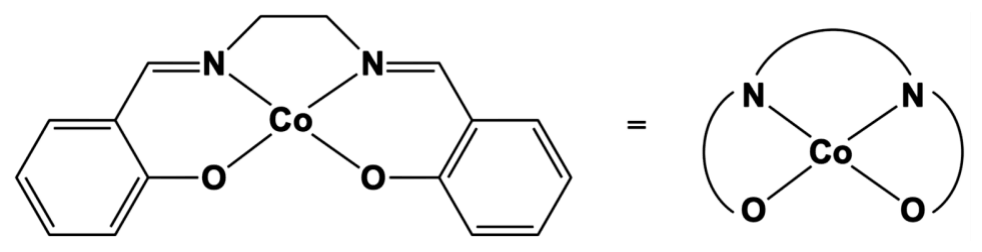
Figure 1. The structure of salcomin
3.3 Determine the oxidation state of the cobalt atom in salcomin. Determine the geometric structure around the cobalt center of salcomin, choosing from these three possibilities: tetrahedral, square planar or octahedral.
In solution, salcomin can bind \(\ce{O2}\); that links two salcomin moieties by coordinating to the two Co centers. The oxidation state of both Co centers is then +III.
3.4 Draw the resulting structure.
The \(\ce{H2}\) formation takes place exclusively at the cobalt center. The reaction is described by a 4-step catalytic cycle starting with \(\ce{Co^2+}\) using 2 \(\ce{H+}\) and 2 electrons. During one step a hydride is formed by an intramolecular electron transfer.
3.5 Write down two possible variations of the catalytic cycle with charges of the complex and oxidations states of the Co center. The oxidation state on the Co center should not be larger than +III. Mark the hydride formation step with an asterisk and label \(\ce{H+}\) uptake with C (chemical reaction), and electron uptake with E (electrochemical reaction), see example cycle in Figure 2 below. \(\ce{[Co^{II}]}\) stands for the Cobalt–salen complex.
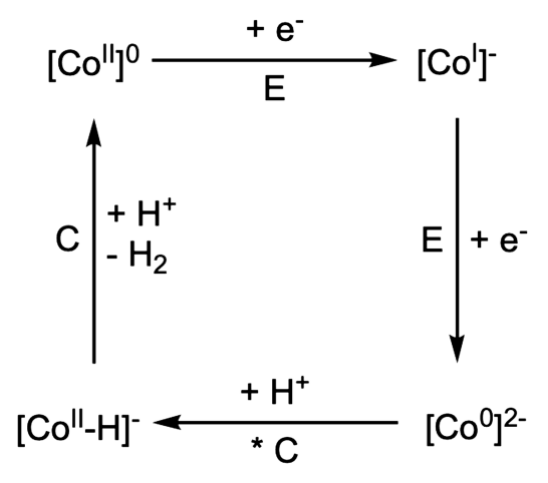
Figure 2. An example cycle for task 3.5
3.6 Using the redox potential values of different cobalt complexes given in Table 1, write down which complex is suitable for a) water oxidation at neutral pH b) water reduction at neutral pH. Write down the corresponding overall reaction for both processes (only for the complexes, capable of performing it) and calculate the cell potential at neutral pH. The half-cell potential for the proton reduction at pH = 7, \(T=298\ \mathrm K\) is \(-0.41\ \mathrm V\).
| Co(III/II) redox couple | \(E^\circ\) vs. normal hydrogen electrode |
|---|---|
| \(\ce{[Co(H2O)6]}^{3+/2+}\) | \(+1.92\ \mathrm V\) |
| \(\ce{[Co(C2O4)3]}^{3-/4-}\) | \(+0.55\ \mathrm V\) |
| \(\ce{[Co(EDTA)]}^{1-/2-}\) | \(+0.38\ \mathrm V\) |
| \(\ce{[Co(NH3)6]}^{3+/2+}\) | \(+0.06\ \mathrm V\) |
| \(\ce{[Co(en)3]}^{3+/2+}\) | \(-0.18\ \mathrm V\) |
| \(\ce{[Co(CN)5]}^{2-/3-}\) | \(-0.60\ \mathrm V\) |
Table 1. Possible redox couples for task 3.6; \(\ce{[C2O4]^2-}\) = oxalate, en = 1,2-ethylendiamine.
A Glimpse at the Natural Process
The natural storage of biological \(\ce{H2}\) equivalents is NADPH, which is produced from \(\ce{NADP+}\) through the addition of a hydride ion. The structure of NADPH is shown in Figure 3.
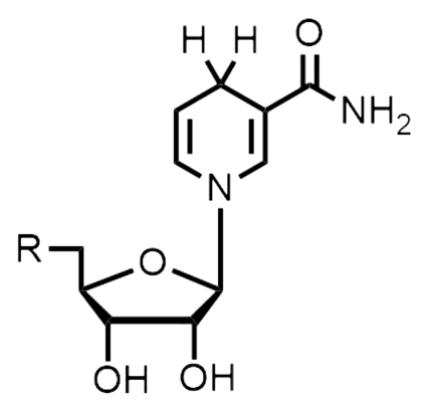
Figure 3. The structure of NADPH
3.7 Draw the structure of \(\ce{NADP+}\).
Chlorophyll has an extinction coefficient of about \(\varepsilon=8\times10^4\ \mathrm{M^{-1}\,cm^{-1}}\) at 680 nm.
3.8 Assuming an efficiency (photon to hydrogen atom) of \(\phi=20\ \%\) at a 680 nm photon flux of \(100\ \mathrm{nE\,s^{-1}\,cm^{-2}}\) (1 E = 1 mol of photons), calculate a) the number of photons per second and b) the concentration of chlorophyll in a \(1\times1\times1\ \mathrm{cm^3}\) cell needed to get a turnover frequency of \(1\ \mathrm{nmol}\ (\ce{H2})\ \mathrm{s^{-1}}\).
Official English text of the problem.
Answers
- 3.1: \(\boxed{\Delta_{\mathrm r}H=+676\ \mathrm{kJ\,mol^{-1}}}\), per mole of \(\ce{H2}\).
- 3.2: (a) \(\boxed{\Delta_{\mathrm r}S^\circ=+160\ \mathrm{J\,mol^{-1}\,K^{-1}}}\); (b) \(\boxed{U_{\mathrm{tn}}=1.48\ \mathrm V}\).
- 3.3: Cobalt has oxidation state +II; the coordination geometry is square planar.
- 3.4: A neutral peroxide-bridged dicobalt(III)–salen dimer, with connectivity \(\ce{(L)Co^{III}-O-O-Co^{III}(L)}\), where \(\ce{L^2-}\) is salen.
- 3.5: Two alternatives are E–C*–E–C and E–C*–C–E. Their fully balanced steps, charges and oxidation states are given below.
- 3.6: (a) Hexaaquacobalt(III), \(\ce{[Co(H2O)6]^3+}\), oxidizes water: \(\boxed{E_{\mathrm{cell}}=+1.10\ \mathrm V}\). (b) Pentacyanidocobaltate(II), \(\ce{[Co(CN)5]^3-}\), reduces water: \(\boxed{E_{\mathrm{cell}}=+0.19\ \mathrm V}\).
- 3.7: \(\ce{NADP+}\) has an aromatic nicotinamide pyridinium ring, with positive charge on its ring nitrogen and one hydrogen at C4. The ribose stereochemistry and the group \(R\) remain unchanged.
- 3.8: (a) Required absorbed photon rate: \(\boxed{6.02\times10^{15}\ \mathrm{photons\,s^{-1}}}\). Incident photon rate through the \(1\ \mathrm{cm^2}\) face: \(\boxed{6.02\times10^{16}\ \mathrm{photons\,s^{-1}}}\). (b) \(\boxed{c=5.7\times10^{-7}\ \mathrm M=0.57\ \mathrm{\mu M}}\).
Solution
The numerical calculations use \[ F=96485.3\ \mathrm{C\,mol^{-1}},\qquad N_{\mathrm A}=6.02214076\times10^{23}\ \mathrm{mol^{-1}}, \] and \[ 1\ \mathrm{eV\ per\ particle}=96.4853\ \mathrm{kJ\,mol^{-1}}. \]
The small species used below have the following names and SMILES:
| Species | Name | SMILES |
|---|---|---|
| \(\ce{H2O}\) | Water | O |
| \(\ce{H2}\) | Dihydrogen | [H][H] |
| \(\ce{O2}\) | Dioxygen | O=O |
| \(\ce{H}\) | Hydrogen atom | [H] |
| \(\ce{H+}\) | Proton | [H+] |
| \(\ce{H-}\) | Hydride ion | [H-] |
| \(\ce{OH-}\) | Hydroxide ion | [OH-] |
| \(\ce{O2^2-}\) | Peroxide ion | [O-][O-] |
Coordination SMILES below use -> for donor-to-metal bonds. Coordination geometry is specified in words.
3.1 — Enthalpy of hydrogen oxidation
Apply Hess’s law using dissociation, ionization and solvation:
\[ \ce{H2(g) -> 2H(g)} \qquad \Delta H_1=+432\ \mathrm{kJ\,mol^{-1}}. \]
\[ \ce{2H(g) -> 2H+(g) + 2e-} \] \[ \Delta H_2 =2(13.6)(96.4853) =+2624.4\ \mathrm{kJ\,mol^{-1}}. \]
\[ \ce{2H+(g) -> 2H+(aq)} \qquad \Delta H_3=2(-1190)=-2380\ \mathrm{kJ\,mol^{-1}}. \]
Adding gives the required reaction: \[ \ce{H2(g) -> 2H+(aq) + 2e-}, \] with \[ \boxed{ \Delta_{\mathrm r}H =432+2624.4-2380 =+676.4 \approx+676\ \mathrm{kJ\,mol^{-1}}. } \]
3.2 — Entropy and thermoneutral voltage
For one mole of liquid water, \[ \ce{H2O(l) -> H2(g) + 1/2 O2(g)}. \]
The reaction transfers two moles of electrons per mole of water. Its enthalpy is the negative of the given formation enthalpy: \[ \Delta_{\mathrm r}H^\circ=+285\ \mathrm{kJ\,mol^{-1}}. \]
(a) The minimum electrical work is the reaction Gibbs energy: \[ \Delta_{\mathrm r}G^\circ =2FU_{\mathrm{rev}} =2(96485.3)(1.23) =237.354\ \mathrm{kJ\,mol^{-1}}. \]
Using \(\Delta G=\Delta H-T\Delta S\), at \(T=298.15\ \mathrm K\), \[ \Delta_{\mathrm r}S^\circ =\frac{(285-237.354)\times10^3}{298.15}. \]
Thus, \[ \boxed{\Delta_{\mathrm r}S^\circ=+159.8 \approx+160\ \mathrm{J\,mol^{-1}\,K^{-1}}.} \]
The positive entropy change accounts for the approximately \(47.6\ \mathrm{kJ\,mol^{-1}}\) of environmental heat needed during reversible electrolysis.
(b) At the thermoneutral voltage, electrical energy supplies the entire reaction enthalpy: \[ 2FU_{\mathrm{tn}}=\Delta_{\mathrm r}H^\circ. \]
Therefore, \[ \boxed{ U_{\mathrm{tn}} =\frac{285000}{2(96485.3)} =1.4769 \approx1.48\ \mathrm V. } \]
3.3 — Oxidation state and geometry of salcomin
Let \(\ce{L^2-}\) denote the salen dianion, the doubly deprotonated tetradentate Schiff-base ligand:
[O-]c1ccccc1/C=N/CC/N=C/c1ccccc1[O-]
Its two phenolate oxygen donors each contribute charge \(-1\), while the two imine nitrogen donors are neutral. Salcomin is neutral, so \[ x+(-2)=0, \] giving \[ \boxed{x=+II.} \]
The ligand holds its two nitrogen and two oxygen donors approximately in one plane around cobalt. The correct choice is therefore square planar.
Cobalt(II)–salen (salcomin) has coordination SMILES:
[Co+2]123<-[O-]c4ccccc4/C=N->1/CC/N->2=C/c4ccccc4[O-]->3
The square-planar arrangement must be stated separately; it is not encoded by this SMILES.
3.4 — Oxygen-bound dimer
Each cobalt center changes from +II to +III, so the two centers together supply two electrons: \[ \ce{O2 + 2e- -> O2^2-}. \]
Consequently, the oxygen ligand is peroxide, with a single oxygen–oxygen bond and oxidation state \(-I\) on each oxygen.
The overall binding reaction is \[ \ce{2[Co^{II}L]^0 + O2 -> [LCo^{III}-O-O-Co^{III}L]^0}. \]
The product charge is \[ 2(+3)+2(-2)+(-2)=0. \]
The required drawing is an end-on \(\mu\)-peroxido-bis[(salen)cobalt(III)] dimer: draw a \(\ce{Co-O-O-Co}\) chain, with each cobalt also connected to the two nitrogen and two oxygen donors of its own salen ligand. Each peroxide oxygen coordinates to one cobalt, occupying an additional, approximately axial position relative to that cobalt’s salen donor plane.
Its coordination SMILES is:
[Co+3]123(<-[O-][O-]->[Co+3]456<-[O-]c7ccccc7/C=N->4/CC/N->5=C/c7ccccc7[O-]->6)<-[O-]c4ccccc4/C=N->1/CC/N->2=C/c4ccccc4[O-]->3
3.5 — Two catalytic cycles
The salen ligand remains \(\ce{L^2-}\). A bound hydrogen in a hydride complex is \(\ce{H-}\), so \[ q\!\left(\ce{[CoL]}\right)=\operatorname{OS}(\ce{Co})-2, \] and \[ q\!\left(\ce{[CoLH]}\right)=\operatorname{OS}(\ce{Co})-3. \]
The additional species required for the two cycles are:
| Species | Name | Coordination SMILES |
|---|---|---|
| \(\ce{[Co^{I}L]^-}\) | Cobalt(I)–salen anion | [Co+]123<-[O-]c4ccccc4/C=N->1/CC/N->2=C/c4ccccc4[O-]->3 |
| \(\ce{[Co^{III}LH]^0}\) | Hydridocobalt(III)–salen | [H-]->[Co+3]123<-[O-]c4ccccc4/C=N->1/CC/N->2=C/c4ccccc4[O-]->3 |
| \(\ce{[Co^{II}LH]^-}\) | Hydridocobalt(II)–salen anion | [H-]->[Co+2]123<-[O-]c4ccccc4/C=N->1/CC/N->2=C/c4ccccc4[O-]->3 |
| \(\ce{[Co^{III}L]^+}\) | Cobalt(III)–salen cation | [Co+3]123<-[O-]c4ccccc4/C=N->1/CC/N->2=C/c4ccccc4[O-]->3 |
The hydride is directly bound to cobalt. The dative notation provides explicit charge bookkeeping; it does not specify a detailed three-dimensional geometry.
First variation: E–C*–E–C
\[ \ce{[Co^{II}L]^0 + e- -> [Co^{I}L]^-} \qquad \mathrm E \]
\[ \ce{[Co^{I}L]^- + H+ -> [Co^{III}LH]^0} \qquad \mathrm C^* \]
\[ \ce{[Co^{III}LH]^0 + e- -> [Co^{II}LH]^-} \qquad \mathrm E \]
\[ \ce{[Co^{II}LH]^- + H+ -> [Co^{II}L]^0 + H2} \qquad \mathrm C \]
Second variation: E–C*–C–E
\[ \ce{[Co^{II}L]^0 + e- -> [Co^{I}L]^-} \qquad \mathrm E \]
\[ \ce{[Co^{I}L]^- + H+ -> [Co^{III}LH]^0} \qquad \mathrm C^* \]
\[ \ce{[Co^{III}LH]^0 + H+ -> [Co^{III}L]^+ + H2} \qquad \mathrm C \]
\[ \ce{[Co^{III}L]^+ + e- -> [Co^{II}L]^0} \qquad \mathrm E \]
In each starred step, cobalt(I) transfers two electrons internally to the incoming proton. Hydrogen changes from \(+I\) to \(-I\), forming hydride, while cobalt changes from \(+I\) to \(+III\).
Protonation of the hydride then produces dihydrogen. Each cycle regenerates the original cobalt(II) complex and sums to \[ \boxed{\ce{2H+ + 2e- -> H2}.} \]
No cobalt oxidation state exceeds +III.
3.6 — Water oxidation and reduction
At pH 7, the hydrogen reduction half-reaction is \[ \ce{2H+ + 2e- -> H2}, \qquad E=-0.41\ \mathrm V. \]
The oxygen/water and proton/hydrogen reduction potentials differ by the reversible water-splitting voltage, 1.23 V. Hence \[ \ce{O2 + 4H+ + 4e- -> 2H2O}, \qquad E=1.23-0.41=+0.82\ \mathrm V. \]
A reaction is thermodynamically favorable when \[ E_{\mathrm{cell}} =E_{\mathrm{cathode}}-E_{\mathrm{anode}}>0, \] where both electrode potentials are written as reduction potentials.
(a) Water oxidation
The cobalt(III) oxidant must have a reduction potential greater than \(+0.82\ \mathrm V\). Only the hexaaqua couple, at \(+1.92\ \mathrm V\), satisfies this condition.
The species are:
- Hexaaquacobalt(III), \(\ce{[Co(H2O)6]^3+}\):
[Co+3](<-O)(<-O)(<-O)(<-O)(<-O)<-O - Hexaaquacobalt(II), \(\ce{[Co(H2O)6]^2+}\):
[Co+2](<-O)(<-O)(<-O)(<-O)(<-O)<-O
Both have six coordinated water ligands in an octahedral arrangement.
Combine \[ \ce{4[Co(H2O)6]^3+ + 4e- -> 4[Co(H2O)6]^2+} \] with \[ \ce{2H2O -> O2 + 4H+ + 4e-}. \]
The overall reaction is \[ \boxed{ \ce{4[Co(H2O)6]^3+ + 2H2O -> 4[Co(H2O)6]^2+ + O2 + 4H+}. } \]
At pH 7, \[ \boxed{E_{\mathrm{cell}}=1.92-0.82=+1.10\ \mathrm V.} \]
(b) Water reduction
The cobalt(II) reductant must belong to a couple with reduction potential below \(-0.41\ \mathrm V\). Only the pentacyanido couple, at \(-0.60\ \mathrm V\), satisfies this condition.
The species are:
- Pentacyanidocobaltate(II), \(\ce{[Co(CN)5]^3-}\):
[Co+2](<-[C-]#N)(<-[C-]#N)(<-[C-]#N)(<-[C-]#N)<-[C-]#N - Pentacyanidocobaltate(III), \(\ce{[Co(CN)5]^2-}\):
[Co+3](<-[C-]#N)(<-[C-]#N)(<-[C-]#N)(<-[C-]#N)<-[C-]#N
The cyanido ligands coordinate through carbon.
Combine \[ \ce{2[Co(CN)5]^3- -> 2[Co(CN)5]^2- + 2e-} \] with \[ \ce{2H2O + 2e- -> H2 + 2OH-}. \]
The overall water-reduction reaction is \[ \boxed{ \ce{2[Co(CN)5]^3- + 2H2O -> 2[Co(CN)5]^2- + H2 + 2OH-}. } \]
Equivalently, using protons, \[ \ce{2[Co(CN)5]^3- + 2H+ -> 2[Co(CN)5]^2- + H2}. \]
At pH 7, \[ \boxed{E_{\mathrm{cell}}=-0.41-(-0.60)=+0.19\ \mathrm V.} \]
The other four couples lie between \(-0.41\) and \(+0.82\ \mathrm V\), so neither their cobalt(III) forms oxidize water nor their cobalt(II) forms reduce it under the stated potential comparison.
3.7 — Structure of \(\ce{NADP+}\)
The relationship is \[ \ce{NADP+ + H- -> NADPH}. \]
Thus, reverse hydride addition to the reduced nicotinamide ring. Number the ring nitrogen N1; the carboxamide substituent is at C3, and the carbon bearing two hydrogens in Figure 3 is C4.
The required drawing has:
- An aromatic six-membered pyridinium ring, with a positive charge on N1.
- The same carboxamide group at C3.
- One hydrogen at C4, replacing the two hydrogens shown for the reduced form.
- The same nitrogen–ribose bond, ribose stereochemistry, hydroxyl groups and \(R\) substituent.
One valid Kekulé drawing places double bonds at N1=C2, C3=C4 and C5=C6. Formation of the aromatic ring involves the nitrogen lone pair and rearrangement of the ring’s \(\pi\) bonds.
Oxidized nicotinamide adenine dinucleotide phosphate, \(\ce{NADP+}\), represented with the same abbreviated \(R\) group as the problem:
NC(=O)c1ccc[n+]([C@@H]2O[C@H](C*)[C@@H](O)[C@H]2O)c1
For comparison, the corresponding reduced nicotinamide adenine dinucleotide phosphate, \(\ce{NADPH}\) fragment is:
NC(=O)C1=CN([C@@H]2O[C@H](C*)[C@@H](O)[C@H]2O)C=CC1
Here * denotes the unchanged \(R\) group in Figure 3, attached through the depicted methylene group. These fragment SMILES retain the β-D-ribofuranosyl stereochemistry. The positive charge specified for the oxidized structure is on the nicotinamide nitrogen; charges within the abbreviated \(R\) group are not represented.
3.8 — Photon requirement and chlorophyll concentration
Use the \(1\ \mathrm{cm^2}\) illuminated face and an optical path length of \(1\ \mathrm{cm}\).
(a) Photon rates
The incident molar photon rate is \[ \dot n_{\gamma,\mathrm{in}} =(100\ \mathrm{nE\,s^{-1}\,cm^{-2}})(1\ \mathrm{cm^2}) =1.00\times10^{-7}\ \mathrm{mol\,s^{-1}}. \]
Therefore, \[ \boxed{ \dot N_{\gamma,\mathrm{in}} =(1.00\times10^{-7})N_{\mathrm A} =6.02\times10^{16}\ \mathrm{photons\,s^{-1}}. } \]
The target production rate is \[ \dot n_{\ce{H2}}=1.00\times10^{-9}\ \mathrm{mol\,s^{-1}}. \]
Each molecule of dihydrogen requires two hydrogen-atom equivalents. With a photon-to-hydrogen-atom efficiency of \(0.20\), the required absorbed photon rate is \[ \dot n_{\gamma,\mathrm{abs}} =\frac{2\dot n_{\ce{H2}}}{\phi} =\frac{2(1.00\times10^{-9})}{0.20} =1.00\times10^{-8}\ \mathrm{mol\,s^{-1}}. \]
Thus, \[ \boxed{ \dot N_{\gamma,\mathrm{abs}} =(1.00\times10^{-8})N_{\mathrm A} =6.02\times10^{15}\ \mathrm{photons\,s^{-1}}. } \]
(b) Chlorophyll concentration
The required absorbed fraction is \[ f_{\mathrm{abs}} =\frac{\dot n_{\gamma,\mathrm{abs}}} {\dot n_{\gamma,\mathrm{in}}} =\frac{10}{100}=0.10. \]
Consequently, the transmitted fraction is \(0.90\), and the decadic absorbance is \[ A=-\log_{10}(0.90)=0.045757. \]
By the Beer–Lambert law, \[ A=\varepsilon c l. \]
Therefore, \[ c=\frac{0.045757} {(8\times10^4\ \mathrm{M^{-1}\,cm^{-1}})(1\ \mathrm{cm})} =5.72\times10^{-7}\ \mathrm M. \]
Hence, \[ \boxed{c\approx5.7\times10^{-7}\ \mathrm M=0.57\ \mathrm{\mu M}.} \]
This uses the stated efficiency as the quantum yield per absorbed photon.
The solution was checked against the official solution.
IChO 2023 · Theorieaufgabe 3
Künstliche Photosynthese
Das Forschungsgebiet der künstlichen Photosynthese hat zum Ziel, Sonnenenergie in chemischen Bindungen zu speichern. Photonen werden unter Anregung von Sensibilisatoren absorbiert, wodurch ein ladungsgetrennter Zustand entsteht. Das angeregte Elektron wird auf einen Katalysator zur Wasserstoffentwicklung (hydrogen evolving catalyst, HEC) übertragen, der zweimal reduziert wird und anschließend \(\ce{H2}\) erzeugt. Als Photosensibilisator oder Lichtabsorber dient häufig \(\ce{[Ru(bpy)3]^2+}\) (bpy = 2,2'-Bipyridin), und als HECs werden häufig Cobaltkomplexe eingesetzt.
Energetik der Wasserspaltung
3.1 Berechnen Sie die Enthalpie der Reaktion \(\ce{H2 -> 2H+(aq) + 2e-}\).
Solvatationsenthalpie des Protons: \(\Delta_{\mathrm{aq}}H(\ce{H+})=-1190\ \mathrm{kJ\,mol^{-1}}\)
Ionisierungsenergie von Wasserstoff: \(IE_1=13.6\ \mathrm{eV}\)
Dissoziationsenthalpie von \(\ce{H2}\): \(\Delta_{\mathrm{diss}}H(\ce{H2})=432\ \mathrm{kJ\,mol^{-1}}\)
Im Idealfall läuft die elektrochemische Spaltung von Wasser in \(\ce{O2}\) und \(\ce{H2}\) bei 1.23 V ab. Da \(T\Delta S\) für diesen Prozess positiv ist, wird Wärme aus der Umgebung benötigt. Wenn durch eine zusätzliche Spannung die Wärme erzeugt wird, die zum Ausgleich der Temperaturabnahme erforderlich ist, wird der Prozess als thermoneutral bezeichnet. Die Bildungsenthalpie von \(\ce{H2O}\), \(\Delta_{\mathrm f}H^\circ(\ce{H2O})\), beträgt \(-285\ \mathrm{kJ\,mol^{-1}}\).
3.2 Berechnen Sie (a) die Reaktionsentropie \(\Delta_{\mathrm r}S^\circ\) der Wasserspaltung bei 25 °C für 1 mol \(\ce{H2O}\) und (b) die Spannung, bei der die Wasserspaltung thermoneutral ist.
Katalysatoren
Komplexe vom Cobalt–salen-Typ (Salcomin) sind potenzielle Katalysatoren für die Bildung von \(\ce{H2}\) aus Protonen und Elektronen. Die Struktur von Salcomin ist nachstehend dargestellt:
Abbildung 1. Die Struktur von Salcomin
3.3 Bestimmen Sie die Oxidationsstufe des Cobaltatoms in Salcomin. Bestimmen Sie die geometrische Struktur um das Cobaltzentrum von Salcomin, indem Sie aus den folgenden drei Möglichkeiten wählen: tetraedrisch, quadratisch-planar oder oktaedrisch.
In Lösung kann Salcomin \(\ce{O2}\) binden; dieses verbindet zwei Salcomin-Einheiten, indem es an die beiden Co-Zentren koordiniert. Die Oxidationsstufe beider Co-Zentren ist dann +III.
3.4 Zeichnen Sie die resultierende Struktur.
Die Bildung von \(\ce{H2}\) findet ausschließlich am Cobaltzentrum statt. Die Reaktion wird durch einen vierstufigen Katalysezyklus beschrieben, der mit \(\ce{Co^2+}\) beginnt und 2 \(\ce{H+}\) sowie 2 Elektronen verbraucht. In einem der Schritte wird durch einen intramolekularen Elektronentransfer ein Hydrid gebildet.
3.5 Schreiben Sie zwei mögliche Varianten des Katalysezyklus mit den Ladungen des Komplexes und den Oxidationsstufen des Co-Zentrums auf. Die Oxidationsstufe am Co-Zentrum soll nicht höher als +III sein. Markieren Sie den Schritt der Hydridbildung mit einem Sternchen und kennzeichnen Sie die Aufnahme von \(\ce{H+}\) mit C (chemische Reaktion) und die Elektronenaufnahme mit E (elektrochemische Reaktion); siehe den Beispielzyklus in Abbildung 2 unten. \(\ce{[Co^{II}]}\) steht für den Cobalt–salen-Komplex.
Abbildung 2. Ein Beispielzyklus für Aufgabe 3.5
3.6 Geben Sie anhand der in Tabelle 1 aufgeführten Redoxpotentiale verschiedener Cobaltkomplexe an, welcher Komplex für a) die Wasseroxidation bei neutralem pH-Wert und b) die Wasserreduktion bei neutralem pH-Wert geeignet ist. Schreiben Sie für beide Prozesse die entsprechende Gesamtreaktion auf (nur für die Komplexe, die den jeweiligen Prozess durchführen können) und berechnen Sie das Zellpotential bei neutralem pH-Wert. Das Halbzellenpotential der Protonenreduktion bei pH = 7 und \(T=298\ \mathrm K\) beträgt \(-0.41\ \mathrm V\).
| Co(III/II)-Redoxpaar | \(E^\circ\) gegenüber der Normalwasserstoffelektrode |
|---|---|
| \(\ce{[Co(H2O)6]}^{3+/2+}\) | \(+1.92\ \mathrm V\) |
| \(\ce{[Co(C2O4)3]}^{3-/4-}\) | \(+0.55\ \mathrm V\) |
| \(\ce{[Co(EDTA)]}^{1-/2-}\) | \(+0.38\ \mathrm V\) |
| \(\ce{[Co(NH3)6]}^{3+/2+}\) | \(+0.06\ \mathrm V\) |
| \(\ce{[Co(en)3]}^{3+/2+}\) | \(-0.18\ \mathrm V\) |
| \(\ce{[Co(CN)5]}^{2-/3-}\) | \(-0.60\ \mathrm V\) |
Tabelle 1. Mögliche Redoxpaare für Aufgabe 3.6; \(\ce{[C2O4]^2-}\) = Oxalat, en = 1,2-Ethylendiamin.
Ein Blick auf den natürlichen Prozess
Der natürliche Speicher biologischer \(\ce{H2}\)-Äquivalente ist NADPH, das durch Addition eines Hydridions aus \(\ce{NADP+}\) gebildet wird. Die Struktur von NADPH ist in Abbildung 3 dargestellt.
Abbildung 3. Die Struktur von NADPH
3.7 Zeichnen Sie die Struktur von \(\ce{NADP+}\).
Chlorophyll hat bei 680 nm einen Extinktionskoeffizienten von etwa \(\varepsilon=8\times10^4\ \mathrm{M^{-1}\,cm^{-1}}\).
3.8 Berechnen Sie unter Annahme einer Effizienz (Photon zu Wasserstoffatom) von \(\phi=20\ \%\) bei einem Photonenfluss von \(100\ \mathrm{nE\,s^{-1}\,cm^{-2}}\) bei 680 nm (1 E = 1 mol Photonen) a) die Anzahl der Photonen pro Sekunde und b) die Chlorophyllkonzentration in einer \(1\times1\times1\ \mathrm{cm^3}\) großen Küvette, die erforderlich ist, um eine Umsatzfrequenz von \(1\ \mathrm{nmol}\ (\ce{H2})\ \mathrm{s^{-1}}\) zu erreichen.
Aufgabentext aus dem offiziellen englischen Text übersetzt.
Antworten
- 3.1: \(\boxed{\Delta_{\mathrm r}H=+676\ \mathrm{kJ\,mol^{-1}}}\), pro Mol \(\ce{H2}\).
- 3.2: (a) \(\boxed{\Delta_{\mathrm r}S^\circ=+160\ \mathrm{J\,mol^{-1}\,K^{-1}}}\); (b) \(\boxed{U_{\mathrm{tn}}=1.48\ \mathrm V}\).
- 3.3: Cobalt hat die Oxidationsstufe +II; die Koordinationsgeometrie ist quadratisch-planar.
- 3.4: Ein neutrales, peroxidverbrücktes Dicobalt(III)–salen-Dimer mit der Verknüpfung \(\ce{(L)Co^{III}-O-O-Co^{III}(L)}\), wobei \(\ce{L^2-}\) für salen steht.
- 3.5: Zwei Alternativen sind E–C*–E–C und E–C*–C–E. Ihre vollständig ausgeglichenen Schritte, Ladungen und Oxidationsstufen sind unten angegeben.
- 3.6: (a) Hexaaquacobalt(III), \(\ce{[Co(H2O)6]^3+}\), oxidiert Wasser: \(\boxed{E_{\mathrm{cell}}=+1.10\ \mathrm V}\). (b) Pentacyanidocobaltat(II), \(\ce{[Co(CN)5]^3-}\), reduziert Wasser: \(\boxed{E_{\mathrm{cell}}=+0.19\ \mathrm V}\).
- 3.7: \(\ce{NADP+}\) besitzt einen aromatischen Pyridiniumring der Nicotinamid-Einheit mit positiver Ladung am Ringstickstoff und einem Wasserstoffatom an C4. Die Stereochemie der Ribose und die Gruppe \(R\) bleiben unverändert.
- 3.8: (a) Erforderliche Rate absorbierter Photonen: \(\boxed{6.02\times10^{15}\ \mathrm{photons\,s^{-1}}}\). Rate einfallender Photonen durch die \(1\ \mathrm{cm^2}\) große Fläche: \(\boxed{6.02\times10^{16}\ \mathrm{photons\,s^{-1}}}\). (b) \(\boxed{c=5.7\times10^{-7}\ \mathrm M=0.57\ \mathrm{\mu M}}\).
Lösung
Für die numerischen Berechnungen werden \[ F=96485.3\ \mathrm{C\,mol^{-1}},\qquad N_{\mathrm A}=6.02214076\times10^{23}\ \mathrm{mol^{-1}}, \] und \[ 1\ \mathrm{eV\ per\ particle}=96.4853\ \mathrm{kJ\,mol^{-1}}. \] verwendet.
Die im Folgenden verwendeten kleinen Spezies haben die folgenden Namen und SMILES:
| Spezies | Name | SMILES |
|---|---|---|
| \(\ce{H2O}\) | Wasser | O |
| \(\ce{H2}\) | Diwasserstoff | [H][H] |
| \(\ce{O2}\) | Disauerstoff | O=O |
| \(\ce{H}\) | Wasserstoffatom | [H] |
| \(\ce{H+}\) | Proton | [H+] |
| \(\ce{H-}\) | Hydridion | [H-] |
| \(\ce{OH-}\) | Hydroxidion | [OH-] |
| \(\ce{O2^2-}\) | Peroxidion | [O-][O-] |
In den folgenden Koordinations-SMILES kennzeichnet -> Bindungen vom Donor zum Metall. Die Koordinationsgeometrie wird in Worten angegeben.
3.1 — Enthalpie der Wasserstoffoxidation
Der Satz von Hess wird unter Verwendung von Dissoziation, Ionisierung und Solvatation angewendet:
\[ \ce{H2(g) -> 2H(g)} \qquad \Delta H_1=+432\ \mathrm{kJ\,mol^{-1}}. \]
\[ \ce{2H(g) -> 2H+(g) + 2e-} \] \[ \Delta H_2 =2(13.6)(96.4853) =+2624.4\ \mathrm{kJ\,mol^{-1}}. \]
\[ \ce{2H+(g) -> 2H+(aq)} \qquad \Delta H_3=2(-1190)=-2380\ \mathrm{kJ\,mol^{-1}}. \]
Durch Addition ergibt sich die gesuchte Reaktion: \[ \ce{H2(g) -> 2H+(aq) + 2e-}, \] mit \[ \boxed{ \Delta_{\mathrm r}H =432+2624.4-2380 =+676.4 \approx+676\ \mathrm{kJ\,mol^{-1}}. } \]
3.2 — Entropie und thermoneutrale Spannung
Für ein Mol flüssiges Wasser gilt: \[ \ce{H2O(l) -> H2(g) + 1/2 O2(g)}. \]
Bei der Reaktion werden pro Mol Wasser zwei Mol Elektronen übertragen. Ihre Enthalpie ist das Negative der angegebenen Bildungsenthalpie: \[ \Delta_{\mathrm r}H^\circ=+285\ \mathrm{kJ\,mol^{-1}}. \]
(a) Die minimale elektrische Arbeit entspricht der freien Reaktionsenthalpie: \[ \Delta_{\mathrm r}G^\circ =2FU_{\mathrm{rev}} =2(96485.3)(1.23) =237.354\ \mathrm{kJ\,mol^{-1}}. \]
Mit \(\Delta G=\Delta H-T\Delta S\) ergibt sich bei \(T=298.15\ \mathrm K\): \[ \Delta_{\mathrm r}S^\circ =\frac{(285-237.354)\times10^3}{298.15}. \]
Somit gilt: \[ \boxed{\Delta_{\mathrm r}S^\circ=+159.8 \approx+160\ \mathrm{J\,mol^{-1}\,K^{-1}}.} \]
Die positive Entropieänderung erklärt die etwa \(47.6\ \mathrm{kJ\,mol^{-1}}\) Wärme aus der Umgebung, die während der reversiblen Elektrolyse benötigt werden.
(b) Bei der thermoneutralen Spannung wird die gesamte Reaktionsenthalpie durch elektrische Energie bereitgestellt: \[ 2FU_{\mathrm{tn}}=\Delta_{\mathrm r}H^\circ. \]
Daher gilt: \[ \boxed{ U_{\mathrm{tn}} =\frac{285000}{2(96485.3)} =1.4769 \approx1.48\ \mathrm V. } \]
3.3 — Oxidationsstufe und Geometrie von Salcomin
\(\ce{L^2-}\) bezeichne das salen-Dianion, den zweifach deprotonierten vierzähnigen Schiffbasenliganden:
[O-]c1ccccc1/C=N/CC/N=C/c1ccccc1[O-]
Seine beiden Phenolat-Sauerstoffdonoren tragen jeweils die Ladung \(-1\), während die beiden Imin-Stickstoffdonoren neutral sind. Salcomin ist neutral, daher gilt \[ x+(-2)=0, \] woraus folgt: \[ \boxed{x=+II.} \]
Der Ligand hält seine beiden Stickstoff- und seine beiden Sauerstoffdonoren annähernd in einer Ebene um das Cobalt. Die richtige Wahl ist daher quadratisch-planar.
Cobalt(II)–salen (Salcomin) hat die folgende Koordinations-SMILES:
[Co+2]123<-[O-]c4ccccc4/C=N->1/CC/N->2=C/c4ccccc4[O-]->3
Die quadratisch-planare Anordnung muss gesondert angegeben werden; sie wird durch diese SMILES nicht codiert.
3.4 — Dimer mit gebundenem Sauerstoff
Jedes Cobaltzentrum wechselt von +II zu +III, sodass die beiden Zentren zusammen zwei Elektronen abgeben: \[ \ce{O2 + 2e- -> O2^2-}. \]
Folglich ist der Sauerstoffligand Peroxid, mit einer Sauerstoff–Sauerstoff-Einfachbindung und der Oxidationsstufe \(-I\) an jedem Sauerstoffatom.
Die Gesamtreaktion der Bindung lautet \[ \ce{2[Co^{II}L]^0 + O2 -> [LCo^{III}-O-O-Co^{III}L]^0}. \]
Die Ladung des Produkts beträgt \[ 2(+3)+2(-2)+(-2)=0. \]
Die gesuchte Zeichnung zeigt ein endständig koordiniertes \(\mu\)-Peroxido-bis[(salen)cobalt(III)]-Dimer: Zeichnen Sie eine \(\ce{Co-O-O-Co}\)-Kette, wobei jedes Cobalt außerdem mit den beiden Stickstoff- und den beiden Sauerstoffdonoren seines eigenen salen-Liganden verbunden ist. Jedes Peroxid-Sauerstoffatom koordiniert an ein Cobalt und besetzt dabei eine zusätzliche, annähernd axiale Position relativ zur Donorebene des salen-Liganden dieses Cobaltzentrums.
Die zugehörige Koordinations-SMILES lautet:
[Co+3]123(<-[O-][O-]->[Co+3]456<-[O-]c7ccccc7/C=N->4/CC/N->5=C/c7ccccc7[O-]->6)<-[O-]c4ccccc4/C=N->1/CC/N->2=C/c4ccccc4[O-]->3
3.5 — Zwei Katalysezyklen
Der salen-Ligand bleibt \(\ce{L^2-}\). Ein gebundenes Wasserstoffatom in einem Hydridkomplex liegt als \(\ce{H-}\) vor, daher gilt \[ q\!\left(\ce{[CoL]}\right)=\operatorname{OS}(\ce{Co})-2, \] und \[ q\!\left(\ce{[CoLH]}\right)=\operatorname{OS}(\ce{Co})-3. \]
Die für die beiden Zyklen zusätzlich benötigten Spezies sind:
| Spezies | Name | Koordinations-SMILES |
|---|---|---|
| \(\ce{[Co^{I}L]^-}\) | Cobalt(I)–salen-Anion | [Co+]123<-[O-]c4ccccc4/C=N->1/CC/N->2=C/c4ccccc4[O-]->3 |
| \(\ce{[Co^{III}LH]^0}\) | Hydridocobalt(III)–salen | [H-]->[Co+3]123<-[O-]c4ccccc4/C=N->1/CC/N->2=C/c4ccccc4[O-]->3 |
| \(\ce{[Co^{II}LH]^-}\) | Hydridocobalt(II)–salen-Anion | [H-]->[Co+2]123<-[O-]c4ccccc4/C=N->1/CC/N->2=C/c4ccccc4[O-]->3 |
| \(\ce{[Co^{III}L]^+}\) | Cobalt(III)–salen-Kation | [Co+3]123<-[O-]c4ccccc4/C=N->1/CC/N->2=C/c4ccccc4[O-]->3 |
Das Hydrid ist direkt an Cobalt gebunden. Die Schreibweise mit koordinativen Bindungen ermöglicht eine explizite Ladungsbilanz; sie legt keine detaillierte dreidimensionale Geometrie fest.
Erste Variante: E–C*–E–C
\[ \ce{[Co^{II}L]^0 + e- -> [Co^{I}L]^-} \qquad \mathrm E \]
\[ \ce{[Co^{I}L]^- + H+ -> [Co^{III}LH]^0} \qquad \mathrm C^* \]
\[ \ce{[Co^{III}LH]^0 + e- -> [Co^{II}LH]^-} \qquad \mathrm E \]
\[ \ce{[Co^{II}LH]^- + H+ -> [Co^{II}L]^0 + H2} \qquad \mathrm C \]
Zweite Variante: E–C*–C–E
\[ \ce{[Co^{II}L]^0 + e- -> [Co^{I}L]^-} \qquad \mathrm E \]
\[ \ce{[Co^{I}L]^- + H+ -> [Co^{III}LH]^0} \qquad \mathrm C^* \]
\[ \ce{[Co^{III}LH]^0 + H+ -> [Co^{III}L]^+ + H2} \qquad \mathrm C \]
\[ \ce{[Co^{III}L]^+ + e- -> [Co^{II}L]^0} \qquad \mathrm E \]
In jedem mit einem Sternchen markierten Schritt überträgt Cobalt(I) intern zwei Elektronen auf das hinzukommende Proton. Wasserstoff wechselt von \(+I\) zu \(-I\) und bildet dabei Hydrid, während Cobalt von \(+I\) zu \(+III\) wechselt.
Die anschließende Protonierung des Hydrids erzeugt Diwasserstoff. In jedem Zyklus wird der ursprüngliche Cobalt(II)-Komplex regeneriert, und die Summe der Schritte ergibt \[ \boxed{\ce{2H+ + 2e- -> H2}.} \]
Keine Oxidationsstufe des Cobalts überschreitet +III.
3.6 — Wasseroxidation und Wasserreduktion
Bei pH 7 lautet die Halbreaktion der Wasserstoffreduktion \[ \ce{2H+ + 2e- -> H2}, \qquad E=-0.41\ \mathrm V. \]
Die Reduktionspotentiale der Paare Sauerstoff/Wasser und Proton/Wasserstoff unterscheiden sich um die reversible Wasserspaltungsspannung von 1.23 V. Somit gilt \[ \ce{O2 + 4H+ + 4e- -> 2H2O}, \qquad E=1.23-0.41=+0.82\ \mathrm V. \]
Eine Reaktion ist thermodynamisch begünstigt, wenn \[ E_{\mathrm{cell}} =E_{\mathrm{cathode}}-E_{\mathrm{anode}}>0, \] wobei beide Elektrodenpotentiale als Reduktionspotentiale angegeben werden.
(a) Wasseroxidation
Das Cobalt(III)-Oxidationsmittel muss ein Reduktionspotential von mehr als \(+0.82\ \mathrm V\) besitzen. Nur das Hexaaqua-Redoxpaar erfüllt mit \(+1.92\ \mathrm V\) diese Bedingung.
Die Spezies sind:
- Hexaaquacobalt(III), \(\ce{[Co(H2O)6]^3+}\):
[Co+3](<-O)(<-O)(<-O)(<-O)(<-O)<-O - Hexaaquacobalt(II), \(\ce{[Co(H2O)6]^2+}\):
[Co+2](<-O)(<-O)(<-O)(<-O)(<-O)<-O
Beide besitzen sechs koordinierte Wasserliganden in oktaedrischer Anordnung.
Man kombiniert \[ \ce{4[Co(H2O)6]^3+ + 4e- -> 4[Co(H2O)6]^2+} \] mit \[ \ce{2H2O -> O2 + 4H+ + 4e-}. \]
Die Gesamtreaktion lautet \[ \boxed{ \ce{4[Co(H2O)6]^3+ + 2H2O -> 4[Co(H2O)6]^2+ + O2 + 4H+}. } \]
Bei pH 7 gilt: \[ \boxed{E_{\mathrm{cell}}=1.92-0.82=+1.10\ \mathrm V.} \]
(b) Wasserreduktion
Das Cobalt(II)-Reduktionsmittel muss zu einem Redoxpaar mit einem Reduktionspotential unter \(-0.41\ \mathrm V\) gehören. Nur das Pentacyanido-Redoxpaar erfüllt mit \(-0.60\ \mathrm V\) diese Bedingung.
Die Spezies sind:
- Pentacyanidocobaltat(II), \(\ce{[Co(CN)5]^3-}\):
[Co+2](<-[C-]#N)(<-[C-]#N)(<-[C-]#N)(<-[C-]#N)<-[C-]#N - Pentacyanidocobaltat(III), \(\ce{[Co(CN)5]^2-}\):
[Co+3](<-[C-]#N)(<-[C-]#N)(<-[C-]#N)(<-[C-]#N)<-[C-]#N
Die Cyanidoliganden koordinieren über Kohlenstoff.
Man kombiniert \[ \ce{2[Co(CN)5]^3- -> 2[Co(CN)5]^2- + 2e-} \] mit \[ \ce{2H2O + 2e- -> H2 + 2OH-}. \]
Die Gesamtreaktion der Wasserreduktion lautet \[ \boxed{ \ce{2[Co(CN)5]^3- + 2H2O -> 2[Co(CN)5]^2- + H2 + 2OH-}. } \]
Gleichwertig lässt sich unter Verwendung von Protonen schreiben: \[ \ce{2[Co(CN)5]^3- + 2H+ -> 2[Co(CN)5]^2- + H2}. \]
Bei pH 7 gilt: \[ \boxed{E_{\mathrm{cell}}=-0.41-(-0.60)=+0.19\ \mathrm V.} \]
Die anderen vier Redoxpaare liegen zwischen \(-0.41\) und \(+0.82\ \mathrm V\), sodass nach dem angegebenen Potentialvergleich weder ihre Cobalt(III)-Formen Wasser oxidieren noch ihre Cobalt(II)-Formen Wasser reduzieren.
3.7 — Struktur von \(\ce{NADP+}\)
Es gilt die Beziehung \[ \ce{NADP+ + H- -> NADPH}. \]
Die Hydridaddition an den reduzierten Nicotinamidring wird daher rückgängig gemacht. Der Ringstickstoff erhält die Nummer N1; der Carboxamidsubstituent befindet sich an C3, und das Kohlenstoffatom, das in Abbildung 3 zwei Wasserstoffatome trägt, ist C4.
Die gesuchte Zeichnung enthält:
- Einen aromatischen sechsgliedrigen Pyridiniumring mit einer positiven Ladung an N1.
- Dieselbe Carboxamidgruppe an C3.
- Ein Wasserstoffatom an C4 anstelle der zwei Wasserstoffatome, die für die reduzierte Form gezeigt sind.
- Dieselbe Stickstoff–Ribose-Bindung, dieselbe Stereochemie der Ribose, dieselben Hydroxygruppen und denselben \(R\)-Substituenten.
Eine gültige Kekulé-Struktur enthält Doppelbindungen an N1=C2, C3=C4 und C5=C6. Die Bildung des aromatischen Rings umfasst die Beteiligung des freien Elektronenpaars am Stickstoff und eine Umlagerung der \(\pi\)-Bindungen des Rings.
Oxidiertes Nicotinamidadenindinukleotidphosphat, \(\ce{NADP+}\), dargestellt mit derselben abgekürzten Gruppe \(R\) wie in der Aufgabenstellung:
NC(=O)c1ccc[n+]([C@@H]2O[C@H](C*)[C@@H](O)[C@H]2O)c1
Zum Vergleich lautet das entsprechende Fragment des reduzierten Nicotinamidadenindinukleotidphosphats, \(\ce{NADPH}\):
NC(=O)C1=CN([C@@H]2O[C@H](C*)[C@@H](O)[C@H]2O)C=CC1
Hier bezeichnet * die unveränderte Gruppe \(R\) aus Abbildung 3, die über die dargestellte Methylengruppe gebunden ist. Diese Fragment-SMILES behalten die β-D-Ribofuranosyl-Stereochemie bei. Die für die oxidierte Struktur angegebene positive Ladung sitzt am Nicotinamid-Stickstoff; Ladungen innerhalb der abgekürzten Gruppe \(R\) sind nicht dargestellt.
3.8 — Photonenbedarf und Chlorophyllkonzentration
Es werden die beleuchtete Fläche von \(1\ \mathrm{cm^2}\) und eine optische Weglänge von \(1\ \mathrm{cm}\) verwendet.
(a) Photonenraten
Die einfallende molare Photonenrate beträgt \[ \dot n_{\gamma,\mathrm{in}} =(100\ \mathrm{nE\,s^{-1}\,cm^{-2}})(1\ \mathrm{cm^2}) =1.00\times10^{-7}\ \mathrm{mol\,s^{-1}}. \]
Daher gilt: \[ \boxed{ \dot N_{\gamma,\mathrm{in}} =(1.00\times10^{-7})N_{\mathrm A} =6.02\times10^{16}\ \mathrm{photons\,s^{-1}}. } \]
Die angestrebte Produktionsrate beträgt \[ \dot n_{\ce{H2}}=1.00\times10^{-9}\ \mathrm{mol\,s^{-1}}. \]
Jedes Diwasserstoffmolekül erfordert zwei Wasserstoffatom-Äquivalente. Bei einer Effizienz der Umwandlung von Photonen in Wasserstoffatome von \(0.20\) beträgt die erforderliche Rate absorbierter Photonen \[ \dot n_{\gamma,\mathrm{abs}} =\frac{2\dot n_{\ce{H2}}}{\phi} =\frac{2(1.00\times10^{-9})}{0.20} =1.00\times10^{-8}\ \mathrm{mol\,s^{-1}}. \]
Somit gilt: \[ \boxed{ \dot N_{\gamma,\mathrm{abs}} =(1.00\times10^{-8})N_{\mathrm A} =6.02\times10^{15}\ \mathrm{photons\,s^{-1}}. } \]
(b) Chlorophyllkonzentration
Der erforderliche absorbierte Anteil beträgt \[ f_{\mathrm{abs}} =\frac{\dot n_{\gamma,\mathrm{abs}}} {\dot n_{\gamma,\mathrm{in}}} =\frac{10}{100}=0.10. \]
Folglich beträgt der transmittierte Anteil \(0.90\), und die dekadische Extinktion ist \[ A=-\log_{10}(0.90)=0.045757. \]
Nach dem Lambert-Beerschen Gesetz gilt \[ A=\varepsilon c l. \]
Daher gilt: \[ c=\frac{0.045757} {(8\times10^4\ \mathrm{M^{-1}\,cm^{-1}})(1\ \mathrm{cm})} =5.72\times10^{-7}\ \mathrm M. \]
Somit ergibt sich: \[ \boxed{c\approx5.7\times10^{-7}\ \mathrm M=0.57\ \mathrm{\mu M}.} \]
Dabei wird die angegebene Effizienz als Quantenausbeute pro absorbiertem Photon verwendet.
Die Lösung wurde mit der offiziellen Lösung abgeglichen.
IChO 2023 · Teori sorusu 3
Yapay Fotosentez
Yapay fotosentez araştırmaları, güneş enerjisini kimyasal bağlarda depolamayı amaçlar. Fotonlar, duyarlılaştırıcıları uyararak soğurulur ve böylece yüklerin ayrıldığı bir durum oluşur. Uyarılmış elektron, iki kez indirgendikten sonra \(\ce{H2}\) üreten bir katalizöre (hidrojen oluşum katalizörü, HEC) aktarılır. Işığa duyarlılaştırıcı veya ışık soğurucu çoğunlukla \(\ce{[Ru(bpy)3]^2+}\) (bpy = 2,2'-bipiridin), HEC'ler ise çoğunlukla kobalt kompleksleridir.
Suyun Ayrıştırılmasının Enerjetiği
3.1 \(\ce{H2 -> 2H+(aq) + 2e-}\) tepkimesinin entalpisini hesaplayınız.
Protonun solvatasyon entalpisi: \(\Delta_{\mathrm{aq}}H(\ce{H+})=-1190\ \mathrm{kJ\,mol^{-1}}\)
Hidrojenin iyonlaşma enerjisi: \(IE_1=13.6\ \mathrm{eV}\)
\(\ce{H2}\)'nin ayrışma entalpisi: \(\Delta_{\mathrm{diss}}H(\ce{H2})=432\ \mathrm{kJ\,mol^{-1}}\)
İdeal olarak suyun elektrokimyasal yolla \(\ce{O2}\) ve \(\ce{H2}\)'ye ayrıştırılması 1.23 V gerilimde gerçekleşir. Bu süreç için \(T\Delta S\) pozitif olduğundan çevreden ısı alınması gerekir. Ek gerilim, sıcaklık düşüşünü telafi etmek için gereken ısıyı sağlıyorsa süreç termonötr olarak adlandırılır. \(\ce{H2O}\)'nun oluşum entalpisi, \(\Delta_{\mathrm f}H^\circ(\ce{H2O})\), \(-285\ \mathrm{kJ\,mol^{-1}}\)'dir.
3.2 (a) 25 °C'de 1 mol \(\ce{H2O}\)'nun ayrıştırılması tepkimesinin entropisini, \(\Delta_{\mathrm r}S^\circ\), ve (b) suyun ayrıştırılmasının termonötr olduğu gerilimi hesaplayınız.
Katalizörler
Kobalt–salen (salkomin) tipi kompleksler, proton ve elektronlardan \(\ce{H2}\) oluşumu için potansiyel katalizörlerdir. Salkominin yapısı aşağıda verilmiştir:
Şekil 1. Salkominin yapısı
3.3 Salkomindeki kobalt atomunun yükseltgenme basamağını belirleyiniz. Salkominin kobalt merkezi çevresindeki geometrik yapıyı şu üç olasılıktan birini seçerek belirleyiniz: tetrahedral, kare düzlemsel veya oktahedral.
Çözeltide salkomin, \(\ce{O2}\) bağlayabilir; \(\ce{O2}\), iki Co merkezine koordine olarak iki salkomin birimini birbirine bağlar. Bu durumda her iki Co merkezinin yükseltgenme basamağı +III olur.
3.4 Oluşan yapıyı çiziniz.
\(\ce{H2}\) oluşumu yalnızca kobalt merkezinde gerçekleşir. Tepkime, \(\ce{Co^2+}\) ile başlayan, 2 \(\ce{H+}\) ve 2 elektron kullanan 4 basamaklı bir katalitik çevrimle tanımlanır. Basamaklardan birinde, molekül içi elektron aktarımıyla bir hidrür oluşur.
3.5 Kompleksin yüklerini ve Co merkezinin yükseltgenme basamaklarını göstererek katalitik çevrimin iki olası biçimini yazınız. Co merkezinin yükseltgenme basamağı +III'ten büyük olmamalıdır. Hidrür oluşumu basamağını bir yıldız işaretiyle belirtiniz; \(\ce{H+}\) alımını C (kimyasal tepkime), elektron alımını ise E (elektrokimyasal tepkime) ile etiketleyiniz; aşağıdaki Şekil 2'de verilen örnek çevrime bakınız. \(\ce{[Co^{II}]}\), kobalt–salen kompleksini temsil eder.
Şekil 2. 3.5 sorusu için örnek bir çevrim
3.6 Tablo 1'de verilen farklı kobalt komplekslerinin redoks potansiyeli değerlerini kullanarak a) nötr pH'da suyun yükseltgenmesi b) nötr pH'da suyun indirgenmesi için hangi kompleksin uygun olduğunu yazınız. Her iki süreç için ilgili toplam tepkimeyi (yalnızca bu süreçleri gerçekleştirebilen kompleksler için) yazınız ve nötr pH'daki hücre potansiyelini hesaplayınız. pH = 7 ve \(T=298\ \mathrm K\) koşullarında protonun indirgenmesi için yarı hücre potansiyeli \(-0.41\ \mathrm V\)'tur.
| Co(III/II) redoks çifti | Normal hidrojen elektroduna göre \(E^\circ\) |
|---|---|
| \(\ce{[Co(H2O)6]}^{3+/2+}\) | \(+1.92\ \mathrm V\) |
| \(\ce{[Co(C2O4)3]}^{3-/4-}\) | \(+0.55\ \mathrm V\) |
| \(\ce{[Co(EDTA)]}^{1-/2-}\) | \(+0.38\ \mathrm V\) |
| \(\ce{[Co(NH3)6]}^{3+/2+}\) | \(+0.06\ \mathrm V\) |
| \(\ce{[Co(en)3]}^{3+/2+}\) | \(-0.18\ \mathrm V\) |
| \(\ce{[Co(CN)5]}^{2-/3-}\) | \(-0.60\ \mathrm V\) |
Tablo 1. 3.6 sorusu için olası redoks çiftleri; \(\ce{[C2O4]^2-}\) = oksalat, en = 1,2-etilendiamin.
Doğal Sürece Kısa Bir Bakış
Biyolojik \(\ce{H2}\) eşdeğerleri doğal olarak NADPH biçiminde depolanır; NADPH, \(\ce{NADP+}\)'ya bir hidrür iyonunun katılmasıyla üretilir. NADPH'nin yapısı Şekil 3'te gösterilmiştir.
Şekil 3. NADPH'nin yapısı
3.7 \(\ce{NADP+}\)'nın yapısını çiziniz.
Klorofilin 680 nm'deki sönüm katsayısı yaklaşık \(\varepsilon=8\times10^4\ \mathrm{M^{-1}\,cm^{-1}}\)'dir.
3.8 680 nm'de \(100\ \mathrm{nE\,s^{-1}\,cm^{-2}}\) foton akısı (1 E = 1 mol foton) için verimin (fotondan hidrojen atomuna) \(\phi=20\ \%\) olduğunu varsayarak, \(1\ \mathrm{nmol}\ (\ce{H2})\ \mathrm{s^{-1}}\) çevrim frekansı elde etmek için gereken a) saniyedeki foton sayısını ve b) \(1\times1\times1\ \mathrm{cm^3}\)'lük bir hücredeki klorofil derişimini hesaplayınız.
Soru metni resmi İngilizce metinden çevrilmiştir.
Cevaplar
- 3.1: \(\ce{H2}\)'nin molü başına \(\boxed{\Delta_{\mathrm r}H=+676\ \mathrm{kJ\,mol^{-1}}}\).
- 3.2: (a) \(\boxed{\Delta_{\mathrm r}S^\circ=+160\ \mathrm{J\,mol^{-1}\,K^{-1}}}\); (b) \(\boxed{U_{\mathrm{tn}}=1.48\ \mathrm V}\).
- 3.3: Kobaltın yükseltgenme basamağı +II'dir; koordinasyon geometrisi kare düzlemseldir.
- 3.4: Bağlantı düzeni \(\ce{(L)Co^{III}-O-O-Co^{III}(L)}\) olan, yüksüz bir peroksit köprülü dikobalt(III)–salen dimeri; burada \(\ce{L^2-}\), salen ligandıdır.
- 3.5: İki alternatif E–C*–E–C ve E–C*–C–E'dir. Bunların tam olarak denkleştirilmiş basamakları, yükleri ve yükseltgenme basamakları aşağıda verilmiştir.
- 3.6: (a) Hekzaakuakobalt(III), \(\ce{[Co(H2O)6]^3+}\), suyu yükseltger: \(\boxed{E_{\mathrm{cell}}=+1.10\ \mathrm V}\). (b) Pentasiyanidokobaltat(II), \(\ce{[Co(CN)5]^3-}\), suyu indirger: \(\boxed{E_{\mathrm{cell}}=+0.19\ \mathrm V}\).
- 3.7: \(\ce{NADP+}\), halka azotu üzerinde pozitif yük ve C4'te bir hidrojen taşıyan aromatik bir nikotinamid piridinyum halkasına sahiptir. Ribozun stereokimyası ve \(R\) grubu değişmeden kalır.
- 3.8: (a) Gereken soğurulmuş foton hızı: \(\boxed{6.02\times10^{15}\ \mathrm{photons\,s^{-1}}}\). \(1\ \mathrm{cm^2}\)'lik yüzeye gelen foton hızı: \(\boxed{6.02\times10^{16}\ \mathrm{photons\,s^{-1}}}\). (b) \(\boxed{c=5.7\times10^{-7}\ \mathrm M=0.57\ \mathrm{\mu M}}\).
Çözüm
Sayısal hesaplamalarda \[ F=96485.3\ \mathrm{C\,mol^{-1}},\qquad N_{\mathrm A}=6.02214076\times10^{23}\ \mathrm{mol^{-1}}, \] ve \[ 1\ \mathrm{eV\ per\ particle}=96.4853\ \mathrm{kJ\,mol^{-1}}. \] değerleri kullanılır.
Aşağıda kullanılan küçük kimyasal türlerin adları ve SMILES gösterimleri şöyledir:
| Tür | Ad | SMILES |
|---|---|---|
| \(\ce{H2O}\) | Su | O |
| \(\ce{H2}\) | Dihidrojen | [H][H] |
| \(\ce{O2}\) | Dioksijen | O=O |
| \(\ce{H}\) | Hidrojen atomu | [H] |
| \(\ce{H+}\) | Proton | [H+] |
| \(\ce{H-}\) | Hidrür iyonu | [H-] |
| \(\ce{OH-}\) | Hidroksit iyonu | [OH-] |
| \(\ce{O2^2-}\) | Peroksit iyonu | [O-][O-] |
Aşağıdaki koordinasyon SMILES gösterimlerinde donörden metale olan bağlar için -> kullanılır. Koordinasyon geometrisi sözel olarak belirtilir.
3.1 — Hidrojenin yükseltgenme entalpisi
Ayrışma, iyonlaşma ve solvatasyon basamaklarını kullanarak Hess yasasını uygulayalım:
\[ \ce{H2(g) -> 2H(g)} \qquad \Delta H_1=+432\ \mathrm{kJ\,mol^{-1}}. \]
\[ \ce{2H(g) -> 2H+(g) + 2e-} \] \[ \Delta H_2 =2(13.6)(96.4853) =+2624.4\ \mathrm{kJ\,mol^{-1}}. \]
\[ \ce{2H+(g) -> 2H+(aq)} \qquad \Delta H_3=2(-1190)=-2380\ \mathrm{kJ\,mol^{-1}}. \]
Toplandığında istenen tepkime elde edilir: \[ \ce{H2(g) -> 2H+(aq) + 2e-}, \] bu tepkimenin entalpisi \[ \boxed{ \Delta_{\mathrm r}H =432+2624.4-2380 =+676.4 \approx+676\ \mathrm{kJ\,mol^{-1}}. } \] olur.
3.2 — Entropi ve termonötr gerilim
Bir mol sıvı su için, \[ \ce{H2O(l) -> H2(g) + 1/2 O2(g)}. \]
Tepkimede suyun molü başına iki mol elektron aktarılır. Tepkimenin entalpisi, verilen oluşum entalpisinin negatifidir: \[ \Delta_{\mathrm r}H^\circ=+285\ \mathrm{kJ\,mol^{-1}}. \]
(a) Minimum elektriksel iş, tepkimenin Gibbs enerjisidir: \[ \Delta_{\mathrm r}G^\circ =2FU_{\mathrm{rev}} =2(96485.3)(1.23) =237.354\ \mathrm{kJ\,mol^{-1}}. \]
\(\Delta G=\Delta H-T\Delta S\) bağıntısı kullanılarak, \(T=298.15\ \mathrm K\)'de, \[ \Delta_{\mathrm r}S^\circ =\frac{(285-237.354)\times10^3}{298.15}. \]
Böylece, \[ \boxed{\Delta_{\mathrm r}S^\circ=+159.8 \approx+160\ \mathrm{J\,mol^{-1}\,K^{-1}}.} \]
Pozitif entropi değişimi, tersinir elektroliz sırasında çevreden alınması gereken yaklaşık \(47.6\ \mathrm{kJ\,mol^{-1}}\) ısıyı açıklar.
(b) Termonötr gerilimde elektrik enerjisi, tepkime entalpisinin tamamını karşılar: \[ 2FU_{\mathrm{tn}}=\Delta_{\mathrm r}H^\circ. \]
Dolayısıyla, \[ \boxed{ U_{\mathrm{tn}} =\frac{285000}{2(96485.3)} =1.4769 \approx1.48\ \mathrm V. } \]
3.3 — Salkominin yükseltgenme basamağı ve geometrisi
\(\ce{L^2-}\), iki protonunu kaybetmiş, dört dişli bir Schiff bazı ligandı olan salen dianyonunu göstersin:
[O-]c1ccccc1/C=N/CC/N=C/c1ccccc1[O-]
İki fenolat oksijen donörünün her biri \(-1\) yük katkısında bulunurken iki imin azot donörü yüksüzdür. Salkomin yüksüz olduğundan \[ x+(-2)=0, \] buradan \[ \boxed{x=+II.} \] elde edilir.
Ligand, iki azot ve iki oksijen donörünü kobaltın çevresinde yaklaşık olarak aynı düzlemde tutar. Bu nedenle doğru seçenek kare düzlemsel geometridir.
Kobalt(II)–salen (salkomin) için koordinasyon SMILES gösterimi şöyledir:
[Co+2]123<-[O-]c4ccccc4/C=N->1/CC/N->2=C/c4ccccc4[O-]->3
Kare düzlemsel düzen ayrıca belirtilmelidir; bu SMILES gösteriminde kodlanmamıştır.
3.4 — Oksijen bağlı dimer
Her kobalt merkezinin yükseltgenme basamağı +II'den +III'e değişir; dolayısıyla iki merkez birlikte iki elektron sağlar: \[ \ce{O2 + 2e- -> O2^2-}. \]
Sonuç olarak oksijen ligandı, tek bir oksijen–oksijen bağı içeren ve her oksijenin yükseltgenme basamağı \(-I\) olan peroksittir.
Toplam bağlanma tepkimesi şöyledir: \[ \ce{2[Co^{II}L]^0 + O2 -> [LCo^{III}-O-O-Co^{III}L]^0}. \]
Ürünün yükü \[ 2(+3)+2(-2)+(-2)=0. \] olur.
İstenen çizim, uçlardan bağlanmış bir \(\mu\)-peroksido-bis[(salen)kobalt(III)] dimeridir: her kobaltın ayrıca kendi salen ligandının iki azot ve iki oksijen donörüne bağlı olduğu bir \(\ce{Co-O-O-Co}\) zinciri çiziniz. Her peroksit oksijeni bir kobalta koordine olur ve bu kobaltın salen donör düzlemine göre yaklaşık olarak eksenel olan ek bir konumu işgal eder.
Koordinasyon SMILES gösterimi şöyledir:
[Co+3]123(<-[O-][O-]->[Co+3]456<-[O-]c7ccccc7/C=N->4/CC/N->5=C/c7ccccc7[O-]->6)<-[O-]c4ccccc4/C=N->1/CC/N->2=C/c4ccccc4[O-]->3
3.5 — İki katalitik çevrim
Salen ligandı \(\ce{L^2-}\) olarak kalır. Bir hidrür kompleksindeki bağlı hidrojen \(\ce{H-}\) olduğundan \[ q\!\left(\ce{[CoL]}\right)=\operatorname{OS}(\ce{Co})-2, \] ve \[ q\!\left(\ce{[CoLH]}\right)=\operatorname{OS}(\ce{Co})-3. \]
İki çevrim için gereken ek türler şunlardır:
| Tür | Ad | Koordinasyon SMILES gösterimi |
|---|---|---|
| \(\ce{[Co^{I}L]^-}\) | Kobalt(I)–salen anyonu | [Co+]123<-[O-]c4ccccc4/C=N->1/CC/N->2=C/c4ccccc4[O-]->3 |
| \(\ce{[Co^{III}LH]^0}\) | Hidridokobalt(III)–salen | [H-]->[Co+3]123<-[O-]c4ccccc4/C=N->1/CC/N->2=C/c4ccccc4[O-]->3 |
| \(\ce{[Co^{II}LH]^-}\) | Hidridokobalt(II)–salen anyonu | [H-]->[Co+2]123<-[O-]c4ccccc4/C=N->1/CC/N->2=C/c4ccccc4[O-]->3 |
| \(\ce{[Co^{III}L]^+}\) | Kobalt(III)–salen katyonu | [Co+3]123<-[O-]c4ccccc4/C=N->1/CC/N->2=C/c4ccccc4[O-]->3 |
Hidrür doğrudan kobalta bağlıdır. Koordinatif bağ gösterimi, yüklerin açıkça izlenmesini sağlar; ayrıntılı bir üç boyutlu geometri belirtmez.
Birinci biçim: E–C*–E–C
\[ \ce{[Co^{II}L]^0 + e- -> [Co^{I}L]^-} \qquad \mathrm E \]
\[ \ce{[Co^{I}L]^- + H+ -> [Co^{III}LH]^0} \qquad \mathrm C^* \]
\[ \ce{[Co^{III}LH]^0 + e- -> [Co^{II}LH]^-} \qquad \mathrm E \]
\[ \ce{[Co^{II}LH]^- + H+ -> [Co^{II}L]^0 + H2} \qquad \mathrm C \]
İkinci biçim: E–C*–C–E
\[ \ce{[Co^{II}L]^0 + e- -> [Co^{I}L]^-} \qquad \mathrm E \]
\[ \ce{[Co^{I}L]^- + H+ -> [Co^{III}LH]^0} \qquad \mathrm C^* \]
\[ \ce{[Co^{III}LH]^0 + H+ -> [Co^{III}L]^+ + H2} \qquad \mathrm C \]
\[ \ce{[Co^{III}L]^+ + e- -> [Co^{II}L]^0} \qquad \mathrm E \]
Yıldızla işaretlenmiş her basamakta kobalt(I), gelen protona molekül içinde iki elektron aktarır. Hidrojenin yükseltgenme basamağı \(+I\)'den \(-I\)'e değişerek hidrür oluşurken kobaltın yükseltgenme basamağı \(+I\)'den \(+III\)'e değişir.
Ardından hidrürün protonlanması dihidrojen üretir. Her çevrim başlangıçtaki kobalt(II) kompleksini yeniden oluşturur ve basamakların toplamı \[ \boxed{\ce{2H+ + 2e- -> H2}.} \] tepkimesini verir.
Kobaltın hiçbir yükseltgenme basamağı +III'ü aşmaz.
3.6 — Suyun yükseltgenmesi ve indirgenmesi
pH 7'de hidrojenin indirgenme yarı tepkimesi şöyledir: \[ \ce{2H+ + 2e- -> H2}, \qquad E=-0.41\ \mathrm V. \]
Oksijen/su ve proton/hidrojen indirgenme potansiyelleri arasındaki fark, suyun tersinir ayrıştırılma gerilimi olan 1.23 V'tur. Dolayısıyla \[ \ce{O2 + 4H+ + 4e- -> 2H2O}, \qquad E=1.23-0.41=+0.82\ \mathrm V. \]
Bir tepkime, \[ E_{\mathrm{cell}} =E_{\mathrm{cathode}}-E_{\mathrm{anode}}>0, \] olduğunda termodinamik açıdan elverişlidir; burada her iki elektrot potansiyeli de indirgenme potansiyeli olarak yazılmıştır.
(a) Suyun yükseltgenmesi
Kobalt(III) yükseltgeninin indirgenme potansiyeli \(+0.82\ \mathrm V\)'tan büyük olmalıdır. Bu koşulu yalnızca \(+1.92\ \mathrm V\) potansiyeline sahip hekzaakua çifti sağlar.
Türler şunlardır:
- Hekzaakuakobalt(III), \(\ce{[Co(H2O)6]^3+}\):
[Co+3](<-O)(<-O)(<-O)(<-O)(<-O)<-O - Hekzaakuakobalt(II), \(\ce{[Co(H2O)6]^2+}\):
[Co+2](<-O)(<-O)(<-O)(<-O)(<-O)<-O
Her ikisi de oktahedral düzende koordine olmuş altı su ligandı içerir.
Şu yarı tepkimeyi \[ \ce{4[Co(H2O)6]^3+ + 4e- -> 4[Co(H2O)6]^2+} \] şununla birleştirelim: \[ \ce{2H2O -> O2 + 4H+ + 4e-}. \]
Toplam tepkime şöyledir: \[ \boxed{ \ce{4[Co(H2O)6]^3+ + 2H2O -> 4[Co(H2O)6]^2+ + O2 + 4H+}. } \]
pH 7'de, \[ \boxed{E_{\mathrm{cell}}=1.92-0.82=+1.10\ \mathrm V.} \]
(b) Suyun indirgenmesi
Kobalt(II) indirgeni, indirgenme potansiyeli \(-0.41\ \mathrm V\)'tan düşük olan bir çifte ait olmalıdır. Bu koşulu yalnızca \(-0.60\ \mathrm V\) potansiyeline sahip pentasiyanido çifti sağlar.
Türler şunlardır:
- Pentasiyanidokobaltat(II), \(\ce{[Co(CN)5]^3-}\):
[Co+2](<-[C-]#N)(<-[C-]#N)(<-[C-]#N)(<-[C-]#N)<-[C-]#N - Pentasiyanidokobaltat(III), \(\ce{[Co(CN)5]^2-}\):
[Co+3](<-[C-]#N)(<-[C-]#N)(<-[C-]#N)(<-[C-]#N)<-[C-]#N
Siyanido ligandları karbon üzerinden koordine olur.
Şu yarı tepkimeyi \[ \ce{2[Co(CN)5]^3- -> 2[Co(CN)5]^2- + 2e-} \] şununla birleştirelim: \[ \ce{2H2O + 2e- -> H2 + 2OH-}. \]
Suyun indirgenmesine ait toplam tepkime şöyledir: \[ \boxed{ \ce{2[Co(CN)5]^3- + 2H2O -> 2[Co(CN)5]^2- + H2 + 2OH-}. } \]
Eşdeğer olarak, protonlar kullanılarak, \[ \ce{2[Co(CN)5]^3- + 2H+ -> 2[Co(CN)5]^2- + H2}. \]
pH 7'de, \[ \boxed{E_{\mathrm{cell}}=-0.41-(-0.60)=+0.19\ \mathrm V.} \]
Diğer dört çiftin potansiyelleri \(-0.41\) ile \(+0.82\ \mathrm V\) arasında yer alır; dolayısıyla belirtilen potansiyel karşılaştırmasına göre ne kobalt(III) biçimleri suyu yükseltger ne de kobalt(II) biçimleri suyu indirger.
3.7 — \(\ce{NADP+}\)'nın yapısı
Aralarındaki ilişki şöyledir: \[ \ce{NADP+ + H- -> NADPH}. \]
Bu nedenle indirgenmiş nikotinamid halkasına hidrür katılmasını tersine çevirelim. Halka azotunu N1 olarak numaralandıralım; karboksamid sübstitüenti C3'tedir ve Şekil 3'te iki hidrojen taşıyan karbon C4'tür.
İstenen çizimde şunlar bulunur:
- N1 üzerinde pozitif yük bulunan, aromatik, altı üyeli bir piridinyum halkası.
- C3'te aynı karboksamid grubu.
- İndirgenmiş biçim için gösterilen iki hidrojenin yerine C4'te bir hidrojen.
- Aynı azot–riboz bağı, riboz stereokimyası, hidroksil grupları ve \(R\) sübstitüenti.
Geçerli bir Kekulé çiziminde çift bağlar N1=C2, C3=C4 ve C5=C6 konumlarına yerleştirilir. Aromatik halkanın oluşumu, azotun ortaklanmamış elektron çiftinin katılımını ve halkanın \(\pi\) bağlarının yeniden düzenlenmesini içerir.
Sorudakiyle aynı kısaltılmış \(R\) grubu kullanılarak gösterilen yükseltgenmiş nikotinamid adenin dinükleotit fosfat, \(\ce{NADP+}\):
NC(=O)c1ccc[n+]([C@@H]2O[C@H](C*)[C@@H](O)[C@H]2O)c1
Karşılaştırma için, buna karşılık gelen indirgenmiş nikotinamid adenin dinükleotit fosfat, \(\ce{NADPH}\) parçası şöyledir:
NC(=O)C1=CN([C@@H]2O[C@H](C*)[C@@H](O)[C@H]2O)C=CC1
Burada *, Şekil 3'teki değişmeden kalan ve gösterilen metilen grubu üzerinden bağlı olan \(R\) grubunu belirtir. Bu parça SMILES gösterimleri β-D-ribofuranozil stereokimyasını korur. Yükseltgenmiş yapı için belirtilen pozitif yük nikotinamid azotu üzerindedir; kısaltılmış \(R\) grubu içindeki yükler gösterilmemiştir.
3.8 — Foton gereksinimi ve klorofil derişimi
\(1\ \mathrm{cm^2}\)'lik aydınlatılan yüzeyi ve \(1\ \mathrm{cm}\)'lik optik yol uzunluğunu kullanalım.
(a) Foton hızları
Gelen molar foton hızı şöyledir: \[ \dot n_{\gamma,\mathrm{in}} =(100\ \mathrm{nE\,s^{-1}\,cm^{-2}})(1\ \mathrm{cm^2}) =1.00\times10^{-7}\ \mathrm{mol\,s^{-1}}. \]
Dolayısıyla, \[ \boxed{ \dot N_{\gamma,\mathrm{in}} =(1.00\times10^{-7})N_{\mathrm A} =6.02\times10^{16}\ \mathrm{photons\,s^{-1}}. } \]
Hedeflenen üretim hızı şöyledir: \[ \dot n_{\ce{H2}}=1.00\times10^{-9}\ \mathrm{mol\,s^{-1}}. \]
Her dihidrojen molekülü iki hidrojen atomu eşdeğeri gerektirir. Fotondan hidrojen atomuna dönüşüm verimi \(0.20\) olduğunda gereken soğurulmuş foton hızı \[ \dot n_{\gamma,\mathrm{abs}} =\frac{2\dot n_{\ce{H2}}}{\phi} =\frac{2(1.00\times10^{-9})}{0.20} =1.00\times10^{-8}\ \mathrm{mol\,s^{-1}}. \] olur.
Böylece, \[ \boxed{ \dot N_{\gamma,\mathrm{abs}} =(1.00\times10^{-8})N_{\mathrm A} =6.02\times10^{15}\ \mathrm{photons\,s^{-1}}. } \]
(b) Klorofil derişimi
Soğurulması gereken kesir şöyledir: \[ f_{\mathrm{abs}} =\frac{\dot n_{\gamma,\mathrm{abs}}} {\dot n_{\gamma,\mathrm{in}}} =\frac{10}{100}=0.10. \]
Sonuç olarak geçen kesir \(0.90\)'dır ve on tabanlı absorbans \[ A=-\log_{10}(0.90)=0.045757. \] olur.
Beer–Lambert yasasına göre, \[ A=\varepsilon c l. \]
Dolayısıyla, \[ c=\frac{0.045757} {(8\times10^4\ \mathrm{M^{-1}\,cm^{-1}})(1\ \mathrm{cm})} =5.72\times10^{-7}\ \mathrm M. \]
Böylece, \[ \boxed{c\approx5.7\times10^{-7}\ \mathrm M=0.57\ \mathrm{\mu M}.} \]
Bu hesaplamada belirtilen verim, soğurulan foton başına kuantum verimi olarak kullanılmıştır.
Çözüm, resmi çözümle karşılaştırılarak kontrol edildi.
IChO 2023 · Problema teórico 3
Fotosíntesis artificial
El campo de investigación de la fotosíntesis artificial tiene como objetivo almacenar energía solar en enlaces químicos. Los fotones se absorben al excitar sensibilizadores, lo que produce un estado con separación de cargas. El electrón excitado se transfiere a un catalizador (catalizador de producción de hidrógeno, HEC), que se reduce dos veces y después produce \(\ce{H2}\). El fotosensibilizador o absorbente de luz suele ser \(\ce{[Ru(bpy)3]^2+}\) (bpy = 2,2'-bipiridina), y los HEC suelen ser complejos de cobalto.
Energética de la descomposición del agua
3.1 Calcule la entalpía de la reacción \(\ce{H2 -> 2H+(aq) + 2e-}\).
Entalpía de solvatación del protón: \(\Delta_{\mathrm{aq}}H(\ce{H+})=-1190\ \mathrm{kJ\,mol^{-1}}\)
Energía de ionización del hidrógeno: \(IE_1=13.6\ \mathrm{eV}\)
Entalpía de disociación de \(\ce{H2}\): \(\Delta_{\mathrm{diss}}H(\ce{H2})=432\ \mathrm{kJ\,mol^{-1}}\)
En condiciones ideales, la descomposición electroquímica del agua en \(\ce{O2}\) y \(\ce{H2}\) se lleva a cabo a 1.23 V. Dado que \(T\Delta S\) es positivo para este proceso, se necesita calor del entorno. Si un voltaje adicional produce el calor necesario para compensar la disminución de temperatura, el proceso se denomina termoneutro. La entalpía de formación de \(\ce{H2O}\), \(\Delta_{\mathrm f}H^\circ(\ce{H2O})\), es \(-285\ \mathrm{kJ\,mol^{-1}}\).
3.2 Calcule (a) la entropía de la reacción de descomposición del agua \(\Delta_{\mathrm r}S^\circ\) a 25 °C para 1 mol de \(\ce{H2O}\) y (b) el voltaje al que la descomposición del agua es termoneutra.
Catalizadores
Los complejos de tipo cobalto–salen (salcomina) son posibles catalizadores para la formación de \(\ce{H2}\) a partir de protones y electrones. La estructura de la salcomina se muestra a continuación:
Figura 1. La estructura de la salcomina
3.3 Determine el estado de oxidación del átomo de cobalto en la salcomina. Determine la estructura geométrica alrededor del centro de cobalto de la salcomina, eligiendo entre estas tres posibilidades: tetraédrica, plana cuadrada u octaédrica.
En disolución, la salcomina puede unirse a \(\ce{O2}\); este enlaza dos unidades de salcomina al coordinarse con los dos centros de Co. El estado de oxidación de ambos centros de Co es entonces +III.
3.4 Dibuje la estructura resultante.
La formación de \(\ce{H2}\) tiene lugar exclusivamente en el centro de cobalto. La reacción se describe mediante un ciclo catalítico de 4 etapas que comienza con \(\ce{Co^2+}\) y utiliza 2 \(\ce{H+}\) y 2 electrones. Durante una de las etapas se forma un hidruro mediante una transferencia electrónica intramolecular.
3.5 Escriba dos posibles variantes del ciclo catalítico indicando las cargas del complejo y los estados de oxidación del centro de Co. El estado de oxidación del centro de Co no debe ser superior a +III. Marque la etapa de formación del hidruro con un asterisco e identifique la captación de \(\ce{H+}\) con C (reacción química), y la captación de electrones con E (reacción electroquímica); véase el ciclo de ejemplo de la Figura 2 a continuación. \(\ce{[Co^{II}]}\) representa el complejo cobalto–salen.
Figura 2. Un ciclo de ejemplo para el apartado 3.5
3.6 Utilizando los valores de potencial redox de distintos complejos de cobalto que se dan en la Tabla 1, indique qué complejo es adecuado para a) la oxidación del agua a pH neutro b) la reducción del agua a pH neutro. Escriba la reacción global correspondiente a ambos procesos (solo para los complejos capaces de llevarlos a cabo) y calcule el potencial de celda a pH neutro. El potencial de semicelda para la reducción de protones a pH = 7 y \(T=298\ \mathrm K\) es \(-0.41\ \mathrm V\).
| Par redox Co(III/II) | \(E^\circ\) frente al electrodo normal de hidrógeno |
|---|---|
| \(\ce{[Co(H2O)6]}^{3+/2+}\) | \(+1.92\ \mathrm V\) |
| \(\ce{[Co(C2O4)3]}^{3-/4-}\) | \(+0.55\ \mathrm V\) |
| \(\ce{[Co(EDTA)]}^{1-/2-}\) | \(+0.38\ \mathrm V\) |
| \(\ce{[Co(NH3)6]}^{3+/2+}\) | \(+0.06\ \mathrm V\) |
| \(\ce{[Co(en)3]}^{3+/2+}\) | \(-0.18\ \mathrm V\) |
| \(\ce{[Co(CN)5]}^{2-/3-}\) | \(-0.60\ \mathrm V\) |
Tabla 1. Posibles pares redox para el apartado 3.6; \(\ce{[C2O4]^2-}\) = oxalato, en = 1,2-etilendiamina.
Una mirada al proceso natural
La forma natural de almacenamiento de equivalentes biológicos de \(\ce{H2}\) es el NADPH, que se produce a partir de \(\ce{NADP+}\) mediante la adición de un ion hidruro. La estructura del NADPH se muestra en la Figura 3.
Figura 3. La estructura del NADPH
3.7 Dibuje la estructura de \(\ce{NADP+}\).
La clorofila tiene un coeficiente de extinción de aproximadamente \(\varepsilon=8\times10^4\ \mathrm{M^{-1}\,cm^{-1}}\) a 680 nm.
3.8 Suponiendo una eficiencia (de fotón a átomo de hidrógeno) de \(\phi=20\ \%\) con un flujo de fotones de 680 nm de \(100\ \mathrm{nE\,s^{-1}\,cm^{-2}}\) (1 E = 1 mol de fotones), calcule a) el número de fotones por segundo y b) la concentración de clorofila en una cubeta de \(1\times1\times1\ \mathrm{cm^3}\) necesaria para obtener una frecuencia de recambio de \(1\ \mathrm{nmol}\ (\ce{H2})\ \mathrm{s^{-1}}\).
Enunciado traducido del texto oficial en inglés.
Respuestas
- 3.1: \(\boxed{\Delta_{\mathrm r}H=+676\ \mathrm{kJ\,mol^{-1}}}\), por mol de \(\ce{H2}\).
- 3.2: (a) \(\boxed{\Delta_{\mathrm r}S^\circ=+160\ \mathrm{J\,mol^{-1}\,K^{-1}}}\); (b) \(\boxed{U_{\mathrm{tn}}=1.48\ \mathrm V}\).
- 3.3: El cobalto tiene un estado de oxidación +II; la geometría de coordinación es plana cuadrada.
- 3.4: Un dímero neutro de dicobalto(III)–salen con un puente peróxido, con conectividad \(\ce{(L)Co^{III}-O-O-Co^{III}(L)}\), donde \(\ce{L^2-}\) es salen.
- 3.5: Dos alternativas son E–C*–E–C y E–C*–C–E. Sus etapas completamente ajustadas, cargas y estados de oxidación se indican a continuación.
- 3.6: (a) El hexaaquacobalto(III), \(\ce{[Co(H2O)6]^3+}\), oxida el agua: \(\boxed{E_{\mathrm{cell}}=+1.10\ \mathrm V}\). (b) El pentacianidocobaltato(II), \(\ce{[Co(CN)5]^3-}\), reduce el agua: \(\boxed{E_{\mathrm{cell}}=+0.19\ \mathrm V}\).
- 3.7: El \(\ce{NADP+}\) tiene un anillo aromático de piridinio de nicotinamida, con carga positiva en el nitrógeno del anillo y un hidrógeno en C4. La estereoquímica de la ribosa y el grupo \(R\) permanecen inalterados.
- 3.8: (a) Tasa necesaria de fotones absorbidos: \(\boxed{6.02\times10^{15}\ \mathrm{photons\,s^{-1}}}\). Tasa de fotones incidentes a través de la cara de \(1\ \mathrm{cm^2}\): \(\boxed{6.02\times10^{16}\ \mathrm{photons\,s^{-1}}}\). (b) \(\boxed{c=5.7\times10^{-7}\ \mathrm M=0.57\ \mathrm{\mu M}}\).
Solución
Los cálculos numéricos utilizan \[ F=96485.3\ \mathrm{C\,mol^{-1}},\qquad N_{\mathrm A}=6.02214076\times10^{23}\ \mathrm{mol^{-1}}, \] y \[ 1\ \mathrm{eV\ per\ particle}=96.4853\ \mathrm{kJ\,mol^{-1}}. \]
Las especies pequeñas utilizadas a continuación tienen los siguientes nombres y SMILES:
| Especie | Nombre | SMILES |
|---|---|---|
| \(\ce{H2O}\) | Agua | O |
| \(\ce{H2}\) | Dihidrógeno | [H][H] |
| \(\ce{O2}\) | Dioxígeno | O=O |
| \(\ce{H}\) | Átomo de hidrógeno | [H] |
| \(\ce{H+}\) | Protón | [H+] |
| \(\ce{H-}\) | Ion hidruro | [H-] |
| \(\ce{OH-}\) | Ion hidróxido | [OH-] |
| \(\ce{O2^2-}\) | Ion peróxido | [O-][O-] |
Los SMILES de coordinación que aparecen a continuación utilizan -> para los enlaces del donador al metal. La geometría de coordinación se especifica mediante palabras.
3.1 — Entalpía de oxidación del hidrógeno
Se aplica la ley de Hess utilizando la disociación, la ionización y la solvatación:
\[ \ce{H2(g) -> 2H(g)} \qquad \Delta H_1=+432\ \mathrm{kJ\,mol^{-1}}. \]
\[ \ce{2H(g) -> 2H+(g) + 2e-} \] \[ \Delta H_2 =2(13.6)(96.4853) =+2624.4\ \mathrm{kJ\,mol^{-1}}. \]
\[ \ce{2H+(g) -> 2H+(aq)} \qquad \Delta H_3=2(-1190)=-2380\ \mathrm{kJ\,mol^{-1}}. \]
La suma da la reacción solicitada: \[ \ce{H2(g) -> 2H+(aq) + 2e-}, \] con \[ \boxed{ \Delta_{\mathrm r}H =432+2624.4-2380 =+676.4 \approx+676\ \mathrm{kJ\,mol^{-1}}. } \]
3.2 — Entropía y voltaje termoneutro
Para un mol de agua líquida, \[ \ce{H2O(l) -> H2(g) + 1/2 O2(g)}. \]
La reacción transfiere dos moles de electrones por mol de agua. Su entalpía es la opuesta a la entalpía de formación dada: \[ \Delta_{\mathrm r}H^\circ=+285\ \mathrm{kJ\,mol^{-1}}. \]
(a) El trabajo eléctrico mínimo es la energía de Gibbs de reacción: \[ \Delta_{\mathrm r}G^\circ =2FU_{\mathrm{rev}} =2(96485.3)(1.23) =237.354\ \mathrm{kJ\,mol^{-1}}. \]
Utilizando \(\Delta G=\Delta H-T\Delta S\), a \(T=298.15\ \mathrm K\), \[ \Delta_{\mathrm r}S^\circ =\frac{(285-237.354)\times10^3}{298.15}. \]
Por tanto, \[ \boxed{\Delta_{\mathrm r}S^\circ=+159.8 \approx+160\ \mathrm{J\,mol^{-1}\,K^{-1}}.} \]
La variación positiva de entropía explica los aproximadamente \(47.6\ \mathrm{kJ\,mol^{-1}}\) de calor del entorno necesarios durante la electrólisis reversible.
(b) Al voltaje termoneutro, la energía eléctrica suministra toda la entalpía de reacción: \[ 2FU_{\mathrm{tn}}=\Delta_{\mathrm r}H^\circ. \]
Por consiguiente, \[ \boxed{ U_{\mathrm{tn}} =\frac{285000}{2(96485.3)} =1.4769 \approx1.48\ \mathrm V. } \]
3.3 — Estado de oxidación y geometría de la salcomina
Sea \(\ce{L^2-}\) el dianión salen, el ligando tetradentado de tipo base de Schiff doblemente desprotonado:
[O-]c1ccccc1/C=N/CC/N=C/c1ccccc1[O-]
Sus dos átomos donadores de oxígeno de tipo fenolato aportan cada uno una carga \(-1\), mientras que los dos átomos donadores de nitrógeno imínico son neutros. La salcomina es neutra, por lo que \[ x+(-2)=0, \] de donde se obtiene \[ \boxed{x=+II.} \]
El ligando mantiene sus dos átomos donadores de nitrógeno y sus dos átomos donadores de oxígeno aproximadamente en un mismo plano alrededor del cobalto. Por tanto, la opción correcta es plana cuadrada.
El cobalto(II)–salen (salcomina) tiene el siguiente SMILES de coordinación:
[Co+2]123<-[O-]c4ccccc4/C=N->1/CC/N->2=C/c4ccccc4[O-]->3
La disposición plana cuadrada debe indicarse por separado; este SMILES no la codifica.
3.4 — Dímero unido por oxígeno
Cada centro de cobalto pasa de +II a +III, por lo que los dos centros aportan conjuntamente dos electrones: \[ \ce{O2 + 2e- -> O2^2-}. \]
En consecuencia, el ligando de oxígeno es peróxido, con un enlace sencillo oxígeno–oxígeno y un estado de oxidación \(-I\) en cada oxígeno.
La reacción global de unión es \[ \ce{2[Co^{II}L]^0 + O2 -> [LCo^{III}-O-O-Co^{III}L]^0}. \]
La carga del producto es \[ 2(+3)+2(-2)+(-2)=0. \]
El dibujo solicitado es un dímero de \(\mu\)-peroxido-bis[(salen)cobalto(III)] con coordinación por los extremos: dibuje una cadena \(\ce{Co-O-O-Co}\), con cada cobalto conectado también a los dos átomos donadores de nitrógeno y a los dos de oxígeno de su propio ligando salen. Cada oxígeno del peróxido se coordina a un cobalto, ocupando una posición adicional, aproximadamente axial respecto al plano de los átomos donadores del salen de ese cobalto.
Su SMILES de coordinación es:
[Co+3]123(<-[O-][O-]->[Co+3]456<-[O-]c7ccccc7/C=N->4/CC/N->5=C/c7ccccc7[O-]->6)<-[O-]c4ccccc4/C=N->1/CC/N->2=C/c4ccccc4[O-]->3
3.5 — Dos ciclos catalíticos
El ligando salen permanece como \(\ce{L^2-}\). Un hidrógeno unido en un complejo de hidruro es \(\ce{H-}\), por lo que \[ q\!\left(\ce{[CoL]}\right)=\operatorname{OS}(\ce{Co})-2, \] y \[ q\!\left(\ce{[CoLH]}\right)=\operatorname{OS}(\ce{Co})-3. \]
Las especies adicionales necesarias para los dos ciclos son:
| Especie | Nombre | SMILES de coordinación |
|---|---|---|
| \(\ce{[Co^{I}L]^-}\) | Anión cobalto(I)–salen | [Co+]123<-[O-]c4ccccc4/C=N->1/CC/N->2=C/c4ccccc4[O-]->3 |
| \(\ce{[Co^{III}LH]^0}\) | Hidrurocobalto(III)–salen | [H-]->[Co+3]123<-[O-]c4ccccc4/C=N->1/CC/N->2=C/c4ccccc4[O-]->3 |
| \(\ce{[Co^{II}LH]^-}\) | Anión hidrurocobalto(II)–salen | [H-]->[Co+2]123<-[O-]c4ccccc4/C=N->1/CC/N->2=C/c4ccccc4[O-]->3 |
| \(\ce{[Co^{III}L]^+}\) | Catión cobalto(III)–salen | [Co+3]123<-[O-]c4ccccc4/C=N->1/CC/N->2=C/c4ccccc4[O-]->3 |
El hidruro está unido directamente al cobalto. La notación dativa permite contabilizar explícitamente las cargas; no especifica una geometría tridimensional detallada.
Primera variante: E–C*–E–C
\[ \ce{[Co^{II}L]^0 + e- -> [Co^{I}L]^-} \qquad \mathrm E \]
\[ \ce{[Co^{I}L]^- + H+ -> [Co^{III}LH]^0} \qquad \mathrm C^* \]
\[ \ce{[Co^{III}LH]^0 + e- -> [Co^{II}LH]^-} \qquad \mathrm E \]
\[ \ce{[Co^{II}LH]^- + H+ -> [Co^{II}L]^0 + H2} \qquad \mathrm C \]
Segunda variante: E–C*–C–E
\[ \ce{[Co^{II}L]^0 + e- -> [Co^{I}L]^-} \qquad \mathrm E \]
\[ \ce{[Co^{I}L]^- + H+ -> [Co^{III}LH]^0} \qquad \mathrm C^* \]
\[ \ce{[Co^{III}LH]^0 + H+ -> [Co^{III}L]^+ + H2} \qquad \mathrm C \]
\[ \ce{[Co^{III}L]^+ + e- -> [Co^{II}L]^0} \qquad \mathrm E \]
En cada etapa marcada con un asterisco, el cobalto(I) transfiere internamente dos electrones al protón entrante. El hidrógeno pasa de \(+I\) a \(-I\), formando hidruro, mientras que el cobalto pasa de \(+I\) a \(+III\).
La protonación del hidruro produce entonces dihidrógeno. Cada ciclo regenera el complejo original de cobalto(II) y su suma es \[ \boxed{\ce{2H+ + 2e- -> H2}.} \]
Ningún estado de oxidación del cobalto supera +III.
3.6 — Oxidación y reducción del agua
A pH 7, la semirreacción de reducción del hidrógeno es \[ \ce{2H+ + 2e- -> H2}, \qquad E=-0.41\ \mathrm V. \]
Los potenciales de reducción de los pares oxígeno/agua y protón/hidrógeno difieren en el voltaje reversible de descomposición del agua, 1.23 V. Por tanto, \[ \ce{O2 + 4H+ + 4e- -> 2H2O}, \qquad E=1.23-0.41=+0.82\ \mathrm V. \]
Una reacción es termodinámicamente favorable cuando \[ E_{\mathrm{cell}} =E_{\mathrm{cathode}}-E_{\mathrm{anode}}>0, \] donde ambos potenciales de electrodo se expresan como potenciales de reducción.
(a) Oxidación del agua
El oxidante de cobalto(III) debe tener un potencial de reducción superior a \(+0.82\ \mathrm V\). Solo el par hexaaqua, a \(+1.92\ \mathrm V\), cumple esta condición.
Las especies son:
- Hexaaquacobalto(III), \(\ce{[Co(H2O)6]^3+}\):
[Co+3](<-O)(<-O)(<-O)(<-O)(<-O)<-O - Hexaaquacobalto(II), \(\ce{[Co(H2O)6]^2+}\):
[Co+2](<-O)(<-O)(<-O)(<-O)(<-O)<-O
Ambos tienen seis ligandos de agua coordinados en una disposición octaédrica.
Se combina \[ \ce{4[Co(H2O)6]^3+ + 4e- -> 4[Co(H2O)6]^2+} \] con \[ \ce{2H2O -> O2 + 4H+ + 4e-}. \]
La reacción global es \[ \boxed{ \ce{4[Co(H2O)6]^3+ + 2H2O -> 4[Co(H2O)6]^2+ + O2 + 4H+}. } \]
A pH 7, \[ \boxed{E_{\mathrm{cell}}=1.92-0.82=+1.10\ \mathrm V.} \]
(b) Reducción del agua
El reductor de cobalto(II) debe pertenecer a un par con un potencial de reducción inferior a \(-0.41\ \mathrm V\). Solo el par pentacianido, a \(-0.60\ \mathrm V\), cumple esta condición.
Las especies son:
- Pentacianidocobaltato(II), \(\ce{[Co(CN)5]^3-}\):
[Co+2](<-[C-]#N)(<-[C-]#N)(<-[C-]#N)(<-[C-]#N)<-[C-]#N - Pentacianidocobaltato(III), \(\ce{[Co(CN)5]^2-}\):
[Co+3](<-[C-]#N)(<-[C-]#N)(<-[C-]#N)(<-[C-]#N)<-[C-]#N
Los ligandos cianido se coordinan a través del carbono.
Se combina \[ \ce{2[Co(CN)5]^3- -> 2[Co(CN)5]^2- + 2e-} \] con \[ \ce{2H2O + 2e- -> H2 + 2OH-}. \]
La reacción global de reducción del agua es \[ \boxed{ \ce{2[Co(CN)5]^3- + 2H2O -> 2[Co(CN)5]^2- + H2 + 2OH-}. } \]
De manera equivalente, utilizando protones, \[ \ce{2[Co(CN)5]^3- + 2H+ -> 2[Co(CN)5]^2- + H2}. \]
A pH 7, \[ \boxed{E_{\mathrm{cell}}=-0.41-(-0.60)=+0.19\ \mathrm V.} \]
Los otros cuatro pares se sitúan entre \(-0.41\) y \(+0.82\ \mathrm V\), por lo que ni sus formas de cobalto(III) oxidan el agua ni sus formas de cobalto(II) la reducen según la comparación de potenciales indicada.
3.7 — Estructura de \(\ce{NADP+}\)
La relación es \[ \ce{NADP+ + H- -> NADPH}. \]
Por tanto, se invierte la adición de hidruro al anillo de nicotinamida reducido. Se numera el nitrógeno del anillo como N1; el sustituyente carboxamida está en C3, y el carbono que lleva dos hidrógenos en la Figura 3 es C4.
El dibujo solicitado tiene:
- Un anillo aromático de piridinio de seis miembros, con una carga positiva en N1.
- El mismo grupo carboxamida en C3.
- Un hidrógeno en C4, en lugar de los dos hidrógenos mostrados para la forma reducida.
- El mismo enlace nitrógeno–ribosa, la misma estereoquímica de la ribosa, los mismos grupos hidroxilo y el mismo sustituyente \(R\).
Una representación válida de Kekulé sitúa los dobles enlaces en N1=C2, C3=C4 y C5=C6. La formación del anillo aromático implica el par de electrones no compartido del nitrógeno y la reorganización de los enlaces \(\pi\) del anillo.
Fosfato de dinucleótido de nicotinamida y adenina oxidado, \(\ce{NADP+}\), representado con el mismo grupo \(R\) abreviado que en el problema:
NC(=O)c1ccc[n+]([C@@H]2O[C@H](C*)[C@@H](O)[C@H]2O)c1
A modo de comparación, el fragmento correspondiente de fosfato de dinucleótido de nicotinamida y adenina reducido, \(\ce{NADPH}\) es:
NC(=O)C1=CN([C@@H]2O[C@H](C*)[C@@H](O)[C@H]2O)C=CC1
Aquí * representa el grupo \(R\) inalterado de la Figura 3, unido a través del grupo metileno representado. Estos SMILES de fragmentos conservan la estereoquímica β-D-ribofuranosilo. La carga positiva especificada para la estructura oxidada se encuentra en el nitrógeno de la nicotinamida; no se representan las cargas dentro del grupo \(R\) abreviado.
3.8 — Necesidad de fotones y concentración de clorofila
Se utiliza la cara iluminada de \(1\ \mathrm{cm^2}\) y una longitud de paso óptico de \(1\ \mathrm{cm}\).
(a) Tasas de fotones
La tasa molar de fotones incidentes es \[ \dot n_{\gamma,\mathrm{in}} =(100\ \mathrm{nE\,s^{-1}\,cm^{-2}})(1\ \mathrm{cm^2}) =1.00\times10^{-7}\ \mathrm{mol\,s^{-1}}. \]
Por consiguiente, \[ \boxed{ \dot N_{\gamma,\mathrm{in}} =(1.00\times10^{-7})N_{\mathrm A} =6.02\times10^{16}\ \mathrm{photons\,s^{-1}}. } \]
La tasa de producción deseada es \[ \dot n_{\ce{H2}}=1.00\times10^{-9}\ \mathrm{mol\,s^{-1}}. \]
Cada molécula de dihidrógeno requiere dos equivalentes de átomos de hidrógeno. Con una eficiencia de conversión de fotón a átomo de hidrógeno de \(0.20\), la tasa necesaria de fotones absorbidos es \[ \dot n_{\gamma,\mathrm{abs}} =\frac{2\dot n_{\ce{H2}}}{\phi} =\frac{2(1.00\times10^{-9})}{0.20} =1.00\times10^{-8}\ \mathrm{mol\,s^{-1}}. \]
Por tanto, \[ \boxed{ \dot N_{\gamma,\mathrm{abs}} =(1.00\times10^{-8})N_{\mathrm A} =6.02\times10^{15}\ \mathrm{photons\,s^{-1}}. } \]
(b) Concentración de clorofila
La fracción absorbida necesaria es \[ f_{\mathrm{abs}} =\frac{\dot n_{\gamma,\mathrm{abs}}} {\dot n_{\gamma,\mathrm{in}}} =\frac{10}{100}=0.10. \]
En consecuencia, la fracción transmitida es \(0.90\), y la absorbancia decimal es \[ A=-\log_{10}(0.90)=0.045757. \]
Según la ley de Beer–Lambert, \[ A=\varepsilon c l. \]
Por consiguiente, \[ c=\frac{0.045757} {(8\times10^4\ \mathrm{M^{-1}\,cm^{-1}})(1\ \mathrm{cm})} =5.72\times10^{-7}\ \mathrm M. \]
Así, \[ \boxed{c\approx5.7\times10^{-7}\ \mathrm M=0.57\ \mathrm{\mu M}.} \]
Este cálculo utiliza la eficiencia indicada como rendimiento cuántico por fotón absorbido.
La solución se comprobó con la solución oficial.
IChO 2023 · 理论题 3
人工光合作用
人工光合作用研究旨在将太阳能储存在化学键中。敏化剂吸收光子后被激发,从而产生电荷分离态。激发态电子转移至催化剂(析氢催化剂,HEC),催化剂经两次还原后生成 \(\ce{H2}\)。光敏剂或光吸收体通常为 \(\ce{[Ru(bpy)3]^2+}\)(bpy = 2,2'-联吡啶),而析氢催化剂通常为钴配合物。
水分解的能量学
3.1 计算反应 \(\ce{H2 -> 2H+(aq) + 2e-}\) 的焓变。
质子的溶剂化焓:\(\Delta_{\mathrm{aq}}H(\ce{H+})=-1190\ \mathrm{kJ\,mol^{-1}}\)
氢的电离能:\(IE_1=13.6\ \mathrm{eV}\)
\(\ce{H2}\) 的解离焓:\(\Delta_{\mathrm{diss}}H(\ce{H2})=432\ \mathrm{kJ\,mol^{-1}}\)
理想情况下,水电化学分解为 \(\ce{O2}\) 和 \(\ce{H2}\) 所需的电压为 1.23 V。由于该过程的 \(T\Delta S\) 为正,因此需要从环境中吸收热量。如果额外施加的电压所产生的热量能够补偿温度下降,则该过程称为热中性过程。\(\ce{H2O}\) 的生成焓 \(\Delta_{\mathrm f}H^\circ(\ce{H2O})\) 为 \(-285\ \mathrm{kJ\,mol^{-1}}\)。
3.2 计算 (a) 25 °C 下 1 mol \(\ce{H2O}\) 分解反应的熵变 \(\Delta_{\mathrm r}S^\circ\),以及 (b) 水分解达到热中性时的电压。
催化剂
钴–salen(salcomin)型配合物是由质子和电子生成 \(\ce{H2}\) 的潜在催化剂。salcomin 的结构如下:
图 1. salcomin 的结构
3.3 确定 salcomin 中钴原子的氧化态。从以下三种可能的构型中,确定 salcomin 中钴中心周围的几何构型:四面体、平面正方形或八面体。
在溶液中,salcomin 可以结合 \(\ce{O2}\);\(\ce{O2}\) 通过与两个 Co 中心配位,将两个 salcomin 单元连接起来。此时两个 Co 中心的氧化态均为 +III。
3.4 画出所形成的结构。
\(\ce{H2}\) 的生成仅发生在钴中心。该反应可用一个从 \(\ce{Co^2+}\) 开始、消耗 2 个 \(\ce{H+}\) 和 2 个电子的四步催化循环来描述。其中一步通过分子内电子转移形成氢化物。
3.5 写出两种可能的催化循环,标明配合物的电荷和 Co 中心的氧化态。Co 中心的氧化态不得高于 +III。用星号标出氢化物形成的步骤,并用 C(化学反应)标记摄取 \(\ce{H+}\) 的步骤,用 E(电化学反应)标记摄取电子的步骤,参见下方图 2 中的示例循环。\(\ce{[Co^{II}]}\) 代表钴–salen 配合物。
图 2. 第 3.5 题的示例循环
3.6 利用表 1 中给出的不同钴配合物的氧化还原电势,写出适用于 a) 中性 pH 下水的氧化和 b) 中性 pH 下水的还原的配合物。分别写出这两个过程相应的总反应(仅针对能够进行该过程的配合物),并计算中性 pH 下的电池电势。在 pH = 7、\(T=298\ \mathrm K\) 时,质子还原的半电池电势为 \(-0.41\ \mathrm V\)。
| Co(III/II) 氧化还原电对 | 相对于标准氢电极的 \(E^\circ\) |
|---|---|
| \(\ce{[Co(H2O)6]}^{3+/2+}\) | \(+1.92\ \mathrm V\) |
| \(\ce{[Co(C2O4)3]}^{3-/4-}\) | \(+0.55\ \mathrm V\) |
| \(\ce{[Co(EDTA)]}^{1-/2-}\) | \(+0.38\ \mathrm V\) |
| \(\ce{[Co(NH3)6]}^{3+/2+}\) | \(+0.06\ \mathrm V\) |
| \(\ce{[Co(en)3]}^{3+/2+}\) | \(-0.18\ \mathrm V\) |
| \(\ce{[Co(CN)5]}^{2-/3-}\) | \(-0.60\ \mathrm V\) |
表 1. 第 3.6 题中可能使用的氧化还原电对;\(\ce{[C2O4]^2-}\) = 草酸根,en = 1,2-乙二胺。
自然过程一瞥
生物体内 \(\ce{H2}\) 当量的天然储存形式是 NADPH,它由 \(\ce{NADP+}\) 加成一个氢负离子而生成。NADPH 的结构见图 3。
图 3. NADPH 的结构
3.7 画出 \(\ce{NADP+}\) 的结构。
叶绿素在 680 nm 处的摩尔消光系数约为 \(\varepsilon=8\times10^4\ \mathrm{M^{-1}\,cm^{-1}}\)。
3.8 假设在 680 nm、光子通量为 \(100\ \mathrm{nE\,s^{-1}\,cm^{-2}}\)(1 E = 1 mol 光子)的条件下,效率(光子转化为氢原子)为 \(\phi=20\ \%\),计算 a) 每秒所需的光子数,以及 b) 在一个 \(1\times1\times1\ \mathrm{cm^3}\) 的池中,要达到 \(1\ \mathrm{nmol}\ (\ce{H2})\ \mathrm{s^{-1}}\) 的周转频率所需的叶绿素浓度。
题目译自官方英文原文。
答案
- 3.1: \(\boxed{\Delta_{\mathrm r}H=+676\ \mathrm{kJ\,mol^{-1}}}\),以每摩尔 \(\ce{H2}\) 计。
- 3.2: (a) \(\boxed{\Delta_{\mathrm r}S^\circ=+160\ \mathrm{J\,mol^{-1}\,K^{-1}}}\);(b) \(\boxed{U_{\mathrm{tn}}=1.48\ \mathrm V}\)。
- 3.3: 钴的氧化态为 +II;配位几何构型为平面正方形。
- 3.4: 一个中性的过氧桥联双钴(III)–salen 二聚体,其连接方式为 \(\ce{(L)Co^{III}-O-O-Co^{III}(L)}\),其中 \(\ce{L^2-}\) 为 salen。
- 3.5: 两种方案为 E–C*–E–C 和 E–C*–C–E。它们完全配平的各步反应、电荷和氧化态如下所示。
- 3.6: (a) 六水合钴(III) 离子 \(\ce{[Co(H2O)6]^3+}\) 可氧化水:\(\boxed{E_{\mathrm{cell}}=+1.10\ \mathrm V}\)。(b) 五氰合钴(II) 酸根离子 \(\ce{[Co(CN)5]^3-}\) 可还原水:\(\boxed{E_{\mathrm{cell}}=+0.19\ \mathrm V}\)。
- 3.7: \(\ce{NADP+}\) 具有芳香性的烟酰胺吡啶鎓环,环上的氮原子带正电荷,C4 上有一个氢原子。核糖的立体化学和基团 \(R\) 保持不变。
- 3.8: (a) 所需的吸收光子速率:\(\boxed{6.02\times10^{15}\ \mathrm{photons\,s^{-1}}}\)。通过 \(1\ \mathrm{cm^2}\) 表面的入射光子速率:\(\boxed{6.02\times10^{16}\ \mathrm{photons\,s^{-1}}}\)。(b) \(\boxed{c=5.7\times10^{-7}\ \mathrm M=0.57\ \mathrm{\mu M}}\)。
解答
数值计算采用 \[ F=96485.3\ \mathrm{C\,mol^{-1}},\qquad N_{\mathrm A}=6.02214076\times10^{23}\ \mathrm{mol^{-1}}, \] 以及 \[ 1\ \mathrm{eV\ per\ particle}=96.4853\ \mathrm{kJ\,mol^{-1}}. \]
下文使用的小分子及离子等物种的名称和 SMILES 如下:
| 物种 | 名称 | SMILES |
|---|---|---|
| \(\ce{H2O}\) | 水 | O |
| \(\ce{H2}\) | 氢气 | [H][H] |
| \(\ce{O2}\) | 氧气 | O=O |
| \(\ce{H}\) | 氢原子 | [H] |
| \(\ce{H+}\) | 质子 | [H+] |
| \(\ce{H-}\) | 氢负离子 | [H-] |
| \(\ce{OH-}\) | 氢氧根离子 | [OH-] |
| \(\ce{O2^2-}\) | 过氧根离子 | [O-][O-] |
下文的配位 SMILES 使用 -> 表示从配位原子指向金属的配位键。配位几何构型用文字说明。
3.1 — 氢氧化反应的焓变
利用解离、电离和溶剂化过程,应用盖斯定律:
\[ \ce{H2(g) -> 2H(g)} \qquad \Delta H_1=+432\ \mathrm{kJ\,mol^{-1}}. \]
\[ \ce{2H(g) -> 2H+(g) + 2e-} \] \[ \Delta H_2 =2(13.6)(96.4853) =+2624.4\ \mathrm{kJ\,mol^{-1}}. \]
\[ \ce{2H+(g) -> 2H+(aq)} \qquad \Delta H_3=2(-1190)=-2380\ \mathrm{kJ\,mol^{-1}}. \]
将上述反应相加,得到所求反应: \[ \ce{H2(g) -> 2H+(aq) + 2e-}, \] 其焓变为 \[ \boxed{ \Delta_{\mathrm r}H =432+2624.4-2380 =+676.4 \approx+676\ \mathrm{kJ\,mol^{-1}}. } \]
3.2 — 熵变与热中性电压
对于一摩尔液态水, \[ \ce{H2O(l) -> H2(g) + 1/2 O2(g)}. \]
该反应每分解一摩尔水转移两摩尔电子。其焓变等于所给生成焓的相反数: \[ \Delta_{\mathrm r}H^\circ=+285\ \mathrm{kJ\,mol^{-1}}. \]
(a) 最小电功等于反应的吉布斯能变: \[ \Delta_{\mathrm r}G^\circ =2FU_{\mathrm{rev}} =2(96485.3)(1.23) =237.354\ \mathrm{kJ\,mol^{-1}}. \]
利用 \(\Delta G=\Delta H-T\Delta S\),在 \(T=298.15\ \mathrm K\) 时, \[ \Delta_{\mathrm r}S^\circ =\frac{(285-237.354)\times10^3}{298.15}. \]
因此, \[ \boxed{\Delta_{\mathrm r}S^\circ=+159.8 \approx+160\ \mathrm{J\,mol^{-1}\,K^{-1}}.} \]
正熵变说明了可逆电解过程中需要从环境吸收约 \(47.6\ \mathrm{kJ\,mol^{-1}}\) 热量的原因。
(b) 在热中性电压下,电能提供全部反应焓: \[ 2FU_{\mathrm{tn}}=\Delta_{\mathrm r}H^\circ. \]
因此, \[ \boxed{ U_{\mathrm{tn}} =\frac{285000}{2(96485.3)} =1.4769 \approx1.48\ \mathrm V. } \]
3.3 — salcomin 的氧化态与几何构型
令 \(\ce{L^2-}\) 表示 salen 二价阴离子,即失去两个质子的四齿席夫碱配体:
[O-]c1ccccc1/C=N/CC/N=C/c1ccccc1[O-]
其两个酚氧配位原子各贡献 \(-1\) 电荷,而两个亚胺氮配位原子呈电中性。salcomin 呈电中性,因此 \[ x+(-2)=0, \] 得到 \[ \boxed{x=+II.} \]
该配体使其两个氮配位原子和两个氧配位原子在钴周围近似处于同一平面内。因此,正确选项为平面正方形。
钴(II)–salen(salcomin)的配位 SMILES 为:
[Co+2]123<-[O-]c4ccccc4/C=N->1/CC/N->2=C/c4ccccc4[O-]->3
平面正方形排列必须另行说明;该 SMILES 并未编码这一构型。
3.4 — 结合氧的二聚体
每个钴中心均由 +II 变为 +III,因此两个中心共提供两个电子: \[ \ce{O2 + 2e- -> O2^2-}. \]
因此,含氧配体为过氧根,其中氧–氧之间为单键,每个氧原子的氧化态均为 \(-I\)。
总结合反应为 \[ \ce{2[Co^{II}L]^0 + O2 -> [LCo^{III}-O-O-Co^{III}L]^0}. \]
产物的电荷为 \[ 2(+3)+2(-2)+(-2)=0. \]
所需绘制的结构是一个端位配位的 \(\mu\)-过氧桥联双[(salen)钴(III)] 二聚体:画出一条 \(\ce{Co-O-O-Co}\) 链,每个钴还与其自身 salen 配体的两个氮配位原子和两个氧配位原子相连。过氧根的每个氧原子与一个钴配位,占据相对于该钴的 salen 配位原子平面的一个额外的、近似轴向的位置。
其配位 SMILES 为:
[Co+3]123(<-[O-][O-]->[Co+3]456<-[O-]c7ccccc7/C=N->4/CC/N->5=C/c7ccccc7[O-]->6)<-[O-]c4ccccc4/C=N->1/CC/N->2=C/c4ccccc4[O-]->3
3.5 — 两种催化循环
salen 配体保持为 \(\ce{L^2-}\)。氢化物配合物中结合的氢为 \(\ce{H-}\),因此 \[ q\!\left(\ce{[CoL]}\right)=\operatorname{OS}(\ce{Co})-2, \] 且 \[ q\!\left(\ce{[CoLH]}\right)=\operatorname{OS}(\ce{Co})-3. \]
这两种循环还需要以下物种:
| 物种 | 名称 | 配位 SMILES |
|---|---|---|
| \(\ce{[Co^{I}L]^-}\) | 钴(I)–salen 阴离子 | [Co+]123<-[O-]c4ccccc4/C=N->1/CC/N->2=C/c4ccccc4[O-]->3 |
| \(\ce{[Co^{III}LH]^0}\) | 氢负离子合钴(III)–salen | [H-]->[Co+3]123<-[O-]c4ccccc4/C=N->1/CC/N->2=C/c4ccccc4[O-]->3 |
| \(\ce{[Co^{II}LH]^-}\) | 氢负离子合钴(II)–salen 阴离子 | [H-]->[Co+2]123<-[O-]c4ccccc4/C=N->1/CC/N->2=C/c4ccccc4[O-]->3 |
| \(\ce{[Co^{III}L]^+}\) | 钴(III)–salen 阳离子 | [Co+3]123<-[O-]c4ccccc4/C=N->1/CC/N->2=C/c4ccccc4[O-]->3 |
氢负离子直接与钴结合。配位键表示法明确体现了电荷的核算;它并不指定详细的三维几何构型。
第一种方案:E–C*–E–C
\[ \ce{[Co^{II}L]^0 + e- -> [Co^{I}L]^-} \qquad \mathrm E \]
\[ \ce{[Co^{I}L]^- + H+ -> [Co^{III}LH]^0} \qquad \mathrm C^* \]
\[ \ce{[Co^{III}LH]^0 + e- -> [Co^{II}LH]^-} \qquad \mathrm E \]
\[ \ce{[Co^{II}LH]^- + H+ -> [Co^{II}L]^0 + H2} \qquad \mathrm C \]
第二种方案:E–C*–C–E
\[ \ce{[Co^{II}L]^0 + e- -> [Co^{I}L]^-} \qquad \mathrm E \]
\[ \ce{[Co^{I}L]^- + H+ -> [Co^{III}LH]^0} \qquad \mathrm C^* \]
\[ \ce{[Co^{III}LH]^0 + H+ -> [Co^{III}L]^+ + H2} \qquad \mathrm C \]
\[ \ce{[Co^{III}L]^+ + e- -> [Co^{II}L]^0} \qquad \mathrm E \]
在每个带星号的步骤中,钴(I) 通过分子内转移将两个电子给予进入的质子。氢由 \(+I\) 变为 \(-I\),形成氢负离子,而钴由 \(+I\) 变为 \(+III\)。
随后,氢负离子的质子化生成氢气。每个循环均再生原来的钴(II) 配合物,其总反应为 \[ \boxed{\ce{2H+ + 2e- -> H2}.} \]
钴的氧化态均不超过 +III。
3.6 — 水的氧化与还原
在 pH 7 时,氢的还原半反应为 \[ \ce{2H+ + 2e- -> H2}, \qquad E=-0.41\ \mathrm V. \]
氧气/水与质子/氢气的还原电势之差等于水的可逆分解电压,即 1.23 V。因此 \[ \ce{O2 + 4H+ + 4e- -> 2H2O}, \qquad E=1.23-0.41=+0.82\ \mathrm V. \]
当满足下式时,反应在热力学上有利: \[ E_{\mathrm{cell}} =E_{\mathrm{cathode}}-E_{\mathrm{anode}}>0, \] 其中两个电极电势均以还原电势表示。
(a) 水的氧化
钴(III) 氧化剂的还原电势必须大于 \(+0.82\ \mathrm V\)。只有电势为 \(+1.92\ \mathrm V\) 的六水合电对满足这一条件。
相关物种为:
- 六水合钴(III) 离子,\(\ce{[Co(H2O)6]^3+}\):
[Co+3](<-O)(<-O)(<-O)(<-O)(<-O)<-O - 六水合钴(II) 离子,\(\ce{[Co(H2O)6]^2+}\):
[Co+2](<-O)(<-O)(<-O)(<-O)(<-O)<-O
二者均具有六个呈八面体排列的配位水分子。
将 \[ \ce{4[Co(H2O)6]^3+ + 4e- -> 4[Co(H2O)6]^2+} \] 与下式合并: \[ \ce{2H2O -> O2 + 4H+ + 4e-}. \]
总反应为 \[ \boxed{ \ce{4[Co(H2O)6]^3+ + 2H2O -> 4[Co(H2O)6]^2+ + O2 + 4H+}. } \]
在 pH 7 时, \[ \boxed{E_{\mathrm{cell}}=1.92-0.82=+1.10\ \mathrm V.} \]
(b) 水的还原
钴(II) 还原剂所属电对的还原电势必须低于 \(-0.41\ \mathrm V\)。只有电势为 \(-0.60\ \mathrm V\) 的五氰合电对满足这一条件。
相关物种为:
- 五氰合钴(II) 酸根离子,\(\ce{[Co(CN)5]^3-}\):
[Co+2](<-[C-]#N)(<-[C-]#N)(<-[C-]#N)(<-[C-]#N)<-[C-]#N - 五氰合钴(III) 酸根离子,\(\ce{[Co(CN)5]^2-}\):
[Co+3](<-[C-]#N)(<-[C-]#N)(<-[C-]#N)(<-[C-]#N)<-[C-]#N
氰根配体通过碳原子配位。
将 \[ \ce{2[Co(CN)5]^3- -> 2[Co(CN)5]^2- + 2e-} \] 与下式合并: \[ \ce{2H2O + 2e- -> H2 + 2OH-}. \]
水还原的总反应为 \[ \boxed{ \ce{2[Co(CN)5]^3- + 2H2O -> 2[Co(CN)5]^2- + H2 + 2OH-}. } \]
等价地,用质子表示为 \[ \ce{2[Co(CN)5]^3- + 2H+ -> 2[Co(CN)5]^2- + H2}. \]
在 pH 7 时, \[ \boxed{E_{\mathrm{cell}}=-0.41-(-0.60)=+0.19\ \mathrm V.} \]
其余四个电对的电势介于 \(-0.41\) 和 \(+0.82\ \mathrm V\) 之间,因此根据上述电势比较,它们的钴(III) 形式均不能氧化水,钴(II) 形式也均不能还原水。
3.7 — \(\ce{NADP+}\) 的结构
两者的关系为 \[ \ce{NADP+ + H- -> NADPH}. \]
因此,对还原态烟酰胺环进行氢负离子加成的逆过程。将环上的氮原子编号为 N1;甲酰胺基取代基位于 C3,图 3 中连接两个氢原子的碳为 C4。
所需绘制的结构具有以下特征:
- 一个芳香性六元吡啶鎓环,N1 上带正电荷。
- C3 上的甲酰胺基保持不变。
- C4 上有一个氢原子,取代还原态结构中所示的两个氢原子。
- 氮–核糖键、核糖的立体化学、羟基和 \(R\) 取代基均保持不变。
一种有效的凯库勒结构式将双键置于 N1=C2、C3=C4 和 C5=C6。芳香环的形成涉及氮原子的孤电子对以及环上 \(\pi\) 键的重排。
氧化型烟酰胺腺嘌呤二核苷酸磷酸,\(\ce{NADP+}\),采用与题目相同的缩写基团 \(R\) 表示:
NC(=O)c1ccc[n+]([C@@H]2O[C@H](C*)[C@@H](O)[C@H]2O)c1
作为比较,相应的还原型烟酰胺腺嘌呤二核苷酸磷酸,\(\ce{NADPH}\) 片段为:
NC(=O)C1=CN([C@@H]2O[C@H](C*)[C@@H](O)[C@H]2O)C=CC1
这里,* 表示图 3 中保持不变的 \(R\) 基团,它通过图示的亚甲基连接。这些片段的 SMILES 保留了 β-D-呋喃核糖基的立体化学。氧化态结构中标出的正电荷位于烟酰胺的氮原子上;缩写基团 \(R\) 内部的电荷未予表示。
3.8 — 所需光子数与叶绿素浓度
采用 \(1\ \mathrm{cm^2}\) 的受光面和 \(1\ \mathrm{cm}\) 的光程。
(a) 光子速率
入射光子的摩尔速率为 \[ \dot n_{\gamma,\mathrm{in}} =(100\ \mathrm{nE\,s^{-1}\,cm^{-2}})(1\ \mathrm{cm^2}) =1.00\times10^{-7}\ \mathrm{mol\,s^{-1}}. \]
因此, \[ \boxed{ \dot N_{\gamma,\mathrm{in}} =(1.00\times10^{-7})N_{\mathrm A} =6.02\times10^{16}\ \mathrm{photons\,s^{-1}}. } \]
目标生成速率为 \[ \dot n_{\ce{H2}}=1.00\times10^{-9}\ \mathrm{mol\,s^{-1}}. \]
每个氢分子需要两个氢原子当量。当光子转化为氢原子的效率为 \(0.20\) 时,所需的吸收光子摩尔速率为 \[ \dot n_{\gamma,\mathrm{abs}} =\frac{2\dot n_{\ce{H2}}}{\phi} =\frac{2(1.00\times10^{-9})}{0.20} =1.00\times10^{-8}\ \mathrm{mol\,s^{-1}}. \]
因此, \[ \boxed{ \dot N_{\gamma,\mathrm{abs}} =(1.00\times10^{-8})N_{\mathrm A} =6.02\times10^{15}\ \mathrm{photons\,s^{-1}}. } \]
(b) 叶绿素浓度
所需的吸收比例为 \[ f_{\mathrm{abs}} =\frac{\dot n_{\gamma,\mathrm{abs}}} {\dot n_{\gamma,\mathrm{in}}} =\frac{10}{100}=0.10. \]
因此,透射比例为 \(0.90\),以十为底的吸光度为 \[ A=-\log_{10}(0.90)=0.045757. \]
根据比尔–朗伯定律, \[ A=\varepsilon c l. \]
因此, \[ c=\frac{0.045757} {(8\times10^4\ \mathrm{M^{-1}\,cm^{-1}})(1\ \mathrm{cm})} =5.72\times10^{-7}\ \mathrm M. \]
故 \[ \boxed{c\approx5.7\times10^{-7}\ \mathrm M=0.57\ \mathrm{\mu M}.} \]
这里将题给效率视为每个被吸收的光子所对应的量子产率。
解答已与官方解答核对。
IChO 2023 · Теоретическая задача 3
Искусственный фотосинтез
Исследования в области искусственного фотосинтеза направлены на запасание солнечной энергии в химических связях. Поглощение фотонов приводит к возбуждению сенсибилизаторов, в результате чего возникает состояние с разделёнными зарядами. Возбуждённый электрон переносится на катализатор выделения водорода (HEC), который дважды восстанавливается, а затем образует \(\ce{H2}\). В качестве фотосенсибилизатора, или поглотителя света, часто используют \(\ce{[Ru(bpy)3]^2+}\) (bpy = 2,2'-бипиридин), а в качестве HEC — комплексы кобальта.
Энергетика разложения воды
3.1 Рассчитайте энтальпию реакции \(\ce{H2 -> 2H+(aq) + 2e-}\).
Энтальпия сольватации протона: \(\Delta_{\mathrm{aq}}H(\ce{H+})=-1190\ \mathrm{kJ\,mol^{-1}}\)
Энергия ионизации водорода: \(IE_1=13.6\ \mathrm{eV}\)
Энтальпия диссоциации \(\ce{H2}\): \(\Delta_{\mathrm{diss}}H(\ce{H2})=432\ \mathrm{kJ\,mol^{-1}}\)
В идеальном случае электрохимическое разложение воды на \(\ce{O2}\) и \(\ce{H2}\) протекает при напряжении 1.23 В. Поскольку \(T\Delta S\) для этого процесса положительно, необходим подвод теплоты из окружающей среды. Если дополнительное напряжение обеспечивает выделение теплоты, необходимой для компенсации понижения температуры, процесс называют термонейтральным. Энтальпия образования \(\ce{H2O}\), \(\Delta_{\mathrm f}H^\circ(\ce{H2O})\), составляет \(-285\ \mathrm{kJ\,mol^{-1}}\).
3.2 Рассчитайте (a) энтропию реакции разложения воды \(\Delta_{\mathrm r}S^\circ\) при 25 °C для 1 моль \(\ce{H2O}\) и (b) напряжение, при котором разложение воды является термонейтральным.
Катализаторы
Комплексы типа кобальт–сален (салкомин) являются потенциальными катализаторами образования \(\ce{H2}\) из протонов и электронов. Структура салкомина приведена ниже:
Рисунок 1. Структура салкомина
3.3 Определите степень окисления атома кобальта в салкомине. Определите геометрию координационного окружения центра кобальта в салкомине, выбрав один из трёх вариантов: тетраэдрическая, плоская квадратная или октаэдрическая.
В растворе салкомин может связывать \(\ce{O2}\); молекула кислорода соединяет два фрагмента салкомина, координируясь к двум центрам Co. При этом степень окисления обоих центров Co равна +III.
3.4 Изобразите полученную структуру.
Образование \(\ce{H2}\) происходит исключительно на центре кобальта. Реакция описывается четырёхстадийным каталитическим циклом, который начинается с \(\ce{Co^2+}\) и в котором расходуются 2 \(\ce{H+}\) и 2 электрона. На одной из стадий в результате внутримолекулярного переноса электронов образуется гидрид.
3.5 Запишите два возможных варианта каталитического цикла с указанием зарядов комплекса и степеней окисления центра Co. Степень окисления центра Co не должна превышать +III. Отметьте звёздочкой стадию образования гидрида и обозначьте присоединение \(\ce{H+}\) буквой C (химическая реакция), а присоединение электрона — буквой E (электрохимическая реакция); см. пример цикла на рисунке 2 ниже. \(\ce{[Co^{II}]}\) обозначает комплекс кобальт–сален.
Рисунок 2. Пример цикла для задания 3.5
3.6 Используя значения окислительно-восстановительных потенциалов различных комплексов кобальта, приведённые в таблице 1, укажите, какой комплекс подходит для a) окисления воды при нейтральном pH и b) восстановления воды при нейтральном pH. Запишите соответствующую суммарную реакцию для обоих процессов (только для комплексов, способных осуществлять этот процесс) и рассчитайте ЭДС ячейки при нейтральном pH. Электродный потенциал восстановления протонов при pH = 7, \(T=298\ \mathrm K\) равен \(-0.41\ \mathrm V\).
| Окислительно-восстановительная пара Co(III/II) | \(E^\circ\) относительно нормального водородного электрода |
|---|---|
| \(\ce{[Co(H2O)6]}^{3+/2+}\) | \(+1.92\ \mathrm V\) |
| \(\ce{[Co(C2O4)3]}^{3-/4-}\) | \(+0.55\ \mathrm V\) |
| \(\ce{[Co(EDTA)]}^{1-/2-}\) | \(+0.38\ \mathrm V\) |
| \(\ce{[Co(NH3)6]}^{3+/2+}\) | \(+0.06\ \mathrm V\) |
| \(\ce{[Co(en)3]}^{3+/2+}\) | \(-0.18\ \mathrm V\) |
| \(\ce{[Co(CN)5]}^{2-/3-}\) | \(-0.60\ \mathrm V\) |
Таблица 1. Возможные окислительно-восстановительные пары для задания 3.6; \(\ce{[C2O4]^2-}\) = оксалат, en = 1,2-этилендиамин.
Краткий взгляд на природный процесс
В природе биологические эквиваленты \(\ce{H2}\) запасаются в виде NADPH, который образуется из \(\ce{NADP+}\) путём присоединения гидрид-иона. Структура NADPH показана на рисунке 3.
Рисунок 3. Структура NADPH
3.7 Изобразите структуру \(\ce{NADP+}\).
Молярный коэффициент поглощения хлорофилла при 680 нм составляет приблизительно \(\varepsilon=8\times10^4\ \mathrm{M^{-1}\,cm^{-1}}\).
3.8 Принимая эффективность превращения фотона в атом водорода равной \(\phi=20\ \%\) при плотности потока фотонов с длиной волны 680 нм, равной \(100\ \mathrm{nE\,s^{-1}\,cm^{-2}}\) (1 E = 1 моль фотонов), рассчитайте a) число фотонов в секунду и b) концентрацию хлорофилла в кювете размером \(1\times1\times1\ \mathrm{cm^3}\), необходимую для достижения скорости каталитического образования водорода \(1\ \mathrm{nmol}\ (\ce{H2})\ \mathrm{s^{-1}}\).
Условие переведено с официального английского текста.
Ответы
- 3.1: \(\boxed{\Delta_{\mathrm r}H=+676\ \mathrm{kJ\,mol^{-1}}}\), на моль \(\ce{H2}\).
- 3.2: (a) \(\boxed{\Delta_{\mathrm r}S^\circ=+160\ \mathrm{J\,mol^{-1}\,K^{-1}}}\); (b) \(\boxed{U_{\mathrm{tn}}=1.48\ \mathrm V}\).
- 3.3: Кобальт имеет степень окисления +II; геометрия координационного окружения — плоская квадратная.
- 3.4: Нейтральный димер двух комплексов кобальт(III)–сален с пероксидным мостиком, с последовательностью связей \(\ce{(L)Co^{III}-O-O-Co^{III}(L)}\), где \(\ce{L^2-}\) — сален.
- 3.5: Два варианта: E–C*–E–C и E–C*–C–E. Полностью сбалансированные уравнения их стадий, заряды и степени окисления приведены ниже.
- 3.6: (a) Гексааквакобальт(III), \(\ce{[Co(H2O)6]^3+}\), окисляет воду: \(\boxed{E_{\mathrm{cell}}=+1.10\ \mathrm V}\). (b) Пентацианидокобальтат(II), \(\ce{[Co(CN)5]^3-}\), восстанавливает воду: \(\boxed{E_{\mathrm{cell}}=+0.19\ \mathrm V}\).
- 3.7: \(\ce{NADP+}\) содержит ароматическое пиридиниевое кольцо никотинамидного фрагмента с положительным зарядом на атоме азота кольца и одним атомом водорода при C4. Стереохимия рибозы и группа \(R\) остаются неизменными.
- 3.8: (a) Требуемое число поглощаемых фотонов в секунду: \(\boxed{6.02\times10^{15}\ \mathrm{photons\,s^{-1}}}\). Число падающих фотонов в секунду через грань площадью \(1\ \mathrm{cm^2}\): \(\boxed{6.02\times10^{16}\ \mathrm{photons\,s^{-1}}}\). (b) \(\boxed{c=5.7\times10^{-7}\ \mathrm M=0.57\ \mathrm{\mu M}}\).
Решение
В численных расчётах используются \[ F=96485.3\ \mathrm{C\,mol^{-1}},\qquad N_{\mathrm A}=6.02214076\times10^{23}\ \mathrm{mol^{-1}}, \] и \[ 1\ \mathrm{eV\ per\ particle}=96.4853\ \mathrm{kJ\,mol^{-1}}. \]
Используемые ниже простые химические частицы имеют следующие названия и SMILES:
| Частица | Название | SMILES |
|---|---|---|
| \(\ce{H2O}\) | Вода | O |
| \(\ce{H2}\) | Молекулярный водород | [H][H] |
| \(\ce{O2}\) | Молекулярный кислород | O=O |
| \(\ce{H}\) | Атом водорода | [H] |
| \(\ce{H+}\) | Протон | [H+] |
| \(\ce{H-}\) | Гидрид-ион | [H-] |
| \(\ce{OH-}\) | Гидроксид-ион | [OH-] |
| \(\ce{O2^2-}\) | Пероксид-ион | [O-][O-] |
В приведённых ниже координационных SMILES обозначение -> используется для связей, направленных от донорного атома к металлу. Геометрия координационного окружения указывается словами.
3.1 — Энтальпия окисления водорода
Применим закон Гесса, используя диссоциацию, ионизацию и сольватацию:
\[ \ce{H2(g) -> 2H(g)} \qquad \Delta H_1=+432\ \mathrm{kJ\,mol^{-1}}. \]
\[ \ce{2H(g) -> 2H+(g) + 2e-} \] \[ \Delta H_2 =2(13.6)(96.4853) =+2624.4\ \mathrm{kJ\,mol^{-1}}. \]
\[ \ce{2H+(g) -> 2H+(aq)} \qquad \Delta H_3=2(-1190)=-2380\ \mathrm{kJ\,mol^{-1}}. \]
Суммирование даёт требуемую реакцию: \[ \ce{H2(g) -> 2H+(aq) + 2e-}, \] для которой \[ \boxed{ \Delta_{\mathrm r}H =432+2624.4-2380 =+676.4 \approx+676\ \mathrm{kJ\,mol^{-1}}. } \]
3.2 — Энтропия и термонейтральное напряжение
Для одного моля жидкой воды \[ \ce{H2O(l) -> H2(g) + 1/2 O2(g)}. \]
В реакции переносятся два моля электронов на моль воды. Её энтальпия равна приведённой энтальпии образования с противоположным знаком: \[ \Delta_{\mathrm r}H^\circ=+285\ \mathrm{kJ\,mol^{-1}}. \]
(a) Минимальная электрическая работа равна энергии Гиббса реакции: \[ \Delta_{\mathrm r}G^\circ =2FU_{\mathrm{rev}} =2(96485.3)(1.23) =237.354\ \mathrm{kJ\,mol^{-1}}. \]
Используя \(\Delta G=\Delta H-T\Delta S\), при \(T=298.15\ \mathrm K\) получаем \[ \Delta_{\mathrm r}S^\circ =\frac{(285-237.354)\times10^3}{298.15}. \]
Таким образом, \[ \boxed{\Delta_{\mathrm r}S^\circ=+159.8 \approx+160\ \mathrm{J\,mol^{-1}\,K^{-1}}.} \]
Положительное изменение энтропии объясняет необходимость подвода из окружающей среды приблизительно \(47.6\ \mathrm{kJ\,mol^{-1}}\) теплоты при обратимом электролизе.
(b) При термонейтральном напряжении электрическая энергия полностью покрывает энтальпию реакции: \[ 2FU_{\mathrm{tn}}=\Delta_{\mathrm r}H^\circ. \]
Следовательно, \[ \boxed{ U_{\mathrm{tn}} =\frac{285000}{2(96485.3)} =1.4769 \approx1.48\ \mathrm V. } \]
3.3 — Степень окисления и геометрия салкомина
Обозначим через \(\ce{L^2-}\) дианион салена — дважды депротонированный тетрадентатный лиганд, являющийся основанием Шиффа:
[O-]c1ccccc1/C=N/CC/N=C/c1ccccc1[O-]
Каждый из двух донорных фенолятных атомов кислорода вносит заряд \(-1\), тогда как два донорных иминных атома азота нейтральны. Салкомин нейтрален, поэтому \[ x+(-2)=0, \] откуда \[ \boxed{x=+II.} \]
Лиганд удерживает два донорных атома азота и два донорных атома кислорода приблизительно в одной плоскости вокруг кобальта. Следовательно, правильный вариант — плоская квадратная геометрия.
Кобальт(II)–сален (салкомин) имеет следующий координационный SMILES:
[Co+2]123<-[O-]c4ccccc4/C=N->1/CC/N->2=C/c4ccccc4[O-]->3
Плоское квадратное расположение необходимо указывать отдельно; в этом SMILES оно не закодировано.
3.4 — Димер со связанным кислородом
Степень окисления каждого центра кобальта изменяется с +II до +III, поэтому два центра вместе отдают два электрона: \[ \ce{O2 + 2e- -> O2^2-}. \]
Следовательно, кислородный лиганд представляет собой пероксид с одинарной связью кислород–кислород и степенью окисления \(-I\) у каждого атома кислорода.
Суммарная реакция связывания имеет вид \[ \ce{2[Co^{II}L]^0 + O2 -> [LCo^{III}-O-O-Co^{III}L]^0}. \]
Заряд продукта равен \[ 2(+3)+2(-2)+(-2)=0. \]
Требуемая структура представляет собой димер \(\mu\)-пероксидо-бис[(сален)кобальт(III)] с концевой координацией пероксидного мостика: изобразите цепь \(\ce{Co-O-O-Co}\), в которой каждый атом кобальта также связан с двумя донорными атомами азота и двумя донорными атомами кислорода своего лиганда сален. Каждый атом кислорода пероксидного мостика координируется к одному атому кобальта, занимая дополнительное, приблизительно аксиальное положение относительно плоскости донорных атомов салена при этом атоме кобальта.
Его координационный SMILES:
[Co+3]123(<-[O-][O-]->[Co+3]456<-[O-]c7ccccc7/C=N->4/CC/N->5=C/c7ccccc7[O-]->6)<-[O-]c4ccccc4/C=N->1/CC/N->2=C/c4ccccc4[O-]->3
3.5 — Два каталитических цикла
Лиганд сален остаётся в форме \(\ce{L^2-}\). Связанный водород в гидридном комплексе представляет собой \(\ce{H-}\), поэтому \[ q\!\left(\ce{[CoL]}\right)=\operatorname{OS}(\ce{Co})-2, \] и \[ q\!\left(\ce{[CoLH]}\right)=\operatorname{OS}(\ce{Co})-3. \]
Дополнительные частицы, необходимые для двух циклов:
| Частица | Название | Координационный SMILES |
|---|---|---|
| \(\ce{[Co^{I}L]^-}\) | Анион кобальт(I)–сален | [Co+]123<-[O-]c4ccccc4/C=N->1/CC/N->2=C/c4ccccc4[O-]->3 |
| \(\ce{[Co^{III}LH]^0}\) | Гидридокобальт(III)–сален | [H-]->[Co+3]123<-[O-]c4ccccc4/C=N->1/CC/N->2=C/c4ccccc4[O-]->3 |
| \(\ce{[Co^{II}LH]^-}\) | Анион гидридокобальт(II)–сален | [H-]->[Co+2]123<-[O-]c4ccccc4/C=N->1/CC/N->2=C/c4ccccc4[O-]->3 |
| \(\ce{[Co^{III}L]^+}\) | Катион кобальт(III)–сален | [Co+3]123<-[O-]c4ccccc4/C=N->1/CC/N->2=C/c4ccccc4[O-]->3 |
Гидрид непосредственно связан с кобальтом. Донорно-акцепторная запись позволяет явно учитывать заряды; она не задаёт подробную трёхмерную геометрию.
Первый вариант: E–C*–E–C
\[ \ce{[Co^{II}L]^0 + e- -> [Co^{I}L]^-} \qquad \mathrm E \]
\[ \ce{[Co^{I}L]^- + H+ -> [Co^{III}LH]^0} \qquad \mathrm C^* \]
\[ \ce{[Co^{III}LH]^0 + e- -> [Co^{II}LH]^-} \qquad \mathrm E \]
\[ \ce{[Co^{II}LH]^- + H+ -> [Co^{II}L]^0 + H2} \qquad \mathrm C \]
Второй вариант: E–C*–C–E
\[ \ce{[Co^{II}L]^0 + e- -> [Co^{I}L]^-} \qquad \mathrm E \]
\[ \ce{[Co^{I}L]^- + H+ -> [Co^{III}LH]^0} \qquad \mathrm C^* \]
\[ \ce{[Co^{III}LH]^0 + H+ -> [Co^{III}L]^+ + H2} \qquad \mathrm C \]
\[ \ce{[Co^{III}L]^+ + e- -> [Co^{II}L]^0} \qquad \mathrm E \]
На каждой стадии, отмеченной звёздочкой, кобальт(I) передаёт два электрона присоединяющемуся протону в результате внутримолекулярного переноса. Степень окисления водорода изменяется с \(+I\) до \(-I\) с образованием гидрида, а степень окисления кобальта — с \(+I\) до \(+III\).
Последующее протонирование гидрида приводит к образованию молекулярного водорода. В каждом цикле регенерируется исходный комплекс кобальта(II), а суммарное уравнение имеет вид \[ \boxed{\ce{2H+ + 2e- -> H2}.} \]
Ни на одной стадии степень окисления кобальта не превышает +III.
3.6 — Окисление и восстановление воды
При pH 7 полуреакция восстановления водорода имеет вид \[ \ce{2H+ + 2e- -> H2}, \qquad E=-0.41\ \mathrm V. \]
Потенциалы восстановления пар кислород/вода и протон/водород различаются на величину обратимого напряжения разложения воды, 1.23 В. Поэтому \[ \ce{O2 + 4H+ + 4e- -> 2H2O}, \qquad E=1.23-0.41=+0.82\ \mathrm V. \]
Реакция термодинамически выгодна, когда \[ E_{\mathrm{cell}} =E_{\mathrm{cathode}}-E_{\mathrm{anode}}>0, \] где оба электродных потенциала записаны как потенциалы восстановления.
(a) Окисление воды
Окислитель на основе кобальта(III) должен иметь потенциал восстановления выше \(+0.82\ \mathrm V\). Этому условию удовлетворяет только пара гексааквакомплексов с потенциалом \(+1.92\ \mathrm V\).
Соответствующие частицы:
- Гексааквакобальт(III), \(\ce{[Co(H2O)6]^3+}\):
[Co+3](<-O)(<-O)(<-O)(<-O)(<-O)<-O - Гексааквакобальт(II), \(\ce{[Co(H2O)6]^2+}\):
[Co+2](<-O)(<-O)(<-O)(<-O)(<-O)<-O
В обоих комплексах шесть координированных молекул воды расположены октаэдрически.
Сложим \[ \ce{4[Co(H2O)6]^3+ + 4e- -> 4[Co(H2O)6]^2+} \] и \[ \ce{2H2O -> O2 + 4H+ + 4e-}. \]
Суммарная реакция имеет вид \[ \boxed{ \ce{4[Co(H2O)6]^3+ + 2H2O -> 4[Co(H2O)6]^2+ + O2 + 4H+}. } \]
При pH 7 \[ \boxed{E_{\mathrm{cell}}=1.92-0.82=+1.10\ \mathrm V.} \]
(b) Восстановление воды
Восстановитель на основе кобальта(II) должен принадлежать паре с потенциалом восстановления ниже \(-0.41\ \mathrm V\). Этому условию удовлетворяет только пара пентацианидокомплексов с потенциалом \(-0.60\ \mathrm V\).
Соответствующие частицы:
- Пентацианидокобальтат(II), \(\ce{[Co(CN)5]^3-}\):
[Co+2](<-[C-]#N)(<-[C-]#N)(<-[C-]#N)(<-[C-]#N)<-[C-]#N - Пентацианидокобальтат(III), \(\ce{[Co(CN)5]^2-}\):
[Co+3](<-[C-]#N)(<-[C-]#N)(<-[C-]#N)(<-[C-]#N)<-[C-]#N
Цианидные лиганды координируются через атом углерода.
Сложим \[ \ce{2[Co(CN)5]^3- -> 2[Co(CN)5]^2- + 2e-} \] и \[ \ce{2H2O + 2e- -> H2 + 2OH-}. \]
Суммарная реакция восстановления воды имеет вид \[ \boxed{ \ce{2[Co(CN)5]^3- + 2H2O -> 2[Co(CN)5]^2- + H2 + 2OH-}. } \]
Эквивалентная запись с использованием протонов: \[ \ce{2[Co(CN)5]^3- + 2H+ -> 2[Co(CN)5]^2- + H2}. \]
При pH 7 \[ \boxed{E_{\mathrm{cell}}=-0.41-(-0.60)=+0.19\ \mathrm V.} \]
Потенциалы остальных четырёх пар лежат между \(-0.41\) и \(+0.82\ \mathrm V\), поэтому при указанном сравнении потенциалов ни их формы кобальта(III) не окисляют воду, ни их формы кобальта(II) не восстанавливают её.
3.7 — Структура \(\ce{NADP+}\)
Взаимосвязь имеет вид \[ \ce{NADP+ + H- -> NADPH}. \]
Следовательно, нужно обратить присоединение гидрида к восстановленному никотинамидному кольцу. Обозначим атом азота кольца как N1; карбоксамидный заместитель находится при C3, а атом углерода, несущий два атома водорода на рисунке 3, — это C4.
На требуемом рисунке должны быть:
- Ароматическое шестичленное пиридиниевое кольцо с положительным зарядом на N1.
- Та же карбоксамидная группа при C3.
- Один атом водорода при C4 вместо двух атомов водорода, показанных для восстановленной формы.
- Те же связь азот–рибоза, стереохимия рибозы, гидроксильные группы и заместитель \(R\).
В одном из допустимых изображений по Кекуле двойные связи расположены как N1=C2, C3=C4 и C5=C6. Образование ароматического кольца происходит с участием неподелённой электронной пары азота и перераспределением \(\pi\)-связей кольца.
Окисленный никотинамидадениндинуклеотидфосфат, \(\ce{NADP+}\), представленный с той же сокращённо обозначенной группой \(R\), что и в условии:
NC(=O)c1ccc[n+]([C@@H]2O[C@H](C*)[C@@H](O)[C@H]2O)c1
Для сравнения, соответствующий фрагмент восстановленного никотинамидадениндинуклеотидфосфата, \(\ce{NADPH}\):
NC(=O)C1=CN([C@@H]2O[C@H](C*)[C@@H](O)[C@H]2O)C=CC1
Здесь * обозначает неизменённую группу \(R\) на рисунке 3, присоединённую через изображённую метиленовую группу. Эти SMILES фрагментов сохраняют стереохимию β-D-рибофуранозильного остатка. Положительный заряд, указанный для окисленной структуры, находится на атоме азота никотинамидного фрагмента; заряды внутри сокращённо обозначенной группы \(R\) не показаны.
3.8 — Необходимое число фотонов и концентрация хлорофилла
Используем освещаемую грань площадью \(1\ \mathrm{cm^2}\) и длину оптического пути \(1\ \mathrm{cm}\).
(a) Число фотонов в секунду
Молярный поток падающих фотонов равен \[ \dot n_{\gamma,\mathrm{in}} =(100\ \mathrm{nE\,s^{-1}\,cm^{-2}})(1\ \mathrm{cm^2}) =1.00\times10^{-7}\ \mathrm{mol\,s^{-1}}. \]
Следовательно, \[ \boxed{ \dot N_{\gamma,\mathrm{in}} =(1.00\times10^{-7})N_{\mathrm A} =6.02\times10^{16}\ \mathrm{photons\,s^{-1}}. } \]
Требуемая скорость образования водорода равна \[ \dot n_{\ce{H2}}=1.00\times10^{-9}\ \mathrm{mol\,s^{-1}}. \]
Для каждой молекулы молекулярного водорода необходимы два эквивалента атомов водорода. При эффективности превращения фотона в атом водорода \(0.20\) требуемый молярный поток поглощаемых фотонов составляет \[ \dot n_{\gamma,\mathrm{abs}} =\frac{2\dot n_{\ce{H2}}}{\phi} =\frac{2(1.00\times10^{-9})}{0.20} =1.00\times10^{-8}\ \mathrm{mol\,s^{-1}}. \]
Таким образом, \[ \boxed{ \dot N_{\gamma,\mathrm{abs}} =(1.00\times10^{-8})N_{\mathrm A} =6.02\times10^{15}\ \mathrm{photons\,s^{-1}}. } \]
(b) Концентрация хлорофилла
Требуемая доля поглощённых фотонов равна \[ f_{\mathrm{abs}} =\frac{\dot n_{\gamma,\mathrm{abs}}} {\dot n_{\gamma,\mathrm{in}}} =\frac{10}{100}=0.10. \]
Следовательно, доля прошедших фотонов равна \(0.90\), а десятичная оптическая плотность составляет \[ A=-\log_{10}(0.90)=0.045757. \]
По закону Бугера–Ламберта–Бера \[ A=\varepsilon c l. \]
Следовательно, \[ c=\frac{0.045757} {(8\times10^4\ \mathrm{M^{-1}\,cm^{-1}})(1\ \mathrm{cm})} =5.72\times10^{-7}\ \mathrm M. \]
Таким образом, \[ \boxed{c\approx5.7\times10^{-7}\ \mathrm M=0.57\ \mathrm{\mu M}.} \]
В этом расчёте указанная эффективность используется как квантовый выход в расчёте на один поглощённый фотон.
Решение проверено по официальному решению.
IChO 2023 · مسألة نظرية 3
البناء الضوئي الاصطناعي
يهدف مجال أبحاث البناء الضوئي الاصطناعي إلى تخزين الطاقة الشمسية في الروابط الكيميائية. تُمتص الفوتونات بإثارة مواد مُحسِّسة، مما يؤدي إلى تكوين حالة انفصال للشحنات. يُنقل الإلكترون المثار إلى حفاز (حفاز توليد الهيدروجين، HEC)، يُختزل مرتين ثم يُنتج \(\ce{H2}\). وغالبًا ما يكون المُحسِّس الضوئي أو ماصّ الضوء هو \(\ce{[Ru(bpy)3]^2+}\) (bpy = 2,2'-ثنائي البيريدين)، وغالبًا ما تكون حفازات توليد الهيدروجين معقّدات للكوبالت.
الجوانب الطاقية لشطر الماء
3.1 احسب إنثالبي التفاعل \(\ce{H2 -> 2H+(aq) + 2e-}\).
إنثالبي استذواب البروتون: \(\Delta_{\mathrm{aq}}H(\ce{H+})=-1190\ \mathrm{kJ\,mol^{-1}}\)
طاقة تأيّن الهيدروجين: \(IE_1=13.6\ \mathrm{eV}\)
إنثالبي تفكّك \(\ce{H2}\): \(\Delta_{\mathrm{diss}}H(\ce{H2})=432\ \mathrm{kJ\,mol^{-1}}\)
في الحالة المثالية، يجري الشطر الكهروكيميائي للماء إلى \(\ce{O2}\) و\(\ce{H2}\) عند جهد 1.23 V. وبما أن \(T\Delta S\) لهذه العملية موجب، فإنها تحتاج إلى حرارة من الوسط المحيط. وإذا ولّد جهد إضافي الحرارة اللازمة لتعويض الانخفاض في درجة الحرارة، تُسمّى العملية متعادلة حراريًا. إن إنثالبي تكوّن \(\ce{H2O}\)، أي \(\Delta_{\mathrm f}H^\circ(\ce{H2O})\)، يساوي \(-285\ \mathrm{kJ\,mol^{-1}}\).
3.2 احسب (a) إنتروبي تفاعل شطر الماء \(\Delta_{\mathrm r}S^\circ\) عند 25 °C لمقدار 1 mol من \(\ce{H2O}\)، و(b) الجهد الذي يكون عنده شطر الماء متعادلًا حراريًا.
الحفازات
تُعدّ المعقّدات من نوع كوبالت–سالين (سالكومين) حفازات محتملة لتكوين \(\ce{H2}\) من البروتونات والإلكترونات. تُعطى بنية السالكومين أدناه:
الشكل 1. بنية السالكومين
3.3 حدّد حالة أكسدة ذرة الكوبالت في السالكومين. وحدّد البنية الهندسية حول مركز الكوبالت في السالكومين، باختيار أحد الاحتمالات الثلاثة الآتية: رباعية السطوح، أو مربعة مستوية، أو ثمانية السطوح.
في المحلول، يستطيع السالكومين الارتباط بـ\(\ce{O2}\)؛ فيربط الأخير وحدتي سالكومين من خلال التناسق مع مركزي Co. وتصبح حالة أكسدة كلا مركزي Co عندئذٍ +III.
3.4 ارسم البنية الناتجة.
يحدث تكوّن \(\ce{H2}\) حصرًا عند مركز الكوبالت. ويُوصف التفاعل بدورة حفزية مؤلفة من 4 خطوات، تبدأ بـ\(\ce{Co^2+}\) وتستخدم 2 \(\ce{H+}\) وإلكترونين. وخلال إحدى الخطوات، يتكوّن هيدريد بانتقال إلكتروني داخل الجزيء.
3.5 اكتب مسارين محتملين للدورة الحفزية، مع بيان شحنات المعقّد وحالات أكسدة مركز Co. يجب ألّا تتجاوز حالة أكسدة مركز Co القيمة +III. علّم خطوة تكوّن الهيدريد بنجمة، ورمّز إلى اكتساب \(\ce{H+}\) بالحرف C (تفاعل كيميائي)، وإلى اكتساب الإلكترون بالحرف E (تفاعل كهروكيميائي)؛ انظر الدورة النموذجية في الشكل 2 أدناه. يرمز \(\ce{[Co^{II}]}\) إلى معقّد كوبالت–سالين.
الشكل 2. دورة نموذجية للمطلوب 3.5
3.6 باستخدام قيم جهود الأكسدة والاختزال لمعقّدات الكوبالت المختلفة المعطاة في الجدول 1، اكتب أيّ المعقّدات مناسب لـ a) أكسدة الماء عند pH متعادل، وb) اختزال الماء عند pH متعادل. اكتب التفاعل الكلي الموافق لكلتا العمليتين (للمعقّدات القادرة على إجرائه فقط)، واحسب جهد الخلية عند pH متعادل. جهد نصف الخلية لاختزال البروتون عند pH = 7 و\(T=298\ \mathrm K\) هو \(-0.41\ \mathrm V\).
| زوج الأكسدة والاختزال Co(III/II) | \(E^\circ\) بالنسبة إلى قطب الهيدروجين العادي |
|---|---|
| \(\ce{[Co(H2O)6]}^{3+/2+}\) | \(+1.92\ \mathrm V\) |
| \(\ce{[Co(C2O4)3]}^{3-/4-}\) | \(+0.55\ \mathrm V\) |
| \(\ce{[Co(EDTA)]}^{1-/2-}\) | \(+0.38\ \mathrm V\) |
| \(\ce{[Co(NH3)6]}^{3+/2+}\) | \(+0.06\ \mathrm V\) |
| \(\ce{[Co(en)3]}^{3+/2+}\) | \(-0.18\ \mathrm V\) |
| \(\ce{[Co(CN)5]}^{2-/3-}\) | \(-0.60\ \mathrm V\) |
الجدول 1. أزواج الأكسدة والاختزال الممكنة للمطلوب 3.6؛ \(\ce{[C2O4]^2-}\) = أكسالات، en = 1,2-إيثيلين ثنائي الأمين.
لمحة عن العملية الطبيعية
المخزن الطبيعي لمكافئات \(\ce{H2}\) الحيوية هو NADPH، الذي يُنتج من \(\ce{NADP+}\) بإضافة أيون هيدريد. وتُعرض بنية NADPH في الشكل 3.
الشكل 3. بنية NADPH
3.7 ارسم بنية \(\ce{NADP+}\).
للكلوروفيل معامل انطفاء يبلغ نحو \(\varepsilon=8\times10^4\ \mathrm{M^{-1}\,cm^{-1}}\) عند 680 nm.
3.8 بافتراض كفاءة (من الفوتون إلى ذرة الهيدروجين) مقدارها \(\phi=20\ \%\) عند تدفّق فوتوني بطول موجي 680 nm مقداره \(100\ \mathrm{nE\,s^{-1}\,cm^{-2}}\) (1 E = 1 mol من الفوتونات)، احسب a) عدد الفوتونات في الثانية، وb) تركيز الكلوروفيل في خلية أبعادها \(1\times1\times1\ \mathrm{cm^3}\) اللازم للحصول على تواتر دوران حفزي مقداره \(1\ \mathrm{nmol}\ (\ce{H2})\ \mathrm{s^{-1}}\).
نص المسألة مترجم عن النص الإنجليزي الرسمي.
الإجابات
- 3.1: \(\boxed{\Delta_{\mathrm r}H=+676\ \mathrm{kJ\,mol^{-1}}}\)، لكل مول من \(\ce{H2}\).
- 3.2: (a) \(\boxed{\Delta_{\mathrm r}S^\circ=+160\ \mathrm{J\,mol^{-1}\,K^{-1}}}\)؛ (b) \(\boxed{U_{\mathrm{tn}}=1.48\ \mathrm V}\).
- 3.3: حالة أكسدة الكوبالت هي +II؛ والهندسة التناسقية مربعة مستوية.
- 3.4: ثنائي وحدات متعادل من ثنائي الكوبالت(III)–سالين ذي جسر بيروكسيدي، تترابط مكوّناته وفق \(\ce{(L)Co^{III}-O-O-Co^{III}(L)}\)، حيث \(\ce{L^2-}\) هو السالين.
- 3.5: المساران البديلان هما E–C*–E–C وE–C*–C–E. وتُعطى أدناه خطواتهما الموزونة بالكامل، والشحنات وحالات الأكسدة.
- 3.6: (a) سداسي أكوا الكوبالت(III)، \(\ce{[Co(H2O)6]^3+}\)، يؤكسد الماء: \(\boxed{E_{\mathrm{cell}}=+1.10\ \mathrm V}\). (b) خماسي سيانيدو كوبالتات(II)، \(\ce{[Co(CN)5]^3-}\)، يختزل الماء: \(\boxed{E_{\mathrm{cell}}=+0.19\ \mathrm V}\).
- 3.7: يحتوي \(\ce{NADP+}\) على حلقة بيريدينيوم عطرية في جزء النيكوتيناميد، مع شحنة موجبة على نيتروجين الحلقة وذرة هيدروجين واحدة عند C4. وتبقى الكيمياء الفراغية للريبوز والمجموعة \(R\) دون تغيير.
- 3.8: (a) معدل الفوتونات الممتصة المطلوب: \(\boxed{6.02\times10^{15}\ \mathrm{photons\,s^{-1}}}\). معدل الفوتونات الساقطة عبر الوجه ذي المساحة \(1\ \mathrm{cm^2}\): \(\boxed{6.02\times10^{16}\ \mathrm{photons\,s^{-1}}}\). (b) \(\boxed{c=5.7\times10^{-7}\ \mathrm M=0.57\ \mathrm{\mu M}}\).
الحل
تستخدم الحسابات العددية \[ F=96485.3\ \mathrm{C\,mol^{-1}},\qquad N_{\mathrm A}=6.02214076\times10^{23}\ \mathrm{mol^{-1}}, \] و \[ 1\ \mathrm{eV\ per\ particle}=96.4853\ \mathrm{kJ\,mol^{-1}}. \]
للأنواع الكيميائية الصغيرة المستخدمة أدناه الأسماء وتمثيلات SMILES الآتية:
| النوع الكيميائي | الاسم | SMILES |
|---|---|---|
| \(\ce{H2O}\) | الماء | O |
| \(\ce{H2}\) | ثنائي الهيدروجين | [H][H] |
| \(\ce{O2}\) | ثنائي الأكسجين | O=O |
| \(\ce{H}\) | ذرة الهيدروجين | [H] |
| \(\ce{H+}\) | البروتون | [H+] |
| \(\ce{H-}\) | أيون الهيدريد | [H-] |
| \(\ce{OH-}\) | أيون الهيدروكسيد | [OH-] |
| \(\ce{O2^2-}\) | أيون البيروكسيد | [O-][O-] |
تستخدم تمثيلات SMILES التناسقية أدناه الرمز -> للروابط المتجهة من الذرة المانحة إلى الفلز. وتُحدَّد الهندسة التناسقية بالكلمات.
3.1 — إنثالبي أكسدة الهيدروجين
نطبّق قانون هس باستخدام التفكّك والتأيّن والاستذواب:
\[ \ce{H2(g) -> 2H(g)} \qquad \Delta H_1=+432\ \mathrm{kJ\,mol^{-1}}. \]
\[ \ce{2H(g) -> 2H+(g) + 2e-} \] \[ \Delta H_2 =2(13.6)(96.4853) =+2624.4\ \mathrm{kJ\,mol^{-1}}. \]
\[ \ce{2H+(g) -> 2H+(aq)} \qquad \Delta H_3=2(-1190)=-2380\ \mathrm{kJ\,mol^{-1}}. \]
يعطي الجمع التفاعل المطلوب: \[ \ce{H2(g) -> 2H+(aq) + 2e-}, \] حيث \[ \boxed{ \Delta_{\mathrm r}H =432+2624.4-2380 =+676.4 \approx+676\ \mathrm{kJ\,mol^{-1}}. } \]
3.2 — الإنتروبي والجهد المتعادل حراريًا
لمول واحد من الماء السائل، \[ \ce{H2O(l) -> H2(g) + 1/2 O2(g)}. \]
ينقل التفاعل مولين من الإلكترونات لكل مول من الماء. وإنثالبيه هو سالب إنثالبي التكوّن المعطى: \[ \Delta_{\mathrm r}H^\circ=+285\ \mathrm{kJ\,mol^{-1}}. \]
(a) الشغل الكهربائي الأدنى هو طاقة غيبس للتفاعل: \[ \Delta_{\mathrm r}G^\circ =2FU_{\mathrm{rev}} =2(96485.3)(1.23) =237.354\ \mathrm{kJ\,mol^{-1}}. \]
باستخدام \(\Delta G=\Delta H-T\Delta S\)، عند \(T=298.15\ \mathrm K\)، \[ \Delta_{\mathrm r}S^\circ =\frac{(285-237.354)\times10^3}{298.15}. \]
إذًا، \[ \boxed{\Delta_{\mathrm r}S^\circ=+159.8 \approx+160\ \mathrm{J\,mol^{-1}\,K^{-1}}.} \]
يفسّر التغيّر الموجب في الإنتروبي الحاجة إلى نحو \(47.6\ \mathrm{kJ\,mol^{-1}}\) من حرارة الوسط المحيط أثناء التحليل الكهربائي العكوس.
(b) عند الجهد المتعادل حراريًا، توفّر الطاقة الكهربائية كامل إنثالبي التفاعل: \[ 2FU_{\mathrm{tn}}=\Delta_{\mathrm r}H^\circ. \]
ومن ثمّ، \[ \boxed{ U_{\mathrm{tn}} =\frac{285000}{2(96485.3)} =1.4769 \approx1.48\ \mathrm V. } \]
3.3 — حالة أكسدة السالكومين وهندسته
لنرمز بـ\(\ce{L^2-}\) إلى أنيون السالين ثنائي الشحنة، وهو ربيطة رباعية السن من نوع قواعد شيف نُزع منها بروتونان:
[O-]c1ccccc1/C=N/CC/N=C/c1ccccc1[O-]
تسهم كل من ذرتي الأكسجين المانحتين في مجموعتي الفينولات بشحنة \(-1\)، بينما تكون ذرتا النيتروجين المانحتان في مجموعتي الإيمين متعادلتين. والسالكومين متعادل، لذا \[ x+(-2)=0, \] مما يعطي \[ \boxed{x=+II.} \]
تُبقي الربيطة ذرتي النيتروجين وذرتي الأكسجين المانحة فيها ضمن مستوى واحد تقريبًا حول الكوبالت. لذلك فالاختيار الصحيح هو مربعة مستوية.
لـكوبالت(II)–سالين (سالكومين) تمثيل SMILES التناسقي الآتي:
[Co+2]123<-[O-]c4ccccc4/C=N->1/CC/N->2=C/c4ccccc4[O-]->3
يجب بيان الترتيب المربع المستوي على نحو منفصل؛ فهو غير مشفّر في تمثيل SMILES هذا.
3.4 — ثنائي الوحدات المرتبط بالأكسجين
يتغيّر كل مركز كوبالت من +II إلى +III، لذا يوفّر المركزان معًا إلكترونين: \[ \ce{O2 + 2e- -> O2^2-}. \]
وعليه، فإن ربيطة الأكسجين هي بيروكسيد، برابطة أكسجين–أكسجين أحادية وحالة أكسدة \(-I\) لكل ذرة أكسجين.
تفاعل الارتباط الكلي هو \[ \ce{2[Co^{II}L]^0 + O2 -> [LCo^{III}-O-O-Co^{III}L]^0}. \]
شحنة الناتج هي \[ 2(+3)+2(-2)+(-2)=0. \]
الرسم المطلوب هو ثنائي الوحدات \(\mu\)-بيروكسيدو-بيس[(سالين)كوبالت(III)] المرتبط طرفيًا: ارسم سلسلة \(\ce{Co-O-O-Co}\)، مع ربط كل ذرة كوبالت أيضًا بذرتي النيتروجين وذرتي الأكسجين المانحة في ربيطة السالين الخاصة بها. تتناسق كل ذرة أكسجين في البيروكسيد مع ذرة كوبالت واحدة، وتشغل موضعًا إضافيًا محوريًا تقريبًا بالنسبة إلى مستوى الذرات المانحة في السالين المرتبط بتلك الذرة من الكوبالت.
تمثيل SMILES التناسقي له هو:
[Co+3]123(<-[O-][O-]->[Co+3]456<-[O-]c7ccccc7/C=N->4/CC/N->5=C/c7ccccc7[O-]->6)<-[O-]c4ccccc4/C=N->1/CC/N->2=C/c4ccccc4[O-]->3
3.5 — دورتان حفزيتان
تبقى ربيطة السالين على الصورة \(\ce{L^2-}\). والهيدروجين المرتبط في معقّد هيدريد هو \(\ce{H-}\)، لذا \[ q\!\left(\ce{[CoL]}\right)=\operatorname{OS}(\ce{Co})-2, \] و \[ q\!\left(\ce{[CoLH]}\right)=\operatorname{OS}(\ce{Co})-3. \]
الأنواع الكيميائية الإضافية اللازمة للدورتين هي:
| النوع الكيميائي | الاسم | SMILES التناسقي |
|---|---|---|
| \(\ce{[Co^{I}L]^-}\) | أنيون كوبالت(I)–سالين | [Co+]123<-[O-]c4ccccc4/C=N->1/CC/N->2=C/c4ccccc4[O-]->3 |
| \(\ce{[Co^{III}LH]^0}\) | هيدريدوكوبالت(III)–سالين | [H-]->[Co+3]123<-[O-]c4ccccc4/C=N->1/CC/N->2=C/c4ccccc4[O-]->3 |
| \(\ce{[Co^{II}LH]^-}\) | أنيون هيدريدوكوبالت(II)–سالين | [H-]->[Co+2]123<-[O-]c4ccccc4/C=N->1/CC/N->2=C/c4ccccc4[O-]->3 |
| \(\ce{[Co^{III}L]^+}\) | كاتيون كوبالت(III)–سالين | [Co+3]123<-[O-]c4ccccc4/C=N->1/CC/N->2=C/c4ccccc4[O-]->3 |
يرتبط الهيدريد مباشرةً بالكوبالت. ويوفّر ترميز الروابط التناسقية حصرًا صريحًا للشحنات؛ لكنه لا يحدّد هندسة ثلاثية الأبعاد مفصّلة.
المسار الأول: E–C*–E–C
\[ \ce{[Co^{II}L]^0 + e- -> [Co^{I}L]^-} \qquad \mathrm E \]
\[ \ce{[Co^{I}L]^- + H+ -> [Co^{III}LH]^0} \qquad \mathrm C^* \]
\[ \ce{[Co^{III}LH]^0 + e- -> [Co^{II}LH]^-} \qquad \mathrm E \]
\[ \ce{[Co^{II}LH]^- + H+ -> [Co^{II}L]^0 + H2} \qquad \mathrm C \]
المسار الثاني: E–C*–C–E
\[ \ce{[Co^{II}L]^0 + e- -> [Co^{I}L]^-} \qquad \mathrm E \]
\[ \ce{[Co^{I}L]^- + H+ -> [Co^{III}LH]^0} \qquad \mathrm C^* \]
\[ \ce{[Co^{III}LH]^0 + H+ -> [Co^{III}L]^+ + H2} \qquad \mathrm C \]
\[ \ce{[Co^{III}L]^+ + e- -> [Co^{II}L]^0} \qquad \mathrm E \]
في كل خطوة معلّمة بنجمة، ينقل الكوبالت(I) إلكترونين داخليًا إلى البروتون الوارد. تتغيّر حالة أكسدة الهيدروجين من \(+I\) إلى \(-I\)، فيتكوّن الهيدريد، بينما تتغيّر حالة أكسدة الكوبالت من \(+I\) إلى \(+III\).
ثم تؤدي بروتنة الهيدريد إلى إنتاج ثنائي الهيدروجين. وتُعيد كل دورة تكوين معقّد الكوبالت(II) الأصلي، ويكون مجموع خطواتها \[ \boxed{\ce{2H+ + 2e- -> H2}.} \]
لا تتجاوز أي حالة أكسدة للكوبالت +III.
3.6 — أكسدة الماء واختزاله
عند pH 7، يكون نصف تفاعل الاختزال المنتج للهيدروجين \[ \ce{2H+ + 2e- -> H2}, \qquad E=-0.41\ \mathrm V. \]
يختلف جهدا اختزال زوجي الأكسجين/الماء والبروتون/الهيدروجين بمقدار جهد شطر الماء العكوس، وهو 1.23 V. ومن ثمّ \[ \ce{O2 + 4H+ + 4e- -> 2H2O}, \qquad E=1.23-0.41=+0.82\ \mathrm V. \]
يكون التفاعل ملائمًا ترموديناميكيًا عندما \[ E_{\mathrm{cell}} =E_{\mathrm{cathode}}-E_{\mathrm{anode}}>0, \] حيث يُكتب جهدا القطبين كلاهما بوصفهما جهدي اختزال.
(a) أكسدة الماء
يجب أن يكون جهد اختزال العامل المؤكسد من الكوبالت(III) أكبر من \(+0.82\ \mathrm V\). ولا يحقّق هذا الشرط إلا زوج سداسي الأكوا، الذي يبلغ جهده \(+1.92\ \mathrm V\).
النوعان الكيميائيان هما:
- سداسي أكوا الكوبالت(III)، \(\ce{[Co(H2O)6]^3+}\):
[Co+3](<-O)(<-O)(<-O)(<-O)(<-O)<-O - سداسي أكوا الكوبالت(II)، \(\ce{[Co(H2O)6]^2+}\):
[Co+2](<-O)(<-O)(<-O)(<-O)(<-O)<-O
لكليهما ست ربيطات ماء متناسقة في ترتيب ثماني السطوح.
نجمع \[ \ce{4[Co(H2O)6]^3+ + 4e- -> 4[Co(H2O)6]^2+} \] مع \[ \ce{2H2O -> O2 + 4H+ + 4e-}. \]
التفاعل الكلي هو \[ \boxed{ \ce{4[Co(H2O)6]^3+ + 2H2O -> 4[Co(H2O)6]^2+ + O2 + 4H+}. } \]
عند pH 7، \[ \boxed{E_{\mathrm{cell}}=1.92-0.82=+1.10\ \mathrm V.} \]
(b) اختزال الماء
يجب أن ينتمي العامل المختزل من الكوبالت(II) إلى زوج جهد اختزاله أدنى من \(-0.41\ \mathrm V\). ولا يحقّق هذا الشرط إلا زوج خماسي السيانيدو، الذي يبلغ جهده \(-0.60\ \mathrm V\).
النوعان الكيميائيان هما:
- خماسي سيانيدو كوبالتات(II)، \(\ce{[Co(CN)5]^3-}\):
[Co+2](<-[C-]#N)(<-[C-]#N)(<-[C-]#N)(<-[C-]#N)<-[C-]#N - خماسي سيانيدو كوبالتات(III)، \(\ce{[Co(CN)5]^2-}\):
[Co+3](<-[C-]#N)(<-[C-]#N)(<-[C-]#N)(<-[C-]#N)<-[C-]#N
تتناسق ربيطات السيانيدو عبر الكربون.
نجمع \[ \ce{2[Co(CN)5]^3- -> 2[Co(CN)5]^2- + 2e-} \] مع \[ \ce{2H2O + 2e- -> H2 + 2OH-}. \]
تفاعل اختزال الماء الكلي هو \[ \boxed{ \ce{2[Co(CN)5]^3- + 2H2O -> 2[Co(CN)5]^2- + H2 + 2OH-}. } \]
وبصورة مكافئة، باستخدام البروتونات، \[ \ce{2[Co(CN)5]^3- + 2H+ -> 2[Co(CN)5]^2- + H2}. \]
عند pH 7، \[ \boxed{E_{\mathrm{cell}}=-0.41-(-0.60)=+0.19\ \mathrm V.} \]
تقع الأزواج الأربعة الأخرى بين \(-0.41\) و\(+0.82\ \mathrm V\)، لذا لا تؤكسد صورها المحتوية على الكوبالت(III) الماء، ولا تختزله صورها المحتوية على الكوبالت(II)، وفق مقارنة الجهود المذكورة.
3.7 — بنية \(\ce{NADP+}\)
العلاقة هي \[ \ce{NADP+ + H- -> NADPH}. \]
إذًا، نعكس إضافة الهيدريد إلى حلقة النيكوتيناميد المختزلة. نرقّم نيتروجين الحلقة N1؛ يقع مستبدَل الكربوكساميد عند C3، وتكون ذرة الكربون الحاملة لذرتي هيدروجين في الشكل 3 هي C4.
يتضمّن الرسم المطلوب:
- حلقة بيريدينيوم عطرية سداسية الأعضاء، مع شحنة موجبة على N1.
- مجموعة الكربوكساميد نفسها عند C3.
- ذرة هيدروجين واحدة عند C4، بدلًا من ذرتي الهيدروجين المبيّنتين في الصورة المختزلة.
- رابطة النيتروجين–الريبوز نفسها، والكيمياء الفراغية نفسها للريبوز، ومجموعات الهيدروكسيل والمستبدَل \(R\) نفسها.
يمكن رسم صيغة كيكوله صحيحة بوضع الروابط المزدوجة عند N1=C2 وC3=C4 وC5=C6. ويشترك في تكوين الحلقة العطرية الزوج الإلكتروني الحر للنيتروجين، مع إعادة ترتيب روابط \(\pi\) في الحلقة.
فوسفات ثنائي نوكليوتيد النيكوتيناميد والأدينين المؤكسد، \(\ce{NADP+}\)، ممثّلًا بالمجموعة المختصرة \(R\) نفسها المستخدمة في المسألة:
NC(=O)c1ccc[n+]([C@@H]2O[C@H](C*)[C@@H](O)[C@H]2O)c1
للمقارنة، فإن الجزء الموافق من فوسفات ثنائي نوكليوتيد النيكوتيناميد والأدينين المختزل، \(\ce{NADPH}\) هو:
NC(=O)C1=CN([C@@H]2O[C@H](C*)[C@@H](O)[C@H]2O)C=CC1
يرمز * هنا إلى المجموعة \(R\) غير المتغيّرة في الشكل 3، والمرتبطة عبر مجموعة الميثيلين المرسومة. وتحافظ تمثيلات SMILES لهذه الأجزاء على الكيمياء الفراغية لمجموعة β-D-ريبوفورانوزيل. تقع الشحنة الموجبة المحدّدة للبنية المؤكسدة على نيتروجين النيكوتيناميد؛ ولا تُمثَّل الشحنات داخل المجموعة المختصرة \(R\).
3.8 — متطلبات الفوتونات وتركيز الكلوروفيل
نستخدم الوجه المُضاء ذا المساحة \(1\ \mathrm{cm^2}\)، وطول مسار ضوئي مقداره \(1\ \mathrm{cm}\).
(a) معدلات الفوتونات
معدل الفوتونات الساقطة بالمول هو \[ \dot n_{\gamma,\mathrm{in}} =(100\ \mathrm{nE\,s^{-1}\,cm^{-2}})(1\ \mathrm{cm^2}) =1.00\times10^{-7}\ \mathrm{mol\,s^{-1}}. \]
ومن ثمّ، \[ \boxed{ \dot N_{\gamma,\mathrm{in}} =(1.00\times10^{-7})N_{\mathrm A} =6.02\times10^{16}\ \mathrm{photons\,s^{-1}}. } \]
معدل الإنتاج المستهدف هو \[ \dot n_{\ce{H2}}=1.00\times10^{-9}\ \mathrm{mol\,s^{-1}}. \]
يتطلّب كل جزيء من ثنائي الهيدروجين مكافئين من ذرات الهيدروجين. وعند كفاءة تحويل من الفوتون إلى ذرة الهيدروجين مقدارها \(0.20\)، يكون معدل الفوتونات الممتصة المطلوب \[ \dot n_{\gamma,\mathrm{abs}} =\frac{2\dot n_{\ce{H2}}}{\phi} =\frac{2(1.00\times10^{-9})}{0.20} =1.00\times10^{-8}\ \mathrm{mol\,s^{-1}}. \]
إذًا، \[ \boxed{ \dot N_{\gamma,\mathrm{abs}} =(1.00\times10^{-8})N_{\mathrm A} =6.02\times10^{15}\ \mathrm{photons\,s^{-1}}. } \]
(b) تركيز الكلوروفيل
الكسر المطلوب امتصاصه هو \[ f_{\mathrm{abs}} =\frac{\dot n_{\gamma,\mathrm{abs}}} {\dot n_{\gamma,\mathrm{in}}} =\frac{10}{100}=0.10. \]
وعليه، فإن الكسر النافذ يساوي \(0.90\)، وتكون الامتصاصية العشرية \[ A=-\log_{10}(0.90)=0.045757. \]
وفق قانون بير–لامبرت، \[ A=\varepsilon c l. \]
ومن ثمّ، \[ c=\frac{0.045757} {(8\times10^4\ \mathrm{M^{-1}\,cm^{-1}})(1\ \mathrm{cm})} =5.72\times10^{-7}\ \mathrm M. \]
وبالتالي، \[ \boxed{c\approx5.7\times10^{-7}\ \mathrm M=0.57\ \mathrm{\mu M}.} \]
يستخدم هذا الحساب الكفاءة المذكورة بوصفها المردود الكمي لكل فوتون ممتص.
تمت مراجعة الحل بمقارنته بالحل الرسمي.