IChO 2023 · Theory problem 2
Electrochemical CO2 Reduction
Electrochemical \(\ce{CO2}\) reduction
In recent years, the electrochemical conversion of \(\ce{CO2}\) into higher value products has been considered a promising and technologically feasible approach to mitigate the negative climatic effects caused by its increasing levels in the atmosphere. Several technologies have been developed to achieve this goal. Among these, \(\ce{CO2}\) reduction through electrochemical means (\(\ce{CO2}\)RR) warrants particular attention due to its ability to be powered by renewable energy to transform environmentally harmful \(\ce{CO2}\) into platform chemicals. Electrocatalysts are essential not only to accelerate the intrinsically slow \(\ce{CO2}\)RR but also to direct the electrolysis reaction towards the desired reaction products. In this context, it is not only the chemical nature of the catalyst itself which governs the resulting \(\ce{CO2}\)RR product distribution but also its morphological characteristics on various length scales. A new concept of \(\ce{CO2}\)RR catalyst design relies on the electrodeposition of foam-type materials, which offer a large surface area that is accessible to reactants (e.g. \(\ce{H2O}\), \(\ce{H2}\), and \(\ce{CO2}\)). Copper-based materials are the only known metallic \(\ce{CO2}\)RR catalysts that can produce hydrocarbons and alcohols in significant amounts by \(\ce{CO2}\) electrolysis.
Given below are thermodynamic data of selected substances:
| \(\Delta_\mathrm{f}H^\ominus\) (\(\mathrm{kJ\,mol^{-1}}\)) | \(S^\ominus\) (\(\mathrm{J\,K^{-1}\,mol^{-1}}\)) | |
|---|---|---|
| \(\ce{H2O(l)}\) | −285.83 | 69.95 |
| \(\ce{O2(g)}\) | 0 | 205.15 |
| \(\ce{H2(g)}\) | 0 | 130.68 |
| \(\ce{CO2(g)}\) | −393.52 | 213.79 |
| ethanol(l) | −276.00 | 159.86 |
| n-propanol(l) | −302.54 | 192.80 |
Table 1. Standard formation enthalpy \(\Delta_\mathrm{f}H^\ominus\) and standard entropy \(S^\ominus\) for some substances under standard conditions (\(T=298.15\ \mathrm{K}\), \(p^\ominus=1\ \mathrm{bar}\))
| Cell reaction | \(E^\ominus\) vs. SHE (V) |
|---|---|
| \(\ce{Cu^2+ + 2e- = Cu}\) | +0.34 |
| \(\ce{2H+ + 2e- = H2}\) | 0.00 |
Table 2. Selected half-cell reactions and standard potentials under standard conditions
2.1 Write and balance the chemical equation of the half-cell reactions for the following electrochemical reduction processes in acidic environment: (i) \(\ce{CO2}\) to ethanol; (ii) \(\ce{CO2}\) to n-propanol.
2.2 Combine the half-cell of the reduction process with an \(\ce{H2}/\ce{2H+}\) half-cell where the latter acts as anode. Calculate the value of the standard cell potential of the \(\ce{CO2}\) to ethanol reduction.
2.3 Write all the reduction and oxidation half-cell reactions taking place at the cathode and the anode, respectively.
Figure 1 shows the principle of dynamic hydrogen bubble-templated metal deposition.
Figure 2 displays top-down scanning electron microscopy images of five different \(\ce{Cu}\) foams obtained upon interruption of the metal deposition at different times: 5 s, 20 s, 80 s.
\(\ce{Cu}\) foam electrodeposition processes (see Figure 1) were carried out in an aqueous 1.5 M sulfuric acid solution containing 0.2 M copper sulfate (\(\ce{CuSO4 * 5H2O}\)) as the copper source. A \(\ce{Cu}\) disk (\(1\ \mathrm{cm^2}\)) and a \(\ce{Pt}\) foil served as the cathode and the anode, respectively.
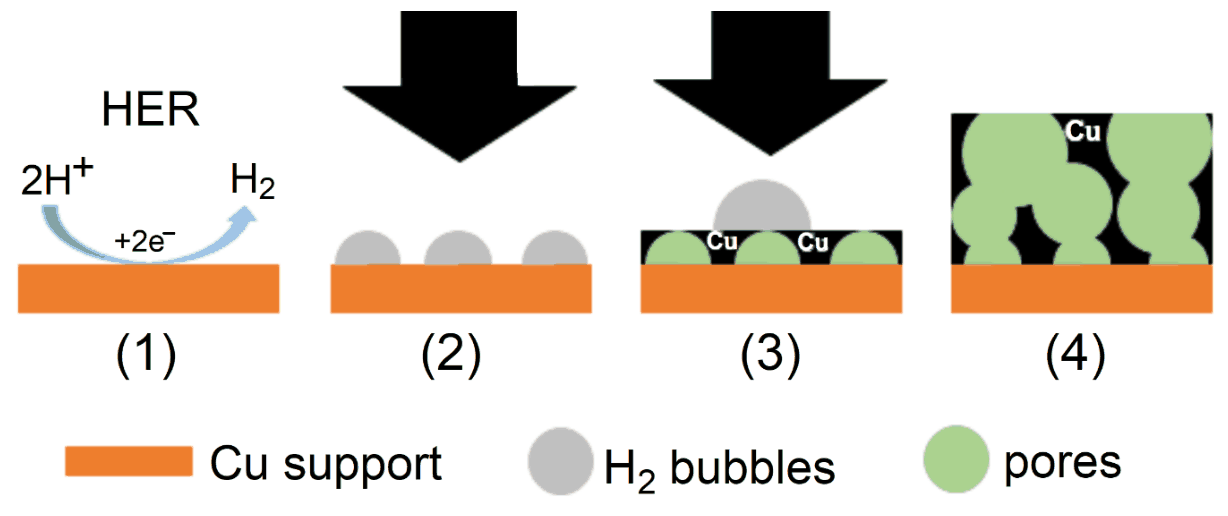
Figure 1. Depiction of the electrodeposition of foam-type materials. In the course of electrochemical metal deposition (black arrows) at high current densities in aqueous media, the Hydrogen Evolution Reaction (HER) takes place on the metallic (\(\ce{Cu}\)) support (1). The surface becomes thus partially covered by \(\ce{H2}\) bubbles (2). The \(\ce{H2}\) bubbles act as a template for metal deposition (3). As a result a highly porous metal foam emerges (4)
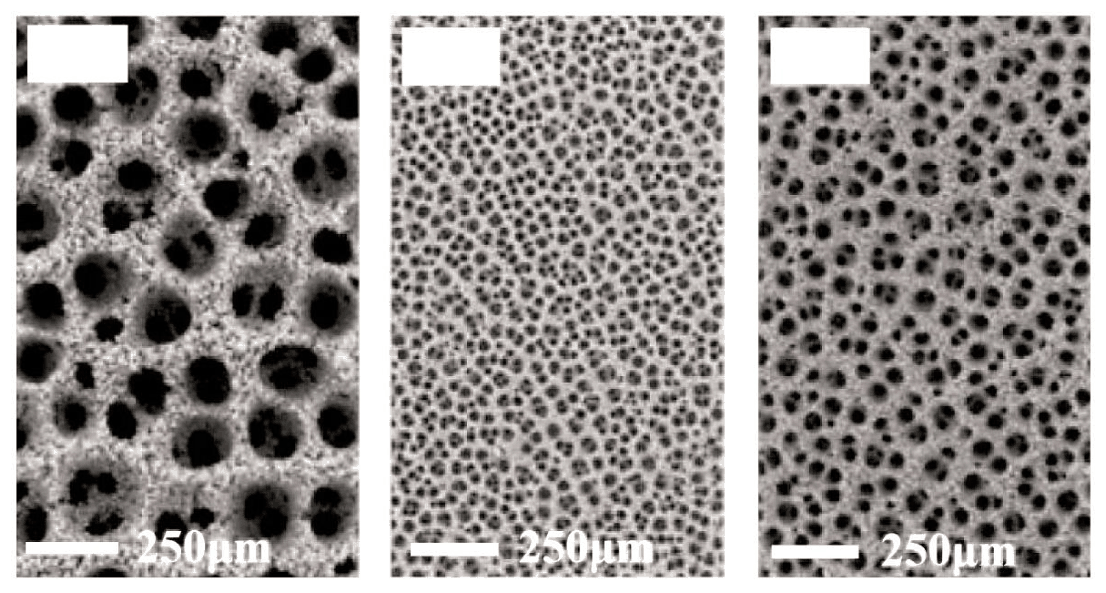
Figure 2. \(\ce{Cu}\) foams obtained by galvanostatic \(\ce{Cu}\) electrodeposition at a current density of \(j=-3\ \mathrm{A\,cm^{-2}}\). The deposition was, in each case, interrupted at distinct elapsed duration: 5 s, 20 s and 80 s. The scale bar is the same in all panels
2.4 Considering this mechanism, assign the correct deposition time to the \(\ce{Cu}\) foams shown in Figure 2 on the answer sheet (white boxes upper left corner).
Bimetallic \(\ce{CuAg}\) systems are excellent catalysts for the electrosynthesis of alcohols from \(\ce{CO2}\). 5.4 mg of a bimetallic \(\ce{Cu}\)-\(\ce{Ag}\) foam catalyst (90 wt. % \(\ce{Cu}\), \(M_{\ce{Cu}}=63.546\ \mathrm{g\,mol^{-1}}\); 10 wt. % \(\ce{Ag}\), \(M_{\ce{Ag}}=107.868\ \mathrm{g\,mol^{-1}}\)) was galvanostatically deposited onto a \(\ce{Cu}\) foil (\(1\ \mathrm{cm^2}\)) at a current density of \(j=-3\ \mathrm{A\,cm^{-2}}\) applied for 20 s (the minus sign accounts for a reductive/cathodic process).
2.5 Calculate the Faradaic efficiency (FE in %) of this metal deposition process. FE is defined as \((Q_\mathrm{product}/Q_\mathrm{total})\times100\%\), where \(Q\) denotes the charge.
We consider a \(\ce{CO2}\) electrolysis experiment carried out in 35 mL \(\ce{CO2}\)-saturated 0.5 M \(\ce{KHCO3}\) electrolyte solution over the bimetallic \(\ce{Cu}\)-\(\ce{Ag}\) foam catalyst (90 wt. % \(\ce{Cu}\); 10 wt. % \(\ce{Ag}\)). The \(\ce{CO2}\) electrolysis was carried out at a constant (total) current density of \(j(\mathrm{tot})=-30\ \mathrm{mA\,cm^{-2}}\) for 3600 s (note the current density is normalized to the geometric surface area of \(1\ \mathrm{cm^2}\); the minus sign accounts for a reductive/cathodic process). A product analysis, carried out after the electrolysis, revealed mass concentrations of \(41.3\ \mathrm{mg\,L^{-1}}\) and \(7.4\ \mathrm{mg\,L^{-1}}\) for ethanol and n-propanol, respectively. Both alcohols are liquid reaction products and accumulate in the electrolyte in the course of the electrolysis reaction. We assume that gaseous hydrogen (\(\ce{H2}\)) is formed as the only by-product of the process.
2.6 Calculate the current densities required for the formation of (a) ethanol (\(M_\mathrm{EtOH}=46.08\ \mathrm{g\,mol^{-1}}\)) and (b) n-propanol (\(M_\mathrm{PrOH}=60.10\ \mathrm{g\,mol^{-1}}\)) assuming that the current densities do not change with electrolysis time.
2.7 Calculate the volume of the formed hydrogen on the \(1\ \mathrm{cm^2}\) catalyst area at 298.15 K and 1 bar, assuming ideal behavior of the formed hydrogen, and its complete release into the gas phase. If you did not get a result in Task 2.6, continue with FE(EtOH) = 45,1 % and FE(PrOH) = 4.8 %.
Official English text of the problem.
Answers
-
2.1 (i) Ethanol,
CCO: \[ \ce{2CO2(g) + 12H+(aq) + 12e- -> CH3CH2OH(l) + 3H2O(l)} \] (ii) n-Propanol (propan-1-ol),CCCO: \[ \ce{3CO2(g) + 18H+(aq) + 18e- -> CH3CH2CH2OH(l) + 5H2O(l)} \] -
2.2 The combined cell reaction is \[ \ce{2CO2(g) + 6H2(g) -> CH3CH2OH(l) + 3H2O(l)}, \qquad \boxed{E^\ominus_\mathrm{cell}=+0.0824\ \mathrm{V}}. \]
-
2.3 Cathode: \[ \ce{Cu^2+(aq) + 2e- -> Cu(s)} \] \[ \ce{2H+(aq) + 2e- -> H2(g)} \] Anode: \[ \ce{2H2O(l) -> O2(g) + 4H+(aq) + 4e-} \]
-
2.4 Fill the white boxes from left to right with 80 s, 5 s, 20 s.
-
2.5 \(\boxed{\mathrm{FE}_\mathrm{metal}=25.4\%}\).
-
2.6 (a) \(\boxed{j_\mathrm{EtOH}=-10.1\ \mathrm{mA\,cm^{-2}}}\); (b) \(\boxed{j_\mathrm{PrOH}=-2.08\ \mathrm{mA\,cm^{-2}}}\).
-
2.7 Hydrogen,
[H][H]: \(\boxed{V_{\ce{H2}}=8.25\ \mathrm{mL}}\), using the results calculated in 2.6.
Solution
The molecular and ionic species used in the solution have the following names and SMILES. Physical states and electron transfer are specified in the reaction equations.
| Species | SMILES |
|---|---|
| Carbon dioxide | O=C=O |
| Water | O |
| Hydrogen | [H][H] |
| Oxygen | O=O |
| Ethanol | CCO |
| n-Propanol (propan-1-ol) | CCCO |
| Hydrogen ion (proton) | [H+] |
| Copper(II) ion | [Cu+2] |
| Silver(I) ion | [Ag+] |
The attached pages do not list numerical physical constants. I use \[ F=96485\ \mathrm{C\,mol^{-1}}, \qquad R=8.314\ \mathrm{J\,mol^{-1}\,K^{-1}}. \]
2.1 — Reduction half-reactions
For ethanol, two carbon dioxide molecules supply the two carbon atoms. Balancing oxygen requires three water molecules on the product side. The products then contain twelve hydrogen atoms, requiring twelve protons on the reactant side. Twelve electrons balance the charge:
\[ \boxed{\ce{2CO2(g) + 12H+(aq) + 12e- -> CH3CH2OH(l) + 3H2O(l)}} \]
For n-propanol, three carbon dioxide molecules supply the three carbon atoms. Five water molecules balance oxygen, eighteen protons balance hydrogen, and eighteen electrons balance charge:
\[ \boxed{\ce{3CO2(g) + 18H+(aq) + 18e- -> CH3CH2CH2OH(l) + 5H2O(l)}} \]
Thus the electron requirements are \(12\ \mathrm{mol}\) of electrons per mole of ethanol and \(18\ \mathrm{mol}\) per mole of n-propanol.
2.2 — Standard cell potential
Hydrogen undergoes oxidation at the anode:
\[ \ce{H2(g) -> 2H+(aq) + 2e-}. \]
Multiplying this equation by six and adding it to the ethanol half-reaction gives
\[ \ce{2CO2(g) + 6H2(g) -> CH3CH2OH(l) + 3H2O(l)}. \]
For this reaction, the standard reaction enthalpy is
\[ \begin{aligned} \Delta_\mathrm{r}H^\ominus &=\sum\nu\Delta_\mathrm{f}H^\ominus_\mathrm{products} -\sum\nu\Delta_\mathrm{f}H^\ominus_\mathrm{reactants}\\ &=[-276.00+3(-285.83)]-[2(-393.52)+6(0)]\\ &=-346.45\ \mathrm{kJ\,mol^{-1}}. \end{aligned} \]
The standard reaction entropy is
\[ \begin{aligned} \Delta_\mathrm{r}S^\ominus &=[159.86+3(69.95)]-[2(213.79)+6(130.68)]\\ &=-841.95\ \mathrm{J\,K^{-1}\,mol^{-1}}\\ &=-0.84195\ \mathrm{kJ\,K^{-1}\,mol^{-1}}. \end{aligned} \]
At \(298.15\ \mathrm{K}\),
\[ \begin{aligned} \Delta_\mathrm{r}G^\ominus &=\Delta_\mathrm{r}H^\ominus-T\Delta_\mathrm{r}S^\ominus\\ &=-346.45-298.15(-0.84195)\\ &=-95.4226\ \mathrm{kJ\,mol^{-1}}. \end{aligned} \]
The cell reaction transfers twelve electrons, so
\[ E^\ominus_\mathrm{cell} =-\frac{\Delta_\mathrm{r}G^\ominus}{12F} =\frac{95422.6\ \mathrm{J\,mol^{-1}}} {12(96485\ \mathrm{C\,mol^{-1}})} =\boxed{+0.0824\ \mathrm{V}}. \]
Since the standard hydrogen electrode has a reduction potential of \(0.00\ \mathrm{V}\), this is also the standard reduction potential of the carbon dioxide/ethanol half-cell versus SHE.
2.3 — Electrode reactions during copper-foam deposition
This part concerns the copper-foam electrodeposition described immediately after the question.
At the cathode, copper(II) ions accept electrons and deposit as metallic copper:
\[ \boxed{\ce{Cu^2+(aq) + 2e- -> Cu(s)}}. \]
Protons are also reduced, producing the hydrogen bubbles that template the pores:
\[ \boxed{\ce{2H+(aq) + 2e- -> H2(g)}}. \]
At the platinum anode, water is oxidized to oxygen:
\[ \boxed{\ce{2H2O(l) -> O2(g) + 4H+(aq) + 4e-}}. \]
The platinum foil serves as the conducting anode without being consumed in this reaction.
2.4 — Assignment of deposition times
Copper deposits around hydrogen bubbles, leaving pores when the bubbles escape. As deposition proceeds, bubble growth and coalescence produce larger pores.
Because all three panels have the same scale bar, their pore sizes can be compared directly:
- The left panel has the largest pores: 80 s.
- The middle panel has the smallest pores: 5 s.
- The right panel has intermediate pore sizes: 20 s.
Therefore, the white boxes should read
\[ \boxed{\text{Left: }80\ \mathrm{s}\qquad \text{Middle: }5\ \mathrm{s}\qquad \text{Right: }20\ \mathrm{s}}. \]
2.5 — Faradaic efficiency of metal deposition
Use positive charge magnitudes when calculating Faradaic efficiency. The total charge passed is
\[ Q_\mathrm{total}=|j|At =(3\ \mathrm{A\,cm^{-2}})(1\ \mathrm{cm^2})(20\ \mathrm{s}) =60\ \mathrm{C}. \]
The deposited metal masses are
\[ m_{\ce{Cu}}=0.90(5.4\ \mathrm{mg})=4.86\ \mathrm{mg}, \] \[ m_{\ce{Ag}}=0.10(5.4\ \mathrm{mg})=0.54\ \mathrm{mg}. \]
Their amounts are
\[ n_{\ce{Cu}} =\frac{4.86\times10^{-3}\ \mathrm{g}} {63.546\ \mathrm{g\,mol^{-1}}} =7.6480\times10^{-5}\ \mathrm{mol}, \]
\[ n_{\ce{Ag}} =\frac{0.54\times10^{-3}\ \mathrm{g}} {107.868\ \mathrm{g\,mol^{-1}}} =5.0061\times10^{-6}\ \mathrm{mol}. \]
Copper deposition requires two electrons per atom. Taking silver to be deposited from silver(I), its deposition requires one:
\[ \ce{Cu^2+(aq) + 2e- -> Cu(s)}, \qquad \ce{Ag+(aq) + e- -> Ag(s)}. \]
Hence
\[ \begin{aligned} Q_\mathrm{metal} &=F(2n_{\ce{Cu}}+n_{\ce{Ag}})\\ &=(96485)\left[2(7.6480\times10^{-5})+5.0061\times10^{-6}\right]\\ &=15.2414\ \mathrm{C}. \end{aligned} \]
Therefore,
\[ \boxed{ \mathrm{FE}_\mathrm{metal} =\frac{15.2414}{60}\times100\% =25.4\% }. \]
The competing hydrogen-evolution reaction accounts for the low efficiency of metal deposition in the bubble-templating process.
2.6 — Partial current densities for alcohol formation
The electrolyte volume is \(0.035\ \mathrm{L}\). For a product requiring \(z\) electrons per molecule,
\[ n=\frac{c_mV_\mathrm{el}}{M}, \qquad Q=zFn, \qquad j=-\frac{Q}{At}. \]
The negative sign denotes a cathodic current. The relevant area is the stated geometric area, \(A=1\ \mathrm{cm^2}\).
(a) Ethanol
The amount produced is
\[ \begin{aligned} n_\mathrm{EtOH} &=\frac{(41.3\times10^{-3}\ \mathrm{g\,L^{-1}}) (0.035\ \mathrm{L})} {46.08\ \mathrm{g\,mol^{-1}}}\\ &=3.13694\times10^{-5}\ \mathrm{mol}. \end{aligned} \]
Using \(z=12\),
\[ Q_\mathrm{EtOH} =12F n_\mathrm{EtOH} =36.3201\ \mathrm{C}. \]
Thus
\[ j_\mathrm{EtOH} =-\frac{36.3201\ \mathrm{C}} {(1\ \mathrm{cm^2})(3600\ \mathrm{s})} =-0.0100889\ \mathrm{A\,cm^{-2}}, \]
\[ \boxed{j_\mathrm{EtOH}=-10.1\ \mathrm{mA\,cm^{-2}}}. \]
(b) \(\boldsymbol{n}\)-Propanol
The amount produced is
\[ \begin{aligned} n_\mathrm{PrOH} &=\frac{(7.4\times10^{-3}\ \mathrm{g\,L^{-1}}) (0.035\ \mathrm{L})} {60.10\ \mathrm{g\,mol^{-1}}}\\ &=4.30948\times10^{-6}\ \mathrm{mol}. \end{aligned} \]
Using \(z=18\),
\[ Q_\mathrm{PrOH} =18F n_\mathrm{PrOH} =7.48441\ \mathrm{C}. \]
Therefore,
\[ j_\mathrm{PrOH} =-\frac{7.48441\ \mathrm{C}} {(1\ \mathrm{cm^2})(3600\ \mathrm{s})} =-0.00207900\ \mathrm{A\,cm^{-2}}, \]
\[ \boxed{j_\mathrm{PrOH}=-2.08\ \mathrm{mA\,cm^{-2}}} \]
(or \(-2.1\ \mathrm{mA\,cm^{-2}}\) to two significant figures).
The corresponding Faradaic efficiencies, retaining unrounded current values, are
\[ \mathrm{FE}_\mathrm{EtOH} =\frac{10.0889}{30}\times100\% =33.63\%, \]
\[ \mathrm{FE}_\mathrm{PrOH} =\frac{2.07900}{30}\times100\% =6.930\%. \]
2.7 — Hydrogen volume
The total electrolysis charge is
\[ Q_\mathrm{total} =(0.030\ \mathrm{A\,cm^{-2}}) (1\ \mathrm{cm^2})(3600\ \mathrm{s}) =108\ \mathrm{C}. \]
Since hydrogen is the only by-product, its formation accounts for all charge remaining after alcohol formation:
\[ \begin{aligned} Q_{\ce{H2}} &=Q_\mathrm{total}-Q_\mathrm{EtOH}-Q_\mathrm{PrOH}\\ &=108-36.3201-7.48441\\ &=64.1955\ \mathrm{C}. \end{aligned} \]
Formation of one hydrogen molecule requires two electrons. Consequently,
\[ n_{\ce{H2}} =\frac{Q_{\ce{H2}}}{2F} =\frac{64.1955}{2(96485)} =3.32671\times10^{-4}\ \mathrm{mol}. \]
Using the ideal-gas law at \(p=1\ \mathrm{bar}=10^5\ \mathrm{Pa}\),
\[ \begin{aligned} V_{\ce{H2}} &=\frac{n_{\ce{H2}}RT}{p}\\ &=\frac{(3.32671\times10^{-4}\ \mathrm{mol}) (8.314\ \mathrm{J\,mol^{-1}\,K^{-1}}) (298.15\ \mathrm{K})} {10^5\ \mathrm{Pa}}\\ &=8.24631\times10^{-6}\ \mathrm{m^3}. \end{aligned} \]
Therefore,
\[ \boxed{V_{\ce{H2}}=8.25\ \mathrm{mL}}. \]
Using the question’s optional fallback efficiencies would instead give \[ \mathrm{FE}_{\ce{H2}}=100\%-45.1\%-4.8\%=50.1\% \] and \(V_{\ce{H2}}=6.95\ \mathrm{mL}\). The main answer uses the efficiencies calculated directly from the stated product concentrations.
The solution was checked against the official solution. Where this solution differs from the official solution, the official solution contains an error or a misprint.
IChO 2023 · Theorieaufgabe 2
Elektrochemische CO2-Reduktion
Elektrochemische \(\ce{CO2}\)-Reduktion
In den letzten Jahren wurde die elektrochemische Umwandlung von \(\ce{CO2}\) in höherwertige Produkte als vielversprechender und technologisch realisierbarer Ansatz angesehen, um die negativen klimatischen Auswirkungen seiner zunehmenden Konzentration in der Atmosphäre abzumildern. Zur Erreichung dieses Ziels wurden mehrere Technologien entwickelt. Unter diesen verdient die elektrochemische Reduktion von \(\ce{CO2}\) (\(\ce{CO2}\)RR) besondere Aufmerksamkeit, da sie mit erneuerbarer Energie betrieben werden kann, um umweltschädliches \(\ce{CO2}\) in Plattformchemikalien umzuwandeln. Elektrokatalysatoren sind nicht nur unerlässlich, um die von Natur aus langsame \(\ce{CO2}\)RR zu beschleunigen, sondern auch, um die Elektrolysereaktion zu den gewünschten Reaktionsprodukten zu lenken. In diesem Zusammenhang bestimmt nicht nur die chemische Natur des Katalysators selbst die resultierende Produktverteilung der \(\ce{CO2}\)RR, sondern auch seine morphologischen Eigenschaften auf verschiedenen Längenskalen. Ein neues Konzept für die Entwicklung von \(\ce{CO2}\)RR-Katalysatoren beruht auf der elektrochemischen Abscheidung schaumartiger Materialien, die eine große, für Reaktanten (z. B. \(\ce{H2O}\), \(\ce{H2}\) und \(\ce{CO2}\)) zugängliche Oberfläche bieten. Materialien auf Kupferbasis sind die einzigen bekannten metallischen \(\ce{CO2}\)RR-Katalysatoren, die durch \(\ce{CO2}\)-Elektrolyse Kohlenwasserstoffe und Alkohole in nennenswerten Mengen erzeugen können.
Im Folgenden sind thermodynamische Daten ausgewählter Stoffe angegeben:
| \(\Delta_\mathrm{f}H^\ominus\) (\(\mathrm{kJ\,mol^{-1}}\)) | \(S^\ominus\) (\(\mathrm{J\,K^{-1}\,mol^{-1}}\)) | |
|---|---|---|
| \(\ce{H2O(l)}\) | −285.83 | 69.95 |
| \(\ce{O2(g)}\) | 0 | 205.15 |
| \(\ce{H2(g)}\) | 0 | 130.68 |
| \(\ce{CO2(g)}\) | −393.52 | 213.79 |
| Ethanol(l) | −276.00 | 159.86 |
| n-Propanol(l) | −302.54 | 192.80 |
Tabelle 1. Standardbildungsenthalpie \(\Delta_\mathrm{f}H^\ominus\) und Standardentropie \(S^\ominus\) einiger Stoffe unter Standardbedingungen (\(T=298.15\ \mathrm{K}\), \(p^\ominus=1\ \mathrm{bar}\))
| Zellreaktion | \(E^\ominus\) gegen SHE (V) |
|---|---|
| \(\ce{Cu^2+ + 2e- = Cu}\) | +0.34 |
| \(\ce{2H+ + 2e- = H2}\) | 0.00 |
Tabelle 2. Ausgewählte Halbzellenreaktionen und Standardpotentiale unter Standardbedingungen
2.1 Stellen Sie die Reaktionsgleichungen der Halbzellenreaktionen für die folgenden elektrochemischen Reduktionsprozesse in saurem Milieu auf und gleichen Sie diese aus: (i) \(\ce{CO2}\) zu Ethanol; (ii) \(\ce{CO2}\) zu n-Propanol.
2.2 Kombinieren Sie die Halbzelle des Reduktionsprozesses mit einer \(\ce{H2}/\ce{2H+}\)-Halbzelle, wobei Letztere als Anode dient. Berechnen Sie den Wert des Standardzellpotentials der Reduktion von \(\ce{CO2}\) zu Ethanol.
2.3 Geben Sie alle Reduktions- bzw. Oxidationshalbreaktionen an, die an der Kathode bzw. an der Anode ablaufen.
Abbildung 1 zeigt das Prinzip der Metallabscheidung mithilfe dynamischer Wasserstoffblasen als Templat.
Abbildung 2 zeigt rasterelektronenmikroskopische Aufnahmen in Draufsicht von fünf verschiedenen \(\ce{Cu}\)-Schäumen, die durch Unterbrechung der Metallabscheidung zu unterschiedlichen Zeitpunkten erhalten wurden: 5 s, 20 s, 80 s.
Die elektrochemische Abscheidung von \(\ce{Cu}\)-Schaum (siehe Abbildung 1) wurde in einer wässrigen 1.5 M Schwefelsäurelösung durchgeführt, die 0.2 M Kupfersulfat (\(\ce{CuSO4 * 5H2O}\)) als Kupferquelle enthielt. Eine \(\ce{Cu}\)-Scheibe (\(1\ \mathrm{cm^2}\)) und eine \(\ce{Pt}\)-Folie dienten als Kathode bzw. Anode.
Abbildung 1. Darstellung der elektrochemischen Abscheidung schaumartiger Materialien. Im Verlauf der elektrochemischen Metallabscheidung (schwarze Pfeile) bei hohen Stromdichten in wässrigen Medien findet auf dem metallischen (\(\ce{Cu}\)) Träger (1) die Wasserstoffentwicklungsreaktion (HER) statt. Dadurch wird die Oberfläche teilweise mit \(\ce{H2}\)-Blasen bedeckt (2). Die \(\ce{H2}\)-Blasen dienen als Templat für die Metallabscheidung (3). Als Ergebnis entsteht ein hochporöser Metallschaum (4)
Abbildung 2. \(\ce{Cu}\)-Schäume, die durch galvanostatische elektrochemische \(\ce{Cu}\)-Abscheidung bei einer Stromdichte von \(j=-3\ \mathrm{A\,cm^{-2}}\) erhalten wurden. Die Abscheidung wurde jeweils nach unterschiedlichen Zeitspannen unterbrochen: 5 s, 20 s und 80 s. Der Maßstabsbalken ist in allen Teilbildern gleich
2.4 Ordnen Sie unter Berücksichtigung dieses Mechanismus den in Abbildung 2 gezeigten \(\ce{Cu}\)-Schäumen auf dem Antwortbogen die richtige Abscheidungszeit zu (weiße Kästchen in der oberen linken Ecke).
Bimetallische \(\ce{CuAg}\)-Systeme sind ausgezeichnete Katalysatoren für die Elektrosynthese von Alkoholen aus \(\ce{CO2}\). 5.4 mg eines bimetallischen \(\ce{Cu}\)-\(\ce{Ag}\)-Schaumkatalysators (90 Gew.-% \(\ce{Cu}\), \(M_{\ce{Cu}}=63.546\ \mathrm{g\,mol^{-1}}\); 10 Gew.-% \(\ce{Ag}\), \(M_{\ce{Ag}}=107.868\ \mathrm{g\,mol^{-1}}\)) wurden galvanostatisch auf einer \(\ce{Cu}\)-Folie (\(1\ \mathrm{cm^2}\)) bei einer Stromdichte von \(j=-3\ \mathrm{A\,cm^{-2}}\) abgeschieden, die 20 s lang angelegt wurde (das Minuszeichen kennzeichnet einen reduktiven/kathodischen Prozess).
2.5 Berechnen Sie den Faraday-Wirkungsgrad (FE in %) dieses Metallabscheidungsprozesses. FE ist definiert als \((Q_\mathrm{product}/Q_\mathrm{total})\times100\%\), wobei \(Q\) die Ladung bezeichnet.
Wir betrachten ein \(\ce{CO2}\)-Elektrolyseexperiment, das in 35 mL einer mit \(\ce{CO2}\) gesättigten 0.5 M \(\ce{KHCO3}\)-Elektrolytlösung am bimetallischen \(\ce{Cu}\)-\(\ce{Ag}\)-Schaumkatalysator (90 Gew.-% \(\ce{Cu}\); 10 Gew.-% \(\ce{Ag}\)) durchgeführt wird. Die \(\ce{CO2}\)-Elektrolyse wurde bei einer konstanten (Gesamt-)Stromdichte von \(j(\mathrm{tot})=-30\ \mathrm{mA\,cm^{-2}}\) für 3600 s durchgeführt (beachten Sie, dass die Stromdichte auf die geometrische Oberfläche von \(1\ \mathrm{cm^2}\) normiert ist; das Minuszeichen kennzeichnet einen reduktiven/kathodischen Prozess). Eine nach der Elektrolyse durchgeführte Produktanalyse ergab Massenkonzentrationen von \(41.3\ \mathrm{mg\,L^{-1}}\) bzw. \(7.4\ \mathrm{mg\,L^{-1}}\) für Ethanol bzw. n-Propanol. Beide Alkohole sind flüssige Reaktionsprodukte und reichern sich im Verlauf der Elektrolysereaktion im Elektrolyten an. Wir nehmen an, dass gasförmiger Wasserstoff (\(\ce{H2}\)) als einziges Nebenprodukt des Prozesses gebildet wird.
2.6 Berechnen Sie die für die Bildung von (a) Ethanol (\(M_\mathrm{EtOH}=46.08\ \mathrm{g\,mol^{-1}}\)) und (b) n-Propanol (\(M_\mathrm{PrOH}=60.10\ \mathrm{g\,mol^{-1}}\)) erforderlichen Stromdichten unter der Annahme, dass sich die Stromdichten mit der Elektrolysezeit nicht ändern.
2.7 Berechnen Sie das Volumen des auf der \(1\ \mathrm{cm^2}\) großen Katalysatorfläche gebildeten Wasserstoffs bei 298.15 K und 1 bar unter der Annahme, dass sich der gebildete Wasserstoff ideal verhält und vollständig in die Gasphase übergeht. Falls Sie in Aufgabe 2.6 kein Ergebnis erhalten haben, rechnen Sie mit FE(EtOH) = 45,1 % und FE(PrOH) = 4.8 % weiter.
Aufgabentext aus dem offiziellen englischen Text übersetzt.
Antworten
-
2.1 (i) Ethanol,
CCO: \[ \ce{2CO2(g) + 12H+(aq) + 12e- -> CH3CH2OH(l) + 3H2O(l)} \] (ii) n-Propanol (Propan-1-ol),CCCO: \[ \ce{3CO2(g) + 18H+(aq) + 18e- -> CH3CH2CH2OH(l) + 5H2O(l)} \] -
2.2 Die kombinierte Zellreaktion lautet \[ \ce{2CO2(g) + 6H2(g) -> CH3CH2OH(l) + 3H2O(l)}, \qquad \boxed{E^\ominus_\mathrm{cell}=+0.0824\ \mathrm{V}}. \]
-
2.3 Kathode: \[ \ce{Cu^2+(aq) + 2e- -> Cu(s)} \] \[ \ce{2H+(aq) + 2e- -> H2(g)} \] Anode: \[ \ce{2H2O(l) -> O2(g) + 4H+(aq) + 4e-} \]
-
2.4 Tragen Sie in die weißen Kästchen von links nach rechts 80 s, 5 s, 20 s ein.
-
2.5 \(\boxed{\mathrm{FE}_\mathrm{metal}=25.4\%}\).
-
2.6 (a) \(\boxed{j_\mathrm{EtOH}=-10.1\ \mathrm{mA\,cm^{-2}}}\); (b) \(\boxed{j_\mathrm{PrOH}=-2.08\ \mathrm{mA\,cm^{-2}}}\).
-
2.7 Wasserstoff,
[H][H]: \(\boxed{V_{\ce{H2}}=8.25\ \mathrm{mL}}\), unter Verwendung der in 2.6 berechneten Ergebnisse.
Lösung
Die in der Lösung verwendeten molekularen und ionischen Spezies haben die folgenden Namen und SMILES. Aggregatzustände und Elektronenübertragung sind in den Reaktionsgleichungen angegeben.
| Spezies | SMILES |
|---|---|
| Kohlenstoffdioxid | O=C=O |
| Wasser | O |
| Wasserstoff | [H][H] |
| Sauerstoff | O=O |
| Ethanol | CCO |
| n-Propanol (Propan-1-ol) | CCCO |
| Wasserstoffion (Proton) | [H+] |
| Kupfer(II)-Ion | [Cu+2] |
| Silber(I)-Ion | [Ag+] |
Die beigefügten Seiten enthalten keine Zahlenwerte für physikalische Konstanten. Ich verwende \[ F=96485\ \mathrm{C\,mol^{-1}}, \qquad R=8.314\ \mathrm{J\,mol^{-1}\,K^{-1}}. \]
2.1 — Reduktionshalbreaktionen
Für Ethanol liefern zwei Kohlenstoffdioxidmoleküle die beiden Kohlenstoffatome. Der Ausgleich der Sauerstoffatome erfordert drei Wassermoleküle auf der Produktseite. Die Produkte enthalten dann zwölf Wasserstoffatome, sodass auf der Eduktseite zwölf Protonen erforderlich sind. Zwölf Elektronen gleichen die Ladung aus:
\[ \boxed{\ce{2CO2(g) + 12H+(aq) + 12e- -> CH3CH2OH(l) + 3H2O(l)}} \]
Für n-Propanol liefern drei Kohlenstoffdioxidmoleküle die drei Kohlenstoffatome. Fünf Wassermoleküle gleichen die Sauerstoffatome aus, achtzehn Protonen die Wasserstoffatome und achtzehn Elektronen die Ladung:
\[ \boxed{\ce{3CO2(g) + 18H+(aq) + 18e- -> CH3CH2CH2OH(l) + 5H2O(l)}} \]
Somit werden \(12\ \mathrm{mol}\) Elektronen pro Mol Ethanol und \(18\ \mathrm{mol}\) pro Mol n-Propanol benötigt.
2.2 — Standardzellpotential
Wasserstoff wird an der Anode oxidiert:
\[ \ce{H2(g) -> 2H+(aq) + 2e-}. \]
Multipliziert man diese Gleichung mit sechs und addiert sie zur Ethanol-Halbreaktion, erhält man
\[ \ce{2CO2(g) + 6H2(g) -> CH3CH2OH(l) + 3H2O(l)}. \]
Für diese Reaktion beträgt die Standardreaktionsenthalpie
\[ \begin{aligned} \Delta_\mathrm{r}H^\ominus &=\sum\nu\Delta_\mathrm{f}H^\ominus_\mathrm{products} -\sum\nu\Delta_\mathrm{f}H^\ominus_\mathrm{reactants}\\ &=[-276.00+3(-285.83)]-[2(-393.52)+6(0)]\\ &=-346.45\ \mathrm{kJ\,mol^{-1}}. \end{aligned} \]
Die Standardreaktionsentropie beträgt
\[ \begin{aligned} \Delta_\mathrm{r}S^\ominus &=[159.86+3(69.95)]-[2(213.79)+6(130.68)]\\ &=-841.95\ \mathrm{J\,K^{-1}\,mol^{-1}}\\ &=-0.84195\ \mathrm{kJ\,K^{-1}\,mol^{-1}}. \end{aligned} \]
Bei \(298.15\ \mathrm{K}\) gilt
\[ \begin{aligned} \Delta_\mathrm{r}G^\ominus &=\Delta_\mathrm{r}H^\ominus-T\Delta_\mathrm{r}S^\ominus\\ &=-346.45-298.15(-0.84195)\\ &=-95.4226\ \mathrm{kJ\,mol^{-1}}. \end{aligned} \]
Bei der Zellreaktion werden zwölf Elektronen übertragen, sodass
\[ E^\ominus_\mathrm{cell} =-\frac{\Delta_\mathrm{r}G^\ominus}{12F} =\frac{95422.6\ \mathrm{J\,mol^{-1}}} {12(96485\ \mathrm{C\,mol^{-1}})} =\boxed{+0.0824\ \mathrm{V}}. \]
Da die Standardwasserstoffelektrode ein Reduktionspotential von \(0.00\ \mathrm{V}\) aufweist, ist dies zugleich das Standardreduktionspotential der Kohlenstoffdioxid/Ethanol-Halbzelle gegen SHE.
2.3 — Elektrodenreaktionen bei der Abscheidung von Kupferschaum
Dieser Teil bezieht sich auf die unmittelbar nach der Frage beschriebene elektrochemische Abscheidung von Kupferschaum.
An der Kathode nehmen Kupfer(II)-Ionen Elektronen auf und werden als metallisches Kupfer abgeschieden:
\[ \boxed{\ce{Cu^2+(aq) + 2e- -> Cu(s)}}. \]
Auch Protonen werden reduziert, wobei die Wasserstoffblasen entstehen, die als Templat für die Poren dienen:
\[ \boxed{\ce{2H+(aq) + 2e- -> H2(g)}}. \]
An der Platinanode wird Wasser zu Sauerstoff oxidiert:
\[ \boxed{\ce{2H2O(l) -> O2(g) + 4H+(aq) + 4e-}}. \]
Die Platinfolie dient als leitfähige Anode, ohne bei dieser Reaktion verbraucht zu werden.
2.4 — Zuordnung der Abscheidungszeiten
Kupfer scheidet sich um Wasserstoffblasen herum ab, die beim Entweichen Poren hinterlassen. Mit fortschreitender Abscheidung entstehen durch Blasenwachstum und Koaleszenz größere Poren.
Da alle drei Teilbilder denselben Maßstabsbalken haben, lassen sich ihre Porengrößen direkt vergleichen:
- Das linke Teilbild zeigt die größten Poren: 80 s.
- Das mittlere Teilbild zeigt die kleinsten Poren: 5 s.
- Das rechte Teilbild zeigt Poren mittlerer Größe: 20 s.
Die weißen Kästchen sind daher wie folgt zu beschriften:
\[ \boxed{\text{Links: }80\ \mathrm{s}\qquad \text{Mitte: }5\ \mathrm{s}\qquad \text{Rechts: }20\ \mathrm{s}}. \]
2.5 — Faraday-Wirkungsgrad der Metallabscheidung
Verwenden Sie bei der Berechnung des Faraday-Wirkungsgrads positive Ladungsbeträge. Die insgesamt geflossene Ladung beträgt
\[ Q_\mathrm{total}=|j|At =(3\ \mathrm{A\,cm^{-2}})(1\ \mathrm{cm^2})(20\ \mathrm{s}) =60\ \mathrm{C}. \]
Die abgeschiedenen Metallmassen betragen
\[ m_{\ce{Cu}}=0.90(5.4\ \mathrm{mg})=4.86\ \mathrm{mg}, \] \[ m_{\ce{Ag}}=0.10(5.4\ \mathrm{mg})=0.54\ \mathrm{mg}. \]
Ihre Stoffmengen betragen
\[ n_{\ce{Cu}} =\frac{4.86\times10^{-3}\ \mathrm{g}} {63.546\ \mathrm{g\,mol^{-1}}} =7.6480\times10^{-5}\ \mathrm{mol}, \]
\[ n_{\ce{Ag}} =\frac{0.54\times10^{-3}\ \mathrm{g}} {107.868\ \mathrm{g\,mol^{-1}}} =5.0061\times10^{-6}\ \mathrm{mol}. \]
Die Kupferabscheidung erfordert zwei Elektronen pro Atom. Unter der Annahme, dass Silber aus Silber(I) abgeschieden wird, erfordert seine Abscheidung ein Elektron:
\[ \ce{Cu^2+(aq) + 2e- -> Cu(s)}, \qquad \ce{Ag+(aq) + e- -> Ag(s)}. \]
Daraus folgt
\[ \begin{aligned} Q_\mathrm{metal} &=F(2n_{\ce{Cu}}+n_{\ce{Ag}})\\ &=(96485)\left[2(7.6480\times10^{-5})+5.0061\times10^{-6}\right]\\ &=15.2414\ \mathrm{C}. \end{aligned} \]
Somit gilt
\[ \boxed{ \mathrm{FE}_\mathrm{metal} =\frac{15.2414}{60}\times100\% =25.4\% }. \]
Die konkurrierende Wasserstoffentwicklungsreaktion ist für den niedrigen Wirkungsgrad der Metallabscheidung beim Verfahren mit Blasen als Templat verantwortlich.
2.6 — Partielle Stromdichten für die Alkoholbildung
Das Elektrolytvolumen beträgt \(0.035\ \mathrm{L}\). Für ein Produkt, dessen Bildung \(z\) Elektronen pro Molekül erfordert, gilt
\[ n=\frac{c_mV_\mathrm{el}}{M}, \qquad Q=zFn, \qquad j=-\frac{Q}{At}. \]
Das negative Vorzeichen kennzeichnet einen kathodischen Strom. Maßgeblich ist die angegebene geometrische Fläche, \(A=1\ \mathrm{cm^2}\).
(a) Ethanol
Die erzeugte Stoffmenge beträgt
\[ \begin{aligned} n_\mathrm{EtOH} &=\frac{(41.3\times10^{-3}\ \mathrm{g\,L^{-1}}) (0.035\ \mathrm{L})} {46.08\ \mathrm{g\,mol^{-1}}}\\ &=3.13694\times10^{-5}\ \mathrm{mol}. \end{aligned} \]
Mit \(z=12\) ergibt sich
\[ Q_\mathrm{EtOH} =12F n_\mathrm{EtOH} =36.3201\ \mathrm{C}. \]
Damit gilt
\[ j_\mathrm{EtOH} =-\frac{36.3201\ \mathrm{C}} {(1\ \mathrm{cm^2})(3600\ \mathrm{s})} =-0.0100889\ \mathrm{A\,cm^{-2}}, \]
\[ \boxed{j_\mathrm{EtOH}=-10.1\ \mathrm{mA\,cm^{-2}}}. \]
(b) \(\boldsymbol{n}\)-Propanol
Die erzeugte Stoffmenge beträgt
\[ \begin{aligned} n_\mathrm{PrOH} &=\frac{(7.4\times10^{-3}\ \mathrm{g\,L^{-1}}) (0.035\ \mathrm{L})} {60.10\ \mathrm{g\,mol^{-1}}}\\ &=4.30948\times10^{-6}\ \mathrm{mol}. \end{aligned} \]
Mit \(z=18\) ergibt sich
\[ Q_\mathrm{PrOH} =18F n_\mathrm{PrOH} =7.48441\ \mathrm{C}. \]
Somit gilt
\[ j_\mathrm{PrOH} =-\frac{7.48441\ \mathrm{C}} {(1\ \mathrm{cm^2})(3600\ \mathrm{s})} =-0.00207900\ \mathrm{A\,cm^{-2}}, \]
\[ \boxed{j_\mathrm{PrOH}=-2.08\ \mathrm{mA\,cm^{-2}}} \]
(oder \(-2.1\ \mathrm{mA\,cm^{-2}}\) auf zwei signifikante Stellen gerundet).
Die entsprechenden Faraday-Wirkungsgrade betragen unter Verwendung der ungerundeten Stromwerte
\[ \mathrm{FE}_\mathrm{EtOH} =\frac{10.0889}{30}\times100\% =33.63\%, \]
\[ \mathrm{FE}_\mathrm{PrOH} =\frac{2.07900}{30}\times100\% =6.930\%. \]
2.7 — Wasserstoffvolumen
Die gesamte Elektrolyseladung beträgt
\[ Q_\mathrm{total} =(0.030\ \mathrm{A\,cm^{-2}}) (1\ \mathrm{cm^2})(3600\ \mathrm{s}) =108\ \mathrm{C}. \]
Da Wasserstoff das einzige Nebenprodukt ist, entfällt auf seine Bildung die gesamte nach der Alkoholbildung verbleibende Ladung:
\[ \begin{aligned} Q_{\ce{H2}} &=Q_\mathrm{total}-Q_\mathrm{EtOH}-Q_\mathrm{PrOH}\\ &=108-36.3201-7.48441\\ &=64.1955\ \mathrm{C}. \end{aligned} \]
Die Bildung eines Wasserstoffmoleküls erfordert zwei Elektronen. Folglich gilt
\[ n_{\ce{H2}} =\frac{Q_{\ce{H2}}}{2F} =\frac{64.1955}{2(96485)} =3.32671\times10^{-4}\ \mathrm{mol}. \]
Mit dem idealen Gasgesetz ergibt sich bei \(p=1\ \mathrm{bar}=10^5\ \mathrm{Pa}\)
\[ \begin{aligned} V_{\ce{H2}} &=\frac{n_{\ce{H2}}RT}{p}\\ &=\frac{(3.32671\times10^{-4}\ \mathrm{mol}) (8.314\ \mathrm{J\,mol^{-1}\,K^{-1}}) (298.15\ \mathrm{K})} {10^5\ \mathrm{Pa}}\\ &=8.24631\times10^{-6}\ \mathrm{m^3}. \end{aligned} \]
Somit gilt
\[ \boxed{V_{\ce{H2}}=8.25\ \mathrm{mL}}. \]
Die Verwendung der in der Aufgabenstellung optional angegebenen Ersatzwerte für die Wirkungsgrade würde stattdessen \[ \mathrm{FE}_{\ce{H2}}=100\%-45.1\%-4.8\%=50.1\% \] und \(V_{\ce{H2}}=6.95\ \mathrm{mL}\) ergeben. Die Hauptantwort verwendet die direkt aus den angegebenen Produktkonzentrationen berechneten Wirkungsgrade.
Die Lösung wurde mit der offiziellen Lösung abgeglichen. Wo diese Lösung von der offiziellen Lösung abweicht, enthält die offizielle Lösung einen Fehler oder Druckfehler.
IChO 2023 · Teori sorusu 2
Elektrokimyasal CO2 İndirgenmesi
Elektrokimyasal \(\ce{CO2}\) indirgenmesi
Son yıllarda, \(\ce{CO2}\)'nin daha yüksek değerli ürünlere elektrokimyasal dönüşümü, atmosferde artan derişiminin yol açtığı olumsuz iklim etkilerini hafifletmek için umut vadeden ve teknolojik açıdan uygulanabilir bir yaklaşım olarak değerlendirilmektedir. Bu amaca ulaşmak için çeşitli teknolojiler geliştirilmiştir. Bunlar arasında, çevreye zararlı \(\ce{CO2}\)'yi temel kimyasal ham maddelere dönüştürmek için yenilenebilir enerjiyle çalışabilmesi nedeniyle, \(\ce{CO2}\)'nin elektrokimyasal yollarla indirgenmesi (\(\ce{CO2}\)RR) özellikle dikkat çekmektedir. Elektrokatalizörler, yalnızca doğası gereği yavaş olan \(\ce{CO2}\)RR'yi hızlandırmak için değil, aynı zamanda elektroliz tepkimesini istenen tepkime ürünlerine yönlendirmek için de gereklidir. Bu bağlamda, ortaya çıkan \(\ce{CO2}\)RR ürün dağılımını belirleyen yalnızca katalizörün kendi kimyasal yapısı değil, aynı zamanda çeşitli uzunluk ölçeklerindeki morfolojik özellikleridir. \(\ce{CO2}\)RR katalizör tasarımında yeni bir yaklaşım, tepkenlerin (örneğin \(\ce{H2O}\), \(\ce{H2}\) ve \(\ce{CO2}\)) erişebildiği geniş bir yüzey alanı sunan köpük tipi malzemelerin elektrokimyasal biriktirilmesine dayanır. Bakır esaslı malzemeler, \(\ce{CO2}\) elektroliziyle önemli miktarlarda hidrokarbon ve alkol üretebilen, bilinen tek metalik \(\ce{CO2}\)RR katalizörleridir.
Aşağıda seçilmiş maddelerin termodinamik verileri verilmiştir:
| \(\Delta_\mathrm{f}H^\ominus\) (\(\mathrm{kJ\,mol^{-1}}\)) | \(S^\ominus\) (\(\mathrm{J\,K^{-1}\,mol^{-1}}\)) | |
|---|---|---|
| \(\ce{H2O(l)}\) | −285.83 | 69.95 |
| \(\ce{O2(g)}\) | 0 | 205.15 |
| \(\ce{H2(g)}\) | 0 | 130.68 |
| \(\ce{CO2(g)}\) | −393.52 | 213.79 |
| etanol(l) | −276.00 | 159.86 |
| n-propanol(l) | −302.54 | 192.80 |
Tablo 1. Bazı maddelerin standart koşullardaki (\(T=298.15\ \mathrm{K}\), \(p^\ominus=1\ \mathrm{bar}\)) standart oluşum entalpileri \(\Delta_\mathrm{f}H^\ominus\) ve standart entropileri \(S^\ominus\)
| Hücre tepkimesi | SHE'ye göre \(E^\ominus\) (V) |
|---|---|
| \(\ce{Cu^2+ + 2e- = Cu}\) | +0.34 |
| \(\ce{2H+ + 2e- = H2}\) | 0.00 |
Tablo 2. Seçilmiş yarı hücre tepkimeleri ve standart koşullardaki standart potansiyelleri
2.1 Asidik ortamda gerçekleşen şu elektrokimyasal indirgenme süreçlerinin yarı hücre tepkimelerine ait kimyasal denklemleri yazınız ve denkleştiriniz: (i) \(\ce{CO2}\)'den etanole; (ii) \(\ce{CO2}\)'den n-propanole.
2.2 İndirgenme sürecinin yarı hücresini, anot olarak işlev gören bir \(\ce{H2}/\ce{2H+}\) yarı hücresiyle birleştiriniz. \(\ce{CO2}\)'nin etanole indirgenmesi için standart hücre potansiyelini hesaplayınız.
2.3 Sırasıyla katotta ve anotta gerçekleşen tüm indirgenme ve yükseltgenme yarı hücre tepkimelerini yazınız.
Şekil 1, dinamik hidrojen kabarcıklarının şablon görevi gördüğü metal biriktirme yönteminin ilkesini göstermektedir.
Şekil 2, metal biriktirme işleminin farklı sürelerde (5 s, 20 s, 80 s) kesilmesiyle elde edilen beş farklı \(\ce{Cu}\) köpüğün üstten görünüş taramalı elektron mikroskobu görüntülerini göstermektedir.
\(\ce{Cu}\) köpük elektrokimyasal biriktirme işlemleri (bkz. Şekil 1), bakır kaynağı olarak 0.2 M bakır sülfat (\(\ce{CuSO4 * 5H2O}\)) içeren sulu 1.5 M sülfürik asit çözeltisinde gerçekleştirilmiştir. Bir \(\ce{Cu}\) disk (\(1\ \mathrm{cm^2}\)) ve bir \(\ce{Pt}\) folyo, sırasıyla katot ve anot olarak kullanılmıştır.
Şekil 1. Köpük tipi malzemelerin elektrokimyasal biriktirilmesinin gösterimi. Sulu ortamlarda yüksek akım yoğunluklarında gerçekleştirilen elektrokimyasal metal biriktirme (siyah oklar) sırasında, metalik (\(\ce{Cu}\)) destek üzerinde Hidrojen Oluşum Tepkimesi (HER) gerçekleşir (1). Böylece yüzey kısmen \(\ce{H2}\) kabarcıklarıyla kaplanır (2). \(\ce{H2}\) kabarcıkları metal biriktirme için bir şablon görevi görür (3). Sonuç olarak oldukça gözenekli bir metal köpük oluşur (4)
Şekil 2. \(j=-3\ \mathrm{A\,cm^{-2}}\) akım yoğunluğunda galvanostatik \(\ce{Cu}\) elektrokimyasal biriktirmesiyle elde edilen \(\ce{Cu}\) köpükler. Biriktirme işlemi her durumda farklı bir süre sonunda kesilmiştir: 5 s, 20 s ve 80 s. Ölçek çubuğu tüm panellerde aynıdır
2.4 Bu mekanizmayı göz önünde bulundurarak, cevap kâğıdında Şekil 2'de gösterilen \(\ce{Cu}\) köpüklere doğru biriktirme sürelerini atayınız (sol üst köşedeki beyaz kutular).
İki metalli \(\ce{CuAg}\) sistemleri, \(\ce{CO2}\)'den alkollerin elektrosentezi için mükemmel katalizörlerdir. İki metalli bir \(\ce{Cu}\)-\(\ce{Ag}\) köpük katalizörün 5.4 mg'ı (kütlece %90 \(\ce{Cu}\), \(M_{\ce{Cu}}=63.546\ \mathrm{g\,mol^{-1}}\); kütlece %10 \(\ce{Ag}\), \(M_{\ce{Ag}}=107.868\ \mathrm{g\,mol^{-1}}\)), 20 s boyunca uygulanan \(j=-3\ \mathrm{A\,cm^{-2}}\) akım yoğunluğunda bir \(\ce{Cu}\) folyo (\(1\ \mathrm{cm^2}\)) üzerine galvanostatik olarak biriktirilmiştir (eksi işareti bir indirgenme/katodik süreci ifade eder).
2.5 Bu metal biriktirme işleminin Faraday verimini (% cinsinden FE) hesaplayınız. FE, \((Q_\mathrm{product}/Q_\mathrm{total})\times100\%\) olarak tanımlanır; burada \(Q\) elektrik yükünü belirtir.
İki metalli \(\ce{Cu}\)-\(\ce{Ag}\) köpük katalizör (kütlece %90 \(\ce{Cu}\); kütlece %10 \(\ce{Ag}\)) üzerinde, \(\ce{CO2}\) ile doyurulmuş 35 mL 0.5 M \(\ce{KHCO3}\) elektrolit çözeltisinde gerçekleştirilen bir \(\ce{CO2}\) elektrolizi deneyini ele alıyoruz. \(\ce{CO2}\) elektrolizi, 3600 s boyunca sabit \(j(\mathrm{tot})=-30\ \mathrm{mA\,cm^{-2}}\) (toplam) akım yoğunluğunda gerçekleştirilmiştir (akım yoğunluğunun \(1\ \mathrm{cm^2}\) geometrik yüzey alanına göre normalize edildiğine dikkat ediniz; eksi işareti bir indirgenme/katodik süreci ifade eder). Elektrolizden sonra gerçekleştirilen ürün analizi, etanol ve n-propanol için sırasıyla \(41.3\ \mathrm{mg\,L^{-1}}\) ve \(7.4\ \mathrm{mg\,L^{-1}}\) kütle derişimleri vermiştir. Her iki alkol de sıvı tepkime ürünleridir ve elektroliz tepkimesi sırasında elektrolitte birikir. Sürecin tek yan ürünü olarak gaz hâlinde hidrojen (\(\ce{H2}\)) oluştuğunu varsayıyoruz.
2.6 Akım yoğunluklarının elektroliz süresiyle değişmediğini varsayarak, (a) etanol (\(M_\mathrm{EtOH}=46.08\ \mathrm{g\,mol^{-1}}\)) ve (b) n-propanol (\(M_\mathrm{PrOH}=60.10\ \mathrm{g\,mol^{-1}}\)) oluşumu için gereken akım yoğunluklarını hesaplayınız.
2.7 Oluşan hidrojenin ideal davrandığını ve tamamen gaz fazına geçtiğini varsayarak, \(1\ \mathrm{cm^2}\) katalizör alanında oluşan hidrojenin 298.15 K ve 1 bar'daki hacmini hesaplayınız. 2.6 numaralı soruda bir sonuç elde edemediyseniz, FE(EtOH) = 45,1 % ve FE(PrOH) = 4.8 % ile devam ediniz.
Soru metni resmi İngilizce metinden çevrilmiştir.
Cevaplar
-
2.1 (i) Etanol,
CCO: \[ \ce{2CO2(g) + 12H+(aq) + 12e- -> CH3CH2OH(l) + 3H2O(l)} \] (ii) n-Propanol (propan-1-ol),CCCO: \[ \ce{3CO2(g) + 18H+(aq) + 18e- -> CH3CH2CH2OH(l) + 5H2O(l)} \] -
2.2 Birleştirilmiş hücre tepkimesi şöyledir: \[ \ce{2CO2(g) + 6H2(g) -> CH3CH2OH(l) + 3H2O(l)}, \qquad \boxed{E^\ominus_\mathrm{cell}=+0.0824\ \mathrm{V}}. \]
-
2.3 Katot: \[ \ce{Cu^2+(aq) + 2e- -> Cu(s)} \] \[ \ce{2H+(aq) + 2e- -> H2(g)} \] Anot: \[ \ce{2H2O(l) -> O2(g) + 4H+(aq) + 4e-} \]
-
2.4 Beyaz kutuları soldan sağa 80 s, 5 s, 20 s ile doldurunuz.
-
2.5 \(\boxed{\mathrm{FE}_\mathrm{metal}=25.4\%}\).
-
2.6 (a) \(\boxed{j_\mathrm{EtOH}=-10.1\ \mathrm{mA\,cm^{-2}}}\); (b) \(\boxed{j_\mathrm{PrOH}=-2.08\ \mathrm{mA\,cm^{-2}}}\).
-
2.7 Hidrojen,
[H][H]: 2.6'da hesaplanan sonuçlar kullanıldığında \(\boxed{V_{\ce{H2}}=8.25\ \mathrm{mL}}\).
Çözüm
Çözümde kullanılan moleküler ve iyonik türlerin adları ve SMILES gösterimleri aşağıdadır. Fiziksel hâller ve elektron aktarımı tepkime denklemlerinde belirtilmiştir.
| Tür | SMILES |
|---|---|
| Karbon dioksit | O=C=O |
| Su | O |
| Hidrojen | [H][H] |
| Oksijen | O=O |
| Etanol | CCO |
| n-Propanol (propan-1-ol) | CCCO |
| Hidrojen iyonu (proton) | [H+] |
| Bakır(II) iyonu | [Cu+2] |
| Gümüş(I) iyonu | [Ag+] |
Ekteki sayfalarda fiziksel sabitlerin sayısal değerleri verilmemiştir. Şu değerleri kullanıyorum: \[ F=96485\ \mathrm{C\,mol^{-1}}, \qquad R=8.314\ \mathrm{J\,mol^{-1}\,K^{-1}}. \]
2.1 — İndirgenme yarı tepkimeleri
Etanol için iki karbon dioksit molekülü, iki karbon atomunu sağlar. Oksijenin denkleştirilmesi için ürünler tarafında üç su molekülü gerekir. Bu durumda ürünler on iki hidrojen atomu içerir; dolayısıyla tepkenler tarafında on iki proton gerekir. On iki elektron yükü denkleştirir:
\[ \boxed{\ce{2CO2(g) + 12H+(aq) + 12e- -> CH3CH2OH(l) + 3H2O(l)}} \]
n-Propanol için üç karbon dioksit molekülü, üç karbon atomunu sağlar. Beş su molekülü oksijeni, on sekiz proton hidrojeni ve on sekiz elektron yükü denkleştirir:
\[ \boxed{\ce{3CO2(g) + 18H+(aq) + 18e- -> CH3CH2CH2OH(l) + 5H2O(l)}} \]
Dolayısıyla gereken elektron miktarları, etanolün molü başına \(12\ \mathrm{mol}\) elektron ve n-propanolün molü başına \(18\ \mathrm{mol}\) elektrondur.
2.2 — Standart hücre potansiyeli
Hidrojen anotta yükseltgenir:
\[ \ce{H2(g) -> 2H+(aq) + 2e-}. \]
Bu denklem altıyla çarpılıp etanol yarı tepkimesine eklendiğinde şu denklem elde edilir:
\[ \ce{2CO2(g) + 6H2(g) -> CH3CH2OH(l) + 3H2O(l)}. \]
Bu tepkimenin standart tepkime entalpisi şöyledir:
\[ \begin{aligned} \Delta_\mathrm{r}H^\ominus &=\sum\nu\Delta_\mathrm{f}H^\ominus_\mathrm{products} -\sum\nu\Delta_\mathrm{f}H^\ominus_\mathrm{reactants}\\ &=[-276.00+3(-285.83)]-[2(-393.52)+6(0)]\\ &=-346.45\ \mathrm{kJ\,mol^{-1}}. \end{aligned} \]
Standart tepkime entropisi şöyledir:
\[ \begin{aligned} \Delta_\mathrm{r}S^\ominus &=[159.86+3(69.95)]-[2(213.79)+6(130.68)]\\ &=-841.95\ \mathrm{J\,K^{-1}\,mol^{-1}}\\ &=-0.84195\ \mathrm{kJ\,K^{-1}\,mol^{-1}}. \end{aligned} \]
\(298.15\ \mathrm{K}\)'de,
\[ \begin{aligned} \Delta_\mathrm{r}G^\ominus &=\Delta_\mathrm{r}H^\ominus-T\Delta_\mathrm{r}S^\ominus\\ &=-346.45-298.15(-0.84195)\\ &=-95.4226\ \mathrm{kJ\,mol^{-1}}. \end{aligned} \]
Hücre tepkimesinde on iki elektron aktarıldığından,
\[ E^\ominus_\mathrm{cell} =-\frac{\Delta_\mathrm{r}G^\ominus}{12F} =\frac{95422.6\ \mathrm{J\,mol^{-1}}} {12(96485\ \mathrm{C\,mol^{-1}})} =\boxed{+0.0824\ \mathrm{V}}. \]
Standart hidrojen elektrodunun indirgenme potansiyeli \(0.00\ \mathrm{V}\) olduğundan, bu değer aynı zamanda karbon dioksit/etanol yarı hücresinin SHE'ye göre standart indirgenme potansiyelidir.
2.3 — Bakır köpük biriktirilmesi sırasında elektrot tepkimeleri
Bu kısım, sorunun hemen ardından açıklanan bakır köpüğün elektrokimyasal biriktirilmesiyle ilgilidir.
Katotta, bakır(II) iyonları elektron alır ve metalik bakır olarak birikir:
\[ \boxed{\ce{Cu^2+(aq) + 2e- -> Cu(s)}}. \]
Protonlar da indirgenerek gözenekler için şablon görevi gören hidrojen kabarcıklarını oluşturur:
\[ \boxed{\ce{2H+(aq) + 2e- -> H2(g)}}. \]
Platin anotta, su oksijene yükseltgenir:
\[ \boxed{\ce{2H2O(l) -> O2(g) + 4H+(aq) + 4e-}}. \]
Platin folyo, bu tepkimede tüketilmeden iletken anot görevi görür.
2.4 — Biriktirme sürelerinin atanması
Bakır, hidrojen kabarcıklarının çevresinde birikir ve kabarcıklar ayrıldığında geride gözenekler kalır. Biriktirme ilerledikçe kabarcıkların büyümesi ve birleşmesi daha büyük gözenekler oluşturur.
Üç panelin de ölçek çubuğu aynı olduğundan, gözenek boyutları doğrudan karşılaştırılabilir:
- Sol panel en büyük gözeneklere sahiptir: 80 s.
- Orta panel en küçük gözeneklere sahiptir: 5 s.
- Sağ panel orta büyüklükte gözeneklere sahiptir: 20 s.
Dolayısıyla beyaz kutulara şu değerler yazılmalıdır:
\[ \boxed{\text{Sol: }80\ \mathrm{s}\qquad \text{Orta: }5\ \mathrm{s}\qquad \text{Sağ: }20\ \mathrm{s}}. \]
2.5 — Metal biriktirmenin Faraday verimi
Faraday verimini hesaplarken yüklerin pozitif büyüklüklerini kullanınız. Geçen toplam yük şöyledir:
\[ Q_\mathrm{total}=|j|At =(3\ \mathrm{A\,cm^{-2}})(1\ \mathrm{cm^2})(20\ \mathrm{s}) =60\ \mathrm{C}. \]
Biriktirilen metallerin kütleleri şöyledir:
\[ m_{\ce{Cu}}=0.90(5.4\ \mathrm{mg})=4.86\ \mathrm{mg}, \] \[ m_{\ce{Ag}}=0.10(5.4\ \mathrm{mg})=0.54\ \mathrm{mg}. \]
Madde miktarları şöyledir:
\[ n_{\ce{Cu}} =\frac{4.86\times10^{-3}\ \mathrm{g}} {63.546\ \mathrm{g\,mol^{-1}}} =7.6480\times10^{-5}\ \mathrm{mol}, \]
\[ n_{\ce{Ag}} =\frac{0.54\times10^{-3}\ \mathrm{g}} {107.868\ \mathrm{g\,mol^{-1}}} =5.0061\times10^{-6}\ \mathrm{mol}. \]
Bakır biriktirilmesi atom başına iki elektron gerektirir. Gümüşün gümüş(I)'den biriktirildiği kabul edildiğinde, biriktirilmesi bir elektron gerektirir:
\[ \ce{Cu^2+(aq) + 2e- -> Cu(s)}, \qquad \ce{Ag+(aq) + e- -> Ag(s)}. \]
Böylece
\[ \begin{aligned} Q_\mathrm{metal} &=F(2n_{\ce{Cu}}+n_{\ce{Ag}})\\ &=(96485)\left[2(7.6480\times10^{-5})+5.0061\times10^{-6}\right]\\ &=15.2414\ \mathrm{C}. \end{aligned} \]
Dolayısıyla,
\[ \boxed{ \mathrm{FE}_\mathrm{metal} =\frac{15.2414}{60}\times100\% =25.4\% }. \]
Rakip hidrojen oluşum tepkimesi, kabarcıkların şablon olarak kullanıldığı süreçte metal biriktirme veriminin düşük olmasını açıklar.
2.6 — Alkol oluşumu için kısmi akım yoğunlukları
Elektrolit hacmi \(0.035\ \mathrm{L}\)'dir. Molekül başına \(z\) elektron gerektiren bir ürün için,
\[ n=\frac{c_mV_\mathrm{el}}{M}, \qquad Q=zFn, \qquad j=-\frac{Q}{At}. \]
Eksi işareti katodik akımı belirtir. Kullanılacak alan, belirtilen geometrik alandır: \(A=1\ \mathrm{cm^2}\).
(a) Etanol
Üretilen madde miktarı şöyledir:
\[ \begin{aligned} n_\mathrm{EtOH} &=\frac{(41.3\times10^{-3}\ \mathrm{g\,L^{-1}}) (0.035\ \mathrm{L})} {46.08\ \mathrm{g\,mol^{-1}}}\\ &=3.13694\times10^{-5}\ \mathrm{mol}. \end{aligned} \]
\(z=12\) kullanıldığında,
\[ Q_\mathrm{EtOH} =12F n_\mathrm{EtOH} =36.3201\ \mathrm{C}. \]
Böylece
\[ j_\mathrm{EtOH} =-\frac{36.3201\ \mathrm{C}} {(1\ \mathrm{cm^2})(3600\ \mathrm{s})} =-0.0100889\ \mathrm{A\,cm^{-2}}, \]
\[ \boxed{j_\mathrm{EtOH}=-10.1\ \mathrm{mA\,cm^{-2}}}. \]
(b) \(\boldsymbol{n}\)-Propanol
Üretilen madde miktarı şöyledir:
\[ \begin{aligned} n_\mathrm{PrOH} &=\frac{(7.4\times10^{-3}\ \mathrm{g\,L^{-1}}) (0.035\ \mathrm{L})} {60.10\ \mathrm{g\,mol^{-1}}}\\ &=4.30948\times10^{-6}\ \mathrm{mol}. \end{aligned} \]
\(z=18\) kullanıldığında,
\[ Q_\mathrm{PrOH} =18F n_\mathrm{PrOH} =7.48441\ \mathrm{C}. \]
Dolayısıyla,
\[ j_\mathrm{PrOH} =-\frac{7.48441\ \mathrm{C}} {(1\ \mathrm{cm^2})(3600\ \mathrm{s})} =-0.00207900\ \mathrm{A\,cm^{-2}}, \]
\[ \boxed{j_\mathrm{PrOH}=-2.08\ \mathrm{mA\,cm^{-2}}} \]
(veya iki anlamlı basamakla \(-2.1\ \mathrm{mA\,cm^{-2}}\)).
Yuvarlanmamış akım değerleri korunarak hesaplanan karşılık gelen Faraday verimleri şöyledir:
\[ \mathrm{FE}_\mathrm{EtOH} =\frac{10.0889}{30}\times100\% =33.63\%, \]
\[ \mathrm{FE}_\mathrm{PrOH} =\frac{2.07900}{30}\times100\% =6.930\%. \]
2.7 — Hidrojen hacmi
Toplam elektroliz yükü şöyledir:
\[ Q_\mathrm{total} =(0.030\ \mathrm{A\,cm^{-2}}) (1\ \mathrm{cm^2})(3600\ \mathrm{s}) =108\ \mathrm{C}. \]
Hidrojen tek yan ürün olduğundan, alkol oluşumundan sonra kalan yükün tamamı hidrojen oluşumuna karşılık gelir:
\[ \begin{aligned} Q_{\ce{H2}} &=Q_\mathrm{total}-Q_\mathrm{EtOH}-Q_\mathrm{PrOH}\\ &=108-36.3201-7.48441\\ &=64.1955\ \mathrm{C}. \end{aligned} \]
Bir hidrojen molekülünün oluşumu iki elektron gerektirir. Buna göre,
\[ n_{\ce{H2}} =\frac{Q_{\ce{H2}}}{2F} =\frac{64.1955}{2(96485)} =3.32671\times10^{-4}\ \mathrm{mol}. \]
\(p=1\ \mathrm{bar}=10^5\ \mathrm{Pa}\) basıncında ideal gaz yasası kullanıldığında,
\[ \begin{aligned} V_{\ce{H2}} &=\frac{n_{\ce{H2}}RT}{p}\\ &=\frac{(3.32671\times10^{-4}\ \mathrm{mol}) (8.314\ \mathrm{J\,mol^{-1}\,K^{-1}}) (298.15\ \mathrm{K})} {10^5\ \mathrm{Pa}}\\ &=8.24631\times10^{-6}\ \mathrm{m^3}. \end{aligned} \]
Dolayısıyla,
\[ \boxed{V_{\ce{H2}}=8.25\ \mathrm{mL}}. \]
Soruda sonuç elde edilememesi durumunda kullanılmak üzere verilen isteğe bağlı verimler kullanılsaydı, bunun yerine \[ \mathrm{FE}_{\ce{H2}}=100\%-45.1\%-4.8\%=50.1\% \] ve \(V_{\ce{H2}}=6.95\ \mathrm{mL}\) elde edilirdi. Esas cevapta, verilen ürün derişimlerinden doğrudan hesaplanan verimler kullanılmıştır.
Çözüm, resmi çözümle karşılaştırılarak kontrol edildi. Bu çözümün resmi çözümden ayrıldığı yerlerde resmi çözümde bir hata ya da baskı hatası vardır.
IChO 2023 · Problema teórico 2
Reducción electroquímica de CO2
Reducción electroquímica de \(\ce{CO2}\)
En los últimos años, la conversión electroquímica de \(\ce{CO2}\) en productos de mayor valor se ha considerado una estrategia prometedora y tecnológicamente viable para mitigar los efectos climáticos negativos causados por el aumento de su concentración en la atmósfera. Se han desarrollado varias tecnologías para alcanzar este objetivo. Entre ellas, la reducción de \(\ce{CO2}\) por medios electroquímicos (\(\ce{CO2}\)RR) merece especial atención por su capacidad de utilizar energía renovable para transformar el \(\ce{CO2}\), perjudicial para el medio ambiente, en productos químicos de base. Los electrocatalizadores son esenciales no solo para acelerar la \(\ce{CO2}\)RR, intrínsecamente lenta, sino también para dirigir la reacción de electrólisis hacia los productos de reacción deseados. En este contexto, la distribución de productos resultante de la \(\ce{CO2}\)RR está determinada no solo por la naturaleza química del propio catalizador, sino también por sus características morfológicas a distintas escalas de longitud. Un nuevo concepto de diseño de catalizadores para la \(\ce{CO2}\)RR se basa en la electrodeposición de materiales de tipo espuma, que ofrecen una gran superficie accesible a los reactivos (p. ej., \(\ce{H2O}\), \(\ce{H2}\) y \(\ce{CO2}\)). Los materiales basados en cobre son los únicos catalizadores metálicos conocidos para la \(\ce{CO2}\)RR capaces de producir hidrocarburos y alcoholes en cantidades significativas mediante la electrólisis de \(\ce{CO2}\).
A continuación se presentan datos termodinámicos de algunas sustancias:
| \(\Delta_\mathrm{f}H^\ominus\) (\(\mathrm{kJ\,mol^{-1}}\)) | \(S^\ominus\) (\(\mathrm{J\,K^{-1}\,mol^{-1}}\)) | |
|---|---|---|
| \(\ce{H2O(l)}\) | −285.83 | 69.95 |
| \(\ce{O2(g)}\) | 0 | 205.15 |
| \(\ce{H2(g)}\) | 0 | 130.68 |
| \(\ce{CO2(g)}\) | −393.52 | 213.79 |
| etanol(l) | −276.00 | 159.86 |
| n-propanol(l) | −302.54 | 192.80 |
Tabla 1. Entalpía estándar de formación \(\Delta_\mathrm{f}H^\ominus\) y entropía estándar \(S^\ominus\) de algunas sustancias en condiciones estándar (\(T=298.15\ \mathrm{K}\), \(p^\ominus=1\ \mathrm{bar}\))
| Reacción de celda | \(E^\ominus\) frente al electrodo estándar de hidrógeno (SHE) (V) |
|---|---|
| \(\ce{Cu^2+ + 2e- = Cu}\) | +0.34 |
| \(\ce{2H+ + 2e- = H2}\) | 0.00 |
Tabla 2. Algunas reacciones de semicelda y sus potenciales estándar en condiciones estándar
2.1 Escriba y ajuste la ecuación química de las reacciones de semicelda correspondientes a los siguientes procesos de reducción electroquímica en medio ácido: (i) de \(\ce{CO2}\) a etanol; (ii) de \(\ce{CO2}\) a n-propanol.
2.2 Combine la semicelda del proceso de reducción con una semicelda de \(\ce{H2}/\ce{2H+}\) que actúe como ánodo. Calcule el valor del potencial estándar de celda para la reducción de \(\ce{CO2}\) a etanol.
2.3 Escriba todas las reacciones de semicelda de reducción y oxidación que tienen lugar en el cátodo y en el ánodo, respectivamente.
La Figura 1 muestra el principio de la deposición de metales mediante una plantilla dinámica de burbujas de hidrógeno.
La Figura 2 presenta imágenes de microscopía electrónica de barrido, tomadas desde arriba, de cinco espumas de \(\ce{Cu}\) diferentes obtenidas al interrumpir la deposición del metal en distintos instantes: 5 s, 20 s, 80 s.
Los procesos de electrodeposición de espumas de \(\ce{Cu}\) (véase la Figura 1) se llevaron a cabo en una disolución acuosa de ácido sulfúrico 1.5 M que contenía sulfato de cobre (\(\ce{CuSO4 * 5H2O}\)) 0.2 M como fuente de cobre. Un disco de \(\ce{Cu}\) (\(1\ \mathrm{cm^2}\)) y una lámina de \(\ce{Pt}\) sirvieron de cátodo y ánodo, respectivamente.
Figura 1. Representación de la electrodeposición de materiales de tipo espuma. Durante la deposición electroquímica del metal (flechas negras) a densidades de corriente elevadas en medios acuosos, tiene lugar la reacción de desprendimiento de hidrógeno (HER) sobre el soporte metálico (\(\ce{Cu}\)) (1). La superficie queda así parcialmente cubierta por burbujas de \(\ce{H2}\) (2). Las burbujas de \(\ce{H2}\) actúan como plantilla para la deposición del metal (3). Como resultado, se forma una espuma metálica muy porosa (4)
Figura 2. Espumas de \(\ce{Cu}\) obtenidas mediante electrodeposición galvanostática de \(\ce{Cu}\) a una densidad de corriente de \(j=-3\ \mathrm{A\,cm^{-2}}\). En cada caso, la deposición se interrumpió tras un tiempo distinto: 5 s, 20 s y 80 s. La barra de escala es la misma en todos los paneles
2.4 Teniendo en cuenta este mecanismo, asigne el tiempo de deposición correcto a las espumas de \(\ce{Cu}\) que se muestran en la Figura 2 de la hoja de respuestas (recuadros blancos en la esquina superior izquierda).
Los sistemas bimetálicos de \(\ce{CuAg}\) son excelentes catalizadores para la electrosíntesis de alcoholes a partir de \(\ce{CO2}\). Se depositaron galvanostáticamente 5.4 mg de un catalizador de espuma bimetálica de \(\ce{Cu}\)-\(\ce{Ag}\) (90 % en masa de \(\ce{Cu}\), \(M_{\ce{Cu}}=63.546\ \mathrm{g\,mol^{-1}}\); 10 % en masa de \(\ce{Ag}\), \(M_{\ce{Ag}}=107.868\ \mathrm{g\,mol^{-1}}\)) sobre una lámina de \(\ce{Cu}\) (\(1\ \mathrm{cm^2}\)) a una densidad de corriente de \(j=-3\ \mathrm{A\,cm^{-2}}\) aplicada durante 20 s (el signo negativo indica un proceso de reducción/catódico).
2.5 Calcule la eficiencia farádica (FE en %) de este proceso de deposición de metales. La FE se define como \((Q_\mathrm{product}/Q_\mathrm{total})\times100\%\), donde \(Q\) representa la carga.
Consideramos un experimento de electrólisis de \(\ce{CO2}\) llevado a cabo en 35 mL de una disolución electrolítica de \(\ce{KHCO3}\) 0.5 M saturada de \(\ce{CO2}\), sobre el catalizador de espuma bimetálica de \(\ce{Cu}\)-\(\ce{Ag}\) (90 % en masa de \(\ce{Cu}\); 10 % en masa de \(\ce{Ag}\)). La electrólisis de \(\ce{CO2}\) se llevó a cabo a una densidad de corriente (total) constante de \(j(\mathrm{tot})=-30\ \mathrm{mA\,cm^{-2}}\) durante 3600 s (obsérvese que la densidad de corriente está normalizada respecto al área superficial geométrica de \(1\ \mathrm{cm^2}\); el signo negativo indica un proceso de reducción/catódico). Un análisis de los productos, realizado después de la electrólisis, reveló concentraciones másicas de \(41.3\ \mathrm{mg\,L^{-1}}\) y \(7.4\ \mathrm{mg\,L^{-1}}\) para el etanol y el n-propanol, respectivamente. Ambos alcoholes son productos de reacción líquidos y se acumulan en el electrolito durante la reacción de electrólisis. Suponemos que se forma hidrógeno gaseoso (\(\ce{H2}\)) como único subproducto del proceso.
2.6 Calcule las densidades de corriente necesarias para la formación de (a) etanol (\(M_\mathrm{EtOH}=46.08\ \mathrm{g\,mol^{-1}}\)) y (b) n-propanol (\(M_\mathrm{PrOH}=60.10\ \mathrm{g\,mol^{-1}}\)), suponiendo que las densidades de corriente no varían con el tiempo de electrólisis.
2.7 Calcule el volumen del hidrógeno formado sobre el área de catalizador de \(1\ \mathrm{cm^2}\) a 298.15 K y 1 bar, suponiendo un comportamiento ideal del hidrógeno formado y su liberación completa a la fase gaseosa. Si no obtuvo un resultado en el apartado 2.6, continúe con FE(EtOH) = 45,1 % y FE(PrOH) = 4.8 %.
Enunciado traducido del texto oficial en inglés.
Respuestas
-
2.1 (i) Etanol,
CCO: \[ \ce{2CO2(g) + 12H+(aq) + 12e- -> CH3CH2OH(l) + 3H2O(l)} \] (ii) n-Propanol (propan-1-ol),CCCO: \[ \ce{3CO2(g) + 18H+(aq) + 18e- -> CH3CH2CH2OH(l) + 5H2O(l)} \] -
2.2 La reacción de celda combinada es \[ \ce{2CO2(g) + 6H2(g) -> CH3CH2OH(l) + 3H2O(l)}, \qquad \boxed{E^\ominus_\mathrm{cell}=+0.0824\ \mathrm{V}}. \]
-
2.3 Cátodo: \[ \ce{Cu^2+(aq) + 2e- -> Cu(s)} \] \[ \ce{2H+(aq) + 2e- -> H2(g)} \] Ánodo: \[ \ce{2H2O(l) -> O2(g) + 4H+(aq) + 4e-} \]
-
2.4 Rellene los recuadros blancos de izquierda a derecha con 80 s, 5 s, 20 s.
-
2.5 \(\boxed{\mathrm{FE}_\mathrm{metal}=25.4\%}\).
-
2.6 (a) \(\boxed{j_\mathrm{EtOH}=-10.1\ \mathrm{mA\,cm^{-2}}}\); (b) \(\boxed{j_\mathrm{PrOH}=-2.08\ \mathrm{mA\,cm^{-2}}}\).
-
2.7 Hidrógeno,
[H][H]: \(\boxed{V_{\ce{H2}}=8.25\ \mathrm{mL}}\), utilizando los resultados calculados en 2.6.
Solución
Las especies moleculares e iónicas utilizadas en la solución tienen los siguientes nombres y SMILES. Los estados físicos y la transferencia de electrones se especifican en las ecuaciones de reacción.
| Especie | SMILES |
|---|---|
| Dióxido de carbono | O=C=O |
| Agua | O |
| Hidrógeno | [H][H] |
| Oxígeno | O=O |
| Etanol | CCO |
| n-Propanol (propan-1-ol) | CCCO |
| Ion hidrógeno (protón) | [H+] |
| Ion cobre(II) | [Cu+2] |
| Ion plata(I) | [Ag+] |
Las páginas adjuntas no incluyen valores numéricos de las constantes físicas. Utilizo \[ F=96485\ \mathrm{C\,mol^{-1}}, \qquad R=8.314\ \mathrm{J\,mol^{-1}\,K^{-1}}. \]
2.1 — Semirreacciones de reducción
Para el etanol, dos moléculas de dióxido de carbono aportan los dos átomos de carbono. Para ajustar el oxígeno se necesitan tres moléculas de agua en el lado de los productos. Los productos contienen entonces doce átomos de hidrógeno, lo que requiere doce protones en el lado de los reactivos. Doce electrones equilibran la carga:
\[ \boxed{\ce{2CO2(g) + 12H+(aq) + 12e- -> CH3CH2OH(l) + 3H2O(l)}} \]
Para el n-propanol, tres moléculas de dióxido de carbono aportan los tres átomos de carbono. Cinco moléculas de agua ajustan el oxígeno, dieciocho protones ajustan el hidrógeno y dieciocho electrones equilibran la carga:
\[ \boxed{\ce{3CO2(g) + 18H+(aq) + 18e- -> CH3CH2CH2OH(l) + 5H2O(l)}} \]
Por tanto, se necesitan \(12\ \mathrm{mol}\) de electrones por mol de etanol y \(18\ \mathrm{mol}\) por mol de n-propanol.
2.2 — Potencial estándar de celda
El hidrógeno se oxida en el ánodo:
\[ \ce{H2(g) -> 2H+(aq) + 2e-}. \]
Al multiplicar esta ecuación por seis y sumarla a la semirreacción del etanol se obtiene
\[ \ce{2CO2(g) + 6H2(g) -> CH3CH2OH(l) + 3H2O(l)}. \]
Para esta reacción, la entalpía estándar de reacción es
\[ \begin{aligned} \Delta_\mathrm{r}H^\ominus &=\sum\nu\Delta_\mathrm{f}H^\ominus_\mathrm{products} -\sum\nu\Delta_\mathrm{f}H^\ominus_\mathrm{reactants}\\ &=[-276.00+3(-285.83)]-[2(-393.52)+6(0)]\\ &=-346.45\ \mathrm{kJ\,mol^{-1}}. \end{aligned} \]
La entropía estándar de reacción es
\[ \begin{aligned} \Delta_\mathrm{r}S^\ominus &=[159.86+3(69.95)]-[2(213.79)+6(130.68)]\\ &=-841.95\ \mathrm{J\,K^{-1}\,mol^{-1}}\\ &=-0.84195\ \mathrm{kJ\,K^{-1}\,mol^{-1}}. \end{aligned} \]
A \(298.15\ \mathrm{K}\),
\[ \begin{aligned} \Delta_\mathrm{r}G^\ominus &=\Delta_\mathrm{r}H^\ominus-T\Delta_\mathrm{r}S^\ominus\\ &=-346.45-298.15(-0.84195)\\ &=-95.4226\ \mathrm{kJ\,mol^{-1}}. \end{aligned} \]
En la reacción de celda se transfieren doce electrones, por lo que
\[ E^\ominus_\mathrm{cell} =-\frac{\Delta_\mathrm{r}G^\ominus}{12F} =\frac{95422.6\ \mathrm{J\,mol^{-1}}} {12(96485\ \mathrm{C\,mol^{-1}})} =\boxed{+0.0824\ \mathrm{V}}. \]
Como el electrodo estándar de hidrógeno tiene un potencial de reducción de \(0.00\ \mathrm{V}\), este es también el potencial estándar de reducción de la semicelda dióxido de carbono/etanol frente al SHE.
2.3 — Reacciones electródicas durante la deposición de la espuma de cobre
Este apartado se refiere a la electrodeposición de la espuma de cobre descrita inmediatamente después de la pregunta.
En el cátodo, los iones cobre(II) aceptan electrones y se depositan como cobre metálico:
\[ \boxed{\ce{Cu^2+(aq) + 2e- -> Cu(s)}}. \]
También se reducen los protones, produciendo las burbujas de hidrógeno que actúan como plantilla para los poros:
\[ \boxed{\ce{2H+(aq) + 2e- -> H2(g)}}. \]
En el ánodo de platino, el agua se oxida a oxígeno:
\[ \boxed{\ce{2H2O(l) -> O2(g) + 4H+(aq) + 4e-}}. \]
La lámina de platino actúa como ánodo conductor sin consumirse en esta reacción.
2.4 — Asignación de los tiempos de deposición
El cobre se deposita alrededor de las burbujas de hidrógeno y deja poros cuando las burbujas escapan. A medida que avanza la deposición, el crecimiento y la coalescencia de las burbujas producen poros más grandes.
Como los tres paneles tienen la misma barra de escala, los tamaños de sus poros pueden compararse directamente:
- El panel izquierdo tiene los poros más grandes: 80 s.
- El panel central tiene los poros más pequeños: 5 s.
- El panel derecho tiene poros de tamaño intermedio: 20 s.
Por tanto, en los recuadros blancos debe figurar
\[ \boxed{\text{Izquierda: }80\ \mathrm{s}\qquad \text{Centro: }5\ \mathrm{s}\qquad \text{Derecha: }20\ \mathrm{s}}. \]
2.5 — Eficiencia farádica de la deposición de metales
Utilice los valores absolutos positivos de las cargas al calcular la eficiencia farádica. La carga total que ha circulado es
\[ Q_\mathrm{total}=|j|At =(3\ \mathrm{A\,cm^{-2}})(1\ \mathrm{cm^2})(20\ \mathrm{s}) =60\ \mathrm{C}. \]
Las masas de los metales depositados son
\[ m_{\ce{Cu}}=0.90(5.4\ \mathrm{mg})=4.86\ \mathrm{mg}, \] \[ m_{\ce{Ag}}=0.10(5.4\ \mathrm{mg})=0.54\ \mathrm{mg}. \]
Sus cantidades de sustancia son
\[ n_{\ce{Cu}} =\frac{4.86\times10^{-3}\ \mathrm{g}} {63.546\ \mathrm{g\,mol^{-1}}} =7.6480\times10^{-5}\ \mathrm{mol}, \]
\[ n_{\ce{Ag}} =\frac{0.54\times10^{-3}\ \mathrm{g}} {107.868\ \mathrm{g\,mol^{-1}}} =5.0061\times10^{-6}\ \mathrm{mol}. \]
La deposición de cobre requiere dos electrones por átomo. Suponiendo que la plata se deposita a partir de plata(I), su deposición requiere uno:
\[ \ce{Cu^2+(aq) + 2e- -> Cu(s)}, \qquad \ce{Ag+(aq) + e- -> Ag(s)}. \]
Por consiguiente,
\[ \begin{aligned} Q_\mathrm{metal} &=F(2n_{\ce{Cu}}+n_{\ce{Ag}})\\ &=(96485)\left[2(7.6480\times10^{-5})+5.0061\times10^{-6}\right]\\ &=15.2414\ \mathrm{C}. \end{aligned} \]
Por tanto,
\[ \boxed{ \mathrm{FE}_\mathrm{metal} =\frac{15.2414}{60}\times100\% =25.4\% }. \]
La reacción competitiva de desprendimiento de hidrógeno explica la baja eficiencia de la deposición de metales en el proceso que utiliza burbujas como plantilla.
2.6 — Densidades de corriente parciales para la formación de alcoholes
El volumen de electrolito es \(0.035\ \mathrm{L}\). Para un producto que requiere \(z\) electrones por molécula,
\[ n=\frac{c_mV_\mathrm{el}}{M}, \qquad Q=zFn, \qquad j=-\frac{Q}{At}. \]
El signo negativo indica una corriente catódica. El área pertinente es el área geométrica indicada, \(A=1\ \mathrm{cm^2}\).
(a) Etanol
La cantidad de sustancia producida es
\[ \begin{aligned} n_\mathrm{EtOH} &=\frac{(41.3\times10^{-3}\ \mathrm{g\,L^{-1}}) (0.035\ \mathrm{L})} {46.08\ \mathrm{g\,mol^{-1}}}\\ &=3.13694\times10^{-5}\ \mathrm{mol}. \end{aligned} \]
Utilizando \(z=12\),
\[ Q_\mathrm{EtOH} =12F n_\mathrm{EtOH} =36.3201\ \mathrm{C}. \]
Así,
\[ j_\mathrm{EtOH} =-\frac{36.3201\ \mathrm{C}} {(1\ \mathrm{cm^2})(3600\ \mathrm{s})} =-0.0100889\ \mathrm{A\,cm^{-2}}, \]
\[ \boxed{j_\mathrm{EtOH}=-10.1\ \mathrm{mA\,cm^{-2}}}. \]
(b) \(\boldsymbol{n}\)-Propanol
La cantidad de sustancia producida es
\[ \begin{aligned} n_\mathrm{PrOH} &=\frac{(7.4\times10^{-3}\ \mathrm{g\,L^{-1}}) (0.035\ \mathrm{L})} {60.10\ \mathrm{g\,mol^{-1}}}\\ &=4.30948\times10^{-6}\ \mathrm{mol}. \end{aligned} \]
Utilizando \(z=18\),
\[ Q_\mathrm{PrOH} =18F n_\mathrm{PrOH} =7.48441\ \mathrm{C}. \]
Por tanto,
\[ j_\mathrm{PrOH} =-\frac{7.48441\ \mathrm{C}} {(1\ \mathrm{cm^2})(3600\ \mathrm{s})} =-0.00207900\ \mathrm{A\,cm^{-2}}, \]
\[ \boxed{j_\mathrm{PrOH}=-2.08\ \mathrm{mA\,cm^{-2}}} \]
(o \(-2.1\ \mathrm{mA\,cm^{-2}}\) con dos cifras significativas).
Las eficiencias farádicas correspondientes, conservando los valores de corriente sin redondear, son
\[ \mathrm{FE}_\mathrm{EtOH} =\frac{10.0889}{30}\times100\% =33.63\%, \]
\[ \mathrm{FE}_\mathrm{PrOH} =\frac{2.07900}{30}\times100\% =6.930\%. \]
2.7 — Volumen de hidrógeno
La carga total de electrólisis es
\[ Q_\mathrm{total} =(0.030\ \mathrm{A\,cm^{-2}}) (1\ \mathrm{cm^2})(3600\ \mathrm{s}) =108\ \mathrm{C}. \]
Como el hidrógeno es el único subproducto, su formación consume toda la carga restante después de la formación de los alcoholes:
\[ \begin{aligned} Q_{\ce{H2}} &=Q_\mathrm{total}-Q_\mathrm{EtOH}-Q_\mathrm{PrOH}\\ &=108-36.3201-7.48441\\ &=64.1955\ \mathrm{C}. \end{aligned} \]
La formación de una molécula de hidrógeno requiere dos electrones. En consecuencia,
\[ n_{\ce{H2}} =\frac{Q_{\ce{H2}}}{2F} =\frac{64.1955}{2(96485)} =3.32671\times10^{-4}\ \mathrm{mol}. \]
Utilizando la ley de los gases ideales a \(p=1\ \mathrm{bar}=10^5\ \mathrm{Pa}\),
\[ \begin{aligned} V_{\ce{H2}} &=\frac{n_{\ce{H2}}RT}{p}\\ &=\frac{(3.32671\times10^{-4}\ \mathrm{mol}) (8.314\ \mathrm{J\,mol^{-1}\,K^{-1}}) (298.15\ \mathrm{K})} {10^5\ \mathrm{Pa}}\\ &=8.24631\times10^{-6}\ \mathrm{m^3}. \end{aligned} \]
Por tanto,
\[ \boxed{V_{\ce{H2}}=8.25\ \mathrm{mL}}. \]
Si se utilizaran las eficiencias alternativas opcionales del enunciado, se obtendría, en cambio, \[ \mathrm{FE}_{\ce{H2}}=100\%-45.1\%-4.8\%=50.1\% \] y \(V_{\ce{H2}}=6.95\ \mathrm{mL}\). La respuesta principal utiliza las eficiencias calculadas directamente a partir de las concentraciones de productos indicadas.
La solución se comprobó con la solución oficial. Donde esta solución difiere de la solución oficial, la solución oficial contiene un error o una errata.
IChO 2023 · 理论题 2
CO2 的电化学还原
\(\ce{CO2}\) 的电化学还原
近年来,将 \(\ce{CO2}\) 电化学转化为高附加值产物被认为是一种具有前景且技术上可行的方法,可缓解大气中 \(\ce{CO2}\) 含量不断升高所造成的负面气候影响。为实现这一目标,人们已开发了多种技术。其中,通过电化学手段还原 \(\ce{CO2}\)(\(\ce{CO2}\)RR)尤其值得关注,因为这一过程能够利用可再生能源,将对环境有害的 \(\ce{CO2}\) 转化为平台化学品。电催化剂不仅对于加快本征反应速率缓慢的 \(\ce{CO2}\)RR 至关重要,还能使电解反应朝着生成目标产物的方向进行。在这一过程中,决定 \(\ce{CO2}\)RR 最终产物分布的不仅是催化剂本身的化学性质,还有其在不同尺度上的形貌特征。一种新的 \(\ce{CO2}\)RR 催化剂设计理念是通过电沉积制备泡沫状材料,这类材料具有较大的表面积,可供反应物(例如 \(\ce{H2O}\)、\(\ce{H2}\) 和 \(\ce{CO2}\))接触。铜基材料是目前已知唯一能够通过 \(\ce{CO2}\) 电解生成可观数量的烃和醇的金属 \(\ce{CO2}\)RR 催化剂。
以下给出若干物质的热力学数据:
| \(\Delta_\mathrm{f}H^\ominus\)(\(\mathrm{kJ\,mol^{-1}}\)) | \(S^\ominus\)(\(\mathrm{J\,K^{-1}\,mol^{-1}}\)) | |
|---|---|---|
| \(\ce{H2O(l)}\) | −285.83 | 69.95 |
| \(\ce{O2(g)}\) | 0 | 205.15 |
| \(\ce{H2(g)}\) | 0 | 130.68 |
| \(\ce{CO2(g)}\) | −393.52 | 213.79 |
| 乙醇(l) | −276.00 | 159.86 |
| 正丙醇(l) | −302.54 | 192.80 |
表 1. 标准条件(\(T=298.15\ \mathrm{K}\)、\(p^\ominus=1\ \mathrm{bar}\))下若干物质的标准生成焓 \(\Delta_\mathrm{f}H^\ominus\) 和标准熵 \(S^\ominus\)
| 电池反应 | 相对于 SHE 的 \(E^\ominus\) (V) |
|---|---|
| \(\ce{Cu^2+ + 2e- = Cu}\) | +0.34 |
| \(\ce{2H+ + 2e- = H2}\) | 0.00 |
表 2. 标准条件下若干半电池反应及其标准电势
2.1 写出并配平酸性环境中下列电化学还原过程的半电池反应方程式:(i) \(\ce{CO2}\) 还原为乙醇;(ii) \(\ce{CO2}\) 还原为正丙醇。
2.2 将上述还原过程的半电池与一个 \(\ce{H2}/\ce{2H+}\) 半电池组成电池,后者作为阳极。计算 \(\ce{CO2}\) 还原为乙醇时的标准电池电势。
2.3 分别写出阴极和阳极上发生的所有还原及氧化半电池反应。
图 1 展示了动态氢气气泡模板法金属沉积的原理。
图 2 展示了在不同时间(5 s、20 s、80 s)中断金属沉积后获得的五种不同 \(\ce{Cu}\) 泡沫的俯视扫描电子显微镜图像。
\(\ce{Cu}\) 泡沫的电沉积过程(见图 1)在 1.5 M 硫酸水溶液中进行,其中含有 0.2 M 硫酸铜(\(\ce{CuSO4 * 5H2O}\))作为铜源。以 \(\ce{Cu}\) 圆盘(\(1\ \mathrm{cm^2}\))和 \(\ce{Pt}\) 箔分别作为阴极和阳极。
图 1. 泡沫状材料电沉积过程示意图。在水介质中以高电流密度进行金属电沉积(黑色箭头)时,金属(\(\ce{Cu}\))基底上发生析氢反应(HER)(1)。因此,表面被 \(\ce{H2}\) 气泡部分覆盖 (2)。\(\ce{H2}\) 气泡充当金属沉积的模板 (3)。最终形成高度多孔的金属泡沫 (4)
图 2. 在电流密度为 \(j=-3\ \mathrm{A\,cm^{-2}}\) 的恒电流条件下,通过 \(\ce{Cu}\) 电沉积获得的 \(\ce{Cu}\) 泡沫。各次沉积分别在经过不同时间后中断:5 s、20 s 和 80 s。所有子图的比例尺均相同
2.4 根据上述机理,在答题纸上为图 2 所示的 \(\ce{Cu}\) 泡沫标注正确的沉积时间(左上角白框)。
双金属 \(\ce{CuAg}\) 体系是由 \(\ce{CO2}\) 电合成醇的优良催化剂。在电流密度为 \(j=-3\ \mathrm{A\,cm^{-2}}\) 的恒电流条件下,持续沉积 20 s,将 5.4 mg 双金属 \(\ce{Cu}\)-\(\ce{Ag}\) 泡沫催化剂(90 wt. % \(\ce{Cu}\),\(M_{\ce{Cu}}=63.546\ \mathrm{g\,mol^{-1}}\);10 wt. % \(\ce{Ag}\),\(M_{\ce{Ag}}=107.868\ \mathrm{g\,mol^{-1}}\))沉积到 \(\ce{Cu}\) 箔(\(1\ \mathrm{cm^2}\))上(负号表示还原/阴极过程)。
2.5 计算该金属沉积过程的法拉第效率(FE,以 % 表示)。FE 定义为 \((Q_\mathrm{product}/Q_\mathrm{total})\times100\%\),其中 \(Q\) 表示电荷量。
考虑在 35 mL 经 \(\ce{CO2}\) 饱和的 0.5 M \(\ce{KHCO3}\) 电解质溶液中,使用双金属 \(\ce{Cu}\)-\(\ce{Ag}\) 泡沫催化剂(90 wt. % \(\ce{Cu}\);10 wt. % \(\ce{Ag}\))进行的 \(\ce{CO2}\) 电解实验。\(\ce{CO2}\) 电解在恒定的(总)电流密度 \(j(\mathrm{tot})=-30\ \mathrm{mA\,cm^{-2}}\) 下进行 3600 s(注意,电流密度以 \(1\ \mathrm{cm^2}\) 的几何表面积归一化;负号表示还原/阴极过程)。电解后的产物分析表明,乙醇和正丙醇的质量浓度分别为 \(41.3\ \mathrm{mg\,L^{-1}}\) 和 \(7.4\ \mathrm{mg\,L^{-1}}\)。这两种醇均为液态反应产物,在电解反应过程中积累于电解质溶液中。假设该过程中生成的唯一副产物为氢气(\(\ce{H2}\))。
2.6 假设电流密度不随电解时间变化,计算生成 (a) 乙醇(\(M_\mathrm{EtOH}=46.08\ \mathrm{g\,mol^{-1}}\))和 (b) 正丙醇(\(M_\mathrm{PrOH}=60.10\ \mathrm{g\,mol^{-1}}\))所需的电流密度。
2.7 计算在 \(1\ \mathrm{cm^2}\) 催化剂面积上生成的氢气在 298.15 K 和 1 bar 下的体积,假设生成的氢气符合理想气体行为,并完全释放至气相。若你未能求得第 2.6 题的结果,请使用 FE(EtOH) = 45,1 % 和 FE(PrOH) = 4.8 % 继续计算。
题目译自官方英文原文。
答案
-
2.1 (i) 乙醇,
CCO: \[ \ce{2CO2(g) + 12H+(aq) + 12e- -> CH3CH2OH(l) + 3H2O(l)} \] (ii) 正丙醇(1-丙醇),CCCO: \[ \ce{3CO2(g) + 18H+(aq) + 18e- -> CH3CH2CH2OH(l) + 5H2O(l)} \] -
2.2 合并后的电池反应为 \[ \ce{2CO2(g) + 6H2(g) -> CH3CH2OH(l) + 3H2O(l)}, \qquad \boxed{E^\ominus_\mathrm{cell}=+0.0824\ \mathrm{V}}. \]
-
2.3 阴极: \[ \ce{Cu^2+(aq) + 2e- -> Cu(s)} \] \[ \ce{2H+(aq) + 2e- -> H2(g)} \] 阳极: \[ \ce{2H2O(l) -> O2(g) + 4H+(aq) + 4e-} \]
-
2.4 在白框中从左到右填写 80 s、5 s、20 s。
-
2.5 \(\boxed{\mathrm{FE}_\mathrm{metal}=25.4\%}\)。
-
2.6 (a) \(\boxed{j_\mathrm{EtOH}=-10.1\ \mathrm{mA\,cm^{-2}}}\);(b) \(\boxed{j_\mathrm{PrOH}=-2.08\ \mathrm{mA\,cm^{-2}}}\)。
-
2.7 氢气,
[H][H]:\(\boxed{V_{\ce{H2}}=8.25\ \mathrm{mL}}\),使用 2.6 中计算得到的结果。
解答
解答中涉及的分子和离子物种,其名称和 SMILES 如下。物态和电子转移均在反应方程式中注明。
| 物种 | SMILES |
|---|---|
| 二氧化碳 | O=C=O |
| 水 | O |
| 氢气 | [H][H] |
| 氧气 | O=O |
| 乙醇 | CCO |
| 正丙醇(1-丙醇) | CCCO |
| 氢离子(质子) | [H+] |
| 铜(II)离子 | [Cu+2] |
| 银(I)离子 | [Ag+] |
所附页面未列出物理常数的数值。这里采用 \[ F=96485\ \mathrm{C\,mol^{-1}}, \qquad R=8.314\ \mathrm{J\,mol^{-1}\,K^{-1}}. \]
2.1 — 还原半反应
对于乙醇,两个二氧化碳分子提供两个碳原子。为配平氧,需要在产物一侧加入三个水分子。此时产物共含十二个氢原子,因此需要在反应物一侧加入十二个质子。加入十二个电子以配平电荷:
\[ \boxed{\ce{2CO2(g) + 12H+(aq) + 12e- -> CH3CH2OH(l) + 3H2O(l)}} \]
对于正丙醇,三个二氧化碳分子提供三个碳原子。用五个水分子配平氧、十八个质子配平氢,以及十八个电子配平电荷:
\[ \boxed{\ce{3CO2(g) + 18H+(aq) + 18e- -> CH3CH2CH2OH(l) + 5H2O(l)}} \]
因此,每生成一摩尔乙醇需要 \(12\ \mathrm{mol}\) 电子,每生成一摩尔正丙醇需要 \(18\ \mathrm{mol}\) 电子。
2.2 — 标准电池电势
氢气在阳极发生氧化反应:
\[ \ce{H2(g) -> 2H+(aq) + 2e-}. \]
将此方程式乘以六,再与生成乙醇的半反应相加,得到
\[ \ce{2CO2(g) + 6H2(g) -> CH3CH2OH(l) + 3H2O(l)}. \]
该反应的标准反应焓为
\[ \begin{aligned} \Delta_\mathrm{r}H^\ominus &=\sum\nu\Delta_\mathrm{f}H^\ominus_\mathrm{products} -\sum\nu\Delta_\mathrm{f}H^\ominus_\mathrm{reactants}\\ &=[-276.00+3(-285.83)]-[2(-393.52)+6(0)]\\ &=-346.45\ \mathrm{kJ\,mol^{-1}}. \end{aligned} \]
标准反应熵为
\[ \begin{aligned} \Delta_\mathrm{r}S^\ominus &=[159.86+3(69.95)]-[2(213.79)+6(130.68)]\\ &=-841.95\ \mathrm{J\,K^{-1}\,mol^{-1}}\\ &=-0.84195\ \mathrm{kJ\,K^{-1}\,mol^{-1}}. \end{aligned} \]
在 \(298.15\ \mathrm{K}\) 下,
\[ \begin{aligned} \Delta_\mathrm{r}G^\ominus &=\Delta_\mathrm{r}H^\ominus-T\Delta_\mathrm{r}S^\ominus\\ &=-346.45-298.15(-0.84195)\\ &=-95.4226\ \mathrm{kJ\,mol^{-1}}. \end{aligned} \]
该电池反应转移十二个电子,因此
\[ E^\ominus_\mathrm{cell} =-\frac{\Delta_\mathrm{r}G^\ominus}{12F} =\frac{95422.6\ \mathrm{J\,mol^{-1}}} {12(96485\ \mathrm{C\,mol^{-1}})} =\boxed{+0.0824\ \mathrm{V}}. \]
由于标准氢电极的还原电势为 \(0.00\ \mathrm{V}\),这也是二氧化碳/乙醇半电池相对于标准氢电极(SHE)的标准还原电势。
2.3 — 铜泡沫沉积过程中的电极反应
本小题涉及紧接在该小题之后所描述的铜泡沫电沉积过程。
在阴极,铜(II)离子接受电子,以金属铜的形式沉积:
\[ \boxed{\ce{Cu^2+(aq) + 2e- -> Cu(s)}}. \]
质子也被还原,产生作为孔隙模板的氢气气泡:
\[ \boxed{\ce{2H+(aq) + 2e- -> H2(g)}}. \]
在铂阳极,水被氧化为氧气:
\[ \boxed{\ce{2H2O(l) -> O2(g) + 4H+(aq) + 4e-}}. \]
铂箔作为导电阳极,在该反应中不被消耗。
2.4 — 沉积时间的对应
铜在氢气气泡周围沉积,气泡逸出后留下孔隙。随着沉积过程进行,气泡的长大和聚并形成更大的孔隙。
由于三个子图的比例尺均相同,可以直接比较其孔径:
- 左图的孔径最大:80 s。
- 中图的孔径最小:5 s。
- 右图的孔径介于两者之间:20 s。
因此,白框中应填写
\[ \boxed{\text{左: }80\ \mathrm{s}\qquad \text{中: }5\ \mathrm{s}\qquad \text{右: }20\ \mathrm{s}}. \]
2.5 — 金属沉积的法拉第效率
计算法拉第效率时,电荷量取正的绝对值。通过的总电荷量为
\[ Q_\mathrm{total}=|j|At =(3\ \mathrm{A\,cm^{-2}})(1\ \mathrm{cm^2})(20\ \mathrm{s}) =60\ \mathrm{C}. \]
沉积的金属质量分别为
\[ m_{\ce{Cu}}=0.90(5.4\ \mathrm{mg})=4.86\ \mathrm{mg}, \] \[ m_{\ce{Ag}}=0.10(5.4\ \mathrm{mg})=0.54\ \mathrm{mg}. \]
其物质的量分别为
\[ n_{\ce{Cu}} =\frac{4.86\times10^{-3}\ \mathrm{g}} {63.546\ \mathrm{g\,mol^{-1}}} =7.6480\times10^{-5}\ \mathrm{mol}, \]
\[ n_{\ce{Ag}} =\frac{0.54\times10^{-3}\ \mathrm{g}} {107.868\ \mathrm{g\,mol^{-1}}} =5.0061\times10^{-6}\ \mathrm{mol}. \]
每沉积一个铜原子需要两个电子。若银由银(I)离子沉积而成,则每沉积一个银原子需要一个电子:
\[ \ce{Cu^2+(aq) + 2e- -> Cu(s)}, \qquad \ce{Ag+(aq) + e- -> Ag(s)}. \]
因此
\[ \begin{aligned} Q_\mathrm{metal} &=F(2n_{\ce{Cu}}+n_{\ce{Ag}})\\ &=(96485)\left[2(7.6480\times10^{-5})+5.0061\times10^{-6}\right]\\ &=15.2414\ \mathrm{C}. \end{aligned} \]
所以,
\[ \boxed{ \mathrm{FE}_\mathrm{metal} =\frac{15.2414}{60}\times100\% =25.4\% }. \]
竞争性的析氢反应导致气泡模板法中的金属沉积效率较低。
2.6 — 生成醇的分电流密度
电解质溶液体积为 \(0.035\ \mathrm{L}\)。对于每生成一个分子需要 \(z\) 个电子的产物,
\[ n=\frac{c_mV_\mathrm{el}}{M}, \qquad Q=zFn, \qquad j=-\frac{Q}{At}. \]
负号表示阴极电流。这里使用的面积是题目给出的几何面积,\(A=1\ \mathrm{cm^2}\)。
(a) 乙醇
生成的物质的量为
\[ \begin{aligned} n_\mathrm{EtOH} &=\frac{(41.3\times10^{-3}\ \mathrm{g\,L^{-1}}) (0.035\ \mathrm{L})} {46.08\ \mathrm{g\,mol^{-1}}}\\ &=3.13694\times10^{-5}\ \mathrm{mol}. \end{aligned} \]
取 \(z=12\),
\[ Q_\mathrm{EtOH} =12F n_\mathrm{EtOH} =36.3201\ \mathrm{C}. \]
因此
\[ j_\mathrm{EtOH} =-\frac{36.3201\ \mathrm{C}} {(1\ \mathrm{cm^2})(3600\ \mathrm{s})} =-0.0100889\ \mathrm{A\,cm^{-2}}, \]
\[ \boxed{j_\mathrm{EtOH}=-10.1\ \mathrm{mA\,cm^{-2}}}. \]
(b) \(\boldsymbol{n}\)-丙醇
生成的物质的量为
\[ \begin{aligned} n_\mathrm{PrOH} &=\frac{(7.4\times10^{-3}\ \mathrm{g\,L^{-1}}) (0.035\ \mathrm{L})} {60.10\ \mathrm{g\,mol^{-1}}}\\ &=4.30948\times10^{-6}\ \mathrm{mol}. \end{aligned} \]
取 \(z=18\),
\[ Q_\mathrm{PrOH} =18F n_\mathrm{PrOH} =7.48441\ \mathrm{C}. \]
因此,
\[ j_\mathrm{PrOH} =-\frac{7.48441\ \mathrm{C}} {(1\ \mathrm{cm^2})(3600\ \mathrm{s})} =-0.00207900\ \mathrm{A\,cm^{-2}}, \]
\[ \boxed{j_\mathrm{PrOH}=-2.08\ \mathrm{mA\,cm^{-2}}} \]
(若保留两位有效数字,则为 \(-2.1\ \mathrm{mA\,cm^{-2}}\))。
保留未经舍入的电流值,得到相应的法拉第效率为
\[ \mathrm{FE}_\mathrm{EtOH} =\frac{10.0889}{30}\times100\% =33.63\%, \]
\[ \mathrm{FE}_\mathrm{PrOH} =\frac{2.07900}{30}\times100\% =6.930\%. \]
2.7 — 氢气体积
电解的总电荷量为
\[ Q_\mathrm{total} =(0.030\ \mathrm{A\,cm^{-2}}) (1\ \mathrm{cm^2})(3600\ \mathrm{s}) =108\ \mathrm{C}. \]
由于氢气是唯一的副产物,生成醇后剩余的全部电荷量均用于生成氢气:
\[ \begin{aligned} Q_{\ce{H2}} &=Q_\mathrm{total}-Q_\mathrm{EtOH}-Q_\mathrm{PrOH}\\ &=108-36.3201-7.48441\\ &=64.1955\ \mathrm{C}. \end{aligned} \]
生成一个氢分子需要两个电子。因此,
\[ n_{\ce{H2}} =\frac{Q_{\ce{H2}}}{2F} =\frac{64.1955}{2(96485)} =3.32671\times10^{-4}\ \mathrm{mol}. \]
在 \(p=1\ \mathrm{bar}=10^5\ \mathrm{Pa}\) 下使用理想气体状态方程,
\[ \begin{aligned} V_{\ce{H2}} &=\frac{n_{\ce{H2}}RT}{p}\\ &=\frac{(3.32671\times10^{-4}\ \mathrm{mol}) (8.314\ \mathrm{J\,mol^{-1}\,K^{-1}}) (298.15\ \mathrm{K})} {10^5\ \mathrm{Pa}}\\ &=8.24631\times10^{-6}\ \mathrm{m^3}. \end{aligned} \]
因此,
\[ \boxed{V_{\ce{H2}}=8.25\ \mathrm{mL}}. \]
若使用题目提供的备用效率值,则得到 \[ \mathrm{FE}_{\ce{H2}}=100\%-45.1\%-4.8\%=50.1\% \] 以及 \(V_{\ce{H2}}=6.95\ \mathrm{mL}\)。主要答案采用由题目所给产物浓度直接计算得到的效率。
解答已与官方解答核对。本解答与官方解答不同之处,均为官方解答中的错误或印刷错误。
IChO 2023 · Теоретическая задача 2
Электрохимическое восстановление CO2
Электрохимическое восстановление \(\ce{CO2}\)
В последние годы электрохимическое превращение \(\ce{CO2}\) в продукты с более высокой добавленной стоимостью рассматривается как перспективный и технологически осуществимый подход к смягчению негативных климатических последствий, вызванных ростом его содержания в атмосфере. Для достижения этой цели разработано несколько технологий. Среди них особого внимания заслуживает электрохимическое восстановление \(\ce{CO2}\) (\(\ce{CO2}\)RR), поскольку оно позволяет использовать возобновляемую энергию для превращения экологически вредного \(\ce{CO2}\) в базовые химические продукты. Электрокатализаторы необходимы не только для ускорения по своей природе медленного процесса \(\ce{CO2}\)RR, но и для направления реакции электролиза к образованию желаемых продуктов. При этом распределение продуктов \(\ce{CO2}\)RR определяется не только химической природой самого катализатора, но и его морфологическими характеристиками на различных масштабах длины. Новая концепция разработки катализаторов \(\ce{CO2}\)RR основана на электроосаждении пеноматериалов, обладающих большой площадью поверхности, доступной для реагентов (например, \(\ce{H2O}\), \(\ce{H2}\) и \(\ce{CO2}\)). Материалы на основе меди — единственные известные металлические катализаторы \(\ce{CO2}\)RR, способные образовывать углеводороды и спирты в значительных количествах при электролизе \(\ce{CO2}\).
Ниже приведены термодинамические данные для некоторых веществ:
| \(\Delta_\mathrm{f}H^\ominus\) (\(\mathrm{kJ\,mol^{-1}}\)) | \(S^\ominus\) (\(\mathrm{J\,K^{-1}\,mol^{-1}}\)) | |
|---|---|---|
| \(\ce{H2O(l)}\) | −285.83 | 69.95 |
| \(\ce{O2(g)}\) | 0 | 205.15 |
| \(\ce{H2(g)}\) | 0 | 130.68 |
| \(\ce{CO2(g)}\) | −393.52 | 213.79 |
| этанол(ж) | −276.00 | 159.86 |
| н-пропанол(ж) | −302.54 | 192.80 |
Таблица 1. Стандартная энтальпия образования \(\Delta_\mathrm{f}H^\ominus\) и стандартная энтропия \(S^\ominus\) некоторых веществ при стандартных условиях (\(T=298.15\ \mathrm{K}\), \(p^\ominus=1\ \mathrm{bar}\))
| Электродная реакция | \(E^\ominus\) относительно СВЭ (В) |
|---|---|
| \(\ce{Cu^2+ + 2e- = Cu}\) | +0.34 |
| \(\ce{2H+ + 2e- = H2}\) | 0.00 |
Таблица 2. Некоторые электродные полуреакции и стандартные потенциалы при стандартных условиях
2.1 Запишите и уравняйте химические уравнения электродных полуреакций для следующих процессов электрохимического восстановления в кислой среде: (i) \(\ce{CO2}\) до этанола; (ii) \(\ce{CO2}\) до н-пропанола.
2.2 Соедините полуэлемент, в котором протекает процесс восстановления, с полуэлементом \(\ce{H2}/\ce{2H+}\), который служит анодом. Рассчитайте стандартную ЭДС элемента для восстановления \(\ce{CO2}\) до этанола.
2.3 Запишите все полуреакции восстановления и окисления, протекающие соответственно на катоде и аноде.
На рисунке 1 показан принцип осаждения металла с использованием динамического шаблона из пузырьков водорода.
На рисунке 2 представлены полученные методом сканирующей электронной микроскопии изображения сверху пяти различных пен \(\ce{Cu}\), полученных при прерывании осаждения металла в разные моменты времени: 5 с, 20 с, 80 с.
Электроосаждение пены \(\ce{Cu}\) (см. рисунок 1) проводили в водном растворе серной кислоты с концентрацией 1.5 М, содержащем 0.2 М сульфата меди (\(\ce{CuSO4 * 5H2O}\)) в качестве источника меди. Диск из \(\ce{Cu}\) (\(1\ \mathrm{cm^2}\)) и фольга из \(\ce{Pt}\) служили соответственно катодом и анодом.
Рисунок 1. Схема электроосаждения пеноматериалов. При электрохимическом осаждении металла (чёрные стрелки) с высокими плотностями тока в водной среде на металлической (\(\ce{Cu}\)) подложке протекает реакция выделения водорода (HER) (1). В результате поверхность частично покрывается пузырьками \(\ce{H2}\) (2). Пузырьки \(\ce{H2}\) служат шаблоном для осаждения металла (3). В результате образуется высокопористая металлическая пена (4)
Рисунок 2. Пены \(\ce{Cu}\), полученные гальваностатическим электроосаждением \(\ce{Cu}\) при плотности тока \(j=-3\ \mathrm{A\,cm^{-2}}\). В каждом случае осаждение прерывали через определённое время: 5 с, 20 с и 80 с. Масштабная линейка одинакова на всех изображениях
2.4 Учитывая этот механизм, укажите правильное время осаждения для пен \(\ce{Cu}\), показанных на рисунке 2, в листе ответов (белые поля в левом верхнем углу).
Биметаллические системы \(\ce{CuAg}\) являются превосходными катализаторами электросинтеза спиртов из \(\ce{CO2}\). На фольгу из \(\ce{Cu}\) (\(1\ \mathrm{cm^2}\)) гальваностатически осадили 5.4 мг биметаллического пенного катализатора \(\ce{Cu}\)-\(\ce{Ag}\) (90 масс. % \(\ce{Cu}\), \(M_{\ce{Cu}}=63.546\ \mathrm{g\,mol^{-1}}\); 10 масс. % \(\ce{Ag}\), \(M_{\ce{Ag}}=107.868\ \mathrm{g\,mol^{-1}}\)) при плотности тока \(j=-3\ \mathrm{A\,cm^{-2}}\) в течение 20 с (знак минус обозначает восстановительный/катодный процесс).
2.5 Рассчитайте выход по току (FE в %) для этого процесса осаждения металла. FE определяется как \((Q_\mathrm{product}/Q_\mathrm{total})\times100\%\), где \(Q\) обозначает заряд.
Рассмотрим эксперимент по электролизу \(\ce{CO2}\), проведённый в 35 мл насыщенного \(\ce{CO2}\) раствора электролита 0.5 М \(\ce{KHCO3}\) на биметаллическом пенном катализаторе \(\ce{Cu}\)-\(\ce{Ag}\) (90 масс. % \(\ce{Cu}\); 10 масс. % \(\ce{Ag}\)). Электролиз \(\ce{CO2}\) проводили при постоянной (общей) плотности тока \(j(\mathrm{tot})=-30\ \mathrm{mA\,cm^{-2}}\) в течение 3600 с (обратите внимание, что плотность тока нормирована на геометрическую площадь поверхности \(1\ \mathrm{cm^2}\); знак минус обозначает восстановительный/катодный процесс). Анализ продуктов после электролиза показал массовые концентрации \(41.3\ \mathrm{mg\,L^{-1}}\) и \(7.4\ \mathrm{mg\,L^{-1}}\) для этанола и н-пропанола соответственно. Оба спирта являются жидкими продуктами реакции и накапливаются в электролите в ходе электролиза. Будем считать, что единственным побочным продуктом процесса является газообразный водород (\(\ce{H2}\)).
2.6 Рассчитайте плотности тока, необходимые для образования (a) этанола (\(M_\mathrm{EtOH}=46.08\ \mathrm{g\,mol^{-1}}\)) и (b) н-пропанола (\(M_\mathrm{PrOH}=60.10\ \mathrm{g\,mol^{-1}}\)), считая, что плотности тока не изменяются со временем электролиза.
2.7 Рассчитайте объём водорода, образовавшегося на площади катализатора \(1\ \mathrm{cm^2}\), при 298.15 К и 1 бар, считая образовавшийся водород идеальным газом и предполагая его полное выделение в газовую фазу. Если вы не получили результат в задании 2.6, продолжите расчёт с FE(EtOH) = 45,1 % и FE(PrOH) = 4.8 %.
Условие переведено с официального английского текста.
Ответы
-
2.1 (i) Этанол,
CCO: \[ \ce{2CO2(g) + 12H+(aq) + 12e- -> CH3CH2OH(l) + 3H2O(l)} \] (ii) н-Пропанол (пропан-1-ол),CCCO: \[ \ce{3CO2(g) + 18H+(aq) + 18e- -> CH3CH2CH2OH(l) + 5H2O(l)} \] -
2.2 Суммарная реакция в элементе имеет вид \[ \ce{2CO2(g) + 6H2(g) -> CH3CH2OH(l) + 3H2O(l)}, \qquad \boxed{E^\ominus_\mathrm{cell}=+0.0824\ \mathrm{V}}. \]
-
2.3 Катод: \[ \ce{Cu^2+(aq) + 2e- -> Cu(s)} \] \[ \ce{2H+(aq) + 2e- -> H2(g)} \] Анод: \[ \ce{2H2O(l) -> O2(g) + 4H+(aq) + 4e-} \]
-
2.4 Заполните белые поля слева направо: 80 с, 5 с, 20 с.
-
2.5 \(\boxed{\mathrm{FE}_\mathrm{metal}=25.4\%}\).
-
2.6 (a) \(\boxed{j_\mathrm{EtOH}=-10.1\ \mathrm{mA\,cm^{-2}}}\); (b) \(\boxed{j_\mathrm{PrOH}=-2.08\ \mathrm{mA\,cm^{-2}}}\).
-
2.7 Водород,
[H][H]: \(\boxed{V_{\ce{H2}}=8.25\ \mathrm{mL}}\), с использованием результатов, рассчитанных в 2.6.
Решение
Молекулы и ионы, используемые в решении, имеют следующие названия и SMILES. Агрегатные состояния и перенос электронов указаны в уравнениях реакций.
| Частица | SMILES |
|---|---|
| Диоксид углерода | O=C=O |
| Вода | O |
| Водород | [H][H] |
| Кислород | O=O |
| Этанол | CCO |
| н-Пропанол (пропан-1-ол) | CCCO |
| Ион водорода (протон) | [H+] |
| Ион меди(II) | [Cu+2] |
| Ион серебра(I) | [Ag+] |
На приложенных страницах численные значения физических констант не приведены. Я использую \[ F=96485\ \mathrm{C\,mol^{-1}}, \qquad R=8.314\ \mathrm{J\,mol^{-1}\,K^{-1}}. \]
2.1 — Полуреакции восстановления
Для этанола две молекулы диоксида углерода дают два атома углерода. Для уравнивания кислорода необходимо добавить три молекулы воды в правую часть уравнения. Тогда продукты содержат двенадцать атомов водорода, поэтому в левую часть уравнения необходимо добавить двенадцать протонов. Двенадцать электронов уравнивают заряд:
\[ \boxed{\ce{2CO2(g) + 12H+(aq) + 12e- -> CH3CH2OH(l) + 3H2O(l)}} \]
Для н-пропанола три молекулы диоксида углерода дают три атома углерода. Пять молекул воды уравнивают кислород, восемнадцать протонов — водород, а восемнадцать электронов — заряд:
\[ \boxed{\ce{3CO2(g) + 18H+(aq) + 18e- -> CH3CH2CH2OH(l) + 5H2O(l)}} \]
Таким образом, требуется \(12\ \mathrm{mol}\) электронов на моль этанола и \(18\ \mathrm{mol}\) на моль н-пропанола.
2.2 — Стандартная ЭДС элемента
Водород окисляется на аноде:
\[ \ce{H2(g) -> 2H+(aq) + 2e-}. \]
Умножая это уравнение на шесть и складывая его с полуреакцией образования этанола, получаем
\[ \ce{2CO2(g) + 6H2(g) -> CH3CH2OH(l) + 3H2O(l)}. \]
Для этой реакции стандартная энтальпия реакции равна
\[ \begin{aligned} \Delta_\mathrm{r}H^\ominus &=\sum\nu\Delta_\mathrm{f}H^\ominus_\mathrm{products} -\sum\nu\Delta_\mathrm{f}H^\ominus_\mathrm{reactants}\\ &=[-276.00+3(-285.83)]-[2(-393.52)+6(0)]\\ &=-346.45\ \mathrm{kJ\,mol^{-1}}. \end{aligned} \]
Стандартная энтропия реакции равна
\[ \begin{aligned} \Delta_\mathrm{r}S^\ominus &=[159.86+3(69.95)]-[2(213.79)+6(130.68)]\\ &=-841.95\ \mathrm{J\,K^{-1}\,mol^{-1}}\\ &=-0.84195\ \mathrm{kJ\,K^{-1}\,mol^{-1}}. \end{aligned} \]
При \(298.15\ \mathrm{K}\)
\[ \begin{aligned} \Delta_\mathrm{r}G^\ominus &=\Delta_\mathrm{r}H^\ominus-T\Delta_\mathrm{r}S^\ominus\\ &=-346.45-298.15(-0.84195)\\ &=-95.4226\ \mathrm{kJ\,mol^{-1}}. \end{aligned} \]
В реакции элемента переносится двенадцать электронов, поэтому
\[ E^\ominus_\mathrm{cell} =-\frac{\Delta_\mathrm{r}G^\ominus}{12F} =\frac{95422.6\ \mathrm{J\,mol^{-1}}} {12(96485\ \mathrm{C\,mol^{-1}})} =\boxed{+0.0824\ \mathrm{V}}. \]
Поскольку стандартный водородный электрод имеет потенциал восстановления \(0.00\ \mathrm{V}\), это также стандартный потенциал восстановления полуэлемента диоксид углерода/этанол относительно СВЭ.
2.3 — Электродные реакции при осаждении медной пены
Этот пункт относится к электроосаждению медной пены, описанному непосредственно после вопроса.
На катоде ионы меди(II) принимают электроны и осаждаются в виде металлической меди:
\[ \boxed{\ce{Cu^2+(aq) + 2e- -> Cu(s)}}. \]
Протоны также восстанавливаются, образуя пузырьки водорода, которые служат шаблоном для пор:
\[ \boxed{\ce{2H+(aq) + 2e- -> H2(g)}}. \]
На платиновом аноде вода окисляется до кислорода:
\[ \boxed{\ce{2H2O(l) -> O2(g) + 4H+(aq) + 4e-}}. \]
Платиновая фольга служит проводящим анодом и не расходуется в этой реакции.
2.4 — Определение времени осаждения
Медь осаждается вокруг пузырьков водорода, оставляя поры после их удаления. По мере осаждения рост и слияние пузырьков приводят к образованию более крупных пор.
Поскольку масштабная линейка одинакова на всех трёх изображениях, размеры пор можно сравнивать непосредственно:
- На левом изображении поры самые крупные: 80 с.
- На среднем изображении поры самые мелкие: 5 с.
- На правом изображении поры имеют промежуточный размер: 20 с.
Следовательно, в белых полях следует указать
\[ \boxed{\text{Слева: }80\ \mathrm{s}\qquad \text{В центре: }5\ \mathrm{s}\qquad \text{Справа: }20\ \mathrm{s}}. \]
2.5 — Выход по току при осаждении металла
При расчёте выхода по току используем положительные значения модулей зарядов. Общий прошедший заряд равен
\[ Q_\mathrm{total}=|j|At =(3\ \mathrm{A\,cm^{-2}})(1\ \mathrm{cm^2})(20\ \mathrm{s}) =60\ \mathrm{C}. \]
Массы осаждённых металлов равны
\[ m_{\ce{Cu}}=0.90(5.4\ \mathrm{mg})=4.86\ \mathrm{mg}, \] \[ m_{\ce{Ag}}=0.10(5.4\ \mathrm{mg})=0.54\ \mathrm{mg}. \]
Их количества вещества равны
\[ n_{\ce{Cu}} =\frac{4.86\times10^{-3}\ \mathrm{g}} {63.546\ \mathrm{g\,mol^{-1}}} =7.6480\times10^{-5}\ \mathrm{mol}, \]
\[ n_{\ce{Ag}} =\frac{0.54\times10^{-3}\ \mathrm{g}} {107.868\ \mathrm{g\,mol^{-1}}} =5.0061\times10^{-6}\ \mathrm{mol}. \]
Для осаждения меди требуются два электрона на атом. Если считать, что серебро осаждается из ионов серебра(I), для его осаждения требуется один электрон:
\[ \ce{Cu^2+(aq) + 2e- -> Cu(s)}, \qquad \ce{Ag+(aq) + e- -> Ag(s)}. \]
Следовательно,
\[ \begin{aligned} Q_\mathrm{metal} &=F(2n_{\ce{Cu}}+n_{\ce{Ag}})\\ &=(96485)\left[2(7.6480\times10^{-5})+5.0061\times10^{-6}\right]\\ &=15.2414\ \mathrm{C}. \end{aligned} \]
Таким образом,
\[ \boxed{ \mathrm{FE}_\mathrm{metal} =\frac{15.2414}{60}\times100\% =25.4\% }. \]
Конкурирующая реакция выделения водорода объясняет низкий выход по току при осаждении металла с использованием пузырьков в качестве шаблона.
2.6 — Парциальные плотности тока образования спиртов
Объём электролита равен \(0.035\ \mathrm{L}\). Для продукта, образование одной молекулы которого требует \(z\) электронов,
\[ n=\frac{c_mV_\mathrm{el}}{M}, \qquad Q=zFn, \qquad j=-\frac{Q}{At}. \]
Отрицательный знак обозначает катодный ток. Используемая площадь — указанная геометрическая площадь, \(A=1\ \mathrm{cm^2}\).
(a) Этанол
Количество образовавшегося вещества равно
\[ \begin{aligned} n_\mathrm{EtOH} &=\frac{(41.3\times10^{-3}\ \mathrm{g\,L^{-1}}) (0.035\ \mathrm{L})} {46.08\ \mathrm{g\,mol^{-1}}}\\ &=3.13694\times10^{-5}\ \mathrm{mol}. \end{aligned} \]
При \(z=12\)
\[ Q_\mathrm{EtOH} =12F n_\mathrm{EtOH} =36.3201\ \mathrm{C}. \]
Следовательно,
\[ j_\mathrm{EtOH} =-\frac{36.3201\ \mathrm{C}} {(1\ \mathrm{cm^2})(3600\ \mathrm{s})} =-0.0100889\ \mathrm{A\,cm^{-2}}, \]
\[ \boxed{j_\mathrm{EtOH}=-10.1\ \mathrm{mA\,cm^{-2}}}. \]
(b) \(\boldsymbol{n}\)-Пропанол
Количество образовавшегося вещества равно
\[ \begin{aligned} n_\mathrm{PrOH} &=\frac{(7.4\times10^{-3}\ \mathrm{g\,L^{-1}}) (0.035\ \mathrm{L})} {60.10\ \mathrm{g\,mol^{-1}}}\\ &=4.30948\times10^{-6}\ \mathrm{mol}. \end{aligned} \]
При \(z=18\)
\[ Q_\mathrm{PrOH} =18F n_\mathrm{PrOH} =7.48441\ \mathrm{C}. \]
Таким образом,
\[ j_\mathrm{PrOH} =-\frac{7.48441\ \mathrm{C}} {(1\ \mathrm{cm^2})(3600\ \mathrm{s})} =-0.00207900\ \mathrm{A\,cm^{-2}}, \]
\[ \boxed{j_\mathrm{PrOH}=-2.08\ \mathrm{mA\,cm^{-2}}} \]
(или \(-2.1\ \mathrm{mA\,cm^{-2}}\) с двумя значащими цифрами).
Соответствующие выходы по току, рассчитанные с сохранением неокруглённых значений тока, равны
\[ \mathrm{FE}_\mathrm{EtOH} =\frac{10.0889}{30}\times100\% =33.63\%, \]
\[ \mathrm{FE}_\mathrm{PrOH} =\frac{2.07900}{30}\times100\% =6.930\%. \]
2.7 — Объём водорода
Общий заряд, прошедший при электролизе, равен
\[ Q_\mathrm{total} =(0.030\ \mathrm{A\,cm^{-2}}) (1\ \mathrm{cm^2})(3600\ \mathrm{s}) =108\ \mathrm{C}. \]
Поскольку водород является единственным побочным продуктом, на его образование расходуется весь заряд, оставшийся после образования спиртов:
\[ \begin{aligned} Q_{\ce{H2}} &=Q_\mathrm{total}-Q_\mathrm{EtOH}-Q_\mathrm{PrOH}\\ &=108-36.3201-7.48441\\ &=64.1955\ \mathrm{C}. \end{aligned} \]
Для образования одной молекулы водорода требуются два электрона. Следовательно,
\[ n_{\ce{H2}} =\frac{Q_{\ce{H2}}}{2F} =\frac{64.1955}{2(96485)} =3.32671\times10^{-4}\ \mathrm{mol}. \]
Используя уравнение состояния идеального газа при \(p=1\ \mathrm{bar}=10^5\ \mathrm{Pa}\), получаем
\[ \begin{aligned} V_{\ce{H2}} &=\frac{n_{\ce{H2}}RT}{p}\\ &=\frac{(3.32671\times10^{-4}\ \mathrm{mol}) (8.314\ \mathrm{J\,mol^{-1}\,K^{-1}}) (298.15\ \mathrm{K})} {10^5\ \mathrm{Pa}}\\ &=8.24631\times10^{-6}\ \mathrm{m^3}. \end{aligned} \]
Таким образом,
\[ \boxed{V_{\ce{H2}}=8.25\ \mathrm{mL}}. \]
При использовании предложенных в условии запасных значений выхода по току вместо этого получилось бы \[ \mathrm{FE}_{\ce{H2}}=100\%-45.1\%-4.8\%=50.1\% \] и \(V_{\ce{H2}}=6.95\ \mathrm{mL}\). В основном ответе используются выходы по току, рассчитанные непосредственно из указанных концентраций продуктов.
Решение проверено по официальному решению. Там, где это решение расходится с официальным, в официальном решении есть ошибка или опечатка.
IChO 2023 · مسألة نظرية 2
الاختزال الكهروكيميائي لثاني أكسيد الكربون
الاختزال الكهروكيميائي لـ \(\ce{CO2}\)
في السنوات الأخيرة، عُدّ التحويل الكهروكيميائي لـ \(\ce{CO2}\) إلى منتجات أعلى قيمةً نهجًا واعدًا وقابلًا للتطبيق تقنيًا للتخفيف من الآثار المناخية السلبية الناجمة عن تزايد مستوياته في الغلاف الجوي. وقد طُوّرت عدة تقنيات لتحقيق هذا الهدف. ومن بينها، يستحق اختزال \(\ce{CO2}\) بالوسائل الكهروكيميائية (\(\ce{CO2}\)RR) اهتمامًا خاصًا لإمكانية تشغيله بالطاقة المتجددة لتحويل \(\ce{CO2}\) الضار بالبيئة إلى مواد كيميائية أساسية تُستخدم في تصنيع منتجات أخرى. وتُعدّ المحفزات الكهروكيميائية ضرورية ليس فقط لتسريع تفاعل \(\ce{CO2}\)RR البطيء بطبيعته، بل أيضًا لتوجيه تفاعل التحليل الكهربائي نحو نواتج التفاعل المرغوبة. وفي هذا السياق، لا تقتصر العوامل التي تتحكم في توزيع نواتج \(\ce{CO2}\)RR على الطبيعة الكيميائية للمحفز نفسه، بل تشمل أيضًا خصائصه المورفولوجية على مقاييس طولية مختلفة. ويعتمد مفهوم جديد لتصميم محفزات \(\ce{CO2}\)RR على الترسيب الكهربائي لمواد ذات بنية رغوية، توفر مساحة سطحية كبيرة يمكن للمتفاعلات الوصول إليها (مثل \(\ce{H2O}\) و\(\ce{H2}\) و\(\ce{CO2}\)). وتُعدّ المواد القائمة على النحاس المحفزات الفلزية الوحيدة المعروفة لتفاعل \(\ce{CO2}\)RR التي تستطيع إنتاج الهيدروكربونات والكحولات بكميات كبيرة عن طريق التحليل الكهربائي لـ \(\ce{CO2}\).
فيما يلي بيانات ديناميكية حرارية لمواد مختارة:
| \(\Delta_\mathrm{f}H^\ominus\) (\(\mathrm{kJ\,mol^{-1}}\)) | \(S^\ominus\) (\(\mathrm{J\,K^{-1}\,mol^{-1}}\)) | |
|---|---|---|
| \(\ce{H2O(l)}\) | −285.83 | 69.95 |
| \(\ce{O2(g)}\) | 0 | 205.15 |
| \(\ce{H2(g)}\) | 0 | 130.68 |
| \(\ce{CO2(g)}\) | −393.52 | 213.79 |
| إيثانول(l) | −276.00 | 159.86 |
| n-بروبانول(l) | −302.54 | 192.80 |
الجدول 1. إنثالبي التكوين القياسي \(\Delta_\mathrm{f}H^\ominus\) والإنتروبيا القياسية \(S^\ominus\) لبعض المواد في الظروف القياسية (\(T=298.15\ \mathrm{K}\)، \(p^\ominus=1\ \mathrm{bar}\))
| تفاعل الخلية | \(E^\ominus\) بالنسبة إلى قطب الهيدروجين القياسي SHE (V) |
|---|---|
| \(\ce{Cu^2+ + 2e- = Cu}\) | +0.34 |
| \(\ce{2H+ + 2e- = H2}\) | 0.00 |
الجدول 2. تفاعلات مختارة لأنصاف الخلايا وجهودها القياسية في الظروف القياسية
2.1 اكتب ووازن المعادلات الكيميائية لتفاعلات أنصاف الخلايا لعمليتي الاختزال الكهروكيميائي التاليتين في وسط حمضي: (i) تحويل \(\ce{CO2}\) إلى إيثانول؛ (ii) تحويل \(\ce{CO2}\) إلى n-بروبانول.
2.2 اقرن نصف خلية عملية الاختزال بنصف خلية \(\ce{H2}/\ce{2H+}\)، بحيث يعمل الأخير بوصفه المصعد. احسب قيمة جهد الخلية القياسي لاختزال \(\ce{CO2}\) إلى إيثانول.
2.3 اكتب جميع تفاعلات أنصاف الخلايا للاختزال والأكسدة التي تحدث عند المهبط والمصعد، على الترتيب.
يوضح الشكل 1 مبدأ ترسيب الفلز باستخدام فقاعات الهيدروجين الديناميكية قوالبَ للترسيب.
يعرض الشكل 2 صورًا بالمجهر الإلكتروني الماسح، مأخوذة من أعلى، لخمس رغوات مختلفة من \(\ce{Cu}\) جرى الحصول عليها بإيقاف ترسيب الفلز عند أزمنة مختلفة: 5 s و20 s و80 s.
أُجريت عمليات الترسيب الكهربائي لرغوة \(\ce{Cu}\) (انظر الشكل 1) في محلول مائي من حمض الكبريتيك بتركيز 1.5 M يحتوي على كبريتات النحاس (\(\ce{CuSO4 * 5H2O}\)) بتركيز 0.2 M بوصفها مصدرًا للنحاس. واستُخدم قرص من \(\ce{Cu}\) (\(1\ \mathrm{cm^2}\)) ورقيقة من \(\ce{Pt}\) بوصفهما المهبط والمصعد، على الترتيب.
الشكل 1. تمثيل للترسيب الكهربائي لمواد ذات بنية رغوية. أثناء الترسيب الكهروكيميائي للفلز (الأسهم السوداء) عند كثافات تيار مرتفعة في أوساط مائية، يحدث تفاعل انطلاق الهيدروجين (HER) على الدعامة الفلزية (\(\ce{Cu}\)) (1). وبذلك يصبح السطح مغطى جزئيًا بفقاعات \(\ce{H2}\) (2). وتعمل فقاعات \(\ce{H2}\) قوالبَ لترسيب الفلز (3). ونتيجة لذلك تتكون رغوة فلزية عالية المسامية (4)
الشكل 2. رغوات \(\ce{Cu}\) الناتجة عن الترسيب الكهربائي لـ \(\ce{Cu}\) بتيار ثابت عند كثافة تيار \(j=-3\ \mathrm{A\,cm^{-2}}\). أُوقف الترسيب في كل حالة بعد مدة مختلفة: 5 s و20 s و80 s. شريط المقياس متماثل في جميع اللوحات
2.4 بالنظر إلى هذه الآلية، عيّن زمن الترسيب الصحيح لرغوات \(\ce{Cu}\) الموضحة في الشكل 2 على ورقة الإجابة (المربعات البيضاء في الزاوية العلوية اليسرى).
تُعدّ أنظمة \(\ce{CuAg}\) ثنائية الفلز محفزات ممتازة للتخليق الكهربائي للكحولات من \(\ce{CO2}\). رُسّبت كتلة مقدارها 5.4 mg من محفز رغوي ثنائي الفلز من \(\ce{Cu}\)-\(\ce{Ag}\) (90 % كتليًا من \(\ce{Cu}\)، \(M_{\ce{Cu}}=63.546\ \mathrm{g\,mol^{-1}}\)؛ و10 % كتليًا من \(\ce{Ag}\)، \(M_{\ce{Ag}}=107.868\ \mathrm{g\,mol^{-1}}\)) بتيار ثابت على رقيقة من \(\ce{Cu}\) (\(1\ \mathrm{cm^2}\)) عند كثافة تيار \(j=-3\ \mathrm{A\,cm^{-2}}\) طُبّقت لمدة 20 s (تشير الإشارة السالبة إلى عملية اختزال/عملية مهبطية).
2.5 احسب الكفاءة الفارادية (FE بوحدة %) لعملية ترسيب الفلز هذه. تُعرَّف FE بالعلاقة \((Q_\mathrm{product}/Q_\mathrm{total})\times100\%\)، حيث يرمز \(Q\) إلى الشحنة.
ننظر في تجربة للتحليل الكهربائي لـ \(\ce{CO2}\) أُجريت في 35 mL من محلول إلكتروليت \(\ce{KHCO3}\) بتركيز 0.5 M مشبع بـ \(\ce{CO2}\)، باستخدام المحفز الرغوي ثنائي الفلز \(\ce{Cu}\)-\(\ce{Ag}\) (90 % كتليًا من \(\ce{Cu}\)؛ و10 % كتليًا من \(\ce{Ag}\)). أُجري التحليل الكهربائي لـ \(\ce{CO2}\) عند كثافة تيار (كلية) ثابتة مقدارها \(j(\mathrm{tot})=-30\ \mathrm{mA\,cm^{-2}}\) لمدة 3600 s (لاحظ أن كثافة التيار محسوبة بالنسبة إلى المساحة السطحية الهندسية البالغة \(1\ \mathrm{cm^2}\)؛ وتشير الإشارة السالبة إلى عملية اختزال/عملية مهبطية). أظهر تحليل النواتج، الذي أُجري بعد التحليل الكهربائي، تركيزين كتليين مقدارهما \(41.3\ \mathrm{mg\,L^{-1}}\) و\(7.4\ \mathrm{mg\,L^{-1}}\) للإيثانول وn-بروبانول، على الترتيب. كلا الكحولين من نواتج التفاعل السائلة، ويتراكمان في الإلكتروليت أثناء تفاعل التحليل الكهربائي. نفترض أن الهيدروجين الغازي (\(\ce{H2}\)) يتكون بوصفه الناتج الجانبي الوحيد للعملية.
2.6 احسب كثافتي التيار اللازمتين لتكوين (a) الإيثانول (\(M_\mathrm{EtOH}=46.08\ \mathrm{g\,mol^{-1}}\)) و(b) n-بروبانول (\(M_\mathrm{PrOH}=60.10\ \mathrm{g\,mol^{-1}}\))، بافتراض أن كثافتي التيار لا تتغيران مع زمن التحليل الكهربائي.
2.7 احسب حجم الهيدروجين المتكوّن على مساحة المحفز البالغة \(1\ \mathrm{cm^2}\) عند 298.15 K و1 bar، بافتراض السلوك المثالي للهيدروجين المتكوّن وانطلاقه بالكامل إلى الطور الغازي. إذا لم تحصل على نتيجة في المهمة 2.6، فتابع باستخدام FE(EtOH) = 45,1 % وFE(PrOH) = 4.8 %.
نص المسألة مترجم عن النص الإنجليزي الرسمي.
الإجابات
-
2.1 (i) الإيثانول،
CCO: \[ \ce{2CO2(g) + 12H+(aq) + 12e- -> CH3CH2OH(l) + 3H2O(l)} \] (ii) n-بروبانول (بروبان-1-ول)،CCCO: \[ \ce{3CO2(g) + 18H+(aq) + 18e- -> CH3CH2CH2OH(l) + 5H2O(l)} \] -
2.2 تفاعل الخلية الناتج عن الجمع هو \[ \ce{2CO2(g) + 6H2(g) -> CH3CH2OH(l) + 3H2O(l)}, \qquad \boxed{E^\ominus_\mathrm{cell}=+0.0824\ \mathrm{V}}. \]
-
2.3 المهبط: \[ \ce{Cu^2+(aq) + 2e- -> Cu(s)} \] \[ \ce{2H+(aq) + 2e- -> H2(g)} \] المصعد: \[ \ce{2H2O(l) -> O2(g) + 4H+(aq) + 4e-} \]
-
2.4 املأ المربعات البيضاء من اليسار إلى اليمين بالقيم 80 s و5 s و20 s.
-
2.5 \(\boxed{\mathrm{FE}_\mathrm{metal}=25.4\%}\).
-
2.6 (a) \(\boxed{j_\mathrm{EtOH}=-10.1\ \mathrm{mA\,cm^{-2}}}\)؛ (b) \(\boxed{j_\mathrm{PrOH}=-2.08\ \mathrm{mA\,cm^{-2}}}\).
-
2.7 الهيدروجين،
[H][H]: \(\boxed{V_{\ce{H2}}=8.25\ \mathrm{mL}}\)، باستخدام النتائج المحسوبة في 2.6.
الحل
للأنواع الجزيئية والأيونية المستخدمة في الحل الأسماء وتمثيلات SMILES التالية. تُحدَّد الحالات الفيزيائية وانتقال الإلكترونات في معادلات التفاعل.
| النوع الكيميائي | SMILES |
|---|---|
| ثاني أكسيد الكربون | O=C=O |
| الماء | O |
| الهيدروجين | [H][H] |
| الأكسجين | O=O |
| الإيثانول | CCO |
| n-بروبانول (بروبان-1-ول) | CCCO |
| أيون الهيدروجين (بروتون) | [H+] |
| أيون النحاس(II) | [Cu+2] |
| أيون الفضة(I) | [Ag+] |
لا تورد الصفحات المرفقة قيمًا عددية للثوابت الفيزيائية. أستخدم \[ F=96485\ \mathrm{C\,mol^{-1}}, \qquad R=8.314\ \mathrm{J\,mol^{-1}\,K^{-1}}. \]
2.1 — تفاعلات الاختزال النصفية
في حالة الإيثانول، يوفر جزيئان من ثاني أكسيد الكربون ذرتي الكربون. وتتطلب موازنة الأكسجين ثلاثة جزيئات ماء في طرف النواتج. وعندئذ تحتوي النواتج على اثنتي عشرة ذرة هيدروجين، مما يستلزم اثني عشر بروتونًا في طرف المتفاعلات. وتوازن اثنا عشر إلكترونًا الشحنة:
\[ \boxed{\ce{2CO2(g) + 12H+(aq) + 12e- -> CH3CH2OH(l) + 3H2O(l)}} \]
في حالة n-بروبانول، توفر ثلاثة جزيئات من ثاني أكسيد الكربون ذرات الكربون الثلاث. وتوازن خمسة جزيئات ماء الأكسجين، وثمانية عشر بروتونًا الهيدروجين، وثمانية عشر إلكترونًا الشحنة:
\[ \boxed{\ce{3CO2(g) + 18H+(aq) + 18e- -> CH3CH2CH2OH(l) + 5H2O(l)}} \]
إذن يلزم \(12\ \mathrm{mol}\) من الإلكترونات لكل مول من الإيثانول، و\(18\ \mathrm{mol}\) لكل مول من n-بروبانول.
2.2 — جهد الخلية القياسي
يتأكسد الهيدروجين عند المصعد:
\[ \ce{H2(g) -> 2H+(aq) + 2e-}. \]
بضرب هذه المعادلة في ستة وجمعها مع التفاعل النصفي للإيثانول نحصل على
\[ \ce{2CO2(g) + 6H2(g) -> CH3CH2OH(l) + 3H2O(l)}. \]
إنثالبي التفاعل القياسي لهذا التفاعل هو
\[ \begin{aligned} \Delta_\mathrm{r}H^\ominus &=\sum\nu\Delta_\mathrm{f}H^\ominus_\mathrm{products} -\sum\nu\Delta_\mathrm{f}H^\ominus_\mathrm{reactants}\\ &=[-276.00+3(-285.83)]-[2(-393.52)+6(0)]\\ &=-346.45\ \mathrm{kJ\,mol^{-1}}. \end{aligned} \]
إنتروبيا التفاعل القياسية هي
\[ \begin{aligned} \Delta_\mathrm{r}S^\ominus &=[159.86+3(69.95)]-[2(213.79)+6(130.68)]\\ &=-841.95\ \mathrm{J\,K^{-1}\,mol^{-1}}\\ &=-0.84195\ \mathrm{kJ\,K^{-1}\,mol^{-1}}. \end{aligned} \]
عند \(298.15\ \mathrm{K}\)،
\[ \begin{aligned} \Delta_\mathrm{r}G^\ominus &=\Delta_\mathrm{r}H^\ominus-T\Delta_\mathrm{r}S^\ominus\\ &=-346.45-298.15(-0.84195)\\ &=-95.4226\ \mathrm{kJ\,mol^{-1}}. \end{aligned} \]
ينقل تفاعل الخلية اثني عشر إلكترونًا، لذا
\[ E^\ominus_\mathrm{cell} =-\frac{\Delta_\mathrm{r}G^\ominus}{12F} =\frac{95422.6\ \mathrm{J\,mol^{-1}}} {12(96485\ \mathrm{C\,mol^{-1}})} =\boxed{+0.0824\ \mathrm{V}}. \]
بما أن جهد اختزال قطب الهيدروجين القياسي يساوي \(0.00\ \mathrm{V}\)، فإن هذه القيمة هي أيضًا جهد الاختزال القياسي لنصف خلية ثاني أكسيد الكربون/الإيثانول بالنسبة إلى SHE.
2.3 — تفاعلات الأقطاب أثناء ترسيب رغوة النحاس
يتعلق هذا الجزء بالترسيب الكهربائي لرغوة النحاس الموصوف مباشرة بعد السؤال.
عند المهبط، تكتسب أيونات النحاس(II) إلكترونات وتترسب على هيئة نحاس فلزي:
\[ \boxed{\ce{Cu^2+(aq) + 2e- -> Cu(s)}}. \]
تُختزل البروتونات أيضًا، فتنتج فقاعات الهيدروجين التي تعمل قوالبَ للمسام:
\[ \boxed{\ce{2H+(aq) + 2e- -> H2(g)}}. \]
عند مصعد البلاتين، يتأكسد الماء إلى الأكسجين:
\[ \boxed{\ce{2H2O(l) -> O2(g) + 4H+(aq) + 4e-}}. \]
تعمل رقيقة البلاتين بوصفها مصعدًا موصلًا دون أن تُستهلك في هذا التفاعل.
2.4 — تعيين أزمنة الترسيب
يترسب النحاس حول فقاعات الهيدروجين، تاركًا مسامًا عند مغادرة الفقاعات. ومع استمرار الترسيب، يؤدي نمو الفقاعات واندماجها إلى تكوّن مسام أكبر.
بما أن شريط المقياس متماثل في اللوحات الثلاث جميعها، يمكن مقارنة أحجام مسامها مباشرة:
- تحتوي اللوحة اليسرى على أكبر المسام: 80 s.
- تحتوي اللوحة الوسطى على أصغر المسام: 5 s.
- تحتوي اللوحة اليمنى على مسام متوسطة الحجم: 20 s.
لذلك، ينبغي أن تُكتب في المربعات البيضاء القيم التالية
\[ \boxed{\text{اليسار: }80\ \mathrm{s}\qquad \text{الوسط: }5\ \mathrm{s}\qquad \text{اليمين: }20\ \mathrm{s}}. \]
2.5 — الكفاءة الفارادية لترسيب الفلز
استخدم المقادير الموجبة للشحنة عند حساب الكفاءة الفارادية. الشحنة الكلية المارة هي
\[ Q_\mathrm{total}=|j|At =(3\ \mathrm{A\,cm^{-2}})(1\ \mathrm{cm^2})(20\ \mathrm{s}) =60\ \mathrm{C}. \]
كتلتا الفلزين المترسبين هما
\[ m_{\ce{Cu}}=0.90(5.4\ \mathrm{mg})=4.86\ \mathrm{mg}, \] \[ m_{\ce{Ag}}=0.10(5.4\ \mathrm{mg})=0.54\ \mathrm{mg}. \]
وكميتا مادتهما هما
\[ n_{\ce{Cu}} =\frac{4.86\times10^{-3}\ \mathrm{g}} {63.546\ \mathrm{g\,mol^{-1}}} =7.6480\times10^{-5}\ \mathrm{mol}, \]
\[ n_{\ce{Ag}} =\frac{0.54\times10^{-3}\ \mathrm{g}} {107.868\ \mathrm{g\,mol^{-1}}} =5.0061\times10^{-6}\ \mathrm{mol}. \]
يتطلب ترسيب النحاس إلكترونين لكل ذرة. وبافتراض أن الفضة تترسب من الفضة(I)، فإن ترسيبها يتطلب إلكترونًا واحدًا:
\[ \ce{Cu^2+(aq) + 2e- -> Cu(s)}, \qquad \ce{Ag+(aq) + e- -> Ag(s)}. \]
ومن ثم
\[ \begin{aligned} Q_\mathrm{metal} &=F(2n_{\ce{Cu}}+n_{\ce{Ag}})\\ &=(96485)\left[2(7.6480\times10^{-5})+5.0061\times10^{-6}\right]\\ &=15.2414\ \mathrm{C}. \end{aligned} \]
وعليه،
\[ \boxed{ \mathrm{FE}_\mathrm{metal} =\frac{15.2414}{60}\times100\% =25.4\% }. \]
يفسر تفاعل انطلاق الهيدروجين المنافس انخفاض كفاءة ترسيب الفلز في عملية استخدام الفقاعات قوالبَ للترسيب.
2.6 — كثافات التيار الجزئية لتكوين الكحولات
حجم الإلكتروليت هو \(0.035\ \mathrm{L}\). لناتج يتطلب \(z\) إلكترونًا لكل جزيء،
\[ n=\frac{c_mV_\mathrm{el}}{M}, \qquad Q=zFn, \qquad j=-\frac{Q}{At}. \]
تشير الإشارة السالبة إلى تيار مهبطي. والمساحة المعنية هي المساحة الهندسية المذكورة، \(A=1\ \mathrm{cm^2}\).
(a) الإيثانول
كمية المادة الناتجة هي
\[ \begin{aligned} n_\mathrm{EtOH} &=\frac{(41.3\times10^{-3}\ \mathrm{g\,L^{-1}}) (0.035\ \mathrm{L})} {46.08\ \mathrm{g\,mol^{-1}}}\\ &=3.13694\times10^{-5}\ \mathrm{mol}. \end{aligned} \]
باستخدام \(z=12\)،
\[ Q_\mathrm{EtOH} =12F n_\mathrm{EtOH} =36.3201\ \mathrm{C}. \]
إذن
\[ j_\mathrm{EtOH} =-\frac{36.3201\ \mathrm{C}} {(1\ \mathrm{cm^2})(3600\ \mathrm{s})} =-0.0100889\ \mathrm{A\,cm^{-2}}, \]
\[ \boxed{j_\mathrm{EtOH}=-10.1\ \mathrm{mA\,cm^{-2}}}. \]
(b) \(\boldsymbol{n}\)-بروبانول
كمية المادة الناتجة هي
\[ \begin{aligned} n_\mathrm{PrOH} &=\frac{(7.4\times10^{-3}\ \mathrm{g\,L^{-1}}) (0.035\ \mathrm{L})} {60.10\ \mathrm{g\,mol^{-1}}}\\ &=4.30948\times10^{-6}\ \mathrm{mol}. \end{aligned} \]
باستخدام \(z=18\)،
\[ Q_\mathrm{PrOH} =18F n_\mathrm{PrOH} =7.48441\ \mathrm{C}. \]
وعليه،
\[ j_\mathrm{PrOH} =-\frac{7.48441\ \mathrm{C}} {(1\ \mathrm{cm^2})(3600\ \mathrm{s})} =-0.00207900\ \mathrm{A\,cm^{-2}}, \]
\[ \boxed{j_\mathrm{PrOH}=-2.08\ \mathrm{mA\,cm^{-2}}} \]
(أو \(-2.1\ \mathrm{mA\,cm^{-2}}\) برقمين معنويين).
الكفاءتان الفاراديتان المقابلتان، مع الاحتفاظ بقيم التيار غير المقرَّبة، هما
\[ \mathrm{FE}_\mathrm{EtOH} =\frac{10.0889}{30}\times100\% =33.63\%, \]
\[ \mathrm{FE}_\mathrm{PrOH} =\frac{2.07900}{30}\times100\% =6.930\%. \]
2.7 — حجم الهيدروجين
الشحنة الكلية للتحليل الكهربائي هي
\[ Q_\mathrm{total} =(0.030\ \mathrm{A\,cm^{-2}}) (1\ \mathrm{cm^2})(3600\ \mathrm{s}) =108\ \mathrm{C}. \]
بما أن الهيدروجين هو الناتج الجانبي الوحيد، فإن تكوّنه يستهلك كل الشحنة المتبقية بعد تكوين الكحولات:
\[ \begin{aligned} Q_{\ce{H2}} &=Q_\mathrm{total}-Q_\mathrm{EtOH}-Q_\mathrm{PrOH}\\ &=108-36.3201-7.48441\\ &=64.1955\ \mathrm{C}. \end{aligned} \]
يتطلب تكوين جزيء واحد من الهيدروجين إلكترونين. وبالتالي،
\[ n_{\ce{H2}} =\frac{Q_{\ce{H2}}}{2F} =\frac{64.1955}{2(96485)} =3.32671\times10^{-4}\ \mathrm{mol}. \]
باستخدام قانون الغاز المثالي عند \(p=1\ \mathrm{bar}=10^5\ \mathrm{Pa}\)،
\[ \begin{aligned} V_{\ce{H2}} &=\frac{n_{\ce{H2}}RT}{p}\\ &=\frac{(3.32671\times10^{-4}\ \mathrm{mol}) (8.314\ \mathrm{J\,mol^{-1}\,K^{-1}}) (298.15\ \mathrm{K})} {10^5\ \mathrm{Pa}}\\ &=8.24631\times10^{-6}\ \mathrm{m^3}. \end{aligned} \]
وعليه،
\[ \boxed{V_{\ce{H2}}=8.25\ \mathrm{mL}}. \]
أما استخدام الكفاءتين البديلتين الاختياريتين الواردتين في السؤال فيعطي \[ \mathrm{FE}_{\ce{H2}}=100\%-45.1\%-4.8\%=50.1\% \] و\(V_{\ce{H2}}=6.95\ \mathrm{mL}\). تستخدم الإجابة الأساسية الكفاءتين المحسوبتين مباشرة من تراكيز النواتج المعطاة.
تمت مراجعة الحل بمقارنته بالحل الرسمي. حيثما يختلف هذا الحل عن الحل الرسمي، يحتوي الحل الرسمي على خطأ أو خطأ مطبعي.