IChO 2023 · Theory problem 1
Molecular Imaging
Molecular imaging is a powerful tool in medical diagnostics. The nuclear isomer \(\ce{^{99m}Tc}\) (m = metastable) of the isotope \(\ce{^{99g}Tc}\) (g = ground state) has excellent radiation properties (\(\gamma\)-emitter, \(t_{1/2}=6.015\ \mathrm{h}\)) for radioimaging. \(\ce{^{99m}Tc}\) is obtained by \(\beta^-\) decay of a mother nuclide in a so-called technetium generator as \(\ce{^{99m}Tc}\)-pertechnetate \(\ce{[^{99m}TcO4]^-}\).
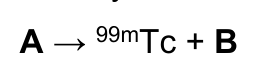
1.1 Identify the mother nuclide (A) of \(\ce{^{99m}Tc}\) and the emitted particle (B).
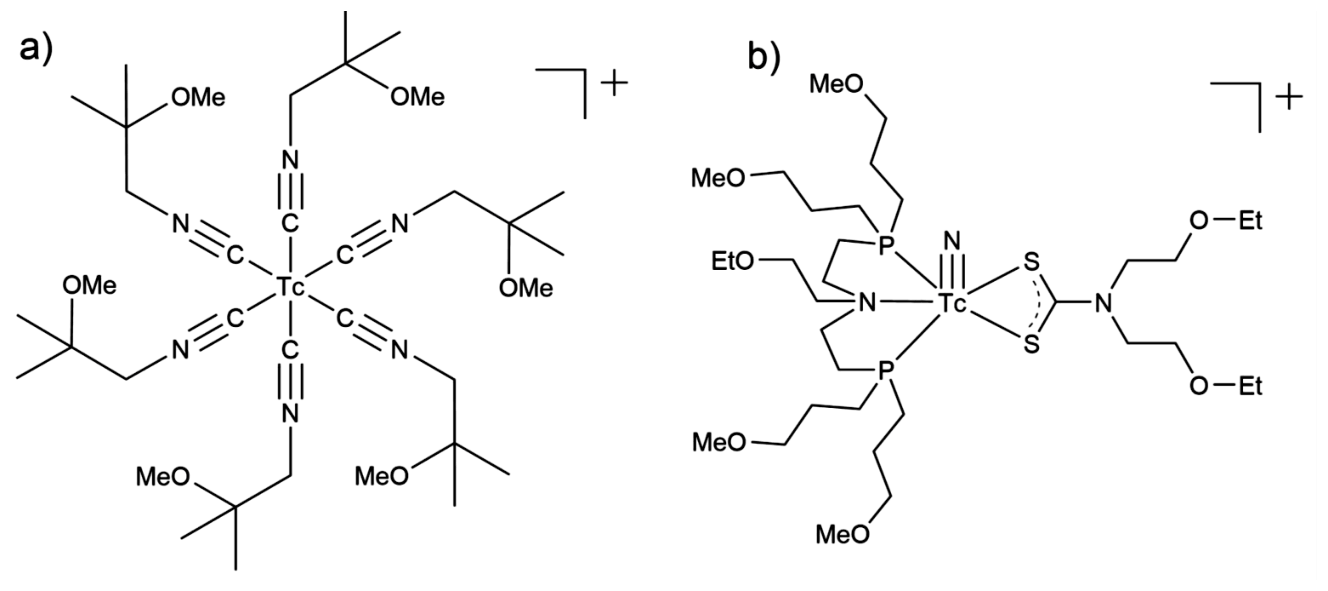
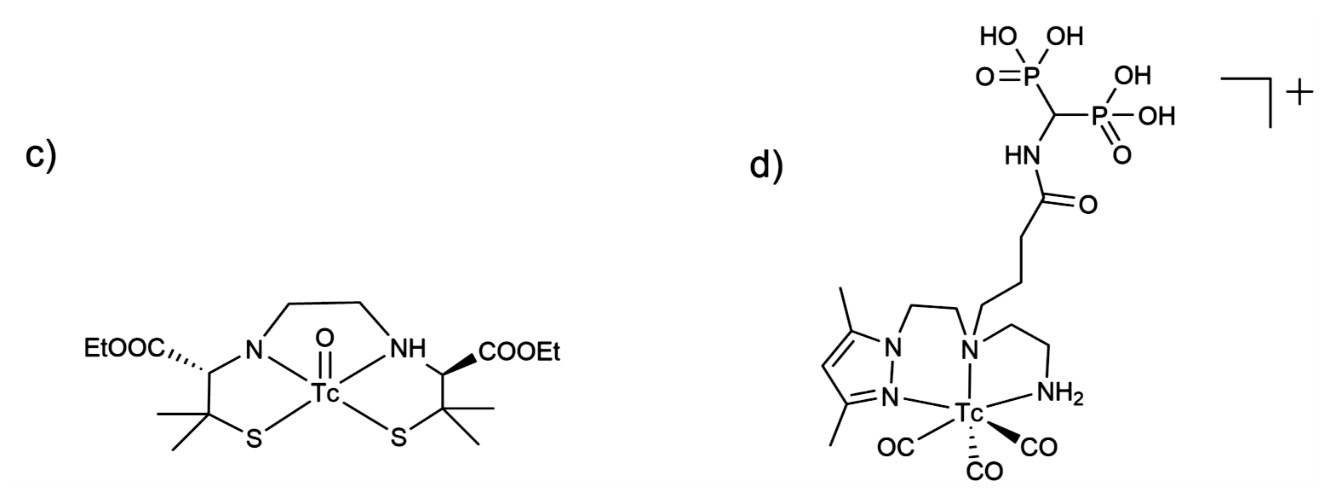
1.2 Provide the oxidation states of the radiometal in the following \(\ce{^{99m}Tc}\)-probes.
The redox potentials of the group seven elements manganese (\(\ce{Mn}\)), technetium (\(\ce{Tc}\)) and rhenium (\(\ce{Re}\)) follow the general trend in the periodic tables (see Figure 2 below).
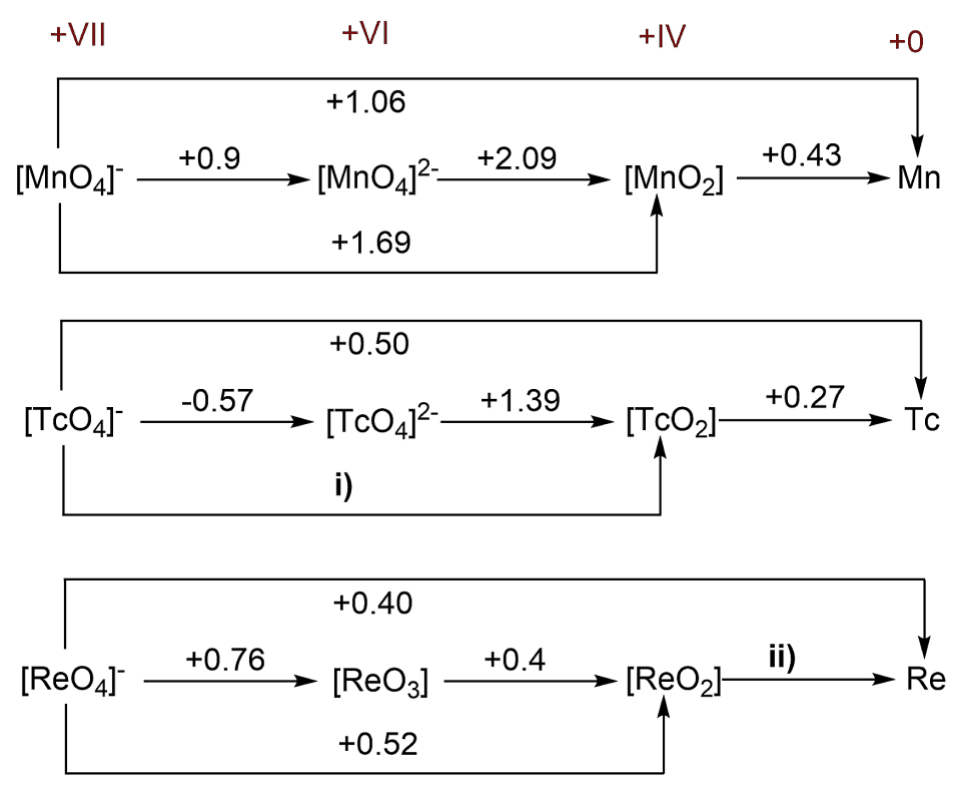
Figure 2
1.3 Calculate the two missing redox potentials i and ii.
1.4 Compare \(\ce{[MnO4]^-}\), \(\ce{[TcO4]^-}\) and \(\ce{[ReO4]^-}\). Chose the strongest oxidizing agent.
1.5 Based on the values indicated by Figure 2 in the question sheet, select if \(\ce{TcO2}\) would disproportionate to \(\ce{Tc}\) and \(\ce{TcO4^2-}\) under acidic conditions.
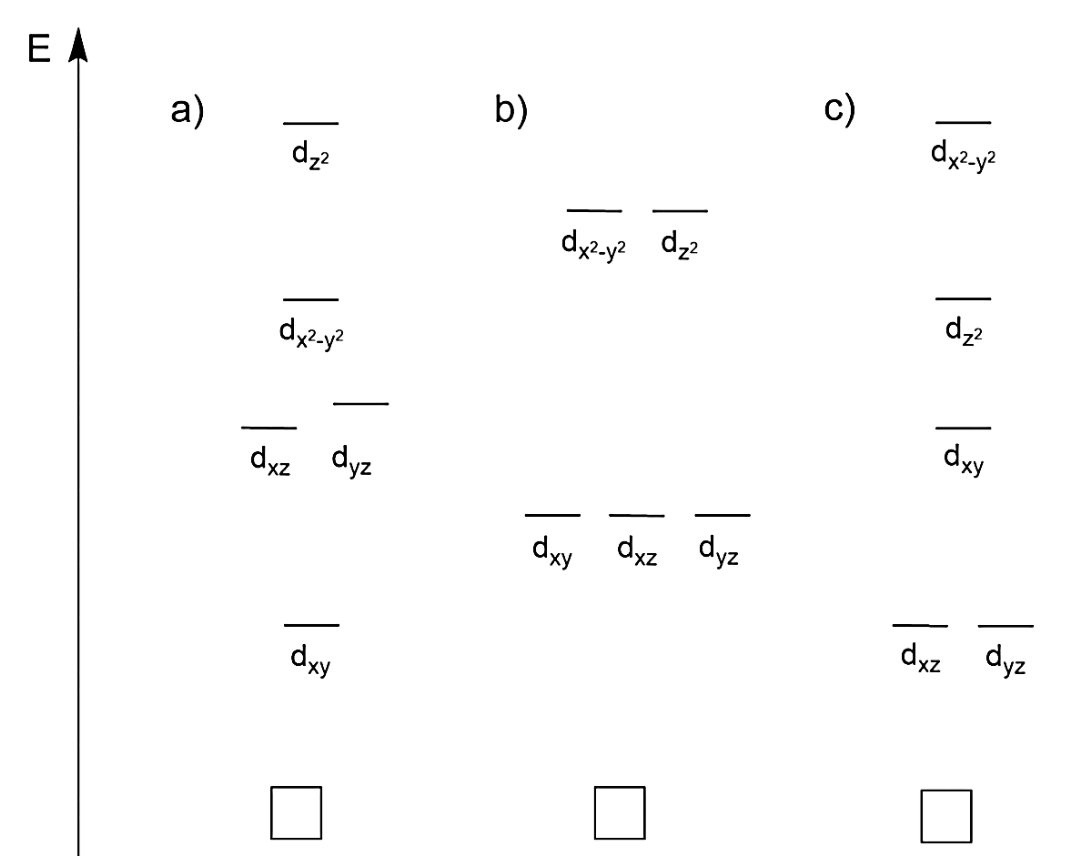
\(\ce{Tc}\) and \(\ce{Re}\) complexes at the oxidation state +V (\(d^2\) systems) which contain a terminal oxo- (\(\ce{O=}\)) or nitrido ligand (\(\ce{N#}\)) are diamagnetic. The scheme below shows three possible molecular orbital energy diagrams.
1.6 Choose which orbital energy diagram explains the observed diamagnetism. Draw the corresponding electron configuration in the correct diagram.
\(\ce{((C4H9)4N)[^{99g}TcO4]}\) is a colorless powder. By the addition of conc. \(\ce{HCl}\) this common starting compound for \(\ce{^{99g}Tc}\) chemistry is converted into the green complex \(\ce{((C4H9)4N)[^{99g}TcOCl4]}\).
1.7 Write down both oxidation and reduction half-reactions using the formulas of ions or neutral molecules, and the complete redox reaction.
All \(\ce{^{99m}Tc}\) radiotracers in clinics are prepared in “one pot” reactions, applying commercialized kits. Typically (\(\ce{^{99m}Tc}\) \(t_{1/2}=6.015\ \mathrm{h}\)), an eluate of a \(\ce{^{99m}Tc}\) generator has an activity of 12.5 GBq (GBq = gigabecquerel = \(10^9\) decays per second).
1.8 Calculate how many moles of \(\ce{^{99m}Tc}\) are present in such samples.
For standard imaging, around 200 MBq \(\ce{^{99m}Tc}\) are administered to the patient.
1.9 Assume that no activity is lost through excretion. Calculate how many hours the patient has to wait until the injected activity decreases to under 1 % of the starting activity.
Bioconjugation of radiometals is a chemical challenge. A recent example is the (3 + 2) cycloaddition of \(\ce{[^{99m}TcO3(tacn)]+}\) (A) (tacn = 1,4,7-triazacyclononane) with alkenes. In this context (3 + 2) refers to the number of atoms involved and not to the numbers of electrons. The following scheme shows an example of this reaction by labeling a protected carbohydrate.
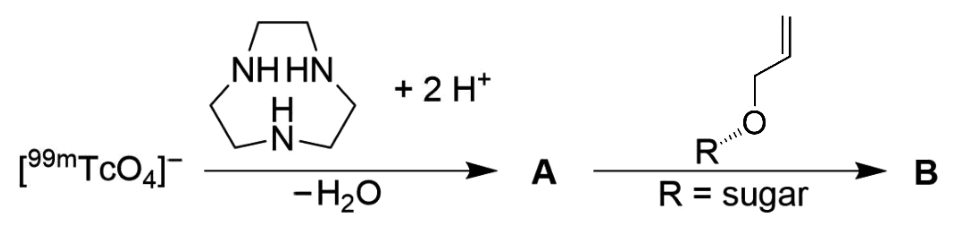
1.10 Draw the structures of compound A and B. Further, state the oxidation state of the technetium in these compounds.
Official English text of the problem.
Answers
-
1.1: A is molybdenum-99, \(\ce{^{99}_{42}Mo}\),
[99Mo]. B is a \(\beta^-\) particle, an electron. -
1.2: a) \(+I\); b) \(+V\); c) \(+V\); d) \(+I\).
-
1.3: i: \(\boxed{+0.74\ \mathrm{V}}\), using the adjacent steps; ii: \(\boxed{+0.31\ \mathrm{V}}\). The technetium diagram contains an inconsistency: the overall \(+0.50\ \mathrm{V}\) arrow and the \(+0.27\ \mathrm{V}\) final step would instead give \(E^\circ_{\mathrm{i}}=+0.81\ \mathrm{V}\).
-
1.4: The permanganate ion, \(\ce{[MnO4]^-}\),
[O-][Mn](=O)(=O)=O, is the strongest oxidizing agent. -
1.5: No, according to the supplied potentials: \(E^\circ_{\mathrm{disproportionation}}=-1.12\ \mathrm{V}\).
-
1.6: Diagram a. Put two opposite-spin electrons, \(\uparrow\downarrow\), in the lowest \(d_{xy}\) orbital; leave the other four orbitals empty.
-
1.7: The balanced half-reactions and overall ionic reaction are: \[ \begin{aligned} &\text{Oxidation:} && \ce{2Cl- -> Cl2 + 2e-}\\ &\text{Reduction:} && \ce{[^{99g}TcO4]^- + 6H+ + 4Cl- + 2e- -> [^{99g}TcOCl4]^- + 3H2O}\\ &\text{Overall:} && \ce{[^{99g}TcO4]^- + 6H+ + 6Cl- -> [^{99g}TcOCl4]^- + Cl2 + 3H2O}. \end{aligned} \]
-
1.8: \(\boxed{n=6.48\times10^{-10}\ \mathrm{mol}=0.648\ \mathrm{nmol}}\).
-
1.9: \(\boxed{t>39.9628\ \mathrm{h}}\); approximately 40.0 hours.
-
1.10:
A: fac-Trioxo(1,4,7-triazacyclononane)technetium(VII) cation, \(\ce{[^{99m}TcO3(tacn)]+}\); Tc \(=+VII\).
SMILES:O=[99Tc+]12(=O)(=O)<-[NH]3CC[NH]->1CC[NH]->2CC3
B: Oxo(tacn)[3-(R-oxy)propane-1,2-diolato]technetium(V) cation; Tc \(=+V\). It contains a five-membered Tc–O–C–C–O ring.
SMILES: O=[99Tc+]123(<-[NH]4CC[NH]->1CC[NH]->2CC4)OCC(CO[*])O3
Here [*] represents the protected sugar residue \(\mathrm{R}\); the newly formed carbon stereocenter is unspecified.
Solution
SMILES below use -> and <- for dative bonds and [*] for an unspecified organic substituent. A metal’s formal charge in SMILES is not necessarily its oxidation state. SMILES can encode mass number 99 but cannot distinguish the metastable and ground nuclear states; those are specified in the text. Formula-unit representations of solid oxides and metals do not describe their crystal lattices.
Common species used in the equations are water, O; hydrogen ion, [H+]; chloride ion, [Cl-]; chlorine, ClCl; and hydrogen chloride, Cl. Electrons and antineutrinos have no molecular SMILES.
1.1 — Mother nuclide and emitted particle
In \(\beta^-\) decay, a neutron becomes a proton. The mass number remains unchanged, while the atomic number increases by one.
Technetium has atomic number 43, so the parent must have atomic number 42 and mass number 99: molybdenum-99, [99Mo].
The full nuclear equation, including the electron antineutrino omitted from the question’s abbreviated scheme, is
\[ \ce{^{99}_{42}Mo -> ^{99m}_{43}Tc + ^{0}_{-1}e} +\bar{\nu}_e. \]
Thus B is the emitted electron, or \(\beta^-\) particle. The daughter is technetium-99m, whose isotope SMILES is [99Tc], with its metastable state specified separately.
1.2 — Oxidation states of the four probes
Let the technetium oxidation state be \(x\). The metal oxidation state plus the formal ligand charges must equal the complex charge.
| Probe | Ligand-charge accounting | Result |
|---|---|---|
| a | All six isocyanide ligands are neutral: \(x+6(0)=+1\). | \(\boxed{x=+I}\) |
| b | Nitrido contributes \(-3\), dithiocarbamato contributes \(-1\), and the aminobisphosphine ligand is neutral: \(x-3-1=+1\). | \(\boxed{x=+V}\) |
| c | Oxo contributes \(-2\), the two thiolates contribute \(-2\) together, and the deprotonated nitrogen contributes \(-1\). The complex is neutral: \(x-2-2-1=0\). | \(\boxed{x=+V}\) |
| d | The three carbonyl ligands and the nitrogen-donor ligand are neutral. The phosphonic acid groups are drawn protonated: \(x=+1\). | \(\boxed{x=+I}\) |
The ligand types used in this accounting have the following SMILES representations:
| Ligand or fragment | SMILES | Charge |
|---|---|---|
| Isocyanide | [*][N+]#[C-] |
\(0\) |
| Nitrido, represented by nitride | [N-3] |
\(-3\) |
| Dithiocarbamate | [*]N([*])C(=S)[S-] |
\(-1\) |
| Oxo, represented by oxide | [O-2] |
\(-2\) |
| Thiolate | [*][S-] |
\(-1\) |
| Amido, a deprotonated secondary amine | [*][N-][*] |
\(-1\) |
| Carbon monoxide | [C-]#[O+] |
\(0\) |
In c, the left nitrogen has no hydrogen and is the amido donor. The right nitrogen is explicitly drawn as \(\ce{NH}\), so it is a neutral amine donor.
1.3 — Missing redox potentials
Reduction potentials cannot be added directly. Instead, use the additivity of Gibbs energies:
\[ \Delta G^\circ=-nFE^\circ. \]
Consequently, combining two consecutive reductions gives
\[ E^\circ_{\mathrm{overall}} =\frac{n_1E^\circ_1+n_2E^\circ_2}{n_1+n_2}. \]
The species involved are:
| Species and name | SMILES |
|---|---|
| \(\ce{[TcO4]^-}\), pertechnetate(VII) | [O-][Tc](=O)(=O)=O |
| \(\ce{[TcO4]^2-}\), tetraoxotechnetate(VI) | [O-][Tc](=O)(=O)[O-] |
| \(\ce{TcO2}\), technetium(IV) oxide | O=[Tc]=O |
| \(\ce{Tc}\), technetium metal | [Tc] |
| \(\ce{[ReO4]^-}\), perrhenate(VII) | [O-][Re](=O)(=O)=O |
| \(\ce{ReO2}\), rhenium(IV) oxide | O=[Re]=O |
| \(\ce{Re}\), rhenium metal | [Re] |
For i, the adjacent technetium reductions are \(+VII\rightarrow+VI\), involving one electron, and \(+VI\rightarrow+IV\), involving two electrons:
\[ E^\circ_{\mathrm{i}} =\frac{1(-0.57)+2(1.39)}{3} =\frac{2.21}{3} =0.7367\ \mathrm{V}. \]
Therefore,
\[ \boxed{E^\circ_{\mathrm{i}}=+0.74\ \mathrm{V}}. \]
For ii, the overall rhenium reduction \(+VII\rightarrow0\) involves seven electrons. Its \(+VII\rightarrow+IV\) segment involves three electrons, leaving four for \(+IV\rightarrow0\):
\[ 7(0.40)=3(0.52)+4E^\circ_{\mathrm{ii}}. \]
Hence,
\[ E^\circ_{\mathrm{ii}} =\frac{7(0.40)-3(0.52)}{4} =\boxed{+0.31\ \mathrm{V}}. \]
1.4 — Strongest oxidizing agent
An oxidizing agent accepts electrons. For comparable reductions, a more positive reduction potential indicates a stronger oxidizing agent.
For the \(+VII\rightarrow+IV\) reductions, the supplied or calculated potentials are
\[ \begin{aligned} E^\circ_{\mathrm{Mn}}&=+1.69\ \mathrm{V},\\ E^\circ_{\mathrm{Tc}}&\approx+0.74\ \mathrm{V},\\ E^\circ_{\mathrm{Re}}&=+0.52\ \mathrm{V}. \end{aligned} \]
Thus the strongest oxidizing agent is the permanganate ion:
\[ \boxed{\ce{[MnO4]^-}}. \]
1.5 — Disproportionation of technetium(IV) oxide
The reduction half-reaction is
\[ \ce{TcO2 + 4H+ + 4e- -> Tc + 2H2O}, \qquad E^\circ_{\mathrm{red}}=+0.27\ \mathrm{V}. \]
The oxidation half-reaction is the reverse of the supplied \(+VI\rightarrow+IV\) reduction:
\[ \ce{TcO2 + 2H2O -> TcO4^2- + 4H+ + 2e-}, \qquad E^\circ_{\mathrm{ox}}=-1.39\ \mathrm{V}. \]
Multiplying the oxidation half-reaction by two and adding gives
\[ \boxed{\ce{3TcO2 + 2H2O -> Tc + 2TcO4^2- + 4H+}}. \]
Its cell potential is
\[ E^\circ_{\mathrm{cell}} =0.27-1.39 =\boxed{-1.12\ \mathrm{V}}. \]
Since four electrons are transferred,
\[ \Delta G^\circ=-4FE^\circ_{\mathrm{cell}}>0. \]
Therefore, the proposed disproportionation is thermodynamically unfavorable under the conditions represented by the supplied potentials. Acidic conditions also oppose a reaction that produces hydrogen ions.
1.6 — Orbital diagram and diamagnetism
A \(d^2\) complex is diamagnetic only if its two electrons are paired.
In diagram a, \(d_{xy}\) is an isolated lowest-energy orbital. If its separation from the next orbitals exceeds the pairing energy, both electrons occupy it:
\[ \boxed{ (d_{xy})^2(d_{xz})^0(d_{yz})^0 (d_{x^2-y^2})^0(d_{z^2})^0 }. \]
To complete the drawing, select a, put \(\uparrow\downarrow\) on the lowest \(d_{xy}\) line, and leave every other line empty. The total spin is \(S=0\).
A terminal oxo or nitrido ligand along the \(z\)-axis strongly destabilizes orbitals involved in metal–ligand \(\sigma\) and \(\pi\) interactions, while \(d_{xy}\) can remain comparatively low.
In diagrams b and c, the lowest level contains degenerate orbitals. Hund’s rule would place the two electrons in separate orbitals with parallel spins, giving paramagnetism.
1.7 — Conversion of pertechnetate to the oxochlorido complex
The relevant anions are:
- Pertechnetate(VII), \(\ce{[^{99g}TcO4]^-}\):
[O-][99Tc](=O)(=O)=O. - Tetrachloridooxotechnetate(V), \(\ce{[^{99g}TcOCl4]^-}\):
O=[99Tc-](Cl)(Cl)(Cl)Cl.
Their oxidation states follow from
\[ x-4(2)=-1 \quad\Rightarrow\quad x=+VII \]
and
\[ x-2-4=-1 \quad\Rightarrow\quad x=+V. \]
Technetium therefore gains two electrons. Chloride supplies those electrons by oxidation to chlorine.
The oxidation half-reaction is
\[ \boxed{\ce{2Cl- -> Cl2 + 2e-}}. \]
For the reduction, three oxygen atoms are removed as water, requiring six hydrogen ions; four chlorides become ligands:
\[ \boxed{ \ce{[^{99g}TcO4]^- + 6H+ + 4Cl- + 2e- -> [^{99g}TcOCl4]^- + 3H2O} }. \]
Adding and cancelling electrons gives
\[ \boxed{ \ce{[^{99g}TcO4]^- + 6H+ + 6Cl- -> [^{99g}TcOCl4]^- + Cl2 + 3H2O} }. \]
The tetrabutylammonium ion, CCCC[N+](CCCC)(CCCC)CCCC, is a spectator. Including it gives the complete salt equation:
\[ \boxed{ \ce{[(C4H9)4N][^{99g}TcO4] + 6HCl -> [(C4H9)4N][^{99g}TcOCl4] + Cl2 + 3H2O} }. \]
The corresponding salt SMILES are:
- Tetrabutylammonium pertechnetate:
CCCC[N+](CCCC)(CCCC)CCCC.[O-][99Tc](=O)(=O)=O - Tetrabutylammonium tetrachloridooxotechnetate(V):
CCCC[N+](CCCC)(CCCC)CCCC.O=[99Tc-](Cl)(Cl)(Cl)Cl
1.8 — Amount of technetium-99m
Activity and the number of radioactive nuclei are related by
\[ A=\lambda N, \qquad \lambda=\frac{\ln 2}{t_{1/2}}. \]
Convert the half-life to seconds:
\[ t_{1/2} =6.015\times3600 =21654\ \mathrm{s}. \]
Thus
\[ \lambda =\frac{\ln2}{21654\ \mathrm{s}} =3.2010\times10^{-5}\ \mathrm{s^{-1}}. \]
For an activity of \(12.5\times10^9\ \mathrm{s^{-1}}\),
\[ N =\frac{12.5\times10^9}{3.2010\times10^{-5}} =3.9050\times10^{14}\ \text{nuclei}. \]
Using \(N_{\mathrm A}=6.02214076\times10^{23}\ \mathrm{mol^{-1}}\),
\[ n=\frac{N}{N_{\mathrm A}} =\frac{3.9050\times10^{14}} {6.02214076\times10^{23}} =6.4844\times10^{-10}\ \mathrm{mol}. \]
To three significant figures,
\[ \boxed{n=6.48\times10^{-10}\ \mathrm{mol}=0.648\ \mathrm{nmol}}. \]
1.9 — Time to fall below 1%
Radioactive decay gives
\[ \frac{A(t)}{A_0} =e^{-\lambda t} =2^{-t/t_{1/2}}. \]
The required condition is
\[ 2^{-t/t_{1/2}}<0.01. \]
Therefore,
\[ t> t_{1/2}\frac{\ln100}{\ln2} =(6.015\ \mathrm{h})(6.643856) =39.9628\ \mathrm{h}. \]
Hence the patient must wait approximately
\[ \boxed{40.0\ \mathrm{h}}. \]
At \(39.9628\ \mathrm{h}\), the activity reaches 1%; a slightly longer time is required to be strictly below it. For the stated initial activity, the target is below \(2.00\ \mathrm{MBq}\).
1.10 — Structures and oxidation states of A and B
The neutral ligand 1,4,7-triazacyclononane, tacn, has SMILES N1CCNCCNCC1. It coordinates through its three nitrogen atoms.
The alkene is an allyl ether of the protected carbohydrate, \(\ce{CH2=CH-CH2-O-R}\), with generic SMILES C=CCO[*].
Compound A
Its formation is
\[ \ce{[^{99m}TcO4]^- + tacn + 2H+ -> [^{99m}TcO3(tacn)]+ + H2O}. \]
Draw a technetium center with three terminal \(\ce{Tc=O}\) groups and three coordinate bonds to the nitrogen atoms of one tacn ligand. The geometry is approximately octahedral: tacn occupies one triangular face, and the three oxo ligands occupy the opposite face.
This is fac-trioxo(tacn)technetium(VII) cation:
O=[99Tc+]12(=O)(=O)<-[NH]3CC[NH]->1CC[NH]->2CC3
Since tacn is neutral and each oxo ligand contributes \(-2\),
\[ x+3(-2)=+1 \quad\Rightarrow\quad \boxed{x=+VII}. \]
Compound B
Two oxo ligands of A react with the two alkene carbons. The three-atom unit is O–Tc–O; the two-atom unit is the alkene’s C–C pair.
The product contains a five-membered ring with the sequence
\[ \ce{Tc-O-CH2-CH(CH2OR)-O}, \]
where the final oxygen bonds back to the same technetium atom. Thus:
- The alkene’s C=C bond becomes a C–C single bond.
- Each alkene carbon forms a new C–O bond.
- Two terminal oxo groups become a chelating diolato ligand.
- The third terminal oxo group and all three tacn donor bonds remain.
The overall cycloaddition is
\[ \ce{[^{99m}TcO3(tacn)]+ + CH2=CH-CH2-O-R -> [^{99m}TcO(tacn)(OCH2CH(CH2OR)O)]+}. \]
The product is oxo(tacn)[3-(R-oxy)propane-1,2-diolato]technetium(V) cation:
O=[99Tc+]123(<-[NH]4CC[NH]->1CC[NH]->2CC4)OCC(CO[*])O3
Draw tacn facially coordinated, with the remaining three coordination positions occupied by the terminal oxo ligand and the two oxygen donors of the diolato chelate.
The remaining oxo ligand has charge \(-2\), and the diolato ligand has charge \(-2\):
\[ x-2-2=+1 \quad\Rightarrow\quad \boxed{x=+V}. \]
Thus technetium is reduced from \(+VII\) to \(+V\), while the alkene undergoes oxidative addition of the two oxygen atoms.
The cycloaddition gives syn attachment of the two oxygens to the alkene. Only the substituted alkene carbon becomes a new carbon stereocenter. The scheme does not specify which absolute configuration is obtained, so that center is intentionally left unassigned in the SMILES.
The solution was checked against the official solution. Where this solution differs from the official solution, the official solution contains an error or a misprint.
IChO 2023 · Theorieaufgabe 1
Molekulare Bildgebung
Die molekulare Bildgebung ist ein leistungsfähiges Werkzeug der medizinischen Diagnostik. Das Kernisomer \(\ce{^{99m}Tc}\) (m = metastabil) des Isotops \(\ce{^{99g}Tc}\) (g = Grundzustand) besitzt hervorragende Strahlungseigenschaften (\(\gamma\)-Strahler, \(t_{1/2}=6.015\ \mathrm{h}\)) für die nuklearmedizinische Bildgebung. \(\ce{^{99m}Tc}\) wird durch \(\beta^-\)-Zerfall eines Mutternuklids in einem sogenannten Technetiumgenerator als \(\ce{^{99m}Tc}\)-Pertechnetat \(\ce{[^{99m}TcO4]^-}\) gewonnen.
1.1 Bestimmen Sie das Mutternuklid (A) von \(\ce{^{99m}Tc}\) und das emittierte Teilchen (B).
1.2 Geben Sie die Oxidationsstufen des Radiometalls in den folgenden \(\ce{^{99m}Tc}\)-Sonden an.
Die Redoxpotentiale der Elemente der siebten Gruppe Mangan (\(\ce{Mn}\)), Technetium (\(\ce{Tc}\)) und Rhenium (\(\ce{Re}\)) folgen dem allgemeinen Trend im Periodensystem (siehe Abbildung 2 unten).
Abbildung 2
1.3 Berechnen Sie die beiden fehlenden Redoxpotentiale i und ii.
1.4 Vergleichen Sie \(\ce{[MnO4]^-}\), \(\ce{[TcO4]^-}\) und \(\ce{[ReO4]^-}\). Wählen Sie das stärkste Oxidationsmittel aus.
1.5 Entscheiden Sie anhand der in Abbildung 2 auf dem Aufgabenblatt angegebenen Werte, ob \(\ce{TcO2}\) unter sauren Bedingungen zu \(\ce{Tc}\) und \(\ce{TcO4^2-}\) disproportionieren würde.
\(\ce{Tc}\)- und \(\ce{Re}\)-Komplexe in der Oxidationsstufe +V (\(d^2\)-Systeme), die einen terminalen Oxo- (\(\ce{O=}\)) oder Nitridoliganden (\(\ce{N#}\)) enthalten, sind diamagnetisch. Das folgende Schema zeigt drei mögliche Molekülorbital-Energiediagramme.
1.6 Wählen Sie das Orbitalenergiediagramm aus, das den beobachteten Diamagnetismus erklärt. Zeichnen Sie die entsprechende Elektronenkonfiguration in das richtige Diagramm ein.
\(\ce{((C4H9)4N)[^{99g}TcO4]}\) ist ein farbloses Pulver. Durch Zugabe von konz. \(\ce{HCl}\) wird diese gebräuchliche Ausgangsverbindung der \(\ce{^{99g}Tc}\)-Chemie in den grünen Komplex \(\ce{((C4H9)4N)[^{99g}TcOCl4]}\) umgewandelt.
1.7 Schreiben Sie sowohl die Oxidations- als auch die Reduktionshalbreaktion unter Verwendung der Formeln von Ionen oder neutralen Molekülen sowie die vollständige Redoxreaktion auf.
Alle klinisch eingesetzten \(\ce{^{99m}Tc}\)-Radiotracer werden in „Eintopfreaktionen“ unter Verwendung kommerziell erhältlicher Kits hergestellt. Typischerweise hat ein Eluat eines \(\ce{^{99m}Tc}\)-Generators (\(\ce{^{99m}Tc}\) \(t_{1/2}=6.015\ \mathrm{h}\)) eine Aktivität von 12.5 GBq (GBq = Gigabecquerel = \(10^9\) Zerfälle pro Sekunde).
1.8 Berechnen Sie, wie viele Mol \(\ce{^{99m}Tc}\) in solchen Proben enthalten sind.
Für eine Standard-Bildgebung werden dem Patienten etwa 200 MBq \(\ce{^{99m}Tc}\) verabreicht.
1.9 Nehmen Sie an, dass keine Aktivität durch Ausscheidung verloren geht. Berechnen Sie, wie viele Stunden der Patient warten muss, bis die injizierte Aktivität auf unter 1 % der Anfangsaktivität abnimmt.
Die Biokonjugation von Radiometallen ist eine chemische Herausforderung. Ein aktuelles Beispiel ist die (3 + 2)-Cycloaddition von \(\ce{[^{99m}TcO3(tacn)]+}\) (A) (tacn = 1,4,7-Triazacyclononan) mit Alkenen. In diesem Zusammenhang bezieht sich (3 + 2) auf die Anzahl der beteiligten Atome und nicht auf die Anzahl der Elektronen. Das folgende Schema zeigt ein Beispiel dieser Reaktion bei der Markierung eines geschützten Kohlenhydrats.
1.10 Zeichnen Sie die Strukturen der Verbindungen A und B. Geben Sie außerdem die Oxidationsstufe des Technetiums in diesen Verbindungen an.
Aufgabentext aus dem offiziellen englischen Text übersetzt.
Antworten
-
1.1: A ist Molybdän-99, \(\ce{^{99}_{42}Mo}\),
[99Mo]. B ist ein \(\beta^-\)-Teilchen, ein Elektron. -
1.2: a) \(+I\); b) \(+V\); c) \(+V\); d) \(+I\).
-
1.3: i: \(\boxed{+0.74\ \mathrm{V}}\), unter Verwendung der benachbarten Schritte; ii: \(\boxed{+0.31\ \mathrm{V}}\). Das Technetiumdiagramm enthält eine Unstimmigkeit: Der Gesamtpfeil mit \(+0.50\ \mathrm{V}\) und der letzte Schritt mit \(+0.27\ \mathrm{V}\) würden stattdessen \(E^\circ_{\mathrm{i}}=+0.81\ \mathrm{V}\) ergeben.
-
1.4: Das Permanganat-Ion, \(\ce{[MnO4]^-}\),
[O-][Mn](=O)(=O)=O, ist das stärkste Oxidationsmittel. -
1.5: Nein, gemäß den angegebenen Potentialen: \(E^\circ_{\mathrm{disproportionation}}=-1.12\ \mathrm{V}\).
-
1.6: Diagramm a. Tragen Sie zwei Elektronen mit entgegengesetztem Spin, \(\uparrow\downarrow\), in das niedrigste \(d_{xy}\)-Orbital ein; lassen Sie die anderen vier Orbitale leer.
-
1.7: Die ausgeglichenen Halbreaktionen und die ionische Gesamtreaktion lauten: \[ \begin{aligned} &\text{Oxidation:} && \ce{2Cl- -> Cl2 + 2e-}\\ &\text{Reduktion:} && \ce{[^{99g}TcO4]^- + 6H+ + 4Cl- + 2e- -> [^{99g}TcOCl4]^- + 3H2O}\\ &\text{Gesamt:} && \ce{[^{99g}TcO4]^- + 6H+ + 6Cl- -> [^{99g}TcOCl4]^- + Cl2 + 3H2O}. \end{aligned} \]
-
1.8: \(\boxed{n=6.48\times10^{-10}\ \mathrm{mol}=0.648\ \mathrm{nmol}}\).
-
1.9: \(\boxed{t>39.9628\ \mathrm{h}}\); ungefähr 40.0 Stunden.
-
1.10:
A: fac-Trioxo(1,4,7-triazacyclononan)technetium(VII)-Kation, \(\ce{[^{99m}TcO3(tacn)]+}\); Tc \(=+VII\).
SMILES:O=[99Tc+]12(=O)(=O)<-[NH]3CC[NH]->1CC[NH]->2CC3
B: Oxo(tacn)[3-(R-oxy)propan-1,2-diolato]technetium(V)-Kation; Tc \(=+V\). Es enthält einen fünfgliedrigen Tc–O–C–C–O-Ring.
SMILES: O=[99Tc+]123(<-[NH]4CC[NH]->1CC[NH]->2CC4)OCC(CO[*])O3
Hier steht [*] für den geschützten Zuckerrest \(\mathrm{R}\); das neu gebildete Kohlenstoff-Stereozentrum ist nicht spezifiziert.
Lösung
In den folgenden SMILES stehen -> und <- für koordinative Bindungen und [*] für einen nicht näher spezifizierten organischen Substituenten. Die Formalladung eines Metalls in SMILES ist nicht notwendigerweise seine Oxidationsstufe. SMILES können die Massenzahl 99 codieren, aber nicht zwischen dem metastabilen Kernzustand und dem Kerngrundzustand unterscheiden; diese werden im Text angegeben. Darstellungen von Formeleinheiten fester Oxide und Metalle beschreiben nicht deren Kristallgitter.
Häufig in den Gleichungen verwendete Spezies sind Wasser, O; das Wasserstoff-Ion, [H+]; das Chlorid-Ion, [Cl-]; Chlor, ClCl; und Chlorwasserstoff, Cl. Für Elektronen und Antineutrinos gibt es keine molekularen SMILES.
1.1 — Mutternuklid und emittiertes Teilchen
Beim \(\beta^-\)-Zerfall wird ein Neutron in ein Proton umgewandelt. Die Massenzahl bleibt unverändert, während die Ordnungszahl um eins zunimmt.
Technetium hat die Ordnungszahl 43, daher muss das Mutternuklid die Ordnungszahl 42 und die Massenzahl 99 besitzen: Molybdän-99, [99Mo].
Die vollständige Kerngleichung einschließlich des im verkürzten Schema der Aufgabe weggelassenen Elektron-Antineutrinos lautet
\[ \ce{^{99}_{42}Mo -> ^{99m}_{43}Tc + ^{0}_{-1}e} +\bar{\nu}_e. \]
Somit ist B das emittierte Elektron, also das \(\beta^-\)-Teilchen. Das Tochternuklid ist Technetium-99m, dessen Isotopen-SMILES [99Tc] lautet, wobei sein metastabiler Zustand gesondert angegeben wird.
1.2 — Oxidationsstufen der vier Sonden
Die Oxidationsstufe des Technetiums sei \(x\). Die Summe aus der Oxidationsstufe des Metalls und den formalen Ligandenladungen muss der Komplexladung entsprechen.
| Sonde | Bilanz der Ligandenladungen | Ergebnis |
|---|---|---|
| a | Alle sechs Isocyanidliganden sind neutral: \(x+6(0)=+1\). | \(\boxed{x=+I}\) |
| b | Nitrido trägt \(-3\) bei, Dithiocarbamato trägt \(-1\) bei, und der Aminobisphosphinligand ist neutral: \(x-3-1=+1\). | \(\boxed{x=+V}\) |
| c | Oxo trägt \(-2\) bei, die beiden Thiolate tragen zusammen \(-2\) bei, und der deprotonierte Stickstoff trägt \(-1\) bei. Der Komplex ist neutral: \(x-2-2-1=0\). | \(\boxed{x=+V}\) |
| d | Die drei Carbonylliganden und der Stickstoffdonorligand sind neutral. Die Phosphonsäuregruppen sind protoniert gezeichnet: \(x=+1\). | \(\boxed{x=+I}\) |
Die in dieser Bilanz verwendeten Ligandentypen haben die folgenden SMILES-Darstellungen:
| Ligand oder Fragment | SMILES | Ladung |
|---|---|---|
| Isocyanid | [*][N+]#[C-] |
\(0\) |
| Nitrido, dargestellt durch Nitrid | [N-3] |
\(-3\) |
| Dithiocarbamat | [*]N([*])C(=S)[S-] |
\(-1\) |
| Oxo, dargestellt durch Oxid | [O-2] |
\(-2\) |
| Thiolat | [*][S-] |
\(-1\) |
| Amido, ein deprotoniertes sekundäres Amin | [*][N-][*] |
\(-1\) |
| Kohlenstoffmonoxid | [C-]#[O+] |
\(0\) |
In c trägt der linke Stickstoff keinen Wasserstoff und ist der Amido-Donor. Der rechte Stickstoff ist ausdrücklich als \(\ce{NH}\) gezeichnet und somit ein neutraler Amin-Donor.
1.3 — Fehlende Redoxpotentiale
Reduktionspotentiale können nicht direkt addiert werden. Stattdessen nutzt man die Additivität der Gibbs-Energien:
\[ \Delta G^\circ=-nFE^\circ. \]
Dementsprechend ergibt die Kombination zweier aufeinanderfolgender Reduktionen
\[ E^\circ_{\mathrm{overall}} =\frac{n_1E^\circ_1+n_2E^\circ_2}{n_1+n_2}. \]
Die beteiligten Spezies sind:
| Spezies und Name | SMILES |
|---|---|
| \(\ce{[TcO4]^-}\), Pertechnetat(VII) | [O-][Tc](=O)(=O)=O |
| \(\ce{[TcO4]^2-}\), Tetraoxotechnetat(VI) | [O-][Tc](=O)(=O)[O-] |
| \(\ce{TcO2}\), Technetium(IV)-oxid | O=[Tc]=O |
| \(\ce{Tc}\), metallisches Technetium | [Tc] |
| \(\ce{[ReO4]^-}\), Perrhenat(VII) | [O-][Re](=O)(=O)=O |
| \(\ce{ReO2}\), Rhenium(IV)-oxid | O=[Re]=O |
| \(\ce{Re}\), metallisches Rhenium | [Re] |
Für i sind die benachbarten Technetiumreduktionen \(+VII\rightarrow+VI\), an der ein Elektron beteiligt ist, und \(+VI\rightarrow+IV\), an der zwei Elektronen beteiligt sind:
\[ E^\circ_{\mathrm{i}} =\frac{1(-0.57)+2(1.39)}{3} =\frac{2.21}{3} =0.7367\ \mathrm{V}. \]
Daher gilt
\[ \boxed{E^\circ_{\mathrm{i}}=+0.74\ \mathrm{V}}. \]
Für ii sind an der Gesamtreduktion des Rheniums \(+VII\rightarrow0\) sieben Elektronen beteiligt. Der Teilschritt \(+VII\rightarrow+IV\) umfasst drei Elektronen, sodass vier für \(+IV\rightarrow0\) verbleiben:
\[ 7(0.40)=3(0.52)+4E^\circ_{\mathrm{ii}}. \]
Somit gilt
\[ E^\circ_{\mathrm{ii}} =\frac{7(0.40)-3(0.52)}{4} =\boxed{+0.31\ \mathrm{V}}. \]
1.4 — Stärkstes Oxidationsmittel
Ein Oxidationsmittel nimmt Elektronen auf. Bei vergleichbaren Reduktionen weist ein positiveres Reduktionspotential auf ein stärkeres Oxidationsmittel hin.
Für die Reduktionen \(+VII\rightarrow+IV\) sind die angegebenen oder berechneten Potentiale
\[ \begin{aligned} E^\circ_{\mathrm{Mn}}&=+1.69\ \mathrm{V},\\ E^\circ_{\mathrm{Tc}}&\approx+0.74\ \mathrm{V},\\ E^\circ_{\mathrm{Re}}&=+0.52\ \mathrm{V}. \end{aligned} \]
Das stärkste Oxidationsmittel ist somit das Permanganat-Ion:
\[ \boxed{\ce{[MnO4]^-}}. \]
1.5 — Disproportionierung von Technetium(IV)-oxid
Die Reduktionshalbreaktion lautet
\[ \ce{TcO2 + 4H+ + 4e- -> Tc + 2H2O}, \qquad E^\circ_{\mathrm{red}}=+0.27\ \mathrm{V}. \]
Die Oxidationshalbreaktion ist die Umkehrung der angegebenen Reduktion \(+VI\rightarrow+IV\):
\[ \ce{TcO2 + 2H2O -> TcO4^2- + 4H+ + 2e-}, \qquad E^\circ_{\mathrm{ox}}=-1.39\ \mathrm{V}. \]
Multipliziert man die Oxidationshalbreaktion mit zwei und addiert die beiden Halbreaktionen, erhält man
\[ \boxed{\ce{3TcO2 + 2H2O -> Tc + 2TcO4^2- + 4H+}}. \]
Das zugehörige Zellpotential beträgt
\[ E^\circ_{\mathrm{cell}} =0.27-1.39 =\boxed{-1.12\ \mathrm{V}}. \]
Da vier Elektronen übertragen werden, gilt
\[ \Delta G^\circ=-4FE^\circ_{\mathrm{cell}}>0. \]
Die vorgeschlagene Disproportionierung ist daher unter den durch die angegebenen Potentiale beschriebenen Bedingungen thermodynamisch ungünstig. Saure Bedingungen wirken außerdem einer Reaktion entgegen, bei der Wasserstoff-Ionen entstehen.
1.6 — Orbitaldiagramm und Diamagnetismus
Ein \(d^2\)-Komplex ist nur dann diamagnetisch, wenn seine beiden Elektronen gepaart sind.
In Diagramm a ist \(d_{xy}\) ein einzelnes energetisch tiefstes Orbital. Wenn sein Abstand zu den nächsthöheren Orbitalen die Paarungsenergie übersteigt, besetzen es beide Elektronen:
\[ \boxed{ (d_{xy})^2(d_{xz})^0(d_{yz})^0 (d_{x^2-y^2})^0(d_{z^2})^0 }. \]
Um die Zeichnung zu vervollständigen, wählen Sie a, tragen Sie \(\uparrow\downarrow\) auf der untersten \(d_{xy}\)-Linie ein und lassen Sie alle anderen Linien leer. Der Gesamtspin ist \(S=0\).
Ein terminaler Oxo- oder Nitridoligand entlang der \(z\)-Achse destabilisiert die Orbitale, die an Metall–Ligand-\(\sigma\)- und -\(\pi\)-Wechselwirkungen beteiligt sind, stark, während \(d_{xy}\) vergleichsweise tief liegen kann.
In den Diagrammen b und c enthält das niedrigste Energieniveau entartete Orbitale. Nach der Hundschen Regel würden die beiden Elektronen getrennte Orbitale mit parallelen Spins besetzen, was zu Paramagnetismus führt.
1.7 — Umwandlung von Pertechnetat in den Oxochloridokomplex
Die relevanten Anionen sind:
- Pertechnetat(VII), \(\ce{[^{99g}TcO4]^-}\):
[O-][99Tc](=O)(=O)=O. - Tetrachloridooxotechnetat(V), \(\ce{[^{99g}TcOCl4]^-}\):
O=[99Tc-](Cl)(Cl)(Cl)Cl.
Ihre Oxidationsstufen ergeben sich aus
\[ x-4(2)=-1 \quad\Rightarrow\quad x=+VII \]
und
\[ x-2-4=-1 \quad\Rightarrow\quad x=+V. \]
Technetium nimmt daher zwei Elektronen auf. Chlorid liefert diese Elektronen durch Oxidation zu Chlor.
Die Oxidationshalbreaktion lautet
\[ \boxed{\ce{2Cl- -> Cl2 + 2e-}}. \]
Bei der Reduktion werden drei Sauerstoffatome als Wasser entfernt, wofür sechs Wasserstoff-Ionen benötigt werden; vier Chlorid-Ionen werden zu Liganden:
\[ \boxed{ \ce{[^{99g}TcO4]^- + 6H+ + 4Cl- + 2e- -> [^{99g}TcOCl4]^- + 3H2O} }. \]
Durch Addition und Kürzen der Elektronen erhält man
\[ \boxed{ \ce{[^{99g}TcO4]^- + 6H+ + 6Cl- -> [^{99g}TcOCl4]^- + Cl2 + 3H2O} }. \]
Das Tetrabutylammonium-Ion, CCCC[N+](CCCC)(CCCC)CCCC, ist ein Zuschauerion. Unter Einbeziehung dieses Ions ergibt sich die vollständige Salzgleichung:
\[ \boxed{ \ce{[(C4H9)4N][^{99g}TcO4] + 6HCl -> [(C4H9)4N][^{99g}TcOCl4] + Cl2 + 3H2O} }. \]
Die entsprechenden SMILES der Salze lauten:
- Tetrabutylammoniumpertechnetat:
CCCC[N+](CCCC)(CCCC)CCCC.[O-][99Tc](=O)(=O)=O - Tetrabutylammoniumtetrachloridooxotechnetat(V):
CCCC[N+](CCCC)(CCCC)CCCC.O=[99Tc-](Cl)(Cl)(Cl)Cl
1.8 — Stoffmenge an Technetium-99m
Die Aktivität und die Anzahl radioaktiver Kerne hängen folgendermaßen zusammen:
\[ A=\lambda N, \qquad \lambda=\frac{\ln 2}{t_{1/2}}. \]
Umrechnung der Halbwertszeit in Sekunden:
\[ t_{1/2} =6.015\times3600 =21654\ \mathrm{s}. \]
Somit gilt
\[ \lambda =\frac{\ln2}{21654\ \mathrm{s}} =3.2010\times10^{-5}\ \mathrm{s^{-1}}. \]
Für eine Aktivität von \(12.5\times10^9\ \mathrm{s^{-1}}\) gilt
\[ N =\frac{12.5\times10^9}{3.2010\times10^{-5}} =3.9050\times10^{14}\ \text{Kerne}. \]
Mit \(N_{\mathrm A}=6.02214076\times10^{23}\ \mathrm{mol^{-1}}\) erhält man
\[ n=\frac{N}{N_{\mathrm A}} =\frac{3.9050\times10^{14}} {6.02214076\times10^{23}} =6.4844\times10^{-10}\ \mathrm{mol}. \]
Auf drei signifikante Stellen gerundet:
\[ \boxed{n=6.48\times10^{-10}\ \mathrm{mol}=0.648\ \mathrm{nmol}}. \]
1.9 — Zeit bis zum Unterschreiten von 1 %
Für den radioaktiven Zerfall gilt
\[ \frac{A(t)}{A_0} =e^{-\lambda t} =2^{-t/t_{1/2}}. \]
Die geforderte Bedingung lautet
\[ 2^{-t/t_{1/2}}<0.01. \]
Daher gilt
\[ t> t_{1/2}\frac{\ln100}{\ln2} =(6.015\ \mathrm{h})(6.643856) =39.9628\ \mathrm{h}. \]
Die erforderliche Wartezeit des Patienten beträgt somit ungefähr
\[ \boxed{40.0\ \mathrm{h}}. \]
Nach \(39.9628\ \mathrm{h}\) erreicht die Aktivität 1 %; um strikt darunter zu liegen, ist eine geringfügig längere Zeit erforderlich. Bei der angegebenen Anfangsaktivität liegt der Zielwert unter \(2.00\ \mathrm{MBq}\).
1.10 — Strukturen und Oxidationsstufen von A und B
Der neutrale Ligand 1,4,7-Triazacyclononan, tacn, hat den SMILES N1CCNCCNCC1. Er koordiniert über seine drei Stickstoffatome.
Das Alken ist ein Allylether des geschützten Kohlenhydrats, \(\ce{CH2=CH-CH2-O-R}\), mit dem allgemeinen SMILES C=CCO[*].
Verbindung A
Ihre Bildung erfolgt gemäß
\[ \ce{[^{99m}TcO4]^- + tacn + 2H+ -> [^{99m}TcO3(tacn)]+ + H2O}. \]
Zeichnen Sie ein Technetiumzentrum mit drei terminalen \(\ce{Tc=O}\)-Gruppen und drei koordinativen Bindungen zu den Stickstoffatomen eines tacn-Liganden. Die Geometrie ist annähernd oktaedrisch: tacn besetzt eine dreieckige Fläche, und die drei Oxoliganden besetzen die gegenüberliegende Fläche.
Dies ist das fac-Trioxo(tacn)technetium(VII)-Kation:
O=[99Tc+]12(=O)(=O)<-[NH]3CC[NH]->1CC[NH]->2CC3
Da tacn neutral ist und jeder Oxoligand \(-2\) beiträgt, gilt
\[ x+3(-2)=+1 \quad\Rightarrow\quad \boxed{x=+VII}. \]
Verbindung B
Zwei Oxoliganden von A reagieren mit den beiden Alken-Kohlenstoffatomen. Die dreiatomige Einheit ist O–Tc–O; die zweiatomige Einheit ist das C–C-Paar des Alkens.
Das Produkt enthält einen fünfgliedrigen Ring mit der Abfolge
\[ \ce{Tc-O-CH2-CH(CH2OR)-O}, \]
wobei das letzte Sauerstoffatom wieder an dasselbe Technetiumatom bindet. Somit gilt:
- Die C=C-Bindung des Alkens wird zu einer C–C-Einfachbindung.
- Jedes Alken-Kohlenstoffatom bildet eine neue C–O-Bindung.
- Zwei terminale Oxogruppen werden zu einem chelatisierenden Diolatoliganden.
- Die dritte terminale Oxogruppe und alle drei tacn-Donorbindungen bleiben erhalten.
Die gesamte Cycloaddition lautet
\[ \ce{[^{99m}TcO3(tacn)]+ + CH2=CH-CH2-O-R -> [^{99m}TcO(tacn)(OCH2CH(CH2OR)O)]+}. \]
Das Produkt ist das Oxo(tacn)[3-(R-oxy)propan-1,2-diolato]technetium(V)-Kation:
O=[99Tc+]123(<-[NH]4CC[NH]->1CC[NH]->2CC4)OCC(CO[*])O3
Zeichnen Sie tacn facial koordiniert, wobei die verbleibenden drei Koordinationsstellen vom terminalen Oxoliganden und den beiden Sauerstoffdonoren des Diolatochelats besetzt sind.
Der verbleibende Oxoligand hat die Ladung \(-2\), und der Diolatoligand hat die Ladung \(-2\):
\[ x-2-2=+1 \quad\Rightarrow\quad \boxed{x=+V}. \]
Technetium wird somit von \(+VII\) zu \(+V\) reduziert, während das Alken eine oxidative Addition der beiden Sauerstoffatome erfährt.
Die Cycloaddition führt zur syn-Addition der beiden Sauerstoffatome an das Alken. Nur das substituierte Alken-Kohlenstoffatom wird zu einem neuen Kohlenstoff-Stereozentrum. Das Schema gibt nicht an, welche absolute Konfiguration erhalten wird, daher bleibt dieses Zentrum im SMILES absichtlich ohne Konfigurationszuweisung.
Die Lösung wurde mit der offiziellen Lösung abgeglichen. Wo diese Lösung von der offiziellen Lösung abweicht, enthält die offizielle Lösung einen Fehler oder Druckfehler.
IChO 2023 · Teori sorusu 1
Moleküler Görüntüleme
Moleküler görüntüleme, tıbbi tanıda güçlü bir araçtır. \(\ce{^{99g}Tc}\) (g = temel durum) izotopunun nükleer izomeri \(\ce{^{99m}Tc}\) (m = metastabil), radyogörüntüleme için mükemmel ışınım özelliklerine (\(\gamma\) yayıcısı, \(t_{1/2}=6.015\ \mathrm{h}\)) sahiptir. \(\ce{^{99m}Tc}\), teknesyum jeneratörü adı verilen bir düzenekte bir ana nüklidin \(\beta^-\) bozunmasıyla, \(\ce{^{99m}Tc}\)-perteknetat \(\ce{[^{99m}TcO4]^-}\) olarak elde edilir.
1.1 \(\ce{^{99m}Tc}\)'nin ana nüklidini (A) ve yayımlanan parçacığı (B) belirleyiniz.
1.2 Aşağıdaki \(\ce{^{99m}Tc}\) problarında radyoaktif metalin yükseltgenme basamaklarını belirtiniz.
Yedinci grup elementleri mangan (\(\ce{Mn}\)), teknesyum (\(\ce{Tc}\)) ve renyumun (\(\ce{Re}\)) redoks potansiyelleri, periyodik tablolardaki genel eğilimi izler (aşağıdaki Şekil 2'ye bakınız).
Şekil 2
1.3 Eksik olan iki redoks potansiyelini, i ve ii'yi hesaplayınız.
1.4 \(\ce{[MnO4]^-}\), \(\ce{[TcO4]^-}\) ve \(\ce{[ReO4]^-}\) iyonlarını karşılaştırınız. En güçlü yükseltgeni seçiniz.
1.5 Soru kâğıdındaki Şekil 2'de verilen değerlere dayanarak, asidik koşullarda \(\ce{TcO2}\)'nin \(\ce{Tc}\) ve \(\ce{TcO4^2-}\) oluşturacak şekilde disproporsiyonlaşmaya uğrayıp uğramayacağını seçiniz.
Uç konumda bir okso (\(\ce{O=}\)) veya nitrido ligandı (\(\ce{N#}\)) içeren, +V yükseltgenme basamağındaki \(\ce{Tc}\) ve \(\ce{Re}\) kompleksleri (\(d^2\) sistemleri) diyamanyetiktir. Aşağıdaki şema, üç olası moleküler orbital enerji diyagramını göstermektedir.
1.6 Gözlenen diyamanyetizmayı hangi orbital enerji diyagramının açıkladığını seçiniz. İlgili elektron dizilimini doğru diyagrama çiziniz.
\(\ce{((C4H9)4N)[^{99g}TcO4]}\) renksiz bir tozdur. Derişik \(\ce{HCl}\) eklenmesiyle, \(\ce{^{99g}Tc}\) kimyasında yaygın olarak kullanılan bu başlangıç bileşiği, yeşil renkli \(\ce{((C4H9)4N)[^{99g}TcOCl4]}\) kompleksine dönüştürülür.
1.7 İyonların veya nötr moleküllerin formüllerini kullanarak hem yükseltgenme hem de indirgenme yarı tepkimelerini ve toplam redoks tepkimesini yazınız.
Kliniklerde kullanılan tüm \(\ce{^{99m}Tc}\) radyoizleyicileri, ticari kitler kullanılarak “tek kap” tepkimeleriyle hazırlanır. Tipik olarak (\(\ce{^{99m}Tc}\) \(t_{1/2}=6.015\ \mathrm{h}\)), bir \(\ce{^{99m}Tc}\) jeneratörünün elüatı 12.5 GBq aktiviteye sahiptir (GBq = gigabekerel = saniyede \(10^9\) bozunma).
1.8 Bu tür örneklerde kaç mol \(\ce{^{99m}Tc}\) bulunduğunu hesaplayınız.
Standart görüntüleme için hastaya yaklaşık 200 MBq \(\ce{^{99m}Tc}\) uygulanır.
1.9 Vücuttan atılım yoluyla hiçbir aktivite kaybı olmadığını varsayınız. Enjekte edilen aktivitenin başlangıç aktivitesinin %1'inin altına düşmesi için hastanın kaç saat beklemesi gerektiğini hesaplayınız.
Radyoaktif metallerin biyokonjugasyonu kimyasal açıdan zorluk taşır. Yakın tarihli bir örnek, \(\ce{[^{99m}TcO3(tacn)]+}\) (A) (tacn = 1,4,7-triazasiklononan) ile alkenlerin (3 + 2) siklokatılma tepkimesidir. Bu bağlamda (3 + 2), elektron sayılarını değil, tepkimeye katılan atom sayılarını belirtir. Aşağıdaki şema, korunmuş bir karbonhidratın işaretlenmesi üzerinden bu tepkimenin bir örneğini göstermektedir.
1.10 A ve B bileşiklerinin yapılarını çiziniz. Ayrıca bu bileşiklerdeki teknesyumun yükseltgenme basamağını belirtiniz.
Soru metni resmi İngilizce metinden çevrilmiştir.
Cevaplar
-
1.1: A, molibden-99'dur, \(\ce{^{99}_{42}Mo}\),
[99Mo]. B, bir \(\beta^-\) parçacığı, yani bir elektrondur. -
1.2: a) \(+I\); b) \(+V\); c) \(+V\); d) \(+I\).
-
1.3: i: Ardışık basamaklar kullanılarak \(\boxed{+0.74\ \mathrm{V}}\); ii: \(\boxed{+0.31\ \mathrm{V}}\). Teknesyum diyagramı bir tutarsızlık içermektedir: toplam dönüşümü gösteren \(+0.50\ \mathrm{V}\) oku ve \(+0.27\ \mathrm{V}\) değerindeki son basamak, bunun yerine \(E^\circ_{\mathrm{i}}=+0.81\ \mathrm{V}\) sonucunu verir.
-
1.4: Permanganat iyonu, \(\ce{[MnO4]^-}\),
[O-][Mn](=O)(=O)=O, en güçlü yükseltgendir. -
1.5: Verilen potansiyellere göre hayır: \(E^\circ_{\mathrm{disproportionation}}=-1.12\ \mathrm{V}\).
-
1.6: Diyagram a. En düşük enerjili \(d_{xy}\) orbitaline zıt spinli iki elektron, \(\uparrow\downarrow\), yerleştiriniz; diğer dört orbitali boş bırakınız.
-
1.7: Denkleştirilmiş yarı tepkimeler ve toplam iyonik tepkime şöyledir: \[ \begin{aligned} &\text{Yükseltgenme:} && \ce{2Cl- -> Cl2 + 2e-}\\ &\text{İndirgenme:} && \ce{[^{99g}TcO4]^- + 6H+ + 4Cl- + 2e- -> [^{99g}TcOCl4]^- + 3H2O}\\ &\text{Toplam:} && \ce{[^{99g}TcO4]^- + 6H+ + 6Cl- -> [^{99g}TcOCl4]^- + Cl2 + 3H2O}. \end{aligned} \]
-
1.8: \(\boxed{n=6.48\times10^{-10}\ \mathrm{mol}=0.648\ \mathrm{nmol}}\).
-
1.9: \(\boxed{t>39.9628\ \mathrm{h}}\); yaklaşık 40.0 saat.
-
1.10:
A: fac-Triokso(1,4,7-triazasiklononan)teknesyum(VII) katyonu, \(\ce{[^{99m}TcO3(tacn)]+}\); Tc \(=+VII\).
SMILES:O=[99Tc+]12(=O)(=O)<-[NH]3CC[NH]->1CC[NH]->2CC3
B: Okso(tacn)[3-(R-oksi)propan-1,2-diolato]teknesyum(V) katyonu; Tc \(=+V\). Beş üyeli bir Tc–O–C–C–O halkası içerir.
SMILES: O=[99Tc+]123(<-[NH]4CC[NH]->1CC[NH]->2CC4)OCC(CO[*])O3
Burada [*], korunmuş şeker kalıntısı \(\mathrm{R}\)'yi temsil eder; yeni oluşan karbon stereomerkezinin konfigürasyonu belirtilmemiştir.
Çözüm
Aşağıdaki SMILES gösterimlerinde koordinatif bağlar için -> ve <-, belirtilmemiş bir organik sübstitüent için ise [*] kullanılmıştır. Bir metalin SMILES gösterimindeki formal yükü, yükseltgenme basamağına eşit olmak zorunda değildir. SMILES, 99 kütle numarasını kodlayabilir, ancak metastabil ve temel nükleer durumları ayırt edemez; bunlar metinde belirtilmiştir. Katı oksitlerin ve metallerin formül birimi gösterimleri, kristal örgülerini betimlemez.
Denklemlerde kullanılan yaygın türler su, O; hidrojen iyonu, [H+]; klorür iyonu, [Cl-]; klor, ClCl; ve hidrojen klorür, Cl'dir. Elektronların ve antinötrinoların moleküler SMILES gösterimi yoktur.
1.1 — Ana nüklit ve yayımlanan parçacık
\(\beta^-\) bozunmasında bir nötron protona dönüşür. Kütle numarası değişmezken atom numarası bir artar.
Teknesyumun atom numarası 43 olduğundan, ana nüklidin atom numarası 42 ve kütle numarası 99 olmalıdır: molibden-99, [99Mo].
Sorunun kısaltılmış şemasında gösterilmeyen elektron antinötrinosu da dâhil olmak üzere tam çekirdek tepkimesi şöyledir:
\[ \ce{^{99}_{42}Mo -> ^{99m}_{43}Tc + ^{0}_{-1}e} +\bar{\nu}_e. \]
Dolayısıyla B, yayımlanan elektron, yani \(\beta^-\) parçacığıdır. Yavru nüklit teknesyum-99m'dir; izotop SMILES gösterimi [99Tc] olup metastabil durumu ayrıca belirtilir.
1.2 — Dört probun yükseltgenme basamakları
Teknesyumun yükseltgenme basamağı \(x\) olsun. Metalin yükseltgenme basamağı ile ligandların formal yüklerinin toplamı, kompleksin yüküne eşit olmalıdır.
| Prob | Ligand yüklerinin hesabı | Sonuç |
|---|---|---|
| a | Altı izosiyanür ligandının tamamı nötrdür: \(x+6(0)=+1\). | \(\boxed{x=+I}\) |
| b | Nitrido \(-3\), ditiyokarbamato \(-1\) yük katkısında bulunur ve aminobisfosfin ligandı nötrdür: \(x-3-1=+1\). | \(\boxed{x=+V}\) |
| c | Okso \(-2\), iki tiyolat birlikte \(-2\) ve protonu uzaklaştırılmış azot \(-1\) yük katkısında bulunur. Kompleks nötrdür: \(x-2-2-1=0\). | \(\boxed{x=+V}\) |
| d | Üç karbonil ligandı ve azot verici ligand nötrdür. Fosfonik asit grupları protonlanmış olarak çizilmiştir: \(x=+1\). | \(\boxed{x=+I}\) |
Bu hesapta kullanılan ligand türlerinin SMILES gösterimleri şöyledir:
| Ligand veya parça | SMILES | Yük |
|---|---|---|
| İzosiyanür | [*][N+]#[C-] |
\(0\) |
| Nitrür ile temsil edilen nitrido | [N-3] |
\(-3\) |
| Ditiyokarbamat | [*]N([*])C(=S)[S-] |
\(-1\) |
| Oksit ile temsil edilen okso | [O-2] |
\(-2\) |
| Tiyolat | [*][S-] |
\(-1\) |
| Amido, protonu uzaklaştırılmış bir sekonder amin | [*][N-][*] |
\(-1\) |
| Karbon monoksit | [C-]#[O+] |
\(0\) |
c'de soldaki azotta hidrojen yoktur ve bu azot amido vericisidir. Sağdaki azot açıkça \(\ce{NH}\) olarak çizildiğinden nötr bir amin vericisidir.
1.3 — Eksik redoks potansiyelleri
İndirgenme potansiyelleri doğrudan toplanamaz. Bunun yerine Gibbs enerjilerinin toplanabilirliğinden yararlanılır:
\[ \Delta G^\circ=-nFE^\circ. \]
Buna göre, art arda gerçekleşen iki indirgenme birleştirildiğinde
\[ E^\circ_{\mathrm{overall}} =\frac{n_1E^\circ_1+n_2E^\circ_2}{n_1+n_2}. \]
İlgili türler şunlardır:
| Tür ve adı | SMILES |
|---|---|
| \(\ce{[TcO4]^-}\), perteknetat(VII) | [O-][Tc](=O)(=O)=O |
| \(\ce{[TcO4]^2-}\), tetraoksoteknetat(VI) | [O-][Tc](=O)(=O)[O-] |
| \(\ce{TcO2}\), teknesyum(IV) oksit | O=[Tc]=O |
| \(\ce{Tc}\), teknesyum metali | [Tc] |
| \(\ce{[ReO4]^-}\), perrenat(VII) | [O-][Re](=O)(=O)=O |
| \(\ce{ReO2}\), renyum(IV) oksit | O=[Re]=O |
| \(\ce{Re}\), renyum metali | [Re] |
i için ardışık teknesyum indirgenmeleri, bir elektronun yer aldığı \(+VII\rightarrow+VI\) ve iki elektronun yer aldığı \(+VI\rightarrow+IV\) basamaklarıdır:
\[ E^\circ_{\mathrm{i}} =\frac{1(-0.57)+2(1.39)}{3} =\frac{2.21}{3} =0.7367\ \mathrm{V}. \]
Dolayısıyla,
\[ \boxed{E^\circ_{\mathrm{i}}=+0.74\ \mathrm{V}}. \]
ii için toplam renyum indirgenmesi \(+VII\rightarrow0\), yedi elektron içerir. Bunun \(+VII\rightarrow+IV\) bölümü üç elektron içerdiğinden \(+IV\rightarrow0\) için dört elektron kalır:
\[ 7(0.40)=3(0.52)+4E^\circ_{\mathrm{ii}}. \]
Böylece,
\[ E^\circ_{\mathrm{ii}} =\frac{7(0.40)-3(0.52)}{4} =\boxed{+0.31\ \mathrm{V}}. \]
1.4 — En güçlü yükseltgen
Bir yükseltgen elektron alır. Karşılaştırılabilir indirgenmeler için daha pozitif bir indirgenme potansiyeli, daha güçlü bir yükseltgeni gösterir.
\(+VII\rightarrow+IV\) indirgenmeleri için verilen veya hesaplanan potansiyeller şöyledir:
\[ \begin{aligned} E^\circ_{\mathrm{Mn}}&=+1.69\ \mathrm{V},\\ E^\circ_{\mathrm{Tc}}&\approx+0.74\ \mathrm{V},\\ E^\circ_{\mathrm{Re}}&=+0.52\ \mathrm{V}. \end{aligned} \]
Dolayısıyla en güçlü yükseltgen permanganat iyonudur:
\[ \boxed{\ce{[MnO4]^-}}. \]
1.5 — Teknesyum(IV) oksidin disproporsiyonlaşması
İndirgenme yarı tepkimesi şöyledir:
\[ \ce{TcO2 + 4H+ + 4e- -> Tc + 2H2O}, \qquad E^\circ_{\mathrm{red}}=+0.27\ \mathrm{V}. \]
Yükseltgenme yarı tepkimesi, verilen \(+VI\rightarrow+IV\) indirgenmesinin tersidir:
\[ \ce{TcO2 + 2H2O -> TcO4^2- + 4H+ + 2e-}, \qquad E^\circ_{\mathrm{ox}}=-1.39\ \mathrm{V}. \]
Yükseltgenme yarı tepkimesi ikiyle çarpılıp toplandığında
\[ \boxed{\ce{3TcO2 + 2H2O -> Tc + 2TcO4^2- + 4H+}}. \]
Hücre potansiyeli şöyledir:
\[ E^\circ_{\mathrm{cell}} =0.27-1.39 =\boxed{-1.12\ \mathrm{V}}. \]
Dört elektron aktarıldığından,
\[ \Delta G^\circ=-4FE^\circ_{\mathrm{cell}}>0. \]
Bu nedenle önerilen disproporsiyonlaşma, verilen potansiyellerin temsil ettiği koşullarda termodinamik açıdan elverişsizdir. Asidik koşullar da hidrojen iyonu üreten bir tepkimeyi engelleyici yönde etki eder.
1.6 — Orbital diyagramı ve diyamanyetizma
Bir \(d^2\) kompleksi, ancak iki elektronu eşleşmişse diyamanyetiktir.
Diyagram a'da \(d_{xy}\), diğerlerinden ayrılmış en düşük enerjili orbitaldir. Bir sonraki orbitallerle arasındaki enerji farkı eşleşme enerjisini aşarsa, her iki elektron da bu orbitale yerleşir:
\[ \boxed{ (d_{xy})^2(d_{xz})^0(d_{yz})^0 (d_{x^2-y^2})^0(d_{z^2})^0 }. \]
Çizimi tamamlamak için a'yı seçiniz, en alttaki \(d_{xy}\) çizgisine \(\uparrow\downarrow\) yerleştiriniz ve diğer tüm çizgileri boş bırakınız. Toplam spin \(S=0\)'dır.
\(z\) ekseni boyunca uzanan uç konumdaki bir okso veya nitrido ligandı, metal–ligand \(\sigma\) ve \(\pi\) etkileşimlerine katılan orbitallerin enerjilerini belirgin biçimde yükseltirken \(d_{xy}\) nispeten düşük enerjide kalabilir.
b ve c diyagramlarında en düşük enerji düzeyi, eş enerjili orbitaller içerir. Hund kuralına göre iki elektron, paralel spinlerle farklı orbitallere yerleşir ve bu da paramanyetizmaya yol açar.
1.7 — Perteknetatın oksoklorido kompleksine dönüşümü
İlgili anyonlar şunlardır:
- Perteknetat(VII), \(\ce{[^{99g}TcO4]^-}\):
[O-][99Tc](=O)(=O)=O. - Tetrakloridooksoteknetat(V), \(\ce{[^{99g}TcOCl4]^-}\):
O=[99Tc-](Cl)(Cl)(Cl)Cl.
Yükseltgenme basamakları şu bağıntılardan bulunur:
\[ x-4(2)=-1 \quad\Rightarrow\quad x=+VII \]
ve
\[ x-2-4=-1 \quad\Rightarrow\quad x=+V. \]
Dolayısıyla teknesyum iki elektron alır. Klorür, klora yükseltgenerek bu elektronları sağlar.
Yükseltgenme yarı tepkimesi şöyledir:
\[ \boxed{\ce{2Cl- -> Cl2 + 2e-}}. \]
İndirgenmede üç oksijen atomu su olarak uzaklaştırılır ve bunun için altı hidrojen iyonu gerekir; dört klorür ise ligand hâline gelir:
\[ \boxed{ \ce{[^{99g}TcO4]^- + 6H+ + 4Cl- + 2e- -> [^{99g}TcOCl4]^- + 3H2O} }. \]
Toplayıp elektronları sadeleştirince
\[ \boxed{ \ce{[^{99g}TcO4]^- + 6H+ + 6Cl- -> [^{99g}TcOCl4]^- + Cl2 + 3H2O} }. \]
Tetrabütilamonyum iyonu, CCCC[N+](CCCC)(CCCC)CCCC, seyirci iyondur. Bu iyon da dâhil edildiğinde tam tuz denklemi elde edilir:
\[ \boxed{ \ce{[(C4H9)4N][^{99g}TcO4] + 6HCl -> [(C4H9)4N][^{99g}TcOCl4] + Cl2 + 3H2O} }. \]
İlgili tuzların SMILES gösterimleri şöyledir:
- Tetrabütilamonyum perteknetat:
CCCC[N+](CCCC)(CCCC)CCCC.[O-][99Tc](=O)(=O)=O - Tetrabütilamonyum tetrakloridooksoteknetat(V):
CCCC[N+](CCCC)(CCCC)CCCC.O=[99Tc-](Cl)(Cl)(Cl)Cl
1.8 — Teknesyum-99m miktarı
Aktivite ile radyoaktif çekirdek sayısı arasındaki ilişki şöyledir:
\[ A=\lambda N, \qquad \lambda=\frac{\ln 2}{t_{1/2}}. \]
Yarı ömrü saniyeye çevirelim:
\[ t_{1/2} =6.015\times3600 =21654\ \mathrm{s}. \]
Böylece
\[ \lambda =\frac{\ln2}{21654\ \mathrm{s}} =3.2010\times10^{-5}\ \mathrm{s^{-1}}. \]
\(12.5\times10^9\ \mathrm{s^{-1}}\) aktivite için,
\[ N =\frac{12.5\times10^9}{3.2010\times10^{-5}} =3.9050\times10^{14}\ \text{çekirdek}. \]
\(N_{\mathrm A}=6.02214076\times10^{23}\ \mathrm{mol^{-1}}\) kullanılarak,
\[ n=\frac{N}{N_{\mathrm A}} =\frac{3.9050\times10^{14}} {6.02214076\times10^{23}} =6.4844\times10^{-10}\ \mathrm{mol}. \]
Üç anlamlı basamakla,
\[ \boxed{n=6.48\times10^{-10}\ \mathrm{mol}=0.648\ \mathrm{nmol}}. \]
1.9 — %1'in altına düşme süresi
Radyoaktif bozunma bağıntısı şöyledir:
\[ \frac{A(t)}{A_0} =e^{-\lambda t} =2^{-t/t_{1/2}}. \]
Gerekli koşul,
\[ 2^{-t/t_{1/2}}<0.01. \]
Dolayısıyla,
\[ t> t_{1/2}\frac{\ln100}{\ln2} =(6.015\ \mathrm{h})(6.643856) =39.9628\ \mathrm{h}. \]
Buna göre hastanın beklemesi gereken süre yaklaşık olarak
\[ \boxed{40.0\ \mathrm{h}}. \]
\(39.9628\ \mathrm{h}\) sonunda aktivite %1'e ulaşır; kesin olarak bu değerin altında olması için biraz daha uzun süre gerekir. Belirtilen başlangıç aktivitesi için hedef, \(2.00\ \mathrm{MBq}\)'in altıdır.
1.10 — A ve B'nin yapıları ve yükseltgenme basamakları
Nötr ligand 1,4,7-triazasiklononan, tacn, N1CCNCCNCC1 SMILES gösterimine sahiptir. Üç azot atomu üzerinden koordine olur.
Alken, korunmuş karbonhidratın bir allil eteridir, \(\ce{CH2=CH-CH2-O-R}\); genel SMILES gösterimi C=CCO[*] şeklindedir.
A bileşiği
Oluşum tepkimesi şöyledir:
\[ \ce{[^{99m}TcO4]^- + tacn + 2H+ -> [^{99m}TcO3(tacn)]+ + H2O}. \]
Üç uç \(\ce{Tc=O}\) grubu ve bir tacn ligandının azot atomlarına üç koordinatif bağı olan bir teknesyum merkezi çiziniz. Geometri yaklaşık olarak oktahedraldir: tacn bir üçgen yüzü, üç okso ligandı ise karşı yüzü işgal eder.
Bu, fac-triokso(tacn)teknesyum(VII) katyonudur:
O=[99Tc+]12(=O)(=O)<-[NH]3CC[NH]->1CC[NH]->2CC3
tacn nötr olduğundan ve her okso ligandı \(-2\) yük katkısında bulunduğundan,
\[ x+3(-2)=+1 \quad\Rightarrow\quad \boxed{x=+VII}. \]
B bileşiği
A'nın iki okso ligandı, alkenin iki karbonuyla tepkimeye girer. Üç atomlu birim O–Tc–O'dur; iki atomlu birim ise alkenin C–C çiftidir.
Ürün, aşağıdaki atom dizilimine sahip beş üyeli bir halka içerir:
\[ \ce{Tc-O-CH2-CH(CH2OR)-O}, \]
burada sondaki oksijen yeniden aynı teknesyum atomuna bağlanır. Dolayısıyla:
- Alkenin C=C bağı, C–C tekli bağına dönüşür.
- Her alken karbonu yeni bir C–O bağı oluşturur.
- İki uç okso grubu, şelat oluşturan bir diolato ligandına dönüşür.
- Üçüncü uç okso grubu ve tacn'nin üç verici bağının tamamı korunur.
Toplam siklokatılma tepkimesi şöyledir:
\[ \ce{[^{99m}TcO3(tacn)]+ + CH2=CH-CH2-O-R -> [^{99m}TcO(tacn)(OCH2CH(CH2OR)O)]+}. \]
Ürün, okso(tacn)[3-(R-oksi)propan-1,2-diolato]teknesyum(V) katyonudur:
O=[99Tc+]123(<-[NH]4CC[NH]->1CC[NH]->2CC4)OCC(CO[*])O3
tacn'yi fasiyal olarak koordine olmuş biçimde çiziniz; kalan üç koordinasyon konumunu uç okso ligandı ve diolato şelatının iki oksijen vericisi işgal etmelidir.
Kalan okso ligandının yükü \(-2\), diolato ligandının yükü de \(-2\)'dir:
\[ x-2-2=+1 \quad\Rightarrow\quad \boxed{x=+V}. \]
Böylece teknesyum \(+VII\)'den \(+V\)'e indirgenirken alken, iki oksijen atomunun yükseltgen katılmasına uğrar.
Siklokatılma, iki oksijenin alkene syn bağlanmasını sağlar. Yalnızca sübstitüe alken karbonu yeni bir karbon stereomerkezi hâline gelir. Şema, hangi mutlak konfigürasyonun elde edildiğini belirtmediğinden bu merkezin konfigürasyonu SMILES gösteriminde bilinçli olarak atanmamıştır.
Çözüm, resmi çözümle karşılaştırılarak kontrol edildi. Bu çözümün resmi çözümden ayrıldığı yerlerde resmi çözümde bir hata ya da baskı hatası vardır.
IChO 2023 · Problema teórico 1
Imagen molecular
La imagen molecular es una herramienta potente para el diagnóstico médico. El isómero nuclear \(\ce{^{99m}Tc}\) (m = metaestable) del isótopo \(\ce{^{99g}Tc}\) (g = estado fundamental) tiene excelentes propiedades radiativas (emisor \(\gamma\), \(t_{1/2}=6.015\ \mathrm{h}\)) para la obtención de imágenes mediante radiación. El \(\ce{^{99m}Tc}\) se obtiene por desintegración \(\beta^-\) de un nucleido progenitor en un dispositivo denominado generador de tecnecio, en forma de pertecnetato de \(\ce{^{99m}Tc}\), \(\ce{[^{99m}TcO4]^-}\).
1.1 Identifique el nucleido progenitor (A) del \(\ce{^{99m}Tc}\) y la partícula emitida (B).
1.2 Indique los estados de oxidación del radiometal en las siguientes sondas de \(\ce{^{99m}Tc}\).
Los potenciales redox de los elementos del grupo siete, manganeso (\(\ce{Mn}\)), tecnecio (\(\ce{Tc}\)) y renio (\(\ce{Re}\)), siguen la tendencia general de las tablas periódicas (véase la Figura 2 a continuación).
Figura 2
1.3 Calcule los dos potenciales redox que faltan, i y ii.
1.4 Compare \(\ce{[MnO4]^-}\), \(\ce{[TcO4]^-}\) y \(\ce{[ReO4]^-}\). Elija el agente oxidante más fuerte.
1.5 Basándose en los valores indicados en la Figura 2 de la hoja de preguntas, indique si el \(\ce{TcO2}\) se desproporcionaría en \(\ce{Tc}\) y \(\ce{TcO4^2-}\) en medio ácido.
Los complejos de \(\ce{Tc}\) y \(\ce{Re}\) en el estado de oxidación +V (sistemas \(d^2\)) que contienen un ligando terminal oxo (\(\ce{O=}\)) o nitrido (\(\ce{N#}\)) son diamagnéticos. El esquema siguiente muestra tres posibles diagramas de energía de orbitales moleculares.
1.6 Elija el diagrama de energía de orbitales que explica el diamagnetismo observado. Dibuje la configuración electrónica correspondiente en el diagrama correcto.
El \(\ce{((C4H9)4N)[^{99g}TcO4]}\) es un polvo incoloro. Al añadir \(\ce{HCl}\) concentrado, este compuesto de partida habitual en la química del \(\ce{^{99g}Tc}\) se convierte en el complejo verde \(\ce{((C4H9)4N)[^{99g}TcOCl4]}\).
1.7 Escriba las semirreacciones de oxidación y de reducción utilizando las fórmulas de los iones o de las moléculas neutras, así como la reacción redox completa.
Todos los radiotrazadores de \(\ce{^{99m}Tc}\) de uso clínico se preparan mediante reacciones «en un solo recipiente», utilizando kits comerciales. Habitualmente (\(\ce{^{99m}Tc}\) \(t_{1/2}=6.015\ \mathrm{h}\)), un eluato de un generador de \(\ce{^{99m}Tc}\) tiene una actividad de 12.5 GBq (GBq = gigabecquerel = \(10^9\) desintegraciones por segundo).
1.8 Calcule cuántos moles de \(\ce{^{99m}Tc}\) hay en estas muestras.
Para la obtención habitual de imágenes, se administran al paciente alrededor de 200 MBq de \(\ce{^{99m}Tc}\).
1.9 Suponga que no se pierde actividad por excreción. Calcule cuántas horas debe esperar el paciente hasta que la actividad inyectada disminuya por debajo del 1 % de la actividad inicial.
La bioconjugación de radiometales constituye un reto químico. Un ejemplo reciente es la cicloadición (3 + 2) de \(\ce{[^{99m}TcO3(tacn)]+}\) (A) (tacn = 1,4,7-triazaciclononano) con alquenos. En este contexto, (3 + 2) se refiere al número de átomos implicados y no al número de electrones. El siguiente esquema muestra un ejemplo de esta reacción mediante el marcaje de un carbohidrato protegido.
1.10 Dibuje las estructuras de los compuestos A y B. Indique, además, el estado de oxidación del tecnecio en estos compuestos.
Enunciado traducido del texto oficial en inglés.
Respuestas
-
1.1: A es molibdeno-99, \(\ce{^{99}_{42}Mo}\),
[99Mo]. B es una partícula \(\beta^-\), un electrón. -
1.2: a) \(+I\); b) \(+V\); c) \(+V\); d) \(+I\).
-
1.3: i: \(\boxed{+0.74\ \mathrm{V}}\), utilizando las etapas adyacentes; ii: \(\boxed{+0.31\ \mathrm{V}}\). El diagrama del tecnecio contiene una inconsistencia: la flecha global de \(+0.50\ \mathrm{V}\) y la etapa final de \(+0.27\ \mathrm{V}\) darían, en cambio, \(E^\circ_{\mathrm{i}}=+0.81\ \mathrm{V}\).
-
1.4: El ion permanganato, \(\ce{[MnO4]^-}\),
[O-][Mn](=O)(=O)=O, es el agente oxidante más fuerte. -
1.5: No, de acuerdo con los potenciales proporcionados: \(E^\circ_{\mathrm{disproportionation}}=-1.12\ \mathrm{V}\).
-
1.6: Diagrama a. Coloque dos electrones con espines opuestos, \(\uparrow\downarrow\), en el orbital \(d_{xy}\) de menor energía; deje vacíos los otros cuatro orbitales.
-
1.7: Las semirreacciones ajustadas y la reacción iónica global son: \[ \begin{aligned} &\text{Oxidación:} && \ce{2Cl- -> Cl2 + 2e-}\\ &\text{Reducción:} && \ce{[^{99g}TcO4]^- + 6H+ + 4Cl- + 2e- -> [^{99g}TcOCl4]^- + 3H2O}\\ &\text{Global:} && \ce{[^{99g}TcO4]^- + 6H+ + 6Cl- -> [^{99g}TcOCl4]^- + Cl2 + 3H2O}. \end{aligned} \]
-
1.8: \(\boxed{n=6.48\times10^{-10}\ \mathrm{mol}=0.648\ \mathrm{nmol}}\).
-
1.9: \(\boxed{t>39.9628\ \mathrm{h}}\); aproximadamente 40.0 horas.
-
1.10:
A: Catión fac-trioxo(1,4,7-triazaciclononano)tecnecio(VII), \(\ce{[^{99m}TcO3(tacn)]+}\); Tc \(=+VII\).
SMILES:O=[99Tc+]12(=O)(=O)<-[NH]3CC[NH]->1CC[NH]->2CC3
B: Catión oxo(tacn)[3-(R-oxi)propano-1,2-diolato]tecnecio(V); Tc \(=+V\). Contiene un anillo de cinco miembros Tc–O–C–C–O.
SMILES: O=[99Tc+]123(<-[NH]4CC[NH]->1CC[NH]->2CC4)OCC(CO[*])O3
Aquí, [*] representa el residuo de azúcar protegido \(\mathrm{R}\); no se especifica la configuración del estereocentro de carbono recién formado.
Solución
Los SMILES que aparecen a continuación utilizan -> y <- para los enlaces dativos y [*] para un sustituyente orgánico no especificado. La carga formal de un metal en SMILES no es necesariamente su estado de oxidación. Los SMILES pueden codificar el número másico 99, pero no pueden distinguir entre los estados nucleares metaestable y fundamental; estos se especifican en el texto. Las representaciones mediante unidades fórmula de los óxidos sólidos y los metales no describen sus redes cristalinas.
Las especies habituales utilizadas en las ecuaciones son el agua, O; el ion hidrógeno, [H+]; el ion cloruro, [Cl-]; el cloro, ClCl; y el cloruro de hidrógeno, Cl. Los electrones y los antineutrinos no tienen SMILES moleculares.
1.1 — Nucleido progenitor y partícula emitida
En la desintegración \(\beta^-\), un neutrón se convierte en un protón. El número másico permanece inalterado, mientras que el número atómico aumenta en una unidad.
El tecnecio tiene número atómico 43, por lo que el progenitor debe tener número atómico 42 y número másico 99: molibdeno-99, [99Mo].
La ecuación nuclear completa, incluido el antineutrino electrónico omitido en el esquema abreviado de la pregunta, es
\[ \ce{^{99}_{42}Mo -> ^{99m}_{43}Tc + ^{0}_{-1}e} +\bar{\nu}_e. \]
Por tanto, B es el electrón emitido, o partícula \(\beta^-\). El nucleido hijo es el tecnecio-99m, cuyo SMILES isotópico es [99Tc], con su estado metaestable especificado por separado.
1.2 — Estados de oxidación de las cuatro sondas
Sea \(x\) el estado de oxidación del tecnecio. La suma del estado de oxidación del metal y las cargas formales de los ligandos debe ser igual a la carga del complejo.
| Sonda | Cómputo de las cargas de los ligandos | Resultado |
|---|---|---|
| a | Los seis ligandos isocianuro son neutros: \(x+6(0)=+1\). | \(\boxed{x=+I}\) |
| b | El nitrido aporta \(-3\), el ditiocarbamato aporta \(-1\) y el ligando aminobisfosfina es neutro: \(x-3-1=+1\). | \(\boxed{x=+V}\) |
| c | El oxo aporta \(-2\), los dos tiolatos aportan conjuntamente \(-2\) y el nitrógeno desprotonado aporta \(-1\). El complejo es neutro: \(x-2-2-1=0\). | \(\boxed{x=+V}\) |
| d | Los tres ligandos carbonilo y el ligando con átomos donadores de nitrógeno son neutros. Los grupos de ácido fosfónico se representan protonados: \(x=+1\). | \(\boxed{x=+I}\) |
Los tipos de ligandos utilizados en este cómputo tienen las siguientes representaciones SMILES:
| Ligando o fragmento | SMILES | Carga |
|---|---|---|
| Isocianuro | [*][N+]#[C-] |
\(0\) |
| Nitrido, representado por nitruro | [N-3] |
\(-3\) |
| Ditiocarbamato | [*]N([*])C(=S)[S-] |
\(-1\) |
| Oxo, representado por óxido | [O-2] |
\(-2\) |
| Tiolato | [*][S-] |
\(-1\) |
| Amido, una amina secundaria desprotonada | [*][N-][*] |
\(-1\) |
| Monóxido de carbono | [C-]#[O+] |
\(0\) |
En c, el nitrógeno de la izquierda no tiene hidrógeno y es el donador amido. El nitrógeno de la derecha se representa explícitamente como \(\ce{NH}\), por lo que es un donador de tipo amina neutra.
1.3 — Potenciales redox que faltan
Los potenciales de reducción no pueden sumarse directamente. En su lugar, se utiliza la aditividad de las energías de Gibbs:
\[ \Delta G^\circ=-nFE^\circ. \]
En consecuencia, al combinar dos reducciones consecutivas se obtiene
\[ E^\circ_{\mathrm{overall}} =\frac{n_1E^\circ_1+n_2E^\circ_2}{n_1+n_2}. \]
Las especies implicadas son:
| Especie y nombre | SMILES |
|---|---|
| \(\ce{[TcO4]^-}\), pertecnetato(VII) | [O-][Tc](=O)(=O)=O |
| \(\ce{[TcO4]^2-}\), tetraoxotecnetato(VI) | [O-][Tc](=O)(=O)[O-] |
| \(\ce{TcO2}\), óxido de tecnecio(IV) | O=[Tc]=O |
| \(\ce{Tc}\), tecnecio metálico | [Tc] |
| \(\ce{[ReO4]^-}\), perrenato(VII) | [O-][Re](=O)(=O)=O |
| \(\ce{ReO2}\), óxido de renio(IV) | O=[Re]=O |
| \(\ce{Re}\), renio metálico | [Re] |
Para i, las reducciones adyacentes del tecnecio son \(+VII\rightarrow+VI\), en la que interviene un electrón, y \(+VI\rightarrow+IV\), en la que intervienen dos electrones:
\[ E^\circ_{\mathrm{i}} =\frac{1(-0.57)+2(1.39)}{3} =\frac{2.21}{3} =0.7367\ \mathrm{V}. \]
Por tanto,
\[ \boxed{E^\circ_{\mathrm{i}}=+0.74\ \mathrm{V}}. \]
Para ii, la reducción global del renio \(+VII\rightarrow0\) implica siete electrones. Su tramo \(+VII\rightarrow+IV\) implica tres electrones, lo que deja cuatro para \(+IV\rightarrow0\):
\[ 7(0.40)=3(0.52)+4E^\circ_{\mathrm{ii}}. \]
Así,
\[ E^\circ_{\mathrm{ii}} =\frac{7(0.40)-3(0.52)}{4} =\boxed{+0.31\ \mathrm{V}}. \]
1.4 — Agente oxidante más fuerte
Un agente oxidante acepta electrones. Para reducciones comparables, un potencial de reducción más positivo indica un agente oxidante más fuerte.
Para las reducciones \(+VII\rightarrow+IV\), los potenciales proporcionados o calculados son
\[ \begin{aligned} E^\circ_{\mathrm{Mn}}&=+1.69\ \mathrm{V},\\ E^\circ_{\mathrm{Tc}}&\approx+0.74\ \mathrm{V},\\ E^\circ_{\mathrm{Re}}&=+0.52\ \mathrm{V}. \end{aligned} \]
Por tanto, el agente oxidante más fuerte es el ion permanganato:
\[ \boxed{\ce{[MnO4]^-}}. \]
1.5 — Desproporción del óxido de tecnecio(IV)
La semirreacción de reducción es
\[ \ce{TcO2 + 4H+ + 4e- -> Tc + 2H2O}, \qquad E^\circ_{\mathrm{red}}=+0.27\ \mathrm{V}. \]
La semirreacción de oxidación es la inversa de la reducción \(+VI\rightarrow+IV\) proporcionada:
\[ \ce{TcO2 + 2H2O -> TcO4^2- + 4H+ + 2e-}, \qquad E^\circ_{\mathrm{ox}}=-1.39\ \mathrm{V}. \]
Al multiplicar la semirreacción de oxidación por dos y sumar, se obtiene
\[ \boxed{\ce{3TcO2 + 2H2O -> Tc + 2TcO4^2- + 4H+}}. \]
Su potencial de celda es
\[ E^\circ_{\mathrm{cell}} =0.27-1.39 =\boxed{-1.12\ \mathrm{V}}. \]
Como se transfieren cuatro electrones,
\[ \Delta G^\circ=-4FE^\circ_{\mathrm{cell}}>0. \]
Por tanto, la desproporción propuesta es termodinámicamente desfavorable en las condiciones representadas por los potenciales proporcionados. El medio ácido también se opone a una reacción que produce iones hidrógeno.
1.6 — Diagrama de orbitales y diamagnetismo
Un complejo \(d^2\) solo es diamagnético si sus dos electrones están apareados.
En el diagrama a, \(d_{xy}\) es un orbital aislado de energía mínima. Si su separación respecto a los orbitales siguientes supera la energía de apareamiento, ambos electrones lo ocupan:
\[ \boxed{ (d_{xy})^2(d_{xz})^0(d_{yz})^0 (d_{x^2-y^2})^0(d_{z^2})^0 }. \]
Para completar el dibujo, seleccione a, coloque \(\uparrow\downarrow\) en la línea más baja, correspondiente a \(d_{xy}\), y deje vacías todas las demás líneas. El espín total es \(S=0\).
Un ligando terminal oxo o nitrido situado a lo largo del eje \(z\) desestabiliza fuertemente los orbitales que intervienen en las interacciones \(\sigma\) y \(\pi\) metal–ligando, mientras que \(d_{xy}\) puede mantener una energía comparativamente baja.
En los diagramas b y c, el nivel más bajo contiene orbitales degenerados. La regla de Hund situaría los dos electrones en orbitales distintos con espines paralelos, dando lugar a paramagnetismo.
1.7 — Conversión del pertecnetato en el complejo oxoclorido
Los aniones pertinentes son:
- Pertecnetato(VII), \(\ce{[^{99g}TcO4]^-}\):
[O-][99Tc](=O)(=O)=O. - Tetracloridooxotecnetato(V), \(\ce{[^{99g}TcOCl4]^-}\):
O=[99Tc-](Cl)(Cl)(Cl)Cl.
Sus estados de oxidación se deducen de
\[ x-4(2)=-1 \quad\Rightarrow\quad x=+VII \]
y
\[ x-2-4=-1 \quad\Rightarrow\quad x=+V. \]
Por tanto, el tecnecio gana dos electrones. El cloruro aporta esos electrones al oxidarse a cloro.
La semirreacción de oxidación es
\[ \boxed{\ce{2Cl- -> Cl2 + 2e-}}. \]
En la reducción, tres átomos de oxígeno se eliminan en forma de agua, lo que requiere seis iones hidrógeno; cuatro cloruros se convierten en ligandos:
\[ \boxed{ \ce{[^{99g}TcO4]^- + 6H+ + 4Cl- + 2e- -> [^{99g}TcOCl4]^- + 3H2O} }. \]
Al sumar y cancelar los electrones, se obtiene
\[ \boxed{ \ce{[^{99g}TcO4]^- + 6H+ + 6Cl- -> [^{99g}TcOCl4]^- + Cl2 + 3H2O} }. \]
El ion tetrabutilamonio, CCCC[N+](CCCC)(CCCC)CCCC, es un ion espectador. Al incluirlo, se obtiene la ecuación completa de las sales:
\[ \boxed{ \ce{[(C4H9)4N][^{99g}TcO4] + 6HCl -> [(C4H9)4N][^{99g}TcOCl4] + Cl2 + 3H2O} }. \]
Los SMILES de las sales correspondientes son:
- Pertecnetato de tetrabutilamonio:
CCCC[N+](CCCC)(CCCC)CCCC.[O-][99Tc](=O)(=O)=O - Tetracloridooxotecnetato(V) de tetrabutilamonio:
CCCC[N+](CCCC)(CCCC)CCCC.O=[99Tc-](Cl)(Cl)(Cl)Cl
1.8 — Cantidad de tecnecio-99m
La actividad y el número de núcleos radiactivos se relacionan mediante
\[ A=\lambda N, \qquad \lambda=\frac{\ln 2}{t_{1/2}}. \]
Convierta el período de semidesintegración a segundos:
\[ t_{1/2} =6.015\times3600 =21654\ \mathrm{s}. \]
Así,
\[ \lambda =\frac{\ln2}{21654\ \mathrm{s}} =3.2010\times10^{-5}\ \mathrm{s^{-1}}. \]
Para una actividad de \(12.5\times10^9\ \mathrm{s^{-1}}\),
\[ N =\frac{12.5\times10^9}{3.2010\times10^{-5}} =3.9050\times10^{14}\ \text{núcleos}. \]
Utilizando \(N_{\mathrm A}=6.02214076\times10^{23}\ \mathrm{mol^{-1}}\),
\[ n=\frac{N}{N_{\mathrm A}} =\frac{3.9050\times10^{14}} {6.02214076\times10^{23}} =6.4844\times10^{-10}\ \mathrm{mol}. \]
Con tres cifras significativas,
\[ \boxed{n=6.48\times10^{-10}\ \mathrm{mol}=0.648\ \mathrm{nmol}}. \]
1.9 — Tiempo para descender por debajo del 1%
La ley de desintegración radiactiva da
\[ \frac{A(t)}{A_0} =e^{-\lambda t} =2^{-t/t_{1/2}}. \]
La condición requerida es
\[ 2^{-t/t_{1/2}}<0.01. \]
Por tanto,
\[ t> t_{1/2}\frac{\ln100}{\ln2} =(6.015\ \mathrm{h})(6.643856) =39.9628\ \mathrm{h}. \]
Así pues, el paciente debe esperar aproximadamente
\[ \boxed{40.0\ \mathrm{h}}. \]
A las \(39.9628\ \mathrm{h}\), la actividad alcanza el 1%; se requiere un tiempo ligeramente mayor para estar estrictamente por debajo de ese valor. Para la actividad inicial indicada, el objetivo es estar por debajo de \(2.00\ \mathrm{MBq}\).
1.10 — Estructuras y estados de oxidación de A y B
El ligando neutro 1,4,7-triazaciclononano, tacn, tiene el SMILES N1CCNCCNCC1. Se coordina a través de sus tres átomos de nitrógeno.
El alqueno es un éter alílico del carbohidrato protegido, \(\ce{CH2=CH-CH2-O-R}\), con el SMILES genérico C=CCO[*].
Compuesto A
Su formación es
\[ \ce{[^{99m}TcO4]^- + tacn + 2H+ -> [^{99m}TcO3(tacn)]+ + H2O}. \]
Dibuje un centro de tecnecio con tres grupos terminales \(\ce{Tc=O}\) y tres enlaces de coordinación a los átomos de nitrógeno de un ligando tacn. La geometría es aproximadamente octaédrica: el tacn ocupa una cara triangular y los tres ligandos oxo ocupan la cara opuesta.
Se trata del catión fac-trioxo(tacn)tecnecio(VII):
O=[99Tc+]12(=O)(=O)<-[NH]3CC[NH]->1CC[NH]->2CC3
Como el tacn es neutro y cada ligando oxo aporta \(-2\),
\[ x+3(-2)=+1 \quad\Rightarrow\quad \boxed{x=+VII}. \]
Compuesto B
Dos ligandos oxo de A reaccionan con los dos carbonos del alqueno. La unidad de tres átomos es O–Tc–O; la unidad de dos átomos es el par C–C del alqueno.
El producto contiene un anillo de cinco miembros con la secuencia
\[ \ce{Tc-O-CH2-CH(CH2OR)-O}, \]
en la que el oxígeno final se enlaza de nuevo al mismo átomo de tecnecio. Por tanto:
- El enlace C=C del alqueno se convierte en un enlace simple C–C.
- Cada carbono del alqueno forma un nuevo enlace C–O.
- Dos grupos oxo terminales se convierten en un ligando diolato quelante.
- Se conservan el tercer grupo oxo terminal y los tres enlaces de los átomos donadores del tacn.
La cicloadición global es
\[ \ce{[^{99m}TcO3(tacn)]+ + CH2=CH-CH2-O-R -> [^{99m}TcO(tacn)(OCH2CH(CH2OR)O)]+}. \]
El producto es el catión oxo(tacn)[3-(R-oxi)propano-1,2-diolato]tecnecio(V):
O=[99Tc+]123(<-[NH]4CC[NH]->1CC[NH]->2CC4)OCC(CO[*])O3
Dibuje el tacn coordinado facialmente, con las otras tres posiciones de coordinación ocupadas por el ligando oxo terminal y los dos átomos donadores de oxígeno del quelato diolato.
El ligando oxo restante tiene carga \(-2\) y el ligando diolato tiene carga \(-2\):
\[ x-2-2=+1 \quad\Rightarrow\quad \boxed{x=+V}. \]
Así, el tecnecio se reduce de \(+VII\) a \(+V\), mientras que el alqueno experimenta la adición oxidativa de los dos átomos de oxígeno.
La cicloadición produce una adición syn de los dos oxígenos al alqueno. Solo el carbono sustituido del alqueno se convierte en un nuevo estereocentro de carbono. El esquema no especifica qué configuración absoluta se obtiene, por lo que la configuración de ese centro se deja intencionadamente sin asignar en el SMILES.
La solución se comprobó con la solución oficial. Donde esta solución difiere de la solución oficial, la solución oficial contiene un error o una errata.
IChO 2023 · 理论题 1
分子成像
分子成像是医学诊断中的一种强大工具。同位素 \(\ce{^{99g}Tc}\)(g = 基态)的核同质异能素 \(\ce{^{99m}Tc}\)(m = 亚稳态)具有优异的辐射特性(\(\gamma\) 发射体,\(t_{1/2}=6.015\ \mathrm{h}\)),适用于放射性成像。\(\ce{^{99m}Tc}\) 在所谓的锝发生器中由母核素经 \(\beta^-\) 衰变产生,以 \(\ce{^{99m}Tc}\) 标记的高锝酸根 \(\ce{[^{99m}TcO4]^-}\) 的形式获得。
1.1 确定 \(\ce{^{99m}Tc}\) 的母核素(A)和发射的粒子(B)。
1.2 给出下列 \(\ce{^{99m}Tc}\) 探针中放射性金属的氧化态。
第七族元素锰(\(\ce{Mn}\))、锝(\(\ce{Tc}\))和铼(\(\ce{Re}\))的氧化还原电势遵循元素周期表中的一般变化趋势(见下方图 2)。
图 2
1.3 计算缺失的两个氧化还原电势 i 和 ii。
1.4 比较 \(\ce{[MnO4]^-}\)、\(\ce{[TcO4]^-}\) 和 \(\ce{[ReO4]^-}\)。选出最强的氧化剂。
1.5 根据试题中图 2 所示的数值,判断 \(\ce{TcO2}\) 在酸性条件下是否会歧化生成 \(\ce{Tc}\) 和 \(\ce{TcO4^2-}\)。
含有端位氧配体(\(\ce{O=}\))或端位氮配体(\(\ce{N#}\))的 +V 氧化态 \(\ce{Tc}\) 和 \(\ce{Re}\) 配合物(\(d^2\) 体系)具有抗磁性。下图给出了三种可能的分子轨道能级图。
1.6 选择能够解释所观察到的抗磁性的轨道能级图。在正确的图中画出相应的电子排布。
\(\ce{((C4H9)4N)[^{99g}TcO4]}\) 是一种无色粉末。加入浓 \(\ce{HCl}\) 后,这种 \(\ce{^{99g}Tc}\) 化学中常用的起始原料会转化为绿色配合物 \(\ce{((C4H9)4N)[^{99g}TcOCl4]}\)。
1.7 用离子或中性分子的化学式写出氧化和还原两个半反应,以及完整的氧化还原反应。
临床使用的所有 \(\ce{^{99m}Tc}\) 放射性示踪剂均使用商业化试剂盒,通过“一锅法”反应制备。通常(\(\ce{^{99m}Tc}\) \(t_{1/2}=6.015\ \mathrm{h}\)),\(\ce{^{99m}Tc}\) 发生器的淋洗液具有 12.5 GBq 的活度(GBq = 吉贝可勒尔 = 每秒 \(10^9\) 次衰变)。
1.8 计算这样的样品中含有多少摩尔的 \(\ce{^{99m}Tc}\)。
常规成像时,向患者施用约 200 MBq 的 \(\ce{^{99m}Tc}\)。
1.9 假设没有活度因排泄而损失。计算患者需要等待多少小时,注入的活度才会降至初始活度的 1 % 以下。
放射性金属的生物偶联是一项化学挑战。最近的一个例子是 \(\ce{[^{99m}TcO3(tacn)]+}\)(A)(tacn = 1,4,7-三氮杂环壬烷)与烯烃的 (3 + 2) 环加成反应。这里的 (3 + 2) 指参与反应的原子数,而非电子数。下列反应示意图以标记一种受保护的糖类为例,展示了这一反应。
1.10 画出化合物 A 和 B 的结构。此外,指出这些化合物中锝的氧化态。
题目译自官方英文原文。
答案
-
1.1: A 是钼-99,\(\ce{^{99}_{42}Mo}\),
[99Mo]。B 是一个 \(\beta^-\) 粒子,即电子。 -
1.2: a) \(+I\);b) \(+V\);c) \(+V\);d) \(+I\)。
-
1.3: i: \(\boxed{+0.74\ \mathrm{V}}\),由相邻步骤求得;ii: \(\boxed{+0.31\ \mathrm{V}}\)。锝的电势图存在一处不一致:表示总过程的 \(+0.50\ \mathrm{V}\) 箭头与 \(+0.27\ \mathrm{V}\) 的最后一步反而会给出 \(E^\circ_{\mathrm{i}}=+0.81\ \mathrm{V}\)。
-
1.4: 高锰酸根离子,\(\ce{[MnO4]^-}\),
[O-][Mn](=O)(=O)=O,是最强的氧化剂。 -
1.5: 根据给定的电势,不会:\(E^\circ_{\mathrm{disproportionation}}=-1.12\ \mathrm{V}\)。
-
1.6: 图 a。将两个自旋相反的电子 \(\uparrow\downarrow\) 填入最低的 \(d_{xy}\) 轨道;其余四个轨道保持空置。
-
1.7: 配平的半反应和总离子反应为: \[ \begin{aligned} &\text{氧化:} && \ce{2Cl- -> Cl2 + 2e-}\\ &\text{还原:} && \ce{[^{99g}TcO4]^- + 6H+ + 4Cl- + 2e- -> [^{99g}TcOCl4]^- + 3H2O}\\ &\text{总反应:} && \ce{[^{99g}TcO4]^- + 6H+ + 6Cl- -> [^{99g}TcOCl4]^- + Cl2 + 3H2O}. \end{aligned} \]
-
1.8: \(\boxed{n=6.48\times10^{-10}\ \mathrm{mol}=0.648\ \mathrm{nmol}}\)。
-
1.9: \(\boxed{t>39.9628\ \mathrm{h}}\);约 40.0 小时。
-
1.10:
A: 面式-三氧合(1,4,7-三氮杂环壬烷)锝(VII)阳离子,\(\ce{[^{99m}TcO3(tacn)]+}\);Tc \(=+VII\)。
SMILES:O=[99Tc+]12(=O)(=O)<-[NH]3CC[NH]->1CC[NH]->2CC3
B: 氧合(tacn)[3-(R-氧基)丙烷-1,2-二醇根合]锝(V)阳离子;Tc \(=+V\)。它含有一个五元 Tc–O–C–C–O 环。
SMILES: O=[99Tc+]123(<-[NH]4CC[NH]->1CC[NH]->2CC4)OCC(CO[*])O3
这里的 [*] 表示受保护的糖残基 \(\mathrm{R}\);新形成的碳立体中心的构型未指定。
解答
下文的 SMILES 用 -> 和 <- 表示配位键,用 [*] 表示未指定的有机取代基。金属在 SMILES 中的形式电荷不一定等于其氧化态。SMILES 可以编码质量数 99,但无法区分亚稳态和基态这两种核状态;这些状态在文字中注明。固体氧化物和金属的化学式单元表示法并不描述其晶格。
方程式中使用的常见物种有水,O;氢离子,[H+];氯离子,[Cl-];氯气,ClCl;以及氯化氢,Cl。电子和反中微子没有分子 SMILES。
1.1 — 母核素和发射的粒子
在 \(\beta^-\) 衰变中,一个中子转变为一个质子。质量数保持不变,而原子序数增加一。
锝的原子序数为 43,因此母核素的原子序数必须为 42、质量数为 99,即钼-99,[99Mo]。
完整的核反应方程式如下,其中包含了题目简略示意图中省略的电子反中微子:
\[ \ce{^{99}_{42}Mo -> ^{99m}_{43}Tc + ^{0}_{-1}e} +\bar{\nu}_e. \]
因此,B 是发射的电子,即 \(\beta^-\) 粒子。子核素为锝-99m,其同位素 SMILES 为 [99Tc],亚稳态另行注明。
1.2 — 四种探针的氧化态
设锝的氧化态为 \(x\)。金属的氧化态与各配体形式电荷之和必须等于配合物的电荷。
| 探针 | 配体电荷核算 | 结果 |
|---|---|---|
| a | 六个异腈配体均为中性:\(x+6(0)=+1\)。 | \(\boxed{x=+I}\) |
| b | 氮配体贡献 \(-3\),二硫代氨基甲酸根配体贡献 \(-1\),氨基双膦配体为中性:\(x-3-1=+1\)。 | \(\boxed{x=+V}\) |
| c | 氧配体贡献 \(-2\),两个硫醇根配体合计贡献 \(-2\),去质子化的氮贡献 \(-1\)。配合物为中性:\(x-2-2-1=0\)。 | \(\boxed{x=+V}\) |
| d | 三个羰基配体和氮给体配体均为中性。图中的膦酸基团处于质子化形式:\(x=+1\)。 | \(\boxed{x=+I}\) |
上述核算所涉及的配体类型具有以下 SMILES 表示:
| 配体或片段 | SMILES | 电荷 |
|---|---|---|
| 异腈 | [*][N+]#[C-] |
\(0\) |
| 氮配体,以氮负离子表示 | [N-3] |
\(-3\) |
| 二硫代氨基甲酸根 | [*]N([*])C(=S)[S-] |
\(-1\) |
| 氧配体,以氧负离子表示 | [O-2] |
\(-2\) |
| 硫醇根 | [*][S-] |
\(-1\) |
| 氨基负离子配体,即去质子化的仲胺 | [*][N-][*] |
\(-1\) |
| 一氧化碳 | [C-]#[O+] |
\(0\) |
在 c 中,左侧的氮不带氢,是氨基负离子给体。右侧的氮明确画为 \(\ce{NH}\),因此是中性胺给体。
1.3 — 缺失的氧化还原电势
还原电势不能直接相加。应利用吉布斯能的可加性:
\[ \Delta G^\circ=-nFE^\circ. \]
因此,将两个连续的还原过程合并可得
\[ E^\circ_{\mathrm{overall}} =\frac{n_1E^\circ_1+n_2E^\circ_2}{n_1+n_2}. \]
涉及的物种如下:
| 物种及名称 | SMILES |
|---|---|
| \(\ce{[TcO4]^-}\),高锝酸根(VII) | [O-][Tc](=O)(=O)=O |
| \(\ce{[TcO4]^2-}\),四氧合锝酸根(VI) | [O-][Tc](=O)(=O)[O-] |
| \(\ce{TcO2}\),氧化锝(IV) | O=[Tc]=O |
| \(\ce{Tc}\),金属锝 | [Tc] |
| \(\ce{[ReO4]^-}\),高铼酸根(VII) | [O-][Re](=O)(=O)=O |
| \(\ce{ReO2}\),氧化铼(IV) | O=[Re]=O |
| \(\ce{Re}\),金属铼 | [Re] |
对于 i,锝的两个相邻还原步骤分别为涉及一个电子的 \(+VII\rightarrow+VI\),以及涉及两个电子的 \(+VI\rightarrow+IV\):
\[ E^\circ_{\mathrm{i}} =\frac{1(-0.57)+2(1.39)}{3} =\frac{2.21}{3} =0.7367\ \mathrm{V}. \]
因此,
\[ \boxed{E^\circ_{\mathrm{i}}=+0.74\ \mathrm{V}}. \]
对于 ii,铼的总还原过程 \(+VII\rightarrow0\) 涉及七个电子。其中 \(+VII\rightarrow+IV\) 这一阶段涉及三个电子,因此 \(+IV\rightarrow0\) 阶段涉及其余四个电子:
\[ 7(0.40)=3(0.52)+4E^\circ_{\mathrm{ii}}. \]
所以,
\[ E^\circ_{\mathrm{ii}} =\frac{7(0.40)-3(0.52)}{4} =\boxed{+0.31\ \mathrm{V}}. \]
1.4 — 最强的氧化剂
氧化剂接受电子。对于可比较的还原过程,还原电势越正,氧化剂的氧化性越强。
对于 \(+VII\rightarrow+IV\) 的还原过程,给定或计算得到的电势为
\[ \begin{aligned} E^\circ_{\mathrm{Mn}}&=+1.69\ \mathrm{V},\\ E^\circ_{\mathrm{Tc}}&\approx+0.74\ \mathrm{V},\\ E^\circ_{\mathrm{Re}}&=+0.52\ \mathrm{V}. \end{aligned} \]
因此,最强的氧化剂是高锰酸根离子:
\[ \boxed{\ce{[MnO4]^-}}. \]
1.5 — 氧化锝(IV)的歧化
还原半反应为
\[ \ce{TcO2 + 4H+ + 4e- -> Tc + 2H2O}, \qquad E^\circ_{\mathrm{red}}=+0.27\ \mathrm{V}. \]
氧化半反应是给定的 \(+VI\rightarrow+IV\) 还原过程的逆反应:
\[ \ce{TcO2 + 2H2O -> TcO4^2- + 4H+ + 2e-}, \qquad E^\circ_{\mathrm{ox}}=-1.39\ \mathrm{V}. \]
将氧化半反应乘以二后相加,得到
\[ \boxed{\ce{3TcO2 + 2H2O -> Tc + 2TcO4^2- + 4H+}}. \]
其电池电势为
\[ E^\circ_{\mathrm{cell}} =0.27-1.39 =\boxed{-1.12\ \mathrm{V}}. \]
由于转移了四个电子,
\[ \Delta G^\circ=-4FE^\circ_{\mathrm{cell}}>0. \]
因此,所提出的歧化反应在给定电势所对应的条件下,热力学上不利。酸性条件也不利于生成氢离子的反应。
1.6 — 轨道图与抗磁性
\(d^2\) 配合物只有在两个电子配对时才具有抗磁性。
在图 a 中,\(d_{xy}\) 是一个独立的最低能量轨道。如果它与更高一组轨道之间的能量差大于成对能,两个电子就都会占据该轨道:
\[ \boxed{ (d_{xy})^2(d_{xz})^0(d_{yz})^0 (d_{x^2-y^2})^0(d_{z^2})^0 }. \]
完成作图时,选择 a,在最低的 \(d_{xy}\) 能级线上填入 \(\uparrow\downarrow\),其余各能级线均留空。总自旋为 \(S=0\)。
沿 \(z\) 轴的端位氧配体或氮配体会使参与金属–配体 \(\sigma\) 和 \(\pi\) 相互作用的轨道能量显著升高,而 \(d_{xy}\) 的能量可保持相对较低。
在图 b 和 c 中,最低能级包含简并轨道。根据洪特规则,两个电子会以平行自旋分别占据不同轨道,从而产生顺磁性。
1.7 — 高锝酸根向氧氯配合物的转化
相关阴离子为:
- 高锝酸根(VII),\(\ce{[^{99g}TcO4]^-}\):
[O-][99Tc](=O)(=O)=O。 - 四氯氧合锝酸根(V),\(\ce{[^{99g}TcOCl4]^-}\):
O=[99Tc-](Cl)(Cl)(Cl)Cl。
其氧化态由下式确定:
\[ x-4(2)=-1 \quad\Rightarrow\quad x=+VII \]
以及
\[ x-2-4=-1 \quad\Rightarrow\quad x=+V. \]
因此,锝得到两个电子。氯离子通过氧化为氯气提供这些电子。
氧化半反应为
\[ \boxed{\ce{2Cl- -> Cl2 + 2e-}}. \]
在还原过程中,三个氧原子以水的形式移除,需要六个氢离子;四个氯离子成为配体:
\[ \boxed{ \ce{[^{99g}TcO4]^- + 6H+ + 4Cl- + 2e- -> [^{99g}TcOCl4]^- + 3H2O} }. \]
相加并消去电子,得到
\[ \boxed{ \ce{[^{99g}TcO4]^- + 6H+ + 6Cl- -> [^{99g}TcOCl4]^- + Cl2 + 3H2O} }. \]
四丁基铵离子,CCCC[N+](CCCC)(CCCC)CCCC,是旁观离子。将其计入,得到包含盐的完整反应方程式:
\[ \boxed{ \ce{[(C4H9)4N][^{99g}TcO4] + 6HCl -> [(C4H9)4N][^{99g}TcOCl4] + Cl2 + 3H2O} }. \]
相应盐的 SMILES 为:
- 高锝酸四丁基铵:
CCCC[N+](CCCC)(CCCC)CCCC.[O-][99Tc](=O)(=O)=O - 四氯氧合锝(V)酸四丁基铵:
CCCC[N+](CCCC)(CCCC)CCCC.O=[99Tc-](Cl)(Cl)(Cl)Cl
1.8 — 锝-99m的物质的量
活度与放射性原子核数之间的关系为
\[ A=\lambda N, \qquad \lambda=\frac{\ln 2}{t_{1/2}}. \]
将半衰期换算为秒:
\[ t_{1/2} =6.015\times3600 =21654\ \mathrm{s}. \]
因此
\[ \lambda =\frac{\ln2}{21654\ \mathrm{s}} =3.2010\times10^{-5}\ \mathrm{s^{-1}}. \]
对于 \(12.5\times10^9\ \mathrm{s^{-1}}\) 的活度,
\[ N =\frac{12.5\times10^9}{3.2010\times10^{-5}} =3.9050\times10^{14}\ \text{个原子核}. \]
使用 \(N_{\mathrm A}=6.02214076\times10^{23}\ \mathrm{mol^{-1}}\),
\[ n=\frac{N}{N_{\mathrm A}} =\frac{3.9050\times10^{14}} {6.02214076\times10^{23}} =6.4844\times10^{-10}\ \mathrm{mol}. \]
保留三位有效数字,
\[ \boxed{n=6.48\times10^{-10}\ \mathrm{mol}=0.648\ \mathrm{nmol}}. \]
1.9 — 降至 1% 以下所需的时间
由放射性衰变规律可得
\[ \frac{A(t)}{A_0} =e^{-\lambda t} =2^{-t/t_{1/2}}. \]
所需满足的条件为
\[ 2^{-t/t_{1/2}}<0.01. \]
因此,
\[ t> t_{1/2}\frac{\ln100}{\ln2} =(6.015\ \mathrm{h})(6.643856) =39.9628\ \mathrm{h}. \]
所以患者必须等待约
\[ \boxed{40.0\ \mathrm{h}}. \]
在 \(39.9628\ \mathrm{h}\) 时,活度达到 1%;要严格低于这一数值,所需时间应稍长。对于题目给定的初始活度,目标是降至 \(2.00\ \mathrm{MBq}\) 以下。
1.10 — A 和 B 的结构及氧化态
中性配体 1,4,7-三氮杂环壬烷(tacn)的 SMILES 为 N1CCNCCNCC1。它通过三个氮原子配位。
该烯烃是受保护糖类的烯丙基醚,\(\ce{CH2=CH-CH2-O-R}\),其通用 SMILES 为 C=CCO[*]。
化合物 A
其生成反应为
\[ \ce{[^{99m}TcO4]^- + tacn + 2H+ -> [^{99m}TcO3(tacn)]+ + H2O}. \]
画出一个锝中心,与三个端位 \(\ce{Tc=O}\) 基团相连,并通过三条配位键与一个 tacn 配体的三个氮原子相连。其几何构型近似为八面体:tacn 占据一个三角形面,三个氧配体占据相对的面。
这就是面式-三氧合(tacn)锝(VII)阳离子:
O=[99Tc+]12(=O)(=O)<-[NH]3CC[NH]->1CC[NH]->2CC3
由于 tacn 为中性,每个氧配体贡献 \(-2\),
\[ x+3(-2)=+1 \quad\Rightarrow\quad \boxed{x=+VII}. \]
化合物 B
A 的两个氧配体与烯烃的两个碳原子反应。三原子单元为 O–Tc–O;二原子单元为烯烃的 C–C 原子对。
产物含有一个五元环,其原子连接顺序为
\[ \ce{Tc-O-CH2-CH(CH2OR)-O}, \]
其中末端的氧与同一个锝原子重新成键闭环。因此:
- 烯烃的 C=C 键变为 C–C 单键。
- 烯烃的每个碳原子各形成一条新的 C–O 键。
- 两个端位氧基团转变为一个螯合二醇根配体。
- 第三个端位氧基团和 tacn 的三条配位键均保留。
总环加成反应为
\[ \ce{[^{99m}TcO3(tacn)]+ + CH2=CH-CH2-O-R -> [^{99m}TcO(tacn)(OCH2CH(CH2OR)O)]+}. \]
产物为氧合(tacn)[3-(R-氧基)丙烷-1,2-二醇根合]锝(V)阳离子:
O=[99Tc+]123(<-[NH]4CC[NH]->1CC[NH]->2CC4)OCC(CO[*])O3
将 tacn 画为面式配位,其余三个配位位置由端位氧配体和二醇根螯合配体的两个氧给体占据。
剩余的氧配体电荷为 \(-2\),二醇根配体电荷为 \(-2\):
\[ x-2-2=+1 \quad\Rightarrow\quad \boxed{x=+V}. \]
因此,锝由 \(+VII\) 还原为 \(+V\),而烯烃则发生两个氧原子的氧化加成。
该环加成使两个氧以同面加成的方式连接到烯烃上。只有带取代基的烯烃碳原子成为新的碳立体中心。反应示意图没有指定所得到的绝对构型,因此 SMILES 中有意不指定该中心的构型。
解答已与官方解答核对。本解答与官方解答不同之处,均为官方解答中的错误或印刷错误。
IChO 2023 · Теоретическая задача 1
Молекулярная визуализация
Молекулярная визуализация — мощный инструмент медицинской диагностики. Ядерный изомер \(\ce{^{99m}Tc}\) (m = метастабильное состояние) изотопа \(\ce{^{99g}Tc}\) (g = основное состояние) обладает превосходными радиационными характеристиками (\(\gamma\)-излучатель, \(t_{1/2}=6.015\ \mathrm{h}\)) для радионуклидной визуализации. \(\ce{^{99m}Tc}\) получают в результате \(\beta^-\)-распада материнского нуклида в так называемом генераторе технеция в виде \(\ce{^{99m}Tc}\)-пертехнетата \(\ce{[^{99m}TcO4]^-}\).
1.1 Определите материнский нуклид (A) для \(\ce{^{99m}Tc}\) и испускаемую частицу (B).
1.2 Укажите степени окисления радиоактивного металла в следующих диагностических препаратах на основе \(\ce{^{99m}Tc}\).
Окислительно-восстановительные потенциалы элементов седьмой группы — марганца (\(\ce{Mn}\)), технеция (\(\ce{Tc}\)) и рения (\(\ce{Re}\)) — изменяются в соответствии с общей закономерностью периодической системы (см. рисунок 2 ниже).
Рисунок 2
1.3 Рассчитайте два недостающих окислительно-восстановительных потенциала i и ii.
1.4 Сравните \(\ce{[MnO4]^-}\), \(\ce{[TcO4]^-}\) и \(\ce{[ReO4]^-}\). Выберите наиболее сильный окислитель.
1.5 На основании значений, приведённых на рисунке 2 в условии задачи, определите, будет ли \(\ce{TcO2}\) диспропорционировать с образованием \(\ce{Tc}\) и \(\ce{TcO4^2-}\) в кислой среде.
Комплексы \(\ce{Tc}\) и \(\ce{Re}\) в степени окисления +V (\(d^2\)-системы), содержащие концевой оксо- (\(\ce{O=}\)) или нитридо-лиганд (\(\ce{N#}\)), диамагнитны. На схеме ниже представлены три возможные энергетические диаграммы молекулярных орбиталей.
1.6 Выберите энергетическую диаграмму орбиталей, которая объясняет наблюдаемый диамагнетизм. Изобразите соответствующую электронную конфигурацию на правильной диаграмме.
\(\ce{((C4H9)4N)[^{99g}TcO4]}\) — бесцветный порошок. При добавлении конц. \(\ce{HCl}\) это соединение, часто используемое в качестве исходного вещества в химии \(\ce{^{99g}Tc}\), превращается в зелёный комплекс \(\ce{((C4H9)4N)[^{99g}TcOCl4]}\).
1.7 Запишите полуреакции окисления и восстановления, используя формулы ионов или нейтральных молекул, а также полное уравнение окислительно-восстановительной реакции.
Все радиофармацевтические препараты на основе \(\ce{^{99m}Tc}\), применяемые в клинической практике, получают в «однореакторных» реакциях с использованием коммерчески доступных наборов. Обычно (\(\ce{^{99m}Tc}\) \(t_{1/2}=6.015\ \mathrm{h}\)) элюат генератора \(\ce{^{99m}Tc}\) имеет активность 12.5 ГБк (ГБк = гигабеккерель = \(10^9\) распадов в секунду).
1.8 Рассчитайте, сколько молей \(\ce{^{99m}Tc}\) содержится в таких образцах.
При стандартном исследовании пациенту вводят около 200 МБк \(\ce{^{99m}Tc}\).
1.9 Предположите, что активность не уменьшается за счёт выведения из организма. Рассчитайте, сколько часов пациент должен ждать, пока введённая активность не снизится до уровня менее 1 % от начальной активности.
Биоконъюгация радиоактивных металлов представляет собой сложную химическую задачу. Недавним примером является (3 + 2)-циклоприсоединение \(\ce{[^{99m}TcO3(tacn)]+}\) (A) (tacn = 1,4,7-триазациклононан) к алкенам. В данном случае (3 + 2) обозначает число участвующих атомов, а не число электронов. На следующей схеме показан пример этой реакции при введении метки в защищённый углевод.
1.10 Изобразите структуры соединений A и B. Также укажите степень окисления технеция в этих соединениях.
Условие переведено с официального английского текста.
Ответы
-
1.1: A — молибден-99, \(\ce{^{99}_{42}Mo}\),
[99Mo]. B — \(\beta^-\)-частица, электрон. -
1.2: a) \(+I\); b) \(+V\); c) \(+V\); d) \(+I\).
-
1.3: i: \(\boxed{+0.74\ \mathrm{V}}\), при использовании соседних стадий; ii: \(\boxed{+0.31\ \mathrm{V}}\). Диаграмма для технеция содержит несогласованность: стрелка суммарного перехода с \(+0.50\ \mathrm{V}\) и последняя стадия с \(+0.27\ \mathrm{V}\) вместо этого дали бы \(E^\circ_{\mathrm{i}}=+0.81\ \mathrm{V}\).
-
1.4: Перманганат-ион, \(\ce{[MnO4]^-}\),
[O-][Mn](=O)(=O)=O, — наиболее сильный окислитель. -
1.5: Нет, согласно приведённым потенциалам: \(E^\circ_{\mathrm{disproportionation}}=-1.12\ \mathrm{V}\).
-
1.6: Диаграмма a. Поместите два электрона с противоположными спинами, \(\uparrow\downarrow\), на самую низкую орбиталь \(d_{xy}\); остальные четыре орбитали оставьте пустыми.
-
1.7: Уравненные полуреакции и суммарное ионное уравнение реакции: \[ \begin{aligned} &\text{Окисление:} && \ce{2Cl- -> Cl2 + 2e-}\\ &\text{Восстановление:} && \ce{[^{99g}TcO4]^- + 6H+ + 4Cl- + 2e- -> [^{99g}TcOCl4]^- + 3H2O}\\ &\text{Суммарно:} && \ce{[^{99g}TcO4]^- + 6H+ + 6Cl- -> [^{99g}TcOCl4]^- + Cl2 + 3H2O}. \end{aligned} \]
-
1.8: \(\boxed{n=6.48\times10^{-10}\ \mathrm{mol}=0.648\ \mathrm{nmol}}\).
-
1.9: \(\boxed{t>39.9628\ \mathrm{h}}\); приблизительно 40.0 часов.
-
1.10:
A: Катион fac-триоксо(1,4,7-триазациклононан)технеция(VII), \(\ce{[^{99m}TcO3(tacn)]+}\); Tc \(=+VII\).
SMILES:O=[99Tc+]12(=O)(=O)<-[NH]3CC[NH]->1CC[NH]->2CC3
B: Катион оксо(tacn)[3-(R-окси)пропан-1,2-диолато]технеция(V); Tc \(=+V\). Он содержит пятичленный цикл Tc–O–C–C–O.
SMILES: O=[99Tc+]123(<-[NH]4CC[NH]->1CC[NH]->2CC4)OCC(CO[*])O3
Здесь [*] обозначает защищённый остаток сахара \(\mathrm{R}\); конфигурация вновь образовавшегося углеродного стереоцентра не указана.
Решение
В приведённых ниже SMILES обозначения -> и <- используются для донорно-акцепторных связей, а [*] — для неуказанного органического заместителя. Формальный заряд металла в SMILES не обязательно совпадает с его степенью окисления. SMILES позволяет задать массовое число 99, но не позволяет различать метастабильное и основное состояния ядра; они указаны в тексте. Представления формульных единиц твёрдых оксидов и металлов не описывают их кристаллические решётки.
В уравнениях используются следующие распространённые частицы и вещества: вода, O; ион водорода, [H+]; хлорид-ион, [Cl-]; хлор, ClCl; и хлороводород, Cl. Для электронов и антинейтрино молекулярных SMILES не существует.
1.1 — Материнский нуклид и испускаемая частица
При \(\beta^-\)-распаде нейтрон превращается в протон. Массовое число остаётся неизменным, а атомный номер увеличивается на единицу.
Атомный номер технеция равен 43, поэтому материнский нуклид должен иметь атомный номер 42 и массовое число 99: это молибден-99, [99Mo].
Полное уравнение ядерной реакции, включая электронное антинейтрино, опущенное в сокращённой схеме условия, имеет вид
\[ \ce{^{99}_{42}Mo -> ^{99m}_{43}Tc + ^{0}_{-1}e} +\bar{\nu}_e. \]
Таким образом, B — испускаемый электрон, или \(\beta^-\)-частица. Дочерний нуклид — технеций-99m, изотопная запись которого в SMILES имеет вид [99Tc], а его метастабильное состояние указывается отдельно.
1.2 — Степени окисления в четырёх диагностических препаратах
Пусть степень окисления технеция равна \(x\). Сумма степени окисления металла и формальных зарядов лигандов должна равняться заряду комплекса.
| Препарат | Учёт зарядов лигандов | Результат |
|---|---|---|
| a | Все шесть изоцианидных лигандов нейтральны: \(x+6(0)=+1\). | \(\boxed{x=+I}\) |
| b | Нитридо-лиганд вносит заряд \(-3\), дитиокарбамато-лиганд — \(-1\), а аминобисфосфиновый лиганд нейтрален: \(x-3-1=+1\). | \(\boxed{x=+V}\) |
| c | Оксо-лиганд вносит заряд \(-2\), два тиолатных лиганда вместе — \(-2\), а депротонированный атом азота — \(-1\). Комплекс нейтрален: \(x-2-2-1=0\). | \(\boxed{x=+V}\) |
| d | Три карбонильных лиганда и азотсодержащий донорный лиганд нейтральны. Группы фосфоновой кислоты изображены в протонированной форме: \(x=+1\). | \(\boxed{x=+I}\) |
Типы лигандов, использованные при этом подсчёте, имеют следующие представления SMILES:
| Лиганд или фрагмент | SMILES | Заряд |
|---|---|---|
| Изоцианид | [*][N+]#[C-] |
\(0\) |
| Нитридо-лиганд, представленный нитрид-ионом | [N-3] |
\(-3\) |
| Дитиокарбамат | [*]N([*])C(=S)[S-] |
\(-1\) |
| Оксо-лиганд, представленный оксид-ионом | [O-2] |
\(-2\) |
| Тиолат | [*][S-] |
\(-1\) |
| Амидо-лиганд, депротонированный вторичный амин | [*][N-][*] |
\(-1\) |
| Монооксид углерода | [C-]#[O+] |
\(0\) |
В c левый атом азота не имеет атома водорода и является амидо-донором. Правый атом азота явно изображён как \(\ce{NH}\), поэтому он является нейтральным аминным донором.
1.3 — Недостающие окислительно-восстановительные потенциалы
Потенциалы восстановления нельзя складывать напрямую. Вместо этого следует использовать аддитивность энергий Гиббса:
\[ \Delta G^\circ=-nFE^\circ. \]
Следовательно, при объединении двух последовательных стадий восстановления получаем
\[ E^\circ_{\mathrm{overall}} =\frac{n_1E^\circ_1+n_2E^\circ_2}{n_1+n_2}. \]
Участвующие частицы и вещества:
| Частица или вещество и название | SMILES |
|---|---|
| \(\ce{[TcO4]^-}\), пертехнетат(VII) | [O-][Tc](=O)(=O)=O |
| \(\ce{[TcO4]^2-}\), тетраоксотехнетат(VI) | [O-][Tc](=O)(=O)[O-] |
| \(\ce{TcO2}\), оксид технеция(IV) | O=[Tc]=O |
| \(\ce{Tc}\), металлический технеций | [Tc] |
| \(\ce{[ReO4]^-}\), перренат(VII) | [O-][Re](=O)(=O)=O |
| \(\ce{ReO2}\), оксид рения(IV) | O=[Re]=O |
| \(\ce{Re}\), металлический рений | [Re] |
Для i соседние стадии восстановления технеция — это \(+VII\rightarrow+VI\), в которой участвует один электрон, и \(+VI\rightarrow+IV\), в которой участвуют два электрона:
\[ E^\circ_{\mathrm{i}} =\frac{1(-0.57)+2(1.39)}{3} =\frac{2.21}{3} =0.7367\ \mathrm{V}. \]
Следовательно,
\[ \boxed{E^\circ_{\mathrm{i}}=+0.74\ \mathrm{V}}. \]
Для ii в суммарном восстановлении рения \(+VII\rightarrow0\) участвуют семь электронов. На стадии \(+VII\rightarrow+IV\) участвуют три электрона, поэтому на стадию \(+IV\rightarrow0\) остаются четыре:
\[ 7(0.40)=3(0.52)+4E^\circ_{\mathrm{ii}}. \]
Отсюда
\[ E^\circ_{\mathrm{ii}} =\frac{7(0.40)-3(0.52)}{4} =\boxed{+0.31\ \mathrm{V}}. \]
1.4 — Наиболее сильный окислитель
Окислитель принимает электроны. Для сопоставимых процессов восстановления более положительный потенциал восстановления указывает на более сильный окислитель.
Для процессов восстановления \(+VII\rightarrow+IV\) приведённые или рассчитанные потенциалы равны
\[ \begin{aligned} E^\circ_{\mathrm{Mn}}&=+1.69\ \mathrm{V},\\ E^\circ_{\mathrm{Tc}}&\approx+0.74\ \mathrm{V},\\ E^\circ_{\mathrm{Re}}&=+0.52\ \mathrm{V}. \end{aligned} \]
Таким образом, наиболее сильным окислителем является перманганат-ион:
\[ \boxed{\ce{[MnO4]^-}}. \]
1.5 — Диспропорционирование оксида технеция(IV)
Полуреакция восстановления имеет вид
\[ \ce{TcO2 + 4H+ + 4e- -> Tc + 2H2O}, \qquad E^\circ_{\mathrm{red}}=+0.27\ \mathrm{V}. \]
Полуреакция окисления является обратной по отношению к приведённой реакции восстановления \(+VI\rightarrow+IV\):
\[ \ce{TcO2 + 2H2O -> TcO4^2- + 4H+ + 2e-}, \qquad E^\circ_{\mathrm{ox}}=-1.39\ \mathrm{V}. \]
Умножая полуреакцию окисления на два и складывая полуреакции, получаем
\[ \boxed{\ce{3TcO2 + 2H2O -> Tc + 2TcO4^2- + 4H+}}. \]
ЭДС соответствующего элемента равна
\[ E^\circ_{\mathrm{cell}} =0.27-1.39 =\boxed{-1.12\ \mathrm{V}}. \]
Поскольку переносятся четыре электрона,
\[ \Delta G^\circ=-4FE^\circ_{\mathrm{cell}}>0. \]
Следовательно, предложенное диспропорционирование термодинамически невыгодно в условиях, которым соответствуют приведённые потенциалы. Кислая среда также препятствует реакции, в которой образуются ионы водорода.
1.6 — Орбитальная диаграмма и диамагнетизм
Комплекс с конфигурацией \(d^2\) диамагнитен только в том случае, если два его электрона спарены.
На диаграмме a орбиталь \(d_{xy}\) является отдельной орбиталью с наименьшей энергией. Если разность энергий между ней и следующими орбиталями превышает энергию спаривания, оба электрона занимают её:
\[ \boxed{ (d_{xy})^2(d_{xz})^0(d_{yz})^0 (d_{x^2-y^2})^0(d_{z^2})^0 }. \]
Чтобы завершить рисунок, выберите a, поместите \(\uparrow\downarrow\) на самую нижнюю линию \(d_{xy}\) и оставьте все остальные линии пустыми. Суммарный спин равен \(S=0\).
Концевой оксо- или нитридо-лиганд, расположенный вдоль оси \(z\), сильно повышает энергию орбиталей, участвующих в \(\sigma\)- и \(\pi\)-взаимодействиях металл–лиганд, тогда как энергия \(d_{xy}\) может оставаться сравнительно низкой.
На диаграммах b и c самый низкий уровень содержит вырожденные орбитали. Согласно правилу Хунда, два электрона заняли бы разные орбитали с параллельными спинами, что обусловило бы парамагнетизм.
1.7 — Превращение пертехнетата в оксохлоридный комплекс
Соответствующие анионы:
- Пертехнетат(VII), \(\ce{[^{99g}TcO4]^-}\):
[O-][99Tc](=O)(=O)=O. - Тетрахлоридооксотехнетат(V), \(\ce{[^{99g}TcOCl4]^-}\):
O=[99Tc-](Cl)(Cl)(Cl)Cl.
Степени окисления технеция в них следуют из уравнений
\[ x-4(2)=-1 \quad\Rightarrow\quad x=+VII \]
и
\[ x-2-4=-1 \quad\Rightarrow\quad x=+V. \]
Следовательно, технеций принимает два электрона. Хлорид отдаёт эти электроны, окисляясь до хлора.
Полуреакция окисления имеет вид
\[ \boxed{\ce{2Cl- -> Cl2 + 2e-}}. \]
При восстановлении три атома кислорода удаляются в виде воды, для чего требуются шесть ионов водорода; четыре хлорид-иона становятся лигандами:
\[ \boxed{ \ce{[^{99g}TcO4]^- + 6H+ + 4Cl- + 2e- -> [^{99g}TcOCl4]^- + 3H2O} }. \]
Складывая полуреакции и сокращая электроны, получаем
\[ \boxed{ \ce{[^{99g}TcO4]^- + 6H+ + 6Cl- -> [^{99g}TcOCl4]^- + Cl2 + 3H2O} }. \]
Ион тетрабутиламмония, CCCC[N+](CCCC)(CCCC)CCCC, не участвует в реакции. С его учётом получаем полное уравнение реакции солей:
\[ \boxed{ \ce{[(C4H9)4N][^{99g}TcO4] + 6HCl -> [(C4H9)4N][^{99g}TcOCl4] + Cl2 + 3H2O} }. \]
Соответствующие SMILES солей:
- Пертехнетат тетрабутиламмония:
CCCC[N+](CCCC)(CCCC)CCCC.[O-][99Tc](=O)(=O)=O - Тетрахлоридооксотехнетат(V) тетрабутиламмония:
CCCC[N+](CCCC)(CCCC)CCCC.O=[99Tc-](Cl)(Cl)(Cl)Cl
1.8 — Количество технеция-99m
Активность и число радиоактивных ядер связаны соотношениями
\[ A=\lambda N, \qquad \lambda=\frac{\ln 2}{t_{1/2}}. \]
Переведём период полураспада в секунды:
\[ t_{1/2} =6.015\times3600 =21654\ \mathrm{s}. \]
Тогда
\[ \lambda =\frac{\ln2}{21654\ \mathrm{s}} =3.2010\times10^{-5}\ \mathrm{s^{-1}}. \]
Для активности \(12.5\times10^9\ \mathrm{s^{-1}}\)
\[ N =\frac{12.5\times10^9}{3.2010\times10^{-5}} =3.9050\times10^{14}\ \text{ядер}. \]
Используя \(N_{\mathrm A}=6.02214076\times10^{23}\ \mathrm{mol^{-1}}\), получаем
\[ n=\frac{N}{N_{\mathrm A}} =\frac{3.9050\times10^{14}} {6.02214076\times10^{23}} =6.4844\times10^{-10}\ \mathrm{mol}. \]
С точностью до трёх значащих цифр
\[ \boxed{n=6.48\times10^{-10}\ \mathrm{mol}=0.648\ \mathrm{nmol}}. \]
1.9 — Время снижения активности до уровня менее 1%
Закон радиоактивного распада даёт
\[ \frac{A(t)}{A_0} =e^{-\lambda t} =2^{-t/t_{1/2}}. \]
Необходимое условие имеет вид
\[ 2^{-t/t_{1/2}}<0.01. \]
Следовательно,
\[ t> t_{1/2}\frac{\ln100}{\ln2} =(6.015\ \mathrm{h})(6.643856) =39.9628\ \mathrm{h}. \]
Таким образом, пациент должен ждать приблизительно
\[ \boxed{40.0\ \mathrm{h}}. \]
При \(39.9628\ \mathrm{h}\) активность достигает 1%; чтобы она стала строго меньше этого значения, требуется немного больше времени. Для указанной начальной активности целевой уровень составляет менее \(2.00\ \mathrm{MBq}\).
1.10 — Структуры и степени окисления в A и B
Нейтральный лиганд 1,4,7-триазациклононан, tacn, имеет SMILES N1CCNCCNCC1. Он координируется тремя своими атомами азота.
Алкен представляет собой аллиловый эфир защищённого углевода, \(\ce{CH2=CH-CH2-O-R}\), с обобщённой записью SMILES C=CCO[*].
Соединение A
Его образование описывается уравнением
\[ \ce{[^{99m}TcO4]^- + tacn + 2H+ -> [^{99m}TcO3(tacn)]+ + H2O}. \]
Изобразите центральный атом технеция с тремя концевыми группами \(\ce{Tc=O}\) и тремя донорно-акцепторными связями с атомами азота одного лиганда tacn. Геометрия приблизительно октаэдрическая: tacn занимает одну треугольную грань, а три оксо-лиганда — противоположную грань.
Это катион fac-триоксо(tacn)технеция(VII):
O=[99Tc+]12(=O)(=O)<-[NH]3CC[NH]->1CC[NH]->2CC3
Поскольку tacn нейтрален, а каждый оксо-лиганд вносит заряд \(-2\),
\[ x+3(-2)=+1 \quad\Rightarrow\quad \boxed{x=+VII}. \]
Соединение B
Два оксо-лиганда A реагируют с двумя атомами углерода алкена. Трёхатомный фрагмент — O–Tc–O; двухатомный фрагмент — пара атомов C–C алкена.
Продукт содержит пятичленный цикл с последовательностью атомов
\[ \ce{Tc-O-CH2-CH(CH2OR)-O}, \]
в котором последний атом кислорода связан с тем же атомом технеция, замыкая цикл. Таким образом:
- Связь C=C алкена превращается в одинарную связь C–C.
- Каждый атом углерода алкена образует новую связь C–O.
- Две концевые оксо-группы превращаются в хелатирующий диолато-лиганд.
- Третья концевая оксо-группа и все три донорные связи tacn сохраняются.
Суммарное уравнение циклоприсоединения имеет вид
\[ \ce{[^{99m}TcO3(tacn)]+ + CH2=CH-CH2-O-R -> [^{99m}TcO(tacn)(OCH2CH(CH2OR)O)]+}. \]
Продукт представляет собой катион оксо(tacn)[3-(R-окси)пропан-1,2-диолато]технеция(V):
O=[99Tc+]123(<-[NH]4CC[NH]->1CC[NH]->2CC4)OCC(CO[*])O3
Изобразите tacn с фациальной координацией; оставшиеся три координационные позиции занимают концевой оксо-лиганд и два донорных атома кислорода диолатного хелата.
Оставшийся оксо-лиганд имеет заряд \(-2\), а диолато-лиганд — заряд \(-2\):
\[ x-2-2=+1 \quad\Rightarrow\quad \boxed{x=+V}. \]
Таким образом, технеций восстанавливается из \(+VII\) до \(+V\), а алкен подвергается окислительному присоединению двух атомов кислорода.
Циклоприсоединение приводит к син-присоединению двух атомов кислорода к алкену. Новым углеродным стереоцентром становится только замещённый атом углерода алкена. На схеме не указано, какая абсолютная конфигурация образуется, поэтому конфигурация этого центра намеренно не задана в SMILES.
Решение проверено по официальному решению. Там, где это решение расходится с официальным, в официальном решении есть ошибка или опечатка.
IChO 2023 · مسألة نظرية 1
التصوير الجزيئي
التصوير الجزيئي أداة فعّالة في التشخيص الطبي. يتمتع المتماكب النووي \(\ce{^{99m}Tc}\) (m = شبه مستقر) للنظير \(\ce{^{99g}Tc}\) (g = الحالة القاعية) بخصائص إشعاعية ممتازة (باعث لأشعة \(\gamma\)، \(t_{1/2}=6.015\ \mathrm{h}\)) للتصوير الإشعاعي. يُحصَل على \(\ce{^{99m}Tc}\) عن طريق اضمحلال \(\beta^-\) لنويدة أم في ما يُسمّى مولّد التكنيشيوم، على هيئة بيرتكنيتات \(\ce{^{99m}Tc}\)، أي \(\ce{[^{99m}TcO4]^-}\).
1.1 حدّد النويدة الأم (A) لـ \(\ce{^{99m}Tc}\) والجسيم المنبعث (B).
1.2 اذكر حالات تأكسد الفلز المشع في مجسّات \(\ce{^{99m}Tc}\) الآتية.
تتبع جهود الأكسدة والاختزال لعناصر المجموعة السابعة، المنغنيز (\(\ce{Mn}\)) والتكنيشيوم (\(\ce{Tc}\)) والرينيوم (\(\ce{Re}\))، الاتجاه العام في الجداول الدورية (انظر الشكل 2 أدناه).
الشكل 2
1.3 احسب جهدَي الأكسدة والاختزال المفقودين i وii.
1.4 قارن بين \(\ce{[MnO4]^-}\) و\(\ce{[TcO4]^-}\) و\(\ce{[ReO4]^-}\). اختر أقوى عامل مؤكسد.
1.5 استنادًا إلى القيم المبيّنة في الشكل 2 في ورقة الأسئلة، حدّد ما إذا كان \(\ce{TcO2}\) سيخضع لتفاعل عدم تناسب إلى \(\ce{Tc}\) و\(\ce{TcO4^2-}\) في وسط حمضي.
معقّدات \(\ce{Tc}\) و\(\ce{Re}\) في حالة التأكسد +V (أنظمة \(d^2\))، التي تحتوي على ربيطة أوكسو طرفية (\(\ce{O=}\)) أو ربيطة نتريدو طرفية (\(\ce{N#}\))، هي معقّدات دايامغناطيسية. يوضّح المخطط أدناه ثلاثة مخططات ممكنة لطاقات المدارات الجزيئية.
1.6 اختر مخطط طاقات المدارات الذي يفسّر الدايامغناطيسية الملحوظة. ارسم التوزيع الإلكتروني الموافق في المخطط الصحيح.
المركّب \(\ce{((C4H9)4N)[^{99g}TcO4]}\) مسحوق عديم اللون. وبإضافة \(\ce{HCl}\) المركّز، يتحوّل هذا المركّب الابتدائي الشائع في كيمياء \(\ce{^{99g}Tc}\) إلى المعقّد الأخضر \(\ce{((C4H9)4N)[^{99g}TcOCl4]}\).
1.7 اكتب نصفَي تفاعل الأكسدة والاختزال باستخدام صيغ الأيونات أو الجزيئات المتعادلة، وكذلك تفاعل الأكسدة والاختزال الكامل.
تُحضَّر جميع مقتفيات \(\ce{^{99m}Tc}\) الإشعاعية المستخدمة سريريًا في تفاعلات «وعاء واحد»، باستخدام أطقم متاحة تجاريًا. عادةً (\(\ce{^{99m}Tc}\) \(t_{1/2}=6.015\ \mathrm{h}\))، يكون نشاط سائل الإزاحة من مولّد \(\ce{^{99m}Tc}\) مقداره 12.5 GBq (GBq = غيغابكريل = \(10^9\) اضمحلالات في الثانية).
1.8 احسب عدد مولات \(\ce{^{99m}Tc}\) الموجودة في مثل هذه العينات.
للتصوير المعتاد، يُعطى المريض نحو 200 MBq من \(\ce{^{99m}Tc}\).
1.9 افترض عدم فقدان أي نشاط عن طريق الإطراح. احسب عدد الساعات التي يجب على المريض انتظارها حتى ينخفض النشاط المحقون إلى أقل من 1 % من النشاط الابتدائي.
يمثّل الاقتران الحيوي للفلزات المشعة تحدّيًا كيميائيًا. ومن الأمثلة الحديثة عليه الإضافة الحلقية (3 + 2) للمعقّد \(\ce{[^{99m}TcO3(tacn)]+}\) (A) (tacn = 1,4,7-تري آزاسيكلونونان) مع الألكينات. وفي هذا السياق، تشير (3 + 2) إلى عدد الذرات المشاركة، وليس إلى عدد الإلكترونات. يوضّح المخطط الآتي مثالًا على هذا التفاعل بوسم كربوهيدرات محمية.
1.10 ارسم بنيتَي المركّبين A وB. واذكر أيضًا حالة تأكسد التكنيشيوم في هذين المركّبين.
نص المسألة مترجم عن النص الإنجليزي الرسمي.
الإجابات
-
1.1: A هو الموليبدينوم-99، \(\ce{^{99}_{42}Mo}\)،
[99Mo]. وB جسيم \(\beta^-\)، أي إلكترون. -
1.2: a) \(+I\)؛ b) \(+V\)؛ c) \(+V\)؛ d) \(+I\).
-
1.3: i: \(\boxed{+0.74\ \mathrm{V}}\)، باستخدام الخطوات المتجاورة؛ ii: \(\boxed{+0.31\ \mathrm{V}}\). يتضمّن مخطط التكنيشيوم تناقضًا: فالسهم الكلي ذي القيمة \(+0.50\ \mathrm{V}\) والخطوة النهائية ذات القيمة \(+0.27\ \mathrm{V}\) يعطيان بدلًا من ذلك \(E^\circ_{\mathrm{i}}=+0.81\ \mathrm{V}\).
-
1.4: أيون البرمنغنات، \(\ce{[MnO4]^-}\)،
[O-][Mn](=O)(=O)=O، هو أقوى عامل مؤكسد. -
1.5: لا، وفقًا للجهود المعطاة: \(E^\circ_{\mathrm{disproportionation}}=-1.12\ \mathrm{V}\).
-
1.6: المخطط a. ضع إلكترونين متعاكسي اللف المغزلي، \(\uparrow\downarrow\)، في المدار \(d_{xy}\) الأدنى طاقة؛ واترك المدارات الأربعة الأخرى فارغة.
-
1.7: أنصاف التفاعلات الموزونة والتفاعل الأيوني الكلي هي: \[ \begin{aligned} &\text{الأكسدة:} && \ce{2Cl- -> Cl2 + 2e-}\\ &\text{الاختزال:} && \ce{[^{99g}TcO4]^- + 6H+ + 4Cl- + 2e- -> [^{99g}TcOCl4]^- + 3H2O}\\ &\text{الكلي:} && \ce{[^{99g}TcO4]^- + 6H+ + 6Cl- -> [^{99g}TcOCl4]^- + Cl2 + 3H2O}. \end{aligned} \]
-
1.8: \(\boxed{n=6.48\times10^{-10}\ \mathrm{mol}=0.648\ \mathrm{nmol}}\).
-
1.9: \(\boxed{t>39.9628\ \mathrm{h}}\)؛ نحو 40.0 ساعة.
-
1.10:
A: كاتيون fac-ثلاثي أوكسو(1,4,7-تري آزاسيكلونونان)تكنيشيوم(VII)، \(\ce{[^{99m}TcO3(tacn)]+}\)؛ Tc \(=+VII\).
SMILES:O=[99Tc+]12(=O)(=O)<-[NH]3CC[NH]->1CC[NH]->2CC3
B: كاتيون أوكسو(tacn)[3-(R-أوكسي)بروبان-1,2-ديولاتو]تكنيشيوم(V)؛ Tc \(=+V\). يحتوي على حلقة خماسية الأعضاء Tc–O–C–C–O.
SMILES: O=[99Tc+]123(<-[NH]4CC[NH]->1CC[NH]->2CC4)OCC(CO[*])O3
يمثّل [*] هنا بقية السكر المحمي \(\mathrm{R}\)؛ ولم يُحدَّد التشكيل الفراغي للمركز الكربوني المتكوّن حديثًا.
الحل
تستخدم صيغ SMILES أدناه -> و<- للروابط التناسقية، و[*] لمستبدَل عضوي غير محدّد. الشحنة الشكلية للفلز في SMILES ليست بالضرورة حالة تأكسده. يمكن لصيغ SMILES ترميز العدد الكتلي 99، لكنها لا تستطيع التمييز بين الحالتين النوويتين شبه المستقرة والقاعية؛ وتُحدَّد هاتان الحالتان في النص. ولا تصف تمثيلات وحدات الصيغة للأكاسيد الصلبة والفلزات شبكاتها البلورية.
الأنواع الشائعة المستخدمة في المعادلات هي الماء، O؛ وأيون الهيدروجين، [H+]؛ وأيون الكلوريد، [Cl-]؛ والكلور، ClCl؛ وكلوريد الهيدروجين، Cl. وليس للإلكترونات وضديدات النيوترينو صيغ SMILES جزيئية.
1.1 — النويدة الأم والجسيم المنبعث
في اضمحلال \(\beta^-\)، يتحوّل نيوترون إلى بروتون. يبقى العدد الكتلي ثابتًا، بينما يزداد العدد الذري بمقدار واحد.
العدد الذري للتكنيشيوم هو 43، لذا يجب أن يكون العدد الذري للنويدة الأم 42 وعددها الكتلي 99: الموليبدينوم-99، [99Mo].
المعادلة النووية الكاملة، بما فيها ضديد نيوترينو الإلكترون المحذوف من المخطط المختصر في السؤال، هي
\[ \ce{^{99}_{42}Mo -> ^{99m}_{43}Tc + ^{0}_{-1}e} +\bar{\nu}_e. \]
إذًا B هو الإلكترون المنبعث، أو جسيم \(\beta^-\). والنويدة البنت هي التكنيشيوم-99m، وصيغة SMILES لنظيرها هي [99Tc]، مع تحديد حالتها شبه المستقرة على نحو منفصل.
1.2 — حالات تأكسد المجسّات الأربعة
لتكن حالة تأكسد التكنيشيوم \(x\). يجب أن يساوي مجموع حالة تأكسد الفلز والشحنات الشكلية للربيطات شحنة المعقّد.
| المجسّ | حساب شحنات الربيطات | النتيجة |
|---|---|---|
| a | ربيطات الإيزوسيانيد الست جميعها متعادلة: \(x+6(0)=+1\). | \(\boxed{x=+I}\) |
| b | تسهم ربيطة النتريدو بشحنة \(-3\)، وربيطة ثنائي ثيوكرباماتو بشحنة \(-1\)، وربيطة الأمينو ثنائي الفوسفين متعادلة: \(x-3-1=+1\). | \(\boxed{x=+V}\) |
| c | تسهم ربيطة الأوكسو بشحنة \(-2\)، وربيطتا الثيولات بشحنة إجمالية \(-2\)، والنيتروجين المنزوع البروتون بشحنة \(-1\). المعقّد متعادل: \(x-2-2-1=0\). | \(\boxed{x=+V}\) |
| d | ربيطات الكربونيل الثلاث والربيطة المانحة عبر النيتروجين متعادلة. رُسمت مجموعات حمض الفوسفونيك في صورتها البروتونية: \(x=+1\). | \(\boxed{x=+I}\) |
لأنواع الربيطات المستخدمة في هذا الحساب تمثيلات SMILES الآتية:
| الربيطة أو الجزء | SMILES | الشحنة |
|---|---|---|
| إيزوسيانيد | [*][N+]#[C-] |
\(0\) |
| نتريدو، ممثّل بأيون النتريد | [N-3] |
\(-3\) |
| ثنائي ثيوكربامات | [*]N([*])C(=S)[S-] |
\(-1\) |
| أوكسو، ممثّل بأيون الأكسيد | [O-2] |
\(-2\) |
| ثيولات | [*][S-] |
\(-1\) |
| أميدو، أمين ثانوي منزوع البروتون | [*][N-][*] |
\(-1\) |
| أحادي أكسيد الكربون | [C-]#[O+] |
\(0\) |
في c، لا تحمل ذرة النيتروجين اليسرى هيدروجينًا، وهي الذرة المانحة في ربيطة الأميدو. أما ذرة النيتروجين اليمنى فمرسومة صراحةً على هيئة \(\ce{NH}\)، لذا فهي ذرة مانحة في أمين متعادل.
1.3 — جهود الأكسدة والاختزال المفقودة
لا يمكن جمع جهود الاختزال مباشرةً. وبدلًا من ذلك، تُستخدم قابلية طاقات غيبس للجمع:
\[ \Delta G^\circ=-nFE^\circ. \]
وعليه، فإن دمج عمليتَي اختزال متتاليتين يعطي
\[ E^\circ_{\mathrm{overall}} =\frac{n_1E^\circ_1+n_2E^\circ_2}{n_1+n_2}. \]
الأنواع المشاركة هي:
| النوع واسمه | SMILES |
|---|---|
| \(\ce{[TcO4]^-}\)، بيرتكنيتات(VII) | [O-][Tc](=O)(=O)=O |
| \(\ce{[TcO4]^2-}\)، رباعي أوكسوتكنيتات(VI) | [O-][Tc](=O)(=O)[O-] |
| \(\ce{TcO2}\)، أكسيد التكنيشيوم(IV) | O=[Tc]=O |
| \(\ce{Tc}\)، فلز التكنيشيوم | [Tc] |
| \(\ce{[ReO4]^-}\)، بيررينات(VII) | [O-][Re](=O)(=O)=O |
| \(\ce{ReO2}\)، أكسيد الرينيوم(IV) | O=[Re]=O |
| \(\ce{Re}\)، فلز الرينيوم | [Re] |
بالنسبة إلى i، خطوتا اختزال التكنيشيوم المتجاورتان هما \(+VII\rightarrow+VI\)، وتتضمّن إلكترونًا واحدًا، و\(+VI\rightarrow+IV\)، وتتضمّن إلكترونين:
\[ E^\circ_{\mathrm{i}} =\frac{1(-0.57)+2(1.39)}{3} =\frac{2.21}{3} =0.7367\ \mathrm{V}. \]
إذًا،
\[ \boxed{E^\circ_{\mathrm{i}}=+0.74\ \mathrm{V}}. \]
بالنسبة إلى ii، يتضمّن الاختزال الكلي للرينيوم \(+VII\rightarrow0\) سبعة إلكترونات. وتتضمّن خطوته \(+VII\rightarrow+IV\) ثلاثة إلكترونات، فيتبقى أربعة إلكترونات للخطوة \(+IV\rightarrow0\):
\[ 7(0.40)=3(0.52)+4E^\circ_{\mathrm{ii}}. \]
ومن ثم،
\[ E^\circ_{\mathrm{ii}} =\frac{7(0.40)-3(0.52)}{4} =\boxed{+0.31\ \mathrm{V}}. \]
1.4 — أقوى عامل مؤكسد
يكتسب العامل المؤكسد إلكترونات. وعند مقارنة عمليات اختزال متكافئة، يشير جهد الاختزال الأكثر إيجابية إلى عامل مؤكسد أقوى.
لعمليات الاختزال \(+VII\rightarrow+IV\)، تكون الجهود المعطاة أو المحسوبة
\[ \begin{aligned} E^\circ_{\mathrm{Mn}}&=+1.69\ \mathrm{V},\\ E^\circ_{\mathrm{Tc}}&\approx+0.74\ \mathrm{V},\\ E^\circ_{\mathrm{Re}}&=+0.52\ \mathrm{V}. \end{aligned} \]
إذًا أقوى عامل مؤكسد هو أيون البرمنغنات:
\[ \boxed{\ce{[MnO4]^-}}. \]
1.5 — عدم تناسب أكسيد التكنيشيوم(IV)
نصف تفاعل الاختزال هو
\[ \ce{TcO2 + 4H+ + 4e- -> Tc + 2H2O}, \qquad E^\circ_{\mathrm{red}}=+0.27\ \mathrm{V}. \]
نصف تفاعل الأكسدة هو عكس تفاعل الاختزال المعطى \(+VI\rightarrow+IV\):
\[ \ce{TcO2 + 2H2O -> TcO4^2- + 4H+ + 2e-}, \qquad E^\circ_{\mathrm{ox}}=-1.39\ \mathrm{V}. \]
بضرب نصف تفاعل الأكسدة في اثنين ثم الجمع، نحصل على
\[ \boxed{\ce{3TcO2 + 2H2O -> Tc + 2TcO4^2- + 4H+}}. \]
جهد الخلية لهذا التفاعل هو
\[ E^\circ_{\mathrm{cell}} =0.27-1.39 =\boxed{-1.12\ \mathrm{V}}. \]
ولأن أربعة إلكترونات تنتقل، فإن
\[ \Delta G^\circ=-4FE^\circ_{\mathrm{cell}}>0. \]
لذلك، فإن تفاعل عدم التناسب المقترح غير ملائم ترموديناميكيًا في الظروف التي تمثّلها الجهود المعطاة. كما أن الوسط الحمضي يعاكس تفاعلًا يُنتج أيونات الهيدروجين.
1.6 — مخطط المدارات والدايامغناطيسية
لا يكون معقّد \(d^2\) دايامغناطيسيًا إلا إذا كان إلكتروناه مزدوجين.
في المخطط a، المدار \(d_{xy}\) هو مدار منفرد أدنى طاقةً من غيره. وإذا تجاوز فرق الطاقة بينه وبين المدارات التالية طاقة الازدواج، شغله كلا الإلكترونين:
\[ \boxed{ (d_{xy})^2(d_{xz})^0(d_{yz})^0 (d_{x^2-y^2})^0(d_{z^2})^0 }. \]
لإكمال الرسم، اختر a، وضع \(\uparrow\downarrow\) على خط \(d_{xy}\) الأدنى، واترك جميع الخطوط الأخرى فارغة. اللف المغزلي الكلي هو \(S=0\).
ترفع ربيطة أوكسو أو نتريدو طرفية على امتداد المحور \(z\) طاقات المدارات المشاركة في تآثرات \(\sigma\) و\(\pi\) بين الفلز والربيطة بشدة، في حين يمكن أن تبقى طاقة \(d_{xy}\) منخفضة نسبيًا.
في المخططين b وc، يحتوي المستوى الأدنى على مدارات متساوية الطاقة. ووفقًا لقاعدة هوند، يشغل الإلكترونان مدارين منفصلين بلفين مغزليين متوازيين، مما يؤدي إلى البارامغناطيسية.
1.7 — تحويل البيرتكنيتات إلى معقّد الأوكسوكلوريدو
الأنيونات المعنية هي:
- بيرتكنيتات(VII)، \(\ce{[^{99g}TcO4]^-}\):
[O-][99Tc](=O)(=O)=O. - رباعي كلوريدوأوكسوتكنيتات(V)، \(\ce{[^{99g}TcOCl4]^-}\):
O=[99Tc-](Cl)(Cl)(Cl)Cl.
تُستنتَج حالتا تأكسدهما من
\[ x-4(2)=-1 \quad\Rightarrow\quad x=+VII \]
و
\[ x-2-4=-1 \quad\Rightarrow\quad x=+V. \]
إذًا يكتسب التكنيشيوم إلكترونين. ويوفّر الكلوريد هذين الإلكترونين بتأكسده إلى الكلور.
نصف تفاعل الأكسدة هو
\[ \boxed{\ce{2Cl- -> Cl2 + 2e-}}. \]
في الاختزال، تُزال ثلاث ذرات أكسجين على هيئة ماء، مما يتطلّب ستة أيونات هيدروجين؛ وتصبح أربعة أيونات كلوريد ربيطات:
\[ \boxed{ \ce{[^{99g}TcO4]^- + 6H+ + 4Cl- + 2e- -> [^{99g}TcOCl4]^- + 3H2O} }. \]
بالجمع وحذف الإلكترونات، نحصل على
\[ \boxed{ \ce{[^{99g}TcO4]^- + 6H+ + 6Cl- -> [^{99g}TcOCl4]^- + Cl2 + 3H2O} }. \]
أيون رباعي بيوتيل الأمونيوم، CCCC[N+](CCCC)(CCCC)CCCC، أيون متفرّج. وبإدراجه نحصل على المعادلة الكاملة للملح:
\[ \boxed{ \ce{[(C4H9)4N][^{99g}TcO4] + 6HCl -> [(C4H9)4N][^{99g}TcOCl4] + Cl2 + 3H2O} }. \]
صيغ SMILES للأملاح الموافقة هي:
- بيرتكنيتات رباعي بيوتيل الأمونيوم:
CCCC[N+](CCCC)(CCCC)CCCC.[O-][99Tc](=O)(=O)=O - رباعي كلوريدوأوكسوتكنيتات(V) رباعي بيوتيل الأمونيوم:
CCCC[N+](CCCC)(CCCC)CCCC.O=[99Tc-](Cl)(Cl)(Cl)Cl
1.8 — كمية التكنيشيوم-99m
يرتبط النشاط بعدد النوى المشعة بالعلاقة
\[ A=\lambda N, \qquad \lambda=\frac{\ln 2}{t_{1/2}}. \]
نحوّل عمر النصف إلى ثوانٍ:
\[ t_{1/2} =6.015\times3600 =21654\ \mathrm{s}. \]
إذًا
\[ \lambda =\frac{\ln2}{21654\ \mathrm{s}} =3.2010\times10^{-5}\ \mathrm{s^{-1}}. \]
لنشاط مقداره \(12.5\times10^9\ \mathrm{s^{-1}}\)،
\[ N =\frac{12.5\times10^9}{3.2010\times10^{-5}} =3.9050\times10^{14}\ \text{نواة}. \]
باستخدام \(N_{\mathrm A}=6.02214076\times10^{23}\ \mathrm{mol^{-1}}\)،
\[ n=\frac{N}{N_{\mathrm A}} =\frac{3.9050\times10^{14}} {6.02214076\times10^{23}} =6.4844\times10^{-10}\ \mathrm{mol}. \]
بالتقريب إلى ثلاثة أرقام معنوية،
\[ \boxed{n=6.48\times10^{-10}\ \mathrm{mol}=0.648\ \mathrm{nmol}}. \]
1.9 — الزمن اللازم للانخفاض إلى أقل من 1%
يعطي قانون الاضمحلال الإشعاعي
\[ \frac{A(t)}{A_0} =e^{-\lambda t} =2^{-t/t_{1/2}}. \]
الشرط المطلوب هو
\[ 2^{-t/t_{1/2}}<0.01. \]
إذًا،
\[ t> t_{1/2}\frac{\ln100}{\ln2} =(6.015\ \mathrm{h})(6.643856) =39.9628\ \mathrm{h}. \]
ومن ثم يجب على المريض الانتظار نحو
\[ \boxed{40.0\ \mathrm{h}}. \]
عند \(39.9628\ \mathrm{h}\)، يصل النشاط إلى 1%؛ ويلزم زمن أطول قليلًا ليصبح أقل من هذه النسبة تمامًا. وبالنسبة إلى النشاط الابتدائي المذكور، فالهدف هو الوصول إلى أقل من \(2.00\ \mathrm{MBq}\).
1.10 — بنيتا A وB وحالتا تأكسدهما
الربيطة المتعادلة 1,4,7-تري آزاسيكلونونان، tacn، لها صيغة SMILES N1CCNCCNCC1. وهي تتناسق عبر ذرات النيتروجين الثلاث فيها.
الألكين هو إيثر الأليل للكربوهيدرات المحمية، \(\ce{CH2=CH-CH2-O-R}\)، وصيغة SMILES العامة له هي C=CCO[*].
المركّب A
يتكوّن وفق التفاعل
\[ \ce{[^{99m}TcO4]^- + tacn + 2H+ -> [^{99m}TcO3(tacn)]+ + H2O}. \]
ارسم مركز تكنيشيوم مرتبطًا بثلاث مجموعات \(\ce{Tc=O}\) طرفية وبثلاث روابط تناسقية مع ذرات النيتروجين في ربيطة tacn واحدة. الهندسة ثمانية السطوح تقريبًا: تشغل tacn وجهًا مثلثًا واحدًا، وتشغل ربيطات الأوكسو الثلاث الوجه المقابل.
هذا هو كاتيون fac-ثلاثي أوكسو(tacn)تكنيشيوم(VII):
O=[99Tc+]12(=O)(=O)<-[NH]3CC[NH]->1CC[NH]->2CC3
بما أن tacn متعادلة، وأن كل ربيطة أوكسو تسهم بشحنة \(-2\)، فإن
\[ x+3(-2)=+1 \quad\Rightarrow\quad \boxed{x=+VII}. \]
المركّب B
تتفاعل ربيطتا أوكسو من A مع ذرتَي كربون الألكين. والوحدة الثلاثية الذرات هي O–Tc–O؛ أما الوحدة الثنائية الذرات فهي زوج ذرات C–C في الألكين.
يحتوي الناتج على حلقة خماسية الأعضاء ذات التسلسل
\[ \ce{Tc-O-CH2-CH(CH2OR)-O}, \]
حيث ترتبط ذرة الأكسجين الأخيرة بذرة التكنيشيوم نفسها لتغلق الحلقة. وعليه:
- تتحوّل رابطة C=C في الألكين إلى رابطة C–C أحادية.
- تكوّن كل ذرة كربون في الألكين رابطة C–O جديدة.
- تتحوّل مجموعتا أوكسو طرفيتان إلى ربيطة ديولاتو مُخلِّبة.
- تبقى مجموعة الأوكسو الطرفية الثالثة وروابط tacn المانحة الثلاث جميعها.
تفاعل الإضافة الحلقية الكلي هو
\[ \ce{[^{99m}TcO3(tacn)]+ + CH2=CH-CH2-O-R -> [^{99m}TcO(tacn)(OCH2CH(CH2OR)O)]+}. \]
الناتج هو كاتيون أوكسو(tacn)[3-(R-أوكسي)بروبان-1,2-ديولاتو]تكنيشيوم(V):
O=[99Tc+]123(<-[NH]4CC[NH]->1CC[NH]->2CC4)OCC(CO[*])O3
ارسم tacn متناسقةً على وجه واحد، مع شغل مواضع التناسق الثلاثة المتبقية بربيطة الأوكسو الطرفية وذرتَي الأكسجين المانحتين في ربيطة الديولاتو المُخلِّبة.
شحنة ربيطة الأوكسو المتبقية هي \(-2\)، وشحنة ربيطة الديولاتو هي \(-2\):
\[ x-2-2=+1 \quad\Rightarrow\quad \boxed{x=+V}. \]
إذًا يُختزَل التكنيشيوم من \(+VII\) إلى \(+V\)، بينما يخضع الألكين لإضافة تأكسدية لذرتَي الأكسجين.
تؤدي الإضافة الحلقية إلى ارتباط ذرتَي الأكسجين بالألكين من الجهة نفسها (syn). ولا تصبح مركزًا كربونيًا فراغيًا جديدًا إلا ذرة كربون الألكين الحاملة للمستبدَل. ولا يحدّد المخطط أي تشكيل مطلق يُحصَل عليه، لذلك تُرك تشكيل هذا المركز دون تعيين عمدًا في صيغة SMILES.
تمت مراجعة الحل بمقارنته بالحل الرسمي. حيثما يختلف هذا الحل عن الحل الرسمي، يحتوي الحل الرسمي على خطأ أو خطأ مطبعي.