IChO 2009 · Theory problem 5
Epoxy resins
The synthesis of epoxy resins is a multi-billion dollar industry worldwide. Epoxy resins are high performance adhesives synthesised from the reaction of a bis-epoxide with a diamine. The bis-epoxide is made from H and epichlorohydrin, C. Compounds C and H can be synthesised according to the schemes below.

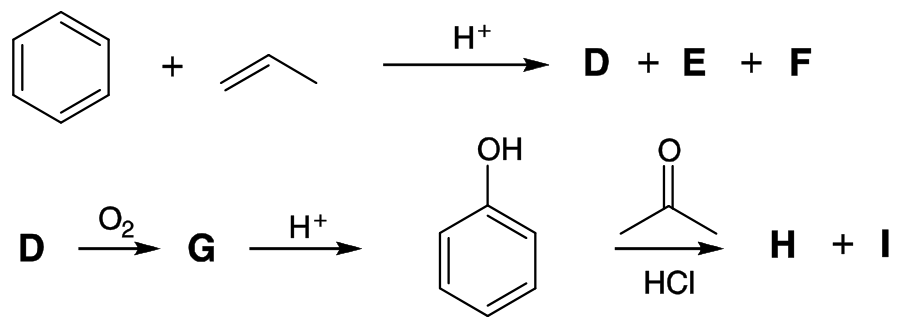
The synthesis of epichlorohydrin C begins with the reaction of propene with chlorine in the presence of light.
5.1 Draw the structures of A and B.
5.2 Give the formula of a suitable reagent for the conversion of B into epichlorohydrin C.
The synthesis of H commences with the reaction of benzene with propene in the presence of an acid catalyst which gives D as the major product and E and F as minor products.
5.3 Draw the structures of D, E, and F from the following data:
D: Elemental composition: C 89.94 %, H 10.06 %; 6 signals in the \(^{13}\mathrm{C}\) NMR spectrum.
E: Elemental composition: C 88.82 %, H 11.18 %; 4 signals in the \(^{13}\mathrm{C}\) NMR spectrum.
F: Elemental composition: C 88.82 %, H 11.18 %; 5 signals in the \(^{13}\mathrm{C}\) NMR spectrum.
Bubbling oxygen through a hot solution of D gives G which on exposure to acid gives phenol (hydroxybenzene) and acetone (propanone). G turns starch iodide paper from white to dark blue. G has 6 signals in the \(^{13}\mathrm{C}\) NMR spectrum and the following signals in the \(^{1}\mathrm{H}\) NMR spectrum: \(\delta\) 7.78 (1H, s), 7.45 – 7.22 (5H, m), 1.56 (6H, s); addition of \(\ce{D2O}\) results in the disappearance of the signal at \(\delta = 7.78\).
5.4 Draw the structure of G.
Exposure of phenol and acetone to hydrochloric acid gives compound H. The \(^{13}\mathrm{C}\) NMR spectrum for H is shown in Fig. 1. The \(^{1}\mathrm{H}\) NMR spectrum is shown in Fig. 2 together with a four-fold expansion of the region 6.5 – 7.1 ppm. The \(^{1}\mathrm{H}\) NMR spectrum after the addition of a drop of \(\ce{D2O}\), is shown in Fig. 3. Peaks due to the solvent are marked with an asterisk (*).
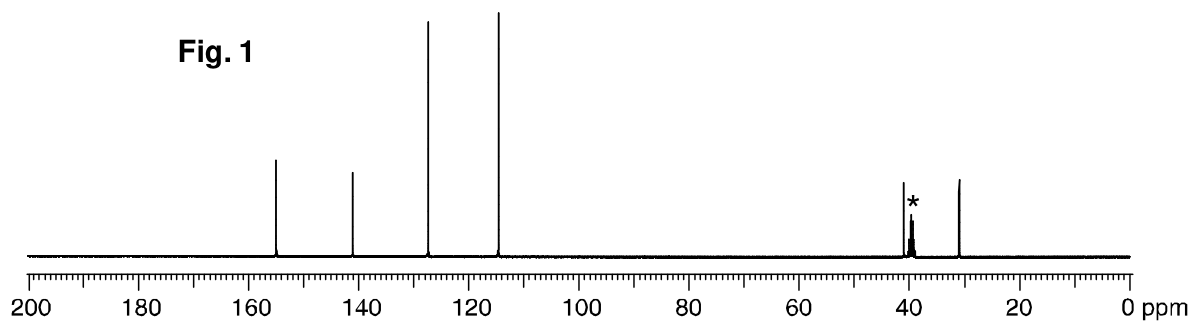
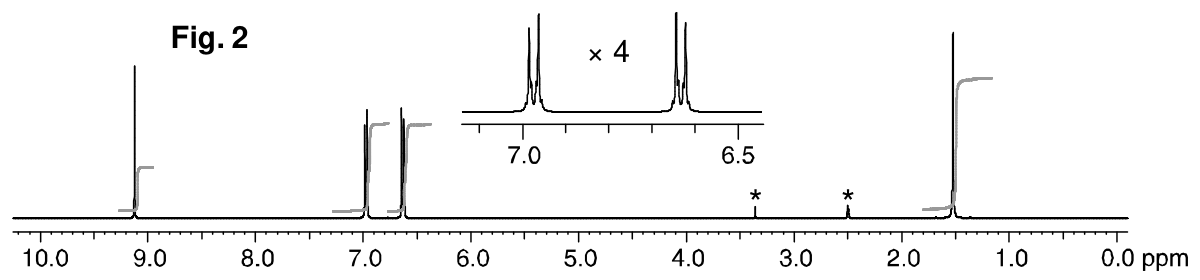
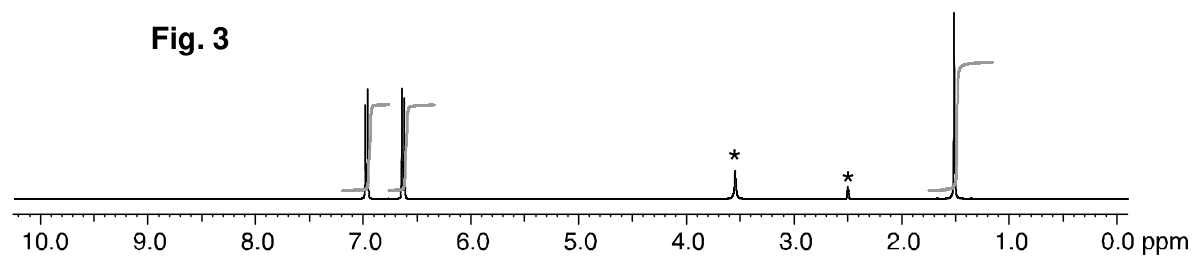
5.5 Draw the structure of H.
5.6 Draw one resonance structure of phenol which explains the regioselective formation of H.
A second compound, I, is also formed in the reaction of phenol with acetone. The \(^{13}\mathrm{C}\) NMR spectrum of I has 12 signals. The \(^{1}\mathrm{H}\) NMR spectrum has the following signals:
\(\delta\) 7.50 – 6.51 (8H, m), 5.19 (1H, s), 4.45 (1H, s), 1.67 (6H, s); addition of \(\ce{D2O}\) results in the disappearance of the signals at \(\delta = 5.19\) and 4.45
5.7 Draw a structure for I.
Excess phenol reacts with epichlorohydrin C in the presence of base to give compound L which has 6 signals in its \(^{13}\mathrm{C}\) NMR spectrum. If the reaction is stopped before completion compounds J and K can also be isolated. Compound L is formed from compound K and compound K is formed from compound J.

5.8 Draw the structures of J, K and L.
Treatment of H with a large excess of epichlorohydrin C and base gives a monomeric bis-epoxide M. M contains no chlorine atoms or OH groups.
5.9 Draw the structure of M.
Treatment of H with a small excess of epichlorohydrin and base gives N. N has the form: endgroup 1-[repeat unit]\(_n\)-endgroup 2 where \(n\) is approximately 10 – 15. N does not contain chlorine atoms and contains one OH group per repeat unit.
5.10 Draw the structure of N in the form indicated above:
(endgroup 1-[repeat unit]\(_n\)-endgroup 2).
5.11 Draw the repeat unit of the polymeric epoxy resin O formed from the reaction of the bis-epoxide M with ethane-1,2-diamine.
Official English text of the problem.
Answers
In the polymer structures below, [*] denotes an attachment point, not an actual atom. Define:
- \(Q\): the 4,4′-isopropylidenediphenylene group,
[*]c1ccc(C(C)(C)c2ccc([*])cc2)cc1. Each external attachment is para to the central \(\ce{C(CH3)2}\) group. - \(g\): the glycidyl (oxiran-2-ylmethyl) group,
[*]CC1CO1, attached through its exocyclic methylene carbon.
The conditions do not specify absolute stereochemistry. SMILES for chiral products therefore leave configuration unspecified; racemic products or stereoisomeric mixtures are intended.
-
5.1 — A: allyl chloride, 3-chloroprop-1-ene,
C=CCCl. B: 1,3-dichloropropan-2-ol,OC(CCl)CCl. -
5.2 — A suitable reagent is sodium hydroxide, \(\ce{NaOH}\),
[Na+].[OH-]. -
5.3 — D: cumene (propan-2-ylbenzene),
CC(C)c1ccccc1. E: 1,4-diisopropylbenzene,CC(C)c1ccc(C(C)C)cc1. F: 1,2-diisopropylbenzene,CC(C)c1ccccc1C(C)C. -
5.4 — G: cumene hydroperoxide,
CC(C)(OO)c1ccccc1. -
5.5 — H: bisphenol A, 2,2-bis(4-hydroxyphenyl)propane,
CC(C)(c1ccc(O)cc1)c1ccc(O)cc1. -
5.6 — The para-carbanionic, oxonium resonance contributor of phenol,
[OH+]=C1C=C[CH-]C=C1: oxygen bears a positive charge, and the carbon para to oxygen bears a negative charge. -
5.7 — I: 2-(2-hydroxyphenyl)-2-(4-hydroxyphenyl)propane, the ortho/para isomer of bisphenol A,
CC(C)(c1ccccc1O)c1ccc(O)cc1. -
5.8 — J: 1-chloro-3-phenoxypropan-2-ol,
OC(CCl)COc1ccccc1. K: phenyl glycidyl ether, 2-(phenoxymethyl)oxirane,c1ccc(OCC2CO2)cc1. L: 1,3-diphenoxypropan-2-ol,OC(COc1ccccc1)COc1ccccc1. -
5.9 — M: bisphenol A diglycidyl ether (DGEBA),
CC(C)(c1ccc(OCC2CO2)cc1)c1ccc(OCC2CO2)cc1. -
5.10 — N: the glycidyl-terminated bisphenol A–epichlorohydrin oligomer, \[ \underbrace{g\ce{-O-}Q\ce{-O-}}_{\text{endgroup 1}} \underbrace{\left[\ce{CH2-CH(OH)-CH2-O-}Q\ce{-O-}\right]_n}_{\text{repeat units}} \underbrace{g}_{\text{endgroup 2}}. \] Its repeat-fragment SMILES is
[*]CC(O)COc1ccc(C(C)(C)c2ccc(O[*])cc2)cc1. -
5.11 — O: the ethane-1,2-diamine-cured DGEBA resin. Its opened-DGEBA bridge is
[*]CC(O)COc1ccc(C(C)(C)c2ccc(OCC(O)C[*])cc2)cc1. Fully reacted diamine junctions are[*]N([*])CCN([*])[*], with each nitrogen attached to two such bridges. The initial linear repeat, before further reaction of the remaining N–H bonds, is[*]NCCNCC(O)COc1ccc(C(C)(C)c2ccc(OCC(O)C[*])cc2)cc1.
Solution
5.1 — Allylic chlorination and chlorohydrin formation
Propene, C=CC, undergoes allylic substitution with chlorine, ClCl, under the photochemical conditions intended in the scheme. Replacing an allylic hydrogen gives A, allyl chloride:
\[ \ce{CH2=CHCH3 + Cl2 ->[h\nu] CH2=CHCH2Cl + HCl}. \]
The coproduct is hydrogen chloride, Cl.
Hypochlorous acid, OCl, then adds across the double bond. The expected major chlorohydrin has its hydroxyl group on the more substituted alkene carbon:
\[ \ce{CH2=CHCH2Cl + HOCl -> ClCH2CH(OH)CH2Cl}. \]
Thus B has a central hydroxyl-bearing carbon and two identical chloromethyl groups.
5.2 — Formation of epichlorohydrin
Sodium hydroxide converts B into its alkoxide, 1,3-dichloropropan-2-olate, [O-]C(CCl)CCl. The oxygen attacks one adjacent chloromethyl carbon intramolecularly, displacing chloride, [Cl-], and forming the three-membered epoxide ring.
The product C is epichlorohydrin, 2-(chloromethyl)oxirane, ClCC1CO1. The balanced overall equation is
\[ \ce{C3H6Cl2O + NaOH -> C3H5ClO + NaCl + H2O}. \]
The other products are sodium chloride, [Na+].[Cl-], and water, O. The two equivalent chloromethyl groups of B lead to racemic C.
5.3 — Identification of the alkylbenzenes
Using standard atomic molar masses \(12.01\ \mathrm{g\,mol^{-1}}\) for carbon and \(1.008\ \mathrm{g\,mol^{-1}}\) for hydrogen, a \(100.00\ \mathrm{g}\) sample gives:
| Compound | Amount of carbon atoms | Amount of hydrogen atoms | H:C atomic ratio |
|---|---|---|---|
| D | \(89.94/12.01=7.489\ \mathrm{mol}\) | \(10.06/1.008=9.980\ \mathrm{mol}\) | \(1.333\) |
| E, F | \(88.82/12.01=7.396\ \mathrm{mol}\) | \(11.18/1.008=11.09\ \mathrm{mol}\) | \(1.500\) |
Alkylating benzene, c1ccccc1, with \(k\) molecules of propene gives the molecular formula
\[ \ce{C_{6+3k}H_{6+6k}}. \]
Consequently,
\[ \frac{6+6k}{6+3k} = \begin{cases} 4/3 &\Rightarrow k=1,\\ 3/2 &\Rightarrow k=2. \end{cases} \]
Thus D is \(\ce{C9H12}\), whereas E and F are \(\ce{C12H18}\).
The acid catalyst is represented by a hydrogen ion, [H+]. Protonation of propene produces a secondary isopropyl electrophile, represented as the propan-2-yl cation, C[CH+]C. Electrophilic aromatic substitution therefore introduces isopropyl groups:
\[ \ce{C6H6 + CH2=CHCH3 ->[H+] C6H5CH(CH3)2}, \]
\[ \ce{C6H6 + 2 CH2=CHCH3 ->[H+] C6H4[CH(CH3)2]2}. \]
The second equation applies separately to the ortho and para products.
Their carbon equivalences identify the structures:
| Compound | Aromatic carbon environments | Side-chain carbon environments | Total |
|---|---|---|---|
| D: cumene | 4: ipso, ortho, meta, para | 2: methine and equivalent methyls | 6 |
| E: para-diisopropylbenzene | 2: substituted and proton-bearing carbons | 2 | 4 |
| F: ortho-diisopropylbenzene | 3: three equivalent pairs | 2 | 5 |
The meta isomer would have four aromatic environments and six carbon signals overall, so it does not match E or F. The formulas also reproduce the reported elemental percentages to their stated precision.
5.4 — Cumene hydroperoxide
Oxidation of the benzylic position of cumene by dioxygen, O=O, gives G:
\[ \ce{C6H5CH(CH3)2 + O2 -> C6H5C(CH3)2OOH}. \]
The data support a hydroperoxide:
- The five aromatic protons identify a monosubstituted phenyl group.
- The \(6\mathrm{H}\) singlet at \(\delta=1.56\) corresponds to two equivalent methyl groups attached to a carbon without a hydrogen.
- The exchangeable \(1\mathrm{H}\) singlet at \(\delta=7.78\) is the hydroperoxide proton.
- Four aromatic carbon environments, one central carbon and one methyl environment give six \(^{13}\mathrm{C}\) signals.
A hydroperoxide oxidizes iodide to iodine, producing the dark-blue starch–iodine response. A balanced equation is
\[ \ce{C6H5C(CH3)2OOH + 2 I- + 2 H+ -> C6H5C(CH3)2OH + I2 + H2O}. \]
Here iodide is [I-], iodine is II, and the organic reduction product is cumyl alcohol, 2-phenylpropan-2-ol, CC(C)(O)c1ccccc1.
Acid-catalysed Hock rearrangement of G gives phenol, Oc1ccccc1, and acetone, CC(=O)C:
\[ \ce{C6H5C(CH3)2OOH ->[H+] C6H5OH + (CH3)2CO}. \]
5.5 — Bisphenol A
Two phenol molecules condense with one acetone molecule, eliminating one water molecule:
\[ \ce{2 C6H5OH + (CH3)2CO -> [HCl] (HOC6H4)2C(CH3)2 + H2O}. \]
For H, each hydroxyl group is para to the central isopropylidene group.
The spectra establish the symmetry and substitution pattern:
| Approximate \(^{1}\mathrm{H}\) shift | Integral | Assignment |
|---|---|---|
| \(9.1\ \mathrm{ppm}\) | 2H | Two equivalent phenolic OH groups |
| \(7.0\ \mathrm{ppm}\) | 4H | One set of aromatic protons |
| \(6.65\ \mathrm{ppm}\) | 4H | The other set of aromatic protons |
| \(1.55\ \mathrm{ppm}\) | 6H | Two equivalent methyl groups |
The two aromatic sets give the characteristic pattern of equivalent para-disubstituted rings. Addition of deuterium oxide, [2H]O[2H], removes the OH resonance through hydrogen–deuterium exchange.
Excluding the starred solvent peaks, the \(^{13}\mathrm{C}\) spectrum contains six signals: four aromatic environments, the central quaternary carbon, and the equivalent methyl carbons. This identifies bisphenol A.
5.6 — Resonance and regioselectivity
Use the contributor
[OH+]=C1C=C[CH-]C=C1.
To draw it precisely, number the hydroxyl-bearing ring carbon \(1\):
- Draw a double bond from carbon \(1\) to oxygen; oxygen retains its hydrogen and bears a positive charge.
- Draw ring double bonds between carbons \(2\)–\(3\) and \(5\)–\(6\).
- Place a negative charge on carbon \(4\), para to oxygen; that carbon retains its hydrogen.
The electron flow is donation of an oxygen lone pair into the oxygen–carbon bond, accompanied by movement of ring \(\pi\) electrons toward the para carbon. This is a resonance contributor of phenol, not a separate reaction product.
It shows enhanced electron density at the para position. Related contributors enhance the ortho positions. Phenol therefore directs electrophilic substitution ortho and para; the less crowded para positions favour formation of H.
5.7 — The ortho/para bisphenol isomer
Compound I has two nonequivalent phenolic OH groups: their separate \(1\mathrm{H}\) singlets disappear after deuterium oxide addition. Its eight aromatic protons and equivalent six methyl protons are consistent with another bisphenol A isomer.
The carbon-signal count distinguishes the ortho/para structure:
\[ \underbrace{6}_{\text{ortho-disubstituted ring}} + \underbrace{4}_{\text{para-disubstituted ring}} + \underbrace{1}_{\text{central carbon}} + \underbrace{1}_{\text{equivalent methyls}} =12. \]
Thus draw one hydroxyl group ortho to the central carbon substituent and the other para to it.
The balanced condensation is
\[ \ce{2 C6H5OH + (CH3)2CO ->[HCl] C15H16O2 + H2O}, \]
where the \(\ce{C15H16O2}\) product has the connectivity specified for I.
5.8 — Chlorohydrin, glycidyl ether and diether
Base produces the phenoxide ion, [O-]c1ccccc1, which attacks the less substituted carbon of the epoxide ring of C. Ring opening and proton transfer give J:
\[ \ce{C6H5OH + C3H5ClO ->[base] C6H5OCH2CH(OH)CH2Cl}. \]
This product has formula \(\ce{C9H11ClO2}\), as required.
Base then promotes intramolecular displacement of chloride, forming the epoxide K:
\[ \ce{C9H11ClO2 + NaOH -> C9H10O2 + NaCl + H2O}. \]
Further phenoxide attack opens K at its terminal epoxide carbon:
\[ \ce{C9H10O2 + C6H5OH ->[base] C6H5OCH2CH(OH)CH2OC6H5}. \]
The resulting L has formula \(\ce{C15H16O3}\). Its two ends are identical, so its six carbon signals comprise:
\[ 4\ \text{phenyl environments} +1\ \text{equivalent methylene environment} +1\ \text{central hydroxymethine environment}. \]
5.9 — The monomeric bis-epoxide
Each phenolic group of H undergoes the chlorohydrin-formation/ring-closure sequence established in 5.8. With a large excess of epichlorohydrin, both ends become glycidyl ethers, giving M.
Draw a bisphenol A framework bearing an \(\ce{-O-CH2-}\) linkage to an oxirane ring at each para position. The oxirane oxygen bridges its adjacent methine and terminal methylene carbons.
The balanced overall reaction is
\[ \ce{C15H16O2 + 2 C3H5ClO + 2 NaOH -> C21H24O4 + 2 NaCl + 2 H2O}. \]
The four oxygen atoms in M are two aryl ether oxygens and two epoxide oxygens. There are no OH groups or chlorine atoms.
5.10 — The oligomer and its end groups
With a smaller excess of epichlorohydrin, phenolic groups also open glycidyl epoxide groups on other molecules. Each such chain-extension step creates the linkage
\[ \ce{-O-CH2-CH(OH)-CH2-O-}, \]
which contains exactly one secondary alcohol group.
The required structure is
\[ \boxed{ \underbrace{g\ce{-O-}Q\ce{-O-}}_{\text{endgroup 1}} \left[ \underbrace{\ce{CH2-CH(OH)-CH2-O-}Q\ce{-O-}}_{\text{repeat unit}} \right]_n \underbrace{g}_{\text{endgroup 2}} }. \]
The fragment SMILES, with attachment points, are:
| Fragment | SMILES |
|---|---|
| Endgroup 1: glycidylated bisphenol A ether end | CC(C)(c1ccc(OCC2CO2)cc1)c1ccc(O[*])cc1 |
| Repeat unit | [*]CC(O)COc1ccc(C(C)(C)c2ccc(O[*])cc2)cc1 |
| Endgroup 2: glycidyl group | [*]CC1CO1 |
Join the atoms adjacent to matching attachment points, removing the dummy atoms. Both termini are epoxides. Each repeat contributes one OH group, and no chlorine remains. Setting \(n=0\) recovers M, which checks the end-group assignment.
The repeat formula is \(\ce{C18H20O3}\), and the complete oligomer formula is
\[ \ce{C_{18n+21}H_{20n+24}O_{3n+4}}. \]
Its balanced preparation can be written
\[ \begin{aligned} &(n+1)\ce{C15H16O2}+(n+2)\ce{C3H5ClO}+(n+2)\ce{NaOH}\\ &\quad\ce{->} \ce{C_{18n+21}H_{20n+24}O_{3n+4}} +(n+2)\ce{NaCl}+(n+2)\ce{H2O}. \end{aligned} \]
For \(n=10\)–15, the ideal incorporated epichlorohydrin:bisphenol A ratio is
\[ \frac{n+2}{n+1}=1.063\text{–}1.091\ \mathrm{mol\,mol^{-1}}, \]
consistent with a small molar excess of epichlorohydrin.
5.11 — Amine opening and crosslinking
Ethane-1,2-diamine, NCCN, attacks the less substituted carbon of each epoxide. The epoxide oxygen becomes an OH group, while the attacked terminal carbon forms a carbon–nitrogen bond. No small molecule is eliminated.
Define the doubly opened M bridge \(P\) as
\[ P= \ce{-CH2-CH(OH)-CH2-O-}Q \ce{-O-CH2-CH(OH)-CH2-}, \]
with fragment SMILES
[*]CC(O)COc1ccc(C(C)(C)c2ccc(OCC(O)C[*])cc2)cc1.
If each amino nitrogen reacts once, the linear addition repeat is
\[ \boxed{\left[\ce{-NH-CH2-CH2-NH-}P\right]_m}. \]
Its fragment SMILES is
[*]NCCNCC(O)COc1ccc(C(C)(C)c2ccc(OCC(O)C[*])cc2)cc1.
The corresponding repeat composition is obtained by direct addition:
\[ \ce{C21H24O4 + C2H8N2 -> C23H32N2O4} \qquad\text{(repeat-unit composition)}. \]
Each nitrogen still has one N–H bond. These secondary amines can open further epoxide rings, producing crosslinks. In the fully reacted resin, each nitrogen has three carbon bonds: one to the ethylene bridge and two to opened-epoxide methylene groups.
To draw that network motif precisely:
- Draw two nitrogen atoms joined by \(\ce{-CH2-CH2-}\).
- Give each nitrogen two additional bonds to \(\ce{-CH2-CH(OH)-CH2-O-}\) arms.
- Continue each arm through \(Q\), then through another \(\ce{-O-CH2-CH(OH)-CH2-}\) arm to a nitrogen elsewhere in the resin.
A representative four-attachment structural cell is
[*:1]N(CCN([*:2])CC(O)COc1ccc(C(C)(C)c2ccc(OCC(O)C[*:3])cc2)cc1)CC(O)COc3ccc(C(C)(C)c4ccc(OCC(O)C[*:4])cc4)cc3.
Attachments 1 and 2 terminate at nitrogens; attachments 3 and 4 terminate at methylene carbons. Connect nitrogen ends to methylene ends of other cells. This specifies the local covalent connectivity; the long-range crosslink arrangement need not be periodic.
A fully reacted cell contains two M molecules per diamine, because one diamine supplies four reactive N–H bonds:
\[ \ce{2 C21H24O4 + C2H8N2 -> C44H56N2O8} \qquad\text{(network-cell composition)}. \]
It contains four newly formed OH groups and no residual N–H bonds.
The answers were checked against the official answers published by the organisers.
IChO 2009 · Theorieaufgabe 5
Epoxidharze
Die Synthese von Epoxidharzen ist weltweit ein Industriezweig mit Milliardenumsätzen in US-Dollar. Epoxidharze sind Hochleistungsklebstoffe, die durch die Reaktion eines Bisepoxids mit einem Diamin hergestellt werden. Das Bisepoxid wird aus H und Epichlorhydrin, C, hergestellt. Die Verbindungen C und H können nach den folgenden Schemata synthetisiert werden.
Die Synthese von Epichlorhydrin C beginnt mit der Reaktion von Propen mit Chlor unter Lichteinwirkung.
5.1 Zeichnen Sie die Strukturen von A und B.
5.2 Geben Sie die Formel eines geeigneten Reagenzes für die Umwandlung von B in Epichlorhydrin C an.
Die Synthese von H beginnt mit der Reaktion von Benzol mit Propen in Gegenwart eines Säurekatalysators, wobei D als Hauptprodukt und E und F als Nebenprodukte entstehen.
5.3 Zeichnen Sie anhand der folgenden Daten die Strukturen von D, E und F:
D: Elementarzusammensetzung: C 89.94 %, H 10.06 %; 6 Signale im \(^{13}\mathrm{C}\)-NMR-Spektrum.
E: Elementarzusammensetzung: C 88.82 %, H 11.18 %; 4 Signale im \(^{13}\mathrm{C}\)-NMR-Spektrum.
F: Elementarzusammensetzung: C 88.82 %, H 11.18 %; 5 Signale im \(^{13}\mathrm{C}\)-NMR-Spektrum.
Beim Durchleiten von Sauerstoff durch eine heiße Lösung von D entsteht G, das unter Säureeinwirkung Phenol (Hydroxybenzol) und Aceton (Propanon) ergibt. G färbt weißes Iodidstärkepapier dunkelblau. G weist 6 Signale im \(^{13}\mathrm{C}\)-NMR-Spektrum und die folgenden Signale im \(^{1}\mathrm{H}\)-NMR-Spektrum auf: \(\delta\) 7.78 (1H, s), 7.45 – 7.22 (5H, m), 1.56 (6H, s); die Zugabe von \(\ce{D2O}\) führt zum Verschwinden des Signals bei \(\delta = 7.78\).
5.4 Zeichnen Sie die Struktur von G.
Die Einwirkung von Salzsäure auf Phenol und Aceton ergibt die Verbindung H. Das \(^{13}\mathrm{C}\)-NMR-Spektrum von H ist in Abb. 1 dargestellt. Das \(^{1}\mathrm{H}\)-NMR-Spektrum ist in Abb. 2 zusammen mit einer vierfachen Vergrößerung des Bereichs 6.5 – 7.1 ppm dargestellt. Das \(^{1}\mathrm{H}\)-NMR-Spektrum nach Zugabe eines Tropfens \(\ce{D2O}\) ist in Abb. 3 dargestellt. Die vom Lösungsmittel verursachten Peaks sind mit einem Sternchen (*) gekennzeichnet.
5.5 Zeichnen Sie die Struktur von H.
5.6 Zeichnen Sie eine mesomere Grenzstruktur von Phenol, die die regioselektive Bildung von H erklärt.
Bei der Reaktion von Phenol mit Aceton entsteht auch eine zweite Verbindung, I. Das \(^{13}\mathrm{C}\)-NMR-Spektrum von I weist 12 Signale auf. Das \(^{1}\mathrm{H}\)-NMR-Spektrum weist die folgenden Signale auf:
\(\delta\) 7.50 – 6.51 (8H, m), 5.19 (1H, s), 4.45 (1H, s), 1.67 (6H, s); die Zugabe von \(\ce{D2O}\) führt zum Verschwinden der Signale bei \(\delta = 5.19\) und 4.45
5.7 Zeichnen Sie eine Struktur für I.
Überschüssiges Phenol reagiert mit Epichlorhydrin C in Gegenwart einer Base zur Verbindung L, die 6 Signale in ihrem \(^{13}\mathrm{C}\)-NMR-Spektrum aufweist. Wird die Reaktion vor ihrem vollständigen Ablauf abgebrochen, können auch die Verbindungen J und K isoliert werden. Verbindung L entsteht aus Verbindung K, und Verbindung K entsteht aus Verbindung J.
5.8 Zeichnen Sie die Strukturen von J, K und L.
Die Umsetzung von H mit einem großen Überschuss an Epichlorhydrin C und einer Base ergibt ein monomeres Bisepoxid M. M enthält weder Chloratome noch OH-Gruppen.
5.9 Zeichnen Sie die Struktur von M.
Die Umsetzung von H mit einem geringen Überschuss an Epichlorhydrin und einer Base ergibt N. N hat die Form: Endgruppe 1-[Wiederholungseinheit]\(_n\)-Endgruppe 2, wobei \(n\) ungefähr 10 – 15 beträgt. N enthält keine Chloratome und enthält eine OH-Gruppe pro Wiederholungseinheit.
5.10 Zeichnen Sie die Struktur von N in der oben angegebenen Form:
(Endgruppe 1-[Wiederholungseinheit]\(_n\)-Endgruppe 2).
5.11 Zeichnen Sie die Wiederholungseinheit des polymeren Epoxidharzes O, das bei der Reaktion des Bisepoxids M mit Ethan-1,2-diamin entsteht.
Aufgabentext aus dem offiziellen englischen Text übersetzt.
Antworten
In den folgenden Polymerstrukturen bezeichnet [*] eine Verknüpfungsstelle, kein tatsächliches Atom. Es seien definiert:
- \(Q\): die 4,4′-Isopropylidendiphenylen-Gruppe,
[*]c1ccc(C(C)(C)c2ccc([*])cc2)cc1. Jede äußere Verknüpfungsstelle befindet sich para zur zentralen \(\ce{C(CH3)2}\)-Gruppe. - \(g\): die Glycidylgruppe (Oxiran-2-ylmethylgruppe),
[*]CC1CO1, die über ihr exocyclisches Methylen-Kohlenstoffatom gebunden ist.
Die Bedingungen legen keine absolute Stereochemie fest. In den SMILES chiraler Produkte bleibt die Konfiguration daher unbestimmt; gemeint sind racemische Produkte oder Stereoisomerengemische.
-
5.1 — A: Allylchlorid, 3-Chlorprop-1-en,
C=CCCl. B: 1,3-Dichlorpropan-2-ol,OC(CCl)CCl. -
5.2 — Ein geeignetes Reagenz ist Natriumhydroxid, \(\ce{NaOH}\),
[Na+].[OH-]. -
5.3 — D: Cumol (Propan-2-ylbenzol),
CC(C)c1ccccc1. E: 1,4-Diisopropylbenzol,CC(C)c1ccc(C(C)C)cc1. F: 1,2-Diisopropylbenzol,CC(C)c1ccccc1C(C)C. -
5.4 — G: Cumolhydroperoxid,
CC(C)(OO)c1ccccc1. -
5.5 — H: Bisphenol A, 2,2-Bis(4-hydroxyphenyl)propan,
CC(C)(c1ccc(O)cc1)c1ccc(O)cc1. -
5.6 — Die mesomere Oxonium-Grenzstruktur von Phenol mit einem Carbanion in para-Stellung,
[OH+]=C1C=C[CH-]C=C1: Der Sauerstoff trägt eine positive Ladung, und das Kohlenstoffatom para zum Sauerstoff trägt eine negative Ladung. -
5.7 — I: 2-(2-Hydroxyphenyl)-2-(4-hydroxyphenyl)propan, das ortho/para-Isomer von Bisphenol A,
CC(C)(c1ccccc1O)c1ccc(O)cc1. -
5.8 — J: 1-Chlor-3-phenoxypropan-2-ol,
OC(CCl)COc1ccccc1. K: Phenylglycidylether, 2-(Phenoxymethyl)oxiran,c1ccc(OCC2CO2)cc1. L: 1,3-Diphenoxypropan-2-ol,OC(COc1ccccc1)COc1ccccc1. -
5.9 — M: Bisphenol-A-diglycidylether (DGEBA),
CC(C)(c1ccc(OCC2CO2)cc1)c1ccc(OCC2CO2)cc1. -
5.10 — N: das Bisphenol-A–Epichlorhydrin-Oligomer mit Glycidyl-Endgruppen, \[ \underbrace{g\ce{-O-}Q\ce{-O-}}_{\text{Endgruppe 1}} \underbrace{\left[\ce{CH2-CH(OH)-CH2-O-}Q\ce{-O-}\right]_n}_{\text{Wiederholungseinheiten}} \underbrace{g}_{\text{Endgruppe 2}}. \] Der SMILES des Wiederholungsfragments lautet
[*]CC(O)COc1ccc(C(C)(C)c2ccc(O[*])cc2)cc1. -
5.11 — O: das mit Ethan-1,2-diamin gehärtete DGEBA-Harz. Seine DGEBA-Brücke mit geöffneten Epoxidringen ist
[*]CC(O)COc1ccc(C(C)(C)c2ccc(OCC(O)C[*])cc2)cc1. Vollständig umgesetzte Diamin-Verknüpfungsstellen sind[*]N([*])CCN([*])[*], wobei jeder Stickstoff an zwei solcher Brücken gebunden ist. Die anfängliche lineare Wiederholungseinheit vor der weiteren Reaktion der verbleibenden N–H-Bindungen lautet[*]NCCNCC(O)COc1ccc(C(C)(C)c2ccc(OCC(O)C[*])cc2)cc1.
Lösung
5.1 — Allylische Chlorierung und Chlorhydrinbildung
Propen, C=CC, geht unter den im Schema vorgesehenen photochemischen Bedingungen mit Chlor, ClCl, eine allylische Substitution ein. Der Ersatz eines allylischen Wasserstoffatoms ergibt A, Allylchlorid:
\[ \ce{CH2=CHCH3 + Cl2 ->[h\nu] CH2=CHCH2Cl + HCl}. \]
Das Koppelprodukt ist Chlorwasserstoff, Cl.
Anschließend addiert sich hypochlorige Säure, OCl, an die Doppelbindung. Beim erwarteten Hauptprodukt, einem Chlorhydrin, befindet sich die Hydroxygruppe am höher substituierten Alken-Kohlenstoffatom:
\[ \ce{CH2=CHCH2Cl + HOCl -> ClCH2CH(OH)CH2Cl}. \]
Somit besitzt B ein zentrales Kohlenstoffatom mit einer Hydroxygruppe und zwei identische Chlormethylgruppen.
5.2 — Bildung von Epichlorhydrin
Natriumhydroxid überführt B in sein Alkoholat, 1,3-Dichlorpropan-2-olat, [O-]C(CCl)CCl. Der Sauerstoff greift intramolekular eines der benachbarten Chlormethyl-Kohlenstoffatome an, wobei Chlorid, [Cl-], verdrängt wird und der dreigliedrige Epoxidring entsteht.
Das Produkt C ist Epichlorhydrin, 2-(Chlormethyl)oxiran, ClCC1CO1. Die ausgeglichene Gesamtgleichung lautet
\[ \ce{C3H6Cl2O + NaOH -> C3H5ClO + NaCl + H2O}. \]
Die weiteren Produkte sind Natriumchlorid, [Na+].[Cl-], und Wasser, O. Die beiden äquivalenten Chlormethylgruppen von B führen zu racemischem C.
5.3 — Identifizierung der Alkylbenzole
Mit den üblichen molaren Atommassen von \(12.01\ \mathrm{g\,mol^{-1}}\) für Kohlenstoff und \(1.008\ \mathrm{g\,mol^{-1}}\) für Wasserstoff ergibt sich für eine Probe von \(100.00\ \mathrm{g}\):
| Verbindung | Stoffmenge der Kohlenstoffatome | Stoffmenge der Wasserstoffatome | H:C-Atomverhältnis |
|---|---|---|---|
| D | \(89.94/12.01=7.489\ \mathrm{mol}\) | \(10.06/1.008=9.980\ \mathrm{mol}\) | \(1.333\) |
| E, F | \(88.82/12.01=7.396\ \mathrm{mol}\) | \(11.18/1.008=11.09\ \mathrm{mol}\) | \(1.500\) |
Die Alkylierung von Benzol, c1ccccc1, mit \(k\) Molekülen Propen ergibt die Summenformel
\[ \ce{C_{6+3k}H_{6+6k}}. \]
Folglich gilt
\[ \frac{6+6k}{6+3k} = \begin{cases} 4/3 &\Rightarrow k=1,\\ 3/2 &\Rightarrow k=2. \end{cases} \]
Somit hat D die Summenformel \(\ce{C9H12}\), während E und F die Summenformel \(\ce{C12H18}\) haben.
Der Säurekatalysator wird durch ein Wasserstoffion, [H+], dargestellt. Die Protonierung von Propen erzeugt ein sekundäres Isopropyl-Elektrophil, dargestellt als Propan-2-yl-Kation, C[CH+]C. Durch elektrophile aromatische Substitution werden daher Isopropylgruppen eingeführt:
\[ \ce{C6H6 + CH2=CHCH3 ->[H+] C6H5CH(CH3)2}, \]
\[ \ce{C6H6 + 2 CH2=CHCH3 ->[H+] C6H4[CH(CH3)2]2}. \]
Die zweite Gleichung gilt jeweils für das ortho- und das para-Produkt.
Die Äquivalenzen ihrer Kohlenstoffatome ermöglichen die Identifizierung der Strukturen:
| Verbindung | Aromatische Kohlenstoffumgebungen | Kohlenstoffumgebungen der Seitenketten | Insgesamt |
|---|---|---|---|
| D: Cumol | 4: ipso, ortho, meta, para | 2: Methin und äquivalente Methylgruppen | 6 |
| E: para-Diisopropylbenzol | 2: substituierte und protonentragende Kohlenstoffatome | 2 | 4 |
| F: ortho-Diisopropylbenzol | 3: drei Paare äquivalenter Atome | 2 | 5 |
Das meta-Isomer hätte vier aromatische Umgebungen und insgesamt sechs Kohlenstoffsignale und passt daher weder zu E noch zu F. Die Formeln ergeben außerdem die angegebenen prozentualen Elementgehalte mit der angegebenen Genauigkeit.
5.4 — Cumolhydroperoxid
Die Oxidation der benzylischen Position von Cumol durch molekularen Sauerstoff, O=O, ergibt G:
\[ \ce{C6H5CH(CH3)2 + O2 -> C6H5C(CH3)2OOH}. \]
Die Daten sprechen für ein Hydroperoxid:
- Die fünf aromatischen Protonen kennzeichnen eine monosubstituierte Phenylgruppe.
- Das \(6\mathrm{H}\)-Singulett bei \(\delta=1.56\) entspricht zwei äquivalenten Methylgruppen, die an ein Kohlenstoffatom ohne Wasserstoffatom gebunden sind.
- Das austauschbare \(1\mathrm{H}\)-Singulett bei \(\delta=7.78\) stammt vom Hydroperoxidproton.
- Vier aromatische Kohlenstoffumgebungen, ein zentrales Kohlenstoffatom und eine Methylumgebung ergeben sechs \(^{13}\mathrm{C}\)-Signale.
Ein Hydroperoxid oxidiert Iodid zu Iod und erzeugt dadurch die dunkelblaue Stärke-Iod-Reaktion. Eine ausgeglichene Gleichung lautet
\[ \ce{C6H5C(CH3)2OOH + 2 I- + 2 H+ -> C6H5C(CH3)2OH + I2 + H2O}. \]
Hier ist Iodid [I-], Iod ist II, und das organische Reduktionsprodukt ist Cumylalkohol, 2-Phenylpropan-2-ol, CC(C)(O)c1ccccc1.
Die säurekatalysierte Hock-Umlagerung von G ergibt Phenol, Oc1ccccc1, und Aceton, CC(=O)C:
\[ \ce{C6H5C(CH3)2OOH ->[H+] C6H5OH + (CH3)2CO}. \]
5.5 — Bisphenol A
Zwei Phenolmoleküle kondensieren mit einem Acetonmolekül unter Abspaltung eines Wassermoleküls:
\[ \ce{2 C6H5OH + (CH3)2CO -> [HCl] (HOC6H4)2C(CH3)2 + H2O}. \]
In H befindet sich jede Hydroxygruppe para zur zentralen Isopropylidengruppe.
Die Spektren belegen die Symmetrie und das Substitutionsmuster:
| Ungefähre \(^{1}\mathrm{H}\)-Verschiebung | Integral | Zuordnung |
|---|---|---|
| \(9.1\ \mathrm{ppm}\) | 2H | Zwei äquivalente phenolische OH-Gruppen |
| \(7.0\ \mathrm{ppm}\) | 4H | Eine Gruppe aromatischer Protonen |
| \(6.65\ \mathrm{ppm}\) | 4H | Die andere Gruppe aromatischer Protonen |
| \(1.55\ \mathrm{ppm}\) | 6H | Zwei äquivalente Methylgruppen |
Die beiden Gruppen aromatischer Protonen ergeben das charakteristische Muster äquivalenter para-disubstituierter Ringe. Die Zugabe von Deuteriumoxid, [2H]O[2H], lässt die OH-Resonanz durch Wasserstoff-Deuterium-Austausch verschwinden.
Ohne die mit Sternchen markierten Lösungsmittelpeaks enthält das \(^{13}\mathrm{C}\)-Spektrum sechs Signale: vier aromatische Umgebungen, das zentrale quartäre Kohlenstoffatom und die äquivalenten Methyl-Kohlenstoffatome. Damit ist Bisphenol A identifiziert.
5.6 — Mesomerie und Regioselektivität
Verwenden Sie die Grenzstruktur
[OH+]=C1C=C[CH-]C=C1.
Um sie genau zu zeichnen, nummerieren Sie das hydroxygruppentragende Ring-Kohlenstoffatom mit \(1\):
- Zeichnen Sie eine Doppelbindung von Kohlenstoffatom \(1\) zum Sauerstoff; der Sauerstoff behält sein Wasserstoffatom und trägt eine positive Ladung.
- Zeichnen Sie Doppelbindungen im Ring zwischen den Kohlenstoffatomen \(2\)–\(3\) und \(5\)–\(6\).
- Setzen Sie eine negative Ladung an Kohlenstoffatom \(4\), para zum Sauerstoff; dieses Kohlenstoffatom behält sein Wasserstoffatom.
Die Elektronenverschiebung besteht in der Abgabe eines freien Elektronenpaars des Sauerstoffs in die Sauerstoff-Kohlenstoff-Bindung, begleitet von einer Verschiebung der \(\pi\)-Elektronen des Rings zum para-Kohlenstoffatom. Dies ist eine mesomere Grenzstruktur von Phenol, kein eigenständiges Reaktionsprodukt.
Sie zeigt eine erhöhte Elektronendichte an der para-Position. Entsprechende Grenzstrukturen erhöhen die Elektronendichte an den ortho-Positionen. Phenol dirigiert die elektrophile Substitution daher in ortho- und para-Stellung; die sterisch weniger gehinderten para-Positionen begünstigen die Bildung von H.
5.7 — Das ortho/para-Bisphenol-Isomer
Verbindung I besitzt zwei nicht äquivalente phenolische OH-Gruppen: Ihre getrennten \(1\mathrm{H}\)-Singuletts verschwinden nach Zugabe von Deuteriumoxid. Ihre acht aromatischen Protonen und sechs äquivalenten Methylprotonen passen zu einem weiteren Bisphenol-A-Isomer.
Die Anzahl der Kohlenstoffsignale kennzeichnet die ortho/para-Struktur:
\[ \underbrace{6}_{\text{ortho-disubstituierter Ring}} + \underbrace{4}_{\text{para-disubstituierter Ring}} + \underbrace{1}_{\text{zentrales Kohlenstoffatom}} + \underbrace{1}_{\text{äquivalente Methylgruppen}} =12. \]
Zeichnen Sie daher eine Hydroxygruppe ortho zum zentralen Kohlenstoffsubstituenten und die andere para dazu.
Die ausgeglichene Kondensationsgleichung lautet
\[ \ce{2 C6H5OH + (CH3)2CO ->[HCl] C15H16O2 + H2O}, \]
wobei das Produkt \(\ce{C15H16O2}\) die für I angegebene Atomverknüpfung aufweist.
5.8 — Chlorhydrin, Glycidylether und Diether
Eine Base erzeugt das Phenolat-Ion, [O-]c1ccccc1, das das weniger substituierte Kohlenstoffatom des Epoxidrings von C angreift. Ringöffnung und Protonenübertragung ergeben J:
\[ \ce{C6H5OH + C3H5ClO ->[base] C6H5OCH2CH(OH)CH2Cl}. \]
Dieses Produkt hat wie gefordert die Summenformel \(\ce{C9H11ClO2}\).
Anschließend fördert die Base die intramolekulare Verdrängung von Chlorid, wobei das Epoxid K entsteht:
\[ \ce{C9H11ClO2 + NaOH -> C9H10O2 + NaCl + H2O}. \]
Ein weiterer Angriff von Phenolat öffnet K an seinem terminalen Epoxid-Kohlenstoffatom:
\[ \ce{C9H10O2 + C6H5OH ->[base] C6H5OCH2CH(OH)CH2OC6H5}. \]
Das entstehende L hat die Summenformel \(\ce{C15H16O3}\). Seine beiden Enden sind identisch, sodass sich seine sechs Kohlenstoffsignale wie folgt zusammensetzen:
\[ 4\ \text{Phenylumgebungen} +1\ \text{Umgebung äquivalenter Methylengruppen} +1\ \text{Umgebung der zentralen Hydroxymethingruppe}. \]
5.9 — Das monomere Bisepoxid
Jede phenolische Gruppe von H durchläuft die in 5.8 erläuterte Abfolge aus Chlorhydrinbildung und Ringschluss. Bei einem großen Überschuss an Epichlorhydrin werden beide Enden zu Glycidylethern, wodurch M entsteht.
Zeichnen Sie ein Bisphenol-A-Gerüst, das an jeder para-Position eine \(\ce{-O-CH2-}\)-Verknüpfung zu einem Oxiranring trägt. Der Oxiransauerstoff überbrückt die benachbarten Methin- und terminalen Methylen-Kohlenstoffatome.
Die ausgeglichene Gesamtreaktion lautet
\[ \ce{C15H16O2 + 2 C3H5ClO + 2 NaOH -> C21H24O4 + 2 NaCl + 2 H2O}. \]
Die vier Sauerstoffatome in M sind zwei Arylether-Sauerstoffatome und zwei Epoxid-Sauerstoffatome. Es sind keine OH-Gruppen oder Chloratome vorhanden.
5.10 — Das Oligomer und seine Endgruppen
Bei einem geringeren Überschuss an Epichlorhydrin öffnen phenolische Gruppen auch Glycidyl-Epoxidgruppen an anderen Molekülen. Jeder solche Kettenverlängerungsschritt erzeugt die Verknüpfung
\[ \ce{-O-CH2-CH(OH)-CH2-O-}, \]
die genau eine sekundäre Alkoholgruppe enthält.
Die gesuchte Struktur lautet
\[ \boxed{ \underbrace{g\ce{-O-}Q\ce{-O-}}_{\text{Endgruppe 1}} \left[ \underbrace{\ce{CH2-CH(OH)-CH2-O-}Q\ce{-O-}}_{\text{Wiederholungseinheit}} \right]_n \underbrace{g}_{\text{Endgruppe 2}} }. \]
Die Fragment-SMILES mit Verknüpfungsstellen lauten:
| Fragment | SMILES |
|---|---|
| Endgruppe 1: glycidyliertes Bisphenol-A-Etherende | CC(C)(c1ccc(OCC2CO2)cc1)c1ccc(O[*])cc1 |
| Wiederholungseinheit | [*]CC(O)COc1ccc(C(C)(C)c2ccc(O[*])cc2)cc1 |
| Endgruppe 2: Glycidylgruppe | [*]CC1CO1 |
Verbinden Sie die Atome neben den zusammengehörigen Verknüpfungsstellen und entfernen Sie dabei die Platzhalteratome. Beide Enden sind Epoxide. Jede Wiederholungseinheit trägt eine OH-Gruppe bei, und es verbleibt kein Chlor. Setzt man \(n=0\), erhält man wieder M, wodurch die Zuordnung der Endgruppen überprüft wird.
Die Summenformel der Wiederholungseinheit lautet \(\ce{C18H20O3}\), und die Summenformel des vollständigen Oligomers lautet
\[ \ce{C_{18n+21}H_{20n+24}O_{3n+4}}. \]
Seine Herstellung lässt sich durch die folgende ausgeglichene Gleichung beschreiben:
\[ \begin{aligned} &(n+1)\ce{C15H16O2}+(n+2)\ce{C3H5ClO}+(n+2)\ce{NaOH}\\ &\quad\ce{->} \ce{C_{18n+21}H_{20n+24}O_{3n+4}} +(n+2)\ce{NaCl}+(n+2)\ce{H2O}. \end{aligned} \]
Für \(n=10\)–15 beträgt das ideale Verhältnis der eingebauten Mengen von Epichlorhydrin zu Bisphenol A
\[ \frac{n+2}{n+1}=1.063\text{–}1.091\ \mathrm{mol\,mol^{-1}}, \]
was mit einem geringen molaren Überschuss an Epichlorhydrin übereinstimmt.
5.11 — Ringöffnung durch Amin und Vernetzung
Ethan-1,2-diamin, NCCN, greift das weniger substituierte Kohlenstoffatom jedes Epoxids an. Der Epoxidsauerstoff wird zu einer OH-Gruppe, während das angegriffene terminale Kohlenstoffatom eine Kohlenstoff-Stickstoff-Bindung bildet. Es wird kein kleines Molekül abgespalten.
Die M-Brücke \(P\) mit zwei geöffneten Epoxidringen sei definiert als
\[ P= \ce{-CH2-CH(OH)-CH2-O-}Q \ce{-O-CH2-CH(OH)-CH2-}, \]
mit dem Fragment-SMILES
[*]CC(O)COc1ccc(C(C)(C)c2ccc(OCC(O)C[*])cc2)cc1.
Wenn jedes Amino-Stickstoffatom einmal reagiert, lautet die lineare Wiederholungseinheit der Addition
\[ \boxed{\left[\ce{-NH-CH2-CH2-NH-}P\right]_m}. \]
Ihr Fragment-SMILES lautet
[*]NCCNCC(O)COc1ccc(C(C)(C)c2ccc(OCC(O)C[*])cc2)cc1.
Die entsprechende Zusammensetzung der Wiederholungseinheit ergibt sich durch direkte Addition:
\[ \ce{C21H24O4 + C2H8N2 -> C23H32N2O4} \qquad\text{(Zusammensetzung der Wiederholungseinheit)}. \]
Jedes Stickstoffatom besitzt noch eine N–H-Bindung. Diese sekundären Amine können weitere Epoxidringe öffnen und dadurch Vernetzungen erzeugen. Im vollständig umgesetzten Harz besitzt jedes Stickstoffatom drei Bindungen zu Kohlenstoffatomen: eine zur Ethylenbrücke und zwei zu Methylengruppen geöffneter Epoxide.
Um dieses Netzwerk-Strukturmotiv genau zu zeichnen:
- Zeichnen Sie zwei Stickstoffatome, die durch \(\ce{-CH2-CH2-}\) verbunden sind.
- Geben Sie jedem Stickstoffatom zwei zusätzliche Bindungen zu \(\ce{-CH2-CH(OH)-CH2-O-}\)-Armen.
- Führen Sie jeden Arm über \(Q\) und anschließend über einen weiteren \(\ce{-O-CH2-CH(OH)-CH2-}\)-Arm zu einem Stickstoffatom an anderer Stelle im Harz weiter.
Eine repräsentative Strukturzelle mit vier Verknüpfungsstellen lautet
[*:1]N(CCN([*:2])CC(O)COc1ccc(C(C)(C)c2ccc(OCC(O)C[*:3])cc2)cc1)CC(O)COc3ccc(C(C)(C)c4ccc(OCC(O)C[*:4])cc4)cc3.
Die Verknüpfungsstellen 1 und 2 enden an Stickstoffatomen; die Verknüpfungsstellen 3 und 4 enden an Methylen-Kohlenstoffatomen. Verbinden Sie Stickstoffenden mit Methylenenden anderer Zellen. Dadurch wird die lokale kovalente Verknüpfung festgelegt; die weitreichende Anordnung der Vernetzungen muss nicht periodisch sein.
Eine vollständig umgesetzte Zelle enthält zwei M-Moleküle pro Diamin, da ein Diamin vier reaktive N–H-Bindungen bereitstellt:
\[ \ce{2 C21H24O4 + C2H8N2 -> C44H56N2O8} \qquad\text{(Zusammensetzung der Netzwerkzelle)}. \]
Sie enthält vier neu gebildete OH-Gruppen und keine verbleibenden N–H-Bindungen.
Die Ergebnisse wurden mit den von den Veranstaltern veröffentlichten offiziellen Ergebnissen abgeglichen.
IChO 2009 · Teori sorusu 5
Epoksi reçineleri
Epoksi reçinelerinin sentezi, dünya çapında milyarlarca dolarlık bir endüstridir. Epoksi reçineleri, bir bis-epoksidin bir diaminle tepkimesinden sentezlenen yüksek performanslı yapıştırıcılardır. Bis-epoksit, H ve epiklorohidrin C kullanılarak hazırlanır. C ve H bileşikleri aşağıdaki şemalara göre sentezlenebilir.
Epiklorohidrin C'nin sentezi, propenin ışık varlığında klorla tepkimesiyle başlar.
5.1 A ve B'nin yapılarını çiziniz.
5.2 B'nin epiklorohidrin C'ye dönüştürülmesi için uygun bir reaktifin formülünü veriniz.
H'nin sentezi, benzenin bir asit katalizörü varlığında propenle tepkimesiyle başlar; bu tepkimede ana ürün olarak D, yan ürünler olarak E ve F oluşur.
5.3 Aşağıdaki verilerden yararlanarak D, E ve F'nin yapılarını çiziniz:
D: Elementel bileşim: C %89.94, H %10.06; \(^{13}\mathrm{C}\) NMR spektrumunda 6 sinyal.
E: Elementel bileşim: C %88.82, H %11.18; \(^{13}\mathrm{C}\) NMR spektrumunda 4 sinyal.
F: Elementel bileşim: C %88.82, H %11.18; \(^{13}\mathrm{C}\) NMR spektrumunda 5 sinyal.
D'nin sıcak bir çözeltisinden oksijen gazı geçirilmesiyle G elde edilir; G, asitle muamele edildiğinde fenol (hidroksibenzen) ve aseton (propanon) verir. G, nişastalı iyodür kâğıdının rengini beyazdan koyu maviye dönüştürür. G'nin \(^{13}\mathrm{C}\) NMR spektrumunda 6 sinyal ve \(^{1}\mathrm{H}\) NMR spektrumunda şu sinyaller vardır: \(\delta\) 7.78 (1H, s), 7.45 – 7.22 (5H, m), 1.56 (6H, s); \(\ce{D2O}\) eklenmesi, \(\delta = 7.78\) konumundaki sinyalin kaybolmasına yol açar.
5.4 G'nin yapısını çiziniz.
Fenol ve asetonun hidroklorik asitle muamele edilmesiyle H bileşiği elde edilir. H'nin \(^{13}\mathrm{C}\) NMR spektrumu Şekil 1'de gösterilmiştir. \(^{1}\mathrm{H}\) NMR spektrumu, 6.5 – 7.1 ppm bölgesinin dört kat büyütülmüş hâliyle birlikte Şekil 2'de gösterilmiştir. Bir damla \(\ce{D2O}\) eklendikten sonraki \(^{1}\mathrm{H}\) NMR spektrumu Şekil 3'te gösterilmiştir. Çözücüden kaynaklanan pikler yıldız işareti (*) ile belirtilmiştir.
5.5 H'nin yapısını çiziniz.
5.6 H'nin bölge seçici oluşumunu açıklayan bir fenol rezonans yapısı çiziniz.
Fenolün asetonla tepkimesinde ikinci bir bileşik olan I de oluşur. I'nın \(^{13}\mathrm{C}\) NMR spektrumunda 12 sinyal vardır. \(^{1}\mathrm{H}\) NMR spektrumunda şu sinyaller bulunur:
\(\delta\) 7.50 – 6.51 (8H, m), 5.19 (1H, s), 4.45 (1H, s), 1.67 (6H, s); \(\ce{D2O}\) eklenmesi, \(\delta = 5.19\) ve 4.45 konumlarındaki sinyallerin kaybolmasına yol açar
5.7 I için bir yapı çiziniz.
Fazla miktarda fenol, baz varlığında epiklorohidrin C ile tepkimeye girerek \(^{13}\mathrm{C}\) NMR spektrumunda 6 sinyal bulunan L bileşiğini verir. Tepkime tamamlanmadan durdurulursa J ve K bileşikleri de izole edilebilir. L bileşiği K bileşiğinden, K bileşiği ise J bileşiğinden oluşur.
5.8 J, K ve L'nin yapılarını çiziniz.
H'nin çok fazla miktarda epiklorohidrin C ve baz ile muamele edilmesiyle monomerik bir bis-epoksit olan M elde edilir. M, klor atomu veya OH grubu içermez.
5.9 M'nin yapısını çiziniz.
H'nin az miktarda fazla epiklorohidrin ve baz ile muamele edilmesiyle N elde edilir. N şu biçimdedir: uç grup 1-[tekrarlanan birim]\(_n\)-uç grup 2; burada \(n\) yaklaşık 10 – 15'tir. N, klor atomu içermez ve tekrarlanan birim başına bir OH grubu içerir.
5.10 N'nin yapısını yukarıda belirtilen biçimde çiziniz:
(uç grup 1-[tekrarlanan birim]\(_n\)-uç grup 2).
5.11 Bis-epoksit M'nin etan-1,2-diamin ile tepkimesinden oluşan polimerik epoksi reçinesi O'nun tekrarlanan birimini çiziniz.
Soru metni resmi İngilizce metinden çevrilmiştir.
Cevaplar
Aşağıdaki polimer yapılarında [*], gerçek bir atomu değil, bir bağlanma noktasını gösterir. Şu tanımları yapalım:
- \(Q\): 4,4′-izopropilidendifenilen grubu,
[*]c1ccc(C(C)(C)c2ccc([*])cc2)cc1. Her bir dış bağlanma noktası, merkezdeki \(\ce{C(CH3)2}\) grubuna göre para konumundadır. - \(g\): halkaya ait olmayan metilen karbonu üzerinden bağlanan glisidil (oksiran-2-ilmetil) grubu,
[*]CC1CO1.
Koşullar mutlak stereokimyayı belirtmemektedir. Bu nedenle kiral ürünlerin SMILES gösterimlerinde konfigürasyon belirtilmemiştir; rasemik ürünler veya stereoizomer karışımları kastedilmektedir.
-
5.1 — A: alil klorür, 3-kloroprop-1-en,
C=CCCl. B: 1,3-dikloropropan-2-ol,OC(CCl)CCl. -
5.2 — Uygun bir reaktif sodyum hidroksittir, \(\ce{NaOH}\),
[Na+].[OH-]. -
5.3 — D: kümen (propan-2-ilbenzen),
CC(C)c1ccccc1. E: 1,4-diizopropilbenzen,CC(C)c1ccc(C(C)C)cc1. F: 1,2-diizopropilbenzen,CC(C)c1ccccc1C(C)C. -
5.4 — G: kümen hidroperoksit,
CC(C)(OO)c1ccccc1. -
5.5 — H: bisfenol A, 2,2-bis(4-hidroksifenil)propan,
CC(C)(c1ccc(O)cc1)c1ccc(O)cc1. -
5.6 — Fenolün para-karbanyonik, oksonyum rezonans katkı yapısı,
[OH+]=C1C=C[CH-]C=C1: oksijen pozitif yük taşır ve oksijene göre para konumundaki karbon negatif yük taşır. -
5.7 — I: bisfenol A'nın orto/para izomeri olan 2-(2-hidroksifenil)-2-(4-hidroksifenil)propan,
CC(C)(c1ccccc1O)c1ccc(O)cc1. -
5.8 — J: 1-kloro-3-fenoksipropan-2-ol,
OC(CCl)COc1ccccc1. K: fenil glisidil eter, 2-(fenoksimetil)oksiran,c1ccc(OCC2CO2)cc1. L: 1,3-difenoksipropan-2-ol,OC(COc1ccccc1)COc1ccccc1. -
5.9 — M: bisfenol A diglisidil eter (DGEBA),
CC(C)(c1ccc(OCC2CO2)cc1)c1ccc(OCC2CO2)cc1. -
5.10 — N: glisidil uç gruplu bisfenol A–epiklorohidrin oligomeri, \[ \underbrace{g\ce{-O-}Q\ce{-O-}}_{\text{uç grup 1}} \underbrace{\left[\ce{CH2-CH(OH)-CH2-O-}Q\ce{-O-}\right]_n}_{\text{tekrarlanan birimler}} \underbrace{g}_{\text{uç grup 2}}. \] Tekrarlanan parçasının SMILES gösterimi
[*]CC(O)COc1ccc(C(C)(C)c2ccc(O[*])cc2)cc1şeklindedir. -
5.11 — O: etan-1,2-diamin ile kürlenmiş DGEBA reçinesi. Halkaları açılmış DGEBA köprüsü
[*]CC(O)COc1ccc(C(C)(C)c2ccc(OCC(O)C[*])cc2)cc1şeklindedir. Tamamen tepkimeye girmiş diamin bağlantı noktaları[*]N([*])CCN([*])[*]şeklindedir ve her azot bu tür iki köprüye bağlıdır. Kalan N–H bağlarının daha ileri tepkimelerinden önceki başlangıç doğrusal tekrarlanan birim[*]NCCNCC(O)COc1ccc(C(C)(C)c2ccc(OCC(O)C[*])cc2)cc1şeklindedir.
Çözüm
5.1 — Alilik klorlama ve klorohidrin oluşumu
Propen, C=CC, şemada öngörülen fotokimyasal koşullarda klorla, ClCl, alilik yer değiştirme tepkimesine girer. Bir alilik hidrojenin yer değiştirmesiyle A, alil klorür, elde edilir:
\[ \ce{CH2=CHCH3 + Cl2 ->[h\nu] CH2=CHCH2Cl + HCl}. \]
Birlikte oluşan diğer ürün hidrojen klorürdür, Cl.
Ardından hipokloröz asit, OCl, çift bağa katılır. Beklenen ana klorohidrin ürününde hidroksil grubu, daha fazla sübstitüe olmuş alken karbonuna bağlıdır:
\[ \ce{CH2=CHCH2Cl + HOCl -> ClCH2CH(OH)CH2Cl}. \]
Dolayısıyla B, merkezde hidroksil taşıyan bir karbon ve iki özdeş klorometil grubu içerir.
5.2 — Epiklorohidrin oluşumu
Sodyum hidroksit, B'yi alkoksidi olan 1,3-dikloropropan-2-olata, [O-]C(CCl)CCl, dönüştürür. Oksijen, komşu klorometil karbonlarından birine molekül içi saldırıda bulunur; klorürü, [Cl-], uzaklaştırarak üç üyeli epoksit halkasını oluşturur.
Ürün C, epiklorohidrin, 2-(klorometil)oksirandır, ClCC1CO1. Denkleştirilmiş toplam tepkime denklemi şöyledir:
\[ \ce{C3H6Cl2O + NaOH -> C3H5ClO + NaCl + H2O}. \]
Diğer ürünler sodyum klorür, [Na+].[Cl-], ve sudur, O. B'nin iki eşdeğer klorometil grubu, rasemik C oluşumuna yol açar.
5.3 — Alkilbenzenlerin belirlenmesi
Karbon için \(12.01\ \mathrm{g\,mol^{-1}}\) ve hidrojen için \(1.008\ \mathrm{g\,mol^{-1}}\) standart atomik molar kütleleri kullanıldığında, \(100.00\ \mathrm{g}\) numune için şu değerler elde edilir:
| Bileşik | Karbon atomlarının madde miktarı | Hidrojen atomlarının madde miktarı | H:C atom oranı |
|---|---|---|---|
| D | \(89.94/12.01=7.489\ \mathrm{mol}\) | \(10.06/1.008=9.980\ \mathrm{mol}\) | \(1.333\) |
| E, F | \(88.82/12.01=7.396\ \mathrm{mol}\) | \(11.18/1.008=11.09\ \mathrm{mol}\) | \(1.500\) |
Benzenin, c1ccccc1, \(k\) propen molekülüyle alkillenmesi sonucunda şu molekül formülü elde edilir:
\[ \ce{C_{6+3k}H_{6+6k}}. \]
Buna göre,
\[ \frac{6+6k}{6+3k} = \begin{cases} 4/3 &\Rightarrow k=1,\\ 3/2 &\Rightarrow k=2. \end{cases} \]
Dolayısıyla D, \(\ce{C9H12}\) formülüne sahipken E ve F, \(\ce{C12H18}\) formülüne sahiptir.
Asit katalizörü bir hidrojen iyonuyla, [H+], gösterilir. Propenin protonlanması, propan-2-il katyonu, C[CH+]C, olarak gösterilen ikincil bir izopropil elektrofili oluşturur. Bu nedenle elektrofilik aromatik yer değiştirme ile izopropil grupları bağlanır:
\[ \ce{C6H6 + CH2=CHCH3 ->[H+] C6H5CH(CH3)2}, \]
\[ \ce{C6H6 + 2 CH2=CHCH3 ->[H+] C6H4[CH(CH3)2]2}. \]
İkinci denklem orto ve para ürünlerinin her biri için ayrı ayrı geçerlidir.
Karbonlarının eşdeğerlikleri, yapıların belirlenmesini sağlar:
| Bileşik | Aromatik karbon ortamları | Yan zincir karbon ortamları | Toplam |
|---|---|---|---|
| D: kümen | 4: ipso, orto, meta, para | 2: metin ve eşdeğer metiller | 6 |
| E: para-diizopropilbenzen | 2: sübstitüe olmuş ve proton taşıyan karbonlar | 2 | 4 |
| F: orto-diizopropilbenzen | 3: üç eşdeğer çift | 2 | 5 |
Meta izomerinde dört aromatik ortam ve toplam altı karbon sinyali bulunacağından bu izomer E veya F ile uyuşmaz. Formüller ayrıca verilen element yüzdelerini belirtilen hassasiyetle yeniden verir.
5.4 — Kümen hidroperoksit
Kümenin benzilik konumunun dioksijen, O=O, ile yükseltgenmesi sonucunda G oluşur:
\[ \ce{C6H5CH(CH3)2 + O2 -> C6H5C(CH3)2OOH}. \]
Veriler bir hidroperoksit yapısını destekler:
- Beş aromatik proton, tek sübstitüentli bir fenil grubunu gösterir.
- \(\delta=1.56\) konumundaki \(6\mathrm{H}\) singleti, hidrojen taşımayan bir karbona bağlı iki eşdeğer metil grubuna karşılık gelir.
- \(\delta=7.78\) konumundaki değişebilir \(1\mathrm{H}\) singleti, hidroperoksit protonudur.
- Dört aromatik karbon ortamı, bir merkez karbon ve bir metil ortamı, altı \(^{13}\mathrm{C}\) sinyali verir.
Bir hidroperoksit, iyodürü iyoda yükseltgeyerek koyu mavi nişasta–iyot renk tepkisini oluşturur. Denkleştirilmiş bir tepkime denklemi şöyledir:
\[ \ce{C6H5C(CH3)2OOH + 2 I- + 2 H+ -> C6H5C(CH3)2OH + I2 + H2O}. \]
Burada iyodür [I-], iyot II ve organik indirgenme ürünü kümil alkol, 2-fenilpropan-2-ol, CC(C)(O)c1ccccc1, şeklindedir.
G'nin asit katalizli Hock yeniden düzenlenmesiyle fenol, Oc1ccccc1, ve aseton, CC(=O)C, oluşur:
\[ \ce{C6H5C(CH3)2OOH ->[H+] C6H5OH + (CH3)2CO}. \]
5.5 — Bisfenol A
İki fenol molekülü, bir aseton molekülüyle kondenzasyona girerek bir su molekülü açığa çıkarır:
\[ \ce{2 C6H5OH + (CH3)2CO -> [HCl] (HOC6H4)2C(CH3)2 + H2O}. \]
H'de her hidroksil grubu, merkezdeki izopropiliden grubuna göre para konumundadır.
Spektrumlar simetriyi ve sübstitüsyon düzenini ortaya koyar:
| Yaklaşık \(^{1}\mathrm{H}\) kimyasal kayması | İntegral | Atama |
|---|---|---|
| \(9.1\ \mathrm{ppm}\) | 2H | İki eşdeğer fenolik OH grubu |
| \(7.0\ \mathrm{ppm}\) | 4H | Bir aromatik proton grubu |
| \(6.65\ \mathrm{ppm}\) | 4H | Diğer aromatik proton grubu |
| \(1.55\ \mathrm{ppm}\) | 6H | İki eşdeğer metil grubu |
İki aromatik proton grubu, eşdeğer para-disübstitüe halkaların karakteristik örüntüsünü verir. Döteryum oksit, [2H]O[2H], eklenmesi, hidrojen–döteryum değişimi yoluyla OH rezonansını ortadan kaldırır.
Yıldızla işaretlenmiş çözücü pikleri hariç tutulduğunda, \(^{13}\mathrm{C}\) spektrumu altı sinyal içerir: dört aromatik ortam, merkezdeki kuaterner karbon ve eşdeğer metil karbonları. Böylece bileşiğin bisfenol A olduğu belirlenir.
5.6 — Rezonans ve bölge seçicilik
Şu katkı yapısını kullanınız:
[OH+]=C1C=C[CH-]C=C1.
Yapıyı tam olarak çizmek için hidroksil taşıyan halka karbonunu \(1\) olarak numaralandırınız:
- \(1\) numaralı karbondan oksijene bir çift bağ çiziniz; oksijen hidrojenini korur ve pozitif yük taşır.
- Halkada \(2\)–\(3\) ve \(5\)–\(6\) numaralı karbonlar arasına çift bağlar çiziniz.
- Oksijene göre para konumundaki \(4\) numaralı karbona negatif yük yerleştiriniz; bu karbon hidrojenini korur.
Elektron akışı, oksijenin bir ortaklanmamış elektron çiftini oksijen–karbon bağına vermesi ve buna eşlik eden halka \(\pi\) elektronlarının para karbonuna doğru hareketidir. Bu, ayrı bir tepkime ürünü değil, fenolün bir rezonans katkı yapısıdır.
Bu yapı, para konumunda artmış elektron yoğunluğunu gösterir. Benzer katkı yapıları orto konumlarında da elektron yoğunluğunu artırır. Bu nedenle fenol, elektrofilik yer değiştirmeyi orto ve para konumlarına yönlendirir; sterik engelin daha az olduğu para konumları H oluşumunu destekler.
5.7 — Orto/para bisfenol izomeri
I bileşiğinde eşdeğer olmayan iki fenolik OH grubu bulunur: bunların ayrı ayrı gözlenen \(1\mathrm{H}\) singletleri, döteryum oksit eklendikten sonra kaybolur. Sekiz aromatik protonu ve altı eşdeğer metil protonu, başka bir bisfenol A izomeriyle uyumludur.
Karbon sinyali sayısı, orto/para yapısını ayırt eder:
\[ \underbrace{6}_{\text{orto-disübstitüe halka}} + \underbrace{4}_{\text{para-disübstitüe halka}} + \underbrace{1}_{\text{merkez karbon}} + \underbrace{1}_{\text{eşdeğer metiller}} =12. \]
Dolayısıyla bir hidroksil grubunu merkez karbon sübstitüentine göre orto, diğerini ise para konumunda çiziniz.
Denkleştirilmiş kondenzasyon tepkimesi şöyledir:
\[ \ce{2 C6H5OH + (CH3)2CO ->[HCl] C15H16O2 + H2O}, \]
burada \(\ce{C15H16O2}\) ürünü, I için belirtilen bağlanma düzenine sahiptir.
5.8 — Klorohidrin, glisidil eter ve dieter
Baz, fenoksit iyonunu, [O-]c1ccccc1, oluşturur; bu iyon C'nin epoksit halkasının daha az sübstitüe olmuş karbonuna saldırır. Halka açılması ve proton aktarımı sonucunda J elde edilir:
\[ \ce{C6H5OH + C3H5ClO ->[base] C6H5OCH2CH(OH)CH2Cl}. \]
Bu ürün, beklendiği gibi \(\ce{C9H11ClO2}\) formülüne sahiptir.
Ardından baz, klorürün molekül içi yer değiştirmeyle uzaklaşmasını sağlayarak epoksit K'yi oluşturur:
\[ \ce{C9H11ClO2 + NaOH -> C9H10O2 + NaCl + H2O}. \]
Fenoksitin bir sonraki saldırısı, K'nin halkasını uç epoksit karbonundan açar:
\[ \ce{C9H10O2 + C6H5OH ->[base] C6H5OCH2CH(OH)CH2OC6H5}. \]
Oluşan L, \(\ce{C15H16O3}\) formülüne sahiptir. İki ucu özdeş olduğundan altı karbon sinyali şunlardan oluşur:
\[ 4\ \text{fenil ortamı} +1\ \text{eşdeğer metilen ortamı} +1\ \text{merkez hidroksimetin ortamı}. \]
5.9 — Monomerik bis-epoksit
H'nin her fenolik grubu, 5.8'de ortaya konan klorohidrin oluşumu/halka kapanması dizisinden geçer. Epiklorohidrin çok fazla miktarda kullanıldığında her iki uç da glisidil etere dönüşerek M'yi verir.
Her para konumunda, bir oksiran halkasına \(\ce{-O-CH2-}\) bağıyla bağlanmış bir bisfenol A iskeleti çiziniz. Oksiran oksijeni, kendisine komşu metin karbonu ile uç metilen karbonu arasında köprü oluşturur.
Denkleştirilmiş toplam tepkime şöyledir:
\[ \ce{C15H16O2 + 2 C3H5ClO + 2 NaOH -> C21H24O4 + 2 NaCl + 2 H2O}. \]
M'deki dört oksijen atomu, iki aril eter oksijeni ve iki epoksit oksijenidir. OH grubu veya klor atomu yoktur.
5.10 — Oligomer ve uç grupları
Epiklorohidrin daha az miktarda fazla kullanıldığında, fenolik gruplar başka moleküllerdeki glisidil epoksit gruplarını da açar. Bu tür her zincir uzama adımı şu bağlantıyı oluşturur:
\[ \ce{-O-CH2-CH(OH)-CH2-O-}, \]
bu bağlantı tam olarak bir ikincil alkol grubu içerir.
İstenen yapı şöyledir:
\[ \boxed{ \underbrace{g\ce{-O-}Q\ce{-O-}}_{\text{uç grup 1}} \left[ \underbrace{\ce{CH2-CH(OH)-CH2-O-}Q\ce{-O-}}_{\text{tekrarlanan birim}} \right]_n \underbrace{g}_{\text{uç grup 2}} }. \]
Bağlanma noktalarını içeren parça SMILES gösterimleri şöyledir:
| Parça | SMILES |
|---|---|
| Uç grup 1: glisidillenmiş bisfenol A eter ucu | CC(C)(c1ccc(OCC2CO2)cc1)c1ccc(O[*])cc1 |
| Tekrarlanan birim | [*]CC(O)COc1ccc(C(C)(C)c2ccc(O[*])cc2)cc1 |
| Uç grup 2: glisidil grubu | [*]CC1CO1 |
Eşleşen bağlanma noktalarına komşu atomları, yer tutucu atomları çıkararak birleştiriniz. Her iki uç da epoksittir. Her tekrarlanan birim bir OH grubu sağlar ve hiç klor kalmaz. \(n=0\) alındığında yeniden M elde edilir; bu da uç grup atamasını doğrular.
Tekrarlanan birimin formülü \(\ce{C18H20O3}\), oligomerin tamamının formülü ise şöyledir:
\[ \ce{C_{18n+21}H_{20n+24}O_{3n+4}}. \]
Elde edilişinin denkleştirilmiş tepkimesi şöyle yazılabilir:
\[ \begin{aligned} &(n+1)\ce{C15H16O2}+(n+2)\ce{C3H5ClO}+(n+2)\ce{NaOH}\\ &\quad\ce{->} \ce{C_{18n+21}H_{20n+24}O_{3n+4}} +(n+2)\ce{NaCl}+(n+2)\ce{H2O}. \end{aligned} \]
\(n=10\)–15 için yapıya katılan epiklorohidrin:bisfenol A ideal oranı şöyledir:
\[ \frac{n+2}{n+1}=1.063\text{–}1.091\ \mathrm{mol\,mol^{-1}}, \]
bu da epiklorohidrinin molce az miktarda fazla kullanılmasıyla uyumludur.
5.11 — Aminle halka açılması ve çapraz bağlanma
Etan-1,2-diamin, NCCN, her epoksidin daha az sübstitüe olmuş karbonuna saldırır. Epoksit oksijeni bir OH grubuna dönüşürken saldırıya uğrayan uç karbon bir karbon–azot bağı oluşturur. Küçük bir molekül ayrılmaz.
Her iki halkası da açılmış M köprüsünü \(P\) olarak şöyle tanımlayalım:
\[ P= \ce{-CH2-CH(OH)-CH2-O-}Q \ce{-O-CH2-CH(OH)-CH2-}, \]
parça SMILES gösterimi şöyledir:
[*]CC(O)COc1ccc(C(C)(C)c2ccc(OCC(O)C[*])cc2)cc1.
Her amino azotu bir kez tepkimeye girerse, doğrusal katılma ürününün tekrarlanan birimi şöyledir:
\[ \boxed{\left[\ce{-NH-CH2-CH2-NH-}P\right]_m}. \]
Parça SMILES gösterimi şöyledir:
[*]NCCNCC(O)COc1ccc(C(C)(C)c2ccc(OCC(O)C[*])cc2)cc1.
Karşılık gelen tekrarlanan birimin bileşimi doğrudan katılmayla elde edilir:
\[ \ce{C21H24O4 + C2H8N2 -> C23H32N2O4} \qquad\text{(tekrarlanan birimin bileşimi)}. \]
Her azotta hâlâ bir N–H bağı vardır. Bu ikincil aminler başka epoksit halkalarını da açarak çapraz bağlar oluşturabilir. Tamamen tepkimeye girmiş reçinede her azotun karbonlara yaptığı üç bağ vardır: biri etilen köprüsüne, ikisi ise halkası açılmış epoksitlerin metilen gruplarına.
Bu ağ yapısı motifini tam olarak çizmek için:
- \(\ce{-CH2-CH2-}\) ile birbirine bağlanmış iki azot atomu çiziniz.
- Her azota, \(\ce{-CH2-CH(OH)-CH2-O-}\) kollarına uzanan iki ek bağ çiziniz.
- Her kolu \(Q\) üzerinden, ardından başka bir \(\ce{-O-CH2-CH(OH)-CH2-}\) kolu üzerinden reçinenin başka bir yerindeki bir azota kadar devam ettiriniz.
Dört bağlanma noktalı temsili bir yapısal hücre şöyledir:
[*:1]N(CCN([*:2])CC(O)COc1ccc(C(C)(C)c2ccc(OCC(O)C[*:3])cc2)cc1)CC(O)COc3ccc(C(C)(C)c4ccc(OCC(O)C[*:4])cc4)cc3.
1 ve 2 numaralı bağlanma noktaları azotlarda; 3 ve 4 numaralı bağlanma noktaları metilen karbonlarında sonlanır. Azot uçlarını başka hücrelerin metilen uçlarına bağlayınız. Bu, yerel kovalent bağlanma düzenini tanımlar; uzun menzilli çapraz bağ düzeninin periyodik olması gerekmez.
Tamamen tepkimeye girmiş bir hücre, diamin başına iki M molekülü içerir; çünkü bir diamin dört reaktif N–H bağı sağlar:
\[ \ce{2 C21H24O4 + C2H8N2 -> C44H56N2O8} \qquad\text{(ağ hücresinin bileşimi)}. \]
Dört yeni oluşmuş OH grubu içerir ve hiç N–H bağı kalmaz.
Sonuçlar, düzenleyicilerin yayımladığı resmi sonuçlarla karşılaştırılarak kontrol edildi.
IChO 2009 · Problema teórico 5
Resinas epoxi
La síntesis de resinas epoxi constituye una industria que mueve miles de millones de dólares en todo el mundo. Las resinas epoxi son adhesivos de altas prestaciones sintetizados mediante la reacción de un bisepóxido con una diamina. El bisepóxido se obtiene a partir de H y epiclorohidrina, C. Los compuestos C y H pueden sintetizarse según los esquemas siguientes.
La síntesis de epiclorohidrina C comienza con la reacción de propeno con cloro en presencia de luz.
5.1 Dibuje las estructuras de A y B.
5.2 Indique la fórmula de un reactivo adecuado para la conversión de B en epiclorohidrina C.
La síntesis de H comienza con la reacción de benceno con propeno en presencia de un catalizador ácido, que da D como producto mayoritario y E y F como productos minoritarios.
5.3 Dibuje las estructuras de D, E y F a partir de los siguientes datos:
D: Composición elemental: C 89.94 %, H 10.06 %; 6 señales en el espectro de RMN de \(^{13}\mathrm{C}\).
E: Composición elemental: C 88.82 %, H 11.18 %; 4 señales en el espectro de RMN de \(^{13}\mathrm{C}\).
F: Composición elemental: C 88.82 %, H 11.18 %; 5 señales en el espectro de RMN de \(^{13}\mathrm{C}\).
Al burbujear oxígeno a través de una disolución caliente de D se obtiene G, que, al tratarse con ácido, da fenol (hidroxibenceno) y acetona (propanona). G hace que el papel de yoduro-almidón pase de blanco a azul oscuro. G presenta 6 señales en el espectro de RMN de \(^{13}\mathrm{C}\) y las siguientes señales en el espectro de RMN de \(^{1}\mathrm{H}\): \(\delta\) 7.78 (1H, s), 7.45 – 7.22 (5H, m), 1.56 (6H, s); la adición de \(\ce{D2O}\) provoca la desaparición de la señal a \(\delta = 7.78\).
5.4 Dibuje la estructura de G.
El tratamiento de fenol y acetona con ácido clorhídrico da el compuesto H. El espectro de RMN de \(^{13}\mathrm{C}\) de H se muestra en la Fig. 1. El espectro de RMN de \(^{1}\mathrm{H}\) se muestra en la Fig. 2, junto con una ampliación de cuatro veces de la región 6.5 – 7.1 ppm. El espectro de RMN de \(^{1}\mathrm{H}\) tras la adición de una gota de \(\ce{D2O}\) se muestra en la Fig. 3. Los picos debidos al disolvente están marcados con un asterisco (*).
5.5 Dibuje la estructura de H.
5.6 Dibuje una estructura resonante del fenol que explique la formación regioselectiva de H.
En la reacción de fenol con acetona también se forma un segundo compuesto, I. El espectro de RMN de \(^{13}\mathrm{C}\) de I presenta 12 señales. El espectro de RMN de \(^{1}\mathrm{H}\) presenta las siguientes señales:
\(\delta\) 7.50 – 6.51 (8H, m), 5.19 (1H, s), 4.45 (1H, s), 1.67 (6H, s); la adición de \(\ce{D2O}\) provoca la desaparición de las señales a \(\delta = 5.19\) y 4.45
5.7 Dibuje una estructura para I.
El fenol en exceso reacciona con epiclorohidrina C en presencia de una base para dar el compuesto L, que presenta 6 señales en su espectro de RMN de \(^{13}\mathrm{C}\). Si la reacción se detiene antes de completarse, también pueden aislarse los compuestos J y K. El compuesto L se forma a partir del compuesto K, y el compuesto K se forma a partir del compuesto J.
5.8 Dibuje las estructuras de J, K y L.
El tratamiento de H con un gran exceso de epiclorohidrina C y una base da un bisepóxido monomérico M. M no contiene átomos de cloro ni grupos OH.
5.9 Dibuje la estructura de M.
El tratamiento de H con un pequeño exceso de epiclorohidrina y una base da N. N tiene la forma: grupo terminal 1-[unidad repetitiva]\(_n\)-grupo terminal 2, donde \(n\) es aproximadamente 10 – 15. N no contiene átomos de cloro y contiene un grupo OH por unidad repetitiva.
5.10 Dibuje la estructura de N en la forma indicada anteriormente:
(grupo terminal 1-[unidad repetitiva]\(_n\)-grupo terminal 2).
5.11 Dibuje la unidad repetitiva de la resina epoxi polimérica O formada a partir de la reacción del bisepóxido M con etano-1,2-diamina.
Enunciado traducido del texto oficial en inglés.
Respuestas
En las estructuras poliméricas siguientes, [*] indica un punto de unión, no un átomo real. Se definen:
- \(Q\): el grupo 4,4′-isopropilidendifenileno,
[*]c1ccc(C(C)(C)c2ccc([*])cc2)cc1. Cada unión externa está en posición para respecto al grupo central \(\ce{C(CH3)2}\). - \(g\): el grupo glicidilo (oxiran-2-ilmetilo),
[*]CC1CO1, unido a través de su carbono metilénico exocíclico.
Las condiciones no especifican la estereoquímica absoluta. Por tanto, los SMILES de los productos quirales dejan la configuración sin especificar; se entienden productos racémicos o mezclas de estereoisómeros.
-
5.1 — A: cloruro de alilo, 3-cloroprop-1-eno,
C=CCCl. B: 1,3-dicloropropan-2-ol,OC(CCl)CCl. -
5.2 — Un reactivo adecuado es el hidróxido de sodio, \(\ce{NaOH}\),
[Na+].[OH-]. -
5.3 — D: cumeno (propan-2-ilbenceno),
CC(C)c1ccccc1. E: 1,4-diisopropilbenceno,CC(C)c1ccc(C(C)C)cc1. F: 1,2-diisopropilbenceno,CC(C)c1ccccc1C(C)C. -
5.4 — G: hidroperóxido de cumeno,
CC(C)(OO)c1ccccc1. -
5.5 — H: bisfenol A, 2,2-bis(4-hidroxifenil)propano,
CC(C)(c1ccc(O)cc1)c1ccc(O)cc1. -
5.6 — La forma resonante del fenol con un centro oxonio y un carbanión en posición para,
[OH+]=C1C=C[CH-]C=C1: el oxígeno lleva una carga positiva y el carbono en posición para respecto al oxígeno lleva una carga negativa. -
5.7 — I: 2-(2-hidroxifenil)-2-(4-hidroxifenil)propano, el isómero orto/para del bisfenol A,
CC(C)(c1ccccc1O)c1ccc(O)cc1. -
5.8 — J: 1-cloro-3-fenoxipropan-2-ol,
OC(CCl)COc1ccccc1. K: éter de fenilo y glicidilo, 2-(fenoximetil)oxirano,c1ccc(OCC2CO2)cc1. L: 1,3-difenoxipropan-2-ol,OC(COc1ccccc1)COc1ccccc1. -
5.9 — M: éter diglicidílico del bisfenol A (DGEBA),
CC(C)(c1ccc(OCC2CO2)cc1)c1ccc(OCC2CO2)cc1. -
5.10 — N: el oligómero de bisfenol A–epiclorohidrina con grupos terminales glicidilo, \[ \underbrace{g\ce{-O-}Q\ce{-O-}}_{\text{grupo terminal 1}} \underbrace{\left[\ce{CH2-CH(OH)-CH2-O-}Q\ce{-O-}\right]_n}_{\text{unidades repetitivas}} \underbrace{g}_{\text{grupo terminal 2}}. \] El SMILES de su fragmento repetitivo es
[*]CC(O)COc1ccc(C(C)(C)c2ccc(O[*])cc2)cc1. -
5.11 — O: la resina DGEBA curada con etano-1,2-diamina. Su puente de DGEBA con los anillos abiertos es
[*]CC(O)COc1ccc(C(C)(C)c2ccc(OCC(O)C[*])cc2)cc1. Los nodos de diamina completamente reaccionados son[*]N([*])CCN([*])[*], con cada nitrógeno unido a dos de esos puentes. La unidad repetitiva lineal inicial, antes de que sigan reaccionando los enlaces N–H restantes, es[*]NCCNCC(O)COc1ccc(C(C)(C)c2ccc(OCC(O)C[*])cc2)cc1.
Solución
5.1 — Cloración alílica y formación de la clorohidrina
El propeno, C=CC, experimenta una sustitución alílica con cloro, ClCl, en las condiciones fotoquímicas previstas en el esquema. La sustitución de un hidrógeno alílico da A, cloruro de alilo:
\[ \ce{CH2=CHCH3 + Cl2 ->[h\nu] CH2=CHCH2Cl + HCl}. \]
El coproducto es cloruro de hidrógeno, Cl.
A continuación, el ácido hipocloroso, OCl, se adiciona al doble enlace. La clorohidrina mayoritaria esperada tiene su grupo hidroxilo en el carbono más sustituido del alqueno:
\[ \ce{CH2=CHCH2Cl + HOCl -> ClCH2CH(OH)CH2Cl}. \]
Por tanto, B tiene un carbono central que porta un grupo hidroxilo y dos grupos clorometilo idénticos.
5.2 — Formación de epiclorohidrina
El hidróxido de sodio convierte B en su alcóxido, 1,3-dicloropropan-2-olato, [O-]C(CCl)CCl. El oxígeno ataca intramolecularmente a uno de los carbonos clorometílicos adyacentes, desplazando cloruro, [Cl-], y formando el anillo de epóxido de tres miembros.
El producto C es epiclorohidrina, 2-(clorometil)oxirano, ClCC1CO1. La ecuación global ajustada es
\[ \ce{C3H6Cl2O + NaOH -> C3H5ClO + NaCl + H2O}. \]
Los otros productos son cloruro de sodio, [Na+].[Cl-], y agua, O. Los dos grupos clorometilo equivalentes de B dan lugar a C racémico.
5.3 — Identificación de los alquilbencenos
Utilizando las masas molares atómicas estándar de \(12.01\ \mathrm{g\,mol^{-1}}\) para el carbono y \(1.008\ \mathrm{g\,mol^{-1}}\) para el hidrógeno, una muestra de \(100.00\ \mathrm{g}\) da:
| Compuesto | Cantidad de átomos de carbono | Cantidad de átomos de hidrógeno | Relación atómica H:C |
|---|---|---|---|
| D | \(89.94/12.01=7.489\ \mathrm{mol}\) | \(10.06/1.008=9.980\ \mathrm{mol}\) | \(1.333\) |
| E, F | \(88.82/12.01=7.396\ \mathrm{mol}\) | \(11.18/1.008=11.09\ \mathrm{mol}\) | \(1.500\) |
La alquilación del benceno, c1ccccc1, con \(k\) moléculas de propeno da la fórmula molecular
\[ \ce{C_{6+3k}H_{6+6k}}. \]
Por consiguiente,
\[ \frac{6+6k}{6+3k} = \begin{cases} 4/3 &\Rightarrow k=1,\\ 3/2 &\Rightarrow k=2. \end{cases} \]
Por tanto, D es \(\ce{C9H12}\), mientras que E y F son \(\ce{C12H18}\).
El catalizador ácido se representa mediante un ion hidrógeno, [H+]. La protonación del propeno produce un electrófilo isopropilo secundario, representado como el catión propan-2-ilo, C[CH+]C. Por tanto, la sustitución electrófila aromática introduce grupos isopropilo:
\[ \ce{C6H6 + CH2=CHCH3 ->[H+] C6H5CH(CH3)2}, \]
\[ \ce{C6H6 + 2 CH2=CHCH3 ->[H+] C6H4[CH(CH3)2]2}. \]
La segunda ecuación se aplica por separado a los productos orto y para.
Las equivalencias de sus carbonos permiten identificar las estructuras:
| Compuesto | Entornos de carbono aromático | Entornos de carbono de las cadenas laterales | Total |
|---|---|---|---|
| D: cumeno | 4: ipso, orto, meta, para | 2: metino y metilos equivalentes | 6 |
| E: para-diisopropilbenceno | 2: carbonos sustituidos y carbonos que portan un protón | 2 | 4 |
| F: orto-diisopropilbenceno | 3: tres pares equivalentes | 2 | 5 |
El isómero meta tendría cuatro entornos aromáticos y seis señales de carbono en total, por lo que no corresponde a E ni a F. Las fórmulas también reproducen los porcentajes elementales indicados con la precisión señalada.
5.4 — Hidroperóxido de cumeno
La oxidación de la posición bencílica del cumeno por dioxígeno, O=O, da G:
\[ \ce{C6H5CH(CH3)2 + O2 -> C6H5C(CH3)2OOH}. \]
Los datos respaldan la presencia de un hidroperóxido:
- Los cinco protones aromáticos identifican un grupo fenilo monosustituido.
- El singlete de \(6\mathrm{H}\) a \(\delta=1.56\) corresponde a dos grupos metilo equivalentes unidos a un carbono sin hidrógeno.
- El singlete intercambiable de \(1\mathrm{H}\) a \(\delta=7.78\) corresponde al protón del hidroperóxido.
- Cuatro entornos de carbono aromático, un carbono central y un entorno de metilo dan seis señales de \(^{13}\mathrm{C}\).
Un hidroperóxido oxida el yoduro a yodo, produciendo la coloración azul oscura del complejo almidón–yodo. Una ecuación ajustada es
\[ \ce{C6H5C(CH3)2OOH + 2 I- + 2 H+ -> C6H5C(CH3)2OH + I2 + H2O}. \]
Aquí, el yoduro es [I-], el yodo es II y el producto orgánico de reducción es alcohol cumílico, 2-fenilpropan-2-ol, CC(C)(O)c1ccccc1.
La transposición de Hock de G, catalizada por ácido, da fenol, Oc1ccccc1, y acetona, CC(=O)C:
\[ \ce{C6H5C(CH3)2OOH ->[H+] C6H5OH + (CH3)2CO}. \]
5.5 — Bisfenol A
Dos moléculas de fenol se condensan con una molécula de acetona, eliminando una molécula de agua:
\[ \ce{2 C6H5OH + (CH3)2CO -> [HCl] (HOC6H4)2C(CH3)2 + H2O}. \]
En H, cada grupo hidroxilo está en posición para respecto al grupo isopropilideno central.
Los espectros establecen la simetría y el patrón de sustitución:
| Desplazamiento aproximado de \(^{1}\mathrm{H}\) | Integral | Asignación |
|---|---|---|
| \(9.1\ \mathrm{ppm}\) | 2H | Dos grupos OH fenólicos equivalentes |
| \(7.0\ \mathrm{ppm}\) | 4H | Un conjunto de protones aromáticos |
| \(6.65\ \mathrm{ppm}\) | 4H | El otro conjunto de protones aromáticos |
| \(1.55\ \mathrm{ppm}\) | 6H | Dos grupos metilo equivalentes |
Los dos conjuntos aromáticos dan el patrón característico de anillos para-disustituidos equivalentes. La adición de óxido de deuterio, [2H]O[2H], elimina la señal de resonancia del OH mediante intercambio hidrógeno–deuterio.
Excluyendo los picos del disolvente marcados con asteriscos, el espectro de \(^{13}\mathrm{C}\) contiene seis señales: cuatro entornos aromáticos, el carbono cuaternario central y los carbonos metílicos equivalentes. Esto identifica al bisfenol A.
5.6 — Resonancia y regioselectividad
Utilice la forma resonante
[OH+]=C1C=C[CH-]C=C1.
Para dibujarla con precisión, numere como \(1\) el carbono del anillo que porta el grupo hidroxilo:
- Dibuje un doble enlace entre el carbono \(1\) y el oxígeno; el oxígeno conserva su hidrógeno y lleva una carga positiva.
- Dibuje dobles enlaces en el anillo entre los carbonos \(2\)–\(3\) y \(5\)–\(6\).
- Coloque una carga negativa en el carbono \(4\), en posición para respecto al oxígeno; ese carbono conserva su hidrógeno.
El flujo de electrones consiste en la donación de un par solitario del oxígeno al enlace oxígeno–carbono, acompañada del desplazamiento de los electrones \(\pi\) del anillo hacia el carbono para. Esta es una forma resonante del fenol, no un producto de reacción independiente.
Muestra una mayor densidad electrónica en la posición para. Otras formas resonantes relacionadas aumentan la densidad electrónica en las posiciones orto. Por tanto, el fenol orienta la sustitución electrófila hacia orto y para; las posiciones para, menos impedidas estéricamente, favorecen la formación de H.
5.7 — El isómero orto/para del bisfenol
El compuesto I tiene dos grupos OH fenólicos no equivalentes: sus singletes separados de \(1\mathrm{H}\) desaparecen tras la adición de óxido de deuterio. Sus ocho protones aromáticos y sus seis protones metílicos equivalentes son compatibles con otro isómero del bisfenol A.
El número de señales de carbono distingue la estructura orto/para:
\[ \underbrace{6}_{\text{anillo orto-disustituido}} + \underbrace{4}_{\text{anillo para-disustituido}} + \underbrace{1}_{\text{carbono central}} + \underbrace{1}_{\text{metilos equivalentes}} =12. \]
Por tanto, dibuje un grupo hidroxilo en posición orto respecto al sustituyente del carbono central y el otro en posición para respecto a él.
La condensación ajustada es
\[ \ce{2 C6H5OH + (CH3)2CO ->[HCl] C15H16O2 + H2O}, \]
donde el producto \(\ce{C15H16O2}\) tiene la conectividad especificada para I.
5.8 — Clorohidrina, éter glicidílico y diéter
La base produce el ion fenóxido, [O-]c1ccccc1, que ataca al carbono menos sustituido del anillo de epóxido de C. La apertura del anillo y la transferencia de un protón dan J:
\[ \ce{C6H5OH + C3H5ClO ->[base] C6H5OCH2CH(OH)CH2Cl}. \]
Este producto tiene la fórmula \(\ce{C9H11ClO2}\), como se requiere.
A continuación, la base promueve el desplazamiento intramolecular de cloruro, formando el epóxido K:
\[ \ce{C9H11ClO2 + NaOH -> C9H10O2 + NaCl + H2O}. \]
Un nuevo ataque del fenóxido abre K en su carbono terminal del epóxido:
\[ \ce{C9H10O2 + C6H5OH ->[base] C6H5OCH2CH(OH)CH2OC6H5}. \]
El L resultante tiene la fórmula \(\ce{C15H16O3}\). Sus dos extremos son idénticos, por lo que sus seis señales de carbono comprenden:
\[ 4\ \text{entornos de fenilo} +1\ \text{entorno de metilenos equivalentes} +1\ \text{entorno de hidroximetino central}. \]
5.9 — El bisepóxido monomérico
Cada grupo fenólico de H experimenta la secuencia de formación de clorohidrina y cierre del anillo establecida en 5.8. Con un gran exceso de epiclorohidrina, ambos extremos se convierten en éteres glicidílicos, dando M.
Dibuje un esqueleto de bisfenol A que tenga, en cada posición para, un enlace \(\ce{-O-CH2-}\) a un anillo de oxirano. El oxígeno del oxirano forma un puente entre su carbono metínico adyacente y su carbono metilénico terminal.
La reacción global ajustada es
\[ \ce{C15H16O2 + 2 C3H5ClO + 2 NaOH -> C21H24O4 + 2 NaCl + 2 H2O}. \]
Los cuatro átomos de oxígeno de M son dos oxígenos de éter arílico y dos oxígenos de epóxido. No hay grupos OH ni átomos de cloro.
5.10 — El oligómero y sus grupos terminales
Con un exceso menor de epiclorohidrina, los grupos fenólicos también abren grupos epóxido glicidílicos de otras moléculas. Cada etapa de este tipo de extensión de cadena crea el enlace
\[ \ce{-O-CH2-CH(OH)-CH2-O-}, \]
que contiene exactamente un grupo alcohol secundario.
La estructura requerida es
\[ \boxed{ \underbrace{g\ce{-O-}Q\ce{-O-}}_{\text{grupo terminal 1}} \left[ \underbrace{\ce{CH2-CH(OH)-CH2-O-}Q\ce{-O-}}_{\text{unidad repetitiva}} \right]_n \underbrace{g}_{\text{grupo terminal 2}} }. \]
Los SMILES de los fragmentos, con puntos de unión, son:
| Fragmento | SMILES |
|---|---|
| Grupo terminal 1: extremo de éter de bisfenol A glicidilado | CC(C)(c1ccc(OCC2CO2)cc1)c1ccc(O[*])cc1 |
| Unidad repetitiva | [*]CC(O)COc1ccc(C(C)(C)c2ccc(O[*])cc2)cc1 |
| Grupo terminal 2: grupo glicidilo | [*]CC1CO1 |
Una los átomos adyacentes a los puntos de unión correspondientes, eliminando los átomos ficticios. Ambos extremos son epóxidos. Cada unidad repetitiva aporta un grupo OH y no queda cloro. Al fijar \(n=0\) se recupera M, lo que comprueba la asignación de los grupos terminales.
La fórmula de la unidad repetitiva es \(\ce{C18H20O3}\), y la fórmula del oligómero completo es
\[ \ce{C_{18n+21}H_{20n+24}O_{3n+4}}. \]
Su preparación ajustada puede escribirse como
\[ \begin{aligned} &(n+1)\ce{C15H16O2}+(n+2)\ce{C3H5ClO}+(n+2)\ce{NaOH}\\ &\quad\ce{->} \ce{C_{18n+21}H_{20n+24}O_{3n+4}} +(n+2)\ce{NaCl}+(n+2)\ce{H2O}. \end{aligned} \]
Para \(n=10\)–15, la relación ideal de epiclorohidrina:bisfenol A incorporados es
\[ \frac{n+2}{n+1}=1.063\text{–}1.091\ \mathrm{mol\,mol^{-1}}, \]
coherente con un pequeño exceso molar de epiclorohidrina.
5.11 — Apertura por aminas y reticulación
La etano-1,2-diamina, NCCN, ataca al carbono menos sustituido de cada epóxido. El oxígeno del epóxido se convierte en un grupo OH, mientras que el carbono terminal atacado forma un enlace carbono–nitrógeno. No se elimina ninguna molécula pequeña.
Se define el puente \(P\) de M con ambos anillos abiertos como
\[ P= \ce{-CH2-CH(OH)-CH2-O-}Q \ce{-O-CH2-CH(OH)-CH2-}, \]
con el SMILES del fragmento
[*]CC(O)COc1ccc(C(C)(C)c2ccc(OCC(O)C[*])cc2)cc1.
Si cada nitrógeno amínico reacciona una vez, la unidad repetitiva de adición lineal es
\[ \boxed{\left[\ce{-NH-CH2-CH2-NH-}P\right]_m}. \]
El SMILES de su fragmento es
[*]NCCNCC(O)COc1ccc(C(C)(C)c2ccc(OCC(O)C[*])cc2)cc1.
La composición correspondiente de la unidad repetitiva se obtiene por adición directa:
\[ \ce{C21H24O4 + C2H8N2 -> C23H32N2O4} \qquad\text{(composición de la unidad repetitiva)}. \]
Cada nitrógeno conserva un enlace N–H. Estas aminas secundarias pueden abrir otros anillos de epóxido, produciendo enlaces de reticulación. En la resina completamente reaccionada, cada nitrógeno tiene tres enlaces con carbonos: uno con el puente etileno y dos con grupos metileno de epóxidos abiertos.
Para dibujar con precisión ese motivo de la red:
- Dibuje dos átomos de nitrógeno unidos por \(\ce{-CH2-CH2-}\).
- Añada a cada nitrógeno dos enlaces adicionales con brazos \(\ce{-CH2-CH(OH)-CH2-O-}\).
- Prolongue cada brazo a través de \(Q\), después a través de otro brazo \(\ce{-O-CH2-CH(OH)-CH2-}\), hasta un nitrógeno situado en otra parte de la resina.
Una celda estructural representativa con cuatro puntos de unión es
[*:1]N(CCN([*:2])CC(O)COc1ccc(C(C)(C)c2ccc(OCC(O)C[*:3])cc2)cc1)CC(O)COc3ccc(C(C)(C)c4ccc(OCC(O)C[*:4])cc4)cc3.
Los puntos de unión 1 y 2 terminan en nitrógenos; los puntos de unión 3 y 4 terminan en carbonos metilénicos. Conecte los extremos de nitrógeno con extremos de metileno de otras celdas. Esto especifica la conectividad covalente local; la disposición de los enlaces de reticulación a largo alcance no tiene por qué ser periódica.
Una celda completamente reaccionada contiene dos moléculas de M por diamina, porque una diamina aporta cuatro enlaces N–H reactivos:
\[ \ce{2 C21H24O4 + C2H8N2 -> C44H56N2O8} \qquad\text{(composición de la celda de la red)}. \]
Contiene cuatro grupos OH recién formados y ningún enlace N–H residual.
Los resultados se comprobaron con los resultados oficiales publicados por los organizadores.
IChO 2009 · 理论题 5
环氧树脂
环氧树脂的合成在全球范围内是一个产值达数十亿美元的产业。环氧树脂是由双环氧化合物与二胺反应合成的高性能胶黏剂。双环氧化合物由 H 与环氧氯丙烷 C 制得。化合物 C 和 H 可按下列路线合成。
环氧氯丙烷 C 的合成始于丙烯与氯气在光照下的反应。
5.1 画出 A 和 B 的结构。
5.2 写出一种适合将 B 转化为环氧氯丙烷 C 的试剂的化学式。
H 的合成始于苯与丙烯在酸催化剂存在下的反应,该反应生成主要产物 D,以及少量产物 E 和 F。
5.3 根据下列数据画出 D、E 和 F 的结构:
D: 元素组成:C 89.94 %,H 10.06 %;\(^{13}\mathrm{C}\) 核磁共振谱中有 6 个信号。
E: 元素组成:C 88.82 %,H 11.18 %;\(^{13}\mathrm{C}\) 核磁共振谱中有 4 个信号。
F: 元素组成:C 88.82 %,H 11.18 %;\(^{13}\mathrm{C}\) 核磁共振谱中有 5 个信号。
向 D 的热溶液中鼓入氧气得到 G,G 经酸处理生成苯酚(羟基苯)和丙酮(2-丙酮)。G 使淀粉碘化物试纸由白色变为深蓝色。G 的 \(^{13}\mathrm{C}\) 核磁共振谱中有 6 个信号,\(^{1}\mathrm{H}\) 核磁共振谱中有以下信号:\(\delta\) 7.78 (1H, s),7.45 – 7.22 (5H, m),1.56 (6H, s);加入 \(\ce{D2O}\) 后,\(\delta = 7.78\) 处的信号消失。
5.4 画出 G 的结构。
苯酚和丙酮经盐酸处理生成化合物 H。H 的 \(^{13}\mathrm{C}\) 核磁共振谱见图 1。图 2 给出了其 \(^{1}\mathrm{H}\) 核磁共振谱,以及 6.5 – 7.1 ppm 区域放大四倍后的谱图。加入一滴 \(\ce{D2O}\) 后的 \(^{1}\mathrm{H}\) 核磁共振谱见图 3。溶剂峰以星号 (*) 标出。
5.5 画出 H 的结构。
5.6 画出苯酚的一个共振结构,以解释 H 生成时的区域选择性。
苯酚与丙酮反应时还生成另一种化合物 I。I 的 \(^{13}\mathrm{C}\) 核磁共振谱中有 12 个信号。其 \(^{1}\mathrm{H}\) 核磁共振谱中有以下信号:
\(\delta\) 7.50 – 6.51 (8H, m),5.19 (1H, s),4.45 (1H, s),1.67 (6H, s);加入 \(\ce{D2O}\) 后,\(\delta = 5.19\) 和 4.45 处的信号消失
5.7 画出 I 的一种结构。
过量苯酚与环氧氯丙烷 C 在碱存在下反应,生成化合物 L,其 \(^{13}\mathrm{C}\) 核磁共振谱中有 6 个信号。如果在反应完成之前终止反应,还可以分离出化合物 J 和 K。化合物 L 由化合物 K 生成,而化合物 K 由化合物 J 生成。
5.8 画出 J、K 和 L 的结构。
用大量过量的环氧氯丙烷 C 和碱处理 H,得到单体双环氧化合物 M。M 不含氯原子或 OH 基团。
5.9 画出 M 的结构。
用少量过量的环氧氯丙烷和碱处理 H,得到 N。N 的形式为:端基 1-[重复单元]\(_n\)-端基 2,其中 \(n\) 约为 10 – 15。N 不含氯原子,每个重复单元含有一个 OH 基团。
5.10 按上述形式画出 N 的结构:
(端基 1-[重复单元]\(_n\)-端基 2)。
5.11 画出双环氧化合物 M 与 1,2-乙二胺反应形成的聚合物环氧树脂 O 的重复单元。
题目译自官方英文原文。
答案
在下面的聚合物结构中,[*] 表示连接点,而非实际的原子。定义:
- \(Q\):4,4′-异丙叉二亚苯基,
[*]c1ccc(C(C)(C)c2ccc([*])cc2)cc1。每个外部连接点均位于中心 \(\ce{C(CH3)2}\) 基团的对位。 - \(g\):缩水甘油基(环氧乙烷-2-基甲基),
[*]CC1CO1,通过其环外亚甲基碳原子连接。
这些条件未指定绝对立体化学。因此,手性产物的 SMILES 未指定构型;所指的是外消旋产物或立体异构体混合物。
-
5.1 — A: 氯丙烯,3-氯-1-丙烯,
C=CCCl。B: 1,3-二氯-2-丙醇,OC(CCl)CCl。 -
5.2 — 一种合适的试剂是氢氧化钠,\(\ce{NaOH}\),
[Na+].[OH-]。 -
5.3 — D: 异丙苯(丙-2-基苯),
CC(C)c1ccccc1。E: 1,4-二异丙基苯,CC(C)c1ccc(C(C)C)cc1。F: 1,2-二异丙基苯,CC(C)c1ccccc1C(C)C。 -
5.4 — G: 异丙苯过氧化氢,
CC(C)(OO)c1ccccc1。 -
5.5 — H: 双酚 A,2,2-双(4-羟基苯基)丙烷,
CC(C)(c1ccc(O)cc1)c1ccc(O)cc1。 -
5.6 — 苯酚的对位碳负离子、氧鎓离子共振式,
[OH+]=C1C=C[CH-]C=C1:氧带正电荷,氧的对位碳带负电荷。 -
5.7 — I: 2-(2-羟基苯基)-2-(4-羟基苯基)丙烷,即双酚 A 的邻位/对位异构体,
CC(C)(c1ccccc1O)c1ccc(O)cc1。 -
5.8 — J: 1-氯-3-苯氧基-2-丙醇,
OC(CCl)COc1ccccc1。K: 苯基缩水甘油醚,2-(苯氧基甲基)环氧乙烷,c1ccc(OCC2CO2)cc1。L: 1,3-二苯氧基-2-丙醇,OC(COc1ccccc1)COc1ccccc1。 -
5.9 — M: 双酚 A 二缩水甘油醚(DGEBA),
CC(C)(c1ccc(OCC2CO2)cc1)c1ccc(OCC2CO2)cc1。 -
5.10 — N: 缩水甘油基封端的双酚 A–环氧氯丙烷低聚物, \[ \underbrace{g\ce{-O-}Q\ce{-O-}}_{\text{端基 1}} \underbrace{\left[\ce{CH2-CH(OH)-CH2-O-}Q\ce{-O-}\right]_n}_{\text{重复单元}} \underbrace{g}_{\text{端基 2}}. \] 其重复片段的 SMILES 为
[*]CC(O)COc1ccc(C(C)(C)c2ccc(O[*])cc2)cc1。 -
5.11 — O: 1,2-乙二胺固化的 DGEBA 树脂。其开环后的 DGEBA 桥连片段为
[*]CC(O)COc1ccc(C(C)(C)c2ccc(OCC(O)C[*])cc2)cc1。完全反应的二胺连接节点为[*]N([*])CCN([*])[*],每个氮原子均与两个这样的桥连片段相连。在剩余 N–H 键进一步反应之前,最初的线性重复单元为[*]NCCNCC(O)COc1ccc(C(C)(C)c2ccc(OCC(O)C[*])cc2)cc1。
解答
5.1 — 烯丙位氯化与氯醇的形成
丙烯 C=CC 在路线所指的光化学条件下与氯气 ClCl 发生烯丙位取代反应。一个烯丙位氢被取代,生成 A,即氯丙烯:
\[ \ce{CH2=CHCH3 + Cl2 ->[h\nu] CH2=CHCH2Cl + HCl}. \]
同时生成的副产物为氯化氢 Cl。
随后,次氯酸 OCl 对双键发生加成。预期生成的主要氯醇产物中,羟基位于取代程度较高的烯烃碳原子上:
\[ \ce{CH2=CHCH2Cl + HOCl -> ClCH2CH(OH)CH2Cl}. \]
因此,B 具有一个连有羟基的中心碳原子和两个相同的氯甲基。
5.2 — 环氧氯丙烷的形成
氢氧化钠将 B 转化为其醇盐阴离子,即 1,3-二氯丙-2-醇盐阴离子 [O-]C(CCl)CCl。氧原子在分子内进攻一个相邻的氯甲基碳原子,取代氯离子 [Cl-],形成三元环氧环。
产物 C 为环氧氯丙烷,2-(氯甲基)环氧乙烷,ClCC1CO1。配平后的总反应方程式为
\[ \ce{C3H6Cl2O + NaOH -> C3H5ClO + NaCl + H2O}. \]
其他产物为氯化钠 [Na+].[Cl-] 和水 O。B 的两个等价氯甲基使反应生成外消旋的 C。
5.3 — 烷基苯的鉴定
采用碳和氢的标准原子摩尔质量,分别为 \(12.01\ \mathrm{g\,mol^{-1}}\) 和 \(1.008\ \mathrm{g\,mol^{-1}}\),对于 \(100.00\ \mathrm{g}\) 样品,可得:
| 化合物 | 碳原子的物质的量 | 氢原子的物质的量 | H:C 原子数比 |
|---|---|---|---|
| D | \(89.94/12.01=7.489\ \mathrm{mol}\) | \(10.06/1.008=9.980\ \mathrm{mol}\) | \(1.333\) |
| E, F | \(88.82/12.01=7.396\ \mathrm{mol}\) | \(11.18/1.008=11.09\ \mathrm{mol}\) | \(1.500\) |
用 \(k\) 个丙烯分子对苯 c1ccccc1 进行烷基化,得到的分子式为
\[ \ce{C_{6+3k}H_{6+6k}}. \]
因此,
\[ \frac{6+6k}{6+3k} = \begin{cases} 4/3 &\Rightarrow k=1,\\ 3/2 &\Rightarrow k=2. \end{cases} \]
所以 D 为 \(\ce{C9H12}\),而 E 和 F 为 \(\ce{C12H18}\)。
酸催化剂用氢离子 [H+] 表示。丙烯质子化后生成仲异丙基亲电试剂,可表示为丙-2-基正离子 C[CH+]C。因此,芳香亲电取代反应引入异丙基:
\[ \ce{C6H6 + CH2=CHCH3 ->[H+] C6H5CH(CH3)2}, \]
\[ \ce{C6H6 + 2 CH2=CHCH3 ->[H+] C6H4[CH(CH3)2]2}. \]
第二个方程式分别适用于邻位和对位产物。
通过碳原子的等价性可确定其结构:
| 化合物 | 芳环碳环境 | 侧链碳环境 | 总数 |
|---|---|---|---|
| D:异丙苯 | 4:取代位、邻位、间位、对位 | 2:次甲基和等价甲基 | 6 |
| E:对二异丙基苯 | 2:连有取代基的碳和连有氢的碳 | 2 | 4 |
| F:邻二异丙基苯 | 3:三对等价碳 | 2 | 5 |
间位异构体会有四种芳环碳环境,总共有六个碳信号,因此不符合 E 或 F。这些分子式计算出的元素百分含量也在所给精度内与题中数据一致。
5.4 — 异丙苯过氧化氢
异丙苯的苄位被氧气 O=O 氧化,生成 G:
\[ \ce{C6H5CH(CH3)2 + O2 -> C6H5C(CH3)2OOH}. \]
数据支持其为氢过氧化物:
- 五个芳香质子表明存在单取代苯基。
- \(\delta=1.56\) 处的 \(6\mathrm{H}\) 单峰对应于连接在一个不带氢的碳原子上的两个等价甲基。
- \(\delta=7.78\) 处可交换的 \(1\mathrm{H}\) 单峰是氢过氧基的质子。
- 四种芳环碳环境、一个中心碳和一种甲基环境,总共给出六个 \(^{13}\mathrm{C}\) 信号。
氢过氧化物将碘离子氧化成碘,产生深蓝色的淀粉–碘显色反应。配平的方程式为
\[ \ce{C6H5C(CH3)2OOH + 2 I- + 2 H+ -> C6H5C(CH3)2OH + I2 + H2O}. \]
其中,碘离子为 [I-],碘为 II,有机还原产物为二甲基苄醇,2-苯基-2-丙醇,CC(C)(O)c1ccccc1。
G 经酸催化的 Hock 重排生成苯酚 Oc1ccccc1 和丙酮 CC(=O)C:
\[ \ce{C6H5C(CH3)2OOH ->[H+] C6H5OH + (CH3)2CO}. \]
5.5 — 双酚 A
两个苯酚分子与一个丙酮分子缩合,脱去一个水分子:
\[ \ce{2 C6H5OH + (CH3)2CO -> [HCl] (HOC6H4)2C(CH3)2 + H2O}. \]
在 H 中,每个羟基都位于中心异丙叉基的对位。
谱图确立了其对称性和取代模式:
| \(^{1}\mathrm{H}\) 化学位移近似值 | 积分值 | 归属 |
|---|---|---|
| \(9.1\ \mathrm{ppm}\) | 2H | 两个等价的酚 OH 基团 |
| \(7.0\ \mathrm{ppm}\) | 4H | 一组芳香质子 |
| \(6.65\ \mathrm{ppm}\) | 4H | 另一组芳香质子 |
| \(1.55\ \mathrm{ppm}\) | 6H | 两个等价甲基 |
这两组芳香质子呈现出等价的对位二取代苯环的特征谱型。加入重水 [2H]O[2H] 后,氢氘交换使 OH 共振信号消失。
除去标有星号的溶剂峰,\(^{13}\mathrm{C}\) 谱中有六个信号:四种芳环碳环境、中心季碳和等价的甲基碳。这确定了该化合物为双酚 A。
5.6 — 共振与区域选择性
采用以下共振式
[OH+]=C1C=C[CH-]C=C1。
为准确画出该结构,将连有羟基的环碳编号为 \(1\):
- 在碳 \(1\) 与氧之间画出双键;氧保留其氢原子并带正电荷。
- 在环上碳 \(2\)–\(3\) 和 \(5\)–\(6\) 之间画出双键。
- 在氧的对位碳 \(4\) 上标出负电荷;该碳保留其氢原子。
电子的移动方式是:氧的一对孤电子对进入氧–碳键,同时环上的 \(\pi\) 电子向对位碳移动。这是苯酚的一个共振式,并非独立的反应产物。
它表明对位的电子密度增大。相关的共振式也使邻位的电子密度增大。因此,苯酚使亲电取代发生在邻位和对位;空间拥挤程度较小的对位有利于 H 的形成。
5.7 — 邻位/对位双酚异构体
化合物 I 有两个不等价的酚 OH 基团:它们各自的 \(1\mathrm{H}\) 单峰在加入重水后消失。其八个芳香质子和六个等价甲基质子与另一种双酚 A 异构体相符。
碳信号数目可以鉴别出邻位/对位结构:
\[ \underbrace{6}_{\text{邻位二取代环}} + \underbrace{4}_{\text{对位二取代环}} + \underbrace{1}_{\text{中心碳}} + \underbrace{1}_{\text{等价甲基}} =12. \]
因此,应将一个羟基画在中心碳取代基的邻位,另一个画在其对位。
配平后的缩合反应为
\[ \ce{2 C6H5OH + (CH3)2CO ->[HCl] C15H16O2 + H2O}, \]
其中,\(\ce{C15H16O2}\) 产物具有 I 所指定的连接方式。
5.8 — 氯醇、缩水甘油醚与二醚
碱使苯酚生成苯氧负离子 [O-]c1ccccc1,该离子进攻 C 的环氧环上取代程度较低的碳原子。开环和质子转移后得到 J:
\[ \ce{C6H5OH + C3H5ClO ->[base] C6H5OCH2CH(OH)CH2Cl}. \]
该产物的分子式为 \(\ce{C9H11ClO2}\),符合要求。
随后,碱促进分子内取代,使氯离子离去,形成环氧化合物 K:
\[ \ce{C9H11ClO2 + NaOH -> C9H10O2 + NaCl + H2O}. \]
苯氧负离子进一步进攻 K 的末端环氧碳原子,使其开环:
\[ \ce{C9H10O2 + C6H5OH ->[base] C6H5OCH2CH(OH)CH2OC6H5}. \]
所得 L 的分子式为 \(\ce{C15H16O3}\)。其两端相同,因此六个碳信号由以下部分组成:
\[ 4\ \text{种苯基碳环境} +1\ \text{种等价亚甲基环境} +1\ \text{种中心羟基次甲基环境}. \]
5.9 — 单体双环氧化合物
H 的每个酚羟基都经历 5.8 中确立的氯醇形成/闭环过程。在环氧氯丙烷大量过量时,两端均转化为缩水甘油醚,得到 M。
画出双酚 A 骨架,在每个对位通过 \(\ce{-O-CH2-}\) 连接基与一个环氧乙烷环相连。环氧乙烷中的氧原子桥连相邻的次甲基碳和末端亚甲基碳。
配平后的总反应为
\[ \ce{C15H16O2 + 2 C3H5ClO + 2 NaOH -> C21H24O4 + 2 NaCl + 2 H2O}. \]
M 中的四个氧原子分别为两个芳基醚氧和两个环氧氧原子。不含 OH 基团或氯原子。
5.10 — 低聚物及其端基
环氧氯丙烷过量程度较小时,酚羟基还会使其他分子上的缩水甘油基环氧基团开环。每一步这样的扩链反应都会形成连接基
\[ \ce{-O-CH2-CH(OH)-CH2-O-}, \]
其中恰好含有一个仲醇基团。
所需结构为
\[ \boxed{ \underbrace{g\ce{-O-}Q\ce{-O-}}_{\text{端基 1}} \left[ \underbrace{\ce{CH2-CH(OH)-CH2-O-}Q\ce{-O-}}_{\text{重复单元}} \right]_n \underbrace{g}_{\text{端基 2}} }. \]
带有连接点的片段 SMILES 如下:
| 片段 | SMILES |
|---|---|
| 端基 1:缩水甘油基化的双酚 A 醚端基 | CC(C)(c1ccc(OCC2CO2)cc1)c1ccc(O[*])cc1 |
| 重复单元 | [*]CC(O)COc1ccc(C(C)(C)c2ccc(O[*])cc2)cc1 |
| 端基 2:缩水甘油基 | [*]CC1CO1 |
将匹配连接点旁的原子相连,并移除虚拟原子。两个末端均为环氧基。每个重复单元贡献一个 OH 基团,且不残留氯。令 \(n=0\) 即得到 M,这验证了端基的指认。
重复单元的化学式为 \(\ce{C18H20O3}\),完整低聚物的分子式为
\[ \ce{C_{18n+21}H_{20n+24}O_{3n+4}}. \]
其配平后的制备反应可写为
\[ \begin{aligned} &(n+1)\ce{C15H16O2}+(n+2)\ce{C3H5ClO}+(n+2)\ce{NaOH}\\ &\quad\ce{->} \ce{C_{18n+21}H_{20n+24}O_{3n+4}} +(n+2)\ce{NaCl}+(n+2)\ce{H2O}. \end{aligned} \]
当 \(n=10\)–15 时,理想情况下实际结合到产物中的环氧氯丙烷与双酚 A 的物质的量之比为
\[ \frac{n+2}{n+1}=1.063\text{–}1.091\ \mathrm{mol\,mol^{-1}}, \]
这与环氧氯丙烷在摩尔量上少量过量相符。
5.11 — 胺引发的开环与交联
1,2-乙二胺 NCCN 进攻每个环氧基中取代程度较低的碳原子。环氧氧原子转化为 OH 基团,而受到进攻的末端碳原子形成碳–氮键。不脱去小分子。
将 M 的两个环均开环后形成的桥连片段 \(P\) 定义为
\[ P= \ce{-CH2-CH(OH)-CH2-O-}Q \ce{-O-CH2-CH(OH)-CH2-}, \]
其片段 SMILES 为
[*]CC(O)COc1ccc(C(C)(C)c2ccc(OCC(O)C[*])cc2)cc1。
若每个氨基氮原子反应一次,则线性加成重复单元为
\[ \boxed{\left[\ce{-NH-CH2-CH2-NH-}P\right]_m}. \]
其片段 SMILES 为
[*]NCCNCC(O)COc1ccc(C(C)(C)c2ccc(OCC(O)C[*])cc2)cc1。
相应重复单元的组成由直接加成得到:
\[ \ce{C21H24O4 + C2H8N2 -> C23H32N2O4} \qquad\text{(重复单元组成)}. \]
每个氮原子仍有一个 N–H 键。这些仲胺可以使更多环氧环开环,从而产生交联。在完全反应的树脂中,每个氮原子与三个碳原子成键:一个来自乙撑桥,另外两个来自开环后的环氧基亚甲基。
为准确画出这一网络结构单元:
- 画出两个由 \(\ce{-CH2-CH2-}\) 连接的氮原子。
- 为每个氮原子再画出两条与 \(\ce{-CH2-CH(OH)-CH2-O-}\) 支臂相连的键。
- 将每条支臂经由 \(Q\),再经另一条 \(\ce{-O-CH2-CH(OH)-CH2-}\) 支臂,连接至树脂中其他位置的氮原子。
一个具有四个连接点的代表性结构单元为
[*:1]N(CCN([*:2])CC(O)COc1ccc(C(C)(C)c2ccc(OCC(O)C[*:3])cc2)cc1)CC(O)COc3ccc(C(C)(C)c4ccc(OCC(O)C[*:4])cc4)cc3。
连接点 1 和 2 位于氮原子端;连接点 3 和 4 位于亚甲基碳原子端。将氮原子端与其他结构单元的亚甲基端相连。这规定了局部的共价连接方式;长程交联排列不必具有周期性。
一个完全反应的结构单元中,每个二胺分子对应两个 M 分子,因为一个二胺分子提供四个可反应的 N–H 键:
\[ \ce{2 C21H24O4 + C2H8N2 -> C44H56N2O8} \qquad\text{(网络结构单元组成)}. \]
它含有四个新生成的 OH 基团,且没有残余的 N–H 键。
结果已与主办方公布的官方答案核对。
IChO 2009 · Теоретическая задача 5
Эпоксидные смолы
Производство эпоксидных смол — отрасль с многомиллиардным долларовым оборотом во всём мире. Эпоксидные смолы представляют собой высокоэффективные клеевые материалы, получаемые реакцией бисэпоксида с диамином. Бисэпоксид получают из H и эпихлоргидрина C. Соединения C и H можно синтезировать по приведённым ниже схемам.
Синтез эпихлоргидрина C начинается с реакции пропена с хлором на свету.
5.1 Изобразите структуры A и B.
5.2 Приведите формулу подходящего реагента для превращения B в эпихлоргидрин C.
Синтез H начинается с реакции бензола с пропеном в присутствии кислотного катализатора, в результате которой D образуется как основной продукт, а E и F — как побочные продукты.
5.3 Изобразите структуры D, E и F, используя следующие данные:
D: Элементный состав: C 89.94 %, H 10.06 %; 6 сигналов в спектре ЯМР \(^{13}\mathrm{C}\).
E: Элементный состав: C 88.82 %, H 11.18 %; 4 сигнала в спектре ЯМР \(^{13}\mathrm{C}\).
F: Элементный состав: C 88.82 %, H 11.18 %; 5 сигналов в спектре ЯМР \(^{13}\mathrm{C}\).
При пропускании кислорода через горячий раствор D образуется G, которое под действием кислоты даёт фенол (гидроксибензол) и ацетон (пропанон). G изменяет цвет йодкрахмальной бумаги с белого на тёмно-синий. В спектре ЯМР \(^{13}\mathrm{C}\) соединения G имеется 6 сигналов, а в спектре ЯМР \(^{1}\mathrm{H}\) наблюдаются следующие сигналы: \(\delta\) 7.78 (1H, с), 7.45 – 7.22 (5H, м), 1.56 (6H, с); добавление \(\ce{D2O}\) приводит к исчезновению сигнала при \(\delta = 7.78\).
5.4 Изобразите структуру G.
При действии соляной кислоты на фенол и ацетон образуется соединение H. Спектр ЯМР \(^{13}\mathrm{C}\) соединения H показан на рис. 1. Спектр ЯМР \(^{1}\mathrm{H}\) показан на рис. 2 вместе с увеличенным в четыре раза участком 6.5 – 7.1 м. д. Спектр ЯМР \(^{1}\mathrm{H}\) после добавления капли \(\ce{D2O}\) показан на рис. 3. Пики растворителя отмечены звёздочкой (*).
5.5 Изобразите структуру H.
5.6 Изобразите одну резонансную структуру фенола, объясняющую региоселективное образование H.
В реакции фенола с ацетоном образуется также второе соединение, I. В спектре ЯМР \(^{13}\mathrm{C}\) соединения I имеется 12 сигналов. В спектре ЯМР \(^{1}\mathrm{H}\) наблюдаются следующие сигналы:
\(\delta\) 7.50 – 6.51 (8H, м), 5.19 (1H, с), 4.45 (1H, с), 1.67 (6H, с); добавление \(\ce{D2O}\) приводит к исчезновению сигналов при \(\delta = 5.19\) и 4.45
5.7 Изобразите структуру I.
Избыток фенола реагирует с эпихлоргидрином C в присутствии основания с образованием соединения L, в спектре ЯМР \(^{13}\mathrm{C}\) которого имеется 6 сигналов. Если остановить реакцию до её завершения, можно также выделить соединения J и K. Соединение L образуется из соединения K, а соединение K — из соединения J.
5.8 Изобразите структуры J, K и L.
Обработка H большим избытком эпихлоргидрина C и основанием даёт мономерный бисэпоксид M. M не содержит атомов хлора или групп OH.
5.9 Изобразите структуру M.
Обработка H небольшим избытком эпихлоргидрина и основанием даёт N. N имеет вид: концевая группа 1-[повторяющееся звено]\(_n\)-концевая группа 2, где \(n\) составляет приблизительно 10 – 15. N не содержит атомов хлора и содержит одну группу OH на каждое повторяющееся звено.
5.10 Изобразите структуру N в указанном выше виде:
(концевая группа 1-[повторяющееся звено]\(_n\)-концевая группа 2).
5.11 Изобразите повторяющееся звено полимерной эпоксидной смолы O, образующейся при реакции бисэпоксида M с этан-1,2-диамином.
Условие переведено с официального английского текста.
Ответы
В приведённых ниже структурах полимеров [*] обозначает точку присоединения, а не реальный атом. Введём обозначения:
- \(Q\): 4,4′-изопропилидендифениленовая группа,
[*]c1ccc(C(C)(C)c2ccc([*])cc2)cc1. Каждая внешняя связь находится в пара-положении к центральной группе \(\ce{C(CH3)2}\). - \(g\): глицидильная (оксиран-2-илметильная) группа,
[*]CC1CO1, присоединённая через экзоциклический метиленовый атом углерода.
В условиях не задана абсолютная стереохимия. Поэтому в SMILES хиральных продуктов конфигурация не указана; подразумеваются рацемические продукты или смеси стереоизомеров.
-
5.1 — A: аллилхлорид, 3-хлорпроп-1-ен,
C=CCCl. B: 1,3-дихлорпропан-2-ол,OC(CCl)CCl. -
5.2 — Подходящий реагент — гидроксид натрия, \(\ce{NaOH}\),
[Na+].[OH-]. -
5.3 — D: кумол (пропан-2-илбензол),
CC(C)c1ccccc1. E: 1,4-диизопропилбензол,CC(C)c1ccc(C(C)C)cc1. F: 1,2-диизопропилбензол,CC(C)c1ccccc1C(C)C. -
5.4 — G: гидропероксид кумола,
CC(C)(OO)c1ccccc1. -
5.5 — H: бисфенол A, 2,2-бис(4-гидроксифенил)пропан,
CC(C)(c1ccc(O)cc1)c1ccc(O)cc1. -
5.6 — Резонансная структура фенола с карбанионным центром в пара-положении и оксониевым центром,
[OH+]=C1C=C[CH-]C=C1: кислород несёт положительный заряд, а атом углерода в пара-положении к кислороду — отрицательный. -
5.7 — I: 2-(2-гидроксифенил)-2-(4-гидроксифенил)пропан, орто/пара-изомер бисфенола A,
CC(C)(c1ccccc1O)c1ccc(O)cc1. -
5.8 — J: 1-хлор-3-феноксипропан-2-ол,
OC(CCl)COc1ccccc1. K: фенилглицидиловый эфир, 2-(феноксиметил)оксиран,c1ccc(OCC2CO2)cc1. L: 1,3-дифеноксипропан-2-ол,OC(COc1ccccc1)COc1ccccc1. -
5.9 — M: диглицидиловый эфир бисфенола A (DGEBA),
CC(C)(c1ccc(OCC2CO2)cc1)c1ccc(OCC2CO2)cc1. -
5.10 — N: олигомер бисфенола A и эпихлоргидрина с концевыми глицидильными группами, \[ \underbrace{g\ce{-O-}Q\ce{-O-}}_{\text{концевая группа 1}} \underbrace{\left[\ce{CH2-CH(OH)-CH2-O-}Q\ce{-O-}\right]_n}_{\text{повторяющиеся звенья}} \underbrace{g}_{\text{концевая группа 2}}. \] SMILES его повторяющегося фрагмента:
[*]CC(O)COc1ccc(C(C)(C)c2ccc(O[*])cc2)cc1. -
5.11 — O: смола на основе DGEBA, отверждённая этан-1,2-диамином. Её мостиковый фрагмент DGEBA с раскрытыми циклами:
[*]CC(O)COc1ccc(C(C)(C)c2ccc(OCC(O)C[*])cc2)cc1. Полностью прореагировавшие диаминные узлы имеют вид[*]N([*])CCN([*])[*], причём каждый атом азота связан с двумя такими мостиковыми фрагментами. Исходное линейное повторяющееся звено, до дальнейшей реакции оставшихся связей N–H, имеет вид[*]NCCNCC(O)COc1ccc(C(C)(C)c2ccc(OCC(O)C[*])cc2)cc1.
Решение
5.1 — Аллильное хлорирование и образование хлоргидрина
Пропен, C=CC, подвергается аллильному замещению при взаимодействии с хлором, ClCl, в фотохимических условиях, подразумеваемых в схеме. Замещение аллильного атома водорода даёт A, аллилхлорид:
\[ \ce{CH2=CHCH3 + Cl2 ->[h\nu] CH2=CHCH2Cl + HCl}. \]
Сопутствующий продукт — хлороводород, Cl.
Затем хлорноватистая кислота, OCl, присоединяется по двойной связи. В ожидаемом основном хлоргидрине гидроксильная группа находится у более замещённого атома углерода алкена:
\[ \ce{CH2=CHCH2Cl + HOCl -> ClCH2CH(OH)CH2Cl}. \]
Таким образом, B содержит центральный атом углерода, несущий гидроксильную группу, и две одинаковые хлорметильные группы.
5.2 — Образование эпихлоргидрина
Гидроксид натрия превращает B в соответствующий алкоголят, 1,3-дихлорпропан-2-олят, [O-]C(CCl)CCl. Атом кислорода внутримолекулярно атакует атом углерода одной из соседних хлорметильных групп, вытесняя хлорид-ион, [Cl-], и образуя трёхчленный эпоксидный цикл.
Продукт C — эпихлоргидрин, 2-(хлорметил)оксиран, ClCC1CO1. Суммарное уравнение с расставленными коэффициентами:
\[ \ce{C3H6Cl2O + NaOH -> C3H5ClO + NaCl + H2O}. \]
Другие продукты — хлорид натрия, [Na+].[Cl-], и вода, O. Две эквивалентные хлорметильные группы в B приводят к образованию рацемического C.
5.3 — Определение структуры алкилбензолов
Используя стандартные атомные молярные массы \(12.01\ \mathrm{g\,mol^{-1}}\) для углерода и \(1.008\ \mathrm{g\,mol^{-1}}\) для водорода, для образца массой \(100.00\ \mathrm{g}\) получаем:
| Соединение | Количество вещества атомов углерода | Количество вещества атомов водорода | Атомное отношение H:C |
|---|---|---|---|
| D | \(89.94/12.01=7.489\ \mathrm{mol}\) | \(10.06/1.008=9.980\ \mathrm{mol}\) | \(1.333\) |
| E, F | \(88.82/12.01=7.396\ \mathrm{mol}\) | \(11.18/1.008=11.09\ \mathrm{mol}\) | \(1.500\) |
Алкилирование бензола, c1ccccc1, \(k\) молекулами пропена даёт молекулярную формулу
\[ \ce{C_{6+3k}H_{6+6k}}. \]
Следовательно,
\[ \frac{6+6k}{6+3k} = \begin{cases} 4/3 &\Rightarrow k=1,\\ 3/2 &\Rightarrow k=2. \end{cases} \]
Таким образом, D имеет формулу \(\ce{C9H12}\), а E и F — \(\ce{C12H18}\).
Кислотный катализатор представлен ионом водорода, [H+]. Протонирование пропена приводит к образованию вторичного изопропильного электрофила, представленного как пропан-2-ильный катион, C[CH+]C. Поэтому при электрофильном ароматическом замещении вводятся изопропильные группы:
\[ \ce{C6H6 + CH2=CHCH3 ->[H+] C6H5CH(CH3)2}, \]
\[ \ce{C6H6 + 2 CH2=CHCH3 ->[H+] C6H4[CH(CH3)2]2}. \]
Второе уравнение применимо по отдельности к орто- и пара-продуктам.
Эквивалентность атомов углерода позволяет определить структуры:
| Соединение | Окружения ароматических атомов углерода | Окружения атомов углерода боковых цепей | Всего |
|---|---|---|---|
| D: кумол | 4: ипсо, орто, мета, пара | 2: метиновый атом и эквивалентные метильные атомы | 6 |
| E: пара-диизопропилбензол | 2: замещённые атомы углерода и атомы углерода, несущие водород | 2 | 4 |
| F: орто-диизопропилбензол | 3: три пары эквивалентных атомов | 2 | 5 |
Мета-изомер имел бы четыре ароматических окружения и всего шесть углеродных сигналов, поэтому он не соответствует ни E, ни F. Эти формулы также воспроизводят приведённые массовые доли элементов с указанной точностью.
5.4 — Гидропероксид кумола
Окисление кумола молекулярным кислородом, O=O, по бензильному положению даёт G:
\[ \ce{C6H5CH(CH3)2 + O2 -> C6H5C(CH3)2OOH}. \]
Данные подтверждают образование гидропероксида:
- Пять ароматических протонов указывают на монозамещённую фенильную группу.
- Синглет \(6\mathrm{H}\) при \(\delta=1.56\) соответствует двум эквивалентным метильным группам, связанным с атомом углерода, не несущим водорода.
- Синглет обменивающегося протона \(1\mathrm{H}\) при \(\delta=7.78\) принадлежит гидропероксидному протону.
- Четыре окружения ароматических атомов углерода, один центральный атом углерода и одно окружение метильных атомов дают шесть сигналов \(^{13}\mathrm{C}\).
Гидропероксид окисляет иодид до иода, вызывая тёмно-синюю окраску комплекса крахмала с иодом. Уравнение с расставленными коэффициентами:
\[ \ce{C6H5C(CH3)2OOH + 2 I- + 2 H+ -> C6H5C(CH3)2OH + I2 + H2O}. \]
Здесь иодид — [I-], иод — II, а органический продукт восстановления — кумиловый спирт, 2-фенилпропан-2-ол, CC(C)(O)c1ccccc1.
Катализируемая кислотой перегруппировка Хока соединения G даёт фенол, Oc1ccccc1, и ацетон, CC(=O)C:
\[ \ce{C6H5C(CH3)2OOH ->[H+] C6H5OH + (CH3)2CO}. \]
5.5 — Бисфенол A
Две молекулы фенола конденсируются с одной молекулой ацетона с отщеплением одной молекулы воды:
\[ \ce{2 C6H5OH + (CH3)2CO -> [HCl] (HOC6H4)2C(CH3)2 + H2O}. \]
В H каждая гидроксильная группа находится в пара-положении к центральной изопропилиденовой группе.
Спектры позволяют установить симметрию и расположение заместителей:
| Приблизительный химический сдвиг \(^{1}\mathrm{H}\) | Интегральная интенсивность | Отнесение |
|---|---|---|
| \(9.1\ \mathrm{ppm}\) | 2H | Две эквивалентные фенольные группы OH |
| \(7.0\ \mathrm{ppm}\) | 4H | Одна группа ароматических протонов |
| \(6.65\ \mathrm{ppm}\) | 4H | Другая группа ароматических протонов |
| \(1.55\ \mathrm{ppm}\) | 6H | Две эквивалентные метильные группы |
Две группы ароматических протонов дают картину, характерную для эквивалентных пара-дизамещённых колец. Добавление оксида дейтерия, [2H]O[2H], приводит к исчезновению сигнала OH вследствие водородно-дейтериевого обмена.
Если исключить отмеченные звёздочками пики растворителя, спектр \(^{13}\mathrm{C}\) содержит шесть сигналов: четыре ароматических окружения, центральный четвертичный атом углерода и эквивалентные метильные атомы углерода. Это позволяет идентифицировать бисфенол A.
5.6 — Резонанс и региоселективность
Используем резонансную структуру
[OH+]=C1C=C[CH-]C=C1.
Чтобы изобразить её точно, присвоим атому углерода кольца, несущему гидроксильную группу, номер \(1\):
- Проведите двойную связь от атома углерода \(1\) к кислороду; кислород сохраняет свой атом водорода и несёт положительный заряд.
- Изобразите двойные связи в кольце между атомами углерода \(2\)–\(3\) и \(5\)–\(6\).
- Поместите отрицательный заряд на атоме углерода \(4\), в пара-положении к кислороду; этот атом углерода сохраняет свой атом водорода.
Смещение электронов заключается в передаче неподелённой пары кислорода на образование связи кислород–углерод, сопровождаемой смещением \(\pi\)-электронов кольца к пара-атому углерода. Это резонансная структура фенола, а не отдельный продукт реакции.
Она показывает повышенную электронную плотность в пара-положении. Аналогичные резонансные структуры показывают её повышение в орто-положениях. Поэтому фенол направляет электрофильное замещение в орто- и пара-положения; менее пространственно затруднённые пара-положения благоприятствуют образованию H.
5.7 — Орто/пара-изомер бисфенола
Соединение I имеет две неэквивалентные фенольные группы OH: их отдельные синглеты \(1\mathrm{H}\) исчезают после добавления оксида дейтерия. Наличие восьми ароматических протонов и шести эквивалентных метильных протонов согласуется с другим изомером бисфенола A.
Число углеродных сигналов позволяет выделить орто/пара-структуру:
\[ \underbrace{6}_{\text{орто-дизамещённое кольцо}} + \underbrace{4}_{\text{пара-дизамещённое кольцо}} + \underbrace{1}_{\text{центральный атом углерода}} + \underbrace{1}_{\text{эквивалентные метильные группы}} =12. \]
Таким образом, изобразите одну гидроксильную группу в орто-положении к центральному углеродному заместителю, а другую — в пара-положении к нему.
Уравнение конденсации с расставленными коэффициентами:
\[ \ce{2 C6H5OH + (CH3)2CO ->[HCl] C15H16O2 + H2O}, \]
где продукт \(\ce{C15H16O2}\) имеет порядок соединения атомов, указанный для I.
5.8 — Хлоргидрин, глицидиловый эфир и диэфир
Основание образует фенолят-ион, [O-]c1ccccc1, который атакует менее замещённый атом углерода эпоксидного цикла C. Раскрытие цикла и перенос протона дают J:
\[ \ce{C6H5OH + C3H5ClO ->[base] C6H5OCH2CH(OH)CH2Cl}. \]
Этот продукт имеет формулу \(\ce{C9H11ClO2}\), как и требуется.
Затем основание способствует внутримолекулярному вытеснению хлорид-иона с образованием эпоксида K:
\[ \ce{C9H11ClO2 + NaOH -> C9H10O2 + NaCl + H2O}. \]
Дальнейшая атака фенолят-иона раскрывает цикл K у его концевого эпоксидного атома углерода:
\[ \ce{C9H10O2 + C6H5OH ->[base] C6H5OCH2CH(OH)CH2OC6H5}. \]
Полученное соединение L имеет формулу \(\ce{C15H16O3}\). Его два конца одинаковы, поэтому шесть его углеродных сигналов включают:
\[ 4\ \text{окружения фенильных атомов углерода} +1\ \text{окружение эквивалентных метиленовых атомов углерода} +1\ \text{окружение центрального гидроксиметинового атома углерода}. \]
5.9 — Мономерный бисэпоксид
Каждая фенольная группа H претерпевает последовательность образования хлоргидрина и замыкания цикла, установленную в 5.8. При большом избытке эпихлоргидрина оба конца превращаются в глицидиловые эфиры, давая M.
Изобразите каркас бисфенола A, несущий в каждом пара-положении связь с оксирановым циклом через фрагмент \(\ce{-O-CH2-}\). Атом кислорода оксирана образует мостик между соседними метиновым и концевым метиленовым атомами углерода.
Суммарное уравнение реакции с расставленными коэффициентами:
\[ \ce{C15H16O2 + 2 C3H5ClO + 2 NaOH -> C21H24O4 + 2 NaCl + 2 H2O}. \]
Четыре атома кислорода в M — это два атома кислорода арильных эфирных групп и два эпоксидных атома кислорода. Группы OH и атомы хлора отсутствуют.
5.10 — Олигомер и его концевые группы
При меньшем избытке эпихлоргидрина фенольные группы также раскрывают глицидильные эпоксидные группы других молекул. Каждая такая стадия удлинения цепи создаёт фрагмент
\[ \ce{-O-CH2-CH(OH)-CH2-O-}, \]
содержащий ровно одну вторичную спиртовую группу.
Требуемая структура:
\[ \boxed{ \underbrace{g\ce{-O-}Q\ce{-O-}}_{\text{концевая группа 1}} \left[ \underbrace{\ce{CH2-CH(OH)-CH2-O-}Q\ce{-O-}}_{\text{повторяющееся звено}} \right]_n \underbrace{g}_{\text{концевая группа 2}} }. \]
SMILES фрагментов с точками присоединения:
| Фрагмент | SMILES |
|---|---|
| Концевая группа 1: концевой фрагмент глицидилированного эфира бисфенола A | CC(C)(c1ccc(OCC2CO2)cc1)c1ccc(O[*])cc1 |
| Повторяющееся звено | [*]CC(O)COc1ccc(C(C)(C)c2ccc(O[*])cc2)cc1 |
| Концевая группа 2: глицидильная группа | [*]CC1CO1 |
Соедините атомы, соседние с соответствующими точками присоединения, удаляя фиктивные атомы. Оба конца являются эпоксидными группами. Каждое повторяющееся звено содержит одну группу OH, и хлор не остаётся. При \(n=0\) получается M, что подтверждает правильность определения концевых групп.
Формула повторяющегося звена — \(\ce{C18H20O3}\), а полная формула олигомера:
\[ \ce{C_{18n+21}H_{20n+24}O_{3n+4}}. \]
Уравнение его получения с расставленными коэффициентами можно записать так:
\[ \begin{aligned} &(n+1)\ce{C15H16O2}+(n+2)\ce{C3H5ClO}+(n+2)\ce{NaOH}\\ &\quad\ce{->} \ce{C_{18n+21}H_{20n+24}O_{3n+4}} +(n+2)\ce{NaCl}+(n+2)\ce{H2O}. \end{aligned} \]
При \(n=10\)–15 идеальное соотношение эпихлоргидрин:бисфенол A, включённых в состав олигомера, составляет
\[ \frac{n+2}{n+1}=1.063\text{–}1.091\ \mathrm{mol\,mol^{-1}}, \]
что согласуется с небольшим молярным избытком эпихлоргидрина.
5.11 — Раскрытие цикла амином и образование поперечных связей
Этан-1,2-диамин, NCCN, атакует менее замещённый атом углерода каждого эпоксида. Эпоксидный атом кислорода превращается в группу OH, а атакуемый концевой атом углерода образует связь углерод–азот. Низкомолекулярный продукт не отщепляется.
Обозначим мостиковый фрагмент M с двумя раскрытыми циклами через \(P\):
\[ P= \ce{-CH2-CH(OH)-CH2-O-}Q \ce{-O-CH2-CH(OH)-CH2-}, \]
его фрагментный SMILES:
[*]CC(O)COc1ccc(C(C)(C)c2ccc(OCC(O)C[*])cc2)cc1.
Если каждый аминный атом азота реагирует один раз, линейное повторяющееся звено продукта присоединения имеет вид
\[ \boxed{\left[\ce{-NH-CH2-CH2-NH-}P\right]_m}. \]
Его фрагментный SMILES:
[*]NCCNCC(O)COc1ccc(C(C)(C)c2ccc(OCC(O)C[*])cc2)cc1.
Соответствующий состав повторяющегося звена получается прямым сложением:
\[ \ce{C21H24O4 + C2H8N2 -> C23H32N2O4} \qquad\text{(состав повторяющегося звена)}. \]
Каждый атом азота всё ещё имеет одну связь N–H. Эти вторичные амины могут раскрывать дополнительные эпоксидные циклы, образуя поперечные связи. В полностью прореагировавшей смоле каждый атом азота имеет три связи с атомами углерода: одну с этиленовым мостиком и две с метиленовыми группами раскрытых эпоксидных циклов.
Чтобы точно изобразить этот фрагмент сетчатой структуры:
- Изобразите два атома азота, соединённых фрагментом \(\ce{-CH2-CH2-}\).
- Добавьте каждому атому азота две дополнительные связи с ветвями \(\ce{-CH2-CH(OH)-CH2-O-}\).
- Продолжите каждую ветвь через \(Q\), затем через ещё одну ветвь \(\ce{-O-CH2-CH(OH)-CH2-}\) к атому азота в другой части смолы.
Типичная структурная ячейка с четырьмя точками присоединения:
[*:1]N(CCN([*:2])CC(O)COc1ccc(C(C)(C)c2ccc(OCC(O)C[*:3])cc2)cc1)CC(O)COc3ccc(C(C)(C)c4ccc(OCC(O)C[*:4])cc4)cc3.
Точки присоединения 1 и 2 находятся у атомов азота; точки присоединения 3 и 4 — у метиленовых атомов углерода. Соедините азотные концы с метиленовыми концами других ячеек. Это задаёт локальный порядок ковалентных связей; расположение поперечных связей на больших расстояниях не обязательно является периодическим.
Полностью прореагировавшая ячейка содержит две молекулы M на одну молекулу диамина, поскольку один диамин предоставляет четыре реакционноспособные связи N–H:
\[ \ce{2 C21H24O4 + C2H8N2 -> C44H56N2O8} \qquad\text{(состав ячейки сетчатой структуры)}. \]
Она содержит четыре вновь образованные группы OH и не содержит остаточных связей N–H.
Ответы проверены по официальным ответам, опубликованным организаторами.
IChO 2009 · مسألة نظرية 5
راتنجات الإيبوكسي
يُعدّ تصنيع راتنجات الإيبوكسي صناعةً تبلغ قيمتها مليارات الدولارات على مستوى العالم. وراتنجات الإيبوكسي مواد لاصقة عالية الأداء تُحضَّر بتفاعل مركّب ثنائي الإيبوكسيد مع ثنائي أمين. ويُحضَّر المركّب ثنائي الإيبوكسيد من H والإبيكلوروهيدرين، C. ويمكن تحضير المركّبين C وH وفقًا للمخططين الآتيين.
يبدأ تحضير الإبيكلوروهيدرين C بتفاعل البروبين مع الكلور في وجود الضوء.
5.1 ارسم الصيغ البنائية للمركّبين A وB.
5.2 أعطِ صيغة كاشف مناسب لتحويل B إلى الإبيكلوروهيدرين C.
يبدأ تحضير H بتفاعل البنزين مع البروبين في وجود حفّاز حمضي، فيعطي D بوصفه الناتج الرئيس، وE وF بوصفهما ناتجين ثانويين.
5.3 ارسم الصيغ البنائية للمركّبات D وE وF اعتمادًا على البيانات الآتية:
D: التركيب العنصري: C 89.94 %، H 10.06 %؛ 6 إشارات في طيف الرنين المغناطيسي النووي لـ \(^{13}\mathrm{C}\).
E: التركيب العنصري: C 88.82 %، H 11.18 %؛ 4 إشارات في طيف الرنين المغناطيسي النووي لـ \(^{13}\mathrm{C}\).
F: التركيب العنصري: C 88.82 %، H 11.18 %؛ 5 إشارات في طيف الرنين المغناطيسي النووي لـ \(^{13}\mathrm{C}\).
يؤدي تمرير فقاعات الأكسجين عبر محلول ساخن من D إلى تكوين G، الذي يعطي الفينول (هيدروكسي بنزين) والأسيتون (البروبانون) عند تعريضه لحمض. ويحوّل G لون ورق النشا واليوديد من الأبيض إلى الأزرق الداكن. ويُظهر G ست إشارات في طيف الرنين المغناطيسي النووي لـ \(^{13}\mathrm{C}\)، والإشارات الآتية في طيف الرنين المغناطيسي النووي لـ \(^{1}\mathrm{H}\): \(\delta\) 7.78 (1H, s)، 7.45 – 7.22 (5H, m)، 1.56 (6H, s)؛ وتؤدي إضافة \(\ce{D2O}\) إلى اختفاء الإشارة عند \(\delta = 7.78\).
5.4 ارسم الصيغة البنائية للمركّب G.
يؤدي تعريض الفينول والأسيتون لحمض الهيدروكلوريك إلى تكوين المركّب H. ويُعرض طيف الرنين المغناطيسي النووي لـ \(^{13}\mathrm{C}\) للمركّب H في الشكل 1. ويُعرض طيف الرنين المغناطيسي النووي لـ \(^{1}\mathrm{H}\) في الشكل 2، مع تكبير بمقدار أربعة أضعاف للمنطقة 6.5 – 7.1 ppm. ويُعرض طيف الرنين المغناطيسي النووي لـ \(^{1}\mathrm{H}\) بعد إضافة قطرة من \(\ce{D2O}\) في الشكل 3. وقد وُسِمت القمم الناتجة عن المذيب بعلامة النجمة (*).
5.5 ارسم الصيغة البنائية للمركّب H.
5.6 ارسم صيغة رنين واحدة للفينول تفسّر تكوّن H بانتقائية موضعية.
يتكوّن أيضًا مركّب ثانٍ، I، في تفاعل الفينول مع الأسيتون. ويُظهر طيف الرنين المغناطيسي النووي لـ \(^{13}\mathrm{C}\) للمركّب I اثنتي عشرة إشارة. ويُظهر طيف الرنين المغناطيسي النووي لـ \(^{1}\mathrm{H}\) الإشارات الآتية:
\(\delta\) 7.50 – 6.51 (8H, m)، 5.19 (1H, s)، 4.45 (1H, s)، 1.67 (6H, s)؛ وتؤدي إضافة \(\ce{D2O}\) إلى اختفاء الإشارتين عند \(\delta = 5.19\) و4.45
5.7 ارسم صيغة بنائية للمركّب I.
يتفاعل فائض من الفينول مع الإبيكلوروهيدرين C في وجود قاعدة، فيعطي المركّب L الذي يُظهر 6 إشارات في طيف الرنين المغناطيسي النووي لـ \(^{13}\mathrm{C}\). وإذا أُوقف التفاعل قبل اكتماله، أمكن أيضًا عزل المركّبين J وK. ويتكوّن المركّب L من المركّب K، ويتكوّن المركّب K من المركّب J.
5.8 ارسم الصيغ البنائية للمركّبات J وK وL.
تؤدي معالجة H بفائض كبير من الإبيكلوروهيدرين C وبقاعدة إلى تكوين مونومر ثنائي الإيبوكسيد M. ولا يحتوي M على ذرات كلور أو مجموعات OH.
5.9 ارسم الصيغة البنائية للمركّب M.
تؤدي معالجة H بفائض طفيف من الإبيكلوروهيدرين وبقاعدة إلى تكوين N. ويكون N على الصورة: مجموعة طرفية 1-[وحدة متكررة]\(_n\)-مجموعة طرفية 2، حيث تبلغ قيمة \(n\) نحو 10 – 15. ولا يحتوي N على ذرات كلور، ويحتوي على مجموعة OH واحدة في كل وحدة متكررة.
5.10 ارسم الصيغة البنائية للمركّب N وفق الصورة المبيّنة أعلاه:
(مجموعة طرفية 1-[وحدة متكررة]\(_n\)-مجموعة طرفية 2).
5.11 ارسم الوحدة المتكررة لراتنج الإيبوكسي البوليمري O الناتج من تفاعل ثنائي الإيبوكسيد M مع الإيثان-1,2-ثنائي الأمين.
نص المسألة مترجم عن النص الإنجليزي الرسمي.
الإجابات
في البنى البوليمرية أدناه، يرمز [*] إلى نقطة اتصال، وليس إلى ذرة فعلية. نعرّف:
- \(Q\): مجموعة 4,4′-إيزوبروبيليدين ثنائي الفينيلين،
[*]c1ccc(C(C)(C)c2ccc([*])cc2)cc1. تقع كل نقطة اتصال خارجية في الموضع بارا بالنسبة إلى مجموعة \(\ce{C(CH3)2}\) المركزية. - \(g\): مجموعة الغليسيديل (أوكسيران-2-يل ميثيل)،
[*]CC1CO1، وتتصل عبر ذرة كربون الميثيلين الواقعة خارج الحلقة.
لا تحدّد الشروط الكيمياء الفراغية المطلقة. لذلك لا تحدّد صيغ SMILES للنواتج الكيرالية التشكيل الفراغي؛ والمقصود هو نواتج راسيمية أو مخاليط من المتماكبات الفراغية.
-
5.1 — A: كلوريد الأليل، 3-كلوروبروب-1-ين،
C=CCCl. B: 1,3-ثنائي كلوروبروبان-2-ول،OC(CCl)CCl. -
5.2 — كاشف مناسب هو هيدروكسيد الصوديوم، \(\ce{NaOH}\)،
[Na+].[OH-]. -
5.3 — D: الكومين (بروبان-2-يل بنزين)،
CC(C)c1ccccc1. E: 1,4-ثنائي إيزوبروبيل بنزين،CC(C)c1ccc(C(C)C)cc1. F: 1,2-ثنائي إيزوبروبيل بنزين،CC(C)c1ccccc1C(C)C. -
5.4 — G: هيدروبيروكسيد الكومين،
CC(C)(OO)c1ccccc1. -
5.5 — H: بيسفينول A، 2,2-بيس(4-هيدروكسي فينيل)بروبان،
CC(C)(c1ccc(O)cc1)c1ccc(O)cc1. -
5.6 — صيغة الرنين المساهمة للفينول ذات الأوكسونيوم والكربانيون في الموضع بارا،
[OH+]=C1C=C[CH-]C=C1: تحمل ذرة الأكسجين شحنة موجبة، وتحمل ذرة الكربون الواقعة في الموضع بارا بالنسبة إلى الأكسجين شحنة سالبة. -
5.7 — I: 2-(2-هيدروكسي فينيل)-2-(4-هيدروكسي فينيل)بروبان، وهو متماكب أورثو/بارا لبيسفينول A،
CC(C)(c1ccccc1O)c1ccc(O)cc1. -
5.8 — J: 1-كلورو-3-فينوكسي بروبان-2-ول،
OC(CCl)COc1ccccc1. K: إيثر فينيل غليسيديل، 2-(فينوكسي ميثيل)أوكسيران،c1ccc(OCC2CO2)cc1. L: 1,3-ثنائي فينوكسي بروبان-2-ول،OC(COc1ccccc1)COc1ccccc1. -
5.9 — M: إيثر ثنائي الغليسيديل لبيسفينول A (DGEBA)،
CC(C)(c1ccc(OCC2CO2)cc1)c1ccc(OCC2CO2)cc1. -
5.10 — N: أوليغومر بيسفينول A–الإبيكلوروهيدرين المنتهي بمجموعتي غليسيديل، \[ \underbrace{g\ce{-O-}Q\ce{-O-}}_{\text{مجموعة طرفية 1}} \underbrace{\left[\ce{CH2-CH(OH)-CH2-O-}Q\ce{-O-}\right]_n}_{\text{وحدات متكررة}} \underbrace{g}_{\text{مجموعة طرفية 2}}. \] وصيغة SMILES للجزء المتكرر فيه هي
[*]CC(O)COc1ccc(C(C)(C)c2ccc(O[*])cc2)cc1. -
5.11 — O: راتنج DGEBA المصلَّد بالإيثان-1,2-ثنائي الأمين. والجسر الناتج من فتح حلقتَي DGEBA هو
[*]CC(O)COc1ccc(C(C)(C)c2ccc(OCC(O)C[*])cc2)cc1. ونقاط التشابك المشتقة من ثنائي الأمين بعد تمام تفاعله هي[*]N([*])CCN([*])[*]، حيث تتصل كل ذرة نيتروجين بجسرين من هذا النوع. والوحدة المتكررة الخطية الأولية، قبل التفاعل الإضافي لروابط N–H المتبقية، هي[*]NCCNCC(O)COc1ccc(C(C)(C)c2ccc(OCC(O)C[*])cc2)cc1.
الحل
5.1 — الكلورة الأليلية وتكوّن الكلوروهيدرين
يخضع البروبين، C=CC، لاستبدال أليلي بالكلور، ClCl، في الشروط الضوئية الكيميائية المقصودة في المخطط. ويؤدي استبدال ذرة هيدروجين أليلية إلى تكوين A، كلوريد الأليل:
\[ \ce{CH2=CHCH3 + Cl2 ->[h\nu] CH2=CHCH2Cl + HCl}. \]
والناتج المصاحب هو كلوريد الهيدروجين، Cl.
ثم يُضاف حمض الهيبوكلوروز، OCl، عبر الرابطة المزدوجة. وفي الكلوروهيدرين الرئيس المتوقع، تقع مجموعة الهيدروكسيل على ذرة كربون الألكين الأكثر استبدالًا:
\[ \ce{CH2=CHCH2Cl + HOCl -> ClCH2CH(OH)CH2Cl}. \]
وبذلك يحتوي B على ذرة كربون مركزية تحمل مجموعة هيدروكسيل، وعلى مجموعتي كلوروميثيل متماثلتين.
5.2 — تكوّن الإبيكلوروهيدرين
يحوّل هيدروكسيد الصوديوم B إلى ألكوكسيده، 1,3-ثنائي كلوروبروبان-2-ولات، [O-]C(CCl)CCl. وتهاجم ذرة الأكسجين إحدى ذرتَي كربون الكلوروميثيل المجاورتين داخل الجزيء، فتزيح أيون الكلوريد، [Cl-]، وتشكّل حلقة الإيبوكسيد الثلاثية الأعضاء.
والناتج C هو الإبيكلوروهيدرين، 2-(كلوروميثيل)أوكسيران، ClCC1CO1. والمعادلة الكلية الموزونة هي
\[ \ce{C3H6Cl2O + NaOH -> C3H5ClO + NaCl + H2O}. \]
أما الناتجان الآخران فهما كلوريد الصوديوم، [Na+].[Cl-]، والماء، O. وتؤدي مجموعتا الكلوروميثيل المتكافئتان في B إلى تكوين C الراسيمي.
5.3 — تعيين الألكيل بنزينات
باستخدام الكتلتين الموليتين الذريتين القياسيتين \(12.01\ \mathrm{g\,mol^{-1}}\) للكربون و\(1.008\ \mathrm{g\,mol^{-1}}\) للهيدروجين، تعطي عيّنة كتلتها \(100.00\ \mathrm{g}\) ما يأتي:
| المركّب | كمية ذرات الكربون | كمية ذرات الهيدروجين | النسبة الذرية H:C |
|---|---|---|---|
| D | \(89.94/12.01=7.489\ \mathrm{mol}\) | \(10.06/1.008=9.980\ \mathrm{mol}\) | \(1.333\) |
| E, F | \(88.82/12.01=7.396\ \mathrm{mol}\) | \(11.18/1.008=11.09\ \mathrm{mol}\) | \(1.500\) |
تعطي ألكلة البنزين، c1ccccc1، بعدد \(k\) من جزيئات البروبين الصيغة الجزيئية
\[ \ce{C_{6+3k}H_{6+6k}}. \]
ومن ثم،
\[ \frac{6+6k}{6+3k} = \begin{cases} 4/3 &\Rightarrow k=1,\\ 3/2 &\Rightarrow k=2. \end{cases} \]
إذًا، صيغة D هي \(\ce{C9H12}\)، في حين أن صيغة كلٍّ من E وF هي \(\ce{C12H18}\).
يُمثَّل الحفّاز الحمضي بأيون الهيدروجين، [H+]. وتنتج بروتنة البروبين نوعًا إلكتروفيليًا ثانويًا من الإيزوبروبيل، يُمثَّل بـ كاتيون البروبان-2-يل، C[CH+]C. ولذلك يُدخل الاستبدال العطري الإلكتروفيلي مجموعات إيزوبروبيل:
\[ \ce{C6H6 + CH2=CHCH3 ->[H+] C6H5CH(CH3)2}, \]
\[ \ce{C6H6 + 2 CH2=CHCH3 ->[H+] C6H4[CH(CH3)2]2}. \]
تنطبق المعادلة الثانية على ناتجَي أورثو وبارا كلٍّ على حدة.
وتحدّد تكافؤات ذرات الكربون فيها الصيغ البنائية:
| المركّب | بيئات الكربون العطري | بيئات كربون السلسلة الجانبية | المجموع |
|---|---|---|---|
| D: الكومين | 4: إيبسو، أورثو، ميتا، بارا | 2: الميثين ومجموعتا الميثيل المتكافئتان | 6 |
| E: بارا-ثنائي إيزوبروبيل بنزين | 2: ذرات الكربون المستبدَلة وذرات الكربون الحاملة للبروتونات | 2 | 4 |
| F: أورثو-ثنائي إيزوبروبيل بنزين | 3: ثلاثة أزواج متكافئة | 2 | 5 |
أما متماكب ميتا فستكون له أربع بيئات عطرية وست إشارات كربون إجمالًا، ولذلك لا يتوافق مع E أو F. كما تعيد الصيغ إنتاج النسب العنصرية المذكورة ضمن دقتها المعلنة.
5.4 — هيدروبيروكسيد الكومين
تعطي أكسدة الموضع البنزيلي في الكومين بثنائي الأكسجين، O=O، المركّب G:
\[ \ce{C6H5CH(CH3)2 + O2 -> C6H5C(CH3)2OOH}. \]
تدعم البيانات وجود هيدروبيروكسيد:
- تدلّ البروتونات العطرية الخمسة على مجموعة فينيل أحادية الاستبدال.
- تقابل الإشارة الأحادية ذات التكامل \(6\mathrm{H}\) عند \(\delta=1.56\) مجموعتي ميثيل متكافئتين متصلتين بذرة كربون لا تحمل هيدروجينًا.
- تعود الإشارة الأحادية القابلة للتبادل ذات التكامل \(1\mathrm{H}\) عند \(\delta=7.78\) إلى بروتون الهيدروبيروكسيد.
- تعطي أربع بيئات للكربون العطري، وذرة كربون مركزية واحدة، وبيئة ميثيل واحدة، ست إشارات لـ \(^{13}\mathrm{C}\).
يؤكسد الهيدروبيروكسيد اليوديد إلى اليود، فينتج اللون الأزرق الداكن المميّز للنشا–اليود. ومن المعادلات الموزونة لذلك
\[ \ce{C6H5C(CH3)2OOH + 2 I- + 2 H+ -> C6H5C(CH3)2OH + I2 + H2O}. \]
هنا يُمثَّل اليوديد بـ [I-]، واليود بـ II، وناتج الاختزال العضوي هو كحول الكوميل، 2-فينيل بروبان-2-ول، CC(C)(O)c1ccccc1.
تعطي إعادة ترتيب هوك المحفَّزة حمضيًا للمركّب G الفينول، Oc1ccccc1، والأسيتون، CC(=O)C:
\[ \ce{C6H5C(CH3)2OOH ->[H+] C6H5OH + (CH3)2CO}. \]
5.5 — بيسفينول A
يتكاثف جزيئان من الفينول مع جزيء واحد من الأسيتون، مع فقد جزيء ماء واحد:
\[ \ce{2 C6H5OH + (CH3)2CO -> [HCl] (HOC6H4)2C(CH3)2 + H2O}. \]
في H، تقع كل مجموعة هيدروكسيل في الموضع بارا بالنسبة إلى مجموعة الإيزوبروبيليدين المركزية.
تثبت الأطياف التناظر ونمط الاستبدال:
| الإزاحة التقريبية لـ \(^{1}\mathrm{H}\) | التكامل | التعيين |
|---|---|---|
| \(9.1\ \mathrm{ppm}\) | 2H | مجموعتا OH فينوليتان متكافئتان |
| \(7.0\ \mathrm{ppm}\) | 4H | إحدى مجموعتي البروتونات العطرية |
| \(6.65\ \mathrm{ppm}\) | 4H | المجموعة الأخرى من البروتونات العطرية |
| \(1.55\ \mathrm{ppm}\) | 6H | مجموعتا ميثيل متكافئتان |
تعطي مجموعتا البروتونات العطرية النمط المميّز لحلقتين متكافئتين ثنائيتَي الاستبدال في الموضعين بارا. وتزيل إضافة أكسيد الديوتيريوم، [2H]O[2H]، إشارة رنين OH عن طريق تبادل الهيدروجين–الديوتيريوم.
باستثناء قمم المذيب الموسومة بنجمة، يحتوي طيف \(^{13}\mathrm{C}\) على ست إشارات: أربع بيئات عطرية، وذرة الكربون المركزية الرباعية، وذرات كربون الميثيل المتكافئة. وهذا يعيّن بيسفينول A.
5.6 — الرنين والانتقائية الموضعية
استخدم صيغة الرنين المساهمة
[OH+]=C1C=C[CH-]C=C1.
لرسمها بدقة، أعطِ ذرة كربون الحلقة الحاملة للهيدروكسيل الرقم \(1\):
- ارسم رابطة مزدوجة من ذرة الكربون \(1\) إلى الأكسجين؛ تحتفظ ذرة الأكسجين بذرة الهيدروجين المرتبطة بها وتحمل شحنة موجبة.
- ارسم رابطتين مزدوجتين في الحلقة بين ذرتَي الكربون \(2\)–\(3\) وبين ذرتَي الكربون \(5\)–\(6\).
- ضع شحنة سالبة على ذرة الكربون \(4\)، الواقعة في الموضع بارا بالنسبة إلى الأكسجين؛ وتحتفظ ذرة الكربون هذه بذرة الهيدروجين المرتبطة بها.
يتمثل تدفق الإلكترونات في منح زوج إلكتروني حر من الأكسجين إلى رابطة الأكسجين–الكربون، بالتزامن مع انتقال إلكترونات \(\pi\) في الحلقة نحو ذرة كربون بارا. وهذه صيغة مساهمة في رنين الفينول، وليست ناتج تفاعل مستقلًا.
وتُظهر ازدياد الكثافة الإلكترونية عند الموضع بارا. وتزيد صيغ مساهمة مماثلة الكثافة الإلكترونية عند موضعي أورثو. ولذلك يوجّه الفينول الاستبدال الإلكتروفيلي إلى مواضع أورثو وبارا؛ وتفضّل مواضع بارا الأقل ازدحامًا تكوّن H.
5.7 — متماكب أورثو/بارا للبيسفينول
يحتوي المركّب I على مجموعتي OH فينوليتين غير متكافئتين: إذ تختفي إشارتاهما الأحاديتان المنفصلتان، بتكامل \(1\mathrm{H}\) لكل منهما، بعد إضافة أكسيد الديوتيريوم. وتتوافق بروتوناته العطرية الثمانية وبروتونات الميثيل الستة المتكافئة مع متماكب آخر لبيسفينول A.
يميّز عدد إشارات الكربون بنية أورثو/بارا:
\[ \underbrace{6}_{\text{حلقة ثنائية الاستبدال في موضعي أورثو}} + \underbrace{4}_{\text{حلقة ثنائية الاستبدال في موضعي بارا}} + \underbrace{1}_{\text{الكربون المركزي}} + \underbrace{1}_{\text{مجموعتا الميثيل المتكافئتان}} =12. \]
لذلك ارسم إحدى مجموعتي الهيدروكسيل في الموضع أورثو بالنسبة إلى المستبدَل الكربوني المركزي، والأخرى في الموضع بارا بالنسبة إليه.
ومعادلة التكاثف الموزونة هي
\[ \ce{2 C6H5OH + (CH3)2CO ->[HCl] C15H16O2 + H2O}, \]
حيث يمتلك الناتج \(\ce{C15H16O2}\) نمط اتصال الذرات المحدّد للمركّب I.
5.8 — الكلوروهيدرين وإيثر الغليسيديل وثنائي الإيثر
تنتج القاعدة أيون الفينوكسيد، [O-]c1ccccc1، الذي يهاجم ذرة الكربون الأقل استبدالًا في حلقة الإيبوكسيد للمركّب C. ويعطي فتح الحلقة وانتقال البروتون المركّب J:
\[ \ce{C6H5OH + C3H5ClO ->[base] C6H5OCH2CH(OH)CH2Cl}. \]
وصيغة هذا الناتج هي \(\ce{C9H11ClO2}\)، كما هو مطلوب.
ثم تعزّز القاعدة إزاحة الكلوريد داخل الجزيء، فيتكوّن الإيبوكسيد K:
\[ \ce{C9H11ClO2 + NaOH -> C9H10O2 + NaCl + H2O}. \]
ويؤدي هجوم إضافي للفينوكسيد إلى فتح K عند ذرة كربون الإيبوكسيد الطرفية:
\[ \ce{C9H10O2 + C6H5OH ->[base] C6H5OCH2CH(OH)CH2OC6H5}. \]
وصيغة L الناتج هي \(\ce{C15H16O3}\). وطرفاه متماثلان، ولذلك تتألف إشارات الكربون الست فيه من:
\[ 4\ \text{بيئات للفينيل} +1\ \text{بيئة لمجموعتي الميثيلين المتكافئتين} +1\ \text{بيئة للهيدروكسي ميثين المركزي}. \]
5.9 — المونومر ثنائي الإيبوكسيد
تخضع كل مجموعة فينولية في H لتتابع تكوّن الكلوروهيدرين/إغلاق الحلقة الذي تقرّر في 5.8. ومع وجود فائض كبير من الإبيكلوروهيدرين، يتحوّل الطرفان إلى إيثرَي غليسيديل، فينتج M.
ارسم هيكل بيسفينول A يحمل وصلة \(\ce{-O-CH2-}\) متصلة بحلقة أوكسيران عند كل موضع بارا. وتصل ذرة أكسجين الأوكسيران بين ذرة كربون الميثين المجاورة لها وذرة كربون الميثيلين الطرفية.
والتفاعل الكلي الموزون هو
\[ \ce{C15H16O2 + 2 C3H5ClO + 2 NaOH -> C21H24O4 + 2 NaCl + 2 H2O}. \]
ذرات الأكسجين الأربع في M هي ذرتا أكسجين إيثر أريلي وذرتا أكسجين إيبوكسيد. ولا توجد مجموعات OH أو ذرات كلور.
5.10 — الأوليغومر ومجموعتاه الطرفيتان
مع وجود فائض أصغر من الإبيكلوروهيدرين، تفتح المجموعات الفينولية أيضًا مجموعات إيبوكسيد الغليسيديل على جزيئات أخرى. وتُنشئ كل خطوة من خطوات إطالة السلسلة هذه الوصلة
\[ \ce{-O-CH2-CH(OH)-CH2-O-}, \]
التي تحتوي على مجموعة كحول ثانوي واحدة بالضبط.
والبنية المطلوبة هي
\[ \boxed{ \underbrace{g\ce{-O-}Q\ce{-O-}}_{\text{مجموعة طرفية 1}} \left[ \underbrace{\ce{CH2-CH(OH)-CH2-O-}Q\ce{-O-}}_{\text{وحدة متكررة}} \right]_n \underbrace{g}_{\text{مجموعة طرفية 2}} }. \]
وصيغ SMILES للأجزاء، مع نقاط الاتصال، هي:
| الجزء | SMILES |
|---|---|
| المجموعة الطرفية 1: نهاية إيثر بيسفينول A المرتبطة بالغليسيديل | CC(C)(c1ccc(OCC2CO2)cc1)c1ccc(O[*])cc1 |
| الوحدة المتكررة | [*]CC(O)COc1ccc(C(C)(C)c2ccc(O[*])cc2)cc1 |
| المجموعة الطرفية 2: مجموعة غليسيديل | [*]CC1CO1 |
صِل الذرات المجاورة لنقاط الاتصال المتناظرة، مع حذف الذرات الوهمية. وكلتا النهايتين إيبوكسيديتان. وتضيف كل وحدة متكررة مجموعة OH واحدة، ولا يبقى أي كلور. وبوضع \(n=0\) نحصل مجددًا على M، وهو ما يتحقق به تعيين المجموعتين الطرفيتين.
وصيغة الوحدة المتكررة هي \(\ce{C18H20O3}\)، وصيغة الأوليغومر الكامل هي
\[ \ce{C_{18n+21}H_{20n+24}O_{3n+4}}. \]
ويمكن كتابة معادلة تحضيره الموزونة كما يأتي
\[ \begin{aligned} &(n+1)\ce{C15H16O2}+(n+2)\ce{C3H5ClO}+(n+2)\ce{NaOH}\\ &\quad\ce{->} \ce{C_{18n+21}H_{20n+24}O_{3n+4}} +(n+2)\ce{NaCl}+(n+2)\ce{H2O}. \end{aligned} \]
عندما تكون \(n=10\)–15، تكون النسبة المثالية بين الإبيكلوروهيدرين وبيسفينول A المندمجَين في الناتج
\[ \frac{n+2}{n+1}=1.063\text{–}1.091\ \mathrm{mol\,mol^{-1}}, \]
وهي متوافقة مع فائض مولي طفيف من الإبيكلوروهيدرين.
5.11 — فتح الحلقة بالأمين والتشابك
يهاجم الإيثان-1,2-ثنائي الأمين، NCCN، ذرة الكربون الأقل استبدالًا في كل إيبوكسيد. وتصبح ذرة أكسجين الإيبوكسيد جزءًا من مجموعة OH، بينما تشكّل ذرة الكربون الطرفية التي تعرّضت للهجوم رابطة كربون–نيتروجين. ولا يُفقد أي جزيء صغير.
نعرّف الجسر \(P\) الناتج من فتح حلقتَي M كما يأتي
\[ P= \ce{-CH2-CH(OH)-CH2-O-}Q \ce{-O-CH2-CH(OH)-CH2-}, \]
وصيغة SMILES لهذا الجزء هي
[*]CC(O)COc1ccc(C(C)(C)c2ccc(OCC(O)C[*])cc2)cc1.
إذا تفاعلت كل ذرة نيتروجين أمينية مرة واحدة، فإن الوحدة المتكررة الخطية الناتجة من الإضافة تكون
\[ \boxed{\left[\ce{-NH-CH2-CH2-NH-}P\right]_m}. \]
وصيغة SMILES لهذا الجزء هي
[*]NCCNCC(O)COc1ccc(C(C)(C)c2ccc(OCC(O)C[*])cc2)cc1.
ويُستنتج تركيب الوحدة المتكررة المقابلة بالإضافة المباشرة:
\[ \ce{C21H24O4 + C2H8N2 -> C23H32N2O4} \qquad\text{(تركيب الوحدة المتكررة)}. \]
تبقى على كل ذرة نيتروجين رابطة N–H واحدة. ويمكن لهذه الأمينات الثانوية أن تفتح حلقات إيبوكسيد إضافية، فتنتج روابط تشابك. وفي الراتنج الذي اكتمل تفاعله، تكون لكل ذرة نيتروجين ثلاث روابط مع الكربون: واحدة مع جسر الإيثيلين، واثنتان مع مجموعتي ميثيلين ناتجتين من فتح الإيبوكسيد.
لرسم هذا النمط الشبكي بدقة:
- ارسم ذرتَي نيتروجين موصولتين بـ \(\ce{-CH2-CH2-}\).
- أضف إلى كل ذرة نيتروجين رابطتين أخريين مع ذراعين من \(\ce{-CH2-CH(OH)-CH2-O-}\).
- مدّد كل ذراع عبر \(Q\)، ثم عبر ذراع أخرى من \(\ce{-O-CH2-CH(OH)-CH2-}\) إلى ذرة نيتروجين في موضع آخر من الراتنج.
ومن أمثلة الخلايا البنائية ذات نقاط الاتصال الأربع
[*:1]N(CCN([*:2])CC(O)COc1ccc(C(C)(C)c2ccc(OCC(O)C[*:3])cc2)cc1)CC(O)COc3ccc(C(C)(C)c4ccc(OCC(O)C[*:4])cc4)cc3.
تنتهي نقطتا الاتصال 1 و2 عند ذرتَي نيتروجين؛ وتنتهي نقطتا الاتصال 3 و4 عند ذرتَي كربون ميثيلين. صِل نهايات النيتروجين بنهايات الميثيلين في خلايا أخرى. وهذا يحدّد نمط الاتصال التساهمي الموضعي؛ ولا يلزم أن يكون ترتيب التشابك بعيد المدى دوريًا.
تحتوي الخلية التي اكتمل تفاعلها على جزيئين من M لكل جزيء ثنائي أمين، لأن جزيء ثنائي أمين واحدًا يوفّر أربع روابط N–H قابلة للتفاعل:
\[ \ce{2 C21H24O4 + C2H8N2 -> C44H56N2O8} \qquad\text{(تركيب الخلية الشبكية)}. \]
وهي تحتوي على أربع مجموعات OH متكوّنة حديثًا، ولا تحتوي على روابط N–H متبقية.
تمت مراجعة النتائج بمقارنتها بالنتائج الرسمية التي نشرها المنظمون.