IChO 2009 · Theory problem 6
Transition metal complexes
Alfred Werner used the technique of ‘isomer counting’ to deduce the structure of metal complexes with coordination number six. Three of the shapes he considered are shown below.
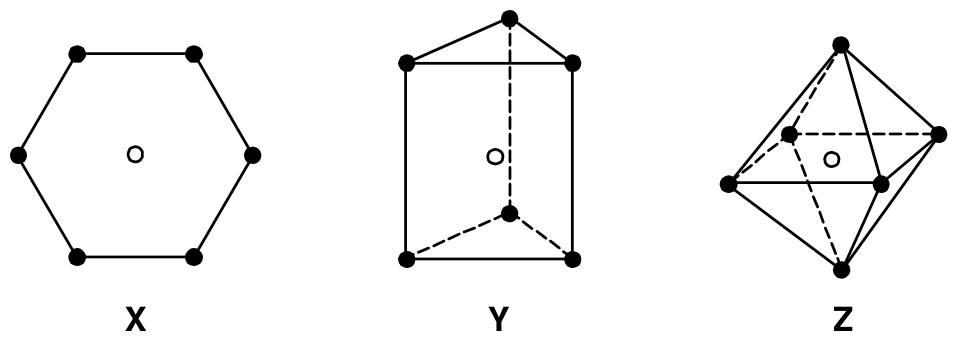
In each structure, the empty circle shows the location of the central metal atom and the filled circles show the location of the ligands. Structure X is hexagonal planar, structure Y is trigonal prismatic and structure Z is octahedral.
For each of the three shapes, there is just one structure when all of the ligands are the same, i.e. when the complex has the general formula \(\ce{MA6}\) where A is the ligand. However, when achiral ligands A are substituted by one or more achiral ligands, it may be possible for each structure to form geometrical isomers. It might also be possible for one or more of the geometrical isomers to be optically active and exist as pairs of enantiomers.
6.1 Fill in the table below to indicate how many geometrical isomers may be formed for each structure X, Y, and Z as the monodentate ligands A are substituted by monodentate ligands B or by symmetrical bidentate ligands, denoted C–C. Bidentate ligand C–C can only link between two atoms on adjacent positions, i.e. those positions connected by a line in the structures X, Y, and Z.
In each case write the number of geometrical isomers in the space provided. If one of the isomers exists as a pair of enantiomers, include an asterisk, *, in the box. If two exist as two pairs of enantiomers, include two asterisks and so on. For example, if you think there are five geometrical isomers of a particular structure, three of which exist as pairs of enantiomers, write 5 ***
Number of predicted geometrical isomers
| Hexagonal planar X | Trigonal Prismatic Y | Octahedral Z | |
|---|---|---|---|
| \(\ce{MA6}\) | 1 | 1 | 1 |
| \(\ce{MA5B}\) | |||
| \(\ce{MA4B2}\) | |||
| \(\ce{MA3B3}\) | |||
| \(\ce{MA4(C-C)}\) | |||
| \(\ce{MA2(C-C)2}\) | |||
| \(\ce{M(C-C)3}\) |
There are no known complexes that adopt the hexagonal planar geometry X, but structures are known for both the trigonal prismatic geometry Y and for the octahedral geometry Z. In these complexes, the orbitals derived from the metal d orbitals have different energies depending on the geometry of the complex. The splitting patterns for the trigonal prismatic geometry and for the octahedral geometry are shown below.
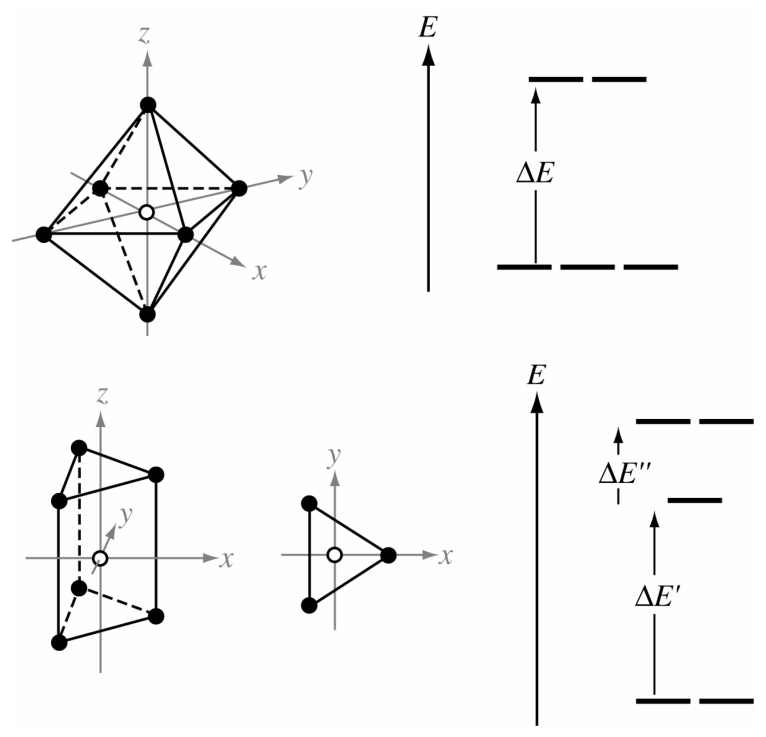
The separations in energy, \(\Delta E\), \(\Delta E'\) and \(\Delta E''\) depend on the particular complex.
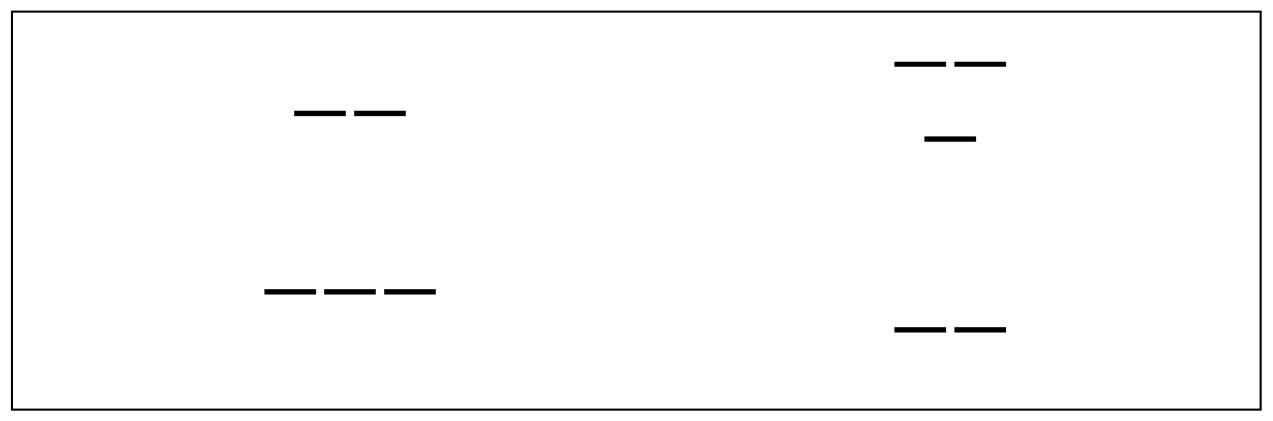
6.2 For each of the splitting patterns shown below label which d orbitals are which.
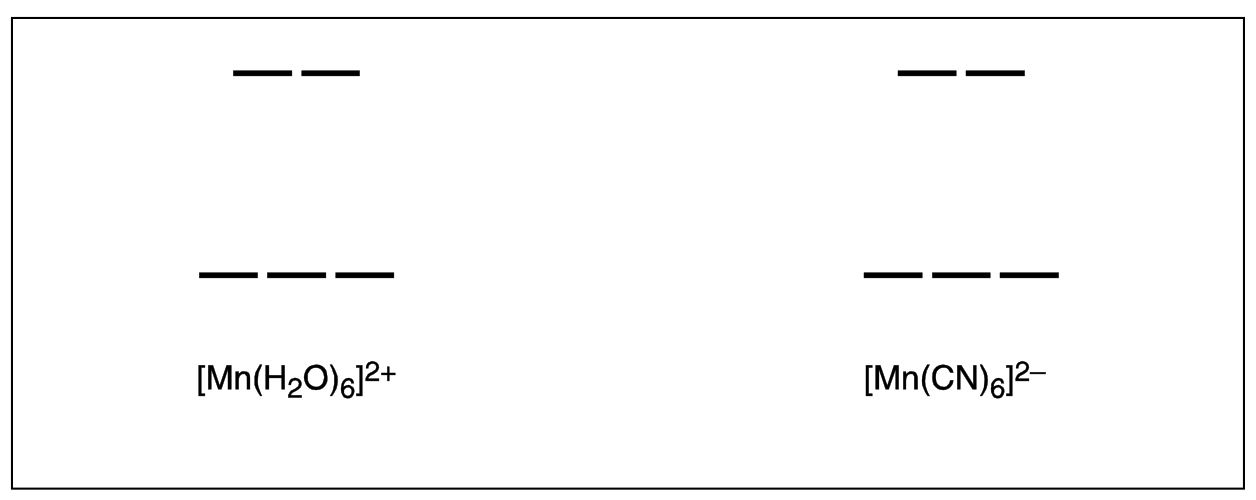
The two complexes \(\ce{[Mn(H2O)6]^2+}\) and \(\ce{[Mn(CN)6]^2-}\) are both octahedral. One has a magnetic moment of 5.9 BM, the other has a magnetic moment of 3.8 BM but you must decide which is which.
6.3 On the diagram below, draw the electronic arrangements for each of the complexes.
The magnetic moments of complexes A and B shown below have been measured and found to be 1.9 and 2.7 BM but you must decide which is which.
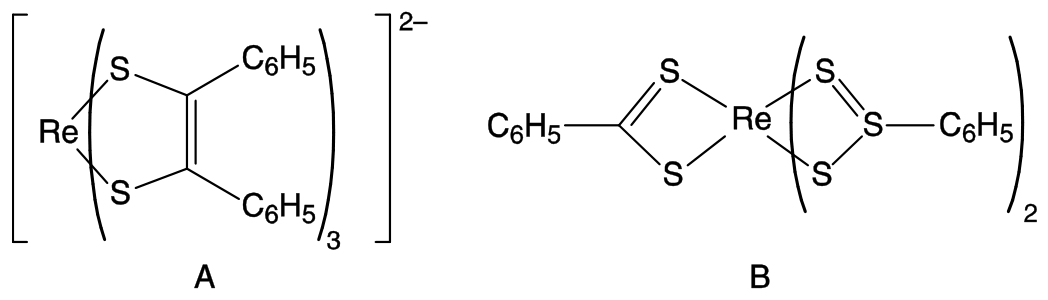
6.4 Draw the orbital splitting diagrams for the two complexes, including the arrangements of the electrons.
Octahedral complexes are far more common than trigonal prismatic. Werner isolated five compounds C – G containing Co(III), Cl, and \(\ce{NH3}\) only, each of which contained one octahedral complex. (There is actually a sixth compound but Werner could not isolate it.) Werner’s five compounds had the molar conductivities shown below. The conductivities are extrapolated to infinite dilution and are expressed in arbitrary units. Compound G does not react with aqueous \(\ce{AgNO3}\); compounds C, D, and E react with different stoichiometric ratios of aqueous \(\ce{AgNO3}\); E and F react with the same stoichiometric ratio of aqueous \(\ce{AgNO3}\).
| C | D | E | F | G | |
|---|---|---|---|---|---|
| molar conductivity | 510 | 372 | 249 | 249 | \(\sim0\) |
6.5 As far as you are able, suggest a structure for each of the compounds C – G.
Werner was also the first person to separate the enantiomers of an octahedral compound, H, which contained no carbon atoms. The compound, H, is composed of only cobalt, ammonia, chloride and an oxygen species which could be either \(\ce{H2O}\), or \(\ce{HO^-}\) or \(\ce{O^2-}\). The compound contains octahedrally coordinated cobalt ions. All of the chloride is easily removed from the compound by titration with aqueous silver nitrate. A 0.2872 g sample of H (containing no water of crystallization) required 22.8 \(\mathrm{cm^3}\) of a silver nitrate solution (\(c=0.100\ \mathrm{mol\,dm^{-3}}\)) to exchange all the chloride.
6.6 Calculate the percentage, by mass, of chloride in H.
H is stable to acids, but is hydrolysed in alkali. A 0.7934 g sample of H (containing no water of crystallization) was heated with excess aqueous sodium hydroxide. Cobalt(III) oxide was formed and ammonia gas given off. The ammonia produced was distilled off and absorbed into 50.0 \(\mathrm{cm^3}\) of aqueous \(\ce{HCl}\) (\(c_{\ce{HCl}}=0.500\ \mathrm{mol\,dm^{-3}}\)). The residual \(\ce{HCl}\) required 24.8 \(\mathrm{cm^3}\) of aqueous \(\ce{KOH}\) solution (\(c_{\ce{KOH}}=0.500\ \mathrm{mol\,dm^{-3}}\)) to be neutralized.
The remaining suspension of cobalt(III) oxide was allowed to cool, approximately 1 g of potassium iodide was added, and then the mixture was acidified with aqueous \(\ce{HCl}\). The liberated iodine was then titrated with aqueous solution of sodium thiosulfate (\(c=0.200\ \mathrm{mol\,dm^{-3}}\)) and required 21.0 \(\mathrm{cm^3}\) for complete reaction.
6.7 Calculate the percentage, by mass, of ammonia in H.
6.8 Give the equation for the reaction of cobalt(III) oxide with potassium iodide in aqueous acid.
6.9 Calculate the percentage, by mass, of cobalt in H.
6.10 Calculate the identity of the oxygen species contained in H. Show your working.
6.11 Give the empirical formula of H.
6.12 Suggest a structure for the chiral compound H.
Official English text of the problem.
Answers
Molecular names and coordination SMILES are supplied in the corresponding solution parts.
- 6.1. Each asterisk denotes one geometrical isomer that exists as an enantiomeric pair.
| Formula | Hexagonal planar X | Trigonal prismatic Y | Octahedral Z |
|---|---|---|---|
| \(\ce{MA6}\) | 1 | 1 | 1 |
| \(\ce{MA5B}\) | 1 | 1 | 1 |
| \(\ce{MA4B2}\) | 3 | \(3^*\) | 2 |
| \(\ce{MA3B3}\) | 3 | \(3^*\) | 2 |
| \(\ce{MA4(C-C)}\) | 1 | 2 | 1 |
| \(\ce{MA2(C-C)2}\) | 2 | \(4^*\) | \(2^*\) |
| \(\ce{M(C-C)3}\) | 1 | 2 | \(1^*\) |
- 6.2. From lowest to highest energy:
- Octahedral: \((d_{xy},d_{xz},d_{yz})<(d_{z^2},d_{x^2-y^2})\).
-
Trigonal prismatic, for the pattern supplied: \((d_{xy},d_{x^2-y^2})<d_{z^2}<(d_{xz},d_{yz})\).
-
6.3.
- \(\ce{[Mn(H2O)6]^2+}\): high-spin \(d^5\), \(t_{2g}^{3}e_g^{2}\), five unpaired electrons, 5.9 BM.
-
\(\ce{[Mn(CN)6]^2-}\): \(d^3\), \(t_{2g}^{3}\), three unpaired electrons, 3.8 BM.
-
6.4.
- A: Re(IV), \(d^3\), trigonal prismatic; three electrons in the lowest doublet, one unpaired; 1.9 BM.
-
B: Re(III), \(d^4\), low-spin octahedral in the intended strong-field treatment; \(t_{2g}^{4}\), two unpaired; 2.7 BM.
-
6.5.
- C: \(\ce{[Co(NH3)6]Cl3}\).
- D: \(\ce{[Co(NH3)5Cl]Cl2}\).
- E, F: cis- and trans-\(\ce{[Co(NH3)4Cl2]Cl}\), in an undetermined order.
-
G: \(\ce{[Co(NH3)3Cl3}\)], either fac or mer; the data do not distinguish them.
-
6.6. Chloride: 28.1% by mass.
- 6.7. Ammonia: 27.0% by mass.
- 6.8. \(\ce{Co2O3 + 2I^- + 6H+ -> 2Co^2+ + I2 + 3H2O}\).
- 6.9. Cobalt: 31.2% by mass.
- 6.10. The oxygen species is hydroxide, \(\ce{OH^-}\), SMILES
[OH-]. - 6.11. Empirical formula: \(\ce{Co2(NH3)6(OH)3Cl3}\), equivalently \(\ce{Co2Cl3H21N6O3}\).
- 6.12. A suitable structure is hexol chloride, \(\ce{[Co4(NH3)12(OH)6]Cl6}\): a central octahedral cobalt ion joined through three pairs of hydroxide bridges to three peripheral tetraamminecobalt centres. Its central tris-chelate arrangement gives \(\Delta\) and \(\Lambda\) enantiomers.
Solution
The coordination SMILES below use dative bonds, ->, and octahedral stereodescriptors, @OH, where appropriate. An @OH descriptor can specify geometrical configuration even when the complex is achiral. Trigonal-prismatic geometry is described in words because these octahedral descriptors do not encode it.
6.1 — Geometrical and optical isomers
A pair of enantiomers counts as one geometrical isomer, with an asterisk. Ligands A, B and C–C are unspecified placeholders, so they do not have unique molecular names or molecular SMILES.
For X, number the six sites consecutively around the hexagon.
- With one B ligand, every site is equivalent.
- With two B ligands, their separation can be one, two or three edges: three isomers.
- With three B ligands, representative occupied sets are \(123\), \(124\) and \(135\): three isomers.
- One chelate can occupy any edge: one isomer.
- Two chelates have representatives \((12)(34)\) and \((12)(45)\): two isomers.
- Three chelates have the single arrangement \((12)(34)(56)\), up to symmetry.
All are achiral in the problem’s idealized planar site-and-link model: reflection in the molecular plane leaves each arrangement unchanged.
For Y, label the upper triangle \(u_1,u_2,u_3\) and the lower triangle \(l_1,l_2,l_3\), with vertical edges \(u_i l_i\). The following representatives exhaust the possibilities:
| Substitution | Representatives | Chirality |
|---|---|---|
| One B | \(u_1\) | Achiral |
| Two B | \(u_1u_2\), \(u_1l_1\), \(u_1l_2\) | Only \(u_1l_2\) is chiral |
| Three B | \(u_1u_2u_3\), \(u_1u_2l_1\), \(u_1u_2l_3\) | Only \(u_1u_2l_1\) is chiral |
| One chelate | \((u_1u_2)\), \((u_1l_1)\) | Both achiral |
| Two chelates | \((u_1l_1)(u_2l_2)\); \((u_1u_2)(u_3l_3)\); \((u_1u_2)(l_1l_2)\); \((u_1u_2)(l_1l_3)\) | Only the last is chiral |
| Three chelates | \((u_1l_1)(u_2l_2)(u_3l_3)\); \((u_1u_2)(l_1l_2)(u_3l_3)\) | Both achiral |
For example, the two B ligands in \(u_1l_2\) occupy opposite ends of a diagonal of a rectangular face. Its mirror image cannot be superimposed by a proper rotation. The same test gives the other two starred prism arrangements.
For Z:
- \(\ce{MA5B}\) has one arrangement.
- \(\ce{MA4B2}\) has cis and trans arrangements.
- \(\ce{MA3B3}\) has fac and mer arrangements.
- One chelate can occupy any octahedral edge: one arrangement.
- Two chelates leave the two A ligands either cis or trans. The cis arrangement has \(\Delta/\Lambda\) enantiomers; the trans arrangement is achiral.
- Three chelates give one geometrical arrangement with \(\Delta/\Lambda\) enantiomers.
These results give the completed table in Answers.
6.2 — Identification of the d orbitals
In an octahedral complex, the ligands lie along the coordinate axes. The orbitals directed along these axes experience greater ligand repulsion:
\[ \underbrace{d_{xy},d_{xz},d_{yz}}_{\text{lower }t_{2g}} \quad<\quad \underbrace{d_{z^2},d_{x^2-y^2}}_{\text{upper }e_g}. \]
Thus write \(d_{xy},d_{xz},d_{yz}\) on the lower three lines and \(d_{z^2},d_{x^2-y^2}\) on the upper two lines, in any order within each degenerate set.
For the supplied trigonal-prismatic pattern, with \(z\) along the prism axis:
\[ \underbrace{d_{xy},d_{x^2-y^2}}_{\text{lowest doublet}} \quad<\quad \underbrace{d_{z^2}}_{\text{middle singlet}} \quad<\quad \underbrace{d_{xz},d_{yz}}_{\text{highest doublet}}. \]
The unique singlet is \(d_{z^2}\). The other four orbitals form the two indicated symmetry-related pairs.
6.3 — Manganese electron arrangements
The spin-only magnetic moment is approximately
\[ \mu_{\mathrm{so}}=\sqrt{n(n+2)}\ \mathrm{BM}, \]
where \(n\) is the number of unpaired electrons.
The hexaaquamanganese(II) ion, \(\ce{[Mn(H2O)6]^2+}\), has coordination SMILES:
[Mn+2](<-[OH2])(<-[OH2])(<-[OH2])(<-[OH2])(<-[OH2])<-[OH2]
Water is neutral, so manganese is in oxidation state \(+2\). Manganese is a group-7 element; therefore Mn(II) is \(d^5\). With weak-field water ligands, it is high spin:
\[ t_{2g}:\ [\uparrow]\,[\uparrow]\,[\uparrow], \qquad e_g:\ [\uparrow]\,[\uparrow]. \]
There are five unpaired electrons:
\[ \mu_{\mathrm{so}}=\sqrt{5(5+2)}=\sqrt{35}=5.92\ \mathrm{BM}. \]
It therefore has the measured moment 5.9 BM.
The hexacyanidomanganate(IV) ion, \(\ce{[Mn(CN)6]^2-}\), has coordination SMILES:
[Mn+4](<-[C-]#N)(<-[C-]#N)(<-[C-]#N)(<-[C-]#N)(<-[C-]#N)<-[C-]#N
Each cyanido ligand has charge \(-1\), so
\[ x+6(-1)=-2 \quad\Longrightarrow\quad x=+4. \]
Mn(IV) is \(d^3\), giving
\[ t_{2g}:\ [\uparrow]\,[\uparrow]\,[\uparrow], \qquad e_g:\ [\ ]\,[\ ]. \]
Thus
\[ \mu_{\mathrm{so}}=\sqrt{3(3+2)}=\sqrt{15}=3.87\ \mathrm{BM}, \]
corresponding to the measured 3.8 BM. Both complexes are octahedral; the difference in electron count is essential.
6.4 — Rhenium electron arrangements
In A, each ene-dithiolate ligand is dianionic. Consequently,
\[ x+3(-2)=-2 \quad\Longrightarrow\quad x=+4. \]
Rhenium is a group-7 element, so Re(IV) is \(d^3\).
A is the tris[(Z)-1,2-diphenylethene-1,2-dithiolato]rhenate(IV) ion, represented by the connectivity SMILES:
[Re+4]123(<-[S-]/C(c4ccccc4)=C(\[S-]->1)c4ccccc4)(<-[S-]/C(c4ccccc4)=C(\[S-]->2)c4ccccc4)<-[S-]/C(c4ccccc4)=C(\[S-]->3)c4ccccc4
An octahedral \(d^3\) ion would have three unpaired electrons. The smaller magnetic moment instead corresponds to one unpaired electron, obtained in the supplied trigonal-prismatic splitting:
| Level in A, highest first | Occupation |
|---|---|
| \(d_{xz},d_{yz}\) | \([\ ]\,[\ ]\) |
| \(d_{z^2}\) | \([\ ]\) |
| \(d_{xy},d_{x^2-y^2}\) | \([\uparrow\downarrow]\,[\uparrow]\) |
The choice of which member of the lowest doublet contains the pair is arbitrary. With one unpaired electron,
\[ \mu_{\mathrm{so}}=\sqrt{3}=1.73\ \mathrm{BM}, \]
consistent with assigning the observed 1.9 BM to A. Its coordination geometry is trigonal prismatic, which the connectivity SMILES does not itself specify.
In B, each sulfur chelate is monoanionic. Since the complex is neutral,
\[ x+3(-1)=0 \quad\Longrightarrow\quad x=+3, \]
so Re(III) is \(d^4\).
Reading the central S in the right-hand repeated ligand literally, B is bis(benzenedithiosulfinato)(dithiobenzoato)rhenium(III), with connectivity SMILES:
[Re+3]123(<-S=C(c4ccccc4)[S-]->1)(<-S=S(c4ccccc4)[S-]->2)<-S=S(c4ccccc4)[S-]->3
Under the strong-field treatment intended for these 5d complexes, B has the low-spin octahedral arrangement:
| Level in B, highest first | Occupation |
|---|---|
| \(e_g: d_{z^2},d_{x^2-y^2}\) | \([\ ]\,[\ ]\) |
| \(t_{2g}: d_{xy},d_{xz},d_{yz}\) | \([\uparrow\downarrow]\,[\uparrow]\,[\uparrow]\) |
There are two unpaired electrons:
\[ \mu_{\mathrm{so}}=\sqrt{8}=2.83\ \mathrm{BM}, \]
corresponding to 2.7 BM. The displayed connectivity leaves its handedness unspecified, as does the problem’s drawing.
6.5 — Werner’s cobalt compounds
Co(III) has coordination number six. Ammonia is neutral, whereas each coordinated chlorido ligand lowers the complex charge by one:
\[ \ce{[Co(NH3)_{6-k}Cl_k]^{(3-k)+}}. \]
The remaining chloride ions are counterions. These precipitate with silver ions, whereas coordinated chloride is not immediately removed in the stated test.
The conductivity sequence is consistent with four, three, two, two and zero ions per formula unit:
| Compound | Structure | Counterion chlorides | Dissolved ions per formula unit |
|---|---|---|---|
| C | \(\ce{[Co(NH3)6]Cl3}\) | 3 | 4 |
| D | \(\ce{[Co(NH3)5Cl]Cl2}\) | 2 | 3 |
| E | One isomer of \(\ce{[Co(NH3)4Cl2]Cl}\) | 1 | 2 |
| F | The other isomer of \(\ce{[Co(NH3)4Cl2]Cl}\) | 1 | 2 |
| G | \(\ce{[Co(NH3)3Cl3]}\) | 0 | 0 |
The structures, names and SMILES are:
- C: hexaamminecobalt(III) chloride
[Co+3](<-[NH3])(<-[NH3])(<-[NH3])(<-[NH3])(<-[NH3])<-[NH3].[Cl-].[Cl-].[Cl-]
- D: pentaamminechloridocobalt(III) chloride
[Co+3](<-[Cl-])(<-[NH3])(<-[NH3])(<-[NH3])(<-[NH3])<-[NH3].[Cl-].[Cl-]
- One of E/F: cis-tetraamminedichloridocobalt(III) chloride, with adjacent chlorido ligands, at \(90^\circ\):
[Co@OH21+3](<-[Cl-])(<-[Cl-])(<-[NH3])(<-[NH3])(<-[NH3])<-[NH3].[Cl-]
- The other of E/F: trans-tetraamminedichloridocobalt(III) chloride, with opposite chlorido ligands, at \(180^\circ\):
[Co@OH27+3](<-[Cl-])(<-[Cl-])(<-[NH3])(<-[NH3])(<-[NH3])<-[NH3].[Cl-]
- G may be fac-triamminetrichloridocobalt(III), with all three chlorido ligands mutually cis on one triangular face:
[Co@OH6+3](<-[Cl-])(<-[Cl-])(<-[Cl-])(<-[NH3])(<-[NH3])<-[NH3]
- Alternatively, G may be mer-triamminetrichloridocobalt(III), with two chlorido ligands trans and the third cis to both:
[Co@OH27+3](<-[Cl-])(<-[Cl-])(<-[Cl-])(<-[NH3])(<-[NH3])<-[NH3]
Neither conductivity nor the chloride-precipitation result distinguishes E from F, or fac-G from mer-G. The other geometrical isomer of G is the sixth compound mentioned in the question.
6.6 — Mass percentage of chloride
For the numerical calculations, use standard molar masses
\[ M(\ce{Cl})=35.45,\qquad M(\ce{NH3})=17.03,\qquad M(\ce{Co})=58.93 \quad\mathrm{g\,mol^{-1}}. \]
Chloride ion, [Cl-], precipitates with silver(I) ion, [Ag+], in a 1:1 ratio:
\[ \ce{Ag+ + Cl^- -> AgCl(s)}. \]
Silver chloride has the stoichiometric ionic SMILES [Ag+].[Cl-]; this does not describe its crystal lattice.
\[ n(\ce{Cl^-}) =(0.100\ \mathrm{mol\,dm^{-3}}) (22.8\times10^{-3}\ \mathrm{dm^3}) =2.28\times10^{-3}\ \mathrm{mol}. \]
Therefore,
\[ m(\ce{Cl^-}) =(2.28\times10^{-3})(35.45) =0.080826\ \mathrm{g}, \]
and
\[ \boxed{ w(\ce{Cl^-}) =\frac{0.080826}{0.2872}\times100 =28.1\% }. \]
6.7 — Mass percentage of ammonia
Ammonia, N, consumes one equivalent of acid to form ammonium ion, [NH4+]:
\[ \ce{NH3 + H+ -> NH4+}. \]
The remaining acid is measured by
\[ \ce{H+ + OH^- -> H2O}. \]
Here the hydron, hydroxide ion and water have SMILES [H+], [OH-] and O, respectively.
Initially,
\[ n_0(\ce{H+}) =(0.500)(50.0\times10^{-3}) =0.0250\ \mathrm{mol}. \]
The residual acid is
\[ n_{\mathrm{res}}(\ce{H+}) =(0.500)(24.8\times10^{-3}) =0.0124\ \mathrm{mol}. \]
Hence,
\[ n(\ce{NH3})=0.0250-0.0124=0.0126\ \mathrm{mol}, \]
\[ m(\ce{NH3})=(0.0126)(17.03)=0.2146\ \mathrm{g}, \]
and
\[ \boxed{ w(\ce{NH3}) =\frac{0.2146}{0.7934}\times100 =27.0\% }. \]
6.8 — Reaction of cobalt(III) oxide with iodide
Cobalt(III) is reduced to cobalt(II), while iodide is oxidized to iodine:
\[ \ce{Co2O3 + 6H+ + 2e^- -> 2Co^2+ + 3H2O}, \]
\[ \ce{2I^- -> I2 + 2e^-}. \]
Adding gives
\[ \boxed{\ce{Co2O3 + 2I^- + 6H+ -> 2Co^2+ + I2 + 3H2O}}. \]
The relevant species are cobalt(III) oxide, stoichiometric ionic SMILES [Co+3].[Co+3].[O-2].[O-2].[O-2]; iodide ion, [I-]; cobalt(II) ion, [Co+2]; and iodine, II. Cobalt(III) oxide is an extended solid, so its ionic SMILES specifies composition rather than lattice structure.
6.9 — Mass percentage of cobalt
Iodine reacts with thiosulfate according to
\[ \ce{I2 + 2S2O3^2- -> 2I^- + S4O6^2-}. \]
The ions are thiosulfate, [O-]S(=O)(=O)[S-], and tetrathionate, [O-]S(=O)(=O)SSS(=O)(=O)[O-].
Thus,
\[ n(\ce{S2O3^2-}) =(0.200)(21.0\times10^{-3}) =4.20\times10^{-3}\ \mathrm{mol}, \]
\[ n(\ce{I2})=\frac{4.20\times10^{-3}}{2} =2.10\times10^{-3}\ \mathrm{mol}. \]
From the equation in 6.8, two cobalt atoms correspond to one iodine molecule:
\[ n(\ce{Co})=2n(\ce{I2}) =4.20\times10^{-3}\ \mathrm{mol}. \]
Consequently,
\[ m(\ce{Co})=(4.20\times10^{-3})(58.93) =0.2475\ \mathrm{g}, \]
\[ \boxed{ w(\ce{Co}) =\frac{0.2475}{0.7934}\times100 =31.2\% }. \]
6.10 — Identification of the oxygen species
The unassigned mass percentage is approximately
\[ 100-28.14-27.05-31.20=13.61\%. \]
This includes both oxygen and any hydrogen belonging to its species.
For the \(0.7934\ \mathrm{g}\) sample, the chloride content inferred from 6.6 is
\[ n(\ce{Cl^-}) =(2.280\times10^{-3}) \frac{0.7934}{0.2872} \approx6.30\times10^{-3}\ \mathrm{mol}. \]
The cobalt and ammonia amounts therefore give
\[ \ce{Co}:\ce{NH3}:\ce{Cl^-} = 0.00420:0.0126:0.00630 = 1:3:1.5. \]
With cobalt in oxidation state \(+3\) and ammonia neutral, the oxygen species must supply
\[ 3-1.5=1.5 \]
negative charge units per cobalt atom.
The remaining mass per mole of cobalt is approximately
\[ \frac{0.1361(0.7934\ \mathrm{g})} {0.00420\ \mathrm{mol}} =25.7\ \mathrm{g\,mol^{-1}} \]
per mole of cobalt. Compare the candidates:
| Candidate | Amount required per cobalt by charge balance | Predicted remaining mass per mole of cobalt |
|---|---|---|
Water, \(\ce{H2O}\), O |
Cannot supply negative charge | Inconsistent |
Hydroxide, \(\ce{OH^-}\), [OH-] |
1.5 mol | \(1.5(17.01)=25.5\ \mathrm{g}\) |
Oxide, \(\ce{O^2-}\), [O-2] |
0.75 mol | \(0.75(16.00)=12.0\ \mathrm{g}\) |
The measured residual mass agrees with hydroxide:
\[ \boxed{\text{The oxygen species is }\ce{OH^-}.} \]
6.11 — Empirical formula
The component ratio is
\[ \ce{Co}:\ce{NH3}:\ce{OH^-}:\ce{Cl^-} =1:3:1.5:1.5. \]
Multiplying by two gives the smallest integral ratio:
\[ \boxed{\ce{Co2(NH3)6(OH)3Cl3}}. \]
On an elemental basis this is
\[ \boxed{\ce{Co2Cl3H21N6O3}}. \]
An empirical formula specifies a ratio, not a unique molecular graph. The molecular structure and SMILES proposed for H follow in 6.12.
6.12 — Structure and chirality of H
A suitable structure is hexol chloride, also described as dodecaamminehexa-μ-hydroxidotetracobalt(III) chloride:
\[ \boxed{ \ce{[Co((OH)2Co(NH3)4)3]Cl6} = \ce{[Co4(NH3)12(OH)6]Cl6} }. \]
Describe the drawing as follows:
- Place one cobalt(III) ion at the centre of an octahedron.
- Put six hydroxide oxygen donors at its six vertices.
- Divide those donors into three adjacent pairs.
- Connect each pair to one peripheral cobalt(III) ion, so each hydroxide bridges the central and a peripheral cobalt.
- Complete each peripheral cobalt’s octahedron with four ammonia ligands. Its two bridging oxygen donors are cis.
- Place six chloride counterions outside the coordination sphere.
Every cobalt is six-coordinate:
- The central cobalt binds six hydroxide donors.
- Each peripheral cobalt binds two hydroxide donors and four ammonia ligands.
The complex-ion charge is
\[ 4(+3)+6(-1)=+6, \]
requiring six chloride counterions. Its composition is twice the empirical formula obtained in 6.11.
For a precise stereochemical sketch, put the central donors on the \(\pm x,\pm y,\pm z\) axes and pair them as
\[ (+x,+y),\qquad(-x,+z),\qquad(-y,-z). \]
Each pair connects to a different peripheral cobalt. Reflecting this arrangement gives the opposite hand. The three paired bridges act as three bidentate ligands around the central cobalt, producing the familiar \(\Delta/\Lambda\) tris-chelate enantiomers.
The two enantiomers of hexol chloride can be represented by the following coordination SMILES:
[Co@OH8+3]123(<-[OH-]->[Co+3](<-[NH3])(<-[NH3])(<-[NH3])(<-[NH3])<-[OH-]->1)(<-[OH-]->[Co+3](<-[NH3])(<-[NH3])(<-[NH3])(<-[NH3])<-[OH-]->2)<-[OH-]->[Co+3](<-[NH3])(<-[NH3])(<-[NH3])(<-[NH3])<-[OH-]->3.[Cl-].[Cl-].[Cl-].[Cl-].[Cl-].[Cl-]
[Co@OH10+3]123(<-[OH-]->[Co+3](<-[NH3])(<-[NH3])(<-[NH3])(<-[NH3])<-[OH-]->1)(<-[OH-]->[Co+3](<-[NH3])(<-[NH3])(<-[NH3])(<-[NH3])<-[OH-]->2)<-[OH-]->[Co+3](<-[NH3])(<-[NH3])(<-[NH3])(<-[NH3])<-[OH-]->3.[Cl-].[Cl-].[Cl-].[Cl-].[Cl-].[Cl-]
The @OH8 and @OH10 indices specify opposite configurations for this particular SMILES atom order; they are not signs of optical rotation. The peripheral cis coordination and the octahedral geometries are as described above.
The solution was checked against the official solution.
IChO 2009 · Theorieaufgabe 6
Übergangsmetallkomplexe
Alfred Werner nutzte die Methode der „Isomerenzählung“, um die Struktur von Metallkomplexen mit der Koordinationszahl sechs abzuleiten. Drei der von ihm betrachteten Geometrien sind unten dargestellt.
In jeder Struktur zeigt der leere Kreis die Position des zentralen Metallatoms und die ausgefüllten Kreise zeigen die Positionen der Liganden. Struktur X ist hexagonal-planar, Struktur Y trigonal-prismatisch und Struktur Z oktaedrisch.
Für jede der drei Geometrien gibt es nur eine Struktur, wenn alle Liganden gleich sind, d. h., wenn der Komplex die allgemeine Formel \(\ce{MA6}\) hat, wobei A der Ligand ist. Werden jedoch achirale Liganden A durch einen oder mehrere achirale Liganden ersetzt, kann jede Struktur möglicherweise geometrische Isomere bilden. Außerdem können eines oder mehrere der geometrischen Isomere optisch aktiv sein und als Enantiomerenpaare vorliegen.
6.1 Tragen Sie in die folgende Tabelle ein, wie viele geometrische Isomere für jede der Strukturen X, Y und Z entstehen können, wenn die einzähnigen Liganden A durch einzähnige Liganden B oder durch symmetrische zweizähnige Liganden, bezeichnet als C–C, ersetzt werden. Der zweizähnige Ligand C–C kann nur zwei Atome an benachbarten Positionen miteinander verbinden, d. h. an Positionen, die in den Strukturen X, Y und Z durch eine Linie verbunden sind.
Schreiben Sie jeweils die Anzahl der geometrischen Isomere in das dafür vorgesehene Feld. Wenn eines der Isomere als Enantiomerenpaar vorliegt, fügen Sie im Feld ein Sternchen, *, hinzu. Wenn zwei als zwei Enantiomerenpaare vorliegen, fügen Sie zwei Sternchen hinzu und so weiter. Wenn Sie beispielsweise annehmen, dass es fünf geometrische Isomere einer bestimmten Struktur gibt, von denen drei als Enantiomerenpaare vorliegen, schreiben Sie 5 ***
Anzahl der vorhergesagten geometrischen Isomere
| Hexagonal-planar X | Trigonal-prismatisch Y | Oktaedrisch Z | |
|---|---|---|---|
| \(\ce{MA6}\) | 1 | 1 | 1 |
| \(\ce{MA5B}\) | |||
| \(\ce{MA4B2}\) | |||
| \(\ce{MA3B3}\) | |||
| \(\ce{MA4(C-C)}\) | |||
| \(\ce{MA2(C-C)2}\) | |||
| \(\ce{M(C-C)3}\) |
Es sind keine Komplexe bekannt, die die hexagonal-planare Geometrie X annehmen; es sind jedoch Strukturen sowohl mit der trigonal-prismatischen Geometrie Y als auch mit der oktaedrischen Geometrie Z bekannt. In diesen Komplexen haben die von den d-Orbitalen des Metalls abgeleiteten Orbitale je nach Geometrie des Komplexes unterschiedliche Energien. Die Aufspaltungsmuster für die trigonal-prismatische und die oktaedrische Geometrie sind unten dargestellt.
Die Energieabstände \(\Delta E\), \(\Delta E'\) und \(\Delta E''\) hängen vom jeweiligen Komplex ab.
6.2 Beschriften Sie für jedes der unten dargestellten Aufspaltungsmuster die Niveaus mit den zugehörigen d-Orbitalen.
Die beiden Komplexe \(\ce{[Mn(H2O)6]^2+}\) und \(\ce{[Mn(CN)6]^2-}\) sind beide oktaedrisch. Einer hat ein magnetisches Moment von 5.9 BM, der andere ein magnetisches Moment von 3.8 BM. Sie müssen entscheiden, welcher Wert zu welchem Komplex gehört.
6.3 Zeichnen Sie im folgenden Diagramm die Elektronenbesetzung für jeden der Komplexe ein.
Die magnetischen Momente der unten dargestellten Komplexe A und B wurden gemessen und betragen 1.9 und 2.7 BM. Sie müssen entscheiden, welcher Wert zu welchem Komplex gehört.
6.4 Zeichnen Sie die Orbitalaufspaltungsdiagramme für die beiden Komplexe einschließlich der Elektronenbesetzung.
Oktaedrische Komplexe sind weitaus häufiger als trigonal-prismatische. Werner isolierte fünf Verbindungen C – G, die ausschließlich Co(III), Cl und \(\ce{NH3}\) enthielten und jeweils einen oktaedrischen Komplex aufwiesen. (Tatsächlich gibt es eine sechste Verbindung, doch Werner konnte sie nicht isolieren.) Werners fünf Verbindungen hatten die unten angegebenen molaren Leitfähigkeiten. Die Leitfähigkeiten sind auf unendliche Verdünnung extrapoliert und in willkürlichen Einheiten angegeben. Verbindung G reagiert nicht mit wässrigem \(\ce{AgNO3}\); die Verbindungen C, D und E reagieren in unterschiedlichen stöchiometrischen Verhältnissen mit wässrigem \(\ce{AgNO3}\); E und F reagieren im gleichen stöchiometrischen Verhältnis mit wässrigem \(\ce{AgNO3}\).
| C | D | E | F | G | |
|---|---|---|---|---|---|
| Molare Leitfähigkeit | 510 | 372 | 249 | 249 | \(\sim0\) |
6.5 Schlagen Sie, soweit möglich, für jede der Verbindungen C – G eine Struktur vor.
Werner war außerdem der Erste, der die Enantiomere einer oktaedrischen Verbindung H trennte, die keine Kohlenstoffatome enthielt. Die Verbindung H besteht nur aus Cobalt, Ammoniak, Chlorid und einer Sauerstoffspezies, bei der es sich um \(\ce{H2O}\), \(\ce{HO^-}\) oder \(\ce{O^2-}\) handeln könnte. Die Verbindung enthält oktaedrisch koordinierte Cobaltionen. Das gesamte Chlorid lässt sich durch Titration mit wässriger Silbernitratlösung leicht aus der Verbindung entfernen. Eine 0.2872 g schwere Probe von H (ohne Kristallwasser) benötigte 22.8 \(\mathrm{cm^3}\) einer Silbernitratlösung (\(c=0.100\ \mathrm{mol\,dm^{-3}}\)), um das gesamte Chlorid auszutauschen.
6.6 Berechnen Sie den Massenanteil von Chlorid in H in Prozent.
H ist gegenüber Säuren stabil, wird aber in alkalischer Lösung hydrolysiert. Eine 0.7934 g schwere Probe von H (ohne Kristallwasser) wurde mit überschüssiger wässriger Natriumhydroxidlösung erhitzt. Dabei bildete sich Cobalt(III)-oxid und gasförmiges Ammoniak wurde freigesetzt. Das entstandene Ammoniak wurde abdestilliert und in 50.0 \(\mathrm{cm^3}\) wässriger \(\ce{HCl}\) (\(c_{\ce{HCl}}=0.500\ \mathrm{mol\,dm^{-3}}\)) absorbiert. Zur Neutralisation der verbleibenden \(\ce{HCl}\) wurden 24.8 \(\mathrm{cm^3}\) einer wässrigen \(\ce{KOH}\)-Lösung (\(c_{\ce{KOH}}=0.500\ \mathrm{mol\,dm^{-3}}\)) benötigt.
Die verbleibende Suspension von Cobalt(III)-oxid wurde abkühlen gelassen, etwa 1 g Kaliumiodid wurde zugegeben, und anschließend wurde das Gemisch mit wässriger \(\ce{HCl}\) angesäuert. Das freigesetzte Iod wurde anschließend mit einer wässrigen Natriumthiosulfatlösung (\(c=0.200\ \mathrm{mol\,dm^{-3}}\)) titriert; für die vollständige Reaktion wurden 21.0 \(\mathrm{cm^3}\) benötigt.
6.7 Berechnen Sie den Massenanteil von Ammoniak in H in Prozent.
6.8 Geben Sie die Reaktionsgleichung für die Reaktion von Cobalt(III)-oxid mit Kaliumiodid in wässriger Säure an.
6.9 Berechnen Sie den Massenanteil von Cobalt in H in Prozent.
6.10 Bestimmen Sie rechnerisch die Identität der in H enthaltenen Sauerstoffspezies. Geben Sie Ihren Rechenweg an.
6.11 Geben Sie die Verhältnisformel von H an.
6.12 Schlagen Sie eine Struktur für die chirale Verbindung H vor.
Aufgabentext aus dem offiziellen englischen Text übersetzt.
Antworten
Molekülnamen und Koordinations-SMILES sind in den entsprechenden Lösungsteilen angegeben.
- 6.1. Jedes Sternchen bezeichnet ein geometrisches Isomer, das als Enantiomerenpaar vorliegt.
| Formel | Hexagonal-planar X | Trigonal-prismatisch Y | Oktaedrisch Z |
|---|---|---|---|
| \(\ce{MA6}\) | 1 | 1 | 1 |
| \(\ce{MA5B}\) | 1 | 1 | 1 |
| \(\ce{MA4B2}\) | 3 | \(3^*\) | 2 |
| \(\ce{MA3B3}\) | 3 | \(3^*\) | 2 |
| \(\ce{MA4(C-C)}\) | 1 | 2 | 1 |
| \(\ce{MA2(C-C)2}\) | 2 | \(4^*\) | \(2^*\) |
| \(\ce{M(C-C)3}\) | 1 | 2 | \(1^*\) |
- 6.2. Von der niedrigsten zur höchsten Energie:
- Oktaedrisch: \((d_{xy},d_{xz},d_{yz})<(d_{z^2},d_{x^2-y^2})\).
-
Trigonal-prismatisch, für das vorgegebene Muster: \((d_{xy},d_{x^2-y^2})<d_{z^2}<(d_{xz},d_{yz})\).
-
6.3.
- \(\ce{[Mn(H2O)6]^2+}\): High-Spin-\(d^5\), \(t_{2g}^{3}e_g^{2}\), fünf ungepaarte Elektronen, 5.9 BM.
-
\(\ce{[Mn(CN)6]^2-}\): \(d^3\), \(t_{2g}^{3}\), drei ungepaarte Elektronen, 3.8 BM.
-
6.4.
- A: Re(IV), \(d^3\), trigonal-prismatisch; drei Elektronen im niedrigsten Dublett, eines ungepaart; 1.9 BM.
-
B: Re(III), \(d^4\), oktaedrisch mit Low-Spin-Konfiguration bei der vorgesehenen Behandlung im starken Ligandenfeld; \(t_{2g}^{4}\), zwei ungepaarte Elektronen; 2.7 BM.
-
6.5.
- C: \(\ce{[Co(NH3)6]Cl3}\).
- D: \(\ce{[Co(NH3)5Cl]Cl2}\).
- E, F: cis- und trans-\(\ce{[Co(NH3)4Cl2]Cl}\), in unbestimmter Zuordnung.
-
G: \(\ce{[Co(NH3)3Cl3}\)], entweder fac oder mer; die Daten erlauben keine Unterscheidung.
-
6.6. Chlorid: 28.1 Massen-%.
- 6.7. Ammoniak: 27.0 Massen-%.
- 6.8. \(\ce{Co2O3 + 2I^- + 6H+ -> 2Co^2+ + I2 + 3H2O}\).
- 6.9. Cobalt: 31.2 Massen-%.
- 6.10. Die Sauerstoffspezies ist Hydroxid, \(\ce{OH^-}\), SMILES
[OH-]. - 6.11. Verhältnisformel: \(\ce{Co2(NH3)6(OH)3Cl3}\), gleichwertig mit \(\ce{Co2Cl3H21N6O3}\).
- 6.12. Eine geeignete Struktur ist Hexolchlorid, \(\ce{[Co4(NH3)12(OH)6]Cl6}\): ein zentrales oktaedrisches Cobaltion, das über drei Paare von Hydroxidbrücken mit drei peripheren Tetraammincobalt-Zentren verbunden ist. Seine zentrale Trischelat-Anordnung führt zu \(\Delta\)- und \(\Lambda\)-Enantiomeren.
Lösung
Die folgenden Koordinations-SMILES verwenden koordinative Bindungen, ->, und gegebenenfalls oktaedrische Stereodeskriptoren, @OH. Ein @OH-Deskriptor kann die geometrische Konfiguration auch dann angeben, wenn der Komplex achiral ist. Die trigonal-prismatische Geometrie wird in Worten beschrieben, da diese oktaedrischen Deskriptoren sie nicht codieren.
6.1 — Geometrische und optische Isomere
Ein Enantiomerenpaar zählt als ein geometrisches Isomer, das mit einem Sternchen gekennzeichnet wird. Die Liganden A, B und C–C sind nicht näher bestimmte Platzhalter und haben daher keine eindeutigen Molekülnamen oder molekularen SMILES.
Nummerieren Sie für X die sechs Positionen entlang des Sechsecks fortlaufend.
- Bei einem B-Liganden sind alle Positionen gleichwertig.
- Bei zwei B-Liganden kann ihr Abstand eine, zwei oder drei Kanten betragen: drei Isomere.
- Bei drei B-Liganden sind repräsentative Mengen besetzter Positionen \(123\), \(124\) und \(135\): drei Isomere.
- Ein Chelat kann jede beliebige Kante besetzen: ein Isomer.
- Für zwei Chelate sind \((12)(34)\) und \((12)(45)\) repräsentative Anordnungen: zwei Isomere.
- Drei Chelate ergeben bis auf Symmetrie die einzige Anordnung \((12)(34)(56)\).
Im idealisierten ebenen Modell aus Positionen und Verbindungen dieser Aufgabe sind alle achiral: Die Spiegelung an der Molekülebene lässt jede Anordnung unverändert.
Bezeichnen Sie für Y das obere Dreieck mit \(u_1,u_2,u_3\) und das untere Dreieck mit \(l_1,l_2,l_3\), mit vertikalen Kanten \(u_i l_i\). Die folgenden repräsentativen Anordnungen decken alle Möglichkeiten ab:
| Substitution | Repräsentative Anordnungen | Chiralität |
|---|---|---|
| Ein B | \(u_1\) | Achiral |
| Zwei B | \(u_1u_2\), \(u_1l_1\), \(u_1l_2\) | Nur \(u_1l_2\) ist chiral |
| Drei B | \(u_1u_2u_3\), \(u_1u_2l_1\), \(u_1u_2l_3\) | Nur \(u_1u_2l_1\) ist chiral |
| Ein Chelat | \((u_1u_2)\), \((u_1l_1)\) | Beide achiral |
| Zwei Chelate | \((u_1l_1)(u_2l_2)\); \((u_1u_2)(u_3l_3)\); \((u_1u_2)(l_1l_2)\); \((u_1u_2)(l_1l_3)\) | Nur die letzte Anordnung ist chiral |
| Drei Chelate | \((u_1l_1)(u_2l_2)(u_3l_3)\); \((u_1u_2)(l_1l_2)(u_3l_3)\) | Beide achiral |
Beispielsweise besetzen die beiden B-Liganden in \(u_1l_2\) die gegenüberliegenden Enden einer Diagonalen einer rechteckigen Seitenfläche. Ihr Spiegelbild lässt sich durch eine eigentliche Drehung nicht zur Deckung bringen. Dasselbe Kriterium ergibt die beiden anderen mit einem Sternchen gekennzeichneten Prismen-Anordnungen.
Für Z gilt:
- \(\ce{MA5B}\) hat eine Anordnung.
- \(\ce{MA4B2}\) hat cis- und trans-Anordnungen.
- \(\ce{MA3B3}\) hat fac- und mer-Anordnungen.
- Ein Chelat kann jede beliebige Oktaederkante besetzen: eine Anordnung.
- Zwei Chelate lassen die beiden A-Liganden entweder cis oder trans zueinander stehen. Die cis-Anordnung besitzt \(\Delta/\Lambda\)-Enantiomere; die trans-Anordnung ist achiral.
- Drei Chelate ergeben eine geometrische Anordnung mit \(\Delta/\Lambda\)-Enantiomeren.
Diese Ergebnisse liefern die ausgefüllte Tabelle unter Antworten.
6.2 — Zuordnung der d-Orbitale
In einem oktaedrischen Komplex liegen die Liganden auf den Koordinatenachsen. Die entlang dieser Achsen ausgerichteten Orbitale erfahren eine stärkere Abstoßung durch die Liganden:
\[ \underbrace{d_{xy},d_{xz},d_{yz}}_{\text{untere }t_{2g}} \quad<\quad \underbrace{d_{z^2},d_{x^2-y^2}}_{\text{obere }e_g}. \]
Schreiben Sie daher \(d_{xy},d_{xz},d_{yz}\) an die unteren drei Linien und \(d_{z^2},d_{x^2-y^2}\) an die oberen zwei Linien, innerhalb jeder entarteten Gruppe in beliebiger Reihenfolge.
Für das vorgegebene trigonal-prismatische Muster, bei dem \(z\) entlang der Prismenachse verläuft:
\[ \underbrace{d_{xy},d_{x^2-y^2}}_{\text{niedrigstes Dublett}} \quad<\quad \underbrace{d_{z^2}}_{\text{mittleres Singulett}} \quad<\quad \underbrace{d_{xz},d_{yz}}_{\text{höchstes Dublett}}. \]
Das einzige Singulett ist \(d_{z^2}\). Die übrigen vier Orbitale bilden die beiden angegebenen, jeweils durch Symmetrie verknüpften Paare.
6.3 — Elektronenbesetzung der Mangankomplexe
Das magnetische Moment bei ausschließlicher Berücksichtigung des Spins beträgt näherungsweise
\[ \mu_{\mathrm{so}}=\sqrt{n(n+2)}\ \mathrm{BM}, \]
wobei \(n\) die Anzahl ungepaarter Elektronen ist.
Das Hexaaquamangan(II)-Ion, \(\ce{[Mn(H2O)6]^2+}\), hat die Koordinations-SMILES:
[Mn+2](<-[OH2])(<-[OH2])(<-[OH2])(<-[OH2])(<-[OH2])<-[OH2]
Wasser ist neutral, daher liegt Mangan in der Oxidationsstufe \(+2\) vor. Mangan ist ein Element der Gruppe 7; Mn(II) hat daher die Konfiguration \(d^5\). Mit den schwachen Feldliganden Wasser liegt eine High-Spin-Konfiguration vor:
\[ t_{2g}:\ [\uparrow]\,[\uparrow]\,[\uparrow], \qquad e_g:\ [\uparrow]\,[\uparrow]. \]
Es gibt fünf ungepaarte Elektronen:
\[ \mu_{\mathrm{so}}=\sqrt{5(5+2)}=\sqrt{35}=5.92\ \mathrm{BM}. \]
Damit besitzt es das gemessene Moment von 5.9 BM.
Das Hexacyanidomanganat(IV)-Ion, \(\ce{[Mn(CN)6]^2-}\), hat die Koordinations-SMILES:
[Mn+4](<-[C-]#N)(<-[C-]#N)(<-[C-]#N)(<-[C-]#N)(<-[C-]#N)<-[C-]#N
Jeder Cyanido-Ligand hat die Ladung \(-1\), also gilt
\[ x+6(-1)=-2 \quad\Longrightarrow\quad x=+4. \]
Mn(IV) hat die Konfiguration \(d^3\), woraus sich ergibt:
\[ t_{2g}:\ [\uparrow]\,[\uparrow]\,[\uparrow], \qquad e_g:\ [\ ]\,[\ ]. \]
Somit gilt
\[ \mu_{\mathrm{so}}=\sqrt{3(3+2)}=\sqrt{15}=3.87\ \mathrm{BM}, \]
entsprechend dem gemessenen Wert von 3.8 BM. Beide Komplexe sind oktaedrisch; der Unterschied in der Elektronenzahl ist entscheidend.
6.4 — Elektronenbesetzung der Rheniumkomplexe
In A ist jeder Endithiolat-Ligand zweifach negativ geladen. Folglich gilt
\[ x+3(-2)=-2 \quad\Longrightarrow\quad x=+4. \]
Rhenium ist ein Element der Gruppe 7, daher hat Re(IV) die Konfiguration \(d^3\).
A ist das Tris[(Z)-1,2-diphenylethen-1,2-dithiolato]rhenat(IV)-Ion, dargestellt durch die Konnektivitäts-SMILES:
[Re+4]123(<-[S-]/C(c4ccccc4)=C(\[S-]->1)c4ccccc4)(<-[S-]/C(c4ccccc4)=C(\[S-]->2)c4ccccc4)<-[S-]/C(c4ccccc4)=C(\[S-]->3)c4ccccc4
Ein oktaedrisches \(d^3\)-Ion hätte drei ungepaarte Elektronen. Das kleinere magnetische Moment entspricht dagegen einem ungepaarten Elektron, das sich bei der vorgegebenen trigonal-prismatischen Aufspaltung ergibt:
| Niveau in A, höchstes zuerst | Besetzung |
|---|---|
| \(d_{xz},d_{yz}\) | \([\ ]\,[\ ]\) |
| \(d_{z^2}\) | \([\ ]\) |
| \(d_{xy},d_{x^2-y^2}\) | \([\uparrow\downarrow]\,[\uparrow]\) |
Welches der beiden Orbitale des niedrigsten Dubletts das Elektronenpaar enthält, ist beliebig. Bei einem ungepaarten Elektron gilt
\[ \mu_{\mathrm{so}}=\sqrt{3}=1.73\ \mathrm{BM}, \]
was mit der Zuordnung des beobachteten Wertes von 1.9 BM zu A vereinbar ist. Seine Koordinationsgeometrie ist trigonal-prismatisch; dies wird durch die Konnektivitäts-SMILES selbst nicht angegeben.
In B ist jeder Schwefel-Chelatligand einfach negativ geladen. Da der Komplex neutral ist, gilt
\[ x+3(-1)=0 \quad\Longrightarrow\quad x=+3, \]
also hat Re(III) die Konfiguration \(d^4\).
Wenn man das zentrale S im rechts dargestellten, wiederholten Liganden wörtlich nimmt, ist B Bis(benzoldithiosulfinato)(dithiobenzoato)rhenium(III) mit der Konnektivitäts-SMILES:
[Re+3]123(<-S=C(c4ccccc4)[S-]->1)(<-S=S(c4ccccc4)[S-]->2)<-S=S(c4ccccc4)[S-]->3
Bei der für diese 5d-Komplexe vorgesehenen Behandlung im starken Ligandenfeld hat B die oktaedrische Low-Spin-Anordnung:
| Niveau in B, höchstes zuerst | Besetzung |
|---|---|
| \(e_g: d_{z^2},d_{x^2-y^2}\) | \([\ ]\,[\ ]\) |
| \(t_{2g}: d_{xy},d_{xz},d_{yz}\) | \([\uparrow\downarrow]\,[\uparrow]\,[\uparrow]\) |
Es gibt zwei ungepaarte Elektronen:
\[ \mu_{\mathrm{so}}=\sqrt{8}=2.83\ \mathrm{BM}, \]
entsprechend 2.7 BM. Die dargestellte Konnektivität lässt die Händigkeit offen, ebenso wie die Zeichnung in der Aufgabenstellung.
6.5 — Werners Cobaltverbindungen
Co(III) hat die Koordinationszahl sechs. Ammoniak ist neutral, während jeder koordinierte Chlorido-Ligand die Komplexladung um eins verringert:
\[ \ce{[Co(NH3)_{6-k}Cl_k]^{(3-k)+}}. \]
Die übrigen Chloridionen sind Gegenionen. Diese werden mit Silberionen gefällt, während koordiniertes Chlorid beim angegebenen Nachweis nicht sofort entfernt wird.
Die Reihenfolge der Leitfähigkeiten ist mit vier, drei, zwei, zwei und null Ionen pro Formeleinheit vereinbar:
| Verbindung | Struktur | Chlorid-Gegenionen | Gelöste Ionen pro Formeleinheit |
|---|---|---|---|
| C | \(\ce{[Co(NH3)6]Cl3}\) | 3 | 4 |
| D | \(\ce{[Co(NH3)5Cl]Cl2}\) | 2 | 3 |
| E | Ein Isomer von \(\ce{[Co(NH3)4Cl2]Cl}\) | 1 | 2 |
| F | Das andere Isomer von \(\ce{[Co(NH3)4Cl2]Cl}\) | 1 | 2 |
| G | \(\ce{[Co(NH3)3Cl3]}\) | 0 | 0 |
Die Strukturen, Namen und SMILES lauten:
- C: Hexaammincobalt(III)-chlorid
[Co+3](<-[NH3])(<-[NH3])(<-[NH3])(<-[NH3])(<-[NH3])<-[NH3].[Cl-].[Cl-].[Cl-]
- D: Pentaamminchloridocobalt(III)-chlorid
[Co+3](<-[Cl-])(<-[NH3])(<-[NH3])(<-[NH3])(<-[NH3])<-[NH3].[Cl-].[Cl-]
- Eine der Verbindungen E/F: cis-Tetraammindichloridocobalt(III)-chlorid, mit benachbarten Chlorido-Liganden im Winkel von \(90^\circ\):
[Co@OH21+3](<-[Cl-])(<-[Cl-])(<-[NH3])(<-[NH3])(<-[NH3])<-[NH3].[Cl-]
- Die andere der Verbindungen E/F: trans-Tetraammindichloridocobalt(III)-chlorid, mit gegenüberliegenden Chlorido-Liganden im Winkel von \(180^\circ\):
[Co@OH27+3](<-[Cl-])(<-[Cl-])(<-[NH3])(<-[NH3])(<-[NH3])<-[NH3].[Cl-]
- G kann fac-Triammintrichloridocobalt(III) sein, bei dem alle drei Chlorido-Liganden auf einer Dreiecksfläche paarweise cis zueinander stehen:
[Co@OH6+3](<-[Cl-])(<-[Cl-])(<-[Cl-])(<-[NH3])(<-[NH3])<-[NH3]
- Alternativ kann G mer-Triammintrichloridocobalt(III) sein, bei dem zwei Chlorido-Liganden trans zueinander und der dritte cis zu beiden steht:
[Co@OH27+3](<-[Cl-])(<-[Cl-])(<-[Cl-])(<-[NH3])(<-[NH3])<-[NH3]
Weder die Leitfähigkeit noch das Ergebnis der Chloridfällung unterscheidet E von F oder fac-G von mer-G. Das andere geometrische Isomer von G ist die in der Aufgabe erwähnte sechste Verbindung.
6.6 — Massenanteil von Chlorid in Prozent
Für die numerischen Berechnungen werden die üblichen molaren Massen verwendet:
\[ M(\ce{Cl})=35.45,\qquad M(\ce{NH3})=17.03,\qquad M(\ce{Co})=58.93 \quad\mathrm{g\,mol^{-1}}. \]
Chloridionen, [Cl-], werden mit Silber(I)-Ionen, [Ag+], im Verhältnis 1:1 gefällt:
\[ \ce{Ag+ + Cl^- -> AgCl(s)}. \]
Silberchlorid hat die stöchiometrische ionische SMILES [Ag+].[Cl-]; diese beschreibt nicht sein Kristallgitter.
\[ n(\ce{Cl^-}) =(0.100\ \mathrm{mol\,dm^{-3}}) (22.8\times10^{-3}\ \mathrm{dm^3}) =2.28\times10^{-3}\ \mathrm{mol}. \]
Damit gilt
\[ m(\ce{Cl^-}) =(2.28\times10^{-3})(35.45) =0.080826\ \mathrm{g}, \]
und
\[ \boxed{ w(\ce{Cl^-}) =\frac{0.080826}{0.2872}\times100 =28.1\% }. \]
6.7 — Massenanteil von Ammoniak in Prozent
Ammoniak, N, verbraucht ein Äquivalent Säure und bildet dabei ein Ammoniumion, [NH4+]:
\[ \ce{NH3 + H+ -> NH4+}. \]
Die verbleibende Säure wird durch folgende Reaktion bestimmt:
\[ \ce{H+ + OH^- -> H2O}. \]
Hier haben das Hydron, das Hydroxidion und Wasser die SMILES [H+], [OH-] bzw. O.
Anfangs gilt
\[ n_0(\ce{H+}) =(0.500)(50.0\times10^{-3}) =0.0250\ \mathrm{mol}. \]
Die verbleibende Säuremenge beträgt
\[ n_{\mathrm{res}}(\ce{H+}) =(0.500)(24.8\times10^{-3}) =0.0124\ \mathrm{mol}. \]
Daraus folgt
\[ n(\ce{NH3})=0.0250-0.0124=0.0126\ \mathrm{mol}, \]
\[ m(\ce{NH3})=(0.0126)(17.03)=0.2146\ \mathrm{g}, \]
und
\[ \boxed{ w(\ce{NH3}) =\frac{0.2146}{0.7934}\times100 =27.0\% }. \]
6.8 — Reaktion von Cobalt(III)-oxid mit Iodid
Cobalt(III) wird zu Cobalt(II) reduziert, während Iodid zu Iod oxidiert wird:
\[ \ce{Co2O3 + 6H+ + 2e^- -> 2Co^2+ + 3H2O}, \]
\[ \ce{2I^- -> I2 + 2e^-}. \]
Durch Addition ergibt sich
\[ \boxed{\ce{Co2O3 + 2I^- + 6H+ -> 2Co^2+ + I2 + 3H2O}}. \]
Die beteiligten Spezies sind Cobalt(III)-oxid, stöchiometrische ionische SMILES [Co+3].[Co+3].[O-2].[O-2].[O-2]; das Iodidion, [I-]; das Cobalt(II)-Ion, [Co+2]; und Iod, II. Cobalt(III)-oxid ist ein ausgedehnter Festkörper, daher gibt seine ionische SMILES die Zusammensetzung und nicht die Gitterstruktur an.
6.9 — Massenanteil von Cobalt in Prozent
Iod reagiert mit Thiosulfat gemäß
\[ \ce{I2 + 2S2O3^2- -> 2I^- + S4O6^2-}. \]
Die Ionen sind Thiosulfat, [O-]S(=O)(=O)[S-], und Tetrathionat, [O-]S(=O)(=O)SSS(=O)(=O)[O-].
Somit gilt
\[ n(\ce{S2O3^2-}) =(0.200)(21.0\times10^{-3}) =4.20\times10^{-3}\ \mathrm{mol}, \]
\[ n(\ce{I2})=\frac{4.20\times10^{-3}}{2} =2.10\times10^{-3}\ \mathrm{mol}. \]
Nach der Gleichung in 6.8 entsprechen zwei Cobaltatome einem Iodmolekül:
\[ n(\ce{Co})=2n(\ce{I2}) =4.20\times10^{-3}\ \mathrm{mol}. \]
Folglich gilt
\[ m(\ce{Co})=(4.20\times10^{-3})(58.93) =0.2475\ \mathrm{g}, \]
\[ \boxed{ w(\ce{Co}) =\frac{0.2475}{0.7934}\times100 =31.2\% }. \]
6.10 — Identifizierung der Sauerstoffspezies
Der noch nicht zugeordnete Massenanteil beträgt näherungsweise
\[ 100-28.14-27.05-31.20=13.61\%. \]
Dieser umfasst sowohl Sauerstoff als auch etwaigen Wasserstoff, der zu seiner Spezies gehört.
Für die \(0.7934\ \mathrm{g}\) schwere Probe ergibt sich aus 6.6 der Chloridgehalt
\[ n(\ce{Cl^-}) =(2.280\times10^{-3}) \frac{0.7934}{0.2872} \approx6.30\times10^{-3}\ \mathrm{mol}. \]
Die Stoffmengen von Cobalt und Ammoniak ergeben daher
\[ \ce{Co}:\ce{NH3}:\ce{Cl^-} = 0.00420:0.0126:0.00630 = 1:3:1.5. \]
Da Cobalt in der Oxidationsstufe \(+3\) vorliegt und Ammoniak neutral ist, muss die Sauerstoffspezies
\[ 3-1.5=1.5 \]
negative Ladungseinheiten pro Cobaltatom liefern.
Die verbleibende Masse pro Mol Cobalt beträgt näherungsweise
\[ \frac{0.1361(0.7934\ \mathrm{g})} {0.00420\ \mathrm{mol}} =25.7\ \mathrm{g\,mol^{-1}} \]
pro Mol Cobalt. Vergleichen wir die möglichen Spezies:
| Mögliche Spezies | Für den Ladungsausgleich erforderliche Menge pro Cobalt | Vorhergesagte verbleibende Masse pro Mol Cobalt |
|---|---|---|
Wasser, \(\ce{H2O}\), O |
Kann keine negative Ladung liefern | Nicht vereinbar |
Hydroxid, \(\ce{OH^-}\), [OH-] |
1.5 mol | \(1.5(17.01)=25.5\ \mathrm{g}\) |
Oxid, \(\ce{O^2-}\), [O-2] |
0.75 mol | \(0.75(16.00)=12.0\ \mathrm{g}\) |
Die gemessene Restmasse stimmt mit Hydroxid überein:
\[ \boxed{\text{Die Sauerstoffspezies ist }\ce{OH^-}.} \]
6.11 — Verhältnisformel
Das Verhältnis der Bestandteile lautet
\[ \ce{Co}:\ce{NH3}:\ce{OH^-}:\ce{Cl^-} =1:3:1.5:1.5. \]
Multiplikation mit zwei ergibt das kleinste ganzzahlige Verhältnis:
\[ \boxed{\ce{Co2(NH3)6(OH)3Cl3}}. \]
Auf die Elemente bezogen lautet dies
\[ \boxed{\ce{Co2Cl3H21N6O3}}. \]
Eine Verhältnisformel gibt ein Verhältnis an, keinen eindeutigen Molekülgraphen. Die für H vorgeschlagene Molekülstruktur und SMILES folgen in 6.12.
6.12 — Struktur und Chiralität von H
Eine geeignete Struktur ist Hexolchlorid, auch als Dodecaamminhexa-μ-hydroxidotetracobalt(III)-chlorid bezeichnet:
\[ \boxed{ \ce{[Co((OH)2Co(NH3)4)3]Cl6} = \ce{[Co4(NH3)12(OH)6]Cl6} }. \]
Die Zeichnung lässt sich folgendermaßen beschreiben:
- Platzieren Sie ein Cobalt(III)-Ion im Zentrum eines Oktaeders.
- Setzen Sie sechs Sauerstoff-Donoratome von Hydroxidionen an seine sechs Ecken.
- Teilen Sie diese Donoratome in drei benachbarte Paare auf.
- Verbinden Sie jedes Paar mit einem peripheren Cobalt(III)-Ion, sodass jedes Hydroxidion das zentrale und ein peripheres Cobaltatom verbrückt.
- Vervollständigen Sie das Oktaeder jedes peripheren Cobaltatoms mit vier Ammoniakliganden. Seine beiden verbrückenden Sauerstoff-Donoratome stehen cis zueinander.
- Platzieren Sie sechs Chlorid-Gegenionen außerhalb der Koordinationssphäre.
Jedes Cobaltatom ist sechsfach koordiniert:
- Das zentrale Cobaltatom bindet sechs Hydroxid-Donoratome.
- Jedes periphere Cobaltatom bindet zwei Hydroxid-Donoratome und vier Ammoniakliganden.
Die Ladung des Komplexions beträgt
\[ 4(+3)+6(-1)=+6, \]
weshalb sechs Chlorid-Gegenionen erforderlich sind. Seine Zusammensetzung entspricht dem Doppelten der in 6.11 erhaltenen Verhältnisformel.
Für eine genaue stereochemische Skizze setzen Sie die zentralen Donoratome auf die Achsen \(\pm x,\pm y,\pm z\) und bilden die Paare
\[ (+x,+y),\qquad(-x,+z),\qquad(-y,-z). \]
Jedes Paar ist mit einem anderen peripheren Cobaltatom verbunden. Die Spiegelung dieser Anordnung ergibt die entgegengesetzte Händigkeit. Die drei Brückenpaare wirken als drei zweizähnige Liganden um das zentrale Cobaltatom und erzeugen die bekannten \(\Delta/\Lambda\)-Trischelat-Enantiomere.
Die beiden Enantiomere von Hexolchlorid lassen sich durch die folgenden Koordinations-SMILES darstellen:
[Co@OH8+3]123(<-[OH-]->[Co+3](<-[NH3])(<-[NH3])(<-[NH3])(<-[NH3])<-[OH-]->1)(<-[OH-]->[Co+3](<-[NH3])(<-[NH3])(<-[NH3])(<-[NH3])<-[OH-]->2)<-[OH-]->[Co+3](<-[NH3])(<-[NH3])(<-[NH3])(<-[NH3])<-[OH-]->3.[Cl-].[Cl-].[Cl-].[Cl-].[Cl-].[Cl-]
[Co@OH10+3]123(<-[OH-]->[Co+3](<-[NH3])(<-[NH3])(<-[NH3])(<-[NH3])<-[OH-]->1)(<-[OH-]->[Co+3](<-[NH3])(<-[NH3])(<-[NH3])(<-[NH3])<-[OH-]->2)<-[OH-]->[Co+3](<-[NH3])(<-[NH3])(<-[NH3])(<-[NH3])<-[OH-]->3.[Cl-].[Cl-].[Cl-].[Cl-].[Cl-].[Cl-]
Die Indizes @OH8 und @OH10 geben für diese spezielle Atomreihenfolge in den SMILES entgegengesetzte Konfigurationen an; sie sind keine Vorzeichen der optischen Drehung. Die periphere cis-Koordination und die oktaedrischen Geometrien entsprechen der obigen Beschreibung.
Die Lösung wurde mit der offiziellen Lösung abgeglichen.
IChO 2009 · Teori sorusu 6
Geçiş metali kompleksleri
Alfred Werner, koordinasyon sayısı altı olan metal komplekslerinin yapısını belirlemek için ‘izomer sayma’ tekniğini kullanmıştır. Ele aldığı geometrilerden üçü aşağıda gösterilmiştir.
Her yapıda boş daire merkez metal atomunun konumunu, dolu daireler ise ligandların konumlarını göstermektedir. X yapısı altıgen düzlemsel, Y yapısı üçgen prizmatik ve Z yapısı oktahedraldir.
Bu üç geometrinin her biri için, ligandların tamamı aynı olduğunda, yani kompleksin genel formülü A'nın ligandı gösterdiği \(\ce{MA6}\) olduğunda, yalnızca bir yapı vardır. Ancak akiral A ligandları bir veya daha fazla akiral ligandla yer değiştirdiğinde, her yapının geometrik izomerler oluşturması mümkün olabilir. Geometrik izomerlerden bir veya daha fazlasının optikçe aktif olması ve enantiyomer çiftleri hâlinde bulunması da mümkündür.
6.1 Tek dişli A ligandları tek dişli B ligandlarıyla veya C–C ile gösterilen simetrik iki dişli ligandlarla yer değiştirdiğinde, X, Y ve Z yapılarının her biri için kaç geometrik izomer oluşabileceğini belirtmek üzere aşağıdaki tabloyu doldurunuz. İki dişli C–C ligandı yalnızca komşu konumlardaki iki atom arasında, yani X, Y ve Z yapılarında bir çizgiyle bağlanmış konumlar arasında bağlantı kurabilir.
Her durumda geometrik izomer sayısını ayrılan boşluğa yazınız. İzomerlerden biri bir enantiyomer çifti hâlinde bulunuyorsa kutuya bir yıldız, *, ekleyiniz. İkisi iki enantiyomer çifti hâlinde bulunuyorsa iki yıldız ekleyiniz ve bu şekilde devam ediniz. Örneğin, belirli bir yapının beş geometrik izomeri olduğunu ve bunlardan üçünün enantiyomer çiftleri hâlinde bulunduğunu düşünüyorsanız 5 *** yazınız.
Öngörülen geometrik izomer sayısı
| Altıgen düzlemsel X | Üçgen prizmatik Y | Oktahedral Z | |
|---|---|---|---|
| \(\ce{MA6}\) | 1 | 1 | 1 |
| \(\ce{MA5B}\) | |||
| \(\ce{MA4B2}\) | |||
| \(\ce{MA3B3}\) | |||
| \(\ce{MA4(C-C)}\) | |||
| \(\ce{MA2(C-C)2}\) | |||
| \(\ce{M(C-C)3}\) |
Altıgen düzlemsel X geometrisini benimseyen bilinen bir kompleks yoktur; ancak hem üçgen prizmatik Y geometrisine hem de oktahedral Z geometrisine sahip yapılar bilinmektedir. Bu komplekslerde metalin d orbitallerinden türeyen orbitaller, kompleksin geometrisine bağlı olarak farklı enerjilere sahiptir. Üçgen prizmatik geometri ve oktahedral geometri için yarılma düzenleri aşağıda gösterilmiştir.
Enerji farkları \(\Delta E\), \(\Delta E'\) ve \(\Delta E''\), söz konusu komplekse bağlıdır.
6.2 Aşağıda gösterilen yarılma düzenlerinin her birinde hangi d orbitalinin hangisi olduğunu etiketleyiniz.
\(\ce{[Mn(H2O)6]^2+}\) ve \(\ce{[Mn(CN)6]^2-}\) komplekslerinin ikisi de oktahedraldir. Birinin manyetik momenti 5.9 BM, diğerinin manyetik momenti ise 3.8 BM'dir; ancak hangisinin hangisi olduğuna sizin karar vermeniz gerekmektedir.
6.3 Aşağıdaki diyagramda her bir kompleksin elektron yerleşimini çiziniz.
Aşağıda gösterilen A ve B komplekslerinin manyetik momentleri ölçülmüş ve 1.9 ile 2.7 BM olarak bulunmuştur; ancak hangisinin hangisi olduğuna sizin karar vermeniz gerekmektedir.
6.4 Elektronların yerleşimlerini de içerecek şekilde iki kompleksin orbital yarılma diyagramlarını çiziniz.
Oktahedral kompleksler üçgen prizmatik komplekslerden çok daha yaygındır. Werner, yalnızca Co(III), Cl ve \(\ce{NH3}\) içeren ve her birinde bir oktahedral kompleks bulunan beş bileşiği, C – G, izole etmiştir. (Aslında altıncı bir bileşik daha vardır, ancak Werner bunu izole edememiştir.) Werner'in beş bileşiğinin molar iletkenlikleri aşağıda verilmiştir. İletkenlikler sonsuz seyreltikliğe ekstrapole edilmiş olup keyfî birimlerle ifade edilmiştir. G bileşiği sulu \(\ce{AgNO3}\) ile tepkime vermez; C, D ve E bileşikleri sulu \(\ce{AgNO3}\) ile farklı stokiyometrik oranlarda tepkime verir; E ve F ise sulu \(\ce{AgNO3}\) ile aynı stokiyometrik oranda tepkime verir.
| C | D | E | F | G | |
|---|---|---|---|---|---|
| molar iletkenlik | 510 | 372 | 249 | 249 | \(\sim0\) |
6.5 Belirleyebildiğiniz ölçüde, C – G bileşiklerinin her biri için bir yapı öneriniz.
Werner, karbon atomu içermeyen oktahedral bir bileşiğin, H'nin, enantiyomerlerini birbirinden ayıran ilk kişidir. H bileşiği yalnızca kobalt, amonyak, klorür ve \(\ce{H2O}\), \(\ce{HO^-}\) veya \(\ce{O^2-}\) olabilecek bir oksijen türünden oluşmaktadır. Bileşik, oktahedral koordinasyona sahip kobalt iyonları içerir. Klorürün tamamı, sulu gümüş nitratla titrasyon yoluyla bileşikten kolayca uzaklaştırılır. H'nin (kristal suyu içermeyen) 0.2872 g'lık bir örneğindeki klorürün tamamının yer değiştirmesi için 22.8 \(\mathrm{cm^3}\) gümüş nitrat çözeltisi (\(c=0.100\ \mathrm{mol\,dm^{-3}}\)) gerekmiştir.
6.6 H'deki klorürün kütlece yüzdesini hesaplayınız.
H asitlere karşı kararlıdır, ancak bazik ortamda hidrolize olur. H'nin (kristal suyu içermeyen) 0.7934 g'lık bir örneği, fazla miktarda sulu sodyum hidroksitle ısıtılmıştır. Kobalt(III) oksit oluşmuş ve amonyak gazı açığa çıkmıştır. Oluşan amonyak damıtılarak uzaklaştırılmış ve 50.0 \(\mathrm{cm^3}\) sulu \(\ce{HCl}\) (\(c_{\ce{HCl}}=0.500\ \mathrm{mol\,dm^{-3}}\)) içinde soğurulmuştur. Artan \(\ce{HCl}\)'nin nötralleştirilmesi için 24.8 \(\mathrm{cm^3}\) sulu \(\ce{KOH}\) çözeltisi (\(c_{\ce{KOH}}=0.500\ \mathrm{mol\,dm^{-3}}\)) gerekmiştir.
Geriye kalan kobalt(III) oksit süspansiyonu soğumaya bırakılmış, yaklaşık 1 g potasyum iyodür eklenmiş ve ardından karışım sulu \(\ce{HCl}\) ile asitlendirilmiştir. Açığa çıkan iyot daha sonra sulu sodyum tiyosülfat çözeltisi (\(c=0.200\ \mathrm{mol\,dm^{-3}}\)) ile titre edilmiş ve tepkimenin tamamlanması için 21.0 \(\mathrm{cm^3}\) gerekmiştir.
6.7 H'deki amonyağın kütlece yüzdesini hesaplayınız.
6.8 Kobalt(III) oksidin sulu asit ortamında potasyum iyodürle tepkimesinin denklemini yazınız.
6.9 H'deki kobaltın kütlece yüzdesini hesaplayınız.
6.10 H'de bulunan oksijen türünün ne olduğunu hesaplayarak belirleyiniz. İşlemlerinizi gösteriniz.
6.11 H'nin basit formülünü veriniz.
6.12 Kiral H bileşiği için bir yapı öneriniz.
Soru metni resmi İngilizce metinden çevrilmiştir.
Cevaplar
Molekül adları ve koordinasyon SMILES gösterimleri, çözümün ilgili kısımlarında verilmiştir.
- 6.1. Her yıldız, bir enantiyomer çifti hâlinde bulunan bir geometrik izomeri belirtir.
| Formül | Altıgen düzlemsel X | Üçgen prizmatik Y | Oktahedral Z |
|---|---|---|---|
| \(\ce{MA6}\) | 1 | 1 | 1 |
| \(\ce{MA5B}\) | 1 | 1 | 1 |
| \(\ce{MA4B2}\) | 3 | \(3^*\) | 2 |
| \(\ce{MA3B3}\) | 3 | \(3^*\) | 2 |
| \(\ce{MA4(C-C)}\) | 1 | 2 | 1 |
| \(\ce{MA2(C-C)2}\) | 2 | \(4^*\) | \(2^*\) |
| \(\ce{M(C-C)3}\) | 1 | 2 | \(1^*\) |
- 6.2. En düşük enerjiden en yükseğe doğru:
- Oktahedral: \((d_{xy},d_{xz},d_{yz})<(d_{z^2},d_{x^2-y^2})\).
-
Verilen düzene göre üçgen prizmatik: \((d_{xy},d_{x^2-y^2})<d_{z^2}<(d_{xz},d_{yz})\).
-
6.3.
- \(\ce{[Mn(H2O)6]^2+}\): yüksek spinli \(d^5\), \(t_{2g}^{3}e_g^{2}\), beş eşleşmemiş elektron, 5.9 BM.
-
\(\ce{[Mn(CN)6]^2-}\): \(d^3\), \(t_{2g}^{3}\), üç eşleşmemiş elektron, 3.8 BM.
-
6.4.
- A: Re(IV), \(d^3\), üçgen prizmatik; en düşük enerjili ikili düzeyde üç elektron, biri eşleşmemiş; 1.9 BM.
-
B: Re(III), \(d^4\), amaçlanan güçlü alan yaklaşımında düşük spinli oktahedral; \(t_{2g}^{4}\), iki eşleşmemiş elektron; 2.7 BM.
-
6.5.
- C: \(\ce{[Co(NH3)6]Cl3}\).
- D: \(\ce{[Co(NH3)5Cl]Cl2}\).
- E, F: hangisinin hangisi olduğu belirlenemeyen cis- ve trans-\(\ce{[Co(NH3)4Cl2]Cl}\).
-
G: \(\ce{[Co(NH3)3Cl3}\)], fac veya mer olabilir; veriler bunları ayırt etmeye yetmez.
-
6.6. Klorür: kütlece %28.1.
- 6.7. Amonyak: kütlece %27.0.
- 6.8. \(\ce{Co2O3 + 2I^- + 6H+ -> 2Co^2+ + I2 + 3H2O}\).
- 6.9. Kobalt: kütlece %31.2.
- 6.10. Oksijen türü hidroksittir, \(\ce{OH^-}\), SMILES gösterimi
[OH-]. - 6.11. Basit formül: \(\ce{Co2(NH3)6(OH)3Cl3}\), eşdeğer olarak \(\ce{Co2Cl3H21N6O3}\).
- 6.12. Uygun bir yapı heksol klorür, \(\ce{[Co4(NH3)12(OH)6]Cl6}\), yapısıdır: merkezdeki oktahedral bir kobalt iyonu, üç çift hidroksit köprüsü aracılığıyla çevredeki üç tetraamminkobalt merkezine bağlanır. Merkezdeki tris-şelat düzeni \(\Delta\) ve \(\Lambda\) enantiyomerlerini oluşturur.
Çözüm
Aşağıdaki koordinasyon SMILES gösterimlerinde koordinatif bağlar, ->, ve uygun yerlerde oktahedral stereotanımlayıcılar, @OH, kullanılmıştır. Bir @OH tanımlayıcısı, kompleks akiral olduğunda bile geometrik konfigürasyonu belirtebilir. Bu oktahedral tanımlayıcılar üçgen prizmatik geometriyi kodlamadığından, bu geometri sözcüklerle açıklanmıştır.
6.1 — Geometrik ve optik izomerler
Bir enantiyomer çifti, yıldızla işaretlenen bir geometrik izomer olarak sayılır. A, B ve C–C ligandları belirli olmayan ligandları temsil ettiğinden, bunlara özgü molekül adları veya moleküler SMILES gösterimleri yoktur.
X için altı konumu altıgenin çevresinde ardışık olarak numaralandıralım.
- Tek bir B ligandı olduğunda tüm konumlar eşdeğerdir.
- İki B ligandı olduğunda aralarındaki uzaklık bir, iki veya üç kenar olabilir: üç izomer.
- Üç B ligandı olduğunda, işgal edilen konum kümelerinin temsilcileri \(123\), \(124\) ve \(135\)'tir: üç izomer.
- Bir şelat herhangi bir kenarı işgal edebilir: bir izomer.
- İki şelatın temsilci düzenleri \((12)(34)\) ve \((12)(45)\)'tir: iki izomer.
- Üç şelat için, simetri bakımından eşdeğer düzenler aynı sayıldığında, tek düzen \((12)(34)(56)\)'dır.
Sorudaki idealize edilmiş düzlemsel konum ve bağlantı modelinde bunların tümü akiraldir: molekül düzlemine göre yansıma, her düzeni değişmeden bırakır.
Y için üst üçgeni \(u_1,u_2,u_3\), alt üçgeni \(l_1,l_2,l_3\) olarak etiketleyelim; düşey kenarlar \(u_i l_i\) olsun. Aşağıdaki temsilciler tüm olasılıkları kapsar:
| Yer değiştirme | Temsilciler | Kiralite |
|---|---|---|
| Bir B | \(u_1\) | Akiral |
| İki B | \(u_1u_2\), \(u_1l_1\), \(u_1l_2\) | Yalnızca \(u_1l_2\) kiraldir |
| Üç B | \(u_1u_2u_3\), \(u_1u_2l_1\), \(u_1u_2l_3\) | Yalnızca \(u_1u_2l_1\) kiraldir |
| Bir şelat | \((u_1u_2)\), \((u_1l_1)\) | İkisi de akiral |
| İki şelat | \((u_1l_1)(u_2l_2)\); \((u_1u_2)(u_3l_3)\); \((u_1u_2)(l_1l_2)\); \((u_1u_2)(l_1l_3)\) | Yalnızca sonuncusu kiraldir |
| Üç şelat | \((u_1l_1)(u_2l_2)(u_3l_3)\); \((u_1u_2)(l_1l_2)(u_3l_3)\) | İkisi de akiral |
Örneğin \(u_1l_2\) düzenindeki iki B ligandı, dikdörtgen bir yüzün köşegeninin karşılıklı uçlarını işgal eder. Bunun ayna görüntüsü bir öz dönme işlemiyle kendisiyle üst üste çakıştırılamaz. Aynı sınama, yıldızla işaretlenmiş diğer iki prizma düzenini de verir.
Z için:
- \(\ce{MA5B}\) için tek bir düzen vardır.
- \(\ce{MA4B2}\) için cis ve trans düzenleri vardır.
- \(\ce{MA3B3}\) için fac ve mer düzenleri vardır.
- Bir şelat oktahedronun herhangi bir kenarını işgal edebilir: bir düzen.
- İki şelat, geriye kalan iki A ligandını cis veya trans konumda bırakır. Cis düzeninin \(\Delta/\Lambda\) enantiyomerleri vardır; trans düzeni akiraldir.
- Üç şelat, \(\Delta/\Lambda\) enantiyomerlerine sahip tek bir geometrik düzen verir.
Bu sonuçlar Cevaplar bölümündeki tamamlanmış tabloyu verir.
6.2 — d orbitallerinin belirlenmesi
Oktahedral bir komplekste ligandlar koordinat eksenleri boyunca yer alır. Bu eksenler boyunca yönelmiş orbitaller daha büyük ligand itmesine maruz kalır:
\[ \underbrace{d_{xy},d_{xz},d_{yz}}_{\text{alt }t_{2g}} \quad<\quad \underbrace{d_{z^2},d_{x^2-y^2}}_{\text{üst }e_g}. \]
Dolayısıyla alttaki üç çizgiye \(d_{xy},d_{xz},d_{yz}\), üstteki iki çizgiye ise \(d_{z^2},d_{x^2-y^2}\) yazılır; her eş enerjili kümenin kendi içindeki sırası herhangi bir şekilde seçilebilir.
Verilen üçgen prizmatik düzende, \(z\) prizma ekseni boyunca olmak üzere:
\[ \underbrace{d_{xy},d_{x^2-y^2}}_{\text{en düşük ikili düzey}} \quad<\quad \underbrace{d_{z^2}}_{\text{ortadaki tekli düzey}} \quad<\quad \underbrace{d_{xz},d_{yz}}_{\text{en yüksek ikili düzey}}. \]
Tek tekli düzey \(d_{z^2}\)'dir. Diğer dört orbital, gösterilen ve üyeleri simetriyle ilişkili olan iki çifti oluşturur.
6.3 — Manganın elektron yerleşimleri
Yalnızca spinden kaynaklanan manyetik moment yaklaşık olarak
\[ \mu_{\mathrm{so}}=\sqrt{n(n+2)}\ \mathrm{BM}, \]
ifadesiyle verilir; burada \(n\) eşleşmemiş elektron sayısıdır.
Heksaakuamangan(II) iyonunun, \(\ce{[Mn(H2O)6]^2+}\), koordinasyon SMILES gösterimi şöyledir:
[Mn+2](<-[OH2])(<-[OH2])(<-[OH2])(<-[OH2])(<-[OH2])<-[OH2]
Su nötr olduğundan manganın yükseltgenme basamağı \(+2\)'dir. Mangan, 7. grup elementidir; dolayısıyla Mn(II) \(d^5\) düzenindedir. Zayıf alanlı su ligandlarıyla yüksek spinlidir:
\[ t_{2g}:\ [\uparrow]\,[\uparrow]\,[\uparrow], \qquad e_g:\ [\uparrow]\,[\uparrow]. \]
Beş eşleşmemiş elektron vardır:
\[ \mu_{\mathrm{so}}=\sqrt{5(5+2)}=\sqrt{35}=5.92\ \mathrm{BM}. \]
Dolayısıyla ölçülen 5.9 BM momentine sahiptir.
Heksasiyanidomanganat(IV) iyonunun, \(\ce{[Mn(CN)6]^2-}\), koordinasyon SMILES gösterimi şöyledir:
[Mn+4](<-[C-]#N)(<-[C-]#N)(<-[C-]#N)(<-[C-]#N)(<-[C-]#N)<-[C-]#N
Her siyanido ligandının yükü \(-1\) olduğundan
\[ x+6(-1)=-2 \quad\Longrightarrow\quad x=+4. \]
Mn(IV) \(d^3\) düzenindedir ve şu yerleşimi verir:
\[ t_{2g}:\ [\uparrow]\,[\uparrow]\,[\uparrow], \qquad e_g:\ [\ ]\,[\ ]. \]
Böylece
\[ \mu_{\mathrm{so}}=\sqrt{3(3+2)}=\sqrt{15}=3.87\ \mathrm{BM}, \]
bu da ölçülen 3.8 BM değerine karşılık gelir. Her iki kompleks de oktahedraldir; elektron sayılarındaki fark belirleyicidir.
6.4 — Renyumun elektron yerleşimleri
A'da her en-ditiyolat ligandı dianyoniktir. Dolayısıyla,
\[ x+3(-2)=-2 \quad\Longrightarrow\quad x=+4. \]
Renyum, 7. grup elementi olduğundan Re(IV) \(d^3\) düzenindedir.
A, tris[(Z)-1,2-difenileten-1,2-ditiyolato]renat(IV) iyonudur ve bağlantı yapısını gösteren SMILES gösterimi şöyledir:
[Re+4]123(<-[S-]/C(c4ccccc4)=C(\[S-]->1)c4ccccc4)(<-[S-]/C(c4ccccc4)=C(\[S-]->2)c4ccccc4)<-[S-]/C(c4ccccc4)=C(\[S-]->3)c4ccccc4
Oktahedral bir \(d^3\) iyonunun üç eşleşmemiş elektronu olurdu. Buna karşılık, daha küçük manyetik moment, verilen üçgen prizmatik yarılmada elde edilen tek bir eşleşmemiş elektrona karşılık gelir:
| A'daki düzey, en yüksek önce | Elektron yerleşimi |
|---|---|
| \(d_{xz},d_{yz}\) | \([\ ]\,[\ ]\) |
| \(d_{z^2}\) | \([\ ]\) |
| \(d_{xy},d_{x^2-y^2}\) | \([\uparrow\downarrow]\,[\uparrow]\) |
En düşük enerjili ikili düzeyin hangi üyesinin elektron çiftini içerdiği keyfî olarak seçilebilir. Bir eşleşmemiş elektron için,
\[ \mu_{\mathrm{so}}=\sqrt{3}=1.73\ \mathrm{BM}, \]
bu da gözlenen 1.9 BM değerinin A'ya atanmasıyla uyumludur. Koordinasyon geometrisi üçgen prizmatiktir; bağlantı yapısını gösteren SMILES gösterimi kendi başına bu geometriyi belirtmez.
B'de her kükürt şelatı monoanyoniktir. Kompleks nötr olduğundan,
\[ x+3(-1)=0 \quad\Longrightarrow\quad x=+3, \]
dolayısıyla Re(III) \(d^4\) düzenindedir.
Sağ taraftaki tekrarlanan ligandın merkezindeki S harfi olduğu gibi okunduğunda B, bis(benzenditiyosülfinato)(ditiyobenzoato)renyum(III) olur; bağlantı yapısını gösteren SMILES gösterimi şöyledir:
[Re+3]123(<-S=C(c4ccccc4)[S-]->1)(<-S=S(c4ccccc4)[S-]->2)<-S=S(c4ccccc4)[S-]->3
Bu 5d kompleksleri için amaçlanan güçlü alan yaklaşımında B, düşük spinli oktahedral yerleşime sahiptir:
| B'deki düzey, en yüksek önce | Elektron yerleşimi |
|---|---|
| \(e_g: d_{z^2},d_{x^2-y^2}\) | \([\ ]\,[\ ]\) |
| \(t_{2g}: d_{xy},d_{xz},d_{yz}\) | \([\uparrow\downarrow]\,[\uparrow]\,[\uparrow]\) |
İki eşleşmemiş elektron vardır:
\[ \mu_{\mathrm{so}}=\sqrt{8}=2.83\ \mathrm{BM}, \]
bu da 2.7 BM değerine karşılık gelir. Gösterilen bağlantı yapısı, sorudaki çizim gibi, yapının hangi elliliğe sahip olduğunu belirtmez.
6.5 — Werner'in kobalt bileşikleri
Co(III)'ün koordinasyon sayısı altıdır. Amonyak nötrdür; buna karşılık koordine olmuş her klorido ligandı kompleksin yükünü bir azaltır:
\[ \ce{[Co(NH3)_{6-k}Cl_k]^{(3-k)+}}. \]
Geriye kalan klorür iyonları karşı iyonlardır. Bunlar gümüş iyonlarıyla çökerken, koordine olmuş klorür belirtilen deneyde hemen uzaklaştırılmaz.
İletkenlik sıralaması, formül birimi başına sırasıyla dört, üç, iki, iki ve sıfır iyonla uyumludur:
| Bileşik | Yapı | Karşı iyon olan klorürler | Formül birimi başına çözünmüş iyon sayısı |
|---|---|---|---|
| C | \(\ce{[Co(NH3)6]Cl3}\) | 3 | 4 |
| D | \(\ce{[Co(NH3)5Cl]Cl2}\) | 2 | 3 |
| E | \(\ce{[Co(NH3)4Cl2]Cl}\)'nin bir izomeri | 1 | 2 |
| F | \(\ce{[Co(NH3)4Cl2]Cl}\)'nin diğer izomeri | 1 | 2 |
| G | \(\ce{[Co(NH3)3Cl3]}\) | 0 | 0 |
Yapılar, adlar ve SMILES gösterimleri şöyledir:
- C: heksaamminkobalt(III) klorür
[Co+3](<-[NH3])(<-[NH3])(<-[NH3])(<-[NH3])(<-[NH3])<-[NH3].[Cl-].[Cl-].[Cl-]
- D: pentaamminkloridokobalt(III) klorür
[Co+3](<-[Cl-])(<-[NH3])(<-[NH3])(<-[NH3])(<-[NH3])<-[NH3].[Cl-].[Cl-]
- E/F'den biri: cis-tetraammindikloridokobalt(III) klorür, klorido ligandları \(90^\circ\) açıyla komşu konumlarda bulunur:
[Co@OH21+3](<-[Cl-])(<-[Cl-])(<-[NH3])(<-[NH3])(<-[NH3])<-[NH3].[Cl-]
- E/F'den diğeri: trans-tetraammindikloridokobalt(III) klorür, klorido ligandları \(180^\circ\) açıyla karşılıklı konumlarda bulunur:
[Co@OH27+3](<-[Cl-])(<-[Cl-])(<-[NH3])(<-[NH3])(<-[NH3])<-[NH3].[Cl-]
- G, fac-triammintrikloridokobalt(III) olabilir; üç klorido ligandının tümü, bir üçgen yüz üzerinde birbirlerine göre cis konumdadır:
[Co@OH6+3](<-[Cl-])(<-[Cl-])(<-[Cl-])(<-[NH3])(<-[NH3])<-[NH3]
- Alternatif olarak G, mer-triammintrikloridokobalt(III) olabilir; iki klorido ligandı trans, üçüncüsü ise her ikisine göre cis konumdadır:
[Co@OH27+3](<-[Cl-])(<-[Cl-])(<-[Cl-])(<-[NH3])(<-[NH3])<-[NH3]
Ne iletkenlik ne de klorür çöktürme sonucu E'yi F'den veya fac-G'yi mer-G'den ayırt eder. G'nin diğer geometrik izomeri, soruda sözü edilen altıncı bileşiktir.
6.6 — Klorürün kütlece yüzdesi
Sayısal hesaplamalarda standart molar kütleleri kullanalım:
\[ M(\ce{Cl})=35.45,\qquad M(\ce{NH3})=17.03,\qquad M(\ce{Co})=58.93 \quad\mathrm{g\,mol^{-1}}. \]
Klorür iyonu, [Cl-], gümüş(I) iyonuyla, [Ag+], 1:1 oranında çöker:
\[ \ce{Ag+ + Cl^- -> AgCl(s)}. \]
Gümüş klorürün stokiyometrik iyonik SMILES gösterimi [Ag+].[Cl-] şeklindedir; bu gösterim kristal örgüsünü tanımlamaz.
\[ n(\ce{Cl^-}) =(0.100\ \mathrm{mol\,dm^{-3}}) (22.8\times10^{-3}\ \mathrm{dm^3}) =2.28\times10^{-3}\ \mathrm{mol}. \]
Dolayısıyla,
\[ m(\ce{Cl^-}) =(2.28\times10^{-3})(35.45) =0.080826\ \mathrm{g}, \]
ve
\[ \boxed{ w(\ce{Cl^-}) =\frac{0.080826}{0.2872}\times100 =28.1\% }. \]
6.7 — Amonyağın kütlece yüzdesi
Amonyak, N, amonyum iyonu, [NH4+], oluşturmak için bir eşdeğer asit tüketir:
\[ \ce{NH3 + H+ -> NH4+}. \]
Artan asit şu tepkimeyle ölçülür:
\[ \ce{H+ + OH^- -> H2O}. \]
Burada hidron, hidroksit iyonu ve suyun SMILES gösterimleri sırasıyla [H+], [OH-] ve O şeklindedir.
Başlangıçta,
\[ n_0(\ce{H+}) =(0.500)(50.0\times10^{-3}) =0.0250\ \mathrm{mol}. \]
Artan asit miktarı
\[ n_{\mathrm{res}}(\ce{H+}) =(0.500)(24.8\times10^{-3}) =0.0124\ \mathrm{mol}. \]
Böylece,
\[ n(\ce{NH3})=0.0250-0.0124=0.0126\ \mathrm{mol}, \]
\[ m(\ce{NH3})=(0.0126)(17.03)=0.2146\ \mathrm{g}, \]
ve
\[ \boxed{ w(\ce{NH3}) =\frac{0.2146}{0.7934}\times100 =27.0\% }. \]
6.8 — Kobalt(III) oksidin iyodürle tepkimesi
Kobalt(III), kobalt(II)'ye indirgenirken iyodür iyoda yükseltgenir:
\[ \ce{Co2O3 + 6H+ + 2e^- -> 2Co^2+ + 3H2O}, \]
\[ \ce{2I^- -> I2 + 2e^-}. \]
Toplandığında
\[ \boxed{\ce{Co2O3 + 2I^- + 6H+ -> 2Co^2+ + I2 + 3H2O}}. \]
İlgili türler; stokiyometrik iyonik SMILES gösterimi [Co+3].[Co+3].[O-2].[O-2].[O-2] olan kobalt(III) oksit; iyodür iyonu, [I-]; kobalt(II) iyonu, [Co+2]; ve iyot, II, şeklindedir. Kobalt(III) oksit, sürekli bir örgü yapısına sahip katı olduğundan iyonik SMILES gösterimi örgü yapısını değil, bileşimini belirtir.
6.9 — Kobaltın kütlece yüzdesi
İyot, tiyosülfatla şu denkleme göre tepkime verir:
\[ \ce{I2 + 2S2O3^2- -> 2I^- + S4O6^2-}. \]
İyonlar tiyosülfat, [O-]S(=O)(=O)[S-], ve tetratiyonat, [O-]S(=O)(=O)SSS(=O)(=O)[O-], iyonlarıdır.
Böylece,
\[ n(\ce{S2O3^2-}) =(0.200)(21.0\times10^{-3}) =4.20\times10^{-3}\ \mathrm{mol}, \]
\[ n(\ce{I2})=\frac{4.20\times10^{-3}}{2} =2.10\times10^{-3}\ \mathrm{mol}. \]
6.8'deki denkleme göre iki kobalt atomu bir iyot molekülüne karşılık gelir:
\[ n(\ce{Co})=2n(\ce{I2}) =4.20\times10^{-3}\ \mathrm{mol}. \]
Dolayısıyla,
\[ m(\ce{Co})=(4.20\times10^{-3})(58.93) =0.2475\ \mathrm{g}, \]
\[ \boxed{ w(\ce{Co}) =\frac{0.2475}{0.7934}\times100 =31.2\% }. \]
6.10 — Oksijen türünün belirlenmesi
Henüz herhangi bir bileşene atanmamış kütle yüzdesi yaklaşık olarak
\[ 100-28.14-27.05-31.20=13.61\%. \]
Bu, hem oksijeni hem de oksijen türüne ait olabilecek hidrojeni içerir.
\(0.7934\ \mathrm{g}\)'lık örnek için 6.6'dan çıkarılan klorür miktarı
\[ n(\ce{Cl^-}) =(2.280\times10^{-3}) \frac{0.7934}{0.2872} \approx6.30\times10^{-3}\ \mathrm{mol}. \]
Dolayısıyla kobalt ve amonyak miktarları şu oranı verir:
\[ \ce{Co}:\ce{NH3}:\ce{Cl^-} = 0.00420:0.0126:0.00630 = 1:3:1.5. \]
Kobaltın yükseltgenme basamağı \(+3\) ve amonyak nötr olduğundan, oksijen türü her kobalt atomu başına
\[ 3-1.5=1.5 \]
birim negatif yük sağlamalıdır.
Bir mol kobalt başına kalan kütle yaklaşık olarak
\[ \frac{0.1361(0.7934\ \mathrm{g})} {0.00420\ \mathrm{mol}} =25.7\ \mathrm{g\,mol^{-1}} \]
olur. Adayları karşılaştıralım:
| Aday | Yük dengesine göre kobalt başına gereken miktar | Bir mol kobalt başına öngörülen kalan kütle |
|---|---|---|
Su, \(\ce{H2O}\), O |
Negatif yük sağlayamaz | Tutarsız |
Hidroksit, \(\ce{OH^-}\), [OH-] |
1.5 mol | \(1.5(17.01)=25.5\ \mathrm{g}\) |
Oksit, \(\ce{O^2-}\), [O-2] |
0.75 mol | \(0.75(16.00)=12.0\ \mathrm{g}\) |
Ölçülen kalan kütle hidroksitle uyumludur:
\[ \boxed{\text{Oksijen türü }\ce{OH^-}.} \]
6.11 — Basit formül
Bileşenlerin oranı
\[ \ce{Co}:\ce{NH3}:\ce{OH^-}:\ce{Cl^-} =1:3:1.5:1.5. \]
İkiyle çarpmak en küçük tam sayılı oranı verir:
\[ \boxed{\ce{Co2(NH3)6(OH)3Cl3}}. \]
Elementler cinsinden bu,
\[ \boxed{\ce{Co2Cl3H21N6O3}}. \]
Basit formül, tek bir moleküler bağlantı yapısını değil, bir oranı belirtir. H için önerilen molekül yapısı ve SMILES gösterimi 6.12'de verilmiştir.
6.12 — H'nin yapısı ve kiralitesi
Uygun bir yapı, dodekaamminheksa-μ-hidroksidotetrakobalt(III) klorür olarak da adlandırılan heksol klorür yapısıdır:
\[ \boxed{ \ce{[Co((OH)2Co(NH3)4)3]Cl6} = \ce{[Co4(NH3)12(OH)6]Cl6} }. \]
Çizim aşağıdaki gibi tarif edilir:
- Bir oktahedronun merkezine bir kobalt(III) iyonu yerleştiriniz.
- Altı köşesine altı hidroksit oksijen donörü yerleştiriniz.
- Bu donörleri, üyeleri birbirine komşu olan üç çifte ayırınız.
- Her çifti çevredeki bir kobalt(III) iyonuna bağlayınız; böylece her hidroksit, merkezdeki kobalt ile çevredeki bir kobalt arasında köprü oluşturur.
- Çevredeki her kobaltın oktahedronunu dört amonyak ligandıyla tamamlayınız. Köprü oluşturan iki oksijen donörü cis konumdadır.
- Koordinasyon küresinin dışına altı klorür karşı iyonu yerleştiriniz.
Her kobaltın koordinasyon sayısı altıdır:
- Merkezdeki kobalt altı hidroksit donörüne bağlanır.
- Çevredeki her kobalt iki hidroksit donörüne ve dört amonyak ligandına bağlanır.
Kompleks iyonun yükü
\[ 4(+3)+6(-1)=+6, \]
olduğundan altı klorür karşı iyonu gereklidir. Bileşimi, 6.11'de elde edilen basit formülün iki katıdır.
Kesin bir stereokimyasal çizim için merkezdeki donörleri \(\pm x,\pm y,\pm z\) eksenlerine yerleştirip şu şekilde eşleştiriniz:
\[ (+x,+y),\qquad(-x,+z),\qquad(-y,-z). \]
Her çift, çevredeki farklı bir kobalta bağlanır. Bu düzenin yansıtılması zıt elliliği verir. Üç çift köprü, merkezdeki kobaltın çevresinde üç iki dişli ligand gibi davranarak bilinen \(\Delta/\Lambda\) tris-şelat enantiyomerlerini oluşturur.
Heksol klorürün iki enantiyomeri aşağıdaki koordinasyon SMILES gösterimleriyle temsil edilebilir:
[Co@OH8+3]123(<-[OH-]->[Co+3](<-[NH3])(<-[NH3])(<-[NH3])(<-[NH3])<-[OH-]->1)(<-[OH-]->[Co+3](<-[NH3])(<-[NH3])(<-[NH3])(<-[NH3])<-[OH-]->2)<-[OH-]->[Co+3](<-[NH3])(<-[NH3])(<-[NH3])(<-[NH3])<-[OH-]->3.[Cl-].[Cl-].[Cl-].[Cl-].[Cl-].[Cl-]
[Co@OH10+3]123(<-[OH-]->[Co+3](<-[NH3])(<-[NH3])(<-[NH3])(<-[NH3])<-[OH-]->1)(<-[OH-]->[Co+3](<-[NH3])(<-[NH3])(<-[NH3])(<-[NH3])<-[OH-]->2)<-[OH-]->[Co+3](<-[NH3])(<-[NH3])(<-[NH3])(<-[NH3])<-[OH-]->3.[Cl-].[Cl-].[Cl-].[Cl-].[Cl-].[Cl-]
@OH8 ve @OH10 indisleri, bu belirli SMILES atom sırası için zıt konfigürasyonları belirtir; optik dönmenin işaretleri değildir. Çevredeki merkezlerin cis koordinasyonu ve oktahedral geometriler yukarıda açıklandığı gibidir.
Çözüm, resmi çözümle karşılaştırılarak kontrol edildi.
IChO 2009 · Problema teórico 6
Complejos de metales de transición
Alfred Werner utilizó la técnica del «recuento de isómeros» para deducir la estructura de los complejos metálicos con número de coordinación seis. A continuación se muestran tres de las geometrías que consideró.
En cada estructura, el círculo vacío indica la posición del átomo metálico central y los círculos rellenos indican las posiciones de los ligandos. La estructura X es hexagonal plana, la estructura Y es prismática trigonal y la estructura Z es octaédrica.
Para cada una de las tres geometrías, existe una sola estructura cuando todos los ligandos son iguales, es decir, cuando el complejo tiene la fórmula general \(\ce{MA6}\), donde A es el ligando. Sin embargo, cuando los ligandos aquirales A se sustituyen por uno o más ligandos aquirales, puede que cada estructura forme isómeros geométricos. También puede que uno o más de los isómeros geométricos sean ópticamente activos y existan como pares de enantiómeros.
6.1 Complete la tabla siguiente para indicar cuántos isómeros geométricos pueden formarse para cada estructura X, Y y Z cuando los ligandos monodentados A se sustituyen por ligandos monodentados B o por ligandos bidentados simétricos, designados C–C. El ligando bidentado C–C solo puede unir dos átomos situados en posiciones adyacentes, es decir, aquellas posiciones conectadas por una línea en las estructuras X, Y y Z.
En cada caso, escriba el número de isómeros geométricos en el espacio correspondiente. Si uno de los isómeros existe como un par de enantiómeros, incluya un asterisco, *, en la casilla. Si dos existen como dos pares de enantiómeros, incluya dos asteriscos, y así sucesivamente. Por ejemplo, si cree que hay cinco isómeros geométricos de una estructura determinada, tres de los cuales existen como pares de enantiómeros, escriba 5 ***
Número de isómeros geométricos previstos
| Hexagonal plana X | Prismática trigonal Y | Octaédrica Z | |
|---|---|---|---|
| \(\ce{MA6}\) | 1 | 1 | 1 |
| \(\ce{MA5B}\) | |||
| \(\ce{MA4B2}\) | |||
| \(\ce{MA3B3}\) | |||
| \(\ce{MA4(C-C)}\) | |||
| \(\ce{MA2(C-C)2}\) | |||
| \(\ce{M(C-C)3}\) |
No se conocen complejos que adopten la geometría hexagonal plana X, pero sí se conocen estructuras tanto con la geometría prismática trigonal Y como con la geometría octaédrica Z. En estos complejos, los orbitales derivados de los orbitales d del metal tienen energías diferentes según la geometría del complejo. A continuación se muestran los esquemas de desdoblamiento para las geometrías prismática trigonal y octaédrica.
Las separaciones energéticas, \(\Delta E\), \(\Delta E'\) y \(\Delta E''\), dependen del complejo concreto.
6.2 Identifique los orbitales d en cada uno de los esquemas de desdoblamiento que se muestran a continuación.
Los dos complejos \(\ce{[Mn(H2O)6]^2+}\) y \(\ce{[Mn(CN)6]^2-}\) son octaédricos. Uno tiene un momento magnético de 5.9 BM y el otro tiene un momento magnético de 3.8 BM, pero debe decidir cuál corresponde a cada uno.
6.3 Dibuje las distribuciones electrónicas de cada complejo en el diagrama siguiente.
Se han medido los momentos magnéticos de los complejos A y B que se muestran a continuación y se han obtenido los valores 1.9 y 2.7 BM, pero debe decidir cuál corresponde a cada uno.
6.4 Dibuje los diagramas de desdoblamiento de orbitales de los dos complejos, incluyendo las distribuciones de los electrones.
Los complejos octaédricos son mucho más comunes que los prismáticos trigonales. Werner aisló cinco compuestos C – G que contenían únicamente Co(III), Cl y \(\ce{NH3}\), cada uno de los cuales contenía un complejo octaédrico. (En realidad existe un sexto compuesto, pero Werner no pudo aislarlo.) Los cinco compuestos de Werner tenían las conductividades molares que se muestran a continuación. Las conductividades están extrapoladas a dilución infinita y se expresan en unidades arbitrarias. El compuesto G no reacciona con \(\ce{AgNO3}\) acuoso; los compuestos C, D y E reaccionan con \(\ce{AgNO3}\) acuoso en distintas proporciones estequiométricas; E y F reaccionan con \(\ce{AgNO3}\) acuoso en la misma proporción estequiométrica.
| C | D | E | F | G | |
|---|---|---|---|---|---|
| conductividad molar | 510 | 372 | 249 | 249 | \(\sim0\) |
6.5 En la medida de lo posible, proponga una estructura para cada uno de los compuestos C – G.
Werner también fue la primera persona en separar los enantiómeros de un compuesto octaédrico, H, que no contenía átomos de carbono. El compuesto H está formado únicamente por cobalto, amoníaco, cloruro y una especie de oxígeno que podría ser \(\ce{H2O}\), \(\ce{HO^-}\) o \(\ce{O^2-}\). El compuesto contiene iones de cobalto con coordinación octaédrica. Todo el cloruro se elimina fácilmente del compuesto mediante valoración con nitrato de plata acuoso. Una muestra de 0.2872 g de H (sin agua de cristalización) requirió 22.8 \(\mathrm{cm^3}\) de una disolución de nitrato de plata (\(c=0.100\ \mathrm{mol\,dm^{-3}}\)) para intercambiar todo el cloruro.
6.6 Calcule el porcentaje en masa de cloruro en H.
H es estable frente a los ácidos, pero se hidroliza en medio alcalino. Se calentó una muestra de 0.7934 g de H (sin agua de cristalización) con un exceso de hidróxido de sodio acuoso. Se formó óxido de cobalto(III) y se desprendió amoníaco gaseoso. El amoníaco producido se separó por destilación y se absorbió en 50.0 \(\mathrm{cm^3}\) de \(\ce{HCl}\) acuoso (\(c_{\ce{HCl}}=0.500\ \mathrm{mol\,dm^{-3}}\)). El \(\ce{HCl}\) residual requirió 24.8 \(\mathrm{cm^3}\) de disolución acuosa de \(\ce{KOH}\) (\(c_{\ce{KOH}}=0.500\ \mathrm{mol\,dm^{-3}}\)) para su neutralización.
Se dejó enfriar la suspensión restante de óxido de cobalto(III), se añadió aproximadamente 1 g de yoduro de potasio y, a continuación, se acidificó la mezcla con \(\ce{HCl}\) acuoso. Después se valoró el yodo liberado con una disolución acuosa de tiosulfato de sodio (\(c=0.200\ \mathrm{mol\,dm^{-3}}\)) y se necesitaron 21.0 \(\mathrm{cm^3}\) para que la reacción fuera completa.
6.7 Calcule el porcentaje en masa de amoníaco en H.
6.8 Escriba la ecuación de la reacción del óxido de cobalto(III) con yoduro de potasio en medio acuoso ácido.
6.9 Calcule el porcentaje en masa de cobalto en H.
6.10 Determine mediante cálculos la identidad de la especie de oxígeno contenida en H. Muestre sus cálculos.
6.11 Escriba la fórmula empírica de H.
6.12 Proponga una estructura para el compuesto quiral H.
Enunciado traducido del texto oficial en inglés.
Respuestas
Los nombres moleculares y los SMILES de coordinación se proporcionan en los apartados correspondientes de la solución.
- 6.1. Cada asterisco indica un isómero geométrico que existe como un par de enantiómeros.
| Fórmula | Hexagonal plana X | Prismática trigonal Y | Octaédrica Z |
|---|---|---|---|
| \(\ce{MA6}\) | 1 | 1 | 1 |
| \(\ce{MA5B}\) | 1 | 1 | 1 |
| \(\ce{MA4B2}\) | 3 | \(3^*\) | 2 |
| \(\ce{MA3B3}\) | 3 | \(3^*\) | 2 |
| \(\ce{MA4(C-C)}\) | 1 | 2 | 1 |
| \(\ce{MA2(C-C)2}\) | 2 | \(4^*\) | \(2^*\) |
| \(\ce{M(C-C)3}\) | 1 | 2 | \(1^*\) |
- 6.2. De menor a mayor energía:
- Octaédrica: \((d_{xy},d_{xz},d_{yz})<(d_{z^2},d_{x^2-y^2})\).
-
Prismática trigonal, para el esquema proporcionado: \((d_{xy},d_{x^2-y^2})<d_{z^2}<(d_{xz},d_{yz})\).
-
6.3.
- \(\ce{[Mn(H2O)6]^2+}\): \(d^5\) de espín alto, \(t_{2g}^{3}e_g^{2}\), cinco electrones desapareados, 5.9 BM.
-
\(\ce{[Mn(CN)6]^2-}\): \(d^3\), \(t_{2g}^{3}\), tres electrones desapareados, 3.8 BM.
-
6.4.
- A: Re(IV), \(d^3\), prismático trigonal; tres electrones en el doblete de menor energía, uno desapareado; 1.9 BM.
-
B: Re(III), \(d^4\), octaédrico de espín bajo en el tratamiento de campo fuerte previsto; \(t_{2g}^{4}\), dos desapareados; 2.7 BM.
-
6.5.
- C: \(\ce{[Co(NH3)6]Cl3}\).
- D: \(\ce{[Co(NH3)5Cl]Cl2}\).
- E, F: cis- y trans-\(\ce{[Co(NH3)4Cl2]Cl}\), en un orden indeterminado.
-
G: \(\ce{[Co(NH3)3Cl3}\)], ya sea fac o mer; los datos no permiten distinguirlos.
-
6.6. Cloruro: 28.1% en masa.
- 6.7. Amoníaco: 27.0% en masa.
- 6.8. \(\ce{Co2O3 + 2I^- + 6H+ -> 2Co^2+ + I2 + 3H2O}\).
- 6.9. Cobalto: 31.2% en masa.
- 6.10. La especie de oxígeno es el hidróxido, \(\ce{OH^-}\), SMILES
[OH-]. - 6.11. Fórmula empírica: \(\ce{Co2(NH3)6(OH)3Cl3}\), equivalentemente \(\ce{Co2Cl3H21N6O3}\).
- 6.12. Una estructura adecuada es el cloruro de hexol, \(\ce{[Co4(NH3)12(OH)6]Cl6}\): un ion de cobalto octaédrico central unido mediante tres pares de puentes hidróxido a tres centros periféricos de tetraamminocobalto. Su disposición central tris-quelato da lugar a los enantiómeros \(\Delta\) y \(\Lambda\).
Solución
Los SMILES de coordinación siguientes utilizan enlaces dativos, ->, y estereodescriptores octaédricos, @OH, cuando corresponde. Un descriptor @OH puede especificar la configuración geométrica incluso cuando el complejo es aquiral. La geometría prismática trigonal se describe con palabras porque estos descriptores octaédricos no la codifican.
6.1 — Isómeros geométricos y ópticos
Un par de enantiómeros cuenta como un isómero geométrico, con un asterisco. Los ligandos A, B y C–C son designaciones genéricas sin especificar, por lo que no tienen nombres moleculares ni SMILES moleculares únicos.
Para X, numere consecutivamente las seis posiciones alrededor del hexágono.
- Con un ligando B, todas las posiciones son equivalentes.
- Con dos ligandos B, su separación puede ser de una, dos o tres aristas: tres isómeros.
- Con tres ligandos B, unos conjuntos representativos de posiciones ocupadas son \(123\), \(124\) y \(135\): tres isómeros.
- Un quelato puede ocupar cualquier arista: un isómero.
- Dos quelatos tienen como representantes \((12)(34)\) y \((12)(45)\): dos isómeros.
- Tres quelatos tienen una única disposición \((12)(34)(56)\), salvo equivalencia por simetría.
Todos son aquirales en el modelo plano idealizado de posiciones y enlaces del problema: la reflexión en el plano molecular deja cada disposición inalterada.
Para Y, etiquete el triángulo superior como \(u_1,u_2,u_3\) y el inferior como \(l_1,l_2,l_3\), con aristas verticales \(u_i l_i\). Los siguientes representantes abarcan todas las posibilidades:
| Sustitución | Representantes | Quiralidad |
|---|---|---|
| Un B | \(u_1\) | Aquiral |
| Dos B | \(u_1u_2\), \(u_1l_1\), \(u_1l_2\) | Solo \(u_1l_2\) es quiral |
| Tres B | \(u_1u_2u_3\), \(u_1u_2l_1\), \(u_1u_2l_3\) | Solo \(u_1u_2l_1\) es quiral |
| Un quelato | \((u_1u_2)\), \((u_1l_1)\) | Ambos aquirales |
| Dos quelatos | \((u_1l_1)(u_2l_2)\); \((u_1u_2)(u_3l_3)\); \((u_1u_2)(l_1l_2)\); \((u_1u_2)(l_1l_3)\) | Solo el último es quiral |
| Tres quelatos | \((u_1l_1)(u_2l_2)(u_3l_3)\); \((u_1u_2)(l_1l_2)(u_3l_3)\) | Ambos aquirales |
Por ejemplo, los dos ligandos B en \(u_1l_2\) ocupan extremos opuestos de una diagonal de una cara rectangular. Su imagen especular no puede superponerse mediante una rotación propia. La misma prueba da las otras dos disposiciones prismáticas marcadas con asterisco.
Para Z:
- \(\ce{MA5B}\) tiene una disposición.
- \(\ce{MA4B2}\) tiene disposiciones cis y trans.
- \(\ce{MA3B3}\) tiene disposiciones fac y mer.
- Un quelato puede ocupar cualquier arista octaédrica: una disposición.
- Dos quelatos dejan los dos ligandos A en posición cis o trans. La disposición cis tiene enantiómeros \(\Delta/\Lambda\); la disposición trans es aquiral.
- Tres quelatos dan una disposición geométrica con enantiómeros \(\Delta/\Lambda\).
Estos resultados dan la tabla completa de Respuestas.
6.2 — Identificación de los orbitales d
En un complejo octaédrico, los ligandos se encuentran a lo largo de los ejes de coordenadas. Los orbitales dirigidos a lo largo de estos ejes experimentan una mayor repulsión por parte de los ligandos:
\[ \underbrace{d_{xy},d_{xz},d_{yz}}_{\text{inferior }t_{2g}} \quad<\quad \underbrace{d_{z^2},d_{x^2-y^2}}_{\text{superior }e_g}. \]
Por tanto, escriba \(d_{xy},d_{xz},d_{yz}\) en las tres líneas inferiores y \(d_{z^2},d_{x^2-y^2}\) en las dos líneas superiores, en cualquier orden dentro de cada conjunto degenerado.
Para el esquema prismático trigonal proporcionado, con \(z\) a lo largo del eje del prisma:
\[ \underbrace{d_{xy},d_{x^2-y^2}}_{\text{doblete de menor energía}} \quad<\quad \underbrace{d_{z^2}}_{\text{singlete intermedio}} \quad<\quad \underbrace{d_{xz},d_{yz}}_{\text{doblete de mayor energía}}. \]
El único singlete es \(d_{z^2}\). Los otros cuatro orbitales forman los dos pares indicados, relacionados por simetría.
6.3 — Distribuciones electrónicas del manganeso
El momento magnético debido únicamente al espín es aproximadamente
\[ \mu_{\mathrm{so}}=\sqrt{n(n+2)}\ \mathrm{BM}, \]
donde \(n\) es el número de electrones desapareados.
El ion hexaaquamanganeso(II), \(\ce{[Mn(H2O)6]^2+}\), tiene el SMILES de coordinación:
[Mn+2](<-[OH2])(<-[OH2])(<-[OH2])(<-[OH2])(<-[OH2])<-[OH2]
El agua es neutra, por lo que el manganeso tiene estado de oxidación \(+2\). El manganeso es un elemento del grupo 7; por tanto, Mn(II) es \(d^5\). Con ligandos de agua de campo débil, es de espín alto:
\[ t_{2g}:\ [\uparrow]\,[\uparrow]\,[\uparrow], \qquad e_g:\ [\uparrow]\,[\uparrow]. \]
Hay cinco electrones desapareados:
\[ \mu_{\mathrm{so}}=\sqrt{5(5+2)}=\sqrt{35}=5.92\ \mathrm{BM}. \]
Por tanto, le corresponde el momento medido de 5.9 BM.
El ion hexacianidomanganato(IV), \(\ce{[Mn(CN)6]^2-}\), tiene el SMILES de coordinación:
[Mn+4](<-[C-]#N)(<-[C-]#N)(<-[C-]#N)(<-[C-]#N)(<-[C-]#N)<-[C-]#N
Cada ligando cianido tiene carga \(-1\), por lo que
\[ x+6(-1)=-2 \quad\Longrightarrow\quad x=+4. \]
Mn(IV) es \(d^3\), lo que da
\[ t_{2g}:\ [\uparrow]\,[\uparrow]\,[\uparrow], \qquad e_g:\ [\ ]\,[\ ]. \]
Así,
\[ \mu_{\mathrm{so}}=\sqrt{3(3+2)}=\sqrt{15}=3.87\ \mathrm{BM}, \]
que corresponde al valor medido de 3.8 BM. Ambos complejos son octaédricos; la diferencia en el número de electrones es esencial.
6.4 — Distribuciones electrónicas del renio
En A, cada ligando eno-ditiolato es dianiónico. En consecuencia,
\[ x+3(-2)=-2 \quad\Longrightarrow\quad x=+4. \]
El renio es un elemento del grupo 7, por lo que Re(IV) es \(d^3\).
A es el ion tris[(Z)-1,2-difenileteno-1,2-ditiolato]renato(IV), representado por el SMILES de conectividad:
[Re+4]123(<-[S-]/C(c4ccccc4)=C(\[S-]->1)c4ccccc4)(<-[S-]/C(c4ccccc4)=C(\[S-]->2)c4ccccc4)<-[S-]/C(c4ccccc4)=C(\[S-]->3)c4ccccc4
Un ion \(d^3\) octaédrico tendría tres electrones desapareados. En cambio, el menor momento magnético corresponde a un electrón desapareado, obtenido en el desdoblamiento prismático trigonal proporcionado:
| Nivel en A, de mayor a menor energía | Ocupación |
|---|---|
| \(d_{xz},d_{yz}\) | \([\ ]\,[\ ]\) |
| \(d_{z^2}\) | \([\ ]\) |
| \(d_{xy},d_{x^2-y^2}\) | \([\uparrow\downarrow]\,[\uparrow]\) |
La elección de qué miembro del doblete de menor energía contiene el par es arbitraria. Con un electrón desapareado,
\[ \mu_{\mathrm{so}}=\sqrt{3}=1.73\ \mathrm{BM}, \]
lo que concuerda con asignar a A el valor observado de 1.9 BM. Su geometría de coordinación es prismática trigonal, algo que el SMILES de conectividad no especifica por sí mismo.
En B, cada quelato de azufre es monoaniónico. Como el complejo es neutro,
\[ x+3(-1)=0 \quad\Longrightarrow\quad x=+3, \]
por lo que Re(III) es \(d^4\).
Interpretando literalmente la S central del ligando repetido de la derecha, B es bis(bencenoditiosulfinato)(ditiobenzoato)renio(III), con el SMILES de conectividad:
[Re+3]123(<-S=C(c4ccccc4)[S-]->1)(<-S=S(c4ccccc4)[S-]->2)<-S=S(c4ccccc4)[S-]->3
Según el tratamiento de campo fuerte previsto para estos complejos 5d, B tiene la distribución octaédrica de espín bajo:
| Nivel en B, de mayor a menor energía | Ocupación |
|---|---|
| \(e_g: d_{z^2},d_{x^2-y^2}\) | \([\ ]\,[\ ]\) |
| \(t_{2g}: d_{xy},d_{xz},d_{yz}\) | \([\uparrow\downarrow]\,[\uparrow]\,[\uparrow]\) |
Hay dos electrones desapareados:
\[ \mu_{\mathrm{so}}=\sqrt{8}=2.83\ \mathrm{BM}, \]
que corresponde a 2.7 BM. La conectividad mostrada deja sin especificar su configuración enantiomérica, al igual que el dibujo del problema.
6.5 — Compuestos de cobalto de Werner
Co(III) tiene número de coordinación seis. El amoníaco es neutro, mientras que cada ligando clorido coordinado reduce en una unidad la carga del complejo:
\[ \ce{[Co(NH3)_{6-k}Cl_k]^{(3-k)+}}. \]
Los iones cloruro restantes son contraiones. Estos precipitan con los iones de plata, mientras que el cloruro coordinado no se elimina inmediatamente en el ensayo indicado.
La secuencia de conductividades es compatible con cuatro, tres, dos, dos y cero iones por unidad fórmula:
| Compuesto | Estructura | Cloruros como contraiones | Iones disueltos por unidad fórmula |
|---|---|---|---|
| C | \(\ce{[Co(NH3)6]Cl3}\) | 3 | 4 |
| D | \(\ce{[Co(NH3)5Cl]Cl2}\) | 2 | 3 |
| E | Un isómero de \(\ce{[Co(NH3)4Cl2]Cl}\) | 1 | 2 |
| F | El otro isómero de \(\ce{[Co(NH3)4Cl2]Cl}\) | 1 | 2 |
| G | \(\ce{[Co(NH3)3Cl3]}\) | 0 | 0 |
Las estructuras, los nombres y los SMILES son:
- C: cloruro de hexaamminocobalto(III)
[Co+3](<-[NH3])(<-[NH3])(<-[NH3])(<-[NH3])(<-[NH3])<-[NH3].[Cl-].[Cl-].[Cl-]
- D: cloruro de pentaamminocloridocobalto(III)
[Co+3](<-[Cl-])(<-[NH3])(<-[NH3])(<-[NH3])(<-[NH3])<-[NH3].[Cl-].[Cl-]
- Uno de E/F: cloruro de cis-tetraamminodicloridocobalto(III), con ligandos clorido adyacentes, a \(90^\circ\):
[Co@OH21+3](<-[Cl-])(<-[Cl-])(<-[NH3])(<-[NH3])(<-[NH3])<-[NH3].[Cl-]
- El otro de E/F: cloruro de trans-tetraamminodicloridocobalto(III), con ligandos clorido opuestos, a \(180^\circ\):
[Co@OH27+3](<-[Cl-])(<-[Cl-])(<-[NH3])(<-[NH3])(<-[NH3])<-[NH3].[Cl-]
- G puede ser fac-triamminotricloridocobalto(III), con los tres ligandos clorido mutuamente cis en una cara triangular:
[Co@OH6+3](<-[Cl-])(<-[Cl-])(<-[Cl-])(<-[NH3])(<-[NH3])<-[NH3]
- Alternativamente, G puede ser mer-triamminotricloridocobalto(III), con dos ligandos clorido trans y el tercero cis respecto a ambos:
[Co@OH27+3](<-[Cl-])(<-[Cl-])(<-[Cl-])(<-[NH3])(<-[NH3])<-[NH3]
Ni la conductividad ni el resultado de la precipitación del cloruro permiten distinguir E de F, ni fac-G de mer-G. El otro isómero geométrico de G es el sexto compuesto mencionado en la pregunta.
6.6 — Porcentaje en masa de cloruro
Para los cálculos numéricos, utilice las masas molares estándar
\[ M(\ce{Cl})=35.45,\qquad M(\ce{NH3})=17.03,\qquad M(\ce{Co})=58.93 \quad\mathrm{g\,mol^{-1}}. \]
El ion cloruro, [Cl-], precipita con el ion plata(I), [Ag+], en una proporción 1:1:
\[ \ce{Ag+ + Cl^- -> AgCl(s)}. \]
El cloruro de plata tiene el SMILES iónico estequiométrico [Ag+].[Cl-]; este no describe su red cristalina.
\[ n(\ce{Cl^-}) =(0.100\ \mathrm{mol\,dm^{-3}}) (22.8\times10^{-3}\ \mathrm{dm^3}) =2.28\times10^{-3}\ \mathrm{mol}. \]
Por tanto,
\[ m(\ce{Cl^-}) =(2.28\times10^{-3})(35.45) =0.080826\ \mathrm{g}, \]
y
\[ \boxed{ w(\ce{Cl^-}) =\frac{0.080826}{0.2872}\times100 =28.1\% }. \]
6.7 — Porcentaje en masa de amoníaco
El amoníaco, N, consume un equivalente de ácido para formar el ion amonio, [NH4+]:
\[ \ce{NH3 + H+ -> NH4+}. \]
El ácido restante se determina mediante
\[ \ce{H+ + OH^- -> H2O}. \]
Aquí, el hidrón, el ion hidróxido y el agua tienen los SMILES [H+], [OH-] y O, respectivamente.
Inicialmente,
\[ n_0(\ce{H+}) =(0.500)(50.0\times10^{-3}) =0.0250\ \mathrm{mol}. \]
El ácido residual es
\[ n_{\mathrm{res}}(\ce{H+}) =(0.500)(24.8\times10^{-3}) =0.0124\ \mathrm{mol}. \]
Por consiguiente,
\[ n(\ce{NH3})=0.0250-0.0124=0.0126\ \mathrm{mol}, \]
\[ m(\ce{NH3})=(0.0126)(17.03)=0.2146\ \mathrm{g}, \]
y
\[ \boxed{ w(\ce{NH3}) =\frac{0.2146}{0.7934}\times100 =27.0\% }. \]
6.8 — Reacción del óxido de cobalto(III) con yoduro
El cobalto(III) se reduce a cobalto(II), mientras que el yoduro se oxida a yodo:
\[ \ce{Co2O3 + 6H+ + 2e^- -> 2Co^2+ + 3H2O}, \]
\[ \ce{2I^- -> I2 + 2e^-}. \]
Al sumar se obtiene
\[ \boxed{\ce{Co2O3 + 2I^- + 6H+ -> 2Co^2+ + I2 + 3H2O}}. \]
Las especies pertinentes son el óxido de cobalto(III), con SMILES iónico estequiométrico [Co+3].[Co+3].[O-2].[O-2].[O-2]; el ion yoduro, [I-]; el ion cobalto(II), [Co+2]; y el yodo, II. El óxido de cobalto(III) es un sólido de estructura extendida, por lo que su SMILES iónico especifica la composición y no la estructura de la red.
6.9 — Porcentaje en masa de cobalto
El yodo reacciona con el tiosulfato según
\[ \ce{I2 + 2S2O3^2- -> 2I^- + S4O6^2-}. \]
Los iones son tiosulfato, [O-]S(=O)(=O)[S-], y tetrationato, [O-]S(=O)(=O)SSS(=O)(=O)[O-].
Así,
\[ n(\ce{S2O3^2-}) =(0.200)(21.0\times10^{-3}) =4.20\times10^{-3}\ \mathrm{mol}, \]
\[ n(\ce{I2})=\frac{4.20\times10^{-3}}{2} =2.10\times10^{-3}\ \mathrm{mol}. \]
Según la ecuación de 6.8, dos átomos de cobalto corresponden a una molécula de yodo:
\[ n(\ce{Co})=2n(\ce{I2}) =4.20\times10^{-3}\ \mathrm{mol}. \]
En consecuencia,
\[ m(\ce{Co})=(4.20\times10^{-3})(58.93) =0.2475\ \mathrm{g}, \]
\[ \boxed{ w(\ce{Co}) =\frac{0.2475}{0.7934}\times100 =31.2\% }. \]
6.10 — Identificación de la especie de oxígeno
El porcentaje en masa sin asignar es aproximadamente
\[ 100-28.14-27.05-31.20=13.61\%. \]
Este incluye tanto el oxígeno como cualquier hidrógeno perteneciente a su especie.
Para la muestra de \(0.7934\ \mathrm{g}\), el contenido de cloruro deducido de 6.6 es
\[ n(\ce{Cl^-}) =(2.280\times10^{-3}) \frac{0.7934}{0.2872} \approx6.30\times10^{-3}\ \mathrm{mol}. \]
Las cantidades de cobalto y amoníaco dan, por tanto,
\[ \ce{Co}:\ce{NH3}:\ce{Cl^-} = 0.00420:0.0126:0.00630 = 1:3:1.5. \]
Con el cobalto en estado de oxidación \(+3\) y el amoníaco neutro, la especie de oxígeno debe aportar
\[ 3-1.5=1.5 \]
unidades de carga negativa por átomo de cobalto.
La masa restante por mol de cobalto es aproximadamente
\[ \frac{0.1361(0.7934\ \mathrm{g})} {0.00420\ \mathrm{mol}} =25.7\ \mathrm{g\,mol^{-1}} \]
por mol de cobalto. Compare las especies candidatas:
| Especie candidata | Cantidad necesaria por cobalto según el balance de carga | Masa restante prevista por mol de cobalto |
|---|---|---|
Agua, \(\ce{H2O}\), O |
No puede aportar carga negativa | Incompatible |
Hidróxido, \(\ce{OH^-}\), [OH-] |
1.5 mol | \(1.5(17.01)=25.5\ \mathrm{g}\) |
Óxido, \(\ce{O^2-}\), [O-2] |
0.75 mol | \(0.75(16.00)=12.0\ \mathrm{g}\) |
La masa residual medida concuerda con el hidróxido:
\[ \boxed{\text{La especie de oxígeno es }\ce{OH^-}.} \]
6.11 — Fórmula empírica
La proporción entre los componentes es
\[ \ce{Co}:\ce{NH3}:\ce{OH^-}:\ce{Cl^-} =1:3:1.5:1.5. \]
Al multiplicar por dos se obtiene la proporción entera mínima:
\[ \boxed{\ce{Co2(NH3)6(OH)3Cl3}}. \]
Expresada en términos de los elementos, es
\[ \boxed{\ce{Co2Cl3H21N6O3}}. \]
Una fórmula empírica especifica una proporción, no un grafo molecular único. La estructura molecular y el SMILES propuestos para H se presentan a continuación, en 6.12.
6.12 — Estructura y quiralidad de H
Una estructura adecuada es el cloruro de hexol, también descrito como cloruro de dodecaamminohexa-μ-hidroxidotetracobalto(III):
\[ \boxed{ \ce{[Co((OH)2Co(NH3)4)3]Cl6} = \ce{[Co4(NH3)12(OH)6]Cl6} }. \]
Describa el dibujo de la siguiente manera:
- Coloque un ion cobalto(III) en el centro de un octaedro.
- Sitúe seis átomos donadores de oxígeno de los hidróxidos en sus seis vértices.
- Divida esos donadores en tres pares adyacentes.
- Conecte cada par a un ion cobalto(III) periférico, de modo que cada hidróxido forme un puente entre el cobalto central y uno periférico.
- Complete el octaedro de cada cobalto periférico con cuatro ligandos de amoníaco. Sus dos donadores de oxígeno puente están en posición cis.
- Coloque seis contraiones cloruro fuera de la esfera de coordinación.
Cada cobalto tiene número de coordinación seis:
- El cobalto central se une a seis donadores hidróxido.
- Cada cobalto periférico se une a dos donadores hidróxido y cuatro ligandos de amoníaco.
La carga del ion complejo es
\[ 4(+3)+6(-1)=+6, \]
lo que requiere seis contraiones cloruro. Su composición es el doble de la fórmula empírica obtenida en 6.11.
Para realizar un esquema estereoquímico preciso, coloque los donadores centrales sobre los ejes \(\pm x,\pm y,\pm z\) y agrúpelos en pares como
\[ (+x,+y),\qquad(-x,+z),\qquad(-y,-z). \]
Cada par se conecta a un cobalto periférico distinto. La reflexión de esta disposición da la configuración enantiomérica opuesta. Los tres pares de puentes actúan como tres ligandos bidentados alrededor del cobalto central, produciendo los conocidos enantiómeros tris-quelato \(\Delta/\Lambda\).
Los dos enantiómeros del cloruro de hexol pueden representarse mediante los siguientes SMILES de coordinación:
[Co@OH8+3]123(<-[OH-]->[Co+3](<-[NH3])(<-[NH3])(<-[NH3])(<-[NH3])<-[OH-]->1)(<-[OH-]->[Co+3](<-[NH3])(<-[NH3])(<-[NH3])(<-[NH3])<-[OH-]->2)<-[OH-]->[Co+3](<-[NH3])(<-[NH3])(<-[NH3])(<-[NH3])<-[OH-]->3.[Cl-].[Cl-].[Cl-].[Cl-].[Cl-].[Cl-]
[Co@OH10+3]123(<-[OH-]->[Co+3](<-[NH3])(<-[NH3])(<-[NH3])(<-[NH3])<-[OH-]->1)(<-[OH-]->[Co+3](<-[NH3])(<-[NH3])(<-[NH3])(<-[NH3])<-[OH-]->2)<-[OH-]->[Co+3](<-[NH3])(<-[NH3])(<-[NH3])(<-[NH3])<-[OH-]->3.[Cl-].[Cl-].[Cl-].[Cl-].[Cl-].[Cl-]
Los índices @OH8 y @OH10 especifican configuraciones opuestas para este orden concreto de átomos en SMILES; no son signos de rotación óptica. La coordinación cis periférica y las geometrías octaédricas son las descritas anteriormente.
La solución se comprobó con la solución oficial.
IChO 2009 · 理论题 6
过渡金属配合物
Alfred Werner 运用“异构体计数”法推断配位数为六的金属配合物的结构。他考虑过的三种构型如下所示。
在每种结构中,空心圆表示中心金属原子的位置,实心圆表示配体的位置。结构 X 为平面六边形,结构 Y 为三棱柱形,结构 Z 为八面体形。
对于这三种构型,当所有配体都相同时,即配合物的通式为 \(\ce{MA6}\)(其中 A 为配体)时,每种构型都只有一种结构。然而,当非手性配体 A 被一个或多个非手性配体取代时,每种结构都可能形成几何异构体。一个或多个几何异构体还可能具有旋光性,并以成对的对映异构体形式存在。
6.1 填写下表,指出当单齿配体 A 被单齿配体 B 或以 C–C 表示的对称双齿配体取代时,结构 X、Y 和 Z 各可形成多少种几何异构体。双齿配体 C–C 只能连接相邻位置上的两个原子,即结构 X、Y 和 Z 中用线相连的位置。
在每种情况下,将几何异构体的数目填入相应空格。如果其中一种异构体以一对对映异构体的形式存在,则在格内加一个星号 *。如果其中两种分别以两对对映异构体的形式存在,则加两个星号,依此类推。例如,如果你认为某种结构有五种几何异构体,其中三种以成对对映异构体的形式存在,则填写 5 ***
预测的几何异构体数目
| 平面六边形 X | 三棱柱形 Y | 八面体形 Z | |
|---|---|---|---|
| \(\ce{MA6}\) | 1 | 1 | 1 |
| \(\ce{MA5B}\) | |||
| \(\ce{MA4B2}\) | |||
| \(\ce{MA3B3}\) | |||
| \(\ce{MA4(C-C)}\) | |||
| \(\ce{MA2(C-C)2}\) | |||
| \(\ce{M(C-C)3}\) |
目前尚无已知配合物采用平面六边形构型 X,但三棱柱形构型 Y 和八面体形构型 Z 均有已知的配合物结构。在这些配合物中,由金属 d 轨道形成的轨道具有不同的能量,其能量取决于配合物的几何构型。三棱柱形和八面体形构型的轨道分裂方式如下所示。
能量间隔 \(\Delta E\)、\(\Delta E'\) 和 \(\Delta E''\) 取决于具体的配合物。
6.2 对于下列每种分裂方式,标明各能级对应哪些 d 轨道。
两个配合物 \(\ce{[Mn(H2O)6]^2+}\) 和 \(\ce{[Mn(CN)6]^2-}\) 均为八面体形。其中一个的磁矩为 5.9 BM,另一个的磁矩为 3.8 BM,你需要判断各自对应哪一个。
6.3 在下图中画出各配合物的电子排布。
下列配合物 A 和 B 的磁矩经测定分别为 1.9 和 2.7 BM,但你需要判断各自对应哪一个。
6.4 画出这两个配合物的轨道分裂图,并标出电子排布。
八面体配合物远比三棱柱形配合物常见。Werner 分离出了五种仅含 Co(III)、Cl 和 \(\ce{NH3}\) 的化合物 C – G,每种化合物均含有一个八面体配合物。(实际上还有第六种化合物,但 Werner 未能将其分离出来。)Werner 的这五种化合物具有下表所示的摩尔电导率。这些电导率均外推至无限稀释,以任意单位表示。化合物 G 不与 \(\ce{AgNO3}\) 水溶液反应;化合物 C、D 和 E 与 \(\ce{AgNO3}\) 水溶液反应的化学计量比各不相同;E 和 F 与 \(\ce{AgNO3}\) 水溶液反应的化学计量比相同。
| C | D | E | F | G | |
|---|---|---|---|---|---|
| 摩尔电导率 | 510 | 372 | 249 | 249 | \(\sim0\) |
6.5 尽可能提出化合物 C – G 各自的结构。
Werner 也是首位分离出不含碳原子的八面体化合物 H 的对映异构体的人。化合物 H 仅由钴、氨、氯离子以及一种含氧物种组成,该含氧物种可能是 \(\ce{H2O}\)、\(\ce{HO^-}\) 或 \(\ce{O^2-}\)。该化合物含有呈八面体配位的钴离子。用硝酸银水溶液滴定时,所有氯离子均可容易地从该化合物中除去。一份 0.2872 g 的 H 样品(不含结晶水)需要消耗 22.8 \(\mathrm{cm^3}\) 的硝酸银溶液(\(c=0.100\ \mathrm{mol\,dm^{-3}}\)),才能将所有氯离子置换出来。
6.6 计算 H 中氯离子的质量百分含量。
H 对酸稳定,但在碱中会发生水解。将一份 0.7934 g 的 H 样品(不含结晶水)与过量氢氧化钠水溶液一起加热,生成氧化钴(III),并放出氨气。将生成的氨蒸出,并吸收于 50.0 \(\mathrm{cm^3}\) 的 \(\ce{HCl}\) 水溶液(\(c_{\ce{HCl}}=0.500\ \mathrm{mol\,dm^{-3}}\))中。中和剩余的 \(\ce{HCl}\) 需要 24.8 \(\mathrm{cm^3}\) 的 \(\ce{KOH}\) 水溶液(\(c_{\ce{KOH}}=0.500\ \mathrm{mol\,dm^{-3}}\))。
将剩余的氧化钴(III) 悬浊液冷却,加入约 1 g 碘化钾,然后用 \(\ce{HCl}\) 水溶液将混合物酸化。再用硫代硫酸钠水溶液(\(c=0.200\ \mathrm{mol\,dm^{-3}}\))滴定释放出的碘,完全反应需要消耗 21.0 \(\mathrm{cm^3}\)。
6.7 计算 H 中氨的质量百分含量。
6.8 写出氧化钴(III) 与碘化钾在酸性水溶液中反应的方程式。
6.9 计算 H 中钴的质量百分含量。
6.10 通过计算确定 H 中含氧物种的种类。写出计算过程。
6.11 写出 H 的实验式。
6.12 提出手性化合物 H 的一种结构。
题目译自官方英文原文。
答案
分子名称和配位 SMILES 见相应的解答部分。
- 6.1. 每个星号表示一种以一对对映异构体形式存在的几何异构体。
| 化学式 | 平面六边形 X | 三棱柱形 Y | 八面体形 Z |
|---|---|---|---|
| \(\ce{MA6}\) | 1 | 1 | 1 |
| \(\ce{MA5B}\) | 1 | 1 | 1 |
| \(\ce{MA4B2}\) | 3 | \(3^*\) | 2 |
| \(\ce{MA3B3}\) | 3 | \(3^*\) | 2 |
| \(\ce{MA4(C-C)}\) | 1 | 2 | 1 |
| \(\ce{MA2(C-C)2}\) | 2 | \(4^*\) | \(2^*\) |
| \(\ce{M(C-C)3}\) | 1 | 2 | \(1^*\) |
- 6.2. 按能量由低到高排列:
- 八面体形:\((d_{xy},d_{xz},d_{yz})<(d_{z^2},d_{x^2-y^2})\)。
-
三棱柱形,对于题给的分裂方式:\((d_{xy},d_{x^2-y^2})<d_{z^2}<(d_{xz},d_{yz})\)。
-
6.3.
- \(\ce{[Mn(H2O)6]^2+}\):高自旋 \(d^5\),\(t_{2g}^{3}e_g^{2}\),五个未成对电子,5.9 BM。
-
\(\ce{[Mn(CN)6]^2-}\):\(d^3\),\(t_{2g}^{3}\),三个未成对电子,3.8 BM。
-
6.4.
- A: Re(IV),\(d^3\),三棱柱形;三个电子占据最低的二重简并能级,其中一个未成对;1.9 BM。
-
B: Re(III),\(d^4\),按本题预期的强场处理为低自旋八面体形;\(t_{2g}^{4}\),两个未成对电子;2.7 BM。
-
6.5.
- C: \(\ce{[Co(NH3)6]Cl3}\)。
- D: \(\ce{[Co(NH3)5Cl]Cl2}\)。
- E、F: 顺式和反式 \(\ce{[Co(NH3)4Cl2]Cl}\),但无法确定对应顺序。
-
G: \(\ce{[Co(NH3)3Cl3}\)],可能为面式或经式;所给数据无法区分两者。
-
6.6. 氯离子:质量百分含量为 28.1%。
- 6.7. 氨:质量百分含量为 27.0%。
- 6.8. \(\ce{Co2O3 + 2I^- + 6H+ -> 2Co^2+ + I2 + 3H2O}\)。
- 6.9. 钴:质量百分含量为 31.2%。
- 6.10. 含氧物种为氢氧根离子,\(\ce{OH^-}\),SMILES 为
[OH-]。 - 6.11. 实验式:\(\ce{Co2(NH3)6(OH)3Cl3}\),等价地可写为 \(\ce{Co2Cl3H21N6O3}\)。
- 6.12. 一种合适的结构为 hexol 氯化物,\(\ce{[Co4(NH3)12(OH)6]Cl6}\):一个呈八面体配位的中心钴离子通过三对羟桥与三个外围的四氨合钴中心相连。中心的三螯合排布产生 \(\Delta\) 和 \(\Lambda\) 对映异构体。
解答
以下配位 SMILES 使用配位键 ->,并在适当处使用八面体立体描述符 @OH。即使配合物不具有手性,@OH 描述符也可指定其几何构型。三棱柱形构型用文字描述,因为这些八面体描述符无法编码该构型。
6.1 — 几何异构体与旋光异构体
一对对映异构体计为一种几何异构体,并加注一个星号。配体 A、B 和 C–C 是未具体指定的占位符,因此没有唯一的分子名称或分子 SMILES。
对于 X,沿六边形依次对六个位置编号。
- 只有一个 B 配体时,所有位置等价。
- 有两个 B 配体时,两者之间可相隔一条、两条或三条边:共三种异构体。
- 有三个 B 配体时,所占位置集合的代表为 \(123\)、\(124\) 和 \(135\):共三种异构体。
- 一个螯合配体可占据任意一条边:一种异构体。
- 两个螯合配体的代表排布为 \((12)(34)\) 和 \((12)(45)\):两种异构体。
- 考虑对称等价后,三个螯合配体只有 \((12)(34)(56)\) 一种排布。
在本题理想化的平面位置及连接模型中,这些排布均无手性:关于分子平面反射后,各排布均保持不变。
对于 Y,将上方三角形的位置标为 \(u_1,u_2,u_3\),下方三角形的位置标为 \(l_1,l_2,l_3\),竖直边为 \(u_i l_i\)。下列代表排布涵盖了所有可能情况:
| 取代情况 | 代表排布 | 手性 |
|---|---|---|
| 一个 B | \(u_1\) | 无手性 |
| 两个 B | \(u_1u_2\)、\(u_1l_1\)、\(u_1l_2\) | 仅 \(u_1l_2\) 有手性 |
| 三个 B | \(u_1u_2u_3\)、\(u_1u_2l_1\)、\(u_1u_2l_3\) | 仅 \(u_1u_2l_1\) 有手性 |
| 一个螯合配体 | \((u_1u_2)\)、\((u_1l_1)\) | 均无手性 |
| 两个螯合配体 | \((u_1l_1)(u_2l_2)\);\((u_1u_2)(u_3l_3)\);\((u_1u_2)(l_1l_2)\);\((u_1u_2)(l_1l_3)\) | 仅最后一种有手性 |
| 三个螯合配体 | \((u_1l_1)(u_2l_2)(u_3l_3)\);\((u_1u_2)(l_1l_2)(u_3l_3)\) | 均无手性 |
例如,在 \(u_1l_2\) 中,两个 B 配体占据同一个矩形面的对角线两端。其镜像无法通过正旋转与原结构重合。用同样的判据可确定另外两种带星号的三棱柱排布。
对于 Z:
- \(\ce{MA5B}\) 有一种排布。
- \(\ce{MA4B2}\) 有顺式和反式排布。
- \(\ce{MA3B3}\) 有面式和经式排布。
- 一个螯合配体可占据八面体的任意一条边:一种排布。
- 两个螯合配体使剩余的两个 A 配体呈顺式或反式。顺式排布有 \(\Delta/\Lambda\) 对映异构体;反式排布无手性。
- 三个螯合配体产生一种几何排布,并具有 \(\Delta/\Lambda\) 对映异构体。
由这些结果即可得到答案部分中填写完整的表格。
6.2 — d 轨道的辨认
在八面体配合物中,配体位于坐标轴方向。沿这些轴伸展的轨道受到较大的配体排斥作用:
\[ \underbrace{d_{xy},d_{xz},d_{yz}}_{\text{较低的 }t_{2g}} \quad<\quad \underbrace{d_{z^2},d_{x^2-y^2}}_{\text{较高的 }e_g}. \]
因此,在下面三条线上标注 \(d_{xy},d_{xz},d_{yz}\),在上面两条线上标注 \(d_{z^2},d_{x^2-y^2}\);每组简并轨道内部的顺序任意。
对于题给的三棱柱形分裂方式,令 \(z\) 沿棱柱轴方向:
\[ \underbrace{d_{xy},d_{x^2-y^2}}_{\text{最低的二重简并能级}} \quad<\quad \underbrace{d_{z^2}}_{\text{中间的非简并能级}} \quad<\quad \underbrace{d_{xz},d_{yz}}_{\text{最高的二重简并能级}}. \]
唯一的非简并轨道是 \(d_{z^2}\)。其余四个轨道形成图示的两对由对称性关联的轨道。
6.3 — 锰的电子排布
仅考虑自旋的磁矩近似为
\[ \mu_{\mathrm{so}}=\sqrt{n(n+2)}\ \mathrm{BM}, \]
其中 \(n\) 为未成对电子数。
六水合锰(II)离子 \(\ce{[Mn(H2O)6]^2+}\) 的配位 SMILES 为:
[Mn+2](<-[OH2])(<-[OH2])(<-[OH2])(<-[OH2])(<-[OH2])<-[OH2]
水呈电中性,因此锰的氧化态为 \(+2\)。锰是第 7 族元素,所以 Mn(II) 为 \(d^5\)。在弱场水配体作用下,它呈高自旋:
\[ t_{2g}:\ [\uparrow]\,[\uparrow]\,[\uparrow], \qquad e_g:\ [\uparrow]\,[\uparrow]. \]
共有五个未成对电子:
\[ \mu_{\mathrm{so}}=\sqrt{5(5+2)}=\sqrt{35}=5.92\ \mathrm{BM}. \]
因此,它对应测得的磁矩 5.9 BM。
六氰合锰(IV)酸根离子 \(\ce{[Mn(CN)6]^2-}\) 的配位 SMILES 为:
[Mn+4](<-[C-]#N)(<-[C-]#N)(<-[C-]#N)(<-[C-]#N)(<-[C-]#N)<-[C-]#N
每个氰配体的电荷为 \(-1\),因此
\[ x+6(-1)=-2 \quad\Longrightarrow\quad x=+4. \]
Mn(IV) 为 \(d^3\),其排布为
\[ t_{2g}:\ [\uparrow]\,[\uparrow]\,[\uparrow], \qquad e_g:\ [\ ]\,[\ ]. \]
于是
\[ \mu_{\mathrm{so}}=\sqrt{3(3+2)}=\sqrt{15}=3.87\ \mathrm{BM}, \]
对应测得的 3.8 BM。两个配合物均为八面体形;关键在于它们的电子数不同。
6.4 — 铼的电子排布
在 A 中,每个烯二硫醇根配体均带两个负电荷。因此,
\[ x+3(-2)=-2 \quad\Longrightarrow\quad x=+4. \]
铼是第 7 族元素,所以 Re(IV) 为 \(d^3\)。
A 为三[(Z)-1,2-二苯基乙烯-1,2-二硫醇根]合铼(IV)酸根离子,其连接关系可用以下 SMILES 表示:
[Re+4]123(<-[S-]/C(c4ccccc4)=C(\[S-]->1)c4ccccc4)(<-[S-]/C(c4ccccc4)=C(\[S-]->2)c4ccccc4)<-[S-]/C(c4ccccc4)=C(\[S-]->3)c4ccccc4
八面体 \(d^3\) 离子应有三个未成对电子。而较小的磁矩对应一个未成对电子,题给的三棱柱形分裂可产生这种排布:
| A 中的能级,由高到低 | 电子占据情况 |
|---|---|
| \(d_{xz},d_{yz}\) | \([\ ]\,[\ ]\) |
| \(d_{z^2}\) | \([\ ]\) |
| \(d_{xy},d_{x^2-y^2}\) | \([\uparrow\downarrow]\,[\uparrow]\) |
最低二重简并能级中的哪一个轨道容纳电子对,可以任意选择。对于一个未成对电子,
\[ \mu_{\mathrm{so}}=\sqrt{3}=1.73\ \mathrm{BM}, \]
这与将观测值 1.9 BM 归属于 A 相符。它的配位构型为三棱柱形,而上述表示连接关系的 SMILES 本身并未指定这一构型。
在 B 中,每个含硫螯合配体均带一个负电荷。由于配合物呈电中性,
\[ x+3(-1)=0 \quad\Longrightarrow\quad x=+3, \]
所以 Re(III) 为 \(d^4\)。
若按图中标示,将右侧重复配体中央的 S 理解为硫,则 B 为双(苯二硫亚磺酸根)(二硫代苯甲酸根)合铼(III),其连接关系 SMILES 为:
[Re+3]123(<-S=C(c4ccccc4)[S-]->1)(<-S=S(c4ccccc4)[S-]->2)<-S=S(c4ccccc4)[S-]->3
按照本题对这些 5d 配合物所采用的强场处理,B 具有低自旋八面体排布:
| B 中的能级,由高到低 | 电子占据情况 |
|---|---|
| \(e_g: d_{z^2},d_{x^2-y^2}\) | \([\ ]\,[\ ]\) |
| \(t_{2g}: d_{xy},d_{xz},d_{yz}\) | \([\uparrow\downarrow]\,[\uparrow]\,[\uparrow]\) |
共有两个未成对电子:
\[ \mu_{\mathrm{so}}=\sqrt{8}=2.83\ \mathrm{BM}, \]
对应 2.7 BM。所示连接关系与题图一样,均未指定其手性构型。
6.5 — Werner 的钴化合物
Co(III) 的配位数为六。氨呈电中性,而每个配位的氯配体均使配合物的电荷数降低一:
\[ \ce{[Co(NH3)_{6-k}Cl_k]^{(3-k)+}}. \]
其余氯离子为抗衡离子。这些氯离子与银离子生成沉淀,而配位的氯离子在题述检验中不会立即被除去。
电导率的变化顺序与每个化学式单位分别产生四个、三个、两个、两个和零个离子的情况一致:
| 化合物 | 结构 | 作为抗衡离子的氯离子数 | 每个化学式单位溶解后产生的离子数 |
|---|---|---|---|
| C | \(\ce{[Co(NH3)6]Cl3}\) | 3 | 4 |
| D | \(\ce{[Co(NH3)5Cl]Cl2}\) | 2 | 3 |
| E | \(\ce{[Co(NH3)4Cl2]Cl}\) 的一种异构体 | 1 | 2 |
| F | \(\ce{[Co(NH3)4Cl2]Cl}\) 的另一种异构体 | 1 | 2 |
| G | \(\ce{[Co(NH3)3Cl3]}\) | 0 | 0 |
各结构、名称和 SMILES 如下:
- C:氯化六氨合钴(III)
[Co+3](<-[NH3])(<-[NH3])(<-[NH3])(<-[NH3])(<-[NH3])<-[NH3].[Cl-].[Cl-].[Cl-]
- D:氯化一氯五氨合钴(III)
[Co+3](<-[Cl-])(<-[NH3])(<-[NH3])(<-[NH3])(<-[NH3])<-[NH3].[Cl-].[Cl-]
- E/F 中的一种:氯化顺式二氯四氨合钴(III),氯配体彼此相邻,夹角为 \(90^\circ\):
[Co@OH21+3](<-[Cl-])(<-[Cl-])(<-[NH3])(<-[NH3])(<-[NH3])<-[NH3].[Cl-]
- E/F 中的另一种:氯化反式二氯四氨合钴(III),氯配体彼此相对,夹角为 \(180^\circ\):
[Co@OH27+3](<-[Cl-])(<-[Cl-])(<-[NH3])(<-[NH3])(<-[NH3])<-[NH3].[Cl-]
- G 可能是面式三氯三氨合钴(III),三个氯配体均位于同一个三角形面上,两两呈顺式:
[Co@OH6+3](<-[Cl-])(<-[Cl-])(<-[Cl-])(<-[NH3])(<-[NH3])<-[NH3]
- 或者,G 可能是经式三氯三氨合钴(III),其中两个氯配体呈反式,第三个与这两个均呈顺式:
[Co@OH27+3](<-[Cl-])(<-[Cl-])(<-[Cl-])(<-[NH3])(<-[NH3])<-[NH3]
无论电导率还是氯离子沉淀实验的结果,都无法区分 E 与 F,也无法区分面式 G 与经式 G。G 的另一种几何异构体就是题中提到的第六种化合物。
6.6 — 氯离子的质量百分含量
数值计算采用以下标准摩尔质量:
\[ M(\ce{Cl})=35.45,\qquad M(\ce{NH3})=17.03,\qquad M(\ce{Co})=58.93 \quad\mathrm{g\,mol^{-1}}. \]
氯离子 [Cl-] 与银(I)离子 [Ag+] 按 1:1 的比例生成沉淀:
\[ \ce{Ag+ + Cl^- -> AgCl(s)}. \]
氯化银的化学计量离子 SMILES 为 [Ag+].[Cl-];这并不描述其晶格。
\[ n(\ce{Cl^-}) =(0.100\ \mathrm{mol\,dm^{-3}}) (22.8\times10^{-3}\ \mathrm{dm^3}) =2.28\times10^{-3}\ \mathrm{mol}. \]
因此,
\[ m(\ce{Cl^-}) =(2.28\times10^{-3})(35.45) =0.080826\ \mathrm{g}, \]
且
\[ \boxed{ w(\ce{Cl^-}) =\frac{0.080826}{0.2872}\times100 =28.1\% }. \]
6.7 — 氨的质量百分含量
氨 N 消耗一当量的酸,形成铵离子 [NH4+]:
\[ \ce{NH3 + H+ -> NH4+}. \]
剩余的酸通过以下反应测定:
\[ \ce{H+ + OH^- -> H2O}. \]
这里,氢离子、氢氧根离子和水的 SMILES 分别为 [H+]、[OH-] 和 O。
初始时,
\[ n_0(\ce{H+}) =(0.500)(50.0\times10^{-3}) =0.0250\ \mathrm{mol}. \]
剩余的酸为
\[ n_{\mathrm{res}}(\ce{H+}) =(0.500)(24.8\times10^{-3}) =0.0124\ \mathrm{mol}. \]
因此,
\[ n(\ce{NH3})=0.0250-0.0124=0.0126\ \mathrm{mol}, \]
\[ m(\ce{NH3})=(0.0126)(17.03)=0.2146\ \mathrm{g}, \]
且
\[ \boxed{ w(\ce{NH3}) =\frac{0.2146}{0.7934}\times100 =27.0\% }. \]
6.8 — 氧化钴(III) 与碘离子的反应
钴(III) 被还原为钴(II),同时碘离子被氧化为碘:
\[ \ce{Co2O3 + 6H+ + 2e^- -> 2Co^2+ + 3H2O}, \]
\[ \ce{2I^- -> I2 + 2e^-}. \]
相加得到
\[ \boxed{\ce{Co2O3 + 2I^- + 6H+ -> 2Co^2+ + I2 + 3H2O}}. \]
相关物种为氧化钴(III),其化学计量离子 SMILES 为 [Co+3].[Co+3].[O-2].[O-2].[O-2];碘离子 [I-];钴(II)离子 [Co+2];以及碘 II。氧化钴(III) 是具有延展结构的固体,因此其离子 SMILES 指定的是组成,而非晶格结构。
6.9 — 钴的质量百分含量
碘与硫代硫酸根按下式反应:
\[ \ce{I2 + 2S2O3^2- -> 2I^- + S4O6^2-}. \]
其中的离子为硫代硫酸根 [O-]S(=O)(=O)[S-] 和连四硫酸根 [O-]S(=O)(=O)SSS(=O)(=O)[O-]。
于是,
\[ n(\ce{S2O3^2-}) =(0.200)(21.0\times10^{-3}) =4.20\times10^{-3}\ \mathrm{mol}, \]
\[ n(\ce{I2})=\frac{4.20\times10^{-3}}{2} =2.10\times10^{-3}\ \mathrm{mol}. \]
由 6.8 中的方程式可知,两个钴原子对应一个碘分子:
\[ n(\ce{Co})=2n(\ce{I2}) =4.20\times10^{-3}\ \mathrm{mol}. \]
因此,
\[ m(\ce{Co})=(4.20\times10^{-3})(58.93) =0.2475\ \mathrm{g}, \]
\[ \boxed{ w(\ce{Co}) =\frac{0.2475}{0.7934}\times100 =31.2\% }. \]
6.10 — 含氧物种的确定
尚未归属的质量百分含量约为
\[ 100-28.14-27.05-31.20=13.61\%. \]
这部分既包括氧,也包括该含氧物种中的氢。
对于 \(0.7934\ \mathrm{g}\) 样品,由 6.6 推得其中的氯离子含量为
\[ n(\ce{Cl^-}) =(2.280\times10^{-3}) \frac{0.7934}{0.2872} \approx6.30\times10^{-3}\ \mathrm{mol}. \]
结合钴和氨的物质的量可得
\[ \ce{Co}:\ce{NH3}:\ce{Cl^-} = 0.00420:0.0126:0.00630 = 1:3:1.5. \]
钴的氧化态为 \(+3\),氨呈电中性,因此含氧物种必须为每个钴原子提供
\[ 3-1.5=1.5 \]
个单位的负电荷。
每摩尔钴对应的剩余质量约为
\[ \frac{0.1361(0.7934\ \mathrm{g})} {0.00420\ \mathrm{mol}} =25.7\ \mathrm{g\,mol^{-1}} \]
即上述数值以每摩尔钴计。比较各候选物种:
| 候选物种 | 根据电荷平衡,每摩尔钴所需的物质的量 | 预测的每摩尔钴对应的剩余质量 |
|---|---|---|
水,\(\ce{H2O}\),O |
无法提供负电荷 | 不符合 |
氢氧根离子,\(\ce{OH^-}\),[OH-] |
1.5 mol | \(1.5(17.01)=25.5\ \mathrm{g}\) |
氧离子,\(\ce{O^2-}\),[O-2] |
0.75 mol | \(0.75(16.00)=12.0\ \mathrm{g}\) |
测得的剩余质量与氢氧根离子相符:
\[ \boxed{\text{含氧物种为 }\ce{OH^-}.} \]
6.11 — 实验式
各组分之比为
\[ \ce{Co}:\ce{NH3}:\ce{OH^-}:\ce{Cl^-} =1:3:1.5:1.5. \]
乘以二,得到最小整数比:
\[ \boxed{\ce{Co2(NH3)6(OH)3Cl3}}. \]
按元素组成表示为
\[ \boxed{\ce{Co2Cl3H21N6O3}}. \]
实验式指定的是比例,而非唯一的分子连接图。所提出的 H 的分子结构及 SMILES 见下面的 6.12。
6.12 — H 的结构与手性
一种合适的结构为 hexol 氯化物,也称为氯化六-μ-羟基十二氨合四钴(III):
\[ \boxed{ \ce{[Co((OH)2Co(NH3)4)3]Cl6} = \ce{[Co4(NH3)12(OH)6]Cl6} }. \]
可按以下步骤绘制结构:
- 将一个钴(III)离子置于八面体中心。
- 将六个羟基氧给体置于八面体的六个顶点。
- 将这些给体分成三对,每对占据相邻位置。
- 将每对给体连接至一个外围钴(III)离子,使每个羟基桥联中心钴与一个外围钴。
- 用四个氨配体补全每个外围钴的八面体配位环境。其两个桥联氧给体呈顺式。
- 在配位层外放置六个氯离子作为抗衡离子。
每个钴均为六配位:
- 中心钴与六个羟基给体结合。
- 每个外围钴与两个羟基给体和四个氨配体结合。
配离子的电荷为
\[ 4(+3)+6(-1)=+6, \]
因此需要六个氯离子作为抗衡离子。其组成是 6.11 所得实验式的两倍。
为准确绘制立体化学示意图,将中心钴的给体置于 \(\pm x,\pm y,\pm z\) 轴上,并按以下方式配对:
\[ (+x,+y),\qquad(-x,+z),\qquad(-y,-z). \]
每一对连接到一个不同的外围钴。将此排布作镜面反射,即得到相反的手性构型。这三对桥联基团在中心钴周围起到三个双齿配体的作用,产生常见的 \(\Delta/\Lambda\) 三螯合对映异构体。
hexol 氯化物的两个对映异构体可用以下配位 SMILES 表示:
[Co@OH8+3]123(<-[OH-]->[Co+3](<-[NH3])(<-[NH3])(<-[NH3])(<-[NH3])<-[OH-]->1)(<-[OH-]->[Co+3](<-[NH3])(<-[NH3])(<-[NH3])(<-[NH3])<-[OH-]->2)<-[OH-]->[Co+3](<-[NH3])(<-[NH3])(<-[NH3])(<-[NH3])<-[OH-]->3.[Cl-].[Cl-].[Cl-].[Cl-].[Cl-].[Cl-]
[Co@OH10+3]123(<-[OH-]->[Co+3](<-[NH3])(<-[NH3])(<-[NH3])(<-[NH3])<-[OH-]->1)(<-[OH-]->[Co+3](<-[NH3])(<-[NH3])(<-[NH3])(<-[NH3])<-[OH-]->2)<-[OH-]->[Co+3](<-[NH3])(<-[NH3])(<-[NH3])(<-[NH3])<-[OH-]->3.[Cl-].[Cl-].[Cl-].[Cl-].[Cl-].[Cl-]
对于这一特定的 SMILES 原子顺序,@OH8 和 @OH10 编号指定相反的构型;它们不是旋光方向的标志。外围的顺式配位以及八面体构型均如上文所述。
解答已与官方解答核对。
IChO 2009 · Теоретическая задача 6
Комплексы переходных металлов
Альфред Вернер использовал метод «подсчёта изомеров», чтобы установить строение комплексов металлов с координационным числом шесть. Три из рассмотренных им геометрических конфигураций показаны ниже.
В каждой структуре незакрашенный кружок показывает положение центрального атома металла, а закрашенные кружки — положения лигандов. Структура X имеет плоскую гексагональную геометрию, структура Y — тригонально-призматическую, а структура Z — октаэдрическую.
Для каждой из трёх геометрических конфигураций существует лишь одна структура, если все лиганды одинаковы, то есть если комплекс имеет общую формулу \(\ce{MA6}\), где A — лиганд. Однако при замещении ахиральных лигандов A одним или несколькими ахиральными лигандами для каждой структуры может оказаться возможным образование геометрических изомеров. Кроме того, один или несколько геометрических изомеров могут быть оптически активными и существовать в виде пар энантиомеров.
6.1 Заполните приведённую ниже таблицу, указав, сколько геометрических изомеров может образоваться для каждой структуры X, Y и Z при замещении монодентатных лигандов A монодентатными лигандами B или симметричными бидентатными лигандами, обозначенными C–C. Бидентатный лиганд C–C может связывать только два атома в соседних положениях, то есть в положениях, соединённых линией в структурах X, Y и Z.
В каждом случае запишите число геометрических изомеров в соответствующей ячейке. Если один из изомеров существует в виде пары энантиомеров, добавьте в ячейку звёздочку, *. Если два изомера существуют в виде двух пар энантиомеров, добавьте две звёздочки и так далее. Например, если вы считаете, что у определённой структуры имеется пять геометрических изомеров, три из которых существуют в виде пар энантиомеров, запишите 5 ***
Предсказываемое число геометрических изомеров
| Плоская гексагональная X | Тригонально-призматическая Y | Октаэдрическая Z | |
|---|---|---|---|
| \(\ce{MA6}\) | 1 | 1 | 1 |
| \(\ce{MA5B}\) | |||
| \(\ce{MA4B2}\) | |||
| \(\ce{MA3B3}\) | |||
| \(\ce{MA4(C-C)}\) | |||
| \(\ce{MA2(C-C)2}\) | |||
| \(\ce{M(C-C)3}\) |
Комплексы с плоской гексагональной геометрией X неизвестны, однако известны структуры как с тригонально-призматической геометрией Y, так и с октаэдрической геометрией Z. В этих комплексах орбитали, образованные из d-орбиталей металла, имеют различные энергии в зависимости от геометрии комплекса. Схемы расщепления для тригонально-призматической и октаэдрической геометрии показаны ниже.
Разности энергий \(\Delta E\), \(\Delta E'\) и \(\Delta E''\) зависят от конкретного комплекса.
6.2 Для каждой из приведённых ниже схем расщепления укажите, каким d-орбиталям соответствуют уровни.
Оба комплекса, \(\ce{[Mn(H2O)6]^2+}\) и \(\ce{[Mn(CN)6]^2-}\), октаэдрические. Магнитный момент одного из них составляет 5.9 BM, другого — 3.8 BM; вам необходимо определить, какой момент относится к какому комплексу.
6.3 На приведённой ниже диаграмме изобразите распределение электронов для каждого из комплексов.
Измеренные магнитные моменты комплексов A и B, показанных ниже, составляют 1.9 и 2.7 BM; вам необходимо определить, какой момент относится к какому комплексу.
6.4 Нарисуйте диаграммы расщепления орбиталей для двух комплексов, указав распределение электронов.
Октаэдрические комплексы встречаются гораздо чаще, чем тригонально-призматические. Вернер выделил пять соединений C – G, содержащих только Co(III), Cl и \(\ce{NH3}\), каждое из которых содержало один октаэдрический комплекс. (На самом деле существует и шестое соединение, но Вернеру не удалось его выделить.) Молярные электропроводности пяти соединений Вернера приведены ниже. Значения электропроводности экстраполированы к бесконечному разбавлению и выражены в условных единицах. Соединение G не реагирует с водным раствором \(\ce{AgNO3}\); соединения C, D и E реагируют с водным раствором \(\ce{AgNO3}\) в различных стехиометрических соотношениях; E и F реагируют с водным раствором \(\ce{AgNO3}\) в одинаковом стехиометрическом соотношении.
| C | D | E | F | G | |
|---|---|---|---|---|---|
| молярная электропроводность | 510 | 372 | 249 | 249 | \(\sim0\) |
6.5 Насколько позволяют данные, предложите структуру каждого из соединений C – G.
Вернер также первым разделил энантиомеры октаэдрического соединения H, не содержащего атомов углерода. Соединение H состоит только из кобальта, аммиака, хлорида и кислородсодержащих частиц, которыми могут быть \(\ce{H2O}\), \(\ce{HO^-}\) или \(\ce{O^2-}\). Соединение содержит ионы кобальта с октаэдрическим координационным окружением. Весь хлорид легко удаляется из соединения при титровании водным раствором нитрата серебра. Для удаления всего хлорида из образца H массой 0.2872 g (не содержащего кристаллизационной воды) потребовалось 22.8 \(\mathrm{cm^3}\) раствора нитрата серебра (\(c=0.100\ \mathrm{mol\,dm^{-3}}\)).
6.6 Рассчитайте массовую долю хлорида в H в процентах.
H устойчиво к действию кислот, но гидролизуется в щелочной среде. Образец H массой 0.7934 g (не содержащий кристаллизационной воды) нагрели с избытком водного раствора гидроксида натрия. При этом образовался оксид кобальта(III) и выделился газообразный аммиак. Образовавшийся аммиак отогнали и поглотили 50.0 \(\mathrm{cm^3}\) водного раствора \(\ce{HCl}\) (\(c_{\ce{HCl}}=0.500\ \mathrm{mol\,dm^{-3}}\)). Для нейтрализации оставшейся \(\ce{HCl}\) потребовалось 24.8 \(\mathrm{cm^3}\) водного раствора \(\ce{KOH}\) (\(c_{\ce{KOH}}=0.500\ \mathrm{mol\,dm^{-3}}\)).
Оставшуюся суспензию оксида кобальта(III) охладили, добавили приблизительно 1 g иодида калия, а затем подкислили смесь водным раствором \(\ce{HCl}\). Выделившийся иод затем оттитровали водным раствором тиосульфата натрия (\(c=0.200\ \mathrm{mol\,dm^{-3}}\)); для полного протекания реакции потребовалось 21.0 \(\mathrm{cm^3}\).
6.7 Рассчитайте массовую долю аммиака в H в процентах.
6.8 Напишите уравнение реакции оксида кобальта(III) с иодидом калия в водном растворе кислоты.
6.9 Рассчитайте массовую долю кобальта в H в процентах.
6.10 Определите расчётом, какие кислородсодержащие частицы входят в состав H. Приведите расчёты.
6.11 Укажите эмпирическую формулу H.
6.12 Предложите структуру хирального соединения H.
Условие переведено с официального английского текста.
Ответы
Названия соединений и координационные SMILES приведены в соответствующих пунктах решения.
- 6.1. Каждая звёздочка обозначает один геометрический изомер, существующий в виде пары энантиомеров.
| Формула | Плоская гексагональная X | Тригонально-призматическая Y | Октаэдрическая Z |
|---|---|---|---|
| \(\ce{MA6}\) | 1 | 1 | 1 |
| \(\ce{MA5B}\) | 1 | 1 | 1 |
| \(\ce{MA4B2}\) | 3 | \(3^*\) | 2 |
| \(\ce{MA3B3}\) | 3 | \(3^*\) | 2 |
| \(\ce{MA4(C-C)}\) | 1 | 2 | 1 |
| \(\ce{MA2(C-C)2}\) | 2 | \(4^*\) | \(2^*\) |
| \(\ce{M(C-C)3}\) | 1 | 2 | \(1^*\) |
- 6.2. В порядке возрастания энергии:
- Октаэдрическая геометрия: \((d_{xy},d_{xz},d_{yz})<(d_{z^2},d_{x^2-y^2})\).
-
Тригонально-призматическая геометрия, для приведённой схемы: \((d_{xy},d_{x^2-y^2})<d_{z^2}<(d_{xz},d_{yz})\).
-
6.3.
- \(\ce{[Mn(H2O)6]^2+}\): высокоспиновая конфигурация \(d^5\), \(t_{2g}^{3}e_g^{2}\), пять неспаренных электронов, 5.9 BM.
-
\(\ce{[Mn(CN)6]^2-}\): \(d^3\), \(t_{2g}^{3}\), три неспаренных электрона, 3.8 BM.
-
6.4.
- A: Re(IV), \(d^3\), тригонально-призматическая геометрия; три электрона на нижнем двукратно вырожденном уровне, один неспаренный; 1.9 BM.
-
B: Re(III), \(d^4\), низкоспиновый октаэдрический комплекс в предполагаемом приближении сильного поля; \(t_{2g}^{4}\), два неспаренных электрона; 2.7 BM.
-
6.5.
- C: \(\ce{[Co(NH3)6]Cl3}\).
- D: \(\ce{[Co(NH3)5Cl]Cl2}\).
- E, F: цис- и транс-\(\ce{[Co(NH3)4Cl2]Cl}\), в неустановленном порядке.
-
G: \(\ce{[Co(NH3)3Cl3}\)], fac- или mer-изомер; данные не позволяют их различить.
-
6.6. Хлорид: 28.1% по массе.
- 6.7. Аммиак: 27.0% по массе.
- 6.8. \(\ce{Co2O3 + 2I^- + 6H+ -> 2Co^2+ + I2 + 3H2O}\).
- 6.9. Кобальт: 31.2% по массе.
- 6.10. Кислородсодержащая частица — гидроксид-ион, \(\ce{OH^-}\), SMILES
[OH-]. - 6.11. Эмпирическая формула: \(\ce{Co2(NH3)6(OH)3Cl3}\), или, что равнозначно, \(\ce{Co2Cl3H21N6O3}\).
- 6.12. Подходящая структура — хлорид гексола, \(\ce{[Co4(NH3)12(OH)6]Cl6}\): центральный октаэдрический ион кобальта соединён через три пары гидроксидных мостиков с тремя периферическими тетраамминкобальтовыми центрами. Трис-хелатное окружение центрального иона приводит к существованию \(\Delta\)- и \(\Lambda\)-энантиомеров.
Решение
В приведённых ниже координационных SMILES используются донорно-акцепторные связи -> и, где это уместно, октаэдрические стереодескрипторы @OH. Дескриптор @OH может задавать геометрическую конфигурацию даже для ахирального комплекса. Тригонально-призматическая геометрия описана словами, поскольку эти октаэдрические дескрипторы её не кодируют.
6.1 — Геометрические и оптические изомеры
Пара энантиомеров считается одним геометрическим изомером, отмеченным звёздочкой. Лиганды A, B и C–C — условные обозначения неуточнённых лигандов, поэтому им нельзя сопоставить однозначные названия молекул или молекулярные SMILES.
Для X пронумеруем шесть позиций последовательно по периметру шестиугольника.
- При одном лиганде B все позиции эквивалентны.
- При двух лигандах B расстояние между ними может составлять одно, два или три ребра: три изомера.
- При трёх лигандах B представителями наборов занятых позиций являются \(123\), \(124\) и \(135\): три изомера.
- Один хелатный лиганд может занимать любое ребро: один изомер.
- Для двух хелатных лигандов представителями являются \((12)(34)\) и \((12)(45)\): два изомера.
- Три хелатных лиганда имеют единственное расположение \((12)(34)(56)\) с точностью до симметрии.
Все они ахиральны в принятой в задаче идеализированной плоской модели позиций и связей: отражение в плоскости молекулы оставляет каждое расположение неизменным.
Для Y обозначим вершины верхнего треугольника \(u_1,u_2,u_3\), а нижнего — \(l_1,l_2,l_3\), с вертикальными рёбрами \(u_i l_i\). Следующие представители исчерпывают все возможности:
| Замещение | Представители | Хиральность |
|---|---|---|
| Один B | \(u_1\) | Ахирален |
| Два B | \(u_1u_2\), \(u_1l_1\), \(u_1l_2\) | Только \(u_1l_2\) хирален |
| Три B | \(u_1u_2u_3\), \(u_1u_2l_1\), \(u_1u_2l_3\) | Только \(u_1u_2l_1\) хирален |
| Один хелатный лиганд | \((u_1u_2)\), \((u_1l_1)\) | Оба ахиральны |
| Два хелатных лиганда | \((u_1l_1)(u_2l_2)\); \((u_1u_2)(u_3l_3)\); \((u_1u_2)(l_1l_2)\); \((u_1u_2)(l_1l_3)\) | Только последний хирален |
| Три хелатных лиганда | \((u_1l_1)(u_2l_2)(u_3l_3)\); \((u_1u_2)(l_1l_2)(u_3l_3)\) | Оба ахиральны |
Например, два лиганда B в \(u_1l_2\) занимают противоположные концы диагонали прямоугольной грани. Его зеркальное отражение невозможно совместить с исходной структурой собственным вращением. Та же проверка выявляет два других призматических расположения, отмеченных звёздочкой.
Для Z:
- \(\ce{MA5B}\) имеет одно расположение.
- \(\ce{MA4B2}\) имеет цис- и транс-расположения.
- \(\ce{MA3B3}\) имеет fac- и mer-расположения.
- Один хелатный лиганд может занимать любое ребро октаэдра: одно расположение.
- При двух хелатных лигандах два оставшихся лиганда A располагаются либо цис, либо транс. Цис-расположение имеет \(\Delta/\Lambda\)-энантиомеры; транс-расположение ахирально.
- Три хелатных лиганда дают одно геометрическое расположение с \(\Delta/\Lambda\)-энантиомерами.
Эти результаты дают заполненную таблицу в разделе Ответы.
6.2 — Определение d-орбиталей
В октаэдрическом комплексе лиганды расположены вдоль координатных осей. Орбитали, направленные вдоль этих осей, испытывают более сильное отталкивание со стороны лигандов:
\[ \underbrace{d_{xy},d_{xz},d_{yz}}_{\text{нижние }t_{2g}} \quad<\quad \underbrace{d_{z^2},d_{x^2-y^2}}_{\text{верхние }e_g}. \]
Поэтому на трёх нижних линиях следует написать \(d_{xy},d_{xz},d_{yz}\), а на двух верхних — \(d_{z^2},d_{x^2-y^2}\), в любом порядке внутри каждого набора вырожденных орбиталей.
Для приведённой тригонально-призматической схемы, где ось \(z\) направлена вдоль оси призмы:
\[ \underbrace{d_{xy},d_{x^2-y^2}}_{\text{нижний дублет}} \quad<\quad \underbrace{d_{z^2}}_{\text{средний синглет}} \quad<\quad \underbrace{d_{xz},d_{yz}}_{\text{верхний дублет}}. \]
Единственный синглет — \(d_{z^2}\). Остальные четыре орбитали образуют две указанные пары, связанные симметрией.
6.3 — Электронные конфигурации комплексов марганца
Чисто спиновый магнитный момент приближённо равен
\[ \mu_{\mathrm{so}}=\sqrt{n(n+2)}\ \mathrm{BM}, \]
где \(n\) — число неспаренных электронов.
Ион гексааквамарганца(II), \(\ce{[Mn(H2O)6]^2+}\), имеет координационный SMILES:
[Mn+2](<-[OH2])(<-[OH2])(<-[OH2])(<-[OH2])(<-[OH2])<-[OH2]
Вода нейтральна, поэтому марганец находится в степени окисления \(+2\). Марганец — элемент 7-й группы; следовательно, Mn(II) имеет конфигурацию \(d^5\). С лигандами воды, создающими слабое поле, комплекс высокоспиновый:
\[ t_{2g}:\ [\uparrow]\,[\uparrow]\,[\uparrow], \qquad e_g:\ [\uparrow]\,[\uparrow]. \]
Имеются пять неспаренных электронов:
\[ \mu_{\mathrm{so}}=\sqrt{5(5+2)}=\sqrt{35}=5.92\ \mathrm{BM}. \]
Следовательно, ему соответствует измеренный момент 5.9 BM.
Гексацианидоманганат(IV)-ион, \(\ce{[Mn(CN)6]^2-}\), имеет координационный SMILES:
[Mn+4](<-[C-]#N)(<-[C-]#N)(<-[C-]#N)(<-[C-]#N)(<-[C-]#N)<-[C-]#N
Каждый цианидный лиганд имеет заряд \(-1\), поэтому
\[ x+6(-1)=-2 \quad\Longrightarrow\quad x=+4. \]
Mn(IV) имеет конфигурацию \(d^3\), что даёт
\[ t_{2g}:\ [\uparrow]\,[\uparrow]\,[\uparrow], \qquad e_g:\ [\ ]\,[\ ]. \]
Таким образом,
\[ \mu_{\mathrm{so}}=\sqrt{3(3+2)}=\sqrt{15}=3.87\ \mathrm{BM}, \]
что соответствует измеренному значению 3.8 BM. Оба комплекса октаэдрические; существенным является различие в числе электронов.
6.4 — Электронные конфигурации комплексов рения
В A каждый ен-дитиолатный лиганд является дианионом. Следовательно,
\[ x+3(-2)=-2 \quad\Longrightarrow\quad x=+4. \]
Рений — элемент 7-й группы, поэтому Re(IV) имеет конфигурацию \(d^3\).
A — трис[(Z)-1,2-дифенилэтен-1,2-дитиолато]ренат(IV)-ион, связность которого представлена следующим SMILES:
[Re+4]123(<-[S-]/C(c4ccccc4)=C(\[S-]->1)c4ccccc4)(<-[S-]/C(c4ccccc4)=C(\[S-]->2)c4ccccc4)<-[S-]/C(c4ccccc4)=C(\[S-]->3)c4ccccc4
Октаэдрический ион с конфигурацией \(d^3\) имел бы три неспаренных электрона. Меньший магнитный момент соответствует одному неспаренному электрону, что достигается при приведённом тригонально-призматическом расщеплении:
| Уровень в A, начиная с самого высокого | Заселённость |
|---|---|
| \(d_{xz},d_{yz}\) | \([\ ]\,[\ ]\) |
| \(d_{z^2}\) | \([\ ]\) |
| \(d_{xy},d_{x^2-y^2}\) | \([\uparrow\downarrow]\,[\uparrow]\) |
Выбор орбитали нижнего дублета, содержащей пару электронов, произволен. При одном неспаренном электроне
\[ \mu_{\mathrm{so}}=\sqrt{3}=1.73\ \mathrm{BM}, \]
что согласуется с отнесением наблюдаемого значения 1.9 BM к A. Его координационная геометрия — тригонально-призматическая, чего сам по себе SMILES связности не задаёт.
В B каждый серосодержащий хелатный лиганд является моноанионом. Поскольку комплекс нейтрален,
\[ x+3(-1)=0 \quad\Longrightarrow\quad x=+3, \]
поэтому Re(III) имеет конфигурацию \(d^4\).
Если буквально трактовать центральный символ S в повторяющемся лиганде справа, B — бис(бензолдитиосульфинато)(дитиобензоато)рений(III) со следующим SMILES связности:
[Re+3]123(<-S=C(c4ccccc4)[S-]->1)(<-S=S(c4ccccc4)[S-]->2)<-S=S(c4ccccc4)[S-]->3
В приближении сильного поля, предполагаемом для этих 5d-комплексов, B имеет низкоспиновую октаэдрическую конфигурацию:
| Уровень в B, начиная с самого высокого | Заселённость |
|---|---|
| \(e_g: d_{z^2},d_{x^2-y^2}\) | \([\ ]\,[\ ]\) |
| \(t_{2g}: d_{xy},d_{xz},d_{yz}\) | \([\uparrow\downarrow]\,[\uparrow]\,[\uparrow]\) |
Имеются два неспаренных электрона:
\[ \mu_{\mathrm{so}}=\sqrt{8}=2.83\ \mathrm{BM}, \]
что соответствует 2.7 BM. Приведённая запись связности не задаёт, какой из энантиомеров представлен, как и рисунок в условии задачи.
6.5 — Соединения кобальта Вернера
Co(III) имеет координационное число шесть. Аммиак нейтрален, тогда как каждый координированный хлоридный лиганд уменьшает заряд комплекса на единицу:
\[ \ce{[Co(NH3)_{6-k}Cl_k]^{(3-k)+}}. \]
Остальные хлорид-ионы являются противоионами. Они осаждаются ионами серебра, тогда как координированный хлорид в описанной пробе не удаляется немедленно.
Последовательность значений электропроводности согласуется с образованием четырёх, трёх, двух, двух и нуля ионов на формульную единицу:
| Соединение | Структура | Хлоридные противоионы | Число ионов в растворе на формульную единицу |
|---|---|---|---|
| C | \(\ce{[Co(NH3)6]Cl3}\) | 3 | 4 |
| D | \(\ce{[Co(NH3)5Cl]Cl2}\) | 2 | 3 |
| E | Один изомер \(\ce{[Co(NH3)4Cl2]Cl}\) | 1 | 2 |
| F | Другой изомер \(\ce{[Co(NH3)4Cl2]Cl}\) | 1 | 2 |
| G | \(\ce{[Co(NH3)3Cl3]}\) | 0 | 0 |
Структуры, названия и SMILES:
- C: хлорид гексаамминкобальта(III)
[Co+3](<-[NH3])(<-[NH3])(<-[NH3])(<-[NH3])(<-[NH3])<-[NH3].[Cl-].[Cl-].[Cl-]
- D: хлорид пентаамминхлоридокобальта(III)
[Co+3](<-[Cl-])(<-[NH3])(<-[NH3])(<-[NH3])(<-[NH3])<-[NH3].[Cl-].[Cl-]
- Одно из соединений E/F: хлорид цис-тетраамминдихлоридокобальта(III), с соседними хлоридными лигандами под углом \(90^\circ\):
[Co@OH21+3](<-[Cl-])(<-[Cl-])(<-[NH3])(<-[NH3])(<-[NH3])<-[NH3].[Cl-]
- Другое из соединений E/F: хлорид транс-тетраамминдихлоридокобальта(III), с противоположными хлоридными лигандами под углом \(180^\circ\):
[Co@OH27+3](<-[Cl-])(<-[Cl-])(<-[NH3])(<-[NH3])(<-[NH3])<-[NH3].[Cl-]
- G может быть fac-триамминтрихлоридокобальтом(III), у которого все три хлоридных лиганда находятся во взаимных цис-положениях на одной треугольной грани:
[Co@OH6+3](<-[Cl-])(<-[Cl-])(<-[Cl-])(<-[NH3])(<-[NH3])<-[NH3]
- Либо G может быть mer-триамминтрихлоридокобальтом(III), у которого два хлоридных лиганда находятся в транс-положениях, а третий — в цис-положении к обоим:
[Co@OH27+3](<-[Cl-])(<-[Cl-])(<-[Cl-])(<-[NH3])(<-[NH3])<-[NH3]
Ни электропроводность, ни результат осаждения хлорида не позволяют отличить E от F или fac-G от mer-G. Другой геометрический изомер G является шестым соединением, упомянутым в условии.
6.6 — Массовая доля хлорида в процентах
Для численных расчётов используем стандартные молярные массы
\[ M(\ce{Cl})=35.45,\qquad M(\ce{NH3})=17.03,\qquad M(\ce{Co})=58.93 \quad\mathrm{g\,mol^{-1}}. \]
Хлорид-ион, [Cl-], осаждается ионом серебра(I), [Ag+], в соотношении 1:1:
\[ \ce{Ag+ + Cl^- -> AgCl(s)}. \]
Хлорид серебра имеет стехиометрический ионный SMILES [Ag+].[Cl-]; эта запись не описывает его кристаллическую решётку.
\[ n(\ce{Cl^-}) =(0.100\ \mathrm{mol\,dm^{-3}}) (22.8\times10^{-3}\ \mathrm{dm^3}) =2.28\times10^{-3}\ \mathrm{mol}. \]
Следовательно,
\[ m(\ce{Cl^-}) =(2.28\times10^{-3})(35.45) =0.080826\ \mathrm{g}, \]
и
\[ \boxed{ w(\ce{Cl^-}) =\frac{0.080826}{0.2872}\times100 =28.1\% }. \]
6.7 — Массовая доля аммиака в процентах
Аммиак, N, расходует один эквивалент кислоты с образованием иона аммония, [NH4+]:
\[ \ce{NH3 + H+ -> NH4+}. \]
Оставшуюся кислоту определяют по реакции
\[ \ce{H+ + OH^- -> H2O}. \]
Здесь гидрон, гидроксид-ион и вода имеют SMILES [H+], [OH-] и O соответственно.
Первоначально
\[ n_0(\ce{H+}) =(0.500)(50.0\times10^{-3}) =0.0250\ \mathrm{mol}. \]
Количество оставшейся кислоты составляет
\[ n_{\mathrm{res}}(\ce{H+}) =(0.500)(24.8\times10^{-3}) =0.0124\ \mathrm{mol}. \]
Следовательно,
\[ n(\ce{NH3})=0.0250-0.0124=0.0126\ \mathrm{mol}, \]
\[ m(\ce{NH3})=(0.0126)(17.03)=0.2146\ \mathrm{g}, \]
и
\[ \boxed{ w(\ce{NH3}) =\frac{0.2146}{0.7934}\times100 =27.0\% }. \]
6.8 — Реакция оксида кобальта(III) с иодидом
Кобальт(III) восстанавливается до кобальта(II), а иодид окисляется до иода:
\[ \ce{Co2O3 + 6H+ + 2e^- -> 2Co^2+ + 3H2O}, \]
\[ \ce{2I^- -> I2 + 2e^-}. \]
Сложение даёт
\[ \boxed{\ce{Co2O3 + 2I^- + 6H+ -> 2Co^2+ + I2 + 3H2O}}. \]
Соответствующие вещества и частицы: оксид кобальта(III), стехиометрический ионный SMILES [Co+3].[Co+3].[O-2].[O-2].[O-2]; иодид-ион, [I-]; ион кобальта(II), [Co+2]; и иод, II. Оксид кобальта(III) — твёрдое вещество с протяжённой структурой, поэтому его ионный SMILES задаёт состав, а не строение решётки.
6.9 — Массовая доля кобальта в процентах
Иод реагирует с тиосульфатом согласно уравнению
\[ \ce{I2 + 2S2O3^2- -> 2I^- + S4O6^2-}. \]
Эти ионы — тиосульфат, [O-]S(=O)(=O)[S-], и тетратионат, [O-]S(=O)(=O)SSS(=O)(=O)[O-].
Таким образом,
\[ n(\ce{S2O3^2-}) =(0.200)(21.0\times10^{-3}) =4.20\times10^{-3}\ \mathrm{mol}, \]
\[ n(\ce{I2})=\frac{4.20\times10^{-3}}{2} =2.10\times10^{-3}\ \mathrm{mol}. \]
Согласно уравнению в 6.8, двум атомам кобальта соответствует одна молекула иода:
\[ n(\ce{Co})=2n(\ce{I2}) =4.20\times10^{-3}\ \mathrm{mol}. \]
Следовательно,
\[ m(\ce{Co})=(4.20\times10^{-3})(58.93) =0.2475\ \mathrm{g}, \]
\[ \boxed{ w(\ce{Co}) =\frac{0.2475}{0.7934}\times100 =31.2\% }. \]
6.10 — Определение кислородсодержащих частиц
Неотнесённая массовая доля в процентах приблизительно равна
\[ 100-28.14-27.05-31.20=13.61\%. \]
Она включает как кислород, так и водород, если он входит в состав кислородсодержащих частиц.
Для образца массой \(0.7934\ \mathrm{g}\) содержание хлорида, рассчитанное по результату 6.6, составляет
\[ n(\ce{Cl^-}) =(2.280\times10^{-3}) \frac{0.7934}{0.2872} \approx6.30\times10^{-3}\ \mathrm{mol}. \]
Поэтому количества кобальта и аммиака дают
\[ \ce{Co}:\ce{NH3}:\ce{Cl^-} = 0.00420:0.0126:0.00630 = 1:3:1.5. \]
Поскольку кобальт находится в степени окисления \(+3\), а аммиак нейтрален, кислородсодержащие частицы должны обеспечивать
\[ 3-1.5=1.5 \]
единицы отрицательного заряда на атом кобальта.
Оставшаяся масса на моль кобальта приблизительно равна
\[ \frac{0.1361(0.7934\ \mathrm{g})} {0.00420\ \mathrm{mol}} =25.7\ \mathrm{g\,mol^{-1}} \]
на моль кобальта. Сравним возможные варианты:
| Возможная частица | Количество на атом кобальта, требуемое балансом зарядов | Предсказываемая оставшаяся масса на моль кобальта |
|---|---|---|
Вода, \(\ce{H2O}\), O |
Не может обеспечить отрицательный заряд | Не согласуется |
Гидроксид-ион, \(\ce{OH^-}\), [OH-] |
1.5 mol | \(1.5(17.01)=25.5\ \mathrm{g}\) |
Оксид-ион, \(\ce{O^2-}\), [O-2] |
0.75 mol | \(0.75(16.00)=12.0\ \mathrm{g}\) |
Измеренная остаточная масса согласуется с гидроксид-ионом:
\[ \boxed{\text{Кислородсодержащая частица — }\ce{OH^-}.} \]
6.11 — Эмпирическая формула
Соотношение компонентов составляет
\[ \ce{Co}:\ce{NH3}:\ce{OH^-}:\ce{Cl^-} =1:3:1.5:1.5. \]
Умножение на два даёт наименьшее целочисленное соотношение:
\[ \boxed{\ce{Co2(NH3)6(OH)3Cl3}}. \]
При записи по элементам получаем
\[ \boxed{\ce{Co2Cl3H21N6O3}}. \]
Эмпирическая формула задаёт соотношение, а не однозначный молекулярный граф. Молекулярная структура и SMILES, предложенные для H, приведены далее в 6.12.
6.12 — Структура и хиральность H
Подходящая структура — хлорид гексола, также называемый хлоридом додекааммин-гекса-μ-гидроксидотетракобальта(III):
\[ \boxed{ \ce{[Co((OH)2Co(NH3)4)3]Cl6} = \ce{[Co4(NH3)12(OH)6]Cl6} }. \]
Рисунок можно описать следующим образом:
- Поместите один ион кобальта(III) в центр октаэдра.
- Расположите шесть донорных атомов кислорода гидроксид-ионов в его шести вершинах.
- Разделите эти донорные атомы на три пары соседних атомов.
- Соедините каждую пару с одним периферическим ионом кобальта(III), так чтобы каждый гидроксид-ион образовывал мостик между центральным и периферическим атомами кобальта.
- Дополните октаэдр каждого периферического атома кобальта четырьмя лигандами аммиака. Два его мостиковых донорных атома кислорода находятся в цис-положениях.
- Поместите шесть хлоридных противоионов вне координационной сферы.
Каждый атом кобальта имеет координационное число шесть:
- Центральный атом кобальта связывает шесть гидроксидных доноров.
- Каждый периферический атом кобальта связывает два гидроксидных донора и четыре лиганда аммиака.
Заряд комплексного иона равен
\[ 4(+3)+6(-1)=+6, \]
что требует шести хлоридных противоионов. Его состав соответствует удвоенной эмпирической формуле, полученной в 6.11.
Для точного стереохимического рисунка расположите донорные атомы центрального иона на осях \(\pm x,\pm y,\pm z\) и объедините их в пары
\[ (+x,+y),\qquad(-x,+z),\qquad(-y,-z). \]
Каждая пара соединяется с отдельным периферическим атомом кобальта. Отражение этого расположения даёт противоположную конфигурацию. Три пары мостиков действуют как три бидентатных лиганда вокруг центрального атома кобальта, образуя обычные \(\Delta/\Lambda\) трис-хелатные энантиомеры.
Два энантиомера хлорида гексола можно представить следующими координационными SMILES:
[Co@OH8+3]123(<-[OH-]->[Co+3](<-[NH3])(<-[NH3])(<-[NH3])(<-[NH3])<-[OH-]->1)(<-[OH-]->[Co+3](<-[NH3])(<-[NH3])(<-[NH3])(<-[NH3])<-[OH-]->2)<-[OH-]->[Co+3](<-[NH3])(<-[NH3])(<-[NH3])(<-[NH3])<-[OH-]->3.[Cl-].[Cl-].[Cl-].[Cl-].[Cl-].[Cl-]
[Co@OH10+3]123(<-[OH-]->[Co+3](<-[NH3])(<-[NH3])(<-[NH3])(<-[NH3])<-[OH-]->1)(<-[OH-]->[Co+3](<-[NH3])(<-[NH3])(<-[NH3])(<-[NH3])<-[OH-]->2)<-[OH-]->[Co+3](<-[NH3])(<-[NH3])(<-[NH3])(<-[NH3])<-[OH-]->3.[Cl-].[Cl-].[Cl-].[Cl-].[Cl-].[Cl-]
Индексы @OH8 и @OH10 задают противоположные конфигурации для данного конкретного порядка атомов в SMILES; они не обозначают знак оптического вращения. Цис-координация периферических центров и октаэдрическая геометрия соответствуют описанным выше.
Решение проверено по официальному решению.
IChO 2009 · مسألة نظرية 6
معقدات الفلزات الانتقالية
استخدم ألفرد فيرنر تقنية «عدّ المتماكبات» لاستنتاج بنية المعقدات الفلزية ذات العدد التناسقي ستة. وتُعرض أدناه ثلاثة من الأشكال التي درسها.
في كل بنية، تبيّن الدائرة الفارغة موضع ذرة الفلز المركزية، وتبيّن الدوائر الممتلئة مواضع الربيطات. البنية X سداسية مستوية، والبنية Y منشورية ثلاثية، والبنية Z ثمانية السطوح.
لكل شكل من الأشكال الثلاثة بنية واحدة فقط عندما تكون الربيطات كلها متماثلة، أي عندما تكون الصيغة العامة للمعقد \(\ce{MA6}\)، حيث A هي الربيطة. ولكن عند إحلال ربيطة غير كيرالية واحدة أو أكثر محل الربيطات غير الكيرالية A، قد تتمكن كل بنية من تكوين متماكبات هندسية. وقد يكون من الممكن أيضًا أن يكون واحد أو أكثر من المتماكبات الهندسية نشطًا ضوئيًا وأن يوجد على هيئة أزواج من المتماكبات المرآتية.
6.1 أكمل الجدول أدناه لتبيّن عدد المتماكبات الهندسية التي يمكن أن تتكون لكل بنية من البنى X وY وZ عند إحلال ربيطات أحادية السن B أو ربيطات متناظرة ثنائية السن، يُرمز إليها بـ C–C، محل الربيطات أحادية السن A. لا يمكن للربيطة ثنائية السن C–C أن تصل إلا بين ذرتين في موضعين متجاورين، أي المواضع المتصلة بخط في البنى X وY وZ.
اكتب في كل حالة عدد المتماكبات الهندسية في الحيز المخصص. إذا كان أحد المتماكبات يوجد على هيئة زوج من المتماكبات المرآتية، فأضف نجمة، *، في الخانة. وإذا كان اثنان منها يوجدان على هيئة زوجين من المتماكبات المرآتية، فأضف نجمتين، وهكذا. على سبيل المثال، إذا كنت تعتقد أن لبنية معينة خمسة متماكبات هندسية، ثلاثة منها توجد على هيئة أزواج من المتماكبات المرآتية، فاكتب 5 ***
عدد المتماكبات الهندسية المتوقع
| سداسي مستوٍ X | منشوري ثلاثي Y | ثماني السطوح Z | |
|---|---|---|---|
| \(\ce{MA6}\) | 1 | 1 | 1 |
| \(\ce{MA5B}\) | |||
| \(\ce{MA4B2}\) | |||
| \(\ce{MA3B3}\) | |||
| \(\ce{MA4(C-C)}\) | |||
| \(\ce{MA2(C-C)2}\) | |||
| \(\ce{M(C-C)3}\) |
لا توجد معقدات معروفة تتخذ الهندسة السداسية المستوية X، ولكن توجد بنى معروفة تتخذ الهندسة المنشورية الثلاثية Y والهندسة الثمانية السطوح Z. في هذه المعقدات، تكون للمدارات المشتقة من مدارات d للفلز طاقات مختلفة تبعًا لهندسة المعقد. وتُعرض أدناه أنماط الانشطار للهندسة المنشورية الثلاثية والهندسة الثمانية السطوح.
تعتمد فروق الطاقة، \(\Delta E\) و\(\Delta E'\) و\(\Delta E''\)، على المعقد المعني.
6.2 عيّن مدارات d في كل نمط من أنماط الانشطار المبينة أدناه.
المعقدان \(\ce{[Mn(H2O)6]^2+}\) و\(\ce{[Mn(CN)6]^2-}\) كلاهما ثماني السطوح. لأحدهما عزم مغناطيسي مقداره 5.9 BM، وللآخر عزم مغناطيسي مقداره 3.8 BM، وعليك تحديد أيهما يخص كل معقد.
6.3 ارسم التوزيع الإلكتروني لكل من المعقدين على المخطط أدناه.
قيس العزمان المغناطيسيان للمعقدين A وB المبينين أدناه، فوُجد أنهما 1.9 و2.7 BM، وعليك تحديد أيهما يخص كل معقد.
6.4 ارسم مخططي انشطار المدارات للمعقدين، مع تضمين توزيعات الإلكترونات.
المعقدات الثمانية السطوح أكثر شيوعًا بكثير من المعقدات المنشورية الثلاثية. عزل فيرنر خمسة مركبات C – G تحتوي على Co(III) وCl و\(\ce{NH3}\) فقط، ويحتوي كل منها على معقد ثماني السطوح واحد. (يوجد في الواقع مركب سادس، لكن فيرنر لم يتمكن من عزله.) كانت الناقليات المولية لمركبات فيرنر الخمسة كما هو مبين أدناه. وقد استُقرئت الناقليات إلى التخفيف اللانهائي، وعُبّر عنها بوحدات اصطلاحية. لا يتفاعل المركب G مع \(\ce{AgNO3}\) المائي؛ وتتفاعل المركبات C وD وE بنسب ستوكيومترية مختلفة مع \(\ce{AgNO3}\) المائي؛ ويتفاعل E وF بالنسبة الستوكيومترية نفسها مع \(\ce{AgNO3}\) المائي.
| C | D | E | F | G | |
|---|---|---|---|---|---|
| الناقلية المولية | 510 | 372 | 249 | 249 | \(\sim0\) |
6.5 اقترح، بقدر ما تستطيع، بنية لكل مركب من المركبات C – G.
كان فيرنر أيضًا أول من فصل المتماكبين المرآتيين لمركب ثماني السطوح، H، لا يحتوي على ذرات كربون. يتكون المركب H من الكوبالت والأمونيا والكلوريد فقط، إضافة إلى نوع كيميائي أكسجيني يمكن أن يكون \(\ce{H2O}\) أو \(\ce{HO^-}\) أو \(\ce{O^2-}\). يحتوي المركب على أيونات كوبالت ذات تناسق ثماني السطوح. ويمكن إزالة الكلوريد كله بسهولة من المركب بمعايرته بنترات الفضة المائية. تطلبت عينة كتلتها 0.2872 g من H (لا تحتوي على ماء تبلور) حجمًا قدره 22.8 \(\mathrm{cm^3}\) من محلول نترات الفضة (\(c=0.100\ \mathrm{mol\,dm^{-3}}\)) لاستبدال الكلوريد كله.
6.6 احسب النسبة المئوية الكتلية للكلوريد في H.
المركب H ثابت تجاه الأحماض، لكنه يتحلل مائيًا في الوسط القلوي. سُخنت عينة كتلتها 0.7934 g من H (لا تحتوي على ماء تبلور) مع فائض من هيدروكسيد الصوديوم المائي. فتكوّن أكسيد الكوبالت(III) وانطلق غاز الأمونيا. فُصلت الأمونيا الناتجة بالتقطير وامتصت في 50.0 \(\mathrm{cm^3}\) من \(\ce{HCl}\) المائي (\(c_{\ce{HCl}}=0.500\ \mathrm{mol\,dm^{-3}}\)). وتطلب تعادل \(\ce{HCl}\) المتبقي 24.8 \(\mathrm{cm^3}\) من محلول \(\ce{KOH}\) المائي (\(c_{\ce{KOH}}=0.500\ \mathrm{mol\,dm^{-3}}\)).
تُرك المعلق المتبقي من أكسيد الكوبالت(III) ليبرد، وأضيف نحو 1 g من يوديد البوتاسيوم، ثم حُمّض المزيج باستخدام \(\ce{HCl}\) المائي. ثم عُوير اليود المتحرر بمحلول مائي من ثيوكبريتات الصوديوم (\(c=0.200\ \mathrm{mol\,dm^{-3}}\))، وتطلب اكتمال التفاعل 21.0 \(\mathrm{cm^3}\).
6.7 احسب النسبة المئوية الكتلية للأمونيا في H.
6.8 أعط معادلة تفاعل أكسيد الكوبالت(III) مع يوديد البوتاسيوم في وسط حمضي مائي.
6.9 احسب النسبة المئوية الكتلية للكوبالت في H.
6.10 حدّد بالحساب هوية النوع الكيميائي الأكسجيني الموجود في H. بيّن خطوات حسابك.
6.11 أعط الصيغة الأولية للمركب H.
6.12 اقترح بنية للمركب الكيرالي H.
نص المسألة مترجم عن النص الإنجليزي الرسمي.
الإجابات
ترد أسماء الجزيئات وتمثيلات SMILES التناسقية في الأجزاء المقابلة من الحل.
- 6.1. تشير كل نجمة إلى متماكب هندسي واحد يوجد على هيئة زوج من المتماكبات المرآتية.
| الصيغة | سداسي مستوٍ X | منشوري ثلاثي Y | ثماني السطوح Z |
|---|---|---|---|
| \(\ce{MA6}\) | 1 | 1 | 1 |
| \(\ce{MA5B}\) | 1 | 1 | 1 |
| \(\ce{MA4B2}\) | 3 | \(3^*\) | 2 |
| \(\ce{MA3B3}\) | 3 | \(3^*\) | 2 |
| \(\ce{MA4(C-C)}\) | 1 | 2 | 1 |
| \(\ce{MA2(C-C)2}\) | 2 | \(4^*\) | \(2^*\) |
| \(\ce{M(C-C)3}\) | 1 | 2 | \(1^*\) |
- 6.2. من أدنى طاقة إلى أعلاها:
- ثماني السطوح: \((d_{xy},d_{xz},d_{yz})<(d_{z^2},d_{x^2-y^2})\).
-
منشوري ثلاثي، للنمط المعطى: \((d_{xy},d_{x^2-y^2})<d_{z^2}<(d_{xz},d_{yz})\).
-
6.3.
- \(\ce{[Mn(H2O)6]^2+}\): عالي اللف المغزلي، \(d^5\)، \(t_{2g}^{3}e_g^{2}\)، خمسة إلكترونات منفردة، 5.9 BM.
-
\(\ce{[Mn(CN)6]^2-}\): \(d^3\)، \(t_{2g}^{3}\)، ثلاثة إلكترونات منفردة، 3.8 BM.
-
6.4.
- A: Re(IV)، \(d^3\)، منشوري ثلاثي؛ ثلاثة إلكترونات في أدنى مجموعة ثنائية المدارات، أحدها منفرد؛ 1.9 BM.
-
B: Re(III)، \(d^4\)، ثماني السطوح منخفض اللف المغزلي وفق معالجة المجال القوي المقصودة؛ \(t_{2g}^{4}\)، إلكترونان منفردان؛ 2.7 BM.
-
6.5.
- C: \(\ce{[Co(NH3)6]Cl3}\).
- D: \(\ce{[Co(NH3)5Cl]Cl2}\).
- E، F: المتماكبان cis وtrans للمركب \(\ce{[Co(NH3)4Cl2]Cl}\)، بترتيب غير محدد.
-
G: \(\ce{[Co(NH3)3Cl3}\)]، إما fac أو mer؛ ولا تميّز المعطيات بينهما.
-
6.6. الكلوريد: 28.1% كتليًا.
- 6.7. الأمونيا: 27.0% كتليًا.
- 6.8. \(\ce{Co2O3 + 2I^- + 6H+ -> 2Co^2+ + I2 + 3H2O}\).
- 6.9. الكوبالت: 31.2% كتليًا.
- 6.10. النوع الكيميائي الأكسجيني هو الهيدروكسيد، \(\ce{OH^-}\)، وتمثيله بصيغة SMILES هو
[OH-]. - 6.11. الصيغة الأولية: \(\ce{Co2(NH3)6(OH)3Cl3}\)، أو بصورة مكافئة \(\ce{Co2Cl3H21N6O3}\).
- 6.12. بنية مناسبة هي كلوريد الهكسول، \(\ce{[Co4(NH3)12(OH)6]Cl6}\): أيون كوبالت مركزي ثماني السطوح متصل عبر ثلاثة أزواج من جسور الهيدروكسيد بثلاثة مراكز طرفية من رباعي أمين الكوبالت. ويعطي ترتيب التخلب الثلاثي حول المركز المتماكبين المرآتيين \(\Delta\) و\(\Lambda\).
الحل
تستخدم تمثيلات SMILES التناسقية أدناه روابط تناسقية، ->، وواصفات فراغية ثمانية السطوح، @OH، حيثما كان ذلك مناسبًا. ويمكن لواصف @OH أن يحدد التشكيل الهندسي حتى عندما يكون المعقد غير كيرالي. وتوصف الهندسة المنشورية الثلاثية بالكلمات لأن هذه الواصفات الثمانية السطوح لا ترمّزها.
6.1 — المتماكبات الهندسية والضوئية
يُعدّ زوج المتماكبات المرآتية متماكبًا هندسيًا واحدًا، مع نجمة. الربيطات A وB وC–C رموز بديلة غير محددة، ولذلك لا توجد لها أسماء جزيئية أو تمثيلات SMILES جزيئية وحيدة.
بالنسبة إلى X، رقّم المواقع الستة بالتتابع حول الشكل السداسي.
- مع ربيطة B واحدة، تكون جميع المواقع متكافئة.
- مع ربيطتين B، يمكن أن تفصل بينهما حافة واحدة أو حافتان أو ثلاث حواف: ثلاثة متماكبات.
- مع ثلاث ربيطات B، تكون المجموعات الممثلة للمواقع المشغولة هي \(123\) و\(124\) و\(135\): ثلاثة متماكبات.
- يمكن لربيطة مخلبية واحدة أن تشغل أي حافة: متماكب واحد.
- يمثل ربيطتين مخلبيتين الترتيبان \((12)(34)\) و\((12)(45)\): متماكبان.
- لثلاث ربيطات مخلبية ترتيب واحد هو \((12)(34)(56)\)، مع اعتبار الترتيبات المتكافئة بالتناظر متطابقة.
جميعها غير كيرالية في نموذج المواقع والوصلات المستوي المثالي المعتمد في المسألة: فالانعكاس في المستوى الجزيئي يُبقي كل ترتيب دون تغيير.
بالنسبة إلى Y، سمّ رؤوس المثلث العلوي \(u_1,u_2,u_3\) ورؤوس المثلث السفلي \(l_1,l_2,l_3\)، مع الحواف الرأسية \(u_i l_i\). وتستنفد الترتيبات الممثلة الآتية جميع الاحتمالات:
| الإحلال | الترتيبات الممثلة | الكيرالية |
|---|---|---|
| ربيطة B واحدة | \(u_1\) | غير كيرالي |
| ربيطتان B | \(u_1u_2\)، \(u_1l_1\)، \(u_1l_2\) | فقط \(u_1l_2\) كيرالي |
| ثلاث ربيطات B | \(u_1u_2u_3\)، \(u_1u_2l_1\)، \(u_1u_2l_3\) | فقط \(u_1u_2l_1\) كيرالي |
| ربيطة مخلبية واحدة | \((u_1u_2)\)، \((u_1l_1)\) | كلاهما غير كيرالي |
| ربيطتان مخلبيتان | \((u_1l_1)(u_2l_2)\)؛ \((u_1u_2)(u_3l_3)\)؛ \((u_1u_2)(l_1l_2)\)؛ \((u_1u_2)(l_1l_3)\) | الأخير وحده كيرالي |
| ثلاث ربيطات مخلبية | \((u_1l_1)(u_2l_2)(u_3l_3)\)؛ \((u_1u_2)(l_1l_2)(u_3l_3)\) | كلاهما غير كيرالي |
على سبيل المثال، تشغل ربيطتا B في \(u_1l_2\) طرفي قطر وجه مستطيل. ولا يمكن مطابقة صورته المرآتية عليه بدوران حقيقي. ويعطي الاختبار نفسه الترتيبين المنشوريين الآخرين المعلّمين بنجمة.
بالنسبة إلى Z:
- للمركب \(\ce{MA5B}\) ترتيب واحد.
- للمركب \(\ce{MA4B2}\) ترتيبان cis وtrans.
- للمركب \(\ce{MA3B3}\) ترتيبان fac وmer.
- يمكن لربيطة مخلبية واحدة أن تشغل أي حافة من حواف ثماني السطوح: ترتيب واحد.
- تترك الربيطتان المخلبيتان ربيطتي A إما في وضع cis أو في وضع trans. للترتيب cis متماكبان مرآتيان \(\Delta/\Lambda\)؛ أما الترتيب trans فغير كيرالي.
- تعطي ثلاث ربيطات مخلبية ترتيبًا هندسيًا واحدًا له متماكبان مرآتيان \(\Delta/\Lambda\).
تعطي هذه النتائج الجدول المكتمل في الإجابات.
6.2 — تعيين مدارات d
في المعقد الثماني السطوح، تقع الربيطات على امتداد محاور الإحداثيات. وتتعرض المدارات الموجهة على امتداد هذه المحاور لتنافر أكبر مع الربيطات:
\[ \underbrace{d_{xy},d_{xz},d_{yz}}_{\text{الأدنى }t_{2g}} \quad<\quad \underbrace{d_{z^2},d_{x^2-y^2}}_{\text{الأعلى }e_g}. \]
وعليه، اكتب \(d_{xy},d_{xz},d_{yz}\) على الخطوط الثلاثة السفلى و\(d_{z^2},d_{x^2-y^2}\) على الخطين العلويين، بأي ترتيب داخل كل مجموعة متساوية الطاقة.
بالنسبة إلى نمط الانشطار المنشوري الثلاثي المعطى، حيث يقع \(z\) على امتداد محور المنشور:
\[ \underbrace{d_{xy},d_{x^2-y^2}}_{\text{المجموعة الثنائية الأدنى}} \quad<\quad \underbrace{d_{z^2}}_{\text{المستوى المفرد الأوسط}} \quad<\quad \underbrace{d_{xz},d_{yz}}_{\text{المجموعة الثنائية الأعلى}}. \]
المستوى المفرد الوحيد هو \(d_{z^2}\). وتشكل المدارات الأربعة الأخرى الزوجين المبينين المرتبطين بالتناظر.
6.3 — التوزيعات الإلكترونية للمنغنيز
العزم المغناطيسي الناشئ عن اللف المغزلي وحده يساوي تقريبًا
\[ \mu_{\mathrm{so}}=\sqrt{n(n+2)}\ \mathrm{BM}, \]
حيث \(n\) هو عدد الإلكترونات المنفردة.
لأيون سداسي أكوا المنغنيز(II)، \(\ce{[Mn(H2O)6]^2+}\)، تمثيل SMILES التناسقي الآتي:
[Mn+2](<-[OH2])(<-[OH2])(<-[OH2])(<-[OH2])(<-[OH2])<-[OH2]
الماء متعادل، لذا تكون حالة أكسدة المنغنيز \(+2\). والمنغنيز عنصر من المجموعة 7؛ لذلك يكون Mn(II) ذا توزيع \(d^5\). ومع ربيطات الماء ضعيفة المجال، يكون عالي اللف المغزلي:
\[ t_{2g}:\ [\uparrow]\,[\uparrow]\,[\uparrow], \qquad e_g:\ [\uparrow]\,[\uparrow]. \]
توجد خمسة إلكترونات منفردة:
\[ \mu_{\mathrm{so}}=\sqrt{5(5+2)}=\sqrt{35}=5.92\ \mathrm{BM}. \]
وعليه، فإن عزمه المقيس هو 5.9 BM.
لأيون سداسي سيانيدو المنغنات(IV)، \(\ce{[Mn(CN)6]^2-}\)، تمثيل SMILES التناسقي الآتي:
[Mn+4](<-[C-]#N)(<-[C-]#N)(<-[C-]#N)(<-[C-]#N)(<-[C-]#N)<-[C-]#N
شحنة كل ربيطة سيانيدو هي \(-1\)، ومن ثم
\[ x+6(-1)=-2 \quad\Longrightarrow\quad x=+4. \]
يكون Mn(IV) ذا توزيع \(d^3\)، مما يعطي
\[ t_{2g}:\ [\uparrow]\,[\uparrow]\,[\uparrow], \qquad e_g:\ [\ ]\,[\ ]. \]
إذن
\[ \mu_{\mathrm{so}}=\sqrt{3(3+2)}=\sqrt{15}=3.87\ \mathrm{BM}, \]
وهو يقابل القيمة المقيسة 3.8 BM. كلا المعقدين ثماني السطوح؛ والاختلاف في عدد الإلكترونات أساسي.
6.4 — التوزيعات الإلكترونية للرينيوم
في A، تكون كل ربيطة إين-ثنائي الثيولات ثنائية الشحنة السالبة. وبالتالي،
\[ x+3(-2)=-2 \quad\Longrightarrow\quad x=+4. \]
الرينيوم عنصر من المجموعة 7، لذا يكون Re(IV) ذا توزيع \(d^3\).
A هو أيون ثلاثي[(Z)-1,2-ثنائي فينيل إيثين-1,2-ثنائي ثيولاتو]رينات(IV)، ويمثله تمثيل SMILES الآتي للاتصال:
[Re+4]123(<-[S-]/C(c4ccccc4)=C(\[S-]->1)c4ccccc4)(<-[S-]/C(c4ccccc4)=C(\[S-]->2)c4ccccc4)<-[S-]/C(c4ccccc4)=C(\[S-]->3)c4ccccc4
يكون لأيون \(d^3\) ثماني السطوح ثلاثة إلكترونات منفردة. أما العزم المغناطيسي الأصغر فيقابل إلكترونًا منفردًا واحدًا، وهو ما ينتج في الانشطار المنشوري الثلاثي المعطى:
| المستوى في A، بدءًا بالأعلى | الإشغال |
|---|---|
| \(d_{xz},d_{yz}\) | \([\ ]\,[\ ]\) |
| \(d_{z^2}\) | \([\ ]\) |
| \(d_{xy},d_{x^2-y^2}\) | \([\uparrow\downarrow]\,[\uparrow]\) |
اختيار أيّ مداري المجموعة الثنائية الأدنى يحتوي على الزوج اعتباطي. ومع إلكترون منفرد واحد،
\[ \mu_{\mathrm{so}}=\sqrt{3}=1.73\ \mathrm{BM}, \]
وهو ما يتفق مع إسناد القيمة المرصودة 1.9 BM إلى A. هندسته التناسقية منشورية ثلاثية، وهو ما لا يحدده تمثيل SMILES للاتصال بحد ذاته.
في B، تكون كل ربيطة كبريتية مخلبية أحادية الشحنة السالبة. وبما أن المعقد متعادل،
\[ x+3(-1)=0 \quad\Longrightarrow\quad x=+3, \]
فإن Re(III) يكون ذا توزيع \(d^4\).
عند قراءة الرمز S المركزي في الربيطة المتكررة على اليمين حرفيًا، يكون B هو ثنائي(بنزين ثنائي ثيوسلفيناتو)(ثنائي ثيوبنزواتو)الرينيوم(III)، وله تمثيل SMILES الآتي للاتصال:
[Re+3]123(<-S=C(c4ccccc4)[S-]->1)(<-S=S(c4ccccc4)[S-]->2)<-S=S(c4ccccc4)[S-]->3
وفق معالجة المجال القوي المقصودة لمعقدات 5d هذه، يكون لـ B التوزيع الثماني السطوح منخفض اللف المغزلي:
| المستوى في B، بدءًا بالأعلى | الإشغال |
|---|---|
| \(e_g: d_{z^2},d_{x^2-y^2}\) | \([\ ]\,[\ ]\) |
| \(t_{2g}: d_{xy},d_{xz},d_{yz}\) | \([\uparrow\downarrow]\,[\uparrow]\,[\uparrow]\) |
يوجد إلكترونان منفردان:
\[ \mu_{\mathrm{so}}=\sqrt{8}=2.83\ \mathrm{BM}, \]
وهو ما يقابل 2.7 BM. لا يحدد تمثيل الاتصال المعروض اتجاهه الكيرالي، وكذلك رسم المسألة.
6.5 — مركبات الكوبالت التي درسها فيرنر
العدد التناسقي لـ Co(III) هو ستة. الأمونيا متعادلة، في حين تخفض كل ربيطة كلوريدو متناسقة شحنة المعقد بمقدار واحد:
\[ \ce{[Co(NH3)_{6-k}Cl_k]^{(3-k)+}}. \]
أيونات الكلوريد المتبقية أيونات مقابلة. تترسب هذه الأيونات مع أيونات الفضة، في حين لا يُزال الكلوريد المتناسق فورًا في الاختبار المذكور.
يتفق تسلسل الناقلية مع وجود أربعة أيونات وثلاثة وأيونين وأيونين وصفر من الأيونات لكل وحدة صيغة:
| المركب | البنية | أيونات الكلوريد المقابلة | الأيونات المذابة لكل وحدة صيغة |
|---|---|---|---|
| C | \(\ce{[Co(NH3)6]Cl3}\) | 3 | 4 |
| D | \(\ce{[Co(NH3)5Cl]Cl2}\) | 2 | 3 |
| E | أحد متماكبي \(\ce{[Co(NH3)4Cl2]Cl}\) | 1 | 2 |
| F | المتماكب الآخر لـ \(\ce{[Co(NH3)4Cl2]Cl}\) | 1 | 2 |
| G | \(\ce{[Co(NH3)3Cl3]}\) | 0 | 0 |
البنى والأسماء وتمثيلات SMILES هي:
- C: كلوريد سداسي أمين الكوبالت(III)
[Co+3](<-[NH3])(<-[NH3])(<-[NH3])(<-[NH3])(<-[NH3])<-[NH3].[Cl-].[Cl-].[Cl-]
- D: كلوريد خماسي أمين كلوريدو الكوبالت(III)
[Co+3](<-[Cl-])(<-[NH3])(<-[NH3])(<-[NH3])(<-[NH3])<-[NH3].[Cl-].[Cl-]
- أحد E/F: كلوريد cis-رباعي أمين ثنائي كلوريدو الكوبالت(III)، بربيطتي كلوريدو متجاورتين، بزاوية \(90^\circ\):
[Co@OH21+3](<-[Cl-])(<-[Cl-])(<-[NH3])(<-[NH3])(<-[NH3])<-[NH3].[Cl-]
- الآخر من E/F: كلوريد trans-رباعي أمين ثنائي كلوريدو الكوبالت(III)، بربيطتي كلوريدو متقابلتين، بزاوية \(180^\circ\):
[Co@OH27+3](<-[Cl-])(<-[Cl-])(<-[NH3])(<-[NH3])(<-[NH3])<-[NH3].[Cl-]
- قد يكون G هو fac-ثلاثي أمين ثلاثي كلوريدو الكوبالت(III)، بحيث تكون ربيطات الكلوريدو الثلاث جميعها في وضع cis بعضها بالنسبة إلى بعض على وجه مثلث واحد:
[Co@OH6+3](<-[Cl-])(<-[Cl-])(<-[Cl-])(<-[NH3])(<-[NH3])<-[NH3]
- وبدلًا من ذلك، قد يكون G هو mer-ثلاثي أمين ثلاثي كلوريدو الكوبالت(III)، بحيث تكون ربيطتا كلوريدو في وضع trans والثالثة في وضع cis بالنسبة إلى كلتيهما:
[Co@OH27+3](<-[Cl-])(<-[Cl-])(<-[Cl-])(<-[NH3])(<-[NH3])<-[NH3]
لا تميّز الناقلية ولا نتيجة ترسيب الكلوريد بين E وF، أو بين fac-G وmer-G. والمتماكب الهندسي الآخر لـ G هو المركب السادس المذكور في السؤال.
6.6 — النسبة المئوية الكتلية للكلوريد
للحسابات العددية، استخدم الكتل المولية القياسية
\[ M(\ce{Cl})=35.45,\qquad M(\ce{NH3})=17.03,\qquad M(\ce{Co})=58.93 \quad\mathrm{g\,mol^{-1}}. \]
يترسب أيون الكلوريد، [Cl-]، مع أيون الفضة(I)، [Ag+]، بنسبة 1:1:
\[ \ce{Ag+ + Cl^- -> AgCl(s)}. \]
تمثيل SMILES الأيوني الستوكيومتري لكلوريد الفضة هو [Ag+].[Cl-]؛ وهذا لا يصف شبكته البلورية.
\[ n(\ce{Cl^-}) =(0.100\ \mathrm{mol\,dm^{-3}}) (22.8\times10^{-3}\ \mathrm{dm^3}) =2.28\times10^{-3}\ \mathrm{mol}. \]
لذلك،
\[ m(\ce{Cl^-}) =(2.28\times10^{-3})(35.45) =0.080826\ \mathrm{g}, \]
و
\[ \boxed{ w(\ce{Cl^-}) =\frac{0.080826}{0.2872}\times100 =28.1\% }. \]
6.7 — النسبة المئوية الكتلية للأمونيا
تستهلك الأمونيا، N، مكافئًا واحدًا من الحمض لتكوين أيون الأمونيوم، [NH4+]:
\[ \ce{NH3 + H+ -> NH4+}. \]
تُقاس كمية الحمض المتبقي بواسطة
\[ \ce{H+ + OH^- -> H2O}. \]
هنا، تمثيلات SMILES للهيدرون وأيون الهيدروكسيد والماء هي [H+] و[OH-] وO، على الترتيب.
في البداية،
\[ n_0(\ce{H+}) =(0.500)(50.0\times10^{-3}) =0.0250\ \mathrm{mol}. \]
كمية الحمض المتبقي هي
\[ n_{\mathrm{res}}(\ce{H+}) =(0.500)(24.8\times10^{-3}) =0.0124\ \mathrm{mol}. \]
ومن ثم،
\[ n(\ce{NH3})=0.0250-0.0124=0.0126\ \mathrm{mol}, \]
\[ m(\ce{NH3})=(0.0126)(17.03)=0.2146\ \mathrm{g}, \]
و
\[ \boxed{ w(\ce{NH3}) =\frac{0.2146}{0.7934}\times100 =27.0\% }. \]
6.8 — تفاعل أكسيد الكوبالت(III) مع اليوديد
يُختزل الكوبالت(III) إلى الكوبالت(II)، بينما يتأكسد اليوديد إلى اليود:
\[ \ce{Co2O3 + 6H+ + 2e^- -> 2Co^2+ + 3H2O}, \]
\[ \ce{2I^- -> I2 + 2e^-}. \]
بالجمع نحصل على
\[ \boxed{\ce{Co2O3 + 2I^- + 6H+ -> 2Co^2+ + I2 + 3H2O}}. \]
الأنواع الكيميائية ذات الصلة هي أكسيد الكوبالت(III)، وتمثيله الأيوني الستوكيومتري بصيغة SMILES هو [Co+3].[Co+3].[O-2].[O-2].[O-2]؛ وأيون اليوديد، [I-]؛ وأيون الكوبالت(II)، [Co+2]؛ واليود، II. أكسيد الكوبالت(III) صلب ممتد البنية، لذا يحدد تمثيل SMILES الأيوني تركيبه لا بنية شبكته.
6.9 — النسبة المئوية الكتلية للكوبالت
يتفاعل اليود مع الثيوكبريتات وفقًا للمعادلة
\[ \ce{I2 + 2S2O3^2- -> 2I^- + S4O6^2-}. \]
الأيونان هما الثيوكبريتات، [O-]S(=O)(=O)[S-]، ورباعي الثيونات، [O-]S(=O)(=O)SSS(=O)(=O)[O-].
إذن،
\[ n(\ce{S2O3^2-}) =(0.200)(21.0\times10^{-3}) =4.20\times10^{-3}\ \mathrm{mol}, \]
\[ n(\ce{I2})=\frac{4.20\times10^{-3}}{2} =2.10\times10^{-3}\ \mathrm{mol}. \]
من المعادلة في 6.8، تقابل ذرتا كوبالت جزيئًا واحدًا من اليود:
\[ n(\ce{Co})=2n(\ce{I2}) =4.20\times10^{-3}\ \mathrm{mol}. \]
وبالتالي،
\[ m(\ce{Co})=(4.20\times10^{-3})(58.93) =0.2475\ \mathrm{g}, \]
\[ \boxed{ w(\ce{Co}) =\frac{0.2475}{0.7934}\times100 =31.2\% }. \]
6.10 — تعيين النوع الكيميائي الأكسجيني
النسبة المئوية الكتلية التي لم تُنسب إلى مكوّن بعد تساوي تقريبًا
\[ 100-28.14-27.05-31.20=13.61\%. \]
تشمل هذه النسبة الأكسجين وأي هيدروجين ينتمي إلى نوعه الكيميائي.
للعينة التي كتلتها \(0.7934\ \mathrm{g}\)، تكون كمية الكلوريد المستنتجة من 6.6 هي
\[ n(\ce{Cl^-}) =(2.280\times10^{-3}) \frac{0.7934}{0.2872} \approx6.30\times10^{-3}\ \mathrm{mol}. \]
ومن ثم تعطي كميتا الكوبالت والأمونيا
\[ \ce{Co}:\ce{NH3}:\ce{Cl^-} = 0.00420:0.0126:0.00630 = 1:3:1.5. \]
بما أن الكوبالت في حالة الأكسدة \(+3\) والأمونيا متعادلة، فلا بد أن يوفر النوع الكيميائي الأكسجيني
\[ 3-1.5=1.5 \]
وحدة شحنة سالبة لكل ذرة كوبالت.
الكتلة المتبقية لكل مول من الكوبالت تساوي تقريبًا
\[ \frac{0.1361(0.7934\ \mathrm{g})} {0.00420\ \mathrm{mol}} =25.7\ \mathrm{g\,mol^{-1}} \]
لكل مول من الكوبالت. قارن الأنواع المرشحة:
| النوع المرشح | الكمية المطلوبة لكل كوبالت وفق موازنة الشحنة | الكتلة المتبقية المتوقعة لكل مول من الكوبالت |
|---|---|---|
الماء، \(\ce{H2O}\)، O |
لا يستطيع توفير شحنة سالبة | غير متوافق |
الهيدروكسيد، \(\ce{OH^-}\)، [OH-] |
1.5 mol | \(1.5(17.01)=25.5\ \mathrm{g}\) |
الأكسيد، \(\ce{O^2-}\)، [O-2] |
0.75 mol | \(0.75(16.00)=12.0\ \mathrm{g}\) |
تتفق الكتلة المتبقية المقيسة مع الهيدروكسيد:
\[ \boxed{\text{النوع الكيميائي الأكسجيني هو }\ce{OH^-}.} \]
6.11 — الصيغة الأولية
نسبة المكونات هي
\[ \ce{Co}:\ce{NH3}:\ce{OH^-}:\ce{Cl^-} =1:3:1.5:1.5. \]
يعطي الضرب في اثنين أبسط نسبة بأعداد صحيحة:
\[ \boxed{\ce{Co2(NH3)6(OH)3Cl3}}. \]
وعلى أساس العناصر، تكون هذه الصيغة
\[ \boxed{\ce{Co2Cl3H21N6O3}}. \]
تحدد الصيغة الأولية نسبةً، ولا تحدد مخطط اتصال جزيئيًا وحيدًا. وترد البنية الجزيئية وتمثيل SMILES المقترحان لـ H في 6.12.
6.12 — بنية H وكيراليته
بنية مناسبة هي كلوريد الهكسول، الذي يوصف أيضًا بأنه كلوريد اثني عشري أمين سداسي-μ-هيدروكسيدو رباعي الكوبالت(III):
\[ \boxed{ \ce{[Co((OH)2Co(NH3)4)3]Cl6} = \ce{[Co4(NH3)12(OH)6]Cl6} }. \]
يُوصف الرسم على النحو الآتي:
- ضع أيون كوبالت(III) واحدًا في مركز ثماني سطوح.
- ضع ست ذرات أكسجين مانحة تابعة للهيدروكسيد عند رؤوسه الستة.
- قسّم هذه الذرات المانحة إلى ثلاثة أزواج متجاورة.
- صِل كل زوج بأيون كوبالت(III) طرفي واحد، بحيث يجسر كل هيدروكسيد بين الكوبالت المركزي وكوبالت طرفي.
- أكمل ثماني السطوح حول كل كوبالت طرفي بأربع ربيطات أمونيا. وتكون ذرتا الأكسجين المانحتان الجسريتان في وضع cis.
- ضع ستة أيونات كلوريد مقابلة خارج كرة التناسق.
كل ذرة كوبالت سداسية التناسق:
- يرتبط الكوبالت المركزي بست ذرات مانحة من الهيدروكسيد.
- يرتبط كل كوبالت طرفي بذرتين مانحتين من الهيدروكسيد وأربع ربيطات أمونيا.
شحنة الأيون المعقد هي
\[ 4(+3)+6(-1)=+6, \]
مما يتطلب ستة أيونات كلوريد مقابلة. وتركيبه ضعف الصيغة الأولية التي حُصل عليها في 6.11.
لرسم كيميائي فراغي دقيق، ضع الذرات المانحة المركزية على المحاور \(\pm x,\pm y,\pm z\)، واجمعها في أزواج كما يأتي
\[ (+x,+y),\qquad(-x,+z),\qquad(-y,-z). \]
يتصل كل زوج بكوبالت طرفي مختلف. ويعطي انعكاس هذا الترتيب الاتجاه الكيرالي المقابل. تعمل أزواج الجسور الثلاثة بوصفها ثلاث ربيطات ثنائية السن حول الكوبالت المركزي، فتنتج المتماكبين المرآتيين ثلاثيي التخلب \(\Delta/\Lambda\) المعروفين.
يمكن تمثيل المتماكبين المرآتيين لكلوريد الهكسول بتمثيلي SMILES التناسقيين الآتيين:
[Co@OH8+3]123(<-[OH-]->[Co+3](<-[NH3])(<-[NH3])(<-[NH3])(<-[NH3])<-[OH-]->1)(<-[OH-]->[Co+3](<-[NH3])(<-[NH3])(<-[NH3])(<-[NH3])<-[OH-]->2)<-[OH-]->[Co+3](<-[NH3])(<-[NH3])(<-[NH3])(<-[NH3])<-[OH-]->3.[Cl-].[Cl-].[Cl-].[Cl-].[Cl-].[Cl-]
[Co@OH10+3]123(<-[OH-]->[Co+3](<-[NH3])(<-[NH3])(<-[NH3])(<-[NH3])<-[OH-]->1)(<-[OH-]->[Co+3](<-[NH3])(<-[NH3])(<-[NH3])(<-[NH3])<-[OH-]->2)<-[OH-]->[Co+3](<-[NH3])(<-[NH3])(<-[NH3])(<-[NH3])<-[OH-]->3.[Cl-].[Cl-].[Cl-].[Cl-].[Cl-].[Cl-]
يحدد المؤشران @OH8 و@OH10 تشكيلين متعاكسين لهذا الترتيب المحدد للذرات في SMILES؛ وهما لا يمثلان إشارتَي الدوران الضوئي. ويكون التناسق الطرفي cis والهندسات الثمانية السطوح كما وُصفت أعلاه.
تمت مراجعة الحل بمقارنته بالحل الرسمي.