IChO 2009 · Theory problem 4
Synthesis of Amprenavir
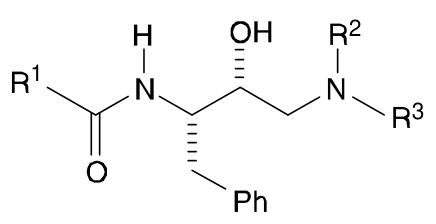
One class of anti-HIV drugs, known as protease inhibitors, works by blocking the active site of one of the enzymes used in assembly of the viruses within the host cell. Two successful drugs, saquinavir and amprenavir, contain the structural unit shown below which mimics the transition state within the enzyme. In the structure, \(R^1\), \(R^2\) and \(R^3\) may represent any atom or group other than hydrogen.
Amprenavir may be synthesised as shown in the convergent scheme below.
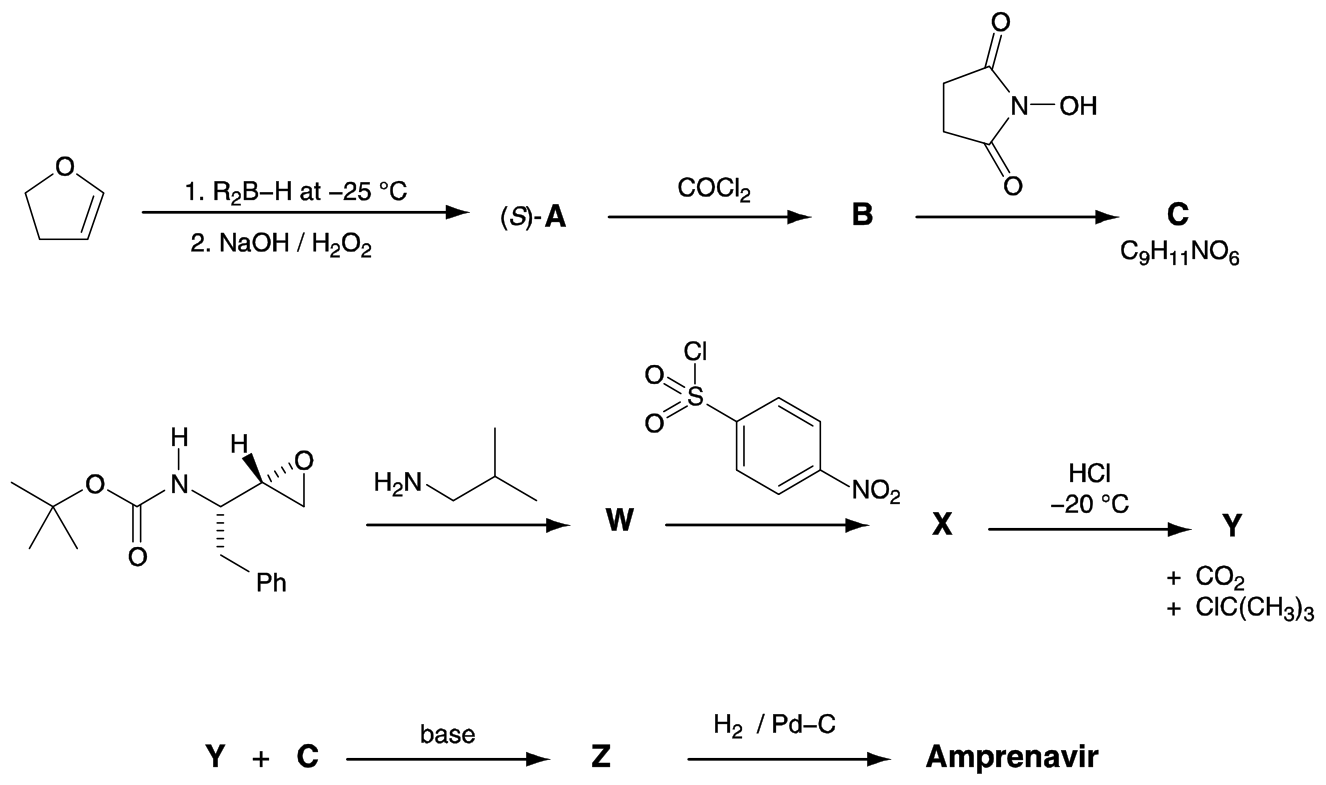
The reagent \(\ce{R2B-H}\) used in the first step is chiral.
Product A is formed as the \((S)\)-enantiomer.
Three of the signals in the \({}^{1}\mathrm{H}\) NMR spectrum of Amprenavir disappear on shaking with \(\ce{D2O}\): \(\delta\) 4.2 (2H), \(\delta\) 4.9 (1H) and \(\delta\) 5.1 (1H).
4.1 Suggest structures for:
a) the intermediates A, B, C, W, X, Y and Z,
b) Amprenavir.
Your answers should clearly show the stereochemistry at each centre.
Official English text of the problem.
Answers
-
4.1(a), A — \((3S)\)-Tetrahydrofuran-3-ol.
O[C@@H]1COCC1 -
4.1(a), B — \((3S)\)-Tetrahydrofuran-3-yl chloroformate.
O=C(Cl)O[C@@H]1COCC1 -
4.1(a), C — N-Succinimidyl \((3S)\)-tetrahydrofuran-3-yl carbonate, the activated carbonate of A.
O=C(ON1C(=O)CCC1=O)O[C@@H]1COCC1 -
4.1(a), W — tert-Butyl [(2S,3R)-3-hydroxy-4-[(2-methylpropyl)amino]-1-phenylbutan-2-yl]carbamate.
CC(C)(C)OC(=O)N[C@@H](Cc1ccccc1)[C@H](O)CNCC(C)C -
4.1(a), X — tert-Butyl [(2S,3R)-3-hydroxy-4-[(2-methylpropyl)(4-nitrobenzenesulfonyl)amino]-1-phenylbutan-2-yl]carbamate.
CC(C)(C)OC(=O)N[C@@H](Cc1ccccc1)[C@H](O)CN(CC(C)C)S(=O)(=O)c1ccc([N+](=O)[O-])cc1 -
4.1(a), Y — N-[(2R,3S)-3-amino-2-hydroxy-4-phenylbutyl]-N-(2-methylpropyl)-4-nitrobenzenesulfonamide, shown as the free base.
N[C@@H](Cc1ccccc1)[C@H](O)CN(CC(C)C)S(=O)(=O)c1ccc([N+](=O)[O-])cc1 -
4.1(a), Z — \((3S)\)-Tetrahydrofuran-3-yl [(2S,3R)-3-hydroxy-4-[(2-methylpropyl)(4-nitrobenzenesulfonyl)amino]-1-phenylbutan-2-yl]carbamate.
O=C(O[C@@H]1COCC1)N[C@@H](Cc1ccccc1)[C@H](O)CN(CC(C)C)S(=O)(=O)c1ccc([N+](=O)[O-])cc1 -
4.1(b), Amprenavir — the 4-amino analogue of Z. Its tetrahydrofuran centre is \((3S)\), and its amino-alcohol chain has configuration \((2S,3R)\), numbering from the phenyl-bearing methylene.
O=C(O[C@@H]1COCC1)N[C@@H](Cc1ccccc1)[C@H](O)CN(CC(C)C)S(=O)(=O)c1ccc(N)cc1
Solution
4.1(a): Identification of the intermediates
A: asymmetric hydroboration–oxidation.
The starting alkene is 2,3-dihydrofuran, C1COC=C1. Hydroboration places boron on the alkene carbon farther from the ring oxygen and hydrogen on the carbon adjacent to that oxygen. Oxidation replaces the carbon–boron bond by a carbon–oxygen bond with retention of configuration.
The product is therefore tetrahydrofuran-3-ol. The problem specifies formation of the \((S)\)-enantiomer, establishing A as \((3S)\)-tetrahydrofuran-3-ol.
B and C: formation of an activated carbonate.
The alcohol oxygen of A attacks phosgene, O=C(Cl)Cl, displacing chloride and giving chloroformate B:
\[ \ce{C4H8O2 + COCl2 -> C5H7ClO3 + HCl}. \]
Here hydrogen chloride has SMILES Cl. The stereogenic carbon is unaffected, so B retains the \((3S)\) configuration.
The next reagent is N-hydroxysuccinimide, ON1C(=O)CCC1=O. Its hydroxyl oxygen replaces the remaining chloride of B, giving activated carbonate C:
\[ \ce{C5H7ClO3 + C4H5NO3 -> C9H11NO6 + HCl}. \]
Thus C contains the linkage
\[ \ce{(tetrahydrofuran-3-yl)-O-C(=O)-O-N(succinimide)}. \]
Its molecular formula is exactly the supplied \(\ce{C9H11NO6}\). Again, reaction occurs at the carbonyl carbon, so the tetrahydrofuran stereocentre remains \((3S)\).
W: regioselective epoxide opening.
The starting epoxide is tert-butyl [(1S)-1-[(2S)-oxiran-2-yl]-2-phenylethyl]carbamate:
CC(C)(C)OC(=O)N[C@@H](Cc1ccccc1)[C@H]1CO1
The nucleophile is 2-methylpropan-1-amine (isobutylamine), CC(C)CN. Its nitrogen attacks the less hindered, terminal epoxide carbon. The carbon–oxygen bond at that carbon breaks; subsequent proton transfer gives the alcohol and secondary amine in W:
\[ \ce{C15H21NO3 + C4H11N -> C19H32N2O3}. \]
For the common four-carbon chain, number from the phenyl-bearing methylene: C2 bears the protected amino group, and C3 bears the newly formed hydroxyl group.
Neither existing stereocentre undergoes geometric inversion. Nevertheless, the substituted epoxide carbon changes its descriptor from \(S\) to \(R\), because its CIP priorities change:
| At the substituted epoxide carbon | After opening, at the alcohol carbon |
|---|---|
| \(1:\) oxygen | \(1:\) hydroxyl oxygen |
| \(2:\) terminal epoxide carbon, whose next atoms are \(\ce{O,H,H}\) | \(2:\) adjacent amino-bearing carbon, whose next atoms are \(\ce{N,C,H}\) |
| \(3:\) adjacent amino-bearing carbon, whose next atoms are \(\ce{N,C,H}\) | \(3:\) terminal aminomethyl carbon, whose next atoms are \(\ce{N,H,H}\) |
| \(4:\) hydrogen | \(4:\) hydrogen |
The interchange of priorities 2 and 3 changes the descriptor without changing the geometry. Consequently, W has the required \((2S,3R)\) configuration.
X: sulfonamide formation.
The reagent is 4-nitrobenzenesulfonyl chloride:
O=S(=O)(Cl)c1ccc([N+](=O)[O-])cc1
The secondary aliphatic amine of W attacks sulfur and displaces chloride. This nitrogen is more nucleophilic than the carbamate nitrogen or alcohol oxygen. Its N–H hydrogen is replaced by the 4-nitrobenzenesulfonyl group, producing tertiary sulfonamide X:
\[ \ce{C19H32N2O3 + C6H4ClNO4S -> C25H35N3O7S + HCl}. \]
The hydroxyl group and both carbon configurations are retained.
Y: removal of the Boc protecting group.
Hydrogen chloride removes the tert-butoxycarbonyl (Boc) group, exposing the primary amine. The specified coproducts are carbon dioxide, O=C=O, and 2-chloro-2-methylpropane (tert-butyl chloride), CC(C)(C)Cl.
Writing Y as its neutral free base gives the balanced equation:
\[ \ce{C25H35N3O7S + HCl -> C20H27N3O5S + CO2 + (CH3)3CCl}. \]
With excess hydrogen chloride, the primary amino group is protonated. The corresponding Y hydrochloride is:
[NH3+][C@@H](Cc1ccccc1)[C@H](O)CN(CC(C)C)S(=O)(=O)c1ccc([N+](=O)[O-])cc1.[Cl-]
The base in the following step makes the amine available for coupling. Neither stereocentre changes. The \((2R,3S)\) descriptors in Y’s sulfonamide name arise solely from numbering its side chain from the opposite end.
Z: coupling the two synthetic fragments.
The primary amine of Y attacks the carbonate carbonyl of C. Collapse of the tetrahedral intermediate expels the N-hydroxysuccinimide-derived leaving group, forming the carbamate Z:
\[ \ce{C20H27N3O5S + C9H11NO6 -> C25H33N3O8S + C4H5NO3}. \]
The amino group is acylated preferentially to the alcohol. The product therefore retains a free hydroxyl group and gains the linkage connecting the amino-alcohol chain to the \((3S)\)-tetrahydrofuran fragment.
All three stereocentres retain their configurations: \((2S,3R)\) in the amino-alcohol chain and \((3S)\) in the tetrahydrofuran ring.
4.1(b): Formation and identification of Amprenavir
Catalytic hydrogenation reduces the para-nitro group of Z to an amino group:
\[ \ce{C25H33N3O8S + 3H2 ->[Pd/C] C25H35N3O6S + 2H2O}. \]
Hydrogen has SMILES [H][H], and water has SMILES O. No stereogenic carbon is altered, giving the Amprenavir structure listed above.
The product contains exactly four exchangeable hydrogens:
- The aromatic \(\ce{NH2}\) group accounts for the 2H signal at \(\delta 4.2\).
- The alcohol \(\ce{OH}\) and carbamate \(\ce{NH}\) account for the two 1H signals at \(\delta 4.9\) and \(\delta 5.1\).
- The sulfonamide nitrogen has no hydrogen.
The two one-proton signals need not be assigned individually to establish the structure; the stated exchange experiment identifies them collectively as OH and NH. Their disappearance on treatment with \(\ce{D2O}\) agrees with the proposed product.
The answers were checked against the official answers published by the organisers.
IChO 2009 · Theorieaufgabe 4
Synthese von Amprenavir
Eine Klasse von Arzneistoffen gegen HIV, die als Proteaseinhibitoren bezeichnet werden, wirkt durch Blockierung des aktiven Zentrums eines der Enzyme, die am Zusammenbau der Viren innerhalb der Wirtszelle beteiligt sind. Zwei erfolgreiche Arzneistoffe, Saquinavir und Amprenavir, enthalten die unten gezeigte Struktureinheit, die den Übergangszustand im Enzym nachahmt. In der Struktur können \(R^1\), \(R^2\) und \(R^3\) für beliebige Atome oder Gruppen außer Wasserstoff stehen.
Amprenavir lässt sich nach dem unten gezeigten konvergenten Syntheseschema herstellen.
Das im ersten Schritt verwendete Reagenz \(\ce{R2B-H}\) ist chiral.
Produkt A entsteht als \((S)\)-Enantiomer.
Drei der Signale im \({}^{1}\mathrm{H}\)-NMR-Spektrum von Amprenavir verschwinden beim Schütteln mit \(\ce{D2O}\): \(\delta\) 4.2 (2H), \(\delta\) 4.9 (1H) und \(\delta\) 5.1 (1H).
4.1 Schlagen Sie Strukturen vor für:
a) die Zwischenprodukte A, B, C, W, X, Y und Z,
b) Amprenavir.
Ihre Antworten sollen die Stereochemie an jedem Zentrum eindeutig zeigen.
Aufgabentext aus dem offiziellen englischen Text übersetzt.
Antworten
-
4.1(a), A — \((3S)\)-Tetrahydrofuran-3-ol.
O[C@@H]1COCC1 -
4.1(a), B — Chlorameisensäure-\((3S)\)-tetrahydrofuran-3-ylester.
O=C(Cl)O[C@@H]1COCC1 -
4.1(a), C — N-Succinimidyl-\((3S)\)-tetrahydrofuran-3-ylcarbonat, das aktivierte Carbonat von A.
O=C(ON1C(=O)CCC1=O)O[C@@H]1COCC1 -
4.1(a), W — tert-Butyl-[(2S,3R)-3-hydroxy-4-[(2-methylpropyl)amino]-1-phenylbutan-2-yl]carbamat.
CC(C)(C)OC(=O)N[C@@H](Cc1ccccc1)[C@H](O)CNCC(C)C -
4.1(a), X — tert-Butyl-[(2S,3R)-3-hydroxy-4-[(2-methylpropyl)(4-nitrobenzolsulfonyl)amino]-1-phenylbutan-2-yl]carbamat.
CC(C)(C)OC(=O)N[C@@H](Cc1ccccc1)[C@H](O)CN(CC(C)C)S(=O)(=O)c1ccc([N+](=O)[O-])cc1 -
4.1(a), Y — N-[(2R,3S)-3-Amino-2-hydroxy-4-phenylbutyl]-N-(2-methylpropyl)-4-nitrobenzolsulfonamid, dargestellt als freie Base.
N[C@@H](Cc1ccccc1)[C@H](O)CN(CC(C)C)S(=O)(=O)c1ccc([N+](=O)[O-])cc1 -
4.1(a), Z — \((3S)\)-Tetrahydrofuran-3-yl-[(2S,3R)-3-hydroxy-4-[(2-methylpropyl)(4-nitrobenzolsulfonyl)amino]-1-phenylbutan-2-yl]carbamat.
O=C(O[C@@H]1COCC1)N[C@@H](Cc1ccccc1)[C@H](O)CN(CC(C)C)S(=O)(=O)c1ccc([N+](=O)[O-])cc1 -
4.1(b), Amprenavir — das 4-Amino-Analogon von Z. Sein Tetrahydrofuran-Zentrum besitzt die Konfiguration \((3S)\), und seine Aminoalkohol-Kette hat bei Nummerierung von der phenyltragenden Methylengruppe aus die Konfiguration \((2S,3R)\).
O=C(O[C@@H]1COCC1)N[C@@H](Cc1ccccc1)[C@H](O)CN(CC(C)C)S(=O)(=O)c1ccc(N)cc1
Lösung
4.1(a): Identifizierung der Zwischenprodukte
A: asymmetrische Hydroborierung–Oxidation.
Das als Ausgangsstoff eingesetzte Alken ist 2,3-Dihydrofuran, C1COC=C1. Bei der Hydroborierung wird Bor an das vom Ringsauerstoff weiter entfernte Alken-Kohlenstoffatom und Wasserstoff an das diesem Sauerstoff benachbarte Kohlenstoffatom addiert. Die Oxidation ersetzt die Kohlenstoff–Bor-Bindung unter Erhaltung der Konfiguration durch eine Kohlenstoff–Sauerstoff-Bindung.
Das Produkt ist daher Tetrahydrofuran-3-ol. Die Aufgabenstellung gibt die Bildung des \((S)\)-Enantiomers vor, womit A als \((3S)\)-Tetrahydrofuran-3-ol feststeht.
B und C: Bildung eines aktivierten Carbonats.
Der Alkoholsauerstoff von A greift Phosgen, O=C(Cl)Cl, an, wobei Chlorid verdrängt wird und Chlorameisensäureester B entsteht:
\[ \ce{C4H8O2 + COCl2 -> C5H7ClO3 + HCl}. \]
Hier hat Chlorwasserstoff den SMILES-Code Cl. Das stereogene Kohlenstoffatom bleibt unverändert, sodass B die \((3S)\)-Konfiguration beibehält.
Das nächste Reagenz ist N-Hydroxysuccinimid, ON1C(=O)CCC1=O. Sein Hydroxylsauerstoff ersetzt das verbleibende Chlorid von B, wobei das aktivierte Carbonat C entsteht:
\[ \ce{C5H7ClO3 + C4H5NO3 -> C9H11NO6 + HCl}. \]
Somit enthält C die Verknüpfung
\[ \ce{(tetrahydrofuran-3-yl)-O-C(=O)-O-N(succinimide)}. \]
Seine Summenformel entspricht genau der angegebenen Formel \(\ce{C9H11NO6}\). Auch hier findet die Reaktion am Carbonylkohlenstoff statt, sodass das Stereozentrum im Tetrahydrofuran die Konfiguration \((3S)\) beibehält.
W: regioselektive Epoxidöffnung.
Das als Ausgangsstoff eingesetzte Epoxid ist tert-Butyl-[(1S)-1-[(2S)-oxiran-2-yl]-2-phenylethyl]carbamat:
CC(C)(C)OC(=O)N[C@@H](Cc1ccccc1)[C@H]1CO1
Das Nukleophil ist 2-Methylpropan-1-amin (Isobutylamin), CC(C)CN. Sein Stickstoff greift das sterisch weniger gehinderte, endständige Epoxid-Kohlenstoffatom an. Die Kohlenstoff–Sauerstoff-Bindung an diesem Kohlenstoffatom wird gespalten; eine anschließende Protonenübertragung liefert den Alkohol und das sekundäre Amin in W:
\[ \ce{C15H21NO3 + C4H11N -> C19H32N2O3}. \]
Die gemeinsame Kette aus vier Kohlenstoffatomen wird von der phenyltragenden Methylengruppe aus nummeriert: C2 trägt die geschützte Aminogruppe, und C3 trägt die neu gebildete Hydroxylgruppe.
An keinem der vorhandenen Stereozentren erfolgt eine geometrische Inversion. Dennoch ändert sich der Deskriptor des substituierten Epoxid-Kohlenstoffatoms von \(S\) zu \(R\), da sich seine CIP-Prioritäten ändern:
| Am substituierten Epoxid-Kohlenstoffatom | Nach der Öffnung am Alkohol-Kohlenstoffatom |
|---|---|
| \(1:\) Sauerstoff | \(1:\) Hydroxylsauerstoff |
| \(2:\) endständiges Epoxid-Kohlenstoffatom, dessen nächste Atome \(\ce{O,H,H}\) sind | \(2:\) benachbartes aminotragendes Kohlenstoffatom, dessen nächste Atome \(\ce{N,C,H}\) sind |
| \(3:\) benachbartes aminotragendes Kohlenstoffatom, dessen nächste Atome \(\ce{N,C,H}\) sind | \(3:\) endständiges Aminomethyl-Kohlenstoffatom, dessen nächste Atome \(\ce{N,H,H}\) sind |
| \(4:\) Wasserstoff | \(4:\) Wasserstoff |
Die Vertauschung der Prioritäten 2 und 3 ändert den Deskriptor, ohne die Geometrie zu verändern. Folglich besitzt W die erforderliche \((2S,3R)\)-Konfiguration.
X: Sulfonamidbildung.
Das Reagenz ist 4-Nitrobenzolsulfonylchlorid:
O=S(=O)(Cl)c1ccc([N+](=O)[O-])cc1
Das sekundäre aliphatische Amin von W greift den Schwefel an und verdrängt Chlorid. Dieser Stickstoff ist nukleophiler als der Carbamatstickstoff oder der Alkoholsauerstoff. Sein N–H-Wasserstoff wird durch die 4-Nitrobenzolsulfonylgruppe ersetzt, wodurch das tertiäre Sulfonamid X entsteht:
\[ \ce{C19H32N2O3 + C6H4ClNO4S -> C25H35N3O7S + HCl}. \]
Die Hydroxylgruppe und die Konfigurationen beider Kohlenstoffatome bleiben erhalten.
Y: Abspaltung der Boc-Schutzgruppe.
Chlorwasserstoff spaltet die tert-Butoxycarbonylgruppe (Boc-Gruppe) ab und setzt dadurch das primäre Amin frei. Die angegebenen Nebenprodukte sind Kohlenstoffdioxid, O=C=O, und 2-Chlor-2-methylpropan (tert-Butylchlorid), CC(C)(C)Cl.
Wird Y als neutrale freie Base geschrieben, ergibt sich die ausgeglichene Gleichung:
\[ \ce{C25H35N3O7S + HCl -> C20H27N3O5S + CO2 + (CH3)3CCl}. \]
Bei einem Überschuss an Chlorwasserstoff wird die primäre Aminogruppe protoniert. Das entsprechende Hydrochlorid von Y ist:
[NH3+][C@@H](Cc1ccccc1)[C@H](O)CN(CC(C)C)S(=O)(=O)c1ccc([N+](=O)[O-])cc1.[Cl-]
Die Base im folgenden Schritt macht das Amin für die Kupplung verfügbar. Keines der Stereozentren verändert sich. Die Deskriptoren \((2R,3S)\) im Sulfonamidnamen von Y ergeben sich ausschließlich daraus, dass seine Seitenkette vom entgegengesetzten Ende aus nummeriert wird.
Z: Kupplung der beiden Synthesefragmente.
Das primäre Amin von Y greift die Carbonylgruppe des Carbonats C an. Beim Zerfall des tetraedrischen Zwischenprodukts wird die von N-Hydroxysuccinimid abgeleitete Abgangsgruppe abgespalten, wobei das Carbamat Z entsteht:
\[ \ce{C20H27N3O5S + C9H11NO6 -> C25H33N3O8S + C4H5NO3}. \]
Die Aminogruppe wird bevorzugt gegenüber der Alkoholgruppe acyliert. Das Produkt behält daher eine freie Hydroxylgruppe und erhält die Verknüpfung, die die Aminoalkohol-Kette mit dem \((3S)\)-Tetrahydrofuran-Fragment verbindet.
Alle drei Stereozentren behalten ihre Konfigurationen bei: \((2S,3R)\) in der Aminoalkohol-Kette und \((3S)\) im Tetrahydrofuranring.
4.1(b): Bildung und Identifizierung von Amprenavir
Durch katalytische Hydrierung wird die para-Nitrogruppe von Z zu einer Aminogruppe reduziert:
\[ \ce{C25H33N3O8S + 3H2 ->[Pd/C] C25H35N3O6S + 2H2O}. \]
Wasserstoff hat den SMILES-Code [H][H], Wasser den SMILES-Code O. Kein stereogenes Kohlenstoffatom wird verändert, sodass die oben angegebene Struktur von Amprenavir entsteht.
Das Produkt enthält genau vier austauschbare Wasserstoffatome:
- Die aromatische \(\ce{NH2}\)-Gruppe ist für das 2H-Signal bei \(\delta 4.2\) verantwortlich.
- Die Alkoholgruppe \(\ce{OH}\) und die Carbamatgruppe \(\ce{NH}\) sind für die beiden 1H-Signale bei \(\delta 4.9\) und \(\delta 5.1\) verantwortlich.
- Der Sulfonamidstickstoff trägt keinen Wasserstoff.
Die beiden Einprotonensignale müssen zur Bestimmung der Struktur nicht einzeln zugeordnet werden; das beschriebene Austauschexperiment identifiziert sie gemeinsam als OH und NH. Ihr Verschwinden bei Behandlung mit \(\ce{D2O}\) stimmt mit dem vorgeschlagenen Produkt überein.
Die Ergebnisse wurden mit den von den Veranstaltern veröffentlichten offiziellen Ergebnissen abgeglichen.
IChO 2009 · Teori sorusu 4
Amprenavir Sentezi
Proteaz inhibitörleri olarak bilinen bir anti-HIV ilaç sınıfı, konak hücre içinde virüslerin bir araya getirilmesinde kullanılan enzimlerden birinin aktif bölgesini bloke ederek etki gösterir. Başarıyla kullanılan iki ilaç, sakinavir ve amprenavir, enzim içindeki geçiş durumunu taklit eden ve aşağıda gösterilen yapısal birimi içerir. Bu yapıda \(R^1\), \(R^2\) ve \(R^3\), hidrojen dışındaki herhangi bir atomu veya grubu temsil edebilir.
Amprenavir, aşağıdaki yakınsak sentez şemasında gösterildiği gibi sentezlenebilir.
İlk basamakta kullanılan \(\ce{R2B-H}\) reaktifi kiraldir.
A ürünü, \((S)\)-enantiyomeri olarak oluşur.
Amprenavirin \({}^{1}\mathrm{H}\) NMR spektrumundaki sinyallerden üçü, \(\ce{D2O}\) ile çalkalandığında kaybolur: \(\delta\) 4.2 (2H), \(\delta\) 4.9 (1H) ve \(\delta\) 5.1 (1H).
4.1 Aşağıdakiler için yapılar öneriniz:
a) A, B, C, W, X, Y ve Z ara ürünleri,
b) Amprenavir.
Yanıtlarınız her bir merkezdeki stereokimyayı açıkça göstermelidir.
Soru metni resmi İngilizce metinden çevrilmiştir.
Cevaplar
-
4.1(a), A — \((3S)\)-Tetrahidrofuran-3-ol.
O[C@@H]1COCC1 -
4.1(a), B — \((3S)\)-Tetrahidrofuran-3-il kloroformat.
O=C(Cl)O[C@@H]1COCC1 -
4.1(a), C — N-Süksinimidil \((3S)\)-tetrahidrofuran-3-il karbonat, A'nın aktive edilmiş karbonatı.
O=C(ON1C(=O)CCC1=O)O[C@@H]1COCC1 -
4.1(a), W — tert-Bütil [(2S,3R)-3-hidroksi-4-[(2-metilpropil)amino]-1-fenilbütan-2-il]karbamat.
CC(C)(C)OC(=O)N[C@@H](Cc1ccccc1)[C@H](O)CNCC(C)C -
4.1(a), X — tert-Bütil [(2S,3R)-3-hidroksi-4-[(2-metilpropil)(4-nitrobenzensülfonil)amino]-1-fenilbütan-2-il]karbamat.
CC(C)(C)OC(=O)N[C@@H](Cc1ccccc1)[C@H](O)CN(CC(C)C)S(=O)(=O)c1ccc([N+](=O)[O-])cc1 -
4.1(a), Y — N-[(2R,3S)-3-amino-2-hidroksi-4-fenilbütil]-N-(2-metilpropil)-4-nitrobenzensülfonamid, serbest baz olarak gösterilmiştir.
N[C@@H](Cc1ccccc1)[C@H](O)CN(CC(C)C)S(=O)(=O)c1ccc([N+](=O)[O-])cc1 -
4.1(a), Z — \((3S)\)-Tetrahidrofuran-3-il [(2S,3R)-3-hidroksi-4-[(2-metilpropil)(4-nitrobenzensülfonil)amino]-1-fenilbütan-2-il]karbamat.
O=C(O[C@@H]1COCC1)N[C@@H](Cc1ccccc1)[C@H](O)CN(CC(C)C)S(=O)(=O)c1ccc([N+](=O)[O-])cc1 -
4.1(b), Amprenavir — Z'nin 4-amino analoğu. Tetrahidrofuran merkezi \((3S)\) konfigürasyonundadır; amino alkol zinciri ise fenil grubunu taşıyan metilenden başlayarak numaralandırıldığında \((2S,3R)\) konfigürasyonuna sahiptir.
O=C(O[C@@H]1COCC1)N[C@@H](Cc1ccccc1)[C@H](O)CN(CC(C)C)S(=O)(=O)c1ccc(N)cc1
Çözüm
4.1(a): Ara ürünlerin belirlenmesi
A: asimetrik hidroborasyon–oksidasyon.
Başlangıç alkeni 2,3-dihidrofuran, C1COC=C1, bileşiğidir. Hidroborasyon, boru halka oksijeninden daha uzaktaki alken karbonuna, hidrojeni ise bu oksijene komşu karbona bağlar. Oksidasyon, konfigürasyon korunarak karbon–bor bağının yerine karbon–oksijen bağının oluşmasını sağlar.
Dolayısıyla ürün tetrahidrofuran-3-oldür. Soruda \((S)\)-enantiyomerinin oluştuğu belirtildiğinden A, \((3S)\)-tetrahidrofuran-3-ol olarak belirlenir.
B ve C: aktive edilmiş bir karbonatın oluşumu.
A'nın alkol oksijeni, fosgene, O=C(Cl)Cl, saldırarak klorürü uzaklaştırır ve kloroformat B'yi oluşturur:
\[ \ce{C4H8O2 + COCl2 -> C5H7ClO3 + HCl}. \]
Burada hidrojen klorürün SMILES gösterimi Cl şeklindedir. Stereojenik karbon etkilenmediğinden B, \((3S)\) konfigürasyonunu korur.
Bir sonraki reaktif N-hidroksisüksinimid, ON1C(=O)CCC1=O, bileşiğidir. Bu bileşiğin hidroksil oksijeni, B'de kalan klorürün yerini alarak aktive edilmiş karbonat C'yi oluşturur:
\[ \ce{C5H7ClO3 + C4H5NO3 -> C9H11NO6 + HCl}. \]
Böylece C, şu bağlantıyı içerir:
\[ \ce{(tetrahydrofuran-3-yl)-O-C(=O)-O-N(succinimide)}. \]
Molekül formülü, verilen \(\ce{C9H11NO6}\) formülüyle tam olarak aynıdır. Tepkime yine karbonil karbonunda gerçekleştiğinden tetrahidrofuranın stereomerkezi \((3S)\) olarak kalır.
W: bölge seçici epoksit açılması.
Başlangıç epoksiti tert-bütil [(1S)-1-[(2S)-oksiran-2-il]-2-feniletil]karbamat bileşiğidir:
CC(C)(C)OC(=O)N[C@@H](Cc1ccccc1)[C@H]1CO1
Nükleofil 2-metilpropan-1-amin (izobütilamin), CC(C)CN, bileşiğidir. Azot atomu, sterik engeli daha az olan uç epoksit karbonuna saldırır. Bu karbondaki karbon–oksijen bağı kopar; ardından gerçekleşen proton aktarımı, W'deki alkolü ve sekonder amini oluşturur:
\[ \ce{C15H21NO3 + C4H11N -> C19H32N2O3}. \]
Ortak dört karbonlu zinciri, fenil grubunu taşıyan metilenden başlayarak numaralandırınız: C2 korunmuş amino grubunu, C3 ise yeni oluşan hidroksil grubunu taşır.
Mevcut stereomerkezlerin hiçbirinde geometrik tersinme gerçekleşmez. Bununla birlikte, sübstitüe epoksit karbonunun CIP öncelikleri değiştiğinden, bu karbonun tanımlayıcısı \(S\)'den \(R\)'ye dönüşür:
| Sübstitüe epoksit karbonunda | Açılmadan sonra alkol karbonunda |
|---|---|
| \(1:\) oksijen | \(1:\) hidroksil oksijeni |
| \(2:\) bir sonraki atomları \(\ce{O,H,H}\) olan uç epoksit karbonu | \(2:\) bir sonraki atomları \(\ce{N,C,H}\) olan, amino grubu taşıyan komşu karbon |
| \(3:\) bir sonraki atomları \(\ce{N,C,H}\) olan, amino grubu taşıyan komşu karbon | \(3:\) bir sonraki atomları \(\ce{N,H,H}\) olan uç aminometil karbonu |
| \(4:\) hidrojen | \(4:\) hidrojen |
2 ve 3 önceliklerinin yer değiştirmesi, geometriyi değiştirmeden tanımlayıcıyı değiştirir. Sonuç olarak W, gerekli \((2S,3R)\) konfigürasyonuna sahiptir.
X: sülfonamid oluşumu.
Reaktif 4-nitrobenzensülfonil klorür bileşiğidir:
O=S(=O)(Cl)c1ccc([N+](=O)[O-])cc1
W'nin sekonder alifatik amini, kükürde saldırarak klorürü uzaklaştırır. Bu azot, karbamat azotundan veya alkol oksijeninden daha nükleofiliktir. N–H hidrojeni, 4-nitrobenzensülfonil grubuyla yer değiştirerek tersiyer sülfonamid X'i oluşturur:
\[ \ce{C19H32N2O3 + C6H4ClNO4S -> C25H35N3O7S + HCl}. \]
Hidroksil grubu ve her iki karbonun konfigürasyonu korunur.
Y: Boc koruyucu grubunun uzaklaştırılması.
Hidrojen klorür, tert-bütoksikarbonil (Boc) grubunu uzaklaştırarak primer amini açığa çıkarır. Belirtilen yan ürünler karbon dioksit, O=C=O, ve 2-kloro-2-metilpropan (tert-bütil klorür), CC(C)(C)Cl, bileşikleridir.
Y, nötr serbest baz biçiminde yazıldığında şu denkleştirilmiş denklem elde edilir:
\[ \ce{C25H35N3O7S + HCl -> C20H27N3O5S + CO2 + (CH3)3CCl}. \]
Hidrojen klorür fazlası varlığında primer amino grubu protonlanır. Buna karşılık gelen Y hidroklorür şöyledir:
[NH3+][C@@H](Cc1ccccc1)[C@H](O)CN(CC(C)C)S(=O)(=O)c1ccc([N+](=O)[O-])cc1.[Cl-]
Bir sonraki basamakta kullanılan baz, amini kenetlenme tepkimesine girebilir hâle getirir. Stereomerkezlerin hiçbiri değişmez. Y'nin sülfonamid adındaki \((2R,3S)\) tanımlayıcıları, yalnızca yan zincirin diğer uçtan numaralandırılmasından kaynaklanır.
Z: iki sentez parçasının kenetlenmesi.
Y'nin primer amini, C'nin karbonat karboniline saldırır. Tetrahedral ara ürünün çökmesiyle N-hidroksisüksinimidden türeyen ayrılan grup uzaklaşır ve karbamat Z oluşur:
\[ \ce{C20H27N3O5S + C9H11NO6 -> C25H33N3O8S + C4H5NO3}. \]
Alkole kıyasla amino grubu tercihen açillenir. Bu nedenle ürün, serbest bir hidroksil grubunu korur ve amino alkol zincirini \((3S)\)-tetrahidrofuran parçasına bağlayan bağlantıyı kazanır.
Üç stereomerkezin tümü konfigürasyonlarını korur: amino alkol zincirinde \((2S,3R)\) ve tetrahidrofuran halkasında \((3S)\).
4.1(b): Amprenavirin oluşumu ve belirlenmesi
Katalitik hidrojenasyon, Z'nin para-nitro grubunu amino grubuna indirger:
\[ \ce{C25H33N3O8S + 3H2 ->[Pd/C] C25H35N3O6S + 2H2O}. \]
Hidrojenin SMILES gösterimi [H][H], suyunki ise O şeklindedir. Hiçbir stereojenik karbon değişmez ve yukarıda verilen Amprenavir yapısı elde edilir.
Ürün, tam olarak dört değişebilir hidrojen içerir:
- Aromatik \(\ce{NH2}\) grubu, \(\delta 4.2\)'deki 2H sinyalinden sorumludur.
- Alkol \(\ce{OH}\) ve karbamat \(\ce{NH}\) grupları, \(\delta 4.9\) ve \(\delta 5.1\)'deki iki 1H sinyalinden sorumludur.
- Sülfonamid azotunda hidrojen bulunmaz.
Yapıyı belirlemek için birer protona ait bu iki sinyalin ayrı ayrı atanması gerekmez; belirtilen değişim deneyi, bunları birlikte OH ve NH olarak tanımlar. \(\ce{D2O}\) ile muamele edildiklerinde kaybolmaları, önerilen ürünle uyumludur.
Sonuçlar, düzenleyicilerin yayımladığı resmi sonuçlarla karşılaştırılarak kontrol edildi.
IChO 2009 · Problema teórico 4
Síntesis de Amprenavir
Una clase de fármacos contra el VIH, conocidos como inhibidores de la proteasa, actúa bloqueando el centro activo de una de las enzimas utilizadas en el ensamblaje de los virus dentro de la célula huésped. Dos fármacos eficaces, saquinavir y amprenavir, contienen la unidad estructural que se muestra a continuación, que imita el estado de transición dentro de la enzima. En la estructura, \(R^1\), \(R^2\) y \(R^3\) pueden representar cualquier átomo o grupo distinto del hidrógeno.
El amprenavir puede sintetizarse como se muestra en el siguiente esquema convergente.
El reactivo \(\ce{R2B-H}\) utilizado en la primera etapa es quiral.
El producto A se forma como el enantiómero \((S)\).
Tres de las señales del espectro de RMN de \({}^{1}\mathrm{H}\) del amprenavir desaparecen al agitar con \(\ce{D2O}\): \(\delta\) 4.2 (2H), \(\delta\) 4.9 (1H) y \(\delta\) 5.1 (1H).
4.1 Proponga estructuras para:
a) los intermedios A, B, C, W, X, Y y Z,
b) el amprenavir.
Sus respuestas deben mostrar claramente la estereoquímica de cada centro.
Enunciado traducido del texto oficial en inglés.
Respuestas
-
4.1(a), A — \((3S)\)-Tetrahidrofuran-3-ol.
O[C@@H]1COCC1 -
4.1(a), B — Cloroformiato de \((3S)\)-tetrahidrofuran-3-ilo.
O=C(Cl)O[C@@H]1COCC1 -
4.1(a), C — Carbonato de N-succinimidilo y \((3S)\)-tetrahidrofuran-3-ilo, el carbonato activado de A.
O=C(ON1C(=O)CCC1=O)O[C@@H]1COCC1 -
4.1(a), W — [(2S,3R)-3-Hidroxi-4-[(2-metilpropil)amino]-1-fenilbutan-2-il]carbamato de terc-butilo.
CC(C)(C)OC(=O)N[C@@H](Cc1ccccc1)[C@H](O)CNCC(C)C -
4.1(a), X — [(2S,3R)-3-Hidroxi-4-[(2-metilpropil)(4-nitrobencenosulfonil)amino]-1-fenilbutan-2-il]carbamato de terc-butilo.
CC(C)(C)OC(=O)N[C@@H](Cc1ccccc1)[C@H](O)CN(CC(C)C)S(=O)(=O)c1ccc([N+](=O)[O-])cc1 -
4.1(a), Y — N-[(2R,3S)-3-Amino-2-hidroxi-4-fenilbutil]-N-(2-metilpropil)-4-nitrobencenosulfonamida, representada como base libre.
N[C@@H](Cc1ccccc1)[C@H](O)CN(CC(C)C)S(=O)(=O)c1ccc([N+](=O)[O-])cc1 -
4.1(a), Z — [(2S,3R)-3-Hidroxi-4-[(2-metilpropil)(4-nitrobencenosulfonil)amino]-1-fenilbutan-2-il]carbamato de \((3S)\)-tetrahidrofuran-3-ilo.
O=C(O[C@@H]1COCC1)N[C@@H](Cc1ccccc1)[C@H](O)CN(CC(C)C)S(=O)(=O)c1ccc([N+](=O)[O-])cc1 -
4.1(b), Amprenavir — el análogo 4-amino de Z. Su centro del tetrahidrofurano es \((3S)\), y su cadena de aminoalcohol tiene configuración \((2S,3R)\), numerando desde el metileno que lleva el grupo fenilo.
O=C(O[C@@H]1COCC1)N[C@@H](Cc1ccccc1)[C@H](O)CN(CC(C)C)S(=O)(=O)c1ccc(N)cc1
Solución
4.1(a): Identificación de los intermedios
A: hidroboración–oxidación asimétrica.
El alqueno de partida es el 2,3-dihidrofurano, C1COC=C1. La hidroboración sitúa el boro en el carbono del alqueno más alejado del oxígeno del anillo y el hidrógeno en el carbono adyacente a dicho oxígeno. La oxidación sustituye el enlace carbono–boro por un enlace carbono–oxígeno con retención de la configuración.
Por tanto, el producto es tetrahidrofuran-3-ol. El enunciado especifica la formación del enantiómero \((S)\), lo que establece que A es \((3S)\)-tetrahidrofuran-3-ol.
B y C: formación de un carbonato activado.
El oxígeno del grupo alcohol de A ataca al fosgeno, O=C(Cl)Cl, desplazando el cloruro y dando el cloroformiato B:
\[ \ce{C4H8O2 + COCl2 -> C5H7ClO3 + HCl}. \]
Aquí, el cloruro de hidrógeno tiene el SMILES Cl. El carbono estereogénico no se ve afectado, por lo que B conserva la configuración \((3S)\).
El siguiente reactivo es la N-hidroxisuccinimida, ON1C(=O)CCC1=O. El oxígeno de su grupo hidroxilo sustituye al cloruro restante de B, dando el carbonato activado C:
\[ \ce{C5H7ClO3 + C4H5NO3 -> C9H11NO6 + HCl}. \]
Así, C contiene la conexión
\[ \ce{(tetrahydrofuran-3-yl)-O-C(=O)-O-N(succinimide)}. \]
Su fórmula molecular es exactamente la proporcionada, \(\ce{C9H11NO6}\). De nuevo, la reacción tiene lugar en el carbono carbonílico, por lo que el estereocentro del tetrahidrofurano sigue siendo \((3S)\).
W: apertura regioselectiva del epóxido.
El epóxido de partida es el [(1S)-1-[(2S)-oxiran-2-il]-2-feniletil]carbamato de terc-butilo:
CC(C)(C)OC(=O)N[C@@H](Cc1ccccc1)[C@H]1CO1
El nucleófilo es la 2-metilpropan-1-amina (isobutilamina), CC(C)CN. Su nitrógeno ataca al carbono terminal del epóxido, que presenta menor impedimento estérico. El enlace carbono–oxígeno de ese carbono se rompe; una transferencia de protón posterior da lugar al alcohol y a la amina secundaria de W:
\[ \ce{C15H21NO3 + C4H11N -> C19H32N2O3}. \]
Para la cadena común de cuatro carbonos, se numera desde el metileno que lleva el grupo fenilo: C2 lleva el grupo amino protegido y C3 lleva el grupo hidroxilo recién formado.
Ninguno de los estereocentros existentes experimenta una inversión geométrica. No obstante, el carbono sustituido del epóxido cambia su descriptor de \(S\) a \(R\), porque sus prioridades CIP cambian:
| En el carbono sustituido del epóxido | Tras la apertura, en el carbono del alcohol |
|---|---|
| \(1:\) oxígeno | \(1:\) oxígeno del grupo hidroxilo |
| \(2:\) carbono terminal del epóxido, cuyos siguientes átomos son \(\ce{O,H,H}\) | \(2:\) carbono adyacente que lleva el grupo amino, cuyos siguientes átomos son \(\ce{N,C,H}\) |
| \(3:\) carbono adyacente que lleva el grupo amino, cuyos siguientes átomos son \(\ce{N,C,H}\) | \(3:\) carbono del grupo aminometilo terminal, cuyos siguientes átomos son \(\ce{N,H,H}\) |
| \(4:\) hidrógeno | \(4:\) hidrógeno |
El intercambio de las prioridades 2 y 3 cambia el descriptor sin cambiar la geometría. En consecuencia, W tiene la configuración \((2S,3R)\) requerida.
X: formación de la sulfonamida.
El reactivo es el cloruro de 4-nitrobencenosulfonilo:
O=S(=O)(Cl)c1ccc([N+](=O)[O-])cc1
La amina alifática secundaria de W ataca al azufre y desplaza el cloruro. Este nitrógeno es más nucleófilo que el nitrógeno del carbamato o el oxígeno del alcohol. Su hidrógeno N–H se sustituye por el grupo 4-nitrobencenosulfonilo, produciendo la sulfonamida terciaria X:
\[ \ce{C19H32N2O3 + C6H4ClNO4S -> C25H35N3O7S + HCl}. \]
Se conservan el grupo hidroxilo y las configuraciones de ambos carbonos.
Y: eliminación del grupo protector Boc.
El cloruro de hidrógeno elimina el grupo terc-butoxicarbonilo (Boc), dejando libre la amina primaria. Los coproductos especificados son dióxido de carbono, O=C=O, y 2-cloro-2-metilpropano (cloruro de terc-butilo), CC(C)(C)Cl.
Al representar Y como su base libre neutra, se obtiene la ecuación ajustada:
\[ \ce{C25H35N3O7S + HCl -> C20H27N3O5S + CO2 + (CH3)3CCl}. \]
Con un exceso de cloruro de hidrógeno, el grupo amino primario se protona. El clorhidrato de Y correspondiente es:
[NH3+][C@@H](Cc1ccccc1)[C@H](O)CN(CC(C)C)S(=O)(=O)c1ccc([N+](=O)[O-])cc1.[Cl-]
La base de la etapa siguiente hace que la amina esté disponible para el acoplamiento. Ninguno de los estereocentros cambia. Los descriptores \((2R,3S)\) del nombre de sulfonamida de Y se deben únicamente a que su cadena lateral se numera desde el extremo opuesto.
Z: acoplamiento de los dos fragmentos sintéticos.
La amina primaria de Y ataca al carbonilo del carbonato de C. El colapso del intermedio tetraédrico expulsa el grupo saliente derivado de la N-hidroxisuccinimida, formando el carbamato Z:
\[ \ce{C20H27N3O5S + C9H11NO6 -> C25H33N3O8S + C4H5NO3}. \]
El grupo amino se acila preferentemente frente al alcohol. Por tanto, el producto conserva un grupo hidroxilo libre e incorpora la conexión que une la cadena de aminoalcohol con el fragmento de \((3S)\)-tetrahidrofurano.
Los tres estereocentros conservan sus configuraciones: \((2S,3R)\) en la cadena de aminoalcohol y \((3S)\) en el anillo de tetrahidrofurano.
4.1(b): Formación e identificación de Amprenavir
La hidrogenación catalítica reduce el grupo para-nitro de Z a un grupo amino:
\[ \ce{C25H33N3O8S + 3H2 ->[Pd/C] C25H35N3O6S + 2H2O}. \]
El hidrógeno tiene el SMILES [H][H], y el agua tiene el SMILES O. No se altera ningún carbono estereogénico, lo que da lugar a la estructura del amprenavir indicada anteriormente.
El producto contiene exactamente cuatro hidrógenos intercambiables:
- El grupo aromático \(\ce{NH2}\) explica la señal de 2H a \(\delta 4.2\).
- El \(\ce{OH}\) del alcohol y el \(\ce{NH}\) del carbamato explican las dos señales de 1H a \(\delta 4.9\) y \(\delta 5.1\).
- El nitrógeno de la sulfonamida no tiene ningún hidrógeno.
No es necesario asignar individualmente las dos señales de un protón para establecer la estructura; el experimento de intercambio indicado las identifica conjuntamente como OH y NH. Su desaparición al tratar con \(\ce{D2O}\) concuerda con el producto propuesto.
Los resultados se comprobaron con los resultados oficiales publicados por los organizadores.
IChO 2009 · 理论题 4
安普那韦的合成
一类称为蛋白酶抑制剂的抗 HIV 药物,通过阻断宿主细胞内参与病毒组装的一种酶的活性位点发挥作用。两种成功的药物——沙奎那韦和安普那韦——含有下图所示的结构单元,该结构单元可模拟酶内的过渡态。在此结构中,\(R^1\)、\(R^2\) 和 \(R^3\) 可代表除氢以外的任何原子或基团。
安普那韦可按下列汇聚式合成路线制备。
第一步中使用的试剂 \(\ce{R2B-H}\) 具有手性。
生成的产物 A 为 \((S)\)-对映异构体。
安普那韦的 \({}^{1}\mathrm{H}\) NMR 谱中有三个信号在与 \(\ce{D2O}\) 振荡后消失:\(\delta\) 4.2 (2H)、\(\delta\) 4.9 (1H) 和 \(\delta\) 5.1 (1H)。
4.1 推测下列物质的结构:
a) 中间体 A、B、C、W、X、Y 和 Z,
b) 安普那韦。
答案应清楚地表示每个手性中心的立体化学构型。
题目译自官方英文原文。
答案
-
4.1(a), A — \((3S)\)-四氢呋喃-3-醇。
O[C@@H]1COCC1 -
4.1(a), B — 氯甲酸 \((3S)\)-四氢呋喃-3-基酯。
O=C(Cl)O[C@@H]1COCC1 -
4.1(a), C — 碳酸 N-琥珀酰亚胺基 \((3S)\)-四氢呋喃-3-基酯,即 A 的活化碳酸酯。
O=C(ON1C(=O)CCC1=O)O[C@@H]1COCC1 -
4.1(a), W — [(2S,3R)-3-羟基-4-[(2-甲基丙基)氨基]-1-苯基丁烷-2-基]氨基甲酸叔丁酯。
CC(C)(C)OC(=O)N[C@@H](Cc1ccccc1)[C@H](O)CNCC(C)C -
4.1(a), X — [(2S,3R)-3-羟基-4-[(2-甲基丙基)(4-硝基苯磺酰基)氨基]-1-苯基丁烷-2-基]氨基甲酸叔丁酯。
CC(C)(C)OC(=O)N[C@@H](Cc1ccccc1)[C@H](O)CN(CC(C)C)S(=O)(=O)c1ccc([N+](=O)[O-])cc1 -
4.1(a), Y — N-[(2R,3S)-3-氨基-2-羟基-4-苯基丁基]-N-(2-甲基丙基)-4-硝基苯磺酰胺,以游离碱形式表示。
N[C@@H](Cc1ccccc1)[C@H](O)CN(CC(C)C)S(=O)(=O)c1ccc([N+](=O)[O-])cc1 -
4.1(a), Z — [(2S,3R)-3-羟基-4-[(2-甲基丙基)(4-硝基苯磺酰基)氨基]-1-苯基丁烷-2-基]氨基甲酸 \((3S)\)-四氢呋喃-3-基酯。
O=C(O[C@@H]1COCC1)N[C@@H](Cc1ccccc1)[C@H](O)CN(CC(C)C)S(=O)(=O)c1ccc([N+](=O)[O-])cc1 -
4.1(b), 安普那韦 — Z 的 4-氨基类似物。 其四氢呋喃环上的手性中心为 \((3S)\) 构型;从与苯基相连的亚甲基开始编号,其氨基醇链的构型为 \((2S,3R)\)。
O=C(O[C@@H]1COCC1)N[C@@H](Cc1ccccc1)[C@H](O)CN(CC(C)C)S(=O)(=O)c1ccc(N)cc1
解答
4.1(a): 中间体的确定
A:不对称硼氢化–氧化。
起始烯烃为 2,3-二氢呋喃,C1COC=C1。硼氢化使硼加到离环上氧原子较远的烯碳原子上,而氢加到与该氧原子相邻的碳原子上。氧化将碳–硼键转化为碳–氧键,同时保持构型不变。
因此,产物为四氢呋喃-3-醇。题目指明生成的是 \((S)\)-对映异构体,由此确定 A 为 \((3S)\)-四氢呋喃-3-醇。
B 和 C:活化碳酸酯的形成。
A 的醇羟基氧原子进攻光气,O=C(Cl)Cl,置换出氯离子,生成氯甲酸酯 B:
\[ \ce{C4H8O2 + COCl2 -> C5H7ClO3 + HCl}. \]
这里氯化氢的 SMILES 为 Cl。手性碳原子不受影响,因此 B 保持 \((3S)\) 构型。
下一步的试剂为 N-羟基琥珀酰亚胺,ON1C(=O)CCC1=O。其羟基氧原子取代 B 中剩余的氯,生成活化碳酸酯 C:
\[ \ce{C5H7ClO3 + C4H5NO3 -> C9H11NO6 + HCl}. \]
因此,C 含有以下连接结构
\[ \ce{(tetrahydrofuran-3-yl)-O-C(=O)-O-N(succinimide)}. \]
其分子式恰为题目给出的 \(\ce{C9H11NO6}\)。同样,反应发生在羰基碳原子上,因此四氢呋喃环上的手性中心仍保持 \((3S)\) 构型。
W:区域选择性环氧开环。
起始环氧化物为 [(1S)-1-[(2S)-环氧乙烷-2-基]-2-苯基乙基]氨基甲酸叔丁酯:
CC(C)(C)OC(=O)N[C@@H](Cc1ccccc1)[C@H]1CO1
亲核试剂为 2-甲基丙烷-1-胺(异丁胺),CC(C)CN。其氮原子进攻位阻较小的末端环氧碳原子。该碳原子上的碳–氧键断裂,随后经质子转移,形成 W 中的醇羟基和仲胺:
\[ \ce{C15H21NO3 + C4H11N -> C19H32N2O3}. \]
对于各结构共有的四碳链,从与苯基相连的亚甲基开始编号:C2 连有受保护的氨基,C3 连有新形成的羟基。
两个已有的手性中心均未发生空间构型反转。然而,取代的环氧碳原子的构型描述符由 \(S\) 变为 \(R\),因为其 CIP 优先次序发生了变化:
| 在取代的环氧碳原子处 | 开环后,在醇羟基所连的碳原子处 |
|---|---|
| \(1:\) 氧原子 | \(1:\) 羟基氧原子 |
| \(2:\) 末端环氧碳原子,其下一层原子为 \(\ce{O,H,H}\) | \(2:\) 相邻的连有氨基的碳原子,其下一层原子为 \(\ce{N,C,H}\) |
| \(3:\) 相邻的连有氨基的碳原子,其下一层原子为 \(\ce{N,C,H}\) | \(3:\) 末端氨甲基的碳原子,其下一层原子为 \(\ce{N,H,H}\) |
| \(4:\) 氢原子 | \(4:\) 氢原子 |
优先次序 2 和 3 的互换使构型描述符发生变化,而空间构型并未改变。因此,W 具有所要求的 \((2S,3R)\) 构型。
X:磺酰胺的形成。
所用试剂为 4-硝基苯磺酰氯:
O=S(=O)(Cl)c1ccc([N+](=O)[O-])cc1
W 的脂肪族仲胺进攻硫原子,并置换出氯离子。该氮原子的亲核性强于氨基甲酸酯的氮原子或醇羟基的氧原子。其 N–H 上的氢被 4-硝基苯磺酰基取代,生成叔磺酰胺 X:
\[ \ce{C19H32N2O3 + C6H4ClNO4S -> C25H35N3O7S + HCl}. \]
羟基和两个碳原子的构型均保持不变。
Y:Boc 保护基的脱除。
氯化氢脱除叔丁氧羰基(Boc),使伯氨基显露出来。题目指定的副产物为二氧化碳,O=C=O,以及 2-氯-2-甲基丙烷(叔丁基氯),CC(C)(C)Cl。
将 Y 写成中性游离碱形式,可得配平的反应方程式:
\[ \ce{C25H35N3O7S + HCl -> C20H27N3O5S + CO2 + (CH3)3CCl}. \]
在氯化氢过量时,伯氨基发生质子化。相应的 Y 的盐酸盐为:
[NH3+][C@@H](Cc1ccccc1)[C@H](O)CN(CC(C)C)S(=O)(=O)c1ccc([N+](=O)[O-])cc1.[Cl-]
下一步中的碱使胺能够参与偶联。两个手性中心均不发生变化。Y 的磺酰胺名称中的 \((2R,3S)\) 描述符,仅仅是由于从相反的一端对其侧链进行编号。
Z:两个合成片段的偶联。
Y 的伯氨基进攻 C 的碳酸酯羰基。四面体中间体分解,脱去源自 N-羟基琥珀酰亚胺的离去基团,形成氨基甲酸酯 Z:
\[ \ce{C20H27N3O5S + C9H11NO6 -> C25H33N3O8S + C4H5NO3}. \]
氨基优先于醇羟基发生酰化。因此,产物保留了一个游离羟基,并形成了将氨基醇链与 \((3S)\)-四氢呋喃片段连接起来的结构。
三个手性中心的构型均保持不变:氨基醇链中为 \((2S,3R)\),四氢呋喃环中为 \((3S)\)。
4.1(b): 安普那韦的生成与确定
催化氢化将 Z 的对位硝基还原为氨基:
\[ \ce{C25H33N3O8S + 3H2 ->[Pd/C] C25H35N3O6S + 2H2O}. \]
氢气的 SMILES 为 [H][H],水的 SMILES 为 O。没有任何手性碳原子发生改变,得到上述安普那韦结构。
产物恰好含有四个可交换氢:
- 芳环上的 \(\ce{NH2}\) 基团对应 \(\delta 4.2\) 处的 2H 信号。
- 醇羟基 \(\ce{OH}\) 和氨基甲酸酯的 \(\ce{NH}\) 对应 \(\delta 4.9\) 和 \(\delta 5.1\) 处的两个 1H 信号。
- 磺酰胺氮原子上没有氢。
为确定结构,无需对这两个单质子信号逐一归属;题述交换实验表明它们分别来自 OH 和 NH。它们经 \(\ce{D2O}\) 处理后消失,与所推测的产物相符。
结果已与主办方公布的官方答案核对。
IChO 2009 · Теоретическая задача 4
Синтез ампренавира
Один из классов препаратов против ВИЧ, известных как ингибиторы протеазы, действует за счёт блокирования активного центра одного из ферментов, участвующих в сборке вирусов внутри клетки-хозяина. Два эффективных препарата, саквинавир и ампренавир, содержат показанный ниже структурный фрагмент, который имитирует переходное состояние в ферменте. В этой структуре \(R^1\), \(R^2\) и \(R^3\) могут обозначать любой атом или группу, кроме водорода.
Ампренавир можно синтезировать по приведённой ниже конвергентной схеме.
Реагент \(\ce{R2B-H}\), используемый на первой стадии, является хиральным.
Продукт A образуется в виде \((S)\)-энантиомера.
Три сигнала в спектре ЯМР \({}^{1}\mathrm{H}\) ампренавира исчезают при встряхивании с \(\ce{D2O}\): \(\delta\) 4.2 (2H), \(\delta\) 4.9 (1H) и \(\delta\) 5.1 (1H).
4.1 Предложите структуры:
a) промежуточных соединений A, B, C, W, X, Y и Z,
b) ампренавира.
В ваших ответах должна быть чётко показана стереохимия каждого центра.
Условие переведено с официального английского текста.
Ответы
-
4.1(a), A — \((3S)\)-тетрагидрофуран-3-ол.
O[C@@H]1COCC1 -
4.1(a), B — \((3S)\)-тетрагидрофуран-3-илхлорформиат.
O=C(Cl)O[C@@H]1COCC1 -
4.1(a), C — N-сукцинимидил-\((3S)\)-тетрагидрофуран-3-илкарбонат, активированный карбонат A.
O=C(ON1C(=O)CCC1=O)O[C@@H]1COCC1 -
4.1(a), W — трет-бутил[(2S,3R)-3-гидрокси-4-[(2-метилпропил)амино]-1-фенилбутан-2-ил]карбамат.
CC(C)(C)OC(=O)N[C@@H](Cc1ccccc1)[C@H](O)CNCC(C)C -
4.1(a), X — трет-бутил[(2S,3R)-3-гидрокси-4-[(2-метилпропил)(4-нитробензолсульфонил)амино]-1-фенилбутан-2-ил]карбамат.
CC(C)(C)OC(=O)N[C@@H](Cc1ccccc1)[C@H](O)CN(CC(C)C)S(=O)(=O)c1ccc([N+](=O)[O-])cc1 -
4.1(a), Y — N-[(2R,3S)-3-амино-2-гидрокси-4-фенилбутил]-N-(2-метилпропил)-4-нитробензолсульфонамид, показанный в виде свободного основания.
N[C@@H](Cc1ccccc1)[C@H](O)CN(CC(C)C)S(=O)(=O)c1ccc([N+](=O)[O-])cc1 -
4.1(a), Z — \((3S)\)-тетрагидрофуран-3-ил[(2S,3R)-3-гидрокси-4-[(2-метилпропил)(4-нитробензолсульфонил)амино]-1-фенилбутан-2-ил]карбамат.
O=C(O[C@@H]1COCC1)N[C@@H](Cc1ccccc1)[C@H](O)CN(CC(C)C)S(=O)(=O)c1ccc([N+](=O)[O-])cc1 -
4.1(b), ампренавир — 4-аминоаналог Z. Его центр в тетрагидрофурановом кольце имеет конфигурацию \((3S)\), а аминоспиртовая цепь — конфигурацию \((2S,3R)\) при нумерации от метиленовой группы, связанной с фенильной группой.
O=C(O[C@@H]1COCC1)N[C@@H](Cc1ccccc1)[C@H](O)CN(CC(C)C)S(=O)(=O)c1ccc(N)cc1
Решение
4.1(a): Определение промежуточных соединений
A: асимметрическое гидроборирование–окисление.
Исходный алкен — 2,3-дигидрофуран, C1COC=C1. При гидроборировании бор присоединяется к атому углерода двойной связи, более удалённому от атома кислорода кольца, а водород — к атому углерода, соседнему с этим атомом кислорода. При окислении связь углерод–бор заменяется связью углерод–кислород с сохранением конфигурации.
Таким образом, продуктом является тетрагидрофуран-3-ол. В условии указано образование \((S)\)-энантиомера, что позволяет определить A как \((3S)\)-тетрагидрофуран-3-ол.
B и C: образование активированного карбоната.
Атом кислорода спиртовой группы A атакует фосген, O=C(Cl)Cl, вытесняя хлорид-ион и образуя хлорформиат B:
\[ \ce{C4H8O2 + COCl2 -> C5H7ClO3 + HCl}. \]
Здесь хлороводород имеет запись SMILES Cl. Стереогенный атом углерода не затрагивается, поэтому B сохраняет конфигурацию \((3S)\).
Следующий реагент — N-гидроксисукцинимид, ON1C(=O)CCC1=O. Атом кислорода его гидроксильной группы замещает оставшийся атом хлора в B, образуя активированный карбонат C:
\[ \ce{C5H7ClO3 + C4H5NO3 -> C9H11NO6 + HCl}. \]
Таким образом, C содержит связующий фрагмент
\[ \ce{(tetrahydrofuran-3-yl)-O-C(=O)-O-N(succinimide)}. \]
Его молекулярная формула в точности совпадает с указанной в условии: \(\ce{C9H11NO6}\). И в этом случае реакция протекает по карбонильному атому углерода, поэтому стереоцентр тетрагидрофуранового кольца сохраняет конфигурацию \((3S)\).
W: региоселективное раскрытие эпоксидного кольца.
Исходный эпоксид — трет-бутил[(1S)-1-[(2S)-оксиран-2-ил]-2-фенилэтил]карбамат:
CC(C)(C)OC(=O)N[C@@H](Cc1ccccc1)[C@H]1CO1
Нуклеофил — 2-метилпропан-1-амин (изобутиламин), CC(C)CN. Его атом азота атакует менее стерически затруднённый концевой атом углерода эпоксидного кольца. Связь углерод–кислород при этом атоме углерода разрывается; последующий перенос протона приводит к образованию спиртовой группы и вторичной аминогруппы в W:
\[ \ce{C15H21NO3 + C4H11N -> C19H32N2O3}. \]
Общую для этих соединений четырёхуглеродную цепь нумеруем от метиленовой группы, связанной с фенильной группой: при C2 находится защищённая аминогруппа, а при C3 — вновь образованная гидроксильная группа.
Ни один из существующих стереоцентров не претерпевает геометрического обращения конфигурации. Тем не менее дескриптор замещённого атома углерода эпоксидного кольца меняется с \(S\) на \(R\), поскольку изменяются приоритеты его заместителей по правилам CIP:
| При замещённом атоме углерода эпоксидного кольца | После раскрытия кольца, при атоме углерода, несущем спиртовую группу |
|---|---|
| \(1:\) кислород | \(1:\) кислород гидроксильной группы |
| \(2:\) концевой атом углерода эпоксидного кольца, следующие атомы при котором — \(\ce{O,H,H}\) | \(2:\) соседний атом углерода, несущий аминогруппу, следующие атомы при котором — \(\ce{N,C,H}\) |
| \(3:\) соседний атом углерода, несущий аминогруппу, следующие атомы при котором — \(\ce{N,C,H}\) | \(3:\) атом углерода концевой аминометильной группы, следующие атомы при котором — \(\ce{N,H,H}\) |
| \(4:\) водород | \(4:\) водород |
Перестановка приоритетов 2 и 3 меняет дескриптор без изменения геометрии. Следовательно, W имеет требуемую конфигурацию \((2S,3R)\).
X: образование сульфонамида.
Реагент — 4-нитробензолсульфонилхлорид:
O=S(=O)(Cl)c1ccc([N+](=O)[O-])cc1
Вторичная алифатическая аминогруппа W атакует атом серы и вытесняет хлорид-ион. Этот атом азота более нуклеофилен, чем атом азота карбаматной группы или атом кислорода спиртовой группы. Водород связи N–H замещается 4-нитробензолсульфонильной группой с образованием третичного сульфонамида X:
\[ \ce{C19H32N2O3 + C6H4ClNO4S -> C25H35N3O7S + HCl}. \]
Гидроксильная группа и конфигурации обоих атомов углерода сохраняются.
Y: удаление защитной группы Boc.
Хлороводород удаляет трет-бутоксикарбонильную (Boc) группу, высвобождая первичную аминогруппу. Указанные сопутствующие продукты — диоксид углерода, O=C=O, и 2-хлор-2-метилпропан (трет-бутилхлорид), CC(C)(C)Cl.
Если записать Y в виде нейтрального свободного основания, получим уравнение с расставленными коэффициентами:
\[ \ce{C25H35N3O7S + HCl -> C20H27N3O5S + CO2 + (CH3)3CCl}. \]
В избытке хлороводорода первичная аминогруппа протонируется. Соответствующий гидрохлорид Y имеет вид:
[NH3+][C@@H](Cc1ccccc1)[C@H](O)CN(CC(C)C)S(=O)(=O)c1ccc([N+](=O)[O-])cc1.[Cl-]
Основание на следующей стадии высвобождает амин для реакции соединения фрагментов. Ни один из стереоцентров не изменяется. Дескрипторы \((2R,3S)\) в сульфонамидном названии Y обусловлены исключительно нумерацией его боковой цепи с противоположного конца.
Z: соединение двух синтетических фрагментов.
Первичная аминогруппа Y атакует карбонильный атом углерода карбонатной группы C. Распад тетраэдрического промежуточного соединения сопровождается отщеплением уходящей группы, образованной из N-гидроксисукцинимида, с образованием карбамата Z:
\[ \ce{C20H27N3O5S + C9H11NO6 -> C25H33N3O8S + C4H5NO3}. \]
Аминогруппа ацилируется преимущественно по сравнению со спиртовой группой. Поэтому продукт сохраняет свободную гидроксильную группу и приобретает связующий фрагмент, соединяющий аминоспиртовую цепь с \((3S)\)-тетрагидрофурановым фрагментом.
Все три стереоцентра сохраняют свои конфигурации: \((2S,3R)\) в аминоспиртовой цепи и \((3S)\) в тетрагидрофурановом кольце.
4.1(b): Образование и идентификация ампренавира
При каталитическом гидрировании пара-нитрогруппа Z восстанавливается до аминогруппы:
\[ \ce{C25H33N3O8S + 3H2 ->[Pd/C] C25H35N3O6S + 2H2O}. \]
Водород имеет запись SMILES [H][H], а вода — O. Ни один стереогенный атом углерода не изменяется, и образуется ампренавир приведённой выше структуры.
Продукт содержит ровно четыре обменивающихся атома водорода:
- Ароматическая группа \(\ce{NH2}\) даёт сигнал 2H при \(\delta 4.2\).
- Спиртовая группа \(\ce{OH}\) и карбаматная группа \(\ce{NH}\) дают два сигнала по 1H при \(\delta 4.9\) и \(\delta 5.1\).
- При атоме азота сульфонамидной группы нет водорода.
Для установления структуры не требуется по отдельности относить два однопротонных сигнала к конкретным группам; описанный эксперимент по обмену позволяет отнести их в совокупности к OH и NH. Их исчезновение при обработке \(\ce{D2O}\) согласуется с предложенным продуктом.
Ответы проверены по официальным ответам, опубликованным организаторами.
IChO 2009 · مسألة نظرية 4
اصطناع أمبرينافير
تعمل إحدى فئات الأدوية المضادة لفيروس نقص المناعة البشرية، المعروفة باسم مثبطات البروتياز، عن طريق سد الموقع الفعال لأحد الإنزيمات المستخدمة في تجميع الفيروسات داخل الخلية المضيفة. ويحتوي دواءان ناجحان، هما ساكوينافير وأمبرينافير، على الوحدة البنيوية المبينة أدناه، التي تحاكي الحالة الانتقالية داخل الإنزيم. في هذه البنية، قد تمثل كل من \(R^1\) و\(R^2\) و\(R^3\) أي ذرة أو مجموعة غير الهيدروجين.
يمكن اصطناع أمبرينافير كما هو موضح في مخطط الاصطناع التقاربي أدناه.
الكاشف \(\ce{R2B-H}\) المستخدم في الخطوة الأولى كيرالي.
يتكون الناتج A على هيئة المتماكب المرآتي \((S)\).
تختفي ثلاث إشارات في طيف الرنين المغناطيسي النووي \({}^{1}\mathrm{H}\) لأمبرينافير عند الرج مع \(\ce{D2O}\): وهي \(\delta\) 4.2 (2H)، و\(\delta\) 4.9 (1H)، و\(\delta\) 5.1 (1H).
4.1 اقترح بنى لكل مما يأتي:
a) المركبات الوسيطة A, B, C, W, X, Y وZ،
b) أمبرينافير.
ينبغي أن تُظهر إجاباتك بوضوح الكيمياء الفراغية عند كل مركز.
نص المسألة مترجم عن النص الإنجليزي الرسمي.
الإجابات
-
4.1(a), A — \((3S)\)-رباعي هيدروفوران-3-ول.
O[C@@H]1COCC1 -
4.1(a), B — كلوروفورمات \((3S)\)-رباعي هيدروفوران-3-يل.
O=C(Cl)O[C@@H]1COCC1 -
4.1(a), C — كربونات N-سكسينيميديل و\((3S)\)-رباعي هيدروفوران-3-يل، وهي الكربونات المنشطة للمركب A.
O=C(ON1C(=O)CCC1=O)O[C@@H]1COCC1 -
4.1(a), W — كربامات ثالثي-بيوتيل [(2S,3R)-3-هيدروكسي-4-[(2-ميثيل بروبيل)أمينو]-1-فينيل بوتان-2-يل].
CC(C)(C)OC(=O)N[C@@H](Cc1ccccc1)[C@H](O)CNCC(C)C -
4.1(a), X — كربامات ثالثي-بيوتيل [(2S,3R)-3-هيدروكسي-4-[(2-ميثيل بروبيل)(4-نيتروبنزين سلفونيل)أمينو]-1-فينيل بوتان-2-يل].
CC(C)(C)OC(=O)N[C@@H](Cc1ccccc1)[C@H](O)CN(CC(C)C)S(=O)(=O)c1ccc([N+](=O)[O-])cc1 -
4.1(a), Y — N-[(2R,3S)-3-أمينو-2-هيدروكسي-4-فينيل بيوتيل]-N-(2-ميثيل بروبيل)-4-نيتروبنزين سلفوناميد، ممثلًا على هيئة القاعدة الحرة.
N[C@@H](Cc1ccccc1)[C@H](O)CN(CC(C)C)S(=O)(=O)c1ccc([N+](=O)[O-])cc1 -
4.1(a), Z — كربامات \((3S)\)-رباعي هيدروفوران-3-يل [(2S,3R)-3-هيدروكسي-4-[(2-ميثيل بروبيل)(4-نيتروبنزين سلفونيل)أمينو]-1-فينيل بوتان-2-يل].
O=C(O[C@@H]1COCC1)N[C@@H](Cc1ccccc1)[C@H](O)CN(CC(C)C)S(=O)(=O)c1ccc([N+](=O)[O-])cc1 -
4.1(b), أمبرينافير — نظير Z الحامل لمجموعة 4-أمينو. مركزه في حلقة رباعي هيدروفوران ذو التشكيل \((3S)\)، وسلسلة الكحول الأميني فيه ذات التشكيل \((2S,3R)\)، عند الترقيم انطلاقًا من مجموعة الميثيلين الحاملة للفينيل.
O=C(O[C@@H]1COCC1)N[C@@H](Cc1ccccc1)[C@H](O)CN(CC(C)C)S(=O)(=O)c1ccc(N)cc1
الحل
4.1(a): تعيين المركبات الوسيطة
A: البورة الهيدروجينية غير المتناظرة–الأكسدة.
الألكين الابتدائي هو 2,3-ثنائي هيدروفوران، C1COC=C1. تُضيف البورة الهيدروجينية البورون إلى ذرة كربون الألكين الأبعد عن أكسجين الحلقة، والهيدروجين إلى ذرة الكربون المجاورة لذلك الأكسجين. وتستبدل الأكسدة رابطة كربون–أكسجين برابطة كربون–بورون، مع الاحتفاظ بالتشكيل الفراغي.
ومن ثم يكون الناتج رباعي هيدروفوران-3-ول. وتحدد المسألة تكوُّن المتماكب المرآتي \((S)\)، مما يثبت أن A هو \((3S)\)-رباعي هيدروفوران-3-ول.
B وC: تكوين كربونات منشطة.
تهاجم ذرة أكسجين المجموعة الكحولية في A الفوسجين، O=C(Cl)Cl، فتزيح أيون الكلوريد وتعطي الكلوروفورمات B:
\[ \ce{C4H8O2 + COCl2 -> C5H7ClO3 + HCl}. \]
هنا يُمثَّل كلوريد الهيدروجين بصيغة SMILES Cl. ولا تتأثر ذرة الكربون المولِّدة للتصاوغ الفراغي، لذا يحتفظ B بالتشكيل \((3S)\).
الكاشف التالي هو N-هيدروكسي سكسينيميد، ON1C(=O)CCC1=O. تحل ذرة أكسجين مجموعة الهيدروكسيل فيه محل الكلوريد المتبقي في B، فتعطي الكربونات المنشطة C:
\[ \ce{C5H7ClO3 + C4H5NO3 -> C9H11NO6 + HCl}. \]
وعليه، يحتوي C على الرابطة الواصلة
\[ \ce{(tetrahydrofuran-3-yl)-O-C(=O)-O-N(succinimide)}. \]
وصيغته الجزيئية مطابقة تمامًا للصيغة المعطاة \(\ce{C9H11NO6}\). ومرة أخرى، يحدث التفاعل عند كربون الكربونيل، لذا يبقى المركز الفراغي لرباعي هيدروفوران ذا التشكيل \((3S)\).
W: فتح حلقة الإيبوكسيد بانتقائية موضعية.
الإيبوكسيد الابتدائي هو كربامات ثالثي-بيوتيل [(1S)-1-[(2S)-أوكسيران-2-يل]-2-فينيل إيثيل]:
CC(C)(C)OC(=O)N[C@@H](Cc1ccccc1)[C@H]1CO1
النيوكليوفيل هو 2-ميثيل بروبان-1-أمين (أيزوبيوتيل أمين)، CC(C)CN. تهاجم ذرة النيتروجين فيه ذرة كربون الإيبوكسيد الطرفية الأقل إعاقة فراغية. وتنكسر رابطة كربون–أكسجين عند تلك الذرة؛ ثم يؤدي انتقال بروتون إلى تكوين الكحول والأمين الثانوي في W:
\[ \ce{C15H21NO3 + C4H11N -> C19H32N2O3}. \]
بالنسبة إلى السلسلة المشتركة ذات ذرات الكربون الأربع، يبدأ الترقيم من مجموعة الميثيلين الحاملة للفينيل: تحمل C2 مجموعة الأمينو المحمية، وتحمل C3 مجموعة الهيدروكسيل المتكوِّنة حديثًا.
لا يتعرض أيٌّ من المركزين الفراغيين الموجودين لانقلاب هندسي. ومع ذلك، يتغير واصف ذرة كربون الإيبوكسيد المستبدلة من \(S\) إلى \(R\)، لأن أولوياتها وفق قواعد CIP تتغير:
| عند ذرة كربون الإيبوكسيد المستبدلة | بعد فتح الحلقة، عند ذرة كربون الكحول |
|---|---|
| \(1:\) الأكسجين | \(1:\) أكسجين الهيدروكسيل |
| \(2:\) كربون الإيبوكسيد الطرفي، الذي تكون الذرات التالية له \(\ce{O,H,H}\) | \(2:\) الكربون المجاور الحامل للأمينو، الذي تكون الذرات التالية له \(\ce{N,C,H}\) |
| \(3:\) الكربون المجاور الحامل للأمينو، الذي تكون الذرات التالية له \(\ce{N,C,H}\) | \(3:\) كربون الأمينوميثيل الطرفي، الذي تكون الذرات التالية له \(\ce{N,H,H}\) |
| \(4:\) الهيدروجين | \(4:\) الهيدروجين |
يؤدي تبادل الأولويتين 2 و3 إلى تغيير الواصف دون تغيير الهندسة الفراغية. وبالتالي، يكون W ذا التشكيل المطلوب \((2S,3R)\).
X: تكوين السلفوناميد.
الكاشف هو كلوريد 4-نيتروبنزين سلفونيل:
O=S(=O)(Cl)c1ccc([N+](=O)[O-])cc1
يهاجم الأمين الأليفاتي الثانوي في W الكبريت ويزيح أيون الكلوريد. وذرة النيتروجين هذه أشد نيوكليوفيلية من نيتروجين الكربامات أو أكسجين الكحول. وتحل مجموعة 4-نيتروبنزين سلفونيل محل هيدروجين الرابطة N–H فيه، فينتج السلفوناميد الثالثي X:
\[ \ce{C19H32N2O3 + C6H4ClNO4S -> C25H35N3O7S + HCl}. \]
تُحفَظ مجموعة الهيدروكسيل والتشكيلات الفراغية لكلتا ذرتي الكربون.
Y: إزالة مجموعة الحماية Boc.
يزيل كلوريد الهيدروجين مجموعة ثالثي-بيوتوكسي كربونيل (Boc)، فيحرر الأمين الأولي. والناتجان المصاحبان المحددان هما ثنائي أكسيد الكربون، O=C=O، و2-كلورو-2-ميثيل بروبان (كلوريد ثالثي-بيوتيل)، CC(C)(C)Cl.
عند كتابة Y على هيئة قاعدته الحرة المتعادلة، تكون المعادلة الموزونة:
\[ \ce{C25H35N3O7S + HCl -> C20H27N3O5S + CO2 + (CH3)3CCl}. \]
بوجود فائض من كلوريد الهيدروجين، تُبرتن مجموعة الأمينو الأولية. ويكون هيدروكلوريد Y الموافق:
[NH3+][C@@H](Cc1ccccc1)[C@H](O)CN(CC(C)C)S(=O)(=O)c1ccc([N+](=O)[O-])cc1.[Cl-]
تجعل القاعدة في الخطوة التالية الأمين متاحًا للاقتران. ولا يتغير أيٌّ من المركزين الفراغيين. وتنشأ الواصفات \((2R,3S)\) في اسم السلفوناميد Y فقط من ترقيم سلسلته الجانبية بدءًا من الطرف المقابل.
Z: اقتران الجزأين الاصطناعيين.
يهاجم الأمين الأولي في Y كربونيل الكربونات في C. ويؤدي انهيار المركب الوسيط رباعي السطوح إلى طرد المجموعة المغادرة المشتقة من N-هيدروكسي سكسينيميد، فتتكون الكربامات Z:
\[ \ce{C20H27N3O5S + C9H11NO6 -> C25H33N3O8S + C4H5NO3}. \]
تتأسيل مجموعة الأمينو تفضيليًا مقارنة بالمجموعة الكحولية. لذلك يحتفظ الناتج بمجموعة هيدروكسيل حرة، ويكتسب الرابطة الواصلة بين سلسلة الكحول الأميني وجزء \((3S)\)-رباعي هيدروفوران.
تحتفظ المراكز الفراغية الثلاثة جميعها بتشكيلاتها: \((2S,3R)\) في سلسلة الكحول الأميني، و\((3S)\) في حلقة رباعي هيدروفوران.
4.1(b): تكوين أمبرينافير وتعيينه
تختزل الهدرجة الحفزية مجموعة النيترو في الموضع بارا في Z إلى مجموعة أمينو:
\[ \ce{C25H33N3O8S + 3H2 ->[Pd/C] C25H35N3O6S + 2H2O}. \]
يُمثَّل الهيدروجين بصيغة SMILES [H][H]، والماء بصيغة SMILES O. ولا تتغير أي ذرة كربون مولِّدة للتصاوغ الفراغي، فتنتج بنية أمبرينافير الواردة أعلاه.
يحتوي الناتج على أربع ذرات هيدروجين قابلة للتبادل بالضبط:
- تعود إشارة 2H عند \(\delta 4.2\) إلى مجموعة \(\ce{NH2}\) العطرية.
- تعود إشارتا 1H عند \(\delta 4.9\) و\(\delta 5.1\) إلى مجموعة \(\ce{OH}\) الكحولية ومجموعة \(\ce{NH}\) في الكربامات.
- لا تحمل ذرة نيتروجين السلفوناميد أي هيدروجين.
لا يلزم إسناد كل من الإشارتين الأحاديتَي البروتون على حدة لإثبات البنية؛ إذ تحددهما تجربة التبادل المذكورة معًا بوصفهما OH وNH. ويتفق اختفاؤهما عند المعالجة بـ\(\ce{D2O}\) مع الناتج المقترح.
تمت مراجعة النتائج بمقارنتها بالنتائج الرسمية التي نشرها المنظمون.