IChO 2009 · Theory problem 2
Interstellar production of H2
Interstellar production of \(\ce{H2}\)
If two atoms collide in interstellar space the energy of the resulting molecule is so great that it rapidly dissociates. Hydrogen atoms only react to give stable \(\ce{H2}\) molecules on the surface of dust particles. The dust particles absorb most of the excess energy and the newly formed \(\ce{H2}\) rapidly desorbs. This question examines two kinetic models for \(\ce{H2}\) formation on the surface of a dust particle.
In both models, the rate constant for adsorption of \(\ce{H}\) atoms onto the surface of dust particles is \(k_a = 1.4 \cdot 10^{-5}\ \mathrm{cm^3\,s^{-1}}\). The typical number density of \(\ce{H}\) atoms (number of \(\ce{H}\) atoms per unit volume) in interstellar space is \([\ce{H}] = 10\ \mathrm{cm^{-3}}\).
[Note: In the following, you may treat numbers of surface-adsorbed atoms and number densities of gas-phase atoms in the same way as you would normally use concentrations in the rate equations. As a result, the units of the rate constants may be unfamiliar to you. Reaction rates have units of numbers of atoms or molecules per unit time.]
2.1 Calculate the rate at which \(\ce{H}\) atoms adsorb onto a dust particle. You may assume that this rate is constant throughout.
Desorption of \(\ce{H}\) atoms is first order with respect to the number of adsorbed atoms. The rate constant for the desorption step is \(k_d = 1.9 \cdot 10^{-3}\ \mathrm{s^{-1}}\).
2.2 Assuming that only adsorption and desorption take place, calculate the steady-state number, \(N\), of \(\ce{H}\) atoms on the surface of a dust particle.
The \(\ce{H}\) atoms are mobile on the surface. When they meet they react to form \(\ce{H2}\), which then desorbs. The two kinetic models under consideration differ in the way the reaction is modelled, but share the same rate constants \(k_a\), \(k_d\), and \(k_r\), for adsorption, desorption, and bimolecular reaction, as given below.
\[ \begin{aligned} k_a &= 1.4 \cdot 10^{-5}\ \mathrm{cm^3\,s^{-1}}\\ k_d &= 1.9 \cdot 10^{-3}\ \mathrm{s^{-1}}\\ k_r &= 5.1 \cdot 10^4\ \mathrm{s^{-1}} \end{aligned} \]
Model A
Reaction to form \(\ce{H2}\) is assumed to be second order. On a dust particle the rate of removal of \(\ce{H}\) atoms by reaction is \(k_rN^2\).
2.3 Write down an equation for the rate of change of \(N\), including adsorption, desorption and reaction. Assuming steady state conditions, determine the value of \(N\).
2.4 Calculate the rate of production of \(\ce{H2}\) per dust particle in this model.
Model B
Model B attempts to analyse the probability that the dust particles carry 0, 1 or 2 \(\ce{H}\) atoms. The three states are linked by the following reaction scheme. The assumption is made that no more than 2 atoms may be adsorbed simultaneously.
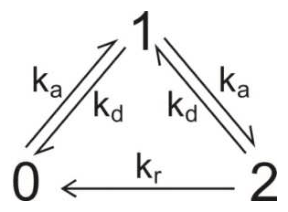
\(x_0\), \(x_1\) and \(x_2\) are the fractions of dust particles existing in state 0, 1 or 2, respectively. These fractions may be treated in the same way as concentrations in the following kinetic analysis. For a system in state \(m\) with fraction \(x_m\), the rates of the three possible processes are
Adsorption \((m\rightarrow m+1)\) : rate \(=k_a[\ce{H}]x_m\)
Desorption \((m\rightarrow m-1)\) : rate \(=k_dmx_m\)
Reaction \((m\rightarrow m-2)\) : rate \(=\frac12 k_rm(m-1)x_m\)
2.5 Write down equations for the rates of change, \(\mathrm{d}x_m/\mathrm{d}t\), of the fractions \(x_0\), \(x_1\) and \(x_2\).
2.6 Assuming steady-state conditions, use the above rate equations to find expressions for the ratios \(x_2/x_1\) and \(x_1/x_0\), and evaluate these ratios.
2.7 Evaluate the steady state fractions \(x_0\), \(x_1\) and \(x_2\).
[If you were unable to determine the ratios in 2.6, use \(x_2/x_1=a\) and \(x_1/x_0=b\) and give the result algebraically.]
2.8 Evaluate the rate of production of \(\ce{H2}\) per dust particle in this model.
2.9 It is currently not possible to measure the rate of this reaction experimentally, but the most recent computer simulations of the rate give a value of \(9.4 \cdot 10^{-6}\ \mathrm{s^{-1}}\). Which of the following statements apply to each model under these conditions? Mark any box you consider to be appropriate.
| Statement | Model A | Model B | Neither model |
|---|---|---|---|
| The rate determining step is adsorption of \(\ce{H}\) atoms. | |||
| The rate-determining step is desorption of \(\ce{H2}\) molecules. | |||
| The rate determining step is the bimolecular reaction of \(\ce{H}\) atoms on the surface. | |||
| The rate determining step is adsorption of the second \(\ce{H}\) atom. | |||
| The implicit assumption that reaction can take place regardless of the number of atoms adsorbed leads to substantial error (at least a factor of two). | |||
| Limiting the number of atoms adsorbed on the particle to 2 leads to substantial error (at least a factor of two). |
Official English text of the problem.
Answers
Let \(F=k_a[\ce{H}]\). The molecular product is dihydrogen, \(\ce{H2}\), SMILES [H][H]. All production rates below are per dust particle.
- 2.1: \(F=\boxed{1.4\times10^{-4}\ \text{atoms}\,\mathrm{s^{-1}}}\).
- 2.2: \(\boxed{N=7.4\times10^{-2}}\) adsorbed atoms on average.
- 2.3: \(\boxed{\mathrm{d}N/\mathrm{d}t=F-k_dN-k_rN^2}\), giving \(\boxed{N=5.2\times10^{-5}}\) adsorbed atoms on average.
- 2.4: \(\boxed{R_A=\tfrac12k_rN^2=7.0\times10^{-5}\ \text{molecules}\,\mathrm{s^{-1}}}\).
- 2.5: \[ \boxed{\begin{aligned} \frac{\mathrm{d}x_0}{\mathrm{d}t}&=-Fx_0+k_dx_1+k_rx_2,\\ \frac{\mathrm{d}x_1}{\mathrm{d}t}&=Fx_0-(F+k_d)x_1+2k_dx_2,\\ \frac{\mathrm{d}x_2}{\mathrm{d}t}&=Fx_1-(2k_d+k_r)x_2. \end{aligned}} \]
- 2.6: \[ \boxed{\frac{x_2}{x_1}=\frac{F}{2k_d+k_r}=2.7\times10^{-9}}, \qquad \boxed{\frac{x_1}{x_0} =\frac{F(2k_d+k_r)}{k_d(2k_d+k_r)+k_rF} =6.9\times10^{-2}}. \]
- 2.7: \(\boxed{x_0\simeq0.936,\quad x_1\simeq0.064,\quad x_2\simeq1.8\times10^{-10}}\).
- 2.8: \(\boxed{R_B=k_rx_2=9.0\times10^{-6}\ \text{molecules}\,\mathrm{s^{-1}}}\).
- 2.9: In the order printed: A; neither; neither; B; A; neither, distinguishing overall adsorption supply from second-atom adsorption. Under a broader reading of the first statement, B can also be marked there, since adsorption of the second atom is itself adsorption of an \(\ce{H}\) atom.
Solution
Atomic hydrogen, \(\ce{H}\), has SMILES [H]. The balanced surface processes are
\[ \ce{H(g) <=> H(ads)} \]
and, including the rapid release of the molecular product,
\[ \ce{2H(ads) -> H2(g)}. \]
Here “ads” denotes adsorption on dust; surface binding is not represented by the SMILES.
2.1
The adsorption rate per particle is
\[ F=k_a[\ce{H}] =\left(1.4\times10^{-5}\ \mathrm{cm^3\,s^{-1}}\right) \left(10\ \mathrm{cm^{-3}}\right). \]
Thus
\[ \boxed{F=1.4\times10^{-4}\ \text{H atoms per particle per second}.} \]
2.2
With adsorption and desorption alone,
\[ \frac{\mathrm{d}N}{\mathrm{d}t}=F-k_dN. \]
At steady state, adsorption balances desorption:
\[ N=\frac{F}{k_d} =\frac{1.4\times10^{-4}}{1.9\times10^{-3}} =0.073684\ldots \]
Therefore,
\[ \boxed{N=7.4\times10^{-2}\ \text{atoms per particle}.} \]
This is an average over particles or time; individual particles carry integer numbers of atoms.
2.3
The problem defines \(k_rN^2\) as the rate of removal of atoms by reaction. Hence
\[ \boxed{\frac{\mathrm{d}N}{\mathrm{d}t} =F-k_dN-k_rN^2.} \]
The steady-state condition gives
\[ k_rN^2+k_dN-F=0. \]
Only the nonnegative root is physically meaningful:
\[ N=\frac{\sqrt{k_d^2+4k_rF}-k_d}{2k_r}. \]
Substitution gives
\[ N= \frac{ \sqrt{(1.9\times10^{-3})^2+ 4(5.1\times10^4)(1.4\times10^{-4})} -1.9\times10^{-3}} {2(5.1\times10^4)} =5.2375\times10^{-5}. \]
Thus
\[ \boxed{N=5.2\times10^{-5}\ \text{atoms per particle}.} \]
2.4
Each molecule consumes two atoms, so the molecular production rate is half the atom-removal rate:
\[ R_A=\frac12k_rN^2. \]
Using the unrounded value of \(N\),
\[ R_A =\frac12(5.1\times10^4)(5.2375\times10^{-5})^2 =6.9950\times10^{-5}\ \mathrm{s^{-1}}. \]
Therefore,
\[ \boxed{R_A=7.0\times10^{-5}\ \text{molecules per particle per second}.} \]
The steady-state atom balance provides a check:
\[ 2R_A=F-k_dN. \]
2.5
The transition rates are
| Transition | Rate |
|---|---|
| \(0\rightarrow1\), adsorption | \(Fx_0\) |
| \(1\rightarrow0\), desorption | \(k_dx_1\) |
| \(1\rightarrow2\), adsorption | \(Fx_1\) |
| \(2\rightarrow1\), desorption | \(2k_dx_2\) |
| \(2\rightarrow0\), reaction | \(k_rx_2\) |
The factor of two for desorption from state 2 arises because either atom can desorb. For reaction in state 2,
\[ \frac12k_rm(m-1)x_m =\frac12k_r(2)(1)x_2=k_rx_2. \]
Adsorption from state 2 is excluded by the imposed two-atom limit. Taking incoming minus outgoing flux for each state gives
\[ \boxed{\begin{aligned} \frac{\mathrm{d}x_0}{\mathrm{d}t} &=-Fx_0+k_dx_1+k_rx_2,\\[2pt] \frac{\mathrm{d}x_1}{\mathrm{d}t} &=Fx_0-k_dx_1-Fx_1+2k_dx_2,\\[2pt] \frac{\mathrm{d}x_2}{\mathrm{d}t} &=Fx_1-2k_dx_2-k_rx_2. \end{aligned}} \]
Their sum is zero, as required for conservation of the total fraction:
\[ \frac{\mathrm{d}}{\mathrm{d}t}(x_0+x_1+x_2)=0. \]
2.6
At steady state, the equation for \(x_2\) gives
\[ Fx_1=(2k_d+k_r)x_2. \]
Consequently,
\[ a\equiv\frac{x_2}{x_1} =\frac{F}{2k_d+k_r} =\frac{1.4\times10^{-4}} {2(1.9\times10^{-3})+5.1\times10^4} =2.74510\times10^{-9}. \]
Thus
\[ \boxed{\frac{x_2}{x_1}=2.7\times10^{-9}.} \]
The steady-state equation for \(x_0\) gives
\[ Fx_0=k_dx_1+k_rx_2 =(k_d+k_ra)x_1. \]
Therefore,
\[ b\equiv\frac{x_1}{x_0} =\frac{F}{k_d+k_ra} =\frac{F(2k_d+k_r)} {k_d(2k_d+k_r)+k_rF}. \]
Numerically,
\[ b=0.06862745\ldots, \]
so
\[ \boxed{\frac{x_1}{x_0}=6.9\times10^{-2}.} \]
2.7
The fractions satisfy
\[ x_0+x_1+x_2=1, \qquad x_1=bx_0, \qquad x_2=abx_0. \]
It follows that
\[ \boxed{ x_0=\frac{1}{1+b+ab},\qquad x_1=\frac{b}{1+b+ab},\qquad x_2=\frac{ab}{1+b+ab}. } \]
Using the unrounded ratios,
\[ x_0=0.935779816\ldots,\qquad x_1=0.064220184\ldots,\qquad x_2=1.7629069\times10^{-10}. \]
Hence
\[ \boxed{x_0\simeq0.936,\qquad x_1\simeq0.064,\qquad x_2\simeq1.8\times10^{-10}.} \]
The extremely small \(x_2\) reflects the very short lifetime of a particle carrying two atoms.
2.8
Each \(2\rightarrow0\) reaction produces one molecule. Its transition rate already counts molecular formation events, so
\[ R_B=k_rx_2. \]
Therefore,
\[ R_B=(5.1\times10^4)(1.7629069\times10^{-10}) =8.990825\times10^{-6}\ \mathrm{s^{-1}}, \]
or
\[ \boxed{R_B=9.0\times10^{-6}\ \text{molecules per particle per second}.} \]
The corresponding atom balance is
\[ F(x_0+x_1) =k_d(x_1+2x_2)+2R_B, \]
which the calculated fractions satisfy.
2.9
Distinguishing overall adsorption supply from the specific second-atom arrival gives the following markings.
| Statement | Model A | Model B | Neither model |
|---|---|---|---|
| Adsorption of \(\ce{H}\) atoms is rate determining. | ✓ | ||
| Desorption of \(\ce{H2}\) molecules is rate determining. | ✓ | ||
| The bimolecular surface reaction is rate determining. | ✓ | ||
| Adsorption of the second \(\ce{H}\) atom is rate determining. | ✓ | ||
| Allowing reaction regardless of the number of adsorbed atoms causes an error of at least a factor of two. | ✓ | ||
| Limiting adsorption to two atoms causes an error of at least a factor of two. | ✓ |
For Model A, desorption removes atoms at only
\[ k_dN=(1.9\times10^{-3})(5.2375\times10^{-5}) =9.95\times10^{-8}\ \mathrm{s^{-1}}, \]
which is negligible compared with \(F=1.4\times10^{-4}\ \mathrm{s^{-1}}\). Almost every arriving atom is therefore consumed in the model:
\[ R_A\simeq\frac{F}{2}. \]
The adsorption supply controls production.
For Model B, a singly occupied particle usually loses its atom before another arrives. The relevant mean times are
\[ \tau_{\mathrm{arrival}}=\frac1F\simeq7.1\times10^3\ \mathrm{s}, \qquad \tau_{\mathrm{desorption}}=\frac1{k_d}\simeq5.3\times10^2\ \mathrm{s}. \]
The probability that the second atom arrives before the first desorbs is
\[ \frac{F}{F+k_d}=0.0686\simeq6.9\%. \]
Once two atoms are present, their reaction is extremely fast:
\[ \tau_{\mathrm{reaction}}=\frac1{k_r} \simeq2.0\times10^{-5}\ \mathrm{s}. \]
Thus the crucial slow event is adsorption of a second atom while the first remains on the particle. Indeed, since \(k_r\) is very large,
\[ R_B\simeq Fx_1 \simeq\frac{F^2}{k_d+2F}. \]
The surface reaction is fast in both models, and the statement explicitly assumes rapid desorption of the newly formed molecule. Neither of those processes is rate determining.
Finally, comparison with the supplied simulation rate gives
\[ \frac{R_A}{R_{\mathrm{sim}}} =\frac{6.9950\times10^{-5}}{9.4\times10^{-6}} =7.44, \]
whereas
\[ \frac{R_B}{R_{\mathrm{sim}}} =\frac{8.9908\times10^{-6}}{9.4\times10^{-6}} =0.956. \]
Model A overestimates production by about 7.4-fold. A fractional mean occupancy is valid, but using \(N^2\) fails to represent the requirement that two atoms coexist on the same particle. Model B explicitly enforces that requirement.
Model B is only about 4.4% below the simulation value. Its two-atom limit therefore does not produce an error approaching a factor of two under these conditions.
The solution was checked against the official solution.
IChO 2009 · Theorieaufgabe 2
Interstellare Bildung von H2
Interstellare Bildung von \(\ce{H2}\)
Wenn zwei Atome im interstellaren Raum zusammenstoßen, ist die Energie des entstehenden Moleküls so groß, dass es rasch dissoziiert. Wasserstoffatome reagieren nur auf der Oberfläche von Staubteilchen zu stabilen \(\ce{H2}\)-Molekülen. Die Staubteilchen nehmen den größten Teil der überschüssigen Energie auf, und das neu gebildete \(\ce{H2}\) desorbiert rasch. In dieser Aufgabe werden zwei kinetische Modelle für die Bildung von \(\ce{H2}\) auf der Oberfläche eines Staubteilchens untersucht.
In beiden Modellen beträgt die Geschwindigkeitskonstante für die Adsorption von \(\ce{H}\)-Atomen an der Oberfläche von Staubteilchen \(k_a = 1.4 \cdot 10^{-5}\ \mathrm{cm^3\,s^{-1}}\). Die typische Teilchenzahldichte der \(\ce{H}\)-Atome (Anzahl der \(\ce{H}\)-Atome pro Volumeneinheit) im interstellaren Raum beträgt \([\ce{H}] = 10\ \mathrm{cm^{-3}}\).
[Hinweis: Im Folgenden dürfen Sie die Anzahlen der an der Oberfläche adsorbierten Atome und die Teilchenzahldichten der Atome in der Gasphase genauso behandeln, wie Sie normalerweise Konzentrationen in Geschwindigkeitsgleichungen verwenden würden. Daher können Ihnen die Einheiten der Geschwindigkeitskonstanten ungewohnt erscheinen. Reaktionsgeschwindigkeiten haben die Einheit Anzahl der Atome oder Moleküle pro Zeiteinheit.]
2.1 Berechnen Sie die Geschwindigkeit, mit der \(\ce{H}\)-Atome an einem Staubteilchen adsorbieren. Sie dürfen durchgehend annehmen, dass diese Geschwindigkeit konstant ist.
Die Desorption von \(\ce{H}\)-Atomen ist bezüglich der Anzahl der adsorbierten Atome erster Ordnung. Die Geschwindigkeitskonstante des Desorptionsschritts beträgt \(k_d = 1.9 \cdot 10^{-3}\ \mathrm{s^{-1}}\).
2.2 Berechnen Sie unter der Annahme, dass nur Adsorption und Desorption stattfinden, die Anzahl \(N\) der \(\ce{H}\)-Atome auf der Oberfläche eines Staubteilchens im stationären Zustand.
Die \(\ce{H}\)-Atome sind auf der Oberfläche beweglich. Wenn sie aufeinandertreffen, reagieren sie zu \(\ce{H2}\), das anschließend desorbiert. Die beiden betrachteten kinetischen Modelle unterscheiden sich in der Modellierung der Reaktion, verwenden jedoch dieselben unten angegebenen Geschwindigkeitskonstanten \(k_a\), \(k_d\) und \(k_r\) für Adsorption, Desorption beziehungsweise bimolekulare Reaktion.
\[ \begin{aligned} k_a &= 1.4 \cdot 10^{-5}\ \mathrm{cm^3\,s^{-1}}\\ k_d &= 1.9 \cdot 10^{-3}\ \mathrm{s^{-1}}\\ k_r &= 5.1 \cdot 10^4\ \mathrm{s^{-1}} \end{aligned} \]
Modell A
Es wird angenommen, dass die Reaktion zur Bildung von \(\ce{H2}\) zweiter Ordnung ist. Auf einem Staubteilchen beträgt die Geschwindigkeit des Verbrauchs von \(\ce{H}\)-Atomen durch die Reaktion \(k_rN^2\).
2.3 Stellen Sie eine Gleichung für die zeitliche Änderung von \(N\) auf, die Adsorption, Desorption und Reaktion berücksichtigt. Bestimmen Sie den Wert von \(N\) unter der Annahme stationärer Bedingungen.
2.4 Berechnen Sie die Bildungsgeschwindigkeit von \(\ce{H2}\) pro Staubteilchen in diesem Modell.
Modell B
Modell B versucht, die Wahrscheinlichkeit dafür zu analysieren, dass die Staubteilchen 0, 1 oder 2 \(\ce{H}\)-Atome tragen. Die drei Zustände sind durch das folgende Reaktionsschema miteinander verknüpft. Es wird angenommen, dass höchstens 2 Atome gleichzeitig adsorbiert sein können.
\(x_0\), \(x_1\) und \(x_2\) sind die Anteile der Staubteilchen, die sich im Zustand 0, 1 beziehungsweise 2 befinden. Diese Anteile dürfen in der folgenden kinetischen Analyse genauso wie Konzentrationen behandelt werden. Für ein System im Zustand \(m\) mit dem Anteil \(x_m\) lauten die Geschwindigkeiten der drei möglichen Prozesse
Adsorption \((m\rightarrow m+1)\) : Geschwindigkeit \(=k_a[\ce{H}]x_m\)
Desorption \((m\rightarrow m-1)\) : Geschwindigkeit \(=k_dmx_m\)
Reaktion \((m\rightarrow m-2)\) : Geschwindigkeit \(=\frac12 k_rm(m-1)x_m\)
2.5 Stellen Sie Gleichungen für die zeitlichen Änderungen \(\mathrm{d}x_m/\mathrm{d}t\) der Anteile \(x_0\), \(x_1\) und \(x_2\) auf.
2.6 Leiten Sie unter der Annahme stationärer Bedingungen mithilfe der obigen Geschwindigkeitsgleichungen Ausdrücke für die Verhältnisse \(x_2/x_1\) und \(x_1/x_0\) her und berechnen Sie diese Verhältnisse.
2.7 Berechnen Sie die Anteile \(x_0\), \(x_1\) und \(x_2\) im stationären Zustand.
[Falls Sie die Verhältnisse in 2.6 nicht bestimmen konnten, verwenden Sie \(x_2/x_1=a\) und \(x_1/x_0=b\) und geben Sie das Ergebnis algebraisch an.]
2.8 Berechnen Sie die Bildungsgeschwindigkeit von \(\ce{H2}\) pro Staubteilchen in diesem Modell.
2.9 Derzeit ist es nicht möglich, die Geschwindigkeit dieser Reaktion experimentell zu messen; die neuesten Computersimulationen der Geschwindigkeit ergeben jedoch einen Wert von \(9.4 \cdot 10^{-6}\ \mathrm{s^{-1}}\). Welche der folgenden Aussagen treffen unter diesen Bedingungen auf das jeweilige Modell zu? Kreuzen Sie alle Kästchen an, die Sie für zutreffend halten.
| Aussage | Modell A | Modell B | Keines der beiden Modelle |
|---|---|---|---|
| Der geschwindigkeitsbestimmende Schritt ist die Adsorption von \(\ce{H}\)-Atomen. | |||
| Der geschwindigkeitsbestimmende Schritt ist die Desorption von \(\ce{H2}\)-Molekülen. | |||
| Der geschwindigkeitsbestimmende Schritt ist die bimolekulare Reaktion von \(\ce{H}\)-Atomen auf der Oberfläche. | |||
| Der geschwindigkeitsbestimmende Schritt ist die Adsorption des zweiten \(\ce{H}\)-Atoms. | |||
| Die implizite Annahme, dass die Reaktion unabhängig von der Anzahl adsorbierter Atome stattfinden kann, führt zu einem erheblichen Fehler (mindestens um einen Faktor zwei). | |||
| Die Begrenzung der Anzahl der am Teilchen adsorbierten Atome auf 2 führt zu einem erheblichen Fehler (mindestens um einen Faktor zwei). |
Aufgabentext aus dem offiziellen englischen Text übersetzt.
Antworten
Es sei \(F=k_a[\ce{H}]\). Das molekulare Produkt ist Diwasserstoff, \(\ce{H2}\), SMILES [H][H]. Alle nachstehenden Bildungsgeschwindigkeiten beziehen sich auf ein Staubteilchen.
- 2.1: \(F=\boxed{1.4\times10^{-4}\ \text{Atome}\,\mathrm{s^{-1}}}\).
- 2.2: \(\boxed{N=7.4\times10^{-2}}\) adsorbierte Atome im Mittel.
- 2.3: \(\boxed{\mathrm{d}N/\mathrm{d}t=F-k_dN-k_rN^2}\), woraus sich \(\boxed{N=5.2\times10^{-5}}\) adsorbierte Atome im Mittel ergeben.
- 2.4: \(\boxed{R_A=\tfrac12k_rN^2=7.0\times10^{-5}\ \text{Moleküle}\,\mathrm{s^{-1}}}\).
- 2.5: \[ \boxed{\begin{aligned} \frac{\mathrm{d}x_0}{\mathrm{d}t}&=-Fx_0+k_dx_1+k_rx_2,\\ \frac{\mathrm{d}x_1}{\mathrm{d}t}&=Fx_0-(F+k_d)x_1+2k_dx_2,\\ \frac{\mathrm{d}x_2}{\mathrm{d}t}&=Fx_1-(2k_d+k_r)x_2. \end{aligned}} \]
- 2.6: \[ \boxed{\frac{x_2}{x_1}=\frac{F}{2k_d+k_r}=2.7\times10^{-9}}, \qquad \boxed{\frac{x_1}{x_0} =\frac{F(2k_d+k_r)}{k_d(2k_d+k_r)+k_rF} =6.9\times10^{-2}}. \]
- 2.7: \(\boxed{x_0\simeq0.936,\quad x_1\simeq0.064,\quad x_2\simeq1.8\times10^{-10}}\).
- 2.8: \(\boxed{R_B=k_rx_2=9.0\times10^{-6}\ \text{Moleküle}\,\mathrm{s^{-1}}}\).
- 2.9: In der angegebenen Reihenfolge: A; keines; keines; B; A; keines, wobei zwischen der gesamten Zufuhr durch Adsorption und der Adsorption des zweiten Atoms unterschieden wird. Bei einer weiter gefassten Auslegung der ersten Aussage kann dort auch B angekreuzt werden, da die Adsorption des zweiten Atoms selbst die Adsorption eines \(\ce{H}\)-Atoms ist.
Lösung
Atomarer Wasserstoff, \(\ce{H}\), hat den SMILES-Ausdruck [H]. Die ausgeglichenen Oberflächenprozesse lauten
\[ \ce{H(g) <=> H(ads)} \]
und unter Einbeziehung der raschen Freisetzung des molekularen Produkts
\[ \ce{2H(ads) -> H2(g)}. \]
Dabei bezeichnet „ads“ die Adsorption an Staub; die Bindung an die Oberfläche wird durch die SMILES-Ausdrücke nicht dargestellt.
2.1
Die Adsorptionsgeschwindigkeit pro Teilchen beträgt
\[ F=k_a[\ce{H}] =\left(1.4\times10^{-5}\ \mathrm{cm^3\,s^{-1}}\right) \left(10\ \mathrm{cm^{-3}}\right). \]
Somit gilt
\[ \boxed{F=1.4\times10^{-4}\ \text{H-Atome pro Teilchen und Sekunde}.} \]
2.2
Wenn nur Adsorption und Desorption stattfinden, gilt
\[ \frac{\mathrm{d}N}{\mathrm{d}t}=F-k_dN. \]
Im stationären Zustand gleichen sich Adsorption und Desorption aus:
\[ N=\frac{F}{k_d} =\frac{1.4\times10^{-4}}{1.9\times10^{-3}} =0.073684\ldots \]
Daher gilt
\[ \boxed{N=7.4\times10^{-2}\ \text{Atome pro Teilchen}.} \]
Dies ist ein Mittelwert über die Teilchen oder über die Zeit; einzelne Teilchen tragen eine ganzzahlige Anzahl von Atomen.
2.3
In der Aufgabenstellung ist \(k_rN^2\) als Geschwindigkeit des Verbrauchs von Atomen durch die Reaktion definiert. Daher gilt
\[ \boxed{\frac{\mathrm{d}N}{\mathrm{d}t} =F-k_dN-k_rN^2.} \]
Die Bedingung für den stationären Zustand ergibt
\[ k_rN^2+k_dN-F=0. \]
Nur die nichtnegative Wurzel ist physikalisch sinnvoll:
\[ N=\frac{\sqrt{k_d^2+4k_rF}-k_d}{2k_r}. \]
Einsetzen ergibt
\[ N= \frac{ \sqrt{(1.9\times10^{-3})^2+ 4(5.1\times10^4)(1.4\times10^{-4})} -1.9\times10^{-3}} {2(5.1\times10^4)} =5.2375\times10^{-5}. \]
Somit gilt
\[ \boxed{N=5.2\times10^{-5}\ \text{Atome pro Teilchen}.} \]
2.4
Für jedes Molekül werden zwei Atome verbraucht, sodass die Bildungsgeschwindigkeit der Moleküle halb so groß ist wie die Verbrauchsgeschwindigkeit der Atome:
\[ R_A=\frac12k_rN^2. \]
Mit dem ungerundeten Wert von \(N\) erhält man
\[ R_A =\frac12(5.1\times10^4)(5.2375\times10^{-5})^2 =6.9950\times10^{-5}\ \mathrm{s^{-1}}. \]
Daher gilt
\[ \boxed{R_A=7.0\times10^{-5}\ \text{Moleküle pro Teilchen und Sekunde}.} \]
Die Atombilanz im stationären Zustand bietet eine Kontrolle:
\[ 2R_A=F-k_dN. \]
2.5
Die Übergangsgeschwindigkeiten lauten
| Übergang | Geschwindigkeit |
|---|---|
| \(0\rightarrow1\), Adsorption | \(Fx_0\) |
| \(1\rightarrow0\), Desorption | \(k_dx_1\) |
| \(1\rightarrow2\), Adsorption | \(Fx_1\) |
| \(2\rightarrow1\), Desorption | \(2k_dx_2\) |
| \(2\rightarrow0\), Reaktion | \(k_rx_2\) |
Der Faktor zwei bei der Desorption aus Zustand 2 ergibt sich daraus, dass jedes der beiden Atome desorbieren kann. Für die Reaktion im Zustand 2 gilt
\[ \frac12k_rm(m-1)x_m =\frac12k_r(2)(1)x_2=k_rx_2. \]
Adsorption ausgehend von Zustand 2 ist durch die vorgegebene Begrenzung auf zwei Atome ausgeschlossen. Die Differenz aus zu- und abfließendem Fluss für jeden Zustand ergibt
\[ \boxed{\begin{aligned} \frac{\mathrm{d}x_0}{\mathrm{d}t} &=-Fx_0+k_dx_1+k_rx_2,\\[2pt] \frac{\mathrm{d}x_1}{\mathrm{d}t} &=Fx_0-k_dx_1-Fx_1+2k_dx_2,\\[2pt] \frac{\mathrm{d}x_2}{\mathrm{d}t} &=Fx_1-2k_dx_2-k_rx_2. \end{aligned}} \]
Ihre Summe ist null, wie es die Erhaltung des Gesamtanteils erfordert:
\[ \frac{\mathrm{d}}{\mathrm{d}t}(x_0+x_1+x_2)=0. \]
2.6
Im stationären Zustand ergibt die Gleichung für \(x_2\)
\[ Fx_1=(2k_d+k_r)x_2. \]
Folglich gilt
\[ a\equiv\frac{x_2}{x_1} =\frac{F}{2k_d+k_r} =\frac{1.4\times10^{-4}} {2(1.9\times10^{-3})+5.1\times10^4} =2.74510\times10^{-9}. \]
Somit gilt
\[ \boxed{\frac{x_2}{x_1}=2.7\times10^{-9}.} \]
Die Gleichung für \(x_0\) im stationären Zustand ergibt
\[ Fx_0=k_dx_1+k_rx_2 =(k_d+k_ra)x_1. \]
Daher gilt
\[ b\equiv\frac{x_1}{x_0} =\frac{F}{k_d+k_ra} =\frac{F(2k_d+k_r)} {k_d(2k_d+k_r)+k_rF}. \]
Numerisch ergibt sich
\[ b=0.06862745\ldots, \]
also
\[ \boxed{\frac{x_1}{x_0}=6.9\times10^{-2}.} \]
2.7
Die Anteile erfüllen
\[ x_0+x_1+x_2=1, \qquad x_1=bx_0, \qquad x_2=abx_0. \]
Daraus folgt
\[ \boxed{ x_0=\frac{1}{1+b+ab},\qquad x_1=\frac{b}{1+b+ab},\qquad x_2=\frac{ab}{1+b+ab}. } \]
Mit den ungerundeten Verhältnissen erhält man
\[ x_0=0.935779816\ldots,\qquad x_1=0.064220184\ldots,\qquad x_2=1.7629069\times10^{-10}. \]
Damit gilt
\[ \boxed{x_0\simeq0.936,\qquad x_1\simeq0.064,\qquad x_2\simeq1.8\times10^{-10}.} \]
Der äußerst kleine Wert von \(x_2\) spiegelt die sehr kurze Lebensdauer eines Teilchens wider, das zwei Atome trägt.
2.8
Jede \(2\rightarrow0\)-Reaktion erzeugt ein Molekül. Ihre Übergangsgeschwindigkeit zählt bereits die Bildungsereignisse von Molekülen, sodass gilt
\[ R_B=k_rx_2. \]
Daher gilt
\[ R_B=(5.1\times10^4)(1.7629069\times10^{-10}) =8.990825\times10^{-6}\ \mathrm{s^{-1}}, \]
oder
\[ \boxed{R_B=9.0\times10^{-6}\ \text{Moleküle pro Teilchen und Sekunde}.} \]
Die zugehörige Atombilanz lautet
\[ F(x_0+x_1) =k_d(x_1+2x_2)+2R_B, \]
und wird von den berechneten Anteilen erfüllt.
2.9
Unterscheidet man zwischen der gesamten Zufuhr durch Adsorption und speziell dem Eintreffen eines zweiten Atoms, ergeben sich die folgenden Markierungen.
| Aussage | Modell A | Modell B | Keines der beiden Modelle |
|---|---|---|---|
| Die Adsorption von \(\ce{H}\)-Atomen ist geschwindigkeitsbestimmend. | ✓ | ||
| Die Desorption von \(\ce{H2}\)-Molekülen ist geschwindigkeitsbestimmend. | ✓ | ||
| Die bimolekulare Oberflächenreaktion ist geschwindigkeitsbestimmend. | ✓ | ||
| Die Adsorption des zweiten \(\ce{H}\)-Atoms ist geschwindigkeitsbestimmend. | ✓ | ||
| Die Zulassung einer Reaktion unabhängig von der Anzahl adsorbierter Atome verursacht einen Fehler von mindestens einem Faktor zwei. | ✓ | ||
| Die Begrenzung der Adsorption auf zwei Atome verursacht einen Fehler von mindestens einem Faktor zwei. | ✓ |
Bei Modell A werden Atome durch Desorption nur mit einer Geschwindigkeit von
\[ k_dN=(1.9\times10^{-3})(5.2375\times10^{-5}) =9.95\times10^{-8}\ \mathrm{s^{-1}}, \]
entfernt, was gegenüber \(F=1.4\times10^{-4}\ \mathrm{s^{-1}}\) vernachlässigbar ist. Daher wird im Modell fast jedes eintreffende Atom verbraucht:
\[ R_A\simeq\frac{F}{2}. \]
Die Zufuhr durch Adsorption bestimmt die Bildungsgeschwindigkeit.
Bei Modell B verliert ein einfach besetztes Teilchen sein Atom meist, bevor ein weiteres eintrifft. Die relevanten mittleren Zeiten betragen
\[ \tau_{\mathrm{arrival}}=\frac1F\simeq7.1\times10^3\ \mathrm{s}, \qquad \tau_{\mathrm{desorption}}=\frac1{k_d}\simeq5.3\times10^2\ \mathrm{s}. \]
Die Wahrscheinlichkeit dafür, dass das zweite Atom eintrifft, bevor das erste desorbiert, beträgt
\[ \frac{F}{F+k_d}=0.0686\simeq6.9\%. \]
Sobald zwei Atome vorhanden sind, verläuft ihre Reaktion äußerst schnell:
\[ \tau_{\mathrm{reaction}}=\frac1{k_r} \simeq2.0\times10^{-5}\ \mathrm{s}. \]
Das entscheidende langsame Ereignis ist somit die Adsorption eines zweiten Atoms, während das erste auf dem Teilchen verbleibt. Da \(k_r\) sehr groß ist, gilt tatsächlich
\[ R_B\simeq Fx_1 \simeq\frac{F^2}{k_d+2F}. \]
Die Oberflächenreaktion ist in beiden Modellen schnell, und die Aufgabenstellung setzt ausdrücklich eine rasche Desorption des neu gebildeten Moleküls voraus. Keiner dieser Prozesse ist geschwindigkeitsbestimmend.
Schließlich ergibt der Vergleich mit der angegebenen Simulationsgeschwindigkeit
\[ \frac{R_A}{R_{\mathrm{sim}}} =\frac{6.9950\times10^{-5}}{9.4\times10^{-6}} =7.44, \]
während
\[ \frac{R_B}{R_{\mathrm{sim}}} =\frac{8.9908\times10^{-6}}{9.4\times10^{-6}} =0.956. \]
Modell A überschätzt die Bildungsgeschwindigkeit etwa um das 7.4-Fache. Eine nichtganzzahlige mittlere Belegung ist zulässig, aber die Verwendung von \(N^2\) bildet die Voraussetzung nicht ab, dass zwei Atome gleichzeitig auf demselben Teilchen vorhanden sein müssen. Modell B berücksichtigt diese Voraussetzung ausdrücklich.
Modell B liegt nur etwa 4.4% unter dem Simulationswert. Seine Begrenzung auf zwei Atome führt daher unter diesen Bedingungen nicht zu einem Fehler, der auch nur annähernd einen Faktor zwei erreicht.
Die Lösung wurde mit der offiziellen Lösung abgeglichen.
IChO 2009 · Teori sorusu 2
Yıldızlararası ortamda H2 oluşumu
Yıldızlararası ortamda \(\ce{H2}\) oluşumu
Yıldızlararası uzayda iki atom çarpıştığında oluşan molekülün enerjisi o kadar büyüktür ki molekül hızla ayrışır. Hidrojen atomları, kararlı \(\ce{H2}\) molekülleri oluşturmak üzere yalnızca toz taneciklerinin yüzeyinde tepkimeye girer. Toz tanecikleri fazla enerjinin büyük bölümünü soğurur ve yeni oluşan \(\ce{H2}\) hızla desorbe olur. Bu soru, bir toz taneciğinin yüzeyinde \(\ce{H2}\) oluşumuna ilişkin iki kinetik modeli incelemektedir.
Her iki modelde de \(\ce{H}\) atomlarının toz taneciklerinin yüzeyine adsorpsiyonu için hız sabiti \(k_a = 1.4 \cdot 10^{-5}\ \mathrm{cm^3\,s^{-1}}\) değerindedir. Yıldızlararası uzayda \(\ce{H}\) atomlarının tipik sayı yoğunluğu (birim hacim başına \(\ce{H}\) atomu sayısı) \([\ce{H}] = 10\ \mathrm{cm^{-3}}\) değerindedir.
[Not: Aşağıda, yüzeye adsorplanmış atom sayılarını ve gaz fazındaki atomların sayı yoğunluklarını, hız denklemlerinde normalde derişimleri kullandığınız şekilde kullanabilirsiniz. Bu nedenle hız sabitlerinin birimleri size alışılmadık gelebilir. Tepkime hızlarının birimi, birim zaman başına atom veya molekül sayısıdır.]
2.1 \(\ce{H}\) atomlarının bir toz taneciğine adsorplanma hızını hesaplayınız. Bu hızın sorunun tamamında sabit olduğunu varsayabilirsiniz.
\(\ce{H}\) atomlarının desorpsiyonu, adsorplanmış atom sayısına göre birinci derecedendir. Desorpsiyon basamağının hız sabiti \(k_d = 1.9 \cdot 10^{-3}\ \mathrm{s^{-1}}\) değerindedir.
2.2 Yalnızca adsorpsiyon ve desorpsiyonun gerçekleştiğini varsayarak, bir toz taneciğinin yüzeyindeki \(\ce{H}\) atomlarının kararlı durumdaki sayısını, \(N\), hesaplayınız.
\(\ce{H}\) atomları yüzey üzerinde hareketlidir. Karşılaştıklarında tepkimeye girerek \(\ce{H2}\) oluştururlar; oluşan \(\ce{H2}\) daha sonra desorbe olur. Ele alınan iki kinetik model, tepkimenin modellenme biçimi bakımından farklılık gösterir; ancak adsorpsiyon, desorpsiyon ve bimoleküler tepkime için aşağıda verilen aynı \(k_a\), \(k_d\) ve \(k_r\) hız sabitlerini kullanır.
\[ \begin{aligned} k_a &= 1.4 \cdot 10^{-5}\ \mathrm{cm^3\,s^{-1}}\\ k_d &= 1.9 \cdot 10^{-3}\ \mathrm{s^{-1}}\\ k_r &= 5.1 \cdot 10^4\ \mathrm{s^{-1}} \end{aligned} \]
Model A
\(\ce{H2}\) oluşum tepkimesinin ikinci dereceden olduğu varsayılmaktadır. Bir toz taneciğinde \(\ce{H}\) atomlarının tepkime yoluyla tüketilme hızı \(k_rN^2\) olarak verilir.
2.3 Adsorpsiyon, desorpsiyon ve tepkimeyi içerecek şekilde \(N\)'nin değişim hızı için bir denklem yazınız. Kararlı durum koşullarını varsayarak \(N\)'nin değerini belirleyiniz.
2.4 Bu modelde toz taneciği başına \(\ce{H2}\) oluşum hızını hesaplayınız.
Model B
Model B, toz taneciklerinin 0, 1 veya 2 \(\ce{H}\) atomu taşıma olasılığını incelemeyi amaçlar. Bu üç durum, aşağıdaki tepkime şemasıyla birbirine bağlıdır. Aynı anda en fazla 2 atomun adsorplanabileceği varsayılmaktadır.
\(x_0\), \(x_1\) ve \(x_2\), sırasıyla 0, 1 veya 2 durumunda bulunan toz taneciklerinin kesirleridir. Aşağıdaki kinetik analizde bu kesirler derişimlerle aynı şekilde ele alınabilir. Kesri \(x_m\) olan \(m\) durumundaki bir sistem için olası üç sürecin hızları şöyledir:
Adsorpsiyon \((m\rightarrow m+1)\) : hız \(=k_a[\ce{H}]x_m\)
Desorpsiyon \((m\rightarrow m-1)\) : hız \(=k_dmx_m\)
Tepkime \((m\rightarrow m-2)\) : hız \(=\frac12 k_rm(m-1)x_m\)
2.5 \(x_0\), \(x_1\) ve \(x_2\) kesirlerinin değişim hızları, \(\mathrm{d}x_m/\mathrm{d}t\), için denklemleri yazınız.
2.6 Kararlı durum koşullarını varsayarak, yukarıdaki hız denklemlerini kullanıp \(x_2/x_1\) ve \(x_1/x_0\) oranları için ifadeler bulunuz ve bu oranların değerlerini hesaplayınız.
2.7 Kararlı durum kesirleri \(x_0\), \(x_1\) ve \(x_2\)'nin değerlerini hesaplayınız.
[2.6'daki oranları belirleyemediyseniz, \(x_2/x_1=a\) ve \(x_1/x_0=b\) kullanarak sonucu cebirsel olarak veriniz.]
2.8 Bu modelde toz taneciği başına \(\ce{H2}\) oluşum hızını hesaplayınız.
2.9 Bu tepkimenin hızını deneysel olarak ölçmek şu anda mümkün değildir; ancak hıza ilişkin en son bilgisayar benzetimleri \(9.4 \cdot 10^{-6}\ \mathrm{s^{-1}}\) değerini vermektedir. Bu koşullar altında aşağıdaki ifadelerden hangileri her bir model için geçerlidir? Uygun bulduğunuz tüm kutuları işaretleyiniz.
| İfade | Model A | Model B | Hiçbir model |
|---|---|---|---|
| Hız belirleyen basamak, \(\ce{H}\) atomlarının adsorpsiyonudur. | |||
| Hız belirleyen basamak, \(\ce{H2}\) moleküllerinin desorpsiyonudur. | |||
| Hız belirleyen basamak, yüzeydeki \(\ce{H}\) atomlarının bimoleküler tepkimesidir. | |||
| Hız belirleyen basamak, ikinci \(\ce{H}\) atomunun adsorpsiyonudur. | |||
| Adsorplanmış atom sayısından bağımsız olarak tepkimenin gerçekleşebileceği yönündeki örtük varsayım, önemli bir hataya (en az iki katlık bir farka) yol açar. | |||
| Tanecik üzerinde adsorplanmış atom sayısını 2 ile sınırlamak, önemli bir hataya (en az iki katlık bir farka) yol açar. |
Soru metni resmi İngilizce metinden çevrilmiştir.
Cevaplar
\(F=k_a[\ce{H}]\) olsun. Moleküler ürün dihidrojen, \(\ce{H2}\), olup SMILES gösterimi [H][H] şeklindedir. Aşağıdaki tüm oluşum hızları toz taneciği başınadır.
- 2.1: \(F=\boxed{1.4\times10^{-4}\ \text{atom}\,\mathrm{s^{-1}}}\).
- 2.2: Ortalama \(\boxed{N=7.4\times10^{-2}}\) adsorplanmış atom.
- 2.3: \(\boxed{\mathrm{d}N/\mathrm{d}t=F-k_dN-k_rN^2}\); buradan ortalama \(\boxed{N=5.2\times10^{-5}}\) adsorplanmış atom elde edilir.
- 2.4: \(\boxed{R_A=\tfrac12k_rN^2=7.0\times10^{-5}\ \text{molekül}\,\mathrm{s^{-1}}}\).
- 2.5: \[ \boxed{\begin{aligned} \frac{\mathrm{d}x_0}{\mathrm{d}t}&=-Fx_0+k_dx_1+k_rx_2,\\ \frac{\mathrm{d}x_1}{\mathrm{d}t}&=Fx_0-(F+k_d)x_1+2k_dx_2,\\ \frac{\mathrm{d}x_2}{\mathrm{d}t}&=Fx_1-(2k_d+k_r)x_2. \end{aligned}} \]
- 2.6: \[ \boxed{\frac{x_2}{x_1}=\frac{F}{2k_d+k_r}=2.7\times10^{-9}}, \qquad \boxed{\frac{x_1}{x_0} =\frac{F(2k_d+k_r)}{k_d(2k_d+k_r)+k_rF} =6.9\times10^{-2}}. \]
- 2.7: \(\boxed{x_0\simeq0.936,\quad x_1\simeq0.064,\quad x_2\simeq1.8\times10^{-10}}\).
- 2.8: \(\boxed{R_B=k_rx_2=9.0\times10^{-6}\ \text{molekül}\,\mathrm{s^{-1}}}\).
- 2.9: Verildikleri sırayla: A; hiçbiri; hiçbiri; B; A; hiçbiri; burada toplam adsorpsiyonla atom sağlanması ile ikinci atomun adsorpsiyonu birbirinden ayrılmıştır. İlk ifade daha geniş yorumlandığında, orada B de işaretlenebilir, çünkü ikinci atomun adsorpsiyonu da başlı başına bir \(\ce{H}\) atomunun adsorpsiyonudur.
Çözüm
Atomik hidrojenin, \(\ce{H}\), SMILES gösterimi [H] şeklindedir. Denkleştirilmiş yüzey süreçleri
\[ \ce{H(g) <=> H(ads)} \]
ve moleküler ürünün hızla salınması da dâhil edildiğinde,
\[ \ce{2H(ads) -> H2(g)}. \]
şeklindedir. Burada “ads”, toz üzerindeki adsorpsiyonu belirtir; yüzeye bağlanma SMILES gösteriminde temsil edilmez.
2.1
Tanecik başına adsorpsiyon hızı
\[ F=k_a[\ce{H}] =\left(1.4\times10^{-5}\ \mathrm{cm^3\,s^{-1}}\right) \left(10\ \mathrm{cm^{-3}}\right). \]
Böylece
\[ \boxed{F=1.4\times10^{-4}\ \text{tanecik başına saniyede H atomu}.} \]
2.2
Yalnızca adsorpsiyon ve desorpsiyon olduğunda,
\[ \frac{\mathrm{d}N}{\mathrm{d}t}=F-k_dN. \]
Kararlı durumda adsorpsiyon ile desorpsiyon birbirini dengeler:
\[ N=\frac{F}{k_d} =\frac{1.4\times10^{-4}}{1.9\times10^{-3}} =0.073684\ldots \]
Dolayısıyla,
\[ \boxed{N=7.4\times10^{-2}\ \text{tanecik başına atom}.} \]
Bu, tanecikler veya zaman üzerinden alınmış bir ortalamadır; tek tek taneciklerin taşıdığı atom sayıları tam sayıdır.
2.3
Soruda \(k_rN^2\), tepkime yoluyla atomların tüketilme hızı olarak tanımlanmaktadır. Bu nedenle
\[ \boxed{\frac{\mathrm{d}N}{\mathrm{d}t} =F-k_dN-k_rN^2.} \]
Kararlı durum koşulu şu denklemi verir:
\[ k_rN^2+k_dN-F=0. \]
Yalnızca negatif olmayan kök fiziksel olarak anlamlıdır:
\[ N=\frac{\sqrt{k_d^2+4k_rF}-k_d}{2k_r}. \]
Değerler yerine konulduğunda
\[ N= \frac{ \sqrt{(1.9\times10^{-3})^2+ 4(5.1\times10^4)(1.4\times10^{-4})} -1.9\times10^{-3}} {2(5.1\times10^4)} =5.2375\times10^{-5}. \]
Böylece
\[ \boxed{N=5.2\times10^{-5}\ \text{tanecik başına atom}.} \]
2.4
Her molekülün oluşumu iki atom tükettiğinden, molekül oluşum hızı atom tüketim hızının yarısıdır:
\[ R_A=\frac12k_rN^2. \]
\(N\)'nin yuvarlanmamış değeri kullanıldığında,
\[ R_A =\frac12(5.1\times10^4)(5.2375\times10^{-5})^2 =6.9950\times10^{-5}\ \mathrm{s^{-1}}. \]
Dolayısıyla,
\[ \boxed{R_A=7.0\times10^{-5}\ \text{tanecik başına saniyede molekül}.} \]
Kararlı durumdaki atom dengesi bir kontrol sağlar:
\[ 2R_A=F-k_dN. \]
2.5
Geçiş hızları şöyledir:
| Geçiş | Hız |
|---|---|
| \(0\rightarrow1\), adsorpsiyon | \(Fx_0\) |
| \(1\rightarrow0\), desorpsiyon | \(k_dx_1\) |
| \(1\rightarrow2\), adsorpsiyon | \(Fx_1\) |
| \(2\rightarrow1\), desorpsiyon | \(2k_dx_2\) |
| \(2\rightarrow0\), tepkime | \(k_rx_2\) |
2 durumundan desorpsiyondaki iki çarpanı, atomlardan herhangi birinin desorbe olabilmesinden kaynaklanır. 2 durumundaki tepkime için,
\[ \frac12k_rm(m-1)x_m =\frac12k_r(2)(1)x_2=k_rx_2. \]
Getirilen iki atom sınırı nedeniyle 2 durumundan adsorpsiyon hariç tutulur. Her durum için gelen akıdan giden akı çıkarıldığında
\[ \boxed{\begin{aligned} \frac{\mathrm{d}x_0}{\mathrm{d}t} &=-Fx_0+k_dx_1+k_rx_2,\\[2pt] \frac{\mathrm{d}x_1}{\mathrm{d}t} &=Fx_0-k_dx_1-Fx_1+2k_dx_2,\\[2pt] \frac{\mathrm{d}x_2}{\mathrm{d}t} &=Fx_1-2k_dx_2-k_rx_2. \end{aligned}} \]
elde edilir. Toplam kesrin korunması için gerektiği gibi, bunların toplamı sıfırdır:
\[ \frac{\mathrm{d}}{\mathrm{d}t}(x_0+x_1+x_2)=0. \]
2.6
Kararlı durumda \(x_2\) için yazılan denklem şunu verir:
\[ Fx_1=(2k_d+k_r)x_2. \]
Bunun sonucunda,
\[ a\equiv\frac{x_2}{x_1} =\frac{F}{2k_d+k_r} =\frac{1.4\times10^{-4}} {2(1.9\times10^{-3})+5.1\times10^4} =2.74510\times10^{-9}. \]
Böylece
\[ \boxed{\frac{x_2}{x_1}=2.7\times10^{-9}.} \]
\(x_0\) için kararlı durum denklemi şunu verir:
\[ Fx_0=k_dx_1+k_rx_2 =(k_d+k_ra)x_1. \]
Dolayısıyla,
\[ b\equiv\frac{x_1}{x_0} =\frac{F}{k_d+k_ra} =\frac{F(2k_d+k_r)} {k_d(2k_d+k_r)+k_rF}. \]
Sayısal olarak,
\[ b=0.06862745\ldots, \]
dolayısıyla
\[ \boxed{\frac{x_1}{x_0}=6.9\times10^{-2}.} \]
2.7
Kesirler şu bağıntıları sağlar:
\[ x_0+x_1+x_2=1, \qquad x_1=bx_0, \qquad x_2=abx_0. \]
Buradan
\[ \boxed{ x_0=\frac{1}{1+b+ab},\qquad x_1=\frac{b}{1+b+ab},\qquad x_2=\frac{ab}{1+b+ab}. } \]
elde edilir. Yuvarlanmamış oranlar kullanıldığında,
\[ x_0=0.935779816\ldots,\qquad x_1=0.064220184\ldots,\qquad x_2=1.7629069\times10^{-10}. \]
Böylece
\[ \boxed{x_0\simeq0.936,\qquad x_1\simeq0.064,\qquad x_2\simeq1.8\times10^{-10}.} \]
\(x_2\)'nin son derece küçük olması, iki atom taşıyan bir taneciğin bu durumdaki ömrünün çok kısa olduğunu yansıtır.
2.8
Her \(2\rightarrow0\) tepkimesi bir molekül oluşturur. Bu geçişin hızı zaten molekül oluşum olaylarını saydığından
\[ R_B=k_rx_2. \]
Dolayısıyla,
\[ R_B=(5.1\times10^4)(1.7629069\times10^{-10}) =8.990825\times10^{-6}\ \mathrm{s^{-1}}, \]
ya da
\[ \boxed{R_B=9.0\times10^{-6}\ \text{tanecik başına saniyede molekül}.} \]
Buna karşılık gelen atom dengesi
\[ F(x_0+x_1) =k_d(x_1+2x_2)+2R_B, \]
olup hesaplanan kesirler bu bağıntıyı sağlar.
2.9
Toplam adsorpsiyonla atom sağlanması ile özel olarak ikinci atomun gelişi birbirinden ayrıldığında aşağıdaki işaretlemeler elde edilir.
| İfade | Model A | Model B | Hiçbir model |
|---|---|---|---|
| \(\ce{H}\) atomlarının adsorpsiyonu hız belirleyicidir. | ✓ | ||
| \(\ce{H2}\) moleküllerinin desorpsiyonu hız belirleyicidir. | ✓ | ||
| Bimoleküler yüzey tepkimesi hız belirleyicidir. | ✓ | ||
| İkinci \(\ce{H}\) atomunun adsorpsiyonu hız belirleyicidir. | ✓ | ||
| Adsorplanmış atom sayısından bağımsız olarak tepkimeye izin verilmesi, en az iki katlık bir hataya neden olur. | ✓ | ||
| Adsorpsiyonun iki atomla sınırlanması, en az iki katlık bir hataya neden olur. | ✓ |
Model A için desorpsiyonla atomların uzaklaşma hızı yalnızca
\[ k_dN=(1.9\times10^{-3})(5.2375\times10^{-5}) =9.95\times10^{-8}\ \mathrm{s^{-1}}, \]
olup \(F=1.4\times10^{-4}\ \mathrm{s^{-1}}\) ile karşılaştırıldığında ihmal edilebilir. Dolayısıyla modelde gelen atomların neredeyse tamamı tüketilir:
\[ R_A\simeq\frac{F}{2}. \]
Oluşum hızını, adsorpsiyon yoluyla atom sağlanması belirler.
Model B için tek atom taşıyan bir tanecik, genellikle başka bir atom gelmeden önce atomunu kaybeder. İlgili ortalama süreler şöyledir:
\[ \tau_{\mathrm{arrival}}=\frac1F\simeq7.1\times10^3\ \mathrm{s}, \qquad \tau_{\mathrm{desorption}}=\frac1{k_d}\simeq5.3\times10^2\ \mathrm{s}. \]
İlk atom desorbe olmadan önce ikinci atomun gelme olasılığı
\[ \frac{F}{F+k_d}=0.0686\simeq6.9\%. \]
İki atom bir arada bulunduğunda, aralarındaki tepkime son derece hızlıdır:
\[ \tau_{\mathrm{reaction}}=\frac1{k_r} \simeq2.0\times10^{-5}\ \mathrm{s}. \]
Bu nedenle belirleyici yavaş olay, ilk atom tanecik üzerinde kalmaya devam ederken ikinci bir atomun adsorpsiyonudur. Nitekim \(k_r\) çok büyük olduğundan,
\[ R_B\simeq Fx_1 \simeq\frac{F^2}{k_d+2F}. \]
Yüzey tepkimesi her iki modelde de hızlıdır ve soru metninde yeni oluşan molekülün hızla desorbe olduğu açıkça varsayılmaktadır. Bu süreçlerin hiçbiri hız belirleyici değildir.
Son olarak, verilen benzetim hızıyla karşılaştırıldığında
\[ \frac{R_A}{R_{\mathrm{sim}}} =\frac{6.9950\times10^{-5}}{9.4\times10^{-6}} =7.44, \]
buna karşılık
\[ \frac{R_B}{R_{\mathrm{sim}}} =\frac{8.9908\times10^{-6}}{9.4\times10^{-6}} =0.956. \]
Model A, oluşum hızı için yaklaşık 7.4 kat yüksek bir tahmin verir. Ortalama doluluğun kesirli olması geçerlidir; ancak \(N^2\) kullanılması, iki atomun aynı tanecik üzerinde bir arada bulunması gerekliliğini temsil edemez. Model B bu gerekliliği açıkça uygular.
Model B'nin verdiği değer, benzetim değerinin yalnızca yaklaşık %4.4 altındadır. Dolayısıyla iki atom sınırı, bu koşullar altında iki katlık bir farka yaklaşan bir hataya yol açmaz.
Çözüm, resmi çözümle karşılaştırılarak kontrol edildi.
IChO 2009 · Problema teórico 2
Producción interestelar de H2
Producción interestelar de \(\ce{H2}\)
Si dos átomos colisionan en el espacio interestelar, la energía de la molécula resultante es tan grande que esta se disocia rápidamente. Los átomos de hidrógeno solo reaccionan para dar moléculas estables de \(\ce{H2}\) sobre la superficie de partículas de polvo. Las partículas de polvo absorben la mayor parte del exceso de energía y el \(\ce{H2}\) recién formado se desorbe rápidamente. Este problema examina dos modelos cinéticos para la formación de \(\ce{H2}\) sobre la superficie de una partícula de polvo.
En ambos modelos, la constante de velocidad de adsorción de átomos de \(\ce{H}\) sobre la superficie de las partículas de polvo es \(k_a = 1.4 \cdot 10^{-5}\ \mathrm{cm^3\,s^{-1}}\). La densidad numérica típica de átomos de \(\ce{H}\) (número de átomos de \(\ce{H}\) por unidad de volumen) en el espacio interestelar es \([\ce{H}] = 10\ \mathrm{cm^{-3}}\).
[Nota: En lo que sigue, puede tratar los números de átomos adsorbidos en la superficie y las densidades numéricas de átomos en fase gaseosa del mismo modo que utilizaría normalmente las concentraciones en las ecuaciones de velocidad. Por ello, las unidades de las constantes de velocidad pueden resultarle poco familiares. Las velocidades de reacción tienen unidades de número de átomos o moléculas por unidad de tiempo.]
2.1 Calcule la velocidad a la que se adsorben los átomos de \(\ce{H}\) sobre una partícula de polvo. Puede suponer que esta velocidad es constante en todo momento.
La desorción de átomos de \(\ce{H}\) es de primer orden respecto al número de átomos adsorbidos. La constante de velocidad de la etapa de desorción es \(k_d = 1.9 \cdot 10^{-3}\ \mathrm{s^{-1}}\).
2.2 Suponiendo que solo tienen lugar la adsorción y la desorción, calcule el número de átomos de \(\ce{H}\) en estado estacionario, \(N\), sobre la superficie de una partícula de polvo.
Los átomos de \(\ce{H}\) pueden desplazarse sobre la superficie. Cuando se encuentran, reaccionan para formar \(\ce{H2}\), que después se desorbe. Los dos modelos cinéticos considerados difieren en la forma de modelizar la reacción, pero comparten las mismas constantes de velocidad \(k_a\), \(k_d\) y \(k_r\), para la adsorción, la desorción y la reacción bimolecular, respectivamente, cuyos valores se indican a continuación.
\[ \begin{aligned} k_a &= 1.4 \cdot 10^{-5}\ \mathrm{cm^3\,s^{-1}}\\ k_d &= 1.9 \cdot 10^{-3}\ \mathrm{s^{-1}}\\ k_r &= 5.1 \cdot 10^4\ \mathrm{s^{-1}} \end{aligned} \]
Modelo A
Se supone que la reacción de formación de \(\ce{H2}\) es de segundo orden. En una partícula de polvo, la velocidad de desaparición de átomos de \(\ce{H}\) por reacción es \(k_rN^2\).
2.3 Escriba una ecuación para la velocidad de variación de \(N\), que incluya la adsorción, la desorción y la reacción. Suponiendo condiciones de estado estacionario, determine el valor de \(N\).
2.4 Calcule la velocidad de producción de \(\ce{H2}\) por partícula de polvo en este modelo.
Modelo B
El modelo B intenta analizar la probabilidad de que las partículas de polvo contengan 0, 1 o 2 átomos de \(\ce{H}\). Los tres estados están relacionados mediante el siguiente esquema de reacción. Se supone que no pueden estar adsorbidos simultáneamente más de 2 átomos.
\(x_0\), \(x_1\) y \(x_2\) son las fracciones de partículas de polvo que se encuentran en los estados 0, 1 o 2, respectivamente. Estas fracciones pueden tratarse del mismo modo que las concentraciones en el siguiente análisis cinético. Para un sistema en el estado \(m\) con fracción \(x_m\), las velocidades de los tres procesos posibles son
Adsorción \((m\rightarrow m+1)\) : velocidad \(=k_a[\ce{H}]x_m\)
Desorción \((m\rightarrow m-1)\) : velocidad \(=k_dmx_m\)
Reacción \((m\rightarrow m-2)\) : velocidad \(=\frac12 k_rm(m-1)x_m\)
2.5 Escriba las ecuaciones para las velocidades de variación, \(\mathrm{d}x_m/\mathrm{d}t\), de las fracciones \(x_0\), \(x_1\) y \(x_2\).
2.6 Suponiendo condiciones de estado estacionario, utilice las ecuaciones de velocidad anteriores para obtener expresiones de los cocientes \(x_2/x_1\) y \(x_1/x_0\), y calcule sus valores.
2.7 Calcule las fracciones en estado estacionario \(x_0\), \(x_1\) y \(x_2\).
[Si no ha podido determinar los cocientes en 2.6, utilice \(x_2/x_1=a\) y \(x_1/x_0=b\) y dé el resultado algebraicamente.]
2.8 Calcule la velocidad de producción de \(\ce{H2}\) por partícula de polvo en este modelo.
2.9 Actualmente no es posible medir experimentalmente la velocidad de esta reacción, pero las simulaciones por ordenador más recientes de dicha velocidad dan un valor de \(9.4 \cdot 10^{-6}\ \mathrm{s^{-1}}\). ¿Cuáles de las siguientes afirmaciones se aplican a cada modelo en estas condiciones? Marque todas las casillas que considere apropiadas.
| Afirmación | Modelo A | Modelo B | Ninguno de los modelos |
|---|---|---|---|
| La etapa determinante de la velocidad es la adsorción de átomos de \(\ce{H}\). | |||
| La etapa determinante de la velocidad es la desorción de moléculas de \(\ce{H2}\). | |||
| La etapa determinante de la velocidad es la reacción bimolecular de los átomos de \(\ce{H}\) sobre la superficie. | |||
| La etapa determinante de la velocidad es la adsorción del segundo átomo de \(\ce{H}\). | |||
| La suposición implícita de que la reacción puede tener lugar independientemente del número de átomos adsorbidos conduce a un error considerable (de al menos un factor de dos). | |||
| Limitar a 2 el número de átomos adsorbidos en la partícula conduce a un error considerable (de al menos un factor de dos). |
Enunciado traducido del texto oficial en inglés.
Respuestas
Sea \(F=k_a[\ce{H}]\). El producto molecular es dihidrógeno, \(\ce{H2}\), SMILES [H][H]. Todas las velocidades de producción que se indican a continuación se expresan por partícula de polvo.
- 2.1: \(F=\boxed{1.4\times10^{-4}\ \text{átomos}\,\mathrm{s^{-1}}}\).
- 2.2: \(\boxed{N=7.4\times10^{-2}}\) átomos adsorbidos en promedio.
- 2.3: \(\boxed{\mathrm{d}N/\mathrm{d}t=F-k_dN-k_rN^2}\), lo que da \(\boxed{N=5.2\times10^{-5}}\) átomos adsorbidos en promedio.
- 2.4: \(\boxed{R_A=\tfrac12k_rN^2=7.0\times10^{-5}\ \text{moléculas}\,\mathrm{s^{-1}}}\).
- 2.5: \[ \boxed{\begin{aligned} \frac{\mathrm{d}x_0}{\mathrm{d}t}&=-Fx_0+k_dx_1+k_rx_2,\\ \frac{\mathrm{d}x_1}{\mathrm{d}t}&=Fx_0-(F+k_d)x_1+2k_dx_2,\\ \frac{\mathrm{d}x_2}{\mathrm{d}t}&=Fx_1-(2k_d+k_r)x_2. \end{aligned}} \]
- 2.6: \[ \boxed{\frac{x_2}{x_1}=\frac{F}{2k_d+k_r}=2.7\times10^{-9}}, \qquad \boxed{\frac{x_1}{x_0} =\frac{F(2k_d+k_r)}{k_d(2k_d+k_r)+k_rF} =6.9\times10^{-2}}. \]
- 2.7: \(\boxed{x_0\simeq0.936,\quad x_1\simeq0.064,\quad x_2\simeq1.8\times10^{-10}}\).
- 2.8: \(\boxed{R_B=k_rx_2=9.0\times10^{-6}\ \text{moléculas}\,\mathrm{s^{-1}}}\).
- 2.9: En el orden en que aparecen: A; ninguno; ninguno; B; A; ninguno, distinguiendo el aporte global por adsorción de la adsorción del segundo átomo. Con una interpretación más amplia de la primera afirmación, también puede marcarse B en esa fila, ya que la adsorción del segundo átomo es en sí misma la adsorción de un átomo de \(\ce{H}\).
Solución
El hidrógeno atómico, \(\ce{H}\), tiene el SMILES [H]. Los procesos superficiales ajustados son
\[ \ce{H(g) <=> H(ads)} \]
y, incluyendo la rápida liberación del producto molecular,
\[ \ce{2H(ads) -> H2(g)}. \]
Aquí, «ads» indica adsorción sobre el polvo; la unión a la superficie no está representada en los SMILES.
2.1
La velocidad de adsorción por partícula es
\[ F=k_a[\ce{H}] =\left(1.4\times10^{-5}\ \mathrm{cm^3\,s^{-1}}\right) \left(10\ \mathrm{cm^{-3}}\right). \]
Por tanto,
\[ \boxed{F=1.4\times10^{-4}\ \text{átomos de H por partícula por segundo}.} \]
2.2
Si solo tienen lugar la adsorción y la desorción,
\[ \frac{\mathrm{d}N}{\mathrm{d}t}=F-k_dN. \]
En estado estacionario, la adsorción compensa la desorción:
\[ N=\frac{F}{k_d} =\frac{1.4\times10^{-4}}{1.9\times10^{-3}} =0.073684\ldots \]
Por tanto,
\[ \boxed{N=7.4\times10^{-2}\ \text{átomos por partícula}.} \]
Este es un promedio sobre las partículas o sobre el tiempo; cada partícula individual contiene un número entero de átomos.
2.3
El problema define \(k_rN^2\) como la velocidad de desaparición de átomos por reacción. Por ello,
\[ \boxed{\frac{\mathrm{d}N}{\mathrm{d}t} =F-k_dN-k_rN^2.} \]
La condición de estado estacionario da
\[ k_rN^2+k_dN-F=0. \]
Solo la raíz no negativa tiene sentido físico:
\[ N=\frac{\sqrt{k_d^2+4k_rF}-k_d}{2k_r}. \]
Al sustituir los valores se obtiene
\[ N= \frac{ \sqrt{(1.9\times10^{-3})^2+ 4(5.1\times10^4)(1.4\times10^{-4})} -1.9\times10^{-3}} {2(5.1\times10^4)} =5.2375\times10^{-5}. \]
Por tanto,
\[ \boxed{N=5.2\times10^{-5}\ \text{átomos por partícula}.} \]
2.4
Cada molécula consume dos átomos, de modo que la velocidad de producción molecular es la mitad de la velocidad de desaparición de átomos:
\[ R_A=\frac12k_rN^2. \]
Utilizando el valor de \(N\) sin redondear,
\[ R_A =\frac12(5.1\times10^4)(5.2375\times10^{-5})^2 =6.9950\times10^{-5}\ \mathrm{s^{-1}}. \]
Por tanto,
\[ \boxed{R_A=7.0\times10^{-5}\ \text{moléculas por partícula por segundo}.} \]
El balance de átomos en estado estacionario permite comprobar el resultado:
\[ 2R_A=F-k_dN. \]
2.5
Las velocidades de transición son
| Transición | Velocidad |
|---|---|
| \(0\rightarrow1\), adsorción | \(Fx_0\) |
| \(1\rightarrow0\), desorción | \(k_dx_1\) |
| \(1\rightarrow2\), adsorción | \(Fx_1\) |
| \(2\rightarrow1\), desorción | \(2k_dx_2\) |
| \(2\rightarrow0\), reacción | \(k_rx_2\) |
El factor de dos en la desorción desde el estado 2 se debe a que cualquiera de los dos átomos puede desorberse. Para la reacción en el estado 2,
\[ \frac12k_rm(m-1)x_m =\frac12k_r(2)(1)x_2=k_rx_2. \]
La adsorción desde el estado 2 queda excluida por el límite impuesto de dos átomos. Restando el flujo saliente del entrante para cada estado se obtiene
\[ \boxed{\begin{aligned} \frac{\mathrm{d}x_0}{\mathrm{d}t} &=-Fx_0+k_dx_1+k_rx_2,\\[2pt] \frac{\mathrm{d}x_1}{\mathrm{d}t} &=Fx_0-k_dx_1-Fx_1+2k_dx_2,\\[2pt] \frac{\mathrm{d}x_2}{\mathrm{d}t} &=Fx_1-2k_dx_2-k_rx_2. \end{aligned}} \]
Su suma es cero, como exige la conservación de la fracción total:
\[ \frac{\mathrm{d}}{\mathrm{d}t}(x_0+x_1+x_2)=0. \]
2.6
En estado estacionario, la ecuación para \(x_2\) da
\[ Fx_1=(2k_d+k_r)x_2. \]
En consecuencia,
\[ a\equiv\frac{x_2}{x_1} =\frac{F}{2k_d+k_r} =\frac{1.4\times10^{-4}} {2(1.9\times10^{-3})+5.1\times10^4} =2.74510\times10^{-9}. \]
Por tanto,
\[ \boxed{\frac{x_2}{x_1}=2.7\times10^{-9}.} \]
La ecuación de estado estacionario para \(x_0\) da
\[ Fx_0=k_dx_1+k_rx_2 =(k_d+k_ra)x_1. \]
Por tanto,
\[ b\equiv\frac{x_1}{x_0} =\frac{F}{k_d+k_ra} =\frac{F(2k_d+k_r)} {k_d(2k_d+k_r)+k_rF}. \]
Numéricamente,
\[ b=0.06862745\ldots, \]
de modo que
\[ \boxed{\frac{x_1}{x_0}=6.9\times10^{-2}.} \]
2.7
Las fracciones satisfacen
\[ x_0+x_1+x_2=1, \qquad x_1=bx_0, \qquad x_2=abx_0. \]
De ello se deduce que
\[ \boxed{ x_0=\frac{1}{1+b+ab},\qquad x_1=\frac{b}{1+b+ab},\qquad x_2=\frac{ab}{1+b+ab}. } \]
Utilizando los cocientes sin redondear,
\[ x_0=0.935779816\ldots,\qquad x_1=0.064220184\ldots,\qquad x_2=1.7629069\times10^{-10}. \]
Por ello,
\[ \boxed{x_0\simeq0.936,\qquad x_1\simeq0.064,\qquad x_2\simeq1.8\times10^{-10}.} \]
El valor extremadamente pequeño de \(x_2\) refleja el tiempo de vida muy corto de una partícula que contiene dos átomos.
2.8
Cada reacción \(2\rightarrow0\) produce una molécula. Su velocidad de transición ya cuenta los sucesos de formación molecular, por lo que
\[ R_B=k_rx_2. \]
Por tanto,
\[ R_B=(5.1\times10^4)(1.7629069\times10^{-10}) =8.990825\times10^{-6}\ \mathrm{s^{-1}}, \]
o bien
\[ \boxed{R_B=9.0\times10^{-6}\ \text{moléculas por partícula por segundo}.} \]
El balance de átomos correspondiente es
\[ F(x_0+x_1) =k_d(x_1+2x_2)+2R_B, \]
que satisfacen las fracciones calculadas.
2.9
Al distinguir el aporte global por adsorción de la llegada específica del segundo átomo, se obtienen las siguientes marcas.
| Afirmación | Modelo A | Modelo B | Ninguno de los modelos |
|---|---|---|---|
| La adsorción de átomos de \(\ce{H}\) determina la velocidad. | ✓ | ||
| La desorción de moléculas de \(\ce{H2}\) determina la velocidad. | ✓ | ||
| La reacción bimolecular superficial determina la velocidad. | ✓ | ||
| La adsorción del segundo átomo de \(\ce{H}\) determina la velocidad. | ✓ | ||
| Permitir la reacción independientemente del número de átomos adsorbidos provoca un error de al menos un factor de dos. | ✓ | ||
| Limitar la adsorción a dos átomos provoca un error de al menos un factor de dos. | ✓ |
Para el modelo A, la desorción elimina átomos a una velocidad de tan solo
\[ k_dN=(1.9\times10^{-3})(5.2375\times10^{-5}) =9.95\times10^{-8}\ \mathrm{s^{-1}}, \]
que es despreciable frente a \(F=1.4\times10^{-4}\ \mathrm{s^{-1}}\). Por tanto, en el modelo se consume casi cada átomo que llega:
\[ R_A\simeq\frac{F}{2}. \]
El aporte por adsorción controla la producción.
Para el modelo B, una partícula ocupada por un solo átomo suele perderlo antes de que llegue otro. Los tiempos medios pertinentes son
\[ \tau_{\mathrm{arrival}}=\frac1F\simeq7.1\times10^3\ \mathrm{s}, \qquad \tau_{\mathrm{desorption}}=\frac1{k_d}\simeq5.3\times10^2\ \mathrm{s}. \]
La probabilidad de que el segundo átomo llegue antes de que el primero se desorba es
\[ \frac{F}{F+k_d}=0.0686\simeq6.9\%. \]
Una vez que hay dos átomos presentes, su reacción es extremadamente rápida:
\[ \tau_{\mathrm{reaction}}=\frac1{k_r} \simeq2.0\times10^{-5}\ \mathrm{s}. \]
Por tanto, el suceso lento crucial es la adsorción de un segundo átomo mientras el primero permanece en la partícula. En efecto, como \(k_r\) es muy grande,
\[ R_B\simeq Fx_1 \simeq\frac{F^2}{k_d+2F}. \]
La reacción superficial es rápida en ambos modelos, y el enunciado supone explícitamente una desorción rápida de la molécula recién formada. Ninguno de esos procesos determina la velocidad.
Finalmente, la comparación con la velocidad de simulación proporcionada da
\[ \frac{R_A}{R_{\mathrm{sim}}} =\frac{6.9950\times10^{-5}}{9.4\times10^{-6}} =7.44, \]
mientras que
\[ \frac{R_B}{R_{\mathrm{sim}}} =\frac{8.9908\times10^{-6}}{9.4\times10^{-6}} =0.956. \]
El modelo A sobreestima la producción en un factor de aproximadamente 7.4. Una ocupación media fraccionaria es válida, pero el uso de \(N^2\) no representa el requisito de que dos átomos coexistan en la misma partícula. El modelo B impone explícitamente ese requisito.
El modelo B da un valor solo un 4.4% inferior al de la simulación. Por tanto, su límite de dos átomos no produce un error que se aproxime a un factor de dos en estas condiciones.
La solución se comprobó con la solución oficial.
IChO 2009 · 理论题 2
星际空间中 H2 的生成
星际空间中 \(\ce{H2}\) 的生成
如果两个原子在星际空间中发生碰撞,所形成分子的能量会很高,以至于它很快就会解离。氢原子只有在尘埃粒子表面反应,才能生成稳定的 \(\ce{H2}\) 分子。尘埃粒子吸收了大部分多余的能量,新生成的 \(\ce{H2}\) 则迅速脱附。本题考察尘埃粒子表面生成 \(\ce{H2}\) 的两种动力学模型。
在这两种模型中,\(\ce{H}\) 原子吸附到尘埃粒子表面的速率常数为 \(k_a = 1.4 \cdot 10^{-5}\ \mathrm{cm^3\,s^{-1}}\)。星际空间中 \(\ce{H}\) 原子的典型数密度(单位体积内的 \(\ce{H}\) 原子数)为 \([\ce{H}] = 10\ \mathrm{cm^{-3}}\)。
[注:在下文中,可以将表面吸附的原子数和气相原子的数密度,按照通常在速率方程中使用浓度的方式处理。因此,速率常数的单位可能与你熟悉的单位不同。反应速率的单位为单位时间内的原子数或分子数。]
2.1 计算 \(\ce{H}\) 原子吸附到一个尘埃粒子上的速率。可以假定该速率始终保持不变。
\(\ce{H}\) 原子的脱附对于吸附原子数为一级过程。脱附步骤的速率常数为 \(k_d = 1.9 \cdot 10^{-3}\ \mathrm{s^{-1}}\)。
2.2 假设仅发生吸附和脱附,计算稳态时一个尘埃粒子表面的 \(\ce{H}\) 原子数 \(N\)。
\(\ce{H}\) 原子能够在表面移动。当它们相遇时,会反应生成 \(\ce{H2}\),随后 \(\ce{H2}\) 脱附。所考察的两种动力学模型对反应的建模方式不同,但采用相同的吸附、脱附和双分子反应速率常数 \(k_a\)、\(k_d\) 和 \(k_r\),如下所示。
\[ \begin{aligned} k_a &= 1.4 \cdot 10^{-5}\ \mathrm{cm^3\,s^{-1}}\\ k_d &= 1.9 \cdot 10^{-3}\ \mathrm{s^{-1}}\\ k_r &= 5.1 \cdot 10^4\ \mathrm{s^{-1}} \end{aligned} \]
模型 A
假定生成 \(\ce{H2}\) 的反应为二级反应。在一个尘埃粒子上,\(\ce{H}\) 原子因反应而消耗的速率为 \(k_rN^2\)。
2.3 写出 \(N\) 的变化速率方程,其中应包括吸附、脱附和反应。假定体系处于稳态,求出 \(N\) 的值。
2.4 计算该模型中每个尘埃粒子生成 \(\ce{H2}\) 的速率。
模型 B
模型 B 尝试分析尘埃粒子上有 0、1 或 2 个 \(\ce{H}\) 原子的概率。这三种状态通过以下反应示意图相互联系。假定同时吸附的原子数不超过 2 个。
\(x_0\)、\(x_1\) 和 \(x_2\) 分别为处于状态 0、1 或 2 的尘埃粒子所占的分数。在下列动力学分析中,这些分数可以按照浓度的方式处理。对于处于状态 \(m\)、所占分数为 \(x_m\) 的体系,三种可能过程的速率为
吸附 \((m\rightarrow m+1)\):速率 \(=k_a[\ce{H}]x_m\)
脱附 \((m\rightarrow m-1)\):速率 \(=k_dmx_m\)
反应 \((m\rightarrow m-2)\):速率 \(=\frac12 k_rm(m-1)x_m\)
2.5 写出分数 \(x_0\)、\(x_1\) 和 \(x_2\) 的变化速率 \(\mathrm{d}x_m/\mathrm{d}t\) 的方程。
2.6 假定体系处于稳态,利用上述速率方程求出比值 \(x_2/x_1\) 和 \(x_1/x_0\) 的表达式,并计算这些比值。
2.7 计算稳态分数 \(x_0\)、\(x_1\) 和 \(x_2\)。
[如果未能求出 2.6 中的比值,请使用 \(x_2/x_1=a\) 和 \(x_1/x_0=b\),并以代数形式给出结果。]
2.8 计算该模型中每个尘埃粒子生成 \(\ce{H2}\) 的速率。
2.9 目前尚无法通过实验测量该反应的速率,但最新的计算机模拟给出的速率值为 \(9.4 \cdot 10^{-6}\ \mathrm{s^{-1}}\)。在这些条件下,以下哪些陈述适用于各模型?请在你认为合适的所有方框中作标记。
| 陈述 | 模型 A | 模型 B | 两种模型均不适用 |
|---|---|---|---|
| 决速步骤是 \(\ce{H}\) 原子的吸附。 | |||
| 决速步骤是 \(\ce{H2}\) 分子的脱附。 | |||
| 决速步骤是 \(\ce{H}\) 原子在表面的双分子反应。 | |||
| 决速步骤是第二个 \(\ce{H}\) 原子的吸附。 | |||
| 隐含地假定无论吸附原子数为多少都能发生反应,会导致显著误差(相差至少两倍)。 | |||
| 将粒子上吸附的原子数限制为最多 2 个,会导致显著误差(相差至少两倍)。 |
题目译自官方英文原文。
答案
令 \(F=k_a[\ce{H}]\)。分子产物为氢气,\(\ce{H2}\),SMILES 为 [H][H]。以下所有生成速率均以每个尘埃粒子计。
- 2.1: \(F=\boxed{1.4\times10^{-4}\ \text{个原子}\,\mathrm{s^{-1}}}\)。
- 2.2: 平均吸附原子数为 \(\boxed{N=7.4\times10^{-2}}\)。
- 2.3: \(\boxed{\mathrm{d}N/\mathrm{d}t=F-k_dN-k_rN^2}\),由此得到平均吸附原子数为 \(\boxed{N=5.2\times10^{-5}}\)。
- 2.4: \(\boxed{R_A=\tfrac12k_rN^2=7.0\times10^{-5}\ \text{个分子}\,\mathrm{s^{-1}}}\)。
- 2.5: \[ \boxed{\begin{aligned} \frac{\mathrm{d}x_0}{\mathrm{d}t}&=-Fx_0+k_dx_1+k_rx_2,\\ \frac{\mathrm{d}x_1}{\mathrm{d}t}&=Fx_0-(F+k_d)x_1+2k_dx_2,\\ \frac{\mathrm{d}x_2}{\mathrm{d}t}&=Fx_1-(2k_d+k_r)x_2. \end{aligned}} \]
- 2.6: \[ \boxed{\frac{x_2}{x_1}=\frac{F}{2k_d+k_r}=2.7\times10^{-9}}, \qquad \boxed{\frac{x_1}{x_0} =\frac{F(2k_d+k_r)}{k_d(2k_d+k_r)+k_rF} =6.9\times10^{-2}}. \]
- 2.7: \(\boxed{x_0\simeq0.936,\quad x_1\simeq0.064,\quad x_2\simeq1.8\times10^{-10}}\)。
- 2.8: \(\boxed{R_B=k_rx_2=9.0\times10^{-6}\ \text{个分子}\,\mathrm{s^{-1}}}\)。
- 2.9: 按题目所列顺序:A;两者均不适用;两者均不适用;B;A;两者均不适用,这里区分了总体的吸附供给与第二个原子的吸附。若对第一条陈述作较宽泛的理解,该项也可以勾选 B,因为第二个原子的吸附本身也是一个 \(\ce{H}\) 原子的吸附。
解答
原子氢 \(\ce{H}\) 的 SMILES 为 [H]。配平后的表面过程为
\[ \ce{H(g) <=> H(ads)} \]
以及包含分子产物迅速释放在内的过程:
\[ \ce{2H(ads) -> H2(g)}. \]
这里“ads”表示吸附在尘埃上;SMILES 未表示与表面的结合。
2.1
每个粒子的吸附速率为
\[ F=k_a[\ce{H}] =\left(1.4\times10^{-5}\ \mathrm{cm^3\,s^{-1}}\right) \left(10\ \mathrm{cm^{-3}}\right). \]
因此
\[ \boxed{F=1.4\times10^{-4}\ \text{个 H 原子每粒子每秒}.} \]
2.2
仅考虑吸附和脱附时,
\[ \frac{\mathrm{d}N}{\mathrm{d}t}=F-k_dN. \]
在稳态下,吸附与脱附相平衡:
\[ N=\frac{F}{k_d} =\frac{1.4\times10^{-4}}{1.9\times10^{-3}} =0.073684\ldots \]
因此,
\[ \boxed{N=7.4\times10^{-2}\ \text{个原子每粒子}.} \]
这是对粒子群体或时间取的平均值;单个粒子上的原子数为整数。
2.3
题目将 \(k_rN^2\) 定义为反应消耗原子的速率。因此
\[ \boxed{\frac{\mathrm{d}N}{\mathrm{d}t} =F-k_dN-k_rN^2.} \]
由稳态条件得到
\[ k_rN^2+k_dN-F=0. \]
只有非负根具有物理意义:
\[ N=\frac{\sqrt{k_d^2+4k_rF}-k_d}{2k_r}. \]
代入数值得到
\[ N= \frac{ \sqrt{(1.9\times10^{-3})^2+ 4(5.1\times10^4)(1.4\times10^{-4})} -1.9\times10^{-3}} {2(5.1\times10^4)} =5.2375\times10^{-5}. \]
因此
\[ \boxed{N=5.2\times10^{-5}\ \text{个原子每粒子}.} \]
2.4
每生成一个分子消耗两个原子,因此分子生成速率为原子消耗速率的一半:
\[ R_A=\frac12k_rN^2. \]
使用未经舍入的 \(N\) 值,
\[ R_A =\frac12(5.1\times10^4)(5.2375\times10^{-5})^2 =6.9950\times10^{-5}\ \mathrm{s^{-1}}. \]
因此,
\[ \boxed{R_A=7.0\times10^{-5}\ \text{个分子每粒子每秒}.} \]
稳态下的原子数平衡可用于检验:
\[ 2R_A=F-k_dN. \]
2.5
各状态转变的速率为
| 状态转变 | 速率 |
|---|---|
| \(0\rightarrow1\),吸附 | \(Fx_0\) |
| \(1\rightarrow0\),脱附 | \(k_dx_1\) |
| \(1\rightarrow2\),吸附 | \(Fx_1\) |
| \(2\rightarrow1\),脱附 | \(2k_dx_2\) |
| \(2\rightarrow0\),反应 | \(k_rx_2\) |
从状态 2 脱附的速率中出现因子 2,是因为两个原子中的任意一个都可以脱附。对于状态 2 中的反应,
\[ \frac12k_rm(m-1)x_m =\frac12k_r(2)(1)x_2=k_rx_2. \]
由于规定最多只能吸附两个原子,处于状态 2 时不能再发生吸附。对每种状态,用流入通量减去流出通量,得到
\[ \boxed{\begin{aligned} \frac{\mathrm{d}x_0}{\mathrm{d}t} &=-Fx_0+k_dx_1+k_rx_2,\\[2pt] \frac{\mathrm{d}x_1}{\mathrm{d}t} &=Fx_0-k_dx_1-Fx_1+2k_dx_2,\\[2pt] \frac{\mathrm{d}x_2}{\mathrm{d}t} &=Fx_1-2k_dx_2-k_rx_2. \end{aligned}} \]
三式之和为零,符合总分数守恒的要求:
\[ \frac{\mathrm{d}}{\mathrm{d}t}(x_0+x_1+x_2)=0. \]
2.6
在稳态下,由 \(x_2\) 的方程得到
\[ Fx_1=(2k_d+k_r)x_2. \]
因此,
\[ a\equiv\frac{x_2}{x_1} =\frac{F}{2k_d+k_r} =\frac{1.4\times10^{-4}} {2(1.9\times10^{-3})+5.1\times10^4} =2.74510\times10^{-9}. \]
于是
\[ \boxed{\frac{x_2}{x_1}=2.7\times10^{-9}.} \]
由 \(x_0\) 的稳态方程得到
\[ Fx_0=k_dx_1+k_rx_2 =(k_d+k_ra)x_1. \]
因此,
\[ b\equiv\frac{x_1}{x_0} =\frac{F}{k_d+k_ra} =\frac{F(2k_d+k_r)} {k_d(2k_d+k_r)+k_rF}. \]
数值上,
\[ b=0.06862745\ldots, \]
所以
\[ \boxed{\frac{x_1}{x_0}=6.9\times10^{-2}.} \]
2.7
这些分数满足
\[ x_0+x_1+x_2=1, \qquad x_1=bx_0, \qquad x_2=abx_0. \]
由此可得
\[ \boxed{ x_0=\frac{1}{1+b+ab},\qquad x_1=\frac{b}{1+b+ab},\qquad x_2=\frac{ab}{1+b+ab}. } \]
使用未经舍入的比值,
\[ x_0=0.935779816\ldots,\qquad x_1=0.064220184\ldots,\qquad x_2=1.7629069\times10^{-10}. \]
因此
\[ \boxed{x_0\simeq0.936,\qquad x_1\simeq0.064,\qquad x_2\simeq1.8\times10^{-10}.} \]
\(x_2\) 极小,反映出粒子上同时存在两个原子的状态寿命极短。
2.8
每次 \(2\rightarrow0\) 反应生成一个分子。该状态转变的速率已经按分子生成事件计数,因此
\[ R_B=k_rx_2. \]
于是,
\[ R_B=(5.1\times10^4)(1.7629069\times10^{-10}) =8.990825\times10^{-6}\ \mathrm{s^{-1}}, \]
即
\[ \boxed{R_B=9.0\times10^{-6}\ \text{个分子每粒子每秒}.} \]
相应的原子数平衡为
\[ F(x_0+x_1) =k_d(x_1+2x_2)+2R_B, \]
计算得到的各分数满足此式。
2.9
区分总体的吸附供给与特定的第二个原子的到达,可得到以下勾选结果。
| 陈述 | 模型 A | 模型 B | 两种模型均不适用 |
|---|---|---|---|
| \(\ce{H}\) 原子的吸附是决速步骤。 | ✓ | ||
| \(\ce{H2}\) 分子的脱附是决速步骤。 | ✓ | ||
| 表面双分子反应是决速步骤。 | ✓ | ||
| 第二个 \(\ce{H}\) 原子的吸附是决速步骤。 | ✓ | ||
| 允许反应在不考虑吸附原子数的情况下发生,会导致至少两倍的误差。 | ✓ | ||
| 将吸附原子数限制为最多两个,会导致至少两倍的误差。 | ✓ |
对于模型 A,脱附移除原子的速率仅为
\[ k_dN=(1.9\times10^{-3})(5.2375\times10^{-5}) =9.95\times10^{-8}\ \mathrm{s^{-1}}, \]
与 \(F=1.4\times10^{-4}\ \mathrm{s^{-1}}\) 相比可以忽略。因此,在该模型中,几乎每个到达的原子都会被消耗:
\[ R_A\simeq\frac{F}{2}. \]
吸附供给控制着生成速率。
对于模型 B,仅有一个原子的粒子通常在另一个原子到达之前就失去了原有的原子。相关的平均时间为
\[ \tau_{\mathrm{arrival}}=\frac1F\simeq7.1\times10^3\ \mathrm{s}, \qquad \tau_{\mathrm{desorption}}=\frac1{k_d}\simeq5.3\times10^2\ \mathrm{s}. \]
第二个原子在第一个原子脱附之前到达的概率为
\[ \frac{F}{F+k_d}=0.0686\simeq6.9\%. \]
一旦两个原子同时存在,它们的反应就极其迅速:
\[ \tau_{\mathrm{reaction}}=\frac1{k_r} \simeq2.0\times10^{-5}\ \mathrm{s}. \]
因此,关键的慢事件是在第一个原子仍留在粒子上时吸附第二个原子。事实上,由于 \(k_r\) 很大,
\[ R_B\simeq Fx_1 \simeq\frac{F^2}{k_d+2F}. \]
在两种模型中,表面反应都很快,而且题目明确假定新生成的分子迅速脱附。这两个过程都不是决速步骤。
最后,与给定的模拟速率比较,得到
\[ \frac{R_A}{R_{\mathrm{sim}}} =\frac{6.9950\times10^{-5}}{9.4\times10^{-6}} =7.44, \]
而
\[ \frac{R_B}{R_{\mathrm{sim}}} =\frac{8.9908\times10^{-6}}{9.4\times10^{-6}} =0.956. \]
模型 A 将生成速率高估为约 7.4 倍。平均占据数为非整数是合理的,但使用 \(N^2\) 无法体现两个原子必须同时存在于同一粒子上的要求。模型 B 则明确落实了这一要求。
模型 B 的结果仅比模拟值低约 4.4%。因此,在这些条件下,其最多两个原子的限制并未产生接近两倍的误差。
解答已与官方解答核对。
IChO 2009 · Теоретическая задача 2
Образование H2 в межзвёздном пространстве
Образование \(\ce{H2}\) в межзвёздном пространстве
При столкновении двух атомов в межзвёздном пространстве энергия образующейся молекулы настолько велика, что она быстро диссоциирует. Атомы водорода образуют устойчивые молекулы \(\ce{H2}\) только при реакции на поверхности пылевых частиц. Пылевые частицы поглощают большую часть избыточной энергии, а вновь образовавшаяся молекула \(\ce{H2}\) быстро десорбируется. В этой задаче рассматриваются две кинетические модели образования \(\ce{H2}\) на поверхности пылевой частицы.
В обеих моделях константа скорости адсорбции атомов \(\ce{H}\) на поверхности пылевых частиц равна \(k_a = 1.4 \cdot 10^{-5}\ \mathrm{cm^3\,s^{-1}}\). Типичная концентрация атомов \(\ce{H}\) (число атомов \(\ce{H}\) в единице объёма) в межзвёздном пространстве составляет \([\ce{H}] = 10\ \mathrm{cm^{-3}}\).
[Примечание: далее при составлении кинетических уравнений вы можете использовать число адсорбированных на поверхности атомов и число атомов газовой фазы в единице объёма так же, как обычно используются концентрации. Поэтому единицы измерения констант скорости могут оказаться для вас непривычными. Скорости реакций выражаются числом атомов или молекул в единицу времени.]
2.1 Рассчитайте скорость адсорбции атомов \(\ce{H}\) на пылевой частице. Можно считать, что эта скорость всё время остаётся постоянной.
Десорбция атомов \(\ce{H}\) имеет первый порядок по числу адсорбированных атомов. Константа скорости стадии десорбции равна \(k_d = 1.9 \cdot 10^{-3}\ \mathrm{s^{-1}}\).
2.2 Предполагая, что происходят только адсорбция и десорбция, рассчитайте стационарное число \(N\) атомов \(\ce{H}\) на поверхности пылевой частицы.
Атомы \(\ce{H}\) подвижны на поверхности. При встрече они реагируют с образованием \(\ce{H2}\), который затем десорбируется. Две рассматриваемые кинетические модели различаются способом описания реакции, но в них используются одинаковые константы скорости \(k_a\), \(k_d\) и \(k_r\) для адсорбции, десорбции и бимолекулярной реакции, приведённые ниже.
\[ \begin{aligned} k_a &= 1.4 \cdot 10^{-5}\ \mathrm{cm^3\,s^{-1}}\\ k_d &= 1.9 \cdot 10^{-3}\ \mathrm{s^{-1}}\\ k_r &= 5.1 \cdot 10^4\ \mathrm{s^{-1}} \end{aligned} \]
Модель A
Предполагается, что реакция образования \(\ce{H2}\) имеет второй порядок. Скорость расходования атомов \(\ce{H}\) в результате реакции на одной пылевой частице равна \(k_rN^2\).
2.3 Запишите уравнение для скорости изменения \(N\), учитывающее адсорбцию, десорбцию и реакцию. Предполагая стационарное состояние, определите значение \(N\).
2.4 Рассчитайте скорость образования \(\ce{H2}\) в расчёте на одну пылевую частицу в этой модели.
Модель B
В модели B анализируется вероятность того, что на пылевых частицах находятся 0, 1 или 2 атома \(\ce{H}\). Эти три состояния связаны следующей схемой реакций. Предполагается, что одновременно могут быть адсорбированы не более 2 атомов.
\(x_0\), \(x_1\) и \(x_2\) — доли пылевых частиц, находящихся в состояниях 0, 1 и 2 соответственно. В последующем кинетическом анализе эти доли можно использовать так же, как концентрации. Для системы в состоянии \(m\) с долей \(x_m\) скорости трёх возможных процессов равны
Адсорбция \((m\rightarrow m+1)\): скорость \(=k_a[\ce{H}]x_m\)
Десорбция \((m\rightarrow m-1)\): скорость \(=k_dmx_m\)
Реакция \((m\rightarrow m-2)\): скорость \(=\frac12 k_rm(m-1)x_m\)
2.5 Запишите уравнения для скоростей изменения \(\mathrm{d}x_m/\mathrm{d}t\) долей \(x_0\), \(x_1\) и \(x_2\).
2.6 Предполагая стационарное состояние, используйте приведённые выше кинетические уравнения, чтобы найти выражения для отношений \(x_2/x_1\) и \(x_1/x_0\), и вычислите эти отношения.
2.7 Вычислите стационарные значения долей \(x_0\), \(x_1\) и \(x_2\).
[Если вы не смогли определить отношения в пункте 2.6, используйте \(x_2/x_1=a\) и \(x_1/x_0=b\) и представьте результат в алгебраическом виде.]
2.8 Вычислите скорость образования \(\ce{H2}\) в расчёте на одну пылевую частицу в этой модели.
2.9 В настоящее время экспериментально измерить скорость этой реакции невозможно, однако последние результаты компьютерного моделирования дают значение \(9.4 \cdot 10^{-6}\ \mathrm{s^{-1}}\). Какие из следующих утверждений применимы к каждой модели в этих условиях? Отметьте все клетки, которые считаете подходящими.
| Утверждение | Модель A | Модель B | Ни одна из моделей |
|---|---|---|---|
| Лимитирующей стадией является адсорбция атомов \(\ce{H}\). | |||
| Лимитирующей стадией является десорбция молекул \(\ce{H2}\). | |||
| Лимитирующей стадией является бимолекулярная реакция атомов \(\ce{H}\) на поверхности. | |||
| Лимитирующей стадией является адсорбция второго атома \(\ce{H}\). | |||
| Неявное предположение о том, что реакция может происходить независимо от числа адсорбированных атомов, приводит к существенной ошибке (по меньшей мере в два раза). | |||
| Ограничение числа адсорбированных на частице атомов двумя приводит к существенной ошибке (по меньшей мере в два раза). |
Условие переведено с официального английского текста.
Ответы
Пусть \(F=k_a[\ce{H}]\). Молекулярный продукт — молекулярный водород, \(\ce{H2}\), SMILES [H][H]. Все приведённые ниже скорости образования указаны в расчёте на одну пылевую частицу.
- 2.1: \(F=\boxed{1.4\times10^{-4}\ \text{атомов}\,\mathrm{s^{-1}}}\).
- 2.2: \(\boxed{N=7.4\times10^{-2}}\) адсорбированных атомов в среднем.
- 2.3: \(\boxed{\mathrm{d}N/\mathrm{d}t=F-k_dN-k_rN^2}\), откуда \(\boxed{N=5.2\times10^{-5}}\) адсорбированных атомов в среднем.
- 2.4: \(\boxed{R_A=\tfrac12k_rN^2=7.0\times10^{-5}\ \text{молекул}\,\mathrm{s^{-1}}}\).
- 2.5: \[ \boxed{\begin{aligned} \frac{\mathrm{d}x_0}{\mathrm{d}t}&=-Fx_0+k_dx_1+k_rx_2,\\ \frac{\mathrm{d}x_1}{\mathrm{d}t}&=Fx_0-(F+k_d)x_1+2k_dx_2,\\ \frac{\mathrm{d}x_2}{\mathrm{d}t}&=Fx_1-(2k_d+k_r)x_2. \end{aligned}} \]
- 2.6: \[ \boxed{\frac{x_2}{x_1}=\frac{F}{2k_d+k_r}=2.7\times10^{-9}}, \qquad \boxed{\frac{x_1}{x_0} =\frac{F(2k_d+k_r)}{k_d(2k_d+k_r)+k_rF} =6.9\times10^{-2}}. \]
- 2.7: \(\boxed{x_0\simeq0.936,\quad x_1\simeq0.064,\quad x_2\simeq1.8\times10^{-10}}\).
- 2.8: \(\boxed{R_B=k_rx_2=9.0\times10^{-6}\ \text{молекул}\,\mathrm{s^{-1}}}\).
- 2.9: В порядке следования утверждений: A; ни одна; ни одна; B; A; ни одна, если различать общее поступление атомов за счёт адсорбции и адсорбцию второго атома. При более широком толковании первого утверждения в этой строке можно также отметить B, поскольку адсорбция второго атома сама по себе является адсорбцией атома \(\ce{H}\).
Решение
Атомарный водород, \(\ce{H}\), имеет SMILES [H]. Уравнения поверхностных процессов с расставленными коэффициентами имеют вид
\[ \ce{H(g) <=> H(ads)} \]
и, с учётом быстрого выделения молекулярного продукта,
\[ \ce{2H(ads) -> H2(g)}. \]
Здесь «ads» обозначает адсорбцию на пылевой частице; связывание с поверхностью в SMILES не отражено.
2.1
Скорость адсорбции в расчёте на одну частицу равна
\[ F=k_a[\ce{H}] =\left(1.4\times10^{-5}\ \mathrm{cm^3\,s^{-1}}\right) \left(10\ \mathrm{cm^{-3}}\right). \]
Таким образом,
\[ \boxed{F=1.4\times10^{-4}\ \text{атомов H на частицу в секунду}.} \]
2.2
Если происходят только адсорбция и десорбция,
\[ \frac{\mathrm{d}N}{\mathrm{d}t}=F-k_dN. \]
В стационарном состоянии адсорбция уравновешивается десорбцией:
\[ N=\frac{F}{k_d} =\frac{1.4\times10^{-4}}{1.9\times10^{-3}} =0.073684\ldots \]
Следовательно,
\[ \boxed{N=7.4\times10^{-2}\ \text{атомов на частицу}.} \]
Это среднее по частицам или по времени; на каждой отдельной частице находится целое число атомов.
2.3
В условии задачи \(k_rN^2\) определяется как скорость расходования атомов в результате реакции. Поэтому
\[ \boxed{\frac{\mathrm{d}N}{\mathrm{d}t} =F-k_dN-k_rN^2.} \]
Условие стационарности даёт
\[ k_rN^2+k_dN-F=0. \]
Физический смысл имеет только неотрицательный корень:
\[ N=\frac{\sqrt{k_d^2+4k_rF}-k_d}{2k_r}. \]
Подстановка даёт
\[ N= \frac{ \sqrt{(1.9\times10^{-3})^2+ 4(5.1\times10^4)(1.4\times10^{-4})} -1.9\times10^{-3}} {2(5.1\times10^4)} =5.2375\times10^{-5}. \]
Таким образом,
\[ \boxed{N=5.2\times10^{-5}\ \text{атомов на частицу}.} \]
2.4
На образование каждой молекулы расходуются два атома, поэтому скорость образования молекул равна половине скорости расходования атомов:
\[ R_A=\frac12k_rN^2. \]
Используя неокруглённое значение \(N\), получаем
\[ R_A =\frac12(5.1\times10^4)(5.2375\times10^{-5})^2 =6.9950\times10^{-5}\ \mathrm{s^{-1}}. \]
Следовательно,
\[ \boxed{R_A=7.0\times10^{-5}\ \text{молекул на частицу в секунду}.} \]
Стационарный баланс атомов позволяет проверить результат:
\[ 2R_A=F-k_dN. \]
2.5
Скорости переходов равны
| Переход | Скорость |
|---|---|
| \(0\rightarrow1\), адсорбция | \(Fx_0\) |
| \(1\rightarrow0\), десорбция | \(k_dx_1\) |
| \(1\rightarrow2\), адсорбция | \(Fx_1\) |
| \(2\rightarrow1\), десорбция | \(2k_dx_2\) |
| \(2\rightarrow0\), реакция | \(k_rx_2\) |
Множитель два для десорбции из состояния 2 возникает потому, что десорбироваться может любой из двух атомов. Для реакции в состоянии 2
\[ \frac12k_rm(m-1)x_m =\frac12k_r(2)(1)x_2=k_rx_2. \]
Адсорбция из состояния 2 исключена введённым ограничением в два атома. Вычитая исходящий поток из входящего для каждого состояния, получаем
\[ \boxed{\begin{aligned} \frac{\mathrm{d}x_0}{\mathrm{d}t} &=-Fx_0+k_dx_1+k_rx_2,\\[2pt] \frac{\mathrm{d}x_1}{\mathrm{d}t} &=Fx_0-k_dx_1-Fx_1+2k_dx_2,\\[2pt] \frac{\mathrm{d}x_2}{\mathrm{d}t} &=Fx_1-2k_dx_2-k_rx_2. \end{aligned}} \]
Их сумма равна нулю, как и должно быть для сохранения суммы долей:
\[ \frac{\mathrm{d}}{\mathrm{d}t}(x_0+x_1+x_2)=0. \]
2.6
В стационарном состоянии уравнение для \(x_2\) даёт
\[ Fx_1=(2k_d+k_r)x_2. \]
Следовательно,
\[ a\equiv\frac{x_2}{x_1} =\frac{F}{2k_d+k_r} =\frac{1.4\times10^{-4}} {2(1.9\times10^{-3})+5.1\times10^4} =2.74510\times10^{-9}. \]
Таким образом,
\[ \boxed{\frac{x_2}{x_1}=2.7\times10^{-9}.} \]
Стационарное уравнение для \(x_0\) даёт
\[ Fx_0=k_dx_1+k_rx_2 =(k_d+k_ra)x_1. \]
Следовательно,
\[ b\equiv\frac{x_1}{x_0} =\frac{F}{k_d+k_ra} =\frac{F(2k_d+k_r)} {k_d(2k_d+k_r)+k_rF}. \]
Численно
\[ b=0.06862745\ldots, \]
поэтому
\[ \boxed{\frac{x_1}{x_0}=6.9\times10^{-2}.} \]
2.7
Доли удовлетворяют соотношениям
\[ x_0+x_1+x_2=1, \qquad x_1=bx_0, \qquad x_2=abx_0. \]
Отсюда следует, что
\[ \boxed{ x_0=\frac{1}{1+b+ab},\qquad x_1=\frac{b}{1+b+ab},\qquad x_2=\frac{ab}{1+b+ab}. } \]
Используя неокруглённые значения отношений, получаем
\[ x_0=0.935779816\ldots,\qquad x_1=0.064220184\ldots,\qquad x_2=1.7629069\times10^{-10}. \]
Следовательно,
\[ \boxed{x_0\simeq0.936,\qquad x_1\simeq0.064,\qquad x_2\simeq1.8\times10^{-10}.} \]
Крайне малое значение \(x_2\) отражает очень малое время жизни частицы с двумя адсорбированными атомами.
2.8
Каждая реакция \(2\rightarrow0\) приводит к образованию одной молекулы. Скорость этого перехода уже учитывает события образования молекул, поэтому
\[ R_B=k_rx_2. \]
Следовательно,
\[ R_B=(5.1\times10^4)(1.7629069\times10^{-10}) =8.990825\times10^{-6}\ \mathrm{s^{-1}}, \]
или
\[ \boxed{R_B=9.0\times10^{-6}\ \text{молекул на частицу в секунду}.} \]
Соответствующий баланс атомов имеет вид
\[ F(x_0+x_1) =k_d(x_1+2x_2)+2R_B, \]
и рассчитанные доли ему удовлетворяют.
2.9
Если различать общее поступление атомов за счёт адсорбции и конкретное событие прибытия второго атома, получаются следующие отметки.
| Утверждение | Модель A | Модель B | Ни одна из моделей |
|---|---|---|---|
| Адсорбция атомов \(\ce{H}\) является лимитирующей стадией. | ✓ | ||
| Десорбция молекул \(\ce{H2}\) является лимитирующей стадией. | ✓ | ||
| Бимолекулярная реакция на поверхности является лимитирующей стадией. | ✓ | ||
| Адсорбция второго атома \(\ce{H}\) является лимитирующей стадией. | ✓ | ||
| Допущение о возможности реакции независимо от числа адсорбированных атомов приводит к ошибке по меньшей мере в два раза. | ✓ | ||
| Ограничение адсорбции двумя атомами приводит к ошибке по меньшей мере в два раза. | ✓ |
В модели A атомы удаляются за счёт десорбции со скоростью всего
\[ k_dN=(1.9\times10^{-3})(5.2375\times10^{-5}) =9.95\times10^{-8}\ \mathrm{s^{-1}}, \]
что пренебрежимо мало по сравнению с \(F=1.4\times10^{-4}\ \mathrm{s^{-1}}\). Поэтому в модели почти каждый прибывающий атом расходуется в реакции:
\[ R_A\simeq\frac{F}{2}. \]
Скорость образования определяется поступлением атомов за счёт адсорбции.
В модели B частица с одним адсорбированным атомом обычно теряет его до прибытия следующего. Соответствующие средние времена равны
\[ \tau_{\mathrm{arrival}}=\frac1F\simeq7.1\times10^3\ \mathrm{s}, \qquad \tau_{\mathrm{desorption}}=\frac1{k_d}\simeq5.3\times10^2\ \mathrm{s}. \]
Вероятность того, что второй атом прибудет до десорбции первого, равна
\[ \frac{F}{F+k_d}=0.0686\simeq6.9\%. \]
Как только на частице оказываются два атома, реакция между ними протекает чрезвычайно быстро:
\[ \tau_{\mathrm{reaction}}=\frac1{k_r} \simeq2.0\times10^{-5}\ \mathrm{s}. \]
Таким образом, определяющим медленным событием является адсорбция второго атома, пока первый остаётся на частице. Действительно, поскольку \(k_r\) очень велика,
\[ R_B\simeq Fx_1 \simeq\frac{F^2}{k_d+2F}. \]
Поверхностная реакция протекает быстро в обеих моделях, а в условии явно предполагается быстрая десорбция вновь образовавшейся молекулы. Ни один из этих процессов не является лимитирующей стадией.
Наконец, сравнение с приведённой скоростью, полученной при компьютерном моделировании, даёт
\[ \frac{R_A}{R_{\mathrm{sim}}} =\frac{6.9950\times10^{-5}}{9.4\times10^{-6}} =7.44, \]
тогда как
\[ \frac{R_B}{R_{\mathrm{sim}}} =\frac{8.9908\times10^{-6}}{9.4\times10^{-6}} =0.956. \]
Модель A завышает скорость образования примерно в 7.4 раза. Дробное среднее число атомов на частице допустимо, однако использование \(N^2\) не отражает требования одновременного присутствия двух атомов на одной и той же частице. В модели B это требование учитывается явно.
Результат модели B лишь примерно на 4.4% ниже значения, полученного при компьютерном моделировании. Поэтому ограничение двумя атомами в этой модели не приводит в данных условиях к ошибке, приближающейся к двукратной.
Решение проверено по официальному решению.
IChO 2009 · مسألة نظرية 2
إنتاج H2 في الفضاء بين النجوم
إنتاج \(\ce{H2}\) في الفضاء بين النجوم
إذا اصطدمت ذرتان في الفضاء بين النجوم، تكون طاقة الجزيء الناتج كبيرة إلى حد يجعله يتفكك بسرعة. ولا تتفاعل ذرات الهيدروجين لتعطي جزيئات \(\ce{H2}\) مستقرة إلا على سطح جسيمات الغبار. تمتص جسيمات الغبار معظم الطاقة الزائدة، ويغادر \(\ce{H2}\) المتكوّن حديثًا السطح بسرعة بعملية إزالة الامتزاز. تتناول هذه المسألة نموذجين حركيين لتكوّن \(\ce{H2}\) على سطح جسيم غبار.
في كلا النموذجين، ثابت سرعة امتزاز ذرات \(\ce{H}\) على سطح جسيمات الغبار هو \(k_a = 1.4 \cdot 10^{-5}\ \mathrm{cm^3\,s^{-1}}\). والكثافة العددية النموذجية لذرات \(\ce{H}\) (عدد ذرات \(\ce{H}\) في وحدة الحجم) في الفضاء بين النجوم هي \([\ce{H}] = 10\ \mathrm{cm^{-3}}\).
[ملاحظة: فيما يأتي، يمكنك التعامل مع أعداد الذرات الممتزّة على السطح والكثافات العددية لذرات الطور الغازي بالطريقة نفسها التي تستخدم بها التراكيز عادةً في معادلات السرعة. ولذلك، قد تكون وحدات ثوابت السرعة غير مألوفة لك. وحدات سرعات التفاعل هي أعداد الذرات أو الجزيئات في وحدة الزمن.]
2.1 احسب سرعة امتزاز ذرات \(\ce{H}\) على جسيم غبار. يمكنك افتراض أن هذه السرعة ثابتة طوال الوقت.
إزالة امتزاز ذرات \(\ce{H}\) عملية من الرتبة الأولى بالنسبة إلى عدد الذرات الممتزّة. وثابت سرعة خطوة إزالة الامتزاز هو \(k_d = 1.9 \cdot 10^{-3}\ \mathrm{s^{-1}}\).
2.2 بافتراض أن الامتزاز وإزالة الامتزاز هما العمليتان الوحيدتان اللتان تحدثان، احسب عدد ذرات \(\ce{H}\) على سطح جسيم غبار في الحالة المستقرة، \(N\).
تتحرك ذرات \(\ce{H}\) على السطح. وعندما تلتقي، تتفاعل لتكوّن \(\ce{H2}\)، الذي يغادر السطح بعد ذلك بإزالة الامتزاز. يختلف النموذجان الحركيان قيد الدراسة في طريقة نمذجة التفاعل، لكنهما يشتركان في ثوابت السرعة نفسها، \(k_a\) و\(k_d\) و\(k_r\)، للامتزاز وإزالة الامتزاز والتفاعل ثنائي الجزيئية، على الترتيب، كما هو مبيّن أدناه.
\[ \begin{aligned} k_a &= 1.4 \cdot 10^{-5}\ \mathrm{cm^3\,s^{-1}}\\ k_d &= 1.9 \cdot 10^{-3}\ \mathrm{s^{-1}}\\ k_r &= 5.1 \cdot 10^4\ \mathrm{s^{-1}} \end{aligned} \]
النموذج A
يُفترض أن تفاعل تكوين \(\ce{H2}\) من الرتبة الثانية. وتكون سرعة استهلاك ذرات \(\ce{H}\) بالتفاعل على جسيم غبار مساويةً لـ \(k_rN^2\).
2.3 اكتب معادلة لسرعة تغيّر \(N\)، تشمل الامتزاز وإزالة الامتزاز والتفاعل. وبافتراض ظروف الحالة المستقرة، حدّد قيمة \(N\).
2.4 احسب سرعة إنتاج \(\ce{H2}\) لكل جسيم غبار في هذا النموذج.
النموذج B
يحاول النموذج B تحليل احتمال أن تحمل جسيمات الغبار 0 أو 1 أو 2 من ذرات \(\ce{H}\). ويربط مخطط التفاعل الآتي بين الحالات الثلاث. ويُفترض أنه لا يمكن امتزاز أكثر من ذرتين في آن واحد.
تمثّل \(x_0\) و\(x_1\) و\(x_2\) كسور جسيمات الغبار الموجودة في الحالة 0 أو 1 أو 2، على الترتيب. ويمكن التعامل مع هذه الكسور بالطريقة نفسها التي تُعامل بها التراكيز في التحليل الحركي الآتي. لنظام في الحالة \(m\) ذي كسر \(x_m\)، تكون سرعات العمليات الثلاث الممكنة كما يأتي:
الامتزاز \((m\rightarrow m+1)\) : السرعة \(=k_a[\ce{H}]x_m\)
إزالة الامتزاز \((m\rightarrow m-1)\) : السرعة \(=k_dmx_m\)
التفاعل \((m\rightarrow m-2)\) : السرعة \(=\frac12 k_rm(m-1)x_m\)
2.5 اكتب معادلات لسرعات التغيّر، \(\mathrm{d}x_m/\mathrm{d}t\)، للكسور \(x_0\) و\(x_1\) و\(x_2\).
2.6 بافتراض ظروف الحالة المستقرة، استخدم معادلات السرعة أعلاه لإيجاد عبارتين للنسبتين \(x_2/x_1\) و\(x_1/x_0\)، واحسب قيمتي هاتين النسبتين.
2.7 احسب قيم الكسور \(x_0\) و\(x_1\) و\(x_2\) في الحالة المستقرة.
[إذا لم تتمكن من تحديد النسبتين في 2.6، فاستخدم \(x_2/x_1=a\) و\(x_1/x_0=b\) وأعطِ النتيجة جبريًا.]
2.8 احسب سرعة إنتاج \(\ce{H2}\) لكل جسيم غبار في هذا النموذج.
2.9 لا يمكن حاليًا قياس سرعة هذا التفاعل تجريبيًا، لكن أحدث المحاكاة الحاسوبية للسرعة تعطي قيمةً مقدارها \(9.4 \cdot 10^{-6}\ \mathrm{s^{-1}}\). أيّ العبارات الآتية ينطبق على كل نموذج في هذه الظروف؟ ضع علامة في كل خانة تراها مناسبة.
| العبارة | النموذج A | النموذج B | لا ينطبق على أيٍّ من النموذجين |
|---|---|---|---|
| الخطوة المحدِّدة للسرعة هي امتزاز ذرات \(\ce{H}\). | |||
| الخطوة المحدِّدة للسرعة هي إزالة امتزاز جزيئات \(\ce{H2}\). | |||
| الخطوة المحدِّدة للسرعة هي التفاعل ثنائي الجزيئية لذرات \(\ce{H}\) على السطح. | |||
| الخطوة المحدِّدة للسرعة هي امتزاز ذرة \(\ce{H}\) الثانية. | |||
| يؤدي الافتراض الضمني بأن التفاعل يمكن أن يحدث بغضّ النظر عن عدد الذرات الممتزّة إلى خطأ كبير (بعامل مقداره اثنان على الأقل). | |||
| يؤدي حصر عدد الذرات الممتزّة على الجسيم في ذرتين إلى خطأ كبير (بعامل مقداره اثنان على الأقل). |
نص المسألة مترجم عن النص الإنجليزي الرسمي.
الإجابات
لتكن \(F=k_a[\ce{H}]\). الناتج الجزيئي هو ثنائي الهيدروجين، \(\ce{H2}\)، وتمثيله بصيغة SMILES هو [H][H]. جميع سرعات الإنتاج أدناه محسوبة لكل جسيم غبار.
- 2.1: \(F=\boxed{1.4\times10^{-4}\ \text{ذرات}\,\mathrm{s^{-1}}}\).
- 2.2: \(\boxed{N=7.4\times10^{-2}}\) من الذرات الممتزّة في المتوسط.
- 2.3: \(\boxed{\mathrm{d}N/\mathrm{d}t=F-k_dN-k_rN^2}\)، وهو ما يعطي \(\boxed{N=5.2\times10^{-5}}\) من الذرات الممتزّة في المتوسط.
- 2.4: \(\boxed{R_A=\tfrac12k_rN^2=7.0\times10^{-5}\ \text{جزيئات}\,\mathrm{s^{-1}}}\).
- 2.5: \[ \boxed{\begin{aligned} \frac{\mathrm{d}x_0}{\mathrm{d}t}&=-Fx_0+k_dx_1+k_rx_2,\\ \frac{\mathrm{d}x_1}{\mathrm{d}t}&=Fx_0-(F+k_d)x_1+2k_dx_2,\\ \frac{\mathrm{d}x_2}{\mathrm{d}t}&=Fx_1-(2k_d+k_r)x_2. \end{aligned}} \]
- 2.6: \[ \boxed{\frac{x_2}{x_1}=\frac{F}{2k_d+k_r}=2.7\times10^{-9}}, \qquad \boxed{\frac{x_1}{x_0} =\frac{F(2k_d+k_r)}{k_d(2k_d+k_r)+k_rF} =6.9\times10^{-2}}. \]
- 2.7: \(\boxed{x_0\simeq0.936,\quad x_1\simeq0.064,\quad x_2\simeq1.8\times10^{-10}}\).
- 2.8: \(\boxed{R_B=k_rx_2=9.0\times10^{-6}\ \text{جزيئات}\,\mathrm{s^{-1}}}\).
- 2.9: بالترتيب الوارد: A؛ لا ينطبق على أيٍّ منهما؛ لا ينطبق على أيٍّ منهما؛ B؛ A؛ لا ينطبق على أيٍّ منهما، مع التمييز بين الإمداد الكلي بالذرات عن طريق الامتزاز وامتزاز الذرة الثانية. وعند تفسير العبارة الأولى تفسيرًا أوسع، يمكن أيضًا وضع علامة للنموذج B فيها، لأن امتزاز الذرة الثانية هو بحد ذاته امتزاز لذرة \(\ce{H}\).
الحل
الهيدروجين الذري، \(\ce{H}\)، تمثيله بصيغة SMILES هو [H]. العمليات السطحية الموزونة هي
\[ \ce{H(g) <=> H(ads)} \]
وكذلك، مع تضمين التحرر السريع للناتج الجزيئي،
\[ \ce{2H(ads) -> H2(g)}. \]
يشير الرمز «ads» هنا إلى الامتزاز على الغبار؛ ولا يُمثَّل الارتباط بالسطح في صيغة SMILES.
2.1
سرعة الامتزاز لكل جسيم هي
\[ F=k_a[\ce{H}] =\left(1.4\times10^{-5}\ \mathrm{cm^3\,s^{-1}}\right) \left(10\ \mathrm{cm^{-3}}\right). \]
إذن
\[ \boxed{F=1.4\times10^{-4}\ \text{ذرات H لكل جسيم في الثانية}.} \]
2.2
عند حدوث الامتزاز وإزالة الامتزاز وحدهما،
\[ \frac{\mathrm{d}N}{\mathrm{d}t}=F-k_dN. \]
في الحالة المستقرة، يتوازن الامتزاز مع إزالة الامتزاز:
\[ N=\frac{F}{k_d} =\frac{1.4\times10^{-4}}{1.9\times10^{-3}} =0.073684\ldots \]
وعليه،
\[ \boxed{N=7.4\times10^{-2}\ \text{ذرات لكل جسيم}.} \]
هذا متوسط محسوب على مجموعة من الجسيمات أو عبر الزمن؛ أما الجسيمات المفردة فتحمل أعدادًا صحيحة من الذرات.
2.3
تعرّف المسألة \(k_rN^2\) بأنه سرعة استهلاك الذرات بالتفاعل. ومن ثم
\[ \boxed{\frac{\mathrm{d}N}{\mathrm{d}t} =F-k_dN-k_rN^2.} \]
يعطي شرط الحالة المستقرة
\[ k_rN^2+k_dN-F=0. \]
الجذر غير السالب وحده له معنى فيزيائي:
\[ N=\frac{\sqrt{k_d^2+4k_rF}-k_d}{2k_r}. \]
بالتعويض نحصل على
\[ N= \frac{ \sqrt{(1.9\times10^{-3})^2+ 4(5.1\times10^4)(1.4\times10^{-4})} -1.9\times10^{-3}} {2(5.1\times10^4)} =5.2375\times10^{-5}. \]
إذن
\[ \boxed{N=5.2\times10^{-5}\ \text{ذرات لكل جسيم}.} \]
2.4
يستهلك كل جزيء ذرتين، لذا فإن سرعة إنتاج الجزيئات تساوي نصف سرعة استهلاك الذرات:
\[ R_A=\frac12k_rN^2. \]
باستخدام قيمة \(N\) غير المقرّبة،
\[ R_A =\frac12(5.1\times10^4)(5.2375\times10^{-5})^2 =6.9950\times10^{-5}\ \mathrm{s^{-1}}. \]
وعليه،
\[ \boxed{R_A=7.0\times10^{-5}\ \text{جزيئات لكل جسيم في الثانية}.} \]
تتيح موازنة الذرات في الحالة المستقرة التحقق من النتيجة:
\[ 2R_A=F-k_dN. \]
2.5
سرعات الانتقال هي
| الانتقال | السرعة |
|---|---|
| \(0\rightarrow1\)، امتزاز | \(Fx_0\) |
| \(1\rightarrow0\)، إزالة امتزاز | \(k_dx_1\) |
| \(1\rightarrow2\)، امتزاز | \(Fx_1\) |
| \(2\rightarrow1\)، إزالة امتزاز | \(2k_dx_2\) |
| \(2\rightarrow0\)، تفاعل | \(k_rx_2\) |
ينشأ العامل اثنان في إزالة الامتزاز من الحالة 2 لأن أيًّا من الذرتين يمكن أن تغادر السطح بإزالة الامتزاز. وللتفاعل في الحالة 2،
\[ \frac12k_rm(m-1)x_m =\frac12k_r(2)(1)x_2=k_rx_2. \]
يُستبعد الامتزاز انطلاقًا من الحالة 2 بسبب الحد المفروض البالغ ذرتين. وبطرح التدفق الخارج من التدفق الداخل لكل حالة نحصل على
\[ \boxed{\begin{aligned} \frac{\mathrm{d}x_0}{\mathrm{d}t} &=-Fx_0+k_dx_1+k_rx_2,\\[2pt] \frac{\mathrm{d}x_1}{\mathrm{d}t} &=Fx_0-k_dx_1-Fx_1+2k_dx_2,\\[2pt] \frac{\mathrm{d}x_2}{\mathrm{d}t} &=Fx_1-2k_dx_2-k_rx_2. \end{aligned}} \]
مجموعها يساوي صفرًا، كما يقتضي انحفاظ مجموع الكسور:
\[ \frac{\mathrm{d}}{\mathrm{d}t}(x_0+x_1+x_2)=0. \]
2.6
في الحالة المستقرة، تعطي معادلة \(x_2\)
\[ Fx_1=(2k_d+k_r)x_2. \]
وبالتالي،
\[ a\equiv\frac{x_2}{x_1} =\frac{F}{2k_d+k_r} =\frac{1.4\times10^{-4}} {2(1.9\times10^{-3})+5.1\times10^4} =2.74510\times10^{-9}. \]
إذن
\[ \boxed{\frac{x_2}{x_1}=2.7\times10^{-9}.} \]
تعطي معادلة الحالة المستقرة لـ \(x_0\)
\[ Fx_0=k_dx_1+k_rx_2 =(k_d+k_ra)x_1. \]
وعليه،
\[ b\equiv\frac{x_1}{x_0} =\frac{F}{k_d+k_ra} =\frac{F(2k_d+k_r)} {k_d(2k_d+k_r)+k_rF}. \]
عدديًا،
\[ b=0.06862745\ldots, \]
ومن ثم
\[ \boxed{\frac{x_1}{x_0}=6.9\times10^{-2}.} \]
2.7
تحقق الكسور العلاقات
\[ x_0+x_1+x_2=1, \qquad x_1=bx_0, \qquad x_2=abx_0. \]
ويترتب على ذلك أن
\[ \boxed{ x_0=\frac{1}{1+b+ab},\qquad x_1=\frac{b}{1+b+ab},\qquad x_2=\frac{ab}{1+b+ab}. } \]
باستخدام النسبتين غير المقرّبتين،
\[ x_0=0.935779816\ldots,\qquad x_1=0.064220184\ldots,\qquad x_2=1.7629069\times10^{-10}. \]
ومن ثم
\[ \boxed{x_0\simeq0.936,\qquad x_1\simeq0.064,\qquad x_2\simeq1.8\times10^{-10}.} \]
تعكس قيمة \(x_2\) المتناهية الصغر قِصر عمر حالة الجسيم الحامل لذرتين إلى حد كبير.
2.8
ينتج كل تفاعل \(2\rightarrow0\) جزيئًا واحدًا. وسرعة انتقاله تعدّ بالفعل أحداث تكوّن الجزيئات، لذا
\[ R_B=k_rx_2. \]
وعليه،
\[ R_B=(5.1\times10^4)(1.7629069\times10^{-10}) =8.990825\times10^{-6}\ \mathrm{s^{-1}}, \]
أو
\[ \boxed{R_B=9.0\times10^{-6}\ \text{جزيئات لكل جسيم في الثانية}.} \]
موازنة الذرات المقابلة هي
\[ F(x_0+x_1) =k_d(x_1+2x_2)+2R_B, \]
وهي علاقة تحققها الكسور المحسوبة.
2.9
يؤدي التمييز بين الإمداد الكلي بالذرات عن طريق الامتزاز ووصول الذرة الثانية تحديدًا إلى العلامات الآتية.
| العبارة | النموذج A | النموذج B | لا ينطبق على أيٍّ من النموذجين |
|---|---|---|---|
| امتزاز ذرات \(\ce{H}\) هو الخطوة المحدِّدة للسرعة. | ✓ | ||
| إزالة امتزاز جزيئات \(\ce{H2}\) هي الخطوة المحدِّدة للسرعة. | ✓ | ||
| التفاعل السطحي ثنائي الجزيئية هو الخطوة المحدِّدة للسرعة. | ✓ | ||
| امتزاز ذرة \(\ce{H}\) الثانية هو الخطوة المحدِّدة للسرعة. | ✓ | ||
| يؤدي السماح بالتفاعل بغضّ النظر عن عدد الذرات الممتزّة إلى خطأ بعامل مقداره اثنان على الأقل. | ✓ | ||
| يؤدي حصر الامتزاز في ذرتين إلى خطأ بعامل مقداره اثنان على الأقل. | ✓ |
في النموذج A، تزيل عملية إزالة الامتزاز الذرات بسرعة لا تتجاوز
\[ k_dN=(1.9\times10^{-3})(5.2375\times10^{-5}) =9.95\times10^{-8}\ \mathrm{s^{-1}}, \]
وهي ضئيلة مقارنةً بـ \(F=1.4\times10^{-4}\ \mathrm{s^{-1}}\). ولذلك تُستهلك في النموذج كل ذرة تصل تقريبًا:
\[ R_A\simeq\frac{F}{2}. \]
يتحكم الإمداد بالذرات عن طريق الامتزاز في الإنتاج.
في النموذج B، يفقد الجسيم الذي يحمل ذرة واحدة ذرته عادةً قبل وصول ذرة أخرى. ومتوسطا الزمن المعنيان هما
\[ \tau_{\mathrm{arrival}}=\frac1F\simeq7.1\times10^3\ \mathrm{s}, \qquad \tau_{\mathrm{desorption}}=\frac1{k_d}\simeq5.3\times10^2\ \mathrm{s}. \]
احتمال وصول الذرة الثانية قبل مغادرة الأولى بإزالة الامتزاز هو
\[ \frac{F}{F+k_d}=0.0686\simeq6.9\%. \]
بمجرد وجود ذرتين، يكون تفاعلهما سريعًا للغاية:
\[ \tau_{\mathrm{reaction}}=\frac1{k_r} \simeq2.0\times10^{-5}\ \mathrm{s}. \]
إذن الحدث البطيء الحاسم هو امتزاز ذرة ثانية بينما تظل الأولى على الجسيم. وبالفعل، بما أن \(k_r\) كبير جدًا،
\[ R_B\simeq Fx_1 \simeq\frac{F^2}{k_d+2F}. \]
التفاعل السطحي سريع في كلا النموذجين، وينصّ نص المسألة صراحةً على افتراض سرعة إزالة امتزاز الجزيء المتكوّن حديثًا. ولا تُعدّ أيٌّ من هاتين العمليتين الخطوة المحدِّدة للسرعة.
أخيرًا، تعطي المقارنة مع سرعة المحاكاة المعطاة
\[ \frac{R_A}{R_{\mathrm{sim}}} =\frac{6.9950\times10^{-5}}{9.4\times10^{-6}} =7.44, \]
بينما
\[ \frac{R_B}{R_{\mathrm{sim}}} =\frac{8.9908\times10^{-6}}{9.4\times10^{-6}} =0.956. \]
يبالغ النموذج A في تقدير الإنتاج ليبلغ نحو 7.4 أضعاف القيمة. ومتوسط الإشغال الكسري صحيح، لكن استخدام \(N^2\) لا يمثّل شرط وجود ذرتين معًا على الجسيم نفسه. أما النموذج B فيفرض هذا الشرط صراحةً.
تقل نتيجة النموذج B عن قيمة المحاكاة بنحو 4.4% فقط. ولذلك فإن حده البالغ ذرتين لا ينتج في هذه الظروف خطأً يقترب من عامل مقداره اثنان.
تمت مراجعة الحل بمقارنته بالحل الرسمي.