IChO 2009 · Theory problem 1
Estimating the Avogadro constant
Many different methods have been used to determine the Avogadro constant. Three different methods are given below.
Method A – from X-ray diffraction data (modern)
The unit cell is the smallest repeating unit in a crystal structure. The unit cell of a gold crystal is found by X-ray diffraction to have the face-centred cubic unit structure (i.e. where the centre of an atom is located at each corner of a cube and in the middle of each face). The side of the unit cell is found to be 0.408 nm.
1.1 Sketch the unit cell and calculate how many \(\ce{Au}\) atoms the cell contains.
1.2 The density of \(\ce{Au}\) is \(1.93\cdot10^4\ \mathrm{kg\,m^{-3}}\). Calculate the volume and mass of the cubic unit cell.
1.3 Hence calculate the mass of a gold atom and the Avogadro constant, given that the relative atomic mass of \(\ce{Au}\) is 196.97.
Method B – from radioactive decay (Rutherford, 1911)
The radioactive decay series of \(\ce{^{226}Ra}\) is as follows:

The times indicated are half-lives, the units are y = years, d = days, m = minutes. The first decay, marked \(t\) above, has a much longer half-life than the others.
1.4 In the table below, identify which transformations are \(\alpha\)-decays and which are \(\beta\)-decays.
| \(\alpha\)-decay | \(\beta\)-decay | |
|---|---|---|
| \(\ce{^{226}Ra -> ^{222}Rn}\) | ||
| \(\ce{^{222}Rn -> ^{218}Po}\) | ||
| \(\ce{^{218}Po -> ^{214}Pb}\) | ||
| \(\ce{^{214}Pb -> ^{214}Bi}\) | ||
| \(\ce{^{214}Bi -> ^{214}Po}\) | ||
| \(\ce{^{214}Po -> ^{210}Pb}\) | ||
| \(\ce{^{210}Pb -> ^{210}Bi}\) | ||
| \(\ce{^{210}Bi -> ^{210}Po}\) | ||
| \(\ce{^{210}Po -> ^{206}Pb}\) |
1.5 A sample containing 192 mg of \(\ce{^{226}Ra}\) was purified and allowed to stand for 40 days. Identify the first isotope in the series (excluding \(\ce{Ra}\)) that has not reached a steady state.
1.6 The total rate of \(\alpha\)-decay from the sample was then determined by scintillation to be 27.7 GBq (where \(1\ \mathrm{Bq}=1\ \mathrm{count\,s^{-1}}\)). The sample was then sealed for 163 days. Calculate the number of \(\alpha\) particles produced.
1.7 At the end of the 163 days the sample was found to contain \(10.4\ \mathrm{mm^3}\) of \(\ce{He}\), measured at 101325 Pa and 273 K. Calculate the Avogadro constant from these data.
1.8 Given that thee relative isotopic mass of \(\ce{^{226}Ra}\) measured by mass spectrometry is 226.25, use the textbook value of the Avogadro constant (\(6.022\cdot10^{23}\ \mathrm{mol^{-1}}\)) to calculate the number of \(\ce{^{226}Ra}\) atoms in the original sample, \(n_{\ce{Ra}}\), the decay rate constant, \(\lambda\), and the half-life, \(t\), of \(\ce{^{226}Ra}\) (in years). You need only consider the decays up to but not including the isotope identified in 1.5.
Method C – dispersion of particles (Perrin, 1909)
One of the first accurate determinations of the Avogadro constant was carried out by studying the vertical distribution under gravity of colloidal particles suspended in water. In one such experiment, particles with radius \(2.12\cdot10^{-7}\ \mathrm{m}\) and density \(1.206\cdot10^3\ \mathrm{kg\,m^{-3}}\) were suspended in a tube of water at \(15\ ^\circ\mathrm{C}\). After allowing sufficient time to equilibrate, the mean numbers of particles per unit volume observed at four heights from the bottom of the tube were:
| height / \(10^{-6}\ \mathrm{m}\) | 5 | 35 | 65 | 95 |
|---|---|---|---|---|
| mean number per unit volume | 4.00 | 1.88 | 0.90 | 0.48 |
1.9 Assuming the particles to be spherical, calculate:
i) the mass, \(m\), of a particle;
ii) the mass, \(m_{\ce{H2O}}\), of the water it displaces;
iii) the effective mass, \(m^*\), of the particle in water accounting for buoyancy (i.e. taking account of the upthrust due to the displaced volume of water).
Take the density of water to be \(999\ \mathrm{kg\,m^{-3}}\).
At equilibrium, the number of particles per unit volume at different heights may be modelled according to a Boltzmann distribution:
\[ \frac{n_h}{n_{h_0}} = \exp\left[-\frac{E_h-E_{h_0}}{RT}\right] \]
where
\(n_h\) is the number of particles per unit volume at height \(h\),
\(n_{h_0}\) is the number of particles per unit volume at the reference height \(h_0\),
\(E_h\) is the gravitational potential energy per mole of particles at height \(h\) relative to the particles at the bottom of the tube,
\(R\) is the gas constant, \(8.3145\ \mathrm{J\,K^{-1}\,mol^{-1}}\).
A graph of \(\ln(n_h/n_{h_0})\) against \((h-h_0)\), based on the data in the table above, is shown below. The reference height is taken to be \(5\ \mu\mathrm{m}\) from the bottom of the tube.
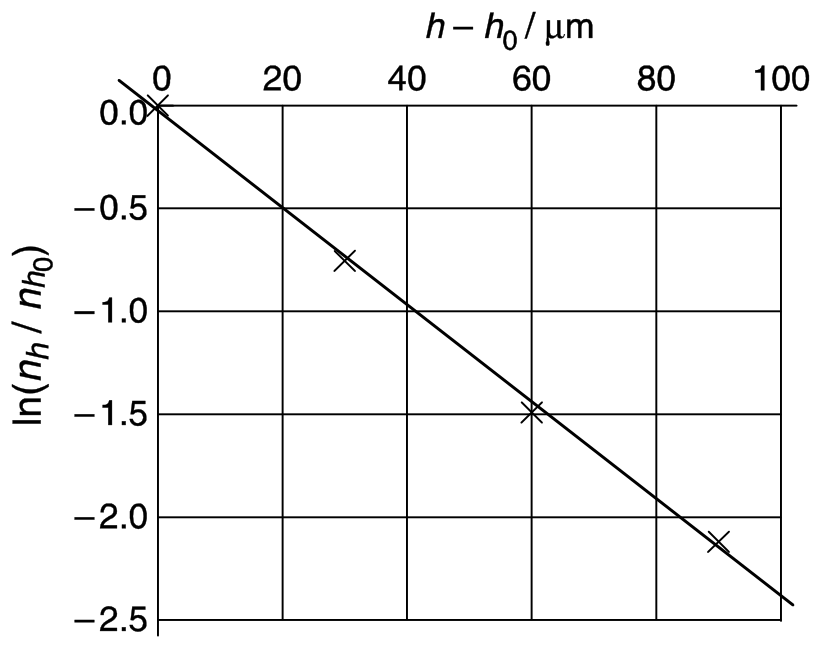
1.10 Derive an expression for the gradient (slope) of the graph.
1.11 Determine the Avogadro constant from these data.
Official English text of the problem.
Answers
- 1.1: A cube with atom centres at its eight corners and six face centres; 4 atoms per unit cell.
- 1.2: \(V_{\mathrm{cell}}=6.79\times10^{-29}\ \mathrm{m^3}\); \(m_{\mathrm{cell}}=1.31\times10^{-24}\ \mathrm{kg}\).
- 1.3: \(m_{\mathrm{atom}}=3.28\times10^{-25}\ \mathrm{kg}\); \(N_{\mathrm A}=6.01\times10^{23}\ \mathrm{mol^{-1}}\).
- 1.4: In table order: \(\alpha,\ \alpha,\ \alpha,\ \beta^-,\ \beta^-,\ \alpha,\ \beta^-,\ \beta^-,\ \alpha\).
- 1.5: Lead-210, \(\ce{^{210}Pb}\).
- 1.6: \(3.90\times10^{17}\) \(\alpha\) particles.
- 1.7: \(N_{\mathrm A}=8.40\times10^{23}\ \mathrm{mol^{-1}}\).
- 1.8: \(n_{\ce{Ra}}=5.11\times10^{20}\) atoms; \(\lambda=1.36\times10^{-11}\ \mathrm{s^{-1}}\); \(t=1.62\times10^3\ \mathrm{years}\).
- 1.9: i) \(m=4.81\times10^{-17}\ \mathrm{kg}\); ii) \(m_{\ce{H2O}}=3.99\times10^{-17}\ \mathrm{kg}\); iii) \(m^*=8.26\times10^{-18}\ \mathrm{kg}\).
- 1.10: \(\displaystyle s=-\frac{N_{\mathrm A}m^*g}{RT}\), with \(s\) in \(\mathrm{m^{-1}}\) when height is measured in metres.
- 1.11: \(N_{\mathrm A}\approx7.1\times10^{23}\ \mathrm{mol^{-1}}\).
Solution
1.1
Sketch a cube with an atom centre at each of its eight corners and at the centre of each of its six faces. There is no atom at the body centre. Hidden edges and hidden atom positions may be indicated with dashed lines.
Each corner atom is shared by eight unit cells, while each face-centred atom is shared by two. Thus the number of atoms belonging to one unit cell is
\[ Z=8\left(\frac18\right)+6\left(\frac12\right) =\boxed{4}. \]
1.2
The cube edge is
\[ a=0.408\ \mathrm{nm}=4.08\times10^{-10}\ \mathrm{m}. \]
Therefore,
\[ V_{\mathrm{cell}}=a^3 =(4.08\times10^{-10})^3 =6.7917312\times10^{-29}\ \mathrm{m^3} \approx\boxed{6.79\times10^{-29}\ \mathrm{m^3}}. \]
Using the density,
\[ m_{\mathrm{cell}} =\rho V_{\mathrm{cell}} =(1.93\times10^4)(6.7917312\times10^{-29}) \approx\boxed{1.31\times10^{-24}\ \mathrm{kg}}. \]
1.3
The unit cell contains four gold atoms, so
\[ m_{\mathrm{atom}} =\frac{m_{\mathrm{cell}}}{4} =3.277010304\times10^{-25}\ \mathrm{kg} \approx\boxed{3.28\times10^{-25}\ \mathrm{kg}}. \]
The molar mass of gold is \(196.97\ \mathrm{g\,mol^{-1}}=0.19697\ \mathrm{kg\,mol^{-1}}\). Consequently,
\[ N_{\mathrm A} =\frac{M_{\ce{Au}}}{m_{\mathrm{atom}}} =\frac{0.19697}{3.277010304\times10^{-25}} =\boxed{6.01\times10^{23}\ \mathrm{mol^{-1}}}. \]
1.4
An \(\alpha\) particle is a helium-4 nucleus, \(\ce{^{4}He^{2+}}\), with SMILES [4He+2]. Its emission decreases the mass number by 4 and the atomic number by 2.
In \(\beta^-\) decay, the mass number is unchanged and the atomic number increases by 1. An electron and an electron antineutrino, \(\bar{\nu}_e\), are emitted.
The balanced nuclear equations are:
| Balanced nuclear equation | Decay |
|---|---|
| \(\ce{^{226}_{88}Ra -> ^{222}_{86}Rn + ^{4}_{2}He}\) | \(\alpha\) |
| \(\ce{^{222}_{86}Rn -> ^{218}_{84}Po + ^{4}_{2}He}\) | \(\alpha\) |
| \(\ce{^{218}_{84}Po -> ^{214}_{82}Pb + ^{4}_{2}He}\) | \(\alpha\) |
| \(\ce{^{214}_{82}Pb -> ^{214}_{83}Bi + ^{0}_{-1}e}+\bar{\nu}_e\) | \(\beta^-\) |
| \(\ce{^{214}_{83}Bi -> ^{214}_{84}Po + ^{0}_{-1}e}+\bar{\nu}_e\) | \(\beta^-\) |
| \(\ce{^{214}_{84}Po -> ^{210}_{82}Pb + ^{4}_{2}He}\) | \(\alpha\) |
| \(\ce{^{210}_{82}Pb -> ^{210}_{83}Bi + ^{0}_{-1}e}+\bar{\nu}_e\) | \(\beta^-\) |
| \(\ce{^{210}_{83}Bi -> ^{210}_{84}Po + ^{0}_{-1}e}+\bar{\nu}_e\) | \(\beta^-\) |
| \(\ce{^{210}_{84}Po -> ^{206}_{82}Pb + ^{4}_{2}He}\) | \(\alpha\) |
Thus every assignment follows directly from the changes in mass number and atomic number.
1.5
A daughter isotope reaches an approximate steady state when its rate of formation equals its rate of decay. With a nearly constant parent activity, this requires several daughter half-lives.
For \(\ce{^{222}Rn}\), 40 days corresponds to
\[ \frac{40}{3.825}=10.46 \]
half-lives. Its activity has therefore reached approximately
\[ 1-2^{-10.46}=0.99929 \]
of its equilibrium value. The following isotopes through \(\ce{^{214}Po}\) have much shorter half-lives and also reach approximate steady state.
The next isotope, \(\ce{^{210}Pb}\), has a half-life of 22.3 years, much longer than 40 days. It is still accumulating. Therefore the first isotope that has not reached steady state is
\[ \boxed{\ce{^{210}Pb}\text{, lead-210}}. \]
1.6
Treat the measured total \(\alpha\) activity as constant over the collection period. This uses the long half-life of radium and neglects the small changes associated with the slowly accumulating later daughters.
The elapsed time is
\[ \Delta t=163\times24\times60\times60 =1.40832\times10^7\ \mathrm{s}. \]
Hence,
\[ N_\alpha=A_\alpha\Delta t =(27.7\times10^9\ \mathrm{s^{-1}}) (1.40832\times10^7\ \mathrm{s}) =\boxed{3.90\times10^{17}\text{ particles}}. \]
1.7
Each \(\alpha\) particle acquires two electrons to become one helium-4 atom, \(\ce{^{4}He}\), SMILES [4He]:
\[ \ce{^{4}He^{2+} + 2e- -> ^{4}He}. \]
Thus the number of helium atoms collected equals the number of \(\alpha\) particles produced.
The gas volume is
\[ V=10.4\ \mathrm{mm^3}=1.04\times10^{-8}\ \mathrm{m^3}. \]
From the ideal-gas equation,
\[ n_{\ce{He}} =\frac{PV}{RT} =\frac{(101325)(1.04\times10^{-8})} {(8.3145)(273)} =4.64249\times10^{-7}\ \mathrm{mol}. \]
Therefore,
\[ N_{\mathrm A} =\frac{N_\alpha}{n_{\ce{He}}} =\frac{3.9010464\times10^{17}} {4.64249\times10^{-7}} =\boxed{8.40\times10^{23}\ \mathrm{mol^{-1}}}. \]
1.8
Using the stated isotopic mass and textbook Avogadro constant, the initial number of radium atoms is
\[ n_{\ce{Ra}} =\frac{0.192\ \mathrm{g}} {226.25\ \mathrm{g\,mol^{-1}}} (6.022\times10^{23}\ \mathrm{mol^{-1}}) =\boxed{5.11\times10^{20}\text{ atoms}}. \]
Before decay of \(\ce{^{210}Pb}\), the four \(\alpha\)-emitting nuclides are
\[ \ce{^{226}Ra},\qquad \ce{^{222}Rn},\qquad \ce{^{218}Po},\qquad \ce{^{214}Po}. \]
At steady state, the activity of each of these daughters equals the radium activity. The total \(\alpha\) activity is therefore four times the radium activity:
\[ A_\alpha=4A_{\ce{Ra}}=4\lambda n_{\ce{Ra}}. \]
Thus,
\[ A_{\ce{Ra}}=\frac{27.7\times10^9}{4} =6.925\times10^9\ \mathrm{s^{-1}}, \]
and
\[ \lambda =\frac{6.925\times10^9} {5.1103823\times10^{20}} =\boxed{1.36\times10^{-11}\ \mathrm{s^{-1}}}. \]
For first-order radioactive decay,
\[ t=\frac{\ln2}{\lambda} =5.115\times10^{10}\ \mathrm{s}. \]
Taking one year as 365 days,
\[ t=\frac{5.115\times10^{10}} {365\times86400} =\boxed{1.62\times10^3\ \mathrm{years}}. \]
1.9
The volume of a spherical particle is
\[ V_p=\frac43\pi r^3 =\frac43\pi(2.12\times10^{-7})^3 =3.99113\times10^{-20}\ \mathrm{m^3}. \]
i) The particle mass is
\[ m=\rho_pV_p =(1.206\times10^3)(3.99113\times10^{-20}) =\boxed{4.81\times10^{-17}\ \mathrm{kg}}. \]
ii) The displaced water, \(\ce{H2O}\) (SMILES O), occupies the same volume as the particle:
\[ m_{\ce{H2O}} =\rho_wV_p =(999)(3.99113\times10^{-20}) =\boxed{3.99\times10^{-17}\ \mathrm{kg}}. \]
iii) The upward buoyant force equals the weight of the displaced water. Therefore,
\[ m^*g=mg-m_{\ce{H2O}}g, \]
so, retaining unrounded values,
\[ m^*=(\rho_p-\rho_w)V_p =(1206-999)(3.99113\times10^{-20}) =\boxed{8.26\times10^{-18}\ \mathrm{kg}}. \]
1.10
Accounting for buoyancy, the potential-energy increase per particle between \(h_0\) and \(h\) is \(m^*g(h-h_0)\). The corresponding increase per mole is
\[ E_h-E_{h_0}=N_{\mathrm A}m^*g(h-h_0). \]
Substituting into the given Boltzmann distribution and taking natural logarithms gives
\[ \ln\left(\frac{n_h}{n_{h_0}}\right) =-\frac{N_{\mathrm A}m^*g}{RT}(h-h_0). \]
Hence the gradient with respect to height in metres is
\[ \boxed{ s=-\frac{N_{\mathrm A}m^*g}{RT} =-\frac{4\pi r^3(\rho_p-\rho_w)gN_{\mathrm A}}{3RT} }. \]
Its units are \(\mathrm{m^{-1}}\). The negative sign expresses the decrease in particle concentration with increasing height.
For the displayed numerical horizontal coordinate \(x=(h-h_0)/(1\ \mu\mathrm{m})\), the gradient is
\[ \frac{\mathrm d}{\mathrm dx} \ln\left(\frac{n_h}{n_{h_0}}\right) =-\frac{N_{\mathrm A}m^*g(10^{-6}\ \mathrm{m})}{RT}. \]
1.11
The drawn line passes approximately through \((0,0)\) and \((100\ \mu\mathrm{m},-2.4)\). Therefore,
\[ s\approx\frac{-2.4}{100\times10^{-6}\ \mathrm{m}} =-2.4\times10^4\ \mathrm{m^{-1}}. \]
Rearranging the expression from 1.10,
\[ N_{\mathrm A}=-\frac{sRT}{m^*g}. \]
Using \(T=15+273.15=288.15\ \mathrm{K}\) and \(g=9.81\ \mathrm{m\,s^{-2}}\),
\[ N_{\mathrm A} \approx \frac{(2.4\times10^4)(8.3145)(288.15)} {(8.26165\times10^{-18})(9.81)} =7.09\times10^{23}\ \mathrm{mol^{-1}}. \]
To the precision justified by reading the graph,
\[ \boxed{N_{\mathrm A}\approx7.1\times10^{23}\ \mathrm{mol^{-1}}}. \]
The solution was checked against the official solution.
IChO 2009 · Theorieaufgabe 1
Abschätzung der Avogadro-Konstante
Zur Bestimmung der Avogadro-Konstante wurden viele verschiedene Methoden verwendet. Drei verschiedene Methoden sind im Folgenden beschrieben.
Methode A – anhand von Röntgenbeugungsdaten (modern)
Die Elementarzelle ist die kleinste sich wiederholende Einheit einer Kristallstruktur. Mittels Röntgenbeugung wird festgestellt, dass die Elementarzelle eines Goldkristalls eine kubisch flächenzentrierte Struktur besitzt (d. h., der Mittelpunkt eines Atoms befindet sich an jeder Ecke eines Würfels und in der Mitte jeder Fläche). Die Kantenlänge der Elementarzelle beträgt 0.408 nm.
1.1 Skizzieren Sie die Elementarzelle und berechnen Sie, wie viele \(\ce{Au}\)-Atome sie enthält.
1.2 Die Dichte von \(\ce{Au}\) beträgt \(1.93\cdot10^4\ \mathrm{kg\,m^{-3}}\). Berechnen Sie das Volumen und die Masse der würfelförmigen Elementarzelle.
1.3 Berechnen Sie daraus die Masse eines Goldatoms und die Avogadro-Konstante, wenn die relative Atommasse von \(\ce{Au}\) 196.97 beträgt.
Methode B – anhand des radioaktiven Zerfalls (Rutherford, 1911)
Die radioaktive Zerfallsreihe von \(\ce{^{226}Ra}\) lautet wie folgt:
Die angegebenen Zeiten sind Halbwertszeiten; die Einheiten sind y = Jahre, d = Tage, m = Minuten. Der erste Zerfall, oben mit \(t\) gekennzeichnet, hat eine wesentlich längere Halbwertszeit als die anderen.
1.4 Geben Sie in der folgenden Tabelle an, welche Umwandlungen \(\alpha\)-Zerfälle und welche \(\beta\)-Zerfälle sind.
| \(\alpha\)-Zerfall | \(\beta\)-Zerfall | |
|---|---|---|
| \(\ce{^{226}Ra -> ^{222}Rn}\) | ||
| \(\ce{^{222}Rn -> ^{218}Po}\) | ||
| \(\ce{^{218}Po -> ^{214}Pb}\) | ||
| \(\ce{^{214}Pb -> ^{214}Bi}\) | ||
| \(\ce{^{214}Bi -> ^{214}Po}\) | ||
| \(\ce{^{214}Po -> ^{210}Pb}\) | ||
| \(\ce{^{210}Pb -> ^{210}Bi}\) | ||
| \(\ce{^{210}Bi -> ^{210}Po}\) | ||
| \(\ce{^{210}Po -> ^{206}Pb}\) |
1.5 Eine Probe mit 192 mg \(\ce{^{226}Ra}\) wurde gereinigt und 40 Tage stehen gelassen. Geben Sie das erste Isotop in der Reihe (mit Ausnahme von \(\ce{Ra}\)) an, das noch keinen stationären Zustand erreicht hat.
1.6 Anschließend wurde die gesamte \(\alpha\)-Zerfallsrate der Probe durch Szintillationsmessung zu 27.7 GBq bestimmt (wobei \(1\ \mathrm{Bq}=1\ \mathrm{count\,s^{-1}}\)). Danach wurde die Probe für 163 Tage dicht verschlossen. Berechnen Sie die Anzahl der erzeugten \(\alpha\)-Teilchen.
1.7 Nach Ablauf der 163 Tage wurde festgestellt, dass die Probe \(10.4\ \mathrm{mm^3}\) \(\ce{He}\) enthielt, gemessen bei 101325 Pa und 273 K. Berechnen Sie aus diesen Daten die Avogadro-Konstante.
1.8 Die mittels Massenspektrometrie gemessene relative Isotopenmasse von \(\ce{^{226}Ra}\) beträgt 226.25. Berechnen Sie mit dem Lehrbuchwert der Avogadro-Konstante (\(6.022\cdot10^{23}\ \mathrm{mol^{-1}}\)) die Anzahl der \(\ce{^{226}Ra}\)-Atome in der ursprünglichen Probe, \(n_{\ce{Ra}}\), die Zerfallskonstante, \(\lambda\), und die Halbwertszeit, \(t\), von \(\ce{^{226}Ra}\) (in Jahren). Sie müssen nur die Zerfälle bis zu dem in 1.5 bestimmten Isotop berücksichtigen, jedoch nicht den Zerfall dieses Isotops selbst.
Methode C – Verteilung von Teilchen (Perrin, 1909)
Eine der ersten genauen Bestimmungen der Avogadro-Konstante erfolgte durch Untersuchung der vertikalen Verteilung von in Wasser suspendierten kolloidalen Teilchen unter dem Einfluss der Schwerkraft. In einem solchen Experiment wurden Teilchen mit einem Radius von \(2.12\cdot10^{-7}\ \mathrm{m}\) und einer Dichte von \(1.206\cdot10^3\ \mathrm{kg\,m^{-3}}\) in einem mit Wasser gefüllten Rohr bei \(15\ ^\circ\mathrm{C}\) suspendiert. Nachdem ausreichend Zeit zur Einstellung des Gleichgewichts verstrichen war, wurden in vier Höhen über dem Boden des Rohrs folgende mittlere Teilchenzahlen pro Volumeneinheit beobachtet:
| Höhe / \(10^{-6}\ \mathrm{m}\) | 5 | 35 | 65 | 95 |
|---|---|---|---|---|
| mittlere Anzahl pro Volumeneinheit | 4.00 | 1.88 | 0.90 | 0.48 |
1.9 Berechnen Sie unter der Annahme kugelförmiger Teilchen:
i) die Masse, \(m\), eines Teilchens;
ii) die Masse, \(m_{\ce{H2O}}\), des von ihm verdrängten Wassers;
iii) die effektive Masse, \(m^*\), des Teilchens in Wasser unter Berücksichtigung des Auftriebs (d. h. unter Berücksichtigung der durch das verdrängte Wasservolumen verursachten Auftriebskraft).
Nehmen Sie für die Dichte des Wassers \(999\ \mathrm{kg\,m^{-3}}\) an.
Im Gleichgewicht lässt sich die Teilchenzahl pro Volumeneinheit in verschiedenen Höhen durch eine Boltzmann-Verteilung beschreiben:
\[ \frac{n_h}{n_{h_0}} = \exp\left[-\frac{E_h-E_{h_0}}{RT}\right] \]
wobei
\(n_h\) die Teilchenzahl pro Volumeneinheit in der Höhe \(h\) ist,
\(n_{h_0}\) die Teilchenzahl pro Volumeneinheit in der Bezugshöhe \(h_0\) ist,
\(E_h\) die potenzielle Energie im Schwerefeld pro Mol Teilchen in der Höhe \(h\), bezogen auf die Teilchen am Boden des Rohrs, ist,
\(R\) die Gaskonstante ist, \(8.3145\ \mathrm{J\,K^{-1}\,mol^{-1}}\).
Ein Diagramm von \(\ln(n_h/n_{h_0})\) gegen \((h-h_0)\), das auf den Daten der obigen Tabelle beruht, ist unten dargestellt. Als Bezugshöhe werden \(5\ \mu\mathrm{m}\) über dem Boden des Rohrs gewählt.
1.10 Leiten Sie einen Ausdruck für die Steigung des Graphen her.
1.11 Bestimmen Sie aus diesen Daten die Avogadro-Konstante.
Aufgabentext aus dem offiziellen englischen Text übersetzt.
Antworten
- 1.1: Ein Würfel mit Atommittelpunkten an seinen acht Ecken und in seinen sechs Flächenmitten; 4 Atome pro Elementarzelle.
- 1.2: \(V_{\mathrm{cell}}=6.79\times10^{-29}\ \mathrm{m^3}\); \(m_{\mathrm{cell}}=1.31\times10^{-24}\ \mathrm{kg}\).
- 1.3: \(m_{\mathrm{atom}}=3.28\times10^{-25}\ \mathrm{kg}\); \(N_{\mathrm A}=6.01\times10^{23}\ \mathrm{mol^{-1}}\).
- 1.4: In der Reihenfolge der Tabelle: \(\alpha,\ \alpha,\ \alpha,\ \beta^-,\ \beta^-,\ \alpha,\ \beta^-,\ \beta^-,\ \alpha\).
- 1.5: Blei-210, \(\ce{^{210}Pb}\).
- 1.6: \(3.90\times10^{17}\) \(\alpha\)-Teilchen.
- 1.7: \(N_{\mathrm A}=8.40\times10^{23}\ \mathrm{mol^{-1}}\).
- 1.8: \(n_{\ce{Ra}}=5.11\times10^{20}\) Atome; \(\lambda=1.36\times10^{-11}\ \mathrm{s^{-1}}\); \(t=1.62\times10^3\ \mathrm{years}\).
- 1.9: i) \(m=4.81\times10^{-17}\ \mathrm{kg}\); ii) \(m_{\ce{H2O}}=3.99\times10^{-17}\ \mathrm{kg}\); iii) \(m^*=8.26\times10^{-18}\ \mathrm{kg}\).
- 1.10: \(\displaystyle s=-\frac{N_{\mathrm A}m^*g}{RT}\), mit \(s\) in \(\mathrm{m^{-1}}\), wenn die Höhe in Metern gemessen wird.
- 1.11: \(N_{\mathrm A}\approx7.1\times10^{23}\ \mathrm{mol^{-1}}\).
Lösung
1.1
Skizzieren Sie einen Würfel mit einem Atommittelpunkt an jeder seiner acht Ecken und in der Mitte jeder seiner sechs Flächen. Im Würfelzentrum befindet sich kein Atom. Verdeckte Kanten und verdeckte Atompositionen können mit gestrichelten Linien dargestellt werden.
Jedes Eckatom gehört zu acht Elementarzellen, während jedes Atom in einer Flächenmitte zu zwei Elementarzellen gehört. Die Anzahl der Atome, die zu einer Elementarzelle gehören, beträgt somit
\[ Z=8\left(\frac18\right)+6\left(\frac12\right) =\boxed{4}. \]
1.2
Die Würfelkante beträgt
\[ a=0.408\ \mathrm{nm}=4.08\times10^{-10}\ \mathrm{m}. \]
Daher gilt
\[ V_{\mathrm{cell}}=a^3 =(4.08\times10^{-10})^3 =6.7917312\times10^{-29}\ \mathrm{m^3} \approx\boxed{6.79\times10^{-29}\ \mathrm{m^3}}. \]
Mit der Dichte ergibt sich
\[ m_{\mathrm{cell}} =\rho V_{\mathrm{cell}} =(1.93\times10^4)(6.7917312\times10^{-29}) \approx\boxed{1.31\times10^{-24}\ \mathrm{kg}}. \]
1.3
Die Elementarzelle enthält vier Goldatome, also gilt
\[ m_{\mathrm{atom}} =\frac{m_{\mathrm{cell}}}{4} =3.277010304\times10^{-25}\ \mathrm{kg} \approx\boxed{3.28\times10^{-25}\ \mathrm{kg}}. \]
Die molare Masse von Gold beträgt \(196.97\ \mathrm{g\,mol^{-1}}=0.19697\ \mathrm{kg\,mol^{-1}}\). Folglich gilt
\[ N_{\mathrm A} =\frac{M_{\ce{Au}}}{m_{\mathrm{atom}}} =\frac{0.19697}{3.277010304\times10^{-25}} =\boxed{6.01\times10^{23}\ \mathrm{mol^{-1}}}. \]
1.4
Ein \(\alpha\)-Teilchen ist ein Helium-4-Kern, \(\ce{^{4}He^{2+}}\), mit dem SMILES-Code [4He+2]. Seine Emission verringert die Massenzahl um 4 und die Ordnungszahl um 2.
Beim \(\beta^-\)-Zerfall bleibt die Massenzahl unverändert und die Ordnungszahl steigt um 1. Ein Elektron und ein Elektron-Antineutrino, \(\bar{\nu}_e\), werden emittiert.
Die ausgeglichenen Kernreaktionsgleichungen lauten:
| Ausgeglichene Kernreaktionsgleichung | Zerfall |
|---|---|
| \(\ce{^{226}_{88}Ra -> ^{222}_{86}Rn + ^{4}_{2}He}\) | \(\alpha\) |
| \(\ce{^{222}_{86}Rn -> ^{218}_{84}Po + ^{4}_{2}He}\) | \(\alpha\) |
| \(\ce{^{218}_{84}Po -> ^{214}_{82}Pb + ^{4}_{2}He}\) | \(\alpha\) |
| \(\ce{^{214}_{82}Pb -> ^{214}_{83}Bi + ^{0}_{-1}e}+\bar{\nu}_e\) | \(\beta^-\) |
| \(\ce{^{214}_{83}Bi -> ^{214}_{84}Po + ^{0}_{-1}e}+\bar{\nu}_e\) | \(\beta^-\) |
| \(\ce{^{214}_{84}Po -> ^{210}_{82}Pb + ^{4}_{2}He}\) | \(\alpha\) |
| \(\ce{^{210}_{82}Pb -> ^{210}_{83}Bi + ^{0}_{-1}e}+\bar{\nu}_e\) | \(\beta^-\) |
| \(\ce{^{210}_{83}Bi -> ^{210}_{84}Po + ^{0}_{-1}e}+\bar{\nu}_e\) | \(\beta^-\) |
| \(\ce{^{210}_{84}Po -> ^{206}_{82}Pb + ^{4}_{2}He}\) | \(\alpha\) |
Somit folgt jede Zuordnung unmittelbar aus den Änderungen der Massenzahl und der Ordnungszahl.
1.5
Ein Tochterisotop erreicht näherungsweise einen stationären Zustand, wenn seine Bildungsrate gleich seiner Zerfallsrate ist. Bei nahezu konstanter Aktivität des Mutterisotops sind dafür mehrere Halbwertszeiten des Tochterisotops erforderlich.
Für \(\ce{^{222}Rn}\) entsprechen 40 Tage
\[ \frac{40}{3.825}=10.46 \]
Halbwertszeiten. Seine Aktivität hat daher ungefähr den Anteil
\[ 1-2^{-10.46}=0.99929 \]
ihres Gleichgewichtswerts erreicht. Die nachfolgenden Isotope bis einschließlich \(\ce{^{214}Po}\) haben wesentlich kürzere Halbwertszeiten und erreichen ebenfalls näherungsweise einen stationären Zustand.
Das nächste Isotop, \(\ce{^{210}Pb}\), hat eine Halbwertszeit von 22.3 Jahren, die wesentlich länger als 40 Tage ist. Es reichert sich noch an. Das erste Isotop, das noch keinen stationären Zustand erreicht hat, ist daher
\[ \boxed{\ce{^{210}Pb}\text{, Blei-210}}. \]
1.6
Die gemessene gesamte \(\alpha\)-Aktivität wird über den Sammelzeitraum als konstant betrachtet. Dabei wird die lange Halbwertszeit von Radium genutzt, und die kleinen Änderungen durch die sich langsam anreichernden späteren Tochterisotope werden vernachlässigt.
Die verstrichene Zeit beträgt
\[ \Delta t=163\times24\times60\times60 =1.40832\times10^7\ \mathrm{s}. \]
Somit gilt
\[ N_\alpha=A_\alpha\Delta t =(27.7\times10^9\ \mathrm{s^{-1}}) (1.40832\times10^7\ \mathrm{s}) =\boxed{3.90\times10^{17}\text{ Teilchen}}. \]
1.7
Jedes \(\alpha\)-Teilchen nimmt zwei Elektronen auf und wird dadurch zu einem Helium-4-Atom, \(\ce{^{4}He}\), SMILES [4He]:
\[ \ce{^{4}He^{2+} + 2e- -> ^{4}He}. \]
Die Anzahl der gesammelten Heliumatome ist somit gleich der Anzahl der erzeugten \(\alpha\)-Teilchen.
Das Gasvolumen beträgt
\[ V=10.4\ \mathrm{mm^3}=1.04\times10^{-8}\ \mathrm{m^3}. \]
Aus der idealen Gasgleichung folgt
\[ n_{\ce{He}} =\frac{PV}{RT} =\frac{(101325)(1.04\times10^{-8})} {(8.3145)(273)} =4.64249\times10^{-7}\ \mathrm{mol}. \]
Daher gilt
\[ N_{\mathrm A} =\frac{N_\alpha}{n_{\ce{He}}} =\frac{3.9010464\times10^{17}} {4.64249\times10^{-7}} =\boxed{8.40\times10^{23}\ \mathrm{mol^{-1}}}. \]
1.8
Mit der angegebenen Isotopenmasse und dem Lehrbuchwert der Avogadro-Konstante ergibt sich für die anfängliche Anzahl der Radiumatome
\[ n_{\ce{Ra}} =\frac{0.192\ \mathrm{g}} {226.25\ \mathrm{g\,mol^{-1}}} (6.022\times10^{23}\ \mathrm{mol^{-1}}) =\boxed{5.11\times10^{20}\text{ Atome}}. \]
Vor dem Zerfall von \(\ce{^{210}Pb}\) sind die vier \(\alpha\)-emittierenden Nuklide
\[ \ce{^{226}Ra},\qquad \ce{^{222}Rn},\qquad \ce{^{218}Po},\qquad \ce{^{214}Po}. \]
Im stationären Zustand ist die Aktivität jedes dieser Tochterisotope gleich der Radiumaktivität. Die gesamte \(\alpha\)-Aktivität ist daher viermal so groß wie die Radiumaktivität:
\[ A_\alpha=4A_{\ce{Ra}}=4\lambda n_{\ce{Ra}}. \]
Somit gilt
\[ A_{\ce{Ra}}=\frac{27.7\times10^9}{4} =6.925\times10^9\ \mathrm{s^{-1}}, \]
und
\[ \lambda =\frac{6.925\times10^9} {5.1103823\times10^{20}} =\boxed{1.36\times10^{-11}\ \mathrm{s^{-1}}}. \]
Für einen radioaktiven Zerfall erster Ordnung gilt
\[ t=\frac{\ln2}{\lambda} =5.115\times10^{10}\ \mathrm{s}. \]
Setzt man ein Jahr gleich 365 Tagen, ergibt sich
\[ t=\frac{5.115\times10^{10}} {365\times86400} =\boxed{1.62\times10^3\ \mathrm{years}}. \]
1.9
Das Volumen eines kugelförmigen Teilchens beträgt
\[ V_p=\frac43\pi r^3 =\frac43\pi(2.12\times10^{-7})^3 =3.99113\times10^{-20}\ \mathrm{m^3}. \]
i) Die Teilchenmasse beträgt
\[ m=\rho_pV_p =(1.206\times10^3)(3.99113\times10^{-20}) =\boxed{4.81\times10^{-17}\ \mathrm{kg}}. \]
ii) Das verdrängte Wasser, \(\ce{H2O}\) (SMILES O), nimmt dasselbe Volumen wie das Teilchen ein:
\[ m_{\ce{H2O}} =\rho_wV_p =(999)(3.99113\times10^{-20}) =\boxed{3.99\times10^{-17}\ \mathrm{kg}}. \]
iii) Die nach oben gerichtete Auftriebskraft ist gleich der Gewichtskraft des verdrängten Wassers. Daher gilt
\[ m^*g=mg-m_{\ce{H2O}}g, \]
also ergibt sich unter Beibehaltung ungerundeter Werte
\[ m^*=(\rho_p-\rho_w)V_p =(1206-999)(3.99113\times10^{-20}) =\boxed{8.26\times10^{-18}\ \mathrm{kg}}. \]
1.10
Unter Berücksichtigung des Auftriebs beträgt die Zunahme der potenziellen Energie pro Teilchen zwischen \(h_0\) und \(h\) genau \(m^*g(h-h_0)\). Die entsprechende Zunahme pro Mol beträgt
\[ E_h-E_{h_0}=N_{\mathrm A}m^*g(h-h_0). \]
Einsetzen in die gegebene Boltzmann-Verteilung und anschließendes natürliches Logarithmieren ergibt
\[ \ln\left(\frac{n_h}{n_{h_0}}\right) =-\frac{N_{\mathrm A}m^*g}{RT}(h-h_0). \]
Somit beträgt die Steigung bezüglich der Höhe in Metern
\[ \boxed{ s=-\frac{N_{\mathrm A}m^*g}{RT} =-\frac{4\pi r^3(\rho_p-\rho_w)gN_{\mathrm A}}{3RT} }. \]
Ihre Einheit ist \(\mathrm{m^{-1}}\). Das negative Vorzeichen drückt die Abnahme der Teilchenkonzentration mit zunehmender Höhe aus.
Für die dargestellte numerische horizontale Koordinate \(x=(h-h_0)/(1\ \mu\mathrm{m})\) beträgt die Steigung
\[ \frac{\mathrm d}{\mathrm dx} \ln\left(\frac{n_h}{n_{h_0}}\right) =-\frac{N_{\mathrm A}m^*g(10^{-6}\ \mathrm{m})}{RT}. \]
1.11
Die eingezeichnete Gerade verläuft ungefähr durch \((0,0)\) und \((100\ \mu\mathrm{m},-2.4)\). Daher gilt
\[ s\approx\frac{-2.4}{100\times10^{-6}\ \mathrm{m}} =-2.4\times10^4\ \mathrm{m^{-1}}. \]
Durch Umstellen des Ausdrucks aus 1.10 erhält man
\[ N_{\mathrm A}=-\frac{sRT}{m^*g}. \]
Mit \(T=15+273.15=288.15\ \mathrm{K}\) und \(g=9.81\ \mathrm{m\,s^{-2}}\) ergibt sich
\[ N_{\mathrm A} \approx \frac{(2.4\times10^4)(8.3145)(288.15)} {(8.26165\times10^{-18})(9.81)} =7.09\times10^{23}\ \mathrm{mol^{-1}}. \]
Mit der durch das Ablesen des Graphen gerechtfertigten Genauigkeit gilt
\[ \boxed{N_{\mathrm A}\approx7.1\times10^{23}\ \mathrm{mol^{-1}}}. \]
Die Lösung wurde mit der offiziellen Lösung abgeglichen.
IChO 2009 · Teori sorusu 1
Avogadro sabitinin tahmin edilmesi
Avogadro sabitini belirlemek için pek çok farklı yöntem kullanılmıştır. Aşağıda üç farklı yöntem verilmiştir.
Yöntem A – X-ışını kırınımı verilerinden (modern)
Birim hücre, bir kristal yapıda tekrarlanan en küçük birimdir. X-ışını kırınımıyla, bir altın kristalinin birim hücresinin yüzey merkezli kübik yapıda olduğu (yani bir küpün her köşesinde ve her yüzünün ortasında bir atom merkezinin bulunduğu) belirlenmiştir. Birim hücrenin kenar uzunluğu 0.408 nm olarak bulunmuştur.
1.1 Birim hücrenin bir çizimini yapınız ve hücrenin kaç tane \(\ce{Au}\) atomu içerdiğini hesaplayınız.
1.2 \(\ce{Au}\)'nun yoğunluğu \(1.93\cdot10^4\ \mathrm{kg\,m^{-3}}\)'tür. Kübik birim hücrenin hacmini ve kütlesini hesaplayınız.
1.3 Buradan, \(\ce{Au}\)'nun bağıl atom kütlesinin 196.97 olduğunu kullanarak bir altın atomunun kütlesini ve Avogadro sabitini hesaplayınız.
Yöntem B – radyoaktif bozunmadan (Rutherford, 1911)
\(\ce{^{226}Ra}\)'nın radyoaktif bozunma serisi şöyledir:
Belirtilen süreler yarı ömürlerdir; birimler y = yıl, d = gün, m = dakikadır. Yukarıda \(t\) ile gösterilen ilk bozunmanın yarı ömrü diğerlerininkinden çok daha uzundur.
1.4 Aşağıdaki tabloda hangi dönüşümlerin \(\alpha\) bozunması, hangilerinin \(\beta\) bozunması olduğunu belirleyiniz.
| \(\alpha\) bozunması | \(\beta\) bozunması | |
|---|---|---|
| \(\ce{^{226}Ra -> ^{222}Rn}\) | ||
| \(\ce{^{222}Rn -> ^{218}Po}\) | ||
| \(\ce{^{218}Po -> ^{214}Pb}\) | ||
| \(\ce{^{214}Pb -> ^{214}Bi}\) | ||
| \(\ce{^{214}Bi -> ^{214}Po}\) | ||
| \(\ce{^{214}Po -> ^{210}Pb}\) | ||
| \(\ce{^{210}Pb -> ^{210}Bi}\) | ||
| \(\ce{^{210}Bi -> ^{210}Po}\) | ||
| \(\ce{^{210}Po -> ^{206}Pb}\) |
1.5 192 mg \(\ce{^{226}Ra}\) içeren bir numune saflaştırılmış ve 40 gün bekletilmiştir. Seride (\(\ce{Ra}\) hariç) kararlı duruma ulaşmamış ilk izotopu belirleyiniz.
1.6 Daha sonra numunenin toplam \(\alpha\) bozunma hızı sintilasyon yöntemiyle 27.7 GBq olarak belirlenmiştir (burada \(1\ \mathrm{Bq}=1\ \mathrm{count\,s^{-1}}\)). Ardından numune sızdırmaz biçimde kapatılarak 163 gün bekletilmiştir. Oluşan \(\alpha\) parçacıklarının sayısını hesaplayınız.
1.7 163 günün sonunda numunenin, 101325 Pa ve 273 K'de ölçülen \(10.4\ \mathrm{mm^3}\) \(\ce{He}\) içerdiği bulunmuştur. Bu verilerden Avogadro sabitini hesaplayınız.
1.8 \(\ce{^{226}Ra}\)'nın kütle spektrometrisiyle ölçülen bağıl izotop kütlesinin 226.25 olduğu verilmektedir. Avogadro sabitinin ders kitaplarında verilen değerini (\(6.022\cdot10^{23}\ \mathrm{mol^{-1}}\)) kullanarak başlangıçtaki numunede bulunan \(\ce{^{226}Ra}\) atomlarının sayısını, \(n_{\ce{Ra}}\), bozunma hız sabitini, \(\lambda\), ve \(\ce{^{226}Ra}\)'nın yarı ömrünü, \(t\), (yıl cinsinden) hesaplayınız. Yalnızca 1.5'te belirlediğiniz izotopa kadar olan bozunmaları, bu izotopun bozunması hariç, dikkate almanız yeterlidir.
Yöntem C – parçacıkların dağılımı (Perrin, 1909)
Avogadro sabitinin ilk doğru belirlemelerinden biri, suda asılı duran kolloidal parçacıkların yerçekimi etkisi altındaki düşey dağılımının incelenmesiyle gerçekleştirilmiştir. Bu tür bir deneyde, yarıçapı \(2.12\cdot10^{-7}\ \mathrm{m}\) ve yoğunluğu \(1.206\cdot10^3\ \mathrm{kg\,m^{-3}}\) olan parçacıklar, \(15\ ^\circ\mathrm{C}\)'de su içeren bir tüpte süspansiyon hâline getirilmiştir. Dengeye ulaşılması için yeterince beklendikten sonra, tüpün tabanından itibaren dört farklı yükseklikte gözlenen birim hacim başına ortalama parçacık sayıları şöyledir:
| yükseklik / \(10^{-6}\ \mathrm{m}\) | 5 | 35 | 65 | 95 |
|---|---|---|---|---|
| birim hacim başına ortalama sayı | 4.00 | 1.88 | 0.90 | 0.48 |
1.9 Parçacıkların küresel olduğunu varsayarak aşağıdakileri hesaplayınız:
i) bir parçacığın kütlesi, \(m\);
ii) parçacığın yer değiştirdiği suyun kütlesi, \(m_{\ce{H2O}}\);
iii) kaldırma kuvvetini hesaba katarak (yani yer değiştirilen su hacminden kaynaklanan yukarı yönlü kuvveti dikkate alarak) parçacığın sudaki etkin kütlesi, \(m^*\).
Suyun yoğunluğunu \(999\ \mathrm{kg\,m^{-3}}\) alınız.
Dengede, farklı yüksekliklerdeki birim hacim başına parçacık sayısı Boltzmann dağılımına göre modellenebilir:
\[ \frac{n_h}{n_{h_0}} = \exp\left[-\frac{E_h-E_{h_0}}{RT}\right] \]
burada
\(n_h\), \(h\) yüksekliğinde birim hacim başına parçacık sayısıdır,
\(n_{h_0}\), referans yüksekliği \(h_0\)'da birim hacim başına parçacık sayısıdır,
\(E_h\), \(h\) yüksekliğindeki parçacıkların, tüpün tabanındaki parçacıklara göre mol başına kütleçekimsel potansiyel enerjisidir,
\(R\), gaz sabitidir ve değeri \(8.3145\ \mathrm{J\,K^{-1}\,mol^{-1}}\)'dir.
Yukarıdaki tabloda verilen verilere dayanan, \(\ln(n_h/n_{h_0})\)'ın \((h-h_0)\)'a karşı grafiği aşağıda gösterilmiştir. Referans yüksekliği, tüpün tabanından itibaren \(5\ \mu\mathrm{m}\) olarak alınmıştır.
1.10 Grafiğin eğimi için bir ifade türetiniz.
1.11 Bu verilerden Avogadro sabitini belirleyiniz.
Soru metni resmi İngilizce metinden çevrilmiştir.
Cevaplar
- 1.1: Sekiz köşesinde ve altı yüzünün merkezinde atom merkezleri bulunan bir küp; birim hücre başına 4 atom.
- 1.2: \(V_{\mathrm{cell}}=6.79\times10^{-29}\ \mathrm{m^3}\); \(m_{\mathrm{cell}}=1.31\times10^{-24}\ \mathrm{kg}\).
- 1.3: \(m_{\mathrm{atom}}=3.28\times10^{-25}\ \mathrm{kg}\); \(N_{\mathrm A}=6.01\times10^{23}\ \mathrm{mol^{-1}}\).
- 1.4: Tablodaki sırayla: \(\alpha,\ \alpha,\ \alpha,\ \beta^-,\ \beta^-,\ \alpha,\ \beta^-,\ \beta^-,\ \alpha\).
- 1.5: Kurşun-210, \(\ce{^{210}Pb}\).
- 1.6: \(3.90\times10^{17}\) \(\alpha\) parçacığı.
- 1.7: \(N_{\mathrm A}=8.40\times10^{23}\ \mathrm{mol^{-1}}\).
- 1.8: \(n_{\ce{Ra}}=5.11\times10^{20}\) atom; \(\lambda=1.36\times10^{-11}\ \mathrm{s^{-1}}\); \(t=1.62\times10^3\ \mathrm{years}\).
- 1.9: i) \(m=4.81\times10^{-17}\ \mathrm{kg}\); ii) \(m_{\ce{H2O}}=3.99\times10^{-17}\ \mathrm{kg}\); iii) \(m^*=8.26\times10^{-18}\ \mathrm{kg}\).
- 1.10: \(\displaystyle s=-\frac{N_{\mathrm A}m^*g}{RT}\); yükseklik metre cinsinden ölçüldüğünde \(s\)'nin birimi \(\mathrm{m^{-1}}\)'dir.
- 1.11: \(N_{\mathrm A}\approx7.1\times10^{23}\ \mathrm{mol^{-1}}\).
Çözüm
1.1
Sekiz köşesinin her birinde ve altı yüzünün her birinin merkezinde bir atom merkezi bulunan bir küp çiziniz. Küpün hacim merkezinde atom bulunmaz. Görünmeyen kenarlar ve görünmeyen atom konumları kesikli çizgilerle gösterilebilir.
Her köşe atomu sekiz birim hücre tarafından, yüz merkezindeki her atom ise iki birim hücre tarafından paylaşılır. Dolayısıyla bir birim hücreye ait atom sayısı
\[ Z=8\left(\frac18\right)+6\left(\frac12\right) =\boxed{4}. \]
1.2
Küpün kenar uzunluğu
\[ a=0.408\ \mathrm{nm}=4.08\times10^{-10}\ \mathrm{m}. \]
Dolayısıyla,
\[ V_{\mathrm{cell}}=a^3 =(4.08\times10^{-10})^3 =6.7917312\times10^{-29}\ \mathrm{m^3} \approx\boxed{6.79\times10^{-29}\ \mathrm{m^3}}. \]
Yoğunluk kullanılarak,
\[ m_{\mathrm{cell}} =\rho V_{\mathrm{cell}} =(1.93\times10^4)(6.7917312\times10^{-29}) \approx\boxed{1.31\times10^{-24}\ \mathrm{kg}}. \]
1.3
Birim hücre dört altın atomu içerdiğinden
\[ m_{\mathrm{atom}} =\frac{m_{\mathrm{cell}}}{4} =3.277010304\times10^{-25}\ \mathrm{kg} \approx\boxed{3.28\times10^{-25}\ \mathrm{kg}}. \]
Altının molar kütlesi \(196.97\ \mathrm{g\,mol^{-1}}=0.19697\ \mathrm{kg\,mol^{-1}}\)'dir. Buna göre,
\[ N_{\mathrm A} =\frac{M_{\ce{Au}}}{m_{\mathrm{atom}}} =\frac{0.19697}{3.277010304\times10^{-25}} =\boxed{6.01\times10^{23}\ \mathrm{mol^{-1}}}. \]
1.4
Bir \(\alpha\) parçacığı, SMILES gösterimi [4He+2] olan bir helyum-4 çekirdeğidir, \(\ce{^{4}He^{2+}}\). Yayımlanması, kütle numarasını 4, atom numarasını ise 2 azaltır.
\(\beta^-\) bozunmasında kütle numarası değişmez ve atom numarası 1 artar. Bir elektron ve bir elektron antinötrinosu, \(\bar{\nu}_e\), yayımlanır.
Denkleştirilmiş çekirdek tepkimeleri şöyledir:
| Denkleştirilmiş çekirdek tepkimesi | Bozunma |
|---|---|
| \(\ce{^{226}_{88}Ra -> ^{222}_{86}Rn + ^{4}_{2}He}\) | \(\alpha\) |
| \(\ce{^{222}_{86}Rn -> ^{218}_{84}Po + ^{4}_{2}He}\) | \(\alpha\) |
| \(\ce{^{218}_{84}Po -> ^{214}_{82}Pb + ^{4}_{2}He}\) | \(\alpha\) |
| \(\ce{^{214}_{82}Pb -> ^{214}_{83}Bi + ^{0}_{-1}e}+\bar{\nu}_e\) | \(\beta^-\) |
| \(\ce{^{214}_{83}Bi -> ^{214}_{84}Po + ^{0}_{-1}e}+\bar{\nu}_e\) | \(\beta^-\) |
| \(\ce{^{214}_{84}Po -> ^{210}_{82}Pb + ^{4}_{2}He}\) | \(\alpha\) |
| \(\ce{^{210}_{82}Pb -> ^{210}_{83}Bi + ^{0}_{-1}e}+\bar{\nu}_e\) | \(\beta^-\) |
| \(\ce{^{210}_{83}Bi -> ^{210}_{84}Po + ^{0}_{-1}e}+\bar{\nu}_e\) | \(\beta^-\) |
| \(\ce{^{210}_{84}Po -> ^{206}_{82}Pb + ^{4}_{2}He}\) | \(\alpha\) |
Böylece her bozunma türü doğrudan kütle numarası ve atom numarasındaki değişimlerden belirlenir.
1.5
Bir yavru izotop, oluşma hızı bozunma hızına eşit olduğunda yaklaşık olarak kararlı duruma ulaşır. Ana izotopun aktivitesi yaklaşık sabit olduğunda bunun için yavru izotopun birkaç yarı ömrü kadar süre gerekir.
\(\ce{^{222}Rn}\) için 40 gün,
\[ \frac{40}{3.825}=10.46 \]
yarı ömre karşılık gelir. Dolayısıyla aktivitesi, denge değerinin yaklaşık olarak
\[ 1-2^{-10.46}=0.99929 \]
katına ulaşmıştır. Ardından gelen ve \(\ce{^{214}Po}\)'ya kadar uzanan izotopların yarı ömürleri çok daha kısadır ve bunlar da yaklaşık olarak kararlı duruma ulaşır.
Sonraki izotop olan \(\ce{^{210}Pb}\)'nin yarı ömrü 22.3 yıldır ve 40 günden çok daha uzundur. Bu izotop hâlâ birikmektedir. Dolayısıyla kararlı duruma ulaşmamış ilk izotop
\[ \boxed{\ce{^{210}Pb}\text{, kurşun-210}}. \]
1.6
Ölçülen toplam \(\alpha\) aktivitesini toplama süresi boyunca sabit kabul ediniz. Bu yaklaşım, radyumun uzun yarı ömrüne dayanır ve yavaşça biriken, serinin ilerleyen kısmındaki yavru izotoplarla ilişkili küçük değişimleri ihmal eder.
Geçen süre
\[ \Delta t=163\times24\times60\times60 =1.40832\times10^7\ \mathrm{s}. \]
Buna göre,
\[ N_\alpha=A_\alpha\Delta t =(27.7\times10^9\ \mathrm{s^{-1}}) (1.40832\times10^7\ \mathrm{s}) =\boxed{3.90\times10^{17}\text{ parçacık}}. \]
1.7
Her \(\alpha\) parçacığı iki elektron alarak SMILES gösterimi [4He] olan bir helyum-4 atomuna, \(\ce{^{4}He}\), dönüşür:
\[ \ce{^{4}He^{2+} + 2e- -> ^{4}He}. \]
Dolayısıyla toplanan helyum atomlarının sayısı, oluşan \(\alpha\) parçacıklarının sayısına eşittir.
Gazın hacmi
\[ V=10.4\ \mathrm{mm^3}=1.04\times10^{-8}\ \mathrm{m^3}. \]
İdeal gaz denkleminden,
\[ n_{\ce{He}} =\frac{PV}{RT} =\frac{(101325)(1.04\times10^{-8})} {(8.3145)(273)} =4.64249\times10^{-7}\ \mathrm{mol}. \]
Dolayısıyla,
\[ N_{\mathrm A} =\frac{N_\alpha}{n_{\ce{He}}} =\frac{3.9010464\times10^{17}} {4.64249\times10^{-7}} =\boxed{8.40\times10^{23}\ \mathrm{mol^{-1}}}. \]
1.8
Verilen izotop kütlesi ve Avogadro sabitinin ders kitaplarındaki değeri kullanıldığında, başlangıçtaki radyum atomlarının sayısı
\[ n_{\ce{Ra}} =\frac{0.192\ \mathrm{g}} {226.25\ \mathrm{g\,mol^{-1}}} (6.022\times10^{23}\ \mathrm{mol^{-1}}) =\boxed{5.11\times10^{20}\text{ atom}}. \]
\(\ce{^{210}Pb}\)'nin bozunmasından önce \(\alpha\) parçacığı yayan dört nüklit şunlardır:
\[ \ce{^{226}Ra},\qquad \ce{^{222}Rn},\qquad \ce{^{218}Po},\qquad \ce{^{214}Po}. \]
Kararlı durumda bu yavru izotopların her birinin aktivitesi radyumun aktivitesine eşittir. Bu nedenle toplam \(\alpha\) aktivitesi, radyumun aktivitesinin dört katıdır:
\[ A_\alpha=4A_{\ce{Ra}}=4\lambda n_{\ce{Ra}}. \]
Böylece,
\[ A_{\ce{Ra}}=\frac{27.7\times10^9}{4} =6.925\times10^9\ \mathrm{s^{-1}}, \]
ve
\[ \lambda =\frac{6.925\times10^9} {5.1103823\times10^{20}} =\boxed{1.36\times10^{-11}\ \mathrm{s^{-1}}}. \]
Birinci dereceden radyoaktif bozunma için,
\[ t=\frac{\ln2}{\lambda} =5.115\times10^{10}\ \mathrm{s}. \]
Bir yıl 365 gün alınırsa,
\[ t=\frac{5.115\times10^{10}} {365\times86400} =\boxed{1.62\times10^3\ \mathrm{years}}. \]
1.9
Küresel bir parçacığın hacmi
\[ V_p=\frac43\pi r^3 =\frac43\pi(2.12\times10^{-7})^3 =3.99113\times10^{-20}\ \mathrm{m^3}. \]
i) Parçacığın kütlesi
\[ m=\rho_pV_p =(1.206\times10^3)(3.99113\times10^{-20}) =\boxed{4.81\times10^{-17}\ \mathrm{kg}}. \]
ii) Yer değiştirilen su, \(\ce{H2O}\) (SMILES O), parçacıkla aynı hacmi kaplar:
\[ m_{\ce{H2O}} =\rho_wV_p =(999)(3.99113\times10^{-20}) =\boxed{3.99\times10^{-17}\ \mathrm{kg}}. \]
iii) Yukarı yönlü kaldırma kuvveti, yer değiştirilen suyun ağırlığına eşittir. Dolayısıyla,
\[ m^*g=mg-m_{\ce{H2O}}g, \]
buradan, yuvarlanmamış değerler korunarak,
\[ m^*=(\rho_p-\rho_w)V_p =(1206-999)(3.99113\times10^{-20}) =\boxed{8.26\times10^{-18}\ \mathrm{kg}}. \]
1.10
Kaldırma kuvveti hesaba katıldığında, \(h_0\) ile \(h\) arasındaki parçacık başına potansiyel enerji artışı \(m^*g(h-h_0)\)'dır. Mol başına karşılık gelen artış
\[ E_h-E_{h_0}=N_{\mathrm A}m^*g(h-h_0). \]
Verilen Boltzmann dağılımında yerine konulup doğal logaritma alındığında
\[ \ln\left(\frac{n_h}{n_{h_0}}\right) =-\frac{N_{\mathrm A}m^*g}{RT}(h-h_0). \]
Buna göre metre cinsinden yüksekliğe göre eğim
\[ \boxed{ s=-\frac{N_{\mathrm A}m^*g}{RT} =-\frac{4\pi r^3(\rho_p-\rho_w)gN_{\mathrm A}}{3RT} }. \]
Birimi \(\mathrm{m^{-1}}\)'dir. Negatif işaret, yükseklik arttıkça parçacık derişiminin azalmasını ifade eder.
Grafikte gösterilen sayısal yatay koordinat \(x=(h-h_0)/(1\ \mu\mathrm{m})\) için eğim
\[ \frac{\mathrm d}{\mathrm dx} \ln\left(\frac{n_h}{n_{h_0}}\right) =-\frac{N_{\mathrm A}m^*g(10^{-6}\ \mathrm{m})}{RT}. \]
1.11
Çizilen doğru yaklaşık olarak \((0,0)\) ve \((100\ \mu\mathrm{m},-2.4)\) noktalarından geçer. Dolayısıyla,
\[ s\approx\frac{-2.4}{100\times10^{-6}\ \mathrm{m}} =-2.4\times10^4\ \mathrm{m^{-1}}. \]
1.10'daki ifade yeniden düzenlenirse,
\[ N_{\mathrm A}=-\frac{sRT}{m^*g}. \]
\(T=15+273.15=288.15\ \mathrm{K}\) ve \(g=9.81\ \mathrm{m\,s^{-2}}\) kullanılarak,
\[ N_{\mathrm A} \approx \frac{(2.4\times10^4)(8.3145)(288.15)} {(8.26165\times10^{-18})(9.81)} =7.09\times10^{23}\ \mathrm{mol^{-1}}. \]
Grafikten okumanın izin verdiği hassasiyetle,
\[ \boxed{N_{\mathrm A}\approx7.1\times10^{23}\ \mathrm{mol^{-1}}}. \]
Çözüm, resmi çözümle karşılaştırılarak kontrol edildi.
IChO 2009 · Problema teórico 1
Estimación de la constante de Avogadro
Se han utilizado muchos métodos distintos para determinar la constante de Avogadro. A continuación se presentan tres métodos diferentes.
Método A – a partir de datos de difracción de rayos X (moderno)
La celda unidad es la unidad repetitiva más pequeña de una estructura cristalina. Mediante difracción de rayos X se determina que la celda unidad de un cristal de oro tiene una estructura cúbica centrada en las caras (es decir, el centro de un átomo se encuentra en cada vértice de un cubo y en el centro de cada cara). Se determina que la arista de la celda unidad mide 0.408 nm.
1.1 Dibuje un esquema de la celda unidad y calcule cuántos átomos de \(\ce{Au}\) contiene.
1.2 La densidad del \(\ce{Au}\) es \(1.93\cdot10^4\ \mathrm{kg\,m^{-3}}\). Calcule el volumen y la masa de la celda unidad cúbica.
1.3 A partir de estos resultados, calcule la masa de un átomo de oro y la constante de Avogadro, sabiendo que la masa atómica relativa del \(\ce{Au}\) es 196.97.
Método B – a partir de la desintegración radiactiva (Rutherford, 1911)
La serie de desintegración radiactiva del \(\ce{^{226}Ra}\) es la siguiente:
Los tiempos indicados son períodos de semidesintegración; las unidades son y = años, d = días, m = minutos. La primera desintegración, señalada arriba con \(t\), tiene un período de semidesintegración mucho mayor que las demás.
1.4 En la tabla siguiente, identifique qué transformaciones son desintegraciones \(\alpha\) y cuáles son desintegraciones \(\beta\).
| Desintegración \(\alpha\) | Desintegración \(\beta\) | |
|---|---|---|
| \(\ce{^{226}Ra -> ^{222}Rn}\) | ||
| \(\ce{^{222}Rn -> ^{218}Po}\) | ||
| \(\ce{^{218}Po -> ^{214}Pb}\) | ||
| \(\ce{^{214}Pb -> ^{214}Bi}\) | ||
| \(\ce{^{214}Bi -> ^{214}Po}\) | ||
| \(\ce{^{214}Po -> ^{210}Pb}\) | ||
| \(\ce{^{210}Pb -> ^{210}Bi}\) | ||
| \(\ce{^{210}Bi -> ^{210}Po}\) | ||
| \(\ce{^{210}Po -> ^{206}Pb}\) |
1.5 Una muestra que contenía 192 mg de \(\ce{^{226}Ra}\) se purificó y se dejó reposar durante 40 días. Identifique el primer isótopo de la serie (excluyendo el \(\ce{Ra}\)) que no ha alcanzado un estado estacionario.
1.6 A continuación, se determinó por centelleo que la tasa total de desintegración \(\alpha\) de la muestra era de 27.7 GBq (donde \(1\ \mathrm{Bq}=1\ \mathrm{count\,s^{-1}}\)). Después, la muestra se mantuvo sellada durante 163 días. Calcule el número de partículas \(\alpha\) producidas.
1.7 Al cabo de los 163 días, se determinó que la muestra contenía \(10.4\ \mathrm{mm^3}\) de \(\ce{He}\), medidos a 101325 Pa y 273 K. Calcule la constante de Avogadro a partir de estos datos.
1.8 Sabiendo que la masa isotópica relativa del \(\ce{^{226}Ra}\), medida mediante espectrometría de masas, es 226.25, utilice el valor de la constante de Avogadro que figura en los libros de texto (\(6.022\cdot10^{23}\ \mathrm{mol^{-1}}\)) para calcular el número de átomos de \(\ce{^{226}Ra}\) en la muestra original, \(n_{\ce{Ra}}\), la constante de desintegración, \(\lambda\), y el período de semidesintegración, \(t\), del \(\ce{^{226}Ra}\) (en años). Solo es necesario considerar las desintegraciones hasta el isótopo identificado en 1.5, sin incluirlo.
Método C – dispersión de partículas (Perrin, 1909)
Una de las primeras determinaciones precisas de la constante de Avogadro se realizó estudiando la distribución vertical, bajo la acción de la gravedad, de partículas coloidales suspendidas en agua. En uno de estos experimentos, se suspendieron partículas de radio \(2.12\cdot10^{-7}\ \mathrm{m}\) y densidad \(1.206\cdot10^3\ \mathrm{kg\,m^{-3}}\) en un tubo de agua a \(15\ ^\circ\mathrm{C}\). Tras dejar transcurrir un tiempo suficiente para alcanzar el equilibrio, los números medios de partículas por unidad de volumen observados a cuatro alturas respecto del fondo del tubo fueron:
| altura / \(10^{-6}\ \mathrm{m}\) | 5 | 35 | 65 | 95 |
|---|---|---|---|---|
| número medio por unidad de volumen | 4.00 | 1.88 | 0.90 | 0.48 |
1.9 Suponiendo que las partículas son esféricas, calcule:
i) la masa, \(m\), de una partícula;
ii) la masa, \(m_{\ce{H2O}}\), del agua que desplaza;
iii) la masa efectiva, \(m^*\), de la partícula en el agua teniendo en cuenta la flotación (es decir, considerando el empuje ascendente debido al volumen de agua desplazado).
Tome la densidad del agua como \(999\ \mathrm{kg\,m^{-3}}\).
En el equilibrio, el número de partículas por unidad de volumen a distintas alturas puede modelizarse mediante una distribución de Boltzmann:
\[ \frac{n_h}{n_{h_0}} = \exp\left[-\frac{E_h-E_{h_0}}{RT}\right] \]
donde
\(n_h\) es el número de partículas por unidad de volumen a la altura \(h\),
\(n_{h_0}\) es el número de partículas por unidad de volumen a la altura de referencia \(h_0\),
\(E_h\) es la energía potencial gravitatoria por mol de partículas a la altura \(h\) con respecto a las partículas situadas en el fondo del tubo,
\(R\) es la constante de los gases, \(8.3145\ \mathrm{J\,K^{-1}\,mol^{-1}}\).
A continuación se muestra una gráfica de \(\ln(n_h/n_{h_0})\) frente a \((h-h_0)\), basada en los datos de la tabla anterior. Se toma como altura de referencia \(5\ \mu\mathrm{m}\) desde el fondo del tubo.
1.10 Deduzca una expresión para la pendiente de la gráfica.
1.11 Determine la constante de Avogadro a partir de estos datos.
Enunciado traducido del texto oficial en inglés.
Respuestas
- 1.1: Un cubo con centros atómicos en sus ocho vértices y en los centros de sus seis caras; 4 átomos por celda unidad.
- 1.2: \(V_{\mathrm{cell}}=6.79\times10^{-29}\ \mathrm{m^3}\); \(m_{\mathrm{cell}}=1.31\times10^{-24}\ \mathrm{kg}\).
- 1.3: \(m_{\mathrm{atom}}=3.28\times10^{-25}\ \mathrm{kg}\); \(N_{\mathrm A}=6.01\times10^{23}\ \mathrm{mol^{-1}}\).
- 1.4: En el orden de la tabla: \(\alpha,\ \alpha,\ \alpha,\ \beta^-,\ \beta^-,\ \alpha,\ \beta^-,\ \beta^-,\ \alpha\).
- 1.5: Plomo-210, \(\ce{^{210}Pb}\).
- 1.6: \(3.90\times10^{17}\) partículas \(\alpha\).
- 1.7: \(N_{\mathrm A}=8.40\times10^{23}\ \mathrm{mol^{-1}}\).
- 1.8: \(n_{\ce{Ra}}=5.11\times10^{20}\) átomos; \(\lambda=1.36\times10^{-11}\ \mathrm{s^{-1}}\); \(t=1.62\times10^3\ \mathrm{years}\).
- 1.9: i) \(m=4.81\times10^{-17}\ \mathrm{kg}\); ii) \(m_{\ce{H2O}}=3.99\times10^{-17}\ \mathrm{kg}\); iii) \(m^*=8.26\times10^{-18}\ \mathrm{kg}\).
- 1.10: \(\displaystyle s=-\frac{N_{\mathrm A}m^*g}{RT}\), con \(s\) en \(\mathrm{m^{-1}}\) cuando la altura se mide en metros.
- 1.11: \(N_{\mathrm A}\approx7.1\times10^{23}\ \mathrm{mol^{-1}}\).
Solución
1.1
Dibuje un cubo con un centro atómico en cada uno de sus ocho vértices y en el centro de cada una de sus seis caras. No hay ningún átomo en el centro del cubo. Las aristas y las posiciones atómicas ocultas pueden indicarse con líneas discontinuas.
Cada átomo de un vértice es compartido por ocho celdas unidad, mientras que cada átomo situado en el centro de una cara es compartido por dos. Por tanto, el número de átomos que pertenecen a una celda unidad es
\[ Z=8\left(\frac18\right)+6\left(\frac12\right) =\boxed{4}. \]
1.2
La arista del cubo es
\[ a=0.408\ \mathrm{nm}=4.08\times10^{-10}\ \mathrm{m}. \]
Por tanto,
\[ V_{\mathrm{cell}}=a^3 =(4.08\times10^{-10})^3 =6.7917312\times10^{-29}\ \mathrm{m^3} \approx\boxed{6.79\times10^{-29}\ \mathrm{m^3}}. \]
Utilizando la densidad,
\[ m_{\mathrm{cell}} =\rho V_{\mathrm{cell}} =(1.93\times10^4)(6.7917312\times10^{-29}) \approx\boxed{1.31\times10^{-24}\ \mathrm{kg}}. \]
1.3
La celda unidad contiene cuatro átomos de oro, de modo que
\[ m_{\mathrm{atom}} =\frac{m_{\mathrm{cell}}}{4} =3.277010304\times10^{-25}\ \mathrm{kg} \approx\boxed{3.28\times10^{-25}\ \mathrm{kg}}. \]
La masa molar del oro es \(196.97\ \mathrm{g\,mol^{-1}}=0.19697\ \mathrm{kg\,mol^{-1}}\). En consecuencia,
\[ N_{\mathrm A} =\frac{M_{\ce{Au}}}{m_{\mathrm{atom}}} =\frac{0.19697}{3.277010304\times10^{-25}} =\boxed{6.01\times10^{23}\ \mathrm{mol^{-1}}}. \]
1.4
Una partícula \(\alpha\) es un núcleo de helio-4, \(\ce{^{4}He^{2+}}\), con SMILES [4He+2]. Su emisión disminuye el número másico en 4 y el número atómico en 2.
En la desintegración \(\beta^-\), el número másico no cambia y el número atómico aumenta en 1. Se emiten un electrón y un antineutrino electrónico, \(\bar{\nu}_e\).
Las ecuaciones nucleares ajustadas son:
| Ecuación nuclear ajustada | Desintegración |
|---|---|
| \(\ce{^{226}_{88}Ra -> ^{222}_{86}Rn + ^{4}_{2}He}\) | \(\alpha\) |
| \(\ce{^{222}_{86}Rn -> ^{218}_{84}Po + ^{4}_{2}He}\) | \(\alpha\) |
| \(\ce{^{218}_{84}Po -> ^{214}_{82}Pb + ^{4}_{2}He}\) | \(\alpha\) |
| \(\ce{^{214}_{82}Pb -> ^{214}_{83}Bi + ^{0}_{-1}e}+\bar{\nu}_e\) | \(\beta^-\) |
| \(\ce{^{214}_{83}Bi -> ^{214}_{84}Po + ^{0}_{-1}e}+\bar{\nu}_e\) | \(\beta^-\) |
| \(\ce{^{214}_{84}Po -> ^{210}_{82}Pb + ^{4}_{2}He}\) | \(\alpha\) |
| \(\ce{^{210}_{82}Pb -> ^{210}_{83}Bi + ^{0}_{-1}e}+\bar{\nu}_e\) | \(\beta^-\) |
| \(\ce{^{210}_{83}Bi -> ^{210}_{84}Po + ^{0}_{-1}e}+\bar{\nu}_e\) | \(\beta^-\) |
| \(\ce{^{210}_{84}Po -> ^{206}_{82}Pb + ^{4}_{2}He}\) | \(\alpha\) |
Así, cada asignación se deduce directamente de los cambios en el número másico y el número atómico.
1.5
Un isótopo hijo alcanza un estado aproximadamente estacionario cuando su tasa de formación iguala su tasa de desintegración. Si la actividad del progenitor es casi constante, para ello deben transcurrir varios períodos de semidesintegración del isótopo hijo.
Para el \(\ce{^{222}Rn}\), 40 días corresponden a
\[ \frac{40}{3.825}=10.46 \]
períodos de semidesintegración. Por tanto, su actividad ha alcanzado aproximadamente
\[ 1-2^{-10.46}=0.99929 \]
de su valor de equilibrio. Los isótopos siguientes, hasta el \(\ce{^{214}Po}\) inclusive, tienen períodos de semidesintegración mucho más cortos y también alcanzan un estado aproximadamente estacionario.
El siguiente isótopo, \(\ce{^{210}Pb}\), tiene un período de semidesintegración de 22.3 años, mucho mayor que 40 días. Todavía se está acumulando. Por tanto, el primer isótopo que no ha alcanzado el estado estacionario es
\[ \boxed{\ce{^{210}Pb}\text{, plomo-210}}. \]
1.6
Considere constante la actividad \(\alpha\) total medida durante el período de recogida. Esta aproximación se basa en el largo período de semidesintegración del radio y desprecia los pequeños cambios asociados a los isótopos hijos posteriores, que se acumulan lentamente.
El tiempo transcurrido es
\[ \Delta t=163\times24\times60\times60 =1.40832\times10^7\ \mathrm{s}. \]
Por tanto,
\[ N_\alpha=A_\alpha\Delta t =(27.7\times10^9\ \mathrm{s^{-1}}) (1.40832\times10^7\ \mathrm{s}) =\boxed{3.90\times10^{17}\text{ partículas}}. \]
1.7
Cada partícula \(\alpha\) adquiere dos electrones para convertirse en un átomo de helio-4, \(\ce{^{4}He}\), SMILES [4He]:
\[ \ce{^{4}He^{2+} + 2e- -> ^{4}He}. \]
Por tanto, el número de átomos de helio recogidos es igual al número de partículas \(\alpha\) producidas.
El volumen del gas es
\[ V=10.4\ \mathrm{mm^3}=1.04\times10^{-8}\ \mathrm{m^3}. \]
A partir de la ecuación de los gases ideales,
\[ n_{\ce{He}} =\frac{PV}{RT} =\frac{(101325)(1.04\times10^{-8})} {(8.3145)(273)} =4.64249\times10^{-7}\ \mathrm{mol}. \]
Por tanto,
\[ N_{\mathrm A} =\frac{N_\alpha}{n_{\ce{He}}} =\frac{3.9010464\times10^{17}} {4.64249\times10^{-7}} =\boxed{8.40\times10^{23}\ \mathrm{mol^{-1}}}. \]
1.8
Utilizando la masa isotópica indicada y la constante de Avogadro de los libros de texto, el número inicial de átomos de radio es
\[ n_{\ce{Ra}} =\frac{0.192\ \mathrm{g}} {226.25\ \mathrm{g\,mol^{-1}}} (6.022\times10^{23}\ \mathrm{mol^{-1}}) =\boxed{5.11\times10^{20}\text{ átomos}}. \]
Antes de la desintegración del \(\ce{^{210}Pb}\), los cuatro nucleidos emisores \(\alpha\) son
\[ \ce{^{226}Ra},\qquad \ce{^{222}Rn},\qquad \ce{^{218}Po},\qquad \ce{^{214}Po}. \]
En el estado estacionario, la actividad de cada uno de estos isótopos hijos es igual a la actividad del radio. Por tanto, la actividad \(\alpha\) total es cuatro veces la actividad del radio:
\[ A_\alpha=4A_{\ce{Ra}}=4\lambda n_{\ce{Ra}}. \]
Así,
\[ A_{\ce{Ra}}=\frac{27.7\times10^9}{4} =6.925\times10^9\ \mathrm{s^{-1}}, \]
y
\[ \lambda =\frac{6.925\times10^9} {5.1103823\times10^{20}} =\boxed{1.36\times10^{-11}\ \mathrm{s^{-1}}}. \]
Para una desintegración radiactiva de primer orden,
\[ t=\frac{\ln2}{\lambda} =5.115\times10^{10}\ \mathrm{s}. \]
Tomando un año como 365 días,
\[ t=\frac{5.115\times10^{10}} {365\times86400} =\boxed{1.62\times10^3\ \mathrm{years}}. \]
1.9
El volumen de una partícula esférica es
\[ V_p=\frac43\pi r^3 =\frac43\pi(2.12\times10^{-7})^3 =3.99113\times10^{-20}\ \mathrm{m^3}. \]
i) La masa de la partícula es
\[ m=\rho_pV_p =(1.206\times10^3)(3.99113\times10^{-20}) =\boxed{4.81\times10^{-17}\ \mathrm{kg}}. \]
ii) El agua desplazada, \(\ce{H2O}\) (SMILES O), ocupa el mismo volumen que la partícula:
\[ m_{\ce{H2O}} =\rho_wV_p =(999)(3.99113\times10^{-20}) =\boxed{3.99\times10^{-17}\ \mathrm{kg}}. \]
iii) El empuje ascendente es igual al peso del agua desplazada. Por tanto,
\[ m^*g=mg-m_{\ce{H2O}}g, \]
de modo que, conservando los valores sin redondear,
\[ m^*=(\rho_p-\rho_w)V_p =(1206-999)(3.99113\times10^{-20}) =\boxed{8.26\times10^{-18}\ \mathrm{kg}}. \]
1.10
Teniendo en cuenta el empuje, el aumento de energía potencial por partícula entre \(h_0\) y \(h\) es \(m^*g(h-h_0)\). El aumento correspondiente por mol es
\[ E_h-E_{h_0}=N_{\mathrm A}m^*g(h-h_0). \]
Sustituyendo en la distribución de Boltzmann dada y tomando logaritmos naturales se obtiene
\[ \ln\left(\frac{n_h}{n_{h_0}}\right) =-\frac{N_{\mathrm A}m^*g}{RT}(h-h_0). \]
Por tanto, la pendiente respecto a la altura en metros es
\[ \boxed{ s=-\frac{N_{\mathrm A}m^*g}{RT} =-\frac{4\pi r^3(\rho_p-\rho_w)gN_{\mathrm A}}{3RT} }. \]
Sus unidades son \(\mathrm{m^{-1}}\). El signo negativo expresa la disminución de la concentración de partículas al aumentar la altura.
Para la coordenada horizontal numérica representada \(x=(h-h_0)/(1\ \mu\mathrm{m})\), la pendiente es
\[ \frac{\mathrm d}{\mathrm dx} \ln\left(\frac{n_h}{n_{h_0}}\right) =-\frac{N_{\mathrm A}m^*g(10^{-6}\ \mathrm{m})}{RT}. \]
1.11
La recta dibujada pasa aproximadamente por \((0,0)\) y \((100\ \mu\mathrm{m},-2.4)\). Por tanto,
\[ s\approx\frac{-2.4}{100\times10^{-6}\ \mathrm{m}} =-2.4\times10^4\ \mathrm{m^{-1}}. \]
Despejando en la expresión de 1.10,
\[ N_{\mathrm A}=-\frac{sRT}{m^*g}. \]
Utilizando \(T=15+273.15=288.15\ \mathrm{K}\) y \(g=9.81\ \mathrm{m\,s^{-2}}\),
\[ N_{\mathrm A} \approx \frac{(2.4\times10^4)(8.3145)(288.15)} {(8.26165\times10^{-18})(9.81)} =7.09\times10^{23}\ \mathrm{mol^{-1}}. \]
Con la precisión que permite la lectura de la gráfica,
\[ \boxed{N_{\mathrm A}\approx7.1\times10^{23}\ \mathrm{mol^{-1}}}. \]
La solución se comprobó con la solución oficial.
IChO 2009 · 理论题 1
估算阿伏伽德罗常数
测定阿伏伽德罗常数的方法有很多种。下面介绍三种不同的方法。
方法 A – 利用 X 射线衍射数据(现代方法)
晶胞是晶体结构中最小的重复单元。通过 X 射线衍射发现,金晶体的晶胞具有面心立方结构(即立方体的每个顶点和每个面的中心都有一个原子中心)。测得晶胞的边长为 0.408 nm。
1.1 画出晶胞的示意图,并计算一个晶胞中含有多少个 \(\ce{Au}\) 原子。
1.2 \(\ce{Au}\) 的密度为 \(1.93\cdot10^4\ \mathrm{kg\,m^{-3}}\)。计算该立方晶胞的体积和质量。
1.3 已知 \(\ce{Au}\) 的相对原子质量为 196.97,据此计算一个金原子的质量和阿伏伽德罗常数。
方法 B – 利用放射性衰变(卢瑟福,1911 年)
\(\ce{^{226}Ra}\) 的放射性衰变系如下:
图中标出的时间为半衰期,单位为 y = 年、d = 天、m = 分钟。上图中用 \(t\) 标记的第一次衰变,其半衰期远长于其余衰变的半衰期。
1.4 在下表中指出哪些转变是 \(\alpha\) 衰变,哪些是 \(\beta\) 衰变。
| \(\alpha\) 衰变 | \(\beta\) 衰变 | |
|---|---|---|
| \(\ce{^{226}Ra -> ^{222}Rn}\) | ||
| \(\ce{^{222}Rn -> ^{218}Po}\) | ||
| \(\ce{^{218}Po -> ^{214}Pb}\) | ||
| \(\ce{^{214}Pb -> ^{214}Bi}\) | ||
| \(\ce{^{214}Bi -> ^{214}Po}\) | ||
| \(\ce{^{214}Po -> ^{210}Pb}\) | ||
| \(\ce{^{210}Pb -> ^{210}Bi}\) | ||
| \(\ce{^{210}Bi -> ^{210}Po}\) | ||
| \(\ce{^{210}Po -> ^{206}Pb}\) |
1.5 将一份含有 192 mg \(\ce{^{226}Ra}\) 的样品纯化后,静置 40 天。指出该衰变系中(不包括 \(\ce{Ra}\))第一个尚未达到稳态的同位素。
1.6 随后用闪烁法测得该样品的总 \(\alpha\) 衰变速率为 27.7 GBq(其中 \(1\ \mathrm{Bq}=1\ \mathrm{count\,s^{-1}}\))。接着将样品密封 163 天。计算产生的 \(\alpha\) 粒子数。
1.7 163 天结束时,测得样品中含有 \(10.4\ \mathrm{mm^3}\) 的 \(\ce{He}\),测量条件为 101325 Pa 和 273 K。根据这些数据计算阿伏伽德罗常数。
1.8 已知用质谱法测得 \(\ce{^{226}Ra}\) 的相对同位素质量为 226.25,使用教科书中阿伏伽德罗常数的数值(\(6.022\cdot10^{23}\ \mathrm{mol^{-1}}\)),计算原始样品中 \(\ce{^{226}Ra}\) 的原子数 \(n_{\ce{Ra}}\)、衰变速率常数 \(\lambda\) 以及 \(\ce{^{226}Ra}\) 的半衰期 \(t\)(以年为单位)。只需考虑 1.5 中所确定的同位素之前的衰变,不包括该同位素本身的衰变。
方法 C – 粒子的分散(佩兰,1909 年)
最早准确测定阿伏伽德罗常数的方法之一,是研究悬浮在水中的胶体粒子在重力作用下的竖直分布。在这样的一次实验中,将半径为 \(2.12\cdot10^{-7}\ \mathrm{m}\)、密度为 \(1.206\cdot10^3\ \mathrm{kg\,m^{-3}}\) 的粒子悬浮于一管温度为 \(15\ ^\circ\mathrm{C}\) 的水中。经过足够长的时间达到平衡后,在距管底四个不同高度处观察到的单位体积内平均粒子数如下:
| 高度 / \(10^{-6}\ \mathrm{m}\) | 5 | 35 | 65 | 95 |
|---|---|---|---|---|
| 单位体积内平均粒子数 | 4.00 | 1.88 | 0.90 | 0.48 |
1.9 假设粒子为球形,计算:
i) 一个粒子的质量 \(m\);
ii) 该粒子排开的水的质量 \(m_{\ce{H2O}}\);
iii) 考虑浮力后,粒子在水中的有效质量 \(m^*\)(即考虑粒子所排开的水产生的向上浮力)。
取水的密度为 \(999\ \mathrm{kg\,m^{-3}}\)。
达到平衡时,不同高度处单位体积内的粒子数可用玻尔兹曼分布描述:
\[ \frac{n_h}{n_{h_0}} = \exp\left[-\frac{E_h-E_{h_0}}{RT}\right] \]
其中,
\(n_h\) 为高度 \(h\) 处单位体积内的粒子数,
\(n_{h_0}\) 为参考高度 \(h_0\) 处单位体积内的粒子数,
\(E_h\) 为高度 \(h\) 处每摩尔粒子相对于管底粒子的重力势能,
\(R\) 为气体常数,\(8.3145\ \mathrm{J\,K^{-1}\,mol^{-1}}\)。
根据上表数据绘制的 \(\ln(n_h/n_{h_0})\) 对 \((h-h_0)\) 的图像如下。参考高度取为距管底 \(5\ \mu\mathrm{m}\) 处。
1.10 推导该图像斜率的表达式。
1.11 根据这些数据求出阿伏伽德罗常数。
题目译自官方英文原文。
答案
- 1.1: 一个立方体,其八个顶点和六个面的中心均有原子中心;每个晶胞含 4 个原子。
- 1.2: \(V_{\mathrm{cell}}=6.79\times10^{-29}\ \mathrm{m^3}\);\(m_{\mathrm{cell}}=1.31\times10^{-24}\ \mathrm{kg}\)。
- 1.3: \(m_{\mathrm{atom}}=3.28\times10^{-25}\ \mathrm{kg}\);\(N_{\mathrm A}=6.01\times10^{23}\ \mathrm{mol^{-1}}\)。
- 1.4: 按表中顺序:\(\alpha,\ \alpha,\ \alpha,\ \beta^-,\ \beta^-,\ \alpha,\ \beta^-,\ \beta^-,\ \alpha\)。
- 1.5: 铅-210,\(\ce{^{210}Pb}\)。
- 1.6: \(3.90\times10^{17}\) 个 \(\alpha\) 粒子。
- 1.7: \(N_{\mathrm A}=8.40\times10^{23}\ \mathrm{mol^{-1}}\)。
- 1.8: \(n_{\ce{Ra}}=5.11\times10^{20}\) 个原子;\(\lambda=1.36\times10^{-11}\ \mathrm{s^{-1}}\);\(t=1.62\times10^3\ \mathrm{years}\)。
- 1.9: i) \(m=4.81\times10^{-17}\ \mathrm{kg}\);ii) \(m_{\ce{H2O}}=3.99\times10^{-17}\ \mathrm{kg}\);iii) \(m^*=8.26\times10^{-18}\ \mathrm{kg}\)。
- 1.10: \(\displaystyle s=-\frac{N_{\mathrm A}m^*g}{RT}\),当高度以米为单位时,\(s\) 的单位为 \(\mathrm{m^{-1}}\)。
- 1.11: \(N_{\mathrm A}\approx7.1\times10^{23}\ \mathrm{mol^{-1}}\)。
解答
1.1
画一个立方体,在其八个顶点和六个面的中心各放置一个原子中心。体心处没有原子。不可见的棱和原子位置可用虚线表示。
每个顶点原子由八个晶胞共有,而每个面心原子由两个晶胞共有。因此,属于一个晶胞的原子数为
\[ Z=8\left(\frac18\right)+6\left(\frac12\right) =\boxed{4}. \]
1.2
立方体的边长为
\[ a=0.408\ \mathrm{nm}=4.08\times10^{-10}\ \mathrm{m}. \]
因此,
\[ V_{\mathrm{cell}}=a^3 =(4.08\times10^{-10})^3 =6.7917312\times10^{-29}\ \mathrm{m^3} \approx\boxed{6.79\times10^{-29}\ \mathrm{m^3}}. \]
利用密度可得,
\[ m_{\mathrm{cell}} =\rho V_{\mathrm{cell}} =(1.93\times10^4)(6.7917312\times10^{-29}) \approx\boxed{1.31\times10^{-24}\ \mathrm{kg}}. \]
1.3
一个晶胞含有四个金原子,因此
\[ m_{\mathrm{atom}} =\frac{m_{\mathrm{cell}}}{4} =3.277010304\times10^{-25}\ \mathrm{kg} \approx\boxed{3.28\times10^{-25}\ \mathrm{kg}}. \]
金的摩尔质量为 \(196.97\ \mathrm{g\,mol^{-1}}=0.19697\ \mathrm{kg\,mol^{-1}}\)。由此可得,
\[ N_{\mathrm A} =\frac{M_{\ce{Au}}}{m_{\mathrm{atom}}} =\frac{0.19697}{3.277010304\times10^{-25}} =\boxed{6.01\times10^{23}\ \mathrm{mol^{-1}}}. \]
1.4
\(\alpha\) 粒子是氦-4 原子核 \(\ce{^{4}He^{2+}}\),其 SMILES 为 [4He+2]。发射这种粒子使质量数减少 4,原子序数减少 2。
在 \(\beta^-\) 衰变中,质量数不变,原子序数增加 1。衰变时发射一个电子和一个电子反中微子 \(\bar{\nu}_e\)。
配平后的核反应方程式如下:
| 配平后的核反应方程式 | 衰变类型 |
|---|---|
| \(\ce{^{226}_{88}Ra -> ^{222}_{86}Rn + ^{4}_{2}He}\) | \(\alpha\) |
| \(\ce{^{222}_{86}Rn -> ^{218}_{84}Po + ^{4}_{2}He}\) | \(\alpha\) |
| \(\ce{^{218}_{84}Po -> ^{214}_{82}Pb + ^{4}_{2}He}\) | \(\alpha\) |
| \(\ce{^{214}_{82}Pb -> ^{214}_{83}Bi + ^{0}_{-1}e}+\bar{\nu}_e\) | \(\beta^-\) |
| \(\ce{^{214}_{83}Bi -> ^{214}_{84}Po + ^{0}_{-1}e}+\bar{\nu}_e\) | \(\beta^-\) |
| \(\ce{^{214}_{84}Po -> ^{210}_{82}Pb + ^{4}_{2}He}\) | \(\alpha\) |
| \(\ce{^{210}_{82}Pb -> ^{210}_{83}Bi + ^{0}_{-1}e}+\bar{\nu}_e\) | \(\beta^-\) |
| \(\ce{^{210}_{83}Bi -> ^{210}_{84}Po + ^{0}_{-1}e}+\bar{\nu}_e\) | \(\beta^-\) |
| \(\ce{^{210}_{84}Po -> ^{206}_{82}Pb + ^{4}_{2}He}\) | \(\alpha\) |
因此,每一种衰变类型都可以直接根据质量数和原子序数的变化来确定。
1.5
当子体同位素的生成速率等于其衰变速率时,它便达到近似稳态。在母体活度近似恒定的条件下,这需要经过子体的若干个半衰期。
对于 \(\ce{^{222}Rn}\),40 天相当于
\[ \frac{40}{3.825}=10.46 \]
个半衰期。因此,其活度已达到平衡值的约
\[ 1-2^{-10.46}=0.99929 \]
倍。其后直至 \(\ce{^{214}Po}\) 的各同位素的半衰期都短得多,也已达到近似稳态。
下一个同位素 \(\ce{^{210}Pb}\) 的半衰期为 22.3 年,远长于 40 天。它仍在不断积累。因此,第一个尚未达到稳态的同位素是
\[ \boxed{\ce{^{210}Pb}\text{,铅-210}}. \]
1.6
将测得的总 \(\alpha\) 活度视为在收集期间保持恒定。这一处理利用了镭的半衰期很长这一特点,并忽略了后续子体缓慢积累所引起的微小变化。
经过的时间为
\[ \Delta t=163\times24\times60\times60 =1.40832\times10^7\ \mathrm{s}. \]
因此,
\[ N_\alpha=A_\alpha\Delta t =(27.7\times10^9\ \mathrm{s^{-1}}) (1.40832\times10^7\ \mathrm{s}) =\boxed{3.90\times10^{17}\text{ 个粒子}}. \]
1.7
每个 \(\alpha\) 粒子获得两个电子后成为一个氦-4 原子 \(\ce{^{4}He}\),其 SMILES 为 [4He]:
\[ \ce{^{4}He^{2+} + 2e- -> ^{4}He}. \]
因此,收集到的氦原子数等于产生的 \(\alpha\) 粒子数。
气体体积为
\[ V=10.4\ \mathrm{mm^3}=1.04\times10^{-8}\ \mathrm{m^3}. \]
根据理想气体状态方程,
\[ n_{\ce{He}} =\frac{PV}{RT} =\frac{(101325)(1.04\times10^{-8})} {(8.3145)(273)} =4.64249\times10^{-7}\ \mathrm{mol}. \]
因此,
\[ N_{\mathrm A} =\frac{N_\alpha}{n_{\ce{He}}} =\frac{3.9010464\times10^{17}} {4.64249\times10^{-7}} =\boxed{8.40\times10^{23}\ \mathrm{mol^{-1}}}. \]
1.8
利用给定的同位素质量和教科书中的阿伏伽德罗常数,初始镭原子数为
\[ n_{\ce{Ra}} =\frac{0.192\ \mathrm{g}} {226.25\ \mathrm{g\,mol^{-1}}} (6.022\times10^{23}\ \mathrm{mol^{-1}}) =\boxed{5.11\times10^{20}\text{ 个原子}}. \]
在 \(\ce{^{210}Pb}\) 衰变之前,发射 \(\alpha\) 粒子的四种核素为
\[ \ce{^{226}Ra},\qquad \ce{^{222}Rn},\qquad \ce{^{218}Po},\qquad \ce{^{214}Po}. \]
在稳态下,这些子体各自的活度均等于镭的活度。因此,总 \(\alpha\) 活度是镭活度的四倍:
\[ A_\alpha=4A_{\ce{Ra}}=4\lambda n_{\ce{Ra}}. \]
因此,
\[ A_{\ce{Ra}}=\frac{27.7\times10^9}{4} =6.925\times10^9\ \mathrm{s^{-1}}, \]
且
\[ \lambda =\frac{6.925\times10^9} {5.1103823\times10^{20}} =\boxed{1.36\times10^{-11}\ \mathrm{s^{-1}}}. \]
对于一级放射性衰变,
\[ t=\frac{\ln2}{\lambda} =5.115\times10^{10}\ \mathrm{s}. \]
取一年为 365 天,
\[ t=\frac{5.115\times10^{10}} {365\times86400} =\boxed{1.62\times10^3\ \mathrm{years}}. \]
1.9
球形粒子的体积为
\[ V_p=\frac43\pi r^3 =\frac43\pi(2.12\times10^{-7})^3 =3.99113\times10^{-20}\ \mathrm{m^3}. \]
i) 粒子的质量为
\[ m=\rho_pV_p =(1.206\times10^3)(3.99113\times10^{-20}) =\boxed{4.81\times10^{-17}\ \mathrm{kg}}. \]
ii) 排开的水 \(\ce{H2O}\)(SMILES 为 O)的体积与粒子的体积相同:
\[ m_{\ce{H2O}} =\rho_wV_p =(999)(3.99113\times10^{-20}) =\boxed{3.99\times10^{-17}\ \mathrm{kg}}. \]
iii) 向上的浮力等于排开的水所受的重力。因此,
\[ m^*g=mg-m_{\ce{H2O}}g, \]
所以,保留未经舍入的数值可得,
\[ m^*=(\rho_p-\rho_w)V_p =(1206-999)(3.99113\times10^{-20}) =\boxed{8.26\times10^{-18}\ \mathrm{kg}}. \]
1.10
考虑浮力后,每个粒子从 \(h_0\) 上升到 \(h\) 时的势能增量为 \(m^*g(h-h_0)\)。相应的每摩尔粒子的势能增量为
\[ E_h-E_{h_0}=N_{\mathrm A}m^*g(h-h_0). \]
代入给定的玻尔兹曼分布并取自然对数,得到
\[ \ln\left(\frac{n_h}{n_{h_0}}\right) =-\frac{N_{\mathrm A}m^*g}{RT}(h-h_0). \]
因此,当高度以米为单位时,相对于高度的斜率为
\[ \boxed{ s=-\frac{N_{\mathrm A}m^*g}{RT} =-\frac{4\pi r^3(\rho_p-\rho_w)gN_{\mathrm A}}{3RT} }. \]
其单位为 \(\mathrm{m^{-1}}\)。负号表示粒子浓度随高度增加而降低。
对于图中所示的横坐标数值 \(x=(h-h_0)/(1\ \mu\mathrm{m})\),斜率为
\[ \frac{\mathrm d}{\mathrm dx} \ln\left(\frac{n_h}{n_{h_0}}\right) =-\frac{N_{\mathrm A}m^*g(10^{-6}\ \mathrm{m})}{RT}. \]
1.11
图中的直线近似经过 \((0,0)\) 和 \((100\ \mu\mathrm{m},-2.4)\)。因此,
\[ s\approx\frac{-2.4}{100\times10^{-6}\ \mathrm{m}} =-2.4\times10^4\ \mathrm{m^{-1}}. \]
将 1.10 中的表达式变形,得
\[ N_{\mathrm A}=-\frac{sRT}{m^*g}. \]
代入 \(T=15+273.15=288.15\ \mathrm{K}\) 和 \(g=9.81\ \mathrm{m\,s^{-2}}\),
\[ N_{\mathrm A} \approx \frac{(2.4\times10^4)(8.3145)(288.15)} {(8.26165\times10^{-18})(9.81)} =7.09\times10^{23}\ \mathrm{mol^{-1}}. \]
按图像读数所能支持的精度,
\[ \boxed{N_{\mathrm A}\approx7.1\times10^{23}\ \mathrm{mol^{-1}}}. \]
解答已与官方解答核对。
IChO 2009 · Теоретическая задача 1
Оценка постоянной Авогадро
Для определения постоянной Авогадро использовалось множество различных методов. Ниже приведены три из них.
Метод A — по данным рентгеновской дифракции (современный)
Элементарная ячейка — это наименьшая повторяющаяся единица кристаллической структуры. Методом рентгеновской дифракции установлено, что элементарная ячейка кристалла золота имеет гранецентрированную кубическую структуру (то есть центры атомов расположены в каждой вершине куба и в центре каждой грани). Установлено, что длина ребра элементарной ячейки составляет 0.408 нм.
1.1 Изобразите элементарную ячейку и рассчитайте, сколько атомов \(\ce{Au}\) она содержит.
1.2 Плотность \(\ce{Au}\) равна \(1.93\cdot10^4\ \mathrm{kg\,m^{-3}}\). Рассчитайте объём и массу кубической элементарной ячейки.
1.3 На основании полученных результатов рассчитайте массу атома золота и постоянную Авогадро, если относительная атомная масса \(\ce{Au}\) равна 196.97.
Метод B — по радиоактивному распаду (Резерфорд, 1911)
Радиоактивный ряд распада \(\ce{^{226}Ra}\) имеет следующий вид:
Указанные значения времени — периоды полураспада; единицы измерения: y = годы, d = сутки, m = минуты. Первый распад, обозначенный выше буквой \(t\), имеет значительно больший период полураспада, чем остальные.
1.4 В приведённой ниже таблице укажите, какие превращения являются \(\alpha\)-распадами, а какие — \(\beta\)-распадами.
| \(\alpha\)-распад | \(\beta\)-распад | |
|---|---|---|
| \(\ce{^{226}Ra -> ^{222}Rn}\) | ||
| \(\ce{^{222}Rn -> ^{218}Po}\) | ||
| \(\ce{^{218}Po -> ^{214}Pb}\) | ||
| \(\ce{^{214}Pb -> ^{214}Bi}\) | ||
| \(\ce{^{214}Bi -> ^{214}Po}\) | ||
| \(\ce{^{214}Po -> ^{210}Pb}\) | ||
| \(\ce{^{210}Pb -> ^{210}Bi}\) | ||
| \(\ce{^{210}Bi -> ^{210}Po}\) | ||
| \(\ce{^{210}Po -> ^{206}Pb}\) |
1.5 Образец, содержащий 192 мг \(\ce{^{226}Ra}\), очистили и выдержали в течение 40 суток. Укажите первый изотоп в ряду (исключая \(\ce{Ra}\)), для которого не установилось стационарное состояние.
1.6 Затем сцинтилляционным методом определили суммарную скорость \(\alpha\)-распада в образце; она составила 27.7 ГБк (где \(1\ \mathrm{Bq}=1\ \mathrm{count\,s^{-1}}\)). После этого образец герметично закрыли на 163 суток. Рассчитайте число образовавшихся \(\alpha\)-частиц.
1.7 По истечении 163 суток было установлено, что образец содержит \(10.4\ \mathrm{mm^3}\) \(\ce{He}\), измеренных при 101325 Па и 273 К. Рассчитайте постоянную Авогадро по этим данным.
1.8 Относительная изотопная масса \(\ce{^{226}Ra}\), измеренная методом масс-спектрометрии, равна 226.25. Используя табличное значение постоянной Авогадро (\(6.022\cdot10^{23}\ \mathrm{mol^{-1}}\)), рассчитайте число атомов \(\ce{^{226}Ra}\) в исходном образце, \(n_{\ce{Ra}}\), константу скорости распада, \(\lambda\), и период полураспада, \(t\), \(\ce{^{226}Ra}\) (в годах). Достаточно учитывать только распады, предшествующие изотопу, указанному в 1.5, не включая распад самого этого изотопа.
Метод C — распределение частиц (Перрен, 1909)
Одно из первых точных определений постоянной Авогадро было выполнено путём изучения распределения по высоте коллоидных частиц, взвешенных в воде, под действием силы тяжести. В одном из таких опытов частицы радиусом \(2.12\cdot10^{-7}\ \mathrm{m}\) и плотностью \(1.206\cdot10^3\ \mathrm{kg\,m^{-3}}\) находились во взвешенном состоянии в трубке с водой при \(15\ ^\circ\mathrm{C}\). После выдержки в течение времени, достаточного для установления равновесия, средние числа частиц в единице объёма, наблюдаемые на четырёх высотах от дна трубки, составили:
| высота / \(10^{-6}\ \mathrm{m}\) | 5 | 35 | 65 | 95 |
|---|---|---|---|---|
| среднее число частиц в единице объёма | 4.00 | 1.88 | 0.90 | 0.48 |
1.9 Считая частицы сферическими, рассчитайте:
i) массу частицы, \(m\);
ii) массу вытесняемой ею воды, \(m_{\ce{H2O}}\);
iii) эффективную массу частицы в воде, \(m^*\), с учётом выталкивающей силы (то есть с учётом силы Архимеда, обусловленной вытесненным объёмом воды).
Примите плотность воды равной \(999\ \mathrm{kg\,m^{-3}}\).
В состоянии равновесия число частиц в единице объёма на различных высотах можно описать распределением Больцмана:
\[ \frac{n_h}{n_{h_0}} = \exp\left[-\frac{E_h-E_{h_0}}{RT}\right] \]
где
\(n_h\) — число частиц в единице объёма на высоте \(h\),
\(n_{h_0}\) — число частиц в единице объёма на высоте отсчёта \(h_0\),
\(E_h\) — гравитационная потенциальная энергия одного моля частиц на высоте \(h\) относительно частиц на дне трубки,
\(R\) — газовая постоянная, \(8.3145\ \mathrm{J\,K^{-1}\,mol^{-1}}\).
Ниже приведён график зависимости \(\ln(n_h/n_{h_0})\) от \((h-h_0)\), построенный по данным таблицы выше. За высоту отсчёта принята высота \(5\ \mu\mathrm{m}\) от дна трубки.
1.10 Выведите выражение для углового коэффициента (наклона) графика.
1.11 Определите постоянную Авогадро по этим данным.
Условие переведено с официального английского текста.
Ответы
- 1.1: Куб с центрами атомов в восьми вершинах и в центрах шести граней; 4 атома на элементарную ячейку.
- 1.2: \(V_{\mathrm{cell}}=6.79\times10^{-29}\ \mathrm{m^3}\); \(m_{\mathrm{cell}}=1.31\times10^{-24}\ \mathrm{kg}\).
- 1.3: \(m_{\mathrm{atom}}=3.28\times10^{-25}\ \mathrm{kg}\); \(N_{\mathrm A}=6.01\times10^{23}\ \mathrm{mol^{-1}}\).
- 1.4: В порядке строк таблицы: \(\alpha,\ \alpha,\ \alpha,\ \beta^-,\ \beta^-,\ \alpha,\ \beta^-,\ \beta^-,\ \alpha\).
- 1.5: Свинец-210, \(\ce{^{210}Pb}\).
- 1.6: \(3.90\times10^{17}\) \(\alpha\)-частиц.
- 1.7: \(N_{\mathrm A}=8.40\times10^{23}\ \mathrm{mol^{-1}}\).
- 1.8: \(n_{\ce{Ra}}=5.11\times10^{20}\) атомов; \(\lambda=1.36\times10^{-11}\ \mathrm{s^{-1}}\); \(t=1.62\times10^3\ \mathrm{years}\).
- 1.9: i) \(m=4.81\times10^{-17}\ \mathrm{kg}\); ii) \(m_{\ce{H2O}}=3.99\times10^{-17}\ \mathrm{kg}\); iii) \(m^*=8.26\times10^{-18}\ \mathrm{kg}\).
- 1.10: \(\displaystyle s=-\frac{N_{\mathrm A}m^*g}{RT}\), где \(s\) выражается в \(\mathrm{m^{-1}}\), если высота измеряется в метрах.
- 1.11: \(N_{\mathrm A}\approx7.1\times10^{23}\ \mathrm{mol^{-1}}\).
Решение
1.1
Изобразите куб с центрами атомов в каждой из восьми вершин и в центре каждой из шести граней. В центре куба атома нет. Невидимые рёбра и положения невидимых атомов можно обозначить штриховыми линиями.
Каждый атом в вершине принадлежит одновременно восьми элементарным ячейкам, а каждый атом в центре грани — двум. Таким образом, число атомов, приходящихся на одну элементарную ячейку, равно
\[ Z=8\left(\frac18\right)+6\left(\frac12\right) =\boxed{4}. \]
1.2
Длина ребра куба равна
\[ a=0.408\ \mathrm{nm}=4.08\times10^{-10}\ \mathrm{m}. \]
Следовательно,
\[ V_{\mathrm{cell}}=a^3 =(4.08\times10^{-10})^3 =6.7917312\times10^{-29}\ \mathrm{m^3} \approx\boxed{6.79\times10^{-29}\ \mathrm{m^3}}. \]
Используя плотность, получаем
\[ m_{\mathrm{cell}} =\rho V_{\mathrm{cell}} =(1.93\times10^4)(6.7917312\times10^{-29}) \approx\boxed{1.31\times10^{-24}\ \mathrm{kg}}. \]
1.3
Элементарная ячейка содержит четыре атома золота, поэтому
\[ m_{\mathrm{atom}} =\frac{m_{\mathrm{cell}}}{4} =3.277010304\times10^{-25}\ \mathrm{kg} \approx\boxed{3.28\times10^{-25}\ \mathrm{kg}}. \]
Молярная масса золота равна \(196.97\ \mathrm{g\,mol^{-1}}=0.19697\ \mathrm{kg\,mol^{-1}}\). Следовательно,
\[ N_{\mathrm A} =\frac{M_{\ce{Au}}}{m_{\mathrm{atom}}} =\frac{0.19697}{3.277010304\times10^{-25}} =\boxed{6.01\times10^{23}\ \mathrm{mol^{-1}}}. \]
1.4
\(\alpha\)-частица — это ядро гелия-4, \(\ce{^{4}He^{2+}}\), со строкой SMILES [4He+2]. При её испускании массовое число уменьшается на 4, а атомный номер — на 2.
При \(\beta^-\)-распаде массовое число не изменяется, а атомный номер увеличивается на 1. Испускаются электрон и электронное антинейтрино, \(\bar{\nu}_e\).
Уравнения ядерных реакций с соблюдением баланса имеют вид:
| Уравнение ядерной реакции с соблюдением баланса | Распад |
|---|---|
| \(\ce{^{226}_{88}Ra -> ^{222}_{86}Rn + ^{4}_{2}He}\) | \(\alpha\) |
| \(\ce{^{222}_{86}Rn -> ^{218}_{84}Po + ^{4}_{2}He}\) | \(\alpha\) |
| \(\ce{^{218}_{84}Po -> ^{214}_{82}Pb + ^{4}_{2}He}\) | \(\alpha\) |
| \(\ce{^{214}_{82}Pb -> ^{214}_{83}Bi + ^{0}_{-1}e}+\bar{\nu}_e\) | \(\beta^-\) |
| \(\ce{^{214}_{83}Bi -> ^{214}_{84}Po + ^{0}_{-1}e}+\bar{\nu}_e\) | \(\beta^-\) |
| \(\ce{^{214}_{84}Po -> ^{210}_{82}Pb + ^{4}_{2}He}\) | \(\alpha\) |
| \(\ce{^{210}_{82}Pb -> ^{210}_{83}Bi + ^{0}_{-1}e}+\bar{\nu}_e\) | \(\beta^-\) |
| \(\ce{^{210}_{83}Bi -> ^{210}_{84}Po + ^{0}_{-1}e}+\bar{\nu}_e\) | \(\beta^-\) |
| \(\ce{^{210}_{84}Po -> ^{206}_{82}Pb + ^{4}_{2}He}\) | \(\alpha\) |
Таким образом, тип каждого распада непосредственно следует из изменений массового числа и атомного номера.
1.5
Для дочернего изотопа устанавливается приближённое стационарное состояние, когда скорость его образования равна скорости его распада. При практически постоянной активности материнского изотопа для этого требуется несколько периодов полураспада дочернего изотопа.
Для \(\ce{^{222}Rn}\) 40 суток соответствуют
\[ \frac{40}{3.825}=10.46 \]
периодам полураспада. Поэтому его активность достигла приблизительно
\[ 1-2^{-10.46}=0.99929 \]
от равновесного значения. Следующие изотопы вплоть до \(\ce{^{214}Po}\) имеют гораздо меньшие периоды полураспада, и для них также устанавливается приближённое стационарное состояние.
Следующий изотоп, \(\ce{^{210}Pb}\), имеет период полураспада 22.3 года, что значительно превышает 40 суток. Он всё ещё накапливается. Следовательно, первый изотоп, для которого не установилось стационарное состояние, — это
\[ \boxed{\ce{^{210}Pb}\text{, свинец-210}}. \]
1.6
Будем считать измеренную суммарную \(\alpha\)-активность постоянной на протяжении периода сбора. Это допущение основано на большом периоде полураспада радия и пренебрежении малыми изменениями, связанными с медленным накоплением последующих дочерних изотопов.
Прошедшее время равно
\[ \Delta t=163\times24\times60\times60 =1.40832\times10^7\ \mathrm{s}. \]
Следовательно,
\[ N_\alpha=A_\alpha\Delta t =(27.7\times10^9\ \mathrm{s^{-1}}) (1.40832\times10^7\ \mathrm{s}) =\boxed{3.90\times10^{17}\text{ частиц}}. \]
1.7
Каждая \(\alpha\)-частица присоединяет два электрона и превращается в один атом гелия-4, \(\ce{^{4}He}\), SMILES [4He]:
\[ \ce{^{4}He^{2+} + 2e- -> ^{4}He}. \]
Таким образом, число собранных атомов гелия равно числу образовавшихся \(\alpha\)-частиц.
Объём газа равен
\[ V=10.4\ \mathrm{mm^3}=1.04\times10^{-8}\ \mathrm{m^3}. \]
Из уравнения состояния идеального газа
\[ n_{\ce{He}} =\frac{PV}{RT} =\frac{(101325)(1.04\times10^{-8})} {(8.3145)(273)} =4.64249\times10^{-7}\ \mathrm{mol}. \]
Следовательно,
\[ N_{\mathrm A} =\frac{N_\alpha}{n_{\ce{He}}} =\frac{3.9010464\times10^{17}} {4.64249\times10^{-7}} =\boxed{8.40\times10^{23}\ \mathrm{mol^{-1}}}. \]
1.8
Используя указанную изотопную массу и табличное значение постоянной Авогадро, получаем исходное число атомов радия:
\[ n_{\ce{Ra}} =\frac{0.192\ \mathrm{g}} {226.25\ \mathrm{g\,mol^{-1}}} (6.022\times10^{23}\ \mathrm{mol^{-1}}) =\boxed{5.11\times10^{20}\text{ атомов}}. \]
До распада \(\ce{^{210}Pb}\) в ряду присутствуют четыре нуклида, испускающих \(\alpha\)-частицы:
\[ \ce{^{226}Ra},\qquad \ce{^{222}Rn},\qquad \ce{^{218}Po},\qquad \ce{^{214}Po}. \]
В стационарном состоянии активность каждого из этих дочерних изотопов равна активности радия. Поэтому суммарная \(\alpha\)-активность в четыре раза больше активности радия:
\[ A_\alpha=4A_{\ce{Ra}}=4\lambda n_{\ce{Ra}}. \]
Таким образом,
\[ A_{\ce{Ra}}=\frac{27.7\times10^9}{4} =6.925\times10^9\ \mathrm{s^{-1}}, \]
и
\[ \lambda =\frac{6.925\times10^9} {5.1103823\times10^{20}} =\boxed{1.36\times10^{-11}\ \mathrm{s^{-1}}}. \]
Для радиоактивного распада первого порядка
\[ t=\frac{\ln2}{\lambda} =5.115\times10^{10}\ \mathrm{s}. \]
Принимая один год равным 365 суткам, получаем
\[ t=\frac{5.115\times10^{10}} {365\times86400} =\boxed{1.62\times10^3\ \mathrm{years}}. \]
1.9
Объём сферической частицы равен
\[ V_p=\frac43\pi r^3 =\frac43\pi(2.12\times10^{-7})^3 =3.99113\times10^{-20}\ \mathrm{m^3}. \]
i) Масса частицы равна
\[ m=\rho_pV_p =(1.206\times10^3)(3.99113\times10^{-20}) =\boxed{4.81\times10^{-17}\ \mathrm{kg}}. \]
ii) Вытесненная вода, \(\ce{H2O}\) (SMILES O), занимает тот же объём, что и частица:
\[ m_{\ce{H2O}} =\rho_wV_p =(999)(3.99113\times10^{-20}) =\boxed{3.99\times10^{-17}\ \mathrm{kg}}. \]
iii) Направленная вверх выталкивающая сила равна весу вытесненной воды. Следовательно,
\[ m^*g=mg-m_{\ce{H2O}}g, \]
поэтому, сохраняя неокруглённые значения, получаем
\[ m^*=(\rho_p-\rho_w)V_p =(1206-999)(3.99113\times10^{-20}) =\boxed{8.26\times10^{-18}\ \mathrm{kg}}. \]
1.10
С учётом выталкивающей силы увеличение потенциальной энергии одной частицы при переходе с высоты \(h_0\) на высоту \(h\) составляет \(m^*g(h-h_0)\). Соответствующее увеличение в расчёте на один моль равно
\[ E_h-E_{h_0}=N_{\mathrm A}m^*g(h-h_0). \]
Подставляя это выражение в данное распределение Больцмана и беря натуральный логарифм, получаем
\[ \ln\left(\frac{n_h}{n_{h_0}}\right) =-\frac{N_{\mathrm A}m^*g}{RT}(h-h_0). \]
Следовательно, угловой коэффициент графика по отношению к высоте, выраженной в метрах, равен
\[ \boxed{ s=-\frac{N_{\mathrm A}m^*g}{RT} =-\frac{4\pi r^3(\rho_p-\rho_w)gN_{\mathrm A}}{3RT} }. \]
Его единицы измерения — \(\mathrm{m^{-1}}\). Отрицательный знак отражает уменьшение концентрации частиц с увеличением высоты.
Для числовой координаты по горизонтальной оси приведённого графика \(x=(h-h_0)/(1\ \mu\mathrm{m})\) угловой коэффициент равен
\[ \frac{\mathrm d}{\mathrm dx} \ln\left(\frac{n_h}{n_{h_0}}\right) =-\frac{N_{\mathrm A}m^*g(10^{-6}\ \mathrm{m})}{RT}. \]
1.11
Проведённая прямая проходит приблизительно через точки \((0,0)\) и \((100\ \mu\mathrm{m},-2.4)\). Следовательно,
\[ s\approx\frac{-2.4}{100\times10^{-6}\ \mathrm{m}} =-2.4\times10^4\ \mathrm{m^{-1}}. \]
Преобразуя выражение из 1.10, получаем
\[ N_{\mathrm A}=-\frac{sRT}{m^*g}. \]
Используя \(T=15+273.15=288.15\ \mathrm{K}\) и \(g=9.81\ \mathrm{m\,s^{-2}}\), получаем
\[ N_{\mathrm A} \approx \frac{(2.4\times10^4)(8.3145)(288.15)} {(8.26165\times10^{-18})(9.81)} =7.09\times10^{23}\ \mathrm{mol^{-1}}. \]
С точностью, обоснованной считыванием значений с графика,
\[ \boxed{N_{\mathrm A}\approx7.1\times10^{23}\ \mathrm{mol^{-1}}}. \]
Решение проверено по официальному решению.
IChO 2009 · مسألة نظرية 1
تقدير ثابت أفوغادرو
استُخدمت طرائق مختلفة عديدة لتحديد ثابت أفوغادرو. وتُعرض فيما يلي ثلاث طرائق مختلفة.
الطريقة A – من بيانات حيود الأشعة السينية (حديثة)
خلية الوحدة هي أصغر وحدة متكررة في البنية البلورية. وقد تبيّن باستخدام حيود الأشعة السينية أن خلية الوحدة لبلورة الذهب ذات بنية مكعبة متمركزة الوجوه (أي إن مركز ذرة يقع عند كل رأس من رؤوس المكعب وفي منتصف كل وجه). ووُجد أن طول ضلع خلية الوحدة يساوي 0.408 nm.
1.1 ارسم مخططًا لخلية الوحدة واحسب عدد ذرات \(\ce{Au}\) التي تحتوي عليها الخلية.
1.2 كثافة \(\ce{Au}\) هي \(1.93\cdot10^4\ \mathrm{kg\,m^{-3}}\). احسب حجم خلية الوحدة المكعبة وكتلتها.
1.3 احسب من ذلك كتلة ذرة ذهب وثابت أفوغادرو، علمًا بأن الكتلة الذرية النسبية لـ \(\ce{Au}\) تساوي 196.97.
الطريقة B – من الاضمحلال الإشعاعي (رذرفورد، 1911)
سلسلة الاضمحلال الإشعاعي لـ \(\ce{^{226}Ra}\) هي كما يلي:
الأزمنة المشار إليها هي أعمار النصف، والوحدات هي y = سنوات، وd = أيام، وm = دقائق. وللاضمحلال الأول، المشار إليه بالرمز \(t\) أعلاه، عمر نصف أطول بكثير من أعمار النصف الأخرى.
1.4 حدّد في الجدول أدناه أي التحولات هي اضمحلالات \(\alpha\) وأيها اضمحلالات \(\beta\).
| اضمحلال \(\alpha\) | اضمحلال \(\beta\) | |
|---|---|---|
| \(\ce{^{226}Ra -> ^{222}Rn}\) | ||
| \(\ce{^{222}Rn -> ^{218}Po}\) | ||
| \(\ce{^{218}Po -> ^{214}Pb}\) | ||
| \(\ce{^{214}Pb -> ^{214}Bi}\) | ||
| \(\ce{^{214}Bi -> ^{214}Po}\) | ||
| \(\ce{^{214}Po -> ^{210}Pb}\) | ||
| \(\ce{^{210}Pb -> ^{210}Bi}\) | ||
| \(\ce{^{210}Bi -> ^{210}Po}\) | ||
| \(\ce{^{210}Po -> ^{206}Pb}\) |
1.5 نُقّيت عينة تحتوي على 192 mg من \(\ce{^{226}Ra}\) وتُركت مدة 40 يومًا. حدّد أول نظير في السلسلة (باستثناء \(\ce{Ra}\)) لم يبلغ حالة مستقرة.
1.6 حُدّد بعد ذلك المعدل الكلي لاضمحلال \(\alpha\) من العينة بطريقة الوميض، فوُجد أنه يساوي 27.7 GBq (حيث \(1\ \mathrm{Bq}=1\ \mathrm{count\,s^{-1}}\)). ثم أُغلقت العينة بإحكام مدة 163 يومًا. احسب عدد جسيمات \(\alpha\) الناتجة.
1.7 في نهاية الأيام الـ 163، وُجد أن العينة تحتوي على \(10.4\ \mathrm{mm^3}\) من \(\ce{He}\)، مقيسة عند 101325 Pa و273 K. احسب ثابت أفوغادرو من هذه البيانات.
1.8 علمًا بأن الكتلة النظيرية النسبية لـ \(\ce{^{226}Ra}\)، المقيسة بمطيافية الكتلة، تساوي 226.25، استخدم قيمة ثابت أفوغادرو الواردة في الكتب الدراسية (\(6.022\cdot10^{23}\ \mathrm{mol^{-1}}\)) لحساب عدد ذرات \(\ce{^{226}Ra}\) في العينة الأصلية، \(n_{\ce{Ra}}\)، وثابت معدل الاضمحلال، \(\lambda\)، وعمر النصف، \(t\)، لـ \(\ce{^{226}Ra}\) (بالسنوات). يكفي أن تأخذ في الحسبان الاضمحلالات حتى النظير المحدّد في 1.5، دون تضمين اضمحلال ذلك النظير.
الطريقة C – تشتّت الجسيمات (بيرين، 1909)
أُجري أحد أول التحديدات الدقيقة لثابت أفوغادرو بدراسة التوزيع الرأسي تحت تأثير الجاذبية لجسيمات غروية معلّقة في الماء. وفي إحدى هذه التجارب، عُلّقت جسيمات نصف قطرها \(2.12\cdot10^{-7}\ \mathrm{m}\) وكثافتها \(1.206\cdot10^3\ \mathrm{kg\,m^{-3}}\) في أنبوب من الماء عند \(15\ ^\circ\mathrm{C}\). وبعد إتاحة وقت كافٍ لبلوغ الاتزان، كانت متوسطات أعداد الجسيمات لكل وحدة حجم المرصودة عند أربعة ارتفاعات من قاع الأنبوب كما يلي:
| الارتفاع / \(10^{-6}\ \mathrm{m}\) | 5 | 35 | 65 | 95 |
|---|---|---|---|---|
| متوسط العدد لكل وحدة حجم | 4.00 | 1.88 | 0.90 | 0.48 |
1.9 بافتراض أن الجسيمات كروية، احسب:
i) كتلة الجسيم، \(m\)؛
ii) كتلة الماء الذي يزيحه، \(m_{\ce{H2O}}\)؛
iii) الكتلة الفعّالة للجسيم في الماء، \(m^*\)، مع مراعاة الطفو (أي مع أخذ قوة الدفع إلى أعلى الناشئة عن حجم الماء المزاح في الحسبان).
اعتبر أن كثافة الماء تساوي \(999\ \mathrm{kg\,m^{-3}}\).
عند الاتزان، يمكن نمذجة عدد الجسيمات لكل وحدة حجم عند ارتفاعات مختلفة وفقًا لتوزيع بولتزمان:
\[ \frac{n_h}{n_{h_0}} = \exp\left[-\frac{E_h-E_{h_0}}{RT}\right] \]
حيث
\(n_h\) هو عدد الجسيمات لكل وحدة حجم عند الارتفاع \(h\)،
\(n_{h_0}\) هو عدد الجسيمات لكل وحدة حجم عند الارتفاع المرجعي \(h_0\)،
\(E_h\) هي طاقة الوضع الثقالية لكل مول من الجسيمات عند الارتفاع \(h\) بالنسبة إلى الجسيمات عند قاع الأنبوب،
\(R\) هو ثابت الغازات، \(8.3145\ \mathrm{J\,K^{-1}\,mol^{-1}}\).
يُعرض أدناه رسم بياني لـ \(\ln(n_h/n_{h_0})\) بدلالة \((h-h_0)\)، استنادًا إلى البيانات الواردة في الجدول أعلاه. ويُؤخذ الارتفاع المرجعي على أنه \(5\ \mu\mathrm{m}\) من قاع الأنبوب.
1.10 اشتق تعبيرًا لميل الرسم البياني.
1.11 حدّد ثابت أفوغادرو من هذه البيانات.
نص المسألة مترجم عن النص الإنجليزي الرسمي.
الإجابات
- 1.1: مكعب تقع مراكز الذرات عند رؤوسه الثمانية ومراكز وجوهه الستة؛ 4 ذرات لكل خلية وحدة.
- 1.2: \(V_{\mathrm{cell}}=6.79\times10^{-29}\ \mathrm{m^3}\)؛ \(m_{\mathrm{cell}}=1.31\times10^{-24}\ \mathrm{kg}\).
- 1.3: \(m_{\mathrm{atom}}=3.28\times10^{-25}\ \mathrm{kg}\)؛ \(N_{\mathrm A}=6.01\times10^{23}\ \mathrm{mol^{-1}}\).
- 1.4: بترتيب الجدول: \(\alpha,\ \alpha,\ \alpha,\ \beta^-,\ \beta^-,\ \alpha,\ \beta^-,\ \beta^-,\ \alpha\).
- 1.5: الرصاص-210، \(\ce{^{210}Pb}\).
- 1.6: \(3.90\times10^{17}\) جسيمًا من جسيمات \(\alpha\).
- 1.7: \(N_{\mathrm A}=8.40\times10^{23}\ \mathrm{mol^{-1}}\).
- 1.8: \(n_{\ce{Ra}}=5.11\times10^{20}\) ذرة؛ \(\lambda=1.36\times10^{-11}\ \mathrm{s^{-1}}\)؛ \(t=1.62\times10^3\ \mathrm{years}\).
- 1.9: i) \(m=4.81\times10^{-17}\ \mathrm{kg}\)؛ ii) \(m_{\ce{H2O}}=3.99\times10^{-17}\ \mathrm{kg}\)؛ iii) \(m^*=8.26\times10^{-18}\ \mathrm{kg}\).
- 1.10: \(\displaystyle s=-\frac{N_{\mathrm A}m^*g}{RT}\)، حيث يُعبَّر عن \(s\) بوحدة \(\mathrm{m^{-1}}\) عندما يُقاس الارتفاع بالأمتار.
- 1.11: \(N_{\mathrm A}\approx7.1\times10^{23}\ \mathrm{mol^{-1}}\).
الحل
1.1
ارسم مكعبًا يقع مركز ذرة عند كل رأس من رؤوسه الثمانية وعند مركز كل وجه من وجوهه الستة. لا توجد ذرة عند مركز جسم المكعب. ويمكن تمثيل الحواف غير المرئية ومواضع الذرات غير المرئية بخطوط متقطعة.
تتشارك ثماني خلايا وحدة في كل ذرة عند أحد الرؤوس، بينما تتشارك خليتان في كل ذرة متمركزة على وجه. ومن ثم فإن عدد الذرات التي تنتمي إلى خلية وحدة واحدة هو
\[ Z=8\left(\frac18\right)+6\left(\frac12\right) =\boxed{4}. \]
1.2
طول حرف المكعب هو
\[ a=0.408\ \mathrm{nm}=4.08\times10^{-10}\ \mathrm{m}. \]
وعليه،
\[ V_{\mathrm{cell}}=a^3 =(4.08\times10^{-10})^3 =6.7917312\times10^{-29}\ \mathrm{m^3} \approx\boxed{6.79\times10^{-29}\ \mathrm{m^3}}. \]
وباستخدام الكثافة،
\[ m_{\mathrm{cell}} =\rho V_{\mathrm{cell}} =(1.93\times10^4)(6.7917312\times10^{-29}) \approx\boxed{1.31\times10^{-24}\ \mathrm{kg}}. \]
1.3
تحتوي خلية الوحدة على أربع ذرات ذهب، لذا
\[ m_{\mathrm{atom}} =\frac{m_{\mathrm{cell}}}{4} =3.277010304\times10^{-25}\ \mathrm{kg} \approx\boxed{3.28\times10^{-25}\ \mathrm{kg}}. \]
الكتلة المولية للذهب هي \(196.97\ \mathrm{g\,mol^{-1}}=0.19697\ \mathrm{kg\,mol^{-1}}\). وبناءً على ذلك،
\[ N_{\mathrm A} =\frac{M_{\ce{Au}}}{m_{\mathrm{atom}}} =\frac{0.19697}{3.277010304\times10^{-25}} =\boxed{6.01\times10^{23}\ \mathrm{mol^{-1}}}. \]
1.4
جسيم \(\alpha\) هو نواة هيليوم-4، \(\ce{^{4}He^{2+}}\)، بتمثيل SMILES [4He+2]. ويؤدي انبعاثه إلى نقصان العدد الكتلي بمقدار 4 والعدد الذري بمقدار 2.
في اضمحلال \(\beta^-\)، يبقى العدد الكتلي دون تغيير ويزداد العدد الذري بمقدار 1. وينبعث إلكترون وضديد نيوترينو إلكتروني، \(\bar{\nu}_e\).
المعادلات النووية الموزونة هي:
| المعادلة النووية الموزونة | الاضمحلال |
|---|---|
| \(\ce{^{226}_{88}Ra -> ^{222}_{86}Rn + ^{4}_{2}He}\) | \(\alpha\) |
| \(\ce{^{222}_{86}Rn -> ^{218}_{84}Po + ^{4}_{2}He}\) | \(\alpha\) |
| \(\ce{^{218}_{84}Po -> ^{214}_{82}Pb + ^{4}_{2}He}\) | \(\alpha\) |
| \(\ce{^{214}_{82}Pb -> ^{214}_{83}Bi + ^{0}_{-1}e}+\bar{\nu}_e\) | \(\beta^-\) |
| \(\ce{^{214}_{83}Bi -> ^{214}_{84}Po + ^{0}_{-1}e}+\bar{\nu}_e\) | \(\beta^-\) |
| \(\ce{^{214}_{84}Po -> ^{210}_{82}Pb + ^{4}_{2}He}\) | \(\alpha\) |
| \(\ce{^{210}_{82}Pb -> ^{210}_{83}Bi + ^{0}_{-1}e}+\bar{\nu}_e\) | \(\beta^-\) |
| \(\ce{^{210}_{83}Bi -> ^{210}_{84}Po + ^{0}_{-1}e}+\bar{\nu}_e\) | \(\beta^-\) |
| \(\ce{^{210}_{84}Po -> ^{206}_{82}Pb + ^{4}_{2}He}\) | \(\alpha\) |
وهكذا، يُحدَّد كل نوع اضمحلال مباشرةً من التغيرات في العدد الكتلي والعدد الذري.
1.5
يبلغ النظير الوليد حالة مستقرة تقريبية عندما يتساوى معدل تكوّنه مع معدل اضمحلاله. ومع نشاط إشعاعي شبه ثابت للنظير الأم، يتطلب ذلك انقضاء عدة أعمار نصف للنظير الوليد.
بالنسبة إلى \(\ce{^{222}Rn}\)، تعادل مدة 40 يومًا
\[ \frac{40}{3.825}=10.46 \]
من أعمار النصف. ولذلك بلغ نشاطه الإشعاعي نحو
\[ 1-2^{-10.46}=0.99929 \]
من قيمته عند الاتزان. وللنظائر التالية حتى \(\ce{^{214}Po}\) أعمار نصف أقصر بكثير، وهي تبلغ أيضًا حالة مستقرة تقريبية.
أما النظير التالي، \(\ce{^{210}Pb}\)، فعمر نصفه 22.3 سنة، وهو أطول بكثير من 40 يومًا. ولا يزال هذا النظير يتراكم. ولذلك فإن أول نظير لم يبلغ الحالة المستقرة هو
\[ \boxed{\ce{^{210}Pb}\text{، الرصاص-210}}. \]
1.6
اعتبر أن النشاط الإشعاعي الكلي المقيس لجسيمات \(\alpha\) ثابت طوال فترة التجميع. ويستند ذلك إلى طول عمر النصف للراديوم، مع إهمال التغيرات الصغيرة المرتبطة بالنظائر الوليدة اللاحقة التي تتراكم ببطء.
الزمن المنقضي هو
\[ \Delta t=163\times24\times60\times60 =1.40832\times10^7\ \mathrm{s}. \]
ومن ثم،
\[ N_\alpha=A_\alpha\Delta t =(27.7\times10^9\ \mathrm{s^{-1}}) (1.40832\times10^7\ \mathrm{s}) =\boxed{3.90\times10^{17}\text{ جسيمًا}}. \]
1.7
يكتسب كل جسيم \(\alpha\) إلكترونين ليصبح ذرة هيليوم-4 واحدة، \(\ce{^{4}He}\)، بتمثيل SMILES [4He]:
\[ \ce{^{4}He^{2+} + 2e- -> ^{4}He}. \]
وبذلك يساوي عدد ذرات الهيليوم المجمّعة عدد جسيمات \(\alpha\) الناتجة.
حجم الغاز هو
\[ V=10.4\ \mathrm{mm^3}=1.04\times10^{-8}\ \mathrm{m^3}. \]
من معادلة الغاز المثالي،
\[ n_{\ce{He}} =\frac{PV}{RT} =\frac{(101325)(1.04\times10^{-8})} {(8.3145)(273)} =4.64249\times10^{-7}\ \mathrm{mol}. \]
وعليه،
\[ N_{\mathrm A} =\frac{N_\alpha}{n_{\ce{He}}} =\frac{3.9010464\times10^{17}} {4.64249\times10^{-7}} =\boxed{8.40\times10^{23}\ \mathrm{mol^{-1}}}. \]
1.8
باستخدام الكتلة النظيرية المعطاة وثابت أفوغادرو الوارد في الكتب الدراسية، يكون العدد الابتدائي لذرات الراديوم
\[ n_{\ce{Ra}} =\frac{0.192\ \mathrm{g}} {226.25\ \mathrm{g\,mol^{-1}}} (6.022\times10^{23}\ \mathrm{mol^{-1}}) =\boxed{5.11\times10^{20}\text{ ذرة}}. \]
قبل اضمحلال \(\ce{^{210}Pb}\)، تكون النويدات الأربع الباعثة لجسيمات \(\alpha\) هي
\[ \ce{^{226}Ra},\qquad \ce{^{222}Rn},\qquad \ce{^{218}Po},\qquad \ce{^{214}Po}. \]
عند الحالة المستقرة، يساوي النشاط الإشعاعي لكل من هذه النظائر الوليدة النشاط الإشعاعي للراديوم. ولذلك يساوي النشاط الإشعاعي الكلي لجسيمات \(\alpha\) أربعة أمثال النشاط الإشعاعي للراديوم:
\[ A_\alpha=4A_{\ce{Ra}}=4\lambda n_{\ce{Ra}}. \]
إذن،
\[ A_{\ce{Ra}}=\frac{27.7\times10^9}{4} =6.925\times10^9\ \mathrm{s^{-1}}, \]
و
\[ \lambda =\frac{6.925\times10^9} {5.1103823\times10^{20}} =\boxed{1.36\times10^{-11}\ \mathrm{s^{-1}}}. \]
للاضمحلال الإشعاعي من الرتبة الأولى،
\[ t=\frac{\ln2}{\lambda} =5.115\times10^{10}\ \mathrm{s}. \]
باعتبار السنة الواحدة 365 يومًا،
\[ t=\frac{5.115\times10^{10}} {365\times86400} =\boxed{1.62\times10^3\ \mathrm{years}}. \]
1.9
حجم الجسيم الكروي هو
\[ V_p=\frac43\pi r^3 =\frac43\pi(2.12\times10^{-7})^3 =3.99113\times10^{-20}\ \mathrm{m^3}. \]
i) كتلة الجسيم هي
\[ m=\rho_pV_p =(1.206\times10^3)(3.99113\times10^{-20}) =\boxed{4.81\times10^{-17}\ \mathrm{kg}}. \]
ii) يشغل الماء المزاح، \(\ce{H2O}\) (بتمثيل SMILES O)، الحجم نفسه الذي يشغله الجسيم:
\[ m_{\ce{H2O}} =\rho_wV_p =(999)(3.99113\times10^{-20}) =\boxed{3.99\times10^{-17}\ \mathrm{kg}}. \]
iii) تساوي قوة الطفو المتجهة إلى أعلى وزن الماء المزاح. وعليه،
\[ m^*g=mg-m_{\ce{H2O}}g, \]
لذا، مع الاحتفاظ بالقيم دون تقريب،
\[ m^*=(\rho_p-\rho_w)V_p =(1206-999)(3.99113\times10^{-20}) =\boxed{8.26\times10^{-18}\ \mathrm{kg}}. \]
1.10
مع مراعاة الطفو، تكون الزيادة في طاقة الوضع لكل جسيم بين \(h_0\) و\(h\) هي \(m^*g(h-h_0)\). والزيادة المقابلة لكل مول هي
\[ E_h-E_{h_0}=N_{\mathrm A}m^*g(h-h_0). \]
بالتعويض في توزيع بولتزمان المعطى وأخذ اللوغاريتم الطبيعي، نحصل على
\[ \ln\left(\frac{n_h}{n_{h_0}}\right) =-\frac{N_{\mathrm A}m^*g}{RT}(h-h_0). \]
ومن ثم فإن الميل بالنسبة إلى الارتفاع بالأمتار هو
\[ \boxed{ s=-\frac{N_{\mathrm A}m^*g}{RT} =-\frac{4\pi r^3(\rho_p-\rho_w)gN_{\mathrm A}}{3RT} }. \]
ووحدته هي \(\mathrm{m^{-1}}\). وتعبّر الإشارة السالبة عن تناقص تركيز الجسيمات مع ازدياد الارتفاع.
بالنسبة إلى الإحداثي الأفقي العددي المعروض \(x=(h-h_0)/(1\ \mu\mathrm{m})\)، يكون الميل
\[ \frac{\mathrm d}{\mathrm dx} \ln\left(\frac{n_h}{n_{h_0}}\right) =-\frac{N_{\mathrm A}m^*g(10^{-6}\ \mathrm{m})}{RT}. \]
1.11
يمر الخط المرسوم تقريبًا بالنقطتين \((0,0)\) و\((100\ \mu\mathrm{m},-2.4)\). وعليه،
\[ s\approx\frac{-2.4}{100\times10^{-6}\ \mathrm{m}} =-2.4\times10^4\ \mathrm{m^{-1}}. \]
بإعادة ترتيب التعبير الوارد في 1.10،
\[ N_{\mathrm A}=-\frac{sRT}{m^*g}. \]
وباستخدام \(T=15+273.15=288.15\ \mathrm{K}\) و\(g=9.81\ \mathrm{m\,s^{-2}}\)،
\[ N_{\mathrm A} \approx \frac{(2.4\times10^4)(8.3145)(288.15)} {(8.26165\times10^{-18})(9.81)} =7.09\times10^{23}\ \mathrm{mol^{-1}}. \]
بالدقة التي تتيحها قراءة الرسم البياني،
\[ \boxed{N_{\mathrm A}\approx7.1\times10^{23}\ \mathrm{mol^{-1}}}. \]
تمت مراجعة الحل بمقارنته بالحل الرسمي.