IChO 2008 · Theory problem 3
Vinpocetine and its metabolites
Vinpocetine (Cavinton®, Calan®) is one of the best selling original drugs developed in Hungary. Its preparation relies on a natural precursor, (+)-vincamine (\(\ce{C21H26N2O3}\)), which is isolated from the vine plant, vinca minor. The transformation of (+)-vincamine to vinpocetine is achieved in two steps depicted below.
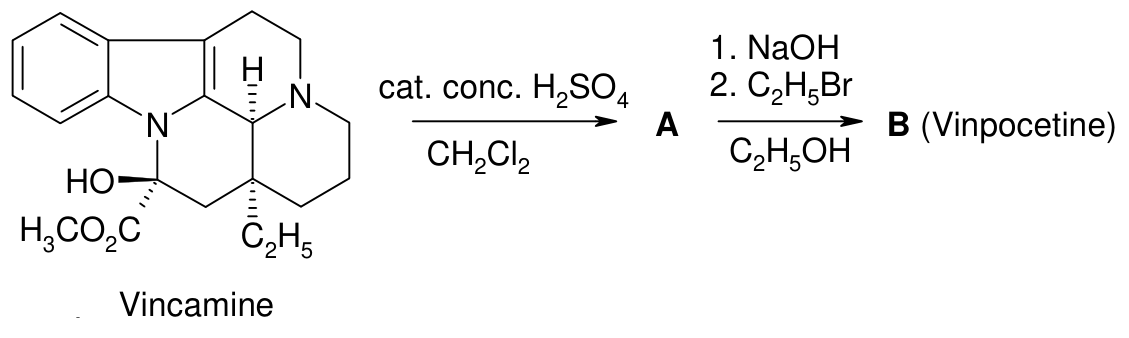
All compounds (A to F) are enantiomerically pure compounds.
- The elementary composition of A is: C 74.97%, H 7.19%, N 8.33%, O 9.55%.
- B has 3 other stereoisomers.
3.1 Propose structures for the intermediate A and vinpocetine (B).
A study of the metabolism of any drug forms a substantial part of its documentation. There are four major metabolites each formed from vinpocetine (B): C and D are formed in hydrolysis or hydration reactions, while E and F are oxidation products.
Hints:
- The acidity of the metabolites decreases in the order C >> E >> D. F does not contain an acidic hydrogen.
- C and E each have 3 other stereoisomers, while D and F each have 7 other stereoisomers.
- F is a pentacyclic zwitterion and it has the same elementary analysis as E:
C 72.11 %, H 7.15 %, N 7.64 %, O 13.10 %. - The formation of E from B follows an electrophilic pattern.
- The formation of D from B is both regio- and stereoselective.
3.2 Propose one possible structure for each of the metabolites C, D, E and F!
3.3 Draw a resonance structure for B that explains the regioselective formation of D and the absence of the alternate regioisomer in particular.
Official English text of the problem.
Answers
The following SMILES preserve the two surviving carbon stereocenters of the supplied vincamine structure.
- 3.1
A — Methyl apovincaminate (apovincamine), \(\ce{C21H24N2O2}\):
COC(=O)C1=C[C@]2(CC)CCCN3CCc4c([C@@H]32)n1c1ccccc41
B — Vinpocetine (ethyl apovincaminate), \(\ce{C22H26N2O2}\):
CCOC(=O)C1=C[C@]2(CC)CCCN3CCc4c([C@@H]32)n1c1ccccc41
- 3.2
C — Apovincaminic acid, \(\ce{C20H22N2O2}\):
O=C(O)C1=C[C@]2(CC)CCCN3CCc4c([C@@H]32)n1c1ccccc41
D — Ethyl vincaminate, \(\ce{C22H28N2O3}\), choosing the alcohol configuration shown for the starting vincamine:
CCOC(=O)[C@@]1(O)C[C@]2(CC)CCCN3CCc4c([C@@H]32)n1c1ccccc41
E — 10-Hydroxyvinpocetine, \(\ce{C22H26N2O3}\), one possible phenolic oxidation product:
CCOC(=O)C1=C[C@]2(CC)CCCN3CCc4c([C@@H]32)n1c1ccc(O)cc41
F — Vinpocetine N-oxide, \(\ce{C22H26N2O3}\), choosing one configuration at the oxidized tertiary-amine nitrogen:
CCOC(=O)C1=C[C@]2(CC)CCC[N@+]3([O-])CCc4c([C@@H]32)n1c1ccccc41
- 3.3
Charge-separated enamine resonance contributor of vinpocetine:
CCOC(=O)C1[CH-][C@]2(CC)CCCN3CCC4=C([C@@H]32)[N+]=1c1ccccc14
In the drawing, make the bond between the indole nitrogen and the ester-bearing alkene carbon double, make the original alkene bond single, and place positive charge on that nitrogen and negative charge on the other alkene carbon. Preserve the remaining framework and carbon stereochemistry.
Solution
3.1 — Identification of A and B
Using standard atomic molar masses \(12.011,\ 1.008,\ 14.007,\ 15.999\ \mathrm{g\,mol^{-1}}\) for carbon, hydrogen, nitrogen and oxygen, respectively, a \(100.00\ \mathrm g\) sample of A gives the atomic ratio
\[ n_{\mathrm C}:n_{\mathrm H}:n_{\mathrm N}:n_{\mathrm O} = \frac{74.97}{12.011}: \frac{7.19}{1.008}: \frac{8.33}{14.007}: \frac{9.55}{15.999} \]
\[ =6.242:7.133:0.5947:0.5969 \approx21:24:2:2. \]
Thus A has molecular formula \(\ce{C21H24N2O2}\), with molar mass approximately \(336.44\ \mathrm{g\,mol^{-1}}\). Compared with vincamine, it has lost one molecule of water:
\[ \ce{C21H26N2O3 -> C21H24N2O2 + H2O}. \]
The starting (+)-vincamine is represented by
COC(=O)[C@@]1(O)C[C@]2(CC)CCCN3CCc4c([C@@H]32)n1c1ccccc41.
Acid-catalysed dehydration removes the hydroxyl group from the carbon bearing the methyl ester and a hydrogen from the adjacent methylene carbon. The resulting double bond lies between those two carbons. This gives A, methyl apovincaminate.
The hydroxyl-bearing stereocenter disappears upon formation of the alkene. The two other carbon stereocenters retain their configurations.
Sodium hydroxide then hydrolyses the methyl ester:
\[ \ce{C21H24N2O2 + NaOH -> C20H21N2NaO2 + CH3OH}. \]
The intermediate is sodium apovincaminate:
[Na+].O=C([O-])C1=C[C@]2(CC)CCCN3CCc4c([C@@H]32)n1c1ccccc41.
Its carboxylate oxygen alkylates bromoethane, producing the ethyl ester B:
\[ \ce{C20H21N2NaO2 + C2H5Br -> C22H26N2O2 + NaBr}. \]
Consequently, B is vinpocetine, ethyl apovincaminate. Its two carbon stereocenters give
\[ 2^2=4 \]
stereoisomers, hence three others besides the specified enantiomer. The endocyclic double bond in the six-membered ring does not introduce an independent pair of geometrical isomers.
For a drawing, retain the original dashed bonds to the bridgehead hydrogen and ethyl group, replace the alcohol-containing segment by the alkene, and change the ester methyl group to ethyl for B.
The small species used here are water O, sodium hydroxide [Na+].[OH-], methanol CO, bromoethane CCBr, and sodium bromide [Na+].[Br-]. The stated catalyst and solvents are sulfuric acid OS(=O)(=O)O, dichloromethane ClCCl, and ethanol CCO.
3.2 — Identification of C, D, E and F
The common analysis of E and F gives
\[ \frac{72.11}{12.011}: \frac{7.15}{1.008}: \frac{7.64}{14.007}: \frac{13.10}{15.999} \approx22:26:2:3. \]
Therefore,
\[ \boxed{\textbf{E},\textbf{F}:\ \ce{C22H26N2O3}}, \qquad M\approx366.46\ \mathrm{g\,mol^{-1}}. \]
Each is formed by adding one oxygen atom to B, without changing its total hydrogen count.
C: ester hydrolysis. Hydrolysis of the ethyl ester gives apovincaminic acid:
\[ \ce{C22H26N2O2 + H2O -> C20H22N2O2 + C2H5OH}. \]
The carboxylic acid group explains why C is the most acidic metabolite. Hydrolysis leaves the two carbon stereocenters unchanged, giving four stereoisomers in total.
D: hydration of the alkene. Addition of water gives
\[ \ce{C22H26N2O2 + H2O -> C22H28N2O3}. \]
The hydroxyl group must attach to the alkene carbon already bonded to the indole nitrogen and ester group. The adjacent alkene carbon becomes a methylene group. This creates one new carbon stereocenter, giving three in total and therefore eight stereoisomers.
The selected D is ethyl vincaminate. Draw it like the original vincamine, with an ethyl ester replacing the methyl ester: the hydroxyl bond projects toward the viewer, and the ester bond projects behind the plane.
Putting hydroxyl on the other alkene carbon would make both former alkene carbons stereogenic. That alternative would have four carbon stereocenters, inconsistent with the stated eight stereoisomers.
E: aromatic hydroxylation. Its intermediate acidity suggests a phenol. Electrophilic aromatic hydroxylation introduces one oxygen atom while replacing an aromatic hydrogen by hydroxyl; the total hydrogen count is unchanged.
One possible structure is 10-hydroxyvinpocetine. In the supplied drawing, put hydroxyl on the upper-left benzene carbon, para to the benzene fusion carbon bonded directly to the indole nitrogen. This introduces no new stereocenter, so E has four stereoisomers.
F: tertiary-amine oxidation. Oxidation of the saturated tertiary-amine nitrogen gives the amine oxide, containing the formally charged linkage \(\ce{N^{+}-O^{-}}\).
This assignment explains all its properties:
- It adds one oxygen atom without changing the hydrogen count.
- It retains all five rings.
- It is a zwitterion, with net charge zero.
- It introduces no hydroxyl or nitrogen-bound hydrogen.
- The tetrahedral amine-oxide nitrogen has four distinguishable substituents and becomes a configurationally stable stereocenter.
Thus F has two carbon stereocenters and one nitrogen stereocenter, giving eight stereoisomers. The SMILES supplied above chooses the \(S\) configuration at this nitrogen.
For either oxidation, an atom-balanced formal equation is
\[ \ce{2C22H26N2O2 + O2 -> 2C22H26N2O3}, \]
with the product being E or F, respectively. This expresses the net elemental change; the problem does not specify the biological oxidant. Dioxygen is O=O.
The assignments satisfy the stereochemical counts:
| Compound | Characteristic group | Configurationally stable stereocenters | Total stereoisomers |
|---|---|---|---|
| C | Carboxylic acid | 2 carbon | 4 |
| D | Tertiary alcohol | 3 carbon | 8 |
| E | Phenol | 2 carbon | 4 |
| F | Tertiary-amine N-oxide | 2 carbon + 1 nitrogen | 8 |
The acidity order follows from stabilization of the conjugate bases: carboxylate is strongly stabilized by delocalization over two oxygens, phenoxide is stabilized by aromatic delocalization, and the alcohol’s alkoxide lacks comparable resonance stabilization. Hence
\[ \mathbf C\gg\mathbf E\gg\mathbf D. \]
3.3 — Resonance and hydration regioselectivity
Call the ester-bearing alkene carbon \(C_\alpha\), and the adjacent alkene carbon \(C_\beta\). The relevant local resonance relationship is
\[ \ce{N-C(CO2Et)=CH <-> N^{+}=C(CO2Et)-CH^{-}}, \]
where the remaining ring bonds are understood.
Starting from a Kekulé representation, move the indole nitrogen’s lone pair into the bond to \(C_\alpha\), and move the alkene \(\pi\)-electron pair onto \(C_\beta\). The full charge-separated contributor is the structure given in Answers 3.3.
This contributor identifies \(C_\beta\) as the electron-rich end of the alkene. Protonation there gives an iminium ion whose positive charge is stabilized by nitrogen donation. This vinpocetine-derived iminium ion is
CCOC(=O)C1C[C@]2(CC)CCCN3CCC4=C([C@@H]32)[N+]=1c1ccccc14.
Water attacks its electrophilic \(C_\alpha\); subsequent deprotonation produces D, with hydroxyl on the ester-bearing carbon.
The opposite protonation would place positive charge at \(C_\beta\), while the newly saturated \(C_\alpha\) would interrupt conjugation with nitrogen. That pathway lacks the iminium stabilization, explaining the observed hydration regioselectivity and the absence of the alternate regioisomer.
The solution was checked against the official solution.
IChO 2008 · Theorieaufgabe 3
Vinpocetin und seine Metaboliten
Vinpocetin (Cavinton®, Calan®) ist eines der meistverkauften Originalarzneimittel, die in Ungarn entwickelt wurden. Seine Herstellung beruht auf einer natürlichen Vorstufe, (+)-Vincamin (\(\ce{C21H26N2O3}\)), das aus der rankenden Pflanze vinca minor isoliert wird. Die Umwandlung von (+)-Vincamin in Vinpocetin erfolgt in den beiden unten dargestellten Schritten.
Alle Verbindungen (A bis F) sind enantiomerenrein.
- Die Elementzusammensetzung von A ist: C 74.97%, H 7.19%, N 8.33%, O 9.55%.
- B besitzt 3 weitere Stereoisomere.
3.1 Schlagen Sie Strukturen für das Zwischenprodukt A und Vinpocetin (B) vor.
Die Untersuchung des Stoffwechsels eines Arzneimittels ist ein wesentlicher Bestandteil seiner Dokumentation. Es gibt vier Hauptmetaboliten, die jeweils aus Vinpocetin (B) entstehen: C und D entstehen durch Hydrolyse- oder Hydratisierungsreaktionen, während E und F Oxidationsprodukte sind.
Hinweise:
- Die Acidität der Metaboliten nimmt in der Reihenfolge C >> E >> D ab. F enthält kein acides Wasserstoffatom.
- C und E besitzen jeweils 3 weitere Stereoisomere, während D und F jeweils 7 weitere Stereoisomere besitzen.
- F ist ein pentacyclisches Zwitterion und hat dieselbe Elementaranalyse wie E:
C 72.11 %, H 7.15 %, N 7.64 %, O 13.10 %. - Die Bildung von E aus B verläuft nach einem elektrophilen Reaktionsmuster.
- Die Bildung von D aus B ist sowohl regio- als auch stereoselektiv.
3.2 Schlagen Sie für jeden der Metaboliten C, D, E und F eine mögliche Struktur vor!
3.3 Zeichnen Sie eine mesomere Grenzstruktur für B, die die regioselektive Bildung von D und insbesondere das Ausbleiben des anderen Regioisomers erklärt.
Aufgabentext aus dem offiziellen englischen Text übersetzt.
Antworten
Die folgenden SMILES bewahren die beiden erhalten gebliebenen Kohlenstoff-Stereozentren der vorgegebenen Vincaminstruktur.
- 3.1
A — Apovincaminsäuremethylester (Apovincamin), \(\ce{C21H24N2O2}\):
COC(=O)C1=C[C@]2(CC)CCCN3CCc4c([C@@H]32)n1c1ccccc41
B — Vinpocetin (Apovincaminsäureethylester), \(\ce{C22H26N2O2}\):
CCOC(=O)C1=C[C@]2(CC)CCCN3CCc4c([C@@H]32)n1c1ccccc41
- 3.2
C — Apovincaminsäure, \(\ce{C20H22N2O2}\):
O=C(O)C1=C[C@]2(CC)CCCN3CCc4c([C@@H]32)n1c1ccccc41
D — Vincaminsäureethylester, \(\ce{C22H28N2O3}\), mit der für das Ausgangs-Vincamin gezeigten Konfiguration am alkoholtragenden Kohlenstoffatom:
CCOC(=O)[C@@]1(O)C[C@]2(CC)CCCN3CCc4c([C@@H]32)n1c1ccccc41
E — 10-Hydroxyvinpocetin, \(\ce{C22H26N2O3}\), ein mögliches phenolisches Oxidationsprodukt:
CCOC(=O)C1=C[C@]2(CC)CCCN3CCc4c([C@@H]32)n1c1ccc(O)cc41
F — Vinpocetin-N-oxid, \(\ce{C22H26N2O3}\), unter Wahl einer Konfiguration am oxidierten tertiären Aminstickstoff:
CCOC(=O)C1=C[C@]2(CC)CCC[N@+]3([O-])CCc4c([C@@H]32)n1c1ccccc41
- 3.3
Ladungsgetrennte Enamin-Grenzstruktur von Vinpocetin:
CCOC(=O)C1[CH-][C@]2(CC)CCCN3CCC4=C([C@@H]32)[N+]=1c1ccccc14
Zeichnen Sie die Bindung zwischen dem Indolstickstoff und dem estertragenden Alken-Kohlenstoffatom als Doppelbindung und die ursprüngliche Alkenbindung als Einfachbindung. Ordnen Sie diesem Stickstoffatom eine positive Ladung und dem anderen Alken-Kohlenstoffatom eine negative Ladung zu. Behalten Sie das übrige Gerüst und die Stereochemie der Kohlenstoffatome bei.
Lösung
3.1 — Identifizierung von A und B
Mit den üblichen atomaren molaren Massen \(12.011,\ 1.008,\ 14.007,\ 15.999\ \mathrm{g\,mol^{-1}}\) für Kohlenstoff, Wasserstoff, Stickstoff beziehungsweise Sauerstoff ergibt eine \(100.00\ \mathrm g\)-Probe von A das Atomzahlenverhältnis
\[ n_{\mathrm C}:n_{\mathrm H}:n_{\mathrm N}:n_{\mathrm O} = \frac{74.97}{12.011}: \frac{7.19}{1.008}: \frac{8.33}{14.007}: \frac{9.55}{15.999} \]
\[ =6.242:7.133:0.5947:0.5969 \approx21:24:2:2. \]
Somit hat A die Summenformel \(\ce{C21H24N2O2}\) und eine molare Masse von ungefähr \(336.44\ \mathrm{g\,mol^{-1}}\). Gegenüber Vincamin hat es ein Molekül Wasser verloren:
\[ \ce{C21H26N2O3 -> C21H24N2O2 + H2O}. \]
Das als Ausgangsstoff verwendete (+)-Vincamin wird dargestellt durch
COC(=O)[C@@]1(O)C[C@]2(CC)CCCN3CCc4c([C@@H]32)n1c1ccccc41.
Bei der säurekatalysierten Dehydratisierung werden die Hydroxygruppe vom Kohlenstoffatom, das die Methylestergruppe trägt, und ein Wasserstoffatom vom benachbarten Methylen-Kohlenstoffatom abgespalten. Die entstehende Doppelbindung liegt zwischen diesen beiden Kohlenstoffatomen. Dadurch entsteht A, Apovincaminsäuremethylester.
Das hydroxygruppentragende Stereozentrum verschwindet bei der Bildung des Alkens. Die beiden anderen Kohlenstoff-Stereozentren behalten ihre Konfigurationen bei.
Anschließend hydrolysiert Natriumhydroxid den Methylester:
\[ \ce{C21H24N2O2 + NaOH -> C20H21N2NaO2 + CH3OH}. \]
Das Zwischenprodukt ist Natriumapovincaminat:
[Na+].O=C([O-])C1=C[C@]2(CC)CCCN3CCc4c([C@@H]32)n1c1ccccc41.
Sein Carboxylat-Sauerstoffatom wird durch Reaktion mit Bromethan alkyliert, wobei der Ethylester B entsteht:
\[ \ce{C20H21N2NaO2 + C2H5Br -> C22H26N2O2 + NaBr}. \]
Folglich ist B Vinpocetin, Apovincaminsäureethylester. Seine beiden Kohlenstoff-Stereozentren ergeben
\[ 2^2=4 \]
Stereoisomere, also drei weitere neben dem angegebenen Enantiomer. Die endocyclische Doppelbindung im sechsgliedrigen Ring führt nicht zu einem unabhängigen Paar geometrischer Isomere.
Behalten Sie für eine Zeichnung die ursprünglichen gestrichelten Bindungen zum Brückenkopf-Wasserstoffatom und zur Ethylgruppe bei, ersetzen Sie den alkoholhaltigen Abschnitt durch das Alken und ändern Sie für B die Methylgruppe des Esters in eine Ethylgruppe.
Die hier verwendeten kleinen Spezies sind Wasser O, Natriumhydroxid [Na+].[OH-], Methanol CO, Bromethan CCBr und Natriumbromid [Na+].[Br-]. Der angegebene Katalysator und die Lösungsmittel sind Schwefelsäure OS(=O)(=O)O, Dichlormethan ClCCl und Ethanol CCO.
3.2 — Identifizierung von C, D, E und F
Die gemeinsame Elementaranalyse von E und F ergibt
\[ \frac{72.11}{12.011}: \frac{7.15}{1.008}: \frac{7.64}{14.007}: \frac{13.10}{15.999} \approx22:26:2:3. \]
Damit gilt
\[ \boxed{\textbf{E},\textbf{F}:\ \ce{C22H26N2O3}}, \qquad M\approx366.46\ \mathrm{g\,mol^{-1}}. \]
Beide entstehen durch Hinzufügen eines Sauerstoffatoms zu B, ohne dass sich die Gesamtzahl seiner Wasserstoffatome ändert.
C: Esterhydrolyse. Die Hydrolyse des Ethylesters liefert Apovincaminsäure:
\[ \ce{C22H26N2O2 + H2O -> C20H22N2O2 + C2H5OH}. \]
Die Carbonsäuregruppe erklärt, warum C der sauerste Metabolit ist. Die Hydrolyse lässt die beiden Kohlenstoff-Stereozentren unverändert, sodass insgesamt vier Stereoisomere vorliegen.
D: Hydratisierung des Alkens. Die Addition von Wasser ergibt
\[ \ce{C22H26N2O2 + H2O -> C22H28N2O3}. \]
Die Hydroxygruppe muss an das Alken-Kohlenstoffatom gebunden werden, das bereits mit dem Indolstickstoff und der Estergruppe verbunden ist. Das benachbarte Alken-Kohlenstoffatom wird zu einer Methylengruppe. Dadurch entsteht ein neues Kohlenstoff-Stereozentrum, sodass insgesamt drei und damit acht Stereoisomere vorliegen.
Das gewählte D ist Vincaminsäureethylester. Zeichnen Sie es wie das ursprüngliche Vincamin, wobei ein Ethylester den Methylester ersetzt: Die Bindung zur Hydroxygruppe zeigt zum Betrachter, und die Bindung zur Estergruppe zeigt hinter die Ebene.
Würde die Hydroxygruppe am anderen Alken-Kohlenstoffatom eingeführt, würden beide ehemaligen Alken-Kohlenstoffatome stereogen. Diese Alternative hätte vier Kohlenstoff-Stereozentren, was mit den angegebenen acht Stereoisomeren unvereinbar ist.
E: aromatische Hydroxylierung. Seine mittlere Acidität deutet auf ein Phenol hin. Durch elektrophile aromatische Hydroxylierung wird ein Sauerstoffatom eingeführt, indem ein aromatisches Wasserstoffatom durch eine Hydroxygruppe ersetzt wird; die Gesamtzahl der Wasserstoffatome bleibt unverändert.
Eine mögliche Struktur ist 10-Hydroxyvinpocetin. Bringen Sie in der vorgegebenen Zeichnung die Hydroxygruppe am oberen linken Benzol-Kohlenstoffatom an, in para-Stellung zu dem an der Ringverknüpfung beteiligten Benzol-Kohlenstoffatom, das direkt an den Indolstickstoff gebunden ist. Dadurch entsteht kein neues Stereozentrum, sodass E vier Stereoisomere besitzt.
F: Oxidation des tertiären Amins. Die Oxidation des gesättigten tertiären Aminstickstoffs ergibt das Aminoxid, das die formal geladene Bindungseinheit \(\ce{N^{+}-O^{-}}\) enthält.
Diese Zuordnung erklärt alle seine Eigenschaften:
- Ein Sauerstoffatom wird hinzugefügt, ohne dass sich die Anzahl der Wasserstoffatome ändert.
- Alle fünf Ringe bleiben erhalten.
- Es handelt sich um ein Zwitterion mit der Nettoladung null.
- Es wird weder eine Hydroxygruppe noch ein an Stickstoff gebundenes Wasserstoffatom eingeführt.
- Das tetraedrische Aminoxid-Stickstoffatom besitzt vier unterscheidbare Substituenten und wird zu einem konfigurationsstabilen Stereozentrum.
Somit besitzt F zwei Kohlenstoff-Stereozentren und ein Stickstoff-Stereozentrum, woraus sich acht Stereoisomere ergeben. Die oben angegebene SMILES-Darstellung legt an diesem Stickstoffatom die \(S\)-Konfiguration fest.
Für beide Oxidationen lautet eine hinsichtlich der Atome ausgeglichene formale Gleichung
\[ \ce{2C22H26N2O2 + O2 -> 2C22H26N2O3}, \]
wobei das Produkt jeweils E beziehungsweise F ist. Dies drückt die Nettoänderung der Elementzusammensetzung aus; die Aufgabe gibt das biologische Oxidationsmittel nicht an. Disauerstoff ist O=O.
Die Zuordnungen erfüllen die angegebenen stereochemischen Anzahlen:
| Verbindung | Charakteristische Gruppe | Konfigurationsstabile Stereozentren | Gesamtzahl der Stereoisomere |
|---|---|---|---|
| C | Carbonsäure | 2 Kohlenstoff | 4 |
| D | Tertiärer Alkohol | 3 Kohlenstoff | 8 |
| E | Phenol | 2 Kohlenstoff | 4 |
| F | N-Oxid eines tertiären Amins | 2 Kohlenstoff + 1 Stickstoff | 8 |
Die Reihenfolge der Acidität ergibt sich aus der Stabilisierung der konjugierten Basen: Carboxylat wird durch Delokalisierung über zwei Sauerstoffatome stark stabilisiert, Phenolat wird durch aromatische Delokalisierung stabilisiert, und dem Alkoholat des Alkohols fehlt eine vergleichbare mesomere Stabilisierung. Daher gilt
\[ \mathbf C\gg\mathbf E\gg\mathbf D. \]
3.3 — Mesomerie und Regioselektivität der Hydratisierung
Das estertragende Alken-Kohlenstoffatom sei mit \(C_\alpha\) und das benachbarte Alken-Kohlenstoffatom mit \(C_\beta\) bezeichnet. Die relevante lokale Mesomeriebeziehung lautet
\[ \ce{N-C(CO2Et)=CH <-> N^{+}=C(CO2Et)-CH^{-}}, \]
wobei die übrigen Ringbindungen mitgedacht werden.
Verschieben Sie ausgehend von einer Kekulé-Darstellung das freie Elektronenpaar des Indolstickstoffs in die Bindung zu \(C_\alpha\) und das \(\pi\)-Elektronenpaar des Alkens auf \(C_\beta\). Die vollständige ladungsgetrennte Grenzstruktur ist die unter Antworten 3.3 angegebene Struktur.
Diese Grenzstruktur kennzeichnet \(C_\beta\) als das elektronenreiche Ende des Alkens. Die Protonierung an dieser Stelle ergibt ein Iminiumion, dessen positive Ladung durch Elektronenabgabe des Stickstoffs stabilisiert wird. Dieses von Vinpocetin abgeleitete Iminiumion ist
CCOC(=O)C1C[C@]2(CC)CCCN3CCC4=C([C@@H]32)[N+]=1c1ccccc14.
Wasser greift dessen elektrophiles \(C_\alpha\) an; die anschließende Deprotonierung liefert D mit der Hydroxygruppe am estertragenden Kohlenstoffatom.
Die Protonierung am anderen Alken-Kohlenstoffatom würde eine positive Ladung an \(C_\beta\) erzeugen, während das nun gesättigte \(C_\alpha\) die Konjugation mit dem Stickstoff unterbrechen würde. Diesem Reaktionsweg fehlt die Iminiumstabilisierung, was die beobachtete Regioselektivität der Hydratisierung und das Ausbleiben des anderen Regioisomers erklärt.
Die Lösung wurde mit der offiziellen Lösung abgeglichen.
IChO 2008 · Teori sorusu 3
Vinposetin ve metabolitleri
Vinposetin (Cavinton®, Calan®), Macaristan'da geliştirilen en çok satan özgün ilaçlardan biridir. Hazırlanması, vinca minor adlı sarılıcı bitkiden izole edilen doğal bir öncü olan (+)-vinkamine (\(\ce{C21H26N2O3}\)) dayanır. (+)-Vinkaminin vinposetine dönüşümü, aşağıda gösterilen iki basamakta gerçekleştirilir.
Tüm bileşikler (A ile F arasındaki bileşikler) enantiyomerik olarak saftır.
- A'nın elementel bileşimi şöyledir: C 74.97%, H 7.19%, N 8.33%, O 9.55%.
- B'nin 3 başka stereoizomeri vardır.
3.1 Ara ürün A ve vinposetin (B) için yapılar öneriniz.
Herhangi bir ilacın metabolizmasının incelenmesi, o ilaca ilişkin belgelerin önemli bir bölümünü oluşturur. Her biri vinposetinden (B) oluşan dört ana metabolit vardır: C ve D, hidroliz veya hidratasyon tepkimelerinde oluşurken E ve F yükseltgenme ürünleridir.
İpuçları:
- Metabolitlerin asitliği C >> E >> D sırasıyla azalır. F, asidik bir hidrojen içermez.
- C ve E'nin her birinin 3 başka stereoizomeri varken D ve F'nin her birinin 7 başka stereoizomeri vardır.
- F, beş halkalı bir zwitteriyondur ve E ile aynı elementel analiz sonucunu verir:
C 72.11 %, H 7.15 %, N 7.64 %, O 13.10 %. - B'den E oluşumu elektrofilik bir mekanizma izler.
- B'den D oluşumu hem bölge seçici hem de stereoseçicidir.
3.2 C, D, E ve F metabolitlerinin her biri için olası bir yapı öneriniz!
3.3 D'nin bölge seçici oluşumunu ve özellikle alternatif bölge izomerinin oluşmamasını açıklayan bir B rezonans yapısı çiziniz.
Soru metni resmi İngilizce metinden çevrilmiştir.
Cevaplar
Aşağıdaki SMILES gösterimleri, verilen vinkamin yapısındaki korunan iki karbon stereomerkezini muhafaza eder.
- 3.1
A — Metil apovinkaminat (apovinkamin), \(\ce{C21H24N2O2}\):
COC(=O)C1=C[C@]2(CC)CCCN3CCc4c([C@@H]32)n1c1ccccc41
B — Vinposetin (etil apovinkaminat), \(\ce{C22H26N2O2}\):
CCOC(=O)C1=C[C@]2(CC)CCCN3CCc4c([C@@H]32)n1c1ccccc41
- 3.2
C — Apovinkaminik asit, \(\ce{C20H22N2O2}\):
O=C(O)C1=C[C@]2(CC)CCCN3CCc4c([C@@H]32)n1c1ccccc41
D — Etil vinkaminat, \(\ce{C22H28N2O3}\), başlangıçtaki vinkamin için gösterilen alkol konfigürasyonu seçilerek:
CCOC(=O)[C@@]1(O)C[C@]2(CC)CCCN3CCc4c([C@@H]32)n1c1ccccc41
E — 10-Hidroksivinposetin, \(\ce{C22H26N2O3}\), olası bir fenolik yükseltgenme ürünü:
CCOC(=O)C1=C[C@]2(CC)CCCN3CCc4c([C@@H]32)n1c1ccc(O)cc41
F — Vinposetin N-oksit, \(\ce{C22H26N2O3}\), yükseltgenmiş üçüncül amin azotunda bir konfigürasyon seçilerek:
CCOC(=O)C1=C[C@]2(CC)CCC[N@+]3([O-])CCc4c([C@@H]32)n1c1ccccc41
- 3.3
Vinposetinin yük ayrışmalı enamin rezonans katkı yapısı:
CCOC(=O)C1[CH-][C@]2(CC)CCCN3CCC4=C([C@@H]32)[N+]=1c1ccccc14
Çizimde, indol azotu ile ester taşıyan alken karbonu arasındaki bağı çift bağa, başlangıçtaki alken bağını ise tek bağa dönüştürünüz; bu azotun üzerine pozitif yük, diğer alken karbonunun üzerine negatif yük yerleştiriniz. İskeletin geri kalanını ve karbon stereokimyasını koruyunuz.
Çözüm
3.1 — A ve B'nin belirlenmesi
Karbon, hidrojen, azot ve oksijen için sırasıyla \(12.011,\ 1.008,\ 14.007,\ 15.999\ \mathrm{g\,mol^{-1}}\) standart atomik molar kütleleri kullanıldığında, \(100.00\ \mathrm g\) A örneği şu atom oranını verir:
\[ n_{\mathrm C}:n_{\mathrm H}:n_{\mathrm N}:n_{\mathrm O} = \frac{74.97}{12.011}: \frac{7.19}{1.008}: \frac{8.33}{14.007}: \frac{9.55}{15.999} \]
\[ =6.242:7.133:0.5947:0.5969 \approx21:24:2:2. \]
Dolayısıyla A'nın molekül formülü \(\ce{C21H24N2O2}\), molar kütlesi ise yaklaşık \(336.44\ \mathrm{g\,mol^{-1}}\)'dir. Vinkamine göre bir su molekülü kaybetmiştir:
\[ \ce{C21H26N2O3 -> C21H24N2O2 + H2O}. \]
Başlangıçtaki (+)-vinkamin şu şekilde gösterilir:
COC(=O)[C@@]1(O)C[C@]2(CC)CCCN3CCc4c([C@@H]32)n1c1ccccc41.
Asit katalizli dehidrasyon, metil esteri taşıyan karbondan hidroksil grubunu ve komşu metilen karbonundan bir hidrojeni uzaklaştırır. Oluşan çift bağ bu iki karbon arasında yer alır. Böylece metil apovinkaminat olan A elde edilir.
Hidroksil taşıyan stereomerkez, alken oluştuğunda ortadan kalkar. Diğer iki karbon stereomerkezi konfigürasyonlarını korur.
Ardından sodyum hidroksit, metil esteri hidroliz eder:
\[ \ce{C21H24N2O2 + NaOH -> C20H21N2NaO2 + CH3OH}. \]
Ara ürün sodyum apovinkaminattır:
[Na+].O=C([O-])C1=C[C@]2(CC)CCCN3CCc4c([C@@H]32)n1c1ccccc41.
Karboksilat oksijeni bromoetanı alkilleyerek etil ester B'yi oluşturur:
\[ \ce{C20H21N2NaO2 + C2H5Br -> C22H26N2O2 + NaBr}. \]
Sonuç olarak B, etil apovinkaminat olan vinposetindir. İki karbon stereomerkezi
\[ 2^2=4 \]
stereoizomer verir; dolayısıyla belirtilen enantiyomer dışında üç stereoizomer daha vardır. Altı üyeli halkadaki endosiklik çift bağ, bağımsız bir geometrik izomer çifti oluşturmaz.
Çizim için köprübaşı hidrojenine ve etil grubuna uzanan başlangıçtaki kesikli bağları koruyunuz, alkol içeren bölümü alkenle değiştiriniz ve B için esterin metil grubunu etile dönüştürünüz.
Burada kullanılan küçük türler su O, sodyum hidroksit [Na+].[OH-], metanol CO, bromoetan CCBr ve sodyum bromür [Na+].[Br-]dür. Belirtilen katalizör ve çözücüler sülfürik asit OS(=O)(=O)O, diklorometan ClCCl ve etanol CCOdür.
3.2 — C, D, E ve F'nin belirlenmesi
E ve F'nin ortak analiz sonucu şunu verir:
\[ \frac{72.11}{12.011}: \frac{7.15}{1.008}: \frac{7.64}{14.007}: \frac{13.10}{15.999} \approx22:26:2:3. \]
Dolayısıyla,
\[ \boxed{\textbf{E},\textbf{F}:\ \ce{C22H26N2O3}}, \qquad M\approx366.46\ \mathrm{g\,mol^{-1}}. \]
Her biri, toplam hidrojen sayısı değişmeden B'ye bir oksijen atomunun eklenmesiyle oluşur.
C: ester hidrolizi. Etil esterin hidrolizi apovinkaminik asidi verir:
\[ \ce{C22H26N2O2 + H2O -> C20H22N2O2 + C2H5OH}. \]
Karboksilik asit grubu, C'nin neden en asidik metabolit olduğunu açıklar. Hidroliz iki karbon stereomerkezini değiştirmediğinden toplam dört stereoizomer elde edilir.
D: alkenin hidratasyonu. Su katılması şu sonucu verir:
\[ \ce{C22H26N2O2 + H2O -> C22H28N2O3}. \]
Hidroksil grubu, zaten indol azotuna ve ester grubuna bağlı olan alken karbonuna bağlanmalıdır. Komşu alken karbonu bir metilen grubuna dönüşür. Bu, bir yeni karbon stereomerkezi oluşturarak toplam stereomerkez sayısını üçe, dolayısıyla stereoizomer sayısını sekize çıkarır.
Seçilen D, etil vinkaminattır. Başlangıçtaki vinkamin gibi, metil esterin yerine etil ester koyarak çiziniz: hidroksil bağı gözlemciye doğru, ester bağı ise düzlemin arkasına doğru uzanır.
Hidroksilin diğer alken karbonuna yerleştirilmesi, başlangıçtaki alken karbonlarının her ikisini de stereojenik hâle getirirdi. Bu alternatif yapıda dört karbon stereomerkezi bulunurdu; bu da belirtilen sekiz stereoizomerle tutarsızdır.
E: aromatik hidroksilasyon. Asitliğinin arada olması bir fenolü düşündürür. Elektrofilik aromatik hidroksilasyon, bir aromatik hidrojeni hidroksille değiştirirken bir oksijen atomu ekler; toplam hidrojen sayısı değişmez.
Olası yapılardan biri 10-hidroksivinposetindir. Verilen çizimde hidroksili, indol azotuna doğrudan bağlı olan benzen halka kaynaşma karbonuna göre para konumundaki, sol üstte yer alan benzen karbonuna yerleştiriniz. Bu işlem yeni bir stereomerkez oluşturmaz; dolayısıyla E'nin dört stereoizomeri vardır.
F: üçüncül aminin yükseltgenmesi. Doymuş üçüncül amin azotunun yükseltgenmesi, formal yükler taşıyan \(\ce{N^{+}-O^{-}}\) bağlantısını içeren amin oksidi verir.
Bu yapı ataması, tüm özelliklerini açıklar:
- Hidrojen sayısını değiştirmeden bir oksijen atomu ekler.
- Beş halkanın tümünü korur.
- Net yükü sıfır olan bir zwitteriyondur.
- Hidroksil veya azota bağlı hidrojen oluşturmaz.
- Dört yüzlü amin oksit azotu, birbirinden ayırt edilebilen dört sübstitüente sahiptir ve konfigürasyonel olarak kararlı bir stereomerkez hâline gelir.
Böylece F'nin iki karbon stereomerkezi ve bir azot stereomerkezi vardır; bu da sekiz stereoizomer verir. Yukarıda verilen SMILES gösteriminde bu azot için \(S\) konfigürasyonu seçilmiştir.
Her iki yükseltgenme için de atom sayıları bakımından denkleştirilmiş biçimsel bir denklem şöyledir:
\[ \ce{2C22H26N2O2 + O2 -> 2C22H26N2O3}, \]
burada ürün, sırasıyla E veya F'dir. Bu, elementel bileşimdeki net değişimi ifade eder; soruda biyolojik yükseltgen belirtilmemiştir. Dioksijen O=O ile gösterilir.
Yapı atamaları, stereokimyasal sayıları sağlar:
| Bileşik | Karakteristik grup | Konfigürasyonel olarak kararlı stereomerkezler | Toplam stereoizomer sayısı |
|---|---|---|---|
| C | Karboksilik asit | 2 karbon | 4 |
| D | Üçüncül alkol | 3 karbon | 8 |
| E | Fenol | 2 karbon | 4 |
| F | Üçüncül amin N-oksit | 2 karbon + 1 azot | 8 |
Asitlik sırası, eşlenik bazların kararlılaşmasından kaynaklanır: karboksilat, iki oksijen üzerindeki delokalizasyonla güçlü biçimde kararlılaşır; fenoksit aromatik delokalizasyonla kararlılaşır; alkolün alkoksiti ise benzer bir rezonans kararlılaşmasından yoksundur. Dolayısıyla
\[ \mathbf C\gg\mathbf E\gg\mathbf D. \]
3.3 — Rezonans ve hidratasyonun bölge seçiciliği
Ester taşıyan alken karbonunu \(C_\alpha\), komşu alken karbonunu ise \(C_\beta\) olarak adlandıralım. İlgili yerel rezonans ilişkisi şöyledir:
\[ \ce{N-C(CO2Et)=CH <-> N^{+}=C(CO2Et)-CH^{-}}, \]
burada halkanın geri kalan bağları örtük olarak kabul edilir.
Bir Kekulé gösteriminden başlayarak indol azotunun ortaklanmamış elektron çiftini \(C_\alpha\)'ya uzanan bağa, alkenin \(\pi\)-elektron çiftini ise \(C_\beta\) üzerine taşıyınız. Yük ayrışmalı katkı yapısının tamamı, Cevaplar 3.3'te verilen yapıdır.
Bu katkı yapısı, \(C_\beta\)'nın alkenin elektronca zengin ucu olduğunu gösterir. Burada protonlanma, pozitif yükü azotun elektron vermesiyle kararlılaşan bir iminyum iyonu oluşturur. Vinposetinden türeyen bu iminyum iyonu şöyledir:
CCOC(=O)C1C[C@]2(CC)CCCN3CCC4=C([C@@H]32)[N+]=1c1ccccc14.
Su, iyonun elektrofilik \(C_\alpha\) karbonuna saldırır; ardından gerçekleşen deprotonlanma, hidroksilin ester taşıyan karbonda bulunduğu D'yi oluşturur.
Diğer uçtan protonlanma, pozitif yükü \(C_\beta\) üzerine yerleştirirken yeni doymuş hâle gelen \(C_\alpha\), azotla konjugasyonu keserdi. Bu yol iminyum kararlılaşmasından yoksundur; bu da gözlenen hidratasyon bölge seçiciliğini ve alternatif bölge izomerinin oluşmamasını açıklar.
Çözüm, resmi çözümle karşılaştırılarak kontrol edildi.
IChO 2008 · Problema teórico 3
La vinpocetina y sus metabolitos
La vinpocetina (Cavinton®, Calan®) es uno de los medicamentos originales desarrollados en Hungría más vendidos. Su preparación se basa en un precursor natural, la (+)-vincamina (\(\ce{C21H26N2O3}\)), que se aísla de la planta rastrera vinca minor. La transformación de la (+)-vincamina en vinpocetina se lleva a cabo en las dos etapas que se muestran a continuación.
Todos los compuestos (de A a F) son enantioméricamente puros.
- La composición elemental de A es: C 74.97%, H 7.19%, N 8.33%, O 9.55%.
- B tiene otros 3 estereoisómeros.
3.1 Proponga las estructuras del intermedio A y de la vinpocetina (B).
El estudio del metabolismo de cualquier medicamento constituye una parte sustancial de su documentación. Hay cuatro metabolitos principales, cada uno de los cuales se forma a partir de la vinpocetina (B): C y D se forman en reacciones de hidrólisis o hidratación, mientras que E y F son productos de oxidación.
Indicaciones:
- La acidez de los metabolitos disminuye en el orden C >> E >> D. F no contiene ningún hidrógeno ácido.
- C y E tienen otros 3 estereoisómeros cada uno, mientras que D y F tienen otros 7 estereoisómeros cada uno.
- F es un zwitterión pentacíclico y presenta el mismo análisis elemental que E:
C 72.11 %, H 7.15 %, N 7.64 %, O 13.10 %. - La formación de E a partir de B sigue un mecanismo electrófilo.
- La formación de D a partir de B es tanto regioselectiva como estereoselectiva.
3.2 ¡Proponga una estructura posible para cada uno de los metabolitos C, D, E y F!
3.3 Dibuje una estructura de resonancia de B que explique la formación regioselectiva de D y, en particular, la ausencia del regioisómero alternativo.
Enunciado traducido del texto oficial en inglés.
Respuestas
Los siguientes SMILES conservan los dos estereocentros de carbono que se mantienen de la estructura de vincamina proporcionada.
- 3.1
A — Apovincaminato de metilo (apovincamina), \(\ce{C21H24N2O2}\):
COC(=O)C1=C[C@]2(CC)CCCN3CCc4c([C@@H]32)n1c1ccccc41
B — Vinpocetina (apovincaminato de etilo), \(\ce{C22H26N2O2}\):
CCOC(=O)C1=C[C@]2(CC)CCCN3CCc4c([C@@H]32)n1c1ccccc41
- 3.2
C — Ácido apovincamínico, \(\ce{C20H22N2O2}\):
O=C(O)C1=C[C@]2(CC)CCCN3CCc4c([C@@H]32)n1c1ccccc41
D — Vincaminato de etilo, \(\ce{C22H28N2O3}\), eligiendo la configuración del alcohol mostrada para la vincamina de partida:
CCOC(=O)[C@@]1(O)C[C@]2(CC)CCCN3CCc4c([C@@H]32)n1c1ccccc41
E — 10-Hidroxivinpocetina, \(\ce{C22H26N2O3}\), un posible producto fenólico de oxidación:
CCOC(=O)C1=C[C@]2(CC)CCCN3CCc4c([C@@H]32)n1c1ccc(O)cc41
F — N-óxido de vinpocetina, \(\ce{C22H26N2O3}\), eligiendo una configuración en el nitrógeno oxidado de la amina terciaria:
CCOC(=O)C1=C[C@]2(CC)CCC[N@+]3([O-])CCc4c([C@@H]32)n1c1ccccc41
- 3.3
Forma resonante de la enamina de la vinpocetina con separación de cargas:
CCOC(=O)C1[CH-][C@]2(CC)CCCN3CCC4=C([C@@H]32)[N+]=1c1ccccc14
En el dibujo, convierta en doble el enlace entre el nitrógeno indólico y el carbono del alqueno que lleva el grupo éster, convierta en sencillo el enlace original del alqueno y sitúe una carga positiva en ese nitrógeno y una carga negativa en el otro carbono del alqueno. Conserve el resto del esqueleto y la estereoquímica de los carbonos.
Solución
3.1 — Identificación de A y B
Utilizando las masas molares atómicas estándar \(12.011,\ 1.008,\ 14.007,\ 15.999\ \mathrm{g\,mol^{-1}}\) para el carbono, el hidrógeno, el nitrógeno y el oxígeno, respectivamente, una muestra de \(100.00\ \mathrm g\) de A da la proporción atómica
\[ n_{\mathrm C}:n_{\mathrm H}:n_{\mathrm N}:n_{\mathrm O} = \frac{74.97}{12.011}: \frac{7.19}{1.008}: \frac{8.33}{14.007}: \frac{9.55}{15.999} \]
\[ =6.242:7.133:0.5947:0.5969 \approx21:24:2:2. \]
Por tanto, A tiene la fórmula molecular \(\ce{C21H24N2O2}\), con una masa molar aproximada de \(336.44\ \mathrm{g\,mol^{-1}}\). En comparación con la vincamina, ha perdido una molécula de agua:
\[ \ce{C21H26N2O3 -> C21H24N2O2 + H2O}. \]
La (+)-vincamina de partida se representa mediante
COC(=O)[C@@]1(O)C[C@]2(CC)CCCN3CCc4c([C@@H]32)n1c1ccccc41.
La deshidratación catalizada por ácido elimina el grupo hidroxilo del carbono que lleva el éster metílico y un hidrógeno del carbono metilénico adyacente. El doble enlace resultante se sitúa entre esos dos carbonos. Así se obtiene A, el apovincaminato de metilo.
El estereocentro que lleva el grupo hidroxilo desaparece al formarse el alqueno. Los otros dos estereocentros de carbono conservan sus configuraciones.
A continuación, el hidróxido de sodio hidroliza el éster metílico:
\[ \ce{C21H24N2O2 + NaOH -> C20H21N2NaO2 + CH3OH}. \]
El intermedio es el apovincaminato de sodio:
[Na+].O=C([O-])C1=C[C@]2(CC)CCCN3CCc4c([C@@H]32)n1c1ccccc41.
Su oxígeno del carboxilato se alquila con bromoetano, produciendo el éster etílico B:
\[ \ce{C20H21N2NaO2 + C2H5Br -> C22H26N2O2 + NaBr}. \]
En consecuencia, B es la vinpocetina, apovincaminato de etilo. Sus dos estereocentros de carbono dan lugar a
\[ 2^2=4 \]
estereoisómeros, es decir, otros tres además del enantiómero especificado. El doble enlace endocíclico del anillo de seis miembros no introduce un par independiente de isómeros geométricos.
Para dibujar la estructura, conserve los enlaces discontinuos originales al hidrógeno de cabeza de puente y al grupo etilo, sustituya el segmento que contiene el alcohol por el alqueno y cambie el grupo metilo del éster por un grupo etilo para B.
Las especies pequeñas utilizadas aquí son agua O, hidróxido de sodio [Na+].[OH-], metanol CO, bromoetano CCBr y bromuro de sodio [Na+].[Br-]. El catalizador y los disolventes indicados son ácido sulfúrico OS(=O)(=O)O, diclorometano ClCCl y etanol CCO.
3.2 — Identificación de C, D, E y F
El análisis común de E y F da
\[ \frac{72.11}{12.011}: \frac{7.15}{1.008}: \frac{7.64}{14.007}: \frac{13.10}{15.999} \approx22:26:2:3. \]
Por tanto,
\[ \boxed{\textbf{E},\textbf{F}:\ \ce{C22H26N2O3}}, \qquad M\approx366.46\ \mathrm{g\,mol^{-1}}. \]
Cada uno se forma añadiendo un átomo de oxígeno a B, sin cambiar su número total de átomos de hidrógeno.
C: hidrólisis del éster. La hidrólisis del éster etílico da ácido apovincamínico:
\[ \ce{C22H26N2O2 + H2O -> C20H22N2O2 + C2H5OH}. \]
El grupo ácido carboxílico explica por qué C es el metabolito más ácido. La hidrólisis deja inalterados los dos estereocentros de carbono, lo que da cuatro estereoisómeros en total.
D: hidratación del alqueno. La adición de agua da
\[ \ce{C22H26N2O2 + H2O -> C22H28N2O3}. \]
El grupo hidroxilo debe unirse al carbono del alqueno que ya está enlazado al nitrógeno indólico y al grupo éster. El carbono adyacente del alqueno se convierte en un grupo metileno. Esto crea un nuevo estereocentro de carbono, lo que da tres en total y, por tanto, ocho estereoisómeros.
El D seleccionado es el vincaminato de etilo. Dibújelo como la vincamina original, sustituyendo el éster metílico por un éster etílico: el enlace al hidroxilo se proyecta hacia el observador y el enlace al éster se proyecta detrás del plano.
Situar el hidroxilo en el otro carbono del alqueno haría que ambos carbonos del alqueno original fueran estereogénicos. Esa alternativa tendría cuatro estereocentros de carbono, lo que no concuerda con los ocho estereoisómeros indicados.
E: hidroxilación aromática. Su acidez intermedia sugiere un fenol. La hidroxilación aromática electrófila introduce un átomo de oxígeno al sustituir un hidrógeno aromático por un hidroxilo; el número total de átomos de hidrógeno no cambia.
Una estructura posible es la 10-hidroxivinpocetina. En el dibujo proporcionado, sitúe el hidroxilo en el carbono superior izquierdo del anillo bencénico, en posición para respecto al carbono de fusión del anillo bencénico enlazado directamente al nitrógeno indólico. Esto no introduce ningún estereocentro nuevo, por lo que E tiene cuatro estereoisómeros.
F: oxidación de la amina terciaria. La oxidación del nitrógeno de la amina terciaria saturada da el óxido de amina, que contiene el enlace con cargas formales \(\ce{N^{+}-O^{-}}\).
Esta asignación explica todas sus propiedades:
- Añade un átomo de oxígeno sin cambiar el número de átomos de hidrógeno.
- Conserva los cinco anillos.
- Es un zwitterión, con carga neta cero.
- No introduce ningún hidroxilo ni hidrógeno unido al nitrógeno.
- El nitrógeno tetraédrico del óxido de amina tiene cuatro sustituyentes distinguibles y se convierte en un estereocentro configuracionalmente estable.
Así, F tiene dos estereocentros de carbono y un estereocentro de nitrógeno, lo que da ocho estereoisómeros. El SMILES proporcionado anteriormente elige la configuración \(S\) en este nitrógeno.
Para cualquiera de las dos oxidaciones, una ecuación formal ajustada en átomos es
\[ \ce{2C22H26N2O2 + O2 -> 2C22H26N2O3}, \]
siendo el producto E o F, respectivamente. Esto expresa el cambio elemental neto; el problema no especifica el oxidante biológico. El dioxígeno es O=O.
Las asignaciones satisfacen los recuentos estereoquímicos:
| Compuesto | Grupo característico | Estereocentros configuracionalmente estables | Total de estereoisómeros |
|---|---|---|---|
| C | Ácido carboxílico | 2 de carbono | 4 |
| D | Alcohol terciario | 3 de carbono | 8 |
| E | Fenol | 2 de carbono | 4 |
| F | N-óxido de amina terciaria | 2 de carbono + 1 de nitrógeno | 8 |
El orden de acidez se deriva de la estabilización de las bases conjugadas: el carboxilato está fuertemente estabilizado por deslocalización sobre dos oxígenos, el fenóxido está estabilizado por deslocalización aromática y el alcóxido del alcohol carece de una estabilización por resonancia comparable. Por ello,
\[ \mathbf C\gg\mathbf E\gg\mathbf D. \]
3.3 — Resonancia y regioselectividad de la hidratación
Denominemos \(C_\alpha\) al carbono del alqueno que lleva el grupo éster y \(C_\beta\) al carbono adyacente del alqueno. La relación de resonancia local pertinente es
\[ \ce{N-C(CO2Et)=CH <-> N^{+}=C(CO2Et)-CH^{-}}, \]
donde se sobreentienden los restantes enlaces del anillo.
Partiendo de una representación de Kekulé, desplace el par solitario del nitrógeno indólico hacia el enlace con \(C_\alpha\) y desplace el par de electrones \(\pi\) del alqueno hacia \(C_\beta\). La forma resonante completa con separación de cargas es la estructura dada en Respuestas 3.3.
Esta forma resonante identifica a \(C_\beta\) como el extremo rico en electrones del alqueno. La protonación en esa posición da un ion iminio cuya carga positiva se estabiliza por la donación electrónica del nitrógeno. Este ion iminio derivado de la vinpocetina es
CCOC(=O)C1C[C@]2(CC)CCCN3CCC4=C([C@@H]32)[N+]=1c1ccccc14.
El agua ataca a su \(C_\alpha\) electrófilo; la desprotonación posterior produce D, con el hidroxilo en el carbono que lleva el grupo éster.
La protonación en la posición opuesta situaría la carga positiva en \(C_\beta\), mientras que el \(C_\alpha\) recién saturado interrumpiría la conjugación con el nitrógeno. Esa vía carece de la estabilización del iminio, lo que explica la regioselectividad observada de la hidratación y la ausencia del regioisómero alternativo.
La solución se comprobó con la solución oficial.
IChO 2008 · 理论题 3
长春西汀及其代谢产物
长春西汀(Cavinton®、Calan®)是匈牙利研发的最畅销的原研药之一。其制备依赖于一种天然前体——(+)-长春胺(\(\ce{C21H26N2O3}\)),该物质从蔓生植物小蔓长春花(vinca minor)中分离得到。(+)-长春胺通过下图所示的两步反应转化为长春西汀。
所有化合物(A 至 F)均为对映体纯的化合物。
- A 的元素组成为:C 74.97%、H 7.19%、N 8.33%、O 9.55%。
- B 另有 3 种立体异构体。
3.1 推测中间体 A 和长春西汀(B)的结构。
药物代谢研究是任何药物申报资料的重要组成部分。长春西汀(B)可分别形成四种主要代谢产物:C 和 D 由水解或水合反应生成,而 E 和 F 是氧化产物。
提示:
- 代谢产物的酸性按 C >> E >> D 的顺序减弱。F 不含酸性氢。
- C 和 E 各另有 3 种立体异构体,而 D 和 F 各另有 7 种立体异构体。
- F 是一种五环两性离子,其元素分析结果与 E 相同:
C 72.11 %、H 7.15 %、N 7.64 %、O 13.10 %。 - B 生成 E 的反应遵循亲电反应模式。
- B 生成 D 的反应同时具有区域选择性和立体选择性。
3.2 为代谢产物 C、D、E 和 F 各提出一种可能的结构!
3.3 画出 B 的一个共振式,用以解释 D 的区域选择性生成,尤其要解释为何不生成另一种区域异构体。
题目译自官方英文原文。
答案
以下 SMILES 保留了所给长春胺结构中保留下来的两个碳立体中心。
- 3.1
A — 阿扑长春胺酸甲酯(阿扑长春胺),\(\ce{C21H24N2O2}\):
COC(=O)C1=C[C@]2(CC)CCCN3CCc4c([C@@H]32)n1c1ccccc41
B — 长春西汀(阿扑长春胺酸乙酯),\(\ce{C22H26N2O2}\):
CCOC(=O)C1=C[C@]2(CC)CCCN3CCc4c([C@@H]32)n1c1ccccc41
- 3.2
C — 阿扑长春胺酸,\(\ce{C20H22N2O2}\):
O=C(O)C1=C[C@]2(CC)CCCN3CCc4c([C@@H]32)n1c1ccccc41
D — 长春胺酸乙酯,\(\ce{C22H28N2O3}\),选取与起始长春胺所示相同的醇羟基所在碳的构型:
CCOC(=O)[C@@]1(O)C[C@]2(CC)CCCN3CCc4c([C@@H]32)n1c1ccccc41
E — 10-羟基长春西汀,\(\ce{C22H26N2O3}\),一种可能的酚类氧化产物:
CCOC(=O)C1=C[C@]2(CC)CCCN3CCc4c([C@@H]32)n1c1ccc(O)cc41
F — 长春西汀 N-氧化物,\(\ce{C22H26N2O3}\),选取氧化后的叔胺氮原子的一种构型:
CCOC(=O)C1=C[C@]2(CC)CCC[N@+]3([O-])CCc4c([C@@H]32)n1c1ccccc41
- 3.3
长春西汀的电荷分离烯胺共振贡献式:
CCOC(=O)C1[CH-][C@]2(CC)CCCN3CCC4=C([C@@H]32)[N+]=1c1ccccc14
作图时,将吲哚氮原子与连接酯基的烯碳原子之间的键改为双键,将原来的烯键改为单键,并在该氮原子上标出正电荷,在另一个烯碳原子上标出负电荷。保留其余骨架和碳原子的立体化学。
解答
3.1 — 确定 A 和 B
分别采用碳、氢、氮和氧的标准原子摩尔质量 \(12.011,\ 1.008,\ 14.007,\ 15.999\ \mathrm{g\,mol^{-1}}\),由 \(100.00\ \mathrm g\) 的 A 样品可得原子数之比
\[ n_{\mathrm C}:n_{\mathrm H}:n_{\mathrm N}:n_{\mathrm O} = \frac{74.97}{12.011}: \frac{7.19}{1.008}: \frac{8.33}{14.007}: \frac{9.55}{15.999} \]
\[ =6.242:7.133:0.5947:0.5969 \approx21:24:2:2. \]
因此,A 的分子式为 \(\ce{C21H24N2O2}\),摩尔质量约为 \(336.44\ \mathrm{g\,mol^{-1}}\)。与长春胺相比,它失去了一分子水:
\[ \ce{C21H26N2O3 -> C21H24N2O2 + H2O}. \]
起始物 (+)-长春胺可表示为
COC(=O)[C@@]1(O)C[C@]2(CC)CCCN3CCc4c([C@@H]32)n1c1ccccc41。
酸催化脱水反应脱去连接甲酯基的碳原子上的羟基,以及相邻亚甲基碳原子上的一个氢。形成的双键位于这两个碳原子之间,由此得到 A,即阿扑长春胺酸甲酯。
形成烯烃后,连接羟基的立体中心消失。其余两个碳立体中心的构型保持不变。
随后,氢氧化钠使甲酯水解:
\[ \ce{C21H24N2O2 + NaOH -> C20H21N2NaO2 + CH3OH}. \]
该中间体为阿扑长春胺酸钠:
[Na+].O=C([O-])C1=C[C@]2(CC)CCCN3CCc4c([C@@H]32)n1c1ccccc41。
其羧酸根的氧原子与溴乙烷发生烷基化反应,生成乙酯 B:
\[ \ce{C20H21N2NaO2 + C2H5Br -> C22H26N2O2 + NaBr}. \]
因此,B 是长春西汀,即阿扑长春胺酸乙酯。其两个碳立体中心产生
\[ 2^2=4 \]
种立体异构体,因此除指定的对映体外,还有三种。六元环内的双键不会引入一对独立的几何异构体。
作图时,保留原图中连接桥头氢和乙基的虚线键,将含醇羟基的片段替换为烯键,并在 B 中将酯基的甲基改为乙基。
这里用到的小分子或离子化合物为水 O、氢氧化钠 [Na+].[OH-]、甲醇 CO、溴乙烷 CCBr 和溴化钠 [Na+].[Br-]。题中所示的催化剂和溶剂为硫酸 OS(=O)(=O)O、二氯甲烷 ClCCl 和乙醇 CCO。
3.2 — 确定 C、D、E 和 F
由 E 和 F 相同的元素分析结果可得
\[ \frac{72.11}{12.011}: \frac{7.15}{1.008}: \frac{7.64}{14.007}: \frac{13.10}{15.999} \approx22:26:2:3. \]
因此,
\[ \boxed{\textbf{E},\textbf{F}:\ \ce{C22H26N2O3}}, \qquad M\approx366.46\ \mathrm{g\,mol^{-1}}. \]
两者均由 B 增加一个氧原子形成,氢原子总数不变。
C:酯的水解。 乙酯水解生成阿扑长春胺酸:
\[ \ce{C22H26N2O2 + H2O -> C20H22N2O2 + C2H5OH}. \]
羧基解释了为何 C 是酸性最强的代谢产物。水解使两个碳立体中心保持不变,因此共有四种立体异构体。
D:烯烃的水合。 加水反应得到
\[ \ce{C22H26N2O2 + H2O -> C22H28N2O3}. \]
羟基必须连接到已与吲哚氮原子和酯基相连的烯碳原子上。相邻的烯碳原子变为亚甲基。这样会产生一个新的碳立体中心,使碳立体中心总数达到三个,因此有八种立体异构体。
所选的 D 为长春胺酸乙酯。将其画成与原始长春胺相同的结构,但以乙酯替代甲酯:连接羟基的键朝向观察者,连接酯基的键朝向平面后方。
若将羟基连在另一个烯碳原子上,则原先的两个烯碳原子都会成为立体中心。该另一种结构将有四个碳立体中心,与题目所述的八种立体异构体不符。
E:芳环羟基化。 其酸性居中,提示它是一种酚。亲电芳环羟基化通过将芳环上的一个氢替换为羟基,引入一个氧原子;氢原子总数保持不变。
一种可能的结构是 10-羟基长春西汀。在所给结构图中,将羟基连在苯环左上方的碳原子上,该位置处于与吲哚氮原子直接相连的苯环稠合碳原子的对位。此过程不引入新的立体中心,因此 E 有四种立体异构体。
F:叔胺氧化。 饱和叔胺氮原子氧化得到胺氧化物,其中含有带形式电荷的连接结构 \(\ce{N^{+}-O^{-}}\)。
这一结构归属解释了它的所有性质:
- 增加一个氧原子,氢原子数不变。
- 保留全部五个环。
- 是两性离子,净电荷为零。
- 不引入羟基或与氮相连的氢。
- 四面体构型的胺氧化物氮原子具有四个可区分的取代基,成为构型稳定的立体中心。
因此,F 有两个碳立体中心和一个氮立体中心,产生八种立体异构体。上面给出的 SMILES 选取了该氮原子的 \(S\) 构型。
对于这两种氧化反应,原子守恒的形式反应式均为
\[ \ce{2C22H26N2O2 + O2 -> 2C22H26N2O3}, \]
产物分别为 E 或 F。该式表示元素组成的净变化;题目并未指定生物体内的氧化剂。氧气为 O=O。
这些结构归属符合立体异构体数目的要求:
| 化合物 | 特征基团 | 构型稳定的立体中心 | 立体异构体总数 |
|---|---|---|---|
| C | 羧基 | 2 个碳 | 4 |
| D | 叔醇羟基 | 3 个碳 | 8 |
| E | 酚羟基 | 2 个碳 | 4 |
| F | 叔胺 N-氧化物 | 2 个碳 + 1 个氮 | 8 |
酸性顺序源于共轭碱的稳定性:羧酸根通过两个氧原子之间的离域得到强烈稳定,酚氧负离子通过芳环离域得到稳定,而醇的烷氧负离子缺乏类似的共振稳定作用。因此
\[ \mathbf C\gg\mathbf E\gg\mathbf D. \]
3.3 — 共振与水合反应的区域选择性
将连接酯基的烯碳原子记为 \(C_\alpha\),相邻的烯碳原子记为 \(C_\beta\)。相关的局部共振关系为
\[ \ce{N-C(CO2Et)=CH <-> N^{+}=C(CO2Et)-CH^{-}}, \]
其中省略了其余环内的键。
从凯库勒表示式出发,将吲哚氮原子的孤电子对移入其与 \(C_\alpha\) 之间的键,并将烯键的 \(\pi\) 电子对移到 \(C_\beta\) 上。完整的电荷分离贡献式即答案 3.3 中给出的结构。
该贡献式表明,\(C_\beta\) 是烯键的富电子端。在此处发生质子化,生成亚胺鎓离子,其正电荷通过氮原子的供电子作用得到稳定。这个由长春西汀形成的亚胺鎓离子为
CCOC(=O)C1C[C@]2(CC)CCCN3CCC4=C([C@@H]32)[N+]=1c1ccccc14。
水进攻其亲电性的 \(C_\alpha\);随后脱质子生成 D,羟基位于连接酯基的碳原子上。
反方向的质子化会使正电荷位于 \(C_\beta\),而新形成的饱和 \(C_\alpha\) 会中断其与氮原子的共轭。这条途径缺乏亚胺鎓离子的稳定作用,因此解释了所观察到的水合反应区域选择性,以及为何不生成另一种区域异构体。
解答已与官方解答核对。
IChO 2008 · Теоретическая задача 3
Винпоцетин и его метаболиты
Винпоцетин (Кавинтон®, Калан®) — один из наиболее продаваемых оригинальных лекарственных препаратов, разработанных в Венгрии. Его получение основано на использовании природного предшественника, (+)-винкамина (\(\ce{C21H26N2O3}\)), который выделяют из стелющегося растения барвинка малого (vinca minor). Превращение (+)-винкамина в винпоцетин осуществляется в две стадии, показанные ниже.
Все соединения (от A до F) энантиомерно чистые.
- Элементный состав A: C 74.97%, H 7.19%, N 8.33%, O 9.55%.
- B имеет 3 других стереоизомера.
3.1 Предложите структуры промежуточного соединения A и винпоцетина (B).
Изучение метаболизма любого лекарственного препарата составляет существенную часть его документации. Существуют четыре основных метаболита, каждый из которых образуется из винпоцетина (B): C и D образуются в реакциях гидролиза или гидратации, тогда как E и F являются продуктами окисления.
Подсказки:
- Кислотность метаболитов уменьшается в ряду C >> E >> D. F не содержит кислотного атома водорода.
- C и E имеют по 3 других стереоизомера, тогда как D и F имеют по 7 других стереоизомеров.
- F — пентациклический цвиттер-ион, имеющий тот же элементный состав, что и E:
C 72.11 %, H 7.15 %, N 7.64 %, O 13.10 %. - Образование E из B протекает по электрофильному механизму.
- Образование D из B протекает как региоселективно, так и стереоселективно.
3.2 Предложите по одной возможной структуре для каждого из метаболитов C, D, E и F!
3.3 Изобразите резонансную структуру B, которая объясняет региоселективное образование D и, в частности, отсутствие другого региоизомера.
Условие переведено с официального английского текста.
Ответы
Приведённые ниже SMILES сохраняют два углеродных стереоцентра, остающихся от заданной структуры винкамина.
- 3.1
A — Метилаповинкаминат (аповинкамин), \(\ce{C21H24N2O2}\):
COC(=O)C1=C[C@]2(CC)CCCN3CCc4c([C@@H]32)n1c1ccccc41
B — Винпоцетин (этилаповинкаминат), \(\ce{C22H26N2O2}\):
CCOC(=O)C1=C[C@]2(CC)CCCN3CCc4c([C@@H]32)n1c1ccccc41
- 3.2
C — Аповинкаминовая кислота, \(\ce{C20H22N2O2}\):
O=C(O)C1=C[C@]2(CC)CCCN3CCc4c([C@@H]32)n1c1ccccc41
D — Этилвинкаминат, \(\ce{C22H28N2O3}\), с выбранной конфигурацией спиртового стереоцентра, показанной для исходного винкамина:
CCOC(=O)[C@@]1(O)C[C@]2(CC)CCCN3CCc4c([C@@H]32)n1c1ccccc41
E — 10-Гидроксивинпоцетин, \(\ce{C22H26N2O3}\), один из возможных фенольных продуктов окисления:
CCOC(=O)C1=C[C@]2(CC)CCCN3CCc4c([C@@H]32)n1c1ccc(O)cc41
F — N-оксид винпоцетина, \(\ce{C22H26N2O3}\), с выбранной одной из конфигураций окисленного атома азота третичной аминогруппы:
CCOC(=O)C1=C[C@]2(CC)CCC[N@+]3([O-])CCc4c([C@@H]32)n1c1ccccc41
- 3.3
Енаминная резонансная структура винпоцетина с разделёнными зарядами:
CCOC(=O)C1[CH-][C@]2(CC)CCCN3CCC4=C([C@@H]32)[N+]=1c1ccccc14
На рисунке сделайте связь между индольным атомом азота и атомом углерода алкена, несущим сложноэфирную группу, двойной, исходную алкеновую связь — одинарной, и поместите положительный заряд на этот атом азота, а отрицательный заряд — на другой атом углерода алкена. Сохраните остальной скелет и стереохимию углеродных центров.
Решение
3.1 — Установление структур A и B
Используя стандартные атомные молярные массы \(12.011,\ 1.008,\ 14.007,\ 15.999\ \mathrm{g\,mol^{-1}}\) для углерода, водорода, азота и кислорода соответственно, для образца A массой \(100.00\ \mathrm g\) получаем соотношение атомов
\[ n_{\mathrm C}:n_{\mathrm H}:n_{\mathrm N}:n_{\mathrm O} = \frac{74.97}{12.011}: \frac{7.19}{1.008}: \frac{8.33}{14.007}: \frac{9.55}{15.999} \]
\[ =6.242:7.133:0.5947:0.5969 \approx21:24:2:2. \]
Таким образом, A имеет молекулярную формулу \(\ce{C21H24N2O2}\) и молярную массу приблизительно \(336.44\ \mathrm{g\,mol^{-1}}\). По сравнению с винкамином оно потеряло одну молекулу воды:
\[ \ce{C21H26N2O3 -> C21H24N2O2 + H2O}. \]
Исходный (+)-винкамин представлен записью
COC(=O)[C@@]1(O)C[C@]2(CC)CCCN3CCc4c([C@@H]32)n1c1ccccc41.
При кислотно-катализируемой дегидратации отщепляются гидроксильная группа от атома углерода, несущего метиловую сложноэфирную группу, и атом водорода от соседнего метиленового атома углерода. Образующаяся двойная связь располагается между этими двумя атомами углерода. В результате получается A, метилаповинкаминат.
При образовании алкена стереоцентр, несущий гидроксильную группу, исчезает. Два других углеродных стереоцентра сохраняют свои конфигурации.
Затем гидроксид натрия гидролизует метиловый эфир:
\[ \ce{C21H24N2O2 + NaOH -> C20H21N2NaO2 + CH3OH}. \]
Промежуточное соединение — аповинкаминат натрия:
[Na+].O=C([O-])C1=C[C@]2(CC)CCCN3CCc4c([C@@H]32)n1c1ccccc41.
Его карбоксилатный атом кислорода алкилируется бромэтаном с образованием этилового эфира B:
\[ \ce{C20H21N2NaO2 + C2H5Br -> C22H26N2O2 + NaBr}. \]
Следовательно, B — винпоцетин, этилаповинкаминат. Два его углеродных стереоцентра дают
\[ 2^2=4 \]
стереоизомера, то есть три других помимо указанного энантиомера. Эндоциклическая двойная связь в шестичленном кольце не создаёт независимой пары геометрических изомеров.
При изображении структуры сохраните исходные штриховые связи с мостиковым атомом водорода и этильной группой, замените фрагмент, содержащий спиртовую группу, на алкеновый, а для B замените метильную группу сложного эфира на этильную.
Используемые здесь низкомолекулярные вещества — вода O, гидроксид натрия [Na+].[OH-], метанол CO, бромэтан CCBr и бромид натрия [Na+].[Br-]. Указанные катализатор и растворители — серная кислота OS(=O)(=O)O, дихлорметан ClCCl и этанол CCO.
3.2 — Установление структур C, D, E и F
Одинаковые результаты элементного анализа E и F дают
\[ \frac{72.11}{12.011}: \frac{7.15}{1.008}: \frac{7.64}{14.007}: \frac{13.10}{15.999} \approx22:26:2:3. \]
Следовательно,
\[ \boxed{\textbf{E},\textbf{F}:\ \ce{C22H26N2O3}}, \qquad M\approx366.46\ \mathrm{g\,mol^{-1}}. \]
Каждое из этих соединений образуется присоединением одного атома кислорода к B без изменения общего числа атомов водорода.
C: гидролиз сложного эфира. Гидролиз этилового эфира даёт аповинкаминовую кислоту:
\[ \ce{C22H26N2O2 + H2O -> C20H22N2O2 + C2H5OH}. \]
Наличие карбоксильной группы объясняет, почему C является наиболее кислотным метаболитом. Гидролиз не затрагивает два углеродных стереоцентра, что даёт в общей сложности четыре стереоизомера.
D: гидратация алкена. Присоединение воды даёт
\[ \ce{C22H26N2O2 + H2O -> C22H28N2O3}. \]
Гидроксильная группа должна присоединяться к тому атому углерода алкена, который уже связан с индольным атомом азота и сложноэфирной группой. Соседний атом углерода алкена превращается в метиленовую группу. При этом образуется один новый углеродный стереоцентр, так что всего их становится три, что даёт восемь стереоизомеров.
Выбранное соединение D — этилвинкаминат. Изобразите его аналогично исходному винкамину, заменив метиловый эфир этиловым: связь с гидроксильной группой направлена к наблюдателю, а связь со сложноэфирной группой — за плоскость рисунка.
Присоединение гидроксильной группы к другому атому углерода алкена сделало бы оба бывших алкеновых атома углерода стереогенными. Такой альтернативный продукт имел бы четыре углеродных стереоцентра, что не согласуется с указанными восемью стереоизомерами.
E: гидроксилирование ароматического кольца. Его промежуточная кислотность указывает на фенол. Электрофильное гидроксилирование ароматического кольца вводит один атом кислорода, заменяя ароматический атом водорода гидроксильной группой; общее число атомов водорода не изменяется.
Одна из возможных структур — 10-гидроксивинпоцетин. На приведённом рисунке поместите гидроксильную группу у верхнего левого атома углерода бензольного кольца, в пара-положении к атому углерода сочленения бензольного кольца, непосредственно связанному с индольным атомом азота. При этом новый стереоцентр не образуется, поэтому E имеет четыре стереоизомера.
F: окисление третичного амина. Окисление насыщенного атома азота третичной аминогруппы даёт аминоксид, содержащий связь с формальными зарядами \(\ce{N^{+}-O^{-}}\).
Такое отнесение объясняет все его свойства:
- Присоединяется один атом кислорода без изменения числа атомов водорода.
- Сохраняются все пять колец.
- Это цвиттер-ион с нулевым суммарным зарядом.
- Не появляются ни гидроксильная группа, ни атом водорода, связанный с азотом.
- Тетраэдрический атом азота аминоксида имеет четыре различающихся заместителя и становится конфигурационно устойчивым стереоцентром.
Таким образом, F имеет два углеродных стереоцентра и один азотный стереоцентр, что даёт восемь стереоизомеров. В приведённой выше записи SMILES для этого атома азота выбрана конфигурация \(S\).
Для каждого из двух процессов окисления формальное уравнение с соблюдением баланса атомов имеет вид
\[ \ce{2C22H26N2O2 + O2 -> 2C22H26N2O3}, \]
где продуктом является соответственно E или F. Это выражает суммарное изменение элементного состава; биологический окислитель в условии не указан. Молекулярный кислород — O=O.
Предложенные структуры согласуются с числом стереоизомеров:
| Соединение | Характерная группа | Конфигурационно устойчивые стереоцентры | Общее число стереоизомеров |
|---|---|---|---|
| C | Карбоксильная группа | 2 углеродных | 4 |
| D | Третичная спиртовая группа | 3 углеродных | 8 |
| E | Фенольная группа | 2 углеродных | 4 |
| F | N-оксид третичного амина | 2 углеродных + 1 азотный | 8 |
Порядок кислотности следует из стабилизации сопряжённых оснований: карбоксилат сильно стабилизирован делокализацией по двум атомам кислорода, феноксид стабилизирован делокализацией в ароматическом кольце, а алкоголят, образующийся из спирта, не обладает сопоставимой резонансной стабилизацией. Поэтому
\[ \mathbf C\gg\mathbf E\gg\mathbf D. \]
3.3 — Резонанс и региоселективность гидратации
Обозначим атом углерода алкена, несущий сложноэфирную группу, как \(C_\alpha\), а соседний атом углерода алкена — как \(C_\beta\). Соответствующее локальное резонансное соотношение имеет вид
\[ \ce{N-C(CO2Et)=CH <-> N^{+}=C(CO2Et)-CH^{-}}, \]
где остальные связи колец подразумеваются.
Исходя из структуры Кекуле, переместите неподелённую электронную пару индольного атома азота на связь с \(C_\alpha\), а пару \(\pi\)-электронов алкена — на \(C_\beta\). Полная резонансная структура с разделёнными зарядами приведена в разделе Ответы 3.3.
Эта резонансная структура показывает, что \(C_\beta\) — богатый электронами конец алкенового фрагмента. Его протонирование даёт ион иминия, положительный заряд которого стабилизирован за счёт донорного участия азота. Этот ион иминия, образующийся из винпоцетина, имеет вид
CCOC(=O)C1C[C@]2(CC)CCCN3CCC4=C([C@@H]32)[N+]=1c1ccccc14.
Вода атакует его электрофильный атом \(C_\alpha\); последующее депротонирование приводит к D с гидроксильной группой у атома углерода, несущего сложноэфирную группу.
При протонировании в противоположном направлении положительный заряд оказался бы на \(C_\beta\), а ставший насыщенным атом \(C_\alpha\) прервал бы сопряжение с азотом. Этот путь лишён стабилизации за счёт образования иона иминия, что объясняет наблюдаемую региоселективность гидратации и отсутствие другого региоизомера.
Решение проверено по официальному решению.
IChO 2008 · مسألة نظرية 3
الفينبوسيتين ومستقلباته
الفينبوسيتين (Cavinton®، Calan®) أحد أكثر الأدوية الأصلية المطوَّرة في المجر مبيعًا. يعتمد تحضيره على طليعة طبيعية، هي (+)-فينكامين (\(\ce{C21H26N2O3}\))، تُعزل من النبات المتسلق vinca minor. ويُحوَّل (+)-فينكامين إلى الفينبوسيتين في خطوتين موضحتين أدناه.
جميع المركبات (من A إلى F) نقية من حيث المتماكب المرآتي.
- التركيب العنصري للمركب A هو: C 74.97%، H 7.19%، N 8.33%، O 9.55%.
- للمركب B 3 متماكبات فراغية أخرى.
3.1 اقترح بنيتين للمركب الوسيط A وللفينبوسيتين (B).
تشكّل دراسة استقلاب أي دواء جزءًا أساسيًا من ملفه التوثيقي. توجد أربعة مستقلبات رئيسية يتشكّل كل منها من الفينبوسيتين (B): يتشكّل C وD في تفاعلات حلمهة أو إماهة، بينما يُعدّ E وF ناتجَي أكسدة.
تلميحات:
- تتناقص حموضة المستقلبات وفق الترتيب C >> E >> D. ولا يحتوي F على هيدروجين حمضي.
- لكل من C وE 3 متماكبات فراغية أخرى، بينما لكل من D وF 7 متماكبات فراغية أخرى.
- F أيون مزدوج خماسي الحلقات، وله نتائج التحليل العنصري نفسها التي للمركب E:
C 72.11 %، H 7.15 %، N 7.64 %، O 13.10 %. - يتبع تكوّن E من B نمطًا إلكتروفيليًا.
- يتّسم تكوّن D من B بانتقائية موضعية وفراغية معًا.
3.2 اقترح بنية ممكنة واحدة لكل من المستقلبات C وD وE وF!
3.3 ارسم بنية رنين للمركب B تفسّر تكوّن D بانتقائية موضعية، وتفسّر على وجه الخصوص غياب المتماكب الموضعي البديل.
نص المسألة مترجم عن النص الإنجليزي الرسمي.
الإجابات
تحافظ تمثيلات SMILES الآتية على المركزين الكربونيين المجسّمين الباقيين من بنية الفينكامين المعطاة.
- 3.1
A — أبوفينكامينات الميثيل (أبوفينكامين)، \(\ce{C21H24N2O2}\):
COC(=O)C1=C[C@]2(CC)CCCN3CCc4c([C@@H]32)n1c1ccccc41
B — الفينبوسيتين (أبوفينكامينات الإيثيل)، \(\ce{C22H26N2O2}\):
CCOC(=O)C1=C[C@]2(CC)CCCN3CCc4c([C@@H]32)n1c1ccccc41
- 3.2
C — حمض الأبوفينكامينيك، \(\ce{C20H22N2O2}\):
O=C(O)C1=C[C@]2(CC)CCCN3CCc4c([C@@H]32)n1c1ccccc41
D — فينكامينات الإيثيل، \(\ce{C22H28N2O3}\)، باختيار التشكيل الفراغي للكحول الموضّح للفينكامين الابتدائي:
CCOC(=O)[C@@]1(O)C[C@]2(CC)CCCN3CCc4c([C@@H]32)n1c1ccccc41
E — 10-هيدروكسي فينبوسيتين، \(\ce{C22H26N2O3}\)، أحد نواتج الأكسدة الفينولية الممكنة:
CCOC(=O)C1=C[C@]2(CC)CCCN3CCc4c([C@@H]32)n1c1ccc(O)cc41
F — أكسيد N للفينبوسيتين، \(\ce{C22H26N2O3}\)، باختيار أحد التشكيلين الفراغيين عند نيتروجين الأمين الثالثي المؤكسَد:
CCOC(=O)C1=C[C@]2(CC)CCC[N@+]3([O-])CCc4c([C@@H]32)n1c1ccccc41
- 3.3
البنية المساهمة في رنين الإينامين للفينبوسيتين ذات الشحنات المنفصلة:
CCOC(=O)C1[CH-][C@]2(CC)CCCN3CCC4=C([C@@H]32)[N+]=1c1ccccc14
في الرسم، اجعل الرابطة بين نيتروجين الإندول وكربون الألكين الحامل لمجموعة الإستر مزدوجة، واجعل رابطة الألكين الأصلية أحادية، وضع شحنة موجبة على ذلك النيتروجين وشحنة سالبة على كربون الألكين الآخر. حافظ على بقية الهيكل وعلى الكيمياء الفراغية لذرات الكربون.
الحل
3.1 — تحديد A وB
باستخدام الكتل المولية الذرية القياسية \(12.011,\ 1.008,\ 14.007,\ 15.999\ \mathrm{g\,mol^{-1}}\) للكربون والهيدروجين والنيتروجين والأكسجين، على الترتيب، تعطي عينة كتلتها \(100.00\ \mathrm g\) من A النسبة الذرية
\[ n_{\mathrm C}:n_{\mathrm H}:n_{\mathrm N}:n_{\mathrm O} = \frac{74.97}{12.011}: \frac{7.19}{1.008}: \frac{8.33}{14.007}: \frac{9.55}{15.999} \]
\[ =6.242:7.133:0.5947:0.5969 \approx21:24:2:2. \]
إذن، الصيغة الجزيئية للمركب A هي \(\ce{C21H24N2O2}\)، وكتلته المولية نحو \(336.44\ \mathrm{g\,mol^{-1}}\). وبالمقارنة مع الفينكامين، فقد جزيئًا واحدًا من الماء:
\[ \ce{C21H26N2O3 -> C21H24N2O2 + H2O}. \]
يُمثَّل (+)-فينكامين الابتدائي بالصيغة
COC(=O)[C@@]1(O)C[C@]2(CC)CCCN3CCc4c([C@@H]32)n1c1ccccc41.
ينزع تفاعل نزع الماء المحفَّز بالحمض مجموعة الهيدروكسيل من ذرة الكربون الحاملة لإستر الميثيل، وذرة هيدروجين من كربون الميثيلين المجاور. وتقع الرابطة المزدوجة الناتجة بين ذرتَي الكربون هاتين. وينتج عن ذلك A، أبوفينكامينات الميثيل.
يختفي المركز المجسّم الحامل للهيدروكسيل عند تكوّن الألكين. ويحتفظ المركزان الكربونيان المجسّمان الآخران بتشكيلَيهما الفراغيين.
ثم يُحلمِه هيدروكسيد الصوديوم إستر الميثيل:
\[ \ce{C21H24N2O2 + NaOH -> C20H21N2NaO2 + CH3OH}. \]
المركب الوسيط هو أبوفينكامينات الصوديوم:
[Na+].O=C([O-])C1=C[C@]2(CC)CCCN3CCc4c([C@@H]32)n1c1ccccc41.
تخضع ذرة أكسجين الكربوكسيلات فيه للألكلة ببروموإيثان، فينتج إستر الإيثيل B:
\[ \ce{C20H21N2NaO2 + C2H5Br -> C22H26N2O2 + NaBr}. \]
وعليه، فإن B هو الفينبوسيتين، أبوفينكامينات الإيثيل. ويعطي مركزاه الكربونيان المجسّمان
\[ 2^2=4 \]
متماكبات فراغية، أي ثلاثة متماكبات أخرى إلى جانب المتماكب المرآتي المحدّد. ولا تضيف الرابطة المزدوجة داخل الحلقة السداسية زوجًا مستقلًا من المتماكبات الهندسية.
عند الرسم، احتفظ بالرابطتين المتقطعتين الأصليتين إلى هيدروجين رأس الجسر ومجموعة الإيثيل، واستبدل الجزء المحتوي على الكحول بالألكين، وغيّر مجموعة الميثيل في الإستر إلى إيثيل للحصول على B.
الأنواع الكيميائية الصغيرة المستخدمة هنا هي الماء O، وهيدروكسيد الصوديوم [Na+].[OH-]، والميثانول CO، وبروموإيثان CCBr، وبروميد الصوديوم [Na+].[Br-]. أما الحفّاز والمذيبات المذكورة فهي حمض الكبريتيك OS(=O)(=O)O، وثنائي كلورو الميثان ClCCl، والإيثانول CCO.
3.2 — تحديد C وD وE وF
تعطي نتائج التحليل المشتركة للمركبين E وF
\[ \frac{72.11}{12.011}: \frac{7.15}{1.008}: \frac{7.64}{14.007}: \frac{13.10}{15.999} \approx22:26:2:3. \]
ومن ثم،
\[ \boxed{\textbf{E},\textbf{F}:\ \ce{C22H26N2O3}}, \qquad M\approx366.46\ \mathrm{g\,mol^{-1}}. \]
يتكوّن كل منهما بإضافة ذرة أكسجين واحدة إلى B، من دون تغيير العدد الكلي لذرات الهيدروجين فيه.
C: حلمهة الإستر. تعطي حلمهة إستر الإيثيل حمض الأبوفينكامينيك:
\[ \ce{C22H26N2O2 + H2O -> C20H22N2O2 + C2H5OH}. \]
تفسّر مجموعة الحمض الكربوكسيلي كون C المستقلب الأعلى حموضة. وتُبقي الحلمهة المركزين الكربونيين المجسّمين دون تغيير، فيكون العدد الكلي للمتماكبات الفراغية أربعة.
D: إماهة الألكين. تعطي إضافة الماء
\[ \ce{C22H26N2O2 + H2O -> C22H28N2O3}. \]
يجب أن ترتبط مجموعة الهيدروكسيل بكربون الألكين المرتبط أصلًا بنيتروجين الإندول ومجموعة الإستر. ويتحوّل كربون الألكين المجاور إلى مجموعة ميثيلين. وينشئ ذلك مركزًا كربونيًا مجسّمًا جديدًا واحدًا، ليصبح العدد الكلي ثلاثة، ومن ثم يكون عدد المتماكبات الفراغية ثمانية.
المركب D المختار هو فينكامينات الإيثيل. ارسمه على غرار الفينكامين الأصلي، مع استبدال إستر الميثيل بإستر الإيثيل: تبرز رابطة الهيدروكسيل نحو الناظر، وتتجه رابطة الإستر إلى خلف المستوى.
إن وضع الهيدروكسيل على كربون الألكين الآخر سيجعل كلتا ذرتَي الكربون اللتين كانتا تشكّلان الألكين مولِّدتَين للتصاوغ الفراغي. وسيكون لذلك البديل أربعة مراكز كربونية مجسّمة، وهو ما لا يتفق مع العدد المذكور، أي ثمانية متماكبات فراغية.
E: الهيدروكسلة العطرية. تشير حموضته المتوسطة إلى أنه فينول. تُدخل الهيدروكسلة العطرية الإلكتروفيلية ذرة أكسجين واحدة مع إحلال هيدروكسيل محل هيدروجين عطري؛ ويبقى العدد الكلي لذرات الهيدروجين دون تغيير.
إحدى البنى الممكنة هي 10-هيدروكسي فينبوسيتين. في الرسم المعطى، ضع الهيدروكسيل على ذرة كربون البنزين العلوية اليسرى، في الموضع بارا بالنسبة إلى ذرة كربون اندماج حلقة البنزين المرتبطة مباشرة بنيتروجين الإندول. ولا يُنشئ ذلك أي مركز مجسّم جديد، لذا فإن للمركب E أربعة متماكبات فراغية.
F: أكسدة الأمين الثالثي. تعطي أكسدة نيتروجين الأمين الثالثي المشبع أكسيد الأمين، الذي يحتوي على الوصلة ذات الشحنات الصورية \(\ce{N^{+}-O^{-}}\).
يفسّر تعيين هذه البنية جميع خصائصه:
- يضيف ذرة أكسجين واحدة من دون تغيير عدد ذرات الهيدروجين.
- يحتفظ بالحلقات الخمس جميعها.
- هو أيون مزدوج، شحنته الصافية صفر.
- لا يُدخل أي مجموعة هيدروكسيل أو هيدروجين مرتبط بالنيتروجين.
- لنيتروجين أكسيد الأمين رباعي السطوح أربع مجموعات مستبدلة يمكن التمييز بينها، ويصبح مركزًا مجسّمًا ثابت التشكيل الفراغي.
إذن، للمركب F مركزان كربونيان مجسّمان ومركز نيتروجيني مجسّم واحد، مما يعطي ثمانية متماكبات فراغية. ويختار تمثيل SMILES المعطى أعلاه التشكيل \(S\) عند ذرة النيتروجين هذه.
لكل من عمليتَي الأكسدة، تكون المعادلة الصورية الموزونة من حيث الذرات هي
\[ \ce{2C22H26N2O2 + O2 -> 2C22H26N2O3}, \]
حيث يكون الناتج E أو F، على الترتيب. وتعبّر هذه المعادلة عن التغيّر العنصري الصافي؛ ولا تحدّد المسألة العامل المؤكسِد الحيوي. والأكسجين ثنائي الذرة هو O=O.
تتفق البنى المعيّنة مع الأعداد المتعلقة بالكيمياء الفراغية:
| المركب | المجموعة المميّزة | المراكز المجسّمة الثابتة التشكيل الفراغي | العدد الكلي للمتماكبات الفراغية |
|---|---|---|---|
| C | حمض كربوكسيلي | 2 كربون | 4 |
| D | كحول ثالثي | 3 كربون | 8 |
| E | فينول | 2 كربون | 4 |
| F | أكسيد N لأمين ثالثي | 2 كربون + 1 نيتروجين | 8 |
ينتج ترتيب الحموضة عن استقرار القواعد المرافقة: تستقر الكربوكسيلات بدرجة كبيرة بفعل عدم تمركز الشحنة على ذرتَي أكسجين، ويستقر الفينوكسيد بفعل عدم تمركز الشحنة في النظام العطري، بينما يفتقر ألكوكسيد الكحول إلى استقرار مماثل بالرنين. ومن ثم
\[ \mathbf C\gg\mathbf E\gg\mathbf D. \]
3.3 — الرنين والانتقائية الموضعية للإماهة
لنسمِّ كربون الألكين الحامل للإستر \(C_\alpha\)، وكربون الألكين المجاور \(C_\beta\). علاقة الرنين الموضعية ذات الصلة هي
\[ \ce{N-C(CO2Et)=CH <-> N^{+}=C(CO2Et)-CH^{-}}, \]
حيث تُفهم بقية روابط الحلقة ضمنًا.
انطلاقًا من تمثيل كيكوليه، انقل الزوج الإلكتروني الحر لنيتروجين الإندول إلى الرابطة مع \(C_\alpha\)، وانقل زوج إلكترونات \(\pi\) للألكين إلى \(C_\beta\). والبنية المساهمة الكاملة ذات الشحنات المنفصلة هي البنية المعطاة في الإجابات 3.3.
تُبيّن هذه البنية المساهمة أن \(C_\beta\) هو الطرف الغني بالإلكترونات في الألكين. وتؤدي البروتنة عنده إلى أيون إيمينيوم تستقر شحنته الموجبة بفعل منح النيتروجين للإلكترونات. ويُمثَّل أيون الإيمينيوم المشتق من الفينبوسيتين هذا بالصيغة
CCOC(=O)C1C[C@]2(CC)CCCN3CCC4=C([C@@H]32)[N+]=1c1ccccc14.
يهاجم الماء ذرة \(C_\alpha\) الإلكتروفيلية فيه؛ ثم ينتج عن نزع البروتون اللاحق المركب D، مع وجود الهيدروكسيل على ذرة الكربون الحاملة للإستر.
أما البروتنة في الموضع المقابل فستضع الشحنة الموجبة عند \(C_\beta\)، في حين ستقطع ذرة \(C_\alpha\) التي أصبحت مشبعة حديثًا الترافق مع النيتروجين. ويفتقر ذلك المسار إلى استقرار الإيمينيوم، مما يفسّر الانتقائية الموضعية الملحوظة للإماهة وغياب المتماكب الموضعي البديل.
تمت مراجعة الحل بمقارنته بالحل الرسمي.