IChO 2008 · Theory problem 4
Ring opening of oxiranes
A major transformation route for oxiranes (epoxides) is ring opening. This may be accomplished in various ways.
On acid catalysis the reactions proceed through cation-like (carbenium ion-like) species. For substituted oxiranes the direction of ring opening (which \(\ce{C-O}\) bond is cleaved) depends on the stability of the intermediate carbenium ion. The more stable the intermediate carbenium ion the more probable its formation. However, an open carbenium ion (with a planar structure) only forms if it is tertiary, benzylic or allylic.
On base catalysis the sterically less hindered \(\ce{C-O}\) bond is cleaved predominantly.
Keep stereochemistry in mind throughout the whole problem. To depict stereochemistry use only the

bond symbols and nothing else where necessary.
4.1 Draw the structure of the reactant and the predominant products when 2,2-dimethyl-oxirane (1,2-epoxy-2-methylpropane) reacts with methanol at low temperatures, catalysed by
(i) sulphuric acid
(ii) \(\ce{NaOCH3}\).
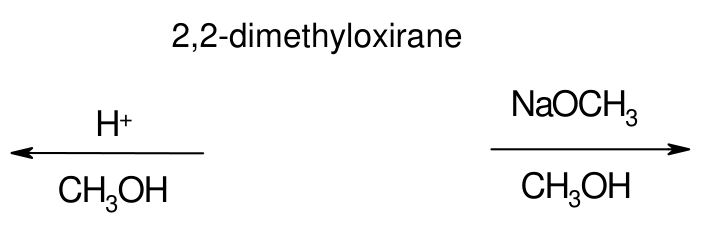
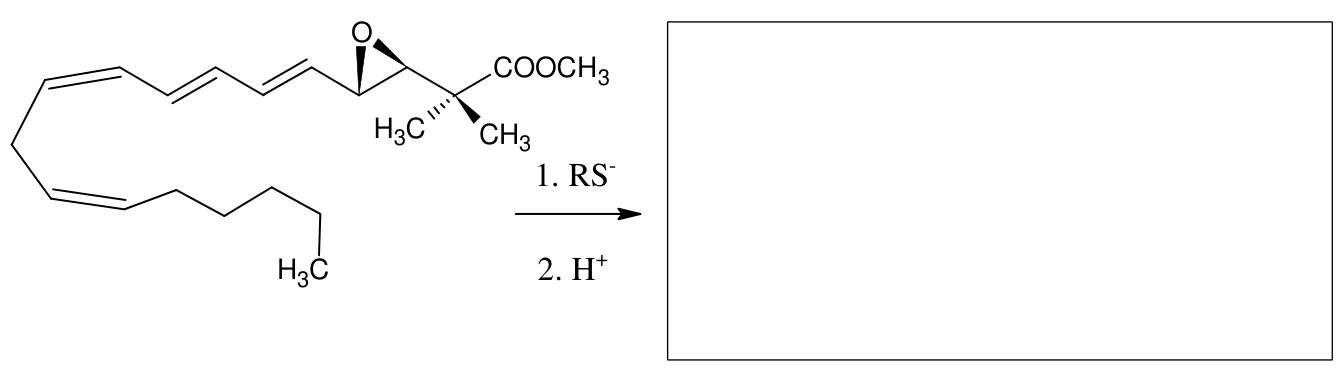
4.2 Draw the structure of the predominant product when the epoxide ring of the following leukotriene derivative is opened with a thiolate (\(\ce{RS^-}\)).
Different porous acidic aluminosilicates can also be used to catalyse the transformation of alkyl oxiranes. In addition to ring opening, cyclic dimerisation is found to be the main reaction pathway producing mainly 1,4-dioxane derivatives (six-membered saturated rings with two oxygen atoms in positions 1,4).
4.3 Draw the structure(s) of the most probable 1,4-dioxane derivative(s) when the starting compound is (S)-2-methyloxirane ((S)-1,2-epoxypropane). Give the structure of the reactant as well.
4.4 Draw the structure(s) of the substituted 1,4-dioxane(s) when the epoxide reacting is (R)-1,2-epoxy-2-methylbutane ((R)-2-ethyl-2-methyloxirane). Give the structure of the reactant as well.
4.5 Give the structure(s) of the substituted 1,4-dioxane(s) when this reaction is carried out with racemic 1,2-epoxy-2-methylbutane (2-ethyl-2-methyloxirane).
Official English text of the problem.
Answers
- 4.1 Reactant: 2,2-dimethyloxirane,
CC1(C)CO1. - (i) Acid catalysis: 2-methoxy-2-methylpropan-1-ol,
COC(C)(C)CO, with structure \(\ce{HOCH2C(CH3)2OCH3}\). -
(ii) Base catalysis: 1-methoxy-2-methylpropan-2-ol,
COCC(C)(C)O, with structure \(\ce{CH3OCH2C(CH3)2OH}\). -
4.2 The product has hydroxy at C3 and \(\ce{SR}\) at C4, with configuration (3S,4R). Its name is methyl (3S,4R,5E,7E,9Z,12Z)-3-hydroxy-2,2-dimethyl-4-(organosulfanyl)octadeca-5,7,9,12-tetraenoate.
SMILES:COC(=O)C(C)(C)[C@H](O)[C@H](S*)/C=C/C=C/C=C\C/C=C\CCCCC
Here*represents the unspecified organic group \(\ce{R}\). -
4.3 Reactant: (S)-2-methyloxirane,
C[C@H]1CO1.
Product: cis-(2R,5R)-2,5-dimethyl-1,4-dioxane,O1[C@H](C)CO[C@H](C)C1. -
4.4 Reactant: (R)-2-ethyl-2-methyloxirane,
CC[C@]1(C)CO1. The products are three stereoisomers of 2,5-diethyl-2,5-dimethyl-1,4-dioxane:
| Product | SMILES |
|---|---|
| cis-(2R,5R) | O1[C@](C)(CC)CO[C@](C)(CC)C1 |
| cis-(2S,5S) | O1[C@@](C)(CC)CO[C@@](C)(CC)C1 |
| trans, meso-(2R,5S), identical to (2S,5R) | O1[C@](C)(CC)CO[C@@](C)(CC)C1 |
Here cis/trans describes the relationship between the two methyl groups; the two ethyl groups have the same cis/trans relationship.
- 4.5 The products are the same three stereoisomers listed in 4.4: the (2R,5R)/(2S,5S) enantiomeric pair and the meso-(2R,5S) compound.
Solution
4.1
The reactant is a three-membered ring containing oxygen, a methylene carbon and a carbon bearing two methyl groups. The reagents are methanol, CO; sulphuric acid, OS(=O)(=O)O; and sodium methoxide, [Na+].C[O-].
(i) Acid catalysis. Protonation activates the epoxide. Cleavage at the carbon bearing two methyl groups is favoured because it produces a tertiary carbenium centre. The original epoxide oxygen remains attached to the methylene carbon. Methanol attacks the tertiary centre through its oxygen, and deprotonation gives the product:
\[ \ce{C4H8O + CH3OH ->[H2SO4] HOCH2C(CH3)2OCH3}. \]
Thus, the methoxy group is attached to the more substituted carbon, while the hydroxy group is attached to the methylene carbon.
(ii) Base catalysis. Methoxide attacks the less hindered methylene carbon by an \(S_\mathrm{N}2\) mechanism. The electrons of its breaking bond to the epoxide oxygen move onto oxygen. Proton transfer from methanol then produces the alcohol and regenerates methoxide:
\[ \ce{C4H8O + CH3OH ->[NaOCH3] CH3OCH2C(CH3)2OH}. \]
Neither product has a stereogenic centre, because the substituted carbon bears two identical methyl groups.
4.2
Number the chain from the ester carbonyl carbon, C1. The geminal methyl groups are at C2, and the epoxide occupies C3 and C4.
The supplied trans-(3S,4S) reactant is methyl (3S,4S,5E,7E,9Z,12Z)-3,4-epoxy-2,2-dimethyloctadeca-5,7,9,12-tetraenoate:
COC(=O)C(C)(C)[C@@H]1O[C@H]1/C=C/C=C/C=C\C/C=C\CCCCC
The organothiolate ion, *[S-], attacks C4. C3 is more hindered because it lies next to the carbon bearing two methyl groups and the ester substituent.
Attack occurs opposite the breaking C4–oxygen bond, giving inversion at C4. The C3–oxygen bond remains intact, so C3 retains its configuration. Acid work-up supplies a proton, [H+], to the oxygen.
Consequently:
\[ \text{C3: }S\longrightarrow S, \qquad \text{C4: }S\longrightarrow R. \]
The balanced overall reaction, with \(\ce{R}\) unchanged, is
\[ \ce{C21H32O3 + RS^- + H+ -> C21H33O3SR}. \]
To draw the product, replace the epoxide bridge with a hydroxy group at C3 and an \(\ce{SR}\) group at C4, using wedges and hashed wedges consistent with (3S,4R). Preserve the four alkene configurations: 5E, 7E, 9Z and 12Z. The specified anti relationship concerns the direction of attack relative to the breaking bond; the resulting open chain can rotate about its single bonds.
4.3
The oxygen of one epoxide attacks the more substituted carbon of an acid-activated second epoxide. Subsequent intramolecular attack closes the six-membered ring, again opening an epoxide at its more substituted carbon.
The resulting ring contains two consecutive units of the form
\[ \ce{-O-CH(CH3)-CH2-}, \]
so the methyl groups occupy positions 2 and 5 of the 1,4-dioxane ring.
Each attacked carbon is secondary. Under the rules given in the problem, an open planar carbenium ion does not form, and each opening proceeds with inversion. Both original stereogenic centres therefore invert. Their relevant priority order remains oxygen, ring methylene carbon, methyl, hydrogen, so both S centres become R centres.
The balanced dimerisation is
\[ \ce{2C3H6O -> C6H12O2}, \]
catalysed by the acidic aluminosilicate.
The product is cis-(2R,5R)-2,5-dimethyl-1,4-dioxane. Draw a six-membered ring with oxygen atoms at positions 1 and 4 and methyl groups at positions 2 and 5 on the same face, with absolute configurations (2R,5R). In either chair conformation, one methyl group is axial and the other is equatorial.
4.4
The favoured opening again occurs at the more substituted epoxide carbon, producing the 2,5-substituted dioxane skeleton.
Here, however, that carbon is bonded to three carbon groups: methyl, ethyl and the ring methylene group. Ring opening can therefore produce a planar tertiary carbenium centre. Formation of the new carbon–oxygen bond can occur from either face, so the starting R configuration is lost.
This happens at both substituted centres. The possible configuration combinations are
\[ (R,R),\quad(S,S),\quad(R,S),\quad(S,R). \]
The last two represent the same compound because positions 2 and 5 are symmetry-related. Thus there are three distinct stereoisomers:
- (2R,5R) and (2S,5S) are an enantiomeric pair. In each, the methyl groups lie on the same face of the ring, and the ethyl groups lie on the opposite face.
- (2R,5S) is meso. Its methyl groups lie on opposite faces, as do its ethyl groups.
For a wedge-and-dash drawing, the two cis structures are mirror images. For the meso structure, put one methyl group on a solid wedge and the other on a hashed wedge, with each ethyl group opposite the methyl group on the same carbon.
The balanced reaction is
\[ \ce{2C5H10O -> C10H20O2}, \]
with the acidic aluminosilicate as catalyst. The problem does not specify the relative amounts of the three stereoisomers.
4.5
The racemic starting material contains equal amounts of (R)-2-ethyl-2-methyloxirane, CC[C@]1(C)CO1, and (S)-2-ethyl-2-methyloxirane, CC[C@@]1(C)CO1.
As in 4.4, the favoured ring openings pass through planar tertiary carbenium centres, erasing the original configurations. Therefore, the racemic reactant gives the same three products: (2R,5R), (2S,5S), and meso-(2R,5S).
The balanced overall dimerisation remains
\[ \ce{2C5H10O -> C10H20O2}. \]
The solution was checked against the official solution.
IChO 2008 · Theorieaufgabe 4
Ringöffnung von Oxiranen
Ein wichtiger Reaktionsweg für Oxirane (Epoxide) ist die Ringöffnung. Diese kann auf verschiedene Weise erfolgen.
Unter Säurekatalyse verlaufen die Reaktionen über kationenartige (carbeniumionenartige) Spezies. Bei substituierten Oxiranen hängt die Richtung der Ringöffnung (welche \(\ce{C-O}\)-Bindung gespalten wird) von der Stabilität des intermediären Carbeniumions ab. Je stabiler das intermediäre Carbeniumion ist, desto wahrscheinlicher ist seine Bildung. Ein offenes Carbeniumion (mit planarer Struktur) bildet sich jedoch nur, wenn es tertiär, benzylisch oder allylisch ist.
Unter Basenkatalyse wird überwiegend die sterisch weniger gehinderte \(\ce{C-O}\)-Bindung gespalten.
Beachten Sie bei der gesamten Aufgabe die Stereochemie. Verwenden Sie zur Darstellung der Stereochemie, wo erforderlich, ausschließlich die
Bindungssymbole und keine anderen.
4.1 Zeichnen Sie die Struktur des Edukts und der Hauptprodukte bei der Reaktion von 2,2-Dimethyloxiran (1,2-Epoxy-2-methylpropan) mit Methanol bei niedrigen Temperaturen unter Katalyse durch
(i) Schwefelsäure
(ii) \(\ce{NaOCH3}\).
4.2 Zeichnen Sie die Struktur des Hauptprodukts, wenn der Epoxidring des folgenden Leukotrienderivats mit einem Thiolat (\(\ce{RS^-}\)) geöffnet wird.
Verschiedene poröse saure Alumosilicate können ebenfalls zur Katalyse der Umsetzung von Alkyloxiranen verwendet werden. Neben der Ringöffnung stellt die cyclische Dimerisierung den Hauptreaktionsweg dar, wobei hauptsächlich 1,4-Dioxanderivate entstehen (sechsgliedrige gesättigte Ringe mit zwei Sauerstoffatomen an den Positionen 1,4).
4.3 Zeichnen Sie die Struktur(en) des/der wahrscheinlichsten 1,4-Dioxanderivats/-derivate, wenn die Ausgangsverbindung (S)-2-Methyloxiran ((S)-1,2-Epoxypropan) ist. Geben Sie auch die Struktur des Edukts an.
4.4 Zeichnen Sie die Struktur(en) des/der substituierten 1,4-Dioxans/-Dioxane, wenn das reagierende Epoxid (R)-1,2-Epoxy-2-methylbutan ((R)-2-Ethyl-2-methyloxiran) ist. Geben Sie auch die Struktur des Edukts an.
4.5 Geben Sie die Struktur(en) des/der substituierten 1,4-Dioxans/-Dioxane an, wenn diese Reaktion mit racemischem 1,2-Epoxy-2-methylbutan (2-Ethyl-2-methyloxiran) durchgeführt wird.
Aufgabentext aus dem offiziellen englischen Text übersetzt.
Antworten
- 4.1 Edukt: 2,2-Dimethyloxiran,
CC1(C)CO1. - (i) Säurekatalyse: 2-Methoxy-2-methylpropan-1-ol,
COC(C)(C)CO, mit der Struktur \(\ce{HOCH2C(CH3)2OCH3}\). -
(ii) Basenkatalyse: 1-Methoxy-2-methylpropan-2-ol,
COCC(C)(C)O, mit der Struktur \(\ce{CH3OCH2C(CH3)2OH}\). -
4.2 Das Produkt trägt eine Hydroxygruppe an C3 und \(\ce{SR}\) an C4 und besitzt die Konfiguration (3S,4R). Sein Name lautet Methyl-(3S,4R,5E,7E,9Z,12Z)-3-hydroxy-2,2-dimethyl-4-(organosulfanyl)octadeca-5,7,9,12-tetraenoat.
SMILES:COC(=O)C(C)(C)[C@H](O)[C@H](S*)/C=C/C=C/C=C\C/C=C\CCCCC
Dabei steht*für die nicht näher bestimmte organische Gruppe \(\ce{R}\). -
4.3 Edukt: (S)-2-Methyloxiran,
C[C@H]1CO1.
Produkt: cis-(2R,5R)-2,5-Dimethyl-1,4-dioxan,O1[C@H](C)CO[C@H](C)C1. -
4.4 Edukt: (R)-2-Ethyl-2-methyloxiran,
CC[C@]1(C)CO1. Die Produkte sind drei Stereoisomere von 2,5-Diethyl-2,5-dimethyl-1,4-dioxan:
| Produkt | SMILES |
|---|---|
| cis-(2R,5R) | O1[C@](C)(CC)CO[C@](C)(CC)C1 |
| cis-(2S,5S) | O1[C@@](C)(CC)CO[C@@](C)(CC)C1 |
| trans, meso-(2R,5S), identisch mit (2S,5R) | O1[C@](C)(CC)CO[C@@](C)(CC)C1 |
Dabei beschreibt cis/trans die räumliche Beziehung zwischen den beiden Methylgruppen; die beiden Ethylgruppen weisen dieselbe cis/trans-Beziehung auf.
- 4.5 Die Produkte sind dieselben drei in 4.4 aufgeführten Stereoisomere: das Enantiomerenpaar (2R,5R)/(2S,5S) und die meso-(2R,5S)-Verbindung.
Lösung
4.1
Das Edukt ist ein dreigliedriger Ring, der ein Sauerstoffatom, ein Methylenkohlenstoffatom und ein Kohlenstoffatom mit zwei Methylgruppen enthält. Die Reagenzien sind Methanol, CO; Schwefelsäure, OS(=O)(=O)O; und Natriummethanolat, [Na+].C[O-].
(i) Säurekatalyse. Die Protonierung aktiviert das Epoxid. Die Spaltung am Kohlenstoffatom mit den beiden Methylgruppen ist begünstigt, weil dabei ein tertiäres Carbeniumzentrum entsteht. Das ursprüngliche Epoxidsauerstoffatom bleibt an das Methylenkohlenstoffatom gebunden. Methanol greift über sein Sauerstoffatom am tertiären Zentrum an, und durch Deprotonierung entsteht das Produkt:
\[ \ce{C4H8O + CH3OH ->[H2SO4] HOCH2C(CH3)2OCH3}. \]
Somit ist die Methoxygruppe an das höher substituierte Kohlenstoffatom gebunden, während die Hydroxygruppe an das Methylenkohlenstoffatom gebunden ist.
(ii) Basenkatalyse. Das Methanolat-Ion greift das weniger gehinderte Methylenkohlenstoffatom nach einem \(S_\mathrm{N}2\)-Mechanismus an. Die Elektronen der dabei aufbrechenden Bindung zum Epoxidsauerstoffatom gehen auf das Sauerstoffatom über. Durch Protonenübertragung von Methanol entsteht anschließend der Alkohol, und das Methanolat-Ion wird regeneriert:
\[ \ce{C4H8O + CH3OH ->[NaOCH3] CH3OCH2C(CH3)2OH}. \]
Keines der beiden Produkte besitzt ein stereogenes Zentrum, da das substituierte Kohlenstoffatom zwei identische Methylgruppen trägt.
4.2
Nummerieren Sie die Kette beginnend mit dem Carbonylkohlenstoffatom des Esters, C1. Die geminalen Methylgruppen befinden sich an C2, und der Epoxidring umfasst C3 und C4.
Das vorgegebene trans-(3S,4S)-Edukt ist Methyl-(3S,4S,5E,7E,9Z,12Z)-3,4-epoxy-2,2-dimethyloctadeca-5,7,9,12-tetraenoat:
COC(=O)C(C)(C)[C@@H]1O[C@H]1/C=C/C=C/C=C\C/C=C\CCCCC
Das Organothiolat-Ion, *[S-], greift C4 an. C3 ist stärker gehindert, da es neben dem Kohlenstoffatom liegt, das zwei Methylgruppen und den Estersubstituenten trägt.
Der Angriff erfolgt von der der aufbrechenden C4–Sauerstoff-Bindung gegenüberliegenden Seite und führt zur Inversion an C4. Die C3–Sauerstoff-Bindung bleibt intakt, sodass C3 seine Konfiguration beibehält. Bei der sauren Aufarbeitung wird das Sauerstoffatom durch ein Proton, [H+], protoniert.
Folglich gilt:
\[ \text{C3: }S\longrightarrow S, \qquad \text{C4: }S\longrightarrow R. \]
Die ausgeglichene Gesamtreaktion, bei der \(\ce{R}\) unverändert bleibt, lautet
\[ \ce{C21H32O3 + RS^- + H+ -> C21H33O3SR}. \]
Ersetzen Sie zum Zeichnen des Produkts die Epoxidbrücke durch eine Hydroxygruppe an C3 und eine \(\ce{SR}\)-Gruppe an C4 und verwenden Sie dabei ausgefüllte und gestrichelte Keile entsprechend (3S,4R). Behalten Sie die vier Alkenkonfigurationen bei: 5E, 7E, 9Z und 12Z. Die angegebene anti-Beziehung betrifft die Angriffsrichtung relativ zur aufbrechenden Bindung; die entstehende offene Kette kann sich um ihre Einfachbindungen drehen.
4.3
Das Sauerstoffatom eines Epoxids greift das höher substituierte Kohlenstoffatom eines zweiten, durch Säure aktivierten Epoxids an. Ein anschließender intramolekularer Angriff schließt den sechsgliedrigen Ring, wobei erneut ein Epoxid an seinem höher substituierten Kohlenstoffatom geöffnet wird.
Der entstehende Ring enthält zwei aufeinanderfolgende Einheiten der Form
\[ \ce{-O-CH(CH3)-CH2-}, \]
sodass die Methylgruppen die Positionen 2 und 5 des 1,4-Dioxanrings besetzen.
Jedes angegriffene Kohlenstoffatom ist sekundär. Nach den in der Aufgabe angegebenen Regeln bildet sich kein offenes planares Carbeniumion, und jede Ringöffnung verläuft unter Inversion. Daher wird die Konfiguration beider ursprünglicher stereogener Zentren invertiert. Ihre maßgebliche Prioritätsreihenfolge bleibt Sauerstoff, Methylenkohlenstoffatom des Rings, Methyl, Wasserstoff, sodass beide S-Zentren zu R-Zentren werden.
Die ausgeglichene Dimerisierungsreaktion lautet
\[ \ce{2C3H6O -> C6H12O2}, \]
katalysiert durch das saure Alumosilicat.
Das Produkt ist cis-(2R,5R)-2,5-Dimethyl-1,4-dioxan. Zeichnen Sie einen sechsgliedrigen Ring mit Sauerstoffatomen an den Positionen 1 und 4 und Methylgruppen an den Positionen 2 und 5 auf derselben Seite, mit den absoluten Konfigurationen (2R,5R). In beiden Sesselkonformationen steht eine Methylgruppe axial und die andere äquatorial.
4.4
Die bevorzugte Ringöffnung erfolgt wiederum am höher substituierten Epoxidkohlenstoffatom, wodurch das 2,5-substituierte Dioxangerüst entsteht.
Hier ist dieses Kohlenstoffatom jedoch an drei Kohlenstoffgruppen gebunden: Methyl, Ethyl und die Methylengruppe des Rings. Die Ringöffnung kann daher ein planares tertiäres Carbeniumzentrum erzeugen. Die Bildung der neuen Kohlenstoff–Sauerstoff-Bindung kann von beiden Seiten erfolgen, sodass die ursprüngliche R-Konfiguration verloren geht.
Dies geschieht an beiden substituierten Zentren. Die möglichen Konfigurationskombinationen sind
\[ (R,R),\quad(S,S),\quad(R,S),\quad(S,R). \]
Die letzten beiden stehen für dieselbe Verbindung, da die Positionen 2 und 5 durch Symmetrie miteinander verknüpft sind. Somit gibt es drei verschiedene Stereoisomere:
- (2R,5R) und (2S,5S) bilden ein Enantiomerenpaar. Bei beiden liegen die Methylgruppen auf derselben Seite des Rings und die Ethylgruppen auf der gegenüberliegenden Seite.
- (2R,5S) ist meso. Seine Methylgruppen liegen auf gegenüberliegenden Seiten, ebenso wie seine Ethylgruppen.
In der Keilstrichdarstellung sind die beiden cis-Strukturen Spiegelbilder. Zeichnen Sie für die meso-Struktur eine Methylgruppe an einem ausgefüllten Keil und die andere an einem gestrichelten Keil, wobei jede Ethylgruppe der Methylgruppe am selben Kohlenstoffatom gegenüberliegt.
Die ausgeglichene Reaktion lautet
\[ \ce{2C5H10O -> C10H20O2}, \]
mit dem sauren Alumosilicat als Katalysator. Die Aufgabe gibt die relativen Mengen der drei Stereoisomere nicht an.
4.5
Das racemische Ausgangsmaterial enthält gleiche Mengen an (R)-2-Ethyl-2-methyloxiran, CC[C@]1(C)CO1, und (S)-2-Ethyl-2-methyloxiran, CC[C@@]1(C)CO1.
Wie in 4.4 verlaufen die bevorzugten Ringöffnungen über planare tertiäre Carbeniumzentren, wodurch die ursprünglichen Konfigurationen verloren gehen. Daher liefert das racemische Edukt dieselben drei Produkte: (2R,5R), (2S,5S) und meso-(2R,5S).
Die ausgeglichene Gesamtdimerisierungsreaktion lautet weiterhin
\[ \ce{2C5H10O -> C10H20O2}. \]
Die Lösung wurde mit der offiziellen Lösung abgeglichen.
IChO 2008 · Teori sorusu 4
Oksiranların halka açılması
Oksiranlar (epoksitler) için başlıca dönüşüm yollarından biri halka açılmasıdır. Bu, çeşitli yollarla gerçekleştirilebilir.
Asit katalizinde tepkimeler katyon benzeri (karbenyum iyonu benzeri) türler üzerinden ilerler. Sübstitüe oksiranlarda halka açılmasının yönü (hangi \(\ce{C-O}\) bağının koptuğu), ara ürün olan karbenyum iyonunun kararlılığına bağlıdır. Ara ürün olan karbenyum iyonu ne kadar kararlıysa oluşma olasılığı o kadar yüksektir. Ancak açık bir karbenyum iyonu (düzlemsel yapıda) yalnızca tersiyer, benzilik veya allilik olduğunda oluşur.
Baz katalizinde ağırlıklı olarak sterik engeli daha az olan \(\ce{C-O}\) bağı kopar.
Sorunun tamamı boyunca stereokimyayı göz önünde bulundurun. Stereokimyayı göstermek için gerekli yerlerde yalnızca
bağ sembollerini kullanın; başka bir gösterim kullanmayın.
4.1 2,2-dimetiloksiran (1,2-epoksi-2-metilpropan) düşük sıcaklıklarda metanol ile aşağıdaki katalizörler eşliğinde tepkimeye girdiğinde, reaktanın ve baskın ürünlerin yapılarını çizin:
(i) sülfürik asit
(ii) \(\ce{NaOCH3}\).
4.2 Aşağıdaki lökotrien türevinin epoksit halkası bir tiyolat (\(\ce{RS^-}\)) ile açıldığında oluşan baskın ürünün yapısını çizin.
Alkil oksiranların dönüşümünü katalizlemek için çeşitli gözenekli asidik alüminosilikatlar da kullanılabilir. Halka açılmasına ek olarak, başlıca tepkime yolunun halkalı dimerleşme olduğu ve bu yolla ağırlıklı olarak 1,4-dioksan türevlerinin (1,4 konumlarında iki oksijen atomu bulunan altı üyeli doymuş halkalar) oluştuğu görülür.
4.3 Başlangıç bileşiği (S)-2-metiloksiran ((S)-1,2-epoksipropan) olduğunda oluşması en olası 1,4-dioksan türevinin (türevlerinin) yapısını (yapılarını) çizin. Reaktanın yapısını da verin.
4.4 Tepkimeye giren epoksit (R)-1,2-epoksi-2-metilbutan ((R)-2-etil-2-metiloksiran) olduğunda oluşan sübstitüe 1,4-dioksanın (1,4-dioksanların) yapısını (yapılarını) çizin. Reaktanın yapısını da verin.
4.5 Bu tepkime rasemik 1,2-epoksi-2-metilbutan (2-etil-2-metiloksiran) ile gerçekleştirildiğinde oluşan sübstitüe 1,4-dioksanın (1,4-dioksanların) yapısını (yapılarını) verin.
Soru metni resmi İngilizce metinden çevrilmiştir.
Cevaplar
- 4.1 Reaktan: 2,2-dimetiloksiran,
CC1(C)CO1. - (i) Asit katalizi: 2-metoksi-2-metilpropan-1-ol,
COC(C)(C)CO; yapısı \(\ce{HOCH2C(CH3)2OCH3}\). -
(ii) Baz katalizi: 1-metoksi-2-metilpropan-2-ol,
COCC(C)(C)O; yapısı \(\ce{CH3OCH2C(CH3)2OH}\). -
4.2 Üründe C3'te hidroksi ve C4'te \(\ce{SR}\) bulunur ve konfigürasyon (3S,4R) şeklindedir. Adı metil (3S,4R,5E,7E,9Z,12Z)-3-hidroksi-2,2-dimetil-4-(organosülfanil)oktadeka-5,7,9,12-tetraenoattır.
SMILES:COC(=O)C(C)(C)[C@H](O)[C@H](S*)/C=C/C=C/C=C\C/C=C\CCCCC
Burada*, belirtilmemiş organik \(\ce{R}\) grubunu temsil eder. -
4.3 Reaktan: (S)-2-metiloksiran,
C[C@H]1CO1.
Ürün: cis-(2R,5R)-2,5-dimetil-1,4-dioksan,O1[C@H](C)CO[C@H](C)C1. -
4.4 Reaktan: (R)-2-etil-2-metiloksiran,
CC[C@]1(C)CO1. Ürünler, 2,5-dietil-2,5-dimetil-1,4-dioksanın üç stereoizomeridir:
| Ürün | SMILES |
|---|---|
| cis-(2R,5R) | O1[C@](C)(CC)CO[C@](C)(CC)C1 |
| cis-(2S,5S) | O1[C@@](C)(CC)CO[C@@](C)(CC)C1 |
| trans, mezo-(2R,5S), (2S,5R) ile özdeş | O1[C@](C)(CC)CO[C@@](C)(CC)C1 |
Burada cis/trans, iki metil grubu arasındaki ilişkiyi tanımlar; iki etil grubu da aynı cis/trans ilişkisine sahiptir.
- 4.5 Ürünler, 4.4'te listelenen aynı üç stereoizomerdir: (2R,5R)/(2S,5S) enantiyomer çifti ve mezo-(2R,5S) bileşiği.
Çözüm
4.1
Reaktan, bir oksijen atomu, bir metilen karbonu ve iki metil grubu taşıyan bir karbon içeren üç üyeli bir halkadır. Reaktifler metanol, CO; sülfürik asit, OS(=O)(=O)O; ve sodyum metoksit, [Na+].C[O-] şeklindedir.
(i) Asit katalizi. Protonlanma epoksiti etkinleştirir. İki metil grubu taşıyan karbondaki bağın kopması tercih edilir, çünkü bu kopma tersiyer bir karbenyum merkezi oluşturur. Başlangıçtaki epoksit oksijeni metilen karbonuna bağlı kalır. Metanol, oksijeni üzerinden tersiyer merkeze saldırır ve proton kaybıyla ürün oluşur:
\[ \ce{C4H8O + CH3OH ->[H2SO4] HOCH2C(CH3)2OCH3}. \]
Böylece metoksi grubu daha fazla sübstitüe olmuş karbona bağlanırken hidroksi grubu metilen karbonuna bağlı kalır.
(ii) Baz katalizi. Metoksit, sterik engeli daha az olan metilen karbonuna bir \(S_\mathrm{N}2\) mekanizmasıyla saldırır. Bu karbonun epoksit oksijeniyle arasındaki kopan bağın elektronları oksijene geçer. Ardından metanolden proton aktarımı alkolü oluşturur ve metoksiti yeniden meydana getirir:
\[ \ce{C4H8O + CH3OH ->[NaOCH3] CH3OCH2C(CH3)2OH}. \]
Sübstitüe karbon iki özdeş metil grubu taşıdığı için ürünlerin hiçbirinde stereojenik merkez bulunmaz.
4.2
Zinciri ester karbonil karbonu olan C1'den başlayarak numaralandırın. Geminal metil grupları C2'de bulunur ve epoksit C3 ile C4'ü kapsar.
Verilen trans-(3S,4S) reaktanı metil (3S,4S,5E,7E,9Z,12Z)-3,4-epoksi-2,2-dimetiloktadeka-5,7,9,12-tetraenoattır:
COC(=O)C(C)(C)[C@@H]1O[C@H]1/C=C/C=C/C=C\C/C=C\CCCCC
Organotiyolat iyonu, *[S-], C4'e saldırır. C3, iki metil grubunu ve ester sübstitüentini taşıyan karbonun yanında bulunduğundan sterik olarak daha engellidir.
Saldırı, kopan C4–oksijen bağının karşı tarafından gerçekleşerek C4'te konfigürasyonun tersine dönmesine yol açar. C3–oksijen bağı bozulmadan kalır; dolayısıyla C3 konfigürasyonunu korur. Tepkime sonrası asitle işlem, oksijene bir proton, [H+], sağlar.
Sonuç olarak:
\[ \text{C3: }S\longrightarrow S, \qquad \text{C4: }S\longrightarrow R. \]
\(\ce{R}\) değişmeden kalmak üzere, denkleştirilmiş toplam tepkime şöyledir:
\[ \ce{C21H32O3 + RS^- + H+ -> C21H33O3SR}. \]
Ürünü çizmek için epoksit köprüsünün yerine C3'te bir hidroksi grubu ve C4'te bir \(\ce{SR}\) grubu yerleştirin; (3S,4R) ile uyumlu dolu ve taralı kama bağlar kullanın. Dört alken konfigürasyonunu koruyun: 5E, 7E, 9Z ve 12Z. Belirtilen anti ilişkisi, saldırının kopan bağa göre yönünü ifade eder; oluşan açık zincir, tekli bağları etrafında dönebilir.
4.3
Bir epoksitin oksijeni, asitle etkinleştirilmiş ikinci bir epoksitin daha fazla sübstitüe olmuş karbonuna saldırır. Ardından gerçekleşen molekül içi saldırı, yine bir epoksiti daha fazla sübstitüe olmuş karbonundan açarak altı üyeli halkayı kapatır.
Oluşan halka, art arda gelen ve aşağıdaki biçimde olan iki birim içerir:
\[ \ce{-O-CH(CH3)-CH2-}, \]
dolayısıyla metil grupları 1,4-dioksan halkasının 2 ve 5 konumlarında bulunur.
Saldırıya uğrayan her karbon sekonderdir. Soruda verilen kurallara göre açık, düzlemsel bir karbenyum iyonu oluşmaz ve her açılma konfigürasyonun tersine dönmesiyle ilerler. Bu nedenle başlangıçtaki her iki stereojenik merkezin konfigürasyonu tersine döner. İlgili öncelik sıraları oksijen, halka metilen karbonu, metil, hidrojen olarak kaldığından her iki S merkezi de R merkezine dönüşür.
Denkleştirilmiş dimerleşme tepkimesi şöyledir:
\[ \ce{2C3H6O -> C6H12O2}, \]
bu tepkime asidik alüminosilikat tarafından katalizlenir.
Ürün cis-(2R,5R)-2,5-dimetil-1,4-dioksandır. Oksijen atomları 1 ve 4 konumlarında, metil grupları ise 2 ve 5 konumlarında aynı yüzde olacak şekilde, mutlak konfigürasyonları (2R,5R) olan altı üyeli bir halka çizin. Her iki sandalye konformasyonunda da metil gruplarından biri aksiyal, diğeri ekvatoryaldir.
4.4
Tercih edilen açılma yine daha fazla sübstitüe olmuş epoksit karbonunda gerçekleşerek 2,5-sübstitüe dioksan iskeletini oluşturur.
Ancak burada söz konusu karbon üç karbon grubuna bağlıdır: metil, etil ve halka metilen grubu. Bu nedenle halka açılması düzlemsel bir tersiyer karbenyum merkezi oluşturabilir. Yeni karbon–oksijen bağı her iki yüzden de oluşabileceği için başlangıçtaki R konfigürasyonu kaybolur.
Bu durum her iki sübstitüe merkezde de gerçekleşir. Olası konfigürasyon birleşimleri şöyledir:
\[ (R,R),\quad(S,S),\quad(R,S),\quad(S,R). \]
2 ve 5 konumları simetriyle ilişkili olduğundan son ikisi aynı bileşiği temsil eder. Dolayısıyla üç farklı stereoizomer vardır:
- (2R,5R) ve (2S,5S) bir enantiyomer çiftidir. Her birinde metil grupları halkanın aynı yüzünde, etil grupları ise karşı yüzünde bulunur.
- (2R,5S) mezodur. Metil grupları karşıt yüzlerde bulunur; etil grupları için de aynı durum geçerlidir.
Dolu ve taralı kama bağlarla yapılan bir çizimde, iki cis yapı birbirinin ayna görüntüsüdür. Mezo yapı için metil gruplarından birini dolu kama, diğerini taralı kama üzerinde gösterin; her etil grubunu aynı karbondaki metil grubunun karşı tarafına yerleştirin.
Denkleştirilmiş tepkime şöyledir:
\[ \ce{2C5H10O -> C10H20O2}, \]
burada katalizör asidik alüminosilikattır. Soruda üç stereoizomerin göreli miktarları belirtilmemiştir.
4.5
Rasemik başlangıç maddesi eşit miktarlarda (R)-2-etil-2-metiloksiran, CC[C@]1(C)CO1, ve (S)-2-etil-2-metiloksiran, CC[C@@]1(C)CO1, içerir.
4.4'te olduğu gibi, tercih edilen halka açılmaları düzlemsel tersiyer karbenyum merkezleri üzerinden ilerleyerek başlangıçtaki konfigürasyonları ortadan kaldırır. Dolayısıyla rasemik reaktan aynı üç ürünü verir: (2R,5R), (2S,5S) ve mezo-(2R,5S).
Denkleştirilmiş toplam dimerleşme tepkimesi yine şöyledir:
\[ \ce{2C5H10O -> C10H20O2}. \]
Çözüm, resmi çözümle karşılaştırılarak kontrol edildi.
IChO 2008 · Problema teórico 4
Apertura del anillo de los oxiranos
Una de las principales vías de transformación de los oxiranos (epóxidos) es la apertura del anillo. Esta puede llevarse a cabo de diversas maneras.
En condiciones de catálisis ácida, las reacciones transcurren a través de especies de carácter catiónico (similares a iones carbenio). En los oxiranos sustituidos, la dirección de apertura del anillo (qué enlace \(\ce{C-O}\) se rompe) depende de la estabilidad del ion carbenio intermedio. Cuanto más estable sea el ion carbenio intermedio, más probable será su formación. Sin embargo, solo se forma un ion carbenio de cadena abierta (con estructura plana) si es terciario, bencílico o alílico.
En condiciones de catálisis básica, se rompe predominantemente el enlace \(\ce{C-O}\) con menor impedimento estérico.
Tenga en cuenta la estereoquímica a lo largo de todo el problema. Para representar la estereoquímica, utilice únicamente los símbolos de enlace
y ningún otro cuando sea necesario.
4.1 Dibuje la estructura del reactivo y de los productos predominantes cuando el 2,2-dimetiloxirano (1,2-epoxi-2-metilpropano) reacciona con metanol a bajas temperaturas, con catálisis de
(i) ácido sulfúrico
(ii) \(\ce{NaOCH3}\).
4.2 Dibuje la estructura del producto predominante cuando el anillo epóxido del siguiente derivado de leucotrieno se abre con un tiolato (\(\ce{RS^-}\)).
También pueden utilizarse distintos aluminosilicatos ácidos porosos para catalizar la transformación de alquiloxiranos. Además de la apertura del anillo, se observa que la dimerización cíclica es la principal vía de reacción y produce principalmente derivados del 1,4-dioxano (anillos saturados de seis miembros con dos átomos de oxígeno en las posiciones 1,4).
4.3 Dibuje la estructura o estructuras de los derivados del 1,4-dioxano más probables cuando el compuesto de partida es (S)-2-metiloxirano ((S)-1,2-epoxipropano). Indique también la estructura del reactivo.
4.4 Dibuje la estructura o estructuras de los 1,4-dioxanos sustituidos cuando el epóxido que reacciona es (R)-1,2-epoxi-2-metilbutano ((R)-2-etil-2-metiloxirano). Indique también la estructura del reactivo.
4.5 Indique la estructura o estructuras de los 1,4-dioxanos sustituidos cuando esta reacción se lleva a cabo con 1,2-epoxi-2-metilbutano racémico (2-etil-2-metiloxirano).
Enunciado traducido del texto oficial en inglés.
Respuestas
- 4.1 Reactivo: 2,2-dimetiloxirano,
CC1(C)CO1. - (i) Catálisis ácida: 2-metoxi-2-metilpropan-1-ol,
COC(C)(C)CO, con estructura \(\ce{HOCH2C(CH3)2OCH3}\). -
(ii) Catálisis básica: 1-metoxi-2-metilpropan-2-ol,
COCC(C)(C)O, con estructura \(\ce{CH3OCH2C(CH3)2OH}\). -
4.2 El producto tiene un grupo hidroxi en C3 y \(\ce{SR}\) en C4, con configuración (3S,4R). Su nombre es (3S,4R,5E,7E,9Z,12Z)-3-hidroxi-2,2-dimetil-4-(organosulfanil)octadeca-5,7,9,12-tetraenoato de metilo.
SMILES:COC(=O)C(C)(C)[C@H](O)[C@H](S*)/C=C/C=C/C=C\C/C=C\CCCCC
Aquí*representa el grupo orgánico no especificado \(\ce{R}\). -
4.3 Reactivo: (S)-2-metiloxirano,
C[C@H]1CO1.
Producto: cis-(2R,5R)-2,5-dimetil-1,4-dioxano,O1[C@H](C)CO[C@H](C)C1. -
4.4 Reactivo: (R)-2-etil-2-metiloxirano,
CC[C@]1(C)CO1. Los productos son tres estereoisómeros del 2,5-dietil-2,5-dimetil-1,4-dioxano:
| Producto | SMILES |
|---|---|
| cis-(2R,5R) | O1[C@](C)(CC)CO[C@](C)(CC)C1 |
| cis-(2S,5S) | O1[C@@](C)(CC)CO[C@@](C)(CC)C1 |
| trans, meso-(2R,5S), idéntico a (2S,5R) | O1[C@](C)(CC)CO[C@@](C)(CC)C1 |
Aquí cis/trans describe la relación entre los dos grupos metilo; los dos grupos etilo presentan la misma relación cis/trans.
- 4.5 Los productos son los mismos tres estereoisómeros enumerados en 4.4: el par de enantiómeros (2R,5R)/(2S,5S) y el compuesto meso-(2R,5S).
Solución
4.1
El reactivo es un anillo de tres miembros que contiene un átomo de oxígeno, un carbono metilénico y un carbono unido a dos grupos metilo. Los reactivos son metanol, CO; ácido sulfúrico, OS(=O)(=O)O; y metóxido de sodio, [Na+].C[O-].
(i) Catálisis ácida. La protonación activa el epóxido. Se favorece la ruptura en el carbono unido a dos grupos metilo porque produce un centro carbenio terciario. El oxígeno original del epóxido permanece unido al carbono metilénico. El metanol ataca al centro terciario a través de su oxígeno y la desprotonación da lugar al producto:
\[ \ce{C4H8O + CH3OH ->[H2SO4] HOCH2C(CH3)2OCH3}. \]
Así, el grupo metoxi queda unido al carbono más sustituido, mientras que el grupo hidroxi queda unido al carbono metilénico.
(ii) Catálisis básica. El metóxido ataca al carbono metilénico menos impedido mediante un mecanismo \(S_\mathrm{N}2\). Los electrones del enlace que se rompe entre este carbono y el oxígeno del epóxido se desplazan hacia el oxígeno. A continuación, la transferencia de un protón desde el metanol produce el alcohol y regenera el metóxido:
\[ \ce{C4H8O + CH3OH ->[NaOCH3] CH3OCH2C(CH3)2OH}. \]
Ninguno de los productos tiene un centro estereogénico, porque el carbono sustituido está unido a dos grupos metilo idénticos.
4.2
Numere la cadena a partir del carbono carbonílico del éster, C1. Los grupos metilo geminales están en C2 y el epóxido ocupa C3 y C4.
El reactivo trans-(3S,4S) proporcionado es (3S,4S,5E,7E,9Z,12Z)-3,4-epoxi-2,2-dimetiloctadeca-5,7,9,12-tetraenoato de metilo:
COC(=O)C(C)(C)[C@@H]1O[C@H]1/C=C/C=C/C=C\C/C=C\CCCCC
El ion organotiolato, *[S-], ataca a C4. C3 presenta mayor impedimento estérico porque se encuentra junto al carbono unido a dos grupos metilo y al sustituyente éster.
El ataque se produce por el lado opuesto al enlace C4–oxígeno que se rompe, lo que provoca la inversión en C4. El enlace C3–oxígeno permanece intacto, por lo que C3 conserva su configuración. El tratamiento ácido posterior aporta un protón, [H+], al oxígeno.
Por consiguiente:
\[ \text{C3: }S\longrightarrow S, \qquad \text{C4: }S\longrightarrow R. \]
La reacción global ajustada, en la que \(\ce{R}\) permanece inalterado, es
\[ \ce{C21H32O3 + RS^- + H+ -> C21H33O3SR}. \]
Para dibujar el producto, sustituya el puente epóxido por un grupo hidroxi en C3 y un grupo \(\ce{SR}\) en C4, utilizando cuñas sólidas y cuñas de trazos coherentes con (3S,4R). Conserve las cuatro configuraciones de los alquenos: 5E, 7E, 9Z y 12Z. La relación anti especificada se refiere a la dirección del ataque respecto al enlace que se rompe; la cadena abierta resultante puede girar alrededor de sus enlaces sencillos.
4.3
El oxígeno de un epóxido ataca al carbono más sustituido de un segundo epóxido activado por un ácido. Un ataque intramolecular posterior cierra el anillo de seis miembros, abriendo de nuevo un epóxido por su carbono más sustituido.
El anillo resultante contiene dos unidades consecutivas de la forma
\[ \ce{-O-CH(CH3)-CH2-}, \]
por lo que los grupos metilo ocupan las posiciones 2 y 5 del anillo de 1,4-dioxano.
Cada carbono atacado es secundario. Según las reglas indicadas en el problema, no se forma un ion carbenio plano de cadena abierta y cada apertura transcurre con inversión. Por tanto, ambos centros estereogénicos originales se invierten. Su orden de prioridad pertinente sigue siendo oxígeno, carbono metilénico del anillo, metilo, hidrógeno, por lo que ambos centros S se convierten en centros R.
La dimerización ajustada es
\[ \ce{2C3H6O -> C6H12O2}, \]
catalizada por el aluminosilicato ácido.
El producto es cis-(2R,5R)-2,5-dimetil-1,4-dioxano. Dibuje un anillo de seis miembros con átomos de oxígeno en las posiciones 1 y 4 y grupos metilo en las posiciones 2 y 5 en la misma cara, con configuraciones absolutas (2R,5R). En cualquiera de las dos conformaciones de silla, un grupo metilo es axial y el otro es ecuatorial.
4.4
La apertura favorecida vuelve a producirse en el carbono más sustituido del epóxido, dando lugar al esqueleto de dioxano sustituido en 2,5.
Sin embargo, en este caso ese carbono está unido a tres grupos carbonados: metilo, etilo y el grupo metileno del anillo. Por tanto, la apertura del anillo puede producir un centro carbenio terciario plano. La formación del nuevo enlace carbono–oxígeno puede tener lugar desde cualquiera de las dos caras, por lo que se pierde la configuración R inicial.
Esto ocurre en ambos centros sustituidos. Las posibles combinaciones de configuraciones son
\[ (R,R),\quad(S,S),\quad(R,S),\quad(S,R). \]
Las dos últimas representan el mismo compuesto porque las posiciones 2 y 5 están relacionadas por simetría. Por tanto, existen tres estereoisómeros distintos:
- (2R,5R) y (2S,5S) forman un par de enantiómeros. En cada uno, los grupos metilo se encuentran en la misma cara del anillo y los grupos etilo se encuentran en la cara opuesta.
- (2R,5S) es meso. Sus grupos metilo se encuentran en caras opuestas, al igual que sus grupos etilo.
En una representación con cuñas y trazos, las dos estructuras cis son imágenes especulares. Para la estructura meso, represente un grupo metilo con una cuña sólida y el otro con una cuña de trazos, con cada grupo etilo en el lado opuesto al grupo metilo del mismo carbono.
La reacción ajustada es
\[ \ce{2C5H10O -> C10H20O2}, \]
con el aluminosilicato ácido como catalizador. El problema no especifica las cantidades relativas de los tres estereoisómeros.
4.5
El material de partida racémico contiene cantidades iguales de (R)-2-etil-2-metiloxirano, CC[C@]1(C)CO1, y (S)-2-etil-2-metiloxirano, CC[C@@]1(C)CO1.
Al igual que en 4.4, las aperturas del anillo favorecidas transcurren a través de centros carbenio terciarios planos, con lo que se pierden las configuraciones originales. Por tanto, el reactivo racémico da lugar a los mismos tres productos: (2R,5R), (2S,5S) y meso-(2R,5S).
La dimerización global ajustada sigue siendo
\[ \ce{2C5H10O -> C10H20O2}. \]
La solución se comprobó con la solución oficial.
IChO 2008 · 理论题 4
环氧乙烷的开环反应
环氧乙烷类化合物(环氧化物)的一条主要转化途径是开环。开环可以通过多种方式实现。
在酸催化下,反应经过具有阳离子特征(类似碳正离子)的物种进行。对于取代环氧乙烷,开环方向(即哪一根 \(\ce{C-O}\) 键断裂)取决于中间体碳正离子的稳定性。中间体碳正离子越稳定,其形成的可能性就越大。然而,只有当碳正离子为叔碳正离子、苄基型碳正离子或烯丙基型碳正离子时,才会形成开放的碳正离子(具有平面结构)。
在碱催化下,主要断裂的是空间位阻较小的 \(\ce{C-O}\) 键。
在解答整道题的过程中都要注意立体化学。需要表示立体化学时,只能使用以下
键符号,不得使用其他符号。
4.1 画出 2,2-二甲基环氧乙烷(1,2-环氧-2-甲基丙烷)在低温下与甲醇反应时的反应物及主要产物的结构,催化剂分别为
(i) 硫酸
(ii) \(\ce{NaOCH3}\)。
4.2 画出下列白三烯衍生物的环氧环被硫醇盐(\(\ce{RS^-}\))开环时所生成的主要产物的结构。
不同的多孔酸性铝硅酸盐也可用于催化烷基取代环氧乙烷的转化。研究发现,除开环外,成环二聚也是主要的反应途径,主要生成 1,4-二氧六环衍生物(在 1,4 位具有两个氧原子的六元饱和环)。
4.3 当起始化合物为 (S)-2-甲基环氧乙烷((S)-1,2-环氧丙烷)时,画出最可能生成的 1,4-二氧六环衍生物的结构。也请给出反应物的结构。
4.4 当参与反应的环氧化物为 (R)-1,2-环氧-2-甲基丁烷((R)-2-乙基-2-甲基环氧乙烷)时,画出所生成的取代 1,4-二氧六环的结构。也请给出反应物的结构。
4.5 当用外消旋的 1,2-环氧-2-甲基丁烷(2-乙基-2-甲基环氧乙烷)进行这一反应时,给出所生成的取代 1,4-二氧六环的结构。
题目译自官方英文原文。
答案
- 4.1 反应物:2,2-二甲基环氧乙烷,
CC1(C)CO1。 - (i) 酸催化:2-甲氧基-2-甲基丙-1-醇,
COC(C)(C)CO,结构为 \(\ce{HOCH2C(CH3)2OCH3}\)。 -
(ii) 碱催化:1-甲氧基-2-甲基丙-2-醇,
COCC(C)(C)O,结构为 \(\ce{CH3OCH2C(CH3)2OH}\)。 -
4.2 产物的 C3 上连接羟基,C4 上连接 \(\ce{SR}\),构型为 (3S,4R)。其名称为 (3S,4R,5E,7E,9Z,12Z)-3-羟基-2,2-二甲基-4-(有机硫基)十八碳-5,7,9,12-四烯酸甲酯。
SMILES:COC(=O)C(C)(C)[C@H](O)[C@H](S*)/C=C/C=C/C=C\C/C=C\CCCCC
此处*表示未指定的有机基团 \(\ce{R}\)。 -
4.3 反应物:(S)-2-甲基环氧乙烷,
C[C@H]1CO1。
产物:顺式-(2R,5R)-2,5-二甲基-1,4-二氧六环,O1[C@H](C)CO[C@H](C)C1。 -
4.4 反应物:(R)-2-乙基-2-甲基环氧乙烷,
CC[C@]1(C)CO1。产物为 2,5-二乙基-2,5-二甲基-1,4-二氧六环的三种立体异构体:
| 产物 | SMILES |
|---|---|
| 顺式-(2R,5R) | O1[C@](C)(CC)CO[C@](C)(CC)C1 |
| 顺式-(2S,5S) | O1[C@@](C)(CC)CO[C@@](C)(CC)C1 |
| 反式,内消旋-(2R,5S),与 (2S,5R) 相同 | O1[C@](C)(CC)CO[C@@](C)(CC)C1 |
此处的顺式/反式描述两个甲基之间的关系;两个乙基具有相同的顺反关系。
- 4.5 产物为 4.4 中列出的相同的三种立体异构体:一对 (2R,5R)/(2S,5S) 对映异构体,以及内消旋-(2R,5S) 化合物。
解答
4.1
反应物是一个三元环,环中含有一个氧原子、一个亚甲基碳原子和一个连接两个甲基的碳原子。所用试剂为甲醇,CO;硫酸,OS(=O)(=O)O;以及甲醇钠,[Na+].C[O-]。
(i) 酸催化。 质子化使环氧化物活化。连接两个甲基的碳原子处优先发生断键,因为这样会产生叔碳正离子中心。原环氧环中的氧仍与亚甲基碳原子相连。甲醇通过其氧原子进攻叔碳中心,随后脱去质子,得到产物:
\[ \ce{C4H8O + CH3OH ->[H2SO4] HOCH2C(CH3)2OCH3}. \]
因此,甲氧基连接在取代程度较高的碳原子上,而羟基连接在亚甲基碳原子上。
(ii) 碱催化。 甲氧基负离子通过 \(S_\mathrm{N}2\) 机理进攻位阻较小的亚甲基碳原子。该碳原子与环氧环中氧原子之间的键断裂,键电子转移到氧原子上。随后,甲醇向其转移质子,生成醇并再生甲氧基负离子:
\[ \ce{C4H8O + CH3OH ->[NaOCH3] CH3OCH2C(CH3)2OH}. \]
两种产物都不具有立体中心,因为取代碳原子上连接着两个相同的甲基。
4.2
从酯基的羰基碳原子 C1 开始对碳链编号。两个偕甲基位于 C2,环氧环位于 C3 和 C4。
题目给出的反式-(3S,4S) 反应物为 (3S,4S,5E,7E,9Z,12Z)-3,4-环氧-2,2-二甲基十八碳-5,7,9,12-四烯酸甲酯:
COC(=O)C(C)(C)[C@@H]1O[C@H]1/C=C/C=C/C=C\C/C=C\CCCCC
有机硫醇盐阴离子 *[S-] 进攻 C4。C3 的位阻较大,因为它与连接两个甲基和酯基取代基的碳原子相邻。
进攻从待断裂的 C4–氧键的背面发生,使 C4 的构型反转。C3–氧键保持完整,因此 C3 的构型保持不变。酸性后处理向氧原子提供一个质子 [H+]。
因此:
\[ \text{C3: }S\longrightarrow S, \qquad \text{C4: }S\longrightarrow R. \]
配平后的总反应如下,其中 \(\ce{R}\) 保持不变:
\[ \ce{C21H32O3 + RS^- + H+ -> C21H33O3SR}. \]
绘制产物时,将环氧桥替换为 C3 上的羟基和 C4 上的 \(\ce{SR}\) 基团,使用与 (3S,4R) 构型一致的实楔线和虚楔线。保留四个烯键的构型:5E、7E、9Z 和 12Z。所指定的反式进攻关系是指进攻方向与断裂键之间的关系;生成的开链结构可以绕其单键旋转。
4.3
一个环氧化物的氧原子进攻另一个经酸活化的环氧化物中取代程度较高的碳原子。随后发生分子内进攻,闭合成六元环,同时再次在取代程度较高的碳原子处打开环氧环。
生成的环含有两个依次相连的如下单元:
\[ \ce{-O-CH(CH3)-CH2-}, \]
因此,甲基位于 1,4-二氧六环的 2 位和 5 位。
每个受进攻的碳原子都是仲碳原子。根据题目给出的规则,不会形成开放的平面碳正离子,每次开环均伴随构型反转。因此,原有的两个立体中心都发生反转。相关基团的优先顺序仍为氧原子、环上的亚甲基碳原子、甲基、氢原子,所以两个 S 中心都变为 R 中心。
配平后的二聚反应为
\[ \ce{2C3H6O -> C6H12O2}, \]
由酸性铝硅酸盐催化。
产物为顺式-(2R,5R)-2,5-二甲基-1,4-二氧六环。画出一个六元环,在 1 位和 4 位放置氧原子,在 2 位和 5 位放置位于环同侧的甲基,绝对构型为 (2R,5R)。在任一椅式构象中,一个甲基处于直立键位置,另一个处于平伏键位置。
4.4
优先发生的开环仍位于环氧环中取代程度较高的碳原子处,生成 2,5-取代的二氧六环骨架。
然而,此处的该碳原子连接着三个碳基团:甲基、乙基和环上的亚甲基。因此,开环可以产生一个平面的叔碳正离子中心。新的碳–氧键可以从任一面形成,所以起始的 R 构型丧失。
两个取代中心都会发生这一过程。可能的构型组合为
\[ (R,R),\quad(S,S),\quad(R,S),\quad(S,R). \]
最后两种组合表示同一化合物,因为 2 位和 5 位通过对称操作可以相互对应。因此,共有三种不同的立体异构体:
- (2R,5R) 和 (2S,5S) 是一对对映异构体。在每种异构体中,两个甲基位于环的同一侧,两个乙基则位于另一侧。
- (2R,5S) 是内消旋体。其两个甲基位于环的异侧,两个乙基也位于环的异侧。
用实楔线和虚楔线绘图时,两种顺式结构互为镜像。对于内消旋结构,将一个甲基画在实楔线上,另一个甲基画在虚楔线上;每个乙基与同一碳原子上的甲基分别位于相反侧。
配平后的反应为
\[ \ce{2C5H10O -> C10H20O2}, \]
催化剂为酸性铝硅酸盐。题目未指定三种立体异构体的相对含量。
4.5
外消旋起始原料含有等量的 (R)-2-乙基-2-甲基环氧乙烷,CC[C@]1(C)CO1,和 (S)-2-乙基-2-甲基环氧乙烷,CC[C@@]1(C)CO1。
与 4.4 相同,优先发生的开环经过平面的叔碳正离子中心,使原有构型消失。因此,外消旋反应物生成相同的三种产物:(2R,5R)、(2S,5S) 和内消旋-(2R,5S)。
配平后的总二聚反应仍为
\[ \ce{2C5H10O -> C10H20O2}. \]
解答已与官方解答核对。
IChO 2008 · Теоретическая задача 4
Раскрытие цикла оксиранов
Одним из основных путей превращения оксиранов (эпоксидов) является раскрытие цикла. Оно может осуществляться различными способами.
При кислотном катализе реакции протекают через частицы катионного характера (подобные карбениевым ионам). Для замещённых оксиранов направление раскрытия цикла (то, какая связь \(\ce{C-O}\) разрывается) зависит от устойчивости промежуточного карбениевого иона. Чем устойчивее промежуточный карбениевый ион, тем вероятнее его образование. Однако открытый карбениевый ион (с плоской структурой) образуется только в том случае, если он третичный, бензильный или аллильный.
При основном катализе преимущественно разрывается стерически менее затруднённая связь \(\ce{C-O}\).
Учитывайте стереохимию на протяжении всей задачи. Для её изображения используйте там, где это необходимо, только следующие
обозначения связей и никакие другие.
4.1 Изобразите структуру исходного вещества и преимущественно образующихся продуктов реакции 2,2-диметилоксирана (1,2-эпокси-2-метилпропана) с метанолом при низких температурах в присутствии в качестве катализатора
(i) серной кислоты
(ii) \(\ce{NaOCH3}\).
4.2 Изобразите структуру преимущественно образующегося продукта раскрытия эпоксидного цикла следующего производного лейкотриена под действием тиолята (\(\ce{RS^-}\)).
Для катализа превращений алкилоксиранов также можно использовать различные пористые алюмосиликаты с кислотными свойствами. Установлено, что наряду с раскрытием цикла основным путём реакции является циклическая димеризация, приводящая преимущественно к производным 1,4-диоксана (шестичленным насыщенным циклам с двумя атомами кислорода в положениях 1,4).
4.3 Изобразите структуру (структуры) наиболее вероятного производного (производных) 1,4-диоксана, если исходным соединением является (S)-2-метилоксиран ((S)-1,2-эпоксипропан). Приведите также структуру исходного вещества.
4.4 Изобразите структуру (структуры) замещённого 1,4-диоксана (замещённых 1,4-диоксанов), если в реакцию вступает (R)-1,2-эпокси-2-метилбутан ((R)-2-этил-2-метилоксиран). Приведите также структуру исходного вещества.
4.5 Приведите структуру (структуры) замещённого 1,4-диоксана (замещённых 1,4-диоксанов), если эту реакцию проводят с рацемическим 1,2-эпокси-2-метилбутаном (2-этил-2-метилоксираном).
Условие переведено с официального английского текста.
Ответы
- 4.1 Исходное вещество: 2,2-диметилоксиран,
CC1(C)CO1. - (i) Кислотный катализ: 2-метокси-2-метилпропан-1-ол,
COC(C)(C)CO, со структурой \(\ce{HOCH2C(CH3)2OCH3}\). -
(ii) Основной катализ: 1-метокси-2-метилпропан-2-ол,
COCC(C)(C)O, со структурой \(\ce{CH3OCH2C(CH3)2OH}\). -
4.2 В продукте гидроксильная группа находится при C3, а \(\ce{SR}\) — при C4, конфигурация — (3S,4R). Его название — метил-(3S,4R,5E,7E,9Z,12Z)-3-гидрокси-2,2-диметил-4-(органилсульфанил)октадека-5,7,9,12-тетраеноат.
SMILES:COC(=O)C(C)(C)[C@H](O)[C@H](S*)/C=C/C=C/C=C\C/C=C\CCCCC
Здесь*обозначает неуточнённую органическую группу \(\ce{R}\). -
4.3 Исходное вещество: (S)-2-метилоксиран,
C[C@H]1CO1.
Продукт: цис-(2R,5R)-2,5-диметил-1,4-диоксан,O1[C@H](C)CO[C@H](C)C1. -
4.4 Исходное вещество: (R)-2-этил-2-метилоксиран,
CC[C@]1(C)CO1. Продуктами являются три стереоизомера 2,5-диэтил-2,5-диметил-1,4-диоксана:
| Продукт | SMILES |
|---|---|
| цис-(2R,5R) | O1[C@](C)(CC)CO[C@](C)(CC)C1 |
| цис-(2S,5S) | O1[C@@](C)(CC)CO[C@@](C)(CC)C1 |
| транс, мезо-(2R,5S), идентичный (2S,5R) | O1[C@](C)(CC)CO[C@@](C)(CC)C1 |
Здесь обозначения цис/транс описывают взаимное расположение двух метильных групп; две этильные группы имеют такое же взаимное расположение цис/транс.
- 4.5 Продуктами являются те же три стереоизомера, которые перечислены в 4.4: энантиомерная пара (2R,5R)/(2S,5S) и мезо-соединение (2R,5S).
Решение
4.1
Исходное вещество представляет собой трёхчленный цикл, содержащий атом кислорода, атом углерода метиленовой группы и атом углерода, несущий две метильные группы. Реагенты: метанол, CO; серная кислота, OS(=O)(=O)O; и метоксид натрия, [Na+].C[O-].
(i) Кислотный катализ. Протонирование активирует эпоксид. Разрыв связи у атома углерода, несущего две метильные группы, предпочтителен, поскольку при этом образуется третичный карбениевый центр. Исходный атом кислорода эпоксида остаётся связанным с атомом углерода метиленовой группы. Метанол атакует третичный центр своим атомом кислорода, а депротонирование приводит к продукту:
\[ \ce{C4H8O + CH3OH ->[H2SO4] HOCH2C(CH3)2OCH3}. \]
Таким образом, метоксигруппа присоединяется к более замещённому атому углерода, а гидроксильная группа — к атому углерода метиленовой группы.
(ii) Основной катализ. Метоксид атакует менее затруднённый атом углерода метиленовой группы по механизму \(S_\mathrm{N}2\). Электроны разрывающейся связи этого атома с кислородом эпоксида переходят к кислороду. Последующий перенос протона от метанола приводит к образованию спирта и регенерации метоксида:
\[ \ce{C4H8O + CH3OH ->[NaOCH3] CH3OCH2C(CH3)2OH}. \]
Ни один из продуктов не имеет стереогенного центра, поскольку замещённый атом углерода несёт две одинаковые метильные группы.
4.2
Пронумеруем цепь, начиная с карбонильного атома углерода сложноэфирной группы, C1. Геминальные метильные группы находятся при C2, а эпоксидный цикл включает C3 и C4.
Приведённое исходное вещество с конфигурацией транс-(3S,4S) — метил-(3S,4S,5E,7E,9Z,12Z)-3,4-эпокси-2,2-диметилоктадека-5,7,9,12-тетраеноат:
COC(=O)C(C)(C)[C@@H]1O[C@H]1/C=C/C=C/C=C\C/C=C\CCCCC
Органический тиолят-ион, *[S-], атакует C4. Атом C3 более стерически затруднён, поскольку расположен рядом с атомом углерода, несущим две метильные группы и сложноэфирный заместитель.
Атака происходит со стороны, противоположной разрывающейся связи C4–кислород, что приводит к обращению конфигурации при C4. Связь C3–кислород остаётся неповреждённой, поэтому C3 сохраняет свою конфигурацию. При кислотной обработке кислород присоединяет протон, [H+].
Следовательно:
\[ \text{C3: }S\longrightarrow S, \qquad \text{C4: }S\longrightarrow R. \]
Суммарное уравнение реакции с расставленными коэффициентами, в котором \(\ce{R}\) остаётся неизменной, имеет вид
\[ \ce{C21H32O3 + RS^- + H+ -> C21H33O3SR}. \]
Чтобы изобразить продукт, замените эпоксидный мостик гидроксильной группой при C3 и группой \(\ce{SR}\) при C4, используя сплошные и штриховые клинья в соответствии с конфигурацией (3S,4R). Сохраните конфигурации четырёх двойных связей: 5E, 7E, 9Z и 12Z. Указанное анти-расположение относится к направлению атаки относительно разрывающейся связи; образующаяся открытая цепь может вращаться вокруг своих одинарных связей.
4.3
Атом кислорода одного эпоксида атакует более замещённый атом углерода второго эпоксида, активированного кислотой. Последующая внутримолекулярная атака замыкает шестичленный цикл, вновь раскрывая эпоксидный цикл у более замещённого атома углерода.
Образующийся цикл содержит два последовательных звена вида
\[ \ce{-O-CH(CH3)-CH2-}, \]
поэтому метильные группы занимают положения 2 и 5 в цикле 1,4-диоксана.
Каждый атакуемый атом углерода является вторичным. Согласно правилам, приведённым в условии задачи, открытый плоский карбениевый ион не образуется, и каждое раскрытие цикла протекает с обращением конфигурации. Поэтому конфигурации обоих исходных стереогенных центров обращаются. Соответствующий порядок старшинства заместителей остаётся следующим: кислород, атом углерода метиленовой группы цикла, метил, водород; следовательно, оба центра S превращаются в центры R.
Уравнение димеризации с расставленными коэффициентами имеет вид
\[ \ce{2C3H6O -> C6H12O2}, \]
а катализатором служит алюмосиликат с кислотными свойствами.
Продукт — цис-(2R,5R)-2,5-диметил-1,4-диоксан. Изобразите шестичленный цикл с атомами кислорода в положениях 1 и 4 и метильными группами в положениях 2 и 5, расположенными по одну сторону цикла, с абсолютными конфигурациями (2R,5R). В каждой из двух конформаций кресла одна метильная группа занимает аксиальное положение, а другая — экваториальное.
4.4
Предпочтительное раскрытие цикла вновь происходит у более замещённого атома углерода эпоксида, что приводит к образованию скелета 2,5-замещённого диоксана.
Однако здесь этот атом углерода связан с тремя углеродными группами: метильной, этильной и метиленовой группой цикла. Поэтому раскрытие цикла может приводить к образованию плоского третичного карбениевого центра. Новая связь углерод–кислород может образовываться с любой из двух сторон, поэтому исходная конфигурация R утрачивается.
Это происходит у обоих замещённых центров. Возможны следующие сочетания конфигураций:
\[ (R,R),\quad(S,S),\quad(R,S),\quad(S,R). \]
Последние два сочетания соответствуют одному и тому же соединению, поскольку положения 2 и 5 связаны симметрией. Таким образом, существуют три различных стереоизомера:
- (2R,5R) и (2S,5S) образуют энантиомерную пару. В каждом из них метильные группы расположены по одну сторону цикла, а этильные группы — по другую.
- (2R,5S) является мезо-соединением. Его метильные группы расположены по разные стороны цикла, как и этильные группы.
При изображении с помощью сплошных и штриховых клиньев две цис-структуры являются зеркальными отражениями друг друга. Для мезо-структуры изобразите связь с одной метильной группой сплошным клином, а с другой — штриховым, расположив каждую этильную группу напротив метильной группы при том же атоме углерода.
Уравнение реакции с расставленными коэффициентами имеет вид
\[ \ce{2C5H10O -> C10H20O2}, \]
а катализатором служит алюмосиликат с кислотными свойствами. В условии задачи не указаны относительные количества трёх стереоизомеров.
4.5
Рацемическое исходное вещество содержит равные количества (R)-2-этил-2-метилоксирана, CC[C@]1(C)CO1, и (S)-2-этил-2-метилоксирана, CC[C@@]1(C)CO1.
Как и в 4.4, предпочтительные пути раскрытия цикла проходят через плоские третичные карбениевые центры, что приводит к утрате исходных конфигураций. Поэтому рацемическое исходное вещество даёт те же три продукта: (2R,5R), (2S,5S) и мезо-(2R,5S).
Суммарное уравнение димеризации с расставленными коэффициентами остаётся прежним:
\[ \ce{2C5H10O -> C10H20O2}. \]
Решение проверено по официальному решению.
IChO 2008 · مسألة نظرية 4
فتح حلقة الأوكسيرانات
يُعدّ فتح الحلقة أحد المسارات الرئيسية لتحوّل الأوكسيرانات (الإيبوكسيدات). ويمكن تحقيق ذلك بطرائق مختلفة.
عند التحفيز الحمضي، تسير التفاعلات عبر أنواع كيميائية شبيهة بالكاتيونات (شبيهة بأيونات الكربينيوم). وفي الأوكسيرانات المستبدلة، يعتمد اتجاه فتح الحلقة (أيّ رابطة \(\ce{C-O}\) تنشطر) على استقرار أيون الكربينيوم الوسيط. وكلما كان أيون الكربينيوم الوسيط أكثر استقرارًا، زاد احتمال تكوّنه. غير أنّ أيون كربينيوم مفتوحًا (ذا بنية مستوية) لا يتكوّن إلا إذا كان ثالثيًا أو بنزيليًا أو أليليًا.
عند التحفيز القاعدي، تنشطر في الغالب رابطة \(\ce{C-O}\) الأقل إعاقةً فراغية.
راعِ الكيمياء الفراغية في جميع أجزاء المسألة. ولتمثيل الكيمياء الفراغية، استخدم فقط رموز الروابط
ولا تستخدم غيرها حيثما يلزم.
4.1 ارسم بنية المتفاعل والنواتج السائدة عند تفاعل 2,2-ثنائي ميثيل الأوكسيران (1,2-إيبوكسي-2-ميثيل البروبان) مع الميثانول عند درجات حرارة منخفضة، بتحفيز من
(i) حمض الكبريتيك
(ii) \(\ce{NaOCH3}\).
4.2 ارسم بنية الناتج السائد عند فتح حلقة الإيبوكسيد في مشتق اللوكوترين الآتي باستخدام ثيولات (\(\ce{RS^-}\)).
يمكن أيضًا استخدام أنواع مختلفة من ألومينوسيليكات حمضية مسامية لتحفيز تحوّل أوكسيرانات الألكيل. وإضافةً إلى فتح الحلقة، يُلاحظ أنّ تكوين الثنائيات الحلقية هو مسار التفاعل الرئيسي، وينتج عنه أساسًا مشتقات 1,4-ديوكسان (حلقات مشبعة سداسية الأعضاء تحتوي على ذرتَي أكسجين في الموضعين 1,4).
4.3 ارسم بنية (أو بُنى) مشتق (أو مشتقات) 1,4-ديوكسان الأكثر احتمالًا عندما يكون المركّب الابتدائي هو (S)-2-ميثيل الأوكسيران ((S)-1,2-إيبوكسي البروبان). أعطِ بنية المتفاعل أيضًا.
4.4 ارسم بنية (أو بُنى) 1,4-ديوكسان المستبدل (أو مشتقاته المستبدلة) عندما يكون الإيبوكسيد المتفاعل هو (R)-1,2-إيبوكسي-2-ميثيل البوتان ((R)-2-إيثيل-2-ميثيل الأوكسيران). أعطِ بنية المتفاعل أيضًا.
4.5 أعطِ بنية (أو بُنى) 1,4-ديوكسان المستبدل (أو مشتقاته المستبدلة) عند إجراء هذا التفاعل باستخدام 1,2-إيبوكسي-2-ميثيل البوتان الراسيمي (2-إيثيل-2-ميثيل الأوكسيران).
نص المسألة مترجم عن النص الإنجليزي الرسمي.
الإجابات
- 4.1 المتفاعل: 2,2-ثنائي ميثيل الأوكسيران،
CC1(C)CO1. - (i) التحفيز الحمضي: 2-ميثوكسي-2-ميثيل بروبان-1-ول،
COC(C)(C)CO، ذو البنية \(\ce{HOCH2C(CH3)2OCH3}\). -
(ii) التحفيز القاعدي: 1-ميثوكسي-2-ميثيل بروبان-2-ول،
COCC(C)(C)O، ذو البنية \(\ce{CH3OCH2C(CH3)2OH}\). -
4.2 يحتوي الناتج على مجموعة هيدروكسيل عند C3 ومجموعة \(\ce{SR}\) عند C4، بتشكيل فراغي (3S,4R). واسمه (3S,4R,5E,7E,9Z,12Z)-3-هيدروكسي-2,2-ثنائي ميثيل-4-(عضوي سلفانيل)أوكتاديكا-5,7,9,12-تتراينوات الميثيل.
SMILES:COC(=O)C(C)(C)[C@H](O)[C@H](S*)/C=C/C=C/C=C\C/C=C\CCCCC
تمثّل*هنا المجموعة العضوية غير المحدّدة \(\ce{R}\). -
4.3 المتفاعل: (S)-2-ميثيل الأوكسيران،
C[C@H]1CO1.
الناتج: سيس-(2R,5R)-2,5-ثنائي ميثيل-1,4-ديوكسان،O1[C@H](C)CO[C@H](C)C1. -
4.4 المتفاعل: (R)-2-إيثيل-2-ميثيل الأوكسيران،
CC[C@]1(C)CO1. النواتج هي ثلاثة متماكبات فراغية من 2,5-ثنائي إيثيل-2,5-ثنائي ميثيل-1,4-ديوكسان:
| الناتج | SMILES |
|---|---|
| سيس-(2R,5R) | O1[C@](C)(CC)CO[C@](C)(CC)C1 |
| سيس-(2S,5S) | O1[C@@](C)(CC)CO[C@@](C)(CC)C1 |
| ترانس، ميزو-(2R,5S)، مطابق لـ (2S,5R) | O1[C@](C)(CC)CO[C@@](C)(CC)C1 |
يصف سيس/ترانس هنا العلاقة بين مجموعتَي الميثيل؛ ولمجموعتَي الإيثيل علاقة سيس/ترانس نفسها.
- 4.5 النواتج هي المتماكبات الفراغية الثلاثة نفسها المذكورة في 4.4: زوج المتماكبات المرآتية (2R,5R)/(2S,5S) والمركّب ميزو-(2R,5S).
الحل
4.1
المتفاعل حلقة ثلاثية الأعضاء تحتوي على ذرة أكسجين، وذرة كربون ميثيلينية، وذرة كربون تحمل مجموعتَي ميثيل. والكواشف هي الميثانول، CO؛ وحمض الكبريتيك، OS(=O)(=O)O؛ وميثوكسيد الصوديوم، [Na+].C[O-].
(i) التحفيز الحمضي. تُنشّط البروتنة الإيبوكسيد. ويُفضَّل الانشطار عند ذرة الكربون الحاملة لمجموعتَي الميثيل، لأنه يولّد مركز كربينيوم ثالثيًا. وتبقى ذرة أكسجين الإيبوكسيد الأصلية مرتبطة بذرة الكربون الميثيلينية. يهاجم الميثانول المركز الثالثي عبر ذرة الأكسجين فيه، ويعطي نزع البروتون الناتج:
\[ \ce{C4H8O + CH3OH ->[H2SO4] HOCH2C(CH3)2OCH3}. \]
وهكذا، ترتبط مجموعة الميثوكسي بذرة الكربون الأكثر استبدالًا، بينما ترتبط مجموعة الهيدروكسيل بذرة الكربون الميثيلينية.
(ii) التحفيز القاعدي. يهاجم الميثوكسيد ذرة الكربون الميثيلينية الأقل إعاقةً بآلية \(S_\mathrm{N}2\). وتنتقل إلكترونات رابطتها التي تنكسر مع أكسجين الإيبوكسيد إلى الأكسجين. ثم يؤدّي انتقال بروتون من الميثانول إلى تكوين الكحول وتجديد الميثوكسيد:
\[ \ce{C4H8O + CH3OH ->[NaOCH3] CH3OCH2C(CH3)2OH}. \]
لا يحتوي أيٌّ من الناتجين على مركز مولِّد للتصاوغ الفراغي، لأن ذرة الكربون المستبدلة تحمل مجموعتَي ميثيل متماثلتين.
4.2
رقّم السلسلة بدءًا من ذرة كربون الكربونيل في الإستر، C1. تقع مجموعتا الميثيل التوأميتان عند C2، ويشغل الإيبوكسيد الموضعين C3 وC4.
المتفاعل المعطى ذو التشكيل ترانس-(3S,4S) هو (3S,4S,5E,7E,9Z,12Z)-3,4-إيبوكسي-2,2-ثنائي ميثيل أوكتاديكا-5,7,9,12-تتراينوات الميثيل:
COC(=O)C(C)(C)[C@@H]1O[C@H]1/C=C/C=C/C=C\C/C=C\CCCCC
يهاجم أيون الثيولات العضوي، *[S-]، الذرة C4. وتكون C3 أكثر إعاقةً لأنها تقع بجوار ذرة الكربون الحاملة لمجموعتَي الميثيل ومستبدَل الإستر.
يحدث الهجوم من الجهة المقابلة لرابطة C4–الأكسجين التي تنكسر، مما يؤدّي إلى انقلاب التشكيل عند C4. وتبقى رابطة C3–الأكسجين سليمة، لذا تحتفظ C3 بتشكيلها. وتزوّد المعالجة الحمضية اللاحقة الأكسجين ببروتون، [H+].
وبالتالي:
\[ \text{C3: }S\longrightarrow S, \qquad \text{C4: }S\longrightarrow R. \]
التفاعل الكلي الموزون، مع بقاء \(\ce{R}\) دون تغيير، هو
\[ \ce{C21H32O3 + RS^- + H+ -> C21H33O3SR}. \]
لرسم الناتج، استبدل بجسر الإيبوكسيد مجموعة هيدروكسيل عند C3 ومجموعة \(\ce{SR}\) عند C4، مستخدمًا أوتادًا مصمتة وأوتادًا مخطّطة تتوافق مع (3S,4R). حافظ على التشكيلات الأربعة للألكينات: 5E و7E و9Z و12Z. تتعلّق العلاقة المتقابلة المحدّدة باتجاه الهجوم بالنسبة إلى الرابطة التي تنكسر؛ ويمكن للسلسلة المفتوحة الناتجة أن تدور حول روابطها الأحادية.
4.3
تهاجم ذرة الأكسجين في أحد جزيئَي الإيبوكسيد ذرة الكربون الأكثر استبدالًا في جزيء إيبوكسيد ثانٍ منشَّط حمضيًا. ويؤدّي هجوم لاحق داخل الجزيء إلى إغلاق الحلقة السداسية الأعضاء، مع فتح حلقة إيبوكسيد مرة أخرى عند ذرة الكربون الأكثر استبدالًا فيها.
تحتوي الحلقة الناتجة على وحدتين متتاليتين من الشكل
\[ \ce{-O-CH(CH3)-CH2-}, \]
ولذلك تشغل مجموعتا الميثيل الموضعين 2 و5 من حلقة 1,4-ديوكسان.
كل ذرة كربون تتعرّض للهجوم هي ذرة ثانوية. ووفقًا للقواعد المعطاة في المسألة، لا يتكوّن أيون كربينيوم مفتوح مستوٍ، ويحدث كل فتح للحلقة مع انقلاب في التشكيل. ولذلك ينقلب التشكيل في كلا المركزين الأصليين المولِّدين للتصاوغ الفراغي. ويظل ترتيب الأولوية ذي الصلة فيهما: الأكسجين، ثم ذرة الكربون الميثيلينية في الحلقة، ثم الميثيل، ثم الهيدروجين؛ لذا يتحوّل كلا المركزين ذوي التشكيل S إلى مركزين ذوي التشكيل R.
معادلة تكوين الثنائي الموزونة هي
\[ \ce{2C3H6O -> C6H12O2}, \]
بتحفيز من الألومينوسيليكات الحمضية.
الناتج هو سيس-(2R,5R)-2,5-ثنائي ميثيل-1,4-ديوكسان. ارسم حلقة سداسية الأعضاء تحتوي على ذرتَي أكسجين في الموضعين 1 و4 ومجموعتَي ميثيل في الموضعين 2 و5 على الوجه نفسه، بالتشكيلين المطلقين (2R,5R). وفي أيٍّ من هيئتَي الكرسي، تكون إحدى مجموعتَي الميثيل محورية والأخرى استوائية.
4.4
يحدث الفتح المفضَّل مرة أخرى عند ذرة كربون الإيبوكسيد الأكثر استبدالًا، مما ينتج هيكل الديوكسان المستبدَل في الموضعين 2,5.
غير أن ذرة الكربون هذه ترتبط هنا بثلاث مجموعات كربونية: الميثيل والإيثيل ومجموعة الميثيلين في الحلقة. ولذلك يمكن لفتح الحلقة أن يولّد مركز كربينيوم ثالثيًا مستويًا. ويمكن أن تتكوّن رابطة الكربون–الأكسجين الجديدة من أيٍّ من الوجهين، ومن ثم يُفقَد التشكيل الابتدائي R.
يحدث ذلك عند كلا المركزين المستبدَلين. وتوليفات التشكيل الممكنة هي
\[ (R,R),\quad(S,S),\quad(R,S),\quad(S,R). \]
تمثّل التوليفتان الأخيرتان المركّب نفسه لأن الموضعين 2 و5 يرتبطان بعلاقة تناظر. ولذلك توجد ثلاثة متماكبات فراغية متميّزة:
- يشكّل (2R,5R) و(2S,5S) زوجًا من المتماكبات المرآتية. وفي كلٍّ منهما، تقع مجموعتا الميثيل على الوجه نفسه من الحلقة، وتقع مجموعتا الإيثيل على الوجه المقابل.
- يكون (2R,5S) من نوع ميزو. وتقع مجموعتا الميثيل فيه على وجهين متقابلين، وكذلك مجموعتا الإيثيل.
في الرسم بالأوتاد والشرطات، تكون بنيتا سيس صورتين مرآتيتين. ولرسم بنية ميزو، ضع إحدى مجموعتَي الميثيل على وتد مصمت والأخرى على وتد مخطّط، مع وضع كل مجموعة إيثيل في الجهة المقابلة لمجموعة الميثيل المرتبطة بذرة الكربون نفسها.
التفاعل الموزون هو
\[ \ce{2C5H10O -> C10H20O2}, \]
باستخدام الألومينوسيليكات الحمضية حفّازًا. ولا تحدّد المسألة الكميات النسبية للمتماكبات الفراغية الثلاثة.
4.5
تحتوي المادة الابتدائية الراسيمية على كميات متساوية من (R)-2-إيثيل-2-ميثيل الأوكسيران، CC[C@]1(C)CO1، و(S)-2-إيثيل-2-ميثيل الأوكسيران، CC[C@@]1(C)CO1.
كما في 4.4، تمرّ عمليات فتح الحلقة المفضَّلة عبر مراكز كربينيوم ثالثية مستوية، مما يمحو التشكيلات الأصلية. ولذلك يعطي المتفاعل الراسيمي النواتج الثلاثة نفسها: (2R,5R) و(2S,5S) وميزو-(2R,5S).
وتظل المعادلة الكلية الموزونة لتكوين الثنائي
\[ \ce{2C5H10O -> C10H20O2}. \]
تمت مراجعة الحل بمقارنته بالحل الرسمي.