IChO 2008 · Theory problem 2
From an aromatic hydrocarbon to compounds A-H
Determine the structure of the compounds A - H (stereochemistry is not expected), based on the information given in the following reaction scheme:
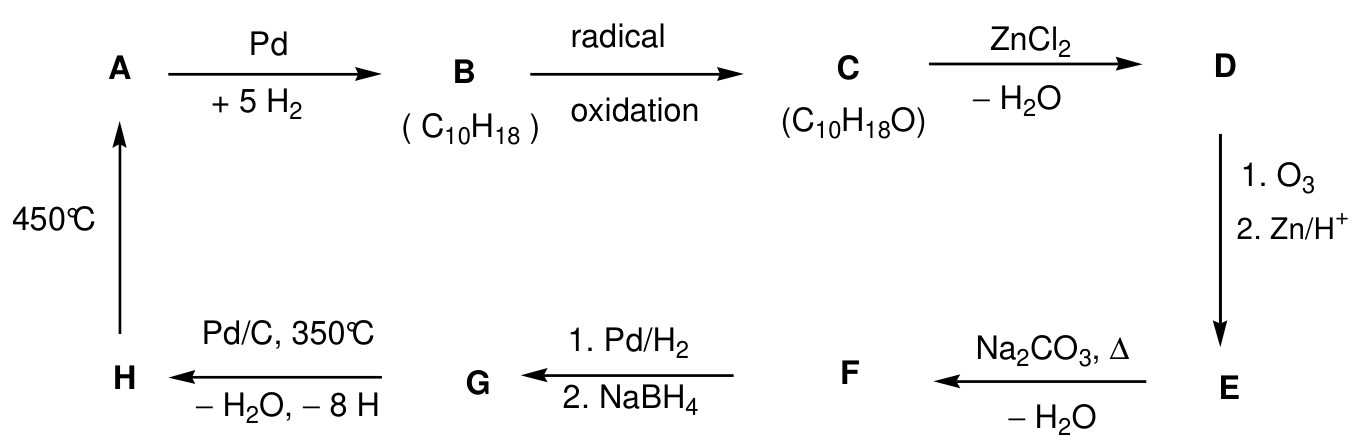
Hints:
- A is a well-known aromatic hydrocarbon.
- A hexane solution of C reacts with sodium (gas evolution can be observed), but C does not react with chromic acid.
- \(\ce{^{13}C}\) NMR spectroscopy shows that D and E contain only two kinds of \(\ce{CH2}\) groups.
- When a solution of E is heated with sodium carbonate an unstable intermediate forms at first, which gives F on dehydration.
Official English text of the problem.
Answers
Problem 2 — structures A–H:
- A: Naphthalene —
c1ccc2ccccc2c1 - B: Decalin (bicyclo[4.4.0]decane) —
C1CCC2CCCCC2C1 - C: Bicyclo[4.4.0]decan-1-ol —
OC12CCCCC1CCCC2 - D: Bicyclo[4.4.0]dec-1(6)-ene —
C1CCCC2=C1CCCC2 - E: Cyclodecane-1,6-dione —
O=C1CCCCC(=O)CCCC1 - F: Bicyclo[5.3.0]dec-1(7)-en-2-one —
O=C1CCCCC2=C1CCC2 - G: Bicyclo[5.3.0]decan-2-ol —
OC1CCCCC2C1CCC2 - H: Azulene —
C1=CC=C2C=CC=C2C=C1
Stereochemistry is omitted as requested. The SMILES for H gives a Kekulé representation of its aromatic structure.
Solution
A and B — aromatic hydrocarbon and complete hydrogenation
Addition of five equivalents of hydrogen gives \(\ce{C10H18}\), so A has molecular formula \(\ce{C10H8}\). Its degree of unsaturation is
\[ \mathrm{DBE}=\frac{2(10)+2-8}{2}=7. \]
Naphthalene accounts for these seven units through two rings and five double bonds. Complete hydrogenation gives B, decalin, retaining the two fused six-membered rings:
\[ \ce{C10H8 + 5H2 ->[Pd] C10H18}. \]
The NMR and ozonolysis clues below confirm this choice of carbon skeleton; the molecular formula alone would not uniquely identify naphthalene.
C — oxidation at a bridgehead
Reaction with sodium, with hydrogen evolution, indicates an alcohol. Resistance to chromic acid identifies it as a tertiary alcohol, whose hydroxyl-bearing carbon has no hydrogen available for ordinary alcohol oxidation.
The only tertiary carbon atoms in decalin are its two equivalent bridgeheads. Consequently, C is bicyclo[4.4.0]decan-1-ol, with the hydroxyl group on a bridgehead.
Using \(\ce{[O]}\) for one oxygen-atom equivalent supplied by the unspecified radical oxidant, the transformation is
\[ \ce{C10H18 + [O] -> C10H18O}. \]
Its reaction with sodium is
\[ \ce{2C10H18O + 2Na -> 2C10H17ONa + H2}. \]
The organic product is sodium bicyclo[4.4.0]decan-1-olate, [Na+].[O-]C12CCCCC1CCCC2; the gas is hydrogen, [H][H].
D — dehydration and the symmetry clue
Zinc chloride promotes dehydration:
\[ \ce{C10H18O ->[ZnCl2] C10H16 + H2O}. \]
Loss of the hydroxyl group from one bridgehead and hydrogen from the other forms a double bond along the bond shared by the two six-membered rings. Thus D is bicyclo[4.4.0]dec-1(6)-ene.
This placement explains the NMR observation. Its eight methylene carbons fall into exactly two equivalent sets:
- Four methylene carbons directly adjacent to an alkene carbon.
- Four remaining methylene carbons, one position farther away.
A double bond between a bridgehead and a neighboring non-bridgehead carbon would destroy this symmetry.
E — reductive ozonolysis
Ozonolysis cleaves the shared double bond of D. Neither alkene carbon carries a hydrogen, so both become ketone carbonyls.
Removing the shared bond leaves the ten-carbon outer perimeter as one ring. The carbonyl groups occupy positions 1 and 6, identifying E as cyclodecane-1,6-dione.
Including the acidic zinc workup, a balanced net equation is
\[ \ce{C10H16 + O3 + Zn + 2H+ -> C10H16O2 + Zn^{2+} + H2O}. \]
The NMR clue is again satisfied: the four methylene groups adjacent to carbonyl groups are equivalent, and the other four form a second equivalent set.
F — intramolecular aldol condensation
Number the ring of E so that its carbonyl carbons are C1 and C6. Under the basic conditions, enolate formation at C2 allows this carbon to attack the carbonyl carbon C6. The carbonyl \(\pi\) electrons move onto oxygen, and protonation produces a hydroxyl group.
The new C2–C6 bond creates:
- A five-membered ring: C2–C3–C4–C5–C6.
- A seven-membered ring: C2–C1–C10–C9–C8–C7–C6.
The unstable aldol intermediate is therefore 7-hydroxybicyclo[5.3.0]decan-2-one, O=C1CCCCC2(O)C1CCC2.
Dehydration removes the hydroxyl group at C6 and a hydrogen at C2, using the original numbering of E. This forms C2=C6, conjugated with the remaining carbonyl group. The resulting enone is F, bicyclo[5.3.0]dec-1(7)-en-2-one.
The overall condensation balance is
\[ \ce{C10H16O2 -> C10H14O + H2O}. \]
Thus the double bond of F lies along the shared edge of its five- and seven-membered rings, and the carbonyl group lies in the seven-membered ring next to that edge.
G — hydrogenation followed by carbonyl reduction
Palladium-catalysed hydrogenation reduces the alkene of F:
\[ \ce{C10H14O + H2 ->[Pd] C10H16O}. \]
The intermediate is bicyclo[5.3.0]decan-2-one, O=C1CCCCC2C1CCC2.
Sodium borohydride then reduces the ketone to a secondary alcohol, giving G, bicyclo[5.3.0]decan-2-ol. Using \(\ce{[H]}\) to denote a formal hydrogen-atom reducing equivalent,
\[ \ce{C10H16O + 2[H] ->[NaBH4] C10H18O}. \]
The fused five- and seven-membered carbon skeleton remains intact through both steps.
H — aromatization and return to A
Heating G over palladium on carbon removes water and eight hydrogen atoms, equivalent to four molecules of hydrogen:
\[ \ce{C10H18O -> C10H8 + H2O + 4H2}. \]
The product retains the fused five- and seven-membered rings and contains five double bonds. It is therefore H, azulene, a nonbenzenoid aromatic hydrocarbon with a delocalized ten-\(\pi\)-electron system.
Finally, heating azulene to \(450\,^\circ\mathrm{C}\) rearranges its carbon skeleton to the two fused six-membered rings of naphthalene:
\[ \underset{\text{H: azulene}}{\ce{C10H8}} \xrightarrow{450\,^\circ\mathrm{C}} \underset{\text{A: naphthalene}}{\ce{C10H8}}. \]
This closes the reaction sequence and confirms the assignments.
The solution was checked against the official solution.
IChO 2008 · Theorieaufgabe 2
Von einem aromatischen Kohlenwasserstoff zu den Verbindungen A-H
Bestimmen Sie anhand der Angaben im folgenden Reaktionsschema die Strukturen der Verbindungen A - H (die Angabe der Stereochemie wird nicht erwartet):
Hinweise:
- A ist ein bekannter aromatischer Kohlenwasserstoff.
- Eine Lösung von C in Hexan reagiert mit Natrium (eine Gasentwicklung ist zu beobachten), aber C reagiert nicht mit Chromsäure.
- Die \(\ce{^{13}C}\)-NMR-Spektroskopie zeigt, dass D und E nur zwei Arten von \(\ce{CH2}\)-Gruppen enthalten.
- Wird eine Lösung von E mit Natriumcarbonat erhitzt, bildet sich zunächst ein instabiles Zwischenprodukt, das durch Wasserabspaltung F ergibt.
Aufgabentext aus dem offiziellen englischen Text übersetzt.
Antworten
Aufgabe 2 — Strukturen A–H:
- A: Naphthalin —
c1ccc2ccccc2c1 - B: Decalin (Bicyclo[4.4.0]decan) —
C1CCC2CCCCC2C1 - C: Bicyclo[4.4.0]decan-1-ol —
OC12CCCCC1CCCC2 - D: Bicyclo[4.4.0]dec-1(6)-en —
C1CCCC2=C1CCCC2 - E: Cyclodecan-1,6-dion —
O=C1CCCCC(=O)CCCC1 - F: Bicyclo[5.3.0]dec-1(7)-en-2-on —
O=C1CCCCC2=C1CCC2 - G: Bicyclo[5.3.0]decan-2-ol —
OC1CCCCC2C1CCC2 - H: Azulen —
C1=CC=C2C=CC=C2C=C1
Die Stereochemie wird wie gefordert weggelassen. Der SMILES für H gibt eine Kekulé-Darstellung seiner aromatischen Struktur wieder.
Lösung
A und B — aromatischer Kohlenwasserstoff und vollständige Hydrierung
Die Addition von fünf Äquivalenten Wasserstoff ergibt \(\ce{C10H18}\), also hat A die Summenformel \(\ce{C10H8}\). Sein Ungesättigtheitsgrad beträgt
\[ \mathrm{DBE}=\frac{2(10)+2-8}{2}=7. \]
Bei Naphthalin ergeben sich diese sieben Einheiten aus zwei Ringen und fünf Doppelbindungen. Die vollständige Hydrierung ergibt B, Decalin, wobei die beiden anellierten Sechsringe erhalten bleiben:
\[ \ce{C10H8 + 5H2 ->[Pd] C10H18}. \]
Die nachfolgend erläuterten Hinweise aus der NMR-Spektroskopie und der Ozonolyse bestätigen diese Wahl des Kohlenstoffgerüsts; die Summenformel allein würde Naphthalin nicht eindeutig identifizieren.
C — Oxidation an einem Brückenkopf
Die Reaktion mit Natrium unter Wasserstoffentwicklung weist auf einen Alkohol hin. Die Beständigkeit gegenüber Chromsäure kennzeichnet ihn als tertiären Alkohol, dessen hydroxylgruppentragendes Kohlenstoffatom kein Wasserstoffatom besitzt, das für die übliche Alkoholoxidation zur Verfügung steht.
Die einzigen tertiären Kohlenstoffatome im Decalin sind seine beiden äquivalenten Brückenkopfatome. Folglich ist C Bicyclo[4.4.0]decan-1-ol, dessen Hydroxylgruppe an einem Brückenkopf sitzt.
Verwendet man \(\ce{[O]}\) für ein Sauerstoffatom-Äquivalent, das vom nicht näher angegebenen radikalischen Oxidationsmittel geliefert wird, lautet die Umsetzung
\[ \ce{C10H18 + [O] -> C10H18O}. \]
Seine Reaktion mit Natrium lautet
\[ \ce{2C10H18O + 2Na -> 2C10H17ONa + H2}. \]
Das organische Produkt ist Natriumbicyclo[4.4.0]decan-1-olat, [Na+].[O-]C12CCCCC1CCCC2; das Gas ist Wasserstoff, [H][H].
D — Wasserabspaltung und der Hinweis auf die Symmetrie
Zinkchlorid fördert die Wasserabspaltung:
\[ \ce{C10H18O ->[ZnCl2] C10H16 + H2O}. \]
Durch Abspaltung der Hydroxylgruppe von einem Brückenkopf und eines Wasserstoffatoms vom anderen entsteht eine Doppelbindung entlang der gemeinsamen Bindung der beiden Sechsringe. Somit ist D Bicyclo[4.4.0]dec-1(6)-en.
Diese Lage erklärt die NMR-Beobachtung. Seine acht Methylen-Kohlenstoffatome lassen sich in genau zwei Gruppen jeweils äquivalenter Atome einteilen:
- Vier Methylen-Kohlenstoffatome, die unmittelbar an ein Alken-Kohlenstoffatom angrenzen.
- Vier übrige Methylen-Kohlenstoffatome, die eine Position weiter entfernt sind.
Eine Doppelbindung zwischen einem Brückenkopfatom und einem benachbarten Kohlenstoffatom, das kein Brückenkopfatom ist, würde diese Symmetrie aufheben.
E — reduktive Ozonolyse
Die Ozonolyse spaltet die gemeinsame Doppelbindung von D. Keines der beiden Alken-Kohlenstoffatome trägt ein Wasserstoffatom, sodass beide zu Keton-Carbonylgruppen werden.
Nach dem Spalten der gemeinsamen Bindung bleibt der äußere Umfang aus zehn Kohlenstoffatomen als ein Ring erhalten. Die Carbonylgruppen befinden sich an den Positionen 1 und 6, wodurch E als Cyclodecan-1,6-dion identifiziert wird.
Unter Einbeziehung der Aufarbeitung mit Zink im sauren Milieu lautet eine ausgeglichene Nettogleichung
\[ \ce{C10H16 + O3 + Zn + 2H+ -> C10H16O2 + Zn^{2+} + H2O}. \]
Der NMR-Hinweis ist erneut erfüllt: Die vier Methylen-Gruppen neben den Carbonylgruppen sind äquivalent, und die übrigen vier bilden eine zweite Gruppe äquivalenter Gruppen.
F — intramolekulare Aldolkondensation
Nummerieren wir den Ring von E so, dass seine Carbonyl-Kohlenstoffatome C1 und C6 sind. Unter den basischen Bedingungen ermöglicht die Enolatbildung an C2 diesem Kohlenstoffatom, das Carbonyl-Kohlenstoffatom C6 anzugreifen. Die \(\pi\)-Elektronen der Carbonylgruppe werden auf den Sauerstoff verschoben, und durch Protonierung entsteht eine Hydroxylgruppe.
Die neue C2–C6-Bindung erzeugt:
- Einen Fünfring: C2–C3–C4–C5–C6.
- Einen Siebenring: C2–C1–C10–C9–C8–C7–C6.
Das instabile Aldol-Zwischenprodukt ist daher 7-Hydroxybicyclo[5.3.0]decan-2-on, O=C1CCCCC2(O)C1CCC2.
Bei der Wasserabspaltung werden die Hydroxylgruppe an C6 und ein Wasserstoffatom an C2 entfernt, wobei die ursprüngliche Nummerierung von E verwendet wird. Dadurch entsteht C2=C6, konjugiert mit der verbleibenden Carbonylgruppe. Das entstehende Enon ist F, Bicyclo[5.3.0]dec-1(7)-en-2-on.
Die Gesamtbilanz der Kondensation lautet
\[ \ce{C10H16O2 -> C10H14O + H2O}. \]
Somit liegt die Doppelbindung von F entlang der gemeinsamen Kante seines Fünf- und Siebenrings, und die Carbonylgruppe liegt im Siebenring neben dieser Kante.
G — Hydrierung mit anschließender Carbonylreduktion
Die palladiumkatalysierte Hydrierung reduziert die Alken-Doppelbindung von F:
\[ \ce{C10H14O + H2 ->[Pd] C10H16O}. \]
Das Zwischenprodukt ist Bicyclo[5.3.0]decan-2-on, O=C1CCCCC2C1CCC2.
Natriumborhydrid reduziert anschließend das Keton zu einem sekundären Alkohol, wodurch G, Bicyclo[5.3.0]decan-2-ol, entsteht. Mit \(\ce{[H]}\) als Bezeichnung für ein formales Wasserstoffatom-Reduktionsäquivalent gilt
\[ \ce{C10H16O + 2[H] ->[NaBH4] C10H18O}. \]
Das Kohlenstoffgerüst aus anelliertem Fünf- und Siebenring bleibt bei beiden Schritten erhalten.
H — Aromatisierung und Rückkehr zu A
Beim Erhitzen von G über Palladium auf Kohlenstoff werden Wasser und acht Wasserstoffatome, entsprechend vier Wasserstoffmolekülen, abgespalten:
\[ \ce{C10H18O -> C10H8 + H2O + 4H2}. \]
Das Produkt behält den anellierten Fünf- und Siebenring bei und enthält fünf Doppelbindungen. Es ist daher H, Azulen, ein nichtbenzoider aromatischer Kohlenwasserstoff mit einem delokalisierten Zehn-\(\pi\)-Elektronensystem.
Schließlich führt das Erhitzen von Azulen auf \(450\,^\circ\mathrm{C}\) zu einer Umlagerung seines Kohlenstoffgerüsts in die beiden anellierten Sechsringe des Naphthalins:
\[ \underset{\text{H: Azulen}}{\ce{C10H8}} \xrightarrow{450\,^\circ\mathrm{C}} \underset{\text{A: Naphthalin}}{\ce{C10H8}}. \]
Damit schließt sich die Reaktionsfolge, und die Zuordnungen werden bestätigt.
Die Lösung wurde mit der offiziellen Lösung abgeglichen.
IChO 2008 · Teori sorusu 2
Bir aromatik hidrokarbondan A-H bileşiklerine
Aşağıdaki tepkime şemasında verilen bilgilere dayanarak A - H bileşiklerinin yapılarını belirleyiniz (stereokimya beklenmemektedir):
İpuçları:
- A, iyi bilinen bir aromatik hidrokarbondur.
- C'nin hekzandaki çözeltisi sodyumla tepkimeye girer (gaz çıkışı gözlemlenebilir), ancak C kromik asitle tepkimeye girmez.
- \(\ce{^{13}C}\) NMR spektroskopisi, D ve E'nin yalnızca iki tür \(\ce{CH2}\) grubu içerdiğini gösterir.
- E'nin bir çözeltisi sodyum karbonatla ısıtıldığında önce kararsız bir ara ürün oluşur; bu ara ürün dehidrasyon sonucunda F'yi verir.
Soru metni resmi İngilizce metinden çevrilmiştir.
Cevaplar
Soru 2 — A–H yapıları:
- A: Naftalin —
c1ccc2ccccc2c1 - B: Dekalin (bisiklo[4.4.0]dekan) —
C1CCC2CCCCC2C1 - C: Bisiklo[4.4.0]dekan-1-ol —
OC12CCCCC1CCCC2 - D: Bisiklo[4.4.0]dek-1(6)-en —
C1CCCC2=C1CCCC2 - E: Siklodekan-1,6-dion —
O=C1CCCCC(=O)CCCC1 - F: Bisiklo[5.3.0]dek-1(7)-en-2-on —
O=C1CCCCC2=C1CCC2 - G: Bisiklo[5.3.0]dekan-2-ol —
OC1CCCCC2C1CCC2 - H: Azulen —
C1=CC=C2C=CC=C2C=C1
İstendiği üzere stereokimya gösterilmemiştir. H için verilen SMILES, aromatik yapının bir Kekulé gösterimidir.
Çözüm
A ve B — aromatik hidrokarbon ve tam hidrojenasyon
Beş eşdeğer hidrojen katılmasıyla \(\ce{C10H18}\) elde edildiğine göre A'nın molekül formülü \(\ce{C10H8}\)'dir. Doymamışlık derecesi şöyledir:
\[ \mathrm{DBE}=\frac{2(10)+2-8}{2}=7. \]
Naftalin, iki halkası ve beş çift bağıyla bu yedi doymamışlık birimini karşılar. Tam hidrojenasyon, kaynaşmış iki altı üyeli halkayı koruyarak B'yi, yani dekalini verir:
\[ \ce{C10H8 + 5H2 ->[Pd] C10H18}. \]
Aşağıdaki NMR ve ozonoliz ipuçları, bu karbon iskeleti seçimini doğrular; molekül formülü tek başına naftalini kesin olarak belirlemeye yetmez.
C — köprübaşında yükseltgenme
Hidrojen çıkışıyla birlikte sodyumla tepkimeye girmesi, bir alkol olduğunu gösterir. Kromik aside karşı dirençli olması, bunun hidroksil grubunu taşıyan karbonunda olağan alkol yükseltgenmesi için kullanılabilecek bir hidrojen bulunmayan bir tersiyer alkol olduğunu ortaya koyar.
Dekalindeki tek tersiyer karbon atomları, birbirine eşdeğer iki köprübaşı karbonudur. Dolayısıyla C, hidroksil grubu bir köprübaşında bulunan bisiklo[4.4.0]dekan-1-oldür.
Belirtilmemiş radikal yükseltgenin sağladığı bir oksijen atomu eşdeğerini \(\ce{[O]}\) ile gösterirsek dönüşüm şöyledir:
\[ \ce{C10H18 + [O] -> C10H18O}. \]
Sodyumla tepkimesi şöyledir:
\[ \ce{2C10H18O + 2Na -> 2C10H17ONa + H2}. \]
Organik ürün sodyum bisiklo[4.4.0]dekan-1-olat, [Na+].[O-]C12CCCCC1CCCC2; gaz ise hidrojen, [H][H]'dir.
D — dehidrasyon ve simetri ipucu
Çinko klorür dehidrasyonu kolaylaştırır:
\[ \ce{C10H18O ->[ZnCl2] C10H16 + H2O}. \]
Bir köprübaşından hidroksil grubunun, diğerinden ise hidrojenin ayrılması, iki altı üyeli halkanın ortak bağı boyunca bir çift bağ oluşturur. Böylece D, bisiklo[4.4.0]dek-1(6)-endir.
Bu yerleşim, NMR gözlemini açıklar. Sekiz metilen karbonu, tam olarak iki eşdeğerlik kümesine ayrılır:
- Bir alken karbonuna doğrudan komşu olan dört metilen karbonu.
- Bir konum daha uzakta bulunan diğer dört metilen karbonu.
Bir köprübaşı karbonuyla komşu bir köprübaşı olmayan karbon arasındaki çift bağ, bu simetriyi bozardı.
E — indirgen ozonoliz
Ozonoliz, D'nin ortak çift bağını parçalar. Alken karbonlarının hiçbiri hidrojen taşımadığından her ikisi de keton karbonillerine dönüşür.
Ortak bağın kopmasıyla, on karbonlu dış çevre tek bir halka olarak kalır. Karbonil grupları 1 ve 6 konumlarında yer alır; bu da E'nin siklodekan-1,6-dion olduğunu gösterir.
Asidik ortamda çinkoyla yapılan son işlem de dahil edildiğinde, denkleştirilmiş net tepkime denklemi şöyledir:
\[ \ce{C10H16 + O3 + Zn + 2H+ -> C10H16O2 + Zn^{2+} + H2O}. \]
NMR ipucu yine sağlanır: karbonil gruplarına komşu dört metilen grubu birbirine eşdeğerdir ve diğer dördü ikinci bir eşdeğerlik kümesi oluşturur.
F — molekül içi aldol kondenzasyonu
E'nin halkasını, karbonil karbonları C1 ve C6 olacak biçimde numaralandıralım. Bazik koşullarda C2'de enolat oluşumu, bu karbonun C6 karbonil karbonuna saldırmasını sağlar. Karbonilin \(\pi\) elektronları oksijene kayar ve protonlanmayla bir hidroksil grubu oluşur.
Yeni C2–C6 bağı şunları oluşturur:
- Beş üyeli bir halka: C2–C3–C4–C5–C6.
- Yedi üyeli bir halka: C2–C1–C10–C9–C8–C7–C6.
Dolayısıyla kararsız aldol ara ürünü 7-hidroksibisiklo[5.3.0]dekan-2-on, O=C1CCCCC2(O)C1CCC2'dir.
E'nin başlangıçtaki numaralandırmasına göre dehidrasyon, C6'daki hidroksil grubunu ve C2'deki bir hidrojeni uzaklaştırır. Böylece kalan karbonil grubuyla konjuge olan C2=C6 bağı oluşur. Oluşan enon F, yani bisiklo[5.3.0]dek-1(7)-en-2-ondur.
Toplam kondenzasyonun denkleştirilmiş tepkime denklemi şöyledir:
\[ \ce{C10H16O2 -> C10H14O + H2O}. \]
Böylece F'nin çift bağı, beş ve yedi üyeli halkalarının ortak kenarı boyunca yer alır; karbonil grubu ise yedi üyeli halkada, bu kenarın yanında bulunur.
G — hidrojenasyon ve ardından karbonil indirgenmesi
Paladyum katalizli hidrojenasyon, F'nin alken grubunu indirger:
\[ \ce{C10H14O + H2 ->[Pd] C10H16O}. \]
Ara ürün bisiklo[5.3.0]dekan-2-on, O=C1CCCCC2C1CCC2'dir.
Ardından sodyum borohidrür, ketonu sekonder bir alkole indirgeyerek G'yi, yani bisiklo[5.3.0]dekan-2-olü verir. Biçimsel bir hidrojen atomu indirgeme eşdeğerini \(\ce{[H]}\) ile gösterirsek,
\[ \ce{C10H16O + 2[H] ->[NaBH4] C10H18O}. \]
Kaynaşmış beş ve yedi üyeli halkalardan oluşan karbon iskeleti, her iki adım boyunca da bozulmadan kalır.
H — aromatikleşme ve A'ya dönüş
G'nin karbon üzerinde paladyum katalizörüyle ısıtılması, suyu ve dört hidrojen molekülüne eşdeğer sekiz hidrojen atomunu uzaklaştırır:
\[ \ce{C10H18O -> C10H8 + H2O + 4H2}. \]
Ürün, kaynaşmış beş ve yedi üyeli halkaları korur ve beş çift bağ içerir. Dolayısıyla bu ürün H, yani delokalize on \(\pi\) elektronlu bir sisteme sahip, benzenoid olmayan aromatik bir hidrokarbon olan azulendir.
Son olarak, azulenin \(450\,^\circ\mathrm{C}\)'ye ısıtılması, karbon iskeletini naftalinin kaynaşmış iki altı üyeli halkasına dönüştüren bir yeniden düzenlenmeye yol açar:
\[ \underset{\text{H: azulen}}{\ce{C10H8}} \xrightarrow{450\,^\circ\mathrm{C}} \underset{\text{A: naftalin}}{\ce{C10H8}}. \]
Bu, tepkime dizisini tamamlar ve yapı atamalarını doğrular.
Çözüm, resmi çözümle karşılaştırılarak kontrol edildi.
IChO 2008 · Problema teórico 2
De un hidrocarburo aromático a los compuestos A-H
Determine la estructura de los compuestos A - H (no se requiere la estereoquímica), basándose en la información proporcionada en el siguiente esquema de reacción:
Pistas:
- A es un hidrocarburo aromático muy conocido.
- Una disolución de C en hexano reacciona con sodio (se puede observar desprendimiento de gas), pero C no reacciona con ácido crómico.
- La espectroscopía de RMN de \(\ce{^{13}C}\) muestra que D y E contienen solo dos tipos de grupos \(\ce{CH2}\).
- Cuando se calienta una disolución de E con carbonato de sodio, primero se forma un intermedio inestable que, por deshidratación, da F.
Enunciado traducido del texto oficial en inglés.
Respuestas
Problema 2 — estructuras A–H:
- A: Naftaleno —
c1ccc2ccccc2c1 - B: Decalina (biciclo[4.4.0]decano) —
C1CCC2CCCCC2C1 - C: Biciclo[4.4.0]decan-1-ol —
OC12CCCCC1CCCC2 - D: Biciclo[4.4.0]dec-1(6)-eno —
C1CCCC2=C1CCCC2 - E: Ciclodecano-1,6-diona —
O=C1CCCCC(=O)CCCC1 - F: Biciclo[5.3.0]dec-1(7)-en-2-ona —
O=C1CCCCC2=C1CCC2 - G: Biciclo[5.3.0]decan-2-ol —
OC1CCCCC2C1CCC2 - H: Azuleno —
C1=CC=C2C=CC=C2C=C1
Se omite la estereoquímica, tal como se solicita. El SMILES de H proporciona una representación de Kekulé de su estructura aromática.
Solución
A y B — hidrocarburo aromático e hidrogenación completa
La adición de cinco equivalentes de hidrógeno da \(\ce{C10H18}\), por lo que A tiene la fórmula molecular \(\ce{C10H8}\). Su grado de insaturación es
\[ \mathrm{DBE}=\frac{2(10)+2-8}{2}=7. \]
El naftaleno presenta estas siete unidades de insaturación en forma de dos anillos y cinco dobles enlaces. La hidrogenación completa da B, decalina, conservando los dos anillos fusionados de seis miembros:
\[ \ce{C10H8 + 5H2 ->[Pd] C10H18}. \]
Las pistas de RMN y ozonólisis que se presentan a continuación confirman esta elección del esqueleto carbonado; la fórmula molecular por sí sola no permitiría identificar inequívocamente el naftaleno.
C — oxidación en una cabeza de puente
La reacción con sodio, con desprendimiento de hidrógeno, indica la presencia de un alcohol. La resistencia al ácido crómico lo identifica como un alcohol terciario, cuyo carbono portador del grupo hidroxilo no tiene ningún hidrógeno disponible para la oxidación habitual de los alcoholes.
Los únicos átomos de carbono terciarios de la decalina son sus dos cabezas de puente equivalentes. Por consiguiente, C es biciclo[4.4.0]decan-1-ol, con el grupo hidroxilo en una cabeza de puente.
Usando \(\ce{[O]}\) para representar un equivalente de átomo de oxígeno aportado por el oxidante radicalario no especificado, la transformación es
\[ \ce{C10H18 + [O] -> C10H18O}. \]
Su reacción con sodio es
\[ \ce{2C10H18O + 2Na -> 2C10H17ONa + H2}. \]
El producto orgánico es biciclo[4.4.0]decan-1-olato de sodio, [Na+].[O-]C12CCCCC1CCCC2; el gas es hidrógeno, [H][H].
D — deshidratación y la pista de la simetría
El cloruro de zinc favorece la deshidratación:
\[ \ce{C10H18O ->[ZnCl2] C10H16 + H2O}. \]
La pérdida del grupo hidroxilo de una cabeza de puente y de un hidrógeno de la otra forma un doble enlace en el enlace compartido por los dos anillos de seis miembros. Así, D es biciclo[4.4.0]dec-1(6)-eno.
Esta ubicación explica la observación de RMN. Sus ocho carbonos metilénicos se distribuyen en exactamente dos conjuntos de carbonos equivalentes:
- Cuatro carbonos metilénicos directamente adyacentes a un carbono del alqueno.
- Los cuatro carbonos metilénicos restantes, situados una posición más lejos.
Un doble enlace entre una cabeza de puente y un carbono vecino que no fuera cabeza de puente destruiría esta simetría.
E — ozonólisis reductora
La ozonólisis rompe el doble enlace compartido de D. Ninguno de los carbonos del alqueno lleva un hidrógeno, por lo que ambos se convierten en carbonilos cetónicos.
La eliminación del enlace compartido deja el perímetro exterior de diez carbonos como un único anillo. Los grupos carbonilo ocupan las posiciones 1 y 6, lo que identifica a E como ciclodecano-1,6-diona.
Incluyendo el tratamiento posterior con zinc en medio ácido, una ecuación global ajustada es
\[ \ce{C10H16 + O3 + Zn + 2H+ -> C10H16O2 + Zn^{2+} + H2O}. \]
La pista de RMN vuelve a cumplirse: los cuatro grupos metileno adyacentes a los grupos carbonilo son equivalentes, y los otros cuatro forman un segundo conjunto de grupos equivalentes.
F — condensación aldólica intramolecular
Numere el anillo de E de modo que sus carbonos carbonílicos sean C1 y C6. En condiciones básicas, la formación del enolato en C2 permite que este carbono ataque al carbono carbonílico C6. Los electrones \(\pi\) del carbonilo se desplazan hacia el oxígeno, y la protonación produce un grupo hidroxilo.
El nuevo enlace C2–C6 crea:
- Un anillo de cinco miembros: C2–C3–C4–C5–C6.
- Un anillo de siete miembros: C2–C1–C10–C9–C8–C7–C6.
El intermedio aldólico inestable es, por tanto, 7-hidroxibiciclo[5.3.0]decan-2-ona, O=C1CCCCC2(O)C1CCC2.
La deshidratación elimina el grupo hidroxilo de C6 y un hidrógeno de C2, utilizando la numeración original de E. Esto forma C2=C6, conjugado con el grupo carbonilo restante. La enona resultante es F, biciclo[5.3.0]dec-1(7)-en-2-ona.
El balance global de la condensación es
\[ \ce{C10H16O2 -> C10H14O + H2O}. \]
Así, el doble enlace de F se sitúa en el lado compartido por sus anillos de cinco y siete miembros, y el grupo carbonilo se encuentra en el anillo de siete miembros junto a ese lado.
G — hidrogenación seguida de reducción del carbonilo
La hidrogenación catalizada por paladio reduce el alqueno de F:
\[ \ce{C10H14O + H2 ->[Pd] C10H16O}. \]
El intermedio es biciclo[5.3.0]decan-2-ona, O=C1CCCCC2C1CCC2.
El borohidruro de sodio reduce después la cetona a un alcohol secundario, dando G, biciclo[5.3.0]decan-2-ol. Usando \(\ce{[H]}\) para denotar un equivalente reductor formal de átomo de hidrógeno,
\[ \ce{C10H16O + 2[H] ->[NaBH4] C10H18O}. \]
El esqueleto carbonado de anillos fusionados de cinco y siete miembros permanece intacto en ambas etapas.
H — aromatización y regreso a A
El calentamiento de G sobre paladio soportado en carbono elimina agua y ocho átomos de hidrógeno, equivalentes a cuatro moléculas de hidrógeno:
\[ \ce{C10H18O -> C10H8 + H2O + 4H2}. \]
El producto conserva los anillos fusionados de cinco y siete miembros y contiene cinco dobles enlaces. Por tanto, es H, azuleno, un hidrocarburo aromático no bencenoide con un sistema deslocalizado de diez electrones \(\pi\).
Finalmente, el calentamiento del azuleno a \(450\,^\circ\mathrm{C}\) provoca la transposición de su esqueleto carbonado para formar los dos anillos fusionados de seis miembros del naftaleno:
\[ \underset{\text{H: azuleno}}{\ce{C10H8}} \xrightarrow{450\,^\circ\mathrm{C}} \underset{\text{A: naftaleno}}{\ce{C10H8}}. \]
Esto cierra la secuencia de reacciones y confirma las asignaciones.
La solución se comprobó con la solución oficial.
IChO 2008 · 理论题 2
从一种芳香烃到化合物 A-H
根据下列反应示意图中给出的信息,确定化合物 A - H 的结构(不要求考虑立体化学):
提示:
- A 是一种众所周知的芳香烃。
- C 的己烷溶液与钠反应(可观察到气体放出),但 C 不与铬酸反应。
- \(\ce{^{13}C}\) 核磁共振谱表明,D 和 E 均仅含两种 \(\ce{CH2}\) 基团。
- 将 E 的溶液与碳酸钠一起加热时,首先生成一种不稳定的中间体,该中间体脱水后得到 F。
题目译自官方英文原文。
答案
题目 2 — A–H 的结构:
- A: 萘 —
c1ccc2ccccc2c1 - B: 十氢萘(双环[4.4.0]癸烷) —
C1CCC2CCCCC2C1 - C: 双环[4.4.0]癸烷-1-醇 —
OC12CCCCC1CCCC2 - D: 双环[4.4.0]癸-1(6)-烯 —
C1CCCC2=C1CCCC2 - E: 环癸烷-1,6-二酮 —
O=C1CCCCC(=O)CCCC1 - F: 双环[5.3.0]癸-1(7)-烯-2-酮 —
O=C1CCCCC2=C1CCC2 - G: 双环[5.3.0]癸烷-2-醇 —
OC1CCCCC2C1CCC2 - H: 薁 —
C1=CC=C2C=CC=C2C=C1
按题目要求,省略立体化学信息。H 的 SMILES 以 Kekulé 式表示其芳香结构。
解答
A 和 B — 芳香烃及完全氢化
加成五当量的氢气后得到 \(\ce{C10H18}\),因此 A 的分子式为 \(\ce{C10H8}\)。其不饱和度为
\[ \mathrm{DBE}=\frac{2(10)+2-8}{2}=7. \]
萘的两个环和五个双键恰好对应这七个不饱和度。完全氢化生成 B,即十氢萘,并保留两个稠合的六元环:
\[ \ce{C10H8 + 5H2 ->[Pd] C10H18}. \]
下文的核磁共振和臭氧分解线索证实了这一碳骨架的选择;仅凭分子式并不能唯一确定该化合物为萘。
C — 桥头位的氧化
与钠反应并放出氢气,表明该化合物是一种醇。不被铬酸氧化,说明它是叔醇,其连接羟基的碳原子上没有可供常规醇氧化反应脱除的氢。
十氢萘中仅有的叔碳原子是两个等价的桥头碳。因此,C 是双环[4.4.0]癸烷-1-醇,羟基位于一个桥头碳上。
用 \(\ce{[O]}\) 表示未具体说明的自由基氧化剂所提供的一个氧原子当量,则该转化为
\[ \ce{C10H18 + [O] -> C10H18O}. \]
它与钠的反应为
\[ \ce{2C10H18O + 2Na -> 2C10H17ONa + H2}. \]
有机产物是双环[4.4.0]癸烷-1-醇钠,[Na+].[O-]C12CCCCC1CCCC2;气体是氢气,[H][H]。
D — 脱水与对称性线索
氯化锌促进脱水:
\[ \ce{C10H18O ->[ZnCl2] C10H16 + H2O}. \]
一个桥头碳上的羟基与另一个桥头碳上的氢脱去,使两个六元环共用的键形成双键。因此,D 是双环[4.4.0]癸-1(6)-烯。
双键位于此处可以解释核磁共振的观测结果。它的八个亚甲基碳原子恰好分为两组,每组内的碳原子彼此等价:
- 四个直接与烯碳原子相邻的亚甲基碳原子。
- 其余四个亚甲基碳原子,它们比前一组远一个位置。
若双键位于桥头碳与相邻的非桥头碳之间,则会破坏这种对称性。
E — 还原性臭氧分解
臭氧分解使 D 中两环共用的双键断裂。两个烯碳原子上均无氢,因此都转变为酮羰基。
除去共用键后,含十个碳原子的外周骨架构成一个环。羰基位于 1 位和 6 位,故可确定 E 为环癸烷-1,6-二酮。
计入酸性条件下用锌进行的后处理,配平的总反应方程式为
\[ \ce{C10H16 + O3 + Zn + 2H+ -> C10H16O2 + Zn^{2+} + H2O}. \]
这一结构同样满足核磁共振线索:与羰基相邻的四个亚甲基彼此等价,另外四个亚甲基构成第二组等价基团。
F — 分子内羟醛缩合
对 E 的环进行编号,使其羰基碳分别为 C1 和 C6。在碱性条件下,C2 处形成烯醇负离子,使该碳原子能够进攻羰基碳 C6。羰基的 \(\pi\) 电子转移到氧原子上,经质子化后形成羟基。
新形成的 C2–C6 键产生:
- 一个五元环:C2–C3–C4–C5–C6。
- 一个七元环:C2–C1–C10–C9–C8–C7–C6。
因此,该不稳定的羟醛加成中间体是 7-羟基双环[5.3.0]癸烷-2-酮,O=C1CCCCC2(O)C1CCC2。
沿用 E 的原始编号,脱水时脱去 C6 上的羟基和 C2 上的一个氢。由此形成 C2=C6,并与保留下来的羰基共轭。所得烯酮即为 F,双环[5.3.0]癸-1(7)-烯-2-酮。
总缩合反应的配平方程式为
\[ \ce{C10H16O2 -> C10H14O + H2O}. \]
因此,F 的双键位于五元环和七元环的共用边上,羰基则位于七元环内,与该共用边相邻。
G — 氢化后再还原羰基
钯催化氢化将 F 中的碳碳双键还原:
\[ \ce{C10H14O + H2 ->[Pd] C10H16O}. \]
中间体是双环[5.3.0]癸烷-2-酮,O=C1CCCCC2C1CCC2。
随后,硼氢化钠将酮还原为仲醇,得到 G,双环[5.3.0]癸烷-2-醇。用 \(\ce{[H]}\) 表示形式上的一个氢原子还原当量,
\[ \ce{C10H16O + 2[H] ->[NaBH4] C10H18O}. \]
在这两步反应中,由稠合的五元环和七元环组成的碳骨架均保持完整。
H — 芳构化并转回 A
在钯碳催化剂上加热 G,脱去一分子水和八个氢原子,后者相当于四分子氢气:
\[ \ce{C10H18O -> C10H8 + H2O + 4H2}. \]
产物保留了稠合的五元环和七元环,并含有五个双键。因此,它是 H,即薁,一种具有离域的十 \(\pi\) 电子体系的非苯型芳香烃。
最后,将薁加热至 \(450\,^\circ\mathrm{C}\),其碳骨架重排为萘的两个稠合六元环:
\[ \underset{\text{H: 薁}}{\ce{C10H8}} \xrightarrow{450\,^\circ\mathrm{C}} \underset{\text{A: 萘}}{\ce{C10H8}}. \]
这使整个反应序列闭合,并证实了各化合物的结构归属。
解答已与官方解答核对。
IChO 2008 · Теоретическая задача 2
От ароматического углеводорода к соединениям A-H
Определите строение соединений A - H (указывать стереохимию не требуется), используя информацию, приведённую в следующей схеме реакций:
Подсказки:
- A — хорошо известный ароматический углеводород.
- Раствор C в гексане реагирует с натрием (наблюдается выделение газа), однако C не реагирует с хромовой кислотой.
- Спектроскопия ЯМР \(\ce{^{13}C}\) показывает, что D и E содержат лишь два типа групп \(\ce{CH2}\).
- При нагревании раствора E с карбонатом натрия сначала образуется неустойчивое промежуточное соединение, которое при дегидратации даёт F.
Условие переведено с официального английского текста.
Ответы
Задача 2 — структуры A–H:
- A: Нафталин —
c1ccc2ccccc2c1 - B: Декалин (бицикло[4.4.0]декан) —
C1CCC2CCCCC2C1 - C: Бицикло[4.4.0]декан-1-ол —
OC12CCCCC1CCCC2 - D: Бицикло[4.4.0]дек-1(6)-ен —
C1CCCC2=C1CCCC2 - E: Циклодекан-1,6-дион —
O=C1CCCCC(=O)CCCC1 - F: Бицикло[5.3.0]дек-1(7)-ен-2-он —
O=C1CCCCC2=C1CCC2 - G: Бицикло[5.3.0]декан-2-ол —
OC1CCCCC2C1CCC2 - H: Азулен —
C1=CC=C2C=CC=C2C=C1
Стереохимия не указана в соответствии с условием. Запись SMILES для H представляет его ароматическую структуру в форме Кекуле.
Решение
A и B — ароматический углеводород и полное гидрирование
Присоединение пяти эквивалентов водорода даёт \(\ce{C10H18}\), поэтому молекулярная формула A — \(\ce{C10H8}\). Его степень ненасыщенности равна
\[ \mathrm{DBE}=\frac{2(10)+2-8}{2}=7. \]
В нафталине эти семь единиц ненасыщенности обусловлены двумя циклами и пятью двойными связями. Полное гидрирование даёт B, декалин, с сохранением двух конденсированных шестичленных циклов:
\[ \ce{C10H8 + 5H2 ->[Pd] C10H18}. \]
Приведённые ниже данные ЯМР и озонолиза подтверждают такой выбор углеродного скелета; одна лишь молекулярная формула не позволила бы однозначно установить, что это нафталин.
C — окисление в узловом положении
Реакция с натрием, сопровождающаяся выделением водорода, указывает на спирт. Устойчивость к действию хромовой кислоты позволяет определить его как третичный спирт, у которого атом углерода, несущий гидроксильную группу, не имеет атома водорода, необходимого для обычного окисления спирта.
Единственные третичные атомы углерода в декалине — два эквивалентных узловых атома. Следовательно, C — бицикло[4.4.0]декан-1-ол, в котором гидроксильная группа находится при узловом атоме углерода.
Если обозначить через \(\ce{[O]}\) один атомный эквивалент кислорода, предоставляемый неуказанным радикальным окислителем, превращение имеет вид
\[ \ce{C10H18 + [O] -> C10H18O}. \]
Его реакция с натрием имеет вид
\[ \ce{2C10H18O + 2Na -> 2C10H17ONa + H2}. \]
Органический продукт — бицикло[4.4.0]декан-1-олят натрия, [Na+].[O-]C12CCCCC1CCCC2; газ — водород, [H][H].
D — дегидратация и подсказка о симметрии
Хлорид цинка способствует дегидратации:
\[ \ce{C10H18O ->[ZnCl2] C10H16 + H2O}. \]
Отщепление гидроксильной группы от одного узлового атома углерода и водорода от другого приводит к образованию двойной связи на месте связи, общей для двух шестичленных циклов. Таким образом, D — бицикло[4.4.0]дек-1(6)-ен.
Такое положение двойной связи объясняет данные ЯМР. Восемь атомов углерода метиленовых групп образуют ровно два набора эквивалентных атомов:
- Четыре атома углерода метиленовых групп, непосредственно соседствующие с атомом углерода двойной связи.
- Четыре остальных атома углерода метиленовых групп, расположенные на одно положение дальше.
Двойная связь между узловым атомом углерода и соседним неузловым атомом углерода нарушила бы эту симметрию.
E — восстановительный озонолиз
При озонолизе расщепляется общая для двух циклов двойная связь соединения D. Ни один из атомов углерода двойной связи не несёт водорода, поэтому оба превращаются в атомы углерода кетонных карбонильных групп.
При разрыве общей связи внешний контур из десяти атомов углерода сохраняется в виде одного цикла. Карбонильные группы занимают положения 1 и 6, что позволяет определить E как циклодекан-1,6-дион.
С учётом последующей обработки цинком в кислой среде уравненное суммарное уравнение имеет вид
\[ \ce{C10H16 + O3 + Zn + 2H+ -> C10H16O2 + Zn^{2+} + H2O}. \]
Данные ЯМР вновь согласуются со структурой: четыре метиленовые группы, соседствующие с карбонильными группами, эквивалентны, а остальные четыре образуют второй набор эквивалентных групп.
F — внутримолекулярная альдольная конденсация
Пронумеруем цикл E так, чтобы атомы углерода карбонильных групп имели номера C1 и C6. В основной среде образование енолята в положении C2 позволяет этому атому углерода атаковать карбонильный атом углерода C6. Электроны карбонильной \(\pi\)-связи переходят к атому кислорода, а протонирование приводит к образованию гидроксильной группы.
Новая связь C2–C6 образует:
- Пятичленный цикл: C2–C3–C4–C5–C6.
- Семичленный цикл: C2–C1–C10–C9–C8–C7–C6.
Таким образом, неустойчивое промежуточное альдольное соединение — 7-гидроксибицикло[5.3.0]декан-2-он, O=C1CCCCC2(O)C1CCC2.
При дегидратации отщепляются гидроксильная группа при C6 и атом водорода при C2, если использовать исходную нумерацию E. При этом образуется связь C2=C6, сопряжённая с оставшейся карбонильной группой. Полученный енон — F, бицикло[5.3.0]дек-1(7)-ен-2-он.
Суммарное уравнение конденсации имеет вид
\[ \ce{C10H16O2 -> C10H14O + H2O}. \]
Таким образом, двойная связь F расположена на общем ребре пяти- и семичленного циклов, а карбонильная группа находится в семичленном цикле рядом с этим ребром.
G — гидрирование с последующим восстановлением карбонильной группы
Гидрирование в присутствии палладиевого катализатора восстанавливает двойную связь F:
\[ \ce{C10H14O + H2 ->[Pd] C10H16O}. \]
Промежуточное соединение — бицикло[5.3.0]декан-2-он, O=C1CCCCC2C1CCC2.
Затем борогидрид натрия восстанавливает кетон до вторичного спирта, давая G, бицикло[5.3.0]декан-2-ол. Если обозначить через \(\ce{[H]}\) формальный восстановительный эквивалент, соответствующий одному атому водорода,
\[ \ce{C10H16O + 2[H] ->[NaBH4] C10H18O}. \]
Углеродный скелет из конденсированных пяти- и семичленного циклов сохраняется на обеих стадиях.
H — ароматизация и возвращение к A
При нагревании G над палладием на угле отщепляются вода и восемь атомов водорода, что соответствует четырём молекулам водорода:
\[ \ce{C10H18O -> C10H8 + H2O + 4H2}. \]
Продукт сохраняет конденсированные пяти- и семичленный циклы и содержит пять двойных связей. Следовательно, это H, азулен, небензоидный ароматический углеводород с делокализованной десяти-\(\pi\)-электронной системой.
Наконец, нагревание азулена до \(450\,^\circ\mathrm{C}\) вызывает перегруппировку его углеродного скелета с образованием двух конденсированных шестичленных циклов нафталина:
\[ \underset{\text{H: азулен}}{\ce{C10H8}} \xrightarrow{450\,^\circ\mathrm{C}} \underset{\text{A: нафталин}}{\ce{C10H8}}. \]
Это замыкает последовательность реакций и подтверждает установленные структуры.
Решение проверено по официальному решению.
IChO 2008 · مسألة نظرية 2
من هيدروكربون عطري إلى المركبات A-H
حدِّد تراكيب المركبات A - H (لا يُطلب تحديد الكيمياء الفراغية)، استنادًا إلى المعلومات الواردة في مخطط التفاعلات الآتي:
تلميحات:
- A هيدروكربون عطري معروف جيدًا.
- يتفاعل محلول C في الهكسان مع الصوديوم (يمكن ملاحظة تصاعد غاز)، لكن C لا يتفاعل مع حمض الكروميك.
- يُظهر مطياف الرنين المغناطيسي النووي لـ \(\ce{^{13}C}\) أن D وE يحتويان على نوعين فقط من مجموعات \(\ce{CH2}\).
- عند تسخين محلول E مع كربونات الصوديوم، يتكوَّن أولًا مركب وسيط غير مستقر، يعطي F عند نزع الماء منه.
نص المسألة مترجم عن النص الإنجليزي الرسمي.
الإجابات
المسألة 2 — تراكيب A–H:
- A: النفثالين —
c1ccc2ccccc2c1 - B: الديكالين (ثنائي سيكلو[4.4.0]ديكان) —
C1CCC2CCCCC2C1 - C: ثنائي سيكلو[4.4.0]ديكان-1-ول —
OC12CCCCC1CCCC2 - D: ثنائي سيكلو[4.4.0]ديك-1(6)-ين —
C1CCCC2=C1CCCC2 - E: سيكلوديكان-1,6-ديون —
O=C1CCCCC(=O)CCCC1 - F: ثنائي سيكلو[5.3.0]ديك-1(7)-ين-2-ون —
O=C1CCCCC2=C1CCC2 - G: ثنائي سيكلو[5.3.0]ديكان-2-ول —
OC1CCCCC2C1CCC2 - H: الأزولين —
C1=CC=C2C=CC=C2C=C1
حُذفت الكيمياء الفراغية كما طُلب. تعطي صيغة SMILES للمركب H تمثيل كيكوله لبنيته العطرية.
الحل
A وB — الهيدروكربون العطري والهدرجة التامة
تعطي إضافة خمسة مكافئات من الهيدروجين \(\ce{C10H18}\)، لذا فإن الصيغة الجزيئية للمركب A هي \(\ce{C10H8}\). وتساوي درجة عدم إشباعه
\[ \mathrm{DBE}=\frac{2(10)+2-8}{2}=7. \]
يستوفي النفثالين هذه الوحدات السبع بوجود حلقتين وخمس روابط مزدوجة. وتعطي الهدرجة التامة المركب B، الديكالين، مع الاحتفاظ بالحلقتين السداسيتين المندمجتين:
\[ \ce{C10H8 + 5H2 ->[Pd] C10H18}. \]
تؤكد القرائن المتعلقة بالرنين المغناطيسي النووي والتحلل بالأوزون الواردة أدناه هذا الاختيار للهيكل الكربوني؛ فالصيغة الجزيئية وحدها لا تكفي لتحديد النفثالين تحديدًا فريدًا.
C — الأكسدة عند رأس جسر
يدل التفاعل مع الصوديوم، المصحوب بتصاعد الهيدروجين، على وجود كحول. وتُحدِّد مقاومته لحمض الكروميك أنه كحول ثالثي، إذ لا تحمل ذرة الكربون المرتبطة بمجموعة الهيدروكسيل أي ذرة هيدروجين متاحة للأكسدة المعتادة للكحولات.
ذرتا الكربون الثالثيتان الوحيدتان في الديكالين هما ذرتا رأسي الجسر المتكافئتان. وبناءً على ذلك، فإن C هو ثنائي سيكلو[4.4.0]ديكان-1-ول، حيث تقع مجموعة الهيدروكسيل عند رأس جسر.
باستخدام \(\ce{[O]}\) للدلالة على مكافئ واحد من ذرات الأكسجين يوفِّره المؤكسد الجذري غير المحدَّد، يكون التحول
\[ \ce{C10H18 + [O] -> C10H18O}. \]
ويكون تفاعله مع الصوديوم
\[ \ce{2C10H18O + 2Na -> 2C10H17ONa + H2}. \]
الناتج العضوي هو ثنائي سيكلو[4.4.0]ديكان-1-ولات الصوديوم، [Na+].[O-]C12CCCCC1CCCC2؛ والغاز هو الهيدروجين، [H][H].
D — نزع الماء وقرينة التناظر
يساعد كلوريد الزنك على نزع الماء:
\[ \ce{C10H18O ->[ZnCl2] C10H16 + H2O}. \]
يؤدي فقدان مجموعة الهيدروكسيل من أحد رأسي الجسر وذرة هيدروجين من الآخر إلى تكوين رابطة مزدوجة على امتداد الرابطة المشتركة بين الحلقتين السداسيتين. ومن ثم فإن D هو ثنائي سيكلو[4.4.0]ديك-1(6)-ين.
يفسِّر هذا الموضع الملاحظة المستمدة من الرنين المغناطيسي النووي. إذ تنقسم ذرات كربون الميثيلين الثماني فيه إلى مجموعتين بالضبط، تتكافأ الذرات ضمن كل منهما:
- أربع ذرات كربون ميثيلينية مجاورة مباشرةً لذرة كربون ألكينية.
- أربع ذرات كربون ميثيلينية متبقية، تقع أبعد بموضع واحد.
إن وجود رابطة مزدوجة بين ذرة كربون عند رأس جسر وذرة كربون مجاورة ليست عند رأس جسر من شأنه أن يُخلَّ بهذا التناظر.
E — التحلل الاختزالي بالأوزون
يشطر التحلل بالأوزون الرابطة المزدوجة المشتركة في D. ولا تحمل أيٌّ من ذرتي الكربون الألكينيتين ذرة هيدروجين، لذا تتحول كلتاهما إلى مجموعتي كربونيل كيتونيتين.
يترك حذف الرابطة المشتركة المحيط الخارجي المكوَّن من عشر ذرات كربون على هيئة حلقة واحدة. وتشغل مجموعتا الكربونيل الموضعين 1 و6، مما يحدِّد E بأنه سيكلوديكان-1,6-ديون.
بإدراج المعالجة اللاحقة بالزنك في وسط حمضي، تكون المعادلة الإجمالية الموزونة
\[ \ce{C10H16 + O3 + Zn + 2H+ -> C10H16O2 + Zn^{2+} + H2O}. \]
تتحقق قرينة الرنين المغناطيسي النووي هنا أيضًا: فمجموعات الميثيلين الأربع المجاورة لمجموعات الكربونيل متكافئة، وتشكِّل المجموعات الأربع الأخرى مجموعة ثانية متكافئة.
F — تكاثف الألدول داخل الجزيء
رقِّم حلقة E بحيث تكون ذرتا كربون الكربونيل هما C1 وC6. في الظروف القاعدية، يتيح تكوُّن الإينولات عند C2 لهذه الذرة أن تهاجم ذرة كربون الكربونيل C6. وتنتقل إلكترونات \(\pi\) للكربونيل إلى الأكسجين، ثم تؤدي البروتنة إلى تكوين مجموعة هيدروكسيل.
تُنشئ الرابطة الجديدة C2–C6:
- حلقة خماسية: C2–C3–C4–C5–C6.
- حلقة سباعية: C2–C1–C10–C9–C8–C7–C6.
وعليه، فإن مركب الألدول الوسيط غير المستقر هو 7-هيدروكسي ثنائي سيكلو[5.3.0]ديكان-2-ون، O=C1CCCCC2(O)C1CCC2.
يؤدي نزع الماء إلى إزالة مجموعة الهيدروكسيل عند C6 وذرة هيدروجين عند C2، وفق الترقيم الأصلي للمركب E. وينتج عن ذلك تكوُّن C2=C6، المترافقة مع مجموعة الكربونيل المتبقية. والإينون الناتج هو F، ثنائي سيكلو[5.3.0]ديك-1(7)-ين-2-ون.
المعادلة الإجمالية الموزونة للتكاثف هي
\[ \ce{C10H16O2 -> C10H14O + H2O}. \]
وهكذا تقع الرابطة المزدوجة في F على امتداد الضلع المشترك بين حلقتيه الخماسية والسباعية، وتقع مجموعة الكربونيل في الحلقة السباعية بجوار ذلك الضلع.
G — الهدرجة يليها اختزال الكربونيل
تختزل الهدرجة المحفَّزة بالبالاديوم الرابطة الألكينية في F:
\[ \ce{C10H14O + H2 ->[Pd] C10H16O}. \]
المركب الوسيط هو ثنائي سيكلو[5.3.0]ديكان-2-ون، O=C1CCCCC2C1CCC2.
ثم يختزل بوروهيدريد الصوديوم الكيتون إلى كحول ثانوي، فيعطي G، ثنائي سيكلو[5.3.0]ديكان-2-ول. وباستخدام \(\ce{[H]}\) للدلالة على مكافئ اختزال صوري من ذرات الهيدروجين،
\[ \ce{C10H16O + 2[H] ->[NaBH4] C10H18O}. \]
يبقى الهيكل الكربوني المكوَّن من الحلقتين الخماسية والسباعية المندمجتين سليمًا خلال كلتا الخطوتين.
H — الأرومة والعودة إلى A
يؤدي تسخين G على البالاديوم المحمول على الكربون إلى نزع الماء وثماني ذرات هيدروجين، تكافئ أربعة جزيئات من الهيدروجين:
\[ \ce{C10H18O -> C10H8 + H2O + 4H2}. \]
يحتفظ الناتج بالحلقتين الخماسية والسباعية المندمجتين ويحتوي على خمس روابط مزدوجة. وعليه فهو H، الأزولين، وهو هيدروكربون عطري غير بنزينويدي ذو منظومة من عشرة إلكترونات \(\pi\) غير متمركزة.
أخيرًا، يؤدي تسخين الأزولين إلى \(450\,^\circ\mathrm{C}\) إلى إعادة ترتيب هيكله الكربوني ليعطي الحلقتين السداسيتين المندمجتين في النفثالين:
\[ \underset{\text{H: الأزولين}}{\ce{C10H8}} \xrightarrow{450\,^\circ\mathrm{C}} \underset{\text{A: النفثالين}}{\ce{C10H8}}. \]
بذلك تكتمل دورة تسلسل التفاعلات وتتأكد هويات المركبات المحدَّدة.
تمت مراجعة الحل بمقارنته بالحل الرسمي.