IChO 2006 · Theory problem 9
Photolithographic process
Photolithography is a process used in semiconductor device fabrication to transfer a pattern from a photomask to the surface of a substrate. In a typical photolithography process, light is projected, through a mask that defines a particular circuitry, onto a silicon wafer coated with a thin layer of photoresist.
The earliest photoresists were based on the photochemistry that generates a reactive intermediates from bis(aryl azide). Patterning becomes possible through the cross-linking reaction of the nitrenes generated from the azides.
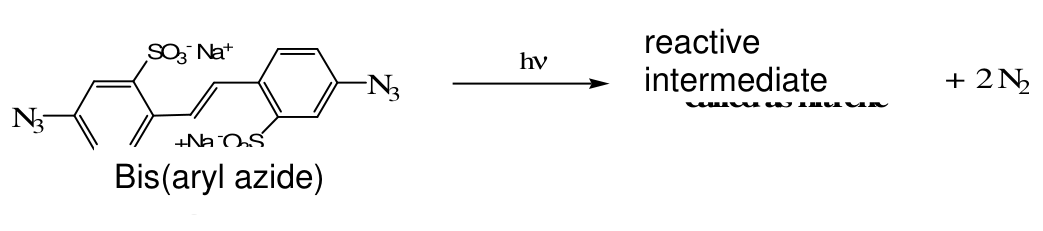
9.1 Draw two possible Lewis structures of \(\ce{CH3-N3}\), the simplest compound having the same active functional group of bis(aryl azide). Assign formal charges.
9.2 Draw the Lewis structure of nitrene expected from \(\ce{CH3-N}\).
9.3 Draw the structures for two possible products, when this nitrene from \(\ce{CH3-N3}\) reacts with ethylene gas (\(\ce{CH2CH2}\)).
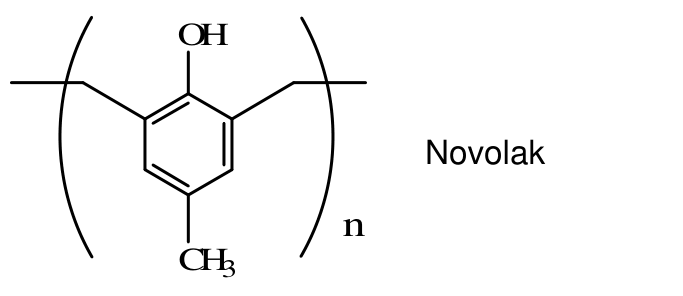
Photoresists consisting of Novolak polymers, utilizes acid to change their solubility. The acid component can be produced photochemically from diazonaphthaquinone. In fact, “Novolaks” have been the representative “positive” photoresists of the modern microelectronic revolution.
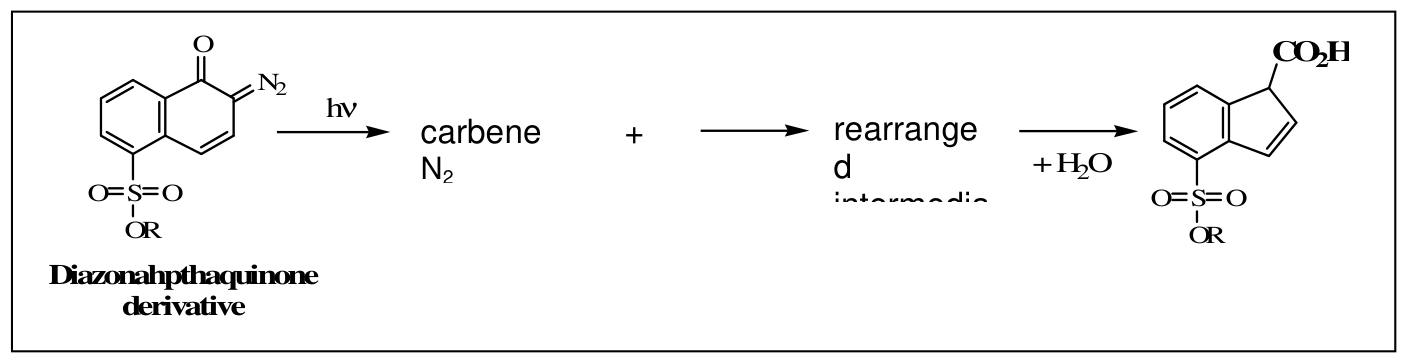
When irradiated, diazonaphthaquinone undergoes photochemical decomposition followed by rearrangement eventually producing a carboxylic acid.
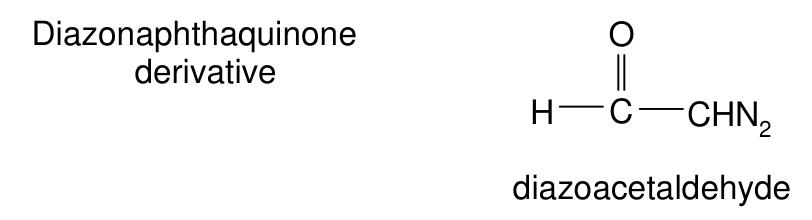
9.4 Draw three Lewis structures of diazoacetaldehyde (see below), the simplest compound having the same active functional group of diazonaphthaquinone. Indicate formal charges.
9.5 Draw a Lewis structure of the rearranged intermediate, A (see below), generated from diazoacetaldehyde after losing \(\ce{N2}\). A satisfies Lewis’ octet rule and reacts with water to form acetic acid, \(\ce{CH3COOH}\).

Advanced photoresists were invented in 1982 based on chemical amplification. The most popular chemical amplification for positive-tone involves the acid catalyzed deprotection of poly(p-hydroxystyrene) resin protected by various acid-sensitive protecting groups such as t-butyloxycarbonyl (t-BOC).
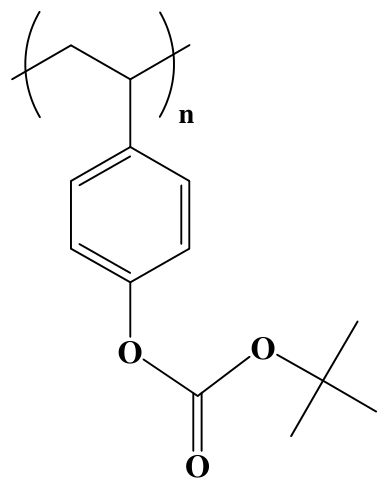
The thermal decomposition of carbonate ester itself normally occurs well above \(150\,^\circ\mathrm{C}\).
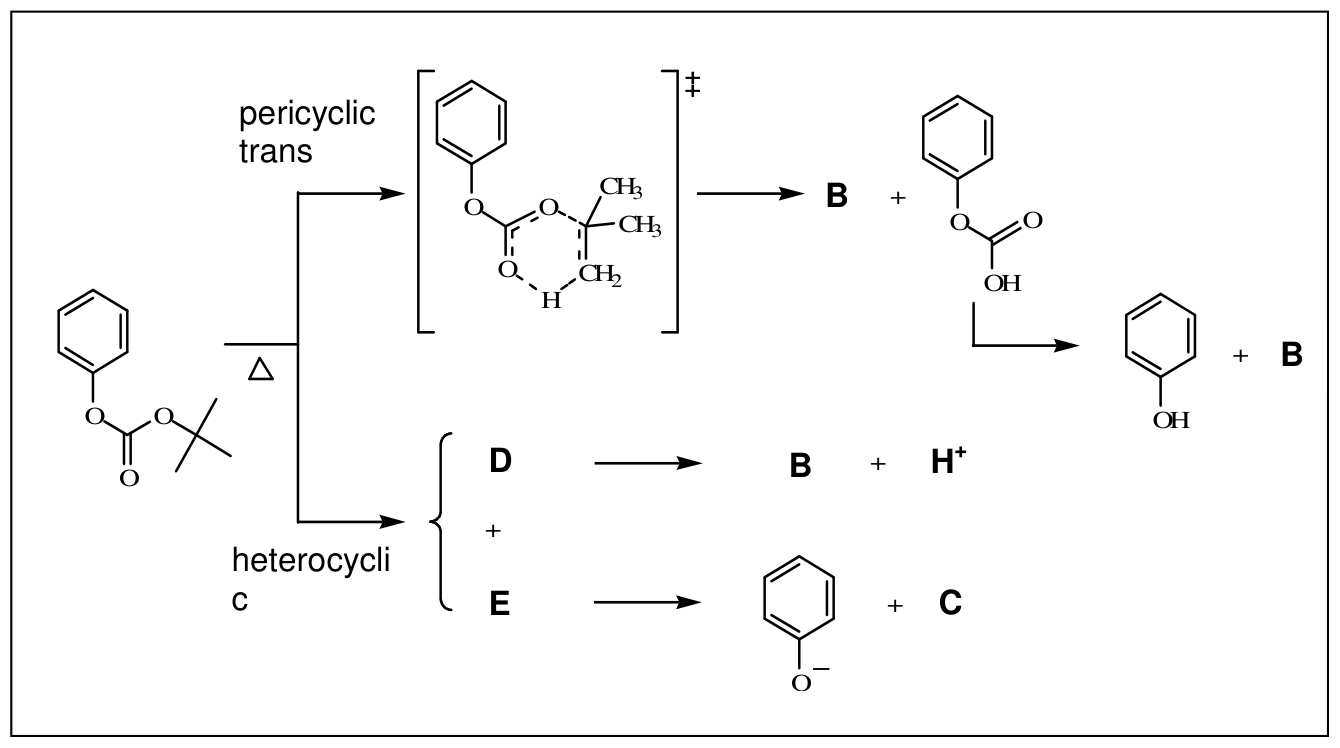
9.6 Two plausible mechanisms have been suggested for this decomposition reaction having relatively high activation energy. Draw expected intermediates and products from this reaction.
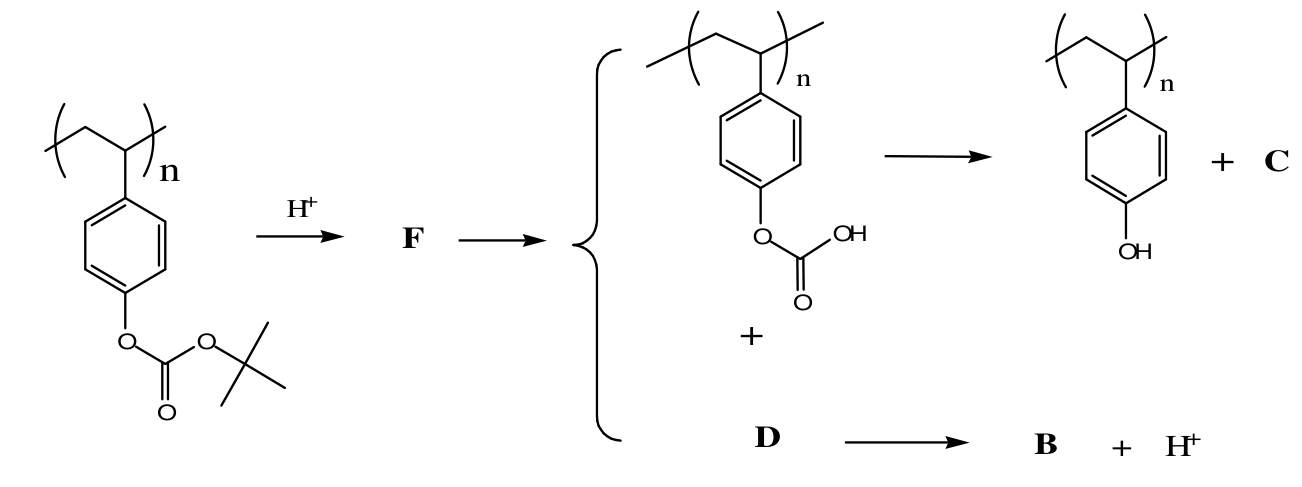
9.7 In the presence of a trace amount of acid, the reaction temperature can be reduced to below \(100\,^\circ\mathrm{C}\). Draw expected intermediate F from the following chemical amplification process based on using t-BOC.
Official English text of the problem.
Answers
-
9.1. The two principal resonance contributors of methyl azide are \(\ce{CH3-N=N^{+}=N^{-}}\),
CN=[N+]=[N-], and \(\ce{CH3-N^{-}-N^{+}\bond{#}N}\),C[N-][N+]#N. Unmarked atoms have zero formal charge. -
9.2. Methylnitrene, \(\ce{CH3-N}\),
C[N]: nitrogen has one single bond and four nonbonding electrons, giving a sextet and zero formal charge. The singlet drawing has two lone pairs; the triplet drawing has one lone pair and two unpaired electrons. SMILES does not specify this spin distinction. -
9.3. 1-Methylaziridine,
CN1CC1, from addition across the double bond, and N-methylethenamine (N-methylvinylamine), \(\ce{CH2=CH-NH-CH3}\),C=CNC, from insertion into a carbon–hydrogen bond. -
9.4. Three resonance contributors of diazoacetaldehyde are \(\ce{H-C(=O)-CH=N^{+}=N^{-}}\),
O=CC=[N+]=[N-]; \(\ce{H-C(=O)-CH^{-}-N^{+}\bond{#}N}\),O=C[CH-][N+]#N; and \(\ce{O^{-}-CH=CH-N^{+}\bond{#}N}\),[O-]C=C[N+]#N. -
9.5. A is ketene (ethenone), \(\ce{CH2=C=O}\),
C=C=O. Oxygen has two lone pairs; all formal charges are zero. -
9.6. B: 2-methylpropene (isobutene), \(\ce{CH2=C(CH3)2}\),
C=C(C)C; C: carbon dioxide, \(\ce{CO2}\),O=C=O; D: tert-butyl cation, \(\ce{(CH3)3C+}\),C[C+](C)C; E: phenyl carbonate anion, \(\ce{PhO-C(=O)-O^{-}}\),O=C([O-])Oc1ccccc1. The gas shown beside phenol in the upper route must be C, despite its printed label B. -
9.7. F is a protonated Boc carbonate, conventionally drawn with protonation at the carbonyl oxygen: \(\ce{Ar-O-C(=OH^{+})-O-C(CH3)3}\). A protonated polymer repeat unit is represented by
[*]CC([*])c1ccc(OC(=[OH+])OC(C)(C)C)cc1, where[*]marks polymer-chain continuation. The tert-butoxy-oxygen-protonated alternative is discussed below.
Solution
Here, \(\ce{Ph}\) denotes phenyl, and \(\ce{Ar}\) denotes the polymer-bound, para-substituted phenyl group in 9.7. Small species used below are dinitrogen, N#N; ethene (ethylene), C=C; water, O; and the proton, [H+].
9.1
Formal charge is calculated from
\[ q_{\mathrm{formal}} = V-n_{\mathrm{nonbonding}} -\frac{1}{2}n_{\mathrm{bonding}}, \]
where \(V\) is the number of valence electrons of the free atom.
The two principal Lewis structures of methyl azide are resonance contributors:
\[ \ce{CH3-N=N^{+}=N^{-} <-> CH3-N^{-}-N^{+}\bond{#}N}. \]
Number the nitrogen atoms from the methyl end.
| Contributor | Formal charges on the three nitrogen atoms | Lone pairs on the three nitrogen atoms |
|---|---|---|
| \(\ce{CH3-N=N^{+}=N^{-}}\) | \(0,\,+1,\,-1\) | \(1,\,0,\,2\) |
| \(\ce{CH3-N^{-}-N^{+}\bond{#}N}\) | \(-1,\,+1,\,0\) | \(2,\,0,\,1\) |
Both structures contain 22 valence electrons, satisfy the octet rule, and have zero net charge. They differ only in electron placement.
9.2
Photolysis expels dinitrogen:
\[ \ce{CH3N3 ->[h\nu] CH3N + N2}. \]
The remaining species is methylnitrene, C[N]. Draw a methyl group joined to nitrogen by a single bond.
Nitrogen retains four nonbonding electrons. In a singlet Lewis drawing these form two lone pairs; in the triplet representation they comprise one lone pair and two unpaired electrons. In either case,
\[ q_{\mathrm N}=5-4-\frac{2}{2}=0. \]
The nitrogen has only six electrons around it: four nonbonding electrons and the two electrons of its carbon–nitrogen bond. This electron deficiency explains its high reactivity. The molecular connectivity alone does not specify its spin state.
9.3
Two standard reactions of the nitrene give the requested products.
- Addition across the double bond gives 1-methylaziridine,
CN1CC1:
\[ \ce{CH3N + CH2=CH2 -> C3H7N} \qquad\text{(1-methylaziridine)}. \]
Draw a three-membered triangle with nitrogen at one vertex and a methylene group at each of the other two vertices. Attach a methyl group to nitrogen. Nitrogen has three single bonds, one lone pair, and zero formal charge.
The ethene double bond becomes a single bond, and nitrogen forms a bond to each carbon.
- Insertion into a vinylic carbon–hydrogen bond gives N-methylethenamine,
C=CNC:
\[ \ce{CH3N + CH2=CH2 -> CH2=CH-NH-CH3}. \]
Nitrogen becomes bonded to both atoms of the original carbon–hydrogen bond. The carbon–carbon double bond remains. Draw the open chain \(\ce{CH2=CH-NH-CH3}\), with one lone pair on nitrogen.
For either product, the overall photochemical equation is
\[ \ce{CH3N3 + C2H4 ->[h\nu] C3H7N + N2}. \]
9.4
The diazo group is conjugated with the carbonyl group. Consequently, its negative charge can be represented on terminal nitrogen, the adjacent carbon, or oxygen:
\[ \begin{aligned} &\ce{H-C(=O)-CH=N^{+}=N^{-}}\\ &\quad\leftrightarrow\ce{H-C(=O)-CH^{-}-N^{+}\bond{#}N}\\ &\quad\leftrightarrow\ce{O^{-}-CH=CH-N^{+}\bond{#}N}. \end{aligned} \]
These are three resonance contributors of diazoacetaldehyde, rather than three distinct compounds.
| Contributor | Nonzero formal charges | Lone pairs to include |
|---|---|---|
O=CC=[N+]=[N-] |
Central nitrogen \(+1\); terminal nitrogen \(-1\) | Two on oxygen; two on terminal nitrogen |
O=C[CH-][N+]#N |
Diazo-bearing carbon \(-1\); central nitrogen \(+1\) | Two on oxygen; one on the negative carbon; one on terminal nitrogen |
[O-]C=C[N+]#N |
Oxygen \(-1\); central nitrogen \(+1\) | Three on oxygen; one on terminal nitrogen |
The positively charged nitrogen has no lone pair in any contributor. All unmarked atoms are neutral.
The first-to-second conversion forms a nitrogen–nitrogen triple bond while moving the carbon–nitrogen \(\pi\)-electron pair onto carbon. Donation of that carbon lone pair toward the carbonyl, accompanied by movement of the carbonyl \(\pi\) electrons onto oxygen, gives the third contributor.
Each structure has 26 valence electrons, complete octets, and zero net charge.
9.5
Loss of dinitrogen initially gives formylcarbene (2-oxoethylidene), O=C[CH]:
\[ \ce{H-C(=O)-CHN2 ->[h\nu] H-C(=O)-C(H): + N2}. \]
The colon indicates the carbene electron pair in a singlet Lewis representation; SMILES does not specify spin.
A Wolff rearrangement then transfers the aldehydic hydrogen to the carbene carbon while forming a carbon–carbon double bond:
\[ \ce{H-C(=O)-C(H): -> CH2=C=O}. \]
Thus A is ketene, C=C=O.
Draw the sequence carbon–carbon–oxygen with two consecutive double bonds. The terminal carbon bears two hydrogens, and oxygen bears two lone pairs. Both carbon atoms and oxygen satisfy the octet rule; every formal charge is zero.
Hydration gives acetic acid (ethanoic acid), CC(=O)O:
\[ \ce{CH2=C=O + H2O -> CH3COOH}. \]
Formally, hydrogen adds to the terminal carbon and hydroxyl to the central carbon. The complete reaction is
\[ \ce{C2H2N2O + H2O ->[h\nu] CH3COOH + N2}. \]
9.6
The model substrate is tert-butyl phenyl carbonate, CC(C)(C)OC(=O)Oc1ccccc1.
In the upper pathway, a six-membered cyclic transition state transfers a hydrogen from a tert-butyl methyl group to the carbonyl oxygen. Carbon–carbon double-bond formation, cleavage of the tert-butyl–oxygen bond, and redistribution of the carbonate bonds occur together.
This gives B, isobutene, and phenyl hydrogen carbonate, O=C(O)Oc1ccccc1:
\[ \ce{PhO-C(=O)-O-C(CH3)3 ->[\Delta] CH2=C(CH3)2 + PhO-C(=O)-OH}. \]
Phenyl hydrogen carbonate subsequently loses C, carbon dioxide, giving phenol, Oc1ccccc1:
\[ \ce{PhO-C(=O)-OH -> PhOH + CO2}. \]
This identifies the apparent labeling error in the upper scheme: the species released beside phenol is carbon dioxide, C.
In the lower pathway, heterolytic cleavage of the tert-butyl–oxygen bond leaves its electron pair on oxygen:
\[ \ce{PhO-C(=O)-O-C(CH3)3 -> (CH3)3C+ + PhO-C(=O)-O^{-}}. \]
Therefore:
- D is the tert-butyl cation,
C[C+](C)C. Draw its central, positively charged carbon bonded to three methyl groups. - E is the phenyl carbonate anion,
O=C([O-])Oc1ccccc1. Draw the negative charge on the singly bonded terminal oxygen; it is delocalized over the two non-phenoxy oxygens.
The subsequent steps shown in the problem are
\[ \ce{(CH3)3C+ -> CH2=C(CH3)2 + H+}, \]
and
\[ \ce{PhO-C(=O)-O^{-} -> PhO^{-} + CO2}. \]
The phenoxide ion, [O-]c1ccccc1, is then protonated:
\[ \ce{PhO^{-} + H+ -> PhOH}. \]
Both pathways have the same balanced overall reaction:
\[ \boxed{ \ce{PhO-C(=O)-O-C(CH3)3 -> PhOH + CH2=C(CH3)2 + CO2} }. \]
Thus one carbonate group produces one molecule each of phenol, isobutene, and carbon dioxide.
9.7
The starting material is Boc-protected poly(p-hydroxystyrene). One repeat unit can be represented as [*]CC([*])c1ccc(OC(=O)OC(C)(C)C)cc1; the wildcard atoms mark chain continuation, and no polymer stereochemistry is specified in the question.
A conventional first step is protonation of the carbonyl oxygen:
\[ \ce{Ar-O-C(=O)-O-C(CH3)3 + H+ <=> Ar-O-C(=OH^{+})-O-C(CH3)3}. \]
This is F, the carbonyl-protonated carbonate, with repeat-unit SMILES [*]CC([*])c1ccc(OC(=[OH+])OC(C)(C)C)cc1.
For the requested drawing, retain the polymer backbone and the para-substituted aromatic ring. Add hydrogen to the carbonate’s carbonyl oxygen and place a positive charge on that oxygen. It has one lone pair and a bond-order sum of three.
Cleavage releases the tert-butyl cation:
\[ \ce{Ar-O-C(=OH^{+})-O-C(CH3)3 -> Ar-O-C(=O)-OH + (CH3)3C+}. \]
During this cleavage, the tert-butoxy oxygen can supply the new carbonyl \(\pi\) bond while the original carbonyl \(\pi\) electrons move onto the protonated oxygen. The latter consequently becomes the hydroxyl oxygen of the carbonic-acid monoester.
The polymer-bound hydrogen carbonate has repeat-unit SMILES [*]CC([*])c1ccc(OC(=O)O)cc1. It decomposes to the deprotected poly(p-hydroxystyrene) repeat, [*]CC([*])c1ccc(O)cc1, and carbon dioxide:
\[ \ce{Ar-O-C(=O)-OH -> Ar-OH + CO2}. \]
Meanwhile, D loses a proton to give B:
\[ \ce{(CH3)3C+ -> CH2=C(CH3)2 + H+}. \]
The overall reaction is therefore
\[ \boxed{ \ce{Ar-O-C(=O)-O-C(CH3)3 ->[H+,\ \Delta] Ar-OH + CH2=C(CH3)2 + CO2} }. \]
The proton is regenerated. A single photogenerated acid molecule can therefore promote removal of many protecting groups: this is the chemical amplification.
An alternative representation of the acid-activated intermediate protonates the tert-butoxy oxygen:
\[ \ce{Ar-O-C(=O)-O^{+}(H)-C(CH3)3}. \]
This tert-butoxy-oxygen-protonated carbonate protomer has repeat-unit SMILES [*]CC([*])c1ccc(OC(=O)[OH+]C(C)(C)C)cc1. Cleavage of its tert-butyl–oxygen bond directly gives the same hydrogen carbonate and D. The two protonation-site structures are distinct protomers, not resonance contributors.
The solution was checked against the official solution.
IChO 2006 · Theorieaufgabe 9
Photolithographisches Verfahren
Die Photolithographie ist ein Verfahren, das bei der Herstellung von Halbleiterbauelementen eingesetzt wird, um ein Muster von einer Photomaske auf die Oberfläche eines Substrats zu übertragen. Bei einem typischen photolithographischen Verfahren wird Licht durch eine Maske, die eine bestimmte Schaltung vorgibt, auf einen Siliciumwafer projiziert, der mit einer dünnen Schicht Photolack beschichtet ist.
Die ersten Photolacke beruhten auf photochemischen Reaktionen, bei denen aus Bis(arylazid) reaktive Zwischenprodukte entstehen. Die Strukturierung wird durch die Vernetzungsreaktion der aus den Aziden erzeugten Nitrene ermöglicht.
9.1 Zeichnen Sie zwei mögliche Lewis-Strukturen von \(\ce{CH3-N3}\), der einfachsten Verbindung mit derselben reaktiven funktionellen Gruppe wie Bis(arylazid). Geben Sie die Formalladungen an.
9.2 Zeichnen Sie die Lewis-Struktur des für \(\ce{CH3-N}\) erwarteten Nitrens.
9.3 Zeichnen Sie die Strukturen zweier möglicher Produkte, die entstehen, wenn dieses Nitren aus \(\ce{CH3-N3}\) mit Ethylengas (\(\ce{CH2CH2}\)) reagiert.
Bei Photolacken aus Novolak-Polymeren wird Säure eingesetzt, um ihre Löslichkeit zu verändern. Die Säurekomponente kann photochemisch aus Diazonaphthochinon erzeugt werden. Tatsächlich waren „Novolake“ die charakteristischen „Positiv“-Photolacke der modernen mikroelektronischen Revolution.
Bei Bestrahlung wird Diazonaphthochinon photochemisch zersetzt; anschließend findet eine Umlagerung statt, die schließlich zur Bildung einer Carbonsäure führt.
9.4 Zeichnen Sie drei Lewis-Strukturen von Diazoacetaldehyd (siehe unten), der einfachsten Verbindung mit derselben reaktiven funktionellen Gruppe wie Diazonaphthochinon. Geben Sie die Formalladungen an.
9.5 Zeichnen Sie eine Lewis-Struktur des umgelagerten Zwischenprodukts A (siehe unten), das nach Abspaltung von \(\ce{N2}\) aus Diazoacetaldehyd entsteht. A erfüllt die Lewis’sche Oktettregel und reagiert mit Wasser zu Essigsäure, \(\ce{CH3COOH}\).
1982 wurden weiterentwickelte Photolacke auf der Grundlage der chemischen Verstärkung erfunden. Die am häufigsten verwendete chemische Verstärkung bei Positivlacken beruht auf der säurekatalysierten Entschützung eines Poly(p-hydroxystyrol)-Harzes, das durch verschiedene säureempfindliche Schutzgruppen wie t-Butyloxycarbonyl (t-BOC) geschützt ist.
Die thermische Zersetzung des Kohlensäureesters selbst erfolgt normalerweise deutlich oberhalb von \(150\,^\circ\mathrm{C}\).
9.6 Für diese Zersetzungsreaktion mit relativ hoher Aktivierungsenergie wurden zwei plausible Mechanismen vorgeschlagen. Zeichnen Sie die erwarteten Zwischenprodukte und Produkte dieser Reaktion.
9.7 In Gegenwart einer Spurenmenge Säure kann die Reaktionstemperatur auf unter \(100\,^\circ\mathrm{C}\) gesenkt werden. Zeichnen Sie das erwartete Zwischenprodukt F des folgenden chemischen Verstärkungsprozesses auf der Grundlage von t-BOC.
Aufgabentext aus dem offiziellen englischen Text übersetzt.
Antworten
-
9.1. Die beiden wichtigsten mesomeren Grenzstrukturen von Methylazid sind \(\ce{CH3-N=N^{+}=N^{-}}\),
CN=[N+]=[N-], und \(\ce{CH3-N^{-}-N^{+}\bond{#}N}\),C[N-][N+]#N. Nicht gekennzeichnete Atome haben die Formalladung null. -
9.2. Methylnitren, \(\ce{CH3-N}\),
C[N]: Das Stickstoffatom hat eine Einfachbindung und vier nichtbindende Elektronen, sodass es ein Elektronensextett und die Formalladung null besitzt. Die Singulett-Darstellung weist zwei freie Elektronenpaare auf; die Triplett-Darstellung weist ein freies Elektronenpaar und zwei ungepaarte Elektronen auf. SMILES legt diesen Spinunterschied nicht fest. -
9.3. 1-Methylaziridin,
CN1CC1, durch Addition an die Doppelbindung, und N-Methylethenamin (N-Methylvinylamin), \(\ce{CH2=CH-NH-CH3}\),C=CNC, durch Insertion in eine Kohlenstoff–Wasserstoff-Bindung. -
9.4. Drei mesomere Grenzstrukturen von Diazoacetaldehyd sind \(\ce{H-C(=O)-CH=N^{+}=N^{-}}\),
O=CC=[N+]=[N-]; \(\ce{H-C(=O)-CH^{-}-N^{+}\bond{#}N}\),O=C[CH-][N+]#N; und \(\ce{O^{-}-CH=CH-N^{+}\bond{#}N}\),[O-]C=C[N+]#N. -
9.5. A ist Keten (Ethenon), \(\ce{CH2=C=O}\),
C=C=O. Das Sauerstoffatom hat zwei freie Elektronenpaare; alle Formalladungen sind null. -
9.6. B: 2-Methylpropen (Isobuten), \(\ce{CH2=C(CH3)2}\),
C=C(C)C; C: Kohlenstoffdioxid, \(\ce{CO2}\),O=C=O; D: tert-Butyl-Kation, \(\ce{(CH3)3C+}\),C[C+](C)C; E: Phenylcarbonat-Anion, \(\ce{PhO-C(=O)-O^{-}}\),O=C([O-])Oc1ccccc1. Das im oberen Reaktionsweg neben Phenol gezeigte Gas muss trotz seiner gedruckten Kennzeichnung B als C bezeichnet werden. -
9.7. F ist ein protoniertes Boc-Carbonat, das üblicherweise mit Protonierung am Carbonylsauerstoff dargestellt wird: \(\ce{Ar-O-C(=OH^{+})-O-C(CH3)3}\). Eine protonierte Wiederholungseinheit des Polymers wird durch
[*]CC([*])c1ccc(OC(=[OH+])OC(C)(C)C)cc1dargestellt, wobei[*]die Fortsetzung der Polymerkette kennzeichnet. Die Alternative mit Protonierung am tert-Butoxy-Sauerstoff wird unten erörtert.
Lösung
Hier bezeichnet \(\ce{Ph}\) Phenyl und \(\ce{Ar}\) die polymergebundene, para-substituierte Phenylgruppe in 9.7. Im Folgenden verwendete kleine Spezies sind Distickstoff, N#N; Ethen (Ethylen), C=C; Wasser, O; und das Proton, [H+].
9.1
Die Formalladung wird berechnet nach
\[ q_{\mathrm{formal}} = V-n_{\mathrm{nonbonding}} -\frac{1}{2}n_{\mathrm{bonding}}, \]
wobei \(V\) die Anzahl der Valenzelektronen des freien Atoms ist.
Die beiden wichtigsten Lewis-Strukturen von Methylazid sind mesomere Grenzstrukturen:
\[ \ce{CH3-N=N^{+}=N^{-} <-> CH3-N^{-}-N^{+}\bond{#}N}. \]
Nummerieren Sie die Stickstoffatome vom Methylende aus.
| Grenzstruktur | Formalladungen an den drei Stickstoffatomen | Freie Elektronenpaare an den drei Stickstoffatomen |
|---|---|---|
| \(\ce{CH3-N=N^{+}=N^{-}}\) | \(0,\,+1,\,-1\) | \(1,\,0,\,2\) |
| \(\ce{CH3-N^{-}-N^{+}\bond{#}N}\) | \(-1,\,+1,\,0\) | \(2,\,0,\,1\) |
Beide Strukturen enthalten 22 Valenzelektronen, erfüllen die Oktettregel und haben die Gesamtladung null. Sie unterscheiden sich nur in der Anordnung der Elektronen.
9.2
Bei der Photolyse wird Distickstoff abgespalten:
\[ \ce{CH3N3 ->[h\nu] CH3N + N2}. \]
Die verbleibende Spezies ist Methylnitren, C[N]. Zeichnen Sie eine Methylgruppe, die durch eine Einfachbindung mit Stickstoff verbunden ist.
Am Stickstoff verbleiben vier nichtbindende Elektronen. In einer Singulett-Lewis-Darstellung bilden diese zwei freie Elektronenpaare; in der Triplett-Darstellung bestehen sie aus einem freien Elektronenpaar und zwei ungepaarten Elektronen. In beiden Fällen gilt
\[ q_{\mathrm N}=5-4-\frac{2}{2}=0. \]
Das Stickstoffatom ist von nur sechs Elektronen umgeben: vier nichtbindenden Elektronen und den beiden Elektronen seiner Kohlenstoff–Stickstoff-Bindung. Dieser Elektronenmangel erklärt seine hohe Reaktivität. Die Verknüpfung der Atome im Molekül allein legt seinen Spinzustand nicht fest.
9.3
Zwei typische Reaktionen des Nitrens ergeben die gesuchten Produkte.
- Die Addition an die Doppelbindung ergibt 1-Methylaziridin,
CN1CC1:
\[ \ce{CH3N + CH2=CH2 -> C3H7N} \qquad\text{(1-Methylaziridin)}. \]
Zeichnen Sie einen dreigliedrigen Ring als Dreieck mit Stickstoff an einer Ecke und jeweils einer Methylengruppe an den beiden anderen Ecken. Binden Sie eine Methylgruppe an den Stickstoff. Das Stickstoffatom hat drei Einfachbindungen, ein freies Elektronenpaar und die Formalladung null.
Die Ethen-Doppelbindung wird zu einer Einfachbindung, und Stickstoff bildet zu jedem Kohlenstoffatom eine Bindung.
- Die Insertion in eine vinylische Kohlenstoff–Wasserstoff-Bindung ergibt N-Methylethenamin,
C=CNC:
\[ \ce{CH3N + CH2=CH2 -> CH2=CH-NH-CH3}. \]
Stickstoff wird an beide Atome der ursprünglichen Kohlenstoff–Wasserstoff-Bindung gebunden. Die Kohlenstoff–Kohlenstoff-Doppelbindung bleibt erhalten. Zeichnen Sie die offene Kette \(\ce{CH2=CH-NH-CH3}\) mit einem freien Elektronenpaar am Stickstoff.
Für beide Produkte lautet die photochemische Gesamtgleichung
\[ \ce{CH3N3 + C2H4 ->[h\nu] C3H7N + N2}. \]
9.4
Die Diazogruppe ist mit der Carbonylgruppe konjugiert. Daher kann ihre negative Ladung am endständigen Stickstoffatom, am benachbarten Kohlenstoffatom oder am Sauerstoffatom dargestellt werden:
\[ \begin{aligned} &\ce{H-C(=O)-CH=N^{+}=N^{-}}\\ &\quad\leftrightarrow\ce{H-C(=O)-CH^{-}-N^{+}\bond{#}N}\\ &\quad\leftrightarrow\ce{O^{-}-CH=CH-N^{+}\bond{#}N}. \end{aligned} \]
Dies sind drei mesomere Grenzstrukturen von Diazoacetaldehyd und keine drei verschiedenen Verbindungen.
| Grenzstruktur | Von null verschiedene Formalladungen | Einzuzeichnende freie Elektronenpaare |
|---|---|---|
O=CC=[N+]=[N-] |
Mittleres Stickstoffatom \(+1\); endständiges Stickstoffatom \(-1\) | Zwei am Sauerstoffatom; zwei am endständigen Stickstoffatom |
O=C[CH-][N+]#N |
Die Diazogruppe tragendes Kohlenstoffatom \(-1\); mittleres Stickstoffatom \(+1\) | Zwei am Sauerstoffatom; eines am negativ geladenen Kohlenstoffatom; eines am endständigen Stickstoffatom |
[O-]C=C[N+]#N |
Sauerstoffatom \(-1\); mittleres Stickstoffatom \(+1\) | Drei am Sauerstoffatom; eines am endständigen Stickstoffatom |
Das positiv geladene Stickstoffatom hat in keiner Grenzstruktur ein freies Elektronenpaar. Alle nicht gekennzeichneten Atome sind neutral.
Beim Übergang von der ersten zur zweiten Grenzstruktur entsteht eine Stickstoff–Stickstoff-Dreifachbindung, während das \(\pi\)-Elektronenpaar der Kohlenstoff–Stickstoff-Bindung auf das Kohlenstoffatom verschoben wird. Die Verschiebung dieses freien Elektronenpaars am Kohlenstoff in Richtung der Carbonylgruppe bei gleichzeitiger Verschiebung der Carbonyl-\(\pi\)-Elektronen auf das Sauerstoffatom ergibt die dritte Grenzstruktur.
Jede Struktur hat 26 Valenzelektronen, vollständige Oktette und die Gesamtladung null.
9.5
Die Abspaltung von Distickstoff ergibt zunächst Formylcarben (2-Oxoethyliden), O=C[CH]:
\[ \ce{H-C(=O)-CHN2 ->[h\nu] H-C(=O)-C(H): + N2}. \]
Der Doppelpunkt kennzeichnet das Carben-Elektronenpaar in einer Singulett-Lewis-Darstellung; SMILES legt den Spin nicht fest.
Durch eine Wolff-Umlagerung wird anschließend der aldehydische Wasserstoff auf das Carben-Kohlenstoffatom übertragen, wobei eine Kohlenstoff–Kohlenstoff-Doppelbindung entsteht:
\[ \ce{H-C(=O)-C(H): -> CH2=C=O}. \]
Somit ist A Keten, C=C=O.
Zeichnen Sie die Abfolge Kohlenstoff–Kohlenstoff–Sauerstoff mit zwei aufeinanderfolgenden Doppelbindungen. Das endständige Kohlenstoffatom trägt zwei Wasserstoffatome, und das Sauerstoffatom trägt zwei freie Elektronenpaare. Beide Kohlenstoffatome und das Sauerstoffatom erfüllen die Oktettregel; jede Formalladung ist null.
Die Hydratisierung ergibt Essigsäure (Ethansäure), CC(=O)O:
\[ \ce{CH2=C=O + H2O -> CH3COOH}. \]
Formal wird Wasserstoff an das endständige Kohlenstoffatom und eine Hydroxygruppe an das mittlere Kohlenstoffatom addiert. Die vollständige Reaktion lautet
\[ \ce{C2H2N2O + H2O ->[h\nu] CH3COOH + N2}. \]
9.6
Das Modellsubstrat ist tert-Butylphenylcarbonat, CC(C)(C)OC(=O)Oc1ccccc1.
Im oberen Reaktionsweg wird über einen sechsgliedrigen cyclischen Übergangszustand ein Wasserstoffatom von einer Methylgruppe der tert-Butylgruppe auf den Carbonylsauerstoff übertragen. Die Bildung der Kohlenstoff–Kohlenstoff-Doppelbindung, die Spaltung der tert-Butyl–Sauerstoff-Bindung und die Umverteilung der Bindungen in der Carbonatgruppe erfolgen gleichzeitig.
Dabei entstehen B, Isobuten, und Phenylhydrogencarbonat, O=C(O)Oc1ccccc1:
\[ \ce{PhO-C(=O)-O-C(CH3)3 ->[\Delta] CH2=C(CH3)2 + PhO-C(=O)-OH}. \]
Phenylhydrogencarbonat spaltet anschließend C, Kohlenstoffdioxid, ab, wobei Phenol, Oc1ccccc1, entsteht:
\[ \ce{PhO-C(=O)-OH -> PhOH + CO2}. \]
Damit ist der offensichtliche Beschriftungsfehler im oberen Schema geklärt: Die neben Phenol freigesetzte Spezies ist Kohlenstoffdioxid, C.
Im unteren Reaktionsweg verbleibt bei der heterolytischen Spaltung der tert-Butyl–Sauerstoff-Bindung deren Elektronenpaar am Sauerstoff:
\[ \ce{PhO-C(=O)-O-C(CH3)3 -> (CH3)3C+ + PhO-C(=O)-O^{-}}. \]
Daher gilt:
- D ist das tert-Butyl-Kation,
C[C+](C)C. Zeichnen Sie sein zentrales, positiv geladenes Kohlenstoffatom mit Bindungen zu drei Methylgruppen. - E ist das Phenylcarbonat-Anion,
O=C([O-])Oc1ccccc1. Zeichnen Sie die negative Ladung am einfach gebundenen endständigen Sauerstoffatom ein; sie ist über die beiden nicht zur Phenoxygruppe gehörenden Sauerstoffatome delokalisiert.
Die in der Aufgabe gezeigten anschließenden Schritte lauten
\[ \ce{(CH3)3C+ -> CH2=C(CH3)2 + H+}, \]
und
\[ \ce{PhO-C(=O)-O^{-} -> PhO^{-} + CO2}. \]
Das Phenolat-Ion, [O-]c1ccccc1, wird anschließend protoniert:
\[ \ce{PhO^{-} + H+ -> PhOH}. \]
Beide Reaktionswege haben dieselbe ausgeglichene Gesamtreaktion:
\[ \boxed{ \ce{PhO-C(=O)-O-C(CH3)3 -> PhOH + CH2=C(CH3)2 + CO2} }. \]
Somit entstehen aus einer Carbonatgruppe jeweils ein Molekül Phenol, Isobuten und Kohlenstoffdioxid.
9.7
Das Ausgangsmaterial ist Boc-geschütztes Poly(p-hydroxystyrol). Eine Wiederholungseinheit kann als [*]CC([*])c1ccc(OC(=O)OC(C)(C)C)cc1 dargestellt werden; die Platzhalteratome kennzeichnen die Fortsetzung der Kette, und in der Aufgabenstellung wird keine Stereochemie des Polymers festgelegt.
Ein üblicher erster Schritt ist die Protonierung des Carbonylsauerstoffs:
\[ \ce{Ar-O-C(=O)-O-C(CH3)3 + H+ <=> Ar-O-C(=OH^{+})-O-C(CH3)3}. \]
Dies ist F, das am Carbonylsauerstoff protonierte Carbonat, mit dem SMILES der Wiederholungseinheit [*]CC([*])c1ccc(OC(=[OH+])OC(C)(C)C)cc1.
Behalten Sie für die geforderte Zeichnung das Polymerrückgrat und den para-substituierten aromatischen Ring bei. Fügen Sie am Carbonylsauerstoff der Carbonatgruppe ein Wasserstoffatom hinzu und kennzeichnen Sie dieses Sauerstoffatom mit einer positiven Ladung. Es hat ein freies Elektronenpaar und eine Bindungsordnungssumme von drei.
Durch Spaltung wird das tert-Butyl-Kation freigesetzt:
\[ \ce{Ar-O-C(=OH^{+})-O-C(CH3)3 -> Ar-O-C(=O)-OH + (CH3)3C+}. \]
Während dieser Spaltung kann der tert-Butoxy-Sauerstoff die neue Carbonyl-\(\pi\)-Bindung bilden, während die ursprünglichen Carbonyl-\(\pi\)-Elektronen auf das protonierte Sauerstoffatom verschoben werden. Letzteres wird somit zum Hydroxy-Sauerstoff des Kohlensäuremonoesters.
Das polymergebundene Hydrogencarbonat hat den SMILES der Wiederholungseinheit [*]CC([*])c1ccc(OC(=O)O)cc1. Es zerfällt in die Wiederholungseinheit des entschützten Poly(p-hydroxystyrols), [*]CC([*])c1ccc(O)cc1, und Kohlenstoffdioxid:
\[ \ce{Ar-O-C(=O)-OH -> Ar-OH + CO2}. \]
Währenddessen spaltet D ein Proton ab und ergibt B:
\[ \ce{(CH3)3C+ -> CH2=C(CH3)2 + H+}. \]
Die Gesamtreaktion lautet daher
\[ \boxed{ \ce{Ar-O-C(=O)-O-C(CH3)3 ->[H+,\ \Delta] Ar-OH + CH2=C(CH3)2 + CO2} }. \]
Das Proton wird regeneriert. Ein einziges photochemisch erzeugtes Säuremolekül kann daher die Abspaltung vieler Schutzgruppen bewirken: Dies ist die chemische Verstärkung.
In einer alternativen Darstellung des durch Säure aktivierten Zwischenprodukts wird der tert-Butoxy-Sauerstoff protoniert:
\[ \ce{Ar-O-C(=O)-O^{+}(H)-C(CH3)3}. \]
Dieses am tert-Butoxy-Sauerstoff protonierte Carbonat-Protomer hat den SMILES der Wiederholungseinheit [*]CC([*])c1ccc(OC(=O)[OH+]C(C)(C)C)cc1. Die Spaltung seiner tert-Butyl–Sauerstoff-Bindung ergibt unmittelbar dasselbe Hydrogencarbonat und D. Die beiden Strukturen mit unterschiedlichen Protonierungsstellen sind verschiedene Protomere und keine mesomeren Grenzstrukturen.
Die Lösung wurde mit der offiziellen Lösung abgeglichen.
IChO 2006 · Teori sorusu 9
Fotolitografi işlemi
Fotolitografi, yarı iletken aygıtların üretiminde bir deseni fotomaskeden bir altlığın yüzeyine aktarmak için kullanılan bir işlemdir. Tipik bir fotolitografi işleminde ışık, belirli bir devre düzenini tanımlayan bir maskeden geçirilerek ince bir fotorezist tabakasıyla kaplanmış bir silisyum plaka üzerine düşürülür.
İlk fotorezistler, bis(aril azit) bileşiğinden reaktif ara türler oluşturan fotokimyaya dayanıyordu. Azitlerden oluşan nitrenlerin çapraz bağlanma tepkimesi sayesinde desen oluşturmak mümkün hâle gelir.
9.1 Bis(aril azit) ile aynı etkin fonksiyonel gruba sahip en basit bileşik olan \(\ce{CH3-N3}\) için iki olası Lewis yapısını çiziniz. Formal yükleri belirtiniz.
9.2 \(\ce{CH3-N}\) için beklenen nitrenin Lewis yapısını çiziniz.
9.3 \(\ce{CH3-N3}\) bileşiğinden oluşan bu nitren etilen gazıyla (\(\ce{CH2CH2}\)) tepkimeye girdiğinde oluşabilecek iki ürünün yapılarını çiziniz.
Novolak polimerlerinden oluşan fotorezistler, çözünürlüklerini değiştirmek için asitten yararlanır. Asit bileşeni, diazonaftakinondan fotokimyasal olarak üretilebilir. Nitekim “Novolaklar”, modern mikroelektronik devriminin başlıca “pozitif” fotorezistleri olmuştur.
Diazonaftakinon ışınlandığında fotokimyasal bozunmaya uğrar; bunu izleyen yeniden düzenlenme sonucunda bir karboksilik asit oluşur.
9.4 Diazonaftakinon ile aynı etkin fonksiyonel gruba sahip en basit bileşik olan diazoasetaldehitin (aşağıya bakınız) üç Lewis yapısını çiziniz. Formal yükleri belirtiniz.
9.5 Diazoasetaldehitten \(\ce{N2}\) ayrılmasının ardından oluşan, yeniden düzenlenmiş ara ürün A'nın (aşağıya bakınız) bir Lewis yapısını çiziniz. A, Lewis'in oktet kuralına uyar ve suyla tepkimeye girerek asetik asit, \(\ce{CH3COOH}\), oluşturur.
Kimyasal çoğaltmaya dayanan gelişmiş fotorezistler 1982 yılında icat edilmiştir. Pozitif ton için en yaygın kimyasal çoğaltma yöntemi, t-bütiloksikarbonil (t-BOC) gibi aside duyarlı çeşitli koruyucu gruplarla korunmuş poli(p-hidroksistiren) reçinesinin koruyucu gruplarının asit kataliziyle uzaklaştırılmasını içerir.
Karbonat esterinin kendi başına ısıl bozunması normalde \(150\,^\circ\mathrm{C}\) sıcaklığının oldukça üzerinde gerçekleşir.
9.6 Görece yüksek aktivasyon enerjisine sahip bu bozunma tepkimesi için iki makul mekanizma önerilmiştir. Bu tepkimeden beklenen ara ürünleri ve ürünleri çiziniz.
9.7 Eser miktarda asit varlığında tepkime sıcaklığı \(100\,^\circ\mathrm{C}\) sıcaklığının altına indirilebilir. t-BOC kullanımına dayanan aşağıdaki kimyasal çoğaltma işleminde beklenen ara ürün F'yi çiziniz.
Soru metni resmi İngilizce metinden çevrilmiştir.
Cevaplar
-
9.1. Metil azidin iki başlıca rezonans katkı yapısı \(\ce{CH3-N=N^{+}=N^{-}}\),
CN=[N+]=[N-]ve \(\ce{CH3-N^{-}-N^{+}\bond{#}N}\),C[N-][N+]#Nşeklindedir. Üzerinde yük belirtilmeyen atomların formal yükü sıfırdır. -
9.2. Metilnitren, \(\ce{CH3-N}\),
C[N]: azotun bir tekli bağı ve bağ yapmayan dört elektronu vardır; böylece azot bir sekstete ve sıfır formal yüke sahiptir. Singlet gösterimde iki ortaklanmamış elektron çifti; triplet gösterimde bir ortaklanmamış elektron çifti ve iki eşleşmemiş elektron bulunur. SMILES bu spin ayrımını belirtmez. -
9.3. Çift bağa katılma sonucunda 1-metilaziridin,
CN1CC1ve bir karbon–hidrojen bağına araya girme sonucunda N-metiletenamin (N-metilvinilamin), \(\ce{CH2=CH-NH-CH3}\),C=CNColuşur. -
9.4. Diazoasetaldehitin üç rezonans katkı yapısı \(\ce{H-C(=O)-CH=N^{+}=N^{-}}\),
O=CC=[N+]=[N-]; \(\ce{H-C(=O)-CH^{-}-N^{+}\bond{#}N}\),O=C[CH-][N+]#Nve \(\ce{O^{-}-CH=CH-N^{+}\bond{#}N}\),[O-]C=C[N+]#Nşeklindedir. -
9.5. A, ketendir (etenon), \(\ce{CH2=C=O}\),
C=C=O. Oksijenin iki ortaklanmamış elektron çifti vardır; tüm formal yükler sıfırdır. -
9.6. B: 2-metilpropen (izobüten), \(\ce{CH2=C(CH3)2}\),
C=C(C)C; C: karbon dioksit, \(\ce{CO2}\),O=C=O; D: tert-bütil katyonu, \(\ce{(CH3)3C+}\),C[C+](C)C; E: fenil karbonat anyonu, \(\ce{PhO-C(=O)-O^{-}}\),O=C([O-])Oc1ccccc1. Üst yolda fenolün yanında gösterilen gaz, basılı etiketi B olmasına rağmen C olmalıdır. -
9.7. F, protonlanmış bir Boc karbonattır; geleneksel olarak karbonil oksijeninin protonlandığı biçimde çizilir: \(\ce{Ar-O-C(=OH^{+})-O-C(CH3)3}\). Protonlanmış bir polimer tekrarlayan birimi
[*]CC([*])c1ccc(OC(=[OH+])OC(C)(C)C)cc1ile gösterilir; burada[*], polimer zincirinin devamını belirtir. tert-Bütoksi oksijeninin protonlandığı alternatif aşağıda ele alınmıştır.
Çözüm
Burada \(\ce{Ph}\) fenili, \(\ce{Ar}\) ise 9.7'deki polimere bağlı, para konumunda sübstitüe fenil grubunu belirtir. Aşağıda kullanılan küçük türler diazot, N#N; eten (etilen), C=C; su, O ve proton, [H+] şeklindedir.
9.1
Formal yük şu bağıntıyla hesaplanır:
\[ q_{\mathrm{formal}} = V-n_{\mathrm{nonbonding}} -\frac{1}{2}n_{\mathrm{bonding}}, \]
burada \(V\), serbest atomun değerlik elektronlarının sayısıdır.
Metil azidin iki başlıca Lewis yapısı rezonans katkı yapılarıdır:
\[ \ce{CH3-N=N^{+}=N^{-} <-> CH3-N^{-}-N^{+}\bond{#}N}. \]
Azot atomlarını metil ucundan başlayarak numaralandırınız.
| Katkı yapısı | Üç azot atomunun formal yükleri | Üç azot atomunun ortaklanmamış elektron çiftleri |
|---|---|---|
| \(\ce{CH3-N=N^{+}=N^{-}}\) | \(0,\,+1,\,-1\) | \(1,\,0,\,2\) |
| \(\ce{CH3-N^{-}-N^{+}\bond{#}N}\) | \(-1,\,+1,\,0\) | \(2,\,0,\,1\) |
Her iki yapı da 22 değerlik elektronu içerir, oktet kuralına uyar ve sıfır net yüke sahiptir. Yalnızca elektronların yerleşimi bakımından farklılık gösterirler.
9.2
Fotoliz sonucunda diazot ayrılır:
\[ \ce{CH3N3 ->[h\nu] CH3N + N2}. \]
Geriye kalan tür metilnitrendir, C[N]. Azota tekli bağla bağlanmış bir metil grubu çiziniz.
Azot üzerinde bağ yapmayan dört elektron kalır. Singlet Lewis gösteriminde bunlar iki ortaklanmamış elektron çifti oluşturur; triplet gösterimde ise bir ortaklanmamış elektron çifti ve iki eşleşmemiş elektron hâlindedirler. Her iki durumda da
\[ q_{\mathrm N}=5-4-\frac{2}{2}=0. \]
Azotun çevresinde yalnızca altı elektron bulunur: bağ yapmayan dört elektron ve karbon–azot bağındaki iki elektron. Bu elektron eksikliği, yüksek reaktifliğini açıklar. Moleküldeki atomların bağlanma düzeni tek başına spin durumunu belirtmez.
9.3
Nitrenin iki standart tepkimesi, istenen ürünleri verir.
- Çift bağa katılma 1-metilaziridin verir,
CN1CC1:
\[ \ce{CH3N + CH2=CH2 -> C3H7N} \qquad\text{(1-metilaziridin)}. \]
Bir köşesinde azot, diğer iki köşesinin her birinde bir metilen grubu bulunan üç üyeli bir üçgen çiziniz. Azota bir metil grubu bağlayınız. Azotun üç tekli bağı, bir ortaklanmamış elektron çifti ve sıfır formal yükü vardır.
Etenin çift bağı tekli bağa dönüşür ve azot her iki karbonla birer bağ oluşturur.
- Bir vinilik karbon–hidrojen bağına araya girme N-metiletenamin verir,
C=CNC:
\[ \ce{CH3N + CH2=CH2 -> CH2=CH-NH-CH3}. \]
Azot, başlangıçtaki karbon–hidrojen bağının her iki atomuna da bağlanır. Karbon–karbon çift bağı korunur. Azot üzerinde bir ortaklanmamış elektron çifti bulunacak şekilde \(\ce{CH2=CH-NH-CH3}\) açık zincirini çiziniz.
Her iki ürün için de toplam fotokimyasal denklem şöyledir:
\[ \ce{CH3N3 + C2H4 ->[h\nu] C3H7N + N2}. \]
9.4
Diazo grubu, karbonil grubuyla konjugasyon hâlindedir. Bu nedenle negatif yükü uçtaki azot, komşu karbon veya oksijen üzerinde gösterilebilir:
\[ \begin{aligned} &\ce{H-C(=O)-CH=N^{+}=N^{-}}\\ &\quad\leftrightarrow\ce{H-C(=O)-CH^{-}-N^{+}\bond{#}N}\\ &\quad\leftrightarrow\ce{O^{-}-CH=CH-N^{+}\bond{#}N}. \end{aligned} \]
Bunlar üç farklı bileşik değil, diazoasetaldehitin üç rezonans katkı yapısıdır.
| Katkı yapısı | Sıfırdan farklı formal yükler | Gösterilmesi gereken ortaklanmamış elektron çiftleri |
|---|---|---|
O=CC=[N+]=[N-] |
Merkezdeki azot \(+1\); uçtaki azot \(-1\) | Oksijen üzerinde iki; uçtaki azot üzerinde iki |
O=C[CH-][N+]#N |
Diazo grubunu taşıyan karbon \(-1\); merkezdeki azot \(+1\) | Oksijen üzerinde iki; negatif yüklü karbon üzerinde bir; uçtaki azot üzerinde bir |
[O-]C=C[N+]#N |
Oksijen \(-1\); merkezdeki azot \(+1\) | Oksijen üzerinde üç; uçtaki azot üzerinde bir |
Pozitif yüklü azotun hiçbir katkı yapısında ortaklanmamış elektron çifti yoktur. Üzerinde yük belirtilmeyen tüm atomlar nötrdür.
Birinci yapıdan ikinciye geçişte, karbon–azot \(\pi\)-elektron çifti karbon üzerine taşınırken bir azot–azot üçlü bağı oluşur. Karbon üzerindeki bu ortaklanmamış elektron çiftinin karbonile doğru verilmesi ve buna eşlik eden karbonil \(\pi\) elektronlarının oksijene kayması üçüncü katkı yapısını verir.
Her yapı 26 değerlik elektronuna, tamamlanmış oktetlere ve sıfır net yüke sahiptir.
9.5
Diazotun ayrılması ilk olarak formilkarben (2-oksoetiliden), O=C[CH], verir:
\[ \ce{H-C(=O)-CHN2 ->[h\nu] H-C(=O)-C(H): + N2}. \]
İki nokta, singlet Lewis gösterimindeki karben elektron çiftini belirtir; SMILES spini belirtmez.
Ardından bir Wolff yeniden düzenlenmesi, karbon–karbon çift bağı oluştururken aldehit hidrojenini karben karbonuna aktarır:
\[ \ce{H-C(=O)-C(H): -> CH2=C=O}. \]
Dolayısıyla A, ketendir, C=C=O.
Karbon–karbon–oksijen dizisini, art arda iki çift bağ içerecek şekilde çiziniz. Uçtaki karbon iki hidrojen, oksijen ise iki ortaklanmamış elektron çifti taşır. Her iki karbon atomu ve oksijen oktet kuralına uyar; tüm formal yükler sıfırdır.
Hidrasyon asetik asit (etanoik asit), CC(=O)O, verir:
\[ \ce{CH2=C=O + H2O -> CH3COOH}. \]
Biçimsel olarak hidrojen uçtaki karbona, hidroksil ise merkezdeki karbona katılır. Tam tepkime şöyledir:
\[ \ce{C2H2N2O + H2O ->[h\nu] CH3COOH + N2}. \]
9.6
Model substrat tert-bütil fenil karbonattır, CC(C)(C)OC(=O)Oc1ccccc1.
Üst yolda, altı üyeli halkalı bir geçiş hâli, tert-bütil grubunun bir metil grubundan karbonil oksijenine bir hidrojen aktarır. Karbon–karbon çift bağının oluşması, tert-bütil–oksijen bağının kırılması ve karbonat bağlarının yeniden düzenlenmesi birlikte gerçekleşir.
Bu süreç B, izobüten ve fenil hidrojen karbonat, O=C(O)Oc1ccccc1, verir:
\[ \ce{PhO-C(=O)-O-C(CH3)3 ->[\Delta] CH2=C(CH3)2 + PhO-C(=O)-OH}. \]
Fenil hidrojen karbonat daha sonra C, karbon dioksiti kaybederek fenol, Oc1ccccc1, verir:
\[ \ce{PhO-C(=O)-OH -> PhOH + CO2}. \]
Bu sonuç, üst şemadaki görünür etiketleme hatasını ortaya koyar: fenolün yanında açığa çıkan tür karbon dioksit, C'dir.
Alt yolda, tert-bütil–oksijen bağının heterolitik kırılması sonucunda bağın elektron çifti oksijen üzerinde kalır:
\[ \ce{PhO-C(=O)-O-C(CH3)3 -> (CH3)3C+ + PhO-C(=O)-O^{-}}. \]
Dolayısıyla:
- D, tert-bütil katyonudur,
C[C+](C)C. Merkezdeki pozitif yüklü karbonu üç metil grubuna bağlı olarak çiziniz. - E, fenil karbonat anyonudur,
O=C([O-])Oc1ccccc1. Negatif yükü tekli bağ yapmış uç oksijen üzerinde çiziniz; bu yük, fenoksi grubuna ait olmayan iki oksijen üzerinde delokalizedir.
Soruda gösterilen sonraki basamaklar şunlardır:
\[ \ce{(CH3)3C+ -> CH2=C(CH3)2 + H+}, \]
ve
\[ \ce{PhO-C(=O)-O^{-} -> PhO^{-} + CO2}. \]
Ardından fenoksit iyonu, [O-]c1ccccc1, protonlanır:
\[ \ce{PhO^{-} + H+ -> PhOH}. \]
Her iki yolun da denkleştirilmiş toplam tepkimesi aynıdır:
\[ \boxed{ \ce{PhO-C(=O)-O-C(CH3)3 -> PhOH + CH2=C(CH3)2 + CO2} }. \]
Böylece bir karbonat grubu, fenol, izobüten ve karbon dioksitin her birinden birer molekül üretir.
9.7
Başlangıç maddesi Boc ile korunmuş poli(p-hidroksistiren)dir. Bir tekrarlayan birim [*]CC([*])c1ccc(OC(=O)OC(C)(C)C)cc1 ile gösterilebilir; joker atomlar zincirin devamını belirtir ve soruda polimerin stereokimyası belirtilmemiştir.
Geleneksel ilk basamak, karbonil oksijeninin protonlanmasıdır:
\[ \ce{Ar-O-C(=O)-O-C(CH3)3 + H+ <=> Ar-O-C(=OH^{+})-O-C(CH3)3}. \]
Bu, karbonil oksijeni protonlanmış karbonat olan F'dir; tekrarlayan birimin SMILES gösterimi [*]CC([*])c1ccc(OC(=[OH+])OC(C)(C)C)cc1 şeklindedir.
İstenen çizimde polimer omurgasını ve para konumunda sübstitüe aromatik halkayı koruyunuz. Karbonatın karbonil oksijenine hidrojen ekleyiniz ve bu oksijen üzerine pozitif yük yerleştiriniz. Bu oksijenin bir ortaklanmamış elektron çifti vardır ve bağ mertebeleri toplamı üçtür.
Bağ kırılması tert-bütil katyonunu açığa çıkarır:
\[ \ce{Ar-O-C(=OH^{+})-O-C(CH3)3 -> Ar-O-C(=O)-OH + (CH3)3C+}. \]
Bu bağ kırılması sırasında, başlangıçtaki karbonilin \(\pi\) elektronları protonlanmış oksijene kayarken tert-bütoksi oksijeni yeni karbonil \(\pi\) bağını oluşturabilir. Böylece başlangıçtaki karbonil oksijeni, karbonik asit monoesterinin hidroksil oksijenine dönüşür.
Polimere bağlı hidrojen karbonatın tekrarlayan biriminin SMILES gösterimi [*]CC([*])c1ccc(OC(=O)O)cc1 şeklindedir. Bu birim, koruyucu grubu uzaklaştırılmış poli(p-hidroksistiren) tekrarlayan birimine, [*]CC([*])c1ccc(O)cc1 ve karbon dioksite bozunur:
\[ \ce{Ar-O-C(=O)-OH -> Ar-OH + CO2}. \]
Bu sırada D, bir proton kaybederek B'yi verir:
\[ \ce{(CH3)3C+ -> CH2=C(CH3)2 + H+}. \]
Dolayısıyla toplam tepkime şöyledir:
\[ \boxed{ \ce{Ar-O-C(=O)-O-C(CH3)3 ->[H+,\ \Delta] Ar-OH + CH2=C(CH3)2 + CO2} }. \]
Proton yeniden oluşur. Bu nedenle fotokimyasal olarak oluşan tek bir asit molekülü, çok sayıda koruyucu grubun uzaklaştırılmasını sağlayabilir: kimyasal çoğaltma budur.
Asitle etkinleştirilmiş ara ürünün alternatif bir gösteriminde tert-bütoksi oksijeni protonlanır:
\[ \ce{Ar-O-C(=O)-O^{+}(H)-C(CH3)3}. \]
Bu tert-bütoksi oksijeni protonlanmış karbonat protomerinin tekrarlayan biriminin SMILES gösterimi [*]CC([*])c1ccc(OC(=O)[OH+]C(C)(C)C)cc1 şeklindedir. tert-Bütil–oksijen bağının kırılması doğrudan aynı hidrojen karbonatı ve D'yi verir. İki farklı protonlanma konumuna sahip bu yapılar, rezonans katkı yapıları değil, farklı protomerlerdir.
Çözüm, resmi çözümle karşılaştırılarak kontrol edildi.
IChO 2006 · Problema teórico 9
Proceso fotolitográfico
La fotolitografía es un proceso utilizado en la fabricación de dispositivos semiconductores para transferir un patrón desde una fotomáscara a la superficie de un sustrato. En un proceso fotolitográfico típico, se proyecta luz, a través de una máscara que define un circuito determinado, sobre una oblea de silicio recubierta con una capa fina de fotorresina.
Las primeras fotorresinas se basaban en la fotoquímica que genera intermedios reactivos a partir de bis(azidas de arilo). La formación del patrón es posible gracias a la reacción de reticulación de los nitrenos generados a partir de las azidas.
9.1 Dibuje dos estructuras de Lewis posibles de \(\ce{CH3-N3}\), el compuesto más sencillo que posee el mismo grupo funcional activo que la bis(azida de arilo). Asigne las cargas formales.
9.2 Dibuje la estructura de Lewis del nitreno esperado a partir de \(\ce{CH3-N}\).
9.3 Dibuje las estructuras de dos productos posibles cuando este nitreno procedente de \(\ce{CH3-N3}\) reacciona con etileno gaseoso (\(\ce{CH2CH2}\)).
Las fotorresinas constituidas por polímeros Novolak utilizan un ácido para modificar su solubilidad. El componente ácido puede producirse fotoquímicamente a partir de la diazonaftoquinona. De hecho, las «Novolak» han sido las fotorresinas «positivas» representativas de la revolución microelectrónica moderna.
Al irradiarse, la diazonaftoquinona experimenta una descomposición fotoquímica seguida de una transposición que finalmente produce un ácido carboxílico.
9.4 Dibuje tres estructuras de Lewis del diazoacetaldehído (véase a continuación), el compuesto más sencillo que posee el mismo grupo funcional activo que la diazonaftoquinona. Indique las cargas formales.
9.5 Dibuje una estructura de Lewis del intermedio transpuesto, A (véase a continuación), generado a partir del diazoacetaldehído tras perder \(\ce{N2}\). A cumple la regla del octeto de Lewis y reacciona con agua para formar ácido acético, \(\ce{CH3COOH}\).
En 1982 se inventaron fotorresinas avanzadas basadas en la amplificación química. La amplificación química más utilizada para el tono positivo implica la desprotección catalizada por ácido de una resina de poli(p-hidroxiestireno) protegida con diversos grupos protectores sensibles a los ácidos, como el t-butiloxicarbonilo (t-BOC).
La descomposición térmica del propio éster de carbonato normalmente tiene lugar muy por encima de \(150\,^\circ\mathrm{C}\).
9.6 Se han propuesto dos mecanismos plausibles para esta reacción de descomposición, cuya energía de activación es relativamente elevada. Dibuje los intermedios y los productos esperados de esta reacción.
9.7 En presencia de una cantidad mínima de ácido, la temperatura de reacción puede reducirse por debajo de \(100\,^\circ\mathrm{C}\). Dibuje el intermedio F esperado en el siguiente proceso de amplificación química basado en el uso de t-BOC.
Enunciado traducido del texto oficial en inglés.
Respuestas
-
9.1. Las dos principales formas contribuyentes de resonancia de la azida de metilo son \(\ce{CH3-N=N^{+}=N^{-}}\),
CN=[N+]=[N-], y \(\ce{CH3-N^{-}-N^{+}\bond{#}N}\),C[N-][N+]#N. Los átomos sin indicación de carga tienen carga formal nula. -
9.2. Metilnitreno, \(\ce{CH3-N}\),
C[N]: el nitrógeno tiene un enlace sencillo y cuatro electrones no enlazantes, lo que da un sexteto y una carga formal nula. La representación del singlete tiene dos pares solitarios; la del triplete tiene un par solitario y dos electrones desapareados. El SMILES no especifica esta distinción de espín. -
9.3. 1-Metilaziridina,
CN1CC1, por adición al doble enlace, y N-metiletenamina (N-metilvinilamina), \(\ce{CH2=CH-NH-CH3}\),C=CNC, por inserción en un enlace carbono–hidrógeno. -
9.4. Tres formas contribuyentes de resonancia del diazoacetaldehído son \(\ce{H-C(=O)-CH=N^{+}=N^{-}}\),
O=CC=[N+]=[N-]; \(\ce{H-C(=O)-CH^{-}-N^{+}\bond{#}N}\),O=C[CH-][N+]#N; y \(\ce{O^{-}-CH=CH-N^{+}\bond{#}N}\),[O-]C=C[N+]#N. -
9.5. A es cetena (etenona), \(\ce{CH2=C=O}\),
C=C=O. El oxígeno tiene dos pares solitarios; todas las cargas formales son nulas. -
9.6. B: 2-metilpropeno (isobuteno), \(\ce{CH2=C(CH3)2}\),
C=C(C)C; C: dióxido de carbono, \(\ce{CO2}\),O=C=O; D: catión terc-butilo, \(\ce{(CH3)3C+}\),C[C+](C)C; E: anión carbonato de fenilo, \(\ce{PhO-C(=O)-O^{-}}\),O=C([O-])Oc1ccccc1. El gas que aparece junto al fenol en la vía superior debe ser C, a pesar de que lleva impresa la etiqueta B. -
9.7. F es un carbonato Boc protonado, que convencionalmente se representa con la protonación en el oxígeno carbonílico: \(\ce{Ar-O-C(=OH^{+})-O-C(CH3)3}\). Una unidad repetitiva protonada del polímero se representa mediante
[*]CC([*])c1ccc(OC(=[OH+])OC(C)(C)C)cc1, donde[*]indica la continuación de la cadena polimérica. La alternativa protonada en el oxígeno terc-butoxílico se analiza más adelante.
Solución
Aquí, \(\ce{Ph}\) designa el fenilo, y \(\ce{Ar}\) designa el grupo fenilo sustituido en para y unido al polímero en 9.7. Las especies pequeñas utilizadas a continuación son dinitrógeno, N#N; eteno (etileno), C=C; agua, O; y el protón, [H+].
9.1
La carga formal se calcula mediante
\[ q_{\mathrm{formal}} = V-n_{\mathrm{nonbonding}} -\frac{1}{2}n_{\mathrm{bonding}}, \]
donde \(V\) es el número de electrones de valencia del átomo libre.
Las dos principales estructuras de Lewis de la azida de metilo son formas contribuyentes de resonancia:
\[ \ce{CH3-N=N^{+}=N^{-} <-> CH3-N^{-}-N^{+}\bond{#}N}. \]
Numere los átomos de nitrógeno desde el extremo del metilo.
| Forma contribuyente | Cargas formales de los tres átomos de nitrógeno | Pares solitarios de los tres átomos de nitrógeno |
|---|---|---|
| \(\ce{CH3-N=N^{+}=N^{-}}\) | \(0,\,+1,\,-1\) | \(1,\,0,\,2\) |
| \(\ce{CH3-N^{-}-N^{+}\bond{#}N}\) | \(-1,\,+1,\,0\) | \(2,\,0,\,1\) |
Ambas estructuras contienen 22 electrones de valencia, cumplen la regla del octeto y tienen carga neta nula. Solo difieren en la distribución de los electrones.
9.2
La fotólisis expulsa dinitrógeno:
\[ \ce{CH3N3 ->[h\nu] CH3N + N2}. \]
La especie restante es el metilnitreno, C[N]. Dibuje un grupo metilo unido al nitrógeno mediante un enlace sencillo.
El nitrógeno conserva cuatro electrones no enlazantes. En una representación de Lewis del singlete, estos forman dos pares solitarios; en la representación del triplete, constituyen un par solitario y dos electrones desapareados. En ambos casos,
\[ q_{\mathrm N}=5-4-\frac{2}{2}=0. \]
El nitrógeno solo tiene seis electrones a su alrededor: cuatro electrones no enlazantes y los dos electrones de su enlace carbono–nitrógeno. Esta deficiencia electrónica explica su elevada reactividad. La conectividad molecular por sí sola no especifica su estado de espín.
9.3
Dos reacciones habituales del nitreno dan los productos solicitados.
- La adición al doble enlace da 1-metilaziridina,
CN1CC1:
\[ \ce{CH3N + CH2=CH2 -> C3H7N} \qquad\text{(1-metilaziridina)}. \]
Dibuje un triángulo de tres miembros con el nitrógeno en un vértice y un grupo metileno en cada uno de los otros dos vértices. Una un grupo metilo al nitrógeno. El nitrógeno tiene tres enlaces sencillos, un par solitario y carga formal nula.
El doble enlace del eteno se convierte en un enlace sencillo, y el nitrógeno forma un enlace con cada carbono.
- La inserción en un enlace carbono–hidrógeno vinílico da N-metiletenamina,
C=CNC:
\[ \ce{CH3N + CH2=CH2 -> CH2=CH-NH-CH3}. \]
El nitrógeno queda unido a ambos átomos del enlace carbono–hidrógeno original. El doble enlace carbono–carbono se mantiene. Dibuje la cadena abierta \(\ce{CH2=CH-NH-CH3}\), con un par solitario en el nitrógeno.
Para cualquiera de los dos productos, la ecuación fotoquímica global es
\[ \ce{CH3N3 + C2H4 ->[h\nu] C3H7N + N2}. \]
9.4
El grupo diazo está conjugado con el grupo carbonilo. Por consiguiente, su carga negativa puede representarse en el nitrógeno terminal, en el carbono adyacente o en el oxígeno:
\[ \begin{aligned} &\ce{H-C(=O)-CH=N^{+}=N^{-}}\\ &\quad\leftrightarrow\ce{H-C(=O)-CH^{-}-N^{+}\bond{#}N}\\ &\quad\leftrightarrow\ce{O^{-}-CH=CH-N^{+}\bond{#}N}. \end{aligned} \]
Estas son tres formas contribuyentes de resonancia del diazoacetaldehído, no tres compuestos distintos.
| Forma contribuyente | Cargas formales no nulas | Pares solitarios que deben incluirse |
|---|---|---|
O=CC=[N+]=[N-] |
Nitrógeno central \(+1\); nitrógeno terminal \(-1\) | Dos en el oxígeno; dos en el nitrógeno terminal |
O=C[CH-][N+]#N |
Carbono que porta el grupo diazo \(-1\); nitrógeno central \(+1\) | Dos en el oxígeno; uno en el carbono negativo; uno en el nitrógeno terminal |
[O-]C=C[N+]#N |
Oxígeno \(-1\); nitrógeno central \(+1\) | Tres en el oxígeno; uno en el nitrógeno terminal |
El nitrógeno con carga positiva no tiene ningún par solitario en ninguna de las formas contribuyentes. Todos los átomos sin indicación de carga son neutros.
La conversión de la primera forma en la segunda genera un enlace triple nitrógeno–nitrógeno mientras desplaza el par de electrones \(\pi\) del enlace carbono–nitrógeno hacia el carbono. La donación de ese par solitario del carbono hacia el carbonilo, acompañada del desplazamiento de los electrones \(\pi\) del carbonilo hacia el oxígeno, da la tercera forma contribuyente.
Cada estructura tiene 26 electrones de valencia, octetos completos y carga neta nula.
9.5
La pérdida de dinitrógeno da inicialmente formilcarbeno (2-oxoetilideno), O=C[CH]:
\[ \ce{H-C(=O)-CHN2 ->[h\nu] H-C(=O)-C(H): + N2}. \]
Los dos puntos indican el par de electrones del carbeno en una representación de Lewis del singlete; el SMILES no especifica el espín.
A continuación, una transposición de Wolff transfiere el hidrógeno aldehídico al carbono carbénico mientras se forma un doble enlace carbono–carbono:
\[ \ce{H-C(=O)-C(H): -> CH2=C=O}. \]
Por tanto, A es cetena, C=C=O.
Dibuje la secuencia carbono–carbono–oxígeno con dos dobles enlaces consecutivos. El carbono terminal lleva dos hidrógenos y el oxígeno tiene dos pares solitarios. Ambos átomos de carbono y el oxígeno cumplen la regla del octeto; todas las cargas formales son nulas.
La hidratación da ácido acético (ácido etanoico), CC(=O)O:
\[ \ce{CH2=C=O + H2O -> CH3COOH}. \]
Formalmente, el hidrógeno se adiciona al carbono terminal y el hidroxilo al carbono central. La reacción completa es
\[ \ce{C2H2N2O + H2O ->[h\nu] CH3COOH + N2}. \]
9.6
El sustrato modelo es el carbonato de terc-butilo y fenilo, CC(C)(C)OC(=O)Oc1ccccc1.
En la vía superior, un estado de transición cíclico de seis miembros transfiere un hidrógeno de un grupo metilo del terc-butilo al oxígeno carbonílico. La formación del doble enlace carbono–carbono, la ruptura del enlace terc-butilo–oxígeno y la redistribución de los enlaces del carbonato ocurren conjuntamente.
Esto da B, isobuteno, e hidrogenocarbonato de fenilo, O=C(O)Oc1ccccc1:
\[ \ce{PhO-C(=O)-O-C(CH3)3 ->[\Delta] CH2=C(CH3)2 + PhO-C(=O)-OH}. \]
El hidrogenocarbonato de fenilo pierde posteriormente C, dióxido de carbono, y da fenol, Oc1ccccc1:
\[ \ce{PhO-C(=O)-OH -> PhOH + CO2}. \]
Esto permite identificar el aparente error de etiquetado en el esquema superior: la especie liberada junto al fenol es dióxido de carbono, C.
En la vía inferior, la ruptura heterolítica del enlace terc-butilo–oxígeno deja su par de electrones en el oxígeno:
\[ \ce{PhO-C(=O)-O-C(CH3)3 -> (CH3)3C+ + PhO-C(=O)-O^{-}}. \]
Por tanto:
- D es el catión terc-butilo,
C[C+](C)C. Dibuje su carbono central, con carga positiva, unido a tres grupos metilo. - E es el anión carbonato de fenilo,
O=C([O-])Oc1ccccc1. Dibuje la carga negativa en el oxígeno terminal unido mediante un enlace sencillo; está deslocalizada entre los dos oxígenos que no pertenecen al grupo fenoxi.
Los pasos posteriores que se muestran en el problema son
\[ \ce{(CH3)3C+ -> CH2=C(CH3)2 + H+}, \]
y
\[ \ce{PhO-C(=O)-O^{-} -> PhO^{-} + CO2}. \]
El ion fenóxido, [O-]c1ccccc1, se protona a continuación:
\[ \ce{PhO^{-} + H+ -> PhOH}. \]
Ambas vías tienen la misma reacción global ajustada:
\[ \boxed{ \ce{PhO-C(=O)-O-C(CH3)3 -> PhOH + CH2=C(CH3)2 + CO2} }. \]
Así, un grupo carbonato produce una molécula de fenol, una de isobuteno y una de dióxido de carbono.
9.7
El material de partida es poli(p-hidroxiestireno) protegido con Boc. Una unidad repetitiva puede representarse como [*]CC([*])c1ccc(OC(=O)OC(C)(C)C)cc1; los átomos comodín indican la continuación de la cadena, y en la pregunta no se especifica la estereoquímica del polímero.
Un primer paso convencional es la protonación del oxígeno carbonílico:
\[ \ce{Ar-O-C(=O)-O-C(CH3)3 + H+ <=> Ar-O-C(=OH^{+})-O-C(CH3)3}. \]
Este es F, el carbonato protonado en el carbonilo, cuya unidad repetitiva tiene el SMILES [*]CC([*])c1ccc(OC(=[OH+])OC(C)(C)C)cc1.
Para el dibujo solicitado, conserve la cadena principal del polímero y el anillo aromático sustituido en para. Añada un hidrógeno al oxígeno carbonílico del carbonato y coloque una carga positiva en ese oxígeno. Tiene un par solitario y una suma de órdenes de enlace de tres.
La ruptura libera el catión terc-butilo:
\[ \ce{Ar-O-C(=OH^{+})-O-C(CH3)3 -> Ar-O-C(=O)-OH + (CH3)3C+}. \]
Durante esta ruptura, el oxígeno terc-butoxílico puede aportar el nuevo enlace \(\pi\) del carbonilo mientras los electrones \(\pi\) del carbonilo original se desplazan hacia el oxígeno protonado. Este último se convierte, por consiguiente, en el oxígeno hidroxílico del monoéster del ácido carbónico.
El hidrogenocarbonato unido al polímero tiene una unidad repetitiva con el SMILES [*]CC([*])c1ccc(OC(=O)O)cc1. Se descompone para dar la unidad repetitiva del poli(p-hidroxiestireno) desprotegido, [*]CC([*])c1ccc(O)cc1, y dióxido de carbono:
\[ \ce{Ar-O-C(=O)-OH -> Ar-OH + CO2}. \]
Mientras tanto, D pierde un protón para dar B:
\[ \ce{(CH3)3C+ -> CH2=C(CH3)2 + H+}. \]
La reacción global es, por tanto,
\[ \boxed{ \ce{Ar-O-C(=O)-O-C(CH3)3 ->[H+,\ \Delta] Ar-OH + CH2=C(CH3)2 + CO2} }. \]
El protón se regenera. Por tanto, una sola molécula de ácido generada fotoquímicamente puede promover la eliminación de muchos grupos protectores: esto es la amplificación química.
Una representación alternativa del intermedio activado por ácido protona el oxígeno terc-butoxílico:
\[ \ce{Ar-O-C(=O)-O^{+}(H)-C(CH3)3}. \]
Este protómero del carbonato protonado en el oxígeno terc-butoxílico tiene una unidad repetitiva con el SMILES [*]CC([*])c1ccc(OC(=O)[OH+]C(C)(C)C)cc1. La ruptura de su enlace terc-butilo–oxígeno da directamente el mismo hidrogenocarbonato y D. Las dos estructuras con distintos sitios de protonación son protómeros distintos, no formas contribuyentes de resonancia.
La solución se comprobó con la solución oficial.
IChO 2006 · 理论题 9
光刻工艺
光刻是半导体器件制造中用于将图案从光掩模转移到衬底表面的工艺。在典型的光刻工艺中,光透过限定特定电路图案的掩模,投射到涂有薄层光刻胶的硅片上。
最早的光刻胶基于由双(芳基叠氮化物)产生高活性中间体的光化学反应。由叠氮化物生成的氮烯发生交联反应,从而实现图案化。
9.1 画出 \(\ce{CH3-N3}\) 的两种可能的路易斯结构,它是具有与双(芳基叠氮化物)相同活性官能团的最简单化合物。标明形式电荷。
9.2 画出预期的氮烯 \(\ce{CH3-N}\) 的路易斯结构。
9.3 当由 \(\ce{CH3-N3}\) 生成的这种氮烯与乙烯气体(\(\ce{CH2CH2}\))反应时,画出两种可能产物的结构。
由线型酚醛树脂(Novolak)聚合物组成的光刻胶利用酸来改变其溶解性。酸性组分可由重氮萘醌通过光化学反应产生。事实上,“Novolak”一直是现代微电子革命中具有代表性的“正性”光刻胶。
在光照下,重氮萘醌发生光化学分解,随后重排,最终生成羧酸。
9.4 画出重氮乙醛(见下图)的三种路易斯结构,它是具有与重氮萘醌相同活性官能团的最简单化合物。标明形式电荷。
9.5 画出重氮乙醛失去 \(\ce{N2}\) 后生成的重排中间体 A(见下图)的路易斯结构。A 满足路易斯八隅体规则,并与水反应生成乙酸 \(\ce{CH3COOH}\)。
1982 年,人们基于化学放大原理发明了先进的光刻胶。最常用的正性光刻胶化学放大过程,是对由各种酸敏感保护基(如叔丁氧羰基(t-BOC))保护的聚(对羟基苯乙烯)树脂进行酸催化脱保护。
碳酸酯本身的热分解通常在远高于 \(150\,^\circ\mathrm{C}\) 的温度下发生。
9.6 对于这一活化能较高的分解反应,已提出两种合理的机理。画出该反应预期的中间体和产物。
9.7 在微量酸存在下,反应温度可降至 \(100\,^\circ\mathrm{C}\) 以下。画出下列基于 t-BOC 的化学放大过程预期的中间体 F。
题目译自官方英文原文。
答案
-
9.1. 叠氮甲烷的两个主要共振式为 \(\ce{CH3-N=N^{+}=N^{-}}\),
CN=[N+]=[N-],以及 \(\ce{CH3-N^{-}-N^{+}\bond{#}N}\),C[N-][N+]#N。 未标注的原子的形式电荷为零。 -
9.2. 甲基氮烯,\(\ce{CH3-N}\),
C[N]:氮原子具有一个单键和四个非键电子,因此其周围有六个电子,形式电荷为零。单重态的画法中有两对孤电子对;三重态的画法中有一对孤电子对和两个未成对电子。SMILES 不指定这种自旋差别。 -
9.3. 经双键加成生成的 1-甲基氮杂环丙烷,
CN1CC1,以及经碳—氢键插入生成的 N-甲基乙烯胺(N-甲基乙烯基胺),\(\ce{CH2=CH-NH-CH3}\),C=CNC。 -
9.4. 重氮乙醛的三个共振式为 \(\ce{H-C(=O)-CH=N^{+}=N^{-}}\),
O=CC=[N+]=[N-]; \(\ce{H-C(=O)-CH^{-}-N^{+}\bond{#}N}\),O=C[CH-][N+]#N;以及 \(\ce{O^{-}-CH=CH-N^{+}\bond{#}N}\),[O-]C=C[N+]#N。 -
9.5. A 是烯酮(乙烯酮),\(\ce{CH2=C=O}\),
C=C=O。氧原子有两对孤电子对;所有形式电荷均为零。 -
9.6. B:2-甲基丙烯(异丁烯),\(\ce{CH2=C(CH3)2}\),
C=C(C)C;C:二氧化碳,\(\ce{CO2}\),O=C=O;D:叔丁基碳正离子,\(\ce{(CH3)3C+}\),C[C+](C)C;E:碳酸苯酯阴离子,\(\ce{PhO-C(=O)-O^{-}}\),O=C([O-])Oc1ccccc1。上方路径中苯酚旁标出的气体应为 C,尽管印刷标签为 B。 -
9.7. F 是质子化的 Boc 碳酸酯,通常画作羰基氧被质子化的结构: \(\ce{Ar-O-C(=OH^{+})-O-C(CH3)3}\)。 质子化的聚合物重复单元可表示为
[*]CC([*])c1ccc(OC(=[OH+])OC(C)(C)C)cc1,其中[*]表示聚合物链的延续。叔丁氧基氧被质子化的另一种形式将在下文讨论。
解答
这里,\(\ce{Ph}\) 表示苯基,\(\ce{Ar}\) 表示 9.7 中与聚合物相连的对位取代苯基。下文用到的小分子或离子为氮气,N#N;乙烯,C=C;水,O;以及质子,[H+]。
9.1
形式电荷按下式计算:
\[ q_{\mathrm{formal}} = V-n_{\mathrm{nonbonding}} -\frac{1}{2}n_{\mathrm{bonding}}, \]
其中,\(V\) 为自由原子的价电子数。
叠氮甲烷的两个主要路易斯结构是共振式:
\[ \ce{CH3-N=N^{+}=N^{-} <-> CH3-N^{-}-N^{+}\bond{#}N}. \]
从甲基端开始给氮原子编号。
| 共振式 | 三个氮原子的形式电荷 | 三个氮原子的孤电子对数 |
|---|---|---|
| \(\ce{CH3-N=N^{+}=N^{-}}\) | \(0,\,+1,\,-1\) | \(1,\,0,\,2\) |
| \(\ce{CH3-N^{-}-N^{+}\bond{#}N}\) | \(-1,\,+1,\,0\) | \(2,\,0,\,1\) |
两个结构都含有 22 个价电子,满足八隅体规则,且净电荷为零。它们仅在电子分布上有所不同。
9.2
光解时脱去氮气:
\[ \ce{CH3N3 ->[h\nu] CH3N + N2}. \]
剩余的物种为甲基氮烯,C[N]。画出一个通过单键与氮原子相连的甲基。
氮原子保留四个非键电子。在单重态路易斯结构中,它们形成两对孤电子对;在三重态表示中,它们构成一对孤电子对和两个未成对电子。无论哪种情况,均有
\[ q_{\mathrm N}=5-4-\frac{2}{2}=0. \]
氮原子周围只有六个电子:四个非键电子,以及碳—氮键中的两个电子。这种缺电子性解释了它的高反应活性。仅凭分子的连接关系无法确定其自旋态。
9.3
氮烯的两种典型反应给出所要求的产物。
- 经双键加成生成 1-甲基氮杂环丙烷,
CN1CC1:
\[ \ce{CH3N + CH2=CH2 -> C3H7N} \qquad\text{(1-甲基氮杂环丙烷)}. \]
画出一个三元环三角形,其中一个顶点为氮原子,另外两个顶点各为一个亚甲基。在氮原子上连接一个甲基。氮原子具有三个单键、一对孤电子对,形式电荷为零。
乙烯的双键变为单键,氮原子分别与两个碳原子成键。
- 插入烯基碳—氢键生成 N-甲基乙烯胺,
C=CNC:
\[ \ce{CH3N + CH2=CH2 -> CH2=CH-NH-CH3}. \]
氮原子与原碳—氢键的两个原子分别成键。碳—碳双键保留。画出开链结构 \(\ce{CH2=CH-NH-CH3}\),并在氮原子上标出一对孤电子对。
对于任一种产物,总光化学反应方程式均为
\[ \ce{CH3N3 + C2H4 ->[h\nu] C3H7N + N2}. \]
9.4
重氮基与羰基共轭。因此,其负电荷可以表示在末端氮原子、相邻碳原子或氧原子上:
\[ \begin{aligned} &\ce{H-C(=O)-CH=N^{+}=N^{-}}\\ &\quad\leftrightarrow\ce{H-C(=O)-CH^{-}-N^{+}\bond{#}N}\\ &\quad\leftrightarrow\ce{O^{-}-CH=CH-N^{+}\bond{#}N}. \end{aligned} \]
这些是重氮乙醛的三个共振式,而不是三种不同的化合物。
| 共振式 | 非零形式电荷 | 需画出的孤电子对 |
|---|---|---|
O=CC=[N+]=[N-] |
中间氮原子 \(+1\);末端氮原子 \(-1\) | 氧原子上两对;末端氮原子上两对 |
O=C[CH-][N+]#N |
与重氮基相连的碳原子 \(-1\);中间氮原子 \(+1\) | 氧原子上两对;带负电的碳原子上一对;末端氮原子上一对 |
[O-]C=C[N+]#N |
氧原子 \(-1\);中间氮原子 \(+1\) | 氧原子上三对;末端氮原子上一对 |
在任一共振式中,带正电的氮原子均无孤电子对。所有未标注的原子均为电中性。
从第一个共振式转为第二个共振式时,形成氮—氮三键,同时将碳—氮键的 \(\pi\) 电子对移至碳原子上。该碳原子的孤电子对向羰基方向提供电子,同时羰基的 \(\pi\) 电子移至氧原子上,便得到第三个共振式。
每个结构均有 26 个价电子,所有原子均满足八隅体规则,且净电荷为零。
9.5
脱去氮气后最初生成甲酰基卡宾(2-氧代亚乙基),O=C[CH]:
\[ \ce{H-C(=O)-CHN2 ->[h\nu] H-C(=O)-C(H): + N2}. \]
冒号表示单重态路易斯表示中的卡宾电子对;SMILES 不指定自旋。
随后发生 Wolff 重排,醛基氢迁移至卡宾碳原子,同时形成碳—碳双键:
\[ \ce{H-C(=O)-C(H): -> CH2=C=O}. \]
因此,A 是乙烯酮,C=C=O。
按碳—碳—氧的顺序画出两个连续的双键。末端碳原子上连接两个氢原子,氧原子上有两对孤电子对。两个碳原子和氧原子均满足八隅体规则;所有形式电荷均为零。
水合后生成乙酸(醋酸),CC(=O)O:
\[ \ce{CH2=C=O + H2O -> CH3COOH}. \]
从形式上看,氢加到末端碳原子上,羟基加到中间碳原子上。完整反应为
\[ \ce{C2H2N2O + H2O ->[h\nu] CH3COOH + N2}. \]
9.6
模型底物为碳酸叔丁基苯酯,CC(C)(C)OC(=O)Oc1ccccc1。
在上方路径中,经由六元环状过渡态,叔丁基中一个甲基上的氢转移至羰基氧。碳—碳双键的形成、叔丁基—氧键的断裂以及碳酸酯中各键的重新分布同时发生。
由此生成 B,即异丁烯,以及碳酸氢苯酯,O=C(O)Oc1ccccc1:
\[ \ce{PhO-C(=O)-O-C(CH3)3 ->[\Delta] CH2=C(CH3)2 + PhO-C(=O)-OH}. \]
碳酸氢苯酯随后脱去 C,即二氧化碳,生成苯酚,Oc1ccccc1:
\[ \ce{PhO-C(=O)-OH -> PhOH + CO2}. \]
这说明上方反应图中存在明显的标注错误:在苯酚旁释放出的物种是二氧化碳,即 C。
在下方路径中,叔丁基—氧键发生异裂,成键电子对留在氧原子上:
\[ \ce{PhO-C(=O)-O-C(CH3)3 -> (CH3)3C+ + PhO-C(=O)-O^{-}}. \]
因此:
- D 是叔丁基碳正离子,
C[C+](C)C。画出带正电的中心碳原子,并使其与三个甲基相连。 - E 是碳酸苯酯阴离子,
O=C([O-])Oc1ccccc1。将负电荷画在以单键相连的末端氧原子上;该负电荷离域分布在两个不属于苯氧基的氧原子上。
题目所示的后续步骤为
\[ \ce{(CH3)3C+ -> CH2=C(CH3)2 + H+}, \]
以及
\[ \ce{PhO-C(=O)-O^{-} -> PhO^{-} + CO2}. \]
随后,苯氧负离子,[O-]c1ccccc1,发生质子化:
\[ \ce{PhO^{-} + H+ -> PhOH}. \]
两条路径具有相同的配平总反应:
\[ \boxed{ \ce{PhO-C(=O)-O-C(CH3)3 -> PhOH + CH2=C(CH3)2 + CO2} }. \]
因此,一个碳酸酯基团分别生成一分子苯酚、一分子异丁烯和一分子二氧化碳。
9.7
起始物为 Boc 保护的聚(对羟基苯乙烯)。一个重复单元可表示为 [*]CC([*])c1ccc(OC(=O)OC(C)(C)C)cc1;通配原子表示链的延续,题目未指定聚合物的立体化学。
通常的第一步是羰基氧的质子化:
\[ \ce{Ar-O-C(=O)-O-C(CH3)3 + H+ <=> Ar-O-C(=OH^{+})-O-C(CH3)3}. \]
这就是 F,即羰基被质子化的碳酸酯,其重复单元的 SMILES 为 [*]CC([*])c1ccc(OC(=[OH+])OC(C)(C)C)cc1。
绘制所要求的结构时,保留聚合物主链和对位取代芳环。在碳酸酯的羰基氧上加一个氢,并在该氧原子上标出正电荷。它具有一对孤电子对,键级之和为三。
断裂后释放叔丁基碳正离子:
\[ \ce{Ar-O-C(=OH^{+})-O-C(CH3)3 -> Ar-O-C(=O)-OH + (CH3)3C+}. \]
在这一断裂过程中,叔丁氧基的氧原子可提供电子形成新的羰基 \(\pi\) 键,同时原羰基的 \(\pi\) 电子移至已质子化的氧原子上。后者因此成为碳酸单酯的羟基氧。
与聚合物相连的碳酸氢酯的重复单元 SMILES 为 [*]CC([*])c1ccc(OC(=O)O)cc1。它分解生成脱保护的聚(对羟基苯乙烯)重复单元,[*]CC([*])c1ccc(O)cc1,以及二氧化碳:
\[ \ce{Ar-O-C(=O)-OH -> Ar-OH + CO2}. \]
与此同时,D 失去一个质子,生成 B:
\[ \ce{(CH3)3C+ -> CH2=C(CH3)2 + H+}. \]
因此,总反应为
\[ \boxed{ \ce{Ar-O-C(=O)-O-C(CH3)3 ->[H+,\ \Delta] Ar-OH + CH2=C(CH3)2 + CO2} }. \]
质子得到再生。因此,一个光生酸分子就能促进许多个保护基的脱除:这就是化学放大。
酸活化中间体的另一种表示方式是将叔丁氧基的氧原子质子化:
\[ \ce{Ar-O-C(=O)-O^{+}(H)-C(CH3)3}. \]
这一叔丁氧基氧被质子化的碳酸酯质子化异构体的重复单元 SMILES 为 [*]CC([*])c1ccc(OC(=O)[OH+]C(C)(C)C)cc1。其叔丁基—氧键断裂,直接生成相同的碳酸氢酯和 D。这两种质子化位点不同的结构是不同的质子化异构体,而非共振式。
解答已与官方解答核对。
IChO 2006 · Теоретическая задача 9
Фотолитографический процесс
Фотолитография — это процесс, используемый при изготовлении полупроводниковых приборов для переноса рисунка с фотошаблона на поверхность подложки. В типичном фотолитографическом процессе свет через маску, задающую определённую электрическую схему, проецируется на кремниевую пластину, покрытую тонким слоем фоторезиста.
Первые фоторезисты были основаны на фотохимическом образовании реакционноспособных промежуточных частиц из бис(арилазида). Формирование рисунка становится возможным благодаря реакции сшивания с участием нитренов, образующихся из азидов.
9.1 Изобразите две возможные структуры Льюиса для \(\ce{CH3-N3}\), простейшего соединения с той же активной функциональной группой, что и у бис(арилазида). Укажите формальные заряды.
9.2 Изобразите структуру Льюиса нитрена, ожидаемую для \(\ce{CH3-N}\).
9.3 Изобразите структуры двух возможных продуктов реакции этого нитрена, полученного из \(\ce{CH3-N3}\), с газообразным этиленом (\(\ce{CH2CH2}\)).
В фоторезистах на основе новолачных полимеров для изменения растворимости используется кислота. Кислотный компонент может образовываться фотохимически из диазонафтохинона. Фактически «новолаки» стали типичными «позитивными» фоторезистами современной микроэлектронной революции.
При облучении диазонафтохинон подвергается фотохимическому разложению с последующей перегруппировкой, в конечном счёте приводящей к образованию карбоновой кислоты.
9.4 Изобразите три структуры Льюиса диазоацетальдегида (см. ниже), простейшего соединения с той же активной функциональной группой, что и у диазонафтохинона. Укажите формальные заряды.
9.5 Изобразите структуру Льюиса промежуточного соединения A (см. ниже), образующегося при перегруппировке диазоацетальдегида после отщепления \(\ce{N2}\). A удовлетворяет правилу октета Льюиса и реагирует с водой с образованием уксусной кислоты, \(\ce{CH3COOH}\).
В 1982 году были изобретены усовершенствованные фоторезисты на основе химического усиления. Наиболее распространённый способ химического усиления для позитивных фоторезистов включает катализируемое кислотой снятие защитных групп с полимерной смолы поли(п-гидроксистирола), защищённой различными кислотолабильными группами, такими как трет-бутоксикарбонильная группа (t-BOC).
Термическое разложение самого сложного эфира угольной кислоты обычно происходит при температуре значительно выше \(150\,^\circ\mathrm{C}\).
9.6 Для этой реакции разложения с относительно высокой энергией активации предложены два правдоподобных механизма. Изобразите ожидаемые промежуточные соединения и продукты этой реакции.
9.7 В присутствии следовых количеств кислоты температуру реакции можно снизить до значений ниже \(100\,^\circ\mathrm{C}\). Изобразите ожидаемое промежуточное соединение F в следующем процессе химического усиления, основанном на использовании t-BOC.
Условие переведено с официального английского текста.
Ответы
-
9.1. Две основные резонансные структуры метилазида: \(\ce{CH3-N=N^{+}=N^{-}}\),
CN=[N+]=[N-], и \(\ce{CH3-N^{-}-N^{+}\bond{#}N}\),C[N-][N+]#N. Формальные заряды атомов, для которых заряд не указан, равны нулю. -
9.2. Метилнитрен, \(\ce{CH3-N}\),
C[N]: азот имеет одну одинарную связь и четыре несвязывающих электрона, что даёт секстет и нулевой формальный заряд. В синглетном изображении имеются две неподелённые пары; в триплетном — одна неподелённая пара и два неспаренных электрона. SMILES не задаёт это различие спиновых состояний. -
9.3. 1-Метилазиридин,
CN1CC1, образующийся при присоединении по двойной связи, и N-метилэтенамин (N-метилвиниламин), \(\ce{CH2=CH-NH-CH3}\),C=CNC, образующийся при внедрении по связи углерод–водород. -
9.4. Три резонансные структуры диазоацетальдегида: \(\ce{H-C(=O)-CH=N^{+}=N^{-}}\),
O=CC=[N+]=[N-]; \(\ce{H-C(=O)-CH^{-}-N^{+}\bond{#}N}\),O=C[CH-][N+]#N; и \(\ce{O^{-}-CH=CH-N^{+}\bond{#}N}\),[O-]C=C[N+]#N. -
9.5. A — кетен (этенон), \(\ce{CH2=C=O}\),
C=C=O. У кислорода две неподелённые пары; все формальные заряды равны нулю. -
9.6. B: 2-метилпропен (изобутен), \(\ce{CH2=C(CH3)2}\),
C=C(C)C; C: диоксид углерода, \(\ce{CO2}\),O=C=O; D: трет-бутильный катион, \(\ce{(CH3)3C+}\),C[C+](C)C; E: фенилкарбонат-анион, \(\ce{PhO-C(=O)-O^{-}}\),O=C([O-])Oc1ccccc1. Газ, показанный рядом с фенолом в верхнем пути реакции, должен быть обозначен C, несмотря на напечатанное обозначение B. -
9.7. F — протонированный Boc-карбонат, который обычно изображают с протоном на карбонильном кислороде: \(\ce{Ar-O-C(=OH^{+})-O-C(CH3)3}\). Протонированное повторяющееся звено полимера представляется записью
[*]CC([*])c1ccc(OC(=[OH+])OC(C)(C)C)cc1, где[*]обозначает продолжение полимерной цепи. Альтернативный вариант с протонированием кислорода трет-бутоксигруппы обсуждается ниже.
Решение
Здесь \(\ce{Ph}\) обозначает фенил, а \(\ce{Ar}\) — связанную с полимером пара-замещённую фенильную группу в 9.7. Используемые ниже низкомолекулярные частицы: молекулярный азот, N#N; этен (этилен), C=C; вода, O; и протон, [H+].
9.1
Формальный заряд вычисляется по формуле
\[ q_{\mathrm{formal}} = V-n_{\mathrm{nonbonding}} -\frac{1}{2}n_{\mathrm{bonding}}, \]
где \(V\) — число валентных электронов свободного атома.
Две основные структуры Льюиса метилазида являются резонансными структурами:
\[ \ce{CH3-N=N^{+}=N^{-} <-> CH3-N^{-}-N^{+}\bond{#}N}. \]
Пронумеруем атомы азота со стороны метильной группы.
| Резонансная структура | Формальные заряды трёх атомов азота | Неподелённые пары на трёх атомах азота |
|---|---|---|
| \(\ce{CH3-N=N^{+}=N^{-}}\) | \(0,\,+1,\,-1\) | \(1,\,0,\,2\) |
| \(\ce{CH3-N^{-}-N^{+}\bond{#}N}\) | \(-1,\,+1,\,0\) | \(2,\,0,\,1\) |
Обе структуры содержат 22 валентных электрона, удовлетворяют правилу октета и имеют нулевой суммарный заряд. Они различаются только распределением электронов.
9.2
При фотолизе отщепляется молекулярный азот:
\[ \ce{CH3N3 ->[h\nu] CH3N + N2}. \]
Оставшаяся частица — метилнитрен, C[N]. Изобразите метильную группу, соединённую с азотом одинарной связью.
У азота остаются четыре несвязывающих электрона. В синглетной структуре Льюиса они образуют две неподелённые пары; в триплетном представлении это одна неподелённая пара и два неспаренных электрона. В обоих случаях
\[ q_{\mathrm N}=5-4-\frac{2}{2}=0. \]
Вокруг азота находится всего шесть электронов: четыре несвязывающих электрона и два электрона его связи углерод–азот. Эта электронная недостаточность объясняет его высокую реакционную способность. Одна лишь последовательность связей между атомами молекулы не задаёт её спиновое состояние.
9.3
Две типичные реакции нитрена дают искомые продукты.
- Присоединение по двойной связи даёт 1-метилазиридин,
CN1CC1:
\[ \ce{CH3N + CH2=CH2 -> C3H7N} \qquad\text{(1-метилазиридин)}. \]
Изобразите трёхчленный цикл в виде треугольника с атомом азота в одной вершине и метиленовой группой в каждой из двух остальных вершин. Присоедините к азоту метильную группу. У азота три одинарные связи, одна неподелённая пара и нулевой формальный заряд.
Двойная связь этена превращается в одинарную, а азот образует связь с каждым атомом углерода.
- Внедрение по винильной связи углерод–водород даёт N-метилэтенамин,
C=CNC:
\[ \ce{CH3N + CH2=CH2 -> CH2=CH-NH-CH3}. \]
Азот образует связи с обоими атомами исходной связи углерод–водород. Двойная связь углерод–углерод сохраняется. Изобразите открытую цепь \(\ce{CH2=CH-NH-CH3}\) с одной неподелённой парой на азоте.
Для любого из двух продуктов суммарное фотохимическое уравнение имеет вид
\[ \ce{CH3N3 + C2H4 ->[h\nu] C3H7N + N2}. \]
9.4
Диазогруппа сопряжена с карбонильной группой. Поэтому её отрицательный заряд можно изобразить на концевом атоме азота, соседнем атоме углерода или кислороде:
\[ \begin{aligned} &\ce{H-C(=O)-CH=N^{+}=N^{-}}\\ &\quad\leftrightarrow\ce{H-C(=O)-CH^{-}-N^{+}\bond{#}N}\\ &\quad\leftrightarrow\ce{O^{-}-CH=CH-N^{+}\bond{#}N}. \end{aligned} \]
Это три резонансные структуры диазоацетальдегида, а не три различных соединения.
| Резонансная структура | Ненулевые формальные заряды | Неподелённые пары, которые следует указать |
|---|---|---|
O=CC=[N+]=[N-] |
Центральный азот \(+1\); концевой азот \(-1\) | Две на кислороде; две на концевом азоте |
O=C[CH-][N+]#N |
Углерод, несущий диазогруппу, \(-1\); центральный азот \(+1\) | Две на кислороде; одна на отрицательно заряженном углероде; одна на концевом азоте |
[O-]C=C[N+]#N |
Кислород \(-1\); центральный азот \(+1\) | Три на кислороде; одна на концевом азоте |
Положительно заряженный азот не имеет неподелённых пар ни в одной из резонансных структур. Все атомы, для которых заряд не указан, нейтральны.
При переходе от первой структуры ко второй образуется тройная связь азот–азот, а \(\pi\)-электронная пара связи углерод–азот перемещается на углерод. Смещение этой неподелённой пары углерода к карбонильной группе, сопровождаемое перемещением карбонильных \(\pi\)-электронов на кислород, даёт третью резонансную структуру.
Каждая структура имеет 26 валентных электронов, полные октеты и нулевой суммарный заряд.
9.5
Отщепление молекулярного азота первоначально даёт формилкарбен (2-оксоэтилиден), O=C[CH]:
\[ \ce{H-C(=O)-CHN2 ->[h\nu] H-C(=O)-C(H): + N2}. \]
Двоеточие обозначает электронную пару карбена в синглетном представлении Льюиса; SMILES не задаёт спин.
Затем при перегруппировке Вольфа альдегидный атом водорода переносится на карбеновый углерод с одновременным образованием двойной связи углерод–углерод:
\[ \ce{H-C(=O)-C(H): -> CH2=C=O}. \]
Таким образом, A — кетен, C=C=O.
Изобразите последовательность углерод–углерод–кислород с двумя последовательными двойными связями. Концевой углерод несёт два атома водорода, а кислород — две неподелённые пары. Оба атома углерода и кислород удовлетворяют правилу октета; все формальные заряды равны нулю.
Гидратация даёт уксусную кислоту (этановую кислоту), CC(=O)O:
\[ \ce{CH2=C=O + H2O -> CH3COOH}. \]
Формально водород присоединяется к концевому углероду, а гидроксильная группа — к центральному. Полная реакция имеет вид
\[ \ce{C2H2N2O + H2O ->[h\nu] CH3COOH + N2}. \]
9.6
Модельный субстрат — трет-бутилфенилкарбонат, CC(C)(C)OC(=O)Oc1ccccc1.
В верхнем пути реакции через шестичленное циклическое переходное состояние происходит перенос водорода от метильной группы трет-бутильного фрагмента к карбонильному кислороду. Образование двойной связи углерод–углерод, разрыв связи трет-бутил–кислород и перераспределение связей карбонатной группы происходят одновременно.
При этом образуются B, изобутен, и фенилгидрокарбонат, O=C(O)Oc1ccccc1:
\[ \ce{PhO-C(=O)-O-C(CH3)3 ->[\Delta] CH2=C(CH3)2 + PhO-C(=O)-OH}. \]
Затем фенилгидрокарбонат отщепляет C, диоксид углерода, с образованием фенола, Oc1ccccc1:
\[ \ce{PhO-C(=O)-OH -> PhOH + CO2}. \]
Это позволяет выявить очевидную ошибку в обозначениях верхней схемы: вещество, выделяющееся наряду с фенолом, — диоксид углерода, C.
В нижнем пути реакции при гетеролитическом разрыве связи трет-бутил–кислород её электронная пара остаётся на кислороде:
\[ \ce{PhO-C(=O)-O-C(CH3)3 -> (CH3)3C+ + PhO-C(=O)-O^{-}}. \]
Следовательно:
- D — трет-бутильный катион,
C[C+](C)C. Изобразите его центральный положительно заряженный углерод, связанный с тремя метильными группами. - E — фенилкарбонат-анион,
O=C([O-])Oc1ccccc1. Укажите отрицательный заряд на концевом кислороде, связанном одинарной связью; этот заряд делокализован по двум атомам кислорода, не входящим в феноксигруппу.
Последующие стадии, показанные в условии задачи:
\[ \ce{(CH3)3C+ -> CH2=C(CH3)2 + H+}, \]
и
\[ \ce{PhO-C(=O)-O^{-} -> PhO^{-} + CO2}. \]
Затем фенолят-ион, [O-]c1ccccc1, протонируется:
\[ \ce{PhO^{-} + H+ -> PhOH}. \]
Оба пути имеют одно и то же уравненное суммарное уравнение реакции:
\[ \boxed{ \ce{PhO-C(=O)-O-C(CH3)3 -> PhOH + CH2=C(CH3)2 + CO2} }. \]
Таким образом, из одной карбонатной группы образуется по одной молекуле фенола, изобутена и диоксида углерода.
9.7
Исходный материал — поли(п-гидроксистирол), защищённый Boc-группами. Одно повторяющееся звено можно представить как [*]CC([*])c1ccc(OC(=O)OC(C)(C)C)cc1; атомы, обозначенные символом подстановки, указывают на продолжение цепи, а стереохимия полимера в условии не задана.
Обычная первая стадия — протонирование карбонильного кислорода:
\[ \ce{Ar-O-C(=O)-O-C(CH3)3 + H+ <=> Ar-O-C(=OH^{+})-O-C(CH3)3}. \]
Это F, карбонат, протонированный по карбонильному кислороду, со SMILES повторяющегося звена [*]CC([*])c1ccc(OC(=[OH+])OC(C)(C)C)cc1.
Для требуемого изображения сохраните основную цепь полимера и пара-замещённое ароматическое кольцо. Добавьте водород к карбонильному кислороду карбонатной группы и укажите на этом кислороде положительный заряд. У него одна неподелённая пара и сумма порядков связей, равная трём.
При разрыве связи высвобождается трет-бутильный катион:
\[ \ce{Ar-O-C(=OH^{+})-O-C(CH3)3 -> Ar-O-C(=O)-OH + (CH3)3C+}. \]
В ходе этого разрыва кислород трет-бутоксигруппы может образовать новую карбонильную \(\pi\)-связь, тогда как исходные карбонильные \(\pi\)-электроны перемещаются на протонированный кислород. Последний в результате становится гидроксильным кислородом моноэфира угольной кислоты.
Связанный с полимером гидрокарбонат имеет SMILES повторяющегося звена [*]CC([*])c1ccc(OC(=O)O)cc1. Он разлагается с образованием звена поли(п-гидроксистирола) со снятой защитой, [*]CC([*])c1ccc(O)cc1, и диоксида углерода:
\[ \ce{Ar-O-C(=O)-OH -> Ar-OH + CO2}. \]
Тем временем D теряет протон с образованием B:
\[ \ce{(CH3)3C+ -> CH2=C(CH3)2 + H+}. \]
Таким образом, суммарная реакция имеет вид
\[ \boxed{ \ce{Ar-O-C(=O)-O-C(CH3)3 ->[H+,\ \Delta] Ar-OH + CH2=C(CH3)2 + CO2} }. \]
Протон регенерируется. Поэтому одна фотохимически образовавшаяся молекула кислоты может способствовать удалению многих защитных групп: в этом и состоит химическое усиление.
В альтернативном представлении активированного кислотой промежуточного соединения протонируется кислород трет-бутоксигруппы:
\[ \ce{Ar-O-C(=O)-O^{+}(H)-C(CH3)3}. \]
Этот протомер карбоната с протоном на кислороде трет-бутоксигруппы имеет SMILES повторяющегося звена [*]CC([*])c1ccc(OC(=O)[OH+]C(C)(C)C)cc1. Разрыв его связи трет-бутил–кислород непосредственно даёт тот же гидрокарбонат и D. Две структуры с разными местами протонирования являются различными протомерами, а не резонансными структурами.
Решение проверено по официальному решению.
IChO 2006 · مسألة نظرية 9
عملية الطباعة الحجرية الضوئية
الطباعة الحجرية الضوئية عملية تُستخدم في تصنيع أجهزة أشباه الموصلات لنقل نمط من قناع ضوئي إلى سطح ركيزة. وفي عملية الطباعة الحجرية الضوئية المعتادة، يُسلَّط الضوء، عبر قناع يحدد دارة كهربائية معينة، على رقاقة سيليكون مطلية بطبقة رقيقة من مقاوم ضوئي.
استندت أقدم المقاومات الضوئية إلى الكيمياء الضوئية التي تولِّد أنواعًا وسيطة نشطة من ثنائي(أزيد الأريل). ويصبح تشكيل النمط ممكنًا من خلال تفاعل التشابك للنيترينات المتولدة من الأزيدات.
9.1 ارسم بنيتي لويس محتملتين للمركب \(\ce{CH3-N3}\)، وهو أبسط مركب يحمل المجموعة الوظيفية النشطة نفسها الموجودة في ثنائي(أزيد الأريل). عيِّن الشحنات الشكلية.
9.2 ارسم بنية لويس للنيترين المتوقع من \(\ce{CH3-N}\).
9.3 ارسم بنيتي ناتجين محتملين عندما يتفاعل هذا النيترين الناتج من \(\ce{CH3-N3}\) مع غاز الإيثيلين (\(\ce{CH2CH2}\)).
تستخدم المقاومات الضوئية المكوَّنة من بوليمرات نوفولاك حمضًا لتغيير ذوبانيتها. ويمكن إنتاج المكوِّن الحمضي ضوئيًا من ديازونفثوكينون. وفي الواقع، كانت «النوفولاكات» المقاومات الضوئية «الموجبة» النموذجية في ثورة الإلكترونيات الدقيقة الحديثة.
عند تعريض ديازونفثوكينون للإشعاع، يخضع لتفكك ضوئي كيميائي يتبعه إعادة ترتيب، مما ينتج في النهاية حمضًا كربوكسيليًا.
9.4 ارسم ثلاث بنيات لويس لديازوأسيتالدهيد (انظر أدناه)، وهو أبسط مركب يحمل المجموعة الوظيفية النشطة نفسها الموجودة في ديازونفثوكينون. بيِّن الشحنات الشكلية.
9.5 ارسم بنية لويس للناتج الوسيط المعاد ترتيبه، A (انظر أدناه)، المتولِّد من ديازوأسيتالدهيد بعد فقدان \(\ce{N2}\). يحقق A قاعدة لويس الثمانية ويتفاعل مع الماء ليكوِّن حمض الأسيتيك، \(\ce{CH3COOH}\).
ابتُكرت مقاومات ضوئية متقدمة في عام 1982 تعتمد على التضخيم الكيميائي. ويتضمن التضخيم الكيميائي الأكثر شيوعًا للمقاومات الموجبة إزالة الحماية المحفَّزة بالحمض من راتنج بولي(p-هيدروكسي ستايرين) المحمي بمجموعات حماية متنوعة حساسة للحمض، مثل t-بوتيل أوكسي كربونيل (t-BOC).
يحدث التفكك الحراري لإستر الكربونات نفسه عادةً عند درجات حرارة أعلى بكثير من \(150\,^\circ\mathrm{C}\).
9.6 اقتُرحت آليتان معقولتان لتفاعل التفكك هذا، الذي يتميز بطاقة تنشيط مرتفعة نسبيًا. ارسم النواتج الوسيطة والنواتج النهائية المتوقعة من هذا التفاعل.
9.7 في وجود كمية ضئيلة من الحمض، يمكن خفض درجة حرارة التفاعل إلى أقل من \(100\,^\circ\mathrm{C}\). ارسم الناتج الوسيط المتوقع F في عملية التضخيم الكيميائي التالية القائمة على استخدام t-BOC.
نص المسألة مترجم عن النص الإنجليزي الرسمي.
الإجابات
-
9.1. البنيتان الرنينيتان المساهمتان الرئيسيتان في أزيد الميثيل هما \(\ce{CH3-N=N^{+}=N^{-}}\)،
CN=[N+]=[N-]، و \(\ce{CH3-N^{-}-N^{+}\bond{#}N}\)،C[N-][N+]#N. الشحنة الشكلية للذرات التي لم تُعلَّم بشحنة تساوي صفرًا. -
9.2. ميثيل نيترين، \(\ce{CH3-N}\)،
C[N]: للنيتروجين رابطة أحادية واحدة وأربعة إلكترونات غير رابطة، مما يعطي سداسية إلكترونية وشحنة شكلية تساوي صفرًا. يحتوي رسم الحالة الأحادية على زوجين منفردين؛ ويحتوي رسم الحالة الثلاثية على زوج منفرد واحد وإلكترونين غير مزدوجين. لا يحدد تمثيل SMILES هذا الاختلاف في اللف المغزلي. -
9.3. 1-ميثيل أزيريدين،
CN1CC1، الناتج من الإضافة عبر الرابطة المزدوجة، وN-ميثيل إيثين أمين (N-ميثيل فينيل أمين)، \(\ce{CH2=CH-NH-CH3}\)،C=CNC، الناتج من الإدراج في رابطة كربون–هيدروجين. -
9.4. ثلاث بنيات رنينية مساهمة في ديازوأسيتالدهيد هي \(\ce{H-C(=O)-CH=N^{+}=N^{-}}\)،
O=CC=[N+]=[N-]؛ \(\ce{H-C(=O)-CH^{-}-N^{+}\bond{#}N}\)،O=C[CH-][N+]#N؛ و \(\ce{O^{-}-CH=CH-N^{+}\bond{#}N}\)،[O-]C=C[N+]#N. -
9.5. A هو الكيتين (الإيثينون)، \(\ce{CH2=C=O}\)،
C=C=O. للأكسجين زوجان منفردان؛ وجميع الشحنات الشكلية تساوي صفرًا. -
9.6. B: 2-ميثيل بروبين (أيزوبيوتين)، \(\ce{CH2=C(CH3)2}\)،
C=C(C)C؛ C: ثاني أكسيد الكربون، \(\ce{CO2}\)،O=C=O؛ D: كاتيون ثالثي البوتيل، \(\ce{(CH3)3C+}\)،C[C+](C)C؛ E: أنيون كربونات الفينيل، \(\ce{PhO-C(=O)-O^{-}}\)،O=C([O-])Oc1ccccc1. يجب أن يكون الغاز المبين بجانب الفينول في المسار العلوي هو C، على الرغم من تسميته المطبوعة B. -
9.7. F هو كربونات Boc مبرطنة، تُرسم عادةً مع البروتنة عند أكسجين الكربونيل: \(\ce{Ar-O-C(=OH^{+})-O-C(CH3)3}\). تُمثَّل وحدة تكرار بوليمرية مبرطنة بالصيغة
[*]CC([*])c1ccc(OC(=[OH+])OC(C)(C)C)cc1، حيث تشير[*]إلى استمرار سلسلة البوليمر. ويُناقَش أدناه البديل المبرطن عند أكسجين ثالثي البوتوكسي.
الحل
هنا، ترمز \(\ce{Ph}\) إلى الفينيل، وترمز \(\ce{Ar}\) إلى مجموعة الفينيل المرتبطة بالبوليمر والمستبدَلة في الموضع بارا في 9.7. والأنواع الكيميائية الصغيرة المستخدمة أدناه هي ثنائي النيتروجين، N#N؛ والإيثين (الإيثيلين)، C=C؛ والماء، O؛ والبروتون، [H+].
9.1
تُحسب الشحنة الشكلية من
\[ q_{\mathrm{formal}} = V-n_{\mathrm{nonbonding}} -\frac{1}{2}n_{\mathrm{bonding}}, \]
حيث \(V\) هو عدد إلكترونات التكافؤ للذرة الحرة.
بنيتا لويس الرئيسيتان لأزيد الميثيل هما بنيتان رنينيتان مساهمتان:
\[ \ce{CH3-N=N^{+}=N^{-} <-> CH3-N^{-}-N^{+}\bond{#}N}. \]
رقِّم ذرات النيتروجين بدءًا من طرف الميثيل.
| البنية المساهمة | الشحنات الشكلية على ذرات النيتروجين الثلاث | الأزواج المنفردة على ذرات النيتروجين الثلاث |
|---|---|---|
| \(\ce{CH3-N=N^{+}=N^{-}}\) | \(0,\,+1,\,-1\) | \(1,\,0,\,2\) |
| \(\ce{CH3-N^{-}-N^{+}\bond{#}N}\) | \(-1,\,+1,\,0\) | \(2,\,0,\,1\) |
تحتوي كلتا البنيتين على 22 إلكترون تكافؤ، وتحققان قاعدة الثمانية، وتساوي شحنتهما الصافية صفرًا. وتختلفان فقط في مواضع الإلكترونات.
9.2
يطرد التحلل الضوئي ثنائي النيتروجين:
\[ \ce{CH3N3 ->[h\nu] CH3N + N2}. \]
النوع الكيميائي المتبقي هو ميثيل نيترين، C[N]. ارسم مجموعة ميثيل متصلة بالنيتروجين برابطة أحادية.
يحتفظ النيتروجين بأربعة إلكترونات غير رابطة. وفي رسم لويس للحالة الأحادية، تشكل هذه الإلكترونات زوجين منفردين؛ أما في تمثيل الحالة الثلاثية، فتتألف من زوج منفرد واحد وإلكترونين غير مزدوجين. وفي كلتا الحالتين،
\[ q_{\mathrm N}=5-4-\frac{2}{2}=0. \]
لا يوجد حول النيتروجين سوى ستة إلكترونات: أربعة إلكترونات غير رابطة وإلكترونا رابطة الكربون–النيتروجين. ويفسر هذا النقص الإلكتروني نشاطه التفاعلي المرتفع. ولا يحدد نمط اتصال الذرات في الجزيء وحده حالة اللف المغزلي.
9.3
يعطي تفاعلان معتادان للنيترين الناتجين المطلوبين.
- تعطي الإضافة عبر الرابطة المزدوجة 1-ميثيل أزيريدين،
CN1CC1:
\[ \ce{CH3N + CH2=CH2 -> C3H7N} \qquad\text{(1-ميثيل أزيريدين)}. \]
ارسم مثلثًا ثلاثي الأعضاء، تكون ذرة النيتروجين عند أحد رؤوسه ومجموعة ميثيلين عند كل من الرأسين الآخرين. صِل مجموعة ميثيل بالنيتروجين. للنيتروجين ثلاث روابط أحادية وزوج منفرد واحد، وشحنته الشكلية تساوي صفرًا.
تتحول الرابطة المزدوجة في الإيثين إلى رابطة أحادية، ويكوِّن النيتروجين رابطة مع كل ذرة كربون.
- يعطي الإدراج في رابطة كربون–هيدروجين فينيلية N-ميثيل إيثين أمين،
C=CNC:
\[ \ce{CH3N + CH2=CH2 -> CH2=CH-NH-CH3}. \]
يصبح النيتروجين مرتبطًا بكلتا ذرتي رابطة الكربون–الهيدروجين الأصلية. وتبقى رابطة الكربون–الكربون المزدوجة. ارسم السلسلة المفتوحة \(\ce{CH2=CH-NH-CH3}\)، مع زوج منفرد واحد على النيتروجين.
لكل من الناتجين، تكون المعادلة الضوئية الكيميائية الكلية
\[ \ce{CH3N3 + C2H4 ->[h\nu] C3H7N + N2}. \]
9.4
تكون مجموعة الديازو مترافقة مع مجموعة الكربونيل. ولذلك، يمكن تمثيل شحنتها السالبة على النيتروجين الطرفي، أو الكربون المجاور، أو الأكسجين:
\[ \begin{aligned} &\ce{H-C(=O)-CH=N^{+}=N^{-}}\\ &\quad\leftrightarrow\ce{H-C(=O)-CH^{-}-N^{+}\bond{#}N}\\ &\quad\leftrightarrow\ce{O^{-}-CH=CH-N^{+}\bond{#}N}. \end{aligned} \]
هذه ثلاث بنيات رنينية مساهمة في ديازوأسيتالدهيد، وليست ثلاثة مركبات متمايزة.
| البنية المساهمة | الشحنات الشكلية غير الصفرية | الأزواج المنفردة الواجب إظهارها |
|---|---|---|
O=CC=[N+]=[N-] |
النيتروجين المركزي \(+1\)؛ النيتروجين الطرفي \(-1\) | زوجان على الأكسجين؛ وزوجان على النيتروجين الطرفي |
O=C[CH-][N+]#N |
الكربون الحامل لمجموعة الديازو \(-1\)؛ النيتروجين المركزي \(+1\) | زوجان على الأكسجين؛ وزوج واحد على الكربون السالب؛ وزوج واحد على النيتروجين الطرفي |
[O-]C=C[N+]#N |
الأكسجين \(-1\)؛ النيتروجين المركزي \(+1\) | ثلاثة أزواج على الأكسجين؛ وزوج واحد على النيتروجين الطرفي |
لا يحمل النيتروجين الموجب الشحنة أي زوج منفرد في أي من البنيات المساهمة. وجميع الذرات التي لم تُعلَّم بشحنة متعادلة.
يؤدي التحول من البنية الأولى إلى الثانية إلى تكوين رابطة نيتروجين–نيتروجين ثلاثية، مع نقل زوج إلكترونات \(\pi\) لرابطة الكربون–النيتروجين إلى الكربون. ويعطي منح ذلك الزوج المنفرد على الكربون باتجاه الكربونيل، المصحوب بانتقال إلكترونات \(\pi\) للكربونيل إلى الأكسجين، البنية المساهمة الثالثة.
تحتوي كل بنية على 26 إلكترون تكافؤ، وتحقق ثمانيات مكتملة، وتساوي شحنتها الصافية صفرًا.
9.5
يعطي فقدان ثنائي النيتروجين في البداية فورميل كربين (2-أوكسو إيثيليدين)، O=C[CH]:
\[ \ce{H-C(=O)-CHN2 ->[h\nu] H-C(=O)-C(H): + N2}. \]
تشير النقطتان إلى الزوج الإلكتروني للكربين في تمثيل لويس للحالة الأحادية؛ ولا يحدد تمثيل SMILES اللف المغزلي.
ثم تنقل إعادة ترتيب وولف هيدروجين الألدهيد إلى كربون الكربين، مع تكوين رابطة كربون–كربون مزدوجة:
\[ \ce{H-C(=O)-C(H): -> CH2=C=O}. \]
إذن A هو الكيتين، C=C=O.
ارسم التسلسل كربون–كربون–أكسجين مع رابطتين مزدوجتين متتاليتين. يحمل الكربون الطرفي ذرتي هيدروجين، ويحمل الأكسجين زوجين منفردين. وتحقق ذرتا الكربون والأكسجين قاعدة الثمانية؛ وتساوي كل شحنة شكلية صفرًا.
تعطي الإماهة حمض الأسيتيك (حمض الإيثانويك)، CC(=O)O:
\[ \ce{CH2=C=O + H2O -> CH3COOH}. \]
من الناحية الشكلية، يُضاف الهيدروجين إلى الكربون الطرفي، والهيدروكسيل إلى الكربون المركزي. والتفاعل الكامل هو
\[ \ce{C2H2N2O + H2O ->[h\nu] CH3COOH + N2}. \]
9.6
الركيزة النموذجية هي كربونات ثالثي البوتيل والفينيل، CC(C)(C)OC(=O)Oc1ccccc1.
في المسار العلوي، تنقل حالة انتقالية حلقية سداسية الأعضاء ذرة هيدروجين من إحدى مجموعات الميثيل في ثالثي البوتيل إلى أكسجين الكربونيل. ويحدث تكوين رابطة كربون–كربون مزدوجة، وانشطار رابطة ثالثي البوتيل–الأكسجين، وإعادة توزيع روابط الكربونات معًا.
يعطي ذلك B، الأيزوبيوتين، وكربونات الفينيل الهيدروجينية، O=C(O)Oc1ccccc1:
\[ \ce{PhO-C(=O)-O-C(CH3)3 ->[\Delta] CH2=C(CH3)2 + PhO-C(=O)-OH}. \]
تفقد كربونات الفينيل الهيدروجينية لاحقًا C، ثاني أكسيد الكربون، لتعطي الفينول، Oc1ccccc1:
\[ \ce{PhO-C(=O)-OH -> PhOH + CO2}. \]
يحدد ذلك الخطأ الظاهر في التسمية في المخطط العلوي: النوع الكيميائي المنطلق بجانب الفينول هو ثاني أكسيد الكربون، C.
في المسار السفلي، يترك الانشطار غير المتجانس لرابطة ثالثي البوتيل–الأكسجين زوجها الإلكتروني على الأكسجين:
\[ \ce{PhO-C(=O)-O-C(CH3)3 -> (CH3)3C+ + PhO-C(=O)-O^{-}}. \]
وعليه:
- D هو كاتيون ثالثي البوتيل،
C[C+](C)C. ارسم ذرة الكربون المركزية الموجبة الشحنة مرتبطة بثلاث مجموعات ميثيل. - E هو أنيون كربونات الفينيل،
O=C([O-])Oc1ccccc1. ارسم الشحنة السالبة على الأكسجين الطرفي ذي الرابطة الأحادية؛ وهي غير متمركزة وموزعة على ذرتي الأكسجين اللتين لا تنتميان إلى مجموعة الفينوكسي.
الخطوات اللاحقة المبينة في المسألة هي
\[ \ce{(CH3)3C+ -> CH2=C(CH3)2 + H+}, \]
و
\[ \ce{PhO-C(=O)-O^{-} -> PhO^{-} + CO2}. \]
ثم يُبرطَن أيون الفينوكسيد، [O-]c1ccccc1:
\[ \ce{PhO^{-} + H+ -> PhOH}. \]
لكلا المسارين التفاعل الكلي الموزون نفسه:
\[ \boxed{ \ce{PhO-C(=O)-O-C(CH3)3 -> PhOH + CH2=C(CH3)2 + CO2} }. \]
وهكذا تنتج مجموعة كربونات واحدة جزيئًا واحدًا من كل من الفينول والأيزوبيوتين وثاني أكسيد الكربون.
9.7
المادة الابتدائية هي بولي(p-هيدروكسي ستايرين) المحمي بمجموعة Boc. يمكن تمثيل وحدة تكرار واحدة بالصيغة [*]CC([*])c1ccc(OC(=O)OC(C)(C)C)cc1؛ وتشير الذرات ذات الرمز البديل إلى استمرار السلسلة، ولا تحدد المسألة أي كيمياء فراغية للبوليمر.
تتمثل خطوة أولى معتادة في بروتنة أكسجين الكربونيل:
\[ \ce{Ar-O-C(=O)-O-C(CH3)3 + H+ <=> Ar-O-C(=OH^{+})-O-C(CH3)3}. \]
هذا هو F، الكربونات المبرطنة عند الكربونيل، وتمثيل SMILES لوحدة تكرارها هو [*]CC([*])c1ccc(OC(=[OH+])OC(C)(C)C)cc1.
لإنجاز الرسم المطلوب، أبقِ على السلسلة الرئيسية للبوليمر والحلقة العطرية المستبدلة في الموضع بارا. أضف هيدروجينًا إلى أكسجين الكربونيل في الكربونات، وضع شحنة موجبة على ذلك الأكسجين. وله زوج منفرد واحد، ومجموع رتب روابطه يساوي ثلاثة.
يحرر الانشطار كاتيون ثالثي البوتيل:
\[ \ce{Ar-O-C(=OH^{+})-O-C(CH3)3 -> Ar-O-C(=O)-OH + (CH3)3C+}. \]
أثناء هذا الانشطار، يمكن لأكسجين ثالثي البوتوكسي أن يوفِّر رابطة \(\pi\) الجديدة للكربونيل، بينما تنتقل إلكترونات \(\pi\) للكربونيل الأصلي إلى الأكسجين المبرطن. ونتيجة لذلك، يصبح الأخير أكسجين الهيدروكسيل في الإستر الأحادي لحمض الكربونيك.
تمثيل SMILES لوحدة تكرار الكربونات الهيدروجينية المرتبطة بالبوليمر هو [*]CC([*])c1ccc(OC(=O)O)cc1. وتتفكك لتعطي وحدة تكرار بولي(p-هيدروكسي ستايرين) المنزوع الحماية، [*]CC([*])c1ccc(O)cc1، وثاني أكسيد الكربون:
\[ \ce{Ar-O-C(=O)-OH -> Ar-OH + CO2}. \]
وفي الوقت نفسه، يفقد D بروتونًا ليعطي B:
\[ \ce{(CH3)3C+ -> CH2=C(CH3)2 + H+}. \]
وعليه يكون التفاعل الكلي
\[ \boxed{ \ce{Ar-O-C(=O)-O-C(CH3)3 ->[H+,\ \Delta] Ar-OH + CH2=C(CH3)2 + CO2} }. \]
يتجدد البروتون. ولذلك يمكن لجزيء حمض واحد متولد ضوئيًا أن يعزز إزالة العديد من مجموعات الحماية: وهذا هو التضخيم الكيميائي.
في تمثيل بديل للناتج الوسيط المنشَّط بالحمض، تحدث البروتنة عند أكسجين ثالثي البوتوكسي:
\[ \ce{Ar-O-C(=O)-O^{+}(H)-C(CH3)3}. \]
تمثيل SMILES لوحدة تكرار بروتومر الكربونات المبرطن عند أكسجين ثالثي البوتوكسي هذا هو [*]CC([*])c1ccc(OC(=O)[OH+]C(C)(C)C)cc1. ويعطي انشطار رابطة ثالثي البوتيل–الأكسجين فيه مباشرةً الكربونات الهيدروجينية نفسها وD. والبنيتان اللتان تختلفان في موقع البروتنة بروتومران متمايزان، وليستا بنيتين رنينيتين مساهمتين.
تمت مراجعة الحل بمقارنته بالحل الرسمي.