IChO 2006 · Theory problem 8
Chemistry of Iron Oxides
The nucleus of iron is the most stable among all elements and, therefore, iron accumulates at the core of massive red giant stars where nucleosynthesis of many elements essential for life (such as \(\ce{C}\), \(\ce{N}\), \(\ce{O}\), \(\ce{P}\), \(\ce{S}\), etc.) takes place. As a result, among heavy elements iron is quite abundant in the universe. Iron is also abundant on Earth.
Development of a technology for reducing iron oxide to iron was a key step in human civilization. Key reactions taking place in the blast furnace are summarized below.

8.1 Indicate the reducing agent in each reaction.
8.2 Balance reaction (3) and calculate the equilibrium constant of reaction (3) at \(1200\,^\circ\mathrm{C}\). \(\Delta H_{\mathrm f}^{\circ}(\ce{Fe2O3(s)} = -824.2\ \mathrm{kJ\,mol^{-1}}\),
\(S^\circ\ (\mathrm{J\,mol^{-1}\,K^{-1}})\): \(\ce{Fe(s)} = 27.28\), \(\ce{Fe2O3(s)} = 87.40\), \(\ce{C(s)} = 5.74\), \(\ce{CO(g)} = 197.674\), \(\ce{CO2(g)} = 213.74\)
In the manufacture of celadon pottery, \(\ce{Fe2O3}\) is partially reduced in a charcoal kiln to mixed oxides of \(\ce{Fe3O4}\) and \(\ce{FeO}\). The amount of the different oxides seems to be related to the “mystic” color of celadon ceramics. \(\ce{Fe3O4}\) (magnetite) itself is a mixed oxide containing \(\ce{Fe^2+}\) and \(\ce{Fe^3+}\) ions and belongs to a group of compounds with a general formula of \(\ce{AB2O4}\). The oxide ions form a face-centered cubic array. The figure shows the array of oxygens (gray circles) and representative sites for divalent A and trivalent B cations. The dark circle represents a tetrahedral site and the white circle an octahedral site.
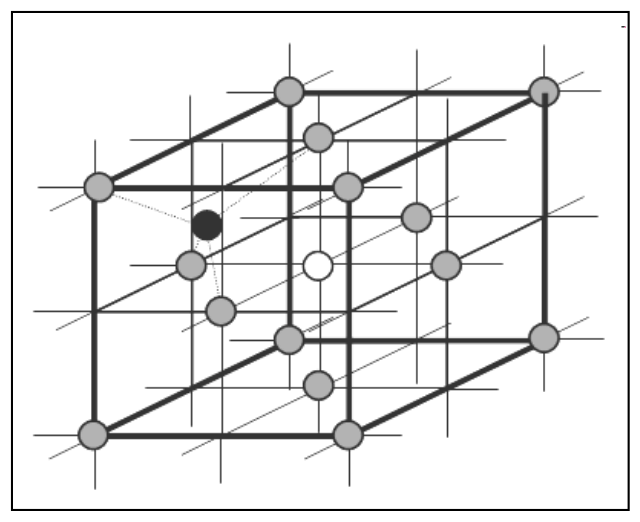
8.3 How many available octahedral sites for iron ions are there in one \(\ce{AB2O4}\) unit? Certain sites are shared by neighbouring units.
\(\ce{AB2O4}\) can adopt a normal- or an inverse-spinel structure. In normal-spinel structure, two B ions occupy two of the octahedral sites and one A occupies one of the tetrahedral sites. In an inverse-spinel structure, one of the two B ions occupies a tetrahedral site. The other B ion and the one A ion occupy octahedral sites.
8.4 What percentage of available tetrahedral sites is occupied by either \(\ce{Fe^2+}\) or \(\ce{Fe^3+}\) ion in \(\ce{Fe3O4}\)?
8.5 \(\ce{Fe3O4}\) has an inverse-spinel structure. Draw the crystal field splitting pattern of \(\ce{Fe^2+}\) and fill out the electrons. The electron pairing energy is greater than the octahedral field splitting.
Official English text of the problem.
Answers
- 8.1: (1) Carbon, \(\ce{C(s)}\); (2) carbon, \(\ce{C(s)}\); (3) carbon monoxide, \(\ce{CO}\),
[C-]#[O+]. - 8.2: \(\ce{Fe2O3(s) + 3CO(g) -> 2Fe(s) + 3CO2(g)}\). At \(1200\,^\circ\mathrm{C}\), \(\boxed{K\approx47.9}\), dimensionless, using the supplied thermodynamic data without temperature corrections.
- 8.3: \(\boxed{4}\) available octahedral sites per \(\ce{AB2O4}\) formula unit.
- 8.4: \(\boxed{12.5\%}\) of the available tetrahedral sites are occupied.
- 8.5: Iron(II), \(\ce{Fe^2+}\),
[Fe+2], is octahedral and high spin: \(\boxed{t_{2g}^{4}e_g^{2}}\). The lower three orbitals contain one pair and two single electrons; the upper two each contain one electron. There are four unpaired electrons.
Solution
8.1 — Reducing agents
The reducing agent is the species that is oxidized.
- Reaction (1) is \[ \ce{C(s) + O2(g) -> CO2(g)}. \] Carbon changes from oxidation state \(0\) to \(+4\), while oxygen changes from \(0\) to \(-2\). Thus carbon is the reducing agent.
The molecular species are dioxygen, \(\ce{O2}\), O=O, and carbon dioxide, \(\ce{CO2}\), O=C=O.
- Reaction (2) is \[ \ce{CO2(g) + C(s) -> 2CO(g)}. \] The carbon initially present as \(\ce{C(s)}\) changes from \(0\) to \(+2\). The carbon initially present in carbon dioxide changes from \(+4\) to \(+2\). Thus solid carbon is the reducing agent.
The product is carbon monoxide, \(\ce{CO}\), [C-]#[O+].
- In reaction (3), carbon in carbon monoxide changes from \(+2\) to \(+4\), while iron in iron(III) oxide changes from \(+3\) to \(0\). Thus carbon monoxide is the reducing agent.
8.2 — Balanced equation and equilibrium constant
Two iron atoms must be produced per formula unit of iron(III) oxide. Its three oxygen atoms convert three carbon monoxide molecules into carbon dioxide:
\[ \boxed{\ce{Fe2O3(s) + 3CO(g) -> 2Fe(s) + 3CO2(g)}}. \]
First obtain the standard formation enthalpy of carbon monoxide. Adding reactions (1) and (2) gives
\[ \ce{2C(s) + O2(g) -> 2CO(g)}, \]
with enthalpy
\[ -393.51+172.46=-221.05\ \mathrm{kJ\,mol^{-1}}. \]
Therefore,
\[ \Delta_{\mathrm f}H^\circ(\ce{CO(g)}) =\frac{-221.05}{2} =-110.525\ \mathrm{kJ\,mol^{-1}}. \]
Reaction (1) also gives
\[ \Delta_{\mathrm f}H^\circ(\ce{CO2(g)}) =-393.51\ \mathrm{kJ\,mol^{-1}}. \]
Using zero standard formation enthalpy for elemental iron,
\[ \begin{aligned} \Delta_{\mathrm r}H^\circ &=\left[2(0)+3(-393.51)\right] -\left[-824.2+3(-110.525)\right]\\ &=-24.755\ \mathrm{kJ\,mol^{-1}} \approx-24.8\ \mathrm{kJ\,mol^{-1}}. \end{aligned} \]
The standard reaction entropy is
\[ \begin{aligned} \Delta_{\mathrm r}S^\circ &=\left[2S^\circ(\ce{Fe(s)})+3S^\circ(\ce{CO2(g)})\right]\\ &\quad-\left[S^\circ(\ce{Fe2O3(s)})+3S^\circ(\ce{CO(g)})\right]\\ &=2(27.28)+3(213.74)-87.40-3(197.674)\\ &=15.358\ \mathrm{J\,mol^{-1}\,K^{-1}}. \end{aligned} \]
No heat capacities or phase-transition data are supplied, so use these enthalpy and entropy values without temperature corrections. At
\[ T=1200+273.15=1473.15\ \mathrm K, \]
the standard Gibbs energy change is
\[ \begin{aligned} \Delta_{\mathrm r}G^\circ &=\Delta_{\mathrm r}H^\circ-T\Delta_{\mathrm r}S^\circ\\ &=-24.755-(1473.15)(0.015358)\\ &=-47.3796\ \mathrm{kJ\,mol^{-1}}. \end{aligned} \]
Since
\[ \Delta_{\mathrm r}G^\circ=-RT\ln K, \]
using \(R=8.314\ \mathrm{J\,mol^{-1}\,K^{-1}}\),
\[ \ln K =\frac{47379.6}{(8.314)(1473.15)} \approx3.868, \]
and hence
\[ \boxed{K=e^{3.868}\approx47.9}. \]
For pure solid phases and ideal gases, the dimensionless equilibrium constant is
\[ K= \frac{(p_{\ce{CO2}}/p^\circ)^3} {(p_{\ce{CO}}/p^\circ)^3} = \left(\frac{p_{\ce{CO2}}}{p_{\ce{CO}}}\right)^3. \]
8.3 — Number of available octahedral sites
The oxide ion is \(\ce{O^2-}\), [O-2]. Its SMILES specifies the individual ion; the fcc arrangement is a property of the extended crystal.
A conventional cell of the fcc oxygen array contains
\[ N_{\mathrm O}=8\left(\frac18\right)+6\left(\frac12\right)=4 \]
oxide ions. Thus its oxygen content corresponds to one \(\ce{AB2O4}\) formula unit.
Octahedral sites occur at the body center and at the twelve edge centers. The body-center site belongs entirely to the cell, while each edge-center site is shared by four cells:
\[ N_{\mathrm{oct}} =1+12\left(\frac14\right) =\boxed{4}. \]
These are the available octahedral sites; only two are occupied per formula unit in either spinel arrangement described.
8.4 — Fraction of tetrahedral sites occupied
The fcc oxygen cell has eight tetrahedral sites, all inside the cell, at positions whose fractional coordinates are independently \(1/4\) or \(3/4\). Therefore, there are eight available tetrahedral sites per four oxide ions, or per \(\ce{AB2O4}\) formula unit.
Exactly one tetrahedral site is occupied per formula unit:
- In normal spinel, its occupant is iron(II), \(\ce{Fe^2+}\),
[Fe+2]. - In inverse spinel, its occupant is iron(III), \(\ce{Fe^3+}\),
[Fe+3].
Consequently, the percentage is the same for either arrangement:
\[ \boxed{ \frac{1\text{ occupied tetrahedral site}} {8\text{ available tetrahedral sites}} \times100\%=12.5\%. } \]
8.5 — Crystal-field splitting and electron occupation
In inverse-spinel magnetite, the divalent iron ion occupies an octahedral site. Iron(II), \(\ce{Fe^2+}\), has the configuration \([\mathrm{Ar}]\,3d^6\).
An octahedral crystal field splits the five \(d\) orbitals into:
- Three lower-energy \(t_{2g}\) orbitals: \(d_{xy}\), \(d_{xz}\), and \(d_{yz}\), each at \(-\frac25\Delta_o\) relative to the barycenter.
- Two higher-energy \(e_g\) orbitals: \(d_{z^2}\) and \(d_{x^2-y^2}\), each at \(+\frac35\Delta_o\).
Because the pairing energy exceeds \(\Delta_o\), the configuration is high spin. The first five electrons singly occupy the five orbitals with parallel spins; the sixth pairs in a lower \(t_{2g}\) orbital:
\[ \boxed{t_{2g}^{4}e_g^{2}}. \]
The requested drawing should have energy increasing upward, with three equal-height orbital lines below two equal-height orbital lines, separated by \(\Delta_o\). Put an up-arrow and a down-arrow in one lower orbital, and one up-arrow in each of the other four orbitals. Any of the three lower orbitals may contain the pair.
This gives one electron pair and four unpaired electrons. The ionic SMILES [Fe+2] does not encode the octahedral coordination geometry or these orbital occupations.
The solution was checked against the official solution.
IChO 2006 · Theorieaufgabe 8
Chemie der Eisenoxide
Der Atomkern von Eisen ist der stabilste unter allen Elementen. Daher reichert sich Eisen im Kern massereicher Roter Riesen an, wo die Nukleosynthese vieler lebenswichtiger Elemente (wie \(\ce{C}\), \(\ce{N}\), \(\ce{O}\), \(\ce{P}\), \(\ce{S}\) usw.) stattfindet. Deshalb ist Eisen unter den schweren Elementen im Universum recht häufig. Auch auf der Erde kommt Eisen häufig vor.
Die Entwicklung einer Technologie zur Reduktion von Eisenoxid zu Eisen war ein entscheidender Schritt in der menschlichen Zivilisation. Die wichtigsten Reaktionen, die im Hochofen ablaufen, sind im Folgenden zusammengefasst.
8.1 Geben Sie für jede Reaktion das Reduktionsmittel an.
8.2 Gleichen Sie Reaktion (3) aus und berechnen Sie die Gleichgewichtskonstante der Reaktion (3) bei \(1200\,^\circ\mathrm{C}\). \(\Delta H_{\mathrm f}^{\circ}(\ce{Fe2O3(s)} = -824.2\ \mathrm{kJ\,mol^{-1}}\),
\(S^\circ\ (\mathrm{J\,mol^{-1}\,K^{-1}})\): \(\ce{Fe(s)} = 27.28\), \(\ce{Fe2O3(s)} = 87.40\), \(\ce{C(s)} = 5.74\), \(\ce{CO(g)} = 197.674\), \(\ce{CO2(g)} = 213.74\)
Bei der Herstellung von Seladonkeramik wird \(\ce{Fe2O3}\) in einem mit Holzkohle befeuerten Brennofen teilweise zu einem Gemisch der Oxide \(\ce{Fe3O4}\) und \(\ce{FeO}\) reduziert. Die Mengen der verschiedenen Oxide scheinen mit der „mystischen“ Farbe der Seladonkeramik zusammenzuhängen. \(\ce{Fe3O4}\) (Magnetit) selbst ist ein Mischoxid, das \(\ce{Fe^2+}\)- und \(\ce{Fe^3+}\)-Ionen enthält und zu einer Gruppe von Verbindungen mit der allgemeinen Formel \(\ce{AB2O4}\) gehört. Die Oxidionen bilden eine kubisch flächenzentrierte Anordnung. Die Abbildung zeigt die Anordnung der Sauerstoffionen (graue Kreise) und repräsentative Plätze für zweiwertige A- und dreiwertige B-Kationen. Der dunkle Kreis stellt einen Tetraederplatz und der weiße Kreis einen Oktaederplatz dar.
8.3 Wie viele verfügbare Oktaederplätze für Eisenionen gibt es in einer \(\ce{AB2O4}\)-Einheit? Bestimmte Plätze werden von benachbarten Einheiten gemeinsam genutzt.
\(\ce{AB2O4}\) kann eine normale oder eine inverse Spinellstruktur annehmen. In der normalen Spinellstruktur besetzen zwei B-Ionen zwei der Oktaederplätze, und ein A-Ion besetzt einen der Tetraederplätze. In einer inversen Spinellstruktur besetzt eines der beiden B-Ionen einen Tetraederplatz. Das andere B-Ion und das eine A-Ion besetzen Oktaederplätze.
8.4 Wie viel Prozent der verfügbaren Tetraederplätze sind in \(\ce{Fe3O4}\) durch ein \(\ce{Fe^2+}\)- oder ein \(\ce{Fe^3+}\)-Ion besetzt?
8.5 \(\ce{Fe3O4}\) besitzt eine inverse Spinellstruktur. Zeichnen Sie das Kristallfeldaufspaltungsschema von \(\ce{Fe^2+}\) und tragen Sie die Elektronen ein. Die Elektronenpaarungsenergie ist größer als die oktaedrische Feldaufspaltung.
Aufgabentext aus dem offiziellen englischen Text übersetzt.
Antworten
- 8.1: (1) Kohlenstoff, \(\ce{C(s)}\); (2) Kohlenstoff, \(\ce{C(s)}\); (3) Kohlenstoffmonoxid, \(\ce{CO}\),
[C-]#[O+]. - 8.2: \(\ce{Fe2O3(s) + 3CO(g) -> 2Fe(s) + 3CO2(g)}\). Bei \(1200\,^\circ\mathrm{C}\) gilt \(\boxed{K\approx47.9}\), dimensionslos, unter Verwendung der angegebenen thermodynamischen Daten ohne Temperaturkorrekturen.
- 8.3: \(\boxed{4}\) verfügbare Oktaederplätze pro \(\ce{AB2O4}\)-Formeleinheit.
- 8.4: \(\boxed{12.5\%}\) der verfügbaren Tetraederplätze sind besetzt.
- 8.5: Eisen(II), \(\ce{Fe^2+}\),
[Fe+2], ist oktaedrisch koordiniert und liegt im High-Spin-Zustand vor: \(\boxed{t_{2g}^{4}e_g^{2}}\). Die drei unteren Orbitale enthalten ein Elektronenpaar und zwei einzelne Elektronen; die beiden oberen enthalten jeweils ein Elektron. Es gibt vier ungepaarte Elektronen.
Lösung
8.1 — Reduktionsmittel
Das Reduktionsmittel ist die Spezies, die oxidiert wird.
- Reaktion (1) lautet \[ \ce{C(s) + O2(g) -> CO2(g)}. \] Die Oxidationszahl des Kohlenstoffs ändert sich von \(0\) zu \(+4\), während sich die des Sauerstoffs von \(0\) zu \(-2\) ändert. Somit ist Kohlenstoff das Reduktionsmittel.
Die molekularen Spezies sind Disauerstoff, \(\ce{O2}\), O=O, und Kohlenstoffdioxid, \(\ce{CO2}\), O=C=O.
- Reaktion (2) lautet \[ \ce{CO2(g) + C(s) -> 2CO(g)}. \] Die Oxidationszahl des ursprünglich als \(\ce{C(s)}\) vorliegenden Kohlenstoffs ändert sich von \(0\) zu \(+2\). Die Oxidationszahl des ursprünglich im Kohlenstoffdioxid vorliegenden Kohlenstoffs ändert sich von \(+4\) zu \(+2\). Somit ist fester Kohlenstoff das Reduktionsmittel.
Das Produkt ist Kohlenstoffmonoxid, \(\ce{CO}\), [C-]#[O+].
- In Reaktion (3) ändert sich die Oxidationszahl des Kohlenstoffs im Kohlenstoffmonoxid von \(+2\) zu \(+4\), während sich die des Eisens im Eisen(III)-oxid von \(+3\) zu \(0\) ändert. Somit ist Kohlenstoffmonoxid das Reduktionsmittel.
8.2 — Ausgeglichene Reaktionsgleichung und Gleichgewichtskonstante
Pro Formeleinheit Eisen(III)-oxid müssen zwei Eisenatome entstehen. Seine drei Sauerstoffatome wandeln drei Kohlenstoffmonoxidmoleküle in Kohlenstoffdioxid um:
\[ \boxed{\ce{Fe2O3(s) + 3CO(g) -> 2Fe(s) + 3CO2(g)}}. \]
Zunächst wird die Standardbildungsenthalpie von Kohlenstoffmonoxid bestimmt. Die Addition der Reaktionen (1) und (2) ergibt
\[ \ce{2C(s) + O2(g) -> 2CO(g)}, \]
mit der Enthalpie
\[ -393.51+172.46=-221.05\ \mathrm{kJ\,mol^{-1}}. \]
Daher gilt
\[ \Delta_{\mathrm f}H^\circ(\ce{CO(g)}) =\frac{-221.05}{2} =-110.525\ \mathrm{kJ\,mol^{-1}}. \]
Aus Reaktion (1) folgt außerdem
\[ \Delta_{\mathrm f}H^\circ(\ce{CO2(g)}) =-393.51\ \mathrm{kJ\,mol^{-1}}. \]
Mit einer Standardbildungsenthalpie von null für elementares Eisen erhält man
\[ \begin{aligned} \Delta_{\mathrm r}H^\circ &=\left[2(0)+3(-393.51)\right] -\left[-824.2+3(-110.525)\right]\\ &=-24.755\ \mathrm{kJ\,mol^{-1}} \approx-24.8\ \mathrm{kJ\,mol^{-1}}. \end{aligned} \]
Die Standardreaktionsentropie beträgt
\[ \begin{aligned} \Delta_{\mathrm r}S^\circ &=\left[2S^\circ(\ce{Fe(s)})+3S^\circ(\ce{CO2(g)})\right]\\ &\quad-\left[S^\circ(\ce{Fe2O3(s)})+3S^\circ(\ce{CO(g)})\right]\\ &=2(27.28)+3(213.74)-87.40-3(197.674)\\ &=15.358\ \mathrm{J\,mol^{-1}\,K^{-1}}. \end{aligned} \]
Da keine Wärmekapazitäten oder Daten zu Phasenübergängen angegeben sind, werden diese Enthalpie- und Entropiewerte ohne Temperaturkorrekturen verwendet. Bei
\[ T=1200+273.15=1473.15\ \mathrm K, \]
beträgt die Änderung der Gibbs-Energie unter Standardbedingungen
\[ \begin{aligned} \Delta_{\mathrm r}G^\circ &=\Delta_{\mathrm r}H^\circ-T\Delta_{\mathrm r}S^\circ\\ &=-24.755-(1473.15)(0.015358)\\ &=-47.3796\ \mathrm{kJ\,mol^{-1}}. \end{aligned} \]
Da
\[ \Delta_{\mathrm r}G^\circ=-RT\ln K, \]
gilt, erhält man mit \(R=8.314\ \mathrm{J\,mol^{-1}\,K^{-1}}\)
\[ \ln K =\frac{47379.6}{(8.314)(1473.15)} \approx3.868, \]
und damit
\[ \boxed{K=e^{3.868}\approx47.9}. \]
Für reine feste Phasen und ideale Gase lautet die dimensionslose Gleichgewichtskonstante
\[ K= \frac{(p_{\ce{CO2}}/p^\circ)^3} {(p_{\ce{CO}}/p^\circ)^3} = \left(\frac{p_{\ce{CO2}}}{p_{\ce{CO}}}\right)^3. \]
8.3 — Anzahl der verfügbaren Oktaederplätze
Das Oxidion ist \(\ce{O^2-}\), [O-2]. Seine SMILES-Notation beschreibt das einzelne Ion; die kubisch flächenzentrierte Anordnung (fcc) ist eine Eigenschaft des ausgedehnten Kristalls.
Eine konventionelle Elementarzelle der kubisch flächenzentrierten Sauerstoffanordnung enthält
\[ N_{\mathrm O}=8\left(\frac18\right)+6\left(\frac12\right)=4 \]
Oxidionen. Ihr Sauerstoffgehalt entspricht somit einer \(\ce{AB2O4}\)-Formeleinheit.
Oktaederplätze befinden sich im Zentrum der Zelle und in den zwölf Kantenmitten. Der Platz im Zellzentrum gehört vollständig zur Zelle, während jeder Platz in einer Kantenmitte von vier Zellen gemeinsam genutzt wird:
\[ N_{\mathrm{oct}} =1+12\left(\frac14\right) =\boxed{4}. \]
Dies sind die verfügbaren Oktaederplätze; in beiden beschriebenen Spinellanordnungen sind nur zwei pro Formeleinheit besetzt.
8.4 — Anteil der besetzten Tetraederplätze
Die kubisch flächenzentrierte Sauerstoffzelle besitzt acht Tetraederplätze, die alle innerhalb der Zelle liegen und deren relative Koordinaten jeweils unabhängig voneinander \(1/4\) oder \(3/4\) betragen. Daher gibt es acht verfügbare Tetraederplätze pro vier Oxidionen beziehungsweise pro \(\ce{AB2O4}\)-Formeleinheit.
Pro Formeleinheit ist genau ein Tetraederplatz besetzt:
- Im normalen Spinell ist er durch Eisen(II), \(\ce{Fe^2+}\),
[Fe+2], besetzt. - Im inversen Spinell ist er durch Eisen(III), \(\ce{Fe^3+}\),
[Fe+3], besetzt.
Folglich ist der prozentuale Anteil für beide Anordnungen gleich:
\[ \boxed{ \frac{1\text{ besetzter Tetraederplatz}} {8\text{ verfügbare Tetraederplätze}} \times100\%=12.5\%. } \]
8.5 — Kristallfeldaufspaltung und Elektronenbesetzung
Im Magnetit mit inverser Spinellstruktur besetzt das zweiwertige Eisenion einen Oktaederplatz. Eisen(II), \(\ce{Fe^2+}\), besitzt die Elektronenkonfiguration \([\mathrm{Ar}]\,3d^6\).
Ein oktaedrisches Kristallfeld spaltet die fünf \(d\)-Orbitale auf in:
- Drei energetisch tiefer liegende \(t_{2g}\)-Orbitale: \(d_{xy}\), \(d_{xz}\) und \(d_{yz}\), jeweils bei \(-\frac25\Delta_o\) relativ zum Energieschwerpunkt.
- Zwei energetisch höher liegende \(e_g\)-Orbitale: \(d_{z^2}\) und \(d_{x^2-y^2}\), jeweils bei \(+\frac35\Delta_o\).
Da die Paarungsenergie größer als \(\Delta_o\) ist, liegt eine High-Spin-Konfiguration vor. Die ersten fünf Elektronen besetzen die fünf Orbitale einzeln mit parallelen Spins; das sechste bildet in einem der tiefer liegenden \(t_{2g}\)-Orbitale ein Paar:
\[ \boxed{t_{2g}^{4}e_g^{2}}. \]
In der geforderten Zeichnung soll die Energie nach oben zunehmen. Drei Orbitallinien auf gleicher Höhe liegen unterhalb von zwei Orbitallinien auf gleicher Höhe, mit einem Energieabstand von \(\Delta_o\). Tragen Sie in eines der unteren Orbitale einen Aufwärtspfeil und einen Abwärtspfeil ein und in jedes der übrigen vier Orbitale einen Aufwärtspfeil. Das Elektronenpaar kann sich in jedem der drei unteren Orbitale befinden.
Dies ergibt ein Elektronenpaar und vier ungepaarte Elektronen. Die ionische SMILES-Notation [Fe+2] codiert weder die oktaedrische Koordinationsgeometrie noch diese Orbitalbesetzungen.
Die Lösung wurde mit der offiziellen Lösung abgeglichen.
IChO 2006 · Teori sorusu 8
Demir Oksitlerin Kimyası
Demirin çekirdeği tüm elementler arasında en kararlı olanıdır ve bu nedenle demir, yaşam için gerekli birçok elementin (örneğin \(\ce{C}\), \(\ce{N}\), \(\ce{O}\), \(\ce{P}\), \(\ce{S}\) vb.) nükleosentezinin gerçekleştiği büyük kütleli kırmızı dev yıldızların merkezinde birikir. Bunun sonucunda demir, ağır elementler arasında evrende oldukça bol bulunur. Demir, Dünya'da da bol bulunur.
Demir oksidi demire indirgemeye yönelik bir teknolojinin geliştirilmesi, insan uygarlığı için önemli bir adımdı. Yüksek fırında gerçekleşen başlıca tepkimeler aşağıda özetlenmiştir.
8.1 Her tepkimedeki indirgen maddeyi belirtiniz.
8.2 (3) numaralı tepkimeyi denkleştiriniz ve bu tepkimenin \(1200\,^\circ\mathrm{C}\) sıcaklıktaki denge sabitini hesaplayınız. \(\Delta H_{\mathrm f}^{\circ}(\ce{Fe2O3(s)} = -824.2\ \mathrm{kJ\,mol^{-1}}\),
\(S^\circ\ (\mathrm{J\,mol^{-1}\,K^{-1}})\): \(\ce{Fe(s)} = 27.28\), \(\ce{Fe2O3(s)} = 87.40\), \(\ce{C(s)} = 5.74\), \(\ce{CO(g)} = 197.674\), \(\ce{CO2(g)} = 213.74\)
Seladon seramiklerinin üretiminde \(\ce{Fe2O3}\), odun kömürüyle yakılan bir fırında kısmen indirgenerek \(\ce{Fe3O4}\) ve \(\ce{FeO}\) oksitlerinin bir karışımına dönüşür. Farklı oksitlerin miktarları, seladon seramiklerinin “gizemli” rengiyle ilişkili görünmektedir. \(\ce{Fe3O4}\) (manyetit), kendisi de \(\ce{Fe^2+}\) ve \(\ce{Fe^3+}\) iyonları içeren bir karma oksittir ve genel formülü \(\ce{AB2O4}\) olan bir bileşik grubuna aittir. Oksit iyonları yüzey merkezli kübik bir dizilim oluşturur. Şekil, oksijenlerin dizilimini (gri daireler) ve iki değerlikli A ile üç değerlikli B katyonları için temsili konumları göstermektedir. Koyu renkli daire bir tetrahedral boşluğu, beyaz daire ise bir oktahedral boşluğu temsil etmektedir.
8.3 Bir \(\ce{AB2O4}\) biriminde demir iyonlarının yerleşebileceği kaç oktahedral boşluk vardır? Bazı boşluklar komşu birimler tarafından paylaşılır.
\(\ce{AB2O4}\), normal veya ters spinel yapısını benimseyebilir. Normal spinel yapısında iki B iyonu oktahedral boşluklardan ikisini, bir A iyonu ise tetrahedral boşluklardan birini doldurur. Ters spinel yapısında iki B iyonundan biri tetrahedral bir boşluğu doldurur. Diğer B iyonu ve bir A iyonu ise oktahedral boşlukları doldurur.
8.4 \(\ce{Fe3O4}\) içindeki mevcut tetrahedral boşlukların yüzde kaçı \(\ce{Fe^2+}\) veya \(\ce{Fe^3+}\) iyonlarından biri tarafından doldurulur?
8.5 \(\ce{Fe3O4}\) ters spinel yapısına sahiptir. \(\ce{Fe^2+}\) iyonunun kristal alan yarılma diyagramını çiziniz ve elektronları yerleştiriniz. Elektron eşleşme enerjisi, oktahedral alan yarılma enerjisinden büyüktür.
Soru metni resmi İngilizce metinden çevrilmiştir.
Cevaplar
- 8.1: (1) Karbon, \(\ce{C(s)}\); (2) karbon, \(\ce{C(s)}\); (3) karbon monoksit, \(\ce{CO}\),
[C-]#[O+]. - 8.2: \(\ce{Fe2O3(s) + 3CO(g) -> 2Fe(s) + 3CO2(g)}\). Verilen termodinamik veriler sıcaklık düzeltmesi yapılmadan kullanıldığında, \(1200\,^\circ\mathrm{C}\) sıcaklıkta boyutsuz denge sabiti \(\boxed{K\approx47.9}\) olur.
- 8.3: Her \(\ce{AB2O4}\) formül birimi başına \(\boxed{4}\) kullanılabilir oktahedral boşluk vardır.
- 8.4: Mevcut tetrahedral boşlukların \(\boxed{12.5\%}\)'i doludur.
- 8.5: Demir(II), \(\ce{Fe^2+}\),
[Fe+2], oktahedral çevrede bulunur ve yüksek spinlidir: \(\boxed{t_{2g}^{4}e_g^{2}}\). Alttaki üç orbitalde bir elektron çifti ve iki tek elektron bulunur; üstteki iki orbitalin her birinde bir elektron bulunur. Dört eşleşmemiş elektron vardır.
Çözüm
8.1 — İndirgen maddeler
İndirgen madde, yükseltgenen türdür.
- (1) numaralı tepkime şöyledir: \[ \ce{C(s) + O2(g) -> CO2(g)}. \] Karbonun yükseltgenme basamağı \(0\)'dan \(+4\)'e, oksijeninki ise \(0\)'dan \(-2\)'ye değişir. Dolayısıyla indirgen madde karbondur.
Moleküler türler dioksijen, \(\ce{O2}\), O=O, ve karbon dioksittir, \(\ce{CO2}\), O=C=O.
- (2) numaralı tepkime şöyledir: \[ \ce{CO2(g) + C(s) -> 2CO(g)}. \] Başlangıçta \(\ce{C(s)}\) hâlinde bulunan karbonun yükseltgenme basamağı \(0\)'dan \(+2\)'ye değişir. Başlangıçta karbon dioksitte bulunan karbonun yükseltgenme basamağı ise \(+4\)'ten \(+2\)'ye değişir. Dolayısıyla indirgen madde katı karbondur.
Ürün karbon monoksittir, \(\ce{CO}\), [C-]#[O+].
- (3) numaralı tepkimede karbon monoksitteki karbonun yükseltgenme basamağı \(+2\)'den \(+4\)'e, demir(III) oksitteki demirinki ise \(+3\)'ten \(0\)'a değişir. Dolayısıyla indirgen madde karbon monoksittir.
8.2 — Denkleştirilmiş tepkime ve denge sabiti
Demir(III) oksidin her formül birimi başına iki demir atomu oluşmalıdır. İçerdiği üç oksijen atomu, üç karbon monoksit molekülünü karbon dioksite dönüştürür:
\[ \boxed{\ce{Fe2O3(s) + 3CO(g) -> 2Fe(s) + 3CO2(g)}}. \]
Önce karbon monoksidin standart oluşum entalpisini bulalım. (1) ve (2) numaralı tepkimeler toplandığında
\[ \ce{2C(s) + O2(g) -> 2CO(g)}, \]
tepkimesi elde edilir ve entalpisi şöyledir:
\[ -393.51+172.46=-221.05\ \mathrm{kJ\,mol^{-1}}. \]
Dolayısıyla,
\[ \Delta_{\mathrm f}H^\circ(\ce{CO(g)}) =\frac{-221.05}{2} =-110.525\ \mathrm{kJ\,mol^{-1}}. \]
(1) numaralı tepkime ayrıca şu değeri verir:
\[ \Delta_{\mathrm f}H^\circ(\ce{CO2(g)}) =-393.51\ \mathrm{kJ\,mol^{-1}}. \]
Elementel demirin standart oluşum entalpisini sıfır alarak,
\[ \begin{aligned} \Delta_{\mathrm r}H^\circ &=\left[2(0)+3(-393.51)\right] -\left[-824.2+3(-110.525)\right]\\ &=-24.755\ \mathrm{kJ\,mol^{-1}} \approx-24.8\ \mathrm{kJ\,mol^{-1}}. \end{aligned} \]
Standart tepkime entropisi şöyledir:
\[ \begin{aligned} \Delta_{\mathrm r}S^\circ &=\left[2S^\circ(\ce{Fe(s)})+3S^\circ(\ce{CO2(g)})\right]\\ &\quad-\left[S^\circ(\ce{Fe2O3(s)})+3S^\circ(\ce{CO(g)})\right]\\ &=2(27.28)+3(213.74)-87.40-3(197.674)\\ &=15.358\ \mathrm{J\,mol^{-1}\,K^{-1}}. \end{aligned} \]
Isı kapasitesi veya faz geçişi verileri verilmediğinden, bu entalpi ve entropi değerlerini sıcaklık düzeltmesi yapmadan kullanalım.
\[ T=1200+273.15=1473.15\ \mathrm K, \]
sıcaklığında standart Gibbs enerjisi değişimi şöyledir:
\[ \begin{aligned} \Delta_{\mathrm r}G^\circ &=\Delta_{\mathrm r}H^\circ-T\Delta_{\mathrm r}S^\circ\\ &=-24.755-(1473.15)(0.015358)\\ &=-47.3796\ \mathrm{kJ\,mol^{-1}}. \end{aligned} \]
\[ \Delta_{\mathrm r}G^\circ=-RT\ln K, \]
olduğundan, \(R=8.314\ \mathrm{J\,mol^{-1}\,K^{-1}}\) kullanılarak,
\[ \ln K =\frac{47379.6}{(8.314)(1473.15)} \approx3.868, \]
ve buradan
\[ \boxed{K=e^{3.868}\approx47.9}. \]
Saf katı fazlar ve ideal gazlar için boyutsuz denge sabiti şöyledir:
\[ K= \frac{(p_{\ce{CO2}}/p^\circ)^3} {(p_{\ce{CO}}/p^\circ)^3} = \left(\frac{p_{\ce{CO2}}}{p_{\ce{CO}}}\right)^3. \]
8.3 — Kullanılabilir oktahedral boşlukların sayısı
Oksit iyonu \(\ce{O^2-}\), [O-2], biçimindedir. SMILES gösterimi tek bir iyonu belirtir; yüzey merkezli kübik (fcc) dizilim ise kristalin bütününe ait bir özelliktir.
Yüzey merkezli kübik oksijen diziliminin geleneksel birim hücresi
\[ N_{\mathrm O}=8\left(\frac18\right)+6\left(\frac12\right)=4 \]
oksit iyonu içerir. Dolayısıyla oksijen içeriği, bir \(\ce{AB2O4}\) formül birimine karşılık gelir.
Oktahedral boşluklar gövde merkezinde ve on iki kenarın merkezlerinde bulunur. Gövde merkezindeki boşluk tümüyle hücreye aitken, kenar merkezlerindeki her boşluk dört hücre tarafından paylaşılır:
\[ N_{\mathrm{oct}} =1+12\left(\frac14\right) =\boxed{4}. \]
Bunlar kullanılabilir oktahedral boşluklardır; açıklanan her iki spinel düzeninde de formül birimi başına bunların yalnızca ikisi doludur.
8.4 — Dolu tetrahedral boşlukların oranı
Yüzey merkezli kübik oksijen hücresinde, tamamı hücrenin içinde olan ve kesirli koordinatlarının her biri bağımsız olarak \(1/4\) veya \(3/4\) değerini alan konumlarda sekiz tetrahedral boşluk bulunur. Bu nedenle her dört oksit iyonu başına veya her \(\ce{AB2O4}\) formül birimi başına kullanılabilir sekiz tetrahedral boşluk vardır.
Her formül birimi başına tam olarak bir tetrahedral boşluk doludur:
- Normal spinelde bu boşluğu dolduran iyon demir(II), \(\ce{Fe^2+}\),
[Fe+2], iyonudur. - Ters spinelde bu boşluğu dolduran iyon demir(III), \(\ce{Fe^3+}\),
[Fe+3], iyonudur.
Sonuç olarak, her iki düzen için de yüzde aynıdır:
\[ \boxed{ \frac{1\text{ dolu tetrahedral boşluk}} {8\text{ kullanılabilir tetrahedral boşluk}} \times100\%=12.5\%. } \]
8.5 — Kristal alan yarılması ve elektronların yerleşimi
Ters spinel yapısındaki manyetitte iki değerlikli demir iyonu bir oktahedral boşluğu doldurur. Demir(II), \(\ce{Fe^2+}\), \([\mathrm{Ar}]\,3d^6\) elektron dizilimine sahiptir.
Oktahedral bir kristal alan, beş \(d\) orbitalini şu şekilde ayırır:
- Daha düşük enerjili üç \(t_{2g}\) orbitali: \(d_{xy}\), \(d_{xz}\) ve \(d_{yz}\); her biri enerji ağırlık merkezine göre \(-\frac25\Delta_o\) düzeyindedir.
- Daha yüksek enerjili iki \(e_g\) orbitali: \(d_{z^2}\) ve \(d_{x^2-y^2}\); her biri \(+\frac35\Delta_o\) düzeyindedir.
Eşleşme enerjisi \(\Delta_o\)'dan büyük olduğundan dizilim yüksek spinlidir. İlk beş elektron, paralel spinlerle beş orbitale birer birer yerleşir; altıncı elektron daha düşük enerjili bir \(t_{2g}\) orbitalinde eşleşir:
\[ \boxed{t_{2g}^{4}e_g^{2}}. \]
İstenen çizimde enerji yukarı doğru artmalı; aynı yükseklikteki üç orbital çizgisi, aynı yükseklikteki iki orbital çizgisinin altında yer almalı ve iki düzey arasında \(\Delta_o\) kadar fark bulunmalıdır. Alttaki orbitallerden birine bir yukarı ok ve bir aşağı ok, diğer dört orbitalin her birine ise bir yukarı ok yerleştiriniz. Elektron çifti, alttaki üç orbitalden herhangi birinde bulunabilir.
Böylece bir elektron çifti ve dört eşleşmemiş elektron elde edilir. İyonik SMILES gösterimi [Fe+2], oktahedral koordinasyon geometrisini veya elektronların bu orbitallere yerleşimini kodlamaz.
Çözüm, resmi çözümle karşılaştırılarak kontrol edildi.
IChO 2006 · Problema teórico 8
Química de los óxidos de hierro
El núcleo del hierro es el más estable de todos los elementos y, por tanto, el hierro se acumula en el núcleo de las estrellas gigantes rojas masivas, donde tiene lugar la nucleosíntesis de muchos elementos esenciales para la vida (como \(\ce{C}\), \(\ce{N}\), \(\ce{O}\), \(\ce{P}\), \(\ce{S}\), etc.). Como resultado, entre los elementos pesados, el hierro es bastante abundante en el universo. El hierro también es abundante en la Tierra.
El desarrollo de una tecnología para reducir el óxido de hierro a hierro fue un paso clave en la civilización humana. A continuación se resumen las reacciones principales que tienen lugar en el alto horno.
8.1 Indique el agente reductor en cada reacción.
8.2 Ajuste la reacción (3) y calcule la constante de equilibrio de la reacción (3) a \(1200\,^\circ\mathrm{C}\). \(\Delta H_{\mathrm f}^{\circ}(\ce{Fe2O3(s)} = -824.2\ \mathrm{kJ\,mol^{-1}}\),
\(S^\circ\ (\mathrm{J\,mol^{-1}\,K^{-1}})\): \(\ce{Fe(s)} = 27.28\), \(\ce{Fe2O3(s)} = 87.40\), \(\ce{C(s)} = 5.74\), \(\ce{CO(g)} = 197.674\), \(\ce{CO2(g)} = 213.74\)
En la fabricación de cerámica celadón, el \(\ce{Fe2O3}\) se reduce parcialmente en un horno de carbón vegetal a óxidos mixtos de \(\ce{Fe3O4}\) y \(\ce{FeO}\). La cantidad de los distintos óxidos parece estar relacionada con el color «místico» de la cerámica celadón. El propio \(\ce{Fe3O4}\) (magnetita) es un óxido mixto que contiene iones \(\ce{Fe^2+}\) y \(\ce{Fe^3+}\) y pertenece a un grupo de compuestos de fórmula general \(\ce{AB2O4}\). Los iones óxido forman una disposición cúbica centrada en las caras. La figura muestra la disposición de los oxígenos (círculos grises) y posiciones representativas para los cationes divalentes A y trivalentes B. El círculo oscuro representa un hueco tetraédrico y el círculo blanco, un hueco octaédrico.
8.3 ¿Cuántos huecos octaédricos disponibles para los iones de hierro hay en una unidad de \(\ce{AB2O4}\)? Algunos huecos son compartidos por unidades vecinas.
El \(\ce{AB2O4}\) puede adoptar una estructura de espinela normal o inversa. En la estructura de espinela normal, dos iones B ocupan dos de los huecos octaédricos y un ion A ocupa uno de los huecos tetraédricos. En una estructura de espinela inversa, uno de los dos iones B ocupa un hueco tetraédrico. El otro ion B y el ion A ocupan huecos octaédricos.
8.4 ¿Qué porcentaje de los huecos tetraédricos disponibles está ocupado por iones \(\ce{Fe^2+}\) o \(\ce{Fe^3+}\) en el \(\ce{Fe3O4}\)?
8.5 El \(\ce{Fe3O4}\) tiene una estructura de espinela inversa. Dibuje el diagrama de desdoblamiento del campo cristalino del \(\ce{Fe^2+}\) y distribuya los electrones. La energía de apareamiento electrónico es mayor que la energía de desdoblamiento del campo octaédrico.
Enunciado traducido del texto oficial en inglés.
Respuestas
- 8.1: (1) Carbono, \(\ce{C(s)}\); (2) carbono, \(\ce{C(s)}\); (3) monóxido de carbono, \(\ce{CO}\),
[C-]#[O+]. - 8.2: \(\ce{Fe2O3(s) + 3CO(g) -> 2Fe(s) + 3CO2(g)}\). A \(1200\,^\circ\mathrm{C}\), \(\boxed{K\approx47.9}\), adimensional, utilizando los datos termodinámicos proporcionados sin correcciones por temperatura.
- 8.3: \(\boxed{4}\) huecos octaédricos disponibles por unidad fórmula de \(\ce{AB2O4}\).
- 8.4: El \(\boxed{12.5\%}\) de los huecos tetraédricos disponibles está ocupado.
- 8.5: El hierro(II), \(\ce{Fe^2+}\),
[Fe+2], presenta coordinación octaédrica y espín alto: \(\boxed{t_{2g}^{4}e_g^{2}}\). Los tres orbitales inferiores contienen un par de electrones y dos electrones individuales; cada uno de los dos superiores contiene un electrón. Hay cuatro electrones desapareados.
Solución
8.1 — Agentes reductores
El agente reductor es la especie que se oxida.
- La reacción (1) es \[ \ce{C(s) + O2(g) -> CO2(g)}. \] El carbono pasa del estado de oxidación \(0\) al \(+4\), mientras que el oxígeno pasa de \(0\) a \(-2\). Por tanto, el carbono es el agente reductor.
Las especies moleculares son el dioxígeno, \(\ce{O2}\), O=O, y el dióxido de carbono, \(\ce{CO2}\), O=C=O.
- La reacción (2) es \[ \ce{CO2(g) + C(s) -> 2CO(g)}. \] El carbono presente inicialmente como \(\ce{C(s)}\) pasa de \(0\) a \(+2\). El carbono presente inicialmente en el dióxido de carbono pasa de \(+4\) a \(+2\). Por tanto, el carbono sólido es el agente reductor.
El producto es el monóxido de carbono, \(\ce{CO}\), [C-]#[O+].
- En la reacción (3), el carbono del monóxido de carbono pasa de \(+2\) a \(+4\), mientras que el hierro del óxido de hierro(III) pasa de \(+3\) a \(0\). Por tanto, el monóxido de carbono es el agente reductor.
8.2 — Ecuación ajustada y constante de equilibrio
Deben producirse dos átomos de hierro por unidad fórmula de óxido de hierro(III). Sus tres átomos de oxígeno convierten tres moléculas de monóxido de carbono en dióxido de carbono:
\[ \boxed{\ce{Fe2O3(s) + 3CO(g) -> 2Fe(s) + 3CO2(g)}}. \]
Primero se obtiene la entalpía estándar de formación del monóxido de carbono. Al sumar las reacciones (1) y (2) se obtiene
\[ \ce{2C(s) + O2(g) -> 2CO(g)}, \]
con una entalpía de
\[ -393.51+172.46=-221.05\ \mathrm{kJ\,mol^{-1}}. \]
Por tanto,
\[ \Delta_{\mathrm f}H^\circ(\ce{CO(g)}) =\frac{-221.05}{2} =-110.525\ \mathrm{kJ\,mol^{-1}}. \]
La reacción (1) también da
\[ \Delta_{\mathrm f}H^\circ(\ce{CO2(g)}) =-393.51\ \mathrm{kJ\,mol^{-1}}. \]
Utilizando una entalpía estándar de formación nula para el hierro elemental,
\[ \begin{aligned} \Delta_{\mathrm r}H^\circ &=\left[2(0)+3(-393.51)\right] -\left[-824.2+3(-110.525)\right]\\ &=-24.755\ \mathrm{kJ\,mol^{-1}} \approx-24.8\ \mathrm{kJ\,mol^{-1}}. \end{aligned} \]
La entropía estándar de reacción es
\[ \begin{aligned} \Delta_{\mathrm r}S^\circ &=\left[2S^\circ(\ce{Fe(s)})+3S^\circ(\ce{CO2(g)})\right]\\ &\quad-\left[S^\circ(\ce{Fe2O3(s)})+3S^\circ(\ce{CO(g)})\right]\\ &=2(27.28)+3(213.74)-87.40-3(197.674)\\ &=15.358\ \mathrm{J\,mol^{-1}\,K^{-1}}. \end{aligned} \]
No se proporcionan capacidades caloríficas ni datos de transiciones de fase, por lo que se utilizan estos valores de entalpía y entropía sin correcciones por temperatura. A
\[ T=1200+273.15=1473.15\ \mathrm K, \]
la variación de energía de Gibbs estándar es
\[ \begin{aligned} \Delta_{\mathrm r}G^\circ &=\Delta_{\mathrm r}H^\circ-T\Delta_{\mathrm r}S^\circ\\ &=-24.755-(1473.15)(0.015358)\\ &=-47.3796\ \mathrm{kJ\,mol^{-1}}. \end{aligned} \]
Puesto que
\[ \Delta_{\mathrm r}G^\circ=-RT\ln K, \]
utilizando \(R=8.314\ \mathrm{J\,mol^{-1}\,K^{-1}}\),
\[ \ln K =\frac{47379.6}{(8.314)(1473.15)} \approx3.868, \]
y, por tanto,
\[ \boxed{K=e^{3.868}\approx47.9}. \]
Para fases sólidas puras y gases ideales, la constante de equilibrio adimensional es
\[ K= \frac{(p_{\ce{CO2}}/p^\circ)^3} {(p_{\ce{CO}}/p^\circ)^3} = \left(\frac{p_{\ce{CO2}}}{p_{\ce{CO}}}\right)^3. \]
8.3 — Número de huecos octaédricos disponibles
El ion óxido es \(\ce{O^2-}\), [O-2]. Su SMILES especifica el ion individual; la disposición cúbica centrada en las caras (fcc) es una propiedad del cristal extendido.
Una celda convencional de la disposición fcc de oxígenos contiene
\[ N_{\mathrm O}=8\left(\frac18\right)+6\left(\frac12\right)=4 \]
iones óxido. Por tanto, su contenido de oxígeno corresponde a una unidad fórmula de \(\ce{AB2O4}\).
Los huecos octaédricos se encuentran en el centro de la celda y en los centros de las doce aristas. El hueco del centro de la celda pertenece íntegramente a ella, mientras que cada hueco situado en el centro de una arista es compartido por cuatro celdas:
\[ N_{\mathrm{oct}} =1+12\left(\frac14\right) =\boxed{4}. \]
Estos son los huecos octaédricos disponibles; solo dos están ocupados por unidad fórmula en cualquiera de las dos disposiciones de espinela descritas.
8.4 — Fracción de huecos tetraédricos ocupados
La celda fcc de oxígenos tiene ocho huecos tetraédricos, todos dentro de la celda, en posiciones cuyas coordenadas fraccionarias son, de forma independiente, \(1/4\) o \(3/4\). Por tanto, hay ocho huecos tetraédricos disponibles por cada cuatro iones óxido, o por unidad fórmula de \(\ce{AB2O4}\).
Se ocupa exactamente un hueco tetraédrico por unidad fórmula:
- En la espinela normal, lo ocupa el hierro(II), \(\ce{Fe^2+}\),
[Fe+2]. - En la espinela inversa, lo ocupa el hierro(III), \(\ce{Fe^3+}\),
[Fe+3].
En consecuencia, el porcentaje es el mismo para ambas disposiciones:
\[ \boxed{ \frac{1\text{ hueco tetraédrico ocupado}} {8\text{ huecos tetraédricos disponibles}} \times100\%=12.5\%. } \]
8.5 — Desdoblamiento del campo cristalino y ocupación electrónica
En la magnetita de estructura de espinela inversa, el ion hierro divalente ocupa un hueco octaédrico. El hierro(II), \(\ce{Fe^2+}\), tiene la configuración \([\mathrm{Ar}]\,3d^6\).
Un campo cristalino octaédrico desdobla los cinco orbitales \(d\) en:
- Tres orbitales \(t_{2g}\) de menor energía: \(d_{xy}\), \(d_{xz}\) y \(d_{yz}\), cada uno a \(-\frac25\Delta_o\) respecto al baricentro.
- Dos orbitales \(e_g\) de mayor energía: \(d_{z^2}\) y \(d_{x^2-y^2}\), cada uno a \(+\frac35\Delta_o\).
Como la energía de apareamiento supera \(\Delta_o\), la configuración es de espín alto. Los primeros cinco electrones ocupan individualmente los cinco orbitales con espines paralelos; el sexto se aparea en un orbital \(t_{2g}\) inferior:
\[ \boxed{t_{2g}^{4}e_g^{2}}. \]
El dibujo solicitado debe mostrar la energía aumentando hacia arriba, con tres líneas de orbitales a la misma altura por debajo de dos líneas de orbitales a la misma altura, separadas por \(\Delta_o\). Coloque una flecha hacia arriba y una flecha hacia abajo en uno de los orbitales inferiores, y una flecha hacia arriba en cada uno de los otros cuatro orbitales. Cualquiera de los tres orbitales inferiores puede contener el par.
Esto da un par de electrones y cuatro electrones desapareados. El SMILES iónico [Fe+2] no codifica la geometría de coordinación octaédrica ni estas ocupaciones orbitales.
La solución se comprobó con la solución oficial.
IChO 2006 · 理论题 8
铁氧化物的化学
铁的原子核是所有元素中最稳定的,因此,铁会在大质量红巨星的核心积聚,许多生命必需元素(如 \(\ce{C}\)、\(\ce{N}\)、\(\ce{O}\)、\(\ce{P}\)、\(\ce{S}\) 等)的核合成就在这些核心中发生。因此,在重元素中,铁在宇宙中的丰度相当高。铁在地球上也很丰富。
将铁氧化物还原为铁的技术的发展是人类文明进程中的关键一步。高炉中发生的主要反应概述如下。
8.1 指出每个反应中的还原剂。
8.2 配平反应 (3),并计算反应 (3) 在 \(1200\,^\circ\mathrm{C}\) 时的平衡常数。\(\Delta H_{\mathrm f}^{\circ}(\ce{Fe2O3(s)} = -824.2\ \mathrm{kJ\,mol^{-1}}\),
\(S^\circ\ (\mathrm{J\,mol^{-1}\,K^{-1}})\):\(\ce{Fe(s)} = 27.28\),\(\ce{Fe2O3(s)} = 87.40\),\(\ce{C(s)} = 5.74\),\(\ce{CO(g)} = 197.674\),\(\ce{CO2(g)} = 213.74\)
在青瓷的烧制过程中,\(\ce{Fe2O3}\) 在木炭窑中被部分还原,形成 \(\ce{Fe3O4}\) 和 \(\ce{FeO}\) 的混合氧化物。不同氧化物的含量似乎与青瓷的“神秘”色泽有关。\(\ce{Fe3O4}\)(磁铁矿)本身是一种含有 \(\ce{Fe^2+}\) 和 \(\ce{Fe^3+}\) 离子的混合氧化物,属于通式为 \(\ce{AB2O4}\) 的一类化合物。氧离子按面心立方方式排列。图中显示了氧离子的排列(灰色圆圈),以及二价 A 阳离子和三价 B 阳离子的代表性占位。深色圆圈表示四面体空隙,白色圆圈表示八面体空隙。
8.3 每个 \(\ce{AB2O4}\) 单位中有多少个可供铁离子占据的八面体空隙?某些空隙由相邻的单位共用。
\(\ce{AB2O4}\) 可以采用正尖晶石结构或反尖晶石结构。在正尖晶石结构中,两个 B 离子占据两个八面体空隙,一个 A 离子占据一个四面体空隙。在反尖晶石结构中,两个 B 离子中的一个占据四面体空隙。另一个 B 离子和那个 A 离子占据八面体空隙。
8.4 在 \(\ce{Fe3O4}\) 中,可用的四面体空隙有百分之多少被 \(\ce{Fe^2+}\) 或 \(\ce{Fe^3+}\) 离子占据?
8.5 \(\ce{Fe3O4}\) 具有反尖晶石结构。画出 \(\ce{Fe^2+}\) 的晶体场分裂能级图,并填入电子。电子成对能大于八面体场分裂能。
题目译自官方英文原文。
答案
- 8.1: (1) 碳,\(\ce{C(s)}\);(2) 碳,\(\ce{C(s)}\);(3) 一氧化碳,\(\ce{CO}\),
[C-]#[O+]。 - 8.2: \(\ce{Fe2O3(s) + 3CO(g) -> 2Fe(s) + 3CO2(g)}\)。在 \(1200\,^\circ\mathrm{C}\) 时,使用所给的热力学数据且不作温度校正,得到 \(\boxed{K\approx47.9}\),无量纲。
- 8.3: 每个 \(\ce{AB2O4}\) 化学式单位有 \(\boxed{4}\) 个可用的八面体空隙。
- 8.4: 可用的四面体空隙中有 \(\boxed{12.5\%}\) 被占据。
- 8.5: 铁(II)离子,\(\ce{Fe^2+}\),
[Fe+2],处于八面体配位环境,为高自旋态:\(\boxed{t_{2g}^{4}e_g^{2}}\)。较低的三个轨道中有一对电子和两个单电子;较高的两个轨道各有一个电子。共有四个未成对电子。
解答
8.1 — 还原剂
还原剂是被氧化的物种。
- 反应 (1) 为 \[ \ce{C(s) + O2(g) -> CO2(g)}. \] 碳的氧化态从 \(0\) 变为 \(+4\),而氧的氧化态从 \(0\) 变为 \(-2\)。因此,碳是还原剂。
其中的分子物种为氧气,\(\ce{O2}\),O=O,以及二氧化碳,\(\ce{CO2}\),O=C=O。
- 反应 (2) 为 \[ \ce{CO2(g) + C(s) -> 2CO(g)}. \] 最初以 \(\ce{C(s)}\) 形式存在的碳,其氧化态从 \(0\) 变为 \(+2\)。最初存在于二氧化碳中的碳,其氧化态从 \(+4\) 变为 \(+2\)。因此,固态碳是还原剂。
产物为一氧化碳,\(\ce{CO}\),[C-]#[O+]。
- 在反应 (3) 中,一氧化碳中碳的氧化态从 \(+2\) 变为 \(+4\),而氧化铁中铁的氧化态从 \(+3\) 变为 \(0\)。因此,一氧化碳是还原剂。
8.2 — 配平的方程式与平衡常数
每个氧化铁化学式单位必须生成两个铁原子。其中的三个氧原子将三个一氧化碳分子转化为二氧化碳:
\[ \boxed{\ce{Fe2O3(s) + 3CO(g) -> 2Fe(s) + 3CO2(g)}}. \]
首先求出一氧化碳的标准生成焓。将反应 (1) 和 (2) 相加,得到
\[ \ce{2C(s) + O2(g) -> 2CO(g)}, \]
其焓变为
\[ -393.51+172.46=-221.05\ \mathrm{kJ\,mol^{-1}}. \]
因此,
\[ \Delta_{\mathrm f}H^\circ(\ce{CO(g)}) =\frac{-221.05}{2} =-110.525\ \mathrm{kJ\,mol^{-1}}. \]
由反应 (1) 还可得
\[ \Delta_{\mathrm f}H^\circ(\ce{CO2(g)}) =-393.51\ \mathrm{kJ\,mol^{-1}}. \]
利用单质铁的标准生成焓为零,得到
\[ \begin{aligned} \Delta_{\mathrm r}H^\circ &=\left[2(0)+3(-393.51)\right] -\left[-824.2+3(-110.525)\right]\\ &=-24.755\ \mathrm{kJ\,mol^{-1}} \approx-24.8\ \mathrm{kJ\,mol^{-1}}. \end{aligned} \]
标准反应熵为
\[ \begin{aligned} \Delta_{\mathrm r}S^\circ &=\left[2S^\circ(\ce{Fe(s)})+3S^\circ(\ce{CO2(g)})\right]\\ &\quad-\left[S^\circ(\ce{Fe2O3(s)})+3S^\circ(\ce{CO(g)})\right]\\ &=2(27.28)+3(213.74)-87.40-3(197.674)\\ &=15.358\ \mathrm{J\,mol^{-1}\,K^{-1}}. \end{aligned} \]
题目未提供热容或相变数据,因此直接使用这些焓和熵的数值,不作温度校正。在
\[ T=1200+273.15=1473.15\ \mathrm K, \]
时,标准吉布斯能变为
\[ \begin{aligned} \Delta_{\mathrm r}G^\circ &=\Delta_{\mathrm r}H^\circ-T\Delta_{\mathrm r}S^\circ\\ &=-24.755-(1473.15)(0.015358)\\ &=-47.3796\ \mathrm{kJ\,mol^{-1}}. \end{aligned} \]
由于
\[ \Delta_{\mathrm r}G^\circ=-RT\ln K, \]
取 \(R=8.314\ \mathrm{J\,mol^{-1}\,K^{-1}}\),得到
\[ \ln K =\frac{47379.6}{(8.314)(1473.15)} \approx3.868, \]
从而
\[ \boxed{K=e^{3.868}\approx47.9}. \]
对于纯固相和理想气体,无量纲平衡常数为
\[ K= \frac{(p_{\ce{CO2}}/p^\circ)^3} {(p_{\ce{CO}}/p^\circ)^3} = \left(\frac{p_{\ce{CO2}}}{p_{\ce{CO}}}\right)^3. \]
8.3 — 可用的八面体空隙数目
氧离子为 \(\ce{O^2-}\),[O-2]。其 SMILES 表示单个离子;面心立方排列则是整个晶体的性质。
氧离子的面心立方排列中,一个常规晶胞含有
\[ N_{\mathrm O}=8\left(\frac18\right)+6\left(\frac12\right)=4 \]
个氧离子。因此,其中的氧含量对应于一个 \(\ce{AB2O4}\) 化学式单位。
八面体空隙位于体心和十二条棱的中心。体心空隙完全属于该晶胞,而每个棱心空隙由四个晶胞共用:
\[ N_{\mathrm{oct}} =1+12\left(\frac14\right) =\boxed{4}. \]
这些是可用的八面体空隙;在所述的两种尖晶石排列中,每个化学式单位都只占据其中的两个。
8.4 — 四面体空隙的占据比例
氧离子的面心立方晶胞有八个四面体空隙,均位于晶胞内部,其各分数坐标可独立取 \(1/4\) 或 \(3/4\)。因此,每四个氧离子,即每个 \(\ce{AB2O4}\) 化学式单位,对应八个可用的四面体空隙。
每个化学式单位恰好占据一个四面体空隙:
- 在正尖晶石中,占据该空隙的是铁(II)离子,\(\ce{Fe^2+}\),
[Fe+2]。 - 在反尖晶石中,占据该空隙的是铁(III)离子,\(\ce{Fe^3+}\),
[Fe+3]。
因此,两种排列的占据百分比相同:
\[ \boxed{ \frac{1\text{ 个已占据的四面体空隙}} {8\text{ 个可用的四面体空隙}} \times100\%=12.5\%. } \]
8.5 — 晶体场分裂与电子占据情况
在反尖晶石结构的磁铁矿中,二价铁离子占据八面体空隙。铁(II)离子,\(\ce{Fe^2+}\),的电子组态为 \([\mathrm{Ar}]\,3d^6\)。
八面体晶体场使五个 \(d\) 轨道分裂为:
- 三个能量较低的 \(t_{2g}\) 轨道:\(d_{xy}\)、\(d_{xz}\) 和 \(d_{yz}\),各自相对于能量重心的能量为 \(-\frac25\Delta_o\)。
- 两个能量较高的 \(e_g\) 轨道:\(d_{z^2}\) 和 \(d_{x^2-y^2}\),各自的能量为 \(+\frac35\Delta_o\)。
由于成对能大于 \(\Delta_o\),该组态为高自旋组态。前五个电子以自旋平行的方式分别单独占据五个轨道;第六个电子在一个能量较低的 \(t_{2g}\) 轨道中与已有电子配对:
\[ \boxed{t_{2g}^{4}e_g^{2}}. \]
所要求的图应以向上为能量升高方向,下方画三条等高的轨道线,上方画两条等高的轨道线,两组之间的能量差为 \(\Delta_o\)。在下方的一个轨道中画一个向上箭头和一个向下箭头,在其余四个轨道中各画一个向上箭头。成对电子可以位于下方三个轨道中的任意一个。
由此得到一对电子和四个未成对电子。离子 SMILES [Fe+2] 不包含八面体配位几何构型或这些轨道占据情况的信息。
解答已与官方解答核对。
IChO 2006 · Теоретическая задача 8
Химия оксидов железа
Ядро железа является наиболее стабильным среди ядер всех элементов, поэтому железо накапливается в ядрах массивных звёзд — красных гигантов, где происходит нуклеосинтез многих элементов, необходимых для жизни (таких как \(\ce{C}\), \(\ce{N}\), \(\ce{O}\), \(\ce{P}\), \(\ce{S}\) и т. д.). В результате железо довольно широко распространено во Вселенной среди тяжёлых элементов. Железо также широко распространено на Земле.
Разработка технологии восстановления оксида железа до железа стала важным этапом развития человеческой цивилизации. Основные реакции, протекающие в доменной печи, представлены ниже.
8.1 Укажите восстановитель в каждой реакции.
8.2 Расставьте коэффициенты в реакции (3) и рассчитайте константу равновесия реакции (3) при \(1200\,^\circ\mathrm{C}\). \(\Delta H_{\mathrm f}^{\circ}(\ce{Fe2O3(s)} = -824.2\ \mathrm{kJ\,mol^{-1}}\),
\(S^\circ\ (\mathrm{J\,mol^{-1}\,K^{-1}})\): \(\ce{Fe(s)} = 27.28\), \(\ce{Fe2O3(s)} = 87.40\), \(\ce{C(s)} = 5.74\), \(\ce{CO(g)} = 197.674\), \(\ce{CO2(g)} = 213.74\)
При изготовлении селадоновой керамики \(\ce{Fe2O3}\) частично восстанавливается в печи на древесном угле до смеси оксидов \(\ce{Fe3O4}\) и \(\ce{FeO}\). По-видимому, соотношение различных оксидов связано с «загадочным» цветом селадоновой керамики. Сам \(\ce{Fe3O4}\) (магнетит) представляет собой смешанный оксид, содержащий ионы \(\ce{Fe^2+}\) и \(\ce{Fe^3+}\), и относится к группе соединений с общей формулой \(\ce{AB2O4}\). Оксид-ионы образуют гранецентрированную кубическую решётку. На рисунке показано расположение ионов кислорода (серые кружки) и характерные позиции двухвалентных катионов A и трёхвалентных катионов B. Тёмный кружок обозначает тетраэдрическую позицию, а белый — октаэдрическую.
8.3 Сколько доступных октаэдрических позиций для ионов железа приходится на одну единицу \(\ce{AB2O4}\)? Некоторые позиции являются общими для соседних единиц.
\(\ce{AB2O4}\) может иметь структуру нормальной или обращённой шпинели. В структуре нормальной шпинели два иона B занимают две октаэдрические позиции, а один ион A занимает одну тетраэдрическую позицию. В структуре обращённой шпинели один из двух ионов B занимает тетраэдрическую позицию. Другой ион B и единственный ион A занимают октаэдрические позиции.
8.4 Какой процент доступных тетраэдрических позиций в \(\ce{Fe3O4}\) занят ионами \(\ce{Fe^2+}\) или \(\ce{Fe^3+}\)?
8.5 \(\ce{Fe3O4}\) имеет структуру обращённой шпинели. Изобразите схему расщепления орбиталей \(\ce{Fe^2+}\) в кристаллическом поле и заполните их электронами. Энергия спаривания электронов превышает энергию расщепления в октаэдрическом поле.
Условие переведено с официального английского текста.
Ответы
- 8.1: (1) Углерод, \(\ce{C(s)}\); (2) углерод, \(\ce{C(s)}\); (3) монооксид углерода, \(\ce{CO}\),
[C-]#[O+]. - 8.2: \(\ce{Fe2O3(s) + 3CO(g) -> 2Fe(s) + 3CO2(g)}\). При \(1200\,^\circ\mathrm{C}\), \(\boxed{K\approx47.9}\), безразмерная величина, полученная с использованием приведённых термодинамических данных без температурных поправок.
- 8.3: \(\boxed{4}\) доступные октаэдрические позиции на одну формульную единицу \(\ce{AB2O4}\).
- 8.4: Занято \(\boxed{12.5\%}\) доступных тетраэдрических позиций.
- 8.5: Железо(II), \(\ce{Fe^2+}\),
[Fe+2], находится в октаэдрическом окружении и высокоспиновом состоянии: \(\boxed{t_{2g}^{4}e_g^{2}}\). На трёх нижних орбиталях находятся одна пара и два одиночных электрона; на каждой из двух верхних — по одному электрону. Имеются четыре неспаренных электрона.
Решение
8.1 — Восстановители
Восстановителем является частица или вещество, которое окисляется.
- Реакция (1): \[ \ce{C(s) + O2(g) -> CO2(g)}. \] Степень окисления углерода изменяется от \(0\) до \(+4\), а кислорода — от \(0\) до \(-2\). Таким образом, восстановителем является углерод.
Молекулярные вещества — кислород, \(\ce{O2}\), O=O, и диоксид углерода, \(\ce{CO2}\), O=C=O.
- Реакция (2): \[ \ce{CO2(g) + C(s) -> 2CO(g)}. \] Степень окисления углерода, изначально присутствующего в виде \(\ce{C(s)}\), изменяется от \(0\) до \(+2\). Степень окисления углерода, изначально входящего в состав диоксида углерода, изменяется от \(+4\) до \(+2\). Таким образом, восстановителем является твёрдый углерод.
Продукт реакции — монооксид углерода, \(\ce{CO}\), [C-]#[O+].
- В реакции (3) степень окисления углерода в монооксиде углерода изменяется от \(+2\) до \(+4\), а железа в оксиде железа(III) — от \(+3\) до \(0\). Таким образом, восстановителем является монооксид углерода.
8.2 — Уравнение реакции с расставленными коэффициентами и константа равновесия
На каждую формульную единицу оксида железа(III) должны образоваться два атома железа. Три атома кислорода этой формульной единицы превращают три молекулы монооксида углерода в диоксид углерода:
\[ \boxed{\ce{Fe2O3(s) + 3CO(g) -> 2Fe(s) + 3CO2(g)}}. \]
Сначала найдём стандартную энтальпию образования монооксида углерода. Сложение реакций (1) и (2) даёт
\[ \ce{2C(s) + O2(g) -> 2CO(g)}, \]
с энтальпией
\[ -393.51+172.46=-221.05\ \mathrm{kJ\,mol^{-1}}. \]
Следовательно,
\[ \Delta_{\mathrm f}H^\circ(\ce{CO(g)}) =\frac{-221.05}{2} =-110.525\ \mathrm{kJ\,mol^{-1}}. \]
Реакция (1) также даёт
\[ \Delta_{\mathrm f}H^\circ(\ce{CO2(g)}) =-393.51\ \mathrm{kJ\,mol^{-1}}. \]
Принимая стандартную энтальпию образования железа как простого вещества равной нулю, получаем
\[ \begin{aligned} \Delta_{\mathrm r}H^\circ &=\left[2(0)+3(-393.51)\right] -\left[-824.2+3(-110.525)\right]\\ &=-24.755\ \mathrm{kJ\,mol^{-1}} \approx-24.8\ \mathrm{kJ\,mol^{-1}}. \end{aligned} \]
Стандартное изменение энтропии реакции равно
\[ \begin{aligned} \Delta_{\mathrm r}S^\circ &=\left[2S^\circ(\ce{Fe(s)})+3S^\circ(\ce{CO2(g)})\right]\\ &\quad-\left[S^\circ(\ce{Fe2O3(s)})+3S^\circ(\ce{CO(g)})\right]\\ &=2(27.28)+3(213.74)-87.40-3(197.674)\\ &=15.358\ \mathrm{J\,mol^{-1}\,K^{-1}}. \end{aligned} \]
Теплоёмкости и данные о фазовых переходах не приведены, поэтому используем эти значения энтальпии и энтропии без температурных поправок. При
\[ T=1200+273.15=1473.15\ \mathrm K, \]
стандартное изменение энергии Гиббса равно
\[ \begin{aligned} \Delta_{\mathrm r}G^\circ &=\Delta_{\mathrm r}H^\circ-T\Delta_{\mathrm r}S^\circ\\ &=-24.755-(1473.15)(0.015358)\\ &=-47.3796\ \mathrm{kJ\,mol^{-1}}. \end{aligned} \]
Поскольку
\[ \Delta_{\mathrm r}G^\circ=-RT\ln K, \]
при \(R=8.314\ \mathrm{J\,mol^{-1}\,K^{-1}}\) получаем
\[ \ln K =\frac{47379.6}{(8.314)(1473.15)} \approx3.868, \]
а значит,
\[ \boxed{K=e^{3.868}\approx47.9}. \]
Для чистых твёрдых фаз и идеальных газов безразмерная константа равновесия имеет вид
\[ K= \frac{(p_{\ce{CO2}}/p^\circ)^3} {(p_{\ce{CO}}/p^\circ)^3} = \left(\frac{p_{\ce{CO2}}}{p_{\ce{CO}}}\right)^3. \]
8.3 — Число доступных октаэдрических позиций
Оксид-ион — это \(\ce{O^2-}\), [O-2]. Его запись SMILES описывает отдельный ион; гранецентрированное кубическое расположение является свойством протяжённой кристаллической структуры.
Обычная элементарная ячейка гранецентрированной кубической решётки ионов кислорода содержит
\[ N_{\mathrm O}=8\left(\frac18\right)+6\left(\frac12\right)=4 \]
оксид-иона. Таким образом, содержание кислорода в ней соответствует одной формульной единице \(\ce{AB2O4}\).
Октаэдрические позиции расположены в центре ячейки и в центрах двенадцати рёбер. Позиция в центре ячейки целиком принадлежит этой ячейке, а каждая позиция в центре ребра является общей для четырёх ячеек:
\[ N_{\mathrm{oct}} =1+12\left(\frac14\right) =\boxed{4}. \]
Это доступные октаэдрические позиции; в каждой из двух описанных структур шпинели на одну формульную единицу заняты только две из них.
8.4 — Доля занятых тетраэдрических позиций
В гранецентрированной кубической ячейке ионов кислорода имеются восемь тетраэдрических позиций, все внутри ячейки, причём каждая из их дробных координат независимо принимает значение \(1/4\) или \(3/4\). Следовательно, на четыре оксид-иона, или на одну формульную единицу \(\ce{AB2O4}\), приходятся восемь доступных тетраэдрических позиций.
На одну формульную единицу занята ровно одна тетраэдрическая позиция:
- В нормальной шпинели её занимает ион железа(II), \(\ce{Fe^2+}\),
[Fe+2]. - В обращённой шпинели её занимает ион железа(III), \(\ce{Fe^3+}\),
[Fe+3].
Следовательно, процентная доля одинакова для обеих структур:
\[ \boxed{ \frac{1\text{ занятая тетраэдрическая позиция}} {8\text{ доступных тетраэдрических позиций}} \times100\%=12.5\%. } \]
8.5 — Расщепление в кристаллическом поле и заполнение орбиталей электронами
В магнетите со структурой обращённой шпинели двухвалентный ион железа занимает октаэдрическую позицию. Железо(II), \(\ce{Fe^2+}\), имеет конфигурацию \([\mathrm{Ar}]\,3d^6\).
Октаэдрическое кристаллическое поле расщепляет пять \(d\)-орбиталей на:
- Три орбитали \(t_{2g}\) с более низкой энергией: \(d_{xy}\), \(d_{xz}\) и \(d_{yz}\), каждая из которых имеет энергию \(-\frac25\Delta_o\) относительно центра тяжести уровней.
- Две орбитали \(e_g\) с более высокой энергией: \(d_{z^2}\) и \(d_{x^2-y^2}\), каждая из которых имеет энергию \(+\frac35\Delta_o\).
Поскольку энергия спаривания превышает \(\Delta_o\), конфигурация является высокоспиновой. Первые пять электронов занимают по одному каждую из пяти орбиталей с параллельными спинами; шестой образует пару на одной из нижних орбиталей \(t_{2g}\):
\[ \boxed{t_{2g}^{4}e_g^{2}}. \]
На требуемом рисунке энергия должна возрастать вверх; три линии орбиталей на одной высоте должны располагаться ниже двух линий орбиталей на другой высоте, а расстояние по энергии между этими группами должно быть равно \(\Delta_o\). На одной из нижних орбиталей изобразите стрелку вверх и стрелку вниз, а на каждой из остальных четырёх орбиталей — по одной стрелке вверх. Пара может находиться на любой из трёх нижних орбиталей.
Таким образом, получаются одна электронная пара и четыре неспаренных электрона. Ионная запись SMILES [Fe+2] не кодирует ни октаэдрическую геометрию координационного окружения, ни такое заполнение орбиталей.
Решение проверено по официальному решению.
IChO 2006 · مسألة نظرية 8
كيمياء أكاسيد الحديد
نواة الحديد هي الأكثر استقرارًا بين نوى جميع العناصر، ولذلك يتراكم الحديد في لبّ النجوم العملاقة الحمراء الضخمة، حيث يحدث التخليق النووي للعديد من العناصر الضرورية للحياة (مثل \(\ce{C}\)، و\(\ce{N}\)، و\(\ce{O}\)، و\(\ce{P}\)، و\(\ce{S}\)، وغيرها). ونتيجة لذلك، يُعدّ الحديد وفيرًا نسبيًا في الكون بين العناصر الثقيلة. والحديد وفير أيضًا على الأرض.
كان تطوير تقنية لاختزال أكسيد الحديد إلى الحديد خطوة أساسية في الحضارة الإنسانية. وتُلخَّص أدناه التفاعلات الرئيسية التي تحدث في الفرن العالي.
8.1 حدِّد العامل المختزِل في كل تفاعل.
8.2 وازن التفاعل (3) واحسب ثابت اتزان التفاعل (3) عند \(1200\,^\circ\mathrm{C}\). \(\Delta H_{\mathrm f}^{\circ}(\ce{Fe2O3(s)} = -824.2\ \mathrm{kJ\,mol^{-1}}\)،
\(S^\circ\ (\mathrm{J\,mol^{-1}\,K^{-1}})\): \(\ce{Fe(s)} = 27.28\)، \(\ce{Fe2O3(s)} = 87.40\)، \(\ce{C(s)} = 5.74\)، \(\ce{CO(g)} = 197.674\)، \(\ce{CO2(g)} = 213.74\)
في صناعة خزف السيلادون، يُختزل \(\ce{Fe2O3}\) جزئيًا في فرن يعمل بالفحم النباتي إلى مزيج من أكسيدي \(\ce{Fe3O4}\) و\(\ce{FeO}\). ويبدو أن كميات الأكاسيد المختلفة ترتبط باللون «الغامض» لخزف السيلادون. ويُعدّ \(\ce{Fe3O4}\) (المغنيتيت) نفسه أكسيدًا مختلطًا يحتوي على أيونات \(\ce{Fe^2+}\) و\(\ce{Fe^3+}\)، وينتمي إلى مجموعة من المركبات صيغتها العامة \(\ce{AB2O4}\). وتشكِّل أيونات الأكسيد ترتيبًا مكعبًا متمركز الوجوه. يوضِّح الشكل ترتيب ذرات الأكسجين (الدوائر الرمادية) ومواقع تمثيلية للكاتيونات A ثنائية التكافؤ والكاتيونات B ثلاثية التكافؤ. وتمثِّل الدائرة الداكنة موقعًا رباعي السطوح، والدائرة البيضاء موقعًا ثماني السطوح.
8.3 كم عدد المواقع ثمانية السطوح المتاحة لأيونات الحديد في وحدة واحدة من \(\ce{AB2O4}\)؟ تتشارك الوحدات المتجاورة بعض المواقع.
يمكن أن يتخذ \(\ce{AB2O4}\) بنية الإسبينل العادي أو الإسبينل المعكوس. في بنية الإسبينل العادي، يشغل أيونان من B موقعين من المواقع ثمانية السطوح، ويشغل أيون واحد من A موقعًا واحدًا من المواقع رباعية السطوح. أما في بنية الإسبينل المعكوس، فيشغل أحد أيوني B موقعًا رباعي السطوح. ويشغل أيون B الآخر وأيون A الوحيد موقعين ثمانيَّي السطوح.
8.4 ما النسبة المئوية للمواقع رباعية السطوح المتاحة التي يشغلها أيون \(\ce{Fe^2+}\) أو \(\ce{Fe^3+}\) في \(\ce{Fe3O4}\)؟
8.5 يمتلك \(\ce{Fe3O4}\) بنية الإسبينل المعكوس. ارسم مخطط انشطار مستويات الطاقة بفعل المجال البلوري لأيون \(\ce{Fe^2+}\)، ووزِّع الإلكترونات عليه. طاقة ازدواج الإلكترونات أكبر من طاقة الانشطار بفعل المجال ثماني السطوح.
نص المسألة مترجم عن النص الإنجليزي الرسمي.
الإجابات
- 8.1: (1) الكربون، \(\ce{C(s)}\)؛ (2) الكربون، \(\ce{C(s)}\)؛ (3) أحادي أكسيد الكربون، \(\ce{CO}\)،
[C-]#[O+]. - 8.2: \(\ce{Fe2O3(s) + 3CO(g) -> 2Fe(s) + 3CO2(g)}\). عند \(1200\,^\circ\mathrm{C}\)، \(\boxed{K\approx47.9}\)، وهو ثابت لا بُعدي، باستخدام المعطيات الديناميكية الحرارية المقدَّمة من دون تصحيحات لدرجة الحرارة.
- 8.3: \(\boxed{4}\) مواقع ثمانية السطوح متاحة لكل وحدة صيغة من \(\ce{AB2O4}\).
- 8.4: تكون \(\boxed{12.5\%}\) من المواقع رباعية السطوح المتاحة مشغولة.
- 8.5: الحديد(II)، \(\ce{Fe^2+}\)،
[Fe+2]، ذو تناسق ثماني السطوح ولفّ مغزلي عالٍ: \(\boxed{t_{2g}^{4}e_g^{2}}\). تحتوي المدارات الثلاثة الأدنى على زوج واحد وإلكترونين منفردين؛ ويحتوي كلٌّ من المدارين الأعلى على إلكترون واحد. توجد أربعة إلكترونات غير مزدوجة.
الحل
8.1 — العوامل المختزِلة
العامل المختزِل هو النوع الكيميائي الذي يتأكسد.
- التفاعل (1) هو \[ \ce{C(s) + O2(g) -> CO2(g)}. \] تتغير حالة أكسدة الكربون من \(0\) إلى \(+4\)، بينما تتغير حالة أكسدة الأكسجين من \(0\) إلى \(-2\). إذن الكربون هو العامل المختزِل.
النوعان الجزيئيان هما ثنائي الأكسجين، \(\ce{O2}\)، O=O، وثنائي أكسيد الكربون، \(\ce{CO2}\)، O=C=O.
- التفاعل (2) هو \[ \ce{CO2(g) + C(s) -> 2CO(g)}. \] تتغير حالة أكسدة الكربون الموجود في البداية على هيئة \(\ce{C(s)}\) من \(0\) إلى \(+2\). وتتغير حالة أكسدة الكربون الموجود في البداية في ثنائي أكسيد الكربون من \(+4\) إلى \(+2\). إذن الكربون الصلب هو العامل المختزِل.
الناتج هو أحادي أكسيد الكربون، \(\ce{CO}\)، [C-]#[O+].
- في التفاعل (3)، تتغير حالة أكسدة الكربون في أحادي أكسيد الكربون من \(+2\) إلى \(+4\)، بينما تتغير حالة أكسدة الحديد في أكسيد الحديد(III) من \(+3\) إلى \(0\). إذن أحادي أكسيد الكربون هو العامل المختزِل.
8.2 — المعادلة الموزونة وثابت الاتزان
يجب أن تنتج ذرتا حديد لكل وحدة صيغة من أكسيد الحديد(III). وتحوِّل ذرات الأكسجين الثلاث فيه ثلاثة جزيئات من أحادي أكسيد الكربون إلى ثنائي أكسيد الكربون:
\[ \boxed{\ce{Fe2O3(s) + 3CO(g) -> 2Fe(s) + 3CO2(g)}}. \]
نحسب أولًا إنثالبي التكوين القياسي لأحادي أكسيد الكربون. يعطي جمع التفاعلين (1) و(2)
\[ \ce{2C(s) + O2(g) -> 2CO(g)}, \]
بتغير في الإنثالبي مقداره
\[ -393.51+172.46=-221.05\ \mathrm{kJ\,mol^{-1}}. \]
وعليه،
\[ \Delta_{\mathrm f}H^\circ(\ce{CO(g)}) =\frac{-221.05}{2} =-110.525\ \mathrm{kJ\,mol^{-1}}. \]
ويعطي التفاعل (1) أيضًا
\[ \Delta_{\mathrm f}H^\circ(\ce{CO2(g)}) =-393.51\ \mathrm{kJ\,mol^{-1}}. \]
باستخدام القيمة الصفرية لإنثالبي التكوين القياسي للحديد العنصري،
\[ \begin{aligned} \Delta_{\mathrm r}H^\circ &=\left[2(0)+3(-393.51)\right] -\left[-824.2+3(-110.525)\right]\\ &=-24.755\ \mathrm{kJ\,mol^{-1}} \approx-24.8\ \mathrm{kJ\,mol^{-1}}. \end{aligned} \]
التغير القياسي في إنتروبيا التفاعل هو
\[ \begin{aligned} \Delta_{\mathrm r}S^\circ &=\left[2S^\circ(\ce{Fe(s)})+3S^\circ(\ce{CO2(g)})\right]\\ &\quad-\left[S^\circ(\ce{Fe2O3(s)})+3S^\circ(\ce{CO(g)})\right]\\ &=2(27.28)+3(213.74)-87.40-3(197.674)\\ &=15.358\ \mathrm{J\,mol^{-1}\,K^{-1}}. \end{aligned} \]
لم تُقدَّم سعات حرارية أو بيانات عن التحولات الطورية، لذا نستخدم قيمتي الإنثالبي والإنتروبيا هاتين من دون تصحيحات لدرجة الحرارة. عند
\[ T=1200+273.15=1473.15\ \mathrm K, \]
يكون التغير القياسي في طاقة غيبس
\[ \begin{aligned} \Delta_{\mathrm r}G^\circ &=\Delta_{\mathrm r}H^\circ-T\Delta_{\mathrm r}S^\circ\\ &=-24.755-(1473.15)(0.015358)\\ &=-47.3796\ \mathrm{kJ\,mol^{-1}}. \end{aligned} \]
بما أن
\[ \Delta_{\mathrm r}G^\circ=-RT\ln K, \]
فباستخدام \(R=8.314\ \mathrm{J\,mol^{-1}\,K^{-1}}\)،
\[ \ln K =\frac{47379.6}{(8.314)(1473.15)} \approx3.868, \]
ومن ثم
\[ \boxed{K=e^{3.868}\approx47.9}. \]
للأطوار الصلبة النقية والغازات المثالية، يكون ثابت الاتزان اللابُعدي
\[ K= \frac{(p_{\ce{CO2}}/p^\circ)^3} {(p_{\ce{CO}}/p^\circ)^3} = \left(\frac{p_{\ce{CO2}}}{p_{\ce{CO}}}\right)^3. \]
8.3 — عدد المواقع ثمانية السطوح المتاحة
أيون الأكسيد هو \(\ce{O^2-}\)، [O-2]. يحدِّد تمثيله بصيغة SMILES الأيون المنفرد؛ أما الترتيب المكعب متمركز الوجوه (fcc) فهو خاصية للبلورة الممتدة.
تحتوي الخلية التقليدية لترتيب الأكسجين المكعب متمركز الوجوه على
\[ N_{\mathrm O}=8\left(\frac18\right)+6\left(\frac12\right)=4 \]
أيونات أكسيد. لذا فإن محتواها من الأكسجين يقابل وحدة صيغة واحدة من \(\ce{AB2O4}\).
توجد المواقع ثمانية السطوح في مركز الخلية وفي مراكز حوافها الاثنتي عشرة. ينتمي الموقع الواقع في مركز الخلية بالكامل إلى الخلية، بينما تتشارك أربع خلايا كل موقع واقع في مركز حافة:
\[ N_{\mathrm{oct}} =1+12\left(\frac14\right) =\boxed{4}. \]
هذه هي المواقع ثمانية السطوح المتاحة؛ ويُشغل منها موقعان فقط لكل وحدة صيغة في كلٍّ من ترتيبي الإسبينل الموصوفين.
8.4 — نسبة المواقع رباعية السطوح المشغولة
تضم خلية الأكسجين المكعبة متمركزة الوجوه ثمانية مواقع رباعية السطوح، تقع جميعها داخل الخلية، في مواضع تكون فيها قيمة كل إحداثي كسري، على نحو مستقل، \(1/4\) أو \(3/4\). لذلك، توجد ثمانية مواقع رباعية السطوح متاحة لكل أربعة أيونات أكسيد، أو لكل وحدة صيغة من \(\ce{AB2O4}\).
يُشغل موقع رباعي السطوح واحد بالضبط لكل وحدة صيغة:
- في الإسبينل العادي، يشغله الحديد(II)، \(\ce{Fe^2+}\)،
[Fe+2]. - في الإسبينل المعكوس، يشغله الحديد(III)، \(\ce{Fe^3+}\)،
[Fe+3].
وبالتالي، تكون النسبة المئوية نفسها في كلا الترتيبين:
\[ \boxed{ \frac{1\text{ موقع رباعي السطوح مشغول}} {8\text{ مواقع رباعية السطوح متاحة}} \times100\%=12.5\%. } \]
8.5 — الانشطار بفعل المجال البلوري وإشغال الإلكترونات للمدارات
في المغنيتيت ذي بنية الإسبينل المعكوس، يشغل أيون الحديد ثنائي التكافؤ موقعًا ثماني السطوح. وللحديد(II)، \(\ce{Fe^2+}\)، التوزيع الإلكتروني \([\mathrm{Ar}]\,3d^6\).
يشطر المجال البلوري ثماني السطوح مستويات طاقة المدارات \(d\) الخمسة إلى:
- ثلاثة مدارات \(t_{2g}\) أقل طاقة: \(d_{xy}\)، و\(d_{xz}\)، و\(d_{yz}\)، يقع كل منها عند \(-\frac25\Delta_o\) بالنسبة إلى مركز ثقل مستويات الطاقة.
- مدارين \(e_g\) أعلى طاقة: \(d_{z^2}\) و\(d_{x^2-y^2}\)، يقع كل منهما عند \(+\frac35\Delta_o\).
لأن طاقة الازدواج تتجاوز \(\Delta_o\)، يكون التوزيع الإلكتروني ذا لفّ مغزلي عالٍ. تشغل الإلكترونات الخمسة الأولى المدارات الخمسة فرادى بلفّات مغزلية متوازية؛ ويزدوج الإلكترون السادس مع إلكترون في أحد مدارات \(t_{2g}\) الأدنى:
\[ \boxed{t_{2g}^{4}e_g^{2}}. \]
ينبغي أن يبيِّن الرسم المطلوب ازدياد الطاقة نحو الأعلى، مع ثلاثة خطوط تمثِّل المدارات عند الارتفاع نفسه أسفل خطين يمثِّلان المدارين عند الارتفاع نفسه، ويفصل بين المجموعتين فرق طاقة مقداره \(\Delta_o\). ضع سهمًا متجهًا إلى الأعلى وسهمًا متجهًا إلى الأسفل في أحد المدارات الأدنى، وسهمًا واحدًا متجهًا إلى الأعلى في كلٍّ من المدارات الأربعة الأخرى. ويمكن أن يحتوي أيٌّ من المدارات الثلاثة الأدنى على الزوج.
ينتج عن ذلك زوج إلكتروني واحد وأربعة إلكترونات غير مزدوجة. لا يرمِّز تمثيل الأيون بصيغة SMILES، [Fe+2]، إلى هندسة التناسق ثمانية السطوح أو إلى إشغالات المدارات هذه.
تمت مراجعة الحل بمقارنته بالحل الرسمي.