IChO 2006 · Theory problem 5
Acid-Base Chemistry
5.1 Calculate \([\ce{H+}]\), \([\ce{OH-}]\), \([\ce{HSO4-}]\), and \([\ce{SO4^2-}]\) in a \(1.0\times10^{-7}\ \mathrm{M}\) solution of sulfuric acid (\(K_w=1.0\times10^{-14}\), \(K_2=1.2\times10^{-2}\) at \(25\ ^\circ\mathrm{C}\)). In your work you may use mass- and charge-balance equations. Answer with two significant figures.
5.2 Calculate the volume of \(0.80\ \mathrm{M}\) \(\ce{NaOH}\) solution that should be added to a \(250\ \mathrm{cm^3}\) aqueous solution containing \(3.48\ \mathrm{cm^3}\) of concentrated phosphoric acid in order to prepare a pH 7.4 buffer. Answer with three significant figures. (\(\ce{H3PO4 (aq)}\), purity = 85 mass %, density = \(1.69\ \mathrm{g/cm^3}\), \(M_r=98.00\)) (\(pK_1=2.15\), \(pK_2=7.20\), \(pK_3=12.44\)).
5.3 The efficacy of a drug is greatly dependent on its ability to be absorbed into the blood stream. Acid-base chemistry plays an important role in drug absorption.
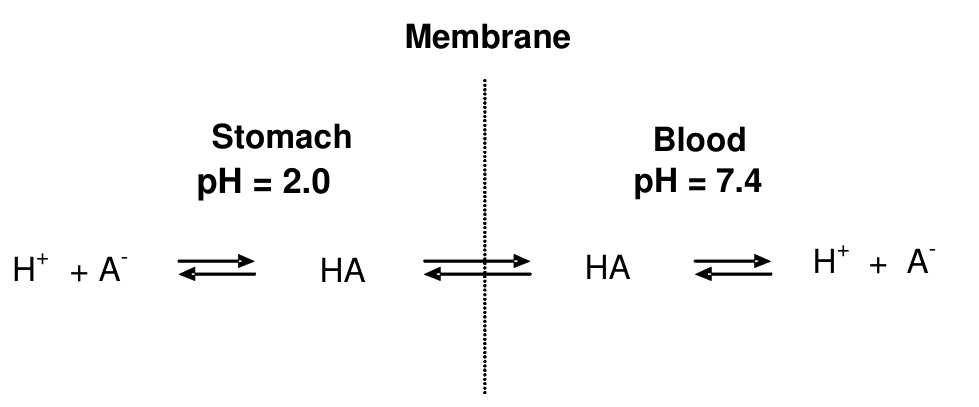
Assume that the ionic form (\(\ce{A-}\)) of a weakly acidic drug does not penetrate the membrane, whereas the neutral form (\(\ce{HA}\)) freely crosses the membrane. Also assume that equilibrium is established so that the concentration of \(\ce{HA}\) is the same on both sides. Calculate the ratio of the total concentration (\([\ce{HA}]+[\ce{A-}]\)) of aspirin (acetylsalicylic acid, \(pK=3.52\)) in the blood to that in the stomach.
Official English text of the problem.
Answers
- 5.1: \([\ce{H+}]=2.4\times10^{-7}\ \mathrm{M}\); \([\ce{OH-}]=4.1\times10^{-8}\ \mathrm{M}\); \([\ce{HSO4-}]=2.0\times10^{-12}\ \mathrm{M}\); \([\ce{SO4^2-}]=1.0\times10^{-7}\ \mathrm{M}\).
- 5.2: \(1.03\times10^2\ \mathrm{cm^3}\) of \(0.80\ \mathrm{M}\) sodium hydroxide solution.
- 5.3: \(\displaystyle \frac{C_{\mathrm{blood}}}{C_{\mathrm{stomach}}}\approx7.4\times10^3\).
Solution
5.1
The chemical species and their SMILES are:
| Species | SMILES |
|---|---|
| Sulfuric acid, \(\ce{H2SO4}\) | O=S(=O)(O)O |
| Hydrogen ion (proton), \(\ce{H+}\) | [H+] |
| Hydroxide ion, \(\ce{OH-}\) | [OH-] |
| Hydrogen sulfate ion, \(\ce{HSO4-}\) | O=S(=O)(O)[O-] |
| Sulfate ion, \(\ce{SO4^2-}\) | O=S(=O)([O-])[O-] |
| Water, \(\ce{H2O}\) | O |
The oxyanion SMILES show particular Lewis representations; resonance is not fully conveyed by the localized bond orders and charges.
The first dissociation of sulfuric acid is treated as complete:
\[ \ce{H2SO4 -> H+ + HSO4-}. \]
The remaining equilibria are
\[ \ce{HSO4- <=> H+ + SO4^2-}, \qquad K_2=\frac{[\ce{H+}][\ce{SO4^2-}]}{[\ce{HSO4-}]}, \]
\[ \ce{H2O <=> H+ + OH-}, \qquad K_w=[\ce{H+}][\ce{OH-}]. \]
Because the analytical acid concentration is comparable to \(10^{-7}\ \mathrm{M}\), water’s contribution must be included.
Let \(C=1.0\times10^{-7}\ \mathrm{M}\) and \(h=[\ce{H+}]\). Sulfate mass balance gives
\[ [\ce{HSO4-}]+[\ce{SO4^2-}]=C, \]
and charge balance gives
\[ h=[\ce{OH-}]+[\ce{HSO4-}]+2[\ce{SO4^2-}]. \]
Combining mass balance with the equilibrium expressions,
\[ [\ce{HSO4-}]=\frac{Ch}{K_2+h}, \qquad [\ce{SO4^2-}]=\frac{CK_2}{K_2+h}, \qquad [\ce{OH-}]=\frac{K_w}{h}. \]
Thus,
\[ h=\frac{K_w}{h}+C\frac{h+2K_2}{h+K_2}. \]
Since \(h\ll K_2\), an excellent approximation is
\[ h=2C+\frac{K_w}{h}, \]
whose positive solution is
\[ h=C+\sqrt{C^2+K_w} \approx2.4142\times10^{-7}\ \mathrm{M}. \]
Solving the full balance equation gives \(h=2.4141964\times10^{-7}\ \mathrm{M}\), confirming the approximation. Substitution gives
\[ \begin{aligned} [\ce{OH-}]&=4.14217\times10^{-8}\ \mathrm{M},\\ [\ce{HSO4-}]&=2.01179\times10^{-12}\ \mathrm{M},\\ [\ce{SO4^2-}]&=9.99980\times10^{-8}\ \mathrm{M}. \end{aligned} \]
Therefore, to two significant figures,
\[ \boxed{ \begin{aligned} [\ce{H+}]&=2.4\times10^{-7}\ \mathrm{M},\\ [\ce{OH-}]&=4.1\times10^{-8}\ \mathrm{M},\\ [\ce{HSO4-}]&=2.0\times10^{-12}\ \mathrm{M},\\ [\ce{SO4^2-}]&=1.0\times10^{-7}\ \mathrm{M}. \end{aligned}} \]
5.2
The additional chemical species are:
| Species | SMILES |
|---|---|
| Sodium hydroxide, \(\ce{NaOH}\) | [Na+].[OH-] |
| Phosphoric acid, \(\ce{H3PO4}\) | O=P(O)(O)O |
| Dihydrogen phosphate ion, \(\ce{H2PO4-}\) | O=P(O)(O)[O-] |
| Hydrogen phosphate ion, \(\ce{HPO4^2-}\) | O=P(O)([O-])[O-] |
| Phosphate ion, \(\ce{PO4^3-}\) | O=P([O-])([O-])[O-] |
The amount of phosphoric acid is
\[ n= \frac{ (3.48\ \mathrm{cm^3}) (1.69\ \mathrm{g\,cm^{-3}}) (0.85) }{ 98.00\ \mathrm{g\,mol^{-1}} } =0.0510104\ \mathrm{mol}. \]
At pH 7.4, the principal phosphate species are \(\ce{H2PO4-}\) and \(\ce{HPO4^2-}\), because this pH is close to \(pK_2=7.20\). The other forms are negligible:
\[ \frac{[\ce{H3PO4}]}{[\ce{H2PO4-}]} =10^{pK_1-\mathrm{pH}} =10^{-5.25}, \]
\[ \frac{[\ce{PO4^3-}]}{[\ce{HPO4^2-}]} =10^{\mathrm{pH}-pK_3} =10^{-5.04}. \]
The relevant buffer equilibrium is
\[ \ce{H2PO4- <=> H+ + HPO4^2-}. \]
Consequently,
\[ \frac{[\ce{HPO4^2-}]}{[\ce{H2PO4-}]} =10^{\mathrm{pH}-pK_2} =10^{7.40-7.20} =1.584893. \]
Adding hydroxide first neutralizes one proton from each phosphoric acid molecule:
\[ \ce{H3PO4 + OH- -> H2PO4- + H2O}. \]
Further hydroxide converts part of the dihydrogen phosphate into hydrogen phosphate:
\[ \ce{H2PO4- + OH- -> HPO4^2- + H2O}. \]
Let \(x\) mol undergo this second neutralization. The final amounts are approximately \(x\) mol of \(\ce{HPO4^2-}\) and \(n-x\) mol of \(\ce{H2PO4-}\). Their common final volume cancels:
\[ \frac{x}{n-x}=1.584893. \]
Therefore,
\[ x=\frac{1.584893}{1+1.584893}\,n =0.0312764\ \mathrm{mol}. \]
The total amount of hydroxide required is
\[ n_{\ce{OH-}}=n+x =0.0822868\ \mathrm{mol}, \]
so
\[ V_{\ce{NaOH}} =\frac{0.0822868\ \mathrm{mol}} {0.80\ \mathrm{mol\,L^{-1}}} =0.102858\ \mathrm{L} =102.858\ \mathrm{cm^3}. \]
Thus, to the requested three significant figures,
\[ \boxed{V_{\ce{NaOH}}=1.03\times10^2\ \mathrm{cm^3}}. \]
The initial \(250\ \mathrm{cm^3}\) affects the final concentrations but cancels from the buffer ratio. Including all phosphate species and the residual free hydrogen and hydroxide ions does not change the rounded answer.
5.3
Here \(\ce{HA}\) is aspirin (acetylsalicylic acid), CC(=O)Oc1ccccc1C(=O)O, and \(\ce{A-}\) is the acetylsalicylate ion, CC(=O)Oc1ccccc1C(=O)[O-]. Ionization removes the carboxylic acid proton; the ester group remains intact.
For the equilibrium
\[ \ce{HA <=> H+ + A-}, \]
\[ K_a=\frac{[\ce{H+}][\ce{A-}]}{[\ce{HA}]}, \]
so
\[ \frac{[\ce{A-}]}{[\ce{HA}]} =10^{\mathrm{pH}-pK_a}. \]
The total drug concentration in either compartment is therefore
\[ C=[\ce{HA}]+[\ce{A-}] =[\ce{HA}]\left(1+10^{\mathrm{pH}-pK_a}\right). \]
At membrane equilibrium,
\[ [\ce{HA}]_{\mathrm{blood}} =[\ce{HA}]_{\mathrm{stomach}}. \]
Using the blood pH of 7.4 and stomach pH of 2.0 shown in the figure,
\[ \begin{aligned} \frac{C_{\mathrm{blood}}}{C_{\mathrm{stomach}}} &=\frac{1+10^{7.4-3.52}} {1+10^{2.0-3.52}}\\ &=\frac{1+7585.7758}{1+0.0301995}\\ &=7364.375\ldots. \end{aligned} \]
Hence,
\[ \boxed{\frac{C_{\mathrm{blood}}}{C_{\mathrm{stomach}}} \approx7.4\times10^3}. \]
The higher blood pH favors the ionized form, which cannot cross the membrane. This produces a much larger total drug concentration in blood even though the neutral-form concentrations are equal.
The solution was checked against the official solution.
IChO 2006 · Theorieaufgabe 5
Säure-Base-Chemie
5.1 Berechnen Sie \([\ce{H+}]\), \([\ce{OH-}]\), \([\ce{HSO4-}]\) und \([\ce{SO4^2-}]\) in einer \(1.0\times10^{-7}\ \mathrm{M}\) Schwefelsäurelösung (\(K_w=1.0\times10^{-14}\), \(K_2=1.2\times10^{-2}\) bei \(25\ ^\circ\mathrm{C}\)). Sie dürfen bei Ihrer Berechnung Stoff- und Ladungsbilanzgleichungen verwenden. Geben Sie das Ergebnis mit zwei signifikanten Stellen an.
5.2 Berechnen Sie das Volumen an \(0.80\ \mathrm{M}\) \(\ce{NaOH}\)-Lösung, das zu einer \(250\ \mathrm{cm^3}\) wässrigen Lösung mit \(3.48\ \mathrm{cm^3}\) konzentrierter Phosphorsäure gegeben werden muss, um einen Puffer mit pH 7.4 herzustellen. Geben Sie das Ergebnis mit drei signifikanten Stellen an. (\(\ce{H3PO4 (aq)}\), Reinheit = 85 Massen-%, Dichte = \(1.69\ \mathrm{g/cm^3}\), \(M_r=98.00\)) (\(pK_1=2.15\), \(pK_2=7.20\), \(pK_3=12.44\)).
5.3 Die Wirksamkeit eines Arzneistoffs hängt in hohem Maße davon ab, wie gut er in die Blutbahn aufgenommen werden kann. Die Säure-Base-Chemie spielt bei der Resorption von Arzneistoffen eine wichtige Rolle.
Nehmen Sie an, dass die ionische Form (\(\ce{A-}\)) eines schwach sauren Arzneistoffs die Membran nicht durchdringt, während die neutrale Form (\(\ce{HA}\)) die Membran ungehindert passiert. Nehmen Sie außerdem an, dass sich ein Gleichgewicht einstellt, sodass die Konzentration von \(\ce{HA}\) auf beiden Seiten gleich ist. Berechnen Sie das Verhältnis der Gesamtkonzentration (\([\ce{HA}]+[\ce{A-}]\)) von Aspirin (Acetylsalicylsäure, \(pK=3.52\)) im Blut zu der im Magen.
Aufgabentext aus dem offiziellen englischen Text übersetzt.
Antworten
- 5.1: \([\ce{H+}]=2.4\times10^{-7}\ \mathrm{M}\); \([\ce{OH-}]=4.1\times10^{-8}\ \mathrm{M}\); \([\ce{HSO4-}]=2.0\times10^{-12}\ \mathrm{M}\); \([\ce{SO4^2-}]=1.0\times10^{-7}\ \mathrm{M}\).
- 5.2: \(1.03\times10^2\ \mathrm{cm^3}\) einer \(0.80\ \mathrm{M}\) Natriumhydroxidlösung.
- 5.3: \(\displaystyle \frac{C_{\mathrm{blood}}}{C_{\mathrm{stomach}}}\approx7.4\times10^3\).
Lösung
5.1
Die chemischen Spezies und ihre SMILES sind:
| Spezies | SMILES |
|---|---|
| Schwefelsäure, \(\ce{H2SO4}\) | O=S(=O)(O)O |
| Wasserstoffion (Proton), \(\ce{H+}\) | [H+] |
| Hydroxidion, \(\ce{OH-}\) | [OH-] |
| Hydrogensulfation, \(\ce{HSO4-}\) | O=S(=O)(O)[O-] |
| Sulfation, \(\ce{SO4^2-}\) | O=S(=O)([O-])[O-] |
| Wasser, \(\ce{H2O}\) | O |
Die SMILES der Oxoanionen zeigen jeweils bestimmte Lewis-Darstellungen; die Mesomerie wird durch die lokalisierten Bindungsordnungen und Ladungen nicht vollständig wiedergegeben.
Die erste Dissoziationsstufe der Schwefelsäure wird als vollständig betrachtet:
\[ \ce{H2SO4 -> H+ + HSO4-}. \]
Die übrigen Gleichgewichte sind
\[ \ce{HSO4- <=> H+ + SO4^2-}, \qquad K_2=\frac{[\ce{H+}][\ce{SO4^2-}]}{[\ce{HSO4-}]}, \]
\[ \ce{H2O <=> H+ + OH-}, \qquad K_w=[\ce{H+}][\ce{OH-}]. \]
Da die analytische Säurekonzentration in der Größenordnung von \(10^{-7}\ \mathrm{M}\) liegt, muss der Beitrag des Wassers berücksichtigt werden.
Es seien \(C=1.0\times10^{-7}\ \mathrm{M}\) und \(h=[\ce{H+}]\). Die Stoffbilanz für Sulfat ergibt
\[ [\ce{HSO4-}]+[\ce{SO4^2-}]=C, \]
und die Ladungsbilanz ergibt
\[ h=[\ce{OH-}]+[\ce{HSO4-}]+2[\ce{SO4^2-}]. \]
Durch Kombination der Stoffbilanz mit den Gleichgewichtsausdrücken erhält man
\[ [\ce{HSO4-}]=\frac{Ch}{K_2+h}, \qquad [\ce{SO4^2-}]=\frac{CK_2}{K_2+h}, \qquad [\ce{OH-}]=\frac{K_w}{h}. \]
Somit gilt
\[ h=\frac{K_w}{h}+C\frac{h+2K_2}{h+K_2}. \]
Da \(h\ll K_2\), gilt in sehr guter Näherung
\[ h=2C+\frac{K_w}{h}, \]
mit der positiven Lösung
\[ h=C+\sqrt{C^2+K_w} \approx2.4142\times10^{-7}\ \mathrm{M}. \]
Das Lösen der vollständigen Bilanzgleichung ergibt \(h=2.4141964\times10^{-7}\ \mathrm{M}\) und bestätigt damit die Näherung. Durch Einsetzen erhält man
\[ \begin{aligned} [\ce{OH-}]&=4.14217\times10^{-8}\ \mathrm{M},\\ [\ce{HSO4-}]&=2.01179\times10^{-12}\ \mathrm{M},\\ [\ce{SO4^2-}]&=9.99980\times10^{-8}\ \mathrm{M}. \end{aligned} \]
Auf zwei signifikante Stellen gerundet ergibt sich daher
\[ \boxed{ \begin{aligned} [\ce{H+}]&=2.4\times10^{-7}\ \mathrm{M},\\ [\ce{OH-}]&=4.1\times10^{-8}\ \mathrm{M},\\ [\ce{HSO4-}]&=2.0\times10^{-12}\ \mathrm{M},\\ [\ce{SO4^2-}]&=1.0\times10^{-7}\ \mathrm{M}. \end{aligned}} \]
5.2
Die zusätzlichen chemischen Spezies sind:
| Spezies | SMILES |
|---|---|
| Natriumhydroxid, \(\ce{NaOH}\) | [Na+].[OH-] |
| Phosphorsäure, \(\ce{H3PO4}\) | O=P(O)(O)O |
| Dihydrogenphosphation, \(\ce{H2PO4-}\) | O=P(O)(O)[O-] |
| Hydrogenphosphation, \(\ce{HPO4^2-}\) | O=P(O)([O-])[O-] |
| Phosphation, \(\ce{PO4^3-}\) | O=P([O-])([O-])[O-] |
Die Stoffmenge der Phosphorsäure beträgt
\[ n= \frac{ (3.48\ \mathrm{cm^3}) (1.69\ \mathrm{g\,cm^{-3}}) (0.85) }{ 98.00\ \mathrm{g\,mol^{-1}} } =0.0510104\ \mathrm{mol}. \]
Bei pH 7.4 sind \(\ce{H2PO4-}\) und \(\ce{HPO4^2-}\) die vorherrschenden Phosphatspezies, da dieser pH-Wert nahe bei \(pK_2=7.20\) liegt. Die anderen Formen sind vernachlässigbar:
\[ \frac{[\ce{H3PO4}]}{[\ce{H2PO4-}]} =10^{pK_1-\mathrm{pH}} =10^{-5.25}, \]
\[ \frac{[\ce{PO4^3-}]}{[\ce{HPO4^2-}]} =10^{\mathrm{pH}-pK_3} =10^{-5.04}. \]
Das maßgebliche Puffergleichgewicht ist
\[ \ce{H2PO4- <=> H+ + HPO4^2-}. \]
Folglich gilt
\[ \frac{[\ce{HPO4^2-}]}{[\ce{H2PO4-}]} =10^{\mathrm{pH}-pK_2} =10^{7.40-7.20} =1.584893. \]
Durch die Zugabe von Hydroxid wird zunächst ein Proton jedes Phosphorsäuremoleküls neutralisiert:
\[ \ce{H3PO4 + OH- -> H2PO4- + H2O}. \]
Weiteres Hydroxid wandelt einen Teil des Dihydrogenphosphats in Hydrogenphosphat um:
\[ \ce{H2PO4- + OH- -> HPO4^2- + H2O}. \]
Es seien \(x\) mol, die diese zweite Neutralisationsstufe durchlaufen. Die endgültigen Stoffmengen betragen näherungsweise \(x\) mol \(\ce{HPO4^2-}\) und \(n-x\) mol \(\ce{H2PO4-}\). Das gemeinsame Endvolumen kürzt sich heraus:
\[ \frac{x}{n-x}=1.584893. \]
Daher gilt
\[ x=\frac{1.584893}{1+1.584893}\,n =0.0312764\ \mathrm{mol}. \]
Die insgesamt benötigte Stoffmenge an Hydroxid beträgt
\[ n_{\ce{OH-}}=n+x =0.0822868\ \mathrm{mol}, \]
sodass
\[ V_{\ce{NaOH}} =\frac{0.0822868\ \mathrm{mol}} {0.80\ \mathrm{mol\,L^{-1}}} =0.102858\ \mathrm{L} =102.858\ \mathrm{cm^3}. \]
Auf die geforderten drei signifikanten Stellen gerundet ergibt sich somit
\[ \boxed{V_{\ce{NaOH}}=1.03\times10^2\ \mathrm{cm^3}}. \]
Das Anfangsvolumen von \(250\ \mathrm{cm^3}\) beeinflusst die Endkonzentrationen, kürzt sich jedoch im Konzentrationsverhältnis der Pufferkomponenten heraus. Die Berücksichtigung aller Phosphatspezies sowie der verbleibenden freien Wasserstoff- und Hydroxidionen ändert das gerundete Ergebnis nicht.
5.3
Hier steht \(\ce{HA}\) für Aspirin (Acetylsalicylsäure), CC(=O)Oc1ccccc1C(=O)O, und \(\ce{A-}\) für das Acetylsalicylation, CC(=O)Oc1ccccc1C(=O)[O-]. Bei der Ionisierung wird das Proton der Carbonsäuregruppe abgespalten; die Estergruppe bleibt intakt.
Für das folgende Gleichgewicht gilt
\[ \ce{HA <=> H+ + A-}, \]
\[ K_a=\frac{[\ce{H+}][\ce{A-}]}{[\ce{HA}]}, \]
also
\[ \frac{[\ce{A-}]}{[\ce{HA}]} =10^{\mathrm{pH}-pK_a}. \]
Die Gesamtkonzentration des Arzneistoffs im jeweiligen Kompartiment ist daher
\[ C=[\ce{HA}]+[\ce{A-}] =[\ce{HA}]\left(1+10^{\mathrm{pH}-pK_a}\right). \]
Im Membrangleichgewicht gilt
\[ [\ce{HA}]_{\mathrm{blood}} =[\ce{HA}]_{\mathrm{stomach}}. \]
Mit den in der Abbildung angegebenen pH-Werten von 7.4 für das Blut und 2.0 für den Magen erhält man
\[ \begin{aligned} \frac{C_{\mathrm{blood}}}{C_{\mathrm{stomach}}} &=\frac{1+10^{7.4-3.52}} {1+10^{2.0-3.52}}\\ &=\frac{1+7585.7758}{1+0.0301995}\\ &=7364.375\ldots. \end{aligned} \]
Damit ergibt sich
\[ \boxed{\frac{C_{\mathrm{blood}}}{C_{\mathrm{stomach}}} \approx7.4\times10^3}. \]
Der höhere pH-Wert des Blutes begünstigt die ionisierte Form, die die Membran nicht passieren kann. Dadurch entsteht im Blut eine wesentlich höhere Gesamtkonzentration des Arzneistoffs, obwohl die Konzentrationen der neutralen Form gleich sind.
Die Lösung wurde mit der offiziellen Lösung abgeglichen.
IChO 2006 · Teori sorusu 5
Asit-Baz Kimyası
5.1 Sülfürik asidin \(1.0\times10^{-7}\ \mathrm{M}\) derişimli bir çözeltisindeki \([\ce{H+}]\), \([\ce{OH-}]\), \([\ce{HSO4-}]\) ve \([\ce{SO4^2-}]\) değerlerini hesaplayınız (\(25\ ^\circ\mathrm{C}\)'de \(K_w=1.0\times10^{-14}\), \(K_2=1.2\times10^{-2}\)). Hesaplamalarınızda kütle ve yük denkliklerini kullanabilirsiniz. Cevabınızı iki anlamlı basamakla veriniz.
5.2 pH değeri 7.4 olan bir tampon hazırlamak için, \(3.48\ \mathrm{cm^3}\) derişik fosforik asit içeren \(250\ \mathrm{cm^3}\) sulu çözeltiye eklenmesi gereken \(0.80\ \mathrm{M}\) \(\ce{NaOH}\) çözeltisinin hacmini hesaplayınız. Cevabınızı üç anlamlı basamakla veriniz. (\(\ce{H3PO4 (aq)}\), saflık = kütlece %85, yoğunluk = \(1.69\ \mathrm{g/cm^3}\), \(M_r=98.00\)) (\(pK_1=2.15\), \(pK_2=7.20\), \(pK_3=12.44\)).
5.3 Bir ilacın etkinliği, büyük ölçüde kan dolaşımına emilebilmesine bağlıdır. Asit-baz kimyası, ilaç emiliminde önemli bir rol oynar.
Zayıf asidik bir ilacın iyonik biçiminin (\(\ce{A-}\)) zardan geçemediğini, nötr biçiminin (\(\ce{HA}\)) ise zardan serbestçe geçtiğini varsayınız. Ayrıca, her iki tarafta \(\ce{HA}\) derişimi aynı olacak şekilde dengenin kurulduğunu varsayınız. Aspirinin (asetilsalisilik asit, \(pK=3.52\)) kandaki toplam derişiminin (\([\ce{HA}]+[\ce{A-}]\)) midedeki toplam derişimine oranını hesaplayınız.
Soru metni resmi İngilizce metinden çevrilmiştir.
Cevaplar
- 5.1: \([\ce{H+}]=2.4\times10^{-7}\ \mathrm{M}\); \([\ce{OH-}]=4.1\times10^{-8}\ \mathrm{M}\); \([\ce{HSO4-}]=2.0\times10^{-12}\ \mathrm{M}\); \([\ce{SO4^2-}]=1.0\times10^{-7}\ \mathrm{M}\).
- 5.2: \(0.80\ \mathrm{M}\) sodyum hidroksit çözeltisinden \(1.03\times10^2\ \mathrm{cm^3}\).
- 5.3: \(\displaystyle \frac{C_{\mathrm{blood}}}{C_{\mathrm{stomach}}}\approx7.4\times10^3\).
Çözüm
5.1
Kimyasal türler ve bunların SMILES gösterimleri şöyledir:
| Tür | SMILES |
|---|---|
| Sülfürik asit, \(\ce{H2SO4}\) | O=S(=O)(O)O |
| Hidrojen iyonu (proton), \(\ce{H+}\) | [H+] |
| Hidroksit iyonu, \(\ce{OH-}\) | [OH-] |
| Hidrojen sülfat iyonu, \(\ce{HSO4-}\) | O=S(=O)(O)[O-] |
| Sülfat iyonu, \(\ce{SO4^2-}\) | O=S(=O)([O-])[O-] |
| Su, \(\ce{H2O}\) | O |
Oksianyonların SMILES gösterimleri belirli Lewis yapılarını gösterir; yerelleştirilmiş bağ mertebeleri ve yükler, rezonansı tam olarak yansıtmaz.
Sülfürik asidin ilk ayrışmasının tam olduğu kabul edilir:
\[ \ce{H2SO4 -> H+ + HSO4-}. \]
Diğer dengeler şöyledir:
\[ \ce{HSO4- <=> H+ + SO4^2-}, \qquad K_2=\frac{[\ce{H+}][\ce{SO4^2-}]}{[\ce{HSO4-}]}, \]
\[ \ce{H2O <=> H+ + OH-}, \qquad K_w=[\ce{H+}][\ce{OH-}]. \]
Asidin analitik derişimi \(10^{-7}\ \mathrm{M}\) ile karşılaştırılabilir düzeyde olduğundan, suyun katkısı da hesaba katılmalıdır.
\(C=1.0\times10^{-7}\ \mathrm{M}\) ve \(h=[\ce{H+}]\) olsun. Sülfat kütle denkliği
\[ [\ce{HSO4-}]+[\ce{SO4^2-}]=C, \]
ve yük denkliği
\[ h=[\ce{OH-}]+[\ce{HSO4-}]+2[\ce{SO4^2-}]. \]
ifadelerini verir. Kütle denkliği denge ifadeleriyle birleştirildiğinde,
\[ [\ce{HSO4-}]=\frac{Ch}{K_2+h}, \qquad [\ce{SO4^2-}]=\frac{CK_2}{K_2+h}, \qquad [\ce{OH-}]=\frac{K_w}{h}. \]
Böylece,
\[ h=\frac{K_w}{h}+C\frac{h+2K_2}{h+K_2}. \]
\(h\ll K_2\) olduğundan, son derece iyi bir yaklaşım
\[ h=2C+\frac{K_w}{h}, \]
olur; bu denklemin pozitif çözümü
\[ h=C+\sqrt{C^2+K_w} \approx2.4142\times10^{-7}\ \mathrm{M}. \]
şeklindedir. Tam denklik denklemi çözüldüğünde \(h=2.4141964\times10^{-7}\ \mathrm{M}\) bulunur; bu da yaklaşımı doğrular. Yerine koyma işlemiyle
\[ \begin{aligned} [\ce{OH-}]&=4.14217\times10^{-8}\ \mathrm{M},\\ [\ce{HSO4-}]&=2.01179\times10^{-12}\ \mathrm{M},\\ [\ce{SO4^2-}]&=9.99980\times10^{-8}\ \mathrm{M}. \end{aligned} \]
elde edilir. Dolayısıyla, iki anlamlı basamakla,
\[ \boxed{ \begin{aligned} [\ce{H+}]&=2.4\times10^{-7}\ \mathrm{M},\\ [\ce{OH-}]&=4.1\times10^{-8}\ \mathrm{M},\\ [\ce{HSO4-}]&=2.0\times10^{-12}\ \mathrm{M},\\ [\ce{SO4^2-}]&=1.0\times10^{-7}\ \mathrm{M}. \end{aligned}} \]
5.2
Ek kimyasal türler şöyledir:
| Tür | SMILES |
|---|---|
| Sodyum hidroksit, \(\ce{NaOH}\) | [Na+].[OH-] |
| Fosforik asit, \(\ce{H3PO4}\) | O=P(O)(O)O |
| Dihidrojen fosfat iyonu, \(\ce{H2PO4-}\) | O=P(O)(O)[O-] |
| Hidrojen fosfat iyonu, \(\ce{HPO4^2-}\) | O=P(O)([O-])[O-] |
| Fosfat iyonu, \(\ce{PO4^3-}\) | O=P([O-])([O-])[O-] |
Fosforik asidin madde miktarı
\[ n= \frac{ (3.48\ \mathrm{cm^3}) (1.69\ \mathrm{g\,cm^{-3}}) (0.85) }{ 98.00\ \mathrm{g\,mol^{-1}} } =0.0510104\ \mathrm{mol}. \]
olarak bulunur. pH 7.4'te başlıca fosfat türleri \(\ce{H2PO4-}\) ve \(\ce{HPO4^2-}\)'dir; çünkü bu pH, \(pK_2=7.20\) değerine yakındır. Diğer biçimler ihmal edilebilir:
\[ \frac{[\ce{H3PO4}]}{[\ce{H2PO4-}]} =10^{pK_1-\mathrm{pH}} =10^{-5.25}, \]
\[ \frac{[\ce{PO4^3-}]}{[\ce{HPO4^2-}]} =10^{\mathrm{pH}-pK_3} =10^{-5.04}. \]
İlgili tampon dengesi şöyledir:
\[ \ce{H2PO4- <=> H+ + HPO4^2-}. \]
Bunun sonucunda,
\[ \frac{[\ce{HPO4^2-}]}{[\ce{H2PO4-}]} =10^{\mathrm{pH}-pK_2} =10^{7.40-7.20} =1.584893. \]
Eklenen hidroksit, önce her fosforik asit molekülünden bir protonu nötrleştirir:
\[ \ce{H3PO4 + OH- -> H2PO4- + H2O}. \]
Daha sonra eklenen hidroksit, dihidrojen fosfatın bir kısmını hidrojen fosfata dönüştürür:
\[ \ce{H2PO4- + OH- -> HPO4^2- + H2O}. \]
Bu ikinci nötrleşmeye \(x\) mol katılsın. Son miktarlar yaklaşık olarak \(x\) mol \(\ce{HPO4^2-}\) ve \(n-x\) mol \(\ce{H2PO4-}\) olur. Her ikisi için de aynı olan son hacim sadeleşir:
\[ \frac{x}{n-x}=1.584893. \]
Dolayısıyla,
\[ x=\frac{1.584893}{1+1.584893}\,n =0.0312764\ \mathrm{mol}. \]
Gereken toplam hidroksit miktarı
\[ n_{\ce{OH-}}=n+x =0.0822868\ \mathrm{mol}, \]
olduğundan,
\[ V_{\ce{NaOH}} =\frac{0.0822868\ \mathrm{mol}} {0.80\ \mathrm{mol\,L^{-1}}} =0.102858\ \mathrm{L} =102.858\ \mathrm{cm^3}. \]
Böylece, istenen üç anlamlı basamakla,
\[ \boxed{V_{\ce{NaOH}}=1.03\times10^2\ \mathrm{cm^3}}. \]
Başlangıçtaki \(250\ \mathrm{cm^3}\) hacim, son derişimleri etkiler ancak tampon oranında sadeleşir. Tüm fosfat türlerinin ve geriye kalan serbest hidrojen ve hidroksit iyonlarının hesaba katılması, yuvarlanmış cevabı değiştirmez.
5.3
Burada \(\ce{HA}\) aspirin (asetilsalisilik asit), CC(=O)Oc1ccccc1C(=O)O, ve \(\ce{A-}\) asetilsalisilat iyonudur, CC(=O)Oc1ccccc1C(=O)[O-]. İyonlaşma sırasında karboksilik asit protonu ayrılır; ester grubu değişmeden kalır.
Şu denge için
\[ \ce{HA <=> H+ + A-}, \]
\[ K_a=\frac{[\ce{H+}][\ce{A-}]}{[\ce{HA}]}, \]
olduğundan,
\[ \frac{[\ce{A-}]}{[\ce{HA}]} =10^{\mathrm{pH}-pK_a}. \]
Dolayısıyla, her iki bölmenin herhangi birindeki toplam ilaç derişimi şöyledir:
\[ C=[\ce{HA}]+[\ce{A-}] =[\ce{HA}]\left(1+10^{\mathrm{pH}-pK_a}\right). \]
Zarın iki tarafı arasında denge kurulduğunda,
\[ [\ce{HA}]_{\mathrm{blood}} =[\ce{HA}]_{\mathrm{stomach}}. \]
Şekilde verilen kan pH'ı 7.4 ve mide pH'ı 2.0 kullanılarak,
\[ \begin{aligned} \frac{C_{\mathrm{blood}}}{C_{\mathrm{stomach}}} &=\frac{1+10^{7.4-3.52}} {1+10^{2.0-3.52}}\\ &=\frac{1+7585.7758}{1+0.0301995}\\ &=7364.375\ldots. \end{aligned} \]
Böylece,
\[ \boxed{\frac{C_{\mathrm{blood}}}{C_{\mathrm{stomach}}} \approx7.4\times10^3}. \]
Kanın daha yüksek pH'ı, zardan geçemeyen iyonlaşmış biçimin oluşumunu destekler. Bu durum, nötr biçimin derişimleri eşit olsa da kandaki toplam ilaç derişiminin çok daha yüksek olmasına yol açar.
Çözüm, resmi çözümle karşılaştırılarak kontrol edildi.
IChO 2006 · Problema teórico 5
Química ácido-base
5.1 Calcule \([\ce{H+}]\), \([\ce{OH-}]\), \([\ce{HSO4-}]\) y \([\ce{SO4^2-}]\) en una disolución de ácido sulfúrico de \(1.0\times10^{-7}\ \mathrm{M}\) (\(K_w=1.0\times10^{-14}\), \(K_2=1.2\times10^{-2}\) a \(25\ ^\circ\mathrm{C}\)). En sus cálculos puede utilizar ecuaciones de balance de materia y de carga. Exprese la respuesta con dos cifras significativas.
5.2 Calcule el volumen de disolución \(0.80\ \mathrm{M}\) de \(\ce{NaOH}\) que debe añadirse a una disolución acuosa de \(250\ \mathrm{cm^3}\) que contiene \(3.48\ \mathrm{cm^3}\) de ácido fosfórico concentrado para preparar una disolución reguladora de pH 7.4. Exprese la respuesta con tres cifras significativas. (\(\ce{H3PO4 (aq)}\), pureza = 85 % en masa, densidad = \(1.69\ \mathrm{g/cm^3}\), \(M_r=98.00\)) (\(pK_1=2.15\), \(pK_2=7.20\), \(pK_3=12.44\)).
5.3 La eficacia de un fármaco depende en gran medida de su capacidad para ser absorbido y pasar al torrente sanguíneo. La química ácido-base desempeña un papel importante en la absorción de los fármacos.
Suponga que la forma iónica (\(\ce{A-}\)) de un fármaco débilmente ácido no atraviesa la membrana, mientras que la forma neutra (\(\ce{HA}\)) la atraviesa libremente. Suponga también que se establece un equilibrio de modo que la concentración de \(\ce{HA}\) es la misma a ambos lados. Calcule el cociente entre la concentración total (\([\ce{HA}]+[\ce{A-}]\)) de aspirina (ácido acetilsalicílico, \(pK=3.52\)) en la sangre y la del estómago.
Enunciado traducido del texto oficial en inglés.
Respuestas
- 5.1: \([\ce{H+}]=2.4\times10^{-7}\ \mathrm{M}\); \([\ce{OH-}]=4.1\times10^{-8}\ \mathrm{M}\); \([\ce{HSO4-}]=2.0\times10^{-12}\ \mathrm{M}\); \([\ce{SO4^2-}]=1.0\times10^{-7}\ \mathrm{M}\).
- 5.2: \(1.03\times10^2\ \mathrm{cm^3}\) de disolución de hidróxido de sodio \(0.80\ \mathrm{M}\).
- 5.3: \(\displaystyle \frac{C_{\mathrm{blood}}}{C_{\mathrm{stomach}}}\approx7.4\times10^3\).
Solución
5.1
Las especies químicas y sus SMILES son:
| Especie | SMILES |
|---|---|
| Ácido sulfúrico, \(\ce{H2SO4}\) | O=S(=O)(O)O |
| Ion hidrógeno (protón), \(\ce{H+}\) | [H+] |
| Ion hidróxido, \(\ce{OH-}\) | [OH-] |
| Ion hidrogenosulfato, \(\ce{HSO4-}\) | O=S(=O)(O)[O-] |
| Ion sulfato, \(\ce{SO4^2-}\) | O=S(=O)([O-])[O-] |
| Agua, \(\ce{H2O}\) | O |
Los SMILES de los oxoaniones muestran representaciones de Lewis concretas; los órdenes de enlace y las cargas localizados no reflejan plenamente la resonancia.
La primera disociación del ácido sulfúrico se considera completa:
\[ \ce{H2SO4 -> H+ + HSO4-}. \]
Los equilibrios restantes son
\[ \ce{HSO4- <=> H+ + SO4^2-}, \qquad K_2=\frac{[\ce{H+}][\ce{SO4^2-}]}{[\ce{HSO4-}]}, \]
\[ \ce{H2O <=> H+ + OH-}, \qquad K_w=[\ce{H+}][\ce{OH-}]. \]
Como la concentración analítica del ácido es comparable a \(10^{-7}\ \mathrm{M}\), debe incluirse la contribución del agua.
Sean \(C=1.0\times10^{-7}\ \mathrm{M}\) y \(h=[\ce{H+}]\). El balance de materia del sulfato da
\[ [\ce{HSO4-}]+[\ce{SO4^2-}]=C, \]
y el balance de carga da
\[ h=[\ce{OH-}]+[\ce{HSO4-}]+2[\ce{SO4^2-}]. \]
Combinando el balance de materia con las expresiones de equilibrio,
\[ [\ce{HSO4-}]=\frac{Ch}{K_2+h}, \qquad [\ce{SO4^2-}]=\frac{CK_2}{K_2+h}, \qquad [\ce{OH-}]=\frac{K_w}{h}. \]
Por tanto,
\[ h=\frac{K_w}{h}+C\frac{h+2K_2}{h+K_2}. \]
Dado que \(h\ll K_2\), una excelente aproximación es
\[ h=2C+\frac{K_w}{h}, \]
cuya solución positiva es
\[ h=C+\sqrt{C^2+K_w} \approx2.4142\times10^{-7}\ \mathrm{M}. \]
Al resolver la ecuación completa de balance se obtiene \(h=2.4141964\times10^{-7}\ \mathrm{M}\), lo que confirma la aproximación. Por sustitución se obtiene
\[ \begin{aligned} [\ce{OH-}]&=4.14217\times10^{-8}\ \mathrm{M},\\ [\ce{HSO4-}]&=2.01179\times10^{-12}\ \mathrm{M},\\ [\ce{SO4^2-}]&=9.99980\times10^{-8}\ \mathrm{M}. \end{aligned} \]
Por tanto, con dos cifras significativas,
\[ \boxed{ \begin{aligned} [\ce{H+}]&=2.4\times10^{-7}\ \mathrm{M},\\ [\ce{OH-}]&=4.1\times10^{-8}\ \mathrm{M},\\ [\ce{HSO4-}]&=2.0\times10^{-12}\ \mathrm{M},\\ [\ce{SO4^2-}]&=1.0\times10^{-7}\ \mathrm{M}. \end{aligned}} \]
5.2
Las especies químicas adicionales son:
| Especie | SMILES |
|---|---|
| Hidróxido de sodio, \(\ce{NaOH}\) | [Na+].[OH-] |
| Ácido fosfórico, \(\ce{H3PO4}\) | O=P(O)(O)O |
| Ion dihidrogenofosfato, \(\ce{H2PO4-}\) | O=P(O)(O)[O-] |
| Ion hidrogenofosfato, \(\ce{HPO4^2-}\) | O=P(O)([O-])[O-] |
| Ion fosfato, \(\ce{PO4^3-}\) | O=P([O-])([O-])[O-] |
La cantidad de ácido fosfórico es
\[ n= \frac{ (3.48\ \mathrm{cm^3}) (1.69\ \mathrm{g\,cm^{-3}}) (0.85) }{ 98.00\ \mathrm{g\,mol^{-1}} } =0.0510104\ \mathrm{mol}. \]
A pH 7.4, las principales especies de fosfato son \(\ce{H2PO4-}\) y \(\ce{HPO4^2-}\), porque este pH es cercano a \(pK_2=7.20\). Las otras formas son despreciables:
\[ \frac{[\ce{H3PO4}]}{[\ce{H2PO4-}]} =10^{pK_1-\mathrm{pH}} =10^{-5.25}, \]
\[ \frac{[\ce{PO4^3-}]}{[\ce{HPO4^2-}]} =10^{\mathrm{pH}-pK_3} =10^{-5.04}. \]
El equilibrio pertinente de la disolución reguladora es
\[ \ce{H2PO4- <=> H+ + HPO4^2-}. \]
En consecuencia,
\[ \frac{[\ce{HPO4^2-}]}{[\ce{H2PO4-}]} =10^{\mathrm{pH}-pK_2} =10^{7.40-7.20} =1.584893. \]
La adición de hidróxido neutraliza primero un protón de cada molécula de ácido fosfórico:
\[ \ce{H3PO4 + OH- -> H2PO4- + H2O}. \]
El hidróxido añadido posteriormente convierte parte del dihidrogenofosfato en hidrogenofosfato:
\[ \ce{H2PO4- + OH- -> HPO4^2- + H2O}. \]
Sean \(x\) mol los que experimentan esta segunda neutralización. Las cantidades finales son aproximadamente \(x\) mol de \(\ce{HPO4^2-}\) y \(n-x\) mol de \(\ce{H2PO4-}\). El volumen final, común a ambas especies, se cancela:
\[ \frac{x}{n-x}=1.584893. \]
Por tanto,
\[ x=\frac{1.584893}{1+1.584893}\,n =0.0312764\ \mathrm{mol}. \]
La cantidad total de hidróxido necesaria es
\[ n_{\ce{OH-}}=n+x =0.0822868\ \mathrm{mol}, \]
de modo que
\[ V_{\ce{NaOH}} =\frac{0.0822868\ \mathrm{mol}} {0.80\ \mathrm{mol\,L^{-1}}} =0.102858\ \mathrm{L} =102.858\ \mathrm{cm^3}. \]
Así, con las tres cifras significativas solicitadas,
\[ \boxed{V_{\ce{NaOH}}=1.03\times10^2\ \mathrm{cm^3}}. \]
El volumen inicial de \(250\ \mathrm{cm^3}\) afecta a las concentraciones finales, pero se cancela en el cociente de concentraciones de la disolución reguladora. La inclusión de todas las especies de fosfato y de los iones hidrógeno e hidróxido libres residuales no modifica la respuesta redondeada.
5.3
Aquí, \(\ce{HA}\) es la aspirina (ácido acetilsalicílico), CC(=O)Oc1ccccc1C(=O)O, y \(\ce{A-}\) es el ion acetilsalicilato, CC(=O)Oc1ccccc1C(=O)[O-]. La ionización elimina el protón del grupo ácido carboxílico; el grupo éster permanece intacto.
Para el equilibrio
\[ \ce{HA <=> H+ + A-}, \]
\[ K_a=\frac{[\ce{H+}][\ce{A-}]}{[\ce{HA}]}, \]
por lo que
\[ \frac{[\ce{A-}]}{[\ce{HA}]} =10^{\mathrm{pH}-pK_a}. \]
La concentración total del fármaco en cualquiera de los dos compartimentos es, por tanto,
\[ C=[\ce{HA}]+[\ce{A-}] =[\ce{HA}]\left(1+10^{\mathrm{pH}-pK_a}\right). \]
En el equilibrio a través de la membrana,
\[ [\ce{HA}]_{\mathrm{blood}} =[\ce{HA}]_{\mathrm{stomach}}. \]
Utilizando el pH de la sangre de 7.4 y el pH del estómago de 2.0 indicados en la figura,
\[ \begin{aligned} \frac{C_{\mathrm{blood}}}{C_{\mathrm{stomach}}} &=\frac{1+10^{7.4-3.52}} {1+10^{2.0-3.52}}\\ &=\frac{1+7585.7758}{1+0.0301995}\\ &=7364.375\ldots. \end{aligned} \]
Por consiguiente,
\[ \boxed{\frac{C_{\mathrm{blood}}}{C_{\mathrm{stomach}}} \approx7.4\times10^3}. \]
El pH más alto de la sangre favorece la forma ionizada, que no puede atravesar la membrana. Esto produce una concentración total del fármaco mucho mayor en la sangre, aunque las concentraciones de la forma neutra sean iguales.
La solución se comprobó con la solución oficial.
IChO 2006 · 理论题 5
酸碱化学
5.1 计算 \(1.0\times10^{-7}\ \mathrm{M}\) 硫酸溶液中的 \([\ce{H+}]\)、\([\ce{OH-}]\)、\([\ce{HSO4-}]\) 和 \([\ce{SO4^2-}]\)(在 \(25\ ^\circ\mathrm{C}\) 时,\(K_w=1.0\times10^{-14}\),\(K_2=1.2\times10^{-2}\))。计算时可以使用物料平衡方程和电荷平衡方程。答案保留两位有效数字。
5.2 为配制 pH 为 7.4 的缓冲溶液,应向含有 \(3.48\ \mathrm{cm^3}\) 浓磷酸的 \(250\ \mathrm{cm^3}\) 水溶液中加入多少体积的 \(0.80\ \mathrm{M}\) \(\ce{NaOH}\) 溶液?答案保留三位有效数字。(\(\ce{H3PO4 (aq)}\),纯度 = 85%(质量分数),密度 = \(1.69\ \mathrm{g/cm^3}\),\(M_r=98.00\))(\(pK_1=2.15\),\(pK_2=7.20\),\(pK_3=12.44\))。
5.3 药物的疗效在很大程度上取决于其被吸收进入血液的能力。酸碱化学在药物吸收中起着重要作用。
假设弱酸性药物的离子形式(\(\ce{A-}\))不能透过膜,而其中性形式(\(\ce{HA}\))可以自由透过膜。另假设已达到平衡,使膜两侧的 \(\ce{HA}\) 浓度相同。计算阿司匹林(乙酰水杨酸,\(pK=3.52\))在血液中的总浓度(\([\ce{HA}]+[\ce{A-}]\))与在胃中的总浓度之比。
题目译自官方英文原文。
答案
- 5.1: \([\ce{H+}]=2.4\times10^{-7}\ \mathrm{M}\);\([\ce{OH-}]=4.1\times10^{-8}\ \mathrm{M}\);\([\ce{HSO4-}]=2.0\times10^{-12}\ \mathrm{M}\);\([\ce{SO4^2-}]=1.0\times10^{-7}\ \mathrm{M}\)。
- 5.2: \(1.03\times10^2\ \mathrm{cm^3}\) 的 \(0.80\ \mathrm{M}\) 氢氧化钠溶液。
- 5.3: \(\displaystyle \frac{C_{\mathrm{blood}}}{C_{\mathrm{stomach}}}\approx7.4\times10^3\)。
解答
5.1
各化学物种及其 SMILES 如下:
| 物种 | SMILES |
|---|---|
| 硫酸,\(\ce{H2SO4}\) | O=S(=O)(O)O |
| 氢离子(质子),\(\ce{H+}\) | [H+] |
| 氢氧根离子,\(\ce{OH-}\) | [OH-] |
| 硫酸氢根离子,\(\ce{HSO4-}\) | O=S(=O)(O)[O-] |
| 硫酸根离子,\(\ce{SO4^2-}\) | O=S(=O)([O-])[O-] |
| 水,\(\ce{H2O}\) | O |
这些含氧酸根阴离子的 SMILES 表示特定的路易斯结构;局域化的键级和电荷不能完整表达共振。
将硫酸的第一级电离视为完全电离:
\[ \ce{H2SO4 -> H+ + HSO4-}. \]
其余平衡为
\[ \ce{HSO4- <=> H+ + SO4^2-}, \qquad K_2=\frac{[\ce{H+}][\ce{SO4^2-}]}{[\ce{HSO4-}]}, \]
\[ \ce{H2O <=> H+ + OH-}, \qquad K_w=[\ce{H+}][\ce{OH-}]. \]
由于酸的分析浓度与 \(10^{-7}\ \mathrm{M}\) 相当,必须计入水的贡献。
令 \(C=1.0\times10^{-7}\ \mathrm{M}\),\(h=[\ce{H+}]\)。由硫酸根的物料平衡可得
\[ [\ce{HSO4-}]+[\ce{SO4^2-}]=C, \]
由电荷平衡可得
\[ h=[\ce{OH-}]+[\ce{HSO4-}]+2[\ce{SO4^2-}]. \]
将物料平衡与平衡常数表达式联立,得
\[ [\ce{HSO4-}]=\frac{Ch}{K_2+h}, \qquad [\ce{SO4^2-}]=\frac{CK_2}{K_2+h}, \qquad [\ce{OH-}]=\frac{K_w}{h}. \]
因此,
\[ h=\frac{K_w}{h}+C\frac{h+2K_2}{h+K_2}. \]
由于 \(h\ll K_2\),可作非常准确的近似:
\[ h=2C+\frac{K_w}{h}, \]
其正根为
\[ h=C+\sqrt{C^2+K_w} \approx2.4142\times10^{-7}\ \mathrm{M}. \]
求解完整的平衡方程可得 \(h=2.4141964\times10^{-7}\ \mathrm{M}\),验证了上述近似。代入可得
\[ \begin{aligned} [\ce{OH-}]&=4.14217\times10^{-8}\ \mathrm{M},\\ [\ce{HSO4-}]&=2.01179\times10^{-12}\ \mathrm{M},\\ [\ce{SO4^2-}]&=9.99980\times10^{-8}\ \mathrm{M}. \end{aligned} \]
因此,保留两位有效数字,得
\[ \boxed{ \begin{aligned} [\ce{H+}]&=2.4\times10^{-7}\ \mathrm{M},\\ [\ce{OH-}]&=4.1\times10^{-8}\ \mathrm{M},\\ [\ce{HSO4-}]&=2.0\times10^{-12}\ \mathrm{M},\\ [\ce{SO4^2-}]&=1.0\times10^{-7}\ \mathrm{M}. \end{aligned}} \]
5.2
此外涉及的化学物种如下:
| 物种 | SMILES |
|---|---|
| 氢氧化钠,\(\ce{NaOH}\) | [Na+].[OH-] |
| 磷酸,\(\ce{H3PO4}\) | O=P(O)(O)O |
| 磷酸二氢根离子,\(\ce{H2PO4-}\) | O=P(O)(O)[O-] |
| 磷酸氢根离子,\(\ce{HPO4^2-}\) | O=P(O)([O-])[O-] |
| 磷酸根离子,\(\ce{PO4^3-}\) | O=P([O-])([O-])[O-] |
磷酸的物质的量为
\[ n= \frac{ (3.48\ \mathrm{cm^3}) (1.69\ \mathrm{g\,cm^{-3}}) (0.85) }{ 98.00\ \mathrm{g\,mol^{-1}} } =0.0510104\ \mathrm{mol}. \]
在 pH 为 7.4 时,主要的磷酸物种是 \(\ce{H2PO4-}\) 和 \(\ce{HPO4^2-}\),因为该 pH 接近 \(pK_2=7.20\)。其他形式可忽略不计:
\[ \frac{[\ce{H3PO4}]}{[\ce{H2PO4-}]} =10^{pK_1-\mathrm{pH}} =10^{-5.25}, \]
\[ \frac{[\ce{PO4^3-}]}{[\ce{HPO4^2-}]} =10^{\mathrm{pH}-pK_3} =10^{-5.04}. \]
相关的缓冲平衡为
\[ \ce{H2PO4- <=> H+ + HPO4^2-}. \]
因此,
\[ \frac{[\ce{HPO4^2-}]}{[\ce{H2PO4-}]} =10^{\mathrm{pH}-pK_2} =10^{7.40-7.20} =1.584893. \]
加入的氢氧根离子首先中和每个磷酸分子中的一个质子:
\[ \ce{H3PO4 + OH- -> H2PO4- + H2O}. \]
继续加入的氢氧根离子将部分磷酸二氢根转化为磷酸氢根:
\[ \ce{H2PO4- + OH- -> HPO4^2- + H2O}. \]
设有 \(x\) mol 发生这第二步中和反应。最终 \(\ce{HPO4^2-}\) 的物质的量约为 \(x\) mol,\(\ce{H2PO4-}\) 的物质的量约为 \(n-x\) mol。两者共同的最终溶液体积相消:
\[ \frac{x}{n-x}=1.584893. \]
因此,
\[ x=\frac{1.584893}{1+1.584893}\,n =0.0312764\ \mathrm{mol}. \]
所需氢氧根离子的总物质的量为
\[ n_{\ce{OH-}}=n+x =0.0822868\ \mathrm{mol}, \]
所以
\[ V_{\ce{NaOH}} =\frac{0.0822868\ \mathrm{mol}} {0.80\ \mathrm{mol\,L^{-1}}} =0.102858\ \mathrm{L} =102.858\ \mathrm{cm^3}. \]
因此,按要求保留三位有效数字,得
\[ \boxed{V_{\ce{NaOH}}=1.03\times10^2\ \mathrm{cm^3}}. \]
初始体积 \(250\ \mathrm{cm^3}\) 影响最终浓度,但在缓冲组分的浓度比中相消。计入所有磷酸物种以及残余的游离氢离子和氢氧根离子,不会改变舍入后的答案。
5.3
这里,\(\ce{HA}\) 为阿司匹林(乙酰水杨酸),CC(=O)Oc1ccccc1C(=O)O,\(\ce{A-}\) 为乙酰水杨酸根离子,CC(=O)Oc1ccccc1C(=O)[O-]。电离时脱去的是羧基上的质子;酯基保持完整。
对于平衡
\[ \ce{HA <=> H+ + A-}, \]
\[ K_a=\frac{[\ce{H+}][\ce{A-}]}{[\ce{HA}]}, \]
所以
\[ \frac{[\ce{A-}]}{[\ce{HA}]} =10^{\mathrm{pH}-pK_a}. \]
因此,任一侧的药物总浓度为
\[ C=[\ce{HA}]+[\ce{A-}] =[\ce{HA}]\left(1+10^{\mathrm{pH}-pK_a}\right). \]
当膜两侧达到平衡时,
\[ [\ce{HA}]_{\mathrm{blood}} =[\ce{HA}]_{\mathrm{stomach}}. \]
利用图中给出的血液 pH 为 7.4、胃内 pH 为 2.0,得
\[ \begin{aligned} \frac{C_{\mathrm{blood}}}{C_{\mathrm{stomach}}} &=\frac{1+10^{7.4-3.52}} {1+10^{2.0-3.52}}\\ &=\frac{1+7585.7758}{1+0.0301995}\\ &=7364.375\ldots. \end{aligned} \]
因此,
\[ \boxed{\frac{C_{\mathrm{blood}}}{C_{\mathrm{stomach}}} \approx7.4\times10^3}. \]
血液中较高的 pH 有利于药物以离子形式存在,而该形式不能透过膜。因此,即使两侧中性形式的浓度相等,血液中的药物总浓度仍高得多。
解答已与官方解答核对。
IChO 2006 · Теоретическая задача 5
Кислотно-основные равновесия
5.1 Рассчитайте \([\ce{H+}]\), \([\ce{OH-}]\), \([\ce{HSO4-}]\) и \([\ce{SO4^2-}]\) в растворе серной кислоты с концентрацией \(1.0\times10^{-7}\ \mathrm{M}\) (\(K_w=1.0\times10^{-14}\), \(K_2=1.2\times10^{-2}\) при \(25\ ^\circ\mathrm{C}\)). При решении можно использовать уравнения материального баланса и электронейтральности. Приведите ответ с двумя значащими цифрами.
5.2 Рассчитайте объём раствора \(\ce{NaOH}\) с концентрацией \(0.80\ \mathrm{M}\), который необходимо добавить к \(250\ \mathrm{cm^3}\) водного раствора, содержащего \(3.48\ \mathrm{cm^3}\) концентрированной фосфорной кислоты, чтобы приготовить буферный раствор с pH 7.4. Приведите ответ с тремя значащими цифрами. (\(\ce{H3PO4 (aq)}\), массовая доля = 85 %, плотность = \(1.69\ \mathrm{g/cm^3}\), \(M_r=98.00\)) (\(pK_1=2.15\), \(pK_2=7.20\), \(pK_3=12.44\)).
5.3 Эффективность лекарственного вещества в значительной степени зависит от его способности всасываться в кровоток. Кислотно-основные равновесия играют важную роль во всасывании лекарственных веществ.
Предположим, что ионная форма (\(\ce{A-}\)) лекарственного вещества, являющегося слабой кислотой, не проникает через мембрану, тогда как нейтральная форма (\(\ce{HA}\)) свободно проходит через неё. Также предположим, что устанавливается равновесие, при котором концентрация \(\ce{HA}\) одинакова по обе стороны мембраны. Рассчитайте отношение суммарной концентрации (\([\ce{HA}]+[\ce{A-}]\)) аспирина (ацетилсалициловой кислоты, \(pK=3.52\)) в крови к его суммарной концентрации в желудке.
Условие переведено с официального английского текста.
Ответы
- 5.1: \([\ce{H+}]=2.4\times10^{-7}\ \mathrm{M}\); \([\ce{OH-}]=4.1\times10^{-8}\ \mathrm{M}\); \([\ce{HSO4-}]=2.0\times10^{-12}\ \mathrm{M}\); \([\ce{SO4^2-}]=1.0\times10^{-7}\ \mathrm{M}\).
- 5.2: \(1.03\times10^2\ \mathrm{cm^3}\) раствора гидроксида натрия с концентрацией \(0.80\ \mathrm{M}\).
- 5.3: \(\displaystyle \frac{C_{\mathrm{blood}}}{C_{\mathrm{stomach}}}\approx7.4\times10^3\).
Решение
5.1
Химические частицы и их SMILES:
| Частица | SMILES |
|---|---|
| Серная кислота, \(\ce{H2SO4}\) | O=S(=O)(O)O |
| Ион водорода (протон), \(\ce{H+}\) | [H+] |
| Гидроксид-ион, \(\ce{OH-}\) | [OH-] |
| Гидросульфат-ион, \(\ce{HSO4-}\) | O=S(=O)(O)[O-] |
| Сульфат-ион, \(\ce{SO4^2-}\) | O=S(=O)([O-])[O-] |
| Вода, \(\ce{H2O}\) | O |
SMILES кислородсодержащих анионов соответствуют отдельным структурам Льюиса; локализованные порядки связей и заряды не передают резонанс в полной мере.
Диссоциацию серной кислоты по первой ступени считаем полной:
\[ \ce{H2SO4 -> H+ + HSO4-}. \]
Остальные равновесия имеют вид
\[ \ce{HSO4- <=> H+ + SO4^2-}, \qquad K_2=\frac{[\ce{H+}][\ce{SO4^2-}]}{[\ce{HSO4-}]}, \]
\[ \ce{H2O <=> H+ + OH-}, \qquad K_w=[\ce{H+}][\ce{OH-}]. \]
Поскольку аналитическая концентрация кислоты сопоставима с \(10^{-7}\ \mathrm{M}\), необходимо учитывать вклад воды.
Пусть \(C=1.0\times10^{-7}\ \mathrm{M}\) и \(h=[\ce{H+}]\). Материальный баланс по сульфату даёт
\[ [\ce{HSO4-}]+[\ce{SO4^2-}]=C, \]
а условие электронейтральности даёт
\[ h=[\ce{OH-}]+[\ce{HSO4-}]+2[\ce{SO4^2-}]. \]
Объединяя уравнение материального баланса с выражениями для констант равновесия, получаем
\[ [\ce{HSO4-}]=\frac{Ch}{K_2+h}, \qquad [\ce{SO4^2-}]=\frac{CK_2}{K_2+h}, \qquad [\ce{OH-}]=\frac{K_w}{h}. \]
Таким образом,
\[ h=\frac{K_w}{h}+C\frac{h+2K_2}{h+K_2}. \]
Поскольку \(h\ll K_2\), очень хорошим приближением является
\[ h=2C+\frac{K_w}{h}, \]
положительное решение которого имеет вид
\[ h=C+\sqrt{C^2+K_w} \approx2.4142\times10^{-7}\ \mathrm{M}. \]
Решение полного балансового уравнения даёт \(h=2.4141964\times10^{-7}\ \mathrm{M}\), что подтверждает справедливость приближения. Подстановка даёт
\[ \begin{aligned} [\ce{OH-}]&=4.14217\times10^{-8}\ \mathrm{M},\\ [\ce{HSO4-}]&=2.01179\times10^{-12}\ \mathrm{M},\\ [\ce{SO4^2-}]&=9.99980\times10^{-8}\ \mathrm{M}. \end{aligned} \]
Следовательно, с двумя значащими цифрами,
\[ \boxed{ \begin{aligned} [\ce{H+}]&=2.4\times10^{-7}\ \mathrm{M},\\ [\ce{OH-}]&=4.1\times10^{-8}\ \mathrm{M},\\ [\ce{HSO4-}]&=2.0\times10^{-12}\ \mathrm{M},\\ [\ce{SO4^2-}]&=1.0\times10^{-7}\ \mathrm{M}. \end{aligned}} \]
5.2
Дополнительные химические частицы:
| Частица | SMILES |
|---|---|
| Гидроксид натрия, \(\ce{NaOH}\) | [Na+].[OH-] |
| Фосфорная кислота, \(\ce{H3PO4}\) | O=P(O)(O)O |
| Дигидрофосфат-ион, \(\ce{H2PO4-}\) | O=P(O)(O)[O-] |
| Гидрофосфат-ион, \(\ce{HPO4^2-}\) | O=P(O)([O-])[O-] |
| Фосфат-ион, \(\ce{PO4^3-}\) | O=P([O-])([O-])[O-] |
Количество вещества фосфорной кислоты равно
\[ n= \frac{ (3.48\ \mathrm{cm^3}) (1.69\ \mathrm{g\,cm^{-3}}) (0.85) }{ 98.00\ \mathrm{g\,mol^{-1}} } =0.0510104\ \mathrm{mol}. \]
При pH 7.4 основными формами фосфорной кислоты являются \(\ce{H2PO4-}\) и \(\ce{HPO4^2-}\), поскольку это значение pH близко к \(pK_2=7.20\). Содержанием остальных форм можно пренебречь:
\[ \frac{[\ce{H3PO4}]}{[\ce{H2PO4-}]} =10^{pK_1-\mathrm{pH}} =10^{-5.25}, \]
\[ \frac{[\ce{PO4^3-}]}{[\ce{HPO4^2-}]} =10^{\mathrm{pH}-pK_3} =10^{-5.04}. \]
Соответствующее буферное равновесие имеет вид
\[ \ce{H2PO4- <=> H+ + HPO4^2-}. \]
Следовательно,
\[ \frac{[\ce{HPO4^2-}]}{[\ce{H2PO4-}]} =10^{\mathrm{pH}-pK_2} =10^{7.40-7.20} =1.584893. \]
При добавлении гидроксид-ионов сначала нейтрализуется один протон каждой молекулы фосфорной кислоты:
\[ \ce{H3PO4 + OH- -> H2PO4- + H2O}. \]
Дальнейшее добавление гидроксид-ионов превращает часть дигидрофосфата в гидрофосфат:
\[ \ce{H2PO4- + OH- -> HPO4^2- + H2O}. \]
Пусть на этой второй стадии нейтрализуется \(x\) моль. Конечные количества вещества составляют приблизительно \(x\) моль \(\ce{HPO4^2-}\) и \(n-x\) моль \(\ce{H2PO4-}\). Общий для обеих форм конечный объём сокращается:
\[ \frac{x}{n-x}=1.584893. \]
Поэтому
\[ x=\frac{1.584893}{1+1.584893}\,n =0.0312764\ \mathrm{mol}. \]
Общее необходимое количество вещества гидроксид-ионов равно
\[ n_{\ce{OH-}}=n+x =0.0822868\ \mathrm{mol}, \]
так что
\[ V_{\ce{NaOH}} =\frac{0.0822868\ \mathrm{mol}} {0.80\ \mathrm{mol\,L^{-1}}} =0.102858\ \mathrm{L} =102.858\ \mathrm{cm^3}. \]
Таким образом, с требуемыми тремя значащими цифрами,
\[ \boxed{V_{\ce{NaOH}}=1.03\times10^2\ \mathrm{cm^3}}. \]
Исходный объём \(250\ \mathrm{cm^3}\) влияет на конечные концентрации, но сокращается в отношении концентраций компонентов буфера. Учёт всех форм фосфорной кислоты и остаточных свободных ионов водорода и гидроксид-ионов не изменяет округлённого ответа.
5.3
Здесь \(\ce{HA}\) — аспирин (ацетилсалициловая кислота), CC(=O)Oc1ccccc1C(=O)O, а \(\ce{A-}\) — ацетилсалицилат-ион, CC(=O)Oc1ccccc1C(=O)[O-]. При ионизации отщепляется протон карбоксильной группы; сложноэфирная группа остаётся неизменной.
Для равновесия
\[ \ce{HA <=> H+ + A-}, \]
\[ K_a=\frac{[\ce{H+}][\ce{A-}]}{[\ce{HA}]}, \]
поэтому
\[ \frac{[\ce{A-}]}{[\ce{HA}]} =10^{\mathrm{pH}-pK_a}. \]
Следовательно, суммарная концентрация лекарственного вещества в каждой из двух сред равна
\[ C=[\ce{HA}]+[\ce{A-}] =[\ce{HA}]\left(1+10^{\mathrm{pH}-pK_a}\right). \]
При установлении равновесия по обе стороны мембраны
\[ [\ce{HA}]_{\mathrm{blood}} =[\ce{HA}]_{\mathrm{stomach}}. \]
Используя указанные на рисунке значения pH крови 7.4 и pH желудка 2.0, получаем
\[ \begin{aligned} \frac{C_{\mathrm{blood}}}{C_{\mathrm{stomach}}} &=\frac{1+10^{7.4-3.52}} {1+10^{2.0-3.52}}\\ &=\frac{1+7585.7758}{1+0.0301995}\\ &=7364.375\ldots. \end{aligned} \]
Следовательно,
\[ \boxed{\frac{C_{\mathrm{blood}}}{C_{\mathrm{stomach}}} \approx7.4\times10^3}. \]
Более высокое значение pH крови способствует образованию ионизированной формы, которая не может проходить через мембрану. Это приводит к значительно большей суммарной концентрации лекарственного вещества в крови, хотя концентрации нейтральной формы одинаковы.
Решение проверено по официальному решению.
IChO 2006 · مسألة نظرية 5
كيمياء الأحماض والقواعد
5.1 احسب \([\ce{H+}]\)، و\([\ce{OH-}]\)، و\([\ce{HSO4-}]\)، و\([\ce{SO4^2-}]\) في محلول حمض الكبريتيك تركيزه \(1.0\times10^{-7}\ \mathrm{M}\) (\(K_w=1.0\times10^{-14}\)، و\(K_2=1.2\times10^{-2}\) عند \(25\ ^\circ\mathrm{C}\)). يمكنك في حساباتك استخدام معادلتي موازنة الكتلة وموازنة الشحنة. أعطِ الإجابة برقمين معنويين.
5.2 احسب حجم المحلول ذي التركيز \(0.80\ \mathrm{M}\) من \(\ce{NaOH}\) الذي يجب إضافته إلى محلول مائي حجمه \(250\ \mathrm{cm^3}\) يحتوي على \(3.48\ \mathrm{cm^3}\) من حمض الفوسفوريك المركز لتحضير محلول منظِّم ذي أس هيدروجيني pH يساوي 7.4. أعطِ الإجابة بثلاثة أرقام معنوية. (\(\ce{H3PO4 (aq)}\)، النقاوة = 85 % كتليًا، الكثافة = \(1.69\ \mathrm{g/cm^3}\)، \(M_r=98.00\)) (\(pK_1=2.15\)، \(pK_2=7.20\)، \(pK_3=12.44\)).
5.3 تعتمد فعالية الدواء اعتمادًا كبيرًا على قابليته للامتصاص إلى مجرى الدم. وتؤدي كيمياء الأحماض والقواعد دورًا مهمًا في امتصاص الأدوية.
افترض أن الشكل الأيوني (\(\ce{A-}\)) لدواء حمضي ضعيف لا ينفذ عبر الغشاء، في حين يعبر الشكل المتعادل (\(\ce{HA}\)) الغشاء بحرية. وافترض أيضًا أن الاتزان قد تحقق بحيث يكون تركيز \(\ce{HA}\) متساويًا على جانبي الغشاء. احسب نسبة التركيز الكلي (\([\ce{HA}]+[\ce{A-}]\)) للأسبرين (حمض الأسيتيل ساليسيليك، \(pK=3.52\)) في الدم إلى تركيزه الكلي في المعدة.
نص المسألة مترجم عن النص الإنجليزي الرسمي.
الإجابات
- 5.1: \([\ce{H+}]=2.4\times10^{-7}\ \mathrm{M}\)؛ \([\ce{OH-}]=4.1\times10^{-8}\ \mathrm{M}\)؛ \([\ce{HSO4-}]=2.0\times10^{-12}\ \mathrm{M}\)؛ \([\ce{SO4^2-}]=1.0\times10^{-7}\ \mathrm{M}\).
- 5.2: \(1.03\times10^2\ \mathrm{cm^3}\) من محلول هيدروكسيد الصوديوم بتركيز \(0.80\ \mathrm{M}\).
- 5.3: \(\displaystyle \frac{C_{\mathrm{blood}}}{C_{\mathrm{stomach}}}\approx7.4\times10^3\).
الحل
5.1
الأنواع الكيميائية وتمثيلاتها بترميز SMILES هي:
| النوع الكيميائي | SMILES |
|---|---|
| حمض الكبريتيك، \(\ce{H2SO4}\) | O=S(=O)(O)O |
| أيون الهيدروجين (البروتون)، \(\ce{H+}\) | [H+] |
| أيون الهيدروكسيد، \(\ce{OH-}\) | [OH-] |
| أيون الهيدروجين كبريتات، \(\ce{HSO4-}\) | O=S(=O)(O)[O-] |
| أيون الكبريتات، \(\ce{SO4^2-}\) | O=S(=O)([O-])[O-] |
| الماء، \(\ce{H2O}\) | O |
تُظهر تمثيلات SMILES للأنيونات الأكسجينية صيغ لويس محددة؛ ولا تعبّر رتب الروابط والشحنات المتموضعة تعبيرًا كاملًا عن الرنين.
يُعامل التفكك الأول لحمض الكبريتيك على أنه تام:
\[ \ce{H2SO4 -> H+ + HSO4-}. \]
والاتزانات المتبقية هي
\[ \ce{HSO4- <=> H+ + SO4^2-}, \qquad K_2=\frac{[\ce{H+}][\ce{SO4^2-}]}{[\ce{HSO4-}]}, \]
\[ \ce{H2O <=> H+ + OH-}, \qquad K_w=[\ce{H+}][\ce{OH-}]. \]
بما أن التركيز التحليلي للحمض مقارب لـ \(10^{-7}\ \mathrm{M}\)، فلا بد من أخذ مساهمة الماء في الحسبان.
لنضع \(C=1.0\times10^{-7}\ \mathrm{M}\) و\(h=[\ce{H+}]\). تعطي موازنة كتلة الكبريتات
\[ [\ce{HSO4-}]+[\ce{SO4^2-}]=C, \]
وتعطي موازنة الشحنة
\[ h=[\ce{OH-}]+[\ce{HSO4-}]+2[\ce{SO4^2-}]. \]
بدمج موازنة الكتلة مع تعبيرات الاتزان، نحصل على
\[ [\ce{HSO4-}]=\frac{Ch}{K_2+h}, \qquad [\ce{SO4^2-}]=\frac{CK_2}{K_2+h}, \qquad [\ce{OH-}]=\frac{K_w}{h}. \]
إذن،
\[ h=\frac{K_w}{h}+C\frac{h+2K_2}{h+K_2}. \]
بما أن \(h\ll K_2\)، فإن تقريبًا ممتازًا هو
\[ h=2C+\frac{K_w}{h}, \]
وحل هذه المعادلة الموجب هو
\[ h=C+\sqrt{C^2+K_w} \approx2.4142\times10^{-7}\ \mathrm{M}. \]
يعطي حل معادلة الموازنة الكاملة \(h=2.4141964\times10^{-7}\ \mathrm{M}\)، مما يؤكد صحة التقريب. وبالتعويض نحصل على
\[ \begin{aligned} [\ce{OH-}]&=4.14217\times10^{-8}\ \mathrm{M},\\ [\ce{HSO4-}]&=2.01179\times10^{-12}\ \mathrm{M},\\ [\ce{SO4^2-}]&=9.99980\times10^{-8}\ \mathrm{M}. \end{aligned} \]
وعليه، برقمين معنويين،
\[ \boxed{ \begin{aligned} [\ce{H+}]&=2.4\times10^{-7}\ \mathrm{M},\\ [\ce{OH-}]&=4.1\times10^{-8}\ \mathrm{M},\\ [\ce{HSO4-}]&=2.0\times10^{-12}\ \mathrm{M},\\ [\ce{SO4^2-}]&=1.0\times10^{-7}\ \mathrm{M}. \end{aligned}} \]
5.2
الأنواع الكيميائية الإضافية هي:
| النوع الكيميائي | SMILES |
|---|---|
| هيدروكسيد الصوديوم، \(\ce{NaOH}\) | [Na+].[OH-] |
| حمض الفوسفوريك، \(\ce{H3PO4}\) | O=P(O)(O)O |
| أيون ثنائي الهيدروجين فوسفات، \(\ce{H2PO4-}\) | O=P(O)(O)[O-] |
| أيون الهيدروجين فوسفات، \(\ce{HPO4^2-}\) | O=P(O)([O-])[O-] |
| أيون الفوسفات، \(\ce{PO4^3-}\) | O=P([O-])([O-])[O-] |
كمية مادة حمض الفوسفوريك هي
\[ n= \frac{ (3.48\ \mathrm{cm^3}) (1.69\ \mathrm{g\,cm^{-3}}) (0.85) }{ 98.00\ \mathrm{g\,mol^{-1}} } =0.0510104\ \mathrm{mol}. \]
عند أس هيدروجيني pH يساوي 7.4، يكون نوعا الفوسفات الرئيسيان هما \(\ce{H2PO4-}\) و\(\ce{HPO4^2-}\)، لأن هذا الأس الهيدروجيني قريب من \(pK_2=7.20\). أما الأشكال الأخرى فيمكن إهمالها:
\[ \frac{[\ce{H3PO4}]}{[\ce{H2PO4-}]} =10^{pK_1-\mathrm{pH}} =10^{-5.25}, \]
\[ \frac{[\ce{PO4^3-}]}{[\ce{HPO4^2-}]} =10^{\mathrm{pH}-pK_3} =10^{-5.04}. \]
اتزان المحلول المنظِّم المعني هو
\[ \ce{H2PO4- <=> H+ + HPO4^2-}. \]
ومن ثم،
\[ \frac{[\ce{HPO4^2-}]}{[\ce{H2PO4-}]} =10^{\mathrm{pH}-pK_2} =10^{7.40-7.20} =1.584893. \]
تؤدي إضافة الهيدروكسيد أولًا إلى معادلة بروتون واحد من كل جزيء من حمض الفوسفوريك:
\[ \ce{H3PO4 + OH- -> H2PO4- + H2O}. \]
وتحوّل إضافة المزيد من الهيدروكسيد جزءًا من ثنائي الهيدروجين فوسفات إلى هيدروجين فوسفات:
\[ \ce{H2PO4- + OH- -> HPO4^2- + H2O}. \]
لنفترض أن \(x\) مول تخضع لهذه المعادلة الثانية. تكون الكميتان النهائيتان تقريبًا \(x\) مول من \(\ce{HPO4^2-}\) و\(n-x\) مول من \(\ce{H2PO4-}\). ويُختزل الحجم النهائي المشترك لهما:
\[ \frac{x}{n-x}=1.584893. \]
لذلك،
\[ x=\frac{1.584893}{1+1.584893}\,n =0.0312764\ \mathrm{mol}. \]
كمية مادة الهيدروكسيد الكلية المطلوبة هي
\[ n_{\ce{OH-}}=n+x =0.0822868\ \mathrm{mol}, \]
ومن ثم
\[ V_{\ce{NaOH}} =\frac{0.0822868\ \mathrm{mol}} {0.80\ \mathrm{mol\,L^{-1}}} =0.102858\ \mathrm{L} =102.858\ \mathrm{cm^3}. \]
إذن، بثلاثة أرقام معنوية كما هو مطلوب،
\[ \boxed{V_{\ce{NaOH}}=1.03\times10^2\ \mathrm{cm^3}}. \]
يؤثر الحجم الابتدائي البالغ \(250\ \mathrm{cm^3}\) في التراكيز النهائية، لكنه يُختزل من نسبة مكوّني المحلول المنظِّم. ولا يغيّر أخذ جميع أنواع الفوسفات وأيونات الهيدروجين والهيدروكسيد الحرة المتبقية في الحسبان الإجابة بعد التقريب.
5.3
هنا يمثّل \(\ce{HA}\) الأسبرين (حمض الأسيتيل ساليسيليك)، CC(=O)Oc1ccccc1C(=O)O، ويمثّل \(\ce{A-}\) أيون الأسيتيل ساليسيلات، CC(=O)Oc1ccccc1C(=O)[O-]. يُزيل التأين بروتون مجموعة الحمض الكربوكسيلي؛ وتبقى مجموعة الإستر دون تغيير.
بالنسبة إلى الاتزان
\[ \ce{HA <=> H+ + A-}, \]
\[ K_a=\frac{[\ce{H+}][\ce{A-}]}{[\ce{HA}]}, \]
ومن ثم
\[ \frac{[\ce{A-}]}{[\ce{HA}]} =10^{\mathrm{pH}-pK_a}. \]
لذلك يكون التركيز الكلي للدواء في أيٍّ من الحيّزين
\[ C=[\ce{HA}]+[\ce{A-}] =[\ce{HA}]\left(1+10^{\mathrm{pH}-pK_a}\right). \]
عند تحقق الاتزان عبر الغشاء،
\[ [\ce{HA}]_{\mathrm{blood}} =[\ce{HA}]_{\mathrm{stomach}}. \]
باستخدام قيمة الأس الهيدروجيني للدم البالغة 7.4 وقيمة الأس الهيدروجيني للمعدة البالغة 2.0، كما هو موضح في الشكل،
\[ \begin{aligned} \frac{C_{\mathrm{blood}}}{C_{\mathrm{stomach}}} &=\frac{1+10^{7.4-3.52}} {1+10^{2.0-3.52}}\\ &=\frac{1+7585.7758}{1+0.0301995}\\ &=7364.375\ldots. \end{aligned} \]
وعليه،
\[ \boxed{\frac{C_{\mathrm{blood}}}{C_{\mathrm{stomach}}} \approx7.4\times10^3}. \]
يرجّح الأس الهيدروجيني الأعلى للدم تكوّن الشكل المتأين، الذي لا يستطيع عبور الغشاء. وينتج عن ذلك تركيز كلي للدواء في الدم أعلى بكثير، على الرغم من تساوي تركيزي الشكل المتعادل.
تمت مراجعة الحل بمقارنته بالحل الرسمي.