IChO 2006 · Theory problem 6
Electrochemistry
Water is a very stable molecule, abundant on earth and essential for life. As such, water was long thought to be a chemical element. However, soon after the invention of a voltaic cell in 1800, Nicholson and Carlyle decomposed water into hydrogen and oxygen by electrolysis.
6.1 Water can be thought of as hydrogen oxidized by oxygen. Thus, hydrogen can be recovered by reduction of water, using an aqueous solution of sodium sulfate, at a platinum electrode connected to the negative terminal of a battery. The solution near the electrode becomes basic. Write a balanced half-reaction for the reduction of water.
6.2 Water can also be thought of as oxygen reduced by hydrogen. Thus, oxygen can be recovered by oxidation of water at the \(\ce{Pt}\) electrode connected to the positive terminal. Write a balanced half-reaction for the oxidation of water.
6.3 When copper is used at both electrodes, gas is generated only at one electrode during the initial stage of electrolysis. Write the half-reaction at the electrode that does not generate gas.
Another species in solution that can be reduced is sodium ion. The reduction of sodium ion to metallic sodium does not occur in aqueous solution because water is reduced first. However, as Humphrey Davy discovered in 1807, sodium can be made by electrolysis of fused sodium chloride.
6.4 Based on these observations, connect the half-reactions with the standard reduction potential (in volts).
| Reduction of copper ion (\(\ce{Cu^2+}\)) | \(+0.340\) |
| Reduction of oxygen | \(-2.710\) |
| Reduction of water | \(-0.830\) |
| Reduction of sodium ion (\(\ce{Na+}\)) | \(0.000\) |
| Reduction of hydrogen ion | \(+1.230\) |
The electrode potential is affected by other reactions taking place around the electrode. The potential of the \(\ce{Cu^2+}/\ce{Cu}\) electrode in a 0.100 M \(\ce{Cu^2+}\) solution changes as \(\ce{Cu(OH)2}\) precipitates. Answer with 3 significant figures for the following problems. The temperature is \(25\,^\circ\mathrm{C}\). Note that \(K_w=1.00\times10^{-14}\) at \(25\,^\circ\mathrm{C}\).
6.5 Precipitation of \(\ce{Cu(OH)2}\) begins at \(\mathrm{pH}=4.84\). Determine the solubility product of \(\ce{Cu(OH)2}\).
6.6 Calculate the standard reduction potential for \(\ce{Cu(OH)2(s) + 2e- -> Cu(s) + 2OH-}\).
6.7 Calculate the electrode potential at \(\mathrm{pH}=1.00\).
Lithium cobalt oxide and specialty carbon are active ingredients for the positive and negative electrodes, respectively, of a rechargeable lithium battery. During the charge recharge cycles, the following reversible half-reactions occur.
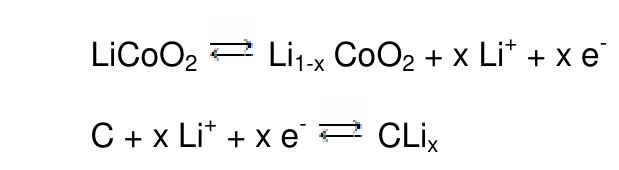
The total amount of energy a battery can store, is rated in mAh. A battery rated at 1500 mAh can power a device drawing 100 milliamps for 15 hours.
6.8 Graphite has lithium intercalation sites between its layers. Assuming a maximum 6 : 1 carbon-to-lithium intercalation stoichiometry, calculate the theoretical charge capacity of 1.00 gram of graphite to intercalate lithium. Answer in mAh/g with 3 significant figures.
Official English text of the problem.
Answers
- 6.1: \(\ce{2H2O(l) + 2e- -> H2(g) + 2OH-(aq)}\).
- 6.2: \(\ce{2H2O(l) -> O2(g) + 4H+(aq) + 4e-}\).
- 6.3: \(\ce{Cu(s) -> Cu^2+(aq) + 2e-}\).
- 6.4: Copper ion: \(+0.340\ \mathrm{V}\); oxygen: \(+1.230\ \mathrm{V}\); water: \(-0.830\ \mathrm{V}\); sodium ion: \(-2.710\ \mathrm{V}\); hydrogen ion: \(0.000\ \mathrm{V}\).
- 6.5: \(K_{\mathrm{sp}}=4.79\times10^{-20}\).
- 6.6: \(E^\circ=-0.231\ \mathrm{V}\).
- 6.7: \(E=+0.310\ \mathrm{V}\).
- 6.8: \(\boxed{372\ \mathrm{mAh\,g^{-1}}}\).
All electrode potentials are relative to the standard hydrogen electrode.
Solution
The molecular and ionic species used below have the following names and SMILES:
| Species | Name | SMILES |
|---|---|---|
| \(\ce{H2O}\) | Water | O |
| \(\ce{H2}\) | Hydrogen | [H][H] |
| \(\ce{O2}\) | Oxygen | O=O |
| \(\ce{H+}\) | Hydrogen ion, or proton | [H+] |
| \(\ce{OH-}\) | Hydroxide ion | [OH-] |
| \(\ce{Cu^2+}\) | Copper(II) ion | [Cu+2] |
| \(\ce{Na+}\) | Sodium ion | [Na+] |
| \(\ce{Li+}\) | Lithium ion | [Li+] |
Copper(II) hydroxide, \(\ce{Cu(OH)2}\), can be represented compositionally as [Cu+2].[OH-].[OH-]. This specifies its ionic formula but does not describe its solid-state coordination or crystal structure. Metals, graphite, and lithium-intercalated graphite are extended solids without finite molecular SMILES. The oxygen SMILES specifies connectivity but does not encode its triplet ground state.
For the calculations, use the usual ideal-solution approximation, \(a_i\simeq[i]/c^\circ\), where \(c^\circ=1\ \mathrm{mol\,L^{-1}}\), and unit activities for pure solids and liquid water. Standard constants are
\[ R=8.31446\ \mathrm{J\,mol^{-1}\,K^{-1}},\qquad F=96485.3\ \mathrm{C\,mol^{-1}},\qquad M_{\ce C}=12.01\ \mathrm{g\,mol^{-1}}. \]
At \(T=298.15\ \mathrm{K}\),
\[ \frac{RT\ln 10}{F}=0.0591593\ \mathrm{V}. \]
6.1 — Reduction of water
The negative electrode supplies electrons and is the cathode. Hydrogen in water is reduced from oxidation state \(+1\) to \(0\):
\[ \boxed{\ce{2H2O(l) + 2e- -> H2(g) + 2OH-(aq)}}. \]
Both atoms and charge are balanced. The production of hydroxide ions explains why the solution near this electrode becomes basic.
6.2 — Oxidation of water
The positive electrode removes electrons and is the anode. Oxygen in water is oxidized from oxidation state \(-2\) to \(0\):
\[ \boxed{\ce{2H2O(l) -> O2(g) + 4H+(aq) + 4e-}}. \]
The production of hydrogen ions makes the solution near this electrode acidic.
6.3 — Copper electrodes
At the copper anode, copper itself is oxidized instead of water:
\[ \boxed{\ce{Cu(s) -> Cu^2+(aq) + 2e-}}. \]
Thus, the anode dissolves without generating gas. Initially, before copper(II) ions reach the cathode in appreciable amounts, water reduction there produces hydrogen as in part 6.1.
6.4 — Identification of the standard reduction potentials
The correct connections, with the corresponding balanced reduction half-reactions, are:
| Reduction | Half-reaction | \(E^\circ/\mathrm{V}\) |
|---|---|---|
| Copper ion | \(\ce{Cu^2+(aq) + 2e- -> Cu(s)}\) | \(+0.340\) |
| Oxygen | \(\ce{O2(g) + 4H+(aq) + 4e- -> 2H2O(l)}\) | \(+1.230\) |
| Water | \(\ce{2H2O(l) + 2e- -> H2(g) + 2OH-(aq)}\) | \(-0.830\) |
| Sodium ion | \(\ce{Na+(aq) + e- -> Na(s)}\) | \(-2.710\) |
| Hydrogen ion | \(\ce{2H+(aq) + 2e- -> H2(g)}\) | \(0.000\) |
The hydrogen-ion reduction potential is zero by definition of the standard hydrogen electrode.
Water is reduced more readily than sodium ions, so its reduction potential is more positive. The two negative values therefore belong to water, \(-0.830\ \mathrm{V}\), and sodium ions, \(-2.710\ \mathrm{V}\), respectively.
Copper dissolves at the anode in preference to oxygen evolution. This identifies copper oxidation as the easier of those two oxidations and assigns the lower remaining reduction potential to the copper couple: \(+0.340\ \mathrm{V}\). Oxygen reduction receives \(+1.230\ \mathrm{V}\).
The oxygen value refers to the acidic half-reaction shown in the table; the water-reduction value refers to the half-reaction producing hydroxide ions.
6.5 — Solubility product of copper(II) hydroxide
The dissolution equilibrium is
\[ \ce{Cu(OH)2(s) <=> Cu^2+(aq) + 2OH-(aq)}. \]
At the onset of precipitation, the copper(II) concentration is still \(0.100\ \mathrm{mol\,L^{-1}}\). Since \(K_w=1.00\times10^{-14}\),
\[ \mathrm{pOH}=14.00-4.84=9.16, \]
so
\[ [\ce{OH-}] =10^{-9.16}\ \mathrm{mol\,L^{-1}} =6.9183\times10^{-10}\ \mathrm{mol\,L^{-1}}. \]
Hence,
\[ \begin{aligned} K_{\mathrm{sp}} &=a(\ce{Cu^2+})\,a(\ce{OH-})^2\\ &=(0.100)(6.9183\times10^{-10})^2\\ &=4.7863\times10^{-20}. \end{aligned} \]
Therefore,
\[ \boxed{K_{\mathrm{sp}}=4.79\times10^{-20}}. \]
This is the dimensionless equilibrium constant using the stated standard concentration; the corresponding concentration product has units \(\mathrm{mol^3\,L^{-3}}\).
6.6 — Standard reduction potential of copper(II) hydroxide
Add the dissolution equilibrium to copper(II) reduction:
\[ \begin{aligned} \ce{Cu(OH)2(s)}&\ce{-> Cu^2+(aq) + 2OH-(aq)},\\ \ce{Cu^2+(aq) + 2e-}&\ce{-> Cu(s)}. \end{aligned} \]
The sum is the required half-reaction:
\[ \ce{Cu(OH)2(s) + 2e- -> Cu(s) + 2OH-(aq)}. \]
Standard Gibbs energies are additive:
\[ \Delta G^\circ_{\mathrm{diss}}=-RT\ln K_{\mathrm{sp}}, \qquad \Delta G^\circ_{\mathrm{Cu}}=-2F E^\circ_{\ce{Cu^2+}/\ce{Cu}}. \]
Thus,
\[ -2F E^\circ =-RT\ln K_{\mathrm{sp}} -2F E^\circ_{\ce{Cu^2+}/\ce{Cu}}, \]
giving
\[ E^\circ =E^\circ_{\ce{Cu^2+}/\ce{Cu}} +\frac{RT}{2F}\ln K_{\mathrm{sp}}. \]
Here \(\log_{10}K_{\mathrm{sp}}=-19.32\), so
\[ \begin{aligned} E^\circ &=0.340+\frac{0.0591593}{2}(-19.32)\\ &=-0.231479\ \mathrm{V}. \end{aligned} \]
To three significant figures,
\[ \boxed{E^\circ=-0.231\ \mathrm{V}}. \]
6.7 — Electrode potential at pH 1.00
At \(\mathrm{pH}=1.00\),
\[ [\ce{H+}]=0.100\ \mathrm{mol\,L^{-1}}, \qquad [\ce{OH-}]=1.00\times10^{-13}\ \mathrm{mol\,L^{-1}}. \]
The ionic activity product is
\[ Q_{\mathrm{sp}} =(0.100)(1.00\times10^{-13})^2 =1.00\times10^{-27} <K_{\mathrm{sp}}. \]
Consequently, copper(II) hydroxide does not precipitate, and the copper(II) concentration remains \(0.100\ \mathrm{mol\,L^{-1}}\). Use the Nernst equation for
\[ \ce{Cu^2+(aq) + 2e- -> Cu(s)}: \]
\[ \begin{aligned} E &=E^\circ_{\ce{Cu^2+}/\ce{Cu}} +\frac{RT}{2F}\ln a(\ce{Cu^2+})\\ &=0.340+\frac{0.0591593}{2}\log_{10}(0.100)\\ &=0.310420\ \mathrm{V}. \end{aligned} \]
Therefore,
\[ \boxed{E=+0.310\ \mathrm{V}}. \]
6.8 — Theoretical charge capacity of graphite
At the maximum carbon-to-lithium ratio of \(6:1\), intercalation can be written as
\[ \ce{6C(s) + Li+ + e- -> LiC6(s)}. \]
Each intercalated lithium ion requires one electron. Thus, six moles of carbon correspond to one mole of transferred electrons. Lithium occupies sites between the graphite layers.
For \(1.00\ \mathrm{g}\) of graphite,
\[ n_e =\frac{1.00\ \mathrm{g}} {6(12.01\ \mathrm{g\,mol^{-1}})} =0.0138773\ \mathrm{mol}. \]
The charge is
\[ Q=n_eF =(0.0138773\ \mathrm{mol}) (96485.3\ \mathrm{C\,mol^{-1}}) =1338.96\ \mathrm{C}. \]
Since
\[ 1\ \mathrm{mAh} =(10^{-3}\ \mathrm{A})(3600\ \mathrm{s}) =3.6\ \mathrm{C}, \]
the specific capacity is
\[ \frac{Q}{m} =\frac{1338.96}{3.6(1.00)} =371.933\ \mathrm{mAh\,g^{-1}}. \]
Therefore,
\[ \boxed{\frac{Q}{m}=372\ \mathrm{mAh\,g^{-1}}}. \]
Although the statement calls the rating an amount of energy, mAh measures electric charge. Calculating stored energy would also require the battery voltage.
The solution was checked against the official solution.
IChO 2006 · Theorieaufgabe 6
Elektrochemie
Wasser ist ein sehr stabiles Molekül, das auf der Erde reichlich vorkommt und für das Leben unverzichtbar ist. Daher hielt man Wasser lange Zeit für ein chemisches Element. Doch schon kurz nach der Erfindung einer galvanischen Zelle im Jahr 1800 zerlegten Nicholson und Carlyle Wasser durch Elektrolyse in Wasserstoff und Sauerstoff.
6.1 Wasser kann als durch Sauerstoff oxidierter Wasserstoff betrachtet werden. Daher lässt sich Wasserstoff durch Reduktion von Wasser in einer wässrigen Natriumsulfatlösung an einer Platinelektrode zurückgewinnen, die mit dem Minuspol einer Batterie verbunden ist. Die Lösung in der Nähe der Elektrode wird basisch. Geben Sie eine ausgeglichene Teilreaktionsgleichung für die Reduktion von Wasser an.
6.2 Wasser kann auch als durch Wasserstoff reduzierter Sauerstoff betrachtet werden. Daher lässt sich Sauerstoff durch Oxidation von Wasser an der mit dem Pluspol verbundenen \(\ce{Pt}\)-Elektrode zurückgewinnen. Geben Sie eine ausgeglichene Teilreaktionsgleichung für die Oxidation von Wasser an.
6.3 Werden beide Elektroden aus Kupfer hergestellt, entsteht in der Anfangsphase der Elektrolyse nur an einer Elektrode Gas. Geben Sie die Teilreaktionsgleichung an der Elektrode an, an der kein Gas entsteht.
Eine weitere Spezies in der Lösung, die reduziert werden kann, ist das Natriumion. Die Reduktion von Natriumionen zu metallischem Natrium findet in wässriger Lösung nicht statt, weil zuerst Wasser reduziert wird. Wie Humphrey Davy jedoch 1807 entdeckte, lässt sich Natrium durch Elektrolyse von geschmolzenem Natriumchlorid herstellen.
6.4 Ordnen Sie auf der Grundlage dieser Beobachtungen den Teilreaktionen das jeweilige Standardreduktionspotential (in Volt) zu.
| Reduktion von Kupferionen (\(\ce{Cu^2+}\)) | \(+0.340\) |
| Reduktion von Sauerstoff | \(-2.710\) |
| Reduktion von Wasser | \(-0.830\) |
| Reduktion von Natriumionen (\(\ce{Na+}\)) | \(0.000\) |
| Reduktion von Wasserstoffionen | \(+1.230\) |
Das Elektrodenpotential wird durch andere Reaktionen beeinflusst, die in der Umgebung der Elektrode ablaufen. Das Potential der \(\ce{Cu^2+}/\ce{Cu}\)-Elektrode in einer 0.100 M \(\ce{Cu^2+}\)-Lösung ändert sich, wenn \(\ce{Cu(OH)2}\) ausfällt. Geben Sie die Ergebnisse der folgenden Aufgaben mit 3 signifikanten Stellen an. Die Temperatur beträgt \(25\,^\circ\mathrm{C}\). Beachten Sie, dass \(K_w=1.00\times10^{-14}\) bei \(25\,^\circ\mathrm{C}\) gilt.
6.5 Die Fällung von \(\ce{Cu(OH)2}\) beginnt bei \(\mathrm{pH}=4.84\). Bestimmen Sie das Löslichkeitsprodukt von \(\ce{Cu(OH)2}\).
6.6 Berechnen Sie das Standardreduktionspotential für \(\ce{Cu(OH)2(s) + 2e- -> Cu(s) + 2OH-}\).
6.7 Berechnen Sie das Elektrodenpotential bei \(\mathrm{pH}=1.00\).
Lithiumcobaltoxid und ein spezielles Kohlenstoffmaterial sind die Aktivmaterialien der positiven beziehungsweise negativen Elektrode einer wiederaufladbaren Lithiumbatterie. Während der Lade- und Entladezyklen laufen die folgenden reversiblen Teilreaktionen ab.
Die gesamte Energiemenge, die eine Batterie speichern kann, wird in mAh angegeben. Eine Batterie mit einer Nennkapazität von 1500 mAh kann ein Gerät, das einen Strom von 100 Milliampere aufnimmt, 15 Stunden lang versorgen.
6.8 Graphit besitzt zwischen seinen Schichten Plätze für die Interkalation von Lithium. Berechnen Sie unter der Annahme einer maximalen Interkalationsstöchiometrie von Kohlenstoff zu Lithium von 6 : 1 die theoretische Ladungskapazität von 1.00 Gramm Graphit für die Interkalation von Lithium. Geben Sie das Ergebnis in mAh/g mit 3 signifikanten Stellen an.
Aufgabentext aus dem offiziellen englischen Text übersetzt.
Antworten
- 6.1: \(\ce{2H2O(l) + 2e- -> H2(g) + 2OH-(aq)}\).
- 6.2: \(\ce{2H2O(l) -> O2(g) + 4H+(aq) + 4e-}\).
- 6.3: \(\ce{Cu(s) -> Cu^2+(aq) + 2e-}\).
- 6.4: Kupferion: \(+0.340\ \mathrm{V}\); Sauerstoff: \(+1.230\ \mathrm{V}\); Wasser: \(-0.830\ \mathrm{V}\); Natriumion: \(-2.710\ \mathrm{V}\); Wasserstoffion: \(0.000\ \mathrm{V}\).
- 6.5: \(K_{\mathrm{sp}}=4.79\times10^{-20}\).
- 6.6: \(E^\circ=-0.231\ \mathrm{V}\).
- 6.7: \(E=+0.310\ \mathrm{V}\).
- 6.8: \(\boxed{372\ \mathrm{mAh\,g^{-1}}}\).
Alle Elektrodenpotentiale beziehen sich auf die Standardwasserstoffelektrode.
Lösung
Die im Folgenden verwendeten molekularen und ionischen Spezies haben die folgenden Namen und SMILES:
| Spezies | Name | SMILES |
|---|---|---|
| \(\ce{H2O}\) | Wasser | O |
| \(\ce{H2}\) | Wasserstoff | [H][H] |
| \(\ce{O2}\) | Sauerstoff | O=O |
| \(\ce{H+}\) | Wasserstoffion oder Proton | [H+] |
| \(\ce{OH-}\) | Hydroxidion | [OH-] |
| \(\ce{Cu^2+}\) | Kupfer(II)-Ion | [Cu+2] |
| \(\ce{Na+}\) | Natriumion | [Na+] |
| \(\ce{Li+}\) | Lithiumion | [Li+] |
Kupfer(II)-hydroxid, \(\ce{Cu(OH)2}\), lässt sich hinsichtlich seiner Zusammensetzung als [Cu+2].[OH-].[OH-] darstellen. Dies gibt seine Ionenformel an, beschreibt jedoch weder seine Koordination im Festkörper noch seine Kristallstruktur. Metalle, Graphit und mit Lithium interkalierter Graphit sind ausgedehnte Festkörper ohne endliche molekulare SMILES. Die SMILES-Darstellung von Sauerstoff gibt die Bindungsverknüpfung an, kodiert jedoch nicht seinen Triplett-Grundzustand.
Verwenden Sie für die Berechnungen die übliche Näherung einer idealen Lösung, \(a_i\simeq[i]/c^\circ\), wobei \(c^\circ=1\ \mathrm{mol\,L^{-1}}\), sowie Aktivitäten von eins für reine Feststoffe und flüssiges Wasser. Die verwendeten Standardkonstanten sind
\[ R=8.31446\ \mathrm{J\,mol^{-1}\,K^{-1}},\qquad F=96485.3\ \mathrm{C\,mol^{-1}},\qquad M_{\ce C}=12.01\ \mathrm{g\,mol^{-1}}. \]
Bei \(T=298.15\ \mathrm{K}\) gilt
\[ \frac{RT\ln 10}{F}=0.0591593\ \mathrm{V}. \]
6.1 — Reduktion von Wasser
Die negative Elektrode liefert Elektronen und ist die Kathode. Der Wasserstoff im Wasser wird von der Oxidationszahl \(+1\) auf \(0\) reduziert:
\[ \boxed{\ce{2H2O(l) + 2e- -> H2(g) + 2OH-(aq)}}. \]
Sowohl die Atome als auch die Ladung sind bilanziert. Die Bildung von Hydroxidionen erklärt, warum die Lösung in der Nähe dieser Elektrode basisch wird.
6.2 — Oxidation von Wasser
Die positive Elektrode nimmt Elektronen auf und ist die Anode. Der Sauerstoff im Wasser wird von der Oxidationszahl \(-2\) auf \(0\) oxidiert:
\[ \boxed{\ce{2H2O(l) -> O2(g) + 4H+(aq) + 4e-}}. \]
Durch die Bildung von Wasserstoffionen wird die Lösung in der Nähe dieser Elektrode sauer.
6.3 — Kupferelektroden
An der Kupferanode wird anstelle von Wasser das Kupfer selbst oxidiert:
\[ \boxed{\ce{Cu(s) -> Cu^2+(aq) + 2e-}}. \]
Die Anode löst sich somit auf, ohne dass Gas entsteht. Zu Beginn, bevor Kupfer(II)-Ionen in nennenswerten Mengen die Kathode erreichen, entsteht dort durch die Reduktion von Wasser Wasserstoff wie in Teil 6.1.
6.4 — Zuordnung der Standardreduktionspotentiale
Die richtigen Zuordnungen mit den zugehörigen ausgeglichenen Reduktionsteilgleichungen lauten:
| Reduktion | Teilreaktion | \(E^\circ/\mathrm{V}\) |
|---|---|---|
| Kupferion | \(\ce{Cu^2+(aq) + 2e- -> Cu(s)}\) | \(+0.340\) |
| Sauerstoff | \(\ce{O2(g) + 4H+(aq) + 4e- -> 2H2O(l)}\) | \(+1.230\) |
| Wasser | \(\ce{2H2O(l) + 2e- -> H2(g) + 2OH-(aq)}\) | \(-0.830\) |
| Natriumion | \(\ce{Na+(aq) + e- -> Na(s)}\) | \(-2.710\) |
| Wasserstoffion | \(\ce{2H+(aq) + 2e- -> H2(g)}\) | \(0.000\) |
Das Reduktionspotential der Wasserstoffionen beträgt aufgrund der Definition der Standardwasserstoffelektrode null.
Wasser wird leichter reduziert als Natriumionen, daher ist sein Reduktionspotential positiver. Die beiden negativen Werte gehören somit zu Wasser, \(-0.830\ \mathrm{V}\), beziehungsweise zu Natriumionen, \(-2.710\ \mathrm{V}\).
An der Anode löst sich bevorzugt Kupfer auf, statt dass Sauerstoff entsteht. Dies zeigt, dass die Kupferoxidation die leichtere dieser beiden Oxidationen ist, und ordnet dem Kupfer-Redoxpaar das niedrigere der verbleibenden Reduktionspotentiale zu: \(+0.340\ \mathrm{V}\). Der Sauerstoffreduktion wird \(+1.230\ \mathrm{V}\) zugeordnet.
Der Wert für Sauerstoff bezieht sich auf die in der Tabelle angegebene Teilreaktion im sauren Milieu; der Wert für die Wasserreduktion bezieht sich auf die Teilreaktion, bei der Hydroxidionen entstehen.
6.5 — Löslichkeitsprodukt von Kupfer(II)-hydroxid
Das Lösungsgleichgewicht lautet
\[ \ce{Cu(OH)2(s) <=> Cu^2+(aq) + 2OH-(aq)}. \]
Zu Beginn der Fällung beträgt die Kupfer(II)-Konzentration noch \(0.100\ \mathrm{mol\,L^{-1}}\). Da \(K_w=1.00\times10^{-14}\), gilt
\[ \mathrm{pOH}=14.00-4.84=9.16, \]
also
\[ [\ce{OH-}] =10^{-9.16}\ \mathrm{mol\,L^{-1}} =6.9183\times10^{-10}\ \mathrm{mol\,L^{-1}}. \]
Daraus folgt
\[ \begin{aligned} K_{\mathrm{sp}} &=a(\ce{Cu^2+})\,a(\ce{OH-})^2\\ &=(0.100)(6.9183\times10^{-10})^2\\ &=4.7863\times10^{-20}. \end{aligned} \]
Somit ergibt sich
\[ \boxed{K_{\mathrm{sp}}=4.79\times10^{-20}}. \]
Dies ist die dimensionslose Gleichgewichtskonstante unter Verwendung der angegebenen Standardkonzentration; das entsprechende Konzentrationsprodukt hat die Einheit \(\mathrm{mol^3\,L^{-3}}\).
6.6 — Standardreduktionspotential von Kupfer(II)-hydroxid
Das Lösungsgleichgewicht wird zur Kupfer(II)-Reduktion addiert:
\[ \begin{aligned} \ce{Cu(OH)2(s)}&\ce{-> Cu^2+(aq) + 2OH-(aq)},\\ \ce{Cu^2+(aq) + 2e-}&\ce{-> Cu(s)}. \end{aligned} \]
Die Summe ist die gesuchte Teilreaktion:
\[ \ce{Cu(OH)2(s) + 2e- -> Cu(s) + 2OH-(aq)}. \]
Die Standard-Gibbs-Energien sind additiv:
\[ \Delta G^\circ_{\mathrm{diss}}=-RT\ln K_{\mathrm{sp}}, \qquad \Delta G^\circ_{\mathrm{Cu}}=-2F E^\circ_{\ce{Cu^2+}/\ce{Cu}}. \]
Damit gilt
\[ -2F E^\circ =-RT\ln K_{\mathrm{sp}} -2F E^\circ_{\ce{Cu^2+}/\ce{Cu}}, \]
woraus folgt
\[ E^\circ =E^\circ_{\ce{Cu^2+}/\ce{Cu}} +\frac{RT}{2F}\ln K_{\mathrm{sp}}. \]
Hier ist \(\log_{10}K_{\mathrm{sp}}=-19.32\), also
\[ \begin{aligned} E^\circ &=0.340+\frac{0.0591593}{2}(-19.32)\\ &=-0.231479\ \mathrm{V}. \end{aligned} \]
Mit drei signifikanten Stellen ergibt sich
\[ \boxed{E^\circ=-0.231\ \mathrm{V}}. \]
6.7 — Elektrodenpotential bei pH 1.00
Bei \(\mathrm{pH}=1.00\) gilt
\[ [\ce{H+}]=0.100\ \mathrm{mol\,L^{-1}}, \qquad [\ce{OH-}]=1.00\times10^{-13}\ \mathrm{mol\,L^{-1}}. \]
Das Ionenaktivitätsprodukt beträgt
\[ Q_{\mathrm{sp}} =(0.100)(1.00\times10^{-13})^2 =1.00\times10^{-27} <K_{\mathrm{sp}}. \]
Folglich fällt kein Kupfer(II)-hydroxid aus, und die Kupfer(II)-Konzentration bleibt bei \(0.100\ \mathrm{mol\,L^{-1}}\). Verwendet wird die Nernst-Gleichung für
\[ \ce{Cu^2+(aq) + 2e- -> Cu(s)}: \]
\[ \begin{aligned} E &=E^\circ_{\ce{Cu^2+}/\ce{Cu}} +\frac{RT}{2F}\ln a(\ce{Cu^2+})\\ &=0.340+\frac{0.0591593}{2}\log_{10}(0.100)\\ &=0.310420\ \mathrm{V}. \end{aligned} \]
Somit ergibt sich
\[ \boxed{E=+0.310\ \mathrm{V}}. \]
6.8 — Theoretische Ladungskapazität von Graphit
Beim maximalen Verhältnis von Kohlenstoff zu Lithium von \(6:1\) lässt sich die Interkalation wie folgt schreiben:
\[ \ce{6C(s) + Li+ + e- -> LiC6(s)}. \]
Jedes interkalierte Lithiumion benötigt ein Elektron. Somit entsprechen sechs Mol Kohlenstoff einem Mol übertragener Elektronen. Lithium besetzt Plätze zwischen den Graphitschichten.
Für \(1.00\ \mathrm{g}\) Graphit gilt
\[ n_e =\frac{1.00\ \mathrm{g}} {6(12.01\ \mathrm{g\,mol^{-1}})} =0.0138773\ \mathrm{mol}. \]
Die Ladung beträgt
\[ Q=n_eF =(0.0138773\ \mathrm{mol}) (96485.3\ \mathrm{C\,mol^{-1}}) =1338.96\ \mathrm{C}. \]
Da
\[ 1\ \mathrm{mAh} =(10^{-3}\ \mathrm{A})(3600\ \mathrm{s}) =3.6\ \mathrm{C}, \]
beträgt die spezifische Kapazität
\[ \frac{Q}{m} =\frac{1338.96}{3.6(1.00)} =371.933\ \mathrm{mAh\,g^{-1}}. \]
Somit ergibt sich
\[ \boxed{\frac{Q}{m}=372\ \mathrm{mAh\,g^{-1}}}. \]
Obwohl die Aufgabenstellung die Kapazitätsangabe als Energiemenge bezeichnet, ist mAh ein Maß für die elektrische Ladung. Zur Berechnung der gespeicherten Energie wäre zusätzlich die Batteriespannung erforderlich.
Die Lösung wurde mit der offiziellen Lösung abgeglichen.
IChO 2006 · Teori sorusu 6
Elektrokimya
Su, yeryüzünde bol bulunan ve yaşam için vazgeçilmez olan çok kararlı bir moleküldür. Bu nedenle su, uzun süre bir kimyasal element olarak düşünülmüştür. Ancak, 1800 yılında volta pilinin icadından kısa bir süre sonra Nicholson ve Carlyle, suyu elektroliz yoluyla hidrojen ve oksijene ayrıştırmıştır.
6.1 Su, oksijen tarafından yükseltgenmiş hidrojen olarak düşünülebilir. Dolayısıyla, sodyum sülfatın sulu çözeltisi kullanılarak, bir pilin negatif kutbuna bağlı platin elektrotta suyun indirgenmesiyle hidrojen elde edilebilir. Elektrot yakınındaki çözelti bazik hâle gelir. Suyun indirgenmesi için denkleştirilmiş bir yarı tepkime yazınız.
6.2 Su, hidrojen tarafından indirgenmiş oksijen olarak da düşünülebilir. Dolayısıyla, pozitif kutba bağlı \(\ce{Pt}\) elektrotta suyun yükseltgenmesiyle oksijen elde edilebilir. Suyun yükseltgenmesi için denkleştirilmiş bir yarı tepkime yazınız.
6.3 Her iki elektrotta da bakır kullanıldığında, elektrolizin başlangıç aşamasında yalnızca bir elektrotta gaz oluşur. Gaz oluşturmayan elektrottaki yarı tepkimeyi yazınız.
Çözeltide indirgenebilen bir başka tür de sodyum iyonudur. Sulu çözeltide önce su indirgendiğinden, sodyum iyonunun metalik sodyuma indirgenmesi gerçekleşmez. Ancak, Humphrey Davy'nin 1807 yılında keşfettiği gibi, erimiş sodyum klorürün elektroliziyle sodyum elde edilebilir.
6.4 Bu gözlemlere dayanarak yarı tepkimeleri standart indirgenme potansiyelleriyle (volt cinsinden) eşleştiriniz.
| Bakır iyonunun (\(\ce{Cu^2+}\)) indirgenmesi | \(+0.340\) |
| Oksijenin indirgenmesi | \(-2.710\) |
| Suyun indirgenmesi | \(-0.830\) |
| Sodyum iyonunun (\(\ce{Na+}\)) indirgenmesi | \(0.000\) |
| Hidrojen iyonunun indirgenmesi | \(+1.230\) |
Elektrot potansiyeli, elektrot çevresinde gerçekleşen diğer tepkimelerden etkilenir. 0.100 M \(\ce{Cu^2+}\) çözeltisindeki \(\ce{Cu^2+}/\ce{Cu}\) elektrodunun potansiyeli, \(\ce{Cu(OH)2}\) çöktükçe değişir. Aşağıdaki soruların cevaplarını 3 anlamlı rakamla veriniz. Sıcaklık \(25\,^\circ\mathrm{C}\)'dir. \(25\,^\circ\mathrm{C}\)'de \(K_w=1.00\times10^{-14}\) olduğunu dikkate alınız.
6.5 \(\ce{Cu(OH)2}\)'nin çökelmesi \(\mathrm{pH}=4.84\)'te başlar. \(\ce{Cu(OH)2}\)'nin çözünürlük çarpımını belirleyiniz.
6.6 \(\ce{Cu(OH)2(s) + 2e- -> Cu(s) + 2OH-}\) için standart indirgenme potansiyelini hesaplayınız.
6.7 \(\mathrm{pH}=1.00\)'de elektrot potansiyelini hesaplayınız.
Lityum kobalt oksit ve özel nitelikli karbon, şarj edilebilir bir lityum pilin sırasıyla pozitif ve negatif elektrotlarının aktif bileşenleridir. Şarj ve yeniden şarj döngüleri sırasında aşağıdaki tersinir yarı tepkimeler gerçekleşir.
Bir pilin depolayabileceği toplam enerji miktarı mAh cinsinden belirtilir. 1500 mAh kapasiteli bir pil, 100 miliamper akım çeken bir aygıta 15 saat boyunca güç sağlayabilir.
6.8 Grafitin katmanları arasında lityumun interkalasyonla yerleşebileceği konumlar bulunur. En yüksek karbon/lityum interkalasyon stokiyometrisinin 6 : 1 olduğunu varsayarak, 1.00 gram grafitin lityum interkalasyonu için teorik yük kapasitesini hesaplayınız. Cevabınızı mAh/g cinsinden 3 anlamlı rakamla veriniz.
Soru metni resmi İngilizce metinden çevrilmiştir.
Cevaplar
- 6.1: \(\ce{2H2O(l) + 2e- -> H2(g) + 2OH-(aq)}\).
- 6.2: \(\ce{2H2O(l) -> O2(g) + 4H+(aq) + 4e-}\).
- 6.3: \(\ce{Cu(s) -> Cu^2+(aq) + 2e-}\).
- 6.4: Bakır iyonu: \(+0.340\ \mathrm{V}\); oksijen: \(+1.230\ \mathrm{V}\); su: \(-0.830\ \mathrm{V}\); sodyum iyonu: \(-2.710\ \mathrm{V}\); hidrojen iyonu: \(0.000\ \mathrm{V}\).
- 6.5: \(K_{\mathrm{sp}}=4.79\times10^{-20}\).
- 6.6: \(E^\circ=-0.231\ \mathrm{V}\).
- 6.7: \(E=+0.310\ \mathrm{V}\).
- 6.8: \(\boxed{372\ \mathrm{mAh\,g^{-1}}}\).
Tüm elektrot potansiyelleri standart hidrojen elektroduna göredir.
Çözüm
Aşağıda kullanılan moleküler ve iyonik türlerin adları ve SMILES gösterimleri şöyledir:
| Tür | Ad | SMILES |
|---|---|---|
| \(\ce{H2O}\) | Su | O |
| \(\ce{H2}\) | Hidrojen | [H][H] |
| \(\ce{O2}\) | Oksijen | O=O |
| \(\ce{H+}\) | Hidrojen iyonu veya proton | [H+] |
| \(\ce{OH-}\) | Hidroksit iyonu | [OH-] |
| \(\ce{Cu^2+}\) | Bakır(II) iyonu | [Cu+2] |
| \(\ce{Na+}\) | Sodyum iyonu | [Na+] |
| \(\ce{Li+}\) | Lityum iyonu | [Li+] |
Bakır(II) hidroksit, \(\ce{Cu(OH)2}\), bileşim açısından [Cu+2].[OH-].[OH-] olarak gösterilebilir. Bu gösterim iyonik formülünü belirtir, ancak katı hâldeki koordinasyonunu veya kristal yapısını tanımlamaz. Metaller, grafit ve lityum interkalasyonu yapılmış grafit, sonlu moleküler SMILES gösterimleri olmayan, uzanımlı yapıya sahip katılardır. Oksijenin SMILES gösterimi atomların bağlanma düzenini belirtir, ancak triplet temel hâlini kodlamaz.
Hesaplamalarda alışılmış ideal çözelti yaklaşımını, \(a_i\simeq[i]/c^\circ\), kullanınız; burada \(c^\circ=1\ \mathrm{mol\,L^{-1}}\)'dir. Saf katıların ve sıvı suyun aktivitelerini bir kabul ediniz. Standart sabitler şöyledir:
\[ R=8.31446\ \mathrm{J\,mol^{-1}\,K^{-1}},\qquad F=96485.3\ \mathrm{C\,mol^{-1}},\qquad M_{\ce C}=12.01\ \mathrm{g\,mol^{-1}}. \]
\(T=298.15\ \mathrm{K}\)'de,
\[ \frac{RT\ln 10}{F}=0.0591593\ \mathrm{V}. \]
6.1 — Suyun indirgenmesi
Negatif elektrot elektron sağlar ve katottur. Sudaki hidrojenin yükseltgenme basamağı \(+1\)'den \(0\)'a düşer:
\[ \boxed{\ce{2H2O(l) + 2e- -> H2(g) + 2OH-(aq)}}. \]
Hem atomlar hem de yük bakımından denklik sağlanmıştır. Hidroksit iyonlarının oluşması, bu elektrot yakınındaki çözeltinin neden bazik hâle geldiğini açıklar.
6.2 — Suyun yükseltgenmesi
Pozitif elektrot elektronları uzaklaştırır ve anottur. Sudaki oksijenin yükseltgenme basamağı \(-2\)'den \(0\)'a yükselir:
\[ \boxed{\ce{2H2O(l) -> O2(g) + 4H+(aq) + 4e-}}. \]
Hidrojen iyonlarının oluşması, bu elektrot yakınındaki çözeltiyi asidik hâle getirir.
6.3 — Bakır elektrotlar
Bakır anotta su yerine bakırın kendisi yükseltgenir:
\[ \boxed{\ce{Cu(s) -> Cu^2+(aq) + 2e-}}. \]
Böylece anot, gaz oluşturmadan çözünür. Başlangıçta, bakır(II) iyonları katoda kayda değer miktarda ulaşmadan önce, katotta suyun indirgenmesiyle 6.1 kısmındaki gibi hidrojen oluşur.
6.4 — Standart indirgenme potansiyellerinin belirlenmesi
İlgili denkleştirilmiş indirgenme yarı tepkimeleriyle birlikte doğru eşleştirmeler şöyledir:
| İndirgenme | Yarı tepkime | \(E^\circ/\mathrm{V}\) |
|---|---|---|
| Bakır iyonu | \(\ce{Cu^2+(aq) + 2e- -> Cu(s)}\) | \(+0.340\) |
| Oksijen | \(\ce{O2(g) + 4H+(aq) + 4e- -> 2H2O(l)}\) | \(+1.230\) |
| Su | \(\ce{2H2O(l) + 2e- -> H2(g) + 2OH-(aq)}\) | \(-0.830\) |
| Sodyum iyonu | \(\ce{Na+(aq) + e- -> Na(s)}\) | \(-2.710\) |
| Hidrojen iyonu | \(\ce{2H+(aq) + 2e- -> H2(g)}\) | \(0.000\) |
Standart hidrojen elektrodunun tanımı gereği, hidrojen iyonunun indirgenme potansiyeli sıfırdır.
Su, sodyum iyonlarından daha kolay indirgenir; bu nedenle indirgenme potansiyeli daha pozitiftir. Dolayısıyla iki negatif değer, sırasıyla suya, \(-0.830\ \mathrm{V}\), ve sodyum iyonlarına, \(-2.710\ \mathrm{V}\), aittir.
Anotta oksijen açığa çıkması yerine bakır çözünür. Bu durum, bakırın yükseltgenmesinin bu iki yükseltgenmeden daha kolay olanı olduğunu gösterir ve geriye kalan indirgenme potansiyellerinden düşük olanının bakır çiftine ait olduğunu belirler: \(+0.340\ \mathrm{V}\). Oksijenin indirgenmesine \(+1.230\ \mathrm{V}\) değeri atanır.
Oksijen için verilen değer, tabloda gösterilen asidik ortamdaki yarı tepkimeye; suyun indirgenmesi için verilen değer ise hidroksit iyonları oluşturan yarı tepkimeye aittir.
6.5 — Bakır(II) hidroksitin çözünürlük çarpımı
Çözünme dengesi şöyledir:
\[ \ce{Cu(OH)2(s) <=> Cu^2+(aq) + 2OH-(aq)}. \]
Çökelmenin başladığı anda bakır(II) derişimi hâlâ \(0.100\ \mathrm{mol\,L^{-1}}\)'dir. \(K_w=1.00\times10^{-14}\) olduğundan,
\[ \mathrm{pOH}=14.00-4.84=9.16, \]
dolayısıyla
\[ [\ce{OH-}] =10^{-9.16}\ \mathrm{mol\,L^{-1}} =6.9183\times10^{-10}\ \mathrm{mol\,L^{-1}}. \]
Buradan,
\[ \begin{aligned} K_{\mathrm{sp}} &=a(\ce{Cu^2+})\,a(\ce{OH-})^2\\ &=(0.100)(6.9183\times10^{-10})^2\\ &=4.7863\times10^{-20}. \end{aligned} \]
Dolayısıyla,
\[ \boxed{K_{\mathrm{sp}}=4.79\times10^{-20}}. \]
Bu, belirtilen standart derişim kullanılarak elde edilen boyutsuz denge sabitidir; buna karşılık gelen derişim çarpımının birimi \(\mathrm{mol^3\,L^{-3}}\)'tür.
6.6 — Bakır(II) hidroksitin standart indirgenme potansiyeli
Çözünme dengesini bakır(II)'nin indirgenmesine ekleyelim:
\[ \begin{aligned} \ce{Cu(OH)2(s)}&\ce{-> Cu^2+(aq) + 2OH-(aq)},\\ \ce{Cu^2+(aq) + 2e-}&\ce{-> Cu(s)}. \end{aligned} \]
Toplam, istenen yarı tepkimeyi verir:
\[ \ce{Cu(OH)2(s) + 2e- -> Cu(s) + 2OH-(aq)}. \]
Standart Gibbs enerjileri toplanabilir:
\[ \Delta G^\circ_{\mathrm{diss}}=-RT\ln K_{\mathrm{sp}}, \qquad \Delta G^\circ_{\mathrm{Cu}}=-2F E^\circ_{\ce{Cu^2+}/\ce{Cu}}. \]
Böylece,
\[ -2F E^\circ =-RT\ln K_{\mathrm{sp}} -2F E^\circ_{\ce{Cu^2+}/\ce{Cu}}, \]
buradan
\[ E^\circ =E^\circ_{\ce{Cu^2+}/\ce{Cu}} +\frac{RT}{2F}\ln K_{\mathrm{sp}}. \]
Burada \(\log_{10}K_{\mathrm{sp}}=-19.32\) olduğundan,
\[ \begin{aligned} E^\circ &=0.340+\frac{0.0591593}{2}(-19.32)\\ &=-0.231479\ \mathrm{V}. \end{aligned} \]
Üç anlamlı rakamla,
\[ \boxed{E^\circ=-0.231\ \mathrm{V}}. \]
6.7 — pH 1.00'de elektrot potansiyeli
\(\mathrm{pH}=1.00\)'de,
\[ [\ce{H+}]=0.100\ \mathrm{mol\,L^{-1}}, \qquad [\ce{OH-}]=1.00\times10^{-13}\ \mathrm{mol\,L^{-1}}. \]
İyonik aktivite çarpımı şöyledir:
\[ Q_{\mathrm{sp}} =(0.100)(1.00\times10^{-13})^2 =1.00\times10^{-27} <K_{\mathrm{sp}}. \]
Sonuç olarak bakır(II) hidroksit çökmez ve bakır(II) derişimi \(0.100\ \mathrm{mol\,L^{-1}}\) olarak kalır. Şu yarı tepkime için Nernst denklemini kullanalım:
\[ \ce{Cu^2+(aq) + 2e- -> Cu(s)}: \]
\[ \begin{aligned} E &=E^\circ_{\ce{Cu^2+}/\ce{Cu}} +\frac{RT}{2F}\ln a(\ce{Cu^2+})\\ &=0.340+\frac{0.0591593}{2}\log_{10}(0.100)\\ &=0.310420\ \mathrm{V}. \end{aligned} \]
Dolayısıyla,
\[ \boxed{E=+0.310\ \mathrm{V}}. \]
6.8 — Grafitin teorik yük kapasitesi
En yüksek karbon/lityum oranı olan \(6:1\)'de interkalasyon şu şekilde yazılabilir:
\[ \ce{6C(s) + Li+ + e- -> LiC6(s)}. \]
İnterkalasyonla yerleşen her lityum iyonu için bir elektron gerekir. Dolayısıyla altı mol karbon, bir mol elektron aktarımına karşılık gelir. Lityum, grafit katmanları arasındaki konumlara yerleşir.
\(1.00\ \mathrm{g}\) grafit için,
\[ n_e =\frac{1.00\ \mathrm{g}} {6(12.01\ \mathrm{g\,mol^{-1}})} =0.0138773\ \mathrm{mol}. \]
Yük şöyledir:
\[ Q=n_eF =(0.0138773\ \mathrm{mol}) (96485.3\ \mathrm{C\,mol^{-1}}) =1338.96\ \mathrm{C}. \]
Şu eşitlikten hareketle,
\[ 1\ \mathrm{mAh} =(10^{-3}\ \mathrm{A})(3600\ \mathrm{s}) =3.6\ \mathrm{C}, \]
özgül kapasite şöyledir:
\[ \frac{Q}{m} =\frac{1338.96}{3.6(1.00)} =371.933\ \mathrm{mAh\,g^{-1}}. \]
Dolayısıyla,
\[ \boxed{\frac{Q}{m}=372\ \mathrm{mAh\,g^{-1}}}. \]
Soru metninde kapasite bir enerji miktarı olarak adlandırılsa da mAh, elektrik yükünü ölçer. Depolanan enerjinin hesaplanması için pil geriliminin de bilinmesi gerekir.
Çözüm, resmi çözümle karşılaştırılarak kontrol edildi.
IChO 2006 · Problema teórico 6
Electroquímica
El agua es una molécula muy estable, abundante en la Tierra y esencial para la vida. Por ello, durante mucho tiempo se pensó que el agua era un elemento químico. Sin embargo, poco después de la invención de una pila voltaica en 1800, Nicholson y Carlyle descompusieron el agua en hidrógeno y oxígeno mediante electrólisis.
6.1 El agua puede considerarse hidrógeno oxidado por el oxígeno. Por tanto, el hidrógeno puede recuperarse mediante la reducción del agua, utilizando una disolución acuosa de sulfato de sodio, en un electrodo de platino conectado al terminal negativo de una batería. La disolución cerca del electrodo se vuelve básica. Escriba una semirreacción ajustada para la reducción del agua.
6.2 El agua también puede considerarse oxígeno reducido por el hidrógeno. Por tanto, el oxígeno puede recuperarse mediante la oxidación del agua en el electrodo de \(\ce{Pt}\) conectado al terminal positivo. Escriba una semirreacción ajustada para la oxidación del agua.
6.3 Cuando se utiliza cobre en ambos electrodos, solo se genera gas en uno de ellos durante la etapa inicial de la electrólisis. Escriba la semirreacción que tiene lugar en el electrodo que no genera gas.
Otra especie presente en la disolución que puede reducirse es el ion sodio. La reducción del ion sodio a sodio metálico no ocurre en disolución acuosa porque el agua se reduce primero. Sin embargo, como descubrió Humphrey Davy en 1807, el sodio puede obtenerse mediante la electrólisis de cloruro de sodio fundido.
6.4 A partir de estas observaciones, relacione las semirreacciones con el potencial estándar de reducción (en voltios).
| Reducción del ion cobre (\(\ce{Cu^2+}\)) | \(+0.340\) |
| Reducción del oxígeno | \(-2.710\) |
| Reducción del agua | \(-0.830\) |
| Reducción del ion sodio (\(\ce{Na+}\)) | \(0.000\) |
| Reducción del ion hidrógeno | \(+1.230\) |
El potencial del electrodo se ve afectado por otras reacciones que tienen lugar alrededor de él. El potencial del electrodo de \(\ce{Cu^2+}/\ce{Cu}\) en una disolución de \(\ce{Cu^2+}\) 0.100 M cambia a medida que precipita \(\ce{Cu(OH)2}\). Exprese las respuestas a los siguientes problemas con 3 cifras significativas. La temperatura es de \(25\,^\circ\mathrm{C}\). Tenga en cuenta que \(K_w=1.00\times10^{-14}\) a \(25\,^\circ\mathrm{C}\).
6.5 La precipitación de \(\ce{Cu(OH)2}\) comienza a \(\mathrm{pH}=4.84\). Determine el producto de solubilidad de \(\ce{Cu(OH)2}\).
6.6 Calcule el potencial estándar de reducción para \(\ce{Cu(OH)2(s) + 2e- -> Cu(s) + 2OH-}\).
6.7 Calcule el potencial del electrodo a \(\mathrm{pH}=1.00\).
El óxido de litio y cobalto y un carbono especial son los componentes activos de los electrodos positivo y negativo, respectivamente, de una batería recargable de litio. Durante los ciclos de carga y recarga, tienen lugar las siguientes semirreacciones reversibles.
La cantidad total de energía que una batería puede almacenar se expresa en mAh. Una batería con una capacidad nominal de 1500 mAh puede alimentar durante 15 horas un dispositivo que consume 100 miliamperios.
6.8 El grafito tiene sitios de intercalación de litio entre sus capas. Suponiendo una estequiometría máxima de intercalación de carbono a litio de 6 : 1, calcule la capacidad de carga teórica de 1.00 gramo de grafito para intercalar litio. Exprese la respuesta en mAh/g con 3 cifras significativas.
Enunciado traducido del texto oficial en inglés.
Respuestas
- 6.1: \(\ce{2H2O(l) + 2e- -> H2(g) + 2OH-(aq)}\).
- 6.2: \(\ce{2H2O(l) -> O2(g) + 4H+(aq) + 4e-}\).
- 6.3: \(\ce{Cu(s) -> Cu^2+(aq) + 2e-}\).
- 6.4: Ion cobre: \(+0.340\ \mathrm{V}\); oxígeno: \(+1.230\ \mathrm{V}\); agua: \(-0.830\ \mathrm{V}\); ion sodio: \(-2.710\ \mathrm{V}\); ion hidrógeno: \(0.000\ \mathrm{V}\).
- 6.5: \(K_{\mathrm{sp}}=4.79\times10^{-20}\).
- 6.6: \(E^\circ=-0.231\ \mathrm{V}\).
- 6.7: \(E=+0.310\ \mathrm{V}\).
- 6.8: \(\boxed{372\ \mathrm{mAh\,g^{-1}}}\).
Todos los potenciales de electrodo se expresan con respecto al electrodo estándar de hidrógeno.
Solución
Las especies moleculares e iónicas utilizadas a continuación tienen los siguientes nombres y SMILES:
| Especie | Nombre | SMILES |
|---|---|---|
| \(\ce{H2O}\) | Agua | O |
| \(\ce{H2}\) | Hidrógeno | [H][H] |
| \(\ce{O2}\) | Oxígeno | O=O |
| \(\ce{H+}\) | Ion hidrógeno, o protón | [H+] |
| \(\ce{OH-}\) | Ion hidróxido | [OH-] |
| \(\ce{Cu^2+}\) | Ion cobre(II) | [Cu+2] |
| \(\ce{Na+}\) | Ion sodio | [Na+] |
| \(\ce{Li+}\) | Ion litio | [Li+] |
El hidróxido de cobre(II), \(\ce{Cu(OH)2}\), puede representarse en términos de su composición como [Cu+2].[OH-].[OH-]. Esto especifica su fórmula iónica, pero no describe su coordinación en estado sólido ni su estructura cristalina. Los metales, el grafito y el grafito con litio intercalado son sólidos de estructura extendida sin SMILES moleculares finitos. El SMILES del oxígeno especifica la conectividad, pero no codifica su estado fundamental triplete.
Para los cálculos, utilice la aproximación habitual de disolución ideal, \(a_i\simeq[i]/c^\circ\), donde \(c^\circ=1\ \mathrm{mol\,L^{-1}}\), y actividades unitarias para los sólidos puros y el agua líquida. Las constantes estándar son
\[ R=8.31446\ \mathrm{J\,mol^{-1}\,K^{-1}},\qquad F=96485.3\ \mathrm{C\,mol^{-1}},\qquad M_{\ce C}=12.01\ \mathrm{g\,mol^{-1}}. \]
A \(T=298.15\ \mathrm{K}\),
\[ \frac{RT\ln 10}{F}=0.0591593\ \mathrm{V}. \]
6.1 — Reducción del agua
El electrodo negativo suministra electrones y es el cátodo. El hidrógeno del agua se reduce del estado de oxidación \(+1\) al \(0\):
\[ \boxed{\ce{2H2O(l) + 2e- -> H2(g) + 2OH-(aq)}}. \]
Tanto los átomos como la carga están balanceados. La producción de iones hidróxido explica por qué la disolución cerca de este electrodo se vuelve básica.
6.2 — Oxidación del agua
El electrodo positivo retira electrones y es el ánodo. El oxígeno del agua se oxida del estado de oxidación \(-2\) al \(0\):
\[ \boxed{\ce{2H2O(l) -> O2(g) + 4H+(aq) + 4e-}}. \]
La producción de iones hidrógeno hace que la disolución cerca de este electrodo se vuelva ácida.
6.3 — Electrodos de cobre
En el ánodo de cobre, se oxida el propio cobre en lugar del agua:
\[ \boxed{\ce{Cu(s) -> Cu^2+(aq) + 2e-}}. \]
Por tanto, el ánodo se disuelve sin generar gas. Inicialmente, antes de que los iones cobre(II) lleguen al cátodo en cantidades apreciables, la reducción del agua en él produce hidrógeno, como en el apartado 6.1.
6.4 — Identificación de los potenciales estándar de reducción
Las correspondencias correctas, con las semirreacciones de reducción ajustadas correspondientes, son:
| Reducción | Semirreacción | \(E^\circ/\mathrm{V}\) |
|---|---|---|
| Ion cobre | \(\ce{Cu^2+(aq) + 2e- -> Cu(s)}\) | \(+0.340\) |
| Oxígeno | \(\ce{O2(g) + 4H+(aq) + 4e- -> 2H2O(l)}\) | \(+1.230\) |
| Agua | \(\ce{2H2O(l) + 2e- -> H2(g) + 2OH-(aq)}\) | \(-0.830\) |
| Ion sodio | \(\ce{Na+(aq) + e- -> Na(s)}\) | \(-2.710\) |
| Ion hidrógeno | \(\ce{2H+(aq) + 2e- -> H2(g)}\) | \(0.000\) |
El potencial de reducción del ion hidrógeno es cero por definición del electrodo estándar de hidrógeno.
El agua se reduce con mayor facilidad que los iones sodio, por lo que su potencial de reducción es más positivo. Por tanto, los dos valores negativos corresponden al agua, \(-0.830\ \mathrm{V}\), y a los iones sodio, \(-2.710\ \mathrm{V}\), respectivamente.
La disolución del cobre en el ánodo ocurre preferentemente frente al desprendimiento de oxígeno. Esto identifica la oxidación del cobre como la más fácil de esas dos oxidaciones y asigna el menor potencial de reducción restante al par del cobre: \(+0.340\ \mathrm{V}\). A la reducción del oxígeno le corresponde \(+1.230\ \mathrm{V}\).
El valor del oxígeno se refiere a la semirreacción en medio ácido que se muestra en la tabla; el valor de reducción del agua se refiere a la semirreacción que produce iones hidróxido.
6.5 — Producto de solubilidad del hidróxido de cobre(II)
El equilibrio de disolución es
\[ \ce{Cu(OH)2(s) <=> Cu^2+(aq) + 2OH-(aq)}. \]
Al inicio de la precipitación, la concentración de cobre(II) sigue siendo \(0.100\ \mathrm{mol\,L^{-1}}\). Dado que \(K_w=1.00\times10^{-14}\),
\[ \mathrm{pOH}=14.00-4.84=9.16, \]
por lo que
\[ [\ce{OH-}] =10^{-9.16}\ \mathrm{mol\,L^{-1}} =6.9183\times10^{-10}\ \mathrm{mol\,L^{-1}}. \]
Así,
\[ \begin{aligned} K_{\mathrm{sp}} &=a(\ce{Cu^2+})\,a(\ce{OH-})^2\\ &=(0.100)(6.9183\times10^{-10})^2\\ &=4.7863\times10^{-20}. \end{aligned} \]
Por tanto,
\[ \boxed{K_{\mathrm{sp}}=4.79\times10^{-20}}. \]
Esta es la constante de equilibrio adimensional al utilizar la concentración estándar indicada; el producto de concentraciones correspondiente tiene unidades de \(\mathrm{mol^3\,L^{-3}}\).
6.6 — Potencial estándar de reducción del hidróxido de cobre(II)
Sume el equilibrio de disolución a la reducción del cobre(II):
\[ \begin{aligned} \ce{Cu(OH)2(s)}&\ce{-> Cu^2+(aq) + 2OH-(aq)},\\ \ce{Cu^2+(aq) + 2e-}&\ce{-> Cu(s)}. \end{aligned} \]
La suma es la semirreacción requerida:
\[ \ce{Cu(OH)2(s) + 2e- -> Cu(s) + 2OH-(aq)}. \]
Las energías de Gibbs estándar son aditivas:
\[ \Delta G^\circ_{\mathrm{diss}}=-RT\ln K_{\mathrm{sp}}, \qquad \Delta G^\circ_{\mathrm{Cu}}=-2F E^\circ_{\ce{Cu^2+}/\ce{Cu}}. \]
Así,
\[ -2F E^\circ =-RT\ln K_{\mathrm{sp}} -2F E^\circ_{\ce{Cu^2+}/\ce{Cu}}, \]
lo que da
\[ E^\circ =E^\circ_{\ce{Cu^2+}/\ce{Cu}} +\frac{RT}{2F}\ln K_{\mathrm{sp}}. \]
Aquí \(\log_{10}K_{\mathrm{sp}}=-19.32\), por lo que
\[ \begin{aligned} E^\circ &=0.340+\frac{0.0591593}{2}(-19.32)\\ &=-0.231479\ \mathrm{V}. \end{aligned} \]
Con tres cifras significativas,
\[ \boxed{E^\circ=-0.231\ \mathrm{V}}. \]
6.7 — Potencial del electrodo a pH 1.00
A \(\mathrm{pH}=1.00\),
\[ [\ce{H+}]=0.100\ \mathrm{mol\,L^{-1}}, \qquad [\ce{OH-}]=1.00\times10^{-13}\ \mathrm{mol\,L^{-1}}. \]
El producto de actividades iónicas es
\[ Q_{\mathrm{sp}} =(0.100)(1.00\times10^{-13})^2 =1.00\times10^{-27} <K_{\mathrm{sp}}. \]
En consecuencia, el hidróxido de cobre(II) no precipita y la concentración de cobre(II) permanece en \(0.100\ \mathrm{mol\,L^{-1}}\). Utilice la ecuación de Nernst para
\[ \ce{Cu^2+(aq) + 2e- -> Cu(s)}: \]
\[ \begin{aligned} E &=E^\circ_{\ce{Cu^2+}/\ce{Cu}} +\frac{RT}{2F}\ln a(\ce{Cu^2+})\\ &=0.340+\frac{0.0591593}{2}\log_{10}(0.100)\\ &=0.310420\ \mathrm{V}. \end{aligned} \]
Por tanto,
\[ \boxed{E=+0.310\ \mathrm{V}}. \]
6.8 — Capacidad de carga teórica del grafito
Para la relación máxima de carbono a litio de \(6:1\), la intercalación puede escribirse como
\[ \ce{6C(s) + Li+ + e- -> LiC6(s)}. \]
Cada ion litio intercalado requiere un electrón. Por tanto, seis moles de carbono corresponden a un mol de electrones transferidos. El litio ocupa sitios entre las capas del grafito.
Para \(1.00\ \mathrm{g}\) de grafito,
\[ n_e =\frac{1.00\ \mathrm{g}} {6(12.01\ \mathrm{g\,mol^{-1}})} =0.0138773\ \mathrm{mol}. \]
La carga es
\[ Q=n_eF =(0.0138773\ \mathrm{mol}) (96485.3\ \mathrm{C\,mol^{-1}}) =1338.96\ \mathrm{C}. \]
Dado que
\[ 1\ \mathrm{mAh} =(10^{-3}\ \mathrm{A})(3600\ \mathrm{s}) =3.6\ \mathrm{C}, \]
la capacidad específica es
\[ \frac{Q}{m} =\frac{1338.96}{3.6(1.00)} =371.933\ \mathrm{mAh\,g^{-1}}. \]
Por tanto,
\[ \boxed{\frac{Q}{m}=372\ \mathrm{mAh\,g^{-1}}}. \]
Aunque el enunciado describe la capacidad nominal como una cantidad de energía, los mAh miden carga eléctrica. Para calcular la energía almacenada también sería necesario conocer el voltaje de la batería.
La solución se comprobó con la solución oficial.
IChO 2006 · 理论题 6
电化学
水是一种非常稳定的分子,在地球上储量丰富,也是生命所必需的。因此,长期以来,人们一直认为水是一种化学元素。然而,1800 年伏打电池发明后不久,尼科尔森和卡莱尔就通过电解将水分解成了氢气和氧气。
6.1 水可以看作氢被氧氧化的产物。因此,使用硫酸钠水溶液,在与电池负极相连的铂电极上还原水,即可得到氢气。电极附近的溶液变为碱性。写出水还原的配平半反应方程式。
6.2 水也可以看作氧被氢还原的产物。因此,在与正极相连的 \(\ce{Pt}\) 电极上氧化水,即可得到氧气。写出水氧化的配平半反应方程式。
6.3 当两个电极均采用铜时,在电解初期只有一个电极产生气体。写出不产生气体的电极上发生的半反应方程式。
溶液中另一种可以被还原的物种是钠离子。在水溶液中,钠离子不会被还原为金属钠,因为水先被还原。然而,正如汉弗里·戴维于 1807 年所发现的,钠可以通过电解熔融氯化钠制得。
6.4 根据这些观察结果,将各半反应与相应的标准还原电势(单位为伏特)连线。
| 铜离子(\(\ce{Cu^2+}\))的还原 | \(+0.340\) |
| 氧气的还原 | \(-2.710\) |
| 水的还原 | \(-0.830\) |
| 钠离子(\(\ce{Na+}\))的还原 | \(0.000\) |
| 氢离子的还原 | \(+1.230\) |
电极电势会受到电极周围发生的其他反应的影响。在 0.100 M 的 \(\ce{Cu^2+}\) 溶液中,\(\ce{Cu^2+}/\ce{Cu}\) 电极的电势会随着 \(\ce{Cu(OH)2}\) 的沉淀而改变。以下各题的答案均保留 3 位有效数字。温度为 \(25\,^\circ\mathrm{C}\)。注意,在 \(25\,^\circ\mathrm{C}\) 时,\(K_w=1.00\times10^{-14}\)。
6.5 在 \(\mathrm{pH}=4.84\) 时,\(\ce{Cu(OH)2}\) 开始沉淀。求 \(\ce{Cu(OH)2}\) 的溶度积。
6.6 计算 \(\ce{Cu(OH)2(s) + 2e- -> Cu(s) + 2OH-}\) 的标准还原电势。
6.7 计算 \(\mathrm{pH}=1.00\) 时的电极电势。
钴酸锂和特种碳材料分别是可充电锂电池正极和负极的活性成分。在充电及再充电循环过程中,会发生以下可逆半反应。
电池能够储存的总能量以 mAh 标定。额定容量为 1500 mAh 的电池可以为工作电流为 100 毫安的设备供电 15 小时。
6.8 石墨的层间具有锂的嵌入位点。假设最大嵌锂量对应的碳与锂的化学计量比为 6 : 1,计算 1.00 克石墨嵌锂的理论电荷容量。答案以 mAh/g 为单位,保留 3 位有效数字。
题目译自官方英文原文。
答案
- 6.1: \(\ce{2H2O(l) + 2e- -> H2(g) + 2OH-(aq)}\)。
- 6.2: \(\ce{2H2O(l) -> O2(g) + 4H+(aq) + 4e-}\)。
- 6.3: \(\ce{Cu(s) -> Cu^2+(aq) + 2e-}\)。
- 6.4: 铜离子:\(+0.340\ \mathrm{V}\);氧气:\(+1.230\ \mathrm{V}\);水:\(-0.830\ \mathrm{V}\);钠离子:\(-2.710\ \mathrm{V}\);氢离子:\(0.000\ \mathrm{V}\)。
- 6.5: \(K_{\mathrm{sp}}=4.79\times10^{-20}\)。
- 6.6: \(E^\circ=-0.231\ \mathrm{V}\)。
- 6.7: \(E=+0.310\ \mathrm{V}\)。
- 6.8: \(\boxed{372\ \mathrm{mAh\,g^{-1}}}\)。
所有电极电势均相对于标准氢电极。
解答
下文所用分子和离子物种的名称及 SMILES 如下:
| 物种 | 名称 | SMILES |
|---|---|---|
| \(\ce{H2O}\) | 水 | O |
| \(\ce{H2}\) | 氢气 | [H][H] |
| \(\ce{O2}\) | 氧气 | O=O |
| \(\ce{H+}\) | 氢离子,或质子 | [H+] |
| \(\ce{OH-}\) | 氢氧根离子 | [OH-] |
| \(\ce{Cu^2+}\) | 铜(II)离子 | [Cu+2] |
| \(\ce{Na+}\) | 钠离子 | [Na+] |
| \(\ce{Li+}\) | 锂离子 | [Li+] |
氢氧化铜(II),\(\ce{Cu(OH)2}\),可按组成表示为 [Cu+2].[OH-].[OH-]。这指定了其离子组成式,但并未描述其固态配位或晶体结构。金属、石墨和嵌锂石墨都是具有延展结构的固体,无法用有限分子的 SMILES 表示。氧气的 SMILES 指定了原子连接关系,但并未编码其三重态基态。
计算中采用通常的理想溶液近似,\(a_i\simeq[i]/c^\circ\),其中 \(c^\circ=1\ \mathrm{mol\,L^{-1}}\),并将纯固体和液态水的活度取为 1。所用标准常数为
\[ R=8.31446\ \mathrm{J\,mol^{-1}\,K^{-1}},\qquad F=96485.3\ \mathrm{C\,mol^{-1}},\qquad M_{\ce C}=12.01\ \mathrm{g\,mol^{-1}}. \]
在 \(T=298.15\ \mathrm{K}\) 时,
\[ \frac{RT\ln 10}{F}=0.0591593\ \mathrm{V}. \]
6.1 — 水的还原
负极提供电子,是阴极。水中的氢由氧化态 \(+1\) 被还原至 \(0\):
\[ \boxed{\ce{2H2O(l) + 2e- -> H2(g) + 2OH-(aq)}}. \]
原子和电荷均已配平。氢氧根离子的生成解释了为什么该电极附近的溶液变为碱性。
6.2 — 水的氧化
正极移走电子,是阳极。水中的氧由氧化态 \(-2\) 被氧化至 \(0\):
\[ \boxed{\ce{2H2O(l) -> O2(g) + 4H+(aq) + 4e-}}. \]
氢离子的生成使该电极附近的溶液呈酸性。
6.3 — 铜电极
在铜阳极上,被氧化的是铜本身,而不是水:
\[ \boxed{\ce{Cu(s) -> Cu^2+(aq) + 2e-}}. \]
因此,阳极溶解而不产生气体。起初,在足量的铜(II)离子到达阴极之前,阴极处的水被还原并产生氢气,如第 6.1 小题所示。
6.4 — 标准还原电势的确定
正确的对应关系及相应的配平还原半反应如下:
| 还原物种 | 半反应 | \(E^\circ/\mathrm{V}\) |
|---|---|---|
| 铜离子 | \(\ce{Cu^2+(aq) + 2e- -> Cu(s)}\) | \(+0.340\) |
| 氧气 | \(\ce{O2(g) + 4H+(aq) + 4e- -> 2H2O(l)}\) | \(+1.230\) |
| 水 | \(\ce{2H2O(l) + 2e- -> H2(g) + 2OH-(aq)}\) | \(-0.830\) |
| 钠离子 | \(\ce{Na+(aq) + e- -> Na(s)}\) | \(-2.710\) |
| 氢离子 | \(\ce{2H+(aq) + 2e- -> H2(g)}\) | \(0.000\) |
根据标准氢电极的定义,氢离子的还原电势为零。
水比钠离子更容易被还原,因此其还原电势更正。所以,两个负值分别对应水的 \(-0.830\ \mathrm{V}\) 和钠离子的 \(-2.710\ \mathrm{V}\)。
在阳极上,铜的溶解优先于析氧。这说明在这两个氧化反应中,铜的氧化更容易发生,因此将剩余还原电势中较低的值赋予铜电对:\(+0.340\ \mathrm{V}\)。氧气还原对应 \(+1.230\ \mathrm{V}\)。
氧气的数值对应表中所列的酸性条件下的半反应;水还原的数值对应生成氢氧根离子的半反应。
6.5 — 氢氧化铜(II)的溶度积
溶解平衡为
\[ \ce{Cu(OH)2(s) <=> Cu^2+(aq) + 2OH-(aq)}. \]
在沉淀刚开始形成时,铜(II)离子的浓度仍为 \(0.100\ \mathrm{mol\,L^{-1}}\)。由于 \(K_w=1.00\times10^{-14}\),
\[ \mathrm{pOH}=14.00-4.84=9.16, \]
因此
\[ [\ce{OH-}] =10^{-9.16}\ \mathrm{mol\,L^{-1}} =6.9183\times10^{-10}\ \mathrm{mol\,L^{-1}}. \]
由此,
\[ \begin{aligned} K_{\mathrm{sp}} &=a(\ce{Cu^2+})\,a(\ce{OH-})^2\\ &=(0.100)(6.9183\times10^{-10})^2\\ &=4.7863\times10^{-20}. \end{aligned} \]
所以,
\[ \boxed{K_{\mathrm{sp}}=4.79\times10^{-20}}. \]
这是采用上述标准浓度得到的无量纲平衡常数;相应浓度积的单位为 \(\mathrm{mol^3\,L^{-3}}\)。
6.6 — 氢氧化铜(II)的标准还原电势
将溶解平衡与铜(II)离子的还原反应相加:
\[ \begin{aligned} \ce{Cu(OH)2(s)}&\ce{-> Cu^2+(aq) + 2OH-(aq)},\\ \ce{Cu^2+(aq) + 2e-}&\ce{-> Cu(s)}. \end{aligned} \]
相加后即得到所求的半反应:
\[ \ce{Cu(OH)2(s) + 2e- -> Cu(s) + 2OH-(aq)}. \]
标准吉布斯能具有可加性:
\[ \Delta G^\circ_{\mathrm{diss}}=-RT\ln K_{\mathrm{sp}}, \qquad \Delta G^\circ_{\mathrm{Cu}}=-2F E^\circ_{\ce{Cu^2+}/\ce{Cu}}. \]
因此,
\[ -2F E^\circ =-RT\ln K_{\mathrm{sp}} -2F E^\circ_{\ce{Cu^2+}/\ce{Cu}}, \]
得到
\[ E^\circ =E^\circ_{\ce{Cu^2+}/\ce{Cu}} +\frac{RT}{2F}\ln K_{\mathrm{sp}}. \]
这里 \(\log_{10}K_{\mathrm{sp}}=-19.32\),所以
\[ \begin{aligned} E^\circ &=0.340+\frac{0.0591593}{2}(-19.32)\\ &=-0.231479\ \mathrm{V}. \end{aligned} \]
保留三位有效数字,
\[ \boxed{E^\circ=-0.231\ \mathrm{V}}. \]
6.7 — pH 为 1.00 时的电极电势
在 \(\mathrm{pH}=1.00\) 时,
\[ [\ce{H+}]=0.100\ \mathrm{mol\,L^{-1}}, \qquad [\ce{OH-}]=1.00\times10^{-13}\ \mathrm{mol\,L^{-1}}. \]
离子活度积为
\[ Q_{\mathrm{sp}} =(0.100)(1.00\times10^{-13})^2 =1.00\times10^{-27} <K_{\mathrm{sp}}. \]
因此,氢氧化铜(II)不会沉淀,铜(II)离子的浓度保持为 \(0.100\ \mathrm{mol\,L^{-1}}\)。对以下反应使用能斯特方程:
\[ \ce{Cu^2+(aq) + 2e- -> Cu(s)}: \]
\[ \begin{aligned} E &=E^\circ_{\ce{Cu^2+}/\ce{Cu}} +\frac{RT}{2F}\ln a(\ce{Cu^2+})\\ &=0.340+\frac{0.0591593}{2}\log_{10}(0.100)\\ &=0.310420\ \mathrm{V}. \end{aligned} \]
所以,
\[ \boxed{E=+0.310\ \mathrm{V}}. \]
6.8 — 石墨的理论电荷容量
在最大嵌锂量对应的碳与锂之比为 \(6:1\) 时,嵌入反应可写为
\[ \ce{6C(s) + Li+ + e- -> LiC6(s)}. \]
每嵌入一个锂离子需要一个电子。因此,六摩尔碳对应一摩尔转移的电子。锂占据石墨层间的位点。
对于 \(1.00\ \mathrm{g}\) 石墨,
\[ n_e =\frac{1.00\ \mathrm{g}} {6(12.01\ \mathrm{g\,mol^{-1}})} =0.0138773\ \mathrm{mol}. \]
电荷量为
\[ Q=n_eF =(0.0138773\ \mathrm{mol}) (96485.3\ \mathrm{C\,mol^{-1}}) =1338.96\ \mathrm{C}. \]
由于
\[ 1\ \mathrm{mAh} =(10^{-3}\ \mathrm{A})(3600\ \mathrm{s}) =3.6\ \mathrm{C}, \]
比容量为
\[ \frac{Q}{m} =\frac{1338.96}{3.6(1.00)} =371.933\ \mathrm{mAh\,g^{-1}}. \]
所以,
\[ \boxed{\frac{Q}{m}=372\ \mathrm{mAh\,g^{-1}}}. \]
虽然题干将该额定值称为能量,但 mAh 衡量的是电荷量。计算储存的能量还需要知道电池电压。
解答已与官方解答核对。
IChO 2006 · Теоретическая задача 6
Электрохимия
Вода — очень устойчивая молекула; она широко распространена на Земле и необходима для жизни. Поэтому долгое время воду считали химическим элементом. Однако вскоре после изобретения гальванического элемента в 1800 году Николсон и Карлейль разложили воду на водород и кислород с помощью электролиза.
6.1 Воду можно рассматривать как водород, окисленный кислородом. Таким образом, водород можно получить восстановлением воды в водном растворе сульфата натрия на платиновом электроде, соединённом с отрицательным полюсом батареи. Раствор вблизи электрода становится щелочным. Запишите уравнение полуреакции восстановления воды, расставив коэффициенты.
6.2 Воду также можно рассматривать как кислород, восстановленный водородом. Таким образом, кислород можно получить окислением воды на электроде из \(\ce{Pt}\), соединённом с положительным полюсом. Запишите уравнение полуреакции окисления воды, расставив коэффициенты.
6.3 Если оба электрода изготовлены из меди, на начальной стадии электролиза газ выделяется только на одном электроде. Запишите полуреакцию, протекающую на электроде, на котором газ не выделяется.
Другой частицей в растворе, способной восстанавливаться, является ион натрия. Восстановление иона натрия до металлического натрия не происходит в водном растворе, поскольку вода восстанавливается раньше. Однако, как установил Гемфри Дэви в 1807 году, натрий можно получить электролизом расплава хлорида натрия.
6.4 На основании этих наблюдений сопоставьте полуреакции со стандартными потенциалами восстановления (в вольтах).
| Восстановление иона меди (\(\ce{Cu^2+}\)) | \(+0.340\) |
| Восстановление кислорода | \(-2.710\) |
| Восстановление воды | \(-0.830\) |
| Восстановление иона натрия (\(\ce{Na+}\)) | \(0.000\) |
| Восстановление иона водорода | \(+1.230\) |
На электродный потенциал влияют другие реакции, протекающие вблизи электрода. Потенциал электрода \(\ce{Cu^2+}/\ce{Cu}\) в 0.100 М растворе \(\ce{Cu^2+}\) изменяется при выпадении осадка \(\ce{Cu(OH)2}\). В следующих заданиях приведите ответы с 3 значащими цифрами. Температура составляет \(25\,^\circ\mathrm{C}\). Учтите, что \(K_w=1.00\times10^{-14}\) при \(25\,^\circ\mathrm{C}\).
6.5 Осаждение \(\ce{Cu(OH)2}\) начинается при \(\mathrm{pH}=4.84\). Определите произведение растворимости \(\ce{Cu(OH)2}\).
6.6 Рассчитайте стандартный потенциал восстановления для \(\ce{Cu(OH)2(s) + 2e- -> Cu(s) + 2OH-}\).
6.7 Рассчитайте электродный потенциал при \(\mathrm{pH}=1.00\).
Кобальтат лития и специальный углеродный материал являются активными компонентами соответственно положительного и отрицательного электродов литиевого аккумулятора. В ходе циклов заряда и разряда протекают следующие обратимые полуреакции.
Общее количество энергии, которое может запасать аккумулятор, выражают в мА·ч. Аккумулятор ёмкостью 1500 мА·ч может питать устройство, потребляющее ток 100 миллиампер, в течение 15 часов.
6.8 Между слоями графита имеются позиции для интеркаляции лития. Принимая предельное стехиометрическое соотношение углерода и лития при интеркаляции равным 6 : 1, рассчитайте теоретическую электрическую ёмкость 1.00 грамма графита при интеркаляции лития. Приведите ответ в мА·ч/г с 3 значащими цифрами.
Условие переведено с официального английского текста.
Ответы
- 6.1: \(\ce{2H2O(l) + 2e- -> H2(g) + 2OH-(aq)}\).
- 6.2: \(\ce{2H2O(l) -> O2(g) + 4H+(aq) + 4e-}\).
- 6.3: \(\ce{Cu(s) -> Cu^2+(aq) + 2e-}\).
- 6.4: Ион меди: \(+0.340\ \mathrm{V}\); кислород: \(+1.230\ \mathrm{V}\); вода: \(-0.830\ \mathrm{V}\); ион натрия: \(-2.710\ \mathrm{V}\); ион водорода: \(0.000\ \mathrm{V}\).
- 6.5: \(K_{\mathrm{sp}}=4.79\times10^{-20}\).
- 6.6: \(E^\circ=-0.231\ \mathrm{V}\).
- 6.7: \(E=+0.310\ \mathrm{V}\).
- 6.8: \(\boxed{372\ \mathrm{mAh\,g^{-1}}}\).
Все электродные потенциалы приведены относительно стандартного водородного электрода.
Решение
Используемые ниже молекулы и ионы имеют следующие названия и записи SMILES:
| Частица | Название | SMILES |
|---|---|---|
| \(\ce{H2O}\) | Вода | O |
| \(\ce{H2}\) | Водород | [H][H] |
| \(\ce{O2}\) | Кислород | O=O |
| \(\ce{H+}\) | Ион водорода, или протон | [H+] |
| \(\ce{OH-}\) | Гидроксид-ион | [OH-] |
| \(\ce{Cu^2+}\) | Ион меди(II) | [Cu+2] |
| \(\ce{Na+}\) | Ион натрия | [Na+] |
| \(\ce{Li+}\) | Ион лития | [Li+] |
Состав гидроксида меди(II), \(\ce{Cu(OH)2}\), можно представить записью [Cu+2].[OH-].[OH-]. Она задаёт его ионную формулу, но не описывает координацию в твёрдом состоянии или кристаллическую структуру. Металлы, графит и графит с интеркалированным литием представляют собой твёрдые вещества с протяжённой структурой, для которых не существует конечной молекулярной записи SMILES. Запись SMILES для кислорода указывает связность атомов, но не кодирует его триплетное основное состояние.
В расчётах используем обычное приближение идеального раствора, \(a_i\simeq[i]/c^\circ\), где \(c^\circ=1\ \mathrm{mol\,L^{-1}}\), и единичные активности чистых твёрдых веществ и жидкой воды. Стандартные константы:
\[ R=8.31446\ \mathrm{J\,mol^{-1}\,K^{-1}},\qquad F=96485.3\ \mathrm{C\,mol^{-1}},\qquad M_{\ce C}=12.01\ \mathrm{g\,mol^{-1}}. \]
При \(T=298.15\ \mathrm{K}\)
\[ \frac{RT\ln 10}{F}=0.0591593\ \mathrm{V}. \]
6.1 — Восстановление воды
Отрицательный электрод отдаёт электроны и является катодом. Водород в составе воды восстанавливается из степени окисления \(+1\) до \(0\):
\[ \boxed{\ce{2H2O(l) + 2e- -> H2(g) + 2OH-(aq)}}. \]
Баланс соблюдается как по атомам, так и по заряду. Образование гидроксид-ионов объясняет, почему раствор вблизи этого электрода становится щелочным.
6.2 — Окисление воды
Положительный электрод принимает электроны и является анодом. Кислород в составе воды окисляется из степени окисления \(-2\) до \(0\):
\[ \boxed{\ce{2H2O(l) -> O2(g) + 4H+(aq) + 4e-}}. \]
Образование ионов водорода делает раствор вблизи этого электрода кислым.
6.3 — Медные электроды
На медном аноде вместо воды окисляется сама медь:
\[ \boxed{\ce{Cu(s) -> Cu^2+(aq) + 2e-}}. \]
Таким образом, анод растворяется без выделения газа. Вначале, пока ионы меди(II) не достигли катода в заметном количестве, восстановление воды на нём приводит к образованию водорода, как в пункте 6.1.
6.4 — Определение стандартных потенциалов восстановления
Правильные соответствия и уравнения полуреакций восстановления с расставленными коэффициентами:
| Восстановление | Полуреакция | \(E^\circ/\mathrm{V}\) |
|---|---|---|
| Ион меди | \(\ce{Cu^2+(aq) + 2e- -> Cu(s)}\) | \(+0.340\) |
| Кислород | \(\ce{O2(g) + 4H+(aq) + 4e- -> 2H2O(l)}\) | \(+1.230\) |
| Вода | \(\ce{2H2O(l) + 2e- -> H2(g) + 2OH-(aq)}\) | \(-0.830\) |
| Ион натрия | \(\ce{Na+(aq) + e- -> Na(s)}\) | \(-2.710\) |
| Ион водорода | \(\ce{2H+(aq) + 2e- -> H2(g)}\) | \(0.000\) |
Потенциал восстановления ионов водорода равен нулю по определению стандартного водородного электрода.
Вода восстанавливается легче, чем ионы натрия, поэтому её потенциал восстановления более положителен. Следовательно, два отрицательных значения относятся соответственно к воде, \(-0.830\ \mathrm{V}\), и ионам натрия, \(-2.710\ \mathrm{V}\).
На аноде преимущественно происходит растворение меди, а не выделение кислорода. Это указывает на то, что окисление меди является более лёгким из этих двух процессов окисления, и позволяет отнести к паре меди меньшее из оставшихся значений потенциала восстановления: \(+0.340\ \mathrm{V}\). Восстановлению кислорода соответствует \(+1.230\ \mathrm{V}\).
Значение для кислорода относится к полуреакции в кислой среде, приведённой в таблице; значение для восстановления воды относится к полуреакции с образованием гидроксид-ионов.
6.5 — Произведение растворимости гидроксида меди(II)
Равновесие растворения:
\[ \ce{Cu(OH)2(s) <=> Cu^2+(aq) + 2OH-(aq)}. \]
В момент начала осаждения концентрация меди(II) всё ещё составляет \(0.100\ \mathrm{mol\,L^{-1}}\). Поскольку \(K_w=1.00\times10^{-14}\),
\[ \mathrm{pOH}=14.00-4.84=9.16, \]
поэтому
\[ [\ce{OH-}] =10^{-9.16}\ \mathrm{mol\,L^{-1}} =6.9183\times10^{-10}\ \mathrm{mol\,L^{-1}}. \]
Отсюда
\[ \begin{aligned} K_{\mathrm{sp}} &=a(\ce{Cu^2+})\,a(\ce{OH-})^2\\ &=(0.100)(6.9183\times10^{-10})^2\\ &=4.7863\times10^{-20}. \end{aligned} \]
Следовательно,
\[ \boxed{K_{\mathrm{sp}}=4.79\times10^{-20}}. \]
Это безразмерная константа равновесия, рассчитанная с использованием указанной стандартной концентрации; соответствующее произведение концентраций имеет единицы \(\mathrm{mol^3\,L^{-3}}\).
6.6 — Стандартный потенциал восстановления гидроксида меди(II)
Сложим равновесие растворения с полуреакцией восстановления меди(II):
\[ \begin{aligned} \ce{Cu(OH)2(s)}&\ce{-> Cu^2+(aq) + 2OH-(aq)},\\ \ce{Cu^2+(aq) + 2e-}&\ce{-> Cu(s)}. \end{aligned} \]
В сумме получаем требуемую полуреакцию:
\[ \ce{Cu(OH)2(s) + 2e- -> Cu(s) + 2OH-(aq)}. \]
Стандартные изменения энергии Гиббса аддитивны:
\[ \Delta G^\circ_{\mathrm{diss}}=-RT\ln K_{\mathrm{sp}}, \qquad \Delta G^\circ_{\mathrm{Cu}}=-2F E^\circ_{\ce{Cu^2+}/\ce{Cu}}. \]
Таким образом,
\[ -2F E^\circ =-RT\ln K_{\mathrm{sp}} -2F E^\circ_{\ce{Cu^2+}/\ce{Cu}}, \]
откуда
\[ E^\circ =E^\circ_{\ce{Cu^2+}/\ce{Cu}} +\frac{RT}{2F}\ln K_{\mathrm{sp}}. \]
Здесь \(\log_{10}K_{\mathrm{sp}}=-19.32\), поэтому
\[ \begin{aligned} E^\circ &=0.340+\frac{0.0591593}{2}(-19.32)\\ &=-0.231479\ \mathrm{V}. \end{aligned} \]
С тремя значащими цифрами:
\[ \boxed{E^\circ=-0.231\ \mathrm{V}}. \]
6.7 — Электродный потенциал при pH 1.00
При \(\mathrm{pH}=1.00\)
\[ [\ce{H+}]=0.100\ \mathrm{mol\,L^{-1}}, \qquad [\ce{OH-}]=1.00\times10^{-13}\ \mathrm{mol\,L^{-1}}. \]
Произведение активностей ионов равно
\[ Q_{\mathrm{sp}} =(0.100)(1.00\times10^{-13})^2 =1.00\times10^{-27} <K_{\mathrm{sp}}. \]
Следовательно, гидроксид меди(II) не выпадает в осадок, и концентрация меди(II) остаётся равной \(0.100\ \mathrm{mol\,L^{-1}}\). Используем уравнение Нернста для
\[ \ce{Cu^2+(aq) + 2e- -> Cu(s)}: \]
\[ \begin{aligned} E &=E^\circ_{\ce{Cu^2+}/\ce{Cu}} +\frac{RT}{2F}\ln a(\ce{Cu^2+})\\ &=0.340+\frac{0.0591593}{2}\log_{10}(0.100)\\ &=0.310420\ \mathrm{V}. \end{aligned} \]
Следовательно,
\[ \boxed{E=+0.310\ \mathrm{V}}. \]
6.8 — Теоретическая электрическая ёмкость графита
При предельном соотношении углерода и лития \(6:1\) интеркаляцию можно записать как
\[ \ce{6C(s) + Li+ + e- -> LiC6(s)}. \]
На каждый интеркалированный ион лития требуется один электрон. Таким образом, шести молям углерода соответствует один моль переносимых электронов. Литий занимает позиции между слоями графита.
Для \(1.00\ \mathrm{g}\) графита
\[ n_e =\frac{1.00\ \mathrm{g}} {6(12.01\ \mathrm{g\,mol^{-1}})} =0.0138773\ \mathrm{mol}. \]
Заряд равен
\[ Q=n_eF =(0.0138773\ \mathrm{mol}) (96485.3\ \mathrm{C\,mol^{-1}}) =1338.96\ \mathrm{C}. \]
Поскольку
\[ 1\ \mathrm{mAh} =(10^{-3}\ \mathrm{A})(3600\ \mathrm{s}) =3.6\ \mathrm{C}, \]
удельная ёмкость равна
\[ \frac{Q}{m} =\frac{1338.96}{3.6(1.00)} =371.933\ \mathrm{mAh\,g^{-1}}. \]
Следовательно,
\[ \boxed{\frac{Q}{m}=372\ \mathrm{mAh\,g^{-1}}}. \]
Хотя в условии ёмкость названа количеством энергии, мА·ч — это единица электрического заряда. Для расчёта запасённой энергии потребовалось бы также знать напряжение аккумулятора.
Решение проверено по официальному решению.
IChO 2006 · مسألة نظرية 6
الكيمياء الكهربائية
الماء جزيء مستقر جدًا، وهو وفير على الأرض وضروري للحياة. ولذلك، ساد الاعتقاد طويلًا بأن الماء عنصر كيميائي. غير أنه بعد اختراع الخلية الفولتية في عام 1800 بوقت قصير، حلّل نيكلسون وكارلايل الماء إلى هيدروجين وأكسجين بالتحليل الكهربائي.
6.1 يمكن النظر إلى الماء على أنه هيدروجين أكسده الأكسجين. ومن ثم، يمكن استرجاع الهيدروجين باختزال الماء، باستخدام محلول مائي من كبريتات الصوديوم، عند قطب من البلاتين موصول بالطرف السالب لبطارية. ويصبح المحلول بالقرب من القطب قاعديًا. اكتب نصف تفاعل موزونًا لاختزال الماء.
6.2 يمكن أيضًا النظر إلى الماء على أنه أكسجين اختزله الهيدروجين. ومن ثم، يمكن استرجاع الأكسجين بأكسدة الماء عند قطب \(\ce{Pt}\) الموصول بالطرف الموجب. اكتب نصف تفاعل موزونًا لأكسدة الماء.
6.3 عند استخدام النحاس في كلا القطبين، يتولد الغاز عند قطب واحد فقط خلال المرحلة الأولى من التحليل الكهربائي. اكتب نصف التفاعل عند القطب الذي لا يتولد عنده غاز.
من الأنواع الكيميائية الأخرى الموجودة في المحلول والقابلة للاختزال أيون الصوديوم. ولا يحدث اختزال أيون الصوديوم إلى صوديوم فلزي في المحلول المائي لأن الماء يُختزل أولًا. ولكن، كما اكتشف همفري ديفي عام 1807، يمكن تحضير الصوديوم بالتحليل الكهربائي لمصهور كلوريد الصوديوم.
6.4 استنادًا إلى هذه الملاحظات، صِل أنصاف التفاعلات بجهود الاختزال القياسية المناسبة (بالفولت).
| اختزال أيون النحاس (\(\ce{Cu^2+}\)) | \(+0.340\) |
| اختزال الأكسجين | \(-2.710\) |
| اختزال الماء | \(-0.830\) |
| اختزال أيون الصوديوم (\(\ce{Na+}\)) | \(0.000\) |
| اختزال أيون الهيدروجين | \(+1.230\) |
يتأثر جهد القطب بالتفاعلات الأخرى التي تحدث حوله. ويتغير جهد قطب \(\ce{Cu^2+}/\ce{Cu}\) في محلول من \(\ce{Cu^2+}\) تركيزه 0.100 M مع ترسّب \(\ce{Cu(OH)2}\). أجب عن المسائل التالية بثلاثة أرقام معنوية. درجة الحرارة هي \(25\,^\circ\mathrm{C}\). لاحظ أن \(K_w=1.00\times10^{-14}\) عند \(25\,^\circ\mathrm{C}\).
6.5 يبدأ ترسّب \(\ce{Cu(OH)2}\) عند \(\mathrm{pH}=4.84\). حدّد حاصل الإذابة لـ \(\ce{Cu(OH)2}\).
6.6 احسب جهد الاختزال القياسي للتفاعل \(\ce{Cu(OH)2(s) + 2e- -> Cu(s) + 2OH-}\).
6.7 احسب جهد القطب عند \(\mathrm{pH}=1.00\).
أكسيد الليثيوم والكوبالت والكربون المخصص لهذا الغرض هما المادتان الفعالتان في القطبين الموجب والسالب، على الترتيب، في بطارية ليثيوم قابلة لإعادة الشحن. وخلال دورات الشحن وإعادة الشحن، تحدث أنصاف التفاعلات العكوسة التالية.
تُقدَّر الكمية الإجمالية من الطاقة التي تستطيع البطارية تخزينها بوحدة mAh. ويمكن لبطارية ذات سعة مقننة قدرها 1500 mAh تشغيل جهاز يسحب تيارًا مقداره 100 ملي أمبير لمدة 15 ساعة.
6.8 يحتوي الغرافيت على مواقع لإقحام الليثيوم بين طبقاته. بافتراض أن النسبة الستوكيومترية للكربون إلى الليثيوم عند أقصى إقحام هي 6 : 1، احسب السعة الشحنية النظرية لـ 1.00 غرام من الغرافيت لإقحام الليثيوم. أعط الإجابة بوحدة mAh/g بثلاثة أرقام معنوية.
نص المسألة مترجم عن النص الإنجليزي الرسمي.
الإجابات
- 6.1: \(\ce{2H2O(l) + 2e- -> H2(g) + 2OH-(aq)}\).
- 6.2: \(\ce{2H2O(l) -> O2(g) + 4H+(aq) + 4e-}\).
- 6.3: \(\ce{Cu(s) -> Cu^2+(aq) + 2e-}\).
- 6.4: أيون النحاس: \(+0.340\ \mathrm{V}\)؛ الأكسجين: \(+1.230\ \mathrm{V}\)؛ الماء: \(-0.830\ \mathrm{V}\)؛ أيون الصوديوم: \(-2.710\ \mathrm{V}\)؛ أيون الهيدروجين: \(0.000\ \mathrm{V}\).
- 6.5: \(K_{\mathrm{sp}}=4.79\times10^{-20}\).
- 6.6: \(E^\circ=-0.231\ \mathrm{V}\).
- 6.7: \(E=+0.310\ \mathrm{V}\).
- 6.8: \(\boxed{372\ \mathrm{mAh\,g^{-1}}}\).
جميع جهود الأقطاب مقاسة بالنسبة إلى قطب الهيدروجين القياسي.
الحل
للأنواع الجزيئية والأيونية المستخدمة أدناه الأسماء وتمثيلات SMILES التالية:
| النوع الكيميائي | الاسم | SMILES |
|---|---|---|
| \(\ce{H2O}\) | الماء | O |
| \(\ce{H2}\) | الهيدروجين | [H][H] |
| \(\ce{O2}\) | الأكسجين | O=O |
| \(\ce{H+}\) | أيون الهيدروجين، أو البروتون | [H+] |
| \(\ce{OH-}\) | أيون الهيدروكسيد | [OH-] |
| \(\ce{Cu^2+}\) | أيون النحاس الثنائي | [Cu+2] |
| \(\ce{Na+}\) | أيون الصوديوم | [Na+] |
| \(\ce{Li+}\) | أيون الليثيوم | [Li+] |
يمكن تمثيل هيدروكسيد النحاس الثنائي، \(\ce{Cu(OH)2}\)، من حيث تركيبه الكيميائي بالصيغة [Cu+2].[OH-].[OH-]. ويحدد هذا التمثيل صيغته الأيونية، لكنه لا يصف تناسقه في الحالة الصلبة أو بنيته البلورية. والفلزات والغرافيت والغرافيت المُقحَم فيه الليثيوم مواد صلبة ممتدة لا تملك تمثيلات SMILES جزيئية محدودة. ويحدد تمثيل SMILES للأكسجين كيفية اتصال الذرات، لكنه لا يرمّز حالته الأرضية الثلاثية.
لإجراء الحسابات، استخدم التقريب المعتاد للمحلول المثالي، \(a_i\simeq[i]/c^\circ\)، حيث \(c^\circ=1\ \mathrm{mol\,L^{-1}}\)، واعتبر أن أنشطة المواد الصلبة النقية والماء السائل تساوي الواحد. الثوابت القياسية هي
\[ R=8.31446\ \mathrm{J\,mol^{-1}\,K^{-1}},\qquad F=96485.3\ \mathrm{C\,mol^{-1}},\qquad M_{\ce C}=12.01\ \mathrm{g\,mol^{-1}}. \]
عند \(T=298.15\ \mathrm{K}\)،
\[ \frac{RT\ln 10}{F}=0.0591593\ \mathrm{V}. \]
6.1 — اختزال الماء
يزوّد القطب السالب الإلكترونات، وهو المهبط. ويُختزل الهيدروجين في الماء من حالة الأكسدة \(+1\) إلى \(0\):
\[ \boxed{\ce{2H2O(l) + 2e- -> H2(g) + 2OH-(aq)}}. \]
كلٌّ من الذرات والشحنة موزون. ويفسر تكوّن أيونات الهيدروكسيد سبب تحوّل المحلول بالقرب من هذا القطب إلى محلول قاعدي.
6.2 — أكسدة الماء
يسحب القطب الموجب الإلكترونات، وهو المصعد. ويتأكسد الأكسجين في الماء من حالة الأكسدة \(-2\) إلى \(0\):
\[ \boxed{\ce{2H2O(l) -> O2(g) + 4H+(aq) + 4e-}}. \]
يجعل تكوّن أيونات الهيدروجين المحلول بالقرب من هذا القطب حمضيًا.
6.3 — أقطاب النحاس
عند المصعد النحاسي، يتأكسد النحاس نفسه بدلًا من الماء:
\[ \boxed{\ce{Cu(s) -> Cu^2+(aq) + 2e-}}. \]
وهكذا يذوب المصعد دون توليد غاز. وفي البداية، قبل أن تصل أيونات النحاس الثنائي إلى المهبط بكميات ملحوظة، ينتج اختزال الماء هناك الهيدروجين كما في الجزء 6.1.
6.4 — تعيين جهود الاختزال القياسية
المطابقات الصحيحة، مع أنصاف تفاعلات الاختزال الموزونة الموافقة لها، هي:
| الاختزال | نصف التفاعل | \(E^\circ/\mathrm{V}\) |
|---|---|---|
| أيون النحاس | \(\ce{Cu^2+(aq) + 2e- -> Cu(s)}\) | \(+0.340\) |
| الأكسجين | \(\ce{O2(g) + 4H+(aq) + 4e- -> 2H2O(l)}\) | \(+1.230\) |
| الماء | \(\ce{2H2O(l) + 2e- -> H2(g) + 2OH-(aq)}\) | \(-0.830\) |
| أيون الصوديوم | \(\ce{Na+(aq) + e- -> Na(s)}\) | \(-2.710\) |
| أيون الهيدروجين | \(\ce{2H+(aq) + 2e- -> H2(g)}\) | \(0.000\) |
جهد اختزال أيون الهيدروجين يساوي صفرًا وفقًا لتعريف قطب الهيدروجين القياسي.
يُختزل الماء بسهولة أكبر من أيونات الصوديوم، ولذلك يكون جهد اختزاله أكثر إيجابية. ومن ثم، تعود القيمتان السالبتان إلى الماء، \(-0.830\ \mathrm{V}\)، وأيونات الصوديوم، \(-2.710\ \mathrm{V}\)، على الترتيب.
يذوب النحاس عند المصعد تفضيليًا على تصاعد الأكسجين. ويبيّن ذلك أن أكسدة النحاس هي الأسهل من عمليتَي الأكسدة هاتين، ويُسنِد جهد الاختزال الأقل من بين القيمتين المتبقيتين إلى مزدوجة النحاس: \(+0.340\ \mathrm{V}\). أما اختزال الأكسجين فتُسنَد إليه القيمة \(+1.230\ \mathrm{V}\).
تشير قيمة الأكسجين إلى نصف التفاعل في الوسط الحمضي المبين في الجدول؛ وتشير قيمة اختزال الماء إلى نصف التفاعل الذي ينتج أيونات الهيدروكسيد.
6.5 — حاصل إذابة هيدروكسيد النحاس الثنائي
اتزان الذوبان هو
\[ \ce{Cu(OH)2(s) <=> Cu^2+(aq) + 2OH-(aq)}. \]
عند بدء الترسيب، يظل تركيز النحاس الثنائي مساويًا لـ \(0.100\ \mathrm{mol\,L^{-1}}\). وبما أن \(K_w=1.00\times10^{-14}\)،
\[ \mathrm{pOH}=14.00-4.84=9.16, \]
فإن
\[ [\ce{OH-}] =10^{-9.16}\ \mathrm{mol\,L^{-1}} =6.9183\times10^{-10}\ \mathrm{mol\,L^{-1}}. \]
ومن ثم،
\[ \begin{aligned} K_{\mathrm{sp}} &=a(\ce{Cu^2+})\,a(\ce{OH-})^2\\ &=(0.100)(6.9183\times10^{-10})^2\\ &=4.7863\times10^{-20}. \end{aligned} \]
لذلك،
\[ \boxed{K_{\mathrm{sp}}=4.79\times10^{-20}}. \]
هذا هو ثابت الاتزان عديم الأبعاد باستخدام التركيز القياسي المذكور؛ أما حاصل ضرب التراكيز الموافق فله وحدات \(\mathrm{mol^3\,L^{-3}}\).
6.6 — جهد الاختزال القياسي لهيدروكسيد النحاس الثنائي
أضف اتزان الذوبان إلى اختزال النحاس الثنائي:
\[ \begin{aligned} \ce{Cu(OH)2(s)}&\ce{-> Cu^2+(aq) + 2OH-(aq)},\\ \ce{Cu^2+(aq) + 2e-}&\ce{-> Cu(s)}. \end{aligned} \]
المجموع هو نصف التفاعل المطلوب:
\[ \ce{Cu(OH)2(s) + 2e- -> Cu(s) + 2OH-(aq)}. \]
تُجمع طاقات غيبس القياسية:
\[ \Delta G^\circ_{\mathrm{diss}}=-RT\ln K_{\mathrm{sp}}, \qquad \Delta G^\circ_{\mathrm{Cu}}=-2F E^\circ_{\ce{Cu^2+}/\ce{Cu}}. \]
وعليه،
\[ -2F E^\circ =-RT\ln K_{\mathrm{sp}} -2F E^\circ_{\ce{Cu^2+}/\ce{Cu}}, \]
مما يعطي
\[ E^\circ =E^\circ_{\ce{Cu^2+}/\ce{Cu}} +\frac{RT}{2F}\ln K_{\mathrm{sp}}. \]
هنا \(\log_{10}K_{\mathrm{sp}}=-19.32\)، لذا
\[ \begin{aligned} E^\circ &=0.340+\frac{0.0591593}{2}(-19.32)\\ &=-0.231479\ \mathrm{V}. \end{aligned} \]
بثلاثة أرقام معنوية،
\[ \boxed{E^\circ=-0.231\ \mathrm{V}}. \]
6.7 — جهد القطب عند أس هيدروجيني مقداره 1.00
عند \(\mathrm{pH}=1.00\)،
\[ [\ce{H+}]=0.100\ \mathrm{mol\,L^{-1}}, \qquad [\ce{OH-}]=1.00\times10^{-13}\ \mathrm{mol\,L^{-1}}. \]
حاصل ضرب الأنشطة الأيونية هو
\[ Q_{\mathrm{sp}} =(0.100)(1.00\times10^{-13})^2 =1.00\times10^{-27} <K_{\mathrm{sp}}. \]
وبالتالي، لا يترسب هيدروكسيد النحاس الثنائي، ويظل تركيز النحاس الثنائي مساويًا لـ \(0.100\ \mathrm{mol\,L^{-1}}\). استخدم معادلة نرنست للتفاعل
\[ \ce{Cu^2+(aq) + 2e- -> Cu(s)}: \]
\[ \begin{aligned} E &=E^\circ_{\ce{Cu^2+}/\ce{Cu}} +\frac{RT}{2F}\ln a(\ce{Cu^2+})\\ &=0.340+\frac{0.0591593}{2}\log_{10}(0.100)\\ &=0.310420\ \mathrm{V}. \end{aligned} \]
لذلك،
\[ \boxed{E=+0.310\ \mathrm{V}}. \]
6.8 — السعة الشحنية النظرية للغرافيت
عند النسبة القصوى للكربون إلى الليثيوم البالغة \(6:1\)، يمكن كتابة تفاعل الإقحام على النحو التالي
\[ \ce{6C(s) + Li+ + e- -> LiC6(s)}. \]
يتطلب كل أيون ليثيوم مُقحَم إلكترونًا واحدًا. ومن ثم، تقابل ستة مولات من الكربون مولًا واحدًا من الإلكترونات المنتقلة. ويشغل الليثيوم مواقع بين طبقات الغرافيت.
بالنسبة إلى \(1.00\ \mathrm{g}\) من الغرافيت،
\[ n_e =\frac{1.00\ \mathrm{g}} {6(12.01\ \mathrm{g\,mol^{-1}})} =0.0138773\ \mathrm{mol}. \]
الشحنة هي
\[ Q=n_eF =(0.0138773\ \mathrm{mol}) (96485.3\ \mathrm{C\,mol^{-1}}) =1338.96\ \mathrm{C}. \]
وبما أن
\[ 1\ \mathrm{mAh} =(10^{-3}\ \mathrm{A})(3600\ \mathrm{s}) =3.6\ \mathrm{C}, \]
فإن السعة النوعية هي
\[ \frac{Q}{m} =\frac{1338.96}{3.6(1.00)} =371.933\ \mathrm{mAh\,g^{-1}}. \]
لذلك،
\[ \boxed{\frac{Q}{m}=372\ \mathrm{mAh\,g^{-1}}}. \]
على الرغم من أن نص المسألة يصف السعة المقننة بأنها كمية من الطاقة، فإن mAh تقيس الشحنة الكهربائية. ويتطلب حساب الطاقة المخزنة معرفة جهد البطارية أيضًا.
تمت مراجعة الحل بمقارنته بالحل الرسمي.