IChO 2001 · Theory problem 5
Halogen Chemistry
Halogens in their reactions among themselves and with a variety of other elements give rise to a large number of compounds with diverse structure, bonding and chemical behaviour. Metal halides, halogen derivatives and interhalogens represent major types of halogen compounds.
(A) Photography
A "black and white" photographic film contains a coating of silver bromide on a support such as cellulose acetate.
5.1 Write the photochemical reaction that occurs when light falls on \(\ce{AgBr(s)}\) coated on a film.
5.2 During the developing process, unexposed \(\ce{AgBr}\) is washed away by complexation of Ag(I) by sodium thiosulphate solution. Write down this chemical reaction.
5.3 These washings are often disposed of as waste. However, metallic silver can be recovered from them by adding cyanide, followed by zinc. Write down the reactions involved.
(B) Shapes, spectra and reactivity
The most reactive halogen, fluorine, reacts with other halogens \(\ce{Cl2}\), \(\ce{Br2}\) and \(\ce{I2}\) under controlled conditions giving a tetra-atomic, hexa-atomic and an octa-atomic molecule, respectively.
5.4 Write the formulae and 3-dimensional structures of these interhalogen molecules on the basis of VSEPR theory. Show the disposition of the lone pairs on the central atom, where appropriate.
A mixture of iodine vapour and chlorine gas when fed into a mass spectrometer gave two sets (A and B) of mass spectral peaks corresponding to molecular ions of two chemical species at \(m/z\):
A: 162, 164
B: 464, 466, 468, 470, 472, 474, 476
5.5 Identify the molecular species corresponding to \(m/z = 162,\ 164,\ 466\) and \(476\). Draw the structure of the heaviest species (\(m/z = 476\)) indicating clearly the lone pairs on atom(s) of I (iodine). Show the isotopic composition of each species.
In aqueous medium chlorine gas oxidises sodium thiosulphate to an ion containing the highest oxidation state of sulphur.
5.6 Write down the chemical equation for this reaction.
5.7 Write down the Lewis dot structure of the thiosulphate ion. Circle the sulphur atom that has the lower oxidation state.
5.8 Chlorine dioxide reacts with sodium hydroxide as shown below. Identify the products X and Y (both containing chlorine) and balance the equation.
5.9 Reaction of chlorine an alkali is used by manufacturing bleach. Write the chemical reaction for its formation.
5.10 Write the oxidation state(s) of chlorine in bleach.
(C) Alkali metal halides and X-ray crystallography
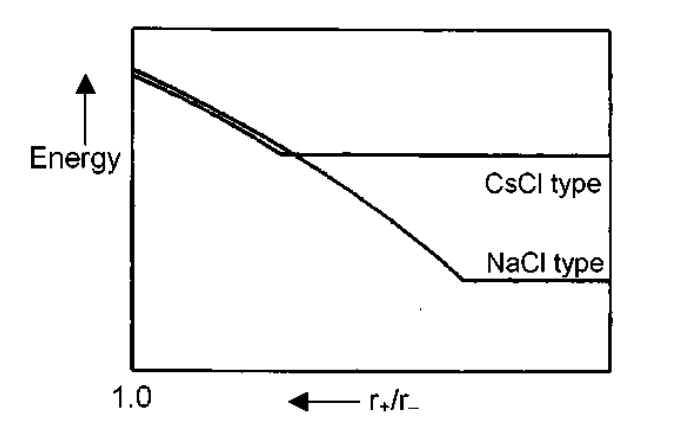
X-ray crystallography reveals many aspects of the structure of metal halides. The radius ratio \((r_+/r_-)\) is a useful parameter to rationalise their structure and stability. A table of radius ratio \((r_+/r_-)\) for some alkali halides with radius ratio (\(r_-\) kept constant) is shown schematically for \(\ce{NaCl}\)-type and \(\ce{CsCl}\)-type crystal structures.
| \(\ce{Li+}\) | \(\ce{Na+}\) | \(\ce{K+}\) | \(\ce{Rb+}\) | \(\ce{Cs+}\) | |
|---|---|---|---|---|---|
| \(\ce{Cl-}\) | 0.33 | 0.52 | 0.74 | 0.82 | 0.93 |
| \(\ce{Br-}\) | 0.31 | 0.49 | 0.68 | 0.76 | 0.87 |
| \(\ce{I-}\) | 0.28 | 0.44 | 0.62 | 0.69 | 0.78 |
5.11 For a given anion, the graph for \(\ce{NaCl}\)-type structure levels off at low \(r_+/r_-\) values because of
(a) cation-cation contact along the face diagonal. \(\square\)
(b) anion-anion contact along the face diagonal. \(\square\)
(c) cation-anion contact along the cell edge. \(\square\)
(Mark X in the correct box.)
5.12 Which among the halides \(\ce{LiBr}\), \(\ce{NaBr}\) and \(\ce{RbBr}\) is likely to undergo phase transition from \(\ce{NaCl}\)-type to \(\ce{CsCl}\)-type structure with change of temperature and / or pressure?
5.13 Show by calculation the radius ratio \((r_+/r_-)\) at which the energy of \(\ce{CsCl}\)-type structure levels off.
5.14 Using CuKα X-rays (\(\lambda = 154\ \mathrm{nm}\)), diffraction by a \(\ce{KCl}\) crystal (fcc structure) is observed at an angle (\(\theta\)) of \(14.2^\circ\). Given that (i) diffraction takes place from the planes with \(h^2+k^2+l^2=4\), (ii) in a cubic crystal \(d_{hkl}=a/(h^2+k^2+l^2)^{1/2}\), where "d" is the distance between adjacent hkl planes and "a" is a lattice parameter, and (iii) reflections in an fcc structure can occur only from planes with "all odd" or "all even" hkl (Miller) indices, calculate the lattice parameter "a" for \(\ce{KCl}\).
5.15 Indicate in the table given below the required information for the \(2^{\mathrm{nd}}\) and \(3^{\mathrm{rd}}\) nearest neighbours of a \(\ce{K+}\) ion in the \(\ce{KCl}\) lattice.
| \(2^{\mathrm{nd}}\) nearest neighbours | \(3^{\mathrm{rd}}\) nearest neighbours | ||||
|---|---|---|---|---|---|
| number | sign of the charge | distance (pm) | number | sign of the charge | distance (pm) |
5.16 Determine the lowest value of diffraction angle \(\theta\) possible for the \(\ce{KCl}\) structure.
Official English text of the problem.
Answers
Names, SMILES, structural descriptions and derivations are supplied in the corresponding solution parts below.
-
5.1 \[ \ce{2AgBr(s) ->[light] 2Ag(s) + Br2} \]
-
5.2 \[ \ce{AgBr(s) + 2S2O3^2- -> [Ag(S2O3)2]^3- + Br-} \]
-
5.3 \[ \ce{[Ag(S2O3)2]^3- + 2CN- -> [Ag(CN)2]- + 2S2O3^2-} \] \[ \ce{2[Ag(CN)2]- + Zn(s) -> 2Ag(s) + [Zn(CN)4]^2-} \]
-
5.4 \(\ce{ClF3}\): T-shaped, two equatorial lone pairs; \(\ce{BrF5}\): square pyramidal, one lone pair opposite the apical fluorine; \(\ce{IF7}\): pentagonal bipyramidal, no iodine lone pairs.
-
5.5 The molecular-ion isotopic compositions are \[ \begin{array}{c|l} m/z & \text{Composition}\\ \hline 162 & \ce{[^{127}I ^{35}Cl]^{+\bullet}}\\ 164 & \ce{[^{127}I ^{37}Cl]^{+\bullet}}\\ 466 & \ce{[^{127}I2 ^{35}Cl5 ^{37}Cl]^{+\bullet}}\\ 476 & \ce{[^{127}I2 ^{37}Cl6]^{+\bullet}} \end{array} \] The heavier species derives from the planar iodine trichloride dimer, \(\ce{I2Cl6}\), with two bridging chlorines. Each iodine in the neutral parent has two lone pairs perpendicular to the molecular plane.
-
5.6 \[ \ce{S2O3^2- + 4Cl2 + 5H2O -> 2SO4^2- + 8Cl- + 10H+} \]
-
5.7 A Lewis contributor is
[O-]S(=O)(=O)[S-]. Circle the terminal sulphur: its oxidation state is \(-1\); the central sulphur has oxidation state \(+5\). -
5.8 The products are sodium chlorite and sodium chlorate: \[ \ce{2ClO2 + 2NaOH -> NaClO2 + NaClO3 + H2O} \]
-
5.9 \[ \ce{Cl2 + 2NaOH -> NaCl + NaClO + H2O} \] using cold, dilute alkali.
-
5.10 Chlorine is \(+1\) in hypochlorite and \(-1\) in the accompanying chloride. In the active bleaching compound \(\ce{NaClO}\) itself, chlorine is \(+1\).
-
5.11 (b) Anion-anion contact along the face diagonal.
-
5.12 \(\ce{RbBr}\).
-
5.13 \[ \boxed{\frac{r_+}{r_-}=\sqrt3-1=0.732} \]
-
5.14 Literally using the printed \(\lambda=154\ \mathrm{nm}\): \[ \boxed{a=628\ \mathrm{nm}}. \] With the apparent intended wavelength, \(\lambda=154\ \mathrm{pm}\): \[ \boxed{a=628\ \mathrm{pm}}. \]
-
5.15 Second neighbours: 12 \(\ce{K+}\) ions, at \(a/\sqrt2\). Third neighbours: 8 \(\ce{Cl-}\) ions, at \(\sqrt3a/2\). The distances are respectively 444 pm and 544 pm if \(\lambda=154\ \mathrm{pm}\), or \(4.44\times10^5\) pm and \(5.44\times10^5\) pm using the printed wavelength.
-
5.16 \[ \boxed{\theta_{\min}=12.3^\circ} \] from the \((111)\) reflection, using the supplied fcc selection rule.
Solution
SMILES specify connectivity, not the spatial arrangements or lone pairs described below. For ionic solids, a dot-disconnected SMILES represents an ionic formula unit rather than the crystal lattice. Coordination complexes use the dative-bond SMILES extension ->.
5.1
Light causes photochemical decomposition of silver bromide, \(\ce{AgBr}\), ionic formula-unit SMILES [Ag+].[Br-]:
\[ \boxed{\ce{2AgBr(s) ->[light] 2Ag(s) + Br2}} \]
Silver(I) ions ([Ag+]) are reduced to silver atoms, while bromide ions ([Br-]) are oxidised to bromine, \(\ce{Br2}\), BrBr. The resulting metallic silver produces the dark regions of the image.
5.2
Sodium thiosulphate, [Na+].[Na+].[O-]S(=O)(=O)[S-], supplies thiosulphate ions, \(\ce{S2O3^2-}\), [O-]S(=O)(=O)[S-]. Their complexation of silver(I) allows unexposed silver bromide to dissolve:
\[ \boxed{\ce{AgBr(s) + 2S2O3^2- -> [Ag(S2O3)2]^3- + Br-}} \]
The soluble product is bis(thiosulphato)argentate(I):
[O-]S(=O)(=O)[S-]->[Ag+]<-[S-]S(=O)(=O)[O-]
The ligands bind through their terminal sulphur atoms; the idealised two-coordinate arrangement around silver is linear. The equation conserves charge: both sides have total charge \(-4\).
5.3
Cyanide, \(\ce{CN-}\), [C-]#N, replaces thiosulphate to form the very stable dicyanoargentate(I) ion:
\[ \boxed{\ce{[Ag(S2O3)2]^3- + 2CN- -> [Ag(CN)2]- + 2S2O3^2-}} \]
Dicyanoargentate(I) has SMILES [C-](#N)->[Ag+]<-[C-]#N and approximately linear carbon–silver–carbon coordination.
Zinc then reduces silver(I) to metallic silver:
\[ \boxed{\ce{2[Ag(CN)2]- + Zn(s) -> 2Ag(s) + [Zn(CN)4]^2-}} \]
Zinc changes from oxidation state \(0\) to \(+2\), supplying the two electrons required to reduce two silver(I) centres.
The zinc product is tetracyanozincate(II):
[Zn+2](<-[C-]#N)(<-[C-]#N)(<-[C-]#N)<-[C-]#N
Its four carbon donors have approximately tetrahedral coordination around zinc.
5.4
The stated total numbers of atoms give three, five and seven fluorine atoms around chlorine, bromine and iodine, respectively.
| Molecule and name | SMILES | VSEPR description | Required three-dimensional structure |
|---|---|---|---|
| \(\ce{ClF3}\), chlorine trifluoride | FCl(F)F |
\(AX_3E_2\); trigonal-bipyramidal electron-domain arrangement | T-shaped. Two fluorines occupy axial positions and one occupies an equatorial position. Both lone pairs occupy the other two equatorial positions. |
| \(\ce{BrF5}\), bromine pentafluoride | FBr(F)(F)(F)F |
\(AX_5E\); octahedral electron-domain arrangement | Square pyramidal. Four fluorines form a square base, the fifth is the apex, and the lone pair occupies the position opposite the apex. |
| \(\ce{IF7}\), iodine heptafluoride | FI(F)(F)(F)(F)(F)F |
\(AX_7\) | Pentagonal bipyramidal. Five fluorines form an equatorial pentagon; two lie on the perpendicular axis, on opposite sides. Iodine has no lone pairs. |
For \(\ce{ClF3}\), equatorial lone pairs minimise the number of \(90^\circ\) interactions. In idealised \(\ce{IF7}\), adjacent equatorial bonds make \(72^\circ\), and each axial bond is perpendicular to the equatorial plane.
5.5
The relevant isotopes are \(\ce{^{127}I}\), \(\ce{^{35}Cl}\) and \(\ce{^{37}Cl}\). For singly charged molecular ions, replacing one chlorine-35 by chlorine-37 increases \(m/z\) by 2.
For set A:
\[ 127+35=162,\qquad127+37=164. \]
Thus species A is iodine monochloride, \(\ce{ICl}\), ICl.
Set B has seven members, consistent with six chlorine atoms containing \(0,1,\ldots,6\) chlorine-37 atoms. Its lowest mass satisfies
\[ 464-6(35)=254=2(127), \]
so species B is diiodine hexachloride, \(\ce{I2Cl6}\), the iodine trichloride dimer. In general,
\[ m/z=2(127)+(6-k)(35)+k(37)=464+2k. \]
The requested assignments are:
| \(m/z\) | Isotopic composition of molecular ion | One formal, localised radical-cation SMILES |
|---|---|---|
| 162 | \(\ce{[^{127}I ^{35}Cl]^{+\bullet}}\) | [127I+][35Cl] |
| 164 | \(\ce{[^{127}I ^{37}Cl]^{+\bullet}}\) | [127I+][37Cl] |
| 466 | \(\ce{[^{127}I2 ^{35}Cl5 ^{37}Cl]^{+\bullet}}\) | [127I]1([35Cl])([35Cl])[35Cl+][127I-]([35Cl])([37Cl])[35Cl+]1 |
| 476 | \(\ce{[^{127}I2 ^{37}Cl6]^{+\bullet}}\) | [127I]1([37Cl])([37Cl])[37Cl+][127I-]([37Cl])([37Cl])[37Cl+]1 |
The \(466\) peak does not establish which chlorine position contains chlorine-37; the SMILES selects one representative placement.
For the requested structural drawing, describe the neutral parent dimer as follows:
- Draw a planar four-membered ring with alternating iodine and bridging chlorine atoms: iodine–chlorine–iodine–chlorine.
- Attach two additional terminal chlorines to each iodine, outside the ring.
- Each iodine therefore has four chlorine neighbours in an approximately square-planar arrangement.
- Place two lone pairs on each iodine, one above and one below the molecular plane. This is an \(AX_4E_2\) arrangement.
- Label both iodines \(\ce{^{127}I}\) and all six chlorines \(\ce{^{37}Cl}\).
A charge-separated Lewis SMILES for this neutral heaviest parent is:
[127I-]1([37Cl])([37Cl])[37Cl+][127I-]([37Cl])([37Cl])[37Cl+]1
The formal charges in this representation account for the bridging bonds; they are not oxidation states. Iodine has oxidation state \(+3\).
The observed molecular ion has one fewer electron than its neutral parent. In the localised ion representation above, one iodine retains two lone pairs, while the other has one lone pair and an unpaired electron. The mass data do not determine the actual distribution of the ion’s charge or spin.
5.6
Sulphur’s highest oxidation state is \(+6\), so the product is sulphate, \(\ce{SO4^2-}\), [O-]S(=O)(=O)[O-].
The oxidation half-reaction is
\[ \ce{S2O3^2- + 5H2O -> 2SO4^2- + 10H+ + 8e-}. \]
Chlorine is reduced according to
\[ \ce{4Cl2 + 8e- -> 8Cl-}. \]
Adding gives
\[ \boxed{\ce{S2O3^2- + 4Cl2 + 5H2O -> 2SO4^2- + 8Cl- + 10H+}}. \]
Here chlorine is ClCl, water is O, chloride is [Cl-], and the hydrogen ion is [H+]. Sodium ions are spectators.
5.7
The thiosulphate ion contains
\[ 2(6)+3(6)+2=32 \]
valence electrons. One suitable Lewis contributor has SMILES:
[O-]S(=O)(=O)[S-]
Describe the drawing precisely as follows:
- Place one sulphur at the centre, bonded to three oxygens and one terminal sulphur.
- Draw two sulphur–oxygen double bonds, one sulphur–oxygen single bond and one sulphur–sulphur single bond.
- Put two lone pairs on each doubly bonded oxygen.
- Put three lone pairs and formal charge \(-1\) on the singly bonded oxygen.
- Put three lone pairs and formal charge \(-1\) on the terminal sulphur.
- The central sulphur has no lone pairs. Enclose the structure in brackets with overall charge \(2-\).
There are three equivalent contributors differing in which oxygen bears the single bond and negative charge. The four bond directions around the central sulphur are approximately tetrahedral.
For oxidation states, assign sulphur–oxygen bonding electrons to oxygen and divide the sulphur–sulphur bonding pair equally. This gives
\[ \boxed{\text{central S: }+5,\qquad\text{terminal S: }-1}. \]
As a check,
\[ (+5)+(-1)+3(-2)=-2. \]
Circle the terminal sulphur atom, which is bonded only to the central sulphur.
5.8
Chlorine dioxide, \(\ce{ClO2}\), O=[Cl]=O, is a radical with chlorine in oxidation state \(+4\). In alkali it disproportionates to chlorine in oxidation states \(+3\) and \(+5\):
| Product | Chlorine oxidation state | SMILES |
|---|---|---|
| Sodium chlorite, \(\ce{NaClO2}\) | \(+3\) | [Na+].[O-]Cl=O |
| Sodium chlorate, \(\ce{NaClO3}\) | \(+5\) | [Na+].[O-]Cl(=O)=O |
Sodium hydroxide has ionic formula-unit SMILES [Na+].[OH-].
One chlorine gains one electron while another loses one electron, giving equal amounts of the two products:
\[ \boxed{\ce{2ClO2 + 2NaOH -> NaClO2 + NaClO3 + H2O}}. \]
Thus X and Y are sodium chlorite and sodium chlorate. Their label order cannot be recovered, because the scheme the problem refers to is not printed.
5.9
With cold, dilute sodium hydroxide, chlorine disproportionates to chloride and hypochlorite:
\[ \boxed{\ce{Cl2 + 2NaOH -> NaCl + NaClO + H2O}}. \]
The products are sodium chloride, [Na+].[Cl-], and sodium hypochlorite, [Na+].[O-]Cl. Hypochlorite provides the bleaching action.
5.10
In chloride, \(\ce{Cl-}\), chlorine has oxidation state \(-1\).
For the hypochlorite ion, \(\ce{ClO-}\), [O-]Cl, let chlorine’s oxidation state be \(x\):
\[ x+(-2)=-1 \quad\Longrightarrow\quad x=+1. \]
Therefore the mixture prepared in 5.9 contains chlorine in oxidation states
\[ \boxed{-1\text{ and }+1}. \]
The active hypochlorite component itself contains chlorine only in oxidation state \(+1\).
5.11
In the sodium chloride structure, the anions form an fcc array. Their nearest separation is along a face diagonal and equals \(a/\sqrt2\).
When neighbouring anions touch,
\[ \frac{a}{\sqrt2}=2r_-, \qquad a=2\sqrt2\,r_-. \]
Further reduction of the cation radius cannot reduce the lattice parameter in this hard-sphere model because the anions already touch. With \(r_-\) fixed, the lattice dimensions—and hence the schematic energy—level off.
Thus mark X in box (b): anion-anion contact along the face diagonal.
For reference, simultaneous cation–anion contact requires
\[ r_++r_-=\frac a2=\sqrt2\,r_-, \]
giving the familiar limiting ratio \(\sqrt2-1\approx0.414\).
5.12
The three candidates are lithium bromide ([Li+].[Br-]), sodium bromide ([Na+].[Br-]) and rubidium bromide ([Rb+].[Br-]).
Their supplied radius ratios are
\[ 0.31,\qquad0.49,\qquad0.76, \]
respectively. The geometrical limiting ratio for eight-coordinate caesium chloride, [Cs+].[Cl-], is approximately \(0.732\), as derived next.
Rubidium bromide lies near this value, where the two arrangements can compete. It is therefore the most likely candidate in the supplied model:
\[ \boxed{\ce{RbBr}}. \]
This is a comparative prediction; the radius-ratio model alone does not determine every possible high-pressure phase transition.
5.13
In the caesium chloride structure, take the anions at the cube corners and the cation at its centre.
Cation–anion contact along the body diagonal gives
\[ \sqrt3\,a=2(r_++r_-). \]
The lattice stops shrinking when adjacent corner anions touch along an edge:
\[ a=2r_-. \]
Combining,
\[ \sqrt3(2r_-)=2(r_++r_-), \]
so
\[ \boxed{\frac{r_+}{r_-}=\sqrt3-1=0.732}. \]
Below this ratio, fixed-size anions prevent further contraction of the idealised structure.
5.14
Potassium chloride has ionic formula-unit SMILES [K+].[Cl-].
Since \(h^2+k^2+l^2=4\), the reflection belongs to the \(\{200\}\) family and
\[ d_{200}=\frac a2. \]
First-order Bragg diffraction satisfies
\[ \lambda=2d_{200}\sin\theta=a\sin\theta. \]
Hence
\[ a=\frac{\lambda}{\sin14.2^\circ}. \]
Using the printed wavelength literally:
\[ a=\frac{154\ \mathrm{nm}}{\sin14.2^\circ} =627.784\ \mathrm{nm} \approx\boxed{628\ \mathrm{nm}}. \]
The stated wavelength appears to contain a unit error: CuKα radiation corresponds to approximately \(154\ \mathrm{pm}=0.154\ \mathrm{nm}\), which gives an atomic-scale lattice parameter:
\[ a=\frac{154\ \mathrm{pm}}{\sin14.2^\circ} =627.784\ \mathrm{pm} \approx\boxed{628\ \mathrm{pm}}. \]
Both interpretations are retained below.
5.15
Place a potassium ion, \(\ce{K+}\), [K+], at the origin. In the rock-salt structure:
- Its first neighbours are six chloride ions at distance \(a/2\).
- Its second neighbours lie at permutations of \((\pm a/2,\pm a/2,0)\). There are \(3\times4=12\), all potassium ions.
- Its third neighbours lie at \((\pm a/2,\pm a/2,\pm a/2)\). There are \(2^3=8\), all chloride ions.
Thus
\[ r_2=\sqrt{\left(\frac a2\right)^2+\left(\frac a2\right)^2} =\frac a{\sqrt2}, \]
and
\[ r_3=\sqrt{3\left(\frac a2\right)^2} =\frac{\sqrt3\,a}{2}. \]
Using the apparent intended wavelength, the answer-sheet entries are:
| \(2^{\mathrm{nd}}\): number | Sign of charge | Distance (pm) | \(3^{\mathrm{rd}}\): number | Sign of charge | Distance (pm) |
|---|---|---|---|---|---|
| 12 | \(+\) | 444 | 8 | \(-\) | 544 |
The unrounded distances are \(443.910\ \mathrm{pm}\) and \(543.677\ \mathrm{pm}\).
If the printed wavelength \(154\ \mathrm{nm}\) is used literally, the corresponding distances are instead
\[ \boxed{r_2=4.44\times10^5\ \mathrm{pm},\qquad r_3=5.44\times10^5\ \mathrm{pm}}. \]
The neighbour counts and charge signs are unchanged.
5.16
The lowest diffraction angle corresponds to the largest allowed plane spacing, hence the smallest nonzero allowed value of \(h^2+k^2+l^2\).
The \((100)\) and \((110)\) indices have mixed parity and are forbidden by the supplied fcc rule. The first allowed family is \(\{111\}\), for which
\[ h^2+k^2+l^2=3, \qquad d_{111}=\frac a{\sqrt3}. \]
Therefore
\[ \sin\theta_{\min} =\frac{\lambda}{2d_{111}} =\frac{\sqrt3\,\lambda}{2a}. \]
Using \(\lambda/a=\sin14.2^\circ\) from 5.14,
\[ \theta_{\min} =\sin^{-1}\!\left(\frac{\sqrt3}{2}\sin14.2^\circ\right) =12.2655^\circ. \]
Thus
\[ \boxed{\theta_{\min}=12.3^\circ}. \]
The wavelength-unit issue does not affect this angle because it depends on the ratio \(\lambda/a\).
The solution was checked against the official solution.
IChO 2001 · Theorieaufgabe 5
Halogenchemie
Halogene bilden bei ihren Reaktionen untereinander und mit einer Vielzahl anderer Elemente zahlreiche Verbindungen mit unterschiedlichen Strukturen, Bindungsverhältnissen und chemischen Eigenschaften. Metallhalogenide, Halogenderivate und Interhalogenverbindungen stellen wichtige Typen von Halogenverbindungen dar.
(A) Fotografie
Ein fotografischer Schwarzweißfilm enthält eine Schicht aus Silberbromid auf einem Trägermaterial wie Celluloseacetat.
5.1 Geben Sie die photochemische Reaktion an, die stattfindet, wenn Licht auf das auf einem Film aufgebrachte \(\ce{AgBr(s)}\) fällt.
5.2 Während des Entwicklungsprozesses wird unbelichtetes \(\ce{AgBr}\) durch Komplexierung von Ag(I) mit Natriumthiosulfatlösung ausgewaschen. Geben Sie diese chemische Reaktion an.
5.3 Diese Waschlösungen werden häufig als Abfall entsorgt. Metallisches Silber lässt sich jedoch daraus zurückgewinnen, indem zunächst Cyanid und anschließend Zink zugegeben wird. Geben Sie die dabei ablaufenden Reaktionen an.
(B) Molekülgestalten, Spektren und Reaktivität
Das reaktivste Halogen, Fluor, reagiert unter kontrollierten Bedingungen mit den anderen Halogenen \(\ce{Cl2}\), \(\ce{Br2}\) und \(\ce{I2}\) unter Bildung eines vieratomigen, eines sechsatomigen beziehungsweise eines achtatomigen Moleküls.
5.4 Geben Sie auf Grundlage der VSEPR-Theorie die Formeln und dreidimensionalen Strukturen dieser Interhalogenmoleküle an. Zeigen Sie gegebenenfalls die Anordnung der freien Elektronenpaare am Zentralatom.
Ein Gemisch aus Ioddampf und Chlorgas ergab beim Einleiten in ein Massenspektrometer zwei Gruppen (A und B) massenspektrometrischer Peaks, die den Molekülionen zweier chemischer Spezies bei folgenden \(m/z\)-Werten entsprechen:
A: 162, 164
B: 464, 466, 468, 470, 472, 474, 476
5.5 Identifizieren Sie die molekularen Spezies, die \(m/z = 162,\ 164,\ 466\) und \(476\) entsprechen. Zeichnen Sie die Struktur der schwersten Spezies (\(m/z = 476\)) und kennzeichnen Sie dabei deutlich die freien Elektronenpaare am Atom bzw. an den Atomen von I (Iod). Geben Sie die Isotopenzusammensetzung jeder Spezies an.
In wässrigem Medium oxidiert Chlorgas Natriumthiosulfat zu einem Ion, in dem Schwefel seine höchste Oxidationsstufe aufweist.
5.6 Geben Sie die chemische Gleichung für diese Reaktion an.
5.7 Zeichnen Sie die Lewis-Punktformel des Thiosulfat-Ions. Kreisen Sie das Schwefelatom mit der niedrigeren Oxidationsstufe ein.
5.8 Chlordioxid reagiert mit Natriumhydroxid wie unten gezeigt. Identifizieren Sie die Produkte X und Y (beide enthalten Chlor) und gleichen Sie die Gleichung aus.
5.9 Die Reaktion von Chlor mit einer Lauge wird zur Herstellung von Bleichlauge genutzt. Geben Sie die chemische Reaktion für deren Bildung an.
5.10 Geben Sie die Oxidationsstufe(n) von Chlor in Bleichlauge an.
(C) Alkalimetallhalogenide und Röntgenkristallographie
Die Röntgenkristallographie liefert Aufschluss über viele Aspekte der Struktur von Metallhalogeniden. Das Radienverhältnis \((r_+/r_-)\) ist ein nützlicher Parameter zur Erklärung ihrer Struktur und Stabilität. Eine Tabelle der Radienverhältnisse \((r_+/r_-)\) einiger Alkalihalogenide ist angegeben; die Abhängigkeit vom Radienverhältnis (bei konstant gehaltenem \(r_-\)) ist für Kristallstrukturen vom \(\ce{NaCl}\)-Typ und vom \(\ce{CsCl}\)-Typ schematisch dargestellt.
| \(\ce{Li+}\) | \(\ce{Na+}\) | \(\ce{K+}\) | \(\ce{Rb+}\) | \(\ce{Cs+}\) | |
|---|---|---|---|---|---|
| \(\ce{Cl-}\) | 0.33 | 0.52 | 0.74 | 0.82 | 0.93 |
| \(\ce{Br-}\) | 0.31 | 0.49 | 0.68 | 0.76 | 0.87 |
| \(\ce{I-}\) | 0.28 | 0.44 | 0.62 | 0.69 | 0.78 |
5.11 Für ein gegebenes Anion geht die Kurve für die Struktur vom \(\ce{NaCl}\)-Typ bei kleinen \(r_+/r_-\)-Werten in ein Plateau über, aufgrund von
(a) Kation-Kation-Kontakt entlang der Flächendiagonalen. \(\square\)
(b) Anion-Anion-Kontakt entlang der Flächendiagonalen. \(\square\)
(c) Kation-Anion-Kontakt entlang der Kante der Elementarzelle. \(\square\)
(Markieren Sie das richtige Kästchen mit X.)
5.12 Welches der Halogenide \(\ce{LiBr}\), \(\ce{NaBr}\) und \(\ce{RbBr}\) wird bei einer Änderung der Temperatur und/oder des Drucks am ehesten einen Phasenübergang von einer Struktur vom \(\ce{NaCl}\)-Typ zu einer Struktur vom \(\ce{CsCl}\)-Typ durchlaufen?
5.13 Berechnen Sie das Radienverhältnis \((r_+/r_-)\), bei dem die Energie der Struktur vom \(\ce{CsCl}\)-Typ in ein Plateau übergeht.
5.14 Bei Verwendung von CuKα-Röntgenstrahlung (\(\lambda = 154\ \mathrm{nm}\)) wird an einem \(\ce{KCl}\)-Kristall (kubisch flächenzentrierte Struktur, fcc) Beugung unter einem Winkel (\(\theta\)) von \(14.2^\circ\) beobachtet. Gegeben ist, dass (i) die Beugung an Ebenen mit \(h^2+k^2+l^2=4\) stattfindet, (ii) in einem kubischen Kristall \(d_{hkl}=a/(h^2+k^2+l^2)^{1/2}\) gilt, wobei „d“ der Abstand zwischen benachbarten hkl-Ebenen und „a“ ein Gitterparameter ist, und (iii) Reflexe in einer fcc-Struktur nur von Ebenen mit „ausschließlich ungeraden“ oder „ausschließlich geraden“ hkl-Indizes (Miller-Indizes) auftreten können. Berechnen Sie den Gitterparameter „a“ für \(\ce{KCl}\).
5.15 Tragen Sie in die folgende Tabelle die geforderten Angaben zu den \(2^{\mathrm{nd}}\) und \(3^{\mathrm{rd}}\) nächsten Nachbarn eines \(\ce{K+}\)-Ions im \(\ce{KCl}\)-Gitter ein.
| \(2^{\mathrm{nd}}\) nächste Nachbarn | \(3^{\mathrm{rd}}\) nächste Nachbarn | ||||
|---|---|---|---|---|---|
| Anzahl | Vorzeichen der Ladung | Abstand (pm) | Anzahl | Vorzeichen der Ladung | Abstand (pm) |
5.16 Bestimmen Sie den kleinsten möglichen Wert des Beugungswinkels \(\theta\) für die \(\ce{KCl}\)-Struktur.
Aufgabentext aus dem offiziellen englischen Text übersetzt.
Antworten
Namen, SMILES, Strukturbeschreibungen und Herleitungen sind in den entsprechenden Lösungsteilen unten angegeben.
-
5.1 \[ \ce{2AgBr(s) ->[light] 2Ag(s) + Br2} \]
-
5.2 \[ \ce{AgBr(s) + 2S2O3^2- -> [Ag(S2O3)2]^3- + Br-} \]
-
5.3 \[ \ce{[Ag(S2O3)2]^3- + 2CN- -> [Ag(CN)2]- + 2S2O3^2-} \] \[ \ce{2[Ag(CN)2]- + Zn(s) -> 2Ag(s) + [Zn(CN)4]^2-} \]
-
5.4 \(\ce{ClF3}\): T-förmig, zwei äquatoriale freie Elektronenpaare; \(\ce{BrF5}\): quadratisch-pyramidal, ein freies Elektronenpaar gegenüber dem apikalen Fluoratom; \(\ce{IF7}\): pentagonal-bipyramidal, keine freien Elektronenpaare am Iod.
-
5.5 Die Isotopenzusammensetzungen der Molekülionen sind \[ \begin{array}{c|l} m/z & \text{Zusammensetzung}\\ \hline 162 & \ce{[^{127}I ^{35}Cl]^{+\bullet}}\\ 164 & \ce{[^{127}I ^{37}Cl]^{+\bullet}}\\ 466 & \ce{[^{127}I2 ^{35}Cl5 ^{37}Cl]^{+\bullet}}\\ 476 & \ce{[^{127}I2 ^{37}Cl6]^{+\bullet}} \end{array} \] Die schwerere Spezies leitet sich vom planaren Iodtrichlorid-Dimer \(\ce{I2Cl6}\) mit zwei verbrückenden Chloratomen ab. Jedes Iodatom im neutralen Ausgangsmolekül besitzt zwei freie Elektronenpaare senkrecht zur Molekülebene.
-
5.6 \[ \ce{S2O3^2- + 4Cl2 + 5H2O -> 2SO4^2- + 8Cl- + 10H+} \]
-
5.7 Eine Lewis-Grenzstruktur ist
[O-]S(=O)(=O)[S-]. Kreisen Sie das endständige Schwefelatom ein: Seine Oxidationsstufe ist \(-1\); das zentrale Schwefelatom hat die Oxidationsstufe \(+5\). -
5.8 Die Produkte sind Natriumchlorit und Natriumchlorat: \[ \ce{2ClO2 + 2NaOH -> NaClO2 + NaClO3 + H2O} \]
-
5.9 \[ \ce{Cl2 + 2NaOH -> NaCl + NaClO + H2O} \] bei Verwendung kalter, verdünnter Lauge.
-
5.10 Chlor hat im Hypochlorit die Oxidationsstufe \(+1\) und im daneben vorliegenden Chlorid die Oxidationsstufe \(-1\). In der bleichaktiven Verbindung \(\ce{NaClO}\) selbst hat Chlor die Oxidationsstufe \(+1\).
-
5.11 (b) Anion-Anion-Kontakt entlang der Flächendiagonalen.
-
5.12 \(\ce{RbBr}\).
-
5.13 \[ \boxed{\frac{r_+}{r_-}=\sqrt3-1=0.732} \]
-
5.14 Bei wörtlicher Verwendung des gedruckten Werts \(\lambda=154\ \mathrm{nm}\): \[ \boxed{a=628\ \mathrm{nm}}. \] Mit der offenbar gemeinten Wellenlänge \(\lambda=154\ \mathrm{pm}\): \[ \boxed{a=628\ \mathrm{pm}}. \]
-
5.15 Zweitnächste Nachbarn: 12 \(\ce{K+}\)-Ionen im Abstand \(a/\sqrt2\). Drittnächste Nachbarn: 8 \(\ce{Cl-}\)-Ionen im Abstand \(\sqrt3a/2\). Die Abstände betragen 444 pm beziehungsweise 544 pm, wenn \(\lambda=154\ \mathrm{pm}\), oder \(4.44\times10^5\) pm beziehungsweise \(5.44\times10^5\) pm bei Verwendung der gedruckten Wellenlänge.
-
5.16 \[ \boxed{\theta_{\min}=12.3^\circ} \] aus dem \((111)\)-Reflex unter Verwendung der angegebenen fcc-Auswahlregel.
Lösung
SMILES geben die Konnektivität an, nicht die nachstehend beschriebenen räumlichen Anordnungen oder freien Elektronenpaare. Bei ionischen Feststoffen stellt ein SMILES mit durch Punkte getrennten Komponenten eine ionische Formeleinheit und nicht das Kristallgitter dar. Für Koordinationskomplexe wird die SMILES-Erweiterung -> für koordinative Bindungen verwendet.
5.1
Licht bewirkt die photochemische Zersetzung von Silberbromid, \(\ce{AgBr}\), mit dem SMILES [Ag+].[Br-] für die ionische Formeleinheit:
\[ \boxed{\ce{2AgBr(s) ->[light] 2Ag(s) + Br2}} \]
Silber(I)-Ionen ([Ag+]) werden zu Silberatomen reduziert, während Bromid-Ionen ([Br-]) zu Brom, \(\ce{Br2}\), BrBr, oxidiert werden. Das entstehende metallische Silber erzeugt die dunklen Bereiche des Bildes.
5.2
Natriumthiosulfat, [Na+].[Na+].[O-]S(=O)(=O)[S-], liefert Thiosulfat-Ionen, \(\ce{S2O3^2-}\), [O-]S(=O)(=O)[S-]. Durch deren Komplexierung von Silber(I) kann sich unbelichtetes Silberbromid lösen:
\[ \boxed{\ce{AgBr(s) + 2S2O3^2- -> [Ag(S2O3)2]^3- + Br-}} \]
Das lösliche Produkt ist Bis(thiosulfato)argentat(I):
[O-]S(=O)(=O)[S-]->[Ag+]<-[S-]S(=O)(=O)[O-]
Die Liganden binden über ihre endständigen Schwefelatome; die idealisierte Anordnung mit der Koordinationszahl zwei um das Silber ist linear. Die Gleichung erfüllt die Ladungserhaltung: Beide Seiten haben die Gesamtladung \(-4\).
5.3
Cyanid, \(\ce{CN-}\), [C-]#N, ersetzt Thiosulfat unter Bildung des sehr stabilen Dicyanidoargentat(I)-Ions:
\[ \boxed{\ce{[Ag(S2O3)2]^3- + 2CN- -> [Ag(CN)2]- + 2S2O3^2-}} \]
Dicyanidoargentat(I) hat den SMILES [C-](#N)->[Ag+]<-[C-]#N und eine annähernd lineare Kohlenstoff–Silber–Kohlenstoff-Koordination.
Zink reduziert anschließend Silber(I) zu metallischem Silber:
\[ \boxed{\ce{2[Ag(CN)2]- + Zn(s) -> 2Ag(s) + [Zn(CN)4]^2-}} \]
Zink geht von der Oxidationsstufe \(0\) in die Oxidationsstufe \(+2\) über und liefert dabei die beiden Elektronen, die zur Reduktion zweier Silber(I)-Zentren benötigt werden.
Das Zinkprodukt ist Tetracyanidozinkat(II):
[Zn+2](<-[C-]#N)(<-[C-]#N)(<-[C-]#N)<-[C-]#N
Seine vier Kohlenstoff-Donoratome sind annähernd tetraedrisch um das Zink koordiniert.
5.4
Aus den angegebenen Gesamtzahlen der Atome ergeben sich drei, fünf beziehungsweise sieben Fluoratome um Chlor, Brom beziehungsweise Iod.
| Molekül und Name | SMILES | VSEPR-Beschreibung | Geforderte dreidimensionale Struktur |
|---|---|---|---|
| \(\ce{ClF3}\), Chlortrifluorid | FCl(F)F |
\(AX_3E_2\); trigonal-bipyramidale Anordnung der Elektronendomänen | T-förmig. Zwei Fluoratome besetzen axiale Positionen und eines eine äquatoriale Position. Die beiden freien Elektronenpaare besetzen die beiden übrigen äquatorialen Positionen. |
| \(\ce{BrF5}\), Brompentafluorid | FBr(F)(F)(F)F |
\(AX_5E\); oktaedrische Anordnung der Elektronendomänen | Quadratisch-pyramidal. Vier Fluoratome bilden eine quadratische Grundfläche, das fünfte bildet die Spitze, und das freie Elektronenpaar besetzt die Position gegenüber der Spitze. |
| \(\ce{IF7}\), Iodheptafluorid | FI(F)(F)(F)(F)(F)F |
\(AX_7\) | Pentagonal-bipyramidal. Fünf Fluoratome bilden ein äquatoriales Fünfeck; zwei liegen auf der dazu senkrechten Achse auf gegenüberliegenden Seiten. Iod besitzt keine freien Elektronenpaare. |
Bei \(\ce{ClF3}\) minimieren äquatoriale freie Elektronenpaare die Anzahl der \(90^\circ\)-Wechselwirkungen. Im idealisierten \(\ce{IF7}\) bilden benachbarte äquatoriale Bindungen einen Winkel von \(72^\circ\), und jede axiale Bindung steht senkrecht auf der Äquatorialebene.
5.5
Die relevanten Isotope sind \(\ce{^{127}I}\), \(\ce{^{35}Cl}\) und \(\ce{^{37}Cl}\). Bei einfach geladenen Molekülionen erhöht der Austausch eines Chlor-35-Atoms gegen ein Chlor-37-Atom den Wert von \(m/z\) um 2.
Für Gruppe A gilt:
\[ 127+35=162,\qquad127+37=164. \]
Somit ist Spezies A Iodmonochlorid, \(\ce{ICl}\), ICl.
Gruppe B hat sieben Glieder, was mit sechs Chloratomen vereinbar ist, unter denen sich \(0,1,\ldots,6\) Chlor-37-Atome befinden. Für ihre niedrigste Masse gilt
\[ 464-6(35)=254=2(127), \]
also ist Spezies B Diiodhexachlorid, \(\ce{I2Cl6}\), das Iodtrichlorid-Dimer. Allgemein gilt
\[ m/z=2(127)+(6-k)(35)+k(37)=464+2k. \]
Die geforderten Zuordnungen lauten:
| \(m/z\) | Isotopenzusammensetzung des Molekülions | Ein formaler, lokalisierter Radikalkation-SMILES |
|---|---|---|
| 162 | \(\ce{[^{127}I ^{35}Cl]^{+\bullet}}\) | [127I+][35Cl] |
| 164 | \(\ce{[^{127}I ^{37}Cl]^{+\bullet}}\) | [127I+][37Cl] |
| 466 | \(\ce{[^{127}I2 ^{35}Cl5 ^{37}Cl]^{+\bullet}}\) | [127I]1([35Cl])([35Cl])[35Cl+][127I-]([35Cl])([37Cl])[35Cl+]1 |
| 476 | \(\ce{[^{127}I2 ^{37}Cl6]^{+\bullet}}\) | [127I]1([37Cl])([37Cl])[37Cl+][127I-]([37Cl])([37Cl])[37Cl+]1 |
Der Peak bei \(466\) legt nicht fest, an welcher Chlorposition sich Chlor-37 befindet; der SMILES wählt eine repräsentative Anordnung aus.
Für die geforderte Strukturzeichnung lässt sich das neutrale Ausgangsdimer wie folgt beschreiben:
- Zeichnen Sie einen planaren viergliedrigen Ring mit abwechselnden Iodatomen und verbrückenden Chloratomen: Iod–Chlor–Iod–Chlor.
- Fügen Sie an jedes Iodatom zwei zusätzliche endständige Chloratome außerhalb des Rings an.
- Jedes Iodatom hat somit vier Chlornachbarn in einer annähernd quadratisch-planaren Anordnung.
- Zeichnen Sie zwei freie Elektronenpaare an jedem Iodatom ein, eines oberhalb und eines unterhalb der Molekülebene. Dies ist eine \(AX_4E_2\)-Anordnung.
- Beschriften Sie beide Iodatome mit \(\ce{^{127}I}\) und alle sechs Chloratome mit \(\ce{^{37}Cl}\).
Ein ladungsgetrennter Lewis-SMILES für dieses neutrale schwerste Ausgangsmolekül lautet:
[127I-]1([37Cl])([37Cl])[37Cl+][127I-]([37Cl])([37Cl])[37Cl+]1
Die Formalladungen in dieser Darstellung berücksichtigen die Brückenbindungen; sie sind keine Oxidationsstufen. Iod hat die Oxidationsstufe \(+3\).
Das beobachtete Molekülion besitzt ein Elektron weniger als sein neutrales Ausgangsmolekül. In der obigen lokalisierten Ionendarstellung behält ein Iodatom zwei freie Elektronenpaare, während das andere ein freies Elektronenpaar und ein ungepaartes Elektron besitzt. Die Massendaten bestimmen nicht die tatsächliche Verteilung der Ladung oder des Spins des Ions.
5.6
Die höchste Oxidationsstufe des Schwefels ist \(+6\), daher ist das Produkt Sulfat, \(\ce{SO4^2-}\), [O-]S(=O)(=O)[O-].
Die Oxidationsteilgleichung lautet
\[ \ce{S2O3^2- + 5H2O -> 2SO4^2- + 10H+ + 8e-}. \]
Chlor wird gemäß folgender Gleichung reduziert:
\[ \ce{4Cl2 + 8e- -> 8Cl-}. \]
Durch Addition ergibt sich
\[ \boxed{\ce{S2O3^2- + 4Cl2 + 5H2O -> 2SO4^2- + 8Cl- + 10H+}}. \]
Hier wird Chlor durch ClCl, Wasser durch O, Chlorid durch [Cl-] und das Wasserstoff-Ion durch [H+] dargestellt. Natrium-Ionen sind Zuschauerionen.
5.7
Das Thiosulfat-Ion enthält
\[ 2(6)+3(6)+2=32 \]
Valenzelektronen. Eine geeignete Lewis-Grenzstruktur hat den SMILES:
[O-]S(=O)(=O)[S-]
Die Zeichnung lässt sich wie folgt präzise beschreiben:
- Platzieren Sie ein Schwefelatom im Zentrum, das an drei Sauerstoffatome und ein endständiges Schwefelatom gebunden ist.
- Zeichnen Sie zwei Schwefel–Sauerstoff-Doppelbindungen, eine Schwefel–Sauerstoff-Einfachbindung und eine Schwefel–Schwefel-Einfachbindung.
- Zeichnen Sie an jedem doppelt gebundenen Sauerstoffatom zwei freie Elektronenpaare ein.
- Zeichnen Sie am einfach gebundenen Sauerstoffatom drei freie Elektronenpaare und die Formalladung \(-1\) ein.
- Zeichnen Sie am endständigen Schwefelatom drei freie Elektronenpaare und die Formalladung \(-1\) ein.
- Das zentrale Schwefelatom besitzt keine freien Elektronenpaare. Setzen Sie die Struktur in eckige Klammern und geben Sie die Gesamtladung \(2-\) an.
Es gibt drei äquivalente Grenzstrukturen, die sich darin unterscheiden, welches Sauerstoffatom die Einfachbindung und die negative Ladung trägt. Die vier Bindungsrichtungen um das zentrale Schwefelatom sind annähernd tetraedrisch angeordnet.
Zur Bestimmung der Oxidationsstufen werden die Bindungselektronen der Schwefel–Sauerstoff-Bindungen dem Sauerstoff zugeordnet und das bindende Elektronenpaar der Schwefel–Schwefel-Bindung gleichmäßig aufgeteilt. Daraus ergibt sich
\[ \boxed{\text{zentrales S: }+5,\qquad\text{endständiges S: }-1}. \]
Zur Kontrolle gilt
\[ (+5)+(-1)+3(-2)=-2. \]
Kreisen Sie das endständige Schwefelatom ein, das nur an das zentrale Schwefelatom gebunden ist.
5.8
Chlordioxid, \(\ce{ClO2}\), O=[Cl]=O, ist ein Radikal mit Chlor in der Oxidationsstufe \(+4\). In alkalischer Lösung disproportioniert es zu Chlor in den Oxidationsstufen \(+3\) und \(+5\):
| Produkt | Oxidationsstufe des Chlors | SMILES |
|---|---|---|
| Natriumchlorit, \(\ce{NaClO2}\) | \(+3\) | [Na+].[O-]Cl=O |
| Natriumchlorat, \(\ce{NaClO3}\) | \(+5\) | [Na+].[O-]Cl(=O)=O |
Natriumhydroxid hat den SMILES [Na+].[OH-] für die ionische Formeleinheit.
Ein Chloratom nimmt ein Elektron auf, während ein anderes ein Elektron abgibt, sodass gleiche Stoffmengen der beiden Produkte entstehen:
\[ \boxed{\ce{2ClO2 + 2NaOH -> NaClO2 + NaClO3 + H2O}}. \]
X und Y sind somit Natriumchlorit und Natriumchlorat. Die Zuordnung der Bezeichnungen lässt sich nicht rekonstruieren, da das Schema, auf das sich die Aufgabe bezieht, nicht abgedruckt ist.
5.9
Mit kalter, verdünnter Natronlauge disproportioniert Chlor zu Chlorid und Hypochlorit:
\[ \boxed{\ce{Cl2 + 2NaOH -> NaCl + NaClO + H2O}}. \]
Die Produkte sind Natriumchlorid, [Na+].[Cl-], und Natriumhypochlorit, [Na+].[O-]Cl. Hypochlorit bewirkt die Bleichwirkung.
5.10
Im Chlorid, \(\ce{Cl-}\), hat Chlor die Oxidationsstufe \(-1\).
Für das Hypochlorit-Ion, \(\ce{ClO-}\), [O-]Cl, sei die Oxidationsstufe des Chlors \(x\):
\[ x+(-2)=-1 \quad\Longrightarrow\quad x=+1. \]
Das in 5.9 hergestellte Gemisch enthält daher Chlor in den Oxidationsstufen
\[ \boxed{-1\text{ und }+1}. \]
Die aktive Hypochloritkomponente selbst enthält Chlor nur in der Oxidationsstufe \(+1\).
5.11
In der Natriumchloridstruktur bilden die Anionen eine kubisch flächenzentrierte Anordnung. Ihr kleinster Abstand liegt entlang einer Flächendiagonalen und beträgt \(a/\sqrt2\).
Wenn sich benachbarte Anionen berühren, gilt
\[ \frac{a}{\sqrt2}=2r_-, \qquad a=2\sqrt2\,r_-. \]
Eine weitere Verringerung des Kationenradius kann den Gitterparameter in diesem Modell harter Kugeln nicht verkleinern, da sich die Anionen bereits berühren. Bei festem \(r_-\) bleiben die Gitterabmessungen — und damit die schematisch dargestellte Energie — konstant.
Markieren Sie daher Kästchen (b): Anion-Anion-Kontakt entlang der Flächendiagonalen mit X.
Zum Vergleich erfordert gleichzeitiger Kation–Anion-Kontakt
\[ r_++r_-=\frac a2=\sqrt2\,r_-, \]
woraus sich das bekannte Grenzverhältnis \(\sqrt2-1\approx0.414\) ergibt.
5.12
Die drei Kandidaten sind Lithiumbromid ([Li+].[Br-]), Natriumbromid ([Na+].[Br-]) und Rubidiumbromid ([Rb+].[Br-]).
Ihre angegebenen Radienverhältnisse betragen
\[ 0.31,\qquad0.49,\qquad0.76, \]
in dieser Reihenfolge. Das geometrische Grenzverhältnis für Caesiumchlorid mit der Koordinationszahl acht, [Cs+].[Cl-], beträgt ungefähr \(0.732\), wie im Folgenden hergeleitet wird.
Rubidiumbromid liegt nahe diesem Wert, bei dem die beiden Anordnungen miteinander konkurrieren können. Es ist daher im vorgegebenen Modell der wahrscheinlichste Kandidat:
\[ \boxed{\ce{RbBr}}. \]
Dies ist eine vergleichende Vorhersage; das Radienverhältnismodell allein legt nicht jeden möglichen Hochdruck-Phasenübergang fest.
5.13
In der Caesiumchloridstruktur seien die Anionen an den Würfelecken und das Kation im Würfelzentrum angeordnet.
Kation–Anion-Kontakt entlang der Raumdiagonalen ergibt
\[ \sqrt3\,a=2(r_++r_-). \]
Das Gitter schrumpft nicht weiter, sobald sich benachbarte Anionen an den Ecken entlang einer Kante berühren:
\[ a=2r_-. \]
Durch Kombination folgt
\[ \sqrt3(2r_-)=2(r_++r_-), \]
also
\[ \boxed{\frac{r_+}{r_-}=\sqrt3-1=0.732}. \]
Unterhalb dieses Verhältnisses verhindern die Anionen mit fester Größe eine weitere Kontraktion der idealisierten Struktur.
5.14
Kaliumchlorid hat den SMILES [K+].[Cl-] für die ionische Formeleinheit.
Da \(h^2+k^2+l^2=4\), gehört der Reflex zur \(\{200\}\)-Familie, und es gilt
\[ d_{200}=\frac a2. \]
Die Bragg-Beugung erster Ordnung erfüllt
\[ \lambda=2d_{200}\sin\theta=a\sin\theta. \]
Daher gilt
\[ a=\frac{\lambda}{\sin14.2^\circ}. \]
Bei wörtlicher Verwendung der gedruckten Wellenlänge:
\[ a=\frac{154\ \mathrm{nm}}{\sin14.2^\circ} =627.784\ \mathrm{nm} \approx\boxed{628\ \mathrm{nm}}. \]
Die angegebene Wellenlänge scheint einen Einheitenfehler zu enthalten: CuKα-Strahlung entspricht ungefähr \(154\ \mathrm{pm}=0.154\ \mathrm{nm}\), was einen Gitterparameter in atomarer Größenordnung ergibt:
\[ a=\frac{154\ \mathrm{pm}}{\sin14.2^\circ} =627.784\ \mathrm{pm} \approx\boxed{628\ \mathrm{pm}}. \]
Im Folgenden werden beide Interpretationen beibehalten.
5.15
Platzieren Sie ein Kalium-Ion, \(\ce{K+}\), [K+], im Ursprung. In der Steinsalzstruktur gilt:
- Seine nächsten Nachbarn sind sechs Chlorid-Ionen im Abstand \(a/2\).
- Seine zweitnächsten Nachbarn liegen an den durch Permutation von \((\pm a/2,\pm a/2,0)\) entstehenden Positionen. Es sind \(3\times4=12\), ausschließlich Kalium-Ionen.
- Seine drittnächsten Nachbarn liegen bei \((\pm a/2,\pm a/2,\pm a/2)\). Es sind \(2^3=8\), ausschließlich Chlorid-Ionen.
Somit gilt
\[ r_2=\sqrt{\left(\frac a2\right)^2+\left(\frac a2\right)^2} =\frac a{\sqrt2}, \]
und
\[ r_3=\sqrt{3\left(\frac a2\right)^2} =\frac{\sqrt3\,a}{2}. \]
Bei Verwendung der offenbar gemeinten Wellenlänge lauten die Einträge im Antwortbogen:
| \(2^{\mathrm{nd}}\): Anzahl | Vorzeichen der Ladung | Abstand (pm) | \(3^{\mathrm{rd}}\): Anzahl | Vorzeichen der Ladung | Abstand (pm) |
|---|---|---|---|---|---|
| 12 | \(+\) | 444 | 8 | \(-\) | 544 |
Die ungerundeten Abstände betragen \(443.910\ \mathrm{pm}\) und \(543.677\ \mathrm{pm}\).
Wird die gedruckte Wellenlänge \(154\ \mathrm{nm}\) wörtlich verwendet, betragen die entsprechenden Abstände stattdessen
\[ \boxed{r_2=4.44\times10^5\ \mathrm{pm},\qquad r_3=5.44\times10^5\ \mathrm{pm}}. \]
Die Nachbarzahlen und die Vorzeichen der Ladungen bleiben unverändert.
5.16
Der kleinste Beugungswinkel entspricht dem größten erlaubten Netzebenenabstand und damit dem kleinsten von null verschiedenen erlaubten Wert von \(h^2+k^2+l^2\).
Die Indizes \((100)\) und \((110)\) haben gemischte Parität und sind nach der angegebenen fcc-Regel verboten. Die erste erlaubte Familie ist \(\{111\}\), für die gilt
\[ h^2+k^2+l^2=3, \qquad d_{111}=\frac a{\sqrt3}. \]
Daher gilt
\[ \sin\theta_{\min} =\frac{\lambda}{2d_{111}} =\frac{\sqrt3\,\lambda}{2a}. \]
Mit \(\lambda/a=\sin14.2^\circ\) aus 5.14 ergibt sich
\[ \theta_{\min} =\sin^{-1}\!\left(\frac{\sqrt3}{2}\sin14.2^\circ\right) =12.2655^\circ. \]
Somit gilt
\[ \boxed{\theta_{\min}=12.3^\circ}. \]
Das Problem mit der Wellenlängeneinheit beeinflusst diesen Winkel nicht, da er vom Verhältnis \(\lambda/a\) abhängt.
Die Lösung wurde mit der offiziellen Lösung abgeglichen.
IChO 2001 · Teori sorusu 5
Halojen Kimyası
Halojenler, birbirleriyle ve çeşitli başka elementlerle tepkimelerinde yapı, bağlanma ve kimyasal davranış bakımından çeşitlilik gösteren çok sayıda bileşik oluşturur. Metal halojenürler, halojen türevleri ve halojenler arası bileşikler, halojen bileşiklerinin başlıca türlerini oluşturur.
(A) Fotoğrafçılık
"Siyah beyaz" bir fotoğraf filmi, selüloz asetat gibi bir destek üzerinde gümüş bromür kaplaması içerir.
5.1 Bir film üzerine kaplanmış \(\ce{AgBr(s)}\) üzerine ışık düştüğünde gerçekleşen fotokimyasal tepkimeyi yazınız.
5.2 Banyo işlemi sırasında, ışığa maruz kalmamış \(\ce{AgBr}\), Ag(I)'in sodyum tiyosülfat çözeltisiyle kompleks oluşturması yoluyla yıkanarak uzaklaştırılır. Bu kimyasal tepkimeyi yazınız.
5.3 Bu yıkama çözeltileri çoğunlukla atık olarak uzaklaştırılır. Ancak önce siyanür, ardından çinko eklenerek bu çözeltilerden metalik gümüş geri kazanılabilir. Gerçekleşen tepkimeleri yazınız.
(B) Şekiller, spektrumlar ve tepkimeye girme eğilimi
En reaktif halojen olan flor, kontrollü koşullarda diğer halojenler \(\ce{Cl2}\), \(\ce{Br2}\) ve \(\ce{I2}\) ile tepkimeye girerek sırasıyla dört atomlu, altı atomlu ve sekiz atomlu birer molekül oluşturur.
5.4 VSEPR kuramına dayanarak bu halojenler arası moleküllerin formüllerini ve üç boyutlu yapılarını yazınız. Uygun durumlarda merkez atom üzerindeki ortaklanmamış elektron çiftlerinin yerleşimini gösteriniz.
İyot buharı ile klor gazından oluşan bir karışım bir kütle spektrometresine verildiğinde, iki kimyasal türün moleküler iyonlarına karşılık gelen, aşağıdaki \(m/z\) değerlerinde iki grup (A ve B) kütle spektrumu piki elde edilmiştir:
A: 162, 164
B: 464, 466, 468, 470, 472, 474, 476
5.5 \(m/z = 162,\ 164,\ 466\) ve \(476\) değerlerine karşılık gelen moleküler türleri belirleyiniz. En ağır türün (\(m/z = 476\)) yapısını, I (iyot) atomu veya atomları üzerindeki ortaklanmamış elektron çiftlerini açıkça belirterek çiziniz. Her türün izotop bileşimini gösteriniz.
Sulu ortamda klor gazı, sodyum tiyosülfatı kükürdün en yüksek yükseltgenme basamağını içerdiği bir iyona yükseltger.
5.6 Bu tepkimenin kimyasal denklemini yazınız.
5.7 Tiyosülfat iyonunun Lewis nokta yapısını yazınız. Daha düşük yükseltgenme basamağına sahip kükürt atomunu daire içine alınız.
5.8 Klor dioksit, sodyum hidroksitle aşağıda gösterildiği gibi tepkimeye girer. X ve Y ürünlerini (her ikisi de klor içerir) belirleyiniz ve denklemi denkleştiriniz.
5.9 Klorun bir alkali ile tepkimesi, çamaşır suyu üretiminde kullanılır. Oluşumuna ilişkin kimyasal tepkimeyi yazınız.
5.10 Çamaşır suyundaki klorun yükseltgenme basamağını veya basamaklarını yazınız.
(C) Alkali metal halojenürler ve X-ışını kristalografisi
X-ışını kristalografisi, metal halojenürlerin yapısının birçok yönünü ortaya koyar. Yarıçap oranı \((r_+/r_-)\), bunların yapılarını ve kararlılıklarını açıklamak için yararlı bir parametredir. Bazı alkali halojenürlerin yarıçap oranları \((r_+/r_-)\) bir tabloda verilmiş, yarıçap oranına bağlı değişim (\(r_-\) sabit tutularak) \(\ce{NaCl}\) tipi ve \(\ce{CsCl}\) tipi kristal yapıları için şematik olarak gösterilmiştir.
| \(\ce{Li+}\) | \(\ce{Na+}\) | \(\ce{K+}\) | \(\ce{Rb+}\) | \(\ce{Cs+}\) | |
|---|---|---|---|---|---|
| \(\ce{Cl-}\) | 0.33 | 0.52 | 0.74 | 0.82 | 0.93 |
| \(\ce{Br-}\) | 0.31 | 0.49 | 0.68 | 0.76 | 0.87 |
| \(\ce{I-}\) | 0.28 | 0.44 | 0.62 | 0.69 | 0.78 |
5.11 Belirli bir anyon için \(\ce{NaCl}\) tipi yapının grafiği, düşük \(r_+/r_-\) değerlerinde aşağıdaki nedenlerden dolayı yataylaşır:
(a) yüzey köşegeni boyunca katyon-katyon teması. \(\square\)
(b) yüzey köşegeni boyunca anyon-anyon teması. \(\square\)
(c) birim hücre kenarı boyunca katyon-anyon teması. \(\square\)
(Doğru kutucuğa X işareti koyunuz.)
5.12 \(\ce{LiBr}\), \(\ce{NaBr}\) ve \(\ce{RbBr}\) halojenürlerinden hangisinin sıcaklık ve / veya basınç değişimiyle \(\ce{NaCl}\) tipi yapıdan \(\ce{CsCl}\) tipi yapıya faz geçişi yapması beklenir?
5.13 \(\ce{CsCl}\) tipi yapının enerjisinin yataylaşmaya başladığı yarıçap oranını \((r_+/r_-)\) hesaplayarak gösteriniz.
5.14 CuKα X-ışınları (\(\lambda = 154\ \mathrm{nm}\)) kullanıldığında, bir \(\ce{KCl}\) kristalinden (fcc yapı) kırınımın \(14.2^\circ\) açısında (\(\theta\)) gerçekleştiği gözlenmektedir. (i) Kırınımın \(h^2+k^2+l^2=4\) koşulunu sağlayan düzlemlerden gerçekleştiği, (ii) kübik bir kristalde \(d_{hkl}=a/(h^2+k^2+l^2)^{1/2}\) olduğu, burada "d"nin komşu hkl düzlemleri arasındaki uzaklık ve "a"nın örgü parametresi olduğu, (iii) fcc yapıda yansımaların yalnızca hkl (Miller) indislerinin "tamamı tek" veya "tamamı çift" olan düzlemlerden gerçekleşebildiği verildiğine göre, \(\ce{KCl}\) için "a" örgü parametresini hesaplayınız.
5.15 \(\ce{KCl}\) örgüsündeki bir \(\ce{K+}\) iyonunun en yakın \(2^{\mathrm{nd}}\) ve \(3^{\mathrm{rd}}\) komşularına ilişkin istenen bilgileri aşağıdaki tabloda belirtiniz.
| En yakın \(2^{\mathrm{nd}}\) komşular | En yakın \(3^{\mathrm{rd}}\) komşular | ||||
|---|---|---|---|---|---|
| sayı | yükün işareti | uzaklık (pm) | sayı | yükün işareti | uzaklık (pm) |
5.16 \(\ce{KCl}\) yapısı için mümkün olan en küçük kırınım açısı \(\theta\) değerini belirleyiniz.
Soru metni resmi İngilizce metinden çevrilmiştir.
Cevaplar
Adlar, SMILES gösterimleri, yapı betimlemeleri ve türetmeler aşağıdaki ilgili çözüm kısımlarında verilmiştir.
-
5.1 \[ \ce{2AgBr(s) ->[light] 2Ag(s) + Br2} \]
-
5.2 \[ \ce{AgBr(s) + 2S2O3^2- -> [Ag(S2O3)2]^3- + Br-} \]
-
5.3 \[ \ce{[Ag(S2O3)2]^3- + 2CN- -> [Ag(CN)2]- + 2S2O3^2-} \] \[ \ce{2[Ag(CN)2]- + Zn(s) -> 2Ag(s) + [Zn(CN)4]^2-} \]
-
5.4 \(\ce{ClF3}\): T biçiminde, iki ekvatoryal ortaklanmamış elektron çifti; \(\ce{BrF5}\): kare piramit, tepedeki florun karşısında bir ortaklanmamış elektron çifti; \(\ce{IF7}\): beşgen çift piramit, iyot üzerinde ortaklanmamış elektron çifti yoktur.
-
5.5 Moleküler iyonların izotop bileşimleri şöyledir: \[ \begin{array}{c|l} m/z & \text{Bileşim}\\ \hline 162 & \ce{[^{127}I ^{35}Cl]^{+\bullet}}\\ 164 & \ce{[^{127}I ^{37}Cl]^{+\bullet}}\\ 466 & \ce{[^{127}I2 ^{35}Cl5 ^{37}Cl]^{+\bullet}}\\ 476 & \ce{[^{127}I2 ^{37}Cl6]^{+\bullet}} \end{array} \] Daha ağır tür, iki köprü klor atomu içeren düzlemsel iyot triklorür dimeri \(\ce{I2Cl6}\)'dan türemiştir. Nötr ana moleküldeki her iyot atomu, molekül düzlemine dik iki ortaklanmamış elektron çiftine sahiptir.
-
5.6 \[ \ce{S2O3^2- + 4Cl2 + 5H2O -> 2SO4^2- + 8Cl- + 10H+} \]
-
5.7 Lewis rezonans yapılarından biri
[O-]S(=O)(=O)[S-]biçimindedir. Uçtaki kükürdü daire içine alınız: yükseltgenme basamağı \(-1\)'dir; merkezdeki kükürdün yükseltgenme basamağı \(+5\)'tir. -
5.8 Ürünler sodyum klorit ve sodyum klorattır: \[ \ce{2ClO2 + 2NaOH -> NaClO2 + NaClO3 + H2O} \]
-
5.9 \[ \ce{Cl2 + 2NaOH -> NaCl + NaClO + H2O} \] soğuk, seyreltik alkali kullanılır.
-
5.10 Klorun yükseltgenme basamağı hipokloritte \(+1\), beraberinde bulunan klorürde ise \(-1\)'dir. Etkin ağartıcı bileşik olan \(\ce{NaClO}\)'nun kendisinde klorun yükseltgenme basamağı \(+1\)'dir.
-
5.11 (b) Yüzey köşegeni boyunca anyon-anyon teması.
-
5.12 \(\ce{RbBr}\).
-
5.13 \[ \boxed{\frac{r_+}{r_-}=\sqrt3-1=0.732} \]
-
5.14 Basılı metindeki \(\lambda=154\ \mathrm{nm}\) değeri aynen kullanıldığında: \[ \boxed{a=628\ \mathrm{nm}}. \] Kastedildiği anlaşılan \(\lambda=154\ \mathrm{pm}\) dalga boyuyla: \[ \boxed{a=628\ \mathrm{pm}}. \]
-
5.15 İkinci komşular: \(a/\sqrt2\) uzaklığında 12 \(\ce{K+}\) iyonu. Üçüncü komşular: \(\sqrt3a/2\) uzaklığında 8 \(\ce{Cl-}\) iyonu. Uzaklıklar, \(\lambda=154\ \mathrm{pm}\) ise sırasıyla 444 pm ve 544 pm, basılı dalga boyu kullanılırsa \(4.44\times10^5\) pm ve \(5.44\times10^5\) pm'dir.
-
5.16 \[ \boxed{\theta_{\min}=12.3^\circ} \] verilen fcc seçim kuralı kullanılarak \((111)\) yansımasından elde edilir.
Çözüm
SMILES gösterimleri, aşağıda açıklanan uzaysal düzenleri veya ortaklanmamış elektron çiftlerini değil, atomların birbirine nasıl bağlandığını belirtir. İyonik katılarda noktayla ayrılmış bir SMILES gösterimi, kristal örgüsünden ziyade bir iyonik formül birimini temsil eder. Koordinasyon komplekslerinde, koordinatif bağlar için SMILES uzantısı -> kullanılır.
5.1
Işık, iyonik formül biriminin SMILES gösterimi [Ag+].[Br-] olan gümüş bromürün, \(\ce{AgBr}\), fotokimyasal olarak ayrışmasına neden olur:
\[ \boxed{\ce{2AgBr(s) ->[light] 2Ag(s) + Br2}} \]
Gümüş(I) iyonları ([Ag+]) gümüş atomlarına indirgenirken bromür iyonları ([Br-]) broma, \(\ce{Br2}\), BrBr, yükseltgenir. Oluşan metalik gümüş, görüntünün koyu bölgelerini meydana getirir.
5.2
Sodyum tiyosülfat, [Na+].[Na+].[O-]S(=O)(=O)[S-], tiyosülfat iyonlarını, \(\ce{S2O3^2-}\), [O-]S(=O)(=O)[S-], sağlar. Bu iyonların gümüş(I) ile kompleks oluşturması, ışığa maruz kalmamış gümüş bromürün çözünmesini sağlar:
\[ \boxed{\ce{AgBr(s) + 2S2O3^2- -> [Ag(S2O3)2]^3- + Br-}} \]
Çözünür ürün bis(tiyosülfato)arjentat(I)'dir:
[O-]S(=O)(=O)[S-]->[Ag+]<-[S-]S(=O)(=O)[O-]
Ligandlar uçtaki kükürt atomları üzerinden bağlanır; gümüş çevresindeki idealleştirilmiş iki koordinasyonlu düzen doğrusaldır. Denklemde yük korunur: her iki tarafın toplam yükü \(-4\)'tür.
5.3
Siyanür, \(\ce{CN-}\), [C-]#N, tiyosülfatın yerini alarak çok kararlı disiyanoarjentat(I) iyonunu oluşturur:
\[ \boxed{\ce{[Ag(S2O3)2]^3- + 2CN- -> [Ag(CN)2]- + 2S2O3^2-}} \]
Disiyanoarjentat(I)'in SMILES gösterimi [C-](#N)->[Ag+]<-[C-]#N olup karbon–gümüş–karbon koordinasyonu yaklaşık doğrusaldır.
Ardından çinko, gümüş(I)'i metalik gümüşe indirger:
\[ \boxed{\ce{2[Ag(CN)2]- + Zn(s) -> 2Ag(s) + [Zn(CN)4]^2-}} \]
Çinkonun yükseltgenme basamağı \(0\)'dan \(+2\)'ye değişir ve iki gümüş(I) merkezini indirgemek için gereken iki elektronu sağlar.
Çinko içeren ürün tetrasiyanoçinkat(II)'dir:
[Zn+2](<-[C-]#N)(<-[C-]#N)(<-[C-]#N)<-[C-]#N
Dört karbon donör atomu, çinko çevresinde yaklaşık tetrahedral koordinasyona sahiptir.
5.4
Belirtilen toplam atom sayıları, klor, brom ve iyot çevresinde sırasıyla üç, beş ve yedi flor atomu bulunduğunu gösterir.
| Molekül ve adı | SMILES | VSEPR açıklaması | İstenen üç boyutlu yapı |
|---|---|---|---|
| \(\ce{ClF3}\), klor triflorür | FCl(F)F |
\(AX_3E_2\); üçgen çift piramit biçiminde elektron bölgesi düzeni | T biçiminde. İki flor aksiyal konumlarda, bir flor ise ekvatoryal konumda bulunur. İki ortaklanmamış elektron çifti de diğer iki ekvatoryal konumda bulunur. |
| \(\ce{BrF5}\), brom pentaflorür | FBr(F)(F)(F)F |
\(AX_5E\); oktahedral elektron bölgesi düzeni | Kare piramit. Dört flor kare tabanı oluşturur, beşincisi tepededir ve ortaklanmamış elektron çifti tepenin karşısındaki konumda bulunur. |
| \(\ce{IF7}\), iyot heptaflorür | FI(F)(F)(F)(F)(F)F |
\(AX_7\) | Beşgen çift piramit. Beş flor ekvatoryal bir beşgen oluşturur; iki flor dik eksen üzerinde, karşılıklı iki tarafta yer alır. İyot üzerinde ortaklanmamış elektron çifti yoktur. |
\(\ce{ClF3}\) için ekvatoryal konumdaki ortaklanmamış elektron çiftleri, \(90^\circ\)'lik etkileşimlerin sayısını en aza indirir. İdealleştirilmiş \(\ce{IF7}\)'de komşu ekvatoryal bağlar \(72^\circ\)'lik açı yapar ve her aksiyal bağ ekvatoryal düzleme diktir.
5.5
İlgili izotoplar \(\ce{^{127}I}\), \(\ce{^{35}Cl}\) ve \(\ce{^{37}Cl}\)'dir. Tek yüklü moleküler iyonlarda bir klor-35 atomunun klor-37 ile yer değiştirmesi \(m/z\) değerini 2 artırır.
A grubu için:
\[ 127+35=162,\qquad127+37=164. \]
Dolayısıyla A türü iyot monoklorür, \(\ce{ICl}\), ICl'dir.
B grubu, altı klor atomunun \(0,1,\ldots,6\) tanesinin klor-37 olmasıyla uyumlu olarak yedi üyeden oluşur. En düşük kütlesi
\[ 464-6(35)=254=2(127), \]
eşitliğini sağlar; dolayısıyla B türü, iyot triklorür dimeri olan diiyot hekzaklorür, \(\ce{I2Cl6}\)'dır. Genel olarak,
\[ m/z=2(127)+(6-k)(35)+k(37)=464+2k. \]
İstenen eşleştirmeler şöyledir:
| \(m/z\) | Moleküler iyonun izotop bileşimi | Biçimsel, yerelleştirilmiş bir radikal katyon SMILES gösterimi |
|---|---|---|
| 162 | \(\ce{[^{127}I ^{35}Cl]^{+\bullet}}\) | [127I+][35Cl] |
| 164 | \(\ce{[^{127}I ^{37}Cl]^{+\bullet}}\) | [127I+][37Cl] |
| 466 | \(\ce{[^{127}I2 ^{35}Cl5 ^{37}Cl]^{+\bullet}}\) | [127I]1([35Cl])([35Cl])[35Cl+][127I-]([35Cl])([37Cl])[35Cl+]1 |
| 476 | \(\ce{[^{127}I2 ^{37}Cl6]^{+\bullet}}\) | [127I]1([37Cl])([37Cl])[37Cl+][127I-]([37Cl])([37Cl])[37Cl+]1 |
\(466\) piki, hangi klor konumunda klor-37 bulunduğunu belirlemez; SMILES gösteriminde temsili bir yerleşim seçilmiştir.
İstenen yapı çizimi için nötr ana dimeri aşağıdaki gibi betimleyiniz:
- İyot ve köprü klor atomlarının dönüşümlü yer aldığı düzlemsel dört üyeli bir halka çiziniz: iyot–klor–iyot–klor.
- Her iyoda, halkanın dışında iki ek uç klor atomu bağlayınız.
- Böylece her iyot, yaklaşık kare düzlemsel bir düzende dört klor komşusuna sahip olur.
- Her iyot üzerine iki ortaklanmamış elektron çifti yerleştiriniz; biri molekül düzleminin üstünde, diğeri altında olsun. Bu, \(AX_4E_2\) düzenidir.
- Her iki iyodu \(\ce{^{127}I}\), altı klorun tamamını da \(\ce{^{37}Cl}\) olarak etiketleyiniz.
Bu en ağır nötr ana molekül için yük ayrışmalı bir Lewis SMILES gösterimi şöyledir:
[127I-]1([37Cl])([37Cl])[37Cl+][127I-]([37Cl])([37Cl])[37Cl+]1
Bu gösterimdeki formal yükler köprü bağlarını hesaba katar; bunlar yükseltgenme basamakları değildir. İyodun yükseltgenme basamağı \(+3\)'tür.
Gözlenen moleküler iyonun elektron sayısı, nötr ana molekülünkinden bir eksiktir. Yukarıdaki yerelleştirilmiş iyon gösteriminde bir iyot iki ortaklanmamış elektron çiftini korurken diğerinde bir ortaklanmamış elektron çifti ve bir eşleşmemiş elektron bulunur. Kütle verileri, iyonun yükünün veya spininin gerçek dağılımını belirlemez.
5.6
Kükürdün en yüksek yükseltgenme basamağı \(+6\) olduğundan ürün sülfat, \(\ce{SO4^2-}\), [O-]S(=O)(=O)[O-]'tır.
Yükseltgenme yarı tepkimesi şöyledir:
\[ \ce{S2O3^2- + 5H2O -> 2SO4^2- + 10H+ + 8e-}. \]
Klor aşağıdaki tepkimeye göre indirgenir:
\[ \ce{4Cl2 + 8e- -> 8Cl-}. \]
Toplandığında şu denklem elde edilir:
\[ \boxed{\ce{S2O3^2- + 4Cl2 + 5H2O -> 2SO4^2- + 8Cl- + 10H+}}. \]
Burada klor ClCl, su O, klorür [Cl-] ve hidrojen iyonu [H+] ile gösterilir. Sodyum iyonları seyirci iyonlardır.
5.7
Tiyosülfat iyonu
\[ 2(6)+3(6)+2=32 \]
değerlik elektronu içerir. Uygun Lewis rezonans yapılarından birinin SMILES gösterimi şöyledir:
[O-]S(=O)(=O)[S-]
Çizimi aşağıdaki gibi ayrıntılı olarak betimleyiniz:
- Merkeze, üç oksijene ve uçtaki bir kükürde bağlı bir kükürt yerleştiriniz.
- İki kükürt–oksijen çift bağı, bir kükürt–oksijen tek bağı ve bir kükürt–kükürt tek bağı çiziniz.
- Çift bağla bağlı her oksijona iki ortaklanmamış elektron çifti yerleştiriniz.
- Tek bağla bağlı oksijona üç ortaklanmamış elektron çifti ve \(-1\) formal yükü yerleştiriniz.
- Uçtaki kükürde üç ortaklanmamış elektron çifti ve \(-1\) formal yükü yerleştiriniz.
- Merkezdeki kükürdün ortaklanmamış elektron çifti yoktur. Yapıyı köşeli parantez içine alıp toplam yükünü \(2-\) olarak belirtiniz.
Tek bağın ve negatif yükün hangi oksijonda bulunduğu bakımından farklılaşan üç eşdeğer rezonans yapısı vardır. Merkezdeki kükürdün çevresindeki dört bağın yönelimi yaklaşık tetrahedraldir.
Yükseltgenme basamaklarını belirlemek için kükürt–oksijen bağ elektronlarını oksijene atayınız ve kükürt–kükürt bağındaki elektron çiftini eşit olarak paylaştırınız. Böylece
\[ \boxed{\text{merkezdeki S: }+5,\qquad\text{uçtaki S: }-1}. \]
elde edilir. Kontrol olarak,
\[ (+5)+(-1)+3(-2)=-2. \]
Yalnızca merkezdeki kükürde bağlı olan uçtaki kükürt atomunu daire içine alınız.
5.8
Klor dioksit, \(\ce{ClO2}\), O=[Cl]=O, klorun \(+4\) yükseltgenme basamağında bulunduğu bir radikaldir. Alkali ortamda disproporsiyonlaşarak klorun \(+3\) ve \(+5\) yükseltgenme basamaklarında bulunduğu türleri oluşturur:
| Ürün | Klorun yükseltgenme basamağı | SMILES |
|---|---|---|
| Sodyum klorit, \(\ce{NaClO2}\) | \(+3\) | [Na+].[O-]Cl=O |
| Sodyum klorat, \(\ce{NaClO3}\) | \(+5\) | [Na+].[O-]Cl(=O)=O |
Sodyum hidroksitin iyonik formül biriminin SMILES gösterimi [Na+].[OH-]'dir.
Bir klor bir elektron alırken diğeri bir elektron verir; böylece iki üründen eşit miktarlarda oluşur:
\[ \boxed{\ce{2ClO2 + 2NaOH -> NaClO2 + NaClO3 + H2O}}. \]
Dolayısıyla X ve Y, sodyum klorit ve sodyum klorattır. Soruda atıfta bulunulan şema basılı metinde yer almadığından, hangi etiketin hangi ürüne ait olduğu belirlenemez.
5.9
Soğuk, seyreltik sodyum hidroksitle klor, klorür ve hipoklorite disproporsiyonlaşır:
\[ \boxed{\ce{Cl2 + 2NaOH -> NaCl + NaClO + H2O}}. \]
Ürünler sodyum klorür, [Na+].[Cl-], ve sodyum hipoklorit, [Na+].[O-]Cl'tir. Ağartıcı etkiyi hipoklorit sağlar.
5.10
Klorürde, \(\ce{Cl-}\), klorun yükseltgenme basamağı \(-1\)'dir.
Hipoklorit iyonu, \(\ce{ClO-}\), [O-]Cl, için klorun yükseltgenme basamağı \(x\) olsun:
\[ x+(-2)=-1 \quad\Longrightarrow\quad x=+1. \]
Dolayısıyla 5.9'da hazırlanan karışımda klorun yükseltgenme basamakları
\[ \boxed{-1\text{ ve }+1}. \]
şeklindedir. Etkin hipoklorit bileşeninin kendisinde klor yalnızca \(+1\) yükseltgenme basamağında bulunur.
5.11
Sodyum klorür yapısında anyonlar yüzey merkezli kübik (fcc) bir düzen oluşturur. Aralarındaki en kısa uzaklık bir yüzey köşegeni boyunca olup \(a/\sqrt2\)'ye eşittir.
Komşu anyonlar birbirine temas ettiğinde,
\[ \frac{a}{\sqrt2}=2r_-, \qquad a=2\sqrt2\,r_-. \]
Bu sert küre modelinde, anyonlar zaten birbirine temas ettiğinden katyon yarıçapının daha da küçülmesi örgü parametresini azaltamaz. \(r_-\) sabit tutulduğunda örgü boyutları ve dolayısıyla şematik enerji yataylaşır.
Bu nedenle (b) kutucuğuna X işareti koyunuz: yüzey köşegeni boyunca anyon-anyon teması.
Bilgi olarak, eş zamanlı katyon–anyon teması
\[ r_++r_-=\frac a2=\sqrt2\,r_-, \]
koşulunu gerektirir; buradan bilinen sınır oranı \(\sqrt2-1\approx0.414\) elde edilir.
5.12
Üç aday lityum bromür ([Li+].[Br-]), sodyum bromür ([Na+].[Br-]) ve rubidyum bromürdür ([Rb+].[Br-]).
Verilen yarıçap oranları sırasıyla
\[ 0.31,\qquad0.49,\qquad0.76, \]
şeklindedir. Sekiz koordinasyonlu sezyum klorür, [Cs+].[Cl-], için geometrik sınır oranı, bir sonraki kısımda türetildiği üzere yaklaşık \(0.732\)'dir.
Rubidyum bromür, iki düzenin birbiriyle rekabet edebildiği bu değere yakındır. Bu nedenle verilen modelde en olası adaydır:
\[ \boxed{\ce{RbBr}}. \]
Bu, karşılaştırmalı bir öngörüdür; yarıçap oranı modeli tek başına mümkün olan tüm yüksek basınç faz geçişlerini belirlemez.
5.13
Sezyum klorür yapısında anyonları küpün köşelerinde, katyonu ise merkezinde alınız.
Cisim köşegeni boyunca katyon–anyon teması şu eşitliği verir:
\[ \sqrt3\,a=2(r_++r_-). \]
Komşu köşe anyonları bir kenar boyunca birbirine temas ettiğinde örgünün küçülmesi durur:
\[ a=2r_-. \]
Birleştirildiğinde,
\[ \sqrt3(2r_-)=2(r_++r_-), \]
dolayısıyla
\[ \boxed{\frac{r_+}{r_-}=\sqrt3-1=0.732}. \]
Bu oranın altında, boyutları sabit olan anyonlar idealleştirilmiş yapının daha fazla büzülmesini engeller.
5.14
Potasyum klorürün iyonik formül biriminin SMILES gösterimi [K+].[Cl-]'dir.
\(h^2+k^2+l^2=4\) olduğundan yansıma \(\{200\}\) ailesine aittir ve
\[ d_{200}=\frac a2. \]
Birinci mertebeden Bragg kırınımı şu eşitliği sağlar:
\[ \lambda=2d_{200}\sin\theta=a\sin\theta. \]
Buradan
\[ a=\frac{\lambda}{\sin14.2^\circ}. \]
Basılı dalga boyu aynen kullanıldığında:
\[ a=\frac{154\ \mathrm{nm}}{\sin14.2^\circ} =627.784\ \mathrm{nm} \approx\boxed{628\ \mathrm{nm}}. \]
Belirtilen dalga boyunda bir birim hatası olduğu anlaşılmaktadır: CuKα ışınımı yaklaşık \(154\ \mathrm{pm}=0.154\ \mathrm{nm}\) dalga boyuna karşılık gelir ve bu değer atomik ölçekte bir örgü parametresi verir:
\[ a=\frac{154\ \mathrm{pm}}{\sin14.2^\circ} =627.784\ \mathrm{pm} \approx\boxed{628\ \mathrm{pm}}. \]
Aşağıda her iki yorum da korunmuştur.
5.15
Bir potasyum iyonunu, \(\ce{K+}\), [K+], orijine yerleştiriniz. Kaya tuzu yapısında:
- Birinci komşuları, \(a/2\) uzaklığındaki altı klorür iyonudur.
- İkinci komşuları, \((\pm a/2,\pm a/2,0)\) koordinatlarının permütasyonlarında yer alır. Sayıları \(3\times4=12\) olup tamamı potasyum iyonudur.
- Üçüncü komşuları, \((\pm a/2,\pm a/2,\pm a/2)\) konumlarında yer alır. Sayıları \(2^3=8\) olup tamamı klorür iyonudur.
Dolayısıyla
\[ r_2=\sqrt{\left(\frac a2\right)^2+\left(\frac a2\right)^2} =\frac a{\sqrt2}, \]
ve
\[ r_3=\sqrt{3\left(\frac a2\right)^2} =\frac{\sqrt3\,a}{2}. \]
Kastedildiği anlaşılan dalga boyu kullanıldığında, cevap kâğıdına yazılacak değerler şöyledir:
| \(2^{\mathrm{nd}}\): sayı | Yükün işareti | Uzaklık (pm) | \(3^{\mathrm{rd}}\): sayı | Yükün işareti | Uzaklık (pm) |
|---|---|---|---|---|---|
| 12 | \(+\) | 444 | 8 | \(-\) | 544 |
Yuvarlanmamış uzaklıklar \(443.910\ \mathrm{pm}\) ve \(543.677\ \mathrm{pm}\)'dir.
Basılı dalga boyu \(154\ \mathrm{nm}\) aynen kullanılırsa, karşılık gelen uzaklıklar bunun yerine
\[ \boxed{r_2=4.44\times10^5\ \mathrm{pm},\qquad r_3=5.44\times10^5\ \mathrm{pm}}. \]
olur. Komşu sayıları ve yük işaretleri değişmez.
5.16
En küçük kırınım açısı, izin verilen en büyük düzlemler arası uzaklığa, dolayısıyla \(h^2+k^2+l^2\)'nin izin verilen sıfırdan farklı en küçük değerine karşılık gelir.
\((100)\) ve \((110)\) indisleri hem tek hem çift sayılar içerir ve verilen fcc kuralına göre yasaktır. İzin verilen ilk aile \(\{111\}\) olup bu aile için
\[ h^2+k^2+l^2=3, \qquad d_{111}=\frac a{\sqrt3}. \]
Dolayısıyla
\[ \sin\theta_{\min} =\frac{\lambda}{2d_{111}} =\frac{\sqrt3\,\lambda}{2a}. \]
5.14'teki \(\lambda/a=\sin14.2^\circ\) eşitliği kullanılarak,
\[ \theta_{\min} =\sin^{-1}\!\left(\frac{\sqrt3}{2}\sin14.2^\circ\right) =12.2655^\circ. \]
Böylece
\[ \boxed{\theta_{\min}=12.3^\circ}. \]
Bu açı \(\lambda/a\) oranına bağlı olduğundan dalga boyu birimiyle ilgili sorun açıyı etkilemez.
Çözüm, resmi çözümle karşılaştırılarak kontrol edildi.
IChO 2001 · Problema teórico 5
Química de los halógenos
Los halógenos, en sus reacciones entre sí y con diversos elementos, dan lugar a un gran número de compuestos con estructuras, enlaces y comportamientos químicos variados. Los haluros metálicos, los derivados halogenados y los interhalógenos representan los principales tipos de compuestos de los halógenos.
(A) Fotografía
Una película fotográfica en «blanco y negro» contiene una capa de bromuro de plata sobre un soporte como el acetato de celulosa.
5.1 Escriba la reacción fotoquímica que se produce cuando la luz incide sobre el \(\ce{AgBr(s)}\) que recubre una película.
5.2 Durante el proceso de revelado, el \(\ce{AgBr}\) no expuesto se elimina por lavado mediante la complejación del Ag(I) con una disolución de tiosulfato de sodio. Escriba esta reacción química.
5.3 Estas aguas de lavado suelen desecharse como residuos. Sin embargo, se puede recuperar plata metálica de ellas añadiendo cianuro y, a continuación, zinc. Escriba las reacciones que intervienen.
(B) Geometrías, espectros y reactividad
El halógeno más reactivo, el flúor, reacciona con los otros halógenos \(\ce{Cl2}\), \(\ce{Br2}\) e \(\ce{I2}\) en condiciones controladas y da lugar a una molécula tetratómica, una hexatómica y una octatómica, respectivamente.
5.4 Escriba las fórmulas y las estructuras tridimensionales de estas moléculas interhalógenas basándose en la teoría de repulsión de los pares de electrones de la capa de valencia (VSEPR). Muestre la disposición de los pares de electrones no enlazantes del átomo central, cuando corresponda.
Una mezcla de vapor de yodo y cloro gaseoso, al introducirse en un espectrómetro de masas, dio dos conjuntos (A y B) de picos en el espectro de masas correspondientes a los iones moleculares de dos especies químicas con los siguientes valores de \(m/z\):
A: 162, 164
B: 464, 466, 468, 470, 472, 474, 476
5.5 Identifique las especies moleculares correspondientes a \(m/z = 162,\ 164,\ 466\) y \(476\). Dibuje la estructura de la especie más pesada (\(m/z = 476\)), indicando claramente los pares de electrones no enlazantes del átomo o los átomos de I (yodo). Muestre la composición isotópica de cada especie.
En medio acuoso, el cloro gaseoso oxida el tiosulfato de sodio a un ion que contiene azufre en su estado de oxidación más alto.
5.6 Escriba la ecuación química de esta reacción.
5.7 Escriba la estructura de Lewis con puntos del ion tiosulfato. Rodee con un círculo el átomo de azufre que tiene el estado de oxidación más bajo.
5.8 El dióxido de cloro reacciona con el hidróxido de sodio como se muestra a continuación. Identifique los productos X e Y (ambos contienen cloro) y ajuste la ecuación.
5.9 La reacción del cloro con un álcali se utiliza para fabricar lejía. Escriba la reacción química de su formación.
5.10 Escriba el estado o los estados de oxidación del cloro en la lejía.
(C) Haluros de metales alcalinos y cristalografía de rayos X
La cristalografía de rayos X revela muchos aspectos de la estructura de los haluros metálicos. La relación de radios \((r_+/r_-)\) es un parámetro útil para explicar su estructura y estabilidad. Se presenta una tabla de la relación de radios \((r_+/r_-)\) de algunos haluros alcalinos, junto con una representación esquemática en función de la relación de radios (manteniendo constante \(r_-\)) para las estructuras cristalinas de tipo \(\ce{NaCl}\) y de tipo \(\ce{CsCl}\).
| \(\ce{Li+}\) | \(\ce{Na+}\) | \(\ce{K+}\) | \(\ce{Rb+}\) | \(\ce{Cs+}\) | |
|---|---|---|---|---|---|
| \(\ce{Cl-}\) | 0.33 | 0.52 | 0.74 | 0.82 | 0.93 |
| \(\ce{Br-}\) | 0.31 | 0.49 | 0.68 | 0.76 | 0.87 |
| \(\ce{I-}\) | 0.28 | 0.44 | 0.62 | 0.69 | 0.78 |
5.11 Para un anión dado, la gráfica de la estructura de tipo \(\ce{NaCl}\) se hace horizontal a valores bajos de \(r_+/r_-\) debido al
(a) contacto catión-catión a lo largo de la diagonal de una cara. \(\square\)
(b) contacto anión-anión a lo largo de la diagonal de una cara. \(\square\)
(c) contacto catión-anión a lo largo de la arista de la celda. \(\square\)
(Marque una X en la casilla correcta.)
5.12 ¿Cuál de los haluros \(\ce{LiBr}\), \(\ce{NaBr}\) y \(\ce{RbBr}\) es más probable que experimente una transición de fase de la estructura de tipo \(\ce{NaCl}\) a la de tipo \(\ce{CsCl}\) al variar la temperatura y/o la presión?
5.13 Determine mediante cálculos la relación de radios \((r_+/r_-)\) a la que la energía de la estructura de tipo \(\ce{CsCl}\) se hace constante.
5.14 Utilizando rayos X CuKα (\(\lambda = 154\ \mathrm{nm}\)), se observa difracción en un cristal de \(\ce{KCl}\) (estructura cúbica centrada en las caras, fcc) a un ángulo (\(\theta\)) de \(14.2^\circ\). Sabiendo que (i) la difracción tiene lugar en los planos con \(h^2+k^2+l^2=4\), (ii) en un cristal cúbico \(d_{hkl}=a/(h^2+k^2+l^2)^{1/2}\), donde «d» es la distancia entre planos hkl adyacentes y «a» es un parámetro de red, y (iii) las reflexiones en una estructura fcc solo pueden proceder de planos cuyos índices hkl (de Miller) sean «todos impares» o «todos pares», calcule el parámetro de red «a» del \(\ce{KCl}\).
5.15 Indique en la tabla siguiente la información solicitada sobre los vecinos más próximos de orden \(2^{\mathrm{nd}}\) y \(3^{\mathrm{rd}}\) de un ion \(\ce{K+}\) en la red de \(\ce{KCl}\).
| Vecinos más próximos de orden \(2^{\mathrm{nd}}\) | Vecinos más próximos de orden \(3^{\mathrm{rd}}\) | ||||
|---|---|---|---|---|---|
| número | signo de la carga | distancia (pm) | número | signo de la carga | distancia (pm) |
5.16 Determine el valor mínimo posible del ángulo de difracción \(\theta\) para la estructura del \(\ce{KCl}\).
Enunciado traducido del texto oficial en inglés.
Respuestas
Los nombres, los SMILES, las descripciones estructurales y las deducciones se proporcionan en los apartados correspondientes de la solución que figura a continuación.
-
5.1 \[ \ce{2AgBr(s) ->[light] 2Ag(s) + Br2} \]
-
5.2 \[ \ce{AgBr(s) + 2S2O3^2- -> [Ag(S2O3)2]^3- + Br-} \]
-
5.3 \[ \ce{[Ag(S2O3)2]^3- + 2CN- -> [Ag(CN)2]- + 2S2O3^2-} \] \[ \ce{2[Ag(CN)2]- + Zn(s) -> 2Ag(s) + [Zn(CN)4]^2-} \]
-
5.4 \(\ce{ClF3}\): forma de T, dos pares no enlazantes ecuatoriales; \(\ce{BrF5}\): piramidal cuadrada, un par no enlazante opuesto al flúor apical; \(\ce{IF7}\): bipiramidal pentagonal, sin pares no enlazantes en el yodo.
-
5.5 Las composiciones isotópicas de los iones moleculares son \[ \begin{array}{c|l} m/z & \text{Composición}\\ \hline 162 & \ce{[^{127}I ^{35}Cl]^{+\bullet}}\\ 164 & \ce{[^{127}I ^{37}Cl]^{+\bullet}}\\ 466 & \ce{[^{127}I2 ^{35}Cl5 ^{37}Cl]^{+\bullet}}\\ 476 & \ce{[^{127}I2 ^{37}Cl6]^{+\bullet}} \end{array} \] La especie más pesada deriva del dímero plano del tricloruro de yodo, \(\ce{I2Cl6}\), con dos átomos de cloro puente. Cada átomo de yodo de la especie neutra precursora tiene dos pares no enlazantes perpendiculares al plano molecular.
-
5.6 \[ \ce{S2O3^2- + 4Cl2 + 5H2O -> 2SO4^2- + 8Cl- + 10H+} \]
-
5.7 Una forma contribuyente de Lewis es
[O-]S(=O)(=O)[S-]. Rodee con un círculo el azufre terminal: su estado de oxidación es \(-1\); el azufre central tiene un estado de oxidación de \(+5\). -
5.8 Los productos son clorito de sodio y clorato de sodio: \[ \ce{2ClO2 + 2NaOH -> NaClO2 + NaClO3 + H2O} \]
-
5.9 \[ \ce{Cl2 + 2NaOH -> NaCl + NaClO + H2O} \] utilizando un álcali frío y diluido.
-
5.10 El cloro tiene un estado de oxidación de \(+1\) en el hipoclorito y de \(-1\) en el cloruro que lo acompaña. En el propio compuesto blanqueador activo \(\ce{NaClO}\), el cloro tiene un estado de oxidación de \(+1\).
-
5.11 (b) Contacto anión-anión a lo largo de la diagonal de una cara.
-
5.12 \(\ce{RbBr}\).
-
5.13 \[ \boxed{\frac{r_+}{r_-}=\sqrt3-1=0.732} \]
-
5.14 Utilizando literalmente el valor impreso \(\lambda=154\ \mathrm{nm}\): \[ \boxed{a=628\ \mathrm{nm}}. \] Con la longitud de onda que aparentemente se pretendía indicar, \(\lambda=154\ \mathrm{pm}\): \[ \boxed{a=628\ \mathrm{pm}}. \]
-
5.15 Segundos vecinos: 12 iones \(\ce{K+}\), a \(a/\sqrt2\). Terceros vecinos: 8 iones \(\ce{Cl-}\), a \(\sqrt3a/2\). Las distancias son, respectivamente, 444 pm y 544 pm si \(\lambda=154\ \mathrm{pm}\), o \(4.44\times10^5\) pm y \(5.44\times10^5\) pm si se utiliza la longitud de onda impresa.
-
5.16 \[ \boxed{\theta_{\min}=12.3^\circ} \] a partir de la reflexión \((111)\), utilizando la regla de selección para estructuras fcc proporcionada.
Solución
Los SMILES especifican la conectividad, no las disposiciones espaciales ni los pares no enlazantes que se describen a continuación. Para los sólidos iónicos, un SMILES con componentes separados por puntos representa una unidad fórmula iónica, no la red cristalina. Los complejos de coordinación utilizan la extensión SMILES para enlaces dativos ->.
5.1
La luz provoca la descomposición fotoquímica del bromuro de plata, \(\ce{AgBr}\), cuyo SMILES de unidad fórmula iónica es [Ag+].[Br-]:
\[ \boxed{\ce{2AgBr(s) ->[light] 2Ag(s) + Br2}} \]
Los iones plata(I) ([Ag+]) se reducen a átomos de plata, mientras que los iones bromuro ([Br-]) se oxidan a bromo, \(\ce{Br2}\), BrBr. La plata metálica resultante produce las zonas oscuras de la imagen.
5.2
El tiosulfato de sodio, [Na+].[Na+].[O-]S(=O)(=O)[S-], aporta iones tiosulfato, \(\ce{S2O3^2-}\), [O-]S(=O)(=O)[S-]. Su complejación de la plata(I) permite que se disuelva el bromuro de plata no expuesto:
\[ \boxed{\ce{AgBr(s) + 2S2O3^2- -> [Ag(S2O3)2]^3- + Br-}} \]
El producto soluble es el bis(tiosulfato)argentato(I):
[O-]S(=O)(=O)[S-]->[Ag+]<-[S-]S(=O)(=O)[O-]
Los ligandos se unen a través de sus átomos de azufre terminales; la disposición idealizada con número de coordinación dos alrededor de la plata es lineal. La ecuación conserva la carga: ambos miembros tienen una carga total de \(-4\).
5.3
El cianuro, \(\ce{CN-}\), [C-]#N, sustituye al tiosulfato para formar el ion dicianoargentato(I), muy estable:
\[ \boxed{\ce{[Ag(S2O3)2]^3- + 2CN- -> [Ag(CN)2]- + 2S2O3^2-}} \]
El dicianoargentato(I) tiene el SMILES [C-](#N)->[Ag+]<-[C-]#N y una coordinación carbono–plata–carbono aproximadamente lineal.
El zinc reduce después la plata(I) a plata metálica:
\[ \boxed{\ce{2[Ag(CN)2]- + Zn(s) -> 2Ag(s) + [Zn(CN)4]^2-}} \]
El zinc pasa del estado de oxidación \(0\) al \(+2\), aportando los dos electrones necesarios para reducir dos centros de plata(I).
El producto de zinc es el tetracianozincato(II):
[Zn+2](<-[C-]#N)(<-[C-]#N)(<-[C-]#N)<-[C-]#N
Sus cuatro átomos donadores de carbono presentan una coordinación aproximadamente tetraédrica alrededor del zinc.
5.4
Los números totales de átomos indicados dan tres, cinco y siete átomos de flúor alrededor del cloro, del bromo y del yodo, respectivamente.
| Molécula y nombre | SMILES | Descripción VSEPR | Estructura tridimensional solicitada |
|---|---|---|---|
| \(\ce{ClF3}\), trifluoruro de cloro | FCl(F)F |
\(AX_3E_2\); disposición bipiramidal trigonal de los dominios electrónicos | Forma de T. Dos átomos de flúor ocupan posiciones axiales y uno ocupa una posición ecuatorial. Los dos pares no enlazantes ocupan las otras dos posiciones ecuatoriales. |
| \(\ce{BrF5}\), pentafluoruro de bromo | FBr(F)(F)(F)F |
\(AX_5E\); disposición octaédrica de los dominios electrónicos | Piramidal cuadrada. Cuatro átomos de flúor forman una base cuadrada, el quinto constituye el vértice y el par no enlazante ocupa la posición opuesta al vértice. |
| \(\ce{IF7}\), heptafluoruro de yodo | FI(F)(F)(F)(F)(F)F |
\(AX_7\) | Bipiramidal pentagonal. Cinco átomos de flúor forman un pentágono ecuatorial; dos se sitúan sobre el eje perpendicular, en lados opuestos. El yodo no tiene pares no enlazantes. |
En el \(\ce{ClF3}\), los pares no enlazantes ecuatoriales minimizan el número de interacciones a \(90^\circ\). En el \(\ce{IF7}\) idealizado, los enlaces ecuatoriales adyacentes forman ángulos de \(72^\circ\), y cada enlace axial es perpendicular al plano ecuatorial.
5.5
Los isótopos pertinentes son \(\ce{^{127}I}\), \(\ce{^{35}Cl}\) y \(\ce{^{37}Cl}\). En los iones moleculares con una sola carga, sustituir un átomo de cloro-35 por uno de cloro-37 aumenta \(m/z\) en 2.
Para el conjunto A:
\[ 127+35=162,\qquad127+37=164. \]
Por tanto, la especie A es el monocloruro de yodo, \(\ce{ICl}\), ICl.
El conjunto B tiene siete miembros, lo que concuerda con seis átomos de cloro que contienen \(0,1,\ldots,6\) átomos de cloro-37. Su masa más baja cumple
\[ 464-6(35)=254=2(127), \]
por lo que la especie B es el hexacloruro de diyodo, \(\ce{I2Cl6}\), el dímero del tricloruro de yodo. En general,
\[ m/z=2(127)+(6-k)(35)+k(37)=464+2k. \]
Las asignaciones solicitadas son:
| \(m/z\) | Composición isotópica del ion molecular | Un SMILES formal del catión radical localizado |
|---|---|---|
| 162 | \(\ce{[^{127}I ^{35}Cl]^{+\bullet}}\) | [127I+][35Cl] |
| 164 | \(\ce{[^{127}I ^{37}Cl]^{+\bullet}}\) | [127I+][37Cl] |
| 466 | \(\ce{[^{127}I2 ^{35}Cl5 ^{37}Cl]^{+\bullet}}\) | [127I]1([35Cl])([35Cl])[35Cl+][127I-]([35Cl])([37Cl])[35Cl+]1 |
| 476 | \(\ce{[^{127}I2 ^{37}Cl6]^{+\bullet}}\) | [127I]1([37Cl])([37Cl])[37Cl+][127I-]([37Cl])([37Cl])[37Cl+]1 |
El pico \(466\) no permite establecer qué posición del cloro contiene cloro-37; el SMILES selecciona una ubicación representativa.
Para el dibujo estructural solicitado, describa el dímero neutro precursor de la siguiente manera:
- Dibuje un anillo plano de cuatro miembros con átomos de yodo y de cloro puente alternados: yodo–cloro–yodo–cloro.
- Una dos átomos de cloro terminales adicionales a cada átomo de yodo, fuera del anillo.
- Por tanto, cada átomo de yodo tiene cuatro vecinos de cloro en una disposición aproximadamente plana cuadrada.
- Sitúe dos pares no enlazantes en cada átomo de yodo, uno por encima y otro por debajo del plano molecular. Esta es una disposición \(AX_4E_2\).
- Etiquete ambos átomos de yodo como \(\ce{^{127}I}\) y los seis átomos de cloro como \(\ce{^{37}Cl}\).
Un SMILES de Lewis con separación de cargas para esta especie neutra precursora más pesada es:
[127I-]1([37Cl])([37Cl])[37Cl+][127I-]([37Cl])([37Cl])[37Cl+]1
Las cargas formales de esta representación dan cuenta de los enlaces puente; no son estados de oxidación. El yodo tiene un estado de oxidación de \(+3\).
El ion molecular observado tiene un electrón menos que su especie neutra precursora. En la representación localizada del ion anterior, un átomo de yodo conserva dos pares no enlazantes, mientras que el otro tiene un par no enlazante y un electrón desapareado. Los datos de masas no determinan la distribución real de la carga ni del espín del ion.
5.6
El estado de oxidación más alto del azufre es \(+6\), por lo que el producto es el sulfato, \(\ce{SO4^2-}\), [O-]S(=O)(=O)[O-].
La semirreacción de oxidación es
\[ \ce{S2O3^2- + 5H2O -> 2SO4^2- + 10H+ + 8e-}. \]
El cloro se reduce según
\[ \ce{4Cl2 + 8e- -> 8Cl-}. \]
Al sumar se obtiene
\[ \boxed{\ce{S2O3^2- + 4Cl2 + 5H2O -> 2SO4^2- + 8Cl- + 10H+}}. \]
Aquí, el cloro es ClCl, el agua es O, el cloruro es [Cl-] y el ion hidrógeno es [H+]. Los iones sodio son espectadores.
5.7
El ion tiosulfato contiene
\[ 2(6)+3(6)+2=32 \]
electrones de valencia. Una forma contribuyente de Lewis adecuada tiene el SMILES:
[O-]S(=O)(=O)[S-]
Describa el dibujo con precisión de la siguiente manera:
- Sitúe un átomo de azufre en el centro, unido a tres átomos de oxígeno y a un átomo de azufre terminal.
- Dibuje dos enlaces dobles azufre–oxígeno, un enlace simple azufre–oxígeno y un enlace simple azufre–azufre.
- Coloque dos pares no enlazantes en cada oxígeno unido mediante un enlace doble.
- Coloque tres pares no enlazantes y una carga formal de \(-1\) en el oxígeno unido mediante un enlace simple.
- Coloque tres pares no enlazantes y una carga formal de \(-1\) en el azufre terminal.
- El azufre central no tiene pares no enlazantes. Encierre la estructura entre corchetes con una carga total de \(2-\).
Hay tres formas contribuyentes equivalentes que difieren en qué oxígeno presenta el enlace simple y la carga negativa. Las cuatro direcciones de enlace alrededor del azufre central son aproximadamente tetraédricas.
Para determinar los estados de oxidación, asigne al oxígeno los electrones de enlace azufre–oxígeno y divida por igual el par de enlace azufre–azufre. Esto da
\[ \boxed{\text{S central: }+5,\qquad\text{S terminal: }-1}. \]
Como comprobación,
\[ (+5)+(-1)+3(-2)=-2. \]
Rodee con un círculo el átomo de azufre terminal, que está unido únicamente al azufre central.
5.8
El dióxido de cloro, \(\ce{ClO2}\), O=[Cl]=O, es un radical con el cloro en el estado de oxidación \(+4\). En medio alcalino se desproporciona para dar cloro en los estados de oxidación \(+3\) y \(+5\):
| Producto | Estado de oxidación del cloro | SMILES |
|---|---|---|
| Clorito de sodio, \(\ce{NaClO2}\) | \(+3\) | [Na+].[O-]Cl=O |
| Clorato de sodio, \(\ce{NaClO3}\) | \(+5\) | [Na+].[O-]Cl(=O)=O |
El hidróxido de sodio tiene el SMILES de unidad fórmula iónica [Na+].[OH-].
Un átomo de cloro gana un electrón mientras otro pierde un electrón, dando cantidades iguales de los dos productos:
\[ \boxed{\ce{2ClO2 + 2NaOH -> NaClO2 + NaClO3 + H2O}}. \]
Por tanto, X e Y son clorito de sodio y clorato de sodio. No es posible determinar el orden de sus etiquetas, porque el esquema al que hace referencia el problema no está impreso.
5.9
Con hidróxido de sodio frío y diluido, el cloro se desproporciona en cloruro e hipoclorito:
\[ \boxed{\ce{Cl2 + 2NaOH -> NaCl + NaClO + H2O}}. \]
Los productos son cloruro de sodio, [Na+].[Cl-], e hipoclorito de sodio, [Na+].[O-]Cl. El hipoclorito proporciona la acción blanqueadora.
5.10
En el cloruro, \(\ce{Cl-}\), el cloro tiene un estado de oxidación de \(-1\).
Para el ion hipoclorito, \(\ce{ClO-}\), [O-]Cl, sea \(x\) el estado de oxidación del cloro:
\[ x+(-2)=-1 \quad\Longrightarrow\quad x=+1. \]
Por tanto, la mezcla preparada en 5.9 contiene cloro en los estados de oxidación
\[ \boxed{-1\text{ y }+1}. \]
El propio componente activo, el hipoclorito, contiene cloro únicamente en el estado de oxidación \(+1\).
5.11
En la estructura del cloruro de sodio, los aniones forman una red fcc. Su separación mínima se encuentra a lo largo de la diagonal de una cara y es igual a \(a/\sqrt2\).
Cuando los aniones vecinos se tocan,
\[ \frac{a}{\sqrt2}=2r_-, \qquad a=2\sqrt2\,r_-. \]
Una reducción adicional del radio del catión no puede reducir el parámetro de red en este modelo de esferas rígidas, porque los aniones ya están en contacto. Con \(r_-\) fijo, las dimensiones de la red —y, por tanto, la energía representada esquemáticamente— se hacen constantes.
Por tanto, marque una X en la casilla (b): contacto anión-anión a lo largo de la diagonal de una cara.
Como referencia, el contacto simultáneo catión–anión requiere
\[ r_++r_-=\frac a2=\sqrt2\,r_-, \]
lo que da la conocida relación límite \(\sqrt2-1\approx0.414\).
5.12
Los tres candidatos son el bromuro de litio ([Li+].[Br-]), el bromuro de sodio ([Na+].[Br-]) y el bromuro de rubidio ([Rb+].[Br-]).
Las relaciones de radios proporcionadas son
\[ 0.31,\qquad0.49,\qquad0.76, \]
respectivamente. La relación límite geométrica para el cloruro de cesio con número de coordinación ocho, [Cs+].[Cl-], es aproximadamente \(0.732\), como se deduce a continuación.
El bromuro de rubidio se encuentra cerca de este valor, donde las dos disposiciones pueden competir. Por tanto, es el candidato más probable en el modelo proporcionado:
\[ \boxed{\ce{RbBr}}. \]
Esta es una predicción comparativa; el modelo de la relación de radios, por sí solo, no determina todas las posibles transiciones de fase a alta presión.
5.13
En la estructura del cloruro de cesio, sitúe los aniones en los vértices del cubo y el catión en su centro.
El contacto catión–anión a lo largo de la diagonal del cubo da
\[ \sqrt3\,a=2(r_++r_-). \]
La red deja de contraerse cuando los aniones de vértices adyacentes se tocan a lo largo de una arista:
\[ a=2r_-. \]
Combinando,
\[ \sqrt3(2r_-)=2(r_++r_-), \]
por lo que
\[ \boxed{\frac{r_+}{r_-}=\sqrt3-1=0.732}. \]
Por debajo de esta relación, los aniones de tamaño fijo impiden una mayor contracción de la estructura idealizada.
5.14
El cloruro de potasio tiene el SMILES de unidad fórmula iónica [K+].[Cl-].
Como \(h^2+k^2+l^2=4\), la reflexión pertenece a la familia \(\{200\}\) y
\[ d_{200}=\frac a2. \]
La difracción de Bragg de primer orden satisface
\[ \lambda=2d_{200}\sin\theta=a\sin\theta. \]
Por tanto,
\[ a=\frac{\lambda}{\sin14.2^\circ}. \]
Utilizando literalmente la longitud de onda impresa:
\[ a=\frac{154\ \mathrm{nm}}{\sin14.2^\circ} =627.784\ \mathrm{nm} \approx\boxed{628\ \mathrm{nm}}. \]
La longitud de onda indicada parece contener un error de unidades: la radiación CuKα corresponde aproximadamente a \(154\ \mathrm{pm}=0.154\ \mathrm{nm}\), lo que da un parámetro de red de escala atómica:
\[ a=\frac{154\ \mathrm{pm}}{\sin14.2^\circ} =627.784\ \mathrm{pm} \approx\boxed{628\ \mathrm{pm}}. \]
A continuación se mantienen ambas interpretaciones.
5.15
Sitúe un ion potasio, \(\ce{K+}\), [K+], en el origen. En la estructura de tipo sal gema:
- Sus primeros vecinos son seis iones cloruro a una distancia \(a/2\).
- Sus segundos vecinos se encuentran en las permutaciones de \((\pm a/2,\pm a/2,0)\). Hay \(3\times4=12\), todos ellos iones potasio.
- Sus terceros vecinos se encuentran en \((\pm a/2,\pm a/2,\pm a/2)\). Hay \(2^3=8\), todos ellos iones cloruro.
Por tanto,
\[ r_2=\sqrt{\left(\frac a2\right)^2+\left(\frac a2\right)^2} =\frac a{\sqrt2}, \]
y
\[ r_3=\sqrt{3\left(\frac a2\right)^2} =\frac{\sqrt3\,a}{2}. \]
Utilizando la longitud de onda que aparentemente se pretendía indicar, los valores de la hoja de respuestas son:
| \(2^{\mathrm{nd}}\): número | Signo de la carga | Distancia (pm) | \(3^{\mathrm{rd}}\): número | Signo de la carga | Distancia (pm) |
|---|---|---|---|---|---|
| 12 | \(+\) | 444 | 8 | \(-\) | 544 |
Las distancias sin redondear son \(443.910\ \mathrm{pm}\) y \(543.677\ \mathrm{pm}\).
Si se utiliza literalmente la longitud de onda impresa \(154\ \mathrm{nm}\), las distancias correspondientes son, en cambio,
\[ \boxed{r_2=4.44\times10^5\ \mathrm{pm},\qquad r_3=5.44\times10^5\ \mathrm{pm}}. \]
El número de vecinos y los signos de las cargas no cambian.
5.16
El ángulo de difracción mínimo corresponde al mayor espaciado interplanar permitido y, por tanto, al menor valor no nulo permitido de \(h^2+k^2+l^2\).
Los índices \((100)\) y \((110)\) tienen paridad mixta y están prohibidos por la regla para estructuras fcc proporcionada. La primera familia permitida es \(\{111\}\), para la cual
\[ h^2+k^2+l^2=3, \qquad d_{111}=\frac a{\sqrt3}. \]
Por tanto,
\[ \sin\theta_{\min} =\frac{\lambda}{2d_{111}} =\frac{\sqrt3\,\lambda}{2a}. \]
Utilizando \(\lambda/a=\sin14.2^\circ\) de 5.14,
\[ \theta_{\min} =\sin^{-1}\!\left(\frac{\sqrt3}{2}\sin14.2^\circ\right) =12.2655^\circ. \]
Así,
\[ \boxed{\theta_{\min}=12.3^\circ}. \]
El problema de las unidades de la longitud de onda no afecta a este ángulo, porque depende de la relación \(\lambda/a\).
La solución se comprobó con la solución oficial.
IChO 2001 · 理论题 5
卤素化学
卤素之间以及卤素与多种其他元素的反应可生成大量结构、成键方式和化学行为各异的化合物。金属卤化物、卤素衍生物和卤素互化物是卤素化合物的主要类型。
(A) 摄影
黑白照相胶片是在醋酸纤维素等片基上涂有溴化银涂层的胶片。
5.1 写出光照射到胶片上涂覆的 \(\ce{AgBr(s)}\) 时发生的光化学反应。
5.2 在显影过程中,利用硫代硫酸钠溶液对 Ag(I) 的配合作用,将未曝光的 \(\ce{AgBr}\) 洗去。写出这一化学反应。
5.3 这些洗液通常作为废液处理。然而,向其中加入氰化物,再加入锌,即可回收金属银。写出涉及的反应。
(B) 构型、光谱与反应性
反应性最强的卤素氟在受控条件下与其他卤素 \(\ce{Cl2}\)、\(\ce{Br2}\) 和 \(\ce{I2}\) 反应,分别生成四原子、六原子和八原子分子。
5.4 根据 VSEPR 理论,写出这些卤素互化物分子的化学式和三维结构。适用时,标明中心原子上孤电子对的空间分布。
将碘蒸气与氯气的混合物通入质谱仪,得到两组(A 和 B)质谱峰,分别对应两种化学物种的分子离子,其 \(m/z\) 为:
A: 162, 164
B: 464, 466, 468, 470, 472, 474, 476
5.5 确定与 \(m/z = 162,\ 164,\ 466\) 和 \(476\) 对应的分子物种。画出最重物种(\(m/z = 476\))的结构,清楚标明 I(碘)原子上的孤电子对。标出每种物种的同位素组成。
在水溶液中,氯气将硫代硫酸钠氧化为一种含有最高氧化态硫的离子。
5.6 写出这一反应的化学方程式。
5.7 写出硫代硫酸根离子的路易斯电子点式。圈出氧化态较低的硫原子。
5.8 二氧化氯与氢氧化钠发生如下反应。确定产物 X 和 Y(两者均含氯),并配平方程式。
5.9 氯气与碱的反应用于制造漂白剂。写出生成漂白剂的化学反应。
5.10 写出漂白剂中氯的氧化态。
(C) 碱金属卤化物与 X 射线晶体学
X 射线晶体学揭示了金属卤化物结构的许多方面。半径比 \((r_+/r_-)\) 是解释其结构和稳定性的一个有用参数。下表列出了一些碱金属卤化物的半径比 \((r_+/r_-)\),图中示意了 \(\ce{NaCl}\) 型和 \(\ce{CsCl}\) 型晶体结构随半径比的变化(保持 \(r_-\) 不变)。
| \(\ce{Li+}\) | \(\ce{Na+}\) | \(\ce{K+}\) | \(\ce{Rb+}\) | \(\ce{Cs+}\) | |
|---|---|---|---|---|---|
| \(\ce{Cl-}\) | 0.33 | 0.52 | 0.74 | 0.82 | 0.93 |
| \(\ce{Br-}\) | 0.31 | 0.49 | 0.68 | 0.76 | 0.87 |
| \(\ce{I-}\) | 0.28 | 0.44 | 0.62 | 0.69 | 0.78 |
5.11 对于给定的阴离子,\(\ce{NaCl}\) 型结构的曲线在较低的 \(r_+/r_-\) 值处趋于水平,这是因为
(a) 阳离子沿面对角线方向彼此接触。 \(\square\)
(b) 阴离子沿面对角线方向彼此接触。 \(\square\)
(c) 阳离子与阴离子沿晶胞棱边方向接触。 \(\square\)
(在正确的方框中标记 X。)
5.12 在卤化物 \(\ce{LiBr}\)、\(\ce{NaBr}\) 和 \(\ce{RbBr}\) 中,哪一种可能随温度和/或压力的变化而发生从 \(\ce{NaCl}\) 型到 \(\ce{CsCl}\) 型结构的相变?
5.13 通过计算求出 \(\ce{CsCl}\) 型结构的能量开始趋于恒定时的半径比 \((r_+/r_-)\)。
5.14 使用 CuKα X 射线(\(\lambda = 154\ \mathrm{nm}\))时,观测到 \(\ce{KCl}\) 晶体(面心立方结构)在角度(\(\theta\))为 \(14.2^\circ\) 时产生衍射。已知 (i) 衍射来自满足 \(h^2+k^2+l^2=4\) 的晶面,(ii) 在立方晶体中,\(d_{hkl}=a/(h^2+k^2+l^2)^{1/2}\),其中“d”为相邻 hkl 晶面之间的距离,“a”为晶格参数,以及 (iii) 面心立方结构只有 hkl(米勒)指数“全奇”或“全偶”的晶面才能产生反射,计算 \(\ce{KCl}\) 的晶格参数“a”。
5.15 在下表中填写 \(\ce{KCl}\) 晶格中一个 \(\ce{K+}\) 离子的第 \(2^{\mathrm{nd}}\) 近邻和第 \(3^{\mathrm{rd}}\) 近邻的所需信息。
| 第 \(2^{\mathrm{nd}}\) 近邻 | 第 \(3^{\mathrm{rd}}\) 近邻 | ||||
|---|---|---|---|---|---|
| 数目 | 电荷符号 | 距离 (pm) | 数目 | 电荷符号 | 距离 (pm) |
5.16 确定 \(\ce{KCl}\) 结构可能出现的最小衍射角 \(\theta\)。
题目译自官方英文原文。
答案
名称、SMILES、结构描述和推导见下文解答中的对应部分。
-
5.1 \[ \ce{2AgBr(s) ->[light] 2Ag(s) + Br2} \]
-
5.2 \[ \ce{AgBr(s) + 2S2O3^2- -> [Ag(S2O3)2]^3- + Br-} \]
-
5.3 \[ \ce{[Ag(S2O3)2]^3- + 2CN- -> [Ag(CN)2]- + 2S2O3^2-} \] \[ \ce{2[Ag(CN)2]- + Zn(s) -> 2Ag(s) + [Zn(CN)4]^2-} \]
-
5.4 \(\ce{ClF3}\):T 形,两个孤电子对位于赤道位置;\(\ce{BrF5}\):四方锥形,一个孤电子对位于顶端氟原子的对面;\(\ce{IF7}\):五角双锥形,碘原子上无孤电子对。
-
5.5 分子离子的同位素组成为 \[ \begin{array}{c|l} m/z & \text{组成}\\ \hline 162 & \ce{[^{127}I ^{35}Cl]^{+\bullet}}\\ 164 & \ce{[^{127}I ^{37}Cl]^{+\bullet}}\\ 466 & \ce{[^{127}I2 ^{35}Cl5 ^{37}Cl]^{+\bullet}}\\ 476 & \ce{[^{127}I2 ^{37}Cl6]^{+\bullet}} \end{array} \] 较重的物种来自平面形的三氯化碘二聚体 \(\ce{I2Cl6}\),其中有两个桥联氯原子。中性母体中的每个碘原子上均有两个垂直于分子平面的孤电子对。
-
5.6 \[ \ce{S2O3^2- + 4Cl2 + 5H2O -> 2SO4^2- + 8Cl- + 10H+} \]
-
5.7 一个路易斯共振式为
[O-]S(=O)(=O)[S-]。圈出末端硫原子:其氧化态为 \(-1\);中心硫原子的氧化态为 \(+5\)。 -
5.8 产物为亚氯酸钠和氯酸钠: \[ \ce{2ClO2 + 2NaOH -> NaClO2 + NaClO3 + H2O} \]
-
5.9 \[ \ce{Cl2 + 2NaOH -> NaCl + NaClO + H2O} \] 使用冷的稀碱溶液。
-
5.10 氯在次氯酸盐中的氧化态为 \(+1\),在同时生成的氯化物中的氧化态为 \(-1\)。在起漂白作用的化合物 \(\ce{NaClO}\) 本身中,氯的氧化态为 \(+1\)。
-
5.11 (b) 阴离子沿面对角线方向彼此接触。
-
5.12 \(\ce{RbBr}\)。
-
5.13 \[ \boxed{\frac{r_+}{r_-}=\sqrt3-1=0.732} \]
-
5.14 严格采用题面印出的 \(\lambda=154\ \mathrm{nm}\): \[ \boxed{a=628\ \mathrm{nm}}. \] 采用题目显然意指的波长 \(\lambda=154\ \mathrm{pm}\): \[ \boxed{a=628\ \mathrm{pm}}. \]
-
5.15 第二近邻:12 个 \(\ce{K+}\) 离子,距离为 \(a/\sqrt2\)。第三近邻:8 个 \(\ce{Cl-}\) 离子,距离为 \(\sqrt3a/2\)。若 \(\lambda=154\ \mathrm{pm}\),距离分别为 444 pm 和 544 pm;若使用题面印出的波长,则分别为 \(4.44\times10^5\) pm 和 \(5.44\times10^5\) pm。
-
5.16 \[ \boxed{\theta_{\min}=12.3^\circ} \] 根据题给的面心立方结构选择定则,由 \((111)\) 反射得到。
解答
SMILES 表示原子间的连接关系,而不表示下文描述的空间排列或孤电子对。对于离子固体,用点号分隔的 SMILES 表示离子式单元,而不是晶格。配合物采用配位键 SMILES 扩展表示法 ->。
5.1
光使溴化银 \(\ce{AgBr}\) 发生光化学分解,其离子式单元的 SMILES 为 [Ag+].[Br-]:
\[ \boxed{\ce{2AgBr(s) ->[light] 2Ag(s) + Br2}} \]
银(I)离子([Ag+])被还原为银原子,而溴离子([Br-])被氧化为溴 \(\ce{Br2}\),其 SMILES 为 BrBr。生成的金属银形成影像的暗部。
5.2
硫代硫酸钠 [Na+].[Na+].[O-]S(=O)(=O)[S-] 提供硫代硫酸根离子 \(\ce{S2O3^2-}\),其 SMILES 为 [O-]S(=O)(=O)[S-]。这些离子与银(I)的配合作用使未曝光的溴化银溶解:
\[ \boxed{\ce{AgBr(s) + 2S2O3^2- -> [Ag(S2O3)2]^3- + Br-}} \]
可溶性产物为二(硫代硫酸根)合银(I)酸根离子:
[O-]S(=O)(=O)[S-]->[Ag+]<-[S-]S(=O)(=O)[O-]
配体通过其末端硫原子与银结合;银周围理想化的二配位构型为直线形。该方程式满足电荷守恒:两侧的总电荷均为 \(-4\)。
5.3
氰根离子 \(\ce{CN-}\),其 SMILES 为 [C-]#N,取代硫代硫酸根,形成非常稳定的二氰合银(I)酸根离子:
\[ \boxed{\ce{[Ag(S2O3)2]^3- + 2CN- -> [Ag(CN)2]- + 2S2O3^2-}} \]
二氰合银(I)酸根的 SMILES 为 [C-](#N)->[Ag+]<-[C-]#N,碳–银–碳的配位构型近似为直线形。
随后,锌将银(I)还原为金属银:
\[ \boxed{\ce{2[Ag(CN)2]- + Zn(s) -> 2Ag(s) + [Zn(CN)4]^2-}} \]
锌的氧化态由 \(0\) 变为 \(+2\),提供还原两个银(I)中心所需的两个电子。
含锌产物为四氰合锌(II)酸根离子:
[Zn+2](<-[C-]#N)(<-[C-]#N)(<-[C-]#N)<-[C-]#N
其四个碳配位原子在锌周围形成近似四面体的配位构型。
5.4
根据题给的原子总数,氯、溴和碘周围分别有三个、五个和七个氟原子。
| 分子及名称 | SMILES | VSEPR 描述 | 所需的三维结构 |
|---|---|---|---|
| \(\ce{ClF3}\),三氟化氯 | FCl(F)F |
\(AX_3E_2\);电子域呈三角双锥排列 | T 形。 两个氟原子占据轴向位置,一个占据赤道位置。两个孤电子对均占据其余两个赤道位置。 |
| \(\ce{BrF5}\),五氟化溴 | FBr(F)(F)(F)F |
\(AX_5E\);电子域呈八面体排列 | 四方锥形。 四个氟原子构成正方形底面,第五个氟原子位于锥顶,孤电子对占据锥顶对面的位置。 |
| \(\ce{IF7}\),七氟化碘 | FI(F)(F)(F)(F)(F)F |
\(AX_7\) | 五角双锥形。 五个氟原子在赤道平面内构成五边形;另外两个位于垂直于该平面的轴上,分居两侧。碘原子上无孤电子对。 |
对于 \(\ce{ClF3}\),孤电子对位于赤道位置可使 \(90^\circ\) 相互作用的数目最少。在理想化的 \(\ce{IF7}\) 中,相邻赤道键之间的夹角为 \(72^\circ\),每条轴向键均垂直于赤道平面。
5.5
相关同位素为 \(\ce{^{127}I}\)、\(\ce{^{35}Cl}\) 和 \(\ce{^{37}Cl}\)。对于单电荷分子离子,将一个氯-35 替换为氯-37,会使 \(m/z\) 增加 2。
对于 A 组:
\[ 127+35=162,\qquad127+37=164. \]
因此,物种 A 是一氯化碘 \(\ce{ICl}\),其 SMILES 为 ICl。
B 组有七个峰,与六个氯原子中含有 \(0,1,\ldots,6\) 个氯-37 原子的情况一致。其最低质量满足
\[ 464-6(35)=254=2(127), \]
因此,物种 B 是六氯化二碘 \(\ce{I2Cl6}\),即三氯化碘二聚体。一般而言,
\[ m/z=2(127)+(6-k)(35)+k(37)=464+2k. \]
题目要求的归属如下:
| \(m/z\) | 分子离子的同位素组成 | 一种形式上的定域自由基阳离子 SMILES |
|---|---|---|
| 162 | \(\ce{[^{127}I ^{35}Cl]^{+\bullet}}\) | [127I+][35Cl] |
| 164 | \(\ce{[^{127}I ^{37}Cl]^{+\bullet}}\) | [127I+][37Cl] |
| 466 | \(\ce{[^{127}I2 ^{35}Cl5 ^{37}Cl]^{+\bullet}}\) | [127I]1([35Cl])([35Cl])[35Cl+][127I-]([35Cl])([37Cl])[35Cl+]1 |
| 476 | \(\ce{[^{127}I2 ^{37}Cl6]^{+\bullet}}\) | [127I]1([37Cl])([37Cl])[37Cl+][127I-]([37Cl])([37Cl])[37Cl+]1 |
\(466\) 峰不能确定氯-37 占据哪一个氯原子的位置;该 SMILES 选择了一种代表性的放置方式。
对于题目要求的结构图,中性母体二聚体可描述如下:
- 画一个由碘原子与桥联氯原子交替组成的平面四元环:碘–氯–碘–氯。
- 在环外,给每个碘原子再连接两个末端氯原子。
- 因此,每个碘原子都有四个氯原子近邻,呈近似平面正方形排列。
- 在每个碘原子上放置两个孤电子对,分别位于分子平面的上方和下方。这是 \(AX_4E_2\) 排列。
- 将两个碘原子均标为 \(\ce{^{127}I}\),将全部六个氯原子均标为 \(\ce{^{37}Cl}\)。
这一最重中性母体的一种电荷分离路易斯 SMILES 为:
[127I-]1([37Cl])([37Cl])[37Cl+][127I-]([37Cl])([37Cl])[37Cl+]1
此表示法中的形式电荷用于描述桥联键;它们并非氧化态。碘的氧化态为 \(+3\)。
观测到的分子离子比其中性母体少一个电子。在上述定域离子表示法中,一个碘原子保留两个孤电子对,而另一个碘原子有一个孤电子对和一个未成对电子。质谱数据不能确定该离子电荷或自旋的实际分布。
5.6
硫的最高氧化态为 \(+6\),因此产物为硫酸根离子 \(\ce{SO4^2-}\),其 SMILES 为 [O-]S(=O)(=O)[O-]。
氧化半反应为
\[ \ce{S2O3^2- + 5H2O -> 2SO4^2- + 10H+ + 8e-}. \]
氯按下式被还原
\[ \ce{4Cl2 + 8e- -> 8Cl-}. \]
相加得到
\[ \boxed{\ce{S2O3^2- + 4Cl2 + 5H2O -> 2SO4^2- + 8Cl- + 10H+}}. \]
这里,氯的 SMILES 为 ClCl,水为 O,氯离子为 [Cl-],氢离子为 [H+]。钠离子是旁观离子。
5.7
硫代硫酸根离子含有
\[ 2(6)+3(6)+2=32 \]
个价电子。一个合适的路易斯共振式的 SMILES 为:
[O-]S(=O)(=O)[S-]
该图的准确画法如下:
- 将一个硫原子置于中心,与三个氧原子和一个末端硫原子成键。
- 画出两个硫–氧双键、一个硫–氧单键和一个硫–硫单键。
- 在每个以双键相连的氧原子上放置两个孤电子对。
- 在以单键相连的氧原子上放置三个孤电子对,并标注形式电荷 \(-1\)。
- 在末端硫原子上放置三个孤电子对,并标注形式电荷 \(-1\)。
- 中心硫原子上无孤电子对。将整个结构置于方括号内,并标注总电荷 \(2-\)。
共有三个等价的共振式,区别在于哪个氧原子以单键相连并带负电荷。中心硫原子周围的四个键方向呈近似四面体排列。
确定氧化态时,将硫–氧键的成键电子归属于氧,并将硫–硫键的成键电子对平均分配。由此得到
\[ \boxed{\text{中心 S:}+5,\qquad\text{末端 S:}-1}. \]
核验如下,
\[ (+5)+(-1)+3(-2)=-2. \]
圈出末端硫原子,它只与中心硫原子成键。
5.8
二氧化氯 \(\ce{ClO2}\),其 SMILES 为 O=[Cl]=O,是一种自由基,其中氯的氧化态为 \(+4\)。在碱中,它发生歧化反应,生成氯的氧化态分别为 \(+3\) 和 \(+5\) 的产物:
| 产物 | 氯的氧化态 | SMILES |
|---|---|---|
| 亚氯酸钠,\(\ce{NaClO2}\) | \(+3\) | [Na+].[O-]Cl=O |
| 氯酸钠,\(\ce{NaClO3}\) | \(+5\) | [Na+].[O-]Cl(=O)=O |
氢氧化钠的离子式单元 SMILES 为 [Na+].[OH-]。
一个氯原子得到一个电子,另一个氯原子失去一个电子,因此两种产物的物质的量相等:
\[ \boxed{\ce{2ClO2 + 2NaOH -> NaClO2 + NaClO3 + H2O}}. \]
因此,X 和 Y 是亚氯酸钠和氯酸钠。由于题目所指的反应图式未印出,无法确定这两个标号的对应顺序。
5.9
氯气与冷的稀氢氧化钠溶液反应,歧化生成氯化物和次氯酸盐:
\[ \boxed{\ce{Cl2 + 2NaOH -> NaCl + NaClO + H2O}}. \]
产物为氯化钠 [Na+].[Cl-] 和次氯酸钠 [Na+].[O-]Cl。次氯酸根起漂白作用。
5.10
在氯离子 \(\ce{Cl-}\) 中,氯的氧化态为 \(-1\)。
对于次氯酸根离子 \(\ce{ClO-}\),其 SMILES 为 [O-]Cl,设氯的氧化态为 \(x\):
\[ x+(-2)=-1 \quad\Longrightarrow\quad x=+1. \]
因此,5.9 中制得的混合物所含氯的氧化态为
\[ \boxed{-1\text{ 和 }+1}. \]
具有活性的次氯酸盐组分本身仅含氧化态为 \(+1\) 的氯。
5.11
在氯化钠结构中,阴离子形成面心立方排列。它们之间的最近距离沿面对角线方向,等于 \(a/\sqrt2\)。
当相邻阴离子彼此接触时,
\[ \frac{a}{\sqrt2}=2r_-, \qquad a=2\sqrt2\,r_-. \]
在这一硬球模型中,由于阴离子已经相互接触,进一步减小阳离子半径不能使晶格参数减小。当 \(r_-\) 固定时,晶格尺寸以及相应的示意能量曲线均趋于恒定。
因此,在方框 (b):阴离子沿面对角线方向彼此接触中标记 X。
作为参考,若阳离子与阴离子同时接触,则要求
\[ r_++r_-=\frac a2=\sqrt2\,r_-, \]
由此得到熟知的极限半径比 \(\sqrt2-1\approx0.414\)。
5.12
三个候选物分别为溴化锂([Li+].[Br-])、溴化钠([Na+].[Br-])和溴化铷([Rb+].[Br-])。
题给的半径比分别为
\[ 0.31,\qquad0.49,\qquad0.76, \]
八配位氯化铯 [Cs+].[Cl-] 的几何极限半径比约为 \(0.732\),推导见下一问。
溴化铷的半径比接近这一数值,在此处两种排列方式可能相互竞争。因此,在题给模型中,它是最有可能的候选物:
\[ \boxed{\ce{RbBr}}. \]
这是一种比较性的预测;仅凭半径比模型无法确定所有可能的高压相变。
5.13
在氯化铯结构中,取阴离子位于立方体顶点、阳离子位于体心的情况。
阳离子与阴离子沿体对角线方向接触,得到
\[ \sqrt3\,a=2(r_++r_-). \]
当相邻顶点上的阴离子沿棱边方向接触时,晶格不再收缩:
\[ a=2r_-. \]
联立得,
\[ \sqrt3(2r_-)=2(r_++r_-), \]
因此
\[ \boxed{\frac{r_+}{r_-}=\sqrt3-1=0.732}. \]
低于这一半径比时,大小固定的阴离子阻止理想化结构进一步收缩。
5.14
氯化钾的离子式单元 SMILES 为 [K+].[Cl-]。
由于 \(h^2+k^2+l^2=4\),该反射属于 \(\{200\}\) 晶面族,且
\[ d_{200}=\frac a2. \]
一级布拉格衍射满足
\[ \lambda=2d_{200}\sin\theta=a\sin\theta. \]
因此
\[ a=\frac{\lambda}{\sin14.2^\circ}. \]
严格采用题面印出的波长:
\[ a=\frac{154\ \mathrm{nm}}{\sin14.2^\circ} =627.784\ \mathrm{nm} \approx\boxed{628\ \mathrm{nm}}. \]
题给波长似乎存在单位错误:CuKα 辐射的波长约为 \(154\ \mathrm{pm}=0.154\ \mathrm{nm}\),由此得到原子尺度的晶格参数:
\[ a=\frac{154\ \mathrm{pm}}{\sin14.2^\circ} =627.784\ \mathrm{pm} \approx\boxed{628\ \mathrm{pm}}. \]
下文保留这两种解释。
5.15
将一个钾离子 \(\ce{K+}\),其 SMILES 为 [K+],置于原点。在岩盐结构中:
- 它的第一近邻为六个氯离子,距离为 \(a/2\)。
- 它的第二近邻位于 \((\pm a/2,\pm a/2,0)\) 的各坐标排列处。共有 \(3\times4=12\) 个,全部是钾离子。
- 它的第三近邻位于 \((\pm a/2,\pm a/2,\pm a/2)\)。共有 \(2^3=8\) 个,全部是氯离子。
因此
\[ r_2=\sqrt{\left(\frac a2\right)^2+\left(\frac a2\right)^2} =\frac a{\sqrt2}, \]
且
\[ r_3=\sqrt{3\left(\frac a2\right)^2} =\frac{\sqrt3\,a}{2}. \]
采用题目显然意指的波长,答题表中的各项为:
| \(2^{\mathrm{nd}}\):数目 | 电荷符号 | 距离 (pm) | \(3^{\mathrm{rd}}\):数目 | 电荷符号 | 距离 (pm) |
|---|---|---|---|---|---|
| 12 | \(+\) | 444 | 8 | \(-\) | 544 |
未舍入的距离为 \(443.910\ \mathrm{pm}\) 和 \(543.677\ \mathrm{pm}\)。
若严格采用题面印出的波长 \(154\ \mathrm{nm}\),相应的距离则为
\[ \boxed{r_2=4.44\times10^5\ \mathrm{pm},\qquad r_3=5.44\times10^5\ \mathrm{pm}}. \]
近邻数目和电荷符号不变。
5.16
最小衍射角对应于允许反射的最大晶面间距,因此也对应于允许的最小非零 \(h^2+k^2+l^2\) 值。
\((100)\) 和 \((110)\) 指数的奇偶性混杂,根据题给的面心立方结构规则,这些反射被禁止。第一个允许反射的晶面族为 \(\{111\}\),对它有
\[ h^2+k^2+l^2=3, \qquad d_{111}=\frac a{\sqrt3}. \]
因此
\[ \sin\theta_{\min} =\frac{\lambda}{2d_{111}} =\frac{\sqrt3\,\lambda}{2a}. \]
利用 5.14 中的 \(\lambda/a=\sin14.2^\circ\),
\[ \theta_{\min} =\sin^{-1}\!\left(\frac{\sqrt3}{2}\sin14.2^\circ\right) =12.2655^\circ. \]
因此
\[ \boxed{\theta_{\min}=12.3^\circ}. \]
波长单位的问题不影响这一角度,因为它取决于比值 \(\lambda/a\)。
解答已与官方解答核对。
IChO 2001 · Теоретическая задача 5
Химия галогенов
Галогены в реакциях друг с другом и с различными другими элементами образуют множество соединений, разнообразных по строению, характеру химических связей и химическим свойствам. Галогениды металлов, галогенпроизводные и межгалогенные соединения представляют собой основные типы соединений галогенов.
(A) Фотография
Чёрно-белая фотоплёнка содержит слой бромида серебра, нанесённый на основу, например из ацетата целлюлозы.
5.1 Напишите фотохимическую реакцию, происходящую при попадании света на \(\ce{AgBr(s)}\), нанесённый на плёнку.
5.2 В процессе проявления не подвергшийся воздействию света \(\ce{AgBr}\) удаляют промыванием раствором тиосульфата натрия благодаря комплексообразованию Ag(I). Напишите уравнение этой химической реакции.
5.3 Эти промывные растворы часто удаляют как отходы. Однако из них можно извлечь металлическое серебро, добавив сначала цианид, а затем цинк. Напишите уравнения соответствующих реакций.
(B) Геометрия, спектры и реакционная способность
Самый реакционноспособный галоген, фтор, в контролируемых условиях реагирует с другими галогенами \(\ce{Cl2}\), \(\ce{Br2}\) и \(\ce{I2}\), образуя соответственно четырёхатомную, шестиатомную и восьмиатомную молекулы.
5.4 Напишите формулы этих межгалогенных соединений и изобразите их пространственное строение на основе теории отталкивания электронных пар валентной оболочки (VSEPR). Там, где это необходимо, укажите расположение неподелённых электронных пар центрального атома.
При введении смеси паров иода и газообразного хлора в масс-спектрометр были получены две группы (A и B) пиков масс-спектра, соответствующих молекулярным ионам двух химических частиц, при следующих значениях \(m/z\):
A: 162, 164
B: 464, 466, 468, 470, 472, 474, 476
5.5 Определите молекулярные частицы, соответствующие \(m/z = 162,\ 164,\ 466\) и \(476\). Изобразите строение самой тяжёлой частицы (\(m/z = 476\)), чётко указав неподелённые электронные пары на атоме (атомах) I (иода). Укажите изотопный состав каждой частицы.
В водной среде газообразный хлор окисляет тиосульфат натрия до иона, содержащего серу в высшей степени окисления.
5.6 Напишите химическое уравнение этой реакции.
5.7 Изобразите электронно-точечную структуру Льюиса тиосульфат-иона. Обведите кружком атом серы с более низкой степенью окисления.
5.8 Диоксид хлора реагирует с гидроксидом натрия, как показано ниже. Определите продукты X и Y (оба содержат хлор) и расставьте коэффициенты в уравнении.
5.9 Реакцию хлора со щёлочью используют для получения отбеливателя. Напишите химическую реакцию его образования.
5.10 Укажите степень (степени) окисления хлора в отбеливателе.
(C) Галогениды щелочных металлов и рентгеновская кристаллография
Рентгеновская кристаллография позволяет установить многие особенности строения галогенидов металлов. Отношение радиусов \((r_+/r_-)\) — полезный параметр для объяснения их структуры и устойчивости. Приведена таблица отношений радиусов \((r_+/r_-)\) для некоторых галогенидов щелочных металлов, а зависимость от отношения радиусов (при постоянном \(r_-\)) схематически показана для кристаллических структур типов \(\ce{NaCl}\) и \(\ce{CsCl}\).
| \(\ce{Li+}\) | \(\ce{Na+}\) | \(\ce{K+}\) | \(\ce{Rb+}\) | \(\ce{Cs+}\) | |
|---|---|---|---|---|---|
| \(\ce{Cl-}\) | 0.33 | 0.52 | 0.74 | 0.82 | 0.93 |
| \(\ce{Br-}\) | 0.31 | 0.49 | 0.68 | 0.76 | 0.87 |
| \(\ce{I-}\) | 0.28 | 0.44 | 0.62 | 0.69 | 0.78 |
5.11 Для заданного аниона график для структуры типа \(\ce{NaCl}\) выходит на плато при малых значениях \(r_+/r_-\) вследствие
(a) соприкосновения катионов вдоль диагонали грани. \(\square\)
(b) соприкосновения анионов вдоль диагонали грани. \(\square\)
(c) соприкосновения катиона и аниона вдоль ребра ячейки. \(\square\)
(Поставьте X в нужном квадрате.)
5.12 Какой из галогенидов \(\ce{LiBr}\), \(\ce{NaBr}\) и \(\ce{RbBr}\), вероятнее всего, претерпевает фазовый переход от структуры типа \(\ce{NaCl}\) к структуре типа \(\ce{CsCl}\) при изменении температуры и/или давления?
5.13 Рассчитайте отношение радиусов \((r_+/r_-)\), при котором энергия структуры типа \(\ce{CsCl}\) выходит на плато.
5.14 При использовании рентгеновского излучения CuKα (\(\lambda = 154\ \mathrm{nm}\)) дифракция на кристалле \(\ce{KCl}\) (гранецентрированная кубическая структура, ГЦК) наблюдается под углом (\(\theta\)) \(14.2^\circ\). Известно, что (i) дифракция происходит на плоскостях, для которых \(h^2+k^2+l^2=4\), (ii) в кубическом кристалле \(d_{hkl}=a/(h^2+k^2+l^2)^{1/2}\), где «d» — расстояние между соседними плоскостями hkl, а «a» — параметр решётки, и (iii) отражения в ГЦК-структуре могут возникать только от плоскостей, у которых индексы hkl (индексы Миллера) либо все нечётные, либо все чётные. Рассчитайте параметр решётки «a» для \(\ce{KCl}\).
5.15 В приведённой ниже таблице укажите требуемые сведения о соседях \(2^{\mathrm{nd}}\) и \(3^{\mathrm{rd}}\) координационных сфер иона \(\ce{K+}\) в решётке \(\ce{KCl}\).
| Соседи \(2^{\mathrm{nd}}\) координационной сферы | Соседи \(3^{\mathrm{rd}}\) координационной сферы | ||||
|---|---|---|---|---|---|
| число | знак заряда | расстояние (пм) | число | знак заряда | расстояние (пм) |
5.16 Определите наименьшее возможное значение угла дифракции \(\theta\) для структуры \(\ce{KCl}\).
Условие переведено с официального английского текста.
Ответы
Названия, SMILES, описания структур и выводы приведены ниже в соответствующих пунктах решения.
-
5.1 \[ \ce{2AgBr(s) ->[light] 2Ag(s) + Br2} \]
-
5.2 \[ \ce{AgBr(s) + 2S2O3^2- -> [Ag(S2O3)2]^3- + Br-} \]
-
5.3 \[ \ce{[Ag(S2O3)2]^3- + 2CN- -> [Ag(CN)2]- + 2S2O3^2-} \] \[ \ce{2[Ag(CN)2]- + Zn(s) -> 2Ag(s) + [Zn(CN)4]^2-} \]
-
5.4 \(\ce{ClF3}\): Т-образная молекула, две экваториальные неподелённые пары; \(\ce{BrF5}\): квадратная пирамида, одна неподелённая пара напротив вершинного атома фтора; \(\ce{IF7}\): пентагональная бипирамида, неподелённых пар у иода нет.
-
5.5 Изотопные составы молекулярных ионов: \[ \begin{array}{c|l} m/z & \text{Состав}\\ \hline 162 & \ce{[^{127}I ^{35}Cl]^{+\bullet}}\\ 164 & \ce{[^{127}I ^{37}Cl]^{+\bullet}}\\ 466 & \ce{[^{127}I2 ^{35}Cl5 ^{37}Cl]^{+\bullet}}\\ 476 & \ce{[^{127}I2 ^{37}Cl6]^{+\bullet}} \end{array} \] Более тяжёлая частица образуется из плоского димера трихлорида иода, \(\ce{I2Cl6}\), с двумя мостиковыми атомами хлора. Каждый атом иода в исходной нейтральной молекуле имеет две неподелённые пары, расположенные перпендикулярно плоскости молекулы.
-
5.6 \[ \ce{S2O3^2- + 4Cl2 + 5H2O -> 2SO4^2- + 8Cl- + 10H+} \]
-
5.7 Одна из резонансных структур Льюиса —
[O-]S(=O)(=O)[S-]. Обведите кружком концевой атом серы: его степень окисления равна \(-1\); степень окисления центрального атома серы равна \(+5\). -
5.8 Продукты — хлорит натрия и хлорат натрия: \[ \ce{2ClO2 + 2NaOH -> NaClO2 + NaClO3 + H2O} \]
-
5.9 \[ \ce{Cl2 + 2NaOH -> NaCl + NaClO + H2O} \] при использовании холодного разбавленного раствора щёлочи.
-
5.10 Степень окисления хлора равна \(+1\) в гипохлорите и \(-1\) в сопутствующем хлориде. В самом активном отбеливающем соединении \(\ce{NaClO}\) степень окисления хлора равна \(+1\).
-
5.11 (b) Соприкосновение анионов вдоль диагонали грани.
-
5.12 \(\ce{RbBr}\).
-
5.13 \[ \boxed{\frac{r_+}{r_-}=\sqrt3-1=0.732} \]
-
5.14 При буквальном использовании указанного значения \(\lambda=154\ \mathrm{nm}\): \[ \boxed{a=628\ \mathrm{nm}}. \] При использовании, по-видимому, подразумевавшейся длины волны \(\lambda=154\ \mathrm{pm}\): \[ \boxed{a=628\ \mathrm{pm}}. \]
-
5.15 Вторая координационная сфера: 12 ионов \(\ce{K+}\) на расстоянии \(a/\sqrt2\). Третья координационная сфера: 8 ионов \(\ce{Cl-}\) на расстоянии \(\sqrt3a/2\). Расстояния составляют соответственно 444 пм и 544 пм, если \(\lambda=154\ \mathrm{pm}\), или \(4.44\times10^5\) пм и \(5.44\times10^5\) пм при использовании напечатанной длины волны.
-
5.16 \[ \boxed{\theta_{\min}=12.3^\circ} \] для отражения \((111)\), согласно приведённому правилу отбора для ГЦК-структуры.
Решение
SMILES задают порядок соединения атомов, но не описываемые ниже пространственное расположение и неподелённые пары. Для ионных твёрдых веществ SMILES с фрагментами, разделёнными точками, представляет ионную формульную единицу, а не кристаллическую решётку. Для координационных комплексов используется расширение SMILES для донорно-акцепторных связей ->.
5.1
Свет вызывает фотохимическое разложение бромида серебра, \(\ce{AgBr}\), SMILES ионной формульной единицы которого — [Ag+].[Br-]:
\[ \boxed{\ce{2AgBr(s) ->[light] 2Ag(s) + Br2}} \]
Ионы серебра(I) ([Ag+]) восстанавливаются до атомов серебра, а бромид-ионы ([Br-]) окисляются до брома, \(\ce{Br2}\), BrBr. Образующееся металлическое серебро создаёт тёмные участки изображения.
5.2
Тиосульфат натрия, [Na+].[Na+].[O-]S(=O)(=O)[S-], служит источником тиосульфат-ионов, \(\ce{S2O3^2-}\), [O-]S(=O)(=O)[S-]. Образование ими комплексов с серебром(I) позволяет растворить бромид серебра, не подвергшийся воздействию света:
\[ \boxed{\ce{AgBr(s) + 2S2O3^2- -> [Ag(S2O3)2]^3- + Br-}} \]
Растворимый продукт — бис(тиосульфато)аргентат(I):
[O-]S(=O)(=O)[S-]->[Ag+]<-[S-]S(=O)(=O)[O-]
Лиганды связываются через концевые атомы серы; идеализированное расположение двух координирующих атомов вокруг серебра линейно. В уравнении соблюдается баланс зарядов: суммарный заряд каждой части равен \(-4\).
5.3
Цианид-ион, \(\ce{CN-}\), [C-]#N, замещает тиосульфат с образованием очень устойчивого иона дицианоаргентата(I):
\[ \boxed{\ce{[Ag(S2O3)2]^3- + 2CN- -> [Ag(CN)2]- + 2S2O3^2-}} \]
Дицианоаргентат(I) имеет SMILES [C-](#N)->[Ag+]<-[C-]#N и практически линейную координацию углерод–серебро–углерод.
Затем цинк восстанавливает серебро(I) до металлического серебра:
\[ \boxed{\ce{2[Ag(CN)2]- + Zn(s) -> 2Ag(s) + [Zn(CN)4]^2-}} \]
Степень окисления цинка изменяется от \(0\) до \(+2\), при этом он отдаёт два электрона, необходимые для восстановления двух центров серебра(I).
Продукт, содержащий цинк, — тетрацианоцинкат(II):
[Zn+2](<-[C-]#N)(<-[C-]#N)(<-[C-]#N)<-[C-]#N
Четыре донорных атома углерода расположены вокруг цинка приблизительно тетраэдрически.
5.4
Из указанных общих чисел атомов следует, что вокруг хлора, брома и иода находятся соответственно три, пять и семь атомов фтора.
| Молекула и название | SMILES | Описание по теории VSEPR | Требуемое пространственное строение |
|---|---|---|---|
| \(\ce{ClF3}\), трифторид хлора | FCl(F)F |
\(AX_3E_2\); расположение электронных областей в виде тригональной бипирамиды | Т-образное. Два атома фтора занимают аксиальные положения, а один — экваториальное. Обе неподелённые пары занимают два оставшихся экваториальных положения. |
| \(\ce{BrF5}\), пентафторид брома | FBr(F)(F)(F)F |
\(AX_5E\); октаэдрическое расположение электронных областей | Квадратная пирамида. Четыре атома фтора образуют квадратное основание, пятый находится в вершине, а неподелённая пара занимает положение напротив вершины. |
| \(\ce{IF7}\), гептафторид иода | FI(F)(F)(F)(F)(F)F |
\(AX_7\) | Пентагональная бипирамида. Пять атомов фтора образуют экваториальный пятиугольник; два расположены на перпендикулярной оси по разные стороны от него. У иода нет неподелённых пар. |
В \(\ce{ClF3}\) экваториальное расположение неподелённых пар сводит к минимуму число взаимодействий под углом \(90^\circ\). В идеализированной молекуле \(\ce{IF7}\) соседние экваториальные связи образуют угол \(72^\circ\), а каждая аксиальная связь перпендикулярна экваториальной плоскости.
5.5
Рассматриваемые изотопы — \(\ce{^{127}I}\), \(\ce{^{35}Cl}\) и \(\ce{^{37}Cl}\). Для однозарядных молекулярных ионов замена одного атома хлора-35 на хлор-37 увеличивает \(m/z\) на 2.
Для группы A:
\[ 127+35=162,\qquad127+37=164. \]
Следовательно, частица A — монохлорид иода, \(\ce{ICl}\), ICl.
Группа B содержит семь пиков, что согласуется с наличием шести атомов хлора, среди которых \(0,1,\ldots,6\) атомов хлора-37. Для наименьшей массы выполняется равенство
\[ 464-6(35)=254=2(127), \]
поэтому частица B — гексахлорид дииода, \(\ce{I2Cl6}\), димер трихлорида иода. В общем случае
\[ m/z=2(127)+(6-k)(35)+k(37)=464+2k. \]
Требуемые отнесения:
| \(m/z\) | Изотопный состав молекулярного иона | Один из формальных SMILES с локализованным радикал-катионом |
|---|---|---|
| 162 | \(\ce{[^{127}I ^{35}Cl]^{+\bullet}}\) | [127I+][35Cl] |
| 164 | \(\ce{[^{127}I ^{37}Cl]^{+\bullet}}\) | [127I+][37Cl] |
| 466 | \(\ce{[^{127}I2 ^{35}Cl5 ^{37}Cl]^{+\bullet}}\) | [127I]1([35Cl])([35Cl])[35Cl+][127I-]([35Cl])([37Cl])[35Cl+]1 |
| 476 | \(\ce{[^{127}I2 ^{37}Cl6]^{+\bullet}}\) | [127I]1([37Cl])([37Cl])[37Cl+][127I-]([37Cl])([37Cl])[37Cl+]1 |
Пик \(466\) не позволяет установить, какое положение занимает хлор-37; в SMILES выбран один представительный вариант его расположения.
Для требуемого изображения структуры опишем исходный нейтральный димер следующим образом:
- Нарисуйте плоское четырёхчленное кольцо с чередующимися атомами иода и мостикового хлора: иод–хлор–иод–хлор.
- Присоедините к каждому атому иода по два дополнительных концевых атома хлора вне кольца.
- Таким образом, каждый атом иода имеет четыре соседних атома хлора, расположенных приблизительно в виде плоского квадрата.
- Разместите две неподелённые пары на каждом атоме иода, одну над плоскостью молекулы, другую под ней. Это расположение типа \(AX_4E_2\).
- Обозначьте оба атома иода как \(\ce{^{127}I}\), а все шесть атомов хлора как \(\ce{^{37}Cl}\).
SMILES структуры Льюиса с разделением зарядов для этой самой тяжёлой исходной нейтральной молекулы:
[127I-]1([37Cl])([37Cl])[37Cl+][127I-]([37Cl])([37Cl])[37Cl+]1
Формальные заряды в этом представлении учитывают мостиковые связи; они не являются степенями окисления. Степень окисления иода равна \(+3\).
Наблюдаемый молекулярный ион содержит на один электрон меньше, чем исходная нейтральная молекула. В приведённом выше локализованном представлении иона один атом иода сохраняет две неподелённые пары, а другой имеет одну неподелённую пару и неспаренный электрон. Масс-спектрометрические данные не определяют реальное распределение заряда или спина иона.
5.6
Высшая степень окисления серы равна \(+6\), поэтому продукт — сульфат-ион, \(\ce{SO4^2-}\), [O-]S(=O)(=O)[O-].
Полуреакция окисления:
\[ \ce{S2O3^2- + 5H2O -> 2SO4^2- + 10H+ + 8e-}. \]
Хлор восстанавливается согласно уравнению
\[ \ce{4Cl2 + 8e- -> 8Cl-}. \]
Сложение даёт
\[ \boxed{\ce{S2O3^2- + 4Cl2 + 5H2O -> 2SO4^2- + 8Cl- + 10H+}}. \]
Здесь хлор — ClCl, вода — O, хлорид-ион — [Cl-], а ион водорода — [H+]. Ионы натрия не участвуют в реакции.
5.7
Тиосульфат-ион содержит
\[ 2(6)+3(6)+2=32 \]
валентных электрона. Одна из подходящих резонансных структур Льюиса имеет SMILES:
[O-]S(=O)(=O)[S-]
Точное описание построения рисунка:
- Поместите один атом серы в центр, связав его с тремя атомами кислорода и одним концевым атомом серы.
- Изобразите две двойные связи сера–кислород, одну одинарную связь сера–кислород и одну одинарную связь сера–сера.
- Разместите по две неподелённые пары на каждом атоме кислорода, связанном двойной связью.
- Разместите три неподелённые пары и формальный заряд \(-1\) на атоме кислорода, связанном одинарной связью.
- Разместите три неподелённые пары и формальный заряд \(-1\) на концевом атоме серы.
- У центрального атома серы нет неподелённых пар. Заключите структуру в скобки с общим зарядом \(2-\).
Существуют три эквивалентные резонансные структуры, различающиеся тем, какой атом кислорода связан одинарной связью и несёт отрицательный заряд. Четыре связи вокруг центрального атома серы направлены приблизительно тетраэдрически.
Для определения степеней окисления отнесите электроны связей сера–кислород к кислороду, а электронную пару связи сера–сера разделите поровну. Это даёт
\[ \boxed{\text{центральный S: }+5,\qquad\text{концевой S: }-1}. \]
Для проверки:
\[ (+5)+(-1)+3(-2)=-2. \]
Обведите кружком концевой атом серы, связанный только с центральным атомом серы.
5.8
Диоксид хлора, \(\ce{ClO2}\), O=[Cl]=O, — радикал, в котором хлор имеет степень окисления \(+4\). В щелочной среде он диспропорционирует с образованием соединений хлора в степенях окисления \(+3\) и \(+5\):
| Продукт | Степень окисления хлора | SMILES |
|---|---|---|
| Хлорит натрия, \(\ce{NaClO2}\) | \(+3\) | [Na+].[O-]Cl=O |
| Хлорат натрия, \(\ce{NaClO3}\) | \(+5\) | [Na+].[O-]Cl(=O)=O |
SMILES ионной формульной единицы гидроксида натрия — [Na+].[OH-].
Один атом хлора принимает один электрон, а другой отдаёт один электрон, что приводит к образованию равных количеств двух продуктов:
\[ \boxed{\ce{2ClO2 + 2NaOH -> NaClO2 + NaClO3 + H2O}}. \]
Таким образом, X и Y — хлорит натрия и хлорат натрия. Установить порядок их обозначений невозможно, поскольку схема, на которую ссылается условие, не напечатана.
5.9
В холодном разбавленном растворе гидроксида натрия хлор диспропорционирует с образованием хлорида и гипохлорита:
\[ \boxed{\ce{Cl2 + 2NaOH -> NaCl + NaClO + H2O}}. \]
Продукты — хлорид натрия, [Na+].[Cl-], и гипохлорит натрия, [Na+].[O-]Cl. Гипохлорит обеспечивает отбеливающее действие.
5.10
В хлорид-ионе, \(\ce{Cl-}\), степень окисления хлора равна \(-1\).
Для гипохлорит-иона, \(\ce{ClO-}\), [O-]Cl, обозначим степень окисления хлора через \(x\):
\[ x+(-2)=-1 \quad\Longrightarrow\quad x=+1. \]
Следовательно, смесь, полученная в 5.9, содержит хлор в степенях окисления
\[ \boxed{-1\text{ и }+1}. \]
Сам активный гипохлоритный компонент содержит хлор только в степени окисления \(+1\).
5.11
В структуре хлорида натрия анионы образуют ГЦК-решётку. Кратчайшее расстояние между ними направлено вдоль диагонали грани и равно \(a/\sqrt2\).
При соприкосновении соседних анионов
\[ \frac{a}{\sqrt2}=2r_-, \qquad a=2\sqrt2\,r_-. \]
Дальнейшее уменьшение радиуса катиона не может уменьшить параметр решётки в этой модели жёстких сфер, поскольку анионы уже соприкасаются. При постоянном \(r_-\) размеры решётки, а значит, и схематически изображённая энергия выходят на плато.
Следовательно, поставьте X в квадрате (b): соприкосновение анионов вдоль диагонали грани.
Для справки: одновременное соприкосновение катиона и аниона требует выполнения условия
\[ r_++r_-=\frac a2=\sqrt2\,r_-, \]
что даёт известное предельное отношение \(\sqrt2-1\approx0.414\).
5.12
Три рассматриваемых вещества — бромид лития ([Li+].[Br-]), бромид натрия ([Na+].[Br-]) и бромид рубидия ([Rb+].[Br-]).
Приведённые для них отношения радиусов равны
\[ 0.31,\qquad0.49,\qquad0.76, \]
соответственно. Геометрическое предельное отношение для структуры хлорида цезия, [Cs+].[Cl-], с координационным числом восемь составляет приблизительно \(0.732\), как показано далее.
Бромид рубидия близок к этому значению, при котором две структуры могут конкурировать. Поэтому в рамках данной модели он является наиболее вероятным кандидатом:
\[ \boxed{\ce{RbBr}}. \]
Это сравнительный прогноз; сама по себе модель отношений радиусов не позволяет определить все возможные фазовые переходы при высоком давлении.
5.13
В структуре хлорида цезия расположим анионы в вершинах куба, а катион — в его центре.
Соприкосновение катиона и аниона вдоль пространственной диагонали даёт
\[ \sqrt3\,a=2(r_++r_-). \]
Решётка перестаёт сжиматься, когда соседние анионы в вершинах соприкасаются вдоль ребра:
\[ a=2r_-. \]
Объединяя эти соотношения, получаем
\[ \sqrt3(2r_-)=2(r_++r_-), \]
откуда
\[ \boxed{\frac{r_+}{r_-}=\sqrt3-1=0.732}. \]
При меньших значениях этого отношения анионы фиксированного размера препятствуют дальнейшему сжатию идеализированной структуры.
5.14
SMILES ионной формульной единицы хлорида калия — [K+].[Cl-].
Поскольку \(h^2+k^2+l^2=4\), отражение относится к семейству \(\{200\}\), и
\[ d_{200}=\frac a2. \]
Дифракция Брэгга первого порядка удовлетворяет условию
\[ \lambda=2d_{200}\sin\theta=a\sin\theta. \]
Следовательно,
\[ a=\frac{\lambda}{\sin14.2^\circ}. \]
При буквальном использовании напечатанной длины волны:
\[ a=\frac{154\ \mathrm{nm}}{\sin14.2^\circ} =627.784\ \mathrm{nm} \approx\boxed{628\ \mathrm{nm}}. \]
По-видимому, в единице измерения указанной длины волны допущена ошибка: излучению CuKα соответствует приблизительно \(154\ \mathrm{pm}=0.154\ \mathrm{nm}\), что даёт параметр решётки атомного масштаба:
\[ a=\frac{154\ \mathrm{pm}}{\sin14.2^\circ} =627.784\ \mathrm{pm} \approx\boxed{628\ \mathrm{pm}}. \]
Ниже сохранены обе интерпретации.
5.15
Поместим ион калия, \(\ce{K+}\), [K+], в начало координат. В структуре каменной соли:
- Его первая координационная сфера содержит шесть хлорид-ионов на расстоянии \(a/2\).
- Ионы второй координационной сферы находятся в положениях, получаемых перестановками координат \((\pm a/2,\pm a/2,0)\). Их \(3\times4=12\), и все они являются ионами калия.
- Ионы третьей координационной сферы находятся в положениях \((\pm a/2,\pm a/2,\pm a/2)\). Их \(2^3=8\), и все они являются хлорид-ионами.
Таким образом,
\[ r_2=\sqrt{\left(\frac a2\right)^2+\left(\frac a2\right)^2} =\frac a{\sqrt2}, \]
и
\[ r_3=\sqrt{3\left(\frac a2\right)^2} =\frac{\sqrt3\,a}{2}. \]
При использовании, по-видимому, подразумевавшейся длины волны в бланк ответов следует внести:
| \(2^{\mathrm{nd}}\): число | Знак заряда | Расстояние (пм) | \(3^{\mathrm{rd}}\): число | Знак заряда | Расстояние (пм) |
|---|---|---|---|---|---|
| 12 | \(+\) | 444 | 8 | \(-\) | 544 |
Неокруглённые расстояния равны \(443.910\ \mathrm{pm}\) и \(543.677\ \mathrm{pm}\).
При буквальном использовании напечатанной длины волны \(154\ \mathrm{nm}\) соответствующие расстояния вместо этого равны
\[ \boxed{r_2=4.44\times10^5\ \mathrm{pm},\qquad r_3=5.44\times10^5\ \mathrm{pm}}. \]
Числа соседей и знаки зарядов остаются прежними.
5.16
Наименьший угол дифракции соответствует наибольшему разрешённому межплоскостному расстоянию, а значит, наименьшему ненулевому разрешённому значению \(h^2+k^2+l^2\).
Индексы \((100)\) и \((110)\) имеют смешанную чётность и запрещены приведённым правилом для ГЦК-структуры. Первое разрешённое семейство — \(\{111\}\), для которого
\[ h^2+k^2+l^2=3, \qquad d_{111}=\frac a{\sqrt3}. \]
Поэтому
\[ \sin\theta_{\min} =\frac{\lambda}{2d_{111}} =\frac{\sqrt3\,\lambda}{2a}. \]
Используя \(\lambda/a=\sin14.2^\circ\) из 5.14, получаем
\[ \theta_{\min} =\sin^{-1}\!\left(\frac{\sqrt3}{2}\sin14.2^\circ\right) =12.2655^\circ. \]
Таким образом,
\[ \boxed{\theta_{\min}=12.3^\circ}. \]
Проблема с единицей измерения длины волны не влияет на этот угол, поскольку он зависит от отношения \(\lambda/a\).
Решение проверено по официальному решению.
IChO 2001 · مسألة نظرية 5
كيمياء الهالوجينات
تنتج الهالوجينات، عند تفاعلها فيما بينها ومع طائفة متنوعة من العناصر الأخرى، عددًا كبيرًا من المركبات المتنوعة في بنيتها وروابطها وسلوكها الكيميائي. وتمثل هاليدات الفلزات والمشتقات الهالوجينية والمركبات بين الهالوجينية أنواعًا رئيسية من مركبات الهالوجينات.
(A) التصوير الفوتوغرافي
يحتوي فيلم التصوير الفوتوغرافي «بالأبيض والأسود» على طبقة من بروميد الفضة فوق دعامة مثل أسيتات السليلوز.
5.1 اكتب التفاعل الكيميائي الضوئي الذي يحدث عند سقوط الضوء على \(\ce{AgBr(s)}\) المطلي على فيلم.
5.2 أثناء عملية التظهير، يُزال \(\ce{AgBr}\) غير المعرّض للضوء بالغسل عن طريق تكوين معقّد لـ Ag(I) باستخدام محلول ثيوكبريتات الصوديوم. اكتب هذا التفاعل الكيميائي.
5.3 غالبًا ما يجري التخلص من سوائل الغسل هذه بوصفها نفايات. غير أنه يمكن استرجاع الفضة الفلزية منها بإضافة السيانيد، ثم الزنك. اكتب التفاعلات التي تحدث.
(B) الأشكال والأطياف والتفاعلية
يتفاعل الفلور، وهو أكثر الهالوجينات تفاعلية، مع الهالوجينات الأخرى \(\ce{Cl2}\) و\(\ce{Br2}\) و\(\ce{I2}\) في ظروف مضبوطة، فيعطي جزيئًا رباعي الذرات وجزيئًا سداسي الذرات وجزيئًا ثماني الذرات، على الترتيب.
5.4 اكتب صيغ هذه الجزيئات بين الهالوجينية وبناها ثلاثية الأبعاد استنادًا إلى نظرية تنافر أزواج إلكترونات غلاف التكافؤ (VSEPR). وبيّن مواضع الأزواج المنفردة على الذرة المركزية، حيثما ينطبق ذلك.
عند إدخال مزيج من بخار اليود وغاز الكلور إلى مطياف الكتلة، أعطى مجموعتين (A وB) من قمم طيف الكتلة تقابلان الأيونات الجزيئية لنوعين كيميائيين عند قيم \(m/z\):
A: 162, 164
B: 464, 466, 468, 470, 472, 474, 476
5.5 حدّد الأنواع الجزيئية المقابلة للقيم \(m/z = 162,\ 164,\ 466\) و\(476\). ارسم بنية النوع الأثقل (\(m/z = 476\))، مبيّنًا بوضوح الأزواج المنفردة على ذرة أو ذرات I (اليود). وبيّن التركيب النظائري لكل نوع.
في الوسط المائي، يؤكسد غاز الكلور ثيوكبريتات الصوديوم إلى أيون يحتوي على الكبريت في أعلى حالة أكسدة له.
5.6 اكتب المعادلة الكيميائية لهذا التفاعل.
5.7 ارسم بنية لويس النقطية لأيون الثيوكبريتات. وضع دائرة حول ذرة الكبريت ذات حالة الأكسدة الأقل.
5.8 يتفاعل ثنائي أكسيد الكلور مع هيدروكسيد الصوديوم كما هو موضح أدناه. حدّد الناتجين X وY (وكلاهما يحتوي على الكلور) ووازن المعادلة.
5.9 يُستخدم تفاعل الكلور مع قلوي في تصنيع المُبيِّض. اكتب التفاعل الكيميائي لتكوينه.
5.10 اكتب حالة أو حالات أكسدة الكلور في المُبيِّض.
(C) هاليدات الفلزات القلوية وعلم البلورات بالأشعة السينية
يكشف علم البلورات بالأشعة السينية عن جوانب عديدة من بنية هاليدات الفلزات. وتُعدّ نسبة نصفي القطر \((r_+/r_-)\) معاملًا مفيدًا لتفسير بنيتها واستقرارها. ويرد جدول لنسبة نصفي القطر \((r_+/r_-)\) لبعض هاليدات الفلزات القلوية، مع تمثيل تخطيطي بدلالة نسبة نصفي القطر (مع إبقاء \(r_-\) ثابتًا) للبنى البلورية من نوع \(\ce{NaCl}\) ومن نوع \(\ce{CsCl}\).
| \(\ce{Li+}\) | \(\ce{Na+}\) | \(\ce{K+}\) | \(\ce{Rb+}\) | \(\ce{Cs+}\) | |
|---|---|---|---|---|---|
| \(\ce{Cl-}\) | 0.33 | 0.52 | 0.74 | 0.82 | 0.93 |
| \(\ce{Br-}\) | 0.31 | 0.49 | 0.68 | 0.76 | 0.87 |
| \(\ce{I-}\) | 0.28 | 0.44 | 0.62 | 0.69 | 0.78 |
5.11 بالنسبة إلى أنيون معيّن، يصبح منحنى البنية من نوع \(\ce{NaCl}\) أفقيًا عند القيم المنخفضة لـ \(r_+/r_-\) بسبب
(a) تلامس الكاتيونات بعضها مع بعض على امتداد قطر الوجه. \(\square\)
(b) تلامس الأنيونات بعضها مع بعض على امتداد قطر الوجه. \(\square\)
(c) تلامس الكاتيون والأنيون على امتداد حرف الخلية. \(\square\)
(ضع علامة X في المربع الصحيح.)
5.12 أيّ الهاليدات \(\ce{LiBr}\) و\(\ce{NaBr}\) و\(\ce{RbBr}\) يُرجَّح أن يخضع لتحوّل طوري من بنية من نوع \(\ce{NaCl}\) إلى بنية من نوع \(\ce{CsCl}\) مع تغيّر درجة الحرارة و/أو الضغط؟
5.13 بيّن بالحساب نسبة نصفي القطر \((r_+/r_-)\) التي تصبح عندها طاقة البنية من نوع \(\ce{CsCl}\) ثابتة.
5.14 باستخدام أشعة CuKα السينية (\(\lambda = 154\ \mathrm{nm}\))، يُرصَد حيود من بلورة \(\ce{KCl}\) (ذات بنية مكعبة متمركزة الوجوه، fcc) عند زاوية (\(\theta\)) مقدارها \(14.2^\circ\). علمًا بأن (i) الحيود يحدث من المستويات التي تحقق \(h^2+k^2+l^2=4\)، و(ii) في البلورة المكعبة \(d_{hkl}=a/(h^2+k^2+l^2)^{1/2}\)، حيث «d» هي المسافة بين مستويين متجاورين من مستويات hkl و«a» هو ثابت الشبكة، و(iii) لا يمكن أن تحدث الانعكاسات في بنية fcc إلا من مستويات تكون مؤشرات hkl (ميلر) لها «كلها فردية» أو «كلها زوجية»، احسب ثابت الشبكة «a» لـ \(\ce{KCl}\).
5.15 دوّن في الجدول أدناه المعلومات المطلوبة عن الجيران الأقرب من الرتبتين \(2^{\mathrm{nd}}\) و\(3^{\mathrm{rd}}\) لأيون \(\ce{K+}\) في شبكة \(\ce{KCl}\).
| الجيران الأقرب من الرتبة \(2^{\mathrm{nd}}\) | الجيران الأقرب من الرتبة \(3^{\mathrm{rd}}\) | ||||
|---|---|---|---|---|---|
| العدد | إشارة الشحنة | المسافة (pm) | العدد | إشارة الشحنة | المسافة (pm) |
5.16 حدّد أصغر قيمة ممكنة لزاوية الحيود \(\theta\) لبنية \(\ce{KCl}\).
نص المسألة مترجم عن النص الإنجليزي الرسمي.
الإجابات
ترد الأسماء وصيغ SMILES وأوصاف البنى والاشتقاقات في الأجزاء المقابلة من الحل أدناه.
-
5.1 \[ \ce{2AgBr(s) ->[light] 2Ag(s) + Br2} \]
-
5.2 \[ \ce{AgBr(s) + 2S2O3^2- -> [Ag(S2O3)2]^3- + Br-} \]
-
5.3 \[ \ce{[Ag(S2O3)2]^3- + 2CN- -> [Ag(CN)2]- + 2S2O3^2-} \] \[ \ce{2[Ag(CN)2]- + Zn(s) -> 2Ag(s) + [Zn(CN)4]^2-} \]
-
5.4 \(\ce{ClF3}\): على شكل حرف T، وله زوجان منفردان استوائيان؛ \(\ce{BrF5}\): هرمي مربع القاعدة، وله زوج منفرد واحد مقابل ذرة الفلور عند القمة؛ \(\ce{IF7}\): ثنائي الهرم خماسي القاعدة، ولا توجد أزواج منفردة على اليود.
-
5.5 التراكيب النظائرية للأيونات الجزيئية هي \[ \begin{array}{c|l} m/z & \text{التركيب}\\ \hline 162 & \ce{[^{127}I ^{35}Cl]^{+\bullet}}\\ 164 & \ce{[^{127}I ^{37}Cl]^{+\bullet}}\\ 466 & \ce{[^{127}I2 ^{35}Cl5 ^{37}Cl]^{+\bullet}}\\ 476 & \ce{[^{127}I2 ^{37}Cl6]^{+\bullet}} \end{array} \] يشتق النوع الأثقل من ثنائي الوحدات المستوي لثلاثي كلوريد اليود، \(\ce{I2Cl6}\)، الذي يحتوي على ذرتي كلور جسريتين. ولكل ذرة يود في الجزيء الأم المتعادل زوجان منفردان عموديان على المستوى الجزيئي.
-
5.6 \[ \ce{S2O3^2- + 4Cl2 + 5H2O -> 2SO4^2- + 8Cl- + 10H+} \]
-
5.7 إحدى صيغ لويس المساهمة هي
[O-]S(=O)(=O)[S-]. ضع دائرة حول ذرة الكبريت الطرفية: حالة أكسدتها \(-1\)؛ أما ذرة الكبريت المركزية فحالة أكسدتها \(+5\). -
5.8 الناتجان هما كلوريت الصوديوم وكلورات الصوديوم: \[ \ce{2ClO2 + 2NaOH -> NaClO2 + NaClO3 + H2O} \]
-
5.9 \[ \ce{Cl2 + 2NaOH -> NaCl + NaClO + H2O} \] باستخدام محلول قلوي بارد ومخفف.
-
5.10 حالة أكسدة الكلور هي \(+1\) في الهيبوكلوريت و\(-1\) في الكلوريد المصاحب. وفي مركب التبييض الفعّال \(\ce{NaClO}\) نفسه، تكون حالة أكسدة الكلور \(+1\).
-
5.11 (b) تلامس الأنيونات بعضها مع بعض على امتداد قطر الوجه.
-
5.12 \(\ce{RbBr}\).
-
5.13 \[ \boxed{\frac{r_+}{r_-}=\sqrt3-1=0.732} \]
-
5.14 باستخدام القيمة المطبوعة \(\lambda=154\ \mathrm{nm}\) حرفيًا: \[ \boxed{a=628\ \mathrm{nm}}. \] وباستخدام الطول الموجي الذي يبدو أنه المقصود، \(\lambda=154\ \mathrm{pm}\): \[ \boxed{a=628\ \mathrm{pm}}. \]
-
5.15 الجيران من الرتبة الثانية: 12 أيونًا من \(\ce{K+}\)، على مسافة \(a/\sqrt2\). الجيران من الرتبة الثالثة: 8 أيونات من \(\ce{Cl-}\)، على مسافة \(\sqrt3a/2\). والمسافتان هما على الترتيب 444 pm و544 pm إذا كان \(\lambda=154\ \mathrm{pm}\)، أو \(4.44\times10^5\) pm و\(5.44\times10^5\) pm عند استخدام الطول الموجي المطبوع.
-
5.16 \[ \boxed{\theta_{\min}=12.3^\circ} \] من الانعكاس \((111)\)، باستخدام قاعدة الاختيار المعطاة لبنية fcc.
الحل
تحدّد صيغ SMILES كيفية اتصال الذرات، ولا تحدّد الترتيبات المكانية أو الأزواج المنفردة الموصوفة أدناه. وبالنسبة إلى المواد الصلبة الأيونية، تمثل صيغة SMILES ذات المكونات المفصولة بنقطة وحدةَ صيغة أيونية، لا الشبكة البلورية. وتستخدم المعقّدات التناسقية امتداد SMILES الخاص بالرابطة التناسقية ->.
5.1
يسبب الضوء التحلل الكيميائي الضوئي لبروميد الفضة، \(\ce{AgBr}\)، الذي تُكتب وحدة صيغته الأيونية بصيغة SMILES على النحو [Ag+].[Br-]:
\[ \boxed{\ce{2AgBr(s) ->[light] 2Ag(s) + Br2}} \]
تُختزَل أيونات الفضة(I) ([Ag+]) إلى ذرات فضة، بينما تتأكسد أيونات البروميد ([Br-]) إلى البروم، \(\ce{Br2}\)، BrBr. وتُنتج الفضة الفلزية الناتجة المناطق الداكنة في الصورة.
5.2
توفّر ثيوكبريتات الصوديوم، [Na+].[Na+].[O-]S(=O)(=O)[S-]، أيونات الثيوكبريتات، \(\ce{S2O3^2-}\)، [O-]S(=O)(=O)[S-]. ويتيح تكوينها معقّدًا مع الفضة(I) ذوبان بروميد الفضة غير المعرّض للضوء:
\[ \boxed{\ce{AgBr(s) + 2S2O3^2- -> [Ag(S2O3)2]^3- + Br-}} \]
الناتج القابل للذوبان هو ثنائي(ثيوكبريتو)أرجنتات(I):
[O-]S(=O)(=O)[S-]->[Ag+]<-[S-]S(=O)(=O)[O-]
ترتبط الربيطات عبر ذرات الكبريت الطرفية فيها؛ ويكون الترتيب المثالي ثنائي التناسق حول الفضة خطيًا. وتحفظ المعادلة الشحنة: فالشحنة الكلية في كلا الطرفين هي \(-4\).
5.3
يحلّ السيانيد، \(\ce{CN-}\)، [C-]#N، محل الثيوكبريتات ليكوّن أيون ثنائي سيانوأرجنتات(I) شديد الاستقرار:
\[ \boxed{\ce{[Ag(S2O3)2]^3- + 2CN- -> [Ag(CN)2]- + 2S2O3^2-}} \]
صيغة SMILES لثنائي سيانوأرجنتات(I) هي [C-](#N)->[Ag+]<-[C-]#N، وله تناسق كربون–فضة–كربون خطي تقريبًا.
ثم يختزل الزنك الفضة(I) إلى فضة فلزية:
\[ \boxed{\ce{2[Ag(CN)2]- + Zn(s) -> 2Ag(s) + [Zn(CN)4]^2-}} \]
ينتقل الزنك من حالة الأكسدة \(0\) إلى \(+2\)، فيوفّر الإلكترونين اللازمين لاختزال مركزي فضة(I).
ناتج الزنك هو رباعي سيانوزنكات(II):
[Zn+2](<-[C-]#N)(<-[C-]#N)(<-[C-]#N)<-[C-]#N
تنتظم ذرات الكربون المانحة الأربع فيه بتناسق رباعي السطوح تقريبًا حول الزنك.
5.4
تعطي الأعداد الكلية المذكورة للذرات ثلاث ذرات فلور وخمس ذرات وسبع ذرات حول الكلور والبروم واليود، على الترتيب.
| الجزيء واسمه | SMILES | الوصف وفق VSEPR | البنية ثلاثية الأبعاد المطلوبة |
|---|---|---|---|
| \(\ce{ClF3}\)، ثلاثي فلوريد الكلور | FCl(F)F |
\(AX_3E_2\)؛ ترتيب المجالات الإلكترونية ثنائي الهرم ثلاثي القاعدة | على شكل حرف T. تشغل ذرتا فلور موضعين محوريين، وتشغل ذرة واحدة موضعًا استوائيًا. ويشغل الزوجان المنفردان الموضعين الاستوائيين الآخرين. |
| \(\ce{BrF5}\)، خماسي فلوريد البروم | FBr(F)(F)(F)F |
\(AX_5E\)؛ ترتيب المجالات الإلكترونية ثماني السطوح | هرمي مربع القاعدة. تشكّل أربع ذرات فلور قاعدة مربعة، وتكون الخامسة عند القمة، ويشغل الزوج المنفرد الموضع المقابل للقمة. |
| \(\ce{IF7}\)، سباعي فلوريد اليود | FI(F)(F)(F)(F)(F)F |
\(AX_7\) | ثنائي الهرم خماسي القاعدة. تشكّل خمس ذرات فلور خماسيًا استوائيًا؛ وتقع ذرتان على المحور العمودي، في جهتين متقابلتين. ولا توجد أزواج منفردة على اليود. |
في \(\ce{ClF3}\)، تقلّل الأزواج المنفردة الاستوائية عدد التآثرات عند زاوية \(90^\circ\). وفي البنية المثالية لـ \(\ce{IF7}\)، تصنع الروابط الاستوائية المتجاورة زاوية \(72^\circ\)، وتكون كل رابطة محورية عمودية على المستوى الاستوائي.
5.5
النظائر المعنية هي \(\ce{^{127}I}\) و\(\ce{^{35}Cl}\) و\(\ce{^{37}Cl}\). وبالنسبة إلى الأيونات الجزيئية أحادية الشحنة، فإن استبدال ذرة واحدة من الكلور-35 بذرة من الكلور-37 يزيد \(m/z\) بمقدار 2.
بالنسبة إلى المجموعة A:
\[ 127+35=162,\qquad127+37=164. \]
إذن النوع A هو أحادي كلوريد اليود، \(\ce{ICl}\)، ICl.
تتكون المجموعة B من سبع قمم، وهو ما يتفق مع وجود ست ذرات كلور تضم \(0,1,\ldots,6\) ذرات من الكلور-37. وتحقق كتلتها الدنيا العلاقة
\[ 464-6(35)=254=2(127), \]
ومن ثم فإن النوع B هو سداسي كلوريد ثنائي اليود، \(\ce{I2Cl6}\)، وهو ثنائي الوحدات لثلاثي كلوريد اليود. وبوجه عام،
\[ m/z=2(127)+(6-k)(35)+k(37)=464+2k. \]
التعيينات المطلوبة هي:
| \(m/z\) | التركيب النظائري للأيون الجزيئي | صيغة SMILES شكلية واحدة لكاتيون جذري موضَّع |
|---|---|---|
| 162 | \(\ce{[^{127}I ^{35}Cl]^{+\bullet}}\) | [127I+][35Cl] |
| 164 | \(\ce{[^{127}I ^{37}Cl]^{+\bullet}}\) | [127I+][37Cl] |
| 466 | \(\ce{[^{127}I2 ^{35}Cl5 ^{37}Cl]^{+\bullet}}\) | [127I]1([35Cl])([35Cl])[35Cl+][127I-]([35Cl])([37Cl])[35Cl+]1 |
| 476 | \(\ce{[^{127}I2 ^{37}Cl6]^{+\bullet}}\) | [127I]1([37Cl])([37Cl])[37Cl+][127I-]([37Cl])([37Cl])[37Cl+]1 |
لا تحدّد القمة \(466\) أيّ موضع من مواضع الكلور يحتوي على الكلور-37؛ وتختار صيغة SMILES موضعًا تمثيليًا واحدًا.
لرسم البنية المطلوبة، صِف ثنائي الوحدات الأم المتعادل كما يأتي:
- ارسم حلقة مستوية رباعية الأعضاء تتناوب فيها ذرات اليود وذرات الكلور الجسرية: يود–كلور–يود–كلور.
- اربط بكل ذرة يود ذرتي كلور طرفيتين إضافيتين خارج الحلقة.
- بذلك تكون لكل ذرة يود أربع ذرات كلور مجاورة في ترتيب مربع مستوٍ تقريبًا.
- ضع زوجين منفردين على كل ذرة يود، أحدهما فوق المستوى الجزيئي والآخر تحته. وهذا ترتيب من نوع \(AX_4E_2\).
- ضع الرمز \(\ce{^{127}I}\) على ذرتي اليود، والرمز \(\ce{^{37}Cl}\) على ذرات الكلور الست جميعها.
صيغة لويس بصياغة SMILES، ذات الشحنات المنفصلة لهذا الجزيء الأم المتعادل الأثقل، هي:
[127I-]1([37Cl])([37Cl])[37Cl+][127I-]([37Cl])([37Cl])[37Cl+]1
تعبّر الشحنات الشكلية في هذا التمثيل عن الروابط الجسرية؛ وهي ليست حالات أكسدة. وحالة أكسدة اليود هي \(+3\).
يقل عدد إلكترونات الأيون الجزيئي المرصود بإلكترون واحد عن الجزيء الأم المتعادل. وفي تمثيل الأيون الموضَّع أعلاه، تحتفظ إحدى ذرتي اليود بزوجين منفردين، بينما يكون للأخرى زوج منفرد واحد وإلكترون غير مزدوج. ولا تحدّد بيانات الكتلة التوزيع الفعلي لشحنة الأيون أو لفّه المغزلي.
5.6
أعلى حالة أكسدة للكبريت هي \(+6\)، لذا فإن الناتج هو الكبريتات، \(\ce{SO4^2-}\)، [O-]S(=O)(=O)[O-].
نصف تفاعل الأكسدة هو
\[ \ce{S2O3^2- + 5H2O -> 2SO4^2- + 10H+ + 8e-}. \]
يُختزَل الكلور وفقًا للمعادلة
\[ \ce{4Cl2 + 8e- -> 8Cl-}. \]
وبالجمع نحصل على
\[ \boxed{\ce{S2O3^2- + 4Cl2 + 5H2O -> 2SO4^2- + 8Cl- + 10H+}}. \]
هنا يُمثَّل الكلور بـ ClCl، والماء بـ O، والكلوريد بـ [Cl-]، وأيون الهيدروجين بـ [H+]. وأيونات الصوديوم أيونات متفرجة.
5.7
يحتوي أيون الثيوكبريتات على
\[ 2(6)+3(6)+2=32 \]
إلكترون تكافؤ. وإحدى صيغ لويس المساهمة المناسبة لها صيغة SMILES الآتية:
[O-]S(=O)(=O)[S-]
صِف الرسم بدقة كما يأتي:
- ضع ذرة كبريت في المركز، مرتبطة بثلاث ذرات أكسجين وذرة كبريت طرفية واحدة.
- ارسم رابطتين مزدوجتين بين الكبريت والأكسجين، ورابطة أحادية بين الكبريت والأكسجين، ورابطة أحادية بين الكبريت والكبريت.
- ضع زوجين منفردين على كل ذرة أكسجين مرتبطة برابطة مزدوجة.
- ضع ثلاثة أزواج منفردة وشحنة شكلية \(-1\) على ذرة الأكسجين المرتبطة برابطة أحادية.
- ضع ثلاثة أزواج منفردة وشحنة شكلية \(-1\) على ذرة الكبريت الطرفية.
- لا توجد أزواج منفردة على ذرة الكبريت المركزية. أحط البنية بقوسين مربعين مع شحنة كلية \(2-\).
توجد ثلاث صيغ مساهمة متكافئة تختلف في ذرة الأكسجين التي تحمل الرابطة الأحادية والشحنة السالبة. وتنتظم اتجاهات الروابط الأربعة حول ذرة الكبريت المركزية في شكل رباعي السطوح تقريبًا.
لتعيين حالات الأكسدة، انسب إلكترونات الروابط بين الكبريت والأكسجين إلى الأكسجين، واقسم الزوج الإلكتروني الرابط بين ذرتي الكبريت بالتساوي بينهما. وهذا يعطي
\[ \boxed{\text{S المركزية: }+5,\qquad\text{S الطرفية: }-1}. \]
وللتحقق،
\[ (+5)+(-1)+3(-2)=-2. \]
ضع دائرة حول ذرة الكبريت الطرفية، المرتبطة بذرة الكبريت المركزية وحدها.
5.8
ثنائي أكسيد الكلور، \(\ce{ClO2}\)، O=[Cl]=O، جذر حر يكون فيه الكلور في حالة الأكسدة \(+4\). وفي الوسط القلوي يخضع لتفاعل عدم تناسب، فينتج الكلور في حالتي الأكسدة \(+3\) و\(+5\):
| الناتج | حالة أكسدة الكلور | SMILES |
|---|---|---|
| كلوريت الصوديوم، \(\ce{NaClO2}\) | \(+3\) | [Na+].[O-]Cl=O |
| كلورات الصوديوم، \(\ce{NaClO3}\) | \(+5\) | [Na+].[O-]Cl(=O)=O |
تُكتب وحدة الصيغة الأيونية لهيدروكسيد الصوديوم بصيغة SMILES على النحو [Na+].[OH-].
تكتسب ذرة كلور إلكترونًا واحدًا بينما تفقد أخرى إلكترونًا واحدًا، فتنتج كميتان متساويتان من الناتجين:
\[ \boxed{\ce{2ClO2 + 2NaOH -> NaClO2 + NaClO3 + H2O}}. \]
إذن X وY هما كلوريت الصوديوم وكلورات الصوديوم. ولا يمكن تحديد ترتيب الرمزين، لأن المخطط الذي تشير إليه المسألة غير مطبوع.
5.9
مع هيدروكسيد الصوديوم البارد والمخفف، يخضع الكلور لتفاعل عدم تناسب إلى كلوريد وهيبوكلوريت:
\[ \boxed{\ce{Cl2 + 2NaOH -> NaCl + NaClO + H2O}}. \]
الناتجان هما كلوريد الصوديوم، [Na+].[Cl-]، وهيبوكلوريت الصوديوم، [Na+].[O-]Cl. والهيبوكلوريت هو المسؤول عن فعل التبييض.
5.10
في الكلوريد، \(\ce{Cl-}\)، تكون حالة أكسدة الكلور \(-1\).
بالنسبة إلى أيون الهيبوكلوريت، \(\ce{ClO-}\)، [O-]Cl، لتكن حالة أكسدة الكلور \(x\):
\[ x+(-2)=-1 \quad\Longrightarrow\quad x=+1. \]
لذلك يحتوي المزيج المحضَّر في 5.9 على الكلور في حالتي الأكسدة
\[ \boxed{-1\text{ و }+1}. \]
أما مكوّن الهيبوكلوريت الفعّال نفسه، فيحتوي على الكلور في حالة الأكسدة \(+1\) فقط.
5.11
في بنية كلوريد الصوديوم، تشكّل الأنيونات ترتيبًا مكعبًا متمركز الوجوه (fcc). وتقع أقصر مسافة فاصلة بينها على امتداد قطر الوجه، وتساوي \(a/\sqrt2\).
عندما تتلامس الأنيونات المتجاورة،
\[ \frac{a}{\sqrt2}=2r_-, \qquad a=2\sqrt2\,r_-. \]
لا يمكن أن يؤدي المزيد من تقليل نصف قطر الكاتيون إلى تقليل ثابت الشبكة في نموذج الكرات الصلبة هذا، لأن الأنيونات متلامسة أصلًا. ومع ثبات \(r_-\)، تصبح أبعاد الشبكة، ومن ثم الطاقة في التمثيل التخطيطي، ثابتة.
إذن ضع علامة X في المربع (b): تلامس الأنيونات بعضها مع بعض على امتداد قطر الوجه.
وللمرجع، يتطلب حدوث تلامس الكاتيون والأنيون في الوقت نفسه
\[ r_++r_-=\frac a2=\sqrt2\,r_-, \]
وهو ما يعطي النسبة الحدّية المعروفة \(\sqrt2-1\approx0.414\).
5.12
المركبات الثلاثة المرشحة هي بروميد الليثيوم ([Li+].[Br-])، وبروميد الصوديوم ([Na+].[Br-])، وبروميد الروبيديوم ([Rb+].[Br-]).
نسب نصفي القطر المعطاة لها هي
\[ 0.31,\qquad0.49,\qquad0.76, \]
على الترتيب. والنسبة الحدّية الهندسية لكلوريد السيزيوم ثماني التناسق، [Cs+].[Cl-]، تساوي تقريبًا \(0.732\)، كما سيُشتق فيما يلي.
يقع بروميد الروبيديوم قرب هذه القيمة، حيث يمكن أن يتنافس الترتيبان. ولذلك فهو المرشح الأرجح في النموذج المعطى:
\[ \boxed{\ce{RbBr}}. \]
هذا تنبؤ مقارن؛ ولا يحدّد نموذج نسبة نصفي القطر وحده كل تحوّل طوري ممكن عند الضغط المرتفع.
5.13
في بنية كلوريد السيزيوم، اعتبر الأنيونات عند رؤوس المكعب والكاتيون في مركزه.
يعطي تلامس الكاتيون والأنيون على امتداد القطر الفراغي
\[ \sqrt3\,a=2(r_++r_-). \]
تتوقف الشبكة عن الانكماش عندما تتلامس الأنيونات الموجودة عند الرؤوس المتجاورة على امتداد حرف:
\[ a=2r_-. \]
وبالجمع،
\[ \sqrt3(2r_-)=2(r_++r_-), \]
ومن ثم
\[ \boxed{\frac{r_+}{r_-}=\sqrt3-1=0.732}. \]
دون هذه النسبة، تمنع الأنيونات ثابتة الحجم حدوث مزيد من الانكماش في البنية المثالية.
5.14
تُكتب وحدة الصيغة الأيونية لكلوريد البوتاسيوم بصيغة SMILES على النحو [K+].[Cl-].
بما أن \(h^2+k^2+l^2=4\)، فإن الانعكاس ينتمي إلى العائلة \(\{200\}\)، و
\[ d_{200}=\frac a2. \]
يحقق حيود براغ من الرتبة الأولى
\[ \lambda=2d_{200}\sin\theta=a\sin\theta. \]
ومن ثم
\[ a=\frac{\lambda}{\sin14.2^\circ}. \]
باستخدام الطول الموجي المطبوع حرفيًا:
\[ a=\frac{154\ \mathrm{nm}}{\sin14.2^\circ} =627.784\ \mathrm{nm} \approx\boxed{628\ \mathrm{nm}}. \]
يبدو أن الطول الموجي المذكور يتضمن خطأ في الوحدة: فإشعاع CuKα يقابل تقريبًا \(154\ \mathrm{pm}=0.154\ \mathrm{nm}\)، وهو ما يعطي ثابت شبكة على المقياس الذري:
\[ a=\frac{154\ \mathrm{pm}}{\sin14.2^\circ} =627.784\ \mathrm{pm} \approx\boxed{628\ \mathrm{pm}}. \]
يُحتفَظ بكلا التفسيرين فيما يلي.
5.15
ضع أيون بوتاسيوم، \(\ce{K+}\)، [K+]، عند نقطة الأصل. في بنية الملح الصخري:
- جيرانه من الرتبة الأولى ستة أيونات كلوريد على مسافة \(a/2\).
- يقع جيرانه من الرتبة الثانية عند تبديلات الإحداثيات \((\pm a/2,\pm a/2,0)\). وعددهم \(3\times4=12\)، وجميعهم أيونات بوتاسيوم.
- يقع جيرانه من الرتبة الثالثة عند \((\pm a/2,\pm a/2,\pm a/2)\). وعددهم \(2^3=8\)، وجميعهم أيونات كلوريد.
إذن
\[ r_2=\sqrt{\left(\frac a2\right)^2+\left(\frac a2\right)^2} =\frac a{\sqrt2}, \]
و
\[ r_3=\sqrt{3\left(\frac a2\right)^2} =\frac{\sqrt3\,a}{2}. \]
باستخدام الطول الموجي الذي يبدو أنه المقصود، تكون خانات ورقة الإجابة كما يأتي:
| \(2^{\mathrm{nd}}\): العدد | إشارة الشحنة | المسافة (pm) | \(3^{\mathrm{rd}}\): العدد | إشارة الشحنة | المسافة (pm) |
|---|---|---|---|---|---|
| 12 | \(+\) | 444 | 8 | \(-\) | 544 |
المسافتان قبل التقريب هما \(443.910\ \mathrm{pm}\) و\(543.677\ \mathrm{pm}\).
إذا استُخدم الطول الموجي المطبوع \(154\ \mathrm{nm}\) حرفيًا، فإن المسافتين المقابلتين تصبحان بدلًا من ذلك
\[ \boxed{r_2=4.44\times10^5\ \mathrm{pm},\qquad r_3=5.44\times10^5\ \mathrm{pm}}. \]
ولا تتغير أعداد الجيران وإشارات الشحنات.
5.16
تقابل أصغر زاوية حيود أكبر مسافة مسموحة بين المستويات، ومن ثم أصغر قيمة مسموحة غير صفرية لـ \(h^2+k^2+l^2\).
تجمع المؤشرات \((100)\) و\((110)\) بين قيم زوجية وفردية، ولذلك تمنعها قاعدة fcc المعطاة. وأول عائلة مسموحة هي \(\{111\}\)، التي تحقق
\[ h^2+k^2+l^2=3, \qquad d_{111}=\frac a{\sqrt3}. \]
لذلك
\[ \sin\theta_{\min} =\frac{\lambda}{2d_{111}} =\frac{\sqrt3\,\lambda}{2a}. \]
وباستخدام \(\lambda/a=\sin14.2^\circ\) من 5.14،
\[ \theta_{\min} =\sin^{-1}\!\left(\frac{\sqrt3}{2}\sin14.2^\circ\right) =12.2655^\circ. \]
إذن
\[ \boxed{\theta_{\min}=12.3^\circ}. \]
لا تؤثر مسألة وحدة الطول الموجي في هذه الزاوية لأنها تعتمد على النسبة \(\lambda/a\).
تمت مراجعة الحل بمقارنته بالحل الرسمي.