IChO 2001 · Theory problem 4
Thorium, uranium and lead in monazite
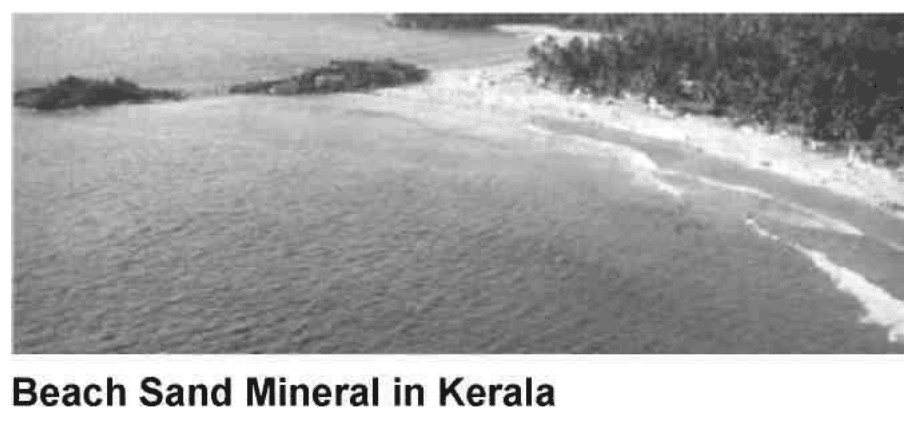
Beach Sand Mineral in Kerala
Beach sand mineral, monazite, is a rich source of thorium, available in large quantities in the state of Kerala in India. A typical monazite sample contains about 9 % \(\ce{ThO2}\) and 0.35 % \(\ce{U3O8}\). \(\ce{^{208}Pb}\) a \(\ce{^{206}Pb}\) are the stable end-products in the radioactive decay series of \(\ce{^{232}Th}\) and \(\ce{^{238}U}\), respectively. All the lead (\(\ce{Pb}\)) found in monazite is of radiogenic origin.
The isotopic atom ratio \(\ce{^{208}Pb}/\ce{^{232}Th}\), measured mass spectrometrically, in a monazite sample was found to be 0.104. The half-lives of \(\ce{^{232}Th}\) and \(\ce{^{238}U}\) \(1.41\times10^{10}\) years and \(4.47\times10^9\) years, respectively. Assume that \(\ce{^{208}Pb}\), \(\ce{^{206}Pb}\), \(\ce{^{232}Th}\) and \(\ce{^{238}U}\) remained entirely in the monazite sample since the formation of monazite mineral.
4.1 Calculate the age (time elapsed since its formation) of the monazite sample.
4.2 Estimate the isotopic atom ratio \(\ce{^{206}Pb}/\ce{^{238}U}\) in the monazite sample.
4.3 Thorium-232 is a fertile material for nuclear energy. In thermal neutron irradiation, it absorbs a neutron and the resulting isotope forms \(\ce{^{233}U}\) by successive \(\beta^-\) decays. Write the nuclear reactions for the formation of \(\ce{^{233}U}\) from \(\ce{^{232}Th}\).
In nuclear fission of \(\ce{^{233}U}\) a complex mixture of radioactive fission products is formed. The fission product \(\ce{^{101}Mo}\) initially undergoes radioactive decay as shown below:

4.4 A freshly prepared radiochemically pure sample of \(\ce{^{101}Mo}\) contains 5000 atoms of \(\ce{^{101}Mo}\) initially. How many atoms of
i) \(\ce{^{101}Mo}\)
ii) \(\ce{^{101}Tc}\)
iii) \(\ce{^{101}Ru}\)
will be present in the sample after 14.6 min?
Official English text of the problem.
Answers
- 4.1: \(\boxed{2.01\times10^9\ \text{years}}\).
- 4.2: \(\boxed{N(\ce{^{206}Pb})/N(\ce{^{238}U})=0.366}\).
- 4.3: Neutron capture produces thorium-233, which undergoes two successive \(\beta^-\) decays through protactinium-233 to uranium-233: \[ \ce{^{232}_{90}Th + ^1_0n -> ^{233}_{90}Th + \gamma} \] \[ \ce{^{233}_{90}Th -> ^{233}_{91}Pa + ^0_{-1}e}+\bar{\nu}_e \] \[ \ce{^{233}_{91}Pa -> ^{233}_{92}U + ^0_{-1}e}+\bar{\nu}_e \]
- 4.4: Expected populations, rounded to whole atoms: (i) 2500 atoms of \(\ce{^{101}Mo}\); (ii) 1720 atoms of \(\ce{^{101}Tc}\); (iii) 780 atoms of \(\ce{^{101}Ru}\).
Solution
4.1 — Age of the monazite
Take the radiogenic lead to have accumulated since mineral formation, with no initial lead and negligible accumulation of intermediate decay-chain nuclides. Each parent nucleus that completes its decay chain produces one lead nucleus.
Let \(P_0\) be the initial number of parent atoms, \(P\) the present number, and \(D\) the number of radiogenic daughter atoms. Radioactive decay gives
\[ P=P_0e^{-\lambda t}, \qquad D=P_0-P, \qquad \lambda=\frac{\ln 2}{t_{1/2}}. \]
Consequently,
\[ \frac{D}{P} =\frac{P_0-P}{P} =e^{\lambda t}-1, \]
and hence
\[ t=\frac{t_{1/2}}{\ln 2} \ln\left(1+\frac{D}{P}\right). \]
For the thorium-232–lead-208 system,
\[ t= \frac{1.41\times10^{10}\ \mathrm{years}}{\ln 2} \ln(1+0.104) =2.0126364\times10^9\ \mathrm{years}. \]
Thus,
\[ \boxed{t=2.01\times10^9\ \mathrm{years}}. \]
4.2 — Lead-206/uranium-238 atom ratio
The uranium system has aged for the same time. Therefore,
\[ \frac{N(\ce{^{206}Pb})}{N(\ce{^{238}U})} =e^{\lambda_{\mathrm U}t}-1, \qquad \lambda_{\mathrm U} =\frac{\ln 2}{4.47\times10^9\ \mathrm{years}}. \]
Using the unrounded age from 4.1,
\[ \frac{N(\ce{^{206}Pb})}{N(\ce{^{238}U})} = \exp\left( \frac{\ln 2\,(2.0126364\times10^9\ \mathrm{years})} {4.47\times10^9\ \mathrm{years}} \right)-1 =0.366281. \]
Hence,
\[ \boxed{\frac{N(\ce{^{206}Pb})}{N(\ce{^{238}U})}=0.366}. \]
The oxide mass percentages are unnecessary for these calculations because the required quantities are daughter/parent atom ratios.
4.3 — Formation of uranium-233
Neutron capture increases the mass number by one without changing the atomic number. Thorium-232 therefore forms thorium-233:
\[ \boxed{\ce{^{232}_{90}Th + ^1_0n -> ^{233}_{90}Th + \gamma}}. \]
In each \(\beta^-\) decay, a neutron converts into a proton, emitting an electron and an electron antineutrino. The mass number remains unchanged, while the atomic number increases by one.
Thus, thorium-233 (\(Z=90\)) first forms protactinium-233 (\(Z=91\)):
\[ \boxed{\ce{^{233}_{90}Th -> ^{233}_{91}Pa + ^0_{-1}e}+\bar{\nu}_e}. \]
Protactinium-233 then forms uranium-233 (\(Z=92\)):
\[ \boxed{\ce{^{233}_{91}Pa -> ^{233}_{92}U + ^0_{-1}e}+\bar{\nu}_e}. \]
Here \(\bar{\nu}_e\) denotes the electron antineutrino. Each equation conserves mass number and electric charge.
4.4 — Successive decay of molybdenum-101 and technetium-101
Let \(N_1,N_2,N_3\) denote the numbers of \(\ce{^{101}Mo}\), \(\ce{^{101}Tc}\), and \(\ce{^{101}Ru}\) atoms, respectively. Initially,
\[ N_1(0)=N_0=5000, \qquad N_2(0)=N_3(0)=0. \]
The decay constants are
\[ \lambda_1=\frac{\ln 2}{14.6\ \mathrm{min}} =0.0474758\ \mathrm{min^{-1}}, \]
\[ \lambda_2=\frac{\ln 2}{14.3\ \mathrm{min}} =0.0484718\ \mathrm{min^{-1}}. \]
(i) Molybdenum-101
After one molybdenum half-life,
\[ N_1(14.6\ \mathrm{min}) =N_0e^{-\lambda_1t} =5000\left(\frac12\right). \]
Thus,
\[ \boxed{N_1=2500\ \text{atoms}}. \]
(ii) Technetium-101
Technetium is simultaneously produced by molybdenum decay and consumed by its own decay:
\[ \frac{dN_2}{dt} =\lambda_1N_1-\lambda_2N_2 =\lambda_1N_0e^{-\lambda_1t}-\lambda_2N_2. \]
With \(N_2(0)=0\), integration gives
\[ N_2(t) = N_0\frac{\lambda_1}{\lambda_2-\lambda_1} \left(e^{-\lambda_1t}-e^{-\lambda_2t}\right). \]
At \(t=14.6\ \mathrm{min}\), this becomes
\[ N_2 = 5000\frac{14.3}{14.6-14.3} \left(\frac12-2^{-14.6/14.3}\right) =1720.3295. \]
Therefore,
\[ \boxed{N_2\approx1720\ \text{atoms}}. \]
(iii) Ruthenium-101
Each decay step preserves one heavy nucleus, and ruthenium is the terminal product in the given chain. Thus,
\[ N_1+N_2+N_3=N_0. \]
Therefore,
\[ N_3=5000-2500-1720.3295=779.6705, \]
so
\[ \boxed{N_3\approx780\ \text{atoms}}. \]
These are expected populations; individual radioactive decays are stochastic.
The solution was checked against the official solution.
IChO 2001 · Theorieaufgabe 4
Thorium, Uran und Blei in Monazit
Mineral im Strandsand von Kerala
Das im Strandsand vorkommende Mineral Monazit ist eine ergiebige Thoriumquelle und kommt im indischen Bundesstaat Kerala in großen Mengen vor. Eine typische Monazitprobe enthält etwa 9 % \(\ce{ThO2}\) und 0.35 % \(\ce{U3O8}\). \(\ce{^{208}Pb}\) und \(\ce{^{206}Pb}\) sind die stabilen Endprodukte der radioaktiven Zerfallsreihen von \(\ce{^{232}Th}\) beziehungsweise \(\ce{^{238}U}\). Das gesamte im Monazit enthaltene Blei (\(\ce{Pb}\)) ist radiogenen Ursprungs.
Das massenspektrometrisch gemessene Isotopen-Atomzahlverhältnis \(\ce{^{208}Pb}/\ce{^{232}Th}\) in einer Monazitprobe beträgt 0.104. Die Halbwertszeiten von \(\ce{^{232}Th}\) und \(\ce{^{238}U}\) betragen \(1.41\times10^{10}\) Jahre beziehungsweise \(4.47\times10^9\) Jahre. Nehmen Sie an, dass \(\ce{^{208}Pb}\), \(\ce{^{206}Pb}\), \(\ce{^{232}Th}\) und \(\ce{^{238}U}\) seit der Bildung des Minerals Monazit vollständig in der Monazitprobe verblieben sind.
4.1 Berechnen Sie das Alter (die seit ihrer Bildung verstrichene Zeit) der Monazitprobe.
4.2 Schätzen Sie das Isotopen-Atomzahlverhältnis \(\ce{^{206}Pb}/\ce{^{238}U}\) in der Monazitprobe ab.
4.3 Thorium-232 ist ein Brutstoff zur Kernenergiegewinnung. Bei der Bestrahlung mit thermischen Neutronen absorbiert es ein Neutron, und das entstehende Isotop bildet durch aufeinanderfolgende \(\beta^-\)-Zerfälle \(\ce{^{233}U}\). Geben Sie die Kernreaktionen für die Bildung von \(\ce{^{233}U}\) aus \(\ce{^{232}Th}\) an.
Bei der Kernspaltung von \(\ce{^{233}U}\) entsteht ein komplexes Gemisch radioaktiver Spaltprodukte. Das Spaltprodukt \(\ce{^{101}Mo}\) zerfällt zunächst radioaktiv wie unten dargestellt:
4.4 Eine frisch hergestellte, radiochemisch reine Probe von \(\ce{^{101}Mo}\) enthält anfangs 5000 Atome \(\ce{^{101}Mo}\). Wie viele Atome von
i) \(\ce{^{101}Mo}\)
ii) \(\ce{^{101}Tc}\)
iii) \(\ce{^{101}Ru}\)
sind nach 14.6 min in der Probe vorhanden?
Aufgabentext aus dem offiziellen englischen Text übersetzt.
Antworten
- 4.1: \(\boxed{2.01\times10^9\ \text{Jahre}}\).
- 4.2: \(\boxed{N(\ce{^{206}Pb})/N(\ce{^{238}U})=0.366}\).
- 4.3: Durch Neutroneneinfang entsteht Thorium-233, das durch zwei aufeinanderfolgende \(\beta^-\)-Zerfälle über Protactinium-233 in Uran-233 übergeht: \[ \ce{^{232}_{90}Th + ^1_0n -> ^{233}_{90}Th + \gamma} \] \[ \ce{^{233}_{90}Th -> ^{233}_{91}Pa + ^0_{-1}e}+\bar{\nu}_e \] \[ \ce{^{233}_{91}Pa -> ^{233}_{92}U + ^0_{-1}e}+\bar{\nu}_e \]
- 4.4: Erwartete Atomzahlen, auf ganze Atome gerundet: (i) 2500 Atome \(\ce{^{101}Mo}\); (ii) 1720 Atome \(\ce{^{101}Tc}\); (iii) 780 Atome \(\ce{^{101}Ru}\).
Lösung
4.1 — Alter des Monazits
Es wird angenommen, dass sich das radiogene Blei seit der Mineralbildung angesammelt hat, dass anfangs kein Blei vorhanden war und dass die Anreicherung von Zwischennukliden der Zerfallsreihe vernachlässigbar ist. Jeder Mutterkern, der seine Zerfallsreihe vollständig durchläuft, erzeugt einen Bleikern.
Sei \(P_0\) die anfängliche Anzahl der Mutteratome, \(P\) die heutige Anzahl und \(D\) die Anzahl der radiogenen Tochteratome. Für den radioaktiven Zerfall gilt
\[ P=P_0e^{-\lambda t}, \qquad D=P_0-P, \qquad \lambda=\frac{\ln 2}{t_{1/2}}. \]
Folglich ist
\[ \frac{D}{P} =\frac{P_0-P}{P} =e^{\lambda t}-1, \]
und damit
\[ t=\frac{t_{1/2}}{\ln 2} \ln\left(1+\frac{D}{P}\right). \]
Für das System Thorium-232–Blei-208 ergibt sich
\[ t= \frac{1.41\times10^{10}\ \mathrm{years}}{\ln 2} \ln(1+0.104) =2.0126364\times10^9\ \mathrm{years}. \]
Somit ist
\[ \boxed{t=2.01\times10^9\ \mathrm{years}}. \]
4.2 — Atomzahlverhältnis Blei-206/Uran-238
Das Uransystem ist während derselben Zeit gealtert. Daher gilt
\[ \frac{N(\ce{^{206}Pb})}{N(\ce{^{238}U})} =e^{\lambda_{\mathrm U}t}-1, \qquad \lambda_{\mathrm U} =\frac{\ln 2}{4.47\times10^9\ \mathrm{years}}. \]
Mit dem ungerundeten Alter aus 4.1 erhält man
\[ \frac{N(\ce{^{206}Pb})}{N(\ce{^{238}U})} = \exp\left( \frac{\ln 2\,(2.0126364\times10^9\ \mathrm{years})} {4.47\times10^9\ \mathrm{years}} \right)-1 =0.366281. \]
Damit ist
\[ \boxed{\frac{N(\ce{^{206}Pb})}{N(\ce{^{238}U})}=0.366}. \]
Die Massenanteile der Oxide in Prozent werden für diese Berechnungen nicht benötigt, da die gesuchten Größen Atomzahlverhältnisse von Tochter- zu Mutternukliden sind.
4.3 — Bildung von Uran-233
Durch Neutroneneinfang erhöht sich die Massenzahl um eins, ohne dass sich die Ordnungszahl ändert. Aus Thorium-232 entsteht daher Thorium-233:
\[ \boxed{\ce{^{232}_{90}Th + ^1_0n -> ^{233}_{90}Th + \gamma}}. \]
Bei jedem \(\beta^-\)-Zerfall wandelt sich ein Neutron unter Emission eines Elektrons und eines Elektron-Antineutrinos in ein Proton um. Die Massenzahl bleibt unverändert, während die Ordnungszahl um eins zunimmt.
Somit entsteht aus Thorium-233 (\(Z=90\)) zunächst Protactinium-233 (\(Z=91\)):
\[ \boxed{\ce{^{233}_{90}Th -> ^{233}_{91}Pa + ^0_{-1}e}+\bar{\nu}_e}. \]
Aus Protactinium-233 entsteht anschließend Uran-233 (\(Z=92\)):
\[ \boxed{\ce{^{233}_{91}Pa -> ^{233}_{92}U + ^0_{-1}e}+\bar{\nu}_e}. \]
Hier bezeichnet \(\bar{\nu}_e\) das Elektron-Antineutrino. In jeder Gleichung bleiben Massenzahl und elektrische Ladung erhalten.
4.4 — Aufeinanderfolgender Zerfall von Molybdän-101 und Technetium-101
Mit \(N_1,N_2,N_3\) werden die Anzahlen der \(\ce{^{101}Mo}\)-, \(\ce{^{101}Tc}\)- beziehungsweise \(\ce{^{101}Ru}\)-Atome bezeichnet. Anfangs gilt
\[ N_1(0)=N_0=5000, \qquad N_2(0)=N_3(0)=0. \]
Die Zerfallskonstanten sind
\[ \lambda_1=\frac{\ln 2}{14.6\ \mathrm{min}} =0.0474758\ \mathrm{min^{-1}}, \]
\[ \lambda_2=\frac{\ln 2}{14.3\ \mathrm{min}} =0.0484718\ \mathrm{min^{-1}}. \]
(i) Molybdän-101
Nach einer Halbwertszeit des Molybdäns gilt
\[ N_1(14.6\ \mathrm{min}) =N_0e^{-\lambda_1t} =5000\left(\frac12\right). \]
Somit ist
\[ \boxed{N_1=2500\ \text{Atome}}. \]
(ii) Technetium-101
Technetium wird gleichzeitig durch den Zerfall von Molybdän gebildet und durch seinen eigenen Zerfall verbraucht:
\[ \frac{dN_2}{dt} =\lambda_1N_1-\lambda_2N_2 =\lambda_1N_0e^{-\lambda_1t}-\lambda_2N_2. \]
Mit \(N_2(0)=0\) ergibt die Integration
\[ N_2(t) = N_0\frac{\lambda_1}{\lambda_2-\lambda_1} \left(e^{-\lambda_1t}-e^{-\lambda_2t}\right). \]
Für \(t=14.6\ \mathrm{min}\) folgt daraus
\[ N_2 = 5000\frac{14.3}{14.6-14.3} \left(\frac12-2^{-14.6/14.3}\right) =1720.3295. \]
Daher ist
\[ \boxed{N_2\approx1720\ \text{Atome}}. \]
(iii) Ruthenium-101
Bei jedem Zerfallsschritt bleibt ein schwerer Kern erhalten, und Ruthenium ist das Endprodukt der angegebenen Zerfallsreihe. Somit gilt
\[ N_1+N_2+N_3=N_0. \]
Daher ist
\[ N_3=5000-2500-1720.3295=779.6705, \]
also
\[ \boxed{N_3\approx780\ \text{Atome}}. \]
Dies sind erwartete Atomzahlen; einzelne radioaktive Zerfälle sind stochastisch.
Die Lösung wurde mit der offiziellen Lösung abgeglichen.
IChO 2001 · Teori sorusu 4
Monazitte toryum, uranyum ve kurşun
Kerala'da Sahil Kumu Minerali
Bir sahil kumu minerali olan monazit, Hindistan'ın Kerala eyaletinde büyük miktarlarda bulunan zengin bir toryum kaynağıdır. Tipik bir monazit örneği yaklaşık % 9 \(\ce{ThO2}\) ve % 0.35 \(\ce{U3O8}\) içerir. \(\ce{^{208}Pb}\) ve \(\ce{^{206}Pb}\), sırasıyla \(\ce{^{232}Th}\) ve \(\ce{^{238}U}\) radyoaktif bozunma serilerinin kararlı son ürünleridir. Monazitte bulunan kurşunun (\(\ce{Pb}\)) tamamı radyojenik kökenlidir.
Bir monazit örneğinde kütle spektrometrisiyle ölçülen \(\ce{^{208}Pb}/\ce{^{232}Th}\) izotopik atom oranı 0.104 olarak bulunmuştur. \(\ce{^{232}Th}\) ve \(\ce{^{238}U}\) izotoplarının yarı ömürleri sırasıyla \(1.41\times10^{10}\) yıl ve \(4.47\times10^9\) yıldır. Monazit mineralinin oluşumundan bu yana \(\ce{^{208}Pb}\), \(\ce{^{206}Pb}\), \(\ce{^{232}Th}\) ve \(\ce{^{238}U}\) izotoplarının tamamının monazit örneği içinde kaldığını varsayınız.
4.1 Monazit örneğinin yaşını (oluşumundan bu yana geçen süreyi) hesaplayınız.
4.2 Monazit örneğindeki \(\ce{^{206}Pb}/\ce{^{238}U}\) izotopik atom oranını tahmin ediniz.
4.3 Toryum-232, nükleer enerji üretiminde kullanılan üretken bir malzemedir. Termal nötronlarla ışınlandığında bir nötron soğurur ve oluşan izotop, art arda gerçekleşen \(\beta^-\) bozunmalarıyla \(\ce{^{233}U}\) oluşturur. \(\ce{^{232}Th}\) izotopundan \(\ce{^{233}U}\) oluşumuna ilişkin nükleer tepkimeleri yazınız.
\(\ce{^{233}U}\) izotopunun nükleer fisyonunda, radyoaktif fisyon ürünlerinden oluşan karmaşık bir karışım meydana gelir. Fisyon ürünü \(\ce{^{101}Mo}\), başlangıçta aşağıda gösterildiği gibi radyoaktif bozunmaya uğrar:
4.4 Yeni hazırlanmış, radyokimyasal olarak saf bir \(\ce{^{101}Mo}\) örneği başlangıçta 5000 adet \(\ce{^{101}Mo}\) atomu içermektedir. 14.6 min sonra örnekte
i) \(\ce{^{101}Mo}\)
ii) \(\ce{^{101}Tc}\)
iii) \(\ce{^{101}Ru}\)
izotoplarının her birinden kaç atom bulunur?
Soru metni resmi İngilizce metinden çevrilmiştir.
Cevaplar
- 4.1: \(\boxed{2.01\times10^9\ \text{yıl}}\).
- 4.2: \(\boxed{N(\ce{^{206}Pb})/N(\ce{^{238}U})=0.366}\).
- 4.3: Nötron yakalanmasıyla toryum-233 oluşur; bu izotop, protaktinyum-233 üzerinden art arda iki \(\beta^-\) bozunmasına uğrayarak uranyum-233'e dönüşür: \[ \ce{^{232}_{90}Th + ^1_0n -> ^{233}_{90}Th + \gamma} \] \[ \ce{^{233}_{90}Th -> ^{233}_{91}Pa + ^0_{-1}e}+\bar{\nu}_e \] \[ \ce{^{233}_{91}Pa -> ^{233}_{92}U + ^0_{-1}e}+\bar{\nu}_e \]
- 4.4: Tam sayıya yuvarlanmış beklenen atom sayıları: (i) 2500 adet \(\ce{^{101}Mo}\) atomu; (ii) 1720 adet \(\ce{^{101}Tc}\) atomu; (iii) 780 adet \(\ce{^{101}Ru}\) atomu.
Çözüm
4.1 — Monazitin yaşı
Başlangıçta kurşun bulunmadığını ve bozunma zincirindeki ara nüklitlerin birikiminin ihmal edilebilir olduğunu kabul ederek, radyojenik kurşunun mineralin oluşumundan bu yana biriktiğini varsayalım. Bozunma zincirini tamamlayan her ana çekirdek bir kurşun çekirdeği üretir.
Başlangıçtaki ana atom sayısı \(P_0\), günümüzdeki ana atom sayısı \(P\) ve radyojenik yavru atom sayısı \(D\) olsun. Radyoaktif bozunma bağıntıları şöyledir:
\[ P=P_0e^{-\lambda t}, \qquad D=P_0-P, \qquad \lambda=\frac{\ln 2}{t_{1/2}}. \]
Buna göre,
\[ \frac{D}{P} =\frac{P_0-P}{P} =e^{\lambda t}-1, \]
ve buradan
\[ t=\frac{t_{1/2}}{\ln 2} \ln\left(1+\frac{D}{P}\right). \]
Toryum-232–kurşun-208 sistemi için,
\[ t= \frac{1.41\times10^{10}\ \mathrm{years}}{\ln 2} \ln(1+0.104) =2.0126364\times10^9\ \mathrm{years}. \]
Dolayısıyla,
\[ \boxed{t=2.01\times10^9\ \mathrm{years}}. \]
4.2 — Kurşun-206/uranyum-238 atom oranı
Uranyum sistemi de aynı süre boyunca yaşlanmıştır. Bu nedenle,
\[ \frac{N(\ce{^{206}Pb})}{N(\ce{^{238}U})} =e^{\lambda_{\mathrm U}t}-1, \qquad \lambda_{\mathrm U} =\frac{\ln 2}{4.47\times10^9\ \mathrm{years}}. \]
4.1'de bulunan yaşın yuvarlanmamış değeri kullanıldığında,
\[ \frac{N(\ce{^{206}Pb})}{N(\ce{^{238}U})} = \exp\left( \frac{\ln 2\,(2.0126364\times10^9\ \mathrm{years})} {4.47\times10^9\ \mathrm{years}} \right)-1 =0.366281. \]
Böylece,
\[ \boxed{\frac{N(\ce{^{206}Pb})}{N(\ce{^{238}U})}=0.366}. \]
Bu hesaplamalar için oksitlerin kütle yüzdelerine gerek yoktur; çünkü gereken büyüklükler yavru/ana atom oranlarıdır.
4.3 — Uranyum-233 oluşumu
Nötron yakalanması, atom numarasını değiştirmeden kütle numarasını bir artırır. Bu nedenle toryum-232'den toryum-233 oluşur:
\[ \boxed{\ce{^{232}_{90}Th + ^1_0n -> ^{233}_{90}Th + \gamma}}. \]
Her \(\beta^-\) bozunmasında bir nötron, bir elektron ve bir elektron antinötrinosu yayarak protona dönüşür. Kütle numarası değişmezken atom numarası bir artar.
Dolayısıyla toryum-233 (\(Z=90\)) önce protaktinyum-233'e (\(Z=91\)) dönüşür:
\[ \boxed{\ce{^{233}_{90}Th -> ^{233}_{91}Pa + ^0_{-1}e}+\bar{\nu}_e}. \]
Ardından protaktinyum-233, uranyum-233'e (\(Z=92\)) dönüşür:
\[ \boxed{\ce{^{233}_{91}Pa -> ^{233}_{92}U + ^0_{-1}e}+\bar{\nu}_e}. \]
Burada \(\bar{\nu}_e\), elektron antinötrinosunu gösterir. Her denklemde kütle numarası ve elektrik yükü korunur.
4.4 — Molibden-101 ve teknesyum-101'in ardışık bozunması
\(N_1,N_2,N_3\), sırasıyla \(\ce{^{101}Mo}\), \(\ce{^{101}Tc}\) ve \(\ce{^{101}Ru}\) atomlarının sayılarını göstersin. Başlangıçta,
\[ N_1(0)=N_0=5000, \qquad N_2(0)=N_3(0)=0. \]
Bozunma sabitleri şöyledir:
\[ \lambda_1=\frac{\ln 2}{14.6\ \mathrm{min}} =0.0474758\ \mathrm{min^{-1}}, \]
\[ \lambda_2=\frac{\ln 2}{14.3\ \mathrm{min}} =0.0484718\ \mathrm{min^{-1}}. \]
(i) Molibden-101
Molibdenin bir yarı ömrü kadar süre geçtiğinde,
\[ N_1(14.6\ \mathrm{min}) =N_0e^{-\lambda_1t} =5000\left(\frac12\right). \]
Dolayısıyla,
\[ \boxed{N_1=2500\ \text{atom}}. \]
(ii) Teknesyum-101
Teknesyum, molibdenin bozunmasıyla üretilirken aynı anda kendi bozunmasıyla tüketilir:
\[ \frac{dN_2}{dt} =\lambda_1N_1-\lambda_2N_2 =\lambda_1N_0e^{-\lambda_1t}-\lambda_2N_2. \]
\(N_2(0)=0\) başlangıç koşuluyla integral alındığında,
\[ N_2(t) = N_0\frac{\lambda_1}{\lambda_2-\lambda_1} \left(e^{-\lambda_1t}-e^{-\lambda_2t}\right). \]
\(t=14.6\ \mathrm{min}\) için bu ifade şöyle olur:
\[ N_2 = 5000\frac{14.3}{14.6-14.3} \left(\frac12-2^{-14.6/14.3}\right) =1720.3295. \]
Bu nedenle,
\[ \boxed{N_2\approx1720\ \text{atom}}. \]
(iii) Rutenyum-101
Her bozunma adımında bir ağır çekirdek korunur ve rutenyum, verilen zincirin son ürünüdür. Dolayısıyla,
\[ N_1+N_2+N_3=N_0. \]
Bu nedenle,
\[ N_3=5000-2500-1720.3295=779.6705, \]
ve buradan
\[ \boxed{N_3\approx780\ \text{atom}}. \]
Bunlar beklenen atom sayılarıdır; tek tek radyoaktif bozunmalar rastlantısaldır.
Çözüm, resmi çözümle karşılaştırılarak kontrol edildi.
IChO 2001 · Problema teórico 4
Torio, uranio y plomo en la monacita
Mineral de las arenas de playa de Kerala
La monacita, un mineral presente en las arenas de playa, es una fuente rica en torio y se encuentra en grandes cantidades en el estado de Kerala, en la India. Una muestra típica de monacita contiene aproximadamente un 9 % de \(\ce{ThO2}\) y un 0.35 % de \(\ce{U3O8}\). El \(\ce{^{208}Pb}\) y el \(\ce{^{206}Pb}\) son los productos finales estables de las series de desintegración radiactiva del \(\ce{^{232}Th}\) y del \(\ce{^{238}U}\), respectivamente. Todo el plomo (\(\ce{Pb}\)) presente en la monacita es de origen radiogénico.
La relación entre el número de átomos de los isótopos \(\ce{^{208}Pb}/\ce{^{232}Th}\), medida mediante espectrometría de masas en una muestra de monacita, resultó ser 0.104. Los períodos de semidesintegración del \(\ce{^{232}Th}\) y del \(\ce{^{238}U}\) son \(1.41\times10^{10}\) años y \(4.47\times10^9\) años, respectivamente. Suponga que el \(\ce{^{208}Pb}\), el \(\ce{^{206}Pb}\), el \(\ce{^{232}Th}\) y el \(\ce{^{238}U}\) han permanecido íntegramente en la muestra de monacita desde la formación del mineral.
4.1 Calcule la edad (el tiempo transcurrido desde su formación) de la muestra de monacita.
4.2 Estime la relación entre el número de átomos de los isótopos \(\ce{^{206}Pb}/\ce{^{238}U}\) en la muestra de monacita.
4.3 El torio-232 es un material fértil para la producción de energía nuclear. Al irradiarlo con neutrones térmicos, absorbe un neutrón y el isótopo resultante forma \(\ce{^{233}U}\) mediante desintegraciones \(\beta^-\) sucesivas. Escriba las reacciones nucleares de formación de \(\ce{^{233}U}\) a partir de \(\ce{^{232}Th}\).
En la fisión nuclear del \(\ce{^{233}U}\) se forma una mezcla compleja de productos de fisión radiactivos. El producto de fisión \(\ce{^{101}Mo}\) experimenta inicialmente una desintegración radiactiva como se muestra a continuación:
4.4 Una muestra recién preparada y radioquímicamente pura de \(\ce{^{101}Mo}\) contiene inicialmente 5000 átomos de \(\ce{^{101}Mo}\). ¿Cuántos átomos de
i) \(\ce{^{101}Mo}\)
ii) \(\ce{^{101}Tc}\)
iii) \(\ce{^{101}Ru}\)
habrá en la muestra después de 14.6 min?
Enunciado traducido del texto oficial en inglés.
Respuestas
- 4.1: \(\boxed{2.01\times10^9\ \text{años}}\).
- 4.2: \(\boxed{N(\ce{^{206}Pb})/N(\ce{^{238}U})=0.366}\).
- 4.3: La captura de un neutrón produce torio-233, que experimenta dos desintegraciones \(\beta^-\) sucesivas, pasando por protactinio-233 hasta convertirse en uranio-233: \[ \ce{^{232}_{90}Th + ^1_0n -> ^{233}_{90}Th + \gamma} \] \[ \ce{^{233}_{90}Th -> ^{233}_{91}Pa + ^0_{-1}e}+\bar{\nu}_e \] \[ \ce{^{233}_{91}Pa -> ^{233}_{92}U + ^0_{-1}e}+\bar{\nu}_e \]
- 4.4: Poblaciones esperadas, redondeadas a números enteros de átomos: (i) 2500 átomos de \(\ce{^{101}Mo}\); (ii) 1720 átomos de \(\ce{^{101}Tc}\); (iii) 780 átomos de \(\ce{^{101}Ru}\).
Solución
4.1 — Edad de la monacita
Se supone que el plomo radiogénico se ha acumulado desde la formación del mineral, sin plomo inicial y con una acumulación despreciable de nucleidos intermedios de las cadenas de desintegración. Cada núcleo progenitor que completa su cadena de desintegración produce un núcleo de plomo.
Sean \(P_0\) el número inicial de átomos progenitores, \(P\) su número actual y \(D\) el número de átomos descendientes radiogénicos. La desintegración radiactiva da
\[ P=P_0e^{-\lambda t}, \qquad D=P_0-P, \qquad \lambda=\frac{\ln 2}{t_{1/2}}. \]
Por consiguiente,
\[ \frac{D}{P} =\frac{P_0-P}{P} =e^{\lambda t}-1, \]
y, por tanto,
\[ t=\frac{t_{1/2}}{\ln 2} \ln\left(1+\frac{D}{P}\right). \]
Para el sistema torio-232–plomo-208,
\[ t= \frac{1.41\times10^{10}\ \mathrm{years}}{\ln 2} \ln(1+0.104) =2.0126364\times10^9\ \mathrm{years}. \]
Así,
\[ \boxed{t=2.01\times10^9\ \mathrm{years}}. \]
4.2 — Relación entre el número de átomos de plomo-206 y uranio-238
El sistema del uranio ha envejecido durante el mismo tiempo. Por lo tanto,
\[ \frac{N(\ce{^{206}Pb})}{N(\ce{^{238}U})} =e^{\lambda_{\mathrm U}t}-1, \qquad \lambda_{\mathrm U} =\frac{\ln 2}{4.47\times10^9\ \mathrm{years}}. \]
Utilizando la edad sin redondear obtenida en 4.1,
\[ \frac{N(\ce{^{206}Pb})}{N(\ce{^{238}U})} = \exp\left( \frac{\ln 2\,(2.0126364\times10^9\ \mathrm{years})} {4.47\times10^9\ \mathrm{years}} \right)-1 =0.366281. \]
Por tanto,
\[ \boxed{\frac{N(\ce{^{206}Pb})}{N(\ce{^{238}U})}=0.366}. \]
Los porcentajes en masa de los óxidos no son necesarios para estos cálculos, porque las magnitudes requeridas son las relaciones entre el número de átomos descendientes y progenitores.
4.3 — Formación de uranio-233
La captura de un neutrón aumenta el número másico en una unidad sin cambiar el número atómico. Por ello, el torio-232 forma torio-233:
\[ \boxed{\ce{^{232}_{90}Th + ^1_0n -> ^{233}_{90}Th + \gamma}}. \]
En cada desintegración \(\beta^-\), un neutrón se convierte en un protón y emite un electrón y un antineutrino electrónico. El número másico permanece inalterado, mientras que el número atómico aumenta en una unidad.
Así, el torio-233 (\(Z=90\)) forma primero protactinio-233 (\(Z=91\)):
\[ \boxed{\ce{^{233}_{90}Th -> ^{233}_{91}Pa + ^0_{-1}e}+\bar{\nu}_e}. \]
A continuación, el protactinio-233 forma uranio-233 (\(Z=92\)):
\[ \boxed{\ce{^{233}_{91}Pa -> ^{233}_{92}U + ^0_{-1}e}+\bar{\nu}_e}. \]
Aquí, \(\bar{\nu}_e\) representa el antineutrino electrónico. En cada ecuación se conservan el número másico y la carga eléctrica.
4.4 — Desintegración sucesiva del molibdeno-101 y del tecnecio-101
Sean \(N_1,N_2,N_3\) los números de átomos de \(\ce{^{101}Mo}\), \(\ce{^{101}Tc}\) y \(\ce{^{101}Ru}\), respectivamente. Inicialmente,
\[ N_1(0)=N_0=5000, \qquad N_2(0)=N_3(0)=0. \]
Las constantes de desintegración son
\[ \lambda_1=\frac{\ln 2}{14.6\ \mathrm{min}} =0.0474758\ \mathrm{min^{-1}}, \]
\[ \lambda_2=\frac{\ln 2}{14.3\ \mathrm{min}} =0.0484718\ \mathrm{min^{-1}}. \]
(i) Molibdeno-101
Tras un período de semidesintegración del molibdeno,
\[ N_1(14.6\ \mathrm{min}) =N_0e^{-\lambda_1t} =5000\left(\frac12\right). \]
Así,
\[ \boxed{N_1=2500\ \text{átomos}}. \]
(ii) Tecnecio-101
El tecnecio se produce por la desintegración del molibdeno y, simultáneamente, se consume por su propia desintegración:
\[ \frac{dN_2}{dt} =\lambda_1N_1-\lambda_2N_2 =\lambda_1N_0e^{-\lambda_1t}-\lambda_2N_2. \]
Con \(N_2(0)=0\), la integración da
\[ N_2(t) = N_0\frac{\lambda_1}{\lambda_2-\lambda_1} \left(e^{-\lambda_1t}-e^{-\lambda_2t}\right). \]
Para \(t=14.6\ \mathrm{min}\), esta expresión se convierte en
\[ N_2 = 5000\frac{14.3}{14.6-14.3} \left(\frac12-2^{-14.6/14.3}\right) =1720.3295. \]
Por lo tanto,
\[ \boxed{N_2\approx1720\ \text{átomos}}. \]
(iii) Rutenio-101
Cada etapa de desintegración conserva un núcleo pesado, y el rutenio es el producto final de la cadena dada. Así,
\[ N_1+N_2+N_3=N_0. \]
Por lo tanto,
\[ N_3=5000-2500-1720.3295=779.6705, \]
de modo que
\[ \boxed{N_3\approx780\ \text{átomos}}. \]
Estas son poblaciones esperadas; las desintegraciones radiactivas individuales son estocásticas.
La solución se comprobó con la solución oficial.
IChO 2001 · 理论题 4
独居石中的钍、铀和铅
喀拉拉邦的海滨砂矿物
独居石是一种富含钍的海滨砂矿物,在印度喀拉拉邦大量分布。典型的独居石样品含有约 9 % 的 \(\ce{ThO2}\) 和 0.35 % 的 \(\ce{U3O8}\)。\(\ce{^{208}Pb}\) 和 \(\ce{^{206}Pb}\) 分别是 \(\ce{^{232}Th}\) 和 \(\ce{^{238}U}\) 放射性衰变系的稳定最终产物。独居石中发现的所有铅(\(\ce{Pb}\))均由放射性衰变产生。
通过质谱法测得某独居石样品中的同位素原子数比 \(\ce{^{208}Pb}/\ce{^{232}Th}\) 为 0.104。\(\ce{^{232}Th}\) 和 \(\ce{^{238}U}\) 的半衰期分别为 \(1.41\times10^{10}\) 年和 \(4.47\times10^9\) 年。假设自独居石矿物形成以来,\(\ce{^{208}Pb}\)、\(\ce{^{206}Pb}\)、\(\ce{^{232}Th}\) 和 \(\ce{^{238}U}\) 始终完全保留在该独居石样品中。
4.1 计算该独居石样品的年龄(自形成以来经过的时间)。
4.2 估算该独居石样品中的同位素原子数比 \(\ce{^{206}Pb}/\ce{^{238}U}\)。
4.3 钍-232 是一种可用于核能的可转换材料。在热中子辐照下,它吸收一个中子,生成的同位素通过连续的 \(\beta^-\) 衰变形成 \(\ce{^{233}U}\)。写出由 \(\ce{^{232}Th}\) 生成 \(\ce{^{233}U}\) 的核反应方程式。
\(\ce{^{233}U}\) 发生核裂变时,会形成由多种放射性裂变产物组成的复杂混合物。裂变产物 \(\ce{^{101}Mo}\) 最初按如下所示的方式发生放射性衰变:
4.4 一份新制备的放射化学纯 \(\ce{^{101}Mo}\) 样品最初含有 5000 个 \(\ce{^{101}Mo}\) 原子。下列各核素:
i) \(\ce{^{101}Mo}\)
ii) \(\ce{^{101}Tc}\)
iii) \(\ce{^{101}Ru}\)
在 14.6 min 后的样品中分别有多少个原子?
题目译自官方英文原文。
答案
- 4.1: \(\boxed{2.01\times10^9\ \text{年}}\)。
- 4.2: \(\boxed{N(\ce{^{206}Pb})/N(\ce{^{238}U})=0.366}\)。
- 4.3: 中子俘获产生钍-233,后者经过两次连续的 \(\beta^-\) 衰变,经由镤-233 转变为铀-233: \[ \ce{^{232}_{90}Th + ^1_0n -> ^{233}_{90}Th + \gamma} \] \[ \ce{^{233}_{90}Th -> ^{233}_{91}Pa + ^0_{-1}e}+\bar{\nu}_e \] \[ \ce{^{233}_{91}Pa -> ^{233}_{92}U + ^0_{-1}e}+\bar{\nu}_e \]
- 4.4: 期望原子数,四舍五入至整数:(i) 2500 个 \(\ce{^{101}Mo}\) 原子;(ii) 1720 个 \(\ce{^{101}Tc}\) 原子;(iii) 780 个 \(\ce{^{101}Ru}\) 原子。
解答
4.1 — 独居石的年龄
认为放射成因铅自矿物形成以来不断积累,初始时不含铅,且衰变链中间核素的积累可忽略不计。每个完成其衰变链的母核都会产生一个铅核。
设 \(P_0\) 为母体原子的初始数目,\(P\) 为其现有数目,\(D\) 为放射成因子体原子的数目。根据放射性衰变规律,得到
\[ P=P_0e^{-\lambda t}, \qquad D=P_0-P, \qquad \lambda=\frac{\ln 2}{t_{1/2}}. \]
因此,
\[ \frac{D}{P} =\frac{P_0-P}{P} =e^{\lambda t}-1, \]
从而
\[ t=\frac{t_{1/2}}{\ln 2} \ln\left(1+\frac{D}{P}\right). \]
对于钍-232–铅-208 体系,
\[ t= \frac{1.41\times10^{10}\ \mathrm{years}}{\ln 2} \ln(1+0.104) =2.0126364\times10^9\ \mathrm{years}. \]
因此,
\[ \boxed{t=2.01\times10^9\ \mathrm{years}}. \]
4.2 — 铅-206/铀-238 原子数比
铀体系经历了相同的时间。因此,
\[ \frac{N(\ce{^{206}Pb})}{N(\ce{^{238}U})} =e^{\lambda_{\mathrm U}t}-1, \qquad \lambda_{\mathrm U} =\frac{\ln 2}{4.47\times10^9\ \mathrm{years}}. \]
使用 4.1 中未经舍入的年龄,
\[ \frac{N(\ce{^{206}Pb})}{N(\ce{^{238}U})} = \exp\left( \frac{\ln 2\,(2.0126364\times10^9\ \mathrm{years})} {4.47\times10^9\ \mathrm{years}} \right)-1 =0.366281. \]
所以,
\[ \boxed{\frac{N(\ce{^{206}Pb})}{N(\ce{^{238}U})}=0.366}. \]
这些计算不需要氧化物的质量百分数,因为所需的量是子体与母体的原子数比。
4.3 — 铀-233 的形成
中子俘获使质量数增加一,而不改变原子序数。因此,钍-232 形成钍-233:
\[ \boxed{\ce{^{232}_{90}Th + ^1_0n -> ^{233}_{90}Th + \gamma}}. \]
在每次 \(\beta^-\) 衰变中,一个中子转变为一个质子,同时发射一个电子和一个电子反中微子。质量数保持不变,而原子序数增加一。
因此,钍-233(\(Z=90\))首先形成镤-233(\(Z=91\)):
\[ \boxed{\ce{^{233}_{90}Th -> ^{233}_{91}Pa + ^0_{-1}e}+\bar{\nu}_e}. \]
随后,镤-233 形成铀-233(\(Z=92\)):
\[ \boxed{\ce{^{233}_{91}Pa -> ^{233}_{92}U + ^0_{-1}e}+\bar{\nu}_e}. \]
这里,\(\bar{\nu}_e\) 表示电子反中微子。每个方程式都满足质量数守恒和电荷守恒。
4.4 — 钼-101 和锝-101 的连续衰变
设 \(N_1,N_2,N_3\) 分别表示 \(\ce{^{101}Mo}\)、\(\ce{^{101}Tc}\) 和 \(\ce{^{101}Ru}\) 的原子数。初始时,
\[ N_1(0)=N_0=5000, \qquad N_2(0)=N_3(0)=0. \]
衰变常数为
\[ \lambda_1=\frac{\ln 2}{14.6\ \mathrm{min}} =0.0474758\ \mathrm{min^{-1}}, \]
\[ \lambda_2=\frac{\ln 2}{14.3\ \mathrm{min}} =0.0484718\ \mathrm{min^{-1}}. \]
(i) 钼-101
经过钼的一个半衰期后,
\[ N_1(14.6\ \mathrm{min}) =N_0e^{-\lambda_1t} =5000\left(\frac12\right). \]
因此,
\[ \boxed{N_1=2500\ \text{个原子}}. \]
(ii) 锝-101
锝由钼衰变产生,同时又因自身衰变而消耗:
\[ \frac{dN_2}{dt} =\lambda_1N_1-\lambda_2N_2 =\lambda_1N_0e^{-\lambda_1t}-\lambda_2N_2. \]
利用 \(N_2(0)=0\),积分得到
\[ N_2(t) = N_0\frac{\lambda_1}{\lambda_2-\lambda_1} \left(e^{-\lambda_1t}-e^{-\lambda_2t}\right). \]
当 \(t=14.6\ \mathrm{min}\) 时,上式变为
\[ N_2 = 5000\frac{14.3}{14.6-14.3} \left(\frac12-2^{-14.6/14.3}\right) =1720.3295. \]
因此,
\[ \boxed{N_2\approx1720\ \text{个原子}}. \]
(iii) 钌-101
每一步衰变都保留一个重核,而钌是给定衰变链的最终产物。因此,
\[ N_1+N_2+N_3=N_0. \]
因此,
\[ N_3=5000-2500-1720.3295=779.6705, \]
所以
\[ \boxed{N_3\approx780\ \text{个原子}}. \]
这些数值是期望原子数;单个原子的放射性衰变具有随机性。
解答已与官方解答核对。
IChO 2001 · Теоретическая задача 4
Торий, уран и свинец в монаците
Минерал пляжного песка в Керале
Монацит — минерал пляжных песков, являющийся богатым источником тория и встречающийся в больших количествах в штате Керала в Индии. Типичный образец монацита содержит около 9 % \(\ce{ThO2}\) и 0.35 % \(\ce{U3O8}\). \(\ce{^{208}Pb}\) и \(\ce{^{206}Pb}\) — стабильные конечные продукты радиоактивных рядов распада \(\ce{^{232}Th}\) и \(\ce{^{238}U}\) соответственно. Весь свинец (\(\ce{Pb}\)), содержащийся в монаците, имеет радиогенное происхождение.
Измеренное методом масс-спектрометрии отношение числа атомов изотопов \(\ce{^{208}Pb}/\ce{^{232}Th}\) в образце монацита оказалось равным 0.104. Периоды полураспада \(\ce{^{232}Th}\) и \(\ce{^{238}U}\) составляют \(1.41\times10^{10}\) лет и \(4.47\times10^9\) лет соответственно. Считайте, что \(\ce{^{208}Pb}\), \(\ce{^{206}Pb}\), \(\ce{^{232}Th}\) и \(\ce{^{238}U}\) полностью сохранялись в образце монацита с момента образования этого минерала.
4.1 Рассчитайте возраст образца монацита (время, прошедшее с момента его образования).
4.2 Оцените отношение числа атомов изотопов \(\ce{^{206}Pb}/\ce{^{238}U}\) в образце монацита.
4.3 Торий-232 — воспроизводящий материал для ядерной энергетики. При облучении тепловыми нейтронами он поглощает нейтрон, и образующийся изотоп в результате последовательных \(\beta^-\)-распадов превращается в \(\ce{^{233}U}\). Напишите ядерные реакции образования \(\ce{^{233}U}\) из \(\ce{^{232}Th}\).
При делении ядер \(\ce{^{233}U}\) образуется сложная смесь радиоактивных продуктов деления. Продукт деления \(\ce{^{101}Mo}\) на начальных стадиях претерпевает радиоактивный распад по приведённой ниже схеме:
4.4 Свежеприготовленный радиохимически чистый образец \(\ce{^{101}Mo}\) первоначально содержит 5000 атомов \(\ce{^{101}Mo}\). Сколько атомов
i) \(\ce{^{101}Mo}\)
ii) \(\ce{^{101}Tc}\)
iii) \(\ce{^{101}Ru}\)
будет присутствовать в образце через 14.6 мин?
Условие переведено с официального английского текста.
Ответы
- 4.1: \(\boxed{2.01\times10^9\ \text{лет}}\).
- 4.2: \(\boxed{N(\ce{^{206}Pb})/N(\ce{^{238}U})=0.366}\).
- 4.3: При захвате нейтрона образуется торий-233, который в результате двух последовательных \(\beta^-\)-распадов через протактиний-233 превращается в уран-233: \[ \ce{^{232}_{90}Th + ^1_0n -> ^{233}_{90}Th + \gamma} \] \[ \ce{^{233}_{90}Th -> ^{233}_{91}Pa + ^0_{-1}e}+\bar{\nu}_e \] \[ \ce{^{233}_{91}Pa -> ^{233}_{92}U + ^0_{-1}e}+\bar{\nu}_e \]
- 4.4: Ожидаемые числа атомов, округлённые до целых: (i) 2500 атомов \(\ce{^{101}Mo}\); (ii) 1720 атомов \(\ce{^{101}Tc}\); (iii) 780 атомов \(\ce{^{101}Ru}\).
Решение
4.1 — Возраст монацита
Будем считать, что радиогенный свинец накапливался с момента образования минерала, причём первоначально свинец отсутствовал, а накоплением промежуточных нуклидов цепочки распада можно пренебречь. Каждое материнское ядро, прошедшее всю цепочку распада, даёт одно ядро свинца.
Пусть \(P_0\) — первоначальное число материнских атомов, \(P\) — их число в настоящее время, а \(D\) — число радиогенных дочерних атомов. Закон радиоактивного распада даёт
\[ P=P_0e^{-\lambda t}, \qquad D=P_0-P, \qquad \lambda=\frac{\ln 2}{t_{1/2}}. \]
Следовательно,
\[ \frac{D}{P} =\frac{P_0-P}{P} =e^{\lambda t}-1, \]
откуда
\[ t=\frac{t_{1/2}}{\ln 2} \ln\left(1+\frac{D}{P}\right). \]
Для системы торий-232–свинец-208
\[ t= \frac{1.41\times10^{10}\ \mathrm{years}}{\ln 2} \ln(1+0.104) =2.0126364\times10^9\ \mathrm{years}. \]
Таким образом,
\[ \boxed{t=2.01\times10^9\ \mathrm{years}}. \]
4.2 — Отношение числа атомов свинца-206 к числу атомов урана-238
Для урановой системы прошло такое же время. Поэтому
\[ \frac{N(\ce{^{206}Pb})}{N(\ce{^{238}U})} =e^{\lambda_{\mathrm U}t}-1, \qquad \lambda_{\mathrm U} =\frac{\ln 2}{4.47\times10^9\ \mathrm{years}}. \]
Используя неокруглённое значение возраста из пункта 4.1, получаем
\[ \frac{N(\ce{^{206}Pb})}{N(\ce{^{238}U})} = \exp\left( \frac{\ln 2\,(2.0126364\times10^9\ \mathrm{years})} {4.47\times10^9\ \mathrm{years}} \right)-1 =0.366281. \]
Следовательно,
\[ \boxed{\frac{N(\ce{^{206}Pb})}{N(\ce{^{238}U})}=0.366}. \]
Массовые доли оксидов в процентах для этих расчётов не нужны, поскольку искомые величины представляют собой отношения числа дочерних атомов к числу материнских.
4.3 — Образование урана-233
Захват нейтрона увеличивает массовое число на единицу, не изменяя атомного номера. Поэтому из тория-232 образуется торий-233:
\[ \boxed{\ce{^{232}_{90}Th + ^1_0n -> ^{233}_{90}Th + \gamma}}. \]
При каждом \(\beta^-\)-распаде нейтрон превращается в протон с испусканием электрона и электронного антинейтрино. Массовое число остаётся неизменным, а атомный номер увеличивается на единицу.
Таким образом, из тория-233 (\(Z=90\)) сначала образуется протактиний-233 (\(Z=91\)):
\[ \boxed{\ce{^{233}_{90}Th -> ^{233}_{91}Pa + ^0_{-1}e}+\bar{\nu}_e}. \]
Затем из протактиния-233 образуется уран-233 (\(Z=92\)):
\[ \boxed{\ce{^{233}_{91}Pa -> ^{233}_{92}U + ^0_{-1}e}+\bar{\nu}_e}. \]
Здесь \(\bar{\nu}_e\) обозначает электронное антинейтрино. В каждом уравнении сохраняются массовое число и электрический заряд.
4.4 — Последовательный распад молибдена-101 и технеция-101
Обозначим через \(N_1,N_2,N_3\) числа атомов \(\ce{^{101}Mo}\), \(\ce{^{101}Tc}\) и \(\ce{^{101}Ru}\) соответственно. В начальный момент
\[ N_1(0)=N_0=5000, \qquad N_2(0)=N_3(0)=0. \]
Постоянные распада равны
\[ \lambda_1=\frac{\ln 2}{14.6\ \mathrm{min}} =0.0474758\ \mathrm{min^{-1}}, \]
\[ \lambda_2=\frac{\ln 2}{14.3\ \mathrm{min}} =0.0484718\ \mathrm{min^{-1}}. \]
(i) Молибден-101
Через один период полураспада молибдена
\[ N_1(14.6\ \mathrm{min}) =N_0e^{-\lambda_1t} =5000\left(\frac12\right). \]
Таким образом,
\[ \boxed{N_1=2500\ \text{атомов}}. \]
(ii) Технеций-101
Технеций одновременно образуется при распаде молибдена и расходуется вследствие собственного распада:
\[ \frac{dN_2}{dt} =\lambda_1N_1-\lambda_2N_2 =\lambda_1N_0e^{-\lambda_1t}-\lambda_2N_2. \]
При \(N_2(0)=0\) интегрирование даёт
\[ N_2(t) = N_0\frac{\lambda_1}{\lambda_2-\lambda_1} \left(e^{-\lambda_1t}-e^{-\lambda_2t}\right). \]
При \(t=14.6\ \mathrm{min}\) получаем
\[ N_2 = 5000\frac{14.3}{14.6-14.3} \left(\frac12-2^{-14.6/14.3}\right) =1720.3295. \]
Следовательно,
\[ \boxed{N_2\approx1720\ \text{атомов}}. \]
(iii) Рутений-101
На каждой стадии распада сохраняется одно тяжёлое ядро, а рутений является конечным продуктом данной цепочки. Таким образом,
\[ N_1+N_2+N_3=N_0. \]
Следовательно,
\[ N_3=5000-2500-1720.3295=779.6705, \]
так что
\[ \boxed{N_3\approx780\ \text{атомов}}. \]
Это ожидаемые числа атомов; отдельные радиоактивные распады носят случайный характер.
Решение проверено по официальному решению.
IChO 2001 · مسألة نظرية 4
الثوريوم واليورانيوم والرصاص في المونازيت
معدن من رمال الشواطئ في كيرالا
المونازيت، وهو معدن يوجد في رمال الشواطئ، مصدر غني بالثوريوم، ويتوافر بكميات كبيرة في ولاية كيرالا في الهند. تحتوي عينة نموذجية من المونازيت على نحو 9 % من \(\ce{ThO2}\) و0.35 % من \(\ce{U3O8}\). ويُعدّ \(\ce{^{208}Pb}\) و\(\ce{^{206}Pb}\) الناتجين النهائيين المستقرين في سلسلتي الاضمحلال الإشعاعي لكلٍّ من \(\ce{^{232}Th}\) و\(\ce{^{238}U}\)، على الترتيب. وكل الرصاص (\(\ce{Pb}\)) الموجود في المونازيت ناتج عن الاضمحلال الإشعاعي.
وُجد أن النسبة بين أعداد ذرات النظيرين \(\ce{^{208}Pb}/\ce{^{232}Th}\)، المقيسة بمطيافية الكتلة في عينة من المونازيت، تساوي 0.104. ويبلغ عمرا النصف لكلٍّ من \(\ce{^{232}Th}\) و\(\ce{^{238}U}\) \(1.41\times10^{10}\) سنة و\(4.47\times10^9\) سنة، على الترتيب. افترض أن \(\ce{^{208}Pb}\) و\(\ce{^{206}Pb}\) و\(\ce{^{232}Th}\) و\(\ce{^{238}U}\) بقيت بالكامل في عينة المونازيت منذ تكوُّن معدن المونازيت.
4.1 احسب عمر عينة المونازيت (الزمن المنقضي منذ تكوُّنها).
4.2 قدِّر النسبة بين أعداد ذرات النظيرين \(\ce{^{206}Pb}/\ce{^{238}U}\) في عينة المونازيت.
4.3 الثوريوم-232 مادة خصبة لإنتاج الطاقة النووية. عند تشعيعه بالنيوترونات الحرارية، يمتص نيوترونًا، ويتحوّل النظير الناتج إلى \(\ce{^{233}U}\) عبر اضمحلالات \(\beta^-\) متتالية. اكتب التفاعلات النووية لتكوُّن \(\ce{^{233}U}\) من \(\ce{^{232}Th}\).
في الانشطار النووي لـ\(\ce{^{233}U}\)، يتكوّن مزيج معقّد من نواتج الانشطار المشعّة. ويخضع ناتج الانشطار \(\ce{^{101}Mo}\) في البداية لاضمحلال إشعاعي كما هو موضّح أدناه:
4.4 تحتوي عينة حديثة التحضير من \(\ce{^{101}Mo}\)، نقية من الناحية الكيميائية الإشعاعية، على 5000 ذرة من \(\ce{^{101}Mo}\) في البداية. كم عدد ذرات
i) \(\ce{^{101}Mo}\)
ii) \(\ce{^{101}Tc}\)
iii) \(\ce{^{101}Ru}\)
التي ستكون موجودة في العينة بعد 14.6 دقيقة؟
نص المسألة مترجم عن النص الإنجليزي الرسمي.
الإجابات
- 4.1: \(\boxed{2.01\times10^9\ \text{سنة}}\).
- 4.2: \(\boxed{N(\ce{^{206}Pb})/N(\ce{^{238}U})=0.366}\).
- 4.3: ينتج عن التقاط نيوترون الثوريوم-233، الذي يخضع لاضمحلالَي \(\beta^-\) متتاليين، مرورًا بالبروتكتينيوم-233 وصولًا إلى اليورانيوم-233: \[ \ce{^{232}_{90}Th + ^1_0n -> ^{233}_{90}Th + \gamma} \] \[ \ce{^{233}_{90}Th -> ^{233}_{91}Pa + ^0_{-1}e}+\bar{\nu}_e \] \[ \ce{^{233}_{91}Pa -> ^{233}_{92}U + ^0_{-1}e}+\bar{\nu}_e \]
- 4.4: الأعداد المتوقعة، مقرّبة إلى أعداد صحيحة من الذرات: (i) 2500 ذرة من \(\ce{^{101}Mo}\)؛ (ii) 1720 ذرة من \(\ce{^{101}Tc}\)؛ (iii) 780 ذرة من \(\ce{^{101}Ru}\).
الحل
4.1 — عمر المونازيت
نفترض أن الرصاص الناتج عن الاضمحلال الإشعاعي قد تراكم منذ تكوُّن المعدن، مع عدم وجود رصاص في البداية وإمكان إهمال تراكم النويدات الوسيطة في سلسلة الاضمحلال. تنتج كل نواة أم تُكمل سلسلة اضمحلالها نواة رصاص واحدة.
ليكن \(P_0\) العدد الابتدائي لذرات النظير الأم، و\(P\) عددها الحالي، و\(D\) عدد ذرات النظير الوليد الناتجة عن الاضمحلال الإشعاعي. يعطي قانون الاضمحلال الإشعاعي
\[ P=P_0e^{-\lambda t}, \qquad D=P_0-P, \qquad \lambda=\frac{\ln 2}{t_{1/2}}. \]
وبناءً على ذلك،
\[ \frac{D}{P} =\frac{P_0-P}{P} =e^{\lambda t}-1, \]
ومن ثمّ
\[ t=\frac{t_{1/2}}{\ln 2} \ln\left(1+\frac{D}{P}\right). \]
بالنسبة إلى منظومة الثوريوم-232–الرصاص-208،
\[ t= \frac{1.41\times10^{10}\ \mathrm{years}}{\ln 2} \ln(1+0.104) =2.0126364\times10^9\ \mathrm{years}. \]
إذن،
\[ \boxed{t=2.01\times10^9\ \mathrm{years}}. \]
4.2 — نسبة أعداد ذرات الرصاص-206 إلى اليورانيوم-238
انقضى على منظومة اليورانيوم الزمن نفسه. لذلك،
\[ \frac{N(\ce{^{206}Pb})}{N(\ce{^{238}U})} =e^{\lambda_{\mathrm U}t}-1, \qquad \lambda_{\mathrm U} =\frac{\ln 2}{4.47\times10^9\ \mathrm{years}}. \]
باستخدام قيمة العمر غير المقرّبة من 4.1،
\[ \frac{N(\ce{^{206}Pb})}{N(\ce{^{238}U})} = \exp\left( \frac{\ln 2\,(2.0126364\times10^9\ \mathrm{years})} {4.47\times10^9\ \mathrm{years}} \right)-1 =0.366281. \]
ومن ثمّ،
\[ \boxed{\frac{N(\ce{^{206}Pb})}{N(\ce{^{238}U})}=0.366}. \]
لا حاجة إلى النسب المئوية الكتلية للأكاسيد في هذه الحسابات، لأن الكميات المطلوبة هي نسب أعداد ذرات النظير الوليد إلى النظير الأم.
4.3 — تكوُّن اليورانيوم-233
يزيد التقاط نيوترون العدد الكتلي بمقدار واحد من دون تغيير العدد الذري. ولذلك يتحوّل الثوريوم-232 إلى الثوريوم-233:
\[ \boxed{\ce{^{232}_{90}Th + ^1_0n -> ^{233}_{90}Th + \gamma}}. \]
في كل اضمحلال من نوع \(\beta^-\)، يتحوّل نيوترون إلى بروتون، مع انبعاث إلكترون وضديد نيوترينو إلكتروني. ويبقى العدد الكتلي ثابتًا، بينما يزداد العدد الذري بمقدار واحد.
وهكذا، يتحوّل الثوريوم-233 (\(Z=90\)) أولًا إلى البروتكتينيوم-233 (\(Z=91\)):
\[ \boxed{\ce{^{233}_{90}Th -> ^{233}_{91}Pa + ^0_{-1}e}+\bar{\nu}_e}. \]
ثم يتحوّل البروتكتينيوم-233 إلى اليورانيوم-233 (\(Z=92\)):
\[ \boxed{\ce{^{233}_{91}Pa -> ^{233}_{92}U + ^0_{-1}e}+\bar{\nu}_e}. \]
يرمز \(\bar{\nu}_e\) هنا إلى ضديد النيوترينو الإلكتروني. ويتحقق في كل معادلة انحفاظ العدد الكتلي والشحنة الكهربائية.
4.4 — الاضمحلال المتتالي للموليبدينوم-101 والتكنيتيوم-101
لتكن \(N_1,N_2,N_3\) أعداد ذرات \(\ce{^{101}Mo}\) و\(\ce{^{101}Tc}\) و\(\ce{^{101}Ru}\)، على الترتيب. في البداية،
\[ N_1(0)=N_0=5000, \qquad N_2(0)=N_3(0)=0. \]
ثابتا الاضمحلال هما
\[ \lambda_1=\frac{\ln 2}{14.6\ \mathrm{min}} =0.0474758\ \mathrm{min^{-1}}, \]
\[ \lambda_2=\frac{\ln 2}{14.3\ \mathrm{min}} =0.0484718\ \mathrm{min^{-1}}. \]
(i) الموليبدينوم-101
بعد انقضاء عمر نصف واحد للموليبدينوم،
\[ N_1(14.6\ \mathrm{min}) =N_0e^{-\lambda_1t} =5000\left(\frac12\right). \]
إذن،
\[ \boxed{N_1=2500\ \text{ذرة}}. \]
(ii) التكنيتيوم-101
يتكوّن التكنيتيوم من اضمحلال الموليبدينوم، ويُستهلك في الوقت نفسه نتيجة اضمحلاله هو:
\[ \frac{dN_2}{dt} =\lambda_1N_1-\lambda_2N_2 =\lambda_1N_0e^{-\lambda_1t}-\lambda_2N_2. \]
مع الشرط \(N_2(0)=0\)، يعطي التكامل
\[ N_2(t) = N_0\frac{\lambda_1}{\lambda_2-\lambda_1} \left(e^{-\lambda_1t}-e^{-\lambda_2t}\right). \]
عند \(t=14.6\ \mathrm{min}\)، تصبح هذه العلاقة
\[ N_2 = 5000\frac{14.3}{14.6-14.3} \left(\frac12-2^{-14.6/14.3}\right) =1720.3295. \]
لذلك،
\[ \boxed{N_2\approx1720\ \text{ذرة}}. \]
(iii) الروثينيوم-101
تحافظ كل خطوة اضمحلال على وجود نواة ثقيلة واحدة، والروثينيوم هو الناتج النهائي في السلسلة المعطاة. إذن،
\[ N_1+N_2+N_3=N_0. \]
لذلك،
\[ N_3=5000-2500-1720.3295=779.6705, \]
ومن ثمّ
\[ \boxed{N_3\approx780\ \text{ذرة}}. \]
هذه أعداد متوقعة؛ فعمليات الاضمحلال الإشعاعي الفردية عشوائية.
تمت مراجعة الحل بمقارنته بالحل الرسمي.