IChO 2001 · Theory problem 3
Second Law of Thermodynamics
J.W.Gibbs (1839 –1903)
The second law of thermodynamics is a fundamental law of science. In this problem we consider the thermodynamics of an ideal gas, phase transitions and chemical equilibrium.
3.00 mol of \(\ce{CO2}\) gas expands isothermically (in thermal contact with the surroundings; temperature = 15 °C) against a fixed external pressure of 1.00 bar. The initial and final volumes of the gas are 10.0 dm³ and 30.0 dm³, respectively.
3.1 Choose the correct option for change in the entropy of the system \((\Delta S_{\mathrm{sys}})\) and of the surroundings \((\Delta S_{\mathrm{sur}})\):
| \(\Delta S_{\mathrm{sys}}\) | \(\Delta S_{\mathrm{sur}}\) | ||
|---|---|---|---|
| (a) | \(>0\) | \(=0\) | ☐ |
| (b) | \(<0\) | \(>0\) | ☐ |
| (c) | \(>0\) | \(<0\) | ☐ |
| d) | \(=0\) | \(=0\) | ☐ |
(Mark X in the correct box.)
3.2 Calculate \(\Delta S_{\mathrm{sys}}\) assuming \(\ce{CO2}\) to be an ideal gas.
3.3 Calculate \(\Delta S_{\mathrm{sur}}\).
3.4 Calculate the change in entropy of the universe.
Does your answer agree with the Second Law of Thermodynamics?
(Mark X in the correct box.)
☐ Yes ☐ No
The pressure – temperature phase diagram of \(\ce{CO2}\) is given below schematically. The diagram is not to scale.
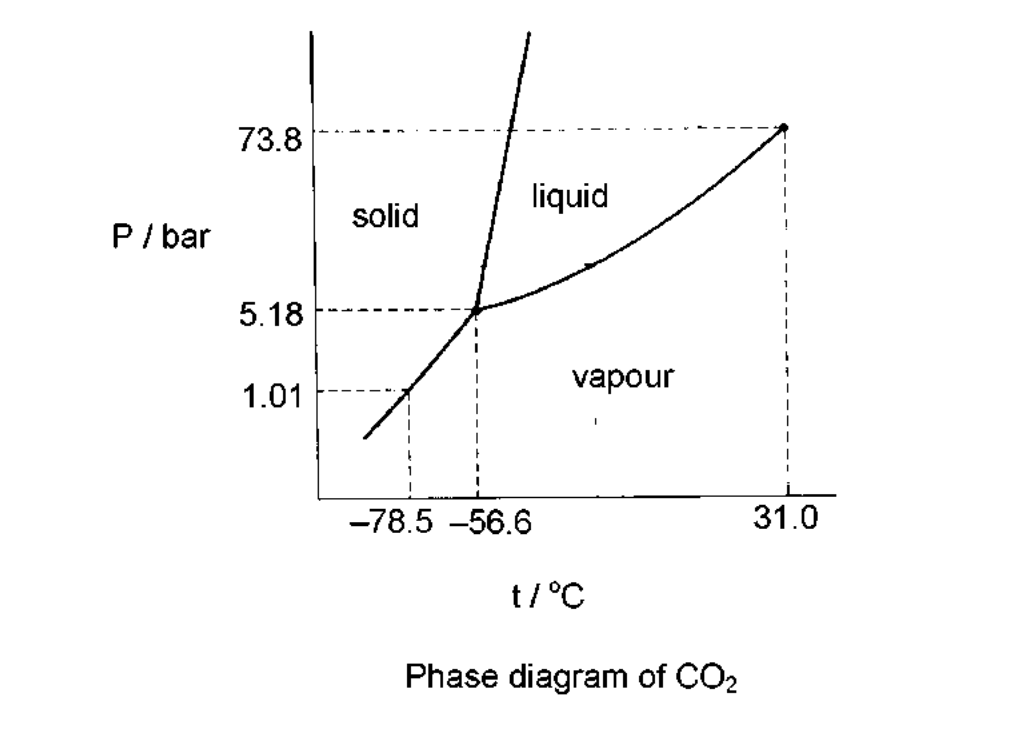
Phase diagram of \(\ce{CO2}\)
3.5 \(\ce{CO2}\) gas, initially at a pressure of 4.0 bar and temperature of 10.0 °C is cooled at constant pressure. In this process,
(a) it goes first to the liquid phase and then to the solid phase. ☐
(b) it goes to the solid phase without going through the liquid phase. ☐
3.6 Starting with the same pressure and temperature as above (in 3.5), \(\ce{CO2}\) is compressed isothermatically. In this process,
(a) it goes first to the liquid phase and then to the solid phase. ☐
(b) it goes to the solid phase without going through the liquid phase. ☐
3.7 From the data given in the phase diagram, calculate the molar enthalpy change of sublimation of \(\ce{CO2}\). Write down the formula used.
3.8 \(\ce{CO}\) gas, used extensively in organic synthesis, can be obtained by reacting \(\ce{CO2}\) gas with graphite. Use the data given below to show that the equilibrium constant at 298.15 K is less than unity.
At 298.15 K
| \(\Delta H_f^0\ /\ \mathrm{kJ\,mol^{-1}}\) | \(S^0\ /\ \mathrm{J\,K^{-1}\,mol^{-1}}\) | |
|---|---|---|
| \(\ce{CO2(g)}\) | −393.51 | 213.79 |
| \(\ce{CO(g)}\) | −110.53 | 197.66 |
| \(\ce{C(graphite)}\) | 5.74 |
3.9 Estimate the temperature at which the reaction would have an equilibrium constant equal to 1. Ignore slight variations in the thermodynamic data with temperature.
3.10 The reaction above (in 3.8) is carried out between \(\ce{CO2}\) and excess hot graphite in a reactor maintained at about 800 °C and a total pressure of 5.0 bar. The equilibrium constant \(K_p\) under these conditions is 10.0. Calculate the partial pressure of \(\ce{CO}\) at equilibrium.
Official English text of the problem.
Answers
- 3.1: (c): \(\Delta S_{\mathrm{sys}}>0\), \(\Delta S_{\mathrm{sur}}<0\). Mark X in box (c).
- 3.2: \(\boxed{\Delta S_{\mathrm{sys}}=+27.4\ \mathrm{J\,K^{-1}}}\).
- 3.3: \(\boxed{\Delta S_{\mathrm{sur}}=-6.94\ \mathrm{J\,K^{-1}}}\).
- 3.4: \(\boxed{\Delta S_{\mathrm{univ}}=+20.5\ \mathrm{J\,K^{-1}}}\). Mark X in Yes.
- 3.5: (b): carbon dioxide (
O=C=O) passes directly from gas to solid. - 3.6: (a): gas → liquid → solid, with sufficiently large compression.
- 3.7: \(\boxed{\Delta_{\mathrm{sub}}H_m\approx+26.2\ \mathrm{kJ\,mol^{-1}}}\), using \[ \ln\!\left(\frac{P_2}{P_1}\right) =\frac{\Delta_{\mathrm{sub}}H_m}{R} \left(\frac1{T_1}-\frac1{T_2}\right). \]
- 3.8: \(\boxed{\Delta_{\mathrm r}G^\circ=+120.04\ \mathrm{kJ\,mol^{-1}}}\), giving \(\boxed{K\approx9.31\times10^{-22}<1}\).
- 3.9: \(\boxed{T\approx981\ \mathrm K\approx708\,^\circ\mathrm C}\).
- 3.10: Carbon monoxide (
[C-]#[O+]): \(\boxed{p_{\ce{CO}}=3.66\ \mathrm{bar}\approx3.7\ \mathrm{bar}}\).
Solution
The molecular species used throughout are carbon dioxide, \(\ce{CO2}\), SMILES O=C=O, and carbon monoxide, \(\ce{CO}\), SMILES [C-]#[O+]. Graphite is an extended carbon lattice and has no single finite molecular SMILES.
Use \(R=8.314\ \mathrm{J\,mol^{-1}\,K^{-1}}\) and \(1\ \mathrm{bar\,dm^3}=100\ \mathrm J\).
3.1
An isothermal expansion increases the entropy of an ideal gas because its accessible volume increases.
The gas performs work against the external pressure. Its internal energy remains constant at constant temperature, so it absorbs heat from the surroundings. The surroundings therefore lose entropy.
Thus, \[ \Delta S_{\mathrm{sys}}>0,\qquad \Delta S_{\mathrm{sur}}<0. \]
Mark X in box (c).
3.2
Entropy is a state function, so the system’s entropy change can be calculated along a reversible isothermal path between the specified initial and final states:
\[ \Delta S_{\mathrm{sys}} =\int_{V_i}^{V_f}\frac{\delta q_{\mathrm{rev}}}{T} =\int_{V_i}^{V_f}\frac{nR}{V}\,dV =nR\ln\!\left(\frac{V_f}{V_i}\right). \]
Therefore, \[ \begin{aligned} \Delta S_{\mathrm{sys}} &=(3.00\ \mathrm{mol}) (8.314\ \mathrm{J\,mol^{-1}\,K^{-1}}) \ln\!\left(\frac{30.0}{10.0}\right)\\ &=\boxed{+27.4\ \mathrm{J\,K^{-1}}}. \end{aligned} \]
The actual expansion is irreversible; its actual heat divided by the temperature is not the system’s entropy change.
3.3
Using the convention that \(w\) is work done on the gas, \[ w=-P_{\mathrm{ext}}(V_f-V_i). \]
Thus, \[ \begin{aligned} w &=-(1.00\ \mathrm{bar})(30.0-10.0)\ \mathrm{dm^3}\\ &=-20.0\ \mathrm{bar\,dm^3}\\ &=-2.00\times10^3\ \mathrm J. \end{aligned} \]
For an ideal gas, internal energy depends only on temperature. Since the expansion is isothermal, \[ \Delta U=q_{\mathrm{sys}}+w=0, \] and hence \[ q_{\mathrm{sys}}=-w=+2.00\times10^3\ \mathrm J. \]
The surroundings supply this heat at the constant temperature \[ T_{\mathrm{sur}}=15+273.15=288.15\ \mathrm K. \]
Consequently, \[ \Delta S_{\mathrm{sur}} =\frac{q_{\mathrm{sur}}}{T_{\mathrm{sur}}} =-\frac{q_{\mathrm{sys}}}{T_{\mathrm{sur}}} =\frac{-2.00\times10^3}{288.15} =\boxed{-6.94\ \mathrm{J\,K^{-1}}}. \]
3.4
The entropy change of the universe is the sum of the system and surroundings contributions:
\[ \begin{aligned} \Delta S_{\mathrm{univ}} &=\Delta S_{\mathrm{sys}}+\Delta S_{\mathrm{sur}}\\ &=27.4016-6.94083\\ &=\boxed{+20.5\ \mathrm{J\,K^{-1}}}. \end{aligned} \]
This positive value agrees with the second law and indicates entropy production in the irreversible expansion. Mark X in Yes.
3.5
The pressure \(4.0\ \mathrm{bar}\) is below the triple-point pressure, \(5.18\ \mathrm{bar}\). There is therefore no stable liquid phase along this constant-pressure cooling path.
Moving leftward at \(4.0\ \mathrm{bar}\) on the phase diagram crosses the gas–solid boundary. Carbon dioxide deposits directly as a solid:
\[ \ce{CO2(g) -> CO2(s)}. \]
Mark X in box (b).
3.6
The temperature \(10.0\,^\circ\mathrm C\) lies above the triple-point temperature, \(-56.6\,^\circ\mathrm C\), and below the critical temperature, \(31.0\,^\circ\mathrm C\).
Increasing pressure at this fixed temperature first crosses the vapour–liquid boundary, so the gas condenses. With sufficiently large further compression, the positively sloping solid–liquid boundary is crossed and the liquid solidifies:
\[ \ce{CO2(g) -> CO2(l) -> CO2(s)}. \]
Mark X in box (a).
3.7
The sublimation process is \[ \ce{CO2(s) -> CO2(g)}. \]
Approximate the vapour as an ideal gas, neglect the solid’s molar volume compared with the vapour’s, and take the sublimation enthalpy as constant over the temperature interval. The integrated Clausius–Clapeyron equation is then
\[ \ln\!\left(\frac{P_2}{P_1}\right) =-\frac{\Delta_{\mathrm{sub}}H_m}{R} \left(\frac1{T_2}-\frac1{T_1}\right). \]
The two points on the solid–vapour equilibrium curve are \[ P_1=1.01\ \mathrm{bar},\qquad T_1=-78.5+273.15=194.65\ \mathrm K, \] \[ P_2=5.18\ \mathrm{bar},\qquad T_2=-56.6+273.15=216.55\ \mathrm K. \]
Therefore, \[ \begin{aligned} \Delta_{\mathrm{sub}}H_m &=\frac{R\ln(P_2/P_1)}{1/T_1-1/T_2}\\ &=\frac{ (8.314\ \mathrm{J\,mol^{-1}\,K^{-1}}) \ln(5.18/1.01) }{ (1/194.65-1/216.55)\ \mathrm{K^{-1}} }\\ &=2.6161\times10^4\ \mathrm{J\,mol^{-1}}. \end{aligned} \]
Thus, \[ \boxed{\Delta_{\mathrm{sub}}H_m\approx+26.2\ \mathrm{kJ\,mol^{-1}}}. \]
The positive sign corresponds to heat absorption during sublimation.
3.8
The balanced reaction is \[ \ce{CO2(g) + C(graphite) <=> 2CO(g)}. \]
Graphite is the standard state of elemental carbon, so its standard enthalpy of formation is zero. The standard reaction enthalpy is
\[ \begin{aligned} \Delta_{\mathrm r}H^\circ &=2\Delta_fH^\circ(\ce{CO}) -\Delta_fH^\circ(\ce{CO2}) -\Delta_fH^\circ(\ce{C(graphite)})\\ &=2(-110.53)-(-393.51)-0\\ &=\boxed{+172.45\ \mathrm{kJ\,mol^{-1}}}. \end{aligned} \]
The standard reaction entropy is
\[ \begin{aligned} \Delta_{\mathrm r}S^\circ &=2S^\circ(\ce{CO}) -S^\circ(\ce{CO2}) -S^\circ(\ce{C(graphite)})\\ &=2(197.66)-213.79-5.74\\ &=\boxed{+175.79\ \mathrm{J\,K^{-1}\,mol^{-1}}}. \end{aligned} \]
At \(298.15\ \mathrm K\), \[ \begin{aligned} \Delta_{\mathrm r}G^\circ &=\Delta_{\mathrm r}H^\circ-T\Delta_{\mathrm r}S^\circ\\ &=172.45-(298.15)(0.17579)\\ &=\boxed{+120.04\ \mathrm{kJ\,mol^{-1}}}. \end{aligned} \]
Since \[ \Delta_{\mathrm r}G^\circ=-RT\ln K, \] a positive standard reaction Gibbs energy implies \(K<1\). Numerically, \[ \ln K =-\frac{120038.2}{(8.314)(298.15)} =-48.4256, \] so \[ \boxed{K\approx9.31\times10^{-22}<1}. \]
3.9
When \(K=1\), \[ \Delta_{\mathrm r}G^\circ=-RT\ln1=0. \]
Ignoring the temperature dependence of the reaction enthalpy and entropy, \[ 0=\Delta_{\mathrm r}H^\circ-T\Delta_{\mathrm r}S^\circ, \] and therefore \[ \begin{aligned} T &=\frac{\Delta_{\mathrm r}H^\circ}{\Delta_{\mathrm r}S^\circ}\\ &=\frac{172450\ \mathrm{J\,mol^{-1}}} {175.79\ \mathrm{J\,K^{-1}\,mol^{-1}}}\\ &=\boxed{981\ \mathrm K}. \end{aligned} \]
In degrees Celsius, \[ \boxed{t\approx708\,^\circ\mathrm C}. \]
3.10
For \[ \ce{CO2(g) + C(graphite) <=> 2CO(g)}, \] the activity of the pure graphite is unity. Using ideal-gas partial pressures and \(p^\circ=1\ \mathrm{bar}\),
\[ K_p =\frac{(p_{\ce{CO}}/p^\circ)^2} {p_{\ce{CO2}}/p^\circ} =\frac{p_{\ce{CO}}^2}{p_{\ce{CO2}}p^\circ}. \]
The gas contains only carbon monoxide and carbon dioxide, so \[ p_{\ce{CO}}+p_{\ce{CO2}}=5.0\ \mathrm{bar}. \]
Let \(x=p_{\ce{CO}}/p^\circ\). Then \(p_{\ce{CO2}}/p^\circ=5.0-x\), and the supplied equilibrium constant gives \[ 10.0=\frac{x^2}{5.0-x}. \]
Rearrangement yields \[ x^2+10.0x-50.0=0. \]
The physically admissible root is \[ x=\frac{-10.0+\sqrt{10.0^2+4(50.0)}}{2} =3.66025. \]
Thus, \[ \boxed{p_{\ce{CO}}=3.66\ \mathrm{bar}\approx3.7\ \mathrm{bar}}. \]
The corresponding carbon dioxide partial pressure is \(1.34\ \mathrm{bar}\), and these values satisfy both the total pressure and the equilibrium expression.
The solution was checked against the official solution.
IChO 2001 · Theorieaufgabe 3
Zweiter Hauptsatz der Thermodynamik
J.W.Gibbs (1839 –1903)
Der zweite Hauptsatz der Thermodynamik ist ein grundlegendes Naturgesetz. In dieser Aufgabe betrachten wir die Thermodynamik eines idealen Gases, Phasenübergänge und das chemische Gleichgewicht.
3.00 mol gasförmiges \(\ce{CO2}\) expandieren isotherm (im thermischen Kontakt mit der Umgebung; Temperatur = 15 °C) gegen einen konstanten äußeren Druck von 1.00 bar. Das Anfangs- und Endvolumen des Gases betragen 10.0 dm³ bzw. 30.0 dm³.
3.1 Wählen Sie die richtige Option für die Entropieänderung des Systems \((\Delta S_{\mathrm{sys}})\) und der Umgebung \((\Delta S_{\mathrm{sur}})\):
| \(\Delta S_{\mathrm{sys}}\) | \(\Delta S_{\mathrm{sur}}\) | ||
|---|---|---|---|
| (a) | \(>0\) | \(=0\) | ☐ |
| (b) | \(<0\) | \(>0\) | ☐ |
| (c) | \(>0\) | \(<0\) | ☐ |
| d) | \(=0\) | \(=0\) | ☐ |
(Markieren Sie das richtige Kästchen mit X.)
3.2 Berechnen Sie \(\Delta S_{\mathrm{sys}}\) unter der Annahme, dass \(\ce{CO2}\) ein ideales Gas ist.
3.3 Berechnen Sie \(\Delta S_{\mathrm{sur}}\).
3.4 Berechnen Sie die Entropieänderung des Universums.
Stimmt Ihre Antwort mit dem zweiten Hauptsatz der Thermodynamik überein?
(Markieren Sie das richtige Kästchen mit X.)
☐ Ja ☐ Nein
Das Druck-Temperatur-Phasendiagramm von \(\ce{CO2}\) ist unten schematisch dargestellt. Das Diagramm ist nicht maßstabsgetreu.
Phasendiagramm von \(\ce{CO2}\)
3.5 Gasförmiges \(\ce{CO2}\), das sich anfangs bei einem Druck von 4.0 bar und einer Temperatur von 10.0 °C befindet, wird bei konstantem Druck abgekühlt. Dabei
(a) geht es zunächst in die flüssige Phase und anschließend in die feste Phase über. ☐
(b) geht es in die feste Phase über, ohne die flüssige Phase zu durchlaufen. ☐
3.6 Ausgehend von demselben Druck und derselben Temperatur wie oben (in 3.5) wird \(\ce{CO2}\) isotherm komprimiert. Dabei
(a) geht es zunächst in die flüssige Phase und anschließend in die feste Phase über. ☐
(b) geht es in die feste Phase über, ohne die flüssige Phase zu durchlaufen. ☐
3.7 Berechnen Sie anhand der im Phasendiagramm angegebenen Daten die molare Sublimationsenthalpie von \(\ce{CO2}\). Geben Sie die verwendete Formel an.
3.8 Gasförmiges \(\ce{CO}\), das in großem Umfang in der organischen Synthese eingesetzt wird, kann durch die Reaktion von gasförmigem \(\ce{CO2}\) mit Graphit gewonnen werden. Zeigen Sie anhand der unten angegebenen Daten, dass die Gleichgewichtskonstante bei 298.15 K kleiner als eins ist.
Bei 298.15 K
| \(\Delta H_f^0\ /\ \mathrm{kJ\,mol^{-1}}\) | \(S^0\ /\ \mathrm{J\,K^{-1}\,mol^{-1}}\) | |
|---|---|---|
| \(\ce{CO2(g)}\) | −393.51 | 213.79 |
| \(\ce{CO(g)}\) | −110.53 | 197.66 |
| \(\ce{C(graphite)}\) | 5.74 |
3.9 Schätzen Sie die Temperatur ab, bei der die Gleichgewichtskonstante der Reaktion gleich 1 wäre. Vernachlässigen Sie geringfügige Änderungen der thermodynamischen Daten mit der Temperatur.
3.10 Die obige Reaktion (in 3.8) wird zwischen \(\ce{CO2}\) und überschüssigem heißem Graphit in einem Reaktor durchgeführt, der bei etwa 800 °C und einem Gesamtdruck von 5.0 bar gehalten wird. Die Gleichgewichtskonstante \(K_p\) beträgt unter diesen Bedingungen 10.0. Berechnen Sie den Partialdruck von \(\ce{CO}\) im Gleichgewicht.
Aufgabentext aus dem offiziellen englischen Text übersetzt.
Antworten
- 3.1: (c): \(\Delta S_{\mathrm{sys}}>0\), \(\Delta S_{\mathrm{sur}}<0\). Markieren Sie Kästchen (c) mit X.
- 3.2: \(\boxed{\Delta S_{\mathrm{sys}}=+27.4\ \mathrm{J\,K^{-1}}}\).
- 3.3: \(\boxed{\Delta S_{\mathrm{sur}}=-6.94\ \mathrm{J\,K^{-1}}}\).
- 3.4: \(\boxed{\Delta S_{\mathrm{univ}}=+20.5\ \mathrm{J\,K^{-1}}}\). Markieren Sie Ja mit X.
- 3.5: (b): Kohlenstoffdioxid (
O=C=O) geht direkt vom gasförmigen in den festen Zustand über. - 3.6: (a): gasförmig → flüssig → fest, bei ausreichend starker Kompression.
- 3.7: \(\boxed{\Delta_{\mathrm{sub}}H_m\approx+26.2\ \mathrm{kJ\,mol^{-1}}}\), unter Verwendung von \[ \ln\!\left(\frac{P_2}{P_1}\right) =\frac{\Delta_{\mathrm{sub}}H_m}{R} \left(\frac1{T_1}-\frac1{T_2}\right). \]
- 3.8: \(\boxed{\Delta_{\mathrm r}G^\circ=+120.04\ \mathrm{kJ\,mol^{-1}}}\), woraus \(\boxed{K\approx9.31\times10^{-22}<1}\) folgt.
- 3.9: \(\boxed{T\approx981\ \mathrm K\approx708\,^\circ\mathrm C}\).
- 3.10: Kohlenstoffmonoxid (
[C-]#[O+]): \(\boxed{p_{\ce{CO}}=3.66\ \mathrm{bar}\approx3.7\ \mathrm{bar}}\).
Lösung
Die durchgehend verwendeten molekularen Spezies sind Kohlenstoffdioxid, \(\ce{CO2}\), SMILES O=C=O, und Kohlenstoffmonoxid, \(\ce{CO}\), SMILES [C-]#[O+]. Graphit bildet ein ausgedehntes Kohlenstoffgitter und besitzt keine einzelne endliche molekulare SMILES-Darstellung.
Verwenden Sie \(R=8.314\ \mathrm{J\,mol^{-1}\,K^{-1}}\) und \(1\ \mathrm{bar\,dm^3}=100\ \mathrm J\).
3.1
Eine isotherme Expansion erhöht die Entropie eines idealen Gases, weil das ihm zugängliche Volumen zunimmt.
Das Gas verrichtet Arbeit gegen den äußeren Druck. Seine innere Energie bleibt bei konstanter Temperatur unverändert, sodass es Wärme aus der Umgebung aufnimmt. Die Entropie der Umgebung nimmt daher ab.
Somit gilt: \[ \Delta S_{\mathrm{sys}}>0,\qquad \Delta S_{\mathrm{sur}}<0. \]
Markieren Sie Kästchen (c) mit X.
3.2
Die Entropie ist eine Zustandsgröße, daher lässt sich die Entropieänderung des Systems entlang eines reversiblen isothermen Weges zwischen dem angegebenen Anfangs- und Endzustand berechnen:
\[ \Delta S_{\mathrm{sys}} =\int_{V_i}^{V_f}\frac{\delta q_{\mathrm{rev}}}{T} =\int_{V_i}^{V_f}\frac{nR}{V}\,dV =nR\ln\!\left(\frac{V_f}{V_i}\right). \]
Daraus folgt: \[ \begin{aligned} \Delta S_{\mathrm{sys}} &=(3.00\ \mathrm{mol}) (8.314\ \mathrm{J\,mol^{-1}\,K^{-1}}) \ln\!\left(\frac{30.0}{10.0}\right)\\ &=\boxed{+27.4\ \mathrm{J\,K^{-1}}}. \end{aligned} \]
Die tatsächliche Expansion ist irreversibel; die dabei tatsächlich ausgetauschte Wärme, dividiert durch die Temperatur, entspricht nicht der Entropieänderung des Systems.
3.3
Mit der Konvention, dass \(w\) die am Gas verrichtete Arbeit bezeichnet, gilt: \[ w=-P_{\mathrm{ext}}(V_f-V_i). \]
Somit gilt: \[ \begin{aligned} w &=-(1.00\ \mathrm{bar})(30.0-10.0)\ \mathrm{dm^3}\\ &=-20.0\ \mathrm{bar\,dm^3}\\ &=-2.00\times10^3\ \mathrm J. \end{aligned} \]
Bei einem idealen Gas hängt die innere Energie nur von der Temperatur ab. Da die Expansion isotherm erfolgt, gilt \[ \Delta U=q_{\mathrm{sys}}+w=0, \] und damit \[ q_{\mathrm{sys}}=-w=+2.00\times10^3\ \mathrm J. \]
Die Umgebung liefert diese Wärme bei der konstanten Temperatur \[ T_{\mathrm{sur}}=15+273.15=288.15\ \mathrm K. \]
Folglich gilt: \[ \Delta S_{\mathrm{sur}} =\frac{q_{\mathrm{sur}}}{T_{\mathrm{sur}}} =-\frac{q_{\mathrm{sys}}}{T_{\mathrm{sur}}} =\frac{-2.00\times10^3}{288.15} =\boxed{-6.94\ \mathrm{J\,K^{-1}}}. \]
3.4
Die Entropieänderung des Universums ist die Summe der Beiträge des Systems und der Umgebung:
\[ \begin{aligned} \Delta S_{\mathrm{univ}} &=\Delta S_{\mathrm{sys}}+\Delta S_{\mathrm{sur}}\\ &=27.4016-6.94083\\ &=\boxed{+20.5\ \mathrm{J\,K^{-1}}}. \end{aligned} \]
Dieser positive Wert stimmt mit dem zweiten Hauptsatz überein und zeigt die Entropieerzeugung bei der irreversiblen Expansion an. Markieren Sie Ja mit X.
3.5
Der Druck \(4.0\ \mathrm{bar}\) liegt unterhalb des Tripelpunktdrucks von \(5.18\ \mathrm{bar}\). Entlang dieses Abkühlungsweges bei konstantem Druck gibt es daher keine stabile flüssige Phase.
Bei einer Bewegung nach links im Phasendiagramm bei \(4.0\ \mathrm{bar}\) wird die Phasengrenze zwischen Gas und Feststoff überschritten. Kohlenstoffdioxid resublimiert direkt zum Feststoff:
\[ \ce{CO2(g) -> CO2(s)}. \]
Markieren Sie Kästchen (b) mit X.
3.6
Die Temperatur \(10.0\,^\circ\mathrm C\) liegt oberhalb der Tripelpunkttemperatur von \(-56.6\,^\circ\mathrm C\) und unterhalb der kritischen Temperatur von \(31.0\,^\circ\mathrm C\).
Bei einer Druckerhöhung bei dieser festen Temperatur wird zunächst die Dampf-Flüssigkeits-Phasengrenze überschritten, sodass das Gas kondensiert. Bei ausreichend starker weiterer Kompression wird die positiv geneigte Feststoff-Flüssigkeits-Phasengrenze überschritten, und die Flüssigkeit erstarrt:
\[ \ce{CO2(g) -> CO2(l) -> CO2(s)}. \]
Markieren Sie Kästchen (a) mit X.
3.7
Der Sublimationsvorgang lautet: \[ \ce{CO2(s) -> CO2(g)}. \]
Der Dampf wird näherungsweise als ideales Gas behandelt, das molare Volumen des Feststoffs gegenüber dem des Dampfes vernachlässigt und die Sublimationsenthalpie über das Temperaturintervall als konstant angenommen. Die integrierte Clausius-Clapeyron-Gleichung lautet dann
\[ \ln\!\left(\frac{P_2}{P_1}\right) =-\frac{\Delta_{\mathrm{sub}}H_m}{R} \left(\frac1{T_2}-\frac1{T_1}\right). \]
Die beiden Punkte auf der Feststoff-Dampf-Gleichgewichtskurve sind \[ P_1=1.01\ \mathrm{bar},\qquad T_1=-78.5+273.15=194.65\ \mathrm K, \] \[ P_2=5.18\ \mathrm{bar},\qquad T_2=-56.6+273.15=216.55\ \mathrm K. \]
Daraus folgt: \[ \begin{aligned} \Delta_{\mathrm{sub}}H_m &=\frac{R\ln(P_2/P_1)}{1/T_1-1/T_2}\\ &=\frac{ (8.314\ \mathrm{J\,mol^{-1}\,K^{-1}}) \ln(5.18/1.01) }{ (1/194.65-1/216.55)\ \mathrm{K^{-1}} }\\ &=2.6161\times10^4\ \mathrm{J\,mol^{-1}}. \end{aligned} \]
Somit gilt: \[ \boxed{\Delta_{\mathrm{sub}}H_m\approx+26.2\ \mathrm{kJ\,mol^{-1}}}. \]
Das positive Vorzeichen entspricht der Wärmeaufnahme bei der Sublimation.
3.8
Die ausgeglichene Reaktionsgleichung lautet: \[ \ce{CO2(g) + C(graphite) <=> 2CO(g)}. \]
Graphit ist der Standardzustand des elementaren Kohlenstoffs, daher ist seine Standardbildungsenthalpie null. Die Standardreaktionsenthalpie beträgt
\[ \begin{aligned} \Delta_{\mathrm r}H^\circ &=2\Delta_fH^\circ(\ce{CO}) -\Delta_fH^\circ(\ce{CO2}) -\Delta_fH^\circ(\ce{C(graphite)})\\ &=2(-110.53)-(-393.51)-0\\ &=\boxed{+172.45\ \mathrm{kJ\,mol^{-1}}}. \end{aligned} \]
Die Standardreaktionsentropie beträgt
\[ \begin{aligned} \Delta_{\mathrm r}S^\circ &=2S^\circ(\ce{CO}) -S^\circ(\ce{CO2}) -S^\circ(\ce{C(graphite)})\\ &=2(197.66)-213.79-5.74\\ &=\boxed{+175.79\ \mathrm{J\,K^{-1}\,mol^{-1}}}. \end{aligned} \]
Bei \(298.15\ \mathrm K\) gilt: \[ \begin{aligned} \Delta_{\mathrm r}G^\circ &=\Delta_{\mathrm r}H^\circ-T\Delta_{\mathrm r}S^\circ\\ &=172.45-(298.15)(0.17579)\\ &=\boxed{+120.04\ \mathrm{kJ\,mol^{-1}}}. \end{aligned} \]
Da \[ \Delta_{\mathrm r}G^\circ=-RT\ln K, \] gilt, folgt aus einer positiven Standardreaktions-Gibbs-Energie, dass \(K<1\) ist. Numerisch ergibt sich \[ \ln K =-\frac{120038.2}{(8.314)(298.15)} =-48.4256, \] also \[ \boxed{K\approx9.31\times10^{-22}<1}. \]
3.9
Wenn \(K=1\) ist, gilt \[ \Delta_{\mathrm r}G^\circ=-RT\ln1=0. \]
Unter Vernachlässigung der Temperaturabhängigkeit der Reaktionsenthalpie und -entropie gilt \[ 0=\Delta_{\mathrm r}H^\circ-T\Delta_{\mathrm r}S^\circ, \] und daher \[ \begin{aligned} T &=\frac{\Delta_{\mathrm r}H^\circ}{\Delta_{\mathrm r}S^\circ}\\ &=\frac{172450\ \mathrm{J\,mol^{-1}}} {175.79\ \mathrm{J\,K^{-1}\,mol^{-1}}}\\ &=\boxed{981\ \mathrm K}. \end{aligned} \]
In Grad Celsius: \[ \boxed{t\approx708\,^\circ\mathrm C}. \]
3.10
Für \[ \ce{CO2(g) + C(graphite) <=> 2CO(g)}, \] ist die Aktivität des reinen Graphits gleich eins. Unter Verwendung der Partialdrücke idealer Gase und von \(p^\circ=1\ \mathrm{bar}\) gilt:
\[ K_p =\frac{(p_{\ce{CO}}/p^\circ)^2} {p_{\ce{CO2}}/p^\circ} =\frac{p_{\ce{CO}}^2}{p_{\ce{CO2}}p^\circ}. \]
Das Gas enthält nur Kohlenstoffmonoxid und Kohlenstoffdioxid, daher gilt \[ p_{\ce{CO}}+p_{\ce{CO2}}=5.0\ \mathrm{bar}. \]
Sei \(x=p_{\ce{CO}}/p^\circ\). Dann ist \(p_{\ce{CO2}}/p^\circ=5.0-x\), und mit der angegebenen Gleichgewichtskonstante ergibt sich \[ 10.0=\frac{x^2}{5.0-x}. \]
Umstellen ergibt \[ x^2+10.0x-50.0=0. \]
Die physikalisch zulässige Lösung ist \[ x=\frac{-10.0+\sqrt{10.0^2+4(50.0)}}{2} =3.66025. \]
Somit gilt: \[ \boxed{p_{\ce{CO}}=3.66\ \mathrm{bar}\approx3.7\ \mathrm{bar}}. \]
Der zugehörige Kohlenstoffdioxidpartialdruck beträgt \(1.34\ \mathrm{bar}\), und diese Werte erfüllen sowohl die Gesamtdruckbedingung als auch den Gleichgewichtsausdruck.
Die Lösung wurde mit der offiziellen Lösung abgeglichen.
IChO 2001 · Teori sorusu 3
Termodinamiğin İkinci Yasası
J.W.Gibbs (1839 –1903)
Termodinamiğin ikinci yasası, bilimin temel yasalarından biridir. Bu soruda ideal bir gazın termodinamiğini, faz geçişlerini ve kimyasal dengeyi ele alıyoruz.
3.00 mol \(\ce{CO2}\) gazı, 1.00 bar sabit dış basınca karşı izotermal olarak (çevreyle ısıl temas hâlinde; sıcaklık = 15 °C) genleşmektedir. Gazın başlangıç ve son hacimleri sırasıyla 10.0 dm³ ve 30.0 dm³'tür.
3.1 Sistemin \((\Delta S_{\mathrm{sys}})\) ve çevrenin \((\Delta S_{\mathrm{sur}})\) entropi değişimleri için doğru seçeneği seçiniz:
| \(\Delta S_{\mathrm{sys}}\) | \(\Delta S_{\mathrm{sur}}\) | ||
|---|---|---|---|
| (a) | \(>0\) | \(=0\) | ☐ |
| (b) | \(<0\) | \(>0\) | ☐ |
| (c) | \(>0\) | \(<0\) | ☐ |
| d) | \(=0\) | \(=0\) | ☐ |
(Doğru kutuya X işareti koyunuz.)
3.2 \(\ce{CO2}\)'nin ideal bir gaz olduğunu varsayarak \(\Delta S_{\mathrm{sys}}\)'i hesaplayınız.
3.3 \(\Delta S_{\mathrm{sur}}\)'u hesaplayınız.
3.4 Evrenin entropi değişimini hesaplayınız.
Cevabınız Termodinamiğin İkinci Yasası ile uyumlu mu?
(Doğru kutuya X işareti koyunuz.)
☐ Evet ☐ Hayır
\(\ce{CO2}\)'nin basınç–sıcaklık faz diyagramı aşağıda şematik olarak verilmiştir. Diyagram ölçekli çizilmemiştir.
\(\ce{CO2}\)'nin faz diyagramı
3.5 Başlangıçta 4.0 bar basınç ve 10.0 °C sıcaklıkta bulunan \(\ce{CO2}\) gazı sabit basınçta soğutulmaktadır. Bu süreçte,
(a) önce sıvı faza, ardından katı faza geçer. ☐
(b) sıvı fazdan geçmeden katı faza geçer. ☐
3.6 Yukarıdaki (3.5'teki) basınç ve sıcaklıktan başlanarak \(\ce{CO2}\) izotermal olarak sıkıştırılmaktadır. Bu süreçte,
(a) önce sıvı faza, ardından katı faza geçer. ☐
(b) sıvı fazdan geçmeden katı faza geçer. ☐
3.7 Faz diyagramında verilen verilerden yararlanarak \(\ce{CO2}\)'nin molar süblimleşme entalpi değişimini hesaplayınız. Kullandığınız formülü yazınız.
3.8 Organik sentezde yaygın olarak kullanılan \(\ce{CO}\) gazı, \(\ce{CO2}\) gazının grafitle tepkimeye sokulmasıyla elde edilebilir. Aşağıda verilen verileri kullanarak 298.15 K'de denge sabitinin birden küçük olduğunu gösteriniz.
298.15 K'de
| \(\Delta H_f^0\ /\ \mathrm{kJ\,mol^{-1}}\) | \(S^0\ /\ \mathrm{J\,K^{-1}\,mol^{-1}}\) | |
|---|---|---|
| \(\ce{CO2(g)}\) | −393.51 | 213.79 |
| \(\ce{CO(g)}\) | −110.53 | 197.66 |
| \(\ce{C(graphite)}\) | 5.74 |
3.9 Tepkimenin denge sabitinin 1'e eşit olacağı sıcaklığı yaklaşık olarak hesaplayınız. Termodinamik verilerin sıcaklıkla gösterdiği küçük değişimleri ihmal ediniz.
3.10 Yukarıdaki (3.8'deki) tepkime, yaklaşık 800 °C sıcaklıkta ve 5.0 bar toplam basınçta tutulan bir reaktörde \(\ce{CO2}\) ile aşırı miktarda sıcak grafit arasında gerçekleştirilmektedir. Bu koşullarda denge sabiti \(K_p\), 10.0'dır. Dengedeki \(\ce{CO}\) kısmi basıncını hesaplayınız.
Soru metni resmi İngilizce metinden çevrilmiştir.
Cevaplar
- 3.1: (c): \(\Delta S_{\mathrm{sys}}>0\), \(\Delta S_{\mathrm{sur}}<0\). (c) kutusuna X işareti koyunuz.
- 3.2: \(\boxed{\Delta S_{\mathrm{sys}}=+27.4\ \mathrm{J\,K^{-1}}}\).
- 3.3: \(\boxed{\Delta S_{\mathrm{sur}}=-6.94\ \mathrm{J\,K^{-1}}}\).
- 3.4: \(\boxed{\Delta S_{\mathrm{univ}}=+20.5\ \mathrm{J\,K^{-1}}}\). Evet kutusuna X işareti koyunuz.
- 3.5: (b): karbondioksit (
O=C=O) doğrudan gaz hâlinden katı hâle geçer. - 3.6: (a): yeterince büyük bir sıkıştırmayla gaz → sıvı → katı.
- 3.7: \(\boxed{\Delta_{\mathrm{sub}}H_m\approx+26.2\ \mathrm{kJ\,mol^{-1}}}\); kullanılan bağıntı: \[ \ln\!\left(\frac{P_2}{P_1}\right) =\frac{\Delta_{\mathrm{sub}}H_m}{R} \left(\frac1{T_1}-\frac1{T_2}\right). \]
- 3.8: \(\boxed{\Delta_{\mathrm r}G^\circ=+120.04\ \mathrm{kJ\,mol^{-1}}}\); buradan \(\boxed{K\approx9.31\times10^{-22}<1}\) elde edilir.
- 3.9: \(\boxed{T\approx981\ \mathrm K\approx708\,^\circ\mathrm C}\).
- 3.10: Karbonmonoksit (
[C-]#[O+]): \(\boxed{p_{\ce{CO}}=3.66\ \mathrm{bar}\approx3.7\ \mathrm{bar}}\).
Çözüm
Metin boyunca kullanılan moleküler türler karbondioksit, \(\ce{CO2}\), SMILES O=C=O ve karbonmonoksit, \(\ce{CO}\), SMILES [C-]#[O+] şeklindedir. Grafit, uzanımlı bir karbon örgüsüdür ve tek bir sonlu moleküler SMILES gösterimi yoktur.
\(R=8.314\ \mathrm{J\,mol^{-1}\,K^{-1}}\) ve \(1\ \mathrm{bar\,dm^3}=100\ \mathrm J\) değerlerini kullanınız.
3.1
İzotermal genleşme, ideal bir gazın erişebildiği hacmi artırdığı için entropisini artırır.
Gaz, dış basınca karşı iş yapar. Sabit sıcaklıkta iç enerjisi sabit kaldığından çevreden ısı alır. Dolayısıyla çevrenin entropisi azalır.
Böylece, \[ \Delta S_{\mathrm{sys}}>0,\qquad \Delta S_{\mathrm{sur}}<0. \]
(c) kutusuna X işareti koyunuz.
3.2
Entropi bir hâl fonksiyonudur; dolayısıyla sistemin entropi değişimi, belirtilen başlangıç ve son hâller arasındaki tersinir bir izotermal yol boyunca hesaplanabilir:
\[ \Delta S_{\mathrm{sys}} =\int_{V_i}^{V_f}\frac{\delta q_{\mathrm{rev}}}{T} =\int_{V_i}^{V_f}\frac{nR}{V}\,dV =nR\ln\!\left(\frac{V_f}{V_i}\right). \]
Dolayısıyla, \[ \begin{aligned} \Delta S_{\mathrm{sys}} &=(3.00\ \mathrm{mol}) (8.314\ \mathrm{J\,mol^{-1}\,K^{-1}}) \ln\!\left(\frac{30.0}{10.0}\right)\\ &=\boxed{+27.4\ \mathrm{J\,K^{-1}}}. \end{aligned} \]
Gerçek genleşme tersinmezdir; bu süreçte alışverişi yapılan gerçek ısının sıcaklığa bölümü, sistemin entropi değişimi değildir.
3.3
\(w\)'nin gaz üzerine yapılan iş olarak tanımlandığı işaret kuralını kullanırsak, \[ w=-P_{\mathrm{ext}}(V_f-V_i). \]
Böylece, \[ \begin{aligned} w &=-(1.00\ \mathrm{bar})(30.0-10.0)\ \mathrm{dm^3}\\ &=-20.0\ \mathrm{bar\,dm^3}\\ &=-2.00\times10^3\ \mathrm J. \end{aligned} \]
İdeal bir gazın iç enerjisi yalnızca sıcaklığa bağlıdır. Genleşme izotermal olduğundan, \[ \Delta U=q_{\mathrm{sys}}+w=0, \] ve buradan \[ q_{\mathrm{sys}}=-w=+2.00\times10^3\ \mathrm J. \]
Çevre bu ısıyı şu sabit sıcaklıkta sağlar: \[ T_{\mathrm{sur}}=15+273.15=288.15\ \mathrm K. \]
Sonuç olarak, \[ \Delta S_{\mathrm{sur}} =\frac{q_{\mathrm{sur}}}{T_{\mathrm{sur}}} =-\frac{q_{\mathrm{sys}}}{T_{\mathrm{sur}}} =\frac{-2.00\times10^3}{288.15} =\boxed{-6.94\ \mathrm{J\,K^{-1}}}. \]
3.4
Evrenin entropi değişimi, sistemin ve çevrenin katkılarının toplamıdır:
\[ \begin{aligned} \Delta S_{\mathrm{univ}} &=\Delta S_{\mathrm{sys}}+\Delta S_{\mathrm{sur}}\\ &=27.4016-6.94083\\ &=\boxed{+20.5\ \mathrm{J\,K^{-1}}}. \end{aligned} \]
Bu pozitif değer ikinci yasayla uyumludur ve tersinmez genleşmede entropi üretildiğini gösterir. Evet kutusuna X işareti koyunuz.
3.5
\(4.0\ \mathrm{bar}\) basınç, üçlü nokta basıncı olan \(5.18\ \mathrm{bar}\)'dan düşüktür. Dolayısıyla bu sabit basınçlı soğutma yolu boyunca kararlı bir sıvı faz bulunmaz.
Faz diyagramında \(4.0\ \mathrm{bar}\) basınçta sola doğru ilerlerken gaz–katı sınırı geçilir. Karbondioksit doğrudan katı hâle geçerek kırağılaşır:
\[ \ce{CO2(g) -> CO2(s)}. \]
(b) kutusuna X işareti koyunuz.
3.6
\(10.0\,^\circ\mathrm C\) sıcaklık, üçlü nokta sıcaklığı olan \(-56.6\,^\circ\mathrm C\)'nin üzerinde ve kritik sıcaklık olan \(31.0\,^\circ\mathrm C\)'nin altındadır.
Bu sabit sıcaklıkta basınç artırıldığında önce buhar–sıvı sınırı geçilir ve gaz yoğuşur. Sıkıştırmaya yeterince devam edildiğinde pozitif eğimli katı–sıvı sınırı geçilir ve sıvı katılaşır:
\[ \ce{CO2(g) -> CO2(l) -> CO2(s)}. \]
(a) kutusuna X işareti koyunuz.
3.7
Süblimleşme süreci şöyledir: \[ \ce{CO2(s) -> CO2(g)}. \]
Buharı ideal gaz olarak kabul edelim, katının molar hacmini buharınkine göre ihmal edelim ve süblimleşme entalpisini bu sıcaklık aralığında sabit alalım. Bu durumda Clausius–Clapeyron denkleminin integre edilmiş biçimi şöyledir:
\[ \ln\!\left(\frac{P_2}{P_1}\right) =-\frac{\Delta_{\mathrm{sub}}H_m}{R} \left(\frac1{T_2}-\frac1{T_1}\right). \]
Katı–buhar denge eğrisi üzerindeki iki nokta şunlardır: \[ P_1=1.01\ \mathrm{bar},\qquad T_1=-78.5+273.15=194.65\ \mathrm K, \] \[ P_2=5.18\ \mathrm{bar},\qquad T_2=-56.6+273.15=216.55\ \mathrm K. \]
Dolayısıyla, \[ \begin{aligned} \Delta_{\mathrm{sub}}H_m &=\frac{R\ln(P_2/P_1)}{1/T_1-1/T_2}\\ &=\frac{ (8.314\ \mathrm{J\,mol^{-1}\,K^{-1}}) \ln(5.18/1.01) }{ (1/194.65-1/216.55)\ \mathrm{K^{-1}} }\\ &=2.6161\times10^4\ \mathrm{J\,mol^{-1}}. \end{aligned} \]
Böylece, \[ \boxed{\Delta_{\mathrm{sub}}H_m\approx+26.2\ \mathrm{kJ\,mol^{-1}}}. \]
Pozitif işaret, süblimleşme sırasında ısı alındığını gösterir.
3.8
Denkleştirilmiş tepkime şöyledir: \[ \ce{CO2(g) + C(graphite) <=> 2CO(g)}. \]
Grafit, elementel karbonun standart hâlidir; bu nedenle standart oluşum entalpisi sıfırdır. Standart tepkime entalpisi şöyledir:
\[ \begin{aligned} \Delta_{\mathrm r}H^\circ &=2\Delta_fH^\circ(\ce{CO}) -\Delta_fH^\circ(\ce{CO2}) -\Delta_fH^\circ(\ce{C(graphite)})\\ &=2(-110.53)-(-393.51)-0\\ &=\boxed{+172.45\ \mathrm{kJ\,mol^{-1}}}. \end{aligned} \]
Standart tepkime entropisi şöyledir:
\[ \begin{aligned} \Delta_{\mathrm r}S^\circ &=2S^\circ(\ce{CO}) -S^\circ(\ce{CO2}) -S^\circ(\ce{C(graphite)})\\ &=2(197.66)-213.79-5.74\\ &=\boxed{+175.79\ \mathrm{J\,K^{-1}\,mol^{-1}}}. \end{aligned} \]
\(298.15\ \mathrm K\)'de, \[ \begin{aligned} \Delta_{\mathrm r}G^\circ &=\Delta_{\mathrm r}H^\circ-T\Delta_{\mathrm r}S^\circ\\ &=172.45-(298.15)(0.17579)\\ &=\boxed{+120.04\ \mathrm{kJ\,mol^{-1}}}. \end{aligned} \]
\[ \Delta_{\mathrm r}G^\circ=-RT\ln K, \] olduğundan, standart tepkime Gibbs enerjisinin pozitif olması \(K<1\) olduğunu gösterir. Sayısal olarak, \[ \ln K =-\frac{120038.2}{(8.314)(298.15)} =-48.4256, \] dolayısıyla \[ \boxed{K\approx9.31\times10^{-22}<1}. \]
3.9
\(K=1\) olduğunda, \[ \Delta_{\mathrm r}G^\circ=-RT\ln1=0. \]
Tepkime entalpisinin ve entropisinin sıcaklığa bağımlılığı ihmal edilirse, \[ 0=\Delta_{\mathrm r}H^\circ-T\Delta_{\mathrm r}S^\circ, \] ve dolayısıyla \[ \begin{aligned} T &=\frac{\Delta_{\mathrm r}H^\circ}{\Delta_{\mathrm r}S^\circ}\\ &=\frac{172450\ \mathrm{J\,mol^{-1}}} {175.79\ \mathrm{J\,K^{-1}\,mol^{-1}}}\\ &=\boxed{981\ \mathrm K}. \end{aligned} \]
Santigrat derece cinsinden, \[ \boxed{t\approx708\,^\circ\mathrm C}. \]
3.10
\[ \ce{CO2(g) + C(graphite) <=> 2CO(g)}, \] tepkimesinde saf grafitin aktivitesi birdir. İdeal gaz kısmi basınçları ve \(p^\circ=1\ \mathrm{bar}\) kullanıldığında,
\[ K_p =\frac{(p_{\ce{CO}}/p^\circ)^2} {p_{\ce{CO2}}/p^\circ} =\frac{p_{\ce{CO}}^2}{p_{\ce{CO2}}p^\circ}. \]
Gaz yalnızca karbonmonoksit ve karbondioksit içerdiğinden, \[ p_{\ce{CO}}+p_{\ce{CO2}}=5.0\ \mathrm{bar}. \]
\(x=p_{\ce{CO}}/p^\circ\) olsun. O hâlde \(p_{\ce{CO2}}/p^\circ=5.0-x\) olur ve verilen denge sabitinden \[ 10.0=\frac{x^2}{5.0-x}. \]
Yeniden düzenlendiğinde şu denklem elde edilir: \[ x^2+10.0x-50.0=0. \]
Fiziksel olarak kabul edilebilir kök şöyledir: \[ x=\frac{-10.0+\sqrt{10.0^2+4(50.0)}}{2} =3.66025. \]
Böylece, \[ \boxed{p_{\ce{CO}}=3.66\ \mathrm{bar}\approx3.7\ \mathrm{bar}}. \]
Buna karşılık gelen karbondioksit kısmi basıncı \(1.34\ \mathrm{bar}\)'dır ve bu değerler hem toplam basıncı hem de denge bağıntısını sağlar.
Çözüm, resmi çözümle karşılaştırılarak kontrol edildi.
IChO 2001 · Problema teórico 3
Segundo principio de la termodinámica
J.W.Gibbs (1839 –1903)
El segundo principio de la termodinámica es una ley fundamental de la ciencia. En este problema consideramos la termodinámica de un gas ideal, las transiciones de fase y el equilibrio químico.
3.00 mol de \(\ce{CO2}\) gaseoso se expanden isotérmicamente (en contacto térmico con el entorno; temperatura = 15 °C) contra una presión externa constante de 1.00 bar. Los volúmenes inicial y final del gas son 10.0 dm³ y 30.0 dm³, respectivamente.
3.1 Elija la opción correcta para la variación de entropía del sistema \((\Delta S_{\mathrm{sys}})\) y del entorno \((\Delta S_{\mathrm{sur}})\):
| \(\Delta S_{\mathrm{sys}}\) | \(\Delta S_{\mathrm{sur}}\) | ||
|---|---|---|---|
| (a) | \(>0\) | \(=0\) | ☐ |
| (b) | \(<0\) | \(>0\) | ☐ |
| (c) | \(>0\) | \(<0\) | ☐ |
| d) | \(=0\) | \(=0\) | ☐ |
(Marque con una X la casilla correcta.)
3.2 Calcule \(\Delta S_{\mathrm{sys}}\) suponiendo que el \(\ce{CO2}\) es un gas ideal.
3.3 Calcule \(\Delta S_{\mathrm{sur}}\).
3.4 Calcule la variación de entropía del universo.
¿Concuerda su respuesta con el segundo principio de la termodinámica?
(Marque con una X la casilla correcta.)
☐ Sí ☐ No
El diagrama de fases presión–temperatura del \(\ce{CO2}\) se muestra esquemáticamente a continuación. El diagrama no está a escala.
Diagrama de fases del \(\ce{CO2}\)
3.5 El \(\ce{CO2}\) gaseoso, inicialmente a una presión de 4.0 bar y una temperatura de 10.0 °C, se enfría a presión constante. En este proceso,
(a) pasa primero a la fase líquida y después a la fase sólida. ☐
(b) pasa a la fase sólida sin pasar por la fase líquida. ☐
3.6 Partiendo de la misma presión y temperatura que antes (en 3.5), el \(\ce{CO2}\) se comprime isotérmicamente. En este proceso,
(a) pasa primero a la fase líquida y después a la fase sólida. ☐
(b) pasa a la fase sólida sin pasar por la fase líquida. ☐
3.7 A partir de los datos proporcionados en el diagrama de fases, calcule la variación de entalpía molar de sublimación del \(\ce{CO2}\). Escriba la fórmula utilizada.
3.8 El \(\ce{CO}\) gaseoso, ampliamente utilizado en síntesis orgánica, puede obtenerse haciendo reaccionar \(\ce{CO2}\) gaseoso con grafito. Utilice los datos siguientes para demostrar que la constante de equilibrio a 298.15 K es menor que la unidad.
A 298.15 K
| \(\Delta H_f^0\ /\ \mathrm{kJ\,mol^{-1}}\) | \(S^0\ /\ \mathrm{J\,K^{-1}\,mol^{-1}}\) | |
|---|---|---|
| \(\ce{CO2(g)}\) | −393.51 | 213.79 |
| \(\ce{CO(g)}\) | −110.53 | 197.66 |
| \(\ce{C(graphite)}\) | 5.74 |
3.9 Estime la temperatura a la que la reacción tendría una constante de equilibrio igual a 1. Ignore las pequeñas variaciones de los datos termodinámicos con la temperatura.
3.10 La reacción anterior (en 3.8) se lleva a cabo entre \(\ce{CO2}\) y un exceso de grafito caliente en un reactor mantenido a unos 800 °C y una presión total de 5.0 bar. La constante de equilibrio \(K_p\) en estas condiciones es 10.0. Calcule la presión parcial del \(\ce{CO}\) en el equilibrio.
Enunciado traducido del texto oficial en inglés.
Respuestas
- 3.1: (c): \(\Delta S_{\mathrm{sys}}>0\), \(\Delta S_{\mathrm{sur}}<0\). Marque con una X la casilla (c).
- 3.2: \(\boxed{\Delta S_{\mathrm{sys}}=+27.4\ \mathrm{J\,K^{-1}}}\).
- 3.3: \(\boxed{\Delta S_{\mathrm{sur}}=-6.94\ \mathrm{J\,K^{-1}}}\).
- 3.4: \(\boxed{\Delta S_{\mathrm{univ}}=+20.5\ \mathrm{J\,K^{-1}}}\). Marque con una X Sí.
- 3.5: (b): el dióxido de carbono (
O=C=O) pasa directamente de gas a sólido. - 3.6: (a): gas → líquido → sólido, con una compresión suficientemente grande.
- 3.7: \(\boxed{\Delta_{\mathrm{sub}}H_m\approx+26.2\ \mathrm{kJ\,mol^{-1}}}\), utilizando \[ \ln\!\left(\frac{P_2}{P_1}\right) =\frac{\Delta_{\mathrm{sub}}H_m}{R} \left(\frac1{T_1}-\frac1{T_2}\right). \]
- 3.8: \(\boxed{\Delta_{\mathrm r}G^\circ=+120.04\ \mathrm{kJ\,mol^{-1}}}\), lo que da \(\boxed{K\approx9.31\times10^{-22}<1}\).
- 3.9: \(\boxed{T\approx981\ \mathrm K\approx708\,^\circ\mathrm C}\).
- 3.10: Monóxido de carbono (
[C-]#[O+]): \(\boxed{p_{\ce{CO}}=3.66\ \mathrm{bar}\approx3.7\ \mathrm{bar}}\).
Solución
Las especies moleculares utilizadas a lo largo del problema son el dióxido de carbono, \(\ce{CO2}\), SMILES O=C=O, y el monóxido de carbono, \(\ce{CO}\), SMILES [C-]#[O+]. El grafito es una red extensa de carbono y no tiene un único SMILES molecular finito.
Utilice \(R=8.314\ \mathrm{J\,mol^{-1}\,K^{-1}}\) y \(1\ \mathrm{bar\,dm^3}=100\ \mathrm J\).
3.1
Una expansión isotérmica aumenta la entropía de un gas ideal porque aumenta el volumen al que tiene acceso.
El gas realiza trabajo contra la presión externa. Su energía interna permanece constante a temperatura constante, por lo que absorbe calor del entorno. Por tanto, el entorno pierde entropía.
Así, \[ \Delta S_{\mathrm{sys}}>0,\qquad \Delta S_{\mathrm{sur}}<0. \]
Marque con una X la casilla (c).
3.2
La entropía es una función de estado, por lo que la variación de entropía del sistema puede calcularse a lo largo de una trayectoria isotérmica reversible entre los estados inicial y final especificados:
\[ \Delta S_{\mathrm{sys}} =\int_{V_i}^{V_f}\frac{\delta q_{\mathrm{rev}}}{T} =\int_{V_i}^{V_f}\frac{nR}{V}\,dV =nR\ln\!\left(\frac{V_f}{V_i}\right). \]
Por tanto, \[ \begin{aligned} \Delta S_{\mathrm{sys}} &=(3.00\ \mathrm{mol}) (8.314\ \mathrm{J\,mol^{-1}\,K^{-1}}) \ln\!\left(\frac{30.0}{10.0}\right)\\ &=\boxed{+27.4\ \mathrm{J\,K^{-1}}}. \end{aligned} \]
La expansión real es irreversible; el calor realmente intercambiado dividido por la temperatura no es la variación de entropía del sistema.
3.3
Utilizando la convención según la cual \(w\) es el trabajo realizado sobre el gas, \[ w=-P_{\mathrm{ext}}(V_f-V_i). \]
Así, \[ \begin{aligned} w &=-(1.00\ \mathrm{bar})(30.0-10.0)\ \mathrm{dm^3}\\ &=-20.0\ \mathrm{bar\,dm^3}\\ &=-2.00\times10^3\ \mathrm J. \end{aligned} \]
En un gas ideal, la energía interna depende únicamente de la temperatura. Como la expansión es isotérmica, \[ \Delta U=q_{\mathrm{sys}}+w=0, \] y, por consiguiente, \[ q_{\mathrm{sys}}=-w=+2.00\times10^3\ \mathrm J. \]
El entorno suministra este calor a la temperatura constante \[ T_{\mathrm{sur}}=15+273.15=288.15\ \mathrm K. \]
En consecuencia, \[ \Delta S_{\mathrm{sur}} =\frac{q_{\mathrm{sur}}}{T_{\mathrm{sur}}} =-\frac{q_{\mathrm{sys}}}{T_{\mathrm{sur}}} =\frac{-2.00\times10^3}{288.15} =\boxed{-6.94\ \mathrm{J\,K^{-1}}}. \]
3.4
La variación de entropía del universo es la suma de las contribuciones del sistema y del entorno:
\[ \begin{aligned} \Delta S_{\mathrm{univ}} &=\Delta S_{\mathrm{sys}}+\Delta S_{\mathrm{sur}}\\ &=27.4016-6.94083\\ &=\boxed{+20.5\ \mathrm{J\,K^{-1}}}. \end{aligned} \]
Este valor positivo concuerda con el segundo principio e indica que se produce entropía en la expansión irreversible. Marque con una X Sí.
3.5
La presión de \(4.0\ \mathrm{bar}\) es inferior a la presión del punto triple, \(5.18\ \mathrm{bar}\). Por tanto, no hay una fase líquida estable a lo largo de esta trayectoria de enfriamiento a presión constante.
Al desplazarse hacia la izquierda a \(4.0\ \mathrm{bar}\) en el diagrama de fases, se cruza la frontera gas–sólido. El dióxido de carbono se deposita directamente en forma de sólido:
\[ \ce{CO2(g) -> CO2(s)}. \]
Marque con una X la casilla (b).
3.6
La temperatura de \(10.0\,^\circ\mathrm C\) está por encima de la temperatura del punto triple, \(-56.6\,^\circ\mathrm C\), y por debajo de la temperatura crítica, \(31.0\,^\circ\mathrm C\).
Al aumentar la presión a esta temperatura fija, se cruza primero la frontera vapor–líquido, por lo que el gas se condensa. Con una compresión adicional suficientemente grande, se cruza la frontera sólido–líquido, de pendiente positiva, y el líquido se solidifica:
\[ \ce{CO2(g) -> CO2(l) -> CO2(s)}. \]
Marque con una X la casilla (a).
3.7
El proceso de sublimación es \[ \ce{CO2(s) -> CO2(g)}. \]
Aproxime el vapor como un gas ideal, desprecie el volumen molar del sólido frente al del vapor y considere constante la entalpía de sublimación en el intervalo de temperaturas. La ecuación integrada de Clausius–Clapeyron es entonces
\[ \ln\!\left(\frac{P_2}{P_1}\right) =-\frac{\Delta_{\mathrm{sub}}H_m}{R} \left(\frac1{T_2}-\frac1{T_1}\right). \]
Los dos puntos de la curva de equilibrio sólido–vapor son \[ P_1=1.01\ \mathrm{bar},\qquad T_1=-78.5+273.15=194.65\ \mathrm K, \] \[ P_2=5.18\ \mathrm{bar},\qquad T_2=-56.6+273.15=216.55\ \mathrm K. \]
Por tanto, \[ \begin{aligned} \Delta_{\mathrm{sub}}H_m &=\frac{R\ln(P_2/P_1)}{1/T_1-1/T_2}\\ &=\frac{ (8.314\ \mathrm{J\,mol^{-1}\,K^{-1}}) \ln(5.18/1.01) }{ (1/194.65-1/216.55)\ \mathrm{K^{-1}} }\\ &=2.6161\times10^4\ \mathrm{J\,mol^{-1}}. \end{aligned} \]
Así, \[ \boxed{\Delta_{\mathrm{sub}}H_m\approx+26.2\ \mathrm{kJ\,mol^{-1}}}. \]
El signo positivo corresponde a la absorción de calor durante la sublimación.
3.8
La reacción ajustada es \[ \ce{CO2(g) + C(graphite) <=> 2CO(g)}. \]
El grafito es el estado estándar del carbono elemental, por lo que su entalpía estándar de formación es cero. La entalpía estándar de reacción es
\[ \begin{aligned} \Delta_{\mathrm r}H^\circ &=2\Delta_fH^\circ(\ce{CO}) -\Delta_fH^\circ(\ce{CO2}) -\Delta_fH^\circ(\ce{C(graphite)})\\ &=2(-110.53)-(-393.51)-0\\ &=\boxed{+172.45\ \mathrm{kJ\,mol^{-1}}}. \end{aligned} \]
La entropía estándar de reacción es
\[ \begin{aligned} \Delta_{\mathrm r}S^\circ &=2S^\circ(\ce{CO}) -S^\circ(\ce{CO2}) -S^\circ(\ce{C(graphite)})\\ &=2(197.66)-213.79-5.74\\ &=\boxed{+175.79\ \mathrm{J\,K^{-1}\,mol^{-1}}}. \end{aligned} \]
A \(298.15\ \mathrm K\), \[ \begin{aligned} \Delta_{\mathrm r}G^\circ &=\Delta_{\mathrm r}H^\circ-T\Delta_{\mathrm r}S^\circ\\ &=172.45-(298.15)(0.17579)\\ &=\boxed{+120.04\ \mathrm{kJ\,mol^{-1}}}. \end{aligned} \]
Como \[ \Delta_{\mathrm r}G^\circ=-RT\ln K, \] una energía de Gibbs estándar de reacción positiva implica \(K<1\). Numéricamente, \[ \ln K =-\frac{120038.2}{(8.314)(298.15)} =-48.4256, \] por lo que \[ \boxed{K\approx9.31\times10^{-22}<1}. \]
3.9
Cuando \(K=1\), \[ \Delta_{\mathrm r}G^\circ=-RT\ln1=0. \]
Ignorando la dependencia de la entalpía y la entropía de reacción con la temperatura, \[ 0=\Delta_{\mathrm r}H^\circ-T\Delta_{\mathrm r}S^\circ, \] y, por tanto, \[ \begin{aligned} T &=\frac{\Delta_{\mathrm r}H^\circ}{\Delta_{\mathrm r}S^\circ}\\ &=\frac{172450\ \mathrm{J\,mol^{-1}}} {175.79\ \mathrm{J\,K^{-1}\,mol^{-1}}}\\ &=\boxed{981\ \mathrm K}. \end{aligned} \]
En grados Celsius, \[ \boxed{t\approx708\,^\circ\mathrm C}. \]
3.10
Para \[ \ce{CO2(g) + C(graphite) <=> 2CO(g)}, \] la actividad del grafito puro es la unidad. Utilizando presiones parciales de gases ideales y \(p^\circ=1\ \mathrm{bar}\),
\[ K_p =\frac{(p_{\ce{CO}}/p^\circ)^2} {p_{\ce{CO2}}/p^\circ} =\frac{p_{\ce{CO}}^2}{p_{\ce{CO2}}p^\circ}. \]
El gas contiene únicamente monóxido de carbono y dióxido de carbono, por lo que \[ p_{\ce{CO}}+p_{\ce{CO2}}=5.0\ \mathrm{bar}. \]
Sea \(x=p_{\ce{CO}}/p^\circ\). Entonces \(p_{\ce{CO2}}/p^\circ=5.0-x\), y la constante de equilibrio proporcionada da \[ 10.0=\frac{x^2}{5.0-x}. \]
Reordenando se obtiene \[ x^2+10.0x-50.0=0. \]
La raíz físicamente admisible es \[ x=\frac{-10.0+\sqrt{10.0^2+4(50.0)}}{2} =3.66025. \]
Así, \[ \boxed{p_{\ce{CO}}=3.66\ \mathrm{bar}\approx3.7\ \mathrm{bar}}. \]
La presión parcial de dióxido de carbono correspondiente es \(1.34\ \mathrm{bar}\), y estos valores satisfacen tanto la presión total como la expresión de equilibrio.
La solución se comprobó con la solución oficial.
IChO 2001 · 理论题 3
热力学第二定律
J.W.Gibbs(1839 –1903)
热力学第二定律是一条基本科学定律。本题讨论理想气体、相变和化学平衡的热力学。
3.00 mol 的 \(\ce{CO2}\) 气体在恒定外压 1.00 bar 下等温膨胀(与环境保持热接触;温度 = 15 °C)。气体的初始体积和最终体积分别为 10.0 dm³ 和 30.0 dm³。
3.1 对于体系的熵变 \((\Delta S_{\mathrm{sys}})\) 和环境的熵变 \((\Delta S_{\mathrm{sur}})\),选择正确的选项:
| \(\Delta S_{\mathrm{sys}}\) | \(\Delta S_{\mathrm{sur}}\) | ||
|---|---|---|---|
| (a) | \(>0\) | \(=0\) | ☐ |
| (b) | \(<0\) | \(>0\) | ☐ |
| (c) | \(>0\) | \(<0\) | ☐ |
| d) | \(=0\) | \(=0\) | ☐ |
(在正确的方框内打 X。)
3.2 假设 \(\ce{CO2}\) 为理想气体,计算 \(\Delta S_{\mathrm{sys}}\)。
3.3 计算 \(\Delta S_{\mathrm{sur}}\)。
3.4 计算宇宙的熵变。
你的答案是否符合热力学第二定律?
(在正确的方框内打 X。)
☐ 是 ☐ 否
下面给出了 \(\ce{CO2}\) 的压力–温度相图示意图。该图未按比例绘制。
\(\ce{CO2}\) 的相图
3.5 将初始压力为 4.0 bar、温度为 10.0 °C 的 \(\ce{CO2}\) 气体恒压冷却。在此过程中,
(a) 它先变为液相,再变为固相。☐
(b) 它不经过液相,直接变为固相。☐
3.6 从与上述(3.5 中)相同的压力和温度出发,对 \(\ce{CO2}\) 进行等温压缩。在此过程中,
(a) 它先变为液相,再变为固相。☐
(b) 它不经过液相,直接变为固相。☐
3.7 根据相图中给出的数据,计算 \(\ce{CO2}\) 的摩尔升华焓变。写出所用的公式。
3.8 广泛用于有机合成的 \(\ce{CO}\) 气体可通过 \(\ce{CO2}\) 气体与石墨反应制得。利用下列数据,说明该反应在 298.15 K 时的平衡常数小于 1。
在 298.15 K 时
| \(\Delta H_f^0\ /\ \mathrm{kJ\,mol^{-1}}\) | \(S^0\ /\ \mathrm{J\,K^{-1}\,mol^{-1}}\) | |
|---|---|---|
| \(\ce{CO2(g)}\) | −393.51 | 213.79 |
| \(\ce{CO(g)}\) | −110.53 | 197.66 |
| \(\ce{C(graphite)}\) | 5.74 |
3.9 估算该反应的平衡常数等于 1 时的温度。忽略热力学数据随温度的微小变化。
3.10 在保持约 800 °C、总压为 5.0 bar 的反应器中,使 \(\ce{CO2}\) 与过量的炽热石墨发生上述(3.8 中的)反应。在这些条件下,平衡常数 \(K_p\) 为 10.0。计算平衡时 \(\ce{CO}\) 的分压。
题目译自官方英文原文。
答案
- 3.1: (c):\(\Delta S_{\mathrm{sys}}>0\),\(\Delta S_{\mathrm{sur}}<0\)。在方框 (c) 内打 X。
- 3.2: \(\boxed{\Delta S_{\mathrm{sys}}=+27.4\ \mathrm{J\,K^{-1}}}\)。
- 3.3: \(\boxed{\Delta S_{\mathrm{sur}}=-6.94\ \mathrm{J\,K^{-1}}}\)。
- 3.4: \(\boxed{\Delta S_{\mathrm{univ}}=+20.5\ \mathrm{J\,K^{-1}}}\)。在是的方框内打 X。
- 3.5: (b):二氧化碳(
O=C=O)直接从气态变为固态。 - 3.6: (a):压缩程度足够大时,气态 → 液态 → 固态。
- 3.7: \(\boxed{\Delta_{\mathrm{sub}}H_m\approx+26.2\ \mathrm{kJ\,mol^{-1}}}\),所用公式为 \[ \ln\!\left(\frac{P_2}{P_1}\right) =\frac{\Delta_{\mathrm{sub}}H_m}{R} \left(\frac1{T_1}-\frac1{T_2}\right). \]
- 3.8: \(\boxed{\Delta_{\mathrm r}G^\circ=+120.04\ \mathrm{kJ\,mol^{-1}}}\),由此得到 \(\boxed{K\approx9.31\times10^{-22}<1}\)。
- 3.9: \(\boxed{T\approx981\ \mathrm K\approx708\,^\circ\mathrm C}\)。
- 3.10: 一氧化碳(
[C-]#[O+]):\(\boxed{p_{\ce{CO}}=3.66\ \mathrm{bar}\approx3.7\ \mathrm{bar}}\)。
解答
本题所涉及的分子物种为二氧化碳,\(\ce{CO2}\),SMILES 为 O=C=O,以及一氧化碳,\(\ce{CO}\),SMILES 为 [C-]#[O+]。石墨具有延展的碳晶格结构,无法用单个有限分子的 SMILES 表示。
采用 \(R=8.314\ \mathrm{J\,mol^{-1}\,K^{-1}}\) 和 \(1\ \mathrm{bar\,dm^3}=100\ \mathrm J\)。
3.1
等温膨胀使理想气体的熵增加,因为气体可占据的体积增大。
气体克服外压做功。在恒温下,其内能保持不变,因此它从环境吸热。所以环境的熵减少。
因此, \[ \Delta S_{\mathrm{sys}}>0,\qquad \Delta S_{\mathrm{sur}}<0. \]
在方框 (c) 内打 X。
3.2
熵是状态函数,因此可以沿连接指定初态和终态的可逆等温路径计算体系的熵变:
\[ \Delta S_{\mathrm{sys}} =\int_{V_i}^{V_f}\frac{\delta q_{\mathrm{rev}}}{T} =\int_{V_i}^{V_f}\frac{nR}{V}\,dV =nR\ln\!\left(\frac{V_f}{V_i}\right). \]
因此, \[ \begin{aligned} \Delta S_{\mathrm{sys}} &=(3.00\ \mathrm{mol}) (8.314\ \mathrm{J\,mol^{-1}\,K^{-1}}) \ln\!\left(\frac{30.0}{10.0}\right)\\ &=\boxed{+27.4\ \mathrm{J\,K^{-1}}}. \end{aligned} \]
实际膨胀过程是不可逆的;实际吸热量除以温度并不等于体系的熵变。
3.3
采用以 \(w\) 表示外界对气体所做功的约定, \[ w=-P_{\mathrm{ext}}(V_f-V_i). \]
因此, \[ \begin{aligned} w &=-(1.00\ \mathrm{bar})(30.0-10.0)\ \mathrm{dm^3}\\ &=-20.0\ \mathrm{bar\,dm^3}\\ &=-2.00\times10^3\ \mathrm J. \end{aligned} \]
对于理想气体,内能只取决于温度。由于膨胀是等温的, \[ \Delta U=q_{\mathrm{sys}}+w=0, \] 因此 \[ q_{\mathrm{sys}}=-w=+2.00\times10^3\ \mathrm J. \]
环境在以下恒定温度下提供这部分热量: \[ T_{\mathrm{sur}}=15+273.15=288.15\ \mathrm K. \]
所以, \[ \Delta S_{\mathrm{sur}} =\frac{q_{\mathrm{sur}}}{T_{\mathrm{sur}}} =-\frac{q_{\mathrm{sys}}}{T_{\mathrm{sur}}} =\frac{-2.00\times10^3}{288.15} =\boxed{-6.94\ \mathrm{J\,K^{-1}}}. \]
3.4
宇宙的熵变等于体系与环境的熵变之和:
\[ \begin{aligned} \Delta S_{\mathrm{univ}} &=\Delta S_{\mathrm{sys}}+\Delta S_{\mathrm{sur}}\\ &=27.4016-6.94083\\ &=\boxed{+20.5\ \mathrm{J\,K^{-1}}}. \end{aligned} \]
该值为正,符合热力学第二定律,并表明不可逆膨胀过程中存在熵产生。在是的方框内打 X。
3.5
压力 \(4.0\ \mathrm{bar}\) 低于三相点压力 \(5.18\ \mathrm{bar}\)。因此,沿这条恒压冷却路径不存在稳定的液相。
在相图上沿 \(4.0\ \mathrm{bar}\) 向左移动,会穿过气–固相界线。二氧化碳直接凝华为固体:
\[ \ce{CO2(g) -> CO2(s)}. \]
在方框 (b) 内打 X。
3.6
温度 \(10.0\,^\circ\mathrm C\) 高于三相点温度 \(-56.6\,^\circ\mathrm C\),低于临界温度 \(31.0\,^\circ\mathrm C\)。
在该恒定温度下增大压力,首先会穿过气–液相界线,使气体凝结。继续压缩至足够高的压力时,会穿过斜率为正的固–液相界线,使液体凝固:
\[ \ce{CO2(g) -> CO2(l) -> CO2(s)}. \]
在方框 (a) 内打 X。
3.7
升华过程为 \[ \ce{CO2(s) -> CO2(g)}. \]
将蒸气近似视为理想气体,忽略相对于蒸气摩尔体积而言很小的固体摩尔体积,并将升华焓视为在该温度区间内保持不变。此时,克劳修斯–克拉佩龙方程的积分形式为
\[ \ln\!\left(\frac{P_2}{P_1}\right) =-\frac{\Delta_{\mathrm{sub}}H_m}{R} \left(\frac1{T_2}-\frac1{T_1}\right). \]
固–气平衡曲线上的两点为 \[ P_1=1.01\ \mathrm{bar},\qquad T_1=-78.5+273.15=194.65\ \mathrm K, \] \[ P_2=5.18\ \mathrm{bar},\qquad T_2=-56.6+273.15=216.55\ \mathrm K. \]
因此, \[ \begin{aligned} \Delta_{\mathrm{sub}}H_m &=\frac{R\ln(P_2/P_1)}{1/T_1-1/T_2}\\ &=\frac{ (8.314\ \mathrm{J\,mol^{-1}\,K^{-1}}) \ln(5.18/1.01) }{ (1/194.65-1/216.55)\ \mathrm{K^{-1}} }\\ &=2.6161\times10^4\ \mathrm{J\,mol^{-1}}. \end{aligned} \]
所以, \[ \boxed{\Delta_{\mathrm{sub}}H_m\approx+26.2\ \mathrm{kJ\,mol^{-1}}}. \]
正号表示升华过程中吸收热量。
3.8
配平后的反应方程式为 \[ \ce{CO2(g) + C(graphite) <=> 2CO(g)}. \]
石墨是碳单质的标准态,因此其标准生成焓为零。标准反应焓为
\[ \begin{aligned} \Delta_{\mathrm r}H^\circ &=2\Delta_fH^\circ(\ce{CO}) -\Delta_fH^\circ(\ce{CO2}) -\Delta_fH^\circ(\ce{C(graphite)})\\ &=2(-110.53)-(-393.51)-0\\ &=\boxed{+172.45\ \mathrm{kJ\,mol^{-1}}}. \end{aligned} \]
标准反应熵为
\[ \begin{aligned} \Delta_{\mathrm r}S^\circ &=2S^\circ(\ce{CO}) -S^\circ(\ce{CO2}) -S^\circ(\ce{C(graphite)})\\ &=2(197.66)-213.79-5.74\\ &=\boxed{+175.79\ \mathrm{J\,K^{-1}\,mol^{-1}}}. \end{aligned} \]
在 \(298.15\ \mathrm K\) 时, \[ \begin{aligned} \Delta_{\mathrm r}G^\circ &=\Delta_{\mathrm r}H^\circ-T\Delta_{\mathrm r}S^\circ\\ &=172.45-(298.15)(0.17579)\\ &=\boxed{+120.04\ \mathrm{kJ\,mol^{-1}}}. \end{aligned} \]
由于 \[ \Delta_{\mathrm r}G^\circ=-RT\ln K, \] 标准反应吉布斯能为正意味着 \(K<1\)。代入数值得 \[ \ln K =-\frac{120038.2}{(8.314)(298.15)} =-48.4256, \] 所以 \[ \boxed{K\approx9.31\times10^{-22}<1}. \]
3.9
当 \(K=1\) 时, \[ \Delta_{\mathrm r}G^\circ=-RT\ln1=0. \]
忽略反应焓和反应熵对温度的依赖性, \[ 0=\Delta_{\mathrm r}H^\circ-T\Delta_{\mathrm r}S^\circ, \] 因此 \[ \begin{aligned} T &=\frac{\Delta_{\mathrm r}H^\circ}{\Delta_{\mathrm r}S^\circ}\\ &=\frac{172450\ \mathrm{J\,mol^{-1}}} {175.79\ \mathrm{J\,K^{-1}\,mol^{-1}}}\\ &=\boxed{981\ \mathrm K}. \end{aligned} \]
用摄氏温度表示, \[ \boxed{t\approx708\,^\circ\mathrm C}. \]
3.10
对于反应 \[ \ce{CO2(g) + C(graphite) <=> 2CO(g)}, \] 纯石墨的活度为 1。采用理想气体分压,并取 \(p^\circ=1\ \mathrm{bar}\),
\[ K_p =\frac{(p_{\ce{CO}}/p^\circ)^2} {p_{\ce{CO2}}/p^\circ} =\frac{p_{\ce{CO}}^2}{p_{\ce{CO2}}p^\circ}. \]
气体中只有一氧化碳和二氧化碳,因此 \[ p_{\ce{CO}}+p_{\ce{CO2}}=5.0\ \mathrm{bar}. \]
令 \(x=p_{\ce{CO}}/p^\circ\)。则 \(p_{\ce{CO2}}/p^\circ=5.0-x\),由给定的平衡常数可得 \[ 10.0=\frac{x^2}{5.0-x}. \]
整理得 \[ x^2+10.0x-50.0=0. \]
具有物理意义的根为 \[ x=\frac{-10.0+\sqrt{10.0^2+4(50.0)}}{2} =3.66025. \]
因此, \[ \boxed{p_{\ce{CO}}=3.66\ \mathrm{bar}\approx3.7\ \mathrm{bar}}. \]
相应的二氧化碳分压为 \(1.34\ \mathrm{bar}\),这些数值同时满足总压条件和平衡关系式。
解答已与官方解答核对。
IChO 2001 · Теоретическая задача 3
Второе начало термодинамики
Дж. У. Гиббс (1839 –1903)
Второе начало термодинамики — фундаментальный закон науки. В этой задаче рассматриваются термодинамика идеального газа, фазовые переходы и химическое равновесие.
3.00 моль газообразного \(\ce{CO2}\) изотермически расширяются (в тепловом контакте с окружающей средой; температура = 15 °C) против постоянного внешнего давления 1.00 бар. Начальный и конечный объёмы газа составляют 10.0 дм³ и 30.0 дм³ соответственно.
3.1 Выберите правильный вариант изменения энтропии системы \((\Delta S_{\mathrm{sys}})\) и окружающей среды \((\Delta S_{\mathrm{sur}})\):
| \(\Delta S_{\mathrm{sys}}\) | \(\Delta S_{\mathrm{sur}}\) | ||
|---|---|---|---|
| (a) | \(>0\) | \(=0\) | ☐ |
| (b) | \(<0\) | \(>0\) | ☐ |
| (c) | \(>0\) | \(<0\) | ☐ |
| d) | \(=0\) | \(=0\) | ☐ |
(Поставьте X в нужной клетке.)
3.2 Рассчитайте \(\Delta S_{\mathrm{sys}}\), считая \(\ce{CO2}\) идеальным газом.
3.3 Рассчитайте \(\Delta S_{\mathrm{sur}}\).
3.4 Рассчитайте изменение энтропии Вселенной.
Согласуется ли ваш ответ со вторым началом термодинамики?
(Поставьте X в нужной клетке.)
☐ Да ☐ Нет
Ниже схематически приведена фазовая диаграмма \(\ce{CO2}\) в координатах давление–температура. Масштаб на диаграмме не соблюдён.
Фазовая диаграмма \(\ce{CO2}\)
3.5 Газообразный \(\ce{CO2}\), первоначально находящийся под давлением 4.0 бар при температуре 10.0 °C, охлаждают при постоянном давлении. В ходе этого процесса он
(a) переходит сначала в жидкую фазу, а затем в твёрдую. ☐
(b) переходит в твёрдую фазу, минуя жидкую. ☐
3.6 \(\ce{CO2}\) изотермически сжимают, начиная с тех же давления и температуры, что и выше (в 3.5). В ходе этого процесса он
(a) переходит сначала в жидкую фазу, а затем в твёрдую. ☐
(b) переходит в твёрдую фазу, минуя жидкую. ☐
3.7 Используя данные, приведённые на фазовой диаграмме, рассчитайте молярную энтальпию сублимации \(\ce{CO2}\). Запишите использованную формулу.
3.8 Газообразный \(\ce{CO}\), широко используемый в органическом синтезе, можно получить реакцией газообразного \(\ce{CO2}\) с графитом. Используя приведённые ниже данные, покажите, что константа равновесия при 298.15 K меньше единицы.
При 298.15 K
| \(\Delta H_f^0\ /\ \mathrm{kJ\,mol^{-1}}\) | \(S^0\ /\ \mathrm{J\,K^{-1}\,mol^{-1}}\) | |
|---|---|---|
| \(\ce{CO2(g)}\) | −393.51 | 213.79 |
| \(\ce{CO(g)}\) | −110.53 | 197.66 |
| \(\ce{C(graphite)}\) | 5.74 |
3.9 Оцените температуру, при которой константа равновесия этой реакции была бы равна 1. Пренебрегите небольшими изменениями термодинамических величин с температурой.
3.10 Указанную выше реакцию (в 3.8) проводят между \(\ce{CO2}\) и избытком горячего графита в реакторе, в котором поддерживают температуру около 800 °C и общее давление 5.0 бар. Константа равновесия \(K_p\) в этих условиях равна 10.0. Рассчитайте парциальное давление \(\ce{CO}\) при равновесии.
Условие переведено с официального английского текста.
Ответы
- 3.1: (c): \(\Delta S_{\mathrm{sys}}>0\), \(\Delta S_{\mathrm{sur}}<0\). Поставьте X в клетке (c).
- 3.2: \(\boxed{\Delta S_{\mathrm{sys}}=+27.4\ \mathrm{J\,K^{-1}}}\).
- 3.3: \(\boxed{\Delta S_{\mathrm{sur}}=-6.94\ \mathrm{J\,K^{-1}}}\).
- 3.4: \(\boxed{\Delta S_{\mathrm{univ}}=+20.5\ \mathrm{J\,K^{-1}}}\). Поставьте X в клетке Да.
- 3.5: (b): диоксид углерода (
O=C=O) переходит непосредственно из газообразного состояния в твёрдое. - 3.6: (a): газ → жидкость → твёрдое тело при достаточно сильном сжатии.
- 3.7: \(\boxed{\Delta_{\mathrm{sub}}H_m\approx+26.2\ \mathrm{kJ\,mol^{-1}}}\), с использованием формулы \[ \ln\!\left(\frac{P_2}{P_1}\right) =\frac{\Delta_{\mathrm{sub}}H_m}{R} \left(\frac1{T_1}-\frac1{T_2}\right). \]
- 3.8: \(\boxed{\Delta_{\mathrm r}G^\circ=+120.04\ \mathrm{kJ\,mol^{-1}}}\), откуда \(\boxed{K\approx9.31\times10^{-22}<1}\).
- 3.9: \(\boxed{T\approx981\ \mathrm K\approx708\,^\circ\mathrm C}\).
- 3.10: Монооксид углерода (
[C-]#[O+]): \(\boxed{p_{\ce{CO}}=3.66\ \mathrm{bar}\approx3.7\ \mathrm{bar}}\).
Решение
Во всей задаче рассматриваются следующие молекулярные вещества: диоксид углерода, \(\ce{CO2}\), SMILES O=C=O, и монооксид углерода, \(\ce{CO}\), SMILES [C-]#[O+]. Графит представляет собой протяжённую углеродную решётку и не имеет единственной конечной молекулярной записи SMILES.
Используем \(R=8.314\ \mathrm{J\,mol^{-1}\,K^{-1}}\) и \(1\ \mathrm{bar\,dm^3}=100\ \mathrm J\).
3.1
При изотермическом расширении энтропия идеального газа возрастает, поскольку увеличивается доступный ему объём.
Газ совершает работу против внешнего давления. При постоянной температуре его внутренняя энергия остаётся постоянной, поэтому он поглощает теплоту из окружающей среды. Следовательно, энтропия окружающей среды уменьшается.
Таким образом, \[ \Delta S_{\mathrm{sys}}>0,\qquad \Delta S_{\mathrm{sur}}<0. \]
Поставьте X в клетке (c).
3.2
Энтропия является функцией состояния, поэтому изменение энтропии системы можно рассчитать для обратимого изотермического пути между заданными начальным и конечным состояниями:
\[ \Delta S_{\mathrm{sys}} =\int_{V_i}^{V_f}\frac{\delta q_{\mathrm{rev}}}{T} =\int_{V_i}^{V_f}\frac{nR}{V}\,dV =nR\ln\!\left(\frac{V_f}{V_i}\right). \]
Следовательно, \[ \begin{aligned} \Delta S_{\mathrm{sys}} &=(3.00\ \mathrm{mol}) (8.314\ \mathrm{J\,mol^{-1}\,K^{-1}}) \ln\!\left(\frac{30.0}{10.0}\right)\\ &=\boxed{+27.4\ \mathrm{J\,K^{-1}}}. \end{aligned} \]
Реальное расширение необратимо; отношение теплоты, полученной в реальном процессе, к температуре не равно изменению энтропии системы.
3.3
Используем соглашение, согласно которому \(w\) — работа, совершённая над газом: \[ w=-P_{\mathrm{ext}}(V_f-V_i). \]
Таким образом, \[ \begin{aligned} w &=-(1.00\ \mathrm{bar})(30.0-10.0)\ \mathrm{dm^3}\\ &=-20.0\ \mathrm{bar\,dm^3}\\ &=-2.00\times10^3\ \mathrm J. \end{aligned} \]
Внутренняя энергия идеального газа зависит только от температуры. Поскольку расширение изотермическое, \[ \Delta U=q_{\mathrm{sys}}+w=0, \] и, следовательно, \[ q_{\mathrm{sys}}=-w=+2.00\times10^3\ \mathrm J. \]
Окружающая среда отдаёт эту теплоту при постоянной температуре \[ T_{\mathrm{sur}}=15+273.15=288.15\ \mathrm K. \]
Следовательно, \[ \Delta S_{\mathrm{sur}} =\frac{q_{\mathrm{sur}}}{T_{\mathrm{sur}}} =-\frac{q_{\mathrm{sys}}}{T_{\mathrm{sur}}} =\frac{-2.00\times10^3}{288.15} =\boxed{-6.94\ \mathrm{J\,K^{-1}}}. \]
3.4
Изменение энтропии Вселенной равно сумме изменений энтропии системы и окружающей среды:
\[ \begin{aligned} \Delta S_{\mathrm{univ}} &=\Delta S_{\mathrm{sys}}+\Delta S_{\mathrm{sur}}\\ &=27.4016-6.94083\\ &=\boxed{+20.5\ \mathrm{J\,K^{-1}}}. \end{aligned} \]
Это положительное значение согласуется со вторым началом термодинамики и указывает на производство энтропии при необратимом расширении. Поставьте X в клетке Да.
3.5
Давление \(4.0\ \mathrm{bar}\) ниже давления в тройной точке, равного \(5.18\ \mathrm{bar}\). Поэтому вдоль данного пути охлаждения при постоянном давлении устойчивая жидкая фаза отсутствует.
При движении влево по фазовой диаграмме при \(4.0\ \mathrm{bar}\) пересекается граница газ–твёрдое тело. Диоксид углерода десублимируется непосредственно в твёрдое состояние:
\[ \ce{CO2(g) -> CO2(s)}. \]
Поставьте X в клетке (b).
3.6
Температура \(10.0\,^\circ\mathrm C\) выше температуры тройной точки, равной \(-56.6\,^\circ\mathrm C\), и ниже критической температуры, равной \(31.0\,^\circ\mathrm C\).
При повышении давления при этой постоянной температуре сначала пересекается граница пар–жидкость, поэтому газ конденсируется. При достаточно сильном дальнейшем сжатии пересекается граница твёрдое тело–жидкость, имеющая положительный наклон, и жидкость затвердевает:
\[ \ce{CO2(g) -> CO2(l) -> CO2(s)}. \]
Поставьте X в клетке (a).
3.7
Процесс сублимации имеет вид \[ \ce{CO2(s) -> CO2(g)}. \]
Будем считать пар идеальным газом, пренебрежём молярным объёмом твёрдого тела по сравнению с молярным объёмом пара и примем энтальпию сублимации постоянной в рассматриваемом интервале температур. Тогда уравнение Клаузиуса–Клапейрона в интегральной форме имеет вид
\[ \ln\!\left(\frac{P_2}{P_1}\right) =-\frac{\Delta_{\mathrm{sub}}H_m}{R} \left(\frac1{T_2}-\frac1{T_1}\right). \]
Две точки на кривой равновесия твёрдое тело–пар имеют координаты \[ P_1=1.01\ \mathrm{bar},\qquad T_1=-78.5+273.15=194.65\ \mathrm K, \] \[ P_2=5.18\ \mathrm{bar},\qquad T_2=-56.6+273.15=216.55\ \mathrm K. \]
Следовательно, \[ \begin{aligned} \Delta_{\mathrm{sub}}H_m &=\frac{R\ln(P_2/P_1)}{1/T_1-1/T_2}\\ &=\frac{ (8.314\ \mathrm{J\,mol^{-1}\,K^{-1}}) \ln(5.18/1.01) }{ (1/194.65-1/216.55)\ \mathrm{K^{-1}} }\\ &=2.6161\times10^4\ \mathrm{J\,mol^{-1}}. \end{aligned} \]
Таким образом, \[ \boxed{\Delta_{\mathrm{sub}}H_m\approx+26.2\ \mathrm{kJ\,mol^{-1}}}. \]
Положительный знак соответствует поглощению теплоты при сублимации.
3.8
Уравнение реакции с расставленными коэффициентами имеет вид \[ \ce{CO2(g) + C(graphite) <=> 2CO(g)}. \]
Графит является стандартным состоянием простого вещества углерода, поэтому его стандартная энтальпия образования равна нулю. Стандартная энтальпия реакции равна
\[ \begin{aligned} \Delta_{\mathrm r}H^\circ &=2\Delta_fH^\circ(\ce{CO}) -\Delta_fH^\circ(\ce{CO2}) -\Delta_fH^\circ(\ce{C(graphite)})\\ &=2(-110.53)-(-393.51)-0\\ &=\boxed{+172.45\ \mathrm{kJ\,mol^{-1}}}. \end{aligned} \]
Стандартная энтропия реакции равна
\[ \begin{aligned} \Delta_{\mathrm r}S^\circ &=2S^\circ(\ce{CO}) -S^\circ(\ce{CO2}) -S^\circ(\ce{C(graphite)})\\ &=2(197.66)-213.79-5.74\\ &=\boxed{+175.79\ \mathrm{J\,K^{-1}\,mol^{-1}}}. \end{aligned} \]
При \(298.15\ \mathrm K\) \[ \begin{aligned} \Delta_{\mathrm r}G^\circ &=\Delta_{\mathrm r}H^\circ-T\Delta_{\mathrm r}S^\circ\\ &=172.45-(298.15)(0.17579)\\ &=\boxed{+120.04\ \mathrm{kJ\,mol^{-1}}}. \end{aligned} \]
Поскольку \[ \Delta_{\mathrm r}G^\circ=-RT\ln K, \] положительная стандартная энергия Гиббса реакции означает, что \(K<1\). Численно \[ \ln K =-\frac{120038.2}{(8.314)(298.15)} =-48.4256, \] так что \[ \boxed{K\approx9.31\times10^{-22}<1}. \]
3.9
При \(K=1\) \[ \Delta_{\mathrm r}G^\circ=-RT\ln1=0. \]
Пренебрегая температурной зависимостью энтальпии и энтропии реакции, получаем \[ 0=\Delta_{\mathrm r}H^\circ-T\Delta_{\mathrm r}S^\circ, \] и, следовательно, \[ \begin{aligned} T &=\frac{\Delta_{\mathrm r}H^\circ}{\Delta_{\mathrm r}S^\circ}\\ &=\frac{172450\ \mathrm{J\,mol^{-1}}} {175.79\ \mathrm{J\,K^{-1}\,mol^{-1}}}\\ &=\boxed{981\ \mathrm K}. \end{aligned} \]
В градусах Цельсия \[ \boxed{t\approx708\,^\circ\mathrm C}. \]
3.10
Для реакции \[ \ce{CO2(g) + C(graphite) <=> 2CO(g)}, \] активность чистого графита равна единице. Используя парциальные давления идеальных газов и \(p^\circ=1\ \mathrm{bar}\), получаем
\[ K_p =\frac{(p_{\ce{CO}}/p^\circ)^2} {p_{\ce{CO2}}/p^\circ} =\frac{p_{\ce{CO}}^2}{p_{\ce{CO2}}p^\circ}. \]
Газовая смесь содержит только монооксид и диоксид углерода, поэтому \[ p_{\ce{CO}}+p_{\ce{CO2}}=5.0\ \mathrm{bar}. \]
Пусть \(x=p_{\ce{CO}}/p^\circ\). Тогда \(p_{\ce{CO2}}/p^\circ=5.0-x\), и из заданного значения константы равновесия следует \[ 10.0=\frac{x^2}{5.0-x}. \]
После преобразования получаем \[ x^2+10.0x-50.0=0. \]
Физически допустимый корень равен \[ x=\frac{-10.0+\sqrt{10.0^2+4(50.0)}}{2} =3.66025. \]
Таким образом, \[ \boxed{p_{\ce{CO}}=3.66\ \mathrm{bar}\approx3.7\ \mathrm{bar}}. \]
Соответствующее парциальное давление диоксида углерода равно \(1.34\ \mathrm{bar}\), и эти значения удовлетворяют как условию общего давления, так и выражению для константы равновесия.
Решение проверено по официальному решению.
IChO 2001 · مسألة نظرية 3
القانون الثاني للديناميكا الحرارية
ج. و. غيبس (1839 –1903)
القانون الثاني للديناميكا الحرارية قانون أساسي من قوانين العلم. نتناول في هذه المسألة الديناميكا الحرارية لغاز مثالي، والتحولات الطورية، والاتزان الكيميائي.
تتمدد 3.00 mol من غاز \(\ce{CO2}\) تمددًا متساوي الحرارة (مع وجود تلامس حراري مع الوسط المحيط؛ درجة الحرارة = 15 °C) ضد ضغط خارجي ثابت مقداره 1.00 bar. حجما الغاز الابتدائي والنهائي هما 10.0 dm³ و30.0 dm³، على الترتيب.
3.1 اختر الخيار الصحيح للتغير في إنتروبيا النظام \((\Delta S_{\mathrm{sys}})\) وإنتروبيا الوسط المحيط \((\Delta S_{\mathrm{sur}})\):
| \(\Delta S_{\mathrm{sys}}\) | \(\Delta S_{\mathrm{sur}}\) | ||
|---|---|---|---|
| (a) | \(>0\) | \(=0\) | ☐ |
| (b) | \(<0\) | \(>0\) | ☐ |
| (c) | \(>0\) | \(<0\) | ☐ |
| d) | \(=0\) | \(=0\) | ☐ |
(ضع علامة X في المربع الصحيح.)
3.2 احسب \(\Delta S_{\mathrm{sys}}\) بافتراض أن \(\ce{CO2}\) غاز مثالي.
3.3 احسب \(\Delta S_{\mathrm{sur}}\).
3.4 احسب التغير في إنتروبيا الكون.
هل تتفق إجابتك مع القانون الثاني للديناميكا الحرارية؟
(ضع علامة X في المربع الصحيح.)
☐ نعم ☐ لا
يرد أدناه مخطط أطوار \(\ce{CO2}\) بدلالة الضغط ودرجة الحرارة بصورة تخطيطية. لم يُرسم المخطط بمقياس رسم.
مخطط أطوار \(\ce{CO2}\)
3.5 يُبرَّد غاز \(\ce{CO2}\)، الذي يكون في البداية عند ضغط 4.0 bar ودرجة حرارة 10.0 °C، عند ضغط ثابت. في هذه العملية،
(a) ينتقل أولًا إلى الطور السائل ثم إلى الطور الصلب. ☐
(b) ينتقل إلى الطور الصلب دون المرور بالطور السائل. ☐
3.6 بدءًا من الضغط ودرجة الحرارة نفسيهما المذكورين أعلاه (في 3.5)، يُضغط \(\ce{CO2}\) ضغطًا متساوي الحرارة. في هذه العملية،
(a) ينتقل أولًا إلى الطور السائل ثم إلى الطور الصلب. ☐
(b) ينتقل إلى الطور الصلب دون المرور بالطور السائل. ☐
3.7 احسب التغير في الإنثالبي المولي لتسامي \(\ce{CO2}\) من المعطيات الواردة في مخطط الأطوار. اكتب الصيغة المستخدمة.
3.8 يمكن الحصول على غاز \(\ce{CO}\)، المستخدم على نطاق واسع في الاصطناع العضوي، بتفاعل غاز \(\ce{CO2}\) مع الغرافيت. استخدم المعطيات الواردة أدناه لتبيّن أن ثابت الاتزان عند 298.15 K أقل من الواحد.
عند 298.15 K
| \(\Delta H_f^0\ /\ \mathrm{kJ\,mol^{-1}}\) | \(S^0\ /\ \mathrm{J\,K^{-1}\,mol^{-1}}\) | |
|---|---|---|
| \(\ce{CO2(g)}\) | −393.51 | 213.79 |
| \(\ce{CO(g)}\) | −110.53 | 197.66 |
| \(\ce{C(graphite)}\) | 5.74 |
3.9 قدّر درجة الحرارة التي يصبح عندها ثابت اتزان التفاعل مساويًا لـ 1. أهمل التغيرات الطفيفة في المعطيات الديناميكية الحرارية مع درجة الحرارة.
3.10 يُجرى التفاعل المذكور أعلاه (في 3.8) بين \(\ce{CO2}\) وفائض من الغرافيت الساخن في مفاعل يُحافَظ فيه على درجة حرارة تقارب 800 °C وضغط كلي قدره 5.0 bar. ثابت الاتزان \(K_p\) في هذه الظروف هو 10.0. احسب الضغط الجزئي لغاز \(\ce{CO}\) عند الاتزان.
نص المسألة مترجم عن النص الإنجليزي الرسمي.
الإجابات
- 3.1: (c): \(\Delta S_{\mathrm{sys}}>0\)، \(\Delta S_{\mathrm{sur}}<0\). ضع علامة X في المربع (c).
- 3.2: \(\boxed{\Delta S_{\mathrm{sys}}=+27.4\ \mathrm{J\,K^{-1}}}\).
- 3.3: \(\boxed{\Delta S_{\mathrm{sur}}=-6.94\ \mathrm{J\,K^{-1}}}\).
- 3.4: \(\boxed{\Delta S_{\mathrm{univ}}=+20.5\ \mathrm{J\,K^{-1}}}\). ضع علامة X في نعم.
- 3.5: (b): ينتقل ثنائي أكسيد الكربون (
O=C=O) مباشرةً من الحالة الغازية إلى الحالة الصلبة. - 3.6: (a): غاز → سائل → صلب، عند تطبيق ضغط كبير بما يكفي.
- 3.7: \(\boxed{\Delta_{\mathrm{sub}}H_m\approx+26.2\ \mathrm{kJ\,mol^{-1}}}\)، باستخدام \[ \ln\!\left(\frac{P_2}{P_1}\right) =\frac{\Delta_{\mathrm{sub}}H_m}{R} \left(\frac1{T_1}-\frac1{T_2}\right). \]
- 3.8: \(\boxed{\Delta_{\mathrm r}G^\circ=+120.04\ \mathrm{kJ\,mol^{-1}}}\)، مما يعطي \(\boxed{K\approx9.31\times10^{-22}<1}\).
- 3.9: \(\boxed{T\approx981\ \mathrm K\approx708\,^\circ\mathrm C}\).
- 3.10: أحادي أكسيد الكربون (
[C-]#[O+]): \(\boxed{p_{\ce{CO}}=3.66\ \mathrm{bar}\approx3.7\ \mathrm{bar}}\).
الحل
الأنواع الجزيئية المستخدمة في جميع أجزاء المسألة هي ثنائي أكسيد الكربون، \(\ce{CO2}\)، وتمثيله بصيغة SMILES هو O=C=O، وأحادي أكسيد الكربون، \(\ce{CO}\)، وتمثيله بصيغة SMILES هو [C-]#[O+]. الغرافيت شبكة كربونية ممتدة، وليس له تمثيل جزيئي واحد محدود بصيغة SMILES.
استخدم \(R=8.314\ \mathrm{J\,mol^{-1}\,K^{-1}}\) و\(1\ \mathrm{bar\,dm^3}=100\ \mathrm J\).
3.1
يزيد التمدد المتساوي الحرارة إنتروبيا الغاز المثالي لأن الحجم المتاح له يزداد.
يبذل الغاز شغلًا ضد الضغط الخارجي. وتبقى طاقته الداخلية ثابتة عند ثبات درجة الحرارة، ولذلك يمتص حرارة من الوسط المحيط. ومن ثم تنخفض إنتروبيا الوسط المحيط.
إذن، \[ \Delta S_{\mathrm{sys}}>0,\qquad \Delta S_{\mathrm{sur}}<0. \]
ضع علامة X في المربع (c).
3.2
الإنتروبيا دالة حالة، لذا يمكن حساب التغير في إنتروبيا النظام على طول مسار عكوس متساوي الحرارة بين الحالتين الابتدائية والنهائية المحددتين:
\[ \Delta S_{\mathrm{sys}} =\int_{V_i}^{V_f}\frac{\delta q_{\mathrm{rev}}}{T} =\int_{V_i}^{V_f}\frac{nR}{V}\,dV =nR\ln\!\left(\frac{V_f}{V_i}\right). \]
وعليه، \[ \begin{aligned} \Delta S_{\mathrm{sys}} &=(3.00\ \mathrm{mol}) (8.314\ \mathrm{J\,mol^{-1}\,K^{-1}}) \ln\!\left(\frac{30.0}{10.0}\right)\\ &=\boxed{+27.4\ \mathrm{J\,K^{-1}}}. \end{aligned} \]
التمدد الفعلي غير عكوس؛ لذا فإن الحرارة الفعلية المتبادلة فيه مقسومةً على درجة الحرارة لا تساوي التغير في إنتروبيا النظام.
3.3
باستخدام الاصطلاح الذي يُعدّ فيه \(w\) الشغل المبذول على الغاز، \[ w=-P_{\mathrm{ext}}(V_f-V_i). \]
إذن، \[ \begin{aligned} w &=-(1.00\ \mathrm{bar})(30.0-10.0)\ \mathrm{dm^3}\\ &=-20.0\ \mathrm{bar\,dm^3}\\ &=-2.00\times10^3\ \mathrm J. \end{aligned} \]
تعتمد الطاقة الداخلية للغاز المثالي على درجة الحرارة وحدها. وبما أن التمدد متساوي الحرارة، فإن \[ \Delta U=q_{\mathrm{sys}}+w=0, \] ومن ثم \[ q_{\mathrm{sys}}=-w=+2.00\times10^3\ \mathrm J. \]
يزوّد الوسط المحيط النظام بهذه الحرارة عند درجة الحرارة الثابتة \[ T_{\mathrm{sur}}=15+273.15=288.15\ \mathrm K. \]
وبالتالي، \[ \Delta S_{\mathrm{sur}} =\frac{q_{\mathrm{sur}}}{T_{\mathrm{sur}}} =-\frac{q_{\mathrm{sys}}}{T_{\mathrm{sur}}} =\frac{-2.00\times10^3}{288.15} =\boxed{-6.94\ \mathrm{J\,K^{-1}}}. \]
3.4
التغير في إنتروبيا الكون هو مجموع التغيرين في إنتروبيا النظام وإنتروبيا الوسط المحيط:
\[ \begin{aligned} \Delta S_{\mathrm{univ}} &=\Delta S_{\mathrm{sys}}+\Delta S_{\mathrm{sur}}\\ &=27.4016-6.94083\\ &=\boxed{+20.5\ \mathrm{J\,K^{-1}}}. \end{aligned} \]
تتفق هذه القيمة الموجبة مع القانون الثاني، وتدل على تولّد الإنتروبيا في التمدد غير العكوس. ضع علامة X في نعم.
3.5
الضغط \(4.0\ \mathrm{bar}\) أقل من ضغط النقطة الثلاثية، \(5.18\ \mathrm{bar}\). لذلك لا يوجد طور سائل مستقر على طول مسار التبريد هذا عند ضغط ثابت.
عند التحرك يسارًا عند \(4.0\ \mathrm{bar}\) على مخطط الأطوار، يُعبَر الحد الفاصل بين الغاز والصلب. ويترسّب ثنائي أكسيد الكربون مباشرةً في الحالة الصلبة:
\[ \ce{CO2(g) -> CO2(s)}. \]
ضع علامة X في المربع (b).
3.6
تقع درجة الحرارة \(10.0\,^\circ\mathrm C\) فوق درجة حرارة النقطة الثلاثية، \(-56.6\,^\circ\mathrm C\)، وتحت درجة الحرارة الحرجة، \(31.0\,^\circ\mathrm C\).
تؤدي زيادة الضغط عند درجة الحرارة الثابتة هذه إلى عبور الحد الفاصل بين البخار والسائل أولًا، فيتكثف الغاز. ومع زيادة الضغط بعد ذلك بمقدار كبير بما يكفي، يُعبَر الحد الفاصل بين الصلب والسائل، ذو الميل الموجب، ويتصلب السائل:
\[ \ce{CO2(g) -> CO2(l) -> CO2(s)}. \]
ضع علامة X في المربع (a).
3.7
عملية التسامي هي \[ \ce{CO2(s) -> CO2(g)}. \]
اعتبر البخار غازًا مثاليًا على سبيل التقريب، وأهمل الحجم المولي للصلب مقارنةً بالحجم المولي للبخار، واعتبر إنثالبي التسامي ثابتًا ضمن المجال الحراري. عندئذ تكون الصيغة المتكاملة لمعادلة كلاوزيوس–كلابيرون
\[ \ln\!\left(\frac{P_2}{P_1}\right) =-\frac{\Delta_{\mathrm{sub}}H_m}{R} \left(\frac1{T_2}-\frac1{T_1}\right). \]
النقطتان الواقعتان على منحنى اتزان الصلب والبخار هما \[ P_1=1.01\ \mathrm{bar},\qquad T_1=-78.5+273.15=194.65\ \mathrm K, \] \[ P_2=5.18\ \mathrm{bar},\qquad T_2=-56.6+273.15=216.55\ \mathrm K. \]
وعليه، \[ \begin{aligned} \Delta_{\mathrm{sub}}H_m &=\frac{R\ln(P_2/P_1)}{1/T_1-1/T_2}\\ &=\frac{ (8.314\ \mathrm{J\,mol^{-1}\,K^{-1}}) \ln(5.18/1.01) }{ (1/194.65-1/216.55)\ \mathrm{K^{-1}} }\\ &=2.6161\times10^4\ \mathrm{J\,mol^{-1}}. \end{aligned} \]
إذن، \[ \boxed{\Delta_{\mathrm{sub}}H_m\approx+26.2\ \mathrm{kJ\,mol^{-1}}}. \]
تقابل الإشارة الموجبة امتصاص الحرارة أثناء التسامي.
3.8
معادلة التفاعل الموزونة هي \[ \ce{CO2(g) + C(graphite) <=> 2CO(g)}. \]
الغرافيت هو الحالة القياسية لعنصر الكربون، لذا فإن إنثالبي تكوّنه القياسي يساوي صفرًا. إنثالبي التفاعل القياسي هو
\[ \begin{aligned} \Delta_{\mathrm r}H^\circ &=2\Delta_fH^\circ(\ce{CO}) -\Delta_fH^\circ(\ce{CO2}) -\Delta_fH^\circ(\ce{C(graphite)})\\ &=2(-110.53)-(-393.51)-0\\ &=\boxed{+172.45\ \mathrm{kJ\,mol^{-1}}}. \end{aligned} \]
إنتروبيا التفاعل القياسية هي
\[ \begin{aligned} \Delta_{\mathrm r}S^\circ &=2S^\circ(\ce{CO}) -S^\circ(\ce{CO2}) -S^\circ(\ce{C(graphite)})\\ &=2(197.66)-213.79-5.74\\ &=\boxed{+175.79\ \mathrm{J\,K^{-1}\,mol^{-1}}}. \end{aligned} \]
عند \(298.15\ \mathrm K\)، \[ \begin{aligned} \Delta_{\mathrm r}G^\circ &=\Delta_{\mathrm r}H^\circ-T\Delta_{\mathrm r}S^\circ\\ &=172.45-(298.15)(0.17579)\\ &=\boxed{+120.04\ \mathrm{kJ\,mol^{-1}}}. \end{aligned} \]
بما أن \[ \Delta_{\mathrm r}G^\circ=-RT\ln K, \] فإن كون طاقة غيبس القياسية للتفاعل موجبة يعني أن \(K<1\). وبالتعويض العددي، \[ \ln K =-\frac{120038.2}{(8.314)(298.15)} =-48.4256, \] ومن ثم \[ \boxed{K\approx9.31\times10^{-22}<1}. \]
3.9
عندما يكون \(K=1\)، \[ \Delta_{\mathrm r}G^\circ=-RT\ln1=0. \]
بإهمال اعتماد إنثالبي التفاعل وإنتروبيته على درجة الحرارة، \[ 0=\Delta_{\mathrm r}H^\circ-T\Delta_{\mathrm r}S^\circ, \] وعليه \[ \begin{aligned} T &=\frac{\Delta_{\mathrm r}H^\circ}{\Delta_{\mathrm r}S^\circ}\\ &=\frac{172450\ \mathrm{J\,mol^{-1}}} {175.79\ \mathrm{J\,K^{-1}\,mol^{-1}}}\\ &=\boxed{981\ \mathrm K}. \end{aligned} \]
بالدرجات المئوية، \[ \boxed{t\approx708\,^\circ\mathrm C}. \]
3.10
بالنسبة إلى التفاعل \[ \ce{CO2(g) + C(graphite) <=> 2CO(g)}, \] فإن فعالية الغرافيت النقي تساوي الواحد. باستخدام الضغوط الجزئية للغازات المثالية و\(p^\circ=1\ \mathrm{bar}\)،
\[ K_p =\frac{(p_{\ce{CO}}/p^\circ)^2} {p_{\ce{CO2}}/p^\circ} =\frac{p_{\ce{CO}}^2}{p_{\ce{CO2}}p^\circ}. \]
لا يحتوي الغاز إلا على أحادي أكسيد الكربون وثنائي أكسيد الكربون، لذا \[ p_{\ce{CO}}+p_{\ce{CO2}}=5.0\ \mathrm{bar}. \]
لتكن \(x=p_{\ce{CO}}/p^\circ\). عندئذ \(p_{\ce{CO2}}/p^\circ=5.0-x\)، ويعطي ثابت الاتزان المعطى \[ 10.0=\frac{x^2}{5.0-x}. \]
بإعادة الترتيب نحصل على \[ x^2+10.0x-50.0=0. \]
الجذر المقبول فيزيائيًا هو \[ x=\frac{-10.0+\sqrt{10.0^2+4(50.0)}}{2} =3.66025. \]
إذن، \[ \boxed{p_{\ce{CO}}=3.66\ \mathrm{bar}\approx3.7\ \mathrm{bar}}. \]
الضغط الجزئي المقابل لثنائي أكسيد الكربون هو \(1.34\ \mathrm{bar}\)، وتحقق هذه القيم كلًا من الضغط الكلي وتعبير ثابت الاتزان.
تمت مراجعة الحل بمقارنته بالحل الرسمي.