IChO 1998 · Theory problem 3
Angle strain, hybridization and fullerenes
The three-dimensional structures of polycyclic molecules can often be explained in terms of the minimisation of angle strain. Consider the following molecules:
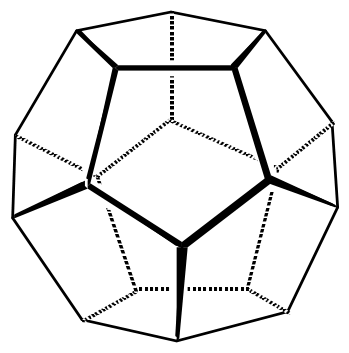
Dodecahedrane, \(\ce{C20H20}\)
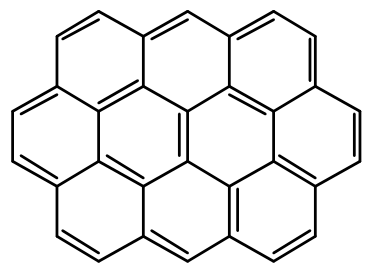
and Ovalene, \(\ce{C32H14}\).
Each \(\ce{C5}\) ring of dodecahedrane is a regular pentagon, while each \(\ce{C6}\) ring of ovalene can be regarded as a regular hexagon.
3.1 What are the \(\angle(\mathrm{CCC})\) angles for each of these rings?
3.2 Which configuration (trigonal planar, \(120^\circ\); tetrahedral, \(109.5^\circ\); or octahedral, \(90^\circ\)) do the above \(\angle(\mathrm{CCC})\) angles most closely match?
3.3 What is the hybridization (\(sp\), \(sp^2\), or \(sp^3\)) which most closely conforms to the geometric structure of dodecahedrane, and of ovalene?
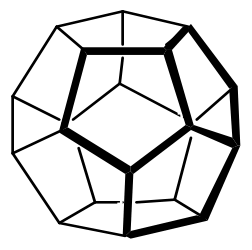
A “juncture” is defined here to mean any 3-ring system, sharing a common central carbon atom, within a molecule. Compare the junctures (shown in bold) of three pentagons within dodecahedrane:
and of three hexagons within ovalene:
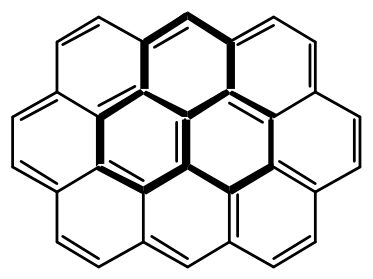
Consider an axis passing through the central carbon atom of each juncture such that the angle the axis forms with all three \(\ce{C-C}\) bonds radiating from this \(\ce{C}\) atom is identical.
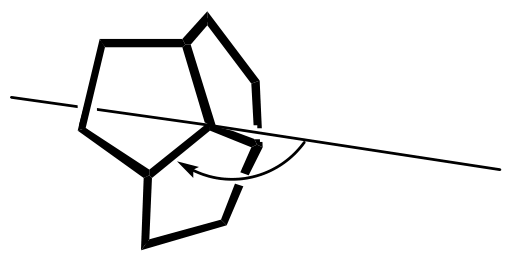
3.4 What is the value of this angle for dodecahedrane (make an “educated guess”, to the nearest three degrees), and for ovalene?
3.5 Subtracting \(90^\circ\) from each of the above angles describes the deviation from planarity for each juncture. Which juncture is planar?
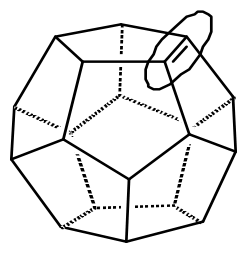
Now consider two polycyclic 'alkenes', dodecahedrene (\(\ce{C20H18}\)):
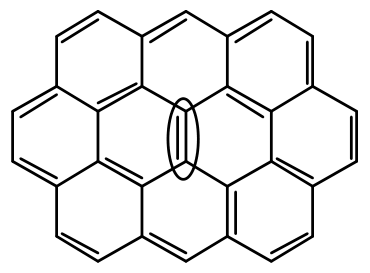
and ovalene:
Assume that the molecular framework is rigid and is not significantly distorted by \(\ce{H2}\) addition to the (indicated) double bond on each structure. Assume also that all double bonds are localized in assessing these systems.
3.6 Compare the indicated pairs of carbon atoms (encircled above). For which \(\ce{C=C}\) pair is \(\ce{H2}\) addition expected to be more exothermic?
And now, on to fullerenes. For all known fullerenes, the deviation from planarity at any juncture is less than is the case for dodecadedrane.
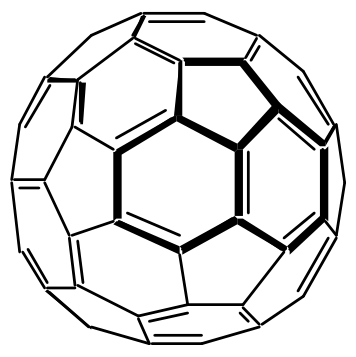
For \(\ce{C60}\), all junctures are entirely equivalent. Now consider \(\ce{H2}\) addition at a \(\ce{C=C}\) bond of \(\ce{C60}\):
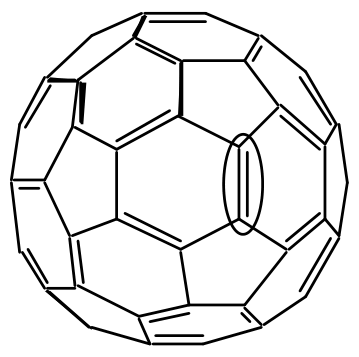
3.7 For which of \(\ce{C60}\), dodecahedrene, or ovalene is \(\ce{H2}\) addition most exothermic?
(Again, assume localization of double bonds.)
3.8 For which of \(\ce{C60}\), dodecahedrene, or ovalene is \(\ce{H2}\) addition least exothermic?
There is evidence for fullerenes smaller than \(\ce{C60}\), such as \(\ce{C58}\). The \(\ce{C58}\) structure (ignoring any distinction between 'double' and 'single' bonds) is shown below:
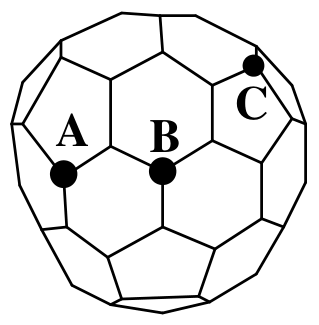
The junctures centred on atoms A, B and C on the above structure can be redrawn for greater clarity:
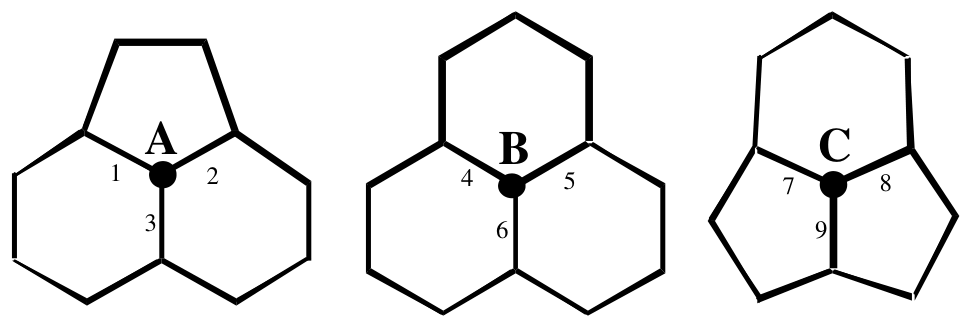
3.9 Which juncture has the least deviation from planarity?
3.10 Which juncture has the greatest deviation from planarity?
3.11 Of the above carbon-carbon bonds, numbered from 1 to 9, which represents the most favourable site for \(\ce{H2}\) addition?
Finally, consider a larger fullerene, \(\ce{C180}\):
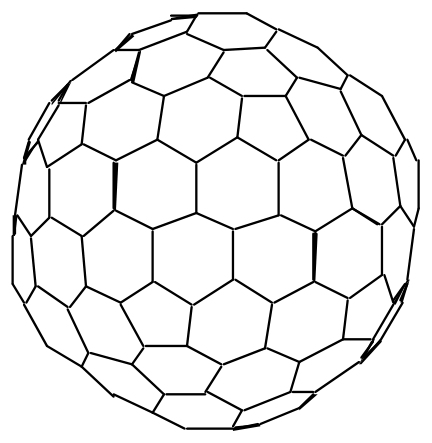
To a first approximation, both \(\ce{C60}\) and \(\ce{C180}\) are "perfect" spheres.
3.12 Which has the larger average deviation from planarity at each juncture? \(\ce{C60}\) or \(\ce{C180}\)?
3.13 Compare the geometries of \(\ce{C60}\) and \(\ce{C180}\), and graphite. Which of the statements shown on the answer sheet (concerning enthalpies of formation, in \(\mathrm{kJ\,g^{-1}}\) units) is correct?
Fullerenes are generated on a very rapid timescale, typically milliseconds. In all techniques, C60 is produced in much greater quantities than C180.
3.14 Which of the graphs shown on the answer template best represents the dependence of potential energy upon reaction progress for the two processes:
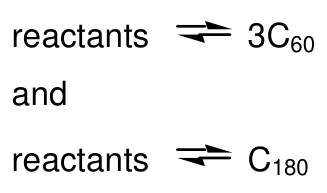
Official English text of the problem.
Answers
SMILES identifiers and their geometric qualifications are given in the solution.
- 3.1: Dodecahedrane: \(108^\circ\). Ovalene: \(120^\circ\).
- 3.2: Dodecahedrane: tetrahedral. Ovalene: trigonal planar.
- 3.3: Dodecahedrane: \(sp^3\). Ovalene: \(sp^2\).
- 3.4: Dodecahedrane: approximately \(111^\circ\). Ovalene: \(90^\circ\).
- 3.5: Ovalene is planar. The deviations are approximately \(21^\circ\) for dodecahedrane and \(0^\circ\) for ovalene.
- 3.6: Addition to the indicated double bond of dodecahedrene is more exothermic.
- 3.7: Dodecahedrene gives the most exothermic addition.
- 3.8: Ovalene gives the least exothermic addition.
- 3.9: B.
- 3.10: C.
- 3.11: Bond 9, shared by two pentagons.
- 3.12: \(\ce{C60}\).
- 3.13: Per gram, \[ h_f^\circ(\ce{C60})>h_f^\circ(\ce{C180})> h_f^\circ(\text{graphite})=0. \]
- 3.14: Choose the graph with a lower activation barrier leading to \(\ce{3C60}\), but a lower final product energy for \(\ce{C180}\).
Solution
3.1 — Ring angles
The molecular identifiers are:
- Dodecahedrane, \(\ce{C20H20}\):
C12C3C4C5C1C1C6C2C2C3C3C4C4C5C1C1C6C2C3C41. Its carbon skeleton is the convex dodecahedral cage shown; SMILES does not specify its regular three-dimensional geometry. - Ovalene, \(\ce{C32H14}\), one Kekulé representation:
C1=CC2=CC=C3C=C4C=CC5=CC=C6C=CC7=CC8=CC=C1C1=C2C3=C2C4=C5C6=C7C2=C81. Its fused carbon framework is planar.
The interior angle of a regular \(n\)-gon is
\[ \alpha_n=\frac{(n-2)180^\circ}{n}. \]
Consequently,
\[ \alpha_5=\frac{3(180^\circ)}5=\boxed{108^\circ}, \qquad \alpha_6=\frac{4(180^\circ)}6=\boxed{120^\circ}. \]
These are the respective \(\angle(\mathrm{CCC})\) angles.
3.2 — Closest configurations
The pentagonal angle \(108^\circ\) differs from the tetrahedral angle \(109.5^\circ\) by only \(1.5^\circ\). Dodecahedrane therefore most closely matches tetrahedral geometry.
The hexagonal angle \(120^\circ\) exactly matches trigonal planar geometry, appropriate to ovalene.
3.3 — Hybridization
Tetrahedral geometry corresponds to \(sp^3\) hybridization. Each carbon of dodecahedrane has three carbon neighbours and one hydrogen, making four \(\sigma\) bonds.
Trigonal planar geometry corresponds to \(sp^2\) hybridization. Each carbon of ovalene has three \(\sigma\)-bond directions, with a remaining \(p\) orbital contributing to \(\pi\) bonding.
Thus,
\[ \boxed{\text{Dodecahedrane: }sp^3;\qquad \text{ovalene: }sp^2.} \]
3.4 — Angle between the axis and the bonds
For ovalene, the axis is perpendicular to the molecular plane. Its angle with each of the three carbon–carbon bonds is therefore
\[ \boxed{90^\circ}. \]
For dodecahedrane, use the outward-pointing ray of the axis, consistent with the obtuse angle indicated in the figure and the subtraction prescribed in 3.5. The geometry is nearly tetrahedral, suggesting an angle near \(110^\circ\).
The regular-pentagon model also permits an exact check. Let the common axis–bond angle be \(\theta\). The three bonds have azimuthal separations of \(120^\circ\), and the angle between any two bonds is \(108^\circ\). Hence
\[ \cos108^\circ =\cos^2\theta+\sin^2\theta\cos120^\circ =\frac32\cos^2\theta-\frac12. \]
Thus
\[ \cos\theta=-\sqrt{\frac{1+2\cos108^\circ}{3}}, \]
where the negative sign selects the outward, obtuse angle. Therefore,
\[ \theta=110.905\ldots^\circ. \]
The requested estimate is
\[ \boxed{\theta\approx111^\circ}. \]
3.5 — Deviation from planarity
Using the definition in the question,
\[ \delta=\theta-90^\circ, \]
gives
\[ \delta_{\mathrm{dodecahedrane}} =110.905\ldots^\circ-90^\circ \approx20.9^\circ, \]
and
\[ \delta_{\mathrm{ovalene}}=90^\circ-90^\circ=0^\circ. \]
Therefore, the ovalene juncture is planar.
3.6 — Hydrogenation of dodecahedrene versus ovalene
Dodecahedrene, \(\ce{C20H18}\), with the convex cage stereochemistry, is represented by:
C12=C3[C@@H]4[C@@H]5[C@H]1[C@@H]1[C@@H]6[C@H]2[C@@H]2[C@H]3[C@@H]3[C@H]4[C@@H]4[C@H]5[C@H]1[C@@H]1[C@H]6[C@H]2[C@H]3[C@H]41
Hydrogen is dihydrogen, \(\ce{H2}\): [H][H].
The balanced additions are
\[ \ce{C20H18 + H2 -> C20H20} \]
and
\[ \ce{C32H14 + H2 -> C32H16}. \]
The first product is dodecahedrane. The second is dihydroovalene hydrogenated at the indicated central bond, with connectivity SMILES:
C1=C2C=CC3=CC=C4C=CC5=CC6=C7C8=C9C(=C1C=CC9=CC=C8C=C6)C1C2=C3C4=C5C71
The question does not specify the relative stereochemistry of the two new carbon–hydrogen bonds in this latter product.
Hydrogenation changes the two reacting carbon atoms from approximately \(sp^2\) bonding toward \(sp^3\) bonding.
In dodecahedrene, the cage forces these initially unsaturated carbon atoms into strongly pyramidal geometries already close to tetrahedral. The double bond is consequently strained. Hydrogenation makes the preferred bonding geometry much better suited to the existing cage.
In ovalene, the initial planar framework suits \(sp^2\) carbon. Hydrogenation introduces carbon atoms that prefer tetrahedral geometry into a framework assumed to remain approximately planar, increasing their geometric strain.
Thus, even without substantial movement of the framework, hydrogenation gives a greater improvement in geometric compatibility for dodecahedrene:
\[ \boxed{ \Delta H_{\mathrm{hyd}}(\text{dodecahedrene}) < \Delta H_{\mathrm{hyd}}(\text{ovalene}) }. \]
The more negative enthalpy change means dodecahedrene hydrogenation is more exothermic. This argument uses the stipulated localized-bond model; aromatic stabilization is not needed.
3.7 — Most exothermic addition among the three compounds
Buckminsterfullerene, \(\ce{C60}\), has a truncated-icosahedral cage. One explicit-bond SMILES is:
C12=C3C4=C5C6=C7C3=C3C8=C1C1=C9C8=C8C%10=C%11C%12=C%13C%14=C%15C%16=C%17C%18=C%19C%20=C(C4=C2C2=C1C1=C4C9=C9C8=C%11C8=C%13C%11=C%15C%17=C%13C%19=C(C1=C2%20)C1=C4C9=C8C%11=C1%13)C%18=C5C%16=C6C%14=C%12C7=C3%10
Its formal hydrogenation is
\[ \ce{C60 + H2 -> C60H2}. \]
For addition of both hydrogens to the exterior at the indicated bond, the product is 1,2-dihydro[60]fullerene, represented by:
C12=C3C4=C5C6=C1C1=C7C2=C2C8=C3C3=C4C4=C9C%10=C3C3=C8C8=C%11C%12=C%13C%14=C%11C3=C%10C3=C%14[C@H]%10C%11=C3C9=C3C4=C5C4=C5C3=C%11C3=C5C5=C9C(=C1C5=C64)C1=C7C(=C28)C%12=C1C1=C%13[C@@H]%10C3=C91
The carbon junctures of \(\ce{C60}\) are pyramidal, but the question specifies that their deviation from planarity is smaller than in dodecahedrane. Consequently, their geometry is intermediate between the strongly pyramidal dodecahedral cage and planar ovalene.
The strain-based order of hydrogenation enthalpies is therefore
\[ \boxed{ \Delta H_{\mathrm{hyd}}(\text{dodecahedrene}) < \Delta H_{\mathrm{hyd}}(\ce{C60}) < \Delta H_{\mathrm{hyd}}(\text{ovalene}) }. \]
Thus, dodecahedrene gives the most exothermic addition.
3.8 — Least exothermic addition
From the same ordering, ovalene gives the least exothermic addition. Its planar carbon framework provides the least favourable fixed geometry for the newly formed \(sp^3\) centres.
3.9 — Juncture with the least deviation from planarity
The three junctures contain:
| Juncture | Rings meeting at the carbon | Sum of ideal ring angles | Angular deficit from \(360^\circ\) |
|---|---|---|---|
| A | One pentagon and two hexagons | \(108^\circ+120^\circ+120^\circ=348^\circ\) | \(12^\circ\) |
| B | Three hexagons | \(3(120^\circ)=360^\circ\) | \(0^\circ\) |
| C | Two pentagons and one hexagon | \(108^\circ+108^\circ+120^\circ=336^\circ\) | \(24^\circ\) |
Three regular hexagons can meet in a plane without an angular deficit. Therefore,
\[ \boxed{\text{B has the least deviation from planarity.}} \]
These angular deficits compare the local curvature; they are not themselves the axis-based deviation angles defined in 3.5. In an actual curved fullerene, small ring distortions can make a three-hexagon juncture slightly nonplanar.
3.10 — Juncture with the greatest deviation from planarity
Juncture C contains two pentagons and has the largest angular deficit. It requires the strongest local departure from a planar arrangement:
\[ \boxed{\text{C has the greatest deviation from planarity.}} \]
The ordering is
\[ \boxed{B<A<C}. \]
3.11 — Most favourable bond for hydrogen addition
Bond 9 is the common edge of two pentagons. Thus, both ends of this bond lie at strongly curved junctures involving two pentagons.
Hydrogenation at this bond converts both reacting carbon atoms toward \(sp^3\) bonding where the existing geometry is most favourable to that change. It therefore provides the greatest strain advantage among the indicated sites:
\[ \boxed{\text{Bond 9}.} \]
3.12 — Average deviation in the two spherical fullerenes
For comparable carbon–carbon distances, the larger cage has the larger radius. A sphere’s curvature decreases as its radius increases, so neighbouring bond directions change more sharply across the smaller cage.
Therefore,
\[ \boxed{\ce{C60}\text{ has the larger average deviation from planarity.}} \]
For a concrete molecular identifier, an icosahedral \(\ce{C180}\) fullerene, constructed as the leapfrog of the \(\ce{C60}\) cage, has the following SMILES:
C12=C3C4=C5C6=C7C8=C9C%10=C%11C8=C8C%12=C7C7=C5C5=C%13C%14=C7C7=C%15C%14=C%14C%16=C%13C%13=C%17C%18=C%19C%20=C%17C%16=C%16C%17=C%14C%14=C%21C%22=C%17C%17=C%23C%22=C%22C%24=C%21C%21=C%25C%26=C%27C%28=C%25C%24=C%24C%25=C%22C%22=C%23C%23=C%29C%30=C%31C%32=C%33C%34=C%35C%36=C%37C%38=C%39C%36=C%36C(=C%40C1=C4C5=C%13C%40=C%18C%36=C%35C%19=C%33C%30=C%20C%16=C%17%29)C1=C%39C4=C5C%13=C%16C%17=C%18C%19=C%20C%16=C%16C%29=C%13C%13=C4C(=C21)C1=C3C6=C9C2=C3C(=C%29C%13=C12)C1=C2C4=C6C9=C%13C4=C4C(=C%11C(=C%27C4=C4C%13=C%11C(=C%13C%27=C%29C%30=C(C%19=C%19C%18=C%18C(=C%37C%34=C%33C%32=C%32C%31=C%23C%23=C%22C(=C%13%25)C%27=C%13C%30=C%19C(=C%18%33)C%32=C%13%23)C%17=C%385)C(=C%20C6=C%161)C9=C%29%11)C%24=C%284)C8=C%26C(=C7%12)C%21=C%15%14)C2=C%103
This is an explicitly identified structural representative; the radius argument does not require a particular \(\ce{C180}\) isomer. SMILES specifies the cage connectivity, not its spherical conformation.
3.13 — Enthalpies of formation per gram
Graphite, \(\ce{C}\), consists of extended sheets of carbon atoms in approximately planar \(sp^2\) environments. It is a periodic solid, so it has no finite molecular SMILES; the atomic SMILES [C] would not represent graphite.
Within the problem’s geometric model:
- Graphite has essentially no curvature-induced pyramidalization strain.
- \(\ce{C180}\) has some curvature strain.
- \(\ce{C60}\) has greater curvature strain per carbon atom.
Define the specific standard enthalpy of formation by
\[ h_f^\circ=\frac{\Delta_fH^\circ}{M}, \]
where \(\Delta_fH^\circ\) is in \(\mathrm{kJ\,mol^{-1}}\) and \(M\) in \(\mathrm{g\,mol^{-1}}\). Then \(h_f^\circ\) is in \(\mathrm{kJ\,g^{-1}}\).
Graphite is the standard reference state of carbon, so its standard enthalpy of formation is zero. The required ordering is
\[ \boxed{ h_f^\circ(\ce{C60}) > h_f^\circ(\ce{C180}) > h_f^\circ(\text{graphite})=0 \quad \text{in }\mathrm{kJ\,g^{-1}}. } \]
The corresponding formation reactions are
\[ \ce{60 C(graphite) -> C60}, \qquad \ce{180 C(graphite) -> C180}. \]
No numerical formation enthalpies are supplied, so only the ordering can be obtained.
3.14 — Potential-energy diagram
The two paths must be compared for the same amount of carbon: one \(\ce{C180}\) cage versus three \(\ce{C60}\) cages.
Because \(\ce{C180}\) has the lower formation enthalpy per gram,
\[ \Delta_fH^\circ(\ce{C180}) < 3\Delta_fH^\circ(\ce{C60}). \]
Thus, the final energy of \(\ce{C180}\) must be below that of \(\ce{3C60}\). Equivalently, the formal atom-balanced conversion
\[ \ce{3C60 -> C180} \]
is energetically downhill in this model; this equation does not assert a direct mechanism.
Nevertheless, the rapid formation process produces much more \(\ce{C60}\). In the intended kinetic interpretation, the route to \(\ce{3C60}\) has the smaller activation barrier.
The required graph should therefore have:
- Reaction progress on the horizontal axis and potential energy on the vertical axis.
- Two curves beginning at the same reactant energy.
- A curve labelled \(\ce{3C60}\) with the lower peak, ending at the higher product energy.
- A curve labelled \(\ce{C180}\) with the higher peak, ending at the lower product energy.
Thus, \(\ce{3C60}\) is favoured kinetically, while \(\ce{C180}\) is favoured thermodynamically within the stated comparison. The information does not fix the absolute product energies relative to the unspecified reactants.
The solution was checked against the official solution.
IChO 1998 · Theorieaufgabe 3
Winkelspannung, Hybridisierung und Fullerene
Die dreidimensionalen Strukturen polycyclischer Moleküle lassen sich häufig durch die Minimierung der Winkelspannung erklären. Betrachten Sie die folgenden Moleküle:
Dodecahedran, \(\ce{C20H20}\)
und Ovalen, \(\ce{C32H14}\).
Jeder \(\ce{C5}\)-Ring des Dodecahedrans ist ein regelmäßiges Fünfeck, während jeder \(\ce{C6}\)-Ring des Ovalens als regelmäßiges Sechseck betrachtet werden kann.
3.1 Wie groß sind die \(\angle(\mathrm{CCC})\)-Winkel in diesen beiden Ringarten?
3.2 Welcher Konfiguration (trigonal-planar, \(120^\circ\); tetraedrisch, \(109.5^\circ\); oder oktaedrisch, \(90^\circ\)) entsprechen die obigen \(\angle(\mathrm{CCC})\)-Winkel am ehesten?
3.3 Welche Hybridisierung (\(sp\), \(sp^2\) oder \(sp^3\)) entspricht am ehesten der geometrischen Struktur des Dodecahedrans bzw. des Ovalens?
Als „Verknüpfungsstelle“ wird hier jedes System aus drei Ringen innerhalb eines Moleküls bezeichnet, die ein gemeinsames zentrales Kohlenstoffatom besitzen. Vergleichen Sie die Verknüpfungsstellen (fett dargestellt) dreier Fünfecke im Dodecahedran:
und dreier Sechsecke im Ovalen:
Betrachten Sie eine Achse durch das zentrale Kohlenstoffatom jeder Verknüpfungsstelle, die mit allen drei von diesem \(\ce{C}\)-Atom ausgehenden \(\ce{C-C}\)-Bindungen den gleichen Winkel bildet.
3.4 Wie groß ist dieser Winkel für Dodecahedran (geben Sie eine begründete Schätzung auf drei Grad genau an) und für Ovalen?
3.5 Zieht man von jedem der obigen Winkel \(90^\circ\) ab, erhält man die Abweichung von der Planarität für die jeweilige Verknüpfungsstelle. Welche Verknüpfungsstelle ist planar?
Betrachten Sie nun zwei polycyclische „Alkene“, Dodecahedren (\(\ce{C20H18}\)):
und Ovalen:
Nehmen Sie an, dass das Molekülgerüst starr ist und durch die Addition von \(\ce{H2}\) an die (markierte) Doppelbindung der jeweiligen Struktur nicht wesentlich verzerrt wird. Nehmen Sie bei der Beurteilung dieser Systeme außerdem an, dass alle Doppelbindungen lokalisiert sind.
3.6 Vergleichen Sie die markierten Kohlenstoffatompaare (oben eingekreist). Bei welchem \(\ce{C=C}\)-Paar ist eine stärker exotherme Addition von \(\ce{H2}\) zu erwarten?
Nun zu den Fullerenen. Bei allen bekannten Fullerenen ist die Abweichung von der Planarität an jeder Verknüpfungsstelle geringer als beim Dodecahedran.
Bei \(\ce{C60}\) sind alle Verknüpfungsstellen vollständig äquivalent. Betrachten Sie nun die Addition von \(\ce{H2}\) an eine \(\ce{C=C}\)-Bindung von \(\ce{C60}\):
3.7 Bei welcher der Verbindungen \(\ce{C60}\), Dodecahedren oder Ovalen ist die Addition von \(\ce{H2}\) am stärksten exotherm?
(Nehmen Sie erneut lokalisierte Doppelbindungen an.)
3.8 Bei welcher der Verbindungen \(\ce{C60}\), Dodecahedren oder Ovalen ist die Addition von \(\ce{H2}\) am wenigsten exotherm?
Es gibt Hinweise auf Fullerene, die kleiner als \(\ce{C60}\) sind, beispielsweise \(\ce{C58}\). Die Struktur von \(\ce{C58}\) (ohne Unterscheidung zwischen „Doppel-“ und „Einfachbindungen“) ist unten dargestellt:
Die Verknüpfungsstellen mit den Atomen A, B und C der obigen Struktur als Zentren lassen sich zur besseren Übersicht folgendermaßen neu zeichnen:
3.9 Welche Verknüpfungsstelle weist die geringste Abweichung von der Planarität auf?
3.10 Welche Verknüpfungsstelle weist die größte Abweichung von der Planarität auf?
3.11 Welche der obigen, von 1 bis 9 nummerierten Kohlenstoff-Kohlenstoff-Bindungen stellt die günstigste Stelle für die Addition von \(\ce{H2}\) dar?
Betrachten Sie abschließend ein größeres Fulleren, \(\ce{C180}\):
In erster Näherung sind sowohl \(\ce{C60}\) als auch \(\ce{C180}\) „perfekte“ Kugeln.
3.12 Welches weist die größere durchschnittliche Abweichung von der Planarität an jeder Verknüpfungsstelle auf: \(\ce{C60}\) oder \(\ce{C180}\)?
3.13 Vergleichen Sie die Geometrien von \(\ce{C60}\), \(\ce{C180}\) und Graphit. Welche der auf dem Antwortbogen angegebenen Aussagen (zu den Bildungsenthalpien in der Einheit \(\mathrm{kJ\,g^{-1}}\)) ist richtig?
Fullerene entstehen innerhalb sehr kurzer Zeit, typischerweise innerhalb von Millisekunden. Bei allen Verfahren wird C60 in wesentlich größeren Mengen als C180 gebildet.
3.14 Welcher der auf dem Antwortbogen dargestellten Graphen gibt die Abhängigkeit der potenziellen Energie vom Reaktionsfortschritt für die beiden Prozesse am besten wieder:
Aufgabentext aus dem offiziellen englischen Text übersetzt.
Antworten
SMILES-Kennungen und die zugehörigen geometrischen Einschränkungen sind in der Lösung angegeben.
- 3.1: Dodecahedran: \(108^\circ\). Ovalen: \(120^\circ\).
- 3.2: Dodecahedran: tetraedrisch. Ovalen: trigonal-planar.
- 3.3: Dodecahedran: \(sp^3\). Ovalen: \(sp^2\).
- 3.4: Dodecahedran: ungefähr \(111^\circ\). Ovalen: \(90^\circ\).
- 3.5: Ovalen ist planar. Die Abweichungen betragen ungefähr \(21^\circ\) für Dodecahedran und \(0^\circ\) für Ovalen.
- 3.6: Die Addition an die markierte Doppelbindung des Dodecahedrens ist stärker exotherm.
- 3.7: Dodecahedren zeigt die am stärksten exotherme Addition.
- 3.8: Ovalen zeigt die am wenigsten exotherme Addition.
- 3.9: B.
- 3.10: C.
- 3.11: Bindung 9, die zwei Fünfecken gemeinsam ist.
- 3.12: \(\ce{C60}\).
- 3.13: Pro Gramm gilt: \[ h_f^\circ(\ce{C60})>h_f^\circ(\ce{C180})> h_f^\circ(\text{Graphit})=0. \]
- 3.14: Wählen Sie den Graphen mit einer niedrigeren Aktivierungsbarriere auf dem Weg zu \(\ce{3C60}\), aber einer niedrigeren Endenergie des Produkts \(\ce{C180}\).
Lösung
3.1 — Ringwinkel
Die Molekülkennungen lauten:
- Dodecahedran, \(\ce{C20H20}\):
C12C3C4C5C1C1C6C2C2C3C3C4C4C5C1C1C6C2C3C41. Sein Kohlenstoffgerüst ist der dargestellte konvexe dodekaedrische Käfig; SMILES legt seine regelmäßige dreidimensionale Geometrie nicht fest. - Ovalen, \(\ce{C32H14}\), eine Kekulé-Darstellung:
C1=CC2=CC=C3C=C4C=CC5=CC=C6C=CC7=CC8=CC=C1C1=C2C3=C2C4=C5C6=C7C2=C81. Sein kondensiertes Kohlenstoffgerüst ist planar.
Der Innenwinkel eines regelmäßigen \(n\)-Ecks beträgt
\[ \alpha_n=\frac{(n-2)180^\circ}{n}. \]
Somit gilt:
\[ \alpha_5=\frac{3(180^\circ)}5=\boxed{108^\circ}, \qquad \alpha_6=\frac{4(180^\circ)}6=\boxed{120^\circ}. \]
Dies sind die jeweiligen \(\angle(\mathrm{CCC})\)-Winkel.
3.2 — Am besten übereinstimmende Konfigurationen
Der Fünfeckwinkel \(108^\circ\) unterscheidet sich vom Tetraederwinkel \(109.5^\circ\) um nur \(1.5^\circ\). Dodecahedran entspricht daher am ehesten einer tetraedrischen Geometrie.
Der Sechseckwinkel \(120^\circ\) entspricht genau einer trigonal-planaren Geometrie, wie sie für Ovalen zutrifft.
3.3 — Hybridisierung
Eine tetraedrische Geometrie entspricht einer \(sp^3\)-Hybridisierung. Jedes Kohlenstoffatom des Dodecahedrans hat drei benachbarte Kohlenstoffatome und ein Wasserstoffatom und bildet somit vier \(\sigma\)-Bindungen.
Eine trigonal-planare Geometrie entspricht einer \(sp^2\)-Hybridisierung. Jedes Kohlenstoffatom des Ovalens hat drei \(\sigma\)-Bindungsrichtungen; ein verbleibendes \(p\)-Orbital trägt zur \(\pi\)-Bindung bei.
Somit gilt:
\[ \boxed{\text{Dodecahedran: }sp^3;\qquad \text{Ovalen: }sp^2.} \]
3.4 — Winkel zwischen der Achse und den Bindungen
Bei Ovalen steht die Achse senkrecht auf der Molekülebene. Ihr Winkel mit jeder der drei Kohlenstoff-Kohlenstoff-Bindungen beträgt daher
\[ \boxed{90^\circ}. \]
Für Dodecahedran wird die nach außen gerichtete Halbgerade der Achse verwendet, entsprechend dem in der Abbildung markierten stumpfen Winkel und der in 3.5 vorgeschriebenen Subtraktion. Die Geometrie ist nahezu tetraedrisch, was einen Winkel nahe \(110^\circ\) nahelegt.
Das Modell regelmäßiger Fünfecke ermöglicht auch eine exakte Überprüfung. Der gemeinsame Achsen-Bindungs-Winkel sei \(\theta\). Die drei Bindungen haben azimutale Winkelabstände von \(120^\circ\), und der Winkel zwischen je zwei Bindungen beträgt \(108^\circ\). Daher gilt
\[ \cos108^\circ =\cos^2\theta+\sin^2\theta\cos120^\circ =\frac32\cos^2\theta-\frac12. \]
Damit ergibt sich
\[ \cos\theta=-\sqrt{\frac{1+2\cos108^\circ}{3}}, \]
wobei das negative Vorzeichen den nach außen gerichteten, stumpfen Winkel auswählt. Folglich gilt:
\[ \theta=110.905\ldots^\circ. \]
Die verlangte Schätzung lautet
\[ \boxed{\theta\approx111^\circ}. \]
3.5 — Abweichung von der Planarität
Mit der Definition aus der Aufgabenstellung,
\[ \delta=\theta-90^\circ, \]
erhält man
\[ \delta_{\mathrm{dodecahedrane}} =110.905\ldots^\circ-90^\circ \approx20.9^\circ, \]
und
\[ \delta_{\mathrm{ovalene}}=90^\circ-90^\circ=0^\circ. \]
Somit ist die Verknüpfungsstelle im Ovalen planar.
3.6 — Hydrierung von Dodecahedren im Vergleich zu Ovalen
Dodecahedren, \(\ce{C20H18}\), mit der Stereochemie des konvexen Käfigs, wird dargestellt durch:
C12=C3[C@@H]4[C@@H]5[C@H]1[C@@H]1[C@@H]6[C@H]2[C@@H]2[C@H]3[C@@H]3[C@H]4[C@@H]4[C@H]5[C@H]1[C@@H]1[C@H]6[C@H]2[C@H]3[C@H]41
Wasserstoff ist Diwasserstoff, \(\ce{H2}\): [H][H].
Die ausgeglichenen Additionsgleichungen lauten
\[ \ce{C20H18 + H2 -> C20H20} \]
und
\[ \ce{C32H14 + H2 -> C32H16}. \]
Das erste Produkt ist Dodecahedran. Das zweite ist an der markierten zentralen Bindung hydriertes Dihydroovalen, dessen Konnektivität durch folgende SMILES-Zeichenfolge wiedergegeben wird:
C1=C2C=CC3=CC=C4C=CC5=CC6=C7C8=C9C(=C1C=CC9=CC=C8C=C6)C1C2=C3C4=C5C71
Die Aufgabenstellung legt die relative Stereochemie der beiden neuen Kohlenstoff-Wasserstoff-Bindungen in diesem zweiten Produkt nicht fest.
Bei der Hydrierung verändert sich der Bindungszustand der beiden reagierenden Kohlenstoffatome von einer näherungsweisen \(sp^2\)-Bindungssituation in Richtung einer \(sp^3\)-Bindungssituation.
Im Dodecahedren zwingt der Käfig diese zunächst ungesättigten Kohlenstoffatome in stark pyramidale Geometrien, die bereits nahezu tetraedrisch sind. Die Doppelbindung ist daher gespannt. Durch die Hydrierung passt die bevorzugte Bindungsgeometrie wesentlich besser zum vorhandenen Käfig.
Im Ovalen ist das anfänglich planare Gerüst für \(sp^2\)-Kohlenstoff geeignet. Die Hydrierung führt Kohlenstoffatome, die eine tetraedrische Geometrie bevorzugen, in ein Gerüst ein, das annahmegemäß näherungsweise planar bleibt, wodurch ihre geometrische Spannung zunimmt.
Somit bewirkt die Hydrierung bei Dodecahedren auch ohne wesentliche Bewegung des Gerüsts eine stärkere Verbesserung der geometrischen Übereinstimmung:
\[ \boxed{ \Delta H_{\mathrm{hyd}}(\text{Dodecahedren}) < \Delta H_{\mathrm{hyd}}(\text{Ovalen}) }. \]
Die stärker negative Enthalpieänderung bedeutet, dass die Hydrierung von Dodecahedren stärker exotherm ist. Diese Argumentation verwendet das vorgegebene Modell lokalisierter Bindungen; eine aromatische Stabilisierung wird dafür nicht benötigt.
3.7 — Am stärksten exotherme Addition unter den drei Verbindungen
Buckminsterfulleren, \(\ce{C60}\), besitzt einen Käfig in Form eines abgestumpften Ikosaeders. Eine SMILES-Zeichenfolge mit explizit angegebenen Bindungen lautet:
C12=C3C4=C5C6=C7C3=C3C8=C1C1=C9C8=C8C%10=C%11C%12=C%13C%14=C%15C%16=C%17C%18=C%19C%20=C(C4=C2C2=C1C1=C4C9=C9C8=C%11C8=C%13C%11=C%15C%17=C%13C%19=C(C1=C2%20)C1=C4C9=C8C%11=C1%13)C%18=C5C%16=C6C%14=C%12C7=C3%10
Seine formale Hydrierung lautet
\[ \ce{C60 + H2 -> C60H2}. \]
Bei der Addition beider Wasserstoffatome an der Außenseite der markierten Bindung ist das Produkt 1,2-Dihydro[60]fulleren, dargestellt durch:
C12=C3C4=C5C6=C1C1=C7C2=C2C8=C3C3=C4C4=C9C%10=C3C3=C8C8=C%11C%12=C%13C%14=C%11C3=C%10C3=C%14[C@H]%10C%11=C3C9=C3C4=C5C4=C5C3=C%11C3=C5C5=C9C(=C1C5=C64)C1=C7C(=C28)C%12=C1C1=C%13[C@@H]%10C3=C91
Die Kohlenstoff-Verknüpfungsstellen von \(\ce{C60}\) sind pyramidal, doch die Aufgabenstellung gibt vor, dass ihre Abweichung von der Planarität geringer ist als beim Dodecahedran. Ihre Geometrie liegt folglich zwischen der des stark pyramidalen dodekaedrischen Käfigs und der des planaren Ovalens.
Die aus der Spannung abgeleitete Reihenfolge der Hydrierungsenthalpien lautet daher
\[ \boxed{ \Delta H_{\mathrm{hyd}}(\text{Dodecahedren}) < \Delta H_{\mathrm{hyd}}(\ce{C60}) < \Delta H_{\mathrm{hyd}}(\text{Ovalen}) }. \]
Somit zeigt Dodecahedren die am stärksten exotherme Addition.
3.8 — Am wenigsten exotherme Addition
Aus derselben Reihenfolge folgt, dass Ovalen die am wenigsten exotherme Addition zeigt. Sein planares Kohlenstoffgerüst bietet die ungünstigste feste Geometrie für die neu gebildeten \(sp^3\)-Zentren.
3.9 — Verknüpfungsstelle mit der geringsten Abweichung von der Planarität
Die drei Verknüpfungsstellen enthalten:
| Verknüpfungsstelle | Am Kohlenstoffatom zusammentreffende Ringe | Summe der idealen Ringwinkel | Winkelfehlbetrag gegenüber \(360^\circ\) |
|---|---|---|---|
| A | Ein Fünfeck und zwei Sechsecke | \(108^\circ+120^\circ+120^\circ=348^\circ\) | \(12^\circ\) |
| B | Drei Sechsecke | \(3(120^\circ)=360^\circ\) | \(0^\circ\) |
| C | Zwei Fünfecke und ein Sechseck | \(108^\circ+108^\circ+120^\circ=336^\circ\) | \(24^\circ\) |
Drei regelmäßige Sechsecke können in einer Ebene ohne Winkelfehlbetrag zusammentreffen. Daher gilt:
\[ \boxed{\text{B hat die geringste Abweichung von der Planarität.}} \]
Diese Winkelfehlbeträge dienen dem Vergleich der lokalen Krümmung; sie sind selbst nicht die in 3.5 definierten, auf die Achse bezogenen Abweichungswinkel. In einem tatsächlich gekrümmten Fulleren können kleine Ringverzerrungen dazu führen, dass eine Verknüpfungsstelle aus drei Sechsecken geringfügig von der Planarität abweicht.
3.10 — Verknüpfungsstelle mit der größten Abweichung von der Planarität
Verknüpfungsstelle C enthält zwei Fünfecke und hat den größten Winkelfehlbetrag. Sie erfordert die stärkste lokale Abweichung von einer planaren Anordnung:
\[ \boxed{\text{C hat die größte Abweichung von der Planarität.}} \]
Die Reihenfolge lautet
\[ \boxed{B<A<C}. \]
3.11 — Günstigste Bindung für die Wasserstoffaddition
Bindung 9 ist die gemeinsame Kante zweier Fünfecke. Somit liegen beide Enden dieser Bindung an stark gekrümmten Verknüpfungsstellen, an denen zwei Fünfecke beteiligt sind.
Die Hydrierung an dieser Bindung überführt beide reagierenden Kohlenstoffatome in Richtung einer \(sp^3\)-Bindungssituation, wobei die vorhandene Geometrie diese Änderung am meisten begünstigt. Sie bietet daher unter den markierten Stellen den größten Vorteil hinsichtlich der Spannung:
\[ \boxed{\text{Bindung 9}.} \]
3.12 — Durchschnittliche Abweichung in den beiden kugelförmigen Fullerenen
Bei vergleichbaren Kohlenstoff-Kohlenstoff-Abständen hat der größere Käfig den größeren Radius. Die Krümmung einer Kugel nimmt mit zunehmendem Radius ab, sodass sich benachbarte Bindungsrichtungen entlang des kleineren Käfigs stärker ändern.
Daher gilt:
\[ \boxed{\ce{C60}\text{ hat die größere durchschnittliche Abweichung von der Planarität.}} \]
Als konkrete Molekülkennung besitzt ein ikosaedrisches \(\ce{C180}\)-Fulleren, das durch die Leapfrog-Konstruktion aus dem \(\ce{C60}\)-Käfig erzeugt wird, die folgende SMILES-Zeichenfolge:
C12=C3C4=C5C6=C7C8=C9C%10=C%11C8=C8C%12=C7C7=C5C5=C%13C%14=C7C7=C%15C%14=C%14C%16=C%13C%13=C%17C%18=C%19C%20=C%17C%16=C%16C%17=C%14C%14=C%21C%22=C%17C%17=C%23C%22=C%22C%24=C%21C%21=C%25C%26=C%27C%28=C%25C%24=C%24C%25=C%22C%22=C%23C%23=C%29C%30=C%31C%32=C%33C%34=C%35C%36=C%37C%38=C%39C%36=C%36C(=C%40C1=C4C5=C%13C%40=C%18C%36=C%35C%19=C%33C%30=C%20C%16=C%17%29)C1=C%39C4=C5C%13=C%16C%17=C%18C%19=C%20C%16=C%16C%29=C%13C%13=C4C(=C21)C1=C3C6=C9C2=C3C(=C%29C%13=C12)C1=C2C4=C6C9=C%13C4=C4C(=C%11C(=C%27C4=C4C%13=C%11C(=C%13C%27=C%29C%30=C(C%19=C%19C%18=C%18C(=C%37C%34=C%33C%32=C%32C%31=C%23C%23=C%22C(=C%13%25)C%27=C%13C%30=C%19C(=C%18%33)C%32=C%13%23)C%17=C%385)C(=C%20C6=C%161)C9=C%29%11)C%24=C%284)C8=C%26C(=C7%12)C%21=C%15%14)C2=C%103
Dies ist ein explizit angegebener Strukturvertreter; das Argument über den Radius setzt kein bestimmtes \(\ce{C180}\)-Isomer voraus. SMILES legt die Konnektivität des Käfigs fest, nicht seine kugelförmige Konformation.
3.13 — Bildungsenthalpien pro Gramm
Graphit, \(\ce{C}\), besteht aus ausgedehnten Schichten von Kohlenstoffatomen in näherungsweise planaren \(sp^2\)-Umgebungen. Er ist ein periodischer Festkörper und hat daher keine endliche molekulare SMILES-Zeichenfolge; die atomare SMILES-Zeichenfolge [C] würde Graphit nicht darstellen.
Im geometrischen Modell der Aufgabe gilt:
- Graphit weist praktisch keine krümmungsbedingte Pyramidalisierungsspannung auf.
- \(\ce{C180}\) weist eine gewisse Krümmungsspannung auf.
- \(\ce{C60}\) weist eine größere Krümmungsspannung pro Kohlenstoffatom auf.
Die spezifische Standardbildungsenthalpie wird definiert durch
\[ h_f^\circ=\frac{\Delta_fH^\circ}{M}, \]
wobei \(\Delta_fH^\circ\) in \(\mathrm{kJ\,mol^{-1}}\) und \(M\) in \(\mathrm{g\,mol^{-1}}\) angegeben wird. Dann hat \(h_f^\circ\) die Einheit \(\mathrm{kJ\,g^{-1}}\).
Graphit ist der Standardreferenzzustand des Kohlenstoffs, daher ist seine Standardbildungsenthalpie null. Die gesuchte Reihenfolge lautet
\[ \boxed{ h_f^\circ(\ce{C60}) > h_f^\circ(\ce{C180}) > h_f^\circ(\text{Graphit})=0 \quad \text{in }\mathrm{kJ\,g^{-1}}. } \]
Die entsprechenden Bildungsreaktionen lauten
\[ \ce{60 C(graphite) -> C60}, \qquad \ce{180 C(graphite) -> C180}. \]
Es sind keine Zahlenwerte für die Bildungsenthalpien angegeben, daher lässt sich nur die Reihenfolge bestimmen.
3.14 — Diagramm der potenziellen Energie
Die beiden Reaktionswege müssen für dieselbe Kohlenstoffmenge verglichen werden: ein \(\ce{C180}\)-Käfig gegenüber drei \(\ce{C60}\)-Käfigen.
Da \(\ce{C180}\) die niedrigere Bildungsenthalpie pro Gramm hat, gilt
\[ \Delta_fH^\circ(\ce{C180}) < 3\Delta_fH^\circ(\ce{C60}). \]
Somit muss die Endenergie von \(\ce{C180}\) unterhalb derjenigen von \(\ce{3C60}\) liegen. Gleichbedeutend damit verläuft die formale, hinsichtlich der Atomanzahl ausgeglichene Umwandlung
\[ \ce{3C60 -> C180} \]
in diesem Modell energetisch abwärts; diese Gleichung macht keine Aussage über einen direkten Mechanismus.
Dennoch entsteht bei dem raschen Bildungsprozess wesentlich mehr \(\ce{C60}\). In der beabsichtigten kinetischen Deutung hat der Reaktionsweg zu \(\ce{3C60}\) die kleinere Aktivierungsbarriere.
Der gesuchte Graph sollte daher Folgendes aufweisen:
- Den Reaktionsfortschritt auf der horizontalen Achse und die potenzielle Energie auf der vertikalen Achse.
- Zwei Kurven, die bei derselben Eduktenergie beginnen.
- Eine mit \(\ce{3C60}\) beschriftete Kurve mit dem niedrigeren Maximum, die bei der höheren Produktenergie endet.
- Eine mit \(\ce{C180}\) beschriftete Kurve mit dem höheren Maximum, die bei der niedrigeren Produktenergie endet.
Somit ist \(\ce{3C60}\) kinetisch begünstigt, während \(\ce{C180}\) im Rahmen des angegebenen Vergleichs thermodynamisch begünstigt ist. Die Angaben legen die absoluten Produktenergien relativ zu den nicht näher angegebenen Edukten nicht fest.
Die Lösung wurde mit der offiziellen Lösung abgeglichen.
IChO 1998 · Teori sorusu 3
Açı gerilimi, hibritleşme ve fullerenler
Polisiklik moleküllerin üç boyutlu yapıları çoğu zaman açı geriliminin en aza indirilmesiyle açıklanabilir. Aşağıdaki molekülleri ele alınız:
Dodekahedran, \(\ce{C20H20}\)
ve ovalen, \(\ce{C32H14}\).
Dodekahedranın her bir \(\ce{C5}\) halkası düzgün bir beşgendir; ovalenin her bir \(\ce{C6}\) halkası ise düzgün bir altıgen olarak kabul edilebilir.
3.1 Bu halkaların her biri için \(\angle(\mathrm{CCC})\) açıları kaç derecedir?
3.2 Yukarıdaki \(\angle(\mathrm{CCC})\) açıları hangi konfigürasyona (üçgen düzlemsel, \(120^\circ\); tetrahedral, \(109.5^\circ\); veya oktahedral, \(90^\circ\)) en yakındır?
3.3 Dodekahedranın ve ovalenin geometrik yapılarına en uygun hibritleşme (\(sp\), \(sp^2\) veya \(sp^3\)) hangisidir?
Burada “birleşim”, bir molekül içinde ortak bir merkez karbon atomunu paylaşan herhangi bir 3 halkalı sistem olarak tanımlanmaktadır. Dodekahedrandaki üç beşgenin birleşimini (kalın çizgilerle gösterilmiştir):
ovalen içindeki üç altıgenin birleşimiyle karşılaştırınız:
Her birleşimin merkez karbon atomundan geçen ve bu \(\ce{C}\) atomundan çıkan üç \(\ce{C-C}\) bağının her biriyle aynı açıyı yapan bir eksen düşününüz.
3.4 Bu açının değeri dodekahedran için (üç derecelik hassasiyetle “bilgiye dayalı bir tahminde” bulununuz) ve ovalen için kaç derecedir?
3.5 Yukarıdaki açıların her birinden \(90^\circ\) çıkarılması, her birleşimin düzlemsellikten sapmasını verir. Hangi birleşim düzlemseldir?
Şimdi iki polisiklik 'alken' olan dodekahedreni (\(\ce{C20H18}\)):
ve ovaleni ele alınız:
Moleküler iskeletin rijit olduğunu ve her yapıdaki (işaretlenmiş) çift bağa \(\ce{H2}\) katılmasıyla önemli ölçüde bozulmadığını varsayınız. Bu sistemleri değerlendirirken tüm çift bağların lokalize olduğunu da varsayınız.
3.6 İşaretlenmiş karbon atomu çiftlerini (yukarıda daire içine alınmıştır) karşılaştırınız. Hangi \(\ce{C=C}\) çiftine \(\ce{H2}\) katılmasının daha ekzotermik olması beklenir?
Şimdi de fullerenlere geçelim. Bilinen tüm fullerenlerde herhangi bir birleşimdeki düzlemsellikten sapma, dodekahedrandakinden daha azdır.
\(\ce{C60}\) için tüm birleşimler tamamen eşdeğerdir. Şimdi \(\ce{C60}\)'ın bir \(\ce{C=C}\) bağına \(\ce{H2}\) katılmasını ele alınız:
3.7 \(\ce{C60}\), dodekahedren ve ovalenden hangisine \(\ce{H2}\) katılması en ekzotermiktir?
(Yine çift bağların lokalize olduğunu varsayınız.)
3.8 \(\ce{C60}\), dodekahedren ve ovalenden hangisine \(\ce{H2}\) katılması en az ekzotermiktir?
\(\ce{C58}\) gibi, \(\ce{C60}\)'tan daha küçük fullerenlerin varlığına ilişkin kanıtlar bulunmaktadır. \(\ce{C58}\) yapısı ('çift' ve 'tek' bağlar arasındaki ayrım göz ardı edilerek) aşağıda gösterilmiştir:
Yukarıdaki yapıda merkezlerinde A, B ve C atomlarının bulunduğu birleşimler, daha açık görülebilmeleri için yeniden çizilebilir:
3.9 Hangi birleşimin düzlemsellikten sapması en azdır?
3.10 Hangi birleşimin düzlemsellikten sapması en fazladır?
3.11 Yukarıdaki, 1'den 9'a kadar numaralandırılmış karbon-karbon bağlarından hangisi \(\ce{H2}\) katılması için en elverişli yerdir?
Son olarak, daha büyük bir fulleren olan \(\ce{C180}\)'ı ele alınız:
İlk yaklaşım olarak, hem \(\ce{C60}\) hem de \(\ce{C180}\) “kusursuz” kürelerdir.
3.12 Hangisinin her bir birleşimdeki ortalama düzlemsellikten sapması daha büyüktür? \(\ce{C60}\) mı, \(\ce{C180}\) mı?
3.13 \(\ce{C60}\), \(\ce{C180}\) ve grafitin geometrilerini karşılaştırınız. Cevap kâğıdında verilen (\(\mathrm{kJ\,g^{-1}}\) birimindeki oluşum entalpileriyle ilgili) ifadelerden hangisi doğrudur?
Fullerenler çok kısa bir zaman ölçeğinde, tipik olarak milisaniyeler içinde oluşur. Tüm tekniklerde C60, C180'den çok daha fazla miktarda üretilir.
3.14 Cevap şablonunda gösterilen grafiklerden hangisi, aşağıdaki iki süreç için potansiyel enerjinin tepkime ilerlemesine bağlılığını en iyi temsil eder:
Soru metni resmi İngilizce metinden çevrilmiştir.
Cevaplar
SMILES tanımlayıcıları ve bunların geometrik açıdan neyi belirttiğine ilişkin açıklamalar çözümde verilmiştir.
- 3.1: Dodekahedran: \(108^\circ\). Ovalen: \(120^\circ\).
- 3.2: Dodekahedran: tetrahedral. Ovalen: üçgen düzlemsel.
- 3.3: Dodekahedran: \(sp^3\). Ovalen: \(sp^2\).
- 3.4: Dodekahedran: yaklaşık \(111^\circ\). Ovalen: \(90^\circ\).
- 3.5: Ovalen düzlemseldir. Sapmalar dodekahedran için yaklaşık \(21^\circ\), ovalen için \(0^\circ\)'dir.
- 3.6: Dodekahedrenin işaretlenmiş çift bağına katılma daha ekzotermiktir.
- 3.7: Dodekahedren, en ekzotermik katılmayı verir.
- 3.8: Ovalen, en az ekzotermik katılmayı verir.
- 3.9: B.
- 3.10: C.
- 3.11: İki beşgenin paylaştığı 9 numaralı bağ.
- 3.12: \(\ce{C60}\).
- 3.13: Gram başına, \[ h_f^\circ(\ce{C60})>h_f^\circ(\ce{C180})> h_f^\circ(\text{grafit})=0. \]
- 3.14: \(\ce{3C60}\)'a giden yolun aktivasyon engelinin daha düşük, ancak \(\ce{C180}\)'ın son ürün enerjisinin daha düşük olduğu grafiği seçiniz.
Çözüm
3.1 — Halka açıları
Moleküler tanımlayıcılar şunlardır:
- Dodekahedran, \(\ce{C20H20}\):
C12C3C4C5C1C1C6C2C2C3C3C4C4C5C1C1C6C2C3C41. Karbon iskeleti, şekilde gösterilen dışbükey dodekahedral kafestir; SMILES, bunun düzgün üç boyutlu geometrisini belirtmez. - Ovalen, \(\ce{C32H14}\), bir Kekulé gösterimi:
C1=CC2=CC=C3C=C4C=CC5=CC=C6C=CC7=CC8=CC=C1C1=C2C3=C2C4=C5C6=C7C2=C81. Kaynaşık karbon iskeleti düzlemseldir.
Düzgün bir \(n\)-genin iç açısı
\[ \alpha_n=\frac{(n-2)180^\circ}{n}. \]
Buna göre,
\[ \alpha_5=\frac{3(180^\circ)}5=\boxed{108^\circ}, \qquad \alpha_6=\frac{4(180^\circ)}6=\boxed{120^\circ}. \]
Bunlar, sırasıyla ilgili \(\angle(\mathrm{CCC})\) açılarıdır.
3.2 — En yakın konfigürasyonlar
Beşgenin \(108^\circ\)'lik açısı, \(109.5^\circ\)'lik tetrahedral açıdan yalnızca \(1.5^\circ\) farklıdır. Bu nedenle dodekahedran, tetrahedral geometriye en yakındır.
Altıgenin \(120^\circ\)'lik açısı, ovalene uygun olan üçgen düzlemsel geometriyle tam olarak örtüşür.
3.3 — Hibritleşme
Tetrahedral geometri, \(sp^3\) hibritleşmesine karşılık gelir. Dodekahedranın her karbonunun üç karbon komşusu ve bir hidrojeni vardır; böylece dört \(\sigma\) bağı yapar.
Üçgen düzlemsel geometri, \(sp^2\) hibritleşmesine karşılık gelir. Ovalenin her karbonunun üç \(\sigma\) bağı doğrultusu vardır; geriye kalan bir \(p\) orbitali ise \(\pi\) bağlanmasına katkıda bulunur.
Dolayısıyla,
\[ \boxed{\text{Dodekahedran: }sp^3;\qquad \text{ovalen: }sp^2.} \]
3.4 — Eksen ile bağlar arasındaki açı
Ovalen için eksen, molekül düzlemine diktir. Dolayısıyla üç karbon–karbon bağının her biriyle yaptığı açı
\[ \boxed{90^\circ}. \]
Dodekahedran için, şekilde gösterilen geniş açıyla ve 3.5'te istenen çıkarma işlemiyle uyumlu olarak, eksenin dışa doğru yönelen ışınını kullanınız. Geometri tetrahedrale yakındır; bu da \(110^\circ\)'ye yakın bir açı düşündürür.
Düzgün beşgen modeli, kesin bir kontrol yapılmasına da olanak tanır. Ortak eksen–bağ açısı \(\theta\) olsun. Üç bağın azimut açıları arasındaki farklar \(120^\circ\)'dir ve herhangi iki bağ arasındaki açı \(108^\circ\)'dir. Bu nedenle
\[ \cos108^\circ =\cos^2\theta+\sin^2\theta\cos120^\circ =\frac32\cos^2\theta-\frac12. \]
Böylece
\[ \cos\theta=-\sqrt{\frac{1+2\cos108^\circ}{3}}, \]
burada negatif işaret, dışa yönelen geniş açıyı seçer. Dolayısıyla,
\[ \theta=110.905\ldots^\circ. \]
İstenen tahmin
\[ \boxed{\theta\approx111^\circ}. \]
3.5 — Düzlemsellikten sapma
Sorudaki tanımı kullanırsak,
\[ \delta=\theta-90^\circ, \]
şu sonuçları elde ederiz:
\[ \delta_{\mathrm{dodecahedrane}} =110.905\ldots^\circ-90^\circ \approx20.9^\circ, \]
ve
\[ \delta_{\mathrm{ovalene}}=90^\circ-90^\circ=0^\circ. \]
Dolayısıyla, ovalen birleşimi düzlemseldir.
3.6 — Dodekahedren ve ovalenin hidrojenlenmesinin karşılaştırılması
Dışbükey kafes stereokimyasına sahip dodekahedren, \(\ce{C20H18}\), şu şekilde gösterilir:
C12=C3[C@@H]4[C@@H]5[C@H]1[C@@H]1[C@@H]6[C@H]2[C@@H]2[C@H]3[C@@H]3[C@H]4[C@@H]4[C@H]5[C@H]1[C@@H]1[C@H]6[C@H]2[C@H]3[C@H]41
Hidrojen, dihidrojen, \(\ce{H2}\), biçimindedir: [H][H].
Denkleştirilmiş katılma tepkimeleri
\[ \ce{C20H18 + H2 -> C20H20} \]
ve
\[ \ce{C32H14 + H2 -> C32H16}. \]
İlk ürün dodekahedrandır. İkincisi, işaretlenmiş merkez bağda hidrojenlenmiş dihidroovalen olup atomların bağlanma düzenini gösteren SMILES ifadesi şöyledir:
C1=C2C=CC3=CC=C4C=CC5=CC6=C7C8=C9C(=C1C=CC9=CC=C8C=C6)C1C2=C3C4=C5C71
Soru, bu ikinci üründeki iki yeni karbon–hidrojen bağının bağıl stereokimyasını belirtmemektedir.
Hidrojenlenme, tepkimeye giren iki karbon atomunu yaklaşık \(sp^2\) bağlanmasından \(sp^3\) bağlanmasına doğru dönüştürür.
Dodekahedrende kafes, başlangıçta doymamış olan bu karbon atomlarını, zaten tetrahedrale yakın, belirgin biçimde piramidal geometrilere zorlar. Bu nedenle çift bağ gerilim altındadır. Hidrojenlenme, tercih edilen bağlanma geometrisini mevcut kafese çok daha uygun hâle getirir.
Ovalende başlangıçtaki düzlemsel iskelet, \(sp^2\) karbonuna uygundur. Hidrojenlenme, yaklaşık olarak düzlemsel kaldığı varsayılan bir iskelete tetrahedral geometriyi tercih eden karbon atomları ekleyerek bunların geometrik gerilimini artırır.
Dolayısıyla, iskelet önemli ölçüde hareket etmese bile hidrojenlenme, dodekahedrenin geometrik uyumunda daha büyük bir iyileşme sağlar:
\[ \boxed{ \Delta H_{\mathrm{hyd}}(\text{dodekahedren}) < \Delta H_{\mathrm{hyd}}(\text{ovalen}) }. \]
Entalpi değişiminin daha negatif olması, dodekahedrenin hidrojenlenmesinin daha ekzotermik olduğu anlamına gelir. Bu gerekçe, belirtilen lokalize bağ modelini kullanır; aromatik kararlılığa başvurmak gerekmez.
3.7 — Üç bileşik arasında en ekzotermik katılma
Buckminsterfulleren, \(\ce{C60}\), kesik ikosahedral bir kafese sahiptir. Bağların açıkça belirtildiği bir SMILES gösterimi şöyledir:
C12=C3C4=C5C6=C7C3=C3C8=C1C1=C9C8=C8C%10=C%11C%12=C%13C%14=C%15C%16=C%17C%18=C%19C%20=C(C4=C2C2=C1C1=C4C9=C9C8=C%11C8=C%13C%11=C%15C%17=C%13C%19=C(C1=C2%20)C1=C4C9=C8C%11=C1%13)C%18=C5C%16=C6C%14=C%12C7=C3%10
Biçimsel hidrojenlenme tepkimesi
\[ \ce{C60 + H2 -> C60H2}. \]
Her iki hidrojenin işaretlenmiş bağa kafesin dışından katılması durumunda ürün 1,2-dihidro[60]fulleren olup şu şekilde gösterilir:
C12=C3C4=C5C6=C1C1=C7C2=C2C8=C3C3=C4C4=C9C%10=C3C3=C8C8=C%11C%12=C%13C%14=C%11C3=C%10C3=C%14[C@H]%10C%11=C3C9=C3C4=C5C4=C5C3=C%11C3=C5C5=C9C(=C1C5=C64)C1=C7C(=C28)C%12=C1C1=C%13[C@@H]%10C3=C91
\(\ce{C60}\)'ın karbon birleşimleri piramidaldir; ancak soruda bunların düzlemsellikten sapmasının dodekahedrandakinden daha küçük olduğu belirtilmektedir. Dolayısıyla geometrileri, belirgin biçimde piramidal olan dodekahedral kafes ile düzlemsel ovalen arasında yer alır.
Bu nedenle, gerilime dayalı hidrojenlenme entalpisi sıralaması
\[ \boxed{ \Delta H_{\mathrm{hyd}}(\text{dodekahedren}) < \Delta H_{\mathrm{hyd}}(\ce{C60}) < \Delta H_{\mathrm{hyd}}(\text{ovalen}) }. \]
Dolayısıyla, dodekahedren en ekzotermik katılmayı verir.
3.8 — En az ekzotermik katılma
Aynı sıralamaya göre, ovalen en az ekzotermik katılmayı verir. Düzlemsel karbon iskeleti, yeni oluşan \(sp^3\) merkezleri için en az elverişli sabit geometriyi sağlar.
3.9 — Düzlemsellikten sapması en az olan birleşim
Üç birleşim şunları içerir:
| Birleşim | Karbon atomunda buluşan halkalar | İdeal halka açılarının toplamı | \(360^\circ\)'ye göre açı eksikliği |
|---|---|---|---|
| A | Bir beşgen ve iki altıgen | \(108^\circ+120^\circ+120^\circ=348^\circ\) | \(12^\circ\) |
| B | Üç altıgen | \(3(120^\circ)=360^\circ\) | \(0^\circ\) |
| C | İki beşgen ve bir altıgen | \(108^\circ+108^\circ+120^\circ=336^\circ\) | \(24^\circ\) |
Üç düzgün altıgen, herhangi bir açı eksikliği olmadan bir düzlemde buluşabilir. Dolayısıyla,
\[ \boxed{\text{Düzlemsellikten sapması en az olan B'dir.}} \]
Bu açı eksiklikleri yerel eğriliği karşılaştırır; kendileri, 3.5'te tanımlanan eksene dayalı sapma açıları değildir. Gerçek bir eğri fullerende, halkalardaki küçük biçim bozulmaları üç altıgenli bir birleşimin düzlemsellikten hafifçe sapmasına yol açabilir.
3.10 — Düzlemsellikten sapması en fazla olan birleşim
C birleşimi iki beşgen içerir ve en büyük açı eksikliğine sahiptir. Düzlemsel bir düzenlemeden yerel olarak en fazla uzaklaşmayı gerektirir:
\[ \boxed{\text{Düzlemsellikten sapması en fazla olan C'dir.}} \]
Sıralama şöyledir:
\[ \boxed{B<A<C}. \]
3.11 — Hidrojen katılması için en elverişli bağ
9 numaralı bağ, iki beşgenin ortak kenarıdır. Dolayısıyla bu bağın her iki ucu da iki beşgen içeren, belirgin biçimde eğri birleşimlerde yer alır.
Bu bağdaki hidrojenlenme, tepkimeye giren her iki karbon atomunu da mevcut geometrinin bu değişime en elverişli olduğu yerde \(sp^3\) bağlanmasına doğru dönüştürür. Bu nedenle, işaretlenmiş yerler arasında gerilim açısından en büyük avantajı sağlar:
\[ \boxed{\text{9 numaralı bağ}.} \]
3.12 — İki küresel fullerendeki ortalama sapma
Karşılaştırılabilir karbon–karbon uzaklıkları için, daha büyük kafesin yarıçapı daha büyüktür. Bir kürenin yarıçapı arttıkça eğriliği azalır; dolayısıyla komşu bağ doğrultuları daha küçük kafes boyunca daha keskin biçimde değişir.
Bu nedenle,
\[ \boxed{\ce{C60}\text{ için ortalama düzlemsellikten sapma daha büyüktür.}} \]
Somut bir moleküler tanımlayıcı olarak, \(\ce{C60}\) kafesine leapfrog dönüşümü uygulanarak oluşturulan ikosahedral bir \(\ce{C180}\) fullereninin SMILES gösterimi şöyledir:
C12=C3C4=C5C6=C7C8=C9C%10=C%11C8=C8C%12=C7C7=C5C5=C%13C%14=C7C7=C%15C%14=C%14C%16=C%13C%13=C%17C%18=C%19C%20=C%17C%16=C%16C%17=C%14C%14=C%21C%22=C%17C%17=C%23C%22=C%22C%24=C%21C%21=C%25C%26=C%27C%28=C%25C%24=C%24C%25=C%22C%22=C%23C%23=C%29C%30=C%31C%32=C%33C%34=C%35C%36=C%37C%38=C%39C%36=C%36C(=C%40C1=C4C5=C%13C%40=C%18C%36=C%35C%19=C%33C%30=C%20C%16=C%17%29)C1=C%39C4=C5C%13=C%16C%17=C%18C%19=C%20C%16=C%16C%29=C%13C%13=C4C(=C21)C1=C3C6=C9C2=C3C(=C%29C%13=C12)C1=C2C4=C6C9=C%13C4=C4C(=C%11C(=C%27C4=C4C%13=C%11C(=C%13C%27=C%29C%30=C(C%19=C%19C%18=C%18C(=C%37C%34=C%33C%32=C%32C%31=C%23C%23=C%22C(=C%13%25)C%27=C%13C%30=C%19C(=C%18%33)C%32=C%13%23)C%17=C%385)C(=C%20C6=C%161)C9=C%29%11)C%24=C%284)C8=C%26C(=C7%12)C%21=C%15%14)C2=C%103
Bu, yapısı açıkça tanımlanmış temsilî bir örnektir; yarıçapa dayalı gerekçe belirli bir \(\ce{C180}\) izomerini gerektirmez. SMILES, kafesin küresel konformasyonunu değil, atomlarının bağlanma düzenini belirtir.
3.13 — Gram başına oluşum entalpileri
Grafit, \(\ce{C}\), yaklaşık olarak düzlemsel \(sp^2\) ortamlarında bulunan karbon atomlarının oluşturduğu geniş tabakalardan oluşur. Periyodik bir katıdır; dolayısıyla sonlu bir moleküler SMILES gösterimi yoktur; atomik SMILES gösterimi olan [C] grafiti temsil etmez.
Sorunun geometrik modeli çerçevesinde:
- Grafitte eğriliğin yol açtığı piramidalleşme gerilimi esasen yoktur.
- \(\ce{C180}\)'da bir miktar eğrilik gerilimi vardır.
- \(\ce{C60}\)'ta karbon atomu başına eğrilik gerilimi daha fazladır.
Özgül standart oluşum entalpisini şu şekilde tanımlayalım:
\[ h_f^\circ=\frac{\Delta_fH^\circ}{M}, \]
burada \(\Delta_fH^\circ\), \(\mathrm{kJ\,mol^{-1}}\) biriminde; \(M\) ise \(\mathrm{g\,mol^{-1}}\) birimindedir. Bu durumda \(h_f^\circ\), \(\mathrm{kJ\,g^{-1}}\) birimindedir.
Grafit, karbonun standart referans hâlidir; bu nedenle standart oluşum entalpisi sıfırdır. İstenen sıralama şöyledir:
\[ \boxed{ h_f^\circ(\ce{C60}) > h_f^\circ(\ce{C180}) > h_f^\circ(\text{grafit})=0 \quad \text{birim: }\mathrm{kJ\,g^{-1}}. } \]
Bunlara karşılık gelen oluşum tepkimeleri
\[ \ce{60 C(graphite) -> C60}, \qquad \ce{180 C(graphite) -> C180}. \]
Sayısal oluşum entalpileri verilmediğinden yalnızca sıralama elde edilebilir.
3.14 — Potansiyel enerji diyagramı
İki yol aynı miktarda karbon için karşılaştırılmalıdır: bir \(\ce{C180}\) kafesine karşı üç \(\ce{C60}\) kafesi.
\(\ce{C180}\)'ın gram başına oluşum entalpisi daha düşük olduğundan,
\[ \Delta_fH^\circ(\ce{C180}) < 3\Delta_fH^\circ(\ce{C60}). \]
Dolayısıyla, \(\ce{C180}\)'ın son enerjisi \(\ce{3C60}\)'ınkinin altında olmalıdır. Eşdeğer olarak, atom sayıları bakımından denkleştirilmiş biçimsel dönüşüm
\[ \ce{3C60 -> C180} \]
bu modelde enerjinin azalması yönündedir; bu denklem doğrudan bir mekanizma olduğunu ileri sürmez.
Buna rağmen, hızlı oluşum süreci çok daha fazla \(\ce{C60}\) üretir. Soruda amaçlanan kinetik yorumda, \(\ce{3C60}\)'a giden yolun aktivasyon engeli daha küçüktür.
Bu nedenle istenen grafik şu özelliklere sahip olmalıdır:
- Yatay eksende tepkime ilerlemesi, düşey eksende potansiyel enerji bulunmalıdır.
- İki eğri aynı giren enerjisinden başlamalıdır.
- \(\ce{3C60}\) olarak etiketlenmiş eğrinin tepe noktası daha düşük olmalı ve eğri daha yüksek ürün enerjisinde sonlanmalıdır.
- \(\ce{C180}\) olarak etiketlenmiş eğrinin tepe noktası daha yüksek olmalı ve eğri daha düşük ürün enerjisinde sonlanmalıdır.
Dolayısıyla, belirtilen karşılaştırma çerçevesinde \(\ce{3C60}\) kinetik açıdan, \(\ce{C180}\) ise termodinamik açıdan daha elverişlidir. Verilen bilgiler, belirtilmemiş girenlere göre mutlak ürün enerjilerini belirlemez.
Çözüm, resmi çözümle karşılaştırılarak kontrol edildi.
IChO 1998 · Problema teórico 3
Tensión angular, hibridación y fullerenos
Las estructuras tridimensionales de las moléculas policíclicas pueden explicarse a menudo en términos de la minimización de la tensión angular. Considere las siguientes moléculas:
Dodecaedrano, \(\ce{C20H20}\)
y ovaleno, \(\ce{C32H14}\).
Cada anillo de \(\ce{C5}\) del dodecaedrano es un pentágono regular, mientras que cada anillo de \(\ce{C6}\) del ovaleno puede considerarse un hexágono regular.
3.1 ¿Cuáles son los ángulos \(\angle(\mathrm{CCC})\) de cada uno de estos anillos?
3.2 ¿A qué configuración (trigonal plana, \(120^\circ\); tetraédrica, \(109.5^\circ\); u octaédrica, \(90^\circ\)) se aproximan más los ángulos \(\angle(\mathrm{CCC})\) anteriores?
3.3 ¿Qué hibridación (\(sp\), \(sp^2\) o \(sp^3\)) se ajusta mejor a la estructura geométrica del dodecaedrano y del ovaleno?
Aquí se define una «unión» como cualquier sistema de 3 anillos que comparten un átomo de carbono central dentro de una molécula. Compare las uniones (resaltadas en negrita) de tres pentágonos en el dodecaedrano:
y de tres hexágonos en el ovaleno:
Considere un eje que pase por el átomo de carbono central de cada unión, de modo que el ángulo que forme el eje con cada uno de los tres enlaces \(\ce{C-C}\) que parten de este átomo de \(\ce{C}\) sea idéntico.
3.4 ¿Cuál es el valor de este ángulo para el dodecaedrano (haga una «estimación razonada», redondeando al múltiplo de tres grados más cercano) y para el ovaleno?
3.5 Al restar \(90^\circ\) de cada uno de los ángulos anteriores se obtiene la desviación de la planaridad de cada unión. ¿Qué unión es plana?
Considere ahora dos «alquenos» policíclicos, el dodecaedreno (\(\ce{C20H18}\)):
y el ovaleno:
Suponga que el armazón molecular es rígido y no se deforma de manera significativa por la adición de \(\ce{H2}\) al doble enlace (indicado) de cada estructura. Suponga también que todos los dobles enlaces están localizados al evaluar estos sistemas.
3.6 Compare los pares de átomos de carbono indicados (rodeados por un círculo arriba). ¿Para qué par \(\ce{C=C}\) se espera que la adición de \(\ce{H2}\) sea más exotérmica?
Y ahora, pasemos a los fullerenos. En todos los fullerenos conocidos, la desviación de la planaridad en cualquier unión es menor que en el dodecaedrano.
En el \(\ce{C60}\), todas las uniones son completamente equivalentes. Considere ahora la adición de \(\ce{H2}\) a un enlace \(\ce{C=C}\) del \(\ce{C60}\):
3.7 ¿Para cuál de los compuestos, \(\ce{C60}\), dodecaedreno u ovaleno, es más exotérmica la adición de \(\ce{H2}\)?
(Suponga de nuevo que los dobles enlaces están localizados.)
3.8 ¿Para cuál de los compuestos, \(\ce{C60}\), dodecaedreno u ovaleno, es menos exotérmica la adición de \(\ce{H2}\)?
Existen indicios de fullerenos más pequeños que el \(\ce{C60}\), como el \(\ce{C58}\). La estructura del \(\ce{C58}\) (sin distinguir entre enlaces «dobles» y «simples») se muestra a continuación:
Las uniones centradas en los átomos A, B y C de la estructura anterior pueden dibujarse de nuevo para mayor claridad:
3.9 ¿Qué unión presenta la menor desviación de la planaridad?
3.10 ¿Qué unión presenta la mayor desviación de la planaridad?
3.11 De los enlaces carbono-carbono anteriores, numerados del 1 al 9, ¿cuál representa el sitio más favorable para la adición de \(\ce{H2}\)?
Por último, considere un fullereno más grande, el \(\ce{C180}\):
En una primera aproximación, tanto el \(\ce{C60}\) como el \(\ce{C180}\) son esferas «perfectas».
3.12 ¿Cuál presenta la mayor desviación media de la planaridad en cada unión, el \(\ce{C60}\) o el \(\ce{C180}\)?
3.13 Compare las geometrías del \(\ce{C60}\), del \(\ce{C180}\) y del grafito. ¿Cuál de las afirmaciones que aparecen en la hoja de respuestas (relativas a las entalpías de formación, en unidades de \(\mathrm{kJ\,g^{-1}}\)) es correcta?
Los fullerenos se generan en una escala de tiempo muy breve, normalmente de milisegundos. En todas las técnicas, se produce C60 en cantidades mucho mayores que C180.
3.14 ¿Cuál de las gráficas que aparecen en la plantilla de respuestas representa mejor la dependencia de la energía potencial con el avance de la reacción para los dos procesos:
Enunciado traducido del texto oficial en inglés.
Respuestas
Los identificadores SMILES y las precisiones sobre su geometría se dan en la solución.
- 3.1: Dodecaedrano: \(108^\circ\). Ovaleno: \(120^\circ\).
- 3.2: Dodecaedrano: tetraédrica. Ovaleno: trigonal plana.
- 3.3: Dodecaedrano: \(sp^3\). Ovaleno: \(sp^2\).
- 3.4: Dodecaedrano: aproximadamente \(111^\circ\). Ovaleno: \(90^\circ\).
- 3.5: El ovaleno es plano. Las desviaciones son aproximadamente \(21^\circ\) para el dodecaedrano y \(0^\circ\) para el ovaleno.
- 3.6: La adición al doble enlace indicado del dodecaedreno es más exotérmica.
- 3.7: El dodecaedreno da lugar a la adición más exotérmica.
- 3.8: El ovaleno da lugar a la adición menos exotérmica.
- 3.9: B.
- 3.10: C.
- 3.11: Enlace 9, compartido por dos pentágonos.
- 3.12: \(\ce{C60}\).
- 3.13: Por gramo, \[ h_f^\circ(\ce{C60})>h_f^\circ(\ce{C180})> h_f^\circ(\text{grafito})=0. \]
- 3.14: Elija la gráfica con una barrera de activación más baja que conduce a \(\ce{3C60}\), pero una energía final del producto más baja para \(\ce{C180}\).
Solución
3.1 — Ángulos de los anillos
Los identificadores moleculares son:
- Dodecaedrano, \(\ce{C20H20}\):
C12C3C4C5C1C1C6C2C2C3C3C4C4C5C1C1C6C2C3C41. Su esqueleto carbonado es la jaula dodecaédrica convexa que se muestra; SMILES no especifica su geometría tridimensional regular. - Ovaleno, \(\ce{C32H14}\), una representación de Kekulé:
C1=CC2=CC=C3C=C4C=CC5=CC=C6C=CC7=CC8=CC=C1C1=C2C3=C2C4=C5C6=C7C2=C81. Su armazón de anillos carbonados fusionados es plano.
El ángulo interior de un polígono regular de \(n\) lados es
\[ \alpha_n=\frac{(n-2)180^\circ}{n}. \]
Por consiguiente,
\[ \alpha_5=\frac{3(180^\circ)}5=\boxed{108^\circ}, \qquad \alpha_6=\frac{4(180^\circ)}6=\boxed{120^\circ}. \]
Estos son los respectivos ángulos \(\angle(\mathrm{CCC})\).
3.2 — Configuraciones más próximas
El ángulo pentagonal de \(108^\circ\) difiere del ángulo tetraédrico de \(109.5^\circ\) en tan solo \(1.5^\circ\). Por tanto, el dodecaedrano se aproxima más a la geometría tetraédrica.
El ángulo hexagonal de \(120^\circ\) coincide exactamente con la geometría trigonal plana, apropiada para el ovaleno.
3.3 — Hibridación
La geometría tetraédrica corresponde a la hibridación \(sp^3\). Cada carbono del dodecaedrano tiene tres átomos de carbono vecinos y un hidrógeno, y forma cuatro enlaces \(\sigma\).
La geometría trigonal plana corresponde a la hibridación \(sp^2\). Cada carbono del ovaleno tiene tres direcciones de enlace \(\sigma\), y un orbital \(p\) restante que contribuye a los enlaces \(\pi\).
Así,
\[ \boxed{\text{Dodecaedrano: }sp^3;\qquad \text{ovaleno: }sp^2.} \]
3.4 — Ángulo entre el eje y los enlaces
En el ovaleno, el eje es perpendicular al plano molecular. Su ángulo con cada uno de los tres enlaces carbono–carbono es, por tanto,
\[ \boxed{90^\circ}. \]
Para el dodecaedrano, utilice la semirrecta del eje dirigida hacia el exterior, en consonancia con el ángulo obtuso indicado en la figura y la resta prescrita en 3.5. La geometría es casi tetraédrica, lo que sugiere un ángulo próximo a \(110^\circ\).
El modelo de pentágonos regulares también permite una comprobación exacta. Sea \(\theta\) el ángulo común entre el eje y los enlaces. Los tres enlaces tienen separaciones azimutales de \(120^\circ\), y el ángulo entre dos enlaces cualesquiera es de \(108^\circ\). Por tanto,
\[ \cos108^\circ =\cos^2\theta+\sin^2\theta\cos120^\circ =\frac32\cos^2\theta-\frac12. \]
Así,
\[ \cos\theta=-\sqrt{\frac{1+2\cos108^\circ}{3}}, \]
donde el signo negativo selecciona el ángulo obtuso hacia el exterior. Por tanto,
\[ \theta=110.905\ldots^\circ. \]
La estimación solicitada es
\[ \boxed{\theta\approx111^\circ}. \]
3.5 — Desviación de la planaridad
Al utilizar la definición del enunciado,
\[ \delta=\theta-90^\circ, \]
se obtiene
\[ \delta_{\mathrm{dodecahedrane}} =110.905\ldots^\circ-90^\circ \approx20.9^\circ, \]
y
\[ \delta_{\mathrm{ovalene}}=90^\circ-90^\circ=0^\circ. \]
Por tanto, la unión del ovaleno es plana.
3.6 — Hidrogenación del dodecaedreno frente a la del ovaleno
El dodecaedreno, \(\ce{C20H18}\), con la estereoquímica de la jaula convexa, se representa mediante:
C12=C3[C@@H]4[C@@H]5[C@H]1[C@@H]1[C@@H]6[C@H]2[C@@H]2[C@H]3[C@@H]3[C@H]4[C@@H]4[C@H]5[C@H]1[C@@H]1[C@H]6[C@H]2[C@H]3[C@H]41
El hidrógeno es dihidrógeno, \(\ce{H2}\): [H][H].
Las reacciones de adición ajustadas son
\[ \ce{C20H18 + H2 -> C20H20} \]
y
\[ \ce{C32H14 + H2 -> C32H16}. \]
El primer producto es dodecaedrano. El segundo es dihidroovaleno hidrogenado en el enlace central indicado, con el siguiente SMILES de conectividad:
C1=C2C=CC3=CC=C4C=CC5=CC6=C7C8=C9C(=C1C=CC9=CC=C8C=C6)C1C2=C3C4=C5C71
El enunciado no especifica la estereoquímica relativa de los dos nuevos enlaces carbono–hidrógeno en este último producto.
La hidrogenación hace que los dos átomos de carbono que reaccionan pasen de un tipo de enlace aproximadamente \(sp^2\) a uno más próximo al \(sp^3\).
En el dodecaedreno, la jaula obliga a estos átomos de carbono inicialmente insaturados a adoptar geometrías fuertemente piramidales, ya próximas a la tetraédrica. En consecuencia, el doble enlace está sometido a tensión. La hidrogenación hace que la geometría de enlace preferida se adapte mucho mejor a la jaula existente.
En el ovaleno, el armazón plano inicial se adapta al carbono \(sp^2\). La hidrogenación introduce átomos de carbono que prefieren una geometría tetraédrica en un armazón que se supone que permanece aproximadamente plano, aumentando su tensión geométrica.
Así, incluso sin un movimiento sustancial del armazón, la hidrogenación produce una mayor mejora de la compatibilidad geométrica en el dodecaedreno:
\[ \boxed{ \Delta H_{\mathrm{hyd}}(\text{dodecaedreno}) < \Delta H_{\mathrm{hyd}}(\text{ovaleno}) }. \]
El cambio de entalpía más negativo significa que la hidrogenación del dodecaedreno es más exotérmica. Este argumento utiliza el modelo estipulado de enlaces localizados; no es necesario recurrir a la estabilización aromática.
3.7 — Adición más exotérmica entre los tres compuestos
El buckminsterfullereno, \(\ce{C60}\), tiene una jaula con forma de icosaedro truncado. Un SMILES con enlaces explícitos es:
C12=C3C4=C5C6=C7C3=C3C8=C1C1=C9C8=C8C%10=C%11C%12=C%13C%14=C%15C%16=C%17C%18=C%19C%20=C(C4=C2C2=C1C1=C4C9=C9C8=C%11C8=C%13C%11=C%15C%17=C%13C%19=C(C1=C2%20)C1=C4C9=C8C%11=C1%13)C%18=C5C%16=C6C%14=C%12C7=C3%10
Su hidrogenación formal es
\[ \ce{C60 + H2 -> C60H2}. \]
Para la adición de ambos hidrógenos por el exterior en el enlace indicado, el producto es 1,2-dihidro[60]fullereno, representado mediante:
C12=C3C4=C5C6=C1C1=C7C2=C2C8=C3C3=C4C4=C9C%10=C3C3=C8C8=C%11C%12=C%13C%14=C%11C3=C%10C3=C%14[C@H]%10C%11=C3C9=C3C4=C5C4=C5C3=C%11C3=C5C5=C9C(=C1C5=C64)C1=C7C(=C28)C%12=C1C1=C%13[C@@H]%10C3=C91
Las uniones de carbono del \(\ce{C60}\) son piramidales, pero el enunciado especifica que su desviación de la planaridad es menor que en el dodecaedrano. En consecuencia, su geometría es intermedia entre la jaula dodecaédrica fuertemente piramidal y el ovaleno plano.
Por tanto, el orden de las entalpías de hidrogenación basado en la tensión es
\[ \boxed{ \Delta H_{\mathrm{hyd}}(\text{dodecaedreno}) < \Delta H_{\mathrm{hyd}}(\ce{C60}) < \Delta H_{\mathrm{hyd}}(\text{ovaleno}) }. \]
Así, el dodecaedreno da lugar a la adición más exotérmica.
3.8 — Adición menos exotérmica
Del mismo orden se deduce que el ovaleno da lugar a la adición menos exotérmica. Su armazón carbonado plano proporciona la geometría fija menos favorable para los centros \(sp^3\) recién formados.
3.9 — Unión con la menor desviación de la planaridad
Las tres uniones contienen:
| Unión | Anillos que confluyen en el carbono | Suma de los ángulos ideales de los anillos | Déficit angular respecto a \(360^\circ\) |
|---|---|---|---|
| A | Un pentágono y dos hexágonos | \(108^\circ+120^\circ+120^\circ=348^\circ\) | \(12^\circ\) |
| B | Tres hexágonos | \(3(120^\circ)=360^\circ\) | \(0^\circ\) |
| C | Dos pentágonos y un hexágono | \(108^\circ+108^\circ+120^\circ=336^\circ\) | \(24^\circ\) |
Tres hexágonos regulares pueden confluir en un plano sin déficit angular. Por tanto,
\[ \boxed{\text{B presenta la menor desviación de la planaridad.}} \]
Estos déficits angulares permiten comparar la curvatura local; no son en sí mismos los ángulos de desviación respecto al eje definidos en 3.5. En un fullereno curvo real, pequeñas deformaciones de los anillos pueden hacer que una unión de tres hexágonos sea ligeramente no plana.
3.10 — Unión con la mayor desviación de la planaridad
La unión C contiene dos pentágonos y tiene el mayor déficit angular. Requiere la mayor desviación local respecto a una disposición plana:
\[ \boxed{\text{C presenta la mayor desviación de la planaridad.}} \]
El orden es
\[ \boxed{B<A<C}. \]
3.11 — Enlace más favorable para la adición de hidrógeno
El enlace 9 es la arista común de dos pentágonos. Así, ambos extremos de este enlace se encuentran en uniones de gran curvatura en las que intervienen dos pentágonos.
La hidrogenación en este enlace hace que ambos átomos de carbono que reaccionan se aproximen al tipo de enlace \(sp^3\) allí donde la geometría existente es más favorable para ese cambio. Por tanto, ofrece la mayor ventaja en términos de tensión entre los sitios indicados:
\[ \boxed{\text{Enlace 9}.} \]
3.12 — Desviación media en los dos fullerenos esféricos
Para distancias carbono–carbono comparables, la jaula más grande tiene el mayor radio. La curvatura de una esfera disminuye al aumentar su radio, por lo que las direcciones de enlaces vecinos cambian más bruscamente en la jaula más pequeña.
Por tanto,
\[ \boxed{\ce{C60}\text{ presenta la mayor desviación media de la planaridad.}} \]
Como identificador molecular concreto, un fullereno \(\ce{C180}\) icosaédrico, construido mediante la transformación de salto de rana de la jaula de \(\ce{C60}\), tiene el siguiente SMILES:
C12=C3C4=C5C6=C7C8=C9C%10=C%11C8=C8C%12=C7C7=C5C5=C%13C%14=C7C7=C%15C%14=C%14C%16=C%13C%13=C%17C%18=C%19C%20=C%17C%16=C%16C%17=C%14C%14=C%21C%22=C%17C%17=C%23C%22=C%22C%24=C%21C%21=C%25C%26=C%27C%28=C%25C%24=C%24C%25=C%22C%22=C%23C%23=C%29C%30=C%31C%32=C%33C%34=C%35C%36=C%37C%38=C%39C%36=C%36C(=C%40C1=C4C5=C%13C%40=C%18C%36=C%35C%19=C%33C%30=C%20C%16=C%17%29)C1=C%39C4=C5C%13=C%16C%17=C%18C%19=C%20C%16=C%16C%29=C%13C%13=C4C(=C21)C1=C3C6=C9C2=C3C(=C%29C%13=C12)C1=C2C4=C6C9=C%13C4=C4C(=C%11C(=C%27C4=C4C%13=C%11C(=C%13C%27=C%29C%30=C(C%19=C%19C%18=C%18C(=C%37C%34=C%33C%32=C%32C%31=C%23C%23=C%22C(=C%13%25)C%27=C%13C%30=C%19C(=C%18%33)C%32=C%13%23)C%17=C%385)C(=C%20C6=C%161)C9=C%29%11)C%24=C%284)C8=C%26C(=C7%12)C%21=C%15%14)C2=C%103
Este es un representante estructural identificado explícitamente; el argumento del radio no requiere un isómero particular de \(\ce{C180}\). SMILES especifica la conectividad de la jaula, no su conformación esférica.
3.13 — Entalpías de formación por gramo
El grafito, \(\ce{C}\), consiste en láminas extensas de átomos de carbono en entornos \(sp^2\) aproximadamente planos. Es un sólido periódico, por lo que no tiene un SMILES molecular finito; el SMILES atómico [C] no representaría al grafito.
Dentro del modelo geométrico del problema:
- El grafito no presenta prácticamente tensión de piramidalización inducida por la curvatura.
- El \(\ce{C180}\) presenta cierta tensión por curvatura.
- El \(\ce{C60}\) presenta una mayor tensión por curvatura por átomo de carbono.
Se define la entalpía estándar específica de formación mediante
\[ h_f^\circ=\frac{\Delta_fH^\circ}{M}, \]
donde \(\Delta_fH^\circ\) se expresa en \(\mathrm{kJ\,mol^{-1}}\) y \(M\) en \(\mathrm{g\,mol^{-1}}\). Entonces, \(h_f^\circ\) se expresa en \(\mathrm{kJ\,g^{-1}}\).
El grafito es el estado de referencia estándar del carbono, por lo que su entalpía estándar de formación es cero. El orden requerido es
\[ \boxed{ h_f^\circ(\ce{C60}) > h_f^\circ(\ce{C180}) > h_f^\circ(\text{grafito})=0 \quad \text{en }\mathrm{kJ\,g^{-1}}. } \]
Las reacciones de formación correspondientes son
\[ \ce{60 C(graphite) -> C60}, \qquad \ce{180 C(graphite) -> C180}. \]
No se proporcionan entalpías de formación numéricas, por lo que solo puede obtenerse el orden.
3.14 — Diagrama de energía potencial
Las dos vías deben compararse para la misma cantidad de carbono: una jaula de \(\ce{C180}\) frente a tres jaulas de \(\ce{C60}\).
Como el \(\ce{C180}\) tiene la menor entalpía de formación por gramo,
\[ \Delta_fH^\circ(\ce{C180}) < 3\Delta_fH^\circ(\ce{C60}). \]
Así, la energía final del \(\ce{C180}\) debe estar por debajo de la del \(\ce{3C60}\). De forma equivalente, la conversión formal con balance atómico
\[ \ce{3C60 -> C180} \]
supone un descenso de energía en este modelo; esta ecuación no afirma que exista un mecanismo directo.
No obstante, el rápido proceso de formación produce mucho más \(\ce{C60}\). En la interpretación cinética pretendida, la vía hacia el \(\ce{3C60}\) tiene la menor barrera de activación.
Por tanto, la gráfica requerida debe tener:
- El avance de la reacción en el eje horizontal y la energía potencial en el eje vertical.
- Dos curvas que comiencen en la misma energía de los reactivos.
- Una curva etiquetada \(\ce{3C60}\) con el máximo más bajo, que termine en la energía de los productos más alta.
- Una curva etiquetada \(\ce{C180}\) con el máximo más alto, que termine en la energía de los productos más baja.
Así, el \(\ce{3C60}\) está favorecido cinéticamente, mientras que el \(\ce{C180}\) está favorecido termodinámicamente dentro de la comparación planteada. La información no determina las energías absolutas de los productos respecto a los reactivos no especificados.
La solución se comprobó con la solución oficial.
IChO 1998 · 理论题 3
角张力、杂化与富勒烯
多环分子的三维结构通常可以用角张力最小化来解释。考虑以下分子:
十二面体烷,\(\ce{C20H20}\)
以及卵苯,\(\ce{C32H14}\)。
十二面体烷中的每个 \(\ce{C5}\) 环都是正五边形,而卵苯中的每个 \(\ce{C6}\) 环都可以视为正六边形。
3.1 这两种环的 \(\angle(\mathrm{CCC})\) 角各是多少?
3.2 上述 \(\angle(\mathrm{CCC})\) 角与哪种构型(平面三角形,\(120^\circ\);四面体,\(109.5^\circ\);或八面体,\(90^\circ\))最为接近?
3.3 哪种杂化方式(\(sp\)、\(sp^2\) 或 \(sp^3\))最符合十二面体烷和卵苯各自的几何结构?
这里将“交汇部位”定义为分子内共用一个中心碳原子的任意三个环所组成的体系。比较十二面体烷中三个五边形的交汇部位(以粗线表示):
以及卵苯中三个六边形的交汇部位:
考虑一条穿过各交汇部位中心碳原子的轴,使该轴与从这个 \(\ce{C}\) 原子伸出的三条 \(\ce{C-C}\) 键所成的角均相等。
3.4 对于十二面体烷(作出“有依据的估计”,取最接近的三度的整数倍)和卵苯,这个角各是多少?
3.5 将上述各角减去 \(90^\circ\),即可描述各交汇部位偏离平面性的程度。哪个交汇部位是平面的?
现在考虑两种多环“烯烃”,十二面体烯(\(\ce{C20H18}\)):
以及卵苯:
假设分子骨架是刚性的,且向各结构中(所标示的)双键加成 \(\ce{H2}\) 不会使其发生显著变形。在分析这些体系时,还假设所有双键都是定域的。
3.6 比较所标示的两对碳原子(上图中圈出的原子)。预计向哪一对 \(\ce{C=C}\) 加成 \(\ce{H2}\) 的放热更多?
现在转向富勒烯。对于所有已知的富勒烯,任一交汇部位偏离平面性的程度都小于十二面体烷中的情况。
对于 \(\ce{C60}\),所有交汇部位都完全等价。现在考虑向 \(\ce{C60}\) 的一个 \(\ce{C=C}\) 键加成 \(\ce{H2}\):
3.7 在 \(\ce{C60}\)、十二面体烯和卵苯中,向哪一种加成 \(\ce{H2}\) 的放热最多?
(仍假设双键是定域的。)
3.8 在 \(\ce{C60}\)、十二面体烯和卵苯中,向哪一种加成 \(\ce{H2}\) 的放热最少?
已有证据表明,存在比 \(\ce{C60}\) 更小的富勒烯,例如 \(\ce{C58}\)。\(\ce{C58}\) 的结构(不区分“双”键和“单”键)如下所示:
为更加清晰地表示上述结构中以原子 A、B 和 C 为中心的交汇部位,可以将其重绘如下:
3.9 哪个交汇部位偏离平面性的程度最小?
3.10 哪个交汇部位偏离平面性的程度最大?
3.11 在上述编号为 1 至 9 的碳—碳键中,哪一个是最有利于 \(\ce{H2}\) 加成的位置?
最后,考虑一种更大的富勒烯 \(\ce{C180}\):
在一级近似下,\(\ce{C60}\) 和 \(\ce{C180}\) 都是“完美”的球体。
3.12 哪一种在各交汇部位的平均平面性偏离程度更大?\(\ce{C60}\) 还是 \(\ce{C180}\)?
3.13 比较 \(\ce{C60}\)、\(\ce{C180}\) 和石墨的几何结构。答题纸上所列的陈述(关于以 \(\mathrm{kJ\,g^{-1}}\) 为单位的生成焓)中,哪一项正确?
富勒烯的生成过程极为迅速,通常在毫秒时间尺度内完成。在所有制备技术中,C60 的产量都远大于 C180。
3.14 答题模板中所示的哪幅图最能表示以下两个过程的势能随反应进程的变化关系:
题目译自官方英文原文。
答案
SMILES 标识符及其在几何结构方面的限定说明见解答。
- 3.1: 十二面体烷:\(108^\circ\)。卵苯:\(120^\circ\)。
- 3.2: 十二面体烷:四面体。卵苯:平面三角形。
- 3.3: 十二面体烷:\(sp^3\)。卵苯:\(sp^2\)。
- 3.4: 十二面体烷:约 \(111^\circ\)。卵苯:\(90^\circ\)。
- 3.5: 卵苯是平面的。十二面体烷和卵苯偏离平面性的角度分别约为 \(21^\circ\) 和 \(0^\circ\)。
- 3.6: 向十二面体烯中所标示的双键加成的放热更多。
- 3.7: 十二面体烯的加成放热最多。
- 3.8: 卵苯的加成放热最少。
- 3.9: B。
- 3.10: C。
- 3.11: 两个五边形共用的键 9。
- 3.12: \(\ce{C60}\)。
- 3.13: 按每克计, \[ h_f^\circ(\ce{C60})>h_f^\circ(\ce{C180})> h_f^\circ(\text{石墨})=0. \]
- 3.14: 选择通向 \(\ce{3C60}\) 的活化能垒较低,但 \(\ce{C180}\) 的最终产物能量较低的图。
解答
3.1 — 环内角
分子标识符如下:
- 十二面体烷,\(\ce{C20H20}\):
C12C3C4C5C1C1C6C2C2C3C3C4C4C5C1C1C6C2C3C41。其碳骨架为图示的凸十二面体笼状结构;SMILES 不指定其规则的三维几何结构。 - 卵苯,\(\ce{C32H14}\),一种凯库勒式表示:
C1=CC2=CC=C3C=C4C=CC5=CC=C6C=CC7=CC8=CC=C1C1=C2C3=C2C4=C5C6=C7C2=C81。其稠合碳骨架是平面的。
正 \(n\) 边形的内角为
\[ \alpha_n=\frac{(n-2)180^\circ}{n}. \]
因此,
\[ \alpha_5=\frac{3(180^\circ)}5=\boxed{108^\circ}, \qquad \alpha_6=\frac{4(180^\circ)}6=\boxed{120^\circ}. \]
这些分别是相应的 \(\angle(\mathrm{CCC})\) 角。
3.2 — 最接近的构型
五边形的内角 \(108^\circ\) 与四面体角 \(109.5^\circ\) 仅相差 \(1.5^\circ\)。因此,十二面体烷最接近四面体几何构型。
六边形的内角 \(120^\circ\) 与平面三角形几何构型完全吻合,这与卵苯相符。
3.3 — 杂化
四面体几何构型对应 \(sp^3\) 杂化。十二面体烷中的每个碳原子都与三个碳原子和一个氢原子相邻,形成四个 \(\sigma\) 键。
平面三角形几何构型对应 \(sp^2\) 杂化。卵苯中的每个碳原子都有三个 \(\sigma\) 键方向,剩余的一个 \(p\) 轨道参与形成 \(\pi\) 键。
因此,
\[ \boxed{\text{十二面体烷: }sp^3;\qquad \text{卵苯: }sp^2.} \]
3.4 — 轴与键之间的夹角
对于卵苯,该轴垂直于分子平面。因此,它与三条碳—碳键中每一条所成的角均为
\[ \boxed{90^\circ}. \]
对于十二面体烷,采用轴上指向外侧的射线,这与图中标示的钝角以及 3.5 中规定的减法一致。其几何构型接近四面体,因此可以推测该角接近 \(110^\circ\)。
正五边形模型还允许进行精确核算。设轴与各键的共同夹角为 \(\theta\)。三条键的方位角间隔为 \(120^\circ\),任意两条键之间的夹角为 \(108^\circ\)。因此
\[ \cos108^\circ =\cos^2\theta+\sin^2\theta\cos120^\circ =\frac32\cos^2\theta-\frac12. \]
于是
\[ \cos\theta=-\sqrt{\frac{1+2\cos108^\circ}{3}}, \]
其中负号用于选取朝向外侧的钝角。因此,
\[ \theta=110.905\ldots^\circ. \]
题目要求的估计值为
\[ \boxed{\theta\approx111^\circ}. \]
3.5 — 偏离平面性的程度
根据题目中的定义,
\[ \delta=\theta-90^\circ, \]
得到
\[ \delta_{\mathrm{dodecahedrane}} =110.905\ldots^\circ-90^\circ \approx20.9^\circ, \]
以及
\[ \delta_{\mathrm{ovalene}}=90^\circ-90^\circ=0^\circ. \]
因此,卵苯的交汇部位是平面的。
3.6 — 十二面体烯与卵苯的氢化比较
具有凸笼状立体构型的十二面体烯,\(\ce{C20H18}\),可表示为:
C12=C3[C@@H]4[C@@H]5[C@H]1[C@@H]1[C@@H]6[C@H]2[C@@H]2[C@H]3[C@@H]3[C@H]4[C@@H]4[C@H]5[C@H]1[C@@H]1[C@H]6[C@H]2[C@H]3[C@H]41
这里的氢为双原子氢分子,\(\ce{H2}\):[H][H]。
配平后的加成反应为
\[ \ce{C20H18 + H2 -> C20H20} \]
以及
\[ \ce{C32H14 + H2 -> C32H16}. \]
第一种产物是十二面体烷。第二种产物是在所标示的中心键处氢化所得的二氢卵苯,其连接关系的 SMILES 为:
C1=C2C=CC3=CC=C4C=CC5=CC6=C7C8=C9C(=C1C=CC9=CC=C8C=C6)C1C2=C3C4=C5C71
题目未指定后一种产物中两个新形成的碳—氢键的相对立体化学关系。
氢化使两个参与反应的碳原子由近似 \(sp^2\) 成键方式转向 \(sp^3\) 成键方式。
在十二面体烯中,笼状骨架迫使这些最初不饱和的碳原子采用明显的锥形几何构型,已经接近四面体构型。因此,该双键具有张力。氢化使其优选的成键几何构型与现有笼状骨架更加匹配。
在卵苯中,初始的平面骨架适合 \(sp^2\) 碳原子。氢化将偏好四面体几何构型的碳原子引入一个假定仍保持近似平面的骨架中,增大了这些碳原子的几何张力。
因此,即使骨架没有发生显著位移,氢化也能使十二面体烯的几何适配程度得到更大的改善:
\[ \boxed{ \Delta H_{\mathrm{hyd}}(\text{十二面体烯}) < \Delta H_{\mathrm{hyd}}(\text{卵苯}) }. \]
焓变更负意味着十二面体烯的氢化放热更多。这一论证采用题目规定的定域键模型,无需考虑芳香稳定化作用。
3.7 — 三种化合物中放热最多的加成
巴克敏斯特富勒烯,\(\ce{C60}\),具有截角二十面体笼状结构。一种显式标明键的 SMILES 为:
C12=C3C4=C5C6=C7C3=C3C8=C1C1=C9C8=C8C%10=C%11C%12=C%13C%14=C%15C%16=C%17C%18=C%19C%20=C(C4=C2C2=C1C1=C4C9=C9C8=C%11C8=C%13C%11=C%15C%17=C%13C%19=C(C1=C2%20)C1=C4C9=C8C%11=C1%13)C%18=C5C%16=C6C%14=C%12C7=C3%10
其形式上的氢化反应为
\[ \ce{C60 + H2 -> C60H2}. \]
若两个氢原子均从外侧加成到所标示的键上,产物为 1,2-二氢[60]富勒烯,可表示为:
C12=C3C4=C5C6=C1C1=C7C2=C2C8=C3C3=C4C4=C9C%10=C3C3=C8C8=C%11C%12=C%13C%14=C%11C3=C%10C3=C%14[C@H]%10C%11=C3C9=C3C4=C5C4=C5C3=C%11C3=C5C5=C9C(=C1C5=C64)C1=C7C(=C28)C%12=C1C1=C%13[C@@H]%10C3=C91
\(\ce{C60}\) 中的碳原子交汇部位呈锥形,但题目指出,其偏离平面性的程度小于十二面体烷。因此,其几何构型介于明显呈锥形的十二面体笼状结构和平面的卵苯之间。
因此,基于张力得出的氢化焓顺序为
\[ \boxed{ \Delta H_{\mathrm{hyd}}(\text{十二面体烯}) < \Delta H_{\mathrm{hyd}}(\ce{C60}) < \Delta H_{\mathrm{hyd}}(\text{卵苯}) }. \]
因此,十二面体烯的加成放热最多。
3.8 — 放热最少的加成
由同一顺序可知,卵苯的加成放热最少。其平面碳骨架为新形成的 \(sp^3\) 中心提供的固定几何构型最不利。
3.9 — 偏离平面性程度最小的交汇部位
三个交汇部位分别包含:
| 交汇部位 | 在该碳原子处交汇的环 | 理想环内角之和 | 相对于 \(360^\circ\) 的角亏 |
|---|---|---|---|
| A | 一个五边形和两个六边形 | \(108^\circ+120^\circ+120^\circ=348^\circ\) | \(12^\circ\) |
| B | 三个六边形 | \(3(120^\circ)=360^\circ\) | \(0^\circ\) |
| C | 两个五边形和一个六边形 | \(108^\circ+108^\circ+120^\circ=336^\circ\) | \(24^\circ\) |
三个正六边形可以在同一平面内交汇而不产生角亏。因此,
\[ \boxed{\text{B 偏离平面性的程度最小。}} \]
这些角亏用于比较局部曲率;它们本身并不是 3.5 中以轴为基准定义的平面性偏离角。在实际的弯曲富勒烯中,环的轻微变形可能使三个六边形的交汇部位略微偏离平面。
3.10 — 偏离平面性程度最大的交汇部位
交汇部位 C 包含两个五边形,角亏最大。它要求局部排列偏离平面的程度最大:
\[ \boxed{\text{C 偏离平面性的程度最大。}} \]
其顺序为
\[ \boxed{B<A<C}. \]
3.11 — 最有利于氢加成的键
键 9 是两个五边形的公共边。因此,该键的两端均位于涉及两个五边形、弯曲程度较大的交汇部位。
在此键处进行氢化,会使两个参与反应的碳原子均转向 \(sp^3\) 成键方式,而该处现有的几何构型最有利于这一变化。因此,在所标示的各位置中,该位置在张力方面最为有利:
\[ \boxed{\text{键 9}.} \]
3.12 — 两种球形富勒烯的平均偏离程度
在碳—碳距离相近的情况下,较大的笼状结构具有较大的半径。球面的曲率随半径增大而减小,因此在较小的笼状结构中,相邻键的方向变化更为剧烈。
因此,
\[ \boxed{\ce{C60}\text{ 的平均平面性偏离程度更大。}} \]
作为一个具体的分子标识符,通过对 \(\ce{C60}\) 笼状结构进行跃蛙变换构造的具有二十面体对称性的 \(\ce{C180}\) 富勒烯,其 SMILES 如下:
C12=C3C4=C5C6=C7C8=C9C%10=C%11C8=C8C%12=C7C7=C5C5=C%13C%14=C7C7=C%15C%14=C%14C%16=C%13C%13=C%17C%18=C%19C%20=C%17C%16=C%16C%17=C%14C%14=C%21C%22=C%17C%17=C%23C%22=C%22C%24=C%21C%21=C%25C%26=C%27C%28=C%25C%24=C%24C%25=C%22C%22=C%23C%23=C%29C%30=C%31C%32=C%33C%34=C%35C%36=C%37C%38=C%39C%36=C%36C(=C%40C1=C4C5=C%13C%40=C%18C%36=C%35C%19=C%33C%30=C%20C%16=C%17%29)C1=C%39C4=C5C%13=C%16C%17=C%18C%19=C%20C%16=C%16C%29=C%13C%13=C4C(=C21)C1=C3C6=C9C2=C3C(=C%29C%13=C12)C1=C2C4=C6C9=C%13C4=C4C(=C%11C(=C%27C4=C4C%13=C%11C(=C%13C%27=C%29C%30=C(C%19=C%19C%18=C%18C(=C%37C%34=C%33C%32=C%32C%31=C%23C%23=C%22C(=C%13%25)C%27=C%13C%30=C%19C(=C%18%33)C%32=C%13%23)C%17=C%385)C(=C%20C6=C%161)C9=C%29%11)C%24=C%284)C8=C%26C(=C7%12)C%21=C%15%14)C2=C%103
这是一个明确指定的代表性结构;关于半径的论证不要求选用某一特定的 \(\ce{C180}\) 异构体。SMILES 指定的是笼状结构的连接关系,而不是其球形构象。
3.13 — 每克物质的生成焓
石墨,\(\ce{C}\),由碳原子构成的延展片层组成,其中碳原子处于近似平面的 \(sp^2\) 环境中。它是周期性固体,因此没有有限分子的 SMILES;原子 SMILES [C] 不能表示石墨。
在本题的几何模型中:
- 石墨基本没有曲率引起的锥形化张力。
- \(\ce{C180}\) 具有一定的曲率张力。
- \(\ce{C60}\) 每个碳原子所具有的曲率张力更大。
定义标准比生成焓为
\[ h_f^\circ=\frac{\Delta_fH^\circ}{M}, \]
其中 \(\Delta_fH^\circ\) 的单位为 \(\mathrm{kJ\,mol^{-1}}\),\(M\) 的单位为 \(\mathrm{g\,mol^{-1}}\)。于是,\(h_f^\circ\) 的单位为 \(\mathrm{kJ\,g^{-1}}\)。
石墨是碳的标准参考态,因此其标准生成焓为零。所求顺序为
\[ \boxed{ h_f^\circ(\ce{C60}) > h_f^\circ(\ce{C180}) > h_f^\circ(\text{石墨})=0 \quad \text{单位为 }\mathrm{kJ\,g^{-1}}. } \]
相应的生成反应为
\[ \ce{60 C(graphite) -> C60}, \qquad \ce{180 C(graphite) -> C180}. \]
题目未提供生成焓的数值,因此只能得出其大小顺序。
3.14 — 势能图
必须在碳的量相同的条件下比较两条路径:一个 \(\ce{C180}\) 笼与三个 \(\ce{C60}\) 笼。
由于 \(\ce{C180}\) 每克的生成焓较低,
\[ \Delta_fH^\circ(\ce{C180}) < 3\Delta_fH^\circ(\ce{C60}). \]
因此,\(\ce{C180}\) 的最终能量必须低于 \(\ce{3C60}\) 的最终能量。等价地,形式上原子数守恒的转化
\[ \ce{3C60 -> C180} \]
在该模型中沿能量降低的方向进行;该方程式并不意味着存在直接的反应机理。
然而,快速生成过程中产生的 \(\ce{C60}\) 多得多。按照题目预期的动力学解释,通向 \(\ce{3C60}\) 的路径具有较小的活化能垒。
因此,所求图像应具有以下特征:
- 横轴为反应进程,纵轴为势能。
- 两条曲线均从相同的反应物能量出发。
- 标为 \(\ce{3C60}\) 的曲线具有较低的峰值,终点的产物能量较高。
- 标为 \(\ce{C180}\) 的曲线具有较高的峰值,终点的产物能量较低。
因此,在上述比较范围内,\(\ce{3C60}\) 在动力学上更有利,而 \(\ce{C180}\) 在热力学上更有利。所给信息不能确定产物相对于未具体说明的反应物的绝对能量。
解答已与官方解答核对。
IChO 1998 · Теоретическая задача 3
Угловое напряжение, гибридизация и фуллерены
Трёхмерное строение полициклических молекул часто можно объяснить минимизацией углового напряжения. Рассмотрим следующие молекулы:
Додекаэдран, \(\ce{C20H20}\)
и овален, \(\ce{C32H14}\).
Каждый цикл \(\ce{C5}\) додекаэдрана представляет собой правильный пятиугольник, а каждый цикл \(\ce{C6}\) овалена можно рассматривать как правильный шестиугольник.
3.1 Чему равны углы \(\angle(\mathrm{CCC})\) в каждом из этих циклов?
3.2 Какой конфигурации (тригонально-плоской, \(120^\circ\); тетраэдрической, \(109.5^\circ\); или октаэдрической, \(90^\circ\)) наиболее близки указанные выше углы \(\angle(\mathrm{CCC})\)?
3.3 Какая гибридизация (\(sp\), \(sp^2\) или \(sp^3\)) наиболее соответствует геометрическому строению додекаэдрана и овалена?
«Узлом» здесь называется любая система из трёх циклов внутри молекулы, имеющих общий центральный атом углерода. Сравните узлы (выделенные жирными линиями), образованные тремя пятиугольниками в додекаэдране:
и тремя шестиугольниками в овалене:
Рассмотрим ось, проходящую через центральный атом углерода каждого узла так, чтобы она образовывала одинаковый угол со всеми тремя связями \(\ce{C-C}\), исходящими из этого атома \(\ce{C}\).
3.4 Чему равен этот угол для додекаэдрана (дайте обоснованную оценку с точностью до трёх градусов) и для овалена?
3.5 Вычитание \(90^\circ\) из каждого из указанных выше углов характеризует отклонение каждого узла от плоскостности. Какой узел является плоским?
Теперь рассмотрим два полициклических «алкена»: додекаэдрен (\(\ce{C20H18}\)):
и овален:
Предположите, что молекулярный каркас жёсткий и существенно не деформируется при присоединении \(\ce{H2}\) по указанной двойной связи в каждой структуре. При рассмотрении этих систем также предположите, что все двойные связи локализованы.
3.6 Сравните указанные пары атомов углерода (обведённые выше). Для какой пары \(\ce{C=C}\) ожидается более экзотермическое присоединение \(\ce{H2}\)?
А теперь перейдём к фуллеренам. У всех известных фуллеренов отклонение от плоскостности в любом узле меньше, чем у додекаэдрана.
В \(\ce{C60}\) все узлы полностью эквивалентны. Теперь рассмотрим присоединение \(\ce{H2}\) по связи \(\ce{C=C}\) в \(\ce{C60}\):
3.7 Для какого из соединений — \(\ce{C60}\), додекаэдрена или овалена — присоединение \(\ce{H2}\) наиболее экзотермично?
(Снова предположите, что двойные связи локализованы.)
3.8 Для какого из соединений — \(\ce{C60}\), додекаэдрена или овалена — присоединение \(\ce{H2}\) наименее экзотермично?
Имеются свидетельства существования фуллеренов меньшего размера, чем \(\ce{C60}\), например \(\ce{C58}\). Структура \(\ce{C58}\) (без учёта различий между «двойными» и «одинарными» связями) показана ниже:
Узлы с центрами на атомах A, B и C в приведённой выше структуре можно изобразить более наглядно:
3.9 Какой узел имеет наименьшее отклонение от плоскостности?
3.10 Какой узел имеет наибольшее отклонение от плоскостности?
3.11 Какая из показанных выше углерод-углеродных связей, пронумерованных от 1 до 9, представляет собой наиболее благоприятное место для присоединения \(\ce{H2}\)?
Наконец, рассмотрим более крупный фуллерен, \(\ce{C180}\):
В первом приближении и \(\ce{C60}\), и \(\ce{C180}\) представляют собой «идеальные» сферы.
3.12 У какого из них среднее отклонение от плоскостности в каждом узле больше: у \(\ce{C60}\) или у \(\ce{C180}\)?
3.13 Сравните геометрию \(\ce{C60}\), \(\ce{C180}\) и графита. Какое из утверждений, приведённых в бланке ответов (об энтальпиях образования в единицах \(\mathrm{kJ\,g^{-1}}\)), верно?
Фуллерены образуются за очень короткое время, обычно за миллисекунды. При использовании любых методов C60 образуется в значительно больших количествах, чем C180.
3.14 Какой из графиков, приведённых в бланке ответов, лучше всего отражает зависимость потенциальной энергии от хода реакции для двух процессов:
Условие переведено с официального английского текста.
Ответы
Идентификаторы SMILES и уточнения относительно описываемой ими геометрии приведены в решении.
- 3.1: Додекаэдран: \(108^\circ\). Овален: \(120^\circ\).
- 3.2: Додекаэдран: тетраэдрическая. Овален: тригонально-плоская.
- 3.3: Додекаэдран: \(sp^3\). Овален: \(sp^2\).
- 3.4: Додекаэдран: приблизительно \(111^\circ\). Овален: \(90^\circ\).
- 3.5: Овален является плоским. Отклонения составляют приблизительно \(21^\circ\) для додекаэдрана и \(0^\circ\) для овалена.
- 3.6: Присоединение по указанной двойной связи додекаэдрена более экзотермично.
- 3.7: Наиболее экзотермическое присоединение происходит к додекаэдрену.
- 3.8: Наименее экзотермическое присоединение происходит к овалену.
- 3.9: B.
- 3.10: C.
- 3.11: Связь 9, общая для двух пятиугольников.
- 3.12: \(\ce{C60}\).
- 3.13: В расчёте на грамм, \[ h_f^\circ(\ce{C60})>h_f^\circ(\ce{C180})> h_f^\circ(\text{графит})=0. \]
- 3.14: Выберите график с более низким активационным барьером на пути к \(\ce{3C60}\), но с более низкой конечной энергией продукта для \(\ce{C180}\).
Решение
3.1 — Углы в циклах
Молекулярные идентификаторы:
- Додекаэдран, \(\ce{C20H20}\):
C12C3C4C5C1C1C6C2C2C3C3C4C4C5C1C1C6C2C3C41. Его углеродный скелет представляет собой изображённый выпуклый додекаэдрический каркас; SMILES не задаёт его геометрию в виде правильного трёхмерного многогранника. - Овален, \(\ce{C32H14}\), одно из представлений Кекуле:
C1=CC2=CC=C3C=C4C=CC5=CC=C6C=CC7=CC8=CC=C1C1=C2C3=C2C4=C5C6=C7C2=C81. Его конденсированный углеродный каркас является плоским.
Внутренний угол правильного \(n\)-угольника равен
\[ \alpha_n=\frac{(n-2)180^\circ}{n}. \]
Следовательно,
\[ \alpha_5=\frac{3(180^\circ)}5=\boxed{108^\circ}, \qquad \alpha_6=\frac{4(180^\circ)}6=\boxed{120^\circ}. \]
Это и есть соответствующие углы \(\angle(\mathrm{CCC})\).
3.2 — Наиболее близкие конфигурации
Угол пятиугольника \(108^\circ\) отличается от тетраэдрического угла \(109.5^\circ\) всего на \(1.5^\circ\). Поэтому додекаэдран наиболее близок к тетраэдрической геометрии.
Угол шестиугольника \(120^\circ\) в точности соответствует тригонально-плоской геометрии, характерной для овалена.
3.3 — Гибридизация
Тетраэдрической геометрии соответствует \(sp^3\)-гибридизация. Каждый атом углерода в додекаэдране связан с тремя соседними атомами углерода и одним атомом водорода, образуя четыре \(\sigma\)-связи.
Тригонально-плоской геометрии соответствует \(sp^2\)-гибридизация. У каждого атома углерода в овалене имеются три направления \(\sigma\)-связей, а оставшаяся \(p\)-орбиталь участвует в образовании \(\pi\)-связей.
Таким образом,
\[ \boxed{\text{Додекаэдран: }sp^3;\qquad \text{овален: }sp^2.} \]
3.4 — Угол между осью и связями
Для овалена ось перпендикулярна плоскости молекулы. Поэтому её угол с каждой из трёх углерод-углеродных связей равен
\[ \boxed{90^\circ}. \]
Для додекаэдрана используем направленный наружу луч оси в соответствии с тупым углом, указанным на рисунке, и вычитанием, предписанным в 3.5. Геометрия близка к тетраэдрической, что позволяет предположить угол около \(110^\circ\).
Модель правильных пятиугольников позволяет также выполнить точную проверку. Обозначим одинаковый для всех связей угол между осью и связью через \(\theta\). Азимутальные углы между тремя связями равны \(120^\circ\), а угол между любыми двумя связями составляет \(108^\circ\). Следовательно,
\[ \cos108^\circ =\cos^2\theta+\sin^2\theta\cos120^\circ =\frac32\cos^2\theta-\frac12. \]
Таким образом,
\[ \cos\theta=-\sqrt{\frac{1+2\cos108^\circ}{3}}, \]
где отрицательный знак соответствует тупому углу с направленным наружу лучом. Поэтому
\[ \theta=110.905\ldots^\circ. \]
Требуемая оценка:
\[ \boxed{\theta\approx111^\circ}. \]
3.5 — Отклонение от плоскостности
Используя определение из условия,
\[ \delta=\theta-90^\circ, \]
получаем
\[ \delta_{\mathrm{dodecahedrane}} =110.905\ldots^\circ-90^\circ \approx20.9^\circ, \]
и
\[ \delta_{\mathrm{ovalene}}=90^\circ-90^\circ=0^\circ. \]
Следовательно, узел овалена является плоским.
3.6 — Сравнение гидрирования додекаэдрена и овалена
Додекаэдрен, \(\ce{C20H18}\), со стереохимией выпуклого каркаса представляется следующим образом:
C12=C3[C@@H]4[C@@H]5[C@H]1[C@@H]1[C@@H]6[C@H]2[C@@H]2[C@H]3[C@@H]3[C@H]4[C@@H]4[C@H]5[C@H]1[C@@H]1[C@H]6[C@H]2[C@H]3[C@H]41
Водород — это молекулярный водород, \(\ce{H2}\): [H][H].
Уравнения реакций присоединения с расставленными коэффициентами:
\[ \ce{C20H18 + H2 -> C20H20} \]
и
\[ \ce{C32H14 + H2 -> C32H16}. \]
Первый продукт — додекаэдран. Второй — дигидроовален, гидрированный по указанной центральной связи, со следующим SMILES, задающим связность атомов:
C1=C2C=CC3=CC=C4C=CC5=CC6=C7C8=C9C(=C1C=CC9=CC=C8C=C6)C1C2=C3C4=C5C71
В условии не указана относительная стереохимия двух новых связей углерод–водород в последнем продукте.
При гидрировании характер связывания двух реагирующих атомов углерода изменяется от приблизительно \(sp^2\) в сторону \(sp^3\).
В додекаэдрене каркас вынуждает эти первоначально ненасыщенные атомы углерода принимать сильно пирамидальную геометрию, уже близкую к тетраэдрической. Поэтому двойная связь напряжена. После гидрирования предпочтительная геометрия связей значительно лучше соответствует существующему каркасу.
В овалене исходный плоский каркас соответствует \(sp^2\)-гибридизованным атомам углерода. Гидрирование вводит атомы углерода, предпочитающие тетраэдрическую геометрию, в каркас, который, согласно предположению, остаётся приблизительно плоским, увеличивая их геометрическое напряжение.
Таким образом, даже без существенного изменения положения атомов каркаса гидрирование приводит к большему улучшению геометрического соответствия для додекаэдрена:
\[ \boxed{ \Delta H_{\mathrm{hyd}}(\text{додекаэдрен}) < \Delta H_{\mathrm{hyd}}(\text{овален}) }. \]
Более отрицательное изменение энтальпии означает, что гидрирование додекаэдрена более экзотермично. Это рассуждение использует заданную модель локализованных связей; привлекать ароматическую стабилизацию не требуется.
3.7 — Наиболее экзотермическое присоединение среди трёх соединений
Бакминстерфуллерен, \(\ce{C60}\), имеет каркас в форме усечённого икосаэдра. Один из SMILES с явно заданными связями:
C12=C3C4=C5C6=C7C3=C3C8=C1C1=C9C8=C8C%10=C%11C%12=C%13C%14=C%15C%16=C%17C%18=C%19C%20=C(C4=C2C2=C1C1=C4C9=C9C8=C%11C8=C%13C%11=C%15C%17=C%13C%19=C(C1=C2%20)C1=C4C9=C8C%11=C1%13)C%18=C5C%16=C6C%14=C%12C7=C3%10
Формальное уравнение его гидрирования:
\[ \ce{C60 + H2 -> C60H2}. \]
При присоединении обоих атомов водорода с внешней стороны по указанной связи продуктом является 1,2-дигидро[60]фуллерен, представляемый следующим образом:
C12=C3C4=C5C6=C1C1=C7C2=C2C8=C3C3=C4C4=C9C%10=C3C3=C8C8=C%11C%12=C%13C%14=C%11C3=C%10C3=C%14[C@H]%10C%11=C3C9=C3C4=C5C4=C5C3=C%11C3=C5C5=C9C(=C1C5=C64)C1=C7C(=C28)C%12=C1C1=C%13[C@@H]%10C3=C91
Углеродные узлы \(\ce{C60}\) имеют пирамидальную геометрию, но в условии указано, что их отклонение от плоскостности меньше, чем у додекаэдрана. Следовательно, их геометрия занимает промежуточное положение между сильно пирамидальными узлами додекаэдрического каркаса и плоским оваленом.
Поэтому порядок энтальпий гидрирования, определяемый напряжением, таков:
\[ \boxed{ \Delta H_{\mathrm{hyd}}(\text{додекаэдрен}) < \Delta H_{\mathrm{hyd}}(\ce{C60}) < \Delta H_{\mathrm{hyd}}(\text{овален}) }. \]
Таким образом, наиболее экзотермическое присоединение происходит к додекаэдрену.
3.8 — Наименее экзотермическое присоединение
Из того же порядка следует, что наименее экзотермическое присоединение происходит к овалену. Его плоский углеродный каркас обеспечивает наименее благоприятную фиксированную геометрию для вновь образующихся \(sp^3\)-центров.
3.9 — Узел с наименьшим отклонением от плоскостности
Три узла содержат:
| Узел | Циклы, сходящиеся у атома углерода | Сумма идеальных углов циклов | Угловой дефицит относительно \(360^\circ\) |
|---|---|---|---|
| A | Один пятиугольник и два шестиугольника | \(108^\circ+120^\circ+120^\circ=348^\circ\) | \(12^\circ\) |
| B | Три шестиугольника | \(3(120^\circ)=360^\circ\) | \(0^\circ\) |
| C | Два пятиугольника и один шестиугольник | \(108^\circ+108^\circ+120^\circ=336^\circ\) | \(24^\circ\) |
Три правильных шестиугольника могут сходиться на плоскости без углового дефицита. Поэтому
\[ \boxed{\text{B имеет наименьшее отклонение от плоскостности.}} \]
Эти угловые дефициты позволяют сравнить локальную кривизну; сами по себе они не являются углами отклонения, определёнными относительно оси в 3.5. В реальном искривлённом фуллерене небольшие деформации циклов могут сделать узел из трёх шестиугольников слегка неплоским.
3.10 — Узел с наибольшим отклонением от плоскостности
Узел C содержит два пятиугольника и имеет наибольший угловой дефицит. Он требует наиболее сильного локального отклонения от плоского расположения:
\[ \boxed{\text{C имеет наибольшее отклонение от плоскостности.}} \]
Порядок следующий:
\[ \boxed{B<A<C}. \]
3.11 — Наиболее благоприятная связь для присоединения водорода
Связь 9 является общим ребром двух пятиугольников. Таким образом, оба конца этой связи находятся в сильно искривлённых узлах, включающих два пятиугольника.
Гидрирование по этой связи переводит оба реагирующих атома углерода в сторону \(sp^3\)-гибридизации там, где существующая геометрия наиболее благоприятна для такого изменения. Поэтому среди указанных участков оно обеспечивает наибольший выигрыш за счёт изменения напряжения:
\[ \boxed{\text{Связь 9}.} \]
3.12 — Среднее отклонение в двух сферических фуллеренах
При сопоставимых углерод-углеродных расстояниях больший каркас имеет больший радиус. Кривизна сферы уменьшается с увеличением её радиуса, поэтому направления соседних связей изменяются резче на меньшем каркасе.
Следовательно,
\[ \boxed{\ce{C60}\text{ имеет большее среднее отклонение от плоскостности.}} \]
В качестве конкретного молекулярного идентификатора приведём следующий SMILES икосаэдрического фуллерена \(\ce{C180}\), построенного путём преобразования leapfrog каркаса \(\ce{C60}\):
C12=C3C4=C5C6=C7C8=C9C%10=C%11C8=C8C%12=C7C7=C5C5=C%13C%14=C7C7=C%15C%14=C%14C%16=C%13C%13=C%17C%18=C%19C%20=C%17C%16=C%16C%17=C%14C%14=C%21C%22=C%17C%17=C%23C%22=C%22C%24=C%21C%21=C%25C%26=C%27C%28=C%25C%24=C%24C%25=C%22C%22=C%23C%23=C%29C%30=C%31C%32=C%33C%34=C%35C%36=C%37C%38=C%39C%36=C%36C(=C%40C1=C4C5=C%13C%40=C%18C%36=C%35C%19=C%33C%30=C%20C%16=C%17%29)C1=C%39C4=C5C%13=C%16C%17=C%18C%19=C%20C%16=C%16C%29=C%13C%13=C4C(=C21)C1=C3C6=C9C2=C3C(=C%29C%13=C12)C1=C2C4=C6C9=C%13C4=C4C(=C%11C(=C%27C4=C4C%13=C%11C(=C%13C%27=C%29C%30=C(C%19=C%19C%18=C%18C(=C%37C%34=C%33C%32=C%32C%31=C%23C%23=C%22C(=C%13%25)C%27=C%13C%30=C%19C(=C%18%33)C%32=C%13%23)C%17=C%385)C(=C%20C6=C%161)C9=C%29%11)C%24=C%284)C8=C%26C(=C7%12)C%21=C%15%14)C2=C%103
Это явно заданный представитель структуры; рассуждение о радиусе не требует выбора конкретного изомера \(\ce{C180}\). SMILES задаёт связность каркаса, а не его сферическую конформацию.
3.13 — Энтальпии образования в расчёте на грамм
Графит, \(\ce{C}\), состоит из протяжённых слоёв атомов углерода в приблизительно плоском \(sp^2\)-окружении. Это периодическое твёрдое тело, поэтому у него нет конечного молекулярного SMILES; атомный SMILES [C] не описывал бы графит.
В рамках геометрической модели задачи:
- У графита практически отсутствует напряжение, обусловленное пирамидализацией из-за кривизны.
- \(\ce{C180}\) имеет некоторое напряжение, обусловленное кривизной.
- \(\ce{C60}\) имеет большее напряжение, обусловленное кривизной, в расчёте на атом углерода.
Определим удельную стандартную энтальпию образования как
\[ h_f^\circ=\frac{\Delta_fH^\circ}{M}, \]
где \(\Delta_fH^\circ\) выражена в \(\mathrm{kJ\,mol^{-1}}\), а \(M\) — в \(\mathrm{g\,mol^{-1}}\). Тогда \(h_f^\circ\) выражается в \(\mathrm{kJ\,g^{-1}}\).
Графит является стандартным состоянием отсчёта для углерода, поэтому его стандартная энтальпия образования равна нулю. Требуемый порядок:
\[ \boxed{ h_f^\circ(\ce{C60}) > h_f^\circ(\ce{C180}) > h_f^\circ(\text{графит})=0 \quad \text{в }\mathrm{kJ\,g^{-1}}. } \]
Соответствующие реакции образования:
\[ \ce{60 C(graphite) -> C60}, \qquad \ce{180 C(graphite) -> C180}. \]
Численные значения энтальпий образования не приведены, поэтому можно установить только их порядок.
3.14 — Диаграмма потенциальной энергии
Два пути необходимо сравнивать для одинакового количества углерода: один каркас \(\ce{C180}\) и три каркаса \(\ce{C60}\).
Поскольку \(\ce{C180}\) имеет меньшую энтальпию образования в расчёте на грамм,
\[ \Delta_fH^\circ(\ce{C180}) < 3\Delta_fH^\circ(\ce{C60}). \]
Следовательно, конечная энергия \(\ce{C180}\) должна быть ниже, чем у \(\ce{3C60}\). Эквивалентно этому, формальное превращение с соблюдением баланса атомов
\[ \ce{3C60 -> C180} \]
в этой модели идёт с понижением энергии; это уравнение не утверждает существования прямого механизма.
Тем не менее при быстром процессе образования получается гораздо больше \(\ce{C60}\). В предполагаемой кинетической интерпретации путь к \(\ce{3C60}\) имеет меньший активационный барьер.
Поэтому требуемый график должен иметь:
- Ход реакции по горизонтальной оси и потенциальную энергию по вертикальной оси.
- Две кривые, начинающиеся при одинаковой энергии реагентов.
- Кривую с обозначением \(\ce{3C60}\) с более низким максимумом, заканчивающуюся при более высокой энергии продукта.
- Кривую с обозначением \(\ce{C180}\) с более высоким максимумом, заканчивающуюся при более низкой энергии продукта.
Таким образом, в рамках указанного сравнения образование \(\ce{3C60}\) предпочтительно кинетически, а образование \(\ce{C180}\) — термодинамически. Приведённая информация не определяет абсолютные энергии продуктов относительно неуказанных реагентов.
Решение проверено по официальному решению.
IChO 1998 · مسألة نظرية 3
إجهاد الزوايا والتهجين والفوليرينات
يمكن غالبًا تفسير البنى ثلاثية الأبعاد للجزيئات متعددة الحلقات من حيث تقليل إجهاد الزوايا إلى أدنى حد. تأمل الجزيئات الآتية:
دوديكاهيدران، \(\ce{C20H20}\)
وأوفالين، \(\ce{C32H14}\).
كل حلقة \(\ce{C5}\) في الدوديكاهيدران خماسي أضلاع منتظم، بينما يمكن اعتبار كل حلقة \(\ce{C6}\) في الأوفالين سداسي أضلاع منتظمًا.
3.1 ما قيم زوايا \(\angle(\mathrm{CCC})\) لكل من هذين النوعين من الحلقات؟
3.2 أي ترتيب هندسي (مثلثي مستوٍ، \(120^\circ\)؛ أو رباعي السطوح، \(109.5^\circ\)؛ أو ثماني السطوح، \(90^\circ\)) هو الأقرب إلى زوايا \(\angle(\mathrm{CCC})\) السابقة؟
3.3 ما التهجين (\(sp\) أو \(sp^2\) أو \(sp^3\)) الأكثر توافقًا مع البنية الهندسية للدوديكاهيدران، وللأوفالين؟
يُعرَّف «ملتقى الحلقات» هنا بأنه أي منظومة من ثلاث حلقات تشترك في ذرة كربون مركزية واحدة داخل جزيء. قارن بين ملتقيات الحلقات (المبيّنة بخط غليظ) لثلاثة خماسيات أضلاع داخل الدوديكاهيدران:
ولثلاثة سداسيات أضلاع داخل الأوفالين:
تأمل محورًا يمر بذرة الكربون المركزية لكل ملتقى، بحيث يصنع المحور الزاوية نفسها مع كل من روابط \(\ce{C-C}\) الثلاث المنطلقة من ذرة \(\ce{C}\) هذه.
3.4 ما قيمة هذه الزاوية للدوديكاهيدران (قدّم «تقديرًا مدروسًا»، لأقرب ثلاث درجات)، وللأوفالين؟
3.5 يصف طرح \(90^\circ\) من كل زاوية من الزاويتين السابقتين مقدار الانحراف عن الاستواء لكل ملتقى. أي الملتقيين مستوٍ؟
تأمل الآن «ألكينين» متعددي الحلقات، هما الدوديكاهيدرين (\(\ce{C20H18}\)):
والأوفالين:
افترض أن الهيكل الجزيئي صلب، وأن إضافة \(\ce{H2}\) إلى الرابطة المزدوجة (المشار إليها) في كل بنية لا تشوّهه بدرجة ملحوظة. وافترض أيضًا أن جميع الروابط المزدوجة موضعية عند تقييم هاتين المنظومتين.
3.6 قارن بين زوجَي ذرات الكربون المشار إليهما (المحاطين بدوائر أعلاه). لأي زوج \(\ce{C=C}\) يُتوقَّع أن تكون إضافة \(\ce{H2}\) أكثر إطلاقًا للحرارة؟
والآن ننتقل إلى الفوليرينات. في جميع الفوليرينات المعروفة، يكون الانحراف عن الاستواء عند أي ملتقى أقل منه في الدوديكاهيدران.
في \(\ce{C60}\)، جميع ملتقيات الحلقات متكافئة تمامًا. تأمل الآن إضافة \(\ce{H2}\) عند رابطة \(\ce{C=C}\) في \(\ce{C60}\):
3.7 لأي من \(\ce{C60}\) أو الدوديكاهيدرين أو الأوفالين تكون إضافة \(\ce{H2}\) الأكثر إطلاقًا للحرارة؟
(افترض مرة أخرى أن الروابط المزدوجة موضعية.)
3.8 لأي من \(\ce{C60}\) أو الدوديكاهيدرين أو الأوفالين تكون إضافة \(\ce{H2}\) الأقل إطلاقًا للحرارة؟
توجد أدلة على وجود فوليرينات أصغر من \(\ce{C60}\)، مثل \(\ce{C58}\). تُبيَّن أدناه بنية \(\ce{C58}\) (مع تجاهل أي تمييز بين الروابط «المزدوجة» و«الأحادية»):
يمكن إعادة رسم ملتقيات الحلقات المتمركزة عند الذرات A وB وC في البنية السابقة لمزيد من الوضوح:
3.9 أي ملتقى هو الأقل انحرافًا عن الاستواء؟
3.10 أي ملتقى هو الأكثر انحرافًا عن الاستواء؟
3.11 أي من روابط الكربون–الكربون السابقة، المرقّمة من 1 إلى 9، يمثّل الموقع الأكثر ملاءمة لإضافة \(\ce{H2}\)؟
أخيرًا، تأمل فوليرينًا أكبر، هو \(\ce{C180}\):
في التقريب الأول، يُعدّ كل من \(\ce{C60}\) و\(\ce{C180}\) كرة «مثالية».
3.12 أيهما له متوسط انحراف عن الاستواء أكبر عند كل ملتقى؟ \(\ce{C60}\) أم \(\ce{C180}\)؟
3.13 قارن بين الأشكال الهندسية لكل من \(\ce{C60}\) و\(\ce{C180}\) والغرافيت. أي العبارات الواردة في ورقة الإجابة (المتعلقة بإنثالبيات التكوين، بوحدات \(\mathrm{kJ\,g^{-1}}\)) صحيحة؟
تتولد الفوليرينات خلال زمن قصير جدًا، عادةً في غضون أجزاء من الألف من الثانية. وفي جميع التقنيات، يُنتَج C60 بكميات أكبر بكثير من C180.
3.14 أي الرسوم البيانية الواردة في نموذج الإجابة يمثّل على أفضل وجه اعتماد طاقة الوضع على تقدم التفاعل للعمليتين الآتيتين:
نص المسألة مترجم عن النص الإنجليزي الرسمي.
الإجابات
ترد معرّفات SMILES والقيود المتعلقة بدلالتها الهندسية في الحل.
- 3.1: الدوديكاهيدران: \(108^\circ\). الأوفالين: \(120^\circ\).
- 3.2: الدوديكاهيدران: رباعي السطوح. الأوفالين: مثلثي مستوٍ.
- 3.3: الدوديكاهيدران: \(sp^3\). الأوفالين: \(sp^2\).
- 3.4: الدوديكاهيدران: نحو \(111^\circ\). الأوفالين: \(90^\circ\).
- 3.5: الأوفالين مستوٍ. يبلغ الانحراف نحو \(21^\circ\) للدوديكاهيدران و\(0^\circ\) للأوفالين.
- 3.6: الإضافة إلى الرابطة المزدوجة المشار إليها في الدوديكاهيدرين أكثر إطلاقًا للحرارة.
- 3.7: يعطي الدوديكاهيدرين الإضافة الأكثر إطلاقًا للحرارة.
- 3.8: يعطي الأوفالين الإضافة الأقل إطلاقًا للحرارة.
- 3.9: B.
- 3.10: C.
- 3.11: الرابطة 9، المشتركة بين خماسيَّي أضلاع.
- 3.12: \(\ce{C60}\).
- 3.13: لكل غرام، \[ h_f^\circ(\ce{C60})>h_f^\circ(\ce{C180})> h_f^\circ(\text{الغرافيت})=0. \]
- 3.14: اختر الرسم البياني الذي يُظهر حاجز تنشيط أقل يؤدي إلى \(\ce{3C60}\)، ولكن طاقة أقل للناتج النهائي \(\ce{C180}\).
الحل
3.1 — زوايا الحلقات
المعرّفات الجزيئية هي:
- الدوديكاهيدران، \(\ce{C20H20}\):
C12C3C4C5C1C1C6C2C2C3C3C4C4C5C1C1C6C2C3C41. هيكله الكربوني هو القفص المحدّب الاثنا عشري السطوح المبيَّن؛ ولا يحدّد SMILES هندسته المنتظمة ثلاثية الأبعاد. - الأوفالين، \(\ce{C32H14}\)، بأحد تمثيلات كيكوله:
C1=CC2=CC=C3C=C4C=CC5=CC=C6C=CC7=CC8=CC=C1C1=C2C3=C2C4=C5C6=C7C2=C81. هيكله الكربوني ذو الحلقات المندمجة مستوٍ.
الزاوية الداخلية لمضلع منتظم ذي \(n\) أضلاع هي
\[ \alpha_n=\frac{(n-2)180^\circ}{n}. \]
وبناءً على ذلك،
\[ \alpha_5=\frac{3(180^\circ)}5=\boxed{108^\circ}, \qquad \alpha_6=\frac{4(180^\circ)}6=\boxed{120^\circ}. \]
وهاتان هما زاويتا \(\angle(\mathrm{CCC})\) على الترتيب.
3.2 — أقرب الترتيبات الهندسية
تختلف زاوية خماسي الأضلاع \(108^\circ\) عن زاوية رباعي السطوح \(109.5^\circ\) بمقدار \(1.5^\circ\) فقط. لذلك يكون الدوديكاهيدران أقرب ما يكون إلى الهندسة رباعية السطوح.
تطابق زاوية سداسي الأضلاع \(120^\circ\) تمامًا الهندسة المثلثية المستوية، الملائمة للأوفالين.
3.3 — التهجين
تقابل الهندسة رباعية السطوح التهجين \(sp^3\). لكل ذرة كربون في الدوديكاهيدران ثلاث ذرات كربون مجاورة وذرة هيدروجين واحدة، فتكوّن أربع روابط \(\sigma\).
تقابل الهندسة المثلثية المستوية التهجين \(sp^2\). لكل ذرة كربون في الأوفالين ثلاثة اتجاهات لروابط \(\sigma\)، ويبقى مدار \(p\) يساهم في الترابط \(\pi\).
إذن،
\[ \boxed{\text{الدوديكاهيدران: }sp^3;\qquad \text{الأوفالين: }sp^2.} \]
3.4 — الزاوية بين المحور والروابط
في الأوفالين، يكون المحور عموديًا على المستوى الجزيئي. ولذلك فإن زاويته مع كل من روابط الكربون–الكربون الثلاث هي
\[ \boxed{90^\circ}. \]
في الدوديكاهيدران، نستخدم نصف المستقيم المتجه إلى الخارج من المحور، بما يتوافق مع الزاوية المنفرجة المشار إليها في الشكل وعملية الطرح المطلوبة في 3.5. الهندسة قريبة من رباعي السطوح، مما يشير إلى زاوية قريبة من \(110^\circ\).
يتيح نموذج خماسي الأضلاع المنتظم أيضًا تحققًا دقيقًا. لتكن الزاوية المشتركة بين المحور وكل رابطة هي \(\theta\). تفصل بين الروابط الثلاث زوايا سمتية مقدارها \(120^\circ\)، والزاوية بين أي رابطتين هي \(108^\circ\). ومن ثم
\[ \cos108^\circ =\cos^2\theta+\sin^2\theta\cos120^\circ =\frac32\cos^2\theta-\frac12. \]
إذن
\[ \cos\theta=-\sqrt{\frac{1+2\cos108^\circ}{3}}, \]
حيث تختار الإشارة السالبة الزاوية المنفرجة المتجهة إلى الخارج. وعليه،
\[ \theta=110.905\ldots^\circ. \]
التقدير المطلوب هو
\[ \boxed{\theta\approx111^\circ}. \]
3.5 — الانحراف عن الاستواء
باستخدام التعريف الوارد في السؤال،
\[ \delta=\theta-90^\circ, \]
نحصل على
\[ \delta_{\mathrm{dodecahedrane}} =110.905\ldots^\circ-90^\circ \approx20.9^\circ, \]
و
\[ \delta_{\mathrm{ovalene}}=90^\circ-90^\circ=0^\circ. \]
لذلك، ملتقى الحلقات في الأوفالين مستوٍ.
3.6 — هدرجة الدوديكاهيدرين مقارنةً بالأوفالين
يُمثَّل الدوديكاهيدرين، \(\ce{C20H18}\)، ذي الترتيب الكيميائي الفراغي للقفص المحدّب، كما يأتي:
C12=C3[C@@H]4[C@@H]5[C@H]1[C@@H]1[C@@H]6[C@H]2[C@@H]2[C@H]3[C@@H]3[C@H]4[C@@H]4[C@H]5[C@H]1[C@@H]1[C@H]6[C@H]2[C@H]3[C@H]41
الهيدروجين هو ثنائي الهيدروجين، \(\ce{H2}\): [H][H].
معادلتا الإضافة الموزونتان هما
\[ \ce{C20H18 + H2 -> C20H20} \]
و
\[ \ce{C32H14 + H2 -> C32H16}. \]
الناتج الأول هو الدوديكاهيدران. والثاني هو ثنائي هيدروأوفالين المهدرَج عند الرابطة المركزية المشار إليها، ويُمثَّل اتصال ذراته بصيغة SMILES الآتية:
C1=C2C=CC3=CC=C4C=CC5=CC6=C7C8=C9C(=C1C=CC9=CC=C8C=C6)C1C2=C3C4=C5C71
لا يحدّد السؤال الترتيب الكيميائي الفراغي النسبي لرابطتي الكربون–الهيدروجين الجديدتين في هذا الناتج الأخير.
تغيّر الهدرجة ترابط ذرتَي الكربون المتفاعلتين من ترابط يقارب \(sp^2\) نحو ترابط \(sp^3\).
في الدوديكاهيدرين، يفرض القفص على ذرتَي الكربون غير المشبعتين في البداية أشكالًا هندسية هرمية بشدة وقريبة أصلًا من رباعي السطوح. ولذلك تكون الرابطة المزدوجة مُجهَدة. وتجعل الهدرجة هندسة الترابط المفضَّلة أكثر ملاءمة بكثير للقفص الموجود.
في الأوفالين، يلائم الهيكل المستوي الأولي الكربون ذا التهجين \(sp^2\). وتُدخل الهدرجة ذرات كربون تفضّل الهندسة رباعية السطوح في هيكل يُفترَض أنه يظل مستويًا تقريبًا، مما يزيد إجهادها الهندسي.
وهكذا، حتى دون حركة كبيرة للهيكل، تُحسّن الهدرجة التوافق الهندسي بدرجة أكبر في الدوديكاهيدرين:
\[ \boxed{ \Delta H_{\mathrm{hyd}}(\text{الدوديكاهيدرين}) < \Delta H_{\mathrm{hyd}}(\text{الأوفالين}) }. \]
يعني التغير الأكثر سلبية في الإنثالبي أن هدرجة الدوديكاهيدرين أكثر إطلاقًا للحرارة. يستند هذا الاستدلال إلى نموذج الروابط الموضعية المفروض؛ ولا حاجة إلى الاستقرار العطري.
3.7 — الإضافة الأكثر إطلاقًا للحرارة بين المركّبات الثلاثة
يمتلك باكمنسترفوليرين، \(\ce{C60}\)، قفصًا على هيئة عشريني سطوح مبتور. ومن صيغ SMILES التي تُظهر الروابط صراحةً:
C12=C3C4=C5C6=C7C3=C3C8=C1C1=C9C8=C8C%10=C%11C%12=C%13C%14=C%15C%16=C%17C%18=C%19C%20=C(C4=C2C2=C1C1=C4C9=C9C8=C%11C8=C%13C%11=C%15C%17=C%13C%19=C(C1=C2%20)C1=C4C9=C8C%11=C1%13)C%18=C5C%16=C6C%14=C%12C7=C3%10
معادلة هدرجته الصورية هي
\[ \ce{C60 + H2 -> C60H2}. \]
عند إضافة ذرتَي الهيدروجين كلتيهما إلى الخارج عند الرابطة المشار إليها، يكون الناتج 1,2-ثنائي هيدرو[60]فوليرين، ويُمثَّل كما يأتي:
C12=C3C4=C5C6=C1C1=C7C2=C2C8=C3C3=C4C4=C9C%10=C3C3=C8C8=C%11C%12=C%13C%14=C%11C3=C%10C3=C%14[C@H]%10C%11=C3C9=C3C4=C5C4=C5C3=C%11C3=C5C5=C9C(=C1C5=C64)C1=C7C(=C28)C%12=C1C1=C%13[C@@H]%10C3=C91
ملتقيات الحلقات الكربونية في \(\ce{C60}\) هرمية، لكن السؤال ينصّ على أن انحرافها عن الاستواء أقل منه في الدوديكاهيدران. وبناءً على ذلك، تكون هندستها وسطًا بين القفص الاثني عشري السطوح ذي الشكل الهرمي الشديد والأوفالين المستوي.
لذلك يكون ترتيب إنثالبيات الهدرجة المستند إلى الإجهاد هو
\[ \boxed{ \Delta H_{\mathrm{hyd}}(\text{الدوديكاهيدرين}) < \Delta H_{\mathrm{hyd}}(\ce{C60}) < \Delta H_{\mathrm{hyd}}(\text{الأوفالين}) }. \]
إذن، يعطي الدوديكاهيدرين الإضافة الأكثر إطلاقًا للحرارة.
3.8 — الإضافة الأقل إطلاقًا للحرارة
من الترتيب نفسه، يعطي الأوفالين الإضافة الأقل إطلاقًا للحرارة. إذ يوفّر هيكله الكربوني المستوي الهندسة الثابتة الأقل ملاءمة لمراكز \(sp^3\) المتكوّنة حديثًا.
3.9 — ملتقى الحلقات الأقل انحرافًا عن الاستواء
تحتوي ملتقيات الحلقات الثلاثة على ما يأتي:
| ملتقى الحلقات | الحلقات الملتقية عند ذرة الكربون | مجموع زوايا الحلقات المثالية | العجز الزاوي عن \(360^\circ\) |
|---|---|---|---|
| A | خماسي أضلاع واحد وسداسيا أضلاع | \(108^\circ+120^\circ+120^\circ=348^\circ\) | \(12^\circ\) |
| B | ثلاثة سداسيات أضلاع | \(3(120^\circ)=360^\circ\) | \(0^\circ\) |
| C | خماسيا أضلاع وسداسي أضلاع واحد | \(108^\circ+108^\circ+120^\circ=336^\circ\) | \(24^\circ\) |
يمكن أن تلتقي ثلاثة سداسيات أضلاع منتظمة في مستوى واحد دون عجز زاوي. لذلك،
\[ \boxed{\text{B هو الأقل انحرافًا عن الاستواء.}} \]
تُستخدم هذه القيم للعجز الزاوي لمقارنة الانحناء الموضعي؛ وهي ليست بحد ذاتها زوايا الانحراف المستندة إلى المحور والمُعرَّفة في 3.5. وفي فوليرين منحنٍ فعلي، قد تجعل التشوهات الصغيرة في الحلقات ملتقى ثلاثة سداسيات أضلاع غير مستوٍ قليلًا.
3.10 — ملتقى الحلقات الأكثر انحرافًا عن الاستواء
يحتوي ملتقى الحلقات C على خماسيَّي أضلاع، وله أكبر عجز زاوي. وهو يتطلب أشد ابتعاد موضعي عن الترتيب المستوي:
\[ \boxed{\text{C هو الأكثر انحرافًا عن الاستواء.}} \]
الترتيب هو
\[ \boxed{B<A<C}. \]
3.11 — الرابطة الأكثر ملاءمة لإضافة الهيدروجين
الرابطة 9 هي الحافة المشتركة بين خماسيَّي أضلاع. ولذلك يقع كلا طرفَي هذه الرابطة عند ملتقيات شديدة الانحناء تضم خماسيَّي أضلاع.
تُحوِّل الهدرجة عند هذه الرابطة ترابط ذرتَي الكربون المتفاعلتين كلتيهما نحو \(sp^3\) حيث تكون الهندسة الموجودة أكثر ملاءمة لهذا التغيّر. ومن ثم توفّر أكبر فائدة من حيث الإجهاد بين المواقع المشار إليها:
\[ \boxed{\text{الرابطة 9}.} \]
3.12 — متوسط الانحراف في الفوليرينين الكرويين
عندما تكون المسافات بين ذرات الكربون المتجاورة متقاربة، يكون نصف قطر القفص الأكبر أكبر. ويتناقص انحناء الكرة بزيادة نصف قطرها، لذا تتغير اتجاهات الروابط المتجاورة بحدّة أكبر على امتداد القفص الأصغر.
لذلك،
\[ \boxed{\ce{C60}\text{ له متوسط انحراف عن الاستواء أكبر.}} \]
لتقديم معرّف جزيئي محدّد، فإن فوليرين \(\ce{C180}\) ذا تناظر عشريني السطوح، مبنيًا بتطبيق تحويل القفز على قفص \(\ce{C60}\)، له صيغة SMILES الآتية:
C12=C3C4=C5C6=C7C8=C9C%10=C%11C8=C8C%12=C7C7=C5C5=C%13C%14=C7C7=C%15C%14=C%14C%16=C%13C%13=C%17C%18=C%19C%20=C%17C%16=C%16C%17=C%14C%14=C%21C%22=C%17C%17=C%23C%22=C%22C%24=C%21C%21=C%25C%26=C%27C%28=C%25C%24=C%24C%25=C%22C%22=C%23C%23=C%29C%30=C%31C%32=C%33C%34=C%35C%36=C%37C%38=C%39C%36=C%36C(=C%40C1=C4C5=C%13C%40=C%18C%36=C%35C%19=C%33C%30=C%20C%16=C%17%29)C1=C%39C4=C5C%13=C%16C%17=C%18C%19=C%20C%16=C%16C%29=C%13C%13=C4C(=C21)C1=C3C6=C9C2=C3C(=C%29C%13=C12)C1=C2C4=C6C9=C%13C4=C4C(=C%11C(=C%27C4=C4C%13=C%11C(=C%13C%27=C%29C%30=C(C%19=C%19C%18=C%18C(=C%37C%34=C%33C%32=C%32C%31=C%23C%23=C%22C(=C%13%25)C%27=C%13C%30=C%19C(=C%18%33)C%32=C%13%23)C%17=C%385)C(=C%20C6=C%161)C9=C%29%11)C%24=C%284)C8=C%26C(=C7%12)C%21=C%15%14)C2=C%103
هذا مثال بنيوي محدّد صراحةً؛ ولا تتطلب الحجة القائمة على نصف القطر متماكبًا بعينه من \(\ce{C180}\). يحدّد SMILES اتصال ذرات القفص، لا هيئته الفراغية الكروية.
3.13 — إنثالبيات التكوين لكل غرام
يتكوّن الغرافيت، \(\ce{C}\)، من صفائح ممتدة من ذرات الكربون في بيئات \(sp^2\) مستوية تقريبًا. وهو مادة صلبة دورية، لذا ليس له تمثيل SMILES جزيئي محدود؛ ولن يمثّل SMILES الذري [C] الغرافيت.
ضمن النموذج الهندسي للمسألة:
- يكاد الغرافيت يخلو من إجهاد التحول إلى الشكل الهرمي الناجم عن الانحناء.
- يمتلك \(\ce{C180}\) قدرًا من إجهاد الانحناء.
- يمتلك \(\ce{C60}\) إجهاد انحناء أكبر لكل ذرة كربون.
نعرّف إنثالبي التكوين القياسي النوعي بالعلاقة
\[ h_f^\circ=\frac{\Delta_fH^\circ}{M}, \]
حيث يُعبَّر عن \(\Delta_fH^\circ\) بوحدة \(\mathrm{kJ\,mol^{-1}}\) وعن \(M\) بوحدة \(\mathrm{g\,mol^{-1}}\). وعندئذ يكون \(h_f^\circ\) بوحدة \(\mathrm{kJ\,g^{-1}}\).
الغرافيت هو الحالة المرجعية القياسية للكربون، ولذلك فإن إنثالبي تكوينه القياسي يساوي صفرًا. والترتيب المطلوب هو
\[ \boxed{ h_f^\circ(\ce{C60}) > h_f^\circ(\ce{C180}) > h_f^\circ(\text{الغرافيت})=0 \quad \text{بوحدة }\mathrm{kJ\,g^{-1}}. } \]
تفاعلا التكوين المقابلان هما
\[ \ce{60 C(graphite) -> C60}, \qquad \ce{180 C(graphite) -> C180}. \]
لم تُعطَ قيم عددية لإنثالبيات التكوين، لذا لا يمكن الحصول إلا على الترتيب.
3.14 — مخطط طاقة الوضع
يجب مقارنة المسارين لكمية الكربون نفسها: قفص واحد من \(\ce{C180}\) مقابل ثلاثة أقفاص من \(\ce{C60}\).
لأن \(\ce{C180}\) له إنثالبي تكوين أقل لكل غرام،
\[ \Delta_fH^\circ(\ce{C180}) < 3\Delta_fH^\circ(\ce{C60}). \]
إذن، يجب أن تكون الطاقة النهائية لـ \(\ce{C180}\) أقل من طاقة \(\ce{3C60}\). وبصورة مكافئة، فإن التحول الصوري الموزون من حيث الذرات
\[ \ce{3C60 -> C180} \]
يسير نحو طاقة أقل في هذا النموذج؛ ولا تفيد هذه المعادلة وجود آلية مباشرة.
ومع ذلك، تُنتج عملية التكوّن السريعة كمية أكبر بكثير من \(\ce{C60}\). وفي التفسير الحركي المقصود، يكون للمسار المؤدي إلى \(\ce{3C60}\) حاجز تنشيط أصغر.
لذلك ينبغي أن يتضمن الرسم البياني المطلوب ما يأتي:
- تقدم التفاعل على المحور الأفقي وطاقة الوضع على المحور الرأسي.
- منحنيين يبدآن عند طاقة المتفاعلات نفسها.
- منحنى موسومًا بـ \(\ce{3C60}\) له القمة الأقل ارتفاعًا، وينتهي عند طاقة الناتج الأعلى.
- منحنى موسومًا بـ \(\ce{C180}\) له القمة الأعلى ارتفاعًا، وينتهي عند طاقة الناتج الأقل.
وهكذا، يُفضَّل \(\ce{3C60}\) حركيًا، بينما يُفضَّل \(\ce{C180}\) ديناميكيًا حراريًا ضمن المقارنة المذكورة. ولا تحدّد المعطيات طاقات النواتج المطلقة بالنسبة إلى المتفاعلات غير المحدّدة.
تمت مراجعة الحل بمقارنته بالحل الرسمي.