IChO 1998 · Theory problem 2
Dating historical events using Pb-210; separation of radionuclides for nuclear medicine
Part A: Dating Historical Events Using Pb-210
Nathan Thompson, one of the first inhabitants of Lord Howe Island, decided to plant some European deciduous trees in his garden. Unfortunately the exact timing of the planting of the seeds is not known. Over the years, pollen produced by the European oak and elm accumulated at the bottom of the lake near Nathan’s house. Very small quantities of radioactive Pb-210 (half-life = 22.0 years) were deposited at the same time. Note that the European oak and elm trees pollinate in their first year of growth.
In 1995, a team of researchers sampled a sediment core from the bottom of the lake. The sediment core was cut into 1 cm slices and examined for pollen and radioactive Pb-210.
The examination of the sediment core found that:
- Pollen of European oak and elm first occur at a depth of 50 cm.
- The activity of Pb-210 at the top of the sediment core is 356 Bq/kg and at 50 cm depth 1.40 Bq/kg.
2.1 In what year did Nathan Thompson plant the seeds?
Radioactive Pb-210 is one of the daughters of U-238. U-238 is present in the earth’s crust and for some reason a certain amount of Pb-210 rains out of the atmosphere and attaches itself to sediment particles that accumulate at the bottom of lakes.
- The U-238 decay chain is:

* Very short half-lives: minutes and days
2.2 Which step in the decay scheme explains how Pb-210 ends up in rainwater while its parent U-238 is only present in the earth’s crust?
Part B: Separation of Radionuclides for Nuclear Medicine Applications.
The Ga-67 is used to image lymphoma. It is preferentially produced by bombarding a target enriched in Zn-68 (> 98%) with high energy protons for 11 hrs. Zn-68 has a natural abundance of 18.8%. Due to the target design other radionuclides may be produced (see Table 1). Twelve hours after the end of bombardment, Ga-67 is bound on a cation exchange. Then the other radionuclides and the Zn-68 are eluted in the wash solution leaving Ga-67 bound to the column.
Table 1
| Radionuclide | Half-life |
|---|---|
| Co-55 | 18.2 hr |
| Ni-57 | 36.0 hr |
| Co-57(daughter of Ni-57) | 270 days |
| Cu-64 | 12.7 hr |
| Cu-67 | 61.7 hr |
| Zn-65 | 244 days |
| Ga-67 | 78.35 hr |
| Ga-66 | 9.4 hr |
Cu-64 and Co-55 have ideal half-lives for use in nuclear medicine applications and it would be useful to isolate them from the wash solution.
The distribution coefficient \(D\) is a measure of the partition of a metal ion between the ion-exchange resin and the eluant.
For a given ion-exchange resin and eluant, \(D\) is given by
\[ D= \frac{\text{radioactivity per mg of resin}} {\text{radioactivity per }\mathrm{cm^3}\text{ of eluant}} \]
For a reasonable separation of two metal ions their \(D\) values should differ by at least 10 units.
2.3 The wash solution is evaporated to dryness and the residue resuspended in a small amount of 0.2 M \(\ce{HCl}\) 96 % methanol and loaded onto an anion exchange column. Use the distribution coefficients \(D\) given in Figures 1 and 2 and rank the best solvent systems (from given alternatives) for eluting Cu-64 and Co-55.
2.4 Having isolated relevant radionuclides, the presence of some long-lived radionuclides could interfere with medical use of Cu-64 or Co-55 or Ga-67. Indicate which of the following statements is either true or false (one or more may be true).
a) Ni-57 may be present as a contaminant of Co-55.
b) Co-57 will interfere with the medical use of Co-55.
c) Cu-67 will interfere with the medical use of Cu-64.
d) Ga-66 will interfere with the use of Ga-67.
e) Ga-67 will interfere with the medical use of Cu-64.
2.5 If radionuclide contamination of Cu-64 or Co-55 or Ga-67 occurred, which method would reduce the amount of radionuclide contaminant/s? Indicate which of the following statements is either true or false. ( one or more may be true).
a) Remove Ni-57 before isolating Co-55.
b) Separate the Ni-57 from the bombarded target material before isolating the Ga-67.
c) Separate the radionuclides closer to the end of bombardment.
d) Allow the Ni-57 to decay before isolation of Co-55.
2.6 If zinc of natural isotopic abundance, instead of enriched Zn-68, was bombarded with high energy protons, indicate which of the following statements is either true or false. (one or more may be true).
a) Ga-67 would be produced at 5 fold higher yields.
b) Ga-67 would be produced at 5 fold lower yields.
c) Ga-67 would be produced at lower yields and contamination of Cu-64, Co-55, Co-57, Ni-57 would increase.
d) Ga-67 would be produced at lower yields and contamination of Cu-64, Co-55, Co-57, Ni-57 would remain the same.
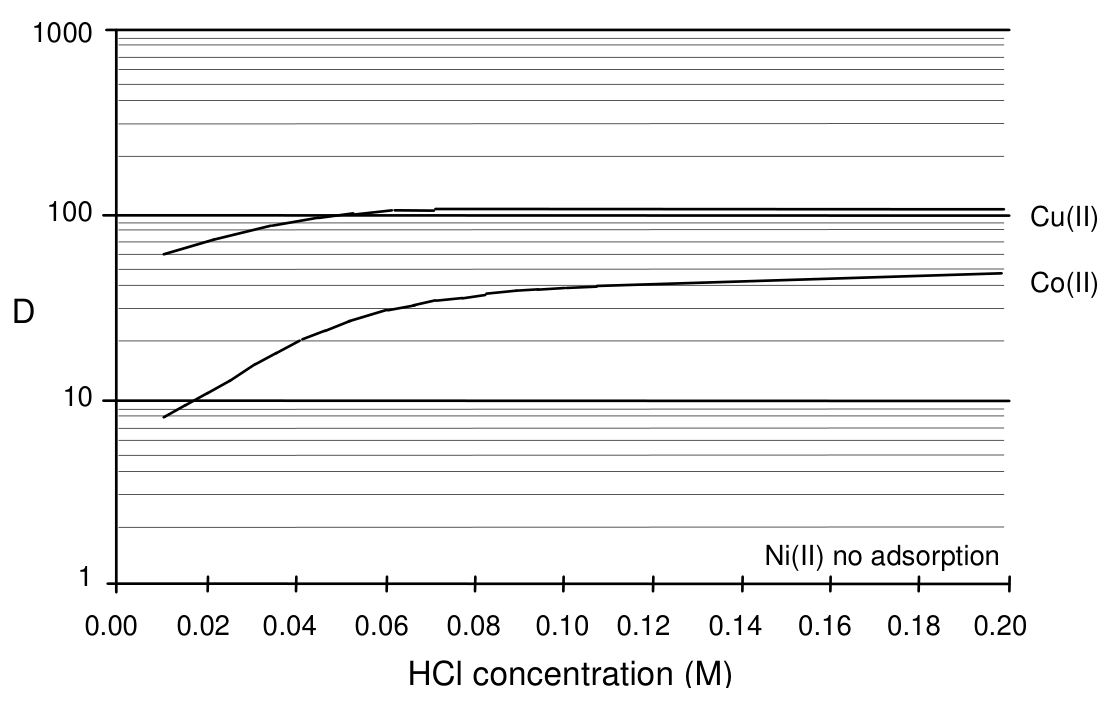
Figure 1. Distribution coefficients, \(D\) of metal ions between anion exchange resin and 96 % methanol at varying \(\ce{HCl}\) concentrations. (note \(D\) value for \(\ce{Zn}\) > 1000)
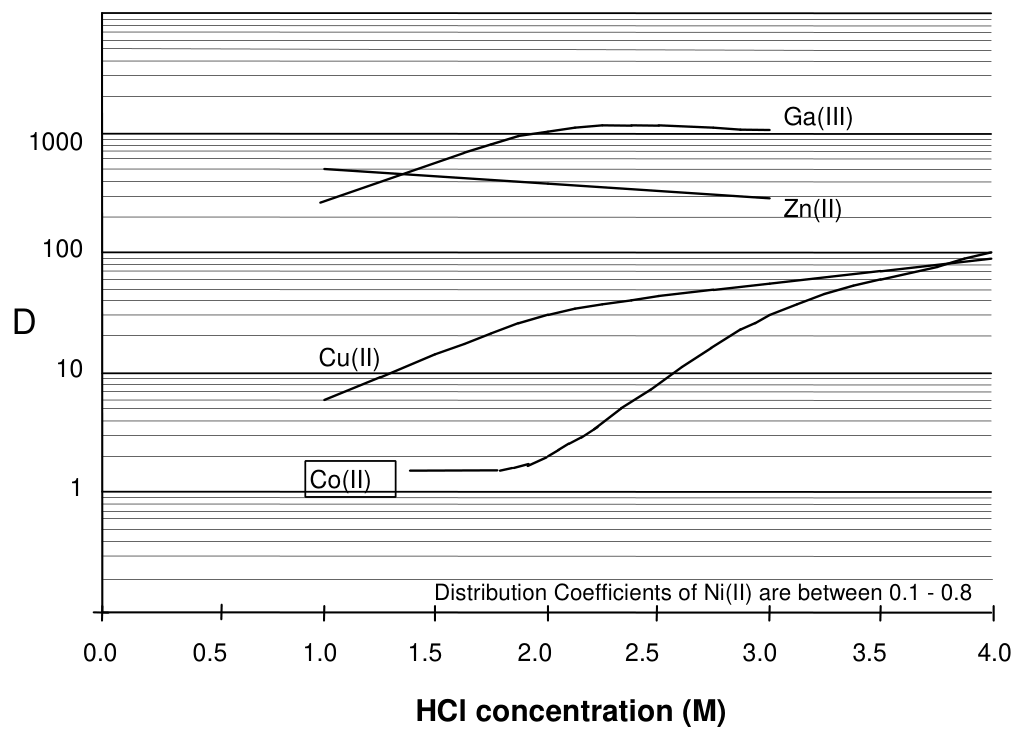
Figure 2. Distribution coefficients, \(D\) of metal ions between anion exchange resin and 55 % isopropyl alcohol at varying \(\ce{HCl}\) concentrations.
Official English text of the problem.
Answers
- 2.1: Approximately 1819.
- 2.2: The formation of gaseous radon-222 by alpha decay of radium-226. Radon escapes into the atmosphere, where its decay produces the precursors of Pb-210.
- 2.3: A suitable elution sequence is: remove Ni-57 using the loading solvent; elute Co-55 with approximately 2 M \(\ce{HCl}\) in 55% isopropyl alcohol; then elute Cu-64 with approximately 1 M \(\ce{HCl}\) in 55% isopropyl alcohol. Approximately 0.01 M \(\ce{HCl}\) in 96% methanol is another suitable cobalt eluent.
- 2.4: a) False; b) True; c) True; d) False; e) False. Here d) concerns the stated problem of long-lived contamination.
- 2.5: a) True; b) True; c) True; d) False.
- 2.6: a) False; b) True, approximately; c) False; d) True, interpreting contamination as the absolute production of contaminants arising from unchanged target construction.
Solution
2.1 — Dating the first pollen
The dating calculation assumes that the sediment originally had the same Pb-210 activity per unit mass as newly deposited surface sediment, and that subsequent activity loss was caused by radioactive decay.
For activity per unit mass \(a\),
\[ a(t)=a_0\,2^{-t/t_{1/2}}. \]
Therefore,
\[ \begin{aligned} t &=\frac{t_{1/2}}{\ln 2}\ln\!\left(\frac{a_0}{a(t)}\right)\\ &=\frac{22.0\ \mathrm{yr}}{\ln 2} \ln\!\left( \frac{356\ \mathrm{Bq\,kg^{-1}}} {1.40\ \mathrm{Bq\,kg^{-1}}} \right)\\ &=175.8\ \mathrm{yr} \approx176\ \mathrm{yr}. \end{aligned} \]
Thus the first pollen was deposited approximately in
\[ 1995-175.8=1819.2. \]
Since the trees pollinate during their first year of growth, the planting year was approximately 1819.
2.2 — Transport from the crust into the atmosphere
The crucial step is
\[ \ce{^{226}_{88}Ra -> ^{222}_{86}Rn + ^{4}_{2}He}. \]
Both mass number and nuclear charge are conserved:
\[ 226=222+4,\qquad 88=86+2. \]
Radon-222, atomic SMILES [222Rn], is a noble gas and can escape from rocks and soil into the atmosphere. Its subsequent radioactive descendants ultimately produce Pb-210. These non-gaseous products attach to atmospheric particles and are carried down by rain.
The emitted alpha particle is a helium-4 nucleus, \(\ce{^{4}He^{2+}}\), SMILES [4He+2]; the equation above uses conventional nuclear notation.
2.3 — Choosing the eluents
A large \(D\) means strong retention on the resin; a small \(D\) favours passage into the eluant. A useful eluent therefore gives the desired metal a relatively small \(D\), while maintaining a difference of at least 10 from metals that must remain on the column.
From the stated definition, \(D\) has units of \(\mathrm{cm^3\,mg^{-1}}\). The following values are approximate graph readings.
| Stage | Solvent system | Relevant \(D\) values | Result |
|---|---|---|---|
| Load and wash | 0.2 M \(\ce{HCl}\), 96% methanol | Ni: no adsorption; Co: about 50; Cu: about 100; Zn: \(>1000\) | Ni-57 passes through while Co, Cu and Zn remain retained. |
| Collect cobalt | About 2 M \(\ce{HCl}\), 55% isopropyl alcohol | Co: about 2; Cu: about 30; Zn: several hundred | Co-55 elutes while Cu and Zn remain more strongly retained. |
| Collect copper | About 1 M \(\ce{HCl}\), 55% isopropyl alcohol | Cu: about 6; Zn: about 500 | Cu-64 elutes after cobalt has been removed; Zn remains strongly retained. |
For the cobalt separation at approximately 2 M acid,
\[ D_{\mathrm{Cu}}-D_{\mathrm{Co}}\approx30-2=28>10. \]
For the subsequent copper–zinc separation,
\[ D_{\mathrm{Zn}}-D_{\mathrm{Cu}}\approx500-6\gg10. \]
Removing nickel during the initial wash is essential: in the isopropyl alcohol system its \(D\) is only 0.1–0.8, so it would accompany a weakly retained cobalt fraction if left on the column.
Figure 1 also supplies a viable cobalt eluent: at approximately 0.01 M \(\ce{HCl}\) in 96% methanol,
\[ D_{\mathrm{Co}}\approx8,\qquad D_{\mathrm{Cu}}\approx60, \]
giving a difference of approximately 52. Cobalt is more strongly retained under this condition than under the proposed isopropyl alcohol condition, but the separation criterion is satisfied.
The solvent components are:
- Hydrogen chloride, \(\ce{HCl}\), SMILES
Cl, used to provide the stated acid concentration. - Methanol, \(\ce{CH3OH}\), SMILES
CO. - Propan-2-ol, or isopropyl alcohol, \(\ce{CH3CH(OH)CH3}\), SMILES
CC(O)C.
The relevant metal-ion identities are listed below. These SMILES identify isotope and formal ion charge; the graphs do not specify the actual coordination structures or geometries of the adsorbed species.
| Metal-ion names | SMILES |
|---|---|
| Copper-64(II); copper-67(II) | [64Cu+2]; [67Cu+2] |
| Cobalt-55(II); cobalt-57(II) | [55Co+2]; [57Co+2] |
| Nickel-57(II) | [57Ni+2] |
| Zinc-65(II); zinc-68(II) | [65Zn+2]; [68Zn+2] |
| Gallium-66(III); gallium-67(III) | [66Ga+3]; [67Ga+3] |
2.4 — Identifying the interfering radionuclides
Ordinary ion-exchange chromatography separates different elements through their chemical behaviour. It does not usefully separate isotopes of the same element.
| Statement | Answer | Reason |
|---|---|---|
| a) Ni-57 may contaminate Co-55. | False | Under the stated separation conditions, nickel is removed during loading and washing because it is not adsorbed in the methanol system. |
| b) Co-57 interferes with Co-55. | True | Both are cobalt isotopes and accompany one another chemically. Co-57 has a half-life of 270 days, much longer than the 18.2 h half-life of Co-55. |
| c) Cu-67 interferes with Cu-64. | True | Both are copper isotopes and accompany one another chemically. Cu-67 has a longer half-life: 61.7 h versus 12.7 h. |
| d) Ga-66 interferes with Ga-67. | False, in the stated long-lived-contaminant sense | Ga-66 has a half-life of only 9.4 h, compared with 78.35 h for Ga-67. Its contribution decreases preferentially during storage. |
| e) Ga-67 interferes with Cu-64. | False | Gallium has already been retained on the first cation-exchange column, while copper enters the wash solution. |
For d), the relative activity follows
\[ \frac{a_{66}(t)}{a_{67}(t)} = \frac{a_{66}(0)}{a_{67}(0)} 2^{-t\left( \frac{1}{9.4\ \mathrm h}-\frac{1}{78.35\ \mathrm h} \right)}. \]
After 12 h this ratio is approximately \(0.459\) times its initial value. An initially present Ga-66 impurity can still matter before sufficient decay; it is not the persistent, long-lived impurity described in the question.
2.5 — Reducing contamination
Ni-57 produces Co-57 as it decays. Once formed, Co-57 accompanies Co-55 through chemical separation. Removing the nickel parent early prevents further production of this inseparable cobalt impurity.
| Statement | Answer | Reason |
|---|---|---|
| a) Remove Ni-57 before isolating Co-55. | True | Removing the parent prevents further Co-57 production in material that will supply the cobalt fraction. It cannot remove Co-57 already formed. |
| b) Remove Ni-57 from the target material before isolating Ga-67. | True | Earlier nickel removal reduces the time available for Co-57 formation before the subsequent cobalt separation. |
| c) Separate closer to the end of bombardment. | True | Less Co-57 forms before separation, and more of the short-lived desired radionuclides survives. |
| d) Allow Ni-57 to decay before isolating Co-55. | False | Waiting converts Ni-57 into the problematic Co-57 daughter while Co-55 itself continues to decay. |
For example, during the stated 12 h delay, the fraction of Ni-57 that decays is
\[ 1-2^{-12/36.0}=0.206, \]
or about 20.6%. Because Co-57 has a 270-day half-life, almost all daughter atoms formed during this short interval remain present.
The benefit of earlier separation in c) concerns daughter formation and preservation of useful activity. It is not a claim that every impurity benefits from earlier use: short-lived Ga-66 is reduced by allowing it to decay.
2.6 — Replacing enriched zinc with natural zinc
The principal intended production reaction is
\[ \ce{^{68}_{30}Zn + ^{1}_{1}H -> ^{67}_{31}Ga + 2 ^{1}_{0}n}. \]
Mass number and nuclear charge balance:
\[ 68+1=67+2,\qquad30+1=31. \]
For the same number of zinc atoms and the same irradiation conditions, the contribution from this reaction is proportional to the Zn-68 abundance. Using 98% as the approximate enriched abundance,
\[ \frac{Y_{\mathrm{natural}}}{Y_{\mathrm{enriched}}} \approx \frac{18.8}{98} =0.192. \]
Thus the natural-zinc yield is approximately one-fifth of the enriched-zinc yield:
\[ \frac{Y_{\mathrm{enriched}}}{Y_{\mathrm{natural}}} \approx5.21. \]
Accordingly:
| Statement | Answer | Reason |
|---|---|---|
| a) Fivefold higher Ga-67 yield. | False | Natural zinc contains substantially less Zn-68. |
| b) Fivefold lower Ga-67 yield. | True, approximately | The abundance estimate gives a reduction by a factor of about 5.2. |
| c) Lower Ga-67 yield and increased Cu, Co and Ni contaminant production. | False, under the intended target-construction assumption | Changing zinc enrichment does not increase the amount of the other target materials responsible for these contaminants. |
| d) Lower Ga-67 yield and unchanged Cu, Co and Ni contaminant production. | True, under the same assumption | Their absolute production remains approximately unchanged when target construction and irradiation are unchanged. |
The distinction is between absolute contaminant production and contamination relative to Ga-67. If contaminant activity remains constant while Ga-67 production falls to about 19%, the contaminant-to-Ga-67 activity ratio increases by about a factor of 5.2.
The solution was checked against the official solution.
IChO 1998 · Theorieaufgabe 2
Datierung historischer Ereignisse mit Pb-210; Trennung von Radionukliden für die Nuklearmedizin
Teil A: Datierung historischer Ereignisse mit Pb-210
Nathan Thompson, einer der ersten Bewohner der Lord-Howe-Insel, beschloss, einige europäische Laubbäume in seinem Garten anzupflanzen. Leider ist der genaue Zeitpunkt der Aussaat nicht bekannt. Im Laufe der Jahre sammelten sich am Grund des Sees in der Nähe von Nathans Haus Pollen europäischer Eichen und Ulmen an. Gleichzeitig wurden sehr geringe Mengen an radioaktivem Pb-210 (Halbwertszeit = 22.0 Jahre) abgelagert. Beachten Sie, dass europäische Eichen und Ulmen bereits in ihrem ersten Wachstumsjahr Pollen abgeben.
Im Jahr 1995 entnahm ein Forschungsteam einen Sedimentkern vom Grund des Sees. Der Sedimentkern wurde in 1 cm dicke Scheiben geschnitten und auf Pollen und radioaktives Pb-210 untersucht.
Die Untersuchung des Sedimentkerns ergab Folgendes:
- Pollen europäischer Eichen und Ulmen treten erstmals in einer Tiefe von 50 cm auf.
- Die Aktivität von Pb-210 beträgt am oberen Ende des Sedimentkerns 356 Bq/kg und in 50 cm Tiefe 1.40 Bq/kg.
2.1 In welchem Jahr säte Nathan Thompson die Samen aus?
Radioaktives Pb-210 ist eines der Tochternuklide von U-238. U-238 kommt in der Erdkruste vor, und aus irgendeinem Grund wird eine gewisse Menge Pb-210 mit dem Regen aus der Atmosphäre ausgewaschen und lagert sich an Sedimentpartikel an, die sich am Grund von Seen ansammeln.
- Die Zerfallsreihe von U-238 lautet:
* Sehr kurze Halbwertszeiten: Minuten und Tage
2.2 Welcher Schritt im Zerfallsschema erklärt, wie Pb-210 ins Regenwasser gelangt, obwohl sein Mutternuklid U-238 nur in der Erdkruste vorkommt?
Teil B: Trennung von Radionukliden für nuklearmedizinische Anwendungen.
Ga-67 wird zur bildgebenden Diagnostik von Lymphomen verwendet. Es wird vorzugsweise hergestellt, indem ein an Zn-68 angereichertes Target (> 98%) 11 Stunden lang mit hochenergetischen Protonen beschossen wird. Zn-68 hat eine natürliche Isotopenhäufigkeit von 18.8%. Aufgrund des Targetaufbaus können weitere Radionuklide entstehen (siehe Tabelle 1). Zwölf Stunden nach dem Ende des Beschusses wird Ga-67 an einem Kationenaustauscher gebunden. Anschließend werden die übrigen Radionuklide und das Zn-68 mit der Waschlösung eluiert, während Ga-67 an der Säule gebunden bleibt.
Tabelle 1
| Radionuklid | Halbwertszeit |
|---|---|
| Co-55 | 18.2 h |
| Ni-57 | 36.0 h |
| Co-57(Tochternuklid von Ni-57) | 270 Tage |
| Cu-64 | 12.7 h |
| Cu-67 | 61.7 h |
| Zn-65 | 244 Tage |
| Ga-67 | 78.35 h |
| Ga-66 | 9.4 h |
Cu-64 und Co-55 besitzen ideale Halbwertszeiten für nuklearmedizinische Anwendungen, und es wäre nützlich, sie aus der Waschlösung zu isolieren.
Der Verteilungskoeffizient \(D\) ist ein Maß für die Verteilung eines Metallions zwischen dem Ionenaustauscherharz und dem Elutionsmittel.
Für ein gegebenes Ionenaustauscherharz und Elutionsmittel ist \(D\) gegeben durch
\[ D= \frac{\text{Radioaktivität pro mg Harz}} {\text{Radioaktivität pro }\mathrm{cm^3}\text{ Elutionsmittel}} \]
Für eine hinreichende Trennung zweier Metallionen sollten sich ihre \(D\)-Werte um mindestens 10 Einheiten unterscheiden.
2.3 Die Waschlösung wird zur Trockne eingedampft und der Rückstand in einer kleinen Menge 0.2 M \(\ce{HCl}\) in 96 % Methanol resuspendiert und auf eine Anionenaustauschersäule aufgetragen. Verwenden Sie die in den Abbildungen 1 und 2 angegebenen Verteilungskoeffizienten \(D\) und ordnen Sie die besten Lösungsmittelsysteme (aus den gegebenen Alternativen) zur Elution von Cu-64 und Co-55 nach ihrer Eignung.
2.4 Nach der Isolierung der relevanten Radionuklide könnte die Anwesenheit einiger langlebiger Radionuklide die medizinische Verwendung von Cu-64, Co-55 oder Ga-67 beeinträchtigen. Geben Sie für jede der folgenden Aussagen an, ob sie richtig oder falsch ist (eine oder mehrere können richtig sein).
a) Ni-57 kann als Verunreinigung von Co-55 vorliegen.
b) Co-57 beeinträchtigt die medizinische Verwendung von Co-55.
c) Cu-67 beeinträchtigt die medizinische Verwendung von Cu-64.
d) Ga-66 beeinträchtigt die Verwendung von Ga-67.
e) Ga-67 beeinträchtigt die medizinische Verwendung von Cu-64.
2.5 Falls Cu-64, Co-55 oder Ga-67 durch Radionuklide verunreinigt wären, mit welcher Methode ließe sich die Menge der verunreinigenden Radionuklide verringern? Geben Sie für jede der folgenden Aussagen an, ob sie richtig oder falsch ist. (Eine oder mehrere können richtig sein.)
a) Ni-57 vor der Isolierung von Co-55 entfernen.
b) Ni-57 vor der Isolierung von Ga-67 vom beschossenen Targetmaterial abtrennen.
c) Die Radionuklide zeitlich näher am Ende des Beschusses trennen.
d) Ni-57 vor der Isolierung von Co-55 zerfallen lassen.
2.6 Wenn Zink mit natürlicher Isotopenhäufigkeit anstelle von angereichertem Zn-68 mit hochenergetischen Protonen beschossen würde, geben Sie für jede der folgenden Aussagen an, ob sie richtig oder falsch ist. (Eine oder mehrere können richtig sein.)
a) Ga-67 würde mit einer fünfmal höheren Ausbeute erzeugt.
b) Ga-67 würde mit einer fünfmal niedrigeren Ausbeute erzeugt.
c) Ga-67 würde mit einer niedrigeren Ausbeute erzeugt, und die Verunreinigung durch Cu-64, Co-55, Co-57 und Ni-57 würde zunehmen.
d) Ga-67 würde mit einer niedrigeren Ausbeute erzeugt, und die Verunreinigung durch Cu-64, Co-55, Co-57 und Ni-57 bliebe gleich.
Abbildung 1. Verteilungskoeffizienten \(D\) von Metallionen zwischen Anionenaustauscherharz und 96 % Methanol bei unterschiedlichen \(\ce{HCl}\)-Konzentrationen. (Beachten Sie: \(D\)-Wert für \(\ce{Zn}\) > 1000)
Abbildung 2. Verteilungskoeffizienten \(D\) von Metallionen zwischen Anionenaustauscherharz und 55 % Isopropanol bei unterschiedlichen \(\ce{HCl}\)-Konzentrationen.
Aufgabentext aus dem offiziellen englischen Text übersetzt.
Antworten
- 2.1: Ungefähr 1819.
- 2.2: Die Bildung von gasförmigem Radon-222 durch Alphazerfall von Radium-226. Radon entweicht in die Atmosphäre, wo durch seinen Zerfall die Vorläufer von Pb-210 entstehen.
- 2.3: Eine geeignete Elutionsfolge ist: Ni-57 mit dem zum Auftragen verwendeten Lösungsmittel entfernen; Co-55 mit ungefähr 2 M \(\ce{HCl}\) in 55% Isopropanol eluieren; anschließend Cu-64 mit ungefähr 1 M \(\ce{HCl}\) in 55% Isopropanol eluieren. Ungefähr 0.01 M \(\ce{HCl}\) in 96% Methanol ist ein weiteres geeignetes Elutionsmittel für Cobalt.
- 2.4: a) Falsch; b) Richtig; c) Richtig; d) Falsch; e) Falsch. Dabei bezieht sich d) auf das genannte Problem langlebiger Verunreinigungen.
- 2.5: a) Richtig; b) Richtig; c) Richtig; d) Falsch.
- 2.6: a) Falsch; b) Näherungsweise richtig; c) Falsch; d) Richtig, wenn unter Verunreinigung die absolute Produktion von Verunreinigungen verstanden wird, die sich aus dem unveränderten Targetaufbau ergibt.
Lösung
2.1 — Datierung der ersten Pollen
Die Datierungsrechnung setzt voraus, dass das Sediment ursprünglich dieselbe Pb-210-Aktivität pro Masseneinheit wie frisch abgelagertes Oberflächensediment besaß und dass der anschließende Aktivitätsverlust durch radioaktiven Zerfall verursacht wurde.
Für die Aktivität pro Masseneinheit \(a\) gilt:
\[ a(t)=a_0\,2^{-t/t_{1/2}}. \]
Daraus folgt:
\[ \begin{aligned} t &=\frac{t_{1/2}}{\ln 2}\ln\!\left(\frac{a_0}{a(t)}\right)\\ &=\frac{22.0\ \mathrm{yr}}{\ln 2} \ln\!\left( \frac{356\ \mathrm{Bq\,kg^{-1}}} {1.40\ \mathrm{Bq\,kg^{-1}}} \right)\\ &=175.8\ \mathrm{yr} \approx176\ \mathrm{yr}. \end{aligned} \]
Die ersten Pollen wurden somit ungefähr im folgenden Jahr abgelagert:
\[ 1995-175.8=1819.2. \]
Da die Bäume bereits in ihrem ersten Wachstumsjahr Pollen abgeben, erfolgte die Aussaat ungefähr im Jahr 1819.
2.2 — Transport aus der Erdkruste in die Atmosphäre
Der entscheidende Schritt ist
\[ \ce{^{226}_{88}Ra -> ^{222}_{86}Rn + ^{4}_{2}He}. \]
Sowohl die Massenzahl als auch die Kernladung bleiben erhalten:
\[ 226=222+4,\qquad 88=86+2. \]
Radon-222, atomarer SMILES-Ausdruck [222Rn], ist ein Edelgas und kann aus Gesteinen und Böden in die Atmosphäre entweichen. Seine nachfolgenden radioaktiven Zerfallsprodukte ergeben schließlich Pb-210. Diese nicht gasförmigen Produkte lagern sich an atmosphärische Partikel an und werden mit dem Regen ausgewaschen.
Das emittierte Alphateilchen ist ein Helium-4-Kern, \(\ce{^{4}He^{2+}}\), SMILES [4He+2]; die obige Gleichung verwendet die übliche Schreibweise für Kernreaktionen.
2.3 — Auswahl der Elutionsmittel
Ein großer Wert von \(D\) bedeutet eine starke Retention am Harz; ein kleiner Wert von \(D\) begünstigt den Übergang in das Elutionsmittel. Ein geeignetes Elutionsmittel ergibt daher für das gewünschte Metall einen relativ kleinen Wert von \(D\), während zu den Metallen, die auf der Säule verbleiben müssen, eine Differenz von mindestens 10 bestehen bleibt.
Nach der angegebenen Definition hat \(D\) die Einheit \(\mathrm{cm^3\,mg^{-1}}\). Die folgenden Werte wurden näherungsweise aus den Diagrammen abgelesen.
| Schritt | Lösungsmittelsystem | Relevante \(D\)-Werte | Ergebnis |
|---|---|---|---|
| Auftragen und Waschen | 0.2 M \(\ce{HCl}\), 96% Methanol | Ni: keine Adsorption; Co: etwa 50; Cu: etwa 100; Zn: \(>1000\) | Ni-57 läuft durch, während Co, Cu und Zn zurückgehalten werden. |
| Cobalt auffangen | Etwa 2 M \(\ce{HCl}\), 55% Isopropanol | Co: etwa 2; Cu: etwa 30; Zn: mehrere Hundert | Co-55 wird eluiert, während Cu und Zn stärker zurückgehalten werden. |
| Kupfer auffangen | Etwa 1 M \(\ce{HCl}\), 55% Isopropanol | Cu: etwa 6; Zn: etwa 500 | Cu-64 wird nach der Entfernung von Cobalt eluiert; Zn wird weiterhin stark zurückgehalten. |
Für die Cobaltabtrennung bei ungefähr 2 M Säure gilt:
\[ D_{\mathrm{Cu}}-D_{\mathrm{Co}}\approx30-2=28>10. \]
Für die anschließende Kupfer-Zink-Trennung gilt:
\[ D_{\mathrm{Zn}}-D_{\mathrm{Cu}}\approx500-6\gg10. \]
Die Entfernung von Nickel beim anfänglichen Waschen ist entscheidend: Im Isopropanolsystem beträgt sein \(D\)-Wert nur 0.1–0.8, sodass es zusammen mit einer schwach zurückgehaltenen Cobaltfraktion eluiert würde, wenn es auf der Säule verbliebe.
Abbildung 1 liefert ebenfalls ein geeignetes Elutionsmittel für Cobalt: Bei ungefähr 0.01 M \(\ce{HCl}\) in 96% Methanol gilt:
\[ D_{\mathrm{Co}}\approx8,\qquad D_{\mathrm{Cu}}\approx60, \]
woraus sich eine Differenz von ungefähr 52 ergibt. Cobalt wird unter dieser Bedingung stärker zurückgehalten als unter der vorgeschlagenen Isopropanolbedingung, doch das Trennkriterium ist erfüllt.
Die Lösungsmittelkomponenten sind:
- Chlorwasserstoff, \(\ce{HCl}\), SMILES
Cl, zur Einstellung der angegebenen Säurekonzentration. - Methanol, \(\ce{CH3OH}\), SMILES
CO. - Propan-2-ol oder Isopropanol, \(\ce{CH3CH(OH)CH3}\), SMILES
CC(O)C.
Die relevanten Metallionen sind nachstehend aufgeführt. Diese SMILES-Ausdrücke geben das Isotop und die formale Ionenladung an; die Diagramme geben die tatsächlichen Koordinationsstrukturen oder Geometrien der adsorbierten Spezies nicht an.
| Namen der Metallionen | SMILES |
|---|---|
| Kupfer-64(II); Kupfer-67(II) | [64Cu+2]; [67Cu+2] |
| Cobalt-55(II); Cobalt-57(II) | [55Co+2]; [57Co+2] |
| Nickel-57(II) | [57Ni+2] |
| Zink-65(II); Zink-68(II) | [65Zn+2]; [68Zn+2] |
| Gallium-66(III); Gallium-67(III) | [66Ga+3]; [67Ga+3] |
2.4 — Identifizierung der störenden Radionuklide
Die gewöhnliche Ionenaustauschchromatographie trennt verschiedene Elemente aufgrund ihres chemischen Verhaltens. Isotope desselben Elements lassen sich damit nicht wirksam trennen.
| Aussage | Antwort | Begründung |
|---|---|---|
| a) Ni-57 kann Co-55 verunreinigen. | Falsch | Unter den angegebenen Trennbedingungen wird Nickel beim Auftragen und Waschen entfernt, da es im Methanolsystem nicht adsorbiert wird. |
| b) Co-57 beeinträchtigt die Verwendung von Co-55. | Richtig | Beide sind Cobaltisotope und verhalten sich chemisch gleich. Co-57 hat eine Halbwertszeit von 270 Tagen, die wesentlich länger ist als die Halbwertszeit von Co-55 von 18.2 h. |
| c) Cu-67 beeinträchtigt die Verwendung von Cu-64. | Richtig | Beide sind Kupferisotope und verhalten sich chemisch gleich. Cu-67 hat eine längere Halbwertszeit: 61.7 h gegenüber 12.7 h. |
| d) Ga-66 beeinträchtigt die Verwendung von Ga-67. | Falsch, im angegebenen Sinne einer langlebigen Verunreinigung | Ga-66 hat eine Halbwertszeit von nur 9.4 h, verglichen mit 78.35 h für Ga-67. Sein Beitrag nimmt während der Lagerung schneller ab. |
| e) Ga-67 beeinträchtigt die Verwendung von Cu-64. | Falsch | Gallium wurde bereits auf der ersten Kationenaustauschersäule zurückgehalten, während Kupfer in die Waschlösung gelangt. |
Für d) folgt die relative Aktivität der Beziehung
\[ \frac{a_{66}(t)}{a_{67}(t)} = \frac{a_{66}(0)}{a_{67}(0)} 2^{-t\left( \frac{1}{9.4\ \mathrm h}-\frac{1}{78.35\ \mathrm h} \right)}. \]
Nach 12 h beträgt dieses Verhältnis ungefähr das \(0.459\)-Fache seines Anfangswerts. Eine anfänglich vorhandene Ga-66-Verunreinigung kann vor einem ausreichenden Zerfall durchaus noch von Bedeutung sein; sie ist jedoch nicht die in der Frage beschriebene beständige, langlebige Verunreinigung.
2.5 — Verringerung der Verunreinigungen
Beim Zerfall von Ni-57 entsteht Co-57. Sobald Co-57 gebildet wurde, begleitet es Co-55 bei der chemischen Trennung. Die frühzeitige Entfernung des Mutternuklids Nickel verhindert die weitere Bildung dieser nicht abtrennbaren Cobaltverunreinigung.
| Aussage | Antwort | Begründung |
|---|---|---|
| a) Ni-57 vor der Isolierung von Co-55 entfernen. | Richtig | Die Entfernung des Mutternuklids verhindert die weitere Bildung von Co-57 in dem Material, aus dem die Cobaltfraktion gewonnen wird. Bereits gebildetes Co-57 kann dadurch nicht entfernt werden. |
| b) Ni-57 vor der Isolierung von Ga-67 aus dem Targetmaterial entfernen. | Richtig | Eine frühere Entfernung von Nickel verkürzt die Zeit, die vor der anschließenden Cobaltabtrennung für die Bildung von Co-57 zur Verfügung steht. |
| c) Die Trennung zeitlich näher am Ende des Beschusses durchführen. | Richtig | Vor der Trennung entsteht weniger Co-57, und ein größerer Anteil der gewünschten kurzlebigen Radionuklide bleibt erhalten. |
| d) Ni-57 vor der Isolierung von Co-55 zerfallen lassen. | Falsch | Durch das Warten wird Ni-57 in das problematische Tochternuklid Co-57 umgewandelt, während Co-55 selbst weiter zerfällt. |
Beispielsweise beträgt während der angegebenen Wartezeit von 12 h der Anteil des Ni-57, der zerfällt,
\[ 1-2^{-12/36.0}=0.206, \]
also etwa 20.6%. Da Co-57 eine Halbwertszeit von 270 Tagen besitzt, bleiben nahezu alle während dieses kurzen Zeitraums gebildeten Tochteratome erhalten.
Der Vorteil einer früheren Trennung in c) betrifft die Bildung des Tochternuklids und die Erhaltung nutzbarer Aktivität. Damit wird nicht behauptet, dass eine frühere Verwendung hinsichtlich jeder Verunreinigung vorteilhaft ist: Kurzlebiges Ga-66 wird durch Abwarten seines Zerfalls verringert.
2.6 — Ersatz von angereichertem Zink durch natürliches Zink
Die hauptsächlich beabsichtigte Herstellungsreaktion lautet
\[ \ce{^{68}_{30}Zn + ^{1}_{1}H -> ^{67}_{31}Ga + 2 ^{1}_{0}n}. \]
Massenzahl und Kernladung sind ausgeglichen:
\[ 68+1=67+2,\qquad30+1=31. \]
Bei gleicher Anzahl an Zinkatomen und gleichen Bestrahlungsbedingungen ist der Beitrag dieser Reaktion proportional zur Isotopenhäufigkeit von Zn-68. Mit 98% als näherungsweiser Isotopenhäufigkeit im angereicherten Material ergibt sich:
\[ \frac{Y_{\mathrm{natural}}}{Y_{\mathrm{enriched}}} \approx \frac{18.8}{98} =0.192. \]
Somit beträgt die Ausbeute mit natürlichem Zink ungefähr ein Fünftel der Ausbeute mit angereichertem Zink:
\[ \frac{Y_{\mathrm{enriched}}}{Y_{\mathrm{natural}}} \approx5.21. \]
Dementsprechend gilt:
| Aussage | Antwort | Begründung |
|---|---|---|
| a) Fünfmal höhere Ga-67-Ausbeute. | Falsch | Natürliches Zink enthält wesentlich weniger Zn-68. |
| b) Fünfmal niedrigere Ga-67-Ausbeute. | Näherungsweise richtig | Die Abschätzung anhand der Isotopenhäufigkeit ergibt eine Verringerung um einen Faktor von etwa 5.2. |
| c) Niedrigere Ga-67-Ausbeute und erhöhte Produktion von Cu-, Co- und Ni-Verunreinigungen. | Falsch, unter der zugrunde gelegten Annahme zum Targetaufbau | Eine Änderung der Zinkanreicherung erhöht nicht die Menge der anderen Targetmaterialien, die für diese Verunreinigungen verantwortlich sind. |
| d) Niedrigere Ga-67-Ausbeute und unveränderte Produktion von Cu-, Co- und Ni-Verunreinigungen. | Richtig, unter derselben Annahme | Ihre absolute Produktion bleibt bei unverändertem Targetaufbau und unveränderter Bestrahlung näherungsweise gleich. |
Zu unterscheiden ist zwischen der absoluten Produktion von Verunreinigungen und der Verunreinigung relativ zu Ga-67. Wenn die Aktivität der Verunreinigungen konstant bleibt, während die Ga-67-Produktion auf etwa 19% sinkt, steigt das Verhältnis der Aktivität der Verunreinigungen zur Ga-67-Aktivität ungefähr um den Faktor 5.2.
Die Lösung wurde mit der offiziellen Lösung abgeglichen.
IChO 1998 · Teori sorusu 2
Pb-210 kullanılarak tarihsel olayların tarihlendirilmesi; nükleer tıp için radyonüklitlerin ayrılması
Bölüm A: Pb-210 Kullanılarak Tarihsel Olayların Tarihlendirilmesi
Lord Howe Adası'nın ilk sakinlerinden biri olan Nathan Thompson, bahçesine Avrupa kökenli, yaprak döken bazı ağaçlar dikmeye karar verdi. Ne yazık ki tohumların tam olarak ne zaman ekildiği bilinmiyor. Yıllar boyunca, Avrupa meşesi ve karaağacının ürettiği polenler Nathan'ın evinin yakınındaki gölün dibinde birikti. Aynı zamanda çok küçük miktarlarda radyoaktif Pb-210 (yarı ömür = 22.0 yıl) da birikti. Avrupa meşesi ve karaağaçlarının büyümelerinin ilk yılında polen ürettiğine dikkat ediniz.
1995 yılında bir araştırma ekibi gölün dibinden bir tortu karotu örneği aldı. Tortu karotu 1 cm kalınlığında dilimlere kesildi ve polen ile radyoaktif Pb-210 bakımından incelendi.
Tortu karotunun incelenmesi sonucunda şunlar bulundu:
- Avrupa meşesi ve karaağacı polenlerine ilk kez 50 cm derinlikte rastlanmaktadır.
- Pb-210'un aktivitesi tortu karotunun en üst kısmında 356 Bq/kg, 50 cm derinlikte ise 1.40 Bq/kg'dır.
2.1 Nathan Thompson tohumları hangi yıl ekmiştir?
Radyoaktif Pb-210, U-238'in bozunma ürünlerinden biridir. U-238 yer kabuğunda bulunur ve bir nedenle belirli bir miktar Pb-210 atmosferden yağmurla yeryüzüne iner ve göllerin dibinde biriken tortu parçacıklarına tutunur.
- U-238 bozunma zinciri şöyledir:
* Çok kısa yarı ömürler: dakikalar ve günler
2.2 Bozunma şemasındaki hangi basamak, ana nüklidi U-238 yalnızca yer kabuğunda bulunurken Pb-210'un yağmur suyuna nasıl geçtiğini açıklar?
Bölüm B: Nükleer Tıp Uygulamaları için Radyonüklitlerin Ayrılması.
Ga-67, lenfoma görüntülemesinde kullanılır. Üretiminde tercih edilen yöntem, Zn-68 bakımından zenginleştirilmiş (> 98%) bir hedefin 11 saat boyunca yüksek enerjili protonlarla bombardıman edilmesidir. Zn-68'in doğal bolluğu 18.8%'dir. Hedefin tasarımı nedeniyle başka radyonüklitler de üretilebilir (bkz. Tablo 1). Bombardımanın sona ermesinden on iki saat sonra Ga-67, bir katyon değiştiriciye bağlanır. Ardından diğer radyonüklitler ve Zn-68 yıkama çözeltisiyle elüe edilirken Ga-67 kolona bağlı kalır.
Tablo 1
| Radyonüklit | Yarı ömür |
|---|---|
| Co-55 | 18.2 saat |
| Ni-57 | 36.0 saat |
| Co-57(Ni-57'nin bozunma ürünü) | 270 gün |
| Cu-64 | 12.7 saat |
| Cu-67 | 61.7 saat |
| Zn-65 | 244 gün |
| Ga-67 | 78.35 saat |
| Ga-66 | 9.4 saat |
Cu-64 ve Co-55, nükleer tıp uygulamalarında kullanım için ideal yarı ömürlere sahiptir ve bunların yıkama çözeltisinden ayrılarak elde edilmesi yararlı olacaktır.
Dağılım katsayısı \(D\), bir metal iyonunun iyon değiştirici reçine ile elüent arasındaki dağılımının bir ölçüsüdür.
Belirli bir iyon değiştirici reçine ve elüent için \(D\) şu şekilde verilir:
\[ D= \frac{\text{reçinenin mg'ı başına radyoaktivite}} {\text{elüentin }\mathrm{cm^3}\text{'ü başına radyoaktivite}} \]
İki metal iyonunun yeterli düzeyde ayrılabilmesi için \(D\) değerleri arasında en az 10 birim fark olmalıdır.
2.3 Yıkama çözeltisi kuruluğa kadar buharlaştırılır ve kalıntı, az miktarda 0.2 M \(\ce{HCl}\) içeren 96 % metanolde yeniden süspanse edilerek bir anyon değişim kolonuna yüklenir. Şekil 1 ve 2'de verilen dağılım katsayılarını, \(D\), kullanarak Cu-64 ve Co-55'i elüe etmek için en uygun çözücü sistemlerini (verilen seçenekler arasından) sıralayınız.
2.4 İlgili radyonüklitler ayrılarak elde edildikten sonra, bazı uzun ömürlü radyonüklitlerin varlığı Cu-64, Co-55 veya Ga-67'nin tıbbi kullanımını olumsuz etkileyebilir. Aşağıdaki ifadelerin her birinin doğru mu yanlış mı olduğunu belirtiniz (bir veya birden fazlası doğru olabilir).
a) Ni-57, Co-55'te bir safsızlık olarak bulunabilir.
b) Co-57, Co-55'in tıbbi kullanımını olumsuz etkiler.
c) Cu-67, Cu-64'ün tıbbi kullanımını olumsuz etkiler.
d) Ga-66, Ga-67'nin kullanımını olumsuz etkiler.
e) Ga-67, Cu-64'ün tıbbi kullanımını olumsuz etkiler.
2.5 Cu-64, Co-55 veya Ga-67'de radyonüklit safsızlığı bulunması durumunda, hangi yöntem radyonüklit safsızlıklarının miktarını azaltır? Aşağıdaki ifadelerin her birinin doğru mu yanlış mı olduğunu belirtiniz. (Bir veya birden fazlası doğru olabilir).
a) Co-55'i ayırmadan önce Ni-57'yi uzaklaştırmak.
b) Ga-67'yi ayırmadan önce Ni-57'yi bombardıman edilmiş hedef malzemesinden ayırmak.
c) Radyonüklitleri bombardımanın bitimine daha yakın bir zamanda ayırmak.
d) Co-55'i ayırmadan önce Ni-57'nin bozunmasını beklemek.
2.6 Zenginleştirilmiş Zn-68 yerine doğal izotop bolluğuna sahip çinko yüksek enerjili protonlarla bombardıman edilseydi, aşağıdaki ifadelerin her birinin doğru mu yanlış mı olacağını belirtiniz. (Bir veya birden fazlası doğru olabilir).
a) Ga-67, 5 kat daha yüksek verimle üretilirdi.
b) Ga-67, 5 kat daha düşük verimle üretilirdi.
c) Ga-67 daha düşük verimle üretilir ve Cu-64, Co-55, Co-57, Ni-57 safsızlıkları artardı.
d) Ga-67 daha düşük verimle üretilir ve Cu-64, Co-55, Co-57, Ni-57 safsızlıkları aynı kalırdı.
Şekil 1. Farklı \(\ce{HCl}\) derişimlerinde metal iyonlarının anyon değiştirici reçine ile 96 % metanol arasındaki dağılım katsayıları, \(D\). (\(\ce{Zn}\) için \(D\) değerinin > 1000 olduğuna dikkat ediniz)
Şekil 2. Farklı \(\ce{HCl}\) derişimlerinde metal iyonlarının anyon değiştirici reçine ile 55 % izopropil alkol arasındaki dağılım katsayıları, \(D\).
Soru metni resmi İngilizce metinden çevrilmiştir.
Cevaplar
- 2.1: Yaklaşık 1819.
- 2.2: Radyum-226'nın alfa bozunmasıyla gaz hâlindeki radon-222'nin oluşması. Radon atmosfere kaçar ve burada bozunarak Pb-210'un öncüllerini oluşturur.
- 2.3: Uygun bir elüsyon sırası şöyledir: yükleme çözücüsünü kullanarak Ni-57'yi uzaklaştırmak; Co-55'i 55% izopropil alkol içinde yaklaşık 2 M \(\ce{HCl}\) ile elüe etmek; ardından Cu-64'ü 55% izopropil alkol içinde yaklaşık 1 M \(\ce{HCl}\) ile elüe etmek. 96% metanol içinde yaklaşık 0.01 M \(\ce{HCl}\) de kobalt için uygun bir başka elüenttir.
- 2.4: a) Yanlış; b) Doğru; c) Doğru; d) Yanlış; e) Yanlış. Burada d), belirtilen uzun ömürlü safsızlık sorunuyla ilgilidir.
- 2.5: a) Doğru; b) Doğru; c) Doğru; d) Yanlış.
- 2.6: a) Yanlış; b) Yaklaşık olarak doğru; c) Yanlış; d) Doğru; burada safsızlık, değişmeyen hedef yapısından kaynaklanan safsızlıkların mutlak üretim miktarı olarak yorumlanmaktadır.
Çözüm
2.1 — İlk polenlerin tarihlendirilmesi
Tarihlendirme hesabında, tortunun başlangıçta birim kütle başına Pb-210 aktivitesinin yeni çökelmiş yüzey tortusuyla aynı olduğu ve sonraki aktivite kaybının radyoaktif bozunmadan kaynaklandığı varsayılır.
Birim kütle başına aktivite \(a\) için,
\[ a(t)=a_0\,2^{-t/t_{1/2}}. \]
Dolayısıyla,
\[ \begin{aligned} t &=\frac{t_{1/2}}{\ln 2}\ln\!\left(\frac{a_0}{a(t)}\right)\\ &=\frac{22.0\ \mathrm{yr}}{\ln 2} \ln\!\left( \frac{356\ \mathrm{Bq\,kg^{-1}}} {1.40\ \mathrm{Bq\,kg^{-1}}} \right)\\ &=175.8\ \mathrm{yr} \approx176\ \mathrm{yr}. \end{aligned} \]
Böylece ilk polenlerin biriktiği yaklaşık yıl
\[ 1995-175.8=1819.2. \]
olarak bulunur. Ağaçlar büyümelerinin ilk yılında polen ürettiklerinden, tohumların ekildiği yıl yaklaşık 1819'dur.
2.2 — Yer kabuğundan atmosfere taşınma
Belirleyici basamak şudur:
\[ \ce{^{226}_{88}Ra -> ^{222}_{86}Rn + ^{4}_{2}He}. \]
Hem kütle numarası hem de çekirdek yükü korunur:
\[ 226=222+4,\qquad 88=86+2. \]
Atomik SMILES gösterimi [222Rn] olan radon-222 bir soy gazdır ve kayaçlardan ve topraktan atmosfere kaçabilir. Ardışık radyoaktif bozunma ürünleri sonunda Pb-210'u oluşturur. Gaz hâlinde olmayan bu ürünler atmosferdeki parçacıklara tutunur ve yağmurla yeryüzüne taşınır.
Yayımlanan alfa parçacığı, SMILES gösterimi [4He+2] olan bir helyum-4 çekirdeğidir, \(\ce{^{4}He^{2+}}\); yukarıdaki denklemde geleneksel çekirdek gösterimi kullanılmıştır.
2.3 — Elüentlerin seçilmesi
Büyük bir \(D\), reçinede güçlü tutulma anlamına gelir; küçük bir \(D\) ise elüente geçişi destekler. Dolayısıyla kullanışlı bir elüent, istenen metal için nispeten küçük bir \(D\) sağlarken kolonda kalması gereken metallerle en az 10 birimlik farkı korur.
Verilen tanıma göre \(D\)'nin birimi \(\mathrm{cm^3\,mg^{-1}}\)'dir. Aşağıdaki değerler grafiklerden okunan yaklaşık değerlerdir.
| Aşama | Çözücü sistemi | İlgili \(D\) değerleri | Sonuç |
|---|---|---|---|
| Yükleme ve yıkama | 0.2 M \(\ce{HCl}\), 96% metanol | Ni: adsorpsiyon yok; Co: yaklaşık 50; Cu: yaklaşık 100; Zn: \(>1000\) | Ni-57 kolondan geçerken Co, Cu ve Zn tutulmaya devam eder. |
| Kobaltın toplanması | Yaklaşık 2 M \(\ce{HCl}\), 55% izopropil alkol | Co: yaklaşık 2; Cu: yaklaşık 30; Zn: birkaç yüz | Co-55 elüe olurken Cu ve Zn daha güçlü biçimde tutulmaya devam eder. |
| Bakırın toplanması | Yaklaşık 1 M \(\ce{HCl}\), 55% izopropil alkol | Cu: yaklaşık 6; Zn: yaklaşık 500 | Kobalt uzaklaştırıldıktan sonra Cu-64 elüe olur; Zn güçlü biçimde tutulmaya devam eder. |
Yaklaşık 2 M asit derişiminde kobaltın ayrılması için,
\[ D_{\mathrm{Cu}}-D_{\mathrm{Co}}\approx30-2=28>10. \]
Ardından gerçekleştirilen bakır–çinko ayırması için,
\[ D_{\mathrm{Zn}}-D_{\mathrm{Cu}}\approx500-6\gg10. \]
İlk yıkama sırasında nikelin uzaklaştırılması zorunludur: izopropil alkol sisteminde \(D\) değeri yalnızca 0.1–0.8 olduğundan, kolonda bırakılırsa zayıf tutulan kobalt fraksiyonuna eşlik eder.
Şekil 1 de kobalt için uygulanabilir bir elüent sunar: 96% metanol içinde yaklaşık 0.01 M \(\ce{HCl}\) koşulunda,
\[ D_{\mathrm{Co}}\approx8,\qquad D_{\mathrm{Cu}}\approx60, \]
olduğundan yaklaşık 52 birimlik bir fark elde edilir. Bu koşulda kobalt, önerilen izopropil alkol koşuluna göre daha güçlü tutulur; ancak ayırma ölçütü sağlanır.
Çözücü bileşenleri şunlardır:
- Belirtilen asit derişimini sağlamak için kullanılan hidrojen klorür, \(\ce{HCl}\), SMILES
Cl. - Metanol, \(\ce{CH3OH}\), SMILES
CO. - Propan-2-ol veya izopropil alkol, \(\ce{CH3CH(OH)CH3}\), SMILES
CC(O)C.
İlgili metal iyonlarının kimlikleri aşağıda listelenmiştir. Bu SMILES gösterimleri izotopu ve biçimsel iyon yükünü belirtir; grafikler adsorplanan türlerin gerçek koordinasyon yapılarını veya geometrilerini belirtmez.
| Metal iyonlarının adları | SMILES |
|---|---|
| Bakır-64(II); bakır-67(II) | [64Cu+2]; [67Cu+2] |
| Kobalt-55(II); kobalt-57(II) | [55Co+2]; [57Co+2] |
| Nikel-57(II) | [57Ni+2] |
| Çinko-65(II); çinko-68(II) | [65Zn+2]; [68Zn+2] |
| Galyum-66(III); galyum-67(III) | [66Ga+3]; [67Ga+3] |
2.4 — Kullanımı olumsuz etkileyen radyonüklitlerin belirlenmesi
Olağan iyon değişim kromatografisi, farklı elementleri kimyasal davranışlarına göre ayırır. Aynı elementin izotoplarını işe yarar düzeyde ayırmaz.
| İfade | Cevap | Gerekçe |
|---|---|---|
| a) Ni-57, Co-55'te safsızlık olarak bulunabilir. | Yanlış | Belirtilen ayırma koşullarında nikel, metanol sisteminde adsorplanmadığı için yükleme ve yıkama sırasında uzaklaştırılır. |
| b) Co-57, Co-55'in kullanımını olumsuz etkiler. | Doğru | Her ikisi de kobalt izotopudur ve kimyasal işlemlerde birlikte hareket eder. Co-57'nin yarı ömrü 270 gündür; bu, Co-55'in 18.2 saatlik yarı ömründen çok daha uzundur. |
| c) Cu-67, Cu-64'ün kullanımını olumsuz etkiler. | Doğru | Her ikisi de bakır izotopudur ve kimyasal işlemlerde birlikte hareket eder. Cu-67'nin yarı ömrü daha uzundur: 12.7 saate karşılık 61.7 saat. |
| d) Ga-66, Ga-67'nin kullanımını olumsuz etkiler. | Belirtilen uzun ömürlü safsızlık anlamında yanlış | Ga-67'nin 78.35 saatlik yarı ömrüne karşılık Ga-66'nın yarı ömrü yalnızca 9.4 saattir. Saklama sırasında katkısı daha hızlı azalır. |
| e) Ga-67, Cu-64'ün kullanımını olumsuz etkiler. | Yanlış | Bakır yıkama çözeltisine geçerken galyum ilk katyon değişim kolonunda zaten tutulmuştur. |
d) için bağıl aktivite şu bağıntıya uyar:
\[ \frac{a_{66}(t)}{a_{67}(t)} = \frac{a_{66}(0)}{a_{67}(0)} 2^{-t\left( \frac{1}{9.4\ \mathrm h}-\frac{1}{78.35\ \mathrm h} \right)}. \]
12 saat sonra bu oran başlangıç değerinin yaklaşık \(0.459\) katıdır. Başlangıçta bulunan bir Ga-66 safsızlığı, yeterince bozunmadan önce yine de önem taşıyabilir; ancak soruda anlatılan kalıcı, uzun ömürlü safsızlık değildir.
2.5 — Safsızlıkların azaltılması
Ni-57 bozunurken Co-57 üretir. Co-57 bir kez oluştuktan sonra kimyasal ayırma boyunca Co-55'e eşlik eder. Ana nüklit olan nikelin erken uzaklaştırılması, ayrılamayan bu kobalt safsızlığının daha fazla üretilmesini önler.
| İfade | Cevap | Gerekçe |
|---|---|---|
| a) Co-55'i ayırmadan önce Ni-57'yi uzaklaştırmak. | Doğru | Ana nüklidin uzaklaştırılması, kobalt fraksiyonunun elde edileceği malzemede daha fazla Co-57 üretilmesini önler. Önceden oluşmuş Co-57'yi uzaklaştıramaz. |
| b) Ga-67'yi ayırmadan önce Ni-57'yi hedef malzemesinden uzaklaştırmak. | Doğru | Nikelin daha erken uzaklaştırılması, daha sonra gerçekleştirilecek kobalt ayırmasına kadar Co-57 oluşumu için mevcut süreyi kısaltır. |
| c) Bombardımanın bitimine daha yakın bir zamanda ayırmak. | Doğru | Ayırmadan önce daha az Co-57 oluşur ve istenen kısa ömürlü radyonüklitlerin daha büyük bir kısmı bozunmadan kalır. |
| d) Co-55'i ayırmadan önce Ni-57'nin bozunmasını beklemek. | Yanlış | Beklemek, Co-55'in kendisi bozunmaya devam ederken Ni-57'yi sorun oluşturan bozunma ürünü Co-57'ye dönüştürür. |
Örneğin, belirtilen 12 saatlik gecikme sırasında Ni-57'nin bozunan kesri
\[ 1-2^{-12/36.0}=0.206, \]
yani yaklaşık 20.6%'dır. Co-57'nin yarı ömrü 270 gün olduğundan, bu kısa zaman aralığında oluşan bozunma ürünü atomlarının neredeyse tamamı varlığını korur.
c)'de daha erken ayırmanın yararı, bozunma ürünü oluşumu ve yararlı aktivitenin korunmasıyla ilgilidir. Bu, daha erken kullanımın her safsızlık açısından yararlı olduğu iddiası değildir: kısa ömürlü Ga-66, bozunması beklendiğinde azalır.
2.6 — Zenginleştirilmiş çinko yerine doğal çinko kullanılması
Amaçlanan başlıca üretim tepkimesi şudur:
\[ \ce{^{68}_{30}Zn + ^{1}_{1}H -> ^{67}_{31}Ga + 2 ^{1}_{0}n}. \]
Kütle numarası ve çekirdek yükü denkliği sağlanır:
\[ 68+1=67+2,\qquad30+1=31. \]
Aynı sayıda çinko atomu ve aynı ışınlama koşulları için bu tepkimenin katkısı, Zn-68 bolluğuyla orantılıdır. Zenginleştirilmiş örnekteki yaklaşık bolluk olarak 98% kullanılırsa,
\[ \frac{Y_{\mathrm{natural}}}{Y_{\mathrm{enriched}}} \approx \frac{18.8}{98} =0.192. \]
Dolayısıyla doğal çinkoyla elde edilen verim, zenginleştirilmiş çinkoyla elde edilen verimin yaklaşık beşte biridir:
\[ \frac{Y_{\mathrm{enriched}}}{Y_{\mathrm{natural}}} \approx5.21. \]
Buna göre:
| İfade | Cevap | Gerekçe |
|---|---|---|
| a) Beş kat daha yüksek Ga-67 verimi. | Yanlış | Doğal çinko önemli ölçüde daha az Zn-68 içerir. |
| b) Beş kat daha düşük Ga-67 verimi. | Yaklaşık olarak doğru | Bolluklara dayalı tahmin, yaklaşık 5.2 katlık bir azalma verir. |
| c) Daha düşük Ga-67 verimi ve artan Cu, Co ve Ni safsızlığı üretimi. | Hedefin yapısına ilişkin amaçlanan varsayım altında yanlış | Çinkonun zenginleştirme düzeyini değiştirmek, bu safsızlıklardan sorumlu diğer hedef malzemelerinin miktarını artırmaz. |
| d) Daha düşük Ga-67 verimi ve değişmeyen Cu, Co ve Ni safsızlığı üretimi. | Aynı varsayım altında doğru | Hedefin yapısı ve ışınlama değişmediğinde bunların mutlak üretim miktarları yaklaşık olarak aynı kalır. |
Buradaki ayrım, mutlak safsızlık üretimi ile Ga-67'ye göre bağıl safsızlık düzeyi arasındadır. Ga-67 üretimi yaklaşık 19%'a düşerken safsızlık aktivitesi sabit kalırsa, safsızlık aktivitesinin Ga-67 aktivitesine oranı yaklaşık 5.2 kat artar.
Çözüm, resmi çözümle karşılaştırılarak kontrol edildi.
IChO 1998 · Problema teórico 2
Datación de acontecimientos históricos mediante Pb-210; separación de radionúclidos para medicina nuclear
Parte A: Datación de acontecimientos históricos mediante Pb-210
Nathan Thompson, uno de los primeros habitantes de la isla de Lord Howe, decidió plantar algunos árboles europeos de hoja caduca en su jardín. Por desgracia, no se conoce la fecha exacta en que sembró las semillas. A lo largo de los años, el polen producido por los robles y olmos europeos se acumuló en el fondo del lago cercano a la casa de Nathan. Al mismo tiempo se depositaron cantidades muy pequeñas de Pb-210 radiactivo (período de semidesintegración = 22.0 años). Téngase en cuenta que los robles y olmos europeos polinizan en su primer año de crecimiento.
En 1995, un equipo de investigadores extrajo un testigo de sedimento del fondo del lago. El testigo de sedimento se cortó en secciones de 1 cm y se examinó para detectar polen y Pb-210 radiactivo.
El examen del testigo de sedimento reveló que:
- El polen de roble y olmo europeos aparece por primera vez a una profundidad de 50 cm.
- La actividad del Pb-210 en la parte superior del testigo de sedimento es de 356 Bq/kg y, a 50 cm de profundidad, de 1.40 Bq/kg.
2.1 ¿En qué año sembró Nathan Thompson las semillas?
El Pb-210 radiactivo es uno de los descendientes del U-238. El U-238 está presente en la corteza terrestre y, por alguna razón, una cierta cantidad de Pb-210 precipita desde la atmósfera con la lluvia y se adhiere a las partículas de sedimento que se acumulan en el fondo de los lagos.
- La cadena de desintegración del U-238 es:
* Períodos de semidesintegración muy cortos: minutos y días
2.2 ¿Qué etapa del esquema de desintegración explica cómo el Pb-210 acaba en el agua de lluvia, mientras que su precursor U-238 solo está presente en la corteza terrestre?
Parte B: Separación de radionúclidos para aplicaciones en medicina nuclear.
El Ga-67 se utiliza para obtener imágenes de linfomas. Se produce preferentemente bombardeando un blanco enriquecido en Zn-68 (> 98%) con protones de alta energía durante 11 h. El Zn-68 tiene una abundancia natural del 18.8%. Debido al diseño del blanco, pueden producirse otros radionúclidos (véase la Tabla 1). Doce horas después de finalizar el bombardeo, el Ga-67 se fija en un intercambiador catiónico. A continuación, los otros radionúclidos y el Zn-68 se eluyen con la solución de lavado, de modo que el Ga-67 permanece retenido en la columna.
Tabla 1
| Radionúclido | Período de semidesintegración |
|---|---|
| Co-55 | 18.2 h |
| Ni-57 | 36.0 h |
| Co-57(descendiente del Ni-57) | 270 días |
| Cu-64 | 12.7 h |
| Cu-67 | 61.7 h |
| Zn-65 | 244 días |
| Ga-67 | 78.35 h |
| Ga-66 | 9.4 h |
El Cu-64 y el Co-55 tienen períodos de semidesintegración ideales para su uso en aplicaciones de medicina nuclear y sería útil aislarlos de la solución de lavado.
El coeficiente de distribución \(D\) es una medida del reparto de un ion metálico entre la resina de intercambio iónico y el eluyente.
Para una resina de intercambio iónico y un eluyente dados, \(D\) viene dado por
\[ D= \frac{\text{radiactividad por mg de resina}} {\text{radiactividad por }\mathrm{cm^3}\text{ de eluyente}} \]
Para lograr una separación razonable de dos iones metálicos, sus valores de \(D\) deben diferir en al menos 10 unidades.
2.3 La solución de lavado se evapora hasta sequedad y el residuo se resuspende en una pequeña cantidad de \(\ce{HCl}\) 0.2 M en metanol al 96 % y se carga en una columna de intercambio aniónico. Utilice los coeficientes de distribución \(D\) indicados en las Figuras 1 y 2 y ordene los mejores sistemas de disolventes (entre las alternativas dadas) para eluir el Cu-64 y el Co-55.
2.4 Una vez aislados los radionúclidos pertinentes, la presencia de algunos radionúclidos de vida larga podría interferir con el uso médico del Cu-64, del Co-55 o del Ga-67. Indique cuáles de las siguientes afirmaciones son verdaderas o falsas (una o más pueden ser verdaderas).
a) El Ni-57 puede estar presente como contaminante del Co-55.
b) El Co-57 interferirá con el uso médico del Co-55.
c) El Cu-67 interferirá con el uso médico del Cu-64.
d) El Ga-66 interferirá con el uso del Ga-67.
e) El Ga-67 interferirá con el uso médico del Cu-64.
2.5 Si se produjera contaminación por radionúclidos del Cu-64, del Co-55 o del Ga-67, ¿qué método reduciría la cantidad de radionúclidos contaminantes? Indique cuáles de las siguientes afirmaciones son verdaderas o falsas. (Una o más pueden ser verdaderas).
a) Eliminar el Ni-57 antes de aislar el Co-55.
b) Separar el Ni-57 del material del blanco bombardeado antes de aislar el Ga-67.
c) Separar los radionúclidos en un momento más próximo al final del bombardeo.
d) Dejar que el Ni-57 se desintegre antes de aislar el Co-55.
2.6 Si se bombardeara con protones de alta energía zinc con abundancia isotópica natural, en lugar de Zn-68 enriquecido, indique cuáles de las siguientes afirmaciones son verdaderas o falsas. (Una o más pueden ser verdaderas).
a) El Ga-67 se produciría con un rendimiento 5 veces mayor.
b) El Ga-67 se produciría con un rendimiento 5 veces menor.
c) El Ga-67 se produciría con un rendimiento menor y aumentaría la contaminación por Cu-64, Co-55, Co-57 y Ni-57.
d) El Ga-67 se produciría con un rendimiento menor y la contaminación por Cu-64, Co-55, Co-57 y Ni-57 permanecería igual.
Figura 1. Coeficientes de distribución, \(D\), de iones metálicos entre una resina de intercambio aniónico y metanol al 96 % a distintas concentraciones de \(\ce{HCl}\). (Obsérvese que el valor de \(D\) para el \(\ce{Zn}\) es > 1000)
Figura 2. Coeficientes de distribución, \(D\), de iones metálicos entre una resina de intercambio aniónico y alcohol isopropílico al 55 % a distintas concentraciones de \(\ce{HCl}\).
Enunciado traducido del texto oficial en inglés.
Respuestas
- 2.1: Aproximadamente 1819.
- 2.2: La formación de radón-222 gaseoso por desintegración alfa del radio-226. El radón escapa a la atmósfera, donde su desintegración produce los precursores del Pb-210.
- 2.3: Una secuencia de elución adecuada es: eliminar el Ni-57 utilizando el disolvente de carga; eluir el Co-55 con \(\ce{HCl}\) aproximadamente 2 M en alcohol isopropílico al 55%; a continuación, eluir el Cu-64 con \(\ce{HCl}\) aproximadamente 1 M en alcohol isopropílico al 55%. El \(\ce{HCl}\) aproximadamente 0.01 M en metanol al 96% es otro eluyente adecuado para el cobalto.
- 2.4: a) Falsa; b) Verdadera; c) Verdadera; d) Falsa; e) Falsa. Aquí, d) se refiere al problema planteado de la contaminación por radionúclidos de vida larga.
- 2.5: a) Verdadera; b) Verdadera; c) Verdadera; d) Falsa.
- 2.6: a) Falsa; b) Verdadera, aproximadamente; c) Falsa; d) Verdadera, interpretando la contaminación como la producción absoluta de contaminantes derivados de una construcción del blanco que no cambia.
Solución
2.1 — Datación del primer polen
El cálculo de datación supone que el sedimento tenía originalmente la misma actividad de Pb-210 por unidad de masa que el sedimento superficial recién depositado, y que la posterior pérdida de actividad se debió a la desintegración radiactiva.
Para la actividad por unidad de masa \(a\),
\[ a(t)=a_0\,2^{-t/t_{1/2}}. \]
Por tanto,
\[ \begin{aligned} t &=\frac{t_{1/2}}{\ln 2}\ln\!\left(\frac{a_0}{a(t)}\right)\\ &=\frac{22.0\ \mathrm{yr}}{\ln 2} \ln\!\left( \frac{356\ \mathrm{Bq\,kg^{-1}}} {1.40\ \mathrm{Bq\,kg^{-1}}} \right)\\ &=175.8\ \mathrm{yr} \approx176\ \mathrm{yr}. \end{aligned} \]
Así pues, el primer polen se depositó aproximadamente en
\[ 1995-175.8=1819.2. \]
Dado que los árboles polinizan durante su primer año de crecimiento, el año de siembra fue aproximadamente 1819.
2.2 — Transporte desde la corteza hasta la atmósfera
La etapa crucial es
\[ \ce{^{226}_{88}Ra -> ^{222}_{86}Rn + ^{4}_{2}He}. \]
Se conservan tanto el número másico como la carga nuclear:
\[ 226=222+4,\qquad 88=86+2. \]
El radón-222, de SMILES atómico [222Rn], es un gas noble y puede escapar de las rocas y del suelo hacia la atmósfera. Sus descendientes radiactivos posteriores producen finalmente Pb-210. Estos productos no gaseosos se adhieren a las partículas atmosféricas y son arrastrados por la lluvia.
La partícula alfa emitida es un núcleo de helio-4, \(\ce{^{4}He^{2+}}\), SMILES [4He+2]; la ecuación anterior utiliza la notación nuclear convencional.
2.3 — Elección de los eluyentes
Un valor grande de \(D\) significa una fuerte retención en la resina; un valor pequeño de \(D\) favorece el paso al eluyente. Por tanto, un eluyente útil proporciona al metal deseado un valor relativamente pequeño de \(D\), manteniendo a la vez una diferencia de al menos 10 respecto a los metales que deben permanecer en la columna.
Según la definición indicada, \(D\) tiene unidades de \(\mathrm{cm^3\,mg^{-1}}\). Los siguientes valores son lecturas aproximadas de las gráficas.
| Etapa | Sistema de disolventes | Valores pertinentes de \(D\) | Resultado |
|---|---|---|---|
| Carga y lavado | \(\ce{HCl}\) 0.2 M, metanol al 96% | Ni: sin adsorción; Co: aproximadamente 50; Cu: aproximadamente 100; Zn: \(>1000\) | El Ni-57 atraviesa la columna mientras que el Co, el Cu y el Zn permanecen retenidos. |
| Recogida del cobalto | \(\ce{HCl}\) aproximadamente 2 M, alcohol isopropílico al 55% | Co: aproximadamente 2; Cu: aproximadamente 30; Zn: varios cientos | El Co-55 se eluye mientras que el Cu y el Zn permanecen retenidos con mayor fuerza. |
| Recogida del cobre | \(\ce{HCl}\) aproximadamente 1 M, alcohol isopropílico al 55% | Cu: aproximadamente 6; Zn: aproximadamente 500 | El Cu-64 se eluye después de haber eliminado el cobalto; el Zn permanece fuertemente retenido. |
Para la separación del cobalto con ácido aproximadamente 2 M,
\[ D_{\mathrm{Cu}}-D_{\mathrm{Co}}\approx30-2=28>10. \]
Para la posterior separación cobre–zinc,
\[ D_{\mathrm{Zn}}-D_{\mathrm{Cu}}\approx500-6\gg10. \]
Es esencial eliminar el níquel durante el lavado inicial: en el sistema con alcohol isopropílico, su \(D\) es de solo 0.1–0.8, por lo que acompañaría a una fracción de cobalto débilmente retenida si se dejara en la columna.
La Figura 1 también proporciona un eluyente viable para el cobalto: con \(\ce{HCl}\) aproximadamente 0.01 M en metanol al 96%,
\[ D_{\mathrm{Co}}\approx8,\qquad D_{\mathrm{Cu}}\approx60, \]
lo que da una diferencia de aproximadamente 52. El cobalto se retiene con mayor fuerza en estas condiciones que en las condiciones propuestas con alcohol isopropílico, pero se cumple el criterio de separación.
Los componentes del disolvente son:
- Cloruro de hidrógeno, \(\ce{HCl}\), SMILES
Cl, utilizado para proporcionar la concentración de ácido indicada. - Metanol, \(\ce{CH3OH}\), SMILES
CO. - Propan-2-ol, o alcohol isopropílico, \(\ce{CH3CH(OH)CH3}\), SMILES
CC(O)C.
A continuación se indican las identidades de los iones metálicos pertinentes. Estos SMILES identifican el isótopo y la carga formal del ion; las gráficas no especifican las estructuras de coordinación ni las geometrías reales de las especies adsorbidas.
| Nombres de los iones metálicos | SMILES |
|---|---|
| Cobre-64(II); cobre-67(II) | [64Cu+2]; [67Cu+2] |
| Cobalto-55(II); cobalto-57(II) | [55Co+2]; [57Co+2] |
| Níquel-57(II) | [57Ni+2] |
| Zinc-65(II); zinc-68(II) | [65Zn+2]; [68Zn+2] |
| Galio-66(III); galio-67(III) | [66Ga+3]; [67Ga+3] |
2.4 — Identificación de los radionúclidos que interfieren
La cromatografía de intercambio iónico ordinaria separa distintos elementos mediante su comportamiento químico. No permite separar de manera útil los isótopos de un mismo elemento.
| Afirmación | Respuesta | Razón |
|---|---|---|
| a) El Ni-57 puede contaminar el Co-55. | Falsa | En las condiciones de separación indicadas, el níquel se elimina durante la carga y el lavado porque no se adsorbe en el sistema con metanol. |
| b) El Co-57 interfiere con el Co-55. | Verdadera | Ambos son isótopos del cobalto y se comportan conjuntamente en los procesos químicos. El Co-57 tiene un período de semidesintegración de 270 días, mucho mayor que el período de semidesintegración de 18.2 h del Co-55. |
| c) El Cu-67 interfiere con el Cu-64. | Verdadera | Ambos son isótopos del cobre y se comportan conjuntamente en los procesos químicos. El Cu-67 tiene un período de semidesintegración mayor: 61.7 h frente a 12.7 h. |
| d) El Ga-66 interfiere con el Ga-67. | Falsa, en el sentido indicado de contaminante de vida larga | El Ga-66 tiene un período de semidesintegración de solo 9.4 h, frente a las 78.35 h del Ga-67. Su contribución disminuye preferentemente durante el almacenamiento. |
| e) El Ga-67 interfiere con el Cu-64. | Falsa | El galio ya ha quedado retenido en la primera columna de intercambio catiónico, mientras que el cobre pasa a la solución de lavado. |
Para d), la actividad relativa sigue la relación
\[ \frac{a_{66}(t)}{a_{67}(t)} = \frac{a_{66}(0)}{a_{67}(0)} 2^{-t\left( \frac{1}{9.4\ \mathrm h}-\frac{1}{78.35\ \mathrm h} \right)}. \]
Después de 12 h, esta relación es aproximadamente \(0.459\) veces su valor inicial. Una impureza de Ga-66 presente inicialmente puede seguir siendo relevante antes de que se haya desintegrado lo suficiente; no es la impureza persistente de vida larga descrita en la pregunta.
2.5 — Reducción de la contaminación
El Ni-57 produce Co-57 al desintegrarse. Una vez formado, el Co-57 acompaña al Co-55 durante la separación química. La eliminación temprana del precursor de níquel evita que siga produciéndose esta impureza inseparable de cobalto.
| Afirmación | Respuesta | Razón |
|---|---|---|
| a) Eliminar el Ni-57 antes de aislar el Co-55. | Verdadera | Eliminar el precursor evita que siga produciéndose Co-57 en el material del que se obtendrá la fracción de cobalto. No permite eliminar el Co-57 ya formado. |
| b) Eliminar el Ni-57 del material del blanco antes de aislar el Ga-67. | Verdadera | Una eliminación más temprana del níquel reduce el tiempo disponible para la formación de Co-57 antes de la posterior separación del cobalto. |
| c) Separar en un momento más próximo al final del bombardeo. | Verdadera | Se forma menos Co-57 antes de la separación y se conserva una mayor cantidad de los radionúclidos deseados de vida corta. |
| d) Dejar que el Ni-57 se desintegre antes de aislar el Co-55. | Falsa | La espera convierte el Ni-57 en su problemático descendiente Co-57, mientras que el propio Co-55 sigue desintegrándose. |
Por ejemplo, durante el intervalo de espera de 12 h indicado, la fracción de Ni-57 que se desintegra es
\[ 1-2^{-12/36.0}=0.206, \]
es decir, aproximadamente el 20.6%. Dado que el Co-57 tiene un período de semidesintegración de 270 días, casi todos los átomos descendientes formados durante este breve intervalo siguen presentes.
El beneficio de una separación más temprana en c) se refiere a la formación de descendientes y a la conservación de la actividad útil. Esto no significa que un uso más temprano resulte beneficioso respecto a todas las impurezas: el Ga-66 de vida corta se reduce dejando que se desintegre.
2.6 — Sustitución del zinc enriquecido por zinc natural
La principal reacción de producción prevista es
\[ \ce{^{68}_{30}Zn + ^{1}_{1}H -> ^{67}_{31}Ga + 2 ^{1}_{0}n}. \]
El número másico y la carga nuclear están equilibrados:
\[ 68+1=67+2,\qquad30+1=31. \]
Para el mismo número de átomos de zinc y las mismas condiciones de irradiación, la contribución de esta reacción es proporcional a la abundancia de Zn-68. Utilizando el 98% como abundancia aproximada en el material enriquecido,
\[ \frac{Y_{\mathrm{natural}}}{Y_{\mathrm{enriched}}} \approx \frac{18.8}{98} =0.192. \]
Por tanto, el rendimiento con zinc natural es aproximadamente una quinta parte del rendimiento con zinc enriquecido:
\[ \frac{Y_{\mathrm{enriched}}}{Y_{\mathrm{natural}}} \approx5.21. \]
En consecuencia:
| Afirmación | Respuesta | Razón |
|---|---|---|
| a) Rendimiento de Ga-67 cinco veces mayor. | Falsa | El zinc natural contiene una cantidad considerablemente menor de Zn-68. |
| b) Rendimiento de Ga-67 cinco veces menor. | Verdadera, aproximadamente | La estimación basada en la abundancia da una reducción por un factor de aproximadamente 5.2. |
| c) Menor rendimiento de Ga-67 y mayor producción de contaminantes de Cu, Co y Ni. | Falsa, bajo el supuesto previsto sobre la construcción del blanco | Cambiar el enriquecimiento del zinc no aumenta la cantidad de los otros materiales del blanco responsables de estos contaminantes. |
| d) Menor rendimiento de Ga-67 y producción inalterada de contaminantes de Cu, Co y Ni. | Verdadera, bajo el mismo supuesto | Su producción absoluta permanece aproximadamente inalterada cuando no cambian la construcción del blanco ni la irradiación. |
La distinción es entre la producción absoluta de contaminantes y la contaminación relativa al Ga-67. Si la actividad de los contaminantes permanece constante mientras que la producción de Ga-67 cae hasta aproximadamente el 19%, la relación entre la actividad de los contaminantes y la del Ga-67 aumenta por un factor de aproximadamente 5.2.
La solución se comprobó con la solución oficial.
IChO 1998 · 理论题 2
利用 Pb-210 测定历史事件的年代;核医学用放射性核素的分离
部分 A: 利用 Pb-210 测定历史事件的年代
Nathan Thompson 是豪勋爵岛最早的居民之一,他决定在自家花园里种植一些欧洲落叶树。不幸的是,播种的确切时间已无从知晓。多年来,欧洲栎树和榆树产生的花粉不断沉积在 Nathan 住宅附近的湖底。与此同时,极微量的放射性 Pb-210(半衰期 = 22.0 年)也沉积下来。注意,欧洲栎树和榆树在生长的第一年就会散粉。
1995 年,一组研究人员从湖底采集了一根沉积物岩芯。将该岩芯切成厚度为 1 cm 的薄片,并检测其中的花粉和放射性 Pb-210。
对沉积物岩芯的检测发现:
- 欧洲栎树和榆树的花粉首次出现在 50 cm 深处。
- 沉积物岩芯顶部 Pb-210 的放射性活度为 356 Bq/kg,而在 50 cm 深处为 1.40 Bq/kg。
2.1 Nathan Thompson 是在哪一年播下种子的?
放射性 Pb-210 是 U-238 的子体核素之一。U-238 存在于地壳中,而由于某种原因,一定量的 Pb-210 随雨水从大气中降落,并附着在沉积于湖底的沉积物颗粒上。
- U-238 的衰变链如下:
* 半衰期很短:以分钟和天计
2.2 衰变图式中的哪一步可以解释:母体 U-238 仅存在于地壳中,而 Pb-210 却最终出现在雨水中?
部分 B: 核医学应用中放射性核素的分离。
Ga-67 用于淋巴瘤显像。其优选制备方法是用高能质子轰击富集 Zn-68(> 98%)的靶 11 小时。Zn-68 的天然丰度为 18.8%。由于靶的设计,还可能产生其他放射性核素(见表 1)。轰击结束 12 小时后,使 Ga-67 结合在阳离子交换树脂上。随后,将其他放射性核素和 Zn-68 洗脱到洗涤液中,而 Ga-67 仍结合在柱上。
表 1
| 放射性核素 | 半衰期 |
|---|---|
| Co-55 | 18.2 小时 |
| Ni-57 | 36.0 小时 |
| Co-57(Ni-57 的子体) | 270 天 |
| Cu-64 | 12.7 小时 |
| Cu-67 | 61.7 小时 |
| Zn-65 | 244 天 |
| Ga-67 | 78.35 小时 |
| Ga-66 | 9.4 小时 |
Cu-64 和 Co-55 的半衰期非常适合核医学应用,因此将它们从洗涤液中分离出来很有价值。
分配系数 \(D\) 是衡量金属离子在离子交换树脂与洗脱液之间分配情况的量。
对于给定的离子交换树脂和洗脱液,\(D\) 定义为
\[ D= \frac{\text{每 mg 树脂的放射性活度}} {\text{每 }\mathrm{cm^3}\text{ 洗脱液的放射性活度}} \]
要使两种金属离子得到较好的分离,它们的 \(D\) 值应至少相差 10 个单位。
2.3 将洗涤液蒸干,再用少量含 0.2 M \(\ce{HCl}\) 的 96 % 甲醇将残渣重新悬浮,然后上样至阴离子交换柱。利用图 1 和图 2 给出的分配系数 \(D\),对用于洗脱 Cu-64 和 Co-55 的最佳溶剂体系(从所给选项中选择)进行排序。
2.4 分离出所需的放射性核素后,某些长寿命放射性核素的存在可能会妨碍 Cu-64、Co-55 或 Ga-67 的医学应用。判断下列各项陈述是对还是错(一项或多项可能正确)。
a) Ni-57 可能作为 Co-55 的杂质存在。
b) Co-57 会妨碍 Co-55 的医学应用。
c) Cu-67 会妨碍 Cu-64 的医学应用。
d) Ga-66 会妨碍 Ga-67 的应用。
e) Ga-67 会妨碍 Cu-64 的医学应用。
2.5 如果 Cu-64、Co-55 或 Ga-67 受到其他放射性核素的污染,哪种方法能够减少放射性核素杂质的量?判断下列各项陈述是对还是错(一项或多项可能正确)。
a) 在分离 Co-55 之前除去 Ni-57。
b) 在分离 Ga-67 之前,从受轰击的靶材料中分离出 Ni-57。
c) 在更接近轰击结束的时间分离放射性核素。
d) 在分离 Co-55 之前,先让 Ni-57 衰变。
2.6 如果用高能质子轰击具有天然同位素丰度的锌,而不是富集的 Zn-68,判断下列各项陈述是对还是错(一项或多项可能正确)。
a) Ga-67 的产额将提高至原来的 5 倍。
b) Ga-67 的产额将降低至原来的五分之一。
c) Ga-67 的产额将降低,而 Cu-64、Co-55、Co-57、Ni-57 的污染将增加。
d) Ga-67 的产额将降低,而 Cu-64、Co-55、Co-57、Ni-57 的污染将保持不变。
图 1. 不同 \(\ce{HCl}\) 浓度下,金属离子在阴离子交换树脂与 96 % 甲醇之间的分配系数 \(D\)。(注意,\(\ce{Zn}\) 的 \(D\) 值 > 1000)
图 2. 不同 \(\ce{HCl}\) 浓度下,金属离子在阴离子交换树脂与 55 % 异丙醇之间的分配系数 \(D\)。
题目译自官方英文原文。
答案
- 2.1: 约为 1819 年。
- 2.2: 镭-226 经 α 衰变生成气态氡-222。氡逸入大气,并在大气中衰变,生成 Pb-210 的前体核素。
- 2.3: 一种合适的洗脱顺序是:用上样溶剂除去 Ni-57;用含约 2 M \(\ce{HCl}\) 的 55% 异丙醇洗脱 Co-55;然后用含约 1 M \(\ce{HCl}\) 的 55% 异丙醇洗脱 Cu-64。含约 0.01 M \(\ce{HCl}\) 的 96% 甲醇也是一种合适的钴洗脱液。
- 2.4: a) 错;b) 对;c) 对;d) 错;e) 错。 此处 d) 针对的是题目所述的长寿命核素污染问题。
- 2.5: a) 对;b) 对;c) 对;d) 错。
- 2.6: a) 错;b) 近似正确;c) 错;d) 对,这里将污染理解为在靶结构不变的情况下所产生杂质的绝对产量。
解答
2.1 — 测定最早花粉的年代
年代计算假定,沉积物最初的单位质量 Pb-210 放射性活度与新沉积的表层沉积物相同,且此后的活度损失由放射性衰变造成。
对于单位质量的活度 \(a\),
\[ a(t)=a_0\,2^{-t/t_{1/2}}. \]
因此,
\[ \begin{aligned} t &=\frac{t_{1/2}}{\ln 2}\ln\!\left(\frac{a_0}{a(t)}\right)\\ &=\frac{22.0\ \mathrm{yr}}{\ln 2} \ln\!\left( \frac{356\ \mathrm{Bq\,kg^{-1}}} {1.40\ \mathrm{Bq\,kg^{-1}}} \right)\\ &=175.8\ \mathrm{yr} \approx176\ \mathrm{yr}. \end{aligned} \]
因此,最早的花粉大约沉积于
\[ 1995-175.8=1819.2. \]
由于这些树在生长的第一年就会散粉,因此播种年份约为 1819 年。
2.2 — 从地壳向大气的迁移
关键步骤为
\[ \ce{^{226}_{88}Ra -> ^{222}_{86}Rn + ^{4}_{2}He}. \]
质量数和核电荷数均守恒:
\[ 226=222+4,\qquad 88=86+2. \]
氡-222 的原子 SMILES 为 [222Rn],它是一种稀有气体,可以从岩石和土壤中逸入大气。其后续放射性子体最终生成 Pb-210。这些非气态产物附着在大气颗粒物上,并随雨水降落。
放出的 α 粒子是氦-4 原子核,\(\ce{^{4}He^{2+}}\),SMILES 为 [4He+2];上式采用常规核反应表示法。
2.3 — 选择洗脱液
较大的 \(D\) 表示在树脂上保留较强;较小的 \(D\) 则有利于进入洗脱液。因此,有效的洗脱液应使目标金属的 \(D\) 相对较小,同时使其与必须留在柱上的金属的 \(D\) 值保持至少 10 的差值。
根据所给定义,\(D\) 的单位为 \(\mathrm{cm^3\,mg^{-1}}\)。下列数值均为从图中读取的近似值。
| 阶段 | 溶剂体系 | 相关的 \(D\) 值 | 结果 |
|---|---|---|---|
| 上样并洗涤 | 0.2 M \(\ce{HCl}\),96% 甲醇 | Ni:不吸附;Co:约 50;Cu:约 100;Zn:\(>1000\) | Ni-57 流出,而 Co、Cu 和 Zn 仍被保留。 |
| 收集钴 | 约 2 M \(\ce{HCl}\),55% 异丙醇 | Co:约 2;Cu:约 30;Zn:数百 | Co-55 被洗脱,而 Cu 和 Zn 仍被较强地保留。 |
| 收集铜 | 约 1 M \(\ce{HCl}\),55% 异丙醇 | Cu:约 6;Zn:约 500 | 除去钴后,Cu-64 被洗脱;Zn 仍被强烈保留。 |
在酸浓度约为 2 M 时分离钴,有
\[ D_{\mathrm{Cu}}-D_{\mathrm{Co}}\approx30-2=28>10. \]
对于随后的铜–锌分离,
\[ D_{\mathrm{Zn}}-D_{\mathrm{Cu}}\approx500-6\gg10. \]
在最初的洗涤过程中除去镍至关重要:在异丙醇体系中,镍的 \(D\) 仅为 0.1–0.8,因此若将其留在柱上,它就会随保留较弱的钴馏分一起流出。
图 1 还给出了另一种可行的钴洗脱液:在含约 0.01 M \(\ce{HCl}\) 的 96% 甲醇中,
\[ D_{\mathrm{Co}}\approx8,\qquad D_{\mathrm{Cu}}\approx60, \]
两者的差值约为 52。在这一条件下,钴的保留比所提出的异丙醇条件下更强,但仍满足分离判据。
溶剂组分为:
- 氯化氢,\(\ce{HCl}\),SMILES 为
Cl,用于提供所述酸浓度。 - 甲醇,\(\ce{CH3OH}\),SMILES 为
CO。 - 2-丙醇,即异丙醇,\(\ce{CH3CH(OH)CH3}\),SMILES 为
CC(O)C。
相关金属离子的种类列于下表。这些 SMILES 标明同位素和离子的形式电荷;图中并未指明被吸附物种的实际配位结构或几何构型。
| 金属离子名称 | SMILES |
|---|---|
| 铜-64(II);铜-67(II) | [64Cu+2];[67Cu+2] |
| 钴-55(II);钴-57(II) | [55Co+2];[57Co+2] |
| 镍-57(II) | [57Ni+2] |
| 锌-65(II);锌-68(II) | [65Zn+2];[68Zn+2] |
| 镓-66(III);镓-67(III) | [66Ga+3];[67Ga+3] |
2.4 — 确定造成干扰的放射性核素
普通离子交换色谱法利用不同元素的化学行为差异进行分离。它无法有效分离同一元素的不同同位素。
| 陈述 | 答案 | 理由 |
|---|---|---|
| a) Ni-57 可能污染 Co-55。 | 错 | 在所述分离条件下,镍在甲醇体系中不被吸附,因此在上样和洗涤过程中被除去。 |
| b) Co-57 会干扰 Co-55。 | 对 | 两者都是钴的同位素,在化学分离中会相互伴随。Co-57 的半衰期为 270 天,远长于 Co-55 的 18.2 h。 |
| c) Cu-67 会干扰 Cu-64。 | 对 | 两者都是铜的同位素,在化学分离中会相互伴随。Cu-67 的半衰期更长:为 61.7 h,而 Cu-64 为 12.7 h。 |
| d) Ga-66 会干扰 Ga-67。 | 错,就题目所述的长寿命杂质而言 | Ga-66 的半衰期仅为 9.4 h,而 Ga-67 为 78.35 h。在储存过程中,Ga-66 的贡献下降得更快。 |
| e) Ga-67 会干扰 Cu-64。 | 错 | 镓已被保留在第一根阳离子交换柱上,而铜进入洗涤液。 |
对于 d),相对活度满足
\[ \frac{a_{66}(t)}{a_{67}(t)} = \frac{a_{66}(0)}{a_{67}(0)} 2^{-t\left( \frac{1}{9.4\ \mathrm h}-\frac{1}{78.35\ \mathrm h} \right)}. \]
12 h 后,该比值约为初始值的 \(0.459\) 倍。最初存在的 Ga-66 杂质在充分衰变之前仍可能产生影响;但它并不是题目所述的持久存在的长寿命杂质。
2.5 — 减少污染
Ni-57 衰变时生成 Co-57。Co-57 一旦形成,就会在化学分离过程中伴随 Co-55。尽早除去母体镍,可以防止这种无法分离的钴杂质继续生成。
| 陈述 | 答案 | 理由 |
|---|---|---|
| a) 在分离 Co-55 之前除去 Ni-57。 | 对 | 除去母体可以防止用于获得钴馏分的物料中继续生成 Co-57。但它无法除去已形成的 Co-57。 |
| b) 在分离 Ga-67 之前,从靶材料中除去 Ni-57。 | 对 | 更早除去镍可以缩短后续钴分离之前 Co-57 的生成时间。 |
| c) 在更接近轰击结束的时间进行分离。 | 对 | 分离之前生成的 Co-57 更少,且保留下来的短寿命目标放射性核素更多。 |
| d) 在分离 Co-55 之前,先让 Ni-57 衰变。 | 错 | 等待会使 Ni-57 转变为造成问题的子体 Co-57,同时 Co-55 本身也在继续衰变。 |
例如,在题目所述的 12 h 等待期间,发生衰变的 Ni-57 所占比例为
\[ 1-2^{-12/36.0}=0.206, \]
即约 20.6%。由于 Co-57 的半衰期为 270 天,在这一短暂时间间隔内形成的子体原子几乎全部仍然存在。
c) 中提前分离的益处在于减少子体生成并保留有用的活度。这并不是说提前使用对所有杂质都有利:对于短寿命的 Ga-66,应通过让其衰变来减少其含量。
2.6 — 用天然锌替代富集锌
预期的主要制备反应为
\[ \ce{^{68}_{30}Zn + ^{1}_{1}H -> ^{67}_{31}Ga + 2 ^{1}_{0}n}. \]
质量数和核电荷数满足守恒:
\[ 68+1=67+2,\qquad30+1=31. \]
在锌原子数相同、辐照条件相同的情况下,该反应对产额的贡献与 Zn-68 的丰度成正比。以 98% 作为富集后丰度的近似值,
\[ \frac{Y_{\mathrm{natural}}}{Y_{\mathrm{enriched}}} \approx \frac{18.8}{98} =0.192. \]
因此,天然锌的产额约为富集锌产额的五分之一:
\[ \frac{Y_{\mathrm{enriched}}}{Y_{\mathrm{natural}}} \approx5.21. \]
据此:
| 陈述 | 答案 | 理由 |
|---|---|---|
| a) Ga-67 的产额提高至原来的五倍。 | 错 | 天然锌中 Zn-68 的含量显著较低。 |
| b) Ga-67 的产额降低至原来的五分之一。 | 近似正确 | 根据丰度估算,产额降低至原来的约 1/5.2。 |
| c) Ga-67 产额降低,Cu、Co 和 Ni 杂质的产量增加。 | 错,基于题目预期的靶结构假设 | 改变锌的富集度不会增加产生这些杂质的其他靶材料的量。 |
| d) Ga-67 产额降低,Cu、Co 和 Ni 杂质的产量不变。 | 对,基于同一假设 | 当靶结构和辐照条件不变时,它们的绝对产量近似保持不变。 |
这里需要区分杂质的绝对产量与相对于 Ga-67 的污染程度。如果杂质活度保持恒定,而 Ga-67 的产量降至约 19%,则杂质与 Ga-67 的活度比将增大至原来的约 5.2 倍。
解答已与官方解答核对。
IChO 1998 · Теоретическая задача 2
Датирование исторических событий с помощью Pb-210; разделение радионуклидов для ядерной медицины
Часть A: Датирование исторических событий с помощью Pb-210
Натан Томпсон, один из первых жителей острова Лорд-Хау, решил посадить в своём саду несколько европейских листопадных деревьев. К сожалению, точное время посева семян неизвестно. На протяжении многих лет пыльца европейских дубов и вязов накапливалась на дне озера неподалёку от дома Натана. Одновременно осаждались очень небольшие количества радиоактивного Pb-210 (период полураспада = 22.0 года). Обратите внимание, что европейские дубы и вязы начинают образовывать пыльцу уже в первый год роста.
В 1995 году группа исследователей отобрала керн донных отложений со дна озера. Керн разрезали на слои толщиной 1 см и исследовали на содержание пыльцы и радиоактивного Pb-210.
Исследование керна донных отложений показало следующее:
- Пыльца европейских дубов и вязов впервые появляется на глубине 50 см.
- Удельная активность Pb-210 в верхней части керна составляет 356 Бк/кг, а на глубине 50 см — 1.40 Бк/кг.
2.1 В каком году Натан Томпсон посеял семена?
Радиоактивный Pb-210 является одним из дочерних продуктов распада U-238. U-238 содержится в земной коре, и по некоторой причине определённое количество Pb-210 выпадает из атмосферы с дождём и связывается с частицами осадка, накапливающимися на дне озёр.
- Цепочка распада U-238:
* Очень короткие периоды полураспада: минуты и дни
2.2 Какая стадия схемы распада объясняет, каким образом Pb-210 оказывается в дождевой воде, тогда как его родоначальный нуклид U-238 присутствует только в земной коре?
Часть B: Разделение радионуклидов для применения в ядерной медицине.
Ga-67 используется для визуализации лимфомы. Предпочтительный способ его получения — облучение мишени, обогащённой Zn-68 (> 98%), протонами высокой энергии в течение 11 ч. Природная изотопная распространённость Zn-68 составляет 18.8%. Из-за особенностей конструкции мишени могут образовываться и другие радионуклиды (см. таблицу 1). Через двенадцать часов после окончания облучения Ga-67 сорбируют на катионообменнике. Затем другие радионуклиды и Zn-68 элюируют промывным раствором, оставляя Ga-67 связанным с колонкой.
Таблица 1
| Радионуклид | Период полураспада |
|---|---|
| Co-55 | 18.2 ч |
| Ni-57 | 36.0 ч |
| Co-57(дочерний продукт распада Ni-57) | 270 дней |
| Cu-64 | 12.7 ч |
| Cu-67 | 61.7 ч |
| Zn-65 | 244 дня |
| Ga-67 | 78.35 ч |
| Ga-66 | 9.4 ч |
Cu-64 и Co-55 имеют периоды полураспада, идеально подходящие для применения в ядерной медицине, поэтому было бы полезно выделить их из промывного раствора.
Коэффициент распределения \(D\) характеризует распределение иона металла между ионообменной смолой и элюентом.
Для заданных ионообменной смолы и элюента \(D\) определяется выражением
\[ D= \frac{\text{радиоактивность на мг смолы}} {\text{радиоактивность на }\mathrm{cm^3}\text{ элюента}} \]
Для удовлетворительного разделения двух ионов металлов их значения \(D\) должны различаться не менее чем на 10 единиц.
2.3 Промывной раствор выпаривают досуха, остаток вновь суспендируют в небольшом количестве 0.2 М \(\ce{HCl}\) в 96 % метаноле и наносят на анионообменную колонку. Используя коэффициенты распределения \(D\), приведённые на рисунках 1 и 2, расположите лучшие системы растворителей (из предложенных вариантов) в порядке предпочтительности для элюирования Cu-64 и Co-55.
2.4 После выделения нужных радионуклидов присутствие некоторых долгоживущих радионуклидов может мешать медицинскому применению Cu-64, Co-55 или Ga-67. Укажите, какие из следующих утверждений верны, а какие неверны (одно или несколько утверждений могут быть верными).
a) Ni-57 может присутствовать в качестве примеси в Co-55.
b) Co-57 будет мешать медицинскому применению Co-55.
c) Cu-67 будет мешать медицинскому применению Cu-64.
d) Ga-66 будет мешать применению Ga-67.
e) Ga-67 будет мешать медицинскому применению Cu-64.
2.5 Если Cu-64, Co-55 или Ga-67 загрязнены радионуклидными примесями, какой способ позволит уменьшить количество этих примесей? Укажите, какие из следующих утверждений верны, а какие неверны. (Одно или несколько утверждений могут быть верными).
a) Удалить Ni-57 до выделения Co-55.
b) Отделить Ni-57 от облучённого материала мишени до выделения Ga-67.
c) Провести разделение радионуклидов ближе к моменту окончания облучения.
d) Дать Ni-57 распасться до выделения Co-55.
2.6 Если вместо обогащённого Zn-68 облучать протонами высокой энергии цинк с природным изотопным составом, укажите, какие из следующих утверждений верны, а какие неверны. (Одно или несколько утверждений могут быть верными).
a) Выход Ga-67 будет в 5 раз выше.
b) Выход Ga-67 будет в 5 раз ниже.
c) Выход Ga-67 будет ниже, а загрязнение примесями Cu-64, Co-55, Co-57, Ni-57 увеличится.
d) Выход Ga-67 будет ниже, а загрязнение примесями Cu-64, Co-55, Co-57, Ni-57 останется прежним.
Рисунок 1. Коэффициенты распределения \(D\) ионов металлов между анионообменной смолой и 96 % метанолом при различных концентрациях \(\ce{HCl}\). (Обратите внимание: значение \(D\) для \(\ce{Zn}\) > 1000)
Рисунок 2. Коэффициенты распределения \(D\) ионов металлов между анионообменной смолой и 55 % изопропиловым спиртом при различных концентрациях \(\ce{HCl}\).
Условие переведено с официального английского текста.
Ответы
- 2.1: Приблизительно 1819 год.
- 2.2: Образование газообразного радона-222 при альфа-распаде радия-226. Радон выходит в атмосферу, где при его распаде образуются предшественники Pb-210.
- 2.3: Подходящая последовательность элюирования: удалить Ni-57 растворителем, использованным для нанесения пробы; элюировать Co-55 приблизительно 2 М \(\ce{HCl}\) в 55% изопропиловом спирте; затем элюировать Cu-64 приблизительно 1 М \(\ce{HCl}\) в 55% изопропиловом спирте. Другим подходящим элюентом для кобальта является приблизительно 0.01 М \(\ce{HCl}\) в 96% метаноле.
- 2.4: a) Неверно; b) Верно; c) Верно; d) Неверно; e) Неверно. Здесь пункт d) относится к указанной в условии проблеме долгоживущих примесей.
- 2.5: a) Верно; b) Верно; c) Верно; d) Неверно.
- 2.6: a) Неверно; b) Приблизительно верно; c) Неверно; d) Верно, если под загрязнением понимать абсолютное количество образующихся примесей, обусловленных неизменной конструкцией мишени.
Решение
2.1 — Датирование появления первой пыльцы
Расчёт возраста основан на предположении, что первоначально активность Pb-210 на единицу массы донных отложений была такой же, как в свежих поверхностных отложениях, а последующее снижение активности было вызвано радиоактивным распадом.
Для активности на единицу массы \(a\)
\[ a(t)=a_0\,2^{-t/t_{1/2}}. \]
Следовательно,
\[ \begin{aligned} t &=\frac{t_{1/2}}{\ln 2}\ln\!\left(\frac{a_0}{a(t)}\right)\\ &=\frac{22.0\ \mathrm{yr}}{\ln 2} \ln\!\left( \frac{356\ \mathrm{Bq\,kg^{-1}}} {1.40\ \mathrm{Bq\,kg^{-1}}} \right)\\ &=175.8\ \mathrm{yr} \approx176\ \mathrm{yr}. \end{aligned} \]
Таким образом, первая пыльца отложилась приблизительно в году
\[ 1995-175.8=1819.2. \]
Поскольку деревья образуют пыльцу уже в первый год роста, семена были посеяны приблизительно в 1819 году.
2.2 — Перенос из земной коры в атмосферу
Ключевая стадия:
\[ \ce{^{226}_{88}Ra -> ^{222}_{86}Rn + ^{4}_{2}He}. \]
Сохраняются как массовое число, так и заряд ядра:
\[ 226=222+4,\qquad 88=86+2. \]
Радон-222, атомная запись SMILES [222Rn], — благородный газ, способный выходить из горных пород и почвы в атмосферу. Его последующие радиоактивные дочерние продукты в конечном итоге дают Pb-210. Эти негазообразные продукты связываются с атмосферными частицами и выпадают с дождём.
Испускаемая альфа-частица представляет собой ядро гелия-4, \(\ce{^{4}He^{2+}}\), SMILES [4He+2]; в приведённом выше уравнении используется общепринятая запись ядерных реакций.
2.3 — Выбор элюентов
Большое значение \(D\) означает сильное удерживание на смоле; малое значение \(D\) благоприятствует переходу в элюент. Поэтому подходящий элюент должен обеспечивать относительно малое значение \(D\) для нужного металла, сохраняя при этом разность не менее 10 по сравнению с металлами, которые должны оставаться на колонке.
Из приведённого определения следует, что \(D\) имеет размерность \(\mathrm{cm^3\,mg^{-1}}\). Следующие значения приблизительно считаны с графиков.
| Стадия | Система растворителей | Соответствующие значения \(D\) | Результат |
|---|---|---|---|
| Нанесение пробы и промывка | 0.2 М \(\ce{HCl}\), 96% метанол | Ni: не адсорбируется; Co: около 50; Cu: около 100; Zn: \(>1000\) | Ni-57 проходит через колонку, тогда как Co, Cu и Zn остаются удержанными. |
| Сбор кобальта | Около 2 М \(\ce{HCl}\), 55% изопропиловый спирт | Co: около 2; Cu: около 30; Zn: несколько сотен | Co-55 элюируется, тогда как Cu и Zn удерживаются сильнее. |
| Сбор меди | Около 1 М \(\ce{HCl}\), 55% изопропиловый спирт | Cu: около 6; Zn: около 500 | Cu-64 элюируется после удаления кобальта; Zn по-прежнему сильно удерживается. |
Для отделения кобальта при концентрации кислоты приблизительно 2 М
\[ D_{\mathrm{Cu}}-D_{\mathrm{Co}}\approx30-2=28>10. \]
Для последующего разделения меди и цинка
\[ D_{\mathrm{Zn}}-D_{\mathrm{Cu}}\approx500-6\gg10. \]
Удаление никеля при первоначальной промывке необходимо: в системе с изопропиловым спиртом его \(D\) составляет всего 0.1–0.8, поэтому, если оставить его на колонке, он будет выходить вместе со слабо удерживаемой фракцией кобальта.
Рисунок 1 также позволяет выбрать подходящий элюент для кобальта: при приблизительно 0.01 М \(\ce{HCl}\) в 96% метаноле
\[ D_{\mathrm{Co}}\approx8,\qquad D_{\mathrm{Cu}}\approx60, \]
что даёт разность приблизительно 52. В этих условиях кобальт удерживается сильнее, чем в предложенных условиях с изопропиловым спиртом, однако критерий разделения выполняется.
Компоненты растворителей:
- Хлороводород, \(\ce{HCl}\), SMILES
Cl, используемый для создания указанной концентрации кислоты. - Метанол, \(\ce{CH3OH}\), SMILES
CO. - Пропан-2-ол, или изопропиловый спирт, \(\ce{CH3CH(OH)CH3}\), SMILES
CC(O)C.
Соответствующие ионы металлов перечислены ниже. Эти записи SMILES указывают изотоп и формальный заряд иона; графики не определяют фактическое координационное строение или геометрию адсорбированных частиц.
| Названия ионов металлов | SMILES |
|---|---|
| Медь-64(II); медь-67(II) | [64Cu+2]; [67Cu+2] |
| Кобальт-55(II); кобальт-57(II) | [55Co+2]; [57Co+2] |
| Никель-57(II) | [57Ni+2] |
| Цинк-65(II); цинк-68(II) | [65Zn+2]; [68Zn+2] |
| Галлий-66(III); галлий-67(III) | [66Ga+3]; [67Ga+3] |
2.4 — Определение мешающих радионуклидов
Обычная ионообменная хроматография разделяет разные элементы благодаря различиям в их химических свойствах. Она не обеспечивает практически значимого разделения изотопов одного и того же элемента.
| Утверждение | Ответ | Обоснование |
|---|---|---|
| a) Ni-57 может загрязнять Co-55. | Неверно | В указанных условиях разделения никель удаляется при нанесении пробы и промывке, поскольку в метанольной системе он не адсорбируется. |
| b) Co-57 мешает применению Co-55. | Верно | Оба являются изотопами кобальта и при химическом разделении следуют друг за другом. Период полураспада Co-57 составляет 270 дней, что значительно больше периода полураспада Co-55, равного 18.2 ч. |
| c) Cu-67 мешает применению Cu-64. | Верно | Оба являются изотопами меди и при химическом разделении следуют друг за другом. Cu-67 имеет более длительный период полураспада: 61.7 ч против 12.7 ч. |
| d) Ga-66 мешает применению Ga-67. | Неверно, в указанном смысле долгоживущей примеси | Период полураспада Ga-66 составляет всего 9.4 ч по сравнению с 78.35 ч для Ga-67. При хранении его вклад уменьшается быстрее. |
| e) Ga-67 мешает применению Cu-64. | Неверно | Галлий уже удержан на первой катионообменной колонке, тогда как медь переходит в промывной раствор. |
Для d) отношение активностей подчиняется зависимости
\[ \frac{a_{66}(t)}{a_{67}(t)} = \frac{a_{66}(0)}{a_{67}(0)} 2^{-t\left( \frac{1}{9.4\ \mathrm h}-\frac{1}{78.35\ \mathrm h} \right)}. \]
Через 12 ч это отношение составляет приблизительно \(0.459\) от начального значения. Изначально присутствующая примесь Ga-66 всё ещё может иметь значение до её достаточного распада; однако она не является устойчивой долгоживущей примесью, описанной в вопросе.
2.5 — Уменьшение загрязнения
При распаде Ni-57 образуется Co-57. После образования Co-57 следует вместе с Co-55 при химическом разделении. Раннее удаление материнского нуклида никеля предотвращает дальнейшее образование этой неотделимой примеси кобальта.
| Утверждение | Ответ | Обоснование |
|---|---|---|
| a) Удалить Ni-57 до выделения Co-55. | Верно | Удаление материнского нуклида предотвращает дальнейшее образование Co-57 в материале, из которого будет получена кобальтовая фракция. Уже образовавшийся Co-57 этим способом удалить нельзя. |
| b) Удалить Ni-57 из материала мишени до выделения Ga-67. | Верно | Более раннее удаление никеля сокращает время, в течение которого может образовываться Co-57 до последующего выделения кобальта. |
| c) Провести разделение ближе к моменту окончания облучения. | Верно | До разделения образуется меньше Co-57 и сохраняется больше нужных короткоживущих радионуклидов. |
| d) Дать Ni-57 распасться до выделения Co-55. | Неверно | При ожидании Ni-57 превращается в нежелательный дочерний нуклид Co-57, тогда как сам Co-55 продолжает распадаться. |
Например, за указанные 12 ч ожидания доля распавшегося Ni-57 составляет
\[ 1-2^{-12/36.0}=0.206, \]
то есть около 20.6%. Поскольку период полураспада Co-57 равен 270 дням, почти все дочерние атомы, образовавшиеся за этот короткий промежуток времени, сохраняются.
Преимущество более раннего разделения в c) касается образования дочернего нуклида и сохранения полезной активности. Это не означает, что более раннее применение благоприятно с точки зрения любой примеси: содержание короткоживущего Ga-66 уменьшается, если дать ему распасться.
2.6 — Замена обогащённого цинка природным
Основная целевая реакция получения:
\[ \ce{^{68}_{30}Zn + ^{1}_{1}H -> ^{67}_{31}Ga + 2 ^{1}_{0}n}. \]
Баланс массовых чисел и зарядов ядер:
\[ 68+1=67+2,\qquad30+1=31. \]
При одинаковом числе атомов цинка и одинаковых условиях облучения вклад этой реакции пропорционален изотопному содержанию Zn-68. Принимая содержание Zn-68 в обогащённом цинке приблизительно равным 98%, получаем
\[ \frac{Y_{\mathrm{natural}}}{Y_{\mathrm{enriched}}} \approx \frac{18.8}{98} =0.192. \]
Таким образом, выход при использовании природного цинка составляет приблизительно одну пятую выхода при использовании обогащённого цинка:
\[ \frac{Y_{\mathrm{enriched}}}{Y_{\mathrm{natural}}} \approx5.21. \]
Соответственно:
| Утверждение | Ответ | Обоснование |
|---|---|---|
| a) Выход Ga-67 в пять раз выше. | Неверно | Природный цинк содержит существенно меньше Zn-68. |
| b) Выход Ga-67 в пять раз ниже. | Приблизительно верно | Оценка по изотопному содержанию даёт снижение примерно в 5.2 раза. |
| c) Более низкий выход Ga-67 и повышенное образование примесей Cu, Co и Ni. | Неверно, при подразумеваемом предположении о конструкции мишени | Изменение степени обогащения цинка не увеличивает количество других материалов мишени, ответственных за образование этих примесей. |
| d) Более низкий выход Ga-67 и неизменное образование примесей Cu, Co и Ni. | Верно, при том же предположении | Абсолютное количество образующихся примесей остаётся приблизительно неизменным при неизменных конструкции мишени и условиях облучения. |
Следует различать абсолютное количество образующихся примесей и загрязнение относительно Ga-67. Если активность примесей остаётся постоянной, а образование Ga-67 снижается примерно до 19%, отношение активности примесей к активности Ga-67 увеличивается примерно в 5.2 раза.
Решение проверено по официальному решению.
IChO 1998 · مسألة نظرية 2
تأريخ الأحداث التاريخية باستخدام Pb-210؛ فصل النويدات المشعة للطب النووي
الجزء A: تأريخ الأحداث التاريخية باستخدام Pb-210
قرر ناثان تومبسون، أحد أوائل سكان جزيرة لورد هاو، أن يزرع بعض الأشجار الأوروبية المتساقطة الأوراق في حديقته. وللأسف، لا يُعرف التوقيت الدقيق لزراعة البذور. وعلى مر السنين، تراكمت حبوب اللقاح التي أنتجتها أشجار البلوط والدردار الأوروبية في قاع البحيرة القريبة من منزل ناثان. وترسبت معها في الوقت نفسه كميات ضئيلة جدًا من Pb-210 المشع (عمر النصف = 22.0 سنة). لاحظ أن أشجار البلوط والدردار الأوروبية تُنتج حبوب اللقاح في عامها الأول من النمو.
في عام 1995، أخذ فريق من الباحثين عينة أسطوانية من الرواسب في قاع البحيرة. وقُطعت العينة الأسطوانية إلى شرائح بسماكة 1 cm، وفُحصت للكشف عن حبوب اللقاح وPb-210 المشع.
أظهر فحص العينة الأسطوانية من الرواسب ما يأتي:
- تظهر حبوب لقاح البلوط والدردار الأوروبية لأول مرة عند عمق 50 cm.
- يبلغ نشاط Pb-210 عند أعلى العينة الأسطوانية من الرواسب 356 Bq/kg، وعند عمق 50 cm يبلغ 1.40 Bq/kg.
2.1 في أي عام زرع ناثان تومبسون البذور؟
يُعد Pb-210 المشع أحد النواتج البنوية لـ U-238. ويوجد U-238 في القشرة الأرضية، ولسبب ما تهطل كمية معينة من Pb-210 مع المطر من الغلاف الجوي وتلتصق بجسيمات الرواسب التي تتراكم في قاع البحيرات.
- سلسلة اضمحلال U-238 هي:
* أعمار نصف قصيرة جدًا: دقائق وأيام
2.2 أي خطوة في مخطط الاضمحلال تفسر وصول Pb-210 إلى مياه الأمطار، مع أن النويدة الأم U-238 لا توجد إلا في القشرة الأرضية؟
الجزء B: فصل النويدات المشعة لتطبيقات الطب النووي.
يُستخدم Ga-67 لتصوير اللمفوما. والطريقة المفضلة لإنتاجه هي قصف هدف مُخصَّب بـ Zn-68 (> 98%) ببروتونات عالية الطاقة لمدة 11 ساعة. وتبلغ الوفرة الطبيعية لـ Zn-68 مقدار 18.8%. وقد تُنتَج نويدات مشعة أخرى بسبب تصميم الهدف (انظر الجدول 1). وبعد اثنتي عشرة ساعة من انتهاء القصف، يُثبَّت Ga-67 على مبادل كاتيوني. ثم تُستخلَص النويدات المشعة الأخرى وZn-68 بالإزاحة في محلول الغسل، بينما يبقى Ga-67 مرتبطًا بالعمود.
الجدول 1
| النويدة المشعة | عمر النصف |
|---|---|
| Co-55 | 18.2 ساعة |
| Ni-57 | 36.0 ساعة |
| Co-57(النويدة البنت لـ Ni-57) | 270 يومًا |
| Cu-64 | 12.7 ساعة |
| Cu-67 | 61.7 ساعة |
| Zn-65 | 244 يومًا |
| Ga-67 | 78.35 ساعة |
| Ga-66 | 9.4 ساعة |
يمتلك Cu-64 وCo-55 عمري نصف مثاليين للاستخدام في تطبيقات الطب النووي، ومن المفيد عزلهما من محلول الغسل.
معامل التوزيع \(D\) هو مقياس لتوزع أيون فلزي بين راتنج التبادل الأيوني وسائل الإزاحة.
لراتنج تبادل أيوني وسائل إزاحة معينين، يُعطى \(D\) بالعلاقة
\[ D= \frac{\text{النشاط الإشعاعي لكل mg من الراتنج}} {\text{النشاط الإشعاعي لكل }\mathrm{cm^3}\text{ من سائل الإزاحة}} \]
لتحقيق فصل مقبول لأيونين فلزيين، ينبغي أن تختلف قيمتا \(D\) لهما بمقدار 10 وحدات على الأقل.
2.3 يُبخَّر محلول الغسل حتى الجفاف، وتُعاد بعثرة البقايا في كمية صغيرة من \(\ce{HCl}\) بتركيز 0.2 M في ميثانول بنسبة 96 %، ثم تُحمَّل على عمود تبادل أنيوني. استخدم معاملات التوزيع \(D\) المعطاة في الشكلين 1 و2 ورتِّب أفضل أنظمة المذيبات (من بين البدائل المعطاة) لإزاحة Cu-64 وCo-55.
2.4 بعد عزل النويدات المشعة المعنية، قد يتعارض وجود بعض النويدات المشعة الطويلة العمر مع الاستخدام الطبي لـ Cu-64 أو Co-55 أو Ga-67. حدِّد ما إذا كانت كل عبارة من العبارات الآتية صحيحة أم خاطئة (قد تكون عبارة واحدة أو أكثر صحيحة).
a) قد يوجد Ni-57 بوصفه ملوِّثًا لـ Co-55.
b) سيتعارض Co-57 مع الاستخدام الطبي لـ Co-55.
c) سيتعارض Cu-67 مع الاستخدام الطبي لـ Cu-64.
d) سيتعارض Ga-66 مع استخدام Ga-67.
e) سيتعارض Ga-67 مع الاستخدام الطبي لـ Cu-64.
2.5 إذا حدث تلوث لـ Cu-64 أو Co-55 أو Ga-67 بنويدات مشعة، فأي طريقة ستقلل كمية النويدة المشعة الملوِّثة أو النويدات المشعة الملوِّثة؟ حدِّد ما إذا كانت كل عبارة من العبارات الآتية صحيحة أم خاطئة. (قد تكون عبارة واحدة أو أكثر صحيحة).
a) إزالة Ni-57 قبل عزل Co-55.
b) فصل Ni-57 عن مادة الهدف المقصوف قبل عزل Ga-67.
c) فصل النويدات المشعة في وقت أقرب إلى نهاية القصف.
d) ترك Ni-57 يضمحل قبل عزل Co-55.
2.6 إذا قُصف زنك ذو وفرة نظيرية طبيعية ببروتونات عالية الطاقة، بدلًا من Zn-68 المُخصَّب، فحدِّد ما إذا كانت كل عبارة من العبارات الآتية صحيحة أم خاطئة. (قد تكون عبارة واحدة أو أكثر صحيحة).
a) سيُنتَج Ga-67 بمردود أعلى بخمسة أمثال.
b) سيُنتَج Ga-67 بمردود أقل بخمسة أمثال.
c) سيُنتَج Ga-67 بمردود أقل، وسيزداد التلوث بـ Cu-64 وCo-55 وCo-57 وNi-57.
d) سيُنتَج Ga-67 بمردود أقل، وسيبقى التلوث بـ Cu-64 وCo-55 وCo-57 وNi-57 كما هو.
الشكل 1. معاملات التوزيع \(D\) للأيونات الفلزية بين راتنج تبادل أنيوني وميثانول بنسبة 96 % عند تراكيز مختلفة من \(\ce{HCl}\). (لاحظ أن قيمة \(D\) لـ \(\ce{Zn}\) > 1000)
الشكل 2. معاملات التوزيع \(D\) للأيونات الفلزية بين راتنج تبادل أنيوني وكحول الأيزوبروبيل بنسبة 55 % عند تراكيز مختلفة من \(\ce{HCl}\).
نص المسألة مترجم عن النص الإنجليزي الرسمي.
الإجابات
- 2.1: نحو عام 1819.
- 2.2: تكوُّن غاز الرادون-222 باضمحلال ألفا للراديوم-226. يتسرب الرادون إلى الغلاف الجوي، حيث ينتج عن اضمحلاله النويدات السليفة لـ Pb-210.
- 2.3: تسلسل مناسب للإزاحة هو: إزالة Ni-57 باستخدام مذيب التحميل؛ ثم إزاحة Co-55 باستخدام \(\ce{HCl}\) بتركيز يقارب 2 M في كحول الأيزوبروبيل بنسبة 55%؛ ثم إزاحة Cu-64 باستخدام \(\ce{HCl}\) بتركيز يقارب 1 M في كحول الأيزوبروبيل بنسبة 55%. ويُعد \(\ce{HCl}\) بتركيز يقارب 0.01 M في ميثانول بنسبة 96% سائل إزاحة مناسبًا آخر للكوبالت.
- 2.4: a) خاطئة؛ b) صحيحة؛ c) صحيحة؛ d) خاطئة؛ e) خاطئة. تتعلق d) هنا بمشكلة التلوث بالنويدات الطويلة العمر المذكورة في السؤال.
- 2.5: a) صحيحة؛ b) صحيحة؛ c) صحيحة؛ d) خاطئة.
- 2.6: a) خاطئة؛ b) صحيحة، تقريبًا؛ c) خاطئة؛ d) صحيحة، عند تفسير التلوث بأنه الإنتاج المطلق للملوِّثات الناشئة عن بنية الهدف التي لم تتغير.
الحل
2.1 — تأريخ أول ظهور لحبوب اللقاح
يفترض حساب التأريخ أن نشاط Pb-210 لكل وحدة كتلة في الرواسب كان في الأصل مساويًا لنشاطه في الرواسب السطحية المترسبة حديثًا، وأن الانخفاض اللاحق في النشاط نجم عن الاضمحلال الإشعاعي.
للنشاط لكل وحدة كتلة \(a\)،
\[ a(t)=a_0\,2^{-t/t_{1/2}}. \]
إذن،
\[ \begin{aligned} t &=\frac{t_{1/2}}{\ln 2}\ln\!\left(\frac{a_0}{a(t)}\right)\\ &=\frac{22.0\ \mathrm{yr}}{\ln 2} \ln\!\left( \frac{356\ \mathrm{Bq\,kg^{-1}}} {1.40\ \mathrm{Bq\,kg^{-1}}} \right)\\ &=175.8\ \mathrm{yr} \approx176\ \mathrm{yr}. \end{aligned} \]
وعليه، ترسبت أولى حبوب اللقاح تقريبًا في عام
\[ 1995-175.8=1819.2. \]
وبما أن الأشجار تُنتج حبوب اللقاح خلال عامها الأول من النمو، فإن عام الزراعة كان نحو 1819.
2.2 — الانتقال من القشرة الأرضية إلى الغلاف الجوي
الخطوة الحاسمة هي
\[ \ce{^{226}_{88}Ra -> ^{222}_{86}Rn + ^{4}_{2}He}. \]
يُحفَظ كل من العدد الكتلي والشحنة النووية:
\[ 226=222+4,\qquad 88=86+2. \]
الرادون-222، ذو ترميز SMILES الذري [222Rn]، غاز نبيل يمكن أن يتسرب من الصخور والتربة إلى الغلاف الجوي. وتؤدي نواتج اضمحلاله المشعة اللاحقة في النهاية إلى إنتاج Pb-210. وتلتصق هذه النواتج غير الغازية بجسيمات الغلاف الجوي، وتحملها الأمطار إلى الأسفل.
جسيم ألفا المنبعث هو نواة هيليوم-4، \(\ce{^{4}He^{2+}}\)، بترميز SMILES [4He+2]؛ وتستخدم المعادلة أعلاه الترميز النووي المتعارف عليه.
2.3 — اختيار سوائل الإزاحة
تعني القيمة الكبيرة لـ \(D\) احتجازًا قويًا على الراتنج؛ أما القيمة الصغيرة لـ \(D\) فتُيسِّر انتقال الأيون إلى سائل الإزاحة. ولذلك، يمنح سائل الإزاحة المناسب الفلز المطلوب قيمة \(D\) صغيرة نسبيًا، مع الحفاظ على فرق لا يقل عن 10 بينها وبين قيم الفلزات التي يجب أن تبقى على العمود.
وفقًا للتعريف المذكور، فإن وحدات \(D\) هي \(\mathrm{cm^3\,mg^{-1}}\). والقيم الآتية قراءات تقريبية من الرسوم البيانية.
| المرحلة | نظام المذيب | قيم \(D\) ذات الصلة | النتيجة |
|---|---|---|---|
| التحميل والغسل | \(\ce{HCl}\) بتركيز 0.2 M، ميثانول بنسبة 96% | Ni: لا امتزاز؛ Co: نحو 50؛ Cu: نحو 100؛ Zn: \(>1000\) | يمر Ni-57 عبر العمود، بينما تبقى Co وCu وZn محتجزة. |
| جمع الكوبالت | \(\ce{HCl}\) بتركيز نحو 2 M، كحول الأيزوبروبيل بنسبة 55% | Co: نحو 2؛ Cu: نحو 30؛ Zn: عدة مئات | يُزاح Co-55 بينما يبقى Cu وZn محتجزين بقوة أكبر. |
| جمع النحاس | \(\ce{HCl}\) بتركيز نحو 1 M، كحول الأيزوبروبيل بنسبة 55% | Cu: نحو 6؛ Zn: نحو 500 | يُزاح Cu-64 بعد إزالة الكوبالت؛ ويبقى Zn محتجزًا بقوة. |
لفصل الكوبالت عند تركيز حمض يقارب 2 M،
\[ D_{\mathrm{Cu}}-D_{\mathrm{Co}}\approx30-2=28>10. \]
ولفصل النحاس عن الزنك لاحقًا،
\[ D_{\mathrm{Zn}}-D_{\mathrm{Cu}}\approx500-6\gg10. \]
تُعد إزالة النيكل أثناء الغسل الأولي ضرورية: ففي نظام كحول الأيزوبروبيل، لا تتجاوز قيمة \(D\) له 0.1–0.8، ولذلك سيرافق الجزء المحتوي على الكوبالت الضعيف الاحتجاز إذا تُرك على العمود.
يوفر الشكل 1 أيضًا سائل إزاحة صالحًا للكوبالت: عند استخدام \(\ce{HCl}\) بتركيز يقارب 0.01 M في ميثانول بنسبة 96%،
\[ D_{\mathrm{Co}}\approx8,\qquad D_{\mathrm{Cu}}\approx60, \]
فيكون الفرق نحو 52. ويكون احتجاز الكوبالت في هذا الشرط أقوى منه في شرط كحول الأيزوبروبيل المقترح، لكن معيار الفصل يتحقق.
مكونات المذيب هي:
- كلوريد الهيدروجين، \(\ce{HCl}\)، بترميز SMILES
Cl، ويُستخدم لتوفير تركيز الحمض المذكور. - الميثانول، \(\ce{CH3OH}\)، بترميز SMILES
CO. - بروبان-2-ول، أو كحول الأيزوبروبيل، \(\ce{CH3CH(OH)CH3}\)، بترميز SMILES
CC(O)C.
ترد هويات الأيونات الفلزية المعنية أدناه. تحدد ترميزات SMILES هذه النظير والشحنة الشكلية للأيون؛ ولا تحدد الرسوم البيانية البنى التناسقية الفعلية أو الأشكال الهندسية للأنواع الممتزة.
| أسماء الأيونات الفلزية | SMILES |
|---|---|
| النحاس-64(II)؛ النحاس-67(II) | [64Cu+2]; [67Cu+2] |
| الكوبالت-55(II)؛ الكوبالت-57(II) | [55Co+2]; [57Co+2] |
| النيكل-57(II) | [57Ni+2] |
| الزنك-65(II)؛ الزنك-68(II) | [65Zn+2]; [68Zn+2] |
| الغاليوم-66(III)؛ الغاليوم-67(III) | [66Ga+3]; [67Ga+3] |
2.4 — تحديد النويدات المشعة المتداخلة
تفصل كروماتوغرافيا التبادل الأيوني العادية العناصر المختلفة من خلال سلوكها الكيميائي. وهي لا تفصل نظائر العنصر نفسه فصلًا ذا جدوى.
| العبارة | الإجابة | السبب |
|---|---|---|
| a) قد يلوث Ni-57 النويدة Co-55. | خاطئة | في ظروف الفصل المذكورة، يُزال النيكل أثناء التحميل والغسل لأنه لا يُمتز في نظام الميثانول. |
| b) يتداخل Co-57 مع Co-55. | صحيحة | كلاهما نظيران للكوبالت ويترافقان في العمليات الكيميائية. يبلغ عمر نصف Co-57 مقدار 270 يومًا، وهو أطول بكثير من عمر نصف Co-55 البالغ 18.2 ساعة. |
| c) يتداخل Cu-67 مع Cu-64. | صحيحة | كلاهما نظيران للنحاس ويترافقان في العمليات الكيميائية. يمتلك Cu-67 عمر نصف أطول: 61.7 ساعة مقابل 12.7 ساعة. |
| d) يتداخل Ga-66 مع Ga-67. | خاطئة، بمعنى الملوِّث الطويل العمر المذكور | يبلغ عمر نصف Ga-66 مقدار 9.4 ساعة فقط، مقارنةً بـ 78.35 ساعة لـ Ga-67. وتنخفض مساهمته بمعدل أسرع أثناء التخزين. |
| e) يتداخل Ga-67 مع Cu-64. | خاطئة | سبق احتجاز الغاليوم على عمود التبادل الكاتيوني الأول، بينما ينتقل النحاس إلى محلول الغسل. |
بالنسبة إلى d)، يتبع النشاط النسبي العلاقة
\[ \frac{a_{66}(t)}{a_{67}(t)} = \frac{a_{66}(0)}{a_{67}(0)} 2^{-t\left( \frac{1}{9.4\ \mathrm h}-\frac{1}{78.35\ \mathrm h} \right)}. \]
بعد 12 ساعة، تصبح هذه النسبة نحو \(0.459\) من قيمتها الابتدائية. وقد تظل شائبة Ga-66 الموجودة أصلًا مؤثرة قبل حدوث اضمحلال كافٍ؛ لكنها ليست الشائبة المستديمة الطويلة العمر الموصوفة في السؤال.
2.5 — تقليل التلوث
ينتج Ni-57 النويدة Co-57 عند اضمحلاله. وبمجرد تكوُّن Co-57، فإنه يرافق Co-55 خلال الفصل الكيميائي. وتمنع الإزالة المبكرة للنويدة الأم من النيكل استمرار إنتاج شائبة الكوبالت هذه التي لا يمكن فصلها.
| العبارة | الإجابة | السبب |
|---|---|---|
| a) إزالة Ni-57 قبل عزل Co-55. | صحيحة | تمنع إزالة النويدة الأم استمرار إنتاج Co-57 في المادة التي سيُستحصل منها على جزء الكوبالت. ولا يمكنها إزالة Co-57 الذي تكوَّن بالفعل. |
| b) إزالة Ni-57 من مادة الهدف قبل عزل Ga-67. | صحيحة | تقلل الإزالة المبكرة للنيكل الوقت المتاح لتكوُّن Co-57 قبل فصل الكوبالت لاحقًا. |
| c) الفصل في وقت أقرب إلى نهاية القصف. | صحيحة | تتكوَّن كمية أقل من Co-57 قبل الفصل، وتبقى كمية أكبر من النويدات المشعة المطلوبة القصيرة العمر دون اضمحلال. |
| d) ترك Ni-57 يضمحل قبل عزل Co-55. | خاطئة | يحوِّل الانتظار Ni-57 إلى النويدة البنت Co-57 المسببة للمشكلة، بينما يستمر Co-55 نفسه في الاضمحلال. |
فعلى سبيل المثال، خلال فترة التأخير المذكورة البالغة 12 ساعة، يكون الكسر الذي يضمحل من Ni-57 هو
\[ 1-2^{-12/36.0}=0.206, \]
أي نحو 20.6%. ولأن عمر نصف Co-57 يبلغ 270 يومًا، فإن جميع ذرات النويدة البنت المتكوِّنة خلال هذه الفترة القصيرة تبقى موجودة تقريبًا.
تتعلق فائدة الفصل المبكر في c) بتكوُّن النويدة البنت والحفاظ على النشاط المفيد. ولا يعني ذلك أن التبكير بالاستخدام مفيد في التعامل مع كل شائبة: فكمية Ga-66 القصير العمر تنخفض بتركه يضمحل.
2.6 — استبدال الزنك المُخصَّب بالزنك الطبيعي
تفاعل الإنتاج الرئيسي المقصود هو
\[ \ce{^{68}_{30}Zn + ^{1}_{1}H -> ^{67}_{31}Ga + 2 ^{1}_{0}n}. \]
يتوازن كل من العدد الكتلي والشحنة النووية:
\[ 68+1=67+2,\qquad30+1=31. \]
عند ثبات عدد ذرات الزنك وظروف التشعيع، تتناسب مساهمة هذا التفاعل طرديًا مع وفرة Zn-68. وباستخدام 98% بوصفها الوفرة التقريبية في الزنك المُخصَّب،
\[ \frac{Y_{\mathrm{natural}}}{Y_{\mathrm{enriched}}} \approx \frac{18.8}{98} =0.192. \]
وعليه، يبلغ مردود الزنك الطبيعي نحو خُمس مردود الزنك المُخصَّب:
\[ \frac{Y_{\mathrm{enriched}}}{Y_{\mathrm{natural}}} \approx5.21. \]
وبناءً على ذلك:
| العبارة | الإجابة | السبب |
|---|---|---|
| a) مردود Ga-67 أعلى بخمسة أمثال. | خاطئة | يحتوي الزنك الطبيعي على كمية أقل بكثير من Zn-68. |
| b) مردود Ga-67 أقل بخمسة أمثال. | صحيحة، تقريبًا | يعطي التقدير المستند إلى الوفرة انخفاضًا بمعامل يقارب 5.2. |
| c) مردود Ga-67 أقل وإنتاج ملوِّثات Cu وCo وNi أكبر. | خاطئة، وفقًا للافتراض المقصود بشأن بنية الهدف | لا يؤدي تغيير تخصيب الزنك إلى زيادة كمية مواد الهدف الأخرى المسؤولة عن هذه الملوِّثات. |
| d) مردود Ga-67 أقل وإنتاج ملوِّثات Cu وCo وNi دون تغيير. | صحيحة، وفقًا للافتراض نفسه | يبقى إنتاجها المطلق دون تغيير تقريبًا عندما لا تتغير بنية الهدف وظروف التشعيع. |
التمييز هنا هو بين الإنتاج المطلق للملوِّثات والتلوث نسبةً إلى Ga-67. فإذا بقي نشاط الملوِّثات ثابتًا بينما انخفض إنتاج Ga-67 إلى نحو 19%، فإن نسبة نشاط الملوِّثات إلى نشاط Ga-67 تزداد بمعامل يقارب 5.2.
تمت مراجعة الحل بمقارنته بالحل الرسمي.