IChO 1998 · Theory problem 1
EDTA titration of tin and lead in an alloy
The following 8 steps describe the procedure for analysing a sample of alloy that contains both tin and lead.
-
A 0.4062 g sample of alloy was dissolved by heating it in a small beaker with a mixture of 11 M hydrochloric and 16 M nitric acid. The beaker was heated until the entire alloy dissolved. In this procedure, lead is oxidised to Pb(II) and tin becomes Sn(IV).
-
After 5 minutes of heating to expel oxides of nitrogen and chlorine, some acid remained. When the solution was cooled, a precipitate of some tin compounds and a lead compound appeared.
-
A 25.00 \(\mathrm{cm^3}\) aliquot of 0.2000 M \(\ce{Na2H2EDTA}\) solution was added. The precipitate dissolved and a clear, colourless solution was obtained.
-
This solution was quantitatively transferred to a 250.0 \(\mathrm{cm^3}\) volumetric flask and made up to the mark with distilled water.
-
A 25.00 \(\mathrm{cm^3}\) aliquot of this solution was treated with 15 \(\mathrm{cm^3}\) of a 30 % w/v solution of hexamine (hexamethylenetetramine), some water and two drops of Xylenol Orange solution. The pH of each aliquot was 6.
-
The clear, yellow solution from Step 5 was titrated with standard 0.009970 M lead nitrate solution until the colour just changed from yellow to red. The titre at this endpoint was 24.05 \(\mathrm{cm^3}\).
-
2.0 g of solid \(\ce{NaF}\) was added to the titration flask. The solution turned back to yellow.
-
The solution was titrated with more standard 0.009970 M lead nitrate solution until the colour changed to red again. The titre at this endpoint was 15.00 \(\mathrm{cm^3}\).
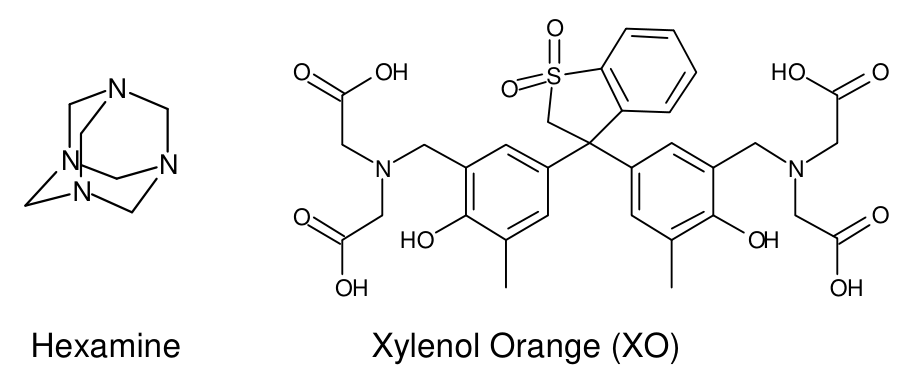
Hexamine and Xylenol Orange have the structures shown below. The \(pK_b\) of hexamine is 9.5. Xylenol Orange is red below \(pH\) 4, yellow above \(pH\) 5.
\(K'_{\mathrm{MY}}\) is the conditional formation constant \(=\alpha K_{\mathrm{MY}}\).
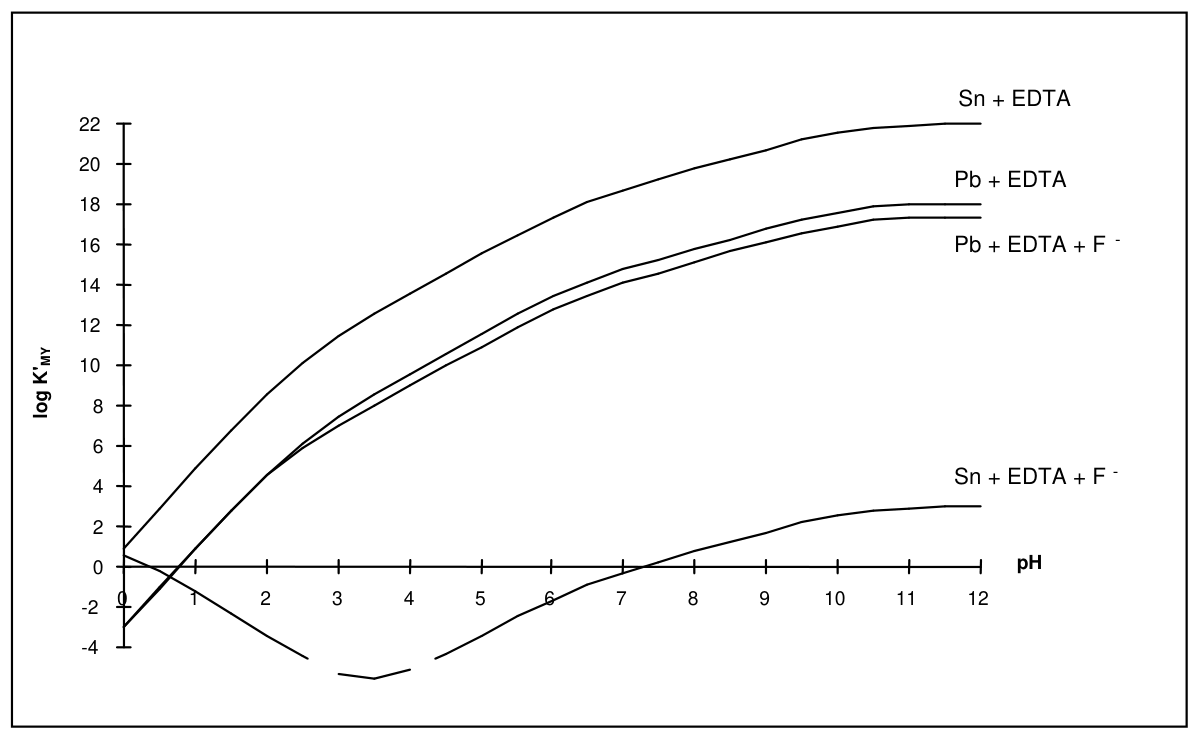
\(K'_{\mathrm{MY}}\) for the formation of the EDTA complexes of Pb(II) and Sn(IV), in the presence and absence of fluoride, are shown in the following Figure.
1.1 What is the lead compound that precipitates in Step 2?
1.2 Write a balanced ionic equation that explains the disappearance of the precipitate in Step 3 (at \(pH\) 6).
1.3 What is the purpose of hexamine in Step 5 of the analysis?
1.4 What is the purpose of Xylenol Orange in the analysis?
1.5 Write balanced ionic equations for the reactions occurring during the titration and responsible for the colour change at the endpoint in Step 6 of the analysis
1.6 What is the purpose of \(\ce{NaF}\) in Step 7 of the analysis?
1.7 Write a balanced ionic equation for the reaction that occurs in Step 7.
1.8 Write a balanced ionic equation that explains why the colour changed from red to yellow in Step 7 of the analysis.
1.9 Write a balanced ionic equation that explains why the lines on the graph below of \(\log K_{\mathrm{MY}}\) vs \(pH\) for \(\ce{Pb}\) + EDTA and \(\ce{Pb}\) + EDTA + \(\ce{F-}\) are coincident below \(pH\) 2.
1.10 Calculate the percentage by weight of \(\ce{Sn}\) and \(\ce{Pb}\) in the alloy.
Official English text of the problem.
Answers
Let \(\ce{Y^{4-}}\) denote fully deprotonated EDTA. For charge-explicit indicator equations, use the formal XO representation \(\ce{X^{4-}}\) and its lead complex \(\ce{[PbX]^{2-}}\). This indicator convention does not identify the unique microscopic protonation state at pH 6; see the discussion and SMILES below.
- 1.1 Lead(II) chloride, \(\ce{PbCl2}\).
- 1.2 \[ \ce{PbCl2(s) + H2Y^{2-} -> [PbY]^{2-} + 2Cl- + 2H+} \]
- 1.3 Hexamine neutralizes residual acid and, with its conjugate acid, helps maintain the solution at pH 6.
- 1.4 Xylenol Orange is a metallochromic indicator: free indicator is yellow at pH 6, whereas its lead complex is red.
- 1.5 \[ \ce{Pb^{2+} + H2Y^{2-} -> [PbY]^{2-} + 2H+} \] \[ \ce{Pb^{2+} + X^{4-} <=> [PbX]^{2-}} \]
- 1.6 Fluoride selectively masks tin(IV), releasing its bound EDTA for a second titration.
- 1.7 \[ \ce{[SnY] + 6F- + 2H+ -> [SnF6]^{2-} + H2Y^{2-}} \]
- 1.8 \[ \ce{[PbX]^{2-} + H2Y^{2-} -> [PbY]^{2-} + X^{4-} + 2H+} \]
- 1.9 \[ \ce{H+ + F- <=> HF} \] Protonation suppresses fluoride’s competition for lead.
- 1.10 \[ \boxed{w(\ce{Sn})=43.70\%,\qquad w(\ce{Pb})=56.45\%} \] The supplied measurements give a total of \(100.15\%\), a small mass-balance discrepancy.
Solution
1.1
The precipitate is lead(II) chloride, \(\ce{PbCl2}\), SMILES [Cl-].[Cl-].[Pb+2].
The solution contains lead(II) ions and chloride from hydrochloric acid. Lead(II) chloride is sparingly soluble, and its solubility decreases on cooling:
\[ \ce{Pb^{2+} + 2Cl- <=> PbCl2(s)} \]
Lead(II) nitrate would remain soluble. The disconnected SMILES describes the ionic composition of the solid, not its crystal lattice.
1.2
EDTA forms a sufficiently stable, soluble lead complex to drive dissolution of the chloride precipitate. Writing the added ligand as \(\ce{H2Y^{2-}}\),
\[ \boxed{\ce{PbCl2(s) + H2Y^{2-} -> [PbY]^{2-} + 2Cl- + 2H+}} \]
This is the sum of dissolution and complex formation:
\[ \ce{PbCl2(s) <=> Pb^{2+} + 2Cl-} \]
\[ \ce{Pb^{2+} + H2Y^{2-} <=> [PbY]^{2-} + 2H+} \]
Complexation lowers the free lead-ion concentration and therefore draws more solid into solution.
Tin(IV) is also strongly complexed:
\[ \ce{Sn^{4+} + H2Y^{2-} <=> [SnY] + 2H+} \]
The problem does not identify the tin precipitates individually. If a precipitate is represented as tin(IV) oxide, its corresponding dissolution equation is
\[ \ce{SnO2(s) + H2Y^{2-} + 2H+ -> [SnY] + 2H2O} \]
This last equation illustrates the principle; it does not establish the identity of every tin solid present.
1.3
Hexamine is a weak base, as indicated by its \(pK_b=9.5\). It accepts protons from the residual acid:
\[ \ce{B + H+ <=> BH+} \]
Here \(\ce{B}\) is hexamine and \(\ce{BH+}\) its conjugate acid. Their mixture provides acid–base buffering and accommodates protons released during complex formation.
Maintaining pH 6 serves two purposes:
- The conditional formation constants of both metal–EDTA complexes are large enough for quantitative complexation.
- Uncomplexed XO is yellow, allowing a distinct red endpoint when lead binds the indicator.
1.4
XO acts as a metallochromic endpoint indicator.
While unbound EDTA remains, added lead(II) is captured by EDTA. Once that EDTA has been consumed, the first slight excess of lead forms the red lead–XO complex.
Because the pH is maintained at 6, this yellow-to-red endpoint signals metal binding, rather than acidification into the indicator’s low-pH red range.
1.5
During the first titration, lead(II) consumes the excess EDTA:
\[ \boxed{\ce{Pb^{2+} + H2Y^{2-} -> [PbY]^{2-} + 2H+}} \]
Each mole of added lead consumes one mole of unbound EDTA.
At the endpoint, lead binds XO. In the stated formal indicator convention,
\[ \boxed{\ce{Pb^{2+} + X^{4-} <=> [PbX]^{2-}}} \]
The free-indicator population is yellow; the lead-bound population is red.
The exact microscopic proton balance of XO cannot be determined from the supplied acid–base information. More generally, if binding removes \(r\) protons from a free indicator species of charge \(q-\), the fully balanced form is
\[ \ce{Pb^{2+} + H_rIn^{q-} <=> [PbIn]^{(q+r-2)-} + rH+} \]
The simpler equation above is a formal representation of this indicator chemistry at fixed pH.
1.6
Sodium fluoride, SMILES [Na+].[F-], supplies fluoride ions that preferentially complex tin(IV).
The graph shows that, at pH 6:
- The tin–EDTA conditional formation constant becomes extremely small in the presence of fluoride.
- The lead–EDTA conditional formation constant remains very large.
Consequently, fluoride displaces EDTA from tin while leaving lead effectively bound to EDTA. The released EDTA can then be measured with additional standard lead nitrate.
This is selective masking of tin(IV).
1.7
Tin(IV) forms hexafluoridostannate(IV), \(\ce{[SnF6]^{2-}}\), releasing one EDTA ligand per tin atom:
\[ \boxed{\ce{[SnY] + 6F- -> [SnF6]^{2-} + Y^{4-}}} \]
Including protonation of the released EDTA gives the equivalent equation
\[ \boxed{\ce{[SnY] + 6F- + 2H+ -> [SnF6]^{2-} + H2Y^{2-}}} \]
Thus, the second titre measures tin in a 1:1 molar ratio:
\[ n(\text{lead added in second titration})=n(\text{tin in aliquot}) \]
1.8
The newly released EDTA removes lead from the red indicator complex, regenerating the yellow free indicator:
\[ \boxed{\ce{[PbX]^{2-} + H2Y^{2-} -> [PbY]^{2-} + X^{4-} + 2H+}} \]
Using fully deprotonated EDTA, the equivalent formal equation is
\[ \ce{[PbX]^{2-} + Y^{4-} -> [PbY]^{2-} + X^{4-}} \]
For the general protonation convention introduced in 1.5, the explicitly balanced version is
\[ \ce{[PbIn]^{(q+r-2)-} + H2Y^{2-} + rH+ -> [PbY]^{2-} + H_rIn^{q-} + 2H+} \]
Further addition of lead nitrate consumes the released EDTA. Once it is exhausted, red lead–XO complex forms again.
1.9
In strongly acidic solution, fluoride is protonated:
\[ \boxed{\ce{H+ + F- <=> HF}} \]
Hydrogen fluoride is much less effective than free fluoride ion at competing for lead. Below pH 2, this suppresses the fluoride side reaction sufficiently that the conditional lead–EDTA formation constants with and without added fluoride coincide on the graph.
1.10
Both metals form 1:1 EDTA complexes. The dilution factor from the aliquot to the original sample is
\[ D=\frac{250.0\ \mathrm{cm^3}}{25.00\ \mathrm{cm^3}}=10.00 \]
The 15.00 \(\mathrm{cm^3}\) second titre is the additional volume added after fluoride treatment.
The original EDTA amount is
\[ n_{Y,0} =(0.2000\ \mathrm{mol\,L^{-1}}) (25.00\times10^{-3}\ \mathrm L) =5.000\times10^{-3}\ \mathrm{mol} \]
Therefore, each aliquot contains
\[ n_{Y,\mathrm{aliquot}}=5.000\times10^{-4}\ \mathrm{mol} \]
of total EDTA, including bound and unbound ligand.
The first titre measures the EDTA initially left unbound:
\[ \begin{aligned} n_{Y,\mathrm{excess}} &=(0.009970\ \mathrm{mol\,L^{-1}}) (24.05\times10^{-3}\ \mathrm L)\\ &=2.397785\times10^{-4}\ \mathrm{mol} \end{aligned} \]
Hence, retaining guard digits,
\[ \begin{aligned} n_{\ce{Sn},a}+n_{\ce{Pb},a} &=5.000\times10^{-4}-2.397785\times10^{-4}\\ &=2.602215\times10^{-4}\ \mathrm{mol} \end{aligned} \]
The second titre measures EDTA released from tin:
\[ \begin{aligned} n_{\ce{Sn},a} &=(0.009970\ \mathrm{mol\,L^{-1}}) (15.00\times10^{-3}\ \mathrm L)\\ &=1.49550\times10^{-4}\ \mathrm{mol} \end{aligned} \]
Therefore,
\[ \begin{aligned} n_{\ce{Pb},a} &=2.602215\times10^{-4}-1.49550\times10^{-4}\\ &=1.106715\times10^{-4}\ \mathrm{mol} \end{aligned} \]
Scaling to the whole sample,
\[ n_{\ce{Sn}}=1.49550\times10^{-3}\ \mathrm{mol} \]
\[ n_{\ce{Pb}}=1.106715\times10^{-3}\ \mathrm{mol} \]
Using \(M_{\ce{Sn}}=118.7\ \mathrm{g\,mol^{-1}}\) and \(M_{\ce{Pb}}=207.2\ \mathrm{g\,mol^{-1}}\),
\[ m_{\ce{Sn}} =(1.49550\times10^{-3})(118.7) =0.17751585\ \mathrm g \]
\[ m_{\ce{Pb}} =(1.106715\times10^{-3})(207.2) =0.229311348\ \mathrm g \]
Thus,
\[ \boxed{ w(\ce{Sn}) =\frac{0.17751585}{0.4062}\times100\% =43.70\% } \]
\[ \boxed{ w(\ce{Pb}) =\frac{0.229311348}{0.4062}\times100\% =56.45\% } \]
The reconstructed metal mass is \(0.4068272\ \mathrm g\), compared with the stated \(0.4062\ \mathrm g\). The two independently calculated percentages have therefore been reported without forcing their sum to \(100\%\).
Names, SMILES, and structural conventions
The following representations complete the structural identification of species used above. Dative arrows in the complex SMILES represent donor-to-metal bonds; they do not specify three-dimensional geometry.
| Species | Name and SMILES |
|---|---|
| \(\ce{Y^{4-}}\) | Ethylenediaminetetraacetate, EDTA(4−): [O-]C(=O)CN(CC(=O)[O-])CCN(CC(=O)[O-])CC(=O)[O-] |
| \(\ce{H2Y^{2-}}\) | Dihydrogen ethylenediaminetetraacetate, shown with both amine nitrogens protonated: [O-]C(=O)C[NH+](CC(=O)[O-])CC[NH+](CC(=O)[O-])CC(=O)[O-] |
| \(\ce{[PbY]^{2-}}\) | Lead(II)–EDTA complex: [Pb+2]12345<-[O-]C(=O)CN->1(CC(=O)[O-]->2)CCN->3(CC(=O)[O-]->4)CC(=O)[O-]->5 |
| \(\ce{[SnY]}\) | Tin(IV)–EDTA complex: [Sn+4]12345<-[O-]C(=O)CN->1(CC(=O)[O-]->2)CCN->3(CC(=O)[O-]->4)CC(=O)[O-]->5 |
| \(\ce{B}\) | Hexamine, or hexamethylenetetramine: C1N2CN3CN1CN(C2)C3 |
| \(\ce{BH+}\) | Monoprotonated hexamine: C1[NH+]2CN3CN1CN(C2)C3 |
| \(\ce{[SnF6]^{2-}}\) | Hexafluoridostannate(IV): [F-]->[Sn+4](<-[F-])(<-[F-])(<-[F-])(<-[F-])<-[F-] |
| \(\ce{X^{4-}}\) | Xylenol Orange, formal tetracarboxylate representation: C1(c2cc(CN(CC(=O)[O-])CC(=O)[O-])c(O)c(C)c2)(c2cc(CN(CC(=O)[O-])CC(=O)[O-])c(O)c(C)c2)OS(=O)(=O)c2ccccc21 |
| \(\ce{[PbX]^{2-}}\) | Lead(II)–XO, schematic 1:1 chelate representation: [Pb+2]12<-[O-]C(=O)CN->1(CC(=O)[O-]->2)Cc1cc(C2(c3cc(CN(CC(=O)[O-])CC(=O)[O-])c(O)c(C)c3)OS(=O)(=O)c3ccccc32)cc(C)c1O |
| \(\ce{SnO2}\) | Tin(IV) oxide, formula-unit representation: O=[Sn]=O |
| \(\ce{HF}\) | Hydrogen fluoride: [H]F |
| \(\ce{H2O}\) | Water: O |
The simple ions are lead(II), [Pb+2]; tin(IV), [Sn+4]; chloride, [Cl-]; fluoride, [F-]; and hydrogen ion, [H+]. Aqueous hydrogen ions are solvated; [H+] is the conventional ionic-equation representation.
The EDTA complex models show coordination through two nitrogen and four oxygen donors. Hexafluoridostannate(IV) has octahedral coordination. The precise lead coordination geometry, additional hydration, and XO donor arrangement are not established by this problem. In particular, the Pb–XO SMILES is a schematic connectivity model, not a determination of its colour-bearing microscopic structure. Solid tin(IV) oxide has an extended lattice rather than discrete molecules of the displayed formula-unit form.
The solution was checked against the official solution.
IChO 1998 · Theorieaufgabe 1
EDTA-Titration von Zinn und Blei in einer Legierung
Die folgenden 8 Schritte beschreiben das Verfahren zur Analyse einer Legierungsprobe, die sowohl Zinn als auch Blei enthält.
-
Eine Legierungsprobe von 0.4062 g wurde durch Erhitzen in einem kleinen Becherglas mit einem Gemisch aus 11 M Salzsäure und 16 M Salpetersäure gelöst. Das Becherglas wurde erhitzt, bis sich die gesamte Legierung aufgelöst hatte. Bei diesem Verfahren wird Blei zu Pb(II) oxidiert, und Zinn geht in Sn(IV) über.
-
Nach 5 Minuten Erhitzen zum Austreiben von Stickstoffoxiden und Chlor war noch etwas Säure vorhanden. Beim Abkühlen der Lösung bildete sich ein Niederschlag aus einigen Zinnverbindungen und einer Bleiverbindung.
-
Ein Aliquot von 25.00 \(\mathrm{cm^3}\) einer 0.2000 M \(\ce{Na2H2EDTA}\)-Lösung wurde zugegeben. Der Niederschlag löste sich auf, und es entstand eine klare, farblose Lösung.
-
Diese Lösung wurde quantitativ in einen 250.0-\(\mathrm{cm^3}\)-Messkolben überführt und mit destilliertem Wasser bis zur Marke aufgefüllt.
-
Ein Aliquot von 25.00 \(\mathrm{cm^3}\) dieser Lösung wurde mit 15 \(\mathrm{cm^3}\) einer 30%igen (m/V) Lösung von Hexamin (Hexamethylentetramin), etwas Wasser und zwei Tropfen Xylenolorange-Lösung versetzt. Der pH-Wert jedes Aliquots betrug 6.
-
Die klare, gelbe Lösung aus Schritt 5 wurde mit einer 0.009970 M Bleinitrat-Maßlösung titriert, bis die Farbe gerade von Gelb nach Rot umschlug. Der Verbrauch bis zu diesem Endpunkt betrug 24.05 \(\mathrm{cm^3}\).
-
In den Titrierkolben wurden 2.0 g festes \(\ce{NaF}\) gegeben. Die Lösung wurde wieder gelb.
-
Die Lösung wurde mit weiterer 0.009970 M Bleinitrat-Maßlösung titriert, bis die Farbe erneut nach Rot umschlug. Der Verbrauch bis zu diesem Endpunkt betrug 15.00 \(\mathrm{cm^3}\).
Hexamin und Xylenolorange haben die unten gezeigten Strukturen. Der \(pK_b\) von Hexamin beträgt 9.5. Xylenolorange ist unterhalb von \(pH\) 4 rot und oberhalb von \(pH\) 5 gelb.
\(K'_{\mathrm{MY}}\) ist die bedingte Bildungskonstante \(=\alpha K_{\mathrm{MY}}\).
Die Werte von \(K'_{\mathrm{MY}}\) für die Bildung der EDTA-Komplexe von Pb(II) und Sn(IV) in Gegenwart und Abwesenheit von Fluorid sind in der folgenden Abbildung dargestellt.
1.1 Welche Bleiverbindung fällt in Schritt 2 aus?
1.2 Geben Sie eine ausgeglichene Ionengleichung an, die das Verschwinden des Niederschlags in Schritt 3 (bei \(pH\) 6) erklärt.
1.3 Welchen Zweck erfüllt Hexamin in Schritt 5 der Analyse?
1.4 Welchen Zweck erfüllt Xylenolorange bei der Analyse?
1.5 Geben Sie ausgeglichene Ionengleichungen für die Reaktionen an, die während der Titration ablaufen und für den Farbumschlag am Endpunkt in Schritt 6 der Analyse verantwortlich sind
1.6 Welchen Zweck erfüllt \(\ce{NaF}\) in Schritt 7 der Analyse?
1.7 Geben Sie eine ausgeglichene Ionengleichung für die Reaktion an, die in Schritt 7 abläuft.
1.8 Geben Sie eine ausgeglichene Ionengleichung an, die erklärt, warum die Farbe in Schritt 7 der Analyse von Rot nach Gelb umschlug.
1.9 Geben Sie eine ausgeglichene Ionengleichung an, die erklärt, warum die Kurven für \(\ce{Pb}\) + EDTA und \(\ce{Pb}\) + EDTA + \(\ce{F-}\) im unten stehenden Diagramm von \(\log K_{\mathrm{MY}}\) gegen \(pH\) unterhalb von \(pH\) 2 zusammenfallen.
1.10 Berechnen Sie die Massenanteile von \(\ce{Sn}\) und \(\ce{Pb}\) in der Legierung in Prozent.
Aufgabentext aus dem offiziellen englischen Text übersetzt.
Antworten
\(\ce{Y^{4-}}\) bezeichne vollständig deprotoniertes EDTA. Für Indikatorgleichungen mit expliziter Ladungsangabe wird die formale XO-Darstellung \(\ce{X^{4-}}\) und deren Bleikomplex \(\ce{[PbX]^{2-}}\) verwendet. Diese Indikatorkonvention legt keinen eindeutigen mikroskopischen Protonierungszustand bei pH 6 fest; siehe die Erörterung und die SMILES weiter unten.
- 1.1 Blei(II)-chlorid, \(\ce{PbCl2}\).
- 1.2 \[ \ce{PbCl2(s) + H2Y^{2-} -> [PbY]^{2-} + 2Cl- + 2H+} \]
- 1.3 Hexamin neutralisiert die verbleibende Säure und trägt zusammen mit seiner konjugierten Säure dazu bei, die Lösung bei pH 6 zu halten.
- 1.4 Xylenolorange ist ein metallochromer Indikator: Der freie Indikator ist bei pH 6 gelb, während sein Bleikomplex rot ist.
- 1.5 \[ \ce{Pb^{2+} + H2Y^{2-} -> [PbY]^{2-} + 2H+} \] \[ \ce{Pb^{2+} + X^{4-} <=> [PbX]^{2-}} \]
- 1.6 Fluorid maskiert selektiv Zinn(IV) und setzt das daran gebundene EDTA für eine zweite Titration frei.
- 1.7 \[ \ce{[SnY] + 6F- + 2H+ -> [SnF6]^{2-} + H2Y^{2-}} \]
- 1.8 \[ \ce{[PbX]^{2-} + H2Y^{2-} -> [PbY]^{2-} + X^{4-} + 2H+} \]
- 1.9 \[ \ce{H+ + F- <=> HF} \] Die Protonierung unterdrückt die Konkurrenz von Fluorid um Blei.
- 1.10 \[ \boxed{w(\ce{Sn})=43.70\%,\qquad w(\ce{Pb})=56.45\%} \] Die angegebenen Messwerte ergeben eine Summe von \(100.15\%\), also eine geringfügige Abweichung in der Massenbilanz.
Lösung
1.1
Der Niederschlag ist Blei(II)-chlorid, \(\ce{PbCl2}\), SMILES [Cl-].[Cl-].[Pb+2].
Die Lösung enthält Blei(II)-Ionen und Chlorid aus der Salzsäure. Blei(II)-chlorid ist schwer löslich, und seine Löslichkeit nimmt beim Abkühlen ab:
\[ \ce{Pb^{2+} + 2Cl- <=> PbCl2(s)} \]
Blei(II)-nitrat würde gelöst bleiben. Die SMILES-Darstellung mit unverbundenen Komponenten beschreibt die ionische Zusammensetzung des Feststoffs, nicht sein Kristallgitter.
1.2
EDTA bildet einen hinreichend stabilen, löslichen Bleikomplex, sodass sich der Chloridniederschlag auflöst. Schreibt man den zugesetzten Liganden als \(\ce{H2Y^{2-}}\), ergibt sich
\[ \boxed{\ce{PbCl2(s) + H2Y^{2-} -> [PbY]^{2-} + 2Cl- + 2H+}} \]
Dies ist die Summe aus Auflösung und Komplexbildung:
\[ \ce{PbCl2(s) <=> Pb^{2+} + 2Cl-} \]
\[ \ce{Pb^{2+} + H2Y^{2-} <=> [PbY]^{2-} + 2H+} \]
Die Komplexbildung senkt die Konzentration freier Blei-Ionen und bewirkt dadurch, dass weiterer Feststoff in Lösung geht.
Auch Zinn(IV) wird stark komplexiert:
\[ \ce{Sn^{4+} + H2Y^{2-} <=> [SnY] + 2H+} \]
Die Aufgabe benennt die einzelnen Zinnniederschläge nicht. Stellt man einen Niederschlag als Zinn(IV)-oxid dar, lautet die zugehörige Auflösungsgleichung
\[ \ce{SnO2(s) + H2Y^{2-} + 2H+ -> [SnY] + 2H2O} \]
Diese letzte Gleichung veranschaulicht das Prinzip; sie legt nicht die Identität aller vorhandenen zinnhaltigen Feststoffe fest.
1.3
Hexamin ist eine schwache Base, wie sein \(pK_b=9.5\) zeigt. Es nimmt Protonen aus der verbleibenden Säure auf:
\[ \ce{B + H+ <=> BH+} \]
Dabei ist \(\ce{B}\) Hexamin und \(\ce{BH+}\) seine konjugierte Säure. Ihr Gemisch wirkt als Säure-Base-Puffer und nimmt die bei der Komplexbildung freigesetzten Protonen auf.
Das Einstellen und Aufrechterhalten von pH 6 erfüllt zwei Zwecke:
- Die bedingten Bildungskonstanten beider Metall-EDTA-Komplexe sind groß genug für eine quantitative Komplexierung.
- Unkomplexiertes XO ist gelb, sodass sich ein deutlicher roter Endpunkt ergibt, wenn Blei an den Indikator bindet.
1.4
XO dient als metallochromer Endpunktindikator.
Solange noch ungebundenes EDTA vorhanden ist, wird zugesetztes Blei(II) von EDTA gebunden. Sobald dieses EDTA verbraucht ist, bildet der erste geringe Bleiüberschuss den roten Blei-XO-Komplex.
Da der pH-Wert bei 6 gehalten wird, zeigt dieser Endpunkt mit dem Farbumschlag von Gelb nach Rot eine Metallbindung an und keine Ansäuerung bis in den roten Farbbereich des Indikators bei niedrigem pH-Wert.
1.5
Während der ersten Titration verbraucht Blei(II) das überschüssige EDTA:
\[ \boxed{\ce{Pb^{2+} + H2Y^{2-} -> [PbY]^{2-} + 2H+}} \]
Jedes Mol zugesetztes Blei verbraucht ein Mol ungebundenes EDTA.
Am Endpunkt bindet Blei an XO. Mit der angegebenen formalen Indikatorkonvention gilt
\[ \boxed{\ce{Pb^{2+} + X^{4-} <=> [PbX]^{2-}}} \]
Die Gesamtheit der freien Indikatorspezies ist gelb; die Gesamtheit der an Blei gebundenen Indikatorspezies ist rot.
Die genaue mikroskopische Protonenbilanz von XO lässt sich aus den angegebenen Säure-Base-Informationen nicht bestimmen. Allgemeiner lautet die vollständig ausgeglichene Form, wenn bei der Bindung \(r\) Protonen aus einer freien Indikatorspezies mit der Ladung \(q-\) entfernt werden,
\[ \ce{Pb^{2+} + H_rIn^{q-} <=> [PbIn]^{(q+r-2)-} + rH+} \]
Die einfachere Gleichung oben ist eine formale Darstellung dieser Indikatorchemie bei festem pH-Wert.
1.6
Natriumfluorid, SMILES [Na+].[F-], liefert Fluorid-Ionen, die bevorzugt Zinn(IV) komplexieren.
Das Diagramm zeigt, dass bei pH 6:
- die bedingte Bildungskonstante des Zinn-EDTA-Komplexes in Gegenwart von Fluorid extrem klein wird;
- die bedingte Bildungskonstante des Blei-EDTA-Komplexes sehr groß bleibt.
Folglich verdrängt Fluorid EDTA aus dem Zinnkomplex, während Blei praktisch vollständig an EDTA gebunden bleibt. Das freigesetzte EDTA kann anschließend mit weiterer Bleinitrat-Maßlösung bestimmt werden.
Dies ist eine selektive Maskierung von Zinn(IV).
1.7
Zinn(IV) bildet Hexafluoridostannat(IV), \(\ce{[SnF6]^{2-}}\), wobei pro Zinnatom ein EDTA-Ligand freigesetzt wird:
\[ \boxed{\ce{[SnY] + 6F- -> [SnF6]^{2-} + Y^{4-}}} \]
Unter Einbeziehung der Protonierung des freigesetzten EDTA ergibt sich die gleichwertige Gleichung
\[ \boxed{\ce{[SnY] + 6F- + 2H+ -> [SnF6]^{2-} + H2Y^{2-}}} \]
Somit wird Zinn anhand des Verbrauchs bei der zweiten Titration in einem Stoffmengenverhältnis von 1:1 bestimmt:
\[ n(\text{bei der zweiten Titration zugesetztes Blei})=n(\text{Zinn im Aliquot}) \]
1.8
Das neu freigesetzte EDTA entzieht dem roten Indikatorkomplex das Blei und setzt dabei den gelben freien Indikator wieder frei:
\[ \boxed{\ce{[PbX]^{2-} + H2Y^{2-} -> [PbY]^{2-} + X^{4-} + 2H+}} \]
Bei Verwendung von vollständig deprotoniertem EDTA lautet die gleichwertige formale Gleichung
\[ \ce{[PbX]^{2-} + Y^{4-} -> [PbY]^{2-} + X^{4-}} \]
Für die in 1.5 eingeführte allgemeine Protonierungskonvention lautet die explizit ausgeglichene Fassung
\[ \ce{[PbIn]^{(q+r-2)-} + H2Y^{2-} + rH+ -> [PbY]^{2-} + H_rIn^{q-} + 2H+} \]
Durch weitere Zugabe von Bleinitrat wird das freigesetzte EDTA verbraucht. Sobald es vollständig verbraucht ist, bildet sich erneut der rote Blei-XO-Komplex.
1.9
In stark saurer Lösung wird Fluorid protoniert:
\[ \boxed{\ce{H+ + F- <=> HF}} \]
Fluorwasserstoff konkurriert wesentlich weniger wirksam um Blei als das freie Fluorid-Ion. Unterhalb von pH 2 wird dadurch die Nebenreaktion mit Fluorid so weit unterdrückt, dass die bedingten Bildungskonstanten des Blei-EDTA-Komplexes mit und ohne Fluoridzusatz im Diagramm zusammenfallen.
1.10
Beide Metalle bilden 1:1-EDTA-Komplexe. Der Verdünnungsfaktor vom Aliquot zur ursprünglichen Probe beträgt
\[ D=\frac{250.0\ \mathrm{cm^3}}{25.00\ \mathrm{cm^3}}=10.00 \]
Der Verbrauch von 15.00 \(\mathrm{cm^3}\) bei der zweiten Titration ist das zusätzliche Volumen, das nach der Behandlung mit Fluorid zugegeben wird.
Die ursprüngliche EDTA-Stoffmenge beträgt
\[ n_{Y,0} =(0.2000\ \mathrm{mol\,L^{-1}}) (25.00\times10^{-3}\ \mathrm L) =5.000\times10^{-3}\ \mathrm{mol} \]
Jedes Aliquot enthält daher insgesamt
\[ n_{Y,\mathrm{aliquot}}=5.000\times10^{-4}\ \mathrm{mol} \]
EDTA, einschließlich des gebundenen und des ungebundenen Liganden.
Der Verbrauch bei der ersten Titration erfasst das anfänglich ungebunden gebliebene EDTA:
\[ \begin{aligned} n_{Y,\mathrm{excess}} &=(0.009970\ \mathrm{mol\,L^{-1}}) (24.05\times10^{-3}\ \mathrm L)\\ &=2.397785\times10^{-4}\ \mathrm{mol} \end{aligned} \]
Unter Beibehaltung zusätzlicher Stellen zur Vermeidung von Rundungsfehlern folgt somit
\[ \begin{aligned} n_{\ce{Sn},a}+n_{\ce{Pb},a} &=5.000\times10^{-4}-2.397785\times10^{-4}\\ &=2.602215\times10^{-4}\ \mathrm{mol} \end{aligned} \]
Der Verbrauch bei der zweiten Titration erfasst das aus dem Zinnkomplex freigesetzte EDTA:
\[ \begin{aligned} n_{\ce{Sn},a} &=(0.009970\ \mathrm{mol\,L^{-1}}) (15.00\times10^{-3}\ \mathrm L)\\ &=1.49550\times10^{-4}\ \mathrm{mol} \end{aligned} \]
Daher gilt
\[ \begin{aligned} n_{\ce{Pb},a} &=2.602215\times10^{-4}-1.49550\times10^{-4}\\ &=1.106715\times10^{-4}\ \mathrm{mol} \end{aligned} \]
Auf die gesamte Probe hochgerechnet ergibt sich
\[ n_{\ce{Sn}}=1.49550\times10^{-3}\ \mathrm{mol} \]
\[ n_{\ce{Pb}}=1.106715\times10^{-3}\ \mathrm{mol} \]
Mit \(M_{\ce{Sn}}=118.7\ \mathrm{g\,mol^{-1}}\) und \(M_{\ce{Pb}}=207.2\ \mathrm{g\,mol^{-1}}\) erhält man
\[ m_{\ce{Sn}} =(1.49550\times10^{-3})(118.7) =0.17751585\ \mathrm g \]
\[ m_{\ce{Pb}} =(1.106715\times10^{-3})(207.2) =0.229311348\ \mathrm g \]
Somit gilt
\[ \boxed{ w(\ce{Sn}) =\frac{0.17751585}{0.4062}\times100\% =43.70\% } \]
\[ \boxed{ w(\ce{Pb}) =\frac{0.229311348}{0.4062}\times100\% =56.45\% } \]
Die rekonstruierte Metallmasse beträgt \(0.4068272\ \mathrm g\), verglichen mit den angegebenen \(0.4062\ \mathrm g\). Die beiden unabhängig berechneten Prozentwerte werden daher angegeben, ohne ihre Summe auf \(100\%\) zu zwingen.
Namen, SMILES und Strukturkonventionen
Die folgenden Darstellungen vervollständigen die strukturelle Identifizierung der oben verwendeten Spezies. Koordinative Bindungspfeile in den Komplex-SMILES stellen Bindungen vom Donor zum Metall dar; sie legen keine dreidimensionale Geometrie fest.
| Spezies | Name und SMILES |
|---|---|
| \(\ce{Y^{4-}}\) | Ethylendiamintetraacetat, EDTA(4−): [O-]C(=O)CN(CC(=O)[O-])CCN(CC(=O)[O-])CC(=O)[O-] |
| \(\ce{H2Y^{2-}}\) | Dihydrogenethylendiamintetraacetat, mit beiden Aminstickstoffatomen in protonierter Form dargestellt: [O-]C(=O)C[NH+](CC(=O)[O-])CC[NH+](CC(=O)[O-])CC(=O)[O-] |
| \(\ce{[PbY]^{2-}}\) | Blei(II)-EDTA-Komplex: [Pb+2]12345<-[O-]C(=O)CN->1(CC(=O)[O-]->2)CCN->3(CC(=O)[O-]->4)CC(=O)[O-]->5 |
| \(\ce{[SnY]}\) | Zinn(IV)-EDTA-Komplex: [Sn+4]12345<-[O-]C(=O)CN->1(CC(=O)[O-]->2)CCN->3(CC(=O)[O-]->4)CC(=O)[O-]->5 |
| \(\ce{B}\) | Hexamin oder Hexamethylentetramin: C1N2CN3CN1CN(C2)C3 |
| \(\ce{BH+}\) | Einfach protoniertes Hexamin: C1[NH+]2CN3CN1CN(C2)C3 |
| \(\ce{[SnF6]^{2-}}\) | Hexafluoridostannat(IV): [F-]->[Sn+4](<-[F-])(<-[F-])(<-[F-])(<-[F-])<-[F-] |
| \(\ce{X^{4-}}\) | Xylenolorange, formale Tetracarboxylat-Darstellung: C1(c2cc(CN(CC(=O)[O-])CC(=O)[O-])c(O)c(C)c2)(c2cc(CN(CC(=O)[O-])CC(=O)[O-])c(O)c(C)c2)OS(=O)(=O)c2ccccc21 |
| \(\ce{[PbX]^{2-}}\) | Blei(II)-XO, schematische 1:1-Chelatdarstellung: [Pb+2]12<-[O-]C(=O)CN->1(CC(=O)[O-]->2)Cc1cc(C2(c3cc(CN(CC(=O)[O-])CC(=O)[O-])c(O)c(C)c3)OS(=O)(=O)c3ccccc32)cc(C)c1O |
| \(\ce{SnO2}\) | Zinn(IV)-oxid, Darstellung einer Formeleinheit: O=[Sn]=O |
| \(\ce{HF}\) | Fluorwasserstoff: [H]F |
| \(\ce{H2O}\) | Wasser: O |
Die einfachen Ionen sind Blei(II), [Pb+2]; Zinn(IV), [Sn+4]; Chlorid, [Cl-]; Fluorid, [F-]; und das Wasserstoff-Ion, [H+]. Wasserstoff-Ionen in wässriger Lösung sind solvatisiert; [H+] ist die übliche Darstellung in Ionengleichungen.
Die Modelle der EDTA-Komplexe zeigen die Koordination über zwei Stickstoff- und vier Sauerstoffdonoren. Hexafluoridostannat(IV) weist eine oktaedrische Koordination auf. Die genaue Koordinationsgeometrie des Bleis, eine zusätzliche Hydratation und die Anordnung der XO-Donoren werden durch diese Aufgabe nicht festgelegt. Insbesondere ist die Pb-XO-SMILES ein schematisches Konnektivitätsmodell und keine Bestimmung seiner farbgebenden mikroskopischen Struktur. Festes Zinn(IV)-oxid besitzt ein ausgedehntes Gitter und besteht nicht aus diskreten Molekülen der dargestellten Formeleinheit.
Die Lösung wurde mit der offiziellen Lösung abgeglichen.
IChO 1998 · Teori sorusu 1
Bir alaşımdaki kalay ve kurşunun EDTA ile titrasyonu
Aşağıdaki 8 adım, hem kalay hem de kurşun içeren bir alaşım numunesinin analiz yöntemini açıklamaktadır.
-
0.4062 g alaşım numunesi, küçük bir beherde 11 M hidroklorik asit ve 16 M nitrik asit karışımıyla ısıtılarak çözüldü. Alaşımın tamamı çözünene kadar beher ısıtıldı. Bu işlemde kurşun Pb(II)'ye yükseltgenirken kalay Sn(IV)'e dönüşür.
-
Azot oksitlerini ve kloru uzaklaştırmak için 5 dakika ısıtıldıktan sonra bir miktar asit kaldı. Çözelti soğutulduğunda bazı kalay bileşikleri ile bir kurşun bileşiğinden oluşan bir çökelek ortaya çıktı.
-
0.2000 M \(\ce{Na2H2EDTA}\) çözeltisinden 25.00 \(\mathrm{cm^3}\) hacminde bir alikot eklendi. Çökelek çözündü ve berrak, renksiz bir çözelti elde edildi.
-
Bu çözelti, nicel olarak 250.0 \(\mathrm{cm^3}\) hacminde bir balonjojeye aktarıldı ve damıtık suyla işaret çizgisine kadar tamamlandı.
-
Bu çözeltiden alınan 25.00 \(\mathrm{cm^3}\) hacmindeki bir alikota, kütle/hacimce % 30'luk hekzamin (hekzametilentetramin) çözeltisinden 15 \(\mathrm{cm^3}\), bir miktar su ve iki damla Ksilenol Turuncusu çözeltisi eklendi. Her alikotun pH değeri 6 idi.
-
- Adımda elde edilen berrak, sarı çözelti, renk sarıdan kırmızıya döner dönmez durulacak şekilde standart 0.009970 M kurşun nitrat çözeltisiyle titre edildi. Bu dönüm noktasına kadar harcanan titrant hacmi 24.05 \(\mathrm{cm^3}\) idi.
-
Titrasyon erlenine 2.0 g katı \(\ce{NaF}\) eklendi. Çözelti yeniden sarıya döndü.
-
Çözelti, renk yeniden kırmızıya dönene kadar standart 0.009970 M kurşun nitrat çözeltisi eklenerek titre edildi. Bu dönüm noktasına kadar harcanan titrant hacmi 15.00 \(\mathrm{cm^3}\) idi.
Hekzamin ve Ksilenol Turuncusu aşağıda gösterilen yapılara sahiptir. Hekzaminin \(pK_b\) değeri 9.5'tir. Ksilenol Turuncusu, \(pH\) 4'ün altında kırmızı, \(pH\) 5'in üzerinde sarıdır.
\(K'_{\mathrm{MY}}\), koşullu oluşum sabitidir \(=\alpha K_{\mathrm{MY}}\).
Florür varlığında ve yokluğunda Pb(II) ve Sn(IV)'ün EDTA komplekslerinin oluşumuna ilişkin \(K'_{\mathrm{MY}}\) değerleri aşağıdaki Şekilde gösterilmiştir.
1.1 2. Adımda çöken kurşun bileşiği nedir?
1.2 3. Adımda (\(pH\) 6'da) çökeleğin kaybolmasını açıklayan denkleştirilmiş bir iyon denklemi yazınız.
1.3 Analizin 5. Adımında hekzaminin kullanılma amacı nedir?
1.4 Analizde Ksilenol Turuncusunun kullanılma amacı nedir?
1.5 Analizin 6. Adımında titrasyon sırasında gerçekleşen ve dönüm noktasındaki renk değişiminden sorumlu olan tepkimeler için denkleştirilmiş iyon denklemleri yazınız
1.6 Analizin 7. Adımında \(\ce{NaF}\)'nin kullanılma amacı nedir?
1.7 7. Adımda gerçekleşen tepkime için denkleştirilmiş bir iyon denklemi yazınız.
1.8 Analizin 7. Adımında rengin neden kırmızıdan sarıya döndüğünü açıklayan denkleştirilmiş bir iyon denklemi yazınız.
1.9 Aşağıdaki \(\log K_{\mathrm{MY}}\)–\(pH\) grafiğinde \(\ce{Pb}\) + EDTA ve \(\ce{Pb}\) + EDTA + \(\ce{F-}\) için çizilen eğrilerin \(pH\) 2'nin altında neden çakıştığını açıklayan denkleştirilmiş bir iyon denklemi yazınız.
1.10 Alaşımdaki \(\ce{Sn}\) ve \(\ce{Pb}\)'nin kütlece yüzdelerini hesaplayınız.
Soru metni resmi İngilizce metinden çevrilmiştir.
Cevaplar
\(\ce{Y^{4-}}\), protonlarını tamamen kaybetmiş EDTA'yı göstersin. Yüklerin açıkça belirtildiği indikatör denklemlerinde, biçimsel XO gösterimi olan \(\ce{X^{4-}}\) ve onun kurşun kompleksi \(\ce{[PbX]^{2-}}\) kullanılsın. Bu indikatör gösterimi, pH 6'daki mikroskobik protonlanma durumunu tekil olarak belirlemez; aşağıdaki açıklamalara ve SMILES gösterimlerine bakınız.
- 1.1 Kurşun(II) klorür, \(\ce{PbCl2}\).
- 1.2 \[ \ce{PbCl2(s) + H2Y^{2-} -> [PbY]^{2-} + 2Cl- + 2H+} \]
- 1.3 Hekzamin, kalan asidi nötrleştirir ve eşlenik asidiyle birlikte çözeltinin pH 6'da tutulmasına yardımcı olur.
- 1.4 Ksilenol Turuncusu metalokromik bir indikatördür: pH 6'da serbest indikatör sarı, kurşun kompleksi ise kırmızıdır.
- 1.5 \[ \ce{Pb^{2+} + H2Y^{2-} -> [PbY]^{2-} + 2H+} \] \[ \ce{Pb^{2+} + X^{4-} <=> [PbX]^{2-}} \]
- 1.6 Florür, kalay(IV)'ü seçici olarak maskeler ve ona bağlı EDTA'yı ikinci bir titrasyon için serbest bırakır.
- 1.7 \[ \ce{[SnY] + 6F- + 2H+ -> [SnF6]^{2-} + H2Y^{2-}} \]
- 1.8 \[ \ce{[PbX]^{2-} + H2Y^{2-} -> [PbY]^{2-} + X^{4-} + 2H+} \]
- 1.9 \[ \ce{H+ + F- <=> HF} \] Protonlanma, florürün kurşuna bağlanmak için rekabet etmesini baskılar.
- 1.10 \[ \boxed{w(\ce{Sn})=43.70\%,\qquad w(\ce{Pb})=56.45\%} \] Verilen ölçümler toplam \(100.15\%\) sonucunu verir; bu, kütle bilançosunda küçük bir uyumsuzluktur.
Çözüm
1.1
Çökelek, kurşun(II) klorür, \(\ce{PbCl2}\), SMILES [Cl-].[Cl-].[Pb+2] bileşiğidir.
Çözelti, kurşun(II) iyonları ve hidroklorik asitten gelen klorür içerir. Kurşun(II) klorür az çözünür ve soğutulduğunda çözünürlüğü azalır:
\[ \ce{Pb^{2+} + 2Cl- <=> PbCl2(s)} \]
Kurşun(II) nitrat ise çözünmüş hâlde kalırdı. Bağlantısız SMILES gösterimi, katının kristal örgüsünü değil, iyonik bileşimini betimler.
1.2
EDTA, klorür çökeleğinin çözünmesini sağlayacak kadar kararlı ve çözünür bir kurşun kompleksi oluşturur. Eklenen ligandı \(\ce{H2Y^{2-}}\) olarak yazarsak,
\[ \boxed{\ce{PbCl2(s) + H2Y^{2-} -> [PbY]^{2-} + 2Cl- + 2H+}} \]
Bu, çözünme ve kompleks oluşumunun toplamıdır:
\[ \ce{PbCl2(s) <=> Pb^{2+} + 2Cl-} \]
\[ \ce{Pb^{2+} + H2Y^{2-} <=> [PbY]^{2-} + 2H+} \]
Kompleksleşme, serbest kurşun iyonu derişimini düşürür ve böylece daha fazla katının çözeltiye geçmesini sağlar.
Kalay(IV) de güçlü biçimde kompleksleşir:
\[ \ce{Sn^{4+} + H2Y^{2-} <=> [SnY] + 2H+} \]
Soruda kalay çökeleklerinin her birinin kimliği belirtilmemiştir. Bir çökelek kalay(IV) oksit olarak gösterilirse buna karşılık gelen çözünme denklemi şöyledir:
\[ \ce{SnO2(s) + H2Y^{2-} + 2H+ -> [SnY] + 2H2O} \]
Bu son denklem ilkeyi örneklendirir; ortamda bulunan tüm kalay katılarının kimliğini belirlemez.
1.3
\(pK_b=9.5\) değerinin gösterdiği gibi, hekzamin zayıf bir bazdır. Kalan asitten proton alır:
\[ \ce{B + H+ <=> BH+} \]
Burada \(\ce{B}\) hekzamin, \(\ce{BH+}\) ise onun eşlenik asididir. Bunların karışımı asit–baz tamponlaması sağlar ve kompleks oluşumu sırasında açığa çıkan protonları tutar.
pH değerinin 6'da tutulması iki amaca hizmet eder:
- Her iki metal–EDTA kompleksinin koşullu oluşum sabitleri, nicel kompleksleşme için yeterince büyüktür.
- Kompleksleşmemiş XO sarıdır; bu da kurşun indikatöre bağlandığında belirgin bir kırmızı dönüm noktası gözlenmesini sağlar.
1.4
XO, metalokromik bir dönüm noktası indikatörü olarak işlev görür.
Bağlanmamış EDTA bulunduğu sürece, eklenen kurşun(II) EDTA tarafından bağlanır. Bu EDTA tükendiğinde, kurşunun ilk küçük fazlası kırmızı kurşun–XO kompleksini oluşturur.
pH değeri 6'da tutulduğu için, sarıdan kırmızıya bu dönüm noktası, çözeltinin asitleşerek indikatörün düşük pH'daki kırmızı renk aralığına girmesini değil, metalin bağlanmasını gösterir.
1.5
İlk titrasyon sırasında kurşun(II), EDTA fazlasını tüketir:
\[ \boxed{\ce{Pb^{2+} + H2Y^{2-} -> [PbY]^{2-} + 2H+}} \]
Eklenen her bir mol kurşun, bir mol bağlanmamış EDTA tüketir.
Dönüm noktasında kurşun XO'ya bağlanır. Belirtilen biçimsel indikatör gösterimine göre,
\[ \boxed{\ce{Pb^{2+} + X^{4-} <=> [PbX]^{2-}}} \]
Serbest indikatör türleri sarı, kurşuna bağlı türler ise kırmızıdır.
XO'nun tam mikroskobik proton bilançosu, verilen asit–baz bilgilerinden belirlenemez. Daha genel olarak, bağlanma sırasında yükü \(q-\) olan bir serbest indikatör türünden \(r\) proton ayrılıyorsa, tamamen denkleştirilmiş biçim şöyledir:
\[ \ce{Pb^{2+} + H_rIn^{q-} <=> [PbIn]^{(q+r-2)-} + rH+} \]
Yukarıdaki daha basit denklem, sabit pH'da bu indikatör kimyasının biçimsel bir gösterimidir.
1.6
Sodyum florür, SMILES [Na+].[F-], öncelikli olarak kalay(IV) ile kompleks oluşturan florür iyonlarını sağlar.
Grafik, pH 6'da şunları gösterir:
- Florür varlığında kalay–EDTA koşullu oluşum sabiti son derece küçülür.
- Kurşun–EDTA koşullu oluşum sabiti çok büyük kalır.
Dolayısıyla florür, kurşunun EDTA'ya bağlı kalmasını büyük ölçüde korurken kalaydan EDTA'yı uzaklaştırır. Serbest kalan EDTA, daha sonra ek standart kurşun nitrat çözeltisiyle ölçülebilir.
Bu, kalay(IV)'ün seçici olarak maskelenmesidir.
1.7
Kalay(IV), hekzafloridostannat(IV), \(\ce{[SnF6]^{2-}}\), oluşturur ve her kalay atomu başına bir EDTA ligandı serbest bırakır:
\[ \boxed{\ce{[SnY] + 6F- -> [SnF6]^{2-} + Y^{4-}}} \]
Serbest kalan EDTA'nın protonlanması da hesaba katıldığında eşdeğer denklem elde edilir:
\[ \boxed{\ce{[SnY] + 6F- + 2H+ -> [SnF6]^{2-} + H2Y^{2-}}} \]
Böylece ikinci titrasyonda harcanan titrant hacmi, kalayı 1:1 mol oranında ölçer:
\[ n(\text{ikinci titrasyonda eklenen kurşun})=n(\text{alikottaki kalay}) \]
1.8
Yeni serbest kalan EDTA, kurşunu kırmızı indikatör kompleksinden uzaklaştırarak sarı serbest indikatörü yeniden oluşturur:
\[ \boxed{\ce{[PbX]^{2-} + H2Y^{2-} -> [PbY]^{2-} + X^{4-} + 2H+}} \]
Protonlarını tamamen kaybetmiş EDTA kullanıldığında eşdeğer biçimsel denklem şöyledir:
\[ \ce{[PbX]^{2-} + Y^{4-} -> [PbY]^{2-} + X^{4-}} \]
1.5'te verilen genel protonlanma gösterimi için açıkça denkleştirilmiş biçim şöyledir:
\[ \ce{[PbIn]^{(q+r-2)-} + H2Y^{2-} + rH+ -> [PbY]^{2-} + H_rIn^{q-} + 2H+} \]
Kurşun nitrat eklenmeye devam edildiğinde serbest kalan EDTA tüketilir. EDTA tükendiğinde kırmızı kurşun–XO kompleksi yeniden oluşur.
1.9
Kuvvetli asidik çözeltide florür protonlanır:
\[ \boxed{\ce{H+ + F- <=> HF}} \]
Hidrojen florür, kurşuna bağlanmak için rekabet etmede serbest florür iyonundan çok daha az etkilidir. pH 2'nin altında bu durum, florürün yan tepkimesini yeterince baskılar; böylece florür eklenmiş ve eklenmemiş ortamlardaki koşullu kurşun–EDTA oluşum sabitleri grafikte çakışır.
1.10
Her iki metal de 1:1 EDTA kompleksleri oluşturur. Alikottan başlangıç numunesine geçişte kullanılan seyreltme faktörü şöyledir:
\[ D=\frac{250.0\ \mathrm{cm^3}}{25.00\ \mathrm{cm^3}}=10.00 \]
İkinci titrasyonda harcanan 15.00 \(\mathrm{cm^3}\), florürle işlemden sonra eklenen ilave hacimdir.
Başlangıçtaki EDTA miktarı şöyledir:
\[ n_{Y,0} =(0.2000\ \mathrm{mol\,L^{-1}}) (25.00\times10^{-3}\ \mathrm L) =5.000\times10^{-3}\ \mathrm{mol} \]
Dolayısıyla her alikot,
\[ n_{Y,\mathrm{aliquot}}=5.000\times10^{-4}\ \mathrm{mol} \]
miktarında toplam EDTA içerir; buna bağlı ve bağlanmamış ligand dahildir.
İlk titrasyonda harcanan titrant hacmi, başlangıçta bağlanmamış hâlde kalan EDTA'yı ölçer:
\[ \begin{aligned} n_{Y,\mathrm{excess}} &=(0.009970\ \mathrm{mol\,L^{-1}}) (24.05\times10^{-3}\ \mathrm L)\\ &=2.397785\times10^{-4}\ \mathrm{mol} \end{aligned} \]
Böylece, ara hesaplamalarda ek basamaklar korunarak,
\[ \begin{aligned} n_{\ce{Sn},a}+n_{\ce{Pb},a} &=5.000\times10^{-4}-2.397785\times10^{-4}\\ &=2.602215\times10^{-4}\ \mathrm{mol} \end{aligned} \]
İkinci titrasyonda harcanan titrant hacmi, kalaydan serbest kalan EDTA'yı ölçer:
\[ \begin{aligned} n_{\ce{Sn},a} &=(0.009970\ \mathrm{mol\,L^{-1}}) (15.00\times10^{-3}\ \mathrm L)\\ &=1.49550\times10^{-4}\ \mathrm{mol} \end{aligned} \]
Dolayısıyla,
\[ \begin{aligned} n_{\ce{Pb},a} &=2.602215\times10^{-4}-1.49550\times10^{-4}\\ &=1.106715\times10^{-4}\ \mathrm{mol} \end{aligned} \]
Numunenin tamamına ölçeklendiğinde,
\[ n_{\ce{Sn}}=1.49550\times10^{-3}\ \mathrm{mol} \]
\[ n_{\ce{Pb}}=1.106715\times10^{-3}\ \mathrm{mol} \]
\(M_{\ce{Sn}}=118.7\ \mathrm{g\,mol^{-1}}\) ve \(M_{\ce{Pb}}=207.2\ \mathrm{g\,mol^{-1}}\) kullanılarak,
\[ m_{\ce{Sn}} =(1.49550\times10^{-3})(118.7) =0.17751585\ \mathrm g \]
\[ m_{\ce{Pb}} =(1.106715\times10^{-3})(207.2) =0.229311348\ \mathrm g \]
Böylece,
\[ \boxed{ w(\ce{Sn}) =\frac{0.17751585}{0.4062}\times100\% =43.70\% } \]
\[ \boxed{ w(\ce{Pb}) =\frac{0.229311348}{0.4062}\times100\% =56.45\% } \]
Hesaplamalardan elde edilen toplam metal kütlesi \(0.4068272\ \mathrm g\) iken verilen değer \(0.4062\ \mathrm g\)'dır. Bu nedenle, birbirinden bağımsız olarak hesaplanan iki yüzde, toplamları \(100\%\)'e zorlanmadan verilmiştir.
Adlar, SMILES ve yapısal gösterim kuralları
Aşağıdaki gösterimler, yukarıda kullanılan türlerin yapısal tanımlanmasını tamamlar. Komplekslerin SMILES gösterimlerindeki koordinatif bağ okları, donörden metale uzanan bağları temsil eder; üç boyutlu geometriyi belirtmez.
| Tür | Adı ve SMILES gösterimi |
|---|---|
| \(\ce{Y^{4-}}\) | Etilendiamintetraasetat, EDTA(4−): [O-]C(=O)CN(CC(=O)[O-])CCN(CC(=O)[O-])CC(=O)[O-] |
| \(\ce{H2Y^{2-}}\) | Dihidrojen etilendiamintetraasetat, her iki amin azotu protonlanmış olarak gösterilmiştir: [O-]C(=O)C[NH+](CC(=O)[O-])CC[NH+](CC(=O)[O-])CC(=O)[O-] |
| \(\ce{[PbY]^{2-}}\) | Kurşun(II)–EDTA kompleksi: [Pb+2]12345<-[O-]C(=O)CN->1(CC(=O)[O-]->2)CCN->3(CC(=O)[O-]->4)CC(=O)[O-]->5 |
| \(\ce{[SnY]}\) | Kalay(IV)–EDTA kompleksi: [Sn+4]12345<-[O-]C(=O)CN->1(CC(=O)[O-]->2)CCN->3(CC(=O)[O-]->4)CC(=O)[O-]->5 |
| \(\ce{B}\) | Hekzamin veya hekzametilentetramin: C1N2CN3CN1CN(C2)C3 |
| \(\ce{BH+}\) | Tek protonlanmış hekzamin: C1[NH+]2CN3CN1CN(C2)C3 |
| \(\ce{[SnF6]^{2-}}\) | Hekzafloridostannat(IV): [F-]->[Sn+4](<-[F-])(<-[F-])(<-[F-])(<-[F-])<-[F-] |
| \(\ce{X^{4-}}\) | Ksilenol Turuncusu, biçimsel tetrakarboksilat gösterimi: C1(c2cc(CN(CC(=O)[O-])CC(=O)[O-])c(O)c(C)c2)(c2cc(CN(CC(=O)[O-])CC(=O)[O-])c(O)c(C)c2)OS(=O)(=O)c2ccccc21 |
| \(\ce{[PbX]^{2-}}\) | Kurşun(II)–XO, şematik 1:1 şelat gösterimi: [Pb+2]12<-[O-]C(=O)CN->1(CC(=O)[O-]->2)Cc1cc(C2(c3cc(CN(CC(=O)[O-])CC(=O)[O-])c(O)c(C)c3)OS(=O)(=O)c3ccccc32)cc(C)c1O |
| \(\ce{SnO2}\) | Kalay(IV) oksit, formül birimi gösterimi: O=[Sn]=O |
| \(\ce{HF}\) | Hidrojen florür: [H]F |
| \(\ce{H2O}\) | Su: O |
Basit iyonlar; kurşun(II), [Pb+2]; kalay(IV), [Sn+4]; klorür, [Cl-]; florür, [F-]; ve hidrojen iyonu, [H+] şeklindedir. Sulu çözeltideki hidrojen iyonları solvatlanmıştır; [H+], iyon denklemlerinde kullanılan geleneksel gösterimdir.
EDTA kompleks modelleri, iki azot ve dört oksijen donörü üzerinden koordinasyonu gösterir. Hekzafloridostannat(IV), oktahedral koordinasyona sahiptir. Kurşunun kesin koordinasyon geometrisi, ek hidratasyon ve XO donörlerinin yerleşimi bu soruda belirlenmemiştir. Özellikle Pb–XO SMILES gösterimi, şematik bir bağlanma modelidir; renginden sorumlu mikroskobik yapısının belirlenmesi değildir. Katı kalay(IV) oksit, gösterilen formül birimi biçimindeki ayrı moleküllerden değil, uzanımlı bir kristal örgüden oluşur.
Çözüm, resmi çözümle karşılaştırılarak kontrol edildi.
IChO 1998 · Problema teórico 1
Valoración con EDTA del estaño y el plomo en una aleación
Los siguientes 8 pasos describen el procedimiento para analizar una muestra de una aleación que contiene tanto estaño como plomo.
-
Se disolvió una muestra de aleación de 0.4062 g calentándola en un vaso de precipitados pequeño con una mezcla de ácido clorhídrico 11 M y ácido nítrico 16 M. Se calentó el vaso de precipitados hasta que se disolvió toda la aleación. En este procedimiento, el plomo se oxida a Pb(II) y el estaño se convierte en Sn(IV).
-
Tras 5 minutos de calentamiento para expulsar los óxidos de nitrógeno y el cloro, quedaba algo de ácido. Al enfriarse la disolución, apareció un precipitado de algunos compuestos de estaño y un compuesto de plomo.
-
Se añadió una alícuota de 25.00 \(\mathrm{cm^3}\) de una disolución de \(\ce{Na2H2EDTA}\) 0.2000 M. El precipitado se disolvió y se obtuvo una disolución transparente e incolora.
-
Esta disolución se transfirió cuantitativamente a un matraz aforado de 250.0 \(\mathrm{cm^3}\) y se enrasó con agua destilada.
-
Se trató una alícuota de 25.00 \(\mathrm{cm^3}\) de esta disolución con 15 \(\mathrm{cm^3}\) de una disolución de hexamina (hexametilentetramina) al 30 % m/v, algo de agua y dos gotas de disolución de naranja de xilenol. El pH de cada alícuota era 6.
-
La disolución transparente y amarilla del paso 5 se valoró con una disolución patrón de nitrato de plomo 0.009970 M hasta que el color acabó de cambiar de amarillo a rojo. El volumen de valorante consumido hasta este punto final fue de 24.05 \(\mathrm{cm^3}\).
-
Se añadieron 2.0 g de \(\ce{NaF}\) sólido al matraz de valoración. La disolución volvió a adquirir un color amarillo.
-
La disolución se valoró con más disolución patrón de nitrato de plomo 0.009970 M hasta que el color volvió a cambiar a rojo. El volumen de valorante consumido hasta este punto final fue de 15.00 \(\mathrm{cm^3}\).
La hexamina y el naranja de xilenol tienen las estructuras que se muestran a continuación. El \(pK_b\) de la hexamina es 9.5. El naranja de xilenol es rojo por debajo de \(pH\) 4 y amarillo por encima de \(pH\) 5.
\(K'_{\mathrm{MY}}\) es la constante condicional de formación \(=\alpha K_{\mathrm{MY}}\).
Los valores de \(K'_{\mathrm{MY}}\) para la formación de los complejos de EDTA con Pb(II) y Sn(IV), en presencia y en ausencia de fluoruro, se muestran en la siguiente figura.
1.1 ¿Cuál es el compuesto de plomo que precipita en el paso 2?
1.2 Escriba una ecuación iónica ajustada que explique la desaparición del precipitado en el paso 3 (a \(pH\) 6).
1.3 ¿Cuál es la función de la hexamina en el paso 5 del análisis?
1.4 ¿Cuál es la función del naranja de xilenol en el análisis?
1.5 Escriba ecuaciones iónicas ajustadas para las reacciones que tienen lugar durante la valoración y que son responsables del cambio de color en el punto final del paso 6 del análisis
1.6 ¿Cuál es la función del \(\ce{NaF}\) en el paso 7 del análisis?
1.7 Escriba una ecuación iónica ajustada para la reacción que tiene lugar en el paso 7.
1.8 Escriba una ecuación iónica ajustada que explique por qué el color cambió de rojo a amarillo en el paso 7 del análisis.
1.9 Escriba una ecuación iónica ajustada que explique por qué las líneas de la gráfica siguiente de \(\log K_{\mathrm{MY}}\) frente a \(pH\) para \(\ce{Pb}\) + EDTA y \(\ce{Pb}\) + EDTA + \(\ce{F-}\) coinciden por debajo de \(pH\) 2.
1.10 Calcule el porcentaje en masa de \(\ce{Sn}\) y \(\ce{Pb}\) en la aleación.
Enunciado traducido del texto oficial en inglés.
Respuestas
Sea \(\ce{Y^{4-}}\) el EDTA completamente desprotonado. Para las ecuaciones del indicador con cargas explícitas, utilice la representación formal del XO como \(\ce{X^{4-}}\) y de su complejo con plomo como \(\ce{[PbX]^{2-}}\). Esta convención para el indicador no identifica un estado microscópico único de protonación a pH 6; véanse la discusión y los SMILES más abajo.
- 1.1 Cloruro de plomo(II), \(\ce{PbCl2}\).
- 1.2 \[ \ce{PbCl2(s) + H2Y^{2-} -> [PbY]^{2-} + 2Cl- + 2H+} \]
- 1.3 La hexamina neutraliza el ácido residual y, junto con su ácido conjugado, ayuda a mantener la disolución a pH 6.
- 1.4 El naranja de xilenol es un indicador metalocrómico: el indicador libre es amarillo a pH 6, mientras que su complejo con plomo es rojo.
- 1.5 \[ \ce{Pb^{2+} + H2Y^{2-} -> [PbY]^{2-} + 2H+} \] \[ \ce{Pb^{2+} + X^{4-} <=> [PbX]^{2-}} \]
- 1.6 El fluoruro enmascara selectivamente el estaño(IV), liberando el EDTA unido a él para una segunda valoración.
- 1.7 \[ \ce{[SnY] + 6F- + 2H+ -> [SnF6]^{2-} + H2Y^{2-}} \]
- 1.8 \[ \ce{[PbX]^{2-} + H2Y^{2-} -> [PbY]^{2-} + X^{4-} + 2H+} \]
- 1.9 \[ \ce{H+ + F- <=> HF} \] La protonación suprime la competencia del fluoruro por el plomo.
- 1.10 \[ \boxed{w(\ce{Sn})=43.70\%,\qquad w(\ce{Pb})=56.45\%} \] Las medidas proporcionadas dan un total de \(100.15\%\), una pequeña discrepancia en el balance de masa.
Solución
1.1
El precipitado es cloruro de plomo(II), \(\ce{PbCl2}\), SMILES [Cl-].[Cl-].[Pb+2].
La disolución contiene iones plomo(II) y cloruro procedente del ácido clorhídrico. El cloruro de plomo(II) es poco soluble y su solubilidad disminuye al enfriarse:
\[ \ce{Pb^{2+} + 2Cl- <=> PbCl2(s)} \]
El nitrato de plomo(II) permanecería disuelto. El SMILES con componentes desconectados describe la composición iónica del sólido, no su red cristalina.
1.2
El EDTA forma un complejo soluble de plomo suficientemente estable como para impulsar la disolución del precipitado de cloruro. Si se representa el ligando añadido como \(\ce{H2Y^{2-}}\),
\[ \boxed{\ce{PbCl2(s) + H2Y^{2-} -> [PbY]^{2-} + 2Cl- + 2H+}} \]
Esta ecuación es la suma de la disolución y la formación del complejo:
\[ \ce{PbCl2(s) <=> Pb^{2+} + 2Cl-} \]
\[ \ce{Pb^{2+} + H2Y^{2-} <=> [PbY]^{2-} + 2H+} \]
La complejación reduce la concentración de iones plomo libres y, por tanto, hace que se disuelva más sólido.
El estaño(IV) también se compleja fuertemente:
\[ \ce{Sn^{4+} + H2Y^{2-} <=> [SnY] + 2H+} \]
El problema no identifica individualmente los precipitados de estaño. Si un precipitado se representa como óxido de estaño(IV), su correspondiente ecuación de disolución es
\[ \ce{SnO2(s) + H2Y^{2-} + 2H+ -> [SnY] + 2H2O} \]
Esta última ecuación ilustra el principio; no establece la identidad de cada sólido de estaño presente.
1.3
La hexamina es una base débil, como indica su \(pK_b=9.5\). Acepta protones del ácido residual:
\[ \ce{B + H+ <=> BH+} \]
Aquí, \(\ce{B}\) es la hexamina y \(\ce{BH+}\) su ácido conjugado. Su mezcla proporciona una acción amortiguadora ácido–base y absorbe los protones liberados durante la formación de los complejos.
Mantener el pH en 6 cumple dos funciones:
- Las constantes condicionales de formación de ambos complejos metal–EDTA son suficientemente grandes para una complejación cuantitativa.
- El XO no complejado es amarillo, lo que permite observar un punto final rojo bien definido cuando el plomo se une al indicador.
1.4
El XO actúa como indicador metalocrómico del punto final.
Mientras queda EDTA libre, el EDTA capta el plomo(II) añadido. Una vez consumido ese EDTA, el primer ligero exceso de plomo forma el complejo rojo plomo–XO.
Como el pH se mantiene en 6, este punto final de amarillo a rojo indica la unión del metal, en lugar de una acidificación hasta el intervalo de pH bajo en el que el indicador es rojo.
1.5
Durante la primera valoración, el plomo(II) consume el exceso de EDTA:
\[ \boxed{\ce{Pb^{2+} + H2Y^{2-} -> [PbY]^{2-} + 2H+}} \]
Cada mol de plomo añadido consume un mol de EDTA libre.
En el punto final, el plomo se une al XO. Según la convención formal indicada para el indicador,
\[ \boxed{\ce{Pb^{2+} + X^{4-} <=> [PbX]^{2-}}} \]
La población de indicador libre es amarilla; la población unida al plomo es roja.
El balance microscópico exacto de protones del XO no puede determinarse a partir de la información ácido–base proporcionada. De forma más general, si la unión elimina \(r\) protones de una especie de indicador libre de carga \(q-\), la forma completamente ajustada es
\[ \ce{Pb^{2+} + H_rIn^{q-} <=> [PbIn]^{(q+r-2)-} + rH+} \]
La ecuación más sencilla anterior es una representación formal de esta química del indicador a pH fijo.
1.6
El fluoruro de sodio, SMILES [Na+].[F-], aporta iones fluoruro que complejan preferentemente el estaño(IV).
La gráfica muestra que, a pH 6:
- La constante condicional de formación del complejo estaño–EDTA se vuelve extremadamente pequeña en presencia de fluoruro.
- La constante condicional de formación del complejo plomo–EDTA sigue siendo muy grande.
En consecuencia, el fluoruro desplaza el EDTA del estaño mientras deja el plomo prácticamente unido al EDTA. El EDTA liberado puede medirse después con más disolución patrón de nitrato de plomo.
Esto constituye un enmascaramiento selectivo del estaño(IV).
1.7
El estaño(IV) forma hexafluoridoestannato(IV), \(\ce{[SnF6]^{2-}}\), liberando un ligando EDTA por átomo de estaño:
\[ \boxed{\ce{[SnY] + 6F- -> [SnF6]^{2-} + Y^{4-}}} \]
Al incluir la protonación del EDTA liberado se obtiene la ecuación equivalente
\[ \boxed{\ce{[SnY] + 6F- + 2H+ -> [SnF6]^{2-} + H2Y^{2-}}} \]
Así, el volumen de valorante consumido en la segunda valoración mide el estaño en una relación molar 1:1:
\[ n(\text{plomo añadido en la segunda valoración})=n(\text{estaño en la alícuota}) \]
1.8
El EDTA recién liberado extrae el plomo del complejo rojo del indicador, regenerando el indicador libre amarillo:
\[ \boxed{\ce{[PbX]^{2-} + H2Y^{2-} -> [PbY]^{2-} + X^{4-} + 2H+}} \]
Si se utiliza EDTA completamente desprotonado, la ecuación formal equivalente es
\[ \ce{[PbX]^{2-} + Y^{4-} -> [PbY]^{2-} + X^{4-}} \]
Para la convención general de protonación introducida en 1.5, la versión explícitamente ajustada es
\[ \ce{[PbIn]^{(q+r-2)-} + H2Y^{2-} + rH+ -> [PbY]^{2-} + H_rIn^{q-} + 2H+} \]
La adición posterior de nitrato de plomo consume el EDTA liberado. Una vez agotado, vuelve a formarse el complejo rojo plomo–XO.
1.9
En una disolución fuertemente ácida, el fluoruro se protona:
\[ \boxed{\ce{H+ + F- <=> HF}} \]
El fluoruro de hidrógeno es mucho menos eficaz que el ion fluoruro libre para competir por el plomo. Por debajo de pH 2, esto suprime suficientemente la reacción secundaria del fluoruro como para que las constantes condicionales de formación del complejo plomo–EDTA con y sin fluoruro añadido coincidan en la gráfica.
1.10
Ambos metales forman complejos 1:1 con EDTA. El factor de dilución de la alícuota a la muestra original es
\[ D=\frac{250.0\ \mathrm{cm^3}}{25.00\ \mathrm{cm^3}}=10.00 \]
Los 15.00 \(\mathrm{cm^3}\) consumidos en la segunda valoración son el volumen adicional añadido después del tratamiento con fluoruro.
La cantidad inicial de EDTA es
\[ n_{Y,0} =(0.2000\ \mathrm{mol\,L^{-1}}) (25.00\times10^{-3}\ \mathrm L) =5.000\times10^{-3}\ \mathrm{mol} \]
Por tanto, cada alícuota contiene
\[ n_{Y,\mathrm{aliquot}}=5.000\times10^{-4}\ \mathrm{mol} \]
de EDTA total, incluido el ligando unido y el libre.
El volumen de valorante consumido en la primera valoración mide el EDTA que quedó libre inicialmente:
\[ \begin{aligned} n_{Y,\mathrm{excess}} &=(0.009970\ \mathrm{mol\,L^{-1}}) (24.05\times10^{-3}\ \mathrm L)\\ &=2.397785\times10^{-4}\ \mathrm{mol} \end{aligned} \]
Por consiguiente, conservando cifras adicionales para evitar errores de redondeo,
\[ \begin{aligned} n_{\ce{Sn},a}+n_{\ce{Pb},a} &=5.000\times10^{-4}-2.397785\times10^{-4}\\ &=2.602215\times10^{-4}\ \mathrm{mol} \end{aligned} \]
El volumen de valorante consumido en la segunda valoración mide el EDTA liberado del estaño:
\[ \begin{aligned} n_{\ce{Sn},a} &=(0.009970\ \mathrm{mol\,L^{-1}}) (15.00\times10^{-3}\ \mathrm L)\\ &=1.49550\times10^{-4}\ \mathrm{mol} \end{aligned} \]
Por tanto,
\[ \begin{aligned} n_{\ce{Pb},a} &=2.602215\times10^{-4}-1.49550\times10^{-4}\\ &=1.106715\times10^{-4}\ \mathrm{mol} \end{aligned} \]
Al extrapolar a la muestra completa,
\[ n_{\ce{Sn}}=1.49550\times10^{-3}\ \mathrm{mol} \]
\[ n_{\ce{Pb}}=1.106715\times10^{-3}\ \mathrm{mol} \]
Utilizando \(M_{\ce{Sn}}=118.7\ \mathrm{g\,mol^{-1}}\) y \(M_{\ce{Pb}}=207.2\ \mathrm{g\,mol^{-1}}\),
\[ m_{\ce{Sn}} =(1.49550\times10^{-3})(118.7) =0.17751585\ \mathrm g \]
\[ m_{\ce{Pb}} =(1.106715\times10^{-3})(207.2) =0.229311348\ \mathrm g \]
Así,
\[ \boxed{ w(\ce{Sn}) =\frac{0.17751585}{0.4062}\times100\% =43.70\% } \]
\[ \boxed{ w(\ce{Pb}) =\frac{0.229311348}{0.4062}\times100\% =56.45\% } \]
La masa de metal reconstruida es \(0.4068272\ \mathrm g\), frente a los \(0.4062\ \mathrm g\) indicados. Por ello, los dos porcentajes calculados de forma independiente se han presentado sin forzar su suma a \(100\%\).
Nombres, SMILES y convenciones estructurales
Las siguientes representaciones completan la identificación estructural de las especies utilizadas anteriormente. Las flechas dativas en los SMILES de los complejos representan enlaces del átomo donador al metal; no especifican la geometría tridimensional.
| Especie | Nombre y SMILES |
|---|---|
| \(\ce{Y^{4-}}\) | Etilendiaminotetraacetato, EDTA(4−): [O-]C(=O)CN(CC(=O)[O-])CCN(CC(=O)[O-])CC(=O)[O-] |
| \(\ce{H2Y^{2-}}\) | Dihidrogenoetilendiaminotetraacetato, representado con ambos nitrógenos amínicos protonados: [O-]C(=O)C[NH+](CC(=O)[O-])CC[NH+](CC(=O)[O-])CC(=O)[O-] |
| \(\ce{[PbY]^{2-}}\) | Complejo plomo(II)–EDTA: [Pb+2]12345<-[O-]C(=O)CN->1(CC(=O)[O-]->2)CCN->3(CC(=O)[O-]->4)CC(=O)[O-]->5 |
| \(\ce{[SnY]}\) | Complejo estaño(IV)–EDTA: [Sn+4]12345<-[O-]C(=O)CN->1(CC(=O)[O-]->2)CCN->3(CC(=O)[O-]->4)CC(=O)[O-]->5 |
| \(\ce{B}\) | Hexamina, o hexametilentetramina: C1N2CN3CN1CN(C2)C3 |
| \(\ce{BH+}\) | Hexamina monoprotonada: C1[NH+]2CN3CN1CN(C2)C3 |
| \(\ce{[SnF6]^{2-}}\) | Hexafluoridoestannato(IV): [F-]->[Sn+4](<-[F-])(<-[F-])(<-[F-])(<-[F-])<-[F-] |
| \(\ce{X^{4-}}\) | Naranja de xilenol, representación formal como tetracarboxilato: C1(c2cc(CN(CC(=O)[O-])CC(=O)[O-])c(O)c(C)c2)(c2cc(CN(CC(=O)[O-])CC(=O)[O-])c(O)c(C)c2)OS(=O)(=O)c2ccccc21 |
| \(\ce{[PbX]^{2-}}\) | Plomo(II)–XO, representación esquemática de un quelato 1:1: [Pb+2]12<-[O-]C(=O)CN->1(CC(=O)[O-]->2)Cc1cc(C2(c3cc(CN(CC(=O)[O-])CC(=O)[O-])c(O)c(C)c3)OS(=O)(=O)c3ccccc32)cc(C)c1O |
| \(\ce{SnO2}\) | Óxido de estaño(IV), representación de la unidad fórmula: O=[Sn]=O |
| \(\ce{HF}\) | Fluoruro de hidrógeno: [H]F |
| \(\ce{H2O}\) | Agua: O |
Los iones simples son plomo(II), [Pb+2]; estaño(IV), [Sn+4]; cloruro, [Cl-]; fluoruro, [F-]; e ion hidrógeno, [H+]. Los iones hidrógeno en disolución acuosa están solvatados; [H+] es la representación convencional en las ecuaciones iónicas.
Los modelos de los complejos de EDTA muestran coordinación a través de dos átomos donadores de nitrógeno y cuatro de oxígeno. El hexafluoridoestannato(IV) presenta coordinación octaédrica. Este problema no establece la geometría precisa de coordinación del plomo, la hidratación adicional ni la disposición de los átomos donadores del XO. En particular, el SMILES de Pb–XO es un modelo esquemático de conectividad, no una determinación de su estructura microscópica responsable del color. El óxido de estaño(IV) sólido tiene una red extendida, en lugar de moléculas discretas con la forma de unidad fórmula mostrada.
La solución se comprobó con la solución oficial.
IChO 1998 · 理论题 1
合金中锡和铅的 EDTA 滴定
以下 8 个步骤描述了分析一种同时含有锡和铅的合金试样的操作过程。
-
将 0.4062 g 合金试样置于小烧杯中,加入 11 M 盐酸与 16 M 硝酸的混合液,加热溶解。持续加热烧杯,直至合金全部溶解。在此过程中,铅被氧化为 Pb(II),锡转化为 Sn(IV)。
-
加热 5 分钟以除去氮的氧化物和氯气后,仍有部分酸残留。溶液冷却后,析出了某些锡化合物和一种铅化合物的沉淀。
-
加入 25.00 \(\mathrm{cm^3}\) 0.2000 M \(\ce{Na2H2EDTA}\) 溶液。沉淀溶解,得到澄清、无色的溶液。
-
将该溶液定量转移至 250.0 \(\mathrm{cm^3}\) 容量瓶中,用蒸馏水稀释至刻度。
-
移取 25.00 \(\mathrm{cm^3}\) 该溶液,加入 15 \(\mathrm{cm^3}\) 30 % w/v 的乌洛托品(六亚甲基四胺)溶液、少量水和两滴二甲酚橙溶液。每份分取液的 pH 均为 6。
-
用 0.009970 M 硝酸铅标准溶液滴定步骤 5 所得的澄清黄色溶液,直至颜色刚好由黄色变为红色。到达该终点时消耗的滴定液体积为 24.05 \(\mathrm{cm^3}\)。
-
向滴定瓶中加入 2.0 g 固体 \(\ce{NaF}\)。溶液重新变为黄色。
-
继续用 0.009970 M 硝酸铅标准溶液滴定该溶液,直至颜色再次变为红色。到达该终点时消耗的滴定液体积为 15.00 \(\mathrm{cm^3}\)。
六亚甲基四胺和二甲酚橙的结构如下所示。六亚甲基四胺的 \(pK_b\) 为 9.5。二甲酚橙在 \(pH\) 低于 4 时呈红色,在 \(pH\) 高于 5 时呈黄色。
\(K'_{\mathrm{MY}}\) 为条件形成常数 \(=\alpha K_{\mathrm{MY}}\)。
下图给出了在有氟离子和无氟离子时,Pb(II) 和 Sn(IV) 的 EDTA 配合物的形成反应所对应的 \(K'_{\mathrm{MY}}\)。
1.1 步骤 2 中析出的铅化合物是什么?
1.2 写出一个配平的离子方程式,解释步骤 3 中沉淀的消失(在 \(pH\) 为 6 时)。
1.3 在分析步骤 5 中,六亚甲基四胺的作用是什么?
1.4 二甲酚橙在该分析中的作用是什么?
1.5 写出配平的离子方程式,分别表示分析步骤 6 中滴定过程中发生的反应以及引起终点颜色变化的反应
1.6 在分析步骤 7 中,\(\ce{NaF}\) 的作用是什么?
1.7 写出步骤 7 中所发生反应的配平离子方程式。
1.8 写出一个配平的离子方程式,解释分析步骤 7 中颜色为何由红色变为黄色。
1.9 写出一个配平的离子方程式,解释下方的 \(\log K_{\mathrm{MY}}\) 对 \(pH\) 关系图中,\(\ce{Pb}\) + EDTA 与 \(\ce{Pb}\) + EDTA + \(\ce{F-}\) 的曲线为何在 \(pH\) 低于 2 时重合。
1.10 计算合金中 \(\ce{Sn}\) 和 \(\ce{Pb}\) 的质量百分含量。
题目译自官方英文原文。
答案
用 \(\ce{Y^{4-}}\) 表示完全去质子化的 EDTA。对于显式标明电荷的指示剂反应方程式,采用 XO 的形式表示 \(\ce{X^{4-}}\) 及其铅配合物 \(\ce{[PbX]^{2-}}\)。这一指示剂表示约定并不确定 pH 为 6 时唯一的微观质子化状态;参见下文的讨论和 SMILES。
- 1.1 氯化铅(II),\(\ce{PbCl2}\)。
- 1.2 \[ \ce{PbCl2(s) + H2Y^{2-} -> [PbY]^{2-} + 2Cl- + 2H+} \]
- 1.3 六亚甲基四胺中和残余的酸,并与其共轭酸共同帮助维持溶液的 pH 为 6。
- 1.4 二甲酚橙是一种金属指示剂:在 pH 为 6 时,游离指示剂呈黄色,而其铅配合物呈红色。
- 1.5 \[ \ce{Pb^{2+} + H2Y^{2-} -> [PbY]^{2-} + 2H+} \] \[ \ce{Pb^{2+} + X^{4-} <=> [PbX]^{2-}} \]
- 1.6 氟离子选择性地掩蔽锡(IV),使与其结合的 EDTA 释放出来,以供第二次滴定。
- 1.7 \[ \ce{[SnY] + 6F- + 2H+ -> [SnF6]^{2-} + H2Y^{2-}} \]
- 1.8 \[ \ce{[PbX]^{2-} + H2Y^{2-} -> [PbY]^{2-} + X^{4-} + 2H+} \]
- 1.9 \[ \ce{H+ + F- <=> HF} \] 质子化抑制了氟离子对铅的竞争配位。
- 1.10 \[ \boxed{w(\ce{Sn})=43.70\%,\qquad w(\ce{Pb})=56.45\%} \] 由所给测量数据得到的总和为 \(100.15\%\),存在小幅质量平衡偏差。
解答
1.1
沉淀是氯化铅(II),\(\ce{PbCl2}\),SMILES 为 [Cl-].[Cl-].[Pb+2]。
溶液中含有铅(II)离子和来自盐酸的氯离子。氯化铅(II)微溶,其溶解度随冷却而降低:
\[ \ce{Pb^{2+} + 2Cl- <=> PbCl2(s)} \]
硝酸铅(II)则会保持溶解状态。这种以不相连片段表示的 SMILES 描述的是固体的离子组成,而非其晶格。
1.2
EDTA 能形成足够稳定且可溶的铅配合物,从而促使氯化物沉淀溶解。将加入的配体写作 \(\ce{H2Y^{2-}}\),则有
\[ \boxed{\ce{PbCl2(s) + H2Y^{2-} -> [PbY]^{2-} + 2Cl- + 2H+}} \]
这是溶解反应与配合物形成反应之和:
\[ \ce{PbCl2(s) <=> Pb^{2+} + 2Cl-} \]
\[ \ce{Pb^{2+} + H2Y^{2-} <=> [PbY]^{2-} + 2H+} \]
配位作用降低了游离铅离子的浓度,因此促使更多固体进入溶液。
锡(IV)也发生很强的配位作用:
\[ \ce{Sn^{4+} + H2Y^{2-} <=> [SnY] + 2H+} \]
题目并未逐一确定锡沉淀的种类。若将某种沉淀表示为氧化锡(IV),则其相应的溶解方程式为
\[ \ce{SnO2(s) + H2Y^{2-} + 2H+ -> [SnY] + 2H2O} \]
最后这个方程式说明了反应原理;它并不能确定所存在的每一种含锡固体的身份。
1.3
六亚甲基四胺是一种弱碱,其 \(pK_b=9.5\) 表明了这一点。它接受残余酸中的质子:
\[ \ce{B + H+ <=> BH+} \]
这里,\(\ce{B}\) 为六亚甲基四胺,\(\ce{BH+}\) 为其共轭酸。二者的混合物具有酸碱缓冲作用,能够吸收配合物形成过程中释放的质子。
将 pH 维持在 6 有两个目的:
- 两种金属–EDTA 配合物的条件形成常数均足够大,可使配位反应定量进行。
- 未配位的 XO 呈黄色,因此当铅与指示剂结合时,可出现明显的红色终点。
1.4
XO 用作金属滴定终点指示剂。
只要仍有未结合的 EDTA,加入的铅(II)就会被 EDTA 结合。当这部分 EDTA 消耗完毕后,最初微量过量的铅便形成红色的铅–XO 配合物。
由于 pH 维持在 6,这一由黄色变为红色的终点指示的是金属结合,而非酸化使溶液进入指示剂在低 pH 下呈红色的范围。
1.5
第一次滴定过程中,铅(II)消耗过量的 EDTA:
\[ \boxed{\ce{Pb^{2+} + H2Y^{2-} -> [PbY]^{2-} + 2H+}} \]
每加入一摩尔铅,就消耗一摩尔未结合的 EDTA。
在终点,铅与 XO 结合。按照前述指示剂的形式表示约定,
\[ \boxed{\ce{Pb^{2+} + X^{4-} <=> [PbX]^{2-}}} \]
游离态指示剂呈黄色;与铅结合的指示剂呈红色。
根据所给酸碱信息,无法确定 XO 精确的微观质子平衡。更一般地,若结合过程使电荷为 \(q-\) 的游离指示剂物种失去 \(r\) 个质子,则完全配平的形式为
\[ \ce{Pb^{2+} + H_rIn^{q-} <=> [PbIn]^{(q+r-2)-} + rH+} \]
上面较简单的方程式是在固定 pH 下对该指示剂化学过程的形式表示。
1.6
氟化钠的 SMILES 为 [Na+].[F-],它提供能优先与锡(IV)配位的氟离子。
图中显示,在 pH 为 6 时:
- 有氟离子存在时,锡–EDTA 的条件形成常数变得极小。
- 铅–EDTA 的条件形成常数仍然很大。
因此,氟离子从锡的配合物中置换出 EDTA,而铅仍有效地与 EDTA 结合。随后可用额外的硝酸铅标准溶液测定释放出的 EDTA。
这就是对锡(IV)的选择性掩蔽。
1.7
锡(IV)形成六氟合锡(IV)酸根离子,\(\ce{[SnF6]^{2-}}\),每个锡原子释放一个 EDTA 配体:
\[ \boxed{\ce{[SnY] + 6F- -> [SnF6]^{2-} + Y^{4-}}} \]
将释放出的 EDTA 的质子化过程计入,可得到等价方程式
\[ \boxed{\ce{[SnY] + 6F- + 2H+ -> [SnF6]^{2-} + H2Y^{2-}}} \]
因此,第二次滴定以 1:1 的摩尔比测定锡:
\[ n(\text{第二次滴定中加入的铅})=n(\text{分取液中的锡}) \]
1.8
新释放出的 EDTA 从红色指示剂配合物中夺取铅,使黄色游离指示剂再生:
\[ \boxed{\ce{[PbX]^{2-} + H2Y^{2-} -> [PbY]^{2-} + X^{4-} + 2H+}} \]
若使用完全去质子化的 EDTA,则等价的形式方程式为
\[ \ce{[PbX]^{2-} + Y^{4-} -> [PbY]^{2-} + X^{4-}} \]
对于 1.5 中引入的一般质子化表示约定,显式配平的方程式为
\[ \ce{[PbIn]^{(q+r-2)-} + H2Y^{2-} + rH+ -> [PbY]^{2-} + H_rIn^{q-} + 2H+} \]
继续加入硝酸铅会消耗释放出的 EDTA。当其消耗完毕后,再次形成红色的铅–XO 配合物。
1.9
在强酸性溶液中,氟离子发生质子化:
\[ \boxed{\ce{H+ + F- <=> HF}} \]
与游离氟离子相比,氟化氢竞争结合铅的能力弱得多。在 pH 低于 2 时,这一作用充分抑制了氟离子的副反应,使得加入氟离子与未加入氟离子时的铅–EDTA 条件形成常数在图上重合。
1.10
两种金属均形成 1:1 的 EDTA 配合物。从分取液换算至原始试样的稀释倍数为
\[ D=\frac{250.0\ \mathrm{cm^3}}{25.00\ \mathrm{cm^3}}=10.00 \]
第二次滴定的 15.00 \(\mathrm{cm^3}\) 是氟离子处理后额外加入的体积。
最初加入的 EDTA 的物质的量为
\[ n_{Y,0} =(0.2000\ \mathrm{mol\,L^{-1}}) (25.00\times10^{-3}\ \mathrm L) =5.000\times10^{-3}\ \mathrm{mol} \]
因此,每份分取液所含 EDTA 的总物质的量为
\[ n_{Y,\mathrm{aliquot}}=5.000\times10^{-4}\ \mathrm{mol} \]
其中包括已结合和未结合的配体。
第一次滴定测定的是最初剩余的未结合 EDTA:
\[ \begin{aligned} n_{Y,\mathrm{excess}} &=(0.009970\ \mathrm{mol\,L^{-1}}) (24.05\times10^{-3}\ \mathrm L)\\ &=2.397785\times10^{-4}\ \mathrm{mol} \end{aligned} \]
因此,保留额外有效数字以避免舍入误差,
\[ \begin{aligned} n_{\ce{Sn},a}+n_{\ce{Pb},a} &=5.000\times10^{-4}-2.397785\times10^{-4}\\ &=2.602215\times10^{-4}\ \mathrm{mol} \end{aligned} \]
第二次滴定测定的是从锡的配合物中释放出的 EDTA:
\[ \begin{aligned} n_{\ce{Sn},a} &=(0.009970\ \mathrm{mol\,L^{-1}}) (15.00\times10^{-3}\ \mathrm L)\\ &=1.49550\times10^{-4}\ \mathrm{mol} \end{aligned} \]
因此,
\[ \begin{aligned} n_{\ce{Pb},a} &=2.602215\times10^{-4}-1.49550\times10^{-4}\\ &=1.106715\times10^{-4}\ \mathrm{mol} \end{aligned} \]
换算至整个试样,
\[ n_{\ce{Sn}}=1.49550\times10^{-3}\ \mathrm{mol} \]
\[ n_{\ce{Pb}}=1.106715\times10^{-3}\ \mathrm{mol} \]
采用 \(M_{\ce{Sn}}=118.7\ \mathrm{g\,mol^{-1}}\) 和 \(M_{\ce{Pb}}=207.2\ \mathrm{g\,mol^{-1}}\),
\[ m_{\ce{Sn}} =(1.49550\times10^{-3})(118.7) =0.17751585\ \mathrm g \]
\[ m_{\ce{Pb}} =(1.106715\times10^{-3})(207.2) =0.229311348\ \mathrm g \]
于是,
\[ \boxed{ w(\ce{Sn}) =\frac{0.17751585}{0.4062}\times100\% =43.70\% } \]
\[ \boxed{ w(\ce{Pb}) =\frac{0.229311348}{0.4062}\times100\% =56.45\% } \]
反算得到的金属质量为 \(0.4068272\ \mathrm g\),而题目给出的质量为 \(0.4062\ \mathrm g\)。因此,这两个独立计算出的百分含量按原值报告,未将其总和强行调整为 \(100\%\)。
名称、SMILES 和结构表示约定
以下表示补全了上述物种的结构信息。配合物 SMILES 中的配位箭头表示从配位原子指向金属的键;它们并不指定三维几何构型。
| 物种 | 名称和 SMILES |
|---|---|
| \(\ce{Y^{4-}}\) | 乙二胺四乙酸根,EDTA(4−):[O-]C(=O)CN(CC(=O)[O-])CCN(CC(=O)[O-])CC(=O)[O-] |
| \(\ce{H2Y^{2-}}\) | 乙二胺四乙酸二氢根,所示形式中两个胺氮原子均已质子化:[O-]C(=O)C[NH+](CC(=O)[O-])CC[NH+](CC(=O)[O-])CC(=O)[O-] |
| \(\ce{[PbY]^{2-}}\) | 铅(II)–EDTA 配合物:[Pb+2]12345<-[O-]C(=O)CN->1(CC(=O)[O-]->2)CCN->3(CC(=O)[O-]->4)CC(=O)[O-]->5 |
| \(\ce{[SnY]}\) | 锡(IV)–EDTA 配合物:[Sn+4]12345<-[O-]C(=O)CN->1(CC(=O)[O-]->2)CCN->3(CC(=O)[O-]->4)CC(=O)[O-]->5 |
| \(\ce{B}\) | 六亚甲基四胺,又称乌洛托品:C1N2CN3CN1CN(C2)C3 |
| \(\ce{BH+}\) | 单质子化的六亚甲基四胺:C1[NH+]2CN3CN1CN(C2)C3 |
| \(\ce{[SnF6]^{2-}}\) | 六氟合锡(IV)酸根离子:[F-]->[Sn+4](<-[F-])(<-[F-])(<-[F-])(<-[F-])<-[F-] |
| \(\ce{X^{4-}}\) | 二甲酚橙,以四个羧基均去质子化的形式表示:C1(c2cc(CN(CC(=O)[O-])CC(=O)[O-])c(O)c(C)c2)(c2cc(CN(CC(=O)[O-])CC(=O)[O-])c(O)c(C)c2)OS(=O)(=O)c2ccccc21 |
| \(\ce{[PbX]^{2-}}\) | 铅(II)–XO,以示意性的 1:1 螯合物形式表示:[Pb+2]12<-[O-]C(=O)CN->1(CC(=O)[O-]->2)Cc1cc(C2(c3cc(CN(CC(=O)[O-])CC(=O)[O-])c(O)c(C)c3)OS(=O)(=O)c3ccccc32)cc(C)c1O |
| \(\ce{SnO2}\) | 氧化锡(IV),以化学式单元表示:O=[Sn]=O |
| \(\ce{HF}\) | 氟化氢:[H]F |
| \(\ce{H2O}\) | 水:O |
简单离子分别为铅(II)离子,[Pb+2];锡(IV)离子,[Sn+4];氯离子,[Cl-];氟离子,[F-];以及氢离子,[H+]。水溶液中的氢离子处于溶剂化状态;[H+] 是离子方程式中的惯用表示。
EDTA 配合物模型显示,其通过两个氮配位原子和四个氧配位原子进行配位。六氟合锡(IV)酸根离子具有八面体配位构型。本题并未确定铅的精确配位几何构型、额外的水合情况以及 XO 配位原子的排列。特别是,Pb–XO 的 SMILES 是示意性的连接关系模型,并非对其显色微观结构的确定。固态氧化锡(IV)具有延伸的晶格,而不是由所示化学式单元形式的离散分子构成。
解答已与官方解答核对。
IChO 1998 · Теоретическая задача 1
Титрование олова и свинца в сплаве с помощью ЭДТА
Следующие 8 этапов описывают методику анализа образца сплава, содержащего олово и свинец.
-
Навеску сплава массой 0.4062 г растворили при нагревании в небольшом химическом стакане в смеси 11 М соляной и 16 М азотной кислот. Стакан нагревали до полного растворения сплава. При этом свинец окисляется до Pb(II), а олово — до Sn(IV).
-
После 5 минут нагревания для удаления оксидов азота и хлора в растворе оставалось некоторое количество кислоты. При охлаждении раствора выпал осадок некоторых соединений олова и одного соединения свинца.
-
Добавили аликвоту объёмом 25.00 \(\mathrm{cm^3}\) 0.2000 М раствора \(\ce{Na2H2EDTA}\). Осадок растворился, и образовался прозрачный бесцветный раствор.
-
Этот раствор количественно перенесли в мерную колбу вместимостью 250.0 \(\mathrm{cm^3}\) и довели до метки дистиллированной водой.
-
К аликвоте этого раствора объёмом 25.00 \(\mathrm{cm^3}\) добавили 15 \(\mathrm{cm^3}\) 30 % раствора гексамина (гексаметилентетрамина; 30 г на 100 мл раствора), некоторое количество воды и две капли раствора ксиленолового оранжевого. Значение pH каждой аликвоты составляло 6.
-
Прозрачный жёлтый раствор, полученный на этапе 5, титровали стандартным 0.009970 М раствором нитрата свинца до первого изменения окраски с жёлтой на красную. Объём титранта, израсходованный до этой конечной точки, составил 24.05 \(\mathrm{cm^3}\).
-
В колбу для титрования добавили 2.0 г твёрдого \(\ce{NaF}\). Раствор вновь стал жёлтым.
-
Раствор продолжили титровать стандартным 0.009970 М раствором нитрата свинца до повторного изменения окраски на красную. Объём титранта, израсходованный до этой конечной точки, составил 15.00 \(\mathrm{cm^3}\).
Структуры гексамина и ксиленолового оранжевого приведены ниже. Значение \(pK_b\) гексамина равно 9.5. Ксиленоловый оранжевый имеет красную окраску при \(pH\) ниже 4 и жёлтую при \(pH\) выше 5.
\(K'_{\mathrm{MY}}\) — условная константа образования \(=\alpha K_{\mathrm{MY}}\).
Значения \(K'_{\mathrm{MY}}\) для образования комплексов Pb(II) и Sn(IV) с ЭДТА в присутствии и в отсутствие фторида показаны на следующем рисунке.
1.1 Какое соединение свинца выпадает в осадок на этапе 2?
1.2 Напишите сбалансированное ионное уравнение, объясняющее исчезновение осадка на этапе 3 (при \(pH\) 6).
1.3 Для чего используют гексамин на этапе 5 анализа?
1.4 Для чего используют ксиленоловый оранжевый в этом анализе?
1.5 Напишите сбалансированные ионные уравнения реакций, протекающих при титровании и вызывающих изменение окраски в конечной точке на этапе 6 анализа
1.6 Для чего используют \(\ce{NaF}\) на этапе 7 анализа?
1.7 Напишите сбалансированное ионное уравнение реакции, протекающей на этапе 7.
1.8 Напишите сбалансированное ионное уравнение, объясняющее изменение окраски с красной на жёлтую на этапе 7 анализа.
1.9 Напишите сбалансированное ионное уравнение, объясняющее, почему на приведённом ниже графике зависимости \(\log K_{\mathrm{MY}}\) от \(pH\) линии для \(\ce{Pb}\) + ЭДТА и \(\ce{Pb}\) + ЭДТА + \(\ce{F-}\) совпадают при \(pH\) ниже 2.
1.10 Рассчитайте массовые доли \(\ce{Sn}\) и \(\ce{Pb}\) в сплаве в процентах.
Условие переведено с официального английского текста.
Ответы
Пусть \(\ce{Y^{4-}}\) обозначает полностью депротонированную ЭДТА. Для уравнений с участием индикатора, в которых явно указаны заряды, используем формальное представление XO в виде \(\ce{X^{4-}}\), а его комплекса со свинцом — в виде \(\ce{[PbX]^{2-}}\). Такое условное представление индикатора не определяет единственное микроскопическое состояние протонирования при pH 6; см. обсуждение и SMILES ниже.
- 1.1 Хлорид свинца(II), \(\ce{PbCl2}\).
- 1.2 \[ \ce{PbCl2(s) + H2Y^{2-} -> [PbY]^{2-} + 2Cl- + 2H+} \]
- 1.3 Гексамин нейтрализует остаточную кислоту и вместе со своей сопряжённой кислотой способствует поддержанию pH раствора на уровне 6.
- 1.4 Ксиленоловый оранжевый — металлохромный индикатор: при pH 6 свободный индикатор имеет жёлтую окраску, а его комплекс со свинцом — красную.
- 1.5 \[ \ce{Pb^{2+} + H2Y^{2-} -> [PbY]^{2-} + 2H+} \] \[ \ce{Pb^{2+} + X^{4-} <=> [PbX]^{2-}} \]
- 1.6 Фторид избирательно маскирует олово(IV), высвобождая связанную с ним ЭДТА для второго титрования.
- 1.7 \[ \ce{[SnY] + 6F- + 2H+ -> [SnF6]^{2-} + H2Y^{2-}} \]
- 1.8 \[ \ce{[PbX]^{2-} + H2Y^{2-} -> [PbY]^{2-} + X^{4-} + 2H+} \]
- 1.9 \[ \ce{H+ + F- <=> HF} \] Протонирование подавляет конкуренцию фторида за связывание свинца.
- 1.10 \[ \boxed{w(\ce{Sn})=43.70\%,\qquad w(\ce{Pb})=56.45\%} \] Приведённые результаты измерений дают в сумме \(100.15\%\), то есть небольшое расхождение в балансе масс.
Решение
1.1
Осадок представляет собой хлорид свинца(II), \(\ce{PbCl2}\), SMILES [Cl-].[Cl-].[Pb+2].
Раствор содержит ионы свинца(II) и хлорид-ионы из соляной кислоты. Хлорид свинца(II) малорастворим, и при охлаждении его растворимость уменьшается:
\[ \ce{Pb^{2+} + 2Cl- <=> PbCl2(s)} \]
Нитрат свинца(II) остался бы в растворе. Запись SMILES с несвязанными фрагментами описывает ионный состав твёрдого вещества, а не его кристаллическую решётку.
1.2
ЭДТА образует достаточно устойчивый растворимый комплекс свинца, что приводит к растворению осадка хлорида. Записывая добавленный лиганд в виде \(\ce{H2Y^{2-}}\), получаем
\[ \boxed{\ce{PbCl2(s) + H2Y^{2-} -> [PbY]^{2-} + 2Cl- + 2H+}} \]
Это сумма уравнений растворения и комплексообразования:
\[ \ce{PbCl2(s) <=> Pb^{2+} + 2Cl-} \]
\[ \ce{Pb^{2+} + H2Y^{2-} <=> [PbY]^{2-} + 2H+} \]
Комплексообразование снижает концентрацию свободных ионов свинца и тем самым способствует дальнейшему переходу твёрдого вещества в раствор.
Олово(IV) также прочно связывается в комплекс:
\[ \ce{Sn^{4+} + H2Y^{2-} <=> [SnY] + 2H+} \]
В условии не указан состав каждого из осадков олова. Если представить осадок как оксид олова(IV), соответствующее уравнение его растворения имеет вид
\[ \ce{SnO2(s) + H2Y^{2-} + 2H+ -> [SnY] + 2H2O} \]
Последнее уравнение иллюстрирует принцип; оно не устанавливает состав каждой присутствующей твёрдой фазы олова.
1.3
Гексамин — слабое основание, на что указывает его \(pK_b=9.5\). Он присоединяет протоны остаточной кислоты:
\[ \ce{B + H+ <=> BH+} \]
Здесь \(\ce{B}\) — гексамин, а \(\ce{BH+}\) — его сопряжённая кислота. Их смесь обеспечивает кислотно-основное буферное действие и связывает протоны, высвобождающиеся при комплексообразовании.
Поддержание pH 6 служит двум целям:
- Условные константы образования обоих комплексов металлов с ЭДТА достаточно велики для количественного комплексообразования.
- Не связанный в комплекс XO имеет жёлтую окраску, что позволяет отчётливо наблюдать красную окраску в конечной точке, когда свинец связывается с индикатором.
1.4
XO служит металлохромным индикатором конечной точки титрования.
Пока в растворе остаётся несвязанная ЭДТА, добавляемый свинец(II) связывается с ней. Когда эта ЭДТА израсходована, первый небольшой избыток свинца образует красный комплекс свинец–XO.
Поскольку pH поддерживается на уровне 6, переход окраски с жёлтой на красную в конечной точке указывает на связывание металла, а не на подкисление до области низких pH, в которой индикатор имеет красную окраску.
1.5
При первом титровании свинец(II) связывает избыток ЭДТА:
\[ \boxed{\ce{Pb^{2+} + H2Y^{2-} -> [PbY]^{2-} + 2H+}} \]
Каждый моль добавленного свинца связывает один моль несвязанной ЭДТА.
В конечной точке свинец связывается с XO. При принятом формальном представлении индикатора
\[ \boxed{\ce{Pb^{2+} + X^{4-} <=> [PbX]^{2-}}} \]
Совокупность свободных форм индикатора имеет жёлтую окраску, а совокупность форм, связанных со свинцом, — красную.
Точный микроскопический протонный баланс XO невозможно определить на основании приведённых кислотно-основных данных. В более общем случае, если при связывании от свободной формы индикатора с зарядом \(q-\) отщепляется \(r\) протонов, полностью сбалансированное уравнение имеет вид
\[ \ce{Pb^{2+} + H_rIn^{q-} <=> [PbIn]^{(q+r-2)-} + rH+} \]
Приведённое выше более простое уравнение является формальным представлением этих превращений индикатора при постоянном pH.
1.6
Фторид натрия, SMILES [Na+].[F-], служит источником фторид-ионов, которые преимущественно образуют комплексы с оловом(IV).
График показывает, что при pH 6:
- Условная константа образования комплекса олово–ЭДТА в присутствии фторида становится чрезвычайно малой.
- Условная константа образования комплекса свинец–ЭДТА остаётся очень большой.
Следовательно, фторид вытесняет ЭДТА из комплекса с оловом, тогда как свинец остаётся практически полностью связанным с ЭДТА. Количество высвободившейся ЭДТА затем можно определить дополнительным титрованием стандартным раствором нитрата свинца.
Это избирательное маскирование олова(IV).
1.7
Олово(IV) образует гексафторостаннат(IV), \(\ce{[SnF6]^{2-}}\), высвобождая один лиганд ЭДТА на каждый атом олова:
\[ \boxed{\ce{[SnY] + 6F- -> [SnF6]^{2-} + Y^{4-}}} \]
С учётом протонирования высвободившейся ЭДТА получаем эквивалентное уравнение
\[ \boxed{\ce{[SnY] + 6F- + 2H+ -> [SnF6]^{2-} + H2Y^{2-}}} \]
Таким образом, по объёму титранта во втором титровании определяют количество олова при мольном соотношении 1:1:
\[ n(\text{свинец, добавленный при втором титровании})=n(\text{олово в аликвоте}) \]
1.8
Высвободившаяся ЭДТА отнимает свинец у красного комплекса индикатора, восстанавливая жёлтую свободную форму индикатора:
\[ \boxed{\ce{[PbX]^{2-} + H2Y^{2-} -> [PbY]^{2-} + X^{4-} + 2H+}} \]
При использовании полностью депротонированной формы ЭДТА эквивалентное формальное уравнение имеет вид
\[ \ce{[PbX]^{2-} + Y^{4-} -> [PbY]^{2-} + X^{4-}} \]
Для общего представления протонирования, введённого в 1.5, явно сбалансированный вариант имеет вид
\[ \ce{[PbIn]^{(q+r-2)-} + H2Y^{2-} + rH+ -> [PbY]^{2-} + H_rIn^{q-} + 2H+} \]
При дальнейшем добавлении нитрата свинца высвободившаяся ЭДТА связывается в комплекс. После её полного расходования вновь образуется красный комплекс свинец–XO.
1.9
В сильнокислом растворе фторид протонируется:
\[ \boxed{\ce{H+ + F- <=> HF}} \]
Фтороводород значительно менее эффективно конкурирует за связывание свинца, чем свободный фторид-ион. При pH ниже 2 это настолько подавляет побочную реакцию с фторидом, что условные константы образования комплекса свинец–ЭДТА в присутствии и в отсутствие добавленного фторида совпадают на графике.
1.10
Оба металла образуют комплексы с ЭДТА состава 1:1. Коэффициент пересчёта от аликвоты к исходной навеске равен
\[ D=\frac{250.0\ \mathrm{cm^3}}{25.00\ \mathrm{cm^3}}=10.00 \]
Объём 15.00 \(\mathrm{cm^3}\) во втором титровании — это дополнительный объём, добавленный после обработки фторидом.
Исходное количество ЭДТА равно
\[ n_{Y,0} =(0.2000\ \mathrm{mol\,L^{-1}}) (25.00\times10^{-3}\ \mathrm L) =5.000\times10^{-3}\ \mathrm{mol} \]
Следовательно, каждая аликвота содержит
\[ n_{Y,\mathrm{aliquot}}=5.000\times10^{-4}\ \mathrm{mol} \]
ЭДТА в общей сложности, включая связанный и несвязанный лиганд.
По объёму титранта в первом титровании определяют количество ЭДТА, первоначально оставшейся несвязанной:
\[ \begin{aligned} n_{Y,\mathrm{excess}} &=(0.009970\ \mathrm{mol\,L^{-1}}) (24.05\times10^{-3}\ \mathrm L)\\ &=2.397785\times10^{-4}\ \mathrm{mol} \end{aligned} \]
Отсюда, сохраняя дополнительные значащие цифры в промежуточных расчётах,
\[ \begin{aligned} n_{\ce{Sn},a}+n_{\ce{Pb},a} &=5.000\times10^{-4}-2.397785\times10^{-4}\\ &=2.602215\times10^{-4}\ \mathrm{mol} \end{aligned} \]
По объёму титранта во втором титровании определяют количество ЭДТА, высвободившейся из комплекса с оловом:
\[ \begin{aligned} n_{\ce{Sn},a} &=(0.009970\ \mathrm{mol\,L^{-1}}) (15.00\times10^{-3}\ \mathrm L)\\ &=1.49550\times10^{-4}\ \mathrm{mol} \end{aligned} \]
Следовательно,
\[ \begin{aligned} n_{\ce{Pb},a} &=2.602215\times10^{-4}-1.49550\times10^{-4}\\ &=1.106715\times10^{-4}\ \mathrm{mol} \end{aligned} \]
Пересчитывая на всю навеску, получаем
\[ n_{\ce{Sn}}=1.49550\times10^{-3}\ \mathrm{mol} \]
\[ n_{\ce{Pb}}=1.106715\times10^{-3}\ \mathrm{mol} \]
Используя \(M_{\ce{Sn}}=118.7\ \mathrm{g\,mol^{-1}}\) и \(M_{\ce{Pb}}=207.2\ \mathrm{g\,mol^{-1}}\), получаем
\[ m_{\ce{Sn}} =(1.49550\times10^{-3})(118.7) =0.17751585\ \mathrm g \]
\[ m_{\ce{Pb}} =(1.106715\times10^{-3})(207.2) =0.229311348\ \mathrm g \]
Таким образом,
\[ \boxed{ w(\ce{Sn}) =\frac{0.17751585}{0.4062}\times100\% =43.70\% } \]
\[ \boxed{ w(\ce{Pb}) =\frac{0.229311348}{0.4062}\times100\% =56.45\% } \]
Восстановленная расчётом масса металлов составляет \(0.4068272\ \mathrm g\), тогда как в условии указано \(0.4062\ \mathrm g\). Поэтому две независимо рассчитанные массовые доли приведены без искусственного приведения их суммы к \(100\%\).
Названия, SMILES и условности структурных представлений
Следующие представления дополняют структурную идентификацию частиц, использованных выше. Координационные стрелки в SMILES комплексов обозначают связи от донора к металлу; они не задают трёхмерную геометрию.
| Частица | Название и SMILES |
|---|---|
| \(\ce{Y^{4-}}\) | Этилендиаминтетраацетат, ЭДТА(4−): [O-]C(=O)CN(CC(=O)[O-])CCN(CC(=O)[O-])CC(=O)[O-] |
| \(\ce{H2Y^{2-}}\) | Дигидроэтилендиаминтетраацетат, изображённый с двумя протонированными атомами азота аминогрупп: [O-]C(=O)C[NH+](CC(=O)[O-])CC[NH+](CC(=O)[O-])CC(=O)[O-] |
| \(\ce{[PbY]^{2-}}\) | Комплекс свинца(II) с ЭДТА: [Pb+2]12345<-[O-]C(=O)CN->1(CC(=O)[O-]->2)CCN->3(CC(=O)[O-]->4)CC(=O)[O-]->5 |
| \(\ce{[SnY]}\) | Комплекс олова(IV) с ЭДТА: [Sn+4]12345<-[O-]C(=O)CN->1(CC(=O)[O-]->2)CCN->3(CC(=O)[O-]->4)CC(=O)[O-]->5 |
| \(\ce{B}\) | Гексамин, или гексаметилентетрамин: C1N2CN3CN1CN(C2)C3 |
| \(\ce{BH+}\) | Монопротонированный гексамин: C1[NH+]2CN3CN1CN(C2)C3 |
| \(\ce{[SnF6]^{2-}}\) | Гексафторостаннат(IV): [F-]->[Sn+4](<-[F-])(<-[F-])(<-[F-])(<-[F-])<-[F-] |
| \(\ce{X^{4-}}\) | Ксиленоловый оранжевый, формальное тетракарбоксилатное представление: C1(c2cc(CN(CC(=O)[O-])CC(=O)[O-])c(O)c(C)c2)(c2cc(CN(CC(=O)[O-])CC(=O)[O-])c(O)c(C)c2)OS(=O)(=O)c2ccccc21 |
| \(\ce{[PbX]^{2-}}\) | Свинец(II)–XO, схематическое представление хелата состава 1:1: [Pb+2]12<-[O-]C(=O)CN->1(CC(=O)[O-]->2)Cc1cc(C2(c3cc(CN(CC(=O)[O-])CC(=O)[O-])c(O)c(C)c3)OS(=O)(=O)c3ccccc32)cc(C)c1O |
| \(\ce{SnO2}\) | Оксид олова(IV), представление формульной единицы: O=[Sn]=O |
| \(\ce{HF}\) | Фтороводород: [H]F |
| \(\ce{H2O}\) | Вода: O |
Простые ионы: свинец(II), [Pb+2]; олово(IV), [Sn+4]; хлорид, [Cl-]; фторид, [F-]; и ион водорода, [H+]. В водном растворе ионы водорода сольватированы; [H+] — общепринятое представление в ионных уравнениях.
Модели комплексов ЭДТА показывают координацию через два донорных атома азота и четыре донорных атома кислорода. Гексафторостаннат(IV) имеет октаэдрическую координацию. Точная координационная геометрия свинца, дополнительная гидратация и расположение донорных атомов XO не устанавливаются в этой задаче. В частности, SMILES комплекса Pb–XO является схематической моделью связности, а не результатом определения его микроскопической структуры, обусловливающей окраску. Твёрдый оксид олова(IV) имеет протяжённую кристаллическую решётку, а не состоит из отдельных молекул в форме изображённой формульной единицы.
Решение проверено по официальному решению.
IChO 1998 · مسألة نظرية 1
معايرة القصدير والرصاص في سبيكة باستخدام EDTA
تصف الخطوات الثماني الآتية إجراء تحليل عينة من سبيكة تحتوي على القصدير والرصاص معًا.
-
أُذيبت عينة من السبيكة كتلتها 0.4062 g بتسخينها في كأس صغيرة مع مزيج من حمض الهيدروكلوريك بتركيز 11 M وحمض النتريك بتركيز 16 M. سُخّنت الكأس حتى ذابت السبيكة بأكملها. في هذا الإجراء، يتأكسد الرصاص إلى Pb(II) ويتحول القصدير إلى Sn(IV).
-
بعد التسخين مدة 5 دقائق لطرد أكاسيد النيتروجين والكلور، بقي بعض الحمض. وعند تبريد المحلول، ظهر راسب من بعض مركبات القصدير ومركب للرصاص.
-
أُضيف جزء مقيس حجمه 25.00 \(\mathrm{cm^3}\) من محلول \(\ce{Na2H2EDTA}\) بتركيز 0.2000 M. ذاب الراسب، وحُصل على محلول رائق عديم اللون.
-
نُقل هذا المحلول كميًا إلى دورق حجمي سعته 250.0 \(\mathrm{cm^3}\)، وأُكمل الحجم حتى العلامة بالماء المقطر.
-
عُولج جزء مقيس حجمه 25.00 \(\mathrm{cm^3}\) من هذا المحلول بإضافة 15 \(\mathrm{cm^3}\) من محلول الهكسامين (سداسي ميثيلين رباعي الأمين) بتركيز 30 % كتلة/حجم، وبعض الماء وقطرتين من محلول برتقالي الزايلينول. كانت قيمة pH لكل جزء مقيس تساوي 6.
-
عُوير المحلول الرائق الأصفر الناتج من الخطوة 5 بمحلول قياسي من نترات الرصاص بتركيز 0.009970 M حتى بدأ اللون يتغير من الأصفر إلى الأحمر. كان حجم محلول المعايِر المستهلك عند نقطة النهاية هذه 24.05 \(\mathrm{cm^3}\).
-
أُضيف 2.0 g من \(\ce{NaF}\) الصلب إلى دورق المعايرة. فعاد لون المحلول إلى الأصفر.
-
عُوير المحلول بكمية إضافية من محلول نترات الرصاص القياسي بتركيز 0.009970 M حتى تغير اللون إلى الأحمر مرة أخرى. كان حجم محلول المعايِر المستهلك عند نقطة النهاية هذه 15.00 \(\mathrm{cm^3}\).
للهكسامين وبرتقالي الزايلينول البنيتان الموضحتان أدناه. تبلغ قيمة \(pK_b\) للهكسامين 9.5. يكون برتقالي الزايلينول أحمر اللون عند قيم \(pH\) الأقل من 4، وأصفر اللون عند قيم \(pH\) الأعلى من 5.
\(K'_{\mathrm{MY}}\) هو ثابت التكوين الشرطي \(=\alpha K_{\mathrm{MY}}\).
يوضح الشكل الآتي قيم \(K'_{\mathrm{MY}}\) لتكوين معقدات EDTA مع Pb(II) وSn(IV)، في وجود الفلوريد وغيابه.
1.1 ما مركب الرصاص الذي يترسب في الخطوة 2؟
1.2 اكتب معادلة أيونية موزونة تفسر اختفاء الراسب في الخطوة 3 (عند \(pH\) يساوي 6).
1.3 ما الغرض من الهكسامين في الخطوة 5 من التحليل؟
1.4 ما الغرض من برتقالي الزايلينول في التحليل؟
1.5 اكتب معادلات أيونية موزونة للتفاعلات التي تحدث أثناء المعايرة والمسؤولة عن تغير اللون عند نقطة النهاية في الخطوة 6 من التحليل
1.6 ما الغرض من \(\ce{NaF}\) في الخطوة 7 من التحليل؟
1.7 اكتب معادلة أيونية موزونة للتفاعل الذي يحدث في الخطوة 7.
1.8 اكتب معادلة أيونية موزونة تفسر سبب تغير اللون من الأحمر إلى الأصفر في الخطوة 7 من التحليل.
1.9 اكتب معادلة أيونية موزونة تفسر سبب تطابق الخطين في الرسم البياني أدناه لـ \(\log K_{\mathrm{MY}}\) بدلالة \(pH\)، الخاصين بـ \(\ce{Pb}\) + EDTA و\(\ce{Pb}\) + EDTA + \(\ce{F-}\)، عند قيم \(pH\) الأقل من 2.
1.10 احسب النسبة المئوية الكتلية لكل من \(\ce{Sn}\) و\(\ce{Pb}\) في السبيكة.
نص المسألة مترجم عن النص الإنجليزي الرسمي.
الإجابات
لنرمز بـ \(\ce{Y^{4-}}\) إلى EDTA المنزوع البروتونات بالكامل. ولمعادلات الدليل التي تُظهر الشحنات صراحةً، نستخدم التمثيل الصوري للدليل XO بالصيغة \(\ce{X^{4-}}\) ولمعقده مع الرصاص بالصيغة \(\ce{[PbX]^{2-}}\). لا يحدد هذا الاصطلاح الخاص بالدليل حالة بروتنة مجهرية وحيدة عند pH يساوي 6؛ انظر المناقشة وتمثيلات SMILES أدناه.
- 1.1 كلوريد الرصاص(II)، \(\ce{PbCl2}\).
- 1.2 \[ \ce{PbCl2(s) + H2Y^{2-} -> [PbY]^{2-} + 2Cl- + 2H+} \]
- 1.3 يعادل الهكسامين الحمض المتبقي ويساعد، مع حمضه المرافق، على إبقاء المحلول عند pH يساوي 6.
- 1.4 برتقالي الزايلينول دليل لوني فلزي: يكون الدليل الحر أصفر عند pH يساوي 6، بينما يكون معقده مع الرصاص أحمر.
- 1.5 \[ \ce{Pb^{2+} + H2Y^{2-} -> [PbY]^{2-} + 2H+} \] \[ \ce{Pb^{2+} + X^{4-} <=> [PbX]^{2-}} \]
- 1.6 يحجب الفلوريد القصدير(IV) انتقائيًا، محررًا EDTA المرتبط به لإجراء معايرة ثانية.
- 1.7 \[ \ce{[SnY] + 6F- + 2H+ -> [SnF6]^{2-} + H2Y^{2-}} \]
- 1.8 \[ \ce{[PbX]^{2-} + H2Y^{2-} -> [PbY]^{2-} + X^{4-} + 2H+} \]
- 1.9 \[ \ce{H+ + F- <=> HF} \] تثبط البروتنة منافسة الفلوريد على الارتباط بالرصاص.
- 1.10 \[ \boxed{w(\ce{Sn})=43.70\%,\qquad w(\ce{Pb})=56.45\%} \] تعطي القياسات المقدمة مجموعًا قدره \(100.15\%\)، وهو فرق صغير في الموازنة الكتلية.
الحل
1.1
الراسب هو كلوريد الرصاص(II)، \(\ce{PbCl2}\)، وتمثيله بصيغة SMILES هو [Cl-].[Cl-].[Pb+2].
يحتوي المحلول على أيونات الرصاص(II) وأيونات الكلوريد الآتية من حمض الهيدروكلوريك. كلوريد الرصاص(II) شحيح الذوبان، وتنخفض ذوبانيته عند التبريد:
\[ \ce{Pb^{2+} + 2Cl- <=> PbCl2(s)} \]
أما نترات الرصاص(II) فتبقى ذائبة. يصف تمثيل SMILES ذو الأجزاء المنفصلة التركيب الأيوني للمادة الصلبة، وليس شبكتها البلورية.
1.2
يكوّن EDTA معقدًا ذائبًا مع الرصاص مستقرًا بما يكفي لدفع ذوبان راسب الكلوريد. وبكتابة الربيطة المضافة بالصيغة \(\ce{H2Y^{2-}}\)،
\[ \boxed{\ce{PbCl2(s) + H2Y^{2-} -> [PbY]^{2-} + 2Cl- + 2H+}} \]
وهذه المعادلة هي مجموع معادلتي الذوبان وتكوين المعقد:
\[ \ce{PbCl2(s) <=> Pb^{2+} + 2Cl-} \]
\[ \ce{Pb^{2+} + H2Y^{2-} <=> [PbY]^{2-} + 2H+} \]
يخفض تكوين المعقد تركيز أيونات الرصاص الحرة، ومن ثم يدفع مزيدًا من المادة الصلبة إلى الذوبان.
كما يتعقد القصدير(IV) بقوة:
\[ \ce{Sn^{4+} + H2Y^{2-} <=> [SnY] + 2H+} \]
لا تحدد المسألة رواسب القصدير كلًا على حدة. فإذا مُثّل أحد الرواسب بأكسيد القصدير(IV)، فإن معادلة ذوبانه المقابلة هي
\[ \ce{SnO2(s) + H2Y^{2-} + 2H+ -> [SnY] + 2H2O} \]
توضح هذه المعادلة الأخيرة المبدأ؛ لكنها لا تثبت هوية كل مادة صلبة من مركبات القصدير موجودة في المحلول.
1.3
الهكسامين قاعدة ضعيفة، كما تدل قيمته \(pK_b=9.5\). وهو يستقبل البروتونات من الحمض المتبقي:
\[ \ce{B + H+ <=> BH+} \]
هنا تمثل \(\ce{B}\) الهكسامين وتمثل \(\ce{BH+}\) حمضه المرافق. ويؤدي مزيجهما فعلًا منظمًا حمضيًا–قاعديًا، ويستوعب البروتونات المتحررة أثناء تكوين المعقدات.
يحقق الحفاظ على pH يساوي 6 غرضين:
- تكون ثوابت التكوين الشرطية لكلا معقدي الفلز–EDTA كبيرة بما يكفي لحدوث التعقد بصورة كمية.
- يكون XO غير المعقد أصفر اللون، مما يتيح ظهور نقطة نهاية حمراء واضحة عندما يرتبط الرصاص بالدليل.
1.4
يعمل XO بوصفه دليلًا لونيًا فلزيًا لنقطة النهاية.
ما دام EDTA غير المرتبط موجودًا، فإنه يلتقط الرصاص(II) المضاف. وبمجرد استهلاك EDTA هذا، تتكون من أول فائض طفيف من الرصاص كمية من معقد الرصاص–XO الأحمر.
ولأن pH يبقى عند 6، فإن نقطة النهاية هذه، التي يتغير عندها اللون من الأصفر إلى الأحمر، تدل على ارتباط الفلز، وليس على ازدياد الحموضة إلى مجال pH المنخفض الذي يكون فيه الدليل أحمر.
1.5
أثناء المعايرة الأولى، يستهلك الرصاص(II) فائض EDTA:
\[ \boxed{\ce{Pb^{2+} + H2Y^{2-} -> [PbY]^{2-} + 2H+}} \]
يستهلك كل مول من الرصاص المضاف مولًا واحدًا من EDTA غير المرتبط.
عند نقطة النهاية، يرتبط الرصاص بـ XO. ووفق الاصطلاح الصوري المذكور للدليل،
\[ \boxed{\ce{Pb^{2+} + X^{4-} <=> [PbX]^{2-}}} \]
تكون مجموعة أنواع الدليل الحرة صفراء؛ وتكون المجموعة المرتبطة بالرصاص حمراء.
لا يمكن تحديد الموازنة البروتونية المجهرية الدقيقة لـ XO من المعلومات الحمضية–القاعدية المعطاة. وبصورة أعم، إذا أدى الارتباط إلى نزع \(r\) من البروتونات من نوع حر من الدليل شحنته \(q-\)، فإن الصيغة الموزونة بالكامل هي
\[ \ce{Pb^{2+} + H_rIn^{q-} <=> [PbIn]^{(q+r-2)-} + rH+} \]
المعادلة الأبسط أعلاه هي تمثيل صوري لكيمياء هذا الدليل عند pH ثابت.
1.6
يوفر فلوريد الصوديوم، ذو تمثيل SMILES [Na+].[F-]، أيونات الفلوريد التي تكوّن معقدات مع القصدير(IV) تفضيليًا.
يبين الرسم البياني أنه عند pH يساوي 6:
- يصبح ثابت التكوين الشرطي لمعقد القصدير–EDTA صغيرًا للغاية في وجود الفلوريد.
- يبقى ثابت التكوين الشرطي لمعقد الرصاص–EDTA كبيرًا جدًا.
وبناءً على ذلك، يزيح الفلوريد EDTA من القصدير، بينما يظل الرصاص مرتبطًا عمليًا بـ EDTA. ويمكن بعد ذلك قياس EDTA المتحرر باستخدام كمية إضافية من محلول نترات الرصاص القياسي.
وهذا هو الحجب الانتقائي للقصدير(IV).
1.7
يكوّن القصدير(IV) سداسي فلوريدوستانات(IV)، \(\ce{[SnF6]^{2-}}\)، محررًا ربيطة EDTA واحدة لكل ذرة قصدير:
\[ \boxed{\ce{[SnY] + 6F- -> [SnF6]^{2-} + Y^{4-}}} \]
وبإدراج بروتنة EDTA المتحرر نحصل على المعادلة المكافئة
\[ \boxed{\ce{[SnY] + 6F- + 2H+ -> [SnF6]^{2-} + H2Y^{2-}}} \]
وعليه، فإن حجم المعايِر المستهلك في المعايرة الثانية يقيس القصدير وفق نسبة مولية 1:1:
\[ n(\text{الرصاص المضاف في المعايرة الثانية})=n(\text{القصدير في الجزء المقيس}) \]
1.8
ينزع EDTA المتحرر حديثًا الرصاص من معقد الدليل الأحمر، مجددًا الدليل الحر الأصفر:
\[ \boxed{\ce{[PbX]^{2-} + H2Y^{2-} -> [PbY]^{2-} + X^{4-} + 2H+}} \]
وباستخدام EDTA المنزوع البروتونات بالكامل، تكون المعادلة الصورية المكافئة
\[ \ce{[PbX]^{2-} + Y^{4-} -> [PbY]^{2-} + X^{4-}} \]
وبالنسبة إلى اصطلاح البروتنة العام الذي قُدم في 1.5، تكون الصيغة الموزونة صراحةً
\[ \ce{[PbIn]^{(q+r-2)-} + H2Y^{2-} + rH+ -> [PbY]^{2-} + H_rIn^{q-} + 2H+} \]
تستهلك الإضافة اللاحقة لنترات الرصاص EDTA المتحرر. وبمجرد نفاده، يتكون معقد الرصاص–XO الأحمر مرة أخرى.
1.9
في المحلول شديد الحموضة، يتعرض الفلوريد للبروتنة:
\[ \boxed{\ce{H+ + F- <=> HF}} \]
فلوريد الهيدروجين أقل فاعلية بكثير من أيون الفلوريد الحر في المنافسة على الارتباط بالرصاص. وعند قيم pH الأقل من 2، يثبط ذلك التفاعل الجانبي للفلوريد بما يكفي لتطابق ثابتي التكوين الشرطيين لمعقد الرصاص–EDTA، في وجود الفلوريد المضاف وغيابه، على الرسم البياني.
1.10
يكوّن كلا الفلزين معقدات مع EDTA بنسبة 1:1. عامل التخفيف من الجزء المقيس إلى العينة الأصلية هو
\[ D=\frac{250.0\ \mathrm{cm^3}}{25.00\ \mathrm{cm^3}}=10.00 \]
إن حجم المعايِر المستهلك في المعايرة الثانية، وقدره 15.00 \(\mathrm{cm^3}\)، هو الحجم الإضافي المضاف بعد المعالجة بالفلوريد.
كمية EDTA الأصلية هي
\[ n_{Y,0} =(0.2000\ \mathrm{mol\,L^{-1}}) (25.00\times10^{-3}\ \mathrm L) =5.000\times10^{-3}\ \mathrm{mol} \]
لذلك، يحتوي كل جزء مقيس على
\[ n_{Y,\mathrm{aliquot}}=5.000\times10^{-4}\ \mathrm{mol} \]
من EDTA الكلي، بما يشمل الربيطة المرتبطة وغير المرتبطة.
يقيس حجم المعايِر المستهلك في المعايرة الأولى EDTA الذي بقي غير مرتبط في البداية:
\[ \begin{aligned} n_{Y,\mathrm{excess}} &=(0.009970\ \mathrm{mol\,L^{-1}}) (24.05\times10^{-3}\ \mathrm L)\\ &=2.397785\times10^{-4}\ \mathrm{mol} \end{aligned} \]
ومن ثم، مع الاحتفاظ بأرقام إضافية لتجنب أخطاء التقريب،
\[ \begin{aligned} n_{\ce{Sn},a}+n_{\ce{Pb},a} &=5.000\times10^{-4}-2.397785\times10^{-4}\\ &=2.602215\times10^{-4}\ \mathrm{mol} \end{aligned} \]
يقيس حجم المعايِر المستهلك في المعايرة الثانية EDTA المتحرر من القصدير:
\[ \begin{aligned} n_{\ce{Sn},a} &=(0.009970\ \mathrm{mol\,L^{-1}}) (15.00\times10^{-3}\ \mathrm L)\\ &=1.49550\times10^{-4}\ \mathrm{mol} \end{aligned} \]
لذلك،
\[ \begin{aligned} n_{\ce{Pb},a} &=2.602215\times10^{-4}-1.49550\times10^{-4}\\ &=1.106715\times10^{-4}\ \mathrm{mol} \end{aligned} \]
وبالتحويل إلى كمية العينة كاملةً،
\[ n_{\ce{Sn}}=1.49550\times10^{-3}\ \mathrm{mol} \]
\[ n_{\ce{Pb}}=1.106715\times10^{-3}\ \mathrm{mol} \]
وباستخدام \(M_{\ce{Sn}}=118.7\ \mathrm{g\,mol^{-1}}\) و\(M_{\ce{Pb}}=207.2\ \mathrm{g\,mol^{-1}}\)،
\[ m_{\ce{Sn}} =(1.49550\times10^{-3})(118.7) =0.17751585\ \mathrm g \]
\[ m_{\ce{Pb}} =(1.106715\times10^{-3})(207.2) =0.229311348\ \mathrm g \]
وعليه،
\[ \boxed{ w(\ce{Sn}) =\frac{0.17751585}{0.4062}\times100\% =43.70\% } \]
\[ \boxed{ w(\ce{Pb}) =\frac{0.229311348}{0.4062}\times100\% =56.45\% } \]
تبلغ كتلة الفلزين المعاد حسابها \(0.4068272\ \mathrm g\)، مقارنةً بالكتلة المذكورة \(0.4062\ \mathrm g\). لذلك، أُوردت النسبتان المئويتان المحسوبتان بصورة مستقلة دون إجبار مجموعهما على مساواة \(100\%\).
الأسماء وتمثيلات SMILES والاصطلاحات البنيوية
تستكمل التمثيلات الآتية التحديد البنيوي للأنواع المستخدمة أعلاه. تمثل الأسهم التناسقية في صيغ SMILES للمعقدات روابط من الذرة المانحة إلى الفلز؛ وهي لا تحدد الهندسة ثلاثية الأبعاد.
| النوع | الاسم وتمثيل SMILES |
|---|---|
| \(\ce{Y^{4-}}\) | إيثيلين ثنائي الأمين رباعي الأسيتات، EDTA(4−): [O-]C(=O)CN(CC(=O)[O-])CCN(CC(=O)[O-])CC(=O)[O-] |
| \(\ce{H2Y^{2-}}\) | ثنائي هيدروجين إيثيلين ثنائي الأمين رباعي الأسيتات، ممثلًا مع بروتنة ذرتي نيتروجين الأمين كلتيهما: [O-]C(=O)C[NH+](CC(=O)[O-])CC[NH+](CC(=O)[O-])CC(=O)[O-] |
| \(\ce{[PbY]^{2-}}\) | معقد الرصاص(II)–EDTA: [Pb+2]12345<-[O-]C(=O)CN->1(CC(=O)[O-]->2)CCN->3(CC(=O)[O-]->4)CC(=O)[O-]->5 |
| \(\ce{[SnY]}\) | معقد القصدير(IV)–EDTA: [Sn+4]12345<-[O-]C(=O)CN->1(CC(=O)[O-]->2)CCN->3(CC(=O)[O-]->4)CC(=O)[O-]->5 |
| \(\ce{B}\) | الهكسامين، أو سداسي ميثيلين رباعي الأمين: C1N2CN3CN1CN(C2)C3 |
| \(\ce{BH+}\) | الهكسامين أحادي البروتنة: C1[NH+]2CN3CN1CN(C2)C3 |
| \(\ce{[SnF6]^{2-}}\) | سداسي فلوريدوستانات(IV): [F-]->[Sn+4](<-[F-])(<-[F-])(<-[F-])(<-[F-])<-[F-] |
| \(\ce{X^{4-}}\) | برتقالي الزايلينول، تمثيل صوري رباعي الكربوكسيلات: C1(c2cc(CN(CC(=O)[O-])CC(=O)[O-])c(O)c(C)c2)(c2cc(CN(CC(=O)[O-])CC(=O)[O-])c(O)c(C)c2)OS(=O)(=O)c2ccccc21 |
| \(\ce{[PbX]^{2-}}\) | الرصاص(II)–XO، تمثيل تخطيطي لمعقد مخلبي بنسبة 1:1: [Pb+2]12<-[O-]C(=O)CN->1(CC(=O)[O-]->2)Cc1cc(C2(c3cc(CN(CC(=O)[O-])CC(=O)[O-])c(O)c(C)c3)OS(=O)(=O)c3ccccc32)cc(C)c1O |
| \(\ce{SnO2}\) | أكسيد القصدير(IV)، تمثيل بوحدة الصيغة: O=[Sn]=O |
| \(\ce{HF}\) | فلوريد الهيدروجين: [H]F |
| \(\ce{H2O}\) | الماء: O |
الأيونات البسيطة هي الرصاص(II)، [Pb+2]؛ والقصدير(IV)، [Sn+4]؛ والكلوريد، [Cl-]؛ والفلوريد، [F-]؛ وأيون الهيدروجين، [H+]. تكون أيونات الهيدروجين في المحلول المائي محاطة بجزيئات المذيب؛ و[H+] هو التمثيل الاصطلاحي المستخدم في المعادلات الأيونية.
تُظهر نماذج معقدات EDTA تناسقًا عبر ذرتي نيتروجين وأربع ذرات أكسجين مانحة. ويكون تناسق سداسي فلوريدوستانات(IV) ثماني السطوح. لا تحدد هذه المسألة هندسة التناسق الدقيقة للرصاص، ولا الإماهة الإضافية، ولا ترتيب الذرات المانحة في XO. وعلى وجه الخصوص، فإن تمثيل SMILES لمعقد Pb–XO هو نموذج تخطيطي للترابط، وليس تحديدًا لبنيته المجهرية المسؤولة عن اللون. لأكسيد القصدير(IV) الصلب شبكة ممتدة، وليس جزيئات منفصلة على هيئة وحدة الصيغة المعروضة.
تمت مراجعة الحل بمقارنته بالحل الرسمي.