IChO 2023 · Theory problem 10
Switzerland — The Country of Pharmaceuticals
Pasireotide (1) is a peptide-based drug developed by the Swiss pharmaceutical company Novartis to treat the Cushing's disease.
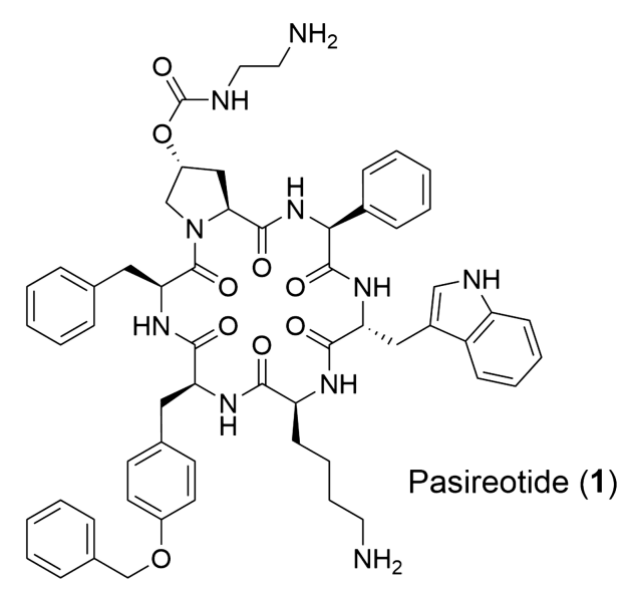
10.1 Determine the number of stereogenic centers (\(n\)) in Pasireotide (1). Calculate the total number of all possible stereoisomers (\(t\)).
Pasireotide (1) is a cyclic peptide. An advanced intermediate in its synthesis (linear peptide 2) can be prepared by solid-phase peptide synthesis (SPPS) using the Fmoc/tBu strategy as shown in Scheme 1.
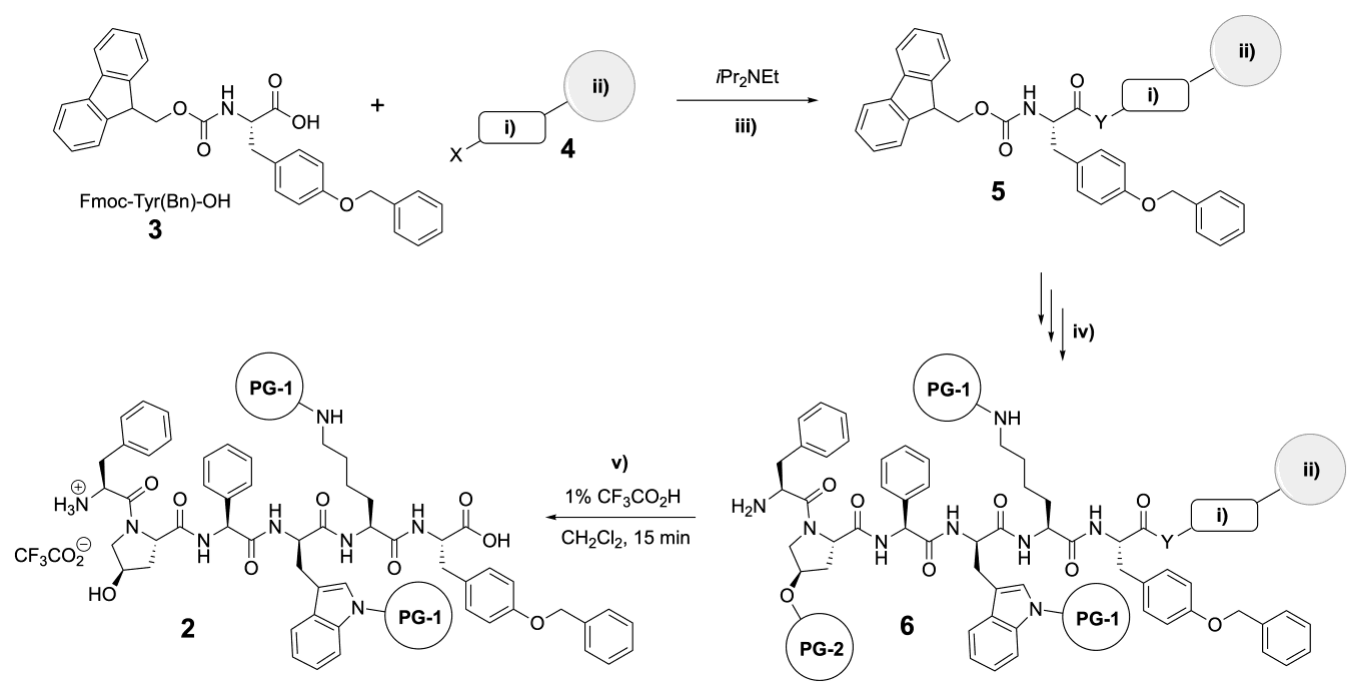
Scheme 1. SPPS of peptide 2. i) Linker; ii) Resin; iii) Resin loading; iv) SPPS: repetition of 1. Fmoc deprotection 2. amino acid coupling + final Fmoc deprotection; v) Peptide cleavage from resin and deprotection of PG-2.
The synthesis starts with the preparation of Fmoc-Tyr(Bn)-OH (3) from Boc-Tyr-OH (7).
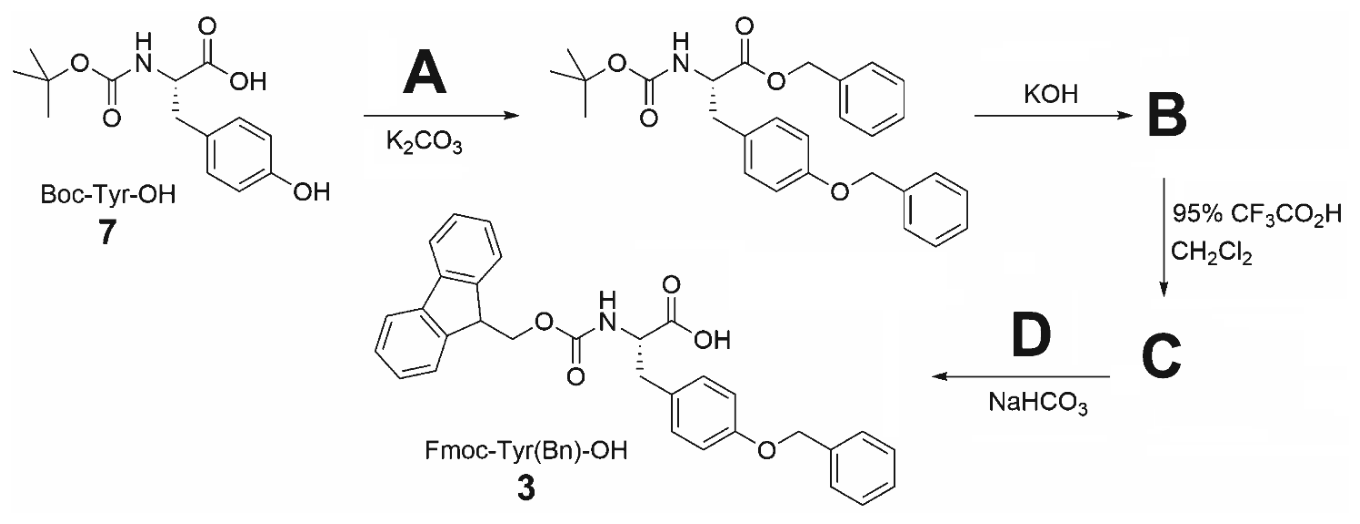
10.2 Draw reagents A and D and intermediates B and C in the synthesis of Fmoc-Tyr(Bn)-OH (3) as shown above.
The SPPS of intermediate 2 begins with attaching the Fmoc-Tyr(Bn)-OH (3) to a suitable resin-bound linker.
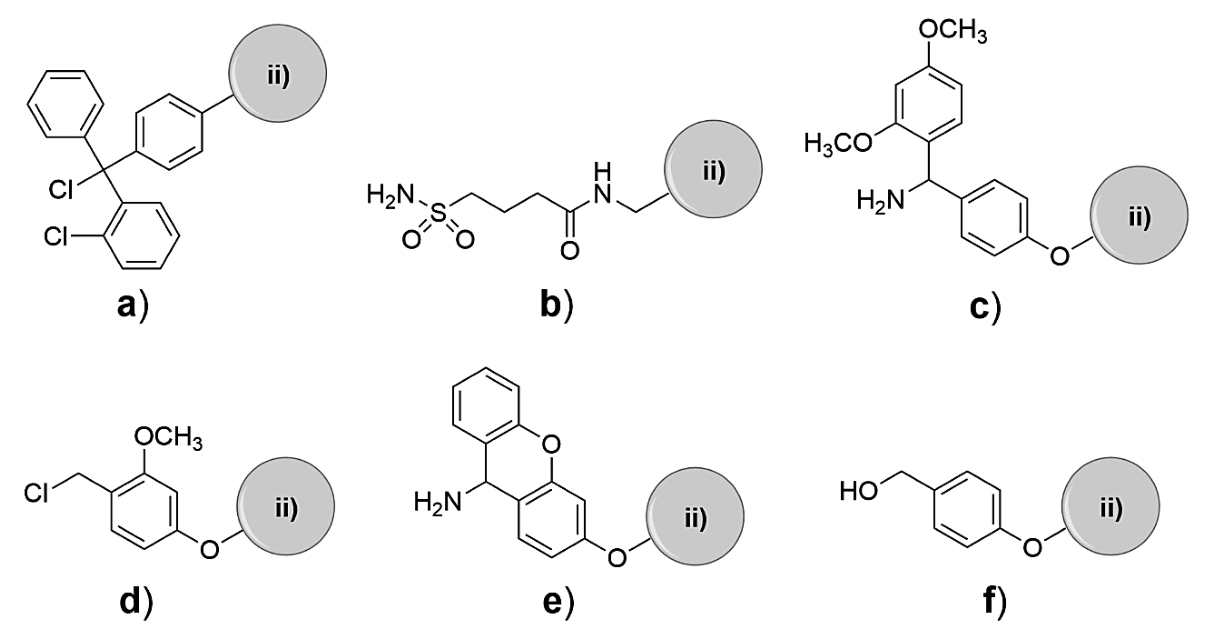
Scheme 2. ii) Resin; a) 2-Chlorotrityl-chloride linker; b) Safety-catch linker; c) Rink amide linker; d) SASRIN-chloride linker; e) Sieber amide linker; f) Wang linker
10.3 Choose the linker(s) 4 from Scheme 2 that are appropriate for SPPS of peptide 2 according to Scheme 1.
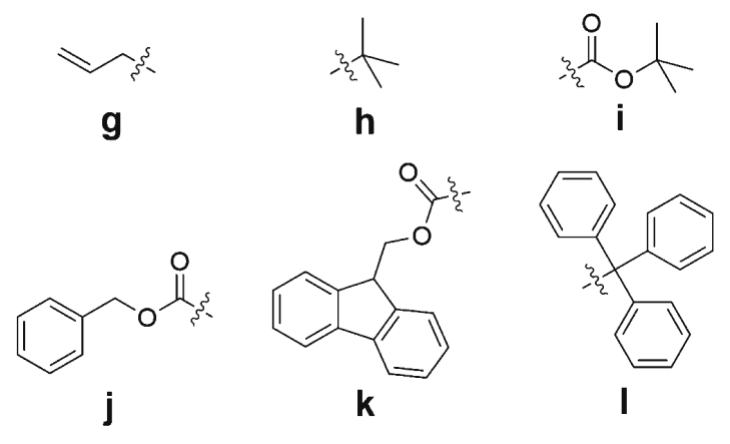
10.4 From g–l choose the most suitable side-chain protecting groups PG-1 and PG-2 for SPPS of 2 according to Scheme 1 that can be orthogonally cleaved in the presence of all other functional groups present in Pasireotide. Only one answer is correct for each of the protecting groups.
Next, linear peptide 2 undergoes an intramolecular coupling reaction to form cyclic peptide 8 according to the following scheme:
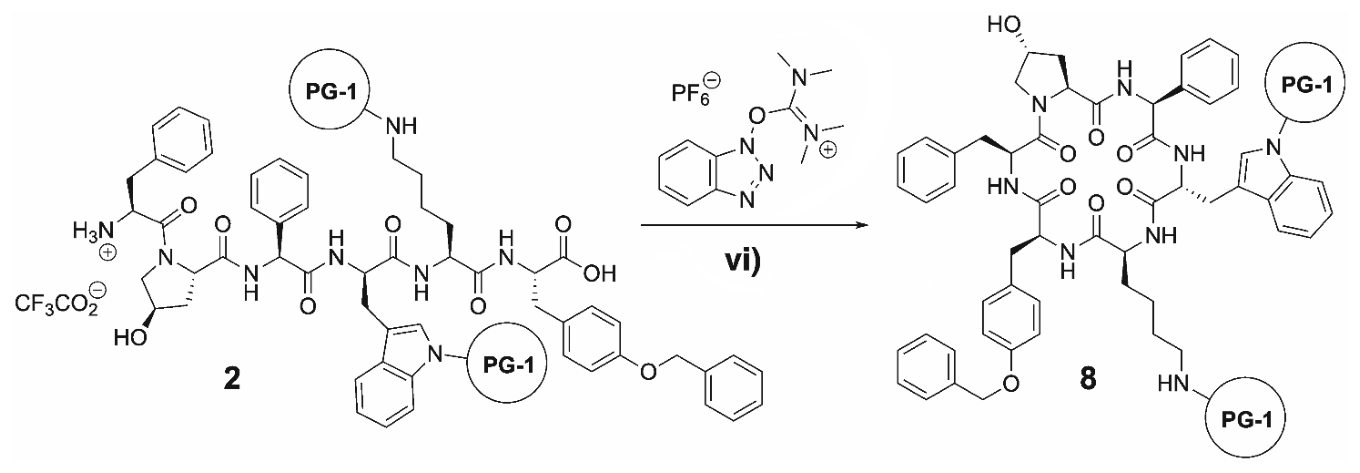
Scheme 3. vi) Base
10.5 Choose the correct statement(s) about the cyclization of peptide 2 to 8.
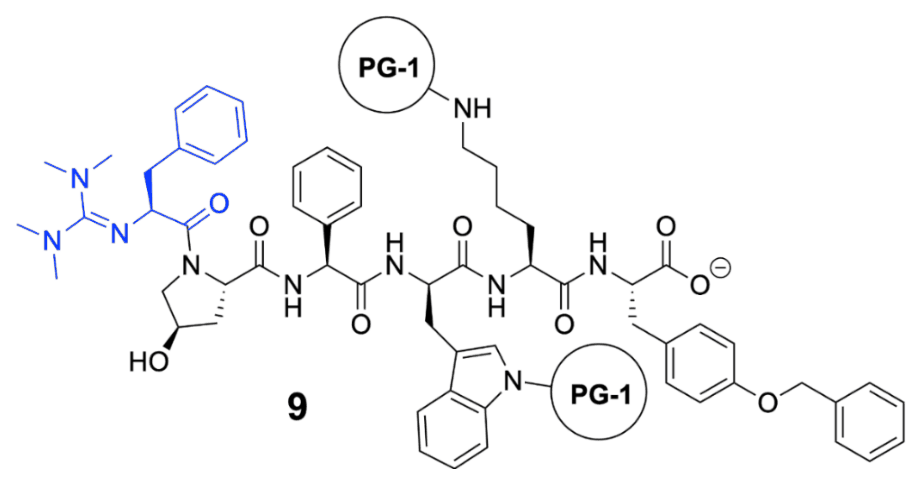
(a) A possible side-product of the reaction is tetramethylguanidylation of the \(N\)-terminal phenylalanine residue resulting in compound 9 shown below.
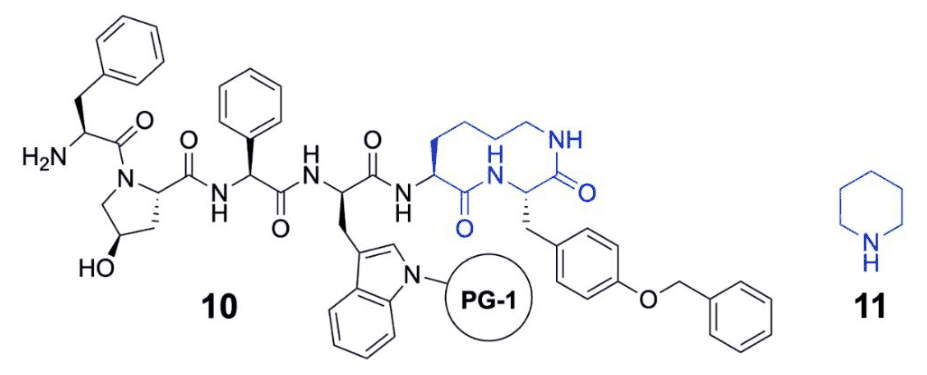
(b) A possible side-product of the reaction is the cleavage of protecting group PG-1 and cyclization via the amino group of the lysine residue to give compound 10 shown below.
(c) The reaction must be carried out at a high peptide concentration to achieve a sufficient reaction rate.
(d) The reaction must be carried out at a low peptide concentration to prevent polycondensation.
(e) Piperidine (11) below is a suitable base for the reaction.
The last steps of the synthesis involve functionalization of the OH-group of the 4-hydroxyproline residue in 8, followed by cleavage of all PGs to give Pasireotide (1).
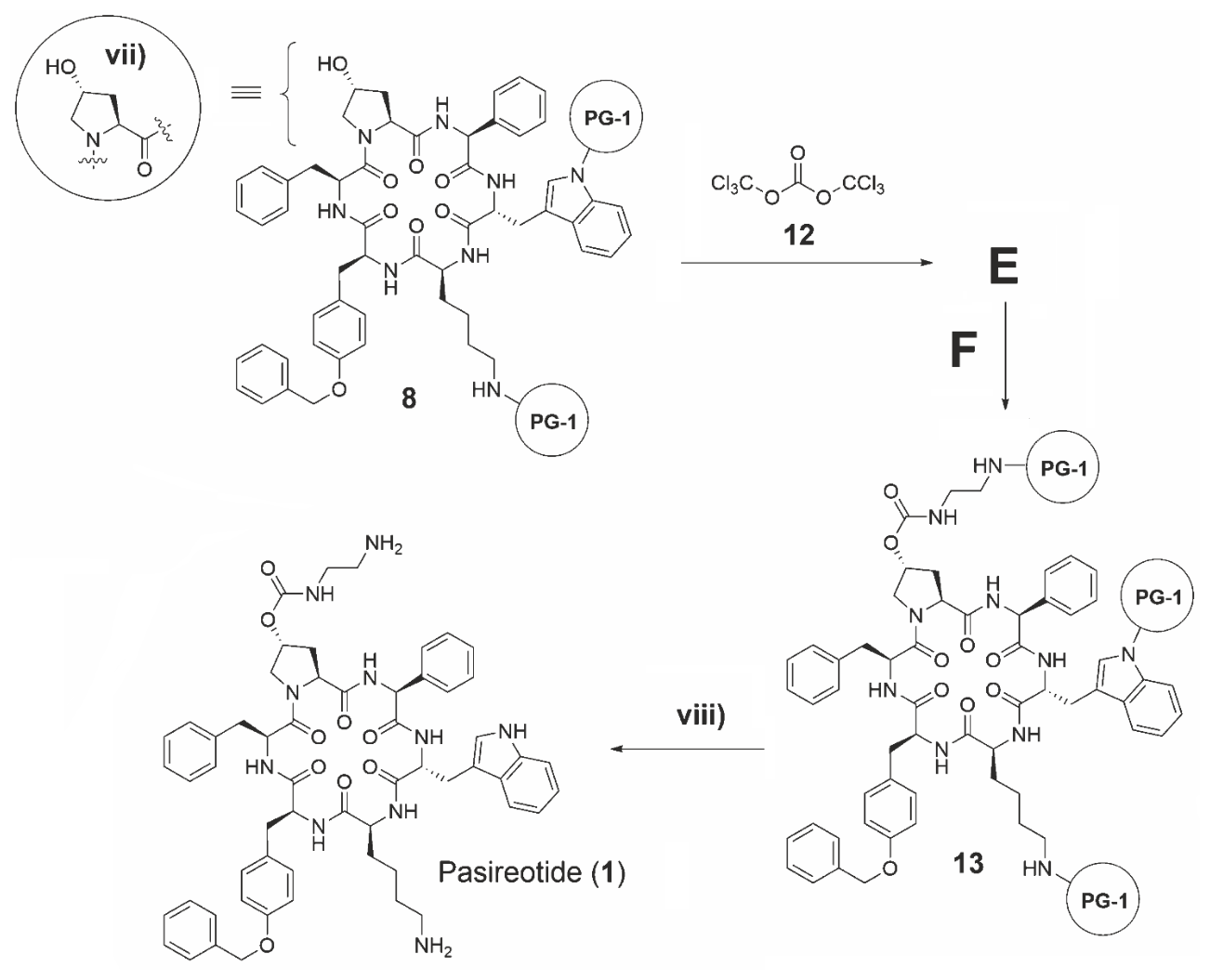
Scheme 4. vii) can be used as simplification of 8; viii) Cleavage of protecting groups
10.6 Draw the structures of intermediate E (including stereochemistry) and reagent F. Abbreviate intermediate 8 as (vii) and the protecting group as PG-1 in structures E and F as depicted in Scheme 5.
10.7 Determine the lowest possible molar equivalents of compound 12 that are necessary to enable full conversion of 8 to 13.
Official English text of the problem.
Answers
Asterisks in the SMILES below denote the explicitly identified attachment points to an omitted resin, peptide, or protecting group.
-
10.1: \(\boxed{n=7,\qquad t=2^7=128}\).
-
10.2: Suitable reagents and the corresponding intermediates are:
| Label | Identification | SMILES |
|---|---|---|
| A | Benzyl bromide, used to introduce both benzyl groups | BrCc1ccccc1 |
| B | \(N\)-Boc-\(O\)-benzyl-L-tyrosine, shown as its free acid after work-up | CC(C)(C)OC(=O)N[C@@H](Cc1ccc(OCc2ccccc2)cc1)C(=O)O |
| C | \(O\)-Benzyl-L-tyrosinium trifluoroacetate | [NH3+][C@@H](Cc1ccc(OCc2ccccc2)cc1)C(=O)O.O=C([O-])C(F)(F)F |
| D | 9-Fluorenylmethyl chloroformate, Fmoc-Cl | O=C(Cl)OCC1c2ccccc2-c2ccccc21 |
-
10.3: \(\boxed{\text{a and d}}\): the 2-chlorotrityl-chloride and SASRIN-chloride linkers. Their resin-bound fragments are, respectively,
[*:1]c1ccc(C(Cl)(c2ccccc2)c2ccccc2Cl)cc1andCOc1cc(O[*:1])ccc1CCl, where[*:1]represents the resin attachment. -
10.4: \(\boxed{\text{PG-1 = i, Boc;\quad PG-2 = l, trityl}}\). The attached protecting-group fragments are tert-butoxycarbonyl,
[*]C(=O)OC(C)(C)C, and triphenylmethyl,[*]C(c1ccccc1)(c1ccccc1)c1ccccc1. -
10.5: \(\boxed{\text{(a) and (d)}}\).
-
10.6: E is the 4-\(O\)-chloroformate of peptide 8, retaining the hydroxyproline \((2S,4R)\) configuration:
[*:1]N1C[C@H](OC(=O)Cl)C[C@H]1C(=O)[*:2]. The two asterisks are the peptide continuation bonds shown in abbreviation (vii). F is \(N\)-Boc-ethane-1,2-diamine,NCCNC(=O)OC(C)(C)C; with the requested PG-1 abbreviation it isNCCN[*:3], where[*:3]denotes PG-1. -
10.7: \(\boxed{\dfrac{1}{3}\text{ molar equivalent of 12}}\), or \(0.333\ \mathrm{mol}\) of triphosgene per \(1.00\ \mathrm{mol}\) of peptide 8.
Solution
10.1 — Stereogenic centers and stereoisomers
Each of the six amino-acid residues has a stereogenic \(\alpha\)-carbon:
- Phenylalanine.
- 4-Hydroxyproline.
- Phenylglycine.
- Tryptophan.
- Lysine.
- \(O\)-Benzyltyrosine.
The oxygen-bearing carbon at position 4 of the hydroxyproline ring supplies one additional stereogenic center. Thus,
\[ n=6+1=\boxed{7}. \]
The amide nitrogens are approximately planar and do not provide additional configurationally stable stereogenic centers. The primary amino groups each have two identical hydrogen substituents.
There is no molecular symmetry that makes different assignments of these seven centers equivalent or creates meso forms. Therefore,
\[ t=2^n=2^7=\boxed{128}. \]
Ordinary conformational changes, including peptide-bond conformations, are not counted separately in this stereogenic-center calculation.
The depicted pasireotide has the stereochemical SMILES:
N1[C@@H](Cc2ccccc2)C(=O)N2C[C@H](OC(=O)NCCN)C[C@H]2C(=O)N[C@@H](c2ccccc2)C(=O)N[C@H](Cc2c[nH]c3ccccc23)C(=O)N[C@@H](CCCCN)C(=O)N[C@@H](Cc2ccc(OCc3ccccc3)cc2)C1=O
This specifies connectivity and configuration, but does not specify a particular macrocycle conformation.
10.2 — Preparation of Fmoc-Tyr(Bn)-OH
The sequence protects both oxygen functions with benzyl groups, selectively hydrolyzes the benzyl ester, removes Boc, and installs Fmoc. The tyrosine stereocenter retains its \(S\) configuration throughout.
The structures already drawn in this sequence can be represented as follows:
| Compound | Name | SMILES |
|---|---|---|
| 7 | \(N\)-Boc-L-tyrosine | CC(C)(C)OC(=O)N[C@@H](Cc1ccc(O)cc1)C(=O)O |
| Product immediately after A | Benzyl \(N\)-Boc-\(O\)-benzyl-L-tyrosinate | CC(C)(C)OC(=O)N[C@@H](Cc1ccc(OCc2ccccc2)cc1)C(=O)OCc1ccccc1 |
| 3 | \(N\)-Fmoc-\(O\)-benzyl-L-tyrosine | O=C(O)[C@@H](NC(=O)OCC1c2ccccc2-c2ccccc21)Cc1ccc(OCc2ccccc2)cc1 |
A: benzylation of both oxygen functions. Potassium carbonate generates the nucleophilic carboxylate and phenoxide. Each attacks benzyl bromide at its benzylic carbon by an \(S_\mathrm{N}2\) substitution. The products are a benzyl ester and a benzyl ether.
Using the amino-acid shorthand of the problem, the balanced overall equation is
\[ \ce{Boc-Tyr-OH + 2 PhCH2Br + K2CO3 -> Boc-Tyr(Bn)-OBn + 2 KBr + CO2 + H2O}. \]
Thus A is benzyl bromide, with two equivalents required for complete dibenzylation. Benzyl chloride is another chemically suitable benzylating reagent.
B: selective ester hydrolysis. Potassium hydroxide hydrolyzes the benzyl ester by nucleophilic acyl substitution. The aryl benzyl ether and the Boc group survive these basic conditions:
\[ \ce{Boc-Tyr(Bn)-OBn + KOH -> Boc-Tyr(Bn)-OK + PhCH2OH}. \]
Here “-OK” denotes the potassium carboxylate. Acidification gives the free acid:
\[ \ce{Boc-Tyr(Bn)-OK + H+ -> Boc-Tyr(Bn)-OH + K+}. \]
Therefore B is \(N\)-Boc-\(O\)-benzyl-L-tyrosine. Strictly, before acidic work-up the alkaline mixture contains its potassium carboxylate, CC(C)(C)OC(=O)N[C@@H](Cc1ccc(OCc2ccccc2)cc1)C(=O)[O-].[K+].
The alcohol released is benzyl alcohol, OCc1ccccc1.
C: removal of Boc. Concentrated trifluoroacetic acid removes the Boc group while preserving the benzyl ether. Boc cleavage gives carbon dioxide and, in a formal net equation, 2-methylpropene. The newly exposed amino group is protonated by the acid.
Let \(R\) denote the tyrosine carbon skeleton attached to nitrogen, including its benzyl-protected phenol and free carboxyl group. Then
\[ \ce{RNHCO2C(CH3)3 + CF3CO2H -> [RNH3]+ + CF3CO2- + CO2 + CH2=C(CH3)2}. \]
Consequently, C is \(O\)-benzyl-L-tyrosinium trifluoroacetate. The relevant small organic species are trifluoroacetic acid, O=C(O)C(F)(F)F, and 2-methylpropene, C=C(C)C.
D: installation of Fmoc. Fmoc-Cl reacts with the liberated amino group by nucleophilic acyl substitution. Bicarbonate releases the amine from its ammonium salt and neutralizes the acid generated during carbamate formation.
Writing \(Fl\) for the fluoren-9-yl group, a balanced equation for conversion of the trifluoroacetate salt to the isolated protected amino acid is
\[ \ce{ [RNH3]+ + CF3CO2- + ClCO2CH2Fl + 2 NaHCO3 -> RNHCO2CH2Fl + NaCF3CO2 + NaCl + 2 CO2 + 2 H2O }. \]
Thus D is Fmoc-Cl, and the product is 3, Fmoc-Tyr(Bn)-OH.
10.3 — Selection of the linker
Two requirements follow directly from Scheme 1:
- Cleavage must produce the C-terminal carboxylic acid needed for subsequent cyclization.
- Cleavage must occur with 1% trifluoroacetic acid for 15 minutes, while PG-1 remains attached.
| Linker | Assessment |
|---|---|
| a: 2-Chlorotrityl-chloride | Suitable. Gives an acid-labile ester linkage and releases the peptide carboxylic acid under mild acidic conditions. |
| b: Safety-catch | Unsuitable. Its intended cleavage requires activation and subsequent cleavage chemistry not provided in Scheme 1. |
| c: Rink amide | Unsuitable. Releases a C-terminal amide rather than the required carboxylic acid. |
| d: SASRIN-chloride | Suitable. Its highly acid-labile ester releases the peptide carboxylic acid under the specified mild conditions. |
| e: Sieber amide | Unsuitable. Although readily acid-cleavable, it gives a C-terminal amide. |
| f: Wang | Unsuitable for the specified conditions. Its ester normally requires substantially stronger acid treatment. |
For both selected chloride linkers, the amino-acid carboxylate replaces the linker chloride. Thus the attachment atom \(Y\) in Scheme 1 is oxygen.
\[ \boxed{\text{Linkers a and d}} \]
10.4 — Selection of the protecting groups
PG-1 must be Boc, option i.
The lysine side-chain amino group and the tryptophan indole nitrogen must remain protected during:
- Repeated basic Fmoc removals.
- Peptide coupling.
- The brief, dilute-acid resin cleavage.
- Macrocyclization and hydroxyproline functionalization.
Boc provides the required compatibility. Its later acid-mediated removal preserves the benzyl ether that is part of the final drug.
The alternatives illustrate the orthogonality constraints. Fmoc would be removed during the repeated Fmoc-deprotection steps. Cbz removal by hydrogenolysis would also threaten the required tyrosine benzyl ether. Trityl would be removed during the mild acid treatment intended to remove PG-2.
PG-2 must be trityl, option l.
The hydroxyproline oxygen must remain protected during SPPS but become a free alcohol during the 1% trifluoroacetic acid treatment. A trityl ether is sufficiently acid-labile for this selective cleavage because the departing triphenylmethyl cation is strongly resonance-stabilized.
The tert-butyl ether is insufficiently labile under the specified brief, dilute-acid conditions; conditions strong enough to remove it would also compromise the desired retention of Boc.
Therefore,
\[ \boxed{\text{PG-1 = Boc (i),\qquad PG-2 = Trt (l)}}. \]
10.5 — Cyclization
The intended reaction joins the terminal amino and carboxyl groups. Its formal condensation balance is
\[ \ce{H2N-P-CO2H -> cyclo(-NH-P-CO-) + H2O}, \]
where \(P\) denotes the intervening peptide skeleton. This expresses the net structural change; the coupling reagent mediates activation and produces its own by-products.
The reagent drawn is HBTU, \(O\)-(benzotriazol-1-yl)-\(N,N,N',N'\)-tetramethyluronium hexafluorophosphate:
CN(C)C(=[N+](C)C)On1nnc2ccccc21.[P-](F)(F)(F)(F)(F)F
| Statement | Verdict | Reason |
|---|---|---|
| (a) | Correct | The terminal amine can attack HBTU’s electrophilic uronium carbon directly, installing a tetramethylguanidino group and giving the side-product connectivity shown in 9. |
| (b) | Incorrect | PG-1 is Boc, which is stable under the basic coupling conditions. The lysine side-chain amino group remains protected. |
| (c) | Incorrect | High concentration increases intermolecular peptide coupling and therefore favors oligomerization. |
| (d) | Correct | Dilution suppresses intermolecular coupling relative to intramolecular cyclization. |
| (e) | Incorrect | Piperidine is a nucleophilic secondary amine and can compete with the peptide amino group for the activated carboxyl group. |
The tetramethylguanidino substituent has the neutral-form fragment [*]N=C(N(C)C)N(C)C, where the asterisk denotes the peptide \(\alpha\)-carbon attachment; protonation changes its charge distribution without changing this connectivity.
The concentration argument follows from the approximate rate laws
\[ v_{\mathrm{cyclization}}=k_{\mathrm{intra}}[P], \qquad v_{\mathrm{intermolecular}}=k_{\mathrm{inter}}[P]^2. \]
Hence
\[ \frac{v_{\mathrm{intermolecular}}}{v_{\mathrm{cyclization}}} = \frac{k_{\mathrm{inter}}}{k_{\mathrm{intra}}}[P]. \]
Lowering peptide concentration reduces the relative importance of intermolecular reactions.
Piperidine, N1CCCCC1, is therefore unsuitable as the coupling base. A suitable choice is the hindered tertiary amine \(N,N\)-diisopropylethylamine, CCN(C(C)C)C(C)C.
\[ \boxed{\text{Correct statements: (a) and (d)}} \]
10.6 — Intermediate E and reagent F
Compound 12 is triphosgene, or bis(trichloromethyl) carbonate:
O=C(OC(Cl)(Cl)Cl)OC(Cl)(Cl)Cl
It supplies phosgene, O=C(Cl)Cl, equivalents.
Let \(\ce{R-OH}\) denote the protected cyclic peptide 8, with the oxygen belonging to the hydroxyproline hydroxyl group. Conversion to the chloroformate is
\[ \ce{R-OH + COCl2 -> R-O-C(=O)Cl + HCl}. \]
Therefore E is the hydroxyproline \(O\)-chloroformate.
To draw E using abbreviation (vii), replace the hydroxyl hydrogen by \(\ce{C(=O)Cl}\), giving the substituent \(\ce{-O-C(=O)Cl}\). Preserve the dashed bond from hydroxyproline C4 to oxygen and the solid wedge shown in the pyrrolidine ring. The configuration remains \((2S,4R)\).
Its abbreviated stereochemical SMILES is
[*:1]N1C[C@H](OC(=O)Cl)C[C@H]1C(=O)[*:2]
Both asterisks connect to the omitted remainder of the same cyclic peptide.
The side chain in 13 requires one free amino group to attack the chloroformate and a second amino group protected by PG-1. Thus F is mono-Boc-protected ethane-1,2-diamine:
\[ \ce{H2N-CH2-CH2-NH-PG1}. \]
Its abbreviated SMILES is NCCN[*:3], with [*:3] = PG-1; its complete SMILES is NCCNC(=O)OC(C)(C)C.
The free amino group attacks the chloroformate carbonyl, and chloride leaves:
\[ \ce{ R-O-C(=O)Cl + H2N-CH2-CH2-NH-PG1 -> R-O-C(=O)-NH-CH2-CH2-NH-PG1 + HCl }. \]
This gives the carbamate in 13. Neither step breaks a bond at a stereogenic carbon, so the hydroxyproline configurations are retained. A base can capture the hydrogen chloride generated in these reactions.
10.7 — Minimum amount of triphosgene
One molecule of triphosgene contains three carbon atoms that can supply three phosgene equivalents:
\[ \ce{(CCl3O)2CO -> 3 COCl2}. \]
Each conversion of 8 into 13 requires one new carbamate carbonyl. Therefore one mole of triphosgene can, in principle, functionalize three moles of peptide 8.
The overall balanced functionalization equation is
\[ \ce{ 3 R-OH + 3 H2N-CH2-CH2-NH-PG1 + (CCl3O)2CO -> 3 R-O-C(=O)-NH-CH2-CH2-NH-PG1 + 6 HCl }. \]
Thus,
\[ 3n_{12}\geq n_8, \]
and the theoretical minimum is
\[ \boxed{ \left(\frac{n_{12}}{n_8}\right)_{\min} =\frac13 =0.333\ \mathrm{mol\,mol^{-1}} }. \]
This is exactly one-third of a molar equivalent, assuming complete utilization of all three phosgene equivalents.
The solution was checked against the official solution.
IChO 2023 · Theorieaufgabe 10
Schweiz — Das Land der Pharmazeutika
Pasireotid (1) ist ein peptidbasierter Arzneistoff, der vom Schweizer Pharmaunternehmen Novartis zur Behandlung des Morbus Cushing entwickelt wurde.
10.1 Bestimmen Sie die Anzahl der stereogenen Zentren (\(n\)) in Pasireotid (1). Berechnen Sie die Gesamtzahl aller möglichen Stereoisomere (\(t\)).
Pasireotid (1) ist ein cyclisches Peptid. Ein fortgeschrittenes Zwischenprodukt seiner Synthese (das lineare Peptid 2) kann mittels Festphasenpeptidsynthese (SPPS) unter Verwendung der Fmoc/tBu-Strategie hergestellt werden, wie in Schema 1 gezeigt.
Schema 1. SPPS von Peptid 2. i) Linker; ii) Harz; iii) Harzbeladung; iv) SPPS: Wiederholung von 1. Fmoc-Abspaltung 2. Aminosäurekupplung + abschließende Fmoc-Abspaltung; v) Abspaltung des Peptids vom Harz und Abspaltung von PG-2.
Die Synthese beginnt mit der Herstellung von Fmoc-Tyr(Bn)-OH (3) aus Boc-Tyr-OH (7).
10.2 Zeichnen Sie die Reagenzien A und D sowie die Zwischenprodukte B und C in der oben gezeigten Synthese von Fmoc-Tyr(Bn)-OH (3).
Die SPPS des Zwischenprodukts 2 beginnt mit der Anknüpfung von Fmoc-Tyr(Bn)-OH (3) an einen geeigneten harzgebundenen Linker.
Schema 2. ii) Harz; a) 2-Chlortritylchlorid-Linker; b) Safety-catch-Linker; c) Rink-Amid-Linker; d) SASRIN-Chlorid-Linker; e) Sieber-Amid-Linker; f) Wang-Linker
10.3 Wählen Sie aus Schema 2 den bzw. die Linker 4 aus, die für die SPPS von Peptid 2 gemäß Schema 1 geeignet sind.
10.4 Wählen Sie aus g–l die am besten geeigneten Seitenkettenschutzgruppen PG-1 und PG-2 für die SPPS von 2 gemäß Schema 1 aus, die sich in Gegenwart aller anderen in Pasireotid vorhandenen funktionellen Gruppen orthogonal abspalten lassen. Für jede Schutzgruppe ist nur eine Antwort richtig.
Anschließend wird das lineare Peptid 2 durch eine intramolekulare Kupplungsreaktion gemäß dem folgenden Schema in das cyclische Peptid 8 überführt:
Schema 3. vi) Base
10.5 Wählen Sie die richtige(n) Aussage(n) zur Cyclisierung von Peptid 2 zu 8 aus.
(a) Ein mögliches Nebenprodukt der Reaktion entsteht durch Tetramethylguanidylierung des \(N\)-terminalen Phenylalaninrests, wobei die unten gezeigte Verbindung 9 gebildet wird.
(b) Ein mögliches Nebenprodukt der Reaktion entsteht durch Abspaltung der Schutzgruppe PG-1 und Cyclisierung über die Aminogruppe des Lysinrests zur unten gezeigten Verbindung 10.
(c) Die Reaktion muss bei hoher Peptidkonzentration durchgeführt werden, um eine ausreichende Reaktionsgeschwindigkeit zu erreichen.
(d) Die Reaktion muss bei niedriger Peptidkonzentration durchgeführt werden, um eine Polykondensation zu verhindern.
(e) Das unten gezeigte Piperidin (11) ist eine geeignete Base für die Reaktion.
Die letzten Schritte der Synthese umfassen die Funktionalisierung der OH-Gruppe des 4-Hydroxyprolinrests in 8, gefolgt von der Abspaltung aller Schutzgruppen (PGs) zu Pasireotid (1).
Schema 4. vii) kann als vereinfachte Darstellung von 8 verwendet werden; viii) Abspaltung der Schutzgruppen
10.6 Zeichnen Sie die Strukturen des Zwischenprodukts E (einschließlich der Stereochemie) und des Reagenzes F. Kürzen Sie in den Strukturen E und F das Zwischenprodukt 8 als (vii) und die Schutzgruppe als PG-1 ab, wie in Schema 5 dargestellt.
10.7 Bestimmen Sie die kleinstmögliche Anzahl molarer Äquivalente der Verbindung 12, die für eine vollständige Umsetzung von 8 zu 13 erforderlich ist.
Aufgabentext aus dem offiziellen englischen Text übersetzt.
Antworten
Sternchen in den folgenden SMILES bezeichnen die ausdrücklich gekennzeichneten Verknüpfungsstellen zu einem nicht dargestellten Harz, Peptid oder einer nicht dargestellten Schutzgruppe.
-
10.1: \(\boxed{n=7,\qquad t=2^7=128}\).
-
10.2: Geeignete Reagenzien und die entsprechenden Zwischenprodukte sind:
| Bezeichnung | Identifizierung | SMILES |
|---|---|---|
| A | Benzylbromid, zur Einführung beider Benzylgruppen | BrCc1ccccc1 |
| B | \(N\)-Boc-\(O\)-benzyl-L-tyrosin, als freie Säure nach der Aufarbeitung dargestellt | CC(C)(C)OC(=O)N[C@@H](Cc1ccc(OCc2ccccc2)cc1)C(=O)O |
| C | \(O\)-Benzyl-L-tyrosiniumtrifluoracetat | [NH3+][C@@H](Cc1ccc(OCc2ccccc2)cc1)C(=O)O.O=C([O-])C(F)(F)F |
| D | Chlorameisensäure-9-fluorenylmethylester, Fmoc-Cl | O=C(Cl)OCC1c2ccccc2-c2ccccc21 |
-
10.3: \(\boxed{\text{a und d}}\): die 2-Chlortritylchlorid- und SASRIN-Chlorid-Linker. Ihre harzgebundenen Fragmente sind
[*:1]c1ccc(C(Cl)(c2ccccc2)c2ccccc2Cl)cc1bzw.COc1cc(O[*:1])ccc1CCl, wobei[*:1]die Verknüpfung mit dem Harz darstellt. -
10.4: \(\boxed{\text{PG-1 = i, Boc;\quad PG-2 = l, Trityl}}\). Die gebundenen Schutzgruppenfragmente sind tert-Butoxycarbonyl,
[*]C(=O)OC(C)(C)C, und Triphenylmethyl,[*]C(c1ccccc1)(c1ccccc1)c1ccccc1. -
10.5: \(\boxed{\text{(a) und (d)}}\).
-
10.6: E ist das 4-\(O\)-Chlorformiat von Peptid 8, unter Beibehaltung der \((2S,4R)\)-Konfiguration des Hydroxyprolins:
[*:1]N1C[C@H](OC(=O)Cl)C[C@H]1C(=O)[*:2]. Die beiden Sternchen sind die in der abgekürzten Darstellung (vii) gezeigten Bindungen, über die sich das Peptid fortsetzt. F ist \(N\)-Boc-ethan-1,2-diamin,NCCNC(=O)OC(C)(C)C; mit der verlangten Abkürzung PG-1 lautet esNCCN[*:3], wobei[*:3]PG-1 bezeichnet. -
10.7: \(\boxed{\dfrac{1}{3}\text{ molares Äquivalent von 12}}\), oder \(0.333\ \mathrm{mol}\) Triphosgen pro \(1.00\ \mathrm{mol}\) Peptid 8.
Lösung
10.1 — Stereogene Zentren und Stereoisomere
Jeder der sechs Aminosäurereste besitzt ein stereogenes \(\alpha\)-Kohlenstoffatom:
- Phenylalanin.
- 4-Hydroxyprolin.
- Phenylglycin.
- Tryptophan.
- Lysin.
- \(O\)-Benzyltyrosin.
Das sauerstofftragende Kohlenstoffatom an Position 4 des Hydroxyprolinrings stellt ein zusätzliches stereogenes Zentrum dar. Somit gilt:
\[ n=6+1=\boxed{7}. \]
Die Amidstickstoffatome sind annähernd planar und bilden keine zusätzlichen konfigurationsstabilen stereogenen Zentren. Die primären Aminogruppen tragen jeweils zwei identische Wasserstoffsubstituenten.
Es liegt keine Molekülsymmetrie vor, durch die unterschiedliche Konfigurationszuweisungen an diesen sieben Zentren äquivalent würden oder meso-Formen entstünden. Daher gilt:
\[ t=2^n=2^7=\boxed{128}. \]
Gewöhnliche Konformationsänderungen, einschließlich der Konformationen von Peptidbindungen, werden bei dieser auf stereogenen Zentren beruhenden Berechnung nicht gesondert gezählt.
Das dargestellte Pasireotid hat den stereochemischen SMILES:
N1[C@@H](Cc2ccccc2)C(=O)N2C[C@H](OC(=O)NCCN)C[C@H]2C(=O)N[C@@H](c2ccccc2)C(=O)N[C@H](Cc2c[nH]c3ccccc23)C(=O)N[C@@H](CCCCN)C(=O)N[C@@H](Cc2ccc(OCc3ccccc3)cc2)C1=O
Dieser legt die Konnektivität und Konfiguration fest, jedoch keine bestimmte Konformation des Makrocyclus.
10.2 — Herstellung von Fmoc-Tyr(Bn)-OH
In dieser Reaktionsfolge werden beide Sauerstofffunktionen mit Benzylgruppen geschützt, der Benzylester selektiv hydrolysiert, Boc abgespalten und Fmoc eingeführt. Das stereogene Zentrum des Tyrosins behält während der gesamten Reaktionsfolge seine \(S\)-Konfiguration.
Die in dieser Reaktionsfolge bereits eingezeichneten Strukturen lassen sich wie folgt darstellen:
| Verbindung | Name | SMILES |
|---|---|---|
| 7 | \(N\)-Boc-L-tyrosin | CC(C)(C)OC(=O)N[C@@H](Cc1ccc(O)cc1)C(=O)O |
| Produkt unmittelbar nach A | \(N\)-Boc-\(O\)-benzyl-L-tyrosinbenzylester | CC(C)(C)OC(=O)N[C@@H](Cc1ccc(OCc2ccccc2)cc1)C(=O)OCc1ccccc1 |
| 3 | \(N\)-Fmoc-\(O\)-benzyl-L-tyrosin | O=C(O)[C@@H](NC(=O)OCC1c2ccccc2-c2ccccc21)Cc1ccc(OCc2ccccc2)cc1 |
A: Benzylierung beider Sauerstofffunktionen. Kaliumcarbonat erzeugt das nucleophile Carboxylat und Phenolat. Beide greifen Benzylbromid am benzylischen Kohlenstoffatom in einer \(S_\mathrm{N}2\)-Substitution an. Die Produkte sind ein Benzylester und ein Benzylether.
Mit der Aminosäurekurzschreibweise der Aufgabe lautet die ausgeglichene Gesamtgleichung:
\[ \ce{Boc-Tyr-OH + 2 PhCH2Br + K2CO3 -> Boc-Tyr(Bn)-OBn + 2 KBr + CO2 + H2O}. \]
Somit ist A Benzylbromid, von dem für eine vollständige Dibenzylierung zwei Äquivalente benötigt werden. Benzylchlorid ist ein weiteres chemisch geeignetes Benzylierungsreagenz.
B: selektive Esterhydrolyse. Kaliumhydroxid hydrolysiert den Benzylester durch nucleophile Acylsubstitution. Der Arylbenzylether und die Boc-Gruppe bleiben unter diesen basischen Bedingungen erhalten:
\[ \ce{Boc-Tyr(Bn)-OBn + KOH -> Boc-Tyr(Bn)-OK + PhCH2OH}. \]
Hier bezeichnet „-OK“ das Kaliumcarboxylat. Ansäuern liefert die freie Säure:
\[ \ce{Boc-Tyr(Bn)-OK + H+ -> Boc-Tyr(Bn)-OH + K+}. \]
Daher ist B \(N\)-Boc-\(O\)-benzyl-L-tyrosin. Streng genommen enthält das alkalische Gemisch vor der sauren Aufarbeitung dessen Kaliumcarboxylat, CC(C)(C)OC(=O)N[C@@H](Cc1ccc(OCc2ccccc2)cc1)C(=O)[O-].[K+].
Der freigesetzte Alkohol ist Benzylalkohol, OCc1ccccc1.
C: Abspaltung von Boc. Konzentrierte Trifluoressigsäure spaltet die Boc-Gruppe ab, während der Benzylether erhalten bleibt. Bei der Boc-Abspaltung entstehen Kohlenstoffdioxid und, in einer formalen Nettogleichung, 2-Methylpropen. Die neu freigesetzte Aminogruppe wird durch die Säure protoniert.
\(R\) bezeichne das an den Stickstoff gebundene Kohlenstoffgerüst des Tyrosins einschließlich seiner benzylgeschützten Phenolgruppe und seiner freien Carboxylgruppe. Dann gilt:
\[ \ce{RNHCO2C(CH3)3 + CF3CO2H -> [RNH3]+ + CF3CO2- + CO2 + CH2=C(CH3)2}. \]
Folglich ist C \(O\)-Benzyl-L-tyrosiniumtrifluoracetat. Die relevanten kleinen organischen Spezies sind Trifluoressigsäure, O=C(O)C(F)(F)F, und 2-Methylpropen, C=C(C)C.
D: Einführung von Fmoc. Fmoc-Cl reagiert mit der freigesetzten Aminogruppe durch nucleophile Acylsubstitution. Hydrogencarbonat setzt das Amin aus seinem Ammoniumsalz frei und neutralisiert die bei der Carbamatbildung entstehende Säure.
Mit \(Fl\) als Abkürzung für die Fluoren-9-yl-Gruppe lautet eine ausgeglichene Gleichung für die Umwandlung des Trifluoracetatsalzes in die isolierte geschützte Aminosäure:
\[ \ce{ [RNH3]+ + CF3CO2- + ClCO2CH2Fl + 2 NaHCO3 -> RNHCO2CH2Fl + NaCF3CO2 + NaCl + 2 CO2 + 2 H2O }. \]
Somit ist D Fmoc-Cl, und das Produkt ist 3, Fmoc-Tyr(Bn)-OH.
10.3 — Auswahl des Linkers
Aus Schema 1 ergeben sich unmittelbar zwei Anforderungen:
- Bei der Abspaltung muss die für die anschließende Cyclisierung erforderliche C-terminale Carbonsäure entstehen.
- Die Abspaltung muss mit 1%iger Trifluoressigsäure innerhalb von 15 Minuten erfolgen, während PG-1 gebunden bleibt.
| Linker | Beurteilung |
|---|---|
| a: 2-Chlortritylchlorid | Geeignet. Bildet eine säurelabile Esterbindung und setzt die Peptidcarbonsäure unter milden sauren Bedingungen frei. |
| b: Safety-catch | Ungeeignet. Seine vorgesehene Abspaltung erfordert eine Aktivierung und anschließende Abspaltungsreaktionen, die in Schema 1 nicht vorgesehen sind. |
| c: Rink-Amid | Ungeeignet. Setzt ein C-terminales Amid anstelle der erforderlichen Carbonsäure frei. |
| d: SASRIN-Chlorid | Geeignet. Sein stark säurelabiler Ester setzt die Peptidcarbonsäure unter den angegebenen milden Bedingungen frei. |
| e: Sieber-Amid | Ungeeignet. Obwohl er leicht durch Säure spaltbar ist, liefert er ein C-terminales Amid. |
| f: Wang | Unter den angegebenen Bedingungen ungeeignet. Sein Ester erfordert normalerweise eine wesentlich stärkere Säurebehandlung. |
Bei beiden ausgewählten Chlorid-Linkern ersetzt das Aminosäurecarboxylat das Chlorid des Linkers. Das Verknüpfungsatom \(Y\) in Schema 1 ist somit Sauerstoff.
\[ \boxed{\text{Linker a und d}} \]
10.4 — Auswahl der Schutzgruppen
PG-1 muss Boc sein, Option i.
Die Aminogruppe der Lysinseitenkette und der Indolstickstoff des Tryptophans müssen während der folgenden Schritte geschützt bleiben:
- Wiederholte basische Fmoc-Abspaltungen.
- Peptidkupplung.
- Kurze Abspaltung vom Harz mit verdünnter Säure.
- Makrocyclisierung und Funktionalisierung des Hydroxyprolins.
Boc bietet die erforderliche Verträglichkeit. Bei seiner späteren säurevermittelten Abspaltung bleibt der Benzylether erhalten, der Bestandteil des fertigen Arzneistoffs ist.
Die Alternativen verdeutlichen die Anforderungen an die Orthogonalität. Fmoc würde bei den wiederholten Fmoc-Abspaltungsschritten entfernt. Die hydrogenolytische Abspaltung von Cbz würde auch den benötigten Tyrosinbenzylether gefährden. Trityl würde bei der milden Säurebehandlung abgespalten, die zur Entfernung von PG-2 vorgesehen ist.
PG-2 muss Trityl sein, Option l.
Der Hydroxyprolinsauerstoff muss während der SPPS geschützt bleiben, bei der Behandlung mit 1%iger Trifluoressigsäure jedoch als freier Alkohol vorliegen. Ein Tritylether ist für diese selektive Spaltung ausreichend säurelabil, da das abgehende Triphenylmethylkation stark mesomeriestabilisiert ist.
Der tert-Butylether ist unter den angegebenen Bedingungen einer kurzen Behandlung mit verdünnter Säure nicht ausreichend labil; Bedingungen, die stark genug für seine Abspaltung wären, würden auch den gewünschten Erhalt von Boc gefährden.
Daher gilt:
\[ \boxed{\text{PG-1 = Boc (i),\qquad PG-2 = Trt (l)}}. \]
10.5 — Cyclisierung
Die beabsichtigte Reaktion verknüpft die endständige Amino- und Carboxylgruppe. Ihre formale Kondensationsbilanz lautet:
\[ \ce{H2N-P-CO2H -> cyclo(-NH-P-CO-) + H2O}, \]
wobei \(P\) das dazwischenliegende Peptidgerüst bezeichnet. Dies beschreibt die strukturelle Nettoänderung; das Kupplungsreagenz vermittelt die Aktivierung und bildet eigene Nebenprodukte.
Das gezeichnete Reagenz ist HBTU, \(O\)-(Benzotriazol-1-yl)-\(N,N,N',N'\)-tetramethyluroniumhexafluorophosphat:
CN(C)C(=[N+](C)C)On1nnc2ccccc21.[P-](F)(F)(F)(F)(F)F
| Aussage | Bewertung | Begründung |
|---|---|---|
| (a) | Richtig | Das endständige Amin kann das elektrophile Uroniumkohlenstoffatom von HBTU direkt angreifen, wodurch eine Tetramethylguanidinogruppe eingeführt wird und das Nebenprodukt mit der in 9 gezeigten Konnektivität entsteht. |
| (b) | Falsch | PG-1 ist Boc, das unter den basischen Kupplungsbedingungen stabil ist. Die Aminogruppe der Lysinseitenkette bleibt geschützt. |
| (c) | Falsch | Eine hohe Konzentration verstärkt die intermolekulare Peptidkupplung und begünstigt daher die Oligomerisierung. |
| (d) | Richtig | Verdünnung unterdrückt die intermolekulare Kupplung gegenüber der intramolekularen Cyclisierung. |
| (e) | Falsch | Piperidin ist ein nucleophiles sekundäres Amin und kann mit der Aminogruppe des Peptids um die aktivierte Carboxylgruppe konkurrieren. |
Der Tetramethylguanidinosubstituent besitzt in seiner neutralen Form das Fragment [*]N=C(N(C)C)N(C)C, wobei das Sternchen die Verknüpfung mit dem \(\alpha\)-Kohlenstoffatom des Peptids bezeichnet; eine Protonierung verändert seine Ladungsverteilung, ohne diese Konnektivität zu ändern.
Das Konzentrationsargument folgt aus den näherungsweisen Geschwindigkeitsgesetzen:
\[ v_{\mathrm{cyclization}}=k_{\mathrm{intra}}[P], \qquad v_{\mathrm{intermolecular}}=k_{\mathrm{inter}}[P]^2. \]
Daraus folgt:
\[ \frac{v_{\mathrm{intermolecular}}}{v_{\mathrm{cyclization}}} = \frac{k_{\mathrm{inter}}}{k_{\mathrm{intra}}}[P]. \]
Eine Verringerung der Peptidkonzentration vermindert die relative Bedeutung intermolekularer Reaktionen.
Piperidin, N1CCCCC1, ist daher als Base für die Kupplung ungeeignet. Eine geeignete Wahl ist das sterisch gehinderte tertiäre Amin \(N,N\)-Diisopropylethylamin, CCN(C(C)C)C(C)C.
\[ \boxed{\text{Richtige Aussagen: (a) und (d)}} \]
10.6 — Zwischenprodukt E und Reagenz F
Verbindung 12 ist Triphosgen oder Bis(trichlormethyl)carbonat:
O=C(OC(Cl)(Cl)Cl)OC(Cl)(Cl)Cl
Es liefert Äquivalente von Phosgen, O=C(Cl)Cl.
\(\ce{R-OH}\) bezeichne das geschützte cyclische Peptid 8, wobei der Sauerstoff zur Hydroxylgruppe des Hydroxyprolins gehört. Die Umwandlung zum Chlorformiat lautet:
\[ \ce{R-OH + COCl2 -> R-O-C(=O)Cl + HCl}. \]
Daher ist E das Hydroxyprolin-\(O\)-chlorformiat.
Um E unter Verwendung der abgekürzten Darstellung (vii) zu zeichnen, ersetzen Sie den Hydroxylwasserstoff durch \(\ce{C(=O)Cl}\), sodass der Substituent \(\ce{-O-C(=O)Cl}\) entsteht. Behalten Sie die gestrichelte Bindung von C4 des Hydroxyprolins zum Sauerstoff und den ausgefüllten Keil im Pyrrolidinring bei. Die Konfiguration bleibt \((2S,4R)\).
Sein abgekürzter stereochemischer SMILES lautet:
[*:1]N1C[C@H](OC(=O)Cl)C[C@H]1C(=O)[*:2]
Beide Sternchen sind mit dem nicht dargestellten Rest desselben cyclischen Peptids verknüpft.
Die Seitenkette in 13 erfordert eine freie Aminogruppe zum Angriff auf das Chlorformiat und eine zweite, durch PG-1 geschützte Aminogruppe. Somit ist F mono-Boc-geschütztes Ethan-1,2-diamin:
\[ \ce{H2N-CH2-CH2-NH-PG1}. \]
Sein abgekürzter SMILES lautet NCCN[*:3], mit [*:3] = PG-1; sein vollständiger SMILES lautet NCCNC(=O)OC(C)(C)C.
Die freie Aminogruppe greift die Carbonylgruppe des Chlorformiats an, und Chlorid tritt aus:
\[ \ce{ R-O-C(=O)Cl + H2N-CH2-CH2-NH-PG1 -> R-O-C(=O)-NH-CH2-CH2-NH-PG1 + HCl }. \]
Dadurch entsteht das Carbamat in 13. In keinem der beiden Schritte wird eine Bindung an einem stereogenen Kohlenstoffatom gespalten, sodass die Konfigurationen des Hydroxyprolins erhalten bleiben. Eine Base kann den bei diesen Reaktionen entstehenden Chlorwasserstoff abfangen.
10.7 — Mindestmenge an Triphosgen
Ein Molekül Triphosgen enthält drei Kohlenstoffatome, die drei Phosgenäquivalente liefern können:
\[ \ce{(CCl3O)2CO -> 3 COCl2}. \]
Jede Umwandlung von 8 in 13 erfordert eine neue Carbamatcarbonylgruppe. Daher kann ein Mol Triphosgen prinzipiell drei Mol Peptid 8 funktionalisieren.
Die ausgeglichene Gesamtgleichung der Funktionalisierung lautet:
\[ \ce{ 3 R-OH + 3 H2N-CH2-CH2-NH-PG1 + (CCl3O)2CO -> 3 R-O-C(=O)-NH-CH2-CH2-NH-PG1 + 6 HCl }. \]
Somit gilt:
\[ 3n_{12}\geq n_8, \]
und das theoretische Minimum beträgt:
\[ \boxed{ \left(\frac{n_{12}}{n_8}\right)_{\min} =\frac13 =0.333\ \mathrm{mol\,mol^{-1}} }. \]
Dies entspricht genau einem Drittel eines molaren Äquivalents, sofern alle drei Phosgenäquivalente vollständig genutzt werden.
Die Lösung wurde mit der offiziellen Lösung abgeglichen.
IChO 2023 · Teori sorusu 10
İsviçre — İlaçlar Ülkesi
Pasireotid (1), İsviçreli ilaç şirketi Novartis tarafından Cushing hastalığının tedavisi için geliştirilmiş peptit temelli bir ilaçtır.
10.1 Pasireotiddeki (1) stereojenik merkezlerin sayısını (\(n\)) belirleyiniz. Olası tüm stereoizomerlerin toplam sayısını (\(t\)) hesaplayınız.
Pasireotid (1) halkalı bir peptittir. Sentezinin ileri bir aşamasındaki bir ara ürün (doğrusal peptit 2), Şema 1'de gösterildiği gibi Fmoc/tBu stratejisi kullanılarak katı faz peptit sentezi (SPPS) ile hazırlanabilir.
Şema 1. Peptit 2'nin SPPS ile sentezi. i) Bağlayıcı; ii) Reçine; iii) Reçineye yükleme; iv) SPPS: 1. Fmoc koruma grubunun uzaklaştırılması 2. amino asit kenetlenmesi adımlarının tekrarlanması + son Fmoc koruma grubunun uzaklaştırılması; v) Peptidin reçineden ayrılması ve PG-2 koruma grubunun uzaklaştırılması.
Sentez, Boc-Tyr-OH'den (7) Fmoc-Tyr(Bn)-OH (3) hazırlanmasıyla başlar.
10.2 Yukarıda gösterilen Fmoc-Tyr(Bn)-OH (3) sentezindeki A ve D reaktifleri ile B ve C ara ürünlerini çiziniz.
Ara ürün 2'nin SPPS ile sentezi, Fmoc-Tyr(Bn)-OH'nin (3) reçineye bağlı uygun bir bağlayıcıya bağlanmasıyla başlar.
Şema 2. ii) Reçine; a) 2-Klorotritil klorür bağlayıcısı; b) Safety-catch bağlayıcısı; c) Rink amid bağlayıcısı; d) SASRIN klorür bağlayıcısı; e) Sieber amid bağlayıcısı; f) Wang bağlayıcısı
10.3 Şema 2'den, peptit 2'nin Şema 1'e göre SPPS ile sentezine uygun bağlayıcıyı/bağlayıcıları 4 seçiniz.
10.4 g–l arasından, 2'nin Şema 1'e göre SPPS ile sentezi için, Pasireotidde bulunan diğer tüm fonksiyonel grupların varlığında ortogonal olarak uzaklaştırılabilen en uygun yan zincir koruma gruplarını PG-1 ve PG-2 seçiniz. Her bir koruma grubu için yalnızca bir cevap doğrudur.
Ardından doğrusal peptit 2, aşağıdaki şemaya göre halkalı peptit 8'i oluşturmak üzere molekül içi bir kenetlenme tepkimesine girer:
Şema 3. vi) Baz
10.5 Peptit 2'nin 8'e halkalaşmasıyla ilgili doğru ifadeyi/ifadeleri seçiniz.
(a) Tepkimenin olası bir yan ürünü, \(N\)-uç fenilalanin kalıntısının tetrametilguanidillenmesi sonucunda oluşan, aşağıda gösterilen bileşik 9'dur.
(b) Tepkimenin olası bir yan ürünü, PG-1 koruma grubunun uzaklaşması ve lizin kalıntısının amino grubu üzerinden halkalaşma sonucunda oluşan, aşağıda gösterilen bileşik 10'dur.
(c) Yeterli bir tepkime hızı elde etmek için tepkime yüksek peptit derişiminde yürütülmelidir.
(d) Polikondenzasyonu önlemek için tepkime düşük peptit derişiminde yürütülmelidir.
(e) Aşağıdaki piperidin (11), tepkime için uygun bir bazdır.
Sentezin son adımları, 8'deki 4-hidroksiprolin kalıntısının OH grubunun fonksiyonelleştirilmesini ve ardından Pasireotid (1) elde etmek üzere tüm koruma gruplarının (PG) uzaklaştırılmasını içerir.
Şema 4. vii) 8'in basitleştirilmiş gösterimi olarak kullanılabilir; viii) Koruma gruplarının uzaklaştırılması
10.6 Ara ürün E'nin (stereokimya dâhil) ve reaktif F'nin yapılarını çiziniz. Şema 5'te gösterildiği gibi, E ve F yapılarında ara ürün 8'i (vii), koruma grubunu ise PG-1 olarak kısaltınız.
10.7 8'in 13'e tamamen dönüşmesini sağlamak için gereken bileşik 12'nin mümkün olan en düşük molar eşdeğer miktarını belirleyiniz.
Soru metni resmi İngilizce metinden çevrilmiştir.
Cevaplar
Aşağıdaki SMILES gösterimlerindeki yıldız işaretleri, gösterilmeyen bir reçineye, peptide veya koruma grubuna ait, açıkça belirtilmiş bağlanma noktalarını gösterir.
-
10.1: \(\boxed{n=7,\qquad t=2^7=128}\).
-
10.2: Uygun reaktifler ve bunlara karşılık gelen ara ürünler şunlardır:
| Etiket | Tanımlama | SMILES |
|---|---|---|
| A | Her iki benzil grubunu bağlamak için kullanılan benzil bromür | BrCc1ccccc1 |
| B | Tepkime sonrası işlemlerin ardından serbest asit hâlinde gösterilen \(N\)-Boc-\(O\)-benzil-L-tirozin | CC(C)(C)OC(=O)N[C@@H](Cc1ccc(OCc2ccccc2)cc1)C(=O)O |
| C | \(O\)-Benzil-L-tirozinyum trifloroasetat | [NH3+][C@@H](Cc1ccc(OCc2ccccc2)cc1)C(=O)O.O=C([O-])C(F)(F)F |
| D | 9-Florenilmetil kloroformat, Fmoc-Cl | O=C(Cl)OCC1c2ccccc2-c2ccccc21 |
-
10.3: \(\boxed{\text{a ve d}}\): 2-klorotritil klorür ve SASRIN klorür bağlayıcıları. Reçineye bağlı parçaları sırasıyla
[*:1]c1ccc(C(Cl)(c2ccccc2)c2ccccc2Cl)cc1veCOc1cc(O[*:1])ccc1CClşeklindedir; burada[*:1]reçineye bağlanmayı temsil eder. -
10.4: \(\boxed{\text{PG-1 = i, Boc;\quad PG-2 = l, tritil}}\). Bağlı koruma grubu parçaları tert-bütoksikarbonil,
[*]C(=O)OC(C)(C)C, ve trifenilmetil,[*]C(c1ccccc1)(c1ccccc1)c1ccccc1şeklindedir. -
10.5: \(\boxed{\text{(a) ve (d)}}\).
-
10.6: E, hidroksiprolinin \((2S,4R)\) konfigürasyonunu koruyan peptit 8'in 4-\(O\)-kloroformatıdır:
[*:1]N1C[C@H](OC(=O)Cl)C[C@H]1C(=O)[*:2]. İki yıldız işareti, (vii) kısaltmasında gösterilen, peptidin devamına bağlanan bağlardır. F, \(N\)-Boc-etan-1,2-diamindir,NCCNC(=O)OC(C)(C)C; istenen PG-1 kısaltmasıyla gösterimiNCCN[*:3]şeklindedir ve burada[*:3], PG-1'i belirtir. -
10.7: \(\boxed{\dfrac{1}{3}\text{ molar eşdeğer 12}}\), yani her \(1.00\ \mathrm{mol}\) peptit 8 için \(0.333\ \mathrm{mol}\) trifosgen.
Çözüm
10.1 — Stereojenik merkezler ve stereoizomerler
Altı amino asit kalıntısının her biri stereojenik bir \(\alpha\)-karbonuna sahiptir:
- Fenilalanin.
- 4-Hidroksiprolin.
- Fenilglisin.
- Triptofan.
- Lizin.
- \(O\)-Benziltirozin.
Hidroksiprolin halkasının 4 konumundaki oksijen taşıyan karbon, ek bir stereojenik merkez oluşturur. Dolayısıyla,
\[ n=6+1=\boxed{7}. \]
Amid azotları yaklaşık olarak düzlemseldir ve konfigürasyonel olarak kararlı ek stereojenik merkezler oluşturmaz. Birincil amino gruplarının her biri iki özdeş hidrojen sübstitüentine sahiptir.
Bu yedi merkezin farklı konfigürasyon atamalarını eşdeğer kılan veya mezo biçimler oluşturan bir moleküler simetri yoktur. Bu nedenle,
\[ t=2^n=2^7=\boxed{128}. \]
Peptit bağı konformasyonları dâhil olmak üzere olağan konformasyon değişimleri, stereojenik merkezlere dayanan bu hesaplamada ayrı ayrı sayılmaz.
Gösterilen pasireotidin stereokimyasal SMILES gösterimi şöyledir:
N1[C@@H](Cc2ccccc2)C(=O)N2C[C@H](OC(=O)NCCN)C[C@H]2C(=O)N[C@@H](c2ccccc2)C(=O)N[C@H](Cc2c[nH]c3ccccc23)C(=O)N[C@@H](CCCCN)C(=O)N[C@@H](Cc2ccc(OCc3ccccc3)cc2)C1=O
Bu gösterim, atomların bağlanma düzenini ve konfigürasyonu belirtir; ancak belirli bir makrohalkalı konformasyon belirtmez.
10.2 — Fmoc-Tyr(Bn)-OH'nin hazırlanması
Bu tepkime dizisinde her iki oksijen fonksiyonu benzil gruplarıyla korunur, benzil esteri seçici olarak hidroliz edilir, Boc uzaklaştırılır ve Fmoc bağlanır. Tirozinin stereomerkezi tüm süreç boyunca \(S\) konfigürasyonunu korur.
Bu dizide hâlihazırda çizilmiş olan yapılar aşağıdaki gibi gösterilebilir:
| Bileşik | Adı | SMILES |
|---|---|---|
| 7 | \(N\)-Boc-L-tirozin | CC(C)(C)OC(=O)N[C@@H](Cc1ccc(O)cc1)C(=O)O |
| A'dan hemen sonraki ürün | Benzil \(N\)-Boc-\(O\)-benzil-L-tirozinat | CC(C)(C)OC(=O)N[C@@H](Cc1ccc(OCc2ccccc2)cc1)C(=O)OCc1ccccc1 |
| 3 | \(N\)-Fmoc-\(O\)-benzil-L-tirozin | O=C(O)[C@@H](NC(=O)OCC1c2ccccc2-c2ccccc21)Cc1ccc(OCc2ccccc2)cc1 |
A: her iki oksijen fonksiyonunun benzillenmesi. Potasyum karbonat, nükleofilik karboksilat ve fenoksidi oluşturur. Bunların her biri benzil bromürün benzilik karbonuna \(S_\mathrm{N}2\) yer değiştirmesi yoluyla saldırır. Ürünler bir benzil esteri ve bir benzil eteridir.
Sorudaki amino asit kısaltmaları kullanıldığında, denkleştirilmiş toplam denklem şöyledir:
\[ \ce{Boc-Tyr-OH + 2 PhCH2Br + K2CO3 -> Boc-Tyr(Bn)-OBn + 2 KBr + CO2 + H2O}. \]
Dolayısıyla A benzil bromürdür ve tam dibenzillenme için iki eşdeğer gerekir. Benzil klorür, kimyasal açıdan uygun bir başka benzilleme reaktifidir.
B: seçici ester hidrolizi. Potasyum hidroksit, benzil esterini nükleofilik açil yer değiştirmesi yoluyla hidroliz eder. Aril benzil eteri ve Boc grubu bu bazik koşullarda korunur:
\[ \ce{Boc-Tyr(Bn)-OBn + KOH -> Boc-Tyr(Bn)-OK + PhCH2OH}. \]
Burada “-OK” potasyum karboksilatı belirtir. Asitlendirme serbest asidi verir:
\[ \ce{Boc-Tyr(Bn)-OK + H+ -> Boc-Tyr(Bn)-OH + K+}. \]
Bu nedenle B, \(N\)-Boc-\(O\)-benzil-L-tirozindir. Daha kesin bir ifadeyle, asidik son işlemden önce bazik karışım bu bileşiğin potasyum karboksilatını, CC(C)(C)OC(=O)N[C@@H](Cc1ccc(OCc2ccccc2)cc1)C(=O)[O-].[K+], içerir.
Açığa çıkan alkol benzil alkoldür, OCc1ccccc1.
C: Boc'un uzaklaştırılması. Derişik trifloroasetik asit, benzil eterini korurken Boc grubunu uzaklaştırır. Boc'un ayrılmasıyla karbon dioksit ve biçimsel net denklemde 2-metilpropen oluşur. Yeni açığa çıkan amino grubu asit tarafından protonlanır.
\(R\), benzille korunmuş fenolü ve serbest karboksil grubu dâhil olmak üzere azota bağlı tirozin karbon iskeletini göstersin. Bu durumda,
\[ \ce{RNHCO2C(CH3)3 + CF3CO2H -> [RNH3]+ + CF3CO2- + CO2 + CH2=C(CH3)2}. \]
Sonuç olarak C, \(O\)-benzil-L-tirozinyum trifloroasetattır. İlgili küçük organik türler trifloroasetik asit, O=C(O)C(F)(F)F, ve 2-metilpropen, C=C(C)C, şeklindedir.
D: Fmoc'un bağlanması. Fmoc-Cl, serbestleşen amino grubuyla nükleofilik açil yer değiştirmesi yoluyla tepkimeye girer. Bikarbonat, amini amonyum tuzundan serbestleştirir ve karbamat oluşumu sırasında açığa çıkan asidi nötrleştirir.
Floren-9-il grubu \(Fl\) ile gösterildiğinde, trifloroasetat tuzunun izole edilen korunmuş amino aside dönüşümü için denkleştirilmiş denklem şöyledir:
\[ \ce{ [RNH3]+ + CF3CO2- + ClCO2CH2Fl + 2 NaHCO3 -> RNHCO2CH2Fl + NaCF3CO2 + NaCl + 2 CO2 + 2 H2O }. \]
Dolayısıyla D, Fmoc-Cl'dir ve ürün 3, Fmoc-Tyr(Bn)-OH'dir.
10.3 — Bağlayıcının seçimi
Şema 1'den doğrudan iki gereklilik çıkar:
- Ayrılma, sonraki halkalaşma için gereken C-uç karboksilik asidi oluşturmalıdır.
- Ayrılma, PG-1 bağlı kalırken 15 dakika boyunca %1 trifloroasetik asit uygulanmasıyla gerçekleşmelidir.
| Bağlayıcı | Değerlendirme |
|---|---|
| a: 2-Klorotritil klorür | Uygun. Aside duyarlı bir ester bağı oluşturur ve hafif asidik koşullarda peptidin karboksilik asidini serbestleştirir. |
| b: Safety-catch | Uygun değil. Amaçlanan ayrılma işlemi, Şema 1'de yer almayan bir aktivasyon ve ardından ayrılmayı sağlayan kimyasal işlemler gerektirir. |
| c: Rink amid | Uygun değil. Gerekli karboksilik asit yerine C-uç amid serbestleştirir. |
| d: SASRIN klorür | Uygun. Aside son derece duyarlı esteri, belirtilen hafif koşullarda peptidin karboksilik asidini serbestleştirir. |
| e: Sieber amid | Uygun değil. Asitle kolayca ayrılabilmesine rağmen C-uç amid verir. |
| f: Wang | Belirtilen koşullar için uygun değil. Esteri normalde çok daha kuvvetli bir asit uygulaması gerektirir. |
Seçilen her iki klorür bağlayıcısında da amino asit karboksilatı, bağlayıcıdaki klorürün yerini alır. Dolayısıyla Şema 1'deki bağlanma atomu \(Y\) oksijendir.
\[ \boxed{\text{a ve d bağlayıcıları}} \]
10.4 — Koruma gruplarının seçimi
PG-1, i seçeneğindeki Boc olmalıdır.
Lizin yan zincirinin amino grubu ve triptofanın indol azotu şu işlemler sırasında korunmuş olarak kalmalıdır:
- Bazik koşullarda tekrarlanan Fmoc uzaklaştırmaları.
- Peptit kenetlenmesi.
- Seyreltik asitle kısa süreli reçineden ayırma işlemi.
- Makrohalkalaşma ve hidroksiprolinin fonksiyonelleştirilmesi.
Boc, gerekli uyumluluğu sağlar. Daha sonra asit aracılığıyla uzaklaştırılması, son ilacın bir parçası olan benzil eterini korur.
Diğer seçenekler, ortogonallik kısıtlarını ortaya koyar. Fmoc, tekrarlanan Fmoc koruma grubu uzaklaştırma adımları sırasında uzaklaşırdı. Cbz'nin hidrojenolizle uzaklaştırılması, korunması gereken tirozin benzil eterini de tehlikeye atardı. Tritil, PG-2'yi uzaklaştırmak için uygulanan hafif asit işlemi sırasında uzaklaşırdı.
PG-2, l seçeneğindeki tritil olmalıdır.
Hidroksiprolin oksijeni SPPS sırasında korunmuş kalmalı, ancak %1 trifloroasetik asit uygulaması sırasında serbest alkole dönüşmelidir. Bir tritil eteri, ayrılan trifenilmetil katyonu rezonansla güçlü biçimde kararlı hâle geldiği için bu seçici ayrılmaya yetecek kadar aside duyarlıdır.
tert-Bütil eteri, belirtilen kısa süreli seyreltik asit koşullarında yeterince kolay ayrılmaz; onu uzaklaştıracak kadar kuvvetli koşullar, Boc'un istenen şekilde korunmasını da tehlikeye atardı.
Bu nedenle,
\[ \boxed{\text{PG-1 = Boc (i),\qquad PG-2 = Trt (l)}}. \]
10.5 — Halkalaşma
Amaçlanan tepkime, uç amino ve karboksil gruplarını birleştirir. Biçimsel kondenzasyon denklemi şöyledir:
\[ \ce{H2N-P-CO2H -> cyclo(-NH-P-CO-) + H2O}, \]
burada \(P\), aradaki peptit iskeletini gösterir. Bu denklem net yapısal değişimi ifade eder; kenetlenme reaktifi aktivasyona aracılık eder ve kendine ait yan ürünler oluşturur.
Çizilen reaktif HBTU, \(O\)-(benzotriazol-1-il)-\(N,N,N',N'\)-tetrametilüronyum hekzaflorofosfattır:
CN(C)C(=[N+](C)C)On1nnc2ccccc21.[P-](F)(F)(F)(F)(F)F
| İfade | Karar | Gerekçe |
|---|---|---|
| (a) | Doğru | Uç amin, HBTU'nun elektrofilik üronyum karbonuna doğrudan saldırarak bir tetrametilguanidino grubu bağlayabilir ve 9'da gösterilen bağlanma düzenine sahip yan ürünü verebilir. |
| (b) | Yanlış | PG-1, bazik kenetlenme koşullarında kararlı olan Boc'tur. Lizin yan zincirinin amino grubu korunmuş olarak kalır. |
| (c) | Yanlış | Yüksek derişim, moleküller arası peptit kenetlenmesini artırır ve bu nedenle oligomerleşmeyi destekler. |
| (d) | Doğru | Seyreltme, molekül içi halkalaşmaya kıyasla moleküller arası kenetlenmeyi baskılar. |
| (e) | Yanlış | Piperidin nükleofilik bir ikincil amindir ve etkinleştirilmiş karboksil grubu için peptidin amino grubuyla yarışabilir. |
Tetrametilguanidino sübstitüentinin nötr biçimdeki parçası [*]N=C(N(C)C)N(C)C şeklindedir; burada yıldız işareti peptidin \(\alpha\)-karbonuna bağlanmayı gösterir. Protonlanma, bu bağlanma düzenini değiştirmeden yük dağılımını değiştirir.
Derişimle ilgili gerekçe, yaklaşık hız yasalarından çıkar:
\[ v_{\mathrm{cyclization}}=k_{\mathrm{intra}}[P], \qquad v_{\mathrm{intermolecular}}=k_{\mathrm{inter}}[P]^2. \]
Dolayısıyla,
\[ \frac{v_{\mathrm{intermolecular}}}{v_{\mathrm{cyclization}}} = \frac{k_{\mathrm{inter}}}{k_{\mathrm{intra}}}[P]. \]
Peptit derişiminin düşürülmesi, moleküller arası tepkimelerin göreli önemini azaltır.
Bu nedenle piperidin, N1CCCCC1, kenetlenme bazı olarak uygun değildir. Uygun bir seçim, sterik olarak engellenmiş üçüncül amin \(N,N\)-diizopropiletilamin, CCN(C(C)C)C(C)C, olur.
\[ \boxed{\text{Doğru ifadeler: (a) ve (d)}} \]
10.6 — Ara ürün E ve reaktif F
Bileşik 12, trifosgen, diğer adıyla bis(triklorometil) karbonattır:
O=C(OC(Cl)(Cl)Cl)OC(Cl)(Cl)Cl
Fosgen, O=C(Cl)Cl, eşdeğerleri sağlar.
\(\ce{R-OH}\), oksijeni hidroksiprolinin hidroksil grubuna ait olan korunmuş halkalı peptit 8'i göstersin. Kloroformata dönüşüm şöyledir:
\[ \ce{R-OH + COCl2 -> R-O-C(=O)Cl + HCl}. \]
Bu nedenle E, hidroksiprolin \(O\)-kloroformattır.
E'yi (vii) kısaltmasını kullanarak çizmek için hidroksil hidrojenini \(\ce{C(=O)Cl}\) ile değiştirerek \(\ce{-O-C(=O)Cl}\) sübstitüentini oluşturunuz. Hidroksiprolinin C4 atomundan oksijene uzanan kesikli bağı ve pirolidin halkasında gösterilen dolu kama bağı koruyunuz. Konfigürasyon \((2S,4R)\) olarak kalır.
Kısaltılmış stereokimyasal SMILES gösterimi şöyledir:
[*:1]N1C[C@H](OC(=O)Cl)C[C@H]1C(=O)[*:2]
Her iki yıldız işareti de aynı halkalı peptidin gösterilmeyen geri kalan kısmına bağlanır.
13'teki yan zincir, kloroformata saldıracak bir serbest amino grubu ile PG-1 tarafından korunmuş ikinci bir amino grubu gerektirir. Dolayısıyla F, mono-Boc korumalı etan-1,2-diamindir:
\[ \ce{H2N-CH2-CH2-NH-PG1}. \]
Kısaltılmış SMILES gösterimi NCCN[*:3] şeklindedir ve [*:3] = PG-1'dir; tam SMILES gösterimi ise NCCNC(=O)OC(C)(C)C şeklindedir.
Serbest amino grubu, kloroformat karboniline saldırır ve klorür ayrılır:
\[ \ce{ R-O-C(=O)Cl + H2N-CH2-CH2-NH-PG1 -> R-O-C(=O)-NH-CH2-CH2-NH-PG1 + HCl }. \]
Böylece 13'teki karbamat oluşur. Her iki adımda da stereojenik bir karbondaki bağ kırılmadığından hidroksiprolin konfigürasyonları korunur. Bir baz, bu tepkimelerde oluşan hidrojen klorürü tutabilir.
10.7 — En düşük trifosgen miktarı
Bir trifosgen molekülü, üç fosgen eşdeğeri sağlayabilecek üç karbon atomu içerir:
\[ \ce{(CCl3O)2CO -> 3 COCl2}. \]
8'in 13'e her dönüşümü, bir yeni karbamat karbonili gerektirir. Bu nedenle bir mol trifosgen, ilke olarak üç mol peptit 8'i fonksiyonelleştirebilir.
Denkleştirilmiş toplam fonksiyonelleştirme denklemi şöyledir:
\[ \ce{ 3 R-OH + 3 H2N-CH2-CH2-NH-PG1 + (CCl3O)2CO -> 3 R-O-C(=O)-NH-CH2-CH2-NH-PG1 + 6 HCl }. \]
Dolayısıyla,
\[ 3n_{12}\geq n_8, \]
ve teorik en düşük değer şöyledir:
\[ \boxed{ \left(\frac{n_{12}}{n_8}\right)_{\min} =\frac13 =0.333\ \mathrm{mol\,mol^{-1}} }. \]
Bu, üç fosgen eşdeğerinin tamamının kullanıldığı varsayımıyla, tam olarak bir molar eşdeğerin üçte biridir.
Çözüm, resmi çözümle karşılaştırılarak kontrol edildi.
IChO 2023 · Problema teórico 10
Suiza — El país de los productos farmacéuticos
La pasireotida (1) es un fármaco peptídico desarrollado por la empresa farmacéutica suiza Novartis para tratar la enfermedad de Cushing.
10.1 Determine el número de centros estereogénicos (\(n\)) de la pasireotida (1). Calcule el número total de todos los estereoisómeros posibles (\(t\)).
La pasireotida (1) es un péptido cíclico. Un intermedio avanzado de su síntesis (el péptido lineal 2) puede prepararse mediante síntesis de péptidos en fase sólida (SPPS) utilizando la estrategia Fmoc/tBu, como se muestra en el Esquema 1.
Esquema 1. SPPS del péptido 2. i) Enlazador; ii) Resina; iii) Carga de la resina; iv) SPPS: repetición de 1. Desprotección de Fmoc 2. Acoplamiento de aminoácidos + desprotección final de Fmoc; v) Escisión del péptido de la resina y desprotección de PG-2.
La síntesis comienza con la preparación de Fmoc-Tyr(Bn)-OH (3) a partir de Boc-Tyr-OH (7).
10.2 Dibuje los reactivos A y D y los intermedios B y C de la síntesis de Fmoc-Tyr(Bn)-OH (3) que se muestra arriba.
La SPPS del intermedio 2 comienza con la unión de Fmoc-Tyr(Bn)-OH (3) a un enlazador adecuado unido a una resina.
Esquema 2. ii) Resina; a) Enlazador de cloruro de 2-clorotritilo; b) Enlazador de seguridad (safety-catch); c) Enlazador de amida de Rink; d) Enlazador de cloruro de SASRIN; e) Enlazador de amida de Sieber; f) Enlazador de Wang
10.3 Elija el enlazador o los enlazadores 4 del Esquema 2 que sean adecuados para la SPPS del péptido 2 según el Esquema 1.
10.4 Entre g–l, elija los grupos protectores de las cadenas laterales PG-1 y PG-2 más adecuados para la SPPS de 2 según el Esquema 1, que puedan escindirse de forma ortogonal en presencia de todos los demás grupos funcionales presentes en la pasireotida. Solo hay una respuesta correcta para cada grupo protector.
A continuación, el péptido lineal 2 experimenta una reacción de acoplamiento intramolecular para formar el péptido cíclico 8 según el siguiente esquema:
Esquema 3. vi) Base
10.5 Elija la afirmación o las afirmaciones correctas sobre la ciclación del péptido 2 para dar 8.
(a) Un posible producto secundario de la reacción se forma por tetrametilguanidilación del residuo de fenilalanina del extremo \(N\)-terminal, dando lugar al compuesto 9 que se muestra a continuación.
(b) Un posible producto secundario de la reacción se forma por escisión del grupo protector PG-1 y ciclación a través del grupo amino del residuo de lisina, para dar el compuesto 10 que se muestra a continuación.
(c) La reacción debe llevarse a cabo a una concentración elevada de péptido para alcanzar una velocidad de reacción suficiente.
(d) La reacción debe llevarse a cabo a una concentración baja de péptido para evitar la policondensación.
(e) La piperidina (11), que se muestra a continuación, es una base adecuada para la reacción.
Los últimos pasos de la síntesis comprenden la funcionalización del grupo OH del residuo de 4-hidroxiprolina de 8, seguida de la escisión de todos los grupos protectores (PG) para dar pasireotida (1).
Esquema 4. vii) Puede utilizarse como representación simplificada de 8; viii) Escisión de los grupos protectores
10.6 Dibuje las estructuras del intermedio E (incluida su estereoquímica) y del reactivo F. Abrevie el intermedio 8 como (vii) y el grupo protector como PG-1 en las estructuras E y F, tal como se indica en el Esquema 5.
10.7 Determine el número mínimo de equivalentes molares del compuesto 12 necesarios para permitir la conversión completa de 8 en 13.
Enunciado traducido del texto oficial en inglés.
Respuestas
Los asteriscos de los SMILES siguientes indican los puntos de unión identificados explícitamente con una resina, un péptido o un grupo protector omitidos.
-
10.1: \(\boxed{n=7,\qquad t=2^7=128}\).
-
10.2: Los reactivos adecuados y los intermedios correspondientes son:
| Etiqueta | Identificación | SMILES |
|---|---|---|
| A | Bromuro de bencilo, utilizado para introducir ambos grupos bencilo | BrCc1ccccc1 |
| B | \(N\)-Boc-\(O\)-bencil-L-tirosina, representada como ácido libre tras el tratamiento final | CC(C)(C)OC(=O)N[C@@H](Cc1ccc(OCc2ccccc2)cc1)C(=O)O |
| C | Trifluoroacetato de \(O\)-bencil-L-tirosinio | [NH3+][C@@H](Cc1ccc(OCc2ccccc2)cc1)C(=O)O.O=C([O-])C(F)(F)F |
| D | Cloroformiato de 9-fluorenilmetilo, Fmoc-Cl | O=C(Cl)OCC1c2ccccc2-c2ccccc21 |
-
10.3: \(\boxed{\text{a y d}}\): los enlazadores de cloruro de 2-clorotritilo y cloruro de SASRIN. Sus fragmentos unidos a la resina son, respectivamente,
[*:1]c1ccc(C(Cl)(c2ccccc2)c2ccccc2Cl)cc1yCOc1cc(O[*:1])ccc1CCl, donde[*:1]representa la unión a la resina. -
10.4: \(\boxed{\text{PG-1 = i, Boc;\quad PG-2 = l, tritilo}}\). Los fragmentos de los grupos protectores unidos son terc-butoxicarbonilo,
[*]C(=O)OC(C)(C)C, y trifenilmetilo,[*]C(c1ccccc1)(c1ccccc1)c1ccccc1. -
10.5: \(\boxed{\text{(a) y (d)}}\).
-
10.6: E es el 4-\(O\)-cloroformiato del péptido 8, que conserva la configuración \((2S,4R)\) de la hidroxiprolina:
[*:1]N1C[C@H](OC(=O)Cl)C[C@H]1C(=O)[*:2]. Los dos asteriscos son los enlaces de continuación del péptido que se muestran en la abreviatura (vii). F es \(N\)-Boc-etano-1,2-diamina,NCCNC(=O)OC(C)(C)C; con la abreviatura PG-1 solicitada, esNCCN[*:3], donde[*:3]indica PG-1. -
10.7: \(\boxed{\dfrac{1}{3}\text{ equivalente molar de 12}}\), o \(0.333\ \mathrm{mol}\) de trifosgeno por \(1.00\ \mathrm{mol}\) del péptido 8.
Solución
10.1 — Centros estereogénicos y estereoisómeros
Cada uno de los seis residuos de aminoácidos tiene un carbono \(\alpha\) estereogénico:
- Fenilalanina.
- 4-Hidroxiprolina.
- Fenilglicina.
- Triptófano.
- Lisina.
- \(O\)-Benciltirosina.
El carbono que porta el oxígeno en la posición 4 del anillo de hidroxiprolina aporta un centro estereogénico adicional. Por tanto,
\[ n=6+1=\boxed{7}. \]
Los nitrógenos amídicos son aproximadamente planos y no aportan centros estereogénicos adicionales configuracionalmente estables. Cada grupo amino primario tiene dos sustituyentes de hidrógeno idénticos.
No existe ninguna simetría molecular que haga equivalentes distintas asignaciones de estos siete centros ni que genere formas meso. Por tanto,
\[ t=2^n=2^7=\boxed{128}. \]
Los cambios conformacionales habituales, incluidas las conformaciones del enlace peptídico, no se cuentan por separado en este cálculo basado en centros estereogénicos.
La pasireotida representada tiene el siguiente SMILES estereoquímico:
N1[C@@H](Cc2ccccc2)C(=O)N2C[C@H](OC(=O)NCCN)C[C@H]2C(=O)N[C@@H](c2ccccc2)C(=O)N[C@H](Cc2c[nH]c3ccccc23)C(=O)N[C@@H](CCCCN)C(=O)N[C@@H](Cc2ccc(OCc3ccccc3)cc2)C1=O
Este especifica la conectividad y la configuración, pero no una conformación particular del macrociclo.
10.2 — Preparación de Fmoc-Tyr(Bn)-OH
La secuencia protege ambas funciones oxigenadas con grupos bencilo, hidroliza selectivamente el éster bencílico, elimina Boc e introduce Fmoc. El estereocentro de la tirosina conserva su configuración \(S\) durante toda la secuencia.
Las estructuras ya dibujadas en esta secuencia pueden representarse de la siguiente manera:
| Compuesto | Nombre | SMILES |
|---|---|---|
| 7 | \(N\)-Boc-L-tirosina | CC(C)(C)OC(=O)N[C@@H](Cc1ccc(O)cc1)C(=O)O |
| Producto inmediatamente después de A | \(N\)-Boc-\(O\)-bencil-L-tirosinato de bencilo | CC(C)(C)OC(=O)N[C@@H](Cc1ccc(OCc2ccccc2)cc1)C(=O)OCc1ccccc1 |
| 3 | \(N\)-Fmoc-\(O\)-bencil-L-tirosina | O=C(O)[C@@H](NC(=O)OCC1c2ccccc2-c2ccccc21)Cc1ccc(OCc2ccccc2)cc1 |
A: bencilación de ambas funciones oxigenadas. El carbonato de potasio genera el carboxilato y el fenóxido nucleófilos. Cada uno ataca al bromuro de bencilo en su carbono bencílico mediante una sustitución \(S_\mathrm{N}2\). Los productos son un éster bencílico y un éter bencílico.
Utilizando la notación abreviada de aminoácidos del problema, la ecuación global ajustada es
\[ \ce{Boc-Tyr-OH + 2 PhCH2Br + K2CO3 -> Boc-Tyr(Bn)-OBn + 2 KBr + CO2 + H2O}. \]
Por tanto, A es bromuro de bencilo, y se requieren dos equivalentes para la dibencilación completa. El cloruro de bencilo es otro reactivo bencilante químicamente adecuado.
B: hidrólisis selectiva del éster. El hidróxido de potasio hidroliza el éster bencílico mediante sustitución nucleófila acílica. El éter arilbencílico y el grupo Boc permanecen intactos en estas condiciones básicas:
\[ \ce{Boc-Tyr(Bn)-OBn + KOH -> Boc-Tyr(Bn)-OK + PhCH2OH}. \]
Aquí, «-OK» indica el carboxilato de potasio. La acidificación da el ácido libre:
\[ \ce{Boc-Tyr(Bn)-OK + H+ -> Boc-Tyr(Bn)-OH + K+}. \]
Por tanto, B es \(N\)-Boc-\(O\)-bencil-L-tirosina. Estrictamente, antes del tratamiento ácido final, la mezcla alcalina contiene su carboxilato de potasio, CC(C)(C)OC(=O)N[C@@H](Cc1ccc(OCc2ccccc2)cc1)C(=O)[O-].[K+].
El alcohol liberado es alcohol bencílico, OCc1ccccc1.
C: eliminación de Boc. El ácido trifluoroacético concentrado elimina el grupo Boc y conserva el éter bencílico. La escisión de Boc da dióxido de carbono y, en una ecuación neta formal, 2-metilpropeno. El grupo amino recién liberado es protonado por el ácido.
Sea \(R\) el esqueleto carbonado de la tirosina unido al nitrógeno, incluidos su fenol protegido con bencilo y su grupo carboxilo libre. Entonces
\[ \ce{RNHCO2C(CH3)3 + CF3CO2H -> [RNH3]+ + CF3CO2- + CO2 + CH2=C(CH3)2}. \]
En consecuencia, C es trifluoroacetato de \(O\)-bencil-L-tirosinio. Las especies orgánicas pequeñas relevantes son el ácido trifluoroacético, O=C(O)C(F)(F)F, y el 2-metilpropeno, C=C(C)C.
D: introducción de Fmoc. Fmoc-Cl reacciona con el grupo amino liberado mediante sustitución nucleófila acílica. El bicarbonato libera la amina de su sal de amonio y neutraliza el ácido generado durante la formación del carbamato.
Escribiendo \(Fl\) para representar el grupo fluoren-9-ilo, una ecuación ajustada para la conversión de la sal de trifluoroacetato en el aminoácido protegido aislado es
\[ \ce{ [RNH3]+ + CF3CO2- + ClCO2CH2Fl + 2 NaHCO3 -> RNHCO2CH2Fl + NaCF3CO2 + NaCl + 2 CO2 + 2 H2O }. \]
Por tanto, D es Fmoc-Cl, y el producto es 3, Fmoc-Tyr(Bn)-OH.
10.3 — Selección del enlazador
Del Esquema 1 se deducen directamente dos requisitos:
- La escisión debe producir el ácido carboxílico C-terminal necesario para la ciclación posterior.
- La escisión debe producirse con ácido trifluoroacético al 1% durante 15 minutos, mientras PG-1 permanece unido.
| Enlazador | Evaluación |
|---|---|
| a: Cloruro de 2-clorotritilo | Adecuado. Forma un enlace éster lábil en medio ácido y libera el ácido carboxílico del péptido en condiciones ácidas suaves. |
| b: De seguridad (safety-catch) | Inadecuado. Su escisión prevista requiere una activación y una etapa posterior de escisión cuyas condiciones no se proporcionan en el Esquema 1. |
| c: Amida de Rink | Inadecuado. Libera una amida C-terminal en lugar del ácido carboxílico requerido. |
| d: Cloruro de SASRIN | Adecuado. Su éster, muy lábil en medio ácido, libera el ácido carboxílico del péptido en las condiciones suaves especificadas. |
| e: Amida de Sieber | Inadecuado. Aunque se escinde fácilmente en medio ácido, da una amida C-terminal. |
| f: Wang | Inadecuado para las condiciones especificadas. Su éster normalmente requiere un tratamiento ácido considerablemente más fuerte. |
En ambos enlazadores de tipo cloruro seleccionados, el carboxilato del aminoácido sustituye al cloruro del enlazador. Por tanto, el átomo de unión \(Y\) del Esquema 1 es oxígeno.
\[ \boxed{\text{Enlazadores a y d}} \]
10.4 — Selección de los grupos protectores
PG-1 debe ser Boc, opción i.
El grupo amino de la cadena lateral de la lisina y el nitrógeno indólico del triptófano deben permanecer protegidos durante:
- Las eliminaciones repetidas de Fmoc en medio básico.
- El acoplamiento peptídico.
- La breve escisión de la resina con ácido diluido.
- La macrociclación y la funcionalización de la hidroxiprolina.
Boc proporciona la compatibilidad requerida. Su posterior eliminación en medio ácido conserva el éter bencílico que forma parte del fármaco final.
Las alternativas ilustran las restricciones de ortogonalidad. Fmoc se eliminaría durante los pasos repetidos de desprotección de Fmoc. La eliminación de Cbz por hidrogenólisis también pondría en riesgo el éter bencílico de la tirosina que debe conservarse. El tritilo se eliminaría durante el tratamiento ácido suave destinado a eliminar PG-2.
PG-2 debe ser tritilo, opción l.
El oxígeno de la hidroxiprolina debe permanecer protegido durante la SPPS, pero debe convertirse en un alcohol libre durante el tratamiento con ácido trifluoroacético al 1%. Un éter tritílico es suficientemente lábil en medio ácido para esta escisión selectiva porque el catión trifenilmetilo saliente está fuertemente estabilizado por resonancia.
El éter terc-butílico no es suficientemente lábil en las condiciones especificadas de tratamiento breve con ácido diluido; unas condiciones lo bastante fuertes para eliminarlo también comprometerían la conservación deseada de Boc.
Por tanto,
\[ \boxed{\text{PG-1 = Boc (i),\qquad PG-2 = Trt (l)}}. \]
10.5 — Ciclación
La reacción deseada une los grupos amino y carboxilo terminales. Su balance formal de condensación es
\[ \ce{H2N-P-CO2H -> cyclo(-NH-P-CO-) + H2O}, \]
donde \(P\) representa el esqueleto peptídico intermedio. Esto expresa el cambio estructural neto; el reactivo de acoplamiento media la activación y produce sus propios subproductos.
El reactivo dibujado es HBTU, hexafluorofosfato de \(O\)-(benzotriazol-1-il)-\(N,N,N',N'\)-tetrametiluronio:
CN(C)C(=[N+](C)C)On1nnc2ccccc21.[P-](F)(F)(F)(F)(F)F
| Afirmación | Veredicto | Motivo |
|---|---|---|
| (a) | Correcta | La amina terminal puede atacar directamente al carbono electrofílico del grupo uronio del HBTU, introduciendo un grupo tetrametilguanidino y dando la conectividad del producto secundario mostrada en 9. |
| (b) | Incorrecta | PG-1 es Boc, que es estable en las condiciones básicas del acoplamiento. El grupo amino de la cadena lateral de la lisina permanece protegido. |
| (c) | Incorrecta | Una concentración elevada aumenta el acoplamiento peptídico intermolecular y, por tanto, favorece la oligomerización. |
| (d) | Correcta | La dilución reduce el acoplamiento intermolecular con respecto a la ciclación intramolecular. |
| (e) | Incorrecta | La piperidina es una amina secundaria nucleófila y puede competir con el grupo amino del péptido por el grupo carboxilo activado. |
El sustituyente tetrametilguanidino tiene el fragmento de forma neutra [*]N=C(N(C)C)N(C)C, donde el asterisco indica la unión al carbono \(\alpha\) del péptido; la protonación cambia su distribución de carga sin cambiar esta conectividad.
El argumento relativo a la concentración se deduce de las leyes de velocidad aproximadas
\[ v_{\mathrm{cyclization}}=k_{\mathrm{intra}}[P], \qquad v_{\mathrm{intermolecular}}=k_{\mathrm{inter}}[P]^2. \]
Por tanto,
\[ \frac{v_{\mathrm{intermolecular}}}{v_{\mathrm{cyclization}}} = \frac{k_{\mathrm{inter}}}{k_{\mathrm{intra}}}[P]. \]
Disminuir la concentración del péptido reduce la importancia relativa de las reacciones intermoleculares.
Por ello, la piperidina, N1CCCCC1, es inadecuada como base para el acoplamiento. Una elección adecuada es la amina terciaria impedida estéricamente \(N,N\)-diisopropiletilamina, CCN(C(C)C)C(C)C.
\[ \boxed{\text{Afirmaciones correctas: (a) y (d)}} \]
10.6 — Intermedio E y reactivo F
El compuesto 12 es trifosgeno, o carbonato de bis(triclorometilo):
O=C(OC(Cl)(Cl)Cl)OC(Cl)(Cl)Cl
Proporciona equivalentes de fosgeno, O=C(Cl)Cl.
Sea \(\ce{R-OH}\) el péptido cíclico protegido 8, cuyo oxígeno pertenece al grupo hidroxilo de la hidroxiprolina. La conversión en el cloroformiato es
\[ \ce{R-OH + COCl2 -> R-O-C(=O)Cl + HCl}. \]
Por tanto, E es el \(O\)-cloroformiato de la hidroxiprolina.
Para dibujar E utilizando la abreviatura (vii), sustituya el hidrógeno del hidroxilo por \(\ce{C(=O)Cl}\), dando el sustituyente \(\ce{-O-C(=O)Cl}\). Conserve el enlace discontinuo desde C4 de la hidroxiprolina hasta el oxígeno y la cuña sólida mostrada en el anillo de pirrolidina. La configuración sigue siendo \((2S,4R)\).
Su SMILES estereoquímico abreviado es
[*:1]N1C[C@H](OC(=O)Cl)C[C@H]1C(=O)[*:2]
Ambos asteriscos conectan con el resto omitido del mismo péptido cíclico.
La cadena lateral de 13 requiere un grupo amino libre para atacar al cloroformiato y un segundo grupo amino protegido por PG-1. Por tanto, F es etano-1,2-diamina monoprotegida con Boc:
\[ \ce{H2N-CH2-CH2-NH-PG1}. \]
Su SMILES abreviado es NCCN[*:3], con [*:3] = PG-1; su SMILES completo es NCCNC(=O)OC(C)(C)C.
El grupo amino libre ataca al carbonilo del cloroformiato y sale el cloruro:
\[ \ce{ R-O-C(=O)Cl + H2N-CH2-CH2-NH-PG1 -> R-O-C(=O)-NH-CH2-CH2-NH-PG1 + HCl }. \]
Esto da el carbamato de 13. Ninguno de los dos pasos rompe un enlace en un carbono estereogénico, por lo que se conservan las configuraciones de la hidroxiprolina. Una base puede captar el cloruro de hidrógeno generado en estas reacciones.
10.7 — Cantidad mínima de trifosgeno
Una molécula de trifosgeno contiene tres átomos de carbono que pueden proporcionar tres equivalentes de fosgeno:
\[ \ce{(CCl3O)2CO -> 3 COCl2}. \]
Cada conversión de 8 en 13 requiere un nuevo carbonilo de carbamato. Por tanto, un mol de trifosgeno puede, en principio, funcionalizar tres moles del péptido 8.
La ecuación global ajustada de funcionalización es
\[ \ce{ 3 R-OH + 3 H2N-CH2-CH2-NH-PG1 + (CCl3O)2CO -> 3 R-O-C(=O)-NH-CH2-CH2-NH-PG1 + 6 HCl }. \]
Por tanto,
\[ 3n_{12}\geq n_8, \]
y el mínimo teórico es
\[ \boxed{ \left(\frac{n_{12}}{n_8}\right)_{\min} =\frac13 =0.333\ \mathrm{mol\,mol^{-1}} }. \]
Esto es exactamente un tercio de un equivalente molar, suponiendo el aprovechamiento completo de los tres equivalentes de fosgeno.
La solución se comprobó con la solución oficial.
IChO 2023 · 理论题 10
瑞士——制药之国
帕瑞肽 (1) 是瑞士制药公司诺华开发的一种肽类药物,用于治疗库欣病。
10.1 确定帕瑞肽 (1) 中立体中心的数目 (\(n\))。计算所有可能的立体异构体的总数 (\(t\))。
帕瑞肽 (1) 是一种环肽。其合成中的后期中间体(线性肽 2)可通过采用 Fmoc/tBu 策略的固相肽合成(SPPS)制备,如合成路线 1 所示。
合成路线 1. 肽 2 的 SPPS。i) 连接臂;ii) 树脂;iii) 树脂负载;iv) SPPS:重复进行 1. Fmoc 脱保护 2. 氨基酸偶联 + 最后一次 Fmoc 脱保护;v) 从树脂上切下肽并脱除 PG-2。
合成首先由 Boc-Tyr-OH (7) 制备 Fmoc-Tyr(Bn)-OH (3)。
10.2 画出上述 Fmoc-Tyr(Bn)-OH (3) 合成过程中的试剂 A 和 D 以及中间体 B 和 C。
中间体 2 的 SPPS 首先将 Fmoc-Tyr(Bn)-OH (3) 连接到合适的树脂结合连接臂上。
合成路线 2. ii) 树脂;a) 2-氯三苯甲基氯连接臂;b) 安全锁型连接臂;c) Rink 酰胺连接臂;d) SASRIN 氯化物连接臂;e) Sieber 酰胺连接臂;f) Wang 连接臂
10.3 从合成路线 2 中选择适合按合成路线 1 进行肽 2 的 SPPS 的连接臂 4。
10.4 从 g–l 中选择最适合按合成路线 1 进行 2 的 SPPS 的侧链保护基 PG-1 和 PG-2,它们应能在帕瑞肽中所有其他官能团存在的情况下正交脱除。每种保护基均只有一个正确答案。
接下来,线性肽 2 按照下列合成路线发生分子内偶联反应,形成环肽 8:
合成路线 3. vi) 碱
10.5 选择关于肽 2 环化生成 8 的正确说法。
(a) 该反应可能发生的副反应是 \(N\) 端苯丙氨酸残基的四甲基胍基化,生成下图所示的化合物 9。
(b) 该反应可能发生的副反应是保护基 PG-1 脱除,并通过赖氨酸残基的氨基环化,生成下图所示的化合物 10。
(c) 该反应必须在高肽浓度下进行,以达到足够的反应速率。
(d) 该反应必须在低肽浓度下进行,以防止缩聚。
(e) 下图中的哌啶 (11) 是适用于该反应的碱。
合成的最后几步包括对 8 中 4-羟基脯氨酸残基的 OH 基团进行官能团化,随后脱除所有保护基,得到帕瑞肽 (1)。
合成路线 4. vii) 可用作 8 的简化表示;viii) 脱除保护基
10.6 画出中间体 E(包括立体化学)和试剂 F 的结构。在 E 和 F 的结构中,按合成路线 5 所示,将中间体 8 简写为 (vii),将保护基简写为 PG-1。
10.7 确定使 8 完全转化为 13 所需的化合物 12 的最小摩尔当量。
题目译自官方英文原文。
答案
下列 SMILES 中的星号表示明确标出的、与省略的树脂、肽或保护基相连的连接位点。
-
10.1: \(\boxed{n=7,\qquad t=2^7=128}\)。
-
10.2: 合适的试剂及相应的中间体如下:
| 标号 | 名称及说明 | SMILES |
|---|---|---|
| A | 溴化苄,用于引入两个苄基 | BrCc1ccccc1 |
| B | \(N\)-Boc-\(O\)-苄基-L-酪氨酸,以后处理后的游离酸形式表示 | CC(C)(C)OC(=O)N[C@@H](Cc1ccc(OCc2ccccc2)cc1)C(=O)O |
| C | \(O\)-苄基-L-酪氨酸的三氟乙酸盐 | [NH3+][C@@H](Cc1ccc(OCc2ccccc2)cc1)C(=O)O.O=C([O-])C(F)(F)F |
| D | 氯甲酸-9-芴甲酯,Fmoc-Cl | O=C(Cl)OCC1c2ccccc2-c2ccccc21 |
-
10.3: \(\boxed{\text{a 和 d}}\):2-氯三苯甲基氯和 SASRIN 氯化物连接臂。它们与树脂结合的片段分别为
[*:1]c1ccc(C(Cl)(c2ccccc2)c2ccccc2Cl)cc1和COc1cc(O[*:1])ccc1CCl,其中[*:1]表示与树脂的连接位点。 -
10.4: \(\boxed{\text{PG-1 = i, Boc;\quad PG-2 = l, 三苯甲基}}\)。连接在分子上的保护基片段为叔丁氧羰基,
[*]C(=O)OC(C)(C)C,以及三苯甲基,[*]C(c1ccccc1)(c1ccccc1)c1ccccc1。 -
10.5: \(\boxed{\text{(a) 和 (d)}}\)。
-
10.6: E 是肽 8 的 4-\(O\)-氯甲酸酯,保留羟基脯氨酸的 \((2S,4R)\) 构型:
[*:1]N1C[C@H](OC(=O)Cl)C[C@H]1C(=O)[*:2]。两个星号表示简写形式 (vii) 中与其余肽链相连的键。F 是 \(N\)-Boc-乙烷-1,2-二胺,NCCNC(=O)OC(C)(C)C;按要求用 PG-1 简写时,其表示为NCCN[*:3],其中[*:3]表示 PG-1。 -
10.7: \(\boxed{\dfrac{1}{3}\text{ 摩尔当量的 12}}\),即每 \(1.00\ \mathrm{mol}\) 肽 8 需要 \(0.333\ \mathrm{mol}\) 三光气。
解答
10.1 — 立体中心与立体异构体
六个氨基酸残基各有一个作为立体中心的 \(\alpha\)-碳原子:
- 苯丙氨酸。
- 4-羟基脯氨酸。
- 苯甘氨酸。
- 色氨酸。
- 赖氨酸。
- \(O\)-苄基酪氨酸。
羟基脯氨酸环上与氧相连的 4 位碳原子提供了另一个立体中心。因此,
\[ n=6+1=\boxed{7}. \]
酰胺氮原子近似呈平面构型,不提供额外的构型稳定的立体中心。每个伯氨基都有两个相同的氢取代基。
分子中不存在使这七个中心的不同构型组合等价或产生内消旋体的对称性。因此,
\[ t=2^n=2^7=\boxed{128}. \]
在这种基于立体中心的计算中,普通的构象变化(包括肽键构象)不单独计数。
图示帕瑞肽的立体化学 SMILES 为:
N1[C@@H](Cc2ccccc2)C(=O)N2C[C@H](OC(=O)NCCN)C[C@H]2C(=O)N[C@@H](c2ccccc2)C(=O)N[C@H](Cc2c[nH]c3ccccc23)C(=O)N[C@@H](CCCCN)C(=O)N[C@@H](Cc2ccc(OCc3ccccc3)cc2)C1=O
这指定了原子连接关系和构型,但未指定某一特定的大环构象。
10.2 — Fmoc-Tyr(Bn)-OH 的制备
该反应序列先用苄基保护两个含氧官能团,再选择性水解苄酯,脱除 Boc,并引入 Fmoc。酪氨酸的立体中心在整个过程中保持其 \(S\) 构型。
该序列中已画出的结构可表示如下:
| 化合物 | 名称 | SMILES |
|---|---|---|
| 7 | \(N\)-Boc-L-酪氨酸 | CC(C)(C)OC(=O)N[C@@H](Cc1ccc(O)cc1)C(=O)O |
| 与 A 反应后直接得到的产物 | \(N\)-Boc-\(O\)-苄基-L-酪氨酸苄酯 | CC(C)(C)OC(=O)N[C@@H](Cc1ccc(OCc2ccccc2)cc1)C(=O)OCc1ccccc1 |
| 3 | \(N\)-Fmoc-\(O\)-苄基-L-酪氨酸 | O=C(O)[C@@H](NC(=O)OCC1c2ccccc2-c2ccccc21)Cc1ccc(OCc2ccccc2)cc1 |
A:两个含氧官能团的苄基化。 碳酸钾使底物生成具有亲核性的羧酸根和酚氧负离子。二者分别通过 \(S_\mathrm{N}2\) 取代进攻溴化苄的苄位碳原子。所得产物含有苄酯和苄醚。
采用题目中的氨基酸简写,配平后的总反应方程式为
\[ \ce{Boc-Tyr-OH + 2 PhCH2Br + K2CO3 -> Boc-Tyr(Bn)-OBn + 2 KBr + CO2 + H2O}. \]
因此,A 是溴化苄,完全双苄基化需要两当量。氯化苄也是化学上适用的另一种苄基化试剂。
B:选择性酯水解。 氢氧化钾通过亲核酰基取代使苄酯水解。芳基苄醚和 Boc 基团在这些碱性条件下保持不变:
\[ \ce{Boc-Tyr(Bn)-OBn + KOH -> Boc-Tyr(Bn)-OK + PhCH2OH}. \]
这里的“-OK”表示羧酸钾盐。酸化后得到游离酸:
\[ \ce{Boc-Tyr(Bn)-OK + H+ -> Boc-Tyr(Bn)-OH + K+}. \]
因此,B 是 \(N\)-Boc-\(O\)-苄基-L-酪氨酸。严格来说,在酸性后处理之前,碱性混合物中含有的是其羧酸钾盐,CC(C)(C)OC(=O)N[C@@H](Cc1ccc(OCc2ccccc2)cc1)C(=O)[O-].[K+]。
释放的醇是苄醇,OCc1ccccc1。
C:脱除 Boc。 浓三氟乙酸在保留苄醚的同时脱除 Boc 基团。Boc 脱除产生二氧化碳,并且在形式上的净反应方程式中还产生 2-甲基丙烯。新暴露的氨基被酸质子化。
令 \(R\) 表示与氮相连的酪氨酸碳骨架,包括其苄基保护的酚羟基和游离羧基。则
\[ \ce{RNHCO2C(CH3)3 + CF3CO2H -> [RNH3]+ + CF3CO2- + CO2 + CH2=C(CH3)2}. \]
因此,C 是 \(O\)-苄基-L-酪氨酸的三氟乙酸盐。相关的小分子有机物为三氟乙酸,O=C(O)C(F)(F)F,以及 2-甲基丙烯,C=C(C)C。
D:引入 Fmoc。 Fmoc-Cl 通过亲核酰基取代与释放出的氨基反应。碳酸氢根使胺从其铵盐中释放,并中和形成氨基甲酸酯过程中产生的酸。
以 \(Fl\) 表示芴-9-基,将三氟乙酸盐转化为分离得到的受保护氨基酸的配平反应方程式为
\[ \ce{ [RNH3]+ + CF3CO2- + ClCO2CH2Fl + 2 NaHCO3 -> RNHCO2CH2Fl + NaCF3CO2 + NaCl + 2 CO2 + 2 H2O }. \]
因此,D 是 Fmoc-Cl,产物是 3,即 Fmoc-Tyr(Bn)-OH。
10.3 — 连接臂的选择
从合成路线 1 可直接得出两个要求:
- 切离时必须生成后续环化所需的 C 端羧酸。
- 必须在用 1% 三氟乙酸处理 15 分钟的条件下完成切离,同时 PG-1 保持连接。
| 连接臂 | 评估 |
|---|---|
| a:2-氯三苯甲基氯 | 适合。 形成易被酸裂解的酯连接,并在温和酸性条件下释放肽羧酸。 |
| b:安全锁型 | 不适合。其预期的切离方式需要先活化,再进行合成路线 1 中未提供的后续切离反应。 |
| c:Rink 酰胺 | 不适合。释放的是 C 端酰胺,而非所需的羧酸。 |
| d:SASRIN 氯化物 | 适合。 其极易被酸裂解的酯在指定的温和条件下释放肽羧酸。 |
| e:Sieber 酰胺 | 不适合。虽然容易被酸切离,但生成的是 C 端酰胺。 |
| f:Wang | 不适用于指定条件。其酯通常需要强得多的酸处理。 |
对于选中的这两种氯化物连接臂,氨基酸羧酸根取代连接臂上的氯。因此,合成路线 1 中的连接原子 \(Y\) 是氧。
\[ \boxed{\text{连接臂 a 和 d}} \]
10.4 — 保护基的选择
PG-1 必须为 Boc,即选项 i。
赖氨酸的侧链氨基和色氨酸的吲哚氮在下列过程中必须保持受保护状态:
- 反复在碱性条件下脱除 Fmoc。
- 肽偶联。
- 短时间的稀酸树脂切离。
- 大环化和羟基脯氨酸的官能团化。
Boc 具有所需的相容性。之后通过酸脱除 Boc 时,作为最终药物组成部分的苄醚得以保留。
其他选项体现了正交保护的限制。Fmoc 会在反复的 Fmoc 脱保护步骤中被脱除。通过氢解脱除 Cbz 也会危及需要保留的酪氨酸苄醚。三苯甲基则会在旨在脱除 PG-2 的温和酸处理过程中被脱除。
PG-2 必须为三苯甲基,即选项 l。
羟基脯氨酸的氧在 SPPS 过程中必须保持受保护状态,但在用 1% 三氟乙酸处理时必须转变为游离醇。三苯甲基醚对酸足够敏感,能够实现这种选择性脱除,因为离去的三苯甲基正离子具有很强的共振稳定作用。
在指定的短时间稀酸处理条件下,叔丁基醚不够易于裂解;足以脱除它的强条件也会妨碍 Boc 按要求保留。
因此,
\[ \boxed{\text{PG-1 = Boc (i),\qquad PG-2 = Trt (l)}}. \]
10.5 — 环化
目标反应将末端氨基与羧基连接起来。其形式上的缩合计量关系为
\[ \ce{H2N-P-CO2H -> cyclo(-NH-P-CO-) + H2O}, \]
其中 \(P\) 表示两者之间的肽骨架。这表示净结构变化;偶联试剂介导活化,并产生其自身的副产物。
图示试剂是 HBTU,即 \(O\)-(苯并三唑-1-基)-\(N,N,N',N'\)-四甲基脲鎓六氟磷酸盐:
CN(C)C(=[N+](C)C)On1nnc2ccccc21.[P-](F)(F)(F)(F)(F)F
| 说法 | 判断 | 理由 |
|---|---|---|
| (a) | 正确 | 末端胺可直接进攻 HBTU 中亲电的脲鎓碳原子,引入四甲基胍基,形成 9 中所示连接关系的副产物。 |
| (b) | 错误 | PG-1 是 Boc,在碱性偶联条件下稳定。赖氨酸的侧链氨基保持受保护状态。 |
| (c) | 错误 | 高浓度会增加分子间肽偶联,因此有利于低聚化。 |
| (d) | 正确 | 相对于分子内环化,稀释会抑制分子间偶联。 |
| (e) | 错误 | 哌啶是一种具有亲核性的仲胺,可与肽氨基竞争进攻已活化的羧基。 |
四甲基胍基取代基的中性形式片段为 [*]N=C(N(C)C)N(C)C,其中星号表示与肽的 \(\alpha\)-碳原子的连接位点;质子化会改变其电荷分布,但不改变这种连接关系。
关于浓度的论证来自以下近似速率方程
\[ v_{\mathrm{cyclization}}=k_{\mathrm{intra}}[P], \qquad v_{\mathrm{intermolecular}}=k_{\mathrm{inter}}[P]^2. \]
因此
\[ \frac{v_{\mathrm{intermolecular}}}{v_{\mathrm{cyclization}}} = \frac{k_{\mathrm{inter}}}{k_{\mathrm{intra}}}[P]. \]
降低肽浓度可减小分子间反应的相对贡献。
因此,哌啶,N1CCCCC1,不适合作为偶联反应中的碱。合适的选择是具有空间位阻的叔胺 \(N,N\)-二异丙基乙胺,CCN(C(C)C)C(C)C。
\[ \boxed{\text{正确说法:(a) 和 (d)}} \]
10.6 — 中间体 E 和试剂 F
化合物 12 是三光气,即碳酸双(三氯甲基)酯:
O=C(OC(Cl)(Cl)Cl)OC(Cl)(Cl)Cl
它提供光气,O=C(Cl)Cl,的当量。
令 \(\ce{R-OH}\) 表示受保护的环肽 8,其中氧属于羟基脯氨酸的羟基。转化为氯甲酸酯的反应为
\[ \ce{R-OH + COCl2 -> R-O-C(=O)Cl + HCl}. \]
因此,E 是羟基脯氨酸的 \(O\)-氯甲酸酯。
使用简写形式 (vii) 绘制 E 时,将羟基氢替换为 \(\ce{C(=O)Cl}\),得到取代基 \(\ce{-O-C(=O)Cl}\)。保留羟基脯氨酸 C4 与氧之间的虚线键,以及吡咯烷环上所示的实楔形键。构型保持为 \((2S,4R)\)。
其简写的立体化学 SMILES 为
[*:1]N1C[C@H](OC(=O)Cl)C[C@H]1C(=O)[*:2]
两个星号均连接到同一环肽中被省略的其余部分。
13 中的侧链需要一个游离氨基进攻氯甲酸酯,以及另一个受 PG-1 保护的氨基。因此,F 是单 Boc 保护的乙烷-1,2-二胺:
\[ \ce{H2N-CH2-CH2-NH-PG1}. \]
其简写 SMILES 为 NCCN[*:3],其中 [*:3] = PG-1;其完整 SMILES 为 NCCNC(=O)OC(C)(C)C。
游离氨基进攻氯甲酸酯的羰基,氯离子离去:
\[ \ce{ R-O-C(=O)Cl + H2N-CH2-CH2-NH-PG1 -> R-O-C(=O)-NH-CH2-CH2-NH-PG1 + HCl }. \]
这就生成了 13 中的氨基甲酸酯。两个步骤均未断裂立体中心碳原子上的键,因此羟基脯氨酸的构型得以保留。可以用碱捕获这些反应中生成的氯化氢。
10.7 — 三光气的最小用量
一个三光气分子含有三个碳原子,可提供三个光气当量:
\[ \ce{(CCl3O)2CO -> 3 COCl2}. \]
每次将 8 转化为 13 都需要一个新的氨基甲酸酯羰基。因此,原则上一摩尔三光气可使三摩尔肽 8 完成官能团化。
配平后的官能团化总反应方程式为
\[ \ce{ 3 R-OH + 3 H2N-CH2-CH2-NH-PG1 + (CCl3O)2CO -> 3 R-O-C(=O)-NH-CH2-CH2-NH-PG1 + 6 HCl }. \]
因此,
\[ 3n_{12}\geq n_8, \]
理论最小值为
\[ \boxed{ \left(\frac{n_{12}}{n_8}\right)_{\min} =\frac13 =0.333\ \mathrm{mol\,mol^{-1}} }. \]
假设三个光气当量全部得到利用,这恰好是三分之一摩尔当量。
解答已与官方解答核对。
IChO 2023 · Теоретическая задача 10
Швейцария — страна фармацевтики
Пасиреотид (1) — лекарственный препарат пептидной природы, разработанный швейцарской фармацевтической компанией Novartis для лечения болезни Кушинга.
10.1 Определите число стереогенных центров (\(n\)) в пасиреотиде (1). Рассчитайте общее число всех возможных стереоизомеров (\(t\)).
Пасиреотид (1) — циклический пептид. Промежуточное соединение, получаемое на поздней стадии его синтеза (линейный пептид 2), можно получить методом твердофазного пептидного синтеза (SPPS) с использованием стратегии Fmoc/tBu, как показано на схеме 1.
Схема 1. SPPS пептида 2. i) Линкер; ii) Смола; iii) Загрузка смолы; iv) SPPS: повторение стадий 1. Снятие защиты Fmoc 2. Присоединение аминокислоты + заключительное снятие защиты Fmoc; v) Отщепление пептида от смолы и снятие защиты PG-2.
Синтез начинается с получения Fmoc-Tyr(Bn)-OH (3) из Boc-Tyr-OH (7).
10.2 Изобразите реагенты A и D и промежуточные соединения B и C в приведённом выше синтезе Fmoc-Tyr(Bn)-OH (3).
SPPS промежуточного соединения 2 начинается с присоединения Fmoc-Tyr(Bn)-OH (3) к подходящему линкеру, связанному со смолой.
Схема 2. ii) Смола; a) 2-Хлортритилхлоридный линкер; b) Линкер типа «предохранитель» (safety-catch); c) Амидный линкер Ринка; d) SASRIN-хлоридный линкер; e) Амидный линкер Зибера; f) Линкер Ванга
10.3 Выберите на схеме 2 линкер(ы) 4, подходящие для SPPS пептида 2 согласно схеме 1.
10.4 Из вариантов g–l выберите наиболее подходящие защитные группы боковых цепей PG-1 и PG-2 для SPPS соединения 2 согласно схеме 1, которые можно ортогонально удалить в присутствии всех остальных функциональных групп пасиреотида. Для каждой защитной группы верен только один ответ.
Далее линейный пептид 2 вступает во внутримолекулярную реакцию сочетания с образованием циклического пептида 8 согласно следующей схеме:
Схема 3. vi) Основание
10.5 Выберите верное(ые) утверждение(я) о циклизации пептида 2 в 8.
(a) Возможной побочной реакцией является тетраметилгуанидинирование \(N\)-концевого остатка фенилаланина с образованием изображённого ниже соединения 9.
(b) Возможной побочной реакцией является отщепление защитной группы PG-1 и циклизация с участием аминогруппы остатка лизина с образованием изображённого ниже соединения 10.
(c) Реакцию необходимо проводить при высокой концентрации пептида для достижения достаточной скорости реакции.
(d) Реакцию необходимо проводить при низкой концентрации пептида для предотвращения поликонденсации.
(e) Изображённый ниже пиперидин (11) является подходящим основанием для этой реакции.
Последние стадии синтеза включают функционализацию OH-группы остатка 4-гидроксипролина в соединении 8 с последующим удалением всех защитных групп (PG) и получением пасиреотида (1).
Схема 4. vii) Можно использовать как упрощённое изображение 8; viii) Отщепление защитных групп
10.6 Изобразите структуры промежуточного соединения E (с указанием стереохимии) и реагента F. В структурах E и F используйте сокращённое обозначение (vii) для промежуточного соединения 8 и PG-1 для защитной группы, как показано на схеме 5.
10.7 Определите минимальное число мольных эквивалентов соединения 12, необходимое для полного превращения 8 в 13.
Условие переведено с официального английского текста.
Ответы
Звёздочки в приведённых ниже SMILES обозначают явно указанные точки присоединения к опущенным фрагментам смолы, пептида или защитной группы.
-
10.1: \(\boxed{n=7,\qquad t=2^7=128}\).
-
10.2: Подходящие реагенты и соответствующие промежуточные соединения:
| Обозначение | Соединение | SMILES |
|---|---|---|
| A | Бензилбромид, используемый для введения обеих бензильных групп | BrCc1ccccc1 |
| B | \(N\)-Boc-\(O\)-бензил-L-тирозин, представленный в виде свободной кислоты после обработки реакционной смеси | CC(C)(C)OC(=O)N[C@@H](Cc1ccc(OCc2ccccc2)cc1)C(=O)O |
| C | Трифторацетат \(O\)-бензил-L-тирозиния | [NH3+][C@@H](Cc1ccc(OCc2ccccc2)cc1)C(=O)O.O=C([O-])C(F)(F)F |
| D | 9-Флуоренилметилхлорформиат, Fmoc-Cl | O=C(Cl)OCC1c2ccccc2-c2ccccc21 |
-
10.3: \(\boxed{\text{a и d}}\): 2-хлортритилхлоридный и SASRIN-хлоридный линкеры. Их связанные со смолой фрагменты имеют вид
[*:1]c1ccc(C(Cl)(c2ccccc2)c2ccccc2Cl)cc1иCOc1cc(O[*:1])ccc1CClсоответственно, где[*:1]обозначает точку присоединения к смоле. -
10.4: \(\boxed{\text{PG-1 = i, Boc;\quad PG-2 = l, тритил}}\). Присоединённые фрагменты защитных групп — трет-бутоксикарбонил,
[*]C(=O)OC(C)(C)C, и трифенилметил,[*]C(c1ccccc1)(c1ccccc1)c1ccccc1. -
10.5: \(\boxed{\text{(a) и (d)}}\).
-
10.6: E — 4-\(O\)-хлорформиат пептида 8, сохраняющий конфигурацию гидроксипролина \((2S,4R)\):
[*:1]N1C[C@H](OC(=O)Cl)C[C@H]1C(=O)[*:2]. Две звёздочки обозначают связи, продолжающие пептидную цепь, показанные в сокращённом изображении (vii). F — \(N\)-Boc-этан-1,2-диамин,NCCNC(=O)OC(C)(C)C; с требуемым сокращённым обозначением PG-1 его запись имеет видNCCN[*:3], где[*:3]обозначает PG-1. -
10.7: \(\boxed{\dfrac{1}{3}\text{ мольного эквивалента 12}}\), или \(0.333\ \mathrm{mol}\) трифосгена на \(1.00\ \mathrm{mol}\) пептида 8.
Решение
10.1 — Стереогенные центры и стереоизомеры
Каждый из шести аминокислотных остатков содержит стереогенный \(\alpha\)-атом углерода:
- Фенилаланин.
- 4-Гидроксипролин.
- Фенилглицин.
- Триптофан.
- Лизин.
- \(O\)-Бензилтирозин.
Атом углерода в положении 4 гидроксипролинового цикла, связанный с кислородом, образует ещё один стереогенный центр. Таким образом,
\[ n=6+1=\boxed{7}. \]
Амидные атомы азота имеют приблизительно плоское окружение и не образуют дополнительных конфигурационно устойчивых стереогенных центров. Каждая первичная аминогруппа имеет два одинаковых заместителя — атома водорода.
В молекуле отсутствует симметрия, которая делала бы различные наборы конфигураций этих семи центров эквивалентными или приводила бы к существованию мезоформ. Поэтому
\[ t=2^n=2^7=\boxed{128}. \]
Обычные конформационные изменения, в том числе изменения конформаций пептидных связей, при таком подсчёте по стереогенным центрам отдельно не учитываются.
Изображённому пасиреотиду соответствует следующая стереохимическая запись SMILES:
N1[C@@H](Cc2ccccc2)C(=O)N2C[C@H](OC(=O)NCCN)C[C@H]2C(=O)N[C@@H](c2ccccc2)C(=O)N[C@H](Cc2c[nH]c3ccccc23)C(=O)N[C@@H](CCCCN)C(=O)N[C@@H](Cc2ccc(OCc3ccccc3)cc2)C1=O
Эта запись задаёт порядок соединения атомов и конфигурацию, но не определённую конформацию макроцикла.
10.2 — Получение Fmoc-Tyr(Bn)-OH
В ходе этой последовательности обе кислородсодержащие функциональные группы защищают бензильными группами, селективно гидролизуют бензиловый сложный эфир, удаляют Boc и вводят Fmoc. На всех стадиях стереоцентр тирозина сохраняет \(S\)-конфигурацию.
Структуры, уже изображённые в этой последовательности, можно представить следующим образом:
| Соединение | Название | SMILES |
|---|---|---|
| 7 | \(N\)-Boc-L-тирозин | CC(C)(C)OC(=O)N[C@@H](Cc1ccc(O)cc1)C(=O)O |
| Продукт непосредственно после действия A | Бензиловый эфир \(N\)-Boc-\(O\)-бензил-L-тирозина | CC(C)(C)OC(=O)N[C@@H](Cc1ccc(OCc2ccccc2)cc1)C(=O)OCc1ccccc1 |
| 3 | \(N\)-Fmoc-\(O\)-бензил-L-тирозин | O=C(O)[C@@H](NC(=O)OCC1c2ccccc2-c2ccccc21)Cc1ccc(OCc2ccccc2)cc1 |
A: бензилирование обеих кислородсодержащих функциональных групп. Карбонат калия обеспечивает образование нуклеофильных карбоксилат- и феноксид-ионов. Каждый из них атакует бензилбромид по бензильному атому углерода в реакции замещения \(S_\mathrm{N}2\). Образуются бензиловый сложный эфир и бензиловый простой эфир.
При использовании принятых в условии сокращённых обозначений аминокислот суммарное уравнение с расставленными коэффициентами имеет вид
\[ \ce{Boc-Tyr-OH + 2 PhCH2Br + K2CO3 -> Boc-Tyr(Bn)-OBn + 2 KBr + CO2 + H2O}. \]
Таким образом, A — бензилбромид; для полного дибензилирования необходимы два эквивалента. Другим химически подходящим бензилирующим реагентом является бензилхлорид.
B: селективный гидролиз сложного эфира. Гидроксид калия гидролизует бензиловый сложный эфир по механизму нуклеофильного замещения у ацильного атома углерода. Арилбензиловый простой эфир и группа Boc сохраняются в этих щелочных условиях:
\[ \ce{Boc-Tyr(Bn)-OBn + KOH -> Boc-Tyr(Bn)-OK + PhCH2OH}. \]
Здесь «-OK» обозначает калиевую соль карбоновой кислоты. Подкисление даёт свободную кислоту:
\[ \ce{Boc-Tyr(Bn)-OK + H+ -> Boc-Tyr(Bn)-OH + K+}. \]
Следовательно, B — \(N\)-Boc-\(O\)-бензил-L-тирозин. Строго говоря, до обработки кислотой щелочная смесь содержит его калиевую соль, CC(C)(C)OC(=O)N[C@@H](Cc1ccc(OCc2ccccc2)cc1)C(=O)[O-].[K+].
Высвобождающийся спирт — бензиловый спирт, OCc1ccccc1.
C: удаление Boc. Концентрированная трифторуксусная кислота удаляет группу Boc, сохраняя бензиловый простой эфир. При отщеплении Boc образуются диоксид углерода и, в формальном суммарном уравнении, 2-метилпропен. Высвободившаяся аминогруппа протонируется кислотой.
Обозначим через \(R\) углеродный скелет тирозина, связанный с азотом, включая фенольную группу с бензильной защитой и свободную карбоксильную группу. Тогда
\[ \ce{RNHCO2C(CH3)3 + CF3CO2H -> [RNH3]+ + CF3CO2- + CO2 + CH2=C(CH3)2}. \]
Следовательно, C — трифторацетат \(O\)-бензил-L-тирозиния. Соответствующие низкомолекулярные органические вещества — трифторуксусная кислота, O=C(O)C(F)(F)F, и 2-метилпропен, C=C(C)C.
D: введение Fmoc. Fmoc-Cl реагирует с высвобождённой аминогруппой по механизму нуклеофильного замещения у ацильного атома углерода. Гидрокарбонат высвобождает амин из его аммониевой соли и нейтрализует кислоту, образующуюся при получении карбамата.
Если обозначить флуорен-9-ильную группу через \(Fl\), уравнение превращения трифторацетатной соли в выделенную защищённую аминокислоту с расставленными коэффициентами имеет вид
\[ \ce{ [RNH3]+ + CF3CO2- + ClCO2CH2Fl + 2 NaHCO3 -> RNHCO2CH2Fl + NaCF3CO2 + NaCl + 2 CO2 + 2 H2O }. \]
Таким образом, D — Fmoc-Cl, а продукт — 3, Fmoc-Tyr(Bn)-OH.
10.3 — Выбор линкера
Из схемы 1 непосредственно следуют два требования:
- При отщеплении должна образовываться C-концевая карбоксильная группа, необходимая для последующей циклизации.
- Отщепление должно происходить при обработке 1%-ной трифторуксусной кислотой в течение 15 минут, при этом PG-1 должна оставаться присоединённой.
| Линкер | Оценка |
|---|---|
| a: 2-Хлортритилхлоридный | Подходит. Образует кислотолабильную сложноэфирную связь и высвобождает пептид со свободной карбоксильной группой в мягких кислых условиях. |
| b: Типа «предохранитель» (safety-catch) | Не подходит. Предусмотренное для него отщепление требует активации и последующих химических превращений, не указанных на схеме 1. |
| c: Амидный линкер Ринка | Не подходит. При отщеплении образуется C-концевой амид вместо необходимой карбоксильной группы. |
| d: SASRIN-хлоридный | Подходит. Его высоколабильная к кислоте сложноэфирная связь расщепляется в указанных мягких условиях, высвобождая пептид со свободной карбоксильной группой. |
| e: Амидный линкер Зибера | Не подходит. Хотя он легко расщепляется под действием кислоты, при этом образуется C-концевой амид. |
| f: Линкер Ванга | Не подходит для указанных условий. Его сложноэфирная связь обычно требует значительно более жёсткой кислотной обработки. |
В обоих выбранных хлоридных линкерах карбоксилат аминокислоты замещает хлорид линкера. Таким образом, атом присоединения \(Y\) на схеме 1 — кислород.
\[ \boxed{\text{Линкеры a и d}} \]
10.4 — Выбор защитных групп
PG-1 должна быть Boc, вариант i.
Аминогруппа боковой цепи лизина и индольный атом азота триптофана должны оставаться защищёнными в ходе:
- Многократного удаления Fmoc в основных условиях.
- Пептидного сочетания.
- Кратковременного отщепления от смолы разбавленной кислотой.
- Макроциклизации и функционализации гидроксипролина.
Boc обеспечивает необходимую совместимость. Её последующее удаление под действием кислоты сохраняет бензиловый простой эфир, входящий в состав конечного лекарственного препарата.
Другие варианты иллюстрируют ограничения, связанные с ортогональностью. Fmoc удалялась бы на повторяющихся стадиях снятия Fmoc-защиты. Удаление Cbz гидрогенолизом также создавало бы угрозу расщепления необходимого бензилового эфира тирозина. Тритил удалялся бы при мягкой кислотной обработке, предназначенной для удаления PG-2.
PG-2 должна быть тритилом, вариант l.
Кислород гидроксипролина должен оставаться защищённым во время SPPS, но при обработке 1%-ной трифторуксусной кислотой должна образовываться свободная спиртовая группа. Тритиловый простой эфир достаточно кислотолабилен для такого селективного расщепления, поскольку уходящий трифенилметильный катион сильно стабилизирован резонансом.
Трет-бутиловый простой эфир недостаточно лабилен в указанных условиях кратковременной обработки разбавленной кислотой; условия, достаточно жёсткие для его удаления, также препятствовали бы желаемому сохранению Boc.
Следовательно,
\[ \boxed{\text{PG-1 = Boc (i),\qquad PG-2 = Trt (l)}}. \]
10.5 — Циклизация
Целевая реакция соединяет концевые амино- и карбоксильную группы. Её формальное уравнение конденсации имеет вид
\[ \ce{H2N-P-CO2H -> cyclo(-NH-P-CO-) + H2O}, \]
где \(P\) обозначает расположенный между ними пептидный скелет. Это уравнение отражает суммарное изменение структуры; реагент сочетания обеспечивает активацию и образует собственные побочные продукты.
Изображённый реагент — HBTU, гексафторфосфат \(O\)-(бензотриазол-1-ил)-\(N,N,N',N'\)-тетраметилурония:
CN(C)C(=[N+](C)C)On1nnc2ccccc21.[P-](F)(F)(F)(F)(F)F
| Утверждение | Оценка | Обоснование |
|---|---|---|
| (a) | Верно | Концевая аминогруппа может непосредственно атаковать электрофильный атом углерода урониевого фрагмента HBTU, в результате чего вводится тетраметилгуанидиногруппа и образуется побочный продукт с порядком соединения атомов, показанным в 9. |
| (b) | Неверно | PG-1 — Boc, устойчивая в основных условиях реакции сочетания. Аминогруппа боковой цепи лизина остаётся защищённой. |
| (c) | Неверно | Высокая концентрация усиливает межмолекулярное пептидное сочетание и поэтому способствует олигомеризации. |
| (d) | Верно | Разбавление подавляет межмолекулярное сочетание по сравнению с внутримолекулярной циклизацией. |
| (e) | Неверно | Пиперидин — нуклеофильный вторичный амин, который может конкурировать с аминогруппой пептида за активированную карбоксильную группу. |
Тетраметилгуанидиновый заместитель в нейтральной форме имеет фрагмент [*]N=C(N(C)C)N(C)C, где звёздочка обозначает присоединение к \(\alpha\)-атому углерода пептида; протонирование изменяет распределение заряда, не изменяя этого порядка соединения атомов.
Обоснование влияния концентрации следует из приближённых кинетических уравнений
\[ v_{\mathrm{cyclization}}=k_{\mathrm{intra}}[P], \qquad v_{\mathrm{intermolecular}}=k_{\mathrm{inter}}[P]^2. \]
Отсюда
\[ \frac{v_{\mathrm{intermolecular}}}{v_{\mathrm{cyclization}}} = \frac{k_{\mathrm{inter}}}{k_{\mathrm{intra}}}[P]. \]
Снижение концентрации пептида уменьшает относительный вклад межмолекулярных реакций.
Поэтому пиперидин, N1CCCCC1, не подходит в качестве основания для реакции сочетания. Подходящим выбором является пространственно затруднённый третичный амин \(N,N\)-диизопропилэтиламин, CCN(C(C)C)C(C)C.
\[ \boxed{\text{Верные утверждения: (a) и (d)}} \]
10.6 — Промежуточное соединение E и реагент F
Соединение 12 — трифосген, или бис(трихлорметил)карбонат:
O=C(OC(Cl)(Cl)Cl)OC(Cl)(Cl)Cl
Он служит источником эквивалентов фосгена, O=C(Cl)Cl.
Обозначим защищённый циклический пептид 8 через \(\ce{R-OH}\), где кислород принадлежит гидроксильной группе гидроксипролина. Превращение в хлорформиат описывается уравнением
\[ \ce{R-OH + COCl2 -> R-O-C(=O)Cl + HCl}. \]
Следовательно, E — \(O\)-хлорформиат гидроксипролина.
Чтобы изобразить E с использованием сокращённого обозначения (vii), замените водород гидроксильной группы на \(\ce{C(=O)Cl}\), получив заместитель \(\ce{-O-C(=O)Cl}\). Сохраните штриховую связь от C4 гидроксипролина к кислороду и сплошной клин, показанный в пирролидиновом цикле. Конфигурация остаётся \((2S,4R)\).
Его сокращённая стереохимическая запись SMILES имеет вид
[*:1]N1C[C@H](OC(=O)Cl)C[C@H]1C(=O)[*:2]
Обе звёздочки обозначают соединение с опущенной остальной частью того же циклического пептида.
Для построения боковой цепи в 13 необходимы одна свободная аминогруппа, атакующая хлорформиат, и вторая аминогруппа, защищённая PG-1. Таким образом, F — этан-1,2-диамин с одной защитной группой Boc:
\[ \ce{H2N-CH2-CH2-NH-PG1}. \]
Его сокращённая запись SMILES — NCCN[*:3], где [*:3] = PG-1; полная запись SMILES — NCCNC(=O)OC(C)(C)C.
Свободная аминогруппа атакует карбонильную группу хлорформиата, и хлорид-ион отщепляется:
\[ \ce{ R-O-C(=O)Cl + H2N-CH2-CH2-NH-PG1 -> R-O-C(=O)-NH-CH2-CH2-NH-PG1 + HCl }. \]
Так образуется карбамат в соединении 13. Ни на одной из стадий не разрывается связь при стереогенном атоме углерода, поэтому конфигурации гидроксипролина сохраняются. Основание может связывать хлороводород, образующийся в этих реакциях.
10.7 — Минимальное количество трифосгена
Одна молекула трифосгена содержит три атома углерода, которые могут дать три эквивалента фосгена:
\[ \ce{(CCl3O)2CO -> 3 COCl2}. \]
Каждое превращение 8 в 13 требует введения одной новой карбаматной карбонильной группы. Поэтому один моль трифосгена в принципе может функционализировать три моля пептида 8.
Суммарное уравнение функционализации с расставленными коэффициентами имеет вид
\[ \ce{ 3 R-OH + 3 H2N-CH2-CH2-NH-PG1 + (CCl3O)2CO -> 3 R-O-C(=O)-NH-CH2-CH2-NH-PG1 + 6 HCl }. \]
Таким образом,
\[ 3n_{12}\geq n_8, \]
а теоретический минимум равен
\[ \boxed{ \left(\frac{n_{12}}{n_8}\right)_{\min} =\frac13 =0.333\ \mathrm{mol\,mol^{-1}} }. \]
Это ровно одна треть мольного эквивалента, при условии полного использования всех трёх эквивалентов фосгена.
Решение проверено по официальному решению.
IChO 2023 · مسألة نظرية 10
سويسرا — بلد المستحضرات الصيدلانية
باسيريوتيد (1) دواء قائم على الببتيدات طوّرته شركة نوفارتس السويسرية للأدوية لعلاج داء كوشينغ.
10.1 حدّد عدد المراكز المولّدة للتصاوغ الفراغي (\(n\)) في باسيريوتيد (1). احسب العدد الكلي لجميع المتصاوغات الفراغية الممكنة (\(t\)).
باسيريوتيد (1) ببتيد حلقي. ويمكن تحضير وسيط متقدم في اصطناعه (الببتيد الخطي 2) بواسطة اصطناع الببتيدات في الطور الصلب (SPPS) باستخدام استراتيجية Fmoc/tBu كما هو موضح في المخطط 1.
المخطط 1. اصطناع الببتيد 2 في الطور الصلب. i) الرابط؛ ii) الراتنج؛ iii) التحميل على الراتنج؛ iv) اصطناع الببتيدات في الطور الصلب: تكرار 1. نزع حماية Fmoc 2. اقتران الحمض الأميني + نزع حماية Fmoc النهائي؛ v) فصل الببتيد عن الراتنج ونزع حماية PG-2.
يبدأ الاصطناع بتحضير Fmoc-Tyr(Bn)-OH (3) من Boc-Tyr-OH (7).
10.2 ارسم الكاشفين A وD والوسيطين B وC في اصطناع Fmoc-Tyr(Bn)-OH (3) كما هو موضح أعلاه.
يبدأ اصطناع الوسيط 2 في الطور الصلب بربط Fmoc-Tyr(Bn)-OH (3) برابط مناسب مرتبط بالراتنج.
المخطط 2. ii) الراتنج؛ a) رابط كلوريد 2-كلوروتريتيل؛ b) رابط قفل الأمان؛ c) رابط رينك الأميدي؛ d) رابط كلوريد SASRIN؛ e) رابط سيبر الأميدي؛ f) رابط وانغ
10.3 اختر الرابط أو الروابط 4 من المخطط 2 المناسبة لاصطناع الببتيد 2 في الطور الصلب وفقًا للمخطط 1.
10.4 اختر من g–l مجموعتي حماية السلاسل الجانبية PG-1 وPG-2 الأنسب لاصطناع 2 في الطور الصلب وفقًا للمخطط 1، بحيث يمكن نزعهما بصورة متعامدة في وجود جميع المجموعات الوظيفية الأخرى الموجودة في باسيريوتيد. توجد إجابة صحيحة واحدة فقط لكل مجموعة من مجموعتي الحماية.
بعد ذلك، يخضع الببتيد الخطي 2 لتفاعل اقتران داخل الجزيء لتكوين الببتيد الحلقي 8 وفقًا للمخطط التالي:
المخطط 3. vi) قاعدة
10.5 اختر العبارة أو العبارات الصحيحة بشأن تحلّق الببتيد 2 إلى 8.
(a) من النواتج الجانبية المحتملة للتفاعل إضافة مجموعة رباعي ميثيل غوانيديل إلى وحدة الفينيل ألانين عند النهاية \(N\)، مما ينتج المركب 9 الموضح أدناه.
(b) من النواتج الجانبية المحتملة للتفاعل نزع مجموعة الحماية PG-1 والتحلّق عبر المجموعة الأمينية لوحدة الليسين لإعطاء المركب 10 الموضح أدناه.
(c) يجب إجراء التفاعل عند تركيز مرتفع للببتيد لتحقيق سرعة تفاعل كافية.
(d) يجب إجراء التفاعل عند تركيز منخفض للببتيد لمنع التكاثف المتعدد.
(e) البيبيريدين (11) أدناه قاعدة مناسبة للتفاعل.
تتضمن الخطوات الأخيرة من الاصطناع تعديل مجموعة OH في وحدة 4-هيدروكسي برولين في 8 وظيفيًا، ثم نزع جميع مجموعات الحماية لإعطاء باسيريوتيد (1).
المخطط 4. vii) يمكن استخدامه تمثيلًا مبسطًا لـ8؛ viii) نزع مجموعات الحماية
10.6 ارسم بنيتي الوسيط E (بما في ذلك الكيمياء الفراغية) والكاشف F. اختصر الوسيط 8 بالتمثيل (vii) ومجموعة الحماية بالرمز PG-1 في البنيتين E وF كما هو مبين في المخطط 5.
10.7 حدّد أقل عدد ممكن من المكافئات المولية للمركب 12 اللازمة لتمكين التحويل الكامل لـ8 إلى 13.
نص المسألة مترجم عن النص الإنجليزي الرسمي.
الإجابات
تشير العلامات النجمية في صيغ SMILES أدناه إلى نقاط الارتباط المحددة صراحةً براتنج أو ببتيد أو مجموعة حماية محذوفة من التمثيل.
-
10.1: \(\boxed{n=7,\qquad t=2^7=128}\).
-
10.2: الكواشف المناسبة والوسائط المقابلة هي:
| الرمز | التعريف | SMILES |
|---|---|---|
| A | بروميد البنزيل، يُستخدم لإدخال مجموعتي البنزيل كلتيهما | BrCc1ccccc1 |
| B | \(N\)-Boc-\(O\)-بنزيل-L-تيروزين، ممثلًا في صورة حمضه الحر بعد المعالجة اللاحقة للتفاعل | CC(C)(C)OC(=O)N[C@@H](Cc1ccc(OCc2ccccc2)cc1)C(=O)O |
| C | ثلاثي فلورو أسيتات \(O\)-بنزيل-L-تيروزينيوم | [NH3+][C@@H](Cc1ccc(OCc2ccccc2)cc1)C(=O)O.O=C([O-])C(F)(F)F |
| D | كلوروفورمات 9-فلورينيل ميثيل، Fmoc-Cl | O=C(Cl)OCC1c2ccccc2-c2ccccc21 |
-
10.3: \(\boxed{\text{a و d}}\): رابطا كلوريد 2-كلوروتريتيل وكلوريد SASRIN. والجزآن المرتبطان بالراتنج هما، على الترتيب،
[*:1]c1ccc(C(Cl)(c2ccccc2)c2ccccc2Cl)cc1وCOc1cc(O[*:1])ccc1CCl، حيث تمثل[*:1]نقطة الارتباط بالراتنج. -
10.4: \(\boxed{\text{PG-1 = i, Boc;\quad PG-2 = l, تريتيل}}\). جزآ مجموعتي الحماية المرتبطان هما ثالثي-بوتوكسي كربونيل،
[*]C(=O)OC(C)(C)C، وثلاثي فينيل ميثيل،[*]C(c1ccccc1)(c1ccccc1)c1ccccc1. -
10.5: \(\boxed{\text{(a) و (d)}}\).
-
10.6: E هو 4-\(O\)-كلوروفورمات الببتيد 8، مع احتفاظ الهيدروكسي برولين بالتشكيل \((2S,4R)\):
[*:1]N1C[C@H](OC(=O)Cl)C[C@H]1C(=O)[*:2]. تمثل العلامتان النجميتان رابطتي امتداد الببتيد المبينتين في التمثيل المختصر (vii). F هو \(N\)-Boc-إيثان-1،2-ثنائي أمين،NCCNC(=O)OC(C)(C)C؛ وباستخدام الاختصار المطلوب PG-1 يصبحNCCN[*:3]، حيث تشير[*:3]إلى PG-1. -
10.7: \(\boxed{\dfrac{1}{3}\text{ مكافئ مولي من 12}}\)، أو \(0.333\ \mathrm{mol}\) من ثلاثي الفوسجين لكل \(1.00\ \mathrm{mol}\) من الببتيد 8.
الحل
10.1 — المراكز المولّدة للتصاوغ الفراغي والمتصاوغات الفراغية
تحتوي كل وحدة من وحدات الأحماض الأمينية الست على ذرة كربون \(\alpha\) مولّدة للتصاوغ الفراغي:
- فينيل ألانين.
- 4-هيدروكسي برولين.
- فينيل غليسين.
- تريبتوفان.
- ليسين.
- \(O\)-بنزيل تيروزين.
توفر ذرة الكربون الحاملة للأكسجين في الموضع 4 من حلقة الهيدروكسي برولين مركزًا إضافيًا مولّدًا للتصاوغ الفراغي. ومن ثم،
\[ n=6+1=\boxed{7}. \]
ذرات نيتروجين الأميد مستوية تقريبًا، ولا توفر مراكز إضافية مولّدة للتصاوغ الفراغي وثابتة من حيث التشكيل. وتحمل كل مجموعة أمينية أولية مستبدلين هيدروجينيين متماثلين.
لا يوجد تناظر جزيئي يجعل التعيينات المختلفة لهذه المراكز السبعة متكافئة أو ينشئ أشكالًا ميزو. لذلك،
\[ t=2^n=2^7=\boxed{128}. \]
لا تُحتسب التغيرات التوافقية المعتادة، بما فيها توافقات الروابط الببتيدية، على نحو منفصل في هذا الحساب القائم على المراكز المولّدة للتصاوغ الفراغي.
صيغة SMILES الكيميائية الفراغية لـباسيريوتيد المرسوم هي:
N1[C@@H](Cc2ccccc2)C(=O)N2C[C@H](OC(=O)NCCN)C[C@H]2C(=O)N[C@@H](c2ccccc2)C(=O)N[C@H](Cc2c[nH]c3ccccc23)C(=O)N[C@@H](CCCCN)C(=O)N[C@@H](Cc2ccc(OCc3ccccc3)cc2)C1=O
تحدد هذه الصيغة ترابط الذرات والتشكيل، لكنها لا تحدد توافقًا معينًا للحلقة الكبيرة.
10.2 — تحضير Fmoc-Tyr(Bn)-OH
يحمي هذا التسلسل كلتا الوظيفتين الأكسجينيتين بمجموعتي بنزيل، ثم يحلّل إستر البنزيل مائيًا بصورة انتقائية، وينزع Boc، ويُدخل Fmoc. ويحتفظ المركز الفراغي في التيروزين بتشكيله \(S\) طوال التسلسل.
يمكن تمثيل البنى المرسومة بالفعل في هذا التسلسل كما يلي:
| المركب | الاسم | SMILES |
|---|---|---|
| 7 | \(N\)-Boc-L-تيروزين | CC(C)(C)OC(=O)N[C@@H](Cc1ccc(O)cc1)C(=O)O |
| الناتج مباشرةً بعد A | \(N\)-Boc-\(O\)-بنزيل-L-تيروزينات البنزيل | CC(C)(C)OC(=O)N[C@@H](Cc1ccc(OCc2ccccc2)cc1)C(=O)OCc1ccccc1 |
| 3 | \(N\)-Fmoc-\(O\)-بنزيل-L-تيروزين | O=C(O)[C@@H](NC(=O)OCC1c2ccccc2-c2ccccc21)Cc1ccc(OCc2ccccc2)cc1 |
A: بنزلة كلتا الوظيفتين الأكسجينيتين. تولّد كربونات البوتاسيوم أيوني الكربوكسيلات والفينوكسيد المحبين للنواة. ويهاجم كل منهما بروميد البنزيل عند ذرة الكربون البنزيلية باستبدال من نوع \(S_\mathrm{N}2\). والناتجان هما إستر بنزيلي وإيثر بنزيلي.
باستخدام الترميز المختصر للأحماض الأمينية الوارد في المسألة، تكون المعادلة الإجمالية الموزونة
\[ \ce{Boc-Tyr-OH + 2 PhCH2Br + K2CO3 -> Boc-Tyr(Bn)-OBn + 2 KBr + CO2 + H2O}. \]
إذن A هو بروميد البنزيل، ويلزم مكافئان لإتمام البنزلة المزدوجة. وكلوريد البنزيل كاشف بنزلة آخر مناسب كيميائيًا.
B: التحلل المائي الانتقائي للإستر. يحلّل هيدروكسيد البوتاسيوم إستر البنزيل مائيًا باستبدال أسيل محب للنواة. ويبقى إيثر الأريل البنزيلي ومجموعة Boc دون تأثر بهذه الظروف القاعدية:
\[ \ce{Boc-Tyr(Bn)-OBn + KOH -> Boc-Tyr(Bn)-OK + PhCH2OH}. \]
يشير «-OK» هنا إلى كربوكسيلات البوتاسيوم. ويعطي التحميض الحمض الحر:
\[ \ce{Boc-Tyr(Bn)-OK + H+ -> Boc-Tyr(Bn)-OH + K+}. \]
لذلك B هو \(N\)-Boc-\(O\)-بنزيل-L-تيروزين. وعلى وجه الدقة، يحتوي المزيج القلوي قبل المعالجة الحمضية اللاحقة للتفاعل على ملح كربوكسيلات البوتاسيوم لهذا المركب، CC(C)(C)OC(=O)N[C@@H](Cc1ccc(OCc2ccccc2)cc1)C(=O)[O-].[K+].
الكحول المتحرر هو الكحول البنزيلي، OCc1ccccc1.
C: نزع Boc. ينزع حمض ثلاثي فلورو الأسيتيك المركز مجموعة Boc مع الحفاظ على الإيثر البنزيلي. وينتج عن نزع Boc ثاني أكسيد الكربون، ووفق معادلة صافية صورية، 2-ميثيل بروبين. وتتبرتن المجموعة الأمينية المنكشفة حديثًا بفعل الحمض.
ليرمز \(R\) إلى الهيكل الكربوني للتيروزين المرتبط بالنيتروجين، بما في ذلك مجموعة الفينول المحمية بالبنزيل ومجموعة الكربوكسيل الحرة. عندئذٍ
\[ \ce{RNHCO2C(CH3)3 + CF3CO2H -> [RNH3]+ + CF3CO2- + CO2 + CH2=C(CH3)2}. \]
وعليه، C هو ثلاثي فلورو أسيتات \(O\)-بنزيل-L-تيروزينيوم. والأنواع العضوية الصغيرة ذات الصلة هي حمض ثلاثي فلورو الأسيتيك، O=C(O)C(F)(F)F، و2-ميثيل بروبين، C=C(C)C.
D: إدخال Fmoc. يتفاعل Fmoc-Cl مع المجموعة الأمينية المتحررة باستبدال أسيل محب للنواة. وتحرر البيكربونات الأمين من ملح الأمونيوم الخاص به وتعادل الحمض المتولد أثناء تكوّن الكربامات.
إذا رمزنا بـ\(Fl\) إلى مجموعة فلورين-9-يل، فإن معادلة موزونة لتحويل ملح ثلاثي فلورو الأسيتات إلى الحمض الأميني المحمي المعزول هي
\[ \ce{ [RNH3]+ + CF3CO2- + ClCO2CH2Fl + 2 NaHCO3 -> RNHCO2CH2Fl + NaCF3CO2 + NaCl + 2 CO2 + 2 H2O }. \]
إذن D هو Fmoc-Cl، والناتج هو 3، Fmoc-Tyr(Bn)-OH.
10.3 — اختيار الرابط
ينتج شرطان مباشرةً من المخطط 1:
- يجب أن ينتج عن الفصل حمض الكربوكسيل عند النهاية C اللازم للتحلّق اللاحق.
- يجب أن يحدث الفصل باستخدام حمض ثلاثي فلورو الأسيتيك بتركيز 1% لمدة 15 دقيقة، مع بقاء PG-1 مرتبطة.
| الرابط | التقييم |
|---|---|
| a: كلوريد 2-كلوروتريتيل | مناسب. يعطي ارتباطًا إستريًا سهل الانشطار بالحمض، ويحرر حمض الكربوكسيل الببتيدي في ظروف حمضية لطيفة. |
| b: قفل الأمان | غير مناسب. يتطلب فصله المقصود تنشيطًا، ثم تفاعلات فصل لاحقة غير متاحة في المخطط 1. |
| c: رينك الأميدي | غير مناسب. يحرر أميدًا عند النهاية C بدلًا من حمض الكربوكسيل المطلوب. |
| d: كلوريد SASRIN | مناسب. يحرر إسترُه الشديد القابلية للانشطار بالحمض حمضَ الكربوكسيل الببتيدي في الظروف اللطيفة المحددة. |
| e: سيبر الأميدي | غير مناسب. رغم سهولة فصله بالحمض، فإنه يعطي أميدًا عند النهاية C. |
| f: وانغ | غير مناسب للظروف المحددة. يتطلب إسترُه عادةً معالجة حمضية أشد بكثير. |
في كلا الرابطين الكلوريديين المختارين، تحل كربوكسيلات الحمض الأميني محل كلوريد الرابط. ومن ثم فإن ذرة الارتباط \(Y\) في المخطط 1 هي الأكسجين.
\[ \boxed{\text{الرابطان a و d}} \]
10.4 — اختيار مجموعتي الحماية
يجب أن تكون PG-1 هي Boc، الخيار i.
يجب أن تظل المجموعة الأمينية في السلسلة الجانبية لليسين ونيتروجين الإندول في التريبتوفان محميين أثناء:
- عمليات نزع Fmoc القاعدية المتكررة.
- اقتران الببتيد.
- الفصل عن الراتنج بالمعالجة القصيرة بالحمض المخفف.
- تكوين الحلقة الكبيرة والتعديل الوظيفي للهيدروكسي برولين.
توفر Boc التوافق المطلوب. ويحافظ نزعها لاحقًا بوساطة الحمض على الإيثر البنزيلي الذي يشكل جزءًا من الدواء النهائي.
توضح البدائل قيود التعامد بين مجموعات الحماية. فستُنزَع Fmoc أثناء خطوات نزع حماية Fmoc المتكررة. كما أن نزع Cbz بالتحلل الهيدروجيني سيهدد الإيثر البنزيلي المطلوب في التيروزين. وستُنزَع التريتيل أثناء المعالجة الحمضية اللطيفة المخصصة لنزع PG-2.
يجب أن تكون PG-2 هي التريتيل، الخيار l.
يجب أن يظل أكسجين الهيدروكسي برولين محميًا أثناء اصطناع الببتيدات في الطور الصلب، ولكنه يجب أن يتحول إلى كحول حر أثناء المعالجة بحمض ثلاثي فلورو الأسيتيك بتركيز 1%. وإيثر التريتيل قابل للانشطار بالحمض بما يكفي لهذا النزع الانتقائي، لأن كاتيون ثلاثي فينيل ميثيل المغادر مثبت بقوة بالرنين.
إيثر ثالثي-البوتيل غير قابل للانشطار بالقدر الكافي في ظروف المعالجة القصيرة بالحمض المخفف المحددة؛ أما الظروف الشديدة بما يكفي لنزعه فستخل أيضًا بالاحتفاظ المطلوب بمجموعة Boc.
لذلك،
\[ \boxed{\text{PG-1 = Boc (i),\qquad PG-2 = Trt (l)}}. \]
10.5 — التحلّق
يربط التفاعل المقصود مجموعتي الأمين والكربوكسيل الطرفيتين. ومعادلة التكاثف الصورية الموزونة هي
\[ \ce{H2N-P-CO2H -> cyclo(-NH-P-CO-) + H2O}, \]
حيث يرمز \(P\) إلى الهيكل الببتيدي الواقع بينهما. ويعبّر هذا عن التغير البنيوي الصافي؛ إذ يتوسط كاشف الاقتران التنشيطَ ويولّد نواتجه الجانبية الخاصة.
الكاشف المرسوم هو HBTU، سداسي فلوروفوسفات \(O\)-(بنزوتريازول-1-يل)-\(N,N,N',N'\)-رباعي ميثيل يورونيوم:
CN(C)C(=[N+](C)C)On1nnc2ccccc21.[P-](F)(F)(F)(F)(F)F
| العبارة | الحكم | السبب |
|---|---|---|
| (a) | صحيحة | يمكن للأمين الطرفي أن يهاجم مباشرةً ذرة كربون اليورونيوم المحبة للإلكترونات في HBTU، فيُدخل مجموعة رباعي ميثيل غوانيدينو ويعطي الناتج الجانبي ذا ترابط الذرات المبين في 9. |
| (b) | غير صحيحة | PG-1 هي Boc، وهي ثابتة في ظروف الاقتران القاعدية. وتظل المجموعة الأمينية في السلسلة الجانبية لليسين محمية. |
| (c) | غير صحيحة | يزيد التركيز المرتفع اقتران الببتيدات بين الجزيئات، ولذلك يرجّح تكوّن قليلات الوحدات. |
| (d) | صحيحة | يثبط التخفيف الاقتران بين الجزيئات مقارنةً بالتحلّق داخل الجزيء. |
| (e) | غير صحيحة | البيبيريدين أمين ثانوي محب للنواة ويمكنه منافسة المجموعة الأمينية للببتيد على مجموعة الكربوكسيل المنشطة. |
يُمثَّل مستبدل رباعي ميثيل غوانيدينو في صورته المتعادلة بالجزء [*]N=C(N(C)C)N(C)C، حيث تشير العلامة النجمية إلى نقطة الارتباط بذرة كربون \(\alpha\) في الببتيد؛ وتغيّر البرتنة توزيع شحنته دون تغيير هذا الترابط بين الذرات.
يستند الاستدلال المتعلق بالتركيز إلى قانوني السرعة التقريبيين
\[ v_{\mathrm{cyclization}}=k_{\mathrm{intra}}[P], \qquad v_{\mathrm{intermolecular}}=k_{\mathrm{inter}}[P]^2. \]
ومن ثم
\[ \frac{v_{\mathrm{intermolecular}}}{v_{\mathrm{cyclization}}} = \frac{k_{\mathrm{inter}}}{k_{\mathrm{intra}}}[P]. \]
يقلل خفض تركيز الببتيد الأهمية النسبية للتفاعلات بين الجزيئات.
لذلك، فإن البيبيريدين، N1CCCCC1، غير مناسب ليكون قاعدة الاقتران. ومن الخيارات المناسبة الأمين الثالثي المعاق فراغيًا \(N,N\)-ثنائي إيزوبروبيل إيثيل أمين، CCN(C(C)C)C(C)C.
\[ \boxed{\text{العبارتان الصحيحتان: (a) و (d)}} \]
10.6 — الوسيط E والكاشف F
المركب 12 هو ثلاثي الفوسجين، أو كربونات ثنائي(ثلاثي كلوروميثيل):
O=C(OC(Cl)(Cl)Cl)OC(Cl)(Cl)Cl
وهو يزود التفاعل بمكافئات من الفوسجين، O=C(Cl)Cl.
ليرمز \(\ce{R-OH}\) إلى الببتيد الحلقي المحمي 8، حيث ينتمي الأكسجين إلى مجموعة الهيدروكسيل في الهيدروكسي برولين. ويكون التحويل إلى الكلوروفورمات كما يلي
\[ \ce{R-OH + COCl2 -> R-O-C(=O)Cl + HCl}. \]
لذلك E هو \(O\)-كلوروفورمات الهيدروكسي برولين.
لرسم E باستخدام التمثيل المختصر (vii)، استبدل هيدروجين الهيدروكسيل بـ\(\ce{C(=O)Cl}\)، لتعطي المستبدل \(\ce{-O-C(=O)Cl}\). حافظ على الرابطة المتقطعة من C4 في الهيدروكسي برولين إلى الأكسجين، وعلى الرابطة الإسفينية المصمتة المبينة في حلقة البيروليدين. ويظل التشكيل \((2S,4R)\).
صيغة SMILES الكيميائية الفراغية المختصرة له هي
[*:1]N1C[C@H](OC(=O)Cl)C[C@H]1C(=O)[*:2]
تتصل كلتا العلامتين النجميتين بالجزء المتبقي المحذوف من الببتيد الحلقي نفسه.
تتطلب السلسلة الجانبية في 13 مجموعة أمينية حرة واحدة لمهاجمة الكلوروفورمات، ومجموعة أمينية ثانية محمية بـPG-1. ومن ثم فإن F هو إيثان-1،2-ثنائي أمين المحمي بمجموعة Boc واحدة:
\[ \ce{H2N-CH2-CH2-NH-PG1}. \]
صيغة SMILES المختصرة له هي NCCN[*:3]، حيث [*:3] = PG-1؛ وصيغة SMILES الكاملة له هي NCCNC(=O)OC(C)(C)C.
تهاجم المجموعة الأمينية الحرة كربونيل الكلوروفورمات، ويغادر الكلوريد:
\[ \ce{ R-O-C(=O)Cl + H2N-CH2-CH2-NH-PG1 -> R-O-C(=O)-NH-CH2-CH2-NH-PG1 + HCl }. \]
يعطي ذلك الكربامات في 13. ولا تكسر أي من الخطوتين رابطة عند ذرة كربون مولّدة للتصاوغ الفراغي، لذا يُحتفظ بتشكيلات الهيدروكسي برولين. ويمكن لقاعدة أن تلتقط كلوريد الهيدروجين المتولد في هذه التفاعلات.
10.7 — الكمية الدنيا من ثلاثي الفوسجين
يحتوي جزيء واحد من ثلاثي الفوسجين على ثلاث ذرات كربون يمكنها توفير ثلاثة مكافئات من الفوسجين:
\[ \ce{(CCl3O)2CO -> 3 COCl2}. \]
يتطلب كل تحويل لـ8 إلى 13 مجموعة كربونيل كربامات جديدة واحدة. ولذلك يمكن لمول واحد من ثلاثي الفوسجين، من حيث المبدأ، أن يُجري التعديل الوظيفي لثلاثة مولات من الببتيد 8.
المعادلة الإجمالية الموزونة للتعديل الوظيفي هي
\[ \ce{ 3 R-OH + 3 H2N-CH2-CH2-NH-PG1 + (CCl3O)2CO -> 3 R-O-C(=O)-NH-CH2-CH2-NH-PG1 + 6 HCl }. \]
ومن ثم،
\[ 3n_{12}\geq n_8, \]
والحد الأدنى النظري هو
\[ \boxed{ \left(\frac{n_{12}}{n_8}\right)_{\min} =\frac13 =0.333\ \mathrm{mol\,mol^{-1}} }. \]
وهذا يساوي بالضبط ثلث مكافئ مولي، بافتراض الاستفادة الكاملة من مكافئات الفوسجين الثلاثة جميعها.
تمت مراجعة الحل بمقارنته بالحل الرسمي.