IChO 2008 · Theory problem 7
The dithionate ion
The dithionate ion (\(\ce{S2O6^2-}\)) is a rather inert inorganic ion. It can be prepared by bubbling sulphur-dioxide continuously into ice-cooled water to which manganese dioxide is added in small increments. Dithionate and sulphate ions are formed under these circumstances.
7.1 Write the balanced chemical equations for the two reactions.
After the reaction is complete, \(\ce{Ba(OH)2}\) is added to the mixture until the sulphate ions are fully precipitated. This is followed by the addition of \(\ce{Na2CO3}\).
7.2 Write the balanced equation for the reaction that takes place upon addition of \(\ce{Na2CO3}\).
Sodium dithionate is then crystallized by evaporating some of the solvent. The prepared crystals dissolve readily in water and do not give a precipitate with \(\ce{BaCl2}\) solution. When the solid is heated and maintained at \(130\,^\circ\mathrm{C}\), 14.88 % weight loss is observed. The resulting white powder dissolves in water and does not give a precipitate with \(\ce{BaCl2}\) solution. When another sample of the original crystals is kept at \(300\,^\circ\mathrm{C}\) for a few hours, 41.34 % weight loss occurs. The resulting white powder dissolves in water and gives a white precipitate with \(\ce{BaCl2}\) solution.
7.3 Give the composition of the prepared crystals and write balanced equations for the two processes that occur during heating.
Although dithionate ion is a fairly good reducing agent thermodynamically, it does not react with oxidants in solution at room temperature. At \(75\,^\circ\mathrm{C}\), however, it can be oxidized in acidic solutions. A series of kinetic experiments were carried out with bromine as an oxidant.
7.4 Write the balanced chemical equation for the reaction between bromine and dithionate ion.
The initial rates (\(v_0\)) of the reaction were determined in a number of experiments at \(75\,^\circ\mathrm{C}\).
| \([\ce{Br2}]_0\) \((\mathrm{mmol\,dm^{-3}})\) | \([\ce{Na2S2O6}]_0\) \((\mathrm{mol\,dm^{-3}})\) | \([\ce{H+}]_0\) \((\mathrm{mol\,dm^{-3}})\) | \(v_0\) \((\mathrm{nmol\,dm^{-3}\,s^{-1}})\) |
|---|---|---|---|
| 0.500 | 0.0500 | 0.500 | 640 |
| 0.500 | 0.0400 | 0.500 | 511 |
| 0.500 | 0.0300 | 0.500 | 387 |
| 0.500 | 0.0200 | 0.500 | 252 |
| 0.500 | 0.0100 | 0.500 | 129 |
| 0.400 | 0.0500 | 0.500 | 642 |
| 0.300 | 0.0500 | 0.500 | 635 |
| 0.200 | 0.0500 | 0.500 | 639 |
| 0.100 | 0.0500 | 0.500 | 641 |
| 0.500 | 0.0500 | 0.400 | 511 |
| 0.500 | 0.0500 | 0.300 | 383 |
| 0.500 | 0.0500 | 0.200 | 257 |
| 0.500 | 0.0500 | 0.100 | 128 |
7.5 Determine the order of the reaction with respect to \(\ce{Br2}\), \(\ce{H+}\) and \(\ce{S2O6^2-}\), the experimental rate equation, and the value and unit of the rate constant.
In similar experiments, chlorine, bromate ion, hydrogen peroxide and chromate ion have all been used as oxidizing agents at \(75\,^\circ\mathrm{C}\). The rate equations for these processes are analogous to the one observed with bromine, the units of all rate constants are the same, the values are \(2.53\times10^{-5}\) (\(\ce{Cl2}\)), \(2.60\times10^{-5}\) (\(\ce{BrO3^-}\)), \(2.56\times10^{-5}\) (\(\ce{H2O2}\)), and \(2.54\times10^{-5}\) (\(\ce{Cr2O7^2-}\)).
Experiments were also carried out in acidic sodium dithionate solution without any oxidizing agent. When following the processes by UV spectrophotometry, the slow appearance of a new absorption band around 275 nm was observed. Although hydrogen sulphate ion is a detectable product of the reaction, it does not absorb any light above 200 nm.
7.6 Give the formula of the major species causing the new absorption band and write the balanced equation of the chemical reaction occurring in the absence of oxidants.
An experiment was carried out to follow the absorbance at 275 nm with initial concentrations: \([\ce{Na2S2O6}]=0.0022\ \mathrm{mol\,dm^{-3}}\), \([\ce{HClO4}]=0.70\ \mathrm{mol\,dm^{-3}}\), and the temperature was \(75\,^\circ\mathrm{C}\). A pseudo first-order kinetic curve was found with a half-life of 10 hours and 45 minutes.
7.7 Calculate the rate constant of the reaction.
Suggest a balanced chemical equation for the rate determining step of the reactions that used an oxidizing agent.
When periodate ion (which is present as \(\ce{H4IO6^-}\) in aqueous solution) was used as an oxidant for dithionate ion, the two kinetic curves depicted in the graph were detected at \(75\,^\circ\mathrm{C}\) in the same experiment at two different wavelengths. The initial concentrations were \([\ce{H4IO6^-}]=5.3\cdot10^{-4}\ \mathrm{mol\,dm^{-3}}\), \([\ce{Na2S2O6}]=0.0519\ \mathrm{mol\,dm^{-3}}\), \([\ce{HClO4}]=0.728\ \mathrm{mol\,dm^{-3}}\). At 465 nm, only \(\ce{I2}\) absorbs and its molar absorption coefficient is \(715\ \mathrm{dm^3\,mol^{-1}\,cm^{-1}}\). At 350 nm, only \(\ce{I3^-}\) absorbs and its molar absorption coefficient is \(11000\ \mathrm{dm^3\,mol^{-1}\,cm^{-1}}\). The optical path length was 0.874 cm.
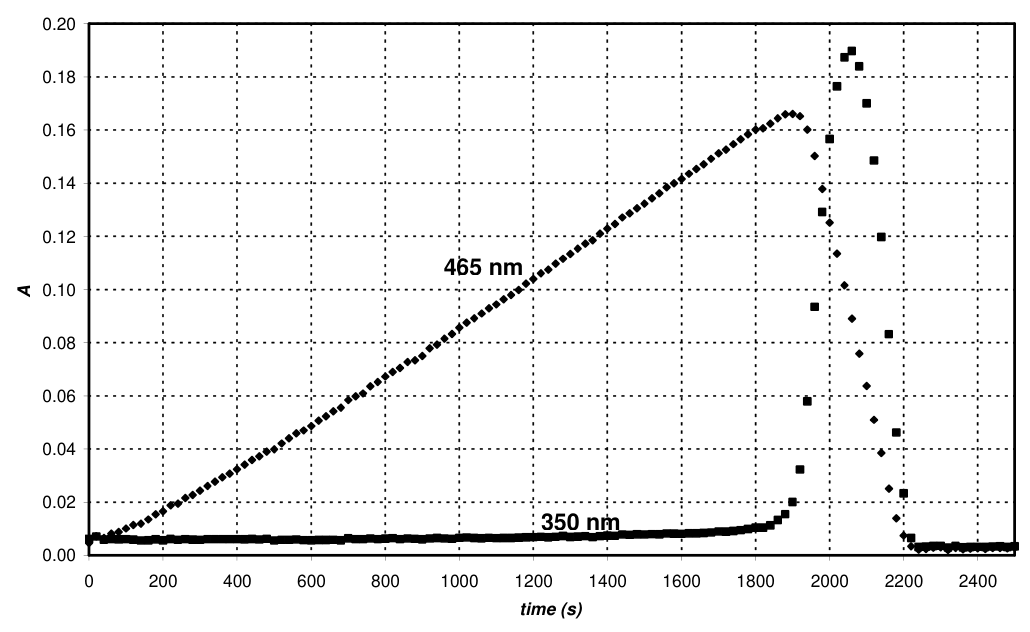
7.8 Write balanced chemical equations for the reactions that occur in the region where the absorbance increases at 465 nm, and in the region where the absorbance decreases at 465 nm.
Calculate the expected time for the maximum absorbance of the kinetic curve measured at 465 nm.
Estimate the expected ratio of the slopes of the increasing and decreasing regions in the kinetic curve measured at 465 nm.
Official English text of the problem.
Answers
Species names and SMILES are supplied in the corresponding Solution parts and apply to all equations below.
-
7.1 \[ \ce{MnO2 + 2SO2 -> Mn^2+ + S2O6^2-} \] \[ \ce{MnO2 + SO2 -> Mn^2+ + SO4^2-} \]
-
7.2 \[ \ce{MnS2O6 + Na2CO3 -> MnCO3(s) + Na2S2O6} \] Carbonate also precipitates any residual dissolved barium as barium carbonate.
-
7.3 The crystals are sodium dithionate dihydrate, \(\ce{Na2S2O6 * 2H2O}\).
At \(130\,^\circ\mathrm{C}\): \[ \ce{Na2S2O6 * 2H2O(s) -> Na2S2O6(s) + 2H2O(g)} \] The subsequent decomposition at \(300\,^\circ\mathrm{C}\) is: \[ \ce{Na2S2O6(s) -> Na2SO4(s) + SO2(g)} \]
-
7.4 \[ \ce{S2O6^2- + Br2 + 2H2O -> 2HSO4^- + 2Br^- + 2H+} \] Equivalently: \[ \ce{S2O6^2- + Br2 + 2H2O -> 2SO4^2- + 2Br^- + 4H+} \]
-
7.5 Orders in \(\ce{Br2}\), \(\ce{H+}\), and \(\ce{S2O6^2-}\): 0, 1, and 1, respectively. \[ \boxed{v=k[\ce{H+}][\ce{S2O6^2-}]}, \qquad \boxed{k\approx2.56\times10^{-5}\ \mathrm{dm^3\,mol^{-1}\,s^{-1}}} \] at \(75\,^\circ\mathrm{C}\).
-
7.6 The absorbing species is dissolved sulfur dioxide, \(\ce{SO2(aq)}\). \[ \ce{S2O6^2- + H+ -> HSO4^- + SO2(aq)} \]
-
7.7 \[ \boxed{k_{\mathrm{obs}}=1.79\times10^{-5}\ \mathrm{s^{-1}}} \] \[ \boxed{k=\frac{k_{\mathrm{obs}}}{[\ce{H+}]} \approx2.56\times10^{-5}\ \mathrm{dm^3\,mol^{-1}\,s^{-1}}} \] A consistent rate-determining reaction is: \[ \ce{S2O6^2- + H+ -> HSO4^- + SO2} \]
-
7.8 During increasing absorbance, the overall reaction is: \[ \ce{7S2O6^2- + 2H4IO6^- + 2H+ + 2H2O -> 14HSO4^- + I2} \] During decreasing absorbance: \[ \ce{S2O6^2- + I2 + 2H2O -> 2HSO4^- + 2I^- + 2H+} \] The transient triiodide signal results from: \[ \ce{I2 + I^- <=> I3^-} \] The predicted peak time and slope ratio are: \[ \boxed{t_{\max}\approx1.9\times10^3\ \mathrm{s}\approx32\ \mathrm{min}} \] \[ \boxed{|m_{\mathrm{increase}}|:|m_{\mathrm{decrease}}|\approx1:7} \] Thus the signed ratio \(m_{\mathrm{increase}}/m_{\mathrm{decrease}}\approx-1/7\).
Solution
Dot-separated SMILES for salts and hydrates specify their ionic composition, not their crystal structure or hydration geometry.
7.1 — Formation of dithionate and sulphate
The relevant species are:
| Species | SMILES |
|---|---|
| Dithionate ion, \(\ce{S2O6^2-}\) | [O-]S(=O)(=O)S(=O)(=O)[O-] |
| Sulfur dioxide, \(\ce{SO2}\) | O=S=O |
| Sulphate ion, \(\ce{SO4^2-}\) | [O-]S(=O)(=O)[O-] |
| Manganese(II) ion, \(\ce{Mn^2+}\) | [Mn+2] |
| Manganese(IV) oxide, \(\ce{MnO2}\) | [Mn+4].[O-2].[O-2] |
The manganese dioxide SMILES is a formal ionic formula-unit representation of an extended solid. Dithionate contains an S–S bond joining two approximately tetrahedral sulfur centres.
Manganese is reduced from \(+4\) to \(+2\), accepting two electrons. Sulfur starts at \(+4\) in sulfur dioxide.
Formation of dithionate raises each of two sulfur atoms to \(+5\), supplying the required two electrons:
\[ \boxed{\ce{MnO2 + 2SO2 -> Mn^2+ + S2O6^2-}} \]
Alternatively, oxidation of one sulfur atom to \(+6\) supplies two electrons and produces sulphate:
\[ \boxed{\ce{MnO2 + SO2 -> Mn^2+ + SO4^2-}} \]
Both equations balance atoms and charge without additional water or hydrogen ions.
7.2 — Addition of sodium carbonate
The additional species are:
| Species | SMILES |
|---|---|
| Manganese(II) dithionate, \(\ce{MnS2O6}\) | [Mn+2].[O-]S(=O)(=O)S(=O)(=O)[O-] |
| Sodium carbonate, \(\ce{Na2CO3}\) | [Na+].[Na+].[O-]C(=O)[O-] |
| Carbonate ion, \(\ce{CO3^2-}\) | [O-]C(=O)[O-] |
| Manganese(II) carbonate, \(\ce{MnCO3}\) | [Mn+2].[O-]C(=O)[O-] |
| Sodium dithionate, \(\ce{Na2S2O6}\) | [Na+].[Na+].[O-]S(=O)(=O)S(=O)(=O)[O-] |
| Barium ion, \(\ce{Ba^2+}\) | [Ba+2] |
| Barium carbonate, \(\ce{BaCO3}\) | [Ba+2].[O-]C(=O)[O-] |
After removal of sulphate, carbonate precipitates the remaining dissolved manganese(II):
\[ \ce{Mn^2+ + CO3^2- -> MnCO3(s)} \]
The corresponding salt equation shows the formation of soluble sodium dithionate:
\[ \boxed{\ce{MnS2O6 + Na2CO3 -> MnCO3(s) + Na2S2O6}} \]
Any soluble barium remaining from the previous addition is also removed:
\[ \ce{Ba^2+ + CO3^2- -> BaCO3(s)} \]
7.3 — Composition and thermal decomposition
The additional species are:
| Species | SMILES |
|---|---|
| Sodium dithionate dihydrate, \(\ce{Na2S2O6 * 2H2O}\) | [Na+].[Na+].[O-]S(=O)(=O)S(=O)(=O)[O-].O.O |
| Water, \(\ce{H2O}\) | O |
| Sodium sulphate, \(\ce{Na2SO4}\) | [Na+].[Na+].[O-]S(=O)(=O)[O-] |
| Barium sulphate, \(\ce{BaSO4}\) | [Ba+2].[O-]S(=O)(=O)[O-] |
Let the crystals be \(\ce{Na2S2O6 * nH2O}\). Using standard rounded atomic masses,
\[ M(\ce{Na2S2O6})=206.10\ \mathrm{g\,mol^{-1}}, \qquad M(\ce{H2O})=18.016\ \mathrm{g\,mol^{-1}}. \]
The absence of a barium precipitate after heating to \(130\,^\circ\mathrm{C}\) is consistent with retention of dithionate. Assigning the first mass loss to water gives
\[ \frac{18.016n}{206.10+18.016n}=0.1488. \]
Hence
\[ n=\frac{0.1488(206.10)}{18.016(1-0.1488)} =1.9998\approx2. \]
Thus the crystals are sodium dithionate dihydrate, and dehydration is
\[ \boxed{\ce{Na2S2O6 * 2H2O(s) -> Na2S2O6(s) + 2H2O(g)}}. \]
The hydrate molar mass is approximately \(242.132\ \mathrm{g\,mol^{-1}}\). After the \(300\,^\circ\mathrm{C}\) treatment, the mass remaining per mole of original hydrate is
\[ (1-0.4134)(242.132)=142.03\ \mathrm{g}. \]
This matches one mole of sodium sulphate, \(M\approx142.04\ \mathrm{g\,mol^{-1}}\). The anhydrous dithionate therefore decomposes by disproportionation:
\[ \boxed{\ce{Na2S2O6(s) -> Na2SO4(s) + SO2(g)}}. \]
One sulfur atom changes from \(+5\) to \(+6\), and the other from \(+5\) to \(+4\). Starting from the original crystals, the overall reaction is
\[ \ce{Na2S2O6 * 2H2O(s) -> Na2SO4(s) + SO2(g) + 2H2O(g)}. \]
Its predicted total mass loss is
\[ \frac{64.06+2(18.016)}{242.132}\times100\% =41.34\%. \]
The sulphate residue explains the white precipitate:
\[ \ce{Ba^2+ + SO4^2- -> BaSO4(s)}. \]
7.4 — Oxidation by bromine
The additional species are:
| Species | SMILES |
|---|---|
| Bromine, \(\ce{Br2}\) | BrBr |
| Bromide ion, \(\ce{Br^-}\) | [Br-] |
| Hydrogen ion, \(\ce{H+}\) | [H+] |
| Hydrogen sulphate ion, \(\ce{HSO4^-}\) | OS(=O)(=O)[O-] |
The hydrogen-ion notation represents aqueous acidity; it does not describe proton solvation.
Oxidation of the two sulfur atoms from \(+5\) to \(+6\) releases two electrons. One bromine molecule accepts these electrons to form two bromide ions. Writing hydrogen sulphate as the sulfur product in acidic solution gives
\[ \boxed{\ce{S2O6^2- + Br2 + 2H2O -> 2HSO4^- + 2Br^- + 2H+}}. \]
Using
\[ \ce{HSO4^- <=> H+ + SO4^2-}, \]
the equivalent sulphate-form equation is
\[ \boxed{\ce{S2O6^2- + Br2 + 2H2O -> 2SO4^2- + 2Br^- + 4H+}}. \]
7.5 — Rate law and rate constant
Write the empirical rate law as
\[ v=k[\ce{Br2}]^a[\ce{H+}]^b[\ce{S2O6^2-}]^c. \]
The independently varied concentrations establish the orders:
- Changing bromine from \(0.100\) to \(0.500\ \mathrm{mmol\,dm^{-3}}\) leaves the rate essentially unchanged, so \(a=0\).
- Increasing dithionate fivefold, from \(0.0100\) to \(0.0500\ \mathrm{mol\,dm^{-3}}\), changes the rate from 129 to 640, approximately fivefold. Thus \(c=1\).
- Increasing hydrogen-ion concentration fivefold, from \(0.100\) to \(0.500\ \mathrm{mol\,dm^{-3}}\), changes the rate from 128 to 640, exactly fivefold within the reported values. Thus \(b=1\).
Therefore,
\[ \boxed{v=k[\ce{H+}][\ce{S2O6^2-}]}. \]
Using the first experiment,
\[ k= \frac{640\times10^{-9}\ \mathrm{mol\,dm^{-3}\,s^{-1}}} {(0.500\ \mathrm{mol\,dm^{-3}}) (0.0500\ \mathrm{mol\,dm^{-3}})} = \boxed{2.56\times10^{-5}\ \mathrm{dm^3\,mol^{-1}\,s^{-1}}}. \]
The overall empirical order is two.
7.6 — Reaction without an oxidant
The absorbing species is sulfur dioxide, \(\ce{SO2(aq)}\), SMILES O=S=O.
Dithionate can disproportionate: one sulfur atom is oxidized from \(+5\) to \(+6\), producing hydrogen sulphate, while the other is reduced to \(+4\). In the strongly acidic medium, the latter product is predominantly dissolved sulfur dioxide.
The balanced equation is
\[ \boxed{\ce{S2O6^2- + H+ -> HSO4^- + SO2(aq)}}. \]
Hydrogen sulphate does not absorb at 275 nm according to the statement, so the growing band is assigned to the sulfur dioxide product.
7.7 — Half-life and the rate-determining reaction
Hydrogen ion is in large excess over dithionate, so its concentration remains approximately constant. Consequently,
\[ -\frac{d[\ce{S2O6^2-}]}{dt} =k[\ce{H+}][\ce{S2O6^2-}] =k_{\mathrm{obs}}[\ce{S2O6^2-}], \]
where
\[ k_{\mathrm{obs}}=k[\ce{H+}]. \]
The half-life is
\[ t_{1/2}=10(3600)+45(60)=38700\ \mathrm{s}. \]
For first-order decay,
\[ k_{\mathrm{obs}} =\frac{\ln2}{t_{1/2}} =\frac{0.693147}{38700} =\boxed{1.79\times10^{-5}\ \mathrm{s^{-1}}}. \]
The corresponding second-order constant is
\[ k=\frac{1.79\times10^{-5}}{0.70} =\boxed{2.56\times10^{-5}\ \mathrm{dm^3\,mol^{-1}\,s^{-1}}}. \]
This agrees with the bromine result and with the constants for the other oxidants. Together with the zero order in bromine, this supports a common slow reaction that does not involve the oxidant:
\[ \boxed{\ce{S2O6^2- + H+ -> HSO4^- + SO2}} \qquad\text{(slow)}. \]
The released sulfur dioxide is then rapidly oxidized. For example, with bromine,
\[ \ce{SO2 + Br2 + 2H2O -> HSO4^- + 2Br^- + 3H+} \qquad\text{(fast)}. \]
Adding these two reactions gives the overall equation in 7.4. This is a consistent kinetic mechanism; the rate data alone do not uniquely establish its microscopic elementary steps.
7.8 — Periodate, iodine formation, and iodine consumption
The additional species are:
| Species | SMILES |
|---|---|
| Tetrahydrogen orthoperiodate ion, \(\ce{H4IO6^-}\) | [O-][I+](O)(O)(O)(O)[O-] |
| Iodine, \(\ce{I2}\) | II |
| Iodide ion, \(\ce{I^-}\) | [I-] |
| Triiodide ion, \(\ce{I3^-}\) | I[I-]I |
The periodate SMILES is a charge-separated representation; iodine has six oxygen neighbours in an approximately octahedral arrangement. Triiodide is linear and has three-centre, four-electron bonding, which the single-bond SMILES does not fully describe.
Increasing absorbance at 465 nm.
The slow reaction in 7.7 supplies sulfur dioxide. Periodate rapidly oxidizes this sulfur dioxide while being reduced to iodine:
\[ \boxed{\ce{2H4IO6^- + 7SO2 + 2H2O -> I2 + 7HSO4^- + 5H+}}. \]
The stoichiometry follows from electron balance: two iodine atoms each fall from oxidation state \(+7\) to \(0\), accepting fourteen electrons; seven sulfur dioxide molecules each supply two electrons.
Adding seven occurrences of the slow dithionate decomposition gives
\[ \boxed{\ce{7S2O6^2- + 2H4IO6^- + 2H+ + 2H2O -> 14HSO4^- + I2}}. \]
Thus seven dithionate ions produce one iodine molecule, and the 465 nm absorbance rises.
Decreasing absorbance at 465 nm.
Once periodate is exhausted, newly generated sulfur dioxide reduces iodine:
\[ \ce{SO2 + I2 + 2H2O -> HSO4^- + 2I^- + 3H+}. \]
Including the slow dithionate decomposition gives
\[ \boxed{\ce{S2O6^2- + I2 + 2H2O -> 2HSO4^- + 2I^- + 2H+}}. \]
Now one dithionate ion consumes one iodine molecule.
As iodide accumulates, some remaining iodine forms triiodide:
\[ \boxed{\ce{I2 + I^- <=> I3^-}}. \]
This accounts for the transient 350 nm signal. Triiodide is ultimately reduced as well:
\[ \ce{I3^- + SO2 + 2H2O -> 3I^- + HSO4^- + 3H+}. \]
Time of maximum iodine absorbance.
The maximum occurs approximately when all periodate has been converted to iodine. The required amount of decomposed dithionate per unit volume is
\[ \Delta[\ce{S2O6^2-}] =\frac{7}{2}[\ce{H4IO6^-}]_0 =\frac{7}{2}(5.3\times10^{-4}) =1.855\times10^{-3}\ \mathrm{mol\,dm^{-3}}. \]
This is only
\[ \frac{1.855\times10^{-3}}{0.0519}\times100\%=3.57\% \]
of the initial dithionate, so an approximately constant rate is appropriate:
\[ v\simeq (2.56\times10^{-5})(0.728)(0.0519) =9.67\times10^{-7}\ \mathrm{mol\,dm^{-3}\,s^{-1}}. \]
Therefore,
\[ t_{\max}\simeq \frac{1.855\times10^{-3}}{9.67\times10^{-7}} = \boxed{1.9\times10^3\ \mathrm{s}\approx32\ \mathrm{min}}. \]
Allowing for dithionate depletion while holding acidity constant gives the modest refinement
\[ t_{\max} = \frac{-\ln\!\left(1-\dfrac{(7/2)[\ce{H4IO6^-}]_0} {[\ce{S2O6^2-}]_0}\right)} {k[\ce{H+}]} \approx1.95\times10^3\ \mathrm{s}. \]
Both estimates are consistent with the graph.
The expected peak height provides an independent stoichiometric check. Neglecting the small amount of triiodide near the iodine maximum,
\[ [\ce{I2}]_{\max}\simeq\frac{5.3\times10^{-4}}{2} =2.65\times10^{-4}\ \mathrm{mol\,dm^{-3}}. \]
Beer–Lambert’s law then gives
\[ A_{465,\max} =\varepsilon l[\ce{I2}]_{\max} =(715)(0.874)(2.65\times10^{-4}) \approx0.166, \]
matching the plotted maximum.
The apparently large triiodide absorbance does not imply a similarly large concentration: its peak \(A_{350}\approx0.19\) corresponds to only
\[ [\ce{I3^-}]_{\max}\approx \frac{0.19}{11000(0.874)} \approx2.0\times10^{-5}\ \mathrm{mol\,dm^{-3}}. \]
Ratio of slopes.
Let \(v\) denote the approximately constant rate of dithionate decomposition. Ignoring the transient redistribution into triiodide,
\[ \left(\frac{d[\ce{I2}]}{dt}\right)_{\mathrm{increase}} =\frac{v}{7}, \qquad \left(\frac{d[\ce{I2}]}{dt}\right)_{\mathrm{decrease}} =-v. \]
Because \(A_{465}=\varepsilon l[\ce{I2}]\), the same ratio applies to the absorbance slopes:
\[ \boxed{ \frac{m_{\mathrm{increase}}}{m_{\mathrm{decrease}}} \approx-\frac17 }. \]
Thus the decreasing region is expected to be approximately seven times steeper in magnitude. Triiodide formation and the small decline in dithionate concentration cause departures from this simple estimate.
The solution was checked against the official solution. Where this solution differs from the official solution, the official solution contains an error or a misprint.
IChO 2008 · Theorieaufgabe 7
Das Dithionat-Ion
Das Dithionat-Ion (\(\ce{S2O6^2-}\)) ist ein recht reaktionsträges anorganisches Ion. Es kann hergestellt werden, indem Schwefeldioxid kontinuierlich in eisgekühltes Wasser eingeleitet wird, dem in kleinen Portionen Mangandioxid zugesetzt wird. Unter diesen Bedingungen entstehen Dithionat- und Sulfat-Ionen.
7.1 Stellen Sie die ausgeglichenen Reaktionsgleichungen für die beiden Reaktionen auf.
Nach Abschluss der Reaktion wird dem Gemisch \(\ce{Ba(OH)2}\) zugesetzt, bis die Sulfat-Ionen vollständig ausgefällt sind. Anschließend wird \(\ce{Na2CO3}\) zugegeben.
7.2 Stellen Sie die ausgeglichene Gleichung für die Reaktion auf, die bei der Zugabe von \(\ce{Na2CO3}\) stattfindet.
Anschließend wird Natriumdithionat durch Verdampfen eines Teils des Lösungsmittels auskristallisiert. Die erhaltenen Kristalle lösen sich leicht in Wasser und bilden mit \(\ce{BaCl2}\)-Lösung keinen Niederschlag. Wird der Feststoff erhitzt und bei \(130\,^\circ\mathrm{C}\) gehalten, wird ein Massenverlust von 14.88 % beobachtet. Das entstehende weiße Pulver löst sich in Wasser und bildet mit \(\ce{BaCl2}\)-Lösung keinen Niederschlag. Wird eine weitere Probe der ursprünglichen Kristalle einige Stunden lang bei \(300\,^\circ\mathrm{C}\) gehalten, tritt ein Massenverlust von 41.34 % auf. Das entstehende weiße Pulver löst sich in Wasser und bildet mit \(\ce{BaCl2}\)-Lösung einen weißen Niederschlag.
7.3 Geben Sie die Zusammensetzung der erhaltenen Kristalle an und stellen Sie ausgeglichene Gleichungen für die beiden beim Erhitzen ablaufenden Vorgänge auf.
Obwohl das Dithionat-Ion aus thermodynamischer Sicht ein recht gutes Reduktionsmittel ist, reagiert es in Lösung bei Raumtemperatur nicht mit Oxidationsmitteln. Bei \(75\,^\circ\mathrm{C}\) kann es jedoch in sauren Lösungen oxidiert werden. Mit Brom als Oxidationsmittel wurde eine Reihe kinetischer Experimente durchgeführt.
7.4 Stellen Sie die ausgeglichene Reaktionsgleichung für die Reaktion zwischen Brom und dem Dithionat-Ion auf.
Die Anfangsgeschwindigkeiten (\(v_0\)) der Reaktion wurden in mehreren Experimenten bei \(75\,^\circ\mathrm{C}\) bestimmt.
| \([\ce{Br2}]_0\) \((\mathrm{mmol\,dm^{-3}})\) | \([\ce{Na2S2O6}]_0\) \((\mathrm{mol\,dm^{-3}})\) | \([\ce{H+}]_0\) \((\mathrm{mol\,dm^{-3}})\) | \(v_0\) \((\mathrm{nmol\,dm^{-3}\,s^{-1}})\) |
|---|---|---|---|
| 0.500 | 0.0500 | 0.500 | 640 |
| 0.500 | 0.0400 | 0.500 | 511 |
| 0.500 | 0.0300 | 0.500 | 387 |
| 0.500 | 0.0200 | 0.500 | 252 |
| 0.500 | 0.0100 | 0.500 | 129 |
| 0.400 | 0.0500 | 0.500 | 642 |
| 0.300 | 0.0500 | 0.500 | 635 |
| 0.200 | 0.0500 | 0.500 | 639 |
| 0.100 | 0.0500 | 0.500 | 641 |
| 0.500 | 0.0500 | 0.400 | 511 |
| 0.500 | 0.0500 | 0.300 | 383 |
| 0.500 | 0.0500 | 0.200 | 257 |
| 0.500 | 0.0500 | 0.100 | 128 |
7.5 Bestimmen Sie die Reaktionsordnung bezüglich \(\ce{Br2}\), \(\ce{H+}\) und \(\ce{S2O6^2-}\), das experimentelle Geschwindigkeitsgesetz sowie den Wert und die Einheit der Geschwindigkeitskonstanten.
In ähnlichen Experimenten wurden bei \(75\,^\circ\mathrm{C}\) auch Chlor, Bromat-Ionen, Wasserstoffperoxid und Chromat-Ionen als Oxidationsmittel eingesetzt. Die Geschwindigkeitsgesetze dieser Vorgänge sind analog zu dem für Brom beobachteten Gesetz; die Einheiten aller Geschwindigkeitskonstanten sind gleich, und ihre Werte betragen \(2.53\times10^{-5}\) (\(\ce{Cl2}\)), \(2.60\times10^{-5}\) (\(\ce{BrO3^-}\)), \(2.56\times10^{-5}\) (\(\ce{H2O2}\)) und \(2.54\times10^{-5}\) (\(\ce{Cr2O7^2-}\)).
Es wurden auch Experimente in saurer Natriumdithionat-Lösung ohne Oxidationsmittel durchgeführt. Bei der Verfolgung der Vorgänge mittels UV-Spektrophotometrie wurde das langsame Auftreten einer neuen Absorptionsbande bei etwa 275 nm beobachtet. Obwohl das Hydrogensulfat-Ion ein nachweisbares Reaktionsprodukt ist, absorbiert es kein Licht oberhalb von 200 nm.
7.6 Geben Sie die Formel der hauptsächlich für die neue Absorptionsbande verantwortlichen Spezies an und stellen Sie die ausgeglichene Gleichung der chemischen Reaktion auf, die in Abwesenheit von Oxidationsmitteln stattfindet.
In einem Experiment wurde die Absorbanz bei 275 nm bei den Anfangskonzentrationen \([\ce{Na2S2O6}]=0.0022\ \mathrm{mol\,dm^{-3}}\) und \([\ce{HClO4}]=0.70\ \mathrm{mol\,dm^{-3}}\) verfolgt; die Temperatur betrug \(75\,^\circ\mathrm{C}\). Es wurde eine kinetische Kurve pseudo-erster Ordnung mit einer Halbwertszeit von 10 Stunden und 45 Minuten gefunden.
7.7 Berechnen Sie die Geschwindigkeitskonstante der Reaktion.
Schlagen Sie eine ausgeglichene Reaktionsgleichung für den geschwindigkeitsbestimmenden Schritt der Reaktionen vor, bei denen ein Oxidationsmittel eingesetzt wurde.
Als Periodat-Ionen (die in wässriger Lösung als \(\ce{H4IO6^-}\) vorliegen) als Oxidationsmittel für Dithionat-Ionen eingesetzt wurden, wurden bei \(75\,^\circ\mathrm{C}\) im selben Experiment bei zwei verschiedenen Wellenlängen die beiden im Diagramm dargestellten kinetischen Kurven aufgenommen. Die Anfangskonzentrationen betrugen \([\ce{H4IO6^-}]=5.3\cdot10^{-4}\ \mathrm{mol\,dm^{-3}}\), \([\ce{Na2S2O6}]=0.0519\ \mathrm{mol\,dm^{-3}}\), \([\ce{HClO4}]=0.728\ \mathrm{mol\,dm^{-3}}\). Bei 465 nm absorbiert nur \(\ce{I2}\), dessen molarer Absorptionskoeffizient \(715\ \mathrm{dm^3\,mol^{-1}\,cm^{-1}}\) beträgt. Bei 350 nm absorbiert nur \(\ce{I3^-}\), dessen molarer Absorptionskoeffizient \(11000\ \mathrm{dm^3\,mol^{-1}\,cm^{-1}}\) beträgt. Die optische Weglänge betrug 0.874 cm.
7.8 Stellen Sie ausgeglichene Reaktionsgleichungen für die Reaktionen auf, die im Bereich zunehmender Absorbanz bei 465 nm und im Bereich abnehmender Absorbanz bei 465 nm stattfinden.
Berechnen Sie den erwarteten Zeitpunkt der maximalen Absorbanz der bei 465 nm gemessenen kinetischen Kurve.
Schätzen Sie das erwartete Verhältnis der Steigungen der ansteigenden und abfallenden Bereiche der bei 465 nm gemessenen kinetischen Kurve ab.
Aufgabentext aus dem offiziellen englischen Text übersetzt.
Antworten
Die Namen der Spezies und ihre SMILES sind in den entsprechenden Teilen der Lösung angegeben und gelten für alle folgenden Gleichungen.
-
7.1 \[ \ce{MnO2 + 2SO2 -> Mn^2+ + S2O6^2-} \] \[ \ce{MnO2 + SO2 -> Mn^2+ + SO4^2-} \]
-
7.2 \[ \ce{MnS2O6 + Na2CO3 -> MnCO3(s) + Na2S2O6} \] Carbonat fällt auch etwaiges noch gelöstes Barium als Bariumcarbonat aus.
-
7.3 Die Kristalle bestehen aus Natriumdithionat-Dihydrat, \(\ce{Na2S2O6 * 2H2O}\).
Bei \(130\,^\circ\mathrm{C}\): \[ \ce{Na2S2O6 * 2H2O(s) -> Na2S2O6(s) + 2H2O(g)} \] Die anschließende Zersetzung bei \(300\,^\circ\mathrm{C}\) lautet: \[ \ce{Na2S2O6(s) -> Na2SO4(s) + SO2(g)} \]
-
7.4 \[ \ce{S2O6^2- + Br2 + 2H2O -> 2HSO4^- + 2Br^- + 2H+} \] Gleichwertig dazu: \[ \ce{S2O6^2- + Br2 + 2H2O -> 2SO4^2- + 2Br^- + 4H+} \]
-
7.5 Die Reaktionsordnungen bezüglich \(\ce{Br2}\), \(\ce{H+}\) und \(\ce{S2O6^2-}\) sind 0, 1 bzw. 1. \[ \boxed{v=k[\ce{H+}][\ce{S2O6^2-}]}, \qquad \boxed{k\approx2.56\times10^{-5}\ \mathrm{dm^3\,mol^{-1}\,s^{-1}}} \] bei \(75\,^\circ\mathrm{C}\).
-
7.6 Die absorbierende Spezies ist gelöstes Schwefeldioxid, \(\ce{SO2(aq)}\). \[ \ce{S2O6^2- + H+ -> HSO4^- + SO2(aq)} \]
-
7.7 \[ \boxed{k_{\mathrm{obs}}=1.79\times10^{-5}\ \mathrm{s^{-1}}} \] \[ \boxed{k=\frac{k_{\mathrm{obs}}}{[\ce{H+}]} \approx2.56\times10^{-5}\ \mathrm{dm^3\,mol^{-1}\,s^{-1}}} \] Eine damit vereinbare geschwindigkeitsbestimmende Reaktion ist: \[ \ce{S2O6^2- + H+ -> HSO4^- + SO2} \]
-
7.8 Während des Anstiegs der Absorbanz lautet die Gesamtreaktion: \[ \ce{7S2O6^2- + 2H4IO6^- + 2H+ + 2H2O -> 14HSO4^- + I2} \] Während der Abnahme der Absorbanz: \[ \ce{S2O6^2- + I2 + 2H2O -> 2HSO4^- + 2I^- + 2H+} \] Das vorübergehende Triiodid-Signal entsteht durch: \[ \ce{I2 + I^- <=> I3^-} \] Der vorhergesagte Zeitpunkt des Maximums und das Steigungsverhältnis sind: \[ \boxed{t_{\max}\approx1.9\times10^3\ \mathrm{s}\approx32\ \mathrm{min}} \] \[ \boxed{|m_{\mathrm{increase}}|:|m_{\mathrm{decrease}}|\approx1:7} \] Das vorzeichenbehaftete Verhältnis beträgt somit \(m_{\mathrm{increase}}/m_{\mathrm{decrease}}\approx-1/7\).
Lösung
Durch Punkte getrennte SMILES für Salze und Hydrate geben deren ionische Zusammensetzung an, nicht ihre Kristallstruktur oder Hydratationsgeometrie.
7.1 — Bildung von Dithionat und Sulfat
Die relevanten Spezies sind:
| Spezies | SMILES |
|---|---|
| Dithionat-Ion, \(\ce{S2O6^2-}\) | [O-]S(=O)(=O)S(=O)(=O)[O-] |
| Schwefeldioxid, \(\ce{SO2}\) | O=S=O |
| Sulfat-Ion, \(\ce{SO4^2-}\) | [O-]S(=O)(=O)[O-] |
| Mangan(II)-Ion, \(\ce{Mn^2+}\) | [Mn+2] |
| Mangan(IV)-oxid, \(\ce{MnO2}\) | [Mn+4].[O-2].[O-2] |
Der SMILES für Mangandioxid stellt eine Formeleinheit eines ausgedehnten Festkörpers formal ionisch dar. Dithionat enthält eine S–S-Bindung, die zwei annähernd tetraedrische Schwefelzentren miteinander verbindet.
Mangan wird unter Aufnahme von zwei Elektronen von \(+4\) auf \(+2\) reduziert. Schwefel hat im Schwefeldioxid zunächst die Oxidationszahl \(+4\).
Bei der Bildung von Dithionat steigt die Oxidationszahl jedes der beiden Schwefelatome auf \(+5\), wodurch die benötigten zwei Elektronen bereitgestellt werden:
\[ \boxed{\ce{MnO2 + 2SO2 -> Mn^2+ + S2O6^2-}} \]
Alternativ liefert die Oxidation eines Schwefelatoms auf \(+6\) zwei Elektronen und führt zur Bildung von Sulfat:
\[ \boxed{\ce{MnO2 + SO2 -> Mn^2+ + SO4^2-}} \]
In beiden Gleichungen sind Atome und Ladungen ohne zusätzliches Wasser oder Wasserstoff-Ionen ausgeglichen.
7.2 — Zugabe von Natriumcarbonat
Die zusätzlichen Spezies sind:
| Spezies | SMILES |
|---|---|
| Mangan(II)-dithionat, \(\ce{MnS2O6}\) | [Mn+2].[O-]S(=O)(=O)S(=O)(=O)[O-] |
| Natriumcarbonat, \(\ce{Na2CO3}\) | [Na+].[Na+].[O-]C(=O)[O-] |
| Carbonat-Ion, \(\ce{CO3^2-}\) | [O-]C(=O)[O-] |
| Mangan(II)-carbonat, \(\ce{MnCO3}\) | [Mn+2].[O-]C(=O)[O-] |
| Natriumdithionat, \(\ce{Na2S2O6}\) | [Na+].[Na+].[O-]S(=O)(=O)S(=O)(=O)[O-] |
| Barium-Ion, \(\ce{Ba^2+}\) | [Ba+2] |
| Bariumcarbonat, \(\ce{BaCO3}\) | [Ba+2].[O-]C(=O)[O-] |
Nach der Entfernung des Sulfats fällt Carbonat das verbleibende gelöste Mangan(II) aus:
\[ \ce{Mn^2+ + CO3^2- -> MnCO3(s)} \]
Die entsprechende Gleichung mit den Salzformeln zeigt die Bildung von löslichem Natriumdithionat:
\[ \boxed{\ce{MnS2O6 + Na2CO3 -> MnCO3(s) + Na2S2O6}} \]
Etwaiges von der vorherigen Zugabe noch gelöstes Barium wird ebenfalls entfernt:
\[ \ce{Ba^2+ + CO3^2- -> BaCO3(s)} \]
7.3 — Zusammensetzung und thermische Zersetzung
Die zusätzlichen Spezies sind:
| Spezies | SMILES |
|---|---|
| Natriumdithionat-Dihydrat, \(\ce{Na2S2O6 * 2H2O}\) | [Na+].[Na+].[O-]S(=O)(=O)S(=O)(=O)[O-].O.O |
| Wasser, \(\ce{H2O}\) | O |
| Natriumsulfat, \(\ce{Na2SO4}\) | [Na+].[Na+].[O-]S(=O)(=O)[O-] |
| Bariumsulfat, \(\ce{BaSO4}\) | [Ba+2].[O-]S(=O)(=O)[O-] |
Die Kristalle seien \(\ce{Na2S2O6 * nH2O}\). Mit den üblichen gerundeten Atommassen gilt:
\[ M(\ce{Na2S2O6})=206.10\ \mathrm{g\,mol^{-1}}, \qquad M(\ce{H2O})=18.016\ \mathrm{g\,mol^{-1}}. \]
Das Ausbleiben eines Bariumniederschlags nach dem Erhitzen auf \(130\,^\circ\mathrm{C}\) ist mit dem Erhalt des Dithionats vereinbar. Wird der erste Massenverlust Wasser zugeordnet, ergibt sich
\[ \frac{18.016n}{206.10+18.016n}=0.1488. \]
Daraus folgt
\[ n=\frac{0.1488(206.10)}{18.016(1-0.1488)} =1.9998\approx2. \]
Die Kristalle bestehen somit aus Natriumdithionat-Dihydrat, und die Dehydratisierung lautet
\[ \boxed{\ce{Na2S2O6 * 2H2O(s) -> Na2S2O6(s) + 2H2O(g)}}. \]
Die molare Masse des Hydrats beträgt etwa \(242.132\ \mathrm{g\,mol^{-1}}\). Nach der Behandlung bei \(300\,^\circ\mathrm{C}\) beträgt die verbleibende Masse pro Mol des ursprünglichen Hydrats
\[ (1-0.4134)(242.132)=142.03\ \mathrm{g}. \]
Dies entspricht einem Mol Natriumsulfat, \(M\approx142.04\ \mathrm{g\,mol^{-1}}\). Das wasserfreie Dithionat zersetzt sich daher durch Disproportionierung:
\[ \boxed{\ce{Na2S2O6(s) -> Na2SO4(s) + SO2(g)}}. \]
Die Oxidationszahl eines Schwefelatoms ändert sich von \(+5\) auf \(+6\), die des anderen von \(+5\) auf \(+4\). Ausgehend von den ursprünglichen Kristallen lautet die Gesamtreaktion
\[ \ce{Na2S2O6 * 2H2O(s) -> Na2SO4(s) + SO2(g) + 2H2O(g)}. \]
Der daraus vorhergesagte gesamte Massenverlust beträgt
\[ \frac{64.06+2(18.016)}{242.132}\times100\% =41.34\%. \]
Der Sulfatrückstand erklärt den weißen Niederschlag:
\[ \ce{Ba^2+ + SO4^2- -> BaSO4(s)}. \]
7.4 — Oxidation durch Brom
Die zusätzlichen Spezies sind:
| Spezies | SMILES |
|---|---|
| Brom, \(\ce{Br2}\) | BrBr |
| Bromid-Ion, \(\ce{Br^-}\) | [Br-] |
| Wasserstoff-Ion, \(\ce{H+}\) | [H+] |
| Hydrogensulfat-Ion, \(\ce{HSO4^-}\) | OS(=O)(=O)[O-] |
Die Schreibweise mit Wasserstoff-Ionen steht für die Acidität in wässriger Lösung; sie beschreibt nicht die Solvatation der Protonen.
Bei der Oxidation der beiden Schwefelatome von \(+5\) auf \(+6\) werden zwei Elektronen freigesetzt. Ein Brommolekül nimmt diese Elektronen auf und bildet zwei Bromid-Ionen. Wird Hydrogensulfat als schwefelhaltiges Produkt in saurer Lösung geschrieben, ergibt sich
\[ \boxed{\ce{S2O6^2- + Br2 + 2H2O -> 2HSO4^- + 2Br^- + 2H+}}. \]
Unter Verwendung von
\[ \ce{HSO4^- <=> H+ + SO4^2-}, \]
lautet die gleichwertige Gleichung mit Sulfat
\[ \boxed{\ce{S2O6^2- + Br2 + 2H2O -> 2SO4^2- + 2Br^- + 4H+}}. \]
7.5 — Geschwindigkeitsgesetz und Geschwindigkeitskonstante
Das empirische Geschwindigkeitsgesetz wird angesetzt als
\[ v=k[\ce{Br2}]^a[\ce{H+}]^b[\ce{S2O6^2-}]^c. \]
Die unabhängig voneinander variierten Konzentrationen ergeben die Reaktionsordnungen:
- Eine Änderung der Bromkonzentration von \(0.100\) auf \(0.500\ \mathrm{mmol\,dm^{-3}}\) lässt die Geschwindigkeit im Wesentlichen unverändert, also ist \(a=0\).
- Eine Verfünffachung der Dithionatkonzentration von \(0.0100\) auf \(0.0500\ \mathrm{mol\,dm^{-3}}\) ändert die Geschwindigkeit von 129 auf 640, also ungefähr um den Faktor fünf. Somit ist \(c=1\).
- Eine Verfünffachung der Wasserstoff-Ionen-Konzentration von \(0.100\) auf \(0.500\ \mathrm{mol\,dm^{-3}}\) ändert die Geschwindigkeit von 128 auf 640, innerhalb der angegebenen Werte also genau um den Faktor fünf. Somit ist \(b=1\).
Daher gilt
\[ \boxed{v=k[\ce{H+}][\ce{S2O6^2-}]}. \]
Mit den Werten des ersten Experiments ergibt sich
\[ k= \frac{640\times10^{-9}\ \mathrm{mol\,dm^{-3}\,s^{-1}}} {(0.500\ \mathrm{mol\,dm^{-3}}) (0.0500\ \mathrm{mol\,dm^{-3}})} = \boxed{2.56\times10^{-5}\ \mathrm{dm^3\,mol^{-1}\,s^{-1}}}. \]
Die empirische Gesamtreaktionsordnung ist zwei.
7.6 — Reaktion ohne Oxidationsmittel
Die absorbierende Spezies ist Schwefeldioxid, \(\ce{SO2(aq)}\), SMILES O=S=O.
Dithionat kann disproportionieren: Ein Schwefelatom wird von \(+5\) auf \(+6\) oxidiert, wobei Hydrogensulfat entsteht, während das andere auf \(+4\) reduziert wird. Im stark sauren Medium liegt das letztgenannte Produkt überwiegend als gelöstes Schwefeldioxid vor.
Die ausgeglichene Gleichung lautet
\[ \boxed{\ce{S2O6^2- + H+ -> HSO4^- + SO2(aq)}}. \]
Hydrogensulfat absorbiert laut Aufgabenstellung nicht bei 275 nm, sodass die anwachsende Bande dem Produkt Schwefeldioxid zugeordnet wird.
7.7 — Halbwertszeit und geschwindigkeitsbestimmende Reaktion
Wasserstoff-Ionen liegen gegenüber Dithionat in großem Überschuss vor, sodass ihre Konzentration annähernd konstant bleibt. Daher gilt
\[ -\frac{d[\ce{S2O6^2-}]}{dt} =k[\ce{H+}][\ce{S2O6^2-}] =k_{\mathrm{obs}}[\ce{S2O6^2-}], \]
wobei
\[ k_{\mathrm{obs}}=k[\ce{H+}]. \]
Die Halbwertszeit beträgt
\[ t_{1/2}=10(3600)+45(60)=38700\ \mathrm{s}. \]
Für einen Zerfall erster Ordnung gilt
\[ k_{\mathrm{obs}} =\frac{\ln2}{t_{1/2}} =\frac{0.693147}{38700} =\boxed{1.79\times10^{-5}\ \mathrm{s^{-1}}}. \]
Die entsprechende Geschwindigkeitskonstante zweiter Ordnung ist
\[ k=\frac{1.79\times10^{-5}}{0.70} =\boxed{2.56\times10^{-5}\ \mathrm{dm^3\,mol^{-1}\,s^{-1}}}. \]
Dies stimmt mit dem Ergebnis für Brom und mit den Konstanten für die anderen Oxidationsmittel überein. Zusammen mit der nullten Ordnung bezüglich Brom spricht dies für eine gemeinsame langsame Reaktion, an der das Oxidationsmittel nicht beteiligt ist:
\[ \boxed{\ce{S2O6^2- + H+ -> HSO4^- + SO2}} \qquad\text{(langsam)}. \]
Das freigesetzte Schwefeldioxid wird anschließend rasch oxidiert. Mit Brom gilt beispielsweise
\[ \ce{SO2 + Br2 + 2H2O -> HSO4^- + 2Br^- + 3H+} \qquad\text{(schnell)}. \]
Die Addition dieser beiden Reaktionen ergibt die Gesamtgleichung in 7.4. Dies ist ein mit den kinetischen Befunden vereinbarer Mechanismus; die Geschwindigkeitsdaten allein legen seine mikroskopischen Elementarschritte nicht eindeutig fest.
7.8 — Periodat, Iodbildung und Iodverbrauch
Die zusätzlichen Spezies sind:
| Spezies | SMILES |
|---|---|
| Tetrahydrogenorthoperiodat-Ion, \(\ce{H4IO6^-}\) | [O-][I+](O)(O)(O)(O)[O-] |
| Iod, \(\ce{I2}\) | II |
| Iodid-Ion, \(\ce{I^-}\) | [I-] |
| Triiodid-Ion, \(\ce{I3^-}\) | I[I-]I |
Der SMILES für Periodat ist eine ladungsgetrennte Darstellung; Iod hat sechs benachbarte Sauerstoffatome in einer annähernd oktaedrischen Anordnung. Triiodid ist linear und weist eine Drei-Zentren-vier-Elektronen-Bindung auf, die durch den SMILES mit Einfachbindungen nicht vollständig beschrieben wird.
Zunehmende Absorbanz bei 465 nm.
Die langsame Reaktion in 7.7 liefert Schwefeldioxid. Periodat oxidiert dieses Schwefeldioxid rasch und wird dabei zu Iod reduziert:
\[ \boxed{\ce{2H4IO6^- + 7SO2 + 2H2O -> I2 + 7HSO4^- + 5H+}}. \]
Die Stöchiometrie folgt aus der Elektronenbilanz: Die Oxidationszahl von zwei Iodatomen sinkt jeweils von \(+7\) auf \(0\), wobei sie vierzehn Elektronen aufnehmen; sieben Schwefeldioxidmoleküle liefern jeweils zwei Elektronen.
Durch Addition der siebenfachen langsamen Dithionatzersetzung ergibt sich
\[ \boxed{\ce{7S2O6^2- + 2H4IO6^- + 2H+ + 2H2O -> 14HSO4^- + I2}}. \]
Somit erzeugen sieben Dithionat-Ionen ein Iodmolekül, und die Absorbanz bei 465 nm steigt.
Abnehmende Absorbanz bei 465 nm.
Sobald das Periodat aufgebraucht ist, reduziert neu gebildetes Schwefeldioxid das Iod:
\[ \ce{SO2 + I2 + 2H2O -> HSO4^- + 2I^- + 3H+}. \]
Unter Einbeziehung der langsamen Dithionatzersetzung ergibt sich
\[ \boxed{\ce{S2O6^2- + I2 + 2H2O -> 2HSO4^- + 2I^- + 2H+}}. \]
Nun verbraucht ein Dithionat-Ion ein Iodmolekül.
Mit zunehmender Iodidkonzentration bildet ein Teil des verbleibenden Iods Triiodid:
\[ \boxed{\ce{I2 + I^- <=> I3^-}}. \]
Dies erklärt das vorübergehende Signal bei 350 nm. Schließlich wird auch Triiodid reduziert:
\[ \ce{I3^- + SO2 + 2H2O -> 3I^- + HSO4^- + 3H+}. \]
Zeitpunkt der maximalen Iodabsorbanz.
Das Maximum tritt ungefähr dann auf, wenn das gesamte Periodat in Iod umgewandelt worden ist. Die dafür erforderliche Stoffmenge an zersetztem Dithionat pro Volumeneinheit beträgt
\[ \Delta[\ce{S2O6^2-}] =\frac{7}{2}[\ce{H4IO6^-}]_0 =\frac{7}{2}(5.3\times10^{-4}) =1.855\times10^{-3}\ \mathrm{mol\,dm^{-3}}. \]
Dies sind nur
\[ \frac{1.855\times10^{-3}}{0.0519}\times100\%=3.57\% \]
des anfänglich vorhandenen Dithionats, sodass die Annahme einer annähernd konstanten Geschwindigkeit angemessen ist:
\[ v\simeq (2.56\times10^{-5})(0.728)(0.0519) =9.67\times10^{-7}\ \mathrm{mol\,dm^{-3}\,s^{-1}}. \]
Daher gilt
\[ t_{\max}\simeq \frac{1.855\times10^{-3}}{9.67\times10^{-7}} = \boxed{1.9\times10^3\ \mathrm{s}\approx32\ \mathrm{min}}. \]
Die Berücksichtigung des Dithionatverbrauchs bei konstant gehaltener Acidität ergibt die geringfügige Verfeinerung
\[ t_{\max} = \frac{-\ln\!\left(1-\dfrac{(7/2)[\ce{H4IO6^-}]_0} {[\ce{S2O6^2-}]_0}\right)} {k[\ce{H+}]} \approx1.95\times10^3\ \mathrm{s}. \]
Beide Abschätzungen stimmen mit dem Diagramm überein.
Die erwartete Höhe des Maximums ermöglicht eine unabhängige stöchiometrische Überprüfung. Unter Vernachlässigung der geringen Triiodidmenge in der Nähe des Iodmaximums gilt
\[ [\ce{I2}]_{\max}\simeq\frac{5.3\times10^{-4}}{2} =2.65\times10^{-4}\ \mathrm{mol\,dm^{-3}}. \]
Das Lambert-Beer’sche Gesetz liefert dann
\[ A_{465,\max} =\varepsilon l[\ce{I2}]_{\max} =(715)(0.874)(2.65\times10^{-4}) \approx0.166, \]
in Übereinstimmung mit dem dargestellten Maximum.
Die scheinbar hohe Triiodidabsorbanz bedeutet keine entsprechend hohe Konzentration: Ihr Maximum \(A_{350}\approx0.19\) entspricht lediglich
\[ [\ce{I3^-}]_{\max}\approx \frac{0.19}{11000(0.874)} \approx2.0\times10^{-5}\ \mathrm{mol\,dm^{-3}}. \]
Verhältnis der Steigungen.
Mit \(v\) sei die annähernd konstante Geschwindigkeit der Dithionatzersetzung bezeichnet. Wird die vorübergehende Umverteilung zu Triiodid vernachlässigt, gilt
\[ \left(\frac{d[\ce{I2}]}{dt}\right)_{\mathrm{increase}} =\frac{v}{7}, \qquad \left(\frac{d[\ce{I2}]}{dt}\right)_{\mathrm{decrease}} =-v. \]
Da \(A_{465}=\varepsilon l[\ce{I2}]\) gilt, gilt dasselbe Verhältnis für die Steigungen der Absorbanzkurve:
\[ \boxed{ \frac{m_{\mathrm{increase}}}{m_{\mathrm{decrease}}} \approx-\frac17 }. \]
Der abfallende Bereich ist somit erwartungsgemäß dem Betrag nach ungefähr siebenmal steiler. Die Triiodidbildung und die geringe Abnahme der Dithionatkonzentration führen zu Abweichungen von dieser einfachen Abschätzung.
Die Lösung wurde mit der offiziellen Lösung abgeglichen. Wo diese Lösung von der offiziellen Lösung abweicht, enthält die offizielle Lösung einen Fehler oder Druckfehler.
IChO 2008 · Teori sorusu 7
Ditiyonat iyonu
Ditiyonat iyonu (\(\ce{S2O6^2-}\)), oldukça inert bir inorganik iyondur. Buzla soğutulan ve küçük porsiyonlar hâlinde mangan dioksit eklenen sudan sürekli kükürt dioksit gazı geçirilerek hazırlanabilir. Bu koşullar altında ditiyonat ve sülfat iyonları oluşur.
7.1 İki tepkimenin denkleştirilmiş kimyasal denklemlerini yazınız.
Tepkime tamamlandıktan sonra, sülfat iyonları tamamen çöktürülene kadar karışıma \(\ce{Ba(OH)2}\) eklenir. Ardından \(\ce{Na2CO3}\) eklenir.
7.2 \(\ce{Na2CO3}\) eklendiğinde gerçekleşen tepkimenin denkleştirilmiş denklemini yazınız.
Daha sonra çözücünün bir kısmı buharlaştırılarak sodyum ditiyonat kristallendirilir. Hazırlanan kristaller suda kolayca çözünür ve \(\ce{BaCl2}\) çözeltisiyle çökelek vermez. Katı ısıtılıp \(130\,^\circ\mathrm{C}\) sıcaklıkta tutulduğunda, % 14.88 kütle kaybı gözlenir. Oluşan beyaz toz suda çözünür ve \(\ce{BaCl2}\) çözeltisiyle çökelek vermez. Başlangıçtaki kristallerden alınan başka bir örnek birkaç saat boyunca \(300\,^\circ\mathrm{C}\) sıcaklıkta tutulduğunda, % 41.34 kütle kaybı meydana gelir. Oluşan beyaz toz suda çözünür ve \(\ce{BaCl2}\) çözeltisiyle beyaz bir çökelek verir.
7.3 Hazırlanan kristallerin bileşimini belirtiniz ve ısıtma sırasında gerçekleşen iki sürecin denkleştirilmiş denklemlerini yazınız.
Ditiyonat iyonu termodinamik açıdan oldukça iyi bir indirgen olmasına rağmen, oda sıcaklığında çözeltide yükseltgenlerle tepkimeye girmez. Ancak \(75\,^\circ\mathrm{C}\) sıcaklıkta asidik çözeltilerde yükseltgenebilir. Yükseltgen olarak brom kullanılarak bir dizi kinetik deney yapılmıştır.
7.4 Brom ile ditiyonat iyonu arasındaki tepkimenin denkleştirilmiş kimyasal denklemini yazınız.
Tepkimenin başlangıç hızları (\(v_0\)), \(75\,^\circ\mathrm{C}\) sıcaklıkta yapılan bir dizi deneyde belirlenmiştir.
| \([\ce{Br2}]_0\) \((\mathrm{mmol\,dm^{-3}})\) | \([\ce{Na2S2O6}]_0\) \((\mathrm{mol\,dm^{-3}})\) | \([\ce{H+}]_0\) \((\mathrm{mol\,dm^{-3}})\) | \(v_0\) \((\mathrm{nmol\,dm^{-3}\,s^{-1}})\) |
|---|---|---|---|
| 0.500 | 0.0500 | 0.500 | 640 |
| 0.500 | 0.0400 | 0.500 | 511 |
| 0.500 | 0.0300 | 0.500 | 387 |
| 0.500 | 0.0200 | 0.500 | 252 |
| 0.500 | 0.0100 | 0.500 | 129 |
| 0.400 | 0.0500 | 0.500 | 642 |
| 0.300 | 0.0500 | 0.500 | 635 |
| 0.200 | 0.0500 | 0.500 | 639 |
| 0.100 | 0.0500 | 0.500 | 641 |
| 0.500 | 0.0500 | 0.400 | 511 |
| 0.500 | 0.0500 | 0.300 | 383 |
| 0.500 | 0.0500 | 0.200 | 257 |
| 0.500 | 0.0500 | 0.100 | 128 |
7.5 Tepkimenin \(\ce{Br2}\), \(\ce{H+}\) ve \(\ce{S2O6^2-}\) bakımından derecelerini, deneysel hız denklemini ve hız sabitinin değerini ve birimini belirleyiniz.
Benzer deneylerde, \(75\,^\circ\mathrm{C}\) sıcaklıkta yükseltgen olarak klor, bromat iyonu, hidrojen peroksit ve kromat iyonu kullanılmıştır. Bu süreçlerin hız denklemleri, bromla gözlenen hız denklemine benzerdir; tüm hız sabitlerinin birimleri aynıdır ve değerleri \(2.53\times10^{-5}\) (\(\ce{Cl2}\)), \(2.60\times10^{-5}\) (\(\ce{BrO3^-}\)), \(2.56\times10^{-5}\) (\(\ce{H2O2}\)) ve \(2.54\times10^{-5}\) (\(\ce{Cr2O7^2-}\)) şeklindedir.
Herhangi bir yükseltgen içermeyen asidik sodyum ditiyonat çözeltisinde de deneyler yapılmıştır. Süreçler UV spektrofotometrisiyle izlenirken, 275 nm civarında yeni bir soğurma bandının yavaşça ortaya çıktığı gözlenmiştir. Hidrojen sülfat iyonu, tepkimenin saptanabilir bir ürünü olmasına rağmen, 200 nm'nin üzerinde ışık soğurmaz.
7.6 Yeni soğurma bandına neden olan başlıca türün formülünü veriniz ve yükseltgenlerin yokluğunda gerçekleşen kimyasal tepkimenin denkleştirilmiş denklemini yazınız.
Başlangıç derişimleri \([\ce{Na2S2O6}]=0.0022\ \mathrm{mol\,dm^{-3}}\), \([\ce{HClO4}]=0.70\ \mathrm{mol\,dm^{-3}}\) ve sıcaklık \(75\,^\circ\mathrm{C}\) olacak şekilde, 275 nm'deki absorbansı izlemek için bir deney yapılmıştır. Yarı ömrü 10 saat 45 dakika olan yalancı birinci dereceden bir kinetik eğri elde edilmiştir.
7.7 Tepkimenin hız sabitini hesaplayınız.
Yükseltgen kullanılan tepkimelerin hız belirleyen basamağı için denkleştirilmiş bir kimyasal denklem öneriniz.
Ditiyonat iyonu için yükseltgen olarak periyodat iyonu (sulu çözeltide \(\ce{H4IO6^-}\) biçiminde bulunur) kullanıldığında, aynı deneyde \(75\,^\circ\mathrm{C}\) sıcaklıkta iki farklı dalga boyunda grafikte gösterilen iki kinetik eğri elde edilmiştir. Başlangıç derişimleri \([\ce{H4IO6^-}]=5.3\cdot10^{-4}\ \mathrm{mol\,dm^{-3}}\), \([\ce{Na2S2O6}]=0.0519\ \mathrm{mol\,dm^{-3}}\), \([\ce{HClO4}]=0.728\ \mathrm{mol\,dm^{-3}}\) şeklindedir. 465 nm'de yalnızca \(\ce{I2}\) soğurma yapar ve molar soğurma katsayısı \(715\ \mathrm{dm^3\,mol^{-1}\,cm^{-1}}\) değerindedir. 350 nm'de yalnızca \(\ce{I3^-}\) soğurma yapar ve molar soğurma katsayısı \(11000\ \mathrm{dm^3\,mol^{-1}\,cm^{-1}}\) değerindedir. Optik yol uzunluğu 0.874 cm'dir.
7.8 465 nm'deki absorbansın arttığı bölgede ve 465 nm'deki absorbansın azaldığı bölgede gerçekleşen tepkimelerin denkleştirilmiş kimyasal denklemlerini yazınız.
465 nm'de ölçülen kinetik eğride absorbansın maksimuma ulaşması için beklenen süreyi hesaplayınız.
465 nm'de ölçülen kinetik eğrinin artan ve azalan bölgelerinin eğimleri arasındaki beklenen oranı tahmin ediniz.
Soru metni resmi İngilizce metinden çevrilmiştir.
Cevaplar
Türlerin adları ve SMILES gösterimleri, Çözüm bölümünün ilgili kısımlarında verilmiştir ve aşağıdaki tüm denklemler için geçerlidir.
-
7.1 \[ \ce{MnO2 + 2SO2 -> Mn^2+ + S2O6^2-} \] \[ \ce{MnO2 + SO2 -> Mn^2+ + SO4^2-} \]
-
7.2 \[ \ce{MnS2O6 + Na2CO3 -> MnCO3(s) + Na2S2O6} \] Karbonat, çözünmüş hâlde kalan baryumu da baryum karbonat olarak çöktürür.
-
7.3 Kristaller sodyum ditiyonat dihidrat, \(\ce{Na2S2O6 * 2H2O}\), bileşimindedir.
\(130\,^\circ\mathrm{C}\) sıcaklıkta: \[ \ce{Na2S2O6 * 2H2O(s) -> Na2S2O6(s) + 2H2O(g)} \] Ardından \(300\,^\circ\mathrm{C}\) sıcaklıkta gerçekleşen bozunma şöyledir: \[ \ce{Na2S2O6(s) -> Na2SO4(s) + SO2(g)} \]
-
7.4 \[ \ce{S2O6^2- + Br2 + 2H2O -> 2HSO4^- + 2Br^- + 2H+} \] Eşdeğer olarak: \[ \ce{S2O6^2- + Br2 + 2H2O -> 2SO4^2- + 2Br^- + 4H+} \]
-
7.5 \(\ce{Br2}\), \(\ce{H+}\) ve \(\ce{S2O6^2-}\) bakımından dereceler sırasıyla 0, 1 ve 1'dir. \[ \boxed{v=k[\ce{H+}][\ce{S2O6^2-}]}, \qquad \boxed{k\approx2.56\times10^{-5}\ \mathrm{dm^3\,mol^{-1}\,s^{-1}}} \] değerleri \(75\,^\circ\mathrm{C}\) sıcaklık için geçerlidir.
-
7.6 Soğurma yapan tür çözünmüş kükürt dioksit, \(\ce{SO2(aq)}\), türüdür. \[ \ce{S2O6^2- + H+ -> HSO4^- + SO2(aq)} \]
-
7.7 \[ \boxed{k_{\mathrm{obs}}=1.79\times10^{-5}\ \mathrm{s^{-1}}} \] \[ \boxed{k=\frac{k_{\mathrm{obs}}}{[\ce{H+}]} \approx2.56\times10^{-5}\ \mathrm{dm^3\,mol^{-1}\,s^{-1}}} \] Verilerle tutarlı bir hız belirleyen tepkime şöyledir: \[ \ce{S2O6^2- + H+ -> HSO4^- + SO2} \]
-
7.8 Absorbans artarken toplam tepkime şöyledir: \[ \ce{7S2O6^2- + 2H4IO6^- + 2H+ + 2H2O -> 14HSO4^- + I2} \] Absorbans azalırken: \[ \ce{S2O6^2- + I2 + 2H2O -> 2HSO4^- + 2I^- + 2H+} \] Geçici triiyodür sinyali şu tepkimeden kaynaklanır: \[ \ce{I2 + I^- <=> I3^-} \] Öngörülen maksimuma ulaşma süresi ve eğim oranı şöyledir: \[ \boxed{t_{\max}\approx1.9\times10^3\ \mathrm{s}\approx32\ \mathrm{min}} \] \[ \boxed{|m_{\mathrm{increase}}|:|m_{\mathrm{decrease}}|\approx1:7} \] Dolayısıyla işaretli oran \(m_{\mathrm{increase}}/m_{\mathrm{decrease}}\approx-1/7\) olur.
Çözüm
Tuzlar ve hidratlar için noktayla ayrılmış SMILES gösterimleri, kristal yapılarını veya hidratasyon geometrilerini değil, iyonik bileşimlerini belirtir.
7.1 — Ditiyonat ve sülfat oluşumu
İlgili türler şunlardır:
| Tür | SMILES |
|---|---|
| Ditiyonat iyonu, \(\ce{S2O6^2-}\) | [O-]S(=O)(=O)S(=O)(=O)[O-] |
| Kükürt dioksit, \(\ce{SO2}\) | O=S=O |
| Sülfat iyonu, \(\ce{SO4^2-}\) | [O-]S(=O)(=O)[O-] |
| Mangan(II) iyonu, \(\ce{Mn^2+}\) | [Mn+2] |
| Mangan(IV) oksit, \(\ce{MnO2}\) | [Mn+4].[O-2].[O-2] |
Mangan dioksitin SMILES gösterimi, sürekli örgü yapısına sahip bir katının biçimsel iyonik formül birimi gösterimidir. Ditiyonat, yaklaşık tetrahedral geometriye sahip iki kükürt merkezini birbirine bağlayan bir S–S bağı içerir.
Mangan, iki elektron alarak \(+4\)'ten \(+2\)'ye indirgenir. Kükürdün başlangıçta kükürt dioksitteki yükseltgenme basamağı \(+4\)'tür.
Ditiyonat oluşumu, iki kükürt atomunun her birinin yükseltgenme basamağını \(+5\)'e çıkararak gerekli iki elektronu sağlar:
\[ \boxed{\ce{MnO2 + 2SO2 -> Mn^2+ + S2O6^2-}} \]
Alternatif olarak, bir kükürt atomunun \(+6\)'ya yükseltgenmesi iki elektron sağlar ve sülfat oluşturur:
\[ \boxed{\ce{MnO2 + SO2 -> Mn^2+ + SO4^2-}} \]
Her iki denklem de ek su veya hidrojen iyonuna gerek olmadan atom ve yük bakımından denktir.
7.2 — Sodyum karbonat eklenmesi
Ek türler şunlardır:
| Tür | SMILES |
|---|---|
| Mangan(II) ditiyonat, \(\ce{MnS2O6}\) | [Mn+2].[O-]S(=O)(=O)S(=O)(=O)[O-] |
| Sodyum karbonat, \(\ce{Na2CO3}\) | [Na+].[Na+].[O-]C(=O)[O-] |
| Karbonat iyonu, \(\ce{CO3^2-}\) | [O-]C(=O)[O-] |
| Mangan(II) karbonat, \(\ce{MnCO3}\) | [Mn+2].[O-]C(=O)[O-] |
| Sodyum ditiyonat, \(\ce{Na2S2O6}\) | [Na+].[Na+].[O-]S(=O)(=O)S(=O)(=O)[O-] |
| Baryum iyonu, \(\ce{Ba^2+}\) | [Ba+2] |
| Baryum karbonat, \(\ce{BaCO3}\) | [Ba+2].[O-]C(=O)[O-] |
Sülfat uzaklaştırıldıktan sonra karbonat, çözünmüş hâlde kalan mangan(II)'yi çöktürür:
\[ \ce{Mn^2+ + CO3^2- -> MnCO3(s)} \]
Buna karşılık gelen tuz denklemi, suda çözünen sodyum ditiyonatın oluşumunu gösterir:
\[ \boxed{\ce{MnS2O6 + Na2CO3 -> MnCO3(s) + Na2S2O6}} \]
Önceki ekleme işleminden kalan çözünmüş baryum da uzaklaştırılır:
\[ \ce{Ba^2+ + CO3^2- -> BaCO3(s)} \]
7.3 — Bileşim ve ısıl bozunma
Ek türler şunlardır:
| Tür | SMILES |
|---|---|
| Sodyum ditiyonat dihidrat, \(\ce{Na2S2O6 * 2H2O}\) | [Na+].[Na+].[O-]S(=O)(=O)S(=O)(=O)[O-].O.O |
| Su, \(\ce{H2O}\) | O |
| Sodyum sülfat, \(\ce{Na2SO4}\) | [Na+].[Na+].[O-]S(=O)(=O)[O-] |
| Baryum sülfat, \(\ce{BaSO4}\) | [Ba+2].[O-]S(=O)(=O)[O-] |
Kristallerin \(\ce{Na2S2O6 * nH2O}\) bileşiminde olduğunu varsayalım. Standart yuvarlatılmış atom kütleleri kullanıldığında,
\[ M(\ce{Na2S2O6})=206.10\ \mathrm{g\,mol^{-1}}, \qquad M(\ce{H2O})=18.016\ \mathrm{g\,mol^{-1}}. \]
\(130\,^\circ\mathrm{C}\) sıcaklığa kadar ısıtıldıktan sonra baryum çökeleği oluşmaması, ditiyonatın korunmasıyla tutarlıdır. İlk kütle kaybının sudan kaynaklandığı kabul edilirse
\[ \frac{18.016n}{206.10+18.016n}=0.1488. \]
Buradan
\[ n=\frac{0.1488(206.10)}{18.016(1-0.1488)} =1.9998\approx2. \]
Dolayısıyla kristaller sodyum ditiyonat dihidrat bileşimindedir ve su kaybı şöyledir:
\[ \boxed{\ce{Na2S2O6 * 2H2O(s) -> Na2S2O6(s) + 2H2O(g)}}. \]
Hidratın molar kütlesi yaklaşık \(242.132\ \mathrm{g\,mol^{-1}}\)'dir. \(300\,^\circ\mathrm{C}\) sıcaklıktaki işlemden sonra, başlangıçtaki hidratın molü başına kalan kütle
\[ (1-0.4134)(242.132)=142.03\ \mathrm{g}. \]
Bu değer, bir mol sodyum sülfata karşılık gelir: \(M\approx142.04\ \mathrm{g\,mol^{-1}}\). Dolayısıyla susuz ditiyonat disproporsiyonlaşma yoluyla bozunur:
\[ \boxed{\ce{Na2S2O6(s) -> Na2SO4(s) + SO2(g)}}. \]
Bir kükürt atomunun yükseltgenme basamağı \(+5\)'ten \(+6\)'ya, diğerininki ise \(+5\)'ten \(+4\)'e değişir. Başlangıçtaki kristallerden hareketle toplam tepkime şöyledir:
\[ \ce{Na2S2O6 * 2H2O(s) -> Na2SO4(s) + SO2(g) + 2H2O(g)}. \]
Bu tepkime için öngörülen toplam kütle kaybı şöyledir:
\[ \frac{64.06+2(18.016)}{242.132}\times100\% =41.34\%. \]
Sülfat kalıntısı, beyaz çökeleği açıklar:
\[ \ce{Ba^2+ + SO4^2- -> BaSO4(s)}. \]
7.4 — Bromla yükseltgenme
Ek türler şunlardır:
| Tür | SMILES |
|---|---|
| Brom, \(\ce{Br2}\) | BrBr |
| Bromür iyonu, \(\ce{Br^-}\) | [Br-] |
| Hidrojen iyonu, \(\ce{H+}\) | [H+] |
| Hidrojen sülfat iyonu, \(\ce{HSO4^-}\) | OS(=O)(=O)[O-] |
Hidrojen iyonu gösterimi, sulu ortamdaki asitliği temsil eder; protonun solvatasyonunu betimlemez.
İki kükürt atomunun \(+5\)'ten \(+6\)'ya yükseltgenmesi iki elektron açığa çıkarır. Bir brom molekülü bu elektronları alarak iki bromür iyonu oluşturur. Asidik çözeltide kükürt içeren ürün hidrojen sülfat olarak yazılırsa
\[ \boxed{\ce{S2O6^2- + Br2 + 2H2O -> 2HSO4^- + 2Br^- + 2H+}}. \]
Şu denge kullanıldığında,
\[ \ce{HSO4^- <=> H+ + SO4^2-}, \]
sülfat biçimindeki eşdeğer denklem şöyledir:
\[ \boxed{\ce{S2O6^2- + Br2 + 2H2O -> 2SO4^2- + 2Br^- + 4H+}}. \]
7.5 — Hız yasası ve hız sabiti
Deneysel hız yasasını şöyle yazalım:
\[ v=k[\ce{Br2}]^a[\ce{H+}]^b[\ce{S2O6^2-}]^c. \]
Birbirinden bağımsız olarak değiştirilen derişimler, dereceleri belirler:
- Brom derişiminin \(0.100\)'den \(0.500\ \mathrm{mmol\,dm^{-3}}\)'e değiştirilmesi hızı esasen değiştirmez; dolayısıyla \(a=0\) olur.
- Ditiyonat derişiminin \(0.0100\)'den \(0.0500\ \mathrm{mol\,dm^{-3}}\)'e, yani beş katına çıkarılması, hızı 129'dan 640'a, yaklaşık beş katına çıkarır. Dolayısıyla \(c=1\) olur.
- Hidrojen iyonu derişiminin \(0.100\)'den \(0.500\ \mathrm{mol\,dm^{-3}}\)'e, yani beş katına çıkarılması, hızı 128'den 640'a, verilen değerlere göre tam olarak beş katına çıkarır. Dolayısıyla \(b=1\) olur.
Bu nedenle,
\[ \boxed{v=k[\ce{H+}][\ce{S2O6^2-}]}. \]
İlk deney kullanıldığında,
\[ k= \frac{640\times10^{-9}\ \mathrm{mol\,dm^{-3}\,s^{-1}}} {(0.500\ \mathrm{mol\,dm^{-3}}) (0.0500\ \mathrm{mol\,dm^{-3}})} = \boxed{2.56\times10^{-5}\ \mathrm{dm^3\,mol^{-1}\,s^{-1}}}. \]
Deneysel toplam tepkime derecesi ikidir.
7.6 — Yükseltgen bulunmadığında gerçekleşen tepkime
Soğurma yapan tür kükürt dioksit, \(\ce{SO2(aq)}\), olup SMILES gösterimi O=S=O şeklindedir.
Ditiyonat disproporsiyonlaşabilir: bir kükürt atomu \(+5\)'ten \(+6\)'ya yükseltgenerek hidrojen sülfat oluştururken, diğeri \(+4\)'e indirgenir. Kuvvetli asidik ortamda ikinci ürün ağırlıklı olarak çözünmüş kükürt dioksit biçimindedir.
Denkleştirilmiş denklem şöyledir:
\[ \boxed{\ce{S2O6^2- + H+ -> HSO4^- + SO2(aq)}}. \]
Soru metnine göre hidrojen sülfat 275 nm'de soğurma yapmaz; bu nedenle büyüyen bant, kükürt dioksit ürününe atfedilir.
7.7 — Yarı ömür ve hız belirleyen tepkime
Hidrojen iyonu ditiyonata göre büyük fazlalıkta olduğundan, derişimi yaklaşık olarak sabit kalır. Dolayısıyla,
\[ -\frac{d[\ce{S2O6^2-}]}{dt} =k[\ce{H+}][\ce{S2O6^2-}] =k_{\mathrm{obs}}[\ce{S2O6^2-}], \]
burada
\[ k_{\mathrm{obs}}=k[\ce{H+}]. \]
Yarı ömür şöyledir:
\[ t_{1/2}=10(3600)+45(60)=38700\ \mathrm{s}. \]
Birinci dereceden bozunma için,
\[ k_{\mathrm{obs}} =\frac{\ln2}{t_{1/2}} =\frac{0.693147}{38700} =\boxed{1.79\times10^{-5}\ \mathrm{s^{-1}}}. \]
Buna karşılık gelen ikinci dereceden hız sabiti şöyledir:
\[ k=\frac{1.79\times10^{-5}}{0.70} =\boxed{2.56\times10^{-5}\ \mathrm{dm^3\,mol^{-1}\,s^{-1}}}. \]
Bu değer, bromla elde edilen sonuçla ve diğer yükseltgenler için bulunan sabitlerle uyumludur. Bu uyum, brom bakımından sıfırıncı derece olmasıyla birlikte, yükseltgenin yer almadığı ortak bir yavaş tepkimeyi destekler:
\[ \boxed{\ce{S2O6^2- + H+ -> HSO4^- + SO2}} \qquad\text{(yavaş)}. \]
Açığa çıkan kükürt dioksit daha sonra hızla yükseltgenir. Örneğin bromla,
\[ \ce{SO2 + Br2 + 2H2O -> HSO4^- + 2Br^- + 3H+} \qquad\text{(hızlı)}. \]
Bu iki tepkimenin toplanması, 7.4'teki toplam denklemi verir. Bu, verilerle tutarlı bir kinetik mekanizmadır; yalnızca hız verileri, mekanizmanın mikroskobik elementer basamaklarını tek bir olasılıkla sınırlayacak biçimde belirlemez.
7.8 — Periyodat, iyot oluşumu ve iyot tüketimi
Ek türler şunlardır:
| Tür | SMILES |
|---|---|
| Tetrahidrojen ortoperiyodat iyonu, \(\ce{H4IO6^-}\) | [O-][I+](O)(O)(O)(O)[O-] |
| İyot, \(\ce{I2}\) | II |
| İyodür iyonu, \(\ce{I^-}\) | [I-] |
| Triiyodür iyonu, \(\ce{I3^-}\) | I[I-]I |
Periyodatın SMILES gösterimi, yüklerin ayrıldığı bir gösterimdir; iyodun yaklaşık oktahedral bir düzende altı oksijen komşusu vardır. Triiyodür doğrusal olup üç merkezli, dört elektronlu bağlanma gösterir; tek bağlar içeren SMILES gösterimi bu bağlanmayı tam olarak betimlemez.
465 nm'de absorbansın artması.
7.7'deki yavaş tepkime kükürt dioksit sağlar. Periyodat, iyoda indirgenirken bu kükürt dioksiti hızla yükseltger:
\[ \boxed{\ce{2H4IO6^- + 7SO2 + 2H2O -> I2 + 7HSO4^- + 5H+}}. \]
Stokiyometri elektron denkliğinden elde edilir: iki iyot atomunun her birinin yükseltgenme basamağı \(+7\)'den \(0\)'a düşer ve toplam on dört elektron alınır; yedi kükürt dioksit molekülünün her biri iki elektron sağlar.
Yavaş ditiyonat bozunma tepkimesinin yedi katı eklendiğinde
\[ \boxed{\ce{7S2O6^2- + 2H4IO6^- + 2H+ + 2H2O -> 14HSO4^- + I2}}. \]
Böylece yedi ditiyonat iyonu bir iyot molekülü oluşturur ve 465 nm'deki absorbans artar.
465 nm'de absorbansın azalması.
Periyodat tükendiğinde, yeni oluşan kükürt dioksit iyodu indirger:
\[ \ce{SO2 + I2 + 2H2O -> HSO4^- + 2I^- + 3H+}. \]
Yavaş ditiyonat bozunması da dâhil edildiğinde
\[ \boxed{\ce{S2O6^2- + I2 + 2H2O -> 2HSO4^- + 2I^- + 2H+}}. \]
Artık bir ditiyonat iyonu bir iyot molekülü tüketir.
İyodür biriktikçe, kalan iyodun bir kısmı triiyodür oluşturur:
\[ \boxed{\ce{I2 + I^- <=> I3^-}}. \]
Bu, 350 nm'deki geçici sinyali açıklar. Sonunda triiyodür de indirgenir:
\[ \ce{I3^- + SO2 + 2H2O -> 3I^- + HSO4^- + 3H+}. \]
İyot absorbansının maksimuma ulaşma süresi.
Maksimum, yaklaşık olarak tüm periyodat iyoda dönüştüğünde ortaya çıkar. Birim hacim başına bozunması gereken ditiyonat miktarı şöyledir:
\[ \Delta[\ce{S2O6^2-}] =\frac{7}{2}[\ce{H4IO6^-}]_0 =\frac{7}{2}(5.3\times10^{-4}) =1.855\times10^{-3}\ \mathrm{mol\,dm^{-3}}. \]
Bu, başlangıçtaki ditiyonatın yalnızca
\[ \frac{1.855\times10^{-3}}{0.0519}\times100\%=3.57\% \]
kadarına karşılık geldiğinden, hızı yaklaşık olarak sabit kabul etmek uygundur:
\[ v\simeq (2.56\times10^{-5})(0.728)(0.0519) =9.67\times10^{-7}\ \mathrm{mol\,dm^{-3}\,s^{-1}}. \]
Bu nedenle,
\[ t_{\max}\simeq \frac{1.855\times10^{-3}}{9.67\times10^{-7}} = \boxed{1.9\times10^3\ \mathrm{s}\approx32\ \mathrm{min}}. \]
Asitlik sabit tutulurken ditiyonatın tükenmesi hesaba katıldığında, küçük bir düzeltmeyle şu sonuç elde edilir:
\[ t_{\max} = \frac{-\ln\!\left(1-\dfrac{(7/2)[\ce{H4IO6^-}]_0} {[\ce{S2O6^2-}]_0}\right)} {k[\ce{H+}]} \approx1.95\times10^3\ \mathrm{s}. \]
Her iki tahmin de grafikle tutarlıdır.
Beklenen pik yüksekliği, bağımsız bir stokiyometrik kontrol sağlar. İyot maksimumu yakınındaki az miktarda triiyodür ihmal edildiğinde,
\[ [\ce{I2}]_{\max}\simeq\frac{5.3\times10^{-4}}{2} =2.65\times10^{-4}\ \mathrm{mol\,dm^{-3}}. \]
Beer–Lambert yasası daha sonra
\[ A_{465,\max} =\varepsilon l[\ce{I2}]_{\max} =(715)(0.874)(2.65\times10^{-4}) \approx0.166, \]
sonucunu verir; bu değer grafikteki maksimumla örtüşür.
Triiyodür absorbansının görünürde yüksek olması, derişiminin de benzer ölçüde yüksek olduğu anlamına gelmez: \(A_{350}\approx0.19\) pik değeri yalnızca şu derişime karşılık gelir:
\[ [\ce{I3^-}]_{\max}\approx \frac{0.19}{11000(0.874)} \approx2.0\times10^{-5}\ \mathrm{mol\,dm^{-3}}. \]
Eğimlerin oranı.
\(v\), ditiyonat bozunmasının yaklaşık olarak sabit hızını göstersin. Triiyodür oluşumundan kaynaklanan geçici yeniden dağılım ihmal edildiğinde,
\[ \left(\frac{d[\ce{I2}]}{dt}\right)_{\mathrm{increase}} =\frac{v}{7}, \qquad \left(\frac{d[\ce{I2}]}{dt}\right)_{\mathrm{decrease}} =-v. \]
\(A_{465}=\varepsilon l[\ce{I2}]\) olduğundan, aynı oran absorbans eğimleri için de geçerlidir:
\[ \boxed{ \frac{m_{\mathrm{increase}}}{m_{\mathrm{decrease}}} \approx-\frac17 }. \]
Dolayısıyla azalan bölgenin eğiminin mutlak değerce yaklaşık yedi kat daha büyük olması beklenir. Triiyodür oluşumu ve ditiyonat derişimindeki küçük azalma, bu basit tahminden sapmalara neden olur.
Çözüm, resmi çözümle karşılaştırılarak kontrol edildi. Bu çözümün resmi çözümden ayrıldığı yerlerde resmi çözümde bir hata ya da baskı hatası vardır.
IChO 2008 · Problema teórico 7
El ion ditionato
El ion ditionato (\(\ce{S2O6^2-}\)) es un ion inorgánico bastante inerte. Puede prepararse haciendo burbujear dióxido de azufre de forma continua en agua enfriada con hielo, a la que se añade dióxido de manganeso en pequeñas porciones. En estas condiciones se forman iones ditionato y sulfato.
7.1 Escriba las ecuaciones químicas ajustadas de las dos reacciones.
Una vez completada la reacción, se añade \(\ce{Ba(OH)2}\) a la mezcla hasta que los iones sulfato hayan precipitado por completo. A continuación, se añade \(\ce{Na2CO3}\).
7.2 Escriba la ecuación ajustada de la reacción que tiene lugar al añadir \(\ce{Na2CO3}\).
Después se cristaliza el ditionato de sodio evaporando parte del disolvente. Los cristales preparados se disuelven fácilmente en agua y no producen un precipitado con una disolución de \(\ce{BaCl2}\). Cuando el sólido se calienta y se mantiene a \(130\,^\circ\mathrm{C}\), se observa una pérdida de masa del 14.88 %. El polvo blanco resultante se disuelve en agua y no produce un precipitado con una disolución de \(\ce{BaCl2}\). Cuando otra muestra de los cristales originales se mantiene a \(300\,^\circ\mathrm{C}\) durante unas horas, se produce una pérdida de masa del 41.34 %. El polvo blanco resultante se disuelve en agua y produce un precipitado blanco con una disolución de \(\ce{BaCl2}\).
7.3 Indique la composición de los cristales preparados y escriba las ecuaciones ajustadas de los dos procesos que tienen lugar durante el calentamiento.
Aunque el ion ditionato es un agente reductor bastante bueno desde el punto de vista termodinámico, no reacciona con oxidantes en disolución a temperatura ambiente. Sin embargo, a \(75\,^\circ\mathrm{C}\) puede oxidarse en disoluciones ácidas. Se llevó a cabo una serie de experimentos cinéticos utilizando bromo como oxidante.
7.4 Escriba la ecuación química ajustada de la reacción entre el bromo y el ion ditionato.
Se determinaron las velocidades iniciales (\(v_0\)) de la reacción en una serie de experimentos a \(75\,^\circ\mathrm{C}\).
| \([\ce{Br2}]_0\) \((\mathrm{mmol\,dm^{-3}})\) | \([\ce{Na2S2O6}]_0\) \((\mathrm{mol\,dm^{-3}})\) | \([\ce{H+}]_0\) \((\mathrm{mol\,dm^{-3}})\) | \(v_0\) \((\mathrm{nmol\,dm^{-3}\,s^{-1}})\) |
|---|---|---|---|
| 0.500 | 0.0500 | 0.500 | 640 |
| 0.500 | 0.0400 | 0.500 | 511 |
| 0.500 | 0.0300 | 0.500 | 387 |
| 0.500 | 0.0200 | 0.500 | 252 |
| 0.500 | 0.0100 | 0.500 | 129 |
| 0.400 | 0.0500 | 0.500 | 642 |
| 0.300 | 0.0500 | 0.500 | 635 |
| 0.200 | 0.0500 | 0.500 | 639 |
| 0.100 | 0.0500 | 0.500 | 641 |
| 0.500 | 0.0500 | 0.400 | 511 |
| 0.500 | 0.0500 | 0.300 | 383 |
| 0.500 | 0.0500 | 0.200 | 257 |
| 0.500 | 0.0500 | 0.100 | 128 |
7.5 Determine el orden de la reacción respecto a \(\ce{Br2}\), \(\ce{H+}\) y \(\ce{S2O6^2-}\), la ecuación de velocidad experimental y el valor y la unidad de la constante de velocidad.
En experimentos similares se han utilizado cloro, ion bromato, peróxido de hidrógeno e ion cromato como agentes oxidantes a \(75\,^\circ\mathrm{C}\). Las ecuaciones de velocidad de estos procesos son análogas a la observada con bromo, las unidades de todas las constantes de velocidad son las mismas y sus valores son \(2.53\times10^{-5}\) (\(\ce{Cl2}\)), \(2.60\times10^{-5}\) (\(\ce{BrO3^-}\)), \(2.56\times10^{-5}\) (\(\ce{H2O2}\)) y \(2.54\times10^{-5}\) (\(\ce{Cr2O7^2-}\)).
También se realizaron experimentos en una disolución ácida de ditionato de sodio sin ningún agente oxidante. Al seguir los procesos mediante espectrofotometría UV, se observó la aparición lenta de una nueva banda de absorción alrededor de 275 nm. Aunque el ion hidrogenosulfato es un producto detectable de la reacción, no absorbe luz por encima de 200 nm.
7.6 Indique la fórmula de la especie principal responsable de la nueva banda de absorción y escriba la ecuación ajustada de la reacción química que tiene lugar en ausencia de oxidantes.
Se llevó a cabo un experimento para seguir la absorbancia a 275 nm con las concentraciones iniciales \([\ce{Na2S2O6}]=0.0022\ \mathrm{mol\,dm^{-3}}\), \([\ce{HClO4}]=0.70\ \mathrm{mol\,dm^{-3}}\), y una temperatura de \(75\,^\circ\mathrm{C}\). Se obtuvo una curva cinética de pseudoprimer orden con un tiempo de semirreacción de 10 horas y 45 minutos.
7.7 Calcule la constante de velocidad de la reacción.
Proponga una ecuación química ajustada para la etapa determinante de la velocidad de las reacciones en las que se utilizó un agente oxidante.
Cuando se utilizó el ion peryodato (que está presente como \(\ce{H4IO6^-}\) en disolución acuosa) como oxidante del ion ditionato, se registraron las dos curvas cinéticas representadas en la gráfica a \(75\,^\circ\mathrm{C}\), en el mismo experimento y a dos longitudes de onda diferentes. Las concentraciones iniciales fueron \([\ce{H4IO6^-}]=5.3\cdot10^{-4}\ \mathrm{mol\,dm^{-3}}\), \([\ce{Na2S2O6}]=0.0519\ \mathrm{mol\,dm^{-3}}\), \([\ce{HClO4}]=0.728\ \mathrm{mol\,dm^{-3}}\). A 465 nm, solo absorbe \(\ce{I2}\) y su coeficiente de absorción molar es \(715\ \mathrm{dm^3\,mol^{-1}\,cm^{-1}}\). A 350 nm, solo absorbe \(\ce{I3^-}\) y su coeficiente de absorción molar es \(11000\ \mathrm{dm^3\,mol^{-1}\,cm^{-1}}\). La longitud del trayecto óptico fue de 0.874 cm.
7.8 Escriba las ecuaciones químicas ajustadas de las reacciones que tienen lugar en la región en la que aumenta la absorbancia a 465 nm y en la región en la que disminuye la absorbancia a 465 nm.
Calcule el tiempo esperado para alcanzar la absorbancia máxima de la curva cinética medida a 465 nm.
Estime la relación esperada entre las pendientes de las regiones creciente y decreciente de la curva cinética medida a 465 nm.
Enunciado traducido del texto oficial en inglés.
Respuestas
Los nombres de las especies y sus SMILES se proporcionan en los apartados correspondientes de la Solución y se aplican a todas las ecuaciones siguientes.
-
7.1 \[ \ce{MnO2 + 2SO2 -> Mn^2+ + S2O6^2-} \] \[ \ce{MnO2 + SO2 -> Mn^2+ + SO4^2-} \]
-
7.2 \[ \ce{MnS2O6 + Na2CO3 -> MnCO3(s) + Na2S2O6} \] El carbonato también precipita cualquier resto de bario disuelto como carbonato de bario.
-
7.3 Los cristales son de ditionato de sodio dihidrato, \(\ce{Na2S2O6 * 2H2O}\).
A \(130\,^\circ\mathrm{C}\): \[ \ce{Na2S2O6 * 2H2O(s) -> Na2S2O6(s) + 2H2O(g)} \] La descomposición posterior a \(300\,^\circ\mathrm{C}\) es: \[ \ce{Na2S2O6(s) -> Na2SO4(s) + SO2(g)} \]
-
7.4 \[ \ce{S2O6^2- + Br2 + 2H2O -> 2HSO4^- + 2Br^- + 2H+} \] De forma equivalente: \[ \ce{S2O6^2- + Br2 + 2H2O -> 2SO4^2- + 2Br^- + 4H+} \]
-
7.5 Órdenes respecto a \(\ce{Br2}\), \(\ce{H+}\) y \(\ce{S2O6^2-}\): 0, 1 y 1, respectivamente. \[ \boxed{v=k[\ce{H+}][\ce{S2O6^2-}]}, \qquad \boxed{k\approx2.56\times10^{-5}\ \mathrm{dm^3\,mol^{-1}\,s^{-1}}} \] a \(75\,^\circ\mathrm{C}\).
-
7.6 La especie absorbente es el dióxido de azufre disuelto, \(\ce{SO2(aq)}\). \[ \ce{S2O6^2- + H+ -> HSO4^- + SO2(aq)} \]
-
7.7 \[ \boxed{k_{\mathrm{obs}}=1.79\times10^{-5}\ \mathrm{s^{-1}}} \] \[ \boxed{k=\frac{k_{\mathrm{obs}}}{[\ce{H+}]} \approx2.56\times10^{-5}\ \mathrm{dm^3\,mol^{-1}\,s^{-1}}} \] Una reacción determinante de la velocidad compatible con los resultados es: \[ \ce{S2O6^2- + H+ -> HSO4^- + SO2} \]
-
7.8 Durante el aumento de la absorbancia, la reacción global es: \[ \ce{7S2O6^2- + 2H4IO6^- + 2H+ + 2H2O -> 14HSO4^- + I2} \] Durante la disminución de la absorbancia: \[ \ce{S2O6^2- + I2 + 2H2O -> 2HSO4^- + 2I^- + 2H+} \] La señal transitoria del triyoduro se debe a: \[ \ce{I2 + I^- <=> I3^-} \] El tiempo previsto para alcanzar el máximo y la relación de pendientes son: \[ \boxed{t_{\max}\approx1.9\times10^3\ \mathrm{s}\approx32\ \mathrm{min}} \] \[ \boxed{|m_{\mathrm{increase}}|:|m_{\mathrm{decrease}}|\approx1:7} \] Por tanto, la relación con signo es \(m_{\mathrm{increase}}/m_{\mathrm{decrease}}\approx-1/7\).
Solución
Los SMILES separados por puntos para sales e hidratos especifican su composición iónica, no su estructura cristalina ni la geometría de hidratación.
7.1 — Formación de ditionato y sulfato
Las especies pertinentes son:
| Especie | SMILES |
|---|---|
| Ion ditionato, \(\ce{S2O6^2-}\) | [O-]S(=O)(=O)S(=O)(=O)[O-] |
| Dióxido de azufre, \(\ce{SO2}\) | O=S=O |
| Ion sulfato, \(\ce{SO4^2-}\) | [O-]S(=O)(=O)[O-] |
| Ion manganeso(II), \(\ce{Mn^2+}\) | [Mn+2] |
| Óxido de manganeso(IV), \(\ce{MnO2}\) | [Mn+4].[O-2].[O-2] |
El SMILES del dióxido de manganeso es una representación iónica formal de la unidad fórmula de un sólido extendido. El ditionato contiene un enlace S–S que une dos centros de azufre aproximadamente tetraédricos.
El manganeso se reduce de \(+4\) a \(+2\), aceptando dos electrones. El azufre parte de \(+4\) en el dióxido de azufre.
La formación de ditionato eleva a \(+5\) el estado de oxidación de cada uno de los dos átomos de azufre, aportando los dos electrones necesarios:
\[ \boxed{\ce{MnO2 + 2SO2 -> Mn^2+ + S2O6^2-}} \]
Alternativamente, la oxidación de un átomo de azufre a \(+6\) aporta dos electrones y produce sulfato:
\[ \boxed{\ce{MnO2 + SO2 -> Mn^2+ + SO4^2-}} \]
Ambas ecuaciones están ajustadas en átomos y carga sin necesidad de añadir agua ni iones hidrógeno.
7.2 — Adición de carbonato de sodio
Las especies adicionales son:
| Especie | SMILES |
|---|---|
| Ditionato de manganeso(II), \(\ce{MnS2O6}\) | [Mn+2].[O-]S(=O)(=O)S(=O)(=O)[O-] |
| Carbonato de sodio, \(\ce{Na2CO3}\) | [Na+].[Na+].[O-]C(=O)[O-] |
| Ion carbonato, \(\ce{CO3^2-}\) | [O-]C(=O)[O-] |
| Carbonato de manganeso(II), \(\ce{MnCO3}\) | [Mn+2].[O-]C(=O)[O-] |
| Ditionato de sodio, \(\ce{Na2S2O6}\) | [Na+].[Na+].[O-]S(=O)(=O)S(=O)(=O)[O-] |
| Ion bario, \(\ce{Ba^2+}\) | [Ba+2] |
| Carbonato de bario, \(\ce{BaCO3}\) | [Ba+2].[O-]C(=O)[O-] |
Tras eliminar el sulfato, el carbonato precipita el manganeso(II) que permanece disuelto:
\[ \ce{Mn^2+ + CO3^2- -> MnCO3(s)} \]
La ecuación correspondiente, escrita con las sales, muestra la formación de ditionato de sodio soluble:
\[ \boxed{\ce{MnS2O6 + Na2CO3 -> MnCO3(s) + Na2S2O6}} \]
También se elimina cualquier resto de bario soluble procedente de la adición anterior:
\[ \ce{Ba^2+ + CO3^2- -> BaCO3(s)} \]
7.3 — Composición y descomposición térmica
Las especies adicionales son:
| Especie | SMILES |
|---|---|
| Ditionato de sodio dihidrato, \(\ce{Na2S2O6 * 2H2O}\) | [Na+].[Na+].[O-]S(=O)(=O)S(=O)(=O)[O-].O.O |
| Agua, \(\ce{H2O}\) | O |
| Sulfato de sodio, \(\ce{Na2SO4}\) | [Na+].[Na+].[O-]S(=O)(=O)[O-] |
| Sulfato de bario, \(\ce{BaSO4}\) | [Ba+2].[O-]S(=O)(=O)[O-] |
Supongamos que los cristales son \(\ce{Na2S2O6 * nH2O}\). Utilizando masas atómicas estándar redondeadas,
\[ M(\ce{Na2S2O6})=206.10\ \mathrm{g\,mol^{-1}}, \qquad M(\ce{H2O})=18.016\ \mathrm{g\,mol^{-1}}. \]
La ausencia de un precipitado de bario después de calentar a \(130\,^\circ\mathrm{C}\) es compatible con la conservación del ditionato. Al atribuir la primera pérdida de masa al agua, se obtiene
\[ \frac{18.016n}{206.10+18.016n}=0.1488. \]
Por tanto,
\[ n=\frac{0.1488(206.10)}{18.016(1-0.1488)} =1.9998\approx2. \]
Así, los cristales son de ditionato de sodio dihidrato, y la deshidratación es
\[ \boxed{\ce{Na2S2O6 * 2H2O(s) -> Na2S2O6(s) + 2H2O(g)}}. \]
La masa molar del hidrato es aproximadamente \(242.132\ \mathrm{g\,mol^{-1}}\). Tras el tratamiento a \(300\,^\circ\mathrm{C}\), la masa restante por mol de hidrato original es
\[ (1-0.4134)(242.132)=142.03\ \mathrm{g}. \]
Esto coincide con un mol de sulfato de sodio, \(M\approx142.04\ \mathrm{g\,mol^{-1}}\). Por tanto, el ditionato anhidro se descompone por desproporción:
\[ \boxed{\ce{Na2S2O6(s) -> Na2SO4(s) + SO2(g)}}. \]
Un átomo de azufre pasa de \(+5\) a \(+6\), y el otro de \(+5\) a \(+4\). Partiendo de los cristales originales, la reacción global es
\[ \ce{Na2S2O6 * 2H2O(s) -> Na2SO4(s) + SO2(g) + 2H2O(g)}. \]
La pérdida total de masa prevista es
\[ \frac{64.06+2(18.016)}{242.132}\times100\% =41.34\%. \]
El residuo de sulfato explica el precipitado blanco:
\[ \ce{Ba^2+ + SO4^2- -> BaSO4(s)}. \]
7.4 — Oxidación con bromo
Las especies adicionales son:
| Especie | SMILES |
|---|---|
| Bromo, \(\ce{Br2}\) | BrBr |
| Ion bromuro, \(\ce{Br^-}\) | [Br-] |
| Ion hidrógeno, \(\ce{H+}\) | [H+] |
| Ion hidrogenosulfato, \(\ce{HSO4^-}\) | OS(=O)(=O)[O-] |
La notación del ion hidrógeno representa la acidez acuosa; no describe la solvatación del protón.
La oxidación de los dos átomos de azufre de \(+5\) a \(+6\) libera dos electrones. Una molécula de bromo acepta estos electrones para formar dos iones bromuro. Al escribir hidrogenosulfato como producto del azufre en disolución ácida, se obtiene
\[ \boxed{\ce{S2O6^2- + Br2 + 2H2O -> 2HSO4^- + 2Br^- + 2H+}}. \]
Utilizando
\[ \ce{HSO4^- <=> H+ + SO4^2-}, \]
la ecuación equivalente expresada con sulfato es
\[ \boxed{\ce{S2O6^2- + Br2 + 2H2O -> 2SO4^2- + 2Br^- + 4H+}}. \]
7.5 — Ley de velocidad y constante de velocidad
Escribimos la ley de velocidad empírica como
\[ v=k[\ce{Br2}]^a[\ce{H+}]^b[\ce{S2O6^2-}]^c. \]
Las concentraciones variadas de forma independiente permiten establecer los órdenes:
- Cambiar la concentración de bromo de \(0.100\) a \(0.500\ \mathrm{mmol\,dm^{-3}}\) deja la velocidad prácticamente inalterada, por lo que \(a=0\).
- Aumentar cinco veces la concentración de ditionato, de \(0.0100\) a \(0.0500\ \mathrm{mol\,dm^{-3}}\), cambia la velocidad de 129 a 640, aproximadamente cinco veces. Por tanto, \(c=1\).
- Aumentar cinco veces la concentración de iones hidrógeno, de \(0.100\) a \(0.500\ \mathrm{mol\,dm^{-3}}\), cambia la velocidad de 128 a 640, exactamente cinco veces según los valores indicados. Por tanto, \(b=1\).
En consecuencia,
\[ \boxed{v=k[\ce{H+}][\ce{S2O6^2-}]}. \]
Utilizando el primer experimento,
\[ k= \frac{640\times10^{-9}\ \mathrm{mol\,dm^{-3}\,s^{-1}}} {(0.500\ \mathrm{mol\,dm^{-3}}) (0.0500\ \mathrm{mol\,dm^{-3}})} = \boxed{2.56\times10^{-5}\ \mathrm{dm^3\,mol^{-1}\,s^{-1}}}. \]
El orden empírico global es dos.
7.6 — Reacción sin oxidante
La especie absorbente es el dióxido de azufre, \(\ce{SO2(aq)}\), SMILES O=S=O.
El ditionato puede experimentar desproporción: un átomo de azufre se oxida de \(+5\) a \(+6\), produciendo hidrogenosulfato, mientras que el otro se reduce a \(+4\). En el medio fuertemente ácido, este último producto se encuentra predominantemente como dióxido de azufre disuelto.
La ecuación ajustada es
\[ \boxed{\ce{S2O6^2- + H+ -> HSO4^- + SO2(aq)}}. \]
Según el enunciado, el hidrogenosulfato no absorbe a 275 nm, por lo que la banda que aumenta se atribuye al dióxido de azufre producido.
7.7 — Tiempo de semirreacción y reacción determinante de la velocidad
El ion hidrógeno se encuentra en gran exceso respecto al ditionato, por lo que su concentración permanece aproximadamente constante. En consecuencia,
\[ -\frac{d[\ce{S2O6^2-}]}{dt} =k[\ce{H+}][\ce{S2O6^2-}] =k_{\mathrm{obs}}[\ce{S2O6^2-}], \]
donde
\[ k_{\mathrm{obs}}=k[\ce{H+}]. \]
El tiempo de semirreacción es
\[ t_{1/2}=10(3600)+45(60)=38700\ \mathrm{s}. \]
Para una disminución de primer orden,
\[ k_{\mathrm{obs}} =\frac{\ln2}{t_{1/2}} =\frac{0.693147}{38700} =\boxed{1.79\times10^{-5}\ \mathrm{s^{-1}}}. \]
La constante de segundo orden correspondiente es
\[ k=\frac{1.79\times10^{-5}}{0.70} =\boxed{2.56\times10^{-5}\ \mathrm{dm^3\,mol^{-1}\,s^{-1}}}. \]
Este valor concuerda con el resultado obtenido con bromo y con las constantes de los demás oxidantes. Junto con el orden cero respecto al bromo, esto respalda una reacción lenta común en la que no interviene el oxidante:
\[ \boxed{\ce{S2O6^2- + H+ -> HSO4^- + SO2}} \qquad\text{(lenta)}. \]
El dióxido de azufre liberado se oxida después rápidamente. Por ejemplo, con bromo,
\[ \ce{SO2 + Br2 + 2H2O -> HSO4^- + 2Br^- + 3H+} \qquad\text{(rápida)}. \]
La suma de estas dos reacciones da la ecuación global de 7.4. Este es un mecanismo cinético compatible con los resultados; los datos de velocidad por sí solos no establecen de forma unívoca sus etapas elementales microscópicas.
7.8 — Peryodato, formación de yodo y consumo de yodo
Las especies adicionales son:
| Especie | SMILES |
|---|---|
| Ion tetrahidrogenoortoperyodato, \(\ce{H4IO6^-}\) | [O-][I+](O)(O)(O)(O)[O-] |
| Yodo, \(\ce{I2}\) | II |
| Ion yoduro, \(\ce{I^-}\) | [I-] |
| Ion triyoduro, \(\ce{I3^-}\) | I[I-]I |
El SMILES del peryodato es una representación con separación de cargas; el yodo tiene seis átomos de oxígeno vecinos en una disposición aproximadamente octaédrica. El triyoduro es lineal y presenta un enlace de tres centros y cuatro electrones, que el SMILES con enlaces simples no describe por completo.
Aumento de la absorbancia a 465 nm.
La reacción lenta de 7.7 suministra dióxido de azufre. El peryodato oxida rápidamente este dióxido de azufre mientras se reduce a yodo:
\[ \boxed{\ce{2H4IO6^- + 7SO2 + 2H2O -> I2 + 7HSO4^- + 5H+}}. \]
La estequiometría se deduce del balance de electrones: dos átomos de yodo pasan cada uno del estado de oxidación \(+7\) al \(0\), aceptando catorce electrones; siete moléculas de dióxido de azufre aportan dos electrones cada una.
Al sumar siete veces la reacción lenta de descomposición del ditionato, se obtiene
\[ \boxed{\ce{7S2O6^2- + 2H4IO6^- + 2H+ + 2H2O -> 14HSO4^- + I2}}. \]
Así, siete iones ditionato producen una molécula de yodo, y la absorbancia a 465 nm aumenta.
Disminución de la absorbancia a 465 nm.
Una vez agotado el peryodato, el dióxido de azufre recién generado reduce el yodo:
\[ \ce{SO2 + I2 + 2H2O -> HSO4^- + 2I^- + 3H+}. \]
Al incluir la descomposición lenta del ditionato, se obtiene
\[ \boxed{\ce{S2O6^2- + I2 + 2H2O -> 2HSO4^- + 2I^- + 2H+}}. \]
Ahora un ion ditionato consume una molécula de yodo.
A medida que se acumula yoduro, parte del yodo restante forma triyoduro:
\[ \boxed{\ce{I2 + I^- <=> I3^-}}. \]
Esto explica la señal transitoria a 350 nm. El triyoduro también acaba reduciéndose:
\[ \ce{I3^- + SO2 + 2H2O -> 3I^- + HSO4^- + 3H+}. \]
Tiempo para alcanzar la absorbancia máxima del yodo.
El máximo se alcanza aproximadamente cuando todo el peryodato se ha convertido en yodo. La cantidad necesaria de ditionato descompuesto por unidad de volumen es
\[ \Delta[\ce{S2O6^2-}] =\frac{7}{2}[\ce{H4IO6^-}]_0 =\frac{7}{2}(5.3\times10^{-4}) =1.855\times10^{-3}\ \mathrm{mol\,dm^{-3}}. \]
Esto representa solo
\[ \frac{1.855\times10^{-3}}{0.0519}\times100\%=3.57\% \]
del ditionato inicial, por lo que resulta adecuado considerar una velocidad aproximadamente constante:
\[ v\simeq (2.56\times10^{-5})(0.728)(0.0519) =9.67\times10^{-7}\ \mathrm{mol\,dm^{-3}\,s^{-1}}. \]
Por tanto,
\[ t_{\max}\simeq \frac{1.855\times10^{-3}}{9.67\times10^{-7}} = \boxed{1.9\times10^3\ \mathrm{s}\approx32\ \mathrm{min}}. \]
Si se tiene en cuenta el consumo de ditionato manteniendo constante la acidez, se obtiene la siguiente pequeña corrección:
\[ t_{\max} = \frac{-\ln\!\left(1-\dfrac{(7/2)[\ce{H4IO6^-}]_0} {[\ce{S2O6^2-}]_0}\right)} {k[\ce{H+}]} \approx1.95\times10^3\ \mathrm{s}. \]
Ambas estimaciones son compatibles con la gráfica.
La altura esperada del máximo proporciona una comprobación estequiométrica independiente. Despreciando la pequeña cantidad de triyoduro cerca del máximo de yodo,
\[ [\ce{I2}]_{\max}\simeq\frac{5.3\times10^{-4}}{2} =2.65\times10^{-4}\ \mathrm{mol\,dm^{-3}}. \]
La ley de Beer–Lambert da entonces
\[ A_{465,\max} =\varepsilon l[\ce{I2}]_{\max} =(715)(0.874)(2.65\times10^{-4}) \approx0.166, \]
en concordancia con el máximo representado en la gráfica.
La absorbancia aparentemente elevada del triyoduro no implica una concentración igualmente elevada: su máximo \(A_{350}\approx0.19\) corresponde tan solo a
\[ [\ce{I3^-}]_{\max}\approx \frac{0.19}{11000(0.874)} \approx2.0\times10^{-5}\ \mathrm{mol\,dm^{-3}}. \]
Relación de pendientes.
Sea \(v\) la velocidad aproximadamente constante de descomposición del ditionato. Si se ignora la redistribución transitoria en forma de triyoduro,
\[ \left(\frac{d[\ce{I2}]}{dt}\right)_{\mathrm{increase}} =\frac{v}{7}, \qquad \left(\frac{d[\ce{I2}]}{dt}\right)_{\mathrm{decrease}} =-v. \]
Como \(A_{465}=\varepsilon l[\ce{I2}]\), la misma relación se aplica a las pendientes de la absorbancia:
\[ \boxed{ \frac{m_{\mathrm{increase}}}{m_{\mathrm{decrease}}} \approx-\frac17 }. \]
Por tanto, se espera que la región decreciente tenga una pendiente de magnitud aproximadamente siete veces mayor. La formación de triyoduro y la pequeña disminución de la concentración de ditionato provocan desviaciones respecto a esta estimación sencilla.
La solución se comprobó con la solución oficial. Donde esta solución difiere de la solución oficial, la solución oficial contiene un error o una errata.
IChO 2008 · 理论题 7
连二硫酸根离子
连二硫酸根离子(\(\ce{S2O6^2-}\))是一种相当惰性的无机离子。将二氧化硫持续通入用冰冷却的水中,同时分批少量加入二氧化锰,即可制得该离子。在这些条件下,会生成连二硫酸根离子和硫酸根离子。
7.1 写出这两个反应的配平化学方程式。
反应完成后,向混合物中加入 \(\ce{Ba(OH)2}\),直至硫酸根离子完全沉淀。随后加入 \(\ce{Na2CO3}\)。
7.2 写出加入 \(\ce{Na2CO3}\) 时所发生反应的配平方程式。
随后蒸发部分溶剂,使连二硫酸钠结晶。所得晶体易溶于水,与 \(\ce{BaCl2}\) 溶液不产生沉淀。将该固体加热并保持在 \(130\,^\circ\mathrm{C}\) 时,观察到质量损失为 14.88 %。所得白色粉末溶于水,与 \(\ce{BaCl2}\) 溶液不产生沉淀。将另一份原始晶体样品在 \(300\,^\circ\mathrm{C}\) 下保持数小时,质量损失为 41.34 %。所得白色粉末溶于水,与 \(\ce{BaCl2}\) 溶液产生白色沉淀。
7.3 给出所得晶体的组成,并写出加热过程中发生的两个过程的配平方程式。
虽然从热力学上看,连二硫酸根离子是一种相当好的还原剂,但在室温下,它在溶液中不与氧化剂反应。然而,在 \(75\,^\circ\mathrm{C}\) 时,它可以在酸性溶液中被氧化。以溴为氧化剂进行了一系列动力学实验。
7.4 写出溴与连二硫酸根离子反应的配平化学方程式。
在 \(75\,^\circ\mathrm{C}\) 下,通过多组实验测定了反应的初始速率(\(v_0\))。
| \([\ce{Br2}]_0\) \((\mathrm{mmol\,dm^{-3}})\) | \([\ce{Na2S2O6}]_0\) \((\mathrm{mol\,dm^{-3}})\) | \([\ce{H+}]_0\) \((\mathrm{mol\,dm^{-3}})\) | \(v_0\) \((\mathrm{nmol\,dm^{-3}\,s^{-1}})\) |
|---|---|---|---|
| 0.500 | 0.0500 | 0.500 | 640 |
| 0.500 | 0.0400 | 0.500 | 511 |
| 0.500 | 0.0300 | 0.500 | 387 |
| 0.500 | 0.0200 | 0.500 | 252 |
| 0.500 | 0.0100 | 0.500 | 129 |
| 0.400 | 0.0500 | 0.500 | 642 |
| 0.300 | 0.0500 | 0.500 | 635 |
| 0.200 | 0.0500 | 0.500 | 639 |
| 0.100 | 0.0500 | 0.500 | 641 |
| 0.500 | 0.0500 | 0.400 | 511 |
| 0.500 | 0.0500 | 0.300 | 383 |
| 0.500 | 0.0500 | 0.200 | 257 |
| 0.500 | 0.0500 | 0.100 | 128 |
7.5 确定反应对 \(\ce{Br2}\)、\(\ce{H+}\) 和 \(\ce{S2O6^2-}\) 各自的反应级数、实验速率方程,以及速率常数的数值和单位。
在类似实验中,分别以氯气、溴酸根离子、过氧化氢和铬酸根离子为氧化剂,在 \(75\,^\circ\mathrm{C}\) 下进行反应。这些过程的速率方程与使用溴时观察到的速率方程类似,所有速率常数的单位均相同,其数值分别为 \(2.53\times10^{-5}\)(\(\ce{Cl2}\))、\(2.60\times10^{-5}\)(\(\ce{BrO3^-}\))、\(2.56\times10^{-5}\)(\(\ce{H2O2}\))和 \(2.54\times10^{-5}\)(\(\ce{Cr2O7^2-}\))。
还在不含任何氧化剂的酸性连二硫酸钠溶液中进行了实验。用紫外分光光度法跟踪这些过程时,观察到在 275 nm 附近缓慢出现了一个新的吸收带。虽然可以检测到反应产物硫酸氢根离子,但它不吸收波长大于 200 nm 的光。
7.6 给出引起新吸收带的主要物种的化学式,并写出无氧化剂时所发生化学反应的配平方程式。
在初始浓度为 \([\ce{Na2S2O6}]=0.0022\ \mathrm{mol\,dm^{-3}}\)、\([\ce{HClO4}]=0.70\ \mathrm{mol\,dm^{-3}}\),温度为 \(75\,^\circ\mathrm{C}\) 的条件下,进行了一项跟踪 275 nm 处吸光度的实验。所得动力学曲线符合准一级反应,半衰期为 10 小时 45 分钟。
7.7 计算该反应的速率常数。
为使用氧化剂的反应提出一个决速步骤的配平化学方程式。
以高碘酸根离子(在水溶液中以 \(\ce{H4IO6^-}\) 的形式存在)为氧化剂氧化连二硫酸根离子时,在 \(75\,^\circ\mathrm{C}\) 下的同一次实验中,于两个不同波长处测得了图示的两条动力学曲线。初始浓度为 \([\ce{H4IO6^-}]=5.3\cdot10^{-4}\ \mathrm{mol\,dm^{-3}}\)、\([\ce{Na2S2O6}]=0.0519\ \mathrm{mol\,dm^{-3}}\)、\([\ce{HClO4}]=0.728\ \mathrm{mol\,dm^{-3}}\)。在 465 nm 处,只有 \(\ce{I2}\) 吸收,其摩尔吸光系数为 \(715\ \mathrm{dm^3\,mol^{-1}\,cm^{-1}}\)。在 350 nm 处,只有 \(\ce{I3^-}\) 吸收,其摩尔吸光系数为 \(11000\ \mathrm{dm^3\,mol^{-1}\,cm^{-1}}\)。光程为 0.874 cm。
7.8 分别写出 465 nm 处吸光度上升区间和下降区间中所发生反应的配平化学方程式。
计算在 465 nm 处测得的动力学曲线达到最大吸光度的预计时间。
估算在 465 nm 处测得的动力学曲线上升区间与下降区间的斜率之比。
题目译自官方英文原文。
答案
物种名称和 SMILES 在相应的解答部分给出,适用于下列所有方程式。
-
7.1 \[ \ce{MnO2 + 2SO2 -> Mn^2+ + S2O6^2-} \] \[ \ce{MnO2 + SO2 -> Mn^2+ + SO4^2-} \]
-
7.2 \[ \ce{MnS2O6 + Na2CO3 -> MnCO3(s) + Na2S2O6} \] 碳酸根还会将残余的溶解态钡以碳酸钡的形式沉淀出来。
-
7.3 晶体为二水合连二硫酸钠,\(\ce{Na2S2O6 * 2H2O}\)。
在 \(130\,^\circ\mathrm{C}\) 下: \[ \ce{Na2S2O6 * 2H2O(s) -> Na2S2O6(s) + 2H2O(g)} \] 随后在 \(300\,^\circ\mathrm{C}\) 下发生的分解为: \[ \ce{Na2S2O6(s) -> Na2SO4(s) + SO2(g)} \]
-
7.4 \[ \ce{S2O6^2- + Br2 + 2H2O -> 2HSO4^- + 2Br^- + 2H+} \] 等价地: \[ \ce{S2O6^2- + Br2 + 2H2O -> 2SO4^2- + 2Br^- + 4H+} \]
-
7.5 对 \(\ce{Br2}\)、\(\ce{H+}\) 和 \(\ce{S2O6^2-}\) 的反应级数分别为 0、1 和 1。 \[ \boxed{v=k[\ce{H+}][\ce{S2O6^2-}]}, \qquad \boxed{k\approx2.56\times10^{-5}\ \mathrm{dm^3\,mol^{-1}\,s^{-1}}} \] 温度为 \(75\,^\circ\mathrm{C}\)。
-
7.6 吸收物种为溶解态二氧化硫,\(\ce{SO2(aq)}\)。 \[ \ce{S2O6^2- + H+ -> HSO4^- + SO2(aq)} \]
-
7.7 \[ \boxed{k_{\mathrm{obs}}=1.79\times10^{-5}\ \mathrm{s^{-1}}} \] \[ \boxed{k=\frac{k_{\mathrm{obs}}}{[\ce{H+}]} \approx2.56\times10^{-5}\ \mathrm{dm^3\,mol^{-1}\,s^{-1}}} \] 一个与实验结果相符的决速反应为: \[ \ce{S2O6^2- + H+ -> HSO4^- + SO2} \]
-
7.8 在吸光度上升期间,总反应为: \[ \ce{7S2O6^2- + 2H4IO6^- + 2H+ + 2H2O -> 14HSO4^- + I2} \] 在吸光度下降期间: \[ \ce{S2O6^2- + I2 + 2H2O -> 2HSO4^- + 2I^- + 2H+} \] 三碘离子的瞬态信号来自: \[ \ce{I2 + I^- <=> I3^-} \] 预测的峰值时间和斜率比为: \[ \boxed{t_{\max}\approx1.9\times10^3\ \mathrm{s}\approx32\ \mathrm{min}} \] \[ \boxed{|m_{\mathrm{increase}}|:|m_{\mathrm{decrease}}|\approx1:7} \] 因此,带符号的比值为 \(m_{\mathrm{increase}}/m_{\mathrm{decrease}}\approx-1/7\)。
解答
盐和水合物的 SMILES 中,以点分隔的写法表示其离子组成,而不表示其晶体结构或水合几何构型。
7.1 — 连二硫酸根和硫酸根的生成
相关物种如下:
| 物种 | SMILES |
|---|---|
| 连二硫酸根离子,\(\ce{S2O6^2-}\) | [O-]S(=O)(=O)S(=O)(=O)[O-] |
| 二氧化硫,\(\ce{SO2}\) | O=S=O |
| 硫酸根离子,\(\ce{SO4^2-}\) | [O-]S(=O)(=O)[O-] |
| 锰(II)离子,\(\ce{Mn^2+}\) | [Mn+2] |
| 氧化锰(IV),\(\ce{MnO2}\) | [Mn+4].[O-2].[O-2] |
二氧化锰的 SMILES 是这种无限延伸固体的化学式单元的形式离子表示法。连二硫酸根中含有一个 S–S 键,连接着两个近似四面体构型的硫中心。
锰从 \(+4\) 价还原为 \(+2\) 价,接受两个电子。二氧化硫中硫的初始氧化态为 \(+4\)。
生成连二硫酸根时,两个硫原子的氧化态均升至 \(+5\),提供所需的两个电子:
\[ \boxed{\ce{MnO2 + 2SO2 -> Mn^2+ + S2O6^2-}} \]
另一种情况是,一个硫原子被氧化至 \(+6\) 价,提供两个电子并生成硫酸根:
\[ \boxed{\ce{MnO2 + SO2 -> Mn^2+ + SO4^2-}} \]
两个方程式的原子数和电荷均已配平,无需额外加入水或氢离子。
7.2 — 加入碳酸钠
新增物种如下:
| 物种 | SMILES |
|---|---|
| 连二硫酸锰(II),\(\ce{MnS2O6}\) | [Mn+2].[O-]S(=O)(=O)S(=O)(=O)[O-] |
| 碳酸钠,\(\ce{Na2CO3}\) | [Na+].[Na+].[O-]C(=O)[O-] |
| 碳酸根离子,\(\ce{CO3^2-}\) | [O-]C(=O)[O-] |
| 碳酸锰(II),\(\ce{MnCO3}\) | [Mn+2].[O-]C(=O)[O-] |
| 连二硫酸钠,\(\ce{Na2S2O6}\) | [Na+].[Na+].[O-]S(=O)(=O)S(=O)(=O)[O-] |
| 钡离子,\(\ce{Ba^2+}\) | [Ba+2] |
| 碳酸钡,\(\ce{BaCO3}\) | [Ba+2].[O-]C(=O)[O-] |
除去硫酸根后,碳酸根使剩余的溶解态锰(II)沉淀:
\[ \ce{Mn^2+ + CO3^2- -> MnCO3(s)} \]
相应的盐的反应方程式表明生成了可溶性的连二硫酸钠:
\[ \boxed{\ce{MnS2O6 + Na2CO3 -> MnCO3(s) + Na2S2O6}} \]
先前加入的钡中任何残留的可溶部分也会被除去:
\[ \ce{Ba^2+ + CO3^2- -> BaCO3(s)} \]
7.3 — 组成与热分解
新增物种如下:
| 物种 | SMILES |
|---|---|
| 二水合连二硫酸钠,\(\ce{Na2S2O6 * 2H2O}\) | [Na+].[Na+].[O-]S(=O)(=O)S(=O)(=O)[O-].O.O |
| 水,\(\ce{H2O}\) | O |
| 硫酸钠,\(\ce{Na2SO4}\) | [Na+].[Na+].[O-]S(=O)(=O)[O-] |
| 硫酸钡,\(\ce{BaSO4}\) | [Ba+2].[O-]S(=O)(=O)[O-] |
设晶体为 \(\ce{Na2S2O6 * nH2O}\)。采用经常规舍入的标准原子质量,
\[ M(\ce{Na2S2O6})=206.10\ \mathrm{g\,mol^{-1}}, \qquad M(\ce{H2O})=18.016\ \mathrm{g\,mol^{-1}}. \]
加热至 \(130\,^\circ\mathrm{C}\) 后不生成钡盐沉淀,与连二硫酸根仍然保留相符。将第一次质量损失归因于失水,得到
\[ \frac{18.016n}{206.10+18.016n}=0.1488. \]
因此
\[ n=\frac{0.1488(206.10)}{18.016(1-0.1488)} =1.9998\approx2. \]
所以晶体为二水合连二硫酸钠,脱水反应为
\[ \boxed{\ce{Na2S2O6 * 2H2O(s) -> Na2S2O6(s) + 2H2O(g)}}. \]
该水合物的摩尔质量约为 \(242.132\ \mathrm{g\,mol^{-1}}\)。经 \(300\,^\circ\mathrm{C}\) 处理后,每摩尔原始水合物的剩余质量为
\[ (1-0.4134)(242.132)=142.03\ \mathrm{g}. \]
这与一摩尔硫酸钠的质量相符,其 \(M\approx142.04\ \mathrm{g\,mol^{-1}}\)。因此,无水连二硫酸钠通过歧化反应分解:
\[ \boxed{\ce{Na2S2O6(s) -> Na2SO4(s) + SO2(g)}}. \]
一个硫原子从 \(+5\) 价变为 \(+6\) 价,另一个从 \(+5\) 价变为 \(+4\) 价。从原始晶体出发,总反应为
\[ \ce{Na2S2O6 * 2H2O(s) -> Na2SO4(s) + SO2(g) + 2H2O(g)}. \]
其预测的总质量损失为
\[ \frac{64.06+2(18.016)}{242.132}\times100\% =41.34\%. \]
硫酸盐残留物解释了白色沉淀的产生:
\[ \ce{Ba^2+ + SO4^2- -> BaSO4(s)}. \]
7.4 — 被溴氧化
新增物种如下:
| 物种 | SMILES |
|---|---|
| 溴,\(\ce{Br2}\) | BrBr |
| 溴离子,\(\ce{Br^-}\) | [Br-] |
| 氢离子,\(\ce{H+}\) | [H+] |
| 硫酸氢根离子,\(\ce{HSO4^-}\) | OS(=O)(=O)[O-] |
氢离子的写法表示水溶液中的酸性,并不描述质子的溶剂化状态。
两个硫原子从 \(+5\) 价氧化至 \(+6\) 价,释放两个电子。一个溴分子接受这些电子,生成两个溴离子。在酸性溶液中将含硫产物写为硫酸氢根,得到
\[ \boxed{\ce{S2O6^2- + Br2 + 2H2O -> 2HSO4^- + 2Br^- + 2H+}}. \]
利用
\[ \ce{HSO4^- <=> H+ + SO4^2-}, \]
可得以硫酸根表示的等价方程式
\[ \boxed{\ce{S2O6^2- + Br2 + 2H2O -> 2SO4^2- + 2Br^- + 4H+}}. \]
7.5 — 速率方程与速率常数
将经验速率方程写为
\[ v=k[\ce{Br2}]^a[\ce{H+}]^b[\ce{S2O6^2-}]^c. \]
通过独立改变各物种浓度,可以确定反应级数:
- 将溴浓度从 \(0.100\) 改为 \(0.500\ \mathrm{mmol\,dm^{-3}}\),速率基本不变,因此 \(a=0\)。
- 将连二硫酸根浓度从 \(0.0100\) 增至 \(0.0500\ \mathrm{mol\,dm^{-3}}\),即增至五倍,速率从 129 增至 640,约为原来的五倍。因此 \(c=1\)。
- 将氢离子浓度从 \(0.100\) 增至 \(0.500\ \mathrm{mol\,dm^{-3}}\),即增至五倍,速率从 128 增至 640,在所报告的数值范围内恰为原来的五倍。因此 \(b=1\)。
因此,
\[ \boxed{v=k[\ce{H+}][\ce{S2O6^2-}]}. \]
利用第一组实验,
\[ k= \frac{640\times10^{-9}\ \mathrm{mol\,dm^{-3}\,s^{-1}}} {(0.500\ \mathrm{mol\,dm^{-3}}) (0.0500\ \mathrm{mol\,dm^{-3}})} = \boxed{2.56\times10^{-5}\ \mathrm{dm^3\,mol^{-1}\,s^{-1}}}. \]
经验总反应级数为二级。
7.6 — 无氧化剂时的反应
吸收物种为二氧化硫,\(\ce{SO2(aq)}\),其 SMILES 为 O=S=O。
连二硫酸根可以发生歧化:一个硫原子从 \(+5\) 价氧化至 \(+6\) 价,生成硫酸氢根,另一个则被还原至 \(+4\) 价。在强酸性介质中,后者主要以溶解态二氧化硫的形式存在。
配平方程式为
\[ \boxed{\ce{S2O6^2- + H+ -> HSO4^- + SO2(aq)}}. \]
根据题意,硫酸氢根在 275 nm 处不吸收,因此将逐渐增强的吸收带归属于产物二氧化硫。
7.7 — 半衰期与决速反应
氢离子相对于连二硫酸根大量过量,因此其浓度保持近似恒定。于是,
\[ -\frac{d[\ce{S2O6^2-}]}{dt} =k[\ce{H+}][\ce{S2O6^2-}] =k_{\mathrm{obs}}[\ce{S2O6^2-}], \]
其中
\[ k_{\mathrm{obs}}=k[\ce{H+}]. \]
半衰期为
\[ t_{1/2}=10(3600)+45(60)=38700\ \mathrm{s}. \]
对于一级衰减过程,
\[ k_{\mathrm{obs}} =\frac{\ln2}{t_{1/2}} =\frac{0.693147}{38700} =\boxed{1.79\times10^{-5}\ \mathrm{s^{-1}}}. \]
相应的二级速率常数为
\[ k=\frac{1.79\times10^{-5}}{0.70} =\boxed{2.56\times10^{-5}\ \mathrm{dm^3\,mol^{-1}\,s^{-1}}}. \]
这与使用溴所得的结果以及其他氧化剂对应的速率常数一致。结合反应对溴为零级这一事实,这支持存在一个不涉及氧化剂的共同慢反应:
\[ \boxed{\ce{S2O6^2- + H+ -> HSO4^- + SO2}} \qquad\text{(慢)}. \]
释放出的二氧化硫随后被迅速氧化。例如,使用溴时,
\[ \ce{SO2 + Br2 + 2H2O -> HSO4^- + 2Br^- + 3H+} \qquad\text{(快)}. \]
将这两个反应相加,即得到 7.4 中的总方程式。这是一个与动力学结果相符的反应机理;仅凭速率数据,无法唯一确定其微观基元步骤。
7.8 — 高碘酸根、碘的生成与消耗
新增物种如下:
| 物种 | SMILES |
|---|---|
| 正高碘酸四氢根离子,\(\ce{H4IO6^-}\) | [O-][I+](O)(O)(O)(O)[O-] |
| 碘,\(\ce{I2}\) | II |
| 碘离子,\(\ce{I^-}\) | [I-] |
| 三碘离子,\(\ce{I3^-}\) | I[I-]I |
高碘酸根的 SMILES 采用电荷分离的表示法;碘周围有六个相邻氧原子,呈近似八面体排列。三碘离子呈直线形,具有三中心四电子键,采用单键的 SMILES 无法完整描述这种成键。
465 nm 处吸光度上升。
7.7 中的慢反应提供二氧化硫。高碘酸根迅速氧化这些二氧化硫,同时被还原为碘:
\[ \boxed{\ce{2H4IO6^- + 7SO2 + 2H2O -> I2 + 7HSO4^- + 5H+}}. \]
其化学计量关系由电子守恒得到:两个碘原子的氧化态各自从 \(+7\) 降至 \(0\),共接受十四个电子;七个二氧化硫分子各提供两个电子。
加上七倍的连二硫酸根缓慢分解反应,得到
\[ \boxed{\ce{7S2O6^2- + 2H4IO6^- + 2H+ + 2H2O -> 14HSO4^- + I2}}. \]
因此,七个连二硫酸根离子生成一个碘分子,465 nm 处的吸光度上升。
465 nm 处吸光度下降。
高碘酸根耗尽后,新生成的二氧化硫将碘还原:
\[ \ce{SO2 + I2 + 2H2O -> HSO4^- + 2I^- + 3H+}. \]
计入连二硫酸根的缓慢分解,得到
\[ \boxed{\ce{S2O6^2- + I2 + 2H2O -> 2HSO4^- + 2I^- + 2H+}}. \]
此时,一个连二硫酸根离子消耗一个碘分子。
随着碘离子积累,一部分剩余的碘形成三碘离子:
\[ \boxed{\ce{I2 + I^- <=> I3^-}}. \]
这解释了 350 nm 处的瞬态信号。三碘离子最终也被还原:
\[ \ce{I3^- + SO2 + 2H2O -> 3I^- + HSO4^- + 3H+}. \]
碘的吸光度达到最大值的时间。
最大值大约出现在全部高碘酸根均转化为碘时。单位体积内所需分解的连二硫酸根的物质的量为
\[ \Delta[\ce{S2O6^2-}] =\frac{7}{2}[\ce{H4IO6^-}]_0 =\frac{7}{2}(5.3\times10^{-4}) =1.855\times10^{-3}\ \mathrm{mol\,dm^{-3}}. \]
这仅占初始连二硫酸根的
\[ \frac{1.855\times10^{-3}}{0.0519}\times100\%=3.57\% \]
因此,可以采用近似恒定的速率:
\[ v\simeq (2.56\times10^{-5})(0.728)(0.0519) =9.67\times10^{-7}\ \mathrm{mol\,dm^{-3}\,s^{-1}}. \]
因此,
\[ t_{\max}\simeq \frac{1.855\times10^{-3}}{9.67\times10^{-7}} = \boxed{1.9\times10^3\ \mathrm{s}\approx32\ \mathrm{min}}. \]
在保持酸度恒定的同时考虑连二硫酸根的消耗,可得到略为精确的结果
\[ t_{\max} = \frac{-\ln\!\left(1-\dfrac{(7/2)[\ce{H4IO6^-}]_0} {[\ce{S2O6^2-}]_0}\right)} {k[\ce{H+}]} \approx1.95\times10^3\ \mathrm{s}. \]
两种估算均与图中结果一致。
预计的峰高可用于独立检验化学计量关系。忽略碘达到最大值附近的少量三碘离子,
\[ [\ce{I2}]_{\max}\simeq\frac{5.3\times10^{-4}}{2} =2.65\times10^{-4}\ \mathrm{mol\,dm^{-3}}. \]
由朗伯–比尔定律得到
\[ A_{465,\max} =\varepsilon l[\ce{I2}]_{\max} =(715)(0.874)(2.65\times10^{-4}) \approx0.166, \]
与图示最大值相符。
三碘离子的吸光度看似较大,但这并不意味着其浓度也同样较大:其峰值 \(A_{350}\approx0.19\) 对应的浓度仅为
\[ [\ce{I3^-}]_{\max}\approx \frac{0.19}{11000(0.874)} \approx2.0\times10^{-5}\ \mathrm{mol\,dm^{-3}}. \]
斜率之比。
设 \(v\) 表示连二硫酸根近似恒定的分解速率。忽略暂时转化为三碘离子所造成的重新分配,
\[ \left(\frac{d[\ce{I2}]}{dt}\right)_{\mathrm{increase}} =\frac{v}{7}, \qquad \left(\frac{d[\ce{I2}]}{dt}\right)_{\mathrm{decrease}} =-v. \]
由于 \(A_{465}=\varepsilon l[\ce{I2}]\),吸光度的斜率也具有相同的比值:
\[ \boxed{ \frac{m_{\mathrm{increase}}}{m_{\mathrm{decrease}}} \approx-\frac17 }. \]
因此,预计下降区间的斜率绝对值约为上升区间的七倍。三碘离子的形成以及连二硫酸根浓度的小幅下降,会使实际结果偏离这一简单估算。
解答已与官方解答核对。本解答与官方解答不同之处,均为官方解答中的错误或印刷错误。
IChO 2008 · Теоретическая задача 7
Дитионат-ион
Дитионат-ион (\(\ce{S2O6^2-}\)) — довольно инертный неорганический ион. Его можно получить, непрерывно пропуская диоксид серы через охлаждаемую льдом воду, в которую небольшими порциями добавляют диоксид марганца. В этих условиях образуются дитионат- и сульфат-ионы.
7.1 Напишите уравнения двух реакций и расставьте коэффициенты.
После завершения реакции к смеси добавляют \(\ce{Ba(OH)2}\) до полного осаждения сульфат-ионов. Затем добавляют \(\ce{Na2CO3}\).
7.2 Напишите уравнение реакции, протекающей при добавлении \(\ce{Na2CO3}\), и расставьте коэффициенты.
Затем дитионат натрия кристаллизуют, выпаривая часть растворителя. Полученные кристаллы легко растворяются в воде и не дают осадка с раствором \(\ce{BaCl2}\). При нагревании твёрдого вещества и выдерживании его при \(130\,^\circ\mathrm{C}\) наблюдается потеря массы 14.88 %. Образующийся белый порошок растворяется в воде и не даёт осадка с раствором \(\ce{BaCl2}\). При выдерживании другого образца исходных кристаллов при \(300\,^\circ\mathrm{C}\) в течение нескольких часов потеря массы составляет 41.34 %. Образующийся белый порошок растворяется в воде и даёт белый осадок с раствором \(\ce{BaCl2}\).
7.3 Укажите состав полученных кристаллов и напишите уравнения двух процессов, происходящих при нагревании, расставив коэффициенты.
Хотя с термодинамической точки зрения дитионат-ион является достаточно сильным восстановителем, при комнатной температуре он не реагирует с окислителями в растворе. Однако при \(75\,^\circ\mathrm{C}\) он может окисляться в кислых растворах. Была проведена серия кинетических экспериментов с бромом в качестве окислителя.
7.4 Напишите уравнение реакции между бромом и дитионат-ионом и расставьте коэффициенты.
В ряде экспериментов при \(75\,^\circ\mathrm{C}\) были определены начальные скорости (\(v_0\)) реакции.
| \([\ce{Br2}]_0\) \((\mathrm{mmol\,dm^{-3}})\) | \([\ce{Na2S2O6}]_0\) \((\mathrm{mol\,dm^{-3}})\) | \([\ce{H+}]_0\) \((\mathrm{mol\,dm^{-3}})\) | \(v_0\) \((\mathrm{nmol\,dm^{-3}\,s^{-1}})\) |
|---|---|---|---|
| 0.500 | 0.0500 | 0.500 | 640 |
| 0.500 | 0.0400 | 0.500 | 511 |
| 0.500 | 0.0300 | 0.500 | 387 |
| 0.500 | 0.0200 | 0.500 | 252 |
| 0.500 | 0.0100 | 0.500 | 129 |
| 0.400 | 0.0500 | 0.500 | 642 |
| 0.300 | 0.0500 | 0.500 | 635 |
| 0.200 | 0.0500 | 0.500 | 639 |
| 0.100 | 0.0500 | 0.500 | 641 |
| 0.500 | 0.0500 | 0.400 | 511 |
| 0.500 | 0.0500 | 0.300 | 383 |
| 0.500 | 0.0500 | 0.200 | 257 |
| 0.500 | 0.0500 | 0.100 | 128 |
7.5 Определите порядки реакции по \(\ce{Br2}\), \(\ce{H+}\) и \(\ce{S2O6^2-}\), экспериментальное кинетическое уравнение, а также значение и единицу измерения константы скорости.
В аналогичных экспериментах при \(75\,^\circ\mathrm{C}\) в качестве окислителей использовали хлор, бромат-ион, пероксид водорода и хромат-ион. Кинетические уравнения этих процессов аналогичны уравнению, полученному для брома; единицы измерения всех констант скорости одинаковы, а их значения составляют \(2.53\times10^{-5}\) (\(\ce{Cl2}\)), \(2.60\times10^{-5}\) (\(\ce{BrO3^-}\)), \(2.56\times10^{-5}\) (\(\ce{H2O2}\)) и \(2.54\times10^{-5}\) (\(\ce{Cr2O7^2-}\)).
Эксперименты проводили также в кислом растворе дитионата натрия без какого-либо окислителя. При наблюдении за процессами методом УФ-спектрофотометрии было обнаружено медленное появление новой полосы поглощения в области 275 нм. Хотя гидросульфат-ион является обнаруживаемым продуктом реакции, он не поглощает свет при длинах волн более 200 нм.
7.6 Приведите формулу основной частицы, обусловливающей новую полосу поглощения, и напишите уравнение химической реакции, протекающей в отсутствие окислителей, расставив коэффициенты.
Был проведён эксперимент по наблюдению за оптической плотностью при 275 нм с начальными концентрациями: \([\ce{Na2S2O6}]=0.0022\ \mathrm{mol\,dm^{-3}}\), \([\ce{HClO4}]=0.70\ \mathrm{mol\,dm^{-3}}\), при температуре \(75\,^\circ\mathrm{C}\). Была получена кинетическая кривая псевдопервого порядка с периодом полупревращения 10 часов 45 минут.
7.7 Рассчитайте константу скорости реакции.
Предложите уравнение лимитирующей стадии реакций, в которых использовался окислитель, и расставьте коэффициенты.
При использовании периодат-иона (который присутствует в водном растворе в виде \(\ce{H4IO6^-}\)) в качестве окислителя дитионат-иона в одном эксперименте при \(75\,^\circ\mathrm{C}\) на двух разных длинах волн были зарегистрированы две кинетические кривые, изображённые на графике. Начальные концентрации составляли \([\ce{H4IO6^-}]=5.3\cdot10^{-4}\ \mathrm{mol\,dm^{-3}}\), \([\ce{Na2S2O6}]=0.0519\ \mathrm{mol\,dm^{-3}}\), \([\ce{HClO4}]=0.728\ \mathrm{mol\,dm^{-3}}\). При 465 нм поглощает только \(\ce{I2}\), и его молярный коэффициент поглощения равен \(715\ \mathrm{dm^3\,mol^{-1}\,cm^{-1}}\). При 350 нм поглощает только \(\ce{I3^-}\), и его молярный коэффициент поглощения равен \(11000\ \mathrm{dm^3\,mol^{-1}\,cm^{-1}}\). Длина оптического пути составляла 0.874 см.
7.8 Напишите уравнения реакций, протекающих на участке увеличения оптической плотности при 465 нм и на участке её уменьшения при 465 нм, расставив коэффициенты.
Рассчитайте ожидаемое время достижения максимальной оптической плотности на кинетической кривой, измеренной при 465 нм.
Оцените ожидаемое отношение наклонов возрастающего и убывающего участков кинетической кривой, измеренной при 465 нм.
Условие переведено с официального английского текста.
Ответы
Названия частиц и SMILES приведены в соответствующих частях раздела «Решение» и относятся ко всем приведённым ниже уравнениям.
-
7.1 \[ \ce{MnO2 + 2SO2 -> Mn^2+ + S2O6^2-} \] \[ \ce{MnO2 + SO2 -> Mn^2+ + SO4^2-} \]
-
7.2 \[ \ce{MnS2O6 + Na2CO3 -> MnCO3(s) + Na2S2O6} \] Карбонат также осаждает весь оставшийся растворённый барий в виде карбоната бария.
-
7.3 Кристаллы представляют собой дигидрат дитионата натрия, \(\ce{Na2S2O6 * 2H2O}\).
При \(130\,^\circ\mathrm{C}\): \[ \ce{Na2S2O6 * 2H2O(s) -> Na2S2O6(s) + 2H2O(g)} \] Последующее разложение при \(300\,^\circ\mathrm{C}\): \[ \ce{Na2S2O6(s) -> Na2SO4(s) + SO2(g)} \]
-
7.4 \[ \ce{S2O6^2- + Br2 + 2H2O -> 2HSO4^- + 2Br^- + 2H+} \] Эквивалентная запись: \[ \ce{S2O6^2- + Br2 + 2H2O -> 2SO4^2- + 2Br^- + 4H+} \]
-
7.5 Порядки по \(\ce{Br2}\), \(\ce{H+}\) и \(\ce{S2O6^2-}\): 0, 1 и 1 соответственно. \[ \boxed{v=k[\ce{H+}][\ce{S2O6^2-}]}, \qquad \boxed{k\approx2.56\times10^{-5}\ \mathrm{dm^3\,mol^{-1}\,s^{-1}}} \] при \(75\,^\circ\mathrm{C}\).
-
7.6 Поглощающая частица — растворённый диоксид серы, \(\ce{SO2(aq)}\). \[ \ce{S2O6^2- + H+ -> HSO4^- + SO2(aq)} \]
-
7.7 \[ \boxed{k_{\mathrm{obs}}=1.79\times10^{-5}\ \mathrm{s^{-1}}} \] \[ \boxed{k=\frac{k_{\mathrm{obs}}}{[\ce{H+}]} \approx2.56\times10^{-5}\ \mathrm{dm^3\,mol^{-1}\,s^{-1}}} \] Согласующаяся с данными лимитирующая реакция: \[ \ce{S2O6^2- + H+ -> HSO4^- + SO2} \]
-
7.8 При увеличении оптической плотности суммарная реакция имеет вид: \[ \ce{7S2O6^2- + 2H4IO6^- + 2H+ + 2H2O -> 14HSO4^- + I2} \] При уменьшении оптической плотности: \[ \ce{S2O6^2- + I2 + 2H2O -> 2HSO4^- + 2I^- + 2H+} \] Временное появление сигнала трииодид-иона обусловлено реакцией: \[ \ce{I2 + I^- <=> I3^-} \] Предсказываемые время достижения максимума и отношение наклонов: \[ \boxed{t_{\max}\approx1.9\times10^3\ \mathrm{s}\approx32\ \mathrm{min}} \] \[ \boxed{|m_{\mathrm{increase}}|:|m_{\mathrm{decrease}}|\approx1:7} \] Таким образом, отношение с учётом знака составляет \(m_{\mathrm{increase}}/m_{\mathrm{decrease}}\approx-1/7\).
Решение
Записи SMILES для солей и гидратов с компонентами, разделёнными точками, задают их ионный состав, а не кристаллическую структуру или геометрию гидратации.
7.1 — Образование дитионата и сульфата
Рассматриваемые частицы:
| Частица | SMILES |
|---|---|
| Дитионат-ион, \(\ce{S2O6^2-}\) | [O-]S(=O)(=O)S(=O)(=O)[O-] |
| Диоксид серы, \(\ce{SO2}\) | O=S=O |
| Сульфат-ион, \(\ce{SO4^2-}\) | [O-]S(=O)(=O)[O-] |
| Ион марганца(II), \(\ce{Mn^2+}\) | [Mn+2] |
| Оксид марганца(IV), \(\ce{MnO2}\) | [Mn+4].[O-2].[O-2] |
Запись SMILES диоксида марганца представляет собой формальное ионное представление формульной единицы твёрдого вещества с протяжённой структурой. Дитионат содержит связь S–S, соединяющую два атома серы с приблизительно тетраэдрическим окружением.
Марганец восстанавливается от \(+4\) до \(+2\), принимая два электрона. Исходная степень окисления серы в диоксиде серы равна \(+4\).
При образовании дитионата степень окисления каждого из двух атомов серы повышается до \(+5\), что обеспечивает отдачу необходимых двух электронов:
\[ \boxed{\ce{MnO2 + 2SO2 -> Mn^2+ + S2O6^2-}} \]
В другом случае окисление одного атома серы до \(+6\) обеспечивает отдачу двух электронов и приводит к образованию сульфата:
\[ \boxed{\ce{MnO2 + SO2 -> Mn^2+ + SO4^2-}} \]
В обоих уравнениях соблюдён баланс атомов и заряда без добавления воды или ионов водорода.
7.2 — Добавление карбоната натрия
Дополнительные частицы:
| Частица | SMILES |
|---|---|
| Дитионат марганца(II), \(\ce{MnS2O6}\) | [Mn+2].[O-]S(=O)(=O)S(=O)(=O)[O-] |
| Карбонат натрия, \(\ce{Na2CO3}\) | [Na+].[Na+].[O-]C(=O)[O-] |
| Карбонат-ион, \(\ce{CO3^2-}\) | [O-]C(=O)[O-] |
| Карбонат марганца(II), \(\ce{MnCO3}\) | [Mn+2].[O-]C(=O)[O-] |
| Дитионат натрия, \(\ce{Na2S2O6}\) | [Na+].[Na+].[O-]S(=O)(=O)S(=O)(=O)[O-] |
| Ион бария, \(\ce{Ba^2+}\) | [Ba+2] |
| Карбонат бария, \(\ce{BaCO3}\) | [Ba+2].[O-]C(=O)[O-] |
После удаления сульфата карбонат осаждает оставшийся в растворе марганец(II):
\[ \ce{Mn^2+ + CO3^2- -> MnCO3(s)} \]
Соответствующее уравнение в молекулярной форме показывает образование растворимого дитионата натрия:
\[ \boxed{\ce{MnS2O6 + Na2CO3 -> MnCO3(s) + Na2S2O6}} \]
Весь растворённый барий, оставшийся после предыдущего добавления, также удаляется:
\[ \ce{Ba^2+ + CO3^2- -> BaCO3(s)} \]
7.3 — Состав и термическое разложение
Дополнительные частицы:
| Частица | SMILES |
|---|---|
| Дигидрат дитионата натрия, \(\ce{Na2S2O6 * 2H2O}\) | [Na+].[Na+].[O-]S(=O)(=O)S(=O)(=O)[O-].O.O |
| Вода, \(\ce{H2O}\) | O |
| Сульфат натрия, \(\ce{Na2SO4}\) | [Na+].[Na+].[O-]S(=O)(=O)[O-] |
| Сульфат бария, \(\ce{BaSO4}\) | [Ba+2].[O-]S(=O)(=O)[O-] |
Пусть состав кристаллов — \(\ce{Na2S2O6 * nH2O}\). Используя стандартные округлённые атомные массы, получаем
\[ M(\ce{Na2S2O6})=206.10\ \mathrm{g\,mol^{-1}}, \qquad M(\ce{H2O})=18.016\ \mathrm{g\,mol^{-1}}. \]
Отсутствие осадка с ионами бария после нагревания до \(130\,^\circ\mathrm{C}\) согласуется с сохранением дитионата. Если отнести первую потерю массы к удалению воды, получаем
\[ \frac{18.016n}{206.10+18.016n}=0.1488. \]
Отсюда
\[ n=\frac{0.1488(206.10)}{18.016(1-0.1488)} =1.9998\approx2. \]
Таким образом, кристаллы представляют собой дигидрат дитионата натрия, а дегидратация протекает по уравнению
\[ \boxed{\ce{Na2S2O6 * 2H2O(s) -> Na2S2O6(s) + 2H2O(g)}}. \]
Молярная масса кристаллогидрата составляет приблизительно \(242.132\ \mathrm{g\,mol^{-1}}\). После обработки при \(300\,^\circ\mathrm{C}\) масса остатка на один моль исходного кристаллогидрата равна
\[ (1-0.4134)(242.132)=142.03\ \mathrm{g}. \]
Это соответствует одному молю сульфата натрия, \(M\approx142.04\ \mathrm{g\,mol^{-1}}\). Следовательно, безводный дитионат разлагается путём диспропорционирования:
\[ \boxed{\ce{Na2S2O6(s) -> Na2SO4(s) + SO2(g)}}. \]
Степень окисления одного атома серы изменяется от \(+5\) до \(+6\), а другого — от \(+5\) до \(+4\). Для исходных кристаллов суммарная реакция имеет вид
\[ \ce{Na2S2O6 * 2H2O(s) -> Na2SO4(s) + SO2(g) + 2H2O(g)}. \]
Предсказываемая суммарная потеря массы составляет
\[ \frac{64.06+2(18.016)}{242.132}\times100\% =41.34\%. \]
Наличие сульфата в остатке объясняет образование белого осадка:
\[ \ce{Ba^2+ + SO4^2- -> BaSO4(s)}. \]
7.4 — Окисление бромом
Дополнительные частицы:
| Частица | SMILES |
|---|---|
| Бром, \(\ce{Br2}\) | BrBr |
| Бромид-ион, \(\ce{Br^-}\) | [Br-] |
| Ион водорода, \(\ce{H+}\) | [H+] |
| Гидросульфат-ион, \(\ce{HSO4^-}\) | OS(=O)(=O)[O-] |
Обозначение иона водорода отражает кислотность водного раствора; оно не описывает сольватацию протона.
Окисление двух атомов серы от \(+5\) до \(+6\) сопровождается отдачей двух электронов. Одна молекула брома принимает эти электроны с образованием двух бромид-ионов. Записывая гидросульфат в качестве серосодержащего продукта в кислом растворе, получаем
\[ \boxed{\ce{S2O6^2- + Br2 + 2H2O -> 2HSO4^- + 2Br^- + 2H+}}. \]
Используя
\[ \ce{HSO4^- <=> H+ + SO4^2-}, \]
получаем эквивалентное уравнение с сульфат-ионом:
\[ \boxed{\ce{S2O6^2- + Br2 + 2H2O -> 2SO4^2- + 2Br^- + 4H+}}. \]
7.5 — Кинетическое уравнение и константа скорости
Запишем эмпирическое кинетическое уравнение в виде
\[ v=k[\ce{Br2}]^a[\ce{H+}]^b[\ce{S2O6^2-}]^c. \]
Независимое варьирование концентраций позволяет установить порядки реакции:
- Изменение концентрации брома от \(0.100\) до \(0.500\ \mathrm{mmol\,dm^{-3}}\) практически не влияет на скорость, поэтому \(a=0\).
- Увеличение концентрации дитионата в пять раз, от \(0.0100\) до \(0.0500\ \mathrm{mol\,dm^{-3}}\), изменяет скорость от 129 до 640, то есть приблизительно в пять раз. Следовательно, \(c=1\).
- Увеличение концентрации ионов водорода в пять раз, от \(0.100\) до \(0.500\ \mathrm{mol\,dm^{-3}}\), изменяет скорость от 128 до 640, то есть ровно в пять раз в пределах приведённых значений. Следовательно, \(b=1\).
Таким образом,
\[ \boxed{v=k[\ce{H+}][\ce{S2O6^2-}]}. \]
Используя данные первого эксперимента, получаем
\[ k= \frac{640\times10^{-9}\ \mathrm{mol\,dm^{-3}\,s^{-1}}} {(0.500\ \mathrm{mol\,dm^{-3}}) (0.0500\ \mathrm{mol\,dm^{-3}})} = \boxed{2.56\times10^{-5}\ \mathrm{dm^3\,mol^{-1}\,s^{-1}}}. \]
Общий эмпирический порядок реакции равен двум.
7.6 — Реакция без окислителя
Поглощающая частица — диоксид серы, \(\ce{SO2(aq)}\), SMILES O=S=O.
Дитионат может диспропорционировать: один атом серы окисляется от \(+5\) до \(+6\) с образованием гидросульфата, а другой восстанавливается до \(+4\). В сильнокислой среде последний продукт находится преимущественно в виде растворённого диоксида серы.
Уравнение с расставленными коэффициентами:
\[ \boxed{\ce{S2O6^2- + H+ -> HSO4^- + SO2(aq)}}. \]
Согласно условию, гидросульфат не поглощает при 275 нм, поэтому растущую полосу относят к образующемуся диоксиду серы.
7.7 — Период полупревращения и лимитирующая реакция
Ионы водорода находятся в большом избытке по отношению к дитионату, поэтому их концентрация остаётся приблизительно постоянной. Следовательно,
\[ -\frac{d[\ce{S2O6^2-}]}{dt} =k[\ce{H+}][\ce{S2O6^2-}] =k_{\mathrm{obs}}[\ce{S2O6^2-}], \]
где
\[ k_{\mathrm{obs}}=k[\ce{H+}]. \]
Период полупревращения равен
\[ t_{1/2}=10(3600)+45(60)=38700\ \mathrm{s}. \]
Для распада первого порядка
\[ k_{\mathrm{obs}} =\frac{\ln2}{t_{1/2}} =\frac{0.693147}{38700} =\boxed{1.79\times10^{-5}\ \mathrm{s^{-1}}}. \]
Соответствующая константа второго порядка равна
\[ k=\frac{1.79\times10^{-5}}{0.70} =\boxed{2.56\times10^{-5}\ \mathrm{dm^3\,mol^{-1}\,s^{-1}}}. \]
Это согласуется с результатом для брома и с константами для других окислителей. Вместе с нулевым порядком по брому это свидетельствует в пользу общей медленной реакции, в которой окислитель не участвует:
\[ \boxed{\ce{S2O6^2- + H+ -> HSO4^- + SO2}} \qquad\text{(медленно)}. \]
Выделившийся диоксид серы затем быстро окисляется. Например, в случае брома,
\[ \ce{SO2 + Br2 + 2H2O -> HSO4^- + 2Br^- + 3H+} \qquad\text{(быстро)}. \]
Сложение этих двух реакций даёт суммарное уравнение из пункта 7.4. Это кинетический механизм, согласующийся с данными; одни лишь данные о скорости не позволяют однозначно установить его микроскопические элементарные стадии.
7.8 — Периодат, образование и расходование иода
Дополнительные частицы:
| Частица | SMILES |
|---|---|
| Тетрагидроортопериодат-ион, \(\ce{H4IO6^-}\) | [O-][I+](O)(O)(O)(O)[O-] |
| Иод, \(\ce{I2}\) | II |
| Иодид-ион, \(\ce{I^-}\) | [I-] |
| Трииодид-ион, \(\ce{I3^-}\) | I[I-]I |
Запись SMILES периодата представляет собой структуру с разделёнными зарядами; иод окружён шестью атомами кислорода, расположенными приблизительно октаэдрически. Трииодид имеет линейное строение и трёхцентровую четырёхэлектронную связь, которую запись SMILES с одинарными связями описывает не полностью.
Увеличение оптической плотности при 465 нм.
Медленная реакция из пункта 7.7 обеспечивает образование диоксида серы. Периодат быстро окисляет этот диоксид серы, восстанавливаясь до иода:
\[ \boxed{\ce{2H4IO6^- + 7SO2 + 2H2O -> I2 + 7HSO4^- + 5H+}}. \]
Стехиометрия следует из электронного баланса: степень окисления каждого из двух атомов иода понижается от \(+7\) до \(0\), при этом принимается четырнадцать электронов; каждая из семи молекул диоксида серы отдаёт два электрона.
Прибавляя уравнение медленного разложения дитионата, умноженное на семь, получаем
\[ \boxed{\ce{7S2O6^2- + 2H4IO6^- + 2H+ + 2H2O -> 14HSO4^- + I2}}. \]
Таким образом, семь дитионат-ионов образуют одну молекулу иода, и оптическая плотность при 465 нм возрастает.
Уменьшение оптической плотности при 465 нм.
После полного расходования периодата вновь образующийся диоксид серы восстанавливает иод:
\[ \ce{SO2 + I2 + 2H2O -> HSO4^- + 2I^- + 3H+}. \]
С учётом медленного разложения дитионата получаем
\[ \boxed{\ce{S2O6^2- + I2 + 2H2O -> 2HSO4^- + 2I^- + 2H+}}. \]
Теперь один дитионат-ион расходует одну молекулу иода.
По мере накопления иодида часть оставшегося иода образует трииодид:
\[ \boxed{\ce{I2 + I^- <=> I3^-}}. \]
Это объясняет временное появление сигнала при 350 нм. В конечном счёте трииодид также восстанавливается:
\[ \ce{I3^- + SO2 + 2H2O -> 3I^- + HSO4^- + 3H+}. \]
Время достижения максимальной оптической плотности иода.
Максимум достигается приблизительно в тот момент, когда весь периодат превращается в иод. Необходимое количество разложившегося дитионата на единицу объёма равно
\[ \Delta[\ce{S2O6^2-}] =\frac{7}{2}[\ce{H4IO6^-}]_0 =\frac{7}{2}(5.3\times10^{-4}) =1.855\times10^{-3}\ \mathrm{mol\,dm^{-3}}. \]
Это составляет лишь
\[ \frac{1.855\times10^{-3}}{0.0519}\times100\%=3.57\% \]
от исходного количества дитионата, поэтому допустимо считать скорость приблизительно постоянной:
\[ v\simeq (2.56\times10^{-5})(0.728)(0.0519) =9.67\times10^{-7}\ \mathrm{mol\,dm^{-3}\,s^{-1}}. \]
Следовательно,
\[ t_{\max}\simeq \frac{1.855\times10^{-3}}{9.67\times10^{-7}} = \boxed{1.9\times10^3\ \mathrm{s}\approx32\ \mathrm{min}}. \]
Учёт расходования дитионата при постоянной кислотности даёт небольшое уточнение:
\[ t_{\max} = \frac{-\ln\!\left(1-\dfrac{(7/2)[\ce{H4IO6^-}]_0} {[\ce{S2O6^2-}]_0}\right)} {k[\ce{H+}]} \approx1.95\times10^3\ \mathrm{s}. \]
Обе оценки согласуются с графиком.
Ожидаемая высота максимума позволяет независимо проверить стехиометрию. Пренебрегая небольшим количеством трииодида вблизи максимума концентрации иода, получаем
\[ [\ce{I2}]_{\max}\simeq\frac{5.3\times10^{-4}}{2} =2.65\times10^{-4}\ \mathrm{mol\,dm^{-3}}. \]
Тогда по закону Бугера–Ламберта–Бера
\[ A_{465,\max} =\varepsilon l[\ce{I2}]_{\max} =(715)(0.874)(2.65\times10^{-4}) \approx0.166, \]
что соответствует максимуму на графике.
Кажущаяся большой оптическая плотность трииодида не означает столь же большой концентрации: её максимум \(A_{350}\approx0.19\) соответствует всего лишь
\[ [\ce{I3^-}]_{\max}\approx \frac{0.19}{11000(0.874)} \approx2.0\times10^{-5}\ \mathrm{mol\,dm^{-3}}. \]
Отношение наклонов.
Обозначим через \(v\) приблизительно постоянную скорость разложения дитионата. Пренебрегая временным перераспределением иода в трииодид, получаем
\[ \left(\frac{d[\ce{I2}]}{dt}\right)_{\mathrm{increase}} =\frac{v}{7}, \qquad \left(\frac{d[\ce{I2}]}{dt}\right)_{\mathrm{decrease}} =-v. \]
Поскольку \(A_{465}=\varepsilon l[\ce{I2}]\), то же отношение справедливо для наклонов кривой оптической плотности:
\[ \boxed{ \frac{m_{\mathrm{increase}}}{m_{\mathrm{decrease}}} \approx-\frac17 }. \]
Таким образом, ожидается, что наклон убывающего участка будет приблизительно в семь раз больше по модулю. Образование трииодида и небольшое снижение концентрации дитионата вызывают отклонения от этой простой оценки.
Решение проверено по официальному решению. Там, где это решение расходится с официальным, в официальном решении есть ошибка или опечатка.
IChO 2008 · مسألة نظرية 7
أيون الديثيونات
أيون الديثيونات (\(\ce{S2O6^2-}\)) أيون غير عضوي خامل إلى حدٍّ ما. ويمكن تحضيره بإمرار غاز ثاني أكسيد الكبريت باستمرار على هيئة فقاعات في ماء مبرَّد بالثلج، يُضاف إليه ثاني أكسيد المنغنيز على دفعات صغيرة. وتتكوّن أيونات الديثيونات والكبريتات في هذه الظروف.
7.1 اكتب المعادلتين الكيميائيتين الموزونتين للتفاعلين.
بعد اكتمال التفاعل، يُضاف \(\ce{Ba(OH)2}\) إلى المزيج حتى تترسّب أيونات الكبريتات تمامًا. ويتبع ذلك إضافة \(\ce{Na2CO3}\).
7.2 اكتب المعادلة الموزونة للتفاعل الذي يحدث عند إضافة \(\ce{Na2CO3}\).
تُبلور ديثيونات الصوديوم بعد ذلك بتبخير جزء من المذيب. وتذوب البلورات المحضَّرة بسهولة في الماء، ولا تعطي راسبًا مع محلول \(\ce{BaCl2}\). وعند تسخين المادة الصلبة وإبقائها عند \(130\,^\circ\mathrm{C}\)، يُلاحظ فقدان 14.88 % من الكتلة. ويذوب المسحوق الأبيض الناتج في الماء، ولا يعطي راسبًا مع محلول \(\ce{BaCl2}\). وعند إبقاء عيّنة أخرى من البلورات الأصلية عند \(300\,^\circ\mathrm{C}\) لبضع ساعات، يحدث فقدان 41.34 % من الكتلة. ويذوب المسحوق الأبيض الناتج في الماء، ويعطي راسبًا أبيض مع محلول \(\ce{BaCl2}\).
7.3 حدّد تركيب البلورات المحضَّرة، واكتب المعادلتين الموزونتين للعمليتين اللتين تحدثان أثناء التسخين.
مع أن أيون الديثيونات عامل مختزِل جيد إلى حدٍّ ما من الناحية الديناميكية الحرارية، فإنه لا يتفاعل مع المؤكسدات في المحلول عند درجة حرارة الغرفة. لكنه يمكن أن يتأكسد في المحاليل الحمضية عند \(75\,^\circ\mathrm{C}\). وقد أُجريت سلسلة من التجارب الحركية باستخدام البروم عاملًا مؤكسِدًا.
7.4 اكتب المعادلة الكيميائية الموزونة للتفاعل بين البروم وأيون الديثيونات.
حُدّدت السرعات الابتدائية (\(v_0\)) للتفاعل في عدد من التجارب عند \(75\,^\circ\mathrm{C}\).
| \([\ce{Br2}]_0\) \((\mathrm{mmol\,dm^{-3}})\) | \([\ce{Na2S2O6}]_0\) \((\mathrm{mol\,dm^{-3}})\) | \([\ce{H+}]_0\) \((\mathrm{mol\,dm^{-3}})\) | \(v_0\) \((\mathrm{nmol\,dm^{-3}\,s^{-1}})\) |
|---|---|---|---|
| 0.500 | 0.0500 | 0.500 | 640 |
| 0.500 | 0.0400 | 0.500 | 511 |
| 0.500 | 0.0300 | 0.500 | 387 |
| 0.500 | 0.0200 | 0.500 | 252 |
| 0.500 | 0.0100 | 0.500 | 129 |
| 0.400 | 0.0500 | 0.500 | 642 |
| 0.300 | 0.0500 | 0.500 | 635 |
| 0.200 | 0.0500 | 0.500 | 639 |
| 0.100 | 0.0500 | 0.500 | 641 |
| 0.500 | 0.0500 | 0.400 | 511 |
| 0.500 | 0.0500 | 0.300 | 383 |
| 0.500 | 0.0500 | 0.200 | 257 |
| 0.500 | 0.0500 | 0.100 | 128 |
7.5 حدّد رتبة التفاعل بالنسبة إلى كلٍّ من \(\ce{Br2}\) و\(\ce{H+}\) و\(\ce{S2O6^2-}\)، ومعادلة السرعة التجريبية، وقيمة ثابت السرعة ووحدته.
في تجارب مماثلة، استُخدم كلٌّ من الكلور وأيون البرومات وفوق أكسيد الهيدروجين وأيون الكرومات عواملَ مؤكسِدة عند \(75\,^\circ\mathrm{C}\). وتماثل معادلات السرعة لهذه العمليات المعادلةَ المرصودة مع البروم، ووحدات جميع ثوابت السرعة متماثلة، وقيمها هي \(2.53\times10^{-5}\) (\(\ce{Cl2}\))، و\(2.60\times10^{-5}\) (\(\ce{BrO3^-}\))، و\(2.56\times10^{-5}\) (\(\ce{H2O2}\))، و\(2.54\times10^{-5}\) (\(\ce{Cr2O7^2-}\)).
أُجريت أيضًا تجارب في محلول حمضي من ديثيونات الصوديوم دون أي عامل مؤكسِد. وعند تتبّع العمليات بالقياس الطيفي للأشعة فوق البنفسجية، لوحظ ظهور بطيء لحزمة امتصاص جديدة قرب 275 nm. ومع أن أيون هيدروجين الكبريتات ناتج من نواتج التفاعل يمكن الكشف عنه، فإنه لا يمتص أي ضوء عند أطوال موجية تزيد على 200 nm.
7.6 أعطِ صيغة النوع الكيميائي الرئيسي المسبّب لحزمة الامتصاص الجديدة، واكتب المعادلة الموزونة للتفاعل الكيميائي الذي يحدث في غياب المؤكسدات.
أُجريت تجربة لتتبّع الامتصاصية عند 275 nm بالتراكيز الابتدائية الآتية: \([\ce{Na2S2O6}]=0.0022\ \mathrm{mol\,dm^{-3}}\)، و\([\ce{HClO4}]=0.70\ \mathrm{mol\,dm^{-3}}\)، وكانت درجة الحرارة \(75\,^\circ\mathrm{C}\). ووُجد منحنى حركي من الرتبة الأولى الظاهرية بزمن نصف عمر قدره 10 ساعات و45 دقيقة.
7.7 احسب ثابت سرعة التفاعل.
اقترح معادلة كيميائية موزونة للخطوة المحدِّدة للسرعة في التفاعلات التي استُخدم فيها عامل مؤكسِد.
عندما استُخدم أيون البيريودات (الموجود على هيئة \(\ce{H4IO6^-}\) في المحلول المائي) مؤكسِدًا لأيون الديثيونات، رُصد المنحنيان الحركيان الموضَّحان في الرسم البياني عند \(75\,^\circ\mathrm{C}\) في التجربة نفسها عند طولين موجيين مختلفين. وكانت التراكيز الابتدائية \([\ce{H4IO6^-}]=5.3\cdot10^{-4}\ \mathrm{mol\,dm^{-3}}\)، و\([\ce{Na2S2O6}]=0.0519\ \mathrm{mol\,dm^{-3}}\)، و\([\ce{HClO4}]=0.728\ \mathrm{mol\,dm^{-3}}\). وعند 465 nm، يمتص \(\ce{I2}\) وحده، ومعامل امتصاصه المولي هو \(715\ \mathrm{dm^3\,mol^{-1}\,cm^{-1}}\). وعند 350 nm، يمتص \(\ce{I3^-}\) وحده، ومعامل امتصاصه المولي هو \(11000\ \mathrm{dm^3\,mol^{-1}\,cm^{-1}}\). وكان طول المسار الضوئي 0.874 cm.
7.8 اكتب المعادلات الكيميائية الموزونة للتفاعلات التي تحدث في المنطقة التي تزداد فيها الامتصاصية عند 465 nm، وفي المنطقة التي تنخفض فيها الامتصاصية عند 465 nm.
احسب الزمن المتوقَّع لبلوغ الامتصاصية العظمى في المنحنى الحركي المقاس عند 465 nm.
قدّر النسبة المتوقَّعة بين ميلي منطقتي التزايد والتناقص في المنحنى الحركي المقاس عند 465 nm.
نص المسألة مترجم عن النص الإنجليزي الرسمي.
الإجابات
ترد أسماء الأنواع الكيميائية وتمثيلاتها بصيغة SMILES في الأجزاء المقابلة من الحل، وتنطبق على جميع المعادلات أدناه.
-
7.1 \[ \ce{MnO2 + 2SO2 -> Mn^2+ + S2O6^2-} \] \[ \ce{MnO2 + SO2 -> Mn^2+ + SO4^2-} \]
-
7.2 \[ \ce{MnS2O6 + Na2CO3 -> MnCO3(s) + Na2S2O6} \] تُرسِّب الكربونات أيضًا أي باريوم مذاب متبقٍّ على هيئة كربونات الباريوم.
-
7.3 البلورات هي ديثيونات الصوديوم ثنائية الهيدرات، \(\ce{Na2S2O6 * 2H2O}\).
عند \(130\,^\circ\mathrm{C}\): \[ \ce{Na2S2O6 * 2H2O(s) -> Na2S2O6(s) + 2H2O(g)} \] يكون التفكك اللاحق عند \(300\,^\circ\mathrm{C}\) كما يأتي: \[ \ce{Na2S2O6(s) -> Na2SO4(s) + SO2(g)} \]
-
7.4 \[ \ce{S2O6^2- + Br2 + 2H2O -> 2HSO4^- + 2Br^- + 2H+} \] أو، بصورة مكافئة: \[ \ce{S2O6^2- + Br2 + 2H2O -> 2SO4^2- + 2Br^- + 4H+} \]
-
7.5 الرتب بالنسبة إلى \(\ce{Br2}\) و\(\ce{H+}\) و\(\ce{S2O6^2-}\) هي 0 و1 و1، على الترتيب. \[ \boxed{v=k[\ce{H+}][\ce{S2O6^2-}]}, \qquad \boxed{k\approx2.56\times10^{-5}\ \mathrm{dm^3\,mol^{-1}\,s^{-1}}} \] عند \(75\,^\circ\mathrm{C}\).
-
7.6 النوع الكيميائي الماصّ هو ثاني أكسيد الكبريت المذاب، \(\ce{SO2(aq)}\). \[ \ce{S2O6^2- + H+ -> HSO4^- + SO2(aq)} \]
-
7.7 \[ \boxed{k_{\mathrm{obs}}=1.79\times10^{-5}\ \mathrm{s^{-1}}} \] \[ \boxed{k=\frac{k_{\mathrm{obs}}}{[\ce{H+}]} \approx2.56\times10^{-5}\ \mathrm{dm^3\,mol^{-1}\,s^{-1}}} \] تفاعل محدِّد للسرعة يتّسق مع المعطيات هو: \[ \ce{S2O6^2- + H+ -> HSO4^- + SO2} \]
-
7.8 أثناء ازدياد الامتصاصية، يكون التفاعل الكلي: \[ \ce{7S2O6^2- + 2H4IO6^- + 2H+ + 2H2O -> 14HSO4^- + I2} \] أثناء انخفاض الامتصاصية: \[ \ce{S2O6^2- + I2 + 2H2O -> 2HSO4^- + 2I^- + 2H+} \] تنتج إشارة ثلاثي اليوديد العابرة عن: \[ \ce{I2 + I^- <=> I3^-} \] الزمن المتوقَّع لبلوغ القمة ونسبة الميلين هما: \[ \boxed{t_{\max}\approx1.9\times10^3\ \mathrm{s}\approx32\ \mathrm{min}} \] \[ \boxed{|m_{\mathrm{increase}}|:|m_{\mathrm{decrease}}|\approx1:7} \] ومن ثم فإن النسبة مع مراعاة الإشارة هي \(m_{\mathrm{increase}}/m_{\mathrm{decrease}}\approx-1/7\).
الحل
تحدّد تمثيلات SMILES المفصولة بنقاط للأملاح والهيدرات تركيبها الأيوني، ولا تحدّد بنيتها البلورية أو هندسة إماهتها.
7.1 — تكوّن الديثيونات والكبريتات
الأنواع الكيميائية ذات الصلة هي:
| النوع الكيميائي | SMILES |
|---|---|
| أيون الديثيونات، \(\ce{S2O6^2-}\) | [O-]S(=O)(=O)S(=O)(=O)[O-] |
| ثاني أكسيد الكبريت، \(\ce{SO2}\) | O=S=O |
| أيون الكبريتات، \(\ce{SO4^2-}\) | [O-]S(=O)(=O)[O-] |
| أيون المنغنيز(II)، \(\ce{Mn^2+}\) | [Mn+2] |
| أكسيد المنغنيز(IV)، \(\ce{MnO2}\) | [Mn+4].[O-2].[O-2] |
تمثيل SMILES لثاني أكسيد المنغنيز هو تمثيل أيوني صوري لوحدة الصيغة في مادة صلبة ذات بنية ممتدة. وتحتوي الديثيونات على رابطة S–S تصل بين مركزَي كبريت ذوي هندسة رباعية السطوح تقريبًا.
يُختزَل المنغنيز من \(+4\) إلى \(+2\)، مكتسبًا إلكترونين. ويبدأ الكبريت بحالة الأكسدة \(+4\) في ثاني أكسيد الكبريت.
يرفع تكوّن الديثيونات حالة أكسدة كلٍّ من ذرتَي الكبريت إلى \(+5\)، موفِّرًا الإلكترونين اللازمين:
\[ \boxed{\ce{MnO2 + 2SO2 -> Mn^2+ + S2O6^2-}} \]
وبديلًا من ذلك، توفّر أكسدة ذرة كبريت واحدة إلى \(+6\) إلكترونين وتنتج الكبريتات:
\[ \boxed{\ce{MnO2 + SO2 -> Mn^2+ + SO4^2-}} \]
تحقّق كلتا المعادلتين توازن الذرات والشحنة دون إضافة ماء أو أيونات هيدروجين.
7.2 — إضافة كربونات الصوديوم
الأنواع الكيميائية الإضافية هي:
| النوع الكيميائي | SMILES |
|---|---|
| ديثيونات المنغنيز(II)، \(\ce{MnS2O6}\) | [Mn+2].[O-]S(=O)(=O)S(=O)(=O)[O-] |
| كربونات الصوديوم، \(\ce{Na2CO3}\) | [Na+].[Na+].[O-]C(=O)[O-] |
| أيون الكربونات، \(\ce{CO3^2-}\) | [O-]C(=O)[O-] |
| كربونات المنغنيز(II)، \(\ce{MnCO3}\) | [Mn+2].[O-]C(=O)[O-] |
| ديثيونات الصوديوم، \(\ce{Na2S2O6}\) | [Na+].[Na+].[O-]S(=O)(=O)S(=O)(=O)[O-] |
| أيون الباريوم، \(\ce{Ba^2+}\) | [Ba+2] |
| كربونات الباريوم، \(\ce{BaCO3}\) | [Ba+2].[O-]C(=O)[O-] |
بعد إزالة الكبريتات، تُرسِّب الكربونات المنغنيز(II) المذاب المتبقّي:
\[ \ce{Mn^2+ + CO3^2- -> MnCO3(s)} \]
تُظهر المعادلة المقابلة المكتوبة بصيغ الأملاح تكوّن ديثيونات الصوديوم القابلة للذوبان:
\[ \boxed{\ce{MnS2O6 + Na2CO3 -> MnCO3(s) + Na2S2O6}} \]
يُزال أيضًا أي باريوم ذائب متبقٍّ من الإضافة السابقة:
\[ \ce{Ba^2+ + CO3^2- -> BaCO3(s)} \]
7.3 — التركيب والتفكك الحراري
الأنواع الكيميائية الإضافية هي:
| النوع الكيميائي | SMILES |
|---|---|
| ديثيونات الصوديوم ثنائية الهيدرات، \(\ce{Na2S2O6 * 2H2O}\) | [Na+].[Na+].[O-]S(=O)(=O)S(=O)(=O)[O-].O.O |
| الماء، \(\ce{H2O}\) | O |
| كبريتات الصوديوم، \(\ce{Na2SO4}\) | [Na+].[Na+].[O-]S(=O)(=O)[O-] |
| كبريتات الباريوم، \(\ce{BaSO4}\) | [Ba+2].[O-]S(=O)(=O)[O-] |
لنفرض أن البلورات هي \(\ce{Na2S2O6 * nH2O}\). باستخدام الكتل الذرية القياسية المقرَّبة،
\[ M(\ce{Na2S2O6})=206.10\ \mathrm{g\,mol^{-1}}, \qquad M(\ce{H2O})=18.016\ \mathrm{g\,mol^{-1}}. \]
يتّسق عدم تكوّن راسب باريوم بعد التسخين إلى \(130\,^\circ\mathrm{C}\) مع بقاء الديثيونات. وبإرجاع الفقد الأول في الكتلة إلى الماء نحصل على
\[ \frac{18.016n}{206.10+18.016n}=0.1488. \]
ومن ثم
\[ n=\frac{0.1488(206.10)}{18.016(1-0.1488)} =1.9998\approx2. \]
إذن البلورات هي ديثيونات الصوديوم ثنائية الهيدرات، ويكون نزع ماء التبلور وفق المعادلة
\[ \boxed{\ce{Na2S2O6 * 2H2O(s) -> Na2S2O6(s) + 2H2O(g)}}. \]
تبلغ الكتلة المولية للهيدرات نحو \(242.132\ \mathrm{g\,mol^{-1}}\). وبعد المعالجة عند \(300\,^\circ\mathrm{C}\)، تكون الكتلة المتبقّية لكل مول من الهيدرات الأصلية
\[ (1-0.4134)(242.132)=142.03\ \mathrm{g}. \]
وهذا يطابق مولًا واحدًا من كبريتات الصوديوم، \(M\approx142.04\ \mathrm{g\,mol^{-1}}\). ومن ثم تتفكّك الديثيونات اللامائية بتفاعل عدم تناسب:
\[ \boxed{\ce{Na2S2O6(s) -> Na2SO4(s) + SO2(g)}}. \]
تتغيّر حالة أكسدة إحدى ذرتَي الكبريت من \(+5\) إلى \(+6\)، والأخرى من \(+5\) إلى \(+4\). وانطلاقًا من البلورات الأصلية، يكون التفاعل الكلي
\[ \ce{Na2S2O6 * 2H2O(s) -> Na2SO4(s) + SO2(g) + 2H2O(g)}. \]
ويكون الفقد الكلي المتوقَّع في الكتلة
\[ \frac{64.06+2(18.016)}{242.132}\times100\% =41.34\%. \]
تفسّر الكبريتات المتبقّية تكوّن الراسب الأبيض:
\[ \ce{Ba^2+ + SO4^2- -> BaSO4(s)}. \]
7.4 — الأكسدة بالبروم
الأنواع الكيميائية الإضافية هي:
| النوع الكيميائي | SMILES |
|---|---|
| البروم، \(\ce{Br2}\) | BrBr |
| أيون البروميد، \(\ce{Br^-}\) | [Br-] |
| أيون الهيدروجين، \(\ce{H+}\) | [H+] |
| أيون هيدروجين الكبريتات، \(\ce{HSO4^-}\) | OS(=O)(=O)[O-] |
يرمز تمثيل أيون الهيدروجين إلى الحموضة في الوسط المائي؛ ولا يصف استذواب البروتون.
تُحرِّر أكسدة ذرتَي الكبريت من \(+5\) إلى \(+6\) إلكترونين. ويكتسب جزيء بروم واحد هذين الإلكترونين ليكوّن أيونَي بروميد. وبكتابة هيدروجين الكبريتات بوصفه الناتج الكبريتي في المحلول الحمضي نحصل على
\[ \boxed{\ce{S2O6^2- + Br2 + 2H2O -> 2HSO4^- + 2Br^- + 2H+}}. \]
باستخدام
\[ \ce{HSO4^- <=> H+ + SO4^2-}, \]
تكون المعادلة المكافئة المكتوبة بصيغة الكبريتات
\[ \boxed{\ce{S2O6^2- + Br2 + 2H2O -> 2SO4^2- + 2Br^- + 4H+}}. \]
7.5 — قانون السرعة وثابت السرعة
نكتب قانون السرعة التجريبي على الصورة
\[ v=k[\ce{Br2}]^a[\ce{H+}]^b[\ce{S2O6^2-}]^c. \]
تحدّد التراكيز التي غُيّرت على نحو مستقل رتب التفاعل:
- تغيير تركيز البروم من \(0.100\) إلى \(0.500\ \mathrm{mmol\,dm^{-3}}\) يُبقي السرعة دون تغيّر يُذكر، لذا \(a=0\).
- زيادة تركيز الديثيونات خمسة أضعاف، من \(0.0100\) إلى \(0.0500\ \mathrm{mol\,dm^{-3}}\)، تغيّر السرعة من 129 إلى 640، أي نحو خمسة أضعاف. ومن ثم \(c=1\).
- زيادة تركيز أيون الهيدروجين خمسة أضعاف، من \(0.100\) إلى \(0.500\ \mathrm{mol\,dm^{-3}}\)، تغيّر السرعة من 128 إلى 640، أي خمسة أضعاف تمامًا ضمن القيم المذكورة. ومن ثم \(b=1\).
وعليه،
\[ \boxed{v=k[\ce{H+}][\ce{S2O6^2-}]}. \]
باستخدام التجربة الأولى،
\[ k= \frac{640\times10^{-9}\ \mathrm{mol\,dm^{-3}\,s^{-1}}} {(0.500\ \mathrm{mol\,dm^{-3}}) (0.0500\ \mathrm{mol\,dm^{-3}})} = \boxed{2.56\times10^{-5}\ \mathrm{dm^3\,mol^{-1}\,s^{-1}}}. \]
الرتبة التجريبية الكلية هي الثانية.
7.6 — التفاعل دون مؤكسِد
النوع الكيميائي الماصّ هو ثاني أكسيد الكبريت، \(\ce{SO2(aq)}\)، وتمثيله بصيغة SMILES هو O=S=O.
يمكن أن تخضع الديثيونات لتفاعل عدم تناسب: تتأكسد إحدى ذرتَي الكبريت من \(+5\) إلى \(+6\)، منتجةً هيدروجين الكبريتات، بينما تُختزَل الأخرى إلى \(+4\). وفي الوسط شديد الحموضة، يوجد الناتج الأخير أساسًا على هيئة ثاني أكسيد الكبريت المذاب.
المعادلة الموزونة هي
\[ \boxed{\ce{S2O6^2- + H+ -> HSO4^- + SO2(aq)}}. \]
لا يمتص هيدروجين الكبريتات عند 275 nm وفقًا لنص المسألة، لذا تُنسب الحزمة المتزايدة إلى ثاني أكسيد الكبريت الناتج.
7.7 — زمن نصف العمر والتفاعل المحدِّد للسرعة
يوجد أيون الهيدروجين بفائض كبير بالنسبة إلى الديثيونات، لذا يبقى تركيزه ثابتًا تقريبًا. وبناءً على ذلك،
\[ -\frac{d[\ce{S2O6^2-}]}{dt} =k[\ce{H+}][\ce{S2O6^2-}] =k_{\mathrm{obs}}[\ce{S2O6^2-}], \]
حيث
\[ k_{\mathrm{obs}}=k[\ce{H+}]. \]
زمن نصف العمر هو
\[ t_{1/2}=10(3600)+45(60)=38700\ \mathrm{s}. \]
لتناقص من الرتبة الأولى،
\[ k_{\mathrm{obs}} =\frac{\ln2}{t_{1/2}} =\frac{0.693147}{38700} =\boxed{1.79\times10^{-5}\ \mathrm{s^{-1}}}. \]
ثابت السرعة المقابل من الرتبة الثانية هو
\[ k=\frac{1.79\times10^{-5}}{0.70} =\boxed{2.56\times10^{-5}\ \mathrm{dm^3\,mol^{-1}\,s^{-1}}}. \]
يتّفق هذا مع نتيجة البروم ومع ثوابت المؤكسدات الأخرى. وإلى جانب الرتبة الصفرية بالنسبة إلى البروم، يدعم ذلك وجود تفاعل بطيء مشترك لا يشارك فيه المؤكسِد:
\[ \boxed{\ce{S2O6^2- + H+ -> HSO4^- + SO2}} \qquad\text{(بطيء)}. \]
ثم يتأكسد ثاني أكسيد الكبريت المتحرّر بسرعة. فعلى سبيل المثال، مع البروم،
\[ \ce{SO2 + Br2 + 2H2O -> HSO4^- + 2Br^- + 3H+} \qquad\text{(سريع)}. \]
يعطي جمع هذين التفاعلين المعادلة الكلية في 7.4. وهذه آلية حركية متّسقة؛ غير أن بيانات السرعة وحدها لا تحدّد خطواتها الأولية المجهرية تحديدًا وحيدًا.
7.8 — البيريودات وتكوّن اليود واستهلاكه
الأنواع الكيميائية الإضافية هي:
| النوع الكيميائي | SMILES |
|---|---|
| أيون رباعي هيدروجين الأورثوبيريودات، \(\ce{H4IO6^-}\) | [O-][I+](O)(O)(O)(O)[O-] |
| اليود، \(\ce{I2}\) | II |
| أيون اليوديد، \(\ce{I^-}\) | [I-] |
| أيون ثلاثي اليوديد، \(\ce{I3^-}\) | I[I-]I |
تمثيل SMILES للبيريودات هو تمثيل بفصل الشحنات؛ وتجاور اليود ست ذرات أكسجين بترتيب ثماني السطوح تقريبًا. وثلاثي اليوديد خطّي، وله ترابط ثلاثي المراكز رباعي الإلكترونات، لا يصفه تمثيل SMILES بالروابط الأحادية وصفًا كاملًا.
ازدياد الامتصاصية عند 465 nm.
يوفّر التفاعل البطيء في 7.7 ثاني أكسيد الكبريت. ويؤكسد البيريودات ثاني أكسيد الكبريت هذا بسرعة، بينما يُختزَل إلى اليود:
\[ \boxed{\ce{2H4IO6^- + 7SO2 + 2H2O -> I2 + 7HSO4^- + 5H+}}. \]
تنتج النسب الستوكيومترية من موازنة الإلكترونات: تنخفض حالة أكسدة كلٍّ من ذرتَي اليود من \(+7\) إلى \(0\)، فتكتسبان أربعة عشر إلكترونًا؛ ويوفّر كلٌّ من جزيئات ثاني أكسيد الكبريت السبعة إلكترونين.
بإضافة سبعة أمثال تفاعل التفكك البطيء للديثيونات نحصل على
\[ \boxed{\ce{7S2O6^2- + 2H4IO6^- + 2H+ + 2H2O -> 14HSO4^- + I2}}. \]
إذن تنتج سبعة أيونات ديثيونات جزيءَ يود واحدًا، وترتفع الامتصاصية عند 465 nm.
انخفاض الامتصاصية عند 465 nm.
بعد نفاد البيريودات، يختزل ثاني أكسيد الكبريت المتولّد حديثًا اليودَ:
\[ \ce{SO2 + I2 + 2H2O -> HSO4^- + 2I^- + 3H+}. \]
بإدراج تفاعل التفكك البطيء للديثيونات نحصل على
\[ \boxed{\ce{S2O6^2- + I2 + 2H2O -> 2HSO4^- + 2I^- + 2H+}}. \]
الآن يستهلك أيون ديثيونات واحد جزيءَ يود واحدًا.
مع تراكم اليوديد، يكوّن بعض اليود المتبقّي ثلاثي اليوديد:
\[ \boxed{\ce{I2 + I^- <=> I3^-}}. \]
وهذا يفسّر الإشارة العابرة عند 350 nm. ويُختزَل ثلاثي اليوديد أيضًا في النهاية:
\[ \ce{I3^- + SO2 + 2H2O -> 3I^- + HSO4^- + 3H+}. \]
زمن بلوغ الامتصاصية العظمى لليود.
تُبلَغ القيمة العظمى تقريبًا عند تحوّل البيريودات كله إلى يود. وتكون كمية الديثيونات التي يلزم تفككها لكل وحدة حجم
\[ \Delta[\ce{S2O6^2-}] =\frac{7}{2}[\ce{H4IO6^-}]_0 =\frac{7}{2}(5.3\times10^{-4}) =1.855\times10^{-3}\ \mathrm{mol\,dm^{-3}}. \]
ولا يمثّل هذا سوى
\[ \frac{1.855\times10^{-3}}{0.0519}\times100\%=3.57\% \]
من الديثيونات الابتدائية، لذا يكون افتراض سرعة ثابتة تقريبًا مناسبًا:
\[ v\simeq (2.56\times10^{-5})(0.728)(0.0519) =9.67\times10^{-7}\ \mathrm{mol\,dm^{-3}\,s^{-1}}. \]
وعليه،
\[ t_{\max}\simeq \frac{1.855\times10^{-3}}{9.67\times10^{-7}} = \boxed{1.9\times10^3\ \mathrm{s}\approx32\ \mathrm{min}}. \]
تؤدّي مراعاة تناقص الديثيونات مع إبقاء الحموضة ثابتة إلى التحسين الطفيف الآتي للتقدير
\[ t_{\max} = \frac{-\ln\!\left(1-\dfrac{(7/2)[\ce{H4IO6^-}]_0} {[\ce{S2O6^2-}]_0}\right)} {k[\ce{H+}]} \approx1.95\times10^3\ \mathrm{s}. \]
يتّسق كلا التقديرين مع الرسم البياني.
يوفّر ارتفاع القمة المتوقَّع تحقّقًا ستوكيومتريًا مستقلًا. وبإهمال الكمية الصغيرة من ثلاثي اليوديد قرب القيمة العظمى لليود،
\[ [\ce{I2}]_{\max}\simeq\frac{5.3\times10^{-4}}{2} =2.65\times10^{-4}\ \mathrm{mol\,dm^{-3}}. \]
يعطي قانون بير–لامبرت عندئذٍ
\[ A_{465,\max} =\varepsilon l[\ce{I2}]_{\max} =(715)(0.874)(2.65\times10^{-4}) \approx0.166, \]
وهو ما يطابق القيمة العظمى المرسومة.
لا تعني الامتصاصية التي تبدو كبيرة لثلاثي اليوديد أن تركيزه كبير بالقدر نفسه: فقيمته العظمى \(A_{350}\approx0.19\) تقابل فقط
\[ [\ce{I3^-}]_{\max}\approx \frac{0.19}{11000(0.874)} \approx2.0\times10^{-5}\ \mathrm{mol\,dm^{-3}}. \]
نسبة الميلين.
ليكن \(v\) رمزًا لسرعة تفكك الديثيونات الثابتة تقريبًا. وبإهمال إعادة التوزّع العابرة بتكوّن ثلاثي اليوديد،
\[ \left(\frac{d[\ce{I2}]}{dt}\right)_{\mathrm{increase}} =\frac{v}{7}, \qquad \left(\frac{d[\ce{I2}]}{dt}\right)_{\mathrm{decrease}} =-v. \]
بما أن \(A_{465}=\varepsilon l[\ce{I2}]\)، فإن النسبة نفسها تنطبق على ميلي الامتصاصية:
\[ \boxed{ \frac{m_{\mathrm{increase}}}{m_{\mathrm{decrease}}} \approx-\frac17 }. \]
إذن يُتوقَّع أن يكون مقدار ميل منطقة التناقص أكبر بنحو سبعة أضعاف. ويسبّب تكوّن ثلاثي اليوديد والانخفاض الطفيف في تركيز الديثيونات انحرافات عن هذا التقدير البسيط.
تمت مراجعة الحل بمقارنته بالحل الرسمي. حيثما يختلف هذا الحل عن الحل الرسمي، يحتوي الحل الرسمي على خطأ أو خطأ مطبعي.