IChO 2006 · Theory problem 11
Enzyme Reaction
Shikimic acid biosynthesis is an important pathway for amino acids, alkaloids and heterocyclic natural product production. Nature converts shikimic acid to chorismic acid through a cascade of enzymatic reactions. Then chorismate mutase catalyzes the conversion of chorismic acid to prephenic acid at the branch point for the biosynthesis of aromatic amino acids such as tyrosine and phenylalanine.
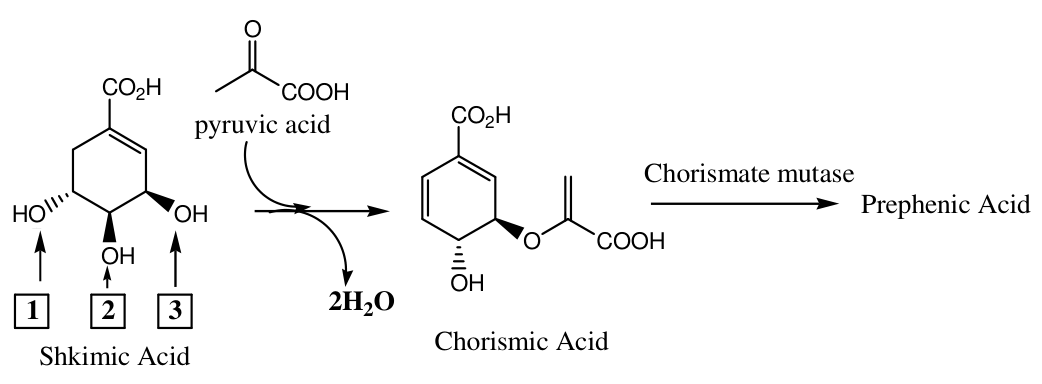
11.1 During the transformation of shikimic acid to chorismic acid, dehydration is occurring. Choose the hydroxyl group in shikimic acid that is lost through above dehydration among all possible reactions.
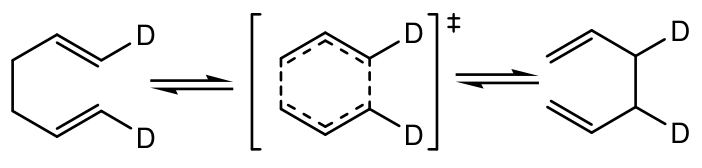
11.2 Chorismate mutase rearranges chorismic acid into prephenic acid without changing the molecular formula. Chorismic acid becomes prephenic acid through the Claisen rearrangement, a concerted pericyclic process like the Cope rearrangement as shown below:
Based on the following spectral data, propose the structure of prephenic acid.
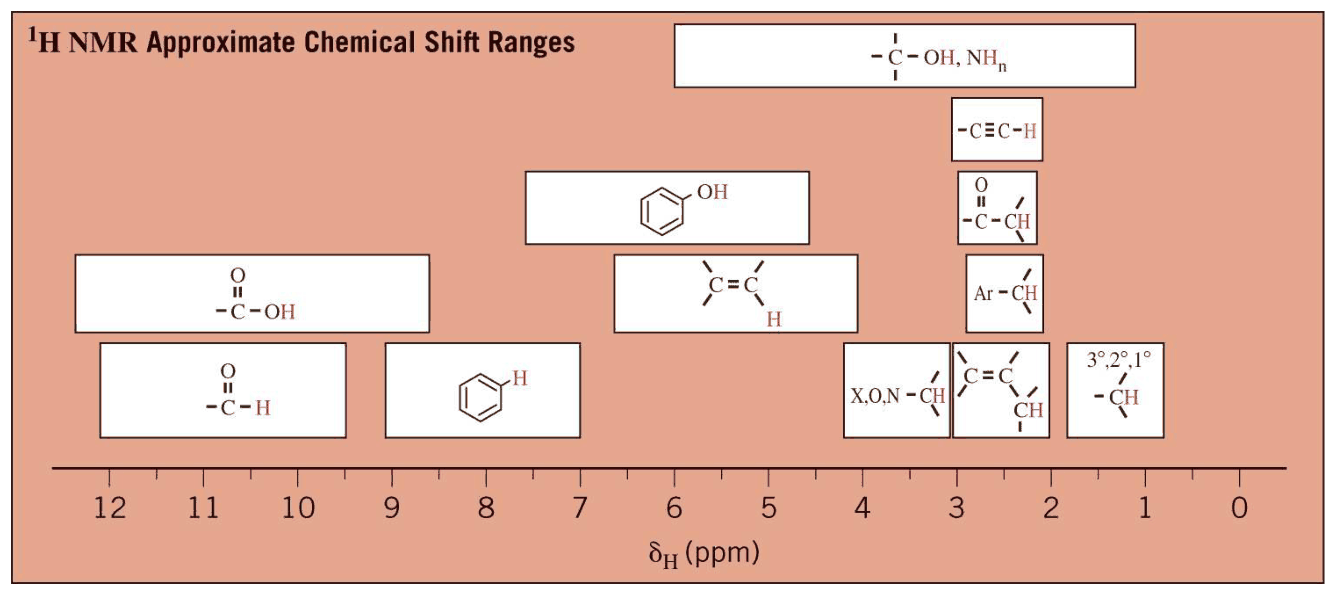
\(\ce{^{1}H}\)-NMR (\(\ce{D2O}\), 250 MHz): \(\delta\) 6.01 (2H, d, J = 10.4 Hz), 5.92 (2H, dd J = 10.4, 3.1 Hz), 4.50 (1H, t, J = 3.1 Hz), 3.12 (2H, s). Note that there are three protons, which have been exchanged by \(\ce{D2O}\) very fast, and two protons at \(\delta\) 3.12, which are exchanged slowly in prephenic acid. \(\ce{^{13}C}\)-NMR (\(\ce{D2O}\), 75 MHz): \(\delta\) 203, 178, 173, 132 (for two identical carbons), 127 (for two identical carbons), 65, 49, 48.
\(\delta\), chemical shift; H, integrals; d, doublet; dd, doublet of doublet; J, coupling constant; t, triplet; s, singlet
Chorismate mutase is believed to stabilize the transition state of Claisen rearrangement. Thus it is an interesting target for inhibitor design. Inhibitors, called transition state analog (TSA)s that resemble the transition state (TS, e.g., the species in brackets “[ ]” above) of the reaction are designed to occupy the active site. Several inhibitors were designed and synthesized, and among them eight turned out to be potent inhibitors of the enzyme. The lower is the \(\mathrm{IC}_{50}\) (inhibitor concentration of 50 % of the enzymatic activity) value, the better is the inhibitor.
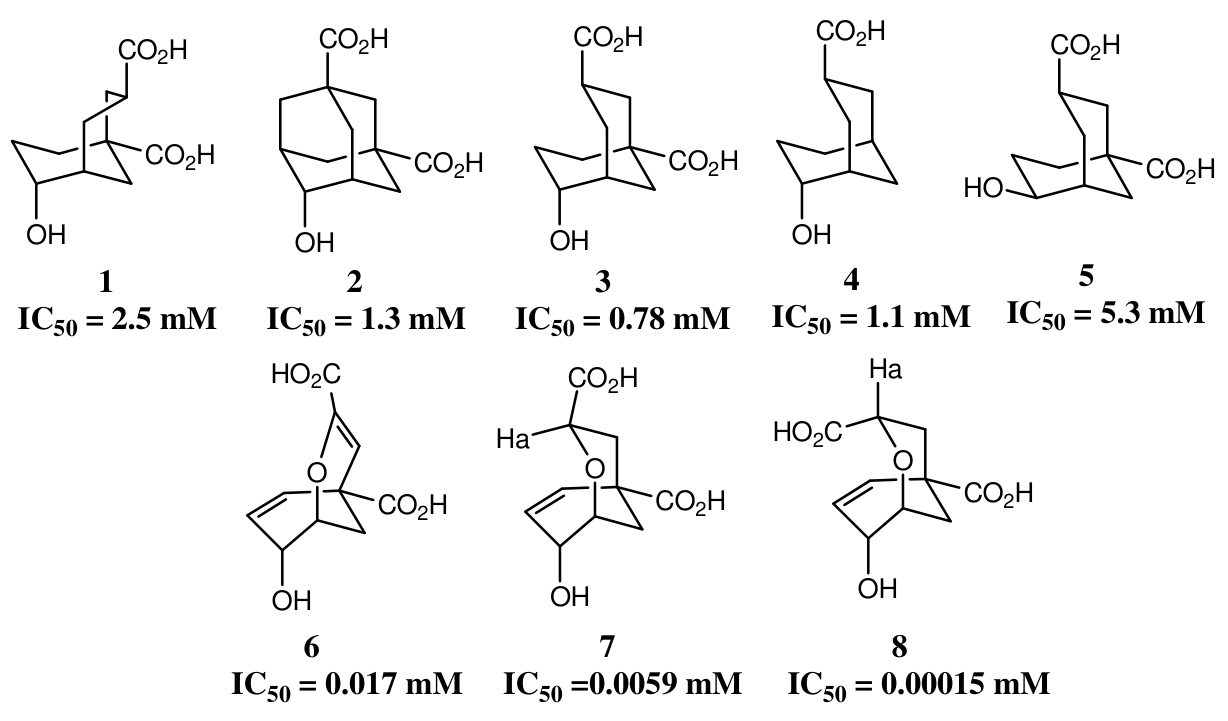
11.3 Choose all correct statements based on the structures and \(\mathrm{IC}_{50}\) values of above inhibitors. Increase of factor 5 is considered to be important.
(a) Configuration of the hydroxyl group plays an important role in the TS and inhibitor design.
(b) The presence of both carboxylic groups is important in the TS and inhibitor design.
(c) Transition state of the reaction contains two six-membered rings with one chair and one twist-boat conformation.
(d) 7 and 8 can be distinguished on the basis of the \(\ce{^{1}H}\)-NMR of \(\mathrm{H}_a\).
11.4 Draw the transition state of the transformation of chorismic acid to prephenic acid based on the TSA structures and their \(\mathrm{IC}_{50}\) values.
11.5 Compared with the uncatalyzed thermal conversion, chorismate mutase accelerates conversion of chorismic acid to prephenic acid \(1.0\times10^6\) fold at 25 °C by lowering the activation energy of the reaction. Calculate the decrease in activation energy of chorismate mutase at 25 °C.
\(\Delta H_{\mathrm{uncat}}^{\ne}\) is 86,900 J mol\(^{-1}\) for the thermal conversion of chorismic acid to prephenic acid. At what temperature will the rate of the uncatalyzed thermal conversion be the same as that of the enzyme-catalyzed conversion at 25 °C, assuming that \(E_a=\Delta H^{\ne}\).
Official English text of the problem.
Answers
- 11.1: Hydroxyl group 3.
- 11.2: Prephenic acid,
O=C(O)[C@]1(CC(=O)C(=O)O)C=C[C@H](O)C=C1. Its ring hydroxyl and ring-bound carboxyl group are cis. - 11.3: (a), (c), and (d).
- 11.4: A concerted \([3,3]\)-Claisen transition state resembling inhibitor 8, with a chair-like pericyclic ring and a twist-boat carbocyclic ring. The ring–oxygen bond breaks while a bond forms between the carboxyl-bearing ring carbon and the terminal methylene carbon of the side chain.
- 11.5: Activation-energy decrease: \(34.2\ \mathrm{kJ\,mol^{-1}}\). Matching uncatalyzed temperature: \(492\ \mathrm{K}\), approximately \(219\,^\circ\mathrm{C}\).
Solution
11.1 — Identifying the hydroxyl group lost
The structures in the overall transformation are:
| Name | SMILES |
|---|---|
| Shikimic acid | O=C(O)C1=C[C@@H](O)[C@@H](O)[C@H](O)C1 |
| Pyruvic acid | CC(=O)C(=O)O |
| Chorismic acid | O=C(O)C1=C[C@@H](OC(=C)C(=O)O)[C@H](O)C=C1 |
| Water | O |
The balanced overall equation represented by the supplied scheme is
\[ \ce{C7H10O5 + C3H4O3 -> C10H10O6 + 2H2O}. \]
The decisive information is the relative stereochemistry, rather than the positions occupied by groups on the page:
- In shikimic acid, hydroxyl groups 1 and 2 are trans, whereas 2 and 3 are cis.
- In chorismic acid, the remaining ring hydroxyl and the oxygen bearing the enolpyruvyl side chain are trans.
Thus hydroxyl 2 remains the alcohol, and the oxygen of hydroxyl 1 becomes the ether oxygen. Hydroxyl 3 is lost.
To track the carbon skeleton explicitly, number the original shikimate ring clockwise from its carboxyl-bearing carbon as \(S_1,\ldots,S_6\). Hydroxyls 3, 2, and 1 then occupy \(S_3,S_4,S_5\), respectively. The final double bonds are \(S_2=S_3\) and \(S_6=S_1\), and the side chain is attached through the oxygen at \(S_5\). Reading this product ring in the opposite direction gives the orientation used in the supplied chorismic-acid drawing. No inversion of either retained oxygen-bearing stereocentre is required.
11.2 — Identifying prephenic acid
Chorismic acid has formula \(\ce{C10H10O6}\), which is retained during rearrangement. Its degree of unsaturation is
\[ \mathrm{DBE}=\frac{2(10)+2-10}{2}=6. \]
The carbon spectrum accounts for these six units as one ring, two carbon–carbon double bonds, and three carbonyl groups:
| \(\delta_{\mathrm C}\), ppm | Assignment |
|---|---|
| 203 | Ketone carbonyl |
| 178, 173 | Two carboxyl carbonyls |
| 132, 127, each representing two carbons | Four alkene carbons in two equivalent pairs |
| 65 | Alcohol-bearing methine carbon |
| 49, 48 | Quaternary ring carbon and side-chain methylene carbon |
These features require a symmetric cyclohexa-2,5-diene ring carrying both a carboxyl group and a \(\ce{-CH2-C(=O)-CO2H}\) side chain at C1, with an alcohol at C4.
The proton spectrum supports this connectivity:
| Signal | Assignment and explanation |
|---|---|
| \(\delta 6.01\), 2H, d, \(J=10.4\ \mathrm{Hz}\) | H2 and H6; each couples principally to the other proton on its double bond. C1 has no hydrogen. |
| \(\delta 5.92\), 2H, dd, \(J=10.4,3.1\ \mathrm{Hz}\) | H3 and H5; each couples to its alkene neighbour and to H4. |
| \(\delta 4.50\), 1H, t, \(J=3.1\ \mathrm{Hz}\) | H4 on the alcohol-bearing carbon, coupled equally to H3 and H5. |
| \(\delta 3.12\), 2H, s | The side-chain methylene, between a quaternary carbon and a ketone carbonyl; neither adjacent carbon bears a hydrogen. |
The three rapidly exchanged hydrogens belong to two carboxyl groups and one alcohol. The methylene hydrogens exchange more slowly with heavy water, [2H]O[2H], through enolization next to the ketone.
The product is therefore prephenic acid:
O=C(O)[C@]1(CC(=O)C(=O)O)C=C[C@H](O)C=C1
Its ring hydroxyl is cis to the ring-bound carboxyl group and trans to the carbon side chain. The NMR establishes the connectivity and symmetry; this relative configuration follows from the supplied reactant stereochemistry and the concerted rearrangement.
The balanced isomerization is
\[ \underbrace{\ce{C10H10O6}}_{\text{chorismic acid}} \xrightarrow{\text{chorismate mutase}} \underbrace{\ce{C10H10O6}}_{\text{prephenic acid}}. \]
11.3 — Evaluating the statements
For explicit structural identification, the numbered inhibitors used in the comparisons can be represented as follows. Their chair and twist-boat conformations must be described separately from their SMILES.
| Name in the problem | SMILES |
|---|---|
| Carbocyclic inhibitor 3 | O=C(O)[C@]12C[C@H]([C@H](O)CC1)C[C@@H](C(=O)O)C2 |
| Monocarboxylic inhibitor 4 | [C@H]12C[C@H]([C@H](O)CC1)C[C@@H](C(=O)O)C2 |
| Hydroxyl epimer 5 | O=C(O)[C@]12C[C@H]([C@@H](O)CC1)C[C@@H](C(=O)O)C2 |
| Oxabicyclic inhibitor 7 | O=C(O)[C@]12C[C@H]([C@H](O)C=C1)O[C@@H](C(=O)O)C2 |
| Oxabicyclic inhibitor 8 | O=C(O)[C@]12C[C@H]([C@H](O)C=C1)O[C@H](C(=O)O)C2 |
(a) Correct. Compare hydroxyl epimers 3 and 5:
\[ \frac{\mathrm{IC}_{50}(5)}{\mathrm{IC}_{50}(3)} =\frac{5.3}{0.78}=6.8. \]
Changing the hydroxyl configuration decreases potency by more than the stipulated factor of five.
(b) Incorrect. Compare dicarboxylic inhibitor 3 with monocarboxylic inhibitor 4:
\[ \frac{\mathrm{IC}_{50}(4)}{\mathrm{IC}_{50}(3)} =\frac{1.1}{0.78}=1.4. \]
Removing this carboxyl group changes potency by less than fivefold. Thus the data do not support the claim that the presence of both carboxyl groups is important under the stated criterion.
(c) Correct. The transition-state assembly contains two distinct six-membered rings. The six-atom ring involved in the Claisen electron redistribution is chair-like, while the original carbocyclic ring adopts a twist-boat conformation. The geometry represented by the potent bicyclic analogue 8 accommodates both. Describing only the chair-like rearranging ring would omit the second ring.
(d) Correct. Compounds 7 and 8 are diastereomers at the carbon bearing \(H_a\). In the depicted chair framework, \(H_a\) is approximately axial in 7 and equatorial in 8. Consequently, their vicinal coupling patterns differ: the axial proton can have a large approximately antiperiplanar coupling to an adjacent axial methylene hydrogen, whereas the equatorial proton has smaller corresponding couplings. Their \(H_a\) resonances can therefore distinguish them.
The correct selection is (a), (c), and (d).
11.4 — Describing the transition-state drawing
Number the chorismic-acid ring clockwise from its carboxyl-bearing carbon:
- C1 bears the ring carboxyl group.
- The initial ring double bonds are C1=C2 and C5=C6.
- C3 bears the ether oxygen \(O_{\mathrm e}\).
- C4 bears the alcohol.
- In the side chain, call the substituted alkene carbon \(C_\alpha\) and the terminal methylene carbon \(C_\beta\). Thus the side chain is \(O_{\mathrm e}-C_\alpha(=C_\beta)-\ce{CO2H}\).
The six-atom pericyclic circuit is
\[ C_1-C_2-C_3-O_{\mathrm e}-C_\alpha-C_\beta-C_1. \]
Draw this circuit in a chair-like conformation, with the original carbocyclic ring in a twist-boat conformation, following inhibitor 8. Its potency relative to 7 is
\[ \frac{\mathrm{IC}_{50}(7)}{\mathrm{IC}_{50}(8)} =\frac{0.0059}{0.00015}\approx39, \]
supporting the substituent orientation represented by 8.
The drawing should show these simultaneous bond changes:
| Bond | Change during rearrangement |
|---|---|
| C3–\(O_{\mathrm e}\) | Breaking |
| \(C_\beta\)–C1 | Forming |
| C1=C2 | Double to single |
| C2–C3 | Single to double |
| \(O_{\mathrm e}\)–\(C_\alpha\) | Single to carbonyl double bond |
| \(C_\alpha=C_\beta\) | Double to single |
The three concerted electron-pair movements are:
- The C1=C2 \(\pi\) electrons form the C2=C3 \(\pi\) bond.
- The C3–\(O_{\mathrm e}\) \(\sigma\) electrons form the \(O_{\mathrm e}=C_\alpha\) carbonyl \(\pi\) bond.
- The \(C_\alpha=C_\beta\) \(\pi\) electrons form the new \(C_\beta\)–C1 \(\sigma\) bond.
Show the forming and breaking bonds as dashed partial bonds, indicate partial \(\pi\)-bond redistribution along the other four edges, and enclose the assembly in brackets with a superscript \(\ddagger\).
The side chain approaches the ring on the same face as the departing C3–oxygen linkage. The C4 hydroxyl lies on the opposite face. Place the side-chain carboxyl group in the orientation modeled by 8. This produces the cis relationship between the ring hydroxyl and ring-bound carboxyl group in prephenic acid.
Ordinary SMILES cannot encode fractional transition-state bonds or these conformations; the endpoint SMILES and the specified bond changes define the requested drawing.
11.5 — Activation-energy decrease and equivalent temperature
Use the Arrhenius model
\[ k=Ae^{-E_a/(RT)}, \]
with the unchanged-prefactor assumption implicit in attributing the acceleration to a decrease in activation energy.
At \(T_0=298.15\ \mathrm K\),
\[ \frac{k_{\mathrm{cat}}}{k_{\mathrm{uncat}}} = \exp\!\left( \frac{E_{a,\mathrm{uncat}}-E_{a,\mathrm{cat}}}{RT_0} \right) =10^6. \]
Therefore,
\[ \begin{aligned} \Delta E_a &=RT_0\ln(10^6)\\ &=(8.314\ \mathrm{J\,mol^{-1}K^{-1}}) (298.15\ \mathrm K)(13.8155)\\ &=3.4246\times10^4\ \mathrm{J\,mol^{-1}}. \end{aligned} \]
Thus the activation-energy decrease is
\[ \boxed{\Delta E_a=34.2\ \mathrm{kJ\,mol^{-1}}}. \]
With \(E_{a,\mathrm{uncat}}=86.900\ \mathrm{kJ\,mol^{-1}}\), the corresponding catalyzed barrier in this model is approximately \(52.7\ \mathrm{kJ\,mol^{-1}}\).
For the uncatalyzed reaction to reach the catalyzed rate at \(298.15\ \mathrm K\), its rate must increase by \(10^6\):
\[ \ln(10^6) = \frac{E_{a,\mathrm{uncat}}}{R} \left(\frac{1}{T_0}-\frac{1}{T}\right). \]
Hence
\[ \begin{aligned} T &= \left[ \frac{1}{298.15\ \mathrm K} - \frac{8.314\ \mathrm{J\,mol^{-1}K^{-1}}} {86\,900\ \mathrm{J\,mol^{-1}}} \ln(10^6) \right]^{-1}\\ &=492.07\ \mathrm K. \end{aligned} \]
Therefore,
\[ \boxed{T\approx492\ \mathrm K\approx219\,^\circ\mathrm C}. \]
The solution was checked against the official solution.
IChO 2006 · Theorieaufgabe 11
Enzymreaktion
Die Shikimisäurebiosynthese ist ein wichtiger Stoffwechselweg zur Bildung von Aminosäuren, Alkaloiden und heterocyclischen Naturstoffen. In der Natur wird Shikimisäure durch eine Kaskade enzymatischer Reaktionen in Chorisminsäure umgewandelt. Anschließend katalysiert die Chorismatmutase die Umwandlung von Chorisminsäure in Prephensäure am Verzweigungspunkt der Biosynthese aromatischer Aminosäuren wie Tyrosin und Phenylalanin.
11.1 Während der Umwandlung von Shikimisäure in Chorisminsäure findet eine Wasserabspaltung statt. Wählen Sie unter allen möglichen Reaktionen die Hydroxygruppe der Shikimisäure aus, die bei der oben genannten Wasserabspaltung verloren geht.
11.2 Die Chorismatmutase lagert Chorisminsäure in Prephensäure um, ohne die Summenformel zu verändern. Chorisminsäure wird durch eine Claisen-Umlagerung zu Prephensäure; dabei handelt es sich um einen konzertierten pericyclischen Prozess wie bei der unten gezeigten Cope-Umlagerung:
Schlagen Sie anhand der folgenden spektroskopischen Daten die Struktur der Prephensäure vor.
\(\ce{^{1}H}\)-NMR (\(\ce{D2O}\), 250 MHz): \(\delta\) 6.01 (2H, d, J = 10.4 Hz), 5.92 (2H, dd J = 10.4, 3.1 Hz), 4.50 (1H, t, J = 3.1 Hz), 3.12 (2H, s). Beachten Sie, dass in der Prephensäure drei Protonen durch \(\ce{D2O}\) sehr schnell ausgetauscht werden und zwei Protonen bei \(\delta\) 3.12 langsam ausgetauscht werden. \(\ce{^{13}C}\)-NMR (\(\ce{D2O}\), 75 MHz): \(\delta\) 203, 178, 173, 132 (für zwei äquivalente Kohlenstoffatome), 127 (für zwei äquivalente Kohlenstoffatome), 65, 49, 48.
\(\delta\), chemische Verschiebung; H, Integrale; d, Dublett; dd, Dublett von Dubletts; J, Kopplungskonstante; t, Triplett; s, Singulett
Man nimmt an, dass die Chorismatmutase den Übergangszustand der Claisen-Umlagerung stabilisiert. Daher ist sie ein interessantes Ziel für die Entwicklung von Inhibitoren. Inhibitoren, die als Übergangszustandsanaloga (TSA) bezeichnet werden und dem Übergangszustand (TS, z. B. der oben in eckigen Klammern „[ ]“ dargestellten Spezies) der Reaktion ähneln, werden so entwickelt, dass sie das aktive Zentrum besetzen. Mehrere Inhibitoren wurden entworfen und synthetisiert; acht von ihnen erwiesen sich als wirksame Inhibitoren des Enzyms. Je niedriger der \(\mathrm{IC}_{50}\)-Wert (Inhibitorkonzentration bei 50 % der enzymatischen Aktivität), desto besser ist der Inhibitor.
11.3 Wählen Sie anhand der Strukturen und der \(\mathrm{IC}_{50}\)-Werte der oben gezeigten Inhibitoren alle richtigen Aussagen aus. Eine Erhöhung um den Faktor 5 wird als bedeutsam angesehen.
(a) Die Konfiguration der Hydroxygruppe spielt im TS und bei der Entwicklung von Inhibitoren eine wichtige Rolle.
(b) Das Vorhandensein beider Carboxygruppen ist im TS und bei der Entwicklung von Inhibitoren wichtig.
(c) Der Übergangszustand der Reaktion enthält zwei sechsgliedrige Ringe, einen in Sesselkonformation und einen in Twist-Wannen-Konformation.
(d) 7 und 8 lassen sich anhand des \(\ce{^{1}H}\)-NMR-Signals von \(\mathrm{H}_a\) unterscheiden.
11.4 Zeichnen Sie anhand der TSA-Strukturen und ihrer \(\mathrm{IC}_{50}\)-Werte den Übergangszustand der Umwandlung von Chorisminsäure in Prephensäure.
11.5 Im Vergleich zur unkatalysierten thermischen Umwandlung beschleunigt die Chorismatmutase die Umwandlung von Chorisminsäure in Prephensäure bei 25 °C um das \(1.0\times10^6\)-Fache, indem sie die Aktivierungsenergie der Reaktion senkt. Berechnen Sie die durch die Chorismatmutase bewirkte Absenkung der Aktivierungsenergie bei 25 °C.
\(\Delta H_{\mathrm{uncat}}^{\ne}\) beträgt für die thermische Umwandlung von Chorisminsäure in Prephensäure 86,900 J mol\(^{-1}\). Bei welcher Temperatur ist die Geschwindigkeit der unkatalysierten thermischen Umwandlung gleich der Geschwindigkeit der enzymkatalysierten Umwandlung bei 25 °C, wenn \(E_a=\Delta H^{\ne}\) angenommen wird?
Aufgabentext aus dem offiziellen englischen Text übersetzt.
Antworten
- 11.1: Hydroxygruppe 3.
- 11.2: Prephensäure,
O=C(O)[C@]1(CC(=O)C(=O)O)C=C[C@H](O)C=C1. Ihre Ringhydroxygruppe und ihre ringgebundene Carboxygruppe stehen cis zueinander. - 11.3: (a), (c) und (d).
- 11.4: Ein konzertierter \([3,3]\)-Claisen-Übergangszustand, der dem Inhibitor 8 ähnelt, mit einem sesselartigen pericyclischen Ring und einem carbocyclischen Ring in Twist-Wannen-Konformation. Die Bindung zwischen Ring und Sauerstoff wird gespalten, während sich zwischen dem carboxygruppentragenden Ringkohlenstoffatom und dem endständigen Methylenkohlenstoffatom der Seitenkette eine Bindung bildet.
- 11.5: Absenkung der Aktivierungsenergie: \(34.2\ \mathrm{kJ\,mol^{-1}}\). Temperatur für die gleiche Geschwindigkeit ohne Katalyse: \(492\ \mathrm{K}\), ungefähr \(219\,^\circ\mathrm{C}\).
Lösung
11.1 — Bestimmung der abgespaltenen Hydroxygruppe
Die Strukturen der Gesamtumwandlung sind:
| Name | SMILES |
|---|---|
| Shikimisäure | O=C(O)C1=C[C@@H](O)[C@@H](O)[C@H](O)C1 |
| Brenztraubensäure | CC(=O)C(=O)O |
| Chorisminsäure | O=C(O)C1=C[C@@H](OC(=C)C(=O)O)[C@H](O)C=C1 |
| Wasser | O |
Die ausgeglichene Gesamtgleichung, die durch das vorgegebene Schema dargestellt wird, lautet
\[ \ce{C7H10O5 + C3H4O3 -> C10H10O6 + 2H2O}. \]
Entscheidend ist die relative Stereochemie, nicht die Position der Gruppen auf dem Blatt:
- In der Shikimisäure stehen die Hydroxygruppen 1 und 2 trans, während 2 und 3 cis zueinander stehen.
- In der Chorisminsäure stehen die verbleibende Ringhydroxygruppe und das Sauerstoffatom, das die Enolpyruvyl-Seitenkette trägt, trans zueinander.
Somit bleibt die Hydroxygruppe 2 als Alkoholgruppe erhalten, und das Sauerstoffatom der Hydroxygruppe 1 wird zum Ethersauerstoffatom. Die Hydroxygruppe 3 wird abgespalten.
Um das Kohlenstoffgerüst ausdrücklich nachzuverfolgen, nummerieren wir den ursprünglichen Shikimatring ausgehend von seinem carboxygruppentragenden Kohlenstoffatom im Uhrzeigersinn als \(S_1,\ldots,S_6\). Die Hydroxygruppen 3, 2 und 1 befinden sich dann an \(S_3,S_4,S_5\). Die abschließenden Doppelbindungen sind \(S_2=S_3\) und \(S_6=S_1\), und die Seitenkette ist über das Sauerstoffatom an \(S_5\) gebunden. Liest man diesen Produktring in der entgegengesetzten Richtung, ergibt sich die Orientierung der vorgegebenen Chorisminsäurezeichnung. Eine Inversion an einem der beiden erhaltenen sauerstofftragenden Stereozentren ist nicht erforderlich.
11.2 — Identifizierung der Prephensäure
Chorisminsäure hat die Summenformel \(\ce{C10H10O6}\), die bei der Umlagerung erhalten bleibt. Ihr Doppelbindungsäquivalent beträgt
\[ \mathrm{DBE}=\frac{2(10)+2-10}{2}=6. \]
Das Kohlenstoffspektrum erklärt diese sechs Einheiten durch einen Ring, zwei Kohlenstoff–Kohlenstoff-Doppelbindungen und drei Carbonylgruppen:
| \(\delta_{\mathrm C}\), ppm | Zuordnung |
|---|---|
| 203 | Ketoncarbonylgruppe |
| 178, 173 | Zwei Carboxylcarbonylgruppen |
| 132, 127, jeweils für zwei Kohlenstoffatome | Vier Alkenkohlenstoffatome in zwei äquivalenten Paaren |
| 65 | Alkoholgruppentragendes Methinkohlenstoffatom |
| 49, 48 | Quartäres Ringkohlenstoffatom und Methylenkohlenstoffatom der Seitenkette |
Diese Merkmale erfordern einen symmetrischen Cyclohexa-2,5-dien-Ring, der an C1 sowohl eine Carboxygruppe als auch eine \(\ce{-CH2-C(=O)-CO2H}\)-Seitenkette und an C4 eine Alkoholgruppe trägt.
Das Protonenspektrum stützt diese Konnektivität:
| Signal | Zuordnung und Erklärung |
|---|---|
| \(\delta 6.01\), 2H, d, \(J=10.4\ \mathrm{Hz}\) | H2 und H6; jedes koppelt hauptsächlich mit dem anderen Proton an seiner Doppelbindung. C1 trägt kein Wasserstoffatom. |
| \(\delta 5.92\), 2H, dd, \(J=10.4,3.1\ \mathrm{Hz}\) | H3 und H5; jedes koppelt mit seinem Alkennachbarn und mit H4. |
| \(\delta 4.50\), 1H, t, \(J=3.1\ \mathrm{Hz}\) | H4 am alkoholgruppentragenden Kohlenstoffatom, mit gleicher Kopplung zu H3 und H5. |
| \(\delta 3.12\), 2H, s | Die Methylengruppe der Seitenkette zwischen einem quartären Kohlenstoffatom und einer Ketoncarbonylgruppe; keines der benachbarten Kohlenstoffatome trägt ein Wasserstoffatom. |
Die drei schnell ausgetauschten Wasserstoffatome gehören zu zwei Carboxygruppen und einer Alkoholgruppe. Die Methylenwasserstoffatome werden durch Enolisierung neben der Ketongruppe langsamer mit schwerem Wasser, [2H]O[2H], ausgetauscht.
Das Produkt ist daher Prephensäure:
O=C(O)[C@]1(CC(=O)C(=O)O)C=C[C@H](O)C=C1
Ihre Ringhydroxygruppe steht cis zur ringgebundenen Carboxygruppe und trans zur Kohlenstoffseitenkette. Die NMR-Daten belegen die Konnektivität und Symmetrie; diese relative Konfiguration folgt aus der vorgegebenen Stereochemie des Edukts und der konzertierten Umlagerung.
Die ausgeglichene Isomerisierung lautet
\[ \underbrace{\ce{C10H10O6}}_{\text{Chorisminsäure}} \xrightarrow{\text{Chorismatmutase}} \underbrace{\ce{C10H10O6}}_{\text{Prephensäure}}. \]
11.3 — Bewertung der Aussagen
Zur eindeutigen strukturellen Identifizierung lassen sich die in den Vergleichen verwendeten nummerierten Inhibitoren wie folgt darstellen. Ihre Sessel- und Twist-Wannen-Konformationen müssen getrennt von ihren SMILES beschrieben werden.
| Bezeichnung in der Aufgabe | SMILES |
|---|---|
| Carbocyclischer Inhibitor 3 | O=C(O)[C@]12C[C@H]([C@H](O)CC1)C[C@@H](C(=O)O)C2 |
| Monocarboxylischer Inhibitor 4 | [C@H]12C[C@H]([C@H](O)CC1)C[C@@H](C(=O)O)C2 |
| Hydroxyepimer 5 | O=C(O)[C@]12C[C@H]([C@@H](O)CC1)C[C@@H](C(=O)O)C2 |
| Oxabicyclischer Inhibitor 7 | O=C(O)[C@]12C[C@H]([C@H](O)C=C1)O[C@@H](C(=O)O)C2 |
| Oxabicyclischer Inhibitor 8 | O=C(O)[C@]12C[C@H]([C@H](O)C=C1)O[C@H](C(=O)O)C2 |
(a) Richtig. Wir vergleichen die Hydroxyepimere 3 und 5:
\[ \frac{\mathrm{IC}_{50}(5)}{\mathrm{IC}_{50}(3)} =\frac{5.3}{0.78}=6.8. \]
Eine Änderung der Hydroxygruppenkonfiguration vermindert die Hemmwirkung um mehr als den vorgegebenen Faktor fünf.
(b) Falsch. Wir vergleichen den dicarboxylischen Inhibitor 3 mit dem monocarboxylischen Inhibitor 4:
\[ \frac{\mathrm{IC}_{50}(4)}{\mathrm{IC}_{50}(3)} =\frac{1.1}{0.78}=1.4. \]
Das Entfernen dieser Carboxygruppe verändert die Hemmwirkung um weniger als das Fünffache. Somit stützen die Daten unter dem angegebenen Kriterium nicht die Aussage, dass das Vorhandensein beider Carboxygruppen wichtig ist.
(c) Richtig. Die Anordnung im Übergangszustand enthält zwei unterschiedliche sechsgliedrige Ringe. Der aus sechs Atomen bestehende Ring, der an der Elektronenumverteilung der Claisen-Umlagerung beteiligt ist, ist sesselartig, während der ursprüngliche carbocyclische Ring eine Twist-Wannen-Konformation einnimmt. Die durch das wirksame bicyclische Analogon 8 dargestellte Geometrie ermöglicht beides. Eine Beschreibung allein des sesselartigen, sich umlagernden Rings würde den zweiten Ring auslassen.
(d) Richtig. Die Verbindungen 7 und 8 sind Diastereomere am Kohlenstoffatom, das \(H_a\) trägt. Im dargestellten Sesselgerüst ist \(H_a\) in 7 annähernd axial und in 8 äquatorial angeordnet. Daher unterscheiden sich ihre vicinalen Kopplungsmuster: Das axiale Proton kann eine große, annähernd antiperiplanare Kopplung mit einem benachbarten axialen Methylenwasserstoffatom aufweisen, während das äquatoriale Proton kleinere entsprechende Kopplungen zeigt. Ihre \(H_a\)-Resonanzen ermöglichen daher ihre Unterscheidung.
Die richtige Auswahl ist (a), (c) und (d).
11.4 — Beschreibung der Zeichnung des Übergangszustands
Wir nummerieren den Chorisminsäurering ausgehend von seinem carboxygruppentragenden Kohlenstoffatom im Uhrzeigersinn:
- C1 trägt die Ringcarboxygruppe.
- Die anfänglichen Ringdoppelbindungen sind C1=C2 und C5=C6.
- C3 trägt das Ethersauerstoffatom \(O_{\mathrm e}\).
- C4 trägt die Alkoholgruppe.
- In der Seitenkette bezeichnen wir das substituierte Alkenkohlenstoffatom als \(C_\alpha\) und das endständige Methylenkohlenstoffatom als \(C_\beta\). Somit lautet die Seitenkette \(O_{\mathrm e}-C_\alpha(=C_\beta)-\ce{CO2H}\).
Der pericyclische Ring aus sechs Atomen ist
\[ C_1-C_2-C_3-O_{\mathrm e}-C_\alpha-C_\beta-C_1. \]
Zeichnen Sie diesen Ring entsprechend Inhibitor 8 in einer sesselartigen Konformation, wobei der ursprüngliche carbocyclische Ring eine Twist-Wannen-Konformation einnimmt. Seine Hemmwirkung relativ zu 7 beträgt
\[ \frac{\mathrm{IC}_{50}(7)}{\mathrm{IC}_{50}(8)} =\frac{0.0059}{0.00015}\approx39, \]
was die durch 8 dargestellte Orientierung der Substituenten stützt.
Die Zeichnung sollte diese gleichzeitigen Bindungsänderungen zeigen:
| Bindung | Änderung während der Umlagerung |
|---|---|
| C3–\(O_{\mathrm e}\) | Wird gespalten |
| \(C_\beta\)–C1 | Wird gebildet |
| C1=C2 | Doppelbindung wird zur Einfachbindung |
| C2–C3 | Einfachbindung wird zur Doppelbindung |
| \(O_{\mathrm e}\)–\(C_\alpha\) | Einfachbindung wird zur Carbonyl-Doppelbindung |
| \(C_\alpha=C_\beta\) | Doppelbindung wird zur Einfachbindung |
Die drei konzertierten Elektronenpaarverschiebungen sind:
- Die \(\pi\)-Elektronen von C1=C2 bilden die \(\pi\)-Bindung C2=C3.
- Die \(\sigma\)-Elektronen von C3–\(O_{\mathrm e}\) bilden die Carbonyl-\(\pi\)-Bindung \(O_{\mathrm e}=C_\alpha\).
- Die \(\pi\)-Elektronen von \(C_\alpha=C_\beta\) bilden die neue \(\sigma\)-Bindung \(C_\beta\)–C1.
Stellen Sie die sich bildenden und die sich lösenden Bindungen als gestrichelte partielle Bindungen dar, kennzeichnen Sie die partielle Umverteilung der \(\pi\)-Bindungen entlang der übrigen vier Kanten und setzen Sie die Anordnung in eckige Klammern mit einem hochgestellten \(\ddagger\).
Die Seitenkette nähert sich dem Ring von derselben Seite wie die sich lösende C3–Sauerstoff-Bindung. Die Hydroxygruppe an C4 liegt auf der gegenüberliegenden Seite. Ordnen Sie die Carboxygruppe der Seitenkette in der durch 8 modellierten Orientierung an. Daraus ergibt sich in der Prephensäure die cis-Beziehung zwischen der Ringhydroxygruppe und der ringgebundenen Carboxygruppe.
Gewöhnliche SMILES können weder Bindungen mit gebrochenen Bindungsordnungen im Übergangszustand noch diese Konformationen kodieren; die SMILES der Ausgangs- und Endstrukturen sowie die angegebenen Bindungsänderungen legen die geforderte Zeichnung fest.
11.5 — Absenkung der Aktivierungsenergie und äquivalente Temperatur
Wir verwenden das Arrhenius-Modell
\[ k=Ae^{-E_a/(RT)}, \]
mit der Annahme eines unveränderten präexponentiellen Faktors, die implizit zugrunde liegt, wenn die Beschleunigung einer Absenkung der Aktivierungsenergie zugeschrieben wird.
Bei \(T_0=298.15\ \mathrm K\) gilt
\[ \frac{k_{\mathrm{cat}}}{k_{\mathrm{uncat}}} = \exp\!\left( \frac{E_{a,\mathrm{uncat}}-E_{a,\mathrm{cat}}}{RT_0} \right) =10^6. \]
Daher gilt
\[ \begin{aligned} \Delta E_a &=RT_0\ln(10^6)\\ &=(8.314\ \mathrm{J\,mol^{-1}K^{-1}}) (298.15\ \mathrm K)(13.8155)\\ &=3.4246\times10^4\ \mathrm{J\,mol^{-1}}. \end{aligned} \]
Somit beträgt die Absenkung der Aktivierungsenergie
\[ \boxed{\Delta E_a=34.2\ \mathrm{kJ\,mol^{-1}}}. \]
Mit \(E_{a,\mathrm{uncat}}=86.900\ \mathrm{kJ\,mol^{-1}}\) beträgt die entsprechende Barriere der katalysierten Reaktion in diesem Modell ungefähr \(52.7\ \mathrm{kJ\,mol^{-1}}\).
Damit die unkatalysierte Reaktion die Geschwindigkeit der katalysierten Reaktion bei \(298.15\ \mathrm K\) erreicht, muss ihre Geschwindigkeit um den Faktor \(10^6\) steigen:
\[ \ln(10^6) = \frac{E_{a,\mathrm{uncat}}}{R} \left(\frac{1}{T_0}-\frac{1}{T}\right). \]
Daraus folgt
\[ \begin{aligned} T &= \left[ \frac{1}{298.15\ \mathrm K} - \frac{8.314\ \mathrm{J\,mol^{-1}K^{-1}}} {86\,900\ \mathrm{J\,mol^{-1}}} \ln(10^6) \right]^{-1}\\ &=492.07\ \mathrm K. \end{aligned} \]
Damit ergibt sich
\[ \boxed{T\approx492\ \mathrm K\approx219\,^\circ\mathrm C}. \]
Die Lösung wurde mit der offiziellen Lösung abgeglichen.
IChO 2006 · Teori sorusu 11
Enzim Tepkimesi
Şikimik asit biyosentezi, amino asitlerin, alkaloitlerin ve heterosiklik doğal ürünlerin üretimi için önemli bir yoldur. Doğa, bir dizi enzimatik tepkime yoluyla şikimik asidi korismik aside dönüştürür. Ardından korismat mutaz, tirozin ve fenilalanin gibi aromatik amino asitlerin biyosentezinin dallanma noktasında korismik asidin prefenik aside dönüşümünü katalizler.
11.1 Şikimik asidin korismik aside dönüşümü sırasında dehidrasyon gerçekleşir. Olası tüm tepkimeler arasından, yukarıdaki dehidrasyon yoluyla şikimik asitte kaybedilen hidroksil grubunu seçin.
11.2 Korismat mutaz, molekül formülünü değiştirmeden korismik asidi yeniden düzenleyerek prefenik aside dönüştürür. Korismik asit, aşağıda gösterilen Cope yeniden düzenlenmesi gibi eş zamanlı bir perisiklik süreç olan Claisen yeniden düzenlenmesi yoluyla prefenik aside dönüşür:
Aşağıdaki spektral verilere dayanarak prefenik asidin yapısını önerin.
\(\ce{^{1}H}\)-NMR (\(\ce{D2O}\), 250 MHz): \(\delta\) 6.01 (2H, d, J = 10.4 Hz), 5.92 (2H, dd J = 10.4, 3.1 Hz), 4.50 (1H, t, J = 3.1 Hz), 3.12 (2H, s). Prefenik asitte \(\ce{D2O}\) ile çok hızlı değişime uğrayan üç proton ve \(\delta\) 3.12'de yavaş değişime uğrayan iki proton bulunduğuna dikkat edin. \(\ce{^{13}C}\)-NMR (\(\ce{D2O}\), 75 MHz): \(\delta\) 203, 178, 173, 132 (iki özdeş karbon için), 127 (iki özdeş karbon için), 65, 49, 48.
\(\delta\), kimyasal kayma; H, integraller; d, dublet; dd, dubletin dubleti; J, eşleşme sabiti; t, triplet; s, singlet
Korismat mutazın, Claisen yeniden düzenlenmesinin geçiş durumunu kararlı hâle getirdiği düşünülmektedir. Bu nedenle inhibitör tasarımı için ilgi çekici bir hedeftir. Tepkimenin geçiş durumuna (TS, örneğin, yukarıda “[ ]” köşeli parantezleri içindeki tür) benzeyen ve geçiş durumu analogları (TSA) olarak adlandırılan inhibitörler, aktif bölgeyi işgal etmek üzere tasarlanır. Çeşitli inhibitörler tasarlanıp sentezlenmiş ve bunlardan sekizinin enzimin güçlü inhibitörleri olduğu ortaya çıkmıştır. \(\mathrm{IC}_{50}\) (enzimatik aktivitenin %50'sine karşılık gelen inhibitör derişimi) değeri ne kadar düşükse inhibitör o kadar etkilidir.
11.3 Yukarıdaki inhibitörlerin yapılarına ve \(\mathrm{IC}_{50}\) değerlerine dayanarak doğru ifadelerin tümünü seçin. Beş katlık bir artış önemli kabul edilir.
(a) Hidroksil grubunun konfigürasyonu, TS ve inhibitör tasarımında önemli bir rol oynar.
(b) Her iki karboksil grubunun da bulunması, TS ve inhibitör tasarımında önemlidir.
(c) Tepkimenin geçiş durumu, biri sandalye, diğeri burulmuş kayık konformasyonunda olan iki altı üyeli halka içerir.
(d) 7 ve 8, \(\mathrm{H}_a\)'nın \(\ce{^{1}H}\)-NMR verileri temelinde ayırt edilebilir.
11.4 TSA yapılarına ve bunların \(\mathrm{IC}_{50}\) değerlerine dayanarak korismik asidin prefenik aside dönüşümünün geçiş durumunu çizin.
11.5 Korismat mutaz, tepkimenin aktivasyon enerjisini düşürerek korismik asidin prefenik aside dönüşümünü, katalizlenmemiş termal dönüşüme kıyasla 25 °C'de \(1.0\times10^6\) kat hızlandırır. Korismat mutazın 25 °C'de sağladığı aktivasyon enerjisi düşüşünü hesaplayın.
Korismik asidin prefenik aside termal dönüşümü için \(\Delta H_{\mathrm{uncat}}^{\ne}\) 86,900 J mol\(^{-1}\)'dir. \(E_a=\Delta H^{\ne}\) olduğunu varsayarak, katalizlenmemiş termal dönüşümün hızının hangi sıcaklıkta 25 °C'deki enzimle katalizlenen dönüşümün hızına eşit olacağını bulun.
Soru metni resmi İngilizce metinden çevrilmiştir.
Cevaplar
- 11.1: 3 numaralı hidroksil grubu.
- 11.2: Prefenik asit,
O=C(O)[C@]1(CC(=O)C(=O)O)C=C[C@H](O)C=C1. Halkadaki hidroksil grubu ile halkaya bağlı karboksil grubu cis konumundadır. - 11.3: (a), (c) ve (d).
- 11.4: Sandalye benzeri bir perisiklik halka ve burulmuş kayık konformasyonunda bir karbosiklik halka içeren, 8 numaralı inhibitöre benzeyen eş zamanlı bir \([3,3]\)-Claisen geçiş durumu. Halka–oksijen bağı kırılırken karboksil taşıyan halka karbonu ile yan zincirin uç metilen karbonu arasında bir bağ oluşur.
- 11.5: Aktivasyon enerjisi düşüşü: \(34.2\ \mathrm{kJ\,mol^{-1}}\). Katalizlenmemiş tepkimenin aynı hıza ulaştığı sıcaklık: \(492\ \mathrm{K}\), yaklaşık \(219\,^\circ\mathrm{C}\).
Çözüm
11.1 — Kaybedilen hidroksil grubunun belirlenmesi
Toplam dönüşümde yer alan yapılar şunlardır:
| Ad | SMILES |
|---|---|
| Şikimik asit | O=C(O)C1=C[C@@H](O)[C@@H](O)[C@H](O)C1 |
| Pirüvik asit | CC(=O)C(=O)O |
| Korismik asit | O=C(O)C1=C[C@@H](OC(=C)C(=O)O)[C@H](O)C=C1 |
| Su | O |
Verilen şemanın temsil ettiği denkleştirilmiş toplam denklem şöyledir:
\[ \ce{C7H10O5 + C3H4O3 -> C10H10O6 + 2H2O}. \]
Belirleyici bilgi, grupların sayfa üzerinde bulundukları konumlardan ziyade bağıl stereokimyadır:
- Şikimik asitte 1 ve 2 numaralı hidroksil grupları trans, 2 ve 3 ise cis konumundadır.
- Korismik asitte halkada kalan hidroksil grubu ile enolpirüvil yan zincirini taşıyan oksijen trans konumundadır.
Dolayısıyla 2 numaralı hidroksil alkol olarak kalır, 1 numaralı hidroksilin oksijeni ise eter oksijenine dönüşür. 3 numaralı hidroksil kaybedilir.
Karbon iskeletini açıkça izlemek için başlangıçtaki şikimat halkasını, karboksil taşıyan karbonundan başlayarak saat yönünde \(S_1,\ldots,S_6\) olarak numaralandırın. Bu durumda 3, 2 ve 1 numaralı hidroksiller sırasıyla \(S_3,S_4,S_5\) konumlarında bulunur. Son durumdaki çift bağlar \(S_2=S_3\) ve \(S_6=S_1\)'dir; yan zincir ise \(S_5\)'teki oksijen üzerinden bağlanır. Bu ürün halkasını ters yönde okumak, verilen korismik asit çiziminde kullanılan yönelimi verir. Korunan, oksijen taşıyan iki stereomerkezden herhangi birinin konfigürasyonunun tersine dönmesi gerekmez.
11.2 — Prefenik asidin belirlenmesi
Korismik asidin formülü \(\ce{C10H10O6}\)'dır ve yeniden düzenlenme sırasında bu formül korunur. Doymamışlık derecesi şöyledir:
\[ \mathrm{DBE}=\frac{2(10)+2-10}{2}=6. \]
Karbon spektrumu, bu altı birimi bir halka, iki karbon–karbon çift bağı ve üç karbonil grubu olarak açıklar:
| \(\delta_{\mathrm C}\), ppm | Atama |
|---|---|
| 203 | Keton karbonili |
| 178, 173 | İki karboksil karbonili |
| 132, 127, her biri iki karbonu temsil eder | İki eşdeğer çift oluşturan dört alken karbonu |
| 65 | Alkol taşıyan metin karbonu |
| 49, 48 | Kuaterner halka karbonu ve yan zincir metilen karbonu |
Bu özellikler, C1'de hem bir karboksil grubu hem de bir \(\ce{-CH2-C(=O)-CO2H}\) yan zinciri taşıyan, C4'te ise bir alkol grubu bulunan simetrik bir sikloheksa-2,5-dien halkası gerektirir.
Proton spektrumu bu bağlanma düzenini destekler:
| Sinyal | Atama ve açıklama |
|---|---|
| \(\delta 6.01\), 2H, d, \(J=10.4\ \mathrm{Hz}\) | H2 ve H6; her biri esas olarak kendi çift bağındaki diğer protonla eşleşir. C1'de hidrojen yoktur. |
| \(\delta 5.92\), 2H, dd, \(J=10.4,3.1\ \mathrm{Hz}\) | H3 ve H5; her biri komşu alken protonuyla ve H4 ile eşleşir. |
| \(\delta 4.50\), 1H, t, \(J=3.1\ \mathrm{Hz}\) | Alkol taşıyan karbondaki H4; H3 ve H5 ile eşit ölçüde eşleşir. |
| \(\delta 3.12\), 2H, s | Kuaterner bir karbon ile bir keton karbonili arasındaki yan zincir metileni; komşu karbonların hiçbirinde hidrojen bulunmaz. |
Hızlı değişime uğrayan üç hidrojen, iki karboksil grubuna ve bir alkole aittir. Metilen hidrojenleri, ketona komşu konumda enolleşme yoluyla ağır suyla, [2H]O[2H], daha yavaş değişime uğrar.
Dolayısıyla ürün prefenik asittir:
O=C(O)[C@]1(CC(=O)C(=O)O)C=C[C@H](O)C=C1
Halkadaki hidroksil grubu, halkaya bağlı karboksil grubuna göre cis, karbon yan zincirine göre ise trans konumundadır. NMR, bağlanma düzenini ve simetriyi ortaya koyar; bu bağıl konfigürasyon ise verilen reaktanın stereokimyasından ve eş zamanlı yeniden düzenlenmeden çıkarılır.
Denkleştirilmiş izomerleşme şöyledir:
\[ \underbrace{\ce{C10H10O6}}_{\text{korismik asit}} \xrightarrow{\text{korismat mutaz}} \underbrace{\ce{C10H10O6}}_{\text{prefenik asit}}. \]
11.3 — İfadelerin değerlendirilmesi
Yapıların açıkça tanımlanması için karşılaştırmalarda kullanılan numaralı inhibitörler aşağıdaki gibi gösterilebilir. Sandalye ve burulmuş kayık konformasyonları, SMILES gösterimlerinden ayrı olarak betimlenmelidir.
| Sorudaki ad | SMILES |
|---|---|
| Karbosiklik inhibitör 3 | O=C(O)[C@]12C[C@H]([C@H](O)CC1)C[C@@H](C(=O)O)C2 |
| Monokarboksilik inhibitör 4 | [C@H]12C[C@H]([C@H](O)CC1)C[C@@H](C(=O)O)C2 |
| Hidroksil epimeri 5 | O=C(O)[C@]12C[C@H]([C@@H](O)CC1)C[C@@H](C(=O)O)C2 |
| Oksabisiklik inhibitör 7 | O=C(O)[C@]12C[C@H]([C@H](O)C=C1)O[C@@H](C(=O)O)C2 |
| Oksabisiklik inhibitör 8 | O=C(O)[C@]12C[C@H]([C@H](O)C=C1)O[C@H](C(=O)O)C2 |
(a) Doğru. Hidroksil epimerleri 3 ve 5'i karşılaştırın:
\[ \frac{\mathrm{IC}_{50}(5)}{\mathrm{IC}_{50}(3)} =\frac{5.3}{0.78}=6.8. \]
Hidroksil konfigürasyonunun değiştirilmesi, inhibitör gücünü belirtilen beş katlık sınırdan daha fazla azaltır.
(b) Yanlış. Dikarboksilik inhibitör 3 ile monokarboksilik inhibitör 4'ü karşılaştırın:
\[ \frac{\mathrm{IC}_{50}(4)}{\mathrm{IC}_{50}(3)} =\frac{1.1}{0.78}=1.4. \]
Bu karboksil grubunun uzaklaştırılması, inhibitör gücünü beş kattan daha az değiştirir. Dolayısıyla veriler, belirtilen ölçüte göre her iki karboksil grubunun da bulunmasının önemli olduğu iddiasını desteklemez.
(c) Doğru. Geçiş durumu yapısı, birbirinden ayrı iki altı üyeli halka içerir. Claisen elektron yeniden dağılımına katılan altı atomlu halka sandalye benzeri iken başlangıçtaki karbosiklik halka burulmuş kayık konformasyonunu alır. Güçlü bisiklik analog 8'in temsil ettiği geometri her ikisini de barındırır. Yalnızca yeniden düzenlenen sandalye benzeri halkayı betimlemek, ikinci halkayı dışarıda bırakır.
(d) Doğru. 7 ve 8 bileşikleri, \(H_a\) taşıyan karbonda birbirlerinin diastereomeridir. Gösterilen sandalye iskeletinde \(H_a\), 7'de yaklaşık aksiyal, 8'de ise ekvatoryal konumdadır. Bu nedenle visinal eşleşme örüntüleri farklıdır: aksiyal proton, komşu bir aksiyal metilen hidrojeniyle büyük bir yaklaşık antiperiplanar eşleşme gösterebilirken ekvatoryal protonun karşılık gelen eşleşmeleri daha küçüktür. Dolayısıyla \(H_a\) rezonansları bu bileşikleri ayırt etmeyi sağlayabilir.
Doğru seçim (a), (c) ve (d)'dir.
11.4 — Geçiş durumu çiziminin betimlenmesi
Korismik asit halkasını, karboksil taşıyan karbonundan başlayarak saat yönünde numaralandırın:
- C1, halkaya bağlı karboksil grubunu taşır.
- Başlangıçtaki halka çift bağları C1=C2 ve C5=C6'dır.
- C3, eter oksijeni \(O_{\mathrm e}\)'yi taşır.
- C4, alkol grubunu taşır.
- Yan zincirde sübstitüe alken karbonunu \(C_\alpha\), uç metilen karbonunu ise \(C_\beta\) olarak adlandırın. Buna göre yan zincir \(O_{\mathrm e}-C_\alpha(=C_\beta)-\ce{CO2H}\)'dır.
Altı atomlu perisiklik çevrim şöyledir:
\[ C_1-C_2-C_3-O_{\mathrm e}-C_\alpha-C_\beta-C_1. \]
8 numaralı inhibitörü örnek alarak bu çevrimi sandalye benzeri bir konformasyonda, başlangıçtaki karbosiklik halkayı ise burulmuş kayık konformasyonunda çizin. 7'ye göre inhibitör gücü oranı şöyledir:
\[ \frac{\mathrm{IC}_{50}(7)}{\mathrm{IC}_{50}(8)} =\frac{0.0059}{0.00015}\approx39, \]
bu da 8 ile temsil edilen sübstitüent yönelimini destekler.
Çizim, eş zamanlı gerçekleşen şu bağ değişimlerini göstermelidir:
| Bağ | Yeniden düzenlenme sırasındaki değişim |
|---|---|
| C3–\(O_{\mathrm e}\) | Kırılır |
| \(C_\beta\)–C1 | Oluşur |
| C1=C2 | Çift bağdan tek bağa dönüşür |
| C2–C3 | Tek bağdan çift bağa dönüşür |
| \(O_{\mathrm e}\)–\(C_\alpha\) | Tek bağdan karbonil çift bağına dönüşür |
| \(C_\alpha=C_\beta\) | Çift bağdan tek bağa dönüşür |
Eş zamanlı gerçekleşen üç elektron çifti hareketi şunlardır:
- C1=C2 \(\pi\) elektronları, C2=C3 \(\pi\) bağını oluşturur.
- C3–\(O_{\mathrm e}\) \(\sigma\) elektronları, \(O_{\mathrm e}=C_\alpha\) karbonil \(\pi\) bağını oluşturur.
- \(C_\alpha=C_\beta\) \(\pi\) elektronları, yeni \(C_\beta\)–C1 \(\sigma\) bağını oluşturur.
Oluşan ve kırılan bağları kesikli kısmi bağlar olarak gösterin, diğer dört kenar boyunca kısmi \(\pi\) bağı yeniden dağılımını belirtin ve yapıyı, sağ üstünde \(\ddagger\) bulunan köşeli parantezler içine alın.
Yan zincir, halkaya ayrılan C3–oksijen bağlantısıyla aynı yüzden yaklaşır. C4 hidroksili karşı yüzde bulunur. Yan zincirin karboksil grubunu 8 ile modellenen yönelime yerleştirin. Bu, prefenik asitte halkadaki hidroksil grubu ile halkaya bağlı karboksil grubu arasında cis ilişkisini oluşturur.
Standart SMILES gösterimi, geçiş durumundaki kesirli bağları veya bu konformasyonları kodlayamaz; başlangıç ve son durumların SMILES gösterimleri ile belirtilen bağ değişimleri, istenen çizimi tanımlar.
11.5 — Aktivasyon enerjisi düşüşü ve eşdeğer sıcaklık
Arrhenius modelini kullanın:
\[ k=Ae^{-E_a/(RT)}, \]
Burada, hızlanmanın aktivasyon enerjisindeki bir düşüşe bağlanmasının örtük olarak içerdiği üzere, ön çarpanın değişmediği varsayılır.
\(T_0=298.15\ \mathrm K\)'de,
\[ \frac{k_{\mathrm{cat}}}{k_{\mathrm{uncat}}} = \exp\!\left( \frac{E_{a,\mathrm{uncat}}-E_{a,\mathrm{cat}}}{RT_0} \right) =10^6. \]
Dolayısıyla,
\[ \begin{aligned} \Delta E_a &=RT_0\ln(10^6)\\ &=(8.314\ \mathrm{J\,mol^{-1}K^{-1}}) (298.15\ \mathrm K)(13.8155)\\ &=3.4246\times10^4\ \mathrm{J\,mol^{-1}}. \end{aligned} \]
Buna göre aktivasyon enerjisi düşüşü şöyledir:
\[ \boxed{\Delta E_a=34.2\ \mathrm{kJ\,mol^{-1}}}. \]
\(E_{a,\mathrm{uncat}}=86.900\ \mathrm{kJ\,mol^{-1}}\) olduğunda, bu modelde katalizlenen tepkimeye karşılık gelen enerji engeli yaklaşık \(52.7\ \mathrm{kJ\,mol^{-1}}\)'dir.
Katalizlenmemiş tepkimenin \(298.15\ \mathrm K\)'deki katalizlenen tepkime hızına ulaşabilmesi için hızının \(10^6\) kat artması gerekir:
\[ \ln(10^6) = \frac{E_{a,\mathrm{uncat}}}{R} \left(\frac{1}{T_0}-\frac{1}{T}\right). \]
Buradan
\[ \begin{aligned} T &= \left[ \frac{1}{298.15\ \mathrm K} - \frac{8.314\ \mathrm{J\,mol^{-1}K^{-1}}} {86\,900\ \mathrm{J\,mol^{-1}}} \ln(10^6) \right]^{-1}\\ &=492.07\ \mathrm K. \end{aligned} \]
Dolayısıyla,
\[ \boxed{T\approx492\ \mathrm K\approx219\,^\circ\mathrm C}. \]
Çözüm, resmi çözümle karşılaştırılarak kontrol edildi.
IChO 2006 · Problema teórico 11
Reacción enzimática
La biosíntesis del ácido shikímico es una ruta importante para la producción de aminoácidos, alcaloides y productos naturales heterocíclicos. La naturaleza convierte el ácido shikímico en ácido corísmico mediante una cascada de reacciones enzimáticas. A continuación, la corismato mutasa cataliza la conversión del ácido corísmico en ácido prefénico en el punto de ramificación de la biosíntesis de aminoácidos aromáticos como la tirosina y la fenilalanina.
11.1 Durante la transformación del ácido shikímico en ácido corísmico se produce una deshidratación. Entre todas las reacciones posibles, elija el grupo hidroxilo del ácido shikímico que se pierde en dicha deshidratación.
11.2 La corismato mutasa transforma el ácido corísmico en ácido prefénico mediante una transposición sin cambiar la fórmula molecular. El ácido corísmico se convierte en ácido prefénico mediante la transposición de Claisen, un proceso pericíclico concertado similar a la transposición de Cope, como se muestra a continuación:
A partir de los siguientes datos espectroscópicos, proponga la estructura del ácido prefénico.
RMN de \(\ce{^{1}H}\) (\(\ce{D2O}\), 250 MHz): \(\delta\) 6.01 (2H, d, J = 10.4 Hz), 5.92 (2H, dd J = 10.4, 3.1 Hz), 4.50 (1H, t, J = 3.1 Hz), 3.12 (2H, s). Tenga en cuenta que en el ácido prefénico hay tres protones que se intercambian muy rápidamente con \(\ce{D2O}\), y dos protones a \(\delta\) 3.12 que se intercambian lentamente. RMN de \(\ce{^{13}C}\) (\(\ce{D2O}\), 75 MHz): \(\delta\) 203, 178, 173, 132 (para dos carbonos idénticos), 127 (para dos carbonos idénticos), 65, 49, 48.
\(\delta\), desplazamiento químico; H, integrales; d, doblete; dd, doblete de dobletes; J, constante de acoplamiento; t, triplete; s, singlete
Se cree que la corismato mutasa estabiliza el estado de transición de la transposición de Claisen. Por ello, es una diana interesante para el diseño de inhibidores. Se diseñan inhibidores, denominados análogos del estado de transición (TSA), que se asemejan al estado de transición (TS, p. ej., la especie entre corchetes «[ ]» mostrada arriba) de la reacción, para que ocupen el centro activo. Se diseñaron y sintetizaron varios inhibidores, de los cuales ocho resultaron ser inhibidores potentes de la enzima. Cuanto menor es el valor de \(\mathrm{IC}_{50}\) (concentración de inhibidor correspondiente al 50 % de la actividad enzimática), mejor es el inhibidor.
11.3 Elija todas las afirmaciones correctas basándose en las estructuras y los valores de \(\mathrm{IC}_{50}\) de los inhibidores anteriores. Se considera importante un aumento de un factor de 5.
(a) La configuración del grupo hidroxilo desempeña un papel importante en el TS y en el diseño de inhibidores.
(b) La presencia de ambos grupos carboxilo es importante en el TS y en el diseño de inhibidores.
(c) El estado de transición de la reacción contiene dos anillos de seis miembros, uno con conformación de silla y otro con conformación de bote torcido.
(d) 7 y 8 pueden distinguirse a partir de la RMN de \(\ce{^{1}H}\) de \(\mathrm{H}_a\).
11.4 Dibuje el estado de transición de la transformación del ácido corísmico en ácido prefénico basándose en las estructuras de los TSA y en sus valores de \(\mathrm{IC}_{50}\).
11.5 En comparación con la conversión térmica no catalizada, la corismato mutasa acelera la conversión del ácido corísmico en ácido prefénico \(1.0\times10^6\) veces a 25 °C al disminuir la energía de activación de la reacción. Calcule la disminución de la energía de activación debida a la corismato mutasa a 25 °C.
\(\Delta H_{\mathrm{uncat}}^{\ne}\) es 86,900 J mol\(^{-1}\) para la conversión térmica del ácido corísmico en ácido prefénico. ¿A qué temperatura será la velocidad de la conversión térmica no catalizada igual a la de la conversión catalizada por la enzima a 25 °C, suponiendo que \(E_a=\Delta H^{\ne}\)?
Enunciado traducido del texto oficial en inglés.
Respuestas
- 11.1: Grupo hidroxilo 3.
- 11.2: Ácido prefénico,
O=C(O)[C@]1(CC(=O)C(=O)O)C=C[C@H](O)C=C1. Su hidroxilo del anillo y el grupo carboxilo unido al anillo son cis. - 11.3: (a), (c) y (d).
- 11.4: Un estado de transición concertado de Claisen \([3,3]\) semejante al inhibidor 8, con un anillo pericíclico de tipo silla y un anillo carbocíclico en conformación de bote torcido. El enlace entre el anillo y el oxígeno se rompe mientras se forma un enlace entre el carbono del anillo que porta el carboxilo y el carbono del metileno terminal de la cadena lateral.
- 11.5: Disminución de la energía de activación: \(34.2\ \mathrm{kJ\,mol^{-1}}\). Temperatura equivalente para la reacción no catalizada: \(492\ \mathrm{K}\), aproximadamente \(219\,^\circ\mathrm{C}\).
Solución
11.1 — Identificación del grupo hidroxilo que se pierde
Las estructuras de la transformación global son:
| Nombre | SMILES |
|---|---|
| Ácido shikímico | O=C(O)C1=C[C@@H](O)[C@@H](O)[C@H](O)C1 |
| Ácido pirúvico | CC(=O)C(=O)O |
| Ácido corísmico | O=C(O)C1=C[C@@H](OC(=C)C(=O)O)[C@H](O)C=C1 |
| Agua | O |
La ecuación global ajustada representada por el esquema proporcionado es
\[ \ce{C7H10O5 + C3H4O3 -> C10H10O6 + 2H2O}. \]
La información decisiva es la estereoquímica relativa, más que las posiciones que ocupan los grupos en la página:
- En el ácido shikímico, los grupos hidroxilo 1 y 2 son trans, mientras que 2 y 3 son cis.
- En el ácido corísmico, el hidroxilo que permanece en el anillo y el oxígeno que porta la cadena lateral enolpiruvilo son trans.
Por tanto, el hidroxilo 2 permanece como alcohol, y el oxígeno del hidroxilo 1 se convierte en el oxígeno del éter. El hidroxilo 3 se pierde.
Para seguir explícitamente el esqueleto carbonado, numere el anillo original del shikimato en sentido horario desde el carbono que porta el carboxilo como \(S_1,\ldots,S_6\). Los hidroxilos 3, 2 y 1 ocupan entonces \(S_3,S_4,S_5\), respectivamente. Los dobles enlaces finales son \(S_2=S_3\) y \(S_6=S_1\), y la cadena lateral está unida a través del oxígeno en \(S_5\). Al recorrer este anillo del producto en sentido contrario se obtiene la orientación utilizada en el dibujo proporcionado del ácido corísmico. No se requiere la inversión de ninguno de los dos estereocentros que portan oxígeno y se conservan.
11.2 — Identificación del ácido prefénico
El ácido corísmico tiene la fórmula \(\ce{C10H10O6}\), que se conserva durante la transposición. Su grado de insaturación es
\[ \mathrm{DBE}=\frac{2(10)+2-10}{2}=6. \]
El espectro de carbono permite asignar estas seis unidades a un anillo, dos dobles enlaces carbono–carbono y tres grupos carbonilo:
| \(\delta_{\mathrm C}\), ppm | Asignación |
|---|---|
| 203 | Carbonilo de cetona |
| 178, 173 | Dos carbonilos de carboxilo |
| 132, 127, cada uno correspondiente a dos carbonos | Cuatro carbonos de alqueno en dos pares equivalentes |
| 65 | Carbono metínico que porta el grupo alcohol |
| 49, 48 | Carbono cuaternario del anillo y carbono metilénico de la cadena lateral |
Estas características requieren un anillo simétrico de ciclohexa-2,5-dieno que porte tanto un grupo carboxilo como una cadena lateral \(\ce{-CH2-C(=O)-CO2H}\) en C1, con un grupo alcohol en C4.
El espectro de protones respalda esta conectividad:
| Señal | Asignación y explicación |
|---|---|
| \(\delta 6.01\), 2H, d, \(J=10.4\ \mathrm{Hz}\) | H2 y H6; cada uno se acopla principalmente con el otro protón de su doble enlace. C1 no tiene hidrógeno. |
| \(\delta 5.92\), 2H, dd, \(J=10.4,3.1\ \mathrm{Hz}\) | H3 y H5; cada uno se acopla con su vecino del alqueno y con H4. |
| \(\delta 4.50\), 1H, t, \(J=3.1\ \mathrm{Hz}\) | H4 en el carbono que porta el grupo alcohol, acoplado por igual con H3 y H5. |
| \(\delta 3.12\), 2H, s | El metileno de la cadena lateral, entre un carbono cuaternario y un carbonilo de cetona; ninguno de los carbonos adyacentes porta un hidrógeno. |
Los tres hidrógenos que se intercambian rápidamente pertenecen a dos grupos carboxilo y a un grupo alcohol. Los hidrógenos del metileno se intercambian más lentamente con el agua pesada, [2H]O[2H], mediante enolización junto a la cetona.
Por tanto, el producto es el ácido prefénico:
O=C(O)[C@]1(CC(=O)C(=O)O)C=C[C@H](O)C=C1
Su hidroxilo del anillo es cis respecto al grupo carboxilo unido al anillo y trans respecto a la cadena lateral carbonada. La RMN establece la conectividad y la simetría; esta configuración relativa se deduce de la estereoquímica proporcionada del reactivo y de la transposición concertada.
La isomerización ajustada es
\[ \underbrace{\ce{C10H10O6}}_{\text{ácido corísmico}} \xrightarrow{\text{corismato mutasa}} \underbrace{\ce{C10H10O6}}_{\text{ácido prefénico}}. \]
11.3 — Evaluación de las afirmaciones
Para identificar explícitamente sus estructuras, los inhibidores numerados utilizados en las comparaciones pueden representarse como sigue. Sus conformaciones de silla y de bote torcido deben describirse por separado de sus SMILES.
| Nombre en el problema | SMILES |
|---|---|
| Inhibidor carbocíclico 3 | O=C(O)[C@]12C[C@H]([C@H](O)CC1)C[C@@H](C(=O)O)C2 |
| Inhibidor monocarboxílico 4 | [C@H]12C[C@H]([C@H](O)CC1)C[C@@H](C(=O)O)C2 |
| Epímero en el hidroxilo 5 | O=C(O)[C@]12C[C@H]([C@@H](O)CC1)C[C@@H](C(=O)O)C2 |
| Inhibidor oxabicíclico 7 | O=C(O)[C@]12C[C@H]([C@H](O)C=C1)O[C@@H](C(=O)O)C2 |
| Inhibidor oxabicíclico 8 | O=C(O)[C@]12C[C@H]([C@H](O)C=C1)O[C@H](C(=O)O)C2 |
(a) Correcta. Compare los epímeros en el hidroxilo 3 y 5:
\[ \frac{\mathrm{IC}_{50}(5)}{\mathrm{IC}_{50}(3)} =\frac{5.3}{0.78}=6.8. \]
Cambiar la configuración del hidroxilo disminuye la potencia en un factor superior al valor estipulado de cinco.
(b) Incorrecta. Compare el inhibidor dicarboxílico 3 con el inhibidor monocarboxílico 4:
\[ \frac{\mathrm{IC}_{50}(4)}{\mathrm{IC}_{50}(3)} =\frac{1.1}{0.78}=1.4. \]
La eliminación de este grupo carboxilo modifica la potencia en un factor inferior a cinco. Por tanto, los datos no respaldan la afirmación de que la presencia de ambos grupos carboxilo sea importante según el criterio indicado.
(c) Correcta. El conjunto del estado de transición contiene dos anillos distintos de seis miembros. El anillo de seis átomos implicado en la redistribución electrónica de Claisen es de tipo silla, mientras que el anillo carbocíclico original adopta una conformación de bote torcido. La geometría representada por el potente análogo bicíclico 8 permite ambas conformaciones. Describir únicamente el anillo de tipo silla que experimenta la transposición omitiría el segundo anillo.
(d) Correcta. Los compuestos 7 y 8 son diastereómeros en el carbono que porta \(H_a\). En la estructura de silla representada, \(H_a\) es aproximadamente axial en 7 y ecuatorial en 8. En consecuencia, sus patrones de acoplamiento vecinal difieren: el protón axial puede presentar un acoplamiento grande, aproximadamente antiperiplanar, con un hidrógeno metilénico axial adyacente, mientras que el protón ecuatorial presenta acoplamientos correspondientes menores. Por tanto, sus resonancias de \(H_a\) permiten distinguirlos.
La selección correcta es (a), (c) y (d).
11.4 — Descripción del dibujo del estado de transición
Numere el anillo del ácido corísmico en sentido horario desde el carbono que porta el carboxilo:
- C1 porta el grupo carboxilo del anillo.
- Los dobles enlaces iniciales del anillo son C1=C2 y C5=C6.
- C3 porta el oxígeno del éter \(O_{\mathrm e}\).
- C4 porta el grupo alcohol.
- En la cadena lateral, denomine \(C_\alpha\) al carbono sustituido del alqueno y \(C_\beta\) al carbono del metileno terminal. Así, la cadena lateral es \(O_{\mathrm e}-C_\alpha(=C_\beta)-\ce{CO2H}\).
El circuito pericíclico de seis átomos es
\[ C_1-C_2-C_3-O_{\mathrm e}-C_\alpha-C_\beta-C_1. \]
Dibuje este circuito en una conformación de tipo silla, con el anillo carbocíclico original en una conformación de bote torcido, siguiendo el inhibidor 8. Su potencia con respecto a 7 es
\[ \frac{\mathrm{IC}_{50}(7)}{\mathrm{IC}_{50}(8)} =\frac{0.0059}{0.00015}\approx39, \]
lo que respalda la orientación de los sustituyentes representada por 8.
El dibujo debe mostrar estos cambios simultáneos en los enlaces:
| Enlace | Cambio durante la transposición |
|---|---|
| C3–\(O_{\mathrm e}\) | Se rompe |
| \(C_\beta\)–C1 | Se forma |
| C1=C2 | De doble a sencillo |
| C2–C3 | De sencillo a doble |
| \(O_{\mathrm e}\)–\(C_\alpha\) | De sencillo a doble enlace carbonílico |
| \(C_\alpha=C_\beta\) | De doble a sencillo |
Los tres desplazamientos concertados de pares de electrones son:
- Los electrones \(\pi\) de C1=C2 forman el enlace \(\pi\) C2=C3.
- Los electrones \(\sigma\) de C3–\(O_{\mathrm e}\) forman el enlace \(\pi\) carbonílico \(O_{\mathrm e}=C_\alpha\).
- Los electrones \(\pi\) de \(C_\alpha=C_\beta\) forman el nuevo enlace \(\sigma\) \(C_\beta\)–C1.
Represente los enlaces que se forman y se rompen como enlaces parciales discontinuos, indique la redistribución parcial de los enlaces \(\pi\) a lo largo de las otras cuatro aristas y encierre el conjunto entre corchetes con un superíndice \(\ddagger\).
La cadena lateral se aproxima al anillo por la misma cara que el enlace C3–oxígeno que se rompe. El hidroxilo de C4 se encuentra en la cara opuesta. Sitúe el grupo carboxilo de la cadena lateral en la orientación modelada por 8. Esto produce la relación cis entre el hidroxilo del anillo y el grupo carboxilo unido al anillo en el ácido prefénico.
Los SMILES ordinarios no pueden codificar los enlaces fraccionarios del estado de transición ni estas conformaciones; los SMILES de los estados inicial y final y los cambios de enlace especificados definen el dibujo solicitado.
11.5 — Disminución de la energía de activación y temperatura equivalente
Utilice el modelo de Arrhenius
\[ k=Ae^{-E_a/(RT)}, \]
con la suposición de que el factor preexponencial permanece invariable, implícita al atribuir la aceleración a una disminución de la energía de activación.
A \(T_0=298.15\ \mathrm K\),
\[ \frac{k_{\mathrm{cat}}}{k_{\mathrm{uncat}}} = \exp\!\left( \frac{E_{a,\mathrm{uncat}}-E_{a,\mathrm{cat}}}{RT_0} \right) =10^6. \]
Por tanto,
\[ \begin{aligned} \Delta E_a &=RT_0\ln(10^6)\\ &=(8.314\ \mathrm{J\,mol^{-1}K^{-1}}) (298.15\ \mathrm K)(13.8155)\\ &=3.4246\times10^4\ \mathrm{J\,mol^{-1}}. \end{aligned} \]
Así, la disminución de la energía de activación es
\[ \boxed{\Delta E_a=34.2\ \mathrm{kJ\,mol^{-1}}}. \]
Con \(E_{a,\mathrm{uncat}}=86.900\ \mathrm{kJ\,mol^{-1}}\), la barrera correspondiente a la reacción catalizada en este modelo es aproximadamente \(52.7\ \mathrm{kJ\,mol^{-1}}\).
Para que la reacción no catalizada alcance la velocidad de la reacción catalizada a \(298.15\ \mathrm K\), su velocidad debe aumentar en un factor de \(10^6\):
\[ \ln(10^6) = \frac{E_{a,\mathrm{uncat}}}{R} \left(\frac{1}{T_0}-\frac{1}{T}\right). \]
Por consiguiente,
\[ \begin{aligned} T &= \left[ \frac{1}{298.15\ \mathrm K} - \frac{8.314\ \mathrm{J\,mol^{-1}K^{-1}}} {86\,900\ \mathrm{J\,mol^{-1}}} \ln(10^6) \right]^{-1}\\ &=492.07\ \mathrm K. \end{aligned} \]
Por tanto,
\[ \boxed{T\approx492\ \mathrm K\approx219\,^\circ\mathrm C}. \]
La solución se comprobó con la solución oficial.
IChO 2006 · 理论题 11
酶促反应
莽草酸生物合成途径是生成氨基酸、生物碱和杂环天然产物的重要途径。自然界通过一系列级联酶促反应将莽草酸转化为分支酸。随后,在酪氨酸和苯丙氨酸等芳香族氨基酸生物合成途径的分支点,分支酸变位酶催化分支酸转化为预苯酸。
11.1 在莽草酸转化为分支酸的过程中,会发生脱水。在所有可能的反应中,选出莽草酸中通过上述脱水过程失去的羟基。
11.2 分支酸变位酶将分支酸重排为预苯酸,而不改变其分子式。分支酸通过 Claisen 重排转化为预苯酸;这是一种协同的周环反应过程,与下图所示的 Cope 重排类似:
根据以下波谱数据,推断预苯酸的结构。
\(\ce{^{1}H}\)-NMR(\(\ce{D2O}\),250 MHz):\(\delta\) 6.01(2H,d,J = 10.4 Hz),5.92(2H,dd,J = 10.4, 3.1 Hz),4.50(1H,t,J = 3.1 Hz),3.12(2H,s)。注意,预苯酸中有三个质子能与 \(\ce{D2O}\) 非常迅速地发生交换,而位于 \(\delta\) 3.12 的两个质子交换较慢。\(\ce{^{13}C}\)-NMR(\(\ce{D2O}\),75 MHz):\(\delta\) 203,178,173,132(对应两个相同的碳),127(对应两个相同的碳),65,49,48。
\(\delta\),化学位移;H,积分值;d,双重峰;dd,双二重峰;J,耦合常数;t,三重峰;s,单峰
一般认为,分支酸变位酶能稳定 Claisen 重排的过渡态。因此,它是抑制剂设计中一个值得关注的靶标。人们设计了称为过渡态类似物(TSA)的抑制剂,它们与反应的过渡态(TS,例如上图方括号“[ ]”中的物种)相似,旨在占据活性位点。研究者设计并合成了多种抑制剂,其中八种被证实是该酶的强效抑制剂。\(\mathrm{IC}_{50}\)(使酶活性降至 50 % 时的抑制剂浓度)值越低,抑制剂的效果越好。
11.3 根据上述抑制剂的结构和 \(\mathrm{IC}_{50}\) 值,选出所有正确的陈述。增大至原来的 5 倍被认为具有重要意义。
(a) 羟基的构型在过渡态和抑制剂设计中起重要作用。
(b) 两个羧基的存在在过渡态和抑制剂设计中都很重要。
(c) 反应的过渡态包含两个六元环,其中一个为椅式构象,另一个为扭船式构象。
(d) 可以根据 \(\mathrm{H}_a\) 的 \(\ce{^{1}H}\)-NMR 区分 7 和 8。
11.4 根据过渡态类似物的结构及其 \(\mathrm{IC}_{50}\) 值,画出分支酸转化为预苯酸的过渡态。
11.5 与未经催化的热转化相比,在 25 °C 下,分支酸变位酶通过降低反应的活化能,使分支酸转化为预苯酸的速率提高至原来的 \(1.0\times10^6\) 倍。计算 25 °C 下分支酸变位酶使活化能降低的数值。
分支酸热转化为预苯酸的 \(\Delta H_{\mathrm{uncat}}^{\ne}\) 为 86,900 J mol\(^{-1}\)。假设 \(E_a=\Delta H^{\ne}\),在什么温度下,未经催化的热转化速率将与 25 °C 下的酶催化转化速率相同?
题目译自官方英文原文。
答案
- 11.1: 羟基 3。
- 11.2: 预苯酸,
O=C(O)[C@]1(CC(=O)C(=O)O)C=C[C@H](O)C=C1。其环上羟基与直接连在环上的羧基呈顺式关系。 - 11.3: (a)、(c) 和 (d)。
- 11.4: 与抑制剂 8 相似的协同 \([3,3]\)-Claisen 重排过渡态,具有一个椅式的周环反应环和一个扭船式的碳环。环与氧之间的键断裂,同时连接羧基的环碳原子与侧链末端亚甲基碳原子之间形成一个键。
- 11.5: 活化能降低值:\(34.2\ \mathrm{kJ\,mol^{-1}}\)。未经催化的反应达到相同速率所需的温度:\(492\ \mathrm{K}\),约为 \(219\,^\circ\mathrm{C}\)。
解答
11.1 — 确定失去的羟基
总转化过程中的各物质结构如下:
| 名称 | SMILES |
|---|---|
| 莽草酸 | O=C(O)C1=C[C@@H](O)[C@@H](O)[C@H](O)C1 |
| 丙酮酸 | CC(=O)C(=O)O |
| 分支酸 | O=C(O)C1=C[C@@H](OC(=C)C(=O)O)[C@H](O)C=C1 |
| 水 | O |
所给反应示意图表示的配平总反应方程式为
\[ \ce{C7H10O5 + C3H4O3 -> C10H10O6 + 2H2O}. \]
决定性的信息是相对立体化学关系,而不是各基团在纸面上所占的位置:
- 在莽草酸中,羟基 1 和 2 呈反式关系,而 2 和 3 呈顺式关系。
- 在分支酸中,保留下来的环上羟基与连接烯醇丙酮酰基侧链的氧原子呈反式关系。
因此,羟基 2 保留为醇羟基,而羟基 1 的氧原子成为醚氧原子。羟基 3 被脱去。
为明确追踪碳骨架,从原始莽草酸环上连接羧基的碳原子开始,沿顺时针方向将各碳原子编号为 \(S_1,\ldots,S_6\)。于是,羟基 3、2 和 1 分别位于 \(S_3,S_4,S_5\)。最终的双键为 \(S_2=S_3\) 和 \(S_6=S_1\),侧链通过 \(S_5\) 上的氧原子连接。沿相反方向读取该产物环,即得到题目所给分支酸结构图的取向。两个保留下来的连氧立体中心均不需要发生构型反转。
11.2 — 确定预苯酸的结构
分支酸的分子式为 \(\ce{C10H10O6}\),重排过程中分子式保持不变。其不饱和度为
\[ \mathrm{DBE}=\frac{2(10)+2-10}{2}=6. \]
根据碳谱,这六个不饱和度分别对应一个环、两个碳碳双键和三个羰基:
| \(\delta_{\mathrm C}\),ppm | 归属 |
|---|---|
| 203 | 酮羰基 |
| 178, 173 | 两个羧基中的羰基 |
| 132, 127,各代表两个碳原子 | 四个烯碳原子,分为两对等价碳原子 |
| 65 | 连接羟基的次甲基碳原子 |
| 49, 48 | 环上的季碳原子和侧链亚甲基碳原子 |
这些特征要求该结构具有一个对称的环己-2,5-二烯环,C1 上同时连接一个羧基和一条 \(\ce{-CH2-C(=O)-CO2H}\) 侧链,C4 上连接一个醇羟基。
氢谱支持这一连接方式:
| 信号 | 归属与解释 |
|---|---|
| \(\delta 6.01\),2H,d,\(J=10.4\ \mathrm{Hz}\) | H2 和 H6;各自主要与所在双键上的另一个质子耦合。C1 上没有氢。 |
| \(\delta 5.92\),2H,dd,\(J=10.4,3.1\ \mathrm{Hz}\) | H3 和 H5;各自与相邻的烯氢及 H4 耦合。 |
| \(\delta 4.50\),1H,t,\(J=3.1\ \mathrm{Hz}\) | 连接羟基的碳原子上的 H4,与 H3 和 H5 具有相同的耦合常数。 |
| \(\delta 3.12\),2H,s | 侧链亚甲基,位于季碳原子与酮羰基之间;两个相邻碳原子上均没有氢。 |
三个快速交换的氢分别属于两个羧基和一个醇羟基。亚甲基氢通过酮羰基邻位的烯醇化,与重水 [2H]O[2H] 发生较慢的交换。
因此,产物为预苯酸:
O=C(O)[C@]1(CC(=O)C(=O)O)C=C[C@H](O)C=C1
其环上羟基与直接连在环上的羧基呈顺式关系,与碳侧链呈反式关系。核磁共振确定了连接方式和对称性;这一相对构型则由题目给定的反应物立体化学和协同重排推得。
配平的异构化反应为
\[ \underbrace{\ce{C10H10O6}}_{\text{分支酸}} \xrightarrow{\text{分支酸变位酶}} \underbrace{\ce{C10H10O6}}_{\text{预苯酸}}. \]
11.3 — 判断各项陈述
为明确识别结构,用于比较的各编号抑制剂可表示如下。其椅式和扭船式构象必须在 SMILES 之外另行说明。
| 题目中的名称 | SMILES |
|---|---|
| 碳环抑制剂 3 | O=C(O)[C@]12C[C@H]([C@H](O)CC1)C[C@@H](C(=O)O)C2 |
| 单羧基抑制剂 4 | [C@H]12C[C@H]([C@H](O)CC1)C[C@@H](C(=O)O)C2 |
| 羟基差向异构体 5 | O=C(O)[C@]12C[C@H]([C@@H](O)CC1)C[C@@H](C(=O)O)C2 |
| 氧杂双环抑制剂 7 | O=C(O)[C@]12C[C@H]([C@H](O)C=C1)O[C@@H](C(=O)O)C2 |
| 氧杂双环抑制剂 8 | O=C(O)[C@]12C[C@H]([C@H](O)C=C1)O[C@H](C(=O)O)C2 |
(a) 正确。比较羟基差向异构体 3 和 5:
\[ \frac{\mathrm{IC}_{50}(5)}{\mathrm{IC}_{50}(3)} =\frac{5.3}{0.78}=6.8. \]
改变羟基构型所导致的抑制效力降低超过了规定的五倍标准。
(b) 错误。比较双羧基抑制剂 3 与单羧基抑制剂 4:
\[ \frac{\mathrm{IC}_{50}(4)}{\mathrm{IC}_{50}(3)} =\frac{1.1}{0.78}=1.4. \]
去掉该羧基引起的抑制效力变化不到五倍。因此,按题目给定的标准,这些数据不支持“两个羧基的存在都很重要”这一说法。
(c) 正确。过渡态整体包含两个不同的六元环。参与 Claisen 重排电子重新分布的六原子环呈椅式,而原有的碳环采取扭船式构象。强效双环类似物 8 所体现的几何结构兼具这两种构象。如果仅描述发生重排的椅式环,就会遗漏第二个环。
(d) 正确。化合物 7 和 8 是在连接 \(H_a\) 的碳原子处构型不同的非对映异构体。在图示的椅式骨架中,\(H_a\) 在 7 中近似处于直立键位置,在 8 中处于平伏键位置。因此,它们的邻位耦合模式不同:直立键上的质子可与相邻亚甲基上处于直立键位置的氢产生较大的、近似反式共平面的耦合,而平伏键上的质子相应的耦合常数较小。因此,可以利用它们的 \(H_a\) 共振信号加以区分。
正确选项为 (a)、(c) 和 (d)。
11.4 — 描述过渡态的画法
从分支酸环上连接羧基的碳原子开始,沿顺时针方向编号:
- C1 连接环上的羧基。
- 起始时的环内双键为 C1=C2 和 C5=C6。
- C3 连接醚氧原子 \(O_{\mathrm e}\)。
- C4 连接醇羟基。
- 在侧链中,将带有取代基的烯碳原子记为 \(C_\alpha\),将末端亚甲基碳原子记为 \(C_\beta\)。因此,侧链为 \(O_{\mathrm e}-C_\alpha(=C_\beta)-\ce{CO2H}\)。
六原子周环反应回路为
\[ C_1-C_2-C_3-O_{\mathrm e}-C_\alpha-C_\beta-C_1. \]
参照抑制剂 8,将该回路画成椅式构象,并使原有碳环呈扭船式构象。它相对于 7 的抑制效力之比为
\[ \frac{\mathrm{IC}_{50}(7)}{\mathrm{IC}_{50}(8)} =\frac{0.0059}{0.00015}\approx39, \]
这支持 8 所体现的取代基取向。
图中应显示以下同时发生的键变化:
| 键 | 重排过程中的变化 |
|---|---|
| C3–\(O_{\mathrm e}\) | 正在断裂 |
| \(C_\beta\)–C1 | 正在形成 |
| C1=C2 | 双键变为单键 |
| C2–C3 | 单键变为双键 |
| \(O_{\mathrm e}\)–\(C_\alpha\) | 单键变为羰基双键 |
| \(C_\alpha=C_\beta\) | 双键变为单键 |
三个协同的电子对移动过程为:
- C1=C2 的 \(\pi\) 电子形成 C2=C3 的 \(\pi\) 键。
- C3–\(O_{\mathrm e}\) 的 \(\sigma\) 电子形成 \(O_{\mathrm e}=C_\alpha\) 羰基的 \(\pi\) 键。
- \(C_\alpha=C_\beta\) 的 \(\pi\) 电子形成新的 \(C_\beta\)–C1 \(\sigma\) 键。
用虚线表示正在形成和断裂的部分键,沿其余四条边标示 \(\pi\) 键的部分重新分布,并将整个结构置于方括号内,标注上标 \(\ddagger\)。
侧链从与正在断裂的 C3–氧键相同的一面靠近环。C4 上的羟基位于相反的一面。将侧链羧基置于 8 所模拟的取向。这会使预苯酸中的环上羟基与直接连在环上的羧基呈顺式关系。
普通 SMILES 无法编码过渡态的分数键级或这些构象;反应端点的 SMILES 与所指定的键变化共同确定了所要求的图示。
11.5 — 活化能降低值与等效温度
使用 Arrhenius 模型
\[ k=Ae^{-E_a/(RT)}, \]
将速率的提高归因于活化能降低,隐含了指前因子不变的假设。
在 \(T_0=298.15\ \mathrm K\) 时,
\[ \frac{k_{\mathrm{cat}}}{k_{\mathrm{uncat}}} = \exp\!\left( \frac{E_{a,\mathrm{uncat}}-E_{a,\mathrm{cat}}}{RT_0} \right) =10^6. \]
因此,
\[ \begin{aligned} \Delta E_a &=RT_0\ln(10^6)\\ &=(8.314\ \mathrm{J\,mol^{-1}K^{-1}}) (298.15\ \mathrm K)(13.8155)\\ &=3.4246\times10^4\ \mathrm{J\,mol^{-1}}. \end{aligned} \]
所以活化能降低值为
\[ \boxed{\Delta E_a=34.2\ \mathrm{kJ\,mol^{-1}}}. \]
取 \(E_{a,\mathrm{uncat}}=86.900\ \mathrm{kJ\,mol^{-1}}\),该模型中相应的催化反应能垒约为 \(52.7\ \mathrm{kJ\,mol^{-1}}\)。
要使未经催化的反应达到 \(298.15\ \mathrm K\) 下催化反应的速率,其速率必须提高至原来的 \(10^6\) 倍:
\[ \ln(10^6) = \frac{E_{a,\mathrm{uncat}}}{R} \left(\frac{1}{T_0}-\frac{1}{T}\right). \]
于是
\[ \begin{aligned} T &= \left[ \frac{1}{298.15\ \mathrm K} - \frac{8.314\ \mathrm{J\,mol^{-1}K^{-1}}} {86\,900\ \mathrm{J\,mol^{-1}}} \ln(10^6) \right]^{-1}\\ &=492.07\ \mathrm K. \end{aligned} \]
因此,
\[ \boxed{T\approx492\ \mathrm K\approx219\,^\circ\mathrm C}. \]
解答已与官方解答核对。
IChO 2006 · Теоретическая задача 11
Ферментативная реакция
Биосинтез шикимовой кислоты — важный путь образования аминокислот, алкалоидов и гетероциклических природных соединений. В природе шикимовая кислота превращается в хоризмовую кислоту посредством каскада ферментативных реакций. Затем хоризматмутаза катализирует превращение хоризмовой кислоты в префеновую кислоту в точке разветвления путей биосинтеза ароматических аминокислот, таких как тирозин и фенилаланин.
11.1 При превращении шикимовой кислоты в хоризмовую происходит дегидратация. Рассмотрев все возможные реакции, выберите гидроксильную группу шикимовой кислоты, которая отщепляется при указанной дегидратации.
11.2 Хоризматмутаза осуществляет перегруппировку хоризмовой кислоты в префеновую без изменения молекулярной формулы. Хоризмовая кислота превращается в префеновую посредством перегруппировки Кляйзена — согласованного перициклического процесса, подобного перегруппировке Коупа, как показано ниже:
На основании следующих спектральных данных предложите структуру префеновой кислоты.
ЯМР \(\ce{^{1}H}\) (\(\ce{D2O}\), 250 МГц): \(\delta\) 6.01 (2H, d, J = 10.4 Гц), 5.92 (2H, dd J = 10.4, 3.1 Гц), 4.50 (1H, t, J = 3.1 Гц), 3.12 (2H, s). Обратите внимание, что в префеновой кислоте имеются три протона, которые очень быстро обмениваются с \(\ce{D2O}\), и два протона при \(\delta\) 3.12, которые обмениваются медленно. ЯМР \(\ce{^{13}C}\) (\(\ce{D2O}\), 75 МГц): \(\delta\) 203, 178, 173, 132 (для двух эквивалентных атомов углерода), 127 (для двух эквивалентных атомов углерода), 65, 49, 48.
\(\delta\), химический сдвиг; H, интегральная интенсивность; d, дублет; dd, дублет дублетов; J, константа спин-спинового взаимодействия; t, триплет; s, синглет
Считается, что хоризматмутаза стабилизирует переходное состояние перегруппировки Кляйзена. Поэтому она представляет интерес как мишень для разработки ингибиторов. Ингибиторы, называемые аналогами переходного состояния (TSA) и напоминающие переходное состояние (TS, например, частицу в скобках «[ ]» выше) реакции, разрабатывают таким образом, чтобы они занимали активный центр. Было разработано и синтезировано несколько ингибиторов, и восемь из них оказались эффективными ингибиторами этого фермента. Чем ниже значение \(\mathrm{IC}_{50}\) (концентрация ингибитора, при которой ферментативная активность составляет 50 %), тем эффективнее ингибитор.
11.3 Выберите все верные утверждения на основании структур и значений \(\mathrm{IC}_{50}\) приведённых выше ингибиторов. Увеличение в 5 раз считается существенным.
(a) Конфигурация гидроксильной группы играет важную роль в переходном состоянии и при разработке ингибиторов.
(b) Наличие обеих карбоксильных групп важно для переходного состояния и разработки ингибиторов.
(c) Переходное состояние реакции содержит два шестичленных цикла, один из которых имеет конформацию кресла, а другой — твист-ванны.
(d) 7 и 8 можно различить на основании ЯМР \(\ce{^{1}H}\) по сигналу \(\mathrm{H}_a\).
11.4 Изобразите переходное состояние превращения хоризмовой кислоты в префеновую на основании структур TSA и их значений \(\mathrm{IC}_{50}\).
11.5 По сравнению с некатализируемым термическим превращением хоризматмутаза ускоряет превращение хоризмовой кислоты в префеновую в \(1.0\times10^6\) раз при 25 °C, снижая энергию активации реакции. Рассчитайте снижение энергии активации под действием хоризматмутазы при 25 °C.
Для термического превращения хоризмовой кислоты в префеновую \(\Delta H_{\mathrm{uncat}}^{\ne}\) составляет 86,900 Дж моль\(^{-1}\). При какой температуре скорость некатализируемого термического превращения будет такой же, как скорость превращения, катализируемого ферментом, при 25 °C, если принять, что \(E_a=\Delta H^{\ne}\)?
Условие переведено с официального английского текста.
Ответы
- 11.1: Гидроксильная группа 3.
- 11.2: Префеновая кислота,
O=C(O)[C@]1(CC(=O)C(=O)O)C=C[C@H](O)C=C1. Её гидроксильная группа в цикле и карбоксильная группа, связанная с циклом, находятся в цис-положении. - 11.3: (a), (c) и (d).
- 11.4: Согласованное переходное состояние \([3,3]\)-перегруппировки Кляйзена, напоминающее ингибитор 8, с перициклическим контуром в конформации, близкой к креслу, и карбоциклическим кольцом в конформации твист-ванны. Связь между циклом и кислородом разрывается, одновременно образуется связь между атомом углерода цикла, несущим карбоксильную группу, и атомом углерода концевой метиленовой группы боковой цепи.
- 11.5: Снижение энергии активации: \(34.2\ \mathrm{kJ\,mol^{-1}}\). Соответствующая температура некатализируемой реакции: \(492\ \mathrm{K}\), приблизительно \(219\,^\circ\mathrm{C}\).
Решение
11.1 — Определение отщепляющейся гидроксильной группы
Структуры веществ, участвующих в суммарном превращении:
| Название | SMILES |
|---|---|
| Шикимовая кислота | O=C(O)C1=C[C@@H](O)[C@@H](O)[C@H](O)C1 |
| Пировиноградная кислота | CC(=O)C(=O)O |
| Хоризмовая кислота | O=C(O)C1=C[C@@H](OC(=C)C(=O)O)[C@H](O)C=C1 |
| Вода | O |
Уравненное суммарное уравнение, соответствующее приведённой схеме, имеет вид
\[ \ce{C7H10O5 + C3H4O3 -> C10H10O6 + 2H2O}. \]
Определяющее значение имеет относительная стереохимия, а не расположение групп на странице:
- В шикимовой кислоте гидроксильные группы 1 и 2 находятся в транс-положении, тогда как 2 и 3 — в цис-положении.
- В хоризмовой кислоте оставшаяся гидроксильная группа цикла и атом кислорода, несущий енолпирувильную боковую цепь, находятся в транс-положении.
Таким образом, гидроксильная группа 2 сохраняется как спиртовая группа, а кислород гидроксильной группы 1 становится атомом кислорода простой эфирной связи. Гидроксильная группа 3 отщепляется.
Чтобы явно проследить изменения углеродного скелета, пронумеруем исходный цикл шикимата по часовой стрелке, начиная с атома углерода, несущего карбоксильную группу, как \(S_1,\ldots,S_6\). Тогда гидроксильные группы 3, 2 и 1 занимают положения \(S_3,S_4,S_5\) соответственно. Конечные двойные связи — \(S_2=S_3\) и \(S_6=S_1\), а боковая цепь присоединена через кислород при \(S_5\). Если обходить цикл продукта в противоположном направлении, получим ориентацию, использованную на приведённом рисунке хоризмовой кислоты. Инверсия ни одного из двух сохраняющихся кислородсодержащих стереоцентров не требуется.
11.2 — Определение структуры префеновой кислоты
Хоризмовая кислота имеет формулу \(\ce{C10H10O6}\), которая сохраняется при перегруппировке. Её степень ненасыщенности равна
\[ \mathrm{DBE}=\frac{2(10)+2-10}{2}=6. \]
Согласно углеродному спектру, эти шесть единиц ненасыщенности соответствуют одному циклу, двум двойным связям углерод–углерод и трём карбонильным группам:
| \(\delta_{\mathrm C}\), м. д. | Отнесение |
|---|---|
| 203 | Кетонная карбонильная группа |
| 178, 173 | Две карбонильные группы карбоксильных групп |
| 132, 127, каждый сигнал соответствует двум атомам углерода | Четыре алкеновых атома углерода, образующих две эквивалентные пары |
| 65 | Метиновый атом углерода, несущий спиртовую группу |
| 49, 48 | Четвертичный атом углерода цикла и метиленовый атом углерода боковой цепи |
Эти признаки требуют симметричного циклогекса-2,5-диенового кольца, несущего при C1 одновременно карбоксильную группу и боковую цепь \(\ce{-CH2-C(=O)-CO2H}\), со спиртовой группой при C4.
Протонный спектр подтверждает такой порядок соединения атомов:
| Сигнал | Отнесение и объяснение |
|---|---|
| \(\delta 6.01\), 2H, d, \(J=10.4\ \mathrm{Hz}\) | H2 и H6; каждый взаимодействует преимущественно с другим протоном при своей двойной связи. При C1 нет атома водорода. |
| \(\delta 5.92\), 2H, dd, \(J=10.4,3.1\ \mathrm{Hz}\) | H3 и H5; каждый взаимодействует с соседним алкеновым протоном и с H4. |
| \(\delta 4.50\), 1H, t, \(J=3.1\ \mathrm{Hz}\) | H4 при атоме углерода, несущем спиртовую группу; он в равной степени взаимодействует с H3 и H5. |
| \(\delta 3.12\), 2H, s | Метиленовая группа боковой цепи между четвертичным атомом углерода и кетонной карбонильной группой; ни один из соседних атомов углерода не несёт водорода. |
Три быстро обменивающихся атома водорода принадлежат двум карбоксильным и одной спиртовой группе. Атомы водорода метиленовой группы медленнее обмениваются с тяжёлой водой, [2H]O[2H], посредством енолизации в соседнем с кетонной группой положении.
Следовательно, продукт — префеновая кислота:
O=C(O)[C@]1(CC(=O)C(=O)O)C=C[C@H](O)C=C1
Её гидроксильная группа в цикле находится в цис-положении к карбоксильной группе, связанной с циклом, и в транс-положении к углеродной боковой цепи. ЯМР устанавливает порядок соединения атомов и симметрию; указанная относительная конфигурация следует из приведённой стереохимии исходного вещества и согласованного характера перегруппировки.
Уравненное уравнение изомеризации имеет вид
\[ \underbrace{\ce{C10H10O6}}_{\text{хоризмовая кислота}} \xrightarrow{\text{хоризматмутаза}} \underbrace{\ce{C10H10O6}}_{\text{префеновая кислота}}. \]
11.3 — Оценка утверждений
Для однозначного определения структур пронумерованные ингибиторы, используемые при сравнении, можно представить следующим образом. Их конформации кресла и твист-ванны необходимо описывать отдельно от SMILES.
| Название в условии | SMILES |
|---|---|
| Карбоциклический ингибитор 3 | O=C(O)[C@]12C[C@H]([C@H](O)CC1)C[C@@H](C(=O)O)C2 |
| Монокарбоксильный ингибитор 4 | [C@H]12C[C@H]([C@H](O)CC1)C[C@@H](C(=O)O)C2 |
| Эпимер по гидроксильной группе 5 | O=C(O)[C@]12C[C@H]([C@@H](O)CC1)C[C@@H](C(=O)O)C2 |
| Оксабициклический ингибитор 7 | O=C(O)[C@]12C[C@H]([C@H](O)C=C1)O[C@@H](C(=O)O)C2 |
| Оксабициклический ингибитор 8 | O=C(O)[C@]12C[C@H]([C@H](O)C=C1)O[C@H](C(=O)O)C2 |
(a) Верно. Сравним эпимеры по гидроксильной группе 3 и 5:
\[ \frac{\mathrm{IC}_{50}(5)}{\mathrm{IC}_{50}(3)} =\frac{5.3}{0.78}=6.8. \]
Изменение конфигурации гидроксильной группы снижает ингибирующую активность более чем в указанные пять раз.
(b) Неверно. Сравним дикарбоксильный ингибитор 3 с монокарбоксильным ингибитором 4:
\[ \frac{\mathrm{IC}_{50}(4)}{\mathrm{IC}_{50}(3)} =\frac{1.1}{0.78}=1.4. \]
Удаление этой карбоксильной группы изменяет ингибирующую активность менее чем в пять раз. Таким образом, данные не подтверждают утверждение о важности наличия обеих карбоксильных групп согласно заданному критерию.
(c) Верно. Структура переходного состояния содержит два разных шестичленных цикла. Шестиатомный цикл, участвующий в перераспределении электронов при перегруппировке Кляйзена, имеет конформацию, близкую к креслу, тогда как исходный карбоцикл принимает конформацию твист-ванны. Геометрия эффективного бициклического аналога 8 соответствует обеим конформациям. Описание только перегруппировывающегося цикла с конформацией, близкой к креслу, оставило бы второй цикл без внимания.
(d) Верно. Соединения 7 и 8 являются диастереомерами, различающимися конфигурацией атома углерода, несущего \(H_a\). В изображённом каркасе с конформацией кресла \(H_a\) занимает приблизительно аксиальное положение в 7 и экваториальное положение в 8. Поэтому характер их вицинального спин-спинового взаимодействия различается: аксиальный протон может иметь большую константу взаимодействия с соседним аксиальным атомом водорода метиленовой группы при приблизительно антиперипланарном расположении, тогда как для экваториального протона соответствующие константы меньше. Следовательно, их можно различить по сигналам \(H_a\).
Правильный выбор — (a), (c) и (d).
11.4 — Описание изображения переходного состояния
Пронумеруем цикл хоризмовой кислоты по часовой стрелке, начиная с атома углерода, несущего карбоксильную группу:
- C1 несёт карбоксильную группу цикла.
- Исходные двойные связи цикла — C1=C2 и C5=C6.
- C3 несёт атом кислорода простой эфирной связи \(O_{\mathrm e}\).
- C4 несёт спиртовую группу.
- В боковой цепи обозначим замещённый алкеновый атом углерода как \(C_\alpha\), а концевой метиленовый атом углерода — как \(C_\beta\). Таким образом, боковая цепь имеет вид \(O_{\mathrm e}-C_\alpha(=C_\beta)-\ce{CO2H}\).
Шестиатомный перициклический контур имеет вид
\[ C_1-C_2-C_3-O_{\mathrm e}-C_\alpha-C_\beta-C_1. \]
Изобразите этот контур в конформации, близкой к креслу, а исходный карбоцикл — в конформации твист-ванны, по аналогии с ингибитором 8. Его ингибирующая активность относительно 7 составляет
\[ \frac{\mathrm{IC}_{50}(7)}{\mathrm{IC}_{50}(8)} =\frac{0.0059}{0.00015}\approx39, \]
что подтверждает ориентацию заместителей, представленную в 8.
На рисунке следует показать следующие одновременные изменения связей:
| Связь | Изменение при перегруппировке |
|---|---|
| C3–\(O_{\mathrm e}\) | Разрыв |
| \(C_\beta\)–C1 | Образование |
| C1=C2 | Двойная становится одинарной |
| C2–C3 | Одинарная становится двойной |
| \(O_{\mathrm e}\)–\(C_\alpha\) | Одинарная становится двойной карбонильной связью |
| \(C_\alpha=C_\beta\) | Двойная становится одинарной |
Три согласованных перемещения электронных пар:
- \(\pi\)-электроны C1=C2 образуют \(\pi\)-связь C2=C3.
- \(\sigma\)-электроны C3–\(O_{\mathrm e}\) образуют карбонильную \(\pi\)-связь \(O_{\mathrm e}=C_\alpha\).
- \(\pi\)-электроны \(C_\alpha=C_\beta\) образуют новую \(\sigma\)-связь \(C_\beta\)–C1.
Покажите образующуюся и разрывающуюся связи пунктирными частичными связями, обозначьте частичное перераспределение \(\pi\)-связей вдоль остальных четырёх сторон контура и заключите всю структуру в скобки с надстрочным символом \(\ddagger\).
Боковая цепь подходит к циклу с той же стороны, с которой находится разрывающаяся связь C3–кислород. Гидроксильная группа при C4 расположена с противоположной стороны. Разместите карбоксильную группу боковой цепи в ориентации, моделируемой соединением 8. Это приводит к цис-расположению гидроксильной группы цикла и связанной с циклом карбоксильной группы в префеновой кислоте.
Обычная запись SMILES не позволяет кодировать связи переходного состояния с дробным порядком или эти конформации; SMILES исходного и конечного соединений и указанные изменения связей определяют требуемый рисунок.
11.5 — Снижение энергии активации и эквивалентная температура
Используем модель Аррениуса
\[ k=Ae^{-E_a/(RT)}, \]
с допущением о неизменности предэкспоненциального множителя, неявно содержащимся в объяснении ускорения снижением энергии активации.
При \(T_0=298.15\ \mathrm K\)
\[ \frac{k_{\mathrm{cat}}}{k_{\mathrm{uncat}}} = \exp\!\left( \frac{E_{a,\mathrm{uncat}}-E_{a,\mathrm{cat}}}{RT_0} \right) =10^6. \]
Следовательно,
\[ \begin{aligned} \Delta E_a &=RT_0\ln(10^6)\\ &=(8.314\ \mathrm{J\,mol^{-1}K^{-1}}) (298.15\ \mathrm K)(13.8155)\\ &=3.4246\times10^4\ \mathrm{J\,mol^{-1}}. \end{aligned} \]
Таким образом, снижение энергии активации составляет
\[ \boxed{\Delta E_a=34.2\ \mathrm{kJ\,mol^{-1}}}. \]
При \(E_{a,\mathrm{uncat}}=86.900\ \mathrm{kJ\,mol^{-1}}\) соответствующий барьер катализируемой реакции в этой модели составляет приблизительно \(52.7\ \mathrm{kJ\,mol^{-1}}\).
Чтобы некатализируемая реакция достигла скорости катализируемой реакции при \(298.15\ \mathrm K\), её скорость должна увеличиться в \(10^6\) раз:
\[ \ln(10^6) = \frac{E_{a,\mathrm{uncat}}}{R} \left(\frac{1}{T_0}-\frac{1}{T}\right). \]
Отсюда
\[ \begin{aligned} T &= \left[ \frac{1}{298.15\ \mathrm K} - \frac{8.314\ \mathrm{J\,mol^{-1}K^{-1}}} {86\,900\ \mathrm{J\,mol^{-1}}} \ln(10^6) \right]^{-1}\\ &=492.07\ \mathrm K. \end{aligned} \]
Следовательно,
\[ \boxed{T\approx492\ \mathrm K\approx219\,^\circ\mathrm C}. \]
Решение проверено по официальному решению.
IChO 2006 · مسألة نظرية 11
تفاعل إنزيمي
يُعدّ التخليق الحيوي لحمض الشيكيميك مسارًا مهمًّا لإنتاج الأحماض الأمينية والقلويدات والنواتج الطبيعية الحلقية غير المتجانسة. تحوّل الطبيعة حمض الشيكيميك إلى حمض الكوريسميك عبر سلسلة متتابعة من التفاعلات الإنزيمية. ثم يحفّز إنزيم ميوتاز الكوريسمات تحويل حمض الكوريسميك إلى حمض البريفينيك عند نقطة تفرّع التخليق الحيوي للأحماض الأمينية العطرية، مثل التيروزين والفينيل ألانين.
11.1 يحدث نزع للماء أثناء تحوّل حمض الشيكيميك إلى حمض الكوريسميك. اختر، من بين جميع التفاعلات الممكنة، مجموعة الهيدروكسيل في حمض الشيكيميك التي تُفقَد بعملية نزع الماء المذكورة أعلاه.
11.2 يعيد إنزيم ميوتاز الكوريسمات ترتيب حمض الكوريسميك إلى حمض البريفينيك دون تغيير الصيغة الجزيئية. يتحوّل حمض الكوريسميك إلى حمض البريفينيك من خلال إعادة ترتيب كلايزن، وهي عملية حول حلقية متزامنة شبيهة بإعادة ترتيب كوب، كما هو موضّح أدناه:
اقترح بنية حمض البريفينيك استنادًا إلى البيانات الطيفية التالية.
الرنين المغناطيسي النووي لـ \(\ce{^{1}H}\) (\(\ce{D2O}\)، 250 MHz): \(\delta\) 6.01 (2H, d, J = 10.4 Hz)، 5.92 (2H, dd J = 10.4, 3.1 Hz)، 4.50 (1H, t, J = 3.1 Hz)، 3.12 (2H, s). لاحظ أن في حمض البريفينيك ثلاثة بروتونات تتبادل مع \(\ce{D2O}\) بسرعة كبيرة، وبروتونين عند \(\delta\) 3.12 يتبادلان ببطء. الرنين المغناطيسي النووي لـ \(\ce{^{13}C}\) (\(\ce{D2O}\)، 75 MHz): \(\delta\) 203، 178، 173، 132 (لذرتي كربون متماثلتين)، 127 (لذرتي كربون متماثلتين)، 65، 49، 48.
\(\delta\)، الإزاحة الكيميائية؛ H، التكاملات؛ d، إشارة مزدوجة؛ dd، إشارة مزدوجة من مزدوجتين؛ J، ثابت الاقتران؛ t، إشارة ثلاثية؛ s، إشارة مفردة
يُعتقد أن إنزيم ميوتاز الكوريسمات يثبّت الحالة الانتقالية لإعادة ترتيب كلايزن. ولذلك فهو هدف مثير للاهتمام لتصميم المثبّطات. تُصمَّم مثبّطات تُسمّى نظائر الحالة الانتقالية (TSA)، تشبه الحالة الانتقالية (TS، مثلًا، النوع الكيميائي بين القوسين «[ ]» أعلاه) للتفاعل، بحيث تشغل الموقع النشط. صُمِّمت عدة مثبّطات وحُضِّرت، وتبيّن أن ثمانية منها مثبّطات قوية للإنزيم. كلما انخفضت قيمة \(\mathrm{IC}_{50}\) (تركيز المثبّط اللازم لتثبيط 50 % من النشاط الإنزيمي)، كان المثبّط أفضل.
11.3 اختر جميع العبارات الصحيحة استنادًا إلى بُنى المثبّطات المذكورة أعلاه وقيم \(\mathrm{IC}_{50}\) لها. تُعدّ الزيادة بمقدار خمسة أضعاف مهمة.
(a) يؤدي التشكيل الفراغي لمجموعة الهيدروكسيل دورًا مهمًّا في الحالة الانتقالية وتصميم المثبّطات.
(b) يُعدّ وجود مجموعتي الكربوكسيل معًا مهمًّا في الحالة الانتقالية وتصميم المثبّطات.
(c) تحتوي الحالة الانتقالية للتفاعل على حلقتين سداسيتَي الأعضاء، إحداهما ذات هيئة كرسي والأخرى ذات هيئة قارب ملتوي.
(d) يمكن التمييز بين 7 و8 استنادًا إلى طيف الرنين المغناطيسي النووي لـ \(\ce{^{1}H}\) الخاص بـ \(\mathrm{H}_a\).
11.4 ارسم الحالة الانتقالية لتحوّل حمض الكوريسميك إلى حمض البريفينيك استنادًا إلى بُنى نظائر الحالة الانتقالية وقيم \(\mathrm{IC}_{50}\) لها.
11.5 مقارنةً بالتحوّل الحراري غير المحفَّز، يسرّع إنزيم ميوتاز الكوريسمات تحوّل حمض الكوريسميك إلى حمض البريفينيك بمقدار \(1.0\times10^6\) ضعف عند 25 °C، وذلك بخفض طاقة تنشيط التفاعل. احسب الانخفاض في طاقة التنشيط الذي يُحدثه إنزيم ميوتاز الكوريسمات عند 25 °C.
تبلغ \(\Delta H_{\mathrm{uncat}}^{\ne}\) للتحوّل الحراري لحمض الكوريسميك إلى حمض البريفينيك 86,900 J mol\(^{-1}\). عند أي درجة حرارة تصبح سرعة التحوّل الحراري غير المحفَّز مساوية لسرعة التحوّل المحفَّز بالإنزيم عند 25 °C، بافتراض أن \(E_a=\Delta H^{\ne}\).
نص المسألة مترجم عن النص الإنجليزي الرسمي.
الإجابات
- 11.1: مجموعة الهيدروكسيل 3.
- 11.2: حمض البريفينيك،
O=C(O)[C@]1(CC(=O)C(=O)O)C=C[C@H](O)C=C1. تكون مجموعة الهيدروكسيل الحلقية ومجموعة الكربوكسيل المرتبطة بالحلقة في وضع مقرون (cis). - 11.3: (a)، و(c)، و(d).
- 11.4: حالة انتقالية متزامنة لإعادة ترتيب كلايزن من النمط \([3,3]\)، تشبه المثبّط 8، وفيها حلقة حول حلقية شبيهة بالكرسي وحلقة كربونية بهيئة قارب ملتوي. تنكسر الرابطة بين الحلقة والأكسجين، بينما تتكوّن رابطة بين ذرة كربون الحلقة الحاملة لمجموعة الكربوكسيل وذرة كربون الميثيلين الطرفية في السلسلة الجانبية.
- 11.5: الانخفاض في طاقة التنشيط: \(34.2\ \mathrm{kJ\,mol^{-1}}\). درجة الحرارة المكافئة للتفاعل غير المحفَّز: \(492\ \mathrm{K}\)، أي نحو \(219\,^\circ\mathrm{C}\).
الحل
11.1 — تحديد مجموعة الهيدروكسيل المفقودة
البُنى الداخلة في التحوّل الكلي هي:
| الاسم | SMILES |
|---|---|
| حمض الشيكيميك | O=C(O)C1=C[C@@H](O)[C@@H](O)[C@H](O)C1 |
| حمض البيروفيك | CC(=O)C(=O)O |
| حمض الكوريسميك | O=C(O)C1=C[C@@H](OC(=C)C(=O)O)[C@H](O)C=C1 |
| الماء | O |
المعادلة الكلية الموزونة التي يمثّلها المخطط المعطى هي
\[ \ce{C7H10O5 + C3H4O3 -> C10H10O6 + 2H2O}. \]
المعلومة الحاسمة هي الكيمياء الفراغية النسبية، وليس المواضع التي تشغلها المجموعات على الصفحة:
- في حمض الشيكيميك، تكون مجموعتا الهيدروكسيل 1 و2 في وضع مفروق (trans)، بينما تكون المجموعتان 2 و3 في وضع مقرون (cis).
- في حمض الكوريسميك، تكون مجموعة الهيدروكسيل الحلقية المتبقية وذرة الأكسجين الحاملة للسلسلة الجانبية إينول بيروفيل في وضع مفروق (trans).
إذًا تبقى مجموعة الهيدروكسيل 2 هي المجموعة الكحولية، وتصبح ذرة أكسجين مجموعة الهيدروكسيل 1 أكسجين الإيثر. وتُفقَد مجموعة الهيدروكسيل 3.
لتتبّع الهيكل الكربوني بوضوح، نرقّم حلقة الشيكيمات الأصلية في اتجاه عقارب الساعة بدءًا من ذرة الكربون الحاملة لمجموعة الكربوكسيل بالرموز \(S_1,\ldots,S_6\). عندئذ تشغل مجموعات الهيدروكسيل 3 و2 و1 المواضع \(S_3,S_4,S_5\)، على الترتيب. الرابطتان المزدوجتان النهائيتان هما \(S_2=S_3\) و\(S_6=S_1\)، وترتبط السلسلة الجانبية عبر الأكسجين عند \(S_5\). تعطي قراءة حلقة الناتج هذه في الاتجاه المعاكس الاتجاه المستخدم في الرسم المعطى لحمض الكوريسميك. ولا يلزم انقلاب أيٍّ من المركزين الفراغيين المحتفَظ بهما والحاملين للأكسجين.
11.2 — تحديد حمض البريفينيك
لحمض الكوريسميك الصيغة \(\ce{C10H10O6}\)، التي تبقى محفوظة أثناء إعادة الترتيب. ودرجة عدم إشباعه هي
\[ \mathrm{DBE}=\frac{2(10)+2-10}{2}=6. \]
يفسّر طيف الكربون هذه الوحدات الست بوجود حلقة واحدة، ورابطتين مزدوجتين بين الكربون والكربون، وثلاث مجموعات كربونيل:
| \(\delta_{\mathrm C}\)، ppm | التعيين |
|---|---|
| 203 | كربونيل كيتوني |
| 178, 173 | مجموعتا كربونيل كربوكسيل |
| 132, 127، تمثّل كل منهما ذرتي كربون | أربع ذرات كربون ألكينية في زوجين متكافئين |
| 65 | ذرة كربون ميثين حاملة لمجموعة كحولية |
| 49, 48 | ذرة كربون حلقية رباعية الاستبدال وذرة كربون ميثيلين في السلسلة الجانبية |
تقتضي هذه السمات وجود حلقة سيكلوهكسا-2،5-ديين متناظرة تحمل مجموعة كربوكسيل وسلسلة جانبية من الصيغة \(\ce{-CH2-C(=O)-CO2H}\) معًا عند C1، ومجموعة كحولية عند C4.
يدعم طيف البروتون نمط الترابط هذا:
| الإشارة | التعيين والتفسير |
|---|---|
| \(\delta 6.01\)، 2H، d، \(J=10.4\ \mathrm{Hz}\) | H2 وH6؛ يقترن كل منهما أساسًا بالبروتون الآخر على رابطته المزدوجة. لا تحمل C1 أي هيدروجين. |
| \(\delta 5.92\)، 2H، dd، \(J=10.4,3.1\ \mathrm{Hz}\) | H3 وH5؛ يقترن كل منهما بجاره الألكيني وبـ H4. |
| \(\delta 4.50\)، 1H، t، \(J=3.1\ \mathrm{Hz}\) | H4 على ذرة الكربون الحاملة للمجموعة الكحولية، ويقترن بالتساوي بـ H3 وH5. |
| \(\delta 3.12\)، 2H، s | مجموعة الميثيلين في السلسلة الجانبية، بين ذرة كربون رباعية الاستبدال وكربونيل كيتوني؛ لا تحمل أيٌّ من ذرتي الكربون المجاورتين هيدروجينًا. |
تنتمي ذرات الهيدروجين الثلاث سريعة التبادل إلى مجموعتي كربوكسيل ومجموعة كحولية واحدة. وتتبادل ذرتا هيدروجين الميثيلين ببطء أكبر مع الماء الثقيل، [2H]O[2H]، عن طريق تكوّن الإينول بجوار الكيتون.
إذًا الناتج هو حمض البريفينيك:
O=C(O)[C@]1(CC(=O)C(=O)O)C=C[C@H](O)C=C1
تكون مجموعة الهيدروكسيل الحلقية في وضع مقرون (cis) بالنسبة إلى مجموعة الكربوكسيل المرتبطة بالحلقة، وفي وضع مفروق (trans) بالنسبة إلى السلسلة الجانبية الكربونية. يثبت الرنين المغناطيسي النووي نمط الترابط والتناظر؛ أما هذا التشكيل الفراغي النسبي فيُستنتج من الكيمياء الفراغية المعطاة للمتفاعل وإعادة الترتيب المتزامنة.
معادلة التصاوغ الموزونة هي
\[ \underbrace{\ce{C10H10O6}}_{\text{حمض الكوريسميك}} \xrightarrow{\text{ميوتاز الكوريسمات}} \underbrace{\ce{C10H10O6}}_{\text{حمض البريفينيك}}. \]
11.3 — تقييم العبارات
لتحديد البُنى بوضوح، يمكن تمثيل المثبّطات المرقّمة المستخدمة في المقارنات على النحو الآتي. ويجب وصف هيئات الكرسي والقارب الملتوي لها على نحو منفصل عن تمثيلاتها بصيغة SMILES.
| الاسم في المسألة | SMILES |
|---|---|
| المثبّط ذو الحلقة الكربونية 3 | O=C(O)[C@]12C[C@H]([C@H](O)CC1)C[C@@H](C(=O)O)C2 |
| المثبّط أحادي الكربوكسيل 4 | [C@H]12C[C@H]([C@H](O)CC1)C[C@@H](C(=O)O)C2 |
| الإبيمر عند مجموعة الهيدروكسيل 5 | O=C(O)[C@]12C[C@H]([C@@H](O)CC1)C[C@@H](C(=O)O)C2 |
| المثبّط الأوكساثنائي الحلقة 7 | O=C(O)[C@]12C[C@H]([C@H](O)C=C1)O[C@@H](C(=O)O)C2 |
| المثبّط الأوكساثنائي الحلقة 8 | O=C(O)[C@]12C[C@H]([C@H](O)C=C1)O[C@H](C(=O)O)C2 |
(a) صحيحة. نقارن الإبيمرين عند مجموعة الهيدروكسيل 3 و5:
\[ \frac{\mathrm{IC}_{50}(5)}{\mathrm{IC}_{50}(3)} =\frac{5.3}{0.78}=6.8. \]
يؤدي تغيير التشكيل الفراغي للهيدروكسيل إلى خفض القوة التثبيطية بأكثر من عامل الخمسة المحدّد.
(b) غير صحيحة. نقارن المثبّط ثنائي الكربوكسيل 3 بالمثبّط أحادي الكربوكسيل 4:
\[ \frac{\mathrm{IC}_{50}(4)}{\mathrm{IC}_{50}(3)} =\frac{1.1}{0.78}=1.4. \]
تؤدي إزالة مجموعة الكربوكسيل هذه إلى تغيير القوة التثبيطية بأقل من خمسة أضعاف. ولذلك لا تدعم البيانات الادعاء بأن وجود مجموعتي الكربوكسيل كلتيهما مهم وفق المعيار المحدّد.
(c) صحيحة. تضم بنية الحالة الانتقالية حلقتين متميزتين سداسيتَي الأعضاء. تكون الحلقة ذات الذرات الست المشاركة في إعادة توزيع الإلكترونات في إعادة ترتيب كلايزن شبيهة بالكرسي، بينما تتخذ الحلقة الكربونية الأصلية هيئة قارب ملتوي. وتستوعب البنية الهندسية التي يمثّلها النظير ثنائي الحلقة القوي 8 كلتا الهيئتين. إن وصف الحلقة الشبيهة بالكرسي التي تخضع لإعادة الترتيب وحدها يُغفل الحلقة الثانية.
(d) صحيحة. المركّبان 7 و8 متماكبان فراغيان غير مرآتيين عند ذرة الكربون الحاملة لـ \(H_a\). في هيكل الكرسي المرسوم، يكون \(H_a\) محوريًّا تقريبًا في 7 واستوائيًّا في 8. وبناءً على ذلك، تختلف أنماط اقترانهما المتجاور: فقد يُظهر البروتون المحوري اقترانًا كبيرًا بهندسة متعاكسة مستوية تقريبًا مع هيدروجين ميثيلين محوري مجاور، بينما تكون الاقترانات المقابلة للبروتون الاستوائي أصغر. لذلك يمكن التمييز بينهما من خلال إشارات الرنين الخاصة بـ \(H_a\).
الاختيار الصحيح هو (a)، و(c)، و(d).
11.4 — وصف رسم الحالة الانتقالية
نرقّم حلقة حمض الكوريسميك في اتجاه عقارب الساعة بدءًا من ذرة الكربون الحاملة لمجموعة الكربوكسيل:
- تحمل C1 مجموعة الكربوكسيل الحلقية.
- الرابطتان المزدوجتان الابتدائيتان في الحلقة هما C1=C2 وC5=C6.
- تحمل C3 أكسجين الإيثر \(O_{\mathrm e}\).
- تحمل C4 المجموعة الكحولية.
- في السلسلة الجانبية، نسمّي ذرة الكربون الألكينية المستبدَلة \(C_\alpha\)، وذرة كربون الميثيلين الطرفية \(C_\beta\). وبذلك تكون السلسلة الجانبية \(O_{\mathrm e}-C_\alpha(=C_\beta)-\ce{CO2H}\).
المسار حول الحلقي ذو الذرات الست هو
\[ C_1-C_2-C_3-O_{\mathrm e}-C_\alpha-C_\beta-C_1. \]
ارسم هذا المسار في هيئة شبيهة بالكرسي، مع جعل الحلقة الكربونية الأصلية في هيئة قارب ملتوي، على غرار المثبّط 8. وتبلغ قوته التثبيطية بالنسبة إلى 7
\[ \frac{\mathrm{IC}_{50}(7)}{\mathrm{IC}_{50}(8)} =\frac{0.0059}{0.00015}\approx39, \]
مما يدعم اتجاه المستبدَلات الذي يمثّله 8.
ينبغي أن يُظهر الرسم التغيّرات المتزامنة التالية في الروابط:
| الرابطة | التغيّر أثناء إعادة الترتيب |
|---|---|
| C3–\(O_{\mathrm e}\) | تنكسر |
| \(C_\beta\)–C1 | تتكوّن |
| C1=C2 | من مزدوجة إلى أحادية |
| C2–C3 | من أحادية إلى مزدوجة |
| \(O_{\mathrm e}\)–\(C_\alpha\) | من أحادية إلى رابطة كربونيل مزدوجة |
| \(C_\alpha=C_\beta\) | من مزدوجة إلى أحادية |
الحركات الثلاث المتزامنة لأزواج الإلكترونات هي:
- تكوّن إلكترونات \(\pi\) في C1=C2 رابطة \(\pi\) في C2=C3.
- تكوّن إلكترونات \(\sigma\) في C3–\(O_{\mathrm e}\) رابطة \(\pi\) الكربونيلية في \(O_{\mathrm e}=C_\alpha\).
- تكوّن إلكترونات \(\pi\) في \(C_\alpha=C_\beta\) رابطة \(\sigma\) الجديدة بين \(C_\beta\)–C1.
أظهِر الروابط التي تتكوّن والتي تنكسر على هيئة روابط جزئية متقطّعة، وأشِر إلى إعادة التوزيع الجزئية لروابط \(\pi\) على امتداد الأضلاع الأربعة الأخرى، وأحِط البنية بقوسين مع وضع الرمز \(\ddagger\) مرتفعًا.
تقترب السلسلة الجانبية من الحلقة على الوجه نفسه الذي توجد عليه الوصلة المغادرة بين C3 والأكسجين. وتقع مجموعة الهيدروكسيل عند C4 على الوجه المقابل. ضع مجموعة الكربوكسيل في السلسلة الجانبية في الاتجاه الذي يمثّله 8. وينتج عن ذلك علاقة مقرونة بين مجموعة الهيدروكسيل الحلقية ومجموعة الكربوكسيل المرتبطة بالحلقة في حمض البريفينيك.
لا تستطيع صيغة SMILES العادية ترميز روابط الحالة الانتقالية ذات الرتب الكسرية أو هذه الهيئات؛ وتحدّد تمثيلات SMILES للحالتين الابتدائية والنهائية والتغيّرات المحدّدة في الروابط الرسم المطلوب.
11.5 — الانخفاض في طاقة التنشيط ودرجة الحرارة المكافئة
نستخدم نموذج أرهينيوس
\[ k=Ae^{-E_a/(RT)}, \]
مع افتراض ثبات العامل السابق للأسّ، وهو افتراض ضمني عند عزو التسارع إلى انخفاض طاقة التنشيط.
عند \(T_0=298.15\ \mathrm K\)،
\[ \frac{k_{\mathrm{cat}}}{k_{\mathrm{uncat}}} = \exp\!\left( \frac{E_{a,\mathrm{uncat}}-E_{a,\mathrm{cat}}}{RT_0} \right) =10^6. \]
إذًا،
\[ \begin{aligned} \Delta E_a &=RT_0\ln(10^6)\\ &=(8.314\ \mathrm{J\,mol^{-1}K^{-1}}) (298.15\ \mathrm K)(13.8155)\\ &=3.4246\times10^4\ \mathrm{J\,mol^{-1}}. \end{aligned} \]
وعليه، فإن الانخفاض في طاقة التنشيط هو
\[ \boxed{\Delta E_a=34.2\ \mathrm{kJ\,mol^{-1}}}. \]
باستخدام \(E_{a,\mathrm{uncat}}=86.900\ \mathrm{kJ\,mol^{-1}}\)، يكون حاجز التنشيط المقابل للتفاعل المحفَّز في هذا النموذج نحو \(52.7\ \mathrm{kJ\,mol^{-1}}\).
لكي يبلغ التفاعل غير المحفَّز سرعة التفاعل المحفَّز عند \(298.15\ \mathrm K\)، يجب أن تزداد سرعته بمقدار \(10^6\):
\[ \ln(10^6) = \frac{E_{a,\mathrm{uncat}}}{R} \left(\frac{1}{T_0}-\frac{1}{T}\right). \]
ومن ثم
\[ \begin{aligned} T &= \left[ \frac{1}{298.15\ \mathrm K} - \frac{8.314\ \mathrm{J\,mol^{-1}K^{-1}}} {86\,900\ \mathrm{J\,mol^{-1}}} \ln(10^6) \right]^{-1}\\ &=492.07\ \mathrm K. \end{aligned} \]
إذًا،
\[ \boxed{T\approx492\ \mathrm K\approx219\,^\circ\mathrm C}. \]
تمت مراجعة الحل بمقارنته بالحل الرسمي.