IChO 2001 · Theory problem 1
Hydrogen Atom and Hydrogen Molecule
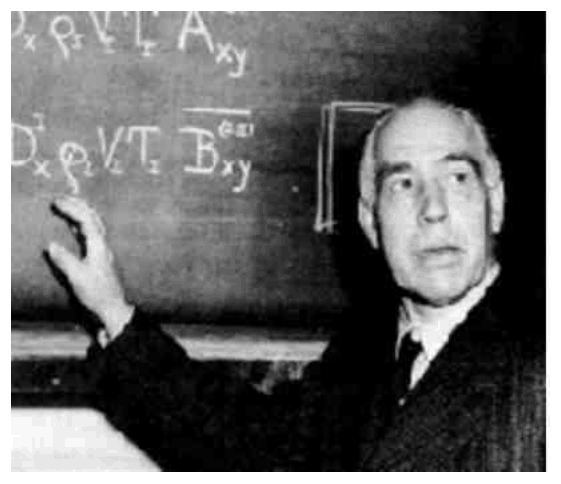
Niels Bohr (1885-1962)
The observed wavelengths in the line spectrum of hydrogen atom were first expressed in terms of a series by Johann Jakob Balmer, a Swiss teacher. Balmer’s empirical formula is
\[ \frac{1}{\lambda} = R_{\mathrm H}\left(\frac{1}{2^2}-\frac{1}{n^2}\right); \qquad n=3,4,5,\ldots \]
Here,
\[ R_{\mathrm H} = \frac{m_e e^4}{8\varepsilon_0^2h^3c} = 109\,678\ \mathrm{cm^{-1}} \]
is the Rydberg konstant, \(m_e\) is the mass of an electron. Niels Bohr derived this expression theoretically in 1913. The formula is easily generalized to any one electron atom/ion.
1.1 Calculate the longest wavelength in Å (\(1\ \text{Å}=10^{-10}\ \mathrm m\)) in the ‘Balmer series’ of singly ionized helium (\(\ce{He+}\)). Ignore nuclear motion in your calculation.
1.2 A formula analogous to Balmer’s formula applies to the series of spectral lines which arise from transitions from higher energy levels to the lowest energy level of hydrogen atom. Write this formula and use it to determine the ground state energy of a hydrogen atom in eV.
A ‘muonic hydrogen atom’ is like a hydrogen atom in which the electron is replaced by a heavier particle, the muon. The mass of a muon is about 207 times the mass of an electron, while its charge is the same as that of an electron. A muon has a very short lifetime, but we ignore its unstable nature here.
1.3 Determine the lowest energy and the radius of the first Bohr orbit of the muonic hydrogen atom. Ignore the motion of the nucleus in your calculation. The radius of the first Bohr orbit of a hydrogen atom (called the Bohr radius, \(a_0=\dfrac{\varepsilon_0h^2}{m_e e^2\pi}\)) is \(0.53\ \text{Å}\).
The classical picture of an "orbit" in Bohr’s theory has now been replaced by the quantum mechanical notion of an ‘orbital’. The orbital \(\psi1\sigma_{1s}(r)\) for the ground state of a hydrogen atom is given by
\[ \Psi_{1s}(r) = \frac{1}{\sqrt{\pi a_0^3}}e^{-r/a_0} \]
where \(r\) is the distance of the electron from the nucleus and \(a_0\) is the Bohr radius.
1.4 Consider a spherical shell of radius \(a_0\) and thickness \(0.001a_0\). Estimate the probability of finding the electron in this shell. Volume of a spherical shell of inner radius \(r\) and small thickness \(\Delta r\) equals \(4\pi r^2\Delta r\).
The \(\ce{H2}\) molecule can dissociate through two different channels:

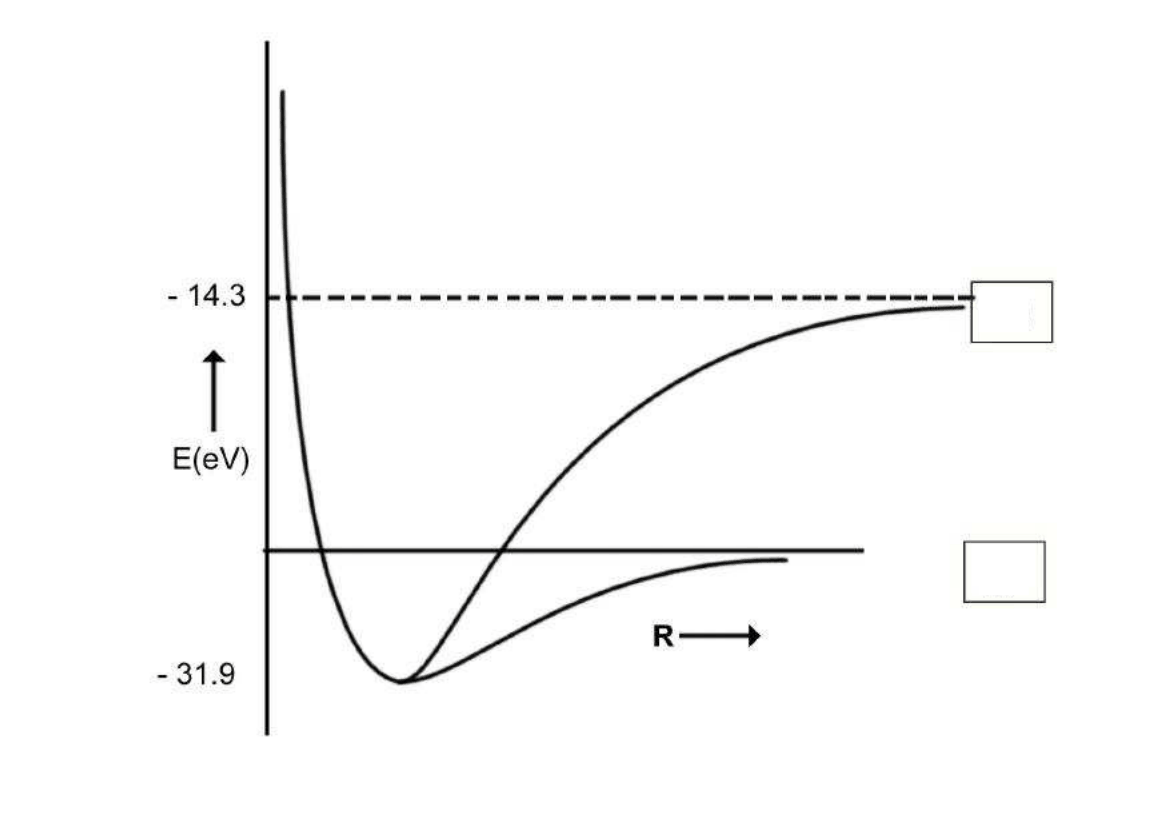
The graph of energy (\(E\)) vs internuclear distance (\(R\)) for \(\ce{H2}\) is shown schematically in the figure. The atomic and molecular energies are given in the same scale.
1.5 Put appropriate channel labels (i) or (ii) in the boxes below.
1.6 Determine the values of the dissociation energies (\(D_e\) in eV) of the \(\ce{H2}\) molecule corresponding to
channel (i) \(\boxed{\phantom{000000}}\)
channel (ii) \(\boxed{\phantom{000000}}\)
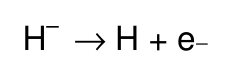
1.7 From the given data, calculate the energy change for the process
1.8 \(\ce{H-}\) is a two-electron atomic system. Assuming that the Bohr energy formula is valid for each electron with nuclear charge \(Z\) replaced by \(Z_{\mathrm{eff}}\), calculate \(Z_{\mathrm{eff}}\) for \(\ce{H-}\).
Official English text of the problem.
Answers
- 1.1 \(\boxed{\lambda_{\max}=1.641\times10^3\ \text{Å}}\), for the \(n=3\rightarrow2\) transition.
- 1.2 \(\boxed{\lambda^{-1}=R_{\mathrm H}(1-n^{-2}),\quad n=2,3,\ldots}\); \(\boxed{E_1=-13.6\ \mathrm{eV}}\).
- 1.3 \(\boxed{E_1^{(\mu)}\approx-2.81\times10^3\ \mathrm{eV}}\); \(\boxed{r_1^{(\mu)}\approx2.6\times10^{-3}\ \text{Å}=2.6\times10^{-13}\ \mathrm m}\).
- 1.4 \(\boxed{P\approx5.41\times10^{-4}=0.0541\%}\).
- 1.5 Upper box: (ii). Lower box: (i).
- 1.6 Channel (i): \(\boxed{D_e=4.7\ \mathrm{eV}}\). Channel (ii): \(\boxed{D_e=17.6\ \mathrm{eV}}\).
- 1.7 \(\boxed{\Delta E=+0.7\ \mathrm{eV}}\); energy must be supplied.
- 1.8 \(\boxed{Z_{\mathrm{eff}}=0.725}\).
Solution
The species used below are the hydrogen atom \(\ce{H}\), [H]; hydrogen molecule \(\ce{H2}\), [H][H]; singly ionized helium \(\ce{He+}\), [He+]; proton \(\ce{H+}\), [H+]; and hydride ion \(\ce{H-}\), [H-]. Ordinary SMILES cannot represent a free electron, replacement of an electron by a muon, or an orbital wavefunction.
Energies are measured relative to separated nuclei and free electrons at rest. For numerical conversion, \(hc=1.23984198\times10^{-4}\ \mathrm{eV\,cm}\).
1.1 — Longest wavelength in the helium-ion Balmer series
For a one-electron ion of nuclear charge \(Z\), neglecting nuclear motion,
\[ \frac{1}{\lambda} = R_{\mathrm H}Z^2 \left(\frac{1}{n_f^2}-\frac{1}{n_i^2}\right). \]
The Balmer series has \(n_f=2\). Its longest wavelength corresponds to its smallest transition energy, hence \(n_i=3\). For singly ionized helium, \(Z=2\):
\[ \frac{1}{\lambda_{\max}} = 4R_{\mathrm H}\left(\frac14-\frac19\right) = \frac59R_{\mathrm H}. \]
Therefore,
\[ \lambda_{\max} = \frac{9}{5(109\,678)}\ \mathrm{cm} = 1.64117\times10^{-5}\ \mathrm{cm}. \]
Using \(1\ \mathrm{cm}=10^8\ \text{Å}\),
\[ \boxed{\lambda_{\max}\approx1641\ \text{Å}}. \]
1.2 — Transitions to the ground state and its energy
Transitions terminating at \(n_f=1\) constitute the Lyman series:
\[ \boxed{ \frac{1}{\lambda} = R_{\mathrm H}\left(1-\frac{1}{n^2}\right), \qquad n=2,3,4,\ldots }. \]
At the series limit, \(n\rightarrow\infty\), the initial electron is at the zero-energy ionization threshold. Thus,
\[ 0-E_1=\frac{hc}{\lambda_{\mathrm{limit}}}=hcR_{\mathrm H}. \]
Consequently,
\[ E_1=-hcR_{\mathrm H} =-(1.23984198\times10^{-4})(109\,678)\ \mathrm{eV} =-13.5983\ \mathrm{eV}. \]
Hence,
\[ \boxed{E_1\approx-13.6\ \mathrm{eV}}. \]
The negative sign indicates that the electron is bound.
1.3 — Muonic hydrogen
With a fixed nucleus and an orbiting particle of mass \(m\) and charge \(-e\), the Bohr formulas give
\[ E_n=-\frac{m e^4}{8\varepsilon_0^2h^2n^2}, \qquad r_n=\frac{\varepsilon_0h^2n^2}{\pi m e^2}. \]
Thus the binding-energy magnitude is proportional to \(m\), while the radius is inversely proportional to \(m\). Substituting \(m_\mu=207m_e\),
\[ E_1^{(\mu)} = 207E_1^{(\mathrm H)} = 207(-13.5983)\ \mathrm{eV} \approx-2814.9\ \mathrm{eV}. \]
Therefore,
\[ \boxed{E_1^{(\mu)}\approx-2.81\times10^3\ \mathrm{eV}}. \]
The first-orbit radius is
\[ r_1^{(\mu)} = \frac{a_0}{207} = \frac{0.53}{207}\ \text{Å} = 2.5604\times10^{-3}\ \text{Å}. \]
To the precision of the supplied Bohr radius,
\[ \boxed{ r_1^{(\mu)}\approx2.6\times10^{-3}\ \text{Å} =2.6\times10^{-13}\ \mathrm m }. \]
1.4 — Probability within the spherical shell
The probability density is the squared magnitude of the wavefunction:
\[ |\Psi_{1s}(r)|^2 = \frac{1}{\pi a_0^3}e^{-2r/a_0}. \]
For a sufficiently thin shell,
\[ P\approx|\Psi_{1s}(r)|^2\,4\pi r^2\Delta r. \]
At \(r=a_0\), with \(\Delta r=0.001a_0\),
\[ \begin{aligned} P &\approx \frac{e^{-2}}{\pi a_0^3} \,4\pi a_0^2(0.001a_0)\\ &=0.004e^{-2}\\ &=5.4134\times10^{-4}. \end{aligned} \]
Thus,
\[ \boxed{P\approx5.41\times10^{-4}=0.0541\%}. \]
1.5 — Identification of the dissociation channels
The two balanced dissociation equations are
\[ \text{(i)}\qquad \ce{H2 -> H + H}, \]
\[ \text{(ii)}\qquad \ce{H2 -> H+ + H-}. \]
For channel (i), the energy of the two infinitely separated ground-state hydrogen atoms is
\[ E_\infty^{(i)} = 2E_1^{(\mathrm H)} \approx2(-13.6) =-27.2\ \mathrm{eV}. \]
This must be the lower asymptote. The upper asymptote, at \(-14.3\ \mathrm{eV}\), therefore corresponds to channel (ii).
Fill the upper box with (ii) and the lower box with (i).
For the ionic channel, the bare proton has zero electronic energy, so the upper asymptote also establishes
\[ E(\ce{H-})=-14.3\ \mathrm{eV}. \]
1.6 — Dissociation energies
The molecular potential-energy minimum is
\[ E_{\min}(\ce{H2})=-31.9\ \mathrm{eV}. \]
Each dissociation energy is the product asymptote minus this minimum.
For channel (i),
\[ \ce{H2 -> H + H}, \]
\[ D_e^{(i)} = -27.2-(-31.9) = \boxed{4.7\ \mathrm{eV}}. \]
For channel (ii),
\[ \ce{H2 -> H+ + H-}, \]
\[ D_e^{(ii)} = -14.3-(-31.9) = \boxed{17.6\ \mathrm{eV}}. \]
Enter these values in the corresponding channel (i) and channel (ii) answer boxes.
1.7 — Electron detachment from hydride
The balanced process is
\[ \ce{H- -> H + e-}. \]
Using zero energy for the detached free electron,
\[ \begin{aligned} \Delta E &=E(\ce{H})+E(\ce{e-})-E(\ce{H-})\\ &=-13.6+0-(-14.3)\\ &=\boxed{+0.7\ \mathrm{eV}}. \end{aligned} \]
The process requires \(0.7\ \mathrm{eV}\) per hydride ion.
1.8 — Effective nuclear charge of hydride
In the stipulated model, both electrons occupy the \(n=1\) level, and each has energy
\[ E_{\text{electron}}=-13.6Z_{\mathrm{eff}}^2\ \mathrm{eV}. \]
The total energy is therefore
\[ E(\ce{H-}) = 2(-13.6Z_{\mathrm{eff}}^2) = -27.2Z_{\mathrm{eff}}^2\ \mathrm{eV}. \]
Equating this to the energy obtained from the graph,
\[ -27.2Z_{\mathrm{eff}}^2=-14.3, \]
so
\[ \boxed{ Z_{\mathrm{eff}} = \sqrt{\frac{14.3}{27.2}} = 0.725 }. \]
Its value below \(1\) represents screening of the proton’s attraction by the other electron within this model.
The solution was checked against the official solution. Where this solution differs from the official solution, the official solution contains an error or a misprint.
IChO 2001 · Theorieaufgabe 1
Wasserstoffatom und Wasserstoffmolekül
Niels Bohr (1885-1962)
Die im Linienspektrum des Wasserstoffatoms beobachteten Wellenlängen wurden erstmals von Johann Jakob Balmer, einem Schweizer Lehrer, durch eine Serienformel beschrieben. Balmers empirische Formel lautet
\[ \frac{1}{\lambda} = R_{\mathrm H}\left(\frac{1}{2^2}-\frac{1}{n^2}\right); \qquad n=3,4,5,\ldots \]
Dabei ist
\[ R_{\mathrm H} = \frac{m_e e^4}{8\varepsilon_0^2h^3c} = 109\,678\ \mathrm{cm^{-1}} \]
die Rydberg-Konstante, und \(m_e\) ist die Masse eines Elektrons. Niels Bohr leitete diesen Ausdruck 1913 theoretisch her. Die Formel lässt sich leicht auf jedes Atom bzw. Ion mit einem Elektron verallgemeinern.
1.1 Berechnen Sie die längste Wellenlänge in Å (\(1\ \text{Å}=10^{-10}\ \mathrm m\)) in der „Balmer-Serie“ des einfach ionisierten Heliums (\(\ce{He+}\)). Vernachlässigen Sie bei Ihrer Berechnung die Kernbewegung.
1.2 Eine zur Balmer-Formel analoge Formel gilt für die Serie von Spektrallinien, die bei Übergängen von höheren Energieniveaus zum niedrigsten Energieniveau des Wasserstoffatoms entstehen. Geben Sie diese Formel an und bestimmen Sie damit die Grundzustandsenergie eines Wasserstoffatoms in eV.
Ein „myonisches Wasserstoffatom“ gleicht einem Wasserstoffatom, in dem das Elektron durch ein schwereres Teilchen, das Myon, ersetzt ist. Die Masse eines Myons beträgt etwa das 207-Fache der Masse eines Elektrons, während seine Ladung der eines Elektrons entspricht. Ein Myon hat eine sehr kurze Lebensdauer, doch seine Instabilität wird hier vernachlässigt.
1.3 Bestimmen Sie die niedrigste Energie und den Radius der ersten Bohr'schen Bahn des myonischen Wasserstoffatoms. Vernachlässigen Sie bei Ihrer Berechnung die Bewegung des Kerns. Der Radius der ersten Bohr'schen Bahn eines Wasserstoffatoms (als Bohr-Radius bezeichnet, \(a_0=\dfrac{\varepsilon_0h^2}{m_e e^2\pi}\)) beträgt \(0.53\ \text{Å}\).
Das klassische Bild einer „Bahn“ in Bohrs Theorie ist inzwischen durch den quantenmechanischen Begriff des „Orbitals“ ersetzt worden. Das Orbital \(\psi1\sigma_{1s}(r)\) für den Grundzustand eines Wasserstoffatoms ist gegeben durch
\[ \Psi_{1s}(r) = \frac{1}{\sqrt{\pi a_0^3}}e^{-r/a_0} \]
wobei \(r\) der Abstand des Elektrons vom Kern und \(a_0\) der Bohr-Radius ist.
1.4 Betrachten Sie eine Kugelschale mit dem Radius \(a_0\) und der Dicke \(0.001a_0\). Schätzen Sie die Wahrscheinlichkeit ab, das Elektron in dieser Schale anzutreffen. Das Volumen einer Kugelschale mit dem Innenradius \(r\) und einer kleinen Dicke \(\Delta r\) beträgt \(4\pi r^2\Delta r\).
Das \(\ce{H2}\)-Molekül kann über zwei verschiedene Kanäle dissoziieren:
Der Verlauf der Energie (\(E\)) in Abhängigkeit vom Kernabstand (\(R\)) für \(\ce{H2}\) ist in der Abbildung schematisch dargestellt. Die atomaren und molekularen Energien sind auf derselben Skala angegeben.
1.5 Tragen Sie die passenden Kanalbezeichnungen (i) oder (ii) in die unten stehenden Kästchen ein.
1.6 Bestimmen Sie die Werte der Dissoziationsenergien (\(D_e\) in eV) des \(\ce{H2}\)-Moleküls für
Kanal (i) \(\boxed{\phantom{000000}}\)
Kanal (ii) \(\boxed{\phantom{000000}}\)
1.7 Berechnen Sie anhand der gegebenen Daten die Energieänderung für den Vorgang
1.8 \(\ce{H-}\) ist ein atomares Zweielektronensystem. Berechnen Sie \(Z_{\mathrm{eff}}\) für \(\ce{H-}\) unter der Annahme, dass die Bohr'sche Energieformel für jedes Elektron gilt, wobei die Kernladungszahl \(Z\) durch \(Z_{\mathrm{eff}}\) ersetzt wird.
Aufgabentext aus dem offiziellen englischen Text übersetzt.
Antworten
- 1.1 \(\boxed{\lambda_{\max}=1.641\times10^3\ \text{Å}}\), für den Übergang \(n=3\rightarrow2\).
- 1.2 \(\boxed{\lambda^{-1}=R_{\mathrm H}(1-n^{-2}),\quad n=2,3,\ldots}\); \(\boxed{E_1=-13.6\ \mathrm{eV}}\).
- 1.3 \(\boxed{E_1^{(\mu)}\approx-2.81\times10^3\ \mathrm{eV}}\); \(\boxed{r_1^{(\mu)}\approx2.6\times10^{-3}\ \text{Å}=2.6\times10^{-13}\ \mathrm m}\).
- 1.4 \(\boxed{P\approx5.41\times10^{-4}=0.0541\%}\).
- 1.5 Oberes Kästchen: (ii). Unteres Kästchen: (i).
- 1.6 Kanal (i): \(\boxed{D_e=4.7\ \mathrm{eV}}\). Kanal (ii): \(\boxed{D_e=17.6\ \mathrm{eV}}\).
- 1.7 \(\boxed{\Delta E=+0.7\ \mathrm{eV}}\); es muss Energie zugeführt werden.
- 1.8 \(\boxed{Z_{\mathrm{eff}}=0.725}\).
Lösung
Die im Folgenden verwendeten Spezies sind das Wasserstoffatom \(\ce{H}\), [H]; das Wasserstoffmolekül \(\ce{H2}\), [H][H]; einfach ionisiertes Helium \(\ce{He+}\), [He+]; das Proton \(\ce{H+}\), [H+]; und das Hydridion \(\ce{H-}\), [H-]. Mit gewöhnlichen SMILES lassen sich weder ein freies Elektron noch der Ersatz eines Elektrons durch ein Myon oder eine Orbitalwellenfunktion darstellen.
Die Energien werden relativ zu voneinander getrennten Kernen und freien Elektronen in Ruhe gemessen. Für die numerische Umrechnung gilt \(hc=1.23984198\times10^{-4}\ \mathrm{eV\,cm}\).
1.1 — Längste Wellenlänge in der Balmer-Serie des Heliumions
Für ein Einelektronenion mit der Kernladungszahl \(Z\) gilt bei Vernachlässigung der Kernbewegung
\[ \frac{1}{\lambda} = R_{\mathrm H}Z^2 \left(\frac{1}{n_f^2}-\frac{1}{n_i^2}\right). \]
Für die Balmer-Serie gilt \(n_f=2\). Ihre längste Wellenlänge entspricht ihrer kleinsten Übergangsenergie, also \(n_i=3\). Für einfach ionisiertes Helium ist \(Z=2\):
\[ \frac{1}{\lambda_{\max}} = 4R_{\mathrm H}\left(\frac14-\frac19\right) = \frac59R_{\mathrm H}. \]
Daher gilt
\[ \lambda_{\max} = \frac{9}{5(109\,678)}\ \mathrm{cm} = 1.64117\times10^{-5}\ \mathrm{cm}. \]
Mit \(1\ \mathrm{cm}=10^8\ \text{Å}\) ergibt sich
\[ \boxed{\lambda_{\max}\approx1641\ \text{Å}}. \]
1.2 — Übergänge in den Grundzustand und dessen Energie
Übergänge, die bei \(n_f=1\) enden, bilden die Lyman-Serie:
\[ \boxed{ \frac{1}{\lambda} = R_{\mathrm H}\left(1-\frac{1}{n^2}\right), \qquad n=2,3,4,\ldots }. \]
An der Seriengrenze, \(n\rightarrow\infty\), befindet sich das Elektron anfangs an der Ionisationsschwelle mit der Energie null. Somit gilt
\[ 0-E_1=\frac{hc}{\lambda_{\mathrm{limit}}}=hcR_{\mathrm H}. \]
Folglich ist
\[ E_1=-hcR_{\mathrm H} =-(1.23984198\times10^{-4})(109\,678)\ \mathrm{eV} =-13.5983\ \mathrm{eV}. \]
Damit ergibt sich
\[ \boxed{E_1\approx-13.6\ \mathrm{eV}}. \]
Das negative Vorzeichen zeigt an, dass das Elektron gebunden ist.
1.3 — Myonischer Wasserstoff
Für einen ruhenden Kern und ein umlaufendes Teilchen mit der Masse \(m\) und der Ladung \(-e\) liefern die Bohr'schen Formeln
\[ E_n=-\frac{m e^4}{8\varepsilon_0^2h^2n^2}, \qquad r_n=\frac{\varepsilon_0h^2n^2}{\pi m e^2}. \]
Der Betrag der Bindungsenergie ist somit proportional zu \(m\), während der Radius umgekehrt proportional zu \(m\) ist. Einsetzen von \(m_\mu=207m_e\) ergibt
\[ E_1^{(\mu)} = 207E_1^{(\mathrm H)} = 207(-13.5983)\ \mathrm{eV} \approx-2814.9\ \mathrm{eV}. \]
Daher gilt
\[ \boxed{E_1^{(\mu)}\approx-2.81\times10^3\ \mathrm{eV}}. \]
Der Radius der ersten Bahn ist
\[ r_1^{(\mu)} = \frac{a_0}{207} = \frac{0.53}{207}\ \text{Å} = 2.5604\times10^{-3}\ \text{Å}. \]
Mit der Genauigkeit des angegebenen Bohr-Radius ergibt sich
\[ \boxed{ r_1^{(\mu)}\approx2.6\times10^{-3}\ \text{Å} =2.6\times10^{-13}\ \mathrm m }. \]
1.4 — Aufenthaltswahrscheinlichkeit in der Kugelschale
Die Wahrscheinlichkeitsdichte ist das Betragsquadrat der Wellenfunktion:
\[ |\Psi_{1s}(r)|^2 = \frac{1}{\pi a_0^3}e^{-2r/a_0}. \]
Für eine hinreichend dünne Schale gilt
\[ P\approx|\Psi_{1s}(r)|^2\,4\pi r^2\Delta r. \]
Bei \(r=a_0\) und mit \(\Delta r=0.001a_0\) ergibt sich
\[ \begin{aligned} P &\approx \frac{e^{-2}}{\pi a_0^3} \,4\pi a_0^2(0.001a_0)\\ &=0.004e^{-2}\\ &=5.4134\times10^{-4}. \end{aligned} \]
Somit gilt
\[ \boxed{P\approx5.41\times10^{-4}=0.0541\%}. \]
1.5 — Zuordnung der Dissoziationskanäle
Die beiden ausgeglichenen Dissoziationsgleichungen lauten
\[ \text{(i)}\qquad \ce{H2 -> H + H}, \]
\[ \text{(ii)}\qquad \ce{H2 -> H+ + H-}. \]
Für Kanal (i) beträgt die Energie der beiden unendlich weit voneinander entfernten Wasserstoffatome im Grundzustand
\[ E_\infty^{(i)} = 2E_1^{(\mathrm H)} \approx2(-13.6) =-27.2\ \mathrm{eV}. \]
Dies muss die untere Asymptote sein. Die obere Asymptote bei \(-14.3\ \mathrm{eV}\) entspricht daher Kanal (ii).
Tragen Sie in das obere Kästchen (ii) und in das untere Kästchen (i) ein.
Beim ionischen Kanal hat das nackte Proton die elektronische Energie null, sodass sich aus der oberen Asymptote auch ergibt:
\[ E(\ce{H-})=-14.3\ \mathrm{eV}. \]
1.6 — Dissoziationsenergien
Das Minimum der potenziellen Energie des Moleküls beträgt
\[ E_{\min}(\ce{H2})=-31.9\ \mathrm{eV}. \]
Jede Dissoziationsenergie ergibt sich aus der Energie der Produktasymptote abzüglich dieses Minimums.
Für Kanal (i) gilt
\[ \ce{H2 -> H + H}, \]
\[ D_e^{(i)} = -27.2-(-31.9) = \boxed{4.7\ \mathrm{eV}}. \]
Für Kanal (ii) gilt
\[ \ce{H2 -> H+ + H-}, \]
\[ D_e^{(ii)} = -14.3-(-31.9) = \boxed{17.6\ \mathrm{eV}}. \]
Tragen Sie diese Werte in die entsprechenden Antwortkästchen für Kanal (i) und Kanal (ii) ein.
1.7 — Elektronenablösung vom Hydridion
Die ausgeglichene Gleichung für den Vorgang lautet
\[ \ce{H- -> H + e-}. \]
Setzt man die Energie des abgelösten freien Elektrons gleich null, ergibt sich
\[ \begin{aligned} \Delta E &=E(\ce{H})+E(\ce{e-})-E(\ce{H-})\\ &=-13.6+0-(-14.3)\\ &=\boxed{+0.7\ \mathrm{eV}}. \end{aligned} \]
Der Vorgang erfordert \(0.7\ \mathrm{eV}\) pro Hydridion.
1.8 — Effektive Kernladungszahl des Hydridions
Im vorgegebenen Modell besetzen beide Elektronen das Niveau \(n=1\), und jedes hat die Energie
\[ E_{\text{Elektron}}=-13.6Z_{\mathrm{eff}}^2\ \mathrm{eV}. \]
Die Gesamtenergie beträgt daher
\[ E(\ce{H-}) = 2(-13.6Z_{\mathrm{eff}}^2) = -27.2Z_{\mathrm{eff}}^2\ \mathrm{eV}. \]
Gleichsetzen mit der aus dem Diagramm erhaltenen Energie ergibt
\[ -27.2Z_{\mathrm{eff}}^2=-14.3, \]
also
\[ \boxed{ Z_{\mathrm{eff}} = \sqrt{\frac{14.3}{27.2}} = 0.725 }. \]
Der Wert unter \(1\) beschreibt in diesem Modell die Abschirmung der Anziehungskraft des Protons durch das jeweils andere Elektron.
Die Lösung wurde mit der offiziellen Lösung abgeglichen. Wo diese Lösung von der offiziellen Lösung abweicht, enthält die offizielle Lösung einen Fehler oder Druckfehler.
IChO 2001 · Teori sorusu 1
Hidrojen Atomu ve Hidrojen Molekülü
Niels Bohr (1885-1962)
Hidrojen atomunun çizgi spektrumunda gözlenen dalga boyları ilk kez İsviçreli bir öğretmen olan Johann Jakob Balmer tarafından bir seri biçiminde ifade edilmiştir. Balmer’in ampirik formülü şöyledir:
\[ \frac{1}{\lambda} = R_{\mathrm H}\left(\frac{1}{2^2}-\frac{1}{n^2}\right); \qquad n=3,4,5,\ldots \]
Burada,
\[ R_{\mathrm H} = \frac{m_e e^4}{8\varepsilon_0^2h^3c} = 109\,678\ \mathrm{cm^{-1}} \]
Rydberg sabitidir; \(m_e\) ise elektronun kütlesidir. Niels Bohr bu ifadeyi 1913 yılında kuramsal olarak türetmiştir. Formül, tek elektronlu herhangi bir atom veya iyona kolayca genellenebilir.
1.1 Bir kez iyonlaşmış helyumun (\(\ce{He+}\)) ‘Balmer serisi’ndeki en uzun dalga boyunu Å (\(1\ \text{Å}=10^{-10}\ \mathrm m\)) cinsinden hesaplayınız. Hesabınızda çekirdeğin hareketini ihmal ediniz.
1.2 Balmer formülüne benzer bir formül, hidrojen atomunun daha yüksek enerji düzeylerinden en düşük enerji düzeyine geçişlerinden kaynaklanan spektrum çizgileri serisi için de geçerlidir. Bu formülü yazınız ve bunu kullanarak hidrojen atomunun temel hâl enerjisini eV cinsinden belirleyiniz.
‘Müonik hidrojen atomu’, elektronun yerini daha ağır bir parçacık olan müonun aldığı bir hidrojen atomu gibidir. Müonun kütlesi elektronun kütlesinin yaklaşık 207 katıdır; yükü ise elektronunkiyle aynıdır. Müonun ömrü çok kısadır, ancak burada kararsız oluşunu göz ardı ediyoruz.
1.3 Müonik hidrojen atomunun en düşük enerjisini ve birinci Bohr yörüngesinin yarıçapını belirleyiniz. Hesabınızda çekirdeğin hareketini ihmal ediniz. Hidrojen atomunun birinci Bohr yörüngesinin yarıçapı (Bohr yarıçapı olarak adlandırılır, \(a_0=\dfrac{\varepsilon_0h^2}{m_e e^2\pi}\)) \(0.53\ \text{Å}\)’dur.
Bohr kuramındaki klasik "yörünge" tasvirinin yerini artık kuantum mekaniğindeki ‘orbital’ kavramı almıştır. Hidrojen atomunun temel hâline ait \(\psi1\sigma_{1s}(r)\) orbitali şu şekilde verilir:
\[ \Psi_{1s}(r) = \frac{1}{\sqrt{\pi a_0^3}}e^{-r/a_0} \]
Burada \(r\), elektronun çekirdeğe olan uzaklığı, \(a_0\) ise Bohr yarıçapıdır.
1.4 Yarıçapı \(a_0\), kalınlığı \(0.001a_0\) olan küresel bir kabuk düşününüz. Elektronun bu kabuk içinde bulunma olasılığını yaklaşık olarak hesaplayınız. İç yarıçapı \(r\) ve küçük bir \(\Delta r\) kalınlığı olan küresel bir kabuğun hacmi \(4\pi r^2\Delta r\)’ye eşittir.
\(\ce{H2}\) molekülü iki farklı kanaldan ayrışabilir:
\(\ce{H2}\) için enerjinin (\(E\)) çekirdekler arası uzaklığa (\(R\)) karşı grafiği şekilde şematik olarak gösterilmiştir. Atom ve molekül enerjileri aynı ölçekte verilmiştir.
1.5 Aşağıdaki kutulara uygun kanal etiketlerini, (i) veya (ii), yazınız.
1.6 \(\ce{H2}\) molekülünün aşağıdaki kanallara karşılık gelen ayrışma enerjilerinin (eV cinsinden \(D_e\)) değerlerini belirleyiniz:
kanal (i) \(\boxed{\phantom{000000}}\)
kanal (ii) \(\boxed{\phantom{000000}}\)
1.7 Verilen verilerden yararlanarak aşağıdaki süreç için enerji değişimini hesaplayınız:
1.8 \(\ce{H-}\), iki elektronlu bir atomik sistemdir. Çekirdek yükü \(Z\) yerine \(Z_{\mathrm{eff}}\) konulduğunda Bohr enerji formülünün her bir elektron için geçerli olduğunu varsayarak \(\ce{H-}\) için \(Z_{\mathrm{eff}}\)’i hesaplayınız.
Soru metni resmi İngilizce metinden çevrilmiştir.
Cevaplar
- 1.1 \(\boxed{\lambda_{\max}=1.641\times10^3\ \text{Å}}\), \(n=3\rightarrow2\) geçişi için.
- 1.2 \(\boxed{\lambda^{-1}=R_{\mathrm H}(1-n^{-2}),\quad n=2,3,\ldots}\); \(\boxed{E_1=-13.6\ \mathrm{eV}}\).
- 1.3 \(\boxed{E_1^{(\mu)}\approx-2.81\times10^3\ \mathrm{eV}}\); \(\boxed{r_1^{(\mu)}\approx2.6\times10^{-3}\ \text{Å}=2.6\times10^{-13}\ \mathrm m}\).
- 1.4 \(\boxed{P\approx5.41\times10^{-4}=0.0541\%}\).
- 1.5 Üst kutu: (ii). Alt kutu: (i).
- 1.6 Kanal (i): \(\boxed{D_e=4.7\ \mathrm{eV}}\). Kanal (ii): \(\boxed{D_e=17.6\ \mathrm{eV}}\).
- 1.7 \(\boxed{\Delta E=+0.7\ \mathrm{eV}}\); enerji verilmelidir.
- 1.8 \(\boxed{Z_{\mathrm{eff}}=0.725}\).
Çözüm
Aşağıda kullanılan türler hidrojen atomu \(\ce{H}\), [H]; hidrojen molekülü \(\ce{H2}\), [H][H]; bir kez iyonlaşmış helyum \(\ce{He+}\), [He+]; proton \(\ce{H+}\), [H+]; ve hidrür iyonu \(\ce{H-}\), [H-]’dir. Standart SMILES, serbest bir elektronu, bir elektronun müonla değiştirilmesini veya bir orbital dalga fonksiyonunu temsil edemez.
Enerjiler, birbirinden ayrılmış çekirdeklere ve durgun serbest elektronlara göre ölçülür. Sayısal dönüşüm için \(hc=1.23984198\times10^{-4}\ \mathrm{eV\,cm}\) kullanılır.
1.1 — Helyum iyonunun Balmer serisindeki en uzun dalga boyu
Çekirdek yükü \(Z\) olan tek elektronlu bir iyon için, çekirdek hareketi ihmal edildiğinde,
\[ \frac{1}{\lambda} = R_{\mathrm H}Z^2 \left(\frac{1}{n_f^2}-\frac{1}{n_i^2}\right). \]
Balmer serisinde \(n_f=2\)’dir. En uzun dalga boyu, en küçük geçiş enerjisine karşılık gelir; dolayısıyla \(n_i=3\)’tür. Bir kez iyonlaşmış helyum için \(Z=2\)’dir:
\[ \frac{1}{\lambda_{\max}} = 4R_{\mathrm H}\left(\frac14-\frac19\right) = \frac59R_{\mathrm H}. \]
Dolayısıyla,
\[ \lambda_{\max} = \frac{9}{5(109\,678)}\ \mathrm{cm} = 1.64117\times10^{-5}\ \mathrm{cm}. \]
\(1\ \mathrm{cm}=10^8\ \text{Å}\) kullanıldığında,
\[ \boxed{\lambda_{\max}\approx1641\ \text{Å}}. \]
1.2 — Temel hâle geçişler ve temel hâl enerjisi
\(n_f=1\) düzeyinde sonlanan geçişler Lyman serisini oluşturur:
\[ \boxed{ \frac{1}{\lambda} = R_{\mathrm H}\left(1-\frac{1}{n^2}\right), \qquad n=2,3,4,\ldots }. \]
Seri sınırında, \(n\rightarrow\infty\) iken, elektron başlangıçta sıfır enerjili iyonlaşma eşiğindedir. Böylece,
\[ 0-E_1=\frac{hc}{\lambda_{\mathrm{limit}}}=hcR_{\mathrm H}. \]
Bunun sonucunda,
\[ E_1=-hcR_{\mathrm H} =-(1.23984198\times10^{-4})(109\,678)\ \mathrm{eV} =-13.5983\ \mathrm{eV}. \]
Dolayısıyla,
\[ \boxed{E_1\approx-13.6\ \mathrm{eV}}. \]
Eksi işareti, elektronun bağlı olduğunu gösterir.
1.3 — Müonik hidrojen
Çekirdek sabitken ve yörüngede dolanan parçacığın kütlesi \(m\), yükü \(-e\) iken Bohr formülleri şu sonuçları verir:
\[ E_n=-\frac{m e^4}{8\varepsilon_0^2h^2n^2}, \qquad r_n=\frac{\varepsilon_0h^2n^2}{\pi m e^2}. \]
Böylece bağlanma enerjisinin büyüklüğü \(m\) ile doğru, yarıçap ise \(m\) ile ters orantılıdır. \(m_\mu=207m_e\) yerine konulduğunda,
\[ E_1^{(\mu)} = 207E_1^{(\mathrm H)} = 207(-13.5983)\ \mathrm{eV} \approx-2814.9\ \mathrm{eV}. \]
Dolayısıyla,
\[ \boxed{E_1^{(\mu)}\approx-2.81\times10^3\ \mathrm{eV}}. \]
Birinci yörüngenin yarıçapı şöyledir:
\[ r_1^{(\mu)} = \frac{a_0}{207} = \frac{0.53}{207}\ \text{Å} = 2.5604\times10^{-3}\ \text{Å}. \]
Verilen Bohr yarıçapının hassasiyetine göre,
\[ \boxed{ r_1^{(\mu)}\approx2.6\times10^{-3}\ \text{Å} =2.6\times10^{-13}\ \mathrm m }. \]
1.4 — Küresel kabuk içinde bulunma olasılığı
Olasılık yoğunluğu, dalga fonksiyonunun mutlak değerinin karesidir:
\[ |\Psi_{1s}(r)|^2 = \frac{1}{\pi a_0^3}e^{-2r/a_0}. \]
Yeterince ince bir kabuk için,
\[ P\approx|\Psi_{1s}(r)|^2\,4\pi r^2\Delta r. \]
\(r=a_0\) ve \(\Delta r=0.001a_0\) için,
\[ \begin{aligned} P &\approx \frac{e^{-2}}{\pi a_0^3} \,4\pi a_0^2(0.001a_0)\\ &=0.004e^{-2}\\ &=5.4134\times10^{-4}. \end{aligned} \]
Böylece,
\[ \boxed{P\approx5.41\times10^{-4}=0.0541\%}. \]
1.5 — Ayrışma kanallarının belirlenmesi
Denkleştirilmiş iki ayrışma denklemi şöyledir:
\[ \text{(i)}\qquad \ce{H2 -> H + H}, \]
\[ \text{(ii)}\qquad \ce{H2 -> H+ + H-}. \]
Kanal (i) için, birbirinden sonsuz uzaklıktaki temel hâlde bulunan iki hidrojen atomunun enerjisi şöyledir:
\[ E_\infty^{(i)} = 2E_1^{(\mathrm H)} \approx2(-13.6) =-27.2\ \mathrm{eV}. \]
Bu, alt asimptot olmalıdır. Dolayısıyla \(-14.3\ \mathrm{eV}\)’taki üst asimptot kanal (ii)’ye karşılık gelir.
Üst kutuya (ii) ve alt kutuya (i) yazınız.
İyonik kanal için, çıplak protonun elektronik enerjisi sıfır olduğundan üst asimptot aynı zamanda şu sonucu verir:
\[ E(\ce{H-})=-14.3\ \mathrm{eV}. \]
1.6 — Ayrışma enerjileri
Molekülün potansiyel enerji minimumu şöyledir:
\[ E_{\min}(\ce{H2})=-31.9\ \mathrm{eV}. \]
Her bir ayrışma enerjisi, ürünlere ait asimptot enerjisinden bu minimumun çıkarılmasıyla bulunur.
Kanal (i) için,
\[ \ce{H2 -> H + H}, \]
\[ D_e^{(i)} = -27.2-(-31.9) = \boxed{4.7\ \mathrm{eV}}. \]
Kanal (ii) için,
\[ \ce{H2 -> H+ + H-}, \]
\[ D_e^{(ii)} = -14.3-(-31.9) = \boxed{17.6\ \mathrm{eV}}. \]
Bu değerleri kanal (i) ve kanal (ii) için ayrılan ilgili cevap kutularına yazınız.
1.7 — Hidrürden elektron koparılması
Denkleştirilmiş süreç şöyledir:
\[ \ce{H- -> H + e-}. \]
Koparılan serbest elektronun enerjisi sıfır alındığında,
\[ \begin{aligned} \Delta E &=E(\ce{H})+E(\ce{e-})-E(\ce{H-})\\ &=-13.6+0-(-14.3)\\ &=\boxed{+0.7\ \mathrm{eV}}. \end{aligned} \]
Bu süreç, hidrür iyonu başına \(0.7\ \mathrm{eV}\) enerji gerektirir.
1.8 — Hidrürün etkin çekirdek yükü
Öngörülen modelde her iki elektron da \(n=1\) düzeyinde bulunur ve her birinin enerjisi şöyledir:
\[ E_{\text{elektron}}=-13.6Z_{\mathrm{eff}}^2\ \mathrm{eV}. \]
Dolayısıyla toplam enerji şöyledir:
\[ E(\ce{H-}) = 2(-13.6Z_{\mathrm{eff}}^2) = -27.2Z_{\mathrm{eff}}^2\ \mathrm{eV}. \]
Bu ifade grafikten elde edilen enerjiye eşitlendiğinde,
\[ -27.2Z_{\mathrm{eff}}^2=-14.3, \]
buradan
\[ \boxed{ Z_{\mathrm{eff}} = \sqrt{\frac{14.3}{27.2}} = 0.725 }. \]
Değerinin \(1\)’den küçük olması, bu modelde protonun çekim etkisinin diğer elektron tarafından perdelenmesini temsil eder.
Çözüm, resmi çözümle karşılaştırılarak kontrol edildi. Bu çözümün resmi çözümden ayrıldığı yerlerde resmi çözümde bir hata ya da baskı hatası vardır.
IChO 2001 · Problema teórico 1
Átomo de hidrógeno y molécula de hidrógeno
Niels Bohr (1885-1962)
Las longitudes de onda observadas en el espectro de líneas del átomo de hidrógeno fueron expresadas por primera vez mediante una serie por Johann Jakob Balmer, un profesor suizo. La fórmula empírica de Balmer es
\[ \frac{1}{\lambda} = R_{\mathrm H}\left(\frac{1}{2^2}-\frac{1}{n^2}\right); \qquad n=3,4,5,\ldots \]
Aquí,
\[ R_{\mathrm H} = \frac{m_e e^4}{8\varepsilon_0^2h^3c} = 109\,678\ \mathrm{cm^{-1}} \]
es la constante de Rydberg, y \(m_e\) es la masa de un electrón. Niels Bohr dedujo teóricamente esta expresión en 1913. La fórmula se generaliza fácilmente a cualquier átomo o ion con un solo electrón.
1.1 Calcule la longitud de onda más larga en Å (\(1\ \text{Å}=10^{-10}\ \mathrm m\)) de la «serie de Balmer» del helio ionizado una vez (\(\ce{He+}\)). Desprecie el movimiento nuclear en el cálculo.
1.2 Una fórmula análoga a la de Balmer se aplica a la serie de líneas espectrales que se originan en las transiciones desde niveles de energía superiores hasta el nivel de energía más bajo del átomo de hidrógeno. Escriba esta fórmula y utilícela para determinar la energía del estado fundamental de un átomo de hidrógeno en eV.
Un «átomo de hidrógeno muónico» es como un átomo de hidrógeno en el que el electrón se sustituye por una partícula más pesada, el muon. La masa de un muon es aproximadamente 207 veces la masa de un electrón, mientras que su carga es la misma que la de un electrón. Un muon tiene una vida media muy corta, pero aquí ignoramos su naturaleza inestable.
1.3 Determine la energía más baja y el radio de la primera órbita de Bohr del átomo de hidrógeno muónico. Desprecie el movimiento del núcleo en el cálculo. El radio de la primera órbita de Bohr de un átomo de hidrógeno (denominado radio de Bohr, \(a_0=\dfrac{\varepsilon_0h^2}{m_e e^2\pi}\)) es \(0.53\ \text{Å}\).
La imagen clásica de una «órbita» en la teoría de Bohr ha sido sustituida por la noción de «orbital» de la mecánica cuántica. El orbital \(\psi1\sigma_{1s}(r)\) del estado fundamental de un átomo de hidrógeno viene dado por
\[ \Psi_{1s}(r) = \frac{1}{\sqrt{\pi a_0^3}}e^{-r/a_0} \]
donde \(r\) es la distancia del electrón al núcleo y \(a_0\) es el radio de Bohr.
1.4 Considere una capa esférica de radio \(a_0\) y espesor \(0.001a_0\). Estime la probabilidad de encontrar el electrón en esta capa. El volumen de una capa esférica de radio interior \(r\) y espesor pequeño \(\Delta r\) es igual a \(4\pi r^2\Delta r\).
La molécula de \(\ce{H2}\) puede disociarse por dos canales diferentes:
La gráfica de la energía (\(E\)) en función de la distancia internuclear (\(R\)) para \(\ce{H2}\) se muestra esquemáticamente en la figura. Las energías atómicas y moleculares se dan en la misma escala.
1.5 Escriba las etiquetas de canal apropiadas, (i) o (ii), en los recuadros siguientes.
1.6 Determine los valores de las energías de disociación (\(D_e\) en eV) de la molécula de \(\ce{H2}\) correspondientes al
canal (i) \(\boxed{\phantom{000000}}\)
canal (ii) \(\boxed{\phantom{000000}}\)
1.7 A partir de los datos proporcionados, calcule la variación de energía del proceso
1.8 \(\ce{H-}\) es un sistema atómico de dos electrones. Suponiendo que la fórmula de Bohr para la energía es válida para cada electrón si se sustituye la carga nuclear \(Z\) por \(Z_{\mathrm{eff}}\), calcule \(Z_{\mathrm{eff}}\) para \(\ce{H-}\).
Enunciado traducido del texto oficial en inglés.
Respuestas
- 1.1 \(\boxed{\lambda_{\max}=1.641\times10^3\ \text{Å}}\), para la transición \(n=3\rightarrow2\).
- 1.2 \(\boxed{\lambda^{-1}=R_{\mathrm H}(1-n^{-2}),\quad n=2,3,\ldots}\); \(\boxed{E_1=-13.6\ \mathrm{eV}}\).
- 1.3 \(\boxed{E_1^{(\mu)}\approx-2.81\times10^3\ \mathrm{eV}}\); \(\boxed{r_1^{(\mu)}\approx2.6\times10^{-3}\ \text{Å}=2.6\times10^{-13}\ \mathrm m}\).
- 1.4 \(\boxed{P\approx5.41\times10^{-4}=0.0541\%}\).
- 1.5 Recuadro superior: (ii). Recuadro inferior: (i).
- 1.6 Canal (i): \(\boxed{D_e=4.7\ \mathrm{eV}}\). Canal (ii): \(\boxed{D_e=17.6\ \mathrm{eV}}\).
- 1.7 \(\boxed{\Delta E=+0.7\ \mathrm{eV}}\); es necesario aportar energía.
- 1.8 \(\boxed{Z_{\mathrm{eff}}=0.725}\).
Solución
Las especies utilizadas a continuación son el átomo de hidrógeno \(\ce{H}\), [H]; la molécula de hidrógeno \(\ce{H2}\), [H][H]; el helio ionizado una vez \(\ce{He+}\), [He+]; el protón \(\ce{H+}\), [H+]; y el ion hidruro \(\ce{H-}\), [H-]. La notación SMILES habitual no permite representar un electrón libre, la sustitución de un electrón por un muon ni una función de onda orbital.
Las energías se miden con respecto a núcleos separados y electrones libres en reposo. Para la conversión numérica, \(hc=1.23984198\times10^{-4}\ \mathrm{eV\,cm}\).
1.1 — Longitud de onda más larga de la serie de Balmer del ion helio
Para un ion con un solo electrón y carga nuclear \(Z\), despreciando el movimiento nuclear,
\[ \frac{1}{\lambda} = R_{\mathrm H}Z^2 \left(\frac{1}{n_f^2}-\frac{1}{n_i^2}\right). \]
La serie de Balmer tiene \(n_f=2\). Su longitud de onda más larga corresponde a la menor energía de transición, por lo que \(n_i=3\). Para el helio ionizado una vez, \(Z=2\):
\[ \frac{1}{\lambda_{\max}} = 4R_{\mathrm H}\left(\frac14-\frac19\right) = \frac59R_{\mathrm H}. \]
Por tanto,
\[ \lambda_{\max} = \frac{9}{5(109\,678)}\ \mathrm{cm} = 1.64117\times10^{-5}\ \mathrm{cm}. \]
Utilizando \(1\ \mathrm{cm}=10^8\ \text{Å}\),
\[ \boxed{\lambda_{\max}\approx1641\ \text{Å}}. \]
1.2 — Transiciones al estado fundamental y su energía
Las transiciones que terminan en \(n_f=1\) constituyen la serie de Lyman:
\[ \boxed{ \frac{1}{\lambda} = R_{\mathrm H}\left(1-\frac{1}{n^2}\right), \qquad n=2,3,4,\ldots }. \]
En el límite de la serie, \(n\rightarrow\infty\), el electrón se encuentra inicialmente en el umbral de ionización de energía cero. Así,
\[ 0-E_1=\frac{hc}{\lambda_{\mathrm{limit}}}=hcR_{\mathrm H}. \]
En consecuencia,
\[ E_1=-hcR_{\mathrm H} =-(1.23984198\times10^{-4})(109\,678)\ \mathrm{eV} =-13.5983\ \mathrm{eV}. \]
Por lo tanto,
\[ \boxed{E_1\approx-13.6\ \mathrm{eV}}. \]
El signo negativo indica que el electrón está ligado.
1.3 — Hidrógeno muónico
Con un núcleo fijo y una partícula en órbita de masa \(m\) y carga \(-e\), las fórmulas de Bohr dan
\[ E_n=-\frac{m e^4}{8\varepsilon_0^2h^2n^2}, \qquad r_n=\frac{\varepsilon_0h^2n^2}{\pi m e^2}. \]
Así, el valor absoluto de la energía de enlace es proporcional a \(m\), mientras que el radio es inversamente proporcional a \(m\). Sustituyendo \(m_\mu=207m_e\),
\[ E_1^{(\mu)} = 207E_1^{(\mathrm H)} = 207(-13.5983)\ \mathrm{eV} \approx-2814.9\ \mathrm{eV}. \]
Por tanto,
\[ \boxed{E_1^{(\mu)}\approx-2.81\times10^3\ \mathrm{eV}}. \]
El radio de la primera órbita es
\[ r_1^{(\mu)} = \frac{a_0}{207} = \frac{0.53}{207}\ \text{Å} = 2.5604\times10^{-3}\ \text{Å}. \]
Con la precisión del radio de Bohr proporcionado,
\[ \boxed{ r_1^{(\mu)}\approx2.6\times10^{-3}\ \text{Å} =2.6\times10^{-13}\ \mathrm m }. \]
1.4 — Probabilidad dentro de la capa esférica
La densidad de probabilidad es el cuadrado del módulo de la función de onda:
\[ |\Psi_{1s}(r)|^2 = \frac{1}{\pi a_0^3}e^{-2r/a_0}. \]
Para una capa suficientemente delgada,
\[ P\approx|\Psi_{1s}(r)|^2\,4\pi r^2\Delta r. \]
En \(r=a_0\), con \(\Delta r=0.001a_0\),
\[ \begin{aligned} P &\approx \frac{e^{-2}}{\pi a_0^3} \,4\pi a_0^2(0.001a_0)\\ &=0.004e^{-2}\\ &=5.4134\times10^{-4}. \end{aligned} \]
Así,
\[ \boxed{P\approx5.41\times10^{-4}=0.0541\%}. \]
1.5 — Identificación de los canales de disociación
Las dos ecuaciones de disociación ajustadas son
\[ \text{(i)}\qquad \ce{H2 -> H + H}, \]
\[ \text{(ii)}\qquad \ce{H2 -> H+ + H-}. \]
Para el canal (i), la energía de los dos átomos de hidrógeno en el estado fundamental separados por una distancia infinita es
\[ E_\infty^{(i)} = 2E_1^{(\mathrm H)} \approx2(-13.6) =-27.2\ \mathrm{eV}. \]
Esta debe ser la asíntota inferior. La asíntota superior, a \(-14.3\ \mathrm{eV}\), corresponde, por tanto, al canal (ii).
Complete el recuadro superior con (ii) y el recuadro inferior con (i).
Para el canal iónico, el protón desnudo tiene energía electrónica cero, de modo que la asíntota superior también establece que
\[ E(\ce{H-})=-14.3\ \mathrm{eV}. \]
1.6 — Energías de disociación
El mínimo de energía potencial molecular es
\[ E_{\min}(\ce{H2})=-31.9\ \mathrm{eV}. \]
Cada energía de disociación es la diferencia entre la energía de la asíntota de los productos y este mínimo.
Para el canal (i),
\[ \ce{H2 -> H + H}, \]
\[ D_e^{(i)} = -27.2-(-31.9) = \boxed{4.7\ \mathrm{eV}}. \]
Para el canal (ii),
\[ \ce{H2 -> H+ + H-}, \]
\[ D_e^{(ii)} = -14.3-(-31.9) = \boxed{17.6\ \mathrm{eV}}. \]
Introduzca estos valores en los recuadros de respuesta correspondientes al canal (i) y al canal (ii).
1.7 — Desprendimiento de un electrón del ion hidruro
El proceso ajustado es
\[ \ce{H- -> H + e-}. \]
Tomando como cero la energía del electrón libre desprendido,
\[ \begin{aligned} \Delta E &=E(\ce{H})+E(\ce{e-})-E(\ce{H-})\\ &=-13.6+0-(-14.3)\\ &=\boxed{+0.7\ \mathrm{eV}}. \end{aligned} \]
El proceso requiere \(0.7\ \mathrm{eV}\) por ion hidruro.
1.8 — Carga nuclear efectiva del ion hidruro
En el modelo estipulado, ambos electrones ocupan el nivel \(n=1\), y cada uno tiene una energía
\[ E_{\text{electrón}}=-13.6Z_{\mathrm{eff}}^2\ \mathrm{eV}. \]
La energía total es, por tanto,
\[ E(\ce{H-}) = 2(-13.6Z_{\mathrm{eff}}^2) = -27.2Z_{\mathrm{eff}}^2\ \mathrm{eV}. \]
Igualando esta expresión a la energía obtenida de la gráfica,
\[ -27.2Z_{\mathrm{eff}}^2=-14.3, \]
se obtiene
\[ \boxed{ Z_{\mathrm{eff}} = \sqrt{\frac{14.3}{27.2}} = 0.725 }. \]
Su valor inferior a \(1\) representa el apantallamiento de la atracción del protón por el otro electrón dentro de este modelo.
La solución se comprobó con la solución oficial. Donde esta solución difiere de la solución oficial, la solución oficial contiene un error o una errata.
IChO 2001 · 理论题 1
氢原子与氢分子
尼尔斯·玻尔(1885-1962)
瑞士教师约翰·雅各布·巴耳末首次将观测到的氢原子线状光谱的波长表示为一个系列。巴耳末的经验公式为
\[ \frac{1}{\lambda} = R_{\mathrm H}\left(\frac{1}{2^2}-\frac{1}{n^2}\right); \qquad n=3,4,5,\ldots \]
其中,
\[ R_{\mathrm H} = \frac{m_e e^4}{8\varepsilon_0^2h^3c} = 109\,678\ \mathrm{cm^{-1}} \]
为里德伯常量,\(m_e\) 为电子的质量。尼尔斯·玻尔于1913年从理论上推导出了这一表达式。该公式很容易推广到任意单电子原子或离子。
1.1 计算一次电离的氦(\(\ce{He+}\))的“巴耳末系”中的最长波长,以 Å 为单位(\(1\ \text{Å}=10^{-10}\ \mathrm m\))。计算时忽略原子核的运动。
1.2 对于氢原子从较高能级跃迁至最低能级所产生的谱线系列,可使用一个与巴耳末公式类似的公式。写出这一公式,并用它确定氢原子的基态能量,以 eV 为单位。
“μ子氢原子”类似于氢原子,只是其中的电子被一种较重的粒子——μ子所取代。μ子的质量约为电子质量的207倍,而其电荷与电子相同。μ子的寿命很短,但这里忽略其不稳定性。
1.3 确定μ子氢原子的最低能量和第一玻尔轨道的半径。计算时忽略原子核的运动。氢原子的第一玻尔轨道半径(称为玻尔半径,\(a_0=\dfrac{\varepsilon_0h^2}{m_e e^2\pi}\))为 \(0.53\ \text{Å}\)。
玻尔理论中“轨道”的经典图像如今已被量子力学中的“轨道”概念所取代。氢原子基态的轨道 \(\psi1\sigma_{1s}(r)\) 为
\[ \Psi_{1s}(r) = \frac{1}{\sqrt{\pi a_0^3}}e^{-r/a_0} \]
其中,\(r\) 为电子到原子核的距离,\(a_0\) 为玻尔半径。
1.4 考虑一个半径为 \(a_0\)、厚度为 \(0.001a_0\) 的球壳。估算在此球壳内找到电子的概率。内半径为 \(r\)、厚度为很小的 \(\Delta r\) 的球壳体积等于 \(4\pi r^2\Delta r\)。
\(\ce{H2}\) 分子可以通过两种不同的通道解离:
图中示意性地给出了 \(\ce{H2}\) 的能量(\(E\))随核间距(\(R\))变化的曲线。原子和分子的能量采用同一标度。
1.5 在下方方框内填入相应的通道标记 (i) 或 (ii)。
1.6 确定 \(\ce{H2}\) 分子分别通过以下通道解离时的解离能(\(D_e\),以 eV 为单位)
通道 (i) \(\boxed{\phantom{000000}}\)
通道 (ii) \(\boxed{\phantom{000000}}\)
1.7 根据所给数据,计算下列过程的能量变化
1.8 \(\ce{H-}\) 是一个双电子原子体系。假设将核电荷数 \(Z\) 替换为 \(Z_{\mathrm{eff}}\) 后,玻尔能量公式对每个电子均适用,计算 \(\ce{H-}\) 的 \(Z_{\mathrm{eff}}\)。
题目译自官方英文原文。
答案
- 1.1 \(\boxed{\lambda_{\max}=1.641\times10^3\ \text{Å}}\),对应于 \(n=3\rightarrow2\) 跃迁。
- 1.2 \(\boxed{\lambda^{-1}=R_{\mathrm H}(1-n^{-2}),\quad n=2,3,\ldots}\);\(\boxed{E_1=-13.6\ \mathrm{eV}}\)。
- 1.3 \(\boxed{E_1^{(\mu)}\approx-2.81\times10^3\ \mathrm{eV}}\);\(\boxed{r_1^{(\mu)}\approx2.6\times10^{-3}\ \text{Å}=2.6\times10^{-13}\ \mathrm m}\)。
- 1.4 \(\boxed{P\approx5.41\times10^{-4}=0.0541\%}\)。
- 1.5 上方方框:(ii)。下方方框:(i)。
- 1.6 通道 (i):\(\boxed{D_e=4.7\ \mathrm{eV}}\)。通道 (ii):\(\boxed{D_e=17.6\ \mathrm{eV}}\)。
- 1.7 \(\boxed{\Delta E=+0.7\ \mathrm{eV}}\);需要供给能量。
- 1.8 \(\boxed{Z_{\mathrm{eff}}=0.725}\)。
解答
下文涉及的物种为氢原子 \(\ce{H}\),[H];氢分子 \(\ce{H2}\),[H][H];一次电离的氦 \(\ce{He+}\),[He+];质子 \(\ce{H+}\),[H+];以及氢负离子 \(\ce{H-}\),[H-]。普通 SMILES 无法表示自由电子、电子被μ子取代的情形或轨道波函数。
能量以彼此分离的原子核和静止的自由电子为参考零点。数值换算采用 \(hc=1.23984198\times10^{-4}\ \mathrm{eV\,cm}\)。
1.1 — 氦离子巴耳末系中的最长波长
对于核电荷数为 \(Z\) 的单电子离子,忽略原子核的运动时,
\[ \frac{1}{\lambda} = R_{\mathrm H}Z^2 \left(\frac{1}{n_f^2}-\frac{1}{n_i^2}\right). \]
巴耳末系的 \(n_f=2\)。其中最长波长对应于最小的跃迁能量,因此 \(n_i=3\)。对于一次电离的氦,\(Z=2\):
\[ \frac{1}{\lambda_{\max}} = 4R_{\mathrm H}\left(\frac14-\frac19\right) = \frac59R_{\mathrm H}. \]
因此,
\[ \lambda_{\max} = \frac{9}{5(109\,678)}\ \mathrm{cm} = 1.64117\times10^{-5}\ \mathrm{cm}. \]
利用 \(1\ \mathrm{cm}=10^8\ \text{Å}\),
\[ \boxed{\lambda_{\max}\approx1641\ \text{Å}}. \]
1.2 — 跃迁至基态及基态能量
终止于 \(n_f=1\) 的跃迁构成莱曼系:
\[ \boxed{ \frac{1}{\lambda} = R_{\mathrm H}\left(1-\frac{1}{n^2}\right), \qquad n=2,3,4,\ldots }. \]
在谱系极限 \(n\rightarrow\infty\) 处,电子的初态位于能量为零的电离阈值。因此,
\[ 0-E_1=\frac{hc}{\lambda_{\mathrm{limit}}}=hcR_{\mathrm H}. \]
由此得到,
\[ E_1=-hcR_{\mathrm H} =-(1.23984198\times10^{-4})(109\,678)\ \mathrm{eV} =-13.5983\ \mathrm{eV}. \]
所以,
\[ \boxed{E_1\approx-13.6\ \mathrm{eV}}. \]
负号表明电子处于束缚态。
1.3 — μ子氢
对于固定的原子核以及绕核运动、质量为 \(m\)、电荷为 \(-e\) 的粒子,玻尔公式给出
\[ E_n=-\frac{m e^4}{8\varepsilon_0^2h^2n^2}, \qquad r_n=\frac{\varepsilon_0h^2n^2}{\pi m e^2}. \]
因此,结合能的大小与 \(m\) 成正比,而半径与 \(m\) 成反比。代入 \(m_\mu=207m_e\),
\[ E_1^{(\mu)} = 207E_1^{(\mathrm H)} = 207(-13.5983)\ \mathrm{eV} \approx-2814.9\ \mathrm{eV}. \]
因此,
\[ \boxed{E_1^{(\mu)}\approx-2.81\times10^3\ \mathrm{eV}}. \]
第一轨道的半径为
\[ r_1^{(\mu)} = \frac{a_0}{207} = \frac{0.53}{207}\ \text{Å} = 2.5604\times10^{-3}\ \text{Å}. \]
按所给玻尔半径的精度取值,
\[ \boxed{ r_1^{(\mu)}\approx2.6\times10^{-3}\ \text{Å} =2.6\times10^{-13}\ \mathrm m }. \]
1.4 — 球壳内的概率
概率密度为波函数模的平方:
\[ |\Psi_{1s}(r)|^2 = \frac{1}{\pi a_0^3}e^{-2r/a_0}. \]
对于足够薄的球壳,
\[ P\approx|\Psi_{1s}(r)|^2\,4\pi r^2\Delta r. \]
当 \(r=a_0\)、\(\Delta r=0.001a_0\) 时,
\[ \begin{aligned} P &\approx \frac{e^{-2}}{\pi a_0^3} \,4\pi a_0^2(0.001a_0)\\ &=0.004e^{-2}\\ &=5.4134\times10^{-4}. \end{aligned} \]
因此,
\[ \boxed{P\approx5.41\times10^{-4}=0.0541\%}. \]
1.5 — 解离通道的判定
两个配平的解离方程式为
\[ \text{(i)}\qquad \ce{H2 -> H + H}, \]
\[ \text{(ii)}\qquad \ce{H2 -> H+ + H-}. \]
对于通道 (i),两个相距无穷远的基态氢原子的能量为
\[ E_\infty^{(i)} = 2E_1^{(\mathrm H)} \approx2(-13.6) =-27.2\ \mathrm{eV}. \]
这必然对应于下方的渐近线。因此,能量为 \(-14.3\ \mathrm{eV}\) 的上方渐近线对应于通道 (ii)。
在上方方框内填入 (ii),在下方方框内填入 (i)。
对于离子通道,裸质子的电子能量为零,因此由上方渐近线还可确定
\[ E(\ce{H-})=-14.3\ \mathrm{eV}. \]
1.6 — 解离能
分子势能的最小值为
\[ E_{\min}(\ce{H2})=-31.9\ \mathrm{eV}. \]
各通道的解离能均为产物渐近线的能量减去该最小值。
对于通道 (i),
\[ \ce{H2 -> H + H}, \]
\[ D_e^{(i)} = -27.2-(-31.9) = \boxed{4.7\ \mathrm{eV}}. \]
对于通道 (ii),
\[ \ce{H2 -> H+ + H-}, \]
\[ D_e^{(ii)} = -14.3-(-31.9) = \boxed{17.6\ \mathrm{eV}}. \]
将这些数值填入通道 (i) 和通道 (ii) 对应的答案框中。
1.7 — 氢负离子的电子脱离
配平后的过程为
\[ \ce{H- -> H + e-}. \]
取脱离后的自由电子能量为零,
\[ \begin{aligned} \Delta E &=E(\ce{H})+E(\ce{e-})-E(\ce{H-})\\ &=-13.6+0-(-14.3)\\ &=\boxed{+0.7\ \mathrm{eV}}. \end{aligned} \]
在这一过程中,每个氢负离子需要吸收 \(0.7\ \mathrm{eV}\) 的能量。
1.8 — 氢负离子的有效核电荷数
在题目规定的模型中,两个电子均占据 \(n=1\) 能级,每个电子的能量为
\[ E_{\text{电子}}=-13.6Z_{\mathrm{eff}}^2\ \mathrm{eV}. \]
因此,总能量为
\[ E(\ce{H-}) = 2(-13.6Z_{\mathrm{eff}}^2) = -27.2Z_{\mathrm{eff}}^2\ \mathrm{eV}. \]
令其等于从图中得到的能量,
\[ -27.2Z_{\mathrm{eff}}^2=-14.3, \]
于是
\[ \boxed{ Z_{\mathrm{eff}} = \sqrt{\frac{14.3}{27.2}} = 0.725 }. \]
其值小于 \(1\),表示在此模型中,另一个电子对质子的吸引作用产生了屏蔽。
解答已与官方解答核对。本解答与官方解答不同之处,均为官方解答中的错误或印刷错误。
IChO 2001 · Теоретическая задача 1
Атом водорода и молекула водорода
Нильс Бор (1885-1962)
Наблюдаемые длины волн в линейчатом спектре атома водорода впервые были описаны как серия швейцарским учителем Иоганном Якобом Бальмером. Эмпирическая формула Бальмера имеет вид
\[ \frac{1}{\lambda} = R_{\mathrm H}\left(\frac{1}{2^2}-\frac{1}{n^2}\right); \qquad n=3,4,5,\ldots \]
Здесь
\[ R_{\mathrm H} = \frac{m_e e^4}{8\varepsilon_0^2h^3c} = 109\,678\ \mathrm{cm^{-1}} \]
— постоянная Ридберга, а \(m_e\) — масса электрона. Нильс Бор теоретически вывел это выражение в 1913 году. Формула легко обобщается на любой одноэлектронный атом или ион.
1.1 Рассчитайте наибольшую длину волны в Å (\(1\ \text{Å}=10^{-10}\ \mathrm m\)) в «серии Бальмера» однократно ионизованного гелия (\(\ce{He+}\)). При расчёте пренебрегите движением ядра.
1.2 Формула, аналогичная формуле Бальмера, применима к серии спектральных линий, возникающих при переходах с более высоких энергетических уровней на самый низкий энергетический уровень атома водорода. Запишите эту формулу и с её помощью определите энергию основного состояния атома водорода в эВ.
«Мюонный атом водорода» подобен атому водорода, в котором электрон заменён более тяжёлой частицей — мюоном. Масса мюона примерно в 207 раз больше массы электрона, а его заряд такой же, как у электрона. Время жизни мюона очень мало, однако здесь мы пренебрегаем его нестабильностью.
1.3 Определите наименьшую энергию и радиус первой боровской орбиты мюонного атома водорода. При расчёте пренебрегите движением ядра. Радиус первой боровской орбиты атома водорода (называемый боровским радиусом, \(a_0=\dfrac{\varepsilon_0h^2}{m_e e^2\pi}\)) равен \(0.53\ \text{Å}\).
Классическое представление об «орбите» в теории Бора в настоящее время заменено квантово-механическим понятием «орбитали». Орбиталь \(\psi1\sigma_{1s}(r)\) основного состояния атома водорода задаётся выражением
\[ \Psi_{1s}(r) = \frac{1}{\sqrt{\pi a_0^3}}e^{-r/a_0} \]
где \(r\) — расстояние от электрона до ядра, а \(a_0\) — боровский радиус.
1.4 Рассмотрите сферический слой радиусом \(a_0\) и толщиной \(0.001a_0\). Оцените вероятность обнаружения электрона в этом слое. Объём сферического слоя с внутренним радиусом \(r\) и малой толщиной \(\Delta r\) равен \(4\pi r^2\Delta r\).
Молекула \(\ce{H2}\) может диссоциировать по двум различным каналам:
На рисунке схематически показан график зависимости энергии (\(E\)) от межъядерного расстояния (\(R\)) для \(\ce{H2}\). Энергии атомов и молекулы приведены в одной и той же шкале.
1.5 Впишите соответствующие обозначения каналов (i) или (ii) в поля ниже.
1.6 Определите значения энергий диссоциации (\(D_e\) в эВ) молекулы \(\ce{H2}\), соответствующие
каналу (i) \(\boxed{\phantom{000000}}\)
каналу (ii) \(\boxed{\phantom{000000}}\)
1.7 По приведённым данным рассчитайте изменение энергии для процесса
1.8 \(\ce{H-}\) — двухэлектронная атомная система. Предполагая, что формула Бора для энергии справедлива для каждого электрона при замене заряда ядра \(Z\) на \(Z_{\mathrm{eff}}\), рассчитайте \(Z_{\mathrm{eff}}\) для \(\ce{H-}\).
Условие переведено с официального английского текста.
Ответы
- 1.1 \(\boxed{\lambda_{\max}=1.641\times10^3\ \text{Å}}\), для перехода \(n=3\rightarrow2\).
- 1.2 \(\boxed{\lambda^{-1}=R_{\mathrm H}(1-n^{-2}),\quad n=2,3,\ldots}\); \(\boxed{E_1=-13.6\ \mathrm{eV}}\).
- 1.3 \(\boxed{E_1^{(\mu)}\approx-2.81\times10^3\ \mathrm{eV}}\); \(\boxed{r_1^{(\mu)}\approx2.6\times10^{-3}\ \text{Å}=2.6\times10^{-13}\ \mathrm m}\).
- 1.4 \(\boxed{P\approx5.41\times10^{-4}=0.0541\%}\).
- 1.5 Верхнее поле: (ii). Нижнее поле: (i).
- 1.6 Канал (i): \(\boxed{D_e=4.7\ \mathrm{eV}}\). Канал (ii): \(\boxed{D_e=17.6\ \mathrm{eV}}\).
- 1.7 \(\boxed{\Delta E=+0.7\ \mathrm{eV}}\); необходимо подвести энергию.
- 1.8 \(\boxed{Z_{\mathrm{eff}}=0.725}\).
Решение
Ниже используются следующие частицы: атом водорода \(\ce{H}\), [H]; молекула водорода \(\ce{H2}\), [H][H]; однократно ионизованный гелий \(\ce{He+}\), [He+]; протон \(\ce{H+}\), [H+]; и гидрид-ион \(\ce{H-}\), [H-]. Обычная нотация SMILES не позволяет представить свободный электрон, замену электрона мюоном или волновую функцию орбитали.
Энергии отсчитываются относительно разделённых ядер и свободных электронов, находящихся в покое. Для численного пересчёта используется \(hc=1.23984198\times10^{-4}\ \mathrm{eV\,cm}\).
1.1 — Наибольшая длина волны в серии Бальмера иона гелия
Для одноэлектронного иона с зарядом ядра \(Z\), если пренебречь движением ядра,
\[ \frac{1}{\lambda} = R_{\mathrm H}Z^2 \left(\frac{1}{n_f^2}-\frac{1}{n_i^2}\right). \]
Для серии Бальмера \(n_f=2\). Наибольшая длина волны соответствует наименьшей энергии перехода, поэтому \(n_i=3\). Для однократно ионизованного гелия \(Z=2\):
\[ \frac{1}{\lambda_{\max}} = 4R_{\mathrm H}\left(\frac14-\frac19\right) = \frac59R_{\mathrm H}. \]
Следовательно,
\[ \lambda_{\max} = \frac{9}{5(109\,678)}\ \mathrm{cm} = 1.64117\times10^{-5}\ \mathrm{cm}. \]
Используя \(1\ \mathrm{cm}=10^8\ \text{Å}\), получаем
\[ \boxed{\lambda_{\max}\approx1641\ \text{Å}}. \]
1.2 — Переходы в основное состояние и его энергия
Переходы, заканчивающиеся на уровне \(n_f=1\), образуют серию Лаймана:
\[ \boxed{ \frac{1}{\lambda} = R_{\mathrm H}\left(1-\frac{1}{n^2}\right), \qquad n=2,3,4,\ldots }. \]
На границе серии, при \(n\rightarrow\infty\), исходное состояние электрона соответствует порогу ионизации с нулевой энергией. Таким образом,
\[ 0-E_1=\frac{hc}{\lambda_{\mathrm{limit}}}=hcR_{\mathrm H}. \]
Следовательно,
\[ E_1=-hcR_{\mathrm H} =-(1.23984198\times10^{-4})(109\,678)\ \mathrm{eV} =-13.5983\ \mathrm{eV}. \]
Отсюда
\[ \boxed{E_1\approx-13.6\ \mathrm{eV}}. \]
Отрицательный знак указывает на то, что электрон находится в связанном состоянии.
1.3 — Мюонный водород
Для неподвижного ядра и движущейся по орбите частицы массой \(m\) и зарядом \(-e\) формулы Бора дают
\[ E_n=-\frac{m e^4}{8\varepsilon_0^2h^2n^2}, \qquad r_n=\frac{\varepsilon_0h^2n^2}{\pi m e^2}. \]
Таким образом, модуль энергии связи пропорционален \(m\), а радиус обратно пропорционален \(m\). Подставляя \(m_\mu=207m_e\), получаем
\[ E_1^{(\mu)} = 207E_1^{(\mathrm H)} = 207(-13.5983)\ \mathrm{eV} \approx-2814.9\ \mathrm{eV}. \]
Следовательно,
\[ \boxed{E_1^{(\mu)}\approx-2.81\times10^3\ \mathrm{eV}}. \]
Радиус первой орбиты равен
\[ r_1^{(\mu)} = \frac{a_0}{207} = \frac{0.53}{207}\ \text{Å} = 2.5604\times10^{-3}\ \text{Å}. \]
С точностью, соответствующей приведённому значению боровского радиуса,
\[ \boxed{ r_1^{(\mu)}\approx2.6\times10^{-3}\ \text{Å} =2.6\times10^{-13}\ \mathrm m }. \]
1.4 — Вероятность нахождения в сферическом слое
Плотность вероятности равна квадрату модуля волновой функции:
\[ |\Psi_{1s}(r)|^2 = \frac{1}{\pi a_0^3}e^{-2r/a_0}. \]
Для достаточно тонкого слоя
\[ P\approx|\Psi_{1s}(r)|^2\,4\pi r^2\Delta r. \]
При \(r=a_0\) и \(\Delta r=0.001a_0\)
\[ \begin{aligned} P &\approx \frac{e^{-2}}{\pi a_0^3} \,4\pi a_0^2(0.001a_0)\\ &=0.004e^{-2}\\ &=5.4134\times10^{-4}. \end{aligned} \]
Таким образом,
\[ \boxed{P\approx5.41\times10^{-4}=0.0541\%}. \]
1.5 — Определение каналов диссоциации
Два уравнения диссоциации с расставленными коэффициентами имеют вид
\[ \text{(i)}\qquad \ce{H2 -> H + H}, \]
\[ \text{(ii)}\qquad \ce{H2 -> H+ + H-}. \]
Для канала (i) энергия двух бесконечно удалённых друг от друга атомов водорода в основном состоянии равна
\[ E_\infty^{(i)} = 2E_1^{(\mathrm H)} \approx2(-13.6) =-27.2\ \mathrm{eV}. \]
Это должна быть нижняя асимптота. Следовательно, верхняя асимптота при \(-14.3\ \mathrm{eV}\) соответствует каналу (ii).
Впишите (ii) в верхнее поле, а (i) в нижнее поле.
Для ионного канала электронная энергия протона без электронов равна нулю, поэтому верхняя асимптота также позволяет установить, что
\[ E(\ce{H-})=-14.3\ \mathrm{eV}. \]
1.6 — Энергии диссоциации
Минимум потенциальной энергии молекулы равен
\[ E_{\min}(\ce{H2})=-31.9\ \mathrm{eV}. \]
Каждая энергия диссоциации равна разности между энергией асимптоты продуктов и этим минимумом.
Для канала (i)
\[ \ce{H2 -> H + H}, \]
\[ D_e^{(i)} = -27.2-(-31.9) = \boxed{4.7\ \mathrm{eV}}. \]
Для канала (ii)
\[ \ce{H2 -> H+ + H-}, \]
\[ D_e^{(ii)} = -14.3-(-31.9) = \boxed{17.6\ \mathrm{eV}}. \]
Впишите эти значения в соответствующие поля для ответов для каналов (i) и (ii).
1.7 — Отрыв электрона от гидрид-иона
Уравнение процесса с расставленными коэффициентами имеет вид
\[ \ce{H- -> H + e-}. \]
Принимая энергию оторванного свободного электрона равной нулю, получаем
\[ \begin{aligned} \Delta E &=E(\ce{H})+E(\ce{e-})-E(\ce{H-})\\ &=-13.6+0-(-14.3)\\ &=\boxed{+0.7\ \mathrm{eV}}. \end{aligned} \]
Для этого процесса необходимо затратить \(0.7\ \mathrm{eV}\) на каждый гидрид-ион.
1.8 — Эффективный заряд ядра гидрид-иона
В заданной модели оба электрона занимают уровень \(n=1\), и каждый из них имеет энергию
\[ E_{\text{электрона}}=-13.6Z_{\mathrm{eff}}^2\ \mathrm{eV}. \]
Следовательно, полная энергия равна
\[ E(\ce{H-}) = 2(-13.6Z_{\mathrm{eff}}^2) = -27.2Z_{\mathrm{eff}}^2\ \mathrm{eV}. \]
Приравнивая её к энергии, полученной из графика,
\[ -27.2Z_{\mathrm{eff}}^2=-14.3, \]
получаем
\[ \boxed{ Z_{\mathrm{eff}} = \sqrt{\frac{14.3}{27.2}} = 0.725 }. \]
Значение меньше \(1\) отражает экранирование притяжения протона другим электроном в рамках этой модели.
Решение проверено по официальному решению. Там, где это решение расходится с официальным, в официальном решении есть ошибка или опечатка.
IChO 2001 · مسألة نظرية 1
ذرة الهيدروجين وجزيء الهيدروجين
نيلز بور (1885-1962)
كان يوهان ياكوب بالمر، وهو معلّم سويسري، أول من عبّر عن الأطوال الموجية المرصودة في الطيف الخطي لذرة الهيدروجين على هيئة سلسلة. وصيغة بالمر التجريبية هي
\[ \frac{1}{\lambda} = R_{\mathrm H}\left(\frac{1}{2^2}-\frac{1}{n^2}\right); \qquad n=3,4,5,\ldots \]
هنا،
\[ R_{\mathrm H} = \frac{m_e e^4}{8\varepsilon_0^2h^3c} = 109\,678\ \mathrm{cm^{-1}} \]
هو ثابت ريدبرغ، و\(m_e\) هي كتلة الإلكترون. اشتق نيلز بور هذا التعبير نظريًا عام 1913. ويمكن تعميم الصيغة بسهولة على أي ذرة أو أيون ذي إلكترون واحد.
1.1 احسب أطول طول موجي بوحدة Å (\(1\ \text{Å}=10^{-10}\ \mathrm m\)) في «سلسلة بالمر» للهيليوم المتأين تأينًا أحاديًا (\(\ce{He+}\)). أهمل حركة النواة في حسابك.
1.2 تنطبق صيغة مماثلة لصيغة بالمر على سلسلة الخطوط الطيفية الناشئة عن الانتقالات من مستويات الطاقة الأعلى إلى أدنى مستوى طاقة في ذرة الهيدروجين. اكتب هذه الصيغة واستخدمها لتحديد طاقة الحالة الأرضية لذرة الهيدروجين بوحدة eV.
«ذرة الهيدروجين الميونية» تشبه ذرة الهيدروجين التي استُبدل فيها الإلكترون بجسيم أثقل، هو الميون. تبلغ كتلة الميون نحو 207 أمثال كتلة الإلكترون، بينما تساوي شحنته شحنة الإلكترون. وللميون عمر قصير جدًا، لكننا نهمل هنا طبيعته غير المستقرة.
1.3 حدّد أدنى طاقة ونصف قطر مدار بور الأول لذرة الهيدروجين الميونية. أهمل حركة النواة في حسابك. نصف قطر مدار بور الأول لذرة الهيدروجين (المسمّى نصف قطر بور، \(a_0=\dfrac{\varepsilon_0h^2}{m_e e^2\pi}\)) هو \(0.53\ \text{Å}\).
حلّ مفهوم «الفلك» في ميكانيكا الكم الآن محلّ التصور الكلاسيكي لـ«المدار» في نظرية بور. ويُعطى الفلك \(\psi1\sigma_{1s}(r)\) للحالة الأرضية لذرة الهيدروجين بالعلاقة
\[ \Psi_{1s}(r) = \frac{1}{\sqrt{\pi a_0^3}}e^{-r/a_0} \]
حيث \(r\) هي المسافة بين الإلكترون والنواة، و\(a_0\) هو نصف قطر بور.
1.4 اعتبر قشرة كروية نصف قطرها \(a_0\) وسُمكها \(0.001a_0\). قدّر احتمال العثور على الإلكترون في هذه القشرة. حجم قشرة كروية نصف قطرها الداخلي \(r\) وسُمكها الصغير \(\Delta r\) يساوي \(4\pi r^2\Delta r\).
يمكن لجزيء \(\ce{H2}\) أن يتفكك عبر مسارين مختلفين:
يُظهر الشكل رسمًا تخطيطيًا للطاقة (\(E\)) بدلالة المسافة بين النواتين (\(R\)) لجزيء \(\ce{H2}\). وقد أُعطيت الطاقات الذرية والجزيئية على المقياس نفسه.
1.5 ضع تسميتي المسارين (i) أو (ii) في المربعين المناسبين أدناه.
1.6 حدّد قيم طاقتي التفكك (\(D_e\) بوحدة eV) لجزيء \(\ce{H2}\) المقابلتين لكلٍّ من
المسار (i) \(\boxed{\phantom{000000}}\)
المسار (ii) \(\boxed{\phantom{000000}}\)
1.7 احسب، من المعطيات، التغير في الطاقة للعملية
1.8 يُعدّ \(\ce{H-}\) نظامًا ذريًا ذا إلكترونين. بافتراض أن صيغة بور للطاقة صالحة لكل إلكترون عند استبدال الشحنة النووية \(Z\) بـ\(Z_{\mathrm{eff}}\)، احسب \(Z_{\mathrm{eff}}\) لأيون \(\ce{H-}\).
نص المسألة مترجم عن النص الإنجليزي الرسمي.
الإجابات
- 1.1 \(\boxed{\lambda_{\max}=1.641\times10^3\ \text{Å}}\)، للانتقال \(n=3\rightarrow2\).
- 1.2 \(\boxed{\lambda^{-1}=R_{\mathrm H}(1-n^{-2}),\quad n=2,3,\ldots}\)؛ \(\boxed{E_1=-13.6\ \mathrm{eV}}\).
- 1.3 \(\boxed{E_1^{(\mu)}\approx-2.81\times10^3\ \mathrm{eV}}\)؛ \(\boxed{r_1^{(\mu)}\approx2.6\times10^{-3}\ \text{Å}=2.6\times10^{-13}\ \mathrm m}\).
- 1.4 \(\boxed{P\approx5.41\times10^{-4}=0.0541\%}\).
- 1.5 المربع العلوي: (ii). المربع السفلي: (i).
- 1.6 المسار (i): \(\boxed{D_e=4.7\ \mathrm{eV}}\). المسار (ii): \(\boxed{D_e=17.6\ \mathrm{eV}}\).
- 1.7 \(\boxed{\Delta E=+0.7\ \mathrm{eV}}\)؛ يجب تزويد النظام بالطاقة.
- 1.8 \(\boxed{Z_{\mathrm{eff}}=0.725}\).
الحل
الأنواع الكيميائية المستخدمة أدناه هي ذرة الهيدروجين \(\ce{H}\)، [H]؛ وجزيء الهيدروجين \(\ce{H2}\)، [H][H]؛ والهيليوم المتأين تأينًا أحاديًا \(\ce{He+}\)، [He+]؛ والبروتون \(\ce{H+}\)، [H+]؛ وأيون الهيدريد \(\ce{H-}\)، [H-]. لا يمكن لترميز SMILES المعتاد تمثيل إلكترون حر، أو استبدال إلكترون بميون، أو دالة موجية لفلك.
تُقاس الطاقات بالنسبة إلى أنوية منفصلة وإلكترونات حرة ساكنة. وللتحويل العددي، \(hc=1.23984198\times10^{-4}\ \mathrm{eV\,cm}\).
1.1 — أطول طول موجي في سلسلة بالمر لأيون الهيليوم
لأيون ذي إلكترون واحد وشحنة نووية \(Z\)، مع إهمال حركة النواة،
\[ \frac{1}{\lambda} = R_{\mathrm H}Z^2 \left(\frac{1}{n_f^2}-\frac{1}{n_i^2}\right). \]
في سلسلة بالمر، \(n_f=2\). ويقابل أطول طول موجي فيها أصغر طاقة انتقال، ومن ثم \(n_i=3\). وللهيليوم المتأين تأينًا أحاديًا، \(Z=2\):
\[ \frac{1}{\lambda_{\max}} = 4R_{\mathrm H}\left(\frac14-\frac19\right) = \frac59R_{\mathrm H}. \]
لذلك،
\[ \lambda_{\max} = \frac{9}{5(109\,678)}\ \mathrm{cm} = 1.64117\times10^{-5}\ \mathrm{cm}. \]
باستخدام \(1\ \mathrm{cm}=10^8\ \text{Å}\)،
\[ \boxed{\lambda_{\max}\approx1641\ \text{Å}}. \]
1.2 — الانتقالات إلى الحالة الأرضية وطاقتها
تشكّل الانتقالات التي تنتهي عند \(n_f=1\) سلسلة ليمان:
\[ \boxed{ \frac{1}{\lambda} = R_{\mathrm H}\left(1-\frac{1}{n^2}\right), \qquad n=2,3,4,\ldots }. \]
عند حدّ السلسلة، \(n\rightarrow\infty\)، يكون الإلكترون في حالته الابتدائية عند عتبة التأين ذات الطاقة الصفرية. وعليه،
\[ 0-E_1=\frac{hc}{\lambda_{\mathrm{limit}}}=hcR_{\mathrm H}. \]
وبالتالي،
\[ E_1=-hcR_{\mathrm H} =-(1.23984198\times10^{-4})(109\,678)\ \mathrm{eV} =-13.5983\ \mathrm{eV}. \]
إذن،
\[ \boxed{E_1\approx-13.6\ \mathrm{eV}}. \]
تشير الإشارة السالبة إلى أن الإلكترون مرتبط.
1.3 — الهيدروجين الميوني
عند ثبات النواة ووجود جسيم يدور حولها كتلته \(m\) وشحنته \(-e\)، تعطي صيغ بور
\[ E_n=-\frac{m e^4}{8\varepsilon_0^2h^2n^2}, \qquad r_n=\frac{\varepsilon_0h^2n^2}{\pi m e^2}. \]
وعليه، تتناسب القيمة المطلقة لطاقة الارتباط طرديًا مع \(m\)، بينما يتناسب نصف القطر عكسيًا مع \(m\). بالتعويض بـ\(m_\mu=207m_e\)،
\[ E_1^{(\mu)} = 207E_1^{(\mathrm H)} = 207(-13.5983)\ \mathrm{eV} \approx-2814.9\ \mathrm{eV}. \]
لذلك،
\[ \boxed{E_1^{(\mu)}\approx-2.81\times10^3\ \mathrm{eV}}. \]
نصف قطر المدار الأول هو
\[ r_1^{(\mu)} = \frac{a_0}{207} = \frac{0.53}{207}\ \text{Å} = 2.5604\times10^{-3}\ \text{Å}. \]
وفقًا لدقة قيمة نصف قطر بور المعطاة،
\[ \boxed{ r_1^{(\mu)}\approx2.6\times10^{-3}\ \text{Å} =2.6\times10^{-13}\ \mathrm m }. \]
1.4 — الاحتمال داخل القشرة الكروية
كثافة الاحتمال هي مربع القيمة المطلقة للدالة الموجية:
\[ |\Psi_{1s}(r)|^2 = \frac{1}{\pi a_0^3}e^{-2r/a_0}. \]
لقشرة رقيقة بما يكفي،
\[ P\approx|\Psi_{1s}(r)|^2\,4\pi r^2\Delta r. \]
عند \(r=a_0\)، مع \(\Delta r=0.001a_0\)،
\[ \begin{aligned} P &\approx \frac{e^{-2}}{\pi a_0^3} \,4\pi a_0^2(0.001a_0)\\ &=0.004e^{-2}\\ &=5.4134\times10^{-4}. \end{aligned} \]
وعليه،
\[ \boxed{P\approx5.41\times10^{-4}=0.0541\%}. \]
1.5 — تحديد مساري التفكك
معادلتا التفكك الموزونتان هما
\[ \text{(i)}\qquad \ce{H2 -> H + H}, \]
\[ \text{(ii)}\qquad \ce{H2 -> H+ + H-}. \]
للمسار (i)، تكون طاقة ذرتي الهيدروجين في الحالة الأرضية، والمنفصلتين بمسافة لا نهائية،
\[ E_\infty^{(i)} = 2E_1^{(\mathrm H)} \approx2(-13.6) =-27.2\ \mathrm{eV}. \]
لا بد أن يمثّل هذا المقارب السفلي. ولذلك يقابل المقارب العلوي، عند \(-14.3\ \mathrm{eV}\)، المسار (ii).
املأ المربع العلوي بـ(ii) والمربع السفلي بـ(i).
في المسار الأيوني، تكون الطاقة الإلكترونية للبروتون المجرّد صفرًا، ولذلك يحدّد المقارب العلوي أيضًا
\[ E(\ce{H-})=-14.3\ \mathrm{eV}. \]
1.6 — طاقتا التفكك
القيمة الدنيا لطاقة الوضع الجزيئية هي
\[ E_{\min}(\ce{H2})=-31.9\ \mathrm{eV}. \]
تساوي كل طاقة تفكك طاقة مقارب النواتج مطروحًا منها هذه القيمة الدنيا.
للمسار (i)،
\[ \ce{H2 -> H + H}, \]
\[ D_e^{(i)} = -27.2-(-31.9) = \boxed{4.7\ \mathrm{eV}}. \]
للمسار (ii)،
\[ \ce{H2 -> H+ + H-}, \]
\[ D_e^{(ii)} = -14.3-(-31.9) = \boxed{17.6\ \mathrm{eV}}. \]
أدخل هاتين القيمتين في مربعي الإجابة المقابلين للمسار (i) والمسار (ii).
1.7 — نزع إلكترون من الهيدريد
المعادلة الموزونة للعملية هي
\[ \ce{H- -> H + e-}. \]
باعتبار طاقة الإلكترون الحر المنزوع مساوية للصفر،
\[ \begin{aligned} \Delta E &=E(\ce{H})+E(\ce{e-})-E(\ce{H-})\\ &=-13.6+0-(-14.3)\\ &=\boxed{+0.7\ \mathrm{eV}}. \end{aligned} \]
تتطلب العملية \(0.7\ \mathrm{eV}\) لكل أيون هيدريد.
1.8 — الشحنة النووية الفعالة للهيدريد
في النموذج المفترض، يشغل كلا الإلكترونين المستوى \(n=1\)، وتكون طاقة كلٍّ منهما
\[ E_{\text{الإلكترون}}=-13.6Z_{\mathrm{eff}}^2\ \mathrm{eV}. \]
لذلك تكون الطاقة الكلية
\[ E(\ce{H-}) = 2(-13.6Z_{\mathrm{eff}}^2) = -27.2Z_{\mathrm{eff}}^2\ \mathrm{eV}. \]
بمساواة هذه الطاقة بالطاقة المستخرجة من الرسم البياني،
\[ -27.2Z_{\mathrm{eff}}^2=-14.3, \]
فنحصل على
\[ \boxed{ Z_{\mathrm{eff}} = \sqrt{\frac{14.3}{27.2}} = 0.725 }. \]
تمثّل قيمتها الأقل من \(1\) حجبَ الإلكترون الآخر لتجاذب البروتون والإلكترون ضمن هذا النموذج.
تمت مراجعة الحل بمقارنته بالحل الرسمي. حيثما يختلف هذا الحل عن الحل الرسمي، يحتوي الحل الرسمي على خطأ أو خطأ مطبعي.