IChO 1998 · Theory problem 7
Aromatic lactones of Aspergillus nidulans and a synthesis of D
The structures needed to read this question are shown in the answer template.
The fungus Aspergillus nidulans produces two isomeric aromatic lactones (cyclic esters) A and B (\(\ce{C10H10O4}\)) each of which dissolved in cold aqueous \(\ce{NaOH}\) but not in aqueous \(\ce{NaHCO3}\). Both A and B gave a violet colour with aqueous \(\ce{FeCl3}\). Reaction of A with \(\ce{CH3I}\) in the presence of \(\ce{K2CO3}\) gave C (\(\ce{C11H12O4}\)) which was shown by \({}^{1}\mathrm{H}\) NMR spectroscopy to contain three non-identical methyl groups one of which was bonded directly to an aromatic ring. Selective demethylation of C with \(\ce{BCl3}\) followed by aqueous work up gave D a new isomer of A. The \({}^{1}\mathrm{H}\) NMR spectrum of compound D clearly showed the presence of an intramolecularly hydrogen bonded hydroxyl group at \(\delta\) 11.8 ppm.
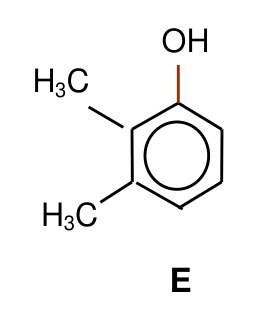
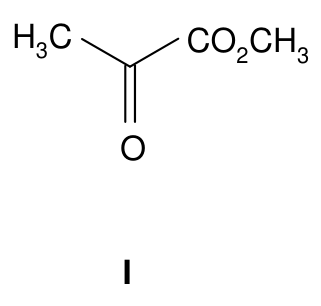
Compound D was synthesised as follows: The phenol E was methylated (\(\ce{MeI/K2CO3}\)) to afford F (\(\ce{C9H12O2}\)) which in turn was reduced with lithium metal in liquid ammonia and 2-methyl-propan-2-ol to give the symmetrical unconjugated diene G. Conjugation of this diene was achieved by reaction with \(\ce{KNH2}\) in liquid ammonia followed by aqueous work up, a process which afforded only one product H. Ozonolysis of H followed by non reductive work up afforded amongst other products the ketoester I.
Compound H underwent a Diels-Alder reaction with dimethyl but-2-ynedioate J to give the adduct K (\(\ce{C15H20O6}\)) which upon heating expelled ethene to afford an aromatic ester L. Basic hydrolysis of L followed by acidification of the solution gave M (\(\ce{C11H12O6}\)) which when heated under vacuum yielded N (\(\ce{C11H10O5}\)). Reduction of N with \(\ce{NaBH4}\) in dimethylformamide gave C and an isomeric lactone O which could also be obtained by the methylation of B.
7.1 Using the answer template provided fill in the structures A to O.
7.2 Using the last space on the answer template provide a second structure for B.
Official English text of the problem.
Answers
- 7.1. The structures are listed below. The answer requires correcting the lower-left substituent of E to methoxy.
Phthalide numbering places the carbonyl at C1, the ring oxygen at position 2 and the methylene at C3. Aromatic positions 4–7 run from the methylene end towards the carbonyl end.
| Compound | Name | SMILES |
|---|---|---|
| A | 5-Hydroxy-7-methoxy-6-methylphthalide | O=C1OCc2cc(O)c(C)c(OC)c21 |
| B | 4-Hydroxy-6-methoxy-5-methylphthalide; one permissible assignment | O=C1OCc2c(O)c(C)c(OC)cc21 |
| C | 5,7-Dimethoxy-6-methylphthalide | O=C1OCc2cc(OC)c(C)c(OC)c21 |
| D | 7-Hydroxy-5-methoxy-6-methylphthalide | O=C1OCc2cc(OC)c(C)c(O)c21 |
| E | 3-Methoxy-2-methylphenol | Oc1c(C)c(OC)ccc1 |
| F | 1,3-Dimethoxy-2-methylbenzene | COc1c(C)c(OC)ccc1 |
| G | 1,5-Dimethoxy-6-methylcyclohexa-1,4-diene | COC1=CCC=C(OC)C1C |
| H | 1,3-Dimethoxy-2-methylcyclohexa-1,3-diene | COC1=C(C)C(OC)=CCC1 |
| I | Methyl 2-oxopropanoate, or methyl pyruvate | CC(=O)C(=O)OC |
| J | Dimethyl but-2-ynedioate, or dimethyl acetylenedicarboxylate | COC(=O)C#CC(=O)OC |
| K | Dimethyl 1,5-dimethoxy-6-methylbicyclo[2.2.2]octa-2,5-diene-2,3-dicarboxylate, racemic | CO[C@]12C(C)=C(OC)[C@H](CC1)C(C(=O)OC)=C2C(=O)OC |
| L | Dimethyl 3,5-dimethoxy-4-methylphthalate | COC(=O)c1c(C(=O)OC)c(OC)c(C)c(OC)c1 |
| M | 3,5-Dimethoxy-4-methylphthalic acid | O=C(O)c1c(C(=O)O)c(OC)c(C)c(OC)c1 |
| N | 3,5-Dimethoxy-4-methylphthalic anhydride | O=C1OC(=O)c2c(OC)c(C)c(OC)cc21 |
| O | 4,6-Dimethoxy-5-methylphthalide | O=C1OCc2c(OC)c(C)c(OC)cc21 |
The SMILES for K specifies one enantiomer. Its equally formed mirror image is CO[C@@]12C(C)=C(OC)[C@@H](CC1)C(C(=O)OC)=C2C(=O)OC.
- 7.2. The second permissible structure for B is 6-hydroxy-4-methoxy-5-methylphthalide,
O=C1OCc2c(OC)c(C)c(O)cc21. The two assignments of B may be interchanged between 7.1 and 7.2.
Solution
7.1. Identification of A–O
Phenolic groups and methylation.
Solubility in aqueous hydroxide, insolubility in bicarbonate and the violet ferric-chloride reaction indicate phenolic hydroxyl groups in A and B. The bicarbonate observation also argues against a free carboxylic acid.
Methylation replaces a phenolic hydrogen with methyl, giving the observed formula change:
\[ \ce{C10H10O4 -> C11H12O4}. \]
A balanced general equation for the methylations A → C, B → O and E → F is
\[ \ce{2ArOH + 2CH3I + K2CO3 -> 2ArOCH3 + 2KI + CO2 + H2O}. \]
Here \(\mathrm{Ar}\) denotes the corresponding substituted aromatic framework.
E → F → G: methylation and Birch reduction.
The formula-consistent structure of E is 3-methoxy-2-methylphenol. Methylating its hydroxyl gives F, 1,3-dimethoxy-2-methylbenzene, with the required formula \(\ce{C9H12O2}\).
For this paragraph, retain the aromatic numbering of F: methoxy groups at C1 and C3, and methyl at C2. Birch reduction adds hydrogen at C2 and C5, leaving double bonds C1=C6 and C3=C4. This gives G, whose two halves are equivalent by reflection through the methyl-bearing carbon and the opposite methylene carbon.
The net reduction is
\[ \ce{C9H12O2 + 2Li + 2(CH3)3COH -> C9H14O2 + 2(CH3)3COLi}. \]
The proton donor is 2-methylpropan-2-ol, CC(C)(C)O; its conjugate base is lithium tert-butoxide, [Li+].[O-]C(C)(C)C.
G → H, established by ozonolysis.
Base-catalysed double-bond migration gives the conjugated diene H, with the sequence
\[ \ce{C(OMe)=C(Me)-C(OMe)=CH} \]
along its four-carbon diene unit. The remaining two ring atoms are methylene groups. No atoms are added or removed, so both G and H have formula \(\ce{C9H14O2}\).
Ozonolysis breaks the two double bonds but preserves the single bond between the two middle diene carbons. One of these bears methyl; the other bears methoxy. Their conversion into carbonyl carbons therefore gives
\[ \ce{CH3-C(=O)-C(=O)-OCH3}, \]
which is exactly I, methyl pyruvate.
The complementary carbonyl fragment is methyl 4-oxobutanoate, COC(=O)CCC=O. An atom-balanced representation of the initial cleavage is
\[ \ce{C9H14O2 + 4[O] -> C4H6O3 + C5H8O3}, \]
where \([O]\) denotes an oxygen-atom oxidizing equivalent. During non-reductive work-up, the aldehyde fragment can undergo further oxidation to methyl hydrogen succinate, COC(=O)CCC(=O)O:
\[ \ce{C5H8O3 + [O] -> C5H8O4}. \]
The identification of H depends on the methyl-pyruvate fragment, regardless of the subsequent fate of the complementary fragment.
H + J → K → L: construction of the aromatic substitution pattern.
The terminal diene carbons of H form two new carbon–carbon bonds to the alkyne carbons of J. This produces the bicyclo[2.2.2]octadiene K:
\[ \ce{C9H14O2 + C6H6O4 -> C15H20O6}. \]
To draw K, connect its two bridgeheads by three two-carbon paths:
- \(\ce{-CH2-CH2-}\);
- \(\ce{-C(Me)=C(OMe)-}\);
- \(\ce{-C(CO2Me)=C(CO2Me)-}\).
One bridgehead bears methoxy and the other hydrogen. The SMILES in Answers specifies their relative configuration; the reaction gives a racemate.
Heating eliminates the saturated two-carbon bridge as ethene, C=C, and produces the aromatic ester L:
\[ \ce{C15H20O6 ->[\Delta] C13H16O6 + C2H4}. \]
The six substituents around the new benzene ring, in cyclic order, are
\[ \ce{CO2Me,\ CO2Me,\ OMe,\ Me,\ OMe,\ H}. \]
Consequently, L is dimethyl 3,5-dimethoxy-4-methylphthalate.
L → M → N: hydrolysis and anhydride formation.
Basic hydrolysis converts both methyl carboxylate groups into carboxylates. Acidification gives the adjacent dicarboxylic acid M; the aryl methyl ethers remain intact. The overall equation, including acidification, is
\[ \ce{C13H16O6 + 2H2O -> C11H12O6 + 2CH3OH}. \]
The small-molecule products are methanol, CO, and, in the following dehydration, water, O.
Heating the ortho-dicarboxylic acid under vacuum removes water and closes the five-membered anhydride ring:
\[ \ce{C11H12O6 ->[\Delta,\ vacuum] C11H10O5 + H2O}. \]
Thus N is 3,5-dimethoxy-4-methylphthalic anhydride.
N → C and O: the two phthalide orientations.
Reduction can convert either of the two inequivalent anhydride carbonyl groups into the methylene group of a phthalide. The other carbonyl remains as the lactone carbonyl. The balanced net reduction for either product is
\[ \ce{C11H10O5 + 4[H] -> C11H12O4 + H2O}, \]
where \([H]\) denotes a reducing hydrogen equivalent.
The two possible products are therefore:
- 5,7-dimethoxy-6-methylphthalide;
- 4,6-dimethoxy-5-methylphthalide.
The hydrogen-bond information determines which is C.
C → D fixes the lactone orientation and identifies A.
A phenolic hydroxyl at phthalide C7 lies adjacent to the lactone carbonyl and can form a strong intramolecular \(\ce{O-H...O=C}\) hydrogen bond. This produces a six-membered hydrogen-bonded arrangement and explains the strongly downfield signal at \(\delta 11.8\ \mathrm{ppm}\). This hydrogen bond is a spatial interaction and is not encoded in ordinary SMILES.
Accordingly:
- C must be 5,7-dimethoxy-6-methylphthalide.
- Selective cleavage of its C7 methyl ether gives D, 7-hydroxy-5-methoxy-6-methylphthalide.
- The other reduction product is O, 4,6-dimethoxy-5-methylphthalide.
A balanced overall representation of demethylation and aqueous work-up is
\[ \ce{C11H12O4 + BCl3 + 3H2O -> C10H10O4 + CH3Cl + B(OH)3 + 2HCl}. \]
Because methylation of A gives C, A has the same framework with one methoxy group replaced by hydroxyl. Since D is a different isomer, A must have hydroxyl at C5 and methoxy at C7: 5-hydroxy-7-methoxy-6-methylphthalide.
This assignment also explains the three non-identical methyl groups in C: two inequivalent methoxy groups and one aromatic methyl group.
Identification of B.
Methylation of B gives O, so B must have the 4,6-dioxygenated-5-methylphthalide framework. One oxygen substituent is hydroxyl and the other methoxy. Either placement satisfies all the observations supplied for B.
For 7.1, we choose 4-hydroxy-6-methoxy-5-methylphthalide.
7.2. The second structure for B
Interchanging hydroxyl and methoxy gives 6-hydroxy-4-methoxy-5-methylphthalide, O=C1OCc2c(OC)c(C)c(O)cc21.
Both candidates have formula \(\ce{C10H10O4}\), contain a phenolic hydroxyl, and methylate to the same O. The supplied observations do not distinguish them.
The solution was checked against the official solution.
IChO 1998 · Theorieaufgabe 7
Aromatische Lactone von Aspergillus nidulans und eine Synthese von D
Die zum Verständnis dieser Aufgabe benötigten Strukturen sind in der Antwortvorlage dargestellt.
Der Pilz Aspergillus nidulans produziert zwei isomere aromatische Lactone (cyclische Ester) A und B (\(\ce{C10H10O4}\)), die sich beide in kalter wässriger \(\ce{NaOH}\), jedoch nicht in wässrigem \(\ce{NaHCO3}\) lösten. Sowohl A als auch B ergaben mit wässrigem \(\ce{FeCl3}\) eine violette Färbung. Die Reaktion von A mit \(\ce{CH3I}\) in Gegenwart von \(\ce{K2CO3}\) ergab C (\(\ce{C11H12O4}\)), für das mittels \({}^{1}\mathrm{H}\)-NMR-Spektroskopie nachgewiesen wurde, dass es drei nicht äquivalente Methylgruppen enthält, von denen eine direkt an einen aromatischen Ring gebunden war. Die selektive Demethylierung von C mit \(\ce{BCl3}\) und anschließende wässrige Aufarbeitung ergaben D, ein neues Isomer von A. Das \({}^{1}\mathrm{H}\)-NMR-Spektrum der Verbindung D zeigte bei \(\delta\) 11.8 ppm eindeutig das Vorliegen einer Hydroxygruppe, die an einer intramolekularen Wasserstoffbrückenbindung beteiligt ist.
Verbindung D wurde wie folgt synthetisiert: Das Phenol E wurde methyliert (\(\ce{MeI/K2CO3}\)), wobei F (\(\ce{C9H12O2}\)) entstand. Dieses wurde anschließend mit metallischem Lithium in flüssigem Ammoniak und 2-Methylpropan-2-ol zum symmetrischen, nicht konjugierten Dien G reduziert. Die Konjugation dieses Diens wurde durch Reaktion mit \(\ce{KNH2}\) in flüssigem Ammoniak und anschließende wässrige Aufarbeitung erreicht; dabei entstand nur ein Produkt H. Die Ozonolyse von H mit anschließender nichtreduktiver Aufarbeitung ergab neben anderen Produkten den Ketoester I.
Verbindung H ging mit But-2-indisäuredimethylester J eine Diels-Alder-Reaktion ein und lieferte das Addukt K (\(\ce{C15H20O6}\)), das beim Erhitzen Ethen abspaltete und den aromatischen Ester L bildete. Die basische Hydrolyse von L und anschließendes Ansäuern der Lösung ergaben M (\(\ce{C11H12O6}\)), das beim Erhitzen unter Vakuum N (\(\ce{C11H10O5}\)) lieferte. Die Reduktion von N mit \(\ce{NaBH4}\) in Dimethylformamid ergab C und ein isomeres Lacton O, das auch durch Methylierung von B erhalten werden konnte.
7.1 Tragen Sie die Strukturen A bis O in die bereitgestellte Antwortvorlage ein.
7.2 Geben Sie im letzten Feld der Antwortvorlage eine zweite Struktur für B an.
Aufgabentext aus dem offiziellen englischen Text übersetzt.
Antworten
- 7.1. Die Strukturen sind unten aufgeführt. Für die Antwort muss der Substituent unten links in E zu einer Methoxygruppe korrigiert werden.
Bei der Nummerierung des Phthalids liegt die Carbonylgruppe an C1, der Ringsauerstoff an Position 2 und die Methylengruppe an C3. Die aromatischen Positionen 4–7 verlaufen von der Methylenseite zur Carbonylseite.
| Verbindung | Name | SMILES |
|---|---|---|
| A | 5-Hydroxy-7-methoxy-6-methylphthalid | O=C1OCc2cc(O)c(C)c(OC)c21 |
| B | 4-Hydroxy-6-methoxy-5-methylphthalid; eine zulässige Zuordnung | O=C1OCc2c(O)c(C)c(OC)cc21 |
| C | 5,7-Dimethoxy-6-methylphthalid | O=C1OCc2cc(OC)c(C)c(OC)c21 |
| D | 7-Hydroxy-5-methoxy-6-methylphthalid | O=C1OCc2cc(OC)c(C)c(O)c21 |
| E | 3-Methoxy-2-methylphenol | Oc1c(C)c(OC)ccc1 |
| F | 1,3-Dimethoxy-2-methylbenzol | COc1c(C)c(OC)ccc1 |
| G | 1,5-Dimethoxy-6-methylcyclohexa-1,4-dien | COC1=CCC=C(OC)C1C |
| H | 1,3-Dimethoxy-2-methylcyclohexa-1,3-dien | COC1=C(C)C(OC)=CCC1 |
| I | 2-Oxopropansäuremethylester oder Brenztraubensäuremethylester | CC(=O)C(=O)OC |
| J | But-2-indisäuredimethylester oder Acetylendicarbonsäuredimethylester | COC(=O)C#CC(=O)OC |
| K | 1,5-Dimethoxy-6-methylbicyclo[2.2.2]octa-2,5-dien-2,3-dicarbonsäuredimethylester, racemisch | CO[C@]12C(C)=C(OC)[C@H](CC1)C(C(=O)OC)=C2C(=O)OC |
| L | 3,5-Dimethoxy-4-methylphthalsäuredimethylester | COC(=O)c1c(C(=O)OC)c(OC)c(C)c(OC)c1 |
| M | 3,5-Dimethoxy-4-methylphthalsäure | O=C(O)c1c(C(=O)O)c(OC)c(C)c(OC)c1 |
| N | 3,5-Dimethoxy-4-methylphthalsäureanhydrid | O=C1OC(=O)c2c(OC)c(C)c(OC)cc21 |
| O | 4,6-Dimethoxy-5-methylphthalid | O=C1OCc2c(OC)c(C)c(OC)cc21 |
Der SMILES für K gibt ein Enantiomer an. Sein in gleicher Menge gebildetes Spiegelbild ist CO[C@@]12C(C)=C(OC)[C@@H](CC1)C(C(=O)OC)=C2C(=O)OC.
- 7.2. Die zweite zulässige Struktur für B ist 6-Hydroxy-4-methoxy-5-methylphthalid,
O=C1OCc2c(OC)c(C)c(O)cc21. Die beiden Zuordnungen für B können zwischen 7.1 und 7.2 vertauscht werden.
Lösung
7.1. Identifizierung von A–O
Phenolische Gruppen und Methylierung.
Die Löslichkeit in wässriger Hydroxidlösung, die Unlöslichkeit in Hydrogencarbonatlösung und die violette Eisen(III)-chlorid-Reaktion weisen auf phenolische Hydroxygruppen in A und B hin. Die Beobachtung mit Hydrogencarbonat spricht außerdem gegen eine freie Carbonsäuregruppe.
Bei der Methylierung wird ein phenolisches Wasserstoffatom durch eine Methylgruppe ersetzt, was die beobachtete Änderung der Summenformel ergibt:
\[ \ce{C10H10O4 -> C11H12O4}. \]
Eine ausgeglichene allgemeine Gleichung für die Methylierungen A → C, B → O und E → F lautet
\[ \ce{2ArOH + 2CH3I + K2CO3 -> 2ArOCH3 + 2KI + CO2 + H2O}. \]
Hier bezeichnet \(\mathrm{Ar}\) das entsprechende substituierte aromatische Gerüst.
E → F → G: Methylierung und Birch-Reduktion.
Die mit der Summenformel vereinbare Struktur von E ist 3-Methoxy-2-methylphenol. Die Methylierung seiner Hydroxygruppe ergibt F, 1,3-Dimethoxy-2-methylbenzol, mit der geforderten Summenformel \(\ce{C9H12O2}\).
Für diesen Absatz wird die Nummerierung des aromatischen Rings von F beibehalten: Methoxygruppen an C1 und C3 sowie eine Methylgruppe an C2. Bei der Birch-Reduktion wird Wasserstoff an C2 und C5 addiert, wobei die Doppelbindungen C1=C6 und C3=C4 verbleiben. Dies ergibt G, dessen beide Hälften durch Spiegelung an einer Ebene durch das methyltragende Kohlenstoffatom und das gegenüberliegende Methylenkohlenstoffatom äquivalent sind.
Die Nettogleichung der Reduktion lautet
\[ \ce{C9H12O2 + 2Li + 2(CH3)3COH -> C9H14O2 + 2(CH3)3COLi}. \]
Der Protonendonator ist 2-Methylpropan-2-ol, CC(C)(C)O; seine konjugierte Base liegt als Lithium-tert-butanolat, [Li+].[O-]C(C)(C)C, vor.
G → H, durch Ozonolyse aufgeklärt.
Die basenkatalysierte Doppelbindungsverschiebung ergibt das konjugierte Dien H mit der Abfolge
\[ \ce{C(OMe)=C(Me)-C(OMe)=CH} \]
entlang seiner aus vier Kohlenstoffatomen bestehenden Dieneinheit. Die beiden übrigen Ringatome sind Methylengruppen. Es werden keine Atome hinzugefügt oder entfernt, sodass sowohl G als auch H die Summenformel \(\ce{C9H14O2}\) haben.
Die Ozonolyse spaltet die beiden Doppelbindungen, erhält jedoch die Einfachbindung zwischen den beiden mittleren Kohlenstoffatomen der Dieneinheit. Eines davon trägt eine Methylgruppe, das andere eine Methoxygruppe. Ihre Umwandlung in Carbonylkohlenstoffatome ergibt daher
\[ \ce{CH3-C(=O)-C(=O)-OCH3}, \]
also genau I, Brenztraubensäuremethylester.
Das komplementäre Carbonylfragment ist 4-Oxobutansäuremethylester, COC(=O)CCC=O. Eine hinsichtlich der Atome ausgeglichene Darstellung der anfänglichen Spaltung lautet
\[ \ce{C9H14O2 + 4[O] -> C4H6O3 + C5H8O3}, \]
wobei \([O]\) ein Oxidationsäquivalent in Form eines Sauerstoffatoms bezeichnet. Bei der nichtreduktiven Aufarbeitung kann das Aldehydfragment weiter zu Bernsteinsäuremonomethylester, COC(=O)CCC(=O)O, oxidiert werden:
\[ \ce{C5H8O3 + [O] -> C5H8O4}. \]
Die Identifizierung von H beruht auf dem Brenztraubensäuremethylesterfragment, unabhängig vom weiteren Schicksal des komplementären Fragments.
H + J → K → L: Aufbau des aromatischen Substitutionsmusters.
Die endständigen Kohlenstoffatome der Dieneinheit von H bilden zwei neue Kohlenstoff–Kohlenstoff-Bindungen zu den Alkin-Kohlenstoffatomen von J. Dadurch entsteht das Bicyclo[2.2.2]octadien K:
\[ \ce{C9H14O2 + C6H6O4 -> C15H20O6}. \]
Um K zu zeichnen, verbindet man seine beiden Brückenköpfe durch drei Wege mit jeweils zwei Kohlenstoffatomen:
- \(\ce{-CH2-CH2-}\);
- \(\ce{-C(Me)=C(OMe)-}\);
- \(\ce{-C(CO2Me)=C(CO2Me)-}\).
Ein Brückenkopf trägt eine Methoxygruppe, der andere ein Wasserstoffatom. Der SMILES im Abschnitt „Antworten“ gibt ihre relative Konfiguration an; die Reaktion liefert ein Racemat.
Beim Erhitzen wird die gesättigte Brücke aus zwei Kohlenstoffatomen als Ethen, C=C, abgespalten, und es entsteht der aromatische Ester L:
\[ \ce{C15H20O6 ->[\Delta] C13H16O6 + C2H4}. \]
Die sechs Substituenten am neuen Benzolring sind in zyklischer Reihenfolge
\[ \ce{CO2Me,\ CO2Me,\ OMe,\ Me,\ OMe,\ H}. \]
Folglich ist L 3,5-Dimethoxy-4-methylphthalsäuredimethylester.
L → M → N: Hydrolyse und Anhydridbildung.
Die basische Hydrolyse wandelt beide Carbonsäuremethylestergruppen in Carboxylatgruppen um. Durch Ansäuern entsteht die Dicarbonsäure M mit benachbarten Carboxygruppen; die Arylmethylether bleiben unverändert. Die Gesamtgleichung einschließlich des Ansäuerns lautet
\[ \ce{C13H16O6 + 2H2O -> C11H12O6 + 2CH3OH}. \]
Die niedermolekularen Produkte sind Methanol, CO, und bei der folgenden Dehydratisierung Wasser, O.
Beim Erhitzen der ortho-Dicarbonsäure unter Vakuum wird Wasser abgespalten, und der fünfgliedrige Anhydridring schließt sich:
\[ \ce{C11H12O6 ->[\Delta,\ vacuum] C11H10O5 + H2O}. \]
Somit ist N 3,5-Dimethoxy-4-methylphthalsäureanhydrid.
N → C und O: die beiden Orientierungen des Phthalids.
Durch die Reduktion kann jede der beiden nicht äquivalenten Anhydridcarbonylgruppen in die Methylengruppe eines Phthalids umgewandelt werden. Die andere Carbonylgruppe bleibt als Lactoncarbonylgruppe erhalten. Die ausgeglichene Nettogleichung der Reduktion lautet für beide Produkte
\[ \ce{C11H10O5 + 4[H] -> C11H12O4 + H2O}, \]
wobei \([H]\) ein reduzierendes Wasserstoffäquivalent bezeichnet.
Die beiden möglichen Produkte sind daher:
- 5,7-Dimethoxy-6-methylphthalid;
- 4,6-Dimethoxy-5-methylphthalid.
Die Information über die Wasserstoffbrückenbindung bestimmt, welches davon C ist.
C → D legt die Orientierung des Lactons fest und identifiziert A.
Eine phenolische Hydroxygruppe an C7 des Phthalids liegt benachbart zur Lactoncarbonylgruppe und kann eine starke intramolekulare \(\ce{O-H...O=C}\)-Wasserstoffbrückenbindung bilden. Dadurch entsteht eine sechsgliedrige, durch eine Wasserstoffbrücke geschlossene Anordnung, die das stark zu tiefem Feld verschobene Signal bei \(\delta 11.8\ \mathrm{ppm}\) erklärt. Diese Wasserstoffbrückenbindung ist eine räumliche Wechselwirkung und wird in gewöhnlichen SMILES nicht codiert.
Dementsprechend gilt:
- C muss 5,7-Dimethoxy-6-methylphthalid sein.
- Die selektive Spaltung seines C7-Methylethers ergibt D, 7-Hydroxy-5-methoxy-6-methylphthalid.
- Das andere Reduktionsprodukt ist O, 4,6-Dimethoxy-5-methylphthalid.
Eine ausgeglichene Gesamtdarstellung der Demethylierung und der wässrigen Aufarbeitung lautet
\[ \ce{C11H12O4 + BCl3 + 3H2O -> C10H10O4 + CH3Cl + B(OH)3 + 2HCl}. \]
Da die Methylierung von A zu C führt, besitzt A dasselbe Gerüst, wobei eine Methoxygruppe durch eine Hydroxygruppe ersetzt ist. Da D ein anderes Isomer ist, muss A eine Hydroxygruppe an C5 und eine Methoxygruppe an C7 tragen: 5-Hydroxy-7-methoxy-6-methylphthalid.
Diese Zuordnung erklärt auch die drei nicht äquivalenten Methylgruppen in C: zwei nicht äquivalente Methoxygruppen und eine aromatische Methylgruppe.
Identifizierung von B.
Die Methylierung von B ergibt O, sodass B das Gerüst eines an den Positionen 4 und 6 mit Sauerstoff substituierten 5-Methylphthalids besitzen muss. Einer der Sauerstoffsubstituenten ist eine Hydroxygruppe, der andere eine Methoxygruppe. Beide Anordnungen erfüllen alle für B angegebenen Beobachtungen.
Für 7.1 wählen wir 4-Hydroxy-6-methoxy-5-methylphthalid.
7.2. Die zweite Struktur für B
Durch Vertauschen von Hydroxy- und Methoxygruppe erhält man 6-Hydroxy-4-methoxy-5-methylphthalid, O=C1OCc2c(OC)c(C)c(O)cc21.
Beide Kandidaten haben die Summenformel \(\ce{C10H10O4}\), enthalten eine phenolische Hydroxygruppe und ergeben bei der Methylierung dasselbe O. Die angegebenen Beobachtungen erlauben keine Unterscheidung zwischen ihnen.
Die Lösung wurde mit der offiziellen Lösung abgeglichen.
IChO 1998 · Teori sorusu 7
Aspergillus nidulans'ın aromatik laktonları ve D'nin bir sentezi
Bu soruyu okumak için gerekli yapılar cevap şablonunda gösterilmiştir.
Aspergillus nidulans mantarı, her biri soğuk sulu \(\ce{NaOH}\) çözeltisinde çözünen, ancak sulu \(\ce{NaHCO3}\) çözeltisinde çözünmeyen, birbirinin izomeri iki aromatik lakton (halkalı ester), A ve B (\(\ce{C10H10O4}\)), üretir. Hem A hem de B, sulu \(\ce{FeCl3}\) çözeltisiyle mor renk vermiştir. A'nın \(\ce{K2CO3}\) varlığında \(\ce{CH3I}\) ile tepkimesi sonucunda C (\(\ce{C11H12O4}\)) elde edilmiştir; \({}^{1}\mathrm{H}\) NMR spektroskopisi, bu bileşiğin biri doğrudan aromatik halkaya bağlı olan, birbirinden farklı üç metil grubu içerdiğini göstermiştir. C'nin \(\ce{BCl3}\) ile seçici demetilasyonunun ardından sulu ortamda işleme tabi tutulmasıyla A'nın yeni bir izomeri olan D elde edilmiştir. D bileşiğinin \({}^{1}\mathrm{H}\) NMR spektrumu, \(\delta\) 11.8 ppm'de molekül içi hidrojen bağı oluşturan bir hidroksil grubunun varlığını açıkça göstermiştir.
D bileşiği şu şekilde sentezlenmiştir: Fenol E, metillenerek (\(\ce{MeI/K2CO3}\)) F (\(\ce{C9H12O2}\)) elde edilmiş; ardından bu bileşik, sıvı amonyak ve 2-metilpropan-2-ol ortamında metalik lityum ile indirgenerek simetrik, konjuge olmayan dien G'ye dönüştürülmüştür. Bu dienin konjugasyonu, sıvı amonyak içinde \(\ce{KNH2}\) ile tepkimeye sokulması ve ardından sulu ortamda işleme tabi tutulmasıyla sağlanmış; bu işlem yalnızca tek bir ürün, H, vermiştir. H'nin ozonolizinin ardından indirgen olmayan koşullarda işleme tabi tutulmasıyla, diğer ürünlerin yanı sıra ketoester I elde edilmiştir.
H bileşiği, dimetil büt-2-indioat J ile Diels-Alder tepkimesine girerek katılma ürünü K'yi (\(\ce{C15H20O6}\)) vermiş; bu ürün ısıtıldığında eten ayrılarak aromatik bir ester olan L oluşmuştur. L'nin bazik hidrolizinin ardından çözeltinin asitlendirilmesiyle M (\(\ce{C11H12O6}\)) elde edilmiş; bu bileşik vakum altında ısıtıldığında N'yi (\(\ce{C11H10O5}\)) vermiştir. N'nin dimetilformamit içinde \(\ce{NaBH4}\) ile indirgenmesi sonucunda C ve B'nin metillenmesiyle de elde edilebilen izomerik lakton O oluşmuştur.
7.1 Verilen cevap şablonunu kullanarak A'dan O'ya kadar olan yapıları doldurunuz.
7.2 Cevap şablonundaki son boşluğa B için ikinci bir yapı yazınız.
Soru metni resmi İngilizce metinden çevrilmiştir.
Cevaplar
- 7.1. Yapılar aşağıda listelenmiştir. Cevap, E'nin sol alt sübstitüentinin metoksi olarak düzeltilmesini gerektirir.
Ftalit numaralandırmasında karbonil C1'de, halka oksijeni 2 konumunda ve metilen C3'te bulunur. Aromatik konumlar 4–7, metilen ucundan karbonil ucuna doğru ilerler.
| Bileşik | Adı | SMILES |
|---|---|---|
| A | 5-Hidroksi-7-metoksi-6-metilftalit | O=C1OCc2cc(O)c(C)c(OC)c21 |
| B | 4-Hidroksi-6-metoksi-5-metilftalit; kabul edilebilir yapı atamalarından biri | O=C1OCc2c(O)c(C)c(OC)cc21 |
| C | 5,7-Dimetoksi-6-metilftalit | O=C1OCc2cc(OC)c(C)c(OC)c21 |
| D | 7-Hidroksi-5-metoksi-6-metilftalit | O=C1OCc2cc(OC)c(C)c(O)c21 |
| E | 3-Metoksi-2-metilfenol | Oc1c(C)c(OC)ccc1 |
| F | 1,3-Dimetoksi-2-metilbenzen | COc1c(C)c(OC)ccc1 |
| G | 1,5-Dimetoksi-6-metilsikloheksa-1,4-dien | COC1=CCC=C(OC)C1C |
| H | 1,3-Dimetoksi-2-metilsikloheksa-1,3-dien | COC1=C(C)C(OC)=CCC1 |
| I | Metil 2-oksopropanoat veya metil pirüvat | CC(=O)C(=O)OC |
| J | Dimetil büt-2-indioat veya dimetil asetilendikarboksilat | COC(=O)C#CC(=O)OC |
| K | Dimetil 1,5-dimetoksi-6-metilbisiklo[2.2.2]okta-2,5-dien-2,3-dikarboksilat, rasemik | CO[C@]12C(C)=C(OC)[C@H](CC1)C(C(=O)OC)=C2C(=O)OC |
| L | Dimetil 3,5-dimetoksi-4-metilftalat | COC(=O)c1c(C(=O)OC)c(OC)c(C)c(OC)c1 |
| M | 3,5-Dimetoksi-4-metilftalik asit | O=C(O)c1c(C(=O)O)c(OC)c(C)c(OC)c1 |
| N | 3,5-Dimetoksi-4-metilftalik anhidrit | O=C1OC(=O)c2c(OC)c(C)c(OC)cc21 |
| O | 4,6-Dimetoksi-5-metilftalit | O=C1OCc2c(OC)c(C)c(OC)cc21 |
K için verilen SMILES bir enantiyomeri belirtir. Eşit miktarda oluşan ayna görüntüsü CO[C@@]12C(C)=C(OC)[C@@H](CC1)C(C(=O)OC)=C2C(=O)OC şeklindedir.
- 7.2. B için kabul edilebilir ikinci yapı 6-hidroksi-4-metoksi-5-metilftalit,
O=C1OCc2c(OC)c(C)c(O)cc21, yapısıdır. B için yapılan bu iki yapı atamasının 7.1 ve 7.2'deki yerleri değiştirilebilir.
Çözüm
7.1. A–O yapılarının belirlenmesi
Fenolik gruplar ve metilleme.
Sulu hidroksit çözeltisinde çözünme, bikarbonat çözeltisinde çözünmeme ve demir(III) klorürle mor renk veren tepkime, A ve B'de fenolik hidroksil grupları bulunduğunu gösterir. Bikarbonatla ilgili gözlem, serbest bir karboksilik asit bulunmadığını da destekler.
Metilleme, fenolik hidrojenin yerine metil grubunu geçirerek gözlenen formül değişimini sağlar:
\[ \ce{C10H10O4 -> C11H12O4}. \]
A → C, B → O ve E → F metillemeleri için denkleştirilmiş genel denklem şöyledir:
\[ \ce{2ArOH + 2CH3I + K2CO3 -> 2ArOCH3 + 2KI + CO2 + H2O}. \]
Burada \(\mathrm{Ar}\), ilgili sübstitüe aromatik iskeleti gösterir.
E → F → G: metilleme ve Birch indirgenmesi.
E'nin formülle uyumlu yapısı 3-metoksi-2-metilfenoldür. Hidroksil grubunun metillenmesiyle, gerekli \(\ce{C9H12O2}\) formülüne sahip 1,3-dimetoksi-2-metilbenzen, F, elde edilir.
Bu paragrafta F'nin aromatik halka numaralandırmasını koruyalım: metoksi grupları C1 ve C3'te, metil grubu ise C2'dedir. Birch indirgenmesi C2 ve C5'e hidrojen ekler; C1=C6 ve C3=C4 çift bağları kalır. Böylece, metil grubunu taşıyan karbon ile karşısındaki metilen karbonundan geçen yansıma düzlemine göre iki yarısı eşdeğer olan G elde edilir.
Net indirgenme tepkimesi şöyledir:
\[ \ce{C9H12O2 + 2Li + 2(CH3)3COH -> C9H14O2 + 2(CH3)3COLi}. \]
Proton vericisi 2-metilpropan-2-ol, CC(C)(C)O; bunun eşlenik bazı ise lityum tert-bütoksit, [Li+].[O-]C(C)(C)C, bileşiğidir.
G → H dönüşümünün ozonolizle belirlenmesi.
Baz katalizli çift bağ göçü, dört karbonlu dien birimi boyunca
\[ \ce{C(OMe)=C(Me)-C(OMe)=CH} \]
dizilimine sahip konjuge dien H'yi verir. Geriye kalan iki halka atomu metilen gruplarıdır. Hiçbir atom eklenmediği veya uzaklaştırılmadığı için hem G hem de H, \(\ce{C9H14O2}\) formülüne sahiptir.
Ozonoliz iki çift bağı parçalar, ancak ortadaki iki dien karbonu arasındaki tek bağı korur. Bu karbonlardan biri metil, diğeri metoksi grubu taşır. Dolayısıyla bunların karbonil karbonlarına dönüşmesiyle
\[ \ce{CH3-C(=O)-C(=O)-OCH3}, \]
yapısı elde edilir; bu, tam olarak I, yani metil pirüvattır.
Tamamlayıcı karbonil parçası metil 4-oksobütanoat, COC(=O)CCC=O, bileşiğidir. İlk parçalanmanın atom sayıları bakımından denkleştirilmiş gösterimi şöyledir:
\[ \ce{C9H14O2 + 4[O] -> C4H6O3 + C5H8O3}, \]
burada \([O]\), bir oksijen atomuna karşılık gelen yükseltgen eşdeğerini gösterir. İndirgen olmayan koşullardaki son işlem sırasında aldehit parçası daha ileri yükseltgenerek metil hidrojen süksinata, COC(=O)CCC(=O)O, dönüşebilir:
\[ \ce{C5H8O3 + [O] -> C5H8O4}. \]
H'nin belirlenmesi, tamamlayıcı parçanın daha sonra neye dönüştüğünden bağımsız olarak metil pirüvat parçasına dayanır.
H + J → K → L: aromatik sübstitüsyon düzeninin oluşturulması.
H'nin uç dien karbonları, J'nin alkin karbonlarıyla iki yeni karbon–karbon bağı oluşturur. Böylece bisiklo[2.2.2]oktadien K oluşur:
\[ \ce{C9H14O2 + C6H6O4 -> C15H20O6}. \]
K'yi çizmek için iki köprübaşı atomunu, her biri iki karbon içeren üç yolla birbirine bağlayınız:
- \(\ce{-CH2-CH2-}\);
- \(\ce{-C(Me)=C(OMe)-}\);
- \(\ce{-C(CO2Me)=C(CO2Me)-}\).
Köprübaşı atomlarından biri metoksi, diğeri hidrojen taşır. Cevaplar bölümündeki SMILES bunların bağıl konfigürasyonunu belirtir; tepkime bir rasemat verir.
Isıtma sonucunda doymuş iki karbonlu köprü eten, C=C, olarak ayrılır ve aromatik ester L oluşur:
\[ \ce{C15H20O6 ->[\Delta] C13H16O6 + C2H4}. \]
Yeni benzen halkasının etrafındaki altı sübstitüent, halka boyunca sırayla şöyledir:
\[ \ce{CO2Me,\ CO2Me,\ OMe,\ Me,\ OMe,\ H}. \]
Dolayısıyla L, dimetil 3,5-dimetoksi-4-metilftalattır.
L → M → N: hidroliz ve anhidrit oluşumu.
Bazik hidroliz, her iki metil karboksilat grubunu da karboksilatlara dönüştürür. Asitlendirme, karboksil grupları komşu konumlarda bulunan dikarboksilik asit M'yi verir; aril metil eterler değişmeden kalır. Asitlendirme dahil toplam denklem şöyledir:
\[ \ce{C13H16O6 + 2H2O -> C11H12O6 + 2CH3OH}. \]
Küçük moleküllü ürünler metanol, CO, ve sonraki dehidrasyon adımında su, O, molekülleridir.
Orto-dikarboksilik asidin vakum altında ısıtılması suyu uzaklaştırır ve beş üyeli anhidrit halkasını kapatır:
\[ \ce{C11H12O6 ->[\Delta,\ vacuum] C11H10O5 + H2O}. \]
Böylece N, 3,5-dimetoksi-4-metilftalik anhidrittir.
N → C ve O: iki ftalit yönelimi.
İndirgenme, eşdeğer olmayan iki anhidrit karbonil grubundan herhangi birini bir ftalitin metilen grubuna dönüştürebilir. Diğer karbonil, lakton karbonili olarak kalır. Her iki ürün için de denkleştirilmiş net indirgenme tepkimesi şöyledir:
\[ \ce{C11H10O5 + 4[H] -> C11H12O4 + H2O}, \]
burada \([H]\), bir indirgen hidrojen eşdeğerini gösterir.
Dolayısıyla olası iki ürün şunlardır:
- 5,7-dimetoksi-6-metilftalit;
- 4,6-dimetoksi-5-metilftalit.
Hidrojen bağına ilişkin bilgi, hangisinin C olduğunu belirler.
C → D dönüşümü lakton yönelimini kesinleştirir ve A'yı belirler.
Ftalitin C7 konumundaki fenolik hidroksil, lakton karboniline komşudur ve güçlü bir molekül içi \(\ce{O-H...O=C}\) hidrojen bağı oluşturabilir. Bu, hidrojen bağıyla tutulan altı üyeli bir düzenlenme oluşturur ve \(\delta 11.8\ \mathrm{ppm}\)'deki belirgin biçimde düşük alana kaymış sinyali açıklar. Bu hidrojen bağı uzaysal bir etkileşimdir ve sıradan SMILES gösteriminde kodlanmaz.
Buna göre:
- C, 5,7-dimetoksi-6-metilftalit olmalıdır.
- C7'deki metil eterinin seçici olarak parçalanmasıyla D, yani 7-hidroksi-5-metoksi-6-metilftalit elde edilir.
- Diğer indirgenme ürünü O, yani 4,6-dimetoksi-5-metilftalittir.
Demetilasyonun ve sulu ortamda gerçekleştirilen son işlemin denkleştirilmiş toplam gösterimi şöyledir:
\[ \ce{C11H12O4 + BCl3 + 3H2O -> C10H10O4 + CH3Cl + B(OH)3 + 2HCl}. \]
A'nın metillenmesi C'yi verdiği için A, metoksi gruplarından birinin yerinde hidroksil bulunan aynı iskelete sahiptir. D farklı bir izomer olduğundan A'da hidroksil C5'te, metoksi ise C7'de bulunmalıdır: 5-hidroksi-7-metoksi-6-metilftalit.
Bu yapı ataması, C'deki birbirinden farklı üç metil grubunu da açıklar: eşdeğer olmayan iki metoksi grubu ve bir aromatik metil grubu.
B'nin belirlenmesi.
B'nin metillenmesi O'yu verdiğinden B, 4,6-dioksijenlenmiş-5-metilftalit iskeletine sahip olmalıdır. Oksijenli sübstitüentlerden biri hidroksil, diğeri metoksidir. Her iki yerleşim de B için verilen tüm gözlemleri karşılar.
7.1 için 4-hidroksi-6-metoksi-5-metilftalit yapısını seçiyoruz.
7.2. B için ikinci yapı
Hidroksil ile metoksinin yer değiştirmesiyle 6-hidroksi-4-metoksi-5-metilftalit, O=C1OCc2c(OC)c(C)c(O)cc21, elde edilir.
Her iki aday da \(\ce{C10H10O4}\) formülüne sahiptir, fenolik bir hidroksil içerir ve metillendiğinde aynı O bileşiğini verir. Verilen gözlemler bu iki yapıyı birbirinden ayırt etmez.
Çözüm, resmi çözümle karşılaştırılarak kontrol edildi.
IChO 1998 · Problema teórico 7
Lactonas aromáticas de Aspergillus nidulans y una síntesis de D
Las estructuras necesarias para interpretar esta pregunta se muestran en la plantilla de respuestas.
El hongo Aspergillus nidulans produce dos lactonas aromáticas (ésteres cíclicos) isómeras A y B (\(\ce{C10H10O4}\)), cada una de las cuales se disolvía en \(\ce{NaOH}\) acuoso frío, pero no en \(\ce{NaHCO3}\) acuoso. Tanto A como B daban una coloración violeta con \(\ce{FeCl3}\) acuoso. La reacción de A con \(\ce{CH3I}\) en presencia de \(\ce{K2CO3}\) dio C (\(\ce{C11H12O4}\)), que, según se demostró mediante espectroscopia de RMN de \({}^{1}\mathrm{H}\), contenía tres grupos metilo no idénticos, uno de los cuales estaba unido directamente a un anillo aromático. La desmetilación selectiva de C con \(\ce{BCl3}\), seguida de un tratamiento acuoso, dio D, un nuevo isómero de A. El espectro de RMN de \({}^{1}\mathrm{H}\) del compuesto D mostraba claramente la presencia de un grupo hidroxilo que formaba un enlace de hidrógeno intramolecular, a \(\delta\) 11.8 ppm.
El compuesto D se sintetizó como sigue: el fenol E se metiló (\(\ce{MeI/K2CO3}\)) para obtener F (\(\ce{C9H12O2}\)), que a su vez se redujo con litio metálico en amoníaco líquido y 2-metilpropan-2-ol para dar el dieno simétrico no conjugado G. La conjugación de este dieno se logró mediante reacción con \(\ce{KNH2}\) en amoníaco líquido, seguida de un tratamiento acuoso, proceso que proporcionó un único producto H. La ozonólisis de H, seguida de un tratamiento no reductor, proporcionó, entre otros productos, el cetoéster I.
El compuesto H experimentó una reacción de Diels-Alder con but-2-inodioato de dimetilo J para dar el aducto K (\(\ce{C15H20O6}\)), que al calentarse liberó eteno para dar un éster aromático L. La hidrólisis básica de L, seguida de la acidificación de la disolución, dio M (\(\ce{C11H12O6}\)), que al calentarse a vacío produjo N (\(\ce{C11H10O5}\)). La reducción de N con \(\ce{NaBH4}\) en dimetilformamida dio C y una lactona isómera O, que también podía obtenerse por metilación de B.
7.1 Utilizando la plantilla de respuestas proporcionada, complete las estructuras A a O.
7.2 Utilizando el último espacio de la plantilla de respuestas, proponga una segunda estructura para B.
Enunciado traducido del texto oficial en inglés.
Respuestas
- 7.1. Las estructuras se enumeran a continuación. La respuesta requiere corregir el sustituyente inferior izquierdo de E a metoxi.
La numeración de la ftalida sitúa el carbonilo en C1, el oxígeno del anillo en la posición 2 y el metileno en C3. Las posiciones aromáticas 4–7 van desde el extremo del metileno hacia el extremo del carbonilo.
| Compuesto | Nombre | SMILES |
|---|---|---|
| A | 5-Hidroxi-7-metoxi-6-metilftalida | O=C1OCc2cc(O)c(C)c(OC)c21 |
| B | 4-Hidroxi-6-metoxi-5-metilftalida; una asignación admisible | O=C1OCc2c(O)c(C)c(OC)cc21 |
| C | 5,7-Dimetoxi-6-metilftalida | O=C1OCc2cc(OC)c(C)c(OC)c21 |
| D | 7-Hidroxi-5-metoxi-6-metilftalida | O=C1OCc2cc(OC)c(C)c(O)c21 |
| E | 3-Metoxi-2-metilfenol | Oc1c(C)c(OC)ccc1 |
| F | 1,3-Dimetoxi-2-metilbenceno | COc1c(C)c(OC)ccc1 |
| G | 1,5-Dimetoxi-6-metilciclohexa-1,4-dieno | COC1=CCC=C(OC)C1C |
| H | 1,3-Dimetoxi-2-metilciclohexa-1,3-dieno | COC1=C(C)C(OC)=CCC1 |
| I | 2-Oxopropanoato de metilo, o piruvato de metilo | CC(=O)C(=O)OC |
| J | But-2-inodioato de dimetilo, o acetilendicarboxilato de dimetilo | COC(=O)C#CC(=O)OC |
| K | 1,5-Dimetoxi-6-metilbiciclo[2.2.2]octa-2,5-dieno-2,3-dicarboxilato de dimetilo, racémico | CO[C@]12C(C)=C(OC)[C@H](CC1)C(C(=O)OC)=C2C(=O)OC |
| L | 3,5-Dimetoxi-4-metilftalato de dimetilo | COC(=O)c1c(C(=O)OC)c(OC)c(C)c(OC)c1 |
| M | Ácido 3,5-dimetoxi-4-metilftálico | O=C(O)c1c(C(=O)O)c(OC)c(C)c(OC)c1 |
| N | Anhídrido 3,5-dimetoxi-4-metilftálico | O=C1OC(=O)c2c(OC)c(C)c(OC)cc21 |
| O | 4,6-Dimetoxi-5-metilftalida | O=C1OCc2c(OC)c(C)c(OC)cc21 |
El SMILES de K especifica un enantiómero. Su imagen especular, que se forma en igual proporción, es CO[C@@]12C(C)=C(OC)[C@@H](CC1)C(C(=O)OC)=C2C(=O)OC.
- 7.2. La segunda estructura admisible para B es la 6-hidroxi-4-metoxi-5-metilftalida,
O=C1OCc2c(OC)c(C)c(O)cc21. Las dos asignaciones de B pueden intercambiarse entre 7.1 y 7.2.
Solución
7.1. Identificación de A–O
Grupos fenólicos y metilación.
La solubilidad en hidróxido acuoso, la insolubilidad en bicarbonato y la coloración violeta en la reacción con cloruro férrico indican la presencia de grupos hidroxilo fenólicos en A y B. La observación con bicarbonato también es un indicio en contra de la presencia de un ácido carboxílico libre.
La metilación sustituye un hidrógeno fenólico por un metilo, lo que da lugar al cambio de fórmula observado:
\[ \ce{C10H10O4 -> C11H12O4}. \]
Una ecuación general ajustada para las metilaciones A → C, B → O y E → F es
\[ \ce{2ArOH + 2CH3I + K2CO3 -> 2ArOCH3 + 2KI + CO2 + H2O}. \]
Aquí \(\mathrm{Ar}\) representa el correspondiente esqueleto aromático sustituido.
E → F → G: metilación y reducción de Birch.
La estructura de E compatible con su fórmula es el 3-metoxi-2-metilfenol. La metilación de su hidroxilo da F, 1,3-dimetoxi-2-metilbenceno, con la fórmula requerida \(\ce{C9H12O2}\).
En este párrafo se conserva la numeración aromática de F: grupos metoxi en C1 y C3, y metilo en C2. La reducción de Birch añade hidrógeno en C2 y C5, dejando los dobles enlaces C1=C6 y C3=C4. Así se obtiene G, cuyas dos mitades son equivalentes por reflexión respecto al plano que pasa por el carbono que lleva el metilo y el carbono metilénico opuesto.
La reducción neta es
\[ \ce{C9H12O2 + 2Li + 2(CH3)3COH -> C9H14O2 + 2(CH3)3COLi}. \]
El dador de protones es el 2-metilpropan-2-ol, CC(C)(C)O; su base conjugada es el terc-butóxido de litio, [Li+].[O-]C(C)(C)C.
G → H, establecido mediante ozonólisis.
La migración de los dobles enlaces catalizada por una base da el dieno conjugado H, con la secuencia
\[ \ce{C(OMe)=C(Me)-C(OMe)=CH} \]
a lo largo de su unidad diénica de cuatro carbonos. Los dos átomos restantes del anillo son grupos metileno. No se añaden ni se eliminan átomos, por lo que tanto G como H tienen la fórmula \(\ce{C9H14O2}\).
La ozonólisis rompe los dos dobles enlaces, pero conserva el enlace sencillo entre los dos carbonos centrales del dieno. Uno de ellos lleva un metilo; el otro, un metoxi. Por tanto, su conversión en carbonos carbonílicos da
\[ \ce{CH3-C(=O)-C(=O)-OCH3}, \]
que es exactamente I, piruvato de metilo.
El fragmento carbonílico complementario es el 4-oxobutanoato de metilo, COC(=O)CCC=O. Una representación de la escisión inicial con balance de átomos es
\[ \ce{C9H14O2 + 4[O] -> C4H6O3 + C5H8O3}, \]
donde \([O]\) representa un equivalente oxidante de un átomo de oxígeno. Durante el tratamiento no reductor, el fragmento aldehídico puede oxidarse adicionalmente a hidrogenosuccinato de metilo, COC(=O)CCC(=O)O:
\[ \ce{C5H8O3 + [O] -> C5H8O4}. \]
La identificación de H depende del fragmento de piruvato de metilo, con independencia del destino posterior del fragmento complementario.
H + J → K → L: construcción del patrón de sustitución aromática.
Los carbonos terminales del dieno H forman dos nuevos enlaces carbono–carbono con los carbonos del alquino J. Esto produce el biciclo[2.2.2]octadieno K:
\[ \ce{C9H14O2 + C6H6O4 -> C15H20O6}. \]
Para dibujar K, conecte sus dos cabezas de puente mediante tres caminos de dos carbonos:
- \(\ce{-CH2-CH2-}\);
- \(\ce{-C(Me)=C(OMe)-}\);
- \(\ce{-C(CO2Me)=C(CO2Me)-}\).
Una cabeza de puente lleva un metoxi y la otra un hidrógeno. El SMILES de Respuestas especifica su configuración relativa; la reacción da un racemato.
El calentamiento elimina el puente saturado de dos carbonos en forma de eteno, C=C, y produce el éster aromático L:
\[ \ce{C15H20O6 ->[\Delta] C13H16O6 + C2H4}. \]
Los seis sustituyentes alrededor del nuevo anillo bencénico, en orden cíclico, son
\[ \ce{CO2Me,\ CO2Me,\ OMe,\ Me,\ OMe,\ H}. \]
Por consiguiente, L es el 3,5-dimetoxi-4-metilftalato de dimetilo.
L → M → N: hidrólisis y formación del anhídrido.
La hidrólisis básica convierte ambos grupos carboxilato de metilo en carboxilatos. La acidificación da el ácido dicarboxílico con grupos adyacentes M; los éteres aril metílicos permanecen intactos. La ecuación global, incluida la acidificación, es
\[ \ce{C13H16O6 + 2H2O -> C11H12O6 + 2CH3OH}. \]
Los productos de molécula pequeña son el metanol, CO, y, en la siguiente deshidratación, el agua, O.
El calentamiento del ácido orto-dicarboxílico a vacío elimina agua y cierra el anillo de anhídrido de cinco miembros:
\[ \ce{C11H12O6 ->[\Delta,\ vacuum] C11H10O5 + H2O}. \]
Así, N es el anhídrido 3,5-dimetoxi-4-metilftálico.
N → C y O: las dos orientaciones de la ftalida.
La reducción puede convertir cualquiera de los dos grupos carbonilo no equivalentes del anhídrido en el grupo metileno de una ftalida. El otro carbonilo permanece como carbonilo de la lactona. La reducción neta ajustada para cualquiera de los dos productos es
\[ \ce{C11H10O5 + 4[H] -> C11H12O4 + H2O}, \]
donde \([H]\) representa un equivalente reductor de hidrógeno.
Por tanto, los dos productos posibles son:
- 5,7-dimetoxi-6-metilftalida;
- 4,6-dimetoxi-5-metilftalida.
La información sobre el enlace de hidrógeno determina cuál es C.
C → D determina la orientación de la lactona e identifica A.
Un hidroxilo fenólico en C7 de la ftalida se encuentra adyacente al carbonilo de la lactona y puede formar un enlace de hidrógeno intramolecular fuerte de tipo \(\ce{O-H...O=C}\). Esto produce una disposición de seis miembros unida por un enlace de hidrógeno y explica la señal a campo muy bajo en \(\delta 11.8\ \mathrm{ppm}\). Este enlace de hidrógeno es una interacción espacial y no está codificado en los SMILES ordinarios.
En consecuencia:
- C debe ser la 5,7-dimetoxi-6-metilftalida.
- La escisión selectiva de su éter metílico en C7 da D, 7-hidroxi-5-metoxi-6-metilftalida.
- El otro producto de reducción es O, 4,6-dimetoxi-5-metilftalida.
Una representación global ajustada de la desmetilación y el tratamiento acuoso es
\[ \ce{C11H12O4 + BCl3 + 3H2O -> C10H10O4 + CH3Cl + B(OH)3 + 2HCl}. \]
Como la metilación de A da C, A tiene el mismo esqueleto con un grupo metoxi sustituido por hidroxilo. Puesto que D es un isómero diferente, A debe tener el hidroxilo en C5 y el metoxi en C7: 5-hidroxi-7-metoxi-6-metilftalida.
Esta asignación también explica los tres grupos metilo no idénticos de C: dos grupos metoxi no equivalentes y un grupo metilo aromático.
Identificación de B.
La metilación de B da O, por lo que B debe tener el esqueleto de una 5-metilftalida oxigenada en las posiciones 4 y 6. Un sustituyente oxigenado es hidroxilo y el otro, metoxi. Cualquiera de las dos disposiciones satisface todas las observaciones proporcionadas para B.
Para 7.1, elegimos la 4-hidroxi-6-metoxi-5-metilftalida.
7.2. La segunda estructura de B
El intercambio de hidroxilo y metoxi da la 6-hidroxi-4-metoxi-5-metilftalida, O=C1OCc2c(OC)c(C)c(O)cc21.
Ambos candidatos tienen la fórmula \(\ce{C10H10O4}\), contienen un hidroxilo fenólico y se metilan para dar el mismo O. Las observaciones proporcionadas no permiten distinguirlos.
La solución se comprobó con la solución oficial.
IChO 1998 · 理论题 7
Aspergillus nidulans 的芳香族内酯及 D 的一种合成方法
阅读本题所需的结构式见答题模板。
真菌构巢曲霉(Aspergillus nidulans)产生两种互为异构体的芳香族内酯(环状酯)A 和 B(\(\ce{C10H10O4}\)),二者均溶于冷的 \(\ce{NaOH}\) 水溶液,但不溶于 \(\ce{NaHCO3}\) 水溶液。A 和 B 均与 \(\ce{FeCl3}\) 水溶液显紫色。A 在 \(\ce{K2CO3}\) 存在下与 \(\ce{CH3I}\) 反应,生成 C(\(\ce{C11H12O4}\));\({}^{1}\mathrm{H}\) NMR 光谱表明,C 含有三个不等价的甲基,其中一个直接连接在芳环上。用 \(\ce{BCl3}\) 对 C 进行选择性脱甲基反应,随后经水处理,得到 D,它是 A 的另一种异构体。化合物 D 的 \({}^{1}\mathrm{H}\) NMR 谱在 \(\delta\) 11.8 ppm 处清楚地显示出参与分子内氢键的羟基的存在。
化合物 D 的合成如下:酚 E 经甲基化(\(\ce{MeI/K2CO3}\))得到 F(\(\ce{C9H12O2}\)),后者在液氨和 2-甲基丙-2-醇中用金属锂还原,得到对称的非共轭二烯 G。该二烯在液氨中与 \(\ce{KNH2}\) 反应,随后经水处理,实现双键共轭化,此过程仅生成一种产物 H。H 经臭氧分解及非还原性后处理后,所得产物中包括酮酯 I。
化合物 H 与丁-2-炔二酸二甲酯 J 发生 Diels-Alder 反应,得到加成产物 K(\(\ce{C15H20O6}\)),后者受热脱去乙烯,生成芳香族酯 L。L 经碱性水解,随后将溶液酸化,得到 M(\(\ce{C11H12O6}\)),其在真空下加热生成 N(\(\ce{C11H10O5}\))。在二甲基甲酰胺中用 \(\ce{NaBH4}\) 还原 N,得到 C 及其异构内酯 O,后者也可由 B 甲基化得到。
7.1 在所提供的答题模板中填写 A 至 O 的结构式。
7.2 在答题模板的最后一个空格中给出 B 的第二种结构式。
题目译自官方英文原文。
答案
- 7.1. 各结构列于下表。本答案需要将 E 左下方的取代基更正为甲氧基。
苯酞的编号将羰基碳定为 C1,环氧原子定为 2 位,亚甲基碳定为 C3。芳环上的 4–7 位从亚甲基一端向羰基一端依次编号。
| 化合物 | 名称 | SMILES |
|---|---|---|
| A | 5-羟基-7-甲氧基-6-甲基苯酞 | O=C1OCc2cc(O)c(C)c(OC)c21 |
| B | 4-羟基-6-甲氧基-5-甲基苯酞;一种符合条件的结构归属 | O=C1OCc2c(O)c(C)c(OC)cc21 |
| C | 5,7-二甲氧基-6-甲基苯酞 | O=C1OCc2cc(OC)c(C)c(OC)c21 |
| D | 7-羟基-5-甲氧基-6-甲基苯酞 | O=C1OCc2cc(OC)c(C)c(O)c21 |
| E | 3-甲氧基-2-甲基苯酚 | Oc1c(C)c(OC)ccc1 |
| F | 1,3-二甲氧基-2-甲基苯 | COc1c(C)c(OC)ccc1 |
| G | 1,5-二甲氧基-6-甲基环己-1,4-二烯 | COC1=CCC=C(OC)C1C |
| H | 1,3-二甲氧基-2-甲基环己-1,3-二烯 | COC1=C(C)C(OC)=CCC1 |
| I | 2-氧代丙酸甲酯,即丙酮酸甲酯 | CC(=O)C(=O)OC |
| J | 丁-2-炔二酸二甲酯,即乙炔二羧酸二甲酯 | COC(=O)C#CC(=O)OC |
| K | 1,5-二甲氧基-6-甲基双环[2.2.2]辛-2,5-二烯-2,3-二羧酸二甲酯,外消旋体 | CO[C@]12C(C)=C(OC)[C@H](CC1)C(C(=O)OC)=C2C(=O)OC |
| L | 3,5-二甲氧基-4-甲基邻苯二甲酸二甲酯 | COC(=O)c1c(C(=O)OC)c(OC)c(C)c(OC)c1 |
| M | 3,5-二甲氧基-4-甲基邻苯二甲酸 | O=C(O)c1c(C(=O)O)c(OC)c(C)c(OC)c1 |
| N | 3,5-二甲氧基-4-甲基邻苯二甲酸酐 | O=C1OC(=O)c2c(OC)c(C)c(OC)cc21 |
| O | 4,6-二甲氧基-5-甲基苯酞 | O=C1OCc2c(OC)c(C)c(OC)cc21 |
K 的 SMILES 指定了其中一个对映体。与其等量生成的镜像异构体为 CO[C@@]12C(C)=C(OC)[C@@H](CC1)C(C(=O)OC)=C2C(=O)OC。
- 7.2. B 的第二种符合条件的结构是 6-羟基-4-甲氧基-5-甲基苯酞,
O=C1OCc2c(OC)c(C)c(O)cc21。B 的这两种结构归属可在 7.1 和 7.2 中互换。
解答
7.1. A–O 的鉴定
酚羟基与甲基化。
溶于氢氧化物水溶液、不溶于碳酸氢盐水溶液以及与氯化铁反应显紫色,表明 A 和 B 中含有酚羟基。碳酸氢盐实验的现象也不支持存在游离羧酸基团。
甲基化以甲基取代酚羟基上的氢,使分子式发生所观察到的变化:
\[ \ce{C10H10O4 -> C11H12O4}. \]
甲基化反应 A → C、B → O 和 E → F 的通用配平方程式为
\[ \ce{2ArOH + 2CH3I + K2CO3 -> 2ArOCH3 + 2KI + CO2 + H2O}. \]
这里,\(\mathrm{Ar}\) 表示相应的取代芳香骨架。
E → F → G:甲基化与 Birch 还原。
与分子式一致的 E 的结构是 3-甲氧基-2-甲基苯酚。其羟基经甲基化得到 F,即 1,3-二甲氧基-2-甲基苯,分子式为题目要求的 \(\ce{C9H12O2}\)。
本段沿用 F 的芳环编号:甲氧基位于 C1 和 C3,甲基位于 C2。Birch 还原在 C2 和 C5 上加氢,保留 C1=C6 和 C3=C4 双键,从而得到 G;其两半部分通过经过连有甲基的碳原子和对面的亚甲基碳原子的镜面反射而相互等价。
还原反应的净反应式为
\[ \ce{C9H12O2 + 2Li + 2(CH3)3COH -> C9H14O2 + 2(CH3)3COLi}. \]
质子供体为 2-甲基丙-2-醇,CC(C)(C)O;其共轭碱以叔丁醇锂的形式存在,[Li+].[O-]C(C)(C)C。
G → H:通过臭氧分解确定结构。
碱催化的双键迁移生成共轭二烯 H,其四碳二烯单元中的连接顺序为
\[ \ce{C(OMe)=C(Me)-C(OMe)=CH} \]
环上其余两个原子均为亚甲基碳原子。此过程未增加或移除任何原子,因此 G 和 H 的分子式均为 \(\ce{C9H14O2}\)。
臭氧分解使两个双键断裂,但保留二烯中间两个碳原子之间的单键。这两个碳原子中的一个连有甲基,另一个连有甲氧基。因此,它们转化为羰基碳原子后,得到
\[ \ce{CH3-C(=O)-C(=O)-OCH3}, \]
这正是 I,即丙酮酸甲酯。
另一互补的羰基片段为 4-氧代丁酸甲酯,COC(=O)CCC=O。初始断裂过程可用如下原子守恒的反应式表示:
\[ \ce{C9H14O2 + 4[O] -> C4H6O3 + C5H8O3}, \]
其中,\([O]\) 表示一个氧原子的氧化当量。在非还原性后处理中,含醛基的片段可进一步氧化为丁二酸氢甲酯,COC(=O)CCC(=O)O:
\[ \ce{C5H8O3 + [O] -> C5H8O4}. \]
H 的鉴定依据是丙酮酸甲酯片段,与另一互补片段后续发生何种变化无关。
H + J → K → L:构建芳环取代模式。
H 的二烯两端碳原子与 J 的炔键碳原子形成两个新的碳–碳键,生成双环[2.2.2]辛二烯 K:
\[ \ce{C9H14O2 + C6H6O4 -> C15H20O6}. \]
绘制 K 时,用三条各含两个碳原子的路径连接两个桥头:
- \(\ce{-CH2-CH2-}\);
- \(\ce{-C(Me)=C(OMe)-}\);
- \(\ce{-C(CO2Me)=C(CO2Me)-}\)。
一个桥头连有甲氧基,另一个连有氢。答案中的 SMILES 指定了二者的相对构型;该反应生成外消旋体。
加热使饱和的二碳桥以乙烯 C=C 的形式脱去,生成芳香族酯 L:
\[ \ce{C15H20O6 ->[\Delta] C13H16O6 + C2H4}. \]
新生成的苯环上的六个取代基,按环绕顺序依次为
\[ \ce{CO2Me,\ CO2Me,\ OMe,\ Me,\ OMe,\ H}. \]
因此,L 为 3,5-二甲氧基-4-甲基邻苯二甲酸二甲酯。
L → M → N:水解与酸酐形成。
碱性水解将两个羧酸甲酯基团均转化为羧酸根。酸化得到含有相邻两个羧基的二羧酸 M;芳基甲醚基团保持不变。包括酸化在内的总反应式为
\[ \ce{C13H16O6 + 2H2O -> C11H12O6 + 2CH3OH}. \]
小分子产物为甲醇 CO,以及随后脱水反应中的水 O。
在真空下加热邻位二羧酸使其失水,闭合形成五元酸酐环:
\[ \ce{C11H12O6 ->[\Delta,\ vacuum] C11H10O5 + H2O}. \]
因此,N 为 3,5-二甲氧基-4-甲基邻苯二甲酸酐。
N → C 和 O:苯酞的两种取向。
还原可将两个不等价的酸酐羰基中的任意一个转化为苯酞中的亚甲基。另一个羰基则保留为内酯羰基。生成任一产物的配平净还原反应式均为
\[ \ce{C11H10O5 + 4[H] -> C11H12O4 + H2O}, \]
其中,\([H]\) 表示一个还原性氢当量。
因此,两种可能的产物为:
- 5,7-二甲氧基-6-甲基苯酞;
- 4,6-二甲氧基-5-甲基苯酞。
氢键信息决定其中哪一种是 C。
C → D 确定内酯的取向并鉴定 A。
苯酞 C7 位的酚羟基邻近内酯羰基,可形成较强的分子内 \(\ce{O-H...O=C}\) 氢键。这会形成六元氢键结构,并解释了 \(\delta 11.8\ \mathrm{ppm}\) 处显著向低场移动的信号。这种氢键是一种空间相互作用,普通 SMILES 不对其进行编码。
据此:
- C 必须是 5,7-二甲氧基-6-甲基苯酞。
- 选择性裂解其 C7 位的甲醚,得到 D,即 7-羟基-5-甲氧基-6-甲基苯酞。
- 另一种还原产物为 O,即 4,6-二甲氧基-5-甲基苯酞。
脱甲基及水处理的总过程可用如下配平方程式表示:
\[ \ce{C11H12O4 + BCl3 + 3H2O -> C10H10O4 + CH3Cl + B(OH)3 + 2HCl}. \]
由于 A 经甲基化得到 C,因此 A 具有相同的骨架,只是其中一个甲氧基被羟基取代。由于 D 是另一种异构体,A 的羟基必须位于 C5,甲氧基位于 C7,即 5-羟基-7-甲氧基-6-甲基苯酞。
这一结构归属也解释了 C 中三个不等价的甲基:两个不等价的甲氧基,以及一个连接在芳环上的甲基。
B 的鉴定。
B 经甲基化得到 O,因此 B 必须具有 4,6-二含氧取代-5-甲基苯酞骨架。一个含氧取代基为羟基,另一个为甲氧基。无论两者如何分配位置,均满足题目所给出的关于 B 的全部实验现象。
在 7.1 中,我们选择 4-羟基-6-甲氧基-5-甲基苯酞。
7.2. B 的第二种结构
互换羟基和甲氧基的位置,得到 6-羟基-4-甲氧基-5-甲基苯酞,O=C1OCc2c(OC)c(C)c(O)cc21。
两种候选结构的分子式均为 \(\ce{C10H10O4}\),均含有酚羟基,且甲基化后均生成同一个 O。题目给出的实验现象无法区分二者。
解答已与官方解答核对。
IChO 1998 · Теоретическая задача 7
Ароматические лактоны Aspergillus nidulans и синтез D
Структурные формулы, необходимые для понимания этого задания, приведены в бланке ответов.
Гриб Aspergillus nidulans вырабатывает два изомерных ароматических лактона (циклических сложных эфира) A и B (\(\ce{C10H10O4}\)), каждый из которых растворялся в холодном водном растворе \(\ce{NaOH}\), но не в водном растворе \(\ce{NaHCO3}\). Оба соединения, A и B, давали фиолетовое окрашивание с водным раствором \(\ce{FeCl3}\). При реакции A с \(\ce{CH3I}\) в присутствии \(\ce{K2CO3}\) образовывалось соединение C (\(\ce{C11H12O4}\)), в котором методом ЯМР-спектроскопии \({}^{1}\mathrm{H}\) было установлено наличие трёх неэквивалентных метильных групп, одна из которых была непосредственно связана с ароматическим кольцом. Селективное деметилирование C с помощью \(\ce{BCl3}\) с последующей обработкой водой давало D — новый изомер A. Спектр ЯМР \({}^{1}\mathrm{H}\) соединения D отчётливо указывал на наличие гидроксильной группы, участвующей во внутримолекулярной водородной связи, с сигналом при \(\delta\) 11.8 м.д.
Соединение D было синтезировано следующим образом: метилирование фенола E (\(\ce{MeI/K2CO3}\)) давало F (\(\ce{C9H12O2}\)), который, в свою очередь, восстанавливали металлическим литием в жидком аммиаке в присутствии 2-метилпропан-2-ола с получением симметричного несопряжённого диена G. Сопряжение двойных связей этого диена достигалось реакцией с \(\ce{KNH2}\) в жидком аммиаке с последующей обработкой водой; в результате этого процесса образовывался только один продукт H. Озонолиз H с последующей невосстановительной обработкой реакционной смеси давал среди прочих продуктов кетоэфир I.
Соединение H вступало в реакцию Дильса—Альдера с диметиловым эфиром бут-2-индиовой кислоты J с образованием аддукта K (\(\ce{C15H20O6}\)), который при нагревании отщеплял этен, образуя ароматический сложный эфир L. Щелочной гидролиз L с последующим подкислением раствора давал M (\(\ce{C11H12O6}\)), который при нагревании в вакууме превращался в N (\(\ce{C11H10O5}\)). Восстановление N с помощью \(\ce{NaBH4}\) в диметилформамиде давало C и изомерный лактон O, который можно было также получить метилированием B.
7.1 Впишите структурные формулы A–O в предоставленный бланк ответов.
7.2 В последнем поле бланка ответов приведите вторую возможную структурную формулу B.
Условие переведено с официального английского текста.
Ответы
- 7.1. Структурные формулы перечислены ниже. Для получения ответа необходимо исправить нижний левый заместитель в E на метоксигруппу.
При нумерации фталида карбонильная группа находится при C1, атом кислорода кольца — в положении 2, а метиленовая группа — при C3. Положения 4–7 ароматического кольца нумеруются от метиленовой группы к карбонильной.
| Соединение | Название | SMILES |
|---|---|---|
| A | 5-Гидрокси-7-метокси-6-метилфталид | O=C1OCc2cc(O)c(C)c(OC)c21 |
| B | 4-Гидрокси-6-метокси-5-метилфталид; один из допустимых вариантов | O=C1OCc2c(O)c(C)c(OC)cc21 |
| C | 5,7-Диметокси-6-метилфталид | O=C1OCc2cc(OC)c(C)c(OC)c21 |
| D | 7-Гидрокси-5-метокси-6-метилфталид | O=C1OCc2cc(OC)c(C)c(O)c21 |
| E | 3-Метокси-2-метилфенол | Oc1c(C)c(OC)ccc1 |
| F | 1,3-Диметокси-2-метилбензол | COc1c(C)c(OC)ccc1 |
| G | 1,5-Диметокси-6-метилциклогекса-1,4-диен | COC1=CCC=C(OC)C1C |
| H | 1,3-Диметокси-2-метилциклогекса-1,3-диен | COC1=C(C)C(OC)=CCC1 |
| I | Метил-2-оксопропаноат, или метилпируват | CC(=O)C(=O)OC |
| J | Диметилбут-2-индиоат, или диметилацетилендикарбоксилат | COC(=O)C#CC(=O)OC |
| K | Диметил-1,5-диметокси-6-метилбицикло[2.2.2]окта-2,5-диен-2,3-дикарбоксилат, рацемат | CO[C@]12C(C)=C(OC)[C@H](CC1)C(C(=O)OC)=C2C(=O)OC |
| L | Диметил-3,5-диметокси-4-метилфталат | COC(=O)c1c(C(=O)OC)c(OC)c(C)c(OC)c1 |
| M | 3,5-Диметокси-4-метилфталевая кислота | O=C(O)c1c(C(=O)O)c(OC)c(C)c(OC)c1 |
| N | Ангидрид 3,5-диметокси-4-метилфталевой кислоты | O=C1OC(=O)c2c(OC)c(C)c(OC)cc21 |
| O | 4,6-Диметокси-5-метилфталид | O=C1OCc2c(OC)c(C)c(OC)cc21 |
Запись SMILES для K задаёт один энантиомер. Его зеркальный изомер, образующийся в равном количестве, имеет запись CO[C@@]12C(C)=C(OC)[C@@H](CC1)C(C(=O)OC)=C2C(=O)OC.
- 7.2. Вторая допустимая структура B — 6-гидрокси-4-метокси-5-метилфталид,
O=C1OCc2c(OC)c(C)c(O)cc21. Два варианта структуры B можно поменять местами в ответах на 7.1 и 7.2.
Решение
7.1. Установление структур A–O
Фенольные группы и метилирование.
Растворимость в водном растворе гидроксида, нерастворимость в растворе гидрокарбоната и фиолетовое окрашивание при реакции с хлоридом железа(III) указывают на наличие фенольных гидроксильных групп в A и B. Отсутствие реакции с гидрокарбонатом также свидетельствует против наличия свободной карбоксильной группы.
Метилирование заменяет атом водорода фенольной группы на метильную группу, что приводит к наблюдаемому изменению формулы:
\[ \ce{C10H10O4 -> C11H12O4}. \]
Общее уравнение метилирования A → C, B → O и E → F с расставленными коэффициентами имеет вид
\[ \ce{2ArOH + 2CH3I + K2CO3 -> 2ArOCH3 + 2KI + CO2 + H2O}. \]
Здесь \(\mathrm{Ar}\) обозначает соответствующий замещённый ароматический фрагмент.
E → F → G: метилирование и восстановление по Бёрчу.
Структура E, согласующаяся с молекулярной формулой, — 3-метокси-2-метилфенол. Метилирование его гидроксильной группы даёт F, 1,3-диметокси-2-метилбензол, с требуемой формулой \(\ce{C9H12O2}\).
В этом абзаце сохраним нумерацию ароматического кольца F: метоксигруппы находятся при C1 и C3, а метильная группа — при C2. При восстановлении по Бёрчу водород присоединяется к C2 и C5, а двойные связи C1=C6 и C3=C4 сохраняются. При этом образуется G, две половины которого эквивалентны при отражении в плоскости, проходящей через атом углерода с метильной группой и противоположный метиленовый атом углерода.
Суммарное уравнение восстановления имеет вид
\[ \ce{C9H12O2 + 2Li + 2(CH3)3COH -> C9H14O2 + 2(CH3)3COLi}. \]
Донором протонов служит 2-метилпропан-2-ол, CC(C)(C)O; его сопряжённое основание представлено трет-бутоксидом лития, [Li+].[O-]C(C)(C)C.
G → H: установление структуры по озонолизу.
Катализируемая основанием миграция двойных связей даёт сопряжённый диен H, содержащий последовательность
\[ \ce{C(OMe)=C(Me)-C(OMe)=CH} \]
в своём четырёхуглеродном диеновом фрагменте. Два остальных атома кольца входят в состав метиленовых групп. Атомы не присоединяются и не отщепляются, поэтому и G, и H имеют формулу \(\ce{C9H14O2}\).
При озонолизе разрываются две двойные связи, но сохраняется одинарная связь между двумя средними атомами углерода диенового фрагмента. Один из них несёт метильную группу, другой — метоксигруппу. Поэтому их превращение в карбонильные атомы углерода даёт
\[ \ce{CH3-C(=O)-C(=O)-OCH3}, \]
то есть именно I, метилпируват.
Второй карбонильный фрагмент — метил-4-оксобутаноат, COC(=O)CCC=O. Уравнение первоначального расщепления с соблюдением баланса атомов имеет вид
\[ \ce{C9H14O2 + 4[O] -> C4H6O3 + C5H8O3}, \]
где \([O]\) обозначает окислительный эквивалент, соответствующий одному атому кислорода. При невосстановительной обработке реакционной смеси альдегидный фрагмент может далее окисляться до монометилового эфира янтарной кислоты, COC(=O)CCC(=O)O:
\[ \ce{C5H8O3 + [O] -> C5H8O4}. \]
Структура H устанавливается по образованию метилпирувата независимо от дальнейшей судьбы второго фрагмента.
H + J → K → L: формирование расположения заместителей в ароматическом кольце.
Концевые атомы углерода диенового фрагмента H образуют две новые связи углерод–углерод с атомами углерода тройной связи J. При этом получается бицикло[2.2.2]октадиен K:
\[ \ce{C9H14O2 + C6H6O4 -> C15H20O6}. \]
Чтобы изобразить K, соедините два его узловых атома тремя двухуглеродными мостиками:
- \(\ce{-CH2-CH2-}\);
- \(\ce{-C(Me)=C(OMe)-}\);
- \(\ce{-C(CO2Me)=C(CO2Me)-}\).
Один узловой атом несёт метоксигруппу, другой — атом водорода. Запись SMILES в разделе «Ответы» задаёт их относительную конфигурацию; в реакции образуется рацемат.
При нагревании насыщенный двухуглеродный мостик отщепляется в виде этена, C=C, и образуется ароматический сложный эфир L:
\[ \ce{C15H20O6 ->[\Delta] C13H16O6 + C2H4}. \]
Шесть заместителей при новом бензольном кольце расположены в следующем порядке при обходе кольца:
\[ \ce{CO2Me,\ CO2Me,\ OMe,\ Me,\ OMe,\ H}. \]
Следовательно, L — диметил-3,5-диметокси-4-метилфталат.
L → M → N: гидролиз и образование ангидрида.
Щелочной гидролиз превращает обе метилэфирные группы в карбоксилатные. Подкисление даёт дикарбоновую кислоту M с соседними карбоксильными группами; арилметиловые эфирные группы остаются неизменными. Суммарное уравнение, включающее подкисление, имеет вид
\[ \ce{C13H16O6 + 2H2O -> C11H12O6 + 2CH3OH}. \]
Низкомолекулярными продуктами являются метанол, CO, и, на следующей стадии дегидратации, вода, O.
При нагревании орто-дикарбоновой кислоты в вакууме отщепляется вода и замыкается пятичленный ангидридный цикл:
\[ \ce{C11H12O6 ->[\Delta,\ vacuum] C11H10O5 + H2O}. \]
Таким образом, N — ангидрид 3,5-диметокси-4-метилфталевой кислоты.
N → C и O: две ориентации фталидного фрагмента.
При восстановлении любая из двух неэквивалентных карбонильных групп ангидрида может превратиться в метиленовую группу фталида. Другая карбонильная группа сохраняется в качестве карбонильной группы лактона. Суммарное уравнение восстановления с расставленными коэффициентами для любого из двух продуктов имеет вид
\[ \ce{C11H10O5 + 4[H] -> C11H12O4 + H2O}, \]
где \([H]\) обозначает восстановительный эквивалент водорода.
Таким образом, возможны два продукта:
- 5,7-диметокси-6-метилфталид;
- 4,6-диметокси-5-метилфталид.
Сведения о водородной связи позволяют определить, какой из них является C.
C → D: определение ориентации лактонного фрагмента и структуры A.
Фенольная гидроксильная группа при C7 фталида находится рядом с карбонильной группой лактона и может образовывать прочную внутримолекулярную водородную связь \(\ce{O-H...O=C}\). При этом возникает шестичленная структура, замкнутая водородной связью, что объясняет сигнал, сильно смещённый в слабое поле, при \(\delta 11.8\ \mathrm{ppm}\). Эта водородная связь представляет собой пространственное взаимодействие и не кодируется в обычной записи SMILES.
Соответственно:
- C должен быть 5,7-диметокси-6-метилфталидом.
- Селективное расщепление его метилэфирной группы при C7 даёт D, 7-гидрокси-5-метокси-6-метилфталид.
- Другой продукт восстановления — O, 4,6-диметокси-5-метилфталид.
Суммарное уравнение деметилирования и последующей обработки водой с расставленными коэффициентами имеет вид
\[ \ce{C11H12O4 + BCl3 + 3H2O -> C10H10O4 + CH3Cl + B(OH)3 + 2HCl}. \]
Поскольку метилирование A даёт C, A имеет тот же скелет, в котором одна метоксигруппа заменена гидроксильной. Поскольку D является другим изомером, в A гидроксильная группа должна находиться при C5, а метоксигруппа — при C7: это 5-гидрокси-7-метокси-6-метилфталид.
Такое отнесение также объясняет наличие трёх неэквивалентных метильных групп в C: двух неэквивалентных метоксигрупп и одной метильной группы, связанной с ароматическим кольцом.
Установление структуры B.
Метилирование B даёт O, поэтому B должен иметь скелет 5-метилфталида с кислородсодержащими заместителями в положениях 4 и 6. Один кислородсодержащий заместитель — гидроксильная группа, другой — метоксигруппа. Любое из двух их расположений согласуется со всеми приведёнными наблюдениями для B.
Для 7.1 выберем 4-гидрокси-6-метокси-5-метилфталид.
7.2. Вторая структура B
Перестановка гидроксильной и метоксигруппы даёт 6-гидрокси-4-метокси-5-метилфталид, O=C1OCc2c(OC)c(C)c(O)cc21.
Оба варианта имеют формулу \(\ce{C10H10O4}\), содержат фенольную гидроксильную группу и при метилировании дают одно и то же соединение O. Приведённые наблюдения не позволяют различить их.
Решение проверено по официальному решению.
IChO 1998 · مسألة نظرية 7
اللاكتونات العطرية لفطر Aspergillus nidulans واصطناع D
تُعرض البنى اللازمة لفهم هذا السؤال في نموذج الإجابة.
ينتج الفطر Aspergillus nidulans لاكتونين عطريين متماكبين (إسترين حلقيين)، A وB (\(\ce{C10H10O4}\))، يذوب كل منهما في محلول مائي بارد من \(\ce{NaOH}\)، لكنه لا يذوب في محلول مائي من \(\ce{NaHCO3}\). وأعطى كل من A وB لونًا بنفسجيًا مع محلول مائي من \(\ce{FeCl3}\). وأدى تفاعل A مع \(\ce{CH3I}\) بوجود \(\ce{K2CO3}\) إلى C (\(\ce{C11H12O4}\))، الذي أظهر التحليل الطيفي بالرنين المغناطيسي النووي لـ \({}^{1}\mathrm{H}\) أنه يحتوي على ثلاث مجموعات ميثيل غير متكافئة، ترتبط إحداها مباشرة بحلقة عطرية. وأدت إزالة الميثيل انتقائيًا من C باستخدام \(\ce{BCl3}\)، ثم المعالجة المائية اللاحقة، إلى D، وهو متماكب جديد لـ A. وأظهر طيف الرنين المغناطيسي النووي لـ \({}^{1}\mathrm{H}\) للمركب D بوضوح وجود مجموعة هيدروكسيل تشارك في رابطة هيدروجينية داخل الجزيء عند \(\delta\) 11.8 ppm.
اصطُنع المركب D كما يلي: مُثيل الفينول E (\(\ce{MeI/K2CO3}\)) للحصول على F (\(\ce{C9H12O2}\))، الذي اختُزل بدوره بفلز الليثيوم في الأمونيا السائلة و2-ميثيل بروبان-2-ول، ليعطي الدايين المتماثل غير المترافق G. وحُقق ترافق هذا الدايين بتفاعله مع \(\ce{KNH2}\) في الأمونيا السائلة، ثم المعالجة المائية اللاحقة، وهي عملية أعطت ناتجًا واحدًا فقط هو H. وأعطى التحلل بالأوزون للمركب H، متبوعًا بمعالجة لاحقة غير اختزالية، الإستر الكيتوني I ضمن نواتج أخرى.
خضع المركب H لتفاعل ديلز–ألدر مع بوت-2-اين ديوات ثنائي الميثيل J ليعطي ناتج الإضافة K (\(\ce{C15H20O6}\))، الذي طرد الإيثين عند تسخينه ليعطي إسترًا عطريًا L. وأعطى التحلل المائي القاعدي لـ L، ثم تحميض المحلول، M (\(\ce{C11H12O6}\))، الذي أعطى N (\(\ce{C11H10O5}\)) عند تسخينه تحت التفريغ. وأعطى اختزال N باستخدام \(\ce{NaBH4}\) في ثنائي ميثيل فورماميد C ولاكتونًا متماكبًا O، يمكن الحصول عليه أيضًا بمثيلة B.
7.1 باستخدام نموذج الإجابة المرفق، أكمل البنى من A إلى O.
7.2 باستخدام الخانة الأخيرة في نموذج الإجابة، قدّم بنية ثانية لـ B.
نص المسألة مترجم عن النص الإنجليزي الرسمي.
الإجابات
- 7.1. تُدرج البنى أدناه. تتطلب الإجابة تصحيح المستبدَل الواقع أسفل يسار E ليصبح ميثوكسي.
يضع ترقيم الفثاليد مجموعة الكربونيل عند C1، وأكسجين الحلقة في الموضع 2، ومجموعة الميثيلين عند C3. وتمتد المواضع العطرية 4–7 من طرف الميثيلين باتجاه طرف الكربونيل.
| المركب | الاسم | SMILES |
|---|---|---|
| A | 5-هيدروكسي-7-ميثوكسي-6-ميثيل فثاليد | O=C1OCc2cc(O)c(C)c(OC)c21 |
| B | 4-هيدروكسي-6-ميثوكسي-5-ميثيل فثاليد؛ أحد التعيينات المقبولة | O=C1OCc2c(O)c(C)c(OC)cc21 |
| C | 5,7-ثنائي ميثوكسي-6-ميثيل فثاليد | O=C1OCc2cc(OC)c(C)c(OC)c21 |
| D | 7-هيدروكسي-5-ميثوكسي-6-ميثيل فثاليد | O=C1OCc2cc(OC)c(C)c(O)c21 |
| E | 3-ميثوكسي-2-ميثيل فينول | Oc1c(C)c(OC)ccc1 |
| F | 1,3-ثنائي ميثوكسي-2-ميثيل بنزين | COc1c(C)c(OC)ccc1 |
| G | 1,5-ثنائي ميثوكسي-6-ميثيل سيكلوهكسا-1,4-دايين | COC1=CCC=C(OC)C1C |
| H | 1,3-ثنائي ميثوكسي-2-ميثيل سيكلوهكسا-1,3-دايين | COC1=C(C)C(OC)=CCC1 |
| I | 2-أوكسوبروبانوات الميثيل، أو بيروفات الميثيل | CC(=O)C(=O)OC |
| J | بوت-2-اين ديوات ثنائي الميثيل، أو أسيتيلين ثنائي الكربوكسيلات ثنائي الميثيل | COC(=O)C#CC(=O)OC |
| K | 1,5-ثنائي ميثوكسي-6-ميثيل ثنائي سيكلو[2.2.2]أوكتا-2,5-دايين-2,3-ثنائي الكربوكسيلات ثنائي الميثيل، راسيمي | CO[C@]12C(C)=C(OC)[C@H](CC1)C(C(=O)OC)=C2C(=O)OC |
| L | 3,5-ثنائي ميثوكسي-4-ميثيل فثالات ثنائي الميثيل | COC(=O)c1c(C(=O)OC)c(OC)c(C)c(OC)c1 |
| M | حمض 3,5-ثنائي ميثوكسي-4-ميثيل الفثاليك | O=C(O)c1c(C(=O)O)c(OC)c(C)c(OC)c1 |
| N | أنهيدريد 3,5-ثنائي ميثوكسي-4-ميثيل الفثاليك | O=C1OC(=O)c2c(OC)c(C)c(OC)cc21 |
| O | 4,6-ثنائي ميثوكسي-5-ميثيل فثاليد | O=C1OCc2c(OC)c(C)c(OC)cc21 |
يحدد تمثيل SMILES للمركب K أحد المتماكبين المرآتيين. أما صورته المرآتية التي تتكون بكمية مساوية فتمثيلها هو CO[C@@]12C(C)=C(OC)[C@@H](CC1)C(C(=O)OC)=C2C(=O)OC.
- 7.2. البنية الثانية المقبولة لـ B هي 6-هيدروكسي-4-ميثوكسي-5-ميثيل فثاليد،
O=C1OCc2c(OC)c(C)c(O)cc21. ويمكن تبادل التعيينين الخاصين بـ B بين 7.1 و7.2.
الحل
7.1. تعيين A–O
المجموعات الفينولية والمثيلة.
تشير الذوبانية في محلول الهيدروكسيد المائي، وعدم الذوبان في البيكربونات، والتفاعل مع كلوريد الحديد الثلاثي الذي يعطي لونًا بنفسجيًا، إلى وجود مجموعات هيدروكسيل فينولية في A وB. كما أن الملاحظة المتعلقة بالبيكربونات ترجح عدم وجود حمض كربوكسيلي حر.
تستبدل المثيلة هيدروجينًا فينوليًا بمجموعة ميثيل، فتعطي التغير المرصود في الصيغة:
\[ \ce{C10H10O4 -> C11H12O4}. \]
المعادلة العامة الموزونة لتفاعلات المثيلة A → C وB → O وE → F هي
\[ \ce{2ArOH + 2CH3I + K2CO3 -> 2ArOCH3 + 2KI + CO2 + H2O}. \]
يرمز \(\mathrm{Ar}\) هنا إلى الهيكل العطري المستبدَل الموافق.
E → F → G: المثيلة واختزال بيرش.
البنية المتوافقة مع الصيغة للمركب E هي 3-ميثوكسي-2-ميثيل فينول. وتعطي مثيلة مجموعة الهيدروكسيل فيه F، أي 1,3-ثنائي ميثوكسي-2-ميثيل بنزين، بالصيغة المطلوبة \(\ce{C9H12O2}\).
في هذه الفقرة، نحتفظ بترقيم الحلقة العطرية في F: مجموعتا الميثوكسي عند C1 وC3، ومجموعة الميثيل عند C2. يضيف اختزال بيرش الهيدروجين عند C2 وC5، ويترك الرابطتين المزدوجتين C1=C6 وC3=C4. وينتج عن ذلك G، الذي يتكافأ نصفاه بالانعكاس عبر ذرة الكربون الحاملة للميثيل وذرة كربون الميثيلين المقابلة لها.
المعادلة الصافية للاختزال هي
\[ \ce{C9H12O2 + 2Li + 2(CH3)3COH -> C9H14O2 + 2(CH3)3COLi}. \]
مانح البروتون هو 2-ميثيل بروبان-2-ول، CC(C)(C)O؛ وقاعدته المرافقة هي ثالثي بوتوكسيد الليثيوم، [Li+].[O-]C(C)(C)C.
G → H، كما يثبته التحلل بالأوزون.
تعطي هجرة الرابطة المزدوجة المحفَّزة بقاعدة الدايين المترافق H، الذي يكون فيه التسلسل
\[ \ce{C(OMe)=C(Me)-C(OMe)=CH} \]
على امتداد وحدة الدايين ذات ذرات الكربون الأربع. أما ذرتا الحلقة المتبقيتان فهما مجموعتا ميثيلين. ولا تُضاف أي ذرات ولا تُزال، ولذلك تكون صيغة كل من G وH هي \(\ce{C9H14O2}\).
يشطر التحلل بالأوزون الرابطتين المزدوجتين، لكنه يُبقي الرابطة الأحادية بين ذرتي الكربون الوسطيتين في الدايين. تحمل إحداهما مجموعة ميثيل، وتحمل الأخرى مجموعة ميثوكسي. ولذلك فإن تحولهما إلى ذرتي كربون كربونيل يعطي
\[ \ce{CH3-C(=O)-C(=O)-OCH3}, \]
وهو I تحديدًا، أي بيروفات الميثيل.
الشظية الكربونيلية المكمِّلة هي 4-أوكسوبوتانوات الميثيل، COC(=O)CCC=O. والتمثيل الموزون ذريًا للشطر الأولي هو
\[ \ce{C9H14O2 + 4[O] -> C4H6O3 + C5H8O3}, \]
حيث يرمز \([O]\) إلى مكافئ مؤكسِد مقداره ذرة أكسجين واحدة. وأثناء المعالجة اللاحقة غير الاختزالية، يمكن أن تخضع الشظية الألدهيدية لمزيد من الأكسدة لتعطي سكسينات الميثيل الهيدروجينية، COC(=O)CCC(=O)O:
\[ \ce{C5H8O3 + [O] -> C5H8O4}. \]
يعتمد تعيين H على شظية بيروفات الميثيل، بصرف النظر عن المصير اللاحق للشظية المكمِّلة.
H + J → K → L: بناء نمط الاستبدال العطري.
تكوِّن ذرتا الكربون الطرفيتان للدايين في H رابطتي كربون–كربون جديدتين مع ذرتي كربون الألكاين في J. وينتج عن ذلك ثنائي سيكلو[2.2.2]أوكتادايين K:
\[ \ce{C9H14O2 + C6H6O4 -> C15H20O6}. \]
لرسم K، صِل ذرتي رأس الجسر فيه بثلاثة مسارات، يحتوي كل منها على ذرتي كربون:
- \(\ce{-CH2-CH2-}\)؛
- \(\ce{-C(Me)=C(OMe)-}\)؛
- \(\ce{-C(CO2Me)=C(CO2Me)-}\).
تحمل إحدى ذرتي رأس الجسر مجموعة ميثوكسي، وتحمل الأخرى هيدروجينًا. ويحدد تمثيل SMILES في الإجابات تكوينهما الفراغي النسبي؛ ويعطي التفاعل مزيجًا راسيميًا.
يؤدي التسخين إلى طرد الجسر المشبع ذي ذرتي الكربون على هيئة إيثين، C=C، وينتج الإستر العطري L:
\[ \ce{C15H20O6 ->[\Delta] C13H16O6 + C2H4}. \]
المستبدَلات الستة حول حلقة البنزين الجديدة، بترتيبها الدوري، هي
\[ \ce{CO2Me,\ CO2Me,\ OMe,\ Me,\ OMe,\ H}. \]
ومن ثم، فإن L هو 3,5-ثنائي ميثوكسي-4-ميثيل فثالات ثنائي الميثيل.
L → M → N: التحلل المائي وتكوّن الأنهيدريد.
يحوِّل التحلل المائي القاعدي مجموعتي كربوكسيلات الميثيل إلى مجموعتي كربوكسيلات. ويعطي التحميض الحمض ثنائي الكربوكسيل ذا المجموعتين المتجاورتين M؛ وتبقى إيثرات الأريل والميثيل دون تغيير. والمعادلة الكلية، بما فيها التحميض، هي
\[ \ce{C13H16O6 + 2H2O -> C11H12O6 + 2CH3OH}. \]
النواتج ذات الجزيئات الصغيرة هي الميثانول، CO، والماء، O، في خطوة نزع الماء التالية.
يؤدي تسخين الحمض أورثو-ثنائي الكربوكسيل تحت التفريغ إلى إزالة الماء وإغلاق حلقة الأنهيدريد الخماسية:
\[ \ce{C11H12O6 ->[\Delta,\ vacuum] C11H10O5 + H2O}. \]
إذًا، فإن N هو أنهيدريد 3,5-ثنائي ميثوكسي-4-ميثيل الفثاليك.
N → C وO: الاتجاهان الممكنان للفثاليد.
يمكن للاختزال أن يحوِّل أيًا من مجموعتي كربونيل الأنهيدريد غير المتكافئتين إلى مجموعة الميثيلين في فثاليد. وتبقى مجموعة الكربونيل الأخرى كربونيلًا للاكتون. والمعادلة الصافية الموزونة للاختزال المؤدي إلى أي من الناتجين هي
\[ \ce{C11H10O5 + 4[H] -> C11H12O4 + H2O}, \]
حيث يرمز \([H]\) إلى مكافئ هيدروجين مختزِل.
وعليه، فإن الناتجين الممكنين هما:
- 5,7-ثنائي ميثوكسي-6-ميثيل فثاليد؛
- 4,6-ثنائي ميثوكسي-5-ميثيل فثاليد.
تحدد المعلومات المتعلقة بالرابطة الهيدروجينية أيهما هو C.
C → D يحدد اتجاه اللاكتون ويعيِّن A.
تقع مجموعة الهيدروكسيل الفينولية عند C7 في الفثاليد بجوار كربونيل اللاكتون، ويمكنها تكوين رابطة هيدروجينية قوية داخل الجزيء من النوع \(\ce{O-H...O=C}\). وينتج عن ذلك ترتيب سداسي الأعضاء مترابط هيدروجينيًا، وهو ما يفسر الإشارة المنزاحة بشدة نحو المجال المنخفض عند \(\delta 11.8\ \mathrm{ppm}\). وهذه الرابطة الهيدروجينية تآثر فراغي لا يُرمَّز له في تمثيلات SMILES العادية.
وبناءً على ذلك:
- يجب أن يكون C هو 5,7-ثنائي ميثوكسي-6-ميثيل فثاليد.
- يعطي الشطر الانتقائي لإيثر الميثيل عند C7 فيه D، أي 7-هيدروكسي-5-ميثوكسي-6-ميثيل فثاليد.
- ناتج الاختزال الآخر هو O، أي 4,6-ثنائي ميثوكسي-5-ميثيل فثاليد.
التمثيل الكلي الموزون لإزالة الميثيل والمعالجة المائية اللاحقة هو
\[ \ce{C11H12O4 + BCl3 + 3H2O -> C10H10O4 + CH3Cl + B(OH)3 + 2HCl}. \]
لأن مثيلة A تعطي C، فإن A له الهيكل نفسه مع استبدال مجموعة هيدروكسيل بإحدى مجموعتي الميثوكسي. وبما أن D متماكب مختلف، فلا بد أن تكون مجموعة الهيدروكسيل في A عند C5 ومجموعة الميثوكسي عند C7: 5-هيدروكسي-7-ميثوكسي-6-ميثيل فثاليد.
يفسر هذا التعيين أيضًا مجموعات الميثيل الثلاث غير المتكافئة في C: مجموعتا ميثوكسي غير متكافئتين ومجموعة ميثيل عطرية واحدة.
تعيين B.
تعطي مثيلة B المركب O، ولذلك يجب أن يكون لـ B هيكل 5-ميثيل فثاليد المستبدَل بالأكسجين في الموضعين 4 و6. أحد المستبدَلين الأكسجينيين هو هيدروكسيل، والآخر ميثوكسي. ويلبي أي من توزيعيهما جميع الملاحظات المعطاة بشأن B.
نختار في 7.1 4-هيدروكسي-6-ميثوكسي-5-ميثيل فثاليد.
7.2. البنية الثانية لـ B
يعطي تبادل موضعي الهيدروكسيل والميثوكسي 6-هيدروكسي-4-ميثوكسي-5-ميثيل فثاليد، O=C1OCc2c(OC)c(C)c(O)cc21.
لكلا البنيتين المرشحتين الصيغة \(\ce{C10H10O4}\)، وتحتوي كل منهما على مجموعة هيدروكسيل فينولية، وتعطيان بالمثيلة المركب O نفسه. ولا تميِّز الملاحظات المعطاة بينهما.
تمت مراجعة الحل بمقارنته بالحل الرسمي.