IChO 1998 · Theory problem 6
Tin(IV) halide complexes: geometry, electrospray MS and 119Sn NMR
Unlike carbon, tin can increase its coordination number beyond four. Like carbon, tin forms a chloride, \(\ce{SnCl4}\).
6.1 Draw two alternative geometries for \(\ce{SnCl4}\).
Lewis acids such as \(\ce{SnCl4}\) react with Lewis bases such as chloride ion or amines. In the case of chloride the following two reactions are observed.
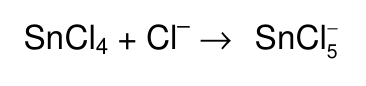
and
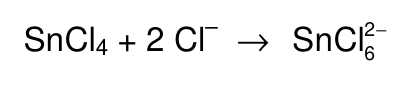
6.2 Draw three alternative geometries for \(\ce{SnCl5^-}\).
6.3 Use Valence Shell Electron Pair Repulsion (VSEPR) theory to predict which geometry is likely to be preferred for \(\ce{SnCl5^-}\).
6.4 Draw three alternative geometries for \(\ce{SnCl6^2-}\).
6.5 Use VSEPR theory to predict which of these geometries is likely to be preferred for \(\ce{SnCl6^2-}\).
A solution containing \(\ce{SnCl6^2-}\) (as the tetrabutylammonium salt) was examined by negative ion electrospray mass spectrometry (ESMS). The spectrum contains a single peak at \(m/z = 295\).
You may assume that the only isotopes observed in this species are \(\ce{^{120}Sn}\) and \(\ce{^{35}Cl}\).
6.6 Write the empirical formula for the tin-containing species detected by this technique.
A solution containing \(\ce{SnBr6^2-}\) (as the tetrabutylammonium salt) was examined by negative ion electrospray mass spectrometry (ESMS). The spectrum contains a single peak at \(m/z=515\).
You may assume that the only isotopes observed in this species are \(\ce{^{120}Sn}\) and \(\ce{^{79}Br}\).
6.7 Write the formula for the tin-containing species detected by this technique.
The ESMS spectrum of a solution made by mixing equimolar amounts of \(\ce{SnCl6^2-}\) and \(\ce{SnBr6^2-}\) (as tetrabutylammonium salts) shows six major species (Fig. 1).
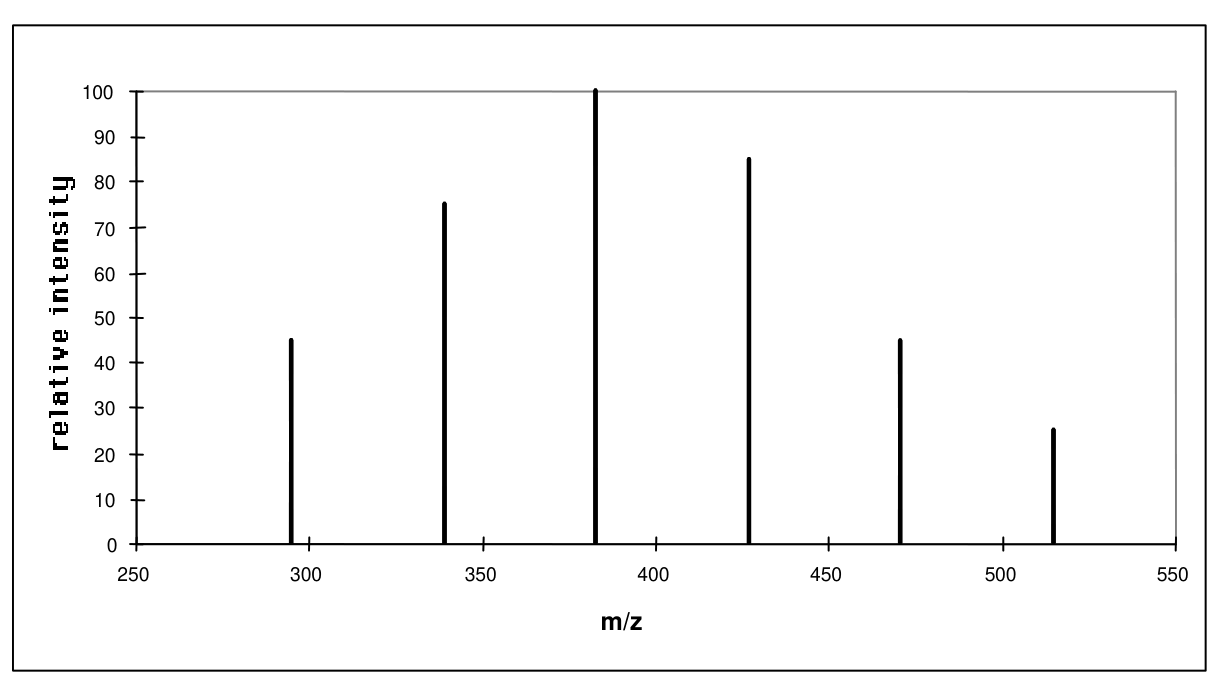
Fig. 1
6.8 Write the empirical formula for each of the four new species.
\(\ce{^{1}H}\) and \(\ce{^{13}C}\) NMR spectroscopy of molecules enable detection of a separate signal for each proton and \(\ce{^{13}C}\) nucleus which is in a different environment. These signals are recorded on dimensionless parts per million (ppm) scale relative to some agreed standard reference compound. Similarly, \(\ce{^{119}Sn}\) NMR gives a signal for each tin atom which is in a different environment.
The \(\ce{^{119}Sn}\) NMR spectrum of a solution of \(\ce{SnCl6^2-}\) (as the tetrabutylammonium salt) contains only one signal which occurs at \(-732\) ppm (relative to tetramethyltin, \(\ce{Me4Sn}\)). The \(\ce{^{119}Sn}\) NMR spectrum of a solution of \(\ce{SnBr6^2-}\) (as the tetrabutylammonium salt) occurs at \(2064\) ppm. The \(\ce{^{119}Sn}\) NMR spectrum at \(60~^\circ\mathrm{C}\) of a solution formed by mixing equimolar amounts of \(\ce{SnCl6^2-}\) and \(\ce{SnBr6^2-}\) contains seven peaks (Fig. 2).
6.9 Write the empirical formula for the tin-containing species in this mixture that give rise to the peaks listed on the answer template.
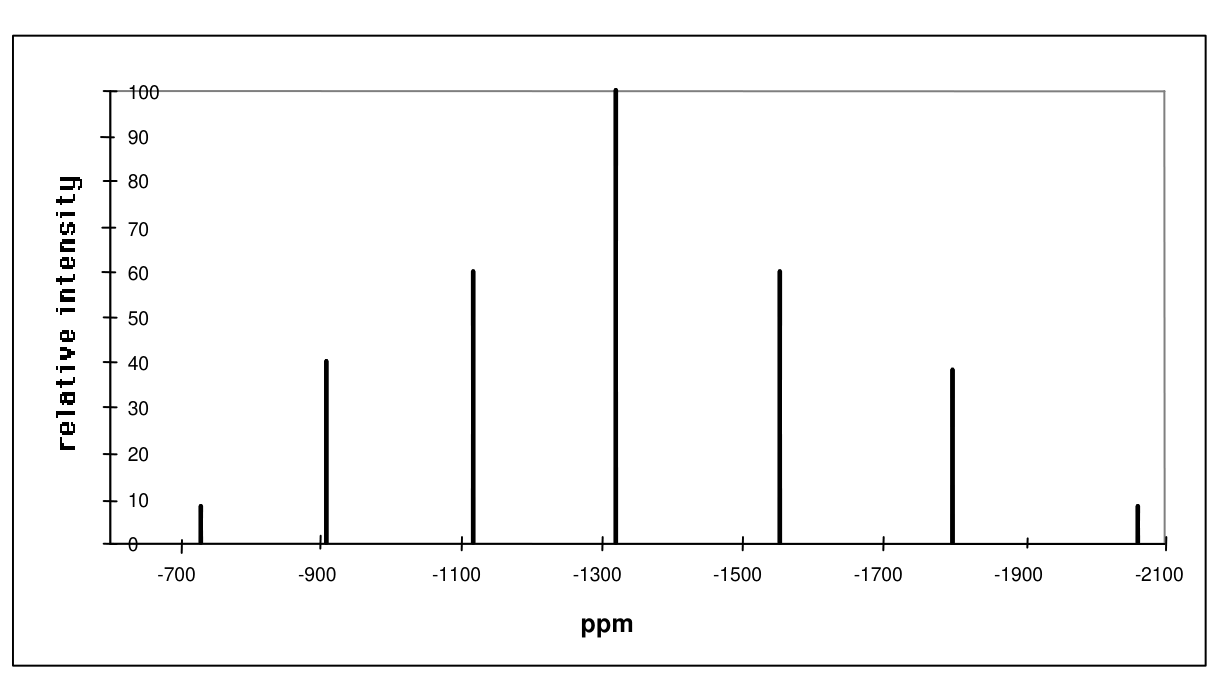
Fig. 2
Cooling the solution causes a change to this \(\ce{^{119}Sn}\) NMR spectrum and at \(-30~^\circ\mathrm{C}\) ten peaks are observed (Fig. 3).
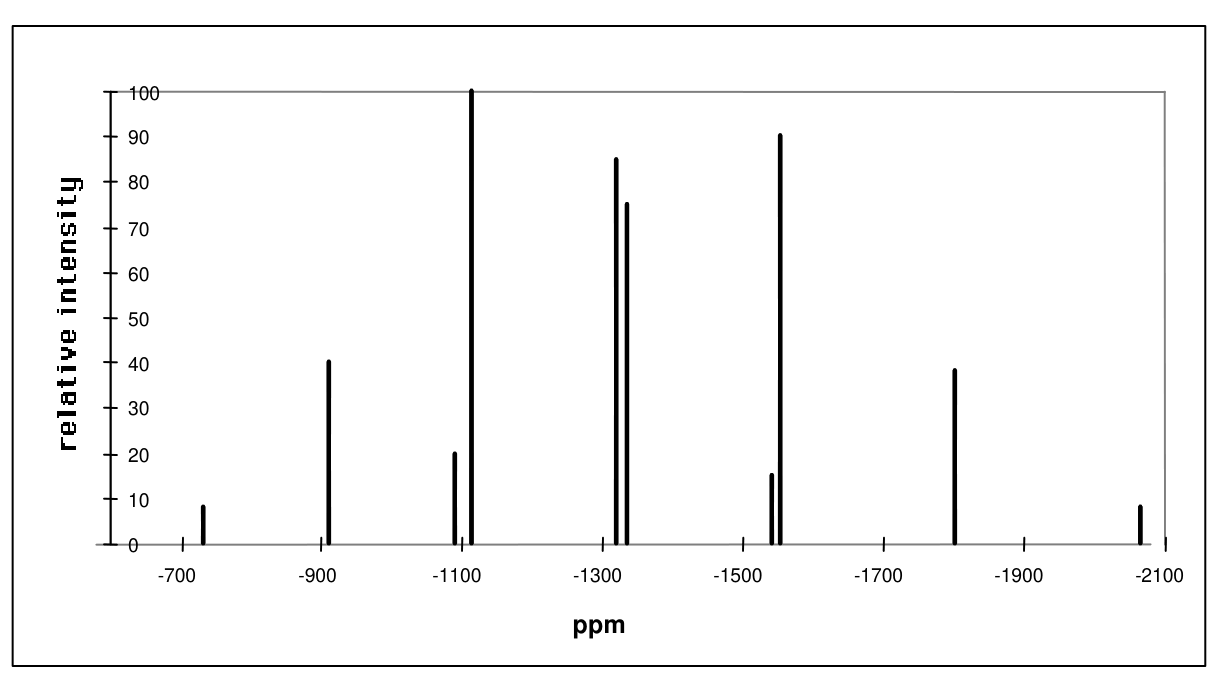
Fig. 3
6.10 Draw the geometry for the four tin-containing species present in this solution at \(-30~^\circ\mathrm{C}\) that give rise to the peaks at \(-1092\) and \(-1115\), \(-1322\) and \(-1336\) ppm.
Official English text of the problem.
Answers
The SMILES below use single bonds to represent connectivity. Their formal negative charge is placed on Sn; the tin oxidation state remains \(+4\). Coordination geometry is specified separately. The isomer-specific SMILES in 6.10 use extended octahedral stereochemistry notation, @OH1.
-
6.1 Tin(IV) chloride, \(\ce{SnCl4}\),
Cl[Sn](Cl)(Cl)Cl: tetrahedral and square planar. -
6.2 Pentachloridostannate(IV), \(\ce{[SnCl5]^-}\),
Cl[Sn-](Cl)(Cl)(Cl)Cl: trigonal bipyramidal, square pyramidal, and pentagonal planar. -
6.3 Trigonal bipyramidal, corresponding to \(\mathrm{AX_5}\).
-
6.4 Hexachloridostannate(IV), \(\ce{[SnCl6]^2-}\),
Cl[Sn-2](Cl)(Cl)(Cl)(Cl)Cl: octahedral, trigonal prismatic, and hexagonal planar. -
6.5 Octahedral, corresponding to \(\mathrm{AX_6}\).
-
6.6 \(\ce{[SnCl5]^-}\), pentachloridostannate(IV),
Cl[Sn-](Cl)(Cl)(Cl)Cl; nominal \(m/z=295\). -
6.7 \(\ce{[SnBr5]^-}\), pentabromidostannate(IV),
Br[Sn-](Br)(Br)(Br)Br; nominal \(m/z=515\). -
6.8 The four new ions are:
\(m/z\) Formula Name SMILES 339 \(\ce{[SnCl4Br]^-}\) Bromidotetrachloridostannate(IV) Br[Sn-](Cl)(Cl)(Cl)Cl383 \(\ce{[SnCl3Br2]^-}\) Dibromidotrichloridostannate(IV) Br[Sn-](Br)(Cl)(Cl)Cl427 \(\ce{[SnCl2Br3]^-}\) Tribromidodichloridostannate(IV) Br[Sn-](Br)(Br)(Cl)Cl471 \(\ce{[SnClBr4]^-}\) Tetrabromidochloridostannate(IV) Br[Sn-](Br)(Br)(Br)Cl -
6.9 The seven assignments, from left to right in Fig. 2, are:
Peak Formula Name SMILES 1, \(-732\) ppm \(\ce{[SnCl6]^2-}\) Hexachloridostannate(IV) Cl[Sn-2](Cl)(Cl)(Cl)(Cl)Cl2 \(\ce{[SnCl5Br]^2-}\) Bromidopentachloridostannate(IV) Br[Sn-2](Cl)(Cl)(Cl)(Cl)Cl3 \(\ce{[SnCl4Br2]^2-}\) Dibromidotetrachloridostannate(IV) Br[Sn-2](Br)(Cl)(Cl)(Cl)Cl4 \(\ce{[SnCl3Br3]^2-}\) Tribromidotrichloridostannate(IV) Br[Sn-2](Br)(Br)(Cl)(Cl)Cl5 \(\ce{[SnCl2Br4]^2-}\) Tetrabromidodichloridostannate(IV) Br[Sn-2](Br)(Br)(Br)(Cl)Cl6 \(\ce{[SnClBr5]^2-}\) Pentabromidochloridostannate(IV) Br[Sn-2](Br)(Br)(Br)(Br)Cl7, \(-2064\) ppm \(\ce{[SnBr6]^2-}\) Hexabromidostannate(IV) Br[Sn-2](Br)(Br)(Br)(Br)Br -
6.10 All four species are octahedral. The assignments are to pairs of peaks, without a unique assignment within either pair:
Peak pair / ppm Isomer Isomer-specific SMILES \(-1092,\,-1115\) cis-Dibromidotetrachloridostannate(IV), \(\ce{[SnCl4Br2]^2-}\) Br[Sn@OH1-2](Br)(Cl)(Cl)(Cl)Cl\(-1092,\,-1115\) trans-Dibromidotetrachloridostannate(IV), \(\ce{[SnCl4Br2]^2-}\) Br[Sn@OH1-2](Cl)(Cl)(Cl)(Cl)Br\(-1322,\,-1336\) fac-Tribromidotrichloridostannate(IV), \(\ce{[SnCl3Br3]^2-}\) Br[Sn@OH1-2](Br)(Br)(Cl)(Cl)Cl\(-1322,\,-1336\) mer-Tribromidotrichloridostannate(IV), \(\ce{[SnCl3Br3]^2-}\) Br[Sn@OH1-2](Br)(Cl)(Cl)(Cl)Br
Solution
The auxiliary ions used below are chloride, \(\ce{Cl^-}\), [Cl-], and bromide, \(\ce{Br^-}\), [Br-]. Tetrabutylammonium, \(\ce{[N(C4H9)4]^+}\), CCCC[N+](CCCC)(CCCC)CCCC, supplies the counterions. Tetramethyltin, \(\ce{Sn(CH3)4}\), C[Sn](C)(C)C, is the NMR reference.
6.1
The two requested drawings can be described as follows:
- Tetrahedral: put Sn at the centre of a regular tetrahedron, with one Cl at each vertex. All \(\ce{Cl-Sn-Cl}\) angles are approximately \(109.5^\circ\).
- Square planar: put Sn at the centre of a square and the four Cl atoms at its vertices. All five atoms lie in one plane; adjacent bond angles are \(90^\circ\), and opposite ones are \(180^\circ\).
These are alternative arrangements for coordination number four. Tetrahedral is the usual geometry of molecular tin(IV) chloride.
6.2
For five ligands, three alternatives are:
- Trigonal bipyramidal: three equatorial Cl atoms surround Sn in a plane at \(120^\circ\) intervals. Two axial Cl atoms lie above and below that plane, with an axial–axial angle of \(180^\circ\) and axial–equatorial angles of \(90^\circ\).
- Square pyramidal: four Cl atoms form a square around Sn in a basal plane; the fifth lies on the perpendicular axis above Sn.
- Pentagonal planar: all five Cl atoms and Sn lie in one plane, with Cl at the vertices of a regular pentagon centred on Sn. Adjacent bond directions differ by \(72^\circ\).
6.3
The Lewis acid–base reaction is
\[ \ce{SnCl4 + Cl^- -> [SnCl5]^-}. \]
The ion has
\[ 4+5(7)+1=40 \]
valence electrons. Giving each terminal chlorine three lone pairs uses \(30\) electrons, leaving \(10\) electrons in five Sn–Cl bonds. Thus the central atom has five bonding pairs and no lone pair, giving the VSEPR designation \(\mathrm{AX_5}\).
The preferred geometry is trigonal bipyramidal. It has six ligand-pair angles of \(90^\circ\), three of \(120^\circ\), and one of \(180^\circ\). A square pyramid has eight \(90^\circ\) pairwise angles, while a planar pentagon introduces \(72^\circ\) separations. The trigonal bipyramid therefore gives the preferred distribution of the five bonding domains.
6.4
Three six-coordinate arrangements are:
- Octahedral: place the ligands along the six directions \(+x,-x,+y,-y,+z,-z\), with Sn at the origin.
- Trigonal prismatic: place three Cl atoms at the vertices of an equilateral triangle above Sn and three at the vertices of an aligned, parallel triangle below it. Corresponding vertices lie directly above one another.
- Hexagonal planar: place all six Cl atoms at the vertices of a regular hexagon, with Sn at its centre in the same plane.
6.5
The overall addition reaction is
\[ \ce{SnCl4 + 2Cl^- -> [SnCl6]^2-}. \]
The total number of valence electrons is
\[ 4+6(7)+2=48. \]
The chlorine lone pairs account for \(36\) electrons, leaving \(12\) electrons in six bonds. Thus the central atom has six bonding domains and no lone pair: \(\mathrm{AX_6}\).
VSEPR predicts an octahedral arrangement. Every pair of bond directions is separated by either \(90^\circ\) or \(180^\circ\). The alternative arrangements introduce smaller separations, including \(60^\circ\) in the planar hexagon.
6.6
Use the given isotope mass numbers as nominal masses in atomic mass units, \(\mathrm{u}\). The numerical \(m/z\) equals the ion’s mass in \(\mathrm{u}\) divided by the magnitude of its charge in elementary-charge units.
For a mononuclear tin(IV) complex containing \(n\) chloride ligands, charge balance gives \(z=4-n\). For an anion,
\[ \frac{120+35n}{n-4}=295. \]
Therefore,
\[ 120+35n=295n-1180 \quad\Longrightarrow\quad n=5,\qquad z=-1. \]
The detected species is pentachloridostannate(IV):
\[ \ce{[SnCl5]^-},\qquad m=\bigl(120+5\times35\bigr)\mathrm{u}=295\,\mathrm{u}, \qquad m/z=295. \]
For comparison, the intact six-coordinate dianion would give
\[ m/z=\frac{120+6(35)}{2}=165, \]
which does not match the observed peak.
A balanced ion transformation consistent with the observation is
\[ \ce{[SnCl6]^2- -> [SnCl5]^- + Cl^-}. \]
This establishes the appropriate composition and charge without requiring a detailed electrospray mechanism.
6.7
Applying the same charge balance to a bromide complex,
\[ \frac{120+79n}{n-4}=515. \]
Hence,
\[ 120+79n=515n-2060 \quad\Longrightarrow\quad n=5,\qquad z=-1. \]
Thus the detected ion is pentabromidostannate(IV):
\[ \ce{[SnBr5]^-},\qquad m=\bigl(120+5\times79\bigr)\mathrm{u}=515\,\mathrm{u}, \qquad m/z=515. \]
The intact dianion would instead give
\[ m/z=\frac{120+6(79)}{2}=297. \]
The corresponding balanced transformation is
\[ \ce{[SnBr6]^2- -> [SnBr5]^- + Br^-}. \]
6.8
The mixed five-coordinate ions have compositions
\[ \ce{[SnCl_{5-n}Br_n]^-},\qquad n=0,1,\ldots,5. \]
Replacing one chlorine isotope by one bromine isotope increases the nominal mass by
\[ 79\,\mathrm{u}-35\,\mathrm{u}=44\,\mathrm{u}. \]
Consequently,
\[ \frac{m}{\mathrm{u}} =120+35(5-n)+79n =295+44n. \]
All these ions have charge \(-1\), giving:
| Number of Br ligands, \(n\) | \(m/z\) | Composition |
|---|---|---|
| 0 | 295 | \(\ce{[SnCl5]^-}\) |
| 1 | 339 | \(\ce{[SnCl4Br]^-}\) |
| 2 | 383 | \(\ce{[SnCl3Br2]^-}\) |
| 3 | 427 | \(\ce{[SnCl2Br3]^-}\) |
| 4 | 471 | \(\ce{[SnClBr4]^-}\) |
| 5 | 515 | \(\ce{[SnBr5]^-}\) |
The four interior peaks therefore correspond to the four mixed-halide ions listed in Answers 6.8.
6.9
NMR observes the six-coordinate complexes present in solution. Halide redistribution produces the seven possible compositions
\[ \ce{[SnCl_{6-n}Br_n]^2-},\qquad n=0,1,\ldots,6. \]
For example, a balanced redistribution is
\[ \ce{[SnCl6]^2- + [SnBr6]^2- <=> [SnCl5Br]^2- + [SnClBr5]^2-}. \]
The all-chloride endpoint is at \(-732\) ppm. Figure 2 places the all-bromide endpoint at approximately \(-2064\) ppm. The progression of intervening resonances is assigned to successive replacement of Cl by Br, giving the left-to-right assignments in Answers 6.9.
At \(60~^\circ\mathrm{C}\), geometrical isomers of a given composition interconvert sufficiently rapidly to give an averaged resonance for that composition. Cooling slows their interconversion and resolves additional signals.
The expected number of distinct octahedral geometrical isomers is:
| Number of Br ligands | Geometrical possibilities | Number of signals when resolved |
|---|---|---|
| 0 | One arrangement | 1 |
| 1 | One arrangement | 1 |
| 2 | cis, trans | 2 |
| 3 | fac, mer | 2 |
| 4 | cis, trans, classified by the two Cl ligands | 2 |
| 5 | One arrangement | 1 |
| 6 | One arrangement | 1 |
| Total | 10 |
Thus the observed change from seven to ten peaks is consistent with resolution of the geometrical isomers of the compositions containing two, three, and four bromide ligands.
6.10
The pair at \(-1092\) and \(-1115\) ppm belongs to the composition \(\ce{[SnCl4Br2]^2-}\), whose two geometrical isomers are cis and trans.
The pair at \(-1322\) and \(-1336\) ppm belongs to \(\ce{[SnCl3Br3]^2-}\), whose two geometrical isomers are fac and mer.
For precise drawings, place Sn at the origin and the six ligand sites along \(+x,-x,+y,-y,+z,-z\). Occupy the sites as follows; every site not occupied by Br is occupied by Cl.
| Isomer | Br positions | Geometrical description |
|---|---|---|
| cis-\(\ce{[SnCl4Br2]^2-}\) | \(+z,+x\) | The two Br ligands are adjacent; \(\ce{Br-Sn-Br}=90^\circ\). |
| trans-\(\ce{[SnCl4Br2]^2-}\) | \(+z,-z\) | The two Br ligands are opposite; \(\ce{Br-Sn-Br}=180^\circ\). |
| fac-\(\ce{[SnCl3Br3]^2-}\) | \(+z,+x,+y\) | The three Br ligands occupy one triangular face. Every Br–Sn–Br angle is \(90^\circ\). |
| mer-\(\ce{[SnCl3Br3]^2-}\) | \(+z,-z,+x\) | Two Br ligands are opposite. All three Br ligands lie in a plane through Sn; their pairwise angles are \(180^\circ,90^\circ,90^\circ\). |
The supplied information identifies these two isomer pairs. It does not uniquely determine which individual resonance in each pair belongs to which isomer. Relative peak heights alone cannot establish that assignment without additional assumptions about populations and NMR response.
The solution was checked against the official solution.
IChO 1998 · Theorieaufgabe 6
Zinn(IV)-Halogenidkomplexe: Geometrie, Elektrospray-MS und 119Sn-NMR
Anders als Kohlenstoff kann Zinn seine Koordinationszahl über vier hinaus erhöhen. Wie Kohlenstoff bildet Zinn ein Chlorid, \(\ce{SnCl4}\).
6.1 Zeichnen Sie zwei alternative Geometrien für \(\ce{SnCl4}\).
Lewis-Säuren wie \(\ce{SnCl4}\) reagieren mit Lewis-Basen wie Chloridionen oder Aminen. Im Fall von Chlorid werden die folgenden beiden Reaktionen beobachtet.
und
6.2 Zeichnen Sie drei alternative Geometrien für \(\ce{SnCl5^-}\).
6.3 Sagen Sie mithilfe des Elektronenpaarabstoßungsmodells der Valenzschale (VSEPR-Theorie) voraus, welche Geometrie für \(\ce{SnCl5^-}\) vermutlich bevorzugt wird.
6.4 Zeichnen Sie drei alternative Geometrien für \(\ce{SnCl6^2-}\).
6.5 Sagen Sie mithilfe der VSEPR-Theorie voraus, welche dieser Geometrien für \(\ce{SnCl6^2-}\) vermutlich bevorzugt wird.
Eine Lösung, die \(\ce{SnCl6^2-}\) (als Tetrabutylammoniumsalz) enthält, wurde mittels Elektrospray-Massenspektrometrie im Negativionenmodus (ESMS) untersucht. Das Spektrum enthält einen einzigen Peak bei \(m/z = 295\).
Sie dürfen annehmen, dass die einzigen in dieser Spezies beobachteten Isotope \(\ce{^{120}Sn}\) und \(\ce{^{35}Cl}\) sind.
6.6 Geben Sie die Verhältnisformel der mit dieser Methode nachgewiesenen zinnhaltigen Spezies an.
Eine Lösung, die \(\ce{SnBr6^2-}\) (als Tetrabutylammoniumsalz) enthält, wurde mittels Elektrospray-Massenspektrometrie im Negativionenmodus (ESMS) untersucht. Das Spektrum enthält einen einzigen Peak bei \(m/z=515\).
Sie dürfen annehmen, dass die einzigen in dieser Spezies beobachteten Isotope \(\ce{^{120}Sn}\) und \(\ce{^{79}Br}\) sind.
6.7 Geben Sie die Formel der mit dieser Methode nachgewiesenen zinnhaltigen Spezies an.
Das ESMS-Spektrum einer Lösung, die durch Mischen äquimolarer Mengen von \(\ce{SnCl6^2-}\) und \(\ce{SnBr6^2-}\) (als Tetrabutylammoniumsalze) hergestellt wurde, zeigt sechs Hauptspezies (Abb. 1).
Abb. 1
6.8 Geben Sie die Verhältnisformel jeder der vier neuen Spezies an.
Die \(\ce{^{1}H}\)- und \(\ce{^{13}C}\)-NMR-Spektroskopie von Molekülen ermöglicht den Nachweis eines gesonderten Signals für jedes Proton und jeden \(\ce{^{13}C}\)-Kern, das bzw. der sich in einer unterschiedlichen Umgebung befindet. Diese Signale werden auf einer dimensionslosen Skala in Teilen pro Million (ppm) relativ zu einer vereinbarten Standardreferenzverbindung aufgezeichnet. Entsprechend liefert die \(\ce{^{119}Sn}\)-NMR-Spektroskopie ein Signal für jedes Zinnatom, das sich in einer unterschiedlichen Umgebung befindet.
Das \(\ce{^{119}Sn}\)-NMR-Spektrum einer Lösung von \(\ce{SnCl6^2-}\) (als Tetrabutylammoniumsalz) enthält nur ein Signal, das bei \(-732\) ppm auftritt (relativ zu Tetramethylzinn, \(\ce{Me4Sn}\)). Das \(\ce{^{119}Sn}\)-NMR-Spektrum einer Lösung von \(\ce{SnBr6^2-}\) (als Tetrabutylammoniumsalz) zeigt ein Signal bei \(2064\) ppm. Das bei \(60~^\circ\mathrm{C}\) aufgenommene \(\ce{^{119}Sn}\)-NMR-Spektrum einer Lösung, die durch Mischen äquimolarer Mengen von \(\ce{SnCl6^2-}\) und \(\ce{SnBr6^2-}\) hergestellt wurde, enthält sieben Peaks (Abb. 2).
6.9 Geben Sie die Verhältnisformeln der zinnhaltigen Spezies in diesem Gemisch an, die die auf dem Antwortbogen aufgeführten Peaks verursachen.
Abb. 2
Beim Abkühlen der Lösung verändert sich dieses \(\ce{^{119}Sn}\)-NMR-Spektrum, und bei \(-30~^\circ\mathrm{C}\) werden zehn Peaks beobachtet (Abb. 3).
Abb. 3
6.10 Zeichnen Sie die Geometrie der vier zinnhaltigen Spezies, die bei \(-30~^\circ\mathrm{C}\) in dieser Lösung vorliegen und die Peaks bei \(-1092\) und \(-1115\), \(-1322\) und \(-1336\) ppm verursachen.
Aufgabentext aus dem offiziellen englischen Text übersetzt.
Antworten
Die folgenden SMILES verwenden Einfachbindungen zur Darstellung der Konnektivität. Ihre formale negative Ladung ist am Sn lokalisiert; die Oxidationsstufe des Zinns bleibt \(+4\). Die Koordinationsgeometrie wird gesondert angegeben. Die isomerspezifischen SMILES in 6.10 verwenden die erweiterte Notation für oktaedrische Stereochemie, @OH1.
-
6.1 Zinn(IV)-chlorid, \(\ce{SnCl4}\),
Cl[Sn](Cl)(Cl)Cl: tetraedrisch und quadratisch-planar. -
6.2 Pentachloridostannat(IV), \(\ce{[SnCl5]^-}\),
Cl[Sn-](Cl)(Cl)(Cl)Cl: trigonal-bipyramidal, quadratisch-pyramidal und pentagonal-planar. -
6.3 Trigonal-bipyramidal, entsprechend \(\mathrm{AX_5}\).
-
6.4 Hexachloridostannat(IV), \(\ce{[SnCl6]^2-}\),
Cl[Sn-2](Cl)(Cl)(Cl)(Cl)Cl: oktaedrisch, trigonal-prismatisch und hexagonal-planar. -
6.5 Oktaedrisch, entsprechend \(\mathrm{AX_6}\).
-
6.6 \(\ce{[SnCl5]^-}\), Pentachloridostannat(IV),
Cl[Sn-](Cl)(Cl)(Cl)Cl; nominales \(m/z=295\). -
6.7 \(\ce{[SnBr5]^-}\), Pentabromidostannat(IV),
Br[Sn-](Br)(Br)(Br)Br; nominales \(m/z=515\). -
6.8 Die vier neuen Ionen sind:
\(m/z\) Formel Name SMILES 339 \(\ce{[SnCl4Br]^-}\) Bromidotetrachloridostannat(IV) Br[Sn-](Cl)(Cl)(Cl)Cl383 \(\ce{[SnCl3Br2]^-}\) Dibromidotrichloridostannat(IV) Br[Sn-](Br)(Cl)(Cl)Cl427 \(\ce{[SnCl2Br3]^-}\) Tribromidodichloridostannat(IV) Br[Sn-](Br)(Br)(Cl)Cl471 \(\ce{[SnClBr4]^-}\) Tetrabromidochloridostannat(IV) Br[Sn-](Br)(Br)(Br)Cl -
6.9 Die sieben Zuordnungen, von links nach rechts in Abb. 2, lauten:
Peak Formel Name SMILES 1, \(-732\) ppm \(\ce{[SnCl6]^2-}\) Hexachloridostannat(IV) Cl[Sn-2](Cl)(Cl)(Cl)(Cl)Cl2 \(\ce{[SnCl5Br]^2-}\) Bromidopentachloridostannat(IV) Br[Sn-2](Cl)(Cl)(Cl)(Cl)Cl3 \(\ce{[SnCl4Br2]^2-}\) Dibromidotetrachloridostannat(IV) Br[Sn-2](Br)(Cl)(Cl)(Cl)Cl4 \(\ce{[SnCl3Br3]^2-}\) Tribromidotrichloridostannat(IV) Br[Sn-2](Br)(Br)(Cl)(Cl)Cl5 \(\ce{[SnCl2Br4]^2-}\) Tetrabromidodichloridostannat(IV) Br[Sn-2](Br)(Br)(Br)(Cl)Cl6 \(\ce{[SnClBr5]^2-}\) Pentabromidochloridostannat(IV) Br[Sn-2](Br)(Br)(Br)(Br)Cl7, \(-2064\) ppm \(\ce{[SnBr6]^2-}\) Hexabromidostannat(IV) Br[Sn-2](Br)(Br)(Br)(Br)Br -
6.10 Alle vier Spezies sind oktaedrisch. Die Zuordnungen beziehen sich auf Peakpaare, ohne eindeutige Zuordnung innerhalb eines der beiden Paare:
Peakpaar / ppm Isomer Isomerspezifische SMILES \(-1092,\,-1115\) cis-Dibromidotetrachloridostannat(IV), \(\ce{[SnCl4Br2]^2-}\) Br[Sn@OH1-2](Br)(Cl)(Cl)(Cl)Cl\(-1092,\,-1115\) trans-Dibromidotetrachloridostannat(IV), \(\ce{[SnCl4Br2]^2-}\) Br[Sn@OH1-2](Cl)(Cl)(Cl)(Cl)Br\(-1322,\,-1336\) fac-Tribromidotrichloridostannat(IV), \(\ce{[SnCl3Br3]^2-}\) Br[Sn@OH1-2](Br)(Br)(Cl)(Cl)Cl\(-1322,\,-1336\) mer-Tribromidotrichloridostannat(IV), \(\ce{[SnCl3Br3]^2-}\) Br[Sn@OH1-2](Br)(Cl)(Cl)(Cl)Br
Lösung
Die im Folgenden verwendeten Hilfsionen sind Chlorid, \(\ce{Cl^-}\), [Cl-], und Bromid, \(\ce{Br^-}\), [Br-]. Tetrabutylammonium, \(\ce{[N(C4H9)4]^+}\), CCCC[N+](CCCC)(CCCC)CCCC, liefert die Gegenionen. Tetramethylzinn, \(\ce{Sn(CH3)4}\), C[Sn](C)(C)C, ist die NMR-Referenz.
6.1
Die beiden geforderten Zeichnungen lassen sich wie folgt beschreiben:
- Tetraedrisch: Sn wird in die Mitte eines regelmäßigen Tetraeders gesetzt, mit je einem Cl an jeder Ecke. Alle \(\ce{Cl-Sn-Cl}\)-Winkel betragen ungefähr \(109.5^\circ\).
- Quadratisch-planar: Sn wird in die Mitte eines Quadrats gesetzt und die vier Cl-Atome an dessen Ecken. Alle fünf Atome liegen in einer Ebene; die Winkel zwischen benachbarten Bindungen betragen \(90^\circ\), diejenigen zwischen gegenüberliegenden Bindungen \(180^\circ\).
Dies sind alternative Anordnungen für die Koordinationszahl vier. Tetraedrisch ist die übliche Geometrie von molekularem Zinn(IV)-chlorid.
6.2
Für fünf Liganden gibt es drei Alternativen:
- Trigonal-bipyramidal: Drei äquatoriale Cl-Atome umgeben Sn in einer Ebene in Winkelabständen von \(120^\circ\). Zwei axiale Cl-Atome liegen oberhalb und unterhalb dieser Ebene, wobei der Winkel zwischen den axialen Bindungen \(180^\circ\) und die Winkel zwischen axialen und äquatorialen Bindungen \(90^\circ\) betragen.
- Quadratisch-pyramidal: Vier Cl-Atome bilden in einer Basisebene ein Quadrat um Sn; das fünfte liegt auf der senkrechten Achse oberhalb von Sn.
- Pentagonal-planar: Alle fünf Cl-Atome und Sn liegen in einer Ebene, wobei sich die Cl-Atome an den Ecken eines regelmäßigen Fünfecks mit Sn im Mittelpunkt befinden. Benachbarte Bindungsrichtungen unterscheiden sich um \(72^\circ\).
6.3
Die Lewis-Säure-Base-Reaktion lautet
\[ \ce{SnCl4 + Cl^- -> [SnCl5]^-}. \]
Das Ion besitzt
\[ 4+5(7)+1=40 \]
Valenzelektronen. Werden jedem endständigen Chloratom drei freie Elektronenpaare zugeordnet, so werden dafür \(30\) Elektronen benötigt; es verbleiben \(10\) Elektronen in fünf Sn–Cl-Bindungen. Das Zentralatom besitzt somit fünf bindende Elektronenpaare und kein freies Elektronenpaar, woraus sich die VSEPR-Bezeichnung \(\mathrm{AX_5}\) ergibt.
Die bevorzugte Geometrie ist trigonal-bipyramidal. Sie weist sechs Winkel zwischen Ligandenpaaren von \(90^\circ\), drei von \(120^\circ\) und einen von \(180^\circ\) auf. Eine quadratische Pyramide hat acht paarweise Winkel von \(90^\circ\), während ein planares Fünfeck Winkelabstände von \(72^\circ\) aufweist. Die trigonale Bipyramide ergibt daher die bevorzugte Verteilung der fünf bindenden Elektronendomänen.
6.4
Drei Anordnungen mit der Koordinationszahl sechs sind:
- Oktaedrisch: Die Liganden werden entlang der sechs Richtungen \(+x,-x,+y,-y,+z,-z\) angeordnet, mit Sn im Ursprung.
- Trigonal-prismatisch: Drei Cl-Atome werden an die Ecken eines gleichseitigen Dreiecks oberhalb von Sn gesetzt und drei an die Ecken eines parallel dazu und gleich ausgerichteten Dreiecks unterhalb davon. Entsprechende Ecken liegen unmittelbar übereinander.
- Hexagonal-planar: Alle sechs Cl-Atome werden an die Ecken eines regelmäßigen Sechsecks gesetzt, mit Sn in dessen Mittelpunkt in derselben Ebene.
6.5
Die gesamte Additionsreaktion lautet
\[ \ce{SnCl4 + 2Cl^- -> [SnCl6]^2-}. \]
Die Gesamtzahl der Valenzelektronen beträgt
\[ 4+6(7)+2=48. \]
Auf die freien Elektronenpaare der Chloratome entfallen \(36\) Elektronen; es verbleiben \(12\) Elektronen in sechs Bindungen. Das Zentralatom besitzt somit sechs bindende Elektronendomänen und kein freies Elektronenpaar: \(\mathrm{AX_6}\).
Die VSEPR-Theorie sagt eine oktaedrische Anordnung voraus. Jedes Paar von Bindungsrichtungen schließt entweder einen Winkel von \(90^\circ\) oder von \(180^\circ\) ein. Die alternativen Anordnungen weisen kleinere Winkelabstände auf, darunter \(60^\circ\) im planaren Sechseck.
6.6
Die angegebenen Isotopenmassenzahlen werden als nominale Massen in atomaren Masseneinheiten, \(\mathrm{u}\), verwendet. Der Zahlenwert von \(m/z\) entspricht der Masse des Ions in \(\mathrm{u}\), geteilt durch den Betrag seiner Ladung in Einheiten der Elementarladung.
Für einen einkernigen Zinn(IV)-Komplex mit \(n\) Chloridliganden ergibt die Ladungsbilanz \(z=4-n\). Für ein Anion gilt
\[ \frac{120+35n}{n-4}=295. \]
Daher gilt
\[ 120+35n=295n-1180 \quad\Longrightarrow\quad n=5,\qquad z=-1. \]
Die nachgewiesene Spezies ist Pentachloridostannat(IV):
\[ \ce{[SnCl5]^-},\qquad m=\bigl(120+5\times35\bigr)\mathrm{u}=295\,\mathrm{u}, \qquad m/z=295. \]
Zum Vergleich würde das intakte sechsfach koordinierte Dianion
\[ m/z=\frac{120+6(35)}{2}=165, \]
ergeben, was nicht mit dem beobachteten Peak übereinstimmt.
Eine ausgeglichene Ionenumwandlung, die mit der Beobachtung vereinbar ist, lautet
\[ \ce{[SnCl6]^2- -> [SnCl5]^- + Cl^-}. \]
Damit sind die passende Zusammensetzung und Ladung bestimmt, ohne dass ein detaillierter Elektrospray-Mechanismus erforderlich ist.
6.7
Wendet man dieselbe Ladungsbilanz auf einen Bromidkomplex an, so gilt
\[ \frac{120+79n}{n-4}=515. \]
Daraus folgt
\[ 120+79n=515n-2060 \quad\Longrightarrow\quad n=5,\qquad z=-1. \]
Das nachgewiesene Ion ist somit Pentabromidostannat(IV):
\[ \ce{[SnBr5]^-},\qquad m=\bigl(120+5\times79\bigr)\mathrm{u}=515\,\mathrm{u}, \qquad m/z=515. \]
Das intakte Dianion würde hingegen Folgendes ergeben:
\[ m/z=\frac{120+6(79)}{2}=297. \]
Die entsprechende ausgeglichene Umwandlung lautet
\[ \ce{[SnBr6]^2- -> [SnBr5]^- + Br^-}. \]
6.8
Die gemischten fünffach koordinierten Ionen haben die Zusammensetzungen
\[ \ce{[SnCl_{5-n}Br_n]^-},\qquad n=0,1,\ldots,5. \]
Der Ersatz eines Chlorisotops durch ein Bromisotop erhöht die nominale Masse um
\[ 79\,\mathrm{u}-35\,\mathrm{u}=44\,\mathrm{u}. \]
Folglich gilt
\[ \frac{m}{\mathrm{u}} =120+35(5-n)+79n =295+44n. \]
Alle diese Ionen haben die Ladung \(-1\), woraus sich ergibt:
| Anzahl der Br-Liganden, \(n\) | \(m/z\) | Zusammensetzung |
|---|---|---|
| 0 | 295 | \(\ce{[SnCl5]^-}\) |
| 1 | 339 | \(\ce{[SnCl4Br]^-}\) |
| 2 | 383 | \(\ce{[SnCl3Br2]^-}\) |
| 3 | 427 | \(\ce{[SnCl2Br3]^-}\) |
| 4 | 471 | \(\ce{[SnClBr4]^-}\) |
| 5 | 515 | \(\ce{[SnBr5]^-}\) |
Die vier inneren Peaks entsprechen daher den vier in Antworten 6.8 aufgeführten Ionen mit gemischten Halogenidliganden.
6.9
Mit NMR werden die in Lösung vorliegenden sechsfach koordinierten Komplexe beobachtet. Durch Umverteilung der Halogenidliganden entstehen die sieben möglichen Zusammensetzungen
\[ \ce{[SnCl_{6-n}Br_n]^2-},\qquad n=0,1,\ldots,6. \]
Eine ausgeglichene Umverteilungsreaktion lautet beispielsweise
\[ \ce{[SnCl6]^2- + [SnBr6]^2- <=> [SnCl5Br]^2- + [SnClBr5]^2-}. \]
Der ausschließlich Chlorid enthaltende Endpunkt liegt bei \(-732\) ppm. In Abbildung 2 liegt der ausschließlich Bromid enthaltende Endpunkt bei ungefähr \(-2064\) ppm. Die Abfolge der dazwischenliegenden Resonanzen wird dem schrittweisen Ersatz von Cl durch Br zugeordnet, woraus sich die Zuordnungen von links nach rechts in Antworten 6.9 ergeben.
Bei \(60~^\circ\mathrm{C}\) wandeln sich geometrische Isomere einer gegebenen Zusammensetzung hinreichend schnell ineinander um, sodass eine gemittelte Resonanz für diese Zusammensetzung entsteht. Beim Abkühlen verlangsamt sich ihre gegenseitige Umwandlung, und zusätzliche Signale werden aufgelöst.
Die erwartete Anzahl unterschiedlicher oktaedrischer geometrischer Isomere beträgt:
| Anzahl der Br-Liganden | Geometrische Möglichkeiten | Anzahl der Signale bei vollständiger Auflösung |
|---|---|---|
| 0 | Eine Anordnung | 1 |
| 1 | Eine Anordnung | 1 |
| 2 | cis, trans | 2 |
| 3 | fac, mer | 2 |
| 4 | cis, trans, anhand der beiden Cl-Liganden klassifiziert | 2 |
| 5 | Eine Anordnung | 1 |
| 6 | Eine Anordnung | 1 |
| Gesamt | 10 |
Die beobachtete Änderung von sieben auf zehn Peaks ist somit mit der Auflösung der geometrischen Isomere der Zusammensetzungen mit zwei, drei und vier Bromidliganden vereinbar.
6.10
Das Paar bei \(-1092\) und \(-1115\) ppm gehört zur Zusammensetzung \(\ce{[SnCl4Br2]^2-}\), deren zwei geometrische Isomere cis und trans sind.
Das Paar bei \(-1322\) und \(-1336\) ppm gehört zu \(\ce{[SnCl3Br3]^2-}\), dessen zwei geometrische Isomere fac und mer sind.
Für präzise Zeichnungen wird Sn in den Ursprung gesetzt, und die sechs Ligandenplätze werden entlang \(+x,-x,+y,-y,+z,-z\) angeordnet. Die Plätze werden wie folgt besetzt; jeder nicht mit Br besetzte Platz wird mit Cl besetzt.
| Isomer | Br-Positionen | Geometrische Beschreibung |
|---|---|---|
| cis-\(\ce{[SnCl4Br2]^2-}\) | \(+z,+x\) | Die beiden Br-Liganden sind benachbart; \(\ce{Br-Sn-Br}=90^\circ\). |
| trans-\(\ce{[SnCl4Br2]^2-}\) | \(+z,-z\) | Die beiden Br-Liganden liegen einander gegenüber; \(\ce{Br-Sn-Br}=180^\circ\). |
| fac-\(\ce{[SnCl3Br3]^2-}\) | \(+z,+x,+y\) | Die drei Br-Liganden besetzen eine Dreiecksfläche. Jeder Br–Sn–Br-Winkel beträgt \(90^\circ\). |
| mer-\(\ce{[SnCl3Br3]^2-}\) | \(+z,-z,+x\) | Zwei Br-Liganden liegen einander gegenüber. Alle drei Br-Liganden liegen in einer Ebene durch Sn; ihre paarweisen Winkel betragen \(180^\circ,90^\circ,90^\circ\). |
Die bereitgestellten Informationen identifizieren diese beiden Isomerenpaare. Sie legen nicht eindeutig fest, welche einzelne Resonanz innerhalb eines Paares zu welchem Isomer gehört. Relative Peakhöhen allein erlauben diese Zuordnung ohne zusätzliche Annahmen über die Populationen und das NMR-Ansprechverhalten nicht.
Die Lösung wurde mit der offiziellen Lösung abgeglichen.
IChO 1998 · Teori sorusu 6
Kalay(IV) halojenür kompleksleri: geometri, elektrosprey MS ve 119Sn NMR
Karbonun aksine kalay, koordinasyon sayısını dördün üzerine çıkarabilir. Karbon gibi kalay da bir klorür bileşiği, \(\ce{SnCl4}\), oluşturur.
6.1 \(\ce{SnCl4}\) için iki alternatif geometri çiziniz.
\(\ce{SnCl4}\) gibi Lewis asitleri, klorür iyonu veya aminler gibi Lewis bazlarıyla tepkimeye girer. Klorür durumunda aşağıdaki iki tepkime gözlenir.
ve
6.2 \(\ce{SnCl5^-}\) için üç alternatif geometri çiziniz.
6.3 Değerlik Kabuğu Elektron Çifti İtmesi (VSEPR) kuramını kullanarak \(\ce{SnCl5^-}\) için hangi geometrinin tercih edilmesinin olası olduğunu öngörünüz.
6.4 \(\ce{SnCl6^2-}\) için üç alternatif geometri çiziniz.
6.5 VSEPR kuramını kullanarak bu geometrilerden hangisinin \(\ce{SnCl6^2-}\) için tercih edilmesinin olası olduğunu öngörünüz.
\(\ce{SnCl6^2-}\) içeren bir çözelti (tetrabütilamonyum tuzu olarak), negatif iyon elektrosprey kütle spektrometrisi (ESMS) ile incelenmiştir. Spektrumda \(m/z = 295\) değerinde tek bir pik bulunmaktadır.
Bu türde gözlenen tek izotopların \(\ce{^{120}Sn}\) ve \(\ce{^{35}Cl}\) olduğunu varsayabilirsiniz.
6.6 Bu teknikle saptanan, kalay içeren türün basit formülünü yazınız.
\(\ce{SnBr6^2-}\) içeren bir çözelti (tetrabütilamonyum tuzu olarak), negatif iyon elektrosprey kütle spektrometrisi (ESMS) ile incelenmiştir. Spektrumda \(m/z=515\) değerinde tek bir pik bulunmaktadır.
Bu türde gözlenen tek izotopların \(\ce{^{120}Sn}\) ve \(\ce{^{79}Br}\) olduğunu varsayabilirsiniz.
6.7 Bu teknikle saptanan, kalay içeren türün formülünü yazınız.
Eşmolar miktarlarda \(\ce{SnCl6^2-}\) ve \(\ce{SnBr6^2-}\) (tetrabütilamonyum tuzları olarak) karıştırılarak hazırlanan bir çözeltinin ESMS spektrumunda altı ana tür görülmektedir (Şekil 1).
Şekil 1
6.8 Dört yeni türün her birinin basit formülünü yazınız.
Moleküllerin \(\ce{^{1}H}\) ve \(\ce{^{13}C}\) NMR spektroskopisi, farklı bir çevrede bulunan her bir proton ve \(\ce{^{13}C}\) çekirdeği için ayrı bir sinyal saptanmasını sağlar. Bu sinyaller, üzerinde uzlaşılmış bir standart referans bileşiğe göre boyutsuz milyonda bir (ppm) ölçeğinde kaydedilir. Benzer biçimde, \(\ce{^{119}Sn}\) NMR, farklı bir çevrede bulunan her bir kalay atomu için bir sinyal verir.
\(\ce{SnCl6^2-}\) çözeltisinin (tetrabütilamonyum tuzu olarak) \(\ce{^{119}Sn}\) NMR spektrumu, \(-732\) ppm'de (tetrametilkalaya, \(\ce{Me4Sn}\), göre) görülen tek bir sinyal içerir. \(\ce{SnBr6^2-}\) çözeltisinin (tetrabütilamonyum tuzu olarak) \(\ce{^{119}Sn}\) NMR spektrumu \(2064\) ppm'de görülür. Eşmolar miktarlarda \(\ce{SnCl6^2-}\) ve \(\ce{SnBr6^2-}\) karıştırılarak oluşturulan bir çözeltinin \(60~^\circ\mathrm{C}\)'deki \(\ce{^{119}Sn}\) NMR spektrumu yedi pik içerir (Şekil 2).
6.9 Bu karışımda bulunan ve cevap şablonunda listelenen pikleri oluşturan kalay içeren türlerin basit formüllerini yazınız.
Şekil 2
Çözeltinin soğutulması bu \(\ce{^{119}Sn}\) NMR spektrumunda bir değişime yol açar ve \(-30~^\circ\mathrm{C}\)'de on pik gözlenir (Şekil 3).
Şekil 3
6.10 Bu çözeltide \(-30~^\circ\mathrm{C}\)'de bulunan ve \(-1092\) ile \(-1115\), \(-1322\) ile \(-1336\) ppm'deki pikleri oluşturan, kalay içeren dört türün geometrilerini çiziniz.
Soru metni resmi İngilizce metinden çevrilmiştir.
Cevaplar
Aşağıdaki SMILES gösterimleri, atomların bağlanma düzenini temsil etmek için tekli bağlar kullanır. Formel negatif yükleri Sn üzerine yerleştirilmiştir; kalayın yükseltgenme basamağı \(+4\) olarak kalır. Koordinasyon geometrisi ayrıca belirtilmiştir. 6.10'daki izomere özgü SMILES gösterimleri, genişletilmiş oktahedral stereokimya gösterimi olan @OH1 kullanır.
-
6.1 Kalay(IV) klorür, \(\ce{SnCl4}\),
Cl[Sn](Cl)(Cl)Cl: tetrahedral ve kare düzlemsel. -
6.2 Pentakloridostannat(IV), \(\ce{[SnCl5]^-}\),
Cl[Sn-](Cl)(Cl)(Cl)Cl: üçgen çift piramidal, kare piramidal ve beşgen düzlemsel. -
6.3 \(\mathrm{AX_5}\)'e karşılık gelen üçgen çift piramidal.
-
6.4 Hekzakloridostannat(IV), \(\ce{[SnCl6]^2-}\),
Cl[Sn-2](Cl)(Cl)(Cl)(Cl)Cl: oktahedral, üçgen prizmatik ve altıgen düzlemsel. -
6.5 \(\mathrm{AX_6}\)'ya karşılık gelen oktahedral.
-
6.6 \(\ce{[SnCl5]^-}\), pentakloridostannat(IV),
Cl[Sn-](Cl)(Cl)(Cl)Cl; nominal \(m/z=295\). -
6.7 \(\ce{[SnBr5]^-}\), pentabromidostannat(IV),
Br[Sn-](Br)(Br)(Br)Br; nominal \(m/z=515\). -
6.8 Dört yeni iyon şunlardır:
\(m/z\) Formül Adı SMILES 339 \(\ce{[SnCl4Br]^-}\) Bromidotetrakloridostannat(IV) Br[Sn-](Cl)(Cl)(Cl)Cl383 \(\ce{[SnCl3Br2]^-}\) Dibromidotrikloridostannat(IV) Br[Sn-](Br)(Cl)(Cl)Cl427 \(\ce{[SnCl2Br3]^-}\) Tribromidodikloridostannat(IV) Br[Sn-](Br)(Br)(Cl)Cl471 \(\ce{[SnClBr4]^-}\) Tetrabromidokloridostannat(IV) Br[Sn-](Br)(Br)(Br)Cl -
6.9 Şekil 2'de soldan sağa doğru yedi atama şöyledir:
Pik Formül Adı SMILES 1, \(-732\) ppm \(\ce{[SnCl6]^2-}\) Hekzakloridostannat(IV) Cl[Sn-2](Cl)(Cl)(Cl)(Cl)Cl2 \(\ce{[SnCl5Br]^2-}\) Bromidopentakloridostannat(IV) Br[Sn-2](Cl)(Cl)(Cl)(Cl)Cl3 \(\ce{[SnCl4Br2]^2-}\) Dibromidotetrakloridostannat(IV) Br[Sn-2](Br)(Cl)(Cl)(Cl)Cl4 \(\ce{[SnCl3Br3]^2-}\) Tribromidotrikloridostannat(IV) Br[Sn-2](Br)(Br)(Cl)(Cl)Cl5 \(\ce{[SnCl2Br4]^2-}\) Tetrabromidodikloridostannat(IV) Br[Sn-2](Br)(Br)(Br)(Cl)Cl6 \(\ce{[SnClBr5]^2-}\) Pentabromidokloridostannat(IV) Br[Sn-2](Br)(Br)(Br)(Br)Cl7, \(-2064\) ppm \(\ce{[SnBr6]^2-}\) Hekzabromidostannat(IV) Br[Sn-2](Br)(Br)(Br)(Br)Br -
6.10 Dört türün tamamı oktahedraldir. Atamalar pik çiftlerine yapılmıştır; her iki çiftin kendi içinde tekil bir atama yapılmamıştır:
Pik çifti / ppm İzomer İzomere özgü SMILES \(-1092,\,-1115\) cis-Dibromidotetrakloridostannat(IV), \(\ce{[SnCl4Br2]^2-}\) Br[Sn@OH1-2](Br)(Cl)(Cl)(Cl)Cl\(-1092,\,-1115\) trans-Dibromidotetrakloridostannat(IV), \(\ce{[SnCl4Br2]^2-}\) Br[Sn@OH1-2](Cl)(Cl)(Cl)(Cl)Br\(-1322,\,-1336\) fac-Tribromidotrikloridostannat(IV), \(\ce{[SnCl3Br3]^2-}\) Br[Sn@OH1-2](Br)(Br)(Cl)(Cl)Cl\(-1322,\,-1336\) mer-Tribromidotrikloridostannat(IV), \(\ce{[SnCl3Br3]^2-}\) Br[Sn@OH1-2](Br)(Cl)(Cl)(Cl)Br
Çözüm
Aşağıda kullanılan yardımcı iyonlar klorür, \(\ce{Cl^-}\), [Cl-] ve bromür, \(\ce{Br^-}\), [Br-] iyonlarıdır. Tetrabütilamonyum, \(\ce{[N(C4H9)4]^+}\), CCCC[N+](CCCC)(CCCC)CCCC, karşı iyonları sağlar. Tetrametilkalay, \(\ce{Sn(CH3)4}\), C[Sn](C)(C)C, NMR referansıdır.
6.1
İstenen iki çizim aşağıdaki gibi betimlenebilir:
- Tetrahedral: Sn atomunu düzgün bir tetrahedronun merkezine, her köşeye de bir Cl atomu yerleştiriniz. Tüm \(\ce{Cl-Sn-Cl}\) açıları yaklaşık \(109.5^\circ\)'dir.
- Kare düzlemsel: Sn atomunu bir karenin merkezine, dört Cl atomunu da köşelerine yerleştiriniz. Beş atomun tamamı aynı düzlemde bulunur; komşu bağlar arasındaki açılar \(90^\circ\), karşılıklı bağlar arasındakiler ise \(180^\circ\)'dir.
Bunlar, koordinasyon sayısı dört için alternatif düzenlenmelerdir. Moleküler kalay(IV) klorürün olağan geometrisi tetrahedraldir.
6.2
Beş ligand için üç alternatif şunlardır:
- Üçgen çift piramidal: Üç ekvatoryal Cl atomu, bir düzlemde Sn atomunu \(120^\circ\)'lik aralıklarla çevreler. İki aksiyal Cl atomu bu düzlemin üstünde ve altında yer alır; aksiyal–aksiyal açı \(180^\circ\), aksiyal–ekvatoryal açılar ise \(90^\circ\)'dir.
- Kare piramidal: Dört Cl atomu, taban düzleminde Sn çevresinde bir kare oluşturur; beşinci atom, Sn atomunun üzerinde, düzleme dik eksen boyunca yer alır.
- Beşgen düzlemsel: Beş Cl atomunun tamamı ve Sn aynı düzlemde bulunur; Cl atomları, merkezi Sn olan düzgün bir beşgenin köşelerindedir. Komşu bağ doğrultuları arasındaki açı \(72^\circ\)'dir.
6.3
Lewis asit–baz tepkimesi şöyledir:
\[ \ce{SnCl4 + Cl^- -> [SnCl5]^-}. \]
İyonun değerlik elektronu sayısı
\[ 4+5(7)+1=40 \]
olur. Her uç klor atomuna üç ortaklanmamış elektron çifti verildiğinde \(30\) elektron kullanılır ve beş Sn–Cl bağında \(10\) elektron kalır. Dolayısıyla merkez atomun beş bağ yapan elektron çifti vardır ve ortaklanmamış elektron çifti yoktur; bu da \(\mathrm{AX_5}\) VSEPR gösterimini verir.
Tercih edilen geometri üçgen çift piramidaldir. Bu geometride ligand çiftleri arasında \(90^\circ\)'lik altı açı, \(120^\circ\)'lik üç açı ve \(180^\circ\)'lik bir açı bulunur. Kare piramitte çiftler arasında \(90^\circ\)'lik sekiz açı bulunurken, düzlemsel beşgen \(72^\circ\)'lik açısal ayrımlar oluşturur. Bu nedenle üçgen çift piramit, beş bağ bölgesinin tercih edilen dağılımını sağlar.
6.4
Koordinasyon sayısı altı olan üç düzenlenme şöyledir:
- Oktahedral: Sn atomu orijinde olacak şekilde ligandları \(+x,-x,+y,-y,+z,-z\) yönlerinin altısı boyunca yerleştiriniz.
- Üçgen prizmatik: Üç Cl atomunu Sn atomunun üstünde bir eşkenar üçgenin köşelerine, diğer üçünü ise altta, bu üçgenle hizalı ve ona paralel bir üçgenin köşelerine yerleştiriniz. Karşılık gelen köşeler doğrudan birbirinin üstünde bulunur.
- Altıgen düzlemsel: Altı Cl atomunun tamamını düzgün bir altıgenin köşelerine, Sn atomunu da aynı düzlemde altıgenin merkezine yerleştiriniz.
6.5
Toplam katılma tepkimesi şöyledir:
\[ \ce{SnCl4 + 2Cl^- -> [SnCl6]^2-}. \]
Toplam değerlik elektronu sayısı şöyledir:
\[ 4+6(7)+2=48. \]
Klor atomlarının ortaklanmamış elektron çiftleri \(36\) elektron içerir ve altı bağda \(12\) elektron kalır. Dolayısıyla merkez atomun altı bağ bölgesi vardır ve ortaklanmamış elektron çifti yoktur: \(\mathrm{AX_6}\).
VSEPR, oktahedral bir düzenlenme öngörür. Her bağ doğrultusu çifti arasında ya \(90^\circ\) ya da \(180^\circ\) açı bulunur. Alternatif düzenlenmeler, düzlemsel altıgendeki \(60^\circ\) dahil olmak üzere daha küçük açısal ayrımlar oluşturur.
6.6
Verilen izotop kütle numaralarını atomik kütle birimi, \(\mathrm{u}\), cinsinden nominal kütleler olarak kullanınız. Sayısal \(m/z\) değeri, iyonun \(\mathrm{u}\) cinsinden kütlesinin, temel yük birimi cinsinden yükünün mutlak değerine bölünmesine eşittir.
\(n\) klorür ligandı içeren tek çekirdekli bir kalay(IV) kompleksi için yük dengesi \(z=4-n\) verir. Bir anyon için,
\[ \frac{120+35n}{n-4}=295. \]
Dolayısıyla,
\[ 120+35n=295n-1180 \quad\Longrightarrow\quad n=5,\qquad z=-1. \]
Saptanan tür pentakloridostannat(IV) iyonudur:
\[ \ce{[SnCl5]^-},\qquad m=\bigl(120+5\times35\bigr)\mathrm{u}=295\,\mathrm{u}, \qquad m/z=295. \]
Karşılaştırma için, parçalanmamış, koordinasyon sayısı altı olan dianyon şu değeri verirdi:
\[ m/z=\frac{120+6(35)}{2}=165, \]
bu da gözlenen pikle uyuşmaz.
Gözlemle uyumlu, denkleştirilmiş bir iyon dönüşümü şöyledir:
\[ \ce{[SnCl6]^2- -> [SnCl5]^- + Cl^-}. \]
Bu, ayrıntılı bir elektrosprey mekanizmasına gerek duymadan uygun bileşimi ve yükü belirler.
6.7
Aynı yük dengesi bir bromür kompleksine uygulandığında,
\[ \frac{120+79n}{n-4}=515. \]
Buradan,
\[ 120+79n=515n-2060 \quad\Longrightarrow\quad n=5,\qquad z=-1. \]
Böylece saptanan iyon pentabromidostannat(IV) iyonudur:
\[ \ce{[SnBr5]^-},\qquad m=\bigl(120+5\times79\bigr)\mathrm{u}=515\,\mathrm{u}, \qquad m/z=515. \]
Parçalanmamış dianyon ise şu değeri verirdi:
\[ m/z=\frac{120+6(79)}{2}=297. \]
Buna karşılık gelen denkleştirilmiş dönüşüm şöyledir:
\[ \ce{[SnBr6]^2- -> [SnBr5]^- + Br^-}. \]
6.8
Koordinasyon sayısı beş olan karışık iyonların bileşimleri şöyledir:
\[ \ce{[SnCl_{5-n}Br_n]^-},\qquad n=0,1,\ldots,5. \]
Bir klor izotopunun bir brom izotopuyla değiştirilmesi, nominal kütleyi şu miktarda artırır:
\[ 79\,\mathrm{u}-35\,\mathrm{u}=44\,\mathrm{u}. \]
Sonuç olarak,
\[ \frac{m}{\mathrm{u}} =120+35(5-n)+79n =295+44n. \]
Bu iyonların tümünün yükü \(-1\) olduğundan şu değerler elde edilir:
| Br ligandı sayısı, \(n\) | \(m/z\) | Bileşim |
|---|---|---|
| 0 | 295 | \(\ce{[SnCl5]^-}\) |
| 1 | 339 | \(\ce{[SnCl4Br]^-}\) |
| 2 | 383 | \(\ce{[SnCl3Br2]^-}\) |
| 3 | 427 | \(\ce{[SnCl2Br3]^-}\) |
| 4 | 471 | \(\ce{[SnClBr4]^-}\) |
| 5 | 515 | \(\ce{[SnBr5]^-}\) |
Dolayısıyla aradaki dört pik, Cevaplar 6.8'de listelenen dört karışık halojenür iyonuna karşılık gelir.
6.9
NMR, çözeltide bulunan, koordinasyon sayısı altı olan kompleksleri gözler. Halojenürlerin yeniden dağılımı, olası yedi bileşimi oluşturur:
\[ \ce{[SnCl_{6-n}Br_n]^2-},\qquad n=0,1,\ldots,6. \]
Örneğin, denkleştirilmiş bir yeniden dağılım tepkimesi şöyledir:
\[ \ce{[SnCl6]^2- + [SnBr6]^2- <=> [SnCl5Br]^2- + [SnClBr5]^2-}. \]
Tamamı klorür olan uç bileşimin sinyali \(-732\) ppm'dedir. Şekil 2, tamamı bromür olan uç bileşimin sinyalini yaklaşık \(-2064\) ppm'de gösterir. Aradaki rezonansların sıralanışı, Cl atomlarının art arda Br ile yer değiştirmesine atanır ve Cevaplar 6.9'daki soldan sağa atamaları verir.
\(60~^\circ\mathrm{C}\)'de, belirli bir bileşimin geometrik izomerleri, o bileşim için ortalama bir rezonans verecek kadar hızlı biçimde birbirine dönüşür. Soğutma, birbirine dönüşümlerini yavaşlatır ve ek sinyallerin ayrı ayrı gözlenmesini sağlar.
Beklenen farklı oktahedral geometrik izomer sayısı şöyledir:
| Br ligandı sayısı | Geometrik olasılıklar | Ayrı ayrı gözlendiklerinde sinyal sayısı |
|---|---|---|
| 0 | Tek düzenlenme | 1 |
| 1 | Tek düzenlenme | 1 |
| 2 | cis, trans | 2 |
| 3 | fac, mer | 2 |
| 4 | İki Cl ligandına göre sınıflandırılan cis, trans | 2 |
| 5 | Tek düzenlenme | 1 |
| 6 | Tek düzenlenme | 1 |
| Toplam | 10 |
Dolayısıyla gözlenen yedi pikten on pike geçiş, iki, üç ve dört bromür ligandı içeren bileşimlerin geometrik izomerlerinin ayrı ayrı gözlenmesiyle uyumludur.
6.10
\(-1092\) ve \(-1115\) ppm'deki çift, iki geometrik izomeri cis ve trans olan \(\ce{[SnCl4Br2]^2-}\) bileşimine aittir.
\(-1322\) ve \(-1336\) ppm'deki çift, iki geometrik izomeri fac ve mer olan \(\ce{[SnCl3Br3]^2-}\) bileşimine aittir.
Kesin çizimler için Sn atomunu orijine ve altı ligand konumunu \(+x,-x,+y,-y,+z,-z\) yönleri boyunca yerleştiriniz. Konumları aşağıdaki gibi doldurunuz; Br tarafından doldurulmayan her konum Cl tarafından doldurulur.
| İzomer | Br konumları | Geometrik betimleme |
|---|---|---|
| cis-\(\ce{[SnCl4Br2]^2-}\) | \(+z,+x\) | İki Br ligandı komşudur; \(\ce{Br-Sn-Br}=90^\circ\). |
| trans-\(\ce{[SnCl4Br2]^2-}\) | \(+z,-z\) | İki Br ligandı karşılıklıdır; \(\ce{Br-Sn-Br}=180^\circ\). |
| fac-\(\ce{[SnCl3Br3]^2-}\) | \(+z,+x,+y\) | Üç Br ligandı bir üçgen yüz üzerinde bulunur. Her Br–Sn–Br açısı \(90^\circ\)'dir. |
| mer-\(\ce{[SnCl3Br3]^2-}\) | \(+z,-z,+x\) | İki Br ligandı karşılıklıdır. Üç Br ligandının tamamı Sn atomundan geçen bir düzlemde bulunur; aralarındaki ikili açılar \(180^\circ,90^\circ,90^\circ\)'dir. |
Verilen bilgiler bu iki izomer çiftini belirler. Her çiftteki hangi tekil rezonansın hangi izomere ait olduğunu tek bir biçimde belirlemez. Yalnızca bağıl pik yükseklikleri, izomerlerin popülasyonları ve NMR yanıtı hakkında ek varsayımlar olmadan bu atamayı belirleyemez.
Çözüm, resmi çözümle karşılaştırılarak kontrol edildi.
IChO 1998 · Problema teórico 6
Complejos de haluros de estaño(IV): geometría, espectrometría de masas por electropulverización y RMN de 119Sn
A diferencia del carbono, el estaño puede aumentar su número de coordinación por encima de cuatro. Al igual que el carbono, el estaño forma un cloruro, \(\ce{SnCl4}\).
6.1 Dibuje dos geometrías alternativas para \(\ce{SnCl4}\).
Los ácidos de Lewis, como \(\ce{SnCl4}\), reaccionan con bases de Lewis, como el ion cloruro o las aminas. En el caso del cloruro se observan las dos reacciones siguientes.
y
6.2 Dibuje tres geometrías alternativas para \(\ce{SnCl5^-}\).
6.3 Utilice la teoría de repulsión de pares de electrones de la capa de valencia (VSEPR) para predecir qué geometría es probable que sea la preferida para \(\ce{SnCl5^-}\).
6.4 Dibuje tres geometrías alternativas para \(\ce{SnCl6^2-}\).
6.5 Utilice la teoría VSEPR para predecir cuál de estas geometrías es probable que sea la preferida para \(\ce{SnCl6^2-}\).
Se examinó una disolución que contenía \(\ce{SnCl6^2-}\) (como sal de tetrabutilamonio) mediante espectrometría de masas por electropulverización en modo de iones negativos (ESMS). El espectro contiene un único pico a \(m/z = 295\).
Puede suponer que los únicos isótopos observados en esta especie son \(\ce{^{120}Sn}\) y \(\ce{^{35}Cl}\).
6.6 Escriba la fórmula empírica de la especie que contiene estaño detectada mediante esta técnica.
Se examinó una disolución que contenía \(\ce{SnBr6^2-}\) (como sal de tetrabutilamonio) mediante espectrometría de masas por electropulverización en modo de iones negativos (ESMS). El espectro contiene un único pico a \(m/z=515\).
Puede suponer que los únicos isótopos observados en esta especie son \(\ce{^{120}Sn}\) y \(\ce{^{79}Br}\).
6.7 Escriba la fórmula de la especie que contiene estaño detectada mediante esta técnica.
El espectro ESMS de una disolución preparada mezclando cantidades equimolares de \(\ce{SnCl6^2-}\) y \(\ce{SnBr6^2-}\) (como sales de tetrabutilamonio) muestra seis especies principales (Fig. 1).
Fig. 1
6.8 Escriba la fórmula empírica de cada una de las cuatro especies nuevas.
La espectroscopia de RMN de \(\ce{^{1}H}\) y \(\ce{^{13}C}\) de las moléculas permite detectar una señal distinta para cada protón y cada núcleo de \(\ce{^{13}C}\) que se encuentre en un entorno diferente. Estas señales se registran en una escala adimensional de partes por millón (ppm) con respecto a un compuesto de referencia estándar acordado. De manera similar, la RMN de \(\ce{^{119}Sn}\) da una señal para cada átomo de estaño que se encuentre en un entorno diferente.
El espectro de RMN de \(\ce{^{119}Sn}\) de una disolución de \(\ce{SnCl6^2-}\) (como sal de tetrabutilamonio) contiene una sola señal, que aparece a \(-732\) ppm (con respecto al tetrametilestaño, \(\ce{Me4Sn}\)). El espectro de RMN de \(\ce{^{119}Sn}\) de una disolución de \(\ce{SnBr6^2-}\) (como sal de tetrabutilamonio) aparece a \(2064\) ppm. El espectro de RMN de \(\ce{^{119}Sn}\) a \(60~^\circ\mathrm{C}\) de una disolución formada mezclando cantidades equimolares de \(\ce{SnCl6^2-}\) y \(\ce{SnBr6^2-}\) contiene siete picos (Fig. 2).
6.9 Escriba la fórmula empírica de las especies que contienen estaño en esta mezcla y que dan lugar a los picos indicados en la plantilla de respuestas.
Fig. 2
Al enfriar la disolución, este espectro de RMN de \(\ce{^{119}Sn}\) cambia y a \(-30~^\circ\mathrm{C}\) se observan diez picos (Fig. 3).
Fig. 3
6.10 Dibuje la geometría de las cuatro especies que contienen estaño presentes en esta disolución a \(-30~^\circ\mathrm{C}\) y que dan lugar a los picos a \(-1092\) y \(-1115\), \(-1322\) y \(-1336\) ppm.
Enunciado traducido del texto oficial en inglés.
Respuestas
Los SMILES que aparecen a continuación utilizan enlaces simples para representar la conectividad. Su carga formal negativa se sitúa en Sn; el estado de oxidación del estaño sigue siendo \(+4\). La geometría de coordinación se especifica por separado. Los SMILES específicos de cada isómero en 6.10 utilizan la notación ampliada de estereoquímica octaédrica, @OH1.
-
6.1 Cloruro de estaño(IV), \(\ce{SnCl4}\),
Cl[Sn](Cl)(Cl)Cl: tetraédrica y plana cuadrada. -
6.2 Pentacloridoestannato(IV), \(\ce{[SnCl5]^-}\),
Cl[Sn-](Cl)(Cl)(Cl)Cl: bipiramidal trigonal, piramidal cuadrada y plana pentagonal. -
6.3 Bipiramidal trigonal, correspondiente a \(\mathrm{AX_5}\).
-
6.4 Hexacloridoestannato(IV), \(\ce{[SnCl6]^2-}\),
Cl[Sn-2](Cl)(Cl)(Cl)(Cl)Cl: octaédrica, prismática trigonal y plana hexagonal. -
6.5 Octaédrica, correspondiente a \(\mathrm{AX_6}\).
-
6.6 \(\ce{[SnCl5]^-}\), pentacloridoestannato(IV),
Cl[Sn-](Cl)(Cl)(Cl)Cl; \(m/z=295\) nominal. -
6.7 \(\ce{[SnBr5]^-}\), pentabromidoestannato(IV),
Br[Sn-](Br)(Br)(Br)Br; \(m/z=515\) nominal. -
6.8 Los cuatro iones nuevos son:
\(m/z\) Fórmula Nombre SMILES 339 \(\ce{[SnCl4Br]^-}\) Bromidotetracloridoestannato(IV) Br[Sn-](Cl)(Cl)(Cl)Cl383 \(\ce{[SnCl3Br2]^-}\) Dibromidotricloridoestannato(IV) Br[Sn-](Br)(Cl)(Cl)Cl427 \(\ce{[SnCl2Br3]^-}\) Tribromidodicloridoestannato(IV) Br[Sn-](Br)(Br)(Cl)Cl471 \(\ce{[SnClBr4]^-}\) Tetrabromidocloridoestannato(IV) Br[Sn-](Br)(Br)(Br)Cl -
6.9 Las siete asignaciones, de izquierda a derecha en la Fig. 2, son:
Pico Fórmula Nombre SMILES 1, \(-732\) ppm \(\ce{[SnCl6]^2-}\) Hexacloridoestannato(IV) Cl[Sn-2](Cl)(Cl)(Cl)(Cl)Cl2 \(\ce{[SnCl5Br]^2-}\) Bromidopentacloridoestannato(IV) Br[Sn-2](Cl)(Cl)(Cl)(Cl)Cl3 \(\ce{[SnCl4Br2]^2-}\) Dibromidotetracloridoestannato(IV) Br[Sn-2](Br)(Cl)(Cl)(Cl)Cl4 \(\ce{[SnCl3Br3]^2-}\) Tribromidotricloridoestannato(IV) Br[Sn-2](Br)(Br)(Cl)(Cl)Cl5 \(\ce{[SnCl2Br4]^2-}\) Tetrabromidodicloridoestannato(IV) Br[Sn-2](Br)(Br)(Br)(Cl)Cl6 \(\ce{[SnClBr5]^2-}\) Pentabromidocloridoestannato(IV) Br[Sn-2](Br)(Br)(Br)(Br)Cl7, \(-2064\) ppm \(\ce{[SnBr6]^2-}\) Hexabromidoestannato(IV) Br[Sn-2](Br)(Br)(Br)(Br)Br -
6.10 Las cuatro especies son octaédricas. Las asignaciones corresponden a pares de picos, sin una asignación unívoca dentro de ninguno de los dos pares:
Par de picos / ppm Isómero SMILES específico del isómero \(-1092,\,-1115\) cis-Dibromidotetracloridoestannato(IV), \(\ce{[SnCl4Br2]^2-}\) Br[Sn@OH1-2](Br)(Cl)(Cl)(Cl)Cl\(-1092,\,-1115\) trans-Dibromidotetracloridoestannato(IV), \(\ce{[SnCl4Br2]^2-}\) Br[Sn@OH1-2](Cl)(Cl)(Cl)(Cl)Br\(-1322,\,-1336\) fac-Tribromidotricloridoestannato(IV), \(\ce{[SnCl3Br3]^2-}\) Br[Sn@OH1-2](Br)(Br)(Cl)(Cl)Cl\(-1322,\,-1336\) mer-Tribromidotricloridoestannato(IV), \(\ce{[SnCl3Br3]^2-}\) Br[Sn@OH1-2](Br)(Cl)(Cl)(Cl)Br
Solución
Los iones auxiliares utilizados a continuación son el cloruro, \(\ce{Cl^-}\), [Cl-], y el bromuro, \(\ce{Br^-}\), [Br-]. El tetrabutilamonio, \(\ce{[N(C4H9)4]^+}\), CCCC[N+](CCCC)(CCCC)CCCC, aporta los contraiones. El tetrametilestaño, \(\ce{Sn(CH3)4}\), C[Sn](C)(C)C, es la referencia de RMN.
6.1
Los dos dibujos solicitados pueden describirse de la siguiente manera:
- Tetraédrica: sitúe Sn en el centro de un tetraedro regular, con un Cl en cada vértice. Todos los ángulos \(\ce{Cl-Sn-Cl}\) son de aproximadamente \(109.5^\circ\).
- Plana cuadrada: sitúe Sn en el centro de un cuadrado y los cuatro átomos de Cl en sus vértices. Los cinco átomos se encuentran en un mismo plano; los ángulos entre enlaces adyacentes son de \(90^\circ\), y entre los opuestos son de \(180^\circ\).
Estas son disposiciones alternativas para el número de coordinación cuatro. La tetraédrica es la geometría habitual del cloruro de estaño(IV) molecular.
6.2
Para cinco ligandos, tres alternativas son:
- Bipiramidal trigonal: tres átomos de Cl ecuatoriales rodean a Sn en un plano, a intervalos de \(120^\circ\). Dos átomos de Cl axiales se sitúan por encima y por debajo de ese plano, con un ángulo axial–axial de \(180^\circ\) y ángulos axial–ecuatorial de \(90^\circ\).
- Piramidal cuadrada: cuatro átomos de Cl forman un cuadrado alrededor de Sn en un plano basal; el quinto se sitúa sobre el eje perpendicular, por encima de Sn.
- Plana pentagonal: los cinco átomos de Cl y Sn se encuentran en un mismo plano, con los Cl en los vértices de un pentágono regular centrado en Sn. Las direcciones de los enlaces adyacentes difieren en \(72^\circ\).
6.3
La reacción ácido–base de Lewis es
\[ \ce{SnCl4 + Cl^- -> [SnCl5]^-}. \]
El ion tiene
\[ 4+5(7)+1=40 \]
electrones de valencia. Asignar tres pares solitarios a cada cloro terminal utiliza \(30\) electrones, lo que deja \(10\) electrones en cinco enlaces Sn–Cl. Por tanto, el átomo central tiene cinco pares enlazantes y ningún par solitario, lo que da la designación VSEPR \(\mathrm{AX_5}\).
La geometría preferida es la bipiramidal trigonal. Tiene seis ángulos entre pares de ligandos de \(90^\circ\), tres de \(120^\circ\) y uno de \(180^\circ\). Una pirámide cuadrada tiene ocho ángulos entre pares de \(90^\circ\), mientras que un pentágono plano introduce separaciones de \(72^\circ\). Por tanto, la bipirámide trigonal proporciona la distribución preferida de los cinco dominios enlazantes.
6.4
Tres disposiciones de coordinación seis son:
- Octaédrica: sitúe los ligandos a lo largo de las seis direcciones \(+x,-x,+y,-y,+z,-z\), con Sn en el origen.
- Prismática trigonal: sitúe tres átomos de Cl en los vértices de un triángulo equilátero por encima de Sn y tres en los vértices de un triángulo paralelo y alineado por debajo de él. Los vértices correspondientes se encuentran directamente uno encima del otro.
- Plana hexagonal: sitúe los seis átomos de Cl en los vértices de un hexágono regular, con Sn en su centro y en el mismo plano.
6.5
La reacción global de adición es
\[ \ce{SnCl4 + 2Cl^- -> [SnCl6]^2-}. \]
El número total de electrones de valencia es
\[ 4+6(7)+2=48. \]
Los pares solitarios de los cloros suman \(36\) electrones, lo que deja \(12\) electrones en seis enlaces. Por tanto, el átomo central tiene seis dominios enlazantes y ningún par solitario: \(\mathrm{AX_6}\).
La teoría VSEPR predice una disposición octaédrica. Cada par de direcciones de enlace está separado por \(90^\circ\) o \(180^\circ\). Las disposiciones alternativas introducen separaciones menores, entre ellas las de \(60^\circ\) en el hexágono plano.
6.6
Utilice los números másicos de los isótopos dados como masas nominales en unidades de masa atómica, \(\mathrm{u}\). El valor numérico de \(m/z\) es igual a la masa del ion en \(\mathrm{u}\) dividida por el valor absoluto de su carga en unidades de carga elemental.
Para un complejo mononuclear de estaño(IV) que contiene \(n\) ligandos cloruro, el balance de cargas da \(z=4-n\). Para un anión,
\[ \frac{120+35n}{n-4}=295. \]
Por tanto,
\[ 120+35n=295n-1180 \quad\Longrightarrow\quad n=5,\qquad z=-1. \]
La especie detectada es el pentacloridoestannato(IV):
\[ \ce{[SnCl5]^-},\qquad m=\bigl(120+5\times35\bigr)\mathrm{u}=295\,\mathrm{u}, \qquad m/z=295. \]
A modo de comparación, el dianión intacto de coordinación seis daría
\[ m/z=\frac{120+6(35)}{2}=165, \]
lo que no coincide con el pico observado.
Una transformación iónica ajustada y compatible con la observación es
\[ \ce{[SnCl6]^2- -> [SnCl5]^- + Cl^-}. \]
Esto establece la composición y la carga apropiadas sin requerir un mecanismo detallado de electropulverización.
6.7
Aplicando el mismo balance de cargas a un complejo de bromuro,
\[ \frac{120+79n}{n-4}=515. \]
De aquí,
\[ 120+79n=515n-2060 \quad\Longrightarrow\quad n=5,\qquad z=-1. \]
Por tanto, el ion detectado es el pentabromidoestannato(IV):
\[ \ce{[SnBr5]^-},\qquad m=\bigl(120+5\times79\bigr)\mathrm{u}=515\,\mathrm{u}, \qquad m/z=515. \]
El dianión intacto daría, en cambio,
\[ m/z=\frac{120+6(79)}{2}=297. \]
La transformación ajustada correspondiente es
\[ \ce{[SnBr6]^2- -> [SnBr5]^- + Br^-}. \]
6.8
Los iones mixtos de coordinación cinco tienen las composiciones
\[ \ce{[SnCl_{5-n}Br_n]^-},\qquad n=0,1,\ldots,5. \]
Sustituir un isótopo de cloro por uno de bromo aumenta la masa nominal en
\[ 79\,\mathrm{u}-35\,\mathrm{u}=44\,\mathrm{u}. \]
En consecuencia,
\[ \frac{m}{\mathrm{u}} =120+35(5-n)+79n =295+44n. \]
Todos estos iones tienen carga \(-1\), lo que da:
| Número de ligandos Br, \(n\) | \(m/z\) | Composición |
|---|---|---|
| 0 | 295 | \(\ce{[SnCl5]^-}\) |
| 1 | 339 | \(\ce{[SnCl4Br]^-}\) |
| 2 | 383 | \(\ce{[SnCl3Br2]^-}\) |
| 3 | 427 | \(\ce{[SnCl2Br3]^-}\) |
| 4 | 471 | \(\ce{[SnClBr4]^-}\) |
| 5 | 515 | \(\ce{[SnBr5]^-}\) |
Por tanto, los cuatro picos interiores corresponden a los cuatro iones de haluros mixtos enumerados en Respuestas 6.8.
6.9
La RMN observa los complejos de coordinación seis presentes en disolución. La redistribución de haluros produce las siete composiciones posibles
\[ \ce{[SnCl_{6-n}Br_n]^2-},\qquad n=0,1,\ldots,6. \]
Por ejemplo, una redistribución ajustada es
\[ \ce{[SnCl6]^2- + [SnBr6]^2- <=> [SnCl5Br]^2- + [SnClBr5]^2-}. \]
El extremo con solo cloruros se encuentra a \(-732\) ppm. La Figura 2 sitúa el extremo con solo bromuros aproximadamente a \(-2064\) ppm. La progresión de las resonancias intermedias se asigna a la sustitución sucesiva de Cl por Br, lo que da las asignaciones de izquierda a derecha de Respuestas 6.9.
A \(60~^\circ\mathrm{C}\), los isómeros geométricos de una composición dada se interconvierten con suficiente rapidez para dar una resonancia promediada para esa composición. El enfriamiento ralentiza su interconversión y permite resolver señales adicionales.
El número esperado de isómeros geométricos octaédricos distintos es:
| Número de ligandos Br | Posibilidades geométricas | Número de señales cuando se resuelven |
|---|---|---|
| 0 | Una disposición | 1 |
| 1 | Una disposición | 1 |
| 2 | cis, trans | 2 |
| 3 | fac, mer | 2 |
| 4 | cis, trans, clasificadas según los dos ligandos Cl | 2 |
| 5 | Una disposición | 1 |
| 6 | Una disposición | 1 |
| Total | 10 |
Por tanto, el cambio observado de siete a diez picos es compatible con la resolución de los isómeros geométricos de las composiciones que contienen dos, tres y cuatro ligandos bromuro.
6.10
El par a \(-1092\) y \(-1115\) ppm corresponde a la composición \(\ce{[SnCl4Br2]^2-}\), cuyos dos isómeros geométricos son cis y trans.
El par a \(-1322\) y \(-1336\) ppm corresponde a \(\ce{[SnCl3Br3]^2-}\), cuyos dos isómeros geométricos son fac y mer.
Para realizar dibujos precisos, sitúe Sn en el origen y las seis posiciones de los ligandos a lo largo de \(+x,-x,+y,-y,+z,-z\). Ocupe las posiciones de la siguiente manera; toda posición que no esté ocupada por Br está ocupada por Cl.
| Isómero | Posiciones de Br | Descripción geométrica |
|---|---|---|
| cis-\(\ce{[SnCl4Br2]^2-}\) | \(+z,+x\) | Los dos ligandos Br son adyacentes; \(\ce{Br-Sn-Br}=90^\circ\). |
| trans-\(\ce{[SnCl4Br2]^2-}\) | \(+z,-z\) | Los dos ligandos Br son opuestos; \(\ce{Br-Sn-Br}=180^\circ\). |
| fac-\(\ce{[SnCl3Br3]^2-}\) | \(+z,+x,+y\) | Los tres ligandos Br ocupan una cara triangular. Todos los ángulos Br–Sn–Br son de \(90^\circ\). |
| mer-\(\ce{[SnCl3Br3]^2-}\) | \(+z,-z,+x\) | Dos ligandos Br son opuestos. Los tres ligandos Br se encuentran en un plano que pasa por Sn; sus ángulos entre pares son de \(180^\circ,90^\circ,90^\circ\). |
La información proporcionada identifica estos dos pares de isómeros. No determina de forma unívoca qué resonancia individual de cada par corresponde a cada isómero. Las alturas relativas de los picos, por sí solas, no permiten establecer esa asignación sin suposiciones adicionales sobre las poblaciones y la respuesta de RMN.
La solución se comprobó con la solución oficial.
IChO 1998 · 理论题 6
卤化锡(IV)配合物:几何构型、电喷雾质谱和119Sn核磁共振
与碳不同,锡的配位数可以超过四。与碳类似,锡也能形成氯化物 \(\ce{SnCl4}\)。
6.1 画出 \(\ce{SnCl4}\) 的两种可能的几何构型。
\(\ce{SnCl4}\) 等路易斯酸能与氯离子或胺等路易斯碱反应。对于氯离子,可观察到以下两个反应。
以及
6.2 画出 \(\ce{SnCl5^-}\) 的三种可能的几何构型。
6.3 利用价层电子对互斥(VSEPR)理论,预测 \(\ce{SnCl5^-}\) 最可能采取哪种几何构型。
6.4 画出 \(\ce{SnCl6^2-}\) 的三种可能的几何构型。
6.5 利用 VSEPR 理论,预测 \(\ce{SnCl6^2-}\) 最可能采取上述哪种几何构型。
用负离子电喷雾质谱法(ESMS)分析含有 \(\ce{SnCl6^2-}\)(以四丁基铵盐形式存在)的溶液。谱图中仅有一个峰,位于 \(m/z = 295\)。
可以假定,该物种中能观察到的同位素只有 \(\ce{^{120}Sn}\) 和 \(\ce{^{35}Cl}\)。
6.6 写出用此技术检测到的含锡物种的实验式。
用负离子电喷雾质谱法(ESMS)分析含有 \(\ce{SnBr6^2-}\)(以四丁基铵盐形式存在)的溶液。谱图中仅有一个峰,位于 \(m/z=515\)。
可以假定,该物种中能观察到的同位素只有 \(\ce{^{120}Sn}\) 和 \(\ce{^{79}Br}\)。
6.7 写出用此技术检测到的含锡物种的化学式。
将等物质的量的 \(\ce{SnCl6^2-}\) 和 \(\ce{SnBr6^2-}\)(均以四丁基铵盐形式存在)混合,所得溶液的 ESMS 谱图显示出六种主要物种(图1)。
图1
6.8 写出四种新物种各自的实验式。
分子的 \(\ce{^{1}H}\) 和 \(\ce{^{13}C}\) 核磁共振(NMR)谱能检测到处于不同环境中的各个质子和 \(\ce{^{13}C}\) 核各自独立的信号。这些信号以某种约定的标准参比化合物为基准,用无量纲的百万分数(ppm)标度记录。类似地,\(\ce{^{119}Sn}\) NMR 为每个处于不同环境中的锡原子给出一个信号。
\(\ce{SnCl6^2-}\)(以四丁基铵盐形式存在)溶液的 \(\ce{^{119}Sn}\) NMR 谱仅有一个信号,位于 \(-732\) ppm(以四甲基锡 \(\ce{Me4Sn}\) 为参比)。\(\ce{SnBr6^2-}\)(以四丁基铵盐形式存在)溶液的 \(\ce{^{119}Sn}\) NMR 信号位于 \(2064\) ppm。将等物质的量的 \(\ce{SnCl6^2-}\) 和 \(\ce{SnBr6^2-}\) 混合,所得溶液在 \(60~^\circ\mathrm{C}\) 下的 \(\ce{^{119}Sn}\) NMR 谱包含七个峰(图2)。
6.9 写出此混合物中产生答题模板所列各峰的含锡物种的实验式。
图2
冷却溶液会使这一 \(\ce{^{119}Sn}\) NMR 谱发生变化,在 \(-30~^\circ\mathrm{C}\) 下可观察到十个峰(图3)。
图3
6.10 画出此溶液在 \(-30~^\circ\mathrm{C}\) 下存在的四种含锡物种的几何构型,它们产生位于 \(-1092\) 和 \(-1115\)、\(-1322\) 和 \(-1336\) ppm 的峰。
题目译自官方英文原文。
答案
下列 SMILES 用单键表示连接关系。其形式负电荷置于 Sn 上;锡的氧化态仍为 \(+4\)。配位几何构型另行说明。6.10 中区分异构体的 SMILES 使用扩展的八面体立体化学标记 @OH1。
-
6.1 氯化锡(IV),\(\ce{SnCl4}\),
Cl[Sn](Cl)(Cl)Cl:四面体形和平面正方形。 -
6.2 五氯合锡(IV)酸根,\(\ce{[SnCl5]^-}\),
Cl[Sn-](Cl)(Cl)(Cl)Cl:三角双锥形、四方锥形和平面五边形。 -
6.3 三角双锥形,对应于 \(\mathrm{AX_5}\)。
-
6.4 六氯合锡(IV)酸根,\(\ce{[SnCl6]^2-}\),
Cl[Sn-2](Cl)(Cl)(Cl)(Cl)Cl:八面体形、三棱柱形和平面六边形。 -
6.5 八面体形,对应于 \(\mathrm{AX_6}\)。
-
6.6 \(\ce{[SnCl5]^-}\),五氯合锡(IV)酸根,
Cl[Sn-](Cl)(Cl)(Cl)Cl;标称 \(m/z=295\)。 -
6.7 \(\ce{[SnBr5]^-}\),五溴合锡(IV)酸根,
Br[Sn-](Br)(Br)(Br)Br;标称 \(m/z=515\)。 -
6.8 四种新离子为:
\(m/z\) 化学式 名称 SMILES 339 \(\ce{[SnCl4Br]^-}\) 四氯一溴合锡(IV)酸根 Br[Sn-](Cl)(Cl)(Cl)Cl383 \(\ce{[SnCl3Br2]^-}\) 三氯二溴合锡(IV)酸根 Br[Sn-](Br)(Cl)(Cl)Cl427 \(\ce{[SnCl2Br3]^-}\) 二氯三溴合锡(IV)酸根 Br[Sn-](Br)(Br)(Cl)Cl471 \(\ce{[SnClBr4]^-}\) 一氯四溴合锡(IV)酸根 Br[Sn-](Br)(Br)(Br)Cl -
6.9 按图2从左至右的顺序,七个峰的归属为:
峰 化学式 名称 SMILES 1,\(-732\) ppm \(\ce{[SnCl6]^2-}\) 六氯合锡(IV)酸根 Cl[Sn-2](Cl)(Cl)(Cl)(Cl)Cl2 \(\ce{[SnCl5Br]^2-}\) 五氯一溴合锡(IV)酸根 Br[Sn-2](Cl)(Cl)(Cl)(Cl)Cl3 \(\ce{[SnCl4Br2]^2-}\) 四氯二溴合锡(IV)酸根 Br[Sn-2](Br)(Cl)(Cl)(Cl)Cl4 \(\ce{[SnCl3Br3]^2-}\) 三氯三溴合锡(IV)酸根 Br[Sn-2](Br)(Br)(Cl)(Cl)Cl5 \(\ce{[SnCl2Br4]^2-}\) 二氯四溴合锡(IV)酸根 Br[Sn-2](Br)(Br)(Br)(Cl)Cl6 \(\ce{[SnClBr5]^2-}\) 一氯五溴合锡(IV)酸根 Br[Sn-2](Br)(Br)(Br)(Br)Cl7,\(-2064\) ppm \(\ce{[SnBr6]^2-}\) 六溴合锡(IV)酸根 Br[Sn-2](Br)(Br)(Br)(Br)Br -
6.10 四种物种均为八面体形。归属只能确定到成对的峰,无法唯一确定每一对峰内部的具体归属:
峰对 / ppm 异构体 区分异构体的 SMILES \(-1092,\,-1115\) 顺式-四氯二溴合锡(IV)酸根,\(\ce{[SnCl4Br2]^2-}\) Br[Sn@OH1-2](Br)(Cl)(Cl)(Cl)Cl\(-1092,\,-1115\) 反式-四氯二溴合锡(IV)酸根,\(\ce{[SnCl4Br2]^2-}\) Br[Sn@OH1-2](Cl)(Cl)(Cl)(Cl)Br\(-1322,\,-1336\) 面式-三氯三溴合锡(IV)酸根,\(\ce{[SnCl3Br3]^2-}\) Br[Sn@OH1-2](Br)(Br)(Cl)(Cl)Cl\(-1322,\,-1336\) 经式-三氯三溴合锡(IV)酸根,\(\ce{[SnCl3Br3]^2-}\) Br[Sn@OH1-2](Br)(Cl)(Cl)(Cl)Br
解答
下文使用的辅助离子为氯离子,\(\ce{Cl^-}\),[Cl-],以及溴离子,\(\ce{Br^-}\),[Br-]。四丁基铵,\(\ce{[N(C4H9)4]^+}\),CCCC[N+](CCCC)(CCCC)CCCC,提供抗衡离子。四甲基锡,\(\ce{Sn(CH3)4}\),C[Sn](C)(C)C,是 NMR 参比物。
6.1
所要求的两幅图可描述如下:
- 四面体形:将 Sn 置于正四面体的中心,每个顶点各放置一个 Cl。所有 \(\ce{Cl-Sn-Cl}\) 键角均约为 \(109.5^\circ\)。
- 平面正方形:将 Sn 置于正方形的中心,四个 Cl 原子置于其顶点。五个原子共面;相邻键之间的夹角为 \(90^\circ\),相对键之间的夹角为 \(180^\circ\)。
这些是配位数为四时可能的排列方式。氯化锡(IV)分子通常采取四面体构型。
6.2
对于五个配体,三种可能的构型为:
- 三角双锥形:三个赤道位 Cl 原子在同一平面内围绕 Sn 排列,彼此间隔 \(120^\circ\)。两个轴向 Cl 原子分别位于该平面的上方和下方,轴向–轴向夹角为 \(180^\circ\),轴向–赤道向夹角为 \(90^\circ\)。
- 四方锥形:四个 Cl 原子在底面内围绕 Sn 形成正方形;第五个 Cl 原子位于经过 Sn 的垂直轴上,在 Sn 的上方。
- 平面五边形:五个 Cl 原子与 Sn 全部共面,Cl 位于以 Sn 为中心的正五边形的顶点。相邻键方向之间的夹角为 \(72^\circ\)。
6.3
路易斯酸碱反应为
\[ \ce{SnCl4 + Cl^- -> [SnCl5]^-}. \]
该离子的价电子数为
\[ 4+5(7)+1=40 \]
给每个末端氯原子分配三对孤电子对,共需 \(30\) 个电子,剩下 \(10\) 个电子形成五个 Sn–Cl 键。因此,中心原子有五对成键电子对,没有孤电子对,其 VSEPR 类型为 \(\mathrm{AX_5}\)。
优先采取的几何构型是三角双锥形。其中,配体两两之间的夹角有六个为 \(90^\circ\),三个为 \(120^\circ\),一个为 \(180^\circ\)。四方锥中有八个 \(90^\circ\) 的两两夹角,而平面五边形会引入 \(72^\circ\) 的夹角。因此,三角双锥使五个成键电子域具有最有利的空间分布。
6.4
三种六配位排列方式为:
- 八面体形:将配体置于 \(+x,-x,+y,-y,+z,-z\) 六个方向上,Sn 位于原点。
- 三棱柱形:将三个 Cl 原子置于 Sn 上方一个等边三角形的顶点,另三个置于 Sn 下方与其平行且对齐的三角形的顶点。相应顶点在竖直方向上一一正对。
- 平面六边形:将六个 Cl 原子全部置于正六边形的顶点,Sn 位于其中心,且与它们共面。
6.5
总加成反应为
\[ \ce{SnCl4 + 2Cl^- -> [SnCl6]^2-}. \]
价电子总数为
\[ 4+6(7)+2=48. \]
氯原子的孤电子对占用 \(36\) 个电子,剩下 \(12\) 个电子形成六个键。因此,中心原子有六个成键电子域,没有孤电子对:\(\mathrm{AX_6}\)。
VSEPR 理论预测其采取八面体形排列。任意两个键方向之间的夹角均为 \(90^\circ\) 或 \(180^\circ\)。其他排列方式会引入更小的夹角,包括平面六边形中的 \(60^\circ\)。
6.6
将给定的同位素质量数作为以原子质量单位 \(\mathrm{u}\) 表示的标称质量。\(m/z\) 的数值等于以 \(\mathrm{u}\) 表示的离子质量除以其以元电荷为单位表示的电荷量绝对值。
对于含有 \(n\) 个氯配体的单核锡(IV)配合物,由电荷平衡可得 \(z=4-n\)。对于阴离子,
\[ \frac{120+35n}{n-4}=295. \]
因此,
\[ 120+35n=295n-1180 \quad\Longrightarrow\quad n=5,\qquad z=-1. \]
检测到的物种为五氯合锡(IV)酸根:
\[ \ce{[SnCl5]^-},\qquad m=\bigl(120+5\times35\bigr)\mathrm{u}=295\,\mathrm{u}, \qquad m/z=295. \]
作为比较,完整的六配位二价阴离子将给出
\[ m/z=\frac{120+6(35)}{2}=165, \]
这与观察到的峰不符。
与实验观察相符的一个配平的离子转化反应为
\[ \ce{[SnCl6]^2- -> [SnCl5]^- + Cl^-}. \]
这样无需确定详细的电喷雾机理,即可确定相应的组成和电荷。
6.7
对溴配合物应用相同的电荷平衡,
\[ \frac{120+79n}{n-4}=515. \]
因此,
\[ 120+79n=515n-2060 \quad\Longrightarrow\quad n=5,\qquad z=-1. \]
所以,检测到的离子为五溴合锡(IV)酸根:
\[ \ce{[SnBr5]^-},\qquad m=\bigl(120+5\times79\bigr)\mathrm{u}=515\,\mathrm{u}, \qquad m/z=515. \]
完整的二价阴离子则会给出
\[ m/z=\frac{120+6(79)}{2}=297. \]
相应的配平转化反应为
\[ \ce{[SnBr6]^2- -> [SnBr5]^- + Br^-}. \]
6.8
混合卤素五配位离子的组成为
\[ \ce{[SnCl_{5-n}Br_n]^-},\qquad n=0,1,\ldots,5. \]
用一个溴同位素原子替换一个氯同位素原子,会使标称质量增加
\[ 79\,\mathrm{u}-35\,\mathrm{u}=44\,\mathrm{u}. \]
因此,
\[ \frac{m}{\mathrm{u}} =120+35(5-n)+79n =295+44n. \]
这些离子的电荷均为 \(-1\),可得:
| Br 配体数目,\(n\) | \(m/z\) | 组成 |
|---|---|---|
| 0 | 295 | \(\ce{[SnCl5]^-}\) |
| 1 | 339 | \(\ce{[SnCl4Br]^-}\) |
| 2 | 383 | \(\ce{[SnCl3Br2]^-}\) |
| 3 | 427 | \(\ce{[SnCl2Br3]^-}\) |
| 4 | 471 | \(\ce{[SnClBr4]^-}\) |
| 5 | 515 | \(\ce{[SnBr5]^-}\) |
因此,中间的四个峰对应于答案6.8中列出的四种混合卤素离子。
6.9
NMR 观测的是溶液中存在的六配位配合物。卤离子配体的重新分配产生七种可能的组成
\[ \ce{[SnCl_{6-n}Br_n]^2-},\qquad n=0,1,\ldots,6. \]
例如,一个配平的重新分配反应为
\[ \ce{[SnCl6]^2- + [SnBr6]^2- <=> [SnCl5Br]^2- + [SnClBr5]^2-}. \]
全氯配体端点的信号位于 \(-732\) ppm。图2中全溴配体端点的信号位于约 \(-2064\) ppm。其间依次出现的共振信号归属于 Cl 被 Br 逐步取代的物种,由此得到答案6.9中从左至右的归属。
在 \(60~^\circ\mathrm{C}\) 下,同一组成的几何异构体之间相互转化得足够快,使该组成只产生一个平均共振信号。降温使其相互转化变慢,从而分辨出更多信号。
预期的不同八面体几何异构体数目为:
| Br 配体数目 | 可能的几何构型 | 分辨后的信号数目 |
|---|---|---|
| 0 | 一种排列方式 | 1 |
| 1 | 一种排列方式 | 1 |
| 2 | 顺式、反式 | 2 |
| 3 | 面式、经式 | 2 |
| 4 | 顺式、反式,以两个 Cl 配体的相对位置分类 | 2 |
| 5 | 一种排列方式 | 1 |
| 6 | 一种排列方式 | 1 |
| 总计 | 10 |
因此,观察到的峰数由七个变为十个,与含有两个、三个和四个溴配体的各组成的几何异构体得到分辨相符。
6.10
位于 \(-1092\) 和 \(-1115\) ppm 的一对峰属于组成 \(\ce{[SnCl4Br2]^2-}\),其两种几何异构体为顺式和反式。
位于 \(-1322\) 和 \(-1336\) ppm 的一对峰属于 \(\ce{[SnCl3Br3]^2-}\),其两种几何异构体为面式和经式。
为准确作图,将 Sn 置于原点,六个配体位点沿 \(+x,-x,+y,-y,+z,-z\) 方向排列。按下表安排位点;所有未被 Br 占据的位点均由 Cl 占据。
| 异构体 | Br 的位置 | 几何描述 |
|---|---|---|
| 顺式-\(\ce{[SnCl4Br2]^2-}\) | \(+z,+x\) | 两个 Br 配体相邻;\(\ce{Br-Sn-Br}=90^\circ\)。 |
| 反式-\(\ce{[SnCl4Br2]^2-}\) | \(+z,-z\) | 两个 Br 配体相对;\(\ce{Br-Sn-Br}=180^\circ\)。 |
| 面式-\(\ce{[SnCl3Br3]^2-}\) | \(+z,+x,+y\) | 三个 Br 配体占据同一个三角形面。每个 Br–Sn–Br 键角均为 \(90^\circ\)。 |
| 经式-\(\ce{[SnCl3Br3]^2-}\) | \(+z,-z,+x\) | 两个 Br 配体相对。三个 Br 配体均位于经过 Sn 的同一平面内;它们两两之间的夹角为 \(180^\circ,90^\circ,90^\circ\)。 |
所给信息能够确定这两对异构体,但不能唯一确定每一对中各个共振信号分别属于哪种异构体。如果不对各异构体的相对含量和 NMR 响应作出额外假设,仅凭相对峰高无法确定该归属。
解答已与官方解答核对。
IChO 1998 · Теоретическая задача 6
Галогенидные комплексы олова(IV): геометрия, масс-спектрометрия с электроспрейной ионизацией и ЯМР 119Sn
В отличие от углерода, олово может увеличивать своё координационное число свыше четырёх. Как и углерод, олово образует хлорид, \(\ce{SnCl4}\).
6.1 Изобразите два возможных варианта геометрии \(\ce{SnCl4}\).
Кислоты Льюиса, такие как \(\ce{SnCl4}\), реагируют с основаниями Льюиса, такими как хлорид-ион или амины. В случае хлорид-иона наблюдаются следующие две реакции.
и
6.2 Изобразите три возможных варианта геометрии \(\ce{SnCl5^-}\).
6.3 Используя теорию отталкивания электронных пар валентной оболочки (ОЭПВО, VSEPR), предскажите, какая геометрия, вероятно, будет предпочтительной для \(\ce{SnCl5^-}\).
6.4 Изобразите три возможных варианта геометрии \(\ce{SnCl6^2-}\).
6.5 Используя теорию ОЭПВО, предскажите, какая из этих геометрий, вероятно, будет предпочтительной для \(\ce{SnCl6^2-}\).
Раствор, содержащий \(\ce{SnCl6^2-}\) (в виде соли тетрабутиламмония), исследовали методом масс-спектрометрии с электроспрейной ионизацией в режиме регистрации отрицательных ионов (ESMS). Спектр содержит единственный пик при \(m/z = 295\).
Можно считать, что единственными изотопами, наблюдаемыми в этой частице, являются \(\ce{^{120}Sn}\) и \(\ce{^{35}Cl}\).
6.6 Напишите эмпирическую формулу оловосодержащей частицы, обнаруживаемой этим методом.
Раствор, содержащий \(\ce{SnBr6^2-}\) (в виде соли тетрабутиламмония), исследовали методом масс-спектрометрии с электроспрейной ионизацией в режиме регистрации отрицательных ионов (ESMS). Спектр содержит единственный пик при \(m/z=515\).
Можно считать, что единственными изотопами, наблюдаемыми в этой частице, являются \(\ce{^{120}Sn}\) и \(\ce{^{79}Br}\).
6.7 Напишите формулу оловосодержащей частицы, обнаруживаемой этим методом.
Спектр ESMS раствора, полученного смешением эквимолярных количеств \(\ce{SnCl6^2-}\) и \(\ce{SnBr6^2-}\) (в виде солей тетрабутиламмония), показывает наличие шести основных частиц (рис. 1).
Рис. 1
6.8 Напишите эмпирическую формулу каждой из четырёх новых частиц.
ЯМР-спектроскопия молекул на ядрах \(\ce{^{1}H}\) и \(\ce{^{13}C}\) позволяет обнаружить отдельный сигнал для каждого протона и ядра \(\ce{^{13}C}\), находящегося в отличающемся окружении. Эти сигналы регистрируют по безразмерной шкале миллионных долей (м. д.) относительно некоторого общепринятого стандартного соединения. Аналогично, ЯМР на ядрах \(\ce{^{119}Sn}\) даёт сигнал для каждого атома олова, находящегося в отличающемся окружении.
Спектр ЯМР на ядрах \(\ce{^{119}Sn}\) раствора \(\ce{SnCl6^2-}\) (в виде соли тетрабутиламмония) содержит только один сигнал при \(-732\) м. д. (относительно тетраметилолова, \(\ce{Me4Sn}\)). Сигнал в спектре ЯМР на ядрах \(\ce{^{119}Sn}\) раствора \(\ce{SnBr6^2-}\) (в виде соли тетрабутиламмония) находится при \(2064\) м. д. Спектр ЯМР на ядрах \(\ce{^{119}Sn}\) при \(60~^\circ\mathrm{C}\) раствора, полученного смешением эквимолярных количеств \(\ce{SnCl6^2-}\) и \(\ce{SnBr6^2-}\), содержит семь пиков (рис. 2).
6.9 Напишите эмпирические формулы оловосодержащих частиц в этой смеси, которым соответствуют пики, перечисленные в бланке ответов.
Рис. 2
Охлаждение раствора приводит к изменению этого спектра ЯМР на ядрах \(\ce{^{119}Sn}\), и при \(-30~^\circ\mathrm{C}\) наблюдаются десять пиков (рис. 3).
Рис. 3
6.10 Изобразите геометрию четырёх оловосодержащих частиц, присутствующих в этом растворе при \(-30~^\circ\mathrm{C}\), которым соответствуют пики при \(-1092\) и \(-1115\), \(-1322\) и \(-1336\) м. д.
Условие переведено с официального английского текста.
Ответы
В приведённых ниже SMILES для представления связности используются одинарные связи. Формальный отрицательный заряд помещён на Sn; степень окисления олова остаётся равной \(+4\). Координационная геометрия указана отдельно. В SMILES для отдельных изомеров в 6.10 используется расширенное обозначение октаэдрической стереохимии, @OH1.
-
6.1 Хлорид олова(IV), \(\ce{SnCl4}\),
Cl[Sn](Cl)(Cl)Cl: тетраэдрическая и квадратно-плоская. -
6.2 Пентахлоридостаннат(IV), \(\ce{[SnCl5]^-}\),
Cl[Sn-](Cl)(Cl)(Cl)Cl: тригонально-бипирамидальная, квадратно-пирамидальная и плоская пятиугольная. -
6.3 Тригонально-бипирамидальная, соответствующая \(\mathrm{AX_5}\).
-
6.4 Гексахлоридостаннат(IV), \(\ce{[SnCl6]^2-}\),
Cl[Sn-2](Cl)(Cl)(Cl)(Cl)Cl: октаэдрическая, тригонально-призматическая и плоская шестиугольная. -
6.5 Октаэдрическая, соответствующая \(\mathrm{AX_6}\).
-
6.6 \(\ce{[SnCl5]^-}\), пентахлоридостаннат(IV),
Cl[Sn-](Cl)(Cl)(Cl)Cl; номинальное \(m/z=295\). -
6.7 \(\ce{[SnBr5]^-}\), пентабромидостаннат(IV),
Br[Sn-](Br)(Br)(Br)Br; номинальное \(m/z=515\). -
6.8 Четыре новых иона:
\(m/z\) Формула Название SMILES 339 \(\ce{[SnCl4Br]^-}\) Бромидотетрахлоридостаннат(IV) Br[Sn-](Cl)(Cl)(Cl)Cl383 \(\ce{[SnCl3Br2]^-}\) Дибромидотрихлоридостаннат(IV) Br[Sn-](Br)(Cl)(Cl)Cl427 \(\ce{[SnCl2Br3]^-}\) Трибромидодихлоридостаннат(IV) Br[Sn-](Br)(Br)(Cl)Cl471 \(\ce{[SnClBr4]^-}\) Тетрабромидохлоридостаннат(IV) Br[Sn-](Br)(Br)(Br)Cl -
6.9 Семь отнесений сигналов, слева направо на рис. 2:
Пик Формула Название SMILES 1, \(-732\) м. д. \(\ce{[SnCl6]^2-}\) Гексахлоридостаннат(IV) Cl[Sn-2](Cl)(Cl)(Cl)(Cl)Cl2 \(\ce{[SnCl5Br]^2-}\) Бромидопентахлоридостаннат(IV) Br[Sn-2](Cl)(Cl)(Cl)(Cl)Cl3 \(\ce{[SnCl4Br2]^2-}\) Дибромидотетрахлоридостаннат(IV) Br[Sn-2](Br)(Cl)(Cl)(Cl)Cl4 \(\ce{[SnCl3Br3]^2-}\) Трибромидотрихлоридостаннат(IV) Br[Sn-2](Br)(Br)(Cl)(Cl)Cl5 \(\ce{[SnCl2Br4]^2-}\) Тетрабромидодихлоридостаннат(IV) Br[Sn-2](Br)(Br)(Br)(Cl)Cl6 \(\ce{[SnClBr5]^2-}\) Пентабромидохлоридостаннат(IV) Br[Sn-2](Br)(Br)(Br)(Br)Cl7, \(-2064\) м. д. \(\ce{[SnBr6]^2-}\) Гексабромидостаннат(IV) Br[Sn-2](Br)(Br)(Br)(Br)Br -
6.10 Все четыре частицы имеют октаэдрическую геометрию. Отнесения выполнены для пар пиков, без однозначного отнесения внутри каждой пары:
Пара пиков / м. д. Изомер SMILES для конкретного изомера \(-1092,\,-1115\) цис-Дибромидотетрахлоридостаннат(IV), \(\ce{[SnCl4Br2]^2-}\) Br[Sn@OH1-2](Br)(Cl)(Cl)(Cl)Cl\(-1092,\,-1115\) транс-Дибромидотетрахлоридостаннат(IV), \(\ce{[SnCl4Br2]^2-}\) Br[Sn@OH1-2](Cl)(Cl)(Cl)(Cl)Br\(-1322,\,-1336\) фац-Трибромидотрихлоридостаннат(IV), \(\ce{[SnCl3Br3]^2-}\) Br[Sn@OH1-2](Br)(Br)(Cl)(Cl)Cl\(-1322,\,-1336\) мер-Трибромидотрихлоридостаннат(IV), \(\ce{[SnCl3Br3]^2-}\) Br[Sn@OH1-2](Br)(Cl)(Cl)(Cl)Br
Решение
Вспомогательные ионы, используемые ниже, — хлорид, \(\ce{Cl^-}\), [Cl-], и бромид, \(\ce{Br^-}\), [Br-]. Тетрабутиламмоний, \(\ce{[N(C4H9)4]^+}\), CCCC[N+](CCCC)(CCCC)CCCC, служит противоионом. Тетраметилолово, \(\ce{Sn(CH3)4}\), C[Sn](C)(C)C, служит стандартом в ЯМР.
6.1
Два требуемых рисунка можно описать следующим образом:
- Тетраэдрическая: поместите Sn в центр правильного тетраэдра, а по одному Cl — в каждую вершину. Все углы \(\ce{Cl-Sn-Cl}\) приблизительно равны \(109.5^\circ\).
- Квадратно-плоская: поместите Sn в центр квадрата, а четыре атома Cl — в его вершины. Все пять атомов лежат в одной плоскости; углы между соседними связями равны \(90^\circ\), а между противоположными — \(180^\circ\).
Это возможные варианты расположения при координационном числе четыре. Обычная геометрия молекулярного хлорида олова(IV) — тетраэдрическая.
6.2
Для пяти лигандов возможны три варианта:
- Тригонально-бипирамидальная: три экваториальных атома Cl окружают Sn в одной плоскости с угловыми интервалами \(120^\circ\). Два аксиальных атома Cl расположены над и под этой плоскостью; угол между аксиальными связями равен \(180^\circ\), а углы между аксиальными и экваториальными связями — \(90^\circ\).
- Квадратно-пирамидальная: четыре атома Cl образуют квадрат вокруг Sn в плоскости основания; пятый расположен над Sn на перпендикулярной оси.
- Плоская пятиугольная: все пять атомов Cl и Sn лежат в одной плоскости, причём Cl находятся в вершинах правильного пятиугольника с центром на Sn. Угол между направлениями соседних связей составляет \(72^\circ\).
6.3
Кислотно-основная реакция по Льюису имеет вид
\[ \ce{SnCl4 + Cl^- -> [SnCl5]^-}. \]
Ион имеет
\[ 4+5(7)+1=40 \]
валентных электронов. Размещение трёх неподелённых пар у каждого концевого атома хлора требует \(30\) электронов; остаются \(10\) электронов в пяти связях Sn–Cl. Таким образом, центральный атом имеет пять связывающих пар и ни одной неподелённой пары, что соответствует обозначению \(\mathrm{AX_5}\) в теории ОЭПВО.
Предпочтительная геометрия — тригонально-бипирамидальная. В ней шесть углов между парами лигандов равны \(90^\circ\), три — \(120^\circ\) и один — \(180^\circ\). В квадратной пирамиде восемь попарных углов равны \(90^\circ\), тогда как в плоском пятиугольнике появляются угловые расстояния \(72^\circ\). Поэтому тригональная бипирамида обеспечивает предпочтительное распределение пяти связывающих электронных областей.
6.4
Три варианта расположения при координационном числе шесть:
- Октаэдрическая: расположите лиганды вдоль шести направлений \(+x,-x,+y,-y,+z,-z\), поместив Sn в начало координат.
- Тригонально-призматическая: расположите три атома Cl в вершинах равностороннего треугольника над Sn и три — в вершинах параллельного ему треугольника той же ориентации под Sn. Соответствующие вершины находятся непосредственно друг над другом.
- Плоская шестиугольная: расположите все шесть атомов Cl в вершинах правильного шестиугольника, поместив Sn в его центр в той же плоскости.
6.5
Суммарная реакция присоединения имеет вид
\[ \ce{SnCl4 + 2Cl^- -> [SnCl6]^2-}. \]
Общее число валентных электронов равно
\[ 4+6(7)+2=48. \]
На неподелённые пары атомов хлора приходятся \(36\) электронов; остаются \(12\) электронов в шести связях. Таким образом, центральный атом имеет шесть связывающих электронных областей и ни одной неподелённой пары: \(\mathrm{AX_6}\).
Теория ОЭПВО предсказывает октаэдрическое расположение. Угол между любой парой направлений связей равен либо \(90^\circ\), либо \(180^\circ\). В альтернативных расположениях появляются меньшие угловые расстояния, в том числе \(60^\circ\) в плоском шестиугольнике.
6.6
Используем заданные массовые числа изотопов как номинальные массы в атомных единицах массы, \(\mathrm{u}\). Численное значение \(m/z\) равно массе иона в \(\mathrm{u}\), делённой на модуль его заряда в единицах элементарного заряда.
Для одноядерного комплекса олова(IV), содержащего \(n\) хлоридных лигандов, баланс зарядов даёт \(z=4-n\). Для аниона
\[ \frac{120+35n}{n-4}=295. \]
Следовательно,
\[ 120+35n=295n-1180 \quad\Longrightarrow\quad n=5,\qquad z=-1. \]
Обнаруживаемая частица — пентахлоридостаннат(IV):
\[ \ce{[SnCl5]^-},\qquad m=\bigl(120+5\times35\bigr)\mathrm{u}=295\,\mathrm{u}, \qquad m/z=295. \]
Для сравнения, для исходного дианиона с координационным числом шесть получилось бы
\[ m/z=\frac{120+6(35)}{2}=165, \]
что не соответствует наблюдаемому пику.
Согласующееся с наблюдением уравнение ионного превращения, сбалансированное по атомам и заряду, имеет вид
\[ \ce{[SnCl6]^2- -> [SnCl5]^- + Cl^-}. \]
Это позволяет установить соответствующие состав и заряд без необходимости подробно рассматривать механизм электроспрейной ионизации.
6.7
Применяя тот же баланс зарядов к бромидному комплексу, получаем
\[ \frac{120+79n}{n-4}=515. \]
Отсюда
\[ 120+79n=515n-2060 \quad\Longrightarrow\quad n=5,\qquad z=-1. \]
Таким образом, обнаруживаемый ион — пентабромидостаннат(IV):
\[ \ce{[SnBr5]^-},\qquad m=\bigl(120+5\times79\bigr)\mathrm{u}=515\,\mathrm{u}, \qquad m/z=515. \]
Для исходного дианиона вместо этого получилось бы
\[ m/z=\frac{120+6(79)}{2}=297. \]
Соответствующее сбалансированное уравнение превращения имеет вид
\[ \ce{[SnBr6]^2- -> [SnBr5]^- + Br^-}. \]
6.8
Смешанные ионы с координационным числом пять имеют состав
\[ \ce{[SnCl_{5-n}Br_n]^-},\qquad n=0,1,\ldots,5. \]
Замена одного атома изотопа хлора на один атом изотопа брома увеличивает номинальную массу на
\[ 79\,\mathrm{u}-35\,\mathrm{u}=44\,\mathrm{u}. \]
Следовательно,
\[ \frac{m}{\mathrm{u}} =120+35(5-n)+79n =295+44n. \]
Все эти ионы имеют заряд \(-1\), что даёт:
| Число лигандов Br, \(n\) | \(m/z\) | Состав |
|---|---|---|
| 0 | 295 | \(\ce{[SnCl5]^-}\) |
| 1 | 339 | \(\ce{[SnCl4Br]^-}\) |
| 2 | 383 | \(\ce{[SnCl3Br2]^-}\) |
| 3 | 427 | \(\ce{[SnCl2Br3]^-}\) |
| 4 | 471 | \(\ce{[SnClBr4]^-}\) |
| 5 | 515 | \(\ce{[SnBr5]^-}\) |
Таким образом, четыре промежуточных пика соответствуют четырём смешанным галогенидным ионам, перечисленным в разделе Ответы 6.8.
6.9
Методом ЯМР наблюдаются присутствующие в растворе комплексы с координационным числом шесть. Перераспределение галогенидных лигандов приводит к семи возможным составам
\[ \ce{[SnCl_{6-n}Br_n]^2-},\qquad n=0,1,\ldots,6. \]
Например, сбалансированное уравнение перераспределения имеет вид
\[ \ce{[SnCl6]^2- + [SnBr6]^2- <=> [SnCl5Br]^2- + [SnClBr5]^2-}. \]
Крайний сигнал комплекса, содержащего только хлоридные лиганды, находится при \(-732\) м. д. На рис. 2 крайний сигнал комплекса, содержащего только бромидные лиганды, расположен приблизительно при \(-2064\) м. д. Последовательность промежуточных резонансных сигналов относят к последовательному замещению Cl на Br, что даёт приведённые в разделе Ответы 6.9 отнесения слева направо.
При \(60~^\circ\mathrm{C}\) геометрические изомеры данного состава взаимопревращаются достаточно быстро, чтобы давать усреднённый резонансный сигнал для этого состава. Охлаждение замедляет их взаимопревращение и позволяет разрешить дополнительные сигналы.
Ожидаемое число различных октаэдрических геометрических изомеров:
| Число лигандов Br | Возможные геометрические варианты | Число сигналов при их разрешении |
|---|---|---|
| 0 | Одно расположение | 1 |
| 1 | Одно расположение | 1 |
| 2 | цис, транс | 2 |
| 3 | фац, мер | 2 |
| 4 | цис, транс, определяемые по двум лигандам Cl | 2 |
| 5 | Одно расположение | 1 |
| 6 | Одно расположение | 1 |
| Всего | 10 |
Таким образом, наблюдаемое увеличение числа пиков с семи до десяти согласуется с разрешением сигналов геометрических изомеров составов, содержащих два, три и четыре бромидных лиганда.
6.10
Пара пиков при \(-1092\) и \(-1115\) м. д. относится к составу \(\ce{[SnCl4Br2]^2-}\), два геометрических изомера которого — цис и транс.
Пара пиков при \(-1322\) и \(-1336\) м. д. относится к \(\ce{[SnCl3Br3]^2-}\), два геометрических изомера которого — фац и мер.
Для точного построения рисунков поместите Sn в начало координат, а шесть позиций лигандов расположите вдоль \(+x,-x,+y,-y,+z,-z\). Заполните позиции следующим образом; каждую позицию, не занятую Br, занимает Cl.
| Изомер | Позиции Br | Геометрическое описание |
|---|---|---|
| цис-\(\ce{[SnCl4Br2]^2-}\) | \(+z,+x\) | Два лиганда Br находятся рядом; \(\ce{Br-Sn-Br}=90^\circ\). |
| транс-\(\ce{[SnCl4Br2]^2-}\) | \(+z,-z\) | Два лиганда Br находятся напротив друг друга; \(\ce{Br-Sn-Br}=180^\circ\). |
| фац-\(\ce{[SnCl3Br3]^2-}\) | \(+z,+x,+y\) | Три лиганда Br занимают одну треугольную грань. Каждый угол Br–Sn–Br равен \(90^\circ\). |
| мер-\(\ce{[SnCl3Br3]^2-}\) | \(+z,-z,+x\) | Два лиганда Br находятся напротив друг друга. Все три лиганда Br лежат в одной плоскости, проходящей через Sn; углы между ними попарно равны \(180^\circ,90^\circ,90^\circ\). |
Приведённая информация позволяет определить эти две пары изомеров. Она не позволяет однозначно установить, какому изомеру принадлежит каждый отдельный резонансный сигнал в каждой паре. Одних относительных высот пиков недостаточно для такого отнесения без дополнительных предположений о долях изомеров и отклике в ЯМР.
Решение проверено по официальному решению.
IChO 1998 · مسألة نظرية 6
معقدات هاليدات القصدير(IV): الهندسة الفراغية ومطيافية الكتلة بالتأين بالرش الكهربائي والرنين المغناطيسي النووي للنظير 119Sn
بخلاف الكربون، يستطيع القصدير زيادة عدد تناسقه إلى أكثر من أربعة. ومثل الكربون، يُكوِّن القصدير كلوريدًا، هو \(\ce{SnCl4}\).
6.1 ارسم شكلين هندسيين بديلين لـ \(\ce{SnCl4}\).
تتفاعل أحماض لويس مثل \(\ce{SnCl4}\) مع قواعد لويس مثل أيون الكلوريد أو الأمينات. وفي حالة الكلوريد، يُلاحَظ التفاعلان الآتيان.
و
6.2 ارسم ثلاثة أشكال هندسية بديلة لـ \(\ce{SnCl5^-}\).
6.3 استخدم نظرية تنافر أزواج إلكترونات غلاف التكافؤ (VSEPR) للتنبؤ بالشكل الهندسي المرجَّح تفضيله لـ \(\ce{SnCl5^-}\).
6.4 ارسم ثلاثة أشكال هندسية بديلة لـ \(\ce{SnCl6^2-}\).
6.5 استخدم نظرية VSEPR للتنبؤ بأيٍّ من هذه الأشكال الهندسية يُرجَّح تفضيله لـ \(\ce{SnCl6^2-}\).
فُحِص محلول يحتوي على \(\ce{SnCl6^2-}\) (على هيئة ملح رباعي بيوتيل الأمونيوم) باستخدام مطيافية الكتلة بالتأين بالرش الكهربائي في نمط الأيونات السالبة (ESMS). يحتوي الطيف على قمة واحدة عند \(m/z = 295\).
يمكنك افتراض أن النظيرين الوحيدين المرصودين في هذا النوع الكيميائي هما \(\ce{^{120}Sn}\) و\(\ce{^{35}Cl}\).
6.6 اكتب الصيغة الأولية للنوع الكيميائي المحتوي على القصدير الذي تكشف عنه هذه التقنية.
فُحِص محلول يحتوي على \(\ce{SnBr6^2-}\) (على هيئة ملح رباعي بيوتيل الأمونيوم) باستخدام مطيافية الكتلة بالتأين بالرش الكهربائي في نمط الأيونات السالبة (ESMS). يحتوي الطيف على قمة واحدة عند \(m/z=515\).
يمكنك افتراض أن النظيرين الوحيدين المرصودين في هذا النوع الكيميائي هما \(\ce{^{120}Sn}\) و\(\ce{^{79}Br}\).
6.7 اكتب صيغة النوع الكيميائي المحتوي على القصدير الذي تكشف عنه هذه التقنية.
يُظهِر طيف ESMS لمحلول حُضِّر بمزج كميتين متساويتين مولياً من \(\ce{SnCl6^2-}\) و\(\ce{SnBr6^2-}\) (على هيئة ملحَي رباعي بيوتيل الأمونيوم) ستة أنواع كيميائية رئيسية (الشكل 1).
الشكل 1
6.8 اكتب الصيغة الأولية لكلٍّ من الأنواع الكيميائية الأربعة الجديدة.
تتيح مطيافية الرنين المغناطيسي النووي (NMR) للجزيئات باستخدام \(\ce{^{1}H}\) و\(\ce{^{13}C}\) الكشف عن إشارة منفصلة لكل بروتون ولكل نواة \(\ce{^{13}C}\) توجد في بيئة مختلفة. تُسجَّل هذه الإشارات على مقياس عديم الأبعاد بوحدة جزء في المليون (ppm)، بالنسبة إلى مركب مرجعي معياري متفق عليه. وبالمثل، يعطي الرنين المغناطيسي النووي لـ \(\ce{^{119}Sn}\) إشارة لكل ذرة قصدير توجد في بيئة مختلفة.
يحتوي طيف الرنين المغناطيسي النووي لـ \(\ce{^{119}Sn}\) لمحلول \(\ce{SnCl6^2-}\) (على هيئة ملح رباعي بيوتيل الأمونيوم) على إشارة واحدة فقط تقع عند \(-732\) ppm (بالنسبة إلى رباعي ميثيل القصدير، \(\ce{Me4Sn}\)). يقع طيف الرنين المغناطيسي النووي لـ \(\ce{^{119}Sn}\) لمحلول \(\ce{SnBr6^2-}\) (على هيئة ملح رباعي بيوتيل الأمونيوم) عند \(2064\) ppm. ويحتوي طيف الرنين المغناطيسي النووي لـ \(\ce{^{119}Sn}\) عند \(60~^\circ\mathrm{C}\) لمحلول تكوَّن بمزج كميتين متساويتين مولياً من \(\ce{SnCl6^2-}\) و\(\ce{SnBr6^2-}\) على سبع قمم (الشكل 2).
6.9 اكتب الصيغة الأولية للأنواع الكيميائية المحتوية على القصدير في هذا المزيج التي تُنتِج القمم المدرجة في نموذج الإجابة.
الشكل 2
يؤدي تبريد المحلول إلى تغيُّر في طيف الرنين المغناطيسي النووي هذا لـ \(\ce{^{119}Sn}\)، وعند \(-30~^\circ\mathrm{C}\) تُرصَد عشر قمم (الشكل 3).
الشكل 3
6.10 ارسم الشكل الهندسي للأنواع الكيميائية الأربعة المحتوية على القصدير الموجودة في هذا المحلول عند \(-30~^\circ\mathrm{C}\)، والتي تُنتِج القمم عند \(-1092\) و\(-1115\)، و\(-1322\) و\(-1336\) ppm.
نص المسألة مترجم عن النص الإنجليزي الرسمي.
الإجابات
تستخدم تمثيلات SMILES أدناه روابط أحادية لتمثيل اتصال الذرات. وتُوضَع شحنتها الشكلية السالبة على Sn؛ وتظل حالة أكسدة القصدير \(+4\). ويُحدَّد الشكل الهندسي التناسقي بصورة منفصلة. وتستخدم تمثيلات SMILES الخاصة بكل متماكب في 6.10 الترميز الموسَّع للكيمياء الفراغية ثمانية السطوح، @OH1.
-
6.1 كلوريد القصدير(IV)، \(\ce{SnCl4}\)،
Cl[Sn](Cl)(Cl)Cl: رباعي السطوح ومربع مستوٍ. -
6.2 خماسي كلوريدوستانات(IV)، \(\ce{[SnCl5]^-}\)،
Cl[Sn-](Cl)(Cl)(Cl)Cl: ثنائي الهرم ثلاثي القاعدة، وهرمي مربع القاعدة، وخماسي الأضلاع مستوٍ. -
6.3 ثنائي الهرم ثلاثي القاعدة، الموافق لـ \(\mathrm{AX_5}\).
-
6.4 سداسي كلوريدوستانات(IV)، \(\ce{[SnCl6]^2-}\)،
Cl[Sn-2](Cl)(Cl)(Cl)(Cl)Cl: ثماني السطوح، ومنشوري ثلاثي القاعدة، وسداسي الأضلاع مستوٍ. -
6.5 ثماني السطوح، الموافق لـ \(\mathrm{AX_6}\).
-
6.6 \(\ce{[SnCl5]^-}\)، خماسي كلوريدوستانات(IV)،
Cl[Sn-](Cl)(Cl)(Cl)Cl؛ القيمة الاسمية \(m/z=295\). -
6.7 \(\ce{[SnBr5]^-}\)، خماسي بروميدوستانات(IV)،
Br[Sn-](Br)(Br)(Br)Br؛ القيمة الاسمية \(m/z=515\). -
6.8 الأيونات الأربعة الجديدة هي:
\(m/z\) الصيغة الاسم SMILES 339 \(\ce{[SnCl4Br]^-}\) بروميدو رباعي كلوريدوستانات(IV) Br[Sn-](Cl)(Cl)(Cl)Cl383 \(\ce{[SnCl3Br2]^-}\) ثنائي بروميدو ثلاثي كلوريدوستانات(IV) Br[Sn-](Br)(Cl)(Cl)Cl427 \(\ce{[SnCl2Br3]^-}\) ثلاثي بروميدو ثنائي كلوريدوستانات(IV) Br[Sn-](Br)(Br)(Cl)Cl471 \(\ce{[SnClBr4]^-}\) رباعي بروميدو كلوريدوستانات(IV) Br[Sn-](Br)(Br)(Br)Cl -
6.9 إسنادات القمم السبع، من اليسار إلى اليمين في الشكل 2، هي:
القمة الصيغة الاسم SMILES 1، \(-732\) ppm \(\ce{[SnCl6]^2-}\) سداسي كلوريدوستانات(IV) Cl[Sn-2](Cl)(Cl)(Cl)(Cl)Cl2 \(\ce{[SnCl5Br]^2-}\) بروميدو خماسي كلوريدوستانات(IV) Br[Sn-2](Cl)(Cl)(Cl)(Cl)Cl3 \(\ce{[SnCl4Br2]^2-}\) ثنائي بروميدو رباعي كلوريدوستانات(IV) Br[Sn-2](Br)(Cl)(Cl)(Cl)Cl4 \(\ce{[SnCl3Br3]^2-}\) ثلاثي بروميدو ثلاثي كلوريدوستانات(IV) Br[Sn-2](Br)(Br)(Cl)(Cl)Cl5 \(\ce{[SnCl2Br4]^2-}\) رباعي بروميدو ثنائي كلوريدوستانات(IV) Br[Sn-2](Br)(Br)(Br)(Cl)Cl6 \(\ce{[SnClBr5]^2-}\) خماسي بروميدو كلوريدوستانات(IV) Br[Sn-2](Br)(Br)(Br)(Br)Cl7، \(-2064\) ppm \(\ce{[SnBr6]^2-}\) سداسي بروميدوستانات(IV) Br[Sn-2](Br)(Br)(Br)(Br)Br -
6.10 الأنواع الكيميائية الأربعة جميعها ثمانية السطوح. وتُسنَد التراكيب إلى أزواج من القمم، من دون إسناد محدَّد وحيد داخل أيٍّ من الزوجين:
زوج القمم / ppm المتماكب تمثيل SMILES الخاص بالمتماكب \(-1092,\,-1115\) مقرون-ثنائي بروميدو رباعي كلوريدوستانات(IV)، \(\ce{[SnCl4Br2]^2-}\) Br[Sn@OH1-2](Br)(Cl)(Cl)(Cl)Cl\(-1092,\,-1115\) مفروق-ثنائي بروميدو رباعي كلوريدوستانات(IV)، \(\ce{[SnCl4Br2]^2-}\) Br[Sn@OH1-2](Cl)(Cl)(Cl)(Cl)Br\(-1322,\,-1336\) وجهي-ثلاثي بروميدو ثلاثي كلوريدوستانات(IV)، \(\ce{[SnCl3Br3]^2-}\) Br[Sn@OH1-2](Br)(Br)(Cl)(Cl)Cl\(-1322,\,-1336\) زوالي-ثلاثي بروميدو ثلاثي كلوريدوستانات(IV)، \(\ce{[SnCl3Br3]^2-}\) Br[Sn@OH1-2](Br)(Cl)(Cl)(Cl)Br
الحل
الأيونات المساعدة المستخدمة أدناه هي الكلوريد، \(\ce{Cl^-}\)، [Cl-]، والبروميد، \(\ce{Br^-}\)، [Br-]. ويوفِّر رباعي بيوتيل الأمونيوم، \(\ce{[N(C4H9)4]^+}\)، CCCC[N+](CCCC)(CCCC)CCCC، الأيونات المقابلة. ويُستخدَم رباعي ميثيل القصدير، \(\ce{Sn(CH3)4}\)، C[Sn](C)(C)C، مرجعًا للرنين المغناطيسي النووي.
6.1
يمكن وصف الرسمين المطلوبين كما يلي:
- رباعي السطوح: ضع Sn في مركز رباعي سطوح منتظم، مع ذرة Cl واحدة عند كل رأس. تبلغ جميع زوايا \(\ce{Cl-Sn-Cl}\) نحو \(109.5^\circ\).
- مربع مستوٍ: ضع Sn في مركز مربع وذرات Cl الأربع عند رؤوسه. تقع الذرات الخمس جميعها في مستوى واحد؛ وتبلغ زوايا الروابط المتجاورة \(90^\circ\)، وزوايا الروابط المتقابلة \(180^\circ\).
هذه ترتيبات بديلة لعدد تناسق يساوي أربعة. والشكل رباعي السطوح هو الشكل الهندسي المعتاد لكلوريد القصدير(IV) الجزيئي.
6.2
بالنسبة إلى خمسة ربيطات، توجد ثلاثة بدائل:
- ثنائي الهرم ثلاثي القاعدة: تحيط ثلاث ذرات Cl استوائية بذرة Sn في مستوى واحد، بفواصل زاوية تبلغ \(120^\circ\). وتقع ذرتا Cl محوريتان فوق ذلك المستوى وتحته، بزاوية محورية–محورية تبلغ \(180^\circ\) وزوايا محورية–استوائية تبلغ \(90^\circ\).
- هرمي مربع القاعدة: تشكِّل أربع ذرات Cl مربعًا حول Sn في مستوى القاعدة؛ وتقع الذرة الخامسة على المحور العمودي فوق Sn.
- خماسي الأضلاع مستوٍ: تقع ذرات Cl الخمس جميعها وذرة Sn في مستوى واحد، وتكون ذرات Cl عند رؤوس خماسي أضلاع منتظم مركزه Sn. وتختلف اتجاهات الروابط المتجاورة بزاوية \(72^\circ\).
6.3
تفاعل حمض لويس مع قاعدة لويس هو
\[ \ce{SnCl4 + Cl^- -> [SnCl5]^-}. \]
يمتلك الأيون
\[ 4+5(7)+1=40 \]
إلكترون تكافؤ. إن تخصيص ثلاثة أزواج منفردة لكل ذرة كلور طرفية يستهلك \(30\) إلكترونًا، ويترك \(10\) إلكترونات في خمس روابط Sn–Cl. ومن ثم تمتلك الذرة المركزية خمسة أزواج رابطة ولا تمتلك أي زوج منفرد، مما يعطي توصيف VSEPR وهو \(\mathrm{AX_5}\).
الشكل الهندسي المفضَّل هو ثنائي الهرم ثلاثي القاعدة. ففيه ست زوايا بين أزواج الربيطات تبلغ \(90^\circ\)، وثلاث تبلغ \(120^\circ\)، وواحدة تبلغ \(180^\circ\). أما الهرم مربع القاعدة ففيه ثماني زوايا بين أزواج الربيطات تبلغ \(90^\circ\)، في حين يُدخِل خماسي الأضلاع المستوي فواصل زاوية تبلغ \(72^\circ\). لذلك يوفِّر ثنائي الهرم ثلاثي القاعدة التوزيع المفضَّل للمجالات الرابطة الخمسة.
6.4
ثلاثة ترتيبات سداسية التناسق هي:
- ثماني السطوح: ضع الربيطات على امتداد الاتجاهات الستة \(+x,-x,+y,-y,+z,-z\)، مع وضع Sn عند نقطة الأصل.
- منشوري ثلاثي القاعدة: ضع ثلاث ذرات Cl عند رؤوس مثلث متساوي الأضلاع فوق Sn، وثلاثًا عند رؤوس مثلث موازٍ له ومحاذٍ له أسفل Sn. تقع الرؤوس المتناظرة بعضها فوق بعض مباشرةً.
- سداسي الأضلاع مستوٍ: ضع ذرات Cl الست جميعها عند رؤوس سداسي أضلاع منتظم، مع وضع Sn في مركزه وفي المستوى نفسه.
6.5
تفاعل الإضافة الكلي هو
\[ \ce{SnCl4 + 2Cl^- -> [SnCl6]^2-}. \]
العدد الكلي لإلكترونات التكافؤ هو
\[ 4+6(7)+2=48. \]
تستوعب أزواج الكلور المنفردة \(36\) إلكترونًا، تاركةً \(12\) إلكترونًا في ست روابط. ومن ثم تمتلك الذرة المركزية ستة مجالات رابطة ولا تمتلك أي زوج منفرد: \(\mathrm{AX_6}\).
تتنبأ نظرية VSEPR بترتيب ثماني السطوح. يفصل بين كل زوج من اتجاهات الروابط إما \(90^\circ\) أو \(180^\circ\). وتُدخِل الترتيبات البديلة فواصل زاوية أصغر، منها \(60^\circ\) في سداسي الأضلاع المستوي.
6.6
استخدم الأعداد الكتلية للنظائر المعطاة بوصفها كتلًا اسمية بوحدات الكتلة الذرية، \(\mathrm{u}\). تساوي القيمة العددية لـ \(m/z\) كتلة الأيون بوحدة \(\mathrm{u}\) مقسومةً على مقدار شحنته بوحدات الشحنة الأولية.
بالنسبة إلى معقد قصدير(IV) أحادي النواة يحتوي على \(n\) من ربيطات الكلوريد، يعطي توازن الشحنة \(z=4-n\). وبالنسبة إلى أنيون،
\[ \frac{120+35n}{n-4}=295. \]
لذلك،
\[ 120+35n=295n-1180 \quad\Longrightarrow\quad n=5,\qquad z=-1. \]
النوع الكيميائي المكتشَف هو خماسي كلوريدوستانات(IV):
\[ \ce{[SnCl5]^-},\qquad m=\bigl(120+5\times35\bigr)\mathrm{u}=295\,\mathrm{u}, \qquad m/z=295. \]
وللمقارنة، فإن الأنيون ثنائي الشحنة سداسي التناسق، إذا بقي سليمًا، سيعطي
\[ m/z=\frac{120+6(35)}{2}=165, \]
وهو ما لا يطابق القمة المرصودة.
تحوُّل أيوني موزون يتفق مع الملاحظة هو
\[ \ce{[SnCl6]^2- -> [SnCl5]^- + Cl^-}. \]
وهذا يحدِّد التركيب والشحنة المناسبين من دون الحاجة إلى آلية تفصيلية للتأين بالرش الكهربائي.
6.7
بتطبيق توازن الشحنة نفسه على معقد بروميد،
\[ \frac{120+79n}{n-4}=515. \]
ومن ثم،
\[ 120+79n=515n-2060 \quad\Longrightarrow\quad n=5,\qquad z=-1. \]
إذن الأيون المكتشَف هو خماسي بروميدوستانات(IV):
\[ \ce{[SnBr5]^-},\qquad m=\bigl(120+5\times79\bigr)\mathrm{u}=515\,\mathrm{u}, \qquad m/z=515. \]
أما الأنيون ثنائي الشحنة السليم فسيعطي بدلًا من ذلك
\[ m/z=\frac{120+6(79)}{2}=297. \]
والتحوُّل الموزون المقابل هو
\[ \ce{[SnBr6]^2- -> [SnBr5]^- + Br^-}. \]
6.8
للأيونات المختلطة خماسية التناسق التراكيب
\[ \ce{[SnCl_{5-n}Br_n]^-},\qquad n=0,1,\ldots,5. \]
يؤدي إحلال ذرة من نظير البروم محل ذرة من نظير الكلور إلى زيادة الكتلة الاسمية بمقدار
\[ 79\,\mathrm{u}-35\,\mathrm{u}=44\,\mathrm{u}. \]
وعليه،
\[ \frac{m}{\mathrm{u}} =120+35(5-n)+79n =295+44n. \]
تحمل جميع هذه الأيونات شحنة \(-1\)، مما يعطي:
| عدد ربيطات Br، \(n\) | \(m/z\) | التركيب |
|---|---|---|
| 0 | 295 | \(\ce{[SnCl5]^-}\) |
| 1 | 339 | \(\ce{[SnCl4Br]^-}\) |
| 2 | 383 | \(\ce{[SnCl3Br2]^-}\) |
| 3 | 427 | \(\ce{[SnCl2Br3]^-}\) |
| 4 | 471 | \(\ce{[SnClBr4]^-}\) |
| 5 | 515 | \(\ce{[SnBr5]^-}\) |
لذلك تقابل القمم الأربع الداخلية أيونات الهاليدات المختلطة الأربعة المدرجة في الإجابات 6.8.
6.9
يرصد الرنين المغناطيسي النووي المعقدات سداسية التناسق الموجودة في المحلول. وتنتج عن إعادة توزيع الهاليدات التراكيب السبعة الممكنة
\[ \ce{[SnCl_{6-n}Br_n]^2-},\qquad n=0,1,\ldots,6. \]
فعلى سبيل المثال، تفاعل موزون لإعادة التوزيع هو
\[ \ce{[SnCl6]^2- + [SnBr6]^2- <=> [SnCl5Br]^2- + [SnClBr5]^2-}. \]
تقع إشارة الطرف الذي تكون فيه الربيطات كلها كلوريدًا عند \(-732\) ppm. ويضع الشكل 2 إشارة الطرف الذي تكون فيه الربيطات كلها بروميدًا عند نحو \(-2064\) ppm. ويُسنَد تتابع إشارات الرنين الواقعة بينهما إلى الاستبدال المتعاقب لـ Cl بـ Br، مما يعطي الإسنادات من اليسار إلى اليمين الواردة في الإجابات 6.9.
عند \(60~^\circ\mathrm{C}\)، تتحول المتماكبات الهندسية ذات التركيب المعين بعضها إلى بعض بسرعة كافية لإعطاء إشارة رنين متوسطة لذلك التركيب. ويُبطِئ التبريد تحوُّلها المتبادل ويتيح تمييز إشارات إضافية.
العدد المتوقع للمتماكبات الهندسية ثمانية السطوح المتميزة هو:
| عدد ربيطات Br | الاحتمالات الهندسية | عدد الإشارات عند تمييزها |
|---|---|---|
| 0 | ترتيب واحد | 1 |
| 1 | ترتيب واحد | 1 |
| 2 | مقرون، مفروق | 2 |
| 3 | وجهي، زوالي | 2 |
| 4 | مقرون، مفروق، ويُصنَّفان بحسب ربيطتي Cl | 2 |
| 5 | ترتيب واحد | 1 |
| 6 | ترتيب واحد | 1 |
| المجموع | 10 |
وهكذا فإن التغير المرصود من سبع قمم إلى عشر يتفق مع تمييز المتماكبات الهندسية للتراكيب المحتوية على ربيطتي بروميد وثلاث ربيطات بروميد وأربع ربيطات بروميد.
6.10
ينتمي الزوج عند \(-1092\) و\(-1115\) ppm إلى التركيب \(\ce{[SnCl4Br2]^2-}\)، الذي له متماكبان هندسيان هما المقرون والمفروق.
وينتمي الزوج عند \(-1322\) و\(-1336\) ppm إلى \(\ce{[SnCl3Br3]^2-}\)، الذي له متماكبان هندسيان هما الوجهي والزوالي.
للحصول على رسوم دقيقة، ضع Sn عند نقطة الأصل ومواقع الربيطات الستة على امتداد \(+x,-x,+y,-y,+z,-z\). اشغل المواقع كما يلي؛ كل موقع لا يشغله Br يشغله Cl.
| المتماكب | مواضع Br | الوصف الهندسي |
|---|---|---|
| مقرون-\(\ce{[SnCl4Br2]^2-}\) | \(+z,+x\) | ربيطتا Br متجاورتان؛ \(\ce{Br-Sn-Br}=90^\circ\). |
| مفروق-\(\ce{[SnCl4Br2]^2-}\) | \(+z,-z\) | ربيطتا Br متقابلتان؛ \(\ce{Br-Sn-Br}=180^\circ\). |
| وجهي-\(\ce{[SnCl3Br3]^2-}\) | \(+z,+x,+y\) | تشغل ربيطات Br الثلاث وجهًا مثلثًا واحدًا. وتبلغ كل زاوية Br–Sn–Br مقدار \(90^\circ\). |
| زوالي-\(\ce{[SnCl3Br3]^2-}\) | \(+z,-z,+x\) | ربيطتان من Br متقابلتان. وتقع ربيطات Br الثلاث جميعها في مستوى يمر عبر Sn؛ والزوايا بينها زوجيًا هي \(180^\circ,90^\circ,90^\circ\). |
تحدِّد المعلومات المعطاة هذين الزوجين من المتماكبات. لكنها لا تحدِّد على نحو وحيد أي إشارة رنين منفردة في كل زوج تعود إلى أي متماكب. ولا يمكن للارتفاعات النسبية للقمم وحدها إثبات ذلك الإسناد من دون افتراضات إضافية بشأن الوفرة النسبية للمتماكبات واستجابة الرنين المغناطيسي النووي.
تمت مراجعة الحل بمقارنته بالحل الرسمي.