IChO 2006 · Theory problem 1
Avogadro's number
Spherical water droplets are dispersed in argon gas. At 27 °C, each droplet is 1.0 micrometer in diameter and undergoes collisions with argon. Assume that inter-droplet collisions do not occur. The root-mean-square speed of these droplets was determined to be \(0.50\ \mathrm{cm\,s^{-1}}\) at 27 °C. The density of a water droplet is \(1.0\ \mathrm{g\,cm^{-3}}\).
1.1 Calculate the average kinetic energy (\(mv^2/2\)) of this droplet at 27 °C. The volume of a sphere is given by \((4/3)\,\pi\,r^3\) where r is the radius.
If the temperature is changed, then droplet size and speed of the droplet will also change. The average kinetic energy of a droplet between 0 °C and 100 °C as a function of temperature is found to be linear. Assume that it remains linear below 0 °C.
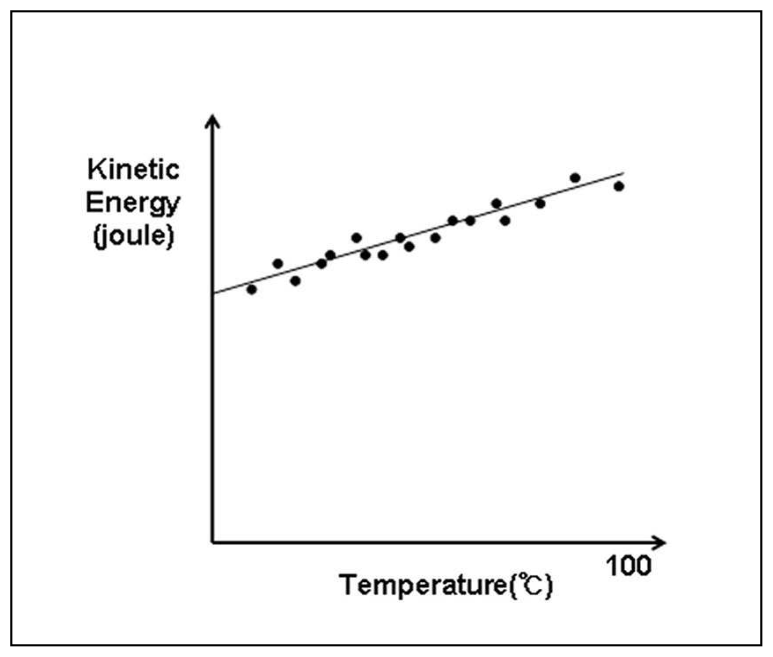
At thermal equlibrium, the average kinetic energy is the same irrespective of particle masses (equipartition theorem).
The specific heat capacity, at constant volume, of argon (atomic weight, 40) gas is \(0.31\ \mathrm{J\,g^{-1}\,K^{-1}}\).
1.2. Calculate Avogadro's number without using the ideal gas law, the gas constant, Boltzmann’s constant).
Official English text of the problem.
Answers
- 1.1: \(\boxed{\overline{E}_{\mathrm{k}}=6.5\times10^{-21}\ \mathrm{J}}\) per droplet.
- 1.2: \(\boxed{N_{\mathrm A}=5.7\times10^{23}\ \mathrm{mol^{-1}}}\).
Solution
1.1
The droplet radius and density in SI units are
\[ r=\frac{1.0\times10^{-6}}{2} =5.0\times10^{-7}\ \mathrm m, \qquad \rho=1.0\times10^3\ \mathrm{kg\,m^{-3}}. \]
Its mass is therefore
\[ m=\rho\frac{4\pi r^3}{3} =(1.0\times10^3)\frac{4\pi}{3}(5.0\times10^{-7})^3 =5.236\times10^{-16}\ \mathrm{kg}. \]
The root-mean-square speed is
\[ v_{\mathrm{rms}} =0.50\ \mathrm{cm\,s^{-1}} =5.0\times10^{-3}\ \mathrm{m\,s^{-1}}. \]
Since \(v_{\mathrm{rms}}^2=\langle v^2\rangle\), the average translational kinetic energy is
\[ \begin{aligned} \overline{E}_{\mathrm{k}} &=\frac12m\langle v^2\rangle =\frac12m v_{\mathrm{rms}}^2\\ &=\frac12(5.236\times10^{-16})(5.0\times10^{-3})^2\\ &=6.545\times10^{-21}\ \mathrm J. \end{aligned} \]
To two significant figures,
\[ \boxed{\overline{E}_{\mathrm{k}}=6.5\times10^{-21}\ \mathrm J}. \]
1.2
In the classical treatment used in this problem, the mean translational kinetic energy extrapolates to zero at absolute zero. Consequently, the stated linear temperature dependence has the form
\[ \overline{E}_{\mathrm{k}}=aT, \]
where \(T\) is the absolute temperature. At 27 °C,
\[ T_0=300.15\ \mathrm K, \]
so the energy increase per particle per kelvin is
\[ a=\frac{d\overline{E}_{\mathrm{k}}}{dT} =\frac{\overline{E}_{\mathrm{k}}(T_0)}{T_0} =\frac{6.545\times10^{-21}}{300.15} =2.181\times10^{-23}\ \mathrm{J\,K^{-1}}. \]
By the stated equipartition principle, an argon atom has the same average translational kinetic energy as a droplet at the same temperature. Thus the same value of \(a\) applies to each argon atom.
Argon is monatomic, so its thermal energy in this classical treatment is translational kinetic energy. At constant volume, the molar heat capacity is therefore
\[ C_{V,m} =\frac{dU_m}{dT} =N_{\mathrm A}\frac{d\overline{E}_{\mathrm{k}}}{dT} =N_{\mathrm A}a. \]
The supplied specific heat capacity gives
\[ C_{V,m} =(0.31\ \mathrm{J\,g^{-1}\,K^{-1}}) (40\ \mathrm{g\,mol^{-1}}) =12.4\ \mathrm{J\,mol^{-1}\,K^{-1}}. \]
Hence
\[ \begin{aligned} N_{\mathrm A} &=\frac{C_{V,m}}{a} =\frac{C_{V,m}T_0}{\overline{E}_{\mathrm{k}}(T_0)}\\ &=\frac{(12.4\ \mathrm{J\,mol^{-1}\,K^{-1}}) (300.15\ \mathrm K)} {6.545\times10^{-21}\ \mathrm J}\\ &=5.687\times10^{23}\ \mathrm{mol^{-1}}. \end{aligned} \]
To two significant figures,
\[ \boxed{N_{\mathrm A}=5.7\times10^{23}\ \mathrm{mol^{-1}}}. \]
The solution was checked against the official solution. Where this solution differs from the official solution, the official solution contains an error or a misprint.
IChO 2006 · Theorieaufgabe 1
Avogadro-Zahl
Kugelförmige Wassertröpfchen sind in Argongas dispergiert. Bei 27 °C hat jedes Tröpfchen einen Durchmesser von 1.0 Mikrometer und stößt mit Argonatomen zusammen. Nehmen Sie an, dass keine Zusammenstöße zwischen den Tröpfchen auftreten. Die quadratisch gemittelte Geschwindigkeit dieser Tröpfchen wurde bei 27 °C zu \(0.50\ \mathrm{cm\,s^{-1}}\) bestimmt. Die Dichte eines Wassertröpfchens beträgt \(1.0\ \mathrm{g\,cm^{-3}}\).
1.1 Berechnen Sie die mittlere kinetische Energie (\(mv^2/2\)) dieses Tröpfchens bei 27 °C. Das Volumen einer Kugel ist durch \((4/3)\,\pi\,r^3\) gegeben, wobei r der Radius ist.
Wenn sich die Temperatur ändert, ändern sich auch die Größe und die Geschwindigkeit des Tröpfchens. Die mittlere kinetische Energie eines Tröpfchens zwischen 0 °C und 100 °C erweist sich als lineare Funktion der Temperatur. Nehmen Sie an, dass diese Abhängigkeit auch unterhalb von 0 °C linear bleibt.
Im thermischen Gleichgewicht ist die mittlere kinetische Energie unabhängig von den Teilchenmassen gleich (Gleichverteilungssatz).
Die spezifische Wärmekapazität von Argongas (Atomgewicht 40) bei konstantem Volumen beträgt \(0.31\ \mathrm{J\,g^{-1}\,K^{-1}}\).
1.2. Berechnen Sie die Avogadro-Zahl, ohne das ideale Gasgesetz, die Gaskonstante oder die Boltzmann-Konstante zu verwenden.
Aufgabentext aus dem offiziellen englischen Text übersetzt.
Antworten
- 1.1: \(\boxed{\overline{E}_{\mathrm{k}}=6.5\times10^{-21}\ \mathrm{J}}\) pro Tröpfchen.
- 1.2: \(\boxed{N_{\mathrm A}=5.7\times10^{23}\ \mathrm{mol^{-1}}}\).
Lösung
1.1
Der Radius und die Dichte des Tröpfchens in SI-Einheiten sind
\[ r=\frac{1.0\times10^{-6}}{2} =5.0\times10^{-7}\ \mathrm m, \qquad \rho=1.0\times10^3\ \mathrm{kg\,m^{-3}}. \]
Seine Masse beträgt daher
\[ m=\rho\frac{4\pi r^3}{3} =(1.0\times10^3)\frac{4\pi}{3}(5.0\times10^{-7})^3 =5.236\times10^{-16}\ \mathrm{kg}. \]
Die quadratisch gemittelte Geschwindigkeit beträgt
\[ v_{\mathrm{rms}} =0.50\ \mathrm{cm\,s^{-1}} =5.0\times10^{-3}\ \mathrm{m\,s^{-1}}. \]
Da \(v_{\mathrm{rms}}^2=\langle v^2\rangle\) gilt, beträgt die mittlere kinetische Translationsenergie
\[ \begin{aligned} \overline{E}_{\mathrm{k}} &=\frac12m\langle v^2\rangle =\frac12m v_{\mathrm{rms}}^2\\ &=\frac12(5.236\times10^{-16})(5.0\times10^{-3})^2\\ &=6.545\times10^{-21}\ \mathrm J. \end{aligned} \]
Auf zwei signifikante Stellen gerundet ergibt sich
\[ \boxed{\overline{E}_{\mathrm{k}}=6.5\times10^{-21}\ \mathrm J}. \]
1.2
In der in dieser Aufgabe verwendeten klassischen Betrachtung ergibt die Extrapolation der mittleren kinetischen Translationsenergie am absoluten Nullpunkt den Wert null. Folglich hat die angegebene lineare Temperaturabhängigkeit die Form
\[ \overline{E}_{\mathrm{k}}=aT, \]
wobei \(T\) die absolute Temperatur ist. Bei 27 °C gilt
\[ T_0=300.15\ \mathrm K, \]
sodass sich für die Energiezunahme pro Teilchen und Kelvin ergibt:
\[ a=\frac{d\overline{E}_{\mathrm{k}}}{dT} =\frac{\overline{E}_{\mathrm{k}}(T_0)}{T_0} =\frac{6.545\times10^{-21}}{300.15} =2.181\times10^{-23}\ \mathrm{J\,K^{-1}}. \]
Nach dem angegebenen Gleichverteilungssatz hat ein Argonatom bei derselben Temperatur dieselbe mittlere kinetische Translationsenergie wie ein Tröpfchen. Somit gilt derselbe Wert von \(a\) für jedes Argonatom.
Argon ist einatomig, daher besteht seine thermische Energie in dieser klassischen Betrachtung aus kinetischer Translationsenergie. Bei konstantem Volumen ist die molare Wärmekapazität daher
\[ C_{V,m} =\frac{dU_m}{dT} =N_{\mathrm A}\frac{d\overline{E}_{\mathrm{k}}}{dT} =N_{\mathrm A}a. \]
Aus der angegebenen spezifischen Wärmekapazität ergibt sich
\[ C_{V,m} =(0.31\ \mathrm{J\,g^{-1}\,K^{-1}}) (40\ \mathrm{g\,mol^{-1}}) =12.4\ \mathrm{J\,mol^{-1}\,K^{-1}}. \]
Damit folgt
\[ \begin{aligned} N_{\mathrm A} &=\frac{C_{V,m}}{a} =\frac{C_{V,m}T_0}{\overline{E}_{\mathrm{k}}(T_0)}\\ &=\frac{(12.4\ \mathrm{J\,mol^{-1}\,K^{-1}}) (300.15\ \mathrm K)} {6.545\times10^{-21}\ \mathrm J}\\ &=5.687\times10^{23}\ \mathrm{mol^{-1}}. \end{aligned} \]
Auf zwei signifikante Stellen gerundet ergibt sich
\[ \boxed{N_{\mathrm A}=5.7\times10^{23}\ \mathrm{mol^{-1}}}. \]
Die Lösung wurde mit der offiziellen Lösung abgeglichen. Wo diese Lösung von der offiziellen Lösung abweicht, enthält die offizielle Lösung einen Fehler oder Druckfehler.
IChO 2006 · Teori sorusu 1
Avogadro sayısı
Küresel su damlacıkları argon gazı içinde dağılmıştır. 27 °C'de her bir damlacığın çapı 1.0 mikrometredir ve damlacıklar argon atomlarıyla çarpışmaktadır. Damlacıkların birbirleriyle çarpışmadığını varsayın. Bu damlacıkların karekök ortalama kare hızının 27 °C'de \(0.50\ \mathrm{cm\,s^{-1}}\) olduğu belirlenmiştir. Bir su damlacığının yoğunluğu \(1.0\ \mathrm{g\,cm^{-3}}\)'tür.
1.1 Bu damlacığın 27 °C'deki ortalama kinetik enerjisini (\(mv^2/2\)) hesaplayın. Bir kürenin hacmi, r yarıçap olmak üzere, \((4/3)\,\pi\,r^3\) ile verilir.
Sıcaklık değiştirilirse damlacığın boyutu ve hızı da değişir. Bir damlacığın 0 °C ile 100 °C arasındaki ortalama kinetik enerjisinin sıcaklığın doğrusal bir fonksiyonu olduğu bulunmuştur. Bu ilişkinin 0 °C'nin altında da doğrusal kaldığını varsayın.
Isıl dengede, taneciklerin kütlelerinden bağımsız olarak ortalama kinetik enerji aynıdır (enerjinin eşit paylaşımı teoremi).
Argon gazının (atom ağırlığı, 40) sabit hacimdeki özgül ısı kapasitesi \(0.31\ \mathrm{J\,g^{-1}\,K^{-1}}\)'dir.
1.2. İdeal gaz yasasını, gaz sabitini ve Boltzmann sabitini kullanmadan Avogadro sayısını hesaplayın.
Soru metni resmi İngilizce metinden çevrilmiştir.
Cevaplar
- 1.1: Damlacık başına \(\boxed{\overline{E}_{\mathrm{k}}=6.5\times10^{-21}\ \mathrm{J}}\).
- 1.2: \(\boxed{N_{\mathrm A}=5.7\times10^{23}\ \mathrm{mol^{-1}}}\).
Çözüm
1.1
Damlacığın SI birimleriyle yarıçapı ve yoğunluğu şöyledir:
\[ r=\frac{1.0\times10^{-6}}{2} =5.0\times10^{-7}\ \mathrm m, \qquad \rho=1.0\times10^3\ \mathrm{kg\,m^{-3}}. \]
Dolayısıyla kütlesi
\[ m=\rho\frac{4\pi r^3}{3} =(1.0\times10^3)\frac{4\pi}{3}(5.0\times10^{-7})^3 =5.236\times10^{-16}\ \mathrm{kg}. \]
Karekök ortalama kare hızı
\[ v_{\mathrm{rms}} =0.50\ \mathrm{cm\,s^{-1}} =5.0\times10^{-3}\ \mathrm{m\,s^{-1}}. \]
\(v_{\mathrm{rms}}^2=\langle v^2\rangle\) olduğundan, ortalama öteleme kinetik enerjisi
\[ \begin{aligned} \overline{E}_{\mathrm{k}} &=\frac12m\langle v^2\rangle =\frac12m v_{\mathrm{rms}}^2\\ &=\frac12(5.236\times10^{-16})(5.0\times10^{-3})^2\\ &=6.545\times10^{-21}\ \mathrm J. \end{aligned} \]
İki anlamlı basamakla,
\[ \boxed{\overline{E}_{\mathrm{k}}=6.5\times10^{-21}\ \mathrm J}. \]
1.2
Bu soruda kullanılan klasik yaklaşımda, ortalama öteleme kinetik enerjisi mutlak sıfıra ekstrapole edildiğinde sıfır olur. Dolayısıyla, belirtilen doğrusal sıcaklık bağımlılığı şu biçimdedir:
\[ \overline{E}_{\mathrm{k}}=aT, \]
Burada \(T\) mutlak sıcaklıktır. 27 °C'de,
\[ T_0=300.15\ \mathrm K, \]
olduğundan, tanecik başına ve kelvin başına enerji artışı
\[ a=\frac{d\overline{E}_{\mathrm{k}}}{dT} =\frac{\overline{E}_{\mathrm{k}}(T_0)}{T_0} =\frac{6.545\times10^{-21}}{300.15} =2.181\times10^{-23}\ \mathrm{J\,K^{-1}}. \]
Belirtilen enerjinin eşit paylaşımı ilkesine göre, bir argon atomu aynı sıcaklıktaki bir damlacıkla aynı ortalama öteleme kinetik enerjisine sahiptir. Bu nedenle aynı \(a\) değeri her bir argon atomu için de geçerlidir.
Argon tek atomlu olduğundan, bu klasik yaklaşımda ısıl enerjisi öteleme kinetik enerjisidir. Dolayısıyla sabit hacimdeki molar ısı kapasitesi
\[ C_{V,m} =\frac{dU_m}{dT} =N_{\mathrm A}\frac{d\overline{E}_{\mathrm{k}}}{dT} =N_{\mathrm A}a. \]
Verilen özgül ısı kapasitesinden
\[ C_{V,m} =(0.31\ \mathrm{J\,g^{-1}\,K^{-1}}) (40\ \mathrm{g\,mol^{-1}}) =12.4\ \mathrm{J\,mol^{-1}\,K^{-1}}. \]
Böylece
\[ \begin{aligned} N_{\mathrm A} &=\frac{C_{V,m}}{a} =\frac{C_{V,m}T_0}{\overline{E}_{\mathrm{k}}(T_0)}\\ &=\frac{(12.4\ \mathrm{J\,mol^{-1}\,K^{-1}}) (300.15\ \mathrm K)} {6.545\times10^{-21}\ \mathrm J}\\ &=5.687\times10^{23}\ \mathrm{mol^{-1}}. \end{aligned} \]
İki anlamlı basamakla,
\[ \boxed{N_{\mathrm A}=5.7\times10^{23}\ \mathrm{mol^{-1}}}. \]
Çözüm, resmi çözümle karşılaştırılarak kontrol edildi. Bu çözümün resmi çözümden ayrıldığı yerlerde resmi çözümde bir hata ya da baskı hatası vardır.
IChO 2006 · Problema teórico 1
El número de Avogadro
Se dispersan gotas esféricas de agua en argón gaseoso. A 27 °C, cada gota tiene un diámetro de 1.0 micrómetro y experimenta colisiones con el argón. Suponga que no se producen colisiones entre las gotas. Se determinó que la velocidad cuadrática media de estas gotas era de \(0.50\ \mathrm{cm\,s^{-1}}\) a 27 °C. La densidad de una gota de agua es de \(1.0\ \mathrm{g\,cm^{-3}}\).
1.1 Calcule la energía cinética media (\(mv^2/2\)) de esta gota a 27 °C. El volumen de una esfera viene dado por \((4/3)\,\pi\,r^3\), donde r es el radio.
Si se modifica la temperatura, también cambiarán el tamaño y la velocidad de la gota. Se observa que la energía cinética media de una gota entre 0 °C y 100 °C es una función lineal de la temperatura. Suponga que sigue siendo lineal por debajo de 0 °C.
En el equilibrio térmico, la energía cinética media es la misma independientemente de las masas de las partículas (teorema de equipartición).
La capacidad calorífica específica a volumen constante del argón gaseoso (peso atómico, 40) es de \(0.31\ \mathrm{J\,g^{-1}\,K^{-1}}\).
1.2. Calcule el número de Avogadro sin utilizar la ley de los gases ideales, la constante de los gases ni la constante de Boltzmann.
Enunciado traducido del texto oficial en inglés.
Respuestas
- 1.1: \(\boxed{\overline{E}_{\mathrm{k}}=6.5\times10^{-21}\ \mathrm{J}}\) por gota.
- 1.2: \(\boxed{N_{\mathrm A}=5.7\times10^{23}\ \mathrm{mol^{-1}}}\).
Solución
1.1
El radio y la densidad de la gota en unidades del SI son
\[ r=\frac{1.0\times10^{-6}}{2} =5.0\times10^{-7}\ \mathrm m, \qquad \rho=1.0\times10^3\ \mathrm{kg\,m^{-3}}. \]
Por tanto, su masa es
\[ m=\rho\frac{4\pi r^3}{3} =(1.0\times10^3)\frac{4\pi}{3}(5.0\times10^{-7})^3 =5.236\times10^{-16}\ \mathrm{kg}. \]
La velocidad cuadrática media es
\[ v_{\mathrm{rms}} =0.50\ \mathrm{cm\,s^{-1}} =5.0\times10^{-3}\ \mathrm{m\,s^{-1}}. \]
Dado que \(v_{\mathrm{rms}}^2=\langle v^2\rangle\), la energía cinética media de traslación es
\[ \begin{aligned} \overline{E}_{\mathrm{k}} &=\frac12m\langle v^2\rangle =\frac12m v_{\mathrm{rms}}^2\\ &=\frac12(5.236\times10^{-16})(5.0\times10^{-3})^2\\ &=6.545\times10^{-21}\ \mathrm J. \end{aligned} \]
Con dos cifras significativas,
\[ \boxed{\overline{E}_{\mathrm{k}}=6.5\times10^{-21}\ \mathrm J}. \]
1.2
En el tratamiento clásico utilizado en este problema, la energía cinética media de traslación se extrapola a cero en el cero absoluto. Por consiguiente, la dependencia lineal de la temperatura indicada tiene la forma
\[ \overline{E}_{\mathrm{k}}=aT, \]
donde \(T\) es la temperatura absoluta. A 27 °C,
\[ T_0=300.15\ \mathrm K, \]
por lo que el incremento de energía por partícula y por kelvin es
\[ a=\frac{d\overline{E}_{\mathrm{k}}}{dT} =\frac{\overline{E}_{\mathrm{k}}(T_0)}{T_0} =\frac{6.545\times10^{-21}}{300.15} =2.181\times10^{-23}\ \mathrm{J\,K^{-1}}. \]
Según el principio de equipartición enunciado, un átomo de argón tiene la misma energía cinética media de traslación que una gota a la misma temperatura. Por tanto, el mismo valor de \(a\) se aplica a cada átomo de argón.
El argón es monoatómico, por lo que su energía térmica en este tratamiento clásico es energía cinética de traslación. A volumen constante, la capacidad calorífica molar es, por tanto,
\[ C_{V,m} =\frac{dU_m}{dT} =N_{\mathrm A}\frac{d\overline{E}_{\mathrm{k}}}{dT} =N_{\mathrm A}a. \]
La capacidad calorífica específica proporcionada da
\[ C_{V,m} =(0.31\ \mathrm{J\,g^{-1}\,K^{-1}}) (40\ \mathrm{g\,mol^{-1}}) =12.4\ \mathrm{J\,mol^{-1}\,K^{-1}}. \]
Por lo tanto,
\[ \begin{aligned} N_{\mathrm A} &=\frac{C_{V,m}}{a} =\frac{C_{V,m}T_0}{\overline{E}_{\mathrm{k}}(T_0)}\\ &=\frac{(12.4\ \mathrm{J\,mol^{-1}\,K^{-1}}) (300.15\ \mathrm K)} {6.545\times10^{-21}\ \mathrm J}\\ &=5.687\times10^{23}\ \mathrm{mol^{-1}}. \end{aligned} \]
Con dos cifras significativas,
\[ \boxed{N_{\mathrm A}=5.7\times10^{23}\ \mathrm{mol^{-1}}}. \]
La solución se comprobó con la solución oficial. Donde esta solución difiere de la solución oficial, la solución oficial contiene un error o una errata.
IChO 2006 · 理论题 1
阿伏伽德罗常数
球形水滴分散在氩气中。在 27 °C 时,每个水滴的直径为 1.0 微米,并与氩原子发生碰撞。假设水滴之间不发生碰撞。测得这些水滴在 27 °C 时的均方根速率为 \(0.50\ \mathrm{cm\,s^{-1}}\)。水滴的密度为 \(1.0\ \mathrm{g\,cm^{-3}}\)。
1.1 计算该水滴在 27 °C 时的平均动能(\(mv^2/2\))。球的体积为 \((4/3)\,\pi\,r^3\),其中 r 为半径。
如果温度发生变化,水滴的大小和速率也会改变。实验发现,在 0 °C 至 100 °C 之间,水滴的平均动能随温度呈线性变化。假设在 0 °C 以下仍保持这一线性关系。
在热平衡状态下,无论粒子的质量如何,其平均动能均相同(能量均分定理)。
氩气(原子量为 40)的定容比热容为 \(0.31\ \mathrm{J\,g^{-1}\,K^{-1}}\)。
1.2. 在不使用理想气体定律、气体常数和玻尔兹曼常数的情况下,计算阿伏伽德罗常数。
题目译自官方英文原文。
答案
- 1.1: 每个水滴的平均动能为 \(\boxed{\overline{E}_{\mathrm{k}}=6.5\times10^{-21}\ \mathrm{J}}\)。
- 1.2: \(\boxed{N_{\mathrm A}=5.7\times10^{23}\ \mathrm{mol^{-1}}}\)。
解答
1.1
以国际单位制表示的水滴半径和密度为
\[ r=\frac{1.0\times10^{-6}}{2} =5.0\times10^{-7}\ \mathrm m, \qquad \rho=1.0\times10^3\ \mathrm{kg\,m^{-3}}. \]
因此,水滴的质量为
\[ m=\rho\frac{4\pi r^3}{3} =(1.0\times10^3)\frac{4\pi}{3}(5.0\times10^{-7})^3 =5.236\times10^{-16}\ \mathrm{kg}. \]
均方根速率为
\[ v_{\mathrm{rms}} =0.50\ \mathrm{cm\,s^{-1}} =5.0\times10^{-3}\ \mathrm{m\,s^{-1}}. \]
由于 \(v_{\mathrm{rms}}^2=\langle v^2\rangle\),平均平动动能为
\[ \begin{aligned} \overline{E}_{\mathrm{k}} &=\frac12m\langle v^2\rangle =\frac12m v_{\mathrm{rms}}^2\\ &=\frac12(5.236\times10^{-16})(5.0\times10^{-3})^2\\ &=6.545\times10^{-21}\ \mathrm J. \end{aligned} \]
保留两位有效数字,得
\[ \boxed{\overline{E}_{\mathrm{k}}=6.5\times10^{-21}\ \mathrm J}. \]
1.2
在本题采用的经典理论处理中,平均平动动能外推至绝对零度时为零。因此,题目所述的动能与温度的线性关系具有如下形式:
\[ \overline{E}_{\mathrm{k}}=aT, \]
其中 \(T\) 为绝对温度。在 27 °C 时,
\[ T_0=300.15\ \mathrm K, \]
因此,温度每升高一开尔文,每个粒子的能量增量为
\[ a=\frac{d\overline{E}_{\mathrm{k}}}{dT} =\frac{\overline{E}_{\mathrm{k}}(T_0)}{T_0} =\frac{6.545\times10^{-21}}{300.15} =2.181\times10^{-23}\ \mathrm{J\,K^{-1}}. \]
根据题目给出的能量均分原理,在相同温度下,氩原子与水滴具有相同的平均平动动能。因此,同一个 \(a\) 值也适用于每个氩原子。
氩是单原子气体,因此在这一经典理论处理中,其热能就是平动动能。所以,在恒定体积下,摩尔热容为
\[ C_{V,m} =\frac{dU_m}{dT} =N_{\mathrm A}\frac{d\overline{E}_{\mathrm{k}}}{dT} =N_{\mathrm A}a. \]
由题目给出的比热容可得
\[ C_{V,m} =(0.31\ \mathrm{J\,g^{-1}\,K^{-1}}) (40\ \mathrm{g\,mol^{-1}}) =12.4\ \mathrm{J\,mol^{-1}\,K^{-1}}. \]
因此,
\[ \begin{aligned} N_{\mathrm A} &=\frac{C_{V,m}}{a} =\frac{C_{V,m}T_0}{\overline{E}_{\mathrm{k}}(T_0)}\\ &=\frac{(12.4\ \mathrm{J\,mol^{-1}\,K^{-1}}) (300.15\ \mathrm K)} {6.545\times10^{-21}\ \mathrm J}\\ &=5.687\times10^{23}\ \mathrm{mol^{-1}}. \end{aligned} \]
保留两位有效数字,得
\[ \boxed{N_{\mathrm A}=5.7\times10^{23}\ \mathrm{mol^{-1}}}. \]
解答已与官方解答核对。本解答与官方解答不同之处,均为官方解答中的错误或印刷错误。
IChO 2006 · Теоретическая задача 1
Число Авогадро
Сферические капли воды диспергированы в газообразном аргоне. При 27 °C каждая капля имеет диаметр 1.0 микрометра и испытывает столкновения с атомами аргона. Считайте, что столкновения между каплями не происходят. Установлено, что среднеквадратичная скорость этих капель при 27 °C составляет \(0.50\ \mathrm{cm\,s^{-1}}\). Плотность капли воды равна \(1.0\ \mathrm{g\,cm^{-3}}\).
1.1 Рассчитайте среднюю кинетическую энергию (\(mv^2/2\)) этой капли при 27 °C. Объём шара определяется выражением \((4/3)\,\pi\,r^3\), где r — радиус.
При изменении температуры размер капли и её скорость также изменяются. Установлено, что в интервале от 0 °C до 100 °C средняя кинетическая энергия капли линейно зависит от температуры. Считайте, что эта зависимость остаётся линейной и ниже 0 °C.
При тепловом равновесии средняя кинетическая энергия одинакова независимо от массы частиц (теорема о равнораспределении энергии).
Удельная теплоёмкость газообразного аргона (атомная масса 40) при постоянном объёме составляет \(0.31\ \mathrm{J\,g^{-1}\,K^{-1}}\).
1.2. Рассчитайте число Авогадро, не используя уравнение состояния идеального газа, универсальную газовую постоянную и постоянную Больцмана.
Условие переведено с официального английского текста.
Ответы
- 1.1: \(\boxed{\overline{E}_{\mathrm{k}}=6.5\times10^{-21}\ \mathrm{J}}\) на одну каплю.
- 1.2: \(\boxed{N_{\mathrm A}=5.7\times10^{23}\ \mathrm{mol^{-1}}}\).
Решение
1.1
Радиус капли и её плотность в единицах СИ равны
\[ r=\frac{1.0\times10^{-6}}{2} =5.0\times10^{-7}\ \mathrm m, \qquad \rho=1.0\times10^3\ \mathrm{kg\,m^{-3}}. \]
Следовательно, её масса составляет
\[ m=\rho\frac{4\pi r^3}{3} =(1.0\times10^3)\frac{4\pi}{3}(5.0\times10^{-7})^3 =5.236\times10^{-16}\ \mathrm{kg}. \]
Среднеквадратичная скорость равна
\[ v_{\mathrm{rms}} =0.50\ \mathrm{cm\,s^{-1}} =5.0\times10^{-3}\ \mathrm{m\,s^{-1}}. \]
Поскольку \(v_{\mathrm{rms}}^2=\langle v^2\rangle\), средняя кинетическая энергия поступательного движения равна
\[ \begin{aligned} \overline{E}_{\mathrm{k}} &=\frac12m\langle v^2\rangle =\frac12m v_{\mathrm{rms}}^2\\ &=\frac12(5.236\times10^{-16})(5.0\times10^{-3})^2\\ &=6.545\times10^{-21}\ \mathrm J. \end{aligned} \]
Округляя до двух значащих цифр, получаем
\[ \boxed{\overline{E}_{\mathrm{k}}=6.5\times10^{-21}\ \mathrm J}. \]
1.2
В рамках классического подхода, используемого в этой задаче, при экстраполяции к абсолютному нулю средняя кинетическая энергия поступательного движения обращается в нуль. Следовательно, указанная линейная зависимость от температуры имеет вид
\[ \overline{E}_{\mathrm{k}}=aT, \]
где \(T\) — абсолютная температура. При 27 °C
\[ T_0=300.15\ \mathrm K, \]
поэтому прирост энергии одной частицы на один кельвин составляет
\[ a=\frac{d\overline{E}_{\mathrm{k}}}{dT} =\frac{\overline{E}_{\mathrm{k}}(T_0)}{T_0} =\frac{6.545\times10^{-21}}{300.15} =2.181\times10^{-23}\ \mathrm{J\,K^{-1}}. \]
Согласно указанному принципу равнораспределения энергии, средняя кинетическая энергия поступательного движения атома аргона такая же, как у капли при той же температуре. Таким образом, то же значение \(a\) справедливо для каждого атома аргона.
Аргон — одноатомный газ, поэтому в рамках этого классического подхода его тепловая энергия представляет собой кинетическую энергию поступательного движения. Следовательно, молярная теплоёмкость при постоянном объёме равна
\[ C_{V,m} =\frac{dU_m}{dT} =N_{\mathrm A}\frac{d\overline{E}_{\mathrm{k}}}{dT} =N_{\mathrm A}a. \]
Из заданного значения удельной теплоёмкости получаем
\[ C_{V,m} =(0.31\ \mathrm{J\,g^{-1}\,K^{-1}}) (40\ \mathrm{g\,mol^{-1}}) =12.4\ \mathrm{J\,mol^{-1}\,K^{-1}}. \]
Отсюда
\[ \begin{aligned} N_{\mathrm A} &=\frac{C_{V,m}}{a} =\frac{C_{V,m}T_0}{\overline{E}_{\mathrm{k}}(T_0)}\\ &=\frac{(12.4\ \mathrm{J\,mol^{-1}\,K^{-1}}) (300.15\ \mathrm K)} {6.545\times10^{-21}\ \mathrm J}\\ &=5.687\times10^{23}\ \mathrm{mol^{-1}}. \end{aligned} \]
Округляя до двух значащих цифр, получаем
\[ \boxed{N_{\mathrm A}=5.7\times10^{23}\ \mathrm{mol^{-1}}}. \]
Решение проверено по официальному решению. Там, где это решение расходится с официальным, в официальном решении есть ошибка или опечатка.
IChO 2006 · مسألة نظرية 1
عدد أفوغادرو
تنتشر قطيرات ماء كروية في غاز الأرجون. عند 27 °C، يبلغ قطر كل قطيرة 1.0 ميكرومتر، وتتعرض لتصادمات مع ذرات الأرجون. افترض أن التصادمات بين القطيرات لا تحدث. وُجد أن الجذر التربيعي لمتوسط مربع سرعة هذه القطيرات يساوي \(0.50\ \mathrm{cm\,s^{-1}}\) عند 27 °C. وتبلغ كثافة قطيرة الماء \(1.0\ \mathrm{g\,cm^{-3}}\).
1.1 احسب متوسط الطاقة الحركية (\(mv^2/2\)) لهذه القطيرة عند 27 °C. يُعطى حجم الكرة بالعلاقة \((4/3)\,\pi\,r^3\)، حيث r هو نصف القطر.
إذا تغيرت درجة الحرارة، فسيتغير أيضًا حجم القطيرة وسرعتها. وقد وُجد أن متوسط الطاقة الحركية للقطيرة بين 0 °C و100 °C يتغير خطيًا بدلالة درجة الحرارة. افترض أن هذه العلاقة تبقى خطية تحت 0 °C.
عند الاتزان الحراري، يكون متوسط الطاقة الحركية متساويًا بغض النظر عن كتل الجسيمات (مبرهنة التوزيع المتساوي للطاقة).
تبلغ السعة الحرارية النوعية عند حجم ثابت لغاز الأرجون (وزنه الذري 40) \(0.31\ \mathrm{J\,g^{-1}\,K^{-1}}\).
1.2. احسب عدد أفوغادرو دون استخدام قانون الغاز المثالي أو ثابت الغازات أو ثابت بولتزمان.
نص المسألة مترجم عن النص الإنجليزي الرسمي.
الإجابات
- 1.1: \(\boxed{\overline{E}_{\mathrm{k}}=6.5\times10^{-21}\ \mathrm{J}}\) لكل قطيرة.
- 1.2: \(\boxed{N_{\mathrm A}=5.7\times10^{23}\ \mathrm{mol^{-1}}}\).
الحل
1.1
نصف قطر القطيرة وكثافتها بوحدات النظام الدولي هما
\[ r=\frac{1.0\times10^{-6}}{2} =5.0\times10^{-7}\ \mathrm m, \qquad \rho=1.0\times10^3\ \mathrm{kg\,m^{-3}}. \]
ومن ثم فإن كتلتها هي
\[ m=\rho\frac{4\pi r^3}{3} =(1.0\times10^3)\frac{4\pi}{3}(5.0\times10^{-7})^3 =5.236\times10^{-16}\ \mathrm{kg}. \]
الجذر التربيعي لمتوسط مربع السرعة هو
\[ v_{\mathrm{rms}} =0.50\ \mathrm{cm\,s^{-1}} =5.0\times10^{-3}\ \mathrm{m\,s^{-1}}. \]
بما أن \(v_{\mathrm{rms}}^2=\langle v^2\rangle\)، فإن متوسط الطاقة الحركية الانتقالية هو
\[ \begin{aligned} \overline{E}_{\mathrm{k}} &=\frac12m\langle v^2\rangle =\frac12m v_{\mathrm{rms}}^2\\ &=\frac12(5.236\times10^{-16})(5.0\times10^{-3})^2\\ &=6.545\times10^{-21}\ \mathrm J. \end{aligned} \]
بالتقريب إلى رقمين معنويين،
\[ \boxed{\overline{E}_{\mathrm{k}}=6.5\times10^{-21}\ \mathrm J}. \]
1.2
في المعالجة الكلاسيكية المستخدمة في هذه المسألة، يصل متوسط الطاقة الحركية الانتقالية بالاستقراء إلى الصفر عند الصفر المطلق. وبناءً على ذلك، تأخذ العلاقة الخطية المذكورة مع درجة الحرارة الصورة
\[ \overline{E}_{\mathrm{k}}=aT, \]
حيث \(T\) هي درجة الحرارة المطلقة. عند 27 °C،
\[ T_0=300.15\ \mathrm K, \]
ومن ثم فإن الزيادة في الطاقة لكل جسيم لكل كلفن هي
\[ a=\frac{d\overline{E}_{\mathrm{k}}}{dT} =\frac{\overline{E}_{\mathrm{k}}(T_0)}{T_0} =\frac{6.545\times10^{-21}}{300.15} =2.181\times10^{-23}\ \mathrm{J\,K^{-1}}. \]
وفقًا لمبدأ التوزيع المتساوي للطاقة المذكور، يكون متوسط الطاقة الحركية الانتقالية لذرة الأرجون مساويًا لمتوسط الطاقة الحركية الانتقالية لقطيرة عند درجة الحرارة نفسها. لذا تنطبق قيمة \(a\) نفسها على كل ذرة أرجون.
الأرجون غاز أحادي الذرة، لذا فإن طاقته الحرارية في هذه المعالجة الكلاسيكية هي طاقة حركية انتقالية. وعند حجم ثابت، تكون السعة الحرارية المولية بالتالي
\[ C_{V,m} =\frac{dU_m}{dT} =N_{\mathrm A}\frac{d\overline{E}_{\mathrm{k}}}{dT} =N_{\mathrm A}a. \]
من السعة الحرارية النوعية المعطاة نحصل على
\[ C_{V,m} =(0.31\ \mathrm{J\,g^{-1}\,K^{-1}}) (40\ \mathrm{g\,mol^{-1}}) =12.4\ \mathrm{J\,mol^{-1}\,K^{-1}}. \]
ومن ثم
\[ \begin{aligned} N_{\mathrm A} &=\frac{C_{V,m}}{a} =\frac{C_{V,m}T_0}{\overline{E}_{\mathrm{k}}(T_0)}\\ &=\frac{(12.4\ \mathrm{J\,mol^{-1}\,K^{-1}}) (300.15\ \mathrm K)} {6.545\times10^{-21}\ \mathrm J}\\ &=5.687\times10^{23}\ \mathrm{mol^{-1}}. \end{aligned} \]
بالتقريب إلى رقمين معنويين،
\[ \boxed{N_{\mathrm A}=5.7\times10^{23}\ \mathrm{mol^{-1}}}. \]
تمت مراجعة الحل بمقارنته بالحل الرسمي. حيثما يختلف هذا الحل عن الحل الرسمي، يحتوي الحل الرسمي على خطأ أو خطأ مطبعي.